the guide FRIDAY, MARCH 27, 2015
E U S S I SEX DANIEL SMITH/THE HOYA
FEATURE
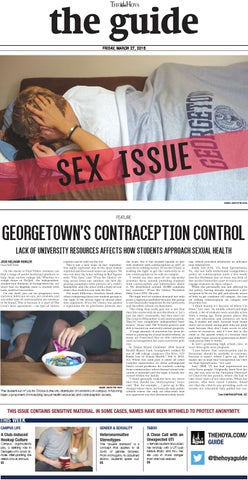
gEORGETOWN’S cONTRACEPTION cONTROL lack of university resources affects how students approach sexual health JESS KELHAM-HOHLER Hoya Staff Writer
On the stacks at Vital Vittles, students can find a range of useful medicinal products to help them survive college life. Whether it’s cough drops or NyQuil, the independent, student-run Students of Georgetown Inc. ensures that its flagship store is stocked with basic medical necessities. On one shelf, you can see pregnancy tests and even lubricant on sale, yet condoms and any other type of contraception are nowhere to be found. This is because it is part of The Corp’s lease agreement — no type of contra-
ception can be sold on the site. This is not a new issue. In fact, reproductive rights represent one of the most widely reported and discussed issues on campus. No one can miss the tense tabling in Red Square with “Vita Saxa” and “H*yas for Choice” sitting across from one another, the first displaying pamphlets with pictures of a child’s handprint, and the other with a bowl of condoms that students can take for free. The main difference students think about when comparing these two student groups is the right to life versus right to choose abortion argument. H*yas for Choice has gained a reputation for its pro-choice protests over
DANIEL SMITH/THE HOYA
The student-run H*yas for Choice is the only distributor of condoms on campus. It has long been a proponent of increasing sexual health resources and contraception access.
the years, but it has worked equally to provide students with contraceptives as well, as seen by its tabling tactics. H*yas for Choice is leading the fight to get the university to allow contraception to be sold on campus. “I would say that most of our day-to-day activities focus around providing students with contraception and information about it. We distributed around 10,000 condoms last semester,” H*yas for Choice President Abby Grace (SFS ’16) said. The high level of student demand not only poses a logistical problem because the group is not financially supported by the university and therefore reliant on donations. “The thing that really gets me is not that they [the university] do not distribute it. Let’s just say that’s reasonable, but they don’t let The Corp or [Wisemiller’s] sell contraception. They’re two completely independent businesses,” Grace said. The N Street grocery and deli is located on university-owned property. A large amount of attention has been devoted to pushing for sexual health reform, as many are frustrated that an elite university such as Georgetown has such restrictive policies. In Trojan Brand Condoms’ 2014 Sexual Health Report Card, Georgetown ranked 93 out of 140 college campuses (THE HOYA, “GU Ranks Low in Sexual Health,” Feb. 6, 2015, A1). While this rank puts it above all other Catholic universities, its often self-imposed limits create problems for students coming from communities where formal sexual education is minimal and the topic is barely discussed within the family. “I think generally students here are aware that they should use contraception,” Grace said. “But, for example … I grew up in Mississippi where there are basically only public schools where the only sex education that was approved was this abstinence-only teach-
ing, which provided absolutely no information whatsoever. Emily Lett (COL ’17), from Spotsylvania, Va., did not fully understand Georgetown’s policy on contraception until a few weeks into her freshman year, as there was little effort on the University’s part to reach out and engage students on these subject. While she personally was not affected by the policy, having already organized a prescription to be on the pill and already aware of how to get condoms off campus, the ban on selling contraception on campus still frustrates her. “I think mainly it’s because of where I’m from,” Lett said. “In middle school and high school, a lot of students were sexually active from a young age. From poorer places like that, sex education and resources are lacking. It makes me mad, because back home there are so many young girls who are pregnant because they don’t have access to education or resources, and it’s not fair to the child or the parent when it’s because they just didn’t have access to protection or didn’t understand how it works.” In Lett’s graduating high school class, at least three girls were pregnant. “I just believe that contraception and information should be available to everyone, because it wasn’t where I grew up. And it makes me so mad that Georgetown isn’t better than Spotsylvania,” Lett said. Amy* (MSB ’17) has had unprotected sex with three people. Originally from New Jersey, she was sent to the Unitarian Universalist Church by her parents, where she had to take three years of sex education. When her parents, who were raised Catholic, found out that the church was providing such extensive sex education they pulled her out. See CONTRACEPTION, B2
THIS ISSUE CONTAINS SENSITIVE MATERIAL. IN SOME CASES, NAMES HAVE BEEN WITHHELD TO PROTECT ANONYMITY.
THIS WEEK CAMPUS LIFE
GENDER & SEXUALITY
TABOO
A Club-Induced Hookup Culture
Heteronormative Stereotypes
A Close Call with an Unexpected UTI
Campus organizations play a defining role in Georgetown’s social climate, often planting the seeds of love and lust. B3
The “double standard” is a concept that applies to all sorts of gender binaries. From monogamy to assumed libidos, students speak out. B5
A female student discusses her mishap with a UTI just before finals, and how her life was in more danger than she had realized. B9
THEHOYA.COM/ GUIDE @thehoyaguide
B2
the guide
THE HOYA
FRIDAY, MARCH 27, 2015
FAILED sTUDENT perceptions of sexual health FORAYS FEATURE
CONTRACEPTION, from B1
“It involves a shoe box, a box of nerds and lots of orange juice, that’s all I am saying,” Jack Hoya (COL ’18) “Pulling my hamstring mid-deed and jumping out and off the bed with a high-pitched yell,” Jack Hoya (SFS ’18) “My boyfriend accidentally set off his car alarm, but we couldn’t find his keys. By the time the cop pulled up we’d found them, but we couldn’t explain why we were both naked,” Jane Hoya (COL ’17) “Getting a scar from a blanket burn while having sex,” Jack Hoya (NHS ’18) “I was engaged in a post-Club Lau hookup freshman year when I realized that my upper lip was really damp. I figured the guy I was making out with was just a really slobbery kisser. Nope — I had gotten a nosebleed, and it was all over both of our faces,” Jane Hoya (SFS ’17) “‘Stick your tongue in or around my ear,’ he whispered sensually,” Jack Hoya (COL ’16)
Now, she is not on the pill mainly because she cannot get it on campus and cannot easily find the information here to understand how to get it. “The first time [I had unprotected sex] was with one of my best friends, and the reason was because we were in the MSB [building],” Amy said. “That was last year. Then the second was with a guy I was seeing over summer back home. He never even pretended like using protection was an option. He came from a very poor area, so I don’t know if it came from that, or [it was] just … his thing. The third was like the first — I had to ask him every time to use protection, and then one time, in the heat of the moment we didn’t. After that, I guess he just expected that we wouldn’t, so it didn’t come up again.” Director of Health Education Services Carol Day explains where the lack of understanding about contraceptive policies occurs. “I think students know that they cannot get contraceptive pills that are primarily for birth control at the Student Health Center, but too few students know that they can get pills for medical reasons,” she said. Joe* (SFS ’17), who admits that he has unprotected sex fairly frequently, explains that if the girl is on the pill, they will tend to mutually choose to not use condoms. “Normally the first time with someone I use a condom,” Smith said. “If we choose to have sex again after that, then I get checked out, and if there are no issues, and she is on the pill, then there are no major health reasons to use condoms.” Joe also explained that when it comes to deciding who should proDANIEL SMITH/THE HOYA vide the contraception, he believes Without easy access to contraceptives, many people simply choose not to use the proper safeguards. Some take the responsibility should be equally time to be tested at a local clinic before each new partner, while others are willing to have unprotected sex regardless. divided. “I would think in the minds “When I went on birth control what to do. I told him the doctor said against sexually transmitted infecof women here, they believe that men should be prepared as an in ninth grade, it changed my hor- it was normal, but he was still very tions, one of the most serious dangers of unprotected sex. adult,” he said. “However, I think in mones. And I was a teenager, so we shocked by it,” Lett said. Although she knew that the Evans explains that a false sense of the minds of men, they bring it in were all pretty emotional already. anticipation that a woman will be on So I already had mood swings, and change in pill would affect her mood invincibility contributed to her decianother form of contraception, too.” so I didn’t notice the change on my and have such side effects, Lett was sion to have unprotected sex, but recAside from condoms, the other mood for four years,” she said. “At still surprised by the extent her per- ognizes the danger of such a mentality, especially when neither individual main choice of contraception is birth that time I was taking a type of birth sonality changed for those months. “I cried every day, I picked a fi ght control that had two of the possible has been tested or even talked about control pills for women. However, this form of contraception is not three types of hormones that come every day. There were moments getting tested. in the pill. … Then I switched my where I literally didn’t recognize myLett pointed out the importance without its complications. Lett first started taking birth con- birth control because of cramps, and self any more. It was insane,” she said. of having the conversation with any The effects lasted, as the doctor had sexual partner about protection and trol pills when she was 15 to deal because I wanted one that would with acne, a popular reason for make me skip my period. This type warned, for three months. Lett is still to find out about any time of STIs. “I don’t know that everyone knows women to take the medication. At replaced one of the hormones with on the pill now and regrets nothing. “I mean, my cramps used to be so to have the conversation, but it’s the time she had a serious boyfriend, another one.” The change had a drastic effect. bad that I was on prescribed medi- so important. Even if it’s awkward, whom she was with until she came to Georgetown. Shortly after coming Over the summer, Lett experienced cation that would basically get me you’re looking after your sexual to campus she met John*, whom she immense emotional mood swings high,” she said. “My boyfriend had to health,” she said. “That is so much has been dating ever since. Last sum- as a result of the change in her hor- check on me in his breaks between more important than any temporary classes to make sure I was OK It was embarrassment you may feel.” mer, Lett decided to change the type mone balance. “One day, John came home and I that bad.” of pill she’d been prescribed as a reThe pill however, cannot protect [* INDICATES NAME CHANGE] was in bed sobbing. He didn’t know sult of her severe cramps.
CONTRACEPTIVE METHODS HORMONAL METHODS THE PILL
NON-HORMONAL METHODS
PATCH 91-99% effective Female wears a small patch that releases hormones to prevent ovulation. Does not prevent STI transmission.
91-99% effective Female takes a pill at the same time every day, preventing ovulation. Does not prevent STI transmission.
VAGINAL RING
SHOT
91-99% effective Female places a ring that releases hormones inside the vagina to prevent ovulation. Does not prevent STI transmission.
IMPLANT
99% effective Female gets a tiny rod inserted under the skin of her upper arm that prevents ovulation for 3 years. Does not prevent STI transmission.
82-98% effective Prevents sperm from entering the partner’s body and prevents STI transmission.
DIAPHRAGM
94-99% effective Female receives a hormone shot to prevent ovulation. Lasts 3 months. Does not prevent STI transmission.
INTRAUTERINE DEVICE
EMERGENCY CONTRACEPTION
MALE CONDOM
99% effective A device inserted into the vagina. Hormonal and non-hormonal options work for 5-10 years. Does not prevent STI transmission.
Not a regular method of birth control, but a high dose of hormones that can prevent pregnancy after unprotected sex. Can be taken up to five days after unprotected sex, but its effectiveness diminishes with time.
94% effective Covers the cervix and prevents sperm from entering the uterus, but does not protect against STIs.
SPONGE 84-91% effective A small sponge with spermicide inserted into the vagina before sex. Does not prevent STI transmission.
FEMALE CONDOM
79-95% effective A small pouch inserted into the vagina prevents sperm from entering. Can be inserted up to eight hours before sex.
DENTAL DAM Prevents STI transmission during oral sex.
SPERMICIDE
72-82% effective Stops sperm from moving to prevent fertilization and can be used with any other method of birth control. Does not prevent STI transmission.
Source: Planned Parenthood
ISABEL BINAMIRA/THE HOYA; SHEENA KARKAL/THE HOYA
the guide
FRIDAY, MARCH 27, 2015
THE HOYA
B3
DANIEL SMITH/THE HOYA
Most Hoyas are involved in at least one club on campus. This environment of close-knit individuals and overlapping interests can cause casual hookups or more serious relationships to quickly develop. While for some this intimacy can be beneficial, for others this same proximity leads to awkward social situations or work environments if those connections fall apart.
ORGANIZATIONAL HOOKUPS Campus groups spark casual and serious relationships SHEA CROWLEY
Georgetown constitute a huge part of students’ days and are integral to their identities on campus. At colleges and universities across “These are the people we work the country, the social scene revolves with, study with, party with and go around sororities and fraternities. Yet on trips with,” Sam* (SFS ’17), a memon a campus like Georgetown where ber of Students of Georgetown, Inc., only a handful of Greek chapters ex- said. ists, the dominant social groups take Students are more open to meeton a much different form. ing new people at parties, many of Sports teams and clubs as well as which are exclusive to the members academic, career and cultural orga- of a club. This restriction results in nizations are the focal point of so- relationships forming within that cial life at Georgetown. Prospective organization. students hear about the more than “The hookup culture pervades 200 clubs and activities that exist clubs and organizations because at Georgeclubs make town on up most of the their tours, party scene and once here,” Claudia* an accept(COL ’17), a ed student member of the arrives on coed business campus, he fraternity AKor she will Psi, said. attend the Many clubs hectic stuhost parties in dent activithe beginning ties fair as of the year if it were a where memrite of pasbers can meet sage. each other and At the become familactivities fair, hundreds of tables are iar with others who are joining the sprawled across Healy and Copley organization for the first time. Lawn, countless fliers are handed “[A female Corp member and out advertising any club imaginable I] met at a welcome party and we and older students run around tell- hooked up,” Sam said. “You can’t ing anyone that will listen why their have 359 18- to 22-year-olds constantclub is the greatest thing since John ly around each other and not expect Carroll. some amount of sexual interaction.” When you ask Georgetown stuThe large size of The Corp, along dents what they do on campus, with its emphasis on social events, many will list four, five or six clubs often lends itself to noncommittal and activities they participate in. Stu- intimacy, and its general presdents are involved in many different ence in campus life has made parts of campus life and form close the organization’s social hapfriendships with members of their penings a hot topic among respective organizations. Outside of students. the classroom, clubs provide an out“It’s a large enough organilet for students with shared interests zation that there isn’t huge to gather and make lasting connec- amounts of awkwardness tions. around low-commitment College is one of the only times hookups,” Blake* (COL ’17), when students will be completely also a member of The Corp, surrounded by people of the same said. age and interests. This ease of accessiThis isn’t a phenomenon bility and connection has created an unique to The Corp — in larger environment where casual hookups social groups on campus, it is and romantic relationships are all unlikely that members from but certain. different branches or sections The phrase “hookup culture” car- all know each other or interact outries with it a largely negative conno- side of the social events hosted by tation, yet it has become more and the organization. Aside from those more applicable to run-ins at Leo’s the noncommittal or knowing You can’t have 359 and frequent intiglances on Lau macy that devel18- to 22-year-olds 2, it is possible ops between club most past constantly around that members. More sehookups will rious relationships not even cross each other and are also bound to paths on a daily occur within orbasis. not expect some ganizations, and This is less so sexual interaction.” within Georgetown stusmaller dents are impacted clubs, teams by this social climate whether they and close-knit sections where the directly partake in it or not. same members often interact on a weekly basis and grow accustomed to *** seeing one another. In any situation, it is a given that “Hooking up within clubs can defipeople are more likely to become nitely make the dynamic of an orgaattracted to those they spend more nization awkward,” Claudia said. time around. Organizations at AKPsi boasts around 120 members,
Hoya Staff Writer
“
compared to The Corp’s much larger membership. Members of AKPsi generally see each other more frequently at meetings or parties. This is different from The Corp, where the 10 different services often host their own separate events. “It totally depends on the reactions of the people who hooked up and the rest of the club,” Claudia said. “Because hookups are so casual, though,
“
Organizations at Georgetown constitute a huge part of students’ days and are integral to their identities on campus.”
they tend to go bad more easily than official relationships, which I think is what can affect clubs.” *** Despite the prominence of casual hookups in some Georgetown clubs, there are also people within the same organization who are committed to more serious relationships. “I am currently dating someone in The Corp and have hooked up with several people in The Corp,” Corp member Frank* (COL ’17) said. “I met all these people through work, both working with them on shifts and at social events outside of work.”
While these organizations definitely create a culture of casual hookups, it is evident that they also allow many students to get to know other people on a more personal level. This is true for many clubs beyond The Corp. Members of club sports teams can also find a connection with teammates. “I met the [guy] from the club sport from a mutual friend and got to know him a lot better through the club sport,” said Anna* (COL ’17), who hooked up with another member of her club team. Participating in the same club sport provides a level of commonality and shared interest. Some students noted that different ratios of guys to girls changed the dynamic of the hookup. On some club sports teams, there is a majority of guys with just a few girls or vice versa. Many reported that this made
them think twice before hooking up with someone on their team. When asked if there was a hookup culture on her club sports team, Anna said, “No, mostly because I was the only girl on it last semester.” While she did hook up with one other guy on the team, her opinion of the team and their opinion of her never changed for the worse.
Contrary to popular belief, he argued that it is a natural development that happens no more in The Corp than in any other student organization. “[The pressure of Corpies hooking up] is completely a myth. We hook up with each other because we are constantly around each other and we get along,” he said. Anna is also a member of AKPsi, and after a period of time in the fraternity, she reported seeing the social scene differently. “[It] made me think of the frat as a little more incestual because I realized how many people within it had hooked up with each other,” she said. Another member of The Corp said that being in a relationship with a fellow employee changed his views to an extent. “[My views changed] in the way a normal relationship would — seeing another person’s perspective on organizational issues — but not in the sense that I look at The Corp differently,” Robert said. “My idea of The Corp when I joined remains very similar to the way I look at it now.” Although most students said that a hookup culture did not alter their views of the organization at large, some took a different stance on how it can affect individual dynamics within the larger club or group. “This relation did not change the way I saw the organization as a whole, but did make me wary that the relation changed the way people in the organization saw me,” Meghan said.
*** In organizations where students are often hooking up with one another, there seemed to be a consensus that any attention paid to a dancefloor-make out would soon dissipate. “In my particular organization hookups are not entirely uncommon and although awkward at first, after a few days there’s usually some other drama that comes about,” Corp m e m b e r Meghan* (SFS ’17) said. Those who went beyond this noncommittal to pursue more serious relationships within the club quickly found that their overall perspective had changed. “[The Corp] went from being mostly a low-commitment hookup culture in my eye to something that could actually foster a longer-term relationship,” Blake said. His fellow organization members fully supported his relationship and encouraged him to pursue it. “I [now] know a number of people who are either in relationships and simply aren’t interested in hooking up with other Corpies.” The Corp has a reputation for being both a successful *** student business as well as a In general, most students reported fraternity-like social group. seeing and experiencing a hookup Ian Philbrick (COL ’17), and relationship culture directly tied who is not a member of The to their clubs and organizations. This Corp, demurred from pass- fact seems obvious, but it is a telltale ing judgment. sign as to how Georgetown social and “It’s hard for me to know academic life operates. exactly, and I also think that people Given the premium placed on being that don’t get certain positions and part of competitive clubs and organizasee things from the outside have an tions, incoming students accepted into unfair perspective this social scene of what goes on [Activities] provide only reinforce [in The Corp],” he this trend. Both a space where said. “At the same official and unrectime, a lot of ruognized groups like-minded mors and stereoshape their own types are generalsocial scenes not individuals can ly based on truth. just by throwing come together I wouldn’t be surparties but also prised if some of through more outside of the those things hapformal, club-relatpen, and I can see ed activities. They classroom.” why people would provide a space be frustrated by that.” where like-minded individuals can Some Corp members are unafraid come together outside of the classroom of confronting the stigma around and spend time getting to know one anthis culture. other, for better or for worse. “Corpies don’t hook up with each other because we feel an overarching sexual pressure to do so,” Sam said. [* INDICATES NAME CHANGE]
“
B4
THE HOYA
the guide
FRIDAY, MARCH 27, 2015
SEXUALITY DICTIONARY
Androsexual | ’andrōsekSH(əw)əl | Hypersexual | ˈhīpər sekSH(o͞o)əl | attracted to males, men and feels sexual attraction with masculinity. intensity bordering on addiction. Asexual | ā’sekSH(o͞o)əl | Lesbian | ˈlezbēən | not attracted to others, regardless a woman who is attracted to other of sex. women. Bisexual | ˌbīˈsekSH(o͞o)əl | Pansexual | panˈsekSH(əw)əl | attracted to people of both sexes. attracted to people regardless of sex. Homosexual | ˌhōməˈsekSH(o͞o)əl | Omnisexual | ˌämnəˈsekSHəwəl | attracted to people of the same another term used to describe sex. pansexual people. Gynesexual | ˌɡīnəˈsekSH(o͞o)əl | Polysexual | ˌpälēˈsekSHo͞oəl | attracted to females, women and attracted to multiple genders and femininity. does not enforce the gender binary. Heterosexual | ˌhedərəˈsekSH(o͞o)əl | Skoliosexual | ˌskōlēˈō sekSH(o͞o)əl | attracted to people of the opposite attracted to genderqueer and sex. transsexual people.
SO WHAT ARE WE?
EVERYONE DEFINES RELATIONSHIPS DIFFERENTLY. WHAT IS AN EXCLUSIVE RELATIONSHIP TO ONE PERSON MAY BE CASUAL TO ANOTHER. SOME PEOPLE FOUND THAT SEX WAS A DEFINING FACTOR, WHILE OTHERS BASED IT SOLELY ON THE AGREEMENT BETWEEN TWO PEOPLE ON THE BASIS OF THE RELATIONSHIP. WE SURVEYED SEVERAL MEN AND WOMEN ON CAMPUS TO GET THEIR OPINIONS TO TRY TO CLEAR THE AIR ON WHAT “HOOKING UP” — AND OTHER TERMINOLOGY — REALLY MEAN.
MEN SAY
WOMEN SAY
TALKING
“Texting, probably, with both people initiating texting, for two weeks.” Danny Leemputte (COL ’16) “It doesn’t mean anything. ... I talk with a lot of people, but it doesn’t include anything.” David McManus (COL ’15) “I feel like that’s just flirting, depending on what you’re doing.” Ryan Canavan (COL ’16)
“Like, flirting, I guess.” Dana Drecksel (NHS ’17) “Texting them on a consistent basis in a flirtatious manner.” Mary Marchese (COL ’18) “I wouldn’t say that’s exclusive. That’s when you’re thinking if you want a relationship with that person and trying to know them better.” Suzanne Trivette (COL ’16)
A HOOKUP
“Anything mild, make out.” Danny Leemputte (COL ’16) “Anything. Making out, or more intense than that.” David McManus (COL ’15) “Saying you hooked up with someone is a vague way of implying something sexual happened without specifying what. The clothes had to be off.” Ryan Canavan (COL ’16)
“Anything more than kissing.” Dana Drecksel (NHS ’17) “Making out or something, but in private. Not a DFMO.” Mary Marchese (COL ’18) “That’s when you have non-exclusive sexual activity with someone regularly.” Suzanne Trivette (COL ’16)
HOOKING UP
“Occurring several weekends in a row, probably three weekends in a row.” Danny Leemputte (COL ’16) “If you made out or did anything more than that, more than two or three times per person.” David McManus (COL ’15) “If it’s ‘we are hooking up,’ it is a regular sort of thing, two or three weekends in a row. And I’d assume sex is involved.” Ryan Canavan (COL ’16)
“Something a lot more than kissing.” Dana Drecksel (NHS ’17) “Consistently hooking up with the same person, more consistent than the previous definition.” Mary Marchese (COL ’18) “The act of engaging in that regular sexual interaction with another, but it doesn’t necessarily have to be exclusive.” Suzanne Trivette (COL ’16)
SEEING EACH OTHER
“Hanging out during the week for a month or longer, hanging out exclusively three times a week alone.” Danny Leemputte (COL ’16) “You’re exclusive.” David McManus (COL ’15) “More often than not, you’re confused about what the other person thinks. ... Or, you don’t want a relationship, and so you just say you’re seeing each other.” Ryan Canavan (COL ’16)
“Actually going on dates or seeing each other in normal, everyday life, not just at parties.” Dana Drecksel (NHS ’17) “I think that means the same as dating someone. You’re going out on dates and not just in it for the hooking up.” Mary Marchese (COL ’18) “When you’re actually seeing someone, and it should be exclusive.” Suzanne Trivette (COL ’16)
BEING A “THING”
“You become a thing once it’s known and noticed by others, even if you don’t say it, but others notice.” Danny Leemputte (COL ’16) “Being in a relationship, but not referring to the other person as boyfriend or girlfriend.” David McManus (COL ’15) “I would never say ‘I’m a thing’ with someone else. It’s more of a third-person thing, maybe to deter them from hooking up with someone who seemed they weren’t open.” Ryan Canavan (COL ’16)
“Some sort of spark between people, that’s more than a one-time thing.” Dana Drecksel (NHS ’17) “When you’re consistently hooking up with someone, with the potential to start seeing them.” Mary Marchese (COL ’18) “It can be exclusive, it can be dating, it can just be talking but really wanting a relationship, or having a special spark with someone.” Suzanne Trivette (COL ’16)
GOING ON DATES
“You need to acknowledge that it is one. But, yeah, going to a meal, in today’s context probably not just one time. But, going on dates is, ‘Let’s get dinner again.’” Danny Leemputte (COL ’16) “Dating the other person.” David McManus (COL ’15) “That funny period when it’s more than hooking up emotionally, but you haven’t yet said you’re going to be in a relationship.” Ryan Canavan (COL ’16)
“Doing something outside of your normal routine together.” Dana Drecksel (NHS ’17) “Not just drunkenly meeting up at a party, but actually making an effort to spend time with each other. But, it could mean you’re going on dates with more than one person.” Mary Marchese (COL ’18) “When it’s more than talking, but not necessarily seeing someone. Particularly going on dates with them.” Suzanne Trivette (COL ’16)
“It needs to be verbalized, and you’ve established that you both want to be exclusive, and both parties agree. But if it doesn’t work, sometimes it might break off from there.” Danny Leemputte (COL ’16) “Not hooking up with other people.” David McManus (COL ’15) “Separate conversation to have whether they’re seeing each other and whether they’re exclusive.” Ryan Canavan (COL ’16)
“Only seeing each other.” Dana Drecksel (NHS ’17) “You’re only hooking up with each other. I think you have to have a conversation about it. Girls and guys don’t understand each other, so you might think the other person is on the same page, but they aren’t.” Mary Marchese (COL ’18) “When you don’t have sexual relationships or engage in a romantic relationship with anyone other than that person.” Suzanne Trivette (COL ’16)
“Having a picture on Facebook and making it Facebook official.” Danny Leemputte (COL ’16) “Based on an extended period of time, there is exclusivity and an emphasis on the future, so not ending anytime soon.” David McManus (COL ’15) “I guess if you’re exclusive, you have to be seeing each other, but not the other way around. You can be boyfriend and/or girlfriend if you’ve had that conversation. It’s an external label as well.” Ryan Canavan (COL ’16)
“Mutually agreeing on being exclusive.” Dana Drecksel (NHS ’17) “You’re definitely dating, but you’re taking interest in their family and interests. You’re getting to know who that person really is, and understanding them.” Mary Marchese (COL ’18) “Exclusive. When that is your one person to go on dates with and have sex with.” Suzanne Trivette (COL ’16)
BEING EXCLUSIVE BEING “OFFICIAL”
the guide
friday, march 27, 2015
THE HOYA
B5
Confronting THE Double Standards of Sexuality laura lannan Hoya Staff Writer
What makes a girl a “slut” and a guy a “player”? Why is the girl labelled a “bitch,” when the guy is “simply aggressive”? These double standards exist in a society that has propagated stereotypes of submissive women and heroic men. Even today, feminists have fallen under criticism for being too assertive of their opinions. Several Georgetown students pinned the blame on a disappointing series of gender norms that have trapped both men and women in a role that isn’t necessarily one they want to play. “Oh, well because of stupid … gender norms. Those go so far back it’s actually ridiculous at this point. It’s that mentality that ‘boys will just be boys,’ and this is just ‘masculine’ of them. And it’s not,” Sitaara Ali (COL ’17) said. With an obvious passion for the feminist stance, Ali urges others to reconsider heteronormative ideals. “Because of the way that our society has somehow decided to label women, we are looked down upon for whether or not we are having sex … being with other guys … even having a lot of guy friends. It’s ridiculous,” she said. Mackenzie Krebs (COL ’16) says that even in our attempts to reorient these standards, we end up slipping back into language that polarizes the sexes. “A girl as the ‘slut’ and a guy as the ‘player’ is a really obvious derivative of patriarchal structures that are inherent to Western society. But, the dichotomy between the two is especially frustrating because there is no reverse,” he said. “While the intention behind ‘manslut’ is to shame men who are sexually promiscuous, it still uses a term that has historically been attributed to women — meaning that it still shames women. You’re not going to find a ‘femaleplayer’ or ‘girlplayer,’ and if there is one, then I have yet to experience it.” The widespread institutionalization of derogatory gender words is a wellknown but little-acknowledged fact. “It’s unfortunate that that stereotype exists. I’ve seen it in my experiences, not only at Georgetown, but in our society generally,” Billy Schuette (SFS ’17) said. Krebs also reminds us that heterosexual couples are not the only ones to implement these pigeonholed identities — they are also directed at the gay community as well. “As far as the gay male community is concerned, from my experiences, gay men are referred to as ‘sluts’ and not
‘players.’ I’d take a gander and say that that’s the result of latent misogyny within the gay community,” he said. Applying “slut” to a gay man is an attempt to degrade his manhood. Since he does not sleep with women, his association with the term connotes that he is not deserving of the more masculine version, “player.” This language blocks healthy sexual discourse and therefore affects how girls see themselves as part of the community as a whole. “As a Muslim, in general, even dating too many guys was seen as really bad. And it was always the easiest way to pick on someone you didn’t like — just say they’re a ‘slut.’ Like what are you supposed to say to that? There’s nothing you can say to that. There’s such a huge stigma against girls who want to date, or want to have fun, or who like hooking up with people,” Ali said. Women who try to define their own sexuality cannot speak openly and comfortably about their sexual preferences without being degraded or insulted. “Your sexual history shouldn’t have to be embarrassing, and you shouldn’t be worried that you’ve been with too many guys to end up in a good relationship in the future, but that’s something that I’ve been told by my parents — that’s just a fact. That’s what it is. However, they would never say that to my brother or another boy in our family; that’s never something that’s even occurred to them,” Ali said. This conservative mindset extends to behavioral norms and everyday routines that take place outside of the household. “Because I am curvier, [the stereotype] applies to me even more when people are like, ‘No, you can’t wear shorts that short,’” Jane Doyle (COL ’18) said. “Even just going to work, I have to be very conscious about what I’m wearing because I don’t want to be seen as appearing inappropriate, and, for guys, they really don’t have to think that much.” Another gender stereotype is the widely held belief that boys are more libidinous than girls. Doyle was quick to argue against this assumption. “I’ve read some places that that’s, biologically, completely false. That oftentimes girls are actually a lot more into it than guys are. Guys are just a lot more vocal about it. And girls just sort of keep it to themselves,” she said. Ali agreed with Doyle. “Girls are horny — I’m speaking from personal experience. Everyone is
DANIEL SMITH/THE HOYA
The gender divisions among men and women contributed to the double standards that exist in society today; they have created deep misunderstandings by enforcing stereotypes about each gender. horny,” she said. “We literally are programmed to want to have sex, and we are in our prime right now. So, if you’re saying that you’re not horny, maybe that’s true, but maybe [if you’re a girl] you’re just saying it because a girl saying she’s horny makes her a slut.” Because female sexual discourse has remained taboo for so long, women tend to hide or oppress their sexual urges. Krebs took a much different stance, disagreeing completely with the statement that males are always portrayed as the more libidinous sex. “I don’t really think that that’s a fair thing to say because women are so frequently sexualized. While guys might be ‘horny,’ girls carry the burden of being deemed ‘seductresses’ more often than not in really unfair ways,” he said. Today’s media has sexualized women and men to an extreme. Women in commercials eat fast food while barely clothed, and almost every female model is shaven, young and edited to look like a real-life Barbie doll. Likewise, men in the media are formed to fulfill masculine roles, complete with an airbrushed six pack or crisp business suit, well-kept hair or slight stubble, and rugged props or expensive watches.
These gender divisions are apparent in how we think about aggressive women versus aggressive men. More often than not, a woman who asserts her authority in a position of power is disliked and put down, whereas her male counterpart is celebrated for his leadership. Sitaara described a personal anecdote in which her debate coach offered her an unforgettable piece of advice. “He was like, ‘This sucks, but you can’t be too aggressive where a guy can be because where he comes off as aggressive and powerful, you come off as a bitch,’” she recounted. However, this critical pendulum swings both ways. Being aggressive in a sexual or romantic context has a completely different meaning. Schuette argues that while aggressive women are more desirable, aggressive men are often ostracized by women. “I’ve seen aggressive guys almost always getting shut down, like, ‘He’s coming on way too strong,’” Schuette said. “But aggressive girls, a lot of guys would be like, ‘Oh, wow.’ You can tell what she wants, and it works out in her favor.” This female aggressiveness can be
appealing, but often only to an extent. The pendulum can just as easily come crashing back again, and there is a fine line between acceptable versus unacceptable behaviors of dominant women. “If there’s a girl who’s actively pursuing a guy and is the first one to initiate conversations or is asking to hang out all the time, then she’s being clingy, or she’s being kind of crazy and desperate,” Doyle said. “I think both [stereotyped sides] have negative connotations, but I feel like guys don’t get put down so much [as] they just get rejected for it.” Gendered double standards affect the way men and women see themselves and each other. They have created deep chasms between not only heterosexual people, but also between those in gay communities. They have propagated misunderstanding and conflict in the most intimate settings. But, more and more people are beginning to come forward to share their stories and find common ground. To combat these stereotypes, it is important that our community recognize that they exist and a discussion surrounding them begins.
Free Spirit
The PERSON that Lives Between the Sheets Anonymous (MSB ’17) I had my first kiss when I was 16 on a church floor. It was undeniably unromantic — I’d met the guy just a handful of hours before it happened, and I didn’t even like him. But the worst part about it? We got caught. Another 16-year-old (who clearly needed to mind her own business) tattled, and the next thing I knew, I was sitting in meetings about how inappropriate the kiss had been. Even though the church had seemed so sexpositive in the past, its reaction to my first physical sexual experience came with overwhelmingly negative connotations. A year-and-a-half later, during my first semester at Georgetown, I had sex for the first time in a remarkably similar circumstance. I was just as sober, just as bored and just as unattached. This time I’d met the guy two months before instead of two hours, but we’d exchanged only a few words with one another. It was terribly anticlimactic. I remember going home for Thanksgiving that year and thinking “Am I going to look different? Am I going to act differently?” You always hear these old wives’ tales about everything changing after your first time, but in reality, little to nothing had really changed. Calling it my “first time” is problematic in itself. It suggests that there is no other more important first time for anything in one’s life — but what about the first time one meets their newborn child, or the first time one gets a promotion or the first time one climbs to the top of a mountain and looks out on the world? Are those firsts somehow inherently less important than the first time a penis and a vagina meet? Sex is so often treated as this endall and be-all because people are scared. They’re scared that some inherent trait is lost after doing the deed, that there might not be something else to look forward to after, that there might be no other life milestone, no remaining obstacle to adulthood. There’s this artificial sanctity placed on such a natural human act, which leads to a mine-
MICHELLE XU/THE HOYA
“College is about figuring out what makes you tick, what you like, what you love and what you want to do with your life. Why should that stop at the bedroom door?” field of mixed emotions every time sex happens — I can feel simultaneously satisfied and guilty, empowered and vulnerable. We are members of this quick-
to-judge society that frequently falls prey to its own hypocrisy. One moment, I will tell my girlfriends about making out with someone, and this recounting will be met
with encouragement. But when I overstep that invisible line of intimacy and go so far as to tell them I slept with someone, their reaction will immediately change: “But you
actually slept with him?” I like sex. So I partake in it. It is a personal choice, and if it’s not your thing then by no means should you feel forced into this mindset. But this respect goes both ways. Sex is not a finite resource; the value of your sex isn’t diminished by the quantity of mine. Feeling guilty about feeling good is silly. What is even sillier is inflicting this judgment and shame upon others. I’ve found that meaningful human connections are sparse, so I believe what little connection we can find is worth exploring. And maybe that’s unconventional, but I don’t feel that this should be part of any convention in the first place. I often turn to my inner circle of friends for support, but it usually backfires. Last week, one of my closest friends told me I should not show my body to “just anyone.” And a year ago, I was lying drunk in bed with another member of this inner circle. When I told him that I didn’t think it was a good idea for us to have sex that night, he said, “How come you can have sex with X and Y but not with me? I thought we were closer than that.” His words gave me a glimpse into how I felt other people had come to define me. This past weekend, my “number” reached double digits. And at first, this filled me with a weird, guttural sense of dread. But then, I realized it wasn’t because it mattered to me and my own values, but because it would matter to my inner circle, and I didn’t like what I supposed they would think of me. I am not in a position to commit to a serious relationship. It’s not what I’m looking for. Between school, work, self-exploration and clubs, there is hardly enough room in my schedule for personal time to focus on myself, let alone another person. But that doesn’t mean I should limit myself from some of life’s more gratifying simplicities, like physical affection and sex, no matter how fleeting they may be. College is about figuring out what makes you tick, what you like, what you love and what you want to do with your life. Why should that stop at the bedroom door?
B6
the guide
THE HOYA
Friday, march 27, 2015
BONDAGE
Trust and Sexual Expression, Tied Together Anonymous (MSB ’17) Trying to put this story to paper is really strange for me, but not for the reason you’d think. O.K., yes, I’m talking about sex and bondage, and if my mother, with whom I was just speaking on the phone while opening up this very Word document, knew what I was doing, she would probably go into cardiac arrest. However, that’s not really why this is strange. It’s strange because ... I don’t feel strange about it at all. Writing this doesn’t feel awkward or shameful — it just feels like I’m telling the story of how my ex-boyfriend and I had a wonderful, beautiful relationship that I will always look back on with fondness. And how once I asked him to tie me down while we were having sex.
My ex and I first got together in the spring of my freshman year. He was 22 and I was 18 — a fact that worried my parents for about two seconds, just before I convinced them of his
“
I felt comfortable with him, both physically and emotionally ... he never made me feel pressured.”
absolute greatness. Because let me tell you, he was the perfect first boyfriend. Not too clingy, not too distant.
DANIEL SMITH/THE HOYA
He took me out on the greatest dates, he had great taste in movies, he made me feel like a better person when I was around him. My point is, our relationship was full of that sappy love stuff. I became that gushing freshman girl of whom the other girls were jealous (“You’re so lucky!” was an exclamation I started to hear often). I was lucky, and I knew it. I felt lucky every day and I made sure to remember that, because, as my realistic brain would tell my ever-loving, sensitive heart, who knew how long this was going to last? And after it ended, if it did, who knew what my other relationships would be like? It didn’t take long for me to feel comfortable with my new boyfriend — who wasn’t technically my boyfriend at this point yet, just to make that clear. Anyway, I felt comfortable with him, both physically and emotionally. Although we had sex pretty early in our relationship, he never made me feel pressured into having sex. And he never made me feel as if I had to hide my emotions from him; I remember once, when I was in a rather unhappy mood and didn’t know whether he’d want to hang out with me like that or not, he said, “I’d rather have a sad you than no you.” So for the good stuff: We were making out, things were getting heated and I must’ve felt extremely confident in myself because, if I remember correctly, I put on my most sexy, mischievous smile, batted my lashes and sweetly asked if he’d want to tie me down. He surprisingly said yes and set about finding appropriate materials to do so. He tied my wrists to his bedframe with some of his ties (finally putting the strict dress code of corporate America to good use, if you ask me) and we got down to it. The sex was different than usual — it was fun to take my mind off the pressure of performing and impressing him, and so it allowed me to concentrate and explore my own pleasure. All in all, the experience was great. An item crossed off the bucket list, a wonderful sex story to tell my very close friends (and, apparently, the entire readership of THE HOYA as well) and, most importantly, an experience that brought my boyfriend and I closer together in a way that I’d never imagined. It’s important to mention that this experimentation didn’t define our relationship by any means — while we joked about purchasing fuzzy handcuffs, he never did tie me up again. And maybe you’d think that’s
DANIEL SMITH/THE HOYA
because it wasn’t our thing, or it only needed to happen once for us to get
“
Tying me up wasn’t just some fun, sexual thing for us — it was a way to express trust while dating.”
the sexual and emotional benefit of it. In actuality, it’s because we realized
that tying me down severely limited the number of positions we could get into, which would’ve ended up creating boredom for our particular sex lives. Being emotionally comfortable with my ex was just as important, if not more, to the act of sexual bondage as being physically comfortable with him. And that’s because tying me up wasn’t just some fun sexual thing for us — yes, it was sexual, and yes, it was really, really fun — it was a way for us to express trust while dating in a time period and environment that makes it all too hard for such a feeling to be expressed. To each their own, I guess.
When Power and Pleasure Don’t Mix anonymous (COL ’18) “Everything in the world is about sex except sex. Sex is about power.” Oscar Wilde said it, Frank Underwood quoted it and the girl whom I chased for most of my senior year of high school meant it. I was someone who had a traditional notion of a relationship built on affection and trust, but she was interested in something very different. She absolutely loathed my affection and instead what she wanted from me was much more straightforward: to control me. She wanted a relationship in which she dominated me in all aspects of the word, because for her, the lines between power and pleasure were blurred. I remember the night she told me she was into BDSM. When she first brought it up, I consulted Wikipedia to learn the acronym: bondage, domination and sadomasochism. She had me watch a video to understand. I remember being stunned at the sight of the dungeon, ballgag and whip and chains that I watched with her for the next 20 minutes. I remember her being aroused from the squeals of pain. And although I knew they were just actors, I was uncomfortable and sad. As a straight-laced, relatively nerdy male who even felt guilty watching soft-core porn, I never could have predicted that the girl I would spend most of my senior year of high school madly pursu-
“
I never could have predicted that the girl I would [be pursuing] would be a bit of a Christian Grey.”
ing would be a bit of a Christian Grey. We were never officially together, so when I refer to this “relationship,” I mean it in the vaguest sense. I hope that this strange dip into
the world of domination can provide useful advice for people who might be interested in or are simply curious about these types of relationships. This is not based on studies, data or anything quantitative; it is purely what I feel.
“
It is my belief that when you mix power and pleasure, the lines get blurred.”
It is my belief that when you mix power and pleasure, the lines get blurred. I remember her always wanting to prove she was in charge. I remember her telling me that it was such a pleasure to emasculate me, make me feel helpless. Only a few weeks after meeting her, she said she wanted to use a strap on. I certainly didn’t start off as a person who found domination attractive. My initial reaction to her interests was honestly uneasiness. But it is much harder to be the masters of our subconscious than we believe. I liked her, and I kept chasing her through it all. She built an association between sexual arousal and being dominated. After a time, I felt almost trained to respond to abuse with arousal, like Pavlov’s dog was trained to salivate at the sound of a bell. My friends would ask me why I didn’t end it. I still don’t have an answer that I find adequate. What I do know from my experience as the person on the submissive end of this relationship is that it is easy to get used to, essentially addicted, to the feeling she gave me. Even though she could make me feel terrible by devaluing any contribution I made to the relationship, there was a part of me that craved her approval and loved the intrigue. I convinced myself that it was what I wanted, even though the relationship felt wrong. By nature of a sexual relation-
AMC
DANIEL SMITH/THE HOYA
ship based on dominance, it is dif- without exception, but sexuality ficult for each in and its implied the relationship power relations This poor to have a fair opcan influence portunity to comour interactions communication municate desires. more than we This poor comoften permeates realize. munication often Of course the relationship there are people permeates the relationship outside who use bondoutside of the of the bedroom, age in the bedso the sexual domroom and seembedroom.” inance becomes ingly maintain difficult to separate from the rest a healthy, committed relationship. of life. This is not to say that all in- What I have found is that an assoteractions revolve around sexuality ciation between pain, domination
“
and arousal is not something that is healthy in the long run. To associate physiological pleasure with exerting power over a person seeps into your daily routine and affects the way you think about your loved one. Even months removed from the relationship, I struggled to separate arousal and the feeling of being overpowered. My desires changed in ways I couldn’t have foreseen and wasn’t able to prevent. And losing control of one’s desires like that is a problem not worth the pleasure.
B8
the guide
THE HOYA
Friday, march 27, 2015
LGBTQ
Casual Sex Never Fully Satisfies James abate (sfs ’17)
self-inflicted schedules, and we have the luxury of surrounding It’s early Sunday morning. Cam- ourselves with activities and things pus seems eerily quiet at nine in the that provide immediate gratificamorning. My hair is messy and my tion. Why would anyone want to clothes are disheveled as I trek back put himself in a position of disapto my bedroom so that I can get on pointment or rejection? Rather, with my existence here at George- we all want to fulfill our urges and town. Other people, who seem at desires in a way that does not take least superficially content, stroll away from our time or even our past me to also begin their day. I am own character. completely surrounded by others, This explains the tendency yet the silence of my own thoughts among many of us to choose casual is deafening. weekend sex over meaningful, emo“Sure . . . last night was fun,” I tionally challenging relationships. convince myself. To tell the truth, In the words of one of my closit really was an est friends, amazing night. “Georgetown Consistently For a moment in dating culture the darkness, a few is almost nonlacking is the hours prior, I felt existent. People true emotional are either too connected to another individual, busy with their connection.” but for some reaown lives to son, in that classic make time for it walk back to my own place, I could or want to have a relationship that not help feeling empty and emo- fits their exact needs and wants.” tionless. On those early Sunday mornings, It’s not that I wanted to express sometimes I think to myself, “Mayrage or sadness or any emotion in be if I wasn’t gay, things would be fact, but rather I wanted to go on easier,” or, “It must just be me.” existing, almost numb to my surBoth of these thoughts are selfroundings and my experiences. deprecating and are just convenient This is the pre-emptive reaction of lies I tell myself. I would rather the loneliness that it is sure to hit blame myself (maybe a separate isme soon. sue that needs resolving) than look Sure, casual sex is sometimes into the deeper problem that I and fun. It is healthy and uplifting, a many of my friends are experiencsure sign of the truth that sex is a ing. Hell, maybe even some of the biological necessity. However, what people I quietly walk past on those is consistently lacking is the true mornings are having the same inemotional connection in these ex- ternal quarrel. periences. This quick, desire-filling This “epidemic” is not one that action is empty and soulless, and it has begun to dissipate my hope. I am tired of I am sure the Georgetown community is no different than life our obsession at similar universities. We are all with instant consumed by a culture of staying busy. We thrive on the endorphins gratification.” of stress during the workweek, and we release these on the weekend in drunken hookups, drug-filled remains within a certain group. outings and of course . . . brunch Too often I have heard friends deat Leo’s. fine two people as “being together” All of us are consumed by our by whether or not they sleep with
“
“
DANIEL SMITH/THE HOYA
each other during the week, not just in a drunken state over the weekend. I know I am part of the problem, but in truth, I am exhausted. I am tired of our obsession with instant gratification. I am tired of the many late nights I spend knowing that I have no real satisfying emotional relationships. I am tired of being unable to share my life with
someone. I fear for my friends and the random faces I pass walking down the street around Georgetown. No one here seems to smile. Maybe the stress of the week is physically draining, but I think this problem runs deeper and is just the exterior of a genuine lack of emotional connection that any of us share. Casual sex is wonderful, but it
serves as a source of convenience for each and every one of us. It is a quick fix that gives us only a glimpse at what it is like to hear the deep breaths of a sleeping body close to our own. I hope that relationships are not dead; I don’t know how many more Sunday mornings I can spend collecting my things and trekking back to an empty bed.
About 8.2 percent of Americans (19 million) say they have engaged in same-sex sexual behavior. About 11 percent of Americans (25.6 million) say they have felt same-sex sexual attraction.
Source: the Williams Institue at the University of California, Los Angeles
In the United States, 3.5 percent of adults identify as lesbian, gay or bisexual, and 0.3 percent of adults are transgender.
The Fear of Leaving Your Heart Unzipped Anonymous (SFS ’18) There’s nothing more awkward than making eye contact with your hookup’s roommate as you zip up your pants prior to leaving in the morning. Georgetown, like most universities, has a very present hookup culture. It has been my experience that the LGBTQ community has a particular preference for casual sexual encounters over something more serious — specifically among gay men. Let’s not forget about the national “free love” movement that started in the ’60s and exploded in the ’80s in gay male culture. At the time, gay men saw casual and frequent sex as the only way to express gay culture and to struggle against overarching, anti-gay political and societal structures. This attitude among gay men toward sex is still very much present in the LGBTQ community today — a culture of which I am proud to consider myself a part. I’d be lying if I said that I haven’t actively participated in casual sex since coming to Georgetown. I’d certainly be lying if I said that I I say that to emphasize that not haven’t enjoyed these experiences as well as their accompanying sense one of my 15 partners — myself inof freedom. However, I think that cluded — has even had the slightest there’s a certain sense of denial confusion about our intentions. Believe me, I don’t walk up to among gay men our age that a serious, or even semi-serious, relation- a guy at a party and say, “Hey, ship with another guy could actu- we’re going to have sex tonight, then I’m goally be a good to put my thing — or We still see free sex ing pants on and that it’s even walk out the an option. as one of the only door before Since the ways to demonstrate you wake up start of my tomorrow. We freshman year gay culture.” won’t have a few months to ever talk ago, I’ve slept with 15 different guys, and not again. The most you’ll get out of once was the idea posited by either me is an awkward nod when I see party that it might lead to some- you in Leo’s.” But, we both know that is what’s thing more serious. I don’t say that waiting to receive a high-five for going to happen. Because why the number of notches on my bed- would we ever talk again? It has become the norm for us to post — I’m gay, not in SAE.
“
DANIEL SMITH/THE HOYA
have casual sex because that’s what we’re used to. We still see free sex as one of the only ways to demonstrate gay culture. I can wave a rainbow flag all I want in defense of my culture, but I’m still going to be repeatedly asked for advice on scarves and what a “power bottom” is — and be expected to sleep around. But, this culture has prevented me from knowing what to do when I’m talking to a guy that I actually like. I’ve gotten good at sleeping with a guy and not thinking about him the next day. I’ve gotten really good at putting on my pants and walking out of the door without waking him up the next morning, but now that I actually have the possibility of something serious with someone, I have no idea what to do. How often do I text him? What
do I say when I do? What happens if he doesn’t reply — do I risk the infamous double text? I continuously fumble with every word and completely destroy my chances with my mutterings and incoherent ram-
“
I actually have the possibility of something serious.”
blings — think Raj from “The Big Bang Theory” trying to flirt. I’m not blaming the idea of free sex for my overwhelming awkwardness. But, there’s something to be said for my lack of experience with serious relationships and the predominant preference gay men have
for casual sex. Let’s not forget the most popular Grindr tag out there, “NSA (no-strings-attached) hookups.” I’ve never “taken it slow” before, and I don’t know how that works. How slow is slow? I’m confused as to how to go about things in the beginning of something serious after only hooking up for so long. With any other guy, his number wouldn’t even be saved in my phone, and I would have seen him naked by now. This time, I think that I have real feelings, and — more importantly — I think that I’m ready to pursue them. But, I don’t know how. However, I have realized that going out on a date with him can express gay culture just as much as, if not more so than, casual sex with any number of guys. We’ll see how the morning eye contact with his roommate goes.
the guide
FRIDAY, march 27, 2015
THE HOYA
B9
Taboo
The Talk that Most Girls Never Had ANONYMOUS (SFS ’18) At least once a month in the deep dark recesses of my dorm room, I quasi-host a sex-ed class for my girl friends. It’s usually accompanied by cheap liquor and some form of bagged snacks, with an opening line that could make its own Cosmo headline. Now, this isn’t your middle or high school health class, with a middle-aged gym teacher and a PowerPoint of STIs meant to scare you away from ever touching someone’s genitals. This is sex-talk anarchy. It all started with us talking about the boys we were getting with (or not getting with but desperately wanting to), which then turned into a spontaneous albeit regular occasion. We are a combination of seasoned practitioners and curious newbies, some with more questions than others, and
all of us willing to provide the best mous questions on YikYak. Women want to know about sex, feedback that we can. We’ve done it all. From hand- we want to talk about it, compare written guides on the appropriate stories and figure out how to skip way to sexually please a guy and our periods using birth control (Yes, demonstrations with bananas to a you can do it. And no, it’s not bad show-and-tell of sex toys, we have for you). The thing is, ever since we were made sure to cover all our bases. y o u n g , The funny we were thing is that Women want to taught not these are the to ask quesquestions that I know about sex, tions in myself have anwe want to talk sex-ed beswered through cause peoGoogle, online about it, compare ple might shopping (nipthink we ple clamps, am stories.” were “doI right?) and actually trudging through the jungle ing it.” Not to masturbate because of sexual curiosity. This approach, it’s “gross,” because it’s “dirty,” bethough, is not exactly universal. cause somehow we’ve been given These were questions we wanted to the impression that taking an inbe answered, but the girls I knew terest in our biology is “shameful.” We don’t watch porn because were afraid to ask. And it’s a common phenomenon, visible even we’re not supposed to have a sex through the delightfully anony- drive, and giving in to our biology in search of stimulus is somehow reserved only for the male fraction of our species (thankfully, this is slowly starting to change). We’re told to shut up about what we like and want during sexual encounters because we wouldn’t want to come off as too experienced (“But, seriously, where did you learn to give head like that?”). Women don’t talk about sex, their sex drives, their kinks and curiosities because we’ve been taught that we’re not supposed to have any. It’s the whole, “Don’t have sex because you will get get pregnant and die!” spiel from “Mean Girls.” So, what do we do? We sit down with our three to 10 friends and use our collective knowledge to figure the whole thing out. We talk about our vaginas, we talk about having sex and how awesome it is when that one guy we’re getting with “does that thing, you know, with his mouth?” We re-educate ourselves sexually and ask all of the scary questions we could never ask our flustered gym teacher. “Mr. Smith? What’s DANIEL SMITH/THE HOYA the appropriate way to clean sili-
“
DANIEL SMITH/THE HOYA
cone sex toys in order to avoid bacterial build up?” is not the sort of question you ask Mr. Smith, whose health class was simply an unfortunate footnote in his job description. These conversations do take place, covertly and without ever mentioning them outside of our small circles. Because after all, we need to “keep up appearances” for the sake of our peers. And we shouldn’t. Sexual curiosity should never have to connote shame. When only a small percentage of women achieve orgasm through vaginal penetration alone, shouldn’t we be taking the time to explore ourselves? Not only physically, but through the emotional
and psychological factors that influence our sex lives. We shouldn’t fear knowing what gets us off, or how to get ourselves off. As more women embrace their sexuality (in whatever way, shape or form they want) they find at their fingertips a world of resources. Yet, these resources are not enough if we can’t share our own wisdom with others and receive guidance in return. It’s not enough that we have to pick, filter and put together the puzzle of sexuality in the dark. Whether it be with our peers, our partners or professionals, it’s time to make the conversation on female sexuality public.
A Pee AfTER Sex Keeps the Doctor at Rest Anonymous (COL ’18)
even broken a bone before. I had to answer the usual slew of questions I remember the last piece of ad- over and over (yes, I drink; no, I vice my high school journalism don’t smoke; yes, I’ve been sexuteacher gave me: always pee before ally active in the past month), and and after sex. I’ve long since forgot- it became increasingly clear to the ten the probably awkward context doctors that I had a urinary tract of that conversation, but after last infection that had spread from my semester, I will always heed her bladder to my kidneys. The symptoms all matched up: painful uriwords. It was around the time of study nation and difficulty peeing were days, just after seeing my long-dis- the first signs of the UTI, then tance boyfriend over Thanksgiving body pains and fever as it spread. As a sexually active woman, I break to, you know, passionately catch up. Everything was going could always be at risk for a UTI, a well for a bit, but when I got back fact which I’d never given serious thought to before. As the doctors to campus, I started feeling off. I was coming down from a explained, UTIs are caused when gnarly cold, so the sudden waves of certain bacteria from the vagina fatigue I felt seemed explainable. gets into the urethra, so being Slightly abnormal were the stab- sexually active greatly increases bing pains in my lower left side the risk of infection. Since women have shorter urethras than men, and back. they are more Weirder likely to get As a sexually acstill were as well the sudden tive woman, I could a— UTI one in five chills and will exfever that always be at risk for women perience a UTI overtook in their lifea UTI.” me one day time. at work. As W h a t ’ s much as I didn’t want to admit it — what worse, I’d forgotten the most imwith finals on the horizon and so portant preventative measure — I many papers to write — something hadn’t peed after sex. As weird as it sounds, urinating helps clear out was most definitely wrong. I finally made an appointment the urethra and prevents it from at the Student Health Center for being infected, so if you hold it in the next morning and made the for too long — especially after havtrek across campus in the Decem- ing sex — you are increasing your ber chill. Upon reaching the build- risk of a UTI. This holds for guys ing and finally sitting down in the as well, although they are signifiexam room, I passed out for the cantly less at risk. Drinking cranberry juice is one way to alleviate first time in my life. The nurses acted quickly, and symptoms after you’ve already gotsoon I found myself being checked ten a UTI, but your best bet should into Georgetown Hospital — an- really be prevention. Once a UTI gets to a certain point other first for me, since I’ve never
“
UTIs are the most common type of health care-associated infection reported to the National Healthcare Safety Network. About 80 to 90 percent of UTIs are caused by a single type of bacteria.
One in five women will have at least one UTI in her lifetime. Nearly 20 percent of women who have a UTI will have another. Source: Center for Disease Control and Prevention, National Kidney Foundation — as mine did — the symptoms won’t just go away on their own. In the end, I was forced to spend the night in the hospital with an IV drip giving me hydration and antibiotics. Plus, I’ve never had to give so many urine samples in my life. And needless to say, I wasn’t expecting to do my studying for finals afflicted by pain and fatigue in a hospital bed. Calling my mother from the hospital was, well, awkward. Obviously, she was concerned for my health, but she’s one of those moms who really does not want to know what I’m up to whenever sex is concerned. Calling my boyfriend to tell him what had happened was mercifully much less uncomfortable. Talking about what was
happening to me didn’t weird him out as much as might be ex-
“
“Before last semester, I hadn’t thought UTIs were a big deal. I thought they just made peeing painful for a while, and then they went away on their own.”
pected, and he was more focused
on making sure I was ok. Now, he’s good about reminding me to take my post-sex pee, which is such a simple habit that can prevent this problem from ever happening again. Before last semester, I hadn’t thought UTIs were a big deal. I thought they just made peeing painful for a while, and then they went away on their own. Sometimes, sure, that’s the case. But other times, UTIs can evolve into serious conditions that will not magically disappear and that require immediate medical treatment. So, I guess the moral of the story is this: Listen to your elders, listen to your own body, and for the love of all that is holy, please pee before and after sex.
Help and Resources On campus
Confidential Pregnancy or Sexual Health Services Cell Phone Call or text 10 a.m. to 10 p.m. 202-870-1666
Health Education Services
Carol Day, Director, Health Education Services, 1437 37th St. NW, Poulton Hall Suite 101, 202-687-8942, daycr@georgetown.edu. Day is open to any questions or concern with which students may wish to present her. One of the goals of Georgetown’s Health Education Services is to foster open, honest conversation about sexual health and resources available to students.
Confidential Pregnancy or Sexual Health Services
Cell Phone; call or text 10 a.m. to 10 p.m.; 202-870-1666 This is the best number to call if you have anything you would like to talk through with someone relating to sexual health or pregnancy. Though there are not many resources on campus for sex-related concerns, this one could be particularly helpful.
Off campus ImPregnant.org
1-844-824-6673 Call this number toll-free, 24/7, to contact a professional about an unplanned or unwanted pregnancy. A counselor will quickly respond to your inquiry and give advice on the next steps to take. An online chat version of this resource is also available.
National Sexual Assault Hotline
1-800-656-HOPE This hotline locates the caller’s area code and sends the call to the Rape, Abuse and Incest National Network Sexual Assault Center nearest to that location. Then, a counselor will assist with the crisis, anonymously if the caller prefers.
American Pregnancy Helpline
1-866-942-6466 This toll-free, 24/7 hotline provides teenagers and young women with advice on unexpected pregnancy in a “non-judgmental and caring fashion.” Users can call through the website, or via phone, to speak to a professional at all hours of the day.
Sexually Transmitted Disease Hotline
800-232-4636 This hotline, sponsored by the Centers for Disease Control, provides health information on sexually transmitted diseases. Callers can speak to a professional about how to tell if one has an STI, what steps to take and how to prevent them in the future.
B10
the guide
THE HOYA
Friday, march 27, 2015
dating apps
Social Media Dating Moves from Niche to Norm Matthew HealEy
are marketing, even if that is not the right fit for everyone. Tinder, however, has achieved such popularity, especially among college-age users, that it is gradually gaining the legitimacy of online dating sites like Match.com and OKCupid. Certainly in the beginning, Tinder mostly spawned hookups, and for a segment of its users this end goal has remained the same. But for others, these hookups are turning into substantial and extended relationships, and this trend only seems to be on the rise. Natalie Alanna, a recent University of San Diego graduate living in California, started a serious relationship from a Tinder match. “I don’t think either of us were looking for a relationship,” Alanna said. “I definitely was using it to meet people and friends on a casual level, not for anything romantic. … But I’m very thankful Tinder allowed me to reconnect with Alyson because I see a long, meaningful relationship in our future.” Unfortunately for Alanna, the public’s opinion of Tinder has not kept up with its changing nature. “For us, it is definitely embarrassing to say Tinder enabled us to reconnect so we always say we met through [a mutual acquaintance] Mollie,” she said. Several Georgetown students who met their significant others on Tinder did not wish to speak openly about their relationships’ origins. It seems that “We met on Tinder,” is the new “We met online.” Even as society begins to embrace Tinder, it feels the need to push it back as well. The rise of Tinder pits a possibly outdated value of chastity against new technological tools to create the perfect millennial storm. The same lingering, conservative ideas of morality that lead us to slut shame and prize virginity prompt us to write off Tinder and all hookup apps as hedonistic or sinful. But the new environ-
Special to The Hoya
Most people can instantly name several dating websites and matchmaking apps. As indicated by their edgy Silicon Valley names, these apps are targeting increasingly specific markets. JSwipe, for example, specifically advertises to Jewish users, while Grindr aims to draw in the gay community. Some of these niche markets are so specific that they seem like bad businesses. One site, Amishdating.com, claims, “At Amish Dating, you will encounter simple Amish singles that are suitable living without the conveniences of modern-day technology.” One must imagine that these Amish bachelors and bachelorettes do not consider the Internet, computers or personalized dating sites to be modern technologies. One must also imagine that Amish Dating generates enough revenue to keep the website up and running. Yet this humorous paradox causes people to question why there are so many of these sites and apps, and why they are so successful. Some of these dating websites have been around for a while and built up an established presence on the Internet. Match.com, Zoosk and OKCupid lead the pack, drawing tens of millions of visitors every month. The sheer number of users (and the ubiquity of these companies’ TV ads) has done a lot to normalize online dating. Much to the delight of OKCupid creators, the phrase, “We met online,” no longer raises so many eyebrows. While notorious exceptions exist (ashleymadison.com: “Life is short. Have an affair.”), large, brand-name dating sites now hold significant legitimacy in the eyes of the public. Matchmaking apps, however, still seem to lack that respect. Different apps are unappealing for different reasons. One Georgetown student, Nathan* (COL
DANIEL SMITH/THE HOYA
’18), deleted his Grindr account because of the app’s overly sexual nature. “It was just a little too aggressive for my tastes,” he said. “Grindr is, I think, a different kind of culture than other dating apps in the sense that it really cultivates primarily, if not specifically, sexual relationships. A lot of other websites or apps are a little more on the emotional side.” Others feel that apps like Tinder, which determine matches off of several pictures and a short bio, are superficial.
“On college campuses, so many people claim it’s really important to get to really know people,” Connor Mayes (MSB ’18) said. “It seems ironic that then those people just swipe left or right after a few seconds and decide about people just based on a picture on the Internet.” But Tinder is now beginning to move into a fuzzy area. It is speculated whether it is just for casual sex and hookups, or something more. Other apps like Grindr seem much more rigidly defined in what they
ment of the Internet affords users a sense of anonymity that inspires them to break free of any inhibitions or pretenses and openly pursue casual sex with strangers. In the Wild West of the online world, we have not decided which, if any, rules and morals apply. This creates more guilt and confusion with each swipe right. Part of us says this is the future. Part of us says this is a moral regression. People complain about Tinder and hookup apps for other reasons, too. Some worry that this generation is afraid to commit. Historically low marriage levels back this up. It’s possible that Tinder not only reflects the problem, but exacerbates it. Yet, a more optimistic view exists. What started as a hookup app is organically changing into a dating app. If anything, the spread of specialized dating apps can allow certain groups to find connections they never would have before. “I do feel it is difficult to meet people in a romantic setting after college, so dating apps help with that. Tinder is great for the LGBTQ community because it makes connecting with the community easier,” Alanna said. “It’s very difficult to meet other lesbians in a non-social media setting. How do you know if someone is part of the LGBTQ community? On dating apps, your sexual orientation is defined in some way and visible to the community. One interesting thing I’ve found is that there are no great dating or hookup apps geared specifically toward lesbians.” If that’s the case, perhaps the main question is why there aren’t more of these dating apps. As the stigma begins to disappear and more successful relationships are created online each day, the rise of the social media dating age is upon us in full swing.
[* indicates name change]
A Beginner’s Guide to Online Dating THE LEAGUE
Grindr
Match.com
Zoosk
The League is exclusive, and it’s precisely what many young professionals seek in today’s world of status. This relationship app is like Tinder in that it matches you with other individuals, but the twist is that not just anyone can use the app. In fact, creator Amanda Bradford has implemented an algorithm to select people of a certain level of education and employment to join The League. The goal is to pair ambitious people with one other.
This app is a social networking tool meant for gay, bisexual and bi-curious men. Similarly to Tinder, the app finds individuals within a close proximity to the user in order to foster conversation. Grindr presents other users’ pictures and allows them to read a specific person’s profile and message them. Grindr tends to be considered Tinder revamped for the gay community. While many users take the app seriously and search for relationships, others take it a little less seriously.
This website is essentially the basis upon which many of the recent dating apps have been formed. The site allows one to search for these matches by the types of people who you would seek, or you can search in reverse by discovering what users hope to find people such as yourself. Match.com is a bit more oriented toward finding someone compatible. The focus is not on finding others to hook up with, but rather on investing time and establishing relationships through the site.
With over half a million paying subscribers and 27 million total users, Zoosk serves as proof that people do utilize online dating services. Like many other products, this app has its own matching system to ensure that each user receives an optimal pairing. The system is complex enough to track users’ in-app action in order then find them the best matches. Zoosk is really focused on finding compatible individuals so users can form new relationships in the long term.
Tinder
OKCUPID
J-SWIPE
HINGE
Tinder is the go-to dating app of many Georgetown students. With the famous “swipe right, swipe left” layout and ability to check mutual friends, common interests and distance from you, Tinder provides a mechanism for chatting with locals. However, many users end up swiping right on everyone, never chatting back or simply avoiding the concept of the app as a whole: to talk to and meet new people. Often, people will go on Tinder with the intention to just hookup, and that’s it.
This question-based app allows users to create an in-depth profile of themselves, as well as answer yes/ no questions that give prospective dates a better idea about who you are. OKCupid is a very dating-centric application. Many of the questions revolve around how you usually spend your Friday nights, or whether or not you enjoy intellectual conversations about certain topics. Organized by location, OKCupid sifts through local matches as you answer more questions, to find the best potential date candidate for you.
J-Swipe is a popular Jewish dating app that is much like Tinder, only specificied for Jewish users. A nice feature is the 18-day inactivity limit for each conversation, so you can move on to other people. This is an app that is a great concept for anyone seeking someone of the Jewish religion. With religion as a defining factor for most users, it can give people something in common, a talking point in the event they meet up in the future.
Hinge is famous for “keeping it real” and meeting up with people with whom you have mutual friends — in real life. Hinge is an app that presents you as a real person and matches you with other real people. Profiles include age, height, location, schooling, occupation, interests and friends on Hinge. Users list what dates and activities they are interested in, and they are matched according to these preferences.
the guide EDITOR-IN-CHIEF MALLIKA SEN
GUIDE EDITOR HANNAH KAUFMAN
EXECUTIVE EDITOR CAROLYN MAGUIRE
LAYOUT EDITOR SHANNON HOU
DEPUTY GUIDE EDITOR MICHAEL FIEDOROWICZ
MANAGING EDITOR ALEXANDER BROWN
PHOTOGRAPHY EDITOR DANIEL SMITH
DEPUTY GUIDE EDITOR GIANNA PISANO
ONLINE EDITOR JESS KELHAM-HOHLER
COPY CHIEF ZACK SARAVAY
DEPUTY PHOTOGRAPHY EDITOR ISABEL BINAMIRA
Visit us online at thehoya.com