
RAs Condemn Updated Roommate Policies After Housing Selection Process
Chloe Taft and Jacqueline Gordon
Georgetown University resident assistants (RAs) criticized recent housing policy changes that prevented them from choosing their suitemates during the second phase of housing selection, which began April 14.
The Ofice of Residential Living (Res Living), which oversees RAs, announced in November a new roommate policy that permits RAs living in suite-style apartments to choose only their direct roommate. The policy change meant some RAs were unable to pull their preferred suitemates into apartment-style dorms because other students had already selected the room.
Naomi Banner (SFS ’27), an RA currently living in a townhouse, said RAs should be able to choose their suitemates, just like other Georgetown students.
“It’s the right of every Georgetown student to choose who they’re going to live with,” Banner told The Hoya. “To take that right away from somebody who has served the residential living department and who has done that as literally their job for several years, to take that right away when it is a right of every other student at Georgetown, even if they violated other residential living expectations, it just seems ridiculous to me.”
Previously, RAs selected all of their suitemates in advance and Res Living placed the group in a room without the RA entering the standard housing portal. However, the change — announced at a Nov. 7 meeting alongside fve other changes, one of which was later reversed — represents a departure from that past policy.
A university spokesperson said Res Living aims to make housing decisions that best serve the Georgetown community.
See RAs, A7

HAAN JUN (RYAN) LEE/THE HOYA
RAs said the policy change has made it more difficult to do their jobs while decreasing the quality of their housing.

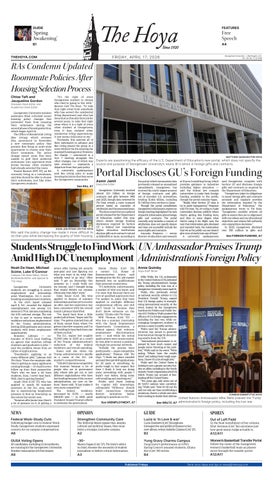
Experts are questioning the efficacy of the U.S. Department of Education’s new portal, which does not specify the source and purpose of Georgetown University’s nearly $1.5 billion in foreign gifts and contracts.
Portal Discloses GU’s Foreign Funding
Georgetown University received almost $1.5 billion in foreign contracts and gifts between 1992 and 2025, though data reviewed by The Hoya reveals a more nuanced picture based on countries of attribution and the associated years.
The data comes from an updated portal released by the Department of Education earlier this year, which details foreign funding disclosures required by Section 117, a federal law mandating higher education institutions disclose gifts and contracts valued at $250,000 or more. According to
Students Struggle to Find Work Amid High DC Unemployment
Noah De Haan, Michael Scime, Luke O’Connor Campus Life Desk Editor, Senior Multimedia Editor and Special to The Hoya
Georgetown University students are struggling to secure employment and internships amid Washington, D.C.’s recordbreaking unemployment numbers. In the city’s report released April 8, D.C. recorded the highest unemployment rate among U.S. states at 6.7% in January, surpassing the 4.3% national average. The rate is due in part to various federal workforce reductions implemented by the Trump administration, leaving 2026 graduates and current students with fewer employment opportunities.
Brandon Labman — cofounder of ROCS Grad Stafing, an agency that matches college students and graduates to jobs — said the problem stems from an infux of applications.
“Everybody’s applying to so many diferent jobs,” Labman told The Hoya. “From the employer side, they’re getting so many applicants coming through — it’s hard to even follow up from their perspective. That’s why we hear a lot from students, ‘man, I never hear back.’ Well, they’re getting fooded.”
Anjali Ofori (CAS ’27), who has applied to nearly 50 summer positions in the D.C. area, said she is experiencing heightened pressure to fnd an internship as she enters her senior year.
“Summer after junior year, there’s a lot of pressure on it, of getting a
return ofer, having job security post-grad and just fguring out what you want to do, what they actually want to go into,” Ofori said. “I got an internship this semester so I could build out my resume. And I thought doing that would elevate my resume. Obviously, that didn’t work.”
Edan Kauer (CAS ’28), who applied to dozens of summer internships and has yet to receive an ofer, said her experience has been consistent with the overall trends Labman identifed.
“I’ve heard back from a little under half of them,” Kauer told The Hoya. “I’ve gotten rejected from all of them, except three, where I’ve gotten interview requests, and I’m still waiting to hear back from one of them on that.”
The D.C. region lost roughly 72,000 jobs in 2025 as a result of the Trump administration’s reduction of the federal workforce and overall spending.
Kauer said she views the Trump administration’s layofs as a cause of the D.C. job market’s competitiveness.
“I think it’s just more competitive this summer because a lot of people who are in government jobs, whose jobs got cut, or just diferent organizations who have lost funding because of the current administration, are now on the hunt,” Kauer said. “It just makes it even more competitive.”
The federal workforce decreased by 10.3% — nearly 238,000 jobs — in 2025 amid President Donald Trump’s eforts to downsize the government.
Kieran Hickis (CAS ’29), a current U.S. House of Representatives intern, said breaking into the D.C. job market depends less on qualifcations than personal connections.
“It’s defnitely, unfortunately, a market of who you know, and I’ve seen that because there are a lot of qualifed applicants that I’ve spoken to, some that have applied to multiple diferent congressional ofices, and still can’t break in because they don’t know someone on the inside,” Hickis told The Hoya Will Thomas (CAS ’27) — who has a summer internship with the Equal Employment Opportunity Commission, a federal agency that enforces employment discrimination laws — said while his initial applications were unsuccessful, he was able to secure a position through his personal network.
“Initially, the process went pretty poorly — super competitive applications,” Thomas told The Hoya. “I think one place emailed and said they got 400 applications for 20 spots or something. So pretty tough in that respect. But then I think it took me doing some networking with people I hadn’t met before, doing some cold emailing and reaching out.”
Hickis said those looking for Capitol Hill internships, colloquially “Hillterns,” should build connections through district initiatives before applying to positions in D.C.
See UNEMPLOYMENT, A7
the portal, which summarizes data previously released as unanalyzed spreadsheets, Georgetown has received the ninth-largest amount of foreign contracts and gifts out of recorded U.S. universities, totaling $1.466 billion, including $1.1 billion from entities in Qatar.
Though the portal consolidates Georgetown’s disclosures, experts on foreign funding highlighted the lack of specifc information about foreign gifts and contracts. The portal currently only includes a country of attribution, does not specify donors and does not accessibly include the years of gifts and contracts.
Amanda Ferguson — senior director of education and research
at Huron Consulting Group, which provides guidance to industries including higher education — said the federal law compels universities to make their foreign funding available to the public, though the portal remains vague.
“Really, what Section 117 does is try to push transparency,” Ferguson told The Hoya. “So, it’s trying to make universities disclose publicly where they’re getting this funding from, and then to some degree what they’re using it for. Right now, the way that information gets disclosed and reported back, the information that we as the public can see doesn’t give a ton of clarity into any of those.” A university spokesperson
said Georgetown complies with Section 117 and discloses foreign gifts and contracts as required by the Department of Education. “Georgetown takes its obligations to report foreign gifts and contracts seriously and regularly provides the information required by the Department of Education,” the spokesperson wrote to The Hoya “Georgetown carefully reviews all gifts to ensure they are in alignment with our values and our educational objectives and retains full authority over expenditure decisions.” In 2025, Georgetown disclosed over $58 million in gifts and See FOREIGN FUNDING, A7
UN Ambassador Praises Trump Administration’s Foreign Policy
Annie Quimby Hoya Staff Writer
Mike Waltz, the U.S. ambassador to the United Nations (UN), defended the Trump administration’s foreign policy, including the Iran war, at a Georgetown University event April 14.
Waltz, who previously served as national security advisor to U.S. President Donald Trump, argued that U.S. foreign policy is strengthening international security. At the event, hosted by the Georgetown Institute for Politics and Public Service (GU Politics), Waltz praised the eficacy of U.S. foreign engagements, including the Iran war, while encouraging Georgetown students to pursue a career in public service.
Waltz said the Trump administration has aimed to generate international change by demanding results from the UN.
“International government is espoused by how much money and people you’re throwing at the problem,” Waltz said at the event. “We’re saying, ‘Where have the results been?’ and asking those tough questions. I know it’s a lot of tough love.”
Waltz said the United States is looking to put a greater security burden on allies, including in the North Atlantic Treaty Organization (NATO), which Trump has accused of freeloading off the United States.
“Ten years ago, only seven out of 30 NATO nations were contributing,” Waltz said. “Now it’s 30 out 30, and not only are they contributing a minimum, there’s a whole new slew that’s looking to double their defense
See WALTZ, A7

United
Women’s Basketball Transfer Portal Follow the roster of the Georgetown women’s basketball team as players move through the transfer portal. A12/A11
MATTHEW GASSOSO/THE HOYA
CONNOR EMMERT/THE HOYA
Nations Ambassador Mike Waltz praised the Trump administration’s foreign policy, including the Iran war.
Aamir Jamil Executive Editor
Yung Gravy Charms Campus Yung Gravy’s performance at GPB’s Spring Concert amazed students, Eliana Kut (CAS ’29) writes.
Lucia is ‘In Love
Lucia Zambetti (CAS ’26) explores introspective
themes in her
album, writes Isabelle Cialone (CAS ’27). B2
OPINION
Reject Complacency, Care for Others
As the semester begins coming to a close, The Hoya’s Opinion section has been flled with 47 pieces that paint a clear portrait of Georgetown University’s culture.
Many of these pieces reveal the ways that all of us –– students, faculty and administrators –– fall short of upholding the principle central to our Jesuit institution, cura personalis or care for the whole person. More concerningly, however, they expose a broader pattern of complacency on our campus. We recognize cultural issues, whether about clubs, professional spaces or campus life in general, but too often fail to take action. Thus, the last piece written by this semester’s Editorial Board ofers one central call to action for each and every Georgetown community member: Undertake collective action to improve the university and build a community.
This semester, the Opinion section has published perspectives highlighting the university’s failure to provide adequate sexual health resources and acknowledging that students have had to step in to fll these gaps. Many may agree with this argument and believe the university should act to prioritize students’ well-being. Yet, this is precisely where complacency arises.
Succumbing to the belief that university practices will never change or that this is simply how our university functions is not practical or rational ––it’s complacent. While organizations like H*yas for Choice and the Georgetown Gender Violence Alliance continuously advocate for women’s reproductive health, the responsibility to hold the university accountable cannot rest on a few groups alone.
Caring and protecting students is a burden we all must carry. Relying on others to address the structural and cultural issues is a refusal to fulfll our obligation to each other.
This pattern of complacency becomes even more threatening to the campus environment when it extends to moments of explicit harm. The Georgetown University College Republicans’ (GUCR) Islamophobic post earlier this semester further exposed this cultural problem.
In response, Dr. Faisal Cheema, the parent of a Muslim Georgetown student, called on all Georgetown community members to refect on the importance of inclusion, saying that students must engage with one another.
“As the university fnds itself in an increasingly complex, polarized and geopolitically unsettled world, I, as a Hoya parent, hope to see a renewed commitment to the cultivation of respectful dialogue across divides, grounded in mutual understanding and the inherent dignity of every human being — ensuring that its interfaith values are actively lived, not merely historically referenced,” Cheema wrote to The Hoya.
HOYA HISTORY
eApril 7, 2022
Georgetown has focused its bicentennial celebrations this year around the traditional Jesuit theme of “Learning, Faith, and Freedom,” based on 200 years of Jesuit educational beliefs. Rev. Joseph Durkin, SJ, wrote in the university Undergraduate Bulletin that Georgetown was created “to show a student how to use his freedom as a son of God for the highest individual and social ends.”
Does this sound like the Georgetown that exists today? We see this glorious and idealized image of Georgetown projected in our admissions brochures, placed neatly between pictures of crew sculls on the Potomac with Healy Tower in the background. “Georgetown University is vitally interested in safeguarding and promoting wellness and providing optimum health services in our country and throughout our world,” according to the introduction in the School of Nursing brochure. The administration obviously had this in mind when they closed the School of Dentistry.
On the other hand, one regularly hears conversations concerning how to slide by the general education requirements with as little work as possible, “blowing off” courses like theology and philosophy. Students in many cases study for the grade, not the course.
Why study for the good of learning, after all? Only three percent of the graduating class of 1988 said that they have no plans after graduation, and, as seniors are painfully aware, the better the grade point average, the better the job offer and the more money you can earn. For the 26 percent continuing on to graduate school, grades are even more crucial for getting into a good program. In American society, where it is generally accepted that achievement and success should be placed before intellectual growth, it is no
Cheema’s words must neither remain in the abstract nor can they be forgotten once the semester is over. Principles of inclusion must be afirmed not only in moments of crisis –– they require a sustained commitment, from all of us, to combatting hatred and intolerance.
As Cheema makes clear, Georgetown values only have meaning when they are actively upheld. Every member of this community is obliged to consistently foster an inclusive campus. The fact that members of our student body felt comfortable expressing this hatred is itself a failure. But when the broader community fails to vehemently and collectively reject these sentiments, we risk complacency, regardless of whether we were directly involved in the incident.
Protecting sexual health and interfaith dialogue on campus may seem like daunting tasks — and they are. But building a culture rooted in care and action is not optional and is one we cannot pursue alone. It is a collective undertaking we cannot claim to uphold the value of cura personalis without.
Creating this environment requires more than strenuous efort. We need to do a better job of simply being there for one another.
In her piece “Focus on What’s Now, Not What’s Next,” Dean Vanessa Corcoran calls for a shift in students’ mindsets.
Rather than constantly focusing on the future, Corcoran said students should simply enjoy the present –– and each other.
“In your haste to wrap up the semester, don’t forget to make time for those moments with your loved ones here at Georgetown — this home stretch will go by in the blink of an eye,” Corcoran wrote to The Hoya.
At a campus where conversations revolve around future plans and academic stresses, it is easy to lose sight of one another. Friendships and genuine connections are often placed on the back burner, and we forget to take care of each other. But right now –– not later or in the future –– we have the opportunity to show up for each other. Some relationships may blossom into lifelong friendships, and others may not after leaving the Hilltop. However, that does not diminish the value of being kind to one another while we are here.
The duty of creating community on this campus belongs to all of us. We should act to change our campus for the better. We have to foster a culture of care where we all belong at Georgetown.
The Hoya’s Editorial Board is composed of six students and is haired y the Opinion editors. Editorials refe t only the beliefs of a majority of the board and are not representative of The Hoya or any individual member of the board.
Since its first issue in 1920, The Hoya has served to inform Georgetown’s campus dialogue. The following article is a glimpse into The Hoya’s rich history, allowing readers to appreciate the evolution of college journalism.
Decline of Jesuit Values at Georgetown
wonder that many Georgetown students share this attitude. Although the majority of the faculty do help to spread an intellectual atmosphere, one could hardly say that many of these courses are concerned with personal values and convictions.
“Georgetown is committed to a view of reality which reflects Catholic and Jesuit influences,” another section of the Undergraduate Bulletin states. “It sees all men as essentially equal, as endowed with a human dignity always to be respected.”
Georgetown’s neutral position on the Armstrong amendment, a law which would have allowed the administration to refuse to recognize on-campus gay groups, again shows a split between Georgetown’s projected image and its actions. If Georgetown had followed its Catholic roots, it would have supported the Armstrong amendment as a condemnation of homosexuality. If Georgetown had followed its creed of respecting human equality, it would have condemned the amendment.
What was Georgetown’s reasoning behind its actions in the last two examples? The Dental School was closed because it was losing money; Georgetown refused to be decisive on the Armstrong amendment because it had $237 million in tax-exempt bonds pending approval, and was afraid to lose them. With this and other examples of administrative actions, it appears that the motivating force is money—that is their view of reality. True Jesuit influence is actually a rarity.
The university also projects a Jesuit educational ethic. The Student Prospectus states that “the College, through a diversifed academic program, encourages the development of critical powers, respect for tradition and human reason, and an appreciation of life and all its endeav-
ors. It promotes not only intellectual disciplines, but the search for personal values and convictions.”
Many courses are aimed more at preparing students for the environment of their future professions, rather than spurring students to analyze and improve the atmosphere in their fields.
Additionally, Georgetown fosters the Jesuit tradition of freedom, which allows an open forum of ideas for any university or world issue. Such an open forum includes incorporating the Alumni Association as a university board and refusing to allow them to take up attitudes contrary to university policy. If a secret society must form to discuss long-term university ideas, further restricting a free forum of expression, then the freedom to express ideas at Georgetown must be questioned.
There are undoubtedly many positive aspects to Georgetown, despite the frequent problems that seem to emerge in our university environment. Georgetown is an excellent university with many strengths, including a strong faculty and a challenging curriculum. However, as innumerable examples demonstrate, Georgetown does not do justice to the Jesuit ideals that it projects through its slogan, “Faith, Learning, and Freedom.” It has problems like any other university, but these problems are only magnified when concealed behind a facade of Jesuit traditions and values.
The first problem Georgetown should address is how it can return to and preserve the Jesuit ideals on which it was founded, while still existing as a modern institution of higher education. Only when this foundation is established can Georgetown effectively deal with the more prevalent issues and problems in our university with any consistency.
Alex Niven EDITORIAL
Friendships and genuine connections are often placed on the back burner, and we forget to take care of each other. But right now –– not later or in the future –– we have the opportunity to show up for each other.
The Editorial Board Reject Complacency, Care for Others thehoya.com

This week, the Spring 2026 Editorial Board (Ed Board) wrote its fnal piece. To conclude the semester, the Ed Board urged Georgetown University students to foster a culture of care and belonging on campus.
CARTOON by Ege Alidedeoglu

Founded January 14, 1920
Maren Fagan, Editor in Chief
Ruth Abramovitz, Aamir Jamil and Nora Toscano, Executive Editors
Nico Abreu, News Editor
Ajani Stella, News Editor
Paulina Inglima, Managing Editor
Opal Kendall, Features Editor
Saroja Ramchandren, Features Editor
Annikah Mishra, Opinion Editor
Ella O’Connor, Opinion Editor
Isabelle Cialone, Guide Editor
Tanvi Gorripati, Guide Editor
Nate Seidenstein, Sports Editor
Maddie Taylor, Sports Editor
Angela Lekan, Science Editor
Eva Siminiceanu, Science Editor
Avelyn Bailey, Design Editor
Lucy Jung, Design Editor
Grace Bauer, Copy Chief
Jackson Roberts, Copy Chief
Shira Oz, Blog Editor
Fallon Wolfley, Blog Editor
Kate Hwang, Multimedia Editor
Michael Scime, Multimedia Editor
Matthew Gassoso, Photo Editor
Caroline Woodward, Audience Editor
Board of Directors
Patrick Clapsaddle, Chair
Bethe Bogrette, Julia Butler, Amber Cherry, Madeline Grabow, Mia Streitberger
Peter Sloniewsky, General Manager
Olivia Zhang, Director of Business Operations
Rosie Garner, Director of Logistics
Connor Manrique-Johnson, Director of Outreach
Jackson Roberts, Technology
EDITORIAL
To gauge student opinion, students were asked whether the Georgetown community has upheld the value of cura personalis on campus. Of the 72 respondents, 41.7% said no, 31.9% said yes and 26.4%
VIEWPOINT • SLONIEWSKY
Build Toward Excellence
Ayear and a half ago, I stepped in as The Hoya’s general manager — the head of the publishing division, which is a fanciful name for a group that had no members when I started. I had no choice but to begin the long process of rebuilding a once-proud component of the organization anew, which has been arduous yet transformative. It’s taught me that the intellectual and the practical can, and should, coexist in leadership.
In my experience, it’s easy to ask a club for short-term rewards: Asking how it can help you, rather than vice versa; demanding a fancy title; requiring a repurposed role ft for a resume. This efect is even more prominent as clubs develop over time — institutions calcify as the original vision for their purpose fades (or, at least, as their founders depart) and is replaced by a practical understanding of what the group has been doing and must continue.
The Hoya was not founded in 1920 with an expectation of regularity, editorial consistency or even formalized categories of content; rather, it was intended as an intellectual exercise in documenting and analyzing events on campus, born from the literary Georgetown College Journal. Yet, over time, it has undoubtedly solidifed its expectations, and moved away from that purpose in favor of a work product so consistent that I know this article will make it to page A3 on Friday, April 17. This is not an explicit value judgement; it’s an exemplar of the way that institutions change and harden.
When the student groups that take up so much of our time and energygiveusconcreteexpectations and a clear path forward, it’s easy to compartmentalize. We can separate clubs as a means to a career, for professional embellishment or for fun, and academics as an avenue for learning and creativity. But the two must not be held apart. Clubs present us with a unique opportunity to mix the two, if addressed with intention and care. Without the opportunity to produce anything tangible, intellectualism is aimless; without any broader vision, the practical cannot be fulflling. Before I was selected as general manager, I worked alone as senior Opinion editor in Fall 2024. In that role, I had a few successes and published some articles and editorials that I’m still proud of. But I didn’t address my work with any grander vision. In the face of my
weekly expectation to produce fve articles, I silenced grander visions of what the section could be. I prioritized authors that responded quickly at the cost of quality. I occasionally overstepped the other editors in the section in the name of efciency. I stacked my Editorial Board with friends that I knew would do the work at the cost of its diversity. I could not have realized how much I left on the table until I was handed a part of The Hoya to rebuild from scratch. As general manager, I’ve learned far more than about how to run the logistics of a student newspaper.
The past year and a half has taught me how to work with others, how to be a mentor and how to implement big ideas step-by-step. It’s been nothing short of liberating. However reluctantly I’d stumbled into the role, I found exactly what I hadn’t as an editor: a place where the demands of running an organization and the ambition to build something meaningful couldn’t be separated, and where passivity wasn’t an option.
As I hand of the publishing division, I understand that my successor will have to operate under the constraints I set, and will have to build upon them.
But that is no excuse to shy away from attempting the exceptional. The most fulflling component of leadership isn’t authority, and you can’t always be fortunate enough to be handed a blank slate. It’s attitude that matters: the willingness to push ambitiously forward, to ask bigger questions than the organization around you and to act on the answers even when existing structures push back. That attitude is bigger than a separated intellectual habit and extracurricular life — it forces them together. As I exit The Hoya I will continue to reconcile my intellectual life with the practical expectations and constraints placed upon me. The real failure within institutions isn’t choosing ideology over the practical — it’s continuously choosing the path of least resistance. Life will happen to students, but this doesn’t mean that studies cannot be applicable to life. The most fulflling, honorable orientation is towards building something you believe in, and that choice is available to all of us.
Peter Sloniewsky is a junior in the College of Arts & Sciences and the Spring 2026 General Manager of The Hoya. His term ends Friday.

Uphold theTradition of Bold Student Journalism
Spread across the pages of The Hoya are 42 stories. 15 of these articles are hard news, focused on current campus events. Five are opinion pieces, all of which have an explicit connection to Georgetown University. One is an investigative piece that seeks to understand a significant aspect of the campus community. While each page represents a different collection of stories, what remains consistent is the dedication of each writer and editor in creating a paper to represent the Georgetown community. These pages have defned my tenure as the editor-in-chief of this publication and my interactions with the Georgetown community as a student journalist. More importantly, though, The Hoya’s presence has defned countless generations of editors, exists as the living record of the university’s last century and provides the necessary news to all campus actors.
But over the past 100 years, student journalism has never been more essential. We document the emergenceofsocialmovements,fights for free speech and the intersection between the federal government and higher education. As local newsrooms are shrinking and cutting essential beats on higher education, the work of so many student newspapers now centers on keeping the campus and greater city community informed.
Write for Opinion, Spark Conversations
Since my first year at Georgetown University, I have been a member of The Hoya’s Opinion section in some capacity. I served on the Editorial Board and, most recently, held the role of senior Opinion editor for the Spring 2025 and Spring 2026 semesters. This section has provided me with friends and memories that have defined my Georgetown experience and that I will always cherish. Beyond the community, however, the very nature and potential of the Opinion section is what has kept me drawn to it, even after my time abroad (sorry, I had to mention it). Reading and editing over 100 Opinion pieces during my tenure has helped me grow intellectually, kept me informed about the student body and taught me lessons that I will carry throughout my time at Georgetown and beyond. While I, along with other members of The Hoya, have long recognized the value of the Opinion section, there seems to be a lack of engagement with the section from the Georgetown community writ large. This is evident in the glaring disproportion between the number of writing requests we send and the number of responses we receive. As editors, we always ask our writers to include a call to action relating to some aspect of our community. If you are stumped on what a call to action could look like, here’s mine for all of you: Write for The Hoya’s Opinion section. When our section reaches out to students, faculty and other members of the Georgetown community to write, the process often feels like pulling teeth. For a student body so wonderfully opinionated, the hesitation that I have encountered is, to put it mildly, quite striking.
I fully understand students are busy, and that others have passions of their own to pursue. Furthermore, I recognize that stakes are high, and attaching your name to a Viewpoint
is intimidating — and, in many ways, a luxury — but this is precisely why those of us who are able to must use our privilege to do so.
Whether it be highlighting the diference in afnity groups’ funding or explaining your vote on a Georgetown University Student Association (GUSA) referendum, writing for this section allows other students to take interest in these issues, many of which have a signifcant impact on campus. Expressing ideas in writing also forces a critical examination of beliefs through defending arguments and anticipating counterarguments — a skill that extends far beyond Georgetown.
Some students have told me that they simply have nothing to write about, but I disagree. Just by roaming the halls of the Leavey Center or standing in Red Square, you’ll hear opinions being tossed around left and right. Sure, some of these are probably ill-ftted to be published in the university’s newspaper of record. But some are genuinely fruitful ideas, waiting to be taken beyond conversation and laid on page A3 of The Hoya I urge any of you who think your opinions or ideas aren’t “revolutionary,” or even too small in scope, to strongly reconsider. The misconception that a Viewpoint must signifcantly transform or alter the course of the university is simply incorrect. Even ideas that seem small can shape meaningful conversations. Additionally, adding nuance to existing conversations in the Opinion section is valuable in and of itself; some of the most intriguing pieces I read build upon other students’ arguments.
And for those of you who have the urge to share your big and new ideas — do it here. Take the bold steps, be courageous and relentless with your
words. Your voice is a critical part of the Georgetown community and deserves a space to fourish.
To those who simply dismiss the value of an opinion piece or ask who reads the paper (shoutout to my roommate who asks this every print week), I urge you to read the pieces by The Hoya’s past two editorsin-chief, who emphasize the vitality of student journalism in a climate where accurate and ethical reporting is increasingly under attack.
Even if you have no student journalism aspirations, writing opinion pieces still allows us to learn from each other. Look no further than the Opinion section’s Cardinal O’Connor Conference (OCC) special edition this semester. Four pieces all on the same topic, in conversation with each other, ofered nuanced and diferent perspectives held by members of our community.
Sitting in Leavey Center 421 these past three years, reading Viewpoints and seeing the conversations they provoke have been some of my favorite moments. I’m not asking you all to write for my own enjoyment (anymore!). We have a responsibility to each other and to cultivate a genuine, engaged student body here at Georgetown — writing for the Opinion section is one way to do so.
Allofus,facultyandadministrators included, must be willing to put forth our ideas. Georgetown cannot be an intellectual environment where diversity of thought thrives without students expressing their perspectives. While it’s understandable to fear putting your name in print — I know I have — we have a duty to each other to make the institutions we are part of better.
Annikah Mishra is a junior in the College of Arts & Sciences and the Spring 2026 opinion editor of The Hoya. Her term ends Friday.
Right now, student journalism is both under threat and more important than ever, making it vital that student journalists continue this necessary work despite fears about the future.
Still, student journalism has never been easier to ignore. In my home state, the University of Alabama terminated two student publications — Nineteen Fifty Six and Alice — amid struggles between the federal government and diversity, equity and inclusion (DEI) initiatives. Indiana University cut print funds for the student-run newspaper, Indiana Daily Student, amid greater cuts in higher education.
These cuts illustrate a greater trend of viewing student journalism as unnecessary, ftting into the broader pressure on colleges and universities to shut down protest, suspend speakers and, overall, chill political activity. And it is working.
At the center of these weighted concerns, student journalists exist at a nexus of options.
One option, the easier of the two, is to cower in fear. We can allow our administrators to dictate our work and shape our publications to be overwhelmingly positive, even if the lived experience of so many community members says otherwise.
This choice, however painless it may seem, comes at the detriment of our media environment and
the destruction of truth. News organizations, no matter their size, have a responsibility to serve their community, not an ideology or administration, with timely reporting focused on honestly explaining the truth.
Already, we can see professional news organizations mirroring this choice to back down in the face of adversity and cower toward the demands of a diferent administration. It is a symptom of overreliance on seeking permission rather than taking action.
Instead of shrinking under the pressure of any administration, we must make a diferent choice: the active, passionate decision to move forward fearlessly. Take the step to fnd those previously-undisclosed decisions. Pressure institutions to explain their actions.
In my experience, this passion to act is the most difcult but far more fulflling.
I remember the frst time I felt this fear in writing — I was part of a team that discovered private data available through a university server. I was afraid for multiple reasons, but most importantly, I feared I would upset university administrators and be pressured to step away from reporting.
That never happened, and, despite this fear, I knew that we had made the active decision to keep the
university community informed. This story was not the last time I was afraid to publish. Even as I anxiously waited for the campus community to read our investigations and breaking news, I realized that, often, without the work student journalists do in serving the campus community, an uninformed community emerges. To our readers and community members, our slogan is “read the paper.” As newsrooms responsible for reporting on Washington, D.C., face major cuts and continue to lose reporters, student journalism has an important role, and my sincerest hope is for each person to take our slogan seriously and read the paper. To the current and future members of The Hoya, remain steadfast to the truth and passionate about the work we do. When we look back at the particular moment, I hope to see continued dedication to the values and role of journalism. While this moment is particularly unsettling, the fundamentals of good journalism and its consistent need remain. We must continue to seek the truth, report it fully and serve our community without fear.
Maren Fagan is a junior in the College of Arts & Sciences and the 152nd editor-in-chief of The Hoya. Her term ends Friday.
Students in the Walsh School of Foreign Service (SFS) hail from nearly every corner of the world, but almost all of them can bond over pulling a grueling all-nighter to study for the “Maps of the Modern World” fnal exam. “Maps of the Modern World” is a one-credit required course for all SFS undergraduate students, advertising itself as an integral component of the frst-year SFS experience.
With Professor Mark Giordano’s breadth of global experience and the course’s unique approach to geopolitical history and confict, “Maps of the Modern World” provides students with a comprehensive understanding of foundational concepts in foreign afairs. However, with weekly 50-minute lectures and just four requirements to pass — one being the fnal exam — the course ultimately encourages rote memorization rather than mastery of the content. Broadening the scope of “Maps of the Modern World” by ofering more review sessions and skillspractice opportunities would ensure that students can hold on to the principles of the course rather than forgetting them once the semester ends. Students enrolled in the course can anticipate a minimal workload, as the course solely consists of the 50-minute weekly lectures. The in-class environment would seem intimidating to an outsider — attendance is strictly enforced, and TAs can be found patrolling the rows of the ICC auditorium to ensure against cell phone usage. Still, students can very easily get away with dozing of during lecture, or simply not paying attention to the content. This may very well be due to the
fact that classes are scheduled for Monday evenings, but it is also because of students’ low motivation for engagement.
Prior to the start of the course, for example, each student is given a notebook containing maps, tables and statistics relevant to each lecture, as well as blank spaces for notetaking. Yet, there is no accountability mechanism set in place to ensure notetaking during class, especially as each lecture is recorded and posted to Canvas. Lecture materials should certainly be published for students’ use — we shouldn’t punish students who are paying attention in class and use the recordings to catch content they may have missed — but there is no denying that it disincentivizes students from actively taking part in the course. Another core requirement to pass “Maps of the Modern World” is attending an ofce hours session, where TAs chat with students about college life. TAs are equipped to assist students with course material should they need it, but ofce hours are merely advertised as a prerequisite, with a specifc deadline set for attendance. They should instead be presented as an opportunity to review and ask questions, so that students who want more out of the course can attend such sessions as often as they wish and receive support in a course whose dense content can feel intimidating to tackle independently. Furthermore, beyond the Map ID quiz — an assessment where students label each country on maps of various regions of the world — there is no additional preparation required for “Maps of the Modern World” in the months prior to the fnal exam.
As such, students tend to leave all of their learning to the very days and hours leading up to the exam, meaning all information is discarded once they exit the testing room. While no college student wants additional work, implementing occasional assignments to test students’ understanding would be a valuable way to ensure engagement during lectures and with the course as a whole. Moreover, it would make studying for the fnal far less daunting: Students may not remember everything by fnals week, but they’ll at least have seen and interacted with the material beforehand.
For many SFS students, “Maps of the Modern World” is a crucial introduction to the realm of foreign afairs. In the end, it is up to students themselves to recognize this importance and take full initiative in their learning. Still, Georgetown must also ensure it is taking adequate measures to equip its students with the fundamentals needed for success in their future courses and career paths. Just as essential classes like “Principles of Microeconomics” or “Comparative Political Systems” are structured elaborately to give students the foundations they need in international afairs, “Maps of the Modern World” must be revised to give students more incentive and opportunities to engage with the course material throughout the semester.
Talia Arcasoy is a first-year in the School of Foreign Service. This is the fourth installment of her column, “Life on the Hilltop.”
ARIA ZHU/THE HOYA
VIEWPOINT • FAGAN
VIEWPOINT • MISHRA
FEATURES

GU Students Seek Increased Involvement
In Free Speech Policy Creation, Application
In the face of an increasingly hostile federal environment, Georgetown students say the university should promote student engagement with the speech and expression policy.
Ella Farahnakian and Juliet Rotondo Features Writers
After almost a decade of operation, Georgetown’s Free Speech Project will close its doors at the end of the Spring 2026 semester.
Luke Daugherty (SFS ’28) — a student involved in the program, which tracks First Amendment violations across the United States — said its loss will have major ramifcations for campus expression.
“I don’t believe that Georgetown shutting down the Speech Project represents an active silencing of free speech, but I think it has unintended consequences that can be really far-reaching and hurt the community,” Daugherty told The Hoya
“You don’t have to ban speech to hurt free speech,” Daugherty added.
The closure comes amid a series of federal attacks on campus speech, part of a broader tension between President Donald Trump and the perceived progressive bias of elite universities.
Since February 2025, his administration has threatened to pull funds from universities that permit “illegal protests” and investigated the presence of pro-Palestinian groups at several top schools.
The U.S. Department of Homeland Security also detained several students legally residing in the United States — including Columbia University’s Mahmoud Khalil, Tufts University’s Rumeysa Öztürk and Georgetown’s Badar Khan Suri — citing social media posts, academic writings and campus advocacy when deciding to arrest them. Elinor Clark (CAS ’27), a student organizer, said this new speech environment has forced activists to fundamentally reassess their approach to protesting.
“The barrier to participate in our movements is signifcantly higher than what it has been historically,” Clark told The Hoya. “When we’re planning protests, whether on campus or of, we have to carefully weigh the pros and cons of diferent goals.”
“The fact that we have to have discussions about how to protect ourselves and our community when we’re standing up for what’s right is disheartening,” Clark added.
As a private institution, Georgetown is not bound by the same First Amendment protections as public universities. Instead, its Policy on Speech and Expression endorses time, place and manner restrictions — limitations on when and where speech can be expressed — and also permits administrators to regulate speech that violates the university’s harassment policy.
A university spokesperson said Georgetown is dedicated to encouraging respectful exchange.
“Georgetown is committed to ensuring that all members of our community have a safe and welcoming place to learn and receive the support they need to do so,” the spokesperson wrote to The Hoya. “While members of our community exercise freedom of speech, we work toward a liv-
ing learning community that is free of bias and geared toward thoughtful, respectful dialogue.”
Still, many worry that Georgetown’s free speech policy does not adequately protect students in this new federal environment.
Ahead of the arrival of incoming university president Eduardo M. Peñalver in July, they say the university is at a fundamental crossroads for free speech protection.
At this critical moment, Daugherty said students must be able to engage with the university’s free speech policy.
“I want there to be more open channels for students to propose ways to change free speech policy,” Daugherty said. “If I wanted to change free speech policy, I don’t necessarily know where I would go.”
Not a Free-for-All
Georgetown has operated under a free speech policy since 1989, but updated its approach in June 2017 to provide additional guidance on the regulation of ofensive or controversial speech.
John Hasnas, who served on the faculty committee that redesigned the policy, said the 2017 revision intended to prioritize free speech protections over community cohesion.
“The university can do whatever it wants to make an inclusive, happy, comfortable, diverse learning environment, but only short of stopping people from expressing their genuinely held beliefs freely,” Hasnas told The Hoya. “It’s supposed to be that freedom of speech predominates over comfort.”
The fnal policy was largely modeled after the University of Chicago’s, which is often considered the gold standard for free speech protection and has been adopted by almost 120 universities across the country.
The two share many provisions, but Eleanor JB Daugherty, the vice president for student affairs, said they diverge in their implementation.
“The way we steward the policy feels diferent here, and what feels diferent is the inclusion of our Jesuit values,” Eleanor JB Daugherty told The Hoya. “We really feel that dignity matters, and so when I’m looking at a protest on campus, I’m looking at are we respecting the rights of others? Are we caring for the rights of others?”
UChicago, also a private school, endorses institutional neutrality, which prohibits the university from taking a stance on political or social issues. In contrast, Georgetown’s approach gives administrators greater power to regulate speech that disrespects others.
Jessica Jones, another faculty member who helped develop the 2017 policy, said the decision to avoid blanket neutrality blurred the boundaries of acceptable speech.
“Free speech is supposed to end where it is considered threatening or harassing to members of the community, but it’s hard to draw that bright line, and it’s not
always clear to the speaker when they’ve crossed it,” Jones told The Hoya. “It always seemed like something that was not possible to put down in really clear terms.”
Still, Eleanor JB Daugherty said this balance is an essential dynamic at a Jesuit institution.
“It would be incredibly antithetical to Georgetown’s purpose if we didn’t live in both places, where we conceivably deeply hurt others, and then sit with the pain that it causes as well,” Eleanor JB Daugherty said.
“I will go to a rally and then meet with a faith community that is hurt by the speech that came out there,” Eleanor JB Daugherty added. “That tension is the right place for us to be in.”
Georgetown has repeatedly applied the Speech and Expression Policy in situations where student groups target peers or raise contentious social issues. In 2021, a professor was fred after making discriminatory comments about Black students’ grades. Similarly, in 2022, the university placed Ilya Shapiro, then the incoming director of Georgetown Law’s Center for the Constitution, on administrative leave after he posted a racist tweet.
Hasnas said these applications violate the intended spirit of Georgetown’s free speech policy.
“In the years that followed, things like that constantly were repeated,” Hasnas said. “People would say things there and they would be punished for it. Our actions were completely inconsistent with the policy that we adopted.”
In part because of its diferential approach, Georgetown has historically struggled in the Foundation for Individual Rights and Expression’s (FIRE) rankings, which evaluate free speech protections on college campuses.
In 2023, the organization, which has faced criticism for its fnancial ties to conservative think tanks, listed Georgetown among the four lowest-ranked schools surveyed, at 245th. In the years since, Georgetown’s place has improved marginally, to 240th in the 2025 rankings and 129th in the 2026 rankings, but the university has retained a grade of an “F,” signaling a poor speech climate.
UChicago, meanwhile, has historically excelled in FIRE’s rankings, placing frst in the 2024, 13th in the 2025 and third in the 2026 rankings.
Eleanor JB Daugherty, who previously served as an administrator at UChicago, said her approach to free speech has remained relatively consistent across the schools.
“I have worked at schools that have been applauded by FIRE,” Eleanor JB Daugherty said. “I have been responsible for speech and expression in schools that FIRE has loved. What I’m really trying to wrestle with is that is there a difference in the way we do the work in an ‘A’ school versus an ‘F’ school? I would say the only thing that has happened in my career is a deepening sense of responsibility for the impact of the speech that you protect.”
On the Outside Looking In
While the current free speech policy was developed by faculty and administrators, students can shape its implementation through the Speech and Expression Committee, which advises the vice president of student afairs.
Eleanor JB Daugherty said the committee has helped guide the university’s response to student protest.
“In the minute of disruption on campus, we were kind of making up the rules as we went,” Eleanor JB Daugherty said. “We don’t want that perception, so Speech and Expression is a place where we go with incomplete thoughts, or we go with tension between the values and the practice.”
Still, some committee members say there is little clarity on how they can meaningfully infuence university policy.
Mahika Sharma (SFS ’27), a former student representative on the Speech and Expression Committee, said administrators were open to student input, but she saw little practical change.
“They were actually very open to absorbing those opinions, and then responding in a way that felt true to administrative concerns, but also considerate of those sorts of opinions that students had,” Sharma told The Hoya. “But in terms of policy changes or anything to that efect, I’m not entirely certain what that looks like.”
The committee consists of about eight members, appointed by student and faculty government.
Jason Brennan, a faculty member of the committee, said the group has no enforcement power.
“The committee itself has no real authority,” Brennan told The Hoya “We are an advisory committee, so we can recommend what we think is the right thing to do. We can propose policies and so on, but we don’t actually set anything.”
“The issue with the university is that there’s so many decision makers who have diferent levels of authority, diferent levels of power, and these things frequently overlap,” Brennan added. “Sometimes a decision can be made in one place and it gets overwritten by someone else, somewhere in a diferent area.”
With few avenues for students to formally petition the university, activists have turned to protest to push for policy change.
In 2025, Georgetown introduced a partial restriction on face coverings, requiring students to remove masks at the request of administrators and preventing them from wearing masks while engaging in conduct that violates university policy. Additionally, the university implemented a new ban on amplifed sound, barring protests from producing disruptive noise.
Mikenzie Hapworth-Eldridge (CAS ’28) — the outreach director of Georgetown’s American Civil Liberties Union (ACLU) chapter, a legal nonproft — said these regulations make protest more
dificult but ensure the university’s daily operations continue.
“I think that soft barriers can defnitely have an impact on people’s willingness, but I also think that it’s a nice way of balancing the administration with student voices,” Hapworth-Eldridge told The Hoya. “Because you’re still allowing students to voice their opinion, but you’re also allowing people who don’t know what’s going on to still live their day-to-day.”
Clark said these policies make protest more dificult, particularly in a hostile federal environment.
“Organizing has a long history of disruption being the most efective tool,” Clark said. “When Georgetown so strictly curbs that through threat of arrest in some cases — but in less severe cases, disciplinary action through this university — it puts a dampener on people’s willingness to engage on fundamental issues.”
“I think Georgetown University needs to remember its Jesuit values of promoting faith that does justice and remember its history of student activism — much of which is now bragged about by university administrators — and allow more flexibility in student organizing,” Clark added.
The Current of Change
Beyond changes to the national speech landscape, students say institutional protections are at a critical juncture ahead of Peñalver’s arrival to Georgetown.
Peñalver previously served as the president of Seattle University, where students and faculty have voiced concerns about his implementation of the university’s free speech policy and the selection of campus speakers.
Seattle University does not base its free speech policy on UChicago’s, but shares Georgetown’s same emphasis on Jesuit values. In October 2022, a few months after Peñalver took ofice, it revised its speaker policy to prohibit student organizations from endorsing political candidates.
Natalie Kenoyer, who graduated from Seattle University in 2023, said the new policies implemented under Peñalver’s tenure did not refect the university’s Jesuit values.
“While there’s the Jesuit values that I think the campus strived for, it didn’t seem like Seattle U was led by those specifc Jesuit values,” Kenoyer told The Hoya
“When Peñalver became president, I was leaving Seattle, and I defnitely felt like things were changing for the worse in terms of censoring students,” Kenoyer added. “I’m not sure how it looks now, but I defnitely felt like the administration was attempting to chill student activism.”
In a May 2024 statement to the Seattle Spectator, Seattle University’s student-run newspaper, Peñalver said the university’s Jesuit values infuence its approach to free speech.
“Seattle University does not take positions on world issues in order to preserve the freedom for mem-
bers of our academic community to express their own views,” Peñalver wrote to The Spectator. “This is not the same as a blanket assertion of neutrality. But, as a university, the primary way we take positions is through our actions, and always at the same time with an afirmation of the importance of the academic freedom of those who may disagree.”
In April 2024, The Spectator reported that students were frustrated when the university allowed StandWithUs, an international pro-Israel educational organization, to speak on campus but not Jewish Voices for Peace, the largest U.S.-based Jewish pro-Palestinian organization. Alexander Johnston, a flm professor at Seattle University, said that Peñalver’s support of free speech was inconsistent, not always allowing for disagreement.
“In the aftermath of October 7, everyone had wanted to bring Jewish Voices for Peace, which is an anti-Zionist, Jewish-led group, and that was not permitted,” Johnston told The Hoya. “It was this push and pull to allow them to come to campus. That stuf has been fairly complex.”
“There are certain ways that he very much adhered to a free speech ethos,” Johnston added. “But there were also instances of disallowing certain ways of speech or certain visitors.”
Kenoyer said student speech is particularly vulnerable in this moment of transition.
“The Free Speech Project being sunsetted right before Peñalver becomes president seems especially concerning to me, as far as safety and well-being of students and the future of Georgetown as an institution,” Kenoyer said. “I think right now, especially as free speech is under attack, that’s a huge red fag.” Clark said Peñalver’s administration should engage with Georgetown’s unique history of activism.
“I hope that as he enters the Georgetown community, he learns about our history of organizing and student activism in the hopes that we can continue to hold the university accountable to its proclaimed values and ensure that it is protecting and respecting all community members.” Luke Daugherty said it is important for university administrators to consider student and community input when interpreting, implementing and evaluating free speech policy.
“If you want to understand our country today, if you want to be able to express your views in the country today, no matter what those views are, free speech is the only way to do so,” Luke Daugherty said. “On this macro scale, you really need to have these protections and these guarantees for democracy to function, and now on a micro scale, at Georgetown, it’s very much the same.”
ILLUSTRATION BY EGE ALIDEDEOGLU/THE HOYA Ahead of incoming president Eduardo Peñalver’s inauguration, students and faculty at Seattle University, where Peñalver was previously the president, have expressed concerns about his free speech record.
A Historic Success, Artemis II’s Return Is An Opportunity for Scientific Discovery
Jack Barklow Hoya Science Writer
The Artemis II mission suc-
cessfully completed its goal of a lunar fyby April 10, marking one of the most ambitious space explorations in recent history.
Aboard the spacecraft Integrity, a four-person crew reached 4,000 miles beyond the moon, marking the furthest human venture into deep space. The mission comes amid the United States’ professing interest in establishing a permanent presence on the moon and carries signifcant geopolitical stakes.
With its title nodding to the celestial twins of Greek mythology, Artemis II represents humanity’s frst expedition beyond low-reach orbit since the 1972 Apollo 17 mission.
Julia Small (CAS ’27), the Georgetown Astronomical Society president, said the frst manned fight of the Artemis program is particularly signifcant.
“The most exciting part about the Artemis program is that we are not just visiting the moon this time around, instead the goal is sustained life there,” Small told The Hoya. “The big idea is to send more missions into deep space by using the moon as a ‘pit-stop’ along the way.”
To accomplish that goal, NASA plans to build a modular moon base in future missions and has even foated the idea of an international space station that orbits the moon.
But Small said the Artemis Program’s proposed timeline — which hopes to test docking capabilities with commercial lunar landers in 2027 and have a lunar landing in 2028 — is contingent on many factors. “A lunar landing requires a development of robotics and semi-permanent infrastructure as well as short-crewed stays,”
Small said. “Will we get there by 2028? I fnd that unlikely. But will we get there in a promising timeline and stay competitive within the space race? I would say so.”
Despite the lengthy timeline, the extended mission of the Artemis program has garnered public support. Lucas Robbins (CAS ’29) said he and his classmates were enthusiastic about the mission.
“I personally was very excited for the launch,” Robbins told The Hoya. “I watched the live stream with a couple of friends and made it a whole event. I’ve heard people discussing the mission in a handful of my classes as well.”
Similar sentiments have been felt across the country. Nearly 70% of Americans report feeling excited
about space exploration, and 80% of Americans hold a favorable view of NASA. While there seems to be support for the mission among the public, Small said that the political will seems to be lagging behind.
“When it comes to political will, what is spoken and what is monetarily given is very, very diferent. In fact, NASA’s funding was just cut in half over the course of the mission,” Small said. “However, current geopolitical tensions seem to incentivize a moon mission.”
Small said political support is especially important because such an ambitious project will likely be expensive.
“The technology is there and in development. It’s more about funding and political will, as well as the logistics of a multi-stage program,” Small said. “Each mission builds upon the previous ones, and each stage has an optimal timeline which will likely be pushed back. This is taken into account and expected.”
Allison Briggs (MSB ’29), who has been watching the mission closely and is interested in international space law, said the event’s geopolitical backdrop is important.

Many experts claim global powers have already entered into a Second Space Race with the United States, alongside countries such as Russia, China, India and the European Union competing for resources and primacy in developing colonies on the moon.
Small said the idea of a “Second Space Race” is semi-accurate but oversimplifed.
“Of course when it comes to defense, space has already been militarized and will continue to be,” Briggs said. “That is an obvious incentive for the United States to expand their footprint in space.”
Chemistry Professor Receives Condé Nast Award
Justin Ha Hoya Science Writer
A Georgetown University chemistry professor received the Condé Nast award for distinguished leadership, research and teaching at the Spring 2026 faculty and staf convocation March 25.
Diana Glick (GRD ’91, ’95), who has been teaching at Georgetown for more than 30 years, received the award for student success in advanced chemistry courses. The convocation awarded multiple professors and faculty members for their excellence in teaching or research breakthroughs.
Glick said she prioritizes helping students realize they are in charge of their own learning, empowering them to understand they can pass the course if they put in the efort.
“When you think you did well because you had a good teacher, or you didn’t because you had a bad teacher, then the student doesn’t get to move ahead,” Glick told The Hoya. “They did not get the opportunity to learn they’re in charge.”
Lela Skopec (CAS ’28), who took Glick’s introductory general chemistry class last year, said Glick stood out among her professors for her enthusiasm and accessibility.
“She was probably the best professor I ever had,” Skopec told The Hoya. “Just enthusiastic, lively, engaging. She always has her door open and is a super helpful resource for just about anything. She’s just been a great help for me in transitioning into college.” Skopec said Glick helped her decide her major and ofered advice on her college journey.
“When I was deciding my major, I was in a limbo,” Skopec told The Hoya. “But she was very neutral and very helpful in guiding me towards
what I was truly passionate about. She’s just a good resource to go to when you’re feeling overwhelmed, and she’s always reminding me that it’s a marathon and not a race. You can always change up what you’re doing, and it’ll be okay.”
Skopec said Glick’s teaching emphasizes challenging students on homework and in lecture, where it matters the least, to properly prepare and assess them for upcoming exams, which she said has helped in organic chemistry.
“That rhetoric of ‘fail where it matters the least’ is something that I’ve carried with me through orgo,” Skopec said. “It’s been a big help making sure I do excessive amounts of work outside the exams, so when it comes to exam time, I’m not surprised by what I see.”
Jackson Hughes (SOH ’28), another student in Glick’s general chemistry class last year, said Glick was always enthusiastic during lectures and used demonstrations to visualize complex topics.
“One example that stuck with me was when she sat on the foor with a slinky to demonstrate particle-in-a-box theory,” Hughes wrote to The Hoya. “Moments like that made complex topics actually click. Her energy and genuine passion for the material made students want to match that same level of engagement, because her enthusiasm was so contagious.”
Hughes added that Glick’s relentless support for her students, even in difcult courses and subjects, is why she deserves the award.
“She sets a very high standard, but she matches it with genuine support for her students,” Hughes wrote. “She pushes you to be better while also making you feel like she’s fully in your

JUSTIN HA/THE HOYA
Chemistry Professor Diana Glick recieved the Condé Nast Award for distinguished teaching at Spring Convocation.
corner, and I think that’s a big reason why she’s had such a lasting impact on so many students.”
According to Glick, one of the primary reasons she was drawn to teaching was her belief that instruction should begin with a clear, simple statement of purpose, which she said helps students avoid confusion.
“There were things that I realized that I can do well teaching is because when I teach myself, I’ll go: ‘Well, why didn’t they say that?’” Glick told The Hoya. “When I teach, I cut right to the chase. The whole point of what I’m going to teach you is this thing, and
then I’ll develop it to show you the thought process so you don’t get lost in the weeds.”
Glick said she has refned her teaching method to prioritize students’ enjoyment and confdence.
“I feel like my role is to make you like it,” Glick said. “That’s the diference between a good experience in a class and a bad experience in a class. Your grade might be exactly the same, but in one case you like it, and in the other you hate it. I’ve had a lot of people say ‘I never knew I could do chemistry,’ and they feel empowered, and seeing this feeling of empowerment is very exciting.”
Professor Argues AI Poses Biases, Ethical Implications
Jack Barklow Hoya Science Writer
A visiting philosophy and data science professor from the University of North Carolina, Charlotte delivered a lecture on how marginalized groups have been harmed by biases in artificial intelligence (AI) systems at a Georgetown University event April 14.
During the event, Damien Patrick Williams, whose work focuses on the intersection of technology and human values, discussed how AI algorithms can perpetuate biases and spread misinformation. Hosted by Georgetown’s Department for Disability Studies, the talk diverged from prevalent discussions of the existential risks AI poses, instead offering a commentary on its current harms.
Williams said marginalized groups have been erased from discussions of AI’s history, displaying a list of attendees from a conference that established the term.
“The term AI was coined in 1956 at the Dartmouth Summer Program for Artifcial Intelligence. Every person named on this list is male,” Williams said at the event. “A name not on this list is Alan Turing, the father of modern computing. The reason?
He was imprisoned for homosexuality after essentially winning World
War II for the Allies through his cryptography. AI would not exist without marginalized people, and yet marginalized people were pushed to the side during its development.”
Williams’ main contention throughout the talk was that the data used to train AI does not accurately represent marginalized groups, leading to bias. Williams said this is partly because many groups have been excluded from important conversations about AI, leading to the very foundations of the technology’s development being biased. Williams said the bias inherent to AI systems can easily be seen with a couple of simple prompts.
“If you ask a language model to tell you a story about a nurse and a doctor, the doctor will be more likely to be male, and the nurse will be more likely to be a woman,” Williams stated. When generating a response, an AI system calculates which word is most likely to follow the previous one based on patterns in its training data. According to Williams, the dilemma for these systems is that predictions are only as good as the training data; if the data is biased, AI responses mirror those same biases and can, therefore, harm historically marginalized groups.
Williams said that addressing this concern can be challenging, as it is often overshadowed by bigger concerns over AI.
“AI ethics these days mostly discusses the existential risks — the idea that AI is going to take over the world,” Williams said. “These harms are much farther off than the harms that are happening to us right now.”
Williams described a study in which an AI-based resume sorter favored certain names, saying there were racial biases underlying the results.
“Two of the exact same resume, the exact same credentials, everything — the only difference was the name on top,” Williams said. “When the name was something that ‘sounded’ Black, the resume was much less likely to be chosen than the same resume with a ‘white-sounding’ name.”
Williams said the study found similar results for resumes that mention disabilities.
“A study showed that any mention of a disability on a resume would be ranked lower and less likely to be hired for the job,” Williams added.
Williams said these biases would never be fully addressed and would therefore hinder the efective application of AI.
Annabelle Nielsen (SOH ’28), a Disability Studies minor who at-
tended the event, said that she appreciated how the event discussed issues in the feld such as the exclusion of marginalized groups and potential risks associated with AI.
“I thought it was a good discussion on how marginalized groups have been kept out of certain disciplines and the potential risks these systems have with their emergence in professional spaces,” Nielsen told The Hoya
Molly The Losen (SOH ’28), another Disability Studies minor who attended the event, said she felt that, while these systems are imperfect, they can also help individuals with disabilities.
“I think that in certain cases AI can be helpful, especially for people who are visually or hearing impaired,” Losen told The Hoya. “They could use AI as a tool to help make courses more accessible, for example.”
Williams ended the talk by stressing the importance of learning from past mistakes, saying developers should center marginalized voices as they continue to create AI technologies.
“If we think back to the origins of AI and the lessons we learned there, we can try to ensure that we are building AI not in a way that takes from marginalized populations, but that centers the most marginalized,” Williams said.
“Now it’s a multi-actor situation, with particularly China being our biggest competitor,” Small said. “There are more questions regarding what’s legal in space, resource rights, and regulation of the commercial space sector. Geopolitics is a large driver, but not the only one. The main concern with winning the space race is being able to set up standards and internal law in space. The first person there sets the rules everyone else plays by.”
Despite the geopolitical tensions wrapped up in space exploration, Robbins said the historic Artemis missions serve as a uniting force, sparking excitement from the Georgetown student body and the rest of the country. “It’s cool to see the collective interest in the event,” Robbins said. “There’s something special, uniting and powerful about space exploration.”
BUZZWORD BREAKDOWN
As Finals Season Begins, Use Science to Improve Memory, Study Skills
Ellie Ward Science Columnist
With a seemingly never-ending midterm season coming to an end, fnals are looming in the distance. No matter how much I try to plan ahead, I always fnd myself cramming for something and reprioritizing at the last minute. While my professors often pester students not to pull all-nighters and to start long projects weeks ahead in small increments, this can feel like a monumental task as students with endless tasks and responsibilities. To our professors’ point, understanding why certain study methods or lifestyle choices are suggested for success is valuable. It allows us to critically evaluate where we can apply science-backed study techniques rather than just deciding a full day and night cram session will sufce, as it may have the last few times.
Most of the tips that circle online or get preached by parents and teachers are linked to memory, or how we take in information and are able to recall it later. The memory process has three steps: acquisition, consolidation and recall. Humans store new information in a neuronal circuit — a connected set of neurons that are organized to process and send certain information — and strengthen those connections for minutes to days, then utilize that stored information later on. These processes’ exact mechanisms are still being discovered, but much current evidence links the process to sleep.
Diferent stages of sleep are associated with diferent stages in this memory process. Non-REM sleep, the early stages of the 90-minute sleep cycle, may be correlated with memory acquisition. This is possibly due to “memory replay” in the brain’s hippocampus region that occurs during non-REM sleep, reactivating a neuronal circuit to strengthen the pathway and memory. So if you try to study on only a few hours of sleep, it may feel like none of the information is sticking. However, it is important to sleep after trying to learn something as well as before, as memory consolidation is evidenced to occur in the sleep directly following learning. In particular, it is associated with later-stage REM sleep. REM sleep plays a role in dynamically linking memories together, not only helping with recall of rote memorization, but also applying new information to creative problem solving. This
consolidation period is so important that a 2021 Harvard article fnds that it cannot be made up by catching up on sleep later. If you miss your chance by not sleeping after your study day, you likely sacrifce a lot of ability to apply that knowledge. How you study also plays a role in your ability to recall and apply information. I often fnd myself getting all other tasks out of the way so I can focus on one big assignment for hours without interruption. However, many students know the burnt out-feeling of losing focus after too long on the same ideas. Overrepetition on the same topic is actually really hard for the brain, and after around 40 minutes, our ability to take in new information about the same topic decreases exponentially. It is not realistic to stop working every 40 minutes, though, so this stress can be relieved through “interleaving.” Experts who advocate for interleaving recommend taking a short break every 40 minutes, returning to work on a new task for the next 30-40 minutes, then returning to the original task. Studying in chunks also takes advantage of the spacing effect, which says that taking time away from working actively on something and then returning to it disrupts the process of the brain forgetting that information, making learning more successful. Spaced repetition is strengthened by learning through recall exercises, like using flashcards or practice tests. Testing recall employs a related phenomenon called the generation efect. The generation efect argues that undergoing memory retrieval as part of studying strengthens longterm retention mechanisms of the memory. That is why studying your professor’s practice problems or choosing fashcards over rereading are actually not a waste of your time. Memory is still being studied, and many more factors play integral roles. For example, dehydration of even 2% reduces attention and immediate memory, stress decreases your ability for verbatim recall and exercise is associated with better memory — to name a few. While fnals are never slogged through without late nights, long hours drafting a single essay or forgetting to make time for yourself, keeping these processes in mind may help minimize the weekslong struggle of assignments and exams. At the very least, I like knowing what I gain and give up when I decide if I should use two hours to take that extra practice exam or call it a night.

NASA/Bill Ingalls
The Artemis II moon mission completed a lunar flyby April 10 with the crew reaching a distance of 4,000 miles beyond the moon, setting the record for the furthest venture into deep space.
NEWS

IN FOCUS Law Center Delays Construction Amid High Costs

Georgetown University Law Center submitted an extension request for the new
replace the Sarah and Bernard Gewirz
Groves Gives Faculty Senate Updates
Noah De Haan Campus Life Desk Editor
Georgetown University leaders briefed the Faculty Senate on the university’s ongoing austerity measures amid federal cuts to higher education at its April 14 meeting.
Administrators announced that the university will provide more details on Georgetown’s fnances at an April 29 town hall, including on proposed budget safety measures. The senate also debated non-discrimination policies and a research collaboration efort.
At the meeting, the Contingency Development Working Group, a team charged with proposing solutions for potential federal funding cuts, briefed the senate on its ongoing process to increase revenue amid the university’s budget shortfalls. In December 2025, the university projected a revenue reduction of at least $91 million for fscal year 2026, citing federal spending cuts to higher education and increased visa restrictions.
Vicki Arroyo, the working group’s chair, said the committee initially aimed to reorganize the university’s federal indirect cost (IDC) allocations — overall funds that aren’t linked to specifc projects — but after Congress blocked the Trump administration’s plans to cut indirect research funding, the group found the reorganization was unnecessary.
“We were looking at reconfguring our indirect cost allocations, where it’s allowed, to try to mitigate some of the risks, to extend our current negotiated rates where possible,” Arroyo said at the meeting.
“Since Georgetown was at a time when we were renegotiating those with the federal government, to develop revenue generation strategies to diversify our revenue so that we would mit-
Noah De Haan and Anna Lim Campus Life Desk Editor and Hoya Staff Writer
The U.S. Congress is weighing cuts to Federal Work-Study (FWS) funding and other education assistance programs, potentially stripping some Georgetown University students of fnancial aid. In its proposed budget for fscal year 2027, the Trump Administration suggested a 90% reduction in FWS, which subsidizes part-time jobs for students demonstrating fnancial need, and an elimination of TRIO and GEAR UP, programs that support frst-generation, low-income and disabled students through college preparation, fnancial education and support services. The proposal comes after Congress blocked similar cuts for fscal year 2026.
Atif Qarni, a professor in Georgetown’s education, inquiry and justice program, said TRIO and Federal Work-Study enable students facing hardship to enroll in college while balancing academics and fnances.
“TRIO and GEAR UP don’t just help students get into college — they provide advising, mentoring and support systems that many students, especially frst-generation and low-income students, wouldn’t otherwise have,” Qarni wrote to The Hoya “Federal Work Study plays a dif-
igate any impact of the potential IDC cuts and to establish some principles to guide our work.”
“I have some good news: that the proposed IDC cuts from this administration were generally stopped by Congress, and we hope that will continue to be the case,” Arroyo added.
Interim University President Robert M. Groves said he will announce some of the group’s strategies at the upcoming town hall.
“We’ll have an announcement of those ideas that would either save money or produce more revenue to help us out at this time, and we got over 200 suggestions,” Groves said at the meeting. “The other thing we’re doing is refning our projections on the end of this year’s fnances, and I’ll be able to do it to announce that, as well as looking forward to next year and issues of how we’re looking next year.”
Arroyo said the Trump administration’s threats to international visas, which make it harder for students to attend U.S. universities and work in the country, pose additional challenges to revenue strategies.
“Some of the early revenue generation strategies that we had as a group to diversify revenue and mitigate the impacts themselves came under threat as the year went on, because this administration started going after international visas for our students and faculty fellows and fnancial aid,” Arroyo said.
Following the budget updates, the senate discussed a plan to use GU360, an internal university platform, for faculty activity reporting, which collects and displays staf academic appointments and accomplishments, to bolster collaboration.
Elliott Crooke, the vice president for faculty and academic affairs who works on the faculty activity report-
ferent but equally important role. It gives students a way to earn money that’s tied to their education and generally more fexible than of-campus jobs. Without it, many students end up working longer hours in jobs that compete with their academics.”
“Taken together, these programs help reduce the gap between students who have built-in support systems and those who don’t,” Qarney added. “Without them, we’d likely see wider disparities in who enrolls, who stays and who graduates.”
FWS was founded in 1964 and provides about $1 billion to roughly 600,000 students annually.
Fatoumata Barry (SFS ’29), who relies on her work-study job to support her education at Georgetown, said there is an often overlooked work-study community on campus that could be impacted by the proposals.
“As a student on a lot of fnancial aid, I use my work study to make sure that there’s no fnancial burden on my parents for any extra costs that fnancial aid doesn’t cover,” Barry told The Hoya
“Something that people don’t really think about is it’s gonna have a large impact on the day-to-day,” Barry added. “On campuses like Georgetown, work-study is not really talked about as much, but there’s a lot of people who receive it and who do rely on it heavily.”
ing project, said GU360 will increase the convenience of activity tracking and boost cooperation among faculty.
“We’re getting away from that manual creation of either flling things out on paper or having to do it on Word documents or whatever,” Crooke said at the meeting.
“We have this database of faculty activities, and what they’re doing will hopefully be able to mine each others’ scholarship to really help enhance fnding collaborations,” Crooke added.
The Faculty Senate also approved changes to the procedures in the Ofice for Equal Opportunity Compliance, an ofice that ensures observance of non-discrimination policies. The senate increased the clarity of administrative reviews, or assessments of alleged university anti-discrimination policy violations, and faculty input in the reviews’ appeal process.
The Contingency Development Working Group also highlighted the impacts of restrictions on federal student loans, such as the eclipse of Grad PLUS loans, a federally managed student aid service for graduate students that will stop accepting new applicants July 1, 2026.
Arroyo said the restrictions may cause admitted graduate students to not attend Georgetown.
I’m hearing from some of the fnancial aid experts that they might be able to actually negotiate something even better than Grad PLUS, but that’s people who have very good credit and maybe somebody to co-sign — for some, they might be not eligible at all, so it’s really going to be a mixed bag,” Arroyo said at the meeting. “I don’t think we know yet, given that we’re just admitting classes, how many of our students might have to make a diferent decision about coming to Georgetown or pursuing grad education at all.”
Anna Gale (SFS ’28), Georgetown University Student Association (GUSA) external afairs director, said despite fears of cuts, students must remember that Congress has previously stood against similar measures.
“It’s very easy to be terrifed of what’s going on, especially for students that are on these programs,” Gale told The Hoya “But it’s also important to note that education is one of the few things that Congress has left where most everyone agrees on the fact that low-income students should be able to go to college.”
In February, Congress approved a budget that largely maintained funding for current Department of Education programs.
Isabella Alvayero (SFS ’29), who has a work-study job at Georgetown, said losing her work-study funding would force her to fnd work elsewhere.
“I kind of rely on my on-campus, federal work-study job,” Alvayero told The Hoya. “Regardless, I feel like I’d have to adapt in some way, whether that means getting a job of campus or trying to fnd work elsewhere.”
“Not having it would have made it a lot more dificult to obtain a job, especially in the city,” Alvayero added.
Jayeon Yu (CAS ’29), who currently has a work-study posi-
DOWNLOAD THE HOYA’S NEW APP

Check Out The Hoya’s New Mobile App
The Hoya is eager to welcome you to its new mobile app. Created by the student group Hoya Developers and currently available on iOS, The Hoya’s app includes features such as specifc news categories, push notifcations, a weekly crossword and more. Read more and download the app at the QR code.
Illustration by Aria Zhu/The Hoya

Ethan Herweck City Desk Editor
Workers at two Georgetown businesses, Blank Street and Crumbs & Whiskers, are in the process of unionizing amid complaints over pay and hours.
Workers at Blank Street, a coffee chain, announced April 8 on Instagram that the two Washington, D.C. locations were unionizing after allegedly being paid below minimum wage and facing inconsistent shift scheduling. Crumbs & Whiskers, a cat cafe, reopened March 21 with a unionized staff after closing in February following an initial unionization effort.
Savannah Zuill, the Crumbs & Whiskers assistant manager, said the unionization process has taken a long time, including setting an election date with the National Labor Relations Board (NLRB), which enforces labor law.
“Unionizing was a long process that started over a year ago,” Zuill wrote to The Hoya. “We determined that all the staff was on board, reached out to local unions, and then eventually signed union cards and announced our decision to management on January 11th, 2026. We then waited a little under two months to get an election date with the NLRB, which we won unanimously. However, the company has still not agreed to go to the bargaining table with us to negotiate a contract (the next step in the process), which is incredibly frustrating.”
Zuill said the staf’s successful unionization efort has infuenced other Georgetown businesses.
“We’re already seeing the impact,” Zuill said. “Other businesses around the area have recently launched their own organizing campaigns which is so exciting. Any time employees are brave enough to stand up to their employers when they are being mistreated is a good day for any-
one who believes in justice, equality and decency, in my opinion.”
Angelina Castillo, a shift lead at Blank Street and one of the organizers of the Blank Street D.C. Union, said the idea to unionize came after the sudden termination of an employee.
“Our general manager had gotten fred in a very abrupt and kind of shocking for most of us,” Castillo told The Hoya. “And so that was when we were like, ‘Okay maybe we need to talk about this seriously.’ I think it shocked us into taking action to protect ourselves.”
Ewa Tryniszewski (SFS ’28), who has visited Crumbs & Whiskers and observed lines out the door at Blank Street, said Blank Street’s large customer base may contribute to staf’s desire to unionize.
“There’s usually a line out of the door,” Tryniszewski told The Hoya “And so I think it’s probably enlightening a little into the workers conditions, or what they’re dealing with on the daily in their jobs, because, at least to me, it seems, if you’re trying to unionize, that likely means that you’re either overworked or potentially underpaid.” Castillo said workers from Georgetown businesses who are unsatisfed with their hours and pay are inspired by Blank Street’s union.
“There are people who work in the area who come into the store,” Castillo said. “They’re pretty much regulars,
and so we know most of them, and a lot of the conversations are the same over and over again, ‘Oh, this is the bullshit I’m putting up with. I’m not getting paid enough to keep doing everything that they’re expecting of me.’ Just really, really unfair working conditions all across the board.” Zuill said Crumbs & Whiskers has started treating employees poorly since the announcement of the union.
“I would argue that several issues that originally pushed us to unionize have actually worsened since winning the election,” Zuill wrote.
“For example, union employees’ hours have been pretty much cut in half, and stafing has been cut severely, to the point where it has been incredibly dificult to run the store day to day. This is all to say that unionizing is an incredibly long process, and it isn’t just one ‘moment.’” Tryniszewski said if Georgetown students were more aware of unionization eforts, they may support unionized businesses.
“If students were more informed, it would definitely have an impact, especially for students who are very much involved in workers rights coalitions on campus and these projects, I would suspect that they’re more likely to stay with the workers and not frequent these places until they’re either unionized or stand with the workers,” Tryniszewski said.

tion, said she believes the community of work-study eligible students could weaken as a result of cuts.
“It might be more solidarity, because once you have the cuts, there’s less opportunities and everybody is in the struggle of fnding a job for themselves,” Yu told The Hoya. “In that way, we’ll
be tighter from that struggle, but also during this, everybody’s struggling to fnd a job, meaning everybody’s a competitor of one another, so that could potentially weaken the community.”
Gale said the potential cuts could threaten future Georgetown students’ ability to attend college.
“This does have the potential to very severely impact not just the current generation of students at Georgetown, but also students that are coming in,” Gale said. “Students in the foreseeable future, in the next few application cycles — it’ll keep students from maybe even considering Georgetown as a place if they don’t think that they will be capable of acquiring federal funding.”

MATTHEW GASSOSO/THE HOYA
building, which is slated to
Student Center, citing high costs and university leadership changes.
MATTHEW GASSOSO/THE HOYA Congress is weighing the Trump administration’s proposal for a 90% reduction in funding for the Federal Work-Study program, which subsidizes part-time jobs for students with financial need.
NOAH DE HAAN/THE HOYA Workers in two Georgetown businesses are unionizing.
RAs Denounce Suitemate Restriction
RAs from A1
“We deeply value the contributions of Resident Assistants (RAs) to our living and learning communities,” a university spokesperson wrote to The Hoya “Georgetown makes housing assignments that best meet the needs of each of its residential living communities. We continuously work with Resident Assistants and their union to ensure that all students living in residence halls have a safe environment conducive to academic and personal success.”
Prakriti Tiwari (CAS ’27), a current RA in Nevils, said the housing selection process was more stressful under the new policy.
“This change directly impacted my housing process,” Tiwari wrote to The Hoya. “I had dificulty securing a space for my friend in my apartment due to timing and accommodation-related issues.
I believe the process would have been much smoother if preferences could still be submitted in advance.”
Lauren Vick (CAS ’28), an RA for the French living-learning community in Arrupe Hall, said Res Living’s direct roommate policy felt punitive.
“Initially, I was really frustrated by the decision,” Vick wrote to The Hoya. “It seemed absolutely unnecessary and defnitely stripped away part of what makes being an RA a good position.”
“RAs work hard, and this decision seemed to punish them for no reason,” Vick added.
Abigail Adane (CAS ’28), a first-time RA who will be living in an apartment in Nevils next year, said she had to ask two students who had selected her apartment during their housing slot to re-select a different apartment.
“I had no other option,” Adane told The Hoya. “I can’t pull in my friends, so all I can really do is ask people to leave.”
Two years ago, a group of RAs voted to unionize, forming the Georgetown Residential Assistant Coalition (GRAC). A year later, in May 2025, GRAC voted to approve a collective bargaining agreement, which provides RAs with additional compensation and other benefts, after seven months of bargaining.
Erik Olmen (MSB ’27), a frstyear RA who was not able to pullin his friends into his suite in Ida Ryan & Isaac Hawkins Hall, said the housing selection process for RAs was largely diferent from that of regular students.
“If I wasn’t an RA, I would have gone through the regular housing process with my friends,” Olmen said. “I would have been in a group of four, we would have gotten a really nice spot on campus because we’re seniors, but now because I’m an RA, I still have a nice dorm — I’m not saying it’s bad, it’s going to be a great dorm — but I don’t know who I’m going to live with and I didn’t get to bring my friends in.”
“It just feels odd because, yes, we’re put at a disadvantage now because we don’t even get to form a group, like everyone else on campus gets to form a group and go live with their friends,” Olmen added.
Thea Kutash (CAS ’28), an RA in Reynolds Hall who will be an RA in Kennedy Hall next year, said the policy creates an unequal balance between supporting her residents and the administrative duties of the RA position.
“It feels like two separate jobs,” Kutash told The Hoya. “Because, on the one hand, I think the experience of being an RA and having residents that you really form relationships
with and friendships with — I think it doesn’t necessarily impact that and that can still be really like a great experience. However, I think that it completely ruins a huge part of being an RA, because you feel like you have no autonomy and you have no voice and you’re honestly disposable and would be replaced.”
Banner said recent policy changes feel representative of RAs’ larger treatment concerns.
“It’s a refection of the way that Residential Living is treating people who have worked for them and have been committed to them over the course of several years and have sacrifced nights, have sacrifced weekends, have sacrifced a lot for the department,” Banner said. “This is just going to make them sacrifce more — it’s going to make them sacrifce their living situation.”
Kutash said she hopes Res Living is more proactive in listening to RAs’ feedback in the future.
“I really just hope for them to take our feedback as RAs because it’s so clear that they don’t like this housing policy is something that every RA has been complaining about,” Kutash said.
“They’ve been telling Res Living that it only makes our housing situation more inconvenient and it only hurts us and they haven’t listened at all.”
Olmen said this new process of selecting RAs will afect their well-being and eficacy.
“Because we don’t know who’s going to be living in our space with us — we’re not close with them, we maybe’ve never talked to them in our lives — how are we supposed to feel comfortable in our own space?” Olmen said.
“And if we’re uncomfortable in our own space, how are we supposed to make others feel comfortable in theirs?”

US Ambassador to UN Defends Trump Foreign Policy, Iran War
WALTZ, from A1
spending so that we can talk about Ukraine, Russia, the threat from Russia, what have you.”
“But Europe has got to be able to stand up on its own and defend itself, and it’s only been through some — we could be friends and allies and have tough conversations,” Waltz added.
Waltz said Trump has criticized the UN because its growing budget did not proportionately increase global peace.
“Well, he’s been critical, but he’s also said there’s tremendous potential, and my charge from him is to help us realize that potential,” Waltz said. “So just a few statistics to approach: The UN’s budget has quadrupled in the last 25 years. 4x. I don’t think we’ve seen — not double, not triple, quadruple — I don’t think we’ve seen a four-fold increase in peace around the world. In fact, it’s gone the opposite direction, in terms of an increasingly fracturing world.” Waltz began serving as the U.S. ambassador to the United Nations in September 2025. He was nominated for the position in May of the same year after he accidentally added a journalist to a sensitive Signal chat in March, prompting him to step down as national security adviser.
In his position, Waltz has advised on and publicly defended the Trump administration’s recent foreign policy, which includes pulling back from European alliances, removing Venezuelan president Nicolas Maduro before bringing him to the United States under arrest, and launching an attack on Iran.
Focusing on the Iran war at the event, Waltz said the U.S. government wants to prevent an Iranian nuclear program that could lead to widespread proliferation, citing countries like the United Arab Emirates (UAE) and Saudi Arabia.
“To take it to the issue of the day that’s been dominating the news, I can say unequivocally that Iran — we’ve seen what they’re doing with missiles and drones — if they had a nuke, you have to keep in mind that Saudi Arabia, probably the UAE, probably Turkey and others would want their own nuclear pro-
grams as well,” Waltz said.
The United States and Israel launched airstrikes on Iran beginning Feb. 28, which killed Supreme Leader Ali Khamenei. Iran then responded with counterattacks on Qatar and other U.S. allies in the region, including by threatening to attack U.S. universities situated in the region March 29, though such strikes never occurred. Both states reached a temporary ceasefre April 7. Waltz said U.S. intervention in Iran benefts all countries.
“There is no country out there — I said this to the Iranian ambassador: Point to me a country that is better of because of the engagement, the destabilizing terrorism of the Iranian regime,” Waltz said.
“They are all worse of.”
During the talk, Waltz addressed some of Trump’s recent controversial comments, including his threats that “a whole civilization will die” without a ceasefre deal in reference to Iran and his post calling Pope Leo XIV “weak” for criticizing the war.
Mo Elleithee, GU Politics’ executive director who moderated the event, said Waltz is key to Trump’s foreign policy and asked him about the comments.
“This public spat between the president and the pope, the comments about ending a civilization, the comments that have ofended many people of the Muslim faith — you’re the person that then has to walk into the security council or the general assembly to build the coalitions with many of the countries that are sort of on the receiving end of the president’s comments,” Elleithee said to Waltz at the event.
“You’re at Georgetown, the nation’s oldest Catholic university, rooted in a Jesuit tradition that emphasizes human dignity and interfaith dialogue and service to others,” Elleithee added. Waltz did not answer Elleithee’s question, saying instead that Muslim-majority Gulf countries — which include Bahrain, Kuwait, Oman, Qatar, Saudi Arabia and the United Arab Emirates — are the United States’ biggest allies at the moment.
New Portal Reveals GU’s Foreign Contracts, Gifts Amid Scrutiny
FOREIGN FUNDING, from A1
contracts, with Qatar and the university signing contracts totaling $42 million. This disclosure comes as Georgetown has renewed the contract governing Georgetown University in Qatar (GU-Q), the university’s Qatar branch.
Still, Neetu Arnold — an education policy researcher at the Manhattan Institute, a conservative think tank that focuses on domestic and urban politics — said the portal lacks important information and the attributed country may not always be accurate.
“The country of origin doesn’t necessarily always give enough information,” Arnold said. “I know in my own research, I remember fnding funding that went through one of these Caribbean countries. And it turned out that it was actually from China.”
Ferguson said Section 117 is designed to address foreign infuence on research and development in universities and broader management of higher education institutions.
“Our government would say that folks are trying to get access to be able to take advantage of U.S. data and information either for militaristic purposes or to further their own economies,” Ferguson said. “And either way, our government would say that’s to our detriment, either by reducing our military capacity or strengthening others of our adversaries or hurting our economy in ways if things are getting commercialized, produced outside of the U.S.”
Ferguson said the portal lacks the dates of the foreign gifts and contracts, making it dificult to analyze the data.
“As a result, the fgures that show up in those graphs refect cumulative totals for reported foreign gifts and contracts,” Ferguson said. “So, to me, that means for the most part that data is infated because we don’t know when the gift or contract was entered into and when it may have expired. That makes it dificult to understand what that amount really is at any one given point in time.”
to increase the detail of disclosures and punishments for noncompliance.
“I think in the last several years, and it’s not necessarily specifc to this administration, there has been an increased interest from the government writ large and what they call malign foreign infuence over higher education and then in research specifcally,” Ferguson said.
To address research security, the Department of Education designated China, Cuba, Iran, North Korea, Russia and Venezuela as countries of concern. According to the portal, Georgetown has received $21.3 million in gifts and contracts from entities in China and $2.4 million from entities in Venezuela.
An entity attributed to China most recently gave Georgetown $400,000 in 2025, the frst Chinese contract or gift since 2018. Entities attributed to Venezuela gave $1 million in 2023 and another $1 million in 2025 to the university.
Kinser said foreign investment is not always something the federal government should be concerned about.
“A lot of the top institutions that were labeled for foreign infuence or the funding came there because they have international branch campuses abroad, which in and of them themselves don’t seem to be a major problem as opposed to sort of the individual investments that foreign governments might make into individual faculty members that could sway those faculty members’ allegiance to being more of an asset to the foreign government than I think the United States would want,” Kinser said.
Qatar’s $1.064 billion in foreign contracts and gifts mainly come from the Qatar Foundation (QF), a state-led Qatari education and development nonproft, to operate GU-Q as a satellite campus.
is going to be the dean, all of those are decisions made by Georgetown University. Qatar Foundation has absolutely no role in that particular activity.”
“Qatar Foundation is paying for the operations of the university in Qatar, and that’s what tends to mislead sometimes the information about the gifts and contracts because we pay for those operations,” Marmolejo added.
The university spokesperson said Georgetown operates GU-Q and remains autonomous from the foundation or Qatari government.
“Georgetown maintains complete operational autonomy and academic authority over GU-Q, including all decisions relating to curriculum, research and faculty hiring,” the spokesperson wrote.
“Funding received from Qatar to operate Georgetown’s campus has been disclosed consistent with federal law.”
Georgetown’s disclosures are predominantly for contracts from Qatar rather than gifts. $1.046 billion in contracts with Georgetown are attributed to Qatar, while only $18 million in gifts are attributed to the country.
Marmolejo said the contracts refect 20 years of partnership with Georgetown, suggesting that using it to argue against the partnership is misguided.
“When you multiply that over the years, that eventually may result in a number that may look scandalous, but is basically a number that is connected to that signifcant operation that Georgetown University and six additional American universities and a seventh, a French university provide,” Marmolejo said. And, of course, that is what creates this wrong impression that is being used to mischaracterize the relationship.”
“I’m gonna leave individual tweets to the president and the team,” Waltz said. “I can tell you, or you just mentioned ofending some of the Muslim faith — our biggest allies right now are the Gulf Arab countries.”
Waltz added that the president’s rhetoric may be warranted to deal with opponents such as Iran, Venezuela and Cuba, which he described as “brutal dictatorships.”
“So we have to be real wide-eyed about what we’re dealing with, and you know what, if we have a couple of mean tweets to free those people, so be it,” Waltz said.
Waltz’s tenure at the UN has been marked by a period of change as the administration pledges to withdraw from multiple international agreements.
Alex Brooks (SFS ’27), who attended the event, said Waltz helped explain the United States’ foreign policy withdrawals under the Trump administration.
“It’s interesting talking to a UN diplomat in a time where the U.S. is clearly trying to rewrite the rules-based international order, and has expressed a lot of disdain for the UN and for international institutions,” Brooks told The Hoya “It has withdrawn from a lot of international agreements.”
Nicole Kim (MSB ’28), another attendee, said Waltz’s perspective on the United Nations was overly critical.
“H was bringing up all these numbers about how the budget has 4x’d, but the amount of peace hasn’t 4x’d, and I thought that was just an interesting way to put it,” Kim told The Hoya. “So I think that stuck with me — if anything, maybe, saddened me a little bit — that that was like the perspective, because I think you can recognize that an organization has pitfalls without framing it in that way.”
Emphasizing the importance of addressing global problems, Waltz said he hopes Georgetown students pursue careers in public service.
“Actually rolling up your sleeves and trying to solve some of these thousand-year-old problems is really noble work,” Waltz said. “You don’t have to do it your entire career, but I would encourage every one of you to fnd ways to serve.”
Kevin Kinser, head of the education policy studies department in The Pennsylvania State University’s College of Education, said the portal also fails to specify where the funding is going.
“The label of ‘foreign funding’ is kind of a blunt category,” Kinser told The Hoya. “It doesn’t really distinguish between what’s included in what you’re really concerned about. So, from a national security perspective, what you would be concerned about is the funding going to infuence research or maybe technology transfer that goes to foreign entities that has a detrimental efect to the United States. But a lot of foreign funding comes in for a lot of innocuous reasons.”
The new portal comes as the Trump administration has prioritized eforts to combat foreign infuence in higher education. In April 2025, President Donald Trump signed an executive order to increase transparency in foreign infuence. The Department of Education followed the order regarding the portal and plans to add specifc donor names later.
Ferguson said the Trump administration wants
UNEMPLOYMENT, from A1
“Work on a campaign, especially if it’s a congressperson that you want to work for on the hill, work on their campaign at home, and then build connections in that campaign,” Hickis said. “And then to keep climbing up from there, work in their district office, or something like that.
Unfortunately, due to the crowded job market, it’s pretty unrealistic to expect to get a hillternship with zero political experience.”
Thomas said applicants should continue to apply, adding that even a single response is uplifting.
“I think, as depressing as it can be to reach out to a ton of places and hear no responses, it’s all going to be worth it, as soon as you get that frst response back, that frst person who wants to talk to you,” Thomas said.
Qatar signed $531 million in contracts with Georgetown in 2005, $422 million in 2015 and $42 million last year, coinciding with the establishment and renewal of the campus in 2015 and 2025. Explaining the federal government’s concern on foreign infuence, Arnold said Qatar’s Foundations partnership with Georgetown does not refect the United States’ free speech ideals.
“On the academic freedom front, it really depends on the countries that we’re partnering with and what their values are and what their expectations are,” Arnold told The Hoya
“And speaking about Qatar specifcally, I thought what was interesting about the Trump administration’s investigations into Qatar funding is that we have evidence now that a country like Qatar is actually infuencing what can and can’t be said, especially by faculty.”
However, Francisco Marmolejo, QF’s president of higher education, said the foundation provides funding only to GU-Q and has no involvement in campus management or personnel.
“Qatar Foundation fully respects the actions of the university in place in order to provide that assurance that is giving equivalent quality of education as the main campus,” Marmolejo told The Hoya . “The decisions about the academic program, about what to teach, who teaches that, how to assess the learning, who to admit, who to hire as faculty members, who
The foreign funding portal comes amid the federal government’s increased scrutiny of higher education institutions, including Georgetown. The U.S. Department of Education launched investigations into diversity, equity and inclusion (DEI) policies and partnerships with advocacy organizations at universities, such as Georgetown, throughout 2025. In a July 15, 2025, hearing before a U.S. House of Representatives committee, interim University President Robert M. Groves defended GU-Q’s importance and its academic independence from the Qatari government. A March report by Republican lawmakers on that committee accused the Qatari government of influencing GU-Q and Northwestern University in Qatar as the universities included restrictions on criticism of Qatar’s political system and religious identity. Within this broader landscape, Kinser said the portal is another federal government efort to threaten universities, especially regarding crucial funding.
“It’s one more pressure point that the federal government has over institutions,” Kinser said. “A lot of the infuence that the federal government has is in terms of funding and support for higher education.”
“It’s the same sort of model to say if you don’t follow the preferences of the current administration that you could put a lot of money at risk that is really existential for your institution,” Kinser added.
Ofori said she has been told by government offices that they are reluctant to onboard employees due to uncertain federal funding.
“I got an interview for the House Judiciary Committee, which would have been a dream, but they said in my first interview — it was two rounds — they said in the first one,
‘We don’t know what the funding looks like right now,’” Ofori said.
“And then when they rejected me, they were like, ‘I’m sorry, we could only take two people,’ which is kind of crazy, if you think about it.”
Ofori said she is changing her approach to the application process, moving from submitting applications to emailing potential employers.
“I think I might have to stop looking at job postings and just start cold emailing people and relying on my network and connections more,”
Ofori said. “I feel like what I’ve been doing is creating a network and using those connections to amplify or elevate what I’ve already submitted, have people flag my resume.” Labman said that with the high number of applicants, students must stay persistent and refrain from discouragement to find employment.
“There are defnitely more people applying,” Labman said. “It’s a combination of things — more applicants, and because it’s more competitive, people are applying to a lot more.”
“How do you stand out from the noise of that — I would say to be persistent,” Labman added. “Stay on top of it. It will break through. You do have to apply to a lot of places. It’s just kind of how it is.
HAAN JUN (RYAN) LEE/THE HOYA
Five months after the Office of Residential Living prohibited RAs from choosing their suitemates, RAs denounced the change throughout the housing selection process.
GU Students Vie for Best Book-Inspired Cake at Library Competition
Jacqueline Gordon Academics Desk Editor
Three Georgetown University students won audience- and judgebased prizes for their book-ish baked goods in an annual contest April 13.
The Edible Book Festival, hosted by Lauinger Library for its fourth year, brought together Georgetown community members to bake, judge and eat a collection of baked goods that represented books. Judges — who focused on technicality, skill, originality and creativity — awarded their choice prize to an “Island of the Blue Dolphins” cake, while cookies depicting Emily Henry books took home the people’s choice prize for look and a “Winnie the Pooh” cake won people’s choice for taste.
Kathleen Scalera, an executive assistant to the library dean who helped organize the event, said the festival aims to promote an interest in reading through its unique format.
“The original intent is just to get people excited about books, about reading, about coming into the physical space of the library to kind of celebrate books in a different way than normal,” Scalera told The Hoya. “Obviously, normally we’re coming to the library for books, we’re reading the books, we’re researching from the books, we’re using them for school work, but this is a way to come to the library and experience books in a way that is much more novel.”
Diego Tejada Castillo (CAS ’27) — president of the Georgetown Eating Society, a student club that promotes learning about culture through food — said he enjoyed being part of the festival’s judging panel.
“From this event in particular, I hope people can see the creativity that students at Georgetown have and the different ways that they can express it,” Tejada Castillo told The Hoya. “The books are so multifaceted, both in the creativity of the books that they made, but also being inspired by the book’s themes and also trying to do differences between bread and cake and cookies and stuff like that.”
“I hope that people really understand how hard of a job this was for people that made the cakes and really respect it, because it was awesome,” Tejada Castillo added.
Emma Hartnett (SON ’27), who won the people’s choice prize for her Emily Henry-inspired cookies, said she participated in the event due to her past baking experience.
“I’ve been making cookies like this for about five or six years now and it’s just something I love to do, but I’ve never really done it at school because it’s kind of tedious and takes a lot of time,” Hartnett told The Hoya. “I figured this would be something fun to do, break up the exams that we have going on and just be a creative outlet.”
Harnett iced and designed her cookies to represent six Henry novels: “Happy Place,” “Beach Read,” “People We Meet on Vacation,” “Book Lovers,” “Great Big Beautiful Life” and “Funny Story.” Malia Odegaard (CAS ’28), who attended the event in support of one of the bakers, Anna Hemmerle (CAS ’26), said she appreciated the range of books depicted.
“I like that all these students came together to make cakes about books, like that’s cool, that’s awesome,” Odegaard told The Hoya “Some of them are really creative,
US Foreign Aid O cial Begins Leadership of GU Global Business Center
Jacqueline Gordon Academics Desk Editor
A former U.S. foreign aid director was named the new executive director of Georgetown University’s Baratta Center for Global Business Education, the university announced April 7. Caroline Nguyen, who previously served as managing director at the U.S. foreign aid agency Millennium Challenge Corporation, plans to expand programs within the Baratta Center, which is housed in the McDonough School of Business (MSB), and foster the next leaders in global business affairs. Nguyen will focus on developing global opportunities to engage students and faculty in business while strengthening the center’s global business fellows (GBF) program, which includes an interdisciplinary curriculum focused on international business affairs.
Nguyen said she was drawn to the center’s interdisciplinary approach to international business because of her background.
“I’ve had a non-linear career that really spanned law and policy and business and government climate across multiple verticals, and that’s really been core to my career, the very interdisciplinary nature of it,” Nguyen told The Hoya. “So when I came across the Baratta Center, I was immediately struck by the vision and the potential, the real focus on you really training the next generation of global leaders who could navigate our increasingly complex world.”
From 2023 to 2025, Nguyen led the Millenium Challenge Corporation’s $2 billion international investment portfolio across Europe, Asia and Latin America. She previously worked at the White House and served as engagement manager for McKinsey & Company.
Nguyen said she plans to prioritize the GBF program, a cohort-based initiative that includes public policy programming.
“I very much am looking forward to really getting to know the students and working with them and making sure that the programming that the center provides is as helpful to them as possible,” Nguyen said. “Also leveraging my own background and what I know leaders really need in the world, and infusing that into the best programming for them.” Nguyen also said she will use her past experiences in geopolitics and economics to help mentor students.
“I know that as you rise to leadership levels, you need an interdisciplinary skill set, you need to know how government operates, you need to know global trend lines, you need to understand how
they’re all diferent in their own ways, which I like — my friend Anna did one about Harry Potter.”
“Some of them do parts from their favourite books, like this one girl did something called ‘Scum,’ which is cool, there’s a big variety,” Odegaard added.
Hemmerle, who baked a cake based on the Harry Potter franchise, said she entered the contest due to her love of baking.
“I love baking, it’s a big passion of mine and hobby, and my friend, Maeve, sent me that this was happening because she’s really tuned into campus events,” Hemmerle told The Hoya. “As soon as I saw it, I knew I had to enter, and it’s a good combination of a passion for reading and cooking.”
“Honestly, I’m just happy to have participated, so I feel like I’ve already gotten the best thing I could get,” Hemmerle added.
Scalera said she hopes the event will engage students in reading books and the library itself.
“For the students that participate, I hope that they had a blast making a really fun cake thing because it’s always really fun to do that, and I hope they get a lot of their friends to come in and see what they’ve made,” Scalera said. “For anyone who just stops by, I hope that, really the best thing ever is someone comes and they see a cake or they see a creation that someone has made by a book, maybe they haven’t read, and they’re intrigued by that, and they’re interested in that, and they’re getting excited about maybe reading that book now or getting engaged with reading for fun, as opposed to just coming to the library for work.”

Capital One Court Storming Faces City Council
Ban
business works,” Nguyen said. “A lot of these things really come together and at leadership levels, you need the big picture view to be able to problem solve and create the strategy for your organization.”
“I’ve lived that experience and so when I come into this role, trying to coach students and develop programming for them and help them not just get their job, but actually become leaders in the organizations,” Nguyen added.
One of the GBF program’s features are its experiential learning opportunities, such as global business labs (GBL) and short co-curricular internship projects. Stephen Weymouth, GBF program director, said Nguyen will advance the center’s mission.
“I think she brings exactly the right kind of leadership that the Baratta Center needs at this stage,” Weymouth told The Hoya. “She has experience that’s strategic, that’s operational, that’s really mission-driven.”
Gracyn Lord (MSB ’26), a previous GBF and current student research fellow at the center, said the program is unique in its approach to business.
“I think it’s important for students to try to broaden their forward-looking perspectives as much as they can, and of course that’s important in your coursework, but then also meeting with practitioners and practitioner experts in diferent felds, I think is also really important to be a more informed academic,” Lord told The Hoya. “I do think it equips students going into various industries, like how to think about global business on the ground and not just from a textbook.”
Dennis Quinn, a Baratta Center faculty fellow and international business professor, said Nguyen’s international expertise will help the Baratta Center expand its programming globally.
“One of the things that we aspire to do is build out additional opportunities for global experiences for the students,” Quinn told The Hoya “She spent a lot of time in Southeast Asia, she speaks Vietnamese, she has experience in Indonesia, Vietnam, very high growth areas, and so we’re hoping, among other things, to build out programming in those regions.”
Nguyen said she hopes students will engage with global business and embrace new opportunities.
“The center really is at an infection point, and I think that’s very exciting,” Nguyen said. “I envision, and am really thrilled, to help lead the center and help it become the leading destination for students who want to lead in our interconnected world, at the intersection of business and the wider world.”
Chloe Taft Graduate Desk Editor
The Washington, D.C. City Council is currently reviewing a law to criminalize running onto the court at Capital One Arena as of April 10.
The Arena Safety Conformity Amendment Act of 2026, introduced by Councilmember Brooke Pinto (LAW ’17) on March 30, would make it illegal for spectators to enter the court at Capital One Arena, where the Georgetown University men’s basketball team plays. The City Council initially enacted emergency legislation to prevent attendees storming the court on April 8.
The proposed act would prevent unauthorized persons from running onto the court, although it does not specify the punishment.
“Unless expressly authorized by the operator of the Downtown Arena, or its duly authorized agents, no person shall at any time enter onto any portion of the playing surface within the Downtown Arena,” the proposal reads.
Capital One Arena is currently the only sports stadium in D.C. where entering the playing feld as a spectator is not illegal, although the arena’s rules and regulations prohibit it. Before being enacted, the proposed law will need to pass a frst reading, a fnal reading, a mayoral review and a congressional review.
Arjun Venkatesh (CAS ’27), who has held season basketball tickets
for two years, said Georgetown fans should be able to storm the court like other students at other universities.
“I think it’s ridiculous,” Venkatesh told The Hoya. “The whole thing about college sports, and it’s unique to college sports. If you watch a big football game — like Alabama or Georgia, Michigan, Ohio State — you got fans storming the court after they win, or the field, because it’s football, but you also have it in basketball, if we manage to win game like that, and we’ve sat through three years of just like misery. I think we should be able to do it.”
According to the arena’s policies, Capital One will remove fans for causing disturbances, including interfering with events, violent actions or attempting to enter the field of play.
Ryan O’Malley (SOH ’29) — an outreach officer for Hoya Blue, a student group that promotes school spirit — said he opposes the legislation because it would prevent school spirit.
“Myself and many members of Hoya Blue are personally against the proposed legislation,” O’Malley wrote to The Hoya. “However, we strongly want to prioritize the safety and wellbeing of all attendees at Capital One. Allowing supporters to storm the court at the end of games would only bolster Georgetown spirit, and we believe it could be achievable while remaining committed to the safety of all.”
Natalie Goldwasser (SFS ’26), who frequently attends George-
town basketball home games, said student support makes a diference in the team’s performance, highlighting Georgetown’s win against Clemson University in November.
“Specifcally last semester, the Clemson game was very well attended and we weren’t supposed to win the game, but I think the student section cheering on helped motivate everyone else, and it was very lively game, and we ended up winning, not because of the student section, but I do think that having support for the players makes a difference,” Goldwasser told The Hoya
O’Malley said he has enjoyed seeing the support for Georgetown while watching basketball games at Capital One Arena.
“Although I have been on campus for less than a year, some of my most memorable experiences have occurred at basketball games, especially those hosted in Capital One arena,” O’Malley wrote. “The energy, excitement and overall camaraderie shared among students at games are infectious and it is always wonderful to see so many supporters, alumni and others in the DC area coming together to root for our Hoyas.”
Goldwasser said she thinks fans would have run onto the court if the basketball team had won against the University of Connecticut (UConn) in January.
“I remember when I was at the very front for the UConn game, and to-
wards the end of the game, a lot of the security guards just started to come to the front, because I think they were getting prepared in case we stormed the court,” Goldwasser said. “I was really excited, and everyone in the student section was really excited about the possibility of storming the court.” Venkatesh said he does not believe legislation will prevent people from storming the court, which has not happened at a Georgetown basketball game since 2015.
“There hasn’t been a court storming for 11 years, one, so it’s not going to be efective until we win,” Venkatesh said. “And two, if we manage to be like UConn this year, I question how efective this legislation is going to be among a bunch of college kids who have seen their team losing.”
“I think it’s more going to be, for those of us who have been there for a long time, it’s like, come on, other schools get to do this,” Venkatesh added. “Why can’t we?” Still, Goldwasser said Georgetown students should focus on attending more games, rather than changing the rules of the arena.
“I do think that students should be more focused on ‘how do we get more students to go to the games,’ and then we can be focused on what the rules are or aren’t in Capital One,” Goldwasser said. “But I do think about, as a school, we need to put a lot of efort into getting more people to the games.”
Twenty Students Compete for GUSA Senate
Sofia Thomas GUSA Desk Editor
Twenty undergraduate students are running for Georgetown University Student Association (GUSA) Senate seats for the Classes of 2027, 2028 and 2029, with voting open from April 15 to April 17. Students are running on platforms that advocate for improved dining and transportation quality on campus and provide more support for student organizations. The candidates, including 12 incumbents, are competing for six seats in each class, along with one at-large seat to replace a graduating senior. The candidates for the Class of 2029 are Dima Al-Quzwini (SFS ʼ29), Iris Cho (SOH ʼ29), Jaxon French (CAS ʼ29), Simon Maxwell (CAS ʼ29), Ayesha Murtaza (CAS, McCourt ʼ29), Ishaan Jordan (CAS ʼ29), Angelina Kou (CAS ʼ29) and Sam Baghdadchi (CAS ʼ29).
Cho, who is running for reelection to serve as a Class of 2029 senator, said she would improve funding for student organizations by building on her work in the Financial and Appropriations Committee (FinApp), which allocates funding to student organizations.
“I want to continue advocating for fair funding for student organizations, clearer and more accessible opportunities for involvement, and improvements in areas that direct-
ly affect student well-being, such as transportation, sanitation, and campus safety,” Cho wrote to The Hoya
“Having already served in GUSA and on FinApp, I hope to build on that experience and keep pushing for practical changes students can truly feel.”
Competing for the Class of 2028 seats are Tyler Chase (SFS ʼ28), Cameran Lane (CAS ʼ28), Zadie Weaver (CAS ʼ28), Roan Bedoian (CAS ʼ28), Leo Braham (SFS ʼ28), Aqib Khan (SFS ʼ28) and Paolo Reyes (SFS ʼ28).
Chase, who is running for reelection for the Class of 2028, said he hopes to expand GUSA funding for student organizations through the McDonough School Advisory Board.
“As Vice Chair of the Finance and Appropriations Committee, I am working to standardize the funding process and expand Student Activities Fee access to include MSB clubs, ensuring our $1.4 million budget is managed equitable and efectively to support the diverse interests of our class,” Chase wrote to The Hoya Bedoian said she will continue to work towards improving financial accessibility at Georgetown if reelected.
“My biggest priority continues to be ensuring that Georgetown is a supportive community for students of all socioeconomic backgrounds,” Bedoian wrote to The Hoya. “This includes advocating for more funding for fnancial aid and more staf in the fnancial aid ofice, improving
afordable transportation options, expanding dining availability and fexibility, making laundry less expensive, and more.”
The candidates for Class of 2027 are Alessia Viscusi (SFS ʼ27), James Nichols-Worley (CAS ʼ27), Sienna Lipton (CAS ʼ27) and Jacob Intrator (CAS ʼ27). Vincent Barahona (MSB ʼ27) is the only candidate for the at-large seat that was vacated by Kat Scarborough (CAS ʼ26).
Nichols-Worley said his experience leading student organizations such as the debate group Philodemic Society and Georgetown Students for Abundance, which advocates for healthcare and housing, has motivated him to improve processes surrounding club funding and bureaucracy.
“As both the treasurer of the oldest club at Georgetown (The Philodemic Society) and the president/founder of a new club this year (Georgetown Students for Abundance), I have seen the wide spectrum of bureaucracy clubs on campus deal with, and I want to work with club leaders and members to improve this process, especially new club development, space reservations, and club spending,” Nichols-Worley wrote to The Hoya
Several candidates across class years said their main priority as a senator would be to improve campus dining.
French, a Class of 2029 candidate, said he would update the Hoya Eats website, which provides
information about menus and dining hours for on-campus dining.
“The first is a revamp of the Hoya Eats dining page,” French wrote to The Hoya. “It is consistently incorrect, supplying poor information to all students. With a better understanding of what is offered across campus, we could eat better and avoid wasted time and disappointment.”
Reyes said he would work to improve the nutritional value of food offered at on-campus dining locations.
“I will place a strong emphasis on ensuring that the nutritional information provided on the Hoya Eats website is factually correct, so students are aware of what they are eating and the health implications,” Reyes wrote to The Hoya Al-Quzwini, who is running for reelection, said she looks forward to building on her work trying to improve student experiences.
“The work is grueling and requires hours of meetings for what feels like slow change, but it is worth it if it helps better even one student’s experience here,” Al-Quzwini wrote to The Hoya Cho said she looks forward to representing the diverse interests of Georgetown’s students as a senator.
“Every student experiences Georgetown diferently, so I want to make sure students from diferent schools, organizations, cultural communities and interests feel heard and represented,” Cho wrote.
MATTHEW GASSOSO/THE HOYA
An audience and judging panel of Georgetown University students and faculty weighed entries to Lauinger Library’s annual edible book festival April 13, where students baked book-inspired cakes.
Professor Studying Latino Businesses Wins National Humanities Fellowship
Liz Sanchez Hoya Staff Writer
A Georgetown University history professor will serve as a 202627 residential fellow at the National Humanities Center (NHC), a nonproft dedicated to advancing study in the humanities, the organization announced April 2.
Mike Amezcua will be one of 29 fellows relocating to Durham, N.C., in the coming academic year, chosen from more than 450 applicants. As a fellow, Amezcua will work on his book, which explores the financial effects Latino businesses and entrepreneurs have had on U.S. society.
Amezcua said the fellowship allows participants to focus on research of their choice while living in Research Triangle Park, one of the largest research centers in the country.
“It’s a residential fellowship in Research Triangle Park, North Carolina, where scholars from across the country come together for a year to focus entirely on their research and writing,” Amezcua wrote to The Hoya. “Fellows are relieved of teaching and administrative responsibilities, which is rare and genuinely valuable.” Amezcua said the fellowship is well-recognized within his field, and he was not sure he would be chosen due to its competitive nature.
“The NHC is well known in my feld, so it was on my radar for a long time,” Amezcua wrote. “The application involves a project proposal, writing samples and letters of recommendation. It’s competitive, and, honestly, I was thrilled when I got the news. It’s the kind of thing you apply for knowing it’s a long shot.”
Rafael Jovel (GRD ’27), one of Amezcua’s dissertation mentees,
said Amezcua’s work and teaching has impacted his own research.
“Professor Amezcua is a great advisor,” Jovel told The Hoya. “I took his class in the fall on the history of racial capitalism, which blends deeply into the research he’s doing.”
Jovel said Amezcua has been hands-on in supporting his research and initiatives at Georgetown.
“Even outside of the class context, he’s been lovely,” Jovel said. “I applied for a grant at the Georgetown Americas Institute and he turned around a recommendation letter for me in a day. He’s very supportive in that way. He’s always having us, as advisees, go after things that we want, and he’s always making sure that we can get it done.”
Amezcua’s book explores the effect Latino businesses and entrepreneurs have had on American capitalism, as opposed to the impact of more well-known corporations, economists and magnates.
Amezcua said his research emphasizes the impact of smaller businesses and entrepreneurs on American capitalism, as well as Latino resistance to entrenched systems of biased finance.
“Most histories of American capitalism center on billionaire tycoons, celebrated economists or the rise and fall of corporations,” Amezcua wrote. “This book does something diferent. Drawing on archives from coast to coast and across the Americas, it recovers untold histories of Latino resistance to manipulated markets, eforts to democratize fnance and the pursuit of economic power — from food stands to banks — by Mexican Americans, Puerto Ricans, Cuban Americans and others. It’s a story about how ordinary people built something extraordinary and why that history matters.”
Gabriel Eljaiek-Rodriguez, a former NHC fellow and now the organization’s scholarly programs research manager, said the NHC uniquely ofers residential, humanity-focused fellowships.
“The Center is the only advanced studies center only focused on the humanities in the world,” Eljaiek-Rodriguez told The Hoya “What we want is to ofer a residential fellowship for projects and academics that are interested in working on advanced projects.”
“For the residential scholarships, we want scholars who have already published one or two books and who already have a particular trajectory and a particular place within their institutions,” Eljaiek-Rodriguez added.
Eljaiek-Rodriguez said the selection committee carefully considers the scholars who are chosen for the fellowship, including if the committee believes they will be able to complete their projects.
“We want to emphasize the fact that we select the scholars that we do because we not only believe in what they are proposing, but also because we believe in their trajectory,” Eljaiek-Rodriguez said. “We know that they have been working on a particular topic or a particular set of topics. We know that the scholars we invite are going to be able to finish the project that they have been working on.”
Amezcua said he believes the experience at the center and in the company of other scholars will greatly impact his career.
“When you’re surrounded by people who are deeply invested in humanistic questions, it sharpens your own thinking,” Amezcua wrote. “I expect it to be one of the more formative years of my career.”
Supreme Court Blog Founder Considers
Future of Conservative Roberts Court
Michael Shtrom Hoya Staff Writer
The founder of popular media outlet SCOTUSblog argued that the U.S. Supreme Court will maintain its current conservative leaning at an April 14 colloquium.
Amy Howe (GRD ’94, LAW ’98), who was also a Georgetown University Institute of Politics and Public Service (GU Politics) Fellow in Fall 2025, concluded that the Supreme Court’s increasing conservatism is pushing the Court into unprecedented procedural decisions. The annual Giles Colloquium on Constitutional Law, named after a former Georgetown professor of constitutional law and hosted by the government department, is an annual discussion of contemporary topics in constitutional law. Howe said the court is becoming increasingly conservative with its decisions and the potential for President Donald Trump to appoint additional justices.
“The court continued to tack to the right,” Howe said at the event.
“We’ve got the Dobbs case of returning the constitutional right to an abortion, the presidential immunity case, the college admissions case. What we’re looking at now is the possibility that Justice Thomas or, more likely, Justice Alito will retire in the next few years to give President Trump the opportunity to appoint their successors.” Howe said she thinks the Roberts Court, which consists of the current associate justices led by Chief Justice John Roberts, will remain conservative in the future.
“I want to start with a sort of 35,000-foot look at the Roberts
Court itself,” Howe said at the event. “In 2005, Chief Justice John Roberts joined the court after the death of then-Chief Justice Willian Rehnquist, and, more signifcantly, in 2006, Justice Samuel Alito joined the court. In 2018, when Justice Kennedy stepped down, he was replaced by Justice Brett Kavanaugh, who was notably more conservative than Justice Kennedy.”
Joseph Hartman, a government professor who moderated the event, said Howe and her media company are a crucial resource for information about the Court and constitutional litigation.
“As many of you know, SCOTUSblog is a must-read when it comes to anyone interested in the Supreme Court or appellate litigation,” Hartman said at the event.
President Donald Trump appointed three of the nine justices — Neil Gorsuch, Brett Kavanaugh and Amy Coney Barrett — to the current Court during his frst term.
The Giles Colloquium was founded after a group of Giles’ former students funded an endowment in 2012 to honor their professor, including with a yearly upper-level government seminar. Former President Bill Clinton (SFS ’68) referred to his class with Giles, who taught at Georgetown for more than 40 years, as his “most memorable” course.
Howe said that in the Roberts Court, more cases are being decided on the emergency docket, where justices review legislation on a preliminary basis without oral arguments or full opinions.
“Although it doesn’t sound like much and although it sounds temporary, it can in fact
have real impact on real people,” Howe said. “And this emergency docket was not something that had been widely used until 2017. It used to be so rare.”
Since October 2025, the Supreme Court has made over 35 decisions on cases on the emergency docket, including Trump v. Illinois, which blocked the Trump administration from deploying the National Guard troops to Illinois. Howe said decisions from the emergency docket are now being treated as precedent, representing a signifcant departure from previous Court tradition.
“There has been controversy about whether or not the Supreme Court’s orders on the emergency docket constitute precedent and whether or not they are binding on the Supreme Court itself or on lower courts,” Howe said. “For most of the Supreme Court’s history, we didn’t think of them as precedent, but, in the last couple of years, the Supreme Court is actually treating its orders on the emergency docket as if they are precedent and are binding.”
Howe said she expects the rhetoric around the Court’s decisions to remain controversial, citing the April 1 oral arguments in the case Trump v. Barbara, which challenges an executive order to end birthright citizenship, as an example.
“It’ll be interesting to see what happens to the rhetoric if, as I would expect, the Supreme Court rules against the president on the birthright citizenship case,” Howe said. “But it doesn’t seem like the rhetoric is going to be toned down anytime soon.”

Former Representative Calls for Progressive Leadership, Condemns Discrimination
Joshua Lou Hoya Staff Writer
A former congresswoman condemned racial discrimination in political ofices and encouraged authentic, progressive leadership at a Georgetown University event April 15.
Former Rep. Cori Bush (D-Mo.) emphasized the challenges faced by Black women in politics, the need for change within the Democratic party and the importance of authenticity and equity when fghting over legislation on Capitol Hill. The Georgetown Lecture Fund event, hosted by Nadia Brown, the women’s and gender studies program chair, analyzed Bush’s transition from activism to congressional politics and her candidacy for her former seat this year.
Bush said she was inspired by her father, Errol Bush, who served as a council member and mayor of Northwoods, Mo., and by her public service jobs to pursue activism from a young age.
“Activism was my childhood. My dad has been in politics since I was about 10 years old,” Bush said at the event.
“So seeing my dad be this activist politician but also going through my own struggles as a pastor and registered nurse fueled my own activism.”
Bush represented Missouri’s 1st district, which includes St. Louis, for two terms from 2021 to 2025 until she lost a primary challenge to Rep. Wesley Bell (D-Mo.), whom she is now challenging in the midterm elections this year. Bush entered politics following political unrest in Ferguson, Mo., in 2014.
Bush said her fnancial struggles while serving as an assistant director at a childcare center in her hometown drove her to a political career in Congress.
“I couldn’t understand why, after 10 years, I was making $9.35 an hour, why I was turning away people who had college degrees, because I had to tell them, I can only pay you $9 an hour,” Bush said.
“Even I remember what it was like to be unhoused, sleeping in my car with my two babies,” Bush added. “So I walked up to Congress, with my head up and my shoulders back, knowing who I was fghting for. If you want me to shut up, give me what I want for my community.”
Bush said her identity as a Black woman forces her to work harder to be heard and taken seriously.
“The fact that I have to say something 12 times and then someone who is not a Black woman, especially not a darker-skinned Black woman, can say it once, that’s so profound,” Bush said. “It’s like, ‘You know, Cori is whining again,’ but that’s what we get.”
Zarria Clark (CAS ’28), who attended the event, said Bush’s positions as a pastor and former congresswoman make her a personal role model.
“She represents my future aspirations,” Clark told The Hoya. “She’s a Black woman in theology and government, which is what I’m pursuing.”
In August 2014, Michael Brown, an unarmed Black teenager, was shot and killed by a police oficer in Ferguson, Mo., sparking widespread protests across the country.
Bush, who was a triage nurse at the time, said she helped the in-
jured during the day and protested at night following the shooting.
“I wanted to be out there,” Bush said. “So I was like, ‘Hey, let’s put out a triage van and do some grief work and help some people, put some nurses and psychologists out on the ground.’ And my job said, ‘okay.’ So we did, but we did that during the day, but then at night, I was out there as a protester.”
Bush said seeing young people stand up for worldwide human sufering gives her hope for the future of U.S. politics.
“When we talk about Venezuela, Haiti, Cuba or Yemen, the fact that people are speaking up that weren’t two years ago, that gives me hope,” Bush said. Synai Harris (CAS, McCourt ’27), another student who attended the event, said Bush empowers her to embrace her identity.
“What stuck to me most was her message to me about navigating being the only Black woman in spaces where you’re overlooked and where the majority of the room doesn’t look like you,” Harris told The Hoya. “That message will stick with me for a long time and I think it will help me decide how I want to navigate my experience at Georgetown in the future.” Bush said that if she is elected next term, she hopes to create a more distinct progressive caucus.
“To be a progressive, you just have to say you’re progressive,” Bush said. “But you can take money from all the big corporations. You don’t have to sign on to Medicare for all you like. You just have to say you are progressive.”

M Street Bike Lane Project to Enter Design Phase, Boosting Traffic Safety
Ethan Herweck City Desk Editor
The District Department of Transportation (DDOT) will begin designing a bike lane project on portions of M Street NW this summer.
The M St. NW Corridor Safety Project, which aims to increase street safety and predictability, is currently in the concept planning phase, allowing Washington, D.C. community members to contribute commentary on the future design until April 21. Georgetown University students had mixed reactions to the announcement of the project, calling on the city to extend it further into the Georgetown neighborhood.
The DDOT project overview said the project will upgrade existing protections.
“The M St. NW Corridor Safety Project is focused on enhancing trafic safety for vulnerable road users between Thomas Circle and 28th St. NW,” the overview wrote. “This corridor is part of D.C.’s High Injury Network and experiences a high rate of crashes involving vulnerable road users.”
“To address these safety risks, DDOT will upgrade the existing bike lane to a protected facility and implement targeted safety measures to reduce conficts and create a safer corridor for all users,” the overview added.
Andrew Egorin (SFS ’29) — magazine editor of Students for Abundance, a club that in part advocates for transit infrastructure
— said D.C.’s bike network has much room for improvement.
“While D.C.’s bike network is great, it’s still very incomplete,
with continuous protected bike highways few and far between,” Egorin wrote to The Hoya. “Just yesterday I almost got run over when my lane unexpectedly ended! D.C. residents also hate cyclists riding on the sidewalk, so I usually have to decide between riding in trafic or getting yelled at by pedestrians.”
The project will create protected spaces for cyclists and pedestrians through barriers and enhanced traffic signals. It will also reduce mixed-turn lanes between cars and bikes.
Zayd Bhatti (MSB ’29), who bikes of campus often, said biking with Lime — a scooter and bicycle rental service — is convenient for him because it gives him many destination options at lower price than other options.
“When I leave campus, usually my frst mode of transportation is a Lime bike,” Bhatti wrote to The Hoya. “Part of this is fnancial —I qualify for a Pell Grant so I get unlimited 30-minute Lime rides for $15/month, which to me is really nothing and really worth it. I like how I can get a Lime bike for the most part anywhere and drop it of anywhere.”
The project is part of DDOT’s effort to reduce risk in D.C.’s High Injury Network, the DDOT’s list of high-risk roads. It aims to lower crashes involving injuries in the M Street NW corridor, which has had 2,400 accidents in the past 20 years.
Bhatti said the absence of a Metro stop in Georgetown and speed of the Georgetown University Transportation Shuttle (GUTS) buses makes biking even more convenient.
“Given that we don’t have a Metro stop, I sometimes take a Lime to Rosslyn to ride the metro,” Bhatti wrote. “I feel like for the most part, GUTS buses are sometimes too slow and given that I live in Copley, are kinda inconvenient to get to.” Bhatti said the part he feels most unsafe about is on M Street near the Key Bridge — a portion not included in the current project.
“I would say my only bad experience biking in D.C. is the weird area of biking from the Georgetown side of M Street to the Key Bridge,” Bhatti wrote. “I usually end up riding in the middle of the road with trafic but need to also merge into the sidewalk after the turn because I don’t feel comfortable and safe biking on
The M St. NW Corridor Safety Project will enter the design phase this summer after the public comment period closes April 21, a milestone for the city’s traffic safety efforts.
MICHAEL SHTROM/THE HOYA
Amy Howe, the founder of the legal media group SCOTUSblog, maintained that the Supreme Court will remain conservative under Chief Justice John Roberts’ leadership.
TENNIS
MEN’S BASKETBALL
Hoyas Sweep Final Weekend of Season Cooley Nabs First 2 Portal Commits
Sam
Fishman Deputy Sports Editor
The Georgetown University men’s and women’s tennis teams picked up nonconference wins over the Mount Saint Mary’s University men’s team and the George Mason University women’s team April 10, before sweeping Villanova University in a dual match April 11. The victories give both teams a win streak to carry into their Big East Tournaments in Cayce, S.C., which will begin Friday, April 17, for both teams. Both teams won in dominating fashion Friday, as the women’s team (8-8, 4-2 Big East) trounced the Patriots (8-9) in a 4-0 win and the men (7-14, 3-3 Big East) defeated the Mountaineers (7-11) 6-1.
The women’s team had a perfect afternoon in Fairfax, Va., starting with the doubles point, courtesy of victories from senior duo Paige Gilbert and Ashley Kennedy at No. 1 and junior partnership Emily Novikov and Katie Garofolo-Ro at No. 2.
The Hoyas quickly won at No. 3, No. 4 and No. 5 singles. Those three wins secured the overall match for Georgetown without having to fnish any of the remaining singles ties.
Sophomore Natasha Kavarana got her frst singles win of the season at No. 5, winning the frst set 6-0 before her opponent retired.
The men’s team was similarly successful in Emmitsburg, Md., winning 6-1 despite struggling at the start of the match.
Sophomore James O’Sullivan and frst-year Joshua LammBocharov’s 6-3 win at No. 2 doubles was Georgetown’s sole doubles victory, with No. 1 and No. 3 dropping their sets and the doubles point with them.
Doubles would be the only disappointment of the day for the Hoyas, however. Georgetown swept all six singles matches, starting with dominant displays from senior Arthur O’Sullivan and his younger brother James at the top of the lineup, who only dropped eight games combined in their straight-set victories.
Lamm-Bocharov also won in two sets at No. 3, and the back half of the lineup, made up of frst-year Cyrus Zia, junior Hank Williams and graduate Burke Pablo, all cleaned up, tallying four bagels in six sets across their three victories.
COMMENTARY
The next day, Georgetown faced the Villanova women’s (119, 1-3 Big East) and men’s teams (5-15, 0-4 Big East) on senior day in College Park, Md., in two Big East clashes. The women clawed out a narrow 4-3 victory, while the men won comfortably Friday, 6-1.
Although the overall scoreline on Saturday was identical to the prior day for the men, the doubles results almost completely fipped. Arthur O’Sullivan and Zia, who were defeated 7-5 on Friday, came out 7-5 victors at No. 1 doubles, while Pablo and Williams pulled of a similar trick, winning their set at No. 3 6-3 after a 6-1 Friday loss to give Georgetown the doubles point. Because No. 1 and No. 3 both won, James O’Sullivan and Lamm-Bocharov did not fnish their set at No. 2.
The O’Sullivan brothers delivered again at singles. Arthur Sullivan won 6-1, 6-3 at No. 1, and James O’Sullivan followed him up with a 6-2, 6-4 victory at No. 2.
Head Coach Freddy Mesmer said getting contributions up and down the lineup is important, but having his top two players win is especially encouraging.
“I feel great about how deep our team is this year, but it gives us even more confdence knowing that the top of our lineup is really coming into form as we head into conference play!” Mesmer wrote to The Hoya
“At the end of the day, our recipe is going to be strong doubles, and fnding a way to put 3 other points on the board from anywhere in the lineup!”
Lamm-Bocharov triumphed 6-2, 6-1 at No. 3, his third overall victory of the weekend. Firstyear Jonah Hill won a thriller 5-7, 6-0, 1-0 (10-7) at No. 4, and sophomore Jacob Mann also won 6-4, 6-0 at No. 5. Pablo fell 7-6, 6-3 at No. 6, denying the Hoyas the sweep, but they still came out comfortably on top.
In the women’s match against Villanova, the Hoyas lost the doubles point, which meant they had to win four out of the six singles matches to emerge victorious. Chu’s comfortable 6-2, 6-0 win at No. 2 and Bhat’s similarly straightforward 6-1, 6-2 victory at No. 4 brought the Hoyas halfway there, but Novikov and Garofolo-Ro both fell in three sets at No. 1 and No.
3, respectively, taking the Hoyas to the brink of defeat.
When the dust settled, it was the seniors who brought the match home for Georgetown. Kennedy came back to win her senior day match at No. 4 in three sets, triumphing 6-2, 3-6, 6-1, evening the score at three matches apiece.
The pinnacle of the day, however, was Gilbert’s performance. After going down 0-5 in the frst set, Gilbert was able to win 2 games before fnally losing the set 2-6. Those two games gave Gilbert a foothold, however. She started the second set on fre, going up 5-0, before her opponent came all the way back, forcing three match points; Gilbert saved all of them, and won the set in the tiebreak. Gilbert subsequently went down 0-4 in the third set, but dug deep to win the next 6 games in a row, taking her match and the overall one too, on what turned out to be a perfect senior day.
Mesmer said he talked with Gilbert after she went down 0-5 in the first set, making a plan which helped her win 7 of the next 8 games, before telling Gilbert to feed off her opponent’s struggles during the third set.
“Paige and I talked about being tougher than her opponent,” Mesmer wrote. “As the third set went on, I told her to look on the other side of the net and see how much her opponent was struggling physically and mentally. If she was able to push through another 30 mins, she would win the battle, and that she did!”
“I was very proud of her for staying tough and making such a great memory for herself on senior day!” Mesmer added.
After both teams’ 2-0 weekends, the men’s team will take a two-match win streak into the postseason, and the women’s team has an even more impressive four-match win streak. Both teams are the No. 4 seeds in their Big East Tournaments.
The men’s team will play No. 5 seed Butler University (8-14, 2-4 Big East) April 17 at 9 a.m. in the quarterfnal, while the women face the No. 5 seed University of Connecticut Huskies (11-7, 4-3 Big East) — whom they narrowly defeated in the regular season — at 1 p.m.
Wizards Lose Often But Still Have Hope
Thejas
Kumar Contributing Editor
Following an 130-117 loss to the Cleveland Cavaliers on April 12, Head Coach Brian Keefe and the Washington Wizards tied a bow on an incredible year of tanking. The team fnished with a league-worst 17-65 record, including an abysmal 1-26 run to close the season. By now, regular season despair is nothing new for the Wizards. This marks the third time in as many years the team has won less than 20 games and extends a streak of losing seasons going back to 2018. However, the ascendance of Washington’s youth, mid-season additions of veterans Anthony Davis and Trae Young and the promise of new prospects in the of-season — including their highly projected 2026 frst-round draft pick — ofer a clear of-ramp from this neardecade of disappointment. Still, these promises may simply spell new heartbreak for Wizards fans.
The Wizards kicked of the season winning just one of their frst 15 games, making it painfully clear they were not looking to contend. This trend only strengthened following the all-star break, after which the Wizards only won three games to close the year. Despite this, the team’s youth have shown fashes of talent.
Center Alex Sarr made signifcant leaps on both sides of the ball, totaling 2 blocks and over 16 points per game on improved eficiency. Forward Kyshawn George, selected 22 picks after Sarr in the 2024 NBA Draft, has likewise ramped up his production during his sophomore season — especially in playmaking, ratcheting up to 4.5 assists along with his nearly 15 points a game. Shooting guard
Tre Johnson has also put together a compelling rookie campaign, averaging 12 points a game on admittedly subpar eficiency.
Though these players’ quiet improvement has been overshadowed by the team’s lack of success, they should continue to be integral parts of the organization going forward.
Things aren’t looking up for all of the Wizards. Tanking gives players many opportunities to shine, but some haven’t stepped up as well as Sarr, George and Johnson. Guard Bilal Coulibaly remains a one-sided player, failing to live up to any ofensive expectations fans thought he might grow into. Second-year point guard Bub Carrington deserves more time to improve, but his fashes thus far appear to be just that. Carrington remains an ineficient scorer and playmaker who averages a turnover for every 2 assists. An upcoming challenge for Washington, exiting a long rebuild, will be deciding when to give up on players like Carrington and Coulibaly.
The most determining factors of Washington’s success next season, however, lie not in their young core but in their unlikely veteran pickups. First came a trade with the Atlanta Hawks for point guard Trae Young in January. Washington bought low on Young, hoping he would regain his 2021 form when he led the Hawks to the Eastern Conference Finals. The 27-year-old played only fve games for the Wizards before being shut down for the season, giving a poor picture of what he might look like alongside a healthy roster next year. Still, his past inconsistencies — including making his team worse while on the court and being one of the worst defenders in the league — create doubts for the Wizards to rally behind him as a primary star next season.
The next domino to fall — and the clearest sign that Washington was shifting to a win-now mindset — was Anthony Davis, who was traded from the Dallas Mavericks
Sam Fishman Deputy Sports Editor
Georgetown University men’s basketball Head Coach Ed Cooley has dipped into the NCAA transfer portal for the first time this offseason.
Junior guard Jaland Lowe, who most recently played for the University of Kentucky, announced his commitment to Georgetown for the 2026-27 season April 13. Three days later, Elmarko Jackson, a 6-foot-3 redshirt sophomore guard from the University of Kansas, also committed to the Hoyas.
Four-star Hoya recruit Alex Constanza announced April 15 he was reentering the transfer portal after committing to Georgetown in November 2025.
Lowe, a 6-foot-1, 170lb point guard, is coming off an injury-riddled junior season that followed a breakout sophomore campaign in 2024-25.
Out of high school, the Missouri City, Texas native, a 4-star recruit and ESPN’s No. 80 recruit in the country, committed to the University of Pittsburgh. As a frst-year, Lowe averaged 9.6 points and 3.3 assists per game, fnishing as Pittsburgh’s fourth-leading scorer, before impressing in his sophomore season. Starting all 31 games for the Panthers in the 2024-25 season, Lowe led the team in scoring and assisting, averaging 16.8 points and 5.5 assists per game. His eforts earned him third-team all-ACC honors.
After his second season at Pittsburgh, Lowe entered the transfer portal for the first time as ESPN’s No. 25-ranked portal entry and committed to the University of Kentucky. His sophomore year efforts earned him a spot on the Bob Cousy Award preseason watchlist, published by the Naismith Memorial Basketball Hall of Fame to honor the top 20 point guards in the NCAA.
Tabbed to lead the Wildcats’ ofense for their 2025-26 campaign, Lowe’s time in Lexington was immediately hampered by injury. Lowe originally hurt his right shoulder in an intra-squad scrimmage Oct. 17, which put him out of the team’s preseason exhibitions. Lowe played the frst two games of the season before aggravating the injury in practice
BASEBALL
in February. Davis, a perennial all-star and world-class defender, could create a potent frontcourt with a third-year Sarr next season, if healthy. However, the 33-yearold is also perennially injured — he has only eclipsed the 60-game mark twice since 2018 — which is likely to put a damper on any Washington hope of sustained success with him as a focal point.
Both stars arrive at Washington at infection points in their career, desperate to kickstart career renaissances as they join a Wizards team that has not played meaningful basketball in years. Next season should provide interesting tests for each player to prove not only that they are worth their contracts, but that they have a place in the league at all.
The Wizards likely enter next season with a lineup of Trae Young, Tre Johnson, Bilal Coulibaly, Alex Sarr and Anthony Davis. The ceiling of this group, especially with projected continued leaps of young players, is ambitious. However, many things will have to go right for them to succeed: Young proving not to be a liability on defense, Johnson and Sarr taking continued leaps in their development, Coulibaly putting together the ofensive pieces enough to be serviceable on ofense and Davis staying healthy enough to foment a legitimate push for a playof berth. If it doesn’t all go according to plan, this Wizards core may soon seem like a fruitless answer to years of rebuilding.
The 2026 NBA playofs oficially begin tomorrow, but the Wizards will not be involved. Fans should instead look ahead to the NBA Draft, beginning June 23, where the Wizards hold multiple picks, including a lottery pick that has a 14% chance at landing on the frst overall pick. Their next stretch of basketball will be in the Summer League beginning July 9.
less than a month later, sidelining him for a month.
Lowe returned for seven more games, including Kentucky’s 78-66 victory over Saint John’s University in December 2025, where he had 13 points and 3 assists in just 14 minutes.
On Jan. 10, three minutes into the Wildcats’ matchup against Mississippi State University, Lowe stole the ball, grabbed at his right shoulder and left the court. He did not return for the remainder of the season.
After battling through the injury since before the season’s start, Lowe fnally decided to undergo seasonending surgery in January, which he is currently recovering from. In the days after his surgery, Lowe’s father, Marland Lowe, said his son planned on returning to Kentucky for this upcoming season, but that depended on the university. He also said that if Kentucky did decide to move on from Lowe, his son would have no shortage of suitors.
Two weeks ago, after Jaland Lowe officially entered the transfer portal, Marland Lowe said he was proud of his son’s effort in playing through injury, though he was on board with the decision to shut him down for the season in January.
“As a parent, of course, one would have wanted their child to shut it down, but we expect mental and physical toughness from our sons,” Marland Lowe told A Sea Of Blue. “He showed what is instilled within him. The efort was clear. We are proud of him.” Jackson was more highly recruited than Lowe coming out of high school, but has not reached the heights Lowe has so far in the NCAA.
A former McDonald’s All-American, Jackson was ESPN’s No. 26 recruit
coming out of high school before committing to the University of Kansas. In his first-year season as a Jayhawk, Jackson started in 17 games and averaged 4.3 points per game on 18.5 minutes a night. Jackson also comes with his own injury history. He tore his patellar tendon during a summer workout in June 2024 and got surgery, missing the entire 2024-25 season. Unlike Lowe, Jackson opted not to transfer after his injury. He served as the team’s sixth man during the 202526 season, averaging 4.8 points per game while shooting 38% from the field and 37% from the 3-point line. He helped Kansas to a 24-11 season and a No. 4 seed in the NCAA tournament, where they lost to St. John’s after Red Storm guard Dylan Darling drove past Jackson for a buzzer-beater layup. Despite offensive inconsistencies, injury and the unfortunate end to his time as a Jayhawk, Jackson will bring experience and high-level perimeter defending to the Hilltop. As Lowe and Jackson join the team, Constanza departs before ever arriving on the Hilltop. The 6-foot-8 small forward from Fort Lauderdale, Fla., is ESPN’s No. 35

With a 6-Run Fifth Inning, Hoyas Even Season With 9-3 Victory Over UMBC
Colin Dhaliwal Sports Staff Writer
The Georgetown University baseball team hit the road on a blisteringly hot Tuesday afternoon to take on the University of Maryland Baltimore County (UMBC) Retrievers in the second game of their midweek home-andhome season series. The Hoyas lost their last game 12-7 to the Retrievers but were able to even the series on the back of strong outings from the pitching staf and a 6-run ffth inning, securing a 9-3 win. Georgetown (20-17, 2-4 Big East) took down UMBC (16-15, 5-4 Athletic East) 9-3 on April 14 at Alumni Field in Baltimore.
First-year right-handed pitcher Charlie Hendrix got the midweek start for Georgetown, his third straight in the role he has begun to settle into. Over his previous two outings against James Madison University and University of Maryland Eastern Shore, Hendrix combined for 9.0 innings, allowing 6 runs while striking out 6 and providing the Hoyas with length and reliability in the midweek spot.
Right-hander Bennett Speicher started for UMBC opposite Hendrix, entering with a 6.86 ERA across 19.2 innings on the season, posting a mix of strong outings and uneven results.
Both pitchers settled in early, working a quick frst inning on both sides. Only one baserunner for UMBC reached frst base on a Hendrix walk.
The second followed a similar script, as neither team generated sustained pressure. For the Hoyas, senior frst baseman Jeremy Shefield singled to right and stole second, but was left stranded as the next three batters were retired.
Hendrix recorded 2 quick outs on back-to-back fyouts before allowing a single and a hit-bypitch to put 2 on. He responded by striking out second baseman Joe Lomangino, looking to end the inning.
Georgetown broke through in the third to open the scoring.
Sophomore catcher Dom Caferillo reached on a single and advanced into scoring position on a throwing error before senior right-felder Jordan Kahn dropped down a bunt single to move him to third. Graduate second baseman AJ Solomon brought him home with an RBI groundout, giving the Hoyas a 1-0 lead.
UMBC immediately responded in the bottom half.
After 2 quick outs, designated hitter Danny Wyatt doubled to spark the inning, and right felder Danny Orr followed by launching a 2-run homer to center to fip the score and give the Retrievers a 2-1 advantage.
Both sides went quietly in the fourth. Georgetown was retired in order. In the home half, after a leadof out, the Hoyas turned to junior right-hander Jack Volo out of the bullpen, who worked a clean inning to keep the defcit at 1. After a slow start for both sides, Georgetown broke the game open at the top of the ffth. Sophomore outfelder Dylan Larkins led things of with a single before junior third baseman Braxton Templin moved him over with a sacrifce bunt. A wild pitch pushed Larkins to third, setting up Caferillo, who dropped down a bunt single to bring him home and tie the game at 2. Another wild pitch moved Caferillo into scoring position, Kahn reached on catcher’s interference, opening the door for more damage, and Solomon got the job done with an RBI single down the left feld line to give Georgetown its frst lead of the afternoon. The Hoyas continued to apply pressure. Solomon advanced to second before senior left-felder Travis Ilitch lifted a sacrifce fy to center, bringing home another run. Graduate shortstop Connor Peek then worked a walk, prompting another pitching change, as Georgetown kept rolling.
Shefield lined an RBI single to left, and after swiping second, sophomore designated hitter Ashton Seymore delivered the biggest swing of the inning, driving in 2 on a single, making the score 7-2. By the time the inning came to a close, Georgetown had turned a 1-run defcit into a 5-run lead, sending 11 hitters to the plate and forcing UMBC to cycle through multiple arms in a frame that never quite slowed down.
UMBC got a runner aboard with a single in the bottom half, but senior right-hander Andrew Citron recorded a strikeout and a fyout to end the inning and keep Georgetown’s lead at 5. Georgetown added on in the sixth with a pair of extra-base hits. After a Caferillo strikeout, Kahn doubled and Solomon drove him in with a triple to right center. After an Ilitch strikeout, Peek doubled home Solomon, extending the Hoyas’ lead to 9-2. UMBC scratched across its third run in the seventh, cutting the defcit with a triple down the line and an RBI single, but the ofense ended there. The Hoyas’ bullpen combined to frmly control the game over the fnal innings, with only one more Retriever reaching base. Junior right-hander Camron Poe handled the ninth for Georgetown, closing the door without any trouble to secure the 9-3 victory. Georgetown Head Coach Edwin Thompson said his pitching staf was strong all evening.
“It started as a good backand-forth game, and Charlie Hendrix gave us a great start. When Jack Volo came in and got us out of a tough spot, and then we came right back and scored six, it really took the wind out of their sails,” Thompson told Georgetown Athletics. The Hoyas hit the road for the second weekend in a row, heading to Indianapolis to face the Butler University Bulldogs (14-22, 4-2 Big East) for a 3-game in-conference set.
MATTHEW GASSOSO/THE HOYA
The Hoyas added their first two transfer commits this week.
What if Aaron Judge Was on ‘ e Rock-ees?’
HERMAN, from A12
zone. That means they probably walk — roll? — quite a bit.
Let’s assume rocks have the best walk rate in baseball. Funnily enough, this belonged to Judge himself last year, at 18.3%. Let’s also include Judge’s HBP percentage, as rocks can get plunked, too. So the rocks reach first base at around 19.29%.
But rocks cannot drive in runs. Not unless they walk with the bases loaded — an unlikely possibility.
As for Judge? He can only drive in runs by hitting a home run, or by reaching base when runners are already on base. Therefore, we need to fgure out how often Judge bats with runs on base.
Okay. Math time. Warning: this is about to get complicated.
A negative binomial calculates the probability of a number of failures in a sequence of independent occurrences before a specifed number of successes occurs. Here, “successes” are outs, and that number is 3. The probability of a rock making an out is 80.71%. How many “failures to get outs” happen before 3 outs?
In baseball-ese, how many rocks reach base before the inning ends? If you solve this equation yourself, I’ll give you a cookie.
P(X=n)=((n+2)/n)(0.1929) (0.8071)3
Just kidding, I did it. When Judge comes to bat, here is the probability that a given number of runners are on base:
1. Bases empty: 52.5%
2. Runner on frst: 30.4%
3. Runners on first and second: 11.7%
4. Bases loaded: 3.80%
And how often will Judge have the opportunity to drive in these runners?
If I wanted to be lazy, I would just assume that Judge would have 679 plate appearances, as he did last year. But that’s wrong —since
everyone around Judge will be so bad, he will have fewer opportunities to hit. Let’s account for that.
For the sake of argument, let’s pretend Judge plays on the (atrocious) 2025 Colorado Rockies. Their left felder Jordan Beck, who I’ve never heard of, led the team in PAs last year with 588. He did so in a team-high 148 games played. Let’s say Judge plays all 162 games, as the Rock-ees can’t aford to bench him. So Beck’s 588 PAs in 148 games translates to 644 PAs in 162.
If we map Judge’s 2025 statistics onto the probability that he bats with a runner on base and calculate his statistics over 644 PAs, Judge would drive in a grand total of — drumroll, please — 97 runs. That is an atrocious 0.6 runs per game. Whew.
I fear the Rock-ees would win approximately zero games.
So contrary to what I declare on an almost-daily basis, the rest of the Yankees’ lineup does not consist of rocks — except, perhaps, for Ryan McMahon. He might just be a rock. Perhaps my fndings will motivate the real Yankees to win a game or two in the near future — but that might be too much to ask.
The Yankees opened the 2026 season 8-2. They then proceeded to cough up fve games in a row — four of which were by 1 run. As of April 13, they sit just one game above .500. I hope that the Yankees’ annual mid-season collapse simply came early this year — that come November, this stretch of the season will be the part in the World Series documentary when the protagonist faces some obstacles.
Maybe, you’ll even think back to Out of Left Field when you see Judge hoisting the Commissioner’s Trophy at the parade. A girl can dream.

SUDOKU


MEN’S LACROSSE
Connor Brothers Continue to Lead the Way
MARQUETTE, from A12
from his brother to put Georgetown up 6-3. With under 2 minutes remaining in the period, Rory Connor scored his second of the game to restore Georgetown’s 4-goal lead over Marquette.
The scoring quieted down in the second period. Junior midfelder Jack Schubert assisted frst-year midfelder Jake Bickel and sophomore attacker Jack Ransom on goals early in the half. Marquette midfelder Beau Westphal’s late goal closed out the frst half with the score 10-4 Georgetown.
Just two minutes into the second half, junior midfelder James Carroll connected with Rory Connor for his fourth goal of the game. Marquette responded, seizing on a wild rebound from junior goalkeeper Anderson Moore. Not long after, Rory Connor scored once more to put the Hoyas up 12-5.
With 1:39 left in the third period, Mason picked up a ground ball in a crowd and scored a high goal from the ground. Liam Connor tallied his frst of the day in the period’s waning moments to increase Georgetown’s lead to 9.
Just 6 seconds into the fourth period, Liam Connor set up his brother Rory for his sixth goal of the game. With the assist, Liam Connor’s eighth of the game, he tied the all-time single-game assist record in Georgetown men’s lacrosse history.
Liam Connor said it was a special moment for him but that the stat is more a measure

Liam
of team success.
“Obviously this is a place with a storied history and that’s one of the big reasons why I wanted to come here,” the younger Connor brother told The Hoya. “The assists wouldn’t be possible without having an amazing group of teammates surrounding me.”
“I can’t have the assists if the guys you throw to don’t bury the ball. So I’m just thankful that the guys on that end were able to do that today,” he added.
Less than a minute later, Rory
WOMEN’S LACROSSE
Connor scored his seventh goal of the game, giving the Hoyas a 16-5 lead. Marquette broke Georgetown’s goal streak with 2 quick goals midway through the period.
After a Marquette midfelder was given a penalty for unnecessary roughness, senior attacker Henry Caponiti assisted senior midfelder Jordan Wray on a man-up goal with 22 seconds remaining in the game to give the Hoyas a 17-7 victory.
Head Coach Kevin Warne said the team’s hard work and
chemistry are peaking at the right time.
“You build this thing when everybody comes in in August, and you want to see our guys have that brotherhood that gets cultivated in the locker room,” Warne told The Hoya. “I think when that goes from the locker room onto the feld, it’s a good sign for us.” Georgetown continues Big East play next Saturday, April 18, at home against the St. John’s University Red Storm (2-10, 0-3 Big East) for senior night.
Butler Unable to Come Back as Hoyas Take Control
BUTLER, from A12
quarter with a comfortable 12-6 lead.
In the fourth quarter, Georgetown piled on more goals, making a Butler comeback even more of a long shot. The Hoyas held the Bulldogs scoreless while tallying 6 more goals, continuing to overpower the Butler defense.
Ziegler led the charge with 2 more goals in the fourth. Sophomore midfelder Sydney Richter also contributed 2 goals, joining other players with multiple goals for Georgetown and serving as another vital part of their strong ofense.
With their 18-6 victory, the Hoyas showcased their strength on both ends of the feld.
On the offensive side, both Ziegler and Davies had 4 goals, accounting for nearly half of Georgetown’s total scores. Defensively, Warehime played all 60 minutes in goal, recording 4 saves to help eliminate any chance Butler may have had for a comeback. First-year attacker Maia Pronti led the Hoyas with 4 assists.
Georgetown also held a signifcant advantage in shots, putting up 41 compared to Butler’s 15, indicative of the Hoyas’ robust defensive efort. The ground ball statistics throughout the game were closer, with Georgetown barely having an edge, winning 10 compared to Butler’s 8. However, the Hoyas played much cleaner than the Bulldogs, only having 5 total turnovers against 14, contributing to their dominant win and making up for the close ground ball numbers.
The middle two quarters were also an important stretch of the game as Georgetown outscored Butler 10-5, showcasing the Hoyas’ ability to continue playing well ofensively despite a less consistent stretch of defensive play.
After their victory on Saturday, Georgetown is still at the top of the Big East. Coming off of this dominant performance, they will look to extend their streak of undefeated conference play in another road game as they take on the Villanova Wildcats (8-5, 2-2 Big East) on Saturday, April 18.
WOMEN’S BASKETBALL

Only 3 Players Will Return to the Hoyas Next Year
PORTAL, from A12
rotation of forwards. The graduation of Scott, who started in all 29 games she played for the Hoyas this season, averaging 8.3 points and 4.7 rebounds, already left a hole in the frontcourt that is further complicated by portal entrants.
Junior forward Cristen Carter, who announced her portal entry April 1, played 14.5 minutes per game, averaging 4.6 points and 4.1 rebounds — the team’s fourth highest. Additionally, while not key contributors, sophomore Alexia Araujo-Dagba and frst-year Braelynn Barnett’s departures diminish the frontcourt’s bench depth.
Byars, who averaged 20.4 minutes, 3.7 points and 3.6 rebounds in 31 games, will be the only returning forward next season, meaning the Hoyas will need to use the portal to build around her.
Georgetown’s incoming class appears limited. Incoming frst-year forward Stella Lockhart is the only known high
school commit for next season to the Hoyas. Instead Georgetown will likely have to rely on the transfer portal to rebuild their rotation.
This approach would mirror the most recent of-season, when seven of Georgetown’s eight roster additions were transfers.
The scale of Georgetown’s roster turnover refects broader changes across college basketball, where players’ freedom to transfer has made signifcant ofseason movement the norm.
The Hoyas are facing a pivotal ofseason as Haney begins his third season at the helm and looks to improve upon his 2025-26 record, losing 14-17 (6-14 Big East).
With the transfer portal window open until April 20, Georgetown’s roster remains fuid, and additional portal entries or withdrawals are still possible.
How Georgetown navigates the portal in the coming weeks will be crucial in determining the trajectory of the 2026-2027 season.

AVELYN BAILEY/THE HOYA
Aaron Judge, the Yankees’ superstar right fielder, was named captain of the U.S. 2026 World Baseball Classic team.
MATTHEW GASSOSO/THE HOYA
A strong team effort held Butler scoreless as the Hoyas added 6 more goals and secured the win for Georgetown.
HAAN JUN (RYAN) LEE/THE HOYA
MATTHEW GASSOSO/THE HOYA Brothers Rory and
Connor have often been dominating forces on the offensive end for the Hoyas, and that continued as they combined for 16 points — 8 goals and 8 assists.

FRIDAY, APRIL 17, 2026
TALKING POINTS

Georgetown vs. St. John’s April 18 @ 1 p.m. Cooper Field

The Hoyas secured their first transfer, former Kentucky guard Jaland Lowe, but 4-star recruit Alex Constanza decommitted.
MEN’S BASKETBALL NUMBERS GAME See A10
The assists wouldn’t be possible without having an amazing group of teammates surrounding me. Liam Connor
Start Spreading The News, I’m Leaving Today
Eilat Herman Sports Columnist
You guys are probably sick of me. If you aren’t, you should be. It’s been two and a half years and 34 columns. If you are still reading, thank you. I sincerely hope I’ve turned at least a few of you into New York Yankees fans by now. But due to unfortunate circumstances —
my
uation — this is my last edition. Game 162. I’ve written about everything by now. Consider my uniquely diverse range of topics: the Yankees, players on the Yankees, players who have hurt the Yankees and players who I wish were on the Yankees. I think there were even a couple of columns in which I didn’t mention the Yankees — for some reason. Perhaps we can call this fnal column my senior thesis. And would it truly be a swan song if it wasn’t about Aaron Judge?
We know that Judge is good. Understatement. We also know that the rest of the New York Yankees’ lineup is… less good. But, as every thesis needs a research question, here’s mine: To parrot the LSAT, we know that Judge was necessary for the Yankees’ 2025 success — but was he suficient?
Let’s fnd out.
What if a team’s lineup consisted of one Judge and eight … rocks? No, not Dwayne Johnson. Actual rocks. Rocks don’t have arms or legs, so they can’t hit or run, which is inconvenient. However, rocks are quite short and cannot chase pitches outside of the strike
See HERMAN, A11
Liam Connor notched 8 assists, tying the Georgetown program record in the April 11 win against Marquette.

Joe Vranizan and Liam Connor celebrate after the first of Connor’s 8 assists set up Vranzian’s
a record-setting day from the
brother and overall offensive dominance, the Hoyas defeated Marquette 17-7 and officially secured their spot in the Big
O ense Continues to Soar, Clinches Postseason Bid
Jacob Nolan Sports Staff Writer
Both Connor brothers took hard tumbles and had to exit the game for short stretches, but battled through to combine for 15 points on the day. While graduate attacker Rory Connor returned from the locker room to score 7 goals, junior attacker Liam Connor’s 8 assists tied him with Lucas Wittenberg’s (MSB ’19)
8-assist performance against Providence College in the 2019 Big East tournament semifnals for the most assists in a game in the history of Georgetown University men’s lacrosse. The dominant ofense from the Connor brothers propelled No. 13 Georgetown (6-4, 3-0 Big East) to a 17-7 victory over the Marquette University Golden Eagles (6-5, 2-1 Big East) on April 11 on Cooper Field, oficially clinching the Hoyas’ spot in the Big East tournament.
Sophomore midfelder Kevin Miller struck frst, scoring on a high shot just 33 seconds into the game. Marquette’s ofense quickly applied pressure, but was unable to respond with a goal of their own after a shot from attacker Carsen Brandt barely missed the net wide. Then, Liam Connor found graduate midfelder Joe Vranizan at 13:16 to put Georgetown up 2-0.
The Hoyas’ third goal of the game came right after Rory Connor was thrown to the ground by a
Hoyas Stay Undefeated in Big East Play
Finn Balon Sports Staff Writer
Coming of a loss to James Madison University on April 8, the No. 22 Georgetown University women’s lacrosse team’s strong ofensive output propelled the Hoyas past the Butler University Bulldogs.
With an 18-6 victory, their April 11 win at Varsity Field in Indianapolis continued Georgetown’s undefeated Big East record.
Both Georgetown’s (10-4, 4-0 Big East) defensive efort and impressive scoring display allowed the Hoyas to take the lead in the frst quarter and break through to hold a commanding lead over Butler (3-11, 0-4 Big East) by halftime. Throughout the game, the Hoya ofense showcased its explosive scoring ability. Despite the Bulldogs’ improved ofensive performance in the second half, the two teams scoring the same number of goals in the third quarter, as well as Butler’s scoreless fnal quarter did not give them a chance to get within striking distance of the Hoyas.
Georgetown struck frst, with frst-year attacker Molly Davies scoring the game’s frst goal just under two minutes into the game and junior attacker Lauren Steer adding another score to put the Hoyas up 2-0. However, the two teams were still competitive after the frst period, with Butler scoring the last goal of the period to cut Georgetown’s lead to just 1. In the second quarter, however, Georgetown’s ofense surged.

Marquette defender. While he had to be helped of the feld, he returned quickly. Senior midfelder Joe Cesare caught a pass from Liam Connor before putting the shot away to put Georgetown up 3-0. Miller then scored his second of the game at 11:02 to give the Hoyas a 4-goal lead. The Golden Eagles began to show some fght midway through the frst period, getting on the board with a goal from midfelder Jake Bair. At 7:25, the Marquette ofense capitalized on a wide hole in the Georgetown defense, setting up midfelder Peter Detwiler for a goal of of a 3-on-1. The Golden Eagles came within 1 at 6:34, digging out of the 4-goal defcit to bring the score to 4-3, but that was the closest they would get to the Hoyas all afternoon. First-year attacker Natty Mason gave the Hoyas some breathing room with his frst goal of the game at 3:19. Just 18 seconds later, Rory Connor scored of of a feed
Maddie Taylor Senior Sports Editor
A month after the Georgetown University women’s basketball team’s season ended in a Big East Tournament quarterfnals loss to the University of Connecticut, the transfer portal opened — triggering a series of departures that have left the Hoyas facing a major roster reset.
Nine Georgetown players have entered the portal, with departure news beginning March 3 when senior guard Victoria Rivera announced her transfer.
Eight players remain in the portal after sophomore guard Destiny Agubata withdrew her name.
Georgetown’s 2025-26 roster featured 15 players. With the graduation of senior guard Modesti McConnell, graduate guard Laila Jewett and graduate forwards Brianna Scott and Chetanna Nweke, the Hoyas were already losing key contributors.
If all players currently in the portal depart, the Hoyas would return just three players from last season’s roster: Agubata, rising-senior guard Khia Miller and rising-senior forward Brianna Byars.
Head Coach Darnell Haney and his staf must reconstruct nearly their entire rotation, losing four graduates and eight other players in the portal that combined for a total of 4,129 minutes this season — a steep task to replace.
In the backcourt, with Agubata and Miller projected as the only returning guards, the Hoyas will need to add multiple backcourt pieces. The loss of sophomore guard Khadee Hession, a former Big East all-freshman team selection, takes away one of the program’s most promising young talents. Hession was a key rotation piece this season, averaging 5.6 points, 2.2 rebounds and 1.6 assists in 22.1 minutes per game. The departures of twins Summer and Indya Davis further thins Georgetown’s guard depth. Summer Davis averaged 16.6 minutes, 5.2 points and 2.0 rebounds per game, while Indya Davis contributed an average of 6.6 minutes and 3 points per game.
Agubata’s decision to withdraw from the portal stands out amidst the turnover. After transferring to Georgetown from West Virginia University ahead of the 2025-2026 season, she started 20 of 31 games played for the Hoyas — averaging 8.5 points, 5 rebounds and 1.3 assists — highlighted by a career-high 24 points in a Jan. 10 80-77 loss to DePaul University (8-24, 5-15 Big East). Her retention provides one of the sparse sources of continuity and gives Georgetown a strong player to build around. Beyond guards, the transfer will signifcantly impact
MATTHEW GASSOSO/THE HOYA
goal. Behind
younger Connor
East lacrosse tournament.
MATTHEW GASSOSO/THE HOYA
Butler Bulldogs and secured the win for
undefeated in the conference.