The Hoya: February 27, 2026

Page 1


GU Set to Overhaul Tech Department, Potentially Threatening Employment

Georgetown University plans to restructure its internal information technology (IT) department by June 1, potentially threatening dozens of employees’ jobs, according to several interviews with employees and documents reviewed by The Hoya University Information Systems (UIS), which was initially structured to maintain local hardware such as physical servers, has not been overhauled in decades, according to multiple UIS employees. At a Feb. 10 meeting, university administrators informed all 150 UIS employees that their positions will fall into one of three categories: no change, updated or repurposed — with the latter designation forcing current staff members to reapply for new jobs due to university policy. In communications with employees about the restructuring, UIS administrators cited the need to adapt to internet and cloud-based technologies as well as offering more customer support. UIS employees in

the “repurposed” category will either start their new roles, if rehired, or be formally laid off by June 1.

According to two UIS employees, 30 staff members — about a fifth of the department — have had their jobs repurposed. The Hoya counted at least 32 UIS and information technology (IT) positions posted on or after Feb. 10 on the university’s careers page.

The Hoya spoke with five UIS employees and reviewed communications between university officials and UIS staff to understand the impact and extent of the restructuring. All five of the employees requested anonymity for fear of professional retaliation, as many will be reapplying for their jobs.

A UIS employee, whose position was repurposed after many years at Georgetown, said changes at UIS could mean losing their job and struggling to afford basic necessities.

“I’m used to having a paycheck,” the employee told The Hoya. “I’m used to having money coming in that allows me to pay for anything and See UIS, A7

HAAN JUN (RYAN) LEE/THE HOYA

Georgetown University Information Services will restructure by June 1 for the first time in decades, according to employees.

GU Facilities Workers Renegotiate Contract

Stella and Nico

The union representing Georgetown University facilities workers began negotiating their contract’s financial clauses at a Feb. 25 bargaining session.

The facilities workers’ union, 1199SEIU, includes a variety of departments such as bus drivers, sanitation workers, housekeepers, maintenance staff and landscapers, among others. During the negotiations, union representatives advocated for an increase in wages and stable parking rates.

GU Community Sees Potential, Drawbacks for Gemini Rollout

Paulina Inglima Managing

After Georgetown University announced it is implementing generative artificial intelligence (AI) tools and curricula, students and faculty remain concerned for the university’s endorsement of the tools yet enthusiastic for potential to increase productivity and research.

Interim University President Robert M. Groves said Feb. 23 the university will partner with Google’s AI assistant Gemini in March and develop AI-related academic programs for the College of Arts & Sciences and McDonough School of Business (MSB) in Fall 2026. This is Georgetown’s first partnership with an AI platform, and the implementation represents an additional step in developing Georgetown’s AI presence as the tool increases in use in both academia and the workforce.

Vedant Srinivasan (SFS ’27) — co-president of the Georgetown AI Association (GAIA), a student organization dedicated to developing campus conversations around AI policy — said the university’s partnership with Gemini makes AI more accessible and places the school at the forefront of the new technology.

“This is access to the frontier, bleeding edge of AI technology, at least as far as large language models go,” Srinivasan told The Hoya “I think access is a really important thing symbolically,” Srinivasan added. “I do think it’s important that an educational

institution is embracing and saying ‘We are going to grant access, not just generally by saying it’s allowed, but through us, to the technology.’”

Currently, Google Gemini is blocked on students’ Georgetown Google accounts. The partnership will give students access to Gemini for Education, an AI assistant that is built to support education and learning accounts, through their Georgetown email. Google currently offers students free access to Google Gemini Pro for up to a year, which offers higher prompt limits, but costs $20 a month to other users.

Still, some faculty and students worry that the access to AI will discourage original thinking and reduce the university’s educational experience.

William Fleisher — a philosophy professor working at the Center for Digital Ethics, a Georgetown initiative aimed at addressing ethical questions around emerging technology — said the decision to launch a widespread approval of AI use, rather than a slower development of AI education, feels hasty.

“I wonder if we shouldn’t think more carefully about the use of these technologies and about the degree of endorsement that we’re providing for these things,” Fleisher told The Hoya. “It’s one thing to recognize that they’re going to be used and to make a space for learning about them, learning how to use them, maybe learning to mitigate their problems.”

“It’s another thing to say every student, faculty and staff should have access to a large language model, and we’re going to help you use it in every one of your classes,” Fleisher added.

The partnership comes amid increasing concerns on AI’s impact on education, with some critics saying that students are overly relying on it to produce work and gain less knowledge from their classes.

Valli Pendyala (SFS ’27) said they are concerned that encouraging the use of AI will exacerbate Georgetown’s perceived pre-professional and competitive environment while neglecting humanities.

“I think this is just perpetuating that kind of environment we’ve developed here, where efficiency is prioritized over actually engaging with the material, thinking critically and doing something for the sake of doing it,” Pendyala told The Hoya

A second Feb. 23 email, sent by interim Provost Soyica Diggs Colbert (COL ’01), announced that the university will also collaborate with Georgetown’s Center for New Design Leadership Studies (CNDLS), which helps advance academic programming.

Other initiatives under CNDLS will include developing courses that encourage engagement with AI, advance scholarship on AI and create a simulation center at Georgetown MedStar University Hospital using the See AI, A7

Charles Gore, a facilities worker on the bargaining team, said the final contract should feel fair to both the workers and the university.

“It’s going as bargaining goes — it’s such a cat and mouse game that’s being played,” Gore told The Hoya. “But I’m not sure where it’s going yet. What we want is better pay and better treatment, and we’re trying to come to an agreement of better pay without the university feeling like they’re overpaying for something that they should be paying for.”

A university spokesperson said Georgetown respects the bargaining process, citing the university’s

Just Employment Policy, which guarantees fair and competitive compensation for all full-time employees and contractors.

“We will continue to negotiate in good faith with 1199SEIU as we work together to reach agreement on a new union contract,” the spokesperson wrote to The Hoya.

The union’s primary demand is to increase wages across the board by over 12%, which was the rate increase in the previous contract, according to Carrietta Hiers, the vice president of the union’s Washington, D.C. branch. The new contract would also spread the wage increase across

four years, according to Elinor Clark (CAS ’27), the facilities team lead for the Georgetown Coalition for Workers’ Rights (GCWR), a student labor advocacy group. Hiers said the representatives aim to keep employee pay above, not just equal to, D.C.’s

Hiers told The Hoya See CONTRACT, A7

Following Brown Shooting, GU Explores Expanding Surveillance

Georgetown University is considering plans to redesign its security infrastructure to include advanced camera networks following the Dec. 13 mass shooting at Brown University, according to a recording of an internal meeting obtained by The Hoya

The university is focusing on redeveloping its camera systems to allow security officials to conduct more detailed surveillance, coordinate campus responses and expand police capabilities. Though the university has not yet settled on a plan, the upgrades could include line-crossing technology, which detects when people breach digitally drawn boundaries, and crowd-detection, which identifies groups in certain areas.

Josh Bornstein, the vice president for public safety, disclosed the suggested changes during a Feb. 5 meeting with a public safety working group, according to a recording The Hoya obtained. The proposals come after the mass shooting at Brown in December, in which a shooter killed two and injured nine students in a building that lacked camera infrastructure.

A university spokesperson said security cameras are crucial to campus safety, but noted the university has not decided on a plan.

“Security cameras are part of a layered approach to public safety, helping to prevent crime in real time and aiding in investiga-

NOAH DE HAAN/THE HOYA
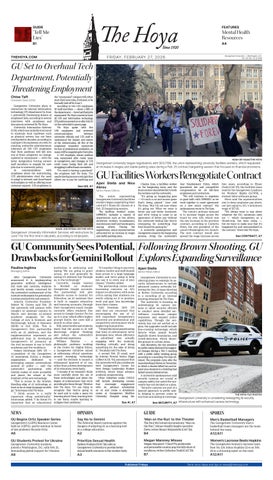
Georgetown University began negotiations with SEIU1199, the union representing university facilities workers, which requested an increase in wages and stable parking rates during a Feb. 25 contract bargaining session that focused on financial provisions.
falls short of excellence, writes Catherine Dodd (CAS ’29).
Women’s Lacrosse Beats Hopkins
women’s lacrosse team beat No. 5/6 Johns Hopkins 12-6 on Feb. 24 in
on the road.

Avoid the Institutionalization of AI

Georgetown University professors could very well begin to see the phrases “indelible mark” and “valuable insight” a lot more often. With artificial intelligence (AI) constantly in the news, debated in academic spaces, raised as a threat to higher education and banned in many classrooms, the university’s Feb. 23 announcement to further integrate AI into academics almost comes as a surprise.

The university plans to make Google’s AI assistant Gemini directly accessible to faculty and staff, eventually expanding this access to students, and introduce a range of other generative AI tools. AI topics will additionally be incorporated into both the College of Arts & Sciences (CAS) and McDonough School of Business (MSB) curricula.

The Editorial Board takes issue with this explicit approval of faculty and students using generative AI because it implicitly encourages dependence on these tools. In doing so, Georgetown risks undermining the very intellectual curiosity it seeks to cultivate.

A university spokesperson said the decision to begin integrating AI into Georgetown’s academic life will include multiple tools to ensure it is secure.

“Unlike consumer versions of AI tools, Georgetown’s enterprise instance of Gemini ensures that user chats and data are not used to train or improve the underlying models,” the spokesperson wrote to The Hoya. “Faculty and staff will receive access to Gemini first, followed by students. This phased approach allows faculty and staff to engage with training resources first, and prepare to support students on effective and appropriate engagement with these tools when applicable.”

We acknowledge the university’s intentions behind this new policy and support efforts to ensure that our community engages with AI responsibly. Denying the growing role of AI in academia and everyday life would not only be naive but also detrimental to students as they enter their professional lives.

With this in mind, we strongly applaud the university’s introduction of the tech, ethics and society minor in 2022, which provides students with class content to better understand digital technology and its responsible use. Furthermore, through courses such as “AI and Democracy” in the CAS, Georgetown continues to encourage students to develop their understanding of AI’s practical and ethical considerations.

The Editorial Board thinks that Georgetown is right to provide educational means to understand AI and its evolving place in modern society, but AI tools need not be integrated into the learning process itself. Georgetown cited the decision to use Gemini as a result of its “native integration with Google Workspace,” which implies students will easily be able to incorporate AI into their everyday online tasks. Georgetown’s endorsement of Gemini risks normalizing dependence on AI as a tool to offload independent thinking, hindering students’ analytical and creative skills.

Generative AI models also have an undeniable effect on creativity and diversity of thought that Georgetown hopes to encourage among its students. With ChatGPT shaping how people think, ideas will eventually become repetitive and fall flat. While it is undeniable that students do — and will continue to — use AI, the university should

HOYA HISTORY

not be encouraging the use of these tools that can make the actual learning process secondary.

Instead of normalizing shortcuts, Georgetown should strengthen students’ intellectual aptitude so they can solve the world’s problems without relying on a language learning model to do it for them.

After all, AI’s risks go far beyond circumventing the thought process — it can lead to outright plagiarism through lack of attribution in generated answers or lead to the complete fabrication of information. It may also create increased skepticism on the part of the professors who wonder if their students are improperly using AI against classroom policies.

This policy further creates a messaging issue for the campus community. While the university wrote in the announcement that faculty will have control over AI use in their classes, its simultaneous institutional support for Gemini sends the opposite signal to students and faculty alike. It reads as an endorsement of AI in any context.

The same day as the initial announcement, students received another email in which they were told not to upload or share course materials to AI platforms. This exposes another risk that the university is assuming through the integration of AI policy ––– it may harm university goals of protecting intellectual property and intellectual discovery.

Nonetheless, the Editorial Board recognizes that some students support the university’s efforts to incorporate AI.

Peyton Rydzewski (CAS ’29), a student majoring in computer science and math, said Georgetown’s integration of Gemini could support students in an academic setting.

“Georgetown’s efforts to boost AI proficiency through coursework and the implementation of Google’s Gemini is exactly what students need to supplement their career preparation,” Rydzewski wrote to The Hoya. “My only wish is that we would be supported in accessing more of these tools and sooner.”

The Editorial Board is not ignoring the reality of AI — it is indeed pervasive and will continue to play an expansive role in our lives. A nuanced understanding of AI and AI-based tools provides a competitive advantage to students as they prepare for an ever-changing workforce.

However, we believe these advancements should not come at the expense of intellectual development. Universities should be a pillar of resistance in our current political moment of democratic backsliding and increased threat of misinformation. Institutionalizing AI use in a manner that makes it easier to avoid critical thought or plagiarize is how universities will fail at this mission.

We support Georgetown in expanding coursework and course offerings that examine AI’s ethical, political and social implications. Continuing to fund research initiatives and support students interested in AI as a discipline is worthwhile. However, Georgetown should not blur the line between studying AI responsibly and promoting its routine use in academics.

The Hoya’s Editorial Board is composed of six students and is chaired by the opinion editors. Editorials reflect only the beliefs of a majority of the board and are not representative of The Hoya or any individual member of the board.

a glimpse into The Hoya’s rich history, allowing readers to appreciate the evolution of college

GU Seeks to Tap Into Information Highway

January 21, 1994

The Georgetown University Student Association (GUSA), the School of Foreign Service (SFS) Academic Council, and the university’s Main Campus Planning Committee are taking steps to bring high tech to the Hilltop.

According to GUSA representative Raj Kumar (SFS 97), GUSA has examined the report written in February 1992 by the Computing and Networking Task Force. The task force, composed of students, faculty and administration was formed by Dean Robert Lawton of the College of Arts and Sciences in June 1991. The report stated that its purpose was “to offer a plan for fully integrating computer, network and information technologies into the education and research programs at Georgetown.”

The extensive report covers 11 areas including computers for students and faculty, networking, electronic mail, classrooms, library and information resources, and curriculum. The report also recommended the formation of a standing university-wide advisory committee to accomplish the task force’s goals and allow for the effective resolution of new and evolving concerns.

According to Matthew Krichman (SFS ‘95), a member of the SFS Academic Council, the council has created a committee which is in the process of creating a proposal to submit to SFS Dean Peter Krogh. “The council was planning technology as one of our main agenda topics of the year,” he said.

According to Kumar, the student association is anxious to act on the task force’s advice. “I have been looking at that report and seeing if we can implement any short-term goals,” he said.

Kumar said short-term proposals include creating more convenient computing facilities for students, establishing a 24hour printing facility, putting computer labs in dorms and expanding the academic computer centers in the Reiss and Intercultural Center buildings.

Kumar will be meeting with the director of Lauinger Library, Dorothy Denning, Chair of the Task Force and Computer Science Department, and Ned Segal (SLL ’96), a member of the Main Campus Planning Committee and a GUSA representative on Monday to talk about the creation and charges of the standing committee.

“The long range goal is being completely computerized…but the problem is bridging the gap between the idea and reality,” Kumar added.

According to Krichman, the SFS committee’s proposal will probably call for the expansion of all computing facilities and the elimination of the $40 fee for use of the academic computing center.

“Eliminating the computer center fee is something very feasible, probably something that will happen next year,” Krichman said.

“Once we send the proposal to the Dean’s Office, it will show that this is something the students are really interested in,” he said. We are also perfectly willing to work in tandem with any other academic councils.”

According to Segal, the Main Campus Planning Committee hopes to increase campus awareness of technology related issues. “We talked about holding a forum in order to have students ask questions,” he said.

“The report outlined costs and ideals for technology, but gave no time frame. We need to create a time frame,” Segal said. Jeff Hom

Instead of normalizing shortcuts, Georgetown should strengthen students’ intellectual aptitude so they can solve the world’s problems without relying on a language learning model to do it for them.”

The Editorial Board “Avoid the Institutionalization of AI” thehoya.com

On Feb. 23, interim University President Robert M. Groves announced that Georgetown University will make Gemini, Google’s AI assistant, accessible to faculty and staff. Gemini access will eventually be extended to students, along with additional generative AI tools. Furthermore, the College of Arts & Sciences (CAS) and McDonough School of

Business (MSB) curricula will begin to explicitly incorporate AI topics.

In order to gauge student opinion, students were asked if they support the university taking measures to integrate generative AI into academics as outlined in this announcement. Of 118 responses, 60.2% said no, 29.7% said yes, 6.8% said unsure and 3.4% said indifferent.

EDITORIAL CARTOON by Autumn Dunlop

Founded January 14, 1920

Maren Fagan, Editor in Chief

Ruth Abramovitz, Aamir Jamil and Nora Toscano, Executive Editors

Nico Abreu, News Editor

Ajani Stella, News Editor

Paulina Inglima, Managing Editor

Opal Kendall, Features Editor

Saroja Ramchandren, Features Editor

Annikah Mishra, Opinion Editor

Ella O’Connor, Opinion Editor

Isabelle Cialone, Guide Editor

Tanvi Gorripati, Guide Editor

Nate Seidenstein, Sports Editor

Madeline Wang, Sports Editor

Angela Lekan, Science Editor

Eva Siminiceanu, Science Editor

Avelyn Bailey, Design Editor

Lucy Jung, Design Editor

Grace Bauer, Copy Chief

Jackson Roberts, Copy Chief

Shira Oz, Blog Editor

Fallon Wolfley, Blog Editor

Kate Hwang, Multimedia Editor

Michael Scime, Multimedia Editor

Matthew Gassoso, Photo Editor

Caroline Woodward, Audience Editor

Board of Directors

Patrick Clapsaddle, Chair

Bethe Bogrette, Julia Butler, Amber Cherry, Madeline

Grabow, Mia Streitberger

Peter Sloniewsky, General Manager

Olivia Zhang, Director of Business Operations

Rosie Garner, Director of Logistics

Connor Manrique-Johnson, Director of Outreach

Jackson Roberts, Technology Director

CALLING IN WITH CAROLINE

Prioritize Your Well-Being

elcome back, ad-

Wvice lovers. If school stress has you counting down the days until spring break, this week’s column is for you: We’re covering burnout, job-hunting anxiety and that one friend’s boyfriend nobody can stand. As always, if you have a question I didn’t answer, submit it to this anonymous form, and I’ll help you out. My roommate has been dating a guy that none of our other friends like. I don’t think he’s a good person, and we all hate the way he talks to her. Since they started dating, they’ve been hanging out almost exclusively in our living room, which means I have to see him every single time I leave my room. He also comes to all of our social events, and I’m honestly so sick of being around him. How do I bring this up to my friend and tell her I miss girls-only time without offending her?

The best approach to these kinds of conversations is to frame them around the use of your shared space, not as a reflection of your feelings about her boyfriend. It can be frustrating to have someone in your home all the time who doesn’t live there, and it’s completely valid to ask for some no-guests time so you can feel comfortable without a stranger around. Sharing these feelings with your roommate as a living preference request is less likely to put her on the defensive than an attack on her boyfriend’s character, however warranted that may be. It also sounds like you miss spending time with your friend one-on-one, which makes a lot of sense if you’re feeling like she’s only around when her boyfriend is there. Make an effort to schedule some social events that include just your immediate friend group; that way, there’s no expectation that her boyfriend will be invited, and you’ll be able to spend some time together without being bothered by his presence.

Lately I’ve been so incredibly busy with work, school and all of my activities that I’ve been feeling like I don’t have any time for myself. I haven’t seen some of my close friends in weeks, and I’m

really starting to miss them. I don’t think I’m burnt out yet, but it’s starting to feel like doing anything that isn’t work doesn’t have a place in my schedule. If you’re not feeling burnt out, that’s great, but it sounds like your level of commitment isn’t sustainable for the next few months. When you’re incredibly busy, it can be easy to feel like taking time for yourself isn’t an option, but a constant cycle of work with no relaxation is a quick way to exhaust yourself. Treating this time as nonnegotiable can be really important when you’re feeling overworked — take a minute to find some time every day where you’ll stop working and do something that makes you happy, whether that’s reading a book for 30 minutes before you go to bed or scheduling more dinners with your friends.

Regularly setting a small amount of time aside guarantees that you’ll be able to see those friends you’ve been missing lately and can take some of the stress away from an overwhelming schedule. I don’t have a summer internship yet even though many of my friends do. I’m starting to get super anxious with every rejection email I get, and it’s having an impact on my self-worth. It can be really stressful to feel like everyone around you has their plans decided when you’re still figuring things out, but an internship or job doesn’t determine your worth or future success. Finding a job can be incredibly difficult and competitive, and it’s important to separate this from any reflection of your own ability. While it’s normal to feel overwhelmed when you open up an email with bad news, remember that it’s only February! You’ve still got plenty of time to find a great opportunity, so take a minute to breathe and remember that your abilities go far beyond what’s reflected in a job application.

Caroline Brown is a senior in the College of Arts & Sciences. This is the 10th installment of her column, “Calling in With Caroline.”

Is Georgetown University a great university? I, and many others, think so. Beyond being the first Catholic university founded in our country, boasting a once nationally recognized and culturally important basketball program, producing the largest number of Fulbright scholars per year, and helping pioneer the field of bioethics with the launch of the Kennedy Institute of Ethics in 1971 (I could go on and on…), Georgetown is our university. It educates us, challenges us, tolerates our criticism and celebrates our achievements. It is where many of us have found lifelong friends, lovers and mentors. Our university has achieved many great things and often does great things for us. We should be proud of that. But often we are not. This article is really about the university’s New Student Orientation (NSO) program, which has the unique responsibility of setting new Hoyas’ expectations and shaping their perception of the place they will call home for the next four years. I served as an orientation advisor (OA) last year and — Patrick Ledesma willing — will do so again this year. It was a truly special and rewarding experience. Surrounded by the wonder that comes with starting a new chapter in one’s life and gaining newfound independence, you can feel students’ enthusiasm about Georgetown. This is one of the top 25 universities in a nation with over 2,500 undergraduate institutions; it is the top-ranked Jesuit university

Carry Lessons Beyond the Hilltop

Since arriving on campus in 2004, Georgetown University has profoundly shaped my life path: I find myself married to my college sweetheart, a father of three and building a life centered on my passions. While you only have four years in college, the lessons you learn on the Hilltop are ones you can carry with you well after graduation. These are the three enduring pieces of advice from fellow Hoyas — friends, mentors and professors — that have helped me the most. I encourage Hoyas to try and glean something from these words and apply them to their own lives.

One of my former classmates, Rod, once told me the sword of victory has been hammered in the flame 1,000 times. Shortly after graduation, Rod, our classmate Hammad and I moved into a refugee camp in the West Bank to start Inspire Dreams, an organization serving refugee youth. After a local shooting led to the cancellation of our first day of summer camp, we considered walking away from the cause. Instead of leaving, we stayed, adapted and went on to run successful camps for several summers. Some of our students obtained admission to prestigious universities including an Ivy League school — something we would not have seen if we just left the community. Rod’s belief that overcoming obstacles not only guided me in this experience but in subsequent stages of my life. When current students face a professional, academic or personal challenge, the first instinct should not be to quit — you may be forgoing a special learning opportunity.

Through the Patrick Healy Fellowship program, I received mentorship from a Georgetown School of Foreign Service (SFS) graduate named Caleb, who told me to invest in my friendships. You can’t always control your boss’ whims or whether you’ll have the chance to say goodbye to a loved one, but you do get to choose your friends and how deeply you commit to those relationships.

I took Caleb’s word to heart. During my senior year at Georgetown in early 2008, four of my classmates and I skipped class and drove to Bamberg, S.C., to volunteer on the Obama campaign during the South Carolina primaries. Together we knocked on doors, spoke to residents, met civil rights leaders, ate an inordinate amount of fast food, outran neighborhood dogs and shared our post-graduation hopes and dreams. On Saturday night, we watched then-Senator Obama give his victory speech in Columbia, S.C., and returned back to the Hilltop with an unbreakable bond. Those friendships have grown over the years, from guidance on graduate school and career moves, perspective on marriage and parenthood, and counsel on family dynamics. Five Hoyas served as groomsmen at my wedding. My friend Greg has been my go-to source for parenting advice from developing sleep patterns, officiating play dates, coaching youth sports and mediating sibling rivalries. Hoyas, take the chance on friendships on the Hilltop. Talk to everyone, join new clubs and yes — sometimes skip class together. Let the opportunities at Georgetown, even if they may seem purely professional, be a way to find these lifelong friends. It might be one of the most rewarding decisions you will have ever made.

Finally, professor Dan Porterfield (CAS ’83) offered a third lesson: When your go-for-it moment comes, go for it. Everyone’s circumstances differ, but when your interests, talents and passions align, you have to lean into that momentum. It won’t always work.

In my case, it has meant missing out on job opportunities, periods of unemployment and even working for a venture that ultimately failed.

Joining the Obama campaign in 2007 and starting Inspire Dreams in 2008 were two of my go-for-it moments. It meant missing out on recruiting cycles and lucrative jobs that my classmates obtained. Those moments gave me courage later in life when I needed it — including serving as a firefighter and managing a small business during the COVID-19 pandemic. It might not always feel comfortable to take the leap, especially when it comes with substantial risks, but you never know where it will take you until you try.

I encourage Hoyas to listen to the wisdom from their friends, invest in those relationships and seek out mentorship from professors and alumni. To find your own version of Rod, Caleb and Dan, be intentional with your time and think about what lessons you can carry after your time on the Hilltop ends.

Indra Sen is a graduate of the School of Foreign Service.

in our nation and a damn hard school to get into. Many incoming first-years are often naturally inclined to buy into Georgetown. Yet we don’t take advantage of that eagerness. We squander it.

Don’t get me wrong. NSO is a valuable and well-run program. By its end, students know what their support system looks like — at the very least, they have heard about every important resource on campus.

However, NSO’s introduction to Georgetown as an institution — and to the traditions, values and history that built it — is bashful at best.

At the opening ceremony, we just distribute lyric sheets for our very complicated fight song. When the pep band played it last year, OA leaders and captains stood and tried to sing it, but mostly did so quietly, unsure of their own knowledge of the song. The fight song is never revisited. We take students to a panel on Jesuit values, but we do not celebrate our uniquely Catholic heritage or context: Each value is presented as a sort of universally agreeable good, with a discussion of “ad majorem dei gloriam” often left out.

The most damaging instance, however, is NSO’s introduction of Georgetown’s history and, implicitly, its suggestion of how students are supposed to feel about the university. Currently, discussion of Georgetown’s history at NSO is limited to its admittedly woeful record on slavery.

When I was a first year, this took the form of a panel discussing

Georgetown’s past ownership of enslaved persons and its implications for current students’ responsibilities.

Last year, this was scaled-down slightly, with the panel replaced by a short video covering famous locations on campus and their connections to slavery. Afterwards, OAs were supposed to lead discussions using suggested guiding questions.

The name of the session is most revealing — it is called “Confronting Georgetown’s History.” There are absolutely parts of Georgetown’s history we should not be proud of.

But it is equally true that there are parts we should embrace. Imagine if discussion of Georgetown’s history at NSO were extended to include the religious toleration inherent in its founding, or its glory and importance in national culture during its athletic heights. Imagine if it included our education of Vera Rubin (GRD ’54), the groundbreaking physicist who helped discover dark matter and attended Georgetown because other leading astronomy programs, such as Princeton University, did not accept women at the time. Imagine, even, just generally, if instead of just giving students a fight song lyrics sheet, we sat down with them and taught them how to sing it with pride.

There is so much in our university’s history and traditions to learn about, interpret and discuss.

But when our discussion of that history during NSO is limited to our involvement in slavery and resulting reform, we — whether intentionally

or not — teach new students that their primary feeling should be shame and that our university’s past is irreparably stained. This can be disheartening and alienating to students so eager to embrace their new home. We need to also teach new students about moments of excellence if we want them to take a stake in Georgetown’s future, however one might envision that. I would suggest that by showcasing our achievements in the past, instead of just our failures, we can prove to new students that Georgetown is truly a university where you can make great change and have great impact. Perhaps students would be more motivated to serve and remedy those perceived injustices. Perhaps students would be awed by the institution they attend and be less motivated to treat it transactionally as the means to an end of a corporate job. Perhaps students would feel more responsibility to continue driving our university forward and be more compelled to contribute to the programs that keep it great. That is all speculative of course, but initial impressions matter. Let us, at NSO, present a vision of Georgetown that we all can embrace. There is so much to be proud of in our university’s history. Imagine if we started showing new students that as well.

Saahil Rao is a junior in the School of Foreign Service.

Protect Students’ Sexual Health

Afew weeks ago, pink streamers, heart-shaped cookies and whispered plans filled the air as Valentine’s Day approached. It was a day for love notes slipped under dorm doors and reservations made weeks in advance. Beneath all the roses and chocolate, there is a quieter truth that most people on college campuses know and rarely name: Students are having sex. And that is not something shameful, reckless or surprising. It is something undeniably human. Georgetown University, however, continues to treat student sexuality like a secret rather than a reality. Despite branding itself as a university committed to “cura personalis,” Georgetown withholds basic sexual health resources from students, especially during moments like Valentine’s Day when intimacy is at the front and center. The university should actively support students with accessible contraception, emergency care and open dialogue both during and outside of this holiday. Instead, it offers silence, restrictions and moral distance. I write this not as a casual observer but as someone who has spent years immersed in reproductive health advocacy and care. I have worked with H*yas for Choice throughout my time at Georgetown, sitting on the executive board and working to organize advocacy initiatives, further sexual health resources and keep the organization running smoothly. I have sat in exam rooms as an OB-GYN medical assistant, and I have conducted sexual health research with Alaska Native communities through the Alaska Native Tribal Health Consortium. I am also currently completing a global health honors thesis examining the connections between abortion access and maternal health since Roe v. Wade was overturned.

Across clinics, communities and classrooms, I have learned one consistent lesson: When

institutions refuse to support sexual health, people suffer. When provided with the necessary support, people thrive. At Georgetown, the Student Health Center cannot prescribe students hormonal birth control medication solely for contraception. If students want these medications, they instead must be prescribed for extraneous reasons such as painful menstrual cramps or acne. There is no university-provided emergency contraception. There are no free condoms available through campus health services. This stands in stark contrast to the standard at many universities, where contraception, safer sex supplies and emergency care are treated as basic components of student health. Institutionally, Georgetown continues to reject abortion care by refusing to acknowledge prochoice student groups or stances, while simultaneously platforming anti-choice viewpoints that further stigmatize reproductive autonomy. These policies do not prevent sex — they simply make it less safe. This disconnect became especially glaring around Valentine’s Day. The university leaned into the aesthetics of romance while avoiding the responsibility of care. We celebrated love while withholding the tools students need to navigate intimacy safely, responsibly and with dignity. Sex is not a moral failure; it is a part of life. It can be joyful, meaningful, awkward, vulnerable and powerful. Pretending otherwise does not align with reality, and it certainly does not align with Georgetown’s stated commitment to student well-being. When access to contraception is limited, students face higher risks of unintended pregnancy, sexually transmitted infections and emotional distress. When conversations about sex are silenced, shame fills the gap. And yet, in the absence of institutional support, students support each other.

H*yas for Choice has spent years doing what Georgetown will not. We provide free condoms, dental dams, lubricant and emergency contraception to students because we know firsthand that care cannot wait for policy shifts. We host workshops, answer questions and create spaces where sexual health is discussed with honesty rather than judgment. Our message is simple: We support us. However, student organizations should not have to function as the primary sexual health safety net at a university of Georgetown’s size and resources. Peer-led care is powerful, but it should supplement institutional support, not replace it. Valentine’s Day should be more than simply heart-shaped balloons. It should be a moment when Georgetown affirms that student health includes sexual health. Georgetown could be a campus where free contraception is available without stigma. Where emergency contraception is easy to obtain when it matters most. Where health providers can prescribe birth control without bureaucratic barriers. Where conversations about sex are grounded in compassion rather than fear. This is not radical. It is standard at countless universities across the country. Georgetown students are adults. We form relationships, explore intimacy and make choices about our bodies every day. The university can either meet us with trust and support or continue pretending we are not doing exactly what humans have done for all of history. Let us be honest about love. Let us acknowledge that care is part of romance, that protection is part of pleasure and that health is part of humanity. Let us ask Georgetown to finally show up for its students in the ways that matter most. Until then, we will keep showing up for each other.

Sydney Hudson is a senior in the School of Health.

COURTESTY OF INDRA SEN
Indra Sen (SFS ’08), Nick Wertsch (COL ’09) and Ben Shaw (COL ’08).

GU Students Raise Concerns Over Campus Mental Health Resources, Insurance Coverage

Although Georgetown has taken some steps to expand mental health services, students report regular delays and communication issues when seeking support from CAPS.

Content warning: This article contains references to suicidal thoughts and other mental health concerns. Please refer to the end of the article for on- and off-campus resources.

In Fall 2015, Brittany Rios (COL ’18) tried to set up an appointment with Counseling and Psychiatric Services (CAPS), the primary mental health care provider at Georgetown University. She would not have her first counseling session for another three weeks, after three separate intake meetings with the program.

Rios, who ultimately received treatment from an off-campus provider, said that timeline ignored the severity of her situation.

“I think there are times where you can wait and times where you know you can’t,” Rios told The Hoya. “I just very much felt like I was in a position where I couldn’t wait for a month.”

Elena Evans (NHS ’22) tried to set up a similar evaluation appointment in Spring 2019, but never received promised communication. After nine days of leaving her emails unanswered, CAPS offered Evans an appointment with one of their in-house therapists within the next two to four weeks or a referral to two off-campus psychiatrists, one of whom was not accepting new patients and the other of whom was not covered by her insurance.

Evans, who was experiencing suicidal ideation, said this treatment plan required her to be proactive about her care.

“The response was essentially like, ‘Yeah, we’ll get in touch,’” Evans told The Hoya. “And then they were like, ‘Okay, if we don’t call you in a couple days, call us.’ It’s pretty common sense that you don’t tell someone with severe depression, ‘Hey, by the way, here’s your responsibility. You have to do this.’”

In the years since Evans’ and Rios’ experiences, the university has taken some steps to expand its resources and reduce counseling costs, but students continue to report issues with campus mental health support. In 2025, only 24% of undergraduate students felt CAPS sufficiently addressed their needs, while 52% said the program was inadequate, according to the Cultural Climate Survey.

Alex Goodale (CAS ’26) — the treasurer of GU Active Minds, a student group dedicated to destigmatizing mental health on campus — said CAPS is a well-known but inaccessible resource.

“It has a bad reputation,” Goodale told The Hoya. “People know about CAPS but are dissuaded from going there, just because they’ve heard stories of long wait times.” A university spokesperson said Georgetown offers diverse support mechanisms to meet student demand.

“Georgetown University Counseling and Psychiatric Services (CAPS) clinicians are constantly working to meet student needs for therapy through a multimodal and multipronged approach,” the spokesper-

son wrote to The Hoya. “CAPS provides a plethora of services to meet student needs and strives to do so in many different ways including, and in addition to, individual therapy.”

Evans, who instead received support from a hometown provider, said her experience reflected a broader issue with the university’s approach to mental health.

“It was pretty clear that Georgetown really did not put the amount of resources or time or thought into this,” Evans said. “It was glaring and concerning, especially when thinking about what the mottos of the school are and what the entire ethos is.”

Waiting Room In the last decade, anxiety, depression and suicidal ideation among college students have increased dramatically, putting additional pressure on university counseling centers.

Anastasia Dueñas (CAS ’25), the former Georgetown University Student Association (GUSA) student health and wellness director, said the school’s intense academic environment places additional pressure on students’ mental health.

“If you’re constantly in that mode — ‘I have to be busy, I have to get this accolade in order to compete with my peers or land that next internship or job’ — it comes with a lot of stress,” Dueñas told The Hoya “The culture of everyone basically being in that type of environment can also become a pressure cooker.”

Dueñas said students reported lengthy wait times for CAPS services during her GUSA tenure.

“Students have expressed concerns in the past of basically needing help with mental health needs,” Dueñas said. “It wasn’t necessarily a crisis or an emergency, but they were urgent and, because of the demand, they were definitely experiencing weeks at a time before they can even get an initial appointment or consult.”

CAPS employs 23 clinical staff members to serve its 17,000 students at the Hilltop Campus and Capitol Campus — a number averaging to around 750 students per counselor.

Syd Howard (GRD ’26) — a member of the CAPS Student Advisory Board, which liaises with program staff and the student body — said CAPS has limited capacity.

“Maybe we can find ways to tap into other resources to ensure the demand that students are requesting,” Howard told The Hoya “Because we’re saying like ‘Hey, come!’ and then we’re like, ‘Uh oh! There’s a lot of y’all coming in!’”

A student who used CAPS in Spring 2025 and requested anonymity due to privacy concerns, said wait times worsened as the semester progressed.

“The later you wait in the semester, there’s more people and there’s more of a wait time,” the student told The Hoya. “So it’s more difficult to meet with someone who’s actually within the CAPS system.” The spokesperson said students

can typically be seen for triage appointments within two to three business days, but wait times can vary.

“The wait time may be longer if the student has a specific request (e.g. they want to work with a particular clinician) or if the student’s availability is limited due to academic demands,” the spokesperson wrote. “During the busiest times of the semester (March and April in the spring, October and November in the fall), wait times may be longer.”

Goodale said students report that capacity issues prevent them from receiving timely care, except in the most urgent cases.

“It seems like CAPS is most accessible when you’re at rock bottom,” Goodale said. “But you don’t want people to be at rock bottom before being able to get help.”

Another student, who sought support from CAPS in Fall 2023 and also requested anonymity due to privacy concerns, said she opted to pursue external support after a series of delays, including a triage-free crisis meeting.

“They didn’t set me up with a regular person until one or two weeks after I had my first priority hour — something they offer if you reach out to them with an urgent need or request,” the student told The Hoya “I, since then, have not been back to CAPS,” the student added. “I found care outside of Georgetown, but a lot of students can’t do that, so I think that they need to do better for students who can’t afford to go other places or get connected to different resources.”

To mitigate capacity concerns, CAPS generally handles urgent and short-term student care, but outsources students for long-term needs or specialized treatment strategies.

Jessica Kuszelewicz, CAPS’ clinical case coordinator, said staff members consider students’ individual needs to develop a treatment plan.

“For instance, if they’re looking for specialized care, for OCD treatment, or something of that nature, there are specific modalities that are the gold standard for certain mental health conditions and treatment,” Kuszelewicz told The Hoya “We would refer them out and help secure them with a clinician that is according to their preferences.”

“If they prefer a specific gender, specific age, specific type and that’s in network with their insurance, we will work with them to find the right fit if CAPS is not appropriate,” Kuszelewicz added.

Phil Meilman, who served as CAPS’ director until 2020, said the program’s providers would not refer high-risk students to outside services.

“You can’t refer out somebody who is in the middle of a crisis, you have to see the crisis to the point of calming and hopefully resolution,” Meilman told The Hoya. “If someone is acutely suicidal or having some major difficulties, you want to at least get them out of the crisis state.”

Evans, who felt she was experiencing a high-risk mental health crisis, said she should have received

more immediate in-network care.

“I think it was really just such an abysmal failure that it didn’t feel worth trying again,” Evans said.

“I’m someone who still works tangential to the medical field, and I’ve dealt with the medical field a lot for physical illness, and it was just an alarmingly negligent situation.”

The Cost of Caring

The tuition insurance plan

Georgetown offers covers 100% of tuition and fees if a student takes a medical leave of absence for physical health issues after the school’s refund schedule elapses, but only 75% for mental health concerns.

Julia Strimling (SON ’26), who took a mental-health-related leave of absence in Spring and Fall 2024, said financial concerns unnecessarily delayed her decision.

“I waited months longer than I should have to give myself a break, because I never purchased insurance to begin with,” Strimling told The Hoya. “I had never looked into it. I thought ‘When am I going to need that?’ and so I hadn’t purchased it, but even given the opportunity to purchase it, it doesn’t cover mental health the way it should.”

“Financial responsibility becomes a priority in your mind over your own health,” Strimling added.

Zahra Izzi (SOH ’27), who serves on the CAPS Student Advisory Board, said the policy improperly suggests that mental health concerns are less legitimate.

“It definitely makes it seem like they think that physical health problems are more serious than mental health problems, which is sometimes true, but not always,” Izzi told The Hoya. “They should be working more to the discretion of people who are in CAPS.”

“If you’re on crutches or something, you physically can’t make it. But if you’re physically there and you’re mentally not there, that’s kind of the same thing,” Izzi added.

Roan Bedoian (CAS ’28), the chair of GUSA’s financial accessibility committee, said the insurance discrepancy disproportionately impacts underprivileged students, discouraging them from taking needed leaves of absence.

“It means that students who are in a less financially stable position are going to be less able to take care of their mental health, if withdrawal is what they need to do to take care of themselves for a semester or a year, or however long it needs to be,” Bedoian told The Hoya. “Students who have the means to eat that 20% of their tuition and be okay with that are able to withdraw for mental health reasons, but for students who can’t eat that 20% and need to make that tuition worth it, they’re only going to be able to withdraw if they have a physical condition come up.”

Strimling, who launched a petition calling for equal tuition insurance coverage in Fall 2025, said there should be no distinction between the university’s support for

physical and mental concerns.

“It should be equal for physical health and mental health,” Strimling said. “So many students experience mental health difficulties when they’re in college that we need to ensure that the tuition insurance policies reflect the values of the school.”

Bernie Yamakaitis (SFS ’22), who also took mental-health-related leaves of absence in Fall 2017, Spring 2019 and Fall 2019, said the university’s policy unfairly penalizes students for issues beyond their control.

“The fact of the matter is, if you have to leave your university, which is your temporary home, because of mental illness — like you have to withdraw — that indicates a failure on the part of the university to even provide adequate service,” Yamakaitis told The Hoya. “Then to not even get a full refund, the way you would if you broke your right arm or something, it feels wrong.”

Bridging the Gap

In the last decade, Georgetown has taken several steps to improve campus mental health support.

In 2018, GUSA established the Georgetown Student Mental Health Fund, which offers financial assistance to students outsourced by CAPS, and in 2021, the university launched TimelyCare, a free mental telehealth service for students. In February, GUSA also announced the reopening of Project Lighthouse, a student-led mental health chatline that was founded in 2016 but has been defunct for the last two years.

CAPS has also embedded several clinicians with higher risk groups, including the athletics department and the Georgetown Scholars Program, which serves first-generation and low-income students.

Despite these advances, Hannah Corwin (SOH ’26), the president of Project Lighthouse, said students remain disconnected from campus mental health resources.

“I think there’s a little bit of error in a lot of students not knowing resources on campus,” Corwin told The Hoya. “That’s something that I realized when we tabled in October for some event that was in Red Square and we did a trivia game that had to do with ‘for this mental health issue, which resource could you use’ and a lot of people just didn’t know about some of the resources that there are on campus.”

Student mental health organizations also reported poor student turnout to club events. According to GU Active Minds leadership, only about 30 students regularly come to meetings, and 10 of those students are board members.

Nashua Haque (MED ’29), another CAPS Student Advisory Board member, said previous backlogs, such as during the COVID-19 pandemic, continue to impact student engagement with the program.

“Another thing that we’ve heard about is people saying that it’s inaccessible and that appointments aren’t available, and that reflects something that maybe was more prevalent during the COVID period,”

Haque told The Hoya. “But with more recent developments to the staff, there’s definitely been an increase in availability for appointments.”

“A lot of the discussion that happens comes from miscommunication, so making sure we’re weeding that out and making sure the staff is aware that these misconceptions exist has been the method,” Haque added. Though satisfaction with CAPS remains low, student approval of the service has improved by roughly nine percent since 2020, when the Cultural Climate Survey was first administered. Still, Goodale said more intentional communication would boost student engagement with the program.

“That messaging of a culture of care and mental wellness just is lacking, and I don’t think the university is doing enough to promote it, even if they’re not the ones that are like directly saying, ‘stress yourself out,’” Goodale said. In lieu of university support, leaders of student groups say their organizations have stepped up to provide additional resources.

Kathryn Castle, the associate vice president of student health, said student-led programming is essential to meeting campus demand.

“I hope we are able to continue to develop more peer-to-peer programming to supplement Georgetown’s robust university resources and better meet the needs of Georgetown students,” Castle wrote to The Hoya Corwin said clubs can target a unique aspect of mental health care.

“It creates more of a sense of community and an understanding between students that there are other people who have shared experience or feel similar ways,” Corwin said. “I think that in itself is a strong form of mental health support and sometimes can be more helpful or just helpful in a different way than meeting with a counselor.” Goodale said, unlike CAPS, clubs are a lower stakes entry point for students.

“Sometimes it’s hard for people to go to those where it feels more like a professional leading it,” Goodale said. “People might be more self-conscious about that, where I feel like, when something’s student-run, students can better empathize with people, and you might feel more comfortable talking to your peers about certain things.” While clubs provide some recourse for students, Rios said the university must work to improve student experiences.

“Mental health issues usually start presenting themselves between 18 and 24,” Rios said. “That’s the window of time your brain may or may not totally give up on you, so I think it’s important to have that extra availability, specifically for people when that might be their first experience with counseling, so they don’t write it off forever.”

Resources: On-campus resources include Health Education Services (202-687-8949); off-campus resources include the National Suicide Prevention Hotline (1-800-273-8255).

ILLUSTRATION BY AVELYN BAILEY/THE HOYA Amid a growing mental health crisis on college campuses, Georgetown does not offer equal tuition insurance for mental- and physicalhealth-related leaves of absence, which students say accelerate the issue.

DC Water Reports No New Overflows After January Potomac Sewage Spill, Repairs Remain on Schedule

Jaya Alenghat

Water management officials in Washington, D.C., said repairs to the Potomac River’s sewage system remain on track at a Feb. 23 media briefing, despite public health advisories remaining in place weeks after sewage contamination.

After the collapse of the Potomac Interceptor, one of the region’s major sewer lines, on Jan. 19, sewage overflow sent raw wastewater into the Potomac River, raising concerns about water quality and safety. At the briefing held a month after the spill, D.C. Water officials said repair efforts on the Potomac Interceptor remain on schedule, bypass pumping systems are functioning effectively and that there have been no new overflows for more than two weeks.

Officials added that while the city’s drinking water has not been impacted, the D.C. Department of Energy and Environment released a public health advisory recommending the public avoid contact with the Potomac as bacteria sampling and testing continues.

Sherri Lewis, senior communications manager of D.C. Water, said their repair operations

continue to bypass the damaged section of the interceptor.

“We have not had any overflows that have entered the Potomac River for more than two weeks now. Today is actually the 15th day that we’re going into without any overflows,” Lewis said at the briefing. “Our pumping operations, that bypass pumping system, continues to work well and be able to divert the wastewater around the damaged pipe section and back into the Potomac Interceptor.”

Colonel Francis Pera, the Baltimore district commander of the U.S. Army Corps of Engineers, said drinking water has not been impacted by the overflow. Lewis added that decisions about recreational use of the river should be guided by public health advisory and ongoing water quality monitoring.

“Ultimately it is a personal decision, based on the science, the water quality that we’re seeing and the advice of the district and the experts — the subject matter experts who are advising and issuing those advisories,” Lewis said at the briefing.

Jessica Meiller, co-director of Georgetown’s environment & sustainability program, said students should abide by the suggestions outlined in the public health advisory.

“Students should continue to avoid contact with the Potomac until it has been cleared for recreational use,” Meiller wrote to The Hoya. “If they do touch the water, they should wash their hands and any clothes or gear that came into contact with it.”

Raw sewage introduces fecal contamination into the river, which can carry bacteria and viruses.

Meiller wrote that one key indicator of contamination is the presence of E. coli.

“Most strains of E. coli itself are pretty harmless to humans but the presence of E. coli in waterways are indicators of fecal contamination and therefore also of the potential presence of other harmful types of waterborne pathogens (bacteria and viruses),” Meiller wrote. “And there are some strains of E. coli that can lead to stomach cramps, diarrhea and vomiting.”

However, according to testing data for the week of Feb. 20, average E. coli levels in the Potomac have been decreasing in areas near the overflow, and are below the recreational limit in Georgetown at Wisconsin Avenue, showing improvement.

Lewis said bacterial levels can fluctuate after heavy rainfall and that single spikes do not necessarily reflect broader trends.

Evan Hogan (CAS ’27), an environment & sustainability student at Georgetown, said he was surprised about the severity of the overflow.

“It definitely was a bit shocking that something this drastic was happening in the 21st century,” Hogan told The Hoya. “But I think unfortunately it’s nothing new for the Potomac.”

Hogan said the incident reflects poorly on the state of environmental infrastructure.

“If this incredibly important and crucial piece of infrastructure — and against my understanding it is one of the most important sewage pipelines in Northern Virginia — is able to fail in such a catastrophic way in the outskirts of the capital of the country, what does that mean for everywhere else?” Hogan said.

Officials estimated the total cost of repairs and environmental remediation to be approximately $20 million. The sewage line is expected to be fully functioning again by mid-March.

Lewis said that heavy rain last week created additional challenges of runoff from nearby roadways flowing into the worksite, causing D.C. Water to request federal assistance.

The Army Corps of Engineers mobilized after a federal emergency declaration to help stabilize the area and reduce further contamination.

STIA Partners With Foreign Service Foundation

The science, technology and international affairs (STIA) program in the School of Foreign Service will partner with the Delta Phi Epsilon Foundation, which promotes and financially supports education in foreign service, to provide awards and fellowships for STIA students, the department announced Feb. 17.

The foundation will fund two awards for STIA graduating seniors: the Delta Phi Epsilon STIA Service Award and the Jack Herrity Innovation Award. The service award focuses on community service and the real-world application of knowledge gained in the STIA program, whereas the innovation award recognizes outstanding achievement and potential for impact in social innovation.

Anna Gale (SFS ’28), a STIA student, said the foundation partnership will support scientific scholarship and policy.

“The modern policy landscape is already governed by the intersection of science and policy, so recognizing the impacts that individual students are making shows Georgetown’s commitment to supporting STIA students and also science policy innovation,” Gale wrote to The Hoya

Emily Mendenhall, STIA program director, said the partnership with the foundation, which was founded by Georgetown graduates, came about through a recommendation from a STIA graduate.

“One of our generous STIA alums identified this organization as a possible great partner for us,” Mendenhall told The Hoya. “They give a lot of fellowships for students to do internships. So we had conversations, and asked what kind of things they support, and

they said they really like to support and invest in student experiences.”

The partnership will also establish the Joseph LeMoine Internship Scholarship program, offering a subsidy for STIA students looking to pursue unpaid internships. The new scholarship program will provide up to $5,000 for a 10-week placement during the summer and up to $500 for a placement during the academic semester for selected students.

Ava Wong (SFS ’27), a STIA student concentrating in energy and environment, said the internship program will unlock opportunities for many students.

“This is incredible news for the STIA department and STIA students because STIA covers a really wide range of disciplines and opportunities, but a lot in the sector of public service, similar to a lot of other opportunities, are unpaid, and it’s difficult for students to get involved with those,” Wong told The Hoya

“I hope that the funding could increase even more in the future from other partners,” Wong added.

Mendenhall said beyond the awards, the foundation wanted to provide financial support to STIA students.

“Each fellowship is $5,000, and they’re competitive for STIA major students who are wanting to do internships mostly abroad, internships that are not paid, so that they can take a risk,” Mendenhall said.

Anna doRosario (SFS ’26), another student studying STIA, said the partnership will encourage STIA students to engage with service-related work.

“This is a clear way in which it can be applied in that more service realm, because a lot more of that curriculum for STIA was developed during the Cold War,

HAAN JUN (RYAN) LEE/THE HOYA

The science, technology and international affairs (STIA) program will partner with the Delta Phi Epsilon Foundation.

and for the nuclear age,” doRosario told The Hoya. “We have a lot of physics classes, and a lot of nuclear classes, but this is another option in addition to the more national security focus.”

Mendenhall said she hopes the fellowship will allow STIA students to explore academic and career opportunities abroad.

“Most of the STIA faculty really want students to get some great international experience, and not just in Europe, but in countries all over the world, so this will create opportunities for students to take risks that they couldn’t otherwise and get into the world,” Mendenhall said.

Mendenhall said she hopes the fellowships will encourage students to partake in internships they have a genuine interest in without the worry of financial constraints.

“A lot of students can’t take a risk for an internship because of financial needs,” Mendenhall said.

“This enables people to do more service work, or an internship in a place like a lower-income country where it would be hard to get to without support, or they can’t get paid. So they’ll have money to pay their way and they’ll be able to have an opportunity that they wouldn’t have otherwise.”

Fruit Fly Brains Reveal the Circuitry Behind Sleep

Oh-Jak

A neuroscientist and assistant professor at the University of Alberta presented his research on the neural mechanisms of sleeping fruit flies at a Georgetown University biology department seminar Feb. 19.

Jacob Berry’s lecture — hosted by Isaac Cervantes-Sandoval, assistant professor in the biology department — was the latest in the department’s weekly invited speaker series and highlighted how specific brain circuits and chemical signals regulate when animals sleep and wake. Berry’s findings suggest that even in simple organisms, sleep is controlled by precise neural pathways, offering insights that could eventually help scientists understand sleep disorders and brain function in humans.

Cervantes-Sandoval, who introduced Berry at the event, emphasized the impact of his colleague’s work on the neuroscience field. He said Berry’s past research has reshaped scientific understanding of how brain circuits influence behavior.

“He found that the same neurons that are in charge of encoding

memories are also involved in eroding these memories in the forgetting process,” Cervantes-Sandoval said at the event. “That paper kind of became a classic in the field.”

Sleep is essential for survival across species, affecting everything from metabolism to memory. Berry’s lab in Alberta studies how brain circuits regulate sleep and how those systems overlap with mechanisms for learning.

Berry explained that his team focuses on identifying how specific neurons and chemical signals control sleep and wakefulness. He said understanding these mechanisms requires studying the brain at multiple levels, from behavior to molecular interactions.

“We ask questions about how sleep is being regulated at molecular and circuit levels,” Berry said at the event. “Sleep is very important for maintaining functionality across the board.”

Berry’s research uses drosophila melanogaster, a species of fruit flies that is a common model organism in neuroscience. Although they are tiny, fruit flies display sleep patterns similar to humans, including sleeping at night and experiencing a midday rest period.

Berry said his lab discovered that different types of sleep in fruit flies are controlled by separate brain circuits. In particular, his team found that daytime sleep appears to depend on light and specific dopamine-related signaling pathways.

“Our working model is that light and daytime together are influencing dopamine signaling,” Berry said. “That signaling affects these neurons to promote wakefulness.”

His team also identified a receptor called “R2” that plays a key role in keeping flies awake during the day. When the receptor was removed, flies slept more, suggesting that dopamine signaling helps regulate alertness.

Berry said these findings challenge previous assumptions about how sleep circuits function.

“To me, that suggests that this circuit output was actually driving wakefulness,” Berry said.

Peter Kann (GRD ’28), a second-year doctoral student at Georgetown’s Weiss lab, which designs genetic circuits to better understand and control how cells behave, attended the seminar and said the talk revealed how sleep is more complex than it appears.

“Fruit flies sleep at night, but they also take a midday nap, and it

Pera said the Army Corps of Engineers is working to stabilize the site, prevent additional contaminated runoff from entering and support D.C. Water’s ongoing repair efforts following last week’s heavy rainfall.

“We’re safeguarding the D.C. Water repair operation,” Pera said at the briefing. “We’re also safeguarding the environment.”

While federal and local agencies have focused on containing the immediate environmental damage, the incident has raised broader questions about the

ON THE PERIPHERY

long-term stability of the region’s infrastructure. Hogan said the overflow is not just an isolated failure, but one that demands public attention and political accountability.

“People should be aware. Contact your congresspeople, your senators, and emphasize the importance of maintaining and upgrading important infrastructure. It’s not just sewage, it’s led in the pipes, it’s bridges and roads crumbling,” Hogan said. “It’s an important issue that people don’t think much about until it goes wrong like this.”

Immigration Status Can Be a Health Determinant

In the past year, there has been a lot of news and discourse over undocumented immigrants, civil rights, and immigration enforcement in the United States. A more neglected question is that of immigrant healthcare. I’m sure we have all, to some extent, confronted the flaws in the American healthcare system; rampant medical debt, clashes with Big Pharma, insurance complexities, disparities and provider shortages have deeply eroded American satisfaction with their systems to all-time lows.

But if we struggle to navigate the system as citizens, what does the process look like for immigrants, especially those whose legal status is temporary, undocumented or uncertain?

seems that daytime and nighttime sleeping are controlled in part by different neural circuitry,” Kann told The Hoya. “From an ecological perspective, I would think that it makes sense that the nature of sleep itself can also differ.”

Scientists have long known that sleep is critical for health, but its biological purpose and regulation remain active areas of research. Berry said sleep plays a fundamental role in keeping organisms functioning properly at every level.

“Sleep is very important for maintaining the functionality across the board,” Berry said at the event. “Everything from metabolism and immune system all the way to brain functions like emotional regulation, learning and memory.”

Kann said this research could have broader implications beyond fruit flies, and that by studying how simple brains control sleep, scientists can uncover insights that could ultimately improve human health.

“Understanding how sleep works from a mechanistic level, and what factors promote or prevent it, helps us understand why we need it and what might be going on in people with disorders that disrupt their ability to sleep,” Kann said.

In Washington, D.C., there have been notable efforts to expand healthcare access regardless of immigration status. Through the DC Healthcare Alliance program, low-income residents ineligible for Medicaid can receive coverage for primary and preventive care. In 2022, the Council of the District of Columbia passed legislation to expand Medicaid-like coverage to income-eligible residents, beginning with children and older adults. However, D.C. Health Care Alliance reforms over the past year have rolled back some of these initiatives, potentially affecting thousands of low-income immigrants. For adults, the program reduced the income eligibility level from 215% of the Federal Poverty Level (FPL) to just 138% of the FPL, disenfranchising at least 25,000 citizens and noncitizens. D.C. also has an interesting law that uniquely affects all kinds of immigrants — the “public charge” rule. This policy flags immigrants who are likely to rely on public subsistence in the future, sometimes used as a ground for denying immigration status. Families often avoid enrolling in programs for which they qualify out of concern that it could jeopardize future green card applications. Even when the D.C. government publicly reassures immigrants that local health programs will not be used for immigration enforcement, federal authority is an overhanging shadow that many immigrants can no longer trust under the Trump administration. Living with uncertain

legal status produces chronic stress in fear of deportation, family separation and unstable legislative priorities. That stress can culminate in detrimental health effects, including hypertension, anxiety disorders and depression. In communities in D.C. with large immigrant populations, such as neighborhoods in Ward 1 and Ward 4, clinics report high levels of trauma-related symptoms tied directly to immigration precarity. Language barriers further complicate the care landscape. Although D.C. has strong language access laws, navigating insurance enrollment, specialty referrals or hospital billing systems can be overwhelming for individuals with limited English proficiency. Personally, even after taking a comparative health systems class, I still struggle to discern between each of the healthcare system’s components. The United States has a confusing mixed insurance system with deductibles, copays and the question of in-network versus out-of-network providers, which renders the system nearly impossible to navigate in many cases. Many immigrants also work in low-wage sectors like hospitality, construction and domestic labor, which are overall more dangerous and simultaneously less likely to offer employer-sponsored insurance. Without stable coverage, preventive care can be delayed and emergency rooms often are forced to take on the role of primary care providers, further overwhelming the system while burdening low-wage workers and immigrants with exorbitant costs. While Americans continue to debate immigration in terms of shrewd legality, civil due process or border control and national security, we often ignore the humanity of immigrants and the immigration system. All people have the right to healthcare, regardless of whether they have a green card or not. In a city that prides itself on progressive public health infrastructure, residents should be able to trust that accessing the systems they need will not cost them their precarious position in the United States. Noncitizen status has morphed into something beyond a legal category — it has become a fundamental determinant that discounts the inherent human dignity of immigrants.

MICHELLE LUBERTO/THE HOYA
Officials with D.C. Water reported that repairs to the Potomac River’s sewage system are on track after a major sewage spill last month.
WIKIMEDIA COMMONS
Sasha Ahmad (CAS ’28) argues immigration status and enforcement influence health outcomes across the nation.

IN FOCUS

Liz Magill to Become GU Law Center Dean

Check out The Hoya’s coverage on Liz Magill, the former president of the University of Pennsylvania who will become Georgetown University Law Center’s dean Aug. 1, including her background and the university reaction.

GU Theology Scholars Warn Against Christian Nationalism in Open Letter

Your news — from every corner of The Hoya

WHAT’S NEW IN BLOG?

Blurry Weekend in New York City

Check out Blog as Fallon Wolfley, one of The Hoya’s senior blog editors, chronicles her mid-January trip to New York City during a snowstorm. Read about her drive to Brooklyn, adventures in Bushwick and nights out on the Lower East Side.

All articles are available on thehoya.com.

LGBTQ Resource Center Launches Speaker Series Honoring Late Professor

LGBTQ+ studies.

Jacqueline

Four Georgetown University faculty and staff signed an open letter calling for Christians to commit to solidarity and resistance to authoritarianism and oppression in the United States, published Feb. 18.

The “A Call to Christians” open letter — which has garnered over 4,000 signatures from faith leaders, scholars and Christians, and condemns the rise of Christian nationalism in the United States — coincided with Ash Wednesday, the start of Lent in the Christian tradition. The letter was signed by Georgetown’s Annie Selak, visiting scholar in the Center on Faith and Justice; Matthew Taylor, visiting scholar in the Center on Faith and Justice; Fr. David Hollenbach, S.J., a professor at Georgetown’s School of Foreign Service; and Jim Wallis, faculty director of the Center on Faith and Justice.

Wallis, who co-wrote and organized the publication of the letter, said the idea for the letter was inspired by the Barmen Declaration, adopted by German Christians in opposition of the Nazi German Christian movement; Letter from Birmingham Jail, in which Martin Luther King Jr. calls for solidarity against unjust laws; and the Kairos document, which challenged the churches’ response to apartheid in South Africa.

“These were three very powerful statements about faith,” Wallis told TheHoya. “I said, ‘We need to use these three documents and put together our own, which is what we need right now to stand up to, in particular, these white Christian nationalists, who are in the White House, who are supporting Donald Trump.’”

“I thought we needed a statement that wasn’t just political and partisan, but was more theological,” he added.

The letter was put forward at an annual retreat for the “Faith Table,” which brings together the heads of faith-based organizations. It said standing up to rising Christian nationalism in the United States is crucial and the U.S. government is acting in opposition to the teachings of Jesus.

“Now is the time to boldly embrace fidelity to the message of Jesus: to defend the image of God in every person; to love our neighbors — no exception; to reject retribution; extend grace, mercy, and compassion; reflect the radical counterculture of the Beatitudes and live out the call of Matthew 25 with special care for persons who are poor, vulnerable and marginalized,” the letter states.

Wallis said he launched the letter with a group of Christian leaders in front of the White House on Ash Wednesday, condemning the actions of the Trump administration.

“We had all these very powerful leaders, and I said, ‘We’re here on Ash Wednesday to repent our own complicity, our own lack of courage, our own silence in the face of such wrongdoing, so we start with our own sins,’” Wallis said. “But then I turned to the White House and said, ‘We’re calling for repentance from Donald Trump. The White House has sinned against God.’”

The letter was inspired by the actions of churches in Minneapolis where clergy members and Christians protested against the growing presence of U.S. Immigration and Customs Enforcement (ICE).

Hollenbach, a scholar of Catholic social teaching, said the equal dignity of all humans is a central tenet of the Christian tradition.

“Christianity is very deeply committed to the idea, to the notion, that all human beings are created in the image and likeness of God, and that comes from the book of Genesis, the

first book of the Bible,” Hollenbach told The Hoya “It can mean we should be respecting refugees, and not just trying to regard refugees as outsiders, and they’re fellow human beings,” Hollenbach added.

Taylor, who was involved in the drafting stages of the document, said the letter is important for faith leaders looking to reclaim public narrative around the Christian tradition, especially in resisting authoritarianism.

“Jesus was one of the most anti-authoritarian human beings that ever lived in my estimation,” Taylor told The Hoya. “He died as an enemy of the state, resisting Roman authoritarianism.”

“It’s important for Christians to tap into these elements within the tradition, and not to denigrate the other side,” Taylor added.

Selak said the letter highlights the importance of solidarity and action against democratic injustices.

“The Gospel demands action,” Selak wrote to The Hoya. “It is not enough to just read the news and internally rage. I also see the value in joining together as a community. An essential part of the church is joining together as the Body of Christ to act.”

Hollenbach said the participation of Georgetown faculty and staff exemplifies the university’s support for democracy and human dignity.

“I would hope that our Georgetown experience is leading people to a deep respect for the dignity of every human being, and I would hope that a Georgetown education has a strong support for human rights and for democratic values,” Hollenbach said. “I think Georgetown, from the beginning, has been strongly in support of the democratic process, and certainly I’m sure that many, many more people than just four would be agreeing with this among the leadership of the Georgetown community.”

Georgetown University’s LGBTQ Resource Center and English department launched the Ricardo L. Ortiz Speaker Series — a poetry seminar featuring LGBTQ+ authors named in honor of humanities professor Ricardo Ortiz, who died in August 2025 — on Feb. 20.

The series’ first event included a poetry workshop and reading featuring Cameron Awkward-Rich, a poet and professor of women, gender and sexuality studies at the University of Massachusetts, Amherst. Ortiz, long celebrated by the Georgetown community as an advocate for the humanities and students from marginalized communities, first began planning the speaker series with the LGBTQ Center and English department prior to his death.

Lionel Daggs III, the director of the LGBTQ Center, said Ortiz’s academic work, especially his work in Latine queer studies, inspired the series.

“After attending Ricardo’s memorial service and seeing how many folks he impacted during his time at Georgetown, I started to think of ways the LGBTQ Resource Center could directly honor his legacy,” Daggs wrote to The Hoya. “His commitment to mentorship, queer scholarship and historic support of the center and LGBTQ students all dovetailed really beautifully with the intentions of the program series.”

Awkward-Rich said he helped students with poetry exercises.

“We just read poems together, responded to the prompts together,” Awkward-Rich said. “It was really cool and interesting, given that for some people it was the first time that they had been in a poetry workshop, and for some people it was kind of old hat.”

Awkward-Rich’s book, “The Terrible We: Thinking with Trans Malad-

justment,” was awarded the Sylvia Rivera Award in Transgender Studies and the Alan Bray Memorial Book Award for best book in LGBTQ literature and cultural studies. He has also published three poetry collections.

Macky Grimm (COL ’21, GRD ’27), a graduate assistant at the LGBTQ Center, said the speaker series’ writing workshop component is particularly helpful for students.

“I do hopefully want to publish one day, but I also think that it would be great for people that just use it as a cathartic experience and to write for the sake of writing,” Grimm told The Hoya

“I hope that we bring in a lot more intersectional speakers, which connects back to the work that Professor Ortiz did, connecting a lot of marginalized identities with his writing and his advocacy,” Grimm added.

The Center plans on hosting about two more authors this semester, according to Grimm.

Sivagami Subbaraman, the former director of the LGBTQ Resource Center and a close friend to Ortiz, said that while the center’s work supporting queer students is important, LGBTQ+ studies must also be championed as an academic field.

“There is a whole discipline around it, that there’s a whole field of knowledge around it, that it is at its core, it is an academic enterprise,” Subbaraman told The Hoya. “It is not often very clear in Georgetown, because Georgetown does not have an LGBT studies major or minor. There are faculty who teach classes right, like we teach classes around sexuality, obviously, but it’s not its own separate thing. So Ricardo, when he was alive, he and I would talk a lot about the importance of sort of emphasizing the academic pieces.”

Subbaraman said Ortiz’s work was revolutionary in the field of

GU Students Petition University Amid Facility Worker Contract

Nico Abreu and Noah De Haan Senior News Editor and Campus Desk Editor

Before delivering a petition that requests the upholding university compensation policy during contract negotiations, a group of Georgetown University students called on the university to provide fair compensation for facility workers at a protest in Red Square on Feb. 24.

Georgetown Coalition for Workers Rights (GCWR), a student group advocating for campus labor rights, led the protest to prepare for the contract negotiation between Georgetown Facilities Management workers and the university that took place Wednesday. At the rally, students urged the new contract to uphold the Just Employment Policy, a university policy ensuring fair and competitive compensation for full-time university employees before marching to interim University President Robert M. Groves’ office to deliver the petition.

Elinor Clark (CAS ’27), the facilities team lead for GCWR, said Georgetown must embody its Jesuit value of “cura personalis,” or care for the whole person, through its contract with facilities.

“We are calling for Georgetown to live up to its value of cura personalis and ensure that as they

build this contract with workers, that they are considering all the needs of workers beyond just living wage,” Clark told The Hoya GCWR’s petition, titled “Facilities Statement of Solidarity,” asks the university to address faculty grievances in good faith and to actively commit to the Just Employment Policy. The petition gathered more than 300 signatures before its delivery.

Clark said the university generally neglects concerns of employees, including residential assistants (RAs), workers at Epicurean & Company and workers at the on-campus Einstein Bros. Bagels.

“Georgetown uses the same tactics to skate around providing workers what they’re owed, what they deserve, whether it’s the dining workers at Einstein Bagels or Epi’s, whether it’s adjunct faculty staff members, RAs or facilities workers,” Clark said. “Georgetown needs to know that every single worker and student on this campus will fight for each other and we’ll fight until every one has their demands met.”

A university spokesperson said Georgetown has remained committed to the Just Employment Policy throughout negotiations with 1199 SEIU, the union that represents Georgetown facilities employees.

“Georgetown is committed to upholding our Just Employment Policy, which affirms employees’ rights to freely associate and or-

ganize,” the spokesperson told The Hoya. “The University has a long history of working collaboratively with unions representing its employees.”

“We regularly engage with 1199SEIU, the union that represents Georgetown’s hourly facilities employees, in accordance with the collective bargaining agreement, which provides a forum for union and University representatives to come together to discuss issues of mutual interest and concern,” the spokesperson added. “We will continue to negotiate in good faith with 1199SEIU as we work together to reach agreement on a new union contract.”

Darius Wagner (CAS ’27), the Georgetown University Student Association (GUSA) president, said university workers are crucial to ensuring a positive student experience at Georgetown.

“They are what help us go through our day to day lives, and so, as I’ll say again, the workers, they give us their all,” Wagner said at the rally. “Now, the university, it’s time for them to do the same.”

“We will deliver this letter to Groves. It will make sure that any new president, any new administrator, any administrator that dares to spit in the face of our workers will face this coalition,” Wagner added. “They’ll face the coalition of workers that we are standing up for today.”

Sahli Negassi (CAS ’29), a GCWR dining committee colead, said students are crucial in unifying advocacy related to various issues on campus.

“There are a lot of disconnected fights,” Negassi told The Hoya “People are fighting to protect their rights from abuses, and as students we’re fighting to bring people together to fight as a coalition, rather than alone.”

“We’re going to be following bargaining tomorrow as the workers continue to negotiate,” Negassi said.

Clark said the university community will advocate for workers’ demands until the university complies.

“I hope that Georgetown sees just how big, strong, united our community is in this fight and understands that they need to listen to the demands of the workers, or we will fight until they do,” Clark said.

Mario Castro, a facilities management worker in the special events department who started working at Georgetown one year ago, said seeing students and workers stand together is inspiring.

“It’s like every time I come with a snowstorm or whatever, helping out the students here now, I just see if it was my kids, like I would see them coming here later in the future,” Castro told The Hoya

“These basically are my kids,” Castro added. “And anytime I see

a student, I don’t mind helping. I don’t mind assisting. It’s just, that’s why I like to see more faculty come and unite with the kids.”

In Fall 2025, the university aimed to subcontract Georgetown University Transportation Shuttle (GUTS) bus drivers to a third-party vendor, Abe’s Transportation. In December 2025, the university said the drivers would remain university employees, but the drivers’ union alleged retaliation in January.

Crystal Luo, a professor of Asian American history who spoke at the rally, said faculty must demonstrate solidarity with facilities workers during contract negotiations.

“I mean regular students and others didn’t fully understand or comprehend how crucial and critical his research was, particularly in queer Latinx context,” Subbaraman said.

“Those of us who followed his research knew how important and path breaking it was.” Georgetown offers a women and gender studies minor, but does not have an LGBTQ+ studies program. Some other higher education institutions, including the University of Maryland and Dartmouth College, include LGBTQ+ studies as part of wider women, gender and sexuality studies programs.

Daggs said the LGBTQ Resource Center hopes to expand the speaker series to explore themes in the broader field of humanities.

“We hope the recent inaugural event will be the first in a signature program series of the LGBTQ Resource Center,” Daggs wrote. “Our goal is to highlight LGBTQ+ authors as the program continues to grow. My hope is that it can grow and change with the needs of the campus community. Ricardo’s academic foundation was in English and his work expanded more broadly into the humanities later and I think the program series could take that same trajectory.” Subbaraman said the series’s emphasis on LGBTQ+ studies in academia aligns with Ortiz’s work.

“We act as if only gay people have a gender and a sexuality, and make it a flash point,” Subbaraman said. “But the truth is, we all do, and we should all be learning to think critically about it, and especially when you’re 18 to 22, it’s a fundamental piece of who you are. So I think he would be very happy and very pleased. I think he would be very tickled that this is in his honor, because I think this is the kind of stuff that he dreamed of making happen at Georgetown.”

“I’m here to express faculty solidarity with our coworkers in facilities as you all enter collective bargaining, because your fight at the end of the day is our fight also,” Luo said at the rally. “Your working conditions are our working conditions, and your power is our power.” “I want to ask any faculty walking by who happen to be listening to please pay close attention to what our facilities colleagues have encountered in bargaining and to support them every step of the way, and for any students to bring this to faculty members who may not be aware of what’s going on” Luo added. Castro said there is strength in the solidarity between workers and students.

“These could be my kids,” Castro said. “To me, the university is like a big old family.”

NOAH DE HAAN/THE HOYA
A group of students petitioned Georgetown University to provide fair compensation for facility workers at a protest Feb. 24.

GU to Overhaul IT Department, Restructure Dozens

UIS, from A1 everything, and all of a sudden, out of the blue, that’s going to stop and that’s quite a gut punch.”

“It means I won’t have any income,” the employee added.

A university spokesperson confirmed the restructuring and said the overhaul is intended to help UIS adapt to current and emerging technologies, which have moved away from on-site hardware systems in recent years.

“Previously, the university relied upon technology which was predominantly on-premise, physically located on our campus, and is now outdated,” the spokesperson wrote to The Hoya “UIS’s traditional service model and organizational structure no longer matches the current technology landscape or the university’s needs.”

UIS provides technological support to students, faculty and staff while managing the university’s digital services and internal administrative systems. For the last decade, UIS has facilitated the university’s transition to cloud-based technologies including digital platforms and Google applications.

J. H. Verkerke, the director of the program for employment and labor law studies at the University of Virginia School of Law, said restructuring is a common reason for layoffs.

“In general, restructuring, in cases of changing needs, is usually considered to be a legitimate business justification for termination,” Verkerke told The Hoya

The changes are not related to the university’s ongoing financial challenges and have been in the works for over a year, according to the university spokesperson and documents sent to staff members. The same document also outlines that UIS does not plan to downsize or minimize costs.

Another UIS employee said they worry about their colleagues’ future at UIS despite their position remaining unchanged.

“I feel very unstable and uncertain about my future, my team’s future,” the employee told The Hoya. “I’m not sure how many of them may leave and what things are going to look like in the next six months.”

A third UIS employee, whose

of Positions

role is unchanged, said they support UIS’ goal of making the department run more efficiently for students and faculty.

“Operational expenses are all tuition-based, and I don’t want to waste people’s money,” the employee told The Hoya. “We need to be responsible stewards of that tuition money. So if because of how structured, if it leads to inefficiencies, then we’re not being responsible stewards.”

A fourth employee, a long-time Georgetown employee who will have to reapply, said they were shocked by the announcement.

“This is just like a kick in the face,” the employee told The Hoya “Now I gotta reapply to other companies and this and that. What am I gonna do now?”

Positions are considered

“repurposed” if more than half of the description and responsibilities have changed, requiring a new job search due to the university’s human resources (HR) reclassification policy. UIS posted the restructured jobs on its career website Feb. 10, which administrators have advertised on social media.

A fifth employee, whose position was repurposed and intends to retire early rather than reapply, said the majority of his position’s duties will remain the same despite the recategorization.

“The job they posted on the internet, this is the exact job that I do,” the employee told The Hoya. “I just said to my managers and my director, ‘I’m not going to reapply for the same job I’ve been doing for 15 years.’”

Following the Feb. 10 announcement, the second employee said their communication with administrators has not provided clarity about the future of UIS.

“When we met with our new associate vice president, it didn’t seem like there was a lot of value placed on people as people, but more so as resources that would do the things that they need to get done,” the employee said.

In a UIS all-staff meeting on Feb. 19, university administrators did not address the restructuring or offer time to answer questions about the changes, according to a recording reviewed by The Hoya

The fourth employee said they hope to continue working at Georgetown, despite not agreeing

with the administration’s recent treatment of UIS staff.

“If I get the job back at Georgetown University I’ll continue to work there. To me it’s about making money,” the employee wrote to The Hoya “Yeah they are treating us UIS staff like garbage, but it’s about having a job to make money.”

The fifth employee said that prior to this overhaul, UIS felt like a family.

“It does feel like they take care of you like extended family,” the employee said. “As far as the way they treated employees through COVID and things like that. They paid everyone and didn’t lay anyone off, so that was awesome.

But it’s been a great place to work.”

That employee added that they think the university is ready for change.

“They seem like they’re ready for some of the people who’ve been there 20-plus years, they’re ready to rip off the band aid and start over with some new people who doesn’t know the infrastructure, doesn’t know the history of Georgetown and how things work,” the employee said.

“They’re ready to start over with just a younger generation.”

Other schools — including Harvard University and Carnegie Mellon University — have conducted mass layoffs of IT professionals this academic year, though many cited financial challenges.

The first employee said the university should offer current UIS employees the opportunity to adapt to new technologies before being repurposed.

“Nothing in technology has changed to the point that there’s no reason to expect that we can’t adapt with the change,” the employee said. “And after several years, it’s completely unacceptable to assume that I’m not able to adapt, whatever the expectation.”

Still, the third employee, whose position will not change, said they largely support reforming UIS despite the large changes.

“Since I pretty much agree with what they’re trying to do, I can forgive them for doing it the way that they did,” the employee said.

The first employee said restructuring UIS contradicts the university’s Jesuit values.

“Georgetown, as a Jesuit university, I don’t think Jesus would lead this way,” the employee said.

Community Members Concerned, Optimistic With GU AI Programs

AI, from A1 technology. The school will also develop a new cross-major concentration in ethics and AI and create an AI core requirement in the MSB’s Master of Business Administration (MBA) program.

Mark Fisher — a government professor and the founding director of the university’s Initiative on Artificial Intelligence and Democratic Citizenship, a program examining the relationship between AI and democracy — said the CNDLS project’s success hinges on teaching responsible AI use.

“I genuinely believe that our aim as Georgetown educators is to develop students’ capacities as whole human beings,” Fisher wrote to The Hoya. “Some of these require training ourselves to think, read and write without the aid of generative AI. But some of these demand that we learn how to use this technology to its full extent, so as to be the most effective actors in the digital world we find ourselves in.” Fisher added that the university’s Jesuit mission of “care of the whole person” requires both using AI to its fullest degree and understanding where it should be limited.

“I think we need to expose students to both approaches if we are to really live up to the principle of ‘cura personalis,’” Fisher wrote. “We need to make sure that they can think for themselves, and that they can translate their creativity and passion into impactful action.” Georgetown’s regulation of AI has been a source of confusion for many students and professors since the introduction of generative AI. Professors generally have the final say on appropriate use of AI for individual classes, and prohibited use can be considered plagiarism.

Nathan Hensley, an English professor, said that the rollout of Gemini only exacerbates structural confusion around AI.

“The university does not have any kind of AI policy,” Hensley wrote to The Hoya. “It has instead used a tactic we’ve seen across the higher education sector, which is to make major infrastructural investments that materially onboard AI services, while leaving faculty and students alone to figure out what to do in the face of these structural transformations.”

Pendyala said potential consequences of using AI in the classroom for both students and faculty is making up untrue information using predicative models, in part because of AI’s tendency to “hallucinate.”

“I think if I am supposed to learn and use that knowledge to make a difference in the world, I feel like I should not be learning from a hallucination machine,” Pendyhala said. “And if my professor assigns me 50plus pages of reading per class, I feel like we should put the

same expectations on them, to put effort and really engage in the way they’re teaching us and like, make lesson plans themselves, like I have taught, it’s not college level.”

Hensley said he believes in the ability of his students to develop opinions and critical thinking at Georgetown, despite the potential for students and faculty to become reliant on AI.

“My hope is that the faculty remaining at this university who value these things — creativity, human judgment and practices of discernment, care and aesthetic appreciation informed by principles of the common good — can find one another and work out ways to preserve the practices that to my mind continue to count as education,” Hensley said.

“I have faith that we’ll do that,” Hensley added. “Students, I know, can tell the difference between real thinking and the fake kind, and I’m confident that at least some of us will continue to work toward the real thing.”

Facilities Workers Begin Wage Talks in Contract Negotiations

from A1

CONTRACT,

The workers’ current contract initially expired last month, but was extended indefinitely during negotiations. Workers will receive retroactive pay through January for any wage increases agreed to in the new contract. The contract negotiation began in November 2025, focusing on noneconomic proposals such as inclement weather and uniforms.

The Feb. 25 session was the first focusing on financial policies.

Hiers said the union representatives will not concede the provisions previously won in negotiations, including the current rate for parking passes.

“We’re not accepting anything below what we earned during the last contract cycle,” Hiers said. “So that’s the way the union opened up with that, and we’re not taking any concessions on things that we’ve already bargained and won for in our previous contracts. It was received well.”

Hiers said the session went well for the workers as they continue to bargain for wages increases.

“The negotiation session actually went well,” Hiers said. “They came in actually higher than we thought they would, which is a good thing, with a concentration of across the board increases, which our members were pleased about. So they came ready to bargain respectfully with the increases that they offered. We’re not there yet, but it was a great start.”

The representatives adjourned after negotiating for over five hours and will resume in a Mar. 2 session. Hiers said she expects the contract to be finalized by the end of March.

The day before the bargaining session, a group of students led by GCWR delivered a petition to the president’s office demanding the university provide fair compensation. Students called on the university to remain faithful to the Just Employment Policy as well as its Jesuit values.

GCWR students were originally present in the negotiation room but left at the representatives’ request when bargaining began. Clark said students wanted to show solidarity with workers by standing outside of the negotiation room in McShain Lounge.

“We made the decision to leave the bargaining room, but will remain present in McShain throughout the day, so the workers know that we are here for them, and we will fight to make sure that they have the best contract possible,” Clark told The Hoya

Roy Linton — a Georgetown University Transportation Shuttle (GUTS) driver who was present at the negotiations, which were open to all university employees — said the bargaining seemed promising for the new contract.

“It seems like it’s going to be a good negotiation,” Linton told The Hoya. “I don’t think it’s going to be too long, so hopefully we will have a contract soon.”

Throughout Fall 2025, GUTS drivers engaged in a protracted campaign against the university to stop a plan to outsource their employment to a thirdparty vendor. In December, the

university pledged to allow the drivers to remain university employees, thus retaining their benefits. However, last month, 1199SEIU alleged the university was retaliating against the drivers through a plan to move the bus depot to Maryland.

Clark said she remains confident in the union’s position even though a contract was not immediately reached.

“The union will walk out of negotiations with a better contract — they will not be making any concessions,” Clark wrote to The Hoya “Georgetown needs to remember that the workers have the power, and the students will fight alongside them until their demands are met.” Gore said student support shows employees that the Georgetown community stands with them throughout negotiations.

“I appreciate what the students do for the employees. That solidarity is so important because it makes me feel like I’m not alone,” Gore said. “It makes me feel like somebody does appreciate what we’re doing, and they see what we do, and they know that the university should notice it also.”

GU to Explore Advanced Camera Technology After Brown Shooting

SECURITY, from A1

-tions,” the spokesperson wrote to The Hoya. “Georgetown’s approach to public safety, including the use of security camera technology, is similar to that of peer universities. We have not finalized any specific camera technology upgrade decisions at this time.”

Peer institutions such as the University of Pennsylvania and the University of Chicago have extensive camera networks as part of their public safety programs.

If implemented, the upgrades Bornstein outlined would amount to an overhaul of the university’s current surveillance system, including connecting the Hilltop Campus and Capitol Campus networks. The current system includes five different camera models across two systems, according to Bornstein.

Bornstein said that while the university was doing “a lot of things” to improve public safety before the Brown shooting, it has fundamentally shifted its approach to security planning.

“After that incident, we reassessed our entire approach to security at the university and made some more changes,” Bornstein said at the meeting.

“All of this really speaks to us moving from a reactive approach to security safety to a proactive approach,” Bornstein later added.

Andrew Ferguson, a George Washington University Law School professor studying surveillance technology and privacy, said universities are increasingly turning to surveillance to mitigate public safety concerns, prompting privacy concerns.

“There is a sense that this need for safety is more important than concerns about privacy or liberty or even the lessons you’re teaching students about how to live in a world without surveillance,” Ferguson told The Hoya. “Everything you do in a university setting is its own teaching lesson, and one thing you’re teaching your students to do is to live under a system of surveillance.”

Natalie Gustin, the Georgetown University Student Association’s (GUSA) director of facilities, transportation and dining who attended Bornstein’s working group meeting, said she recognizes the university’s need for public safety but remains concerned about the implications of surveillance.

“I’m always going to be concerned, and I always want to have a foot in the conversation when it comes to these new surveillance methods because it’s double-sided,” Gustin told The Hoya. “It’s to keep us safe, but at the same time, no decision is made in a vacuum, and we know that. Around the country right now, these different surveillance tactics are being implemented to harm students, both intentionally and unintentionally, to prevent things like free speech and First Amendment protests.”

Government use of surveillance has grown in recent months as federal officers rely on camera technology, prompting privacy advocates to raise concerns about potential First Amendment violations.

In the aftermath of the Brown shooting, universities have faced increasing pressure to assess safety measures, which both Ferguson and Emerald Tse, an associate at the Georgetown Law Center on Privacy & Technology, said is in line with previous trends after security failures.

Bornstein also said he is interested in developing object-detection technology that would notify officers of suspicious objects, such as a backpack left unattended for 30 minutes. However, he said he is concerned about false triggers, such as the system detecting crutches as firearms.

“I don’t want to take a swarm of cops around somebody who is lifting up a crutch that they use to walk somewhere and it triggers as a shotgun,” Bornstein said.

The GUSA Senate considered a bill denouncing the university’s alleged interest in facial recognition technology, but tabled the legislation at a Feb. 21 meeting. At the Feb. 5 meeting, Bornstein said the university is not currently developing facial recognition technology. Ferguson said object recognition is based on the same technology as facial recognition and is just as concerning.

“I see object recognition as dangerous or as risky as facial recognition,” Ferguson said. “I understand this elemental gut sense that facial recognition is scarier just because I think it feels more futuristic. But you can do the exact same thing with object recognition.”

Bornstein said the crowd-detection software would allow the university to respond to suspicious groups at unusual times.

“During class changes, you’re going to have crowds all over the place, moving around,” Bornstein said. “What if a crowd gathers at 2 a.m. somewhere? Something could be going on. That might be something that we would want to pay attention to.” Gustin said she is particularly concerned about the power the university could wield with crowd-detection technology.

“The group-recognition software is particularly concerning to me, and I know to a lot of other students, because a big gathering of people is either going to be a birthday party, or my first thought is protest,” Gustin said. “And I think I’m definitely concerned about anything that triggers police presence when it comes to First Amendment stuff.” In the working group meeting, Bornstein said he supports students’ right to protest and encourages “people to make their word known.” The university spokesperson said Georgetown respects community members’ right to demonstrate, citing the university’s speech and expression policy. The university is also exploring monitoring social media for messages threatening Georgetown, according to Bornstein. Tse said security officials should look beyond surveillance to tackle public safety.

“Public safety is a social issue and that’s not necessarily something that can be solved by technology,” Tse told The Hoya. “By looking at the surveillance technology research, we have numerous examples of technology misidentifying people, getting things wrong, and in a lot of public safety or law enforcement contexts, it’s led to really, really serious life consequences.” Laura Moy, faculty director at the Center on Privacy & Technology, said the university needs to go beyond the public safety working group to solicit community feedback.

“If it’s a product that might result in policing events taking place, it’s just really important that there be involvement of the entire community,” Moy told The Hoya Ferguson said surveillance only provides the perception of safety. “I think most of the surveillance technologies that we buy are a way to pretend or convince ourselves that we are buying safety when really we’re just buying surveillance,” Ferguson said.

HAAN JUN (RYAN) LEE/THE HOYA Georgetown University facilities workers remain optimistic about the future of their contract after a bargaining session.
HAAN JUN (RYAN) LEE/THE HOYA
Following Georgetown University’s announcement it will incorporate AI, community members are unsure about the technology’s future.

GU Students Join Downtown Rally for Ukraine as War Enters Fourth Year

A group of Georgetown University students joined a rally in Washington, D.C., on Feb. 21, demanding global support for Ukraine and marking four years of the Russia-Ukraine war.

The rally — hosted by a group of 10 Ukrainian organizations, including the Embassy of Ukraine in the United States — called for an end to the war in Ukraine, prompted by Russia’s invasion on Feb. 24, 2022. The students who attended the rally are members of the Georgetown University Ukrainian Society (GUUS), a campus organization that aims to raise awareness for Ukraine through advocacy.

Vera Berezhny (CAS ’26), GUUS’s president, who attended the rally, said supporting Ukraine is vital, especially as the conflict continues.

“I’m Ukrainian by heritage — my entire family is Ukrainian,” Berezhny told The Hoya. “It’s now four years of the full-scale invasion, but it’s been 12 years of war since the annexation of Crimea and the incursion into Donbas and we can’t look away.

I think it gets easier every day to look away — the news cycle changes very, very quickly — but it’s important now more than ever to keep paying attention to Ukraine.”

In 2014, Russia annexed the Crimean peninsula from Ukraine in violation of international law, starting the conflict with Ukraine. The Donbas, a Ukrainian territory bordering

Russia, was invaded in 2022 and is almost fully occupied.

Yulian Dlaboha (CAS ’29), a GUUS member who attended the rally, said he is proud to be Ukrainian and hopes to see more students get involved in events held on campus.

“I’m very passionate about my heritage,” Dlaboha told The Hoya. “I love the Ukrainian society here at Georgetown. I think it’s a great community of people. Every time there’s an event to support Ukraine, I think everyone should go to it.

I think everyone should show their support and show what they truly think to finally make a change.”

The rally, held annually at the Lincoln Memorial since 2024, drew hundreds of protestors and featured speakers such as Denys Sienik, deputy chief of mission at the Embassy of Ukraine in the United States, and Jovita Neliupšienė, the European Union (EU) ambassador to the United States.

Neliupšienė said the EU will continue to support Ukraine in its war efforts, highlighting monetary and humanitarian aid.

“Since day one, Europe and European countries have been standing next to Ukraine,” Neliupšienė said at the rally. “We try our best to help to train Ukrainian soldiers, we try our best to support financially and humanitarianly — we already dedicated more than 200 billion euros for that. We will do our best when it comes to ensuring security is guaranteed for Ukraine. We try our best with broken hands to

GU Law Center Names

First Cohort of Public Interest Legal Scholars

Michael Shtrom Special to The Hoya

Five Georgetown University Law Center students and two recent graduates were selected as the inaugural cohort of the Alfred Moses Public Interest Scholars program, the university announced Feb. 18. The program provides financial support for law students seeking careers in public interest, which involves advocacy on behalf of underrepresented individuals for civil rights, social justice and the public good. The funding, established with a $10 million gift from former U.S. Ambassador to Romania Alfred Moses (LAW ’56), covers the remaining tuition costs for current students and provides monetary support for graduate fellows.

Molly Izer (LAW ’27), one of the new Moses scholars who hopes to work in government oversight and civil rights law, said the funding will address the financial barriers to working in public interest.

“This is going towards the furthering of public interest, and that is a radical thing,” Izer told The Hoya. “The express support for that just by the existence of the program is incredibly important to me. The next thing is just that this work does not pay and the right work doesn’t pay, so this helps mitigate those steps between a problem and the solution that takes money.”

The median starting salary for an associate at large, prestigious firms — colloquially known as “big law” — is about $215,000, while the median starting salary for a public interest attorney is about $70,000.

Ashley Nies (LAW ’27), a Moses scholar interested in systemic issues with healthcare, said the program can incentivize students to work in non-governmental organizations, nonprofits and other firms that may not have lucrative salaries, like public interest.

“One great thing about the Moses scholarship is that it allows you to do these careers in plaintiff side work, and it makes you eligible to receive the funding even if you are in one of those technically private side firms,” Nies told The Hoya. “They’re private, but you’re not getting paid anywhere close to a big law salary and you’re doing public interest work.”

In a June 24 press release announcing the fund, Moses said more young lawyers in public interest are needed.

“There is a great need for public service in our country,” Moses

help and support those who are working on bringing Ukrainian children back.”

Neliupšienė’s speech called for the EU to continue sanctioning Russia, denounced military aggression and praised Ukraine for its resilience.

Nathan Fouse, a protester who attended the rally, said Russia must be held accountable for the prolonged war against Ukraine.

“I came here because I support Ukraine, and because I support international democracy,” Fouse told The Hoya. “This is a decisive moment in history. We need to put more pressure against Russia, the end is simple if Russia stops attacking. Russia signed papers recognizing Ukraine a long time ago, and we need to pressure them on that.”

Berezhny said small acts of solidarity, such as spreading awareness and making donations, can go a long way.

“Keep talking about it, and keep sharing it in nonUkrainian communities,” Berezhny said. “If you’re American, call your representatives, your senators and your local state legislators to keep pushing sanction bills and to keep pushing aid to Ukraine. Keep talking about it, support grassroots movements.”

“I know I’m just a drop from the sea, but every penny matters and every individual matters,” Berezhny added. “Just being here and getting my friends to come means more than any one of us can imagine.”

New ACMCU Research Initiative Focuses Scholarship On Rural Muslim Communities in Central Asia

Jacqueline Gordon Academics Desk Editor

said in the press release. “The private sector is very financially attractive to law graduates, but public service is so important for the future of our country.”

Claire Ellis (LAW ’27), another Moses scholar, said the financial support is a reassuring development amid uncertainty around the federal Public Service Loan Forgiveness Program (PSLF), which forgives the student loan debt of individuals working for non-profit or governmental organizations.

“Coming into law school, I felt very confident in my ability to take out loans and have them repaid through the PSLF,” Ellis told The Hoya. “After Trump got elected, there was just a lot of uncertainty and a lot of flight of the public interest fields. What this scholarship has given us students is a peace of mind and a sense of security. I think the Moses scholarship provides this really nice safety net and assurances for students who are deeply committed to public interest.”

On March 7, 2025, the Trump administration began attempts to limit the scope of the PSLF, excluding organizations that allegedly support terrorism or aid and abet illegal immigration. The U.S. secretary of education will ultimately decide which organizations will be excluded from the program going forward.

Mikaylah Ladue (LAW ’27), a Moses scholar who hopes to become a civil rights lawyer focusing on government abuses of power, said the funding allows students from lower-income backgrounds to explore careers in public interest.

“Higher education is prohibitively expensive for many students, especially for those from a lower-income background like myself,” Ladue told The Hoya

“This scholarship will allow me to pay back my loans while in a public interest career. Facilitating public interest careers is particularly critical at this moment, when the rule of law, constitutional rights and bodily autonomy and dignity are under threat.”

Nies said it is particularly important to her that the funding encourages law students to consider more than just the salary when selecting their career paths.

“That’s one important area that it covers that is super important to me,” Nies said. “Your salary is not going to be quite as high as your big law counterparts, but it’s work that’s really important. It’s the work that I think a lot of us came to law school to do.”

Georgetown University’s Alwaleed bin Talal Center for Muslim-Christian Understanding (ACMCU), an academic center focused on Muslim-Christian relations, launched a new research initiative about rural Muslim communities Feb. 17.

The Mountain Societies Initiative (MSI) aims to explore the ethics, development and social life of Muslim groups within rural communities in Central Asia. The research initiative, led by professor Shenila Khoja-Moolji, is a two-year project that begins with an expert speaker series March 10 and will include a conference as part of its goal to produce research about the underrepresented subfield in Islamic scholarship.

Khoja-Moolji, who has studied mountain societies for 15 years, said the initiative will examine how regional and geographical conditions influence Islamic tradition in Central Asia.

“The Mountain Societies Initiative grew out of my long-standing interest in the ethical, cultural and developmental questions that take shape in high-altitude regions that remain underrepresented in mainstream scholarship,” Kho-

ja-Moolji wrote to The Hoya. “With support from ACMCU, I wanted to create a platform at Georgetown for sustained conversation about how topography, fragile terrains and shifting social and technological conditions shape everyday life.”

“The initiative also reflects a commitment to learning from communities whose histories, cultural forms and institutional worlds complicate familiar narratives about Islam, development and modernity,” Khoja-Moolji added.

Khoja-Moolji said the initiative has three core goals: facilitating dialogue, collaboration, and sparking student interest and involvement.

“First, it convenes scholars and practitioners working on Central Asia’s mountain regions to deepen research conversations on ethics, development and social life in these settings,” Khoja-Moolji wrote. “Second, it builds pathways for collaboration with the University of Central Asia, since UCA is doing foundational work in these regions, and there is a strong opportunity for intellectual exchange between UCA and Georgetown.”

“Third, it expands learning opportunities for Georgetown students by bringing this scholarship into our academic community through public talks, classroom in-

tegration, and, where possible, collaborative teaching and student engagement,” Khoja-Moolji added.

Khoja-Moolji said the speaker series will foster academic discussion among differing fields of research.

“The speaker series helps establish a shared set of questions for an understudied region and draws together multiple fields that do not always speak to each other,” Khoja-Moolji wrote. “The series centers on four themes: memory and social life; cultural heritage and the arts; governance and mobility; and climate change and rural livelihoods.”

Jonathan Stupple, the ACMCU’s director of programs, said the initiative aligns with the ACMCU’s mission in enhancing the West’s understanding of the Muslim world.

“Dr. Khoja-Moolji’s Mountain Societies Initiative is a perfect fit for the type of research we support, as it tackles questions relating to ethics, development and social life of societies while relating such questions to ongoing debates in the social sciences,” Stupple wrote to The Hoya. “Academic discourse rarely examines what lessons can be learned from Muslim-minority or -majority contexts.”

Nader Hashemi, ACMCU director, said the initiative falls within the ACMCU’s broader mission of study-

ing Muslim and Christian societies and their cultural interactions.

“When you talk to most people, I think both on campus and just generally people who are not specialists, and you ask them ‘Where is the Islamic world, where do Muslims live?’” Hashemi told The Hoya. “They’ll say the Middle East, maybe North Africa. If they’re smart enough, they’ll say Southeast Asia, Indonesia and Malaysia; they won’t say Central Asia.”

“It’s an understudied part of the world just generally, but also in the context of Muslim-Christian relations, so that’s why I think it’s a very unique, important research project that’s being developed here,” Hashemi added. Stupple said this initiative is particularly important in addressing misconceptions and marginalizations of understudied communities, such as mountain societies.

“While this point should be obvious, humanity includes all religions, communities and societies,” Stupple wrote. “As the world we live in is defined by increasing polarization and marginalization including at home, initiatives like this one that seek to foster mutual understanding and learning predicated on truly universal conceptions of humanity are more vital than ever before.”

GUSA Senate Approves Bills on Dining Reform, Lobbying

The Georgetown University Student Association (GUSA) Senate approved seven bills on dining reform, lobbying and religious organizations as well as a statement of gratitude for campus workers at its Feb. 22 meeting.

The senate unanimously passed the statement of gratitude for campus workers, as well as a resolution that calls on GUSA and the university administration to work to distribute gratitude gifts to employees who worked during the snowstorm at the end of January. The senate also unanimously approved legislation that calls on the university to extend access to dining halls during breaks, exempt students living in apartment-style housing from selecting a meal plan, and affiliate with non-affiliated religious organizations.

Speaker Cameran Lane (CAS ʼ28), who introduced the statement of gratitude and the bill in support of campus workers, said the statement and legislation — which aims to offer gift cards from The Corp to workers — show students’ appreciation for employees who supported the campus during the snowstorm.

“It’s a statement on behalf of the entire senate,” Lane said at the

meeting. “But there’s also the bill that’s pairing it with some type of tangible form of showing appreciation, which right now, we’re hoping will be Corp giftcards.”

Senator Roan Bedoian (CAS ʼ28), who introduced the bill that calls on the university to expand dining options during breaks, said the bill requests the university to include healthier and comprehensive meals during breaks, when Epicurean & Company is often the only option for students.

“I think we’re all aware that over breaks, specifically Thanksgiving and spring breaks, tends to be only Epi’s open and tends to be only open until 6 p.m. and tends to be only grill,” Bedoian said at the meeting. “This is really problematic for a lot of reasons. We all know Epi’s grill options are not the most nutritionally substantial meal choices — they’re good for 1 a.m. on a Saturday, not for actually trying to feed yourself for the entirety of Thanksgiving or spring break.”

Bedoian also said eating at restaurants in the Georgetown neighborhood during these breaks as an alternative is not economically feasible for many students.

“We know that the Georgetown area is very expensive,” Bedoian said. “23% of college students experience food insecurity. That’s a

national statistic. That’s probably not true for some students, realistically speaking, but the point stands that just because you’re in college does not automatically mean you have access to nutritional food when you need it and Georgetown has a responsibility to provide that when students are paying thousands of dollars for a meal plan if the dorms are open.”

Bedoian, who also introduced a bill that calls on the university to exempt students living in apartment-style housing with kitchens from selecting a meal plan, said the bill is important amid the university’s ongoing dining contract negotiations since the contract with the current provider, Aramark, is set to expire in 2027.

“This may have to be implemented with the new dining contract, but right now is a really important time to make sure that we have that conversation,” Bedoian said. “This will just allow students to make a choice that makes more sense for them in terms of their housing.”

The senate passed a bill asking the Federal & D.C. Relations Committee (FedRel), a federal lobbying committee within GUSA that operates independently, to merge with GUSA executive’s

Department of External Affairs, which organizes lobbying efforts in Washington, D.C. The senate unanimously passed a bill that asks the university to offer university affiliation to non-affiliated religious organizations. Senator Jacob Intrator (CAS ʼ27) said some non-affiliated religious groups have faced difficulties obtaining university recognition.

“This is basically a bill that encourages the university to affiliate with non-affiliated religious groups,” Intrator said at the meeting. “Right now, we see two or three, that I know of, religious groups that are seeking further affiliation with the university but due to either the bureaucracy and the difficulty of the university or just the different stringent rules of the university, it has been pretty difficult for those religious groups to gain affiliation.”

Religious organizations such as Chabad, a Jewish student group, are not formally recognized by the university and do not receive university benefits. Intrator said Georgetown’s emphasis on religious inclusivity makes it important to recognize different religious organizations.

“It’s most certainly the Georgetown values to pursue as much religious inclusivity as possible,” Intrator said.

NOAH DE HAAN/THE HOYA
Some members of the Georgetown University Ukrainian Society joined a Feb. 21 rally calling for an end to the Russia-Ukraine war and demanding global support for Ukraine.

GU Institutes New Classroom Recording Policy After Faculty Advocacy, Concerns

Georgetown University announced a policy banning unauthorized recording in classrooms and instructional settings in a Feb. 19 email to community members following faculty advocacy and the creation of a working group aimed at curbing academic censorship.

The policy bars unapproved recording in classroom and academic settings except for approved disability accommodations through the Academic Resource Center (ARC), which manages accommodation requests. The policy — which Georgetown’s chapter of the faculty union the American Association of University Professors (AAUP) advocated for — requires prior approval from a professor to record lectures, office hours or any other academic meeting.

In the email, three university officials said the policy aims to protect both privacy and free speech in classroom settings.

“At Georgetown, we are committed to ensuring that our classroom settings promote serious dialogue while protecting privacy, academic freedom, and intellectual property,” the officials wrote.

Tanina Rostain, a Georgetown law professor who is a member of the working group and the AAUP chapter, said conversation about the new policy began after some students’ accommodations allowed them to use Genio, an artificial intelligence (AI) program, to record lectures.

“The question came up around the kind of recording accommodations for students who were entitled to accommodations to get recordings of classes,” Rostain told The Hoya. “And there was starting to be a conversation, because it was using a program

called Genio, and there were a lot of questions about Genio and how it worked, and whether it is data for AI, and it was unclear, and faculty were being told that they were required to use it if they had questions they should go to ARC.”

Deborah Tannen, a linguistics professor at Georgetown who uses recordings in her studies, said there is a balance between protecting privacy and accommodating students.

“I really see this as one of those situations where there’s just no perfect solution. I am in my 46th year teaching at Georgetown,” Tannen told The Hoya. “So for 46 years now, I tell students, very significantly, my work is analyzing taped, recorded conversations, and I always emphasize you must never record anyone without care permission. On the other hand, we really want to do whatever is best for students that need accommodations.”

Some university professors argue that recording classes may impact the comfort of both students and faculty and hinder classroom discourse. However, advocates have argued recorded lectures help students who miss class due to illness and improve accessibility for students with disabilities.

Mark Altstaedter (CAS ’28), a student receiving accommodations from ARC, said efforts should be designed to accommodate each student based on need, instead of using a blanket policy.

“I think the university’s efforts would be better directed towards implementing policies to eliminate the need for students to record lessons,” Altstaedter wrote to The Hoya. “Everyone has unique learning preferences and I think working with faculty to better address these differences, perhaps through an overhaul of the resources made available after lessons, would be far more beneficial.”

Other universities — including Princeton University and Syracuse University— have also amended their institutional policies to ban unauthorized recording in classrooms this academic year.

Altstaedter said he does not believe the policy will function as the university hopes.

“While I agree safeguarding privacy and protecting the intellectual property of faculty is important, ultimately I don’t think the policy will have substantial effect,” Altstaedter wrote. “I think it’s relatively easy for students to covertly record either audio or visual parts of classes, especially in lecture style rooms. With that in mind, it’s simply unrealistic to expect that this issue can be policed in any meaningful way.”

Tannen said the policy is the best strategy for the university.

“It’s a problem with no solution,” Tannen said. “I know many other colleagues of mine have the reasons that they think it’s not a good idea, and I understand that too. We have free discussion. People talk differently recorded, but on the other hand, you want to respect the needs for the students. So I don’t know what the answer is, but whatever it is, I think having an agreed-upon policy is just the best we can do.”

Rostain said the policy protects privacy and open dialogue for both students and faculty.

“For faculty and for students having authorized recording policy protects privacy and faculty,” Rostain said. “It protects the privacy of students in class, which we realized very early on, even though we were representing the senate and concerned faculty, and concerned about classrooms and the real issues. If you know that you’re being recorded, how much is that going to stifle open discussion about controversial issues?”

GU Begins Forgotten Children Initiative To Honor Youth in Unmarked Graves

Annie

The Center for Youth Justice (CYJ) at Georgetown University’s McCourt School of Public Policy launched the Forgotten Children Initiative, an organization founded to honor deceased incarcerated youth by discovering their identities, during a Feb. 25 event. The initiative was created after officials at the Maryland Department of Juvenile Services discovered as many as 230 Black children in 2024 in unmarked gravesites, buried between 1877 and 1939, adjacent to the Maryland House of Reformation & Instruction for Colored Children, a state-run reform school for Black youth who committed minor offenses. Panelists at the event said the project aims to restore dignity to buried children as more gravesites are discovered and to confront how systemic racism shapes the juvenile justice system.

Marc Schindler, a senior fellow at CYJ and the leader of the initiative, said maintaining the burial site is important for restoring the buried children’s dignity.

“Right in Maryland, just adjacent to the burial site where these kids are, is a very properly maintained and nice cemetery for veterans, for families who lost someone in war; they can go there, they can visit the grave site, they can place flowers,” Schindler said to The Hoya. “That should be the same for the children who were thrown into the woods.” Tyrone Walker (GRD ’25, GRD ’27), the director of reentry services at Georgetown’s Prison Justice Initiative (PJI), said visiting the gravesite was impactful.

“I remember feeling so numb that day,” Walker said at the event.

Walker said his experience in detainment at the Maryland House of Reformation & Instruction for Colored Children — now known as Cheltenham Youth Detention Center — as a youth, influenced his experience at the burial site.

“I remember thinking that day, wow, I could have been those little boys that’s living here in the grave,” Walker said.

Schindler said the program, which has already begun genealogical research to trace the lineage of the boys found in the gravesite, has identified eight living descendants.

“Their families deserve to know this history, and they deserve to help guide what recognition, memorialization, repair, should look like,” Schindler said. Schindler said the initiative promotes education about Black history, which the Trump administration has aimed to minimize.

“At a moment when there are efforts nationally to erase or minimize African American history, we believe it is more urgent than ever to tell the full story of how slavery and segregation shaped our youth legal systems,” Schindler said.

Tiana Davis, the executive director of the Office of Equity and Inclusion for the Maryland Department of Juvenile Services, said the discovery of the graves has prompted conversations about the criminal justice system.

“The point is to anchor our conversation about how we will reform, how we should transform our system so that we can move, we can disconnect from that history of racial oppression

GUSA, GU Pride Propose First LGBTQ+

Affinity Space, Emphasize Belonging

Ava Hult Special to The Hoya

The Cedar Hill Regional Medical CThe Georgetown University Student Association (GUSA) submitted a proposal to university administrators asking for the recreation of an LGBTQ+ affinity space, according to GUSA’s biweekly newsletter, on Feb. 18.

The proposal outlines a dedicated space called the Lavender Haus, modeled after existing affinity spaces, that would serve as inclusive housing, an event venue or a gathering place for LGBTQ+ students, as part of GUSA’s effort to strengthen support for LGBTQ+ students at Georgetown. GUSA submitted the proposal to the LGBTQ Resource Center, which provides support services and resources to LGBTQ+ students.

Princess Diallo (MSB ʼ28), GUSA’s director of campus and social life, said the new initiative would provide a tangible resource for students seeking connection.

“The creation of the Lavender Haus has the potential to be a really meaningful addition to campus life because it moves beyond symbolic support and gives students a real physical space to share,” Diallo wrote to The Hoya. “Students at Georgetown have been wanting the administration to create this space, and I think having a dedicated, visible home for LGBTQ+ students where they can choose to spend time, host events or just study is an amazing proposition.”

Georgetown currently offers two official affinity housing options: The Black House, which serves as a housing option for Black students, and La Casa Latina, which serves as a housing option for Latino students.

Diallo said the space could create new opportunities for collaboration among student organizations and help students who are not already connected to the LGBTQ+ Resource Center.

“It would create more opportunities for collaborations across student organizations, helping students who may not already be connected to the Resource Center feel welcomed into that community,” Diallo wrote. “Overall, spaces like this make Georgetown a better place to live because more students can see themselves here and feel that they truly belong.”

Allie Gaudion (CAS ʼ26) — director of advocacy for GU Pride, a campus affinity group for LGBTQ+ students — said the proposal was jointly developed by student organizations, including Queer People of Color (QPOC).

“This has been over a year-long collaboration between GU Pride, QPOC and GUSA,” Gaudion told The Hoya. “We all contributed to the writing of the document and the design of the proposal itself.”

Jackie Early (CAS ’26), co-president of GU Pride, said Pride and QPOC had been advocating for a dedicated queer space at Georgetown prior to partnering with GUSA on the proposal.

“GUSA saying this is their idea in the newsletter was kind of disheartening, but I imagine it was a kind of miscommunication,” Early told The Hoya GUSA’s initial email on Feb. 18 said GUSA submitted the proposal.

“We heard your feedback and have officially submitted a proposal to the LGBTQ+ Resource Center for a queer affinity space on campus called the Lavender Haus,” the email read.

Ignacio Loaiza Sandoval (CAS ’28), GUSA’s executive chief of staff, said the proposal was co-authored, and GUSA hoped to publicize it to garner additional support.

“This collaboration is vital as each of our organizations are able to tap into our networks to do extensive outreach to students and administrators through pre-existing channels, strengthening the case for this space on campus,”

Loaiza Sandoval wrote to The Hoya

“By publicizing the fact that the proposal has been submitted, we hope

that students are able to help support The Lavender Haus by demonstrating their interest and holding the university accountable to its Jesuit values,” Loaiza Sandoval added.

Allie Schlicht (SFS ʼ27), GUSA’s chief of policy, said the GUSA executive has focused on coordinating the implementation of the Lavender Haus with the university administration since the fall semester of 2025.

“GUSA has been meeting with administrators to advocate for a queer LLC or affinity house since early Fall 2025,” Schlicht wrote to The Hoya Loaiza Sandoval said the proposal also draws on findings from Georgetown’s 2021 Cultural Climate Survey, which found that transgender, genderqueer and nonbinary undergraduates were more than twice as likely to report experiencing prejudice or discrimination during the 2019-20 academic year compared to their peers.

“The Lavender Haus is a necessary response to the lived experiences of our students,” Loaiza Sandoval wrote.

“By highlighting cultural climate surveys, we’re asking the university to tangibly support a community through an existing framework that, by its own data, is disproportionately facing discrimination and feeling excluded.”

Early said student organizers hope the university provides a clear plan for implementation, including a timeline and a commitment to creating a dedicated physical space.

“We want a physical space,” Early said.

“Anything short of direct action and a timeline of how they are going to make this happen, I think, is an insult, quite frankly.” Schlict said GUSA plans to continue working with student groups until the university establishes a dedicated space for LGBTQ+ students.

“If, for whatever reason, this does not move forward for the next academic year, we will continue working to ensure that a space for LGBTQIA+ students can be created as soon as possible,” Schlicht wrote.

and move forward toward greater equity,” Davis said at the event.

Christian Bijoux, the deputy director of community development and enhancement at CYJ, said the discovery of these children is not surprising and is representative of the treatment of Black youth today.

“And so that historical understanding, when we think about it, that’s how our black youth are being treated today,” Bijoux said at the event.

“It requires rehumanizing individuals that this country for so long has maligned,” Bijoux added.

Bijoux said the juvenile justice system needs structural reforms.

“The reform work must also accompany transformation work,” Bijoux said. “We have to completely redesign the blueprint.”

Although Black youth make up less than 15% of the population, Black children account for over a third of juvenile arrests, according to a report from the Sentencing Project, a nonprofit organization that advocates for criminal justice reform.

Schindler said Georgetown’s efforts to acknowledge the descendants and historical impact of the GU272 — the 314 enslaved people the Maryland Province of the Society of Jesus, who operated Georgetown in 1838, sold to financially sustain the university — serves as a model for the initiative.

“The university is taking steps to wrestle with and share the history, and that’s really what this initiative is about,” Schindler said.

“I think grappling with this historical truth is very consistent with the mission and what students are encouraged to engage in the university and with the broader world,” Schindler added.

The former vice president of the Georgetown Business Association, who graduated from Georgetown University, announced her candidacy in the contested race for mayor of Washington, D.C.

GU Graduate, Former Georgetown Association VP Runs for DC Mayor

Noah De Haan

Campus Life Desk Editor

Hope Solomon (COL ’06, GRD ’08), a Washington, D.C. native who previously served as the vice president of the Georgetown Business Association (GBA), announced her candidacy for mayor Feb. 11. Solomon, a former U.S. Department of Homeland Security contractor who lost her job during the Department of Government Efficiency layoffs, has focused her campaign on improving public services, increasing affordability and defending D.C. from the impacts of President Donald Trump’s administration. During her time with GBA, a non-profit organization that advocates for small businesses in D.C.’s Georgetown neighborhood, Solomon collaborated with the D.C. Department of Small & Local Business Development’s Main Streets program to establish a section of Wisconsin Avenue as a main street and strengthen the area’s economy. Solomon said her campaign highlights three issues: essential services, larger city functions and the district’s relationship with the federal government.

“I think when I look at how this campaign is set up, it’s the basic services — can we get those right, because we need to fix the basic services,” Solomon told The Hoya. “Then I think of the next level of D.C. public schools and affordability and things that are bigger than picking up trash.”

“Then there’s the White House and Trump,” Solomon added. “There’s three angles to look at this campaign, so there’s not one central. I think we can do better, and I think there needs to be change.”

William Mead-McCaughan (CAS ’27), a D.C. resident concerned for the District’s autonomy, said he wants the next mayor to push back against the federal government and protect D.C.’s autonomy.

“I’m definitely looking for someone who is going to go to work for the city on local issues,” Mead-McCaughan told The Hoya. “I think D.C. right now is in the limelight federally and in the news a lot federally, so I definitely want a mayor who’s obviously working for the city but also willing to defend the city’s reputation and correct a lot of falsehoods that have been said about D.C. on the national stage. I think a lot of the image that has been painted of D.C. is completely wrong and I think damaging.”

Solomon said the city government needs to take greater accountability when addressing concerns raised by residents.

“There’s a disconnect in putting the onus on the citizens and residents of this city to figure out how to fix problems that the city should have a mechanism in place to be able to seamlessly say ‘we hear you, we solved your problem, here’s the follow up,’ and close the ticket,” Solomon said.

Solomon said she aims to combat the Trump administration by addressing local issues.

“If we stop ignoring the problems in our own house and we can figure out how to gain the trust back in the community, then we have everything we need to fight the people down at the White House and the administration,” Solomon said. Grace Tracy (MSB ’29), a D.C. resident who is a registered Republican, said she is looking for a mayor willing to collaborate with Trump for the District’s best interest.

“There’s obviously the whole federal tension issue,” Tracy told The Hoya. “So, definitely a mayor that doesn’t have to agree with everything that Trump says, I would find it hard to find anyone to agree with everything Trump says, but finding a balance in between their own political policies, being able to work with Trump and D.C. federal budget and autonomy.”

Solomon said finding qualified individuals for her cabinet will ultimately determine her efficacy as mayor and ensure a balanced budget.

“I think the key to being a good leader is making sure that your cabinet is full of people that excel, and holding them accountable for making sure that they’re meeting the numbers and that the budget is being balanced within their jurisdiction,” Solomon said. “That’s what I think the mayor’s job is.” @HOPEFORDC/INSTAGRAM

GEORGETOWN UNIVERSITY
Georgetown University launched the Forgotten Children Initiative to honor deceased incarcerated youth in unmarked graves in Maryland by discovering their identities.

OUT OF LEFT FIELD

MEN’S BASKETBALL

The Robotic Umpires Are Coming! ‘Naismith Is Rolling in His Grave’ As Vintage Hoyas Fall to Seton Hall

The New York Yankees will take the field at Oracle Park in San Francisco on March 25 to open the 2026 MLB season. Taking the field with them will be an army of robots. For the first time in MLB history, umpires will not be the final arbiters of balls and strikes. Now, the Automatic Ball-Strike (ABS) system will allow teams, through a simple tap on the helmet, to challenge an umpire’s call twice per game. Of course, baseball loves to overcomplicate, so “twice” comes with both caveats and strategic implications.

Here are the rules. First, if a team’s challenge is successful, they retain it, like the HawkEye system in tennis. Second, a team receives one challenge per inning in extra innings. Third, teams can no longer challenge pitches when a position player takes the mound in a blowout. And fourth, only pitchers, catchers and batters may challenge (with no help from the bench). Not to be dramatic, but the robot umpires have the ability to fundamentally change the game of baseball as we know it, and not just because we are going to be blessed with the hilarious sight of Yankees outfielder Aaron Judge whacking himself in the head a few times a game.

A new system to determine balls and strikes must be programmed using a precise definition of a strike zone. It just so happens that the ABS-defined strike zone is significantly different from what batters, pitchers, umpires and fans are accustomed to.

Previously, a strike needed to cross home plate above a player’s

knees and below his chest. That ambiguous standard brought heaps of variation. If a player crouched, his strike zone was smaller. If he was a 6-foot-7 gargantuan like Judge, umpires accustomed to a typical strike zone would call a strike at his ankles because, for most players, the pitch was at knee-height.

Umpires could easily be tricked by random factors, such as the height a player wore his socks at. The variation was fun — until a close call went against your team, and then it was history’s greatest tragedy. Now, the ABS-standardized strike zone will be individualized and based on each player’s precise height. The top of the strike zone will be at 53.5% of his height and the bottom at 27%. There is a nonzero chance that MLB picked these numbers out of a hat. But the most interesting part of the ABS system is not about its accuracy. Nor is it about fairness. It is the strategy element.

Teams only have two chances to challenge — who should be allowed to take them? And when?

On the defensive side, if I were a manager, I would only let my catchers challenge. While pitchers are technically permitted to challenge, they are 60 feet and 6 inches away from the ball when it crosses the plate. Catchers are about five inches away, giving them a much better vantage point.

Offensively, the game is a lot more complicated. To maximize the chance that the challenge is worthwhile, I would only let my players with the highest on-base percentage challenge. I would also limit players to challenging called third strikes, rather than first or second strikes. And I

WOMEN’S BASKETBALL

would — with all due respect to Yankees second baseman Jazz Chisholm Jr. — only allow players with a good eye for balls and strikes to call for a challenge.

Whether a player can call a challenge should also be contextdependent. First inning, no one on base? Don’t even think about it. Ninth inning, runners on first and second with two outs? I’d give players a lot more latitude. These two examples are extreme; however, it is the edge cases that will require more gamesmanship. There are also implications on player development itself. Right now, catchers have three main roles — batting, throwing out runners and framing pitches. Framing, which is a fancy word for moving your glove around to trick the umpire, will not work on robots. Because of this, it is an open question whether the value of a defensive-minded catcher will sink.

And what about you, dear reader?

Well, you will no longer be able to see the handy-dandy strike zone box on a live broadcast anymore. That is a precautionary measure, so that no one — especially not certain trashcans belonging to the Houston Astr*s — has information in real time that can be used to help players decide when to challenge. But what you will lose in live viewing experience you will gain in statistical conversation fodder: Surely there will be statistics available about which umpires get overturned the most and how competent various hitters are at challenging pitches.

The new ABS system will change quite a bit about the game of baseball, but it will not leave us deprived of reasons to yell at the TV — and to us Yankees fans, that is what matters most.

In Close Game, Hoyas Fall to Butler

The Georgetown University women’s basketball team entered their game against the Butler University Bulldogs looking to continue their momentum after a close 62-60 win over St. John’s on Feb. 18 but fell 66-58 at McDonough Arena on Feb 21. The Bulldogs (10-18, 4-14 Big East) defense proved to be too strong for the Hoyas (1314, 6-12 Big East), as Butler’s ability to smother perimeter shooters was the key difference maker throughout the contest. Georgetown was limited to just 1-16 from 3-point range, while the Bulldogs were able to convert on 7 jump shots from behind the arc.

The Hoyas opened the first quarter strong. Junior forward Cristen Carter scored the first basket of the game, converting a 2-foot jumper off an assist from sophomore guard Destiny Agubata. Throughout the quarter, Georgetown continued to get into the paint, forcing defensive rotations, which allowed them to create close-range scoring opportunities.

Graduate forward Brianna Scott was particularly aggressive. She drained a 15-foot jumper at the 6:11 mark, followed by a strong drive to the rim for an and-1 opportunity which she converted on. Scott was also able to find cutting teammates and get back to the line, being a key player on both the offensive and defensive ends. Scott was later named to the Big East weekly honor roll for her strong performance against both St. John’s and Butler.

Junior forward Brianna Byars also had a strong starting quarter,

as she played hard-nosed defense which created fast breaks for the Hoyas on the offensive end. Byars poured in 4 points in the first and played a large role in the defensive pressure that allowed the Hoyas to end the first quarter up 17-11 over the Bulldogs. Butler responded quickly to open the second quarter, as guard Lily Zeinstra drove through traffic for a layup and guard Kennedy Langham knocked down a 3-pointer to cut the lead to 3 in just 30 seconds; Georgetown was still up 19-16.

Junior guard Khia Miller, however, stood out for the Hoyas by being aggressive on both the offensive and defensive ends. With 6:15 left in the second, Miller converted on 2 free throws followed by a strong take to the hoop for a layup. The junior guard also got a significant block on the other end with five minutes to go in the half.

Despite strong play from the Hoyas in the paint, the Bulldogs were able to stay in the game due to their 3-point shooting. A pair of 3-pointers from Butler guard Anna Wypch and forward Caroline Dotsey gave the Bulldogs a much needed offensive push to close the half. After a run from Butler, Georgetown entered halftime up 27-26. Both teams came out aggressive on offense to start the second half, with Butler forward Mallory Miller scoring a layup 12 seconds in to give the Bulldogs a one point lead. However, Carter was able to respond with back-toback layups to keep Georgetown in the game. Despite Carter’s effort, Miller and Langham were able to drain jump shots throughout the third.

The game remained close for the majority of the third quarter, with both teams trading buckets. With 3:45 left in the quarter, Butler guard Saniya Jackson made a layup that sparked a 10-4 Bulldog run to close out the third, primarily led by Jackson and Zeinstra.

Going into the fourth quarter, the Bulldogs led 46-42, with momentum on their side.

Agubata fueled Georgetown’s offensive production at the beginning of the fourth; the sophomore guard scored the first 7 points for the Hoyas.

However, besides Agubata, the Hoyas struggled to create offense, with Georgetown finding themselves down 6 with about five minutes left to play. Despite a hard-fought effort to close the fourth, Butler guards Jackson and Zeinstra iced the game at the foul line for the Bulldogs.

Georgetown Head Coach Darnell Haney said despite strong efforts, the Hoyas need to work on finishing.

“We let people drive by us, we weren’t in the right positions,” Haney told Georgetown Athletics after the game. “And when you play against a team that can shoot the ball like they can, they make you pay. We had some great efforts by some people today, but we have to finish the job with finishing and rebounding the basketball.”

With two games left in the regular season, the Hoyas will look to improve their standing heading into the Big East tournament. Georgetown will travel to the PeoplesBank Arena in Hartford, Conn. to face the undefeated, reigning national champions, No. 1 University of Connecticut (29-0, 18-0 Big East) Feb. 26.

Tens of thousands of spectators flooded Capital One Arena for a sold-out matchup between two nationally ranked college basketball teams. It was a potential preview of the Final Four or even the title game, and a throwback to a period of highly competitive basketball in Washington, D.C.

The Georgetown University men’s basketball team was not involved.

Instead, the Hoyas had their own throwback, losing a game where their opponent did not make a single 3-pointer and scored only 51 points. But this game was decidedly in the 21st century.

Georgetown (13-14, 5-11 Big East) fell 51-47 to the Seton Hall University Pirates (19-9, 9-8 Big East) on Feb. 22 at the Prudential Center in one of the most disappointing games of an underwhelming campaign for the Hoyas, marking their fourth loss in a row.

The Hoyas were, in their own way, vintage but to a much more modern era. The same problems that have troubled Georgetown all season — poor shooting (27% from the field), a lethargic second half (outscored by 11 after the break), poor rebounding (outrebounded 44 to 38) and turnovers (13), to name a few — were visible in full force against Seton Hall.

After the three prior losses, Georgetown Head Coach Ed Cooley made two changes to his starting lineup, sliding in senior center Vince Iwuchukwu and sophomore guard Kayvaun Mulready for sophomore center Julius Halaifonua and sophomore forward Isaiah Abraham. Those changes did little to break the Hoyas’ slump.

The game started slow and remained that way. Iwuchukwu corralled the opening tip to his side, but Seton Hall guard AJ Staton-McCray poked away the first possession. The Pirates failed to score, and the Hoyas opened the scoring with a 3-pointer from junior guard KJ Lewis. Seton Hall left Georgetown open all night to shoot from the perimeter — an effective decision as the Hoyas went only 17% from beyond the arc on a whopping 23 attempts.

Early on, neither side did much of anything resembling offense. By the under-16 timeout, Georgetown held only a narrow 6-4 lead. Four minutes later, the Hoyas’ lead was 7-6. With 10 minutes left in the first half, an and-1 by Seton Hall forward Josh Rivera brought the Pirates to their first lead of the game at 10-9.

After the under-8 timeout, the Hoyas looked to step into control of the game. For those final minutes of the period, Georgetown generated some solid offense and shot at a significantly better pace than any other part of the game. The Hoyas rode a 16-1 run well into the lead in the final minutes of the period. Heading to the locker room, Georgetown led 27-20 at the half. From there, as Cooley said after the game, the throwback really began.

“I was really disappointed in how the game ended for us, as this has been a repeat story this year up to this point,” Cooley said in the postgame press conference. It has become a familiar story to Hoya fans — taking a lead into halftime and somehow seeing it fall away over the final 20 minutes of the game.

In the first four minutes of the second period, Seton Hall cut the

deficit to 3 at 29-26, but Georgetown was able to stretch the lead back out to 2 possessions. The Pirates kept pace with the Hoyas for over 10 minutes as the game remained within striking distance — and Georgetown failed to pull away. With five minutes to play, and still not much offense to go around, Seton Hall forward Najai Hines drained 2 free throws to take a 4544 lead. After that, Georgetown only scored 3 more points — a tipin and a free throw by Lewis. The Pirates did not pull away in the final stretch, making no field goals in the final four minutes of the game. But even with a couple of late opportunities, Georgetown could not convert and the scoreline stood. Cooley, after the game, said the Hoyas played an ugly brand of basketball, referring to James Naismith, the inventor of the sport.

“Naismith is rolling in his grave watching that basketball game. It wasn’t very pretty,” Cooley said. “We did everything we could to lose this game, everything possible to lose this game.” Cooley said he took some satisfaction in the Hoyas’ successful defensive effort.

“I love your positivity, I do, and right now I need that,” Cooley said to a reporter who asked if the team’s defense was a positive from the game. “I am proud of our men, the way we battle.”

“Our defense has to win games for us, because the ball is not always going to go into the basket,” Cooley added.

Georgetown will look to get some juice against the dead-last Marquette University Golden Eagles (9-18, 4-12 Big East) on Feb. 24 at Capital One Arena.

MEN’S LACROSSE

In Loss to Notre Dame, Hoyas’ Dual Hat Tricks Could Not Bring a Win

Coming off of last weekend’s win over the University of Pennsylvania, the No. 4 Georgetown University men’s lacrosse team fell 15-9 to the No. 7 University of Notre Dame Fighting Irish in South Bend, Ind., on Feb. 22.

The previous 4 seasons have seen these two perennially ranked programs clash in the regular season and postseason, and the Fighting Irish (3-0) knocked the Hoyas (1-1) out in the NCAA quarterfinal 2 seasons ago. Notre Dame prevailed over Georgetown in 4 of the past 5 matchups, with the Hoyas’ lone win coming during the 2024 regular season in an upset 11-10 overtime victory over the then No. 1-ranked Fighting Irish. Despite this most recent loss, the Connor brothers continued to impress as graduate attacker Rory Connor recorded a hat trick in the first half before adding a fourth goal in the second half. The younger brother, junior attacker Liam Connor, scored a goal and added an assist, and sophomore midfielder Kevin Miller recorded a hat trick of his own.

Similar to Georgetown’s season opener, the Hoyas quickly fell behind as the Fighting Irish jumped out to a 2-0 lead in the first period. With just four minutes remaining in the period, Liam Connor scored his first goal as a Hoya, and Rory Connor

struck 90 seconds later to tie the game up at 2-2.

Rory Connor gave Georgetown a 3-2 lead two and a half minutes into the second period — the only time the Hoyas would lead the game. The Fighting Irish responded quickly, tying the game up at 3-3 just 6 seconds later, before adding 3 more goals to go up 6-3 with 8:16 to go in the half.

Rory Connor scored again to cut the deficit to 2, but Georgetown could not stop Notre Dame’s attack. The Fighting Irish scored twice in the final three minutes of the half to go into the break up 8-4.

Notre Dame opened the second half where they left off, scoring 1:15 in to expand their lead to 9-4. However, Miller responded just 43 seconds later with a goal of his own and Rory Connor scored his fourth of the game after a Georgetown faceoff win to bring the score to 9-6 with 12:15 remaining in the third period.

Three minutes later, the tough Notre Dame defense forced a turnover out of Liam Connor and their offense capitalized with a quick goal. The Fighting Irish scored again with 4:45 remaining in the period to expand their lead to 11-6. Despite trailing, Miller gave the Hoyas hope with backto-back goals late in the period, keeping the game competitive at 11-8 heading into the fourth.

Georgetown’s hopes for a comeback did not last long, however. Notre Dame rattled off 3 goals in the first five minutes of the fourth

period, seizing on forced turnovers from Rory Connor and junior defender Ty Banks to go up 14-8. With just under seven minutes left, the Hoyas gained an extraman opportunity off of a Fighting Irish offsides infraction, but the Hoyas squandered their chance to creep back into the game, going scoreless. Notre Dame scored for a 15th time with 4:48 remaining in the game, virtually sealing Georgetown’s fate. Junior attacker Jack Schubert scored his first of the season less than a minute later to bring the score to 15-9, but it was too little, too late for Georgetown. This was a disappointing loss for the Hoyas, as it was the first time since the 2022 season that Georgetown was ranked higher than Notre Dame.

The Fighting Irish dominated all aspects of the scoresheet, forcing 19 turnovers, picking up 11 more ground balls and outshooting the Hoyas 26-15. Both goalkeepers recorded subpar stat lines, with each goalie saving less than half of their shots faced across both halves. A Georgetown Athletics spokesperson did not respond to requests for comment from Georgetown Head Coach Kevin Warne. According to a press release, the Hoyas cancelled their post-game media availability to beat the impending winter storm back to Washington, D.C. The Hoyas will return to campus Feb. 28 to host the No. 9 Ohio State University Buckeyes (5-0) as Georgetown will look to bounce back.

CONNOR EMMERT/THE HOYA
Georgetown women’s basketball fought Butler to the final buzzer and cut their deficit to just 1 possession, but Butler nailed clutch free throws to secure a victory for the Bulldogs.
Jacob Nolan Hoya Staff Writer
Nate Seidenstein Senior Sports Editor
Eilat Herman Sports Columnist
Alex Smetana Hoya Staff Writer
HAAN JUN (RYAN) LEE/THE HOYA
The Georgetown men’s basketball team managed to fall 51-47 to Seton Hall despite allowing no 3-pointers, an inauspicious feat not seen in the Big East since 2009.

Last Place Marquette Wins Blow Out Against Hoyas Hoyas’ Defense, Pitching Falters Against UMBC

Colin Dhaliwal

Special to The Hoya

Fresh off a high-scoring weekend sweep of Saint Peter’s, the Georgetown University baseball team welcomed the UMBC Retrievers for a game between two programs that have met regularly since 2004.

The Hoyas sought to extend their 24-14 all-time series lead, but Wednesday’s game proved to be a challenge, ending in a 7-12 loss.

UMBC (1-3) capitalized on defensive mistakes and a 7-run eighth inning to defeat Georgetown (5-4) 12-7 Feb. 25 at Capital One Park. The Hoyas committed 4 errors and managed just 6 hits, allowing the Retrievers to control much of the game before a late rally narrowed the final margin.

Georgetown Head Coach Edwin Thompson said the team did not live up to their own standards.

“Tough night on our end — UMBC came out and just played better baseball against us,” Thompson said to Georgetown Athletics after the game. “Tribute to them, how they came out and swung the bats, and we didn’t defend the way we are capable of defending.”

UMBC consistently put runners on base early and forced Georgetown to play from behind.

The Hoyas handed the ball to graduate right-hander JT Raab for his first start of the season.

Raab, the team’s ace who posted a 3.63 ERA across 14 starts last year, ran into immediate trouble.

A walk and a single put two runners aboard before Raab struck out consecutive hitters and appeared ready to escape the frame. Instead, Raab committed a throwing error on a routine comebacker, allowing both runners to score and giving UMBC a 2-0 lead without a hardhit ball leaving the infield.

After an uneventful bottom half, first-year right-hander Charlie Hendrix entered in relief for the Hoyas in the second inning and loaded the bases with no outs. After allowing just one unearned run to an error, he escaped the jam off a double play and groundout on back-to-back pitches.

Still, Georgetown continued to struggle to record clean defensive innings as UMBC repeatedly created traffic on the bases. The Hoyas’ offense, meanwhile, could not respond early on, going quietly through the first 3 frames.

Georgetown finally broke through in the fourth inning, after UMBC tagged on 2 more runs. After a leadoff walk by graduate infielder Connor Peek, first baseman Jeremy Sheffield lined a double down the rightfield line to bring home the

team’s first run. Still, the Hoyas were unable to build a sustained offense, often falling behind in counts and striking out in key spots. Georgetown loaded the bases on 2 walks and a hit-bypitch in the fifth inning, but a strikeout ended the threat.

Graduate right-hander Griffin O’Connor steadied the middle innings for the Hoyas’ pitching staff with 2 scoreless frames. O’Connor, a transfer from Assumption University, recorded 3 strikeouts and retired at the top of the UMBC order in the sixth, keeping the deficit manageable, giving Georgetown an opportunity to work back into the game. The Hoyas appeared to seize that opportunity in the seventh inning.

A walk and a sacrifice bunt set up junior outfielder Ashtin Gilio, who drove a triple into the right-field corner to cut into the lead. A groundout brought home another run, trimming the deficit to 5-3 and energizing the Georgetown dugout as the game entered the late innings.

The Retrievers continued to create pressure on offense using smallball tactics, bunts and aggressive baserunning, before the game ultimately unraveled in the eighth.

UMBC loaded the bases following a hit batter and walks before a wild pitch brought home a run for the Retrievers. A double down the line plated two more, and defensive miscues extended the inning as ground balls found holes and routine plays became difficult outs. The Retrievers scored a whopping 7 runs in the inning, stretching the lead to 12-3 and removing the Hoyas’ margin for recovery.

Georgetown attempted a late response in the bottom half of the inning. Graduate second baseman AJ Solomon delivered a bases-clearing double to right-center field and a bunt from Gilio forced a throwing error that plated another run. The rally briefly brought life back into the ballpark, but a double play ended the inning before the Hoyas could draw closer.

UMBC closed the 9th inning to secure the 12-7 victory.

Georgetown struck out 10 times and committed 4 errors in the loss, falling to 5-4 on the season, while UMBC earned its first win of the year. Despite a late push, the Hoyas spent most of the afternoon playing from behind and were unable to overcome early mistakes and missed opportunities.

Georgetown will look to clean up defensively as they prepare for an upcoming home weekend series against Farleigh Dickinson University (1-2) from Feb. 27 to March 1.

SUDOKU

MARQUETTE, from A12

Georgetown entered the under-12 media timeout up 18-14.

Georgetown held on for a few more minutes before a barrage of 3-pointers from Marquette quickly turned the tide. With the game tied at 25, a midrange fadeaway gave the Golden Eagles a 2-point lead, and a pair of 3-pointers on the next 2 possessions widened the deficit to 8.

Abraham hit a tough layup with four minutes left in the first half to stem the Hoyas’ bleeding, but it wasn’t enough to reverse the flow as a costly turnover immediately led to 2 free throws for Marquette. Despite quality shotmaking over the last few minutes of the half, Georgetown entered halftime trailing 35-40.

The second half continued with the beatdown the Hoyas experienced at the end of the first.

Despite graduate guard Jeremiah Williams tipping off the scoring with a top-of-the-key 3-pointer, Marquette’s tenacious defense — especially on inbounds passes — and hustle on fastbreak attempts quickly put Georgetown in a 13-point deficit just five minutes into the half.

James Jr. led the effort for the Golden Eagles, scoring efficiently

MEN’S BASKETBALL

Managers

MANAGERS, from A12

and seemingly at will to claw away at any chance the Hoyas had to get back into the game. Marquette’s defensive game plan also blanketed Iwuchukwu in the second half. He posted only 4 points after a 15-point first half.

Despite heroics by Abraham and junior guard Malik Mack that dug into Marquette’s lead, the deficit returned to 12 after an emphatic dunk by James Jr. with five minutes to play, all but putting the nail in the coffin for the Hoyas. Georgetown limped to a 16-point loss at the end of regulation, at which point they were put out of their misery by the buzzer.

Cooley said Lewis would undergo health screenings to determine the severity of his injury and the guard’s ability to play later this week.

“I’m pretty sure he’s gonna get an X-ray and MRI,” Cooley said. “He did have some severe swelling, so that’s not a good sign. Just cross our fingers and pray that he’s okay, because that’s definitely a major loss for us.”

The Hoyas will seek to turn the tide and end their losing streak against Xavier University (13-14, 5-11 Big East) on Feb. 28 at the Cintas Center in Cincinnati.

Keep Hoyas Running From Sidelines

At practice, managers stand under the basket with towels during drills, help with film and feed balls back to players. When a huddle forms at halfcourt, the managers listen from a distance.

Spending so much time around the team reveals players’ quirks that most fans never see, including who keeps the locker room laughing.

Cooper said first-year guard Gabriel Landeira, who has not yet played a game for the Hoyas, is one of the most entertaining players on the sidelines.

“Making a late push for this season’s funniest player would be Gabriel,” Cooper said. “He just sometimes says the most random things on the bench. He’ll say random things in Portuguese.”

Perlstein said sophomore center Seal Diouf was one of his favorites.

“Seal can be funny, definitely, at times,” Perlstein said. “He refers to me exclusively as ‘big guy.’ I’m not sure if he knows my name. I think he does.”

The managers have also gotten a close look at Cooley beyond press conferences. Kilman said Cooley’s personality remains consistent behind closed doors.

“The Cooley that the public sees is the Cooley that we get as well,” Kilman said.

Cooper said spending time with Battle, the second-in-command, is also a highlight.

“I think Coach Cooley gets the most screen time, but Coach Battle is the most underrated, for sure,” Cooper said. “He’s just a great guy. Some people, not myself but some people, would call him a father they never had, and I could see him in that light.”

The access comes at a cost; during the season, managers work roughly 30 hours a week, excluding travel. Practices can last three to four hours, while gamedays require up to eight.

Kilman said the job can be overwhelming at times.

“It’s definitely a lot. It’s a significant time commitment,” Kilman said. “There are gonna be some weeks where you feel like you’re drowning because you have 6 practices, 2 games and 2 midterms as well.”

Cooper says the job’s overwhelming nature is what makes it worth it, highlighting the atmosphere after the team’s Oct. 30 preseason win over Kentucky.

“It’s a job that has very high highs and very low lows,” Cooper said. “But being in the locker room after we beat Kentucky this season, it’s something I wouldn’t give up for, anything else on campus.”

“I don’t know where I would be at Georgetown without it,” Cooper added.

Emily Higgins (CAS ’26), an Arlington, Va. native, grew up watching Georgetown basketball games with her father and became a manager to experience the program from the inside. Higgins is the only woman in the group.

Higgins said that at one game, a first-year arena worker at Seton Hall University was surprised to see her with the team.

“She was genuinely shocked,” Higgins told The Hoya. “She told me she

WOMEN’S LACROSSE

had never seen a female manager travel with a men’s team before.”

Moments like that, Higgins said, reinforce the impact of simply showing up.

“Being able to give her guidance and encourage her to apply was incredibly meaningful,” Higgins said. “It made me realize that just doing my job could expand what someone else believed was possible for themselves.”

Higgins added that much of the job’s importance lies in work that most don’t know about.

“A lot of the work we do is invisible, but that’s the point. If everything runs smoothly, it means we’ve done our job right,” Higgins said.

Battle said he appreciates the commitment.

“I believe we have the best manager crew in the country,” Battle wrote. “It’s really their dedication to do all of these things that people don’t see.”

While coaches appreciate their behind-the-scenes work, the managers have their own measure of success. Perlstein said the conference has taken note of the Georgetown managers’ recent wins.

“Teams are kind of ducking us now,” Perlstein said. “We’re making some noise, and suddenly some of the other Big East manager squads are maybe a little bit more nervous than they were a few months ago.”

Perlstein said the managers have simplified their approach to the game.

“For us, it’s more about the Jimmies and Joes than Xs and Os,” Perlstein said. Cooper said he agreed.

“Who wants it more kind of game. And that’s usually us,” Cooper chimed in. The managers take the floor the night before the real game. The rest of the season, they make sure everyone else can.

Hoyas Take Early Season Upset Against Johns Hopkins

HOPKINS, from A12 match to 6-5, the Hoyas delivered their most decisive response of the afternoon. McGovern netted her fourth goal with 2:38 remaining in the period, and Loschert followed moments later off an assist from junior midfielder Danica Blix to push the lead to 8-5. The back-to-back goals established Georgetown’s dominance heading into the final frame. The final 15 minutes belonged

entirely to the Hoyas. Driggs ignited a 4-1 closing run less than 30 seconds into the fourth, finishing off another connection with McGovern. While Hoss managed one final goal for the Blue Jays at the 10:53 mark, the Georgetown defense effectively locked down the remainder of the game, forcing turnovers and controlling drawing possessions. Warehime recorded late saves against Angello to prevent any chance of a comeback. Lo-

schert completed her hat trick midway through the frame, and Steer added an unassisted goal in the closing minutes to seal the 12-6 victory. McGovern and Driggs led the offensive charge with 4 goals apiece, while Loschert contributed 3 goals. McGovern and Steer each tallied 3 assists, highlighting the team’s seamless ball movement and efficient execution in settled offense. Defensively, junior defender Amanda Brille an-

chored the effort with a

and

With

HAAN JUN (RYAN) LEE/THE HOYA
Head Coach Ed Cooley received a technical foul in the final minutes of the game as the Hoyas struggled to generate offense.
HAAN JUN (RYAN) LEE/THE HOYA Alongside their duties rebounding and supporting practice, the managers play games of their own — and the Hoya managers have gathered a winning reputation in the Big East.

Sports

FRIDAY, FEBRUARY 27, 2026

MEN’S LACROSSE

Dual hat tricks were not enough for No. 4 Georgetown men’s lacrosse as they fell 15-9 to No. 9 Notre Dame last weekend.

See A10

KJ Lewis Out For Season

Georgetown University men’s basketball junior guard KJ Lewis injured his ankle in the Hoyas’ Feb. 24 loss to the Marquette University Golden Eagles and will miss the remainder of the 2025-26 season, Georgetown Athletics announced Feb. 26. Lewis exited the game with 4:36 remaining in the first half after appearing to injure his lower leg while attempting to grab a rebound. Lewis laid on the court holding his ankle and was helped off the court by staff. He did not play for the rest of the game and returned to the bench in the second half using crutches.

A spokesperson for Georgetown Athletics said Lewis will not return this season.

“Following a medical evaluation, junior guard KJ Lewis will miss the remainder of the 2025-26 season,” Georgetown Athletics wrote in a post on X. “Lewis suffered an injury to his left ankle that occurred in the game against Marquette on Tuesday, February 24.”

After Lewis’ initial fall, Head Coach Ed Cooley said losing Lewis would be damaging for the team.

“I’m pretty sure he’s gonna get an X-ray and MRI,” Cooley said in the postgame press conference after Marquette. “Just cross our fingers and pray that he’s okay, because that’s definitely a major loss for us.” Lewis, who transferred to Georgetown from the University of Arizona after two seasons with the Wildcats, has been a key contributor this season, averaging 14.9 points, 5.0 rebounds and 2.5 assists per game.

The loss of the Hoyas’ leading scorer leaves a significant gap in Georgetown’s rotation as the team prepares for its Feb. 28 matchup against Xavier University (13-15, 5-12 Big East) and the final stretch before the Big East tournament.

MEN’S BASKETBALL

TALKING POINTS

Hopefully, we can get a couple more wins before the end of the year to boost our position in the manager KenPom. MBB Manager Dylan Perlstein (MSB ’27)

Georgetown vs. Ohio State

Feb. 28 @ 12 p.m.

Cooper Field

NUMBERS GAME

Georgetown baseball committed 4 errors as their defense struggled in a 7-12 loss to UMBC on Feb. 25.

Shortly before the end of the first half, junior guard KJ Lewis fell to the ground, grasping his left ankle. Lewis left the game and did not return, but reappeared at the bench area with crutches. The Hoyas did not recover after he exited, and the team later announced Lewis was out for the season.

Nightmare Loss to Marquette Extends Losing Streak to 5 Games

For most of the season, the Georgetown University men’s basketball team has been plagued by a second-half bug.

During their game against the Marquette University Golden Eagles on Feb. 24, the Hoyas seemed to catch it as early as the 11-minute mark, when the Golden Eagles went on a 19-5 run, punctuated by an emphatic dunk from guard Nigel James Jr. to take the lead, and never looked back.

The game gave Marquette — 0-10 in away games this season coming into Capital One Arena and dead last in the Big East — their first road win of the season and puts a damper on any hopes Georgetown may have had for a bye in the Big East tournament. Georgetown (13-15, 5-12 Big East) disappointed against Marquette (10-18, 5-12 Big East) in a dismal 76-60 loss despite a valiant effort from senior center Vince Iwuchukwu, who tallied 19 points and 7 rebounds in 25 minutes. The game continues an already-dismal stretch of the season for the Hoyas,

who extended their losing streak to 5 games. To make matters worse, junior guard KJ Lewis injured himself near the end of the first half and did not return to the game.

Georgetown Head Coach Ed Cooley, who received a technical foul after a frustrated argument with the officials, said he was disappointed by the loss, attributing it to a lack of spirit by the team.

“We helped ourselves today lose the game — turned the ball over, didn’t play with a growl, didn’t play with a thrust,” Cooley said in the post-game press conference. “These Big

The Team Behind the Bench Can Ball Too

Deputy Sports Editor

On the eve of the Georgetown University men’s basketball team’s 80-73 loss to Villanova University on Feb. 7, a different squad of Hoyas defeated the Wildcats 86-85.

Traditionally, the student managers play an informal basketball game against the other team’s managers the day before most real matchups. There are no cheerleaders and no Jack the Bulldog, just a chance at bragging rights.

Manager Dylan Perlstein (MSB ’27) said the night’s MVP was obvious: Harry Kilman (MSB ’26), one of the head managers.

“Harry,” Perlstein told The Hoya. “It’s no question. He rebounds with the best of them. Maybe not the biggest guy on the team, but he rebounds like he’s a seven-footer.”

“Harry definitely set the tone for the game,” Head Manager Ben Cooper (MSB ’27) told The Hoya With the win, Georgetown’s managers improved to 4-2 in the Big East. (Since, the managers have moved to 5-2.)

Perlstein said the manager group has postseason aspirations of its own.

“Hopefully, we can get a couple more wins before the end of the year to boost our position in the manager KenPom before the tournament,” Perlstein said. For 40 minutes the night before games, the managers are the ones taking the shots. The rest of the year, their responsibilities look very different.

Associate Head Coach Jeff Battle said the team’s managers

commit nearly 30 hours weekly to working practices, games and

handle nearly every logistical responsibility for the program.

“They do everything behind the scenes,” Battle wrote to The Hoya

“Essentially, they make everything convenient for us so that all we have to focus on from a coaching standpoint is the basketball side.” Manager responsibilities are logistical and organizational — from ordering food to packing bags — but some aren’t listed in the job description. Cooper said he once retrieved former center Ryan Mutombo’s

(CAS ’24) forgotten shoes shortly before tipoff.

“We had to drive back to campus,” Cooper said. “It was 20 minutes before the game started when we got back and had his shoes.”

Other requests are less urgent but equally unconventional — from tracking down 85 Santa hats in bulk for a community service event to finding the best Ethiopian food in Washington, D.C., for a recruit on a visit.

Even driving Head Coach Ed Cooley home is not an atypical

ask. On one ride back from Delaware, it turned into “a great three-hour Whitney Houston sing-along,” according to Cooper.

Cooper said the managers, who arrive at Capital One Arena four hours before every game, are deeply integrated into the program.

“Every team event, every team meal, we’re there,” Cooper said. “I would say sometimes I feel more invested than some of the players, which is, I feel, a bad thing.”

See MANAGERS, A11

East games in the dog days of February, teams that want it the most are winning, and right now it’s very disappointing, as we’re not playing the way we should be playing at home.”

This lack of effort seemed present on both ends of the court. Georgetown’s shooting woes continued after the slow start, as the team shot a combined 37.7% from the field and a disastrous 16% from the 3-point line. Defensively, the Hoyas’ on-ball defense suffered, as the team allowed 5 of Marquette’s players to notch at least 10 points.

Both teams came out sloppy to start the game, combining for 6 turnovers in the first 3 minutes. Marquette failed to capitalize on the turnovers, however, allowing Georgetown to come out to an early 8-4 lead behind a pair of Iwuchukwu 2-pointers. From there, the Hoyas kept pace with the Golden Eagles behind continued contributions from Iwuchukwu and consistent scoring from sophomore forward Isaiah Abraham. Despite allowing several fast break opportunities for Marquette,

The Georgetown women’s lacrosse team delivered a stellar performance Tuesday, Feb. 24, taking down No. 5/6 Johns Hopkins 12-6 at Homewood Field in Baltimore.

The victory marked a significant win for the Hoyas (3-1), handing the Blue Jays (4-1) their first loss of the season and giving the Hoyas confidence in their ability to compete against top-10 opponents after a late loss to No. 3 University of Maryland (4-0) last week.

Johns Hopkins attacker Taylor Hoss opened the scoring just one minute into the contest, capitalizing on an early offensive set to give the home side a 1-0 lead. Georgetown responded immediately when senior attacker Gracie Driggs leveled the score at 1-1 off a sharp assist from junior attacker Anne McGovern.

The Hoyas maintained the momentum and picked up a quick lead, with sophomore attacker Sophia Loschert converting a free-position opportunity at the 11:49 mark. McGovern added a goal shortly after to cap a 3-0 Hoya run, providing a 3-1 cushion heading into the second.

The second quarter proved to be a physical, defensive battle as both teams struggled for possession in the midfield. After Blue Jay mid-fielder Lacey Downey

narrowed the gap to 3-2, the Hoyas capitalized on a critical yellow card issued by attacker Ava Angello. During the ensuing man-up opportunity, McGovern stepped up to bury a free-position shot at the 8:56 mark, stretching the lead back out to 4-2. Unfortunately for Georgetown, attacker McKenzey Craig responded for Johns Hopkins with a goal, shrinking the Hoyas’ lead to 4-3. The Hoya defense remained composed under pressure and limited the Blue Jays second-chance opportunities. Georgetown graduate goalkeeper Leah Warehime recorded key saves during the second to preserve the slim advantage. With only 14 seconds remaining before halftime, McGovern struck again off a feed from junior attacker Lauren Steer to complete a first-half hat trick and send the Hoyas into the locker room ahead 5-3. Johns Hopkins came out hot from the break and attempted to shift the momentum. Downey converted a free-position goal early in the third quarter to pull the Blue Jays within one goal. However, Driggs answered for the Hoyas, as she found the back of the net on a man-up opportunity to restore a 2-goal lead. The Blue Jays fought back, and after a man-up goal from attacker Paige Willard brought the

HAAN JUN (RYAN) LEE/THE HOYA
HAAN JUN (RYAN) LEE/THE HOYA Ben Cooper (left) is one of the head managers for Georgetown men’s basketball. The managers
other duties for the team.
See MARQUETTE, A11
WOMEN’S LACROSSE
MEN’S BASKETBALL
MEN’S BASKETBALL

Turn static files into dynamic content formats.

Create a flipbook