
Falling to18th in Ranking, GU Law Center Students
Praise Academic Culture
Chloe Taft and Ethan Herweck
Graduate Desk Editor and City
Desk Editor
Georgetown University Law Center dropped out of this year’s list of the top 14 (T14) law schools in a prominent annual ranking published April 7. Georgetown Law dropped from 14th to 18th place in the U.S. News & World Report’s 2026 rankings of law schools, the frst time in recent years it has ranked outside the T14, a designation that refers to the most prestigious U.S. law schools. After the rank drop, law students criticized the ranking’s methodology and reafirmed the Law Center’s academic standing.
Aryaman Sharma (LAW ’27), who applied to Georgetown Law through the early assurance program during his junior year as a Georgetown undergraduate, said he thinks the Law Center will not lose prestige despite this year’s ranking.
“I think Georgetown will be stable,” Sharma told The Hoya “When it comes to clerkships, when it comes to frms, when it comes to whatever, Georgetown is consistently always in the mix of one of the top schools to send individuals everywhere.”
U.S. News & World Report has ranked Georgetown Law in the top 15 every year since the survey began in 1990.
According to U.S. News, the Law Center ranks frst among peer institutions in part-time law and clinical training, which are hands-on workshops that allow students to practice law before graduation and also scores highly in international law, tax law and healthcare law. A spokesperson for the Law Center declined to comment.
Eyram Gbeddy (LAW ’27) — president of the Law Center’s Student Bar Association (SBA), the center’s student government — said Georgetown See RANKING, A7

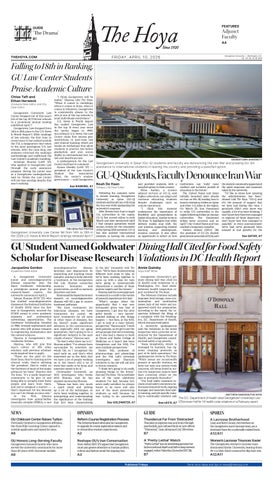
THE HOYA FILE PHOTOS Georgetown University Law Center fell from 14th to 18th in the 2026 U.S. News & World Report rankings released April 7.

GU-Q Students, Faculty Denounce Iran War
Noah De Haan Campus Life Desk Editor
Following the campus’s move to remote learning, Georgetown University in Qatar (GU-Q) students and faculty are criticizing the Iran war while applauding the university’s response.
After threats from Iran to target U.S. universities in the region, GU-Q frst moved online in early March and later announced April 1 that campus operations would remain remote for the remainder of the Spring 2026 semester. GU-Q has also assisted international students in leaving the country
GU Student Named Goldwater Scholar for Disease Research
Jacqueline Gordon Academics Desk Editor
A Georgetown University junior and neurodegenerative disease researcher won the Barry Goldwater Scholarship, a prestigious annual grant for research-based careers, the university announced April 2.
Ishaan Sharma (SOH ’27), who has studied neurodegenerative diseases at the National Institutes of Health (NIH) since his frst year at Georgetown, received the $7,500 award to cover academic expenses and professional networking opportunities. The Goldwater Scholarship, founded in 1986, rewards sophomores and juniors who will pursue research in engineering, mathematics and the natural sciences.
Sharma is Georgetown’s 51st Goldwater Scholar.
Sharma, who will join this year’s cohort of 453 other scholars, said previous scholars’ work inspired him to apply.
“These are the guys on the front lines, they’re running active clinical trials, they’re advising the president, they’re really on the forefront of most of the major advances we have,” Sharma told The Hoya. “It’s a really important community to be part of and being able to actually meet these people and learn from them, and you’re assigned a mentor — that’s important for me, because you can’t do things on your own.”
At the NIH, Sharma investigates how spinal-bulbar muscular atrophy (SBMA), a rare
neurodegenerative disease, develops and degenerates by examining and marking tissue samples, aiming to help identify a treatment. At the Georgetown Pak Lab, Sharma researches memory formation and preservation, as well as memory disorders and loss.
Sharma said he hopes his current research on neurodegenerative diseases will fll a gap in current treatment pathways.
“We have treatments for infectious diseases, we have treatments for cancer, we have treatments for all sorts of other types of diseases, but we haven’t made signifcant advances in the neurosciences, and, especially with our aging population, that’s going to be a signifcant industry in the next couple of years,” Sharma said.
“So that’s what drew me to it,” Sharma added. “I’ve always been surrounded by scientists my whole life, so I recognized the need early on, and that’s what interested me in the feld, that we have a lot of people working on it, but there’s still a lot of work that needs to be done, and someone needs to do it.”
Christopher Grunseich, an NIH investigator who works with Sharma, said he has enjoyed mentoring Sharma.
“Ishaan has been very much a quick study and picking up a lot of the techniques, so we’ve been working together in interpreting and understanding the signifcance of the fndings that he’s been characterizing
in the lab,” Grunseich told The Hoya. “We’ve been brainstorming diferent next steps to take, so we’ve been working together to come up with a plan for how we’re going to systematically characterize a number of these protein targets and the tissues.”
Sharma said his novel approach to research is a credit to the variety of research experiences he’s had.
“What’s unique about the opportunity that I was very fortunately given was that at Georgetown, I get into the nitty gritty details — very narrowminded looking at why things happen — but then, at the NIH, I get to look at a more holistic perspective,” Sharma said. “I work with patients, so we get to see the actual people that we’re studying, and I also had a chance to work at Emory and Baylor College of Medicine, so it hasn’t just been Georgetown and the NIH; I’ve seen multiple perspectives.”
Daniel Pak, professor of pharmacology and physiology and the Pak Lab’s principal investigator, said Sharma’s initiative in the lab will aid him in future research.
“I think he’s going to do really amazing things in the future,” Pak told The Hoya. “He is probably one of the most ambitious students I’ve had, because he’s never really satisfed, he always wants to do more and also one of the most persevering students as well because he was trying to do something
See GOLDWATER, A7
and provided students with a pass/fail option in their courses.
Rima Isaifan, a science adjunct lecturer at GU-Q, said higher education can adapt and continue educating students despite challenges such as remote operations.
“I think this moment underscores the importance of fexibility and preparedness in higher education,” Isaifan wrote to The Hoya. “It highlights that while delivery modes may shift, the core mission, supporting student learning and development, remains constant. It also ofers an opportunity to refect on how
institutions can build more resilient and inclusive models of education in the future.”
The United States and Israel initially launched joint attacks on Iran on Feb. 28, leading Iran to launch retaliatory strikes on Qatar and other U.S. allies in the region.
On March 29, Iran threatened to strike U.S. universities in the region following strikes on Iranian universities. The threatened strikes never occurred, and on April 7, the United States and Iran reached a temporary ceasefre. Yasmin Ahmed (SFS-Q ’28), vice president of GU-Q’s student government association (SGA), said
the student community appreciated the quick responses and measures taken by the university.
“I’d like to stress how amazing the administration has been,” Ahmed told The Hoya. “GU-Q and GU, the amount of support that we have had during this time, I genuinely didn’t even know was capable. A lot of us were thinking, ‘I don’t know how they even managed to organize all these departures. I don’t know how they managed to pass/fail.’ At every announcement we’ve had, we’ve genuinely been amazed at and grateful for the See QATAR, A7
Dining Hall Cited for Food
Safety Violations
Annie Quimby Hoya Staff Writer
Georgetown University’s primary dining hall was cited for 14 health code violations in a Washington, D.C. food establishment health inspection report reviewed by The Hoya
The February citations include improper food storage, cross-contamination and sanitization issues, lack of hot water and unapproved sushi rice preparation. According to the report, the inspection followed the fling of a complaint with the Washington, D.C. Department of Health, which oversees food safety.
A university spokesperson said the violations in the latest inspection were corrected as instructed by the Department of Health, and Georgetown considers food safety a top priority.
“Hoya Hospitality, which is managed by Aramark, has rigorous cleaning protocols as part of its daily operations,” the spokesperson wrote to The Hoya.
“While issues are occasionally present at specifc stations, we have not seen any system-wide concerns. All items listed in initial city inspection reports have been corrected, either on the spot or promptly thereafter.”
“Our food safety measures include a food safety orientation before associates start work, ongoing manager and associate food safety training, and job-specifc training to continually reinforce
in DC Health Report

A12/A11
GEORGETOWN UNIVERSITY
Georgetown University in Qatar (GU-Q) students and faculty are denouncing the Iran War and praising GU-Q’s assistance to international students in leaving the country and providing a pass/fail option.
MATTHEW GASSOSO/THE HOYA
The D.C. Department of Health cited Georgetown University’s Leo O’Donovan Hall for 14 health code violations in a February report.
A Lacrosse Brotherhood Liam and Rory Connor, two brothers on the Georgetown men’s lacrosse team, are a dominant force for a
Xavier The Georgetown women’s lacrosse team dominated Xavier University, beating them 19-1 in their third consecutive Big East win.
Improve Course Registration Process
It’s no secret that Georgetown University students face conundrums and pains for course registration. Students understandably bemoan this process, given the ever-frantic scramble to register for classes and the furious refreshing required to stay updated on which courses have flled up.
In Summer 2024, the university updated its registration system, replacing the previous platform, MyAccess, with GU Experience. While these improvements have signifcantly improved the registration process by making the interface more intuitive, there are still key changes that the Editorial Board believes could further simplify and ease students’ enrollment processes.
These smaller, feasible steps — like always providing course syllabi and ensuring features work smoothly — not only focus on improving the technical aspects of registration but also on the class schedule itself. This Editorial Board’s proposed reforms aim to supplement course descriptions, modernize registration infrastructure and increase accessibility of classes.
First, most course listings on GU Experience ofer little more than a title and short paragraph of generalized information. Often, there are no past syllabi or sample reading lists for the courses. Many students make their selections only to discover on the frst day of class that the workload is incompatible with their other commitments or that the course isn’t what they imagined. Although the add-drop period allows students to adjust their classes based on their experience, adding syllabi information before the frst day of class could mitigate some of the period’s chaos.
Amelie Schulhof (CAS ’28), who struggled to fnd classes that fulfll degree requirements, said she worries about committing to courses without thorough information.
“When there isn’t much information on GU Experience about a course, I feel like I’m taking a risk by registering for that course, and instead I look for a class where the requirements are clearly explained,” Schulhof wrote to The Hoya
To fx this issue, Georgetown should require professors to publish past syllabi directly on the course registration portal. While some professors already post previous semesters’ syllabi on GU360 — a portal for Georgetown students, faculty and administrators — this is not standard practice across all courses, with many professors not posting their syllabi despite earlier prompting from the registrar. Such a policy would ease the burden on students and professors by giving students more information and minimizing the chaos of students switching in and out of classes during syllabus week. In addition to providing more information on courses, the waitlist process should be more transparent. Currently, students can only see how many spots are available on a course’s waitlist, and waitlists are occasionally restricted. This leaves students unsure of how the procedure works and where exactly they stand on that list.
Since its first
HOYA HISTORY
The university should show students precisely where they fall in the waitlist ranking, allowing them to better understand their likelihood of getting into a class and whether they should pursue other course options.
The university should also prioritize making the registration interface more accessible and ensuring the platform operates smoothly. Students are currently able to use the “Plan Ahead” feature to add courses before registration opens, making it easier when their window opens. However, the platform can occasionally slow down or encounter glitches when adding plans, preventing students from enrolling in their preferred classes, as all students rush to register. Additionally, when students create the new plan, courses come up that are listed as “NOT OFFERED FOR TERM.”
Shailee Sinha (CAS ’28) said the dificulty of navigating the site is how the courses seem to be incorrect. “I fnd it really frustrating that when trying to plan ahead, it shows many courses that aren’t being ofered next semester,” Sinha wrote to The Hoya. “If there was a flter that removed the courses not being ofered, that would make registration much easier.”
As for the schedule of classes, Georgetown should focus on ofering required courses for each major at times more convenient for students while opening more sections of these courses. For example, as a Sociology major, you are required to take SOCI 2903: “Statistics for Social Research.” However, there is only one section of this course and it only has 15 seats. In addition, the course is only ofered in the fall and meets from 10:00 to 10:50 a.m. on Monday, Wednesday and Friday.
Limited class oferings, both infexible and scheduled at popular times, cut necessary class options and potential experiences for all students. One of the key parts of the Georgetown academic experience is taking advantage of the city, whether that be getting an internship or enjoying museums and other cultural institutions. These inconvenient class times make it much harder for students to both fulfll their major requirements and enjoy the holistic education Georgetown promises its students. Expanding section oferings for consistently overenrolled and required classes could remedy this problem.
The Editorial Board recognizes that some of these suggestions may seem minute or insignifcant. However, easing the course registration experience and improving course oferings, by any measure, is worth the time and efort it may take if it in any way alleviates students’ and professors’ stress. More importantly, having a wider variety of classes available and accurately listed, along with the freedom and certainty to pick and actually register in the right classes, allows Hoyas to prepare and succeed for future semesters.
The Hoya’s Editorial Board is composed of six students and is chaired by the opinion editors. Editorials refect only the beliefs of a majority of the board and are not representative of The Hoya or any individual member of the board.
Quinn’s Computers Ease Registration
September 17, 1970
Students registered for their fall courses last week under a diferent group system that alleviated the long lines, overcrowding, and confusion which had become synonymous with Georgetown registration. University administrators agreed that it was the smoothest registration in years. Many students also expressed satisfaction with the new procedures.
The Rev. Thomas R. Fitzgerald, S.J., academic vice president, said that there were “obviously still some problems,” which he blamed on revisions in the academic requirements of the various schools. He said these changes had made it tougher to predict which courses students would select because of a lack of previous experience on which to base such judgments.
John V. Quinn, University registrar, remarked that most of the problems had been caused by reforms implemented in the freshman curriculum. He pointed out that an extra section of freshman philosophy would have to be added due to the more than 50 sophomores who signed up this year for the course because they failed to meet the requirements last year.
The Registrar was also surprised by the large number of freshmen who chose to take a language even though that requirement has been eliminated in the School of Business Administration, and for College students seeking an A.B. degree. Additional sections in Spanish and French have been scheduled to deal with the problem. Problems of overcrowding have occurred in some math and English sections as well. Quinn said that difficulties wouldberesolvedbytheendoftheweek.
Ould, chairman of the orientation
committee, remarked that the pre-registration sessions which freshmen attended were a big factor in expediting the registration process. He is upset, however, that the freshmen who were assigned to register late in the afternoon found themselves with few courses from which they could choose. Ould said that some freshmen left the gym Wednesday evening having been registered for only two courses. The freshmen followed their schedule so well, he stated, because they had been assured that all of them would have an equal opportunity to register for the courses of their choice. Ould is afraid that because of this mistake students will not believe promises of equal treatment in the future and that therefore the long lines and tie-ups of past registrations will return again.
Fr. Fitzgerald believes that the general reaction of the community was that “we’ve turned a corner” in registration procedures. Both he and Quinn stated that the major factor was the new computerized pre-registration program.
Quinn said he had been trying to develop such a system for several years. Previous attempts had to be abandoned due to the lack of personnel in data processing.
The project was revived, according to Quinn, by Dr. Bruce Davie of the economics department. Dr. Davie runs the Ofice of Institutional Research at Georgetown (OIR), which conducts research for the University in fnancial, academic and other areas.
Quinn said that Dr. Davie had gone outside the University to hire
people for assistance in the project.
The computers were programmed by John Harrington of the OIR.
Now that the computers have been programmed, the job of pre-registering students will be turned back to the ofice of data processing.
The system also helped to make registration less hectic. Each class was assigned certain hours in which to register and, to insure compliance with the regulation, course cards were available only to those who came at the assigned times.
Freshmen were given assigned times for registration according to an alphabetical order drawn in a lottery. New groups of students arrived at 20-minute intervals, thereby avoiding long lines outside the gymnasium.
Quinn said that this system “worked so well that it backfred on us.” He explained that registration had progressed so smoothly that one group of freshmen had been able to get in ahead of schedule.
Registration workers, seeing that there was no one outside, thought that the last of the freshmen had come in and locked the doors. A few moments later the next group arrived, on time, and found themselves locked out. The result was that they had to register Thursday morning, and the University could not charge them the customary late registration fee.
Referring to last January’s registration, Quinn said, “I’ll never forget that as long as I live.” Later he added, “I think I would prefer going over Niagara Falls in a barrel than to go through that again.”
This Editorial Board’s proposed reforms aim to supplement course descriptions, modernize registration infrastructure and increase accessibility of classes.”
The Editorial Board “Improve Course Registration Process” thehoya.com

On April 13, Georgetown University students will begin registering for classes for Fall 2026. In Summer 2024, the university updated its registration system, moving to the GU Experience platform.
In order to gauge student opinion, students were asked if the university needs to make changes to improve the course registration process. Of the 59 respondents, 64.4% said yes, 22% said no and 13.6% said they were unsure.
EDITORIAL CARTOON by Ray Tian

Founded January 14, 1920
Maren Fagan, Editor in Chief
Ruth Abramovitz, Aamir Jamil and Nora Toscano, Executive Editors
Nico Abreu, News Editor
Ajani Stella, News Editor
Paulina Inglima, Managing Editor
Opal Kendall, Features Editor
Saroja Ramchandren, Features Editor
Annikah Mishra, Opinion Editor
Ella O’Connor, Opinion Editor
Isabelle Cialone, Guide Editor
Tanvi Gorripati, Guide Editor
Nate Seidenstein, Sports Editor
Maddie Taylor, Sports Editor
Angela Lekan, Science Editor
Eva Siminiceanu, Science Editor
Avelyn Bailey, Design Editor
Lucy Jung, Design Editor
Grace Bauer, Copy Chief
Jackson Roberts, Copy Chief
Shira Oz, Blog Editor
Fallon Wolfley, Blog Editor
Kate Hwang, Multimedia Editor
Michael Scime, Multimedia Editor
Matthew Gassoso, Photo Editor
Caroline Woodward, Audience Editor
Board of Directors
Patrick Clapsaddle, Chair
Bethe Bogrette, Julia Butler, Amber Cherry, Made-
line Grabow, Mia Streitberger
Peter Sloniewsky, General Manager
Olivia Zhang, Director of Business Operations
Rosie Garner, Director of Logistics
Connor Manrique-Johnson, Director of Outreach
Jackson Roberts, Technology Director
INSTITUTIONS AND THEIR ILLS • WEAVER
Get to Know Your Professor
On March 10, two Georgetown University students hosted “Desserts & Dialogue: Real Conversations About Georgetown Life” with professors Alexandra DeCandia and Elizabeth Grimm to talk about navigating careerism, club culture and ftting in at Georgetown. When I walked into the Copley basement room, I was met with baked goods and a bustling student scene. About 30 undergraduates stood around talking to one another, meeting a friend of a friend and laughing with the two professors. I introduced myself to Professor Grimm, and she immediately asked me what I was interested in and what brought me to the event. Eventually, all of us made our way to the living room, where we split into two groups to have small discussions led by one of the professors. I nervously anticipated the conversation to be stiff; I had never been to this kind of event, and I wasn’t sure how free the discussion would flow. But, almost immediately, we divulged into life at Georgetown, career pipelines, the value of higher education and what Georgetown can do to encourage more community. Although they are much more scarce than I would like, this wasn’t the first time I have had the opportunity to forge relationships with faculty members. Every first-year seminar in the College of Arts & Sciences (CAS) is given a stipend to take their students to an off-campus event. My “Equality of Educational Opportunity” class went to the Brown Lecture in Education Research at Howard University, followed by a dinner at Il Canale. That evening is ultimately still one of my favorite Georgetown memories because of how close I grew to my classmates and my seminar professor. For the first time, I felt like I was both academically and personally enriched outside of the classroom. Georgetown should create more opportunities for students to form stronger bonds with their faculty. Programs like this have existed in the past. The Georgetown “Moveable Feast,” a program that gave small groups of students a stipend to have dinner with professors and academic deans, was launched in 2013, and received praise even years after. Students gushed over the ability to strengthen relationships with professors and teaching assistants outside the confines of classroom material. Georgetown must implement at least a similar institutional policy that reinforces building student-faculty relationships. But beyond the existence of these structured programs, I call on students and faculty alike to reach out to one another in a personal capacity more frequently. Faculty should be as available as they can to help mentor, be a tool to prepare for life after Georgetown and be a listening ear for the issues their students face.
Students should also go out of their way to get to know their professors. The initiatives need not be formal meals or expensive excursions. When my professors preface their office hours introduction on the first day of class with “come talk with me about homework or about life,” I feel comfortable approaching them. In my first semester of college, I went to my “U.S. Political Systems” professor on three different occasions to talk about the 2024 election and where our class fit into current events; I emailed her 10 months later to ask about community service opportunities. At “Desserts and Dialogue,” Professor Grimm recommended that we simply ask our professors to get lunch in Leo’s, which only costs an extra meal swipe. The point is that, when professors frame themselves as approachable and remind students that they are there for them outside of just coursework, students are inspired to actually reach out.
The issue isn’t that Georgetown faculty are inaccessible or uninterested in their students. In my experience, professors here care about the classes they are teaching and generally make themselves available for office hours. But a gap still exists between knowing a professor in a classroom environment and actually forming a close, mentoring relationship.
As young people report growing rates of uncertainty in the future, connecting with professors becomes increasingly valuable. Georgetown students’ access to distinguished professors is a tool in navigating careers and lifepaths; many of my professors have been public servants, government employees and business leaders before becoming academics. Those stories and experiences are incredibly useful to any student unsure of what they can do or where they can go. But, there is also just an intrinsic value in forming stronger relationships and bonds. Outside of career advice, networking opportunities or a higher participation grade, having new conversations with anyone is beneficial. At an academically rigorous school like Georgetown, I sometimes find myself focused on grades, jobs and my social life with other students. This comes at the expense of the rich community in between. In order for Georgetown to truly be committed to a community that lives “generously in service to others,” we need to implement both structural policies like “A Moveable Feast” to bring students and faculty closer, as well as a cultural change where students and faculty undertake the responsibility to form relationships with one another. Relationships are just as important to Georgetown as its academic institutions.
Zadie Weaver is a sophomore in the College of Arts & Sciences. This is the third installation of her column “Institutions and Their Ills.”

Incentivize Student Engagement in Classrooms
Georgetown University has a startling problem with classroom engagement.
Although I’m studying government at the best university in Washington, D.C., my “Political Theory” lecture often feels like a class of zombies. My professor asks a question and my peers stare blankly at their laptop screens. My poor teaching assistant in my discussion section is often pulling teeth to get any participation because the majority of the class have not done the readings.
Our university is not alone in this issue. Writers and professors across the country have bemoaned that students are more disengaged from their classes than ever before. Even at Harvard University, a committee found that students are chronically absent and checkedout, and the university has launched a task force to improve classroom culture in response. In my experience, much of student disengagement does not stem from laziness, but from the current professional incentive structure. In today’s brutal job market where preprofessional extracurriculars and internships are highly valued, students are certainly working hard ––just outside of the classroom. Georgetown students who spend signifcant time on clubs and jobs have less motivation to dedicate efort to their coursework or class attendance, and many feel like classes simply matter less. Yet, there are a number of structural changes that Georgetown professors and administrators can take to
Welcome back, advice lovers. Course registration is coming up, so if you’re looking for something exciting to read while you anxiously scroll through classes, this week’s column has you covered. This week, we’re working through graduation stress, hometown dread and awkward exes. As always, if you have a question I didn’t answer, submit it to this anonymous form, and I’ll do my best to help you out.
I’m a senior and I’ve started to feel really stressed about how quickly graduation is coming up. All my friends are moving away, so I want to spend more time where our friend group is all together, but it’s so hard to coordinate everyone’s schedule and we never end up doing the activities we talk about. How do I make sure we can do the things we wanted before we all go to diferent ities? The idea of relationships changing with the people you care about can be really scary, and it sounds like you’re feeling a lot of anxiety over not being able to see your friends as regularly as you’d like. It might seem like everyone is too busy to coordinate anything, but it’s incredibly helpful to have one person in a group of friends who wants to make social events happen. Make a list of everything you want to do with your friends before you graduate, and see if you can fnd a time once or twice a week to check one of those activities of your list. While you might not be able to coordinate
with your entire group for every activity, diferent people will be available for diferent things, and you’ll get to spend more individual time with each of your friends.
Knowing graduation is approaching can be really nerveracking no matter what, but being more proactive for the next couple months can reduce a lot of that anxiety. If you make an efort to schedule some activities you’ve had in mind, I’m guessing you’ll feel a lot better — you’ll be able to spend time with your friends and cross some items of your bucket list. By the time you graduate, you won’t be left with any regrets. It’s really clear how much you care about your relationships with your friends, so I’m confdent you’ll be able to maintain that connection for the next few months and in the future, even if you’re living apart. I’ve accepted an internship in my hometown for the summer, and while I’m so excited about the opportunity, I’m dreading having to stay all summer in a place I feel like I outgrew. What’s your advice on living somewhere I don’t want to e? First of all, congratulations on your internship! The good news is, if you’re working most of the time, you’re probably going to be in a very diferent environment than you were the last time you were living there. Getting fully immersed in a job you’re really excited about can make you a lot happier about the situation you’re in. During the times when you’re not working, think
back on whether there were any people you enjoyed spending time with, and if any come to mind, reach out to them. Focus on the parts of your hometown you can still feel excited about and don’t spend too much time on the things you feel like you’ve outgrown. Remember that the summer is short, and if you’re still feeling unsatisfed living at home, you’ll be back on campus before you know it with some great work experience under your belt. Good luck!
I’m neighbors with my ex and it’s very embarrassing every time I bump into him in the hallway or the elevator. I’m not sure how to make small talk without feeling so uncomfortable. Should I just ignore him?
That can be a really awkward situation, but there’s no reason to make it feel even more tense by pretending you’ve never met. He’s probably feeling just as selfconscious as you are, so there’s no need to force conversation if you don’t want to talk. Ignoring him, though, would only make your interactions more uncomfortable. Instead, just say hi when you pass him in the hallway or elevator and continue with your day — that’s enough to be polite without having to force yourself into a conversation neither of you want to be a part of.
Caroline Brown is a senior in the College of Arts & Sciences. This is the 11th installation of her column “Calling in with Caroline.”
rebuild students’ buy-in to the academic experience. The frst shift is perhaps the most straightforward: Laptops should be banned from all classrooms. The constant temptation of this technology detracts signifcantly from intellectual engagement. If you doubt this, sit at the back of any introductory lecture and watch as students answer emails, online shop or do The New York Times’ crossword. While laptops may allow students to take notes and access readings with ease, they invite multitasking and create a barrier between students and their professors. Banning screens in classrooms must be a broader policy change and cannot be left to individual students. As my psychology professor told my class, even students who do choose to take handwritten notes are signifcantly distracted when peers around them misuse technology. I can attest to this — I spent the semester in this class watching the girl in front of me text her boyfriend on Snapchat. All students, whether they already take handwritten notes or not, will beneft from a university-wide ban. Secondly, professors should create tangible incentives for completing course readings. In many discussion-based courses, reading completion is central to a productive and benefcial class period. My American studies professor has our class complete a short, handwritten reading refection before each class. Knowing I will be tested on the material ensures I prioritize my
readings, even when I am busy. Furthermore, it also helps me develop my thoughts before we begin our discussion. Some of my peers in larger lectures report their professors cold calling, which ensures they are well-prepared for class. If my other classes enacted similar policies, I’d be far more likely to consistently complete their readings. Moreover, in order to promote consistent class engagement, professors and administrators should maintain academic rigor and not succumb to the pressures of grade infation. As a student, I sure don’t like the government department’s policy that only 40% of students can receive As or A-minuses in the four introductory courses. However, knowing I had to fght for an A-minus in my “International Relations” class encouraged me to put in hours of real efort both inside and outside the classroom. Ultimately, I learned and engaged with the course signifcantly more than if I had been able to just skate through and receive an easy A.
You may be thinking that these policies sound like a fast-track to unpopularity and dismal Rate My Professor scores. But the last piece of the puzzle helps resist this, and is therefore perhaps the most important. To further active intellectual engagement in class, professors and administrators should invest signifcant time and energy in building relationships with their students outside the classroom.
As many government students can attest, Professor Elizabeth Grimm is widely popular, and
students put in signifcant efort in her courses. It is not that her classes are easier than others in the department — indeed, it is probably the opposite. Rather, Grimm learns the name of every single student in her large “International Relations” lecture, takes each discussion section to lunch at Leo’s and hosts social events. She also requires each student to attend ofice hours at least once, whether that be attending hers or a teaching assistant’s ofice hours. All professors should follow in Grimm’s footsteps to get to know each student in their course individually. This is a signifcant time commitment, but it is a time commitment that pays of. Personally, I can feel the diference between professors who care about their teaching and their students, and those who prioritize their research eforts above the classroom experience. When students feel personally seen, appreciated and understood, they will give more efort back. In my experience, Georgetown students are willing to work hard when they see value and beneft coming from their eforts. Although the pulls of internships and Instagram will persist, if professors and administrators make the shifts towards reincentivizing classroom efort, engagement will fourish and the zombies will come back to life. Hannah Gilheany is a sophomore in the College of Arts & Sciences. This is the fifth installment of her column “Life Outside of Lau.”
As Georgetown University students, we all have a thread. Some of us hold it loosely, unaware it is there at all. Others grip it tightly because they know what it means to live without it.
This thread is education, safety and the belief that our ideas can have an efect on the world. At Georgetown, we are trained to see ourselves as future policymakers, diplomats and leaders. But for the people of Iran, their thread has been pulled out of their hands. Iranians today are facing an uncertain future with constrained classrooms, bombed cities, tyrannical restrictions and a complete dismissal of their voices by the international community.
It therefore becomes the duty of educational institutions such as Georgetown to ensure students are prepared to speak for the voiceless. This is not a criticism of any professor or course, but rather a broader refection on the gap I see as an Iranian student at Georgetown between the scale of events shaping the Middle East and the scale of conversation on our campus. I believe we can address this by fostering more discussion within and beyond our classrooms. Firstly, especially within the School of Foreign Service (SFS), courses on international politics and security should include regular discussions of escalations in the Middle East. For example, professors could dedicate a small part of classes to analyzing one major development in the global world. While the SFS does a great job of addressing major global developments through guest
lectures and public events, there is rarely sustained classroom space to engage with these conversations. In my experience, these discussions are often constrained by limited class time and structured syllabi. Secondly, SFS students should pay closer attention to basic geographic knowledge. In one of my classes this semester, my professor asked us to list the countries bordering Iran and even I initially struggled to name all seven. A simple fveminute map exercise like this can strengthen understanding and help students feel more confdent engaging in conversations about the Middle East. While all SFS students are required to take “Maps of the Modern World,” a class built to understand geography by studying countries and their borders, the course often becomes an exercise in memorization rather than in long-term retention, which is why geographic knowledge should be reinforced throughout the four years of our curriculum at Georgetown. Finally, I believe Georgetown students should take better advantage of our campus being in Washington, D.C. Professors can do this by encouraging students to attend public events at institutions such as the Middle East Institute, the Atlantic Council and the Carnegie Endowment for International Peace or by inviting these analysts into classrooms. Another way to engage with the city around us is to volunteer with refugee support organizations or visit exhibitions of Iranian art at the Smithsonian National Museum of Asian Art. Experiencing Iranian
culture through both policy and art helps students see Iran not only as an international actor but as a beautiful country with a rich history and promising future.
Understanding Iran today requires recognizing that the country stands at a political turning point that could reshape its future trajectory. Questions remain surrounding the role of its leader, Mojtaba Khamenei and if he is alive; the diference between him and his father; whether he will be the last ayatollah; and why he has not yet shown his face in public. Alongside these political debates are signifcant economic stakes. Nearly twenty percent of the world’s oil passes through the Strait of Hormuz, making stability in this corridor essential to the global economy. As tensions rise, several shipping companies have already reduced or paused trafic through the region, making the movement of basic goods more dificult worldwide. If developments in Iran can reshape global markets and regional stability, they must also reshape the conversations in our classrooms. Please continue to speak for the people of Iran and use your voices well. Speaking for Iranians who cannot speak right now does not mean speaking over them; instead, it means recognizing our responsibility and luck. The thread we hold at Georgetown is rare in today’s world and we must use it with care for the civilians whose futures are not as accessible as ours. Noor Afshar is a junior in the School of Foreign Service.

Seeking a Place in Academia, GU Adjuncts Struggle to Find Stability, Make Ends Meet
Although part-time professors make up nearly half of all Georgetown teaching faculty, they receive comparatively limited pay, few benefits and little long-term support.
Ajani Stella and Opal Kendall Senior News Editor and Senior Features Editor
After teaching at Georgetown University for over two decades, Bonnie Morris resigned from her adjunct position and left Washington, D.C. in 2017.
Morris, who now teaches parttime at the University of California, Berkeley, said she could not aford to live in the city on an adjunct’s salary.
“Nobody could live on $20,000, even if you were living in a closet,” Morris told The Hoya. “The point is that there was never any plan for someone to live full-time on a part-time income.”
“There was just no way for me to stay in D.C. and feed myself,” Morris added.
The Hoya spoke with more than two dozen adjunct faculty members to understand their experiences at Georgetown and in the District. Nearly a decade after Morris’ departure, the vast majority said cost-of-living issues are still a constant challenge.
At a school where about 41% of faculty are part-time, Georgetown adjuncts face continued problems with insuficient income, limited benefts and uncertain futures. Though these issues impact universities nationwide, Georgetown has long prided itself on its robust benefts package and fair treatment of employees — which adjuncts say are notably absent from their experiences.
To address these concerns, Georgetown adjuncts voted to unionize in 2013 and have since approved three collective bargaining agreements (CBAs), which defne their terms of employment. Though current faculty members have seen some improvements, issues persist.
A university spokesperson said adjunct faculty, who are contracted to teach and do not have the same research or service obligations as full-time professors, are essential to students’ success.
“We deeply appreciate the contributions that adjunct faculty make to the Georgetown community,” the spokesperson wrote to The Hoya. “Georgetown is committed to respecting the dignity of all members of our community.”
Christopher Shinn, an adjunct in the English department, said the lack of support for part-time professors is systemic.
“It’s a permanent subclass,” Shinn told The Hoya. “I don’t mean that necessarily in a derogatory or contemptuous way. I simply mean that that’s the reality — structurally, that’s our reality. There’s no way to move up.”
Money Talks Scip Barnhart has worked parttime at Georgetown for over two decades, teaching six art classes each year and spending hours each day operating the university’s printmaking studio. Rather than only working at Georgetown, Barnhart also teaches at American University (AU), splitting
his time between the schools to scrape together a decent salary.
Even with two sources of income, Barnhart said he struggles to cover his basic needs.
“Adjuncts at Georgetown haven’t gotten a signifcant raise in a very long time,” Barnhart told The Hoya. “It’s always a hiring freeze or the economy. I have to go with that fow, but in the meantime, I still have to support myself, and it’s always paycheck to paycheck.”
Under the union’s 2021 CBA, Georgetown must pay adjuncts a minimum of $7,750 per three-credit course. Adjuncts can only teach seven credits each semester, limiting their base pay to around $60,000 a year, assuming they maximize their course load across the fall, spring and summer terms — which many faculty do not.
The university’s compensation policy aims to ofer employees competitive salaries in order to attract well-qualifed faculty. Georgetown ofers a higher starting rate than both AU and The George Washington University (GWU), which pay a minimum of $5,400 and $5,225 per three-credit course, respectively.
Though Georgetown’s base pay is locally competitive and the adjunct union has negotiated some wage increases — an additional $250 each year from 2021 to 2024 for three-credit course compensation — Theodora Danylevich (GRD ’08), a part-time English professor, said her salary remains unlivable.
“The pay isn’t good,” Danylevich told The Hoya. “Even though, because of our CBA, because of our union, we’ve gotten a bottom line that is better than most of the other local universities, that doesn’t mean it’s good. It doesn’t mean it’s livable. It’s just not possible and yet, there are those of us who are doing it full-time.”
In addition to considering local expenses, Martin Conway, an adjunct in the School of Continuing Studies (SCS), said Georgetown should measure adjunct pay against peer institutions that compete for the same faculty, not just other D.C. universities.
“That has always been something that we object to, but they continue to bring up,” Conway told The Hoya. “While they want to compare the university’s overall profle to other schools, when it comes to paying adjuncts, they would like to compare the profle to the local universities.”
The University of Chicago, which Georgetown identifes as a peer school and whose adjunct faculty are also unionized, pays a minimum of $8,883 per three-credit course. Adjuncts at Brown University, also part of Georgetown’s slate of peer institutions, receive about $10,000 per course. Beyond issues with their pay rate, Shinn said adjuncts’ salaries do not account for the co-curricular support they ofer students.
“Anything that we do beyond teaching is up to each individual
faculty,” Shinn said. “If we want to work with students, say, on their theses or projects, or help with clubs around campus and so on — those are sort of extracurricular activities that we do — we’re not compensated for it at all. There is a kind of invisible labor that we have.”
According to emails obtained by The Hoya from administrators in 2020, Georgetown assumes an adjunct professor will work a total of three hours per week per credit, amounting to nine hours a week for a three-credit course. In a standard 15 week semester, that means adjuncts would be paid about $57 per hour.
But between teaching, grading, planning and holding ofice hours, many adjuncts say they clock far more time than the university’s estimate.
Kimberlee Holland, an adjunct in the sociology department, said her hourly wage would be signifcantly lower if Georgetown included this work in its calculations.
“I don’t know what they are thinking in their own minds of what they should be paying us per hour, but sometimes I drive past the street and the bus driver in my neighborhood for my high school is getting paid $23.80 an hour,” Holland told The Hoya. “I wonder if that’s what I’m even making, when you sit and fgure out the sheer hours.”
“The pay is just paltry,” Holland added. “I mean, people can’t live.”
Compared to their part-time peers, Georgetown’s full-time faculty are among the best-paid in the country, earning an average salary of almost $210,000.
Barnhart said he holds no animosity toward these full-time colleagues.
“It’s just the luck of the draw — if you’re just lucky enough to get a full-time job,” Barnhart said. “That’s why you’ve got to be really on your game and be prepared if that situation comes up, because they don’t come up very often.”
Now an adjunct for almost fve decades, Barnhart said he is resigned to a long, dificult tenure.
“This is what we come up with, and this is what we’ll live with,” Barnhart said.
Fringe Benefts For full-time faculty, Georgetown ofers a robust benefts package that includes health insurance, tuition discounts and a retirement savings program. As part-time employees, however, adjuncts are not privy to most of these benefts.
They are eligible to participate in the minimum retirement plan and can access some fringe beneft programs, such as an informal wellness program and the Hoya Federal Credit Union. Adjuncts receive no health care coverage or tuition assistance.
Danylevich said the policy makes adjuncts especially vulnerable.
“It’s like you’re assumed to either have access to benefts through your mythical full-time job, or to be young and strong and
healthy and not be bothered by the lack of access,” Danylevich said.
Nick Wertsch (COL ’09, LAW ’12), who studied adjuncts’ unionization campaign while working at the university’s Kalmanovitz Initiative for Labor and the Working Poor, said Georgetown’s unwillingness to support adjuncts is an institutional failure.
“Georgetown charges really high tuition,” Wertsch told The Hoya. “It has this academically prestigious standing and reputation. It’s nuts that the people who are central to that mission, the professors who are educating the students who are paying the tuition, aren’t covered. They’re not taken care of the way that they need to be.”
In the current fscal year, Georgetown’s fringe beneft rate, which represents university spending on student and employee benefts, is over 2.3 times higher for full-time employees than for some part-time faculty.
Because she was not eligible for major benefts, Morris said she paid for them herself, spending over $350 a month on health care coverage.
“It was not only the low fgure of salary, it was the lack of benefts,” Morris said. “I did not ever get anything paid into retirement from Georgetown. I did not get health care. I didn’t have those basics, and if you don’t have them through your university, you pay them yourself.”
Barnhart said he attempted to access tuition assistance benefts, which cover 67% of tuition for an employee and their dependents, but was disappointed to fnd they were reserved for full-time staf.
“The tuition assistance thing — that would have been a great help,” Barnhart said. “Even if it was half tuition, that would have been a great help. I applied for it, but I was told it was unavailable.” Holland said she wished the university would recognize her commitment to the school with some benefts, such as a 401(k) retirement plan.
“This is my seventh year at Georgetown,” Holland said. “I wish there was some sort of beneft to get a break if my kids go there. I would like some sort of 401(k) contribution. I think if you’ve shown some loyalty to the school, I would like to see that.”
Zein El-Amine, a former creative writing and Arabic professor, said he was frustrated by Georgetown’s persistent lack of benefts.
“Of course, I want the full-time job,” El-Amine said. “Of course, I want health insurance. Of course, I want the benefts, and I’ve tried that — I’ve attempted and I haven’t been able to get it, even though I’m fully qualifed.”
“We even have to pay for the gym,” El-Amine added. “If you don’t give an adjunct health insurance, at least let them exercise to be better. It won’t cost the university much. I had to even pay just to keep my health steady because I couldn’t aford to get sick.”
Lacking university support, many adjunct professors rely on spouses or other family members for insurance.
Emily Matson, who teaches modern Chinese history, said her husband’s insurance is the only way she can access health coverage.
“I’m very fortunate that I have a partner who has a full-time job and I can get health care through his employer,” Matson told The Hoya. “Otherwise I would be in a bad spot. I would have to pay for my own health care out of my already limited funds.”
Without an external source of benefts, Danylevich said being an adjunct is totally untenable.
“If I didn’t have access to benefts through my partner, it would probably lead me to leave the profession,” Danylevich said.
Easy to Hire, Easy to Fire
In 2024, after working at Georgetown for six semesters, El-Amine planned to continue teaching for the foreseeable future. Instead, the class he was scheduled to teach in the fall was unexpectedly canceled.
El-Amine said he had a strong performance record and administrators did not provide any explanation for the change.
“I just had an amazing semester — what I would call a rockstar semester — because of my relationship with the students,” El-Amine said. “I was workshopping with them, even when they weren’t my students asking for help, and the students that I was helping were winning awards.”
“That’s the vulnerability that we experience,” El-Amine added.
Most part-time faculty are employed on a semester basis, meaning that they are not guaranteed long-term work. The most recent CBA requires administrators to consider “good faith” reappointment for adjuncts who have taught a course multiple times, but does not guarantee their rehiring.
Even if adjuncts are rehired, the university reserves the right to cancel classes for a number of reasons, including underenrollment.
April Brassard, an adjunct in the performing arts department, said this short-term instability prohibits adjuncts from pursuing longterm professional development.
“I often feel like you’re being hired on a ship as just a crew member with a great deal of experience all over the deck, and you’re just, like, ‘Where do you need me?’” Brassard told The Hoya
“You have to have sea legs — I don’t think you can be an adjunct and be rigid or unable to adapt because you have no job security,” Brassard added.
As a result, Bulbul Tiwari, a former adjunct in the theology department, said it is nearly impossible to break out of part-time work.
“It’s almost like once you start becoming an adjunct, that’s it — you’ve joined a diferent trajectory,” Tiwari told The Hoya. “You’re never going to get tenure. That’s
honestly what it felt like. I don’t think I ever remember making that decision, but I think at some point it became clear to me that I’m just never going to be a tenure-track faculty member.”
Adjunct faculty are not paid to conduct research, but it remains an important part of their career trajectory because departments weigh it heavily when hiring full-time staf.
Mimi Khúc, who taught in the disability studies program for two years, said adjuncts receive little institutional support for research.
“While tenured faculty are seen as faculty, no matter what they’re doing — whether they’re teaching or on sabbatical doing research — they’re still full time, employed with the university, and seen as a full member of the department,” Khúc told The Hoya. “Adjunct faculty, structurally, are treated like second-class citizens, so that when we don’t have a contract or we’re in between contracts, we’re suddenly not a part of the department anymore.”
“We are exploited just for our teaching labor, and so we’re not seen as value added to the university for our research or anything else we do for our program,” Khúc added. Shinn said adjuncts are forced to fnance their own research, which can be dificult on such paltry pay.
“Most of our adjunct faculty do really want to keep a pace with their felds, so they do attend conferences, they do present papers, and they do publish as much as they can,” Shinn said. “So it’s not something that falls of simply because they’re adjunct. But then, of course, it means that they have to be self-supporting. They have to draw from the salaries that they do have, and it’s very dificult.” In light of these barriers, adjuncts face poor job prospects. Matson said she feels stuck as an adjunct and is reconsidering her career in academia.
“Things haven’t really turned out exactly as I had expected,” Matson said. “I feel like I have a full-time job, but I’m not being paid for one. Not only am I teaching multiple classes, but I’m also doing research too.”
“I’m looking for jobs outside of academia right now just because going the full-time academic route, even though it’s what I wanted to do after grad school, it hasn’t really panned out,” Matson added.
Danylevich, who has applied for multiple full-time positions at Georgetown, said it is dificult for adjuncts to move up in academia.
“Georgetown loves its elitism, and that can be a barrier even to a very qualifed applicant who knows your student body, has worked here a lot, has contributed to the programs that they teach in, but because they are an adjunct, it’s like this implicit bias or explicit bias against allowing them into a diferent, more enfranchised status,” Danylevich said.
“When you’re overworked and when your mental load and emotional load is occupied with survival, it’s really hard to pivot,” Danylevich added.
ILLUSTRATION
GU Medical School Lab Investigates
Novel, Natural 3D-Printed Bone Grafts
Eva Siminiceanu Senior Science Editor
The Alimperti Lab, a biomedical engineering lab at Georgetown University, is developing patent-pending 3D-printed bone grafts made from natural materials.
Each year, doctors perform upwards of two million surgical procedures involving bone grafting worldwide. The procedure, which integrates transplanted bone onto a fracture, is most frequently used in orthopedics, neurosurgery and dental implants. 3D printing can provide a natural source for bone graft material, supporting healing and recovery without using human tissue.
Styliani Alimperti, associate professor of biochemistry and molecular and cellular biology in Georgetown’s School of Medicine, said she is using natural materials and 3D printing technology to precisely construct bone grafts that can integrate into a patient’s body.
“We are now using pectin-based material, where we have the ability to generate those scafolds, those grafts, in a more native manner,” Alimperti told The Hoya. “By using 3D printing as a technology, we
can create very detailed structures of these grafts. That helps with the integration with the body.”
Pectin, the organic material that the grafts are made from, is a natural fber found in the cell walls of many fruits and vegetables. Alimperti said pectin is benefcial in both its natural compatibility with the human body and its ability to be used to build precise, detailed grafts.
“Pectin is usually a material we can fnd in apples or in oranges,” Alimperti said. “They have the ability also to be compatible, to be good for the body. We also can use it in a way where we can create the structures, more detailed structures of the actual bone.”
The current leading bone grafting technique is autografting, which uses bone tissue from the patient’s own body. Allografts, which use bone tissue from a donor, and grafts fortified with metal are other viable methods. Both metals and allografts involve materials that are foreign to the patient’s body, increasing risks of infection and the patient’s body rejecting the grafts, Alimperti said. Alimperti added that though autografting uses the body’s own bone, the procedure can be long and costly.
“You can imagine that if you want to take something from the bone and integrate it somewhere else, these are very lengthy and expensive procedures,” Alimperti said. “Allografts can be very easily rejected from the body, and have a lot of risk for infection, and metal is not like the native bone, and sometimes does not have a good integration.”
Alimperti said her 3D-printed grafts aim to avoid these issues by tailoring their structure to each patient.
“We are hoping that we may have better grafts for the specifcity of the defect, and for the specifc characteristics of the patient – the age, the gender, the type of bone,” Alimperti said. “By 3D printing, we can have personalized grafts that can be used for the particular defect based on the characteristics of each patient.”
The lab has begun testing the grafts in mice, and Alimperti said they are aiming to see how the mice’s bodies accept and integrate the material, with promising initial results.
“The most important part is seeing the immune component in the body, if it will accept it or reject it. What is the most important would be to see the actual reaction in the body,” Alimperti said. “We are run-

ning full experiments right now, frst with mice, later with pigs and bigger animals, so that it is something that eventually we can end up with it in humans one day.”
Macie McPherson (SOH ’27), who worked in the Alimperti Lab on optimizing printing protocols and concentrations as well as printing scaffolds to be used for the live mouse study, said Alimperti is dedicated to robust procedures and data.
“Dr. Alimperti pushes her researchers and highly values thoughtful research questions and quality data,” McPherson wrote to The Hoya Ultimately, Alimperti said she
GUSOM Match Rate Exceeds National Average
Chloe Taft Graduate Desk Editor
Georgetown University School of Medicine (GUSOM) graduating students were matched with residency programs at a rate that surpassed the national average, a GUSOM spokesperson confrmed to The Hoya on April 7.
Fourth-year medical students at Georgetown received their placement for residency — a three to seven-year long training for medical school graduates to gain experience working in hospitals or clinics — at a March 20 university ceremony. This year, almost 30,000 students from medical schools in the United States applied to residency programs, with 93% of all applicants receiving a residency and 95% of Georgetown applicants, comparatively, matching with residency programs.
In his speech at the match day event, Norman J. Beauchamp, the dean of the School of Medicine, said students should feel proud of the work required to successfully match.
“You should be really, really proud of yourself because this moment represents persistence, resilience, intelligence and pursuit of purpose,” Beauchamp said at the event.
“It’s absolutely a remarkable day and one you have earned,” Beauchamp added.
Georgetown medical students matched into 24 diferent specialties, the most popular of which were internal medicine and anesthesiology, at residency programs across the country. Forty-four students placed into residency programs at MedStar Health, Georgetown’s academic health system partner.
Aditi Mahajan (MED ’26), who matched into physical medicine and
rehabilitation at New York Presbyterian Hospital, said she was initially nervous about her placement.
“Match day is a very unique situation where you walk in in the morning and you’re just like so anxious because you know you match, but you don’t really know where on your list you’re going to end up,” Mahajan told The Hoya
“It was truly one of the most anxious mornings of my life, but one of the most fun afternoons, just seeing my hard work and all my friends’ hard work pay of,” Mahajan added. Medical students applying to residency rank their desired residency programs in order. The National Resident Matching Program, an organization that facilitates matching medical graduates into residency, uses applicants’ rankings to match them with a hospital or clinic.
Christopher Guirguis (MED ’26), who matched in dermatology at Geisinger Hospital in Pennsylvania along with his wife, Lauren Guirguis (MED ’26), said he appreciated all the support he received throughout the process.
“I would say the primary feeling is just very grateful,” Christopher Guirguis told The Hoya. “I think it takes a lot of trust for people to take a chance on a couple because a lot of programs are pretty small. We make up a pretty large part of an incoming class, and so to have faith in us, we’re very grateful and we certainly owe them a lot and we owe our mentors quite a bit as well.”
Guirguis said she and her husband — who linked their applications to apply to residency programs at the same or nearby hospitals — are grateful they get to spend their residency with their newborn, who was born on match day.

GEORGETOWN UNIVERSITY
Ninety-five percent of School of Medicine graduating students matched with residency programs across the country.
“Our family gets to stay together for both intern year at Geisinger and then also for all the years of dermatology,” Guirguis told The Hoya Iwanger Jia (MED ’26), who will continue at Georgetown MedStar for her residency program in general surgery, said there is a lot of pressure for medical students to match at their desired program.
“Unfortunately, it’s a huge measure of success for medical students for a lot of your eforts during medical school, and it’s a sign of accomplishment,” Jia told The Hoya “It shouldn’t be, ideally, because it’s just a job and it’s just selection for training, but I think we tend to put that pressure on ourselves.”
As an international student, Jia said the process of applying to residency programs while securing a visa was complicated.
“I feel like we may have a bit of a specialized experience that non-international students may not necessarily relate to,” Jia said.
“And I think because of that, it’s gonna be hard to advise specifcally for international students going through the match process. Now, aside from that, I think Georgetown did put in a lot of effort to help us feel supported and very aware of the whole situation.”
Mahajan said the training at GUSOM has prepared her for residency and a career in medicine.
“Our clinical training here at Georgetown in the hospitals, I think it’s unparalleled,” Mahajan said. “We had access to such great positions, such great faculty support, such great peer support. Obviously, medicine is very competitive and there’s external factors, but I do think overall, if you look at the match statistics, Georgetown students do phenomenally in the match, and even later in their careers, physicians that I’ve met that have gone to Georgetown speak very highly of the training.”
Seminar Highlights Toll of Florida’s Immigration Policies
Meredith
A University of South Florida sociology professor presented her research on the cumulative impact of immigration policies and enforcement on immigrants and their children at an April 1 Georgetown University seminar.
Elizabeth Aranda, director of the Immigrant Well-Being Research Center at the University of South Florida, argued that current federal policies force individuals and families to sacrifce fnancial stability, education, community involvement and general well-being to avoid legal repercussions. The event was moderated by Diana Rayes, the program director of Georgetown’s Faith and Global Health Initiative.
Aranda said a central issue that her research examines is legal precarity, which she described as a condition of persistent uncertainty and vulnerability that is produced by immigration policies and enforcement.
“It’s not just legal status, but the instability of legal status that shapes people’s lives,” Aranda said. Aranda added that legal precarity prevents immigrants from adequately caring for their own children, which is taxing to mental health.
“In practice, legal precarity means that ordinary decisions like taking your children to school, or taking your kids to the doctor, carry legal
risk,” Aranda said. “We found that this really destabilized people’s mental and physical health.”
Aranda’s research focuses primarily on immigrant communities in Florida. Her past projects have analyzed the impact of a state law that signifcantly limited undocumented citizens’ access to state resources. Under the law, hospitals receiving Medicaid were required to request the immigration status of patients, directly impacting immigrants’ ability and willingness to access care.
Aranda said this law placed legal and emotional burdens on Florida’s immigrant communities, adding that conditions worsened in 2025 due to increased cooperation between U.S. Immigration and Customs Enforcement (ICE) and state and local authorities.
“The combined pressures from state and federal policies really exacerbate hostile conditions that were already constraining immigrants’ lives,” Aranda said during the seminar. “Studying Florida provides us a window into what enforcement-frst policies look like and how the synergy between levels of enforcement can afect everyday life regardless of legal status.”
Aranda and her team interviewed immigrants across a range of legal statuses, including undocumented individuals, those with temporary protections or permanent residency, asylum seekers
and lawful U.S. citizens impacted by immigration enforcement.
Rayes said Aranda’s qualitative research is especially signifcant given the current immigration climate.
“Beyond just headlines that conditions are horrible and unimaginable, it’s really dificult for the public to conceptualize what is actually taking place,” Rayes said.
Aranda’s research aimed to understand how immigration policies impact the mental health and lived experiences of immigrants, which she said are often overlooked in policy and legal discussions. Her team found that many immigrants shared experiences of abrupt detainments, sometimes without judicial oversight, which caused signifcant emotional distress. Detention experiences themselves were described as deeply disturbing, with serious impacts on both physical and mental health.
Aranda said her research also details how, even after detainment, immigrants experience lasting physical and mental health struggles.
“They weren’t able to fully adapt to their lives back home because they were traumatized, reporting experiences of anxiety, stress and depression,” Aranda said.
Aranda said immigrant parents’ immense emotional distress can impact the mental health of their U.S.-born children, regardless of the children’s legal citizenship.
“They were profoundly afected by what was going on, even if they weren’t the targets of it,” Aranda said. “Parents also described that their children were showing signs of anxiety, sleep disturbances, loss of appetite, lack of focus on their schoolwork, for example.”
Katharine Donato, a professor in Georgetown’s School of Foreign Service who participated in the discussion, said recent shifts in Florida toward extreme immigration policies may contribute to immigrants’ recent and future experiences.
“The news in Washington, or at the national level, has been covering Florida as no longer being the pro-immigration monolith it has previously in the past month,” Donato said at the event.
Aranda said immigrants burdened by immigration policies have found the most support in faith communities and nonprofit organizations.
She added that her research team aimed to help magnify the narrative of impacted individuals, providing a platform for them to share often-misrepresented stories.
“One thing that we noticed in the interviews was that people wanted to set the record straight. They would say, ‘I need people to know that I’m not a criminal,’” Aranda said. “They were asserting not just their humanity, but they were also asserting that they deserve to stay here, which was a form of resilience for themselves as well.”
hopes to see the technology used in healthcare settings.
“We would like to one day commercialize this one, and to make it a real outcome for the patients,” Alimperti said. Improving the process of grafting, even relative to novel metal-based grafts, can improve patient experiences.
Anish Patel (CAS ’28), who works as an emergency room technician at Georgetown University MedStar Hospital, said he hopes new bone grafting technologies can ease the experience of the procedure.
“Bone grafts can be dificult and usually consist of metal,”
THE INTERSECTION
When the Deal Closes, Only Some
Patients Can Pay
Keerthana Ramanathan Science Columnist
Private equity investors are buying up U.S. health care at a remarkable pace. The impact on costs, quality and who gets care is not encouraging.
Private equity doesn’t usually make the news until something goes wrong. A nursing home closes. A hospital cuts staf. An emergency room gets too expensive to use. By then, the deal is years old, the returns are being counted and patients left behind have limited options.
This is the quiet story of how financial logic reshapes medical care and who ends up bearing the cost.
Private equity frms operate by acquiring businesses, restructuring them to increase profts, then selling them. This can extend to acquisition of health care locations like hospitals and private practices. Private equity ownership has expanded rapidly across nearly all health care settings, with roughly 11% of all nongovernmental hospital discharges in 2017 occurring at facilities with a history of private equity ownership. That number has only grown since.
The core tension between the economics of return on investment and the ethics of health care access is becoming dificult to ignore.
The most immediate impact of private equity acquisition isn’t on quality or cost: It’s on who gets seen at all.
In urology practices, private equity afiliation was independently associated with lower Medicaid acceptance: Only 52% of private equity-afiliated practices accepted Medicaid, compared to 67% of independent practices. In otolaryngology (ENT), the gap was even starker, with 32% of non-private equity clinics ofering telehealth options to new Medicaid patients, compared to 0% of private equity-owned clinics.
The economic logic isn’t hard to follow. Medicaid reimburses at lower rates than commercial insurance.
Private equity firms, operating on return-focused timelines, have every incentive to tilt their patient mix toward higher-paying insurers. The Hospital Corporation of America, following a private equity acquisition, experienced roughly a 10% decline in traditional Medicare patients and a 30% decline in Medicaid outpatient procedures between 2003 and 2017. These aren’t accidents. They are strategies.
The cumulative efect of these access restrictions is the gradual construction of a two-tiered health care system, where one tier is for patients with commercial insurance, and the other increasingly threadbare tier is for everyone else. Medicaid and Medicare aren’t fringe programs. They cover the elderly, the disabled, working adults who don’t have employer-sponsored insurance and children in lower-income households. Nearly 40% of Americans are on Medicare or Medicaid. When private equity-owned practices systematically deprioritize these patients, the burden doesn’t disappear, it shifts. It shifts to safety-net hospitals, community health centers and emergency departments, which are already strained and become the default option for anyone turned away elsewhere.
At the hospital level, private equity acquisition led to a 1% decrease in Medicare’s share of discharges between 2005 and 2017. That may sound small, but, scaled across hundreds of acquisitions and millions of patients, it represents a significant and deliberate reallocation of who gets access to well-resourced facilities. The patients being systemically excluded don’t stop needing care. They just receive it in worse conditions, later and with worse outcomes. This dynamic compounds existing inequalities. Lower-income patients are more likely to be on Medicaid. Black and Hispanic Americans are disproportionately enrolled in Medicaid relative to their share of the population. When private equity firms optimize away from Medicaid patients, the resulting inequity is not race-neutral, as it maps onto existing disparities and deepens them.
For those who do get through the door, the bill is higher. Between 2005 and 2017, hospitals acquired by private equity charged $407 more per inpatient day, while physician practices increased charges by 20%, about $71 more per claim. Gastroenterology practices saw increases in colonoscopy prices, spending and utilization. At ENT clinics, appointments at private equity-owned practices cost $291.18 on average, compared to $203.75 at independent practices. These increases hit people with high-deductible plans and those paying out of pocket the hardest. The populations least able to absorb price hikes are the ones most exposed to them. What makes this dilemma more than an isolated pattern is how consistent the operational model is across settings — revenue optimization, staff reductions, selective patient intake. The Hospital Corporation of America lowered clinical thresholds for emergency department admissions to drive up volume while simultaneously cutting ED physician staffing by 25% in their second year of private equity ownership, demonstrating the paradoxical aim to acquire more patients but for less care per patient, all for better margins. This is rational economic behavior. In a sector where the product is human health, this is also a serious public problem. Health care and economics have always been at odds with one another. The market has genuine roles to play in driving efficiency, in allocating capital and in rewarding innovation. But health care is not a normal market. Patients are not typical consumers. Information is asymmetric, stakes are life and death and the most vulnerable patients, those who are elderly, disabled and lower-income, have the least power to push back. As private equity continues expanding across health care, policymakers face a choice: Treat these acquisitions as ordinary business transactions, or recognize them as decisions with direct consequences for health care equity. The deal closes. The returns accumulate. And, somewhere down the line, a Medicaid patient calls a urology clinic and is told they are not accepted. That is not a market inefficiency. It is a policy failure.

IN FOCUS
Photo Gallery: Looking Back on GU Basketball

GU Childcare Center Increases Rates
Jacqueline Gordon Academics Desk Editor
Georgetown University’s childcare center, which was designed to support Georgetown community members with young children, increased tuition rates and changed enrollment requirements, according to a university spokesperson.
The Hoya Kids Learning Center (HKLC) — established in 1997 to provide high-quality and accessible childcare for Georgetown faculty, staff and students — increased their monthly tuition rates from $1,910 to $2,025 for Georgetown affiliates. The center also changed the previous policy limiting enrollment to young children of Georgetown affiliates, and will now accept outside applicants with an increased tuition rate.
A university spokesperson said the changes to the previous policy refects shifts in enrollment and needs for childcare.
“HKLC continuously evaluates enrollment trends and the needs of the university community,” the university spokesperson wrote to The Hoya. “As university workforce factors have shifted, including an increase in hybrid work post-pandemic, and the recent growth of the Capitol Campus, enrollment demand has changed.”
The spokesperson said increases in tuition rates will not impact the quality of care at Hoya Kids.
“To ensure continued quality of care and fnancial sustainability, HKLC has increased rates as part of our planning process for sustainability, though they remain below market for Georgetown families, and has opened applications to families not connected to the university for a limited number of market-rate openings,” the university spokesperson wrote. “This does not change or reduce any beneft for university staf and faculty, who will continue to qualify for rates that are established for Georgetown families.”
Sara Moller, associate teaching professor and mother to a fouryear old enrolled at Hoya Kids, said the center upholds Georgetown’s value of cura personalis, or “care for the whole person,” in supporting community members.
“Hoya Kids is not only an example of cura personalis in practice, but also an important recruitment and retention incentive, especially when it comes to attracting and retaining faculty and staf,” Moller wrote to The Hoya. “When I was considering a move to Georgetown,
access to childcare was not the only factor, but it was an important part of the broader quality-of-life considerations that make Georgetown an attractive place to work.”
Renanah Joyce, an assistant professor who also has a child currently enrolled in Hoya Kids, said the center has done well in keeping tuition rates low.
“We’re all in a tough economic climate, and childcare is expensive, and even small subsidies go a long way, especially in a climate where salaries are not increasing at the university, so when rates go up, and salaries don’t, that has an impact,” Joyce told The Hoya. “So far, I think Hoya Kids has done a good job of keeping their rates reasonable; the increases are no bigger than you see at other centers.”
Washington, D.C. families currently pay the most for daycare in the United States, with the average annual cost for daycare for two children in the District being $47,174 in comparison to the average national cost of $28,168. At this price point, childcare costs are around 40% of the annual median household income in D.C.
Moller said the increase in tuition will be challenging for faculty living in the D.C.-Maryland-Virginia (DMV) area amid ongoing university budget cuts.
“It is well known that there is a childcare crisis in this country, and in the DMV area in particular,” Moller wrote. “Afordable, high-quality childcare is extremely dificult to fnd. The changes that have been communicated to us — increased tuition rates and expanding access to non-Georgetown afiliated families — make sense from a revenue-generating point of view.”
“But in light of the fact that many faculty and staff salaries have been basically frozen for two years, the financial pressure being placed on faculty and staff with young children right now is enormous,” Moller added.
Stephon Hamell, assistant dean of undergraduate programs and classroom liaison for his child’s class at Hoya Kids, said opening up Hoya Kids to non-Georgetown afiliates means adapting certain traditions to be inclusive.
“It changes how you think about fundraising or how you might think about how you describe the community because there are traditions at Georgetown,” Hamell told The Hoya. “So for your kids, you do Halloween, and they go trick-or-treating across campus on Halloween. For a non-Georgetown family, that’s a little diferent; they
don’t spend time on campus, they don’t know those spaces.”
“I know that as a parent advisory council, we’ve talked a lot about, ‘How do we make sure that we fold them into understanding the culture that is with the kids or that it was and the values and the vision,’” Hamell added.
Joyce said she believes some Georgetown afiliates shifted away from Hoya Kids after the COVID-19 pandemic disrupted in-person work and childcare practices.
“Even when the pandemic restrictions lifted, I think what happened was people had settled into more hybrid work patterns, and during the closures, they had found alternative child care arrangements,” Joyce said.
Currently, D.C. lawmakers are deciding to either dismantle or reduce the District’s Early Childhood Educator Pay Equity Fund, which supports facilities including Hoya Kids. The fund provides quarterly funding to early childhood programs to offer competitive wages to staff with the goal of promoting staff compensation and retention, as well as keeping tuition affordable for D.C. families.
Hamell said supporting Hoya Kids’ childcare workers during uncertainty about pay equity is important.
“I’ve recently learned of the changes in D.C. government, the mayor’s proposed budget and that change in pay equity for childcare workers, and that would have a big impact on the staff, the teachers at Hoya Kids,” Hamell said. “I’m always thinking about ‘How can Georgetown and how can we as families who are in Hoya Kids work to make sure there’s consistency and continuity and that teachers feel valued and they want to stay.’”
Moller said the university’s continued support of the center is vital in supporting Georgetown community members.
“I worry that the university may not fully appreciate how important Hoya Kids is to supporting Georgetown staf and families,” Moller wrote. “Without reliable and afordable (relative to university salaries) childcare, many of us simply could not provide the level of teaching, advising, programming and service that we do for our students and the University community.”
“Hoya Kids is an integral part of a communal bargain: The university supports faculty and staff families with excellent childcare, and in return, faculty and staff are able to devote the time, energy and support to students that make Georgetown the kind of institution it is,” Moller added.
Your news — from every corner of The Hoya
WHAT’S NEW IN MULTIMEDIA?

The Hoya: Live! With Olympic Track Athlete Jaden Marchan
Check out the latest episode of The Hoya: Live!, where our reporters interviewed Olympian and Georgetown track and feld sophomore Jaden Marchan. Marchan chronicled his past races and future plans.
All videos are available on YouTube and thehoya.com.

Federal Judge Dismisses Lawsuit at Alleged Employment Discrimination
Abreu and
Nico
Noah De Haan Senior News Editor and Campus Life Desk Editor
A U.S. federal district judge dismissed a lawsuit on March 31 alleging that Georgetown University engaged in discriminatory employment practices by fring a Black Palestinian Muslim employee for antisemitic social media posts.
Aneesa Johnson, who was hired in October 2023 as assistant director of academic and faculty affairs for the School of Foreign Service (SFS), claimed the university discriminated against her by dismissing her less than two months after her hiring due to controversial social media posts reported by a university student. The court ultimately ruled that Johnson’s claim lacked the factual backing to prove the university engaged in discriminatory practices and rejected her claim that the university conspired to remove her from the position.
Johnson’s lawsuit was based on Title VII of the Civil Rights Act of 1964, which prohibits any employer from discriminating on the basis of race, color, religion, sex or national origin within its hiring and compensation practices.
In her complaint, Johnson alleged that the university discriminated against her as a Black, Palestinian and Muslim woman when it terminated her following a university investigation into a series of X posts she had made in 2015 as a first-year college student, where she expressed a “hatred” for Zionists and Israel.
In his ruling, Judge Christopher Cooper of the United States District Court for the District of Columbia said there was insufficient evidence that the university terminated Johnson on account of her identities.
“The Court concludes that Ms. Johnson’s claims against the movants must be dismissed with prejudice,” Cooper wrote in his opinion. “Among myriad grounds for dismissal, the complaint does not make out any claim that Johnson was discriminated against based on her race, religion, or national origin, nor can she proceed in tort against Georgetown or other defendants due to procedural and substantive defects in her claims.”
Abdel-Rahman Hamed, Johnson’s lawyer, did not respond to a request for comment.
Jonathan Harris, an employment law professor at Temple University Beasley School of Law, said Title VII complaints usually compare the plaintif’s treatment to that of employees not in the plaintif’s protected class to demonstrate discriminatory treatment.
“The complaint itself will give examples of how the plaintif alleges that they were treated worse than other employees who were not in that particular race or that were not that same sex or were not of the same national origin, for example, and show how they were treated differently than one or more of those other people who were similarly situated to them,” Harris told The Hoya Johnson also fled claims against Ilya Shapiro — a former Georgetown University Law Center lecturer who resigned following his own controversial social media posts about the appointment of Supreme Court Associate Justice Ketanji Brown Jackson — for taking part in a conspiracy to terminate her appointment. In her Title VII violation claim, Johnson compared her own posts to Shapiro’s, but the court found that she did not prove discriminatory practices because her probationary status as an administrator was a signifcant difference from Shapiro’s case.
Cooper also denied Johnson’s separate claim that Shapiro and donors to Canary Mission, the conservative online organization that publicized her 2015 tweets, engaged in a discriminatory conspiracy to terminate her, saying there was insufficient evidence to prove the parties coordinated to lead to her termination.
“As the Court explains below, Johnson has failed to allege the existence of a conspiracy at all, let alone that ‘overt acts’ were taken by Shapiro or the donors ‘within the forum’ in ‘furtherance of the conspiracy,’” Cooper wrote. “She simply recites the sequence of events in the case and asks the Court to draw an inference of express agreement from their temporal proximity. The notion that these defendants are co-conspirators is speculative at best, rendering the allegations ‘insuficient to establish a conspiracy theory of personal jurisdiction.’”
In an additional claim, Johnson claimed Georgetown retaliated against her for fling a discrimina-
tion complaint with the university. Retaliation claims typically consist of a protected action, such as Johnson’s discrimination complaint and a subsequent action, such as termination, taken against the actor. King Tower, an employment lawyer who has represented various universities in court and who reviewed case documents sent by The Hoya said Cooper ruled that Johnson’s lawsuit did not sufficiently link her discrimination complaint to her termination, which occurred 56 days after she was offered the position.
“You have the plaintif trying to assert that she engaged in protected activities,” Tower told The Hoya “She did fle a charge. She had made some assertions of discriminatory behavior. The court didn’t fnd that there was suficient evidence that the adverse action was because of those protected activities.”
Johnson filed an additional claim alleging that Georgetown cultivated a hostile workplace environment when her supervisor asked her stance on the ongoing Israel-Hamas war after she revealed her Palestinian heritage. On Oct. 7, 2023, during the same month Johnson began working at the university, Hamas militants attacked Israel, leading to Israel’s subsequent military response. Cooper dismissed Johnson’s claim because she failed to demonstrate that the alleged discrimination impacted her ability to perform her job.
Multiple defendants in the case — including Shapiro and the Canary Mission donors — fled for Rule 11 sanctions, penalties imposed on attorneys who fle frivolous complaints, against Johnson and her attorney. The attorney, Abdel-Rahman Hamed, was sanctioned by the court for alleging that Canary Mission donors defamed Johnson, although no monetary penalty was imposed. Cooper said Johnson’s termination reflects the consequences of social media posts and limitations of free speech. “We should all cherish free speech yet recognize that speech is not free,” Cooper wrote. “It has consequences. It refects who we are. And especially if conveyed over the Internet, it can follow us forever. If our words are caustic and hurtful, they may not only injure others, but also sully our own reputations and cost us valuable opportunities and benefts, including in employment.”
GU Admits 13% of Applicants in Last Admissions Cycle Before Common App
Jacqueline Gordon Academics Desk Editor
Georgetown University accepted 13% of applicants to the undergraduate class of 2030, one percentage point higher than the previous year, according to an email to graduates obtained by The Hoya Georgetown received more than 26,900 applications and will enroll 1,650 students in the undergraduate Class of 2030, according to letters sent to admitted students. The decisions, announced March 27, mark the last application cycle before the university also begins accepting applications through the Common Application, an online college application platform used by over 1,100 U.S. colleges and universities for undergraduate admissions.
Charles Deacon, dean of undergraduate admissions, said the 13% admission rate reflects the quality of the candidates in the application pool.
“The academic quality of the overall pool was as strong as ever,”
Deacon wrote in an email to graduates. “This year, the Admissions Committee reviewed over 26,900 applications and ofered admission to 13% of these candidates.”
A university spokesperson did not comment on the admissions rate but reafirmed Deacon’s sentiment about the strength of the applicant pool.
Leah Galibois, a student from Chicago who was admitted March 27, said she had a unique experience opening her acceptance letter.
“I was actually driving home from New Orleans, so my mom and I literally pulled of the side of the road in Missouri,” Galibois told The Hoya
“We were sitting on some random dirt road next to a barn and the WiFi was so bad, but I was still able to open the letter and I had my dad and my sister on the phone and so we all just started crying together.”
The admittees for the Class of 2030 refect an increase in both admission rate and total applications received. In 2025, Georgetown
admitted 12% of applicants from 26,800 total applications received for the undergraduate Class of 2029.
The university did not release more specific data on how many applications it accepted, the demographics of its admitted class or admissions for each undergraduate school.
Sahiti Reddy, an admitted student from Florida, said she applied to Georgetown because of the university’s values and opportunities and her connection to current students.
“I was really obsessed with it, I thought it was beautiful, I thought everything, like their values, things that they represent, they talk about it a lot,” Reddy told The Hoya. “I liked that the school’s a little bit smaller and in this beautiful city that I love with all these opportunities and full of people that I really admire.”
For the next admissions cycle, Georgetown will accept applications through two platforms: the university’s current application system and the Common App. Experts
have said the switch may increase applications, reducing the admissions rate while widening accessibility for low-income students.
Galibois said the Common App will likely increase student interest in the school.
“I think it’ll be a beneft because it’ll help more students fnd Georgetown as a school and help them consider it as an option and just have more awareness of the amazing campus and all of the resources it can provide,” Galibois said.
Kyle Floyd, another admitted student from Missouri, said Georgetown’s separate application process led to a more thoughtful application.
“Georgetown isn’t on the Common App, so it took a lot more work, but honestly, I think that was a beneft because it allowed me to put more efort in and care about it more and get to learn more about the school,” Floyd told The Hoya
“Georgetown was a school that I felt really strongly about because I’d been able to visit the campus
on a few occasions before and just see it and fall in love with it.”
Luisa Zema, a high school student from Brazil who was admitted early on Dec. 12, said she applied to Georgetown for its campus culture and academic opportunities.
“Growing up as a Catholic in the diverse country of Brazil, I knew I wanted a university that would refect my values and be rich in diverse perspectives,” Zema wrote to The Hoya. “Additionally, Georgetown has the best students, who are always willing to help you when you get lost on campus and are genuinely happy to be there.”
“The academics were also a very important factor: What better place to study international affairs than in the capital of the U.S.?” Zema added. Isabel Djerejian, another admitted student from New York City and Riyadh, said she applied to the School of Foreign Service (SFS) for its international focus and student community.
“As someone who applied to the SFS, I was set on Georgetown because it is one of the best schools for international relations in the country,” Djerejian wrote to The Hoya. “Its location is also so amazing being in the capital with so many amazing internship opportunities. I remember my tour guide telling me how supportive the students are and how they help each other get internship/work opportunities and how alumni are also super supportive of the undergraduates here.
“I also remember when I visited the frst time it just really felt like the place for me and I was set on going,” Djerejian added.
Zema said she is looking forward to attending Georgetown in the fall.
“I’m excited to take lessons from Georgetown’s faculty and meet people from all around the world,” Zema wrote. “I also can’t wait to join many clubs, see Jack the Bulldog and live the full D.C. experience.”
MATTHEW GASSOSO/THE HOYA
Look back at the Georgetown University men and women’s basketball teams’ season of historic improvement in the Big East through the lens of The Hoya’s senior photo editor, Matthew Gassoso (SOH ’29).
GU Law Students Defend Academics
After US News Ranking Decline
RANKING, from A1
Law’s ranking does not accurately refect the quality of the school, noting the school’s comparison to Washington, D.C. institutions.
“We are still the number one school in the D.C. area or number one clinical education or number one in part-time legal education,” Gbeddy told The Hoya. “We are a unique, absolutely incredible school.”
“A lot of the things that draw people to Georgetown are still here and they’re going to be here, whether it ranks number one or number 18 or number 14,” Gbeddy added.
Aaron Chan (MSB, SFS ’26, LAW ’29) — who will attend Georgetown Law this fall after applying through the early assurance program — said Georgetown’s reputation and rank infuenced his decision to apply.
“My desire to go to Georgetown Law is defnitely informed by its prestige and its reputation,” Chan. “I want to study energy and environmental law — that’s what I want to go into eventually as a career. Georgetown has one of the best programs in the country for that space. So that also informs my contentedness with just staying with Georgetown and not trying to shop around or apply around.”
Yale Law School dropped from the number one spot for the frst time in the ranking’s history, while schools like Cornell Law School saw large gains. The University of California, Berkeley, Law School and the University of Texas at Austin School of Law also dropped out of the T14. Anna Hicks-Jaco — the president of Spivey Consulting, a law school admissions coaching frm — said rankings are becoming less important to applicants due to the availability of information from the American Bar Association (ABA), which accredits U.S. law schools.
“Applicants are less and less focused on ranking,” Hicks-Jaco told The Hoya. “Specifcally the degree of employment data that is now available to law school applicants for every single law school, through the ABA reporting, makes it such that applicants can be much more specifc in looking at, ‘What do I want to do and how is this law school putting their graduates, into the types
of jobs that I want to be doing?’
And I think applicants are also increasingly cost-sensitive.”
The ABA provides GPA and test score averages, enrollment, tuition and Bar passage outcomes.
U.S. News considers selectivity, the rate students are admitted to legal practice at, career outcomes and academics in its rankings. In 2022, Georgetown Law, under former dean William Treanor, stopped sending internal data to U.S. News, citing the Law Center’s Jesuit values and commitment to public service.
Harrison Young (LAW ’26), a third-year law student, said the T14 designation does not accurately portray prestige, pointing to the law schools that have pulled out of the rankings.
“At various points the ‘T14’ have been more than 14 schools because of ties in the rankings, and in years past have been the T12 or the T10 or any number of other designations,” Young wrote to The Hoya. “Changes in legal education have really brought the more traditional markers of lawyerly success into question, and those rankings are no longer an accurate illustration of this group. The strongest evidence of this is the discussion in recent years of whether or not elite law schools even want to participate in the rankings at all.”
Multiple top institutions — such as Yale Law School, Stanford Law School and Harvard Law School — have stopped providing data to U.S. News because these schools view the methodology as fawed.
Hicks-Jaco said while the Law Center no longer provides internal data, U.S. News uses publicly available data in its methodology, such as the ABA 509 report, which contains information law schools are required to report to the ABA.
“They still take that data from the public ABA 509 report,” Hicks-Jaco said. “So now everything that they okay for the main things is either public information or survey data that they take about every law school.”
Hicks-Jaco said Georgetown Law is still widely seen as within the T14 despite the new U.S. News ranking.
“In terms of how the majority of people talk about and use the term T14, I think Georgetown is still within that T14,” Hicks-Jaco said.
The T14 is historically based on a specifc set of law schools that have remained highly ranked despite year-to-year fuctuations,
typically including Georgetown. This list also includes law schools such as Stanford Law School, the University of Chicago Law School and Yale Law School.
Varun Punnam (LAW ’28), a frst-year law student, said that despite rankings, Georgetown is still comfortably the best law school in D.C., comparing it to the George Washington University Law School.
“Given that many students (myself included) choose a law school based on the jurisdiction they intend to practice in, Georgetown Law remains comfortably ahead of its next closest competitor in the Washington, D.C., legal market as GW Law is ranked #26,” Punnam wrote to The Hoya
Will Thomas (CAS ’27), who plans to apply to law school, said factors beyond rankings will dictate where he applies.
“When I think about going to law school, the things that matter the most to me aren’t things that changed last week or whenever these rankings change,” Thomas told The Hoya. “The things that matter are employment prospects, how much the school costs and then all the soft factors of what the people are like and the professors focus on, the little ways of diferentiating things.”
Hicks-Jaco said she hopes applicants do not let annual rankings impact where they choose to attend law school.
“A law school is no better or worse a school the day after the rankings come out than the day before, no matter what those rankings refect,” Hicks-Jaco said.
“I would certainly encourage law school applicants to be looking at those individual factors that directly relate to their goals, what they value, rather than looking at some ranking that purports to be representative of what everybody should be looking for.”
Sharma said he hopes Georgetown Law’s administration, including incoming dean Liz Magill, will disregard this year’s rankings.
“My hope is that Dean Magill, when she comes in, doesn’t even really care,” Sharma said. “Because I think one thing that I feel confdent in saying, both for myself but also others at Georgetown, is that when you’re here, when you’re at the school, you feel like you’re in the middle of it all.”
GU Junior Researching Diseases Earns Goldwater Scholarship
GOLDWATER, from A1 that was really challenging, really dificult for his project, and it was just not working and not working.”
“He was never fazed, he just kept trying diferent things, thinking about alternative approaches, kind of independently, and, through creativity and hard work, he eventually got a successful result in this,” Pak added. Harry Sun (CAS ’26), who won the scholarship last year, said his advice to Sharma would be to use his experience applying to the scholarship in later applications.
“It’s a huge achievement, and it would defnitely be helpful as he considers the next steps in his research career, whether that’s Ph.D and M.D./Ph.D or beyond,” Sun told The Hoya. “I would advise him to refect on his journey so far in research and come back to the essay he wrote for the application because I found that going back to the research and what I had written about had really helped me think about further applications and further career stuf.”
Sharma said he is looking forward to the scholarship’s fnancial and professional benefts.
“The money is obviously going to help with my tuition, because Georgetown is not an inexpensive school, but, in terms of the networking, I’m certainly going to take advantage of that,” Sharma said. “There’s events in D.C., there’s events in Boston, so I’ll absolutely be going to those events to meet people and get some ideas.”
Pak said that undergraduate research is essential for students interested in scientifc felds.
“The scholarship is designed to train the next generation of scientists who are going to lead and excel in their felds, and I think, as an undergrad, research develops a lot of important skills,” Pak said. “In addition to the nuts and bolts
of conducting research, research is kind of about determining truth, causality, and I think this is increasingly important because of the dissemination of disinformation and learning how to be critical when you’re examining data.”
Bill Cessato, deputy director of Georgetown’s Center for Research and Fellowships, said Sharma’s achievement refects the research opportunities at Georgetown.
“The news that Ishaan received a Goldwater Scholarship presents a truly meaningful moment to celebrate his excellent contributions as an undergraduate researcher and his future plans in patient-focused translational research,” Cessato wrote in the university press release. “Ishaan’s selection as a scholar also
emphasizes the dedication of professors and research mentors who create formative studentcentered opportunities for scientifc discovery.”
Sharma said he is looking forward to learning from and eventually contributing to the Goldwater network.
“I’ve already met hundreds of people that are already M.D./ P.h.Ds at the programs that I would like to attend and they’ve already given me tips and how I should be focusing not just on my applications, but what I want to do post-graduate,” Sharma said. “They’re helping me think more long-term, which is what I want to take forward, and, obviously, I would want to ofer the same mentorship to people that apply later on.”

Qatar Campus Praises University After Remote Learning Switch
QATAR, from A1
support that we’ve received.”
The campus had originally planned to ofer students and faculty the option to return to the classroom the week of March 29, but delayed the decision by a week following Iran’s threats on universities in the region. In an email sent to students April 1, Dean Safwan Masri said remote operations would extend throughout the remainder of the Spring 2026 semester.
Maurice Jackson — a professor at Georgetown’s main campus in Washington, D.C., who is currently teaching at GU-Q — said university administrators in Qatar have made a concerted efort to support GU-Q students.
“I think the community has done a very good job,” Jackson told The Hoya. “The dean had a meeting with the professors, and then they’re meeting with others. I think I should say here that there are certain people who work for the university, some people I’ve known for a long time from other countries — from Yemen and Palestine places like that — who have just been outstanding at being there for the students.”
“Georgetown has some wonderful counselors making sure that if a student needs to talk to somebody, they’re able to talk to them,” Jackson added.
Sama Alissa (SFS-Q ’27), a Palestinian Jordanian student who left the GU-Q campus following the strikes, said she believes the GU-Q community is largely opposed to the war, and
that students no longer feel safe in Doha.
“I don’t think anyone would disagree that we’re all against this war,” Alissa told The Hoya. “We have a lot of Iranians in our community as well, so also we feel for them.”
“It’s not easy when the place that is a safe haven, that’s been a safe haven your whole life, just kind of overnight changes,” Alissa added. “It’s very hard going from taking walks at 2 a.m. as a woman and feeling completely safe to hearing 13 rounds of missile strikes in a single day.”
Isaifan said the campus community has exhibited strength and solidarity during uncertainty around campus operations and personal safety.
“The GU-Q community has shown a high degree of resilience,” Isaifan wrote. “There is a shared understanding that we are navigating an unusual situation together, and this has developed a sense of solidarity. The dean and faculty are actively supporting one another, and students have been adaptable and committed, which has made a significant difference.”
Ian Almond, a professor of world literature at GU-Q, said he is concerned with Qatar’s longterm safety.
“On the whole, I think it looks worse on the outside than it actually is here in Qatar,” Almond wrote to The Hoya. “But that doesn’t mean the situation can’t get more dangerous.”
“The missile attacks/drone attacks have largely stopped,” Almond added.
“My fears, if I’m honest, are more longer term — it’s no longer a very stable part of the world. But to be
honest, nowadays, where is?”
Still, Ahmed said the SGA is working to maintain student engagement and support students while the campus operates remotely, including by receiving event proposals from clubs.
“With this current SGA, I actually feel like we’ve done more since this happened,” Ahmed said. “Just because of how everyone’s feeling and all the uncertainties, we’ve acted as a liaison between freaking out about what’s happening and contacting administration.”
“I know a couple now are submitting proposals for online events, which is really nice to hear,” Ahmed added. “We’ve been supporting on that front as well, but we’ve also tried to engage students and get their minds of of what’s happening.” Alissa also said the conflict has strengthened bonds between GU-Q community members, despite the ongoing uncertainty and instability.
“Our community has gotten together in such a beautiful way because of this,” Alissa said. “It’s so sad that that happened because of a tragedy. I’m taking a class with our senior dean for faculty and academic affairs, and I remember the first after the war started, he said we spent such a long time after COVID trying to rebuild that community, and we finally have it, and now it feels like it’s being taken away again.”
“I think funnily enough, it proved to be the exact opposite,” Alissa added. “I’ve never texted as many Georgetown people that I’ve barely talked to as I have in this last month and a half.”

DC Department of Health Found Food Safety Violations in Dining Hall
LEO’S, from A1 practices,” the spokesperson added.
The Department of Health classifes Leo O’Donovan Hall as a high-risk establishment due to the food it handles and the audience it serves, and Leo’s therefore requires routine inspections. The Hoya previously reported that Leo’s faced 51 violations between March 2021 and September 2024.
The February report cited three priority violations — requiring the elimination of a hazard — and fve priority foundation violations — requirements that contribute to eliminating a hazard — all of which are supposed to be corrected within fve days of the inspection. Six core violations were also found, which require correction within 14 days of inspection. No follow-up report has been made public as of April 9.
Tyler Chase (SFS ’28), dining committee chair for the Georgetown University Student Association (GUSA), said cross-contamination violations are alarming, given the number of specialized stations Leo’s offers.
“I think the cross-contamination is what concerns me the most,” Chase told The Hoya. “It worries me that at a dining location that theoretically provides halal dining, that provides vegan dining, that provides allergen-friendly dining, if cross-contamination is occurring, then that calls into question everything, like all of those stations, and is worrisome from a dietary restriction or allergen standpoint.”
“I think that’s actually dangerous,” Chase added.
The report said Leo’s did not properly guard against cross-contamination by failing to separate raw meats from other products or prevent the mixing of different types of meat. It specifically noted that the storage methods in a walk-in refrigerator did not properly
prevent cross-contamination.
Aramark, the food service management company that operates Leo’s, did not respond to a request for comment.
Henry Payne (MSB ’27) said he contracted salmonella and E. coli in October 2023, during which time he was a regular patron at Leo’s, and feared returning to the dining hall.
“My parents were like, ‘Okay, you can’t eat there anymore,’ and I also was a little bit nervous to eat there again,” Payne told The Hoya. “So it was really dificult, but I ended up getting of the meal plan.”
Payne said the university requirement for on-campus meal plans makes the latest report upsetting for students who have no choice but to eat at Leo’s.
“I think one thing that’s really concerning to me is that the meal plan is so incredibly mandatory at Georgetown, and it’s very dificult to get of,” Payne said.
First-year and sophomore students are required to be on a full meal plan that starts at $3,954 per semester. The minimum requirement for juniors costs $3,576, and seniors living on campus must pay at least $1,914.
Arjun Badi (MSB, SFS ’27), who is on a limited meal plan, said the violations in the report are not refective of the price students pay for the meal plan.
“Looking at that report, however, made me a little nervous because I am here very frequently and some of the safety violations are concerning,” Badi told The Hoya. “For how much we pay, I expect better.”
Bella Gagliano (CAS ’27), who has a tree nut allergy, said she had a severe reaction in January 2025 after eating food incorrectly labeled as nut-free at Leo’s, requiring medical attention from Georgetown Emergency Response Medical Service (GERMS).
“Fast forward like 20 minutes, and I
have to get GERMS-ed and they EpiPen me,” Gagliano told The Hoya Gagliano said the incident was attributed to a manufacturing error, but she now eats in the dining hall less often than before. Gagliano added that the new report’s citations on cross-contamination and sanitation are worrisome.
“It defnitely makes me feel bad about the quality of our dining hall,” Gagliano said.
“I know this is a college dining hall, and they’re trying to cook for thousands of students, but safety standards are there for a reason,” Badi said. “If they’re not followed, we get hurt.” Natalie Gustin (SFS ’26) — GUSA’s director of facilities, transportation and dining — said that although the report raises concerns, students should not be frightened to eat at Leo’s.
“Personally, I think that when you’re eating at a college dining hall, you expect that there are some of these issues,” Gustin told The Hoya Chase said that although the report is concerning, students should not hesitate to continue eating there.
“I think there’s defnitely more of a risk for people dealing with allergies or dietary restrictions,” Chase said. “For the general person, I think these issues are more in terms of how Leo’s operates rather than the food it delivers to a student.”
Georgetown’s contract with Aramark expires in 2027. The current contract, signed in 2016, renovated the top floor of Leo’s and increased options for students with dietary restrictions.
Chase said that while GUSA will consider this report in its advocacy on the dining contract, the burden lies with the university to address future issues.
“GUSA shouldn’t have to pass a bill that says Leo’s shouldn’t have cross-contamination,” Chase said. “That feels like a bare minimum.”
MATTHEW GASSOSO/THE HOYA
Georgetown University’s main dining hall faces 14 health code violations in a Februrary D.C. Department of Health report reviewed by The Hoya, including issues with cross-contamination.
HAAN JUN (RYAN) LEE/THE HOYA
Ishaan Sharma (SOH ’27), who is researching neurodegenerative disease, won the prestigious Goldwater Scholarship.
Advocate Demands Greater Attention To Human Rights Violations in China
Andrew Jiang Hoya Staff Writer
A humanitarian activist called for increased global action against human rights violations in China at a Georgetown University Lecture Fund event April 8.
Sophie Luo — an advocate who is the wife of lawyer Ding Jiaxi, a civil rights activist arrested in China in 2019 and convicted in 2023 for subversion of state power — urged the international and overseas Chinese community to pay greater attention to the deterioration of legal protections under China’s president, Xi Jinping. Ding, along with fellow lawyer Xu Zhiyong, were leaders of the New Citizens’ Movement, which advocates for a peaceful transition to a constitutional government that protects civic rights and prevents abuses of power.
Luo said Ding chose to be a lawyer to advocate for those who lack the ability to do so themselves.
“For him, it’s so natural, because he always wants to speak for the voiceless,” Luo said at the event. “When he wants to be a lawyer, his original intention is to speak for the voiceless.” In 2019, Ding was arrested in Xiamen, China, after meeting with other human rights activists to review ongoing human rights issues, trade wars and protests. In 2023, the government sentenced Ding and Xu to 12 and 14 years in prison, respectively.
Luo said Ding’s arrest surprised her and was personally devastating.
“I was totally shocked,” Luo said.
“Our life in Beijing was just so peaceful and beautiful, and I never thought my husband will be taken away by the police,” Luo added.
Luo, a former engineer, moved to the United States in 2013 after Ding’s frst arrest, which was also for his work with the New Citizens’ Movement. She has since shifted her focus away from her engineering career towards freeing her husband and advocating for the New Citizens’ Movement to the overseas Chinese community.
Luo said the diferences between Ding’s trial after his 2019 arrest and the trials following the Chinese government’s 2013 arrests of human rights lawyers demonstrate the deterioration of legal protections in the country.
“This time, the court is completely closed door,” Luo said. “Court is a secret trial with only the lawyer and no witness at law. The funky thing is, none of the witnesses they put into the verdict, document they put into the indictment, none of them call to the court. It’s a secret trial and the secret verdict and in the end, the judgment documentation do not give to our family members.”
Luo said that after Ding’s arrest, she was unable to visit her husband and had to hire legal counsel.
“After my husband was taken away, I even didn’t know I’m not able to see him until he goes to the court and then I need to hire a lawyer and need to go through the legal process, which totally out of my imagination,” Luo said.
GUSA Reforms Student Election Commission, Referendum Process
Sofia Thomas GUSA Desk Editor
The Georgetown University Student Association (GUSA) aimed to limit referendums and maintain the independence of its Election Commission (EC) as part of an inaugural bylaw review March 29.
The GUSA Senate approved several changes to the bylaws, including encouraging senators to use referendums sparingly and allowing sufficient time for full senate approval before the referendum appears on the ballot. The amendments also required three junior members to assist the Election Commission, which independently administers GUSA campaigns, and appointed two GUSA members to ensure transparency between the commission and GUSA. The changes follow a series of internal controversies throughout 2025, including senators criticizing the approval of an April referendum. The Election Commission also issued sanctions against GUSA candidates in Fall 2025 and reversed the results of a Spring 2025 election after a bribery scandal. Youngsung Sim (SFS ʼ27), the chair of the senate’s Ethics and Oversight Committee, said past issues surrounding the approval process of referendums in the senate encouraged clarifcation within the bylaws.
“We’ve had a lot of controversies in the ways that referendums are passed in the senate because a lot of the time, because of the timeliness of specific issues or for the sake of wanting to protect individual actors, things will be pushed in and out in quick succession without proper vetting and clarifying certain things,” Sim told The Hoya Sim said the updated bylaws strongly encourage senators to use referendums only when absolutely necessary.
“We put strong recommendations for referendums, especially referendums as a last resort and the idea of, we’ve contacted administration, administration hasn’t responded,” Sim said.
“If you use it for things that specifcally matter and are very timely, and the student body wants to spread their opinion, whether it’s for or against, you want to use that and keep the tool as an impactful thing, rather than something that’s watered down,” Sim added.
In April, senators voted to advance a referendum — which called on the university to divest from companies and institutions engaged with Israel’s government — to the full senate without frst going through the Policy and Advocacy Committee (PAC), which considers legislation before it appears in the full senate.
Speaker Cameran Lane (CAS ʼ28) said the clarifcations to referendum
Over the last two decades, China has reportedly failed to enact rule of law in its corrections system, including by using torturous practices and mistreating prisoners, despite a commitment to judicial independence from the Chinese Communist Party (CCP).
Thomas Kellogg, the executive director at the Georgetown University Law Center’s Center for Asian Law who moderated the event, said the Georgetown community should do more to support victims of human rights abuses.
“The frst thing that all of us can do is show up, to be there for people like Sophie Luo, who is obviously sufering immensely over the fact that her husband has sufered and has been sentenced to 12 years in prison,” Kellogg told The Hoya. “And that’s just one of many ways. The fourishing of exile human rights activism across the United States and here in Washington, D.C., gives the Georgetown community so many opportunities to engage.”
Luo believes that change in China can only come from international pressure. Numerous human rights activists have fed China following the 2015 “709 crackdown” on human rights lawyers in mainland China and the passage of a 2020 national security law in Hong Kong that restricted anti-government demonstrations.
Luo said she has started an organization advocating for civic education outside of China to increase engagement with civil rights in the overseas Chinese community.

“The mission of my organization is to empower every citizen, every Chinese citizen, especially, to be a citizen with dignity and the sense of responsibility,” Luo said.
“If you try to avoid politics —the politics will fnd you,” Luo added. “That’s my experience. So we have three platforms: civic education, empowerment and mutual support, and citizen connection and citizens rights protection. Try to continue what Xu Zhiyong and Ding Jiaxi did outside China.” Kellogg said Luo ofers an example of perseverance and an alternative to political disillusionment.
“I think the key in moments like this is to not see the incredible sacrifces that people like Xi Zhiyong
and Ding Jiaxi were making and become disenchanted,” Kellogg said.
“And one reaction to that is to throw up your hands and say, ‘there’s nothing I can do,’” Kellogg added. “And I think that the example that Sophie Luo provides us is to say, ‘Look, I’m going to keep going. I’m going to fnd ways to be active.’” Bella Villarin (CAS ’28), who attended the event, said she appreciated the discussion of human rights from an international perspective, given the focus on domestic issues in her classes in the College of Arts & Sciences.
“For me, being in the College, I don’t have as much access to international issues or learning about international affairs as much and so I definitely
wanted to learn more about human rights in China,” Villarin told The Hoya
“I think this was super great insight to hear from a frst person perspective too, especially because, being in America, sometimes we may not get as much information or communication from people on the ground,” Villarin added. “So I just think it was really insightful.” Luo said she will continue to spread awareness about political prisoners in China despite opposition from the Chinese government. “They don’t want people to know them,” Luo said. “Today, I insist to show their pictures on the screen. I just want every one of you to know them, to know their name, to know their ideas.”
Psychology Graduate Receives Prestigious Gates Cambridge Award to Pursue Criminology Doctorate
Gianna Ovitt Features Staff Writer
language arose from the process around the divestment referendum.
“I think the clarification to the referendum sprung out of the process by which the divestment referendum was passed,” Lane told The Hoya. “I voted in favor of the referendum, but I do think the legitimacy was called into question because of how it was passed. A lot of senators didn’t have the time to read it. It was rushed, which carried a whole host of issues.”
In addition to the referendum amendments, Lane said complications with the Election Commission during the Fall 2025 elections, including a member of GUSA executive resigning to assist the commission, motivated changes to its structure.
“Last election cycle, the EC experienced multiple failures,” Lane said.
“There’s a lot of oversight that other branches of GUSA that you would hope wouldn’t be involved in the administering of an election, i.e. people who were on the ballot and in the current exec — I think that’s problematic. I’m sure there’s widespread agreement that that’s problematic. That’s one of the biggest things we sought to address through this bylaw review.”
The updated bylaws allow the Election Commission to bypass senate approval to add candidates to the ballot if they missed the fling deadline due to miscommunication and remove restrictions on the required fyering for the commission during the election.
Vice Speaker Jacob Intrator (CAS ʼ27), who chairs the Ways and Means Committee that conducts the bylaws review, said the updated Election Commission bylaws grant the commissioners more autonomy during the election period.
“There were some very strict guidelines and rules that the election commission needed to follow in the bylaws explicitly,” Intrator told The Hoya. “Having been quite involved with the election — I was formerly vice chair of Ethics and Oversight, so I was quite involved in the election proceedings last semester. We made it a prerogative in this bylaw review to give the election commission more influence and autonomy.”
The bylaw review is mandated by a 2023 amendment, which requires the Ways and Means Committee to review the bylaws and present proposed changes for approval to the senate every three years.
Sim said the review ensures the bylaws accurately refect the practices and culture of the senate.
“We’re not doing an exhaustive overhaul of it, where we’re trying to put things that are new, but rather we’re trying to update language that maybe hasn’t been followed or update where the culture of the senate is not reflecting the bylaws,” Sim said.
A Georgetown University psychology graduate was awarded the University of Cambridge’s prestigious postgraduate research scholarship, the university announced April 6.
Raf Freund (CAS ’23), who graduated from Georgetown’s psychology department, was awarded the opportunity to pursue graduate studies at Cambridge, marking a signifcant achievement for the university’s psychology department. The Gates Cambridge Scholarship, one of the world’s most competitive international fellowships, is awarded to approximately 25 students in the United States.
Freund said his path to the psychology major was unconventional.
“I came to Georgetown thinking that I would study government and go to law school, but I quickly found that it was my psychology classes that I enjoyed the most,” Freund wrote to The Hoya. “I never lost my interests in law and justice, and I managed to carve out a niche in justice-oriented work that utilizes the techniques of social science research.”
The Gates Cambridge Scholarship covers the full cost of study and research in any subject at the
University of Cambridge, alongside additional discretionary funding. Freund said he plans to enroll in a doctorate program in criminology.
Jennifer Woolard, a psychology professor who taught Freund, said she hopes the award encourages psychology students to engage with social science research that is applicable to the legal system.
“I hope that students interested in psychology, law and policy will see that our department is a terrifc place to gain experience in theory, method and application,” Woolard wrote to The Hoya. “I also hope they see how diferent areas of psychology can integrate into really interesting experimental research.”
“Raf combined what he learned in research methods, psychology & the legal system and cultural psychology to design his honors thesis,” she added. “And he truly came up with the ideas as we refned them through many conversations.”
Oded Meyer, professor of “Probability and Statistics” whom Freund worked for as a teaching assistant (TA) for around three years, said he was not surprised by Freund’s achievement.
“As a person, he really contributed to the educational mission of Georgetown and above anything else, everyone should be proud of a student like that,” Mey-
er told The Hoya. “Obviously, it is a very prestigious scholarship and hard to get, but it is a student like that that they are looking for.”
Meyer said Freund’s ability to help other students set him apart.
“What I really think distinguished Raf was his attention and sensitivity to his students’ needs as learners,” Meyer said. “He was very good at that, which is not something I take for granted in a TA. He always paid attention to any kind of questions or mistakes students had.”
“I immediately felt like I was having a conversation with a colleague rather than just a student,” Meyer added. “There was so much depth of understanding and he could really understand where the student was struggling and where the misconception was. It was truly a joy to have him as a TA.”
Freund said the psychology major particularly gives students the opportunity to engage in interdisciplinary research.
“Psychology is by nature a vast major,” Freund wrote. “People come into it wanting to do all sorts of diferent things. I hope that my experience is proof that people need not feel hemmed in by disciplinary boundaries.”
Brendan Hodgens (CAS ’28), a sophomore majoring in psychol-
ogy, said the program allows students to explore the many facets of psychology.
“Everyone in my psychology classes are there for diferent reasons, but we are all genuinely interested in the feld,” Hodgens told The Hoya. “I believe having a psychology background is almost like a springboard for so many diferent opportunities and each psychology class refects the diversity that the department values so highly.”
“The feld is a mile long and an inch deep,” Hodgens added. “I have learned the vastness of psychology and studying a major that is so broad has helped align with many of the other classes I have taken here at Georgetown and the experiences I have had.”
Woolard said she hopes Freund’s scholarship is both a testament to his hard work but also to the strength of the psychology department.
“I hope it also highlights how proud we are of our students and how much we appreciate them staying in touch with us once they graduate,” Woolard wrote.
“The knowledge, skills and abilities that students can develop in the psychology major can translate into a wide range of post-graduate plans,” Woolard added. “We’re very proud of our students.”
Long-Term Faculty Honored for Service to University
Brendan Fijol Hoya Staff Writer
Georgetown University recognized long-serving faculty for their contributions to the university’s academic community at its spring faculty convocation April 8.
The university honored faculty who served the Georgetown community for 20 years, with 30 gold vicennial medals to full-time faculty members and 33 silver vicennial medals to part-time faculty. The university also recognized Marc Lippman, an oncology and internal medicine professor, as the recipient of the President’s Award for Distinguished Scholar-Teachers, a recognition for faculty dedicated to research and teaching.
Interim Provost Soyica Diggs Colbert (COL ’01) said the award recognizes faculty excellence in both academic and professorial roles.
“This medal was designed to recognize those faculty colleagues among us who excel in both research accomplishments and teaching efectiveness,” Diggs Colbert said at the event. “They therefore teach us every day that these two sides of an academic are not in confict, but can be jointly achieved. By naming these Presidential Scholar-Teachers, we hold them up as models for us all.”
Lippman, an infuential fgure in breast cancer research, previously served as a senior investigator at the National Cancer Institute (NCI), a federal research group, and directed Georgetown’s Lombardi Comprehensive Cancer Center from 1988 to 2001. He has also trained six directors of NCI cancer centers and more than two dozen Georgetown faculty members.
In a video played at the event, Lippman said the Georgetown community gave him an environment where he could turn his curiosity into impactful research.
“It’s an institution with a moral compass,” Lippman said. “They do in many ways have a perspective of where your work stands in the world, because anything you do in the lab doesn’t help anybody unless you can translate it and get it out into the world.”
“I’m extremely grateful to Georgetown,” Lippman added. “I’ve given Georgetown some of the best years of my life so far, and Georgetown has returned with faith by nurturing me and supporting me and my family.” Spring staf convocation is one of two annual events honoring staf members at Georgetown, with the other in the fall semester.
At the spring event, the university traditionally invites a distin-
guished staf member to deliver an address. This spring, the university selected John McNeill, a professor who specializes in environmental history, to deliver the address.
McNeill said his path into academia was unconventional.
“My contention today is that a concatenation of contingent variables best explains the trajectory of my life of learning,” McNeill said at the event. “Or more precisely, I’ve gotten a lot of lucky breaks.”
McNeill added that Georgetown’s rigorous but diverse community helped expand the scope of his academic study as he transitioned into a full-time academic role.
“This roster of classes broadened my range as a historian, and my students, who came from all over the world, often challenged me on my deliberate approach to the history of their country or their culture,” McNeill said.
Interim University President Robert M. Groves said the address seeks to highlight excellence in interdisciplinary study among faculty.
“The addressee invites us to refect on their life dedicated to inquiry, to questions, to enriching our disciplines and working across boundaries and improving our communities and the
world,” Groves said at the event. McNeill’s interdisciplinary curiosity culminated in “Something New Under the Sun,” a book on environmental history that covers energy history, economic history and international relations and proposed revolutionary conclusions about the extent of human impact on the Earth’s climate and ecosystems. McNeill said he hopes others can learn from his rigorous academic experience as a member of Georgetown’s faculty.
“Teaching taught me a lot, and I hope our students learn from it as well, that it’s possible to remain good friends after arguing vehemently,” McNeill said. Groves praised all of the honorees’ contributions to Georgetown’s academic and intellectual culture, saying they are a centerpiece of Georgetown’s educational merit.
“You provide continuity and stability,” Groves said. “You model our values and our expectations in a real way. You end up defning what academic excellence means at Georgetown over the years, and then year after year, you’ve welcomed new members of our community inside our culture, and you teach them how we do things and why we do things here.”
ANDREW JIANG/THE HOYA
Sophie Luo, a human rights activist married to a civil rights activist detained in China, argued that the global community must pay greater attention to human rights abuses throughout China.
Donation for Women’s, Gender Studies Program to Support Student Research
Jacqueline Gordon Academics Desk Editor
A Washington, D.C. philanthropist endowed a $100,000 gift to Georgetown University’s women and gender studies (WGST) program to increase research opportunities, fund events and promote program visibility, the university announced March 31.
Ami Becker Aronson, a D.C.based philanthropist who previously received cancer treatment at Georgetown’s Lombardi Comprehensive Cancer Center, established and gifted the endowment to Georgetown’s WGST degree program. The donation, funded by the local Bernstein Family Foundation, is the frst to be made to the WGST program in fve years.
WGST Program Director Nadia Brown said the donation is valuable in supporting faculty and students’ research.
“Having funding to do research is really important: one, because it raises the profle of our unit when faculty are publishing books, winning awards, doing those things, so I’m looking forward to that; and being able to be a resource for other faculty and other units that want to be afiliated with WGST,” Brown told The Hoya
The $100,000 will help ensure students and faculty have access to resources for their research, as well as provide outside opportunities to network. The fund will also help WGST students study abroad and secure stable housing.
Scottie Vandy (CAS ’27), a WGST major, said he hopes the donation will expand the program’s management and staf.
“Right now, the program is so small that the people that are working within it are doing such a great job trying to handle the weight of too much on their plates without enough resources to do it all,” Vandy told The Hoya. “So I hope that this donation would help alleviate some of that pressure and make doing the job easier.”
Georgetown’s WGST program currently has 29 faculty members. In comparison to peer schools, The George Washington University has 32 faculty members, University of Virginia has 50 faculty members and Cornell University has 23. Elizabeth Esteves (CAS ’27), another WGST major, said she is excited for the new research opportunities the donation could unlock, particularly for the senior capstone research project.
“I have to do my capstone next spring, so I’m looking forward to learning more about students’ ability to do that, what that looks like,” Esteves told The Hoya. “I really do think if students take more of a chance on women’s and gender studies, or once they take one class and take another, then they’ll realize it’s not so niche or it’s not so specifc as it might seem or and it is really interdisciplinary and you can do whatever you want with it.”
Vandy said Becker Aronson’s donation is important in the face of attacks on diversity, equity and
inclusion (DEI) programs across U.S. higher education institutions.
“I think that any sort of donations being made to any sort of DEIbased program is productive and very afirming at least for students within the felds, because I think, for me at least, it gives a bit of security that my program that I will be receiving my degree from will still exist in 10, 20, 30 years,” Vandy said.
Brown said she hopes the donation will illustrate the program’s importance at Georgetown.
“I’m also hoping that it’ll raise the profle of our unit so that other units around the university see us as equals,” Brown said. “Right now we’re a program, not a department, we’re in the College, we basically serve the College, as all interdisciplinary studies programs do, but I think that we should not be siloed.”
Brown said Becker Aronson’s donation will help bolster the program’s relevance within and beyond academia.
“One of the things that I really appreciate about Ami is that it’s not really about the money, which sounds counterintuitive,” Brown said. “What Ami wants to do is invite students and faculty to networks here in D.C. and larger outside of the city to make connections, to make our work relevant, to showcase our students to talk about the good things that we’re doing, to get us a bigger audience, to really expand our footprint and our infuence.”
“She has that vision that honestly I don’t have,” Brown added.

Psaros Center Announces Undergraduate Financial Markets, Policy Program Cohort
Noah De Haan
Campus Life Desk Editor Georgetown University’s Psaros Center for Financial Markets and Policy, a fnancial policy research hub in the McDonough School of Business (MSB), selected 15 students as fnance and policy scholars April 1. The students, who were selected from all of Georgetown’s undergraduate schools, will serve as FinPolicy scholars and participate in visits to fnancial organizations in Washington, D.C. and New York City. The FinPolicy program was established in 2023 and chooses 10 to 15 undergraduates annually to engage with experts and agencies in fnance and policymaking.
Michael Piwowar (GRD ’94), the center’s newly appointed executive director, said the Psaros Center places students in the epicenter of policymaking and fnancial services.
“The Psaros Center is really about the intersection of fnancial markets and policy,” Piwowar told The Hoya. “It was created in the wake of the global fnancial crisis, when the faculty director, professor Reena Aggarwal, noticed that there was a need to educate policymakers about the fnancial services industry and vice versa.”
“What the FinPolicy scholars get an opportunity to do is to see exactly what that nexus is,” Piwowar added.
“So here in Washington, D.C., and then also in New York City, they get to see how markets infuence policy, and how policy infuences markets.”
Aniya Jain (MSB ’29), a newly-selected scholar who is interested in a career in fnance, said she hopes engaging with the Psaros Center’s programming will expose her to new subfelds and enhance her career trajectory.
“I think the biggest thing is learning a lot from some of the people that we meet, and being exposed to the financial policy space, because I feel like it’s not something I’m super-duper knowledgeable about,” Jain told The Hoya. “I’m excited to just learn.”
“I think learning about regulation and policy is defnitely super important for that career path,” Jain added. Michael Chen (MSB ’28), a FinPolicy scholar who has attended Psaros Center events, said he applied to the program a year after frst learning about it to gain a deeper understanding of the intersection between business and government.
“I waited for a whole application cycle, until now, as a sophomore, to apply,” Chen told The Hoya. “To me, it’s just a great opportunity to increase my involvement with the center to actually take a step forward in terms of that understanding that the Center hopes to bring me — that understanding of business and the government.”
Past trips for the program have included visits to government ofices in D.C., including the U.S. Department of the Treasury and Securities Exchange Commission, and notable fnancial frms in New York, including BlackRock and Goldman Sachs.
Chen said he hopes to explore his own interests and hear from
MSB Falls 3 Places in Annual Business Undergraduate Program Ranking List
Ava Hult Hoya Staff Writer
The Georgetown University McDonough School of Business (MSB) undergraduate program fell from fourth to seventh in an annual ranking of top U.S. undergraduate business programs announced March 23.
Poets&Quants, a digital platform that provides news and rankings of business programs, evaluated programs across three main categories: admissions standards, academic experience and career outcomes. Students had mixed reactions, with some surprised by the ranking drop and others saying rankings hold minimal weight.
Patricia Grant, the senior associate dean in the MSB undergraduate program, said the MSB remains committed to providing meaningful undergraduate education despite annual changes in ranking criteria.
“We are proud to remain among the nation’s top undergraduate business programs and to sustain our strength in career outcomes, where we again ranked second,” Grant wrote to The Hoya. “While rankings naturally fluctuate year to year based on methodology and survey inputs, our focus is unwavering: to deliver a transformative undergraduate experience grounded in academic rigor, global perspective, and Georgetown’s values-based approach to business.”
Although Georgetown fell in the overall rankings, it placed second nationally in career outcomes. Poets&Quants considers job-seeking graduates’ employment rates three months after graduation, students completing business-focused internships and average compensation for the classes of 2024 and 2025.
Caterina Palermo (MSB ’28) said she was surprised by the drop in rankings.
“We work knowing we are a top five business school, and to drop is quite shocking,” Palermo wrote to The Hoya
Palermo added that her personal experiences in the classroom do not align with the drop in rankings.
“I feel like in my experience being an MSB student I have only seen the school progress, and in no way decrease in value,” Palermo said. “It made me quite upset as I feel us students work very hard at the level of a top five school curriculum but I am hopeful the MSB can bring it back.”
For admissions standards, the ranking relies on school-reported data such as acceptance rate, six-year graduation rate, GPA, test scores and student demographics. For academic experience, Poets&Quants uses graduate survey data, focusing largely on graduates’ satisfaction with their program, as well as whether they had meaningful hands-on experience and how they felt about their early career outcomes, according to their methodology. The ranking has expanded signifcantly over time, growing from 50 programs in 2017 to 110 in 2026.
Quinn DeStefano (MSB ’28) said faculty support is especially strong in the MSB.
“I’ve had great experiences with professors throughout my time in the MSB, all of whom were willing to go out of their way and provide extra support whenever it felt necessary,” DeStefano wrote to The Hoya
Juliana Wolfington (MSB ’28) said her experience has been consistent with a top-ranked program overall.
“The classes are rigorous, and a lot of professors have strong real-world experience, which makes the material feel relevant,” Wolfington wrote to The Hoya DeStefano said career preparation resources and the Georgetown alumni network are the MSB’s key strengths.
“For me, the extensive Georgetown network in a variety of professional fnancial roles was a major diference maker,” DeStefano wrote.
MSB students have access to career resources and networking support through the McDonough Career Cen-
ter, which offers one-on-one coaching, resume and application help, interview preparation and access to Georgetown graduates. Students also are provided with workshops, career fairs, networking boot camps and events designed to connect them with professionals and recruiters.
Grant said the MSB ofers students strong careers after graduation, as refected by graduates’ success and outcomes.
“We are particularly encouraged by the continued success of our graduates and the consistent feedback we receive about their readiness to lead in the global marketplace,” Grant wrote.
“Ultimately, our priority is to ensure every student leaves Georgetown not only with strong career opportunities but also with the perspective and purposes to make a meaningful impact in business and society.”
According to the 2025 Undergraduate Employment Report, MSB graduates earned an average fulltime salary of $102,780 and an average signing bonus of $9,996 after graduation. 97% of students seeking employment received an ofer within three months of graduation, and 74% received a signing bonus. DeStefano said rankings matter less once students are actually in the program.
“Everyone was so stressed during applications about where their college was ranked, but I feel like once you actually start school you realize how little the rankings matter,” DeStefano said.
Wolfington said that while resources are available, students must take initiative to fully benefit from them.
“The support is there, but it’s not always handed to you,” Wolfington said. “I think people are aware of rankings, but they don’t dominate how students view MSB. Within Georgetown and especially among employers, the reputation is already strong. Based on my experience, students care more about actual outcomes like internships and job placements.”

Professor Named as Scientific Fellow, Global Association Honors Research
experts about current issues in fnancial policymaking.
“I think going on the trek could potentially help me refne my own interest in fnance and policy a little bit more and help me better understand where I want to focus going forward,”
Chen said. “And then, to explore a little bit more about the current topics that are relevant in markets and policy and see how industry leaders think about the same issues.”
Jain said a friend recommended the program to her, and that she applied because it coincides with her interests.
“I was actually referred by one of my friends in one of my clubs, and she said she really enjoyed the experience, and so she encouraged me to apply,” Jain said.
“I’m majoring in fnance and accounting, so it defnitely aligns with my majors,” Jain added.
Chen said he hopes being a FinPolicy scholar will expose him to diferent viewpoints on careers in fnance as he considers his own future.
“I study fnance and accounting in the business school, and I do hope that I go into fnance in the future,” Chen said. “So to me, going on the trek, and being involved as a FinPolicy scholar, I think allows me to actually get a greater focus on what each of the careers in fnance actually does, and to hear from the people who’ve probably done it for their entire lifetime on how they would refect about their careers and and see whether the work is actually something that interests me.”
Sasha Wolfson Special to The Hoya
A Georgetown University physics professor was named to a prestigious scientifc association to honor her work on rheology, the movement and deformation of material caused by external forces, the university announced March 30.
Emanuela Del Gado’s research focuses on soft matter — material that exists between solids and liquids, such as gel, glass and plastic — that is widely used to develop sustainable materials and technologies. The American Association for the Advancement of the Sciences (AAAS), the world’s largest non-government general membership science organization, elects about 500 fellows every year to promote innovation in a host of scientifc and technological felds.
Del Gado said she sees the AAAS fellowship as a recognition of her lab’s work.
“I am honored to be part of this and to see the fellowship recognize the work of my group, confirming that we are on a path that is worth pursuing,” Del Gado wrote to The Hoya
“I am the third AAAS Fellow in the GU physics department, which is remarkable for a small department like ours, and it is yet another demonstration of its scientifc excellence and dedication to our mission in education and research,” Del Gado added.
Daniel Blair, a physics professor, said the award recognizes Del Gado’s knowledge of theoretical physics.
“It’s recognition by your peers that you have contributed in a way that takes you above and beyond the nominal contribution, if you will, to our general understanding of the world,” Blair told The Hoya
“She has contributed in such a way. And it’s you basically are the expert in your feld, and the world recognizes you as being that.”
Blair said Del Gado’s work encompasses multiple scientifc disciplines, including environmental sustainability, material science and biological physics.
“She’s advanced science and shown — I think the interdisciplinarity is the key to all of this as well — that she has been able to take her understanding of how these systems work and then apply that broadly to a lot of diferent things that I would have never thought of as being potentially important for advancing that feld,” Blair said.
Del Gado’s lab uses computational, statistics-based physics to develop models for soft material and codes for computer simulations, allowing her team to research soft material’s responses and its properties.
Blair said the study of soft matter synthesis is rooted in everyday experiences.
“At the core of it, it’s really trying to understand the physics of materials and how they react to things like external force and fow,” Blair said.
Del Gado said simulations and data visualization help her conceptualize soft matter synthesis in the real world.
“The functionalities and the material properties we are interested in link our work to applications ranging from batteries to construction materials, from biological tissues to personal care products,” Del Gado wrote. Abhishek Bathina (GRD ’28), a physics doctoral candidate and full-time researcher in Del Gado’s lab, said he appreciates Del Gado’s interdisciplinary approach.
“They’re engineers, they’re chemists and they’re bioengineers,” Bathina told The Hoya. “I think that’s been a big part of my journey so far and defnitely excited to keep doing that. Being a physicist in a room where there’s not too many physicists is fun.” Del Gado said she aims to support that collaboration.
“It is a precious and, frankly, quite unique resource for interdisciplinary research that connects physics of materials and complex systems to chemistry and material science, biology and biomedical applications,” Del Gado wrote. Bathina said Del Gado’s recognition is reassuring for the future of the Institute for Soft Matter Synthesis and Metrology, which Del Gado directs.
“I think it’s encouraging,” Bathina said. “I think we are all still on standby in terms of maybe we can take on one or two more students over the next couple of years. But I think it means that the group is going to be around, and we’re going to be doing what we’re doing.”
THE HOYA FILE PHOTOS
The McDonough School of Business (MSB) fell to seventh place in the 2026 Poets&Quants annual list of top U.S. undergraduate business programs, a three-place drop from its 2025 ranking.
HAAN JUN (RYAN) LEE/THE HOYA
A Washington, D.C. philanthropist donated $100,000 to the women’s and gender studies program at Georgetown University to support research initiatives in the program.
BASEBALL
FROM SECTION 105
Hoyas Slog Past Md. Eastern Shore Cooley-ing O the Coach’s Hot Seat
Colin Dhaliwal Sports Staff Writer
In a game that stretched just shy of four hours, the Georgetown University baseball team defeated the University of Maryland Eastern Shore (UMES) Hawks 13-9 on April 7, harnessing a 7-run third inning and an unrelenting parade of free passes to frst base to take control before holding of a late push.
The Hoyas (18-15, 1-2 Big East) entered the midweek matchup after a series loss to Xavier University, where they dropped the frst 2 games before salvaging the fnale with a 10-9 comeback victory. Georgetown brought that late-game ofensive momentum against the Hawks, drawing 15 walks and scoring 13 runs on 10 hits. UMES (5-23) responded with 9 runs of its own, capitalizing on a sloppy Georgetown defense that led to late-inning opportunities and kept the game within reach.
First-year right-hander Charlie Hendrix continued to establish himself as Georgetown’s midweek starter pitcher. After 4 innings against James Madison University on March 31, Hendrix turned in another extended outing of 5 innings. Hendrix allowed 2 runs while striking out 5 players, continuing a recent stretch of improved outings and providing the Hoyas with early stability before the game became more chaotic in the later innings.
The Hawks struck frst, manufacturing a run in the opening frame. Centerfelder Julian Jimenez reached on a leadof single, and outfelder Darrius Brown followed with another base hit to put two on. After a sacrifce bunt moved both runners, designated hitter Jonathan Gonzalez grounded out to bring home the game’s frst run, giving UMES a 1-0 lead. A quiet bottom half for the Hoyas and a Hawks run in the top of the second extended their lead to 2-0.
Georgetown’s ofense was slower to get going, but found a way to respond in the second. Sophomore outfelder Dylan Larkins reached on a bunt single and advanced to second on a throwing error. He stole third to put immediate pressure on the defense. Graduate infelder Brett Blair was then walked, and although he was thrown out attempting to steal second, the run came home to cut the defcit in half and get Georgetown on the board.
After a 9-pitch top half from Hendrix, the game devolved in the bottom half of the third.
Senior left felder Travis Ilitch worked a leadof walk and quickly stole second, starting of what became a chaotic and unrelenting inning. Sophomore outfelder Christian Hamilton followed with a walk, and graduate second baseman AJ Solomon did the same to load the bases with no outs.
From there, it didn’t stop. A walk. Then another. And another. 6 free passes later, Georgetown had forced in 3 runs and turned the inning into a mockery of the Hawks’ pitching staff.
Senior infelder Jordan Kahn broke it open with a 2-RBI double into the gap, and even after a pitching change, Georgetown continued to pile on. Sophomore catcher Dom Caferillo grounded out to bring home another run, and Ilitch returned to the plate and delivered an RBI single to cap a 7-run inning. By the time it ended, Georgetown had turned a 1-run defcit into an 8-2 lead, drawing 6 walks in the inning and forcing UMES into a complete collapse.
The Hoyas added on in the fourth.
Solomon singled to start the inning, and Peek followed with a walk to put two on. Senior frst baseman Jeremy Shefield reached on a felder’s choice to move runners into scoring position, and Larkins delivered with an RBI double to extend the lead.
Blair followed with a sacrifce fy, pushing Georgetown ahead 10-2 and giving the Hoyas what appeared to be full control of the game.
The Hoyas’ grip on the game started to slip in the back half.
First-year right-hander Ashton Arroyo took the bump for the Hoyas in the sixth, and the inning quickly unraveled. A leadof runner reached and advanced on a wild pitch before an RBI single brought home a run.
A defensive throwing error allowed 2 more runs to score, and another base hit later in the inning cut into the lead, making it a 10-6 game.
UMES kept the pressure on in the seventh, opening the frame with back-to-back walks issued by junior right-handed pitcher Jack Volo. After a passed ball moved both runners into scoring position, the Hawks looked poised to do more damage. Volo sat down 2 consecutive batters on swinging strikeouts, but a dropped third strike allowed a run to score, cutting the lead to 10-7 before frstyear outfelder Seymore hauled in a fy ball in left to end the inning.
Georgetown answered immediately in the home half.
Seymore worked a walk and stole second before Hamilton struck out swinging. Solomon followed with an RBI single to left center, bringing Seymore home to push the lead back to 11-7 before the inning ended on a double play.
UMES threatened in the fnal frame but could not convert as graduate right-handed pitcher
Grifin O’Connor handled the ninth inning, working around a 1-out single with a pair of strikeouts to secure the 13-9 win.
Head Coach Edwin Thompson said the game had a sloppy feel.
“I think that was midweek baseball at its fnest,” Thompson told Georgetown Athletics. “We did not play our best, but UMES had a lot to do with that.”
“All in all, a win that we’re always going to take,” Thompson added.
Georgetown heads to Queens, N.Y., this weekend for a 3-game Big East series against St. John’s University (15-17, 3-0 Big East).

Hoyas Coast Past Drexel as Regular Season Begins to Wind Down
Greenfield Sports Staff Writer
The Georgetown University women’s lacrosse team came out at the gates strong in downtown Philadelphia, as the No. 22/23 Hoyas coasted to a 17-8 win over Drexel University. The Drexel win marks the Hoyas’ third in a row while Georgetown continues to assert itself as a Big East and NCAA tournament contender as the season enters the home stretch. After a long bus ride and with hot playing weather, one could have excused the Hoyas for a sluggish start to the game. However, Georgetown (8-3, 1-0 Big East) came out fring. Junior midfelder Reagan Ziegler opened the scoring just under two minutes into the contest, fnishing of a beautiful fnd from senior attacker Gracie Driggs. Both Ziegler and Driggs posted hat tricks for the squad, with Driggs tallying 7 points on 5 goals and 2 assists. Georgetown had an early barrage, building a commanding 6-0 lead before Drexel (4-7) got on the scoreboard with just 24 seconds remaining in the frst quarter, thanks to a free-position goal by attacker Mary Claire Heubeck. The Hoyas kept their foot on the gas to begin the second quarter, stretching their lead to 9-1 just over three minutes in after a goal by frst-year attacker Molly Davies. With the game approaching
blowout territory, the Dragons responded with a 4-0 run over the next ten minutes to claw back into the contest. The vaunted Hoyas defense, which entered the contest tied for 10th nationally in scoring defense at just 7.90 per game, was frmly on their heels. Driggs halted the momentum swing, fnding Ziegler for her second goal of the game with just 21 seconds left in the half to put a stop to the scoring drought and push the Hoyas’ lead back up to 5. The Dragons answered with a transition goal of a draw control with just 3 seconds remaining, cutting the defcit down to 10-6 at the intermission. With momentum in favor of Drexel, Georgetown’s lead was cut down to 10-7 just 25 seconds into the third quarter after attacker Bea Buckley assisted attacker Annie Madden for the second straight possession. However, just like numerous times this year, the dominant Hoyas defense clamped back down and held the Dragons scoreless for the remainder of the quarter. Meanwhile, the Hoyas’ offense reasserted their presence. Junior attacker Lauren Steer, junior attacker Anne McGovern, sophomore attacker Sophia Loschert and Driggs each found the back of the net to give the Hoyas
Ratliff III and Luke Neumann Sports Columnists
The 2025-26 Georgetown University men’s basketball season has oficially come to a close and year three of the Ed Cooley era left your columnists with mixed feelings, to say the least.
There were incredible highs: A brilliant upset over Villanova University in the Big East tournament quarterfinals, a come-from-behind win against rival Providence College, sophomore guard Kayvaun Mulready’s “Threeagle” celebration and strong out-of-conference play.
However, the Hoyas finished last in the Big East regular season standings.
Cooley is still on the hunt for his first finish in the top half of the conference while leading the Hilltop. Additionally, the transfer portal has already claimed the Hoyas’ top two scorers, junior starting guards Malik Mack and KJ Lewis, as well as notable depth pieces: graduate student guard Langston Love and sophomore forward Jayden Fort.
The season did not achieve the lofty standards necessary for Georgetown to be on track for a return to its glory of the 1980s and 1990s and has begun to raise questions about Ed Cooley’s job security.
If Cooley wants to stay on the Hilltop, he needs to win.
The Hoyas have not made the NCAA tournament since 2021 and have not received an at-large bid since 2015. Cooley was brought in to shake up the program so that the groundwork could be laid for a perennial tournament team and, hopefully, a national championship contender.
However, his tenure thus far has been less than stellar and Georgetown is paying Cooley a premium that is not conducive to losing. Georgetown’s financial disclosures reveal Cooley received nearly $4 million in compensation for the 2023-24 academic year, the most recent year documents are available. Next year, all signs point to tournament-or-bust for Cooley to remain in blue and gray. Winning programs do not appear out of thin air and are largely built on the backs of the rosters the head coach assembles — especially in the modern era of free player movement.
SOFTBALL
At Providence College, Cooley was known as a developer, often keeping players in the program for four years, which culminated in gritty, physical, defensive-minded play. However, the name, image and likeness era is making it increasingly difficult to retain players year-to-year and Cooley needs to adjust. At Georgetown, his high-school recruit sample size is small, but quite strong. He brought in a top-15 NBA draft pick in Thomas Sorber, who had an explosive 2024-25 season before going pro, as well as key contributors Kayvaun Mulready and sophomore forward Caleb Williams.
Next year, the Hoyas look forward to adding four-star Alex Constanza and four-star Justin Caldwell as potential day-one impact players. Cooley must continue to prove his mettle in bringing potential to fruition in young players to attract future talent.
In the modern era, the transfer portal is both the great equalizer and the ultimate separator of the wheat from the chaf. Cooley needs to fnd proven players to fll the gap in the backcourt left by Mack and Lewis’ departures. Your columnists hope for a proven foor general point guard to run the ofense through and a 3-and-D shooting guard to round out the backcourt.
Georgetown has already been linked to a number of mid-major guards, whose recruitment should evolve rapidly in the coming days.
The plug-and-play roster composition from the transfer portal has been hit-or-miss for Cooley.
Many talented transfers did not hit their stride during their tenure with the Hoyas before going on to great success at other schools, including former guard Rowan Brumbaugh and forward Jordan Burks, who went on to Tulane University and the University of Central Florida, respectively.
Acknowledging this, Cooley likely needs to look for players who can play well of of the Hoyas established frontcourt of Caleb Williams, sophomore center Julius Halaifonua and hopefully, senior center Vince Iwuchukwu, pending a ruling on his eligibility waiver. Cooley also needs to address the culture surrounding the team on campus and among the greater Washington, D.C. population. The best teams in the nation have a legion of fans, both students and locals, who go to lengths to influence games. In its current iteration, the average Georgetown home game is attended by too few students, minimal D.C. residents and too many consultants in button-downs and vests. There’s a reason the Hoyas lost a majority of their home games this season. If Cooley can achieve the lofty expectations of his fourth year, your columnists will be ecstatic. Another losing season, however, should all but guarantee Cooley’s departure from Georgetown. It is do or die in 2026-27, as Cooley faces the biggest test of his tenure in a fght to keep his job and drag the Hoyas up from the depths of the Big East standings.

Hoyas Fall to Maryland in Tight, But Low-Scoring Matchup on Walk-O
Tilger Sports Staff Writer
The Georgetown University softball team (13-14, 6-6 Big East) dropped a non-conference game 5-3 to the University of Maryland (14-23) on April 8. The matchup at the Maryland Softball Complex in College Park, Md., featured a competitive non-conference matchup, but the Maryland Terrapins ultimately secured a walkof victory in the seventh inning.
a resounding 14-7 advantage heading into the final quarter.
The fourth quarter was all but a punctuation mark on a strong afternoon of lacrosse for the Hoyas. Driggs rifed one in of of a gorgeous fnd from senior attacker Molly Byrne to push the lead up to 8 before Drexel responded with their eighth and fnal goal of the contest. Ziegler fnished of her hat trick, and sophomore attacker Della Goodman scored her frst goal of the season and second of her career to deliver the Hoyas a 17-8 victory. Goodman was not the only Hoya to reach a personal milestone, as frst-year attacker Maia Pronti scored the frst 2 goals of her Georgetown career in the frst quarter of the contest. Despite Drexel dominating 1710 in draw controls, Georgetown made up the lost possessions by forcing 6 caused turnovers and dominating the ground ball battle 15-3. Graduate goalkeeper Leah Warehime, along with the gritty zone defense employed by Head Coach Caitlyn Phipps, has helped power Georgetown into contention both in the Big East and on the national stage.
The Hoyas returned to the friendly confnes of Cooper Field when they took on Xavier University (2-10, 0-2 Big East) on April 4 at 12 p.m. for their third Big East contest of the year.
In the frst inning, Georgetown had 3 quick outs, setting a slow start. During Maryland’s half, a Terps outfelder singled and quickly moved into scoring position with only one out, raising the pressure. After a Maryland utility infelder’s single loaded the bases, the Hoya defense faced a real threat but ended the inning by stranding two Maryland runners after a Terrapin catcher few to center.
Moving into the second inning, the Hoyas secured a single from frst-year infelder Taylor Francis, but left her stranded. Maryland then responded with a Terp outfelder’s solo home run, putting them up 1-0.
In the third inning, the momentum shifted slightly. Junior infelder Brooke Rebhan notched a single for Georgetown, but, as before, the Hoyas left a runner waiting. Maryland’s ofense also stalled, managing only a walk. Georgetown kept the score close at 1-0.
Following a similar pattern, the Hoyas earned a walk in the fourth inning, but 3 consecutive outs quickly ended the threat to the Terps. Maryland loaded the bases with 2 hits, a walk and a stolen base, but Georgetown’s defense held strong to maintain the 1-0 margin.
Sophomore infelder Nina Sarlo singled in the ffth inning, but she was thrown out at third attempting to steal. Georgetown then shut down Maryland to keep the Terrapins of the board.
In the sixth inning, senior frst and third baseman Dayanara Campos stood out by going 1-for-2 with a pivotal 3-run home run, earning 3 RBIs to tie the program’s career home run record of 29 alongside Noelle Holiday and Samantha Peters. Rebhan contributed to the Hoya ofense by going 2-for4 and scoring one run, while Gabby Park went 1-for-4 with a run scored. The Hoyas collected 2 additional hits but left runners on base. In response, Maryland quickly responded with 4 hits in the running, using 2 RBI singles to even the score at 3-3.
In the seventh inning, senior outfelder Claire Turner grounded out, followed by strikeouts from both Rebhan and Park. Maryland then capitalized on an error, as a Terp catcher delivered a walk-of 2-run home run for the 5-3 win.
After the Maryland game, Rehban said the Hoyas are preparing for a tough conference series.
“Tomorrow is a big moment for this team, especially because
most of us haven’t had an opportunity to compete for a conference title before,” Rebhan told The Hoya. “A win against a top-three team like Creighton would be something we haven’t accomplished in a long time and it would be a huge step forward for our program.” Francis echoed her teammate’s sentiments, saying she looked forward to facing the Bluejays.
“We’ve defnitely grown a lot since the start of the season and this is a chance to see where we really stand,” Francis told The Hoya. “We’re a gritty group that’s had to fght for everything this year and going up against a top 3 team like Creighton is our chance to show that we belong,”
“If we want to make the tournament, these are the games that we have to take,” Francis added.
The Hoyas are set to face Creighton University (21-20, 9-3 Big East) in a series opener April 10. First pitch is set for 3 p.m. Friday, with games on April 11 and April 12.

ART PITTMAN/GEORGETOWN ATHLETICS
Senior attacker Molly Byrne secured two assists as the Hoyas easily took down Drexel 17-8.
Ava
S.H.
Evan
HAAN JUN (RYAN) LEE/THE HOYA
Georgetown men’s basketball entered the third year under Ed Cooley with high expectations, but finished last in the Big East.
Hoyas Win Second Big East Game of Season
PROVIDENCE, from A12
ball past Providence goalkeep-
er Cam Sterritt to give Georgetown its lead back, before sophomore midfelder Kevin Miller extended the lead to 4-2 at 11:26. Georgetown its lead back, before sophomore midfelder Kevin Miller extended the lead to 4-2 at 11:26. At 8:59, Providence Head Coach Bobby Benson challenged a shot he thought was blocked by a Georgetown defender in the crease, attempting to give his team a man-up advantage, but was unsuccessful. A minute later, an unnecessary roughness penalty gave the Hoyas an extra-man opportunity, and frst-year midfelder Jake Bickel capitalized quickly, fring past Sterritt from the left side to give Georgetown a 5-2 lead.
Rory Connor converted with 2:46 left in the frst half of a feed from junior midfelder Pax Marshall to put the Hoyas up by 4. As time expired, Providence broke through the Georgetown defense and fred between junior goalkeeper Anderson Moore’s legs, but the Hoyas’ goalie quickly fell on the ball before it trickled in. Moore’s miraculous save preserved Georgetown’s 6-2 lead going into the half. Georgetown Head Coach Kevin Warne said possession helped the Hoyas dominate the second quarter after ending the frst tied.
“I just think we had the ball, right. We had some really positive ofensive positions, we shot a little bit better, and we played a little bit better defensively,” Warne said in a halftime interview with ESPN. “Just kind of fgured out how Providence wanted to attack us and have a plan for it.”
The Hoyas picked up where they left of in the third quarter. After they stopped Providence’s ofense on the opening play, a shot from Bickel dropped to sophomore attacker Jack Ransom, who miraculously ficked the ball behind his back and into the top corner at 13:03 to bring the Hoyas’ lead to 5. Rory Connor completed his hat trick two minutes later with a fve-hole efort, putting Georgetown up 8-2. Providence ended the Hoyas’ 6-0 scoring run just over 30 seconds later with their first goal since 1:24 in the first quarter. The relief did little to slow the Hoyas’ momentum. Liam Connor bounced the ball past Sterritt at 9:38, before Miller recorded his second of the game less than a minute later to bring the Hoyas into double digits. Liam Connor matched his brother’s hat trick with a bounce shot off the jump half a minute later to give Georgetown an 11-3 lead, its largest of the night, before Providence scored with 2:55 left in the period.
Bickel opened the fourth quarter with a cross-crease dive and fnish, restoring the Hoyas’ 8-goal advantage. Providence again cut the lead to 7 with 12 minutes left in the game, but Liam Connor took the game out of the Friars’ hands with a breakaway goal at 10:18 and another fnish at 5:47, putting Georgetown up 14-5. Providence scored 3 times as the game wound down, but it was too little, too late. With 39 seconds left, senior midfelder Patrick Crogan scored his frst goal of the season for the Hoyas to cap of Georgetown’s 15-8 win.
Liam Connor led the team with 5 goals and 1 assist, and his brother Rory was close behind, with a hat trick and an assist of his own, marking the second time this season that both brothers have had hat tricks in the same game. Bickel and Miller also had 2 goals each, and Moore recorded a solid 61.5% save percentage. After the team’s second-quarter collapse against Syracuse University two weeks ago, Georgetown has now pulled away in the second quarter twice in a row. Liam Connor said trust was key after a frustrating frst quarter on Saturday.
“I think we really trust each other on ofense, so when things aren’t going great in the frst quarter, we know that we’re just going to keep playing unselfsh,” Connor told ESPN after the game. “I’m just so fortunate to be surrounded by such an awesome group on ofense, and defense did a great job getting us stops right. We get the ball back and push in a little bit, which is awesome.”
The Hoyas have put up 17 and 15 goals, respectively, in their last two games. Liam Connor cited consistency and selfless play as the catalysts for his team’s ofensive explosion.
“I think one thing we stressed throughout the week is just being consistent,” Connor said. “We know we have great pieces on ofense, a bunch of great guys that can make plays, but I think we struggled a little bit early on this season, just being consistent throughout all four quarters of the game. We want to be a great team that makes a lot of plays, especially on ofense.”
“So I think just being consistent, trusting each other, and being unselfsh, which I think we did a great job of today,” Connor added.
Georgetown’s four-game road trip is fnally over. The Hoyas return to Cooper Field on April 11 at 12 p.m. to battle the Marquette University Golden Eagles (6-4, 2-0 Big East), who are coming of back-to-back overtime wins to start their Big East season.


MEN’S BASKETBALL
Starting Guards Head to Portal,
PORTAL, from A12
These departures leave rising junior Kayvaun Mulready, who announced April 7 that he would be returning for his junior season, as the only returning guard who logged signifcant minutes last season. Mulready’s minutes picked up halfway through the season, along with his play. He sank crucial shots in the Hoyas’ Big East tournament upset over Villanova University on March 12.
First-year Gabriel Landeira, a Brazilian guard who redshirted this season, also confrmed his return to the team April 9, but it is unclear how big a role Cooley sees Landeira playing. Georgetown will need to bring in at least two guards from the transfer portal to fll out the position.
At forward, Georgetown is losing sophomore Isaiah Abraham to the portal after just one season. Best remembered for his leaping block in the Hoyas’ victory over Clemson University in November, the Gainesville, Va. native started in 31 games for the Hoyas, averaging 4.8 points per game.
Sophomore forward Jayden Fort also announced April 1 that he was entering the transfer portal. Fort recorded the fifth-most rebounds per game for Georgetown despite only averaging the ninth-most minutes played. Unlike this year’s other portal entrants, the 6-foot-9 Washington,
D.C. native was recruited by Cooley out of high school.
Sophomore forward Caleb Williams, a D.C.-Maryland-Virginiaarea high school recruit like Fort, who averaged 8.8 points per game and started 33 out of the team’s 34 games last season, announced his intention to return to the team April 8. The Hoyas also have two frst-year forwards, Alex Constanza and Justin Caldwell, coming in, but still need at least one more forward to replace the outgoing players. Center could be the position with the most continuity for the Hoyas. Sophomore center Julius Halaifonua announced April 6 that he will be returning to Georgetown for his junior year. The 7-foot New Zealand native’s first-year season was cut short due to injury, before he averaged 9.5 points per game and 4.4 rebounds per game in 28 starts this season.
Sophomore center Seal Diouf has not announced whether he will remain on the team for the 2026-2027 season.
Georgetown’s 2026-2027 roster currently includes just six players who could play signifcant minutes next season: Halaifonua at center, Mulready and Landeira at guard, and Caleb Williams, Constanza and Caldwell at forward. While there is no deadline for players to commit to new schools, teams have already begun competing for many of the portals’ top talents.
But Young Talent Returns

Hoyas Control Second Half to Take Down Xavier
XAVIER, from A12
Hoyas scored goals, including senior midfelder Jacqueline Jaskiewicz, sophomore attacker Della Goodman, junior midfelder Reagan Ziegler and frst-year midfelder Daphne Fallon. The Hoya bench’s involvement was highlighted by Goodman’s goal at 11:00, and moments later, Fallon converted a man-up opportunity with Pronti’s help. After senior attacker Molly Battaglia scored with 2 minutes remaining, sophomore midfelder Ryan Kinhead completed the scoring with a man-up free-position goal in the last 20 seconds.
Loschert produced 2 goals and 2 ground balls, while McGovern and Davies spearheaded the attacking assault with 3 goals and 1 assist each. With 1 goal, 2 assists and 4 draw controls, Driggs led the transition game.
On defense, the Hoyas’ sufocating defense forced 13 Musketeer turnovers, which caused the visitors to go almost 60 minutes without scoring. Sophomore de-
fender Christina King led the team with 3 ground balls and forcing 3 turnovers, while senior midfelder Lucy Nace had 5 draw controls. In a 60-minute efort, Warehime made 6 saves and let up only 1 goal to secure the victory in the cage. Georgetown dominated 30-13 in shots and 14-9 in ground balls,
controlling the game’s tempo the full time. Additionally, the Hoyas dominated the center circle, winning 14 draw controls while the Musketeers only managed 6. To keep up its attacking pace, Georgetown made 4 of 5 free-position attempts and took advantage of man-up opportunities.
Following the dominant display at home, the Hoyas traveled to Harrisonburg, Va., on Wednesday, April 8, for a midweek nonconference test against James Madison University (8-6). Georgetown was unable to sustain the momentum on the road, falling 13-7 to the Dukes.

Rory, Liam Connor Dominate on O ense, Together
CONNORS, from A12
Liam played middle,” Rory Connor added. “Then the following year was the frst time that we played on the same attack line. So that was defnitely special and it has been so much fun these past two years in particular, running on the same attack line together.”
In their season debut with Georgetown, the Connor brothers combined for 7 goals and 13 points.
In the Hoyas’ most recent game, the brothers combined for 8 goals and 10 points against Providence College. Last spring, the two combined for 6 goals and 9 points in Colgate’s Patriot League championship victory over Boston University.
When Rory Connor had one year of college eligibility remaining last ofseason, he said he decided to transfer to Georgetown.
“My freshman year at Colgate, I broke my foot and had to get surgery, so I missed enough of the season that year to get a medical redshirt,” Rory Connor said. “But it’s defnitely a bit of a blessing in disguise because I knew I had an extra year of eligibility that I couldn’t use at Colgate because there was no graduate school.”
Liam Connor said he wanted them to stay together after his brother’s transfer.
“Going through the end of the year last year at Colgate, it was so special to get to play with Rory for two years,” Liam said. “I think after looking ahead at my future and trying to fgure out what that looks like, I ultimately decided to enter the transfer portal.”
The decision to transfer was a tough one, both brothers said, but Georgetown’s winning culture and welcoming coaching staf were key factors. Rory Connor said it also didn’t hurt that their mom went to Georgetown.
“Fortunately, Coach Warne and Coach Hogan reached out and made me excited about the opportunity to come to Georgetown,” Rory Connor said. “It was a no-brainer to come to Georgetown, with the winning culture, the coaching staf and the guys on the team here. My mom also went here so I’ve always liked Georgetown from a young age.”
Liam Connor said his transfer decision took some more time.
“My process was a bit diferent,” Liam Connor said. “Something that I was pretty grateful for is that I was reached out to by diferent schools and Rory did a great job of staying out of it and letting me explore diferent options.”
“Meeting with Coach Warne and having Jack Schubert come and show me around campus, made me feel that this place really ft,” Liam Connor added. “I really believed everything that Coach Warne said and from the second I stepped on campus I could feel just how much this team loves each other.”
One of the advantages of having the Connor brothers on the same team, apart from them both being star players, is that they have built-in brotherly chemistry, Liam Connor said.
“There’s defnitely an element of trust and trust comes from
hard work,” Liam Connor said.
“Growing up as Rory’s brother, seeing him going up to the feld to shoot extra, I know the work that he’s put in as an individual.”
Since 2018, Georgetown has won seven straight Big East championships, which also gives them an automatic bid into the NCAA tournament. Despite the strong conference success, the Hoyas have failed to advance past the quarterfnals in this stretch. This trend continued last year, with Georgetown falling to No. 2 University of Maryland in the quarterfnals after upsetting No. 7 Duke University in the frst round.
Rory Connor said the team’s goal for the season, as well as his own, is continued dominance in the Big East.
“The frst goal that has to happen is winning the Big East championship, which everyone, aside from me, Liam and the freshman, have done at least once,” Rory Connor said. “So that’s a goal that a lot of people have already checked the box for but we’re still hungry to get one more.”
Liam Connor added that taking the season day-by-day is essential.
“One of Coach Warne’s biggest sayings, something that I write down in my notebook frequently, is just about going 1-0,” Liam Connor said.
“Whether that’s having a great day at practice or winning each game we play, if we’re able to go 1-0 consistently throughout the course of the season, we’re going to be in a good spot when the year finishes up.”
Ofering advice to young lacrosse players looking to play at the collegiate level, Liam Connor said hard work has propelled him to success.
“Your college career is not going to be defned by who reaches out to you on September 1st,” Liam Connor said. “I’m still trying to reach my highest potential, but the coaches and my hard work have served me pretty well so far.”
“If you really love playing lacrosse and you love the game then the hard work is actually fun. Whether it’s shooting against the wall or going to practice everyday, it’s something that Liam and I have been fortunate enough to enjoy putting in the work,” Rory said. While Liam Connor still has another year of eligibility, Rory Connor is nearing the end of his career. He refected on his short time left, saying his love for the game leads to how much fun and enjoyment he gets out of playing lacrosse.
“You only have so many days left playing the game,” Rory Connor said. “Last year was my senior year, I was lucky enough to have a ffth year but I know that in a couple weeks my lacrosse career is going to be over.”
“I don’t take a moment for granted,” Rory Connor added.
“Whether you’re a junior in high school, just know that the clock is ticking, and it’s a game that is supposed to be fun. Just having fun with it and enjoying it everyday makes it that much more fun.
MEGHAN HALL/THE HOYA
After the transfer portal opened April 7, Georgetown men’s basketball team saw a wave of announcements for next season.
MATTHEW GASSOSO/THE HOYA
Georgetown women’s lacrosse conceded the first goal, then scored the next 19 to win.
THE TRACKER
Follow


TALKING POINTS
I
Hoyas Shine On Offense, Dominating PC’s
Friars
defeating the University of Pennsylvania in their frst game of the season Feb. 14. The Hoyas (5-4, 2-0 Big East) were looking to build on their win over No. 13 University of Denver (4-6, 0-2 Big East) last week, when they routed the Pioneers 17-5. Meanwhile, the Friars (4-8, 0-2 Big East) hoped to bounce back from an overtime loss to Marquette University on Mar. 28. Providence won the opening faceof and opened scoring at 11:59, but play paused for an oficial review to determine whether Providence attacker Jack Bonello was pushed into the crease before scoring. The referees determined the ball went in before Bonello entered the crease, so the Friars took a 1-0 lead.
First-year midfielder Natty Mason evened it up forGeorgetown at 8:31, and the Hoyas took their first lead of the day at 4:27 when junior attacker Liam Connor found his older brother, graduate attacker Rory Connor, in front of the goal. The Friars dominated possession in the first quarter, aided by faceoff specialist Chris Esposito’s 5-for-5 faceoff record. Providence tied the game at 2 with 1:24 left in the quarter. The Hoyas found their footing in the second quarter. At 14:14, Liam Connor rounded the net and shot, projecting the
See PROVIDENCE, A11
Jacob Nolan Sports Staff Writer
The frst time the Connor brothers played together, younger brother Liam Connor was called in to play on Rory Connor’s youth fag football team in Port Washington, N.Y. While the sport they play together has changed, their relationship has not. Now the two dominate on offense for the Georgetown University men’s lacrosse team. Of the feld, the brothers love hanging out with each other, going to get food and getting extra practice in. Together, on the feld, they have become a dominant ofensive force for a nationally-ranked, championship-contending team. Graduate attacker Rory Connor’s 34 goals this season lead the team and land him third in the NCAA for goals per game. His brother Liam is a junior attacker whose 30 assists lead the team and put him atop the NCAA in assists per game. Last ofseason, Head Coach Kevin Warne and Assistant Coach John Hogan convinced the brothers to transfer from Colgate University. Rory Connor said his father had a big infuence on pushing them to play lacrosse.
Georgetown vs. Marquette
April 11 @ 12 p.m.
Cooper Field
NUMBERS GAME
Rory Connor

Sam Fishman Deputy Sports Editor
The NCAA men’s basketball transfer portal opened at midnight April 7, just minutes after the national championship game between the University of Michigan and the University of Connecticut ended. The abruptness of the portal’s opening forces teams to plan for potential incoming and outgoing transfers during the season, before they oficially lose players and sign new ones in the short weeks after the season ends.
By the end of the frst day, over 1,000 players had already entered the portal, and according to ESPN, coaches expect over 3,000 to enter before the portal closes in two weeks, on April 21. The number of portal entrants jumped to 2,700 in 2025 after reaching over 2,000 players in 2024. The portal’s growing allure means that coaches cannot aford to assume their players will return for the following season and must constantly think about replacements.
Ed Cooley, head coach of the Georgetown University men’s

us into the game and then we fell in love with it from there.”
While echoing his brother’s sentiments, Liam Connor also pointed to his older siblings’ infuence as the driving force behind his introduction into lacrosse.
basketball team, said the transfer portal can be overwhelming.
“You’re never prepared — that’s too aggressive of a word, ‘never’— the portal is open all year round, let’s not kid ourselves,” Cooley told reporters at the NCAA Final Four. “It’s just a very, very diferent time right now, having young players, young people move from school to school to school to school.”
Cooley has gotten a frsthand reminder of how chaotic the portal can be over the last two weeks. As of April 8, seven players from Georgetown’s 20252026 team have announced
their decisions to enter the portal. Throw in the graduation of graduate guards Jeremiah Williams and Langston Love and the uncertainty surrounding senior center Vince Iwuchukwu’s medical waiver (Cooley has said Georgetown plans to apply for an extra year of eligibility for the star center), and Georgetown may have to replace a large percentage of its minutes from last season.
The Hoyas are losing the most at guard. Georgetown’s two starting guards during the 20252026 season, juniors KJ Lewis and Malik Mack, both entered
the portal. The duo combined to average 62.3 minutes and 28.5 points per game. Lewis, who transferred to Georgetown from the University of Arizona, leaves after only one season with the Hoyas, while Mack played his sophomore and junior seasons on the Hilltop after transferring from Harvard University. On top of their departures, Williams and junior guard DeShawn Harris-Smith are graduating and transferring, respectively, both after just one year at Georgetown.
See PORTAL, A11

Liam Connor told The Hoya
“Our dad actually played lacrosse at the University of Maryland, graduating back in 1990,” Rory Connor told The Hoya. “He defnitely put the stick in our hands at a pretty young age. I was probably three or four years old and he was rolling tennis balls at me in the basement. Our dad got
“Seeing Rory and then our older brother Owen, play and see how much fun they were having with the basic element of the game — once I saw them doing it, being the younger brother, I just naturally wanted to join them and do the same thing,”
While the Connor brothers have been playing on the same lacrosse team for the last few years, their camaraderie stretches back to childhood. Liam said he loved playing with his older brother, even if it meant being the goalkeeper.
“On one of Rory’s teams, they were having goalie troubles,” Liam Connor said. “So I got to step in the cage for a couple games. I’m not sure that I was the greatest goalie, but I obviously loved being out there, playing with him.”
However, the two brothers have only recently started to play on the same line over the past few years, which Rory Connor said has given them a special connection.
“In high school, we unfortunately didn’t get to play together all that much,” Rory Connor said. “It wasn’t really until my junior year, Liam’s freshman year at Colgate, that we really started playing together a bunch.”
“That year I played attack and
See CONNORS, A11 MEN’S LACROSSE
Liv Villella
Deputy Sports Editor
The No. 22 Georgetown University women’s lacrosse team (9-4, 3-0 Big East) built momentum of their dominant start to conference play on sunny Saturday, April 4, securing a commanding 19-1 victory over the Xavier Musketeers (3-11, 1-3 Big East) at Cooper Field.
After allowing an early opening goal, the Hoyas responded with 19 unanswered goals to secure their third consecutive Big East win. Georgetown demonstrated enormous depth while staying undefeated in the conference, using a balanced ofensive approach and a dominating defensive efort. As they get ready for the fnal stretch of the regular season, this victory further cements the Hoyas’ position as a strong contender in the Big East. Xavier took an early lead just one minute into the game. However, Georgetown’s defense, directed by graduate goalkeeper Leah Warehime, settled in fast to prevent the Musketeers from scoring for the remaining 59 minutes of the game. Midway through the frst quarter, junior attacker Anne McGovern tied the score at 1 for the Hoyas. Sophomore attacker Sophia Loschert then dominated the frst two quarters, scoring 2 goals in less than four minutes to give
Georgetown a 3-1 lead going into the second quarter. The Hoyas kept their pace and outscored the Musketeers 4-0 in the second quarter. At 9:25, senior attacker Gracie Driggs converted a free-position shot to initiate the scoring. Shortly after, frst-year midfelder Betsy Burton assisted frst-year attacker Molly Davies for another goal. With 2:46 remaining in the quarter, McGovern scored a man-up free-position goal to give Georgetown a 7-1 lead at halftime after senior attacker Molly Byrne added a goal. Georgetown outscored Xavier 12-0 over the last 30 minutes as the ofensive explosion reached its apex in the remaining quarters. In the third quarter, McGovern completed her hat trick with another free-position goal. Shortly after, sophomore midfelder Sydney Richter scored with an assist from frst-year attacker Maia Pronti. Pronti facilitated the second-half with a game-high 3 assists and a goal, while senior midfelder Cate Parsells capped the third-quarter run with a goal assisted by McGovern. The Hoyas dominated the fnal 15 minutes, scoring 7 goals in the fourth quarter. Less than 1 minute into the period, Davies used a man-up opportunity to complete her hat trick. In the victory, 14 diferent
JUN (RYAN) LEE/THE HOYA
Fishman