

GU Raises Undergraduate Tuition, Cost of Attendance For Fourth Straight Year
Shira Oz City Desk Editor
Georgetown University
announced a 4.9% increase in undergraduate tuition for the 2025-26 academic year Jan. 9, marking the fourth consecutive annual tuition increase.
Undergraduate tuition will increase to $71,136 for the new academic year from $67,824 this year. The total cost of attendance, including increases in room and board costs, will also rise by approximately 4.9% compared to last year’s rate.
The university announced a 4.5% tuition increase last year, a 4.9% increase in 2023 and a 3.5% increase in 2022. The university also pledged to increase financial aid, having previously increased its financial aid budget by 8% to $285 million for the 2024-25 fiscal year.
Interim Provost Soyica Diggs Colbert (COL ’01) and Executive Vice President of Health Sciences
Norman J. Beauchamp, Jr., who announced the increase in a Jan. 9 email to the university community, said the increase accounts for rising costs and the resources needed for academic and student programs.
“The tuition rate reflects a balanced approach to managing rising costs, as well as providing the resources needed for academic and student priorities, new programs and initiatives and our commitment to minimizing add-on fees,” Diggs Colbert and Beauchamp wrote in the email. Miranda Yarowsky (SFS ’26) said she questions whether the university is raising tuition to match inflation or rather to
fund the construction of new buildings such as the expanded Capitol Campus.
“I think the tuition increase is getting a bit out of hand, especially as someone who started in 2022,” Yarowsky told The Hoya. “Every year they come out with a new email that says they’ve increased it by a pretty solid amount, and my only thought is, ‘Is this to reflect inflation in the United States, or is this a reflection of the increasing costs it takes to build the Capitol Campus and all the buildings downtown?’”
Emily Dabre (SFS ’28) said she would support a tuition increase if the university also made an effort to improve its campus.
“It’s a little odd that they have been pushing tuition increase every single year for so long, yet there is no real improvement in the facilities,” Dabre told The Hoya. “I would support a standard tuition increase if it were actually reflected in the student facilities.”
The announcement said the university will consider adjusting student financial aid packages as necessary to accommodate the increase.
“The university will continue to consider adjustments to financial aid packages when alerted to new family circumstances and to recruit deserving students regardless of their ability to pay,” Diggs Colbert and Beauchamp wrote.
Jon Plummer (SFS ’27), a member of the Georgetown Scholars Program, a program that provides resources and support to first-generation and See TUITION, A7

GEORGETOWN UNIVERSITY Georgetown University announced a 4.9% increase in undergraduate tuition. Tuition for the new academic year will cost $71,136.

Groves Talks Admissions, Lawsuit, Presidency
Evie Steele Editor in Chief
Georgetown University Interim President Robert M. Groves and Senior Vice President and Chief of Staff Joseph A. Ferrara (GRD ’96) denied allegations that Georgetown illegally colluded with other universities to raise prices for students and said the university admitted 30% fewer African-American applicants to the Class of 2028 than the Class of 2027 in an interview with The Hoya Groves and Ferrara sat down with The Hoya Jan. 16 to discuss the current state of the university, including university admissions, the ongoing search for a new university president, the state of the Capitol Campus and plans to protect undocumented students. This is the first published interview with Groves since he took over from President Emeritus John J. DeGioia (CAS ’79, GRD ’95) Nov. 21 and the first time The Hoya has been granted a conversation with university leadership since 2023.
Financial Aid Lawsuit
In a Dec. 16 court filing, plaintiffs sued Georgetown and 16 other universities for $685 million in damages, alleging that the universities shared a financial aid methodology that reduced the amount of financial aid they provided prospective students.
Ferrara denied the plaintiffs’ claims and said the university works
to admit diverse students annually.
“We strongly disagree with the plaintiffs’ argument in this lawsuit, and we are doing everything we can to vigorously defend ourselves,” Ferrara told The Hoya. “We feel like we have behaved responsibly in our admissions processes.”
“We are trying to compose a class, a diverse class, diversity in all senses of the word every year, socioeconomic diversity, geographical diversity, students who are interested in music, students from Ukraine, students who are athletes, and so that is our aim, in the context of our values,” Ferrara added.
The lawsuit also claims that DeGioia created a “president’s list” of around 80 applicants every year after reviewing their financial background rather than their academic and extracurricular information, writing “Please Admit” on the list and sending it to the admissions office. The university ultimately admitted between 83% and 100% of the students on the president’s list annually.
Ferrara said that DeGioia sought out these students and created any possible list with diversity, rather than wealth, in mind.
“If Jack was mentioning a student to someone, he was never going to try to tell anybody who they should admit,” Ferrara said.
“But the focus was not wealth, I can tell you that, and the focus was really on what is going to be the best possible option for
Georgetown to build a diverse, vibrant student body. Any list, or any development of people who might be interested in applying to Georgetown, came from that perspective, not from wealth.”
Admissions Georgetown enrolled fewer students of color than in previous classes in the first admissions cycle without racebased affirmative action. While 49% of students enrolled in the current first-year class, the Class of 2028, identified as students of color, 53% of students admitted to the Class of 2027 identified as students of color.
Groves said that the Supreme Court’s decision to end racebased affirmative action dramatically impacted the university’s admissions of Black students — though ultimately, an increased yield rate meant that only four fewer Black students enrolled in the Class of 2028 than in the Class of 2027.
“Let’s just pick African American applicants, we actually accepted 30% fewer,” Groves said.
“We weren’t allowed to know what their race was, but the yield on those accepted applicants was higher than in past years.”
Groves attributed this increased yield rate to decisions to package financial aid based on College Board reports rather than the FAFSA form, which faced backlogs and delays, allowing the university to release financial aid offers earlier, and to reach out to
applicants early in the process.
“We packaged financial aid based on the College Board reports on financial need and gave the acceptance and financial aid at the same time,” Groves said. “The second thing that we’ve done is to continue our process of reaching out to applicants to achieve the diversity goals we have, and to convince and to convey that Georgetown may be a place where they can feel like they’re a member of a community that’s supporting them.” Groves said he is not convinced that this higher yield rate is sustainable — potentially meaning that the university’s next incoming class could have an even lower number of Black students.
“I’m not convinced. This is a constant struggle,” Groves said. “You know what has happened? The external world has changed. Our mission hasn’t changed. Our goals haven’t changed.”
Groves said the university has begun formally considering students’ eligibility for Pell Grants, a federal grant to students demonstrating financial need, in its admissions process. In the Class of 2028, 15% of students are Pelleligible, while 8% of the Class of 2027 are Pell-eligible, according to Groves.
“The observation that we were leaving on the table some low-income applicants, terrific students, because we didn’t know they were low-income, we were fully need-blind — we repaired that by sending from the financial See GROVES, A7
Board of Directors Names 12-Person Presidential Search Committee
Nora Toscano Senior News Editor
The Georgetown University Board of Directors named an official search committee Jan. 10 to identify candidates to serve as the next university president. The 12-person committee, consisting of professors, faculty, graduates and members of the board of directors assisted by search firm Isaacson, Miller, will be tasked with reviewing candidates and selecting the new president by July 1, 2026, according to an email to community members from board chair Thomas A. Reynolds (GSB ’74). The committee has received about 160 applications so far.
Reynolds said the presidential search committee will prioritize Georgetown’s Jesuit identity, leadership and community as it reviews candidates.
“As we move forward, the Board of Directors has indicated that the position of the new President is to articulate and implement the University’s vision for excellence; to sustain the University’s strong Catholic and Jesuit identity in collaboration with Jesuit leaders; to foster a sense of community, shared purpose and collaboration among the University’s faculty, staff, students and alumni; and to ensure Georgetown continues its leadership in higher education on a national and global level, among other priorities,” Reynolds
OPINION
wrote in the email. The search committee includes five Georgetown graduates: search committee chair Kevin Warren (GSB ’84), Suzanne Donohoe (COL ’92), W. Robert Berkley, Jr. (GSB ’95), Mannone Butler (GSB ’94, LAW ’99) and Frank McCourt, Jr. (CAS ’75). It also includes four professors: Paul Almeida, the dean of the McDonough School of Business; Kathleen Maguire-Zeiss, the chair of the neuroscience department; law professor Anupam Chander; and professor of Italian Nicoletta Pireddu. The remaining members of the search committee are Rev. Daniel Patrick Huang, S.J., Rev.
Ronald Mercier, S.J., and Jeanne Ruesch, a Georgetown parent who will serve as the committee’s vice chair. Berkley, Butler, Huang, McCourt, Mercier, Ruesch and Warren are all members of the board of directors.
Notably, no current students will serve on the committee, though past Georgetown search committees, including the committee that selected current Interim President Robert M. Groves as provost in 2012, have included students.
Ethan Henshaw (CAS ’26), the president of the Georgetown University Student Association (GUSA), said he thinks students should have opportunities to give the search committee input as they

SPORTS
Honoring Jimmy Carter
Georgetown University students joined thousands of mourners in celebrating the life of former President Jimmy Carter. A6
D.C. Archbishop Cardinal Robert McElroy, the Bishop of San Diego, will become the next Archbishop of Washington, D.C., beginning March 1. A9
Add Student Voices to Search The Editorial Board urges the university to include student representation in its newlynamed presidential search committee. A2
Opinions Aren’t Enough Professor William Schlickenmaier (SFS ’01, GRD ’20) urges students to act on campus problems, not just write about them. A3
‘Babygirl’ Despite lofty promises, Caroline Woodward (CAS ’27) argues “Babygirl” underdelivers on plot, structure and sexiness.
B2
‘Perverts’ Looks for Brilliance Nick Williams (CAS ’25) finds Ethel Cain’s new album “Perverts” intruguing with novel musical interludes. B7
A12/A11
Fall
New
A10
JACK WILLIS/THE HOYA
Georgetown University Interim President Robert M. Groves and Senior Vice President and Chief of Staff Joseph A. Ferrara (GRD ’96) discussed university concerns, including admissions, financial aid and the search for a new president in an interview with The Hoya.
NATALIE REGAN/THE HOYA Georgetown University’s presidential search committee includes faculty, graduates, parents and members of the board of directors.
Hoyas Beaten By Butler The women’s basketball team impressively held their own in a 63-53 loss against the Butler University Bulldogs.
Hoyas
in
York The men’s basketball team battled St. John’s University in a tight game before falling to their third consecutive loss.
Include Students in Presidential Search
President Emeritus John J. DeGioia’s (CAS ’79, GRD ’95) successor as Georgetown University president will take over a growing $3.2 billion endowment, a $337 million research budget, a newly built Capitol Campus and, most importantly, leadership over a student body of over 20,000.
Indeed, according to a Jan. 10 announcement from Thomas A. Reynolds (GSB ’74), chair of Georgetown University’s board of directors, the board’s presidential search committee aims to find a candidate who can “articulate and implement the University’s vision for excellence” and “foster a sense of community, shared purpose and collaboration among the University’s faculty, staff, students and alumni.”
Of the 12 announced search committee members, five are Georgetown graduates and four are professors — yet none represent perhaps the most important constituency at Georgetown: its students. While the Editorial Board does not doubt the search committee members’ qualifications and experience, it is disappointed in the lack of direct student involvement in the presidential search.
According to a university spokesperson, the committee will hold listening sessions for Georgetown community members, including students, to give input on the search; still, no students are formally part of the search process.
“The process is governed by the University bylaws,” the spokesperson wrote to The Hoya. “The search will consider candidates from all backgrounds. There will be ample opportunity for members of the Georgetown community, including students, to provide feedback to the search committee through listening sessions.”
Yet these listening sessions are not enough to truly represent the student body’s interest in the committee’s work. The Editorial Board urges the board to include student representation on the search committee to ensure Georgetown’s next president can truly advocate for students’ needs and deepen connections across the university.
All of the committee’s members share ties with the university in some capacity, be they parents, graduates or members of the Jesuit community. Yet the majority of the committee members are detached from undergraduate campus life, rendering them unable to fully consider and advocate for students’ interests.
For example, six of the 12 members are only affiliated with Georgetown as either graduates or parents of graduates — important connections to the university, to be sure, but not connections that guarantee awareness of student needs.
Two other members are Jesuits not based at Georgetown, with one serving as a priest in Rome. Of the remaining four committee members, only two — professor Nicoletta Pireddu, who teaches courses in Italian and comparative literature, and professor Kathleen Maguire-Zeiss, who teaches courses in biology and neu-
HOYA HISTORY
roscience — currently teach undergraduate students at Georgetown.
To ensure the new president can foster those university-wide relationships and address students’ needs, it is imperative to place students on the search committee.
Ulises Olea Tapia (SFS ’25) said he hopes to see students involved in the search process.
“It is certainly discouraging to see that there is no student representation in such an important decision,” Olea Tapia told The Hoya. “Students will undeniably be the most affected group by this decision, so we should at least have a voice within the committee.”
Rylie Hannon (CAS ’27) said a student voice on the committee would benefit its search.
“While I understand that the process for selecting a new university president is difficult and requires a certain level of expertise, it’s difficult to imagine that the future of Georgetown leadership will be decided without a student advocate,” Hannon told The Hoya
Notably, there is precedent for placing students on a university presidential search committee.
Rutgers University, which is currently in the process of selecting a new university president, officially formed a presidential search committee of its own in November. Among the committee’s 20 members are three students, both graduate and undergraduate.
Georgetown itself has included students on its prior search committees for other positions: The 2014 search committee that hired Joel Hellman as dean of the School of Foreign Service included students among its 17 members, while the 2012 committee that selected current Interim President Robert M. Groves as provost also featured students.
Even short of placing students on the search committee, Georgetown could also maximize student representation through creating a student advisory council based on the council Yale University established for its 2023 presidential search. Yale’s search committee charged the advisory council with gathering information and formally deliberated with council members throughout the search process. Similarly, previous searches for Harvard University presidents have also consulted with students in a formal capacity.
The Editorial Board urges Georgetown’s board of directors and search committee to follow these universities’ examples. The next president of the university will be the steward not only of Georgetown University, but of Georgetown’s students; students, too, should get a say in determining their school’s future.
The Hoya’s Editorial Board is composed of six students and is chaired by the opinion editors. Editorials reflect only the beliefs of a majority of the board and are not representative of The Hoya or any individual member of the board.
Since its first issue in 1920, The Hoya has served to inform Georgetown’s campus dialogue. The following article is a glimpse into The Hoya’s rich history, allowing readers to appreciate the evolution of college journalism.
Demographics Cause Reduced Applicant Pool
April 9, 1991
ApplicationstoGeorgetowndropped significantly this year to the lowest level in the last eight years and may not rise for several years to come, according to David Gibson, associate dean of undergraduate admissions.
“Demographic experts say that we won’t recover to the 1987 level of applications until the year 2003,” said Gibson, noting the decline this year to 8,700 applications, a 27 percent fall since 1987.
Twenty nine percent of the applicant pool, or 1,368 students, were accepted to Georgetown this year. Last year 27 percent of applicants were accepted.
In order to raise revenue, the university also increased the size of the incoming freshman class by 20, despite the seven percent drop in the number of applicants, Gibson said.
Gibson said he did not expect applications to decline markedly in future years. A recent demographic study published by the College Board indicates that the recent decline in high school graduates has bottomed out, but the number will not begin to rise significantly until 1995.
According to a recent admissions office report, the declining applicant pool resulted from an overall decrease in the number of 18-year olds, especially in the northeastern portion of the country, from which over half of the Georgetown student body comes.
Other factors cited as reasons for the decline in applications included the country’s economic downturn and the high crime rate in Washington, D.C.
Twenty three percent of CAS applicants were accepted, while the School of Foreign Service accepted roughly 32 percent and the School of Business Administration accepted roughly 33 percent of its applicants.
The School of Languages and Linguistics accepted 48.9 percent of its applicants. The School of Nursing was the only undergraduate school in the university to witness an increase in the number of applicants from last year, reflecting a trend in the past several years of nursing students. However, the School of Nursing also accepted more students than last year. The school accepted 76.1 percent of the 156 applicants this year, and 75.8 percent of 132 applicants last year.
Although the statistics reflect a decrease in the size of the applicant pool, the quality of the students has increased, according to the admissions office report. Raheel Masood, director of research services for undergraduate admissions, said, “While we are taking more students, we are not sacrificing our standards. This is evident by our consistent SAT scores and class rank figures.”
Masood said that the decrease in the number of applicants did not come as a surprise to the admissions office.
“There are fewer top students in the applicant pool, according to Educational Testing Services statistics,” he said. He added, however, that the number of top students who applied to Georgetown has not decreased this year. This year’s pool consisted of students who on average ranked in the top seven percent of their class and who had an average SAT score of 1267. In addition, there were 500 valedictorians and 2,225 students who scored over 700 on the verbal or math portions of the SAT.
Many students who were in the top portion of their graduating high school class did not gain admission into Georgetown, according to Gibson. This year’s admissions board turned
down 40 percent of students who were either number one or two in their class, according to Gibson. The board also turned down 40 percent of the students who scored higher than 700 on the verbal portion of the SAT and 54 percent of the students who received a score over 700 on the math section.
Twenty eight percent of the admitted students were minorities, with 11 percent African-American, six percent Hispanic, and 11 percent Asian.
Applications from minorities have remained at a constant level of roughly 27 percent for the past several years, according to the admissions’ office report.
Paul Moore, admissions officer and moderator of Students of Color Organized for Recruitment (SCOR), a new campus organization dedicated to increasing minority recruitment, said, “There hasn’t been any special recruitment effort for minority students; however, the overall decline in caucasian students makes the figures for minorities stand out more.”
Ernest Tuckett (CAS ’92), president of Black Student Alliance, said, “Admissions has been taking a big step in the right direction by taking a more direct approach to minority admissions.”
Tuckett indicated that the Admissions office has taken over responsibility for minority recruitment from the Center for Minority Student Affairs.
Tuckett said he supported increased minority recruitment, and said there should be a special emphasis on targeting new high schools whose students were not familiar with Georgetown. “It’s a matter of getting to more key schools so we can have an even larger group of minority students to pick from during the admissions process,” Tuckett said.
Merideth Tirpak
The next president of the university will be the steward not only of Georgetown University, but of Georgetown’s students; students, too, should get a say in determining their school’s future.
The Editorial Board “Include Students in Search Process for the Next University President” thehoya.com


On Jan. 10, 2025, Georgetown University announced a search committee to find a replacement for President Emeritus John J. DeGioia, who stepped down in November. Noting the absence of current Georgetown students on the committee, the Editorial Board urged for more representation of student voices in the selection process.
The Hoya conducted a poll in order to gauge students’ opinions on whether it is important to them that the search committee include Georgetown professors and/or students. Of the 96 respondents, 86.5% responded that it is important to them, while 13.5% responded it is not.
EDITORIAL CARTOON by Lauren Beck

Founded January 14, 1920
Evie Steele, Editor in Chief
Patrick Clapsaddle, Maren Fagan and Aamir Jamil, Executive Editors
Rohini Kudva, Managing Editor
Nora Toscano, News Editor
Jack Willis, News Editor
Catherine Alaimo, Features Editor
Paulina Inglima, Features Editor
Annikah Mishra, Opinion Editor
Maya Ristvedt, Opinion Editor
Elizabethe Bogrette, Guide Editor
Caroline Woodward, Guide Editor
Caleigh Keating, Sports Editor
Sophia Lu, Sports Editor
Isabel Liu, Science Editor
Shivali Vora, Science Editor
Heather Wang, Design Editor
Aria Zhu, Design Editor
Grace Bauer, Copy Chief
Madeleine Ott, Copy Chief
Toni Marz, Social Media Editor
Aspen Nguyen, Social Media Editor
Fallon Wolfley, Blog Editor
Kate Hwang, Multimedia Editor
Michael Scime, Multimedia Editor
Meghan Hall, Photo Editor
Board of Directors
Clayton Kincade, Chair
Jasmine Criqui, Lauren Doherty, Paulina Inglima, Oliver Ni, Georgia Russello, Erin Saunders
RED
Act Against Injustice at GU
No justice, no peace. We will not be silenced. An attack against one is an attack against all. Continuons la lutte, le capitalisme sombre. #BlackLivesMatter.
¡La unión hace la fuerza!
These are just a couple of the many slogans used by past and current activist movements. Freedom of speech and the right to protest are two of the most consequential liberties, especially in our current political and social environment.
However, these movements are not exclusively national and global events. From the Gateway Diner sit-in in 1963 to the more recent pro-Palestinian encampments, Georgetown University has a rich history of student activism. In the first installment of this column, Red Square Rhetoric, I would like to provide a brief history of what I believe to be one of the most influential protests on our campus to shed light on the importance of student activism and the need to keep holding our university accountable.
The nonviolent sit-in movement began in North Carolina in 1960. Civil rights activists would sit in available seats at segregated lunch counters, request service and then refuse to leave when denied. In addition to intentionally creating disruptions and drawing publicity, this action also caused economic hardship for business owners by filling seats intended for paying customers.
In 1963, the Gateway Diner in Alexandria, Va., refused service to three Georgetown students who were participating in this movement.
The next day, the same three students returned with 12 other students, and, after all 15 refused to leave in protest of the diner’s racial discrimination, the students were arrested.
While this sit-in is one of many protests documented on the Georgetown Library website, it is notably one of the earliest recorded instances of Georgetown students organizing a protest because of discrimination.
In addition to playing a significant role in the Civil Rights Movement, the sit-in movement created a lasting impression. In 2022, students occupied Healy Hall to demand justice for LaHannah Giles (CAS ’23), the victim of a racist hate crime.
The sit-in had over 100 participants, creating an overwhelming display of
support and solidarity for Giles. The sit-in, which started Dec. 5, lasted four days, concluding Dec. 8.
The university agreed to establish a timeline to meet Giles’ demands — including the expulsion of the perpetrator, acknowledgment of the harm Giles suffered and improved accountability for similar events — after neglecting Giles’ demands for months. The sit-ins resumed Feb. 8, after the university did not identify the perpetrator of the hate crime.
On Feb. 10, organizers decided that it was time to shift the movement’s focus from demanding a response to preserving the memory of the incident and calling attention to the university’s inability to deliver justice. While this incident drew significant attention, it highlights a recurring issue at Georgetown: the university’s pattern of responding to activism and protests with delays and placations rather than tangible action. The lessons of past protests teach us the importance of persistence, yet the university’s inadequate responses leave students disillusioned and disappointed.
As students see less and less payoff from protests, they may feel discouraged from serving the student groups who engage in protest or, all together, stop protesting and demanding change from the university.
Movements are built on courage, determination and the unwavering belief that change is possible. It is a legacy carried forward by every person who refuses to stay silent in the face of injustice, from the Georgetown students who participated in the Gateway Diner sit-in to those who protested against the university’s handling of hate crimes.
If you want something to change, you need to make your voice heard and, like Giles, not take no for an answer. While the university’s replies to protests have become more and more scarce, this lack of response does not signify a failed protest — rather, it reminds us that we need to work even harder to continue making our voices heard.
Charlotte Hibbert is a sophomore in the College of Arts and Sciences. This is the first installment of her column, “Red Square Rhetoric.”
VIEWPOINT • MAXWELL, HENSHAW, RICE, WAGNER

End Legacy, Donor Preference in GU Admissions
very year, Georgetown Univer-
Esity admits an incoming class of students who are wealthier than almost any other in the country. This overrepresentation of students from ultra-rich families stems from a handful of admissions policies we have long known benefit wealthy applicants. But last month, we learned of yet another reason.
According to a new legal filing, former University President John J. DeGioia (CAS ’79, GRD ’95) annually compiled a list of about 80 names for the admissions office. These students were selected not for their academic qualifications, extracurricular accomplishments or compelling personal stories; instead, they were chosen for the money in their parents’ bank account.
On the top of this list would often be written: “Please admit.” And, according to The Washington Post, the admissions office almost always obliged.
Georgetown robbing seats from the most qualified applicants to give to the children of the rich and powerful is upsetting enough, but it is only one part of the system that Georgetown has created that excludes workingand middle-class students at every step of the process.
From the outset, the admissions office has biased recruitment practices and reserves 10% of each incoming class for legacy applicants. Then, for
Build New Organizations Across GU
Times are turbulent. As a campus, we’re going through not one, but two presidential transitions. Things feel more uncertain and chaotic than ever. In times like these, it can feel like the right answer is to hunker down, avoid starting any new initiatives and stand pat. Wrong. Now, more than ever before, it is time for Georgetown University students to build. The call for a time to build first came five years ago from technology entrepreneur and venture capitalist Marc Andreessen. Amid the COVID-19 pandemic, Andreessen called for technologists and engineers to take chances and build new things — to solve problems rather than simply identifying them. In his last column of the Fall 2024 semester, Saahil Rao (SFS ’27) described the importance of using the Opinion section of Georgetown’s newspaper of record to “publish thoughtful solutions to the crises in our community as they arise.” I couldn’t agree more. But, as Andreesen stressed, we need to go beyond merely writing about solutions. We need to take actionable steps to enact these solutions. We need to build. When I’ve spoken at GAAP weekends, I’ve reflected on “the Georgetown difference” — our competitive advantage vis-à-vis the Stanfords, Harvards and Columbias of the world. Part of what I see as the Georgetown difference is the entrepreneurial spirit that has suffused our undergraduate student population for decades. From The Corp and GIRA to Rangila and GU Pride, to new entrants like the Philonomosian and Project Maverick, Georgetown students have a long tradition of building institutions to solve problems and to take
advantage of the special privileges we enjoy in this city and on this campus. Now, amid the leadership transition we will have on campus, students have a unique opportunity to build for the future. I’d like to offer some advice on how to “build well” here, based on what I’ve seen succeed — and fail.
First, don’t wait for permission. The resources that come with formal recognition by the university and the access to benefits process are nice, but don’t believe that they are necessary to build a new institution. It may be better to start building without university resources and instead present your new institution for funding with a broader constituency behind it.
Second, build inclusively. The consulting club culture has become increasingly divisive on campus. Beyond that, research in complex systems demonstrates that broader, more socioeconomically, politically and cognitively diverse populations make better decisions over time by avoiding groupthink amid uncertainty.
Third, invest in the plumbing. Building something new can feel prestigious. However, the high profile parts of institution building are the least important. Far more important are the processes, procedures, rules and capabilities that allow an institution to mobilize for common purpose. Everything from setting up knowledge management capabilities to identifying communications rhythms matters profoundly.
those admitted, Georgetown charges exorbitant tuition while offering insufficient financial aid packages, which fail to yield working-class applicants. These practices, one after another, serve to shut out a variety of qualified, hardworking students.
And it is the reason Georgetown’s student body consistently fails to reflect the economic makeup of the country.
According to a 2017 New York Times analysis, more Georgetown students come from families in the top one percent of the income scale than the bottom 60%, making Georgetown the 12th most unequal university in the country. In fact, an applicant from the top one percent is nearly three times more likely to get into Georgetown than an applicant of average income, even when you assume both students have the same test scores.
Further, even as the Biden administration expanded Pell Grant eligibility by 10% to include more lowand middle-income students this year, Georgetown saw its Pell Grant enrollment of first-years grow to only 15%,farlessthanevenhalfofthenational proportion of Pell Grant recipients.
That represents a mere one percentage point increase from Georgetown’s previous ten-year high of 14% in 2018. And it is a far cry from the universities Georgetown considers its peers, who all saw their Pell enrollment grow to between 19% and 22%.
Given how intertwined class and race are in this country, Georgetown’s penchant for over admitting wealthy students also results in the drastic underrepresentation of Black and Hispanic students.
According to the most recent Department of Education data, 5% of Georgetown students last academic year were Black and 7% were Hispanic or Latino. In stark contrast, over 13% of college students nationally identify as Black, while over 22% identify as Hispanic or Latino.
Over the past two decades, Georgetown has hardly improved. Hispanic enrollment at Georgetown has not even remotely kept pace with growth nationally, and the total number of Black students fell since 2001, even as Georgetown’s overall enrollment grew by over 800 students from 2000 to 2023.
Most recently, enrollment for students of color in the first class admitted postaffirmative action was four percentage points lower than the previous year’s pool of admitted students. The university only has itself to blame for these abysmal numbers. Even as its very own Center on Education and the Workforce through the McCourt School of Public Policy warned that keeping legacy admissions without affirmative action would make protecting diversity impossible, Georgetown stood by its discriminatory admissions preference.
Ending legacy and donor preference would open spots for working- and middle-class applicants and applicants of color. Studies show that ending legacy preference would immediately boost enrollment for Black, Hispanic and Asian students as well as students from families in the bottom 95% of income levels. While the administration and board refuse to act, Georgetown students have been organizing. Our campaign, Hoyas Against Legacy Admissions, is working to pass a bill in the D.C. Council to ban legacy and donor admissions. We have already won support from the State Board of Education, which voted 8-1 to endorse our bill this summer. Over the next few months, we will be advocating for the bill to members of the D.C. Council and testifying in favor of it — and we will need your help. We are asking all Hoyas to join our campaign, help us advocate for our bill and tell the administration with one voice: Please admit qualified candidates from all backgrounds, regardless of their parents’ income or graduate status.
Asher Maxwell, Ethan Henshaw and Felix Rice are juniors in the College of Arts and Sciences and Darius Wagner is a sophomore in the College of Arts and Sciences.
INSTITUTIONS AND THEIR ILLS
Take the Steps to Save Student Life
upperclass student trying to build a new institution, your priority should be ensuring a strong population of first-years and sophomores ready to take over when you graduate.
Fifth, do the vision thing. There are so many challenges and opportunities on this campus. An institution that matters has a vision of the future and what its role is in achieving that. You, as students, need to have that vision, and you need to implement it. That’s the point of institution building — not a line on your resume. The vision you already have, which I want to see you put into action, is to transform this place for the better however you see it.
And finally, ask for help. Maybe this is my own foolishness in putting myself out there, but there is a wealth of expertise on this campus between faculty, staff, visiting fellows and affiliates, graduate students and even fellow undergraduates.
Interim President Robert M. Groves himself blogged Oct. 16 about the need for “academic entrepreneurism” — use that. Put yourself out there. Make yourself vulnerable. This includes making sure that you’re also taking care of yourself, whether that’s through diet and exercise, counseling or therapy, coaching or accountability, spiritual practices — you name it.
Georgetown is great, but it isn’t perfect. Like the U.S. Constitution says, we aim for a “more perfect” place. Do your part. Build.
William Schlickenmaier (SFS ’01, GRD ’20) is an adjunct lecturer in the department of government. The views expressed in this op-ed are his alone and do not reflect the views of any component of the U.S. government. VIEWPOINT • SCHLICKENMAIER
Fourth, avoid the founder’s dilemma by sharing the leadership. Institutions that matter outlive their founders by focusing on human capital and ensuring that younger, less experienced followers are ready to lead. If you’re an
We, as Georgetown University Student Association (GUSA) senators leading the Finance and Appropriations (FinApp) Committee, believe Georgetown University’s student life has become chronically underfunded, leading to discontinued programming, stifled creativity and institutional discontent.
Each semester, the Georgetown undergraduate student pays a $96.50 “Student Activities Fee” (SAF), $193 annually, to fund clubs and student life. All of the SAF goes into a single pool, which is then distributed by FinApp to club advisory boards (Student Activities Commission (SAC), Advisory Board for Club Sports, Media Board, etc.) through a budget application process, after which it is apportioned to individual clubs.
Each year, when club advisory boards apply to FinApp with an ideal sum and proposed plan, the sum of these cumulative initial requests is hundreds of thousands of dollars greater than the total amount of SAF money. Last cycle, boards requested $221,192 more than was available to distribute. Additionally, growth in the SAF has not kept pace with recent inflation. For the Fiscal Year 2025 cycle (the 2024-25 academic year), the SAF totaled $1.27 million, representing an 18% absolute increase in the size of the SAF over four years. However, inflation increased by 21.40% and food inflation increased by 26% during that same time period. What does this mean for your favorite club? More expensive food for events. More expensive equipment for productions. More expensive transportation for travel. Thus, while the SAF has grown since 2020, it realistically hasn’t grown enough.
When compared to its peers, Georgetown’s student life is clearly underfunded. This year, Georgetown named 10 institutions it considered to be most appropriate for comparison when reporting data to the U.S. Department of Education’s
Integrated Postsecondary Education Data System (IPEDS): Dartmouth College, Duke University, University of Notre Dame, Northwestern University, Cornell University, University of Pennsylvania, Johns Hopkins University, Brown University, University of Chicago and Columbia University.
Among these institutions, eight levy a student activities fee in a manner similar to Georgetown.
Seven of these eight schools’ annual fee is higher than Georgetown’s, ranging from $270 to $1560.
So, how do we begin to fix this?
First, the conversation around FinApp must change. Competition between club boards has become increasingly cutthroat. Stacks and stacks of articles are written each year in contemplation of why and how specific boards received cuts. And while we’re busy infighting, the pie keeps getting smaller. We’re fighting over scraps of what we used to have, or realistically, what we ought to have. We need to start thinking about how we can grow the pie.
We see a couple of options on how to do so. First, the university could increase the base amount of the SAF to one similar to that of similar universities, then peg that number to inflation. This would ensure, in the long run, that Georgetown students maintain a purchasing power equal to their peers.
This would entail a small increase in tuition, which many students feel is already too high.
With the announcement that tuition will climb to over $71,000 next semester, it doesn’t seem exactly realistic that the student body would rally behind charging themselves more money. So, what are the alternative paths?
In February 2020, GUSA senators chartered a Student Empowerment Fund (SEF) which would allocate a portion of SAF income in pursuit of creating an endowed fund to support student life. In the original bill, $50,000 would be drawn from the SAF each year until 2036, allowing Georgetown, assuming a 3% rate of
return of the fund, to accumulate an over $1.3 million fund. Sadly, the program was quickly scrapped. In March 2020, after a protest, mainly from SAC, GUSA liquidated the SEF to increase the board’s funding. In 2021, FinApp chair Winston Ardoin (SFS ’21) decided again not to fund the SEF, citing the need to keep student life fully funded during a COVID-19 year. From there, the SEF was all but dead.
We think it is time to explore this idea again. It’s clear that our student life is desperately underfunded, and it will continue to remain that way unless students act decisively. Student life funding is one of the most important parts of university spending because it’s the most tangible. Georgetown’s extracurriculars are the hub of both social interaction and professional development, and thus central to our prestige. Without SAF reform, we’ll see a continued decline in student life and the value of a Georgetown education. So, as we go through this semester, we hope to have these tough conversations with GUSA. All of us, students, senators, club presidents and board commissioners, must remain open-minded in seeking out a long-term solution for Georgetown’s student life funding. Sometimes, things must get worse before they can get better. Together, we must consider enduring the shortterm commitment of investment to earn the permanence of prosperity. Saahil Rao is a sophomore in the School of Foreign Service. This installment is a continuation from his previous column “Institutions and their Ills.” This piece was co-written with other GUSA senators on the FinApp Committee. Han Li is a sophomore in the College of Arts and Sciences, Zadie Weaver is a first-year in the College of Arts and Sciences, George LeMieux is a senior in the College of Arts and Sciences and John DiPierri is a senior in the School of Foreign Service.

Unseen and Undercounted: Indigenous Students Misrepresented at GU
Georgetown University’s demographic data collection methods mean the number of Indigenous students is likely misrepresented, leading to a decreased presence of funding and programming on campus.
Emma Manetta Features Writer
In the 17th century, Fr. Andrew White, S.J., a Jesuit missionary and namesake of Georgetown University’s White-Gravenor Hall, subjected Indigenous children and peoples to forced conversion to Christianity. White’s actions laid the foundation for the creation of residential schools — off-reservation boarding schools that systematically forced assimilation while abusing and stripping Indigenous children of their culture and right to exist.
Nearly five centuries later, White’s legacy looms as Indigenous students fight for campus visibility — including through how Georgetown collects their data.
At Georgetown, Indigenous students lack the option to self-identify by specific Indigenous nations, while the university also designates multiracial students, which Indigenous students often identify as, with only their listed “primary” identity.
For Simone Guité (CAS ’26), a member of the Circle of Indigenous Students Alliance (CISA), a club focused on student-led Indigenous programming, identification with her tribal affiliation connects her to her Chinook roots in northwest Oregon and southwest Washington.
“Tribal affiliation really kind of designates the region that we’re from and the things that are important to us,” Guité told The Hoya. “For my people, salmon is really important to us, versus some of the other students here who come from the Navajo Nation — something that’s really important to their culture is basket weaving. So your cultures and practices really depend on where you come from.”
Beyond preventing students from identifying with specific tribes, these data collection methods may mean the university undercounts Indigenous students.
Guité said Shelbi Nahwilet Meissner (Luiseño & Cupeño), an Indigenous feminist philosopher and former professor at Georgetown, encouraged Indigenous students to solely self-identify as Indigenous when filling out university-issued forms. They otherwise risked losing access to Indigenous resources and being left out of Indigenous community events.
Meissner said the faculty and administrative staff she worked with seemed to acknowledge that current data collection practices limited on-campus programming.
“If there’s not enough students, we won’t have programming for them, and then if we don’t have programming for them, we’ll never attract more students,” Meissner told The Hoya
Self-Determination by Indigenous Peoples
According to a university spokesperson, Georgetown collects data on race and ethnicity using guidelines from the White House Office of Management and Budget (OMB)’s Statistical Policy Directive 15, which instructs federal agencies on collecting data.
The spokesperson said the directive currently “does not include either verified or self-identified tribal membership,” although
“There is a real lack of cultural relevance within these larger institutions, agencies and companies that can’t understand the dynamic of being Native in 2025,”
RIO MEDINA OTOMI-CHICHIMECA, PUEBLO (TEWA, YAQUI) COMMUNITY BUILDER
they monitor OMB’s guidelines in case the directive is updated.
However, Directive 15 recommends agencies use write-in fields to allow for self-identification when possible.
“Providing a write-in field is especially critical for the American Indian or Alaska Native category, which does not have required detailed categories under these standards,” the directive reads.
Georgetown’s official enrollment for the 2023-24 academic year listed five American Indian or Alaskan Native students as degree-seeking undergraduates, while multi-racial and unmarked categories — students who have multiple identities, including Indigeneity — listed 782.
Indigenous peoples often hold multiple racial and ethnic identities, meaning that the university’s practice of collecting Native student data based on primary self-identifiers excludes students who belong to multiple racial identities from the total number of Indigenous students. Rio Medina, an Otomi-Chichimeca, Pueblo (Tewa, Yaqui) community builder and co-founder of Long Beach City College’s Native American Indigenous Collaborative — which seeks to encourage Indigenous peoples and communities to embrace their Indigeneity —
said data collection practices to record Indigenous student data do not account for those who identify beyond just Native.
“Institutions often do not use data collection practices that are able to disaggregate Native identities, especially in Latinx, Black and Multi-Ethnicity Indigenous students and those who feel they are not ‘Native enough,’” Medina told The Hoya Medina said these practices can have problematic implications, as they disregard cultural traditions.
“There is a real lack of cultural relevance within these larger institutions, agencies and companies that can’t understand the dynamic of being Native in 2025,” Medina said.
According to Medina, large universities like Georgetown typically use these data collection processes to identify the population of Indigenous students so that they can determine how much to fund affinity organizations or programs linked to racial or ethnic identities.
According to the university website for Race and Ethnicity Reporting, they use this data to build community.
“Analyzing and effectively communicating data about our community is an important component of Georgetown’s approach to fostering a diverse, equitable and inclusive learning and working environment,” the website reads.
Mariana Gomez (GRD ’28), a doctoral candidate in philosophy with an Indigenous background from Mexico and family from the Otomi and Mexica cultures, said self-identifying data is insufficient because it disregards traditional kinship networks.
“Our associations with Indigeneity come from our familial ties, and unfortunately, white supremacy also runs through some cultures still and the hesitance, you know, is it comes from its own particular history. But that doesn’t mean they’re not Indigenous,” Gomez told The Hoya Gomez said U.S. government data collection practices including measuring blood quantum — which determines one’s tribal enrollment according to the perceived percentage of DNA associated with a particular tribal nation — violate the sovereignty of Indigenous peoples to accurately identify with their Indigeneity on racial identification forms.
Medina said these data collection practices are typically used to allocate funding sources based on identity populations, with larger racial and ethnic groups typically receiving more funding.
“These agencies are identifying specific identity populations to ensure funding outcomes are met,
and this causes skewed data sources and collection,” Medina said.
Guité said the discrepancy between the number of students whom Georgetown’s system categorizes as Indigenous and the actual number of students with Indigenous heritage factors into a lack of programming geared toward Indigenous students, since the university unwittingly underestimates its Indigenous population.
“If they only think there are five Indigenous students here, then they probably are not giving it much thought, which is still unfair to those five students whom they think are the only population they’re serving,” Guité said.
Serene Gonzalez (CAS ’27), a CISA member, said an Indigenous student’s proximity to their tribal nations strongly influences their connection to their Indigeneity and willingness to identify.
“I think that goes along with students as well who may have Indigenous backgrounds but are not aware of it. One or two don’t feel connected themselves with their Indigeneity simply because they did not grow up on their own lands. They did not grow up with the Indigenous community around them,” Gonzalez told The Hoya On-Campus Programming
CISA serves as a way for Indigenous people to celebrate Indigenous culture on campus, yet Indigenous students have concerns when the university does not hold official events to recognize Indigenous peoples presence on campus.
According to the university spokesperson, Georgetown recognizes heritage months for both student and faculty communities, providing funding to student groups to hold events.
“Georgetown supports student group and faculty programming for many heritage months throughout the year, including through monetary support to student groups,” the spokesperson wrote.
This funding can be used for programming, community dinners, purchasing materials and more, according to the spokesperson.
Last April, CISA collaborated with the president’s office and Campus Ministry to host an art showcase spotlighting Indigenous students’ songs and poetry.
However, while Georgetown hosts events to celebrate other heritage months, including Black History Month, Latine Heritage Month, Asian American and Pacific Islander (AAPI) Month and Jesuit Heritage Month, the events Georgetown highlighted last November
for Native American Heritage Month took place outside the Georgetown community.
Gonzalez said she was dismayed at what she sees as the university’s lack of effort in showcasing Native American Heritage Month.
“Nothing was for the university. The university wasn’t having any lectures, which would be a great opportunity,” Gonzalez said. “But they can’t backtrack now.” Guité added CISA has not been able to advise the university on how to celebrate Indigenous culture.
“We’ve never been consulted on, like, ‘what would you like to see for Indigenous peoples month?’ And I think that that would be really nice, because it kind of feels like we just get this email one month a year, and it’s kind of like pre-planned stuff that nobody’s really been asked about,” Guité said.
Gonzalez said she wants to see the university hire more Indigenous faculty members to educate and commemorate the community’s cultures.
“I think one thing I myself would advocate more for is Indigenous faculty. I feel like that’s very important,” Gonzalez said. “There are a lot of Indigenous scholars who should have the opportunity, especially here to speak.”
Meissner, who left Georgetown in 2023 to join the faculty of the University of Maryland, College Park, also said her advocacy for Georgetown’s administration to address Indigenous issues received little response from the university.
“It seemed like a really big blind spot for Georgetown just kind of in general,” Meissner said.
Meissner said she found it difficult to build a community or find resources at Georgetown and said the university denied her funding to establish an Indigenous student center that would have supported Indigenous graduate students in their research and brought together Indigenous undergraduate students.
According to Meissner, the University of Maryland gave her the funding to realize this initiative — now known as the Indigenous Futures Lab — and serves as its founding director.
Toward a Future of Recognition
As Georgetown continues to undercount the Indigenous student population, Indigenous students envision a campus that better celebrates their Indigeneity.
Gonzalez said a more accurate
representation of Indigenous peoples and cultures on campus would make Indigenous students more comfortable.
“I think for me, having a more accurate representation of Indigeneity in general, would be nice, simply because with that, more Indigenous students would come and feel comfortable being on the Georgetown campus,” Gonzalez said. Gomez added that fostering community with other Indigenous students would bolster efforts to support Indigenous students.
“I think that’s what I want to do as a PhD student: to have a strong connection with the Indigenous undergrads, to sort of start demanding the university, who will not easily hand us anything, to host things for us, to be able to thrive in this university, just like the majority of the predominantly white institution seems to thrive,” Gomez said.
Meissner said Georgetown should hire a tribal liaison to work with tribal communities and address data collection issues.
“I think that another thing that would really benefit Georgetown is a tribal liaison, or like a specific administrative role that works with tribal communities, knows how to do recruitment and retention, knows how to deal with the data issues,” she said. Medina said engaging local community leaders and elders can reform data collection practices.
“Working with local Native elders and leaders to create a collaboration that informs the systematic practices and allows for the community to access their young people is so important to doing this work,” Medina said.
“Formal agreements are actually encouraged by Native communities in order to ensure accountability and outcomes are met with clear and transparent information,” Medina added.
“Building partnerships with local elders and community leaders provides cultural insight to ensure relevant data practices are being employed.”
Guité said working together with Indigenous communities is how Georgetown and the government can improve data collection categories to better represent Indigenous people.
“We still exist. Even though the government doesn’t recognize that, it’s really important for our longevity and tribal affiliation,” Guité said. “Even data collection like that — although it may not seem super important in that sense — is still a public record that my people are here and we are still fighting.”
ILLUSTRATION BY ARIA ZHU/THE HOYA
Many Indigenous students choose to identify as multiracial, meaning their Indigenous identity is not represented accurately in the university’s data.
Los Angeles Wildfires Underscore Dangerous Effects of Climate Change
Eric Feichthaler Science Writer
Numerous wildfires ignited in Los Angeles, Jan. 7, demonstrating the impact of climate shifts and extreme weather on densely populated areas.
The fires, mainly impacting the neighborhoods of Pacific Palisades and Altadena, left approximately 200,000 people under evacuation, which has decreased to around 84,000 as of Jan. 15. The cost of the damage is estimated to be between $135 billion and $150 billion, making this disaster one of the costliest in U.S. history. The fires were fueled by unusually dry conditions in southern California, which have become more common in recent years.
Song Gao, a chemistry profes-
sor at Georgetown University, explained how this dry climate has contributed to a higher fire risk, which may only continue to grow in the future.
“In downtown L.A., just 0.2 inches of rain has fallen since May 2024, according to the National Weather Service,” Gao wrote to The Hoya . “A latest study at Nature suggests that hydroclimate volatility (dry/ wet transitions) is expected to evolve with anthropogenic warming, and will amplify hazards associated with such volatility, including wildfires.”
Dylan Davis (CAS ’26), a student from Los Angeles, said the fire was unprecedented.
“There have always been flareups and fire scares, but nothing of this magnitude so close to home,” Davis told The Hoya
Los Angeles has become more prone to wildfires due to its cycle of sudden shifts between extremely dry and extremely wet conditions. These conditions have also led to other natural disasters, such as flooding, mudslides and extreme heat.
Frances Ross (CAS ’26), another Los Angeles resident, said she has seen drastic changes in the weather patterns of her home county.
“Wildfires have always been a thing in California, but weather in L.A. has been progressively veering towards the extremes due to climate change,” Ross wrote to The Hoya. “For two years, we had periods of extreme rain and flooding, then severe droughts, and some people don’t realize that that’s not normal.”
The exact cause of the largest
UMiami Professor Shares Kidney Research
Isabel Liu
Senior Science Editor
Dr. Alessia Fornoni, a professor of medicine at the University of Miami, shared research strategies and career advice at a virtual presentation Jan. 10.
The event was part of the Georgetown-Howard Universities Center for Clinical and Translational Science’s Research Grand Rounds, and invited doctors, residents and medical students in the Washington, D.C.-Maryland-Virginia area for collaborative learning and discussion. Fornoni explained that she wanted to gain experience in the pharmaceutical industry after working in academia.
“I had discoveries, I had patents about drugs, and I felt like academia would not give me the opportunity to develop them properly,” Fornoni said. “I decided to negotiate a sabbatical and went to explore what it means to do drug discovery. So I did a jump over this valley of death in translational medicine from academia to pharma.”
In 2013, Fornoni became the global head of discovery in cardiovascular and metabolism at Hoffmann-La Roche, a pharmaceuticals and diagnostics company in Basel, Switzerland. Fornoni used this expertise to her advantage when she returned to the University of Miami in 2014. Fornoni believes leveraging a bedside to bench and back (3B) approach can be useful in translating discoveries to clinical practice and accelerating medical research. In the 3B approach, clinical observations are first made at the patient’s bedside. They can then guide medical research and ultimately improve patient care.
“I’ve always felt like this is a way to de-risk my drug development effort, because if you actually stem your basic science from clinical observation and you bring it to the bench towards a cure, I think the
Snowstorm
probability of success is actually higher,” Fornoni said. Fornoni shared how she applied the 3B approach to develop a drug combating kidney disease. In a healthy kidney, proteins called actin fibers act like construction beams and provide structural support to podocytes, cells in the kidney that help remove waste products from the bloodstream. Conversely, when a kidney becomes diseased, the actin fibers are damaged, causing podocytes to lose structural support and flatten.
As a doctor who witnessed patients face kidney diseases without an identifiable cause, Fornoni was motivated to investigate the role of podocytes in kidney disease.
“As long as we don’t know what really brings these healthy podocytes to these disease states, we will not know how to reverse the disorder,” Fornoni said. “What we do know is that podocyte injury is a common feature of rare and prevalent kidney disease.”
Another example Fornoni shared about connections between research and clinical care was her treatment of University of Miami patients who had focal segmental glomerulosclerosis (FSGS), a rare kidney disease. FSGS occurs when glomeruli, the filtering units of kidneys, grow scar tissue. The scar tissue impedes filtration and reduces kidney function. Fornoni’s research efforts led to a new advance in FSGS treatment, rituximab – a drug that combats kidney disease by preventing disruption of actin fibers and podocyte cell death.
After describing her findings, Fornoni moved into a discussion on how one can prioritize worklife balance while pursuing a career in scientific research.
Pallavi Bommareddy (CAS ’26), who conducts neuroscience research at Georgetown University, suggested that students communicate with their research mentors about setting reasonable work-
loads.
“I found it very helpful to discuss my project thoroughly with my research mentor before starting my work so I had a thorough understanding of the time commitment and expectations of me,” Bommareddy wrote to The Hoya. “This helped me make sure that I wasn’t biting off more than I could chew and that I would have enough time to spend on coursework and extracurricular activities.”
Full Disclosure: Pallavi Bommareddy (CAS ’26) was senior science editor at The Hoya in Spring 2024.
Additionally, Bommareddy believes that student researchers can apply what they learn in the lab to their studies, which helps promote integration between research and other pursuits.
“I also try to make connections between the research I am working on and what I am learning in my classes, especially my neurobiology ones, so my research and coursework don’t feel as separate,” Bommareddy wrote.
Dr. Jason Umans, associate professor of medicine at Georgetown and a scientific director at MedStar Health Research Institute, views work-life balance as an opportunity to reflect on what is most important to an individual.
“For those of us who can achieve the personal agency to choose our professional pursuits, understand their sometimes formidable and uncompromising requirements and have the support of those we love and care for, the question might be rephrased to ask why you would not prioritize the privilege of reaching for all of the things most important to you,” Umans wrote to The Hoya
Fornoni concluded her talk by encouraging attendees to approach scientific research with an open mind.
“Be humble in your science. Listen to the people that speak to you. And do your homework,” Fornoni said.
Hits Ahead of Spring Semester
Many Georgetown University students faced difficulties returning to campus for the first day of classes after a major winter storm covered Washington, D.C., with 7.2 inches of snow falling at
National Airport Jan. 6. According to the National Weather Service, the snowfall was one of the largest storms D.C. has seen in years. The extreme nature of the storm, which affected millions from the Midwest to the Mid-Atlantic, raised concerns about possible worsening effects of climate change in the region. Although NASA reported that 2024 was the hottest year on record, this unusually strong snowstorm could be a result of Earth’s warming average temperatures. While it is true that, on average, less snow is falling as a result of climate change, a Nature study published in October 2024 found that Arctic warming is correlated with more severe winter weather in the Northern Hemisphere, including the northeastern United States.
This winter weather could be related to disruptions to the polar vortex, an area around Earth’s North and South poles characterized by low pressure and cold air. The polar vortex can expand during winters in the Northern Hemisphere, sending frigid weather southward into areas that are typically not that cold.
The polar vortex is contained by rapid currents, known as jet streams, which are maintained by the temperature difference between the Arc-
tic and regions to its south. However, with the Arctic warming nearly four times faster than the rest of the globe, fluctuating temperature differences disrupt this balance, allowing jet streams of cold air to reach further south more frequently.
The winter storm that struck the District spanned many Midwestern and Southern states, causing extensive damage and power outages.
Alexis Bond (SFS ’26), who lives in Kentucky, said her county experienced major power outages and extensive damage from frozen branches falling off trees.
“The ice storm was pretty bad. 60% of my county lost power, and there was a lot of tree damage,” Bond wrote to The Hoya. “While it was sleeting outside before it snowed in my area, there were a lot of loud crashes outside. My family went to see what was happening, and all of the trees in our neighborhood were frozen and many limbs were falling on roofs and in the road. We stood outside and watched them crack and fall every few minutes.”
As a result of weather-related travel delays, many Georgetown students struggled to get back to campus in time for the start of classes Jan. 8. Nola Melvin (CAS ’27) said she had to come back to campus later than anticipated due to the snow making it unsafe to travel.
“I was planning to come back on Monday, but the snow made it a little too dangerous for my family to drive me back so I came back on Wednesday instead,” Melvin told The Hoya
Ally Lightburn (MSB ’27), a student from Massachusetts whose flight to
fire, the Palisades Fire, and other fires burning in Los Angeles is currently unknown, but recent climate reports point to rising global temperatures as contributors to the pendulum of dry and rainy conditions.
While international treaties such as the 2015 Paris Agreement have made some headway in bringing countries to a consensus on reducing carbon emissions, Gao said the failure to adhere to these treaties serves as a warning sign.
“The Paris Agreement sets forth efforts to remain below 1.5 degrees Celsius of global warming over the long term. 2024 marked the first time/year, at least temporarily, that has surpassed this critical threshold to avert the worst impacts of global warming,” Gao wrote.
It is highly unlikely that the drastic changes in southern California’s climate will slow down in the next few years, meaning more major wildfires may occur.
Davis said he hopes California will use this knowledge to prepare for potential wildfires in the future.
“California has gone through a series of droughts in recent years, and this is unlikely to let up,” Davis wrote to The Hoya
“We can only hope to be better prepared for the next fire, addressing issues like running out of water, a lack of specialized helicopter and plane assets and staffing issues in fire departments across the state.”
Los Angeles is not the only area with major wildfire risks. According to the Federal Emer-
gency Management Agency (FEMA), 15 states are at relatively high risk for wildfires, including Texas, Washington and Florida. As the likelihood of major wildfires increases across the United States, adequate preparation will be crucial. Davis said Georgetown students can use their education to create positive changes for the environment.
“Georgetown serves as an institution that calls its students to go out into the world before and after graduation to effect policy changes and impact the world in a tangible and positive way,” Davis wrote. “Hopefully, we can learn from this disaster to be better prepared going forward, and can serve as a canary in a coal mine for other regions susceptible to these same dangers.”


campus was canceled, said she was surprised about the occurrence of such a large snowstorm in D.C.
“I was slightly concerned about traveling back to school with the snow,” Lightburn said to The Hoya
“My original JetBlue flight was canceled, and I had to try other airlines to get back to campus on Monday night. I was surprised as I am from Massachusetts, and we didn’t have any snow there.”
Despite the increase in intensity of winter storms, they are becoming rarer overall. As a result of global warming, one study published in September 2024 reported that the United States is projected to experience an increase in wet, as opposed to snowy, winters. Furthermore, the U.S. Environmental Protection Agency reported 170 weather stations across the mainland United States observed a decrease in snow as a proportion of total precipitation between 1949 and 2024.
For all its inconveniences, many considered the snow in some ways to be a welcome visitor. Melvin said she took the opportunity to enjoy the winter weather.
“The snowstorm was a lot of fun. I played with my siblings and went snowboarding. We made snowmen and sledded in our backyard,” Melvin said.
After D.C. experienced its warmest year on record in 2024, many students, like Lightburn, have embraced the increasingly rare sight of snow on campus.
“When I did arrive on campus, I was excited about the snow as it was the first I have seen this winter,” Lightburn said.

IN
FOCUS
Expert Warns of Extremist Risk in Syrian Government

MedStar GU Hospital Rolls Out New Metastatic Melanoma Treatment
Ajani Stella Academics Desk Editor
The MedStar Georgetown University Hospital began implementing a new treatment for metastatic melanoma that fights a patient’s cancer using their own immune system and cancerous cells, the hospital announced Jan. 8. The treatment, known as tumor-infiltrating lymphocyte (TIL) therapy, targets melanoma, a particularly dangerous form of skin cancer, by harvesting a patient’s cancerous cells in a laboratory and training their white-blood immune cells to recognize and attack the tumor. MedStar Georgetown is the only hospital in the Washington, D.C. area, and one of the first in the country, to offer TIL therapy since the Food and Drug Administration (FDA) approved it in March 2024.
Dr. Geoffrey Gibney, an oncologist and the leader of the Melanoma Disease Group at MedStar Georgetown, a clinical research team studying melanoma, said TIL therapy offers a second or third line of defense for melanoma patients, providing a partial solution to gaps in existing treatment strategies.
“The therapies before TIL therapy worked well, but only in about half the patients,” Gibney told The Hoya. “About half of patients would unfortunately progress and that’s where TIL therapy comes in. It puts patients in a very durable or permanent remission — maybe even cure.” Gibney worked with other researchers at academic hospitals and the National Cancer Institute (NCI), a federal cancer research agency, to help pioneer TIL therapy research and implementation. To conduct TIL research, MedStar and other academic hospitals partnered with Iovance Biotherapeutics, a biopharmaceutical company
focusing on cancer drugs.
Gibney said he encouraged MedStar Georgetown, which was involved in clinical trials with Iovance for TIL therapy separate from its FDA approval, to participate in collaborative cell therapy research for melanoma when he first joined in 2015.
“When I came here, we saw the opportunities to work with companies to open trials here at Georgetown,” Gibney said. “We were able to open trials here at Georgetown, to work between the physicians and the medical staff, as well as the administration to figure out the infrastructure. So we’ve been doing trials with TIL therapy as well as other cellular therapies for the last five years or so.”
David Perez (MED ’26), whose research focuses on skin cancer and health disparities, said the therapy could transform how physicians approach cancer treatment.
“It could prompt a larger trend toward cellular immunotherapies, marking a move away from traditional chemotherapies in favor of treatments that result in less undesirable side effects like hair loss,” Perez wrote to The Hoya. “This shift could dramatically change the way we think about cancer treatment, focusing on precision medicine and targeted therapies over-generalized, broad-spectrum approaches.”
Anthony Zisa (MED ’28), a medical student who has worked in immunotherapy research, said TIL therapy’s next step may be expansion to more hospitals across the country, including research beyond the Georgetown Lombardi Comprehensive Cancer Center, the research arm of MedStar Georgetown.
“I think we’re going to see immunotherapy continue to grow, not only here at Lombardi, which has done such a great job of expanding this ser-
vice, but across the U.S.,” Zisa said. “The goal is not to have MedStar and Lombardi be the only site forever.”
Perez said physicians must work to ensure equitable access to TIL therapy given its highly specialized and expensive nature.
“One way to improve access is by ensuring diverse populations are represented in clinical trials for new treatments like TIL therapy,” Perez wrote.
“Other potential solutions could include working with insurance providers to ensure coverage for TIL therapy and seeking government funding to support the treatment of underinsured or uninsured patients.”
Janessa Mendoza (MED ’27) said while TIL therapy is an essential advancement, it does not negate the need for preventative education, particularly in underserved communities.
“I think it’s an impactful new innovative therapy, but from the public health perspective, I want to make sure we don’t have to depend on it,” Mendoza told The Hoya. “The need for public education remains so that we can implement a primary prevention strategy by spreading awareness about skin cancer.”
Gibney said he hopes to continue improving the treatment’s success since its first implementation in October 2024 and is excited by preliminary data indicating TIL therapy’s potential use for other forms of cancer.
“This approach is not just for melanoma — we are going to see this expand, we anticipate, for other solid tumor types, so it’s very exciting,” Gibney said. “Melanoma has really served as the springboard or the learning platform so that we can develop the treatment in different directions and help more patients. This is what we think the future of therapy is.”
Your news — from every corner of The Hoya
WHAT’S NEW ONLINE?

GU Graduate Advocates for Nonviolent Action, Rule of Law Programs Abroad
Nick Zaremba (GRD ’17) spoke about his experience advocating for nonviolent action and peacebuilding programs in Africa at a Jan. 10 webinar. Building on work in Sudan, TheGambiaandGhana,Zarembasaidsucheffortsareessentialinstrengtheningdemocracyworldwide. INSTAGRAM/@GEORGETOWN_CONFLICT_ RESOLUTION
GU Students Remember Late President Jimmy Carter at National Cathedral
Shira Oz City News Desk Editor
Georgetown University students joined thousands of mourners in celebrating the life of former President Jimmy Carter at his casket viewing Jan. 7 and 8, days before the 39th president’s state funeral at the Washington National Cathedral Jan. 9.
Carter, a former peanut farmer, navy veteran and governor of Georgia who served as president for one term between 1977 and 1981, died at his longtime home in Plains, Ga., Dec. 29 at age 100.
Following a 2015 diagnosis of metastatic melanoma, which spread to his liver and brain, Carter suffered years of declining health alongside his late wife Rosalynn, who died in 2023 at 96.
Following official military transport from Georgia to Washington, D.C., following his death, Carter lay in state in the U.S. Capitol Rotunda until Jan. 9, allowing the public to pay their respects.
Jenny Su (SFS ’28), an international student from China who went to the casket viewing, said she appreciated Carter’s presidency in the context of his work on U.S.-China relations, which she said enabled her to study abroad.
“He accepted 100,000 Chinese students to study in the U.S., which no other president did before him,” Su told The Hoya. “And I thought it was really impressive, because I grew up in Shanghai, and being able to study abroad is a really life-changing experience. Jimmy Carter enabled that.”
Catie Dice (CAS ’27), who also attended the casket viewing,
said she witnessed Carter’s family mourn his passing, which made the experience much more impactful and humanizing.
“Not only was he the president, but he was a father, he was a husband, he was a grandpa,” Dice told The Hoya. “And I think at the end of the day, he was still a person, and whatever political opinions people have, I think humanizing is so important and I got the chance to do that by being there.”
All living former U.S. presidents attended the state funeral Jan. 9 as did the justices of the U.S. Supreme Court and international dignitaries. President Joe Biden delivered a eulogy, reflecting on Carter’s dedication to public service and his humanitarian efforts. Other speakers included Rev. Andrew Young, former U.S. ambassador to the United Nations under Carter; Steven Ford, son of late President Gerald Ford; and Carter’s grandsons. The U.S. Marine Orchestra and Armed Forces Chorus performed “Eternal Father, Strong to Save,” honoring Carter’s naval service.
Luke Hughes (SFS ’27), a protocol and special events intern for the sergeant-at-arms for the U.S. House of Representatives, said attending the event proved emotionally moving.
“I felt this overwhelming sense of patriotism, but at the end of the day, this is very emotional, this is somebody who lost their life, and the family is here to mourn that,” Hughes told The Hoya Carter, known for his dedication to human rights, energy conservation and peace, brokered the Camp David Accords
“And I think at the end of the day, he was still a person, and whatever political opinions people have, I think humanizing is so important and I got the chance to do that by being there.”
between Egypt and Israel in 1978 and navigated the Iran hostage crisis between 1979 and 1981. After his presidency, Carter leaned into global humanitarianism through the Carter Center, a non-governmental organization championing democracy, fighting disease and advocating for fair elections worldwide. Dice said she thinks the former president’s death brought people together to focus on his accomplishments and humanitarian efforts at a time when the country is politically divided. “There is so much buzz and polarization about what it means to be president and what it means to be a person beyond that,” Dice said. “And with Jimmy Carter, I think people really came together to recognize his accomplishments as an American man, as well as president.”
Pierce Reading Room Renovations Underway at Lauinger Library
Bridget Galibois Special to The Hoya
The Pierce Reading Room on the third floor of Lauinger Library closed Jan. 14 for a yearlong renovation that will redesign and expand the physical space as well as introduce new technology.
In addition to a 2,000 square foot expansion into what was previously office space for library staff, the library will introduce a digital lab and install additional windows facing the Potomac River. The renovation has an estimated completion date of December 2025 and will involve morning construction to minimize noise disruption.
Harriette Hemmasi, dean of the library, said that the project will include revitalized spaces for collaborative and independent work.
“Pierce is a big room right now, but it will be more than 2,000 square feet bigger,” Hemmasi told The Hoya
“There will be a couple of small group study rooms, there will be casual seating and there will be long study tables.” Library staff will seek student input in elements of the space’s design, including seating and furniture fabric, with samples of potential chairs available in the library later this month for student review and feedback.
Suzanne Chase, head of digital scholarship and technology services at Lauinger Library, said the new digital lab will allow the library to support computational research and public-facing events.
“We expect this space to develop
and grow and really feature prominently in programming, so we can have guest speakers, presentations and symposia events there after hours,” Chase told The Hoya. “It’ll be mostly for teaching and research, but also for use by students who are doing computational projects and need a really high-definition screen to show graphics or images.”
According to Hemmasi, though efforts have been taken to reduce and prevent excessive noise, certain stages of the construction may cause disruptions to those on campus.
“Part of the time, it may not be possible to prevent the spread of noise. There is a certain amount of heavy-duty deconstruction of the space that will have to happen,” Hemmasi said. “And we’ve been working with the architects and communications on campus and campus facilities to make sure that a lot of people have been notified.”
A university spokesperson said the university will offer substitute study locations in wake of the renovations.
“While the Pierce Reading Room is under construction, students can find alternative places in the Library to study on the Library’s Quiet Study Areas page,” the spokesperson wrote to The Hoya To accommodate for the temporary space closure, the university will pilot extended hours in the Bioethics Research Library, located on the first floor of Healy Hall, and Blommer Science Library, in the Reiss Science Building, by opening the spaces until 11 p.m. from Sunday through Thursday beginning Jan. 21.
Hemmasi said new third floor restrooms will be installed with access from the main entrance but will remain unavailable for the duration of construction.
Claudia Byun (SON ’25), a student employee at the third floor circulation desk, said she predicts that other spaces in the library will see increased foot traffic during the renovation.
“I think we can expect an increase of students on the other floors of Lau, other libraries on campus and study spots in the Georgetown neighborhood,” Byun wrote to The Hoya Claire Auslander (SON ’26) said the temporary closure of the space will prove disappointing despite other quiet study spaces remaining open throughout the library.
“It was one of the only spaces in the library that was consistently quiet, well-lit, and still facilitated opportunities for focused group and individual work,” Auslander wrote to The Hoya. “The tall space and open ceilings cannot be found on Lau 4 or 5; it kind of gave this fishbowl effect that I really enjoyed.”
Hemmasi said renovations to the Pierce Reading Room could be the first step in a series of updates to Lauinger Library.
“Over the last two years, we’ve been working with an architect to kind of create a conceptual plan for other parts of Lau so that eventually the whole building will be renovated, and even this spring, we will continue that kind of conceptual design,” Hemmasi said. “We’re very excited about the possibilities.”

GEORGETOWN UNIVERSITY
Fawaz Gerges, a London School of Economics and Political Science professor, warned that the collapse of the Syrian government puts the country at risk of ultraconservative authoritarianism at a Georgetown University event Jan. 16.
Groves, Ferrara Talk Admissions Changes, Aid Lawsuit, Presidential Search
GROVES, from A1
to the admissions office whether each applicant was or was not Pelleligible,” Groves said.
Groves said the university will announce several changes to undergraduate admissions practices in the coming weeks.
Though Groves and Ferrara discussed potentially modifying its legacy admissions policy, which offers preference to applicants with familial connections to graduates or faculty and staff members, they could not confirm whether the university will consider ending legacy admissions.
“Legacy is one of the things we’re examining, along with other things,” Groves said.
“We’re doing a kind of holistic review of everything, all the criteria that we use, because we think it’s time to do that.”
Presidential Transition
Although Groves officially became interim president in November, he and Ferrara have taken charge of the university since DeGioia suffered a stroke in June 2024.
Groves said he wants to ensure the university can communicate with its community across this period of transition.
“We’re committed to making sure there’s communication out to our whole community, not just the community on the Hilltop or downtown, but alumni and parents, so that everybody has as much information as they need to do their work, with assurance that Georgetown is moving ahead with all full steam and the institution is in good hands, hopefully,” Groves said.
Groves said his responsibilities as interim president include ensuring a smooth transition to the next president.
“We want to do everything we can over the coming months, so that hopefully, when a new president is here in July of ’26, they’re ready to roll,” Groves said.
Groves also said he aims to continue DeGioia’s existing initiatives for improvement across Georgetown’s campuses.
“He had put in place a platform for innovation involving growth on the Hilltop Campus and growth on the Capitol Campus, and the board is very explicit to us to say, ‘we want you to push those things forward, because that’s in the interests of the welfare of the institution,’” Groves said.
Presidential Search
Georgetown’s board of directors launched a presidential search immediately following DeGioia’s resignation in November, with board chair Thomas A. Reynolds (GSB ’74) confirming the membership of the presidential search committee Jan. 10. Both Groves and Ferrara said they will not apply for the presidency. Groves said he has confidence in the search committee’s work to find a new president.
“It’s very important for all of us to understand that this is the singular, unambiguous responsibility of the board to appoint a president,” Groves said. “We have incredibly strong board leadership, supportive of
students and faculty and so on, and so they’re going forward on that.”
Georgetown has never had a female president; only Fr. Patrick Healy, S.J., who served as president from 1873 to 1882, has been nonwhite, while only DeGioia has served as president without being a member of the Jesuit order.
Groves said that listening sessions across the university’s campus would help the board get a better sense of the characteristics university community members hope to see in the next president.
“It’s a committee of 12 people, so automatically, you realize that to get fulsome input — to answer your question, what are the key attributes in the next president — from all the stakeholder groups, we need something else,” Groves said. “In the coming days and weeks, there’ll be a set of listening sessions so that students have voices. They can express what they care about for the future Georgetown.”
“If we all took this seriously, this would be a gift by us to the future of the institution, and it’s a great moment for all of us to think carefully about the attributes,” Groves added.
Ferrara said the board will look broadly to find a president who can both understand Georgetown and move it forward amid the current landscape of higher education.
“I think they want to have a very wide open look of who are all the candidates out there that could come in and lead Georgetown,” Ferrara said.
Capitol Campus
The university’s Capitol Campus in downtown Washington, D.C., which houses the McCourt School of Public Policy and the Earth Commons, will begin welcoming residential undergraduate students in the fall of 2025, with students in two new degree programs spending their junior and senior years downtown.
Groves said he believes the two new undergraduate programs offered at the Capitol Campus — degrees in public policy and environment and sustainability — will help Georgetown attract students.
“We know that there are students who didn’t apply to Georgetown because we don’t have a public policy undergraduate degree,” Groves said. “We never had a fulsome environmental studies program. So the applicant pool is going to change too over years, as these schools grow.”
Groves acknowledged concerns about reduced student life at the Capitol Campus and said he is prepared for slow growth in the student population.
“I think it’s one of those things where it requires, if you can’t see evidence of it, then it requires imagination about a future that doesn’t yet exist,” Groves said.
“The plan for undergrads is a gradual one, over about a five to six year period. It will start out small by design,” Groves added. “It wouldn’t surprise me if we don’t hit goals on any particular year; if the pattern is different than we’re expecting, then we need to make adjustments.”

Professors, Graduates, Parents Make Up Presidential Search Committee
SEARCH, from A1 review candidates.
TUITION, from A1
low-income (FGLI) students at Georgetown University, said he thinks the tuition increase will affect middle-class students the most.
“I think middle-class students are particularly affected by it because they don’t get nearly as much need-based financial aid,” Plummer told The Hoya. “And they don’t have enough money to simply shrug off a 5% increase. So I know a lot of my friends are caught in that limbo that’s really difficult, and it makes a more polarized and less economically diverse campus.” Plummer said he thinks elite universities are taking advantage of the limited number of options available in increasing tuition each year.
“I think universities are in communication with each other,” Plummer said. “They understand that there’s not really an alternative for many students: Just raise it by 5%.
What are they going to do, not go to one of the elite institutions?” Georgetown’s tuition increase is similar to recent tuition increases at its peer schools, a specific group of 10 universities that Georgetown uses to compare statistics including the University of Pennsylvania, Brown University and Columbia University. Brown increased its tuition by 4.5% for the 2024-25 academic year. UPenn increased its tuition by 3.9% for the 202425 academic year and Columbia’s tuition increased by 5% for the 2024-25 academic year. While tuition at private U.S. universities averages $38,421 per year, the average cost of tuition in other parts of the world, for the most part, remains under $20,000.
Zoe Griffin (SFS ’28) said the cost of tuition may deter students from attending universities in the United States.
“For a country that I honestly want to say prides itself on its resources and promotion of
higher education, the cost of tuition makes it really daunting to people who come here to receive that sort of education,” Griffin told The Hoya.
Griffin said she questions how elite U.S. institutions require regular tuition hikes while European universities are capable of functioning with low tuition costs.
“I find it hard to believe, and I know a lot of people around the world do too, is how Trinity and Oxford and Cambridge can function without these outrageous prices,” Griffin said.
Diggs Colbert and Beauchamp said the university would ensure students can afford tuition and prioritize financial aid needs.
“We are deeply committed to ensuring that all students and families can afford the cost of a Georgetown education.
Georgetown plans to continue our commitment to meeting the full financial need of all eligible undergraduate students,” Diggs Colbert and Beauchamp said.
“When you’re choosing the next president of the university, you’re choosing the direction and the policies the university will have for years to come, if not decades to come,” Henshaw told The Hoya. “And so it’s very important that students have feedback on that. It’s our university, and I think this decision will affect us more than it will affect anyone else.”
President Emeritus John J. DeGioia (CAS ’79, GRD ’95) was Georgetown’s first lay president, meaning he is not a member of the clergy. Besides DeGioia, all previous Georgetown presidents have been Jesuits; a woman has never served as Georgetown president, and only one president, Fr. Patrick Healy, S.J., has been non-white.
Darius Wagner (CAS ’27), GUSA’s vice president, said he thinks it is important for the search committee to consider diverse candidates for the presidency.
“You want to make history,” Wagner told The Hoya. “For too long in Georgetown’s history, a lot
of marginalized voices have been just excluded from the process, and so obviously this is a chance to make history. We want the best candidate to win, but we know oftentimes the best candidates are often candidates that have never been heard before.”
“That’s something that we would love to see, in addition to the candidate aligning with the values that are important to us and that are important to the student body,” Wagner added.
DeGioia established multiple social justice initiatives during his tenure, including the university’s Working Group on Slavery, Memory and Reconciliation, which advises the president on acknowledging and recognizing Georgetown’s relationship with slavery.
DeGioia also promoted diversity and sustainability on campus and advocated for LGBTQ+ students and students with disabilities.
Maurice Jackson, a Georgetown professor in the history and Black studies departments who worked closely with DeGioia and serves on the Working Group on Slavery, Memory and Reconciliation, said
the new president should be committed to racial justice, as DeGioia was.
“I miss him, and he is a special human being. What he did for this university as a whole, but also for guaranteeing Black education and also for working within the city, we’ll be hard-pressed to replace him,” Jackson told The Hoya. “We must guarantee that anybody who replaces him meets the criteria of caring about African American people, caring about this city,” Jackson added.
Wagner said it is essential that a presidential candidate emphasizes diversity as one of the university’s core values.
“Especially in a time where DEI at higher universities are under assault, we need a president who is ready to stand firm in our university’s beliefs, in which we know it’s true that diversity is good, who is committed to advancing ways for our university to be more diverse, not just racially but also socioeconomically, and is committed to fighting and advocating for students who are in the most marginalized positions,” Wagner said.
JACK WILLIS/THE HOYA
Interim President Robert M. Groves and Senior Vice President and Chief of Staff Joseph A. Ferrara (GRD ’96) denied plantiffs’ claims Georgetown University reduced the amount of financial aid given to prospective students in a Jan. 16 interview.
Legislation Transfers Control of RFK Stadium to Municipal Government
Shira Oz City Desk Editor
President Joe Biden signed legislation Jan. 6 to repurpose and redevelop the 174-acre Robert F. Kennedy (RFK) Memorial Stadium site in Washington, D.C., resulting in differing views of the redevelopment’s impact in the city.
The D.C. Robert F. Kennedy Memorial Stadium Campus Revitalization Act would effectively transfer control of the RFK campus to the D.C. government for the next century to begin implementing projects, such as opening a new football stadium for the Washington Commanders, the D.C.-area professional football team. Parameters in the federal legislation include reserving nearly one-third of the campus for parks and recreation, prohibiting development along the waterfront and excluding federal funding for stadium construction.
In a December statement, Mayor Muriel Bowser said the bill would allow the RFK campus to meet its full potential.
“As a city, we have worked for years toward the opportunity to transform a vacant, blighted sea of asphalt in the heart of D.C. and to put the RFK campus back to productive use,” Bowser said in the statement. “The potential is great — for housing and jobs; for sports, recreation and an entertainment district; for green space, better connections to the river and monumental views of our nation’s capital.”
Emily Dabre (SFS ’28) said that though she thinks a football stadium could stimulate
the area surrounding the RFK campus, she hopes the city government can avoid significant funding cuts in other areas.
“I think the new football stadium will increase accessibility and bring a lot more people to that area of D.C., also increasing revenue to bars and restaurants in the area,” Dabre told The Hoya. “It is a little disappointing that the money has to come at the cost of D.C. programs.”
The legislation prevents D.C. from using federal funds for the construction of the stadium, which forces the city to draw from existing public expenditure.
Max Bassin (MSB, SFS ’25), a Commanders fan, said he thinks bringing the team back to the District will help strengthen the team’s identity.
“I think it’s a good thing. I think it brings the identity of the Commanders back to D.C and helps ensure that a D.C. team supports the city,” Bassin told The Hoya Others, including D.C. Council Chairman Phil Mendelson, feel the plans are overly ambitious and do not consider the city’s existing budgetary struggles.
“Progressive advocates ask for a lot of money for a new program,” Mendelson said at the D.C. City Council swearing-in ceremony. “There are council members who propose new programs. The mayor will propose new programs. And there’s always too little thought about the fact that we’re underfunding existing programs.”
Bassin said he thinks cutting funds from programs is a downside, but in the long run, a new stadium may increase revenue, which could be reinvested in the programs.
“In the short term, some social programs may be cut short, which would not be good,” Bassin said. “But in the long term, maybe D.C. can reinvest these funds back into these programs and make them even stronger.”
According to a 2023 survey of northwest D.C. residents, twothirds of the resident population opposed the construction of a football stadium.
Wendell Felder (D-Ward 7), the newly elected representative of Northwest Washington in the D.C. City Council, said in an interview with ABC News during his campaign that he would support the construction of a stadium if that is what the community wants. Felder also said he plans on organizing a task force of community members to gather the community’s collective goals.
“I want to establish an RFK task force that is comprised of the surrounding communities, which include Kingman Park, River Terrace, Benning Road and Hill East,” Felder told ABC News. “That way you can have a full perspective of what the community’s vision for that site entails.”
Dabre said she hopes that stadium planning leadership will seek to address the needs of local residents to spark local excitement in the revitalization effort.
“As a lifelong Commanders fan, I hope that the team behind the stadium is able to work with the community in order to address their concerns and make them excited about bringing the Commanders into the city and start a new era in D.C. football,” Dabre said.

Deputy Undersecretary of Defense Urges Equity in Hiring
Pooja Narayan Graduate Desk Editor
Patrick Clapsaddle Executive Editor
Georgetown University
of
cants to the
of 2029, up from 10.3% the previous year. The university admitted 917 of 8,254 early applicants, up from 881 of 8,584 applicants accepted early to the Class of 2028, according to a university spokesperson. The university notified applicants of their application result via an online portal and mailed letters Dec. 13. Brianna Finnegan, a high school senior from New York who was accepted early to the McDonough School of Business (MSB), said her interest in both law and business drew her to the MSB.
“I’ve wanted to go to Georgetown since the summer before my junior year, when I first visited,” Finnegan wrote to The Hoya. “I love D.C., and I wanted a school where I could explore being pre-law and a business major equally, and the MSB seemed like the best place to do that.”
The MSB had the lowest acceptance rate at 9.11%, admitting 147 out of 1,613 applicants. The College of Arts & Sciences admitted 480 out of 4,396 applicants for an acceptance rate of 10.92%, while the School of Foreign Service admitted 177 out of 1,525 applicants for an acceptance rate of 11.61%. The School of Health admitted 81 out of 537 applicants for an acceptance rate of 15.08% and the School of Nursing admitted 32 out of 194 applicants for an acceptance rate of 16.49%.
Isaac Choi (MSB ’25) is the co-director of prospective student outreach for the Georgetown Admissions Ambassador Program (GAAP), a student-run organization that aims to help prospective and admitted students familiarize themselves with Georgetown through coffee chats, orientation programs and engagement.
Choi said GAAP plays an important role in creating a welcoming environment for prospective and admitted students throughout the application process.
“It’s a great way to put a face to the university and a great way to make the process a little less daunting,” Choi told The Hoya. “Having student volunteers go and talk to admits from their area and having them be the first point of contact that they have with Georgetown is a strategy we have made sure to employ as much as possible throughout the admissions process.”
Finnegan said GAAP programming and meeting fellow students made her admissions process a better experience.
“I attended the winter reception for admitted students from N.Y.,” Finnegan wrote. “It was super fun and it was really exciting to meet other students and really made me feel like a part of a community.
I was definitely excited before, but meeting other students made the admission feel a little more ‘real’ and more palpably exciting.”
Choi said the receptions GAAP hosts for admitted students across the country — including Choi’s home city of Houston — make for a memorable experience for both GAAP ambassadors and students.
“I love talking to the students,” Choi said. “This past winter reception, we had around six kids apply. I love sharing my experience with them. Every group that I’ve met, they’re always just so excited and so passionate.”
Admissions decisions for the Class of 2029 were the first since the latest lawsuit filed involving Georgetown’s admissions process and alleged favoritism of wealthier and legacy applicants.
A university spokesperson challenged the allegations of the lawsuit in a Dec. 17 statement to The Hoya
“We strongly disagree with the plaintiffs’ claims and will continue to vigorously defend ourselves in court,” the spokesperson wrote to The Hoya
“We believe the university has acted responsibly and always with the goal of only admitting students who will thrive in, contribute to and further strengthen our community.”
Asher Maxwell (CAS ’26), a member of Hoyas Against Legacy Admissions, a student campaign to end preference to applicants connected to graduates in admissions, said he is disappointed by the lack of clarity about the university’s admissions practices.
“We think that every student should be judged for who they are, not for what their parents have accomplished,” Maxwell told The Hoya. “We don’t think that students whose parents weren’t lucky enough to go to Georgetown should be punished for that. I think that if you are preferring legacy admits at any point in the process, that is unfair and it shouldn’t even be a relevant factor in admissions files.”
Finnegan said she wasn’t significantly concerned that Georgetown’s legacy policy would affect her when she submitted her application.
“I’m also not legacy (to Georgetown or any other comparable institution),” Finnegan wrote. “That did concern me a bit, but from my online research it seemed like only a small percentage of Georgetown students were legacy anyway, so that wasn’t something I worried about too much.”
Maxwell said that, regardless of the criteria Georgetown uses to make admissions decisions, admitted students shouldn’t let it overshadow pride in their admission.
“For every applicant that did get admitted, they should be incredibly proud of what they accomplished and very excited for what the next four years have in store,” Maxwell said. Finnegan said she’s thrilled to arrive at the Hilltop.
“I applied early because Georgetown was my top choice, so getting in was truly a wonderful experience,” Finnegan wrote. “It definitely makes me feel like all the work I put into the application paid off!”
Deputy Under Secretary of Defense for Personnel and Readiness
Shawn G. Skelly stressed equitable military hiring practices as crucial to national security at a Jan. 13 Georgetown University event.
Rebecca D. Patterson, the associate director of the Center for Security Studies and the Security Studies Program, a graduate program for those seeking defense or security jobs, moderated the event, focusing on Skelly’s career transition from serving in the U.S. Navy to working in defense. Skelly, one of the highest-ranking openly transgender officials in the U.S. government, shared her experience with military leadership and inclusion work, encouraging diverse audiences to envision themselves as service members.
Skelly, who first joined the military due to a childhood interest in naval airplane manufacturing, said effective leadership requires demonstrating equal capability and effort.
“In the military and aviation, you’re not just a commander that has all these units and people in the field, and you talk on the radio, and you teach them things,” Skelly said at the event. “A leader in aviation has to actually fly the very same airplane their junior officers do. So it was really about always being mindful, to remember what it takes to do the thing that you’re asking.”
Patterson said the different roles Skelly has played in the defense and national security industries have equipped her to communicate the importance of diversity and a well-prepared defense force.
“Not only has she been appointed in the Biden administration, but also in the Obama administration and served for 20 years of active duty service in the U.S. Navy,” Patterson said at the event.
“Her trailblazing career and advocacy demonstrate how inclusive leadership is really essential in strengthening national security.”
After her military service and a short stint in the private sector, Skelly joined the Obama administration in 2013 and
worked first in the Department of Defense and later in the Department of Transportation. In 2018, she co-founded Out in National Security, a nonprofit organization to empower LGBTQ+ military service members.
Skelly said the military’s need for service has made diversity and inclusion strategic recruiting goals.
“It requires us to turn over every rock in the United States of America, the people who are interested and potentially willing to serve their country,” Skelly said. “When it comes to diversity and inclusion, the Department of Defense doesn’t see an American as anything other than someone capable of doing the job that the nation needs for our national security. We’re not a perfect organization.”
“But we are a pretty decent, functional, pragmatic, egalitarian organization. If you do well, you have a chance to succeed, to be promoted,” Skelly added.
Skelly said a lack of representation in U.S. military positions may be discouraging some from serving.
“Practices seem to become ac-
cepted and people go where they see themselves,” Skelly said.
“There’s an attitude of, ‘I don’t know if I’m going to fit in there because I don’t see anybody like me in any of the pictures from the class photo.’ Meanwhile, people are.”
The Department of Defense is the largest employer of transgender people in the United States, and roughly 41% of those serving in the military identify with one or more minority groups. Since the 2015 decision to open up all military roles to women, including those in combat, female representation has risen at the entry-level in the military.
Skelly said changing the perception of the military’s openness to diversity is crucial.
“If segments of our own population do not feel that they get a fair chance, that will be bad,” Skelly said. “That is very dangerous for the United States and by the way, adversaries are working on accelerating those types of things to replicate this, which is part of the ongoing competition.”
Fauci Underscores Importance of Service in GU Talk
Annie Quimby
Special to The Hoya
Dr. Anthony Fauci encouraged students to pursue their passions and public service while reflecting on his career in public health during a talk at Georgetown University Jan. 15.
Fauci, who joined Georgetown as a distinguished professor in the School of Medicine in July 2023 and has a joint appointment in the McCourt School of Public Policy, attributed his success to his dedication to the general public and local communities while reflecting on personal stories about public service during the School of Health (SOH) event, titled “A Journey in Public Service.” Fauci drew on his decades-long career in public health to encourage Georgetown students to devote themselves to public service using stories chronicling his career in public health from his memoir
“On Call: A Doctor’s Journey in Public Service,” published June 2024.
Fauci said leaders should focus on how to help others in their careers.
“The core of what this institution is about is service — service of others, of making the world a better place and not make it all about you, but what you can do,” Fauci said during the event. “So my feeling has always been that pick out something you can be passionate about.”
Fauci added that his personal focus on public service came from his father, a pharmacist whose work revolved around service.
“He just cared about the community, the neighborhood,” Fauci said.
“The idea of public service was in-
grained in me right away.”
Fauci started working in public health at the National Institute of Allergy and Infectious Diseases, which conducts clinical research into disease, where he was a lead researcher on AIDS treatment and diagnosis early into the epidemic. After his leadership during the outbreak of the COVID-19 pandemic, President Joe Biden appointed him as the chief medical advisor to the president in 2021.
Fauci said his early work and research during the AIDS epidemic instilled in him a desire to help make an impact in both the medical field and the personal lives of those affected.
“I really wanted to take care of these people at the same time as studying the disease, and I also had this feeling of profound empathy for people who were already somewhat disenfranchised because of the stigma associated with LGBTQ people at the time,” Fauci said.
Fauci said his experience working with activists during the AIDS crisis reinforced his consideration of how social factors influence physical health while urging health care professionals to work toward changing perceptions of illnesses.
“When you look at HIV/AIDS, the access to care, the access to prevention modalities is much, much less,” Fauci said, “We’re in 2025 right now, so we have to keep pushing that as an agenda we can’t walk away from.”
Christopher King, dean of the SOH and the event moderator, said aspiring leaders should model themselves after Fauci’s emphasis on building relationships with LGBTQ+ activists
during the AIDS epidemic.
“I think about leadership and now I think that surrounding ourselves with people and gifts and expertise that we don’t have is a hallmark of effective leadership,” King said during the event.
Fauci, who frequently sparred with President Donald Trump over health care policy choices, especially during the COVID-19 pandemic, said finding common ground across political differences is important.
“I had a very good relationship with President Trump, you know, he kind of respected what I was doing,” Fauci said. “I felt that I had responsibility for my own personal integrity, but more importantly to the American people who I served, that I had to do something which was profoundly uncomfortable for me, and that was to contradict the President of the
United States publicly.”
Joie Hucko (GRD ’25), a student in the masters of health systems administration program who attended the event, said Fauci encouraged optimism in the face of difficulties in health care and politics.
“Dr. Fauci has such meaningful work that he’s done and his continued resilience throughout his career is very inspiring, especially as a future health care leader,” Hucko told The Hoya. “It kind of gives you hope in a state of the world that we’re currently in.” Fauci said students should focus on issues they care about to build their careers on.
“You should have confidence at this point that you can do anything you set your mind to,” Fauci said. “If you figure out what you want to do, get passionate about it and work hard with it.”

@JULIETSMARIE/INSTAGRAM
The Robert F. Kennedy (RFK) Memorial Stadium Campus Revitalization Act would transfer control of the 174-acre RFK Memorial Stadium site to Washington, D.C. from the federal government.
MEGHAN HALL/THE HOYA
Dr. Anthony Fauci, who led U.S. public health efforts during the COVID-19 pandemic, spoke in Gaston Hall Jan. 15.
Black Alumni Council Honors Professor, Advocate with Distinguished Leader Award
Ajani Stella Academics Desk Editor
A Georgetown University history professor received the Distinguished Leader Award from the Georgetown University Alumni Association (GUAA) Black Alumni Council on Jan. 8, recognizing his contributions to historical scholarship and the Washington, D.C. community.
Maurice Jackson (GRD ’95, ’01), who also teaches in the Black studies and music departments, researches African American history at the intersection of politics and culture. Jackson earned his graduate degrees and joined the Georgetown faculty after a career in community organizing with the U.S. Communist Party, which he left after the Tiananmen Square massacre in 1989, in which student-led demonstrations in Beijing that called for democracy and free speech ended in bloodshed.
Jackson said he was grateful for the award but plans to continue to prioritize his work rather than recognition.
“José Martí, the great writer, said, ‘All the glory in the world can be put into a kernel of corn’ — so I appreciate it, but I want to focus on this university helping more people,” Jackson told The Hoya As a professor, Jackson worked closely with university President Emeritus John J. DeGioia (CAS ’79, GRD ’95), including serving as the president’s representative to GUAA; serving on the Working Group on Slavery, Memory, and Reconciliation, which advised the university on engaging with its legacy of slavery; and helping inspire the university’s Black Studies department and Racial Justice In-
stitute, a research center working to mitigate racism at Georgetown.
Jackson said his interest in social justice stemmed from growing up in rural Alabama facing hostile white supremacy and holding working-class jobs.
“Growing up in the South caused me to start,” Jackson said. “My grandmother was the most formative person in my life, and I saw just how she suffered, how hard she worked — she worked her hands to the bones — and the white people treat you like you’re nothing.”
Jackson said he began to connect his commitment to social justice with academia when he studied D.C.’s racial history for his doctoral dissertation.
“I started looking at Washington — it’s a very complicated city,” Jackson said. “So I tried to tie my activism to my work. The worst thing about being an activist and a scholar is that you care so much for people, and this profession is not built for that.”
Priyana Cabraal (CAS ’25) said Jackson, who instructed her “Black History and Culture” and “Black Lives Matter” courses, is an important leader for the Black community at Georgetown.
“As a Black student at Georgetown, he has been central in cultivating a safe space for the Black community,” Cabraal told The Hoya. “We go there, we feel comfortable, we feel safe.”
Jackson said he is glad to have been part of the Black community and appreciates its support and efforts.
“The African American community is wonderful,” Jackson said. “It is a dedicated group of people who, more than anybody I know, come together with spirit — and made up of people who give, who care.”
Jackson said he appreciated working with DeGioia, who encouraged him to serve at then-D.C. mayor Vincent C. Gray’s invitation as the inaugural chair of the D.C. Commission on African American Affairs from 2013 to 2016, which advises the mayor on how to best engage with the Black community.
“I knew the president supported it, and I was able to work with graduate students in the school of public policy, and we were able to put together this fundamental report, which I think has had a tremendous impact on Washington,” Jackson said.
Jackson studied Black population trends while on the commission, building on his research into D.C. race relations and the city’s Black community, the focus of his forthcoming book on music and sports in racial activism, “Rhythms of Resistance and Resilience.”
Raheeg Zarroug (CAS ’25), who took Jackson’s courses “Freedom Struggles: African Diaspora” and “Black Lives Matter,” said Jackson tries to connect with every student.
“He’s in the pursuit of building connections with students,” Zarroug told The Hoya. “It’s really beautiful when you come across teachers who honestly want to spread the knowledge that they have.”
Jackson, who was inducted into the D.C. Hall of Fame in 2009, said he appreciates the recognition for helping people in D.C.
“For my kids, you want to leave a legacy, so I’m happy with that,” Jackson said. “That means I’ve done something for my city — that’s what’s important. I’ve tried to make people’s lives better in the city.”

GUSA Swears in New Executive, Passes Bill to Install Swing Set on Campus
Ruth Abramovitz
GUSA Desk Editor
The Georgetown University Student Association (GUSA) Senate confirmed the election of the new GUSA executive administration and passed three bills addressing key campaign issues at its Jan. 12 meeting.
Ethan Henshaw (CAS ’26) and Darius Wagner (CAS ’27) were sworn in as GUSA president and vice president and the senate confirmed 13 students to the Henshaw-Wagner cabinet. The senate also passed three pieces of legislation to increase GUSA outreach by surveying its student approval, install swings on campus and improve the structure of the Finance and Appropriations Committee (FinApp), which is responsible for allocating the Student Activities Fee.
Senator Amelia Snyder (SOH ’28), the outreach bill’s sponsor, said creating a research group to survey students each semester on GUSA’s overall performance and specific policies would help students feel that their opinions matter to GUSA.
“It gives us direct feedback on if we’re actually pursuing activities that the whole population deems necessary,” Snyder said at the meeting. “Also, it lets people know that we are actually doing things, and allows them to realize that they actually have a say in what we do in a more direct and accessible way.”
The 13 cabinet members confirmed by the senate will assume positions managing internal affairs, such as chief of staff and treasurer, as well as focusing on specific portfolios including Student
Health and Wellness and Facilities, Transportation, and Dining.
Senator Tina Solki (MSB, SFS ’26) said the FinApp amendment to the bylaws would clarify the responsibilities and parameters for FinApp liaisons, senators in the FinApp committee who oversee a particular area of campus life that receives appropriations, after the senate removed a different position from the committee.
“I put down more strict guidelines on what we expect as our liaisons and what we produce as an initial budget application,” Solki said during the meeting.
The final bill passed by the senate, if implemented by the university, would deliver on the Henshaw-Wagner campaign’s promise to install a swing set on campus.
In response to Henshaw’s promise to discuss the swings initiative with the university provost, senator Keatyn Wede (CAS ’27) said she thought the university should be responsible for financing the swings rather than GUSA, especially in light of the tuition increase announced for the 2025-26 school year.
“Since you’re bringing it up in the provost and now we’re talking about the tuition rates, why does this have to come out of our GUSA budget?” Wede said.
Although the bill suggests GUSA would partially or fully finance the swings, Henshaw said he would work to negotiate with the university on funding, as well as direct his administration to reach out to donors.
“I was told that it’s likely that we’ll get a lot of financial support in it, but there are only so many things the GUSA budget can be spent on, and this is one that I think will be fun,” Hen-
Cancer Survivors, Medical Professionals Emphasize Patient-Centered Treatment
Elyse Ellingsworth Events Desk Editor
A panel of medical professionals and cancer survivors encouraged physicians to prioritize compassionate care for patients and their families during and after cancer treatment during the fourth annual Edward M. Kovach Cura Personalis Endowed Lecture in Georgetown University’s Riggs Library on Jan. 9. The Lombardi Comprehensive Cancer Center, a cancer treatment and research facility within the Georgetown University MedStar Hospital, sponsored the event along with the Kovach family to stimulate conversations around holistic caregiving and to honor physicians who embody cura personalis, the core Jesuit value of care for the whole person. The lecture series was established in honor of Edward M. Kovach (CAS ’60, LAW ’63), a labor lawyer who received treatment for pancreatic cancer at the Lombardi Center.
Karen Knudsen, the former chief executive officer of the American Cancer Society, said cancer survivorship is especially relevant considering one in two men and one in three women are likely to receive a cancer diagnosis in their lifetime.
“So if you just simply do the math, that is every family,” Knudsen said at the event. “So it’s incumbent upon us to understand that the way that we practice medicine, the way that we handle cancer prevention, detection and cure, impacts not just the
individual but the whole family and indeed, the whole person.”
Nicole Faison, a business operations officer and cancer survivor, said her experience reflects the wide-ranging impact of a cancer diagnosis and the associated treatment.
“It’s not just you that goes through the cancer but your whole family and friends that go through it too,” Faison said at the event. “I had the cancer, but when I got the diagnosis, I wasn’t thinking about me. I was like, ‘Oh my goodness, how’s my family gonna react to this diagnosis? Is my mother gonna have to bury me?’”
“Even though I’m coming up on the fourth year of survivorship, I still have those moments of anxiety about the five-year mark and continuing my remission,” Faison said.
Nina Kadan-Lottick, an oncology professor and director of the Survivorship Research Initiative at the Lombardi Center, a program that does research related to optimizing cancer survivorship rates, said a patient’s quality of life must take priority at all stages of treatment and beyond.
“A patient’s needs change at different stages — early in diagnosis, during treatment and off therapy,” Kadan-Lottick said at the event.
“They make a difference in terms of not only how one feels and how one’s emotional well-being is, but also whether you survive the cancer and then later whether you will develop other health problems or not.”
Patrick Jackson, the chief of the division of general surgery at Med-
Star Georgetown University Hospital, received the annual Wooden Spoon Award, given by the Kovach family to honor physicians who emphasize the Jesuit value of cura personalis, or care for the whole person, in their caregiving.
Alexandra Kovach du Pont, Kovach’s daughter, said the way patients like her father are treated in the hospital has a big effect on their wellbeing.
“The way that my dad was treated in the hospital made a really big difference in his spirit,” du Pont said at the event. “A 60-second story from his week wasn’t small talk, it was his less scientific way to measure how he felt. The minute he felt like a patient and not a person, the mountain got harder to climb.”
“One thing that really stands out about Dr. Jackson are the patient reviews he has,” du Pont said. “All of them use words like explained well, listened, compassion, communication, empathy, never felt like he was rushed. Clearly, these patients feel seen and heard.” Faison said the most helpful thing for her quality of life during her cancer treatment at Lombardi was the support she received from her doctors.
“When I walked into Lombardi, every doctor was focused on survivorship as the goal, and they offered an amazing support system — everyone in that hospital became my family,” Faison said. “It wasn’t ‘you have a diagnosis of cancer,’ but ‘you have a diagnosis of hope and a quality life.’”
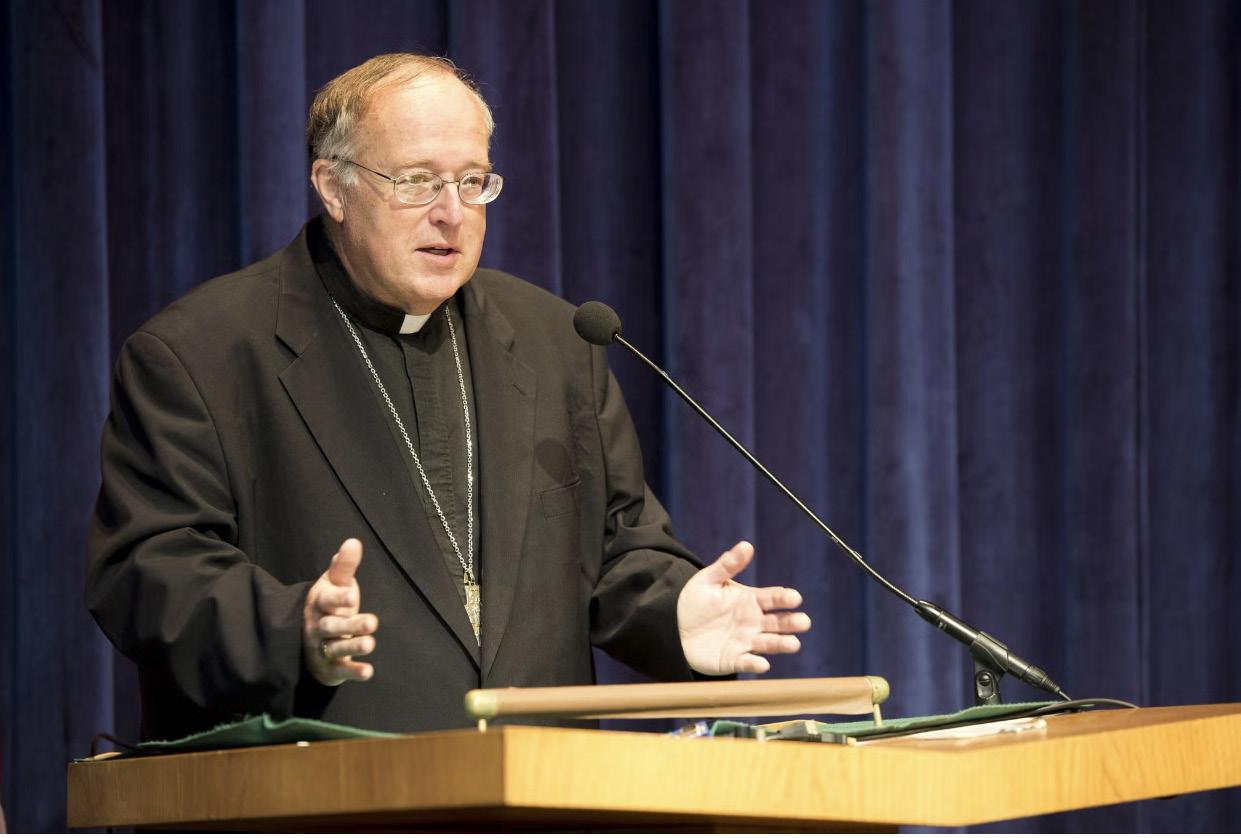
Pope Names Progressive Cardinal As New Archbishop of Washington
they are Catholic or not.
shaw said at the meeting.
“My treasurer is working on building a donor list right now to increase the amount of money that GUSA is taking in, so that’s ideal,” Henshaw added.
The swing set is estimated in the bill to cost just under $2,000, and, according to Henshaw, will be installed near the koi pond next to White-Gravenor Hall, on the field next to Regents Hall or a third location, depending on what the university approves.
A bill to encourage the administration to review insurance claims resulting from the repeated floods in Harbin Hall was withdrawn from the agenda.
The senate concluded the meeting by looking ahead to future legislation, including a bill written by senator Youngsung Sim (SFS ’27) that would increase Georgetown University Transportation System (GUTS) service to the Capitol Campus.
The senate also discussed an initiative led by senator Sam Lovell (CAS ’25) to move the Asian-Pacific (AP) House, an affinity space on campus, under the wing of the Center for Multicultural Equity and Access (CMEA), a university center which provides support to communities who have historically faced barriers to educational access.
Henshaw, whose confirmation will leave a senate seat open in GUSA, said he looks forward to bringing the initiatives passed by the senate to the university.
“We have our weekly provost advisory meeting coming up, and we’re going to have several resolutions prepared to take and introduce there, mostly the stuff that you’ve all been passing,” Henshaw said.
Pooja Narayan
Graduate Desk Editor
Cardinal Robert McElroy, the bishop of San Diego, will become the next archbishop of Washington, D.C., with his inauguration set for March 11, the Vatican announced Jan. 6.
McElroy’s appointment replaces the retiring Cardinal Wilton Gregory. Pope Francis’ choice to name McElroy the Archbishop of Washington garnered national attention in light of President-elect Donald Trump’s upcoming presidential inauguration due to McElroy’s progressive views and outspoken social advocacy.
McElroy said he is excited to engage with D.C.’s diverse community.
“The Catholic community in the District and the five counties is truly sacramental in the rich diversity of its traditions and perspectives on key issues in how to bring the church to its fullness and to bring the church into the world,” McElroy said at a Jan. 6 press conference. “I seek to manifest deep respect for that diversity in undertaking my new ministry.” Georgetown University Interim President Robert Groves said he looks forward to working with McElroy.
“We are honored to welcome Cardinal Robert McElroy as the next leader of the Archdiocese of Washington,” Groves said in a statement released Jan. 6. “Through his leadership, pastoral care and scholarship, Cardinal McElroy has lived out the principles of Catholic social thought and advocated for them in the national arena. We are grateful for his leadership and look forward to working with him in the coming years.”
McElroy previously visited Georgetown in 2014, 2017 and 2021 to participate in events hosted by the Initiative on Catholic Social Thought
and Public Life, which hosts events to promote socially aware Catholic leadership, and the Berkley Center for Religion, Peace and World Affairs, a forum for engagement with religious cooperation. He has also authored two books about Catholic theology and U.S. politics.
McElroy said he wants the church to serve as a safe haven given the potential mass deportations proposed by the incoming Trump administration.
“I want to send some words to the Hispanic community of this archdiocese,” McElroy said in Spanish at the press conference. “I want to be a good pastor, and I want to constantly declare that the church is the mother of all, especially in difficult times and with suffering.”
In addition to his advocacy in support of immigrants, McElroy supported Catholic public officials who have supported legalized abortion and has written against sexuality-based discrimination in the Catholic Church.
Fr. Mark Bosco, S.J., the vice president for Mission & Ministry at Georgetown, said McElroy’s commitment to social justice aligns with Georgetown’s values and that he believes Pope Francis’ appointment of McElroy was not a political statement.
“I think Cardinal McElroy has been more articulate about political polarization,” Bosco told The Hoya. “I think he’s more vocal about being a witness to migrants, refugees, the marginalized in our society. That really fits, I think, with Georgetown’s sense of service to the common good. But I don’t think Pope Francis was making a political point. I think he wanted a very strong new archbishop to come here.” Bosco added that he thinks the new archbishop will strengthen the shared Jesuit values among all Georgetown students, whether
“Our Jesuit values are resourced out of Catholic tradition, but they’re universal values that are shared with many faith traditions,” Bosco said. “I think that the appointment should only encourage students who are not Catholic to see that Georgetown really invites others into the conversation and that we are in a deep relationship, especially because of our Jesuit Catholic heritage, with the Archbishop of D.C.”
Kimberly Mazyck (SFS ’90), the associate director of the Initiative on Catholic Social Thought and Public Life, said she plans to invite McElroy to campus soon.
“I’ve been encouraged when I’ve heard Cardinal McElroy defend the most vulnerable members of the community, especially people experiencing homelessness as well as his work to address racist rhetoric,” Mazyck wrote to The Hoya. “The Initiative on Catholic Social Thought and Public Life has welcomed Cardinal McElroy as a participant in past dialogues held here on the Hilltop, and we look forward to future opportunities to involve him in our work.” Bosco said McElroy’s new position offers an opportunity to strengthen the relationship between the archdiocese and Georgetown.
“I think Cardinal McElroy can help deepen the Catholic commitment to those who are marginalized,” Bosco said. “We’re looking forward to inviting him to Georgetown and working with him in ways we can. We have a lot of centers on immigration here and we have a lot of professors who are Catholic and non-Catholic working in that area. We could see collaborating with the diocese when needed to help further that agenda.”
GEORGETOWN UNIVERSITY
The Vatican tapped Cardinal Robert McElroy, the bishop of San Diego known for his progressive views, to replace Cardinal Wilton Gregory as the Archbishop of Washington.
GEORGETOWN UNIVERSITY
The Georgetown University Black Alumni Council recognized history professor Maurice Jackson for his service to Washington, D.C., and his scholarship on Black history.
Georgetown
Dealt Down-to-the-Wire Loss by Surging St. John’s Red Storm
Allen Tovmasyan Sports Staff Writer
The Georgetown University Hoyas (12-5, 3-3 Big East) battled the St. John’s University Red Storm (15-3, 6-1 Big East) down to the wire in the iconic Madison Square Garden, yet ultimately lost Jan. 14. The loss to St. John’s marked the Hoyas’ third in a row, while the Red Storm won their fourth straight game. Despite the result, Georgetown has a lot to be proud of in their performance against a fierce opponent like St. John’s. The Hoyas came out of the locker room firing on all cylinders, starting the game on a colossal 17-3 run. Sophomore guard Malik Mack began Georgetown’s scoring with a floater in the paint. Mack’s floater was followed by a 3-pointer by graduate guard Micah Peavy, who showcased his impressive defensive abilities by racking up 3 steals. Peavy also led the game in scoring, finishing the game with 21 points. Another sequence in the run showcased the Hoyas’ transition scoring. After a 3-pointer from sophomore guard Curtis Williams Jr., first-year center Thomas Sorber blocked a St. John’s shot in the paint, leading to a Mack layup.
Despite the offensive onslaught by Georgetown, St. John’s worked effectively to keep themselves in the game. Red Storm guard Aaron Scott answered the Hoyas’ run with a 3-pointer of his own, and guard Kadary Richmond completed a handoff in the paint for an and-1 dunk by forward Zuby Ejiofor. Georgetown’s Peavy had something to say about the Red Storm gaining traction in the game when he raced down the court after a St. John’s triple and threw down a thunderous posterizer.
Peavy’s display of athleticism brought the Hoyas’ lead over the Red Storm up to 15 with two minutes remaining in the half.
St. John’s was able to crawl back in the final two minutes to cut the Georgetown lead to 10, ending the half with a score of 37-27 in the Hoyas’ favor.
Georgetown continued to apply pressure on St. John’s coming out of the halftime break as Williams Jr. started the scoring off an assist from Mack. Mack continued the scoring for the Hoyas with a midrange floater to up the Georgetown lead to 14.

@GEORGETOWNHOOPS/INSTAGRAM
Graduate guard Micah Peavy shoots a 3-pointer over St. John’s guard Simeon Wilcher in the Hoyas’ eventual loss Jan. 14.
The beginning of the half made it seem as if Georgetown was expanding on their momentum and had no intentions of looking back. However, the Red Storm’s experience curtailed the Hoyas’ effort.
St. John’s rallied its way back into the game early in the half by applying a newfound defensive pressure on Georgetown, resulting in a 19-2 run to take a 3-point lead over the Hoyas. The monstrous run by St. John’s featured three 3-pointers, two of which came from Red Storm’s Scott.
After the Red Storm’s 19-2 run, the game went back and forth between St. John’s and Georgetown as the Hoyas sought to bring the momentum of the game back on their side. In a fastbreak opportunity, Mack found sophomore forward Drew Fielder, who completed the play with a slam dunk to bring the lead back in favor of Georgetown 47-46.
The game went down to the wire, as St. John’s emerged with a 4-point lead with three minutes left in the game after going back and forth with Georgetown. Georgetown did not go out easily as Mack sank a timely 3-pointer, cutting the Hoyas’ deficit to just
one point and forcing St. John’s to regroup with a timeout.
But St. John’s guard Simeon Wilcher had other plans, as he made a 3-pointer in response to Mack’s right out of the timeout, bringing back the 4 point lead for St. John’s.
After a free throw by Peavy to bring the score 59-56 in favor of St. John’s, Richmond sank a jumper with 50 seconds left, putting the game out of reach for the Hoyas. The final score of 63-58 added another game in the win column for St. John’s.
Hoyas Head Coach Ed Cooley commented on Georgetown’s ability to execute in late-game situations when questioned about the loss to the Red Storm.
“We got to do a better job protecting the ball and executing when it counts,” Cooley told Georgetown Athletics.
“Normally, our teams late in the game are really good at executing … There’s got to be pride when you’re in that game. There’s got to be some emotion that’s connected to wanting to win.”
Georgetown will look to bounce back from their three-game losing streak against DePaul University at Capital One Arena on Jan. 17 at 8 p.m.
Commanders Edge Buccaneers, Win First Playoff Game Since 2005
Fenton Perez Sports Staff Writer
The Washington Commanders outlasted the Tampa Bay Buccaneers 23-20 Jan. 12 to advance to the divisional round of the NFL playoffs, putting them one step closer to the Super Bowl. The Commanders traveled to Tampa Bay, Fla., to face off against the Buccaneers in Raymond James Stadium in the wild card round of the NFL playoffs, as they started their road to the 2025 Super Bowl in their first playoff appearance since 2020, also against the Buccaneers. On the other hand, the Buccaneers are coming off five straight playoff appearances, holding a 6-3 record in those years, with a Super Bowl win in 2020.
Coincidentally, the Commanders’ last playoff win was in 2005 at Tampa Bay. Both teams had incredible seasons, with the Commanders, led by quarterback Jayden Daniels, bouncing back from a 4-13 record last season to achieve a stellar 12-5 record, the team’s best since 1991. The Buccaneers finished the regular season 10-7 with a third-ranked total offense carried by quarterback Baker Mayfield and the team’s passing game. The Buccaneers entered the game at -165 odds to win according to ESPN Analytics, placing them at a 58.8% chance of winning.
While rookie sensation Daniels was a keystone of the matchup, the true battle to watch was between Commanders cornerback Marshon Lattimore and Buccaneers wide receiver Mike Evans, two of the best players in the league in their respective positions. The two have played 14 matchups against each other, most of which resulted in fights, aggression and emotion.
Despite the overwhelming success of the two offenses, the first quarter was a defensive battle, with a field
goal from kicker Chase McLaughlin putting up the only score as part of the Buccaneers’ opening drive. The drought for both teams continued until the beginning of the second quarter, when Daniels marched the Commanders 92 yards down the field in 17 plays, ending the drive with a touchdown catch by wide receiver Dyami Brown in the back of the endzone to take a lead. Kicker Zane Gonzalez followed the drive with a 52-yard field goal to extend the Commanders’ lead to seven.
The Buccaneers’ quiet offense turned up their game at the end of the half, with Mayfield dispatching strikes downfield to drive 74 yards, topping off the drive with a spectacular touchdown by Evans to tie the game 10-10 with only 10 seconds left in the half, leaving the Commanders to draw the clock directly into halftime. Despite the score, the Commanders offense recorded 22 more total offensive yards, more first downs with 11 total and significantly more possession time.
Entering the second half with a tied score, the Commanders looked to boost the odds in their direction with early points. They came out booming with big plays from Brown early on but came up short with only a field goal to take a three-point lead. The Buccaneers quickly answered as they advanced the ball downfield through the hands of Evans and the quickly heating up legs of running back Bucky Irving, whose receiving touchdown returned the lead to Tampa Bay. The fourth quarter grew more competitive with each passing moment. Each team traded offensive blows, resulting in multiple lead changes. As the tide of the game looked like it could swing in the Buccaneers’ favor, a botched handoff by Mayfield resulted in a fumble recovered by Commanders captain
MEN’S TENNIS
Coming Off Strong Fall, Hoyas Hope To Replicate Last Year’s Success
Ceci Lukas Sports Staff Writer
After a strong 2024 season capped off with a top-three finish in the Big East, the Georgetown University men’s tennis team is gearing up for an even more ambitious spring season this year. With three new talented first-years joining the roster and returning players hungry for another strong season, the Hoyas are expected to succeed in both in and out-of-conference play.
Last season, Georgetown ended with a 15-8 record (5-4 Big East), landing them the third seed in the Big East tournament. Then-junior Jake Fellows helped to lead Georgetown’s success, competing in 22 out of 23 matches and going 20-3 in singles and 13-5 in doubles — all in the first-ranked position.
At the end of the season, Fellows was unanimously named Big East player of the year and earned a spot on the all-Big East first team alongside current junior Zamaan Moledina, who earned a spot on the all-Big East second team.
Moledina saw similar success last year, going 11-5 in singles competing in the two, three and four positions. In doubles, Moledina went 12-4, primarily competing in the number one position alongside Fellows.
Head Coach Freddy Mesmer is entering the 2025 season with his own accolades after being named co-coach of the year in 2024 along with Doug
MEN’S BASKETBALL
Matthews, Dillon Pottish and Tom Lilly.
After defeating Xavier University 4-0 in the quarterfinals of the Big East championships, the Hoyas’ season ended in the semifinals with a narrow 4-3 loss to DePaul University April 20, 2024.
This fall, the Hoyas played eight events on the road, debuting at the Delaware Hidden Dual. At the three-day round-robin event, Georgetown competed against the University of Delaware, Temple University and New Jersey Institute of Technology (NJIT).
The Hoyas wrapped up their fall schedule at the ITA Regionals in Lynchburg, Va. Five members of Georgetown’s roster qualified for the 64-player event, where the Hoyas walked away with 12 total wins in the qualifying and main event singles and 2 wins in the main event doubles.
Fresh off their fall tune-ups, the Hoyas have all the pieces in place for a standout spring season. With a blend of fresh talent, seasoned leaders and momentum from last year’s successes, the Hoyas will begin their 2025 season on the road against Old Dominion University Jan. 17. Georgetown will match up against 20 different opponents this season, including six Big East teams, before heading south to South Carolina on April 17 for the Big East championship.
The team welcomed three new
student-athletes this season: first-years Jacob Mann, James O’Sullivan and Dean Rostom. Mann is from New York, where, before Georgetown, he ranked top in the state for the 2023-24 season and was a level 4 national champion and J5 doubles finalist, showing strong performances at the international junior level. O’Sullivan is from Waterford, Ireland, where he attended Mouratoglou International School and was a U18 national champion for Ireland, where he ranked No. 1 in his age group. Rostom is the third first-year player for the men’s tennis team this season, out of Dunn Loring, Va. Rostom attended Laurel Springs High School, where he was named most valuable player of his team and received level 3 champion accolades. In a preseason interview, Mesmer spoke highly of the team, saying he was looking forward to the spring season.
“We are excited for a great season ahead,” Mesmer told Georgetown Athletics. “We have some familiar matchups on the schedule and all of our conference opponents, which is super important to me. Our team has been working hard all semester in anticipation of a great spring season.”
As they strive to set the tone for the season ahead, Georgetown will face Old Dominion in their first match-up of the season Jan. 17 at 12 p.m. in Norfolk, Va.
Despite Promising Start, Hoyas Falter Against No. 9 -Ranked UConn Huskies
Sophia Lu Senior Sports Editor
Though the Georgetown University men’s basketball team fought long and hard during their Jan. 11 Big East matchup against the University of Connecticut Huskies, the team ultimately fell 68-60 to a more experienced, consistent and aggressive opponent.
Karaban and guard Solo Ball, who are averaging 15.9 points, 5 rebounds and 2.9 assists and 13.6 points, 2.4 rebounds and 1.4 assists per game respectively. The Huskies registered their lone loss in Big East play this season to the Villanova University Wildcats 68-66 last Wednesday, Jan. 8, and were hungry to come back with a win against the Hoyas.
and linebacker Bobby Wagner. Wide receiver Terry McLaurin then took a 20-17 lead for the Commanders with 10 minutes remaining with a stunning endzone grab.
With possession, the Buccaneers knew they needed a big drive for a chance to win the game and advance in the playoffs. Tampa Bay progressed down the field smoothly, converting multiple first downs and threatening the Commanders in their territory. As fans roared, the Commanders roared louder, tackling Irving for a 2-yard loss, forcing a field goal attempt to tie the game and leaving Washington just minutes to get the score needed to advance.
This was not unfamiliar territory for phenom Daniels and the Commanders’ offense, who have scored on five separate gamewinning drives this season, one of which being the spectacular Hail Mary against the Bears in week eight. Daniels commanded Washington into the red zone with spectacular plays from running back Austin Ekeler and Brown. With less than a minute left, Daniels took a knee, allowing Gonzalez the opportunity to win the game and advance to the divisional round.
Gonzalez lined it up on the left hashes and kicked the ball, and as it sailed through the air, about to determine the fate of the two teams, it hit the upright and bounced through the sticks to give Washington a 23-20 victory over the Buccaneers, their first playoff win since 2006 and the first playoff win in many fans’ memories. With their advancement to the divisional round of the playoffs, the Commanders are set to travel to Detroit, Mich., to face the firstseeded Lions (15-2) Jan. 18 for a chance to advance to the NFC championship game.
An offensive dry spell during the first six minutes of the second half, which saw UConn go on a 17-2 run, doomed the Hoyas (12-4, 3-2 Big East), who otherwise showed continued resilience throughout the game. Sophomore guard Curtis Williams Jr. led Georgetown in scoring with 15 points, followed by graduate guard Micah Peavy with 14 points. First-year center Thomas Sorber and sophomore guard Malik Mack contributed 9 apiece. Sorber also notched 10 rebounds and 4 blocks.
During the first half, Georgetown went back and forth against UConn, holding them to a close 35-31 score. The Hoyas replicated the same competitive energy later in the second half, but their effort was too little too late to keep up with the Huskies.
The Hoyas entered this afternoon’s matchup riding a high tide of momentum, having defeated three longtime division rivals in a row — the Creighton Bluejays, Seton Hall Pirates and Xavier Musketeers — and putting on a impressive showing against the No. 7 AP poll-ranked Marquette Golden Eagles in a close 74-66 loss. For Hoya fans, the recent hot streak represented a very welcome turn of events after several consecutive seasons of bottom-dwelling in the Big East.
Sorber, Mack, Peavy and junior guard Jayden Epps, the team’s standout players, have been instrumental in sparking the Hoyas’ run this season. Sorber, with averages of 15.1 points, 8.4 rebounds, 2.5 assists and 2.3 blocks, won Big East freshman of the week honors four times and has even drawn first-round buzz for the 2025 NBA draft. Mack, Epps and Peavy, with their respective averages of 14 points, 4.8 assists and 4 rebounds; 14.7 points, 2.5 assists and 2.1 rebounds; and 13.3 points, 4.1 assists and 5 rebounds, have added critical firepower and hustle. Meanwhile, the UConn Huskies (13-4, 5-1 Big East) entered this season off back-to-back national championships. The team lost several starters from the 2023-24 season to the NBA draft, but still fields a potent starting five led by forward Alex
From the outset, Georgetown leaned into their upstart, underdog status against UConn, playing rapidly and bringing out maximum effort and infectious energy. Sorber, matched up against UConn center Samson Johnson, won the opening tipoff to set himself up for a wellpositioned layup right under the basket. On the Hoyas’ second possession, Sorber recovered a lost ball with an offensive rebound, then emphatically dunked on a crowded Huskies defense in the paint. Mack kept up the team’s promising start with a drive to the basket, followed by a successful layup, to give the Hoyas a 6-2 lead.
Though Ball cut into Georgetown’s early momentum with a 3-pointer at the 16:15 mark, the Hoyas kept pushing for more on offense, resulting in a Peavy fast break dunk followed by skillfully executed ball movement that left sophomore forward Drew Fielder open on the wing for 3 points. Up 11-5 less than seven minutes in, the Hoyas appeared to be locked in, playing an extremely competitive game against the Huskies.
Midway through the first half, Head Coach Ed Cooley subbed in Epps, who has been sitting out the past few games with a lower-body injury. His substitution brought a momentary spark of energy to Georgetown, but Karaban answered with several 2-point scores to swing the momentum towards UConn. Later in the first half, back-to-back threes by Ball and Karaban put UConn ahead 33-25. With just under three minutes left in the first half, however, Georgetown pulled themselves back together for a back half run. Epps’ earlier substitution proved pivotal, with the junior guard sinking a 3-pointer at the 00:14 mark and reducing the deficit to 35-31 before the half. The Huskies started out the second half with a successful layup from guard Hassen Diarra, followed by two free throws from Ball, to go up 39-31. Diarra then capitalized on Georgetown’s sloppy ball handling on the other side of the court for a steal and another layup. Putting a stop to UConn’s 6-0 start, Sorber
made a free throw after getting fouled at the basket, but his one point would be Georgetown’s only score for the first three minutes of the second half. UConn kept up the offensive barrage with a Ball jumper and a Karaban 3-pointer for a 14-point lead, larger than any other lead the Huskies had had up until that point. With the Huskies up on the Hoyas 46-32, Cooley called a timeout. Coming out of the timeout, the Hoyas failed to right the ship, giving up three consecutive dunks to the Huskies, the latter two of which came off steals by Karaban and Diarra. Without answers on offense, Cooley had no choice but to call for yet another timeout. The second time around, Georgetown showed more hustle, with Peavy making a layup off an assist by sophomore forward Jordan Burks right out of the gate. Curtis Williams Jr.’s 3-pointer at the 11:35 mark put Georgetown on the scoreboard once more, but the Hoyas still sat at a 53-39 deficit. Georgetown’s defense, however, collapsed, allowing UConn to go on an unanswered 8-point run. Simultaneously, the Hoyas’ offensive play also stalled, until Peavy converted an and-1 with 5:55 left in the game. While his missed free throw left the Hoyas down 6446, Williams Jr. picked up the slack with another successful 3-pointer that brought the game back to life, capping off an unanswered 8-point Georgetown run. UConn staved off a potential Georgetown comeback, putting up a jumper and two free throws to once again pull ahead, this time to 68-51. The Hoyas tallied nine more points on the scoreboard before the clock expired, but the deficit ultimately proved too large to overcome. After the game, Cooley expressed pride in his team’s persistence, acknowledging how emotions proved challenging for the Hoyas.
“I thought they played emotional and had their emotions intact, and I thought we played emotional and we weren’t disciplined with our emotions,” Cooley said at the postgame press conference. “I thought physically they bothered us; offensively, we were out of sorts. What I am very, very proud of is that we got down pretty big and we continued to fight and chip at it.” The loss drops Georgetown to a 3-2 record in the Big East, though the team still has plenty of chances ahead to continue on the up. The Hoyas next play
OUT OF LEFT FIELD

@METS/INSTAGRAM
Juan Soto moved crosstown from the Yankees to the Mets in December, signing a 15-year, $765 million contract.
Soto Spurns One NYC Borough for Another
HERMAN, from A12
And then, an hour later, I found out the worst part: Juan Soto had betrayed the Yankees for a measly $5 million. The Mets gave him $765 million; the Yankees had offered him $760 million. Seriously?
I cannot comprehend how much $765 million is, but I know it is not going to buy anyone a significantly better quality of life than $760 million will. And money can buy a lot of things, but it cannot buy a legacy. The Yankees have a long history of players whose careers are defined by a lengthy tenure on the Yankees and a couple of World Series rings to show for it. Babe Ruth. Mickey Mantle. Joe DiMaggio. Lou Gehrig. Yogi Berra. Derek Jeter. Mariano Rivera. Aaron Judge, soon enough. For $5 million — 0.65% of the contract he signed — Juan Soto gave up his opportunity to join that list. And he was well on his way: Yankees fans are not going to forget that he sent them to the 2024 World Series with a 3-run homerun in extra innings this past October. It means nothing to us now, but we still remember that it happened. Instead of building on that legacy, he chose to play on the Mets. And wear orange. The Mets are … well, the Mets. They are known for living in the Yankees’ shadow and consistently finding a way to fall on their faces. They are the Jets of baseball, and I am all too familiar with the pain of being a Jets fan. The Yankees, on the other
hand, are a perennially successful team that has not had a losing season since 1992.
Aaron Judge, the Yankees’ two-time American League most valuable player (MVP), understood that the value of wearing pinstripes cannot be quantified. After the 2022 season, Judge accepted the Yankees’ offer for a nine-year, $360 million contract. In doing so, he turned down an offer from the San Diego Padres for over $400 million. Judge was smart enough to realize that being remembered as a forever Yankee is worth far more than that $40 million difference.
A few months before he signed, reporters snapped photos of Judge wearing a sweatshirt that said “New York or Nowhere.” And he didn’t mean Queens. Soto, on the other hand, tossed his pinstripes aside for $5 million. That’s about the price of a bag of Kit Kats in college student money. To their credit, the Yankees have bounced back admirably. Instead of throwing almost $1 billion toward one player, they have doled out contracts to twotime all-star starting pitcher Max Fried and seven-time all-star and former National League MVP first baseman Paul Goldschmidt and traded for two-time all-star closer Devin Williams. But they shouldn’t have had to do that. And now, for the next 15 years of my life, I’m going to have to look at Soto’s punchable face in a Mets uniform. In case you were Juan-dering,

WOMEN’S BASKETBALL
Hoyas Continue Four-Game Slide Against Butler
WBB, from A12
Georgetown kept it close for most of the third quarter, feeding off a steady flow of baskets by Ransom, Hession and Jenkins. The Hoyas cut into the Bulldogs’ lead, only down 35-31 with 7:35 remaining in the third quarter.
Three-pointers by guard Lily Zeinstra pushed the Butler lead back to 43-35 with 4:11 left in the quarter. However, Ransom hit a jumper and forced a steal in the backcourt that led to a 3-pointer by first-year guard
Amanda Ajobiewe all within 22 seconds to pull Georgetown back within three points.
At the end of the third quarter, Butler led 48-42. Immediately out of the gates in the final quarter, the Bulldogs embarked on a 7-0 run, holding the Hoyas scoreless for nearly four minutes.
Facing a 59-44 deficit with under five minutes remaining, Jenkins grabbed several offensive rebounds and turned them into layups, but the baskets proved too little too late, and Butler cruised in the fourth quarter to a 63-53 win.
Ransom led Georgetown off the bench with 16 points and 3 steals in the loss. Jenkins added 10 points and 9 rebounds, and Hession finished with 15 points and 3 steals. The Hoyas will look to snap a four-game losing streak when they travel to face the Providence Friars (8-11, 1-5 Big East) and pick up their second conference win of the season Jan. 18 at 2 p.m.

Hoyas Climb National Polls in Resurgent Season
MBB, from A12
With lightweights like Wagner, Coppin State, Fairfield and others coming to “The Cap,” Georgetown has racked up comfortable wins that contributed to its hot 12-4 start. In total, Georgetown currently holds a combined 10-1 record in Q3 and Q4 games (the weakest games a team can play) while holding just a 2-3 mark in Q1 and Q2 games, including a 0-3 mark in Q1 contests. However, Georgetown does own a couple of impressive wins, including an 81-57 blowout of perennial tournament contender Creighton Dec. 18 and a hard-fought 75-71 road win against rival Syracuse Dec. 14 (their first win over their longtime nemesis since 2021).
Georgetown’s 3-0 Big East start represented the program’s best start in conference play since 2011-12, when the Hoyas finished the year ranked 15th in the final AP poll and earned a 3-seed in the NCAA tournament. However, with the losses to Marquette and UConn and an early season blowout at the hands of the University of Notre Dame, Georgetown has shown its youth and inexperience when it matters most, which is not surprising considering the roster is one of the youngest in the nation and the youngest in the Big East.
With young leaders like sophomore guard Malik Mack, standout first-year center Thomas Sorber and junior guard Jayden Epps, Georgetown has shown measurable progress in the second year of the Cooley era after he departed from Big East rival Providence College. Simultaneously, Georgetown has shown tremendous growth on the defensive side of basketball. While Cooley used to rail against his team’s defen-
COMMENTARY WOMEN’S
sive effort in press conferences, the team is now leaning on their cohesiveness, especially in its 2-3 zone, to keep the team in games against major national powers. According to Kenpom.com, Georgetown’s adjusted defensive efficiency sits at 94.7, which is good for 19th in the nation. Cooley’s team has shown remarkable defensive growth as the season has progressed and as most basketball fans know, defense wins championships. To continue to parlay success off their hot start, Georgetown will have to improve offensively and in the turnover department. As it stands, Georgetown currently sits at an adjusted offensive efficiency of 107.4, good for 153rd in the country, according to Kenpom.com. At a base level, the team averages just 74.1 points per game, which clocks in at just 212th in the country. In contests against more talented and experienced groups, Georgetown has struggled to find good shots and get the ball down low to Sorber. The team as a whole is mediocre at best from behind the arc, shooting just a combined 32.5%, good for 254th in the country. For Cooley’s program to earn its first Q1 victory since March 13, 2021, against Creighton, the Hoyas will have to find ways to get the ball down low to Sorber and to standout graduate forward Micah Peavy while also limiting their turnovers down the stretch. In the UConn game alone, Georgetown’s 14 turnovers led to 22 UConn points, a margin that just cannot happen against the sport’s elite, let alone the twotime defending national champions. Overall, Georgetown basketball fans should be pleasantly surprised about where they find their beloved Hoyas so far this season. With a roster filled with young talent and

Graduate guard Micah Peavy has added leadership experience to one of the youngest teams in the Big East this season.
Cooley’s continued success on the recruiting trail, the Hoyas are approaching national relevance for the first time in over a decade. If the season ended today, Hoya fans should be thrilled with the team’s competence in Big East play and the toughness the roster showed. Cooley has consistently been one of the best program builders in college men’s basketball, and his second year at Georgetown has only reinforced that point. However, fans should temper their expectations for the team as they enter the meat of their Big East schedule, which includes two games against Villanova University, a home game against St. John’s University and one more apiece against UConn and Marquette. As it currently stands, Georgetown is projected to finish 17-14 overall with an 8-12 mark in Big East play. While I personally believe the Hoyas will steal a few games they are not supposed to win and approach 20 wins, fans should be rooting more for an appearance in the NIT than in the NCAA tournament. Regardless of how the rest of the season goes, Georgetown has made it clear that they are once again on the rise.
Hoyas Set to Face Strong Conference Opponents
TENNIS, from A12
both new and returning players, shined in several close matches at the Naval Academy Blue & Gold Invite in Annapolis, Md.
In the invite, Novikov picked up right where she left off last spring, making it to the semifinals in A-flight. Several newcomers also showed their importance to the team and produced impressive results. In B-flight, Kavarana made it to the finals, losing narrowly to Navy’s Parvathi Shanker, 6-3, 4-6, 7-10. In D-flight, Evans won the final, defeating Villanova University’s Valieriia Kornieva 7-2, 2-6, 10-5. Additionally, in doubles, Schaefer and Zelenko fashioned a great run, securing a spot in the final match,
but had to forfeit due to an injury Zelenko suffered.
The Hoyas also gained significant experience this fall during their campaign at ITA Regionals. In open doubles, Novikov and Kavarana made a promising run before losing in the Round of 16 to University of Virginia’s Zara Larke and Blanca Pico Navarro and, in open singles, Kavarana earned some impressive victories before falling in the round of 32 to Virginia’s Sara Ziodato.
The Big East this year is primed for an interesting but competitive season. Many Big East teams had star players graduate; only two of the six all-conference first-team players, DePaul’s Hannah Smith and UConn’s Olivia Wright, will return for the Spring 2025 season. Notably, Xavier, who won the
conference championships last year, will be without Imani Graham, the Big East women’s player of the year, and Anna Roggenburk, first-team all-conference, who both graduated. Despite that, Xavier did not falter this fall, as their women’s tennis doubles team of Clara Owen and Abby Nugent qualified for the NCAA Individual Championships after earning a spot in the finals at the ITA Conference Masters. Georgetown Head Coach Freddy Mesmer said the team looks forward to the increased conference matches on the team’s schedule.
“We also are playing nine of our 10 conference opponents, which is huge for our program,” Mesmer told Georgetown Athletics. “Finally getting Xavier back on the schedule as well is great because they are the reigning confer-
ence champs, and I think it gives our team a great goal to strive for throughout the year and see what that level is like to be a conference champion.” Last year, with an 8-13 record (4-2 Big East), the Georgetown women secured the third seed in the Big East. This season, the Hoyas will aim to
GEORGETOWN ATHLETICS
Junior guard Modesti McConnell put up a strong effort on defense against Butler guard Lily Zeinstra, but the Hoyas ultimately lost to their Big East rivals 63-53 after an offensive slowdown in the fourth quarter.
GUHOYAS


TALKING POINTS

OUT OF LEFT FIELD
I Really Don’t Know About You, But I’m Not Feeling 22
night to dress up like hipsters and make fun of our exes.”
She hit the nail on the head: Yankees fans are spending our nights making fun of our exright fielder who wore number 22 — or crying about him, but close enough.
I think bad things happen to the Yankees when The Hoya doesn’t print. On Dec. 8, while I had the displeasure of spending my Sunday night in the library writing a final, the news broke that the Mets signed then-free agent Juan Soto to a 15 year, $765 million contract. Of course, I did not find out from a baseball news source. I found out when my phone started blowing up with texts ranging from “I’m gonna die” to “uh oh” to “HAHAHAHA.”
I knew.
I calmly closed my computer — no chance I was getting any work done — and FaceTimed my parents. Our group chat had been called “give me juan soto;” I changed it to “fjs” immediately. My editors will censor me if I tell you what that stands for. I stared at my parents on the phone for a second, then hung up. Then, I took a lap and bought myself consolation Twizzlers. They tasted like plastic.
See HERMAN, A11
Georgetown @ Nittany Lion Challenge
Saturday, 10:30 a.m.
University Park, Pa.

WOMEN’S BASKETBALL
Hoyas Fall to Butler After Late-Game Offensive Struggles
Daniel Greilsheimer Deputy Sports Editor
With each team searching for their second conference win, the Georgetown University women’s basketball team traveled to Butler University for what was anticipated to be a low-scoring battle. After slow starts by both sides, the Butler Bulldogs (12-7, 2-4 Big East) pulled away from the Hoyas (8-9, 1-5 Big East) in the fourth quarter to secure a 6353 win, marking Georgetown’s fourth consecutive loss.
With junior guard and Georgetown’s leading 3-point shooter Victoria Rivera sidelined
by an injury and graduate guard Kelsey Ransom coming off the bench for only the third game of her career and the first time this season, the Hoyas’ starting lineup trended younger and looked different. Junior guard Modesti McConnell replaced Ransom in the starting five.
Despite winning the tipoff, Georgetown struggled to generate offense with Ransom, the team’s captain and leader in points, assists and steals, off the floor. Butler took advantage of the offensive lapse, jumping out to a 4-0 lead in the quarter’s early stages.
After nearly four minutes, first-year guard Khadee Hession,
fresh off a season-high 22-point performance against the sixthranked University of Connecticut (16-2, 7-0 Big East), put the Hoyas on the board, knocking down a 3-pointer and a jumper to inch Georgetown ahead 5-4.
A Ransom jumper and an acrobatic layup by Hession gave the Hoyas an 11-7 advantage with 2:49 remaining in the quarter. The four-point lead would be the team’s largest of the game.
Butler guard Kilyn McGuff hit 3-pointers on back-to-back possessions as time dwindled, leveling the score at 13-13 after one quarter of play. The Hoyas frequently switched
Crunching Hoya Numbers in the Cooley Era
Evan Greenfield
Sports Staff Writer
Coming off a close but encouraging 74-66 loss on the road to Big East powerhouse and No. 7 AP pollranked Marquette University, the energy surrounding Georgetown University men’s basketball was sky-high ahead of Saturday’s showdown at Capital One Arena against the two-time defending national champions and No. 9 AP poll-ranked University of Connecticut (UConn) Huskies. Armed with an overflowing and rowdy student section waving gray rally towels, along with an announced crowd of 17,168 (the largest attendance for a Georgetown home game since Dec. 5, 2015, against Syracuse University), fans were ready to see Georgetown’s climb back to national relevance culminate in the heart of the nation’s capital. However, after a back-and-forth first half, Georgetown’s (12-5, 3-3 Big East) fans largely started clearing out following UConn’s (13-4, 5-1 Big East) dominant 17-2 run to open the second half. While the final score only reflected an 8-point loss, the Huskies’ far more cohesive and experienced roster thoroughly dominated the Hoyas, leading by as much as 23 points during the game. Once again, Georgetown fell short, leading many to wonder how high the ceiling is for the 2024-25 team from here on out.
Let’s take a look at the facts. Georgetown currently sits at an impressive 12 wins and 4 losses. Purely from a record perspective, the Hoyas are already leaps and bounds ahead of last

year, not to mention the dog days of Patrick Ewing’s coaching era. Georgetown already owns more Big East wins this year (three) than in each of the last three seasons. Furthermore, their 12 wins represent the program’s highest win total since the 2020-21 season, when they finished 13-13 (7-9 Big East) and made their most recent March Madness appearance off a miraculous 4-game win streak in the Big East tournament. From an analytical perspective, Georgetown currently ranks 68th in the NET rankings, 63rd on Kenpom. com and 75th on ESPN’s Basket-
ball Power Index (BPI). Despite the 2-game losing streak, Georgetown currently sits at a season-high mark in both the NET and Kenpom.com rankings, which consider the opponent’s strength and losing margins significantly in their formulas. The Hoyas sit a little further back in ESPN’s BPI rankings due to the system’s greater emphasis on prediction-based rankings, as the Hoyas are predicted to regress considerably in every model. Through Georgetown’s first 16 games, the squad, as reflected in its current NET, BPI and KenPom.com rankings, sits about 20
to 25 teams out of the tournament field, reflecting that Georgetown still has a long way to go before they have a legitimate shot at the NCAA tournament this season. While the team sits at a 12-4 overall record, Georgetown’s strength of schedule (SOS) is considerably poor, with their NET SOS sitting at 144 and Kenpom.com having the team’s net rating SOS at -0.09, good for 163rd in the nation. In other words, Georgetown has thus far benefited tremendously from a weak schedule, especially its non-conference schedule.
See MBB, A11
their defensive sets in the quarter — from man to zone and back again — leaving the Bulldogs’ offense confused. Forcing constant disruption, Georgetown finished the game with 8 steals. The teams traded baskets to begin the second quarter, as firstyear guard Jaeda Wilson and Ransom combined for 8 points to give the Hoyas a 21-19 lead with 5:43 remaining in the half.
An 11-0 Butler run quickly followed, pushing the home team to a 30-21 advantage. The Georgetown offense stalled heavily during the stretch, as the team settled for poor 3-point attempts and had no answers for Butler forward Sydney
WOMEN’S TENNIS
Ceci Lukas Sports Staff Writer
After strong play in the fall, the Georgetown University women’s tennis team is looking to build on their momentum for a potential championship season this spring. Looking ahead, the Hoyas will strive to capitalize on a robust roster of proven returning players and highly touted newcomers.
The Hoyas finished their 2023-24 campaign with 8 wins and received the 3-seed in the Big East tournament. Ultimately, the Hoyas made it to the Big East quarterfinals before the St. John’s University Red Storm eliminated them.
The Hoyas will enter the spring without one of their past leaders, Chloe Bendetti, who has since graduated. Bendetti served an important role for the Hoyas, spending five years with the team and leading Georgetown on and off the court. Last season, Bendetti was named to the allBig East second team and earned the accolade of ITA scholar-athlete, with a GPA over 3.5. Bendetti served as a role model to the team as an experienced player who excelled competitively and academically. Despite Bendetti’s absence, the Hoyas will retain one of their key players, sophomore Emily Novikov. Last season, Novikov was named Big East freshman of the year and landed
Jaynes in the paint. The Hoyas did not score again until there was 1:15 left in the half, when Hession made a free throw to end the drought and senior center Ariel Jenkins added a layup to cut the Bulldogs’ lead at the break to 30-24. Both teams shot 45% from the field in the first half, but Butler’s dominance on the glass and their 12 first-half points off turnovers proved to be the difference. The Bulldogs ultimately outrebounded the Hoyas 35-20 for the game, including a 14-7 advantage on the offensive glass.
on the all-Big East second team. In the spring season, Novikov went 11-4, with a team-high 11 singles wins. Along with plenty of skilled returning players, including Novikov, junior Paige Gilbert, sophomore Katie Garofolo-Ro, junior Ashley Kennedy and sophomore Tatiana Zelenko, the Hoyas gained five new players with proficient skill sets. Notably, one of the five players includes first-year Molly Evans, the 2021 D.C. State Athletic Association champion with a 41-1 overall record in high school, as well as first-year Carolyn Schaefer, a three-time allstate player in Wisconsin, Greater Metro Conference champion and player of the year. Additionally, the Hoyas added first-year Jordan Thomas, the 2022 Tidewater Conference of Independent Schools (TCIS) MVP and 2021 TCIS player of the year, and first-year Natasha Kavarana, the 2021 South Carolina state champion. Finally, Georgetown reinforced the team with experience and talent by bringing in graduate student Ellen Puzak, who earned 45 match victories at the University of Colorado, Boulder. During the fall, the Hoyas gained valuable competitive experience and built chemistry together as a new team. In their second match of the fall season, the Hoyas, with
GUHOYAS
GUHOYAS
Eilat Herman Hoya Sports Columnist