6
Feature
tuesday, march 8, 2011
Election
www.thegatewayonline.ca
compiled by simon yackulic photographed by matt hirji
Dissection E
lections can be confusing at the best of
times. To help students cut through the rhetoric tossed around by candidates
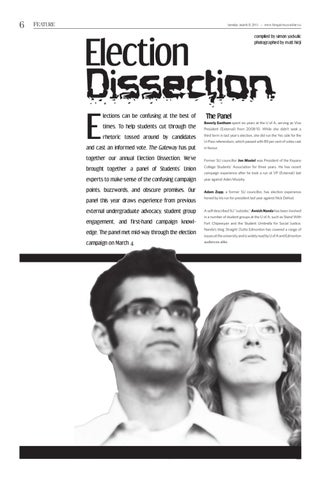
The Panel
Beverly Eastham spent six years at the U of A, serving as Vice President (External) from 2008-10. While she didn't seek a third term in last year's election, she did run the Yes side for the U-Pass referendum, which passed with 89 per cent of votes cast
and cast an informed vote, The Gateway has put
in favour.
together our annual Election Dissection. We’ve
Former SU councillor Jon Mastel was President of the Keyano
brought together a panel of Students’ Union
College Students' Association for three years. He has recent
experts to make sense of the confusing campaign
year against Aden Murphy.
points, buzzwords, and obscure promises. Our
Adam Zepp, a former SU councillor, has election experience
campaign experience after he took a run at VP (External) last
panel this year draws experience from previous
honed by his run for president last year against Nick Dehod.
external undergraduate advocacy, student group
A self-described SU "outsider," Avnish Nanda has been involved
engagement, and first-hand campaign knowl-
in a number of student groups at the U of A, such as Stand With Fort Chipewyan and the Student Umbrella for Social Justice.
edge. The panel met mid-way through the election
Nanda's blog Straight Outta Edmonton has covered a range of
campaign on March 4.
audiences alike.
issues at the university and is widely read by U of A and Edmonton
The Gateway
Feature
volume ci number 37
Board of Governors Representative The panel started their discussion with what they described as the most disappointing race of the election, with only Raphael Lepage Fortin — who goes by “Raph” — running for Board of Governors Representative. The panelists said they felt this race exemplified how this year’s candidates seemed unable to engage the student body. Eastham was concerned about Lepage Fortin’s incomprehensible posters and the general demeanour that he’s demonstrated towards the election. Calling his posters “unprofessional,” Eastham asked why he would feature a pig in his campaign material when he’s running for a position that demands professionalism. “He has no idea. Absolutely none, unfortunately,” Eastham said. “The BoG is an incredibly professional group of individuals and we have one student from the SU who goes and represents the rest of the student body. In addition to the [SU] President, we only have one other student position on the board. And we need that person to be incredibly professional and incredibly articulate and able to bring the student perspective. I don’t think Raph grasps what exactly he would be asked to do.” The panel also commented on how Raph left the Lister forum early, which Mastel felt conflicted with a platform that emphasizes communication. “So, he wants to engage students by not actually taking their questions?” Mastel asked. “To be fair, I think he’s trying to say there’s a disconnect. People don’t understand the BoG’s role and what they do, but I don’t think he has a way to actually convey that to the student body. And that’s a problem if he’s actually going to take that position,” Nanda added, noting that it was hard to understand why Raph was using a pig as a symbol for his campaign.
President As the sole presidential candidate, aside from joke candidate Dr. Horrible, the panel expressed their belief that Rory Tighe has a special
responsibility in re-engaging the campus. One of Tighe’s major campaign points this year is student engagement, but Mastel said that it isn’t as easy as Tighe seems to think. “You can’t just create a Twitter and everything falls into place. You can’t create a YouTube channel and everything just falls into place. [Engagement is] a hard, complex issue,” Mastel said. “You may be able to tweet with computing sciences students really easily, but we have a campus of 30,000-plus students. Engaging all of them, and the matter you have to go about that, varies greatly. Different students go about it different ways.” Mastel said that beyond the vague point on engagement, Tighe’s platform has no concrete goals or vision. “There’s no common thread between his points. There’s no ‘come students, rally around this.’ […] He doesn’t seem to have a grand vision like Dehod [did] last year with mental health. He had Fall Reading Week, which was because of mental health, and it was all tied together,” Mastel said. “[Tighe] wants more student space. But what else? Student experience. Is this for some grandiose thing or is he just throwing out catchphrases and hoping students will be like ‘oh, I like that, student space is good.’ ” Eastham critiqued Tighe’s handling of the election forums and said that even though his only competition is a joke candidate, he should still present a professional image when being questioned. “[Tighe] has to know that if he asks the joke candidate a question, the joke candidate can answer as a joke. Rory Tighe, running for president, cannot. His answers need to be real,” she said. However, Eastham said that one thing working in Tighe’s favour is that he does have some experience in the SU as an executive, having served as Vice President (Student Life) this year. “In a year when no one else is running for president, I think it’s important to have somebody who has been on executive running, and that gives me some confidence that he’s been exposed to what goes on in the SU. But I don’t think he’s pushed himself enough in his presidential campaign. He’s got these three main points, but I’d like him to talk more in-depth
about what he’s going to do.” Nanda agreed with Eastham’s assessment that Tighe may be a good candidate, but he hasn’t given the everyday student a reason to value his campaign. “He’s missing engagement,” Nanda said. “All his points are great, innovative ideas. He looks like he’ll be a good president. But he’s missing a big issue. And by missing that big issue, I don’t know if he gets it. People who aren’t involved in the SU, [in] the hack community, don’t see the SU as having any value to them.” Zepp added that Tighe’s experience in Lister might not necessarily be a positive, as he hasn’t accounted for the differences between Lister and the rest of the U of A. “I think his greatest weakness was that [Tighe] was president of Lister, where engagement isn’t really an issue. When you come to the campus as a whole, it’s a big issue. Maybe he just missed the boat on this one,” Zepp said.
Vice President (External) The panel was quick to point out that Farid Iskandar’s policies were simply taken from already existing positions in student lobby organizations and don’t offer anything insightful. “I think it shows that he has a base level understanding of what needs to be done, but what I’m not getting from him is: Who is [Iskandar]? What does he want to do? What is his vision? […] What is his vision of the future? What does it look like for students?” Eastham wondered when discussing the uncontested candidate vying for her old position. Nanda was displeased that Iskandar didn’t have any points in his platform on how students would be involved in advocacy. “There’s no mention of how he’s going to engage students throughout his term and how he’s going to include them in the decision-making process, which is disappointing,” he said. There was confusion about the point in Iskandar’s platform that calls for limiting tuition to CPI, which is a regulation that has been in place since 2006. Eastham was concerned that this wasn’t the only issue Iskandar was confused about.
7
“Because it’s a complex set of issues, there are little things that perhaps he has not quite connected. He’s been talking about how tuition could be considered a mandatory non-instructional fee. Well, no, tuition is clearly the only instructional fee. But the way the guidelines at the provincial level can be read, you can put things in there that are basically tuition by another name,” Eastham said. Eastham also lamented the lack of another candidate in this race, which she felt would’ve forced Iskandar to flesh out his platform. “Again, this is where I think if you had someone running against him, you would start to bring out the richness of each candidate and strengthen each platform,” she said, though Eastham said she figured that Iskandar could do the job. “I’m reasonably confident that he’ll be able to learn the issues and do a good job of advocacy at the municipal, provincial, and federal level.” However, looking at his platform laid out in his posters and website, the panel was concerned with what seemed like disjointed positions, with Zepp saying that Iskandar’s ideas seemed to be “all over the place” and Mastel agreeing. “If you have your goals, you can say ‘this is my platform, and this is my platform explained.’ I can’t even tell you what I’d pull out [of his platform]. I know what he’s trying to say, but I look and I wonder if these points are his goals or just points of information,” Mastel added.
Vice President (Academic) The panel critiqued many of Emerson Csorba’s platform points and questioned if his campaign could also have used some competition to force him to strengthen his platform. “One of his major points was pairing mentors with first-year students. As a former first-year student, I’m not sure that that’s something I’d want to have,” Mastel said. “I do like his point about research,” Eastham said. “The point is good, and [it’s] something the SU has been working on for a while — saying that if we’re spending all this money on research and we’re trying to be a research-grooming institution, then the undergraduates should at
8
Feature
tuesday, march 8, 2011
least leave [having been] exposed to that. But then again, I think it’s not as clearly laid out in speeches and different things as if he was running against someone.” The panel was concerned that, without any competition, Csorba had chosen some complex issues as his platform points and neglected to explain them in language that students could grasp. “Picking graduate attributes as a platform point is interesting. Kudos to him for picking it, but that’s a hard one to get across,” Eastham said. “You have to be pretty awesome to convey that appropriately and, well, he didn’t,” Zepp added. The panel noted that a lack of opposition might have allowed Csorba to be lazy in platform development. “If there’s no one forcing you to explain your points, you still have to flesh them out,” Mastel said. “Maybe if there was a candidate running against him, those ideas would be fleshed out easier. [Even if you’re unopposed], this isn’t a pass at all,” Nanda added.
Vice President (Student Life)
“If the SU and student councillors started better explaining the value in the positions, then there would be a huge difference.” — Avnish Nanda
“I’m just wondering if he knows what the Fine Arts department does. There isn’t a lack of theatre on campus
Of all the races, the competition between David McBean and Colten Yamagishi for VP (Student Life) received the few accolades the panel doled out. Between the two candidates, some of the panel favoured Yamagishi’s ideas as more original and fresh. “The only race that I’m seeing some new ideas in is for VP (Student Life), and those ideas are coming from Yamagishi, not from McBean,” Eastham said. “The idea about having a thrift store in SUB — I don’t know how it will work. I like the idea though. I think it’s interesting. It might offer something to students […] There’s also the Sexual and Gender Diversity Centre. Who knows, that might get more female candidates running in SU elections.” “I am glad they’re putting it out there — they’re trying something and talking about it,” Nanda said, mentioning Yamagishi’s other platform point of having the SU host a campus musical. In contrast, Zepp was a little more critical of Yamagishi’s ideas. “Sure, let’s just have Andrew Lloyd Webber Week,” Zepp joked. “I’m just wondering if he knows what the Fine Arts department does. There isn’t a lack of theatre on campus […] I don’t know if we need the VP (Student Life) to produce a musical. It’s one thing to say we’re having an improv night. It’s another to have a musical that’s probably running for however long.” Nanda, speaking from his experience with Stand With Fort Chipewyan and the Student
www.thegatewayonline.ca
Umbrella for Social Justice, praised McBean’s idea of encouraging student group collaboration. “I really like McBean’s point of collaboration — having student groups come together and foster collaboration,” Nanda said. However, Mastel doesn’t feel the SU needs to take the lead all the time when it comes to dealing with student groups. “If a student group wants to collaborate with another student group or the SU, you can’t just assume that because the SU has a service that allows you to confer with other groups, that they should have the lead for all these events.” Despite the panel’s disagreements on the specific platform points of the candidates, they did agree that there were quite a few similarities and that neither campaign was tackling engagement as well as they could be. “I’d say they’re about 85 per cent similar, and then in that last 15 per cent, they each have some interesting new ideas. Unfortunately, there’s not a lot about engagement in there. I hope in the last week, they really try to distinguish themselves,” Zepp said. “People haven’t gone as in-depth in their platforms as I’d have liked, even in this VP (Student Life) contested race,” Eastham added. “And though they’ve started at least to have original ideas, I don’t think they’re well formed. And people have made some really bizarre plays at trying to get people interested in their campaigns which I think are just falling flat, such as sheep and pigs and ties and Obama posters.”
Vice President (Operations and Finance) The panel felt that Andy Cheema, the sole candidate for Vice President (Operations and Finance), is running on a platform that is lacking in specifics. “You know what annoyed me most about his platform? He wants to increase the quality and options of beverages on campus. But how?” Mastel asked. “Even his SUB plans are just to renovate the lower level,” Zepp added, explaining that such a general plan wasn’t helpful. The panel also speculated that a lot of Cheema’s plans seemed to be simply a continuation of the plans and projects of current VP (Operations and Finance) Zach Fentiman. Eastham, however, noted that the position does require some continuity and stability between years. “To be fair, VP (Operations and Finance) is probably the hardest race to run for, because a good VP (OpsFi) just keeps the place running well. Does that mean there’s no room for new ideas? Absolutely not. But there is some consistency needed there. If we kept changing our plans for how to design SUB, then it would be chaos,” she said. Mastel expressed a concern that Cheema, like the other candidates, could have improved his platform if he was challenged by competition, but as it is, Cheema just used buzzwords. “He wants to increase the amount of student space in SUB. There is a finite amount of space in SUB. He’s throwing out catchphrases. People like student groups, people like student space,” Mastel said. Zepp agreed with Cheema’s platform points that food quality should be improved on campus, and joked that Cheema at least appeared ready to assume the role. “He looks trustworthy enough. I’d trust him with my money,” Zepp said.
[…] I don’t know if we need
Fall Reading Plebiscite
the VP (Student Life) to pro-
The Fall Reading Week plebiscite was a launching point for debate among the panel, who
duce a musical.” — Adam Zepp on Yamagishi
The Gateway
Feature
volume ci number 37
“Definitely NOTA for BoG. I guess the problem I have with most of the other candidates is that I don’t think they’ll do a bad job, but just because they won’t fail does not necessarily mean they should be elected. I actually want to say that I’m not sure if I would vote for Tighe. I don’t know,” Mastel said. Mastel explained that the candidates haven’t gone the distance in appealing for student votes this election. “Again, it’s not because [...] any of these candidates have a massive flaw in their campaign or what they want to do, but they honestly don’t seem like they get it. They’re a few bricks short of a full campaign. There’s just something not there. Sometimes nobody is better than the options you have,” Mastel added. The other panelists expressed similar sentiments about the lack of a viable candidate for BoG Representative. “Just NOTA for BoG, for now. NOTA is my default vote until someone earns it,” Nanda added. “I’d do NOTA for BoG. Maybe Cheema too,” Zepp said.
“I think the bigger concern in this election
is the lack of people running.”
— Beverly Eastham
disagreed on the need to ask for a student vote on the initiative. “I can expect that the turnout at this election will be at an all-time low, lower than last year. So sure, it’s an important decision, but isn’t there a more effective way of getting student opinion?” Zepp asked. Zepp pointed out that current President Nick Dehod was elected on a platform that included developing a Fall Reading Week, and since students obviously approved of the platform, he questioned what the point was of asking students to vote on it again. “It would make me think that the people who vote in elections, who are the same people every year, want a Fall Reading Week. I think sending out the question again to pretty much the same people… I don’t know [if it’s worthwhile].” However, Eastham felt that it was necessary to have students express their opinions on the proposed Fall Reading Week through a plebiscite. “It’s possible that this is one of those process pieces that the SU needs in order to move forward with the university, so the SU can go to the university and say, ‘Hey, we have a decision from students that are in favour,’ ” Eastham explained. “Then the university has that from students and it’s not just the SU saying they consulted with people who are in favour.” Mastel felt this plebiscite might be the only thing that students should head to the polls for. “I’d say this referendum is one of the few saving graces this election actually has — something students should go out to vote for. If students don’t go out and vote for the candidates, everyone who I think is going to be elected is going to be elected. [None of the Above] usually doesn’t beat somebody in an election,” Mastel said.
The NOTA Vote The panel discussed the option of voting for None of the Above (NOTA) and seemed to reach a consensus that it was a valid option for students, especially in the BoG race. “If I was able to vote, I wouldn’t NOTA vote for everyone, but I personally would NOTA vote for BoG. I’d be on the fence for VP (OpsFi),” Eastham said. “I think it’s an incredibly important option that students can say, ‘actually having nobody in this position would be better then having this person,’ especially when you don’t have opposition to the candidates.” Mastel agreed with Eastham about the validity of NOTA, noting that just because an individual is the only candidate in the election doesn’t mean they shouldn’t work for the votes of students.
A lack of engagement, a lack of females The panel was generally disappointed in the lack of contested races this year and felt the candidates were failing in their duty of engaging the U of A’s undergraduate student population. They went on to discuss the reasons why so few people are running for election in the SU. For the six positions, only one race is contested by anything more than a joke candidate — and all the candidates are males. “There’s nothing really exciting — no one really cares. It’s similar to previous years, but this is more pronounced,” Nanda commented. “It seems like people just aren’t putting as much effort into the elections, and I think that’s because it’s uncontested. Most of the candidates — and I say most, not all — have a general understanding of what the position they’re contesting is, but because they’re not contested, they’re not going into that depth of what they’re going to do specifically, what new initiatives they’re going to be bringing, why we should elect them. I don’t think that depth is there,” Eastham said. While none of the races have female candidates, Eastham said the problem wasn’t who was running, but the low number of contestants. “I think there are lots of strong opportunities on campus to
get involved, be it for male or females. I think the bigger concern in this election is the lack of people running, be it male or female, international students, [or] students with families,” she said. “If you increase the number of candidates running, you’ll increase the numbers of females in the mix.” According to Nanda, many students don’t understand why they should run for the executive. “I’ve been approached throughout my years to run for student councillor or an executive position, but I’ve never been shown the value of that position […] If the SU and student councillors started better explaining the value in the positions, then there would be a huge difference. There is value in getting involved in student politics, but it isn’t being demonstrated,” Nanda said, noting that without stopping the slide of interest in the SU, the union’s relevance could be severely compromised. Eastham added that without an opposing figure forcing candidates to dig deeper into their platforms, they are unlikely to fully unveil their views. “How are students going to be able to choose the candidate best suited to serve them when that candidate doesn’t have anyone really crossexamining them, asking them harder questions, getting harder into the platform, figuring what they’re really here to do?” Eastham said. “The SU has become very rigid almost in terms of its structure and how it deals with things. I don’t think you can be rigid if you’re going to be a governance organization,” Zepp said. “You have to include everyone. The reason people I’ve talked to said they don’t want to get involved have been, ‘those SU people don’t have any idea what they’re doing.’ I don’t think it’s fair — I disagree with a lot of things [those people] say. But [the SU] isn’t helping to change that perception.”
“They’re a few bricks short of a full campaign, there’s just something not there. Sometimes nobody is better than the options you have.” —Jon Mastel
9