
BEHAVIOUR CHANGE: BALANCING INCENTIVES, POLICIES AND ENGAGEMENT
WHY BEHAVIOURAL CHANGE IS CENTRAL TO ESOS SUCCESS: THE HIDDEN HALF OF ENERGY SAVING LESSONS FROM A DECADE OF BEHAVIOUR CHANGE CAMPAIGNS
FOCUS BEHAVIOUR CHANGE




CAREER & TRAINING



BEHAVIOUR CHANGE: BALANCING INCENTIVES, POLICIES AND ENGAGEMENT
WHY BEHAVIOURAL CHANGE IS CENTRAL TO ESOS SUCCESS: THE HIDDEN HALF OF ENERGY SAVING LESSONS FROM A DECADE OF BEHAVIOUR CHANGE CAMPAIGNS
Welcome to the latest edition of The EMA Magazine, which focuses on behaviour change.
Anyone working in energy management and sustainability will understand the importance of behaviour change as well as the challenges involved in achieving it. We know how difficult it can be to influence people’s behaviour, yet we also know that lasting improvements in energy efficiency and carbon reduction often depend on it. That is why we have chosen to dedicate this edition to the subject.
It would make everyone’s life much easier if we could offer a silver bullet - a simple framework or set of instructions that could be applied across every organisation and sector. However, as is often the case in energy management, the reality is more complex. Every organisation has its own culture, challenges and opportunities, meaning there rarely is a one-size-fits-all solution.
What we can offer, however, is something equally valuable: the experiences and insights of energy management professionals who have faced these challenges themselves. Throughout this issue contributors share practical examples, lessons learned and reflections from their own behaviour change initiatives. We hope their experiences will provide food for thought and help you identify ideas that can be adapted to your own circumstances.
Among the many useful tips and perspectives presented, several common themes emerge. One theme that particularly stands out is the importance of leadership support, with effective behaviour change requiring more than encouraging messages from senior leaders; it depends on visible, credible actions that demonstrate commitment and reinforce the behaviours being promoted.
As always, we are grateful to all the contributors who have invested their time and expertise in sharing their experiences for the benefit of the wider community. Our industry has much to gain from collaboration and knowledge sharing, and we hope the insights contained in these pages will help you plan, deliver and sustain your own behaviour change initiatives.
We hope you find this edition both informative and inspiring.
Best wishes,
The EMA Team

The EMA Magazine is published quarterly by the Energy Managers Association (EMA).
EDITORIAL
The Energy Managers Association www.theema.org.uk
Tel: 0203 916 5516
CONTACT
Edita Krupova; Editorial Enquiries & EMA Membership Services Manager edita.krupova@theema.org.uk
CONTRIBUTORS:
Andrew Creamer, Gordon Walker, Kelly Forster, Jonathan Waldie, Jo Merry, Calder Percival, Sam Richardson, Jonathan Akers, Ethan O'Brien, Lowell Lewis, Mark Taylor and Victoria Limbrick
The EMA would like to thank to the above contributors for their time and effort in providing the content and making this issue possible. Their willingness to share experience and knowledge is exemplary and inspiring, and we hope it will encourage others to come forward and contribute in the future.
The EMA Team Tel: 0203 916 5516 enquiries@theema.org.uk
The Energy Managers Association (EMA) was set up in February 2012 and represents Energy Managers across all industries. Our priority is to improve the position of energy management experts and their profession and act as their united voice. We aim to develop the skills, knowledge and experience of professionals through our training, high-quality peer to peer guidance and best practice exchange.
@2026 Energy Managers Association, Registered in England and Wales, Company No 07943728, VAT No 151339624, Registered Address: Suite 77, 95 Mortimer Street, London, W1W 7GB.
No part of this publication may be reproduced, stored in, or introduced into a retrieval system, or transmitted in any form or by any means (electronic, mechanical, photocopying, recording, or otherwise) without prior written permission. Any information or material sent by advertisers and contributors, including advice, opinions, drawings and photographs, is the view and the responsibility of those advertisers and contributors, and does not necessarily represent the view of the EMA.
By Andrew Creamer, Utilities Manager at The Arch Company


I have been involved in designing and delivering behaviour change initiatives for over ten years, working across property organisations, an FM company, retail and large-scale food manufacturing. Across those roles, I’ve seen a wide range of approaches in practice, from training sessions and workshops to digital campaigns, incentive schemes, events and more traditional communications such as posters and email campaigns.
While the available tools and channels have evolved over time, the core objective has remained consistent: improving efficiency. Whether framed as cost savings, energy reduction or environmental responsibility, the underlying goal has always been to encourage people to do things differently and crucially to sustain that change over time.
What I have learned, however, is that behaviour change is rarely the result of a single initiative. It depends on a combination of factors coming together in the right way. Some approaches work better than others and often not for the reasons you might expect.
One of the most successful campaigns I have been involved
in centred around a simple but powerful idea: creating a relatable, visible identity for the initiative. In this case, it was a cartoon penguin character used to promote energysaving behaviours across a large manufacturing business. The penguin was designed to feel part of the organisation, wearing companybranded clothing and even safety boots, turning it into a kind of an unofficial ‘colleague’.
This character became the anchor for a wide range of interventions that formed an all encompassing programme. The programme included occasional face to face engagement in reception and canteen areas, often supported by small giveaways, such as LED lightbulbs or sweets. A web portal provided ideas for saving energy both at work and at home, alongside other simple branded items, such as coasters featuring the penguin image. Big part in the visibility of the programme played stickers displaying the penguin and carrying short, clear prompts such as switching off lights or closing doors to conserve energy. The stickers were placed around sites on light switches, doors, windows and monitors. The messaging was deliberately simple and repetitive, but not overly intrusive, with careful
consideration given to placement so that the stickers supported behaviour change without becoming overwhelming.
What made this approach effective was not just the creativity, but the consistency and visibility. Employees encountered these prompts throughout their day, embedded within the physical environment rather than separated from it. The cartoon character also introduced a sense of personality. Instead of abstract corporate messaging, the campaign felt more human, even slightly humorous. That matters more than it might seem as people are far more likely to engage with something that feels approachable rather than instructional. The key success factor was ensuring that behaviour change became part of everyday activity, rather than an additional task.
To measure the impact, we involved security staff in conducting nighttime checks across sites. Instead of introducing a complex reporting system, they were given a simple mobile tool that allowed them to log issues, such as lights or monitors being left on, with a single tap.
This worked because it removed friction. There were no forms to complete, no systems to log into
and no additional burden placed on the user. It simply became an extension of an existing responsibility.
The results were significant. Over time, there was a measurable reduction in energy waste, with lights and monitors left on overnight dropping dramatically. Importantly, this data reassured the team running the campaign that it was working on a daily basis. It could also be shared across the organisation in a way that highlighted departments and areas that performed well, as well as those that were falling behind, prompting reflection and helping to reinforce the message. This visibility not only demonstrated that behaviour was changing, but also helped underline that it mattered.
This layered approach helped maintain engagement over time, rather than relying on short-term bursts of activity. Whilst I am no longer with the organisation, I believe that the campaign is still running, which proves its effectiveness.
efficiency. These ideas were collected via a central platform and reviewed for feasibility and impact. Rather than rewarding individuals, recognition was given at a team level for submitting the most ideas.
This approach had several advantages. It encouraged collaboration and helped reduce the risk of disengagement among those who might lack confidence contributing on their own. It also broadened participation, with
Interestingly, while the initiative functioned similarly to a competition, it was never explicitly framed as one. Language played an important role in maintaining inclusivity. Positioning it as a shared effort, rather than a contest, helped avoid creating winners and losers, despite the fact that members of the team with the most ideas received £20 vouchers.
Over time, the initiative helped embed a culture of continuous improvement.

Employees began to think more actively about efficiency, not because they were told to, but because they were directly involved in shaping the solutions.
Not every initiative was successful and those failures often provided some of the most valuable lessons.
Email campaigns, intended to reinforce key messages, quickly became counterproductive.
Another successful initiative that I was involved in was an ‘Ideas Awards’ for teams, which proved highly effective in shifting mindsets towards making savings. Teams were formed across the organisation based on their areas of work and employees were encouraged to submit ideas for improving
people in non-technical roles often contributing valuable ideas based on their day-to-day experience. We formed teams ranging from pairs to groups of fifty, with participation from across the entire organisation, including the CEO, who also contributed ideas. Submissions were evaluated using criteria established in advance and clearly communicated to everyone, taking into account factors such as team size and technical capability to ensure a fair assessment for all.
While engagement was initially high, it dropped off rapidly as employees became fatigued. We once tried daily email campaigns and the frequency led to frustration rather than action, and many people simply stopped paying attention. Similarly, more traditional approaches such as leaflet distribution proved ineffective. In one instance, hundreds of leaflets were placed in a reception area with thousands of employees passing through. After a week, almost all remained untouched.
Digital platforms, unless part of a broader approach, had mixed results. While they provided a useful central hub for information and engagement, they relied heavily on employees choosing to participate. In practice, usage rates were often low compared to the size of the organisation. That said, for those who did engage, they provided a way to contribute ideas, share knowledge and build on others’ suggestions.
The key takeaway is that digital tools alone are rarely sufficient, they need to be supported by more visible and immediate forms of engagement.
Sometimes even elements of a successful campaign do not land as intended. For example, in the campaign featuring the cartoon penguin character, which overall worked really well, we introduced branded badges for employees to wear at work, with the aim of encouraging wider engagement. However, this element failed to gain traction. Despite the investment, very few people wore the badges or engaged with the message.
In hindsight, the limited impact may have been linked to the way they were distributed. The badges were sent directly to people’s homes, whereas distributing them in person at events might have created more visibility and uptake. Although this approach would have taken longer to implement, the outcome could potentially have been very different. This example highlights how critical delivery is to the success of even well-designed ideas.
INCENTIVES: ENCOURAGEMENT, NOT DEPENDENCY
Incentives can play a role in behaviour change, but they need to be used carefully. Small, team-
based rewards, such as vouchers, helped drive participation in ideageneration initiatives. However, their effectiveness came not from the value of the reward itself, but from the recognition and shared achievement they represented.
There is a fine line between incentivising behaviour and creating dependency. If people only act because of a reward, the behaviour is unlikely to persist once the incentive is removed. The most effective use of incentives is to spark initial engagement and reinforce positive behaviour, not to sustain it indefinitely.
"Some of the most successful campaigns began as small, lowcost pilots that were gradually expanded based on their effectiveness."
One of the more complex aspects of behaviour change is gaining and maintaining senior level support. In many cases, resistance came from departments focused on cost control, where initiatives were often viewed as overhead rather than investment. Sustainability teams could also be cautious about ideas that did not originate from within their own remit. As a result, unsuccessful initiatives sometimes reinforced scepticism, making it harder to secure support for future efforts.
However, clear evidence of impact, particularly when supported by measurable data, helped to shift perceptions for some. Demonstrating tangible results, even at a small scale, was often the most effective way to build credibility and create momentum.
Over the years, I’ve also noticed differences in how people approach change, often shaped by their backgrounds and experiences. Many UK-origin participants tended to bring an open mindset, with a willingness to explore ideas and think independently, while others from a range of international backgrounds often focused more on contributing in practical ways where the benefits were clear and immediate. These variations highlight how factors such as age, gender and background can influence perspectives, motivations and ultimately behaviour change.
In my earlier roles, behaviour change initiatives were often driven primarily by cost considerations. Over time, however, they have increasingly been shaped by growing awareness of climate change and this shift appears to be partly generational. There are clearly multiple influences at play.
I’ve also found that the most engaged participants tend to be younger overall, particularly those under 25. There is also strong engagement from people in regions more directly affected by environmental challenges. For example, participants from South America were often highly engaged, likely due to their closer experience of environmental impacts such as Amazon rainforest deforestation, which can make the benefits of change feel more tangible. As a
result, these groups often appear more open to new ideas and behaviour change.
Ultimately, it’s most effective to focus on those who are already engaged, while remaining open to bringing others along over time. Certain groups, particularly leadership, whose support is essential for progress and securing their buy-in is worth the extra effort. That said, you won’t bring everyone on board and that’s to be expected, as long as you plan for that reality, the efforts remain well worthwhile.
A key distinction in behaviour change is the difference between motivation and compliance. Compliance-based approaches, such as policies and rules, can be effective in areas like health and safety, where there is a legal requirement. However, for areas like energy efficiency or sustainability, they are often less effective. Policies may set expectations, but they rarely change behaviour on their own. In some cases, they can even create resistance if perceived as overly restrictive.
works, identify potential issues and refine the approach before committing significant resources. It also provides early evidence that can be used to build support for wider rollout.
Some of the most successful campaigns began as small, low-cost pilots that were gradually expanded based on their effectiveness.
Perhaps the most important takeaway is that behaviour change is not achieved through a single intervention. The most effective
ongoing communication. Each element reinforced the others, creating a sense of momentum.
If I were to design a behaviour change campaign today, I would focus on a few key principles:
• Make it visible, relatable and ongoing;
• Keep actions simple and easy to adopt;
• Embed change into existing routines;
• Engage people at both individual and team levels;
• Use incentives sparingly and thoughtfully;

campaigns combined multiple elements:
Motivation, on the other hand, is driven by engagement, understanding and ease of action. The most successful campaigns focus on making the desired behaviour simple, visible and rewarding in a broader sense.
One consistent lesson across all initiatives is the importance of testing ideas before scaling them. Piloting allows you to assess what
• Visual prompts embedded in the workplace;
• Simple, actionable messaging;
• Opportunities for participation and contribution;
• Feedback mechanisms to demonstrate impact;
• Occasional incentives to reinforce engagement.
For example, the penguin campaign was not just about stickers. It included events, giveaways (such as energy-efficient lightbulbs) and
• Measure and communicate impact clearly;
• Test, learn and adapt continuously.
Above all, I would recognise that behaviour change is as much about culture as it is about process. It requires persistence, creativity and a willingness to learn from both success and failure.
And sometimes, the most effective solutions are also the simplest, like a wellplaced reminder, a shared idea or even a cartoon penguin quietly encouraging people to do the right thing.
Author’s profile:
Andrew is an experienced energy manager with over 10 years in the sector, leading decarbonisation and energy management programmes across multi-site portfolios. He also has a decade of expertise in designing and delivering behaviour change initiatives across property organisations, an FM company, retail and large-scale food manufacturing.
By Gordon Walker, Head of Environment and Sustainability at Avove
Behaviour change is critical to the delivery of company-wide energy, carbon and sustainable improvements, yet in practice, it remains one of the most challenging elements to deliver at scale. It underpins any transition to lowcarbon energy and organisational stability, but without it, ambition often remains as intent rather than practice.
Across the engineering and construction sector, there is rarely a shortage of strategy, targets or technical solutions. However, a gap tends to emerge in how consistently those ambitions translate into day-to - day behaviours.
Barriers are often structural, not personal A common assumption is that behaviour change stalls because individuals lack awareness or motivation. Structural barriers are more influential than personal ones. The most persistent barriers are practical and organisational: competing priorities, inconsistent signals and friction that often makes the 'right' behaviour harder than the default.
In my experience, the transition towards lower- carbon operations has shown that willingness is rarely the issue. Adoption depends on whether the delivery system makes low- carbon the easy choice, with equipment availability, and clarity
on who carries cost and risk, all impacting the process. When these enablers are missing, teams default to the simplest and cheapest option in the moment.
Progress accelerates when behaviour change is viewed as an operating model issue - how work is planned, governed, resourced and rewarded - rather than a communication exercise.
One of the most persistent challenges is the tension between cost and carbon. Low- carbon choices often require upfront investment, can introduce perceived delivery risk, and may challenge established commercial and operational assumptions. For example, when comparing gas boilers with heat pumps, gas boilers benefit from lower upfront costs and can, depending on energy prices and system design, offer lower operating costs, but they inherently lock in higher carbon emissions despite their high conversion efficiency. In contrast, heat pumps require greater initial investment but are significantly more energy efficient overall and can achieve competitive running costs, while delivering substantially lower and declining emissions as electricity grids decarbonise - highlighting the trade-off between conventional efficiency metrics, short-term cost
considerations, and true carbon performance.
Without clear direction, these decisions default to traditional priorities - time, cost and quality - where carbon is considered but not determinative. Low carbon choices rarely lose on intent; they lose on economics. Leaders must look to reconcile cost and carbon in approvals, otherwise emissions remain optional.
Organisations that make meaningful progress are those that explicitly define how carbon should be treated in decision-making. This includes setting expectations on acceptable trade-offs, aligning commercial frameworks with sustainability ambitions and giving teams confidence that lower-carbon decisions will be supported, not challenged.
We’ve long managed delivery through time, cost and quality. Carbon is the fourth element and it needs to be priced, governed, and approved with the same commitment and seriousness.
In this context, executive buy-in is not simply an endorsement, it is the act of aligning investment decisions with stated ambitions. Where this alignment exists, behaviour change accelerates. Where it does not, even well-intentioned initiatives struggle to gain traction.
Drivers that enable adoption
Behavioural change initiatives often begin with training and communication - and rightly so. However, experience shows that awareness alone rarely results in sustained change.
Effective drivers are grounded in operational reality. Embedding behaviours into existing systems, aligning with delivery priorities and enabling local ownership are key to sustained change. The strongest drivers are relevance, simplicity and feedback. Behaviour change is sustained when it aligns with operational priorities and is easy to implement in practice.
Measurement is a particularly powerful driver when it is designed for action, not reporting. I have found that tracking fuel, electricity and transport-related energy use - and feeding it back regularly - creates a clearer line of sight between day-to - day choices and outcomes. Where teams can see trends and identify the handful of factors driving consumption, they can act quickly. In practice, using operational data such as telematics to optimise plant utilisation and reduce idling can shift behaviour because it turns 'good practice' into a visible performance lever rather than a vague expectation.
Capability also matters.
expectations, local feedback and practical support reduces the sense that sustainability is an extra or addon, and helps normalise it as part of delivery and business as usual.
Sustainable operational practices
The transition to lower-carbon operations illustrates how barriers and drivers interact. Adoption improves where cost, logistics and operational risks are addressed alongside environmental ambition. For example, introducing alternative fuels and electrified equipment deliver clear benefits, but uptake is shaped less by awareness and more by logistics and approvals.
adds friction such as uncertain availability, complex supply or unclear cost of ownership, then teams will quickly revert to the defaults they know and use.

Behaviour change is easier to sustain when expectations are embedded into induction, supervision and routine conversations, and when people have channels to raise barriers and suggest improvements. The combination of clear
Alternative low carbon fuels such as Hydro-treated Vegetable Oil (HVO) may offer substantial lifecycle emissions reductions compared with conventional fossil fuel, and electrified plant and hybrid site equipment can reduce noise and local air pollution. Yet, if an option
Sustainable practices only become consistent when they stop being initiatives and start shaping how decisions are made every day. The turning point is typically governance and planning: clarify who approves cost, plan infrastructure early, and make low- carbon options standard in project set-up rather than by exception. Once the system supports it, behaviour changes quickly as the effort required reduces and confidence rises. Importantly, teams also become more willing to experiment and improve when early adopters are recognised, and practical lessons are shared across projects. We found this to be particularly true in the roll out of electric fleet vehicles. Focus on high-impact behaviours within local control and remove high-leverage barriers that block multiple behaviours. In operational environments, a small set of choices often drives outcomes. Prioritise the decision points where these choices are made, then simplify the route to the low- carbon option. Where approvals, budgets or responsibilities are unclear, fixing those basics often unlocks multiple behaviours at once.
Practical reflections
Start with decision points: ensure carbon is explicitly part of time, cost and quality conversations. Design out friction: make the
right behaviour easiest through availability, clear process and minimal additional work or burden. Use feedback teams can act on: local, timely indicators beat perfect but delayed reporting.
Build confidence: pilot, de -risk and share what works so teams trust the approach.
• Behaviour change is rarely achieved through messaging alone.
• Financial alignment is essential to enable low-carbon choices.
• Systems and priorities shape behaviour more than intent.
• Local ownership improves engagement and practicality.
• Change is iterative rather than immediate.
Behaviour change requires alignment between ambition, systems and investment decisions. Where executive commitment and financial backing are in place, behaviour change becomes far more achievable and far more resilient under delivery pressure.
Driving behaviour change through action
Awareness campaigns help
shared understanding but rarely sustain change without the right enablers. If the system still rewards speed over efficiency, awareness becomes frustration. Incentives can also underperform if they are perceived as tokenistic or unfair;
"Behaviour change succeeds not when people are told what to do differently, but when the conditions around them make that change logical, practical and worthwhile"
they must complement - rather than substitute for - practical support and consistent leadership signals.
Behaviour change is rarely driven by awareness alone, it is shaped by how
decisions are framed, prioritised and approved. Business leaders must strive to make the 'right' behaviours more accessible through practical and organisational step change.
Most behaviour change programmes don’t fail because people resist change, they fail because systems, incentives and decisions are not aligned to support it. From experience, behaviour change succeeds not when people are told what to do differently, but when the conditions around them make that change logical, practical and worthwhile.
Author’s profile:
Gordon Walker is a Chartered Environmentalist and Commissioner for the Yorkshire & Humber Climate Commission with more than 25 years of senior leadership experience in sustainability, environmental governance and ESG strategy. Having led major net-zero programmes and transformed environmental performance across the UK utilities sector, Gordon is widely recognised for his strategic insight and ability to build resilience and decarbonisation into large, complex organisations.

By Kelly Forster, Senior Sustainability Manager at VetPartners Limited


Behaviour change is often described as one of the most challenging aspects of delivering sustainability. While technology and infrastructure can deliver significant gains, the role of people, their motivations, habits and values, remains complex and often unpredictable. Drawing on practical experience, this article explores what drives successful behaviour change initiatives in practice, examining the role of incentives, policies, leadership and organisational culture in encouraging meaningful action.
Incentives, Recognition and their Role in Encouraging Behaviour Change
From my experience, one of the most effective approaches in driving engagement has been evolving the traditional ‘green champion’ model into something more tailored and meaningful. A particularly successful example was the introduction of a ‘sustainability architect’ role within a university setting.
Rather than assigning generic responsibilities, the initiative embedded sustainability principles directly into individuals’ existing roles. Participants were encouraged to explore how sustainability intersected with their specific responsibilities, whether in procurement, research, teaching or
administration. This made the role feel more personal and impactful.
For example, an academic in a business department might focus on embedding sustainability into their course, weaving sustainability throughout module content, assessments, study visits and industry placements, while a lab technician might concentrate on resource efficiency or student engagement within their area. The key was relevance: individuals were not simply supporting sustainability in a broad sense, but shaping it within their own sphere of influence. This sense of ownership proved powerful. Participants felt they were making a unique contribution rather than filling a replaceable role and that distinction was critical to the initiative’s success.
Interestingly, traditional incentives such as financial rewards or vouchers were not central to the programme. Participants were formally allocated a portion of their working hours, typically around one day per month, to focus on sustainability initiatives. This was agreed between the Sustainability Team and Line Managers, ensuring sustainability work was recognised as a legitimate part of their role rather than an optional extra. This allocation of time addressed
a common barrier in behaviour change: competing priorities. By legitimising sustainability work within existing roles, participants were empowered to act without feeling they were neglecting their primary responsibilities. Many participants became advocates within their own departments, helping embed sustainability into everyday decision-making and influencing wider organisational culture.
Recognition also played an important supporting role. Annual awards provided visibility and acknowledgement, while many participants viewed the experience as an opportunity for professional development. Building new skills, expanding networks and demonstrating leadership in sustainability became strong intrinsic motivators.
Policies, Rules and their Role in Encouraging Behaviour Change Policies and formal requirements play an important role in establishing expectations and minimum standards for performance. However, their effectiveness in driving meaningful behaviour change can be limited when used in isolation.
Policy-driven systems are often successful at achieving compliance.
People meet the required criteria, but rarely go beyond them. Without intrinsic value motivators, external motivators, key skills and competencies, and/or engagement, sustainability risks becoming a boxticking exercise rather than a shared organisational objective.
In some organisational contexts, particularly those that are highly decentralised or professionally autonomous, there may also be limited appetite for strict enforcement. In these environments, imposing rules can be counterproductive, leading to resistance rather than engagement. That does not mean policies are unnecessary. Rather, they need to be complemented by approaches that encourage ownership and involvement. Compliance can set the baseline, but it is rarely enough to inspire innovation or sustained commitment.
The balance between incentives and policies also depends on the organisation itself. In newer organisations, there may be fewer established processes and less reliance on formal policy frameworks, creating opportunities for alternative approaches. However, it also introduces risks. Without clear expectations, behaviour change efforts can easily be deprioritised in favour of competing operational or financial pressures. The challenge is finding the right balance: enough structure to establish importance, combined with enough flexibility to enable engagement in a way that speaks to an organisation’s core values.
Even well-designed initiatives can encounter challenges. One recurring issue is maintaining momentum
over time. In broader ‘green team’ structures, highly motivated individuals often engage deeply with available resources, training and collaboration opportunities. However, sustaining that enthusiasm requires continuous support and clear pathways for progression. For example, during periods such as the COVID-19 pandemic, streamlining operations or budgetary constraints, limitations on organisational capacity and slower rates of change can create a bottleneck. Participants who are eager to do more find
"Clear messaging from leadership can help establish direction, but credibility depends on visible action.
Employees quickly notice inconsistencies between what leaders say and what they do."
themselves limited by a lack of new opportunities, resources or decisionmaking authority. This highlights an important lesson: enthusiasm alone is not enough. Without sufficient organisational backing, momentum can quickly stall.
There are also lessons from more policy-driven approaches. While formal requirements achieve compliance, they often fail to create genuine engagement. In some cases, the activity may become transactional, with individuals focusing on meeting minimum
expectations rather than embracing broader organisational goals. These experiences reinforce the importance of combining structure with empowerment. Rules may secure participation, but long-term behaviour change requires people to feel personally invested in the outcome.
Effective behaviour change rarely comes from incentives or policies alone. The most successful approaches combine both.
Policies and governance structures help establish expectations, accountability and organisational commitment. They signal that sustainability matters and ensure it is considered consistently across decision-making processes.
At the same time, incentives and engagement mechanisms create ownership, motivation and discretionary effort. People are far more likely to contribute meaningfully when it feels relevant to their role, and aligned with their own priorities and values.
Leadership also plays a crucial role in balancing these approaches. Clear messaging from leadership can help establish direction, but credibility depends on visible action. Employees quickly notice inconsistencies between what leaders say and what they do. Effective leadership in behaviour change requires integration, leadership must demonstrate commitment not only through communications, but through investment, decision-making and everyday organisational behaviour. Without this alignment, even wellintentioned initiatives can struggle to gain traction. Ultimately, the goal is to create an environment where
behaviour change is both expected and supported.
One of the most important lessons is that behaviour change initiatives should avoid relying on a single message or intervention. Too often, campaigns focus on a single message, such as 'be more energy efficient', and attempt to apply it across a wide audience. Different people respond to different motivations and one-size-fits-all campaigns rarely achieve lasting impact. For example, students are often seen as a receptive audience due to their familiarity with technology and social media. In practice, however, no group is inherently easier. Students, like any other audience, are diverse. Their responses to behaviour change initiatives depend on their values, interests and priorities.
Successful initiatives should:
• Use multiple messages and channels to reach different audiences;
• Align with individual priorities, not just organisational goals;
• Provide practical support, not just information;
• Address barriers, such as time, authority or resources;
• Be supported by clear
strategy and visible leadership commitment, ensuring credibility.
Understanding the audience is critical. What are their day-to-day challenges? What motivates them? What pressures are they facing? How can the campaign support rather than compete with their objectives? For example, rather than simply asking employees to reduce energy use, a campaign might explore how this aligns with cost savings, operational efficiency or improved working conditions. By making the messages relevant to people’s everyday priorities, organisations are more likely to achieve meaningful engagement.
Clear outcomes are equally important. Broad ambitions such as ‘being more sustainable’ are difficult to translate into action. Specific, measurable objectives help individuals understand what success looks like and how they can contribute.
Ultimately, effective behaviour change requires more than awareness campaigns or compliance measures alone. It requires organisations to create the conditions that enable people to act. Equally important is identifying and addressing barriers. These may include lack of time, resources, knowledge or leadership. Without
tackling these underlying issues, even the most well-designed campaigns may fall short.
Conclusion
Behaviour change in sustainability is complex, nuanced and highly dependent on organisational context. While incentives, policies, leadership and communication all play important roles, none are sufficient in isolation.
The most effective approaches combine personal relevance, organisational support and clear direction. They recognise that individuals are motivated not only by rules or rewards, but by values, identity and the opportunity to make a meaningful contribution. By moving beyond generic initiatives and focusing on what genuinely drives people, organisations can create meaningful and lasting change.
Author’s profile:
Kelly is the Senior Sustainability Manager at VetPartners Limited, where she leads the group’s strategic approach to Net Zero and decarbonisation. With over a decade’s experience in sustainability, Kelly has driven behaviour change and engagement initiatives across multiple organisations, working to embed sustainability into everyday practices.

By Jonathan Waldie, National Sustainability, Energy & Asset Manager at Bourne Leisure


As the UK holiday sector continues to thrive, driven by changing travel habits and a renewed interest in domestic breaks, operators are facing a dual challenge: meeting rising demand while reducing their environmental impact. For Haven Holidays, one of the UK’s leading holiday park operators, the answer lies not just in technology or policy, but in people.
At the heart of its sustainability strategy is a long-running initiative now known as the Green Teams: a network of employees embedded across its parks who are helping to drive meaningful change from the ground up.
What started as a relatively smallscale idea over 12 years ago, has grown into a company-wide movement with 240 team members, delivering measurable reductions in energy use, significant cost savings and a shift in workplace culture.
Large-Scale Operation with a Shared Goal
Haven operates 40 caravan parks across the UK, welcoming over 3.6 million guests each year. Its workforce of approximately 12,000 employees includes a large seasonal component, reflecting the cyclical nature of the holiday industry. The business forms part of a wider
Bourne Leisure Group that includes Warner Hotels. While each brand operates independently, Haven’s sustainability efforts, particularly the Green Teams, are focused on its own park network.
Given the scale and complexity of operations, achieving consistency in sustainability practices is no small task. This is where the Green Teams play a crucial role: acting as on-site champions who bridge the gap between strategy and day-to-day operations.
The Green Teams initiative was first introduced in 2014, though it has undergone several iterations since then. In its early days, the programme adopted more informal and creative branding, including names like ‘Power Rangers’ and ‘Utilities Champions’. While these labels helped generate initial interest, they didn’t fully capture the seriousness or breadth of the initiative.
Over time, the programme matured, both in scale and intent, and the name Green Teams was adopted. The change also aligned better with the organisation’s broader focus on environmental impact, particularly carbon reduction. Interestingly, the name itself had previously been
used within the business to describe grounds and landscaping teams. Following internal restructuring, this created an opportunity to repurpose the term for sustainability efforts, giving it new meaning and visibility.
One of the defining features of the Green Teams is their inclusivity. Participation is open to employees across all departments, from food and beverage to retail, housekeeping, maintenance and leisure operations. Each park is expected to have representatives from its various departments, ensuring that sustainability is embedded throughout the organisation rather than confined to a single function.
At the centre of each team is the Green Team Leader, typically the Head of Facilities. This individual is responsible for coordinating activities, organising meetings and recruiting team members. Importantly, Green Team members are not required to have technical expertise. Instead, the focus is on engagement, awareness and a willingness to contribute.
To support this, we have developed a Sustainability Best Practice Guide. This document outlines clear roles and responsibilities for each
department, highlighting simple, practical actions that employees can take within their existing roles. The philosophy is straightforward: remove complexity, lower barriers to participation and make it easy for people to do the right thing.
Despite its success, the programme is not without challenges. The most significant barrier is time. Green Team responsibilities are not standalone roles; they are additional duties layered on top of employees’ primary jobs. Finding time for meetings, training and on-theground activities can therefore be difficult.
Seasonality adds another layer of complexity. With a large proportion of staff employed on a seasonal basis, turnover among Green Team members is high. Each year, around 50–60% of the team may need to be newly recruited and trained. However, rather than undermining the programme, this cycle has become part of its rhythm. The process of rebuilding Green Teams each year is now an expected and embedded practice, with parks proactively preparing for it as part of their annual planning.
The day-to-day activities of Green Teams are deliberately designed to be simple, consistent and impactful. Members are responsible for monitoring daily energy usage through a central energy management platform, conducting manual meter readings, identifying anomalies and sharing insights with colleagues.
Regular meetings, typically held fortnightly, provide a forum for discussing performance, sharing best practices and planning actions. One particularly effective activity is a monthly ‘night walk’, where
conditioning efficiently and ensure outdoor pools are not overheated.
A key factor in the programme’s success is its use of data to drive engagement. Performance metrics are shared widely across the business, with weekly league tables ranking parks based on their energy efficiency and sustainability performance. This transparency creates a sense of friendly competition. Teams are motivated not only by the desire to improve but also by the recognition that comes with strong performance.

team members inspect facilities outside operating hours to identify unnecessary energy use, such as lights or equipment left running.
Interestingly, many seasonal employees are keen to participate. The role offers opportunities to develop new skills, gain recognition and increase visibility within the organisation, benefits that can support career progression.
To support these activities, we have developed a suite of templates, checklists and reporting tools. These resources standardise processes across parks and reduce the cognitive load on team members. Central oversight is provided through monthly calls with Green Team Leaders, where performance is reviewed, league tables are discussed, and seasonal priorities are communicated. For example, as summer approaches, teams are reminded to manage air
However, competition alone is not enough.
Leadership engagement plays a critical role in sustaining momentum. If senior leaders at a park are not actively supporting the initiative, engagement tends to drop. Conversely, when leaders champion the programme and integrate it into regular business reviews, it gains credibility and importance. To reinforce this, sustainability metrics are included in monthly reviews conducted by senior directors. This ensures that performance is scrutinised at the highest levels and remains aligned with broader business objectives.
Our approach to incentives has evolved over time, reflecting lessons learned from earlier initiatives. An initial strategy centred around
a high-value reward: a trip to Costa Rica for top-performing team members. While this created excitement, it ultimately proved less effective than anticipated. With only a limited number of winners, many participants felt that the reward was out of reach, leading to disengagement among lowerperforming teams. Recognising this, we shifted to a more inclusive model. Instead of rewarding a small number of individuals, the company now offers a financial incentive to any park that meets its targets.
This approach has significantly increased participation and motivation. In 2025, 29 out of 40 parks achieved their targets, contributing to a 6% reduction in electricity consumption, far exceeding the original 1.5% goal. The financial impact has been substantial. Energy savings exceeded £500,000, while the total cost of incentives was just £29,000, a clear demonstration of return on investment.
Beyond measurable outcomes, the Green Teams have helped to embed a culture of sustainability within the organisation. Simple behaviours, such as switching off unused equipment, monitoring heating and cooling systems, and reporting inefficiencies have become more commonplace. These actions may seem minor in isolation, but when multiplied across dozens of sites and thousands of employees, they have a significant cumulative impact.
Recognition also plays an important role. Monthly awards for Green Team Members, along with annual ESG awards, provide opportunities to celebrate success and reinforce positive behaviours. Even small
gestures, such as certificates from park managers, can have a meaningful effect on motivation and morale.
Setting appropriate targets is a complex process, influenced by a range of factors including guest numbers, operational changes and external conditions. Targets are typically based on energy budgets, adjusted to account for expected variations such as new facilities or changes in occupancy. Importantly, the system includes flexibility. For example, if weather conditions
"The success of the programme lies not in complex technology or large-scale investments, but in its simplicity and scalability."
affect solar energy generation, targets can be adjusted to ensure fairness. This adaptability helps to maintain trust in the system and ensures that teams remain motivated, even when external factors are beyond their control.
Reflecting on the programme’s evolution, one of the most striking aspects is its scale. What began as a small initiative now involves over 200 employees across the UK, all contributing to sustainability efforts alongside their primary roles.
Equally significant is the shift in leadership engagement. While
gaining buy-in initially required effort, the programme’s success has helped to secure strong support from senior leaders, further reinforcing its importance.
If there is one key lesson, it is the value of preparation. Having clear processes, tools and documentation in place to support the Green Teams from the outset can make a significant difference in driving adoption and consistency.
The Green Teams offer a compelling example for other organisations looking to embed sustainability into their operations. The success of the programme lies not in complex technology or large-scale investments, but in its simplicity and scalability. By empowering employees, providing clear guidance and creating a culture of accountability and recognition, the company has demonstrated that meaningful change is achievable, even in large, decentralised organisations.
At its core, the initiative recognises a fundamental truth: sustainability is as much about people as it is about systems. And when people are engaged, supported and motivated, the results can be transformative.
Jonathan has worked in the holiday park leisure industry for over 25 years in various roles before moving into a central role overseeing aspects of facilities, sustainability for all the Haven estate. He manages capital and planned preventative maintenance for all mechanical and electrical plant, swimming pool plant operations, water infrastructure, drainage and energy management, including team engagement and behavioural change.
By Jo Merry, Energy Officer at the University of Reading

Organisations increasingly recognise that achieving meaningful energy reduction is not simply a matter of deploying new technologies or setting ambitious targets. Lasting change depends on people, their habits, motivations and willingness to engage with new ways of working. As a result, behaviour change campaigns have become a critical component of sustainability strategies, with Energy Champions playing an increasingly influential role in bridging the gap between organisational objectives and day-to-day action.
Energy Champion networks do more than communicate messages from leadership. They create trusted peer-to-peer influence, encourage participation and help embed behavioural change into workplace culture. However, establishing and sustaining these networks is not without challenges.
Drawing on real-world experiences in planning and delivering behaviour change campaigns, this article explores the strategic value of Energy Champions, the approaches that have proven most effective and the lessons learned from initiatives that sought to influence behaviours at scale.
Who are the Energy Champions in your organisation, and what role do they play?
Sustainability is a strategic objective for the University of Reading (UoR) and as an organisation we set ambitious sustainability targets, and work hard to embed sustainability into what we do. We made an early commitment to reach Net Zero Carbon by 2030 and have recently
expanded this commitment to cover a wider scope by 2040 (while still targeting the original scope by 2030). Decarbonisation on campus is overseen by the Sustainability Team and each year we have budget allocated to a number of physical upgrade projects. However, we also recognise that decarbonisation requires a behavioural shift alongside technological improvements.
Our sustainable behaviours programme ‘Our Future First’ was launched three years ago with the goal of setting up a network of sustainability champions to help us to create the behavioural and cultural change needed. We now have over 60 sustainability champions, with representation across all of our 14 academic schools and 8 professional services
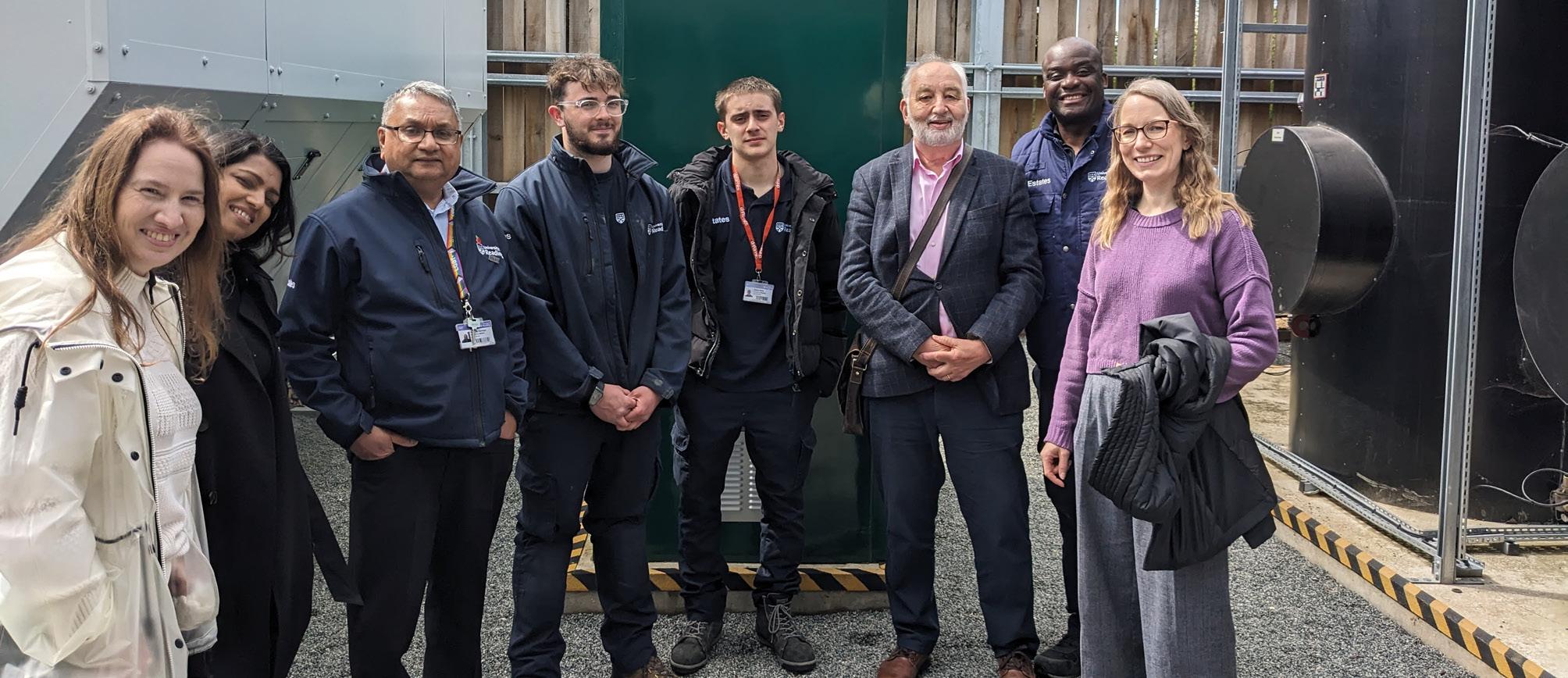
directorates within the University, comprising a mix of technical, nontechnical, academic and professional services staff. All champions are volunteers supporting this initiative on top of their main job roles.
Our sustainability champions perform a number of roles:
• Being our ‘eyes and ears’ across campus to identify and report areas of energy waste - we simply wouldn’t be able to see all the issues across such a large campus and upskilling our champions to spot issues means they can report these back to us. For example, this has led to issues with heating controls, lighting controls and broken window seals being identified and reported back for action.
• Leading support for our energy campaigns within their specific School or Directorate - these joined up campaigns mean we have a big push on a specific focus area to increase our impact through a collective effort. Our latest campaign focused on reducing energy waste from lights being left on and embodies the core mission of our programme: ‘Everyone working together to create collective change for sustainability, one small action at a time’.
• Implementing their own local sustainability and energy actions within their School or Directorate - this recognises the varied nature of the departments across the University and the specific opportunities which exist for different departments. For example, those in science schools have looked at how we improve policies to operate lab equipment more efficiently.
• Collaboration with each other - the network provides a forum for champions to share ideas, issues, problem solving and to celebrate
their achievements together, inspiring each other along the way.
How did you make a business case for engaging energy champions?
We knew that gaining the support of senior leadership was critical if our champions were to feel empowered to take action for their department.
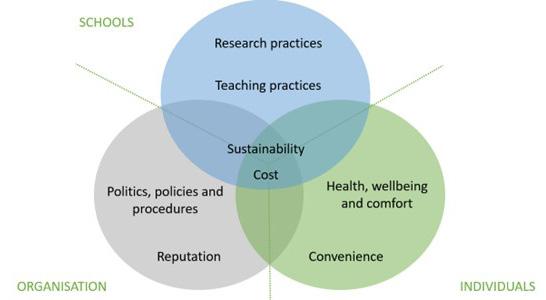
case was demonstrating our understanding of other drivers (Figure 1 below) and how sustainability fits alongside these, as sometimes initiatives will support other objectives, but at times there can be tensions between them. Showing our understanding and need to balance these was
Before launching the programme we had engagement meetings with every head of department to seek their support.
The use of data in these engagement meetings was very important for them to understand the impact of their department’s activities and why we need to act. The energy consumption data and costs were distilled down to individual departments. Our energy bills are managed centrally, so for many this was the first time they understood their contribution to this large cost. We also equated this to the number of additional students the department would need to recruit to cover this cost, turning the data into something very tangible for them to understand. Heads of departments then supported the promotion of the champions role, nominating or recruiting volunteers to sign up as champions for their department.
Another key part of the business
paramount. A sustainability at all costs approach would not get buy in!
For example, when the energy costs crisis hit in 2023, our established network of sustainability champions enabled us to quickly form a working group who designed and implemented a ‘major energy savings programme’ to identify and implement quick energy savings. The collaboration of this group was key to facilitating the changes that we achieved. For example, we knew we needed to reduce heating costs, but a blanket approach to this could have comprised other objectives – such as comfort, teaching practices and reputation. Working with our champions allowed us to understand where changes could be made, during what periods and by how much to achieve a balance between energy and cost reductions, and the other drivers that exist within the University.
How do you measure the champions’ impact?
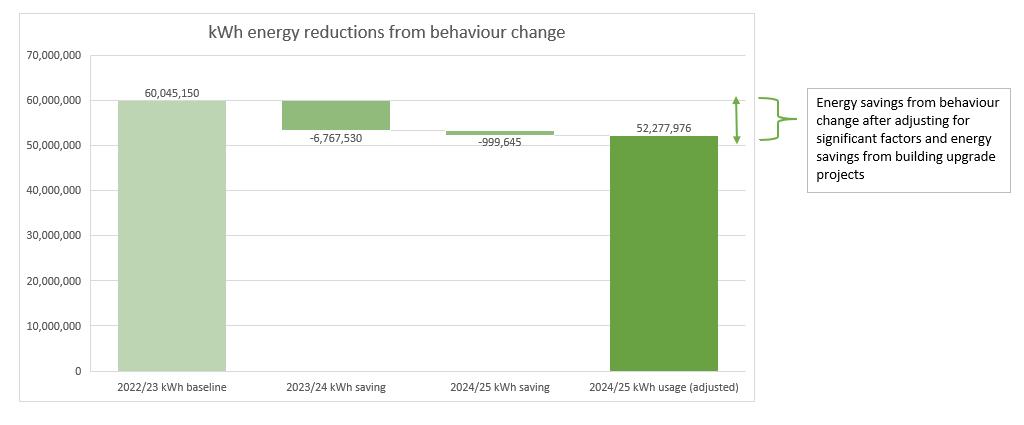
We take a whole facility approach to recording our energy savings associated with behaviour change. Our year-on-year energy consumption is adjusted for any significant factors, including weather adjusting our heating data and the addition or removal of buildings. The calculated energy savings from building upgrade projects (completed within Sustainability and the wider Estates Teams) are then deducted with the balance attributed to behavioural measures from across the University. Applying this methodology, we have achieved a 12.9% energy saving associated with behaviour change over the course of two years following our 2022/23 baseline. The kWh, cost and carbon savings are summarised below.
so varied it is very difficult to make meaningful comparisons between them. Therefore, when running campaigns we encourage individual departments to benchmark their performance and improvements against themselves to keep up the motivation to keep improving.
What are your top tips for achieving long-term success in Energy Champion engagement and results?
• Share data - sharing imperfect data is better than sharing no data. If champions can’t see the impact of their actions, it is difficult to keep up momentum.
• Campaigns - these are a great way of involving lots of people in a common activity with a common goal. The collective action creates a bigger impact than can be seen by small individual actions on their own, again helping to keep champions engaged.
everyone! Understanding other drivers in your organisation and how sustainability aligns with these, and where there are tensions, is key. Develop prioritisation criteria with this in mind to help you decide where to focus your efforts (e.g., environmental impact, cost/ savings, ease of implementation/ level of disruption, buy in from others, impact on comfort, etc.). The initiative with the best outcome for the environment is not the best initiative to focus on if you can’t get buy in. Think about how to tweak your initiative or project to balance these other drivers and get the support of others, even if that means energy savings are slightly lower than they would otherwise have been.
Where data allows, we also strive to share data for specific campaigns or initiatives. The nature of the departments and buildings across the University are
• Share stories - using case studies of actions champions have taken helps to inspire others. Seeing what others are doing and creating new social norms will have a bigger impact than simple comms telling people what to do.
• Pick your battles - when dealing with behaviour change, you learn very quickly that you can’t please
• Maintain good communication - there will always be more good ideas than there is time or resources to implement. Keep a tracker of ideas so you can re-visit these after the initial priorities have been actioned. Be sure to communicate to champions how and why you prioritised certain ideas, so they understand the rationale and don’t lose morale.
• Listen to champions - champions will have the best insights into the opportunities and what will work in
their area, see this as an opportunity to learn from them. Drop any preconceived ideas, listen to their suggestions and support them in bringing these to fruition.
What pitfalls have you encountered and how did you overcome them?
Some champions are really keen to support but don’t know the best way to do so or lack confidence in taking action. Delivering simple training suited to a range of knowledge levels is helpful, and even more so running coordinated campaigns with clear and specific asks and actions helps all champions to get involved.
Momentum can and often does drop after a while so having regular engagement activities is important.
Quarterly champions network meetings, ad hoc workshops and one-to-one sessions with champions help us to keep engagement
"Think about how to tweak your initiative or project to balance these other drivers and get the support of others, even if that means energy savings are slightly lower than they would otherwise have been."
levels up. Remembering that our champions are all volunteers and have busy roles is important, and we are always very clear with champions that we understand
there will be occasions where other priorities take over – having a large pool of champions allows for this. Keeping our expectations open and flexible helps maintain engagement over the longer term.
One thing I’ve learned we need to do differently is say no completely to some ideas, as they don’t meet enough of our prioritisation criteria. We need to spend our energy where we can have an impact and at times we’ve spent a lot of time trying to get initiatives off the ground, which are just too difficult or unpopular to take forward. It’s okay to say no to an idea, as long as you can explain why, and this ensures time and energy are expended where we can make a difference.
Author's profile:
Jo oversees the Our Future First sustainable behaviours programme at the University of Reading in her role as Energy Officer.

Calder W Percival, Engineering Manager at Sealy UK

Engineering and energy management are intrinsically linked through a shared focus on performance, efficiency and problem-solving. Engineers play a vital role in identifying opportunities to optimise systems, reduce energy consumption, and implement sustainable solutions across the built environment and industry. This contribution explores how an engineering mindset can support effective energy management practices and drive meaningful operational improvements in a leading UK manufacturer of orthopaedic mattresses and beds.
What first sparked your interest in energy efficiency and reducing waste?
Having trained as an engineering apprentice and growing up around factories and engineering workshops, I’ve always been conscious of power usage and waste. We were trained to eliminate waste wherever possible. My dad used to say: “Waste is unnecessary effort”, and that has always stayed with me.
From an engineering perspective, reducing power usage also reduces wear and tear on machinery. Lower effort means less strain on equipment, which leads to fewer breakdowns and less downtime. That applies not only to machinery, but also to systems like air conditioning and lighting. The two aspects really go hand in hand, energy efficiency and operational efficiency.
What does your role entail?
As an engineering manager, I look after a team of maintenance engineers, both mechanical and
electrical. I also manage the facilities aspect along with my colleague Ashton Neesham who is the manager of that department.
Day to day we look after both the buildings and the engineering function. By and large, the work is planned maintenance and repairs, but we also have a number of
but in the choice of machinery and layout.
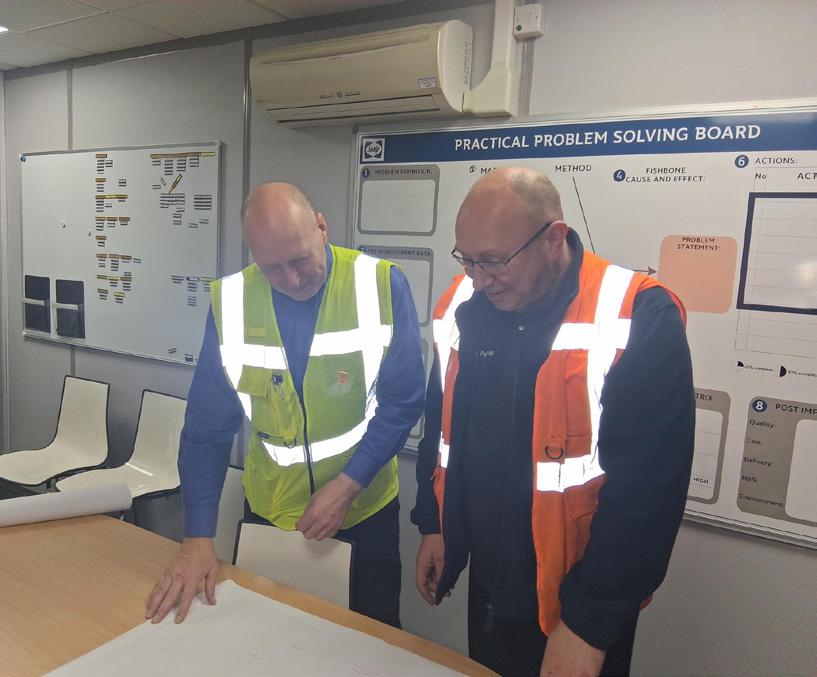
projects on the go to bring the site up to modern standards. In recent years, there has been a strong focus of energy conservation, and this has become a key consideration in the decisions we make as we upgrade the site, not just in the services to site such as heating and lighting,
What were some of the first energy-saving measures introduced on the Sealy UK site? For quite some time, we’ve been working to reduce power usage across the site. Initially, that focused on areas such as reducing compressed air production and replacing fluorescent lighting with LED fittings. At first, the LED project was viewed by some people as a bit of a gimmick. However, when the springs plant expanded and additional machinery was installed, it became very clear just how important those changes had been. We had replaced almost 1,000 fluorescent light fittings with LEDs, and those energy savings alone allowed our existing on-site transformer to cope with the increased power demand. In simple terms, had we not made those savings, we would have needed to replace the transformer entirely. I think that was the moment that changed a lot of people’s views on energy efficiency across the site.
How has Energy Champion training influenced your approach?
Since completing the Energy Champions training, we’ve started using data loggers throughout the site to monitor temperatures in offices, canteen spaces and on the factory floor. Initially, there was some suspicion from the people working in those areas. People naturally wondered why temperatures were being monitored. However, once we were able to provide factual evidence showing temperatures over specific time periods, it quickly helped break down some common myths. We were able to clearly demonstrate where energy was being wasted, for example, heaters left on overnight or office temperatures set far higher than people would normally use at home. Having hard evidence is incredibly important because it allows you to prove something that, in the past, would have been difficult to demonstrate.
needle positioners. The energy and time savings from those machines then create further efficiencies, which allows us to continue reinvesting in the business. It becomes a positive cycle, benefiting both the environment and the business while helping us operate in a more sustainable way moving forward.
How important is behaviour change when it comes to energy reduction?
Behaviour change is absolutely critical, but it has to be managed carefully so that everyone feels included in the process. Traditional working methods can be difficult
that can be enough to change behaviour immediately. Similarly, in the office air conditioning example, charts showing energy usage and temperature levels over time were enough to genuinely shock people when they saw the level of waste.
What is the biggest challenge when it comes to sustainability and energy reduction?
The hardest thing is often simply getting started and thinking about what you can do to make a difference. It’s natural to look for the large-scale projects and the big wins, and those opportunities are definitely there. But even small actions matter. If we switch off the office light when we leave the room while we’re searching for those bigger opportunities and wins, then we have already made a start.

What advice would you give to someone starting out as an Energy Champion?
Have those findings led to wider business benefits as well?
Absolutely. Once we had the evidence, we were able to quantify the savings and connect them directly to investment opportunities within the business. For example, the heating savings achieved in the sales office are enough to pay for at least two modern sewing machines fitted with energy-efficient motors, automatic thread cut-offs and
to change, particularly in longestablished workplaces.
The best way to bring people along is through evidence they can see for themselves. Sometimes that evidence is verbal information and sometimes it’s data. In other cases, it’s real-time feedback linked directly to the task they’re carrying out. For example, if someone can see a power meter showing the energy being used because a machine has been left running unnecessarily,
I would say: focus on the easy wins first. Start with things that are simple to demonstrate and easy to prove as a saving. That helps bring people on board quickly and once people start seeing results, enthusiasm grows. It becomes a bit like a snowball effect, momentum builds naturally and people begin wanting to contribute themselves.
Ultimately, if everyone does one small thing, collectively we can make a very large difference. We all have a responsibility for the impact we have on the Earth.
Sam Richardson, Apprentice Energy and Water Officer at the University

Facilities management and energy management work hand in hand to ensure buildings operate efficiently, sustainably and effectively for their occupants. With responsibility for the day-to-day performance of buildings and services, facilities professionals are uniquely positioned to influence energy use, identify efficiencies and support organisational sustainability goals. This contribution highlights the valuable role facilities management experience plays in delivering practical and impactful energy management outcomes.
How did you become involved in energy and sustainability initiatives, and what does your role involve?
I was a Facilities Assistant for 27 years, and then the university started pushing more for sustainability and energy awareness. Through that, I applied for a Junior Energy Manager apprenticeship at UAL, and that’s really how I got into energy.
From there, we started working with the Net Zero teams on carbon reduction plans and wider sustainability projects. I was one of the first Energy Champions at UAL and since then more people have completed the EMA Energy Champion course as well.
part of a central sustainability group. It gives us one place to discuss sustainability topics, share ideas and collaborate across the university. At the moment, for example, we’re planning Water Awareness Week. Everyone is working together on
switching equipment off and explaining why it matters. It’s not just about telling people what to do, it’s about helping them understand that we all have a responsibility. Once people understand what happens with energy or water after it’s used, they’re more likely to make informed choices themselves.
What inspired you to take on the role?
We’re all trying to do better and be more sustainable.
We’ve now developed a Sustainability Wardens network, where trained champions from different buildings come together as
out-of-hours water audits and then we’ll compare the results across buildings. A lot of what we do is about sharing knowledge and creating a space where people can openly discuss energy-saving issues.
One of our biggest missions is just turning things off. We go around
For me, it’s quite personal. I’ve worked at the university for 27 years in a people-facing role and because it’s a creative university, I really love it here. I want to help make it last longer for the students who haven’t even arrived yet. I also want people to know there are staff behind the scenes who genuinely care about making the university sustainable, and who are willing to share their knowledge so others can
get involved too. That inclusivity is really important to me.
What does your day-to-day role look like?
It’s a real mix. One of my main responsibilities is managing utility meters and analysing energy and water data. I look for anomalies in usage and organise audits when needed.
But the role also involves engaging people across the university and showing what we can achieve together. If we want to make a real impact and help the planet, we all have to work together. I think when people realise they’re contributing to something bigger than themselves, it becomes empowering. That’s really what drives me, getting everyone involved in looking after the planet.
Can you tell us more about the Water Awareness campaign?
The Sustainability Wardens programme has been a huge part of making this possible. Having energy champions across different sites means we can build momentum from the ground up, as well as from senior leadership.
This first Water Awareness Week is mainly focused within Estates. We’ll carry out out-of-hours water audits and feed the findings back to senior staff and key stakeholders. The idea is to establish a baseline of water usage across all buildings. Once we understand which buildings are using more water, we can investigate further, whether that means looking for leaks or identifying inefficient systems. The really important thing is that this gives us something measurable. Next year, we’ll repeat the same
process and compare the results. Over time, we’ll be able to see the impact of awareness campaigns and behaviour changes.
Are students involved in the sustainability work as well? That’s definitely the direction we want to move in. In future campaigns, we’d like students to help design posters and awareness materials.
We recently worked with BA Graphic Design and Product Design students on a project about running buildings more efficiently. We actually took students into
time last year, the sustainability department had one person. Now there are around six people covering areas like circularity, biodiversity, waste, energy and water. It’s exciting because everyone is working towards the same goal, but from different angles. We’re all trying to make things better together rather than individually.
What impact have the Sustainability Wardens had so far?
It’s still early days, but the response has been really positive. What’s great is that all the wardens volunteered. They’re mostly Facilities Assistants at the moment, so they’re already the eyes and ears of the buildings. They’re in the buildings before everyone arrives and often the last people there at night, so they notice leaks, equipment issues or unnecessary energy use quickly.
plant rooms and technical spaces they’d never normally see, showing them pumps, chillers and building systems. It was brilliant because they approached everything with completely fresh eyes. Students usually experience the creative spaces, but not the infrastructure behind them. Seeing their ideas and reactions was really inspiring.
How has the sustainability work grown at UAL?
It’s grown incredibly quickly. This
What’s lovely is that everyone has their own passion, some are really interested in biodiversity, others are completely focused on energy saving. It’s great to help them develop that interest, and give them more knowledge and confidence.
When did you realise you were influencing other people?
Probably right at the beginning, when I started talking about the opportunities I’d had and the knowledge I was gaining. I was enthusiastic about the role and wanted other people to feel they could do it too. I was one of the first Facilities Assistants to get onto the apprenticeship, and I really wanted others to have similar opportunities. I think once people see someone they relate to stepping into these kinds of roles, they start believing they can do it as well.
Have you faced any resistance to energy-saving initiatives?
Yes, definitely. You always get some resistance, especially around change. For example, in student residences, people often want the heating on constantly. If it’s reduced, complaints come in quickly. We’ve also had some people question net zero initiatives entirely.
But for me, the focus is simply on trying to make things last longer and reduce waste. I think resistance is part of any change process. Sometimes the people questioning things actually provide really useful insight because they know what’s worked before and what hasn’t. Those conversations are important.
What behaviours do you think are hardest to change?
I think it often comes down to awareness and habits. A simple
example is brushing your teeth with the tap running. I used to do that automatically. Now, I turn the tap off
"And when you finally identify a leak, reduce wasted energy or save money through a change you’ve implemented, it’s such a rewarding feeling."
because I understand the impact. If people have enough knowledge to make informed choices, they usually will. But if you simply tell people what to do without explaining why,
they’re less likely to engage with it. What’s the biggest lesson you’ve learned so far?
Probably just: don’t give up. Keep going. Not everyone will understand what you’re trying to do straight away, but eventually people do hear the message. And when you finally identify a leak, reduce wasted energy or save money through a change you’ve implemented, it’s such a rewarding feeling. You realise you’ve genuinely made a difference.
What advice would you give someone thinking about becoming an energy champion?
Just go for it. Start now. It can feel overwhelming at first, especially if you’re not used to speaking to people or encouraging behaviour change. But it does get easier. Enjoy it, save energy, save water and be proud that you’re doing something important for the planet.
By Jonathan Akers, Co-Founder / Director of Development, Carbon Legacy & Sustainability Ltd (CL&S) and Axiom Utilities Ltd
Behavioural change is often overlooked as a source of significant energy savings in favour of capital investment projects that promise solid and tangible returns on investment. New LED lighting, variable speed drives and smart controls are all valuable, but in many buildings the greatest opportunity is simply to ensure existing equipment is only used when it is actually needed.
Having run numerous behavioural change campaigns over the past 20 years, I have found that it is useful to evaluate all energy-consuming equipment in terms of three categories: Equipment, Controls and People. Equipment considers the efficiency of the technology itself. Controls assess how effectively the equipment is scheduled and automated. People reflect how the equipment is operated day to day. Scoring each category from 1 to 10 (where 1 is poor and 10 is excellent), quickly highlights whether the best opportunity lies in replacing equipment, improving controls or changing behaviour. The Controls and People scores are often heavily dependent upon discussions with the people who use the equipment every day.
While most ESOS recommendations are technical measures, such as equipment replacement or control
upgrades, behavioural change remains critical. Good housekeeping and staff engagement typically deliver 5–10% savings at little or no cost, and much higher savings are possible where equipment is routinely left running outside operational hours.
Take lighting as an example. Imagine an office with 100 twin 5 ft T5 fluorescent fittings. At 73 W per fitting, the lighting load is 7.3 kW and consumes approximately 65.7 kWh during a standard nine-hour office day, costing around £16.43 per day, based on an assumed electricity price of £0.25/kWh. Relative to modern LED lighting, the Equipment score might be 5 out of 10. If the lights are controlled by occupancy sensors and daylight-linked controls, the Controls score could be 9 or 10. If the entire area is operated by a single wall switch, it may score only 1 or 2, if areas are zoned and controlled with individual switches per zone, a 3 or 4 as in this case example.
The People score depends on what staff actually do. Engaged employees may switch lights off whenever they are not needed (Score 8 +). In less engaged workplaces, lights are left on overnight and throughout weekends (a low score). Staff interviews and Half Hourly data

indicate a 4 or 5 score, on account that occasionally the lights are left on. This example demonstrates that albeit the Equipment is improvable, the low Controls and People score indicate behavioural change will be beneficial.
Over the course of a year, leaving the lights on for just one weekend per month and one midweek night per week wastes approximately 11,212.8 kWh, costing £2,803 per year. By comparison, replacing the T5 fittings with 25 W LED fittings operating for the same office hours would reduce annual consumption by approximately 11,232 kWh, equivalent to an annual saving of £2,808. In other words, the annual cost of poor shutdown behaviour in this example is almost identical to the savings that would be achieved by replacing the lighting with LEDs. This is a powerful reminder that, before investing capital, organisations should first ensure that existing equipment is only operating when it is genuinely required…(caveat, the poor control could be factored into the Equipment replacement to improve the payback, but…).
I have witnessed this repeatedly with lighting, air conditioning, heating, extraction systems, commercial espresso machines, hot plates and process equipment.
Behavioural change can occur at two levels.
Individual change is where a member of staff ensures that equipment is turned on only when needed and switched off when finished with.
Institutional change is where the organisation redesigns how it operates.
One example involved an office that was rezoned according to preferred temperature rather than department. This reduced the familiar situation where one person opens a window while another uses a fan heater under their desk.
unnecessary equipment is turned off. The following day, staff are asked to switch on only what is needed and turn equipment off as soon as it is no longer required, a real 'focus' day. The result is a practical demonstration of what the site can achieve. That 'perfect day' becomes

a believable target for future performance.
Once opportunities have been identified, communication becomes critical. People need to understand what they can do and why it matters.
Benchmarking is therefore essential.
Half-hourly electricity and gas data provide an excellent feedback loop. Daily, weekly and monthly totals help quantify performance, while the half-hourly profile shows exactly when energy is being used outside operational hours. Many behavioural issues are visible before a site survey even begins.
One of the most effective engagement techniques I have used is the Perfect Day campaign. Following discussions and awareness sessions, a specific day is chosen. The night before, everyone ensures all
Targets are much more engaging when translated into commercial terms.
Kilowatt-hour and tonnes of CO2e mean little to most employees. Pounds cash are better, but operational metrics are often more powerful. During previous projects, savings have been expressed as the equivalent of extra cars parked for a national parking operator, extra packs of pet food sold by a retailer, extra cinema visitors and extra tyres sold by a national tyre chain. On a 20% profit margin, every £20 saved
in energy is equivalent to £100 of additional sales. The annual saving of £2,808 in the lighting example is equivalent to £14,015 of additional turnover a year.
A convenience retailer and a home furnishing retailer both treated overnight energy waste as 'stock loss'. That language immediately resonated with management. In one case, unexplained out-of-hours energy use even helped identify employees carrying out side-jobs using company facilities. Whether you choose carrots or sticks depends on your culture.
Rewarding success can be highly motivating, but league tables are hard to beat. Nobody wants to be at the top of the 'biggest wasters' list. Posters, emails, live displays and team huddles all help, but one of the most effective communication tool I have found is a simple timetable or rota. Most energy professionals are comfortable interpreting half-hourly load profiles. Most operational staff are not. Almost everyone, however, understands a timetable. By converting waste into a familiar weekly rota format, people can immediately see when energy is being wasted: Monday early morning, Friday evening or throughout Sunday. It becomes
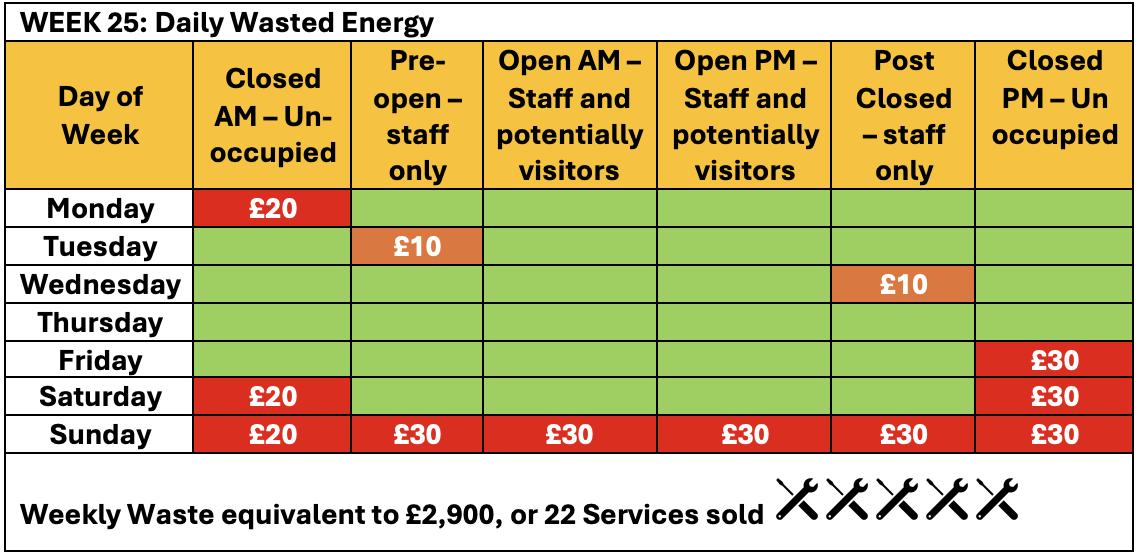
obvious whether equipment is being turned on too early, left on after closing or running all day when the building should be unoccupied.
In my experience, these issues often occur on a weekly repeat basis, usually because a different person is responsible for opening or closing the site. Once staff can see the pattern, the offending events often reduce within a matter of weeks.
The example shown also translates the weekly waste into '22 services sold', linking energy performance directly to commercial outcomes.
Of course, behavioural change requires ongoing effort. Capital investment in controls, particularly with today’s low-cost smart plugs and mini-BEMS, can often deliver more reliable longterm results. However, controls are still overridden and systems are only as effective as the people managing them.
Leadership is therefore essential.
ESOS provides the perfect justification for engaging staff. Most organisations already have team and staff objectives, performance reviews and bonus structures.
"When leaders visibly support the initiative, review performance and celebrate success, behavioural change becomes part of the culture rather than a one-off campaign."
Energy reduction targets can be incorporated into these systems where appropriate. When leaders visibly support the initiative, review
performance and celebrate success, behavioural change becomes part of the culture rather than a oneoff campaign. ESOS audits identify opportunities, but behaviour determines whether they are realised. In many cases, the hidden part of energy saving is not new technology. It is simply helping people understand when energy is being wasted, what they can do about it, and why it matters to the business, beyond just 'saving the planet'.
Author's profile:
Jonathan is a certified ESOS Lead Assessor with a BEng(Hons) in Fuel and Energy Engineering. Co-Founder of Carbon Legacy & Sustainability Ltd, providing ESOS compliance, energy management and carbon footprinting services, and Director of Development at Axiom Utilities Ltd, specialising in energy supplier management, metering, revenue recovery and riskmanaged procurement.
By Ethan O'Brien, Lowell Lewis, Mark Taylor and Victoria Limbrick
The role of energy managers is no longer confined to monitoring consumption or improving efficiency in isolation. Today, it demands a broader perspective, one that balances technical rigour with operational realities and future-facing strategy. In this feature, four energy management professionals share their career journeys and reflect on how evolving responsibilities have reshaped the way they work. The insights from these leaders are clear: embrace technical skills, remain curious, operationalise strategy and don’t underestimate the human dimension. Energy management is a dynamic, challenging and increasingly impactful career and those operating in the field are crucial to the success of the organisations they support.

Ethan O'Brien Sustainability Director
Lowell Lewis Member of the Steering Group EMA
Mark Taylor Director Taylor Made Energy Solutions Ltd
Victoria Limbrick Head of Energy and Decarbonisation Strategy Balfour Beatty
CAREER JOURNEYS AND BACKGROUNDS
How has your career path and responsibilities evolved over the years?
Ethan O'Brien
I’ve been working in energy management for 12 years and one thing I often tell people is that I didn’t enter the field for the money. When I started, energy management was far from strategic, it rarely received the credit or recognition for the value it could deliver. Over time, however, the role has evolved and became mission-critical, particularly as energy prices have risen sharply, from the 2022 crisis triggered by Russia and Ukraine to today, when the UK has some of the highest electricity prices in the G7.
I’ve been fortunate to spend my career in industrial and manufacturing companies, where energy usage is high. With the right framework and buy-in from people, achieving substantial savings, often millions annually, is possible, especially when annual global
energy spend reaches £100–150 million.
My focus has always been on operationalising energy management: turning strategy into measurable results and delivering tangible value. This operational perspective also applies to sustainability. In many organisations, sustainability exists more as a corporate narrative than an operational reality. My goal has always been to embed sustainability into day-to-day operations, much like finance or IT, ensuring that good intentions translate into effective action.
Ultimately, energy management is about delivering real efficiency and operational excellence and when a company does that well, it naturally performs effectively in sustainability too. Despite the challenges, this focus on operationalising energy and sustainability is what continues to make the work rewarding and impactful.
Lowell Lewis
My route into energy management was largely accidental. I trained as a chemical engineer and what drew me to the discipline was process integration and optimisation, rather than traditional chemical engineering sectors, such as oil and gas. Instead, my early career focused on brownfield regeneration, working on projects to restore contaminated groundwater. This appealed to me because it was practical, applied and involved being out on site. I later moved into the built environment when opportunities arose, driven by an interest in how established industrial concepts, such as heat recovery and energy efficiency, could be applied to buildings and facilities. While these ideas were well understood in industry, they were relatively new in the built environment, and I was intrigued by the potential to transfer this knowledge to drive real efficiency gains.
In the early stages, the role was highly administrative, centred on carbon and energy targets, data collection and reporting, particularly in response to central government greening commitments and the introduction of standards. Over time, however, the focus shifted from reporting performance to understanding what the data revealed and how it could be used to drive meaningful change.
This evolution has kept the role engaging and has seen my responsibilities expand beyond utility management and carbon reporting to include practical delivery, such as overseeing heat networks and managing building performance. It is this combination of data, insight and hands-on action that has shaped my career to date and continues to make the work rewarding.
Mark Taylor
My background is firmly technical. I trained as an apprentice in the steel industry, gaining hands-on experience in a heavy-industry environment. I entered energy management by chance through practical work, modifying equipment to track tariffs and taking part in load-shedding and triad avoidance. I quickly realised how compelling the discipline was. From there, I gradually expanded into metering, half-hourly data analysis and procurement, leading to my first formal energy manager position around 25 years ago.
At that time, the focus was almost entirely on cost control, managing energy budgets running into tens of millions of pounds. While data collection was secondary, we were also early adopters of on-site generation projects.
My move into consultancy marked a shift from internal priorities to addressing the specific needs of clients. My grounding in measurement, control and plant operations proved invaluable, allowing me to work confidently across energy efficiency programmes, building management systems and plant room optimisation.
A practical understanding of equipment has remained a defining strength, while consultancy has required balancing technical depth with delivering clear, targeted value, a different dynamic from working inhouse.
Over the past three decades, the scope of energy management has broadened significantly. What was once focused almost exclusively on cost now sits alongside carbon reduction, net zero commitments and wider sustainability considerations. This shift has introduced new challenges, including the need to navigate credibility and greenwashing risks, and has made strategic judgement as important as technical expertise.
While the tools and context have changed, the fundamentals remain constant: understanding systems, identifying opportunities and delivering practical, credible solutions. Today, effective energy management demands both depth and breadth of expertise, reflecting the growing complexity of the field and the expectations placed on it.

Victoria Limbrick
Like many in the profession, I didn’t set out to become an energy manager. When I began my career, it wasn’t a clearly defined role. I started in energy modelling at a time when Part L was still relatively new, as the industry shifted from spreadsheet-based calculations to dedicated software (a reminder of how long ago it was). The focus then was almost entirely on designing buildings to meet compliance requirements, with little consideration of how they would perform in operation.
That mindset hasn’t fundamentally changed. Cost and compliance still dominate, although there is now a growing recognition of the importance of operational performance.
Over time, I became increasingly aware of the disconnect between design predictions and reality. I produced hundreds of EPCs, yet the buildings rarely performed as the certificates suggested: energy bills didn’t align, systems underperformed and controls were often not implemented as designed. This raised a
simple but important question for me: “what happens after the EPC is issued?”
That curiosity led me beyond certification into practical delivery, working with BREEAM and other schemes, and eventually into plant rooms, where I could see systems in operation and understand how to improve them. Collecting sub-meter data became and remains, critical: meaningful performance insight depends on accurate, actionable data.
My current role at Balfour Beatty is much broader. It extends beyond individual buildings to site-wide and operational considerations, such as managing diesel plant, while still focusing on the fundamentals of efficiency. As I often remind colleagues, efficiency is the foundation: if a system is not run efficiently, efforts to decarbonise it will be undermined.
While the scale, data and context of energy management have evolved significantly, the core principle remains unchanged - understanding and improving efficiency underpins everything else.
How has the evolving nature of your role impacted your daily responsibilities, and how have you adapted your skills and approach to manage these changes effectively?
Ethan O'Brien
As my role has evolved, my daily responsibilities have shifted from primarily technical delivery to influencing, collaborating and building relationships across the business. Research shows that most energy and sustainability teams consist of just one to six people, and in large organisations this means a small central team is expected to deliver very ambitious goals, such as net zero. That simply isn’t possible without engaging the wider organisation.
To adapt, I’ve focused heavily on relationship-building and soft skills. Too often, teams operate in isolation, producing reports without creating real change. I’ve learned that meaningful results only come when strong relationships are built across (continues on next page)
Victoria Limbrick
The difference between my role now and when I started is substantial. Early on, my work was highly technical and manual, involving hand-drawn layouts and efficiency calculations. Today, my responsibilities are far broader and more strategic. I regularly present to the executive board on issues such as adopting biodiesel or implementing minimum efficiency standards, while also leading a team whose roles are evolving in different ways.
Adapting to this shift has meant balancing strategic influence with technical depth. My team includes recent graduates who focus on data modelling, building performance and validating supply-chain sustainability claims against how our sites actually operate. This isn’t (continues on next page)
Mark Taylor
The evolution of my roles has significantly changed both what I did day-to-day and how I added value. I began my career very hands-on, working directly on the tools and my first energy manager role involved leading a team. That shift required me to step back from doing everything myself and focus more on managing people, and delivering through others.
The transition into consultancy was an even bigger change. While I’m still driven by delivery and seeing real outcomes, the role is far less about direct implementation and much more about advising, communicating and guiding clients. Over time, I’ve found myself working increasingly with company owners and boards. As a consultant, you’re often (continues on next page)

(cont'd)
the business. A key part of this is simplifying and demystifying energy and sustainability so people feel confident engaging with the topic rather than excluded by it.
Having visited hundreds of industrial sites, I’ve also learned that change can’t be driven by telling people what to do. The best outcomes happen when people feel ownership of ideas and understand the benefits for their own operations. This is particularly important in manufacturing, where energy efficiency is often seen as a trade-off, even though efficient energy use and strong operational performance usually go hand in hand.
While capital and resources are always limited and energy competes with other priorities, I’ve adapted by being pragmatic, focusing on practical improvements and maintaining a high level of passion. Ultimately, my approach has evolved to prioritise influence over control, using relationships, clear communication and shared ownership to deliver real progress in energy and sustainability.
(cont'd)
about challenging suppliers, but about ensuring proposed solutions are practical and effective. We develop realistic energy profiles and scenarios to understand how technologies will perform in our specific environments.
Hands-on skills remain essential. Site visits, opening plant rooms, understanding meters, reading schematics and following energy flows are still fundamental, particularly for graduates who often lack practical experience. While the industry’s focus has expanded to net zero and carbon reduction, the basics remain critical.
Another major change has been the level of engagement required. Where I once worked independently on audits and spreadsheets, I’m now regularly involved in strategic discussions with senior leaders. This reflects both my own career progression and a growing organisational understanding of energy and sustainability. Increased engagement with informed stakeholders has been the most significant change in my role in recent years.
(cont'd)
perceived as an expert by default, which brings both influence and responsibility and having direct access to decision-makers has been one of the most dramatic shifts in my career.
I’ve always considered myself a classic energy manager, with a broad skill set spanning procurement, metering, analysis, efficiency, generation and now carbon management. While this breadth means I’m not deeply specialised in every area, it’s essential in an industry that demands wide-ranging capability and an ability to connect different disciplines.
As the industry has expanded rapidly over the past five years, another critical adaptation has been learning when to say no. Demand for expertise has surged, the number of players has grown, and the work has become more complex and fast-moving. Keeping pace has required continuous learning and a willingness to evolve my knowledge and approach.
Overall, the changing nature of my role has pushed me from hands-on delivery toward leadership, influence and strategic guidance, while still staying grounded in practical outcomes. Adapting to that shift has been essential to remaining effective in an increasingly complex and evolving energy and sustainability landscape.
Lowell
Lewis
The evolving nature of my role within a political organisation has added a distinct layer of complexity to my day-to-day responsibilities. Having worked across both central and local government, I’ve seen how political oversight, election cycles and elected members’ priorities can rapidly reshape the energy agenda. New demands often emerge with little notice, sometimes driven by political positioning rather than operational readiness. As a result, my role has increasingly focused on translating high-level political ambitions into practical, deliverable actions that improve efficiency, protect council budgets and avoid unnecessary pressure on council tax.
To manage this effectively, I’ve adapted by strengthening my stakeholder management, communication and forward-planning skills. Success in this environment depends on grounding decisions in evidence and maintaining credibility with both officers and elected members. That means using facts and figures to demonstrate impact and build trust over time.
My responsibilities have also evolved operationally. Over the past five years, my team has supported seven apprentices, reflecting a deliberate shift away from administrative tasks that can be automated and toward technical capability. We’re now bringing in a BMS controls engineering apprentice, enabling the team to act on insights generated through data analysis rather than simply reporting on them.
This long-term, evidence-led approach has allowed us to demonstrate strong value for money, delivering £15 of benefit for every £1 invested. That performance has helped secure ongoing political support for investment in skills and efficiency, maximising the impact of public funding and freeing up resources for frontline services.
Overall, the role has evolved into one that balances political realities with technical delivery, showing how effective energy management can drive both efficiency and social value within a political context.

What trends or changes do you anticipate shaping the future of energy management in the years ahead?
Mark Taylor
Having worked in this space for many years, one thing is clear: you have to stay constantly aware of new developments. The energy and sustainability industry has changed dramatically, and it’s going to evolve even faster over the next decade. The transition away from fossil fuels, the ongoing push of the carbon agenda and the emergence of new technologiesmany of which don’t even exist yet - will reshape the way we work.
To keep pace, energy management professionals need a broad knowledge base across multiple fields. The next ten years will bring significant change and staying informed, adaptable and curious will be essential for anyone aiming to succeed in energy management and decarbonisation.
Victoria Limbrick
One additional point I’d like to highlight is the importance of commercial and business skills. Over time, I’ve had to upskill in areas I never initially felt entirely comfortable with. For anyone entering this field now, including graduates, understanding how a business operates is essential. You need this knowledge not just to make a strong business case, but also to influence others effectively.
Commercial awareness and a solid grasp of business considerations are becoming increasingly critical for energy management and sustainability professionals, and I expect this trend to continue.
Authors' profiles:

Victoria Limbrick, Head of Energy and Decarbonisation Strategy, Balfour Beatty
Victoria is a senior energy and decarbonisation leader with extensive experience delivering complex energy and carbon reduction programmes. She currently leads Balfour Beatty’s Net Zero strategy, driving energy and fuel efficiency, deployment of electric and hydrogen technologies, and transition pathways to sustainable biodiesel. Previously at the RNLI, she led organisational energy governance, ESOS compliance, behaviour change programmes and energy procurement.
Mark Taylor, Director, Taylor Made Energy Solutions Ltd
Mark is a Chartered Energy Manager and independent consultant with nearly 30 years’ experience in the energy management field. He began his career in a technical, apprentice-trained role and went on to work as an Energy Manager within a large water utility, gaining extensive hands-on experience. He established his own consultancy 17 years ago and has since supported clients across a range of sectors, providing practical, experience-led advice grounded in a strong technical foundation.
Lowell Lewis, Member of the EMA Steering Group, offering experiences from his roles in the public sector
Lowell has worked in energy and sustainability roles since 2015, delivering improvements to the sustainability performance of a variety of public sector and private sector organisations through improved facility management. His current remit includes utility management, EV infrastructure development, renewable energy deployment, energy efficiency retrofit and energy innovation projects. He also offers support with winter affordable warmth and policy around heat networks.
Ethan O’Brien, Sustainability Director
Ethan is a Sustainability Director with over 12 years’ experience in energy and sustainability roles. For the past six years, he worked at KP, a global packaging company operating across 30 sites in 18 countries, where he led sustainability initiatives at an international level. Prior to this, he spent five years as an Energy and Sustainability Manager at Cory Riverside Energy, a large UK-based energy and waste company.
Seven years after its introduction, the UK’s Streamlined Energy and Carbon Reporting (SECR) framework has passed a significant test. The Department for Energy Security and Net Zero's (DESNZ) 2026 PostImplementation Review concludes that SECR has largely achieved its original objectives, delivering measurable energy savings, improving corporate transparency and providing strong value for money.
For organisations required to comply with SECR, and for the growing ecosystem of consultants and reporting specialists supporting compliance, the findings provide both reassurance and a clear signal about the future direction of corporate energy and carbon reporting.
When SECR was introduced in 2019, its primary aim was straightforward: require large UK organisations to disclose energy use and greenhouse gas emissions in their annual reports, thereby increasing transparency, improving board-level awareness and encouraging energy efficiency action.
According to the independent evaluation commissioned by DESNZ, the framework has largely succeeded. Perhaps the most significant finding is that SECR
appears to have delivered tangible energy reductions. Researchers estimated that SECR contributed to reductions in electricity and gas consumption among in-scope unquoted companies and LLPs of 4.5% in 2020 and 6.2% in 2021. Across the period 2020-2025, this equates to an estimated average annual saving of 8 TWh of energy and 1.7 million tonnes of CO₂e emissions.
Importantly, these savings translated into strong economic returns. The review estimates a Benefit-Cost Ratio (BCR) of 2.72, generating a net present social value of approximately £5.1 billion between 2019 and 2025. Even under highly conservative assumptions, SECR continued to demonstrate positive value for money. For a reporting regulation often criticised as a compliance exercise, these findings represent a notable endorsement.
The review found that SECR has substantially increased the amount of energy and carbon information entering the public domain. 79% of businesses reported that they disclosed information they would not otherwise have published without the regulation. Investors, lenders and other stakeholders particularly valued the fact that disclosures are embedded within
statutory annual reports, making them easier to access and compare alongside financial performance. This visibility has also improved governance. Almost half of surveyed organisations reported increased internal awareness of energy use and emissions, while over 60% observed greater board-level interest in energy and carbon performance.
For energy managers and sustainability teams, this may be one of SECR's most enduring contributions. By placing energy and emissions data within the Directors' Report, SECR has elevated these issues from operational concerns to boardroom discussions.
The review nevertheless identifies important shortcomings. Compliance levels are generally high but not universal. Depending on the measurement method used, between 14% and 23% of organisations that should be reporting may not be fully compliant.
The review also highlights higherthan-expected compliance costs. While SECR was designed as a streamlined reporting regime, actual ongoing compliance costs average around £7,100 per organisation annually, significantly above original policy estimates.
Much of this increase reflects the larger-than-anticipated population of organisations within scope, alongside extensive use of external consultants, auditors and reporting specialists.
For providers of SECR services, this finding demonstrates the continued market demand for specialist expertise. However, it also raises questions about how reporting processes can become more efficient and standardised in the future.
One of the most interesting conclusions from the review is that SECR's influence may be diminishing over time.
Researchers found evidence that behavioural impacts were strongest during the early years of implementation.
As organisations become accustomed to reporting requirements, SECR increasingly risks being viewed as a routine compliance obligation rather than a catalyst for energy management improvements.
Stakeholders repeatedly contrasted SECR's backward-looking reporting model with newer frameworks such as TCFD-aligned disclosures, ISSB standards and transition planning requirements. While these frameworks increasingly focus on targets, strategy and future performance, SECR remains primarily concerned with historical data.
However, the review stops short of suggesting that SECR has become obsolete. Instead, it argues that SECR provides the foundational measurement infrastructure upon which more strategic sustainability
frameworks depend. Organisations cannot develop credible transition plans or science-based targets without robust underlying energy and emissions data. In this sense, SECR remains a critical building block within the wider reporting landscape.
The review's central recommendation is clear: retain SECR, but modernise it. Several areas for potential reform emerged consistently throughout the evaluation. These include clearer guidance on eligibility and reporting
could reduce duplication while increasing demand for integrated reporting solutions that connect SECR, ESOS, climate disclosures and transition planning.
The forthcoming government consultation on streamlining energy and emissions reporting is therefore likely to be one of the most significant developments in this space since SECR's original introduction.
The 2026 review delivers a positive verdict on SECR. Despite higher compliance costs than anticipated, the framework has increased transparency, improved governance, delivered measurable energy savings and generated substantial net benefits for society.
boundaries, greater alignment with ISSB, TCFD and other reporting frameworks, standardised reporting templates and stronger consistency in disclosure formats.
Stakeholders also expressed interest in introducing light-touch forward-looking elements, such as targets or action plans, to maintain engagement and strengthen behavioural impacts without creating disproportionate burdens
For organisations providing SECR services, these potential reforms present opportunities as much as challenges. Greater alignment between reporting frameworks
Yet, the review also acknowledges that the reporting landscape has evolved dramatically since 2019. If SECR is to remain relevant, it must become better aligned with emerging sustainability reporting requirements and continue to support meaningful organisational action rather than simply annual disclosure.
For compliance teams, energy managers and SECR service providers alike, the message is straightforward: a ‘version’ of SECR is here to stay, but its next phase is likely to look more integrated, more strategic and more connected to the UK's broader net-zero reporting framework than ever before.
Read the full 2026 postimplementation review of the SECR regulations 2018 here.
By Owen Moulton, Strategic Development Manager at SmartestEnergy


The sustainability challenge for organisations has shifted from having objectives in place, to measuring and reporting on them in the right way. As reporting expectations rise across investors, customers and regulators, businesses and energy managers are experiencing growing pressure to evidence their sustainability claims.
The challenge is that energy data is often fragmented across suppliers, systems and reporting frameworks. This makes it harder to understand where a business really is on its energy transition journey, and where it needs to go to meet its objectives. While it’s understood the best way to shape behaviour change is through transparent communication, we often don’t see this coming through as strongly when it comes to an organisation’s green credentials.
It’s this growing “proof gap” in sustainability reporting that’s becoming one of the defining issues for businesses pursuing decarbonisation. As more internal and external stakeholders ask tougher questions, organisations increasingly need traceable and transparent reporting methods in place so they can answer with confidence.
Across the energy sector, digital platforms are helping organisations move from retrospective reporting towards more granular and realtime visibility of their energy consumption and carbon use. By making this measurable, businesses can better understand the direct consequences of operational decisions and identify opportunities to improve their performance. This technology enables consistent regular visibility and discussion,
which drives behavioural change far beyond a once-a-year report circulation.
"As more internal and external stakeholders ask tougher questions, organisations increasingly need traceable and transparent reporting methods in place so they can answer with confidence."
Energy managers today have a big job to do in navigating volatile markets, meeting sustainability targets, and ensuring they’re prepared for increasing levels of scrutiny. Technology can remove a lot of the manual burden that tends to come with this through automated reporting, centralised data management and live insights, all of which can help lower the risk of errors.
If an energy manager knows they’re at lower risk of errors, that can increase the confidence they have in how they report – vital as organisations seek to demonstrate the credibility of their renewable energy strategy.
One area where this shift is particularly visible is through SmartestEnergy’s Traceable Renewable Electricity Supply. Traditionally, many renewable electricity claims have relied on annual matching processes that provide limited visibility into when renewable electricity is generated and consumed. While this way of reporting has served a purpose, businesses now need to have access
to more granular and transparent approaches.
Our product has been designed to address this need by providing organisations with half-hourly breakdowns of electricity consumption against allocated 15-year vintage, bundled renewable energy certificate volumes. This gives businesses greater visibility into their renewable energy usage and allows them to better trace the origin of the electricity supporting their renewable energy claims.
With access to more detailed and transparent energy data, organisations can make more informed procurement decisions,
identify where renewable matching can be improved, and strengthen the credibility of sustainability disclosures shared with their customers, investors and regulators.
Reshaping best practice across the organisation
Equally important is the operational impact this can have internally. When businesses can clearly see how the way they report on their sustainability objectives is positively impacting their progress, then wider teams also become better equipped to align their performance with environmental goals because the impact is visible and measurable.
For energy managers, the benefits of modern technology platforms
To learn more about the SmartestEnergy's products and services,
• visit: https://insights.smartestenergy.com/HAEAAA
• email: supply-@smartestenergy.com
are becoming increasingly practical, including less manual effort, lower reporting risk, clearer visibility and stronger decision making. For organisations more broadly, tech can provide the ability to build trust in sustainability claims through transparent, traceable and defensible reporting.
Businesses are no longer judged solely on the targets they set, but on the quality and credibility of the evidence behind them. As expectations continue to rise, businesses that can combine renewable energy procurement with robust, audit ready evidence will be better positioned to create longterm change.