www.theema.org.uk | ISSUE MAY-JUNE 2021
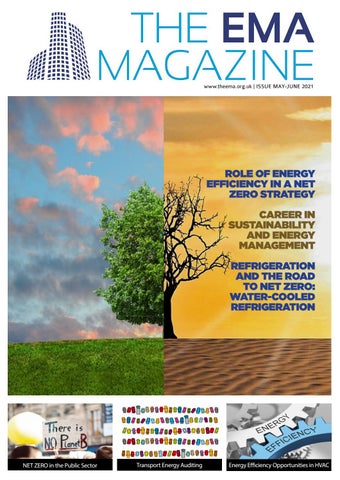
ROLE OF ENERGY EFFICIENCY IN A NET ZERO STRATEGY CAREER IN SUSTAINABILITY AND ENERGY MANAGEMENT REFRIGERATION AND THE ROAD TO NET ZERO: WATER-COOLED REFRIGERATION
NET ZERO in the Public Sector
Transport Energy Auditing
Energy Efficiency Opportunities in HVAC
IC OP AL
T
Accelerating investment and decarbonisation of the public sector CPD awarded Practical advice estate
Q&A sessions
30 June 2021 REPORTING SCOPE 3 EMISSIONS – LESSONS LEARNED This workshop will draw on expertise gained from 10 years of carbon emissions reporting and drafting a supply chain framework to report the Scope 3 emissions at Welsh Water. The presentation will cover the decarbonisation road map, setting out the organisations’ emissions and how they can be measured. The rest to Scope and maximise the distinction between the low of thet session will pay a closer cost and savings and assist in hanging Re:fi is the framework of attention choice for the 3 emissions fruit and the ones for which you have to go the extra mile appointing in order to report. the best contractors for the project. public sector. It enables change to be Booking: MEMBERS/NON-MEMBERS
delivered at scale and pace, supporting you Local Partnerships is proud to be part of the with the preparation and implementation public sector family. We are a joint venture 7 July 2021 of energy efficiency and of programmes between the Local Government Association, renewable energy projects. This helps ENERGY CHAMPIONS – ROLES, RESPONSIBILITIES ENGAGEMENT HM Treasury&and the Welsh Government. Appointing energy champions create is a great way to support promotion energy and reduce carbon emissions, income Wethe work solely forofthe benefi t ofwater the efficiency throughout an organisation and to encourage employees to adopt sustainable measures in the workplace and improve the operational performance public sector. and at home. This workshop will look at the champions’ roles, responsibilities and the support they require to of your buildings, whilst helping accelerate be effective and a good resource within the organisation. Our experts provide trusted, professional the journey towards achieving net-zero. MEMBERS/NON-MEMBERS Booking: support. We bring public and private sector Co-owned by the Greater London Authority experience that provides confidence, and Local Partnerships, the Re:fi t 4 Energy capability and capacity, helping public 1 September 2021 Performance Contract Framework offers a swift sector organisations achieve sustainable ELECTRIC route VEHICLE INFRASTRUCTURE procurement with anCHARGING OJEU compliant targets and a path to net-zero. Over the last few years with sales of electric vehicles (EVs) accelerating, the Electricity Vehicle Charging framework of 16 providers. It is underpinned Infrastructure (EVCI) trends have made some significant leaps forward. Given the inevitable increase in by a performance guarantee, providing certainty To find out how Rachel demand for reliable charging infrastructure, this workshop will examine the following: and her team can help to organisations and de-risking projects, email rachel.toresen-owuor@ protecting client and their investment. How youthe assess your charging requirement; localpartnerships.gov.uk or What are the pitfalls; As aWhy managed framework, dedicated expert call on 07825 963 218. If you’re total kWh isn’t the answer to working out kVA; support is provided to all organisations, through based in London please contact How to optimise use of capacity; retrofitaccelerator@london.gov.uk every stage of the project. We help minimise Smart charging versus cheap capacity; Smart charging – how it works; Dynamic smart charging; What to do if you are faced with expensive grid upgrades; Use of PV and batteries. Booking: MEMBERS/NON-MEMBERS
@LP_localgov I localpartnerships.org.uk
contents THE EMA MAGAZINE EDITOR’S LETTER
www.theema.org.uk | Issue MAY-JuNe 2021
06
ROLE OF ENERGY EFFICIENCY IN A NET ZERO STRATEGY CAREER IN SUSTAINABILITY AND ENERGY MANAGEMENT REFRIGERATION AND THE ROAD TO NET ZERO: WATER-COOLED REFRIGERATION
NET ZERO in the Public Sector
Transport Energy Auditing
12
Energy Efficiency Opportunities in HVAC
04 FOREWORD
By the Energy Managers Association
FEATURES
THE JOURNEY TO NET 06 ZERO IN THE PUBLIC SECTOR By Heidi Barnard and Keith Townsend
15
INDUSTRY FOCUS AND THE ROAD TO NET 25 REFRIGERATION ZERO: WATER-COOLED REFRIGERATION ENERGY EFFICIENCY OPPORTUNITIES IN 30 HVAC By Stuart McLeod
By Andy Watson, Samuel Arje and Bruno Valerio
12
ROLE OF ENERGY EFFICIENCY IN A NET ZERO STRATEGY
CAREER & TRAINING
18
15
CAREER IN SUSTAINABILITY AND ENERGY MANAGEMENT
21
By Faye Hargreaves
MANAGEMENT 18 ENERGY SKILLS, KEY TO REALISING NET ZERO TARGETS By the Energy Managers Association
21
TRANSPORT ENERGY AUDITING By the Energy Managers Association
25
30
THE EMA MAGAZINE • ISSUE MAY–JUNE 2021
By the Energy Managers Association
3
FOREWORD by
The Energy Managers Association
THE EMA MAGAZINE PUBLISHER
Dear Reader, Now more than ever, skills — primarily in core energy management areas aiding the delivery of energy efficiency and carbon reduction — are organisations’ best hopes for building a sustainable future. The amplitude of the crisis created by COVID-19 has engulfed many industries and whilst in general, the energy management industry might not have been affected to the scale of some other industries, organisations alike have been forced to revaluate processes that have been in place for years, even decades. The situation opened the possibility of conversations in areas where there would be no scope for suggestions or adjustments previously, such as travel or home-based working, distance education or meetings conducted virtually rather than in person. We are always encouraged to find the positives in every situation, and if we were to look for one here, it would be the ability to collectively change our behaviours for the benefit of others and the society as a whole.
The EMA Magazine is published bi-monthly by the Energy Managers Association (EMA).
EDITORIAL
The Energy Managers Association www.theema.org.uk Tel: 0203 916 5516
CONTACT
Edita Krupova; Editorial Enquiries & EMA Membership Services Manager edita.krupova@theema.org.uk
CONTRIBUTORS:
Heidi Barnard, Keith Townsend, Faye Hargreaves, Stuart McLeod, Andy Watson, Samuel Arje and Bruno Valerio The EMA would like to thank to the above contributors for their time and effort in providing the content and making this issue possible. Their willingness to share experience and knowledge is exemplary and inspiring, and we hope it will encourage others to come forward and contribute in the future.
ADVERTISING SALES
The EMA Team Tel: 0203 916 5516 enquiries@theema.org.uk
THE EMA MAGAZINE • ISSUE MAY–JUNE 2021
ABOUT EMA
4
A very similar approach, led by the Government and requiring everyone’s cooperation will be needed if the UK is to reach its 2050 Net Zero target. The goal has been set, the time for action is now, and in this spirit, we have once again approached this issue of The EMA Magazine which brings you practical examples and insights from energy management professionals and organisations. It is the skills, knowledge, passion and understanding of the importance of sharing these concepts and unleashing them as positive forces that is driving and will continue to drive our common goal. We hope you will enjoy the issue. Best wishes, The EMA Team
The Energy Managers Association (EMA) was set up in February 2012 and represents Energy Managers across all industries. Our priority is to improve the position of energy management experts and their profession and act as their united voice. We aim to develop the skills, knowledge and experience of professionals through our training, high-quality peer to peer guidance and best practice exchange. @2021 Energy Managers Association, Registered in England and Wales, Company No 7943728, VAT No 151339624, Registered Address: Suite 77, 95 Mortimer Street, London, W1W 7GB. No part of this publication may be reproduced, stored in, or introduced into a retrieval system, or transmitted in any form or by any means (electronic, mechanical, photocopying, recording, or otherwise) without prior written permission. Any information or material sent by advertisers and contributors, including advice, opinions, drawings and photographs, is the view and the responsibility of those advertisers and contributors, and does not necessarily represent the view of the EMA.
5
THE EMA MAGAZINE • ISSUE MAY–JUNE 2021
FEATURES by
Heidi Barnard and Keith Townsend
The Journey to NET ZERO in the Public Sector Heidi Barnard, Group Head of Sustainability at the Northern Care Alliance NHS Group
burden placed on the NHS by COVID and how it has been exacerbated and amplified by wider, deepseated social, economic and health concerns. It highlighted the climate emergency, and the health emergency2 it represents, and made no apologies for pushing for progress in this area while continuing to confront coronavirus3.
Setting the Direction The Net Zero ambition in a time of COVID
THE EMA MAGAZINE • ISSUE MAY–JUNE 2021
In January 2020, in a world before COVID daily headlines, the NHS launched ‘For a greener NHS’, setting out on a journey to understand how we move the healthcare system, responsible for an estimated 4% of the country’s carbon footprint to net carbon zero.
6
The first step was to establish an expert panel to deliver a practical route map, on the 1 October 2020, as we faced the second wave of COVID, the panel published their first report “Delivering a ‘Net Zero’ National Health Service.1” Importantly, it reflected on the
1 2 3 4
The Northern Care Alliance NHS Group (NCA) brings together staff and services across Salford Royal NHS Foundation Trust and The Pennine Acute Hospitals NHS Trust, providing hospital and community healthcare services in Salford, Oldham, Bury and Rochdale. Our dedicated 19,500-strong team delivers high standards of care and experience excellence to over one million people across Greater Manchester.4 We clearly have a strategic part to play in delivering on and being instrumental in leading and influencing the wider communities in our region when it comes to sustainability. Our first Green Plan (previously Sustainable
Development Management Plans or SDMPs for short) was signed off by our board the same month “A Greener NHS” was launched. Whilst our Green Plans are relatively new, we have been working to ensure that it becomes part of the fabric of our Annual Plan, Priorities and Strategic Objectives. This is directly linked to how we deliver the NHS five-year Long-Term Plan. We have six strategic priorities: 1. Partnership in Place Supporting place-based systems to overcome structural inequalities and generate value for our local communities. 2. Caring for and Inspiring Staff Delight our people with a fantastic experience, encouraging inclusivity in everything we do. 3. Clinical & Operational Excellence Continue our Quality Improvement Journey to improve patient safety and reduce harms, re-focussing our strategy to meet our current population needs and building staff capacity & capability for improvement.
https://www.england.nhs.uk/greenernhs/wp-content/uploads/sites/51/2020/10/delivering-a-net-zero-national-health-service.pdf Salas RN, Shultz JM, Solomon CG. The Climate Crisis and COVID-19 - A Major Threat to the Pandemic Response. N Engl J Med 2020; 383(110): e70. Belesova K, Heymann DL, Haines A. Integrating climate action for health into COVID-19 recovery plans. BMJ 2020; 370: m316. More information about the NCA can be found at www.northerncarealliance.nhs.uk
4. New Models of Care Delivering our Major Change Programmes working in partnership with others.
Developing the governance structure and aligning the leads in each area to focus attention has been key to getting buy in.
5. Digital Research & Innovation Improve the experience and offer for students and trainees, integrating leading technology.
At NHS trusts, there is a strong history and understanding of social value, and relationships and responsibilities within the communities we serve, similarly our commercial undertakings are well understood, what we have had to develop and reprioritise the environmental impact of the decisions we make and the situations we find ourselves in.
Having put a sustainability team into the organisation in 2020, during 2021 we are focusing on getting to grips with data, putting robust reporting practices in place, and using third party support to really dive into our carbon impact, and help us find our department specific hotspots, so we can drive the right changes across our whole organisation, and come up with our roadmap for decarbonisation.
Writing the plan was challenging, and we are still trying to understand the NCA’s real carbon impact. In our ERIC return5 we have numbers relating to amount of energy we use, in various forms, which equates to circa 50’000 tonnes CO2e per annum, but as the “Delivering a ‘Net Zero’ National Health Service” report highlighted –
We already know some of these areas, such as medical gases, travel and transport, which is around 14% of the system’s total emissions, are going to be key to our success, and strategically how we decarbonise our heating needs over the next 15 years, we know this is not one we can tackle on our own.
Setting the Scene The Green Plan is how we plan our sustainability work and deliver environmental, social, and financial value. Within it we consider several factors; our past performance as well as our influence across the supply chain and our local communities.
Sources of carbon emissions by proportion of NHS Carbon Footprint Plus6
5 6
A mandatory data collection for all NHS trusts https://digital.nhs.uk/data-and-information/publications/statistical/estates-returns-information-collection https://www.england.nhs.uk/greenernhs/wp-content/uploads/sites/51/2020/10/delivering-a-net-zero-national-health-service.pdf
THE EMA MAGAZINE • ISSUE MAY–JUNE 2021
6. Sustainable Future Deliver on our plans and commitment to environmental sustainability.
this is only about 10% of our overall footprint.
7
Delivering our Green Plans Whilst we are a new team, the organisation has delivered some exciting projects already, with Artificial Intelligence pilots, huge reductions in desflurane anaesthetic in operations at Salford Royal, and considerable LED Light replacement schemes across our estate. COVID has been both a blessing and a curse, we have seen monumental shifts in how we work, and serve our communities, with a home first policy driven from the top. This has seen a huge change in travel around our sites, with virtual appointments and many of our staff working remotely.
THE EMA MAGAZINE • ISSUE MAY–JUNE 2021
We can argue the merits of working from home, mental health and the balance of face to face versus screen time all day, but what we had seen in the early stages of lockdown was a significant improvement in clean air around our sites, and 78.4% of staff rating the experience of working from home as Good or Very Good, 74.8% rating their productivity as Good or Very Good, and a whopping 95.63% of their ideal working pattern including at least one day a week working from home. On the flip side we know the volume of materials we are consuming, and discarding has gone up dramatically, with a combination of impacts. From March to September our waste numbers remained consistent with previous years, yet we know we cut all but essential services, raising the question, if we are not delivering the services, how much has waste per patient increased? As we brought services back online, those waste figures that had been consistent are now increasing. 7
8
We have blown through millions of disposable facemasks as one organisation, and at last count, NHS England have used 11,095,069,000 single use items. That is 48.048 Million gowns, 1.547 BILLION aprons, 1.714 BILLION Type IIR facemasks and 6.954 BILLION gloves7. Many of which we know have been discarded or littered and are now becoming as damaging as straws and stirrers which we saw banned in 2020.
Heidi has worked in this field for 16 years, having developed resource action plans with DEFRA, implemented companywide ISO systems and chaired various sustainability focused groups within trade bodies.
Keith Townsend, Corporate Director for Environment and Regeneration at Islington Council
We know we need to protect each other, but we also need to find ways to do this that are viable for the long term. COVID is not going away any time soon and as the impacts of climate change come home to roost, we are likely to see more diseases and viruses emerge and disrupt our way of life, if we do not adapt and learn to live with them.
What next As we venture into the next phase, learning to live with the COVID, we are updating our plans, taking into account the lessons learnt from this year. Moving forward we know our plans need to be flexible, whilst not getting away from the fundamental crises we are all facing, and find new and innovative ways to deliver change at pace. This last year has shown us we can, now we just need to find the energy to do.
Author’s profile: Heidi is a Group Head of Sustainability at the Northern Care Alliance NHS Group, where she develops and leads on sustainability strategy, including direct impacts such as energy, carbon, and waste.
Background Islington Council declared a climate emergency in June 2019, recognising the need to drastically reduce carbon emissions in the borough. A pledge was made to work towards becoming a net zero borough by 2030. In November 2020, we adopted Vision 2030 - our strategy to set out what is needed to achieve our net zero ambition and what we and our partners plan to do. We see a net zero carbon future as essential to the creation of a fairer Islington by reducing the inequalities that are caused by climate change. The strategy has five main priorities: buildings, transport, sustainable and affordable energy supply, green economy and planning, and natural environment and waste,
https://www.gov.uk/government/statistics/ppe-deliveries-england-3-may-to-9-may-2021/experimental-statistics-personal-protective-equipmentdistributed-for-use-by-health-and-social-care-services-in-england-3-may-to-9-may-2021
plans in place. •
Islington Council is in many ways a typical inner London borough but it has a large housing stock of around 35,000 properties.
Starting point
•
Those that we see as potential commitments but would need more investigation (for example, putting together a plan to replace all gas boilers in council housing stock in 10 years). Those where we need something from others (Central Government policy changes, for example).
Islington Council previously had a target of reducing the borough’s carbon emissions by 40% between 2005 and 2020.
Data
By 2018, we had achieved a 42% reduction, effectively reaching our target three years early. However, following the declaration of a climate emergency, the council focused on setting a new goal of achieving net zero carbon status by 2030.
The council maintains good data on its own carbon emissions from its own corporate buildings and fleet. This, however, only accounts for 4% of the total emissions in the borough, with around another 5% coming from gas boilers in council-owned housing.
Commitments under the five priority areas of Vision 2030 have been categorised as follows:
By gathering data on car ownership, non-council housing stock and other activities from Government sources, we can see where we can influence or help residents and businesses to
•
Those that we could commit to immediately and put action
change, or adjust their policies and practices to help reduce carbon emissions. Islington Council is also trialling a carbon data software. This carbon data software can be used to input savings made and where adjustments need to come from over the next few years. Easy-toview charts show where carbon savings can be adjusted in real time using current data. For example, it would show the effect residents can have to cut commuting emissions by taking more journeys on foot or bicycle. This should give a more accurate picture of the borough’s carbon emissions and how they are decreasing. In addition, we are using THERMOS to help make heat network planning faster, more efficient and more cost effective. THERMOS is a free, user-friendly opensource software tool, developed by a team of planning experts & practitioners from various
THE EMA MAGAZINE • ISSUE MAY–JUNE 2021
with action plans for each priority area. Underpinning these is a communications and engagement work stream.
9
organisations including Islington Council. The tool is available for energy planners around the world.
Targets & timelines In order to achieve Net Zero, work streams have been set up to tackle actions under our corporate programme governance arrangements. These work streams also look at targets, how we can achieve them, and the priority of actions.
the time of setting and checking targets.
Actions Each work stream sets actions for their area, based on what is possible now and what may be possible in future. There are obvious actions that can take
THE EMA MAGAZINE • ISSUE MAY–JUNE 2021
The work streams are made up of officers who work in each area, with a senior person as the lead.
10
For example, the Buildings, Housing and Infrastructure work stream is comprised of officers from our various housing teams (new build, private housing, and social housing), as well as officers who look after commercial property and other buildings. This means that all actions across one area can be discussed, prioritised and a timeline put in place for implementing ways to reduce carbon. Our trial of the carbon data software will help us to see how well our targets are being met and where we need to adjust in realtime, rather than checking past data which may be inaccurate at
place in the day-to-day work of the council – for example, retrofitting housing stock during regular maintenance and refurbishment plans. There are other actions that are planned for future but may depend on changes in legislation or funding from central government that we can act to take advantage of. For example, recent Green Homes Grant funding was made available. Islington had plans in place to help residents make their homes more energy efficient through insulation and secondary glazing measures, and were able to put in an application for funding.
By having an action plan, Islington can be ready to move quickly when funding becomes available, but the timings may not be easy to pin down.
What is next Reducing the emissions from our estate and activities is clearly important but we also need to work at pace to address the 91% of emissions that are not directly controlled by the council. Vision 2030 commits the council to bring residents and stakeholders together to work on communityled energy efficiency initiatives and to establish zerocarbon themed events in order to co-design our approach to achieve the required changes in behaviour and practice.
Author’s profile: Keith Townsend is Islington Council’s Corporate Director for Environment and Regeneration. Keith was appointed to the role in June 2019 and was previously executive director at London Borough of Ealing and chief technical advisor to West London Waste Authority. Keith is also actively involved in London Environment Directors’ Network (LEDNet).
MEMBERS MEETING Monday, 5 July 3.30 pm - 5 pm
Decarbonising heat is key to achieving Net Zero and is one of the most challenging areas for many organisations. Join us on Monday, 5 July at 3.30 pm for a presentation on an ongoing heat decarbonisation project, followed by a panel of energy management professionals discussing their short and long-term solutions for heat decarbonisation at their organisations. Questions for the panel will be welcomed.
VIRTUAL MEETING Register Here
THE EMA MAGAZINE • ISSUE MAY–JUNE 2021
TOPIC: DECARBONISATION OF HEAT
11
FEATURES by
The Energy Managers Association
Role of Energy Efficiency in a Net Zero Strategy Net Zero has become the phrase that defines the ambition of how society will act on climate. It is achieved when all the carbon emissions associated with an organisation are zero or negative. Energy efficiency is the “first fuel”, supporting net-zero energy goals at lower costs, and delivering a wide array of benefits for organisations and society.
THE EMA MAGAZINE • ISSUE MAY–JUNE 2021
We will need to radically accelerate the pace of energy efficiency to achieve our Net Zero goals. Ambitions for Net Zero are incomplete without tackling energy efficiency in a transformational way.
12
Five key considerations should inform energy and sustainability professionals as they set strategic energy efficiency goals for their organisations:
More can and must be done. The historic rate of energy efficiency improvement is around 1% per year1. Improving on that has proven exceptionally hard.
I. Energy efficiency must be driving force for transformation.
At the UN Global Climate Action Summit, the Energy Efficiency Global Alliance launched the Three Percent Club of countries and companies committed to 3% annual energy efficiency improvements2.
There is significant potential for energy savings in every aspect of our lives -- from the homes we live in, to the places we work, the transport we take, the products we make and the food we eat.
1 2
The 3% annual efficiency improvement is the rate needed to meet the Paris climate goals
and achieve sustainable energy for all, i.e. Sustainable Development Goal 7 (SDG7). If such efficiency gains cascade through our energy systems, the impact can be critical for Net Zero. II. Renewable energy alone will not achieve Net Zero. Renewable energy captures the headlines, but it is a much lesser known fact that energy efficiency –through reducing energy demand – has historically played a very important role in reducing emissions.
https://eeglobalalliance.org/three-percent-club https://www.iea.org/news/iea-welcomes-commitment-by-leading-countries-to-drive-global-progress-on-energy-efficiency
Given how critical energy efficiency is, it is remarkable how little attention is devoted to it, about how and where critical savings can be made, and how much unfulfilled potential for improving there still is. However, because energy efficiency is not “visible,” it often is not given the policy and investment priority it deserves. A football analogy helps to illustrate the point: renewable energy is always seen as the star striker scoring all the goals, but energy efficiency is the box-to-box midfielder, the driving force for the team, essential to have any chance of winning. At a macro level, this means something profound: net zero emissions will remain but a pipe dream without dramatic increases in the rate and quality of investment into energy efficiency. To illustrate this point, across infrastructure and buildings, the
“
renewable energy is always seen as the star striker scoring all the goals, but energy efficiency is the boxto-box midfielder, the driving force for the team, essential to have any chance of winning.
III. Timeframe matters. Acting earlier has a higher positive impact for the climate. Net zero by 2050 does not mean starting in 2049. The Paris Agreement outlines that global warming should be limited to pursuing limits to 1.5°C. Peaking of emissions should be as soon as possible as timing is critical. Earlier activities have a higher impact. Energy efficiency represents more than 40% of the emissions abatement needed by 2040, according to the IEA Sustainable Development Scenario4. Investing in energy efficiency today avoids emissions in the future. According to the IEA Efficient World Scenario, currently existing costeffective technologies are sufficient to double global energy efficiency
by 2040. On average, every EUR 1 invested in energy efficiency saves EUR 3 over the lifespan of a technology5. Allowing society to re-invest those savings in projects to deliver Net Zero. Energy efficiency can boost our economies quickly, with long lasting benefits. IV. Net Zero demands an “AndAnd” approach. Net Zero strategies vary and according to the IEA latest report, Net Zero by 2050: a Roadmap for the Global Energy Sector6,
UK Green Building Council. Net Zero Energy Performance Targets for Offices. See here. IEA Report https://www.iea.org/reports/world-energy-model/sustainable-development-scenario Three Percent Club https://eeglobalalliance.org/wp-content/uploads/2019/12/ThreePercentClub-Brochure.pdf https://www.iea.org/reports/net-zero-by-2050
THE EMA MAGAZINE • ISSUE MAY–JUNE 2021
3 4 5 6
UK Green Building Council has outlined that net-zero requires reductions in current energy consumption and emissions in the order of 60-80% by 20503.
13
whilst the number of countries announcing pledges to achieve Net Zero over the coming decades is increasing, even if all pledges made to date were achieved, it would still not be enough to bring global emissions to Net Zero by 2050 and limit the global temperature rise to 1.5°C.
THE EMA MAGAZINE • ISSUE MAY–JUNE 2021
“
14
Whilst the number of countries announcing pledges to achieve Net Zero over the coming decades is increasing, even if all pledges made to date were achieved, it would still not be enough to bring global emissions to Net Zero by 2050 and limit the global temperature rise to 1.5°C.
The report outlines pathways needed to increase efforts and states that a major worldwide push to increase energy efficiency is also an essential part of the efforts, resulting in the global rate of energy efficiency improvements averaging 4 per cent a year through 2030 – about three times the average over the last
two decades. Net Zero strategies require transformation in both energy efficiency and renewable energy: one will not succeed without the other. “And-And Approach” •
Energy efficiency transformation through setting and delivering energy reduction targets
And •
Renewable energy deployment through increased use of renewable energy in operations
Committing to energy efficiency improvements in the short term and taking steady strides to achieving a Net Zero through renewable energy in the longterm, are mutually dependent goals. For organisations, energy efficiency means taking critical short-term strategic decisions to reduce emissions now, whilst not losing sight of the strategic compass, balancing the here-andnow with the long-term Net Zero vision.
V. Take a leap of faith. Part of our challenge in energy efficiency is an emotional – not technical – one. We must take a leap of faith that Net Zero can be delivered; that it is do-able, though it may not be currently provable. Radical improvements to energy efficiency will reduce the overall costs of mitigating carbon emissions while advancing social and economic development, enhancing energy security and quality of life, and creating jobs. Energy efficiency is not siloed to one sector; therefore, policies must target the efficiency of buildings, industry, equipment, appliances, and vehicles. There is an enormous gap between our current position on energy efficiency and where we need to be for Net Zero. Here at the EMA, we recognise that we cannot do this alone; but with the right engagement, change at the scale required can be achieved. We are confident the race to Net Zero can be won. The time for transformational energy efficiency has well and truly arrived.
CAREER & TRAINING by
The Energy Managers Association
Career in Sustainability and Energy Management The Energy Managers Association aims to encourage and enable more professionals to enter the world of energy management and environmental roles. The EMA has taken on a challenge of changing the perception of energy management, by raising the sector’s profile and sharing its members’ – leading energy management professionals - insights into their career progress and achievements. In this issue, we have asked Faye Hargreaves, EMEA Sustainability Coordinator at Oracle about her career in energy management so far.
What attracted you into sustainability? I’ve always been fascinated by the natural world, but my passion for protecting the environment truly started following an A-Level Geography field trip to Iceland where I ice-picked along one of the world’s largest glaciers and learned of its decline. I went on to study Geography at University and have since camped on an active volcano in Guatemala, snorkelled with sharks and manatees in Oman and Belize,
and learned about how the local people of Costa Rica are farming crops more sustainably to protect the untouched, primary forest and are being educated to understand the importance of re-establishing secondary forest in the area for future generations. I feel frustrated knowing the damage the rapid increase in human population is causing on our fragile ecosystems and I want to be a part of the generation that influences positive change. Sustainability is such a broad topic that, whether you are interested in energy, waste, water, transport, biodiversity, wellness… the list goes on, there will be something that interests you. Not only that, but the environment also impacts every single one of us. How has the pandemic affected your entry into the profession? I actually started this role during the pandemic, back in July 2020 so therefore have never physically worked in the office with my team. Starting with the advantages -
with everything being virtual, there has been a great increase in the availability of digital communications and engagement, which I might not have explored, were we still in the office, for example organising and hosting webinars, recording a podcast and creating videos. These have all enabled me to raise the profile of sustainability in a different way. Secondly, the reliability of zoom calls has meant that I have spoken regularly with colleagues from the other side of the world, which in the pre-pandemic world, I might not have met. Video conferencing has boomed over the last year and I think that has done wonders for my network. Having said that, at the beginning I sometimes found it hard meeting new team members over zoom and trying to bring my personality across through the screen, as we are so used to meeting colleagues in the office. When you are starting a new role, this is something I have missed – that social interaction, which
THE EMA MAGAZINE • ISSUE MAY–JUNE 2021
Faye Hargreaves, EMEA Sustainability Coordinator at Oracle
15
maybe I took for granted before Covid.
of our operations and improving the efficiency of the buildings.
Another slight disadvantage to starting a role during the pandemic and therefore working from home is, I sometimes find myself taking longer to pick things up. Being in the office, you would naturally pick things up much quicker, just from that elevator chat etc., which obviously you do not get at home.
A key part of my role is running the communications and engagement programme, which enables me to raise the profile of sustainability throughout Oracle. Through digital communications, I showcase all of the impressive sustainability initiatives we have implemented throughout our offices across EMEA.
To add onto this, not being in the office from a sustainability perspective has been difficult, for example when discussing lighting systems, heat pumps, cooling systems etc. and not being able to physically see the systems in place and learn from the local expert facilities teams. However, this has also given us the opportunity to consider and plan a virtual sustainability audit where we will be looking at the sustainability initiatives of a building, via zoom, which I am very excited about!
THE EMA MAGAZINE • ISSUE MAY–JUNE 2021
What does your role entail?
16
As the Sustainability Coordinator for EMEA, I am responsible for supporting the Real Estate & Facilities Sustainability Manager EMEA in developing, implementing, monitoring and measuring a comprehensive sustainability program that incorporates sustainability into all aspects of RE&F EMEA operations. We focus on energy, water and waste management as well as employee wellness. We aim to create comfortable, productive and sustainable environments for our employees to work in, whilst reducing the environmental impact
What is your biggest achievement to date? My manager and I created a ‘Working from Home, Sustainability at Home’ guide for our colleagues to find out more on how to make sustainable choices, whilst working from home. Although my role focuses on sustainability within the offices, now that we are all working from home, we have a duty to increase the sustainability awareness of our colleagues at home.
“
The guide covered different ways of implementing energy, water and waste saving initiatives at home, as well as what you can do to enhance local biodiversity and how you can travel in a more sustainable way. Initially, the objective of this project was for it to be shared throughout our team in EMEA, however it was so well received by the global sustainability team that it is now being made available to all Oracle colleagues globally. I sit on the UK Green Team steering committee and have been carrying out initiatives and campaigns to drive sustainable action internally.
One of our main goals is to increase awareness of the impact our actions can have on the environment. The aggregate impact of all the initiatives we promote is reflected in the increase of employees that are engaging with sustainable content and seeking to take action to reduce their personal impact on the environment. I was delighted to be recognised as a Sustainability Champion for 2021 for my contribution the UK Green Team.
My manager and I created a ‘Working from Home, Sustainability at Home’ guide for our colleagues to find out more on how to make sustainable choices, whilst working from home. The aggregate impact of all the initiatives we promote is reflected in the increase of employees that are engaging with sustainable content and seeking to take action to reduce their personal impact on the environment. How would you “sell” energy management/sustainability to those considering it as their career? This industry is such an exciting, fast-paced space to be working in at the moment. We are seeing an ever-growing social pressure for businesses and governments to do more for sustainability, we welcome new environmental legislation and the push to net zero. I also find energy procurement a very interesting area to work in, with a transition to renewable energy
What are your thoughts on the link between sustainability and energy management, and how do you expect these two disciplines to evolve in the future? Energy management plays a key role within sustainability, it is a part of our everyday lives, we literally need it to survive, so managing this is key to becoming sustainable. We are also in the midst of a huge energy transition, from all the reliable, yet dirty fossil fuels to the ever-increasing impressive scope of renewable energy.
opportunities when it comes to learning about building management. So, what I would recommend is where possible do external training courses to increase industry knowledge and network. I have completed two recently - the first was the Lead Environmental Auditor course by the Institute of Environmental Management & Assessment to the ISO14001
This role is my first in sustainability and having started it during the pandemic working remotely, there are definitely some missed
Where do you see your future within the sustainability sector? Within the next 5 years, I picture myself diving deeper into real estate sustainability. It is a very exciting area to be working in at the moment with the pandemic, the push to net zero and lots of new legislation coming in. Working out how to manage these buildings efficiently when they reopen is going to be a welcomed challenge. It is exciting because the key step to sustainable buildings is all about enhancing the buildings we already have today, to increase their maximum sustainable potential and efficiency, not by building new futuristic buildings which we often come to picture in our minds when we think of what the world will look like in 2050.
Sustainability has gathered so much momentum over the last year especially, with the continuous increase of new environmental legislation being established here in the UK, energy management and sustainability, in my opinion, will only ever become closer embedded. Any recommendations to those coming into the sector at this current moment?
so I would highly recommend external training courses to those in a similar position.
accreditation. The next course was EMA’s LEC 3 Fundamentals of Energy Management course. Both of these were hosted online and have given me a much greater understanding of what environmental management entails,
Within the next 10 years, I would love to be a part of inventing and designing a new piece of sustainable technology and hopefully running my own business. The scope for sustainability is huge and pretty much limitless. It is a very fast-paced industry, which is only going to get bigger and better, I hope.
THE EMA MAGAZINE • ISSUE MAY–JUNE 2021
and a push to carbon offsetting and carbon sinks, we are learning something new every single day.
17
CAREER & TRAINING by
The Energy Managers Association
Energy Management Skills, Key to Realising Net Zero Targets
THE EMA MAGAZINE • ISSUE MAY–JUNE 2021
The impetus to tackle climate change and reach net zero is growing. The government’s Energy White Paper published at the end of 2020 builds on the grand Ten Point Plan for a Green Industrial Revolution. Climate Change emergencies and net zero aspirations have been expressed and manufacturers as well as consumers are eagerly shifting their focus to electric vehicles and fuel efficiency. These are all encouraging and welcomed actions but let’s not forget, setting targets and gearing ourselves towards the challenge of meeting net zero is the easy part, putting plans into action will be another story.
18
A specific set of skills and expertise is required to tackle a challenge of this scale, and it is the responsibility of all organisations to understand the skills and expertise required. The transition to a green economy will not happen if the UK does not deploy the right people with the right skills to reduce greenhouse gas emissions by 100% or net zero by 2050. In the past, the concept of the energy trilemma and its aim to balance the security of supply, energy affordability and carbon emissions encouraged the development of skills towards the generation of energy and renewable technologies. In essence, skills were developed to satisfy the supply side of the energy market.
The transition to a green economy and reaching net zero targets calls for a workforce with varied skills and understanding of the supply as well as demand side of energy. That includes not only skills in the renewable and low carbon energy sector, but also skills enabling organisations to scrutinise their energy consumption, manage it efficiently and reach their carbon credentials in the required timeline. The combination of technical and operational expertise, and softer skills such as passion for applying sustainability measures and tackling climate change will be vital for organisations to shift their net zero vision into reality. It is predicted that skills enhancing clean electricity generation, installing energy efficiency products,
providing low carbon services or manufacturing lowemission vehicles and infrastructure will be critical. And certainly, those skills will be extremely necessary.
“
evaluate fleet fuel efficiency and most importantly motivate the entire organisation in adhering to a realistic progression towards net zero commitments.
With only 10 years It is an arduous task to The combination of technical and left to halve global develop the green skills operational expertise, and softer emissions, governments ecosystem that will skills such as passion for applying and businesses both enable businesses to have to start paying recruit for the 400,000 sustainability measures and tackling closer attention to the jobs that, according climate change will be vital for skills that can drive to a research from organisations to shift their net zero energy reduction and Development Economics, consequently reduction in will be required in the vision into reality. carbon emissions swiftly. UK’s energy sector by We should prioritise 2050. Now is the perfect developing skills that lead to quick wins. As a first step, time for organisations and industries to take the lead there is a need for the development of skills that will and control their own destinies of reducing energy costs help organisations to truly understand what energy and emissions and upskill their workforce to embrace they use within their buildings, processes and transport the opportunities that the decarbonisation and net zero and how they use it. transition present. The EMA offers a range of energy management courses covering overreaching energy management areas as well as more focused technical issues. The new addition to the training portfolio is the Net Zero Fundamentals and Strategies half day course which will be delivered on 9th July 2021 through Zoom. Register for the course at the EMA website or contact jana.skodlova@theema. org.uk.
THE EMA MAGAZINE • ISSUE MAY–JUNE 2021
Organisations require employees who possess basic energy management skills and knowledge, and who will help them to scrutinise and understand their energy use, set up proper monitoring and measurement systems, accurately calculate emissions, comply with mandatory reporting schemes but also eradicate energy waste, improve energy efficiency, switch to renewable energy sources or on-site renewable generation,
19
20
THE EMA MAGAZINE • ISSUE MAY–JUNE 2021
CAREER & TRAINING by
The Energy Managers Association
Transport Energy Auditing
ASSESSING A FLEET It is important to understand the operation of the fleet concerned with as much granularity as possible. Tackling an organisational fleet should be carried out in a holistic way, piecemeal approaches are rarely successful and lead to resentment amongst staff and a variety of unintended consequences. Minimum requirements to carry out any meaningful assessment are:
From this data, even with only mileage claims, a limited amount of assessment can take place. This would be based on stated and actual MPG against miles driven or fuel receipts. Where mileage rates are known, an understanding of costs can be established as mileage related costs as well as allied costs such as essential user or lease allowances. Naturally, where good quality telematic systems are available these should be utilised. Where they are not, a thorough set of journey assessments should be carried out to understand usage, utilisation and journey timings.
Naturally, the more credible information provided, the more accurate can be the recommendations. With registrations provided per vehicle, the following can be established:
MILEAGE CLAIMS Mileage claims come in many formats, typically from electronic systems to handwritten paper claim sheets. All should have one thing in common, they should all require an honest statement of the driver’s actual mileage driven. Ideally this will include pre and post odometer reads for each trip. Many companies have removed this obligation for ease or processing. By doing so, they have opened themselves up to a far greater potential for fraudulent claims. Mileage claim data should at the very least have registration details, trip details including miles driven by date. This data should be sufficient to carry out a
THE EMA MAGAZINE • ISSUE MAY–JUNE 2021
In order to carry out a basic assessment, the following should be addressed:
21
rudimentary analysis of the fleet. This level of data will not allow the viewer to understand the usage profile of the driver.
complexity and usability but can take account of a range of parameters that broadly include:
As a result, it will not allow an accurate understanding of what would be required to replace grey fleet cars with a better managed, shared or controlled solution. Without individual trips recorded, it is also difficult to assess whether an electric fleet alternative is viable or actionable. FUEL RECEIPTS Naturally, this data will be limited in its ability to come to any real conclusions. However, it will provide a starting point from which to create a rough baseline. Only when an understanding of current costs is established can an understanding of savings available be set out. For any type of assessment using fuel receipts, they should all be available and should be annotated with odometer reading at each fuel fill up. It should always be remembered that averaged fleet data should be treated with extreme care. FUEL CARD INVOICES Good fuel card data will have vehicle registration, fuel pumped by fuel type alongside an accurate odometer reading. Together, these data will provide enough information to carry out a rudimentary assessment. Unfortunately, at time of writing, most fuel card invoices carry little information in terms of odometer readings meaning that only very broad assumptions can be made. Without a board lead demand for this, requests for action on this will tend to be ignored.
THE EMA MAGAZINE • ISSUE MAY–JUNE 2021
FUEL TYPES
22
It is important to understand fuel types in use and what is available as an alternative. Typically, road vehicles operate on petrol or diesel, whilst off-road vehicles (forklifts, excavators, site-masters etc.) operate on red diesel. Conversion factors for fuel types related to the period/year in question can be found at: https:// www.gov.uk/government/collections/governmentconversion-factors-for-company-reporting. TELEMATICS Telematics are a computerised resource that allows the tracking of a vehicle movements through a GPS or similar system. They can assist the fleet manager/ assessor to assess the driver’s ability. They vary in their
Care should be exercised with any data provided in order to comply with GDPR rules.
ESTABLISHING A BASELINE As with energy assessments in buildings, establishing a baseline from which to work from is extremely important. To establish a baseline, beyond simply understanding total miles driven, fuel consumed and costs per driver, a good deal more information is required. In moving away from a grey fleet or readdressing a pool or lease car fleet, a far greater understanding of use needs to be established. The aim of movement to a pool fleet and or daily call-off hire fleet is to reduce vehicle numbers, and journeys made, along with vehicles on the road. As such, assessment of driver journeys needs to be introduced and monitored for a reasonable period of time in order to understand: • Trips made per user; • Time of day of journey(s); • Days of the week of journey(s); • Pinch points; • Duration of journey; • Routing of journey(s); • Miles travelled per day and per journey in each day. This information will provide sufficient data to establish whether or not an alternative (in particular an electric) fleet can be viably introduced.
BEHAVIOUR CHANGE AND BENCHMARKING Assessing and improving driver behaviour is an important part of fleet management. Human behaviour can account for up to 10% of energy/fuel use and is an important area to target.
To establish how much better an organisation’s behaviour can be, benchmarking should take place not only against similar organisational fleets but against itself. This is most easily achieved using telematics. Telematics can be used to assess driver behaviour, including times speed limits exceeded, or assess when vehicles are used outside work specified routes. Drivers whose cars are fitted with telematics are more likely to reduce speed and therefore fuel used. Telematics can also be used to analyse the efficiency of the engines in cars, indicating vehicles that should be serviced or replaced.
for each driver – taking into account such aspects as the stated and real MPG for their vehicle, number of passengers carried, and the type and route of trips taken. By establishing a ranking of most efficient drivers, less efficient drivers can be trained to achieve these higher skill levels. To better understand vehicle use, there is real benefit in comparing fleets against comparable organisational fleets. This is not always readily provided by commercial fleets for understandable commercial reasons. However, public sector bodies will tend to be more generous with their data.
CASE STUDY A limited company with a fleet of lease cars for directors and sales staff was considering ways of reducing its carbon footprint and bringing down its annual cost. These costs include: • Lease car payments; • Maintenance and servicing;
However, if telematics are not fitted, then a more basic assessment using fuel pumped and odometer readings will give approximated MPGs which can be compared
• Mileage costs (fuel card payments); • Damage (including insurance cost); • MOTs.
THE EMA MAGAZINE • ISSUE MAY–JUNE 2021
Driver training is a cost-effective way to reduce fuel consumption. There are a number of companies that offer driver training, focused on reducing fuel use. The training can be organised from company offices for grey fleet car owners, to reduce time taken out of work by employees. Driver training will need to be repeated on a regular basis as drivers often revert to poor driving behaviour usually after as little as three months. Online training is often a cost-effective method to reinforce lessons learned.
23
The cost to the company of operating this fleet was just under £477,000 per annum. The unwritten policy on these lease cars was that drivers may select a car from within a P11D value of up to £30,000. There is no policy on vehicle make, model or engine capacity, nor is vehicle efficiency a requirement.
behaviour and costs, reduced vehicle emissions from the organisation as the new vehicles were up to 12% less polluting than the older fleet, improved duty of care as the fleet was now managed and controlled, MOTs no longer required, servicing, insurance, etc. were all taken care of centrally.
Drivers are required to change their car every four years. The company receives monthly fuel card invoices and there are occasional claims from drivers through payment for their fuel on company credit cards.
This article is an extract from the EMA Guide to FLEET MANAGEMENT. The Guide has been developed to help companies to take control of their transport and fuel use. It focuses on explaining grey fleet and conducting transport audits for cars and light commercial vehicles with an aim to assist businesses and fleet managers in undertaking assessments and identifying opportunities.
There is no company requirement for odometer readings to be taken and so staff mileage is not recorded with any degree of accuracy and in many cases, not at all. By addressing the fleet as a whole, it was recognised that there were significant savings available through the implementation of a travel policy that set out new requirements of vehicles leased in terms of aspects such as maximum g/km CO2 levels, fuel type, recording requirements, driver behaviour and monitoring. By taking control of the way in-which this fleet was procured, offered out, monitored and operated, a 23% saving was seen across the fleet. This amounting to a little over £109,000 per annum reduction in fleet costs.
THE EMA MAGAZINE • ISSUE MAY–JUNE 2021
Additional benefits accrued included a better managed operation, reduced fuel spend, control over driver
24
The full version of the EMA Fleet Management Guide for energy management professionals is available on the EMA website in the Resources section. It includes further sections outlined below: •
• • • • • •
•
Transport context - regulatory requirements, cost reduction, finite resources depletion, air quality and climate change; Grey fleet management; Alternatives to grey fleet; Effective fleet management; Driver behaviour and benchmarking – stakeholders, business case (benefits matrix), value at stake; Opportunities in tackling car and commercial fleets travel policy, benchmarking, monitoring methods; Solutions for car and commercial fleets – fuel, electric vehicles and charging infrastructure, hydrogen, car share, rationalised mileage rates, control of managed fleets; Case studies.
INDUSTRY FOCUS by Stuart McLeod, Project Manager at Oaksmere Design
Refrigeration and the Road to Net Zero: Water-cooled Refrigeration Oaksmere Design is a multidisciplinary engineering services and contracting business based in Ipswich that specialises in supporting the food retail industry. Oaksmere manages a range of energy and capital maintenance projects but has a particular strength in refrigeration engineering. The following article focuses specifically on Oaksmere’s design and project management input to Waitrose’s water-cooled refrigeration rollout. Waitrose is part of the employeeowned John Lewis Partnership, which is the largest employeeowned business in the UK with over 80,000 employees known as Partners. Waitrose has over 331 1 2 3 4
shops across the UK and Channel Islands, including 59 convenience stores and 27 Welcome Break locations. The supermarkets are served by a network of distribution centres and two head offices in Bracknell and London Victoria. Waitrose also operates an online delivery service with an associated ecommerce store pick operation fulfilling online orders1. In 2020/21 the John Lewis Partnership consumed 799,208,795 kWh2 of electricity and gas. The highest area of energy consumption across the estate are refrigeration, HVAC, and lighting. In 2020, 97% of electricity consumption across the Partnership’s physical estate was from REGO certified renewable sources and is working with landlords to convert the remaining 3%.
Project background The John Lewis Partnership brought forward its ambition to be net zero carbon across its entire operations by 15 years to 20353. To help with this commitment emissions associated with refrigeration - which contribute to operational C02e emissions through high energy consumption and the use of high global warming potential (GWP) refrigerant gases - are being tackled. Globally the Carbon Trust estimates that the food cold chain is responsible for 1% of GHG emissions and that the UK food cold chain is responsible for 2-4% of GHG emissions in the UK4. Due to a rising population and increasing food demand, the Economist Intelligence Unit predicts a 2.8% annual growth
John Lewis and Partners Our Business https://www.johnlewispartnership.co.uk/about.html John Lewis Partnership PLC 2021 Annual Report and Accounts www.johnlewispartnership.co.uk/annualreport www.johnlewispartnership.co.uk/media/press/y2020/waitrose-and-john-lewis-set-out-bold-plans-to-reach-more-customers.html The Carbon Trust. Net zero cold chains for food | Carbon Trust
THE EMA MAGAZINE • ISSUE MAY–JUNE 2021
Oaksmere Design and the John Lewis Partnership
25
rate for commercial refrigeration between 2018 - 20305. Therefore, solutions to tackle GHG emissions from refrigeration play a key role in meeting private, national, and international emissions targets.
THE EMA MAGAZINE • ISSUE MAY–JUNE 2021
Since the John Lewis Partnership purchases 97% of electricity through a renewable energy contract this greatly reduces the carbon emissions associated with electricity consumption. The move to water-cooled refrigeration is primarily to eliminate the use of high GWP refrigerant gases. Watercooled refrigeration systems can dramatically reduce the entrained volume of refrigerant gas in the system, by helping to move away from centralised direct expansion systems that require large volumes of refrigerant gas. When watercooled refrigeration systems are designed to incorporate selfcontained refrigerated cabinets operating with low GWP refrigerant gases the benefit is amplified. In this respect, the partnership states that R290 and R1270, which have GWP ratings of 3 and 2 respectively, must be used where possible in place of gases with higher GWP. Cascade and transcritical CO2 (R744) refrigeration systems were also considered due to the low GWP rating of ‘natural refrigerants’ (R744 has a GWP of 1). There are, however, drawbacks associated with cascade and transcritical C02 refrigeration systems. For example, R744 systems have extremely high operating and standstill pressures, which can be hazardous if pipework is damaged. In some places system pressures can be up to 120 bar, compared to just 2 or 3 bar found 5
26
in a water-chilled loop. Cascade and transcritical systems introduce greater complexity in design, build and maintenance and R744 systems require two stage compression on frozen food applications due to high discharge temperatures. To summarise, water-cooled refrigeration systems can reduce the entrained volume of gas and the average GWP of gas entrained in the system by replacing the type of refrigerant gas. While CO2 systems also operate with low GWP gases, systems are more complex and potentially hazardous. This article
reduced refrigerant charge are due to waste heat from the refrigeration cycle being rejected to a water chilled loop, which is connected to cabinets and coldroom equipment housing self-contained refrigeration loops, rather than to roof mounted condensers. There is no mechanical cooling required on the water chilled loop, which operates at between 40⁰C and 46⁰C, only dry air coolers for heat rejection which negates the need for central compressor packs. The systems are estimated to achieve main meter electricity savings in the region of 20%.
Fig. 1 - Cabinet ‘top box’ focuses on a recent replacement scheme to help illustrate some of the challenges and benefits associated with the wider project.
Water-cooled refrigeration: Through the generations The latest specification currently on the estate is known as 3rd generation water-cooled refrigeration. The main benefits of reduced energy consumption and
Since the water chilled loop is piped to the ‘self-contained’ refrigerated cabinets and coldroom equipment, less pipework is needed for refrigerant and therefore less refrigerant gas. Basically, creating water-cooled integralised systems. The system also operates with natural refrigerant with very low GWP values. Figure 1 provides an illustrative example of the self-contained refrigeration unit, colloquially known as a ‘top box’,
The Economist. The cooling imperative - forecasting the size of future cooling demand (2019) http://www.eiu.com/graphics/marketing/pdf/ TheCoolingImperative2019.pdf
The first generation of watercooled refrigeration chilled the water and glycol mix to between 18 and 24⁰C, which was achieved via hydrocarbon water chillers providing progressive ‘free cooling’ below 18⁰C. Ultimately this meant central refrigeration plant was required for the water chilled loop. Like generations 2 and 3, the system utilised cold aisle air retrieval and waste heat recovery to increase secondary benefits to store heating and cooling. The average annual energy savings, when comparing against a standard direct expansion system, were estimated in the region of £35,000. First generation water-cooled systems also displaced R404A with a significantly reduced volume of natural refrigerant, helping to achieve large GHG emissions reductions.
The second generation of watercooled refrigeration chilled the water and glycol mix to two separate temperatures through a complex set of pipework. HT cabinets were served by a temperature between -6 and 0⁰C and LT cabinets were served by a temperature between 6 and 12⁰C. A key difference between generations 1 and 2 was that HT cabinets did not have their own condensing units, rather they used the water glycol mix directly in the coil of the cabinet to provide the required cooling duty (secondary refrigeration). Natural refrigerants were also used in generation 2 water chiller plant, so there was also a large benefit for GHG emissions. Energy usage requirements were, however, greater due to lower cooling requirement. Furthermore, the system was more complex to build and maintain. The main benefits of 3rd generation water-cooled refrigeration, when compared to 1st and 2nd generation, is there is no need to chill the water-cooled loop.
Furthermore, 3rd generation systems are less complex than generation 2.
Project brief At Waitrose Norwich, all existing shopfloor LT and HT refrigerated cabinets were replaced with 3rd generation water cooled cabinets and several smaller air-cooled integral cabinets, each of which were entrained with R1270. The seven existing cold rooms were replaced with four cold rooms that occupied a similar footprint. Cold rooms incorporated into wider water-cooled systems had previously been fitted with selfcontained air-cooled or watercooled units, that were housed directly on top of the cold rooms. At the time, system design was transitioning to incorporate a new self-contained refrigeration unit also capable of rejecting heat to a waterchilled loop. Since the new system was still in trial, the cold rooms were fitted with direct expansion HFC evaporators entrained with R448A.
THE EMA MAGAZINE • ISSUE MAY–JUNE 2021
which sits on top of each cabinet. While the 3rd generation represents the current specification, it is worth reviewing previous generations to understand the journey of innovation.
Figure 2 – Roof mounted dry-air coolers
27
THE EMA MAGAZINE • ISSUE MAY–JUNE 2021
Figure 3 – Internal pump station for the water chilled loop
28
Since the 3rd generation watercooled cabinets have a condensing unit on each cabinet rejecting heat to a water-cooled loop, the roof mounted condensers were rendered redundant. The same was true for the central compressor packs given that each self-contained cabinet also houses its own compressor within the ‘top box’ providing cooling for the cabinet. Instead, centralised pumps were required to circulate the chilled water and glycol mix. Finally, given that the function of the water chilled loop is to act as a medium for heat rejection, with all water-cooled fixtures condensing at a suitably high enough temperature, waste heat removal is possible by use of simple roof mounted dry-air coolers.
online in a coordinated effort between the electrical, mechanical and refrigeration contractors and Waitrose merchandising. Four new direct expansion condensing units were located on the roof condenser platform to serve the cold room evaporators, two for the HT plant and 2 for the LT plant. The fluid medium for the water-cooled loop was water with 15% MonoPropylene glycol. All reclaimed R404A/R407A was removed and sent for remanufacturing and banking. All control panels were replaced, and the frozen food, meat and dairy chillers were fitted with a trapped man & gas leak detection system.
All redundant compressors were decommissioned and removed in accordance with a suitable phasing plan to ensure existing packs were unaffected by light loading. The new water-cooled plant was brought
Waitrose stores usually remain open for the duration of a replacement scheme and in most cases, stores are operational 24 hours a day, although not trading, and 7 days a week as night teams work to replenish
Operational feasibility
stock. In the last year there has also been a rapid expansion of the store pick ecommerce operation, which increases foot traffic overnight as online orders are fulfilled by in-store picking teams. To minimise disruption to online orders, the Waitrose Norwich ecommerce operation was temporarily relocated to a nearby store. Furthermore, planning for the project had to be carried out during Covid restrictions, which introduced new ways of working. Site access presented a challenge for the removal of existing cabinets and delivery of new cabinets, due to door heights and locations. For instance, the front doors lead to a busy main road which has limited parking and is on a slight incline, while the warehouse shutters are obstructed by a loading dock leveller. The fire escape doors, which lead from a ramp directly to the sales floor, provided the best access but they are neither wide nor tall enough.
A crane was required to remove the existing direct expansion condenser units from a roof mounted steel support structure and install the new dry air-coolers. Fortunately, there was sufficient space on the roof to build a new steel structure, alongside the existing structure, to house the new condensing unit required for the coldrooms. To minimise disruption to customers, sound deadening material was placed on the roof to prevent vibrations through the supporting steels and into the store. The existing compressors were removed from an internal plant room by cutting up the equipment and removing piece by piece, making room for pumps required for the water-cooled refrigeration loop. Installation of the new pipework was completed in the four weeks leading up to the installation of the new cabinets and cold rooms.
Project evaluation Prior to the water-cooled refrigeration project at Waitrose Norwich, there was approximately 700kgs of R448A (GWP 1390) entrained in the system. The water-cooled refrigeration project reduced the entrained volume to 64kgs of R448A across the cold rooms, 52.1kgs of R1270 (GWP 2) across the main cabinets and 3.35kgs of mixed hydrocarbons (with a GWP of less
than 4) in the air-cooled integral cabinets. Based on recent recorded refrigerant leak rates, water-cooled refrigeration at Waitrose Norwich is forecast to save 36 tonnes of CO2e annually from direct emissions. Across all sites completed in 2020 there is an estimated annual saving of 2336 tonnes of CO2e. In 2021 the projected figure increases to 3125 tonnes of CO2e. The projected estimated energy saving at Waitrose Norwich, based on like for like savings between January and March, is 1,039 MWh, which represents a like for like main meter saving of 24.5%. The reduction in energy consumption is mainly attributable to the removal of centralised refrigeration plant. There is also an energy reduction benefit in replacing fixed-speed compressors with inverter-driven compressors, which is a benefit specifically associated with the evolution from 1st to 3rd generation water cooled refrigeration. The energy reductions are partly offset by an increase in consumption at the cabinets, however the result is still an overall reduction. Aside from a 24.5% cost reduction, the reduction in energy consumption also translates to a 24.5% reduction in carbon emissions related to energy production, transmission, and distribution.
Future plans Leveraging innovation in refrigeration design has led to massive reductions in energy consumption and GHG emissions from refrigeration. As we continually strive to meet the challenge of
net zero, innovative refrigeration technology must remain at the forefront of system design. The challenges faced at Waitrose Norwich in converting the entire system to water-cooled refrigeration illustrates both the scale of the challenge and the scale of achievement when we face issues head-on. While 3rd Generation water-cooled refrigeration represents a step on the journey to net zero in refrigeration. The next step on the road to further improvements are to utilise A2L gases in the coldroom plant. Continuous improvement to system design has also led to the adoption of new self-contained units, which provide an improved solution for cold rooms. The self-contained units reject heat to the water-cooled loop in the same manner as the current system, but they have an improved lifespan. The new units have been incorporated into the standard specification from 2020 and they will be incorporated into future systems. To date nearly 200 Waitrose shops across the estate have undergone a water-cooled refrigeration replacement. In line with the John Lewis Partnership’s net zero 2035 ambitions, the aim is to replace all existing direct expansion refrigeration systems with watercooled refrigeration by 2030.
Author’s profile: Stuart McLeod is a Project Manager for Oaksmere Design with responsibility for delivering client energy efficiency projects. Formerly an Energy Manager for Morrisons Supermarkets, Stuart has a range of experience across HVAC, lighting, refrigeration, demand response and sustainability reporting.
THE EMA MAGAZINE • ISSUE MAY–JUNE 2021
The solution was to remove a set of handrails next to the door, build a temporary platform and temporarily increase the height of the door. The new layout of the cabinets also presented a challenge in that drainage had to be relocated from a gravity fed system at the location of the existing cabinets to a vacuum fed system located in the warehouse.
29
INDUSTRY FOCUS by
Andy Watson, Samuel Arje and Bruno Valerio
Energy Efficiency Opportunities in HVAC Eliminating energy waste through energy efficiency is something that everyone who looks after energy in their organisation or for their clients is striving for. When it comes to different technologies, there is an endless list of options to consider at every stage. We are looking at different technologies in each issue of The EMA Magazine this year and asking those with experience in these areas for their thoughts and useful tips. In this issue, we will focus on Energy Efficiency Opportunities in HVAC and we have asked three energy management professionals who gave their views in this area.
THE EMA MAGAZINE • ISSUE MAY–JUNE 2021
Andy Watson CEng CIBSE EI, Executive Director at Sim Energy Ltd
30
Heating Ventilation and Air Conditioning (HVAC) usually represents a high proportion of a building’s energy load, often more than 50% of the aggregate electricity and gas usage. The provision of HVAC is essential to allow occupants to work or reside in
relative comfort but due to the fact that its provision is largely invisible (compared to, say, lighting), it is often ignored when it is left switched on even when not required or oversupplying to demands.
has a relationship to the fan speed by a power of three. For example, if you reduce the fan speed by 50% then the approximate resultant fan power is reduced to: 50% x 50% x 50% = 12.5%.
For the energy conservation professional this then presents a range of opportunities to make energy savings without resorting to expensive technical upgrades or untested widgets. Here is a selection of some of them.
That means an approximate 87.5% reduction in electrical power. The catch is that fan pressure is reduced according to a square relationship to fan speed so simply running two fans at 50% may not be enough to overcome the system pressure. Nevertheless, finding ways to reduce fan speed will yield significant savings. These methods include CO2 sensing speed control, elimination of leaks, removal of obstructions in the ductwork and airstream etc.
The most surprising energy efficiency opportunity Fans, often one of the larger electricity loads in an HVAC system, follow what is called the cubic power law. This means that the electricity power used by the fan
Many energy solutions suppliers have recommended and installed
The no cost energy efficiency opportunity It would be odd to suggest anything not relating to the Building Management System (BMS) at this stage. Providing one considers manual expertise on the BMS to be relatively free (an on-site energy manager and BMS maintainer should be able to do this) then focussing on BMS optimisation will yield the shortest paybacks on an HVAC system. Optimisation tasks include: 1. A regular review of time schedules so that the building has enough time to reach the required temperature before
occupancy begins but also allowing for the thermal mass and air volume to take some of the demands and the end of the occupancy and shut down HVAC equipment before everyone leaves the building (assuming that occupancy follows a particular schedule). A rough but good first estimate is that if a building takes 1 hour to “warm up” then it takes about 2 hours to “cool down” so you can gain an hour a day of not having the HVAC switched on in many cases. In many cases however, energy experts often find HVAC systems running 24/7 when the building occupancy has nothing like this kind of demand. 2. Optimisation of temperature/ humidity setpoints to provide relatively good control of tempered air. Typically, temperatures between 20-22°C will keep most people happy though this does not account for everyone - sometimes some people will have to wear
jumpers while others wear short-sleeved shirts, that’s just human nature and the facilities manager should not react to every single request to increase or decrease the building temperature. 3. Review of Low Temperature Hot Water (LTHW) and Chilled Water (CHW) temperatures to ensure that while keeping setpoints away from Legionella danger zones, that temperatures are not too hot or cold. The temperature of the service water in comparison to the ambient air dictates the amount of energy wasted through conduction through the pipework and insulation. A rule of thumb is that a one degree relaxation in temperature setpoints will yield a 2% saving in boiler gas usage and a 3% saving in chiller usage. Furthermore, relaxing setpoints will increase the asset life of chillers and boilers if they are prevented from “hunting” due to poor demand control.
THE EMA MAGAZINE • ISSUE MAY–JUNE 2021
variable speed drives (VSDs) to clients in the past with a promise to reduce their fan energy costs by 40%. This is a good step forwards, however the first step should be to properly calculate, understand and control your air demand so that a VSD can be automatically controlled, and this kind of energy project optimised.
31
equipment life. This arrangement can be set up with pressure or flow sensors to run up one of the units to 100% of the desired demand if the other fails. I have overseen this improvement at a number of sites with a minimum of 11% electrical saving and a maximum of 36%. If the fans or pumps are already fitted with VSDs then this usually requires a very small amount of controls upgrades to enable this opportunity.
Top Tip
THE EMA MAGAZINE • ISSUE MAY–JUNE 2021
The low cost energy efficiency opportunity
32
Installers love to insulate straight runs of pipe: it is easy and it looks great when completed. And they hate fitting insulation over complex shapes such as joints, valves, sensors etc. However, there is more heat radiated and lost from complex shapes than from simple straight pipework. Fitting metallic and fibreglass insulation around these shapes can be tiresome and expensive hence removable jackets are easily and cheaply available to purchase and fit. If access is needed to the ancillaries beneath then the jackets can be quickly and easily removed.
The most common energy efficiency opportunity It is difficult to imagine a common good approach to HVAC savings though there is a surprisingly high number of cases where instead of some good old-fashioned engineering science has been applied, that some kind of miracle widget has been invested in. Some
of these widgets may work, many do not and if they do then the energy savings yield is often too small to be interesting or the payback period extremely long. It is recommended to always work through the solid engineering techniques before investing in something new and relatively unproved.
The most overlooked energy efficiency opportunity Many HVAC systems have their fans or pumps arranged in a duty/ standby parallel arrangement. Often maintainers will cycle these facilities (i.e. switch over which unit is in duty and which in standby) in the belief that this will improve service reliability (in fact this operational strategy is the one most likely to result in simultaneous failure both duty and standby units). Based on the cubic power law described above, there have been multiple cases where running both duty and standby units simultaneously (using VSDs) has resulted in significant energy savings as well as extending
Always examine your actual system demands first! Does the chilled water temperature really need to be at 6°C when the return temperature is only 7°C? Does all the HVAC have to run at 100% during the occupied period? Is half of the building empty during most of the day? Typically, HVAC systems are designed to provide for full occupancy at the most extreme of external conditions and then with another 10-20% comfort allowance on top of that. If you are not operating with those conditions then almost certainly you do not need to be running your HVAC at full supply.
Author’s Profile: Andy has worked and studied in the energy field since 1997 and holds a BEng (Hons) in Energy Engineering as well as Chartered Engineer status. He has been consulting for Sim Energy Ltd since 2006 and has worked for a range of high profile clients in developing carbon and energy mitigation strategies and initiatives. His main focus in the field of energy conservation is using consumption data analysis to develop and optimise solutions.
Sam Arje, Senior Energy Consultant and EnCO Practitioner at TEAM Energy
The most surprising energy efficiency opportunity Avoiding conflict between heating and cooling units is critical when improving the energy efficiency of a building. To ensure this, a dead band of at least 3°C must be set. This dead band represents a comfortable building temperature for staff when neither cooling nor heating is required. Many buildings have just 1°C between the two, which is not enough to guarantee that both heating and cooling are not operating simultaneously.
the business to be allocated in different areas. Demonstrate the business’s position on energy management and the ambition to be a greener, more energy efficient business. In the current climate, customers, suppliers, and future staff respect businesses who are taking climate change seriously so making positive change is great for the company reputation. Most importantly, energy efficient operations drive down energy usage and therefore carbon emissions, which is essential when considering the UK’s net zero target and, for environmental pollution in the local community. This should help them get on board to support your HVAC energy efficiency initiatives.
temperature in accordance with the building use can minimise wastage, drive down costs, reduce carbon emissions and enhance overall user comfort. Therefore, it is important to manage HVAC centrally rather than allowing building users access to the controls. Temperature control panels or thermostatic radiator valves could be protected by codes or keys that only limited people have access to. Additionally, a Building Management System (BMS) can boost the efficiency of an HVAC system by monitoring a building’s humidity and ventilation as well as making it easy to schedule the system to work at different temperatures on specific days and at specific times.
Educating the workforce to understand the importance of energy efficiency. This will have benefits beyond energy efficiency opportunities for HVAC but by inspiring colleagues to think sustainably will motivate them to be more careful when using HVAC systems. The immediate benefit is cost saving, and although this seems to benefit the business rather than the employees in the short term, bigger savings means more money within
The low cost energy efficiency opportunity The nature of a business will determine how its building is used and the ideal temperature it should operate at. Managing the
Central temperature and timebased controls will help you to run your operations at the optimal temperature. You may make a bigger impact by utilising zonal controls which are more effective
THE EMA MAGAZINE • ISSUE MAY–JUNE 2021
The no cost energy efficiency opportunity
33
where there are multiple uses and required temperatures in different areas. You could also install placebo controls which look and feel like actual temperature control panels or dials, so users can seemingly adjust settings without affecting your settings. These placebo controls are not connected to the HVAC system so any changes that the user implements on the controls do not affect the building’s optimal settings. Studies have found that often this is enough to make the user believe the heating or cooling has changed in their environment.
windows and doors need to be repaired to improve HVAC efficiency and ensure that external doors are not left open. Where doors are operated by motion sensors, adjust the settings to limit the time they are open for. And, most obvious of all, encourage staff to not be tempted to open windows when the heating is on.
The most overlooked energy efficiency opportunity It is easy to forget the thermostatic settings that run in the background. Check that they are still suitable for the building’s
correctly so that the internal heating system switches on and off to suit your organisation’s operating hours. Also check that the sensors are located appropriately, particularly if there have been any changes to the building layouts.
Top tip Engaging and influencing staff to form sustainable and efficient habits can make a big impact on your building’s overall energy consumption. It is impossible to make everyone 100% comfortable in a building, but if everyone amends settings to suit themselves, the building is likely to be less comfortable for most and it will never be efficient. Encourage colleagues to adjust their behaviours so they can support the overall energy strategy and avoid inadvertently wasting energy. It is worth trying to influence organisational dress code to allow staff to dress appropriately for the weather conditions and for their own comfort, suggesting that staff wear layers that they can add or remove accordingly.
THE EMA MAGAZINE • ISSUE MAY–JUNE 2021
The most common energy efficiency opportunity
34
A physical inspection of areas around the building will help you understand whether your HVAC system is operating in the best circumstances. Whatever type of building you have, conditioned air is precious so take measures to ensure that roof, wall, and floor insulation is up to standard.
operating hours and occupation levels. These are changes that have affected most organisations in the current climate. If there is a control panel, use it as it is meant to be used; adjust time bands, ensure the settings are adapting for seasonality, building use and UK time zone changes. Also check that the dates and times are correct on all control panels.
Pipes, ducts, and outlets are also usual suspects for energy loss that can get overlooked. Gaps in
Additionally, check the building’s temperature sensors, establish that they are calibrated and operating
Not everyone approaches energy use in the same way, so investing in training to coach colleagues to become more energy conscious and change their habits will be worthwhile.
Author’s Profile: Sam is Senior Energy Consultant at TEAM Energy. He is an awardwinning Energy Manager with strong experience of implementing energy projects. He is an EMA ESOS Lead Assessor and EnCO Practitioner and specialises in Energy Compliance.
Introduction It is known that 160 million buildings in the European Union use over 40% of Europe’s energy and create over 40% of carbon dioxide emissions. In the United Kingdom, direct greenhouse gas (GHG) emissions from buildings were 87 Mt CO2e in 2019, accounting for 17% of the country’s GHG emissions. These emissions are mainly the result of burning fossil fuels for heating. Buildings are responsible for 59% of UK electricity consumption, equivalent to a further 31 Mt CO₂e of indirect emissions. Therefore, the best practices of sustainable building design, efficient energy management policies, and systems optimisation lead to a significant reduction in energy consumption in buildings, driving the country towards its target of bringing all greenhouse gas emissions to net-zero by 2050. In retail food stores/buildings, for instance, HVAC electricity consumption accounts for figures between 15% - 25% of total building usage, depending on the heating system design, geographic location of the store, and controls. This type of buildings would also have gas
as a fuel type mainly consumed for HVAC purposes, in the event of having their heating & ventilation units gas-fired. Energy metering systems allow building occupiers, owners, and managers to learn, manage, benchmark, and improve the buildings’ energy performance and ultimately reduce its consumption and subsequent carbon equivalent emissions, by closely monitoring the various equipment circuits & energy loads. In this topic, HVAC sub-metering data is vital for those keen to analyse the building profile, understand internal & external variables affecting consumption & energy conservation in HVAC systems, whilst anticipating trends and detecting anomalies driving the buildings’ energy consumption upwards. The below points represent real case studies of remote energy investigations of HVAC systems.
The most surprising energy efficiency opportunity Think energy benchmarking and volume of heated spaces. Energy benchmarks are expressed in terms of delivered energy used per unit of floor area (kWh/m2), for both electrical and fossil fuel energy use. For instance, according to CIBSE Energy Benchmarks TM46 document, the fossil thermal typical benchmark for supermarkets is set at 105 kWh/m2/yr, whereas the electrical benchmark is 400 kWh/m2/yr. As much as they guide those seeking to understand whether their buildings are or not within the expected consumption intervals, this document failed to consider the differences in thermal energy
consumption in the cold and warm months. Remote energy HVAC assessment in retail food buildings should consider the analysis of building dimensions and other main systems, such as lighting and refrigeration. The over usage of one will affect the performance of others and viceversa. A particular case of long investigations for a supermarket flagged with excessive HVAC gas consumption has brought up new examples of how one building system can push the other to consume more energy. The investigated supermarket had been within expected energy usage ranges but suddenly seen its gas consumption going through the roof for no apparent reason. Once the HVAC control strategy had been confirmed to be correct, an engineer has attended the site to investigate the HVAC system operation hoping to determine what could be driving gas consumption massively up. It has been noted that all heating & ventilation units had been working perfectly and in accordance to the customer’s specifications. However, it has also been noted that the buildings had recently had a lighting investment. The steep increase in gas consumption followed a LED refit not only because these type of bulbs emit less heat but also, and more importantly, the previously dropped ceiling holding the older lighting system had been removed which has almost doubled the heated space and, therefore, heating demand. The HVAC system was
THE EMA MAGAZINE • ISSUE MAY–JUNE 2021
Bruno Valerio, SMaRT hub Energy Analyst at Arcus FM
35
eventually replaced by a more efficient alternative to match the new heating requirements. Although energy benchmarks add valuable information regarding the typical energy use assessment for a certain building type/sector, it is advised to analyse other parameters that would help to identify energy efficiency opportunities in HVAC.
THE EMA MAGAZINE • ISSUE MAY–JUNE 2021
The no cost energy efficiency opportunity
36
Set energy alerts. One of the key steps of building optimisation is the extensive remote analysis exercise, which could be taken as a first assessment before an on-site energy HVAC audit or purely to ensure these systems run smoothly from an operation & energy efficiency point of view, and in line with the Federation of European HVAC Association’s (REHVA) guidelines. An analysis of metering data does highlight what is very likely to be missed during on-site audits. The better the data granularity available the higher the chances of spotting anomalies. The combination of energy metering data with telemetry data as well as site operating hours provides an
efficient and no-cost way to spot anomalies that could progressively become asset problems or simply detect tiny deviations to the expected building HVAC energy consumption profile. As a result, small and quick remote adjustments could easily result in achieving energy savings by simply resetting BMS systems to specifications. Such a task could be carried out by adjusting BMS parameters in line with core operating hours, building occupancy demands, and/ or seasonal weather factors. The below pictures represent the reduction of a retail building sales
consumption is likely to have reduced. Furthermore, in food retail buildings, we often witness indirect refrigeration energy savings too, depending on how much the heat load is eased upon these systems. As BMS systems automatically run all year round, they help reduce business costs and lower carbon emissions by requiring little maintenance and assuring building thermal comfort, achieving superb savings at no cost. If the building’s energy tariffs are also known and the BMS systems are capable of adjusting settings in a relatively quick period, then an even bigger energy-saving opportunity can arise. Peak tariff management represents a real advantage where, for example, the reduction of major HVAC units’ motors speed or even their temporary shutdown occurs during high energy tariff events (such as Triads) avoiding, at times, the payment of astronomical energy bills.
floor temperatures following the BMS remote adjustments and the direct gas consumption drop, respectively. As per this adjustment, not only has a gas reduction been achieved, but also the HVAC electricity
The low cost energy efficiency opportunity Explore maintenance visits. HVAC systems, like any other building systems, do require regular maintenance. Ultimately, this contributes to fewer repair costs, avoiding major asset issues, increase
Planned preventive maintenance (PPM) visits play a vital part in identifying poor asset performance and retaining these at the desired level of quality. Therefore, including HVAC energy checks in these visits does help pinpoint essential equipment components that could potentially be outdated or requiring replacement. Frequently, sites with excessive gas and HVAC electricity consumption do show some sort of overused asset parts, particularly on occasions where the BMS strategy has been reviewed and set to specification. For instance, the replacement of an Air Handling Unit (AHU) filter and/or door curtains have saved significant amounts of energy in food retail buildings, not to mention the health & safety benefits that come with it. To make the most of PPM visits and adequately plan these according to each building’s demands, geographical location, and/or season, could add great benefits by minimising the HVAC system energy consumption and extending its lifespan.
The most common & overlooked energy efficiency opportunity Review settings. Particularly during the winter months, HVAC systems seem to stretch their capabilities and require pre-winter maintenance checks followed by permanent energy performance monitoring. By doing so, not only do we ensure consumption is within expected ranges but also building thermal comfort is delivered.
Thus, and as previously mentioned, the correlation between telemetry data (building temperatures, AHU supply temperatures, heating demand, etc) and energy metering provides a great remote overview of sites’ energy & thermal performance.
most similar site. Consequently, the search for energy efficiency opportunities, particularly from a remote perspective, does require deep investigations, merging several layers of data that would normally pay off the invested time.
Commonly, retail food supermarkets are flagged with excessive HVAC & gas consumption. Several factors contribute to this but perhaps the requirement to run systems above standard specifications and longer than core operating hours represents the main drivers for such a fuel consumption increase.
As faults do normally occur, the trick is to closely monitor, continuously assess energy and asset performance and, if possible, work with live data to predict rather than react. Owners and tenants also carry out investment programs and on-site works which require energy baselines to be adapted and any BMS strategy amended accordingly.
Despite BMS systems running automatically, faults do occur causing for example, loss of communications to sites and leaving the major HVAC units running flat out. Settings need to be reviewed once communications issues are rectified and/or according to building operations’ demands. Furthermore, ensure settings are also reviewed post-on-site works as these could easily be misleading HVAC units to run harder than needed (quite often unnoticeably until energy consumption starts climbing) and most importantly, that the BMS strategy is in line with the building’s demands. This could provide quick wins, not requiring site attendance and maintaining sites within their energy budgets.
Top tip There are no equal buildings. Be mindful of the fact that each building is a different case scenario as its energy demands, fabric properties, installation type, or simply BMS control strategy may well be different from its
Adopt a bespoke Energy Management Policy which, coupled with a proactive colleague and staff behaviour, becomes vital to follow good practices and helpful in spotting anomalies. Invest in replacement of inefficient systems by low carbon technologies to minimise fuel consumption and GHG emissions. Lastly, keep your eyes wide open and rigorously pay attention to detail (i.e. on data) as it does make a clear difference. The planet thanks us for any energy efficiency improvements.
Author’s Profile: Bruno is passionate about Energy & Environment and working towards the net-zero target. Awarded with a Master’s degree in Energy & Bioenergy, he joined Arcus in 2015 to perform energy consultancy, analysis, management, and monitoring for our customers, supporting them to reduce their energy consumption and carbon footprint.
THE EMA MAGAZINE • ISSUE MAY–JUNE 2021
equipment lifespan and indoor air quality as well energy efficiency.
37
ANNOUNCEMENT
ENERGY MANAGEMENT ONLINE TRAINING SCHEDULE 2021
THE EMA MAGAZINE • ISSUE MAY–JUNE 2021
Energy Management Theory Combined with Real-World Applications
38
JULY 1st 9th
SECR Compliance Net Zero Fundamentals and Strategies
SEPTEMBER 17th 23rd 24th 30th-1st OCT
Reaching Net Zero Energy Auditing Techniques Energy Monitoring, Targeting and Validation Fundamentals of Energy Management
OCTOBER 15th 21st
On-site Electricity Generation BMS Essentials, Controls and Optimisation
NOVEMBER 4th 5th 11th 12th 19th
Turning Data into Energy Savings Lighting – Basic Understanding Understanding and Delivering Behavioural Change Programme Essential HVAC Control and Optimisation Waste Management
DECEMBER 3rd
Lighting – Basic Understanding
RE DU CE D
PR ICE S
Group Training All courses can be delivered to teams or groups of stakeholders from the same organisation or industry in a standard format, or as tailored sessions (minimum 6 candidates). For a quote email jana.skodlova@ theema.org.uk with your chosen course title and approximate number of staff. We can also develop new, bespoke material to fit specific client needs.
For an up-to-date list of all our courses visit our website at www.theema.org.uk “The course built on all aspects of previous knowledge and added a potential new skill that I did not have before attendance.” Energy & Environmental Manager - Celtic Manor Collection “It was informative, useful and given confidence to challenge quotes and suppliers.” Energy Efficiency Manager - Parkwood Leisure
We can design, manufacture and install power transformers for your projects We build and supply CRGO double wound power transformers up to 200MVA Transformers are manufactured in accordance with international standards Tier 2 EU Ecodesign compliAnt
enquire now on: 0113 271 7588 or info@wilsonpowersolutions.co.uk
24 month guarantee
THE EMA MAGAZINE • ISSUE MAY–JUNE 2021
More details on the website: www.wilsonpowersolutions.co.uk
39
T CPD awarded
IC OP AL
Practical advice
Q&A sessions
14 April 2021 DECARBONISATION OF HEAT – THE BASICS OF HEAT PUMPS Decarbonising heat is key to achieving Net Zero. This workshop will look at the basics of heat pump deployment and use and discuss where heat pumps can and should be used and how to make sure their use is optimised. The session will also look at some of the common problems that occur with heat pumps.
5 May 2021 TRANSPORT DECARBONISATION TECHNOLOGIES: PROS & CONS This workshop will look at the range of technologies available to decarbonise the transport and discuss their impact and advantages and disadvantages. The session will look at the following technologies: biomethane, H2ICE, H2FC and battery.
THE EMA MAGAZINE • ISSUE MAY–JUNE 2021
7 July 2021 ENERGY CHAMPIONS – ROLES, RESPONSIBILITIES & ENGAGEMENT
40
Appointing energy champions is a great way to support the promotion of energy and water efficiency throughout an organisation and to encourage employees to adopt sustainable measures in the workplace and at home. This workshop will look at the champions’ roles, responsibilities and the support they require to be effective and a good resource within the organisation.
SUBSCRIPTION AVAILABLE MEMBERSHIP Packages of 10, 20 and 30 Prices from £150+VAT
NON-MEMBERS Packages of 10, 20 and 30 Prices from £300+VAT