
University of Wisconsin-Madison

University of Wisconsin-Madison
Home opener series against Lindenwood offers mixed signals for the men’s hockey team.
+ SPORTS, PAGE 6


Thursday, October 17, 2024
Nine Sols is a masterpiece in metroidvania game design and Chinese mythological integration.
+ ARTS, PAGE 7
By Wanwa Omot STAFF WRITER
With high prices and landlords pressuring University of Wisconsin-Madison students to sign off-campus housing leases as soon as possible, many freshmen decide to hedge their bets and enter the lottery system to return to live with University Housing.
But, with UW-Madison setting records for freshmen enrollment — 8,516 freshmen for the 2024-25 school year, its second-largest freshman class — many students, including incoming freshmen, are unable to return to the residence halls.
The university is looking to change that.
One of UW-Madison’s priorities in the next few years is to build a new residence hall to house the growing student population, Chancellor Jennifer Mnookin told The Daily Cardinal in September. The initiative, which the university included in its 2025-27 biennial budget request to the UW System, would need approval from the Republican-controlled state Legislature before any construction can begin.
“We want to house those that want to live with us,” University Housing Director Jeff Novak
told the Cardinal. “You can’t expand enrollment without at least being able to find first-year students a space to live.”
Novak told the Cardinal University Housing typically has between 2,000 and 2,400 students who want to return to the residence halls in a given year, though they only have space for about 1,000 returning.
“We [reach] out to a good number of them, and then many actually say no,” Novak said.
But for students that do wish to return to the residence halls, many are confused why the university can’t house them.
“Why am I being almost forced out of the dorms?” a now third-year student who wasn’t able to return told the Cardinal. “Because you didn’t plan this out accordingly, and you no longer have the space for us?”
The student, who wished to remain anonymous because they work for the university, said the time between receiving a University Housing email informing residence halls were capped and signing their lease “was probably the worst period in their life.”
“I’m freshly 19 years old on a college campus, I don’t know anything about the housing market
in Madison, I can’t do this,” they recalled of their forced entry into the Madison housing market.
A history of housing shortages
UW-Madison’s 20 residence halls are designed to house just over 7,700 students. In recent years, the university turned double rooms into triple rooms, converted lounges into housing and used campus buildings such as the Lowell Center to house larger numbers of students.
A shortage of student housing has been a consistent issue at UW-Madison and served as the driving force behind the opening of Dejope Residence Hall in 2012 and Leopold Residence Hall in 2013.
Before construction finished for Dejope, UW-Madison was the only school in the Big Ten conference that could not house all freshmen who wanted to live on campus. The opening of the Lakeshore residence hall addressed this issue by providing housing for 408 students, now 589 students.
First-year students living in residence halls are more likely to perform better academically, and the odds are even better for those who
‘Every day is an Indigenous day’
By Elijah Pines STAFF WRITER
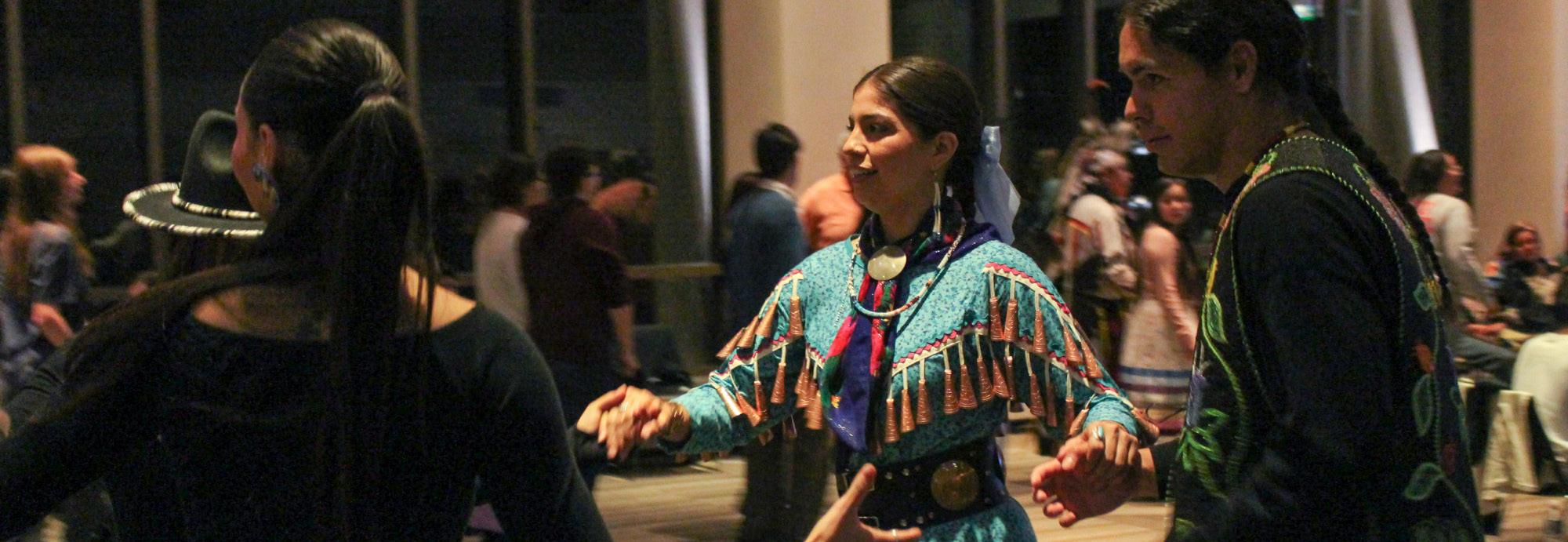
Small children ran around, old friends greeted each other warmly and young people registered to vote. Dancers adorned in bells and intricate embroidery twirled clockwise around drummers while newcomers were welcomed.
Approximately 150 students and community members from all cultural backgrounds converged at Dejope Residence Hall to unite around the Native community on campus and participate in traditional Indigenous dances and music at Indigenous student organization Wunk Sheek’s Powwow Monday night.
“It’s important just to represent Indigenous people on campus to show that we’re still here and still practicing our culture in so many different ways,” said Minan White, Wunk Sheek President and Ho-Chunk Nation and Lac Courte Oreilles (LCO) Ojibwe member. “I think community is most important in Indigenous culture so this is just a really beautiful showcase of it.”
Kalist Cadotte, Wunk Sheek social activism chair and LCO Ojibwe member, said the Powwow was the largest turnout since she has been in college.
Attendees ate sandwich boxes and received
commemorative T-shirts from Wunk Sheek.
Oneida member Artley Skenadore emceed the Powwow, whose even tone often gave way to quick wit, with live music from Ho-Chunk Station, a four-member band who did more with a single drum than some individuals do with a whole set.
“You feel everyone bringing in that good energy for a good powwow. You can really feel that good energy,” said Micahel Gilpin, one of the regalia dancers and a member of the Nebraska Ponca Tribe.
The dances began at 6:30 p.m. with a grand entry in which dancers dressed in their traditional regalia trotted around the central floor. After the grand entry, dancers and the Ho-Chunk Station honored veterans with the veteran song.
Then, the regalia dancers were given the floor to themselves to show off their skill. Much of the regalia was covered in bells jingling in rhythm with the drums.
“If you don’t applaud, we’ll charge you $5,” Skenadore told the crowd. Unfortunately for Skenadore and Wunk Sheek’s pockets, the audience was energized the whole night.
Though the regalia dancers were the stars of the Powwow, the night mostly held dances
for guests.
During the plain clothes dance, a competition between attendees to see who danced the best, a poncho-wearing individual with electric spins won the loudest applause from the audience and $200.
At the potato dance, partners were tasked with keeping a potato pinned to their foreheads while being ordered to spin by the emcee. The couple Ivan and Costanza were one of the last contestants before their potato slipped from their forehead’s grasp and fell to the ground.
“Because I am from Peru, I reconnect this part with my heritage, and that was very beautiful,” Ivan said.
Another form of community building at the Powwow was a table set up by Wisconsin Native Vote. Guests registered to vote or checked their registration. Anne Egan-Waukau, the table’s worker and a member of the Menominee Nation, told the crowd about the time she was almost turned away from a polling station because the worker falsely believed that Native Americans couldn’t vote.
The night ended with a traveling song, a way to wish everyone safe travels on their way back home and a message from Skenadore to “remember, every day is an Indigenous day.”
stay for a second year or more, according to University Housing.
Mnookin told the Cardinal UW-Madison generally wasn’t a place “where most people want to [live] on campus for years and years” but said the university wanted a “little bit more breathing room.”
Funding for the new residence hall, which UW System’s Program Revenue Supported Borrowing estimated would cost $300 million, would not come from Wisconsin taxpayers, Mnookin said.
The third-year student wishes UW-Madison could do more to educate incoming students on the student housing crisis.
“It would be nice if there were resources given at SOAR as well, like, ‘Here’s what you should start doing so that you’re not blindsided by October,’” they said. SOAR did not respond to a request for comment.
Being prepared to navigate the ferocity of the student housing crisis is something they wished they had known before coming to UW-Madison.
“It literally feels like [the] Hunger Games,” the student said of the housing process. “You got to be quick, or you’re going to be lost.”
By Eiman Mir STAFF WRITER
Madison witnessed a sightseeing northern light show on Oct. 9 and 10.
The northern lights, or aurora borealis, are typically only visible near the polar regions. However, extreme solar activity can extend the viewing range south. While it is typical for only northern Wisconsin to see the lights, this year, the Madison area received a glimpse of the show as well.
This year brings more solar activity since this year marks a time of peak activity in the sun’s 11-year cycle, bringing increases in electromagnetic activity.
This can lead to solar flares, which NASA defines as an “intense burst of radiation coming from the release of magnetic energy associated with sunspots.”
An increase in sunspots can lead to more coronal mass ejections, which are large eruptions of magnetized solar plasma. When directed toward the Earth’s surface, the interaction between these energized particles and atmospheric gasses leads to the aurora borealis. Different gasses produce different colors.
Last week, the northern lights were best seen on Thursday and Friday.
Crowds gathered around Memorial Union, Observatory Hill and other spots on campus to capture photos of the view. Seeing the northern lights is difficult with the naked eye, but cameras are able to better capture the colors. Photos with a longer exposure time will be able to pick up the colors best.
Opportunities to view aurora borealis are expected to come up throughout the 2024-25 winter season. The Space Weather Prediction Center updates their aurora borealis viewing prediction tool daily.
By Zoey Elwood & Iain Chang STAFF WRITER AND SENIOR STAFF WRITER
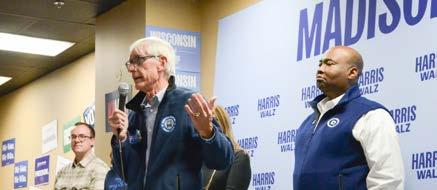
Gov. Tony Evers and Michigan
Gov. Gretchen Whitmer appeared in Madison Tuesday night to highlight the crucial role Midwesterners will play in the 2024 election and rally voters to elect Vice President Kamala Harris and Minnesota Gov. Tim Walz.
“There are 320 million people in the country that are counting on us,” Evers said.
Midwestern swing states are crucial to determining the winner of the next presidential election. If Harris edges out former President Donald Trump in Wisconsin, Michigan and Pennsylvania while holding onto all likely Democratic states, she will win the election.
Whitmer said reaching out to all voters, including those in Republican-led districts, is important for Democrats to win Wisconsin and Michigan in November.
“We can’t write off anybody, we gotta show up in the reddest areas,” Whitmer said.
Evers told The Daily Cardinal having Democratic governors in Wisconsin, Michigan and Pennsylvania has been “important” in rallying swing voters ahead of the election.
Whitmer added that trying to tackle issues such as free student lunches, affordable housing, gun safety laws and abortion rights on the state level has shown voters what Democratic leadership can look like. She believes this will directly translate into support for Democrats at the ballot box in November.
“When people here in Wisconsin
see all the great things that Gov. Evers has been able to get done, they understand that is what Kamala Harris and Tim Walz will do on the national level,” Whitmer told the Cardinal.
The governors’ stop in Madison was part of a statewide bus tour for the Harris-Walz campaign. The bus made previous stops Tuesday in Hudson, Eau Claire, La Crosse and Portage, and on Monday, Evers and Whitmer joined Walz for a rally in Green Bay. Evers told reporters during the event that he plans to join Whitmer in Michigan to rally voters there as well.
Attendees urge Wisconsinites to vote in 2024 election
Enthusiastic rally attendees emphasized the importance of voting in the upcoming election. With the last election being decided by a 20,000-vote margin, voters stressed the stakes of democracy, abortion rights and the economy.
Attendee Ean Ramos, a member
of the United Food and Commercial Workers Local 1473, encouraged people to vote for “the people that are going to care for your friends and your family, not just what you need or want.”
Ramos stressed that rather than taking away someone’s rights, you can give them more protections and benefits.
Students have noticed a rise in enthusiasm on their campus correlated with political figures making appearances in Madison. Joey Wendtland, chair for the University of Wisconsin-Madison College Democrats, told the Cardinal these events excite people and that “people pay attention when they come,” recalling a moment from a Harris visit to Madison last month where students cheered at the sight of his campaign signs in support of Harris.
Liam Byrnes, a UW-Madison law student, expressed excitement to see “real leaders” from the Democratic Party, like Evers and
Whitmer, working toward turning their states blue in this election.
Byrnes doesn’t believe in telling students how they should vote, but he said that part of getting an education is making informed decisions related to key political issues.
“A lot of the norms that we have, especially in terms of the rule of law and a lot of constitutional rights, are really at stake,” Byrnes said. “It is a privilege to live in a democracy like this. Especially for folks who are from out of state, your vote has truly never meant more than in a big swing state and swing election like this.”
The Harris campaign’s fight to win Wisconsin continues with plans for the vice president to visit Milwaukee, La Crosse and Green Bay on Thursday. Former President Barack Obama will visit Madison on Tuesday to energize voters and kick off the first day of early voting in Wisconsin.
By Zach Muchhala STAFF WRITER
Students from rural areas struggle to adjust to college life as they leave family and smaller communities for large and often overwhelming environments at the University of Wisconsin-Madison.
“It was hard to leave the security of such a well established network and go into this unknown,”
Kennan Chojnacki, a junior from Marshfield, Wisconsin, a town of 18,000 just outside of Wausau, said.
Rural students’ rates of college enrollment are much lower than their urban peers — fewer than 20% of adults in rural counties have a bachelor’s degree compared to 50% of adults in urban areas.
Peer advisors from UW-Madison’s College for Rural Wisconsin, a program created following UW-Madison’s partnership with the Small Town and Rural Students College Network, help rural students like themselves navigate UW-Madison.
Avery Simpson, a peer advisor and student from Brooklyn, Wisconsin, a town of 1,500 18 miles from Madison, said she struggled with networking.
“Figuring out how to build connections with people when you’re in a 300-person chemistry class was a pretty big challenge,” Simpson said.
Jack Taylor, another peer advisor from Princeton, Wisconsin, a town of just over 1,000, highlighted how overwhelming cities can be.
“It just feels like you’re either a cog in a machine or you’ve just been thrown into the grinder,” Taylor said.
In a survey sent out last spring, the College for Rural Wisconsin found that 82% of rural-identifying UW-Madison students felt somewhat or unprepared for college, director Jennifer Blazek said.
Blazek said students identified a need for financial and social support, including improved mental health services to support their transition, and found the transition from rural to urban life “isolating and overwhelming,” echoing Simpson and Taylor’s experiences.
To address recruitment issues for students from rural areas, the College for Rural Wisconsin presents to schools across the state and tailors advising to the needs of individual schools and prospective students.
Simpson said she encourages prospective UW-Madison students to get out of their comfort zone.
“That’s where the most growth comes from. That’s where you’ll see the most learning take place,” Simpson said.
Along with infographic handouts and Q&A panels, the College

for Rural Wisconsin has a text hotline where students can connect directly with a peer mentor for one-on-one advice.
“It makes sense with the population that we work with,” Simpson said. “You know, you want that social interaction, that closeness.”
The team also hosts College 2 U roadshow and presents at other youth-focused events. This year, they held a panel at the World Dairy Expo, an event that draws more than 4,000 rural students to Madison, according to Blazek.
The ability to connect with peer advisors from the same background shows first-generation rural students that college is a possibility.
“When you meet a 17-yearold that is just like, hyped about
what they want to do, you can’t help but get a little bit excited for them,” Taylor said. “My favorite thing is just the enthusiasm around it. It’s infectious.”
In the future, they are looking to expand their team, connect with more high schools across Wisconsin and host community lunches. They want to focus not just on recruiting college students but providing resources to help retain students.
“It’s great if [universities] try to bring in another 20 students who are rural, but how do you keep them from transferring out? If they don’t feel they belong or they feel lost or disconnected? [Peer advisors] set them up for success,” Blazek said.
By Noe Goldhaber COLLEGE NEWS EDITOR
Conservative students at the University of Wisconsin-Madison launched a new student newspaper, The Madison Federalist, Wednesday evening to “fill the void of conservative student journalism.
In their founding statement, UW-Madison sophomore and Federalist Editor-in-Chief Benjamin Rothove said it was time for a “rightof-center” student publication.”
“The Badger Herald used to be a right-wing student newspaper, or at least right of center, and just over time shifted,” Rothove told The Daily Cardinal. “Right now, the state of journalism on campus is two left-of-center publications and just a gigantic vacuum on the right.”
In their founding statement, the Federalist cites security fees initially charged to student organization Young Americans for Freedom, the loss of professor Ryan Owens who called the university a “toxic environment” for conservatives after his departure and the university’s decision to negotiate with pro-Palestine protesters who organized an encampment last spring as evidence of the university’s “failure to support differing opinions.”
“The university’s major student publications do good journalism, but they have occasionally failed to hold the school accountable for its left-wing excesses,” the founding statement said.
The Cardinal and the Herald are nonpartisan, independent campus news sources. In 1972, the Herald launched in direct opposition to the Cardinal’s anti-Vietnam War news and editorial coverage, ending what the Herald founders called “a monopoly” on student journalism at UW-Madison.

The Federalist receives funding from the Fund for American Studies Student Journalism Association which “supports young conservative, libertarian and independent journalists who believe in restoring objectivity to the media.” Rothove said the Fund for American Studies has been advising the Federalist to ensure the newspaper “is a sustained effort and doesn’t just have three stories and then disappear again.”
Rothove cited Tripp Grebe, a UW-Madison student whose op-ed opposing defunding the police in 2020 was rejected by the Herald, as a motivation for starting an explicitly conservative newspaper. Grebe later had a column in the Cardinal and published the original opinion.
“We’d have the ability to guarantee that, as long as you’re not writing about antisemitic conspiracy theory or something crazy, we will
publish conservative students’ voices,” Rothove said. “Yes, we are in the minority on this campus. I think that if we have a publication for conservative students, it will kind of help build a network.”
Rothove said the Federalist plans to publish campus news on their Substack and hopes to have a print magazine twice a year. He said editorials will be conservative and news coverage will have some “conservative candy” but not “be super in your face, like Fox News openly right wing, as much as we are just a nonliberal space.”
The Federalist’s first stories
One of the first articles, “UW-Madison sex education program promotes pornography and Planned Parenthood,” details one of the GetWise modules on sex.
Freshman students are required to take one of four modules developed by University Health Services before registering for classes.
The Federalist indicated the GetWise module had a link to pornographic websites, and includes a quote from the College Republicans calling the module “inappropriate” and the university’s decision to promote safe and LGBTQ+ sex a “moral judgment.”
In response, the university took down the Get Wise module to remove “the content in question while the module is being reviewed to ensure that the presentation of the topic is clear and supported by research” according to a statement from John Lucas in the Federalist.
The Federalist also planned to cover UW-Madison Students for Justice in Palestine’s “week of rage” that included several rallies during the week of Oct. 7, the anniversary of the
Hamas terrorist attacks in Israel.
Rothove tweeted that UW-Madison professor Samer Alatout complained about “Jewish supremacy” at an Oct. 7 SJP protest. Alatout responded on Twitter calling Rothove’s characterization of his quote out-of-context as “gotcha journalism.”
“The lack of care, the lack of seriousness, the lack of ethical or serious engagement with issues that dictate life and death is just staggering. Grow up,” Alatout tweeted.
Alatout’s full quote was “We fight against white supremacy, we fight against Jewish supremacy, we fight against any kind of racist supremacy.”
Rothove said Alatout’s quote is something the Federalist would focus on as an example of something “not covered in The Daily Cardinal or Badger Herald, but something people would want to see.”
“It’s just a different perspective, like what we take away from the story versus what a left-wing journalist takes away from the story. I think those perspectives kind of make you see things differently,” Rothove said.
Since the May pro-Palestine encampment, Rothove has tweeted from SJP protests and progressive campus events, mocking and criticizing young progressives. He said his journalism will be less snarky than his tweets.
The Madison Federalist is not the only student newspaper attempting to launch this fall. The Messenger sent an email to all UW-Madison students on April 23, 2024 asking students to apply. On Monday they again emailed all UW-Madison students calling on them to submit completed articles for publication.
The Messenger has yet to publish and denied the Cardinal’s request for comment until they release their issue.
By Vanessa Gavilan STAFF WRITER
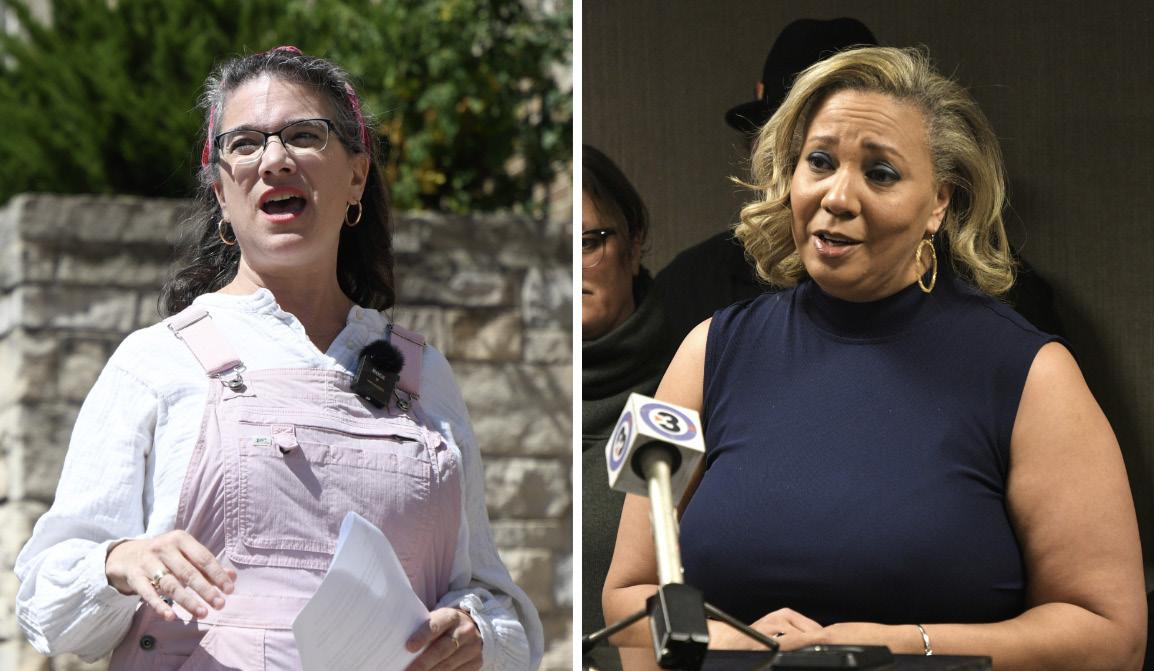
Sen. Melissa Agard, D-Madison and Dane County Supervisor Dana Pellebon will face off on the Nov. 5 ballot to become the next Dane County executive.
The position opened for re-election this year after Joe Parisi announced his retirement in October 2023. Agard and Pellebon advanced from the primary election in August, earning more votes than candidates Wes Sparkman and Regina Vidaver.
The county executive position establishes county government departments, appoints heads of departments and approves or vetoes resolutions set forth by the Dane County Board of Supervisors. The county executive also takes responsibility for submitting the annual budget to the county board.
Both candidates, however, told The Daily Cardinal they believe they have the experience to handle the responsibilities of county executive.
Pellebon, the grassroots candidate from District 33, said being in the executive position means “having experience running programs, setting stra-
tegic priorities and efforts, and then being able to implement budgetary items is where the executive resides.”
Still, Agard said her 14 years in elected office as a current senator for District 16 and former Wisconsin Assembly member would allow her to “build on her experience” further in a county executive position.
“I’m running to build on their progress and create a forward thinking county government ready for the challenges and opportunities ahead,” Agard said in a Nov. 30, 2023 press release.
Both candidates put a large emphasis on prioritizing housing affordability in Dane County if they were to be elected.
Agard told the Cardinal it is especially important to hear students’ perspectives on housing affordability issues to create meaningful change.
“It is clear that we must be doing better that everyone is at the table, including students… we must ultimately strive for equity (in decisionmaking),” she said.
Pellebon said her experience as the Director of Housing and Operations at Porchlight Inc., an organization
focused on reducing homelessness through supportive services and affordable housing, offers a unique perspective on Madison’s ongoing affordable housing shortage.
“I have an enormous amount of experience in the housing industry and understand the intricacies of not just funding, but managing, renting development, all of the different areas of housing,” she said.
Pellebon’s other priorities include criminal justice reform and access to social services, particularly for students.
Agard emphasized the importance of protecting and preserving the natural environment as one of her primary concerns should she be elected.
“I plan to continue with the sustainability movement… placing environmental protections within the county is something I hear from students a lot,” Agard said.
Additionally, she hopes to ensure the county is doing what it can to protect vulnerable communities with services like child welfare, behavioral health resources and addiction resources.
As for the election process, Agard
called it “the hardest job interview I have ever had” but said she was grateful to everyone that has shown up to support the democratic process throughout her campaign.
Pellebon also talked about the challenges of the campaign, particularly with being a grassroots candidate running against a more established candidate.
“I feel that the process needs to be more open… there is money involved in all of these processes that has not been afforded to a grassroots campaign such as mine,”
Pellebon said.
However, both candidates stress it is up to the voters to determine the person whose experience and platforms are best suited to fulfill the county executive role.
“Despite the fact that the government has felt very broken… voting in every election is so important and the youth vote is so important,” Agard said. “Democracy is something we all need to do.”
The winner of the Nov. 5 election will serve through the end of Parisi’s term in April 2025.
Liberal and conservative courts have gone back and forth on the legality of ballot boxes, here’s why they’re so controversial.
By Alexander Tan SENIOR STAFF WRITER
Every election season, Wisconsinites turn out in droves and line up one after the other to cast their votes.
But when dense public gatherings became a health concern amid the 2020 pandemic, demand for absentee voting surged to record highs. Though some states have administered mail-in ballots for decades, some voters still sought out the polls.
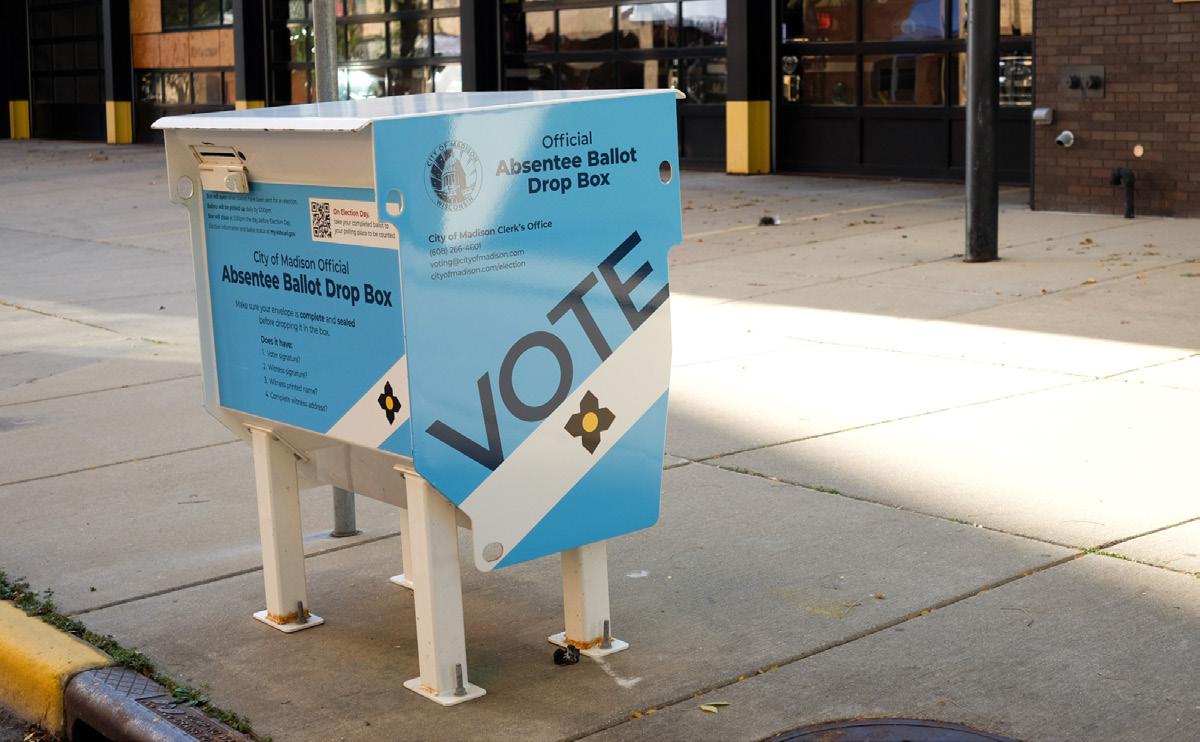
As an alternative, ballot drop boxes became a vital tool for voters seeking a convenient and safe way to cast their ballot without needing to congregate at a polling place on Election Day. In 2020, 40 states successfully implemented drop boxes, and Wisconsin alone installed more than 500. Democrats especially were more likely to use mailin and drop-box methods than Republicans, largely due to their tighter adherence to pandemic health precautions, according to the Pew Research Center.
But as the pandemic receded, these once-simple tools became a flashpoint of political controversy. In 2022, the Wisconsin Supreme Court ruled that election statutes do not explicitly allow for ballot boxes and mandated that no one other than the voter can return a ballot in- person, only for the court to reverse this decision and reinstate ballot boxes earlier this year.
The fight over ballot drop boxes in Wisconsin is but one front in a battle over election security and accessibility stirred by unsubstantiated election fraud allegations
made by former President Donald Trump. Republicans are also advocating for tighter registrant ID laws, which can disproportionately impact voter registration in marginalized groups.
The Wisconsin Supreme Court’s recent ruling does not change ID or citizenship requirements and simply provides clerks with the option to collect votes in drop boxes.
Months after legalization, ballot boxes remain a source of deep disagreement among public officials and voters across the state. While city officials in Madison and Milwaukee embraced them, several communities in Waukesha and Milwaukee counties have opted out of using drop boxes for November’s election despite public demand.
The safety of ballot boxes
Distrust of drop boxes grew from concerns about their unguarded nature and debunked rumors that they were used to cast multiple or fraudulent votes. Ahead of the 2024 election, the controversy surrounding the boxes has led some vigilantes to watch them for evidence of fraud.
But out of the stray cases of invalid ballots, very few are intended to defraud the system, Barry Burden, professor of political science and director of the Elections Research Center at the University of WisconsinMadison told The Daily Cardinal.
The vast majority of invalid ballots or double ballots are from people who misunderstand registration laws and are broadly detected, he said.
“They’re not organized. It’s not
a group rounding up lots of noncitizens or people from other states to come in and vote,” Burden said.
Vigilantism around drop boxes can lead to misunderstandings about election fraud, Burden said.
“When people are observing drop boxes, if they see someone placing more than one envelope into a box, it’s easy to jump to conclusions that there’s ballot stuffing going on,” Burden said. “But in Wisconsin, even today, it’s legal for a person to put more than one ballot in the box [for] a spouse or family member who has a disability and needs assistance.”
Despite evidence for drop boxes’ security, some are worried about their anonymous, unsupervised nature. Some clerks intending to use drop boxes in Dodge County backtracked after the sheriff warned against “even the appearance of the potential for fraud” degrading trust in the system, according to a WisPolitics report.
“But again, the blue mailbox is also anonymous,” Burden said. “At least the drop box is a direct path from the voter to the clerk. The voter puts their ballot in the drop box, and that day they’ll empty the box and take it directly to the clerk’s office.”
Supporters of the decision argue drop boxes will give certain voters, including those with disabilities and those in rural areas, easier access to voting. In a state where razor-thin margins are the norm and presidential elections can be decided by less than 1% of the vote,
stricter barriers to voting can dissuade enough people from casting their ballot to make a difference.
Civil rights groups including Disability Rights Wisconsin and the League of Women Voters of Wisconsin have raised legal challenges over the impact on people with disabilities when absentee options are limited. People with disabilities are over three times more likely to face difficulties voting in person than absentee, according to PBS. While disability accommodations exist, they are not always reliable and can run into potential hiccups with access to transportation and the availability of an assistant.
Drop boxes are intended to resolve some of these challenges. The city of Madison strategically placed them in high-traffic monitored areas that are easy to get to and are on the side of the road where someone can drop their ballot in without needing to walk out of their car.
Drop boxes go beyond a voting amenity in rural communities, where they can serve as critical pieces of
infrastructure, Burden said.
“Many clerks in Wisconsin and small towns don’t have offices or staff,” Burden said. “The drop box could gather ballots but could also collect their water utility bills or dog license applications or other things that clerks handle in Wisconsin.”
The future of voting
The hot-button issue is not likely to fade in the near future, Burden said.
“I don’t think the controversy is going away anytime soon, which is unfortunate because they [drop boxes] have proven themselves to be a safe and convenient way for voters and election officials to do what they need to do in the election,” Burden said. “They could become part of some of the misinformation or disinformation that emerges close to the election, but it’s unfortunately just something that’s gotten injected into the kind of partisan divide about how elections are run in the U.S.”
By Madeline Wooten & Ella Hanley
STAFF WRITER & ASSOCIATE NEWS EDITOR
Greater Good Charities, a global nonprofit, flew more than 200 cats and dogs into Wisconsin after they were relocated following hurricanes Helene and Milton.
The pets were transferred to make room in hurricane-affected shelters for local pets who were displaced by the storms, according to press releases by Greater Good Charities.
Airlifts flew the shelter pets into Waukesha and Milwaukee airports

from South Carolina on Oct. 2 and Oct. 12, respectively. At least 270 cats and dogs were relocated by Greater Good Charities and delivered to humane societies throughout Wisconsin and northern Illinois based on shelter availability.
“Since the beginning we have been supporting the people and pets devastated by these catastrophic hurricanes,” Greater Good Charities CEO Liz Baker said in a press release.
Good Flights, operating under the umbrella of Greater Good Charities, works to save shelter animals and provide disaster relief through airlifts and ground transport. Over 14,000 shelter pets have been transported to safety since Good Flights was established in April 2021, according to the organization.
“Greater Good Charities’ mission works to help people, pets and the planet by mobilizing in response to need,” Sàra Varsa, executive vice president of programs for Greater Good Charities, told The Daily Cardinal in an email. “These emergency airlifts of pets are part of our efforts to bring relief to the hardest-hit areas. Creating room for these critical care facilities that are handling injured and displaced
pets due to the storms ensures they can serve the needs of their communities.”
The Humane Animal Welfare Society (HAWS) of Waukesha said Oct. 13 the animals they received from the Oct. 2 airlift have already been adopted and the organization isn’t worried about future transports given the enthusiasm of the community.
“That flight was on a Tuesday or Wednesday…we had 100 adoptions over that weekend. Not just the transport pets, but the other pets that have been here at the shelter for other reasons,” HAWS Communications Specialist Jen Smieja told Spectrum News 1. “People really have been reacting.”
On the Oct. 12 Milwaukee-bound flight, Avery the kitten found a forever home before the plane had even landed. The Southwest Airlines captain of the plane “found love at 30,000 feet” and decided to adopt Avery.
Other airlifts of pets out of shelters are occurring nationwide, bringing pets to the East Coast, including New York, Maryland, Massachusetts and Virginia. Airlifts are likely to continue as the hurricane season stretches to the end of November.

By Alexandra Malatesta & Hallie Albert LIFE & STYLE EDITORS
In the wake of catastrophic natural disasters like Hurricane Helene and Hurricane Milton, Florida has become an example of the efforts to combat the devastating impacts of climate change. While thousands grapple with the loss of homes and community, a new generation of voices — Gen Z influencers and political figures — has emerged,
By Jake Piper STAFF WRITER
using social media to amplify the urgency of this global crisis.
Floridians, Georgia and North Carolina fought for their lives as these hurricanes destroyed their homes. The destruction was more than just physical; it left emotional scars for many families and was a “wake up call” that showcased just how badly climate change has evolved.
As the debris settles, scientists are delving into data, pinpointing human-caused climate change such as green-
house emission, deforestation, harmful agricultural practices and more, as a significant factor in why we are having these extreme weather events. Climate change has been an ongoing environmental issue for many years now, and scientists have been warning the world of the consequences it could lead to. Now, we are experiencing these consequences first hand.
In a world where the stakes are rising, the influence of
social media — particularly through — young, passionate and socially conscious individuals — is where people are able to harness the power of TikTok, Instagram and Twitter to advocate for climate action.
Figures such as Greta Thunberg, the Swedish climate activist known for her powerful speeches and school strike movement, have reached millions around the world demanding urgent action on climate change. Her commitment to environmental justice has sparked a global youth movement, demonstrating the power of individual voices in driving collective change.
If nothing is done to fight against this problem, the air we breathe will become even more toxic, the storms we face even more destructive. As residents of Wisconsin reflect on the implications of climate change, there are some steps we can take to make a difference:
Step 1: Support local initiatives
Join local environmental organizations or even just practice clean living. Pick up after yourself and avoid littering. It piles up.
Step 2: Reduce carbon footprint
Make conscious decisions in your daily life such as reducing single-use plastics and supporting businesses committed to sustainability.
Step 3: Educate others
Use your own social media platform to share information about climate change and encourage others to take action. Take part in a “call to action” because the more we discuss these issues, the more likely we inspire others to act on positive change.
As we witness the destruction brought by these hurricanes and other climate-related events, it becomes evident the fight against climate change is more just an environmental one: it is a humanitarian one. We strive for our world to be safe for all generations that come after us. The rise of influencers and their ability to mobilize and inspire change through social media is a sliver of hope, ultimately educating many people. Seeing these hurricanes emerge each year shows just how detrimental climate change is. Luckily, we have the power to help.
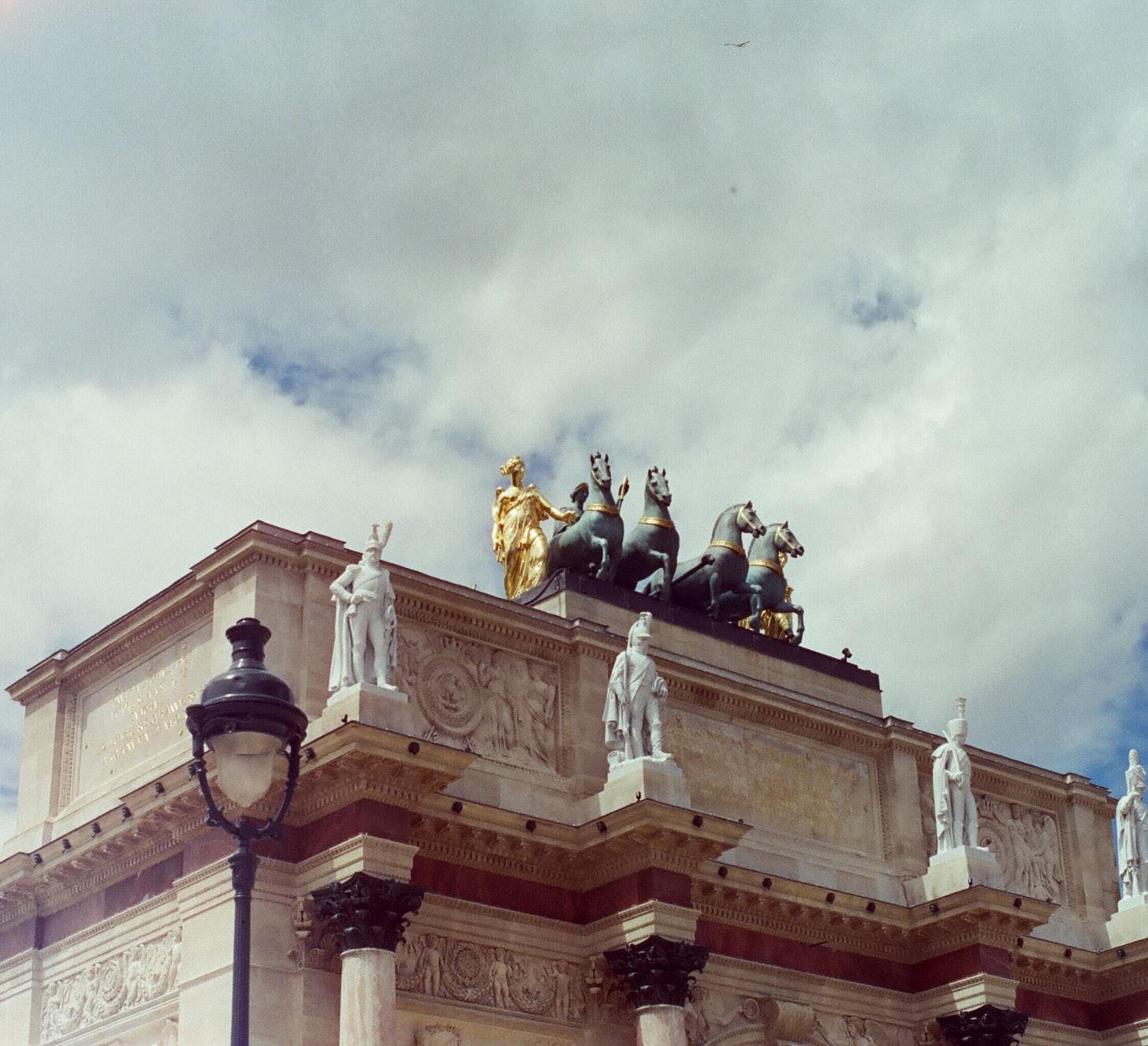
All too often, I feel lost in my own camera roll. A confusing blur of faces and places I half remember amassed over eight years of owning a phone. The thousands of photos virtually weightless in my pocket.
But what if I told you there was a different way, something that could give weight back to your photos and give them the meaning they deserve? Well, let me introduce you to the world of film photography.
Photography has been around in some form for almost 200 years, with the first widely available photographs being expensive copper-plated daguerreotypes introduced in 1839. Since then, photography has come a long way. With the 35mm film everyone knows and loves which Kodak introduced in 1934 and gained popularity in the 1960s as the primary way to take pictures.
The first thing that always strikes me about film photography is the beautiful physicality of it. How the shutter of each film camera has its own distinctive clack or the telltale crackle of a winding spool loading film into the next frame.
The second thing that always hits me is the raw, imperfect nature of film. The vibrant palettes of any given film stock and the subtlety of the film’s natural grain give each photo a unique, dreamy quality that could never be replicated on the precise machining of a digital camera.
There’s something within that imperfection and natural fuzziness that I think appeals to a lot of people on a base level.
We as humans often tend to gravitate towards nostalgia, a rose-tinted inter-
pretation of the past, and with film photography that feeling can be had in the modern day too. It allows us to relive our favorite moments in perpetuity, captured in a rose-colored frame of film.
There’s something to be said for working for your photos as well. Because each roll of film only offers a maximum of 36 shots, each and every shot counts. The limitations of a roll of film are what breed the creativity that can be found within.
Switching to film allowed me to think about each and every photo I take, it required conscious effort each time I held the camera up to my face, carefully metering and compositing before each shot, trying desperately to make each frame count.
It’s a satisfying experience, following your photo from birth to completion, eagerly awaiting your scans to finally see how something turned out. It’s truly an addicting and magical process, and something I sincerely hope you get hooked on too.
Where to begin?
One of the questions any budding film photographer might first ask is “where do I even get a film camera?” The answer is simpler than it might seem.
Ebay can be a great place to start if you want something on the cheaper end that is guaranteed to work. With prices ranging anywhere from $5 to $500, though, it can be an intimidating place to start.
If you want a more local option, you have two alternatives. While pretty hit or miss, Goodwill and St. Vinny’s often have old film cameras lying around that can be had for very cheap.
Otherwise, if you want to support a local business, The Camera Company
with locations on the West Side and the East Side of Madison, offer a range of great, professionally refurbished film cameras to choose from along with selling and developing film.
But my advice to anyone staring out is that as long as the camera works and it’s in your price range, what brand or lens it is really doesn’t matter.
Once you have a camera, what then? Well, if you’re looking for a good beginner film stock I recommend Kodak Gold 200. It’s cheap, can be found practically anywhere and, most importantly, it looks beautiful.
Film photography is a medium that connects us back to our photos. The physical action of metering, framing and shooting grounding us in the moment of time we took that picture. After all, isn’t that what photography is all about? Capturing a moment in time, capturing us in a physical freezing of history. And film connects us to more than just the action of taking a photograph ever could. It freezes that moment in our mind too, holding the feelings, emotions and sounds we experienced along with it in our memory.
By Abigail Bures STAFF WRITER
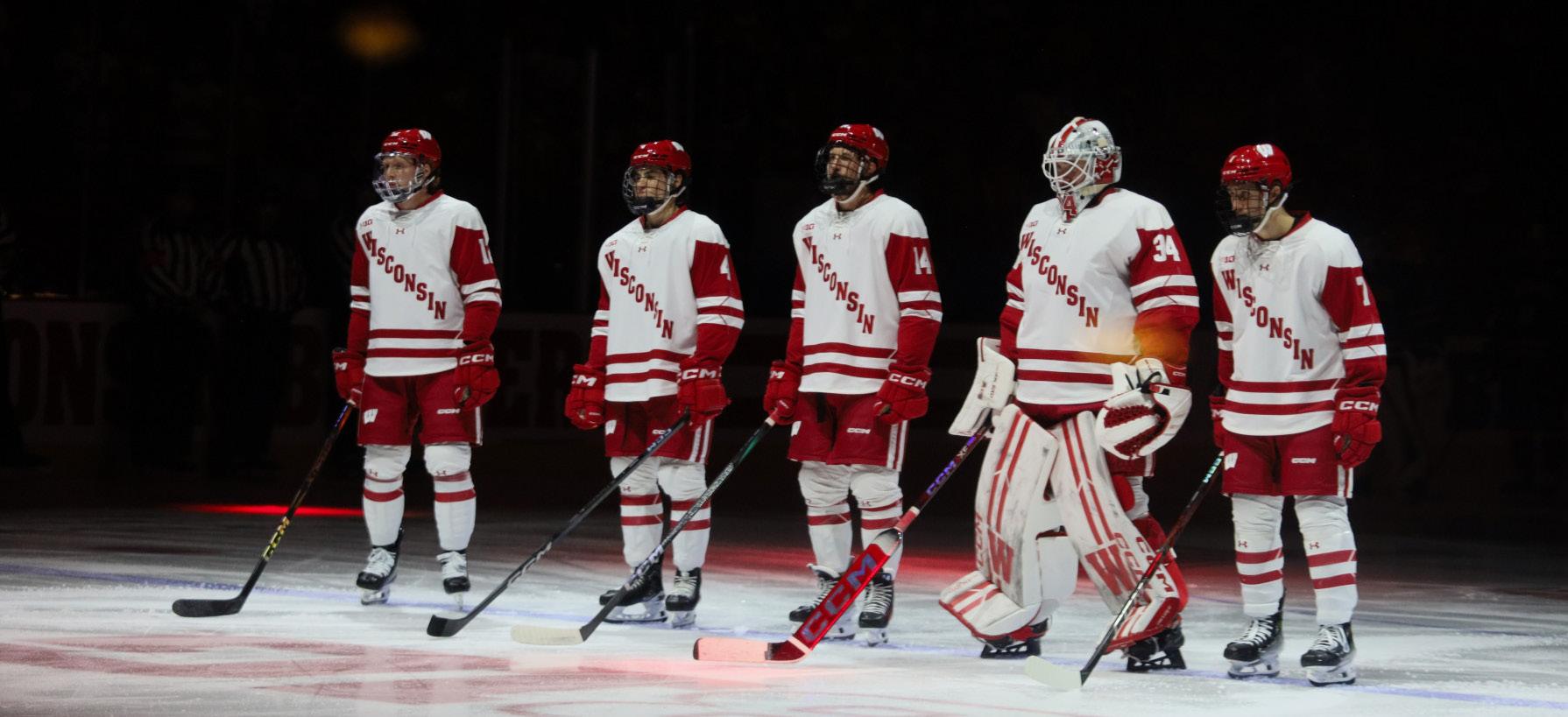
The No. 9 Wisconsin Badgers men’s hockey team’s season opener against Lindenwood suffered the same mixed results as their last series against the Lions in January.
Rocky start
Wisconsin couldn’t hold a lead in the first game on Friday night and lost 4-2. On Saturday, the Badgers came back from down two with a tie-creating, baseballstyle goal from sophomore forward Quinn Finley that sent the game into overtime. Defender Daniel Laatsch scored the gamewinning goal with 18 seconds left in extra time.
Power play goals were crucial in this competition, but out of the 13 power play advantages Lindenwood gave Wisconsin, the Badgers only capitalized on them twice.
Gavin Morrissey and Finley were the Wisconsin players to score on the power play. Lindenwood’s sophomore rightwing, Jaeden Mercier, who scored the first two goals of game one, tallied Lindenwood’s only power play goal for both nights.
New talent
Morrissey, a freshman from Rochester Hills, Michigan, tallied three points in his first series as a Badger. Freshman Logan Hensler made for an impressive series record with one assist, five shots and two blocks.
Head coach Mike Hastings has eight freshman players on his team and four transfers, so there’s a lot of new talent to work with.
“You look at Logan Hensler who’s just turning 18 soon, he went out and played his tail off. There was no fear, he just went out,” Hastings told The Daily Cardinal.
Kohl Center-type energy
Physicality from both teams played a large role in this series. There were 18 total penalties called for minor situations, but other tense moments were observed on the ice. Frustration at passes not connecting led
junior center Christian Fitzgerald to slam his stick into the ice after a play in the first period of the first game.
Scuffles led captain Owen Lindmark to say his teammates need to be on the same page after plays were over in the first game.
“We got to be all bought in and support each other, showing energy on the bench,” Lindmark said.
The energy on the bench was higher on night two at the Kohl Center. Even with Lindenwood scoring the first goal of the night, Badgers fans remained active and supportive.
About 7,500 fans attended the Kohl Center Friday night, but that number jumped to 8,875 for game two.
“Even when we were down, the fans were still really loud. It was a good boost of energy when we needed it most. We’re looking to reward them tomorrow,” Morrissey told the Cardinal.
Comeback season
Reward them they did. In game two, fans who lasted through the first two periods saw a comeback reminiscent of Wisconsin’s preseason competition against Omaha. In that game, Wisconsin came back from a 2-0 losing streak to win in overtime.
Down 2-0 against Lindenwood, Finley scored the first goal of the night for Wisconsin. Assisted by Simon Tassy and Ryland Mosley, Finley backhanded the puck into the net.
A shot in the third period from Fitzgerald was deflected into the air only to fall in front of Finley, where he whacked the puck out of the air into the top right corner of the net. Lindenwood goalie Owen Bartoszkiewicz was still positioned to defend Fitzgerald’s shot and had little time to correct.
Goaltenders
While Lindenwood played the same goalie both nights, Wisconsin opted to switch goalies on night two, and sophomore William Gramme took the net.
Wisconsin’s goaltending depth includes graduate student transfer Tommy Scarfone, who played night one, and William Gramme, who played under Kyle McClellan, the Big Ten Goalie of the Year, the season prior.
Alongside Scarfone and Gramme is freshman Anton Castro from Mendota Heights, Minnesota.
Being a goalie requires a strong mental game, which Hastings believes this group possesses. After night one’s game, Hastings stressed that he wants his goaltenders to feel encouraged.
Hastings spoke of Scarfone’s four goals against: “We need to give him a little more run support.”
On night two, the extra defensive support helped Gramme let only two goals slip past him.
Looking ahead
After a loss like this series’ first game, Lindmark said “the most important thing is flushing it and coming to the rink in the morning and being ready to go.”
Wisconsin will take on Big Ten opponent Ohio State, the team that knocked the Badgers out of the Big Ten tournament last season, in a home series this weekend.
The Badgers have to shake off this rocky start and continue to drive net support, better passes and capitalize off of power plays.
“There’s some positives here, if you can believe it,” Hastings told the Cardinal. “These hurt, they cut deep. You learn from them, and we’re gonna learn from them.”
Coach Hastings entered his second season at Wisconsin looking to accomplish something former coaches Bob Johnson, Jeff Sauer, Mike Eaves and Tony Granato never were able to — open his first two seasons with a win.
While that record wasn’t broken, like Lindmark said, the Badgers have a new opportunity and need to prepare for that instead of focusing on the past.
Wisconsin’s faces off against Ohio State Friday at 7 p.m. and Saturday at 6 p.m. at the Kohl Center.State starts Friday at 7 p.m. and Saturday at 6 p.m. at the Kohl Center.
By Josh Murphy STAFF WRITER
There was never a doubt during the Wisconsin Badgers 42-7 clinic against Rutgers.
Wisconsin Badgers football have put up over 40 points in back-to-back wins, something they haven’t accomplished since 2020.
Performance on the offensive side of the ball has been a glaring weakness of the Wisconsin football program this season, but they are finally starting to show glimpses of what fans expected under head coach Luke Fickell.
The Badgers were in control from the get-go in New Jersey on Saturday, marching 89 yards down the field on their opening possession and punching it into the endzone against Rutgers. They took a commanding 14-0 lead in the first quarter, a lead they held onto for the rest of the game.
Braedyn Locke is doing something that Tyler Van Dyke rarely attempted in his time as starting quarterback — he’s airing it out deep. Sure, he has been inaccurate at times, as shown by a first quarter interception thrown into double-coverage. But more often than not, Locke’s deep ball has been a spark plug to a Wisconsin offense that desperately needed it. It has added another layer to an offensive game plan that appeared largely one-dimensional throughout the first four games of the season.
Running back Tawee Walker deserves a ton of credit. The Badgers needed someone in their backfield to step up after Chez Mellusi announced he was stepping away from football to focus on his health, and Walker has done just that and more.
In the last two games, Walker rushed for 292 yards and scored six touchdowns. Walker showcased his speed when he broke free for a 55-yard touchdown run in the fourth quarter, his longest of the season.
This looks like a different football team than the one we saw just a couple of weeks ago. The offense is now averaging 30.0 points per game, seventhbest in the Big Ten right now. The defense has also given up only one touchdown in their past two contests, allowing 13 points
in total. Rutgers and Purdue are not as strong opponents as the University of Southern California and Alabama, but it is very refreshing for fans to see dominant performances on both sides of the ball. The offensive turnaround in particular has been exciting, and has given fans hope for the remainder of the season.
“The offense hasn’t just turned around statistically the last two weeks, it has been a clear shift towards deep throws and a defined air raid offense,” season ticket holder and Badgers superfan Harry Falk told The Daily Cardinal.
Fickell and offensive coordinator Phil Longo have been the subject of criticism by Badgers fans and former players alike. Many expected an “air raid” style offense similar to the one Fickell ran in Cincinnati, but the passing game in Wisconsin has been anything but since the 2023 season.
Longo recently came under fire on Twitter by fans and former Wisconsin athletes for lining up in the shotgun on multiple 4th-and-1 situations. Ironically, they did the same thing against Rutgers — except this time, Walker was able to pick up two yards and a touchdown. Regardless of the play calling in certain situations, there is no question that the offense is starting to turn a corner.
Falk believes Fickell and Longo have been “far from perfect” this season, but he admits that if this offensive play continues, “they each deserve an apology from everyone in Madison.”
Consistency will be the Badgers’ key to success for the remainder of the season, especially considering that Wisconsin football will face some strong defenses down the stretch.
While the past couple of games have been fun, the job’s not done. The Badgers play on the road against Northwestern on Saturday followed by a tough matchup against No. 3 Penn State in Madison. Kickoff is at 6:30 p.m., and Camp Randall will be rocking for what should be an electric Big Ten primetime matchup.

By Jacob Szczap STAFF WRITER
As late afternoon turned to dusk on an October day in Madison, Tony Casteñeda settled into his Thursday evening routine.
It involves jamming along on the bongos and congas in the back room of the Cardinal Bar with the five-piece Latin jazz band he leads, the Tony Casteñeda Latin Jazz Band. Thursday is Latin music night at the Cardinal, and keeping rhythm on the drums, Casteñeda’s hands bang away to the Afro-Cuban rhythms while the rest of the band creates an excitingly smooth and exotic sound, bringing the genre of Latin jazz to Madison.
“I just love the music, and I love the vibe,” Casteñeda said.
Casteñeda, 68, is Madison’s godfather of Latin jazz. He came to the city in 1974 to study at the University of Wisconsin-Madison and in 1977 became a founding member of Olmeca, Madison’s first Latin jazz band. The group played for over 20 years before Casteñeda formed his own group, which has been playing together since 1998.
Along the way, he’s forged a path greater than music. A social justice advocate, radio and podcast host and bar -
tender among other gigs, the laid-back Casteñeda is a true jack of all trades. Through a variety of avenues, he has become a true and inviting local figure.
Originally from Racine, Wisconsin, Casteñeda got his start in music through his uncle, who played in a Latin orchestra band when he was growing up. When Casteñeda was in fifth grade, his uncle bought him a trumpet, his first instrument. By high school he had a conga drum, teaching himself to beat on to the records of Santana.
A few years later when Casteñeda was at UW-Madison, his band Olmeca played on as a live band in the era of disco. With a weekly gig at State Street Infirmary, Olmeca built the foundation for live Latin jazz in Madison.
“I wanna say he’s kind of a pioneer,” said Anders Svanoe, the saxophonist in Tony’s band and a leader of multiple other musical groups in Madison, referring to Madison’s Latin jazz culture. “He sort of started that whole scene.”
These days, Casteñeda and his band play every Thursday night at the recently reopened Cardinal Bar, with plenty of other gigs scattered
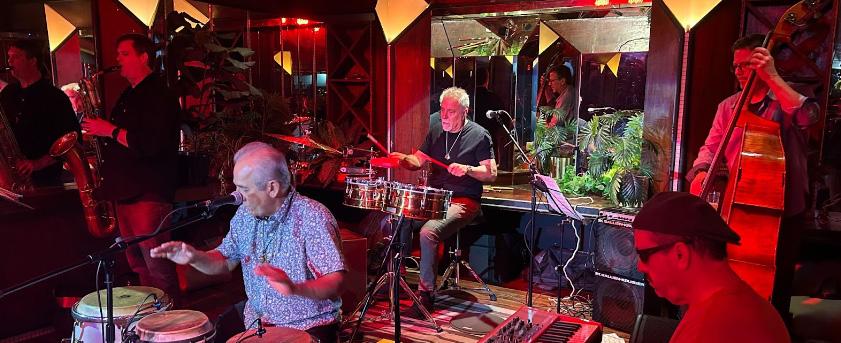
in between. This night in the historical bar’s swanky back room, it’s Casteñeda on the bongos and congas, Svanoe belting out melodies and improvisations on the saxophone, Arno Gonzalez providing a Latin percussion flair on the timbales, Dave Stoler bouncing around the keys on the keyboard and Henry Boehm holding the fort down with technique on the double bass. Louka Patenaude also plays with the group, on guitar.
In between songs, Casteñeda casually converses with the evening crowd, appearing like there’s nowhere he’d rather be.
Before he was Madison’s Latin jazz king, Casteñeda found his footing on the political scene. Arriving in Madison in the mid
1970s, the political climate was still plenty hot on campus.
Casteñeda became involved with Mecha, then UW-Madison’s Chicano student organization and fought for a Chicano studies department, which he remembers as a “big struggle.”
“There was a lot of political activity at the time,” Casteñeda said. “I’m still involved, and everyone does their part.”
Olmeca played together until the late 1990s, and Tony started his own band in 1998, with much of the group still together.
The band had a rollicking years-long Sunday night run at the Cardinal, where they would play in front of crowded, cigarette-hazed rooms full of dancers deep into the night. They’ve opened for legendary
acts such as Poncho Sanchez and John Santos and have won plenty of local awards.
“We’ve been together for a long time, and I really appreciate the loyalty, the commitment that the guys have to the band,” Casteñeda said.
At the Cardinal bar, his band seamlessly merged AfroCuban rhythms with jazz into a free-flowing, deeply enjoyable sound.
Perhaps it’s his laid-back demeanor or his do-anything attitude, but Casteñeda’s decades-long run in Madison has come by no accident. As his invigorating set of Latin jazz came to an energetic end, the Cardinal warmed up. During Latin jazz night, the crowd was fulfilled.
By Arin Chandra STAFF WRITER
In a world full of metroidvanias — action games with non-linear progression — and platformer games struggling to compete with the likes of Hollow Knight and Dead Cells, Red Candle Games created a home run of a game that successfully integrates difficult gameplay with a phenomenal narrative and an art style based in Daoist mythology.
Released on May 29, 2024, Nine Sols certainly competes with the all-time greats of the genre and is one of the best games to come out this year.
Looking from the outside in, Nine Sols is a story about the Solarians, a race of catlike creatures, and their fall from grace. Protagonist Yi is betrayed by his mentor in a near-death encounter but survived thanks to the Primordial Roots, the Solarians’ main energy source.
After living with the captured humans (hilariously called “Apemen”) on the New Kunlun colony ship, Yi finally gets the opportunity to return to the ship prior and exact his revenge on the Nine Sols, the tyrannical leaders who are responsible for betraying him.
In contrast with the game’s futuristic elements and its ruthlessly brilliant artistic decisions, such as complex cargo belts and high-end research labs that only anthropomorphic cats can make, it shows the player that the Solarians were once pushing all sorts of boundaries in science and technology while also maintaining their roots.
The futuristic setting isn’t the only thing going for Nine Sols, as it also features a robust backdrop shrouded in Daoist concepts.
Many characters in the game bear striking resemblances to mythological Chinese figures. One of the most important ones is Shuanshuan, a human who is an indirect reference to the Yellow Emperor — a mythological ruler who allegedly shaped the key

precepts of Daoism — including the quest for long life and a harmonious society.
The evolving relationship between Yi and Shuanshuan shows how time can allow friendships to prosper. Given the game’s Daoist influence, their relationship can also be interpreted as a divine blessing to the Yellow Emperor from a “higher being” in the Solarian Yi.
Another example of Daoism’s influence in Nine Sols is Yi himself. Meant to represent the mythological archer Hou Yi, he uses a bow and a sword throughout the game. However, his story differs from that of Hou Yi based on the player’s choices.
Yi either succumbs to his goal of revenge or creates a new one of saving the imprisoned humans, either deviating from or adhering to Hou Yi’s fate. But both stories both share the concept of “shooting down” the Nine Sols, or the Nine Suns, and leaving one of them to guide the common people.
The story is a wondrous blend of future and fiction that never fails to surprise.
A game with an amazing story can still have bad gameplay to even it out to mediocrity. Luckily, Nine Sols doesn’t suffer from this problem.
Yi starts off with some basic equipment — he can jump, dash and slash just like any
other platformer character. But the real game changer in Nine Sols is the ability to deflect incoming attacks. All of this builds up Chi, which Yi can consume to hit an enemy with exploding talisman attacks for more damage. A combination of all of these basic elements already makes for an exceptionally nuanced gameplay experience.
The best part about these abilities is that they are given to Yi when he needs them the most, allowing for many encounters to be the most challenging when you first see them.
All of these mechanics are matched with well-designed enemies. Even the regular enemies the player encounters right at the beginning of the game can prove to be a big annoyance near the end.
The boss battles serve as a worthy challenge for applying the skills the player has acquired throughout Yi’s journey. They start off decently enough but ramp up in quality quickly. The final boss is the ultimate test and feels like a flawless culmination of both skills and endurance, marking itself as one of the best in the entire genre.
Combining intensity, power and culture, the soundtrack and audio design contribute to an addicting gameplay experience and further help to immerse the
player in the world at hand.
Nine Sols is an undeniably difficult game. Every death or setback is a learning opportunity. This is why many consider it a “Sekiro-like,” because of the uphill battle every encounter represents for the player.
The most rewarding way to experience Nine Sols is to never give up. Pushing through the end of this experience has taught me a great deal about the potential of the metroidvania and platformer genres, and the best ones are always the ones that allow the players to keep pushing forward
Nine Sols weaves cyberpunk and mythological Chinese elements to create a unique world with many cultural aspects for players to discover, especially those tied to Daoist imagery and thematics. Its characters highlight a story of universal compassion and an allusion to the rise of mythological rulers in Eastern history with an art style to boot. And all of this is corroborated by a near-flawless gameplay system that encourages creativity and perseverance.
Nine Sols is definitely one of the best metroidvanias ever made, and it is perhaps a true contender for Game of the Year.
By Haley Froseth STAFF WRITER
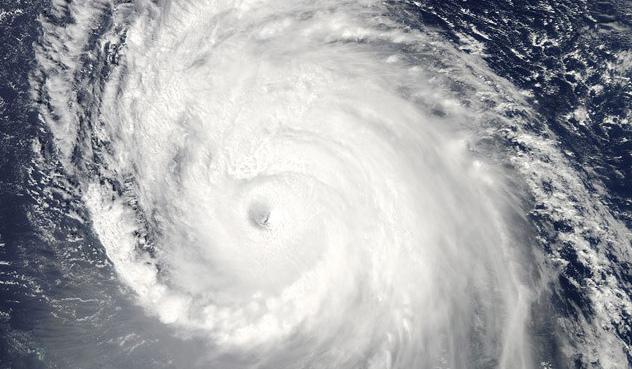
In late September, Hurricane Helene tore through the states of Florida, Georgia, South Carolina, North Carolina, Virginia and Tennessee. Helene demolished areas typically safe from hurricanes and became the deadliest mainland hurricane since Katrina in 2005. Florida residents are now recovering from a second hit from Hurricane Milton, which caused an estimated $50 billion in damage, according to the Biden administration.
The tragic reality of Helene and Milton is that despite attempts at preventative disaster relief, the storms arrived before we were ready. As a result, lives were lost, homes were destroyed and extensive reconstruction efforts are now underway. We’ve grown used to this cycle, yet our country remains unprepared to handle increasingly severe weather.
With November approaching, voters on either side of the aisle must consider a new issue as they head to the polls: disaster response.
Voters can’t ignore the implications of disasters like Helene and Milton, no matter where they fall on the political spectrum. This makes the government’s disaster response a main factor influencing the opinions of voters, shining a heavy spotlight on the Federal Emergency Management Agency.
As of Saturday, FEMA has responded to the disasters with $441 million in assistance for Helene survivors and $349 million for public rebuilding of communities and their infrastructure allocated to affected states. This
By Lauren Stoneman OPINION EDITOR
allows impacted communities to apply for aid from federal funding alongside the more than 10,000 government personnel on the ground helping to mitigate the damages.
While it’s too early to assess whether FEMA’s response is sufficient, it’s no secret that the Biden administration — and in turn, Vice President Kamala Harris — will be held accountable for its effectiveness. In the critical final weeks of her campaign, Harris can’t afford a slow road to recovery, as delays could jeopardize her standing amidst national turmoil.
On top of uncertainty surrounding the effectiveness of FEMA’s response, disinformation about Hurricanes Helene and Milton creates a new dangerous situation for survivors seeking aid. Key swing states, heav-
ily impacted by the storms, have seen unfounded rumors, such as claims that the hurricanes were man-made to influence the election and Trump’s false assertions that Washington withheld funds for Southeast restoration efforts.
Amid this disinformation, Harris addressed a church gathering in North Carolina this past Sunday, condemning those who “play politics with other people’s heartbreak” and urging bipartisan cooperation instead. Given Harris’ direct association with the Biden administration’s performance in disaster recovery, disinformation surrounding Helene and Milton risks damage to her image while also undermining the importance of climate change initiatives in the upcoming presidential term.
Not only will the Biden administration’s response to
Helene and Milton shake up Harris’ campaign, but the right response to these severe weather events could lead voters to prioritize climate policy on the ballot this November. In response, the vice presidential debate between Ohio Sen. JD Vance and Minnesota Gov. Tim Walz held in the aftermath of Hurricane Helene was largely focused on climate change, compared to the last two presidential debates that barely touched the subject.
The bottom line is this election cycle has seen federal disaster response and climate change issues rise to the forefront of the 2024 presidential campaigns. This focus not only underscores the urgency of challenges like the increased frequency of extreme weather, disinformation and disaster recovery preparedness, but it also instills hope that
future administrations will prioritize the implementation of climate policies.
That’s why student voters at University of WisconsinMadison must bring their understanding of humaninduced climate change and the cyclical nature of disasters to the polls. If voters hold candidates accountable for their strategies, there becomes an incentive for political actors to develop resilient, sustainable solutions to climate threats.
With nearly 42 million Gen Z voters nationwide, including 7.8 million in key states, young voters are increasingly engaged through university voter registration efforts and are taking stronger stances on climate issues, especially after Helene and Milton. Candidates are responding by investing in social media ads and campus rallies in swing states like we saw last month in Wisconsin. This renewed focus on climate change may benefit Harris’ campaign and offer hope for future administrations to prioritize environmental action.
The tragedy of Helene and Milton goes beyond the devastation they caused. We knew this was coming, yet we failed to act — extreme weather events are now an inevitable part of our future that continues to be ignored. With the urgency of climate change more evident than ever, the choices we make at the ballot will shape not only our immediate disaster response but also the long-term survival of our planet. The time for accountability is now. Our future depends on it.
a beat before packing up your things in
You’re sitting in class. The professor has been speaking for exactly 48 minutes. She starts to say words like “for next time” or “one final thought,” indicating class is winding down.
And then, everyone around you starts to pack up their things. Loudly. The teacher is still talking, but you can’t hear a word.
This is an experience that I’m willing to guess every University of Wisconsin-Madison student has gone through. Likely, most of us experience it two or three times a day.
You may think this phenomenon is no big deal — certainly not worth writing a whole article about. To that, I say: what is the point of becoming an opinion editor if I can’t occasionally use the platform to air a small grievance?
You may think this phenomenon is annoying, but not indicative of any larger issue. Think again. The collective instinct to get up and go as soon as we can and to talk over our teachers
tells me that academia isn’t valued the way it once was.
Classes have become transactional. Students go because the material will be on the test, because the test is 30% of their grade and because their grade could make or break their GPA. Once they’ve gotten what they needed, they have no issues running to the next thing.
We’re all guilty of that kind of thinking. We’ve all gone to office hours to get an A, not to genuinely engage the professor in a conversation.
But every once and a while, try to remember that academia is a luxury as well as a burden. It’s not just something you should check off on the way to your career, it’s a fleeting chance to read, to study and to learn things that you won’t later in life. It’s your chance to say, “Hey, I’ve always wanted to know more about Russian literature. Maybe I’ll find the time to take a class.” This mindset is especially important to keep in mind as we hit that point in October where every task, every assignment feels like agony.
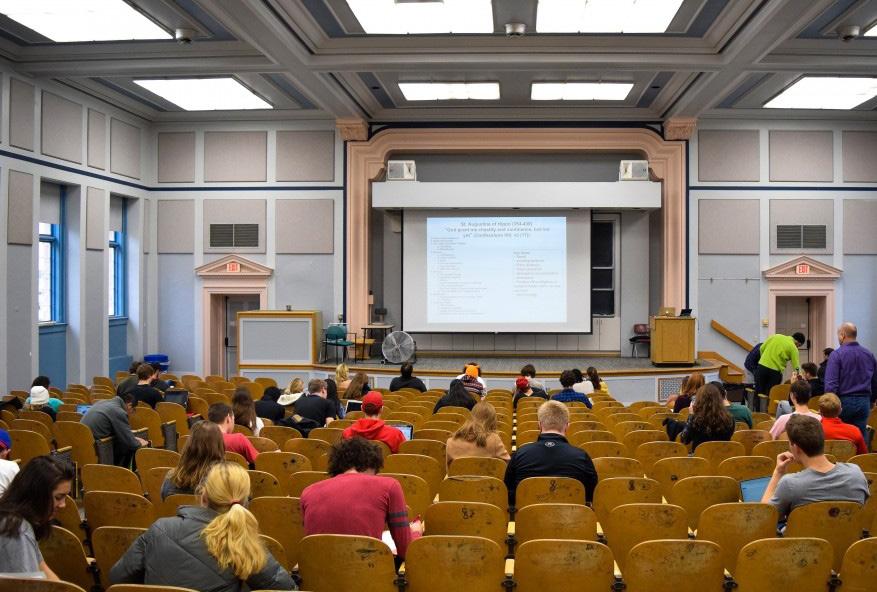
The professor might not save the most important content for the final moments of class. But she’s earned your full attention either way. Think about how much you’ll be missing this time
in 10, 20, 40 years, and sit down just a little bit longer. Maybe ask the professor a question after class. Maybe even do the readings in advance. I get it. Not every class can
be your favorite class, not every lecture will inspire your future career. But for some students in the class, it might. For their sake, you can wait another 50 seconds before shutting your laptop.