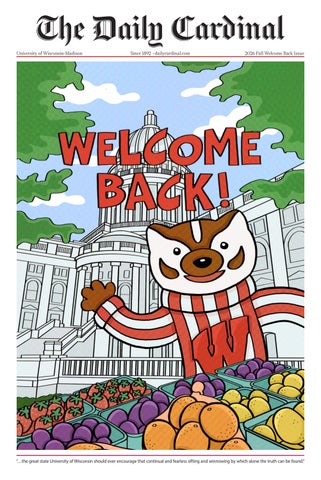
University of Wisconsin-Madison
Since 1892 dailycardinal.com l
2026 Fall Welcome Back Issue
“…the great state University of Wisconsin should ever encourage that continual and fearless sifting and winnowing by which alone the truth can be found.”
news l
2
Thursday, September 3, 2026
An independent student newspaper, serving the University of Wisconsin-Madison community since 1892 Volume 136, Issue 1
2142 Vilas Communication Hall 821 University Avenue Madison, Wis., 53706-1497 (608) 262-8000
News and Editorial editor@dailycardinal.com
dailycardinal.com
MMSD Board approves three Madison school name changes By Jane Dardik CITY EDITOR
Editor-in-Chief Alaina Walsh
Managing Editor Avery Chheda
News Team Campus Editor Sonia Bendre College Editor Grace Carlson City Editor Jane Dardik State Editor Audrey Lopez-Stane Associate News Editor Zoey Jiang Features Editor Jake Kilander Opinion Editors Brady Ahler • Siena Ferraro Arts Editors Ryan Kim • Liset Zacker Sports Editors Otton von Sothen • Hallie Opp Sports Associate Editor Luca Muehlbauer Special Pages Editor Natalie Popper Photo Editors Jonathan Mintz • Michael O’Connor Graphics Editors Eloise Guth • Klaire Maduscha Science Editors Lauren Eno • Addison Dama Life & Style Editors Isabella Bajaras • Jackson Baker Beet Editor Lizzi McGann Podcast Directors Yadiel Chavez • Amelia Fowler Digital Editor Meredith Schadrie Video Director Finnegan Ricco Copy Chiefs Emma Schieffer • Brendan Wolf Copy Editors Isabella Barajas
Business and Advertising business@dailycardinal.com Business Manager Wyatt Vail Marketing/Outreach Director Lydia Picotte Social Media Manager Aanya Agrawal Ad Manager Lauren Downham The Daily Cardinal is a nonprofit organization run by its staff members and elected editors. It receives no funds from the university. Operating revenue is generated from advertising and subscription sales. The Daily Cardinal is published weekdays and distributed at the University of WisconsinMadison and its surrounding community with a circulation of 10,000. Capital Newspapers, Inc. is the Cardinal’s printer. The Daily Cardinal is printed on recycled paper. The Cardinal is a member of the Associated Collegiate Press and the Wisconsin Newspaper Association. All copy, photographs and graphics appearing in The Daily Cardinal are the sole property of the Cardinal and may not be reproduced without written permission of the editor in chief. The Daily Cardinal accepts advertising representing a wide range of views. This acceptance does not imply agreement with the views expressed. The Cardinal reserves the right to reject advertisements judged offensive based on imagery, wording or both. Complaints: News and editorial complaints should be presented to the editor in chief. Business and advertising complaints should be presented to the business manager. Letters Policy: Letters must be word processed and must include contact information. No anonymous letters will be printed. All letters to the editor will be printed at the discretion of The Daily Cardinal. Letters may be sent to opinion@ dailycardinal.com.
Editorial Board Avery Chheda • Alaina Walsh • Brady Ahler • Siena Ferraro • Safa Razvi Chair Safa Razvi
Board of Directors Scott Girard, Chair • Don Miner • Nancy Sandy • Nathan Kalmoe • Jack Kelly • Gary Achterberg • Jennifer Sereno • Kelly Lecker
© 2026, The Daily Cardinal Media Corporation ISSN 0011-5398
For the record Corrections or clarifications? Call The Daily Cardinal office at 608-262-8000 or send an email to edit@dailycardinal.com.
The Madison Metropolitan School District (MMSD) Board of Education approved new names for three elementary schools on August 24, concluding months of community discussion and review. The name changes had a much shorter timeline compared to previous processes, with the board receiving proposals in March and April 2026 for the three schools. Lori Mann Carey Elementary School, formerly Southside Elementary and Ezekiel Gillespie Middle School, formerly Thomas Jefferson Middle School, were both successfully changed in previous years — each taking over a year for final board approval on the name changes. Beginning in the 2026-2027 school year, César Chávez Elementary School will become Roberto G. Sánchez Elementary School, Conrad A. Elvehjem Elementary School will become Ada Deer Elementary School
and Charles Lindbergh Elementary School will become Jeffrey Clay Erlanger Elementary School. The board approved the changes after reviewing recommendations from volunteer citizen naming committees. “The committees reviewed community-submitted name suggestions, considered the history and identity of each school and its surrounding community, and developed finalists for consideration by the Board,” MMSD wrote in a press release. The board voted earlier this year to remove Chávez’s name from César Chávez Elementary School following allegations of sexual abuse against the late labor leader. Community members submitted dozens of potential names before a citizen committee narrowed the list and gave its recommendations to the board. The school is to be renamed Roberto G. Sánchez Elementary School after the late University of Wisconsin-Madison professor Roberto García Sánchez, who advocated for bilingual and first-gener-
UW Regents approve Mosse demolition By Zoey Jiang ASSOCIATES EDITOR
The Board of Regents unanimously approved a 2027-29 biennial budget request which included a University of Wisconsin-Madison demolition plan for the Mosse Humanities Building with a proposed budget of $463.5 million. The project request states the money will be used to “demolish a portion of the original Art Lofts facility and the entire Humanities Building” as well as partially renovate the remainder of the original Arts Lofts facility and to fund a replacement where the music and art departments can be housed. Distribution of funds will be a combination of General Fund Supported Borrowing ($416.7 million) and other gifts and grants ($46.8 million). This is not the first time the Brutalist building’s survival has been questioned. UW-Madison first announced a plan to demolish Mosse in 2003. Since then, there have been multiple requests by the university to see the plan through. In the last biennium budget request, UW-Madison asked the state for $292 million in support and private contributions to demolish the building. “The budget request again proposes critical investment in UW-Madison’s infrastructure by finally demolishing the aging Humanities Building,” Interim Chancellor Eric Wilcots said in a university statement Aug. 20. “The building is well past its expected useful life, with a significantly deteriorated building envelope and exterior window/wall system, uncorrectable humidification conditions, and insufficient environmental controls,” the budget request said. “The building has had numerous chronic design, functional and operational issues that have been exacerbated over time with the aging of the structure.”
In a video published by UW-Madison Campus Connection in 2022, Mosse is presented with mold, water damage, an inability to install technology, odors and HVAC issues and fixed seating leading to safety concerns. The funding will also be allocated to construct a new facility and facility additions to continue supporting the art and music departments: Arts will see new two-dimensional (drawing, graphic design, painting) and three-dimensional (ceramics, printmaking, sculpture, wood shops, glass) programs. The budget will provide the music department with new student performance and exhibit spaces, and an improvement of sound separation and quality of practice environments. For the new facility, “multiple lecture classrooms will be constructed, and specialized instructional laboratories and studio spaces will be created with support for heavy equipment and appropriate ventilation and dust collection,” according to the budget request. Wilcots said in his statement the university will work closely with “colleagues at the Universities of Wisconsin, state business and industry partners, legislative leaders and Wisconsin’s next governor to ensure the important proposals in the budget request move forward.”the most attended philanthropic event at UW-Madison, but also as a defining campus tradition. “It’s just such a unique thing that, while winters suck and nobody loves the freezing cold weather, we’re still able to maximize it and utilize the lake that is right there — that is so unique to UW-Madison that no other campus has,” McNeely said. “It boosts the talk about the school, like people applying, and it just boosts the whole school’s image. I would hate to lose that factor and that unique thing about the school.”
ation students and started Sánchez Scholars, a scholarship program, after retirement alongside the Madison Community Foundation to provide support to these students. According to MMSD policy 6700, the board may not rename more than 2 public buildings per school year. However, the MMSD communications department said the Board may change names following a clause in the policy. “The third of our three recent renamings, for César Chávez Elementary School, was undertaken in line with item 12 of Board Policy 6700,” the department told the Cardinal. “The Board maintains the primary authority to initiate a renaming process at its discretion should it determine that an existing facility name is no longer consistent with the District’s mission, core values, or community standards.” Other name options for the school included Maple Grove, Ice Age Trail and Dejope. The renaming process started April 27th for Chávez
Elementary, one of the shortest renaming timelines in recent years. Ada Deer Elementary School will honor the late Menominee Nation leader, educator and activist who became the first Native American woman to lead the U.S. Bureau of Indian Affairs. Deer, a UW-Madison graduate, played a key role in restoring federal recognition to the Menominee Tribe and remained a prominent advocate for Indigenous communities throughout her career. Jeffrey Clay Erlanger Elementary School will recognize the Madison disability rights advocate who gained national recognition for his appearance on “Mister Rogers’ Neighborhood.” Erlanger, who used a wheelchair because of a spinal condition, spent his life advocating for accessibility and inclusion.designated pedestrian and accessible detours, watch for construction vehicles and obey flagger signals, and do not walk in roadways or cross in the middle of the road.”
Wisconsin Democrats hope for a trifecta in November elections By Addison Dama SCIENCE EDITOR
Wisconsin government has been divided for the past seven years. This November, things could change. Republicans have held a tight grip on the state Legislature since 2010, and the party controlled the Capitol until Democratic Gov. Tony Evers narrowly defeated former GOP Gov. Scott Walker in 2018. Now, Wisconsin Democrats are hoping for a trifecta: control over the Assembly, Senate and governor’s seat. A split government makes it hard for either party to pass legislation; Evers frequently vetoed Republican-backed bills, while the Democratic agenda stalled in the GOP-controlled legislature. Democrat Milwaukee County Executive David Crowley and Republican U.S. Rep. Tom Tiffany will face off for the governor’s seat in the Nov. 3 general election. Crowley previously served in the Assembly from 2017 to 2020 and won Evers’ historic endorsement in the primary. Tiffany has represented Wisconsin’s 7th
congressional district since 2020 and served in the Wisconsin Legislature from 2011 to 2020. Crowley narrowly defeated State Rep. Francesca Hong in the Democratic Primary in August. Democrats have an easier path to taking the Senate than the Assembly. Seventeen of the 33 state Senate seats will be up for election this November. Currently, Republicans hold the chamber with an 18-15 majority. Democrats only need to flip two seats from Republican control to win a majority, assuming they hold all of their current seats. New legislative maps may also increase the chances of Democratic wins. The Wisconsin Supreme Court struck down GOP-drawn legislative districts in 2023, and Gov. Evers signed new maps in 2024 to end what experts considered to be some of the most gerrymandered maps in the country. The new maps allowed Democrats to whittle the Republican majority in the Senate from 22-10 to 18-15 in the 2024 election. Continue reading @ dailycardinal.com
TY JAVIER /THE DAILY CARDINAL
news dailycardinal.com
Thursday, September 3, 2026
l
3
Fact-checking governor’s campaign attack ads to provide financial compensation to those charged in connection to the Jan. 6 Capitol riot — Tiffany expressed his potential support for the fund. Tiffany referred to defendants in the case as “victims” and said some could “possibly” be owed restitution, according to the Milwaukee Journal Sentinel. The fund was later blocked by a federal judge.
By Mary Al-Bazi STAFF WRITER
Both campaigns for the governor’s race have released ads attacking the other as the election amps up in order to gain supporters before the Nov. 3 election. Democratic nominee Milwaukee County Executive David Crowley has centered himself as a candidate that “wasn’t fed by a silver spoon” and who believes that “strong leadership can bridge divides.” “Congressman Tiffany is everything wrong with politics, and Wisconsinites will reject him, his lies and his extreme and expensive agenda,” Alexandra Gross, a Crowley spokesperson, said in a statement to The Daily Cardinal. Republican nominee U.S. Rep. Tom Tiffany currently serves in Congress for Wisconsin’s 7th District. He is running as a “lifelong Wisconsinite” who will “deliver real results for every Wisconsinite.” The Cardinal reached out for a statement to the Tiffany campaign but did not receive a response. The Tiffany campaign has released a number of ads attacking Crowley, most prominently one centered around his failures as Milwaukee County executive and another around Crowley’s position on AI and data centers. Crowley’s campaign has not directly launched ads attacking Tiffany, but Protect Our Wisconsin — a group backed by the Democratic Governors Association, on behalf of the Crowley campaign — attacked Tiffany on his MAGA alliances and legislation he supported during his time in Congress. “Failed Executive David Crowley spent recklessly” to contribute to Milwaukee County’s deficit: FALSE As county executive, Crowley said that general increased costs — from inflation and tariffs — in coordination with cuts in federal funding have contributed to a $46 billion county deficit. He also cites issues from past county leaders, which have been both Republicans and Democrats.
Tiffany “voted to slash social security services:” FALSE
FINNEGAN RICCO & CAMERON SCHNEIDER/THE DAILY CARDINAL
Act 12, passed in 2023, gave Milwaukee County the authority to increase sales taxes. Initially, the passing of the act contributed to a surplus in the 2024 fiscal year budget — the first in twenty years for the county. But when the surplus occurred, the county also predicted that harder times were already ahead as federal stimulus packages — meant to address funding needs in order to combat the pandemic — would expire. The county has faced a deficit every year but one since 2002, according to the Wisconsin Policy Forum. Crowley “raised property and sales taxes:” TRUE Without the Act 12 increase in sales tax, the county would be in an even greater deficit, Wisconsin Policy Forum President Jason Stein told PBS Wisconsin in June. Crowley also supported a referendum increasing property taxes that would provide Milwaukee Public Schools (MPS) with an additional $252 million in annual funding. With the passing of the referendum, enrollment at MPS schools is predicted to grow, according to the Wisconsin Policy Forum. Crowley “botched health insurance for thousands:” FALSE Through
an
administra-
tive error, 5,000 county employees lost healthcare coverage after Milwaukee County’s contract with UnitedHealthcare lapsed, according to Wisconsin Public Radio. Crowley later made an announcement that the employee who made the mistake had been dismissed. A new contract with UnitedHealthcare was signed following the lapse and Crowley released a statement and promised to “ensure compliance, improve processes and increase oversight” in future contract oversight. “Crowley wants you to pay” for “Wisconsin to be a data center hub for the ‘entire globe:’” FALSE Crowley will support data center construction based on a communityto-community basis, according to his campaign website. Regulations, transparency and renewable energy are important factors for his data center construction plan. In response to the attacks from the Tiffany campaign, Gross said Tiffany “is doing what any career politician does” by misrepresenting Crowley’s views on data center construction. “He can’t defend his own extreme record of backing Trump’s cost-raising agenda 100% of the time,” Gross said in the statement to the Cardinal. “Crowley won’t roll back data center tax incentives:” FALSE
In a questionnaire from the Milwaukee Journal Sentinel, Crowley said he does not think that data center tax incentives should be automatically rolled back, but rather data center companies must earn their keep and need “a more rigorous review.” “Crowley’s campaign is funded by the people building [data centers]:” FALSE Over $350,000 received by the Crowley campaign is from union workers, a Crowley spokesperson told the Cardinal. She said many have the opportunity to benefit from construction of data centers in Wisconsin. The top donors for Crowley’s campaign are primarily made up of PACs and groups representing trade and union workers, according to Wisconsin’s Sunshine Campaign Finance Reporting site. The WI Laborers District Council, the International Brotherhood of Electrical Workers PAC Voluntary Fund and the Wisconsin Pipe Trades Association PAC fund are Crowley’s top financial supporters — with each group contributing $86,000. Tiffany “supported Jan. 6 Capitol rioters:” TRUE After the Justice Department initially announced President Donald Trump’s anti-weaponization fund — a proposed $1.77 billion fund meant
Tiffany voted in support of the Limit, Save, Grow Act of 2023, which limits spending on programs such as the Supplemental Nutrition Assistance Program (SNAP) as well as Temporary Assistance for Needy Families (TANF) programs. The bill only passed in the House. Tiffany also voted in support of the Continuing Appropriations and Border Security Enhancement Act of 2024, but the bill did not contain any cuts to Social Security and failed to pass in the House. Tiffany “co-sponsored a bill to ban abortion with no exceptions for rape or incest:” FALSE Tiffany did co-sponsor the Heartbeat Protection Act of 2021 — a bill introduced, but not passed — that would fine doctors who performed abortions when they were aware of a detected heartbeat. The bill does include an exception when the life of the mother is in danger, but there are no references to banning exceptions for rape or incest. The Heartbeat Protection Act of 2023, which was introduced and not passed, banned abortions for fetuses with detected heartbeats. The bill was co-sponsored by Tiffany and did include exceptions for rape and incest. In a recent Marquette Law School poll — the first since the primary election on Aug. 11 — Crowley leads Tiffany by five points. The midterm election is set for Nov. 3.
UW System proposes four-year tuition pledge for students starting in 2027 By Caroline Clark STAFF WRITER
The Universities of Wisconsin are proposing a two-year tuition freeze beginning in 2027 if state lawmakers approve a $190 million increase on top of the UW System’s $730 million budget request. University officials said the plan would make college tuition more affordable while giving students and families greater certainty about future costs. Board of Regents President Kyle Weatherly and Interim UW System President Renee Wachter announced the unanimous approval of the proposed 4-Year Tuition Pledge by the Board of Regents to be in the budget on Aug. 20. The proposal would be a significant change for students following the fourth consecutive tuition increase in June, when in-state tuition rose 2%. The 4-Year Tuition pledge would include a 2-year tuition freeze during the 2027-2029 bien-
nium, followed by two additional years where tuition increases would be capped at the rate of inflation. If the proposal passes, students entering a UW System school in fall 2027 would have four years of predictable tuition costs. The additional $190 million in state funding would help cover operating costs, a problem Regents have cited in recent school closures. Six UW System campuses have closed in recent years, and UW-Platteville Baraboo Sauk County is next after former University of Wisconsin System President Jay Rothman ordered UW-Platteville to cease degree programs at its Richland Center campus. UW-Platteville’s Richland Branch closed in July 2023, followed by program closures at UW-Green Bay Marinette, UW-Milwaukee Washington County, UW-Oshkosh Fond du Lac, UW-Oshkosh Fox Cities and UW-Milwaukee Waukesha between 2024 and 2025. In May, UW-Stevens Point relocated their Wausau
branch to a nearby technical college. If the Legislature does not approve the funding, UW officials said a tuition increase may be necessary for the fifth consecutive year. “To make the 4-Year Tuition Pledge a reality and deliver the quality of education students deserve and parents expect, we need a state partner to fund ongoing operational expenses and help us, as was done for previous generations, fund basic education costs,” Weatherly said. The proposal would pair the 4-Year Tuition Pledge and the Wisconsin Work and Learn Program, an initiative intended to reduce financial barriers and increase workforce readiness. Together, the programs are intended to strengthen Wisconsin’s economy while making college more affordable. The Wisconsin Work and Learn Program provides full tuition for families earning at or below Wisconsin’s median household income
if the student participates in career preparation opportunities and campus jobs. “Together, the 4-Year Tuition Pledge and Wisconsin Work and Learn would provide families with greater certainty, remove financial barriers for thousands of students, and reaffirm Wisconsin’s longstanding belief that talent and hard work, not financial circumstances, should determine a student’s opportunity to succeed,” Wachter said. Currently, Wisconsin uses a two-year budget cycle that happens in odd-numbered years. The active state budget covers July 2025 through June 2027. The Governor will then present the new budget proposal in Feb. 2027, and the legislature will vote on the budget before July 2027. According to Weatherly, the proposal “represents an important commitment to Wisconsin families and helps ensure the Universities of Wisconsin remain the Midwest leader in tuition affordability.”
news
4
l
Thursday, September 3, 2026
dailycardinal.com
Madison ranked 12th happiest major US city By Jane Dardik CITY NEWS EDITOR
Madison was recently dubed the 12th happiest city in the nation for its high emotional and well being statistics in a study done by WalletHub. The study looked at 182 cities and considered numerous factors, such as adequate sleep rate, commute time, and separation and divorce rates. Rankings looked at three categories: emotional and physical well-being, income and employment, and community and environment. Madison ranked 13th, 30th and 19th in the respective categories. Max Besbris, an associate chair for the University of WisconsinMadison Department of Sociology, told the Daily Cardinal Madison’s placement could come from several elements. “Access to green spaces, shorter commuting times and high-quality public infrastructure are, in general, asso-
ciated with better health and well-being,” Besbris said. “So is higher education.” College towns tend to have higher incomes and professional workers, according to the Atlantic, which may contribute to the ranking as well. Haley Vindel Mejia, a Madison local and sophomore at UW-Madison, told the Cardinal she understands why Madison made twelfth place. “Madison has a lot of diversity compared to a lot of Wisconsin, so there are communities for minority groups that might not be found elsewhere,” Vindel Mejia said. “People from Madison are proud to be from here.” Madison was also ranked the 10th most caring city in another study by WalletHub looking at the same 182 cities. The criteria ranged from civic engagement and care for the environment to residents doing favors for neighbors.
Barbara Arnoff moved to Madison 10 years ago with her husband for a job opportunity, something she said attributes to her appreciation for Madison. “The city is filled with opportunities, big and small,” Arnoff told the Cardinal. “I’m thankful fate pushed us in the right direction where there’s such community and love for all ages, beliefs, and lifestyles.” Arnoff said her favorite things about Madison are the many outdoor spaces and diverse food options, something she attributes to the high population of college students. Besbris noted the study may not consider all inequalities in Madison communities. “Yes, Madison has a lot of high-quality, high-income jobs, but it also has a very high and rising price-to-income ratio and is rising on measures of income inequality,” Besbris said. “The ranking isn’t looking at what it actu-
COURTESY OF WIKIMEDIA COMMONS
ally costs to survive in a place like Madison and is instead showing that the most advantaged are doing pretty well.” He said people need freedom to spend their time how they want in order to be happy. “When people are food insecure, housing insecure, can’t get medical care or meet other basic needs, they aren’t thriving,” Besbris said. “Madison, I think, does well in many of these areas, but it still exists in a country where these basic needs are out of reach for many.”
Vindel Mejia said the UW system’s success can sometimes overshadow local issues. “UW brings in younger, happier people, but the bigger picture of MMSD and other districts does not have the same effect,” she said. Dane County has one of the highest percentages of physicians per capita in Wisconsin at 12.8 physicians per 10,000 residents. This is more than any U.S. state’s average and the national average. UW Health may contribute to this as the top hospital in Wisconsin.
UW football pays the bills, hockey brings home the trophies pays the bills, but hockey gives you the pride,” Kowalski said. Men’s ice hockey, similarly, generates $4.06 million in annual revenue. The program has six national titles of its own and routinely fills the Kohl Center with fans. Combined, the UW-Madison ice hockey program represents the gold standard of collegiate competitiveness — and what UW-Madison sports should represent.
By Zoey Jiang ASSOCIATE NEWS EDITOR
On autumn Saturdays in Madison, more than 80,000 red-clad fans pack Camp Randall Stadium, waiting for “Jump Around” to play and for the Wisconsin football team to take the field. College football at the University of Wisconsin-Madison has never been just a sport — it’s a multi-million dollar source of revenue, a cultural institution and the financial engine of Badger athletics. And yet, there’s a stark paradox between some Badger sports. Wisconsin’s football program is the undisputed financial driver for the university’s athletic program. In the 2025 fiscal year alone, the program generated $113.6 million — accounting for 57% of UW-Madison’s total athletic revenue. Even after accounting for $41.5 million in direct team expenses, football delivered $72.08 million net surplus to the athletic department. On the field, however, the returns are harder to measure. Wisconsin posted its worst two seasons in the 21st century in 2024 and 2025, with a finishing record of 5-7 and 4-8, respectively. The program’s winning percentages also fell from more than 90% to below 50% from 2017 to 2024, according to Center for Research on the Wisconsin Economy (CROWE). Meanwhile, UW-Madison’s women’s hockey team seems to be thriving as one of the most successful programs in the country — winning its ninth NCAA championship in March and sending six players to the U.S. Olympic team that won gold at the 2026 Milano Cortina Winter Olympics. The women’s ice hockey program operates with a $3.15 million annual deficit. Yet, what the program possibly loses in dollars, it repays in performance. Football’s underwhelming returns to revenue According to an analysis of UW-Madison’s Fiscal Year 2025 financial disclosures, the athletic depart-
Economic paradox of college sports
JOE KIM/THE DAILY CARDINAL
ment generated $197.9 million in overall revenue against $193.6 million in total expenses. That financial contribution is invested into the broader department, supporting talent, leadership and sports that generate less revenue on their own. The economic impact of football extends beyond the athletic department, too. Big Ten media rights, ticket sales, donations and game-day spending all contribute to the broader financial ecosystem surrounding the program. Wisconsin State Journal reported that head coach Luke Fickell receives $7.7 million annually in total pay, with assistant coaching pool investments reaching $6.91 million per season. Despite this massive influx of institutional and donor backing, football’s recent on-field payout has felt somewhat pedestrian. For longtime fans who have watched the evolution of Badger athletics over the decades, the cultural shift is clear. “I’ve chosen seats in Section T at Camp Randall ever since 2003,” Mark Kowalski, 68, a lifelong Badger fan from Sun Prairie, said. “Back then,
you felt like every dollar you spent was going into honest work. This year, I just decided not to purchase the season’s ticket package, among other factors.” Hockey becomes the championship factory If football is Wisconsin’s financial powerhouse, women’s hockey is its championship factory. With a studded trophy case including gold medals from multiple Olympics, women’s hockey brings in some of the most accolades for UW-Madison. Mark Johnson, the women’s hockey head coach, earns a base compensation of $550,000 according to the WSJ article. His coaching investment efficiency makes the women’s hockey trophy haul even more compelling. While Kowalski has never personally been to a women’s hockey game, he said he can see how prideful it makes Badger fans. “Maybe you’re, you know, watching these women be the absolute best players on Earth. And they’re winning trophies year after year. It’s like football
The answer to why a financial imbalance exists lies in the fundamental structure of higher education sports economics, according to a 2022 report on the economic impact on UW athletics. Football does not exist solely to win titles — one of the main reasons is to bankroll the entire university athletic ecosystem, according to the report. The $72 million surplus generated by Camp Randall on football Saturdays directly subsidizes the operating budgets of 18 non-revenue sports, from rowing to swimming and even women’s hockey. UW-Madison views football funding through a commercial lens rather than a purely achievement-driven one. An eight-win football season that yields $113 million in revenue is an institutional financial victory, even if it leaves fans dissatisfied. Conversely, a women’s hockey national championship brings national pride and prestige, but requires financial cross-subsidization from other profits. Maintaining the face of football and its driving source of revenue is essential for certain department operations, but the university’s championship record continues to be achieved primarily by programs operating on smaller budgets. “Madison sports fans understand the basic economics,” Kowalski said. “From a consumer perspective, when you spend significant money on tickets and donations, you expect the sport to compete for championships at the same level as the lower-budget sports.”
news dailycardinal.com
Thursday, September 3, 2026
l
5
Wisconsin ranks 43rd nationally in university funding, 7th for technical colleges By Sean Walsh STAFF WRITER
A new report from the Center for Research on the Wisconsin Economy (CROWE) highlights a funding disparity between Wisconsin’s technical colleges and public universities, with technical colleges receiving twice as much money per student than universities. Wisconsin gave $14,099 per full-time student to its two-year technical college system in 2025, compared to $6,974 per its public university students, according to the report. Wisconsin ranked 43rd nationally in per-student funding for four-year universities and seventh for two-year technical colleges — making it the only state with a funding gap that wide. The disparity, researchers argue, is not a difference in how much Wisconsin spends on higher education. It is the result of a
funding system built more than a century ago that has not kept pace with the state’s shift toward an economy increasingly reliant on services, information and jobs requiring four-year degrees. The report argues Wisconsin could narrow the gap by redirecting existing higher education funding toward its universities rather than increasing overall spending. The report was written by Junjie Guo, a research economist at CROWE, and Ananth Seshadri, an economics professor and co-director of the Center. CROWE is a University of Wisconsin-Madison based research group dedicated to studying the state’s economy. In 1911, the State Legislature passed a law that made Wisconsin the first state in the country to build a system of technical schools. The law required any city with 5,000 or
more residents to establish a trade school and a local board with the power to levy taxes for the school. Wisconsin backed the system with direct funding and created the State Board of Industrial Education to oversee it. This early network, funded and expanded over the following decades, grew into today’s Wisconsin Technical College System. The report argues the State Legislature never readjusted the funding as the economy shifted toward services, information and knowledge work. “The economy moved,” Guo and Seshadri said in the report. “The plumbing did not.” Wisconsin’s technical colleges can levy property taxes, issue debt and own their buildings, while UW system campuses can’t — a large difference in financial freedom.
‘The future looks amazing’: UW-Madison welcomes students at Convocation By Sonia Bendre CAMPUS NEWS EDITOR
University of Wisconsin-Madison Interim Chancellor Eric Wilcots and faculty welcomed just under 6,000 first-year and new transfer students to campus at the university’s annual convocation on Sept. 1 at the Kohl Center. Each faculty speaker highlighted one of UW-Madison’s four community commitments: practicing civility, fostering connection and community, embracing complexity and providing opportunities for growth and success. Educational psychology professor and special advisor to the provost for community belonging and engagement Percival Matthews developed the commitments as part of UW-Madison’s BadgerWay strategic framework, which launched in April 2026. Of over 75,000 applicants representing all 50 U.S. states, all 72 Wisconsin counties and more than 130 countries, nearly 10,000 entered UW-Madison this year — including about 8,600 first-year students and around 1,100 new transfer students. As students trickled in from the Chancellor’s Welcome Lunch on the Sellery basketball courts, the UW Marching Band kept those already seated entertained with pieces like “Hey Baby,” “Mr. Brightside,” “If You Want to Be a Badger” and “On Wisconsin.” Redefined A Cappella, a student organization, warmed up with “This Love” and “Work Song,” then led the national anthem. Students heard speeches from Wilcots, Matthews, Provost John Zumbrunnen, Vice Chancellor for Student Affairs Lori Reesor and Azi Fanale, a junior majoring in political science, philosophy and international studies. Zumbrunnen spoke about UW-Madison’s educational breadth. The university has over 230 majors and certificates to choose from and
more schools and colleges than all but six other universities in the country. “You’ll build your skills in critical thinking, effective communication and careful listening: skills that will prepare you to succeed in a complex world much better than ChatGPT, and maybe even better than Claude Mythos,” Zumbrunnen said. Wilcots encouraged students to practice intellectual curiosity and humility when engaging with others “who see the world differently than you do.” “We want you to have the skills to challenge each other’s ideas without tearing each other down,” he said. Fanale’s speech used the Allegory of the Cave — a thought experiment in which a cavedweller sees the light of the world for the first time — as a metaphor for the UW-Madison educational experience. Fanale, who read the story in her Philosophy 430: History of Ancient Philosophy course last year, encouraged students to belong to, work for and leave behind something bigger than themselves during their time at the university. Fanale told The Cardinal her experience navigating friction on UW-Madison’s campus helped her this summer when she worked at a bipartisan lobbying firm in Washington, DC. “It was super interesting to view issues and different legislation being passed from across-the-aisle viewpoints,” she said. “The skills that I’ve learned in [Letters & Science] but also UW-Madison as a whole have really helped me… it’s so important what we learn, but also [what is] just as important, maybe even more, is: how can we use that to help other people in our daily lives?” Continue reading at dailycardinal.com
Two La Crosse building projects highlight this difference. Western Technical College proposed a $79.8 million renovation plan to voters in 2012 and the funding was approved on the same day it was voted on. The University of Wisconsin-La Crosse waited seven years and four state budgets for a new science building. The funding system worked when it launched in 1911, according to the report but it argues the state kept pouring resources into the same places despite the economy shifting. Today’s highest-paying jobs increasingly demand a four-year degree, yet Wisconsin’s university system sits “near the bottom” nationally in funding, the report found. The authors don’t think Wisconsin needs to spend more overall. As they put it, “the problem is where the money goes” — they suggest the state legislature should shift more money and resources toward its universities.
Dina Nina MartinezRutherford talks education, plans for Legislature By Audrey Lopez-Stane STATE NEWS EDITOR
Dina Nina Martinez-Rutherford said the color orange “totally typifies” her personality. That’s why she chose it to represent her Assembly campaign. “It’s hopeful, it’s bright, it’s fun. That’s who I am,” Martinez-Rutherford told The Daily Cardinal. Rather than centering a campaign around the color blue — to signify the Democratic party — she felt the color orange was “more connective than divisive.” She also felt that it was a symbol of good. “In the middle of great turmoil, joy and laughter and fun and whimsy and quirkiness are all part of what saves us,” Martinez-Rutherford said. “There’s something good coming… I will endeavor to be that good.” Martinez-Rutherford won the Democratic nomination for Wisconsin’s 76th Assembly District in August. While she has a Republican opponent, Nina Chat, Martinez-Rutherford will likely win in November due to the district’s historically bright blue nature on Madison’s east side. Martinez-Rutherford is an open transgender woman, who will be the first transgender person in the Wisconsin State Legislature if elected. She currently serves on the Madison Common Council and represents District 15. Rep. Francesca Hong, D-Madison, currently holds the 76th District. She is one of the most prominent democratic socialists in Wisconsin and narrowly lost the Democratic primary for governor to Milwaukee County Executive David Crowley. While Martinez-Rutherford said she and Hong share similar policies, particularly since they both share a background working in a restaurant, she said she will have her own spin in the Legislature. Universities of Wisconsin System funding
LAUREN ENO/THE DAILY CARDINAL
The gap has shown up in recent budget fights as well. Gov. Tony Evers signed Wisconsin’s 2025-27 state budget in July 2025 — securing a $256 million increase for the University of Wisconsin System — a fraction of the $856 million that was requested. University of WisconsinMadison’s share went largely toward maintenance and renovation — including more than $160 million for Science Hall repairs — rather than new construction. The university’s request to build a new residence hall went unfunded, and a request for $292 million to demolish the aging Mosse Humanities building was cut to $5 million. “Future budgets should rebalance toward the four-year sector rather than presume that a larger total higher-education budget is required,” Guo and Seshadri said.
Martinez-Rutherford said she wants to “revive” funding for the Universities of Wisconsin System and remove impediments to higher education in Wisconsin. “Education is paramount to creating the future that we want, the future that we see,” Martinez-Rutherford said. The UW System received the largest
COURTESY OF DINA NINA MARTINEZ-RUTHERFORD
funding increase in two decades in the last biennial budget. While Gov. Tony Evers had initially proposed $856 million, he and Republican legislative leaders settled on $256 million. In 2024, Wisconsin was ranked one of the lowest in the country for four-year university public funding. Now, the Board of Regents approved a proposal that requests a $730 million increase for the UW System in the next budget, and that would give the University of Wisconsin-Madison an additional $260 million. “University of Wisconsin System is one of the best in the country, and it needs to continue to be the best,” Martinez-Rutherford said. “I believe that with the right funding… we’ll be able to restore that and really be a shining beacon for the rest of the country.” Data centers Martinez-Rutherford has taken a hard stance on data center reform throughout her campaign, and she said she would want to instate a moratorium to allow for guardrails to develop before construction of any new data centers. Data centers have been given tax breaks in recent budgets to bring economic development, but the Legislative Fiscal Bureau now projects the subsidies to cost the state more than $2 billion in sales tax revenue. Continue reading at dailycardinal.com
column
6 • Thursday, September 3, 2026
dailycardinal.com
Bascom Hill is alive with the sound of journalism By Alaina Walsh & Avery Chheda EDITOR IN CHIEF & MANAGING EDITOR
State street is bustling, Memorial Union Terrace is packed and the University of Wisconsin-Madison is alive with the sound of journalism. Which is a nice way of saying we made it, yet again, to another first day of class (FDOC as known on the streets). For three months, this campus was a ghost town populated by 12 graduate students, multiple very confused summer orientation families looking for a non-heart-straining way up Bascom Hill and whoever was brave enough to still jump in the lake even though it looked like toxic sludge. Now, overnight, there are 45,000 of you and State Street sounds less like a sleepy Midwestern avenue and more like a marching band warming up in a parking garage. And it’s not just the noise — it’s the energy. U-Hauls are double-parked on every street bordering campus, unloading enough mini-fridges to stock a small Culver’s. Somewhere, a parent is nearly in tears saying goodbye outside a dorm, and somewhere else, a returning junior is walking past that exact scene completely unbothered, mostly because they’re on their way to buy a couch off Facebook Marketplace for $20 that they will absolutely regret owning by October. Camp Randall is dusting off “Jump Around,” Mifflin Street residents are already fielding noise complaints that haven’t technically happened yet and somewhere out there, a freshman is asking for directions to Van Hise, which, respectfully, is a building that requires its own search party and possibly a park ranger. We’ve missed this. We’ve missed the chaos of trying to cross Library Mall without getting run over by a bike, an e-scooter or, believe it or not, a Tesla throwing marijuana (yes that happened, read our coverage here). We’ve missed gaslighting ourselves into thinking the walk around Bascom was shorter than walking up it. We’ve missed the Terrace chairs being rearranged into increasingly ambitious formations by people who clearly have too much free time and not enough due dates yet. No one has figured out the bus routes, but don’t worry they are really just a myth that we all mutually agree to participate in because riding around in circles with 100 mouth breathers has to be better than walking in the Wisconsin snow. And let’s be honest, the 80, while convenient, is also just a cesspool for 10 different bacterial viruses at any given moment. A friendly programming note, for the freshmen especially: enjoy this weather while it lasts. Right now
Madison is doing its very best impression of a place with a pleasant climate — Terrace weather, lake weather, “let’s eat outside” weather. This will last approximately eleven weeks. Somewhere around late October, the wind off Lake Mendota will personally insult you, and by February you will understand, in your bones, why every building on this campus should be connected by a tunnel system. Buy the good coat now. Buy it big enough to layer under. Future you, sprinting across East Campus Mall in a windchill advisory, will send present you a thank-you card. For those of you who don’t know us yet — hi, we’re your
Editor-in-Chief and Managing Editor this year, which mostly means we’re the two people most likely to be found in the Cardinal office at 1 a.m. arguing about a headline, an em dash or whether “Terrace” needs a capital T (it does, we checked). Running a 130-plusyear-old student newspaper is a strange kind of honor: we get to spend our year being nosy on your behalf, showing up to the meetings you don’t have time for, filing the records requests you didn’t know you could file and generally making sure your knowledge of the world doesn’t just come from Badger Barstool. We take that seriously. We also take approximately zero days
off, but that one’s on us. We’ve been doing this since 1892 (The Cardinal we mean, not us personally…. Oh dear no), which means the Cardinal has now outlived several U.S. presidents, at least one campus building and countless attempts to replace print journalism with something “more efficient.” We’re still here. We still care. Read the paper. Yell at us about it if you want. Comment on our social medias as much as you’d like, we just ask that you…..read the articles first? Safe to say we aren’t going anywhere, though. As a matter of fact, you’re about to see a whole lot more of us. Start checking the stands every Thursday because we’ve
upgraded. The Daily Cardinal is officially returning to weekly print for the first time in six years. Whether you need to get up to date on elections, you’re curious about upcoming events or you just want to solve a crossword (now included in every print edition!), the Cardinal is at your disposal at the very agreeable price of $0. Welcome back. Or, if this is your first time: welcome. You’re going to lose an umbrella, gain a caffeine dependency and eventually develop strong, unshakeable opinions about which dining hall’s stir-fry station is superior (and it’s Monday nights at Gordon’s btw). That’s Madison, and that’s us.
The Daily Cardinal Crossword • By Ryan Mathiason Across
Down
1 Flinch, perhaps 6 “For Pete’s ___” 10 Go back and forth? 11 Shape of the Packers logo 12 Not as moist 13 Venue for a broomball game 14 Charged particle 15 ___ Island (Massachusetts’s neighbor) 17 Event at the Kohl Center on Sept. 9th and 10th 19 They speak louder than words, some say 23 ___ Block Party (Sept. 4th event hosted by RecWell) 26 Turkey ___ (Thanksgiving event) 27 Spooky-sounding Great Lake 28 Lower leg bone 29 MacTaggart’s, for example 30 Focus of “Ocean’s Eleven” 31 Outdoor volleyball court surface 32 ___ Lauder (cosmetics brand)
1 What WSUM 91.7 produces 2 Fact-checker’s catch 3 Getting older 4 Prompt for a performer 5 Memorial Union space with Sunburst chairs 6 Places where college kids might be in a rush? 7 Like diehard Badger fans 8 ___ Brown (singer performing at Library Mall on Sept. 5th)
1
2
3
4
9 Antlered animal 16 Battleship success 18 Card that might get declined at the bar? 20 Travel around the world, in a way? 21 It’s kept to a minimum in libraries 22 Wisconsin, e.g. 23 They’re lofted in dorm rooms 24 Geometry calculation 25 Oven used in art classes 28 Part of BTW or WTF
5
6
10
11
12
13
14 17
7
8
9
15 16 18 19
20 21 22
23 24 25
26
27
28
29
30
31
32
life & style dailycardinal.com
Thursday, September 3, 2026 7 l
A changing city: What’s new to Madison Berezhanskiy said. The Chazen can be a popular place for instructors to take their students to for both inspiration and for an insight to the cultural context of the time period being studied. As classes start up again, Berzshansky said she hopes students will get to look at more than just “pretty things” as a result of the reimagined galleries. “The way that the galleries are organized allows you to connect the art to many things,” Berezhanskiy said. “To increase conversations that extend beyond art, but also let you understand how art is so interwoven into our world and our lived existence.”
By James Norcross STAFF WRITER
Scaffolding provides a brief shield from the summer heat as you wait for the walking man to return to a never-ending red light. On your right, a fence stands between you and building construction and on your left, students talk amongst each other with pizza slices in hand. Gazing in the distance, you realize the city has changed. Cranes and halffinished buildings make the skyline look like a blueprint of what’s to come. There’s a new high-rise apartment, an art museum and restaurants. But, despite how it all sounds, no, I’m not writing about New York City for The Daily Cardinal. This is Madison, Wisconsin. If you’re returning to Madison this semester you’ve probably noticed the city’s new appearance. While construction rampaged the city this summer, new buildings were erected, old ones received makeovers and there have been more than a few additions to Madison’s food scene. Here’s a glimpse into some of the city’s new offerings for students to explore this fall. Lots of Pizza Strada may have to prepare for competition as a new Wisconsin Union Italian offering arrives: Pedone Pinsa. The pinsaeria, located in the Discovery Building on N Orchard Street, serves a Roman style pinsa on a thin, light crust. For students who need a quick bite between classes but don’t want to overspend on Badger Market snacks, they have an enticing offer: the pinsa only takes 90 seconds to cook, and won’t be a huge hit on your wallet at $11.95 a pinsa. Wesley Erpelding, a rising junior at the University of Wisconsin-Madison, told the Cardinal Pedone Pinsa could become a new staple for him, as he eats lunch at Union South “once a week.” “I think Strada pizza is not good at all,” Erpelding said. “I think [Pedone Pinsa] is gonna blow it out of the water.” If students want a break from the Roman experience, they can get a taste of both Sicily and
A New Humanities Home
JONATHAN MINTZ/THE DAILY CARDINAL
Philly at Frank & Andrea, a Minneapolis-based pizza and cheesesteak joint that has opened its second ever location under the Hub apartment building on N Frances Street. Erpelding, however, said he does not have high hopes for the new spot based on his experience at their Minneapolis location. “It’s abysmal. They don’t keep it in the oven long enough and the cheese never melts,” Erpelding said. “It’s gonna be tough to compete with Ian’s.” While I cannot say how the pizzeria will fare for UW-Madison students who pledge their 1 a.m. weeknights to Ian’s, I can only hope that Hub hands out free pizza and cheesesteaks the next time they advertise their leasing options on State Street. A Reimagined Art Museum For many, the Chazen Museum of Art has been under construction for their entire time at the university. This was mostly the case for The Elvehjem building, which houses
parts of the museum and has been adorned in scaffolding since 2023. But after a full closure of the Chazen for reinstallation this summer, the museum will gradually reopen throughout the Fall semester. “Recollection,” a first-floor exhibition to provide historical context for the museum’s new collection is now on display until Dec. 23. The first two floors of the museum will be reopened by Sept. 8, with more following as the semester unfolds. Dasha Berezhanskiy, a rising junior at UW-Madison and a tour guide at the Chazen, told the Cardinal all the permanent galleries will be based around a “focus object” that will help tell the exhibition’s story. She said some galleries will consider the “impact of trade and interactions between Europe and Asia.” This concept differs from how many art museums organize their collections, typically by time period or geography. Berezhanskiy said the idea came to Katherine Alcauskas, the chief curator of the Chazen, on a bike ride. “She saw it as a nucleus of an atom and the electrons spinning around it,”
After years of discussion, the polarizing Mosse Humanities Building has finally… not been demolished. Instead it’s been joined by the newly-opened Irving and Dorothy Levy Hall at North Park Street and West Johnson Street, a new home to eight humanities departments. The building will house African American Studies, American Indian Studies, Asian American Studies, Chicano & Latino Studies, Gender & Women’s Studies, History, Jewish Studies and Religious Studies. While many are eager to get rid of the original Humanities building, I think that — maintenance issues and all — Harry Wesse’s brutalist beauty plays an integral role in the campus. What other building has a courtyard where I end up being happy to see everyone I know while on a lunch break? Though the new building is certainly more modern, there’s a certain charm to learning about history and pondering large questions in a confusing concrete building. While construction has finished for this fall’s additions, both the campus and city continue to change. There are still many more campus buildings to be built, renovated and demolished. Though I wish John Nolen Drive could halt construction for at least long enough for me to resume my running loop again.
A freshman’s guide to a festive fall at UW-Madison By Yareli Gutierrez STAFF WRITER
You’ve settled into your dorm, classes are underway and starting college doesn’t feel quite as overwhelming anymore. Maybe you’ve met a few people in your residence hall, exchanged socials and started to find your way around campus. But now that the first day’s excitement is wearing off, you might be asking yourself how to step outside of your comfort zone and find community at the University of Wisconsin-Madison. Contrary to popular belief, you don’t have to stick with the first freshmen you meet during Welcome Week to find your people in Madison. There are a number of activities in Madison that give freshmen the chance to experience something new and make friends. So, here’s a few ideas to make Madison feel a bit more like home. The Student Organization Fair Trying new things can feel intimidating, especially if it’s your first time away from home or out of state. Audrey Hardman, a UW-Madison senior and Wisconsin Welcome intern, encourages freshmen not to let this hold them back. “Most of the events are ones that students can go to by themselves,” Hardman told The Daily Cardinal. Hardman explained that late-night events are often especially welcoming because they take place near the residence halls and are designed for stu-
dents who want to make new friends. “From get-to-know-you activities to events with fun giveaways like free succulents, these events give students something to do and a chance to meet others,’’ she said. The Student Organization Fair is a great event to check out if you want to get involved on campus early in the semester. The fair takes place at the Kohl Center on Wednesday and Thursday, Sept. 9 and 10, from 5-8 p.m. The event is a chance to explore all of the clubs and organizations at the university. Whether you already know what you want to join or are still exploring, you can talk to students from different orgs and see what catches your attention. Leah Newman, a UW-Madison junior working for the Office of Student Transitions and Family Engagement, also encourages firstyear students to attend the Student Organization Fair. “Students can go alone and talk to different groups and orgs on campus. I recommend they take a notepad and make notes of what they see and what orgs they’d see themselves in,’’ Newman told the Cardinal. For freshmen looking to branch out at the beginning of the semester, the student unions are popular and easy options for getting out of your dorm.
WUD Film Presents: Project Hail Mary: On Saturday, September 5, students can attend a free showing of Project Hail Mary at The Marquee in Union South from 7-9:45 p.m. This is a great chance for freshmen to get out of their dorms and relax in a casual setting. Going to watch a movie means you don’t have to worry about making conversation the whole time. You can bring your roommate, invite someone you met in class or just come on your own. It’s an easy way to try something different, get comfortable on campus and experience one of the many unique things campus has to offer. Maybe you can even update your Letterboxd while you’re at it. WUD Games: Game Nights: Another way to branch out is by attending game nights at Union South every Sunday starting on Sept. 6. Game nights include board, video and VR games; just make sure to bring your Wiscard. Playing games makes it easier to start conversations, so you don’t have to worry about awkward introductions. Joining a game is an easy way to break the ice and start feeling more at home on campus, even if you don’t have a group to come with. Snake on the Lake: Music Festival: Sharing music is a great way to
JONATHAN MINTZ/THE DAILY CARDINAL
make new friends. WSUM and WUD Music are putting on their annual Snake on the Lake music festival on Friday, Sept. 11. The event is free and takes place on the Memorial Union terrace. You can enjoy live music from Why Bonnie, Baileys and Half Gringa. Come for the music, stay for the dancing and maybe grab some ice cream from Daily Scoop. Tips from upperclassmen Conversations about majors and hometowns can only get you so far, so it’s important to focus on making friendships that’ll last beyond welcome week. For Makeda RenfroSargent, a UW-Madison junior, many of her first year friendships stayed sur-
face-level. It wasn’t until she decided to take initiative that she started building deeper connections with her peers. “When you really take the chance to invite someone along, include someone with your friends or in your activities and your hobbies, meaningful friendships can form. And you might end up learning about all sorts of new cool things you can do on campus and expand your circle,’’ Renfro-Sargent told the Cardinal. Julia Ilarraza, a UW-Madison senior, recommends making new friends in places you already like to spend time. Meeting people who share your interests can make it easier to start a conversation and connect. Continue reading @dailycardinal.com
Surfin’ into the New School Year: Editors 2026
special pages
6 • dailycardinal.com
hief C n i r o t i d E
sh
Alaina Wal
o: g forwoaurdr 1t35 Lookin ratingry as a celebiv ann epraspaer
Science s
Editor
r
effe Emma Schi
ory: m e m r e m m Fav sug New York City vistin
ed
a Fav sum visiting mer memo for theNefiw York Crityy: rst time
Addison Da
Looking for ward to: philostoapkhinyg a course
Graphics
Video
emoriyly: m r e m m u s Fav ing my fam d visit in Maine ant! cabinhing the sunse watc
er Liset Zack
ory: r memvis e m m u s v a F to it goingytoanCdAmy best famil nd from UW frie
r memvoisryit: e m m u s v a F g to NYC to goin ome friends s
s College New tane S z e p o L y e Audr
Zoey Jiang
Marketing
Jonathan Mintz Natalie Popper
Opp
ie ard toth: e l l e Ha g forwith aldl fillineg kining wrs anes som o o L ork rite pag ries w ts w rts sto g r sptohe spmoazin a
Podcast
Jackson Baker
Fav summer memory: having the best time ever with my campers and getting to be a role model for them!
er l w o F a i l l e Am ometown
y: mydhuction r o m e m r e m on a pro Fav suhm act t eataren pGuirtls and I gotterto of Mealongside my sis
Lo It ’s myoskeinngiorforward to: year, so want subjecttos tIalokve it all in. StuI djuystth e e, spend t e frie with apprecniadtse atth the Cardinim ttle thinagls aanbd living einliM out adison.
Fav summer memory: I hosted a movie trivia night for my friends which was super fun!
eer Hallie Egels
City Ne w
s
Isabella Barajas
Jane D a
Fav summer memory: My sister got me a guitar for my birthday and I’ve loved getting to learn to play it
Social Media
Life & Style Fav summer memory: visiting Cape Cod with my friends and painting on seashells
Associate News
umm:er Fav sm me orgyand in ry swimm in n tan ngd eavtethe e weekm k! e M U doc
Life & Style
Special Pages
Lizzi McGann
Looking forward to: college hockey starting up again d watching the Badgan ers take home their championships!
Photo
rts o p S
uer
State News
on s l r a C e c a r G
o: g forwoafrrdietnds Lookinclo t beingin Mseadison
ard teols: ! w r o f g in k o Lo ewsre producing n
ard tofor w r o f g in k o Lo g crosswords d I makin dinal,saonlving r a C y il a D The rs enjoy hope readethem!
ward Lookingtof:or sing annge e a r c d w o n h e s B a Soni panseivnet rvaoices x e : y r o of stuhde opinion er metm ll a f r e Fav sugmtm a in t n this year w hikin inoInadia! sectio
h Eloise Gut
rom Ted Hyngst
on s a i h t a M n Rya :
ro Siena Ferra
ma
Arts
lba Luca Mueh
The Beet
Opinion w Campus Ne
Avery C hh
Sports
Thursday, June X, 2025 • 7
Puzzles
Copy Chief
Managi ng
PHOTOS BY JONATHAN MINTZ
rdik Fav sum wa ng mer me mory thro witlhkim seeing y bestufgrhi Pompe: ii the insa end an ne hist d ory
ward Lookingtof:or road studyisinSgparbing th
Arts
Aanya Agrawal
Fav summer memory: getting to spend time with my family and friends from back home
Ryan Kim
Looking forward to: starting J202 and 203!
NATALIE POPPER / THE DAILY CARDINAL
arts
10
l
Thursday, September 3, 2026
dailycardinal.com
Watch, listen and read as you settle back into campus By Liset Zacker
“The Perks of Being a Wallflower” by Stephen Chbosky Chbosky’s 1999 coming-of-age story remains a staple in back-toschool reading. The epistolary novel follows Charlie, a freshman working through the trials of high school and making new friends. For those who feel like a small fish in the very large UW-Madison pond, this book is just what you need.
ARTS EDITOR
As the temperature continues to drop and students move back to campus, summer in Madison is slipping away. Amid reunions with friends, it can be hard to let go of summer vacations and log back on to Canvas. To get students back into the school spirit the University of Wisconsin-Madison is famous for, The Daily Cardinal has created a list of movies, songs and books to spur some joy during the apprehensive back-to-school season. PHOTOS COURTESY OF WIKIMEDIA
For watching: “Pitch Perfect” Sing and dance along to this backto-school essential, which follows college student Beca as she joins the Barden Bellas, a campus a capella group. This musical comedy depicts the anxieties of freshman movein, the fear of going to the club fair and that first college crush. Maybe you’ll even be inspired to join one of UW-Madison’s a capella groups. “21 Jump Street” Starring Jonah Hill and Channing Tatum as undercover high school students, “21 Jump Street” is a wholly inaccurate and yet entirely relatable depiction of the drugs, sex and rock and roll of high school. The film’s genius lies in its flipping of high school
tropes and its unexpected deep look into adolescent anxieties. “21 Jump Street” will make you mourn high school yet leave you relieved you’ve left those days behind. “Good Will Hunting” The Academy Award-winning “Good Will Hunting” follows misfit Will Hunting (Matt Damon), a 20-year-old janitor at MIT whose genius-level IQ is discovered when he solves a graduate-level math problem on a hallway chalkboard. What follows is Hunting’s journey to reach his full potential, fall in love and confront the traumas of his past. This movie will make you laugh, cry and fall in love with learning, leaving you inspired to solve hard math problems. Or at the very least, to do
some of your homework. For listening: “Jump Around” by House of Pain Not only is “Jump Around” the anthem of UW-Madison, but its repetitive message will get you on your feet, jumping the jitters away. Plug into this House of Pain hit before entering the Memorial Library cages or climbing Bascom Hill and watch your worries turn to excitement for the fun to come. “Stick Season” by Noah Kahan Although not a back-to-school song, Kahan’s folk-pop hit evokes visions of knit sweaters and rebrands fall as “the season of the
sticks.” He even perfectly describes the feeling of fall semester at college, singing “I’ll drink alcohol ‘til my friends come home for Christmas.” “We’re Going to Be Friends” by The White Stripes Fall is here with The White Stripes’ mellow tune, which emulates positivity and recalls memories of elementary school playgrounds. Their lyrics are a good reminder to not only focus on your studies but enjoy college with your friends and take in the little moments. From the wide-eyed freshmen to the allknowing seniors, “We’re Going to Be Friends” is the friendship song for all. For reading:
“Tomorrow, and Tomorrow, and Tomorrow” by Gabrielle Zevin Zevin’s bestselling novel spans the 30-year creative partnership and tumultuous friendship of Sam Masur and Sadie Green, two video game lovers brought together by chance as children. Much of the novel focuses on their college years in the late 1990s and the balance between being a student and preparing for your future. It’s easy for college students to relate to this novel, which mirrors the transitional nature and identity search that happens during college. “The Crayons Go Back to School” by Drew Daywalt Don’t have the energy to read a full novel? Pick up the classic picture book about crayons learning how to work together in a classroom. The illustrations are colorful, the message is sweet and the minimal words provide a good break from reading syllabi.
Save money • Make money • Be greener • Reduce clutter • Build community
BUY LESS. BORROW MORE.
Ever buy something you only used once? Someone around the corner probably already has it. Rent, share and borrow useful things and spaces from classmates, friends and your wider community.
GOFRENTING.COM
Join the UW / Campus Area Frenting group
sports dailycardinal.com
Thursday, September 3, 2026
l
11
Preview: Wisconsin Football set for early test against Notre Dame By Ava Hudson STAFF WRITER
The Wisconsin Badgers football team will open the 2026 season in a highly-anticipated matchup against the Notre Dame Fighting Irish in Green Bay on Sunday. The teams will meet for the first time since 2021, when Notre Dame won 41-13 at Soldier Field in Chicago. The match-up was originally scheduled for 2020 as a part of a neutral-site series but was postponed due to the COVID-19 pandemic. The Fighting Irish enter the season ranked No. 4 nationally after finishing 10-2 last year, only losing to the University of Miami and Texas A&M University. Meanwhile, Wisconsin is coming off of a 4-8 season and enters the
year looking for a turnaround under head coach Luke Fickell. While Notre Dame enters with higher national expectations, Wisconsin has the home-field-like benefit of playing in front of a large crowd at Lambeau Field. Having Wisconsin fans behind them in their home state could provide a boost early on as they look to establish momentum. The Badgers played once before at Lambeau when they had a historic win over No. 5 Louisiana State University in 2016. The unranked Badgers won 16-14, and they impressively shut out the Tigers’ offense in the first half. The massive upset set the tone for a 11-3 season that ended with a Cotton Bowl victory. The season opener will give the Badgers an outlook of where the team will be headed
this year, and if the training and roster changes made during the offseason can translate onto the field. Notre Dame returns 17 starters to their roster, including quarterback CJ Carr. Carr is entering his second year after finishing last season with 2,741 passing yards and 24 passing touchdowns. His strong pocket presence and throwing accuracy will be an early challenge for the Badger defense. Wisconsin’s defense could be its best chance to stay in the game Wisconsin linebackers Mason Posa and Cooper Catalano will lead the middle of the defense alongside Charles Perkins and Sebastian Cheeks. Javan Robinson, Jai’Mier Scott and Bryce West will lead the
Badgers earn much needed 5-1 win against Flames on senior day By Shane Colpoys SPORTS EDITOR EMERITUS
After a rocky start to the 2026-2027 season, the Wisconsin Badgers capped off senior day with a commanding 5-1 win at home against the University of Illinois Chicago Flames on Sunday. The win was largely thanks to the young freshman players who earned spots on the scoresheet as three players scored their first career goals in red and white, highlighting the squad’s blend of veteran badgers, who went to the second round of the tournament last season, and talented youngsters. The Badgers entered Sunday’s game with a 1-1-1 record coming off a 1-1 tie against Marquette on Aug. 23. Before that, Wisconsin upset No. 9 Brigham Young University and lost to Texas Christian University, scoring two goals in three matches to open the season. That changed on Sunday when freshman Jane Rodgers, sophomore Abby Ballek and freshman Margaret Sisk scored their first career goals — more than doubling the team’s total on the season so far Freshman Izzy Traub also earned two assists off of set pieces. After a rain delay, the Badgers were quick to open the score Rainy conditions did not stop Wisconsin from scoring early on their senior day. Five minutes into the game, Rodgers’ heavy pressure from the outside resulted in the team’s first corner of the game. Traub’s corner kick found Rodgers, who volleyed the ball into the top of the net as it bounced off a Flames defender and into the goal.
Despite the Badgers’ dominant possession, the Flames found an equalizer right before the first half was over. Flames defender Sydney Bollis’ long throw created a scrum in front of the Badgers’ net, which led to an own goal to tie the game 1-1. Fortunately, the Badgers soon put any hopes of an upset to rest. Five minutes later, it was substitute Ballek who scored the go-ahead goal off of a pass from senior captain Erin Connolly, who cut through multiple defenders. Ballek’s first career goal as a Badger trickled through the legs of the Flames’ goalkeeper and into the net. The Badgers went into halftime with a 2-1 lead over the Flames — a team that has not won a game this season — and never looked back. Sophomore Jenna Baumann widened the score 3-1, just minutes after halftime off of a free-kick from Traub. Baumann scored another goal off of a cross from Rodgers. Senior Delaney Cox dropped a lofted ball right in the stride of freshman Sisk, who tapped the ball right past the Flames’ goalkeeper — the final goal of the game. Wisconsin has two matches left before conference play, where they are projected to finish fourth in the Big Ten conference behind Michigan State, UCLA and Washington. With three seniors named to the Mac Herman Trophy watchlist, the highest individual honor for Division I soccer, the Badgers will look to improve from a fifth place conference season last year. Their next match is against the University of Wisconsin-Milwaukee on Sept. 3.
KAVIN YEDLAPALLI/THE DAILY CARDINAL
cornerback room with Cai Bates competing for a starting spot. For the Badger offense, all eyes will be on quarterback Colton Joseph, who will play his first game in red and white. Joseph was officially named QB1 for the Badgers, with QB2 still undecided, according to Fickell. The Old Dominion transfer will face the No. 2-ranked defense, led by star cornerback Leonard Moore — another highly anticipated player. Joseph will have returner Eugene Hilton Jr., Oklahoma State University transfer Shamar Rigby and University of Minnesota transfer Malachi Coleman as top wide receiver options. Running back Abu Sama III was confirmed by Fickell to serve as the team’s RB1. He will need to navigate between tackles
and establish the run game early on. Behind Sama will be returner Darrion Dupree, who finished as the Badgers’ leading rusher. In a media conference on Monday, Fickell provided an update on projected starting offensive lineman Kevin Heywood and Emerson Mandell. The duo had been dealing with injuries throughout camp, and both will be a “game-time decision,” Fickell said. Avoiding turnovers will also be critical. Wisconsin cannot afford to give Notre Dame short fields, especially against an Irish offense with experience to capitalize on those opportunities. Playing at Lambeau Field carries added significance for the team and for fans. The pressure will be on the players to start the season on a high note and keep Badger fans in the crowd.
Wisconsin volleyball loses both matches in the Opening Spike Classic By Kira Rath STAFF WRITER
Wisconsin volleyball played in the 2026 Opening Spike Classic in Pittsburgh, hosted by No. 4 Pittsburgh, No. 5 Stanford, No. 6 Wisconsin and No. 15 Kansas. The Badgers faced Stanford on Friday and ended the night with a 3-1 loss. On Sunday, they took on Pittsburgh, losing in three straight sets Wisconsin’s offense struggled throughout the weekend, ending the showcase with a .122 hitting percentage. With multiple key players out with injuries, the Badgers had a hard time filling in the missing pieces and adjusting while out of system. Middle blocker Jaela Auguste, who contributed greatly to the Badger’s win against Louisville the previous weekend, was unable to play due to an abdominal strain and remained on the bench for the entirety of the weekend. Senior outside hitter Grace Egan has also been out with an injury and did not step on the court against Pittsburgh on Sunday. Stanford takes game two Wisconsin started off strong against Stanford in set one on Friday. A 3-0 run allowed the Badgers to gain momentum going into the second half of the set. Freshman outside hitter Audrey Flanagan stepped up on the service line and recorded two aces to bring Wisconsin within two points of taking the set. Flanagan finished off set one for the Badgers with another ace, ending it 25-15. The freshman continued to perform throughout the match, leading the Badgers with 17 total kills and five aces. Despite going on a 5-1 run to open set two, Wisconsin had a hard time carrying that energy throughout the remainder of the match. Stanford forced 11 errors from the Badgers and took set two 28-26. The two teams fought back-and-forth throughout the third set, but Stanford went on a 5-0 run to pull away late in the set. An attack error from Flanagan allowed Stanford to take the set 25-20. Stanford continued their strong offensive attack into the fourth set and held
JOE KIM/THE DAILY CARDINAL
the Badgers to a .081 hitting percentage. Wisconsin could not fight back and lost set four 14-25, allowing Stanford to complete their win. Shut out by Pittsburgh The Badgers struggled to regain their offense rhythm in their match up against Pittsburgh on Sunday. The Panthers came in hot, going on a 12-3 run to open up set one. With multiple key front row players missing, Wisconsin had a hard time responding. A kill from Ayanna Watson ended set one for Pittsburgh 25-14. Wisconsin failed to recover offensively, accumulating a season-low .079 hitting percentage and racking up 24 errors during the match. Pittsburgh completed the easy sweep and finished set two 25-21 and set three 25-16. Wisconsin hopes to bounce back going into the regular season, with multiple players aiming to recover from their injuries in the near future. The Badgers will host No. 17 Florida on Sept. 2 for their home opener, followed by Auburn on Sept. 3.
science Science, technology, engineering, math oh, my: science org round-up 12 • Thursday, September 3, 2026
MEGHAN SPIRITO/THE DAILY CARDINAL
By Lauren Eno SCIENCE EDITOR
Science at the University of Wisconsin-Madison doesn’t end when class is out of session. Here at UW-Madison, undergraduate students can explore their interests in science, technology, engineering and the environment through registered student organizations that offer everything from professional development days and volunteering to field trips and hands-on projects. For new students, these organizations can also provide a community of peers navigating similar coursework, interests and career goals. Life sciences and health For Badgers interested in biology, medicine, public health and other health-related fields, student organizations can provide opportunities to explore potential careers while connecting with peers on similar trajectories. Sam Qastin, a junior at UW-Madison majoring in biology with a certificate in global health on the pre-dental track, serves as president of Mu Epsilon Delta (MED), a pre-health organization. “Through MED, I’ve had access to incredible opportunities across Madison, including volunteering at Ronald McDonald House Charities, hosting blood drives, touring hospitals and learning directly from practicing healthcare professionals and alumni,” Qastin told The Daily Cardinal. Qastin said MED’s combination of leadership opportunities and community has helped prepare him for a career in health care. “The greatest benefit has been the mix of hands-on leadership and a community of like-minded peers. By encouraging every member to step into leadership roles, MED builds lasting communication skills and confidence, which has strongly solidified my own preparation for dental school,” Qastin said. Students interested in other health and life science careers can find organizations tailored to specific fields. The Bucky Pre-Health Volunteering Association combines pre-health interests with community service, while the Pre-Genetic Counseling
Organization introduces students to the field of genetic counseling with workshops and meetings. The PreVeterinary Association offers a similar community for students pursuing careers in veterinary medicine. STEM Greek Life and professional development Moira Ahern, a junior majoring in biology, told the Cardinal she joined Alpha Chi Sigma, a professional chemistry fraternity, during her freshman year. “The frat also introduced me to many new people who I now consider my closest friends. One of my favorite parts has been being able to build a community of people who share the same STEM related interests, are taking the same classes, and are pursuing similar careers,” Ahern said. The community has also provided academic support as students navigate difficult STEM coursework. “I’ve known people in or who have taken the majority of my more difficult classes, which has been a great support system while studying for and choosing my classes,” Ahern said. Kappa Eta Kappa offers a professional and social community for students in electrical engineering, computer engineering and computer science. Triangle Fraternity similarly offers a social and professional community for engineers, architects and scientists, with an emphasis on academics and career preparation. Climate, environment and wildlife Environment and wildlife organizations give students chances to engage with issues ranging from conservation and climate change to local ecosystems and biodiversity. For Haily Hintz, a senior majoring in zoology with certificates in environmental studies and classics, three years in the Undergraduate Zoological Society (UZS) have provided opportunities to explore her interests and connect with like-minded peers. “I have participated in a variety of activities including volunteering, group trips, social nights, grad student panels and faculty presentations,” Hintz said.
Last spring, UZS visited the Shedd Aquarium as a group, following a trip to the Brookfield Zoo the year before, Hintz said. The Audubon Society offers another option for students interested in wildlife and conservation, with activities such as bird hikes and helping monitor tree swallow nest boxes. The organization aims to connect UW-Madison students and community members through dialogue, observation and study of birds and bird conservation. Students interested in atmospheric and oceanic sciences can join the American Meteorological Society Student Chapter, which connects students with working professionals through educational and recreational opportunities. Other environment and climate clubs offer opportunities to engage with environmental issues through conservation, sustainability, advocacy and professional development. Engineering More than 60 engineeringrelated clubs offer students ways to apply classroom concepts in hands-on projects, competitions, professional development and service. Options range from discipline-based to service, competition and identity-based organizations. One hands-on option is the Wisconsin Space Program (WiSP), a student team working to be the first student team to fly a liquid rocket to the edge of space. WiSP members design, analyze, manufacture, test and launch high powered rocketry systems. Students can also compete in large intercollegiate rocketry competitions. Identity-based clubs, such as the Society of Hispanic Professional Engineers or Women in Electrical & Computer Engineering, focus on professional development, leadership and opportunities for students in typically underrepresented identity groups in the field. The Wisconsin Engineering Student Council maintains directories of these organizations for students looking to explore additional options. Continue reading at dailycardinal.com
dailycardinal.com
2,000-acre land deal expands Wisconsin’s conservation efforts By Nicole Steele STAFF WRITER
A collaboration between Ducks Unlimited (DU) and Groundswell Conservancy will permanently protect nearly 2,000 acres of land along the Lower Sugar River in Rock County, Wisconsin, marking the largest conservation win in both organizations’ histories. Amy Mertz, director of development and communications for Groundswell Conservancy, told the Daily Cardinal the project is the largest land protection project in the conservancy’s 43-year history. “The sheer scale of this project is remarkable. Protecting nearly 2,000 acres at once creates an even larger, connected corridor where wildlife of all kinds can move, feed, nest and thrive. With more than two miles along the Sugar River and a rich mix of wetlands, floodplain forests and prairies, this land will also help protect water quality and reduce flood risk,” Mertz said. The protected area includes over two miles of river frontage and high-quality wetlands, forests, prairies and floodplain habitats that support numerous wildlife species. Grants from the KnowlesNelson Stewardship Program, administered by the Wisconsin Department of Natural Resources (WDNR), and the North American Wetlands Conservation Act, administered through the U.S. Fish and Wildlife Service, made the project possible. Additional support was received from private donors and conservation partners, including the National Wild Turkey Federation and Pheasants Forever. Jason Cotter, a WDNR conservationist, told the Cardinal land protection is the first step in conserving habitat and the species that depend upon it. “This addition of land further expands upon a large contiguous complex of unique habitat types including floodplain forest, open marsh, southern sedge meadow and mesic to wet-mesic prairie,” Cotter said. The property’s conservation history also includes a legal battle over tax incentives that helped make wetland protection possible. Applegate-Bader Farms, a large-scale agricultural operation, sued the Wisconsin Department of Revenue in 2016 after a revised tax rule excluded permanent conservation easements from Wisconsin’s ‘use-value’ tax assessment — including the easement for the farm. Applegate-Bader argued the change would destroy the wetlands and disincentivize enrollment into land conservation programs. Simultaneously, farming the near 2,000 acre property became increasingly difficult because of its low lying floodplain. Drainage tiling — a process that involves placing pipes
beneath croplands to remove excess water — was unsuccessful, prompting the ApplegateBader family to look into alternatives for the land. The Wetland Reserve Easement program was the first step, which provides assistance to restore and protect wetlands degraded by agriculture. The eventual sale to Ducks Unlimited and Groundswell Conservancy provided a way to permanently protect the property. The land will eventually be transferred to the WDNR to be managed as part of the Avon Bottoms Wildlife Area, which hosts a complex community of rare species. “Avon Bottoms Wildlife Area is a state Conservation Opportunity Area, Important Bird Area and a Legacy aquatic and floodplain community due to the recognition of the rare native plant communities and the breeding status of rare birds and reptiles,” Cotter said. Cotter told the Cardinal the area is home to species including endangered Yellowcrowned Night-Heron and Ornate Box Turtles, threatened Cerulean Warblers and Acadian Flycatchers, and protected Yellow-throated Warblers, Prothonotary Warblers and Blanding’s Turtles. Brian Glenzinski, Director of Conservation Programs in the Upper Midwest for Ducks Unlimited, told the Cardinal active management practices will ensure the land is healthy. “We hope to maximize wildlife habitat potential on the property through wetland enhancements and upland management. Specifically, knock back the woody growth that has invaded the property through prescribed fire to provide better nesting habitat for waterfowl and other grassland birds,” Glenzinski said. Glenzinski said the land will soon be open to the public, and will be a prime spot for outdoor recreations like hunting, fishing and birding, while providing floodwater storage, aquifer recharge and nutrient filtration to help provide clean water in the area. Cotter said the acquisition will help the WDNR fulfill its mission of protecting and enhancing Wisconsin’s natural resources. “To protect and enhance our natural resources’ is the very first line of the Wisconsin DNR’s mission. Simply put, without land protection, we lack conservation,” Cotter said. Mertz said the project was a continuous effort from multiple stakeholders. “A project of this size and significance simply doesn’t happen without a lot of people and organizations working together…It’s an incredible example of what’s possible when we bring our different strengths and resources together for the benefit of land, water and wildlife.”
the beet dailycardinal.com
Thursday, September 3, 2026
l
13
The Beet dives deep in an exclusive tell-all with Tom Tiffany By Lizzi McGann THE BEET EDITOR
All articles featured in The Beet are creative, satirical and/or entirely fictional pieces. They are fully intended as such and should not be taken seriously as news. Just three weeks after winning the Republican Gubernatorial Primary, Representative Tom Tiffany sat down with The Beet for a tell-all interview (edited for clarity). Tiffany spoke for almost seven hours (seemingly making a half-hearted attempt at the first-ever filibuster in Vilas) on the biggest issues of this race but was able to boil his campaign down to his never-ending fight for practical legislation. He spoke at length (especially when irrelevant to The Beet’s questions) against out-of-touch Democrats, talked about growing up on a farm and insisted that he knew Wisconsinites better than his opponent and could actually work on hotbutton issues. Q: Representative Tiffany, you’ve served Wisconsin in different offices since 2011. What do you think has been the most impactful piece of legislation you’ve passed for Wisconsinites? A: I think, actually, that it was not something I passed, but when I helped repeal the Mining Moratorium in 2017. Prior to that, anyone who wanted to start mining metallic sulfides had to go through all this crazy red tape put in place by Madison democrats who’ve never actually been to one of these mines. Q: What are those sites like, then? A: Well, the miners all have to
CAMERON SCHNEIDER/THE DAILY CARDINAL
wear these ridiculous, brightly colored rubber costumes with those masks all those coastal elites were telling us to wear five or six years ago during the “pandemic”, and they have super thick hockey gloves that make a mockery of a fine Wisconsin trade. I ended up convincing one of the guys at one such mine up in Marquette, Michigan to lose them when I told him he had soft hands and asked him which downstate liberal told him he had to look like such a dufus on the job. I mean, I was under the impression that
we were sending refined, masculine men into the mines. Not Pennywise. Q: What happened to him? A: That’s actually the funny part of that story. After one 16-hour shift, his hands were so cut up and inflamed that he couldn’t go back to work for weeks. He’d been sweating so much under his glove that when he got some of the nickel in the abrasions, it turned into sulfuric acid when it hit the water on his hand and just blanketed the whole thing like icing on a cinnamon roll. Poor guy was lucky I’m in charge
of Wisconsin’s worker protections and not Michigan’s. And he didn’t even get disability anyway. I guess, in hindsight, the gloves were probably there for a reason. Q: You say you promote common sense, Midwestern ideals when fighting for conservative policies in D.C. How have you been bringing the House of Representatives further down to earth and more in line with the reasonable people of Wisconsin? A: I’m so happy you asked. I’ve actually been having a blast with my peers in Washington as we all
are dealing with similar problems in our home states. Everyone is worried about keeping the lights on, clean and safe streets and quality education. All of us in D.C. have lengthy meetings and write miles of bills, and look at what we did! I voted against abortion protections, overturned 2020 election results in two states other than my own and helped pass almost every Trump tariff! Wisconsinites got to put over $3.5 billion back into our economy in just four months! And, you know, I think the reason I was able to get all this done will also resonate with a lot of Wisconsinites, especially rural ones. I grew up on a dairy farm, and I care deeply about agriculture. That’s why I want to build data centers on every farm! It’s basically trickle-down economics if you squint really hard, turn your head and stand 50 meters away. Q: To wrap this all up, Representative, if elected Governor of Wisconsin, what policy or bills are you most excited to get passed? A: The President and I are just itching to get some more old school pro-Wisconsin and pro-America laws passed. Laws that will bring real, tangible improvements to Wisconsinites’ lives and restore some faith in the GOP we’ve been losing downstate. I’m eager to announce upon my election as governor that we’ll be illegalizing gender neutral bathrooms, eliminating bag limits on the North American snapping turtle and I’ll raise Wisconsin taxes so we can send the IDF more missiles.
Hydrogen bomb v.s. coughing baby: The Wisconsin Badgers take on Notre Dame at Lambeau Field
JAKE PIPER/THE DAILY CARDINAL
By Lizzi McGann THE BEET EDITOR
All articles featured in The Beet are creative, satirical and/or entirely fictional pieces. They are fully intended as such and should not be taken seriously as news. The Notre Dame Fighting Irish are slated to plow through the Wisconsin Badgers just weeks before their offensive line is ravaged by injuries and has Wisconsinites asking, “Is this God’s payback for the data centers?”
The organizers of the Shamrock Series told The Beet the idea for this matchup came when a Badger fan remarked that she was excited for the first few games of this season as Wisconsin would be undefeated for a few weeks. The Badgers almost got lucky this year; the first games were against Western Illinois and Eastern Michigan, with whom the Badgers went 3-0 and 4-0 in past matchups, respectively. Notre Dame heard about this and devised
a plan to give the Badgers a losing record before their home opener. But still, the Badgers should have those two games to wipe their tears and drink their sorrows in preparation for going 0-9 the rest of the season. Irish fans will have special seats at the Shamrock Series with cushions filled with the wads of would-be conference fee cash Notre Dame has lying around, while Badger fans will sit on the bleachers and wait for the hockey season to start so they can be taunted
by the Big Ten+ logo, knowing the plus only exists for ND Hockey. In theme with playing against Catholics, the halftime show will feature a full light show and séance wherein the 1929 Packers three-peat roster will be summoned from Astral Titletown to play the remainder of the game. In a statement to The Beet over the summer, Coach Fickell said of the historic lineup, “They have such a better chance than we do. We’re actually biblically screwed.” Students at UW-Madison are figuring out their transportation options to the game this weekend. Many are carpooling or taking buses up, but more and more students are finding themselves starting their hikes in the coming days. The Beet spoke to a group of seniors starting their trek on Regent Street: “We’re not expecting to stand that much while the game goes on, plus I’m planning to come out of this with more toenails than touchdowns. I think the Badgers are going to score.” A few students are taking a more traditional route, hitchhiking. But beware rest stops…we’ve heard Badgers are the new lot lizards. In a world where neither Kalshi nor God want the Badgers to win, how can this new roster defy the odds and bring Wisconsin football out of a dark age? With over forty players new to the program, the coaching staff has the opportunity to surprise everyone and dig their team out of the pit they’ve been in for the last five seasons. The more likely option is an additional six feet added to said pit. Alas, fans await kickoff with bated breath, knowing that if this doesn’t pan out, the basketball team isn’t much better.
opinion
14
l
Thursday, September 3, 2026
dailycardinal.com
The new school year rebrand you need is in your mind and soul, not on social media By Siena Ferraro OPINION EDITOR
In our booming age of social media addiction, determining selfhood has become ritualistic. The ritual commences when opening any form of social media. Suddenly, there’s a self-proclaimed microinfluencer making sure you know it’s “teal girl summer.” Scroll. Another video appears, but this time it’s a reminder that we should all be “whimsymaxxing.” Scroll again. Now, it’s a melange of Pinterestsourced images showing the perfect personal rebranding for the new school year. This is where the ritual goes from potentially inspirational to detrimental. Here’s the damage: A computer algorithm — and the complete strangers working it to streamline their empty musings to the masses — do not know you. As college students, when we bank our selfhood on aesthetics and meticulous curation, we slip into this gripping void of quiet insecurity. The notion of being the “perfect, on-trend student” isn’t motivational, it’s killing us. When we allow non-human algorithms to determine the standards for human learning (and the romanticization thereof ), we stumble further
and further from the actual pursuit of knowledge. Wearing the perfect pair of ballet flats and having an on-trend laptop cover does not make one a better learner than their peers. Rather, it pulls us away from our own individuality and unbridled intellectuality. Furthermore, such insurmountable pressure to entirely abandon past versions of oneself in order to achieve academic success is, actually, the very antithesis of academia. True academic achievement is entirely about finding explosive passion and inquiry in the most tender cavities of our individual brains and stumbling over ourselves in pursuit of that knowledge. There is no singular way to learn — that rhetoric is dated, unproductive and a complete threat to the imperfection that makes the human brain so brilliant and expansive. Our time spent in college is, undisputedly, imperative to our neurological, emotional and overall personal development. As students, we’re metamorphic, ever-changing — and not in some trite caterpillars-to-butterflies way. That’s a rhetoric of identity which emphasizes perfection to the detriment of its investors. Instead, I like to frame
academic growth through this period in my life as the ebb and flow of the seasons. Sometimes, that means feeling radiant and everclear as an effulgent summer’s day, ready to raise my hand in a 200 person lecture hall. Other times, it means begrudgingly trudging through my day like late winter’s muddied sludge, withering away in the library and wondering if proofreading my essay one more time is really worth it. The point is: forcing this time in our lives as scholars and adolescents to feel perfectly linear and curated is the antithesis of personal growth. The truth of the matter is simple: with the amount of academic and social pressure we are already under, trends become deeper than cultural fads. They bleed into our self perception and, relentlessly, insinuate that we simply aren’t good enough at being ourselves. Reader, I ask you to reflect, and at the very least ponder this question: aren’t you more than your brand? More than the advertisements on TikTok telling you to microdose a GLP-1 and sport a “niche” pair of capris and kitten heels? More than a (deeply, hilariously insecure) podcaster telling you your masculinity is directly tied to eating steak
ZOE KUKLA/THE DAILY CARDINAL
and eggs off a cutting board? As we dip into the new semester, I urge you to free yourself from the shackles of tidy aesthetics and algorithmic calculations of your personality as a student and young adult. Connect with the juxtaposingly simple-yetmessy experience that is the reality of being in college. It’s booming and terrifying, but
also so rawly beautiful. And, remember: when you put down the phone and stop your scroll, these trends dissipate. You remain. This school year, don’t waste your breath chasing some artificial, hollow facade of yourself. Take it slow, be kind to yourself and focus on learning the most important lesson: who you authentically are.
Dolly Parton’s politics were hiding in plain sight By Brady Ahler OPINION EDITOR
Dolly Parton’s passing has sent America into mourning, all across the political spectrum. President Trump ordered flags to be flown at half-staff for a week, while Sen. Bernie Sanders praised her for her support of the LGBTQ+ community and her philanthropy supporting public health and childhood literacy. Many commentators have celebrated the widespread unity seen in remembering her legacy, highlighting her avoidance of taking political stances. To a certain degree, this is true. Dolly turned down numerous presidential honors and avoided answering any questions regarding her partisan identity. So she may have been nonpartisan, but she was certainly not apolitical. The themes of her music, the causes she supported and simply her entire persona were inherently political. Her signature anthem, “9 to 5,” discusses worker exploitation and gender inequality in the workplace. She sings, “They let you dream just to watch ‘em shatter / You’re just a step on the bossman’s ladder,” emphasizing corrupt corporate structures and the hardships women face to advance in their careers. In the chorus, she remarks, “Barely gettin’ by, it’s all takin’ and no given’,” highlighting the greed of elites on the backs of the working class, from which Dolly grew up. In her lifetime, Dolly earned the status of “gay icon” through her support for the LGBTQ+ community, marriage equality and transgender rights. Years before the Supreme Court ruling establishing marriage equality in the US, she
COURTESY OF TIMOTHY WILDLY/FLICKR
spoke in support of same-sex marriage, saying, “I think love is love and we have no control over that. I think people should be allowed to marry.” In response to a 2016 bill from North Carolina restricting access to bathrooms for transgender people, she said, “I hope everybody gets a chance to be who and what they are,” adding, “I just know if I have to pee, I’m going to pee. I don’t care where it’s going to be.” Even her public appearance pushed boundaries for what was “socially acceptable.” Since the 1980s, Dolly rocked giant wigs, extravagant makeup and nails, and was open about her plastic surgery. She famously quipped, “If I hadn’t been a woman, I’d have been a drag queen.” Dolly was far ahead of her time on these social issues and neutralized some
of the rhetoric meant to harm LGBTQ individuals. Through her charm and warmth, she made stances once seen as radical palatable to Americans regardless of political identification. Through her philanthropic efforts, Dolly championed numerous politicized causes while avoiding much controversy or backlash. In 2020, she donated $1 million towards research for the Moderna coronavirus vaccine at a time when vaccine skepticism and outright refusal were rampant in right-wing circles. Similarly, as right-wing groups push for book bannings and parental control over what children can read in schools, Dolly’s Imagination Library has provided families 300 million free books over 30 years, including those with themes of identity and race.
One mother of children in the program described, “Whether it was about same-sex families or just different types of families, things about bravery, courage, bullying, things about different identities.” Despite all of this, Dolly seemed to transcend political polarization and garnered the love of all sorts of Americans. She did this by framing her support through empathy and compassion, rather than partisan leanings. She supported the LGBTQ+ community throughout her career not to simply make a statement, but to regard everyone as equals. She funded the COVID-19 vaccine not as a dig at the anti-vaxx crowd, but because she didn’t want people to die. She started the Imagination Library not to spread “woke propaganda,” but because she wanted children to read. It feels dismissive to remember Dolly as someone who “stayed out of politics.” To boil her legacy down to that of simply a country singer ignores her activism, philanthropy and desire to make the world a more just place. Dolly spoke out when she saw harm in the world. She used her platform to humanize people who were unfairly treated in society. She was incredibly intentional with what she spoke out on and how she did it. Perhaps she is remembered as being “apolitical” just because she did politics well. By avoiding partisan labels, she made her beliefs accessible to everyone. Dolly led a politics of kindness over division and charity over greed. Rather than preaching her political beliefs, Dolly lived them.
Thursday, September 3, 2026
dailycardinal.com
l
photo
15
Irving & Dorothy Levy Hall Opens for 2026-27 school year
JONATHAN MINTZ/THE DAILY CARDINAL
JONATHAN MINTZ/THE DAILY CARDINAL
Two women get work done in Levy Hall.
The interior of Levy Hall.
JONATHAN MINTZ/THE DAILY CARDINAL
JONATHAN MINTZ/THE DAILY CARDINAL
Madisonians inhabit the first floor of the newly opened Levy Hall.
A woman sits in Levy Hall.
JONATHAN MINTZ/THE DAILY CARDINAL
Students work and eat in Levy Hall.
JONATHAN MINTZ/THE DAILY CARDINAL
Students use the study cubicles in Levy Hall.
JONATHAN MINTZ/THE DAILY CARDINAL
Students study in the newly opened Levy Hall.
16 • Thursday, September 3, 2026
dailycardinal.com