A student’s retelling of Shaq’s DJ set showcases the basketball star’s fluid transition to music.
+ ARTS, PAGE 5
Thursday, September 25, 2025
MELTDOWN IN MADTOWN
Wisconsin football is facing rock bottom after a devastating 27-10 loss to the Maryland Terrapins.
+ SPORTS, PAGE 6
Chancellors talk state of higher ed
By Zoey Elwood COPY CHIEF
Former Chancellor Donna Shalala and University of Wisconsin-Madison Chancellor Jennifer Mnookin discussed the fragility of research institutions, the importance of undergraduate education and Shalala’s experience as the first female chancellor in the Big Ten at a fireside chat in Union South Monday.
Shalala served as UW-Madison chancellor from 1988 to 1993. After she stepped down from the role, she became the 18th
United States Secretary of Health and Human Services under former President Bill Clinton and served in Congress representing Florida’s 27th district from 2019 to 2021. Shalala also led Hunter College, the University of Miami and The New School in New York City.
As chancellor, she notably strengthened the university’s undergraduate education and research facilities and began the Madison Plan, which aimed to recruit and hire minorities. She was also a champion for UW Athletics.
Shalala highlighted the importance of investing in research universities like UW-Madison, but noted the current climate surrounding university investments is fragile.
“We have ways that we can improve, no question,” Mnookin said. “But at the same time, there’s so much that is valuable. And if those glasses get broken, there’s no guarantee they’re going to be put back together.”
Shalala said research universities are “economic engines for our country,” and they’re important in state, national and international
BLK PWR COALITION VIGIL
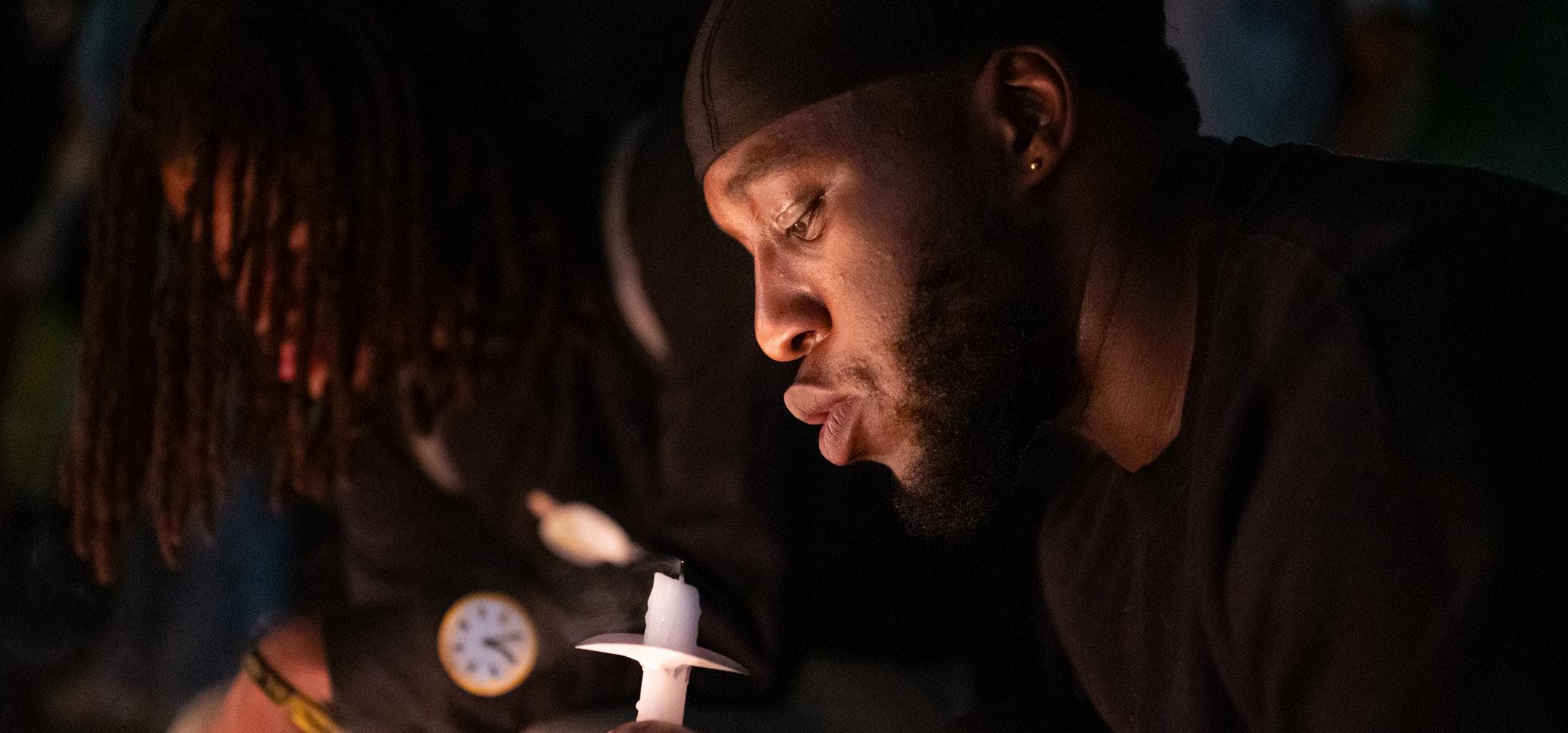
Blk Pwr Coalition hosts Library Mall vigil for Mississippi men found hanging
By Alexa Cattouse STAFF WRITER
The University of Wisconsin-Madison’s Blk Pwr Coalition (BPC) honored Demartravion “Trey” Reed and Cory Zukatis, the two Mississippi men found dead hanging from trees in different parts of the state on Sept. 15, at a vigil on Library Mall Thursday.
Vigil attendees called out the prevalence of anti-Black hate crimes nationwide and the history of violence against Black people in Mississippi. Although police ruled Reed’s death a suicide, many believe the death of Reed was intentional due to the history of lynching in the southern United States. Attendees also drew attention to a recent hoax targeting of predominantly Black colleges after the killing of Charlie Kirk.
“I’m thinking about those two men that lost their lives. I’m thinking about the hurt in our community because this isn’t something that one person feels on an individual level. It’s something everybody feels,” Keisha Osman, a junior at UW-Madison and member of BPC, told The Daily Cardinal.
The vigil began at 8 p.m. with about five minutes of silence, where around 100 attendees were seen in a circle lighting each other’s candles, praying and reflecting on Reed and Zukatis.
The body of Demartravion “Trey” Reed, a 21-year-old Black student at Delta State University, was discovered hanging from a tree on campus early on Sept. 15. Hours later, a second man, identified as 35-year-old Cory Zukatis, was discovered hanging from a tree about 100 miles south of the university.
Police ruled Reed’s death a suicide. His family called for a second, independent autopsy after receiving “conflicting accounts” about the nature of his death. Mississippi police are still investigating Zukatis’ death, but authorities do not believe the two deaths are connected.
Zukatis, who was white, was homeless, and the BPC said on Instagram growing violence toward homeless populations was sparked by “right-wing” commentary, referencing a recent Fox News comment about “involuntary lethal injection” of mentally ill homeless individuals.
Attendees expressed dismay that on-campus vigils are becoming increasingly common, recalling another vigil last year for Marcellus Williams, a Black man executed in Missouri amidst serious doubts about the legitimacy of his murder conviction.
BPC members said they felt proud witnessing support from their community and non-Black students.
“It’s crucial to recognize the importance of how the Black community can cause an impact, especially with the rise of anti-Black crimes and needing to acknowledge the fact that Reed was hanged,” BPC Event Cipher Madison Hird said.
“Knowing that no one is alone and that we have a strong support system is important, but also acknowledging and not sweeping under the rug that things like this happen,” Hird continued.
BPC members hope the vigil will inspire other schools across the nation to draw awareness to anti-Black and anti-homeless crimes.
The vigil opened the floor to attendees to voice concerns about the hangings. A poem critiquing American society’s “hypocrisy” when it comes to Black culture was written and performed by Evan Epps, a sophomore and member of BPC. Epps said students should use their freedom of speech to spread awareness on the causes they care about.
“When you see a community like this, you have more power than you realize,” Epps said.
At the end of the vigil, Epps and other BPC members led attendees in chanting a quote from activist Assata Shakur: “It is our duty to fight for our freedom. It is our duty to win. We love each other and support each other. We have nothing to lose but our chains.”
economics. Mnookin emphasized this, saying these institutions also have a role in fostering innovation, prosperity and opportunity.
On Oct. 7, 1991, Shalala made remarks to the Faculty Senate regarding issues threatening the university’s future, such as political correctness, tuition increases and budget constraints. Mnookin read the remarks aloud during their conversation, noting its relevance in the present day.
+Chancellors page 4
Campus-area housing group restarts
By Wilder Gervais STAFF WRITER
University of Wisconsin-Madison students reinstated the Campus Area Neighborhood Association this past school year, with the aim of working with housing developers and leasing companies to preserve student tenant rights.
Co-chairs Megan Mladucky and Genevieve Lambert said they restarted the organization to help advocate for student renters amid a growing housing crisis in Madison.
“Our plan, mainly, is to get students in places where they feel like they have a voice,” Mladucky said. Lambert said CANA can also serve as a touch point for students to contact their city about their living conditions. “Unless students know their alderperson, they don’t know who to go to,” she said.
The Campus Area Neighborhood Association (CANA) is one of over 20 neighborhood associations recognized by the City of Madison.
CANA holds a significant level of influence in the campus area by advising housing developers and the city on campus-area developments. “We’re able to put together a steering committee who will negotiate directly with the developer, and they can push for whatever they want,” Lambert said.
This change comes at a crucial time for developers as well, with several student housing projects popping up around campus.
CANA is unique in that it is entirely student-run and any student can volunteer, something Mladucky and Lambert stress as central to the organization’s identity and integral to its future success.
“When you’re talking to other students, they are more likely to back you up,” Mladucky said.
Lambert agreed, stressing students should get involved regardless of their personal interests. “Anything students care about, if there’s an avenue for that type of advocacy on CANA, it’s a great way to have an impact,” she said.
Mladucky said CANA was reinstated after being delegitimized by city government two years prior because “of a lack of student participation in the group.”
Due to its recent reinstatement, CANA has a long road before it can provide students with the resources other neighborhood associations can, such as community events and community centers like Greenbush’s Neighborhood house.
“We may not be able to provide the same things as other neighborhood associations can just because we are students; we don’t have a budget,” Mladucky said, adding that a public forum on housing would be something CANA would be able to provide to students as they establish their presence on campus.
CANA will meet every first Tuesday of the month at 6:30 p.m. at the Student Activity Center’s Caucus Room.
“…the great state University of Wisconsin should ever encourage that continual and fearless sifting and winnowing by which alone the truth can be found.”
JAKE PIPER/THE DAILY CARDINAL
First women-centered sports bar in Madison to open
By Haellie Opp SENIOR STAFF WRITER
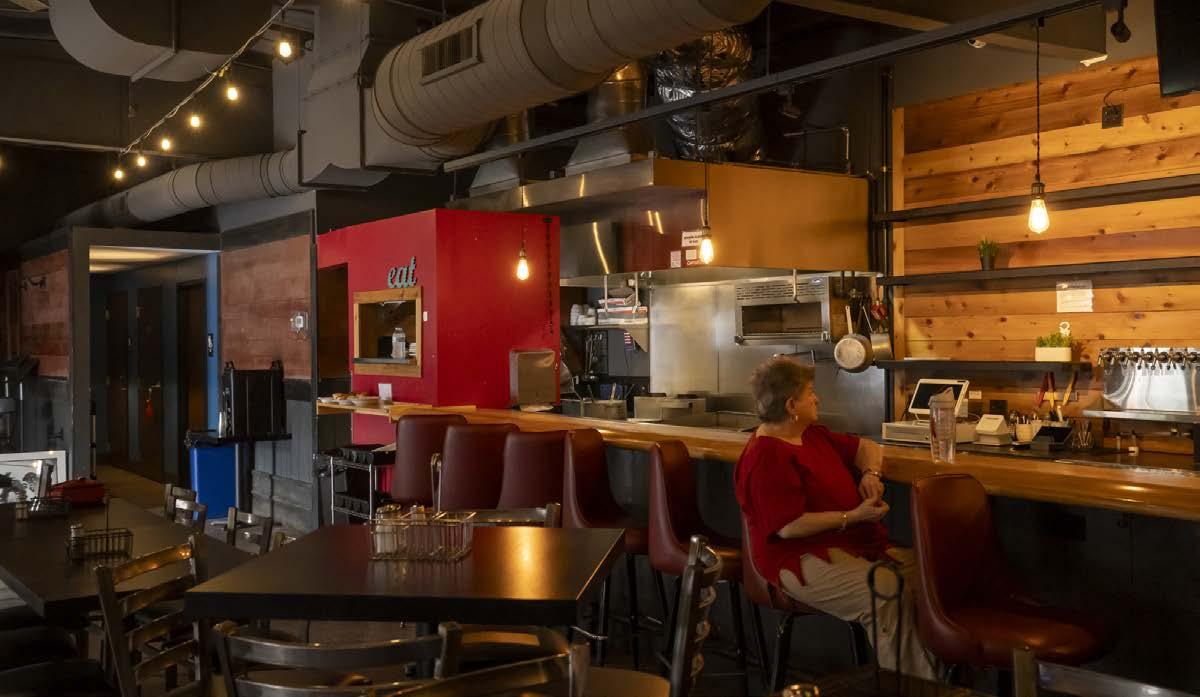
Bernell’s, a new sports bar scheduled to open Oct. 24 on Madison’s East Side, will make history as the city’s first women-centered sports bar.
Owner Rita Adair was inspired to open the bar to honor her late wife Bernell Hooker’s legacy. Hooker — once owner of the Milwaukee Aces, a professional women’s basketball club — was beloved in the sports community.
After Adair struggled to find women’s sports programming at other sports bars in Madison, the push to open Bernell’s became serious. Knowing how “fired up” Hooker was watching the growth of the women’s sports industry, Adair realized a space dedicated to women was what her wife would’ve wanted.
“I did a test here where I went to 15 bars over a six month period and asked to watch certain games. Only one bar said yes,” Adair said. “And that really was like, ‘Okay, Rita. This is needed. You need to be in a place where it isn’t even a question that women’s sports can be on the screens.’”
After setbacks from a financial
investor backing out, Adair turned to community fundraising. With inspiration from other women’s sports bars around the country, Adair recognized the movement that is women’s sports bars.
“This is something happening in our country with women’s sports, and every sport, not just basketball,” Adair said. “Women are really becoming more present, more visible. Teams are just growing in every way including skills, finance and visibility.”
Adair believes that the Madison community is ready for a new environment like Bernell’s, yet the bar will still pay homage to Red Rooster, the bar that previously occupied the building, with Blues music every Thursday night.
Alongside the sports and Blues music, Karaoke will also be a focal point of Bernell’s. Hoping to showcase larger bands and local talent, Adair wants to give the community a place to enjoy all kinds of entertainment.
“I plan on doing a big thing outdoors, like a music festival, in the summer,” Adair said. Their menu will include soul food and a Taco Tuesday.
“We are very open as a community in a lot of ways, and I think the com-
monality will show. People will come in here and enjoy it and have a good time,” Adair said.
Adair also wants the bar to be accessible to University of Wisconsin-Madison students by use of a trolley or event nights to get students involved.
Adair acknowledged the “nayser’s” that have doubted Adair and the opening of Bernell’s. After Adair had to resort to fundraising to open the bar, she noted people didn’t believe it could happen.
“In terms of licensing and the community, getting the licensing and getting permissions, that has
not been a problem at all,” Adair said. “Matter of fact, it’s been overwhelmingly accepted.”
Adair must go through in front of the Common Council for final proof and pass final inspections, but the opening of Bernell’s is set for Oct. 24. With an easily spotted rooster on the side of the building, patrons can access the bar on opening day at 2513 Seiferth Road.
“I am like a part of a movement of women that are really trying to make sure that the world sees them and that they’re treated with equity and the value for what they do in the game of sports,” Adair said.
Democratic Rep. Francesca Hong discusses bid for governor, vision for UW
By Jake Wesson & Drew Wesson SENIOR STAFF WRITERS
Rep. Francesca Hong, D-Madison, discussed her policy goals and campaign for governor, highlighting concerns over funding cuts to the University of Wisconsin System, in an interview with The Daily Cardinal Tuesday.
Hong, a member of the Assembly’s Socialist caucus, represents Madison’s East side and Isthmus. She was first elected in 2020 during the COVID-19 pandemic and said her decision to run for governor was similar to her reasoning then.
“It is similar to how I felt during the COVID pandemic, being in a moment of crisis and chaos,” Hong said. “But I think what is needed right now is unapologetic, bold leadership where folks are prioritizing [and] building working class power.”
She joins Democratic candidates Lt Gov. Sara Rodriguez, Milwaukee County Exec David Crowley, Sen. Kelda Roys, D-Madison, and Ryan Strnad and Republican candidates Washington County Exec Josh Schoemann, businessman Bill Berrien and U.S. Rep. Tom Tiffany.
UW System priorities
Hong highlighted several plans to address issues the University of Wisconsin-Madison and the University of Wisconsin System face.
“I’m disappointed that the Republican representatives [and] federal representatives in this state have made it harder for people to have cheaper tuition [and the ability to have] research funded and grants that were promised,” Hong said.
Hong also said as governor, she would work to ensure the legisla-
ture takes action on allowing bonding authority for the UW System, especially at UW-Madison, saying if granted it would “allow for cheaper building and construction of dorms for students to have more quality affordable housing.”
Granting bonding authority to the UW System would permit campuses to take out loans to allow for building without approval from the Legislature. UW-Madison is currently the only Big Ten school without this authority, resulting in construction delays and significant cost increases for capital projects.
The UW System has struggled with approval for building projects in the past. In 2023, they struck a deal with the Republican-led legislature restructuring diversity, equity and inclusion in exchange for funding approval for the new engineering building. In the most recent budget cycle, the university received $29 million to renovate Rheta Market, Chadbourne and Dejope residence halls, but no funding or approval to build a new residence hall.
Collective bargaining rights
Hong said she wants to repeal Act 10, a measure passed in 2011 by former Republican Gov. Scott Walker which effectively eliminated collective bargaining rights for most public sector employees.
In December 2024, a Dane County Judge struck down multiple sections of Act 10, arguing the distinction between “general” and “public safety” employees violated the equal protections clause in the state’s constitution.
In February 2025, Act 10 was sent to the appeals court.
“The state has a responsibility to make sure that our universities have healthy investments,” she said. “The bonding authority and repealing Act 10 are going to make it so that we can preserve and protect what is an economic engine [and] a place for critical thinking that’s going to make our state a healthier place to live in.”
Immigration
Hong shared her plans to respond to heightened anti-immigration efforts from the Trump administration, which have drawn protests in Madison and around the country.
“There is legislation that we
can pass,” she said. “[It] can make it harder for ICE agents to detain folks or for sheriff’s departments to work with ICE.”
Hong also discussed the current political climate and encouraged people to get involved with their local communities.
“I think it’s important to name that what’s happening right now is authoritarianism,” Hong said. “Voting every election is a powerful way to fight back, but right now it’s even more powerful that we continue to care and look out for neighbors.”
Local community
“I was proud to pass legislation that would require K-12 public schools to include Asian American history in their curriculum,” Hong said. “I’ve passed bipartisan legislation, a bill that was led by Republicans that I ensured was pushed through and signed by the governor. Rural or urban, regardless of zip code, working-class people want cheaper health care, they want free child care, they want to see their kids go to fully funded public schools.”
Hong intended to study Journalism, but only did a couple of semesters.
“I didn’t quite feel like it was the right place for me at that point in my life. I wanted to work in restaurants,” she said.
Hong has worked in the service industry for almost 16 years at various restaurants and bars around Madison, including 43 North. She said she was also the co-owner and co-chef of Morris Ramen from 2016 to 2024.
“It was in restaurants where I learned that being of service to people can be a very powerful way to keep communities and make them stronger,” she said.
PHOTO COURTESY OF FRANCESCA HONG
FINNEGAN RICCO/THE DAILY CARDINAL
Polish Student Association shares culture at first fall Global Café news
By Zoey Jiang STAFF WRITER
As spring unfolds its beauty acThe Polish Student Association (PSA) hosted the first Global Café this year Sept. 17 at the Pyle Center, serving paczki.
Last year, the University of Wisconsin-Madison’s International Student Services (ISS) hosted 11 Global Cafés, interactive events centered around food and conversation, with over 700 total attendees throughout the year, Allison Streckenbach, transitions coordinator at ISS said.
The event first began with an idea to create a space where people from different backgrounds could connect.
“[Global Café] quickly grew because attendees enjoyed the opportunity to meet others, learn about different cul -
tures and just hang out in a welcoming environment,”
Streckenbach said, explaining it is now a regular, biweekly event that brings a whole community together.
As part of the event, two of PSA’s members, Erik Irzenski and Jan Grzywacz, led an information session about a Polish dessert: paczki. The pastry was served at the meeting with various flavor options, including cherry, strawberry and apple. The presentation focused on the Polish history and traditions of celebrating Tłusty Czwartek, also known as Fat Thursday.
“PSA is primarily composed of Polish-American students, but there are also members in Polish classes,” Grzywacz, co-president of PSA, said. “Everybody there has some
attachment or curiosity about Poland, but our focus is to make a space and create events for us to hang out.”
He said his favorite thing about PSA is the people. “I love seeing the younger classes, like the sophomores and juniors, they’re really into it… They’re super enthusiastic about PSA,” Grzywacz said. “That wasn’t really a thing my freshman year, so to see PSA kind of grow has been really inspiring.”
Alan Zarzycki, an undergraduate senior and longterm member of PSA, said, “PSA is one of those organizations where, even if you’re not Polish or if you are Polish, you’ll find some way to be part of a community.”
Many students attending the event agreed Global Café is valuable, in both an education-
al and a social sense. “You can learn a thing or two about other cultures,” Grzywacz said. “It’s got free food, but it’s also got a learning aspect to it. With how they’re running it now, when you come to Global Cafe, you’re here to learn.”
Streckenbach agreed that Global Café is a fun and easy way for students to connect outside of the classroom. “The events make it easy for students to meet others they might not otherwise have the chance to, and it’s a reminder that we’re all part of a larger, global community,” Streckenbach said.
In the past few years since it has begun, Global Café has created many memories for attendees. “Everybody always enjoys different cultures,” Zarzycki said. “Everyone can feel like they’re connected no matter
where they are in the world.”
Streckenbach agreed. “For me, the best part [of Global Café] is seeing people genuinely connect, whether it’s through trying a new food, sharing stories or learning about a new culture,” she said.
She added her favorite Global Café memory was transporting 264 buns from Asian Sweet Bakery in her car and having to cut them right before the event started. “We had so many treats for people to try, my car smelled like pineapple buns for days — which I loved — and we got to support a small, local business,” Streckenbach said.
ISS plans to host five more Global Cafés this semester. The next one will be hosted by the Chinese Language and Culture Club on Oct. 1.
‘Trailblazers in Motion’ exhibit unveils progressive history of UW-Madison women’s physical education program
By Sonia Bendre SCIENCE EDITOR
When the University of WisconsinM adison launched a Women’s Physical Education Department in 1912, Wisconsin women did not have the right to vote. Women, only reluctantly admitted to UW-Madison in the first place, faced scientific misconceptions, double standards and restrictions from administration. But the department itself was always years ahead of its time, alumni said, from its early days to its eventual merger with the men’s program in 1976.
The department produced a plethora of talented alumni, including Ruth Glassow, a famous biomechanicist, and Betty Roberts, who discovered the modern-day optimal basketball shot and football kick.
Now, thanks to Cindy Kuhrasch, a professor emeritus of kinesiology, UW-Madison students can view the history of the department through a virtual exhibition and touchscreen display in the Medical Sciences Department. Kuhrasch, who spent the last 5 years designing the “Trailblazers in Motion” exhibit, spoke to The Daily Cardinal about her creative process and findings.
Kuhrasch’s inspiration
Before she retired, Kuhrasch coordinated the physical education teacher education program. Teaching in buildings like Lathrop Hall, the home of the Women’s Physical Education program, sparked her curiosity about the history of the physical education department at UW-Madison.
“I didn’t have a clue that it was so old and so wonderful,” Kuhrasch said.
The women’s physical education department received accolades for its focus on physical and scientific rigor at a time when women were not believed to be capable of either. Classes focused on gymnastics and calisthenics, and students spent most of their time in Lathrop Hall, which then included a kitchen and bowling alley.
“[Students] would come to campus at six in the morning,” Kuhrasch said. “They ate all meals [in Lathrop], studied in the lounge, took classes and socialized in the bowling alley. It was their home base.”
When alumna Constance Fried attended the program in 1953, she said women in the physical education department only played half-court basketball, could not wear blue jeans to class and were forbidden from jumping on trampolines
“because it might hurt [their] female parts.”
“They wanted us, I think, to try to be ladylike and good athletes at the same time,” Fried said.
Nevertheless, Fried was able to take zoology, anatomy and physiology classes, venture on kayaking and camping trips and conduct scientific research — similar to the coursework and experiences that physical education majors have access to today at UW-Madison.
“Women were so far ahead of their time in terms of creating a program that was sciencebased but also focused on the whole person,” Kuhrasch said. “The biggest difference was these women started this program when they weren’t even really welcome to the university.”
Kuhrasch gathered videos, images and other data with the help of her students and historians running the university archives.
This included oral interviews with luminaries in the department, such as Margaret H’Doubler, the founder of the nation’s first dance program of its kind at UW-Madison.
But the project was still missing something. Barb Gerloff, a professor in the School of Education, suggested Kuhrasch speak with alumni of the women’s physical education department. So she did.
“They sent me artifacts and photos, but mostly they shared their stories,” Kuhrasch said.
Kuhrasch’s phone calls also appear in
the virtual history exhibit, a format she settled on so alumni of the program across the country could view the exhibit without coming to campus.
Kuhrasch uncovered old traditions from the department, like before-school picnics, remembrance books commemorating a school year and a May Day celebration. She brought some of these, like the end-of-year banquet, back to the current program.
“We celebrate, we eat together and we involve the local teachers that support our students, too,” Kuhrasch said.
Alumni describe the lifetime return of their education
Susan Schaffer, the first female vice president of United Airlines, graduated from UW-Madison in 1962 with a degree in physical education and worked as a gym teacher at New Trier High School in Illinois. When the high school split into New Trier East and New Trier West, Schaffer helped found New Trier West’s physical education department.
When Schaffer went to Michigan State for a degree in Instructional Technology, she discovered United Airlines’ training program.
At United Airlines, she quickly climbed the ranks, gaining notoriety for her “sports
knowledge and skills” — for example, for besting the then-president of United Airlines in a game of golf.
“I left the program confident of my abilities, not only to learn and grow, but to lead,” Schaffer told the Cardinal in an email.
Schaffer credited UW-Madison’s physical education program for helping her navigate the male-dominated management world, saying it helped her “tremendously” in her career and that the “strong women” she met “challenged and inspired” her. She added the program helped her build lifelong exercise habits.
Department instructors and staff added “fun and gravitas” to Lathrop, Schaffer said. The Dean of Students, Martha Peterson, allowed Schaffer to stay off-campus her senior year, which female students under 21 were restricted from doing at the time.
Fried first attended UW-Madison’s program in 1953 and returned for a master’s degree in 1983, abandoning her graduate program at Kent State because her “education was 10 years ahead of its time from Wisconsin.”
“The professor [at Kent State] gave us an assignment,” Fried said. “Nobody understood what I was talking about except her. She said to me, ‘where did you graduate from?’ And I said, ‘University of Wisconsin,’ and she said, ‘Oh, well, that explains it.’”
Fried eventually retired as a biology teacher in Florida. She also coached swimming and received a captain’s license from the U.S. Coast Guard. Now, she serves as a volunteer guardian ad litem, a court-appointed special advocate in legal cases involving the U.S. Department of Children and Families.
During her time at UW-Madison, Fried took courses with famous “prime movers” of the time, including Margaret H’Doubler and Ruth Glassow. She said her favorite instructors were Glassow and Marie Liba, who taught volleyball. She called her relationship with her professors “easy” and informal, describing a time she and a roommate gifted her teacher, Kitty Fritz, tulips stolen from the university gardens.
Fried said of the sixteen undergraduates in her class, five are still alive, all 93 years old. They keep in touch monthly through a Zoom meeting. Fried called her studies in the women’s physical education department “the best time of my life.”
“I loved the whole time I was there… I am so proud of what I learned and the people that I associated with,” she said.
Madison Zoo to welcome new polar bear
By Alaina Walsh ASSOCIATES NEWS EDITOR
Dane County’s Henry Vilas Zoo will welcome a new polar bear this year as a part of a national effort to protect the threatened species.
The zoo is working with the Oregon Zoo to transfer Nora, a 9-year-old female polar bear, to Madison. She will join Berit, the zoo’s 26-year-old female, before eventually being paired with a male in hopes she can raise cubs.
Henry Vilas Zoo is part of the Polar Bear Population Alliance, a new consortium of Association of Zoos and Aquariums–accredited organizations, which sponsored the bear move. The alliance aims to maintain a sustainable, genetically diverse polar bear population in the United States. Polar bears are listed as threatened under the U.S. Endangered Species Act as their Arctic habitat continues to shrink.
“This polar bear move is a tremendous step forward towards helping the overall polar bear population,” Executive Zoo Director Ronda Schwetz said. “Our award-winning polar bear habitat was built with cubs in mind and our animal care team has the experience needed to provide Nora with the best possible care.”
AZA-accredited zoos and aquariums support polar bear survival in two ways: by backing conservation work in the Arctic and by
sustaining a healthy population in professional care. Amy Cutting, vice president of conservation at Polar Bears International, said both approaches are crucial in a press release on Tuesday.
“Modern zoos and aquariums play a key part in saving this species,” Cutting said. “Polar bears live in one of the harshest environments on the planet, making them notoriously difficult to study. We have gaps in our understanding of how climate action is affecting them. The bears in professional care can help.”
Nora has already advanced polar bear research. Scientists used her help to calibrate a laser that measures body mass, study caloric needs with a swim flume and test tracking technology known as the “Burr on Fur.”
Henry Vilas conservationists described zoo bears as “Arctic ambassadors,” connecting visitors with the realities of climate change and wildlife loss. Cutting said the animals often deliver those messages
to audiences who might not otherwise hear them.
Born in 2015 at the Columbus Zoo and Aquarium, Nora survived a difficult start. When her mother began leaving her alone in the den, keepers stepped in to hand-rear her, feeding her with a bottle until she grew strong enough to eat solid food.
“I am so proud of all the work the staff at the Henry Vilas Zoo has done to support polar bear conservation and get us to this point,” Dane County Executive Melissa Agard said. “This is going to be an exciting year for our zoo and we look forward to welcoming Nora in the next few months and hopefully polar bear cubs in the near future.”
Henry Vilas Zoo, one of only 10 free AZA-accredited facilities worldwide, remains free to the public. The zoo focuses on animal care, conservation and education, working with global partners to promote sustainability and engage communities in protecting the natural world.
UW-Madison opens new Morgridge Hall for computer and data sciences
By Alaina Walsh ASSOCIATES NEWS EDITOR
The University of WisconsinMadison opened the new Computer, Data and Information Sciences (CDIS) building at the start of the fall semester, bringing together three of the campus’s fastest-growing majors under one roof and establishing a hub for research, education and outreach in technology.
The building houses the Departments of Computer Sciences and Statistics, as well as the Information School. Key partners include the Biostatistics & Medical Informatics Department and two major institutes: the Data Science institute and the Center for High Throughput Computing. Together, they represent the university’s largest majors — computer science and data science — and its rapidly growing information science program.
“This is a home for our students and faculty, finally under one roof,”
Remzi Arpaci-Dusseau, the CDIS school’s director, told The Daily Cardinal. “We see it as the gravitational center of education, research and outreach in computer science, data science, statistics and information and library sciences.”
The lower floors focus on undergraduate life, featuring modern classrooms, the Gross Learning Center, advising offices and the Rebecca Blank Commons Library. Upper floors are dedicated to research, with facility offices, labs and graduate work spaces. The main spaces within the building feature bright natural light, lush greenery and lots of open space meant to encourage collaboration.
The classrooms are equipped with multiple screens, lecture-capture technology and whiteboards, reflecting a blend of traditional and modern teaching tools.
“Students expect materials in many different formats,” ArpaciDusseau said. “These tools support a dynamic learning environment, not just for our fields, but for any class on campus.”
The $267 million project was funded entirely by private donations, led by a gift from Tashia and John Morgridge, who graduated from the university in 1955. Support also came from the Wisconsin Alumni Research Foundation, Epic Systems, the Vilas Trust and hundreds of other alumni. The building is the largest in UW-Madison history to be fully funded by private donations.
“Our alumni and donors were excited to invest,” Arpaci-Dusseau said. “They see how computing and AI are changing the world and want UW at the forefront.”
Morgridge Hall’s private funding allowed the university to construct the facility without tapping state taxpayer dollars, which have gradually declined over the past
Badger Cheese Club hosts first meeting
By Oliver Gerharz & Luca Muehlbauer ARTS EDITOR & STAFF WRITER
One of the University WisconsinMadison’s largest student organizations packed a lecture hall in Ingraham with over 200 students in attendance last week. The Badger Cheese Club’s goal is to bring Wisconsin’s cheese culture to their 500 official members.
The club of cheese connoisseurs — established in 2006 — offers its members a smorgasbord of cheese each meeting, educates its members on the differences between all the unique types of cheese made in Wisconsin and builds a strong community among its members with a variety of special events.
“[Badger Cheese Club] is about fostering a community of cheese lovers who don’t care about background or beliefs and instead just bond over a mutual love for cheese,” Cheese Club President and UW-Madison sophomore Max Rosencrans told The Daily Cardinal.
At that packed inaugural meeting, long lines snaked around to the back of the lecture hall, and attendees slowly filed towards the front of the room where a line of folding tables were stationed, heaping high with cheese. Members of the club were asked to take “just” 15 pieces while they waited in line.
While those in the front row got cheese right away, those at the back waited for over an hour.
Chancellors
Continued from page 1
“It was really striking to me —the parallels — which in a certain way was comforting because we got through hard things then and so, presumably, we can do it again,” Mnookin said.
Mnookin asked Shalala what she makes of the current climate surrounding higher education, emphasizing fiscal challenges and growing distrust in higher education institutions.
two budget cycles. UW-Madison’s Humanities building was set to be demolished in 2026, but the state approved only a small portion of the funding requested.
Arpaci-Dusseau hopes the donor enthusiasm elevates UW-Madison’s profile in tech and innovation circles.
For students, the building offers something they didn’t have before: a dedicated study space for their majors. “Previously, computer science students rarely even had a class in the CS building,” Arpaci-Russeau said. “Now they come here to learn, study, get advising and participate in student-led organizations. Finally, they have a home on campus.”
Early reactions from faculty and students, he added, can be summed up in one word: “Wow.”
The new facility has already boosted UW-Madison’s visibility in technology and innovation. Morgridge now hosts the seventh nationally ranked computer science graduate program.
“It’s going to be a boon for recruiting faculty and students,” ArpaciRusseau said. “The building shows the country that UW-Madison is investing in its future. It’s going to be a great ride.”
There was so much cheese leftover several attendees brought home extra bags. While some students left after the cheese buffet, others stayed in the lecture hall to watch videos on cheese factory production and play cheese-themed Kahoots for prizes.
The club’s cheeseheads flocked to Ingraham for different reasons.
“When I was walking out from the club fair, I saw it from the corner of my eye, and I was like wait, what does that mean, ‘Cheese Club?’ I go up and it’s exactly what I dreamed — you just go and eat cheese,” UW-Madison freshman Alexander Korff said. Freshman Noah Thompson said that as a Wisconsin native, he figured there would likely be a Cheese Club at UW-Madison.
“I want to try and get a leadership position in a club here. Might as well be one I’m passionate about like cheese,” Thompson said.
Each year the club hosts the Curd Crawl, where participants visit bars and restaurants around Madison serving cheese curds. The crawl is open to non-club members — participants have to split up in many groups so as not to overwhelm establishments.
Knoelke also said starting this year, the club plans to donate any extra cheese products from their events to those in need in the city of Madison. The club’s all-new executive board also plans to get in contact with local organizations to orchestrate food pantry donations.
ing UW-Madison centered too much on graduate students.
After receiving these complaints, Shalala told faculty to schedule undergraduate courses first to ensure people could enroll in required classes on time and graduate in four years. She said they invested in student affairs and student services, improving the quality of students’ experience outside of the classroom.
“It’s easy to say it’s all cyclical, but I think we’re in a much more dangerous period. I am more wary now than I was even then,” Shalala said, emphasizing the urgency of preserving hope and continuing university improvements.
“What we do is too important to the future of the country,” Shalala continued. “Our job as leaders is to rally everyone and say, ‘even though we have differences, we still have to move ahead and keep improving, recognizing that we have some vulnerabilities, but keep working and not giving up hope.’”
Mnookin highlighted Shalala’s strength in recognizing and engaging with all perspectives, no matter the differences.
“It requires compromise,” Shalala said. “People criticize universities for making some of those compromises, but we’re interested — not in the survival of our institutions — but in them thriving.”
During Shalala’s tenure, she conducted a statewide survey which found parents were criticizing the institution’s lack of attention to their undergraduate students, say-
“We really put an emphasis on undergraduate education out of respect for the people of Wisconsin and the people paying for the university,” Shalala said.
To convince faculty to focus on undergraduates, she found distinguished faculty members with students of UW-Madison to give their perspective on their students’ treatment, to which they noted difficulties getting into classes.
Mnookin noted the university’s current graduation rate is around 3.72 years, saying the investments Shalala made created a legacy that have continued to be core values of UW-Madison.
The first woman chancellor at a Big Ten university
Shalala said she was underestimated, noting challenges winning over the legislature, faculty and students.
She said people were still learning, and the men around her were very supportive. She noted she had been through worse than the periodical remarks.
“The other thing is, when you have power, no one messes with you very much. So there’s a certain kind of underlying respect,” Shalala said.
COURTESY OF HENRY VILAS ZOO
MAGGIE SPINNEY/THE DAILY CARDINAL
Shaquille O’Neal turned DJ Diesel: up close and personal
By Gavin Cisewski GUEST WRITER
I went to my first DJ concert on Sept. 19 at The Sylvee in Madison, Wisconsin, to see Shaquille O’Neal, the basketball legend turned musician who makes music under the stage name DJ Diesel. It was unlike any other concert I’d ever been to, and the music and atmosphere will stick with me for a lifetime.
As soon as I walked inside the venue, the energy was tremendous. One of the best parts of the night was finding out about the artists that played before DJ Diesel. There were four: Rated R, Celo, C.A.M and Z E L. It’s easy to ignore opening acts, but in this case, each DJ had their own flair and vibe. Their sets made people excited for the
main act and were also great performances on their own. It seemed like the event was meticulously planned to show off the depth and variety of the electronic music scene, offering the audience more than simply a warmup.
The usage of special effects and images was another big highlight of the night. The LED screens and lighting systems showed varied animations that matched the mood of the music every time a DJ came on stage. These visuals were not only imaginative, but they also made the audience feel like they were in each song. The effects, along with the thumping bass and rhythms, made the whole place feel alive. The lights, sounds and movement made it easy to get lost in the music,
and everyone danced and flowed with it, which made the audience feel like one.
The crowd went wild when DJ Diesel came on stage. He played a tremendous performance that kept the enthusiasm up the whole time, showing that, basketball career aside, he is a great DJ.
It was unforgettable when DJ Diesel brought the Wisconsin Badgers men’s basketball team on stage. The crowd went wild when they saw them, linking the event not only to music but also to Madison’s robust sports culture. It grew even more personal for me when one of the players threw his shirt into the crowd, and I was able to catch it. I didn’t get his name, but that shirt is now a unique memento from the night.
Madison Symphony Orchestra celebrates 100 years
By Ryan Kim STAFF WRITER
The Madison Symphony Orchestra began its centennial season at the Overture Center for the Arts for an audience of young and old to celebrate with “Pure Joy Opening Night: Magical Tchaikovsky” on Sept. 19.
The program featured three Tchaikovsky works: the Romeo and Juliet Fantasy Overture, Piano Concerto No. 1 in B-flat minor, Op. 23 and the Theme and Variations from Suite No. 3, Op. 55.
As the orchestra played each song within the span of 90 minutes, it felt as if the chamber itself was suspended in time, as each piece felt like a romantic dream full of bliss.
Beginning in 1925, the orchestra has performed through the Great Depression, two world wars, the moon landing and the invention of the World Wide Web. The MSO has had only four music directors throughout its history, with Maestro John DeMain, who plans to retire this year, serving for the last 32 years.
Throughout DeMain’s career, he has conducted major opera houses and symphonies across the United States and internationally, championing both classic and contemporary works, and mentored generations of musicians, shaping the artistic direction of the MSO.
From winning the Grammy Award for Best Opera Recording in 1976 to receiving the Lifetime Achievement Award from the National Opera Association in 2023, DeMain has garnered prominent awards for his contributions to opera and orchestral music.
DeMain opened with Romeo and Juliet, capturing the emotional depth of Shakespeare’s play. As the basses and the cellos’ strings boomed, the clarinets, along with the violins, rose with the trickling of the harp. During the 20 minutes, the audience watched as each performer moved like a clock, slowly shifting their bodies as they played. Like the play itself, the music was romantic in nature. When the song ended, the piano was brought to the stage, causing murmurs of excitement as guest pianist Olga Kern walked out in
a bright red dress designed by Alex Teih. Kern, a Russian classical pianist who has been playing since she was five, returned to Madison for her sixth appearance with the orchestra. As the winner of the 2001 Van Cliburn International Piano Competition and a longtime Steinway Artist, Kern launched her international career as a teenager and has since performed with major orchestras worldwide.
As Kern bowed and took her seat at the piano, she immediately launched into the performance of Tchaikovsky’s Piano Concerto No. 1 in B-flat minor, Op. 23. Fingers dancing over the keys like a ballerina, Kern immersed herself in the music, swaying as she played. In the finale, the orchestra swelled and receded in waves, echoing Kern’s dynamic phrasing and drawing the audience into the music’s ebb and flow.
As she ended the concerto, the audience gave her a standing ovation, filling the chamber with cheers and whoops. In response, Kern returned for an encore, playing Etude Op. 2 No. 4 by Sergei Prokofiev for an audience and orchestra who silently watched her hands breeze over the keys.
As Kern left the stage with multiple bows, the orchestra prepared to play their final song — the Theme and Variations from Suite No. 3, Op. 55. The song was like an informal goodbye, promising to see the audience again for their next concert. When the instruments combined, it became a harmonious song that felt like a city bustling to life. When the first violin, Naha Greenholtz, played the solo, the orchestra would back her up with the slow plucks of their strings. The orchestra concluded the piece to sustained applause, bringing the Madison Symphony Orchestra’s 100th anniversary opening night to a celebratory close.
MSO will continue their season this fall with shows including “Disney and Pixar, Toy Story in Concert,” on Oct. 5, “Primal Light,” on Oct. 17 and “Radiance,” on Nov. 21-23.
Overall, going to DJ Diesel’s concert was an event I will never forget. It was better than I thought it would be for my first DJ concert.
The night seemed exceptional
because of the great opening acts, the amazing special effects, O’Neal’s largerthan-life excitement and the Badger basketball team’s surprise arrival.
UW-Madison Modern Dance Department Presents
By Lizzi McGann STAFF WRITER
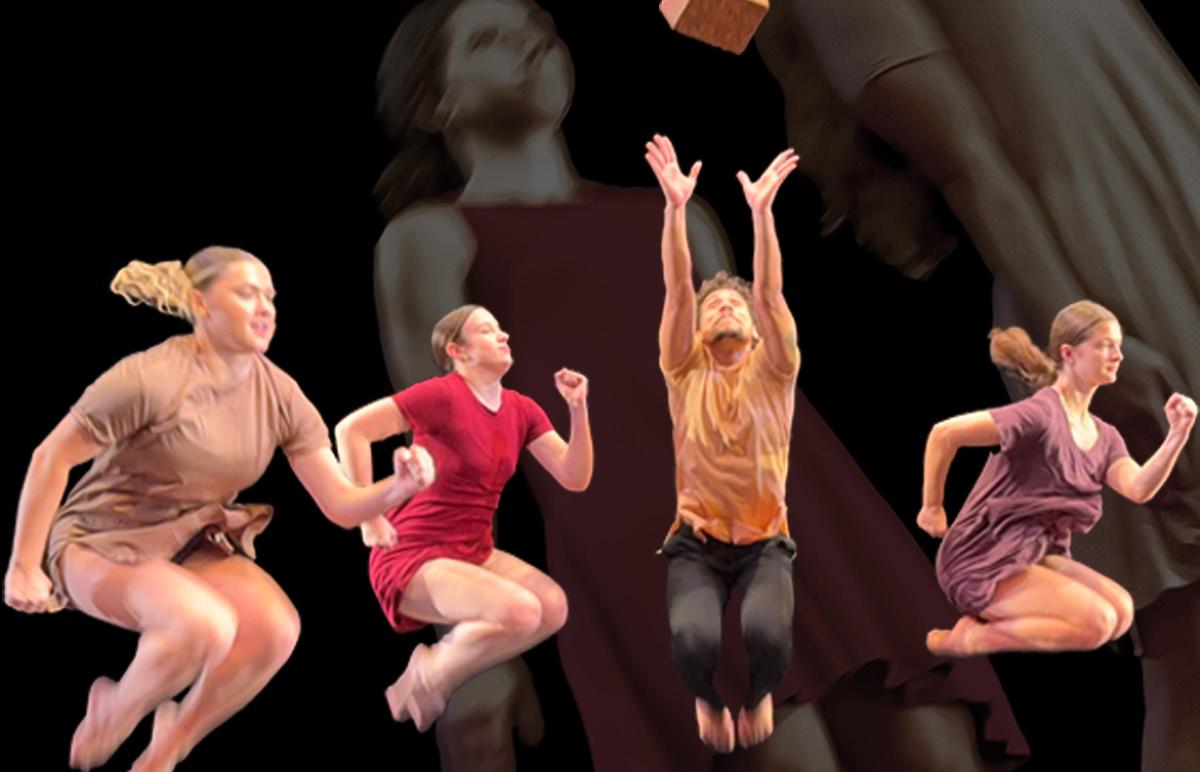
The University of Wisconsin-Madison Dance department chair Dr. Jin-Wen Yu and his students presented “Back • Up” at their yearly public concert Sept. 19. The show consists of two halves, the first, “The Realm of Collage,” revisits choreography shown at earlier concerts and the second, “Back • Up,” is a brand new exploration of the unfamiliar.
Yu’s choreography in “The Realm of Collage” includes selections from “Non-Ordinary,” which looked into the impacts of the COVID pandemic on daily life, and “Page,” a surrealist piece with intricate partner work.
“Back • Up” deals with the uncomfortable experiences we have when confronted with unfamiliarity, and how we rebuild after. While the dancing and music dealt the most with this topic, it is most jarringly addressed in the beginning of “Back • Up” when the dancers blindside the audience by entering the performance space from concert seating.
Yu encouraged dancers to examine these subjects through strenuous floorwork, use of the whole space and pushing their bodies to new limits. From headstands on moving set pieces to running across the stage keeping a paper on their faces, these dancers were challenged to show their modern dance skills in addition to rigorous athletic activity.
The performers danced to fast-paced lyrics, classical instrumentals and sometimes no music at all. It was impossible to
‘Back • Up’
miss the coordination and artistry each dancer brought to the choreography.
“The thing that stood out to me the most was the partnerwork and the reliance on each other,” audience member Kendall Baker said. “You could tell how much practice went into it and how much trust they had in each other.”
Grace Stuckey and Evelyn Henriksen danced with Dr. Yu for years and both said they had close ties with the choreography, themes and each other.
“A lot of the themes in the show were connecting to the other dancers, and I really feel like we connected as a group and worked together and became closer through this production, so it was a really special experience,” Stuckey said.
“The Realm of Collage” exhibited segments of award-winning concerts from 2018-2021, and both Stuckey and Henriksen agreed that Yu’s style of choreography has changed since then. The two halves of the show’s styles exist in stark contrast to each other while still looking like Yu dances.
Henriksen said that she had noticed this shift, but appreciated the creative and personal journey Yu has been on since the pandemic, “[“Non-Ordinary” and “Page”] are both related to a kind of post-COVID time, so he’s thinking about those ideas and then bringing in his new elements so it reflects on his journey through post-COVID life,” Henriksen said.
ISABELLA BARAJAS/THE DAILY CARDINAL
Is the Wisconsin Badgers’ season doomed? sports
By Tejas Rao STAFF WRITER
The Wisconsin Badgers brutally fell to the Maryland Terrapins (4-0) 27-10 at Camp Randall in their Big Ten opener, falling to 2-2 on the season. With Wisconsin’s difficult schedule, what lies ahead may be even worse.
After a bye next week, Wisconsin will enter a brutal October stretch against Michigan, Iowa, Ohio State and Oregon, three of whom are ranked.
All game, Wisconsin’s offense and special teams filled the brim with mistakes that handed Maryland at least 14 of their 27 points.
Wisconsin’s first half was such a disaster that Wisconsin fans booed their own team off the field at halftime, while chanting “Fire Fickell.”
“I feel what their pain is, but I don’t get upset or lose my mind about the way they feel,” Wisconsin head coach Luke Fickell said on the fans’ halftime comments. “We have to play better, and they’re passionate about what they want to see, and that’s what I signed up for when I came here. They’re passionate, they’ve got history and they expect more — just like I do.”
Wisconsin did not come into the season with high expectations. But beating Maryland at
home should be a given.
“We knew this was going to be a mountain. Everybody says you got to have confidence but it’s not something you can just possess. It’s something that has to be built,” Fickell said.
An initial attempt by Wisconsin to switch between quarterbacks Danny O’Neil and Billy Edwards Jr. in the first few possessions did not go well. Maryland’s defensive line penetrated through the Badgers’ offensive line with ease, forcing O’Neil into bad decisions.
Edwards Jr. — who had missed the last 2 games after exiting the season opener with a non-contact knee injury — looked out of sorts on Wisconsin’s first drive, and later exited the game with an injury.
The Maryland defense applied pressure all game. A 7-yard sack from Terrapins linebacker
Sidney Stewart in the first quarter put Wisconsin in 3rd & 16.
Adding to the pressure, Maryland’s defense forced O’Neil to throw a long pass that resulted in an interception by defensive back Jalen Huskey, which he returned for 46 yards.
This put the Terrapins at the 4-yard line in Wisconsin territory, leading to an easy 3-yard run followed by a 1-yard touchdown run for Maryland quarterback Malik Washington.
Later on into the half, Wisconsin rushed three different players to get the ball down the field — running backs Dilon Jones and Darion Dupree and wide receiver Dekel Crowdus. Wisconsin’s ball was at Maryland’s 57-yard line when a bad snap sent the ball back a whopping 23 yards, until it was recovered by Jones at the 34-yard line for a 3rd & 30.
Despite a 13-yard gain from O’Neil’s pass to wide receiver Trech Kekahuna, the special teams were brought out to take the punt on 4th & 17. A good punt could have saved some trouble for the Badger defense, but instead punter Atticus Bertrams’ attempt was blocked and recovered by the Terrapins at the Wisconsin 27-yard line.
“I felt like there were a few times where defense or offense would do something good, and then special teams would mess up their moment, so we got to figure out a way to keep the momentum going,” Badger inside linebacker Tackett Curtis said.
The field position advantage eventually resulted in a 9-yard receiving touchdown for Maryland wide receiver Shaleak Knotts, putting the score up to 14-0. Two late second quarter field goals, including a 49-yarder by Terrapins kicker Sean
O’Haire, put them up 20-0 at the end of the first half.
It seemed as though every time the offense made crucial strides forward, penalties or incompletions kept the Badgers from sustaining drives.
O’Neil was the main quarterback for Wisconsin today, and although he improvised several times for solid rushing gains, the passing game was not good enough to overcome the Terrapins’ defense. He finished throwing 14/22 with one interception and zero touchdowns. After a slight hit on the field late into the fourth quarter, O’Neil was taken off the field to give way to the Badgers’ third string quarterback Hunter Simmons, who
was the only one of the three to score a touchdown today.
As Simmons pushed forward with clean and accurate passes, he ended the drive with a 13-yard receiving touchdown to tight end Lance Mason — the first and last Wisconsin touchdown of the game. The score came with 2 minutes and 44 seconds left in the 4th when almost all the Badger fans had left with their heads down. Wisconsin’s next game will be Saturday Oct. 4 in Ann Arbor against the No. 21 ranked Michigan Wolverines, who won their Big Ten opener against the Nebraska Cornhuskers. The Badgers will have two weeks to figure out not only their quarterback situation, but the direction of their entire season moving forward.
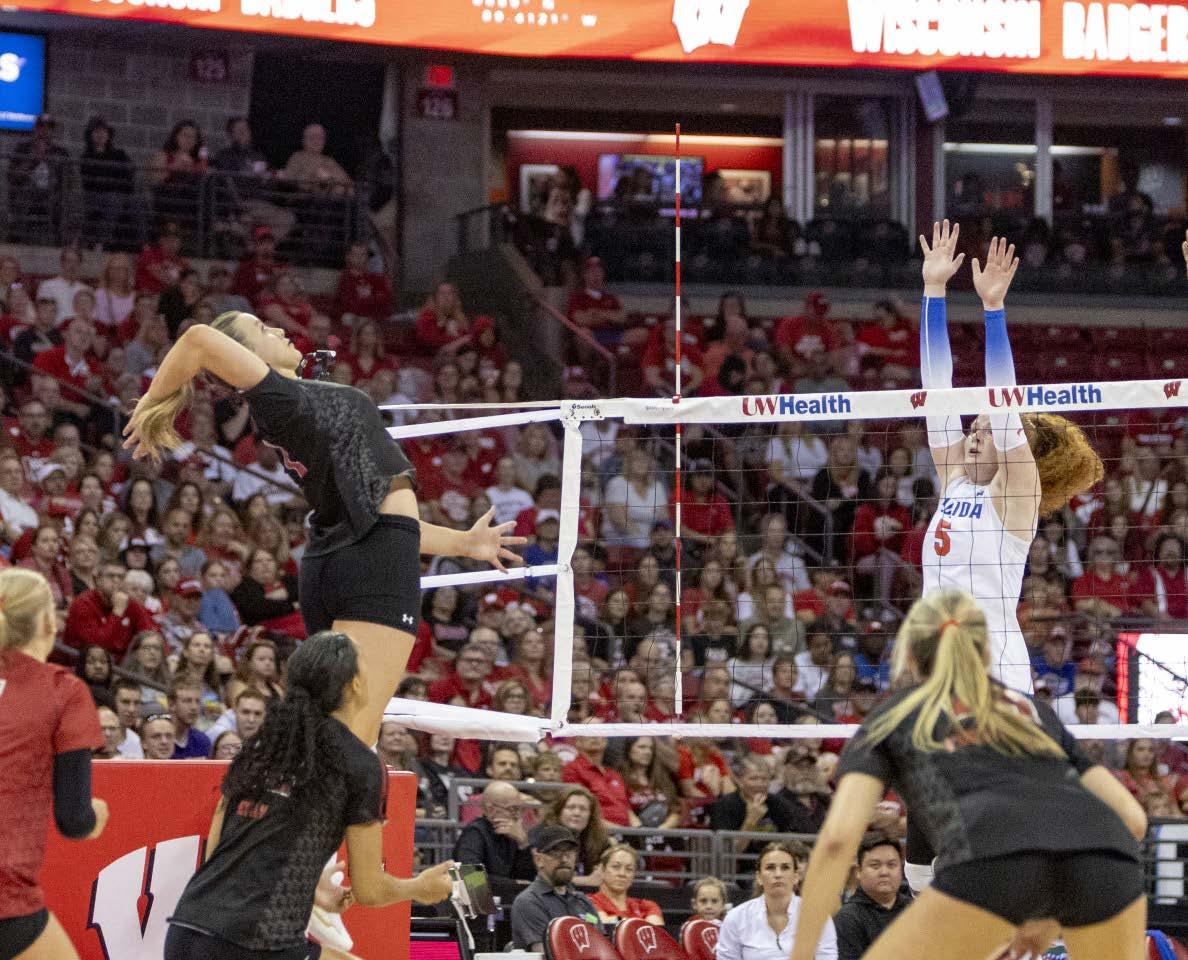
The No. 7 Wisconsin Badgers volleyball team narrowly won three-offour sets against the No. 15 Florida Gators in an intense showdown at the Kohl Center. The game brought roughly 12,300 fans into the Kohl Center and marked the first time Wisconsin beat Florida at home.
Set one was riddled with mistakes from the Badgers, and the Gators were there to pick up the slack. Wisconsin traded points with Florida early on, but continuous net violations and serving errors allowed Florida to pull ahead.
The Badgers lost the first point, but middle blocker Carter Booth earned her first block of the night on the second point of the game. This gave
Wisconsin a chance to set the tone, but outsider hitter Grace Egan, who already has nine service aces this season, made her first serve of the night a net serve.
Wisconsin managed to gain a few points on the Gators with a serving run from middle blocker Natalie Wardlow.
Middle block Alicia Andrew made two big-time hits midway through the first set. This, along with a well-placed tip from setter Charlie Fuerbringer, tied the game up 15-15.
Badgers head coach Kelly Sheffield called his second timeout of the afternoon when the score shifted to 21-16, following a 5-0 Gators scoring run.
The Badgers lost set one 25-19.
At the beginning of set two, Egan had her second net serve of the night and Fuerbringer attempted a tip over the net
but got tangled up in the net herself.
Two calls that went against Wisconsin sparked more energy in the Badger players. Booth was up first, sending one hit that the Gators returned and a second that they could not. In an intense rally that got the Badgers up to a score of 12, Colyer made three hits before scoring. The next point, she made another attack kill.
Andrew was next in line to make a non-returnable hit from the Badgers. Then Booth made another well-placed hit, sending the ball between Florida’s back row.
Wisconsin now trailed 18-19. A serve from Fuerbringer and blocks from Egan and Booth allowed Wisconsin to tie the game.
Wisconsin fought hard in the end of the set to stay on track with Florida’s scoring. The Badgers won the set, 25-22.
Set three was the first set of the game in which Wisconsin secured the first point. The Badgers returned to their usual skill, increasing attack ability and returning on block hits.
Egan had another serving error, stepping over the line before serving. This service error and an attack error immediately after lost Wisconsin’s two point lead, but they were able to make it back in the next rallies.
Toward the end of the set, Colyer scored four crucial points from her back row hits, leading the Badgers to win the set, 25-20.
Set four started slow for Wisconsin. The Badgers lost the first point again and trailed Florida by 2-3 points much of the set.
Colyer, once again, showed her desire to get touches and came away from the game with 27 kills and a .339 hitting percentage.
Error serves became an issue in
this set as well, with both Wisconsin and Florida aiming too low and hitting the net or too high and sending the ball out of bounds.
In a thriller ending to the game, the score of the fourth and final set reached 36-34, in favor of the Badgers. In the postgame press conference, Sheffield commended his players for sticking with the game. This was the first time in six games that Wisconsin played more than three sets.
Sheffield shouted out Booth, who tallied 500 career blocks in this game, Fuerbringer, who created offensive opportunities through her setting abilities and Wardlow, who remained consistent with her serve.
“Her serve is nasty, and that environment will only help her in there,” Sheffield said of Wardlow. “I saw a player that was just going for it.”
Sheffield also talked about the offensive and defensive dynamics that required an adjustment from Wisconsin to react well toward Florida blocks. The Badgers were held to a .265 hitting percentage this game, which was significantly lower than the .400 average they came into the competition with.
This was a hard fought game, and Wisconsin wasn’t able to create runs in this game the way they were able to so easily do earlier in the season.
“I think teams that rely on runs to win are teams that put themselves in positions of weakness,” Booth said. “Today, we proved we can also get in the mud and go point-for-point with the team.”
Coming up, the Badgers will face Big Ten opponents and continue to find tougher competition like Florida. This win over the Gators was crucial for Wisconsin to prove they have the ability to compete at a higher level and are continuing to improve.
MADISON TUFFNELL/THE DAILY CARDINAL
JONATHAN MINTZ/THE DAILY CARDINAL
& style
A walk along the 48th annual Willy Street Fair
By Jake Piper SENIOR STAFF WRITER
On a bustling overcast Saturday, amidst the commotion of the Badgers’ home football game against Maryland, an equally exciting event was happening on the East side of Madison: the annual Willy Street Fair.
While the Badgers’ game against Maryland may have been a disappointment, Willy Street’s sprawling three-block event was anything but.
With 120 booths covering everything from food to handcrafted goods and four music stages featuring tributes, local bands and karaoke, there was no lack of excitement to be had during the fair’s two-day run from Sept. 20-21.
Bringing the neighborhood together
Upon wandering into the fair from one of its six conventional entrances, the first thing to wash over was the sheer density of the crowd. Cheers of laughter and murmurs of reunion were accompanied by the smell of freshly made food. Of the 120 booths, nearly 30 were dedicated to food, with everything from hot dogs to Afghani pilaf and Uyghur lamb kebabs.
The real star of the show, however, were the over 70 stands selling hand-crafted goods from across the Midwest.
K.C. Phillips, creator of the surrealist graphic brand Doomsday LLC, told The Daily Cardinal they traveled from Chicago for the event, calling the Willy Street Fair “the only real market that I commit to every year.”
Other artists were equally drawn to the event. Kyle White, the creative behind Lakehouse Art, who sells prints and bound books inspired
by Wisconsin’s Northwoods, was drawn to Willy Street by family who lives in the area.
“I love being in the Madison market and meeting lots of interesting people that you don’t get to see in rural Illinois,” White said. “I just love the vibe of Willy Street.”
Guests who attended the fair talked about the unique atmosphere of Willy Street and the opportunity the fair gave them to reconnect with friends.
Elizabeth HooperLane, a professor of Design Studies at the University of Wisconsin-Madison, said one of the reasons she keeps coming back to the fair was to “meet up with friends” she and her husband don’t get to see very often.
“The community, the camaraderie, music,” Hooper-Lane said. “It’s part of that neighborhood feel of this city.”
Breaking free from the bustling streets gave way to the cacophonous sound of four concert stages.
Covering everything from country music to EDM, the stages proved to be a diverse and popular attraction at the fair. During a rendition of “Purple Rain” by Prince tribute band Purple Veins, hundreds of attendees swayed along to the beat while clouds opened up above the crowd.
With clear skies ringing in the second day of festivities, high spirits
and a mass of people greeted a procession of paraders featuring everything from dance groups to a Willy Wonka-esque bubble car.
Most notable among the groups in attendance was Madison 350, a non-profit environmental advocacy group that will be holding a rally for climate justice on Sept 28. Between dancing figures dressed as Lady Liberty and elaborate wildlife costumes proclaiming that “all beings want to keep staying alive,” the group wheeled around a giant globe which they dubbed “The Chariot of Great Turning.”
According to Madison 350’s website, the chariot refers to the “ongoing and essential global shift from an Industrial Growth Society to a
Monroe Street Farmers Market
By Alexa Cattouse STAFF WRITER
The Monroe Street Farmer’s Market brings fresh produce and vibrant bouquets, Barrett’s Bagels before they sold out in the first two hours and live music to the near-West side neighborhood. The market is 9 a.m. to 1 p.m.
MSFM is located in the parking lot of Edgewood High School and is a 10 minute bus ride from the University of Wisconsin-Madison’s campus. The market is also adjacent to multiple bike paths and is a part of the Bike Benefits program, giving discounts to those who bike.
Local residents and market-goers say the market offers a more lowkey alternative to the large Dane County Farmer’s market every Saturday on the Capitol square.
The MSFM started in 2015 when residents of Monroe Street wanted to see a market in their neighborhood. Community volunteers help choose vendors each season and give input on decisions for the market. The farmer’s market mission is to be “a welcoming space to engage with your community all while supporting local southern Wisconsin businesses,” according to their website.
Amber Middleton has been the Market Manager since 2023 and helps organize the vendors’ booths and plan the live music, activities and special events happening within the market. Middleton said the market has its own “little micro community” within the largerMadison community.
Middleton appreciates the laid back feeling the market has compared to other markets nearby, as well as the ability to get to know the community on a personal level. “We invited some of our vendors to our wedding this year, and so they’re very special,” Middleton said.
The market is appreciated within the Madison community. San Antonio natives Katherine and Abigail enjoyed Barrett’s Bagels. The pair also attended the Dane County Farmer’s Market the day prior, but said they liked the Monroe market more. “The prices are a little bit cheaper here,” Abigail said.
Katherine said it was a smaller and calmer atmosphere compared to the Dane County Farmer’s Market.
Aside from Barrett’s Bagels, the market has other notable vendors, including quick eats at Machiques’ empanadas, Harry Potter Sorting Hat Brookies at
life-sustaining civilization that prioritizes justice, ecological balance and community well-being.”
Starting in 1977, the fair started as a way to revitalize a declining Willy Street, bringing together local artists and artisans in a one-off community event. With overwhelming success, the fair ballooned into a yearly event, eventually funding the creation of Common Wealth Development, a non-profit community organization.
The parade was a perfect encapsulation of the Willy Street Fair’s ethos, highlighting the numerous cultural, artistic and just plain fun attractions that found their way to the event. Bringing the neighborhood — and Madison — together in a way that can only happen once a year.
market of the season.
Bloom Bake, seasonal and sustainably grown flowers and fruits at Southpaw Fruit Farm and many more. The market also hosts free kids
activities including the traditional trick-or-treating event on Oct. 26, a celebration of the last farmer’s
ASHLEY HAMPTON/THE DAILY
JAKE PIPER/THE DAILY CARDINAL
8 • Thursday, September 25, 2025
Trump distorts line between faith, politics
Christianity has been a cornerstone of American society for a long time. From the earliest Puritan settlers to modern evangelical movements, faith has shaped the nation’s cultural values, moral debates and political ideals.
This is evident throughout U.S. history, from abolitionists invoking the Bible to oppose slavery to the Civil Rights Movement, where Black churches became the backbone of social change. Religion and politics have always intersected and influenced each other, sometimes for good, sometimes for harm.
But influence is not the same thing as identity. Christianity can influence politics, but it is not politics itself. That distinction, which has always been fragile, feels especially threatened today.
In the aftermath of Charlie Kirk’s death and President Donald Trump’s continued rollout of policies he brands as “Christian-focused,” such as calling Americans to gather in groups of 10 for weekly prayers ahead of the nation’s 250th anniversary celebration, the White House Faith Office, the Task Force to Eradicate Anti-Christian Bias, the Religious Liberty Commission and the expansion of prayer in schools, the lines between religion and politics have blurred more than ever.
Across social media and in churches nationwide, there has been a repeated message: to be a true Christian is to be conservative, and to be conservative is to be Christian.
Trump has not only advanced these initiatives at home, but also on the global stage. At the United Nations this week, Trump declared Christianity is the world’s “most persecuted religion,” subtly casting conservative Christians as embattled victims in need of political protection. In doing so, he reinforced the idea that spiritual identity and partisan loyalty are inseparable — both presented as under siege, both requiring political defense.
This framing distorts both spheres. While religion may influence politics, religion should not be the reason why political views are shaped and formed, and vice versa. However, when Christianity and conservatism are equated and
demonstrated nationwide, faith becomes a political tool, stripped of its spiritual value and holiness, while politics is elevated to a kind of religious devotion.
The symbolism of this collapse was on full display during Trump’s post-inauguration Liberty Ball. At the event, MAGA artist Vanessa Horabuena speed-painted a portrait of Trump to the praise song “The Blessing” by Kari Jobe. The painting showed Trump gazing toward a cross, echoing traditional images of Jesus carrying the sins of the world.
This was more than kitsch; it was a direct affront to Christianity’s core commandment: “You shall have no other gods before Me.” Portraying a political leader in the posture of Christ revealed how far the line between worship and political theater has collapsed.
Even in tragedy, the blending persists. In the wake of Kirk’s recent assassination, many of his followers and his family alike have idolized Kirk as a martyr who was killed because he “had an explicit worldview of Jesus Christ, the Son of God, and he shared it everywhere he went.” His death has been weaponized to demonize the left, transforming grief into a partisan spectacle. At this point, religion is no longer worship or faith, but a stage for political theater.
And this collapse isn’t just cultural; it’s institutional. In July, the IRS announced pastors can openly endorse political candidates from the pulpit, reversing decades of church-state norms. What was once considered an overstep has now been legalized, binding faith and partisanship even tighter.
So then, what explains this dangerous blending of faith and politics? A major driving force behind this phenomenon is the rise of White Christian nationalism. At its core, this ideology insists America was founded as a nation for white Christians and must remain that way. It fuses religious devotion with national identity and racial dominance, suggesting that being a good Christian and being a true American are one and the same.
This ideology is not just a fringe sentiment; it is a political project. By narrowing Christianity to the identity of one group, White
How to romanticize your life
By Shreya Bhargava STAFF WRITER
Every journal entry I write ends with the phrase “I love life” with a small little heart drawn next to it in black ink. And I really do love life. However, this wasn’t always the case. In fact, I had moments where I thought it’d be easier if I was never born, so I wouldn’t have to deal with life’s wrath. So when did this switch happen?
To be honest, there was no recipe that flipped my perspective around. It happened gradually — not in some lifealtering way, but in these small shifts that slowly started to stack up. Sure, there were big things I changed, like moving my body more, sleeping better and eating properly. I started to treat myself like someone I cared about. That definitely helped, and I know I’m not alone in this search for balance.
izes faith to advance cultural and political power. And when leaders — pastors to senators — reinforce this myth by equating Christianity with conservatism, they erase the diversity within the faith itself. Believers who emphasize compassion for immigrants, care for the poor or stewardship of creation, are pushed to the margins, told that their Christianity is somehow less authentic.
The consequences of this collapse are profound. For the church, the danger is idolatry: elevating political leaders to near-divine status and allowing the gospel to be overshadowed by campaign slogans. For democracy, the danger is absolutism: if politics becomes an extension of religious identity, compromise and pluralism, the very life of democratic society, are dismissed as weakness or betrayal.
Faith can and should inform our moral vision for public life. It has done so throughout American history, often at its most transformative moments. But when faith becomes indistinguishable from partisan loyalty, it loses its independence and credibility. A church that cannot or will not critique the leaders it aligns with becomes little more than a mouthpiece for power.
So where should the line between faith and politics be drawn?
Faith should follow the teachings of the Bible and other religious texts to inspire believers to seek justice, show compassion and uphold human dignity. It can and should be a guide to how individuals live their lives and shape the conscience of a nation. But it must never be reduced to a tool of partisan identity or racial dominance. Christianity, and faith as a whole, is larger than any party, broader than any ideology and deeper than any political agenda.
If the church is to remain a voice of moral clarity, it must reclaim that independence. And if American democracy is to survive this age of division, it must resist the temptation to sanctify partisan power. Faith and politics will always intersect, but the boundary between them must remain visible. Confusing the two not only undermines religion’s sacred purpose; it endangers the health of the country itself.
the art of romanticization.
Let’s break it down. The definition of romanticizing is to “deal with or describe in an idealized fashion.” In other words, it’s about finding the genuine beauty in things. Every situation, person and moment will have both positives and negatives. It is up to you to choose what you focus on. So why waste your energy dwelling over the worst parts when there’s so much more to look at?
But it’s not in the corny stereotypical way people always throw around in the media. It’s the act of paying attention on purpose and assigning meaning where others see none. This is how I relearned my life. How I made peace with stillness. How I started showing up for myself without needing a reason.
Recent surveys show that many college and high school students today feel weighed down by stress, burnout and pressure to perform.
But the true shift was quieter. I started falling in love with the things I wouldn’t have thought twice about before. The way the breeze brushed my neck and made my hair dance a little. The way a song suddenly hit different because of what I was going through that week. How a warm latte felt in my hands on a cold morning on the bus. That little spark I got when my jewelry matched my vibe. How the lake’s currents sounded just a bit different depending on the time of day or the mood I was in. I didn’t realize it at the time, but now I know what it was:
When you focus on the good, the good gets better. This isn’t just something I say, it’s something I live by. And, it’s true. Research in positive psychology indicates that fostering positive emotions and focusing on strengths can lead to improved mental wellbeing and life satisfaction. When one actively chooses to see the beauty instead of the flaws, they’ll see more beauty all around. I’ve seen this happen to myself. It’s not just about “seeing” the good though. It’s about emphasizing it. Let’s go back to my example of the lake. The first thought might be, “wow, that’s pretty.” But if you stay with it a little longer, more thoughts follow. The Earth is so intricate. I’m lucky to be here. I wonder how many generations of students sat here before me, thinking their own quiet