The Dare’s new album brings a continued ‘brat’ summer with its sleezey club music.


Badger football loses against Alabama in the most anticipateed game of the season.
PAGE 6 + ARTS, PAGE 7

The Dare’s new album brings a continued ‘brat’ summer with its sleezey club music.
Badger football loses against Alabama in the most anticipateed game of the season.
PAGE 6 + ARTS, PAGE 7
By Ellie Huber STAFF WRITER
University of Wisconsin-Madison alumni
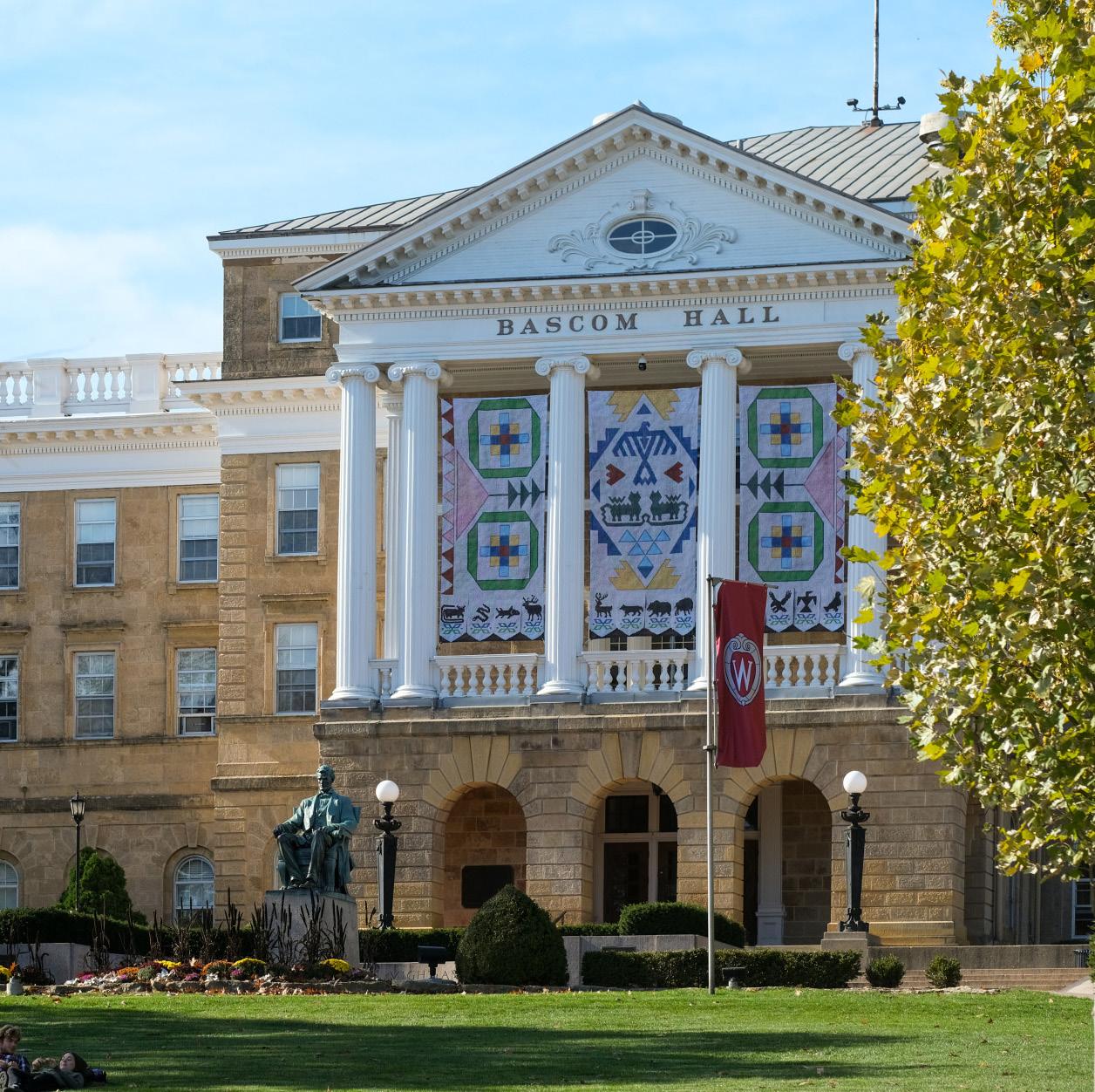
Marv and Jeff Levy announced on Sept. 11 a $75 million donation to fund a new engineering building on campus, the largest gift the university has received for a single project.
Set to open in 2028, the new building will be named in honor of the Levys’ brother, Phil, who passed away in 2021. Construction will begin in May 2026.
“Our family deeply appreciates the vital role engineering plays in driving innovations that advance our society and contribute to people’s quality and enjoyment of life,” said Marv at a Bascom Hill event announcing the donation.
“Through this gift, we can ensure the College of Engineering will remain on the leading edge and
educate an ever-expanding number of talented engineers for generations to come.”
In May, the Legislature’s Republicancontrolled budget-writing committee slashed $197 million in funding for a UW-Madison engineering building approved by Gov. Tony Evers in the state’s 2023-24 capital budget. This left a gap of $75 million in the total $347 million cost, which has now been funded.
The project stalled for two years after Wisconsin Assembly Speaker Robin Vos, R-Rochester, indicated construction of the building was contingent upon reaching an agreement to cut diversity, equity, and inclusion (DEI) programs.
UW-Madison had donors lined up, offering millions to pay for the building, but they eventually pulled out due to the GOP-controlled legis-
lature not holding up their end of the deal. The Levys’ lead gift may not have been necessary had the money from the state come in sooner.
In December 2023, the UW System Board of Regents approved a deal to cap hiring for DEI positions for three years and restructure one-third of the system’s 130 DEI positions into general student success positions. In return, the UW System would receive pay raises and new buildings.
The engineering college can accept fewer than 20% of its applicants. The new building can grow undergraduate enrollment to 5,500 students and graduate student enrollment to 2,000 students.
“Virtually everything in our world today has benefitted from an engineer,” Grainger Dean of the College of Engineering Ian Robertson
told The Daily Cardinal. “Companies across the globe need engineers to continue to be innovative and competitive and the need for very well educated engineering leaders, like our Badger engineers, is growing.”
Max Heirigs, a mechanical engineering major at UW-Madison, told the Cardinal he is fine with a new building as long as the increase in enrollments comes with an increase in faculty capacity.
In Heirigs’ experience, professors are already pretty overwhelmed, especially in introductionlevel classes.
“The new building isn’t going to increase students’ quality of education as [much as investing in] new research tools to help improve professors’ research and students’ involvement in that,” he said.
By Amari Mbongwo & Elijah Pines
OUTREACH DIRECTOR & STAFF WRITER
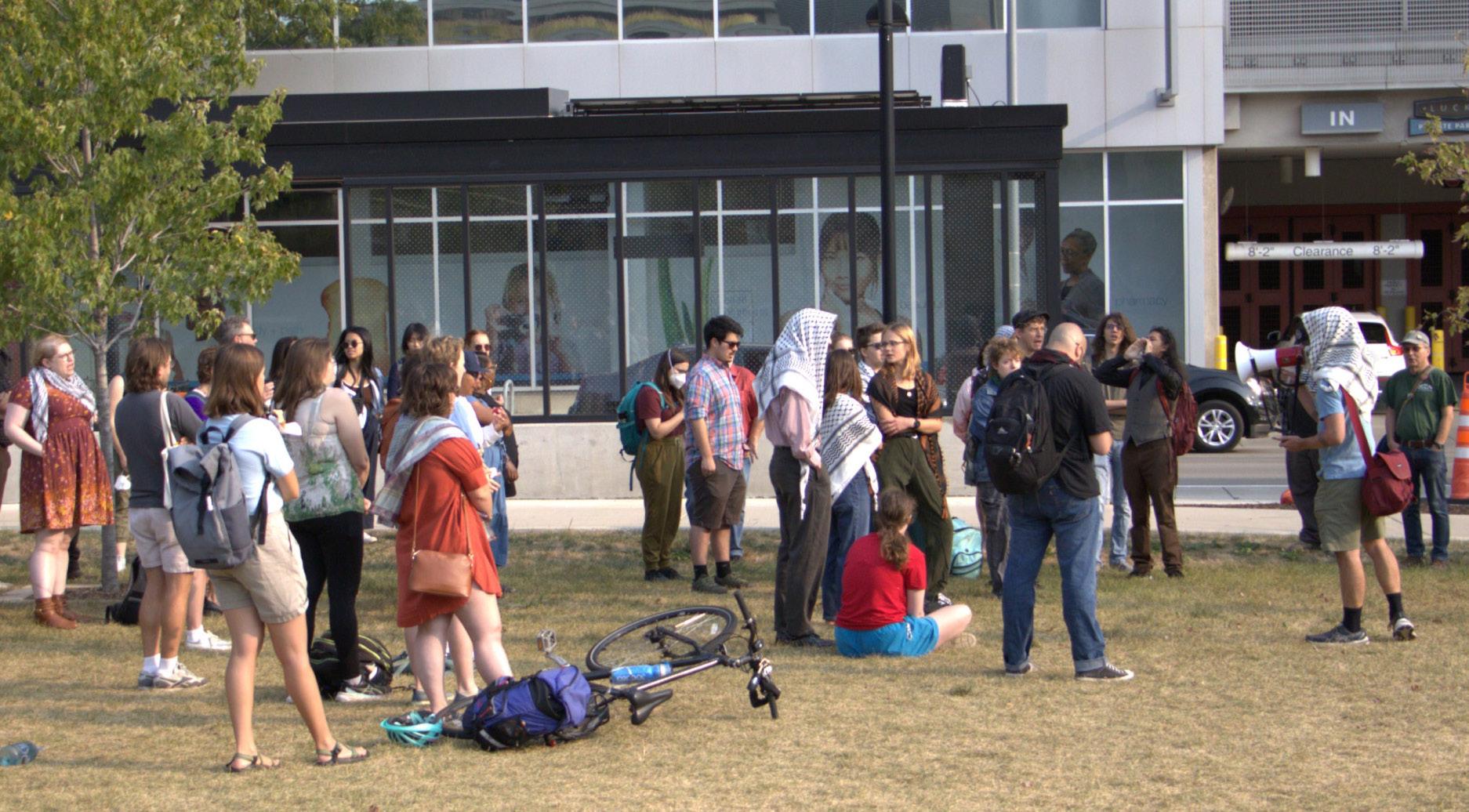
Approximately 40 students, staff, faculty and community members from the University of Wisconsin-Madison’s Students for Justice in Palestine (SJP) protested outside Gordon dining hall on Sept. 11 during a disciplinary hearing for a student involved in the May 2024 pro-Palestine encampment.
The student was appealing UW-Madison’s recommended academic sanction, according to protest organizers. Approximately 30 to 40 students have faced non-academic misconduct investigations by the Office of Student Conduct and Community Standards (OSCCS) for their role in the encampment, according to an August statement from John Lucas, UW-Madison spokesperson.
Four students were recommended disciplinary probation for a year, a status that shows up on official transcripts and could affect access to study abroad, employment and scholarship opportunities. Eleven students were recommended a less severe written reprimand. One student was found not responsible, and one outcome is unknown, according to a statement from 17 students and faculty who were under OSCCS investigation.
They said UW-Madison attempted to “silence students and staff who have stood in solidarity with Palestine” in their statement.
“We just want to show the university that we’re not going to take this lying down,” said Shafiq, who did not share his last name for fear of retribution. “We’re still fighting against genocide. We’re still fighting for divestment.”
Shafiq, an organizer of the protest and SJP board member, told The Daily Cardinal many pro-Palestinian protestors from last year faced disciplinary actions with “minimal evidence.”
“We call on students to call the chancellor and tell them that you are outraged about how this is proceeding, how they are trying to silence students, how they’re trying to shut down pro-Palestinian organizing on campus, how they’re placing sanctions on students for absolutely ridiculous reasons,” Shafiq said.
Shafiq, who said he was out-ofstate during last spring’s pro-Palestine encampment, faced disciplinary proceedings by the university. Shafiq said he and three other Palestinian American students on the SJP board were put on disciplinary probation. He plans to appeal his recommended sanction since he was not on campus during the encampment.
Shafiq said other students were reprimanded for writing an op-ed to the Cardinal, speaking with media or appearing in photos protesting.
He called the disciplinary proceedings “ridiculous” and said they disfavored pro-Palestine and Palestinian
American protesters.
In response to allegations that Palestinian American protesters faced stronger repercussions than non-Palestinian Americans, Lucas said “all student misconduct hearings are judged impartially according to our process.”
Lucas also said he could not detail specifics of misconduct cases because the Family Educational Rights and Privacy Act prevents disclosure of academic records, including disciplinary proceedings.
Demonstrators gathered on the lawn outside Gordon dining hall at 8:30 a.m. and chanted pro-Palestinian slogans through a megaphone. At 9 a.m. the group moved to the tables outside Gordon dining hall and watched the live-streamed hearing on their phones. For the next hour and a half, demonstrators quietly sat at the tables until the hearing concluded.
Outside Gordon’s on East Campus Mall, two marked and two unmarked
police cars parked nearby. Across Johnson Street, another group of police officers set up a table advertising “coffee with a cop”. Passersby were offered free coffee, pizza cutters, toy cop cars and an opportunity to socialize with local police. At 9:30 a.m., a police officer brought his dog to play on the Gordon lawn, and repeatedly brought him near the sitting demonstrators over the next half hour.
Lucas said the university would take the ending of the May encampment as mitigating circumstances for students associated with SJP, as stated in the agreement between SJP and UW-Madison to end the encampment.
Demonstrators criticize updated university expressive policies
According to Shafiq, before the protest even began, Associate Dean of Students Kathy Kruse approached Shafiq to remind him of the new “expressive activity” and
protest policies.
The new policies include restrictions on “expressive activity” with 25-feet of university building entrances, restrictions on sign size, specific noise restrictions, allow for usage of small bluetooth speakers and prevent obstruction of university buildings.
An ACLU of Wisconsin lawyer, and free speech expert Howard Schweber questioned the constitutionality of the rule that prevents “expressive activity” within 25 feet of university facilities.
Barret Elward, president of the UW-Madison faculty union, United Faculty and Academic Staff (UFAS), told the Cardinal the university made their decision without consulting faculty, staff and students through shared governance — the system in which student and staff groups, including the Associated Students of Madison and the Faculty Senate, advise and participate in university decision making and policy development.
“The way the policy can be implemented, they don’t actually need to involve shared governance,” Elward said.
Elwardalsosaidtheadoptionofthepolicydiscredits“thewholeideaofsharedgovernance that it is strictly an advisory body.”
“There’s no actual decision making authority with shared governance,” Elward said.
Lucas said the updated policies were reviewed with the University Committee and with ASM chair Dominic Zappia.
“The university is committed to protecting and promoting free expression, with reasonable time, place and manner restrictions in place to ensure the university can continue to fulfill its responsibilities to teaching, research and service.” Lucas said.
Continue reading online at dailycardinal.com
“…the great state University of Wisconsin should ever encourage that continual and fearless sifting and winnowing by which alone the truth can be found.” University of Wisconsin-Madison

By Ted Hyngstrom STAFF WRITER
U.S. Rep. and former Speaker of the House Nancy Pelosi discussed her political career, the “responsibility” students play in the upcoming presidential election and her new book at a packed Shannon Hall Monday evening.
The talk, held on the second night of the 8th annual Cap Times Idea Fest, was the keynote event. The festival runs from Sept. 15 through Sept. 21 and brings leaders from diverse fields to discuss Wisconsin’s efforts to “reach a better state.”
Pelosi, who has represented San Francisco in Congress for 19 terms, is regarded as one of the most consequential House Speakers in the modern era. Her visit to Madison comes as she released a book last month, “The Art of Power,” which details her rise to the peak of political power and her role in passing landmark legislation.
Pelosi spoke with Washington Post columnist Karen Tumulty on the state of American democracy and the integral role students will play in November.
“I’m here in Wisconsin because of your importance,” Pelosi said. “I want all of you to know the power you hold in all of this and to know your

responsibility in all of this.”
Pelosi highlighted the importance of electing Democrats to the House of Representatives, calling it “absolutely essential” House Minority Leader Hakeem Jeffries receives a majority. She noted the crucial role members of Congress play in ratifying the presidential election results.
Other topics included Pelosi’s start in politics and her motivation in running for Congress.
Pelosi referenced her actions as a volunteer in the 1970s and identified her “why” in politics: to reduce child hunger. “What bothered me was that one in five children
go to sleep hungry each night.
So that was my mission.”
Tumulty asked about a key moment in Pelosi’s political career — securing enough votes to pass the Affordable Care Act (ACA) without a filibuster-proof majority.
Pelosi described it as the “opportunity [and] challenge of a generation,” adding presidents stretching back to the 1950s had tried to pass it and fallen short.
“We weren’t going to let anything stand in our way… we just pushed open the gate,” Pelosi said.
She also firmly rejected Trump’s characterization of
himself as a defender of the ACA in Tuesday’s presidential debate, saying he “definitely wanted to get rid of it because that’s where the money was.”
The conversation shifted when Tumuly asked Pelosi about a lack of “optimism” in the past week, referencing former President Donald Trump’s unsubstantiated claims surrounding Haitian immigrants and the second assassination attempt of Trump. Pelosi responded with a call for unity.
“Hope is where it always has been sitting in between faith and charity,” Pelosi said. “We find our common ground. Our diversity is our strength but our unity is our power.”
Quintessa Ganski, a 2024 University of WisconsinMadison graduate, told The Daily Cardinal after the event Pelosi’s message on unity resonated with her.
“I think she talked a lot about the generational impact we have as young voters,” Ganski said, noting she hoped the message would connect with other young voters.
Pelosi is among other high profile political attendees, including former Wisconsin Gov. Tommy Thompson and former U.S. Rep. Liz Cheney, who will speak this week in Shannon Hall on similar subjects.
By Joseph Panzer SENIOR STAFF WRITER
At a Dane County Board of Supervisors meeting on Sept. 5, 15 students from local high schools were selected to participate in the Dane County Youth Governance Program (YGP).
The program is designed to connect students in 10th through 12th grade with a Dane County committee they will serve with to get involved in local government. For those in county government, the YGP is seen as a vital way to reinvigorate the conversation on local issues.
“As another year of the Youth Governance Program begins, it’s important to put a spotlight on the ambition and the innovative mindsets of high school youth,” District 19 Supervisor Brenda Yang said in a press release. “They bring a refreshing perspective to county government, and we look forward to seeing the contributions they make towards their communities.”
District 5 Supervisor Henry Fries told The Daily Cardinal his experience as a high school student in a similar program in Waupaca was a “transformative experience” and “sparked his passion for local government.” He
believes students can make a difference in Dane County through the YGP by “advocat[ing] for their priorities in the 2025 budget.”
Current requests for Dane County’s 2025 budget have projected expenditures of $812.3 million yet total revenues of only $498.2 million. At the same time, Madison,Dane County’s largest city,has a projected budget shortfall of $22 million for 2025.
Fries serves as a member of the Health & Human Needs Committee overseeing the Human Services Department, which has the largest budget of any department in the County with $165.2 million requested for the 2025 fiscal year.
As a member of Gen Z, Fries told the Cardinal he believes “our generation brings a unique perspective” when it comes to addressing issues related to climate change, social equity and community resilience.
“By elevating the ideas and interests of youth from across Dane County on the Board, we can ensure that our decision-making is not only responsive to current needs but also futurefocused,” Fries said.
Research from the Public Religion Research Institute (PRRI) shows that 58% of Gen Z adults believe
that a handover of political leadership from the older generations to younger ones is needed to solve the country’s problems.
Climate change has already impacted Wisconsin by contributing to flooding in August 2018 that destroyed homes and farmland near the Kickapoo River.
“Gen Z will bear the brunt of these climate issues, so their voice is vitally important in the work of our committee to center climate issues in all of our discussions,” District 6 Supervisor Yogesh Chawla told the Cardinal. District 11 Supervisor Richelle Andrae, a member of the Public
Protection & Judiciary Committee, believes the most rewarding aspect of the program is how it reinforces a future-oriented mindset in supervisors. She said having students involved in government is “a constant reminder to think about how the issues we work on or policy solutions impact young people in our community.”
The selected students represent Dane County high schools from Oregon, Middleton, McFarland, Waunakee, Verona, Edgewood, Monona Grove, Sun Prairie, Vel Phillips Memorial and the Madison Country Day School.
By Ty Javier SENIOR STAFF WRITER
With the Nov. 5 election less than two months away, Wisconsin’s U.S. Senate race remains tight.
Incumbent Democratic U.S. Sen. Tammy Baldwin and multimillionaire businessman Eric Hovde are neck-and-neck, remaining in a statistical tie, according to Marquette Law School’s poll of Wisconsin voters released in early September. Successful political campaigns cost money. When races get tight, campaigns rush to raise and spend large sums to get the word out.
The Federal Election Commission (FEC) limits the amount individuals can contribute to a candidate’s campaigns to
1 DEMOCRAT
WINSENATE (SMP)
Democrat-aligned PAC
2024 election cycle funds allocated to AZ, MI, MT, NV, OH, PA & WI Senate races
$3,300 per election (a primary, general, runoff and special election are each considered separate elections). This often restricts large donors to a maximum of $6,600 per election cycle for individual candidates, so donors who wish to influence the election in a larger way can donate to a Political Action Committee (PAC).
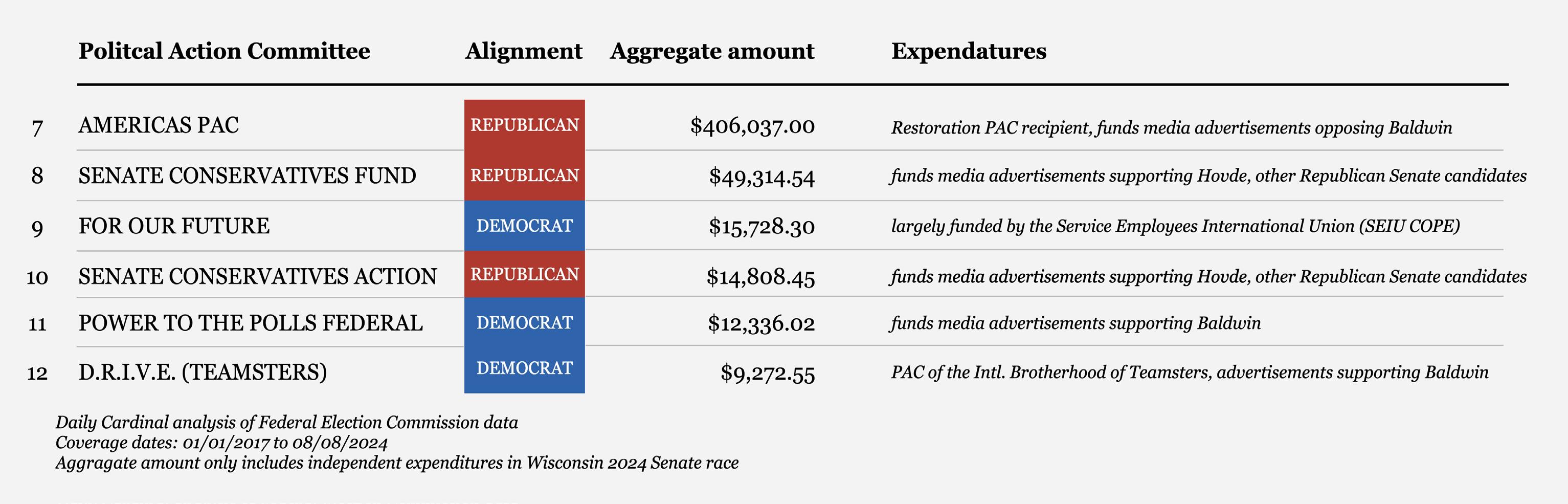
This cycle, PACs have collectively pumped $18.7 million and counting into the Wisconsin Senate race, according to a Daily Cardinal analysis of Federal Election Commission data. The graphics below show the top PAC spenders, their party alignment and top donors.
Some PACs may receive unlimited contributions from individuals, corporations, labor unions and other PACs for
2 FIX WASHINGTON REPUBLICAN
the purpose of financing independent expenditures — spending for a communication that advocates the election or defeat of a candidate without coordination with any candidate, their campaign or political party.
From CEOs to shipping magnates, the mega-donors listed below leverage their wealth to influence elections according to their ideologies. Notable contributors include heirs of the Walmart fortune, Koch Industries, Hovde’s brother and both CEO and the president of Uline.
Note:Theindependentexpenditureslistedbelowareexclusively for the Wisconsin Senate race. Donations are made to thePACnationally,althoughsomeonlyspendinWisconsin.
3
PAC REPUBLICAN
*FRED EYCHANER Chairman/Founder at Newsweb Corp. $8.0 M
*JAMES SIMONS Founder at Renaissance Technologies $7.5M Top donations SMP Supports Democratic Senate candidates $22.8 M
This independent expenditure-only political committee only receives funding from SMP, a separate PAC. *SMP top donations
4 AFP ACTION REPUBLICAN
Koch-linked conservative PAC 2024 election cycle funds spent in House, Senate & presidential races
donations
C. GRIFFIN CEO of Citadel
STEVEN D. HOVDE CEO of Hovde Group
Republican-aligned PAC 2024 funds allocated solely to WI Senate race ELIZABETH A. UIHLEIN President of Uline
This independent expenditure-only political committee largely funds media buys opposing Baldwin and supporting Hovde.
Democrat-aligned PAC 2024 election cycle funds allocated solely to WI Senate race and other organizations
WALTON FAMILY* Collective fortune from Walmart, richest family in the U.S.
By Bryna Goeking ARTS EDITOR
Content warning: this story includes mentions of suicide and mental illness.
On a large campus, students at the University of Wisconsin-Madison struggle with mental health issues and are overwhelmed with a myriad of institutional mental health resources provided by University Health Services.
That’s where two student organizations, Badger Support Network and the Association for Suicide Prevention UW Chapter step up, tackling suicide prevention peer-to-peer to destigmatize mental health.
Suicide is the second-leading cause of death for college students. Each year, there are approximately 1,100 suicides on college campuses. With COVID19 exacerbating an already existing mental health crisis, the Biden-Harris administration announced a $200 million plan to fund the suicide prevention hotline and provide resources for schools in May 2023.
On the UW-Madison campus, 12% of students struggle with suicide ideation per year, with 8% of students seriously considering an attempt, according to the Badger Support Network. Forty-three percent of students screen positive for depression, according to UHS Interim Mental Health director Ellen Marks.
Badger Support Network and
AFSP-UW spoke to The Daily Cardinal about the need for early intervention in those struggling.
Each semester, the Badger Support Network trains students in mental health care and suicide prevention, including the RRR method — Recognize, Respond and Refer — with the assistance of UHS.
The first step, recognizing, relies on student advocates to notice any troubling changes in behavior and actions.
Before referring to a professional, advocates are trained to check in with the student and ask for their permission to share personal details.
Members Mia Braico and Megan Klinger stressed the importance of early intervention.
“We have trained peer facilitators that have weekly meetings, which fosters a sense of stability which promotes advocating for yourself and offers a vulnerable, open space for students to come and connect with one another,” Klinger said. “Obviously, we are not professionals. So we need the support of UHS to kind of give us those baseline skills and how to approach mental health topics.”
Students also face unique struggles, creating a disconnect between professionals. Age, status and marginalized identities can alienate students from licensed mental health programs.
That’s where students connecting each other with trained
professionals is crucial, UHS Interim Director of Mental Health Services Ellen Marks said.
UHS launched a new clinically moderated online peerto-peer mental health community called Togetherall last year. Roughly three quarters of UW-Madison students polled by UHS would talk to a peer if they were struggling with their mental health, Marks said.
Mental health care is not a onesize-fits-all, Marks said. Marks works closely with the Badger Support Network and AFSP-UW, which “strengthens” her work.
“Sometimes they need education, sometimes they need connection, sometimes they need a supportive peer or a supportive person who’s not a clinician to meet them where they’re at,” Marks said. “The work that students are doing across campus also plays a really important role. It feels great to work on a team that awesome.”
Even without providing professional care, creating a community is crucial for raising awareness and providing support for suicide prevention. Social connectedness is an important factor for suicide prevention in teenagers and young adults, according to the University of Oregon.
“It’s comforting to have people that maybe relate to your experience or understand it, and I think having people around you that can relate and understand really
make a difference in mental health,” AFSP-UW President Olivia Sutor said.
Students can also develop more relevant methods of outreach to peers, Sutor said.
Each April, AFSP-UW holds an Out of the Darkness Walk to fundraise for suicide prevention. Walkers can wear different colored beads to symbolize how suicide has impacted their life, why they’re at the walk and create connections with people going through similar experiences, Sutor said.
Strength between student members
In addressing suicide risks on campus, the Badger Support Network and AFSP-UW have also forged close connections between its members.
“As a freshman in a really big university, I was kind of struggling to find my own community,” Braico said. “BSN led me to that community, and I’ve
stayed ever since because it’s been so fun to meet new people, find that support, do community events and, of course, allocate for mental health in the bigger picture.”
In addition to the peer-topeer connection students gain in these organizations, they acknowledge the impact their work has on campus.
“It’s really rewarding personally — as well as helping other people — but it’s rewarding personally to be able to make a difference on campus and see the change start to aspire and maybe make a trend where we can make a difference in mental health,” Sutor said.
From walks to weekly meetings to clinical education, students are shaping a stronger future for mental health on campus.
Students suffering from suicidal thoughts can receive 24/7 mental health care from the UHS crisis line by calling 608-265-5600 (option 9) or the national crisis lifeline at 988.
By Gabriella Hartlaub
ARTS EDITOR EMERITUS
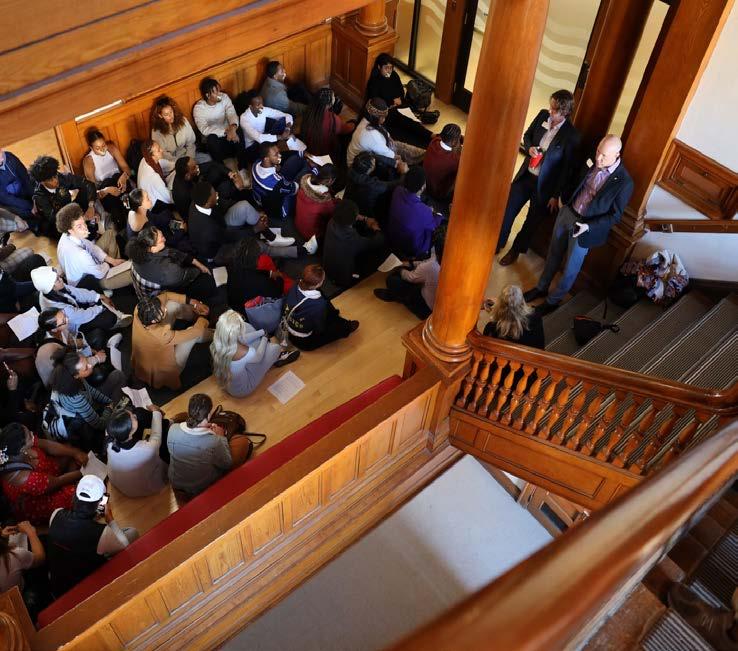
The University of WisconsinMadison released a report from an ad hoc study group on the Black experience Thursday which found stagnation in enrollment of Black students and hiring of Black faculty, lack of funding for Black academic programs and Black student retention issues.
Following the release of a video in which a UW-Madison student used racial slurs, students organized largescale protests calling for evaluating the effectiveness of university diversion, equity and inclusion (DEI) initiatives, increased funding for minority student organizations and the creation of programming for first-year students that covers racial bias. Chancellor Jennifer Mnookin then commissioned the study to address issues that Black students, faculty and alumni face at UW-Madison.
“The success of Black students, faculty, and staff is integral to UW–Madison being a truly inclusive university environment. Anything less is an existential threat to the UW–Madison mission,” the report read.
The 46-page report outlines historical and current data on Black student enrollment and staff, the history of DEI plans at UW-Madison and provides recommendations for the university to better the Black experience, including the creation of a Black
Student Advisory Committee.
The report also recommended creating metric-based goals to address consistently low Black student enrollment and encouraged partnership between UW-Madison and Wisconsin school districts with a higher proportion of Black students. Currently, 3.4% of UW-Madison students are Black, and Black community presence has been “consistently around 3%,” according to the report.
“Progress in enhancing Black representation and experience at the university has remained insufficient,” the report said.
UW-Madison Professor Angela Byars-Winston and Rev. Dr. Alex Gee, co-chaired the committee.
“The recommended strategies in this report are aimed at fostering a university culture where Black individuals do not just survive but thrive,” the co-chairs said in a letter at the beginning of the report.
The 15-person committee included two students: Kaleb Autman, the operations director for the Black Power Coalition, the group that organized the 2023 spring protests, and Amaya Boman, Associated Students of Madison Grant Allocation Committee chair. Other members of the committee included university staff, faculty and alumni.
While the report recommends many different ways to change and
increase enrollment and retention of Black Students, it also notes “it is unacceptable to bring more Black people into a toxic environment and focus on creating more tools to adapt to the toxicity but ignore the metaphorical environmental campus clean-up so desperately needed.”
One of the recommendations the report advocates for is the formation of both a Black Faculty/Staff Council and a black student council. Both groups would hear concerns from Black students, faculty and staff, and leadership would meet with Mnookin twice a year. The report recommends that Mnookin elevate the concerns from these groups to the appropriate university department.
The report also recommended the creation of a Black student recruitment team that would work in tandem with a Black student retention team and increased funding for the recruitment of talented Black students using merit-based scholarships.
The remaining recommendations focused on alumni engagement, Black student recruitment and the African American Studies Department.
The report recommends that the UW Foundation create positions dedicated to mentor matching and coordinating between Black UW-Madison alumni and current Black students in career mentorship, advocates for the hiring of multiple staff members
dedicated to coordination between Black Alumni and the university, and positions to increase financial support from Black Alumni.
African American Studies Department Chair Christy Clark-Pujara recommended there be increased support, financially and intentionally, for the African American Studies Department, including more funding to allow for more full-time staff members for the department, which currently only has three staff members.
Clark-Pujara also wrote of the need for more endowed faculty, Black faculty hires and increased community support.
Mnookin has tasked Vice Chancellor for Inclusive Excellence LaVar Charleston with reviewing and implementing the report’s recommendations, according to a press release from UW-Madison.
By Adalyn Reichenberger STAFF WRITER
As a freshman, I remember being fairly overwhelmed but extremely excited as the school year began. It was not easy jumping into a new place full of new people, opportunities and expectations.
Now, as a junior, I have taken time to reflect on my own experiences. With this, I decided to come up with a few important messages and lessons I have learned throughout the years. If I could go back in time and give my freshman self a few words of advice, I would tell her to read this article.
First, it is important to understand you will most likely do poorly on a few assignments and exams. This is normal. It does not matter if you are ahead in credits, graduated top of your class or that you had a 4.2 GPA in high school. Being at the University of Wisconsin-Madison means every valedictorian and top student now sits next to you.
This piece of information failed to humble me in Chemistry 103, as I received a 33% on an exam. I was studying for hours, going to office hours and still failing. Let me validate the fact that college at an esteemed univer-
sity is not easy. Although it felt like the end of the world, I still passed the class and did even better in Chemistry 104.
If you find yourself in this position, use it as a learning opportunity. Instead of beating yourself up over something you cannot change, use this as motivation to try something new. College is all about learning what works for you and what doesn’t.
Mistakes will be made as no human is perfect. Everyone functions differently, meaning everyone learns differently. Take some time to research and practice new study habits as this can be extremely beneficial in your success.
Say “yes.” I am sure you have heard this piece of advice time and time again, but I am here to reiterate the necessity of saying yes to new activities and people. Join clubs and activities, engage in class, and most notably, don’t be afraid to meet new people. I would recommend talking to as many people as you can, even if they seem like someone you wouldn’t usually talk to. You never know who you will meet, and what opportunities you will run into.
While saying “yes” is great, saying “no” is just as important.
Sometimes, for your own good, you need to say “no” and do what is best for you. Maybe you have hours of schoolwork to get done or you simply need some time to yourself.
Remember the importance of independence and alone time because it greatly benefits your overall success. As time went on, I got more comfortable at school, and realized I didn’t need to be with someone at all times of the day. The more time I spent alone, the more I was able to coordinate my own needs. Maturing is realizing you can and should enjoy spending time with yourself.
Finally, and most importantly, give it the whole year. The end of my first semester at UW-Madison was my mental lowest: finals, fights with roommates and a situationship to end all others. I felt like I had made a mistake coming to college in the first place. Had I not come back the next semester, I would have missed out on meeting the people I now consider family.
By the end of the spring semester, I had to be dragged out of this city. Keeping my perspective on the exciting possibilities led me to the person I am today.
By Hannah Lindow STAFF WRITER
Of all four seasons, fall fashion trends always seem to catch my eye the most. Every year, the possibilities of style choices seem overwhelming, and it seems impossible to figure out what the “cool girls” are wearing for backto-school season. With New York Fashion Week officially over, and Pinterest overflowing with inspiration, I’ve created the perfect “go-to” list of the upcoming fall trends you need to keep your eye on.
This year’s color palette: olive green, chocolate brown, burgundy red and butter yellow
Carrying over from the summer, butter yellow is staying in the spotlight for fall. Mix and match any of the darker colors listed above with a jean or white, and you’ve got the perfect outfit color scheme for fall 2024. Although some of these colors have been in trend for a while, they are turning into staple and timeless colors that will elevate any outfit.
Suede everything
Last year’s material of choice was leather, this year you can add to your outfit with the help of suede. With accessories like boots and purses, and larger articles like oversized jackets, suede is the perfect way to spice up a look. Luckily, thrift stores are overflowing with suede so make sure to visit your local second-hand shop such as Goodwill or Ragstock.
Denim on denim on denim
Carrying over from the summer’s “coastal cowgirl aesthetic,” dark-wash denim is in. According to Glamour’s Jake Henry Smith, “labels like Schiaparelli, Moschino and Skall Studio” were showcasing their denim-packed looks on the runways this fall.
You are guaranteed to find halter tops, button up jackets, long western skirts and the perfect boot cut jeans — all in denim.
Big jumper and a long lacy skirt
An overarching theme of this fall’s trends is a play on western style, and this outfit equation is no exception. Layering an oversized knit sweater over any long and flowy skirt creates the most comfortable (and fashionable) outfit. Playing around with see-through lace, silk or a classic cotton skirt can tailor this trend uniquely to you.
Will we ever get tired of animal print? No: leopard print is here to stay for the fall season. The obvious option is to find a high-neck tank or the viral leopard print jeans. However, if you want to add a more subtle hint of animal print, there are other options. Talia Abbas, a senior shopping editor, told Vogue her plans to use “a patterned clutch, a silk scarf knotted around a bag handle, or a phone-hair flat to amp up a neutral look.”
Your bag needs some jewels too
If you don’t want to add any more pieces to your closet, the easiest way to stay on trend this fall is by accessorizing your bag. Brands such as Coach and Anthropologie have charm options for everyone. Trying to save money? Plan a DIY night and create your own. Reuse your hair ribbon from last spring to add a little feminine touch to your bag strap or visit your local craft store and pick out beads galore.
The biggest trend of this fall is being you. Take any of the trends on this year’s radar and make it your own. Adding your own personal touch is the best way to stay fashionable.

By Sophia Ross SENIOR STAFF WRITER
The University of Wisconsin-Madison football team welcomed No. 4 ranked Alabama to Camp Randall in a highly anticipated non-conference game on Saturday.
No one expected a game against Alabama to be easy. In fact, anyone who thought it would be anything less than a battle was lying to themselves.
The Crimson Tide have curated one of the greatest legacies in college football, one that has gone through a growth period since the retirement of longtime coach Nick Saban but nonetheless has remained a solid force in the SEC.
Wisconsin, on the other hand, is withstanding its own program changes under second-year head coach Luke Fickell’s reign and with the loss of several key players from previous seasons such as star running back Braelon Allen.
But in enduring a 42-10 blowout loss to Alabama last weekend, it’s hard not to reflect on the elements of the loss that came from facing a heavily accomplished, national-title contending program,
as well the holes the Wisconsin team dug itself into.
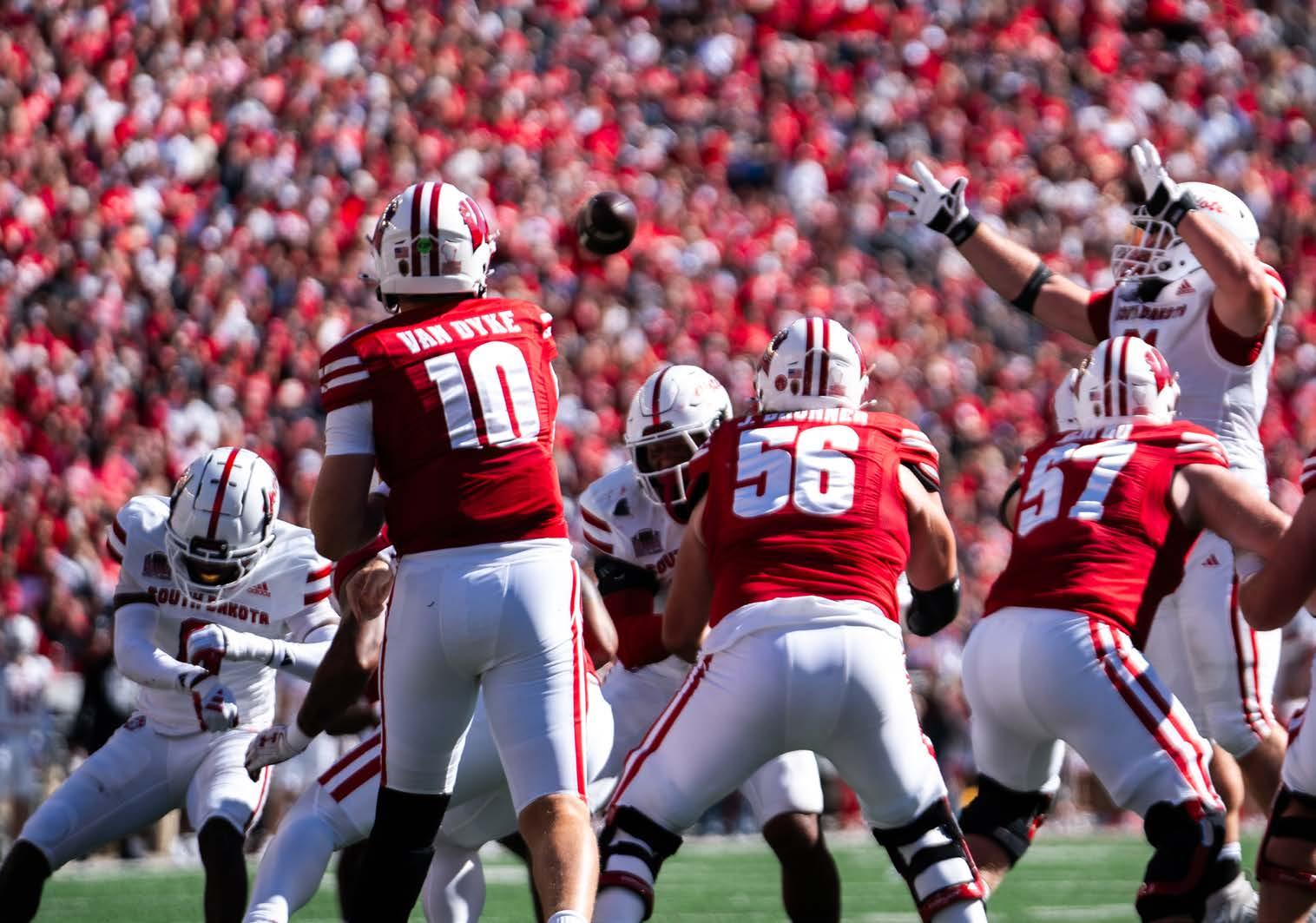
The difficulties for the Badgers began early. On just the first drive of the game, starting quarterback Tyler Van Dyke was sidelined with a right knee injury. Fickell expressed his disappointment in Van Dyke’s injury at the post-game press conference.
“I don’t think it looks real good for us or for him,” Fickell said. “That’s really, really difficult because I think that he was really well prepared, and I think that he had grown in those first few weeks and was really sharp to start that game.”
The sharp start Fickell was referring to was the early points Wisconsin was able to get on board during the first few minutes of the game. Even after Van Dyke’s abrupt exit, second-string quarterback Braedyn Locke was able to progress the ball enough to allow kicker Nathanial Vakos to score a 53-yard field goal. But, those three points were the only score on Wisconsin’s side for the entire first half and into a chunk of the second.
The Badger defense was no match for the Crimson Tide’s quarterback, Jalen Milroe. The
Milwaukee Journal Sentinel reported the Alabama “junior completed 12 of his 17 passes (70.6%) for 196 yards and three touchdowns” (Kuhagen and Radcliffe) — those were just the three touchdowns Milroe threw, while he ran for two more. Locke, on the other hand, went 13-for-26 on the day for 125 yards and a touchdown.
Additionally, Alabama simply made quick haste of every opportunity they were given. Seconds before the first half ended, Alabama scored its third touchdown of the game with a drive that only lasted two plays. Between both plays, the Tide covered 73 yards, making the score 21-3 before halftime.
But it’s what led Alabama to receiving and capitalizing off of the ball so quickly that marks the real issue of Saturday’s matchup.
“The latest problem came just before halftime when Vakos missed a 44-yard field goal, which gave the Crimson Tide the ball back with just enough time to go two plays and 73 yards for a touchdown,” The Athletic said. This seemed to be the story
By Grace Cannizzo STAFF WRITER
The No. 8/7 Wisconsin Badgers men’s soccer team stunned No. 12 University of California-Los Angeles with a 4-1 home win Monday night, once again putting on a show for the Wisconsin crowd and defending the McClimon Soccer Complex, where they remain undefeated this season.
The Badgers struck first in the 24th minute when sophomore Trip Fleming launched a ball high into the box, and freshman superstar Dean Boltz beat the Bruins defender and keeper, landing a backwards header into the back. Boltz’s eight goals on the season ties him for leading scorer in the NCAA.
In the 31st minute of play, senior Kevin Andrews scored his first goal of the season. The Badger capitalized off a rebound deep in the box to find the upper-right corner of the net.
To add to their already thrilling performance, junior forward Thomas Raimbault played a through-ball to the
feet of Fleming, who placed the ball under the legs of the Bruin’s keeper to advance the score to 3-0 in favor of the Badgers with just over four minutes left in the half.
In the second half, UCLA quickly found a goal. But that didn’t discourage the Badgers, who finished off the night with yet another goal. Raimbault, a UCLA transfer, racked up a pair of points against his former team by striking a powerful volley that deflected off of the Bruin’s keeper and found its way into the net. This play marked the junior’s first goal of the season.
Following their 4-1 win, Wisconsin’s record moves to 6-1, the best the program has seen in their first seven games in over 30 years. They now tie for having scored the third most goals in the NCAA (20).
The Badgers look to continue their at-home undefeated streak, playing host to the Viterbo V-Hawks Saturday at 6 p.m.

of the game. Wisconsin made a mistake, and Alabama took advantage of it.
A key element of Wisconsin’s performance on Saturday that needs fixing fast is the lack of control on the ball, which ultimately led to two major fumbles. One such turnover was during the first quarter when Wisconsin running back Chez Mellusi “picked up 21 yards but lost a critical fumble that gave Alabama the ball at the Badgers’ 28-yard line,” Temple said.
All in all, the Crimson Tide converted plays, and Wisconsin did not. Wisconsin went 3-for-14 in third-down conversions whereas Alabama went 8-for-14. Meanwhile, Wisconsin actually had the majority of possession for the game but failed to score with it. Wisconsin had the ball for 34 minutes whereas Alabama had it for 25 minutes.
There were some positives that can be taken away from Saturday’s game. Beyond the play that cost Wisconsin a turnover, Mellusi had a relatively successful game. The Wisconsin Athletics page detailed Mellusi and his fellow running back, Cade Yacamelli’s achievements:
“Chez Mellusi was yet again a force for the offense, rushing for 66 yards on 11 carries and being second on the team in receptions with four. Mellusi’s running back mate Cade Yacamelli had a strong outing for the second straight week, racking up 39 yards on just eight attempts.”
Wisconsin’s sole touchdown for the day showcased what a successful drive for the team could look like. Late in the third quarter, Locke connected with wide receiver Will Pauling on fourth-andgoal to close out a 17-play drive which covered 75 yards.
“They beat us in every phase of the game today,” Fickell said during the postgame press conference. “Give them credit; they’re a really, really good football team. We knew coming in here that we were going to have to play and execute really, really well, and we did not do that today.”
The Badgers have a bye week this next weekend, after which they will travel to Los Angeles to take on the No. 11 University of Southern California Trojans in their first conference game of the season.
By Molly Sheehan SPORTS EDITOR
Wisconsin starting Quarterback Tyler Van Dyke is out for the rest of the 2024 season following a right knee injury in the first quarter of the Badgers’ 42-10 loss to Alabama on Saturday, according to BadgerExtra’s Colton Bartholemew.
“The University of Wisconsin senior quarterback suffered a knee injury Saturday against Alabama, which was confirmed by an MRI Sunday morning, according to two BadgerExtra sources,” Bartholomew reported. “Those sources declined to offer specifics on the injury, but both said Van Dyke will not return to the field this season.”
Van Dyke was carted off the field
after his knee buckled when scrambling to the sideline during the seventh play of the game. The Miami transfer reached for his knee after hitting the ground following a tackle.
ESPN’s Pete Thamel provided clarity on the injury, taking to Twitter that sources told ESPN the injury is a “full ACL tear in his right knee, and the timeline for recovery isn’t clear yet.”
The senior completed 63.2% of his throws for 422 yards and a touchdown, along with rushing 26 yards and a touchdown at Wisconsin.
Following Van Dyke’s early exit against Alabama, Wisconsin looked to Mississippi State transfer Braedyn Locke. The redshirt sophomore completed 50% of his throws for 125 yards against the Crimson Tide defense.
The Dare’s new album “What’s Wrong with New York?” could signal a club music Renaissance.

By Marit Erickson STAFF WRITER
People struggle to shove
The Dare into one box.
He’s bringing back straight boy swag. He’s an LCD Soundsystem wannabe. He’s the new face of New York. He’s sexy, he’s ugly, he’s a nerd, he’s a genius.
The Dare released his first LP, “What’s Wrong with New York?” on Sept. 6. The project features a compilation of thumping beats and suggestive lyrics perfect for a NYC club.
You may have seen him in his thin black tie and slim fitted suit clutching a cigarette and flicking a sweaty Pioneer board behind his DJ pulpit. If you have seen indie sleaze resurrector Harrison Patrick Smith, currently known by stagename The Dare, then you can recognise his undeniable appeal.
In 2022, The Dare released his debut single, “Girls,” which was claimed to be “a rejection of the last five years of music.”
What’s wrong with the last five years of music? It’s all just too serious, according to The Dare, who begs to bring back ridiculous lyrics and songs that make you jump. This has clearly manifested in the 10 tracks of his recent release.
“ Girls” is undoubtedly a masterpiece. This is established immediately with dirty jabbing synths and a moaning cry from Smith. The opening line, “I like the girls who do drugs,” is delivered in this perfectly bratty aggressive tone.
Every lyric in “Girls” is so clever and raunchy: “I like girls who pregnant / Girls who give
it up for Lent / Girls who so f*****’ kinky that they’re bent.”
The Dare sounds utterly conceited in this track. He’s lustful and gross. He encourages breaking the law. Still, weirdly, these salacious lyrics are empowering. He wants to have sex with every shape, size and walk of life.
“Good Time” was the second single Smith released. Similar to “Girls,” this track contains a blaring, warped synth and shouting vocals.
The chorus is addictive. The Dare brings down the volume for enticingly murmured lyrics. It’s hot. This song clearly was meant to be played for sweaty people in low lighting.
Another standout track is “All Night.” The refrain “L.A. to New York, New York to L.A”. is super fun. These chanted lyrics are accompanied by bright 80’s synth and a grungy bass line.
“You’re Invited” has an amazing pulse, perfect for a night club. The incorporation of indie rock moments, like a strumming guitar and “oohs” in the bridge, give this song an unexpected twist.
“Perfume” gets the closest to achieving the replay-ability of “Girls” and “Good Time”. It has a funky guitar riff and perfectly delivered lyrics. Still, it lacks a certain catchiness pop music needs. The guitar even becomes a little grating after a while.
These successful tracks can be contrasted by a few others that fall short, lacking the strong melodies and addictive
By Anna Kleiber STATE NEWS EDITOR
EAST
TROY, Wis. — Noah
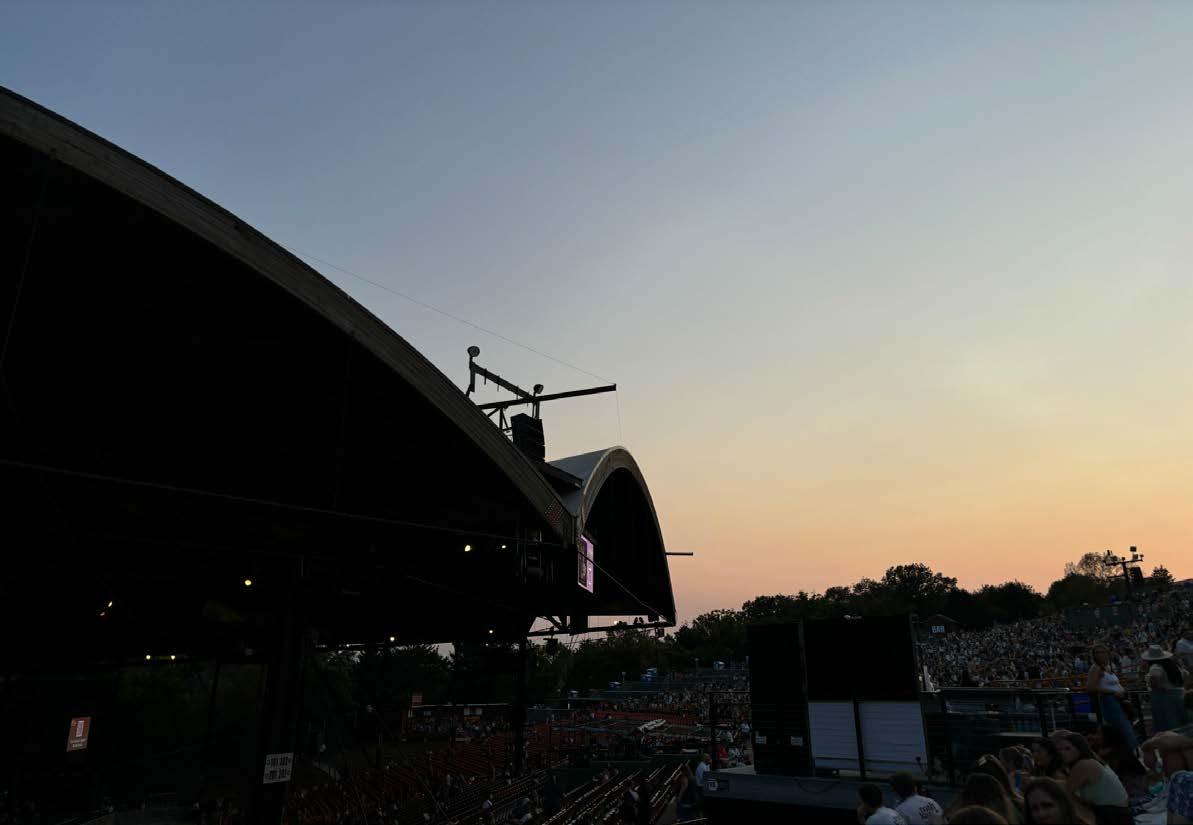
Kahan didn’t disappoint at his rescheduled Alpine Valley Music Theatre show on Sept. 11, nearly two months after the original concert date.
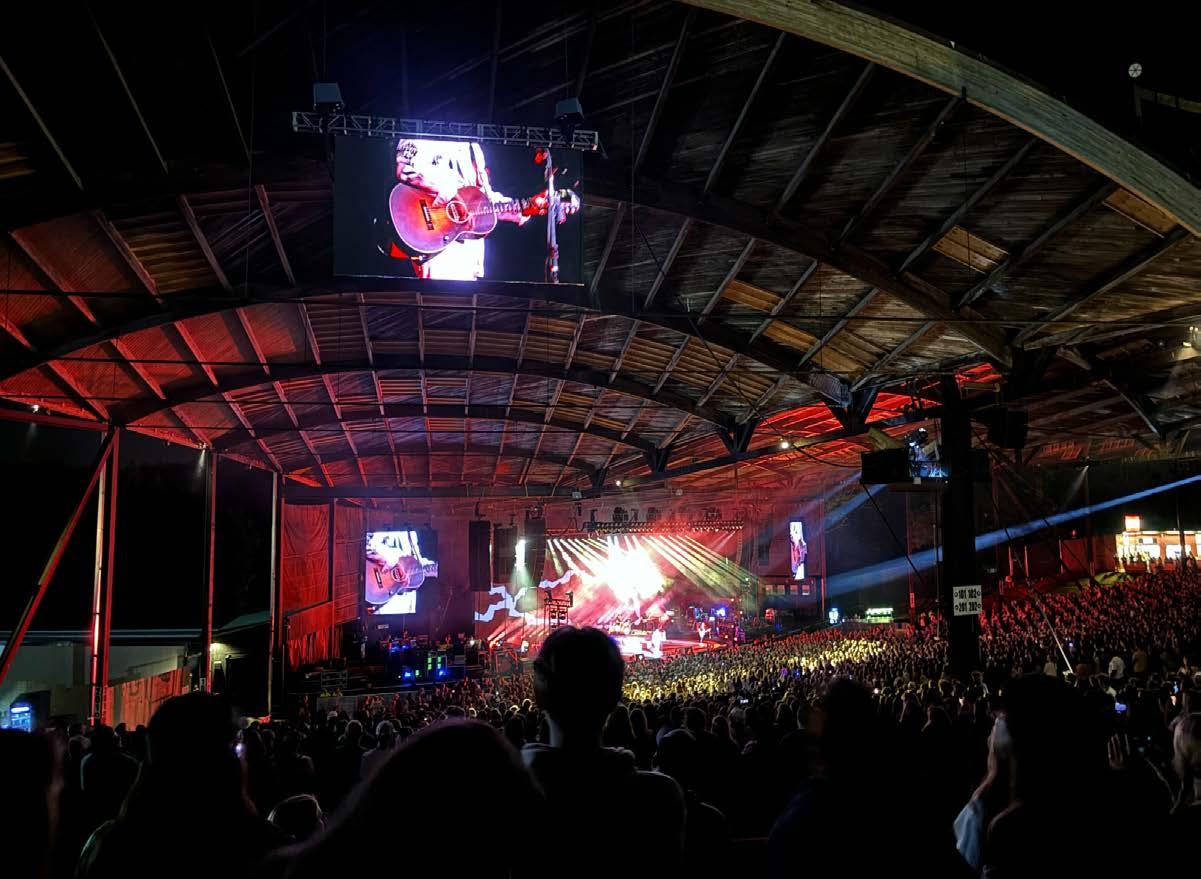
“We made it happen, Alpine,” Kahan screamed after the first verse of his opening song, “Dial Drunk.” The declaration was met with cheers from the crowd.
On July 13, Kahan posted on Twitter he was about to play the “biggest show of my life” at the East Troy amphitheater. About 35,000 people showed up for the show that was supposed to be Kahan’s biggest to date only for it to be delayed and later postponed due to heavy storms.
Concertgoers sheltered in place for just over two hours through downpouring rain, lightning and heavy winds before they were notified the show would be postponed to a later date.
Tired and beaten down by the hellscape that is the Alpine parking lots, fans left disappointed. In the days after, Kahan rescheduled the show for a Wednesday in September.
And for die hard fans like me, it was worth the wait.
The concert, a little over two hours in length, featured songs from Kahan’s first EP, “Cape Elizabeth,” to his breakthrough 2022 album “Stick Season,” plus some unreleased gems.
quality of previous singles.
There is a thumping 808 that runs through this entire project like a heartbeat. Sometimes, however, this creates a sense of monotony.
Also, many of the songs fail to grow in the same way “Girls” and “Good Time” manage to. The choruses on many of these tracks don’t feel earned, with the apex usually being unnecessarily loud, lacking any clear melody.
“Open Up” and “I Destroyed Disco” are unfortunately guilty of this.
“You Can Never Go Home” feels strongly grounded in its LCD Soundsystem influence. However, most folks would probably rather listen to the original.
Regardless of sonic accomplishments, it’s hard to deny the lyrical success of “What’s Wrong with New York?”
Every line flows into the next like an egotistical river: “What’s a blogger to a rocker? What’s a rocker to The Dare?”
Not every song on this project is a masterpiece. Still, the idea of an artist so central to pop culture loudly supporting the return of club music is immensely exciting.
The Dare’s collaboration on Charli XCX’s newest album “BRAT” is especially promising. His production on “Guess” is a standout of the summer, and the two teaming up shows music is heading in the right direction.
It will be interesting to see what the indie sleaze icon has in store. He clearly knows how to make people mosh.
at one point during the show after apologizing for how July 13 unfolded. “I think I can make you feel worse now.”
When Kahan sang, fans sang along while hanging onto almost every word and elevating some of Kahan’s more deep-cutting lyrics by supplying extra volume and emotion.
Lyrics like “forgive my northern attitude, I was raised out in the cold” from “Northern Attitude,” and “so I took my medication and I poured my trauma out” from “Growing Sideways” rang loud throughout the amphitheater.
Kahan’s acoustic set, which featured his unreleased song “Pain is Cold Water,” “Maine” — a song that many fans, and Kahan himself, hold close to their heart for its soul-wrenching lyrics about longing for what we can no longer have — and “Godlight,” was raw and an intimate moment shared between Kahan and the crowd.
Despite being a seasoned Alpine concertgoer who knows the Alpine parking lot is a bloodbath to get out of, I couldn’t help but cheer along with the rest of the crowd when Kahan hollered, “who’s ready to get stuck in traffic?” toward the end of the night.
After all, who cares about getting stuck in traffic when we got a surprise cover of Harry Styles’ “Fine Line” as a part of the encore, a song Kahan has never played before.
Even after the horrible shared experience that was July 13, the energy at Alpine was ecstatic.
Fans seemed more appreciative of the magic of Kahan’s lyricism, hanging onto almost every word.
“I know I made you feel depressed last time,” Kahan said
Kahan didn’t hold back at any point during the night, delivering a stellar setlist of 24 songs. While it was a very long weeknight for someone who had class at 8 a.m. the next day, Kahan’s music was worth both the late night and two month wait.
By Emmett Gaffney STAFF WRITER
University of WisconsinMadison students have just finished their first full weeks of school. Some other BIG 10 schools started two or three weeks ago, but UW-Madison holds off until the Wednesday after Labor Day for the first day of classes.
The extra few weeks of summer are a nice treat for students, but it tends to throw a wrench in our schedule for the long run. While most schools provide their students with a fall break, a couple extra days off during Thanksgiving or both, UW does neither.
Aside from the Thursday and Friday of Thanksgiving, there are no scheduled holidays or breaks for students. Not only does this negatively impact students’ mental health, but it also leads to burnout. By the end of the semester, Badgers are crawling through finals.
Additionally, UW’s academic calendar makes it difficult for out-of-state and inter-
national students, who make up more than half of the student body, to travel, particularly over the incredibly short Thanksgiving break.
It is nearly impossible for students to both attend their classes Wednesday and catch a flight out of Madison’s tiny airport. To fly out of O’Hare or Milwaukee, they need to catch a bus — best case scenario, Badgers are getting home Wednesday night and quickly back to the airport on Saturday or Sunday.
All of these inconveniences beg the question: is the extra day off after Labor Day really worth it? I’m sure plenty of students would rather start on Tuesday and have, say, a long Columbus Day weekend or Thanksgiving break. It’s a no-brainer.
With our schedule delayed until after Labor Day, final exams are also pushed back. This year, exams end Dec. 19. That sounds late, and it is, but in previous years it has been as late as Dec. 22.
As we know, the weather in Madison is not exactly conducive to wintertime travel. I can
recall stories from my freshman year of students spending their first Christmas in college — in their dorm. And instructors are forced to work over the holiday to get exam grades in time.
There’s an easy solution to this problem: shift the start date back a week. This would give us four days, not including the Thursday and Friday of Thanksgiving weekend, to take off throughout the semester.
We could take the whole week of Thanksgiving off, giving students ten days of no classes to recharge before finals. Or we could scatter those days throughout the semester and take off, for instance, Columbus Day, Election Day and any arbitrary Friday. I don’t have a huge preference on how to allot these days, but I do believe it is necessary for UW to provide some break for their students.
Shifting back the academic calendar gives the administration so much flexibility to create a less packed schedule for students and faculty. Badgers are busy. In addition to a full course
load, many students pursue extracurricular activities and work jobs. With this, burnout is inevitable. But UW’s schedule forces them to chug on.
Starting a little earlier is really not a big ask.
Emmett Gaffney is a junior studyinghistory.Doyouagree that UW-Madison should start classes earlier? Send all comments to opinion@dailycardinal.com
When looking at sexual violence on campus, the need for this space becomes particularly clear.
By Lily Sunby STAFF WRITER
As freshmen arrived on campus this year, they eagerly unpacked their belongings from their parents’ mini-van and settled into their new homes — likely a dorm with a roommate or two.
At the University of Wisconsin-Madison, 90% of the first-year students live on campus. With more than 20 residence halls on campus to choose from, offering a variety of sizes, locations and even specific learning communities, you would think it would be easy for students to find the perfect dorm. But UW Housing is notably missing an alternative that focuses on the safety of its students: an all-female-identifying residence hall.
These kinds of dorms used to be common on campus, the first of which was built in 1871 and is now known as Chadbourne Hall. Despite those dorms still being on campus, the rules have changed a lot since then. Women’s halls used to have strict housing rules, including earlier curfews and scheduled visitations that restricted the college experience for those who lived there.
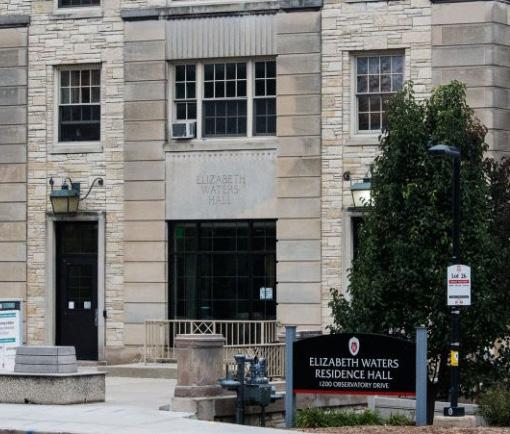
Along with residence hall rules changing, unfortunately, what some students would have considered the “perfect fit” was phased out entirely in 2006 when Waters Residence Hall, the last remaining all female-identifying hall, transitioned to be co-ed.
While some students saw the move as progressive, a safe space had been taken away from others. This shift sparked conversations on campus regarding inclusivity and safety, raising important questions on how the university can prioritize both.
But when looking at sexual violence on campus, the need for this safe space
becomes particularly clear.
In the time between the start of the new semester and Thanksgiving break — known as the “red zone” — sexual assaults on campus are on the rise, accounting for around half of all campus sexual violence in a given year. Within that violence on campus, a recent study found that 81% of all reported rapes and assaults take place in college dorms. This tends to leave female-identifying freshmen especially vulnerable to the risks of sexual violence.
For many freshmen, regardless of gender identity, college is their first significant experience away from home. This newfound sense of freedom in a new environment can be exciting but also scary. Whether it was walking down State Street or going to Memorial Union every place felt terrifying during my first week on campus but eventually the campus became home.
After spending time socializing and exploring, students head back to their dorms. At UW-Madison, these are all co-ed. A dorm should be a safe space for students, but instead, for people who have experienced trauma, it could turn into a place full of anxiety.
Without the option of an all femaleidentifying dorm on campus, some femaleidentifying students are forced to feel uncomfortable — or even unsafe — in their own living spaces. Those who have been assaulted are forced to endure encounters with individuals who may remind them of that trauma. With sexual assault having one of the highest risks of PTSD, the constant presence of those reminders can make the process of healing seem impossible.
For students, returning to their dorm after a long day should be something that they look forward to as opposed to dread. It’s time for University Housing to do more
to guarantee the promise of safety for women on campus.
Reinstating at least one all female-identifying dorm would provide a much-needed sense of security and comfort. It will offer a refuge for students who are trying to establish themselves in a new environment while navigating the challenges of freshman year.
Having this option available for those who want it wouldn’t mean segregating the entire campus or endorsing outdated gender norms. Instead, it recognizes the need for diverse living arrangements that can accommodate the varying needs of stu-
dents. Just as some students thrive in co-ed environments, others might find greater comfort and safety in an all female-identifying dorm. By offering both options, UW-Madison could better support all its students.
Lillie Sunby is a Sophomore studying psychology, communications and political science. Do you agree that UW Housing needs to bring back an all female-identifying residence hall? Send all comments to opinion@dailycardinal.com