University of Wisconsin-Madison
Since 1892 dailycardinal.com
Thursday, September 10, 2026
l
WISCONSIN HAS A GOOD QB?
Y2K BACK IN MADISON
Old Dominion transfer, Colton Joseph is healthy and good. Can he help the Badgers win?
Students bring nostalgic Y2K looks back to campus to kick off the school year.
+ SPORTS, PAGE 8
+ LIFE & STYLE, PAGE 6
American Red Cross urges Big Ten blood donations amid national crisis By Haellie Opp SPORTS EDITOR
University of Wisconsin-Madison “fans, students and alumni” can donate to the third annual Abbott and Big Ten We Give Blood drives hosted around campus during school days for a free T-shirt, and a chance to help UW-Madison win a $1 million prize for student or community health. The American Red Cross has declared a national blood crisis for the second time in history. With blood donation numbers falling to a four-year low this summer, donations are not meeting hospital demands and Red Cross is limiting its distribution of the most commonly transfused blood type — O positive — to ensure availability for patients in need. One blood donation can save up to three lives as donations can be split into red blood cells, plasma and platelets for distribution. Badgers across the country can donate in
UW-Madison’s name from Aug. 12 to Dec. 4, with specific blood drives happening on campus throughout the semester. The university hosted a Homecoming Blood Drive in 2025 to encourage students and Madison residents to participate in the cause and donate. They will host another round of blood drives from Sept. 29 to Oct. 1 for homecoming this year. To incentivize donations, Abbott and Big Ten drive will award $1 million to the Big Ten school that collects the most donations. Student athletes are leading the charge as Abbott currently partners with 11 Badgers, including programs like Track and Field, Women’s Hockey and Rowing. Blair Brophy, Abbott Associate Director of Corporate and Patient Storytelling, told the Cardinal many of the athletes have personal ties to blood donations. Brophy said many families experience the
need for blood transfusions or are regular blood donors, so connecting with students through UW athletes is a way to highlight the student perspective. “Oftentimes when you donate blood, you don’t know where it goes. It feels very anonymous,” Brophy said. “Sometimes having that name [and] that face and that personal connection, especially to somebody in your own community, can really inspire someone to give back and give blood.” UW-Madison won the 2025 challenge with 15,476 donations last year and looks to defend its title. They had the highest percentage of in-state donors in 2025, which earned them a $1 million Abbott grant to “advance student and community health.” UW-Madison leads this year’s challenge so far, with 3,611 donors compared to runner-up University of Nebraska’s 2,538. “I think Badgers — that Badger pride, that
commitment to competition, that commitment to community — definitely reigned through last year,” Brophy told The Daily Cardinal. Wisconsin used the 2025 grant money to expand peer wellness coaching, create an oncampus course for experiential health and leadership development and launch a mental healthfocused concert series. People 65 and over encompass almost a quarter of all blood donations, and Brophy said Abbott is trying to make young people aware that there is no substitute for blood donations. Young adults 19-24 make up just over 5% of all blood donations. “Donate. It takes less than an hour to sign up for an appointment all the way through. Your donation will have an impact,” Brophy said. “And what’s better than saving lives? Logging your donation to get a T-shirt, and potentially helping your university win a $1 million grant. It’s a win, win, win.”
‘I’m fired up’: Wilcots, Reesor discuss campus future at media roundtable have a common commitment to higher education to advance the state of Wisconsin.”
By Ted Hyngstrom VIDEO DIRECTOR
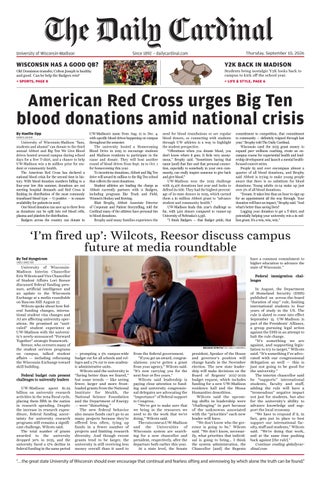
University of WisconsinMadison Interim Chancellor Eric Wilcots and Vice Chancellor of Student Affairs Lori Reesor discussed federal funding pressure, artificial intelligence and an update to the Wisconsin Exchange at a media roundtable on Bascom Hill August 27. Wilcots spoke about how federal funding changes, international student visa changes and AI are affecting university operations. He promised an “unrivaled” student experience at UW-Madison with the university’s newly-announced “Forward Together” strategic framework. Reesor, who oversees many of the student services programs on campus, talked student affairs — including refocusing the Wisconsin Exchange toward skill building. Federal budget cuts present challenges to university leaders UW-Madison spent $1.93 billion on university research activities in the 2024 fiscal cycle, placing them fifth in the nation in research spending. Despite the increase in research expenditure, federal funding uncertainty for university research programs still remains a significant challenge, Wilcots said. The total number of grants awarded to the university dropped 30% in 2025, and the university faced a 17% decline in federal funding in the same period
Federal immigration challenges
MEGHAN SPIRITO/THE DAILY CARDINAL
— prompting a 5% campus-wide budget cut for all schools and colleges and a 7% cut to non-academic administrative units. Wilcots said the university is “faring better than we feared,” but some trends — like seeing fewer, larger and more frontloaded grants from the National Institute for Health, the National Science Foundation and the Department of Energy — were “disturbing.” The new federal behavior also means funds can’t go to as many projects because they’re offered less often, tying up funds in a fewer number of projects and limiting research diversity. And though recent grants tend to be larger, the university is still receiving less money overall than it used to
from the federal government. “If you get an award, congratulations: you’ve gotten a grant from your agency,” Wilcots said. “It’s now carrying you for the next four or five years.” Wilcots said leadership is paying close attention to funding and university congressional delegates are advocating the “importance” of federal support to Congress. “We’ve got to make sure that we bring in the resources we need to do the work that we’re doing,” Wilcots said. The cuts come as UW-Madison and the Universities of Wisconsin system are searching for a new chancellor and president, respectively, after the departure both earlier this year. At a state level, the Senate
president, Speaker of the House and governor’s position will change hands in the November election. The new state leadership will make decisions on the Board of Regents’ 2027-2029 budget request, which includes funding for a new UW-Madison residence hall and the Mosse Humanities demolition. Wilcots said the upcoming shifts in leadership were “challenging” in part because of the unknowns associated with the “priorities” each new leader will have. “We don’t know who the governor is going to be,” Wilcots said. “We don’t know, necessarily, what priorities that individual is going to bring… I think the system administration, the Chancellor [and] the Regents
In August, the Department of Homeland Security (DHS) published an across-the-board “duration of stay” rule, limiting international students to four years of study in the US. The rule is slated to come into effect September 15. UW-Madison is part of the Presidents’ Alliance, a group pursuing legal action against the DHS in an attempt to halt the rule change. “It’s something we are against, and supporting legislation to try to target,” Wilcots said. “It’s something I’ve advocated with our congressional delegation as well — this is just not going to be good for the university.” The interim chancellor said he “supports” international students, faculty and staff, adding the rule will have a “tremendous” negative impact not just for students, but also for the university’s ability to advance knowledge and support the local economy. “We have to respond if it, in fact, gets put in place to best support our international faculty, staff and students,” Wilcots said. “We’re doing that work, and at the same time pushing back against [the rule].” Continue reading @dailycardinal.com
“…the great state University of Wisconsin should ever encourage that continual and fearless sifting and winnowing by which alone the truth can be found.”
news l
2
Thursday, September 10, 2026
An independent student newspaper, serving the University of Wisconsin-Madison community since 1892 Volume 136, Issue 1
2142 Vilas Communication Hall 821 University Avenue Madison, Wis., 53706-1497 (608) 262-8000
News and Editorial editor@dailycardinal.com
Dane County explores Flock camera alternatives By Charles Lahmann STAFF WRITER
Editor-in-Chief Alaina Walsh
Managing Editor Avery Chheda
News Team Campus Editor Sonia Bendre College Editor Grace Carlson City Editor Jane Dardik State Editor Audrey Lopez-Stane Associate News Editor Zoey Jiang Features Editor Jake Kilander Opinion Editors Brady Ahler • Siena Ferraro Arts Editors Ryan Kim • Liset Zacker Sports Editors Otton von Sothen • Hallie Opp Sports Associate Editor Luca Muehlbauer Special Pages Editor Natalie Popper Photo Editors Jonathan Mintz • Michael O’Connor Graphics Editors Eloise Guth • Klaire Maduscha Science Editors Lauren Eno • Addison Dama Life & Style Editors Isabella Bajaras • Jackson Baker Beet Editor Lizzi McGann Podcast Directors Yadiel Chavez • Amelia Fowler Digital Editor Meredith Schadrie Video Director Finnegan Ricco Copy Chiefs Emma Schieffer • Brendan Wolf Copy Editors Isabella Barajas • Delaney Chronister
Business and Advertising business@dailycardinal.com Business Manager Wyatt Vail Marketing/Outreach Director Lydia Picotte Social Media Manager Aanya Agrawal Ad Manager Lauren Downham The Daily Cardinal is a nonprofit organization run by its staff members and elected editors. It receives no funds from the university. Operating revenue is generated from advertising and subscription sales. The Daily Cardinal is published weekdays and distributed at the University of WisconsinMadison and its surrounding community with a circulation of 10,000. Capital Newspapers, Inc. is the Cardinal’s printer. The Daily Cardinal is printed on recycled paper. The Cardinal is a member of the Associated Collegiate Press and the Wisconsin Newspaper Association. All copy, photographs and graphics appearing in The Daily Cardinal are the sole property of the Cardinal and may not be reproduced without written permission of the editor in chief. The Daily Cardinal accepts advertising representing a wide range of views. This acceptance does not imply agreement with the views expressed. The Cardinal reserves the right to reject advertisements judged offensive based on imagery, wording or both. Complaints: News and editorial complaints should be presented to the editor in chief. Business and advertising complaints should be presented to the business manager. Letters Policy: Letters must be word processed and must include contact information. No anonymous letters will be printed. All letters to the editor will be printed at the discretion of The Daily Cardinal. Letters may be sent to opinion@ dailycardinal.com.
dailycardinal.com
The University of WisconsinMadison Police Department announced they would not be renewing their contract with Flock Safety in a statement on July 3, prompting Dane County law enforcement agencies to consider Flock camera alternatives for the greater Madison area. The choice to not renew the contract, which ended on June 26, was made to “work toward identifying an automatic license plate reader (ALPR) vendor that better meets University of Wisconsin-Madison public safety needs, while also addressing campus community concerns about contracting with Flock.” The removal of Flock cameras has been a growing trend in the Madison area, with the Dane County Sheriff’s office and the City of Fitchburg also choosing to remove the technology. All three departments are actively exploring options for an alternative ALPR vendor. UWPD stated “this technology has proven to be an effective tool”, and they plan on engaging with the community for input. ALPRs are cameras that automatically capture, analyze and store vehicle license plate information. Records of vehicle activity can then be created to assist law enforcement in criminal investigations. Common concerns expressed with ALPR technology are the potential violation of privacy expectations given under the fourth amendment, most strongly by the American Civil Liberties Union (ACLU). Additionally, concerns exist about the accuracy of the AI used to identify vehicles that can lead to wrongful arrests. The city of Madison does not operate any Flock camer-
as or any ALPRs, per the Use of Surveillance Technology Ordinance. There are currently four Flock cameras operating around the capitol, as capitol police are a separate jurisdiction. Dane County Sheriff Kalvin Barrett has said there will be additional safeguards in place along with alternative vendors to Flock, including deleting camera records after 30 days, unless manually saved as evidence in an investigation. Weekly audits would also be conducted to prohibit abuse. Additionally, Dane County will have full control over the data, which will not be made available for immigration enforcement or traffic enforcement. As more municipalities move away from Flock camera contracts, alternative vendors such as Motorola and Axon rise as alternatives. Motorola cameras offer a similar law enforcement data sharing system to Flock, but it faces similar criticism. A class action lawsuit was filed against the company in June alleging facilitation of cross jurisdictional sharing of ALPR data, as well as an inadequate privacy policy. Axon has grown the most with the exodus from Flock, offering tighter municipal control and a lack of the data sharing system, limiting concerns about third party access to data. Axon is not restricted to just license plate reading, as it integrates these cameras into a broader system including body cameras, drones and the Fusus system — a system allowing private security camera owners to register their cameras with the local police department, making it easier for police to identify nearby cameras to a particular incident. Axon would not be new to the Dane County area, as the Fusus system has been in place since
JONATHAN MINTZ/THE DAILY CARDINAL
the Connect Madison initiative began in 2024. Camera owners are able to go a step further and integrate their camera into the Madison Police Department system. An Axon Fusus device can be installed with a camera that would give police live streaming capability from that particular camera. Whether live streaming is continuous or in case of an emergency is up to owner discretion. There are currently 170 cameras across Madison integrated with live streaming capability, and an additional 33 that can be accessed by police. The data the cameras collect is kept anonymous, with owners being notified when the camera is used, but not the public. Which cameras are accessible to police is also not made available to the public. For both Motorola and Axon, though, the fundamental technology is very similar to Flock. Abuse of Flock technology has also become widespread, with officers being charged in the last two
UW-Madison graduate claims cruel pig practices afoot at the university By Amellia Fowler
Editorial Board Avery Chheda • Alaina Walsh • Brady Ahler • Siena Ferraro • Safa Razvi Chair Safa Razvi
Board of Directors Scott Girard, Chair • Don Miner • Nancy Sandy • Nathan Kalmoe • Jack Kelly • Gary Achterberg • Jennifer Sereno • Kelly Lecker
© 2026, The Daily Cardinal Media Corporation ISSN 0011-5398
For the record Corrections or clarifications? Call The Daily Cardinal office at 608-262-8000 or send an email to edit@dailycardinal.com.
months in Milwaukee, Kenosha and Menasha for stalking via ALPR technology. Flock specifically has received scrutiny because of the accuracy with which it can track vehicle activity, and how personal details such as religious and political affiliation can be revealed through the tracking. Flock also offers a nationwide database of vehicle activity, meaning law enforcement agencies across the country may be able to access Flock data for an area hundreds of miles away. This database is managed by the Flock company itself, raising issues for many about third party abuse. The Dane County Board voted in a June 4 meeting to reinstate the $80,000 used for Flock cameras to explore an alternative ALPR vendor, though any vendor must follow the county’s requirements giving the county full control over camera data. Fitchburg police have also stated that any vendor who controls the data instead of the police department will be a non-starter.
NEWS PODCAST DIRECTOR
Students at the University of Wisconsin-Madison making their trek up Bascom Hill on Sept. 8 saw dozens of small pink flags and a large banner that read “Campus Gas Chamber, To Record the Truth.” Ryan Blum, a recent University of Wisconsin-Madison graduate, started the campaign after allegedly sneaking into UW-Madison’s Meat Science & Animal Biologics Discovery (MSABD) Building and releasing footage of pigs being placed into an gas chamber. Blum told The Daily Cardinal he planned the unauthorized entry over the course of a year after he discovered CO2 tanks located behind the MSABD building on Halloween in 2024. Blum told the Cardinal he accessed the facility in the spring of 2026. Per his lawyer’s advice, he declined to comment on how he gained entry. He did, however, describe the process as “probably the hardest thing I’ve ever done in my life.” “It was surprising how big the
AMELLIA FOWLER/THE DAILY CARDINAL
gas chamber is… it just really hits you how large this thing actually is,” Blum said. Previous media described the UW-Madison chamber as a “15foot pit filled with carbon dioxide.” Blum’s footage appears to show multiple pigs loudly vocalizing within a dark room, but it is difficult to identify the specific surroundings. UW-Madison operates the only university-controlled CO2 stunner in the country, but the equipment is widely used in commercial abattoirs.
The ethics of using gas chambers in swine slaughter is hotly debated, with some saying the practice causes unnecessary pain to the animals and others maintaining it is the most humane form of slaughter. New York Times Opinion writer Nicholas Kristof penned an article in favor of the pigs in 2023, noting that a group of veterinarians signed an open letter in opposition to industry officials using the practice. In a 2024 Meat and Poultry article, Jeff Sindelar, an Extension Meat Specialist, describes controlled atmo-
sphere stunning as “a very calm, very relaxing, very humane process.” Blum recounted hearing “pigs screaming for their lives” upon his entry to the facility. Blum’s main goal in releasing his campaign is to get the message to a wider audience. “I doubt a fraction of the students on campus… know it goes on. They certainly don’t know it’s that cruel,” Blum said. “The facility was built for students to learn about the safe and humane handling of animals and food products,” Gillian Drummond, the Director of Public Affairs for the Office of Strategic Communication at the university, said. Drummond added that while the MSABD does have a carbon dioxide system, they are unable to confirm that the video shared by Blum was taken at the UW-Madison facility due to its quality and lack of distinguishable features. Continue reading @ dailycardinal.com.
news
dailycardinal.com
Thursday, September 10, 2026 • 3
Students showcase Experts say constitu- multicultural talents tional amendment could at MCOR disrupt equity policies By Sonia Bendre CAMPUS NEWS EDITOR
JAKE PIPER/THE DAILY CARDINAL
By Mia Warren STAFF WRITER
The League of Women Voters of Wisconsin (LWVW) advocated against one of three constitutional amendments set to be on the November ballot during a webinar Tuesday, where speakers discussed the potential impact on healthcare and education. The amendment would prohibit government entities from “discriminating against or granting preferential treatment” based on race, sex, ethnicity or national origin. The amendment defines a government entity as the state and its political subdivisions including the Universities of Wisconsin System. “The anti-equity Constitution rule will seriously impact 60 years of progress in Wisconsin on healthcare, education, public administration, employment, and business contracts from women and minority businesses.” Joan Schwartz, member of the Legislative Advocacy Committee of the LWVW, said. Critics of the amendment said the language on the ballot is too vague, and may lead to a false impression of the amendment’s impacts. “If you’re being asked, ‘Do you want to prohibit government discrimination?’ I’m sure many folks would respond, ‘of course,’” Rachel Snyder of Law Forward said. “I think it’s important to consider the fact that we already have several sources of law that prohibit government discrimination, both at the state level and the federal level.” “Preferential treatment” is not specifically described in either the ballot language or
the full amendment, which Snyder believes will leave this definition to be decided through litigation. “That is a new concept for Wisconsin law…These terms without definition invite litigation.” Snyder said. Health policy and equity Health equity programs depend on government employment and contracting to track racial disparities and create programs to help lessen them, said health policy strategist Kadijha Marquardt-Davis. If the amendment were to pass, these programs would face challenges and potential red-tape. Public administration is also undefined in the amendment, which Marquardt Davis says will leave the future of equitable public health programs, hospitals and other government health services unclear. “That impact will ultimately depend on how the amendment is interpreted and applied,” Marquardt-Davis said. Wisconsin sees significant racial health disparity, especially toward Black and Indigenous communities. Earlier this year, reports revealed a large discrepancy in immunization rates between Black and white children. Only 54% of Black children received basic vaccinations compared to 78% of white children. “These disparities are not the result of individual choices.” Marquardt-Davis said. “When systems have produced unequal starting points or persistent barriers, targeted interventions can be necessary to address documented disparities.” The proposed amendment could prevent policy makers
from addressing inequalities, according to Marquardt-Davis. Education and affirmative action The U.S. Supreme Court ruled that affirmative action measures violated the Equal Protection Clause of the 14th Amendment in 2023. Earlier this year, the Wisconsin Supreme Court struck down a race-based scholarship program in a unanimous decision. Both of these cases set a legal precedent against the preferential treatment the proposed amendment aims to end. The difference between the precedents and the amendment is the scale of the decision. “Laws can be changed, but with a state constitutional amendment, it creates this legal standard that arguably binds local governments, school districts and future legislatures,” said Susan Eckes, University of WisconsinMadison professor of education law, policy and practice. Even though the amendment does not specifically target curriculum, Eckes said institutions may “self-censor” before specific boundaries are applied. “I see how risk averse — to avoid costly litigation — a school board or superintendent may be, and may self censor curriculum, and that could happen.” Eckes said. Eckes explained the proposed amendment targets education at an administrative level, not a curricular level, but riskaverse schools may see these changes and conflate them with in-classroom expectations. “This can have a chilling effect that extends beyond the actual text of the law.” Eckes said.
Twenty-one multicultural dance groups and Greek organizations performed at the University of Wisconsin-Madison’s 44th annual Multicultural Orientation and Reception (MCOR) festival to a crowd of hundreds in Shannon Hall Friday evening, showing off dance covers, original skits and hip-hop dances to bass-boosted Bollywood songs. The cultural showcase is the Multicultural Student Center’s (MSC) largest event and a Welcome Week campus fixture. This year, Wisconsin Union sponsored the event, Claudia Guzman, Director of Programs for the Center for Student Success and Belonging, told The Daily Cardinal. “What I say about MCOR is if you build it, they will come,” Guzman said. “We create this infrastructure, and really it’s just a platform for all of these student organizations to be able to be in the spotlight. We obviously could not do it without them, and every year it comes together really beautifully.” Multicultural Greek organizations made up around half of performing groups, while others included Wisconsin School of Bhangra, K-pop cover groups VIVID Dance Crew and KASPER Dance Crew and the Vietnamese Student Association. Sigma Psi Zeta Sorority members matched in bright red jackets for their step and stroll performance, a percussive dance rooted in HBCU sorority and fraternity culture. Aadya Deshpande, stroll captain, told the Cardinal MCOR is one of the largest events of the semester for the sorority. “Whether you’re performing or you’re just coming to watch, [MCOR] is a great bonding opportunity,” she said. “I think everyone should come to at least one of them in their time here.” Many of the student groups organized their performances on a tight runway of one to two weeks, waiting until their members returned to campus from summer vacation. “It’s a big time crunch,” Deshpande said. “Also, making sure the sorority sisters are hyped and ready, excited to do it and not stressed out. I think having those skills to bring up the energy of a group is really important. I feel like I’ve gained that through [MCOR].” African Students Association (ASA) Dance Team members wore high school uniforms for an energetic part-skit part-dance performance, which included the Scuba move, boys and girls dance-offs and drawing their “teacher” into their final dance. Kofo Aminu, an ASA member who helped choreograph the dance, told the Cardinal the performance pays homage to the African diaspora. “We want to appreciate our homeland… but we also wanted to shout out the cultures that were pioneered by Africans enslaved around the world,” Aminu said. “There was a little bit of Scuba, a nod to our African American cousins; a nod to our cousins in Latin America with our salsa moment. We just wanted it to be a big shoutout to Africans and Black people globally.” While choreography is new to her, Aminu said she’s been doing African
dance for most of her life. “It’s a huge part of our culture to dance,” she said. “That’s how we were able to put together this team of super talented dancers, because so many of us grow up with it that it just becomes par for the course, almost an everyday thing.” Elizabeth “Lizzy” Santos, captain of the final act Fuego Dance Crew, told the Cardinal she assembled the list of songs over the past year. The team danced to a collection of songs, including the reggaetón remix “Fuera del Planeta” by Eloy and Randy Nota Loca. Santos has been dancing since she was seven years old and choreographing since her junior year of high school. She explored several dance organizations her freshman year, and eventually chose Fuego Dance Crew because she enjoyed their performances and “tight-knit community” where “everyone just kind of clicks instantly through dance and through our identity — a majority of our team members are of Latino background.” “[MCOR] is one of our biggest performances of the year, so being able to make our presence known on campus right from the start of the semester is super important to us,” Santos said. “We want to let people know that there is a space for them if they’re of Latino background, if they’re not, if they just love to dance [or] if they want to learn how to dance.” UW-Madison formed MSC in 1988 as the result of a committee group’s recommendations to improve campus race relations. The center principally focuses on students of African-American, American Indian, Chicano, Asian American and Puerto Rican descent, according to its website. Guzman said that the over 100 student organizations affiliated with MSC are “dualaffiliated” with MCOR and can apply in the summer to perform in the festival. Student groups are required to submit a brief video of a past performance. “We always like to start with a big splash, end with a grand finale,” Guzman said. “For the most part, I would say just about everybody who applies does get confirmed.” Every organization submitted an audio file, selected their stage lighting and participated in a sixhour dress rehearsal the day before the performance. Michelle Drane, an operations intern at MSC, manages the front desk of all of the centers in the Red Gym. She’s been working with MSC for three years: “I enjoy how I feel in the spaces and the people I meet there,” she said. “As somebody that comes from a marginalized identity, it was very hard to find a place where I belong on campus, especially being one of the only minorities on my floor in the residence hall,” Drane said. “I’m from Milwaukee… I’ve always interacted with very diverse communities. Coming here, it was just kind of limiting.” Throughout the next few months, MSC will host staggered student welcomes for minority groups, according to Drane. Continue reading @ dailycardinal.com.
news 4
l
Thursday, September 10, 2026
dailycardinal.com
Realta Fusion partners with Madison G&E to build Wisconsin nuclear fusion plant By Sonia Bendre CAMPUS NEWS EDITOR
In ten years, the electricity that runs your microwave could come from the same reaction that powers the sun. University of WisconsinMadison nuclear fusion startup Realta Fusion is partnering with utility company Madison Gas & Electric (MGE) to build a gridconnected fusion power plant in Wisconsin by the mid-2030s, the companies announced Sept. 2. Nuclear fusion is a reaction occurring when two hydrogen isotopes, often deuterium and tritium, smash into each other at high pressures and temperatures, releasing energy. After being “fully developed and derisked,” fusion has the potential to be the cheapest form of energy generation, Dominick Bindl, COO of Realta, told The Daily Cardinal. “[Fusion] gives you dense energy
like conventional nuclear fission, but it has a fundamentally safer mode of operating and it could be significantly lower cost as a result,” Bindl said. “Base load power that’s clean, that is safe, that is cost-effective — we think that’s what Wisconsin energy consumers want, and we think that’s what fusion can deliver.” Realta Fusion, a fusion company founded in 2022, currently partners with UW-Madison to operate the Wisconsin HTS Axisymmetric experimental fusion machine at the university’s Physical Sciences Laboratory in Stoughton. MGE provided Realta with “equipment, engineering and technical support along with assistance for siting, permitting, interconnection and financing” of the plant, in addition to a direct equity investment from its parent company, according to the press release. According to Bindl, MGE’s
interest in fusion was “a big part” of Realta’s decision to select OM Station, a former Oscar Mayer sausage factory in Madison, as the site of their research and development facility slated to begin construction by the end of this year. Bindl said there’s no shortlist in hand for the site of the fusion reactor, adding potential sites are not necessarily limited to MGE’s jurisdiction. The company generates electricity for 170,000 users in Dane County and distributes electricity to 180,000 users across seven other counties in southcentral and west Wisconsin. Bindl expects the footprint of the fusion reactor to be visually similar to a fission reactor of the same electricity output, without the need for an “exclusion zone” around the reactor, an area with “special regulations and procedures to ensure that that plant is operated in a safe manner.” “We [Realta] typically focus on
the fusion core itself, where plasma is confined, where that heat is generated,” Bindl said. “There will be some plasma heating systems that are connected to that. There are some fuel cycle facilities to surround that as well. You’re imagining a relatively small campus with a primary building and several smaller buildings around it, including the steam turbine building for driving that electricity site.” The press release said Realta will build a 200 megawatt-electrical (MWe) plant, which refers to the fusion reactor’s total energy output per second. The reactor’s actual size is subject to change as Realta solidifies the details of the proposal with MGE and will be officially established “much deeper” in the planning process, according to Bindl. “The specific size [200 MWe] that has been under discussion…
falls very cleanly within the range of capacities that Realta is developing technologies to deliver, and it’s a size that is attractive to MGE for their anticipated customer need in that timeframe,” Bindl said. Bindl said around 80% of the energy is thermal energy, which can be converted to electricity using conventional methods also used for coal, oil and natural gas plants. The other 20% comes from the charged helium particles produced by the fusion reaction, which would need to be converted to electricity through more fusion-specific technology called direct energy conversion. Realta demonstrated a smallscale experiment in direct energy conversion this summer, but the technology has never been demonstrated at a grid-scale level. Keep reading @dailycardinal.com
Students travel to Lambeau Field as UW-Madison student the Badgers take on the Fighting Irish grows his app to bring builders, creatives together By Haellie Opp SPORTS EDITOR
By Zoey Jiang ASSOCIATE NEWS EDITOR
Armaan Jain launched Priority, a productivity software made for students, in February. Seven months later, he’s looking to expand. As a junior studying finance at the University of Wisconsin-Madison, Jain told The Daily Cardinal he knows a lot of what his peers are doing within the university’s business school academically, but not much about their ambitions outside of the classroom. “I’ve learned that there are so many cool people doing so many cool things outside of just my little bubble,” Jain said. “I think people get trapped in talking to the same people about the same ideas. Hearing about ideas that are completely unrelated to what you’re doing, I think, is really important.” Jain started his app, Priority, to “help people manage and improve their lives.” He implemented a strong community focus because, according to him, “doing things with friends and when you see them do it, it makes you way more likely to do those things yourself.” He then realized he can do it in real life, too. Enter Priority Labs. “Anyone who has an idea is kind of in very close proximity to each other, and that fosters natural conversation [and] collaboration,” Jain said. “I think it expands your view of what is possible when you can see what other people are building and doing, especially when it’s not the same thing as what you’re doing.” Jain put together the extended program in less than a month last spring. The program is meant to be a nine-day “sprint” to bring together passionate builders on the UW-Madison campus. The first cohort of this program, consisting of 11 people, presented at StartingPoint Madison. Across the nine days, Jain saw a wide variety of presentations. “We had people who were trying to build personal brands. We had people who were building startup apps. We had people who were artists and pursuing music. We had people who were building their own food trucks and after school programs,” he said. Regardless of where he takes his startup
Priority, Jain said Priority Labs will always stay the same. “I think that it’s more valuable than the startup to me, actually. I care more,” Jain said. “I think Priority Labs has given me more of a sense of fulfillment than Priority has. I always want to grow the community, whatever it becomes.” With the same goal of getting people together and to connect, Wisconsin Entrepreneurship Hub is partnering with Priority Labs to make Madison a place where creativity and entrepreneurship can collide and drive. “I’m very passionate about this because, being a creative in Madison, sometimes it’s hard to find people who are doing similar things,” Jain said, pulling from his own experiences as being in the startup world and in the music world as a singer-songwriter. “I think these fields are very sectioned off, so I just wanted to bring a sense of unity to campus.” Lewis Sheats, named the Hub’s inaugural leader in January, is spearheading the program with the vision of centralizing entrepreneurship in small pockets in the university. Jain said he’s looking forward to working with Sheats and what the partnership will bring for the people on campus. “[The Hub] is more focused on more founders [and] entrepreneurs. I’m more focused on anybody who’s doing anything creative. But we saw a natural pairing there in terms of ‘we want to grow Wisconsin as a place where people built things.’” Jain is hoping Priority Labs will have a cohort each semester moving forward. He’s aiming to be as open as possible, and for as many people to participate. Currently, the program is applicationbased — due to his managing team only being himself — but Jain doesn’t want this to just be something he wants. “I want this to continue and I want this to grow,” he said. “I want it to be a place for [participants] to showcase what they’re doing because I feel like everyone knows that students work hard, but nobody knows what else they do behind the scenes. That I think deserves to be seen.” The Fall 2026 will be from Sept. 25 to Oct. 4 and applications close Sept. 20.
For Wisconsin football fans, a trip to Lambeau Field was about more than watching the Badgers open their season. It was a chance to experience one of the state’s most iconic sports venues while cheering for their college team. Thousands of fans made the roughly twohour trip from Madison to Green Bay for the 2026 Shamrock Series, where the Badgers faced Notre Dame at the home of the Green Bay Packers. The game brought together current University of Wisconsin-Madison students, alumni and lifelong fans — giving Wisconsin supporters a rare opportunity to take over Lambeau Field with cardinal red and white. “We go to Packer games, so it’s kind of nice seeing [Lambeau Field] taken over by college sports,” UW-Madison junior Maddox Neumann told The Daily Cardinal. “It’s kind of cool. It’s different with all the opponents here. Usually at [Camp Randall] games, we don’t really see the opposing team other than the big games like Alabama.” Neumann, like many other Badgers, made the trip up north for the game. The drivetime didn’t
stop traveling fans from supporting the Badgers in the season opener. “I mean, you cannot beat this place. It’s awesome, you know. It brings people together, it brings some fans together, and seeing how well the team can travel shows how much you care about the team,” a group of UW-Madison students told the Cardinal at one of the many tailgates before the game. Without help or rideshares provided by the university, students had to find alternative routes to get to Green Bay. Many students drove, rented buses or used online charter services. Some students at the pre-game tailgates told the Cardinal they saw more sophomores, upperclassmen and fraternities than they did freshmen because “it’s hard to get rides.” UW-Madison student Jack Bershad called Wisconsin’s home-opener “the biggest game of the year.” He said it was the reason Sigma Alpha Mu Fraternity took a bus to Lambeau and why he and his friends were excited for the game. “I’ve seen a good amount [of Wisconsin fans], but I think right now it’s more Notre Dame, but I think we’re coming,” Bershad told the Cardinal. Continue reading @dailycardinal.com
The Daily Cardinal Crossword
• By Ryan Mathiason
Across
1 2 3
1 ___ for the course 4 Dance done at a luau 5 Personal ___ (individual records) 6 Get rounds all around State Street? 7 “Now isn’t a good time for me” 8 Audible reaction to someone saying “I don’t like cheese curds”, perhaps
Down 1 Exercise done by Bucky for each Badger football point scored 2 Singers between sopranos and tenors 3 Scratchy-sounding, like someone’s voice 4 Basil, parsley, mint, and thyme, e.g. 5 ___ Rush (Southern sorority event popular on TikTok) 6 Word before “Ten” or “Dipper”
4 5 6 7 8
opinion dailycardinal.com
Thursday, September 10, 2026
l
5
It shouldn’t cost $8 to have friends By Shreya Bhargava STAFF WRITER
“Want to hang out?” rarely means just that anymore. Usually, it means: Want to get coffee? Want to get dinner? Want to go shopping? Want to take a workout class? Maybe go to a farmers market, where somehow a casual afternoon ends with an $8 drink in your hand. Apparently, two people can no longer sit in the same place and talk without an activity attached. There is nothing wrong with any of these activities. A coffee shop can be a great place to catch up with a friend, and restaurants hold some of our dearest heart-to-heart conversations. But once you start paying attention, it becomes hard not to notice how many of our default answers to “where should we go?” imply spending money. Somewhere along the way, spending money stopped being something that might happen while hanging out and started becoming the hangout itself. The problem is not that friendship costs money, but so many of the places that make friendship easy do. This especially matters at a time when Americans are already spending less time together. According to the U.S. Bureau of Labor Statistics, 38% of Americans spent time socializing or communicating on an average day in 2014. By 2024, that number had fallen to 30%. The average time spent socializing per day also dropped from 43 to 35 minutes. There are plenty of explanations for why we might be spending less time together — phones are an easy target. So are social media, remote work, busy schedules and lingering pandemic habits. The advice that follows is equally familiar: put down
JOHNATHAN MINTZ/THE DAILY CARDINAL
your phone. Join something. Make more of an effort. But that skips over another question: where, exactly, are people supposed to go? Sociologists have a term for the spaces outside home and work where people regularly gather: “third places.” They include libraries, parks, community centers, coffee shops, barbershops and other spaces where being around other people can become part of everyday life.What makes these places valuable is not simply that people can meet there, but that they reduce the amount of planning connection requires. This is not just nostalgia for a world where people spent all afternoon at malls. Research suggests these spaces actually matter.
A study by Northwestern University researchers surveyed 313 young adults during the pandemic and looked at what happened as access to third places changed. Reductions in third-place visits were associated with declines in social connection, while dissatisfaction with alternative social spaces was associated with worse mental health outcomes. In other words, physical spaces are not just backdrops to our relationships. Friendship happens between people, but it also happens somewhere, and increasingly, many of those “somewheres” are commercial. Coffee shops function as third places; so can restaurants, bars, gyms and entertainment venues. They give us somewhere comfortable
to sit, something to do and a reason to gather. But unlike a park bench or library table, these spaces come with an unwritten condition. Eventually, you are expected to buy something. One $8 coffee is not a crisis. But friendship is a practice. It’s coffee on Tuesday, dinner on Friday, a workout class next week and someone suggesting brunch on Sunday. These are ordinary expenses on their own and together they create a quiet price of participation. But that price does not feel the same to everyone. For someone with disposable income, “Want to grab coffee?” is simply an invitation, but for someone without it, the same question can become a calculation. How much have I already spent this week? Can I afford dinner too?
If everyone orders something, can I comfortably say I am not hungry? If everyone gets a drink, is it weird if I just ask for water? If I say no again, will it start to seem like I just do not want to come? Technically, nobody has excluded you. But eventually, saying “I can’t afford that” over and over can start looking a lot like saying “no,” and it’s hard to find countless excuses when you don’t feel comfortable talking about finances — that is where an $8 coffee stops being a joke about inflation and starts revealing something bigger about access to community. The inequality is quiet because nobody charges admission to friendship. The admission fee is scattered across dozens of completely normal invitations. Access to the places where those invitations happen is already unequal. A national study of third-place availability in the United States found major socioeconomic and geographic disparities in where these spaces are located. Higher neighborhood poverty rates were associated with fewer third places.The researchers also pointed out something important: having a third place nearby does not necessarily mean someone can actually access it. Cost and transportation create barriers of their own. In other words, the people with the least money to spend on social life can also live in communities with fewer places to participate in it. Of course, free ways to spend time together still exist. Go for a walk. Invite someone over. Sit in a park. Sometimes hanging out really can mean being somewhere for a few hours with absolutely nothing to accomplish. Maybe we should do more of that.
It’s just a joke. Is everyone ‘too sensitive these days’ or is dark humor pushing the limit?
COURTESY OF WIKIMEDIA COMMONS, JAMISON FOSER
By Maizy Auger STAFF WRITER
Recently, while walking down State Street with my male friend, a man on the street approached us and asked my friend for a dollar. When he politely told the man no, the man looked at me, smirked and asked, “How about $0.85?” Mouth agape in disbelief, I turned the opposite direction and briskly walked away.
That comment has since lingered menacingly in my thoughts. It seems people have forgotten when a joke is appropriately theirs to make, if at all. People joke about their lived experiences, but what about others’? Is humor a universal coping mechanism, or is it simply an easy, unoriginal object of derision? Many people disguise their own
battles as humorous anecdotes, but it was odd to see someone so comfortably exercise sexism sandwiched with a smile. There are copious social issues – most notably sexism, homophobia and racism – that are used as common punchlines, encouraging a laugh rather than a solution. This trend has been on the rise in our society, and even more so in our generation. The idea that these jokes make difficult conversations easier and can potentially be used to spread awareness is at the center of this epidemic. In reality, this is not the case for many of the identities that have supposedly become ‘okay’ to poke fun at. The American Psychological Association conducted a study in 2013 which found “[male] participants who were exposed to sexist jokes reported higher levels of rape proclivity.” It seems the intended audience for this material are not joking to come to terms with a lived experience. They are instead making mockery of it. Activism is not the intent of these individuals; rather, it is to normalize and desensitize. Western Carolina University’s social psychology professor, Thomas E. Ford, and his colleagues conducted a study on how people use humor to justify discrimination. In their research, they found that mindsets shifted to “promot[ing] discrimination against Muslims and gay men”
after being exposed to harmful jokes against these social groups. So, how do we talk about uncomfortable topics without defaulting to humor? These conversations are difficult; understandably, we want to ease the tension. However, to inspire real change we must redirect our approach. An easy first step is to stop condoning harmful conversations. By laughing or participating, these behaviors continue. By staying silent, they worsen. Enabling isn’t strictly verbal; a small chuckle or a small smile may tell someone their joke was well-received rather than your intended awkward politeness. However, the issue is how to discern these jokes from ‘dark humor.’ Dark humor is a type of comedy which pulls from many of these harmful issues an individual may experience. Although it often brings discomfort to an unwilling audience, it is widely deemed acceptable. So, how do we know when our words are promoting destructive, regressive thoughts and behaviors? Unfortunately, there is no simple answer. Harmful jokes will continue to be somewhat ‘normalized,’ even if we discourage them. The next time you want to talk about a socially relevant topic, however, I encourage you to move away from doing so to squeeze a laugh out of someone. Consider the impact of your words and continue to discuss with a straight face.
life & style UW is dressed for Taste of Madison: the new semester Where flavor meets the music of the square 6 • Thursday, September 10, 2026
dailycardinal.com
By Yareli Gutierrez STAFF WRITER
MADISON MORIS/THE DAILY CARDINAL
By Audrey Rubenstein STAFF WRITER
The crowd was bustling as I stepped onto the Capitol Square near State Street, where balloons spelling out “Taste” framed the Capitol’s golden light. People sat on curbs, munching on everything from Korean hot dogs to chocolate dipped cheesecake, while music blasted from opposite corners of the Square. People even set up shop on the lawn of the Capitol, creating their own personal picnics. The whole scene was a part of Taste of Madison, which took over the isthmus this past Labor Day weekend. The event is put on through the Madison Festivals Inc., a nonprofit that partners with more than 30 local volunteer groups to help bring the weekend to life. In 2025, the organization donated over $84,000 to local charities and nonprofits, matching the excitement of trying new food with giving back to the community. With over 90 vendors and live music throughout the afternoon, the festival remains one of Madison’s most anticipated endof-summer traditions. I attended the event on behalf of The Daily Cardinal to speak with vendors and festival‑goers and to try some fan favorites myself. By the end of the festival, I had a full stomach and loads of new friends. I began on North Carroll Street, where first-time attendees urged me to try Ben’s Soft Pretzels — a recommendation I heard repeatedly throughout the day. Their Amish‑inspired pretzels, paired with more than 11 gourmet dipping sauces, have earned a loyal following across Columbia, Dane, Sauk and Marquette Counties. Continuing up the street, I passed local staples like The Globe, as well as familiar food trucks such as Hibachi Hut. Higher‑end restaurants also joined the lineup, including The Post — which drew one of the longest lines of the festival — with dishes like Crab Rangoon Mac and Cheese and Chicken and Waffles. Turning onto West Main Street, I found what might have been the
longest line of the day: Glazed Madison’s Korean Hot Dogs. Chef Michael Yang shared that they’ve attended the festival for three years and now operate a storefront in the Madison Global Market. “Our Korean Hot Dogs do the best at the festival, but our top seller is the mochi donuts at our store,” Yang told the Cardinal. Despite the heat and the crowds, Yang said the team returns each year because “seeing people smile and enjoy our food” makes the long hours worth it. I stopped just before Steak Escape and met Britt, the mother of a prospective University of Wisconsin-Madison student who had just stumbled upon the festival as her daughter was touring campus. The Minneapolis local claimed the “Buffalo Chicken Fries from Steak Escape were an all time favorite and the cheesesteak was the highlight for my daughter.” My next stop was Bob’s BBQ Emporium, a double tent anchored by a massive smoker in the back. I knew I had to get a closer look at this operation and after being passed between several friendly employees, I finally had the chance to speak with Bob Brumley himself. What often goes unseen is just how much work goes into preparing for this festival. For vendors like Brumley, it takes at least a week to get everything ready. “We go through about 2,500 pounds of brisket and 400 pounds of pork belly for the weekend,” Brumley told the Cardinal. His BBQ truck has competed at the World Bacon Championship four times, placing in both the top three and top ten. After tasting his food, it’s easy to understand why. Even more surprising, the BBQ Emporium is Brumley’s retirement job; before running this operation, he spent seven and a half years as a research scientist in UW-Madison’s Chemistry Department. Roll Play was another standout, serving stickbokki, onigiri and seasonal boba tea flavors that drew a steady crowd. The local business blends street‑food inspiration
with a hangout‑style atmosphere at its brick‑and‑mortar location on Garver Green Ste. As I walked down East Mifflin Street, I saw a line wrapping around the block at JD’s Taste of Chicago, where festival‑goers were waiting patiently for Chicago dogs, steak burgers and the ultimate fair treat: deep‑fried Oreos. While waiting for my food, I stopped next door at Sabor Queretano for elote (or Mexican street corn) — one of my favorites of the day. I chatted with Joe and Maggie, Madison locals and seasoned festival veterans. “We brought to‑go containers… we want to try everything but can’t let it go to waste,” Joe told the Cardinal. Maggie shined some light on her story, saying that she’s, “been coming here for the past four or five years and moved back to be closer to my family.” She also recommended Keur Fatou, a West African stand with a memorable chicken yassa dish, but she warned “their hot sauce is truly spicy… the owner adds ghost peppers, and it’s not for the weak.” “Keur Fatou is my favorite and I come back every year for it… the chicken dish is the best,” Maggie told the Cardinal. Beyond the food, music filled every corner of the Square. Festival‑goers danced near the Backyard Tailgate DJ and gathered on the grass with lawn chairs to enjoy headliners like Matt Stell and SuperTuesday. Families, students and longtime locals turned the Capitol lawn into a late‑summer picnic, celebrating community, culture and all the flavors that make Madison unique. Food has always been a conduit for connecting with others. My experience gave me the opportunity to hear numerous unique personal stories from vendors and event-goers. As I completed my circle around the Capitol Square, it became clear that Taste of Madison — besides being an excuse to try fantastic new foods — offers something even better. A sense of community.
For ten years, my first day of school outfit was always the same: an annoying navy blue cross tie, a white polo, cardigan and khaki skirt. Having been forced to wear a uniform, the most I could do to explore my style was wear colorful headbands and beaded bracelets. But when I got to high school, everything changed. On the first day of school, I could swap that bland uniform for baggy jeans, a baby pink tank top and a cable knit cardigan —I was thrilled. The cardigan stuck with me and is still something I wear in college. But now, for the most part, each school year feels like another chance to try something new. As the fall semester kicks off, it seems like other students are also using the first week of school to look for outfit inspiration, try new styles and experiment with their look. Because, you never know; you might just get asked to be in a FDOC outfit Tik Tok video while strutting down State Street. fall
Summer fashion carries into the
The first week of classes in September usually feels like the crisp start of fall, but Madison’s unseasonably warm weather this year is allowing summer outfit trends to stick around a little longer. Students have a few more weeks to hold onto their favorite warm-weather pieces before trading them in for fuzzy sweaters and thick jackets. “Students are wearing summer clothes about campus — flip-flops, tank tops and shorts — and there are lots of bright colours such as teal, pink and yellow everywhere,” Isabella Johnson, a junior at the University of Wisconsin-Madison, told The Daily Cardinal. Johnson’s outfit for the first day of classes was completely thrifted, pairing capris with a flowy top and her favorite gold bangles. Styles like this from the early 2000s recently made a comeback and are becoming common and even trendy again. Vanessa De La Rosa, also a junior at UW–Madison, told the Cardinal, “My style this school year is heavily influenced by being in Oregon this summer.” She was inspired by how freely everyone dressed during her time in the state. “These first few weeks, I will be including capris, flip-flops and tank
tops in my outfits, and I’ve also noticed similar summer styles among other students on campus,’’ De La Rosa said. Warm-weather items like these are not only stylish, but also a necessity for comfort during a warm and humid fall. As college students try out different fashion trends like these, they are reminded of the importance of comfort. “I have seen a lot of yoga and gymstyle clothes this week, something I noticed on campus my freshman year as well,’’ De La Rosa said. “College has influenced me to just be comfortable and wear clothes that are comfortable whenever. Because who really cares?’’ Old styles make a comeback Aside from light summer clothes and comfy athletic wear, UW-Madison students are also bringing vintage fashion back. Johnson has noticed capris and gaucho pants, which haven’t been spotted in public since the days of Y2K. UW-Madison sophomore, Khabbab “KB” Gassikia has spotted bootcut and baggy jeans, sandals and Sambas, harkening back to the street style of the ’90s, which has made a massive resurgence in the past few years. “I remember my mom saw me wearing capris and was like, ‘Oh, I didn’t know those were in style again,’” Johnson told the Cardinal. “Now you see them all over campus.’’ Another popular trend of the past few years has been for students to use purses and totes as school bags. The fusion of traditional and modern trends proves that it is not necessary for students to entirely change their wardrobes in order to experiment with new styles. A piece that is already familiar can appear new when matched with different clothes or accessories. College students have a lot to deal with between classes, clubs and social events, but fashion can also be an outlet for creativity, while remaining comfortable and practical. On Gassikia’s first day of class, he wore denim and camo jorts, a kami belt, a rhinestone-studded shirt and shoes inspired by his favorite basketball player, Shai Gilgeous-Alexander. For him and many others settling into the new semester, fashion is a form of self expression. “When I get dressed up for class — particularly when it’s an 8 a.m. class — I dress up, and I feel good about it,” Gassikia said. “I’m doing it for myself.”
GRAPHIC BY MEGHAN KEMPER
arts Q&A: Go Big Read author wanders through complex histories in 10 nonfiction stories
dailycardinal.com
Thursday, September 10, 2026 • 7
By Ryan Kim ARTS EDITOR
“Custodians of Wonder,” by Eliot Stein, senior journalist and editor at the BBC, leads readers through 10 chapters exploring traditions full of love for various crafts and traditions, personal stories and fascination where readers can travel to 10 different countries. Stein said six of the stories are original, and the other four are expanded versions of stories he wrote for BBC Travel in his column, “Custom Made.” In an interview with The Daily Cardinal, Stein talked about his passion, process in writing the book and the love these custodians brought to each tradition.
This interview has been edited for clarity and brevity. How do you feel about this book becoming the Go Big Read for UW-Madison? I’m incredibly honored and humbled that it is this year’s Go Big Read. I’m thrilled, and I hope everyone who picks it up finds some small piece of it that resonates with them. I’ve tried to cast a pretty wide thematic and geographical net. There’s something about the book that reminds each of us of where we each come from and the sort of small pieces that make us who we are, and our families and our cultures. So whether or not you have a connection to Mali or Japan or southern India, maybe in reading these stories you can find something that speaks to you in some personal way. I hope that anyone who
reads the book finds something in it that helps enrich their sense of the world. But I’m so thrilled that the university chose the book. And I’m thrilled to come this autumn, and I can’t wait to meet you and other students and answer any questions that people have. What inspired you to write this book? I created a column for the BBC years ago, all about vanishing traditions and people maintaining them, and that column was called Custom Made, and that was really the inspiration for this. So, before moving to New York, I was based in Berlin, and I was traveling all around the world, doing these types of stories. And the column kind of took off, and one of the stories in the column won a big award. As part of that, I was able to go meet with a bunch of literary agents, and I had always had in the back of my mind that these types of stories might be nice one day to be put into a book. Why choose the name Custodians of Wonder? Custodian to me means someone who is safeguarding something. They’re keeping, preserving and maintaining something; they’re keeping something healthy and alive. Why is pasta pasta? Why go to such great lengths to make something so intricate when it’s the same three ingredients as what you might buy in a store? But the wonder to me is about what these things represent and why we as people choose to do
these things. The custodians are a reflection of the people who have dedicated themselves to preserving something much bigger than themselves. What’s so beautiful about these people and the traditions is that they’re serving a larger purpose. They’re serving an entire world and giving something to a community. That’s what ultimately makes this book sing. It’s not just a guy who blows a horn out of a watchtower. It’s someone who divulged that their life’s dream is to pass this tradition on. What story of all the ones you wrote in this book impacted you the most? Different ones sort of affected me in different ways. I have a personal connection to the one in Germany and the one in Sardinia because I used to live there. I have a very personal connection to the story set in England because bees touch on something that has happened to me and my family, but in a very different way. The one in Cuba affected me quite a lot afterward, just because I happened to be in Cuba at a very desperate time in that country’s history. As an American, it’s tough to… be in Cuba and realize how much your country has impacted the wellbeing of the people who live there. It’s one thing to be in a place where people might not have the same level of income as in other countries, but it’s another thing to see a country where the people themselves will volunteer that they’re very desperate, and that was a very hard thing for me to witness, and something that
really struck me and was hard for me to navigate. So, that’s reflected in the chapter, and as a journalist, it is essentially just to hold a mirror to these places, these cultures and these people, and be honest about that. Different stories affected me in different ways. Some personally, some more emotionally. Where did you hear about these traditions? Was it through word of mouth, or did you find these online? It depends. So for the Sardinia one, I lived in Sardinia for about two and a half years, and I wrote a guidebook to Sardinia, and I heard whispers about this sacred, impossibly difficult type of pasta while I was there. And, we journalists may not know much, but we can recognize a good story when we hear it, and so that’s one that I instantly clocked and kind of filed away. The one in India, I, years ago, read a small blurb in a local Indian newspaper. The most remarkable thing I found in this story was the Mali one, where there was one day where I literally went through each of the UNESCO World Intangible Cultural Heritage traditions, and there are 678 of them. And I found that of the 678, [the story in the book] was the only one that has been maintained within a single family throughout its existence. And so, I followed this chain from this 13thcentury tradition in Mali and Guinea to an email address for a man who lives in Medford, Massachusetts, and I sent this person an email that I’d never met before. And within 30 minutes of sending that email, he called me and the first thing he said was, “I’ve been waiting for an email like this for more than 20 years.” A few weeks later we had our visas and we were on a plane back to Bamako, Mali, and we caravanned over the border with this extended family to this 200-person remote village, and that’s how that story came about. There’s no one way. Some of it is word of mouth. Some of it is perseverance. You find things that are interesting to you, and you file them away. And when the opportunity comes about, you pursue them in the best way you can. What story was the most difficult for you to write, and why? They were different in different ways. I mean, for one of them, I did a 33-kilometer overnight pilgrimage to taste this pasta. The other thing was that I had a newborn infant son when this book came about, and so I have the world’s most amazing, loving partner who kind of made this all possible, but [this book] was difficult in different ways. I think some logistical, some health, some personal, and some, you have to walk a fantastically far way to even report the thing. At what point did you feel like the story was complete and ready to just go out into the world? There’s a great saying in journalism: when you ask the same question enough times, and you start getting the same responses, you have your answer. So, when I could anticipate the answer to something because enough people had told it to me, and those people told me something very similar, I knew that I had found the
truth or as close to the truth as possible. The most important thing was not to tell a beautiful, ugly, or complicated story, but to tell the right story. Once I had researched these stories pretty thoroughly, I wanted to lean on local experts. The writing part was the easiest. It was making sure that I had enough ammo to write the story. That’s the challenge as a journalist. If you could describe this book in like a sentence, what would it be? Ultimately, it’s about why human beings do the things that we do. If you take a look at any of these traditions in the book, no one’s forcing them to do these things. There’s a modern steel bridge that crosses the Apurimac River in Peru. You don’t need to risk your life and dangle over a grasswoven bridge. There are millions of types of soy sauce. You don’t need to build these impossibly difficult, timeconsuming kioke barrels and spend four years growing soy sauce. Or wake up at 7 a.m., slip on an apron and make the world’s rarest pasta, or hike 33 kilometers to taste it. It’s about why we do these things, and that’s the magic of the book. It’s about what we believe in fundamentally, because that’s what separates us from every other species. That’s what makes us who we are. There’s a person who embodies a place, and these are the people who embody a place, and so it’s examining who we are, what we believe in and what makes a place a place. What’s something that students would find surprising about the book? What I’m trying to do with this book is to not so subtly jolt you away from a screen and remind you that there are things out there that make us who we are that have existed for a really long time. And though these things rarely get a whisper, but they matter in some subtle way. My hope is that when you read this book and go through these chapters, you can hopefully reflect on, or realize something about yourself that you might not have realized about your own background. Who do you want to thank for this book? There wouldn’t be a book without, first of all, the custodians themselves. I never went anywhere and I never would ever go anywhere or write a story where I wasn’t invited. My job as a journalist is not to make anyone uncomfortable. So these are people who wholeheartedly invited and welcomed me in. So this book would be nothing without them first. Oftentimes I stayed with families, in some cases the extended families that I profiled, the communities who helped contextualize why these things matter to them. I mean, when I say that the book is a love letter, it’s a love letter to the people profiled in it and to the communities. And my wonderfully patient partner, as this would not have been possible without her as well. I hope anyone who reads the book finds something in it that helps enrich their sense of the world. But I’m so thrilled that the university chose the book. I’m thrilled to come this autumn, and I can’t wait to meet you and other students and answer any questions that people have.
sports
8
l
Thursday, September 10, 2026
dailycardinal.com
Column: Wisconsin fans rejoice! The Badgers have found their QB1 By Luca Muehlbauer SPORTS EDITOR
Guess what? Wisconsin’s quarterback is healthy and good. Hard to believe these words are being typed, but it’s true. Colton Joseph, the Old Dominion transfer, has risen to the occasion. A 202 total yards performance propelled Wisconsin the entirety of the game against Notre Dame — Joseph’s dual threat capabilities gave the Badgers much needed versatility on offense. Though he experienced struggles, missed passes, made the wrong reads and even threw a pick-6, he still looked like a quarterback that could lead this offense. His throwing ability, being able to find Eugene Hilton Jr. and Malachi Coleman consistently throughout the game, got the offense moving the chains
multiple times. “It was a great environment, I felt pretty good throughout the game. Obviously, I can’t have that turnover,” Joseph said in the post game conference. A debut performance against the No. 4 team in the nation with one of the best defenses in the country is never an easy task. Joseph looked composed throughout the game, especially off of inside routes from the slot receiver; finding them consistently for easy receptions. What Badger fans have yet to see are Joseph’s true running capabilities. Known for his dual-threat playing style, his running performance against the Fighting Irish was way below what anyone expected. After finishing his first game with the Badgers racking up only three rushing yards, Joseph leaves a lot to
hope for. At Old Dominion University, Joseph finished with an outstanding 1,007 rushing yards and 13 rushing touchdowns. Wisconsin hopes they can unlock that from Joseph, especially if the Badgers hope to bring back their traditional running play style. One of Joseph’s game highlights came in the second quarter, where he was able to find a wide open Coleman for a 28-yard touchdown pass. With 12:36 still left to play in the first half, Wisconsin had tied it all up, 10-10. Joseph couldn’t find the endzone anytime after, but demonstrated moments of potential. Multiple times he was able to move out of pressure and find an open target. He showed that he is capable of bouncing back after a brutal interception. The Badgers continued to move
JOE KIM/THE DAILY CARDINAL
the ball and kept the drive alive, even though they struggled in opposing territory. Now, the last thing left for Fickell is to keep Joseph healthy. Throughout Fickell’s tenure, gruesome injuries have hindered the offense, especially in the quarterback position. Joseph is capable of running the Wisconsin
offense and will be even more of a threat if he can start running the ball consistently. “It’s not a one game season,” Joseph said. “We got a great team that’s gonna come out firing next week.” Wisconsin will face the Western Illinois Leathernecks at Camp Randall on Sept. 12.
Wisconsin’s top performers and underperformers against Notre Dame No. 4 Notre Dame defeated Wisconsin 41-13 in Lambeau in the first week of the college football season — some Badgers shined while others did not. threat quarterback Joseph on important drives. Wisconsin also only rushed for 67 total yards. The Badgers’ interior-offensive linemen failed to create gaps, leading to running back Abu Sama III and Joseph failing to establish the run-game.
By Otto von Sothen SPORTS EDITOR
No. 4 Notre Dame defeated unranked Wisconsin 41-13 at Lambeau Field in Green Bay on Sunday, drawing large crowds from all over Wisconsin and Indiana. Some Badgers shined while others did not.
Running Back, Darrion Dupree
The Wide Receivers A dominating topic amongst the media leading up to the game was how Wisconsin’s offense will scheme against Notre Dame’s reputable secondary stacked with numerous players with NFL potential, including cornerback Leonard Moore and Safety Brauntae Johnson. Wisconsin’s wide receivers didn’t shy away from this test and managed to get open on numerous occasions, helping quarterback Colton Joseph complete 19 of his 30 pass attempts. University of Wisconsin-Madison senior Malachi Coleman stood out on Sunday evening, totaling 4 receptions for 76 yards including a 28 yard touchdown in the first-half. “The offense as a whole is going to improve as I continue to grow. Each individual is continuing to get better and we’re all continuing to make more strides, that’s what I’m looking forward to,” Malachi Coleman told the Daily Cardinal. Slot receiver Tyrell Henry also showed off his route running ability and speed by catching four passes for a total of 42 yards — 30 of those yards came after the catch. Sophomore Eugene Hilton Jr. is one of the most promising players on this year’s roster. The 6-foot-2 receiver showcased his safe hands on multiple occasions, proving he will be a valuable weapon for offensive coordinator Jeff Grimes and Joseph. He caught three passes for a total of 31 yards, but saw limited playing time in the second-half due to a minor injury. Chris Brooks Jr. is known for his blocking skills but the senior managed to get in on the action and had three receptions for 38 total yards. Overall, the four receivers came close
JOE KIM/THE DAILY CARDINAL
to combining for 200 total yards, an impressive mark against a disciplined Notre Dame defense that is regarded as one of the best in the nation. Punter, Sean West Badger fans may recognize the name Sean West. The punter made national headlines last season after finishing as Wisconsin’s leading passer in their win over No. 23 Washington after completing one pass for 24 yards. The Mequon, Wisconsin native has gone viral in the last 24 hours after delivering an incredibly accurate 70 yard punt that landed on the one-yard-line before trickling past the end-zone pylon. To top it off, the punter wooed the crowd with his golf swing celebration. Wisconsin knows they have a valuable weapon at the punter position. Outside Cheeks
Linebacker,
Sebastian
Expectations were high for Sebastian Cheeks after Wisconsin lost its two sack leaders from last season, Mason Reiger
and Darryl Peterson. That production needs to be filled and Wisconsin needs Cheeks to play a big role if they hope to have a strong pass rush. Cheeks answered the call against a strong Notre Dame offensive line. The senior made his presence known on the Fighting Irish’s first drive, sacking Notre Dame’s quarterback CJ Carr and forcing a fumble recovered by another Notre Dame player. The senior ended the night with 2 tackles for loss. “I’m hungry every week, the goal is the ball. That’s the only thing on my mind,” Cheeks told the Cardinal. Center, Austin Kawecki One of Wisconsin’s glaring holes going into the off-season was the center position. They targeted Austin Kawecki in the transfer portal, a senior from Oklahoma State who provides experience and size at the position standing at 6-foot-4, 310 lbs. Unfortunately Kawecki struggled against Notre Dame, bobbling a few snaps with dual-
Darrion Dupree is in his third season with the Badgers, appearing as the second string running back on Wisconsin’s roster, splitting carries with Sama. Sama ended the night with 15 carries, while Dupree only handled the ball four times. Dupree ended the night with 15 yards, a number that could increase or remain stagnant as he figures out his role for the Badgers in the coming weeks. Tight Ends Wisconsin’s leading receiver last season was tight-end Lance Mason with 398 total yards. Mason’s statistics leave big shoes for future tight ends to fill in Jeff Grimes’ schemes. The tight end is often seen as a safe outlet for the quarterback, especially in small yardage situations. You would expect Joseph to look at his tight-ends, especially in the first game of the season when he’s trying to get the offense rolling. To my surprise, the tight ends were rather absent Sunday night in the receiving game. Junior Grant Stec caught a few passes late in the game when Wisconsin’s fate was already sealed, ending with three receptions for 20 total yards. Bowling Green transfer Jacob Harris who is praised for his athleticism, route-running and red zone abilities only caught one pass for three total yards. Jeff Grimes uses two tight-end sets often, he will need his guys to get open and pose a bigger threat in the future.