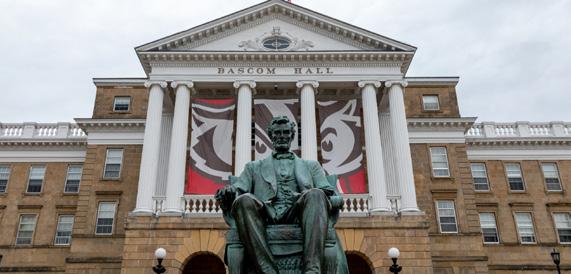
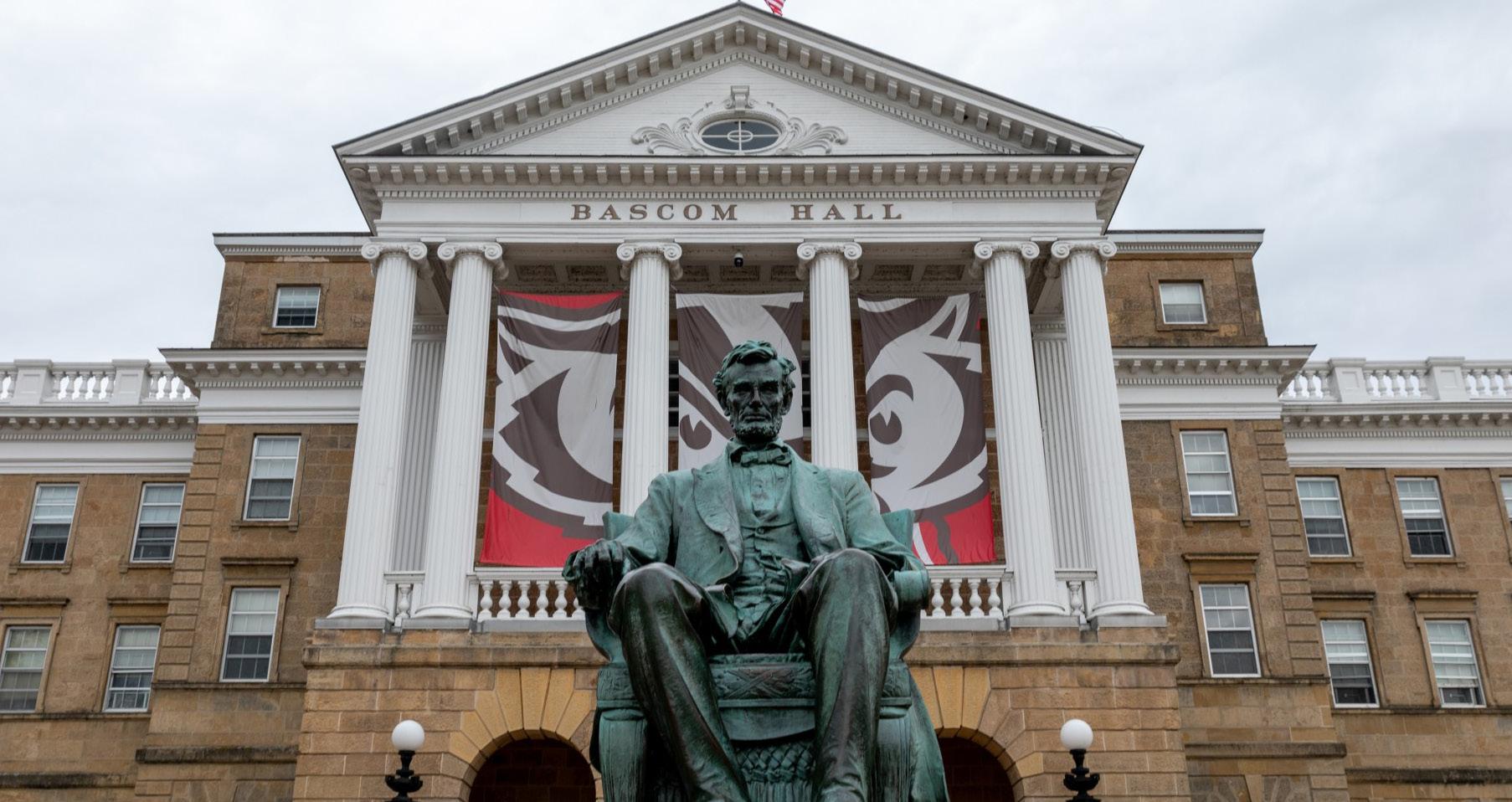
UW-Madison’s new expression policies limit campus protest and dialogue on global events.
+ OPINION, PAGE 8
BRODY ON VOTING UW-MADISON’S UNFAIR POLICY
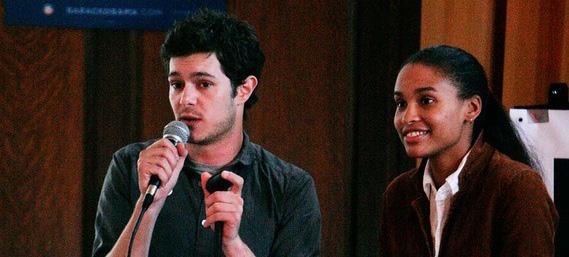
Actor Adam Brody talks to the Cardinal about youth voter turnout and early voting.
+ ARTS, PAGE 7
‘Top Chef’s Dan Jacobs announced as UW-Madison winter commencement speaker
By Ellie Huber STAFF WRITER
‘Top Chef’’s Dan Jacobs will be the keynote speaker at the University of WisconsinMadison’s 2024 winter commencement, the university announced Tuesday.
Jacobs, the head chef and co-owner of acclaimed Milwaukee restaurants EsterEv and Dandan, will share his “recipe for success” with graduates.
“I want to share the challenges I’ve faced, but also celebrate the journey itself,” Jacobs said in a press release. “Success, for me, will be seeing some heads nodding, some smiles, and maybe a few moments of reflection where they realize that they, too, can overcome whatever life throws at them.”
Jacobs has raised over $90,000 to spread awareness on Kennedy’s Disease and was one of four Americans who spoke
to President Joe Biden on behalf of independent restaurant owners. He also helped raise $26.8 billion for the Restaurant Revitalization Fund and is actively involved in several charities like No Kid Hungry and Main Street Alliance.
Jacobs intends on sharing his challenges and experience on “Top Chef” in his speech.
“It was a crash course in tenacity, grit, and perseverance — all skills that are essential in
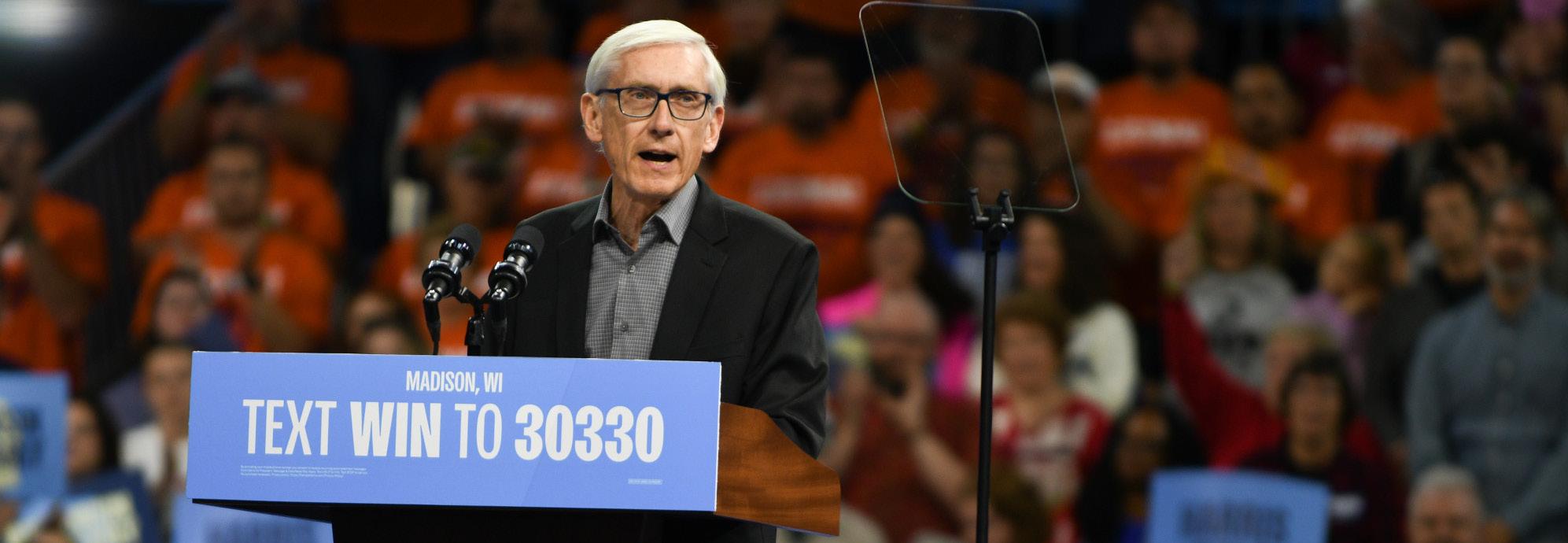
Evers warns against UW-Madison’s neutrality statements, says GOP doesn’t need a ‘daddy’
By Iain Chang SENIOR STAFF WRITER
Gov. Tony Evers expressed concerns about the University of Wisconsin-Madison’s institutional neutrality policy, discussed the gender divide in politics and shared his confidence in Harris’ handling of Israel’s war in Gaza ahead of the Nov. 5 election in an interview with The Daily Cardinal on Thursday.
The governor is unsure of the impact UW-Madison’s recent neutrality policy will have on individual expression. UW-Madison announced their institutional neutrality policy in September, following criticism of previous statements from administration on Israel’s war in Gaza and the encampments last spring. But a spokesperson for UW-Madison previously told the Cardinal that the policy was not a direct response to these events.
“The policy seeks to clarify when and how the university addresses issues with its institutional ‘voice,’ with the goal of limiting statements to situations when UW–Madison is directly affected,” John Lucas, a spokesperson for the university, told the Cardinal Tuesday.
Evers said the university’s lack of discussion on particular topics may affect students’ willingness to participate in “robust,” non-disruptive conversations, something he feels is “healthy” for college campuses.
“I think universities are places where all sides have an opportunity to discuss controversial things,” Evers said.
Evers said it is up to UW-Madison and Chancellor Jennifer Mnookin to figure out how the policy impacts the university weighing in on uncertain topics, such as promoting civic engagement, but emphasized students should play a non-disruptive role in discussion as well. He also expressed doubt that the policy would discourage students from voting on campus.
“I’m a firm believer that we can resolve these things and talk about these things without people interfering with [others’] study or conversation,” Evers said. “I think conversations around difficult topics are really important.”
The policy specifies it only applies to faculty speaking in their “official capacity” or on behalf of the university and makes clear that staff and students maintain the ability to discuss any topic as “private citizens” or “individual scholars.”
Evers addresses the gender divide in politics, recent Mitch McConnell comments
Leading up to the 2024 election, an October survey conducted by the New York Times and Siena College found that the gender gap between party preference has widened as women maintain their yearslong support for the Democrats while men move toward former President Donald Trump. Much of the gender divide is driven by young voters, with polls showing 69% of women ages 18 to 29 favoring Vice President Kamala Harris compared to 45% of young men.
While the Harris-Walz ticket is talking about abortion rights, according to Evers, Trump and his running mate Ohio Sen. JD Vance haven’t, he said men, too, should care about women’s health care.
“Reproductive health is as important to men as it is to women,” Evers said. “I am a male, and I think it’s really important that [Harris and Walz] talk about issues of reproductive health.”
U.S. Senate Minority Leader Mitch McConnell recently said the Republican Party has become “unrecognizable” from the Ronald Reagan era. Evers said it’s “sickening” how Tucker Carlson called Trump “daddy.”
“We have people in the Republican Party assuming that Trump is actually somebody that we should put in the same category as
our fathers,” Evers said. “I can tell you young people that are Republicans, they don’t need another daddy. They need a good president.”
Evers added young Republicans have the right to vote for whoever they want to, but said if they look closely at Trump’s proposals, they are “wrong headed.”
Evers is confident Harris will address Israel’s war in Gaza
Evers also reassured voters who may be hesitant to vote for Harris in the 2024 election after taking a similar policy stance on Israel’s war in Gaza as President Joe Biden.
He said Harris and vice presidential running mate Tim Walz will be the “group to solve” conflict in the Middle East, calling them “great foreign policy people.”
Around 32% of voters in UW-Madison-area wards voted uninstructed, a warning to the Biden administration that sending U.S. military aid to Israel and not pushing for a permanent ceasefire would lose him support among younger voters, a demographic he relied on in 2020 to win Wisconsin.
“Clearly it’s not something that there’s an easy answer to, but my experience with both of them is that they’re going to be right on top of this,” Evers said.
Since launching her campaign in July, Harris has publicly addressed Israel’s war in Gaza with more sympathetic rhetoric toward Palestinians than Biden but has not broken from the Biden administration’s stance on sending military aid to Israel.
Voter turnout on college campuses is crucial for determining the winner of the 2024 Presidential election. Biden beat Trump in 2020 by around 20,000 votes, and there are more than 160,000 four-year students in the UW-System and Marquette University, according to Wisconsin Watch.
life, and that’s where the real growth happens,” Jacobs said. “Competing on the show was proof to myself that my disability doesn’t have to limit or define my potential.”
Senior class president Sam Mahlum said “[Jacobs] epitomizes the aspirations of so many Badgers — to do good in this world and to live lives of integrity and compassion.” Winter Commencement 2024 will be held on Sunday, Dec. 15 at the Kohl Center.
UW-Madison stu-
dent protests were larger in the 1960s and 1970s. Why?
By Tomer Ronen FEATURES EDITOR
Since the 20th century, students at the University of Wisconsin-Madison have protested, most notably in 1967, when over 3,000 students banded together to rally on Bascom Hill in protest against The Dow Chemical Company. At its peak, last spring’s pro-Palestine encampment drew about 10% of that mark. The encampment — which demanded full divestment of all UW-Madison companies tied to Israel — failed to achieve its ultimate goal, and UW-Madison Students for Justice in Palestine (SJP) has said no progress has been made on divestment.
At an Oct. 21 SJP general body meeting, organizers discussed a lack of internal engagement.
SJP declined to comment on this story.
It’s not just a UW-Madison phenomenon. At the Republican National Convention in Milwaukee, protesters barely showed up. A month later at August’s Democratic National Convention, organizers expected tens of thousands of activists to gather in Chicago — a number which would’ve surpassed that drawn by anti-Vietnam protesters in 1968. Instead the number was in the thousands, “fewer” than organizers had hoped.
Ultimately, the DNC did not see a single speech addressing the pro-Palestinian side of the issue, and the Israel and Hamas have yet to reach a ceasefire, while over 40,000 Palestinians have died.
Kacie Lucchini Butcher, director of the Rebecca M. Blank Center for Campus History, told The Daily Cardinal the reason for this may lie in direct impact.
“With the war in Vietnam, people’s friends were dying,” Lucchini Butcher said. “I think there was a sense of urgency to those protests that made people feel as though they wanted to get involved.”
Lucchini Butcher also thinks emerging media has changed the way we protest. In 1944, Lucchini Butler said, a group of students got together to protest the use of universityapproved private landlords. Students talked to their peers face-to-face and got the signatures of over 5,000 students, a third of the student body at the time.
“Students don’t have those same opportunities to talk to each other,” Lucchini Butler said.
+ Protests page 2
“…the great state University of Wisconsin should ever encourage that continual and fearless sifting and winnowing by which alone the truth can be found.”
MARY BOSCH/THE DAILY CARDINAL
Young Wisconsin voters targeted in texting scam
By Wanwa Omot STAFF WRITER
An unknown number of young Wisconsinites received misleading text messages in October about voting in the Nov. 5 election, alerting voter advocacy groups to call for investigations into the source of the texting campaign.
Nonpartisan organization Free Speech for People wrote a letter on behalf of The League of Women Voters of Wisconsin (LWVW) — a nonpartisan organization advocating for civic engagement in government — urging the U.S and Wisconsin Department of Justice to investigate the texts and “take appropriate enforcement action against the perpetrators in order to protect Wisconsin’s voters.”
The texts threaten voters to not vote in a state where they are not eligible, citing Wisconsin statutes 12.13 and 6.18 — which address election fraud by voting absentee in Wisconsin. The texts mention 3.5 years in prison and fines of up to $10,000 for violating these laws.
An analysis of several messages sent to Wisconsin voters found that telecommunications company Telnyx is servicing the phone numbers responsible for the text messages. The Australia Communications and Media Authority investigated and fined Telnyx $106,560 for failing to prevent text message scams and mobile number fraud in 2023.
The LWVW said the texts
Community involvement has also fallen off, according to David Newby, who joined the UW-Madison Teaching Assistants’ Association in 1970 and is now a lifetime member.
“The Vietnam marches and rallies had considerable community participation, but if you look at the 1970 TAA strike rallies, they were primarily student rallies,” Newby said. “I’m not sure that we have the organizations and the structures to be able to bridge that divide between student action and community action.”
Newby, who participated in the pro-Palestine encampment, called it “smaller” than he expected but “different” than anything he’d previously participated in.
So is activism dead or simply changing? Movements like Occupy Wall Street, #MeToo, Black Lives Matter and now divestment from Israel have certainly made an impact, with #MeToo leading to the firing of sexual predators in top positions and hiring of women in prominent jobs, and Black Lives Matter leading to policing reform in some cities and hiring of Black Americans in prominent jobs. But none of the four have attained their central goal.
At UW-Madison, the university has always bargained from a position of power, Lucchini Butler said, but students are the ones to “hold a mirror” to the institution’s face, and with so much constant protest,
have upended their voter education and mobilization efforts for the Nov. 5 election.
LWVW Communications Manager Molly Carmichael, who herself received the text, told The Daily Cardinal the language used in the text was “jarring” and “harsh” and worried these messages would lead to voter intimidation. When she learned that her co-worker also received the message, Carmichael connected the dots that these texts were most likely targeting young voters.
“That was especially alarming, because [young voters] are people who maybe need more inspiration, or we need to empower them to go, or maybe they need more information or tools,” Carmichael said.
Young Wisconsin voters are a key demographic in state and federal elections. Wisconsin voters ages 18-24 led the nation in youth voter turnout in the 2022 midterms, according to data from the U.S. Census Bureau.
Around 292,000 young voters are registered to vote in Wisconsin ahead of the Nov. 5 election, making this demographic vital for both Vice President Kamala Harris and former President Donald Trump’s campaigns. About 20,600 votes made the difference in President Joe Biden’s win of the battleground state in the 2020 presidential election.
Out-of-state students can choose to vote from their permanent home address or their school
“protest fatigue” sets in for organizers and students.
“Students also get this kind of burnout and disillusionment when they make demands, and then some of those demands are not met,” Lucchini Butler said. “I think there’s an exhaustion that comes with just organizing work on top of being a student and then on top of that, to see this dwindling return.”
Frequently, protesters will bring the university a set of demands, to which the university responds by bringing up minute details in specific policies to avoid, Lucchini Butler said. With thousands of campus policies, it’s nearly impossible for students to know every one. But it’s important to consider “the spirit of the ask,” she said.
“In the 1969 Black student strike, students really wanted to be involved in hiring Black professors in the African American Studies department, and the faculty came back and said, ‘No, that’s against all these faculty hiring policies,’” Lucchini Butler said. “The spirit of the ask was that students wanted a professor that more closely reflected them… and they were worried that all the professors that were going to get hired for African American studies were going to be white and were going to maybe be white men.”
But the rhetoric has always been the same, Lucchini Butcher said.
“They say that these protesters should ask for rights more nicely,” Lucchini Butcher said. “That has been consistent on campus, but
address in Wisconsin. To vote in Wisconsin, a state-issued identification card and proof of residency must be shown to the poll worker.
Students can get a physical voter identification card printed at the Wiscard office in Union South or print a paper version themselves.
Any out-of-state student who has resided in Wisconsin for the last 28 days and has no present intent to move is eligible to vote in Wisconsin.
Fighting misinformation with education
This is not the first time the League of Women Voters has come across malicious messaging campaigns. In March, New Hampshire voters received AI robocalls imitating Biden’s voice with false messages that voting in the state’s primaries would prevent voters from casting ballots in the November election.
Lingo Telecom, one of the companies sued by the League of
also throughout protest history, since the dawn of time.”
Protesters fell for ‘university tactics’
Now, the university has students on search committees, Lucchini Butler said, but to get there took compromise.
In the 1969 Black Peoples Alliance the university met only two of the protesters’ 13 demands, and, in May, the university did not directly meet any of the pro-Palestine protesters’ demands, agreeing to “facilitate access” to decision makers at the UW System or UW Foundation, engage students and scholars impacted by war and “use discretion” when reviewing disciplinary cases from the encampment.
In an anonymous reflection letter from a student negotiator at the proPalestine encampment, the protester claimed administration convinced protesters it was better to accept an agreement that didn’t meet any of their demands instead of rejecting the proposal and said negotiators succumbed “to admin’s psychological warfare that led us to believe the false notion that this agreement materially helps Gazans.”
The letter outlined several other negotiation tactics the protesters “fell for” and suggested they should have advocated for “dropping the charges” against protesters arrested at the May 1 police raid.
“I am not saying that the people who worked tirelessly should have worked harder — rather those
Women Voters, settled to pay a $1 million fine for their alleged dissemination of the robocalls.
Voters are coming to terms with the scale of misinformation and disinformation this election cycle because of these incidents, Carmichael said. In response, she said the LWVW has created education initiatives for voters on voting by mail, accessible voting equipment and the security of elections.
“There are lots of wonderful sources out there where students can find information they need to make their plan and get to the polls,” Carmichael said. “Voters have a right to vote without intimidation or interference. The LWVW is going to stand staunchly against that because it’s unacceptable. Voters should feel empowered.”
Voters can go to myvote. wi.gov and vote.wisc.edu for resources and information about voting in Wisconsin.
efforts should have been distributed amongst more people,” the letter said. “Instead, we trusted a select few student voices when that kind of decision-making power should never be put into the hands of a few.”
Over the summer, UW-Madison updated both protest policies and a policy on when to make institutional statements, which has led to concern from free speech experts that the policy could lead to a “chilling effect” on protest and free speech.
The university has also investigated approximately 30 to 40 students for alleged involvement in the spring encampment and several student organizations.
UW-Madison previously divested from apartheid South Africa in 1978 following pressure from The Madison Area Committee on Southern Africa on the Wisconsin Legislature, including a 12-student occupation of the chancellor’s office demanding divestment. Still Lucchini Butler thinks it’s unlikely the university will meet SJP’s demands.
But even with a lack of visible change, protest can make a meaningful difference in raising awareness, Lucchini Butler said.
“Sometimes when you study protests, it’s not even that a policy gets changed, it’s the tone of conversation has changed. If you leave a protest and more people know about reproductive rights than they did before, then maybe that’s a good thing,” Lucchini Butler said.
StaffwriterDrewWessoncontributed to this article.
LAUREN AGUILA/THE DAILY CARDINAL
By Joseph Panzer SENIOR STAFF WRITER
By Jake Wesson & Drew Wesson STAFF WRITERS
Last week, the Homecoming celebration marked its triumphant 114th year. Students, alumni and community members showed their Badger spirit throughout campus, culminating in a parade down State Street and a highly anticipated home-game matchup between Wisconsin and the Penn State Nittany Lions.
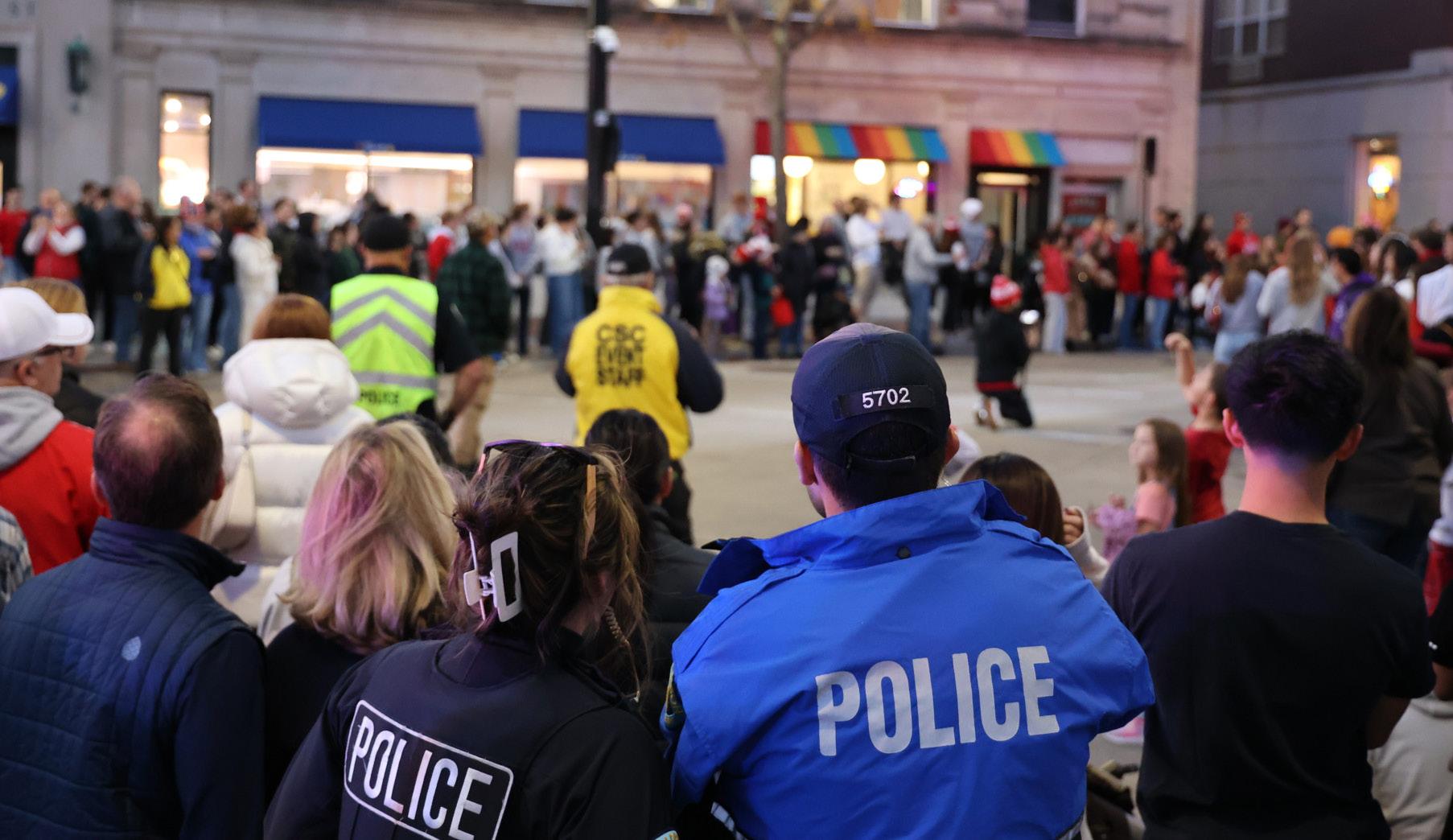
While seas of red clothing covered State Street and Camp Randall, there were a few noticeable outliers. Donning reflective vests and watching from emergency vehicles, Madison’s first responders were gearing up for an eventful weekend.
The Daily Cardinal rode along with the University of Wisconsin Police Department (UWPD) and Engine 1 of the Madison Fire Department (MFD) to get their perspective on how campus life affects their work.
A night with the UWPD
After the parade and early into Saturday morning, officers were briefed on the night ahead. They anticipated a hectic night but ended up surprised at the relatively low number of calls during the evening.
The night started off with a bang. Within the first few minutes, officers, with lights flashing and sirens ringing, raced to a local hospital for a report of an individual, who was experiencing a mental health crisis, attempting to escape. Officers worked to deescalate the situation and the person was brought back to the hospital later that night. While the situation was intense, one officer later said he felt he was “genuinely making a difference” when working in the field.
Following that call, the night was heavy on traffic enforcement around campus. Officers stopped various vehicles due to headlight violations. On one stop, officers conducted a field
sobriety test after smelling alcohol on the driver’s breath. The test indicated low levels of alcohol, and the individual was released without the ability to drive. Their vehicle was parked by an officer in a lot close by.
As officers drove around, they noticed many students were in the Halloween spirit. One officer said “that’s terrifying” in response to seeing a person dressed as Ghostface from “Scream” walking down Observatory Drive in the dark. On University Avenue, a group dressed as the Teletubbies stood out.
Despite the somewhat calm night, UWPD was already preparing for gameday. Events at Camp Randall typically require the coordination of several different public safety agencies. For this one game, UWPD told the Cardinal more than 150 officers from around Wisconsin were brought in to monitor the more than 76,000 fans in attendance.
In an email, the UWPD said 25 people were arrested and 51 were ejected during the football game. A total of 31 citations were issued, mostly for underage alcohol violations.
A ride with the MFD
The next evening, the Cardinal arrived at Station 1, Madison’s largest and busiest firehouse, housing two truck companies in addition to the Lake Rescue Team. While Station 4 is typically known for its responsibility for responding to incidents on campus, Station 1 also covers a portion of UW-Madison and backs up Station 4 when additional resources are needed. Due to the high volume of medical calls typically received during Camp Randall games, it is procedure for an ambulance to be allocated to Station 1 for post-game evenings — something not typical of day-to-day operations, MFD told the Cardinal.
It wasn’t long until the first
alarm went off.
“Let the fun begin,” one firefighter said.
With its horn blaring and lights flashing, the truck arrived to a smell of smoke which turned out to be a false alarm. While other firefighters were sent in to do an interior inspection, Engine 1 was dismissed back to the station.
“This will be busy tonight,” one firefighter said while driving past Langdon Street on the way back.
After arriving back at the station, firefighters rushed to the second floor — where one television displayed the World Series and the other covered Camp Randall’s matchup.
As the Badgers fell to Penn State, firefighters discussed the rumor that fans would have stormed the field and thrown the goal post into Lake Mendota. “We would have to go in and get it,” a firefighter said. Oxygen tanks and scuba gear were a reminder of Station 1’s unique responsibility safeguarding the waters around Madison.
And after one Lieutenant showed off his ability to name several species of dinosaurs, the firefighters were back on the road, responding down State Street with sirens blaring when an individual took a fall at State Street Brats.
Music was pumping and onlookers stared as responders hauled heavy medical bags up the stairs. It took less than five minutes for the victim to be assisted to the awaiting ambulance.
Nestled in the back of Engine 1, the firefighters expressed their love of the job. While they showed regret for the types of incidents that they had to respond to, they said they wanted to be the ones to help in those times.
“We want to be the ones to do it,” one firefighter expressed.
Overall, UWPD reported several notable incidents throughout the weekend. Officers responded to several incidents requiring medical assistance, including alcohol intoxication and mental health welfare checks.
MPD also responded to a variety of calls during the weekend, including one where a person’s finger was partially bitten off during a bar fight.
Due to the timing of Halloween, city leaders are anticipating another upcoming busy weekend. An MFD briefing informed firefighters that holiday-related festivities would likely continue into the first weekend of November, Station 1’s firefighters told the Cardinal.
As inflation has driven up the cost of services, Wisconsin’s local governments, including the city of Madison, find themselves constrained by state laws limiting how they can raise money.
District 8 Ald. MGR Govindarajan told The Daily Cardinal that current state budgets and tax laws dating back to former Gov. Scott Walker’s administration have made it harder for Madison to provide residents with essential services.
“[City employees] haven’t always gotten the pay increases relative to inflation that they have deserved,” Govindarajan said. “The city has grown quite a lot since 2012, but we’re still at the same levels of service for trash collection, for example.”
Despite these constraints, Govindarajan and other officials stressed that city leaders have not given up in their pursuit of increased benefits for Madison residents.
GOP-controlled Legislature strikes down budgetary proposals
Madison Mayor Satya Rhodes-Conway held a press conference Oct. 3 at the Madison Public Library with state lawmakers to demand greater funding for Dane County cities.
Gov. Tony Evers’ 2023-25 budget proposal included a shared revenue distribution that would make the state give to municipalities a minimum of 95% of what they gave the previous year.
Additionally, the proposal included a 5% increase in state payments for municipal services like police, waste disposal and utilities and a 4% increase in general transportation aids for both counties and municipalities.
But the biennial budget passed by the Legislature did not include these increases in funding for shared revenue, leaving Dane County cities underfunded.
This is a result of 2023 Act 12, which initially intended to give all municipalities more funding but has created a disparity between Madison and the rest of the state.
City Communications Manager Dylan Brogan told the Cardinal Act 12 has changed “very little” in what Madison can achieve through state funds despite the fact that Madison has added 90,000 residents since 2000 and is the fastest-growing city in the state.
“That’s a lot more people paying state sales and income tax — a portion of which is supposed to help fund local governments,” Brogan said. “In 2024, Madison receives just $29 per resident through the shared revenue program. The average for Wisconsin cities is $195.”
One particular impact of the shared revenue overhaul is that underfunded communities can
begin to see cuts in the availability of important services, such as fire departments.
Constrained by state law, Wisconsin cities struggle to raise enough money Keeping campus safe during Halloween and Homecoming weekend
Another impact of shared revenue decreasing is that it becomes harder for governments to hire public defenders and district attorneys at competitive salaries, according to Wisconsin Public Radio. This leads to a growing number of backlogged cases accumulating in the court system.
Evers had previously pushed for a raise for public defenders and assistant DAs in his budget proposal before Republicans cut it.
Raising revenues in municipalities is often difficult
Beyond shared revenue from the state, a large part of Madison’s budget is funded by levying taxes. An estimated 71% of the city’s annual revenue comes through property taxes.
“How the state government expects local governments to fund themselves is through the property tax,” Govindarajan said. “If local municipalities want to raise their budget, they are basically forced to ask taxpayers to increase their own taxes in order to pay for city services.”
Wisconsin used to rely heavily on income and property taxes as a part of its revenue stream until the election of Walker in 2010 signaled a shift to fiscal conservatism and tax cuts. The cuts amounted to a 4.4% per capita reduction and created negative externalities for cities.
“Walker basically cut aid to local governments and then also their ability to raise revenue,” Brogan said. “You used to be able to raise property taxes based on inflation and net new construction. Well, he took off the inflation part.”
The Legislature’s budgetwriting committee’s May 2011 legislation on property tax levy limits changed the minimum levy increase for inflation from 3% to 0%, prohibiting municipalities from increasing their base levies by more than one percentage that exceeded the local government’s total value of all taxable property.
While the introduction of levy limits was a response to a then-contemporary growth in municipal tax rates, the loss of these minimum limits on levies has led to low-growth municipalities being unable to keep pace with inflation, according to the Wisconsin Policy Forum, a nonpartisan policy research organization.
Brogan underscored the city of Monona’s Nov. 5 referendum on instituting a onetime $3 million increase to its property tax levy as an example of a city struggling to keep up with costs. The 2024 Wisconsin Department of Revenue report found that Monona’s levy limit is only 0.45%.
Public health officials received dozens of reports of THC-related symptoms after a restaurant in Stoughton accidentally served pizza laced with THC between Tuesday and Thursday.
Famous Yeti’s Pizza unintentionally used oil containing Delta-9 cannabis, which is the most abundant form of THC.
The restaurant operates in a building with a shared industrial kitchen, where businesses can make and store food. The worker making the pizza that day had run out of oil and went to the industrial kitchen to grab oil off the shelf of another operator.
The oil container looked like other cooking oils used for pizza, but the worker failed to read the label on the cap indicating it was Delta-9 cannabis-infused oil.
Late Thursday, Stoughton EMS contacted Public Health Madison & Dane County, as multiple people who had eaten at Famous Yeti’s had been transported to the hospital with similar symptoms.
THC-related symptoms include dizziness, increased blood
in our power to earn that trust and love back,” Famous Yeti’s Pizza owner Cale Ryan said in a statement on Facebook. “We have sought out all the info we can from the Health Department and the Police Department and are following all their suggestions and requirements to deter something like this from happening ever again.”
The post received dozens of kind comments thanking Ryan for his honesty and humility.
pressure, nausea, anxiety and hallucinations, according to Public Health Madison & Dane County.
The dosage of THC in each slice of pizza is unknown and varies by piece.
The Delta-9 oil was a legally purchased product licensed through the Department of Agriculture, Trade, and Consumer Protection. Since it comes from a hemp plant, it doesn’t face the same regulations as marijuana, which is banned for recreational use in Wisconsin.
Famous Yeti’s Pizza is reopening today after taking Friday to deep clean the restaurant and purge all ingredients that could have been contaminated.
“All we can ask for here is your forgiveness and your faith that we will do everything with-
Public Health Madison & Dane County urge people who have been affected by the contaminated pizza to complete their questionnaire to help with their investigation. For more information on THC and poisoning, visit the CDC.
Q&A: Bernie Sanders breaks down Harris’ economic policy, talks Gen Z gender divide ahead of 2024 election
By Tomer Ronen
FEATURES EDITOR
Independent Vermont U.S. Sen.
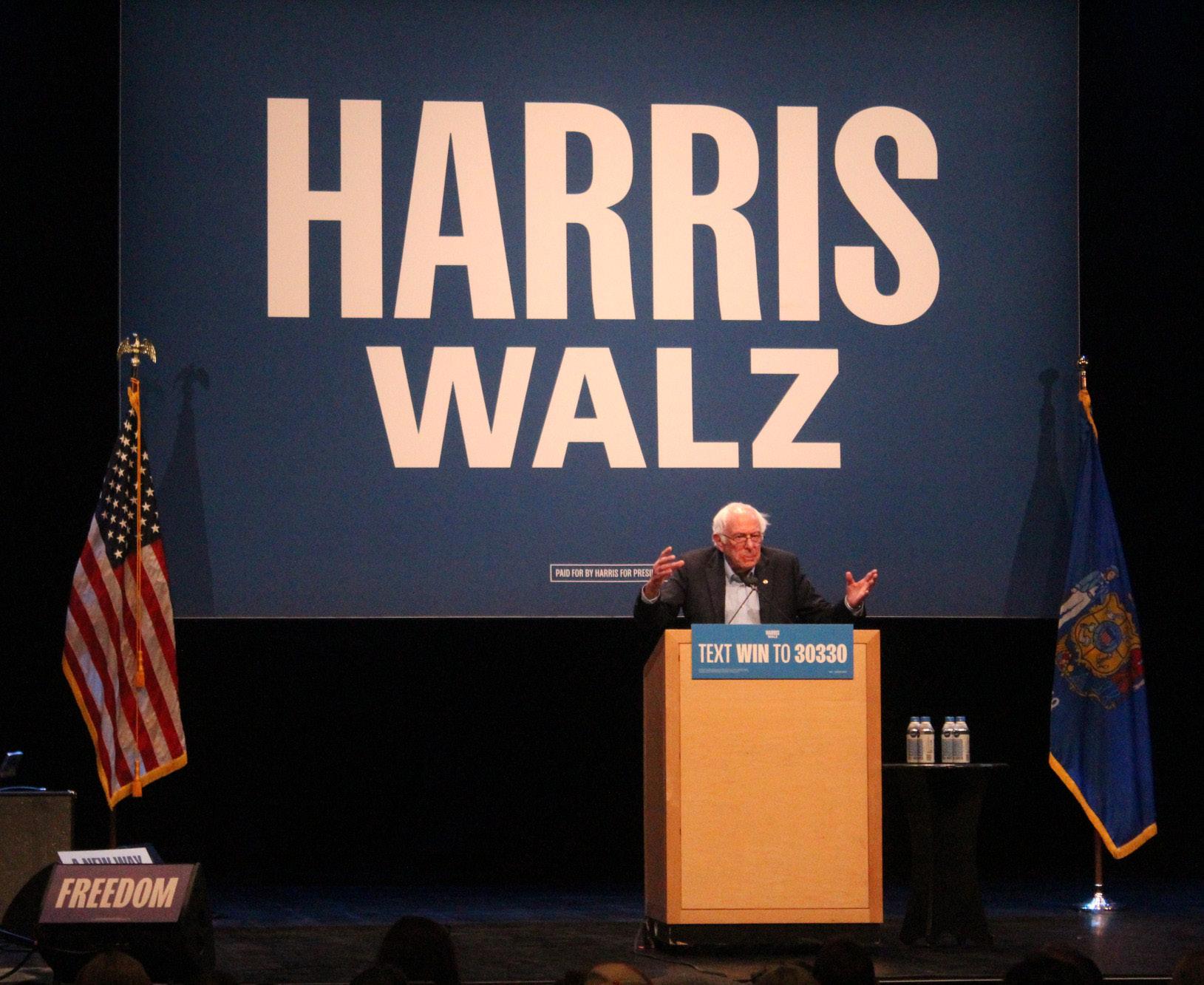
Bernie Sanders, Democratic U.S. Rep. Alexandria Ocasio-Cortez and U.S. Rep. Mark Pocan visited the Overture Center Monday to encourage Wisconsinites to vote early for Vice President Kamala Harris and Minnesota Gov. Tim Walz.
The politicians were met with boisterous cheers as they urged voters to bring their family and friends to the polls to help increase voter turnout.
“What happens in 50 states doesn’t matter, what happens in 10 states does matter, and what happens in Wisconsin matters very, very much,” Sanders said.
The Daily Cardinal spoke with Sanders before the event about gender as a central division in Gen Z politics and Harris’ plan for the economy.
The following has been edited for clarity and brevity.
Harris has advocated for a higher minimum wage, something Biden ran on in 2020. Since Biden has entered office the minimum wage federally has remained $7.25, why should the American public believe a Harris presidency will actually change anything?
As the author of the minimum wage bill, I know a little bit of something about it. We brought to the floor a $15 an hour minimum wage two years ago. I think we did not get one Republican vote, and we ended up with 42 votes.
We tried, right? And we’re going to try again, and I think we’re going to do much better this time, but we have made an effort to raise the minimum wage.
What makes you think that you’re going to do better this time around?
Every state in the country that has had a minimum wage ballot item has passed, including conservative states like Florida, Nebraska. I think you’re going to begin to have some Republican support for it, and I think far more Democratic support. We should have a united Democratic Party, and I hope to get 10 Republican votes as well.
Donald Trump, a multi-billionaire, thinks that we should keep the minimum wage at $7.25 an hour and millions of workers to work for starvation wages.
The gender divide is a prominent topic in this election, yet neither candidate directly addresses gender in relation to themselves. However, since 2020, young men have drifted towards Trump while young women surged for Harris. What does this suggest about the GOP’s strategy, and how much it shapes dynamics of gender in Gen Z politics?
I think many young men, for a wide variety of reasons, are not doing well economically right now. We’re seeing more women going to college, for example, and in the trades that many of the young men are going through, the wages are not particularly high.
I think what we have got to do is talk to those young men and just say, “Should we raise the minimum wage to a living wage?” They will say yes. “Should we guarantee health care to all people as a right?” They
will say yes. “Should we lower the cost of prescription drugs?” They will say yes. “Should we build more affordable housing, lower the cost of rent?” They will say yes. I think what we need is a strong progressive agenda which speaks to women, speaks to men, to the old and the young.
Harris has proposed a “Medicare at home” program. What would this bill cover and how would it work?
It’s a very important development, and you’re right, we have not seen enough. I wish she would talk about it more. What she proposes to do is to expand Medicare to cover home health care, hearing and vision. Right now in this country, there are probably millions of seniors and people with disabilities who would prefer to stay in their own home, but are being forced to go into nursing homes because they can’t attract the help that they need in their own homes. What she is doing is saying they can’t find that help, because it’s expensive, they can’t afford it.
By having Medicare covered, people will
be able to spend their time at home with their family, their loved ones, rather than be forced into a nursing home. There are also a whole lot of seniors who cannot afford hearing aids. This will cover hearing aids, glasses and vision care. This will cover that as well. It’s a very important step forward when you talk about economic issues.
Another issue out there, that’s very important: today, it’s hard to raise a kid, and what Kamala is proposing is a permanent extension of the Child Tax Credit, which will go a long way to lower childhood poverty, putting money into the pockets of working parents to help them raise their kids. That is a big deal. She’s also talking about forgiving medical debt. A lot of people are struggling with medical debt. She wants to move to forgive that. So, those are some of the important provisions in her economic agenda.
Harris’ plan includes a $25,000 down payment assistance for first-time homebuyers. What would you say to young people who are doubtful that they can even afford to buy a home even with the assistance?
She’s also talking about building three million units of affordable housing, and I was impressed, to be honest with you, that as soon as she came out of the gate as a Democratic nominee, probably the first thing she talked about was affordable housing and the need to build more housing units in this country.
I don’t know about Madison, but I do know that in Vermont, and many parts of this country, we have a serious housing crisis that is not only homelessness, it’s people paying 50-70% of their limited income housing. We need more housing. We need to lower the cost of housing, and I think she has a plan to do that. It will be a major step forward, three million units. It’s not a small amount of housing, but we’ve got to do other things as well. We have to change the law so we can build more low-income housing. I think we have to move to sustainably affordable housing through community housing land trusts. There’s a lot that we have to do, but building three million units is good stuff.
COURTESY OF FLICKR USER ELSA OLOFSSON VIA CREATIVE COMMONS
Women’s soccer to face Ohio State in Big Ten Tournament quarterfinals sports
The Badgers’ 9-4-4 regular season record earned them the No. 9 seed to make another appearance in the Big Ten Championship.
By Gabriella Hartlaub ARTS EDITOR EMERITUS
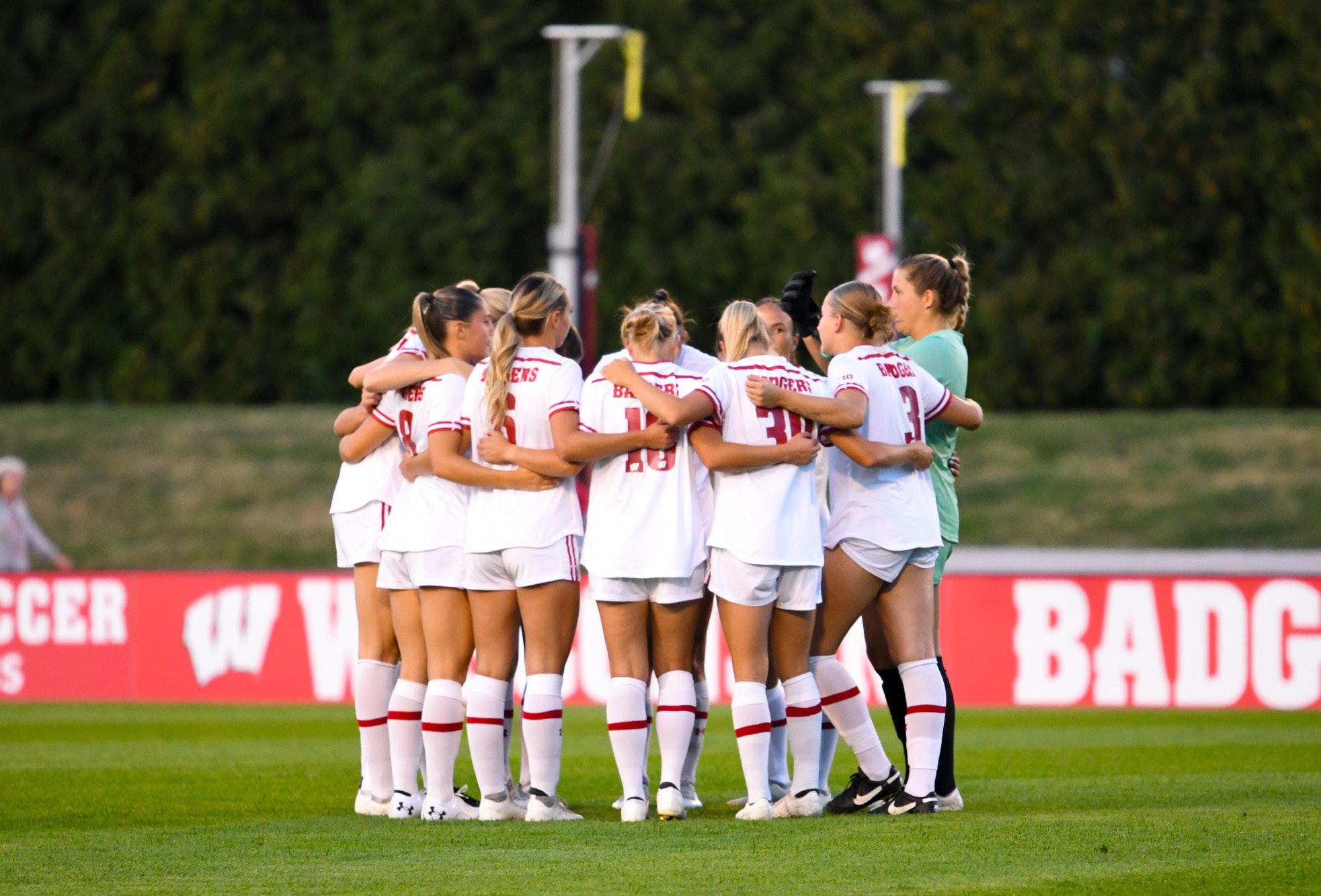
The Wisconsin Badgers women’s soccer team is set to take on the Ohio State Buckeyes in the quarterfinal round of the Big Ten women’s soccer tournament on Thursday, Oct. 31 at 3:30 p.m.
Wisconsin enters the tournament as the No. 9 seed, six places lower than their entrance into last year’s tournament where they made it to the championship game before falling short to Iowa 0-1.
The winner of the matchup between Wisconsin and Ohio State will go on to face the University of Southern California in the semifinal. Both the Badgers and the Buckeyes lost to USC in their regular season matches against the newest Big Ten opponent.
The Badgers have faced the Buckeyes 31 times in program history, falling to an overall record of 11-12-8.
The two teams last met on Oct. 15, 2023, which marked the Badgers’ last home game of the 2023 regular season. The Badgers fell 0-1, with the single score coming from then-junior forward Kailyn Dudukovich, assisted by then-freshman forward Amanda Schlueter.
Now a senior, Dudukovich still plays for the Buckeyes and is ranked second in the Big Ten for goals made during a season with 16. Schleuter, now a sophomore, is ranked fourth in the Big Ten for goals this season with eight.
On the Wisconsin side, then-junior midfielder Maddie
Ishaug recorded two shots and one on goal against Ohio State. Other players who will face the Buckeyes again include Aryssa Mahrt, Hailey Baumann, Riley Philbin, Ashley Martinez, Maddie Poor, Ella Ottey and Adee Boer.
One new face the Buckeyes will meet this time around
is goalkeeper Drew Stover. Previous goalkeeper Erin McKinney recorded three saves and one goal allowed against Ohio State during last year’s game. Stover has started all games for the Badgers in the 2024 season, recording 50 saves with only 15 goals allowed.
Buckeyes’ junior goalkeeper
Molly Pritchard has 74 saves this season but matches Stover in goals allowed with 15 overall. When Pritchard played against the Badgers in 2023, she recorded three saves.
When considering both teams’ 2024 regular season performance, two things stand out. The most stark is Ohio’s home opener against Duke on Aug. 15, where Ohio State beat Duke 1-0. Duke is now ranked No. 1 in the country, according to the United Soccer Coaches Poll. While Ohio State now sits No. 21 nationally, it still is a sign of the team’s skill that they beat a highly ranked opponent so early on in the season. The game also showed off the abilities of Pritchard, who recorded a season-high 11 saves.
There was one regular season team that both the Badgers and the Buckeyes played that the Badgers did win, and that was against Iowa. The Buckeyes came up with a draw on Sept. 19, while the Badgers upset the Hawkeyes 2-1 on Oct. 10.
The Badgers will play the Buckeyes at the Elizabeth Lyle Robbie Stadium on the University of Minnesota Campus, which is playing host to the quarterfinals and semifinals of the Big Ten Tournament.
Badgers gear up for season with eyes on March Madness
By Spencer Teman STAFF WRITER
After a disappointing first-round loss to James Madison in March, the Wisconsin Badgers men’s basketball team will look to return to March Madness for the 22nd time in the last 24 years.
But Wisconsin will look different this year after their underwhelming finish last season.
The Badgers are without three of their top five scorers from last season after losing AJ Storr and Chucky Hepburn to the transfer portal alongside Tyler Wahl graduating. The incoming Badgers will have vital roles this season in Wisconsin’s quest to play meaningful basketball in March.
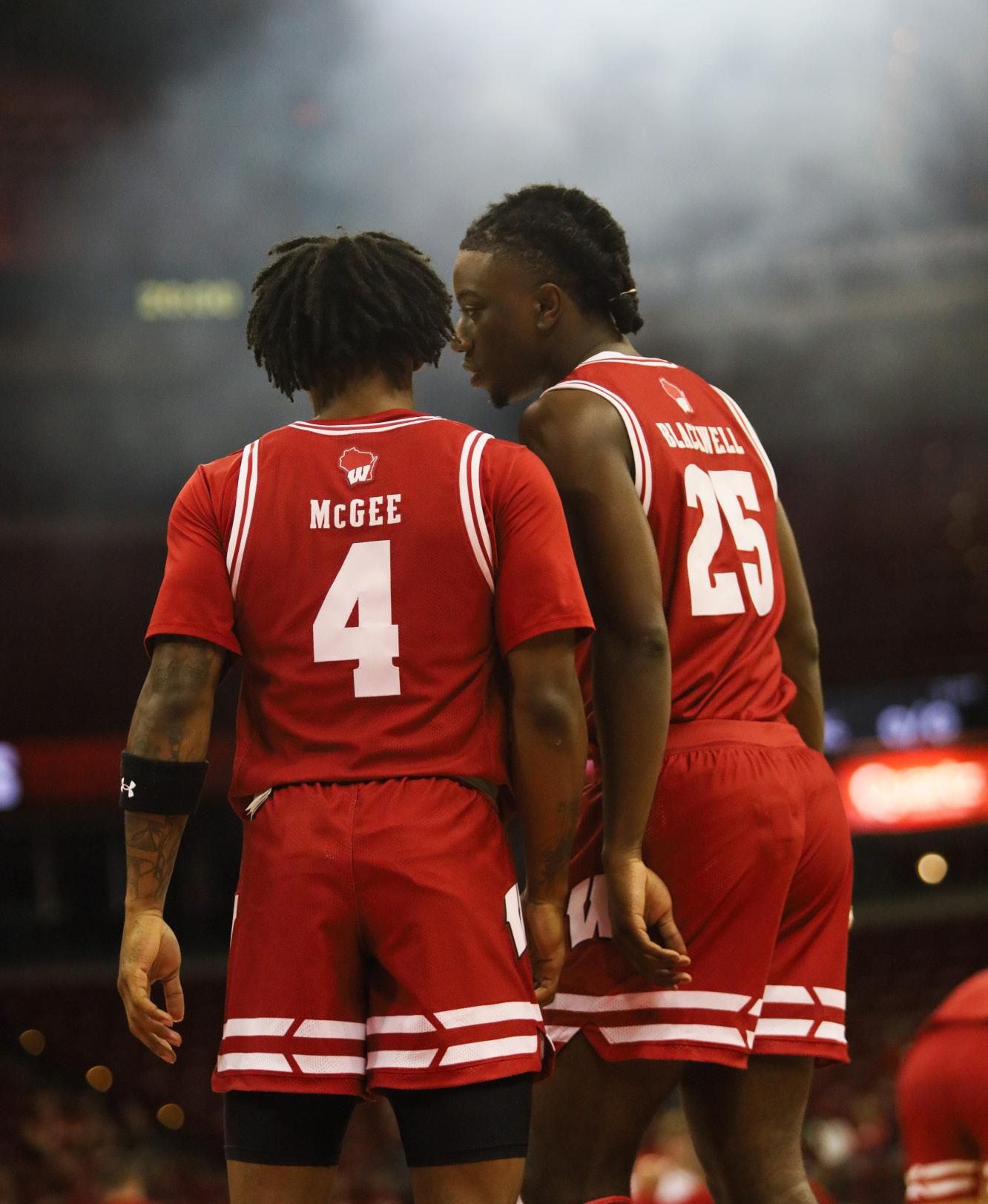
However, Wisconsin retained key veterans in Steven Crowl, Max Klesmit and John Blackwell. Wisconsin also has high hopes for its transfers and freshman point guard Daniel Freitag.
Fortunately, the Badgers landed some experienced veterans in the transfer portal. They acquired two double-digit scorers in junior Xavier Amos and junior Camren Hunter.
The Badgers are undervalued out of the gate, as the Big Ten Media Poll ranked Wisconsin No. 12 in the Big Ten. In an expanded 18-team Big Ten conference, it will definitely be a bigger challenge for Wisconsin to make its way to the top.
The Badgers will need a player to emerge like AJ Storr did a season ago, and signs have pointed towards John Blackwell. Blackwell, averaging just eight points last season as a freshman, has the most potential to break out and become the star Wisconsin so desperately needs.
Sophomore Nolan Winter, who averaged just two points last season as a freshman,
should see a bigger role this season and could possibly start at power forward for Wisconsin.
Wisconsin has an interesting schedule to get over this season. Their non-conference schedule features two top-20 opponents No. 10 Arizona Wildcats and the No. 18 Marquette Golden Eagles. An upset in one of these games would be a huge boost for the Badgers’ tournament resume when March arrives.
With the expanded Big Ten, there are now more opportunities for the Badgers to bolster their tournament resume for March. Wisconsin will be in Los Angeles to take on USC and UCLA in late January and will host Washington and Oregon in late February.
The Badgers will not have a true road test until Dec. 7 when they head to Milwaukee to take on the Golden Eagles. Including the neutral site for the Greenbrier Tip-Off, where the Badgers are set to take on UCF followed by LSU or Pitt, Wisconsin will see at least eight straight non-road games in a row. It’s a perfect chance for the Badgers to start the season hot with a lot of home cooking.
A key this year for the Badgers — which they struggled with a season ago — is winning conference road games. Wisconsin only won three road conference games last season, finishing as the No. 5 seed in the Big Ten. With a couple more conference road wins, the bracket may have looked a lot different.
The Badgers are ready and focused on completing yet another triumphant season. Last season did not end how they wanted it to, but they have a chance to rewrite the script this time around. Another magical March Madness run is possible for Wisconsin, and it will start Nov. 4 against the Holy Cross Crusaders.
MEGHAN SPIRITO/THE DAILY CARDINAL
MADISON TUFFNELL/
New images of RSV may hold key to unlocking new treatments
By Elliott Murray STAFF WRITER
A research team at the University of WisconsinMadison has taken a major step toward deciphering the complexity of the respiratory syncytial virus (RSV) structure.
Led by Elizabeth Wright, a professor of biochemistry, this team has released new highresolution images of the virus that will aid in developing new treatment and vaccine options.
Globally, RSV is the cause of nearly 3 million hospitalizations and 160,000 deaths annually, according to the National Institute of Allergy and Infectious Disease and the Infectious Diseases Society of America.
Due to the intricate structure of the virus, treatment and vaccine options are extremely limited.
High-risk children can receive preventative treatment, and two vaccines have been recently approved for older adults, according to the American Academy of Pediatrics and the New England Journal of Medicine. But for most Americans, there remains no efficient way to treat or prevent this virus.
The Journal of General Virology describes infectious RSV particles as filamentous and pleomorphic, meaning they possess long, thread-like structures that can be irregular in length and width. The complexity of these virus particles has limited development
of preventative and treatment drugs — researchers such as Wright’s team have had difficulty determining drug targets within these highly intricate structures.
Identifying these drug targets requires an understanding of what proteins regulate the structure of infectious RSV particles.
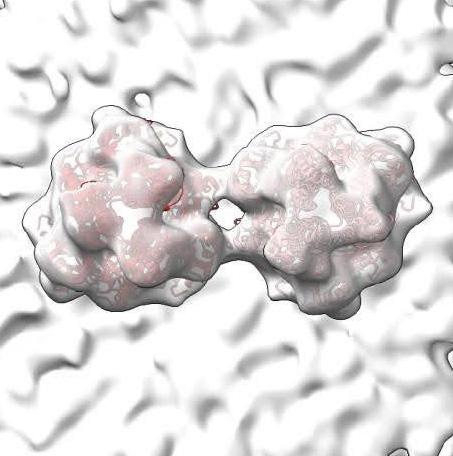
As described in their recent publication in Nature, Wright’s research team produced highresolution 3D images of the virus and the proteins that determine its structure.
Utilizing a technique called cryo-electron tomography, in which infectious RSV particles are frozen at cryogenic temperatures, they were able to inspect the structure of RSV at certain moments in time. They captured 2D images of the frozen infectious viral particles at particular tilt increments. These images were then combined and averaged to computationally generate a 3D representation of the virus structure.
An analysis of this 3D representation revealed that the structure of two proteins — RSV M and RSV F proteins — within RSV are particularly critical to understanding the structure of the virus.
“The imaging found that the RSV M protein is regulating the structure of these filamentous particles,” Wright said. “The M protein forms a helical-like lattice, and it is
Why do leaves change colors in the fall?
The chemical explanation behind the beauty of fall foliage.
By Cassidy Darling STAFF WRITER
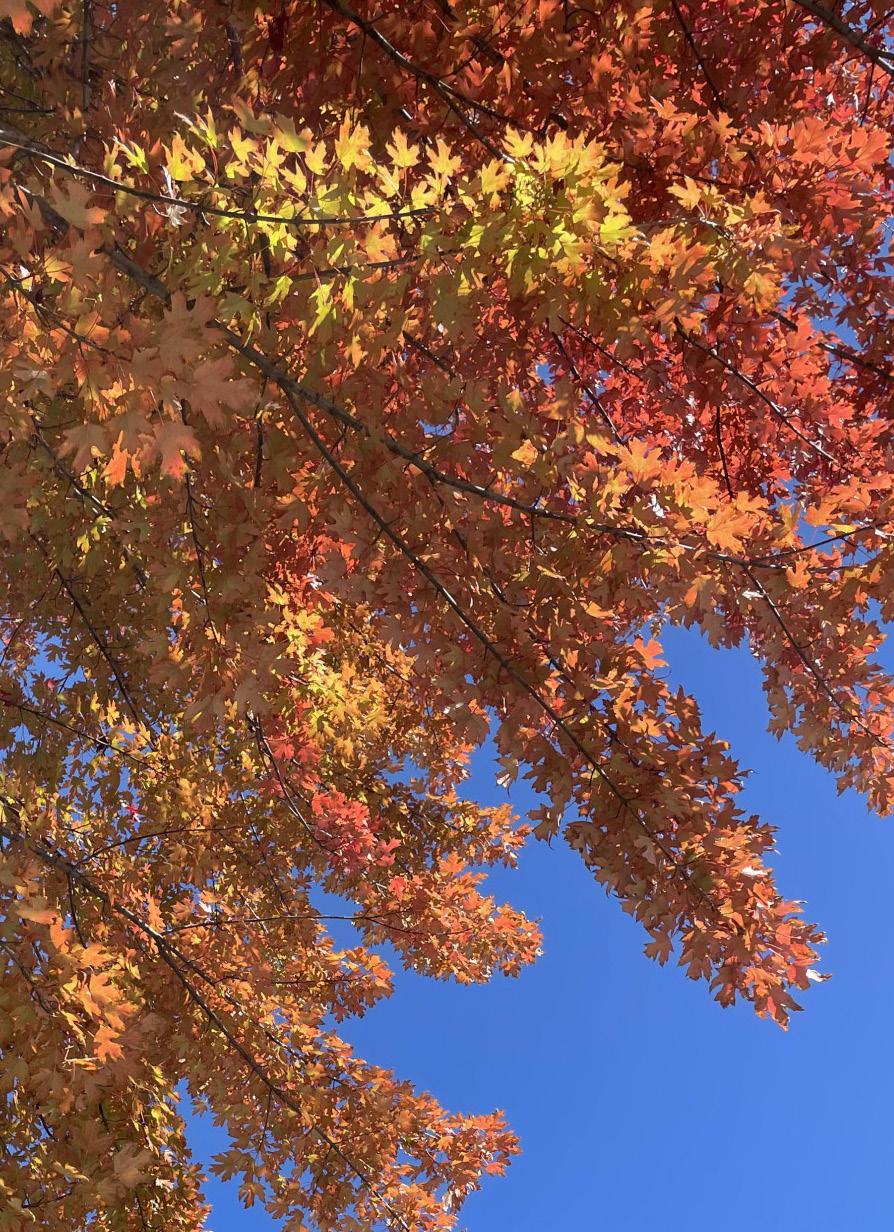
Ever wondered what exactly causes the leaves to shift from green to yellow, orange and red in fall? Turns out, it all comes down to the naturally occurring pigments and chemical transformations within the leaves.
The key pigment is chlorophyll. This molecule turns sunlight into energy for the plant in the process called photosynthesis, University of Wisconsin-Madison chemistry professor emeritus Bassam Shakhashiri told The Daily Cardinal.
“The leaves are green because they are giant factories for chlorophyll. Chlorophyll is a green pigment. Other chemicals are there also, but they are masked. They’re hidden by the immense presence of chlorophyll,” Shakhashiri said.
Chlorophyll absorbs blue and red light from the sun and reflects green. This reflected light is what we see, causing the leaves to appear green. During the summer, the leaves are rich in chlorophyll as it is necessary to perform photosynthesis.
However, the amount of chlorophyll present in the leaves is not constant throughout the year. In the fall, everything starts to change, and chlorophyll is destroyed as the trees prepare for winter.
this lattice of the protein coming together that is regulating RSV formation.”
These RSV M proteins also correspond to the positioning of another protein: RSV F. This membrane protein aids in the fusion of the viral RSV membrane with the host cell membrane.
The imaging of the protein structure revealed that RSV F proteins are arranged in pairs. Each pair is held together by a small “tag” or linkage. Wright said her team now intends to investigate the structure of this link between two RSV F proteins.
“We want to take a highresolution image of the little link so we can engineer some sort of target to keep RSV F proteins linked,” said Wright. By keeping the linkage intact, she told the Cardinal, the virus will not be as infectious.
Along with further investigation of the RSV F protein, Wright’s team intends to study other potential drug targets on the interior of the virus.
“Having more high-resolution structure images will give us more pieces of the story,” Wright said.
As RSV is also related to several other viruses, including measles, rabies and Ebola, according to the Journal of General Virology, her team hopes that their discoveries regarding the structure of RSV can be applied to the development of treatment and vaccines for related viruses.
“When the temperature drops down more, the chlorophyll factories begin to shut down,” Shakhashiri said.
This is when the other chemical pigments that were previously masked begin to shine through. Carotenoids,
one of these pigments, appear yellow due to their absorption of blue and blue-green light. The carotenoids are destroyed at a slower rate than the chlorophyll, turning the leaves more yellow as chlorophyll content decreases.
But what about the red and orange leaves we see?
These are caused by other pigments called anthocyanins. Some trees create anthocyanins in the late summer and fall in order to prevent damage caused by the slowing of photosynthesis.
As chlorophyll production decreases, the leaf can turn less and less of the sunlight it receives into energy, and any extra absorbed sunlight only causes trouble. Anthocyanins act as a shield against sunlight from entering the leaf, preventing damage and also reflecting red light.
So, if a leaf has carotenoids and anthocyanins present, it will reflect both yellow and red light, appearing orange. Red leaves occur when the anthocyanin pigment is the only one left.
“When these other chemicals begin to be observed, it gives us dazzling views and a very, very impressive panorama of colors,” said Shakhashiri.
The vivid display of colors in the trees in the fall is an illustration of the idea that everything we interact with can ultimately be reduced to the actions of molecules, Shakhashiri said.
“It prompts an appreciation for the complexity of the beautiful, chemical world that we live in,” said Shakhashiri.
Q&A: Actor Adam Brody rallies voters
By Alaina Walsh STAFF WRITER
Actor Adam Brody, known for his role as Seth Cohen on the Fox series “The O.C” and most recently as Noah on “Nobody Wants This,” hosted a student meet-andgreet on behalf of the Harris-Walz campaign in Madison on Sunday, where he spoke about Madison’s pivotal role in what he called “a historical election.”
The Wisconsin Democratic Party hosted the event to encourage University of WisconsinMadison students to vote early, backing Vice President Kamala Harris for the upcoming Presidential election. Following the event, Brody spoke privately with small groups of students about their hopes for the election’s outcome.
The Daily Cardinal spoke with Brody about why he thought Madison, specifically UW-Madison students, are important in this election, advice he’d give to first-time
voters and what he’d take home as a keepsake from Wisconsin.
This interview has been editedforclarityandbrevity.
How are you feeling about being in Madison?
Lovely, enthused, energized and comforted by seeing so many energetic, enthusiastic people who are passionate and hopeful.
Why do you think it is so important to talk to University of Wisconsin-Madison students specifically?
Well, starting wider and zooming in, Wisconsin is a swing state, and I think students in general, with good reason, tend to lean more Democratic. At the same time, I thought that the participation wasn’t going to be as strong. So there’s a lot of room there to grow, to activate, to motivate and also they seem to be the people that are interested in talking to me.
What would you say to students that are undecided about voting?
There’s a list of priorities,
policies, positions and rights that I personally care about. Perhaps we share these values or outlooks in common or not — reproductive freedom, the climate crisis, the homelessness problem and the lack of housing, the gun violence epidemic, democracy abroad. These are all big issues. But I would say, regardless of how you feel about any of those…we have a man who’s close to being in office, who is a pathological liar, who’s surrounded by enablers and millions of people that he’s whipped into a frenzy.
I can’t highlight the danger of that enough, not just for all those priorities I just listed, but for keeping the lights on, for keeping the garbage trucks going, for staying out of a nuclear war. I mean, profound instability is mortally dangerous for every person on this planet.
I am not just encouraging you to vote. That’s a must, because we are in a historic time. We’re
Poet Danez Smith marvels at Wisconsin Book Festival
By Marit Erickson STAFF WRITER
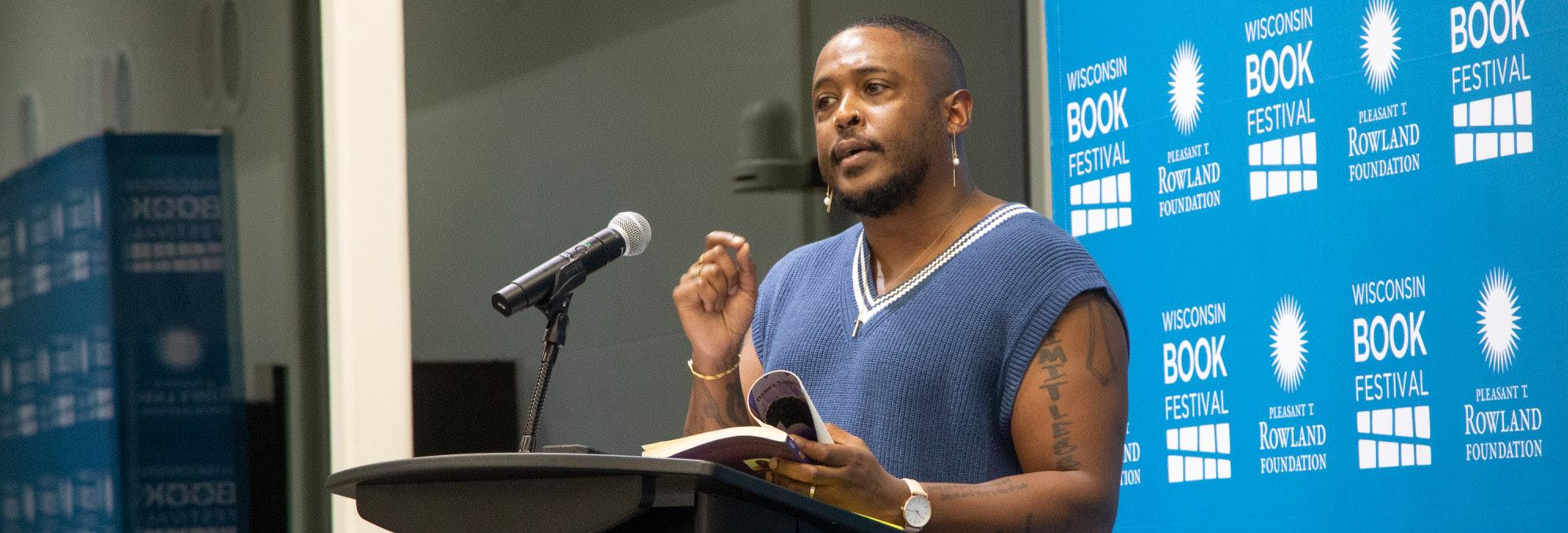
On the crisp evening of Oct. 18, Madison’s literary community flocked to Central Library for a celebration of author Danez Smith’s new poetry collection, “Bluff.”
“Bluff” is the result of Smith’s years-long examination of social justice issues, including the Palestinian liberation movement and George Floyd’s death, and how society perpetuates these inequalities.
The Twin Cities native received their undergraduate degree at the University of WisconsinMadison as a part of the First Wave Hip Hop & Urban Arts Scholarship Program.
Since graduating, their career has flourished, having received the Lambda Literary Award for Gay Poetry, the Kate Tufts Discovery Award and the Forward Prize. They’ve published three previous works: “[insert] boy,” “Don’t Call Us Dead” and “Homie.”
The night opened with a statement by Smith’s former professor Nate Marshall, who described his close relationship with the poet. Fellow First Wave member Diya Abbas performed three poems and introduced Smith with a glowing review of “Bluff.”
Smith took the stage with a familiarity few poets exhibit. Their spoken word roots bled into this reading, holding the audience captive with charisma, humor and raw honesty.
“Bluff” contemplates morality, identity, family, death and injustice. Smith asks the audience and themself: how can one be an artist and fully contribute to change? Is poetry enough in the battle against corruption? Is it okay for one’s art to contribute to the capitalism that fuels American colonialism?
“The poem is still a border…a cage…I do know that it’s fuel,” they said.
Art is insufficient in the fight for equality and social justice, but it can help individuals work through the horror inflicted upon them, Smith
said. Poetry can heal. Specifically, “Bluff” heals.
The collection responds to atrocities around the world, both overseas in Palestine and in Smith’s hometown of Minneapolis.
After the death of George Floyd, Smith took a hiatus from writing, saying, “I had to move with my hands, with my actions.”
On the anthology’s second poem, “ars america (in the hold),” Smith suggested, “there is no art in America but violence.”
Another standout poem from the book is “Last Black American Poem,” in which Smith peels the curtain back on former President Barack Obama’s presidency.
“I don’t want a Black colonizer,” they said. “My politics will not be satisfied by a mirror.”
In “less hope” Smith played with emphasis and volume, changing their delivery after the volta by flipping their tone from an outraged declaration to a somber finish.
The Palestinian tribute, “poem,” incorporated audience participation, as Smith made the whole room shout “Free Palestine” 21 times.
Other poems in this collection are more personal. There are ruminations over Smith’s sexual and gender identity after growing up in a Baptist home. In “Colorado Springs,” Smith reflects on a conversation with their grandmother about homosexuality in the Black community.
“I will not allow myself to exist in a system that is volatile to me,” Smith said after the poem.
Their poem “rondo” plays with form by including a wide black rectangle cutting through the page, scattering words in each direction. The line represents Interstate Highway 94 that cut through Smith’s childhood neighborhood in St. Paul.
As a final farewell, Smith told the audience that “art is a great space to practice the truth.”
In “Bluff,” the Wisconsin alumni does that to perfection.
seven days away from making history. So vote and knock on some doors, because you will remember these moments for the rest of your life. It’s that historical. Whatever happens, you’ll remember where you were and what you did, and you’ll be proud to say that you did something.
To clarify, you’re urging young voters to vote based on facts, correct?
I’m urging people to vote based on facts, for people who build a consensus and are surrounded by experts and are not just following the whim of one man and his imagination and… not somebody who leads with division. I mean, Trump openly denigrates half of Americans and half of American cities all the time. That’s not a leader for this country. You gotta be president for everyone.
Celebrity endorsements can be powerful, so what would you say to students who are skepti-
cal about the influence of celebrities in this election?
There’s no reason that somebody needs to listen to me more than their neighbor, you know? Perhaps I can command a bit more attention, but that doesn’t mean that my opinion is any more valuable or wise.
Looking back, what advice would you give to “young Adam Brody” when voting in a presidential election for the first time?
Oh…do the midterms first. Do your local [elections]. Because the thing is, everyone gets involved in the presidential race, and it has a lot of impact. But if you want to impact your life the most, it’s like, who’s on the school board, who’s your local judge? Do local. Do local. Do local. Finally, if you could take one thing home from Madison, other than food, what would it be?
[Laughs] I mean…a pet cow? Other than food, I don’t know what kind of goodies you have… Oh, the Electoral College votes!
Indie music meets UW-Madison spirit in Christa Lee
By Madeline Wooten STAFF WRITER
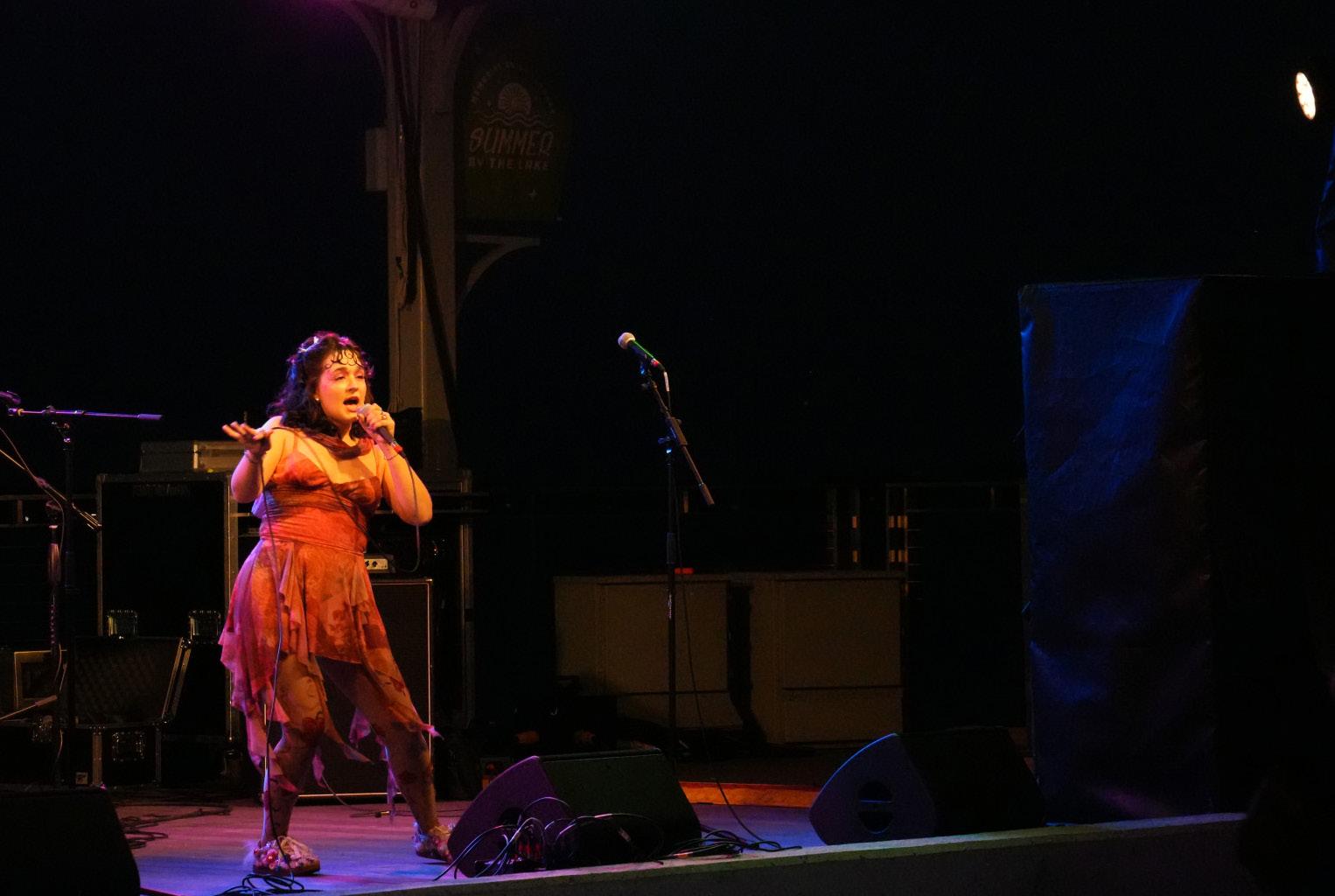
Working toward dreams and passions while in college may be a challenge to some, but University of Wisconsin-Madison senior Christa Klais learned how to balance her school and music career gracefully. While pursuing her bachelor’s degree, Klais has found success writing and performing music under the name Christa Lee.
Since the age of two, Klais knew exactly who she wanted to be when she grew up — a singer.
“I grew up loving [music]. My mother was a singer, so I always loved it and had a passion for it,” Klais said. “It always felt like my soul lived in music.”
She auditioned for every opportunity she could get to sing in school and was raised with an “adoration” of music and artists from the 1980s.
Amy Winehouse, Prince, Raye, Remi Wolf and Harry Styles inspired Klais. As her sound changed, so have her influences. Now, Klais admires Chappell Roan, Kali Uchis, Doja Cat, Faye Webster, SZA and Clairo.
Klais reflected on her live performances this year as she performed her songs at the Memorial Union concert series on Oct. 4 with music artist Rosie Tucker.
“It felt so good and natural. I had just been waiting to do it for such a long time,” Klais said about performing in front of a live
audience. “It felt like my soul had a release of some sort because this is what I’ve been dreaming of my whole life.”
Klais recently performed alongside UW-Madison a capella group Under A-Rest for a “Artists for Abortion Access” event series Oct. 24.
Maintaining a work-life balance as a college student is no easy feat, and sometimes school makes Klais’ music take a pause to put school first. But outside of midterms and exams, Klais finds time to focus more on her music and creating sound.
“It can be hard to be in a space where academics and sports are taken so seriously but the arts feel overlooked,” she said. “For me, it can definitely feel like I’m behind on both at all times, but in reality, I’m doing it, and it’s something I’m proud of.”
Klais has big things coming as she continues working on unreleased songs, hoping to eventually release an album to take her audience “on a journey of an extended piece and tell a story,” she said.
Despite possible judgment from peers, Klais continues to follow her dreams. She’s trying to make her mark as a musician even “in an environment where it is hard to feel like art is appreciated and worthy of taking up space.” she said.
“It’s in those moments that I really choose myself and my dreams and make my innermost self proud and excited for more,” she said.
COURTESY OF SHANNA WOLF
Cardinal View: UW-Madison expression policies shape debate on only their terms opinion
By The Daily Cardinal EDITORIAL BOARD
In the wake of student demonstrations last semester, officials at the University of WisconsinMadison have updated their policies regarding expressive speech on campus and public statements as an institution. While the university champions the free discussion of ideas in our campus community, the reality of these policies tells a different story — one that stands against the Wisconsin Idea.
In August, the university released the updated policy, now called the Expressive Activity Policy, to clarify restrictions of protesting on campus while also reiterating current policies. This
includes restricting expressive activity — which can include protests, speeches and chants — within 25 feet of all university building etrances, limitations on size for indoor signs, restrictions on certain sound amplifications and restricting activities in certain areas on campus, like the Abraham Lincoln Statue, during certain hours of the day. The policy also outlines how UWPD is able to extend the 25-foot distance further if safety is at risk.
In concept, the new student demonstration guidelines are designed to safeguard students’ right to safely protest. In practice, the Expressive Activity Policy has the possibility to not only restrict
student expression, but stand in direct opposition to the university’s mission of fostering the Wisconsin Idea “that education should influence people’s lives beyond the boundaries of the classroom.”
The university’s new Expressive Activity Policy forces students to reconsider the consequences of fighting for change, potentially creating a chilling effect out of fear student protesters could violate unclear rules. As student demonstrators reconsider their involvement in expressive political action, the administration has placed an important asterisk on the Wisconsin Idea — education should influence people’s lives beyond the classroom,
but only on their terms.
“The robust exchange of ideas and viewpoints is central to a university,” said Chancellor Jennifer Mnookin in a UW-Madison statement following the policy release.
“That means that we will often engage with ideas and perspectives that may be new to us, and that might, in some cases, cause us unease or discomfort.”
At face value, this makes sense. But, the question still remains: what’s the difference between a “robust exchange of ideas” and student demonstrations now deemed to be unacceptable? Moreover, is meaningful change always possible when activism is limited to a roundtable discussion tucked away in a university building?
Following the updates to the Expressive Activity Policy, the university released the Institutional and Public Positions Statements policy, outlining when and how university officials will consider and institute public statements.
The new policy determines university response on whether or not the topic directly impacts the “core mission or operations of the university or one or more of its units.”
Once again, the guidelines of this new policy are ambiguous. By leaving statements up to the discretion of the university, it also sets up zero expectation for the university to address current events that deeply affect the wellbeing of the student body. What
could be considered an impact to a “core mission or operation of the university?”
“When the institution takes a point of view on a matter of public concern or controversy, however well intended, it risks crowding out other points of view… it risks harm to one of the most core and fundamental dimensions of a university: free and open debate,” Mnookin wrote in an email to students and staff.
UW-Madison withdrawing itself from making statements is not the best way to encourage free and open discussions on campus.
Students and community members alike should have the opportunity to critique and challenge statements made by the university, because those challenges have the possibility to spark meaningful changes on the institutional level.
When it comes to addressing current events, the role of the university isn’t to serve as the final arbiter of right and wrong for the student body, but that doesn’t mean the institution should always pursue neutrality, especially when determined by a standard that’s unclear to the student body. Ideally, the university should be one of many voices in the “robust exchange of ideas” taking place on campus.
The bottom line is, when the university takes a stance, they take a risk — but if meaningful campus discourse in pursuit of the Wisconsin Idea is the priority, it’s one worth taking.
Win or lose, the Democratic Party is taking a turn for the better
By Safa Ravzi STAFF WRITER
A s the next generation begins their journey to the polls, they are reshaping the nation’s view of elections for years to come.
This past month, Vice President Kamala Harris’ campaign has made many pit stops in Madison, rallying Dane County’s newest voters and capitalizing on young people’s growing support for the Democratic Party.
This isn’t just a temporary strategy. It symbolizes a long-term shift in the Democratic Party’s approach to leadership. As Gen Z becomes more politically aware and active, Democrats see an opportunity for them to establish party loyalty.
Harris’s campaign has consistently focused on college campuses. Harris took the stage at Alliant Energy Center in late September, urging all young voters to register and take part in their civic duty. Former President Barack Obama and vice presidential nominee Minnesota Gov. Tim Walz appeared near campus on Oct. 22, encouraging people to vote early. In comparison, Donald Trump’s approach has focused on larger rallies and less specificity on a certain demographic such as college students. Instead, he appeals to his existing followers and their views.
The best part of the campaign’s rallies in Madison has been the increased civic engagement on campus. Booths line Library Mall, setting up and energizing first-time voters for the polls.
These efforts aren’t just for this one election. By registering voters in Wisconsin, they’re encouraging all kinds
of political involvement — a necessary foundation to be successful in this swing state long-term. It’s not just about winning votes, it’s about developing longstanding commitments to the party.
All of these efforts indicate that Democrats are showing a greater interest in the future of this nation than Republicans. Focusing on party loyalty, they’re prioritizing issues that will be relevant for years to come. This includes health care reform, reproductive rights and LGBTQ+ rights. By supporting the younger generation, the left is developing ties that will harbor them support in the future.
These ties aren’t difficult to make — policies important to young voters, such as student debt relief, are already commonly associated with left-leaning platforms. But they have also been a pivotal focus of Harris’s campaign. Her focus will shape young lives by showcasing the Democratic Party’s commitment to advancing social issues that matter most to them.
The Democratic Party has also shown a willingness to connect with young students online. This can be seen through its social media presence on platforms like TikTok and Twitter, where students already share polling information and debate the issues. In doing this, Democrats reach a younger demographic and take part in trends that students can relate to. For example, Harris’s TikTok page uses popular sounds and “Day in the Life” videos to connect with her audience. They make political awareness a natural aspect of social media.
Harris’s appearance on campus
Wednesday is yet another example of how she is taking time to connect with young people. I know many people who intend to attend the rally because they were motivated by the musical acts. With supporting performances by artists such as Gracie Abrams (a member of Gen Z) and others, she’s showing her awareness of and commitment to students’ interest through pop culture and music.
This isn’t just for short-term gain. Her
audience is the future of democracy, and she’s showing them their views matter in today’s politics. If candidates share their strategy down the line, they will be successful at fostering a connection with the future of the U.S.
Safa is a freshman studying journalism and economics. Do you agree that Harris’ campaign is good for the Democratic Party long term? Send all comments to opinion@dailycardinal.com