When administrations try to suppress student voices, student papers must ensure independence.
+ OPINION, PAGE 7
Thursday, October 23, 2025
BADGERS WIN SHOOTOUTS
Three periods weren’t enough as the Badgers picked up two shootout wins against Mankato.
+ SPORTS, PAGE 4
UW-Madison launches privately funded open dialogue intiative
By Ella Hanley COLLEGE NEWS EDITOR
The University of Wisconsin-Madison launched “The Wisconsin Exchange: Pluralism in Practice,” a campus-wide initiative aimed at promoting open dialogue and creating a campus atmosphere where “different points of view are both expected and respected.”
The initiative will streamline the university’s preexisting programs with new opportunities, emphasizing the value of diverse viewpoints and civil dialogue.
Chancellor Jennifer Mnookin announced the initiative Wednesday, saying that learning happens best when “people with di erent beliefs come together and when we, as a campus, create opportunities for people to share their perspectives.” She said the Wisconsin Exchange “brings these goals to life.”
The announcement comes after conservative political figures and campus groups criticized UW-Madison in recent years for stifling free dialogue and lacking “intellectual diversity.”
“We certainly don’t expect everyone to agree. We know there will be uncomfortable conversations. But it is vital that we talk — and listen — to each other,” the new website reads.
The university said the launch comes at a “pivotal time” where polarization on college campuses is increasingly prevalent. UW-Madison pointed to a 2023 survey that found 43% of students believed speakers with o ensive views should be “disinvited” from campus. Additionally, the Wisconsin Exchange website reads that 50% of students nationally surveyed said they would not “dorm across the aisle” with someone who voted di erently in the last presidential election.
UW-Madison was ranked poorly in the 2026 College Free Speech Rankings, with a score of 59 and a grade of F on “speech climate.”
The program will host events that model how to debate controversial topics with both skill and care. The initiative will also award grants and host events, including a speaker series beginning in 2026, a postdoctoral fellowship program and other workshops and forums.
The initiative will also work with the Ronald Reagan Presidential Foundation and Institute’s Center on Civility and Democracy to host a forum in spring 2026 on bipartisanship and productive, “results-oriented, cooperation” through ideological di erences.
The “institutional priority” was made possible through funding from donors. UW-Madison spokesperson John Lucas did
Dane County conservation program connects farmers, UW researchers
By Jake Kilander STAFF WRITER
Thirty minutes north of Madison, Je Endres is amid his annual fall harvest. Timely rains and a droughtless summer this year led to a successful growing season for the Endres family, who have operated Endres Berryridge Farms in Waunakee for over a century.
Fourth generation farmer Endres took a break from applying manure to his soil to tell The Daily Cardinal about his operation. An operation that has been pushing the needle on conservation practices for over a decade. He’s been seeing the benefits, but hasn’t been able to quantify them on his own.
“A lot of times there isn’t data out there yet to understand [them],” Endres said. He now gets that data from Dane Demo Farms.
The Endres Dairy farm is one of five participants in Dane Demo Farms, a Dane County program helping farmers implement conservation practices and techniques on their farms. The program mirrors a number of demonstration farms in Northeast Wisconsin, but is the
first of its kind in the southern part of the state.
Francisco Arriaga, an associate professor in UW-Madison’s Department of Soil Science, and Connor Schoelzel, his graduate research assistant, collaborate with Dane Demo Farms to collect samples, conduct research and produce data for farmers to use in furthering their conservation interests. Arriaga said he was brought into the program to be the “scientific liaison.”
Early conversations between Arriaga and farmers began with initial conservation concerns, developing into land management strategies both parties wanted to experiment with.
Strategies vary from farm to farm. Several farms in the program have implemented components like cover crops and no-till farming, two practices designed to reduce erosion, improve soil health and limit toxic materials seeping into the water supply. Some farms in the program have been using these strategies for decades, while others are just getting started. Part of the program is addressing concerns those farmers have about changing their approach.
“The number one concern farmers have is
nitrogen,” said Kim Meyer, a county agronomist and the program manager for Dane Demo Farms. Meyer communicates with farmers frequently as a liaison between them and the county. Nitrogen concerns come from planting cover crops — a practice currently implemented at all five demo farms.
“There’s the concern of nutrients, specifically nitrogen, being tied up by that cover crop and then not [being] released in time for their intended crop, like corn,” Meyer said. “It’s kind of a learning curve.”
Meyer said Dane County also provides funding to help farmers get started. Farms are encouraged to go at their own pace with these changes, and the program’s leaders say there is mutual interest between the county and the farm to implement these conservation efforts.
“Sometimes where we see some environmental issues, it’s not that they’re doing it on purpose,” Arriaga said. “It’s maybe [a] lack of understanding or lack of other knowledge that they may not have.”
+ Farms page 3
not respond to an immediate inquiry on which donors contributed to the funding and how much.
The university’s “commitment to free expression” has been embodied through programs such as Deliberation Dinners. Piloted in 2023, the project allows undergraduate students from a wide range of backgrounds to engage in meaningful discussions about controversial issues, like marijuana legalization, abortion and nuclear power generation in Wisconsin.
Mnookin has been a strong advocate for pluralism in recent years and alluded to the program’s launch at a roundtable conversation with student journalists earlier this month, saying Deliberation Dinners would expand alongside “additional initiatives.”
+ Pluralism page 3
Bills chart GOP vision for weed
By Cameron Schneider PHOTO EDITOR
Republican lawmakers are considering two bills that could alter marijuana access in Wisconsin.
One proposes to change the definition of “hemp” in turn closing the loophole created by the 2018 Farm bill that allows the sale of delta9 THC products. The other bill proposes the legalization of maarijuana for medical purposes.
Co-author of the bill ending the THC loophole, Rep. Lindee Brill, R-Sheboygan Falls, said THC products are a “threat” to public health as hemp can cause long-term damages to the brain. She also said there is a rise in THC “poisonings” in children.
“There has been a sharp rise in delta-8 THC poisonings in young children, many of which have led to hospitalization,” Brill said. “Emergency room visits and poison control calls linked to delta-8 THC and other similar substances have increased significantly. Both the CDC and FDA have issued warnings about the dangers of these products, which remain legal and dangerously unregulated.”
The number of children who have accidentally consumed THC-infused gummies has risen in recent years, with The Journal of Pediatrics finding that 3,054 children accidentally consumed products in 2023, a major increase from about 200 children in 2017.
In Wisconsin, a parent unknowingly purchased hemp-infused gummies for their children in Milwaukee in 2025, and a Stoughton pizza shop accidentally served pieces of pizza laced with THC for three days in 2024.
The bill, introduced on Sept. 19, clarifies that hemp does not fall under the prescription drug product approved in the U.S. Food and Drug Administration through the 2018 Farm Bill. Under the state’s Controlled Substances Act, the possession, manufacture, delivery and distribution of THC is illegal. Hemp is currently excluded from this definition of THC.
Hemp and Marijuana are classified as separate species of the same plant, cannabis.
+ Weed page 3
PHOTO COURTESY OF DANE COUNTY LAND & WATER RESOURCE DEPARTMENT
New York Times features Madison local businesses
By Ava Diener STAFF WRITER
Madison local businesses were featured as the places to be — and most importantly, the places to eat — in The New York Times Oct. 8 article ‘36 hours in Madison, Wisconsin.’
Local restaurants and businesses such as Weary Traveler Freehouse, Tornado Steakhouse and Fromagination were featured as ‘must-visit’ places to go as a tourist exploring Madison.
Though many of these businesses had established customer bases prior to the article, small businesses told The Daily Cardinal the feature made a positive impact on Madison restaurants who typically rely on word-of-mouth to build a large customer base.
Weary Traveler Freehouse, a bar and tavern on Madison’s east side that specializes in comfort food, noticed an increase in customer recognition after being mentioned in the article.
“What I’ve noticed is a lot of people are bringing it up. It’s definitely mentioned by the customer base…I’m super excited that [the article was published],” Weary Traveler owner Je Schmidt told The Daily Cardinal.
Increased customer engagement was also seen in Fromagination, an artisanal cheese store regarded as the ‘Capital of Cheese’.
Ken Monteleone, the owner of Fromagination, said he was happy and humbled by the recognition.
“A lot of our customers have commented on it…I’m sure that with our increased tra c, it’s been partly due to the ‘36 hours’ article,” Monteleone said.
Many of the owners and workers featured in the Times’ article felt connected to the piece, as many are frequent Times readers.
Tornado Steakhouse, a steakhouse complimented in the article for their ‘retro vibes,’ was ‘thrilled to be included’ in the article.
Alex Warren show launches UW mental health initiative
By Alaina Walsh ASSOCIATE
Pop artist Alex Warren brought his Cheaper Than Therapy Tour to Madison Thursday night for the nationwide launch of Future Friends on college campuses.
Future Friends, a new initiative merging live music, mental wellness programming and community action on college campuses, was created by Harris and Sabrina Schwartzberg, founders of Two Bridge and Corey McGuire.
“At the heart of this is a simple truth: we all know and love someone impacted by mental health issues,” cofounder Sabrina Schwartzberg said in the press release. “Future Friends was created to make sure no one has to go through that alone.”
Hosted at the Orpheum, the intimate, free event featured performances, wellness activities and guest speakers including Bachelorette winner and mental health advocate Zac Clark. The night was organized by Two Bridge in partnership with Core Spaces, which owns downtown apartment complexes Hub Basset, Hub Madison and Oliv.
“Future Friends is about creating human connection through music,” Harris Schwartzberg, co-founder of Two Bridge said in a press release.
“By pairing meaningful and authentic live music experiences with wellness resources, we’re showing people they’re not alone – and that community can be a powerful part of healing.”
The event opened with remarks from Schwartzberg, who thanked University Health Services for their support and emphasized the importance of mental health on college campuses. “We’re here to connect music, mental health and community,” he said. “Students at this university have incredible resources, and events like this are about making sure they know that.”
Core Spaces President Dan Goldberg said his company’s partnership with Future Friends grew from a
“I was floored. Honestly, it’s a section that I’ve been reading for a very long time…it was just an honor to be included with the rest of the restaurants,” a host at Tornado Steakhouse said.
Fromagination, whose grand opening in 2007 was featured in the Times as well as the Food Network and various food magazines, expressed their gratitude for the feature in yet another Times article.
“We’ve been blessed over the years…we’re always humbled when
people do take time to mention us in articles,” Monteleone said.
Some business owners believe the most important impact of the Times’ article is the way it regards Madison as “impressive” and “uniquely picturesque,” in part due to the capital city’s flourishing restaurant scene.
“[The article] really showcases what makes Madison special; not only the lakes, not only all of the great outdoor things that we have going on in our city, but also the local businesses,” Monteleone said.
UW-Platteville Baraboo Sauk County campus to close
By Audrey Lopez-Stane SENIOR STAFF WRITER
shared mission to foster belonging and mental fitness in student communities. “We’re obsessed with creating the best living experience,” Goldberg said. “That means more than just beautiful spaces – it’s about connection, wellness and unforgettable memories.”
Clark, who recently celebrated 14 years of sobriety, shared his journey through addiction and recovery, encouraging students to embrace authenticity and kindness as pathways to better mental health. “Living an authentic life is powerful,” he said. “Kindness will win. Ask for help when you need it – you’re worth it.”
When Warren took the stage, he immediately connected with the crowd of about 1,000. Wearing a bright yellow cheesehead, he joked about never attending college. “This is the closest I’ve ever been to a college campus,” he said. “I feel like a cult leader, and you all are my disciples.”
Between songs, Warren mixed humor with emotional honesty. “If you wanted me to do a flip, you should have paid Benson Boone,” he said. “I’m here for depression.”
As the show went on, the singer spoke candidly about losing both of his parents — his father when he was 9 and his mother to alcoholism at 18. “Everyone always told me it would get better,” he said. “It doesn’t. It just gets manageable.”
Warren reflected on the loneliness of grief and the importance of remembering those who have died. “People die twice,” he said. “They die when they die, and they die again when you stop telling their stories.”
During one of the most powerful moments of the night, Warren asked the audience to turn o the lights in the theater and raise their hands if they had experienced loss. As concertgoers participated, teal concert bracelets lit up across the crowd. “This is a room where we can cry about these things,” he said. “Because it’s not just you.” The Midwest Horse Fair will return to Madison in April 2025.
The University of WisconsinPlatteville will close their Baraboo Sauk County campus at the end of the 2025-26 school year due to low enrollment, the university announced Friday.
Only 126 students enrolled for the fall semester when the campus initially prepared for 350. Just seven years ago, when the branch merged with UW-Platteville in 2018, nearly 500 students were enrolled.
Baraboo is the eighth branch campus to close since 2022, when the UW-System ordered UW-Platteville’s other branch campus in Richland Center to close.
UW-Platteville Chancellor Tammy K. Evetovich said in a statement the decision to close Baraboo wasn’t made lightly, but they need to focus e orts to best serve the region and the students.
“Student success is at the heart of our mission,” Evetovich said in the statement. “We are providing additional support and resources to ensure students can transition smoothly to our main campus to complete their programs or find the path forward that best meets their needs.”
Operations will end on May 22, 2026. UW-Platteville will allow students currently enrolled at the Baraboo campus to transfer to its main campus, and the university said they will honor the Baraboo tuition rate for those students next fall. UW-Platteville said they are also developing plans for the branch faculty and sta , but specific details have not been released.
Blame laid on lagging state funding
Rep. Karen DeSanto, D-Baraboo, expressed her disappointment on the closure in a statement Friday and blamed the Republicancontrolled Legislature.
“This is part of a greater trend of closing 2 year campuses that have suffered at the hand of nearly a decade of insu cient funding in the state budget due to Republicans’ lack of investment in the Universities of Wisconsin,”
DeSanto said in the statement.
While Gov. Tony Evers initially proposed $856 million toward the UW System for the 2025-27 budget, he and Republican lawmakers agreed on $256 million instead, the largest state funding increase in 20 years.
The state currently provides 20% of the UW System’s budget, half of what it provided a few decades ago. A recent study ranks Wisconsin at 46th nationally in higher education a ordability.
UW System’s string of branch closures
The Baraboo Sauk campus closure will be the eighth UW System branch to close or downsize since 2023 due to low enrollment. UW-Platteville Richland, UW-Milwaukee at Washington County and UW-Oshkosh Fond du Lac closed in 2024. UW-Milwaukee at Waukesha and UW-Oshkosh Fox Cities closed this past spring.
UW-Stevens Point Wausau will relocate near Northcentral Technical College in fall 2026. This comes as fewer high school graduates pursue college degrees, instead turning toward technical programs that will prepare them for the workforce.
In 2018, the UW System’s fouryear universities took over the 13 UW Colleges, now known as branch campuses, in order to consolidate e orts amid declining enrollment.
Since, some faculty at branch campus faculty said the merge hasn’t worked as intended because universities haven’t helped enough with restructuring of the campuses, instead prioritizing recruiting for the main campus at the expense of the branches and complicating the transfer process. After this spring, five branch campuses will remain including UW-Eau Claire Barron County, UW-Green Bay Manitowoc, UW-Green Bay Sheboygan, UW-Stevens Point Marshfield and UW-Whitewater Rock County. All except UW-Green Bay Manitowoc also face declining enrollment, though there haven’t been any reports of their closures in the near future.
MADISON LUICK/THE DAILY CARDINAL
Farms
Continued from page 1
“If you change something so fundamental to your system, there are cascading e ects,” Schoelzel said. Schoelzel and Meyer are the two main collectors of samples for Dane Demo Farms research. Endres said both are very responsive to the farmers they work with.
“They’re here almost weekly in the summer,” Endres said. “They like to try to make it more comfortable for the farmers to make the changes.”
Seeds of an idea
Meyer said the original interest in the program came to Dane County after the success of demonstration farms in Northeast Wisconsin. The county took advantage of UW-Madison’s research capabilities, providing a component other programs lack. Research in Dane Demo Farms is supported by a fiveyear grant from the USDA’s Natural Resources Conservation Service.
Meyer said the program was always designed with the farmers’ interests in mind. Dane Demo Farms began by reaching out to existing farmer groups to gauge interest. Endres was one of those farmers, serving as the chair of the Yahara Pride Farms, a network
of farmers with similar conservation interests, since 2011.
“What Dane Demo Farms does is track and quantify the data to help see if practices are making a di erence or not,” Endres said.
Those practices are beneficial to Madison, Dane County’s largest urban center. According to Arriaga, 75% of water in the state comes from groundwater, water a ected by nitrogen runo from farms. Nitrates seep into lakes, causing an increase in algae blooms and ecological dead zones. Healthy soil holds that nitrogen in the farmland, ready for crops to use.
“If the farmers can improve soil health on their farms, that helps their farm and their crops, but it also helps water quality,” Meyer said.
Meeting farmers where they’re at
One of the main goals of the Dane Demo Farms project is to make conservation look more viable to other farms in the county. Meyer said their outreach strategy involves speaking to farmer groups, tabling at events and distributing their quarterly newsletter to 460 farms across Dane County.
“[The newsletter] is a way to get to a lot of the farmers that are not even involved with the farmer groups. There’s a large subset of them,” Meyer said. The newsletter contains information about
upcoming field days, where farms can showcase conservation practices they’ve implemented to other farmers, data coming from Dane Demo Farms and any news or relevant expert articles.
Once the five-year grant from NRCS expires, Meyer said the program will look to renew the grant, obtain additional funding and add more farms.
“The one thing we’re always trying to do is find projects that meet the farmer’s needs,” Meyer said. Meyer and Arriaga said other farmers are interested in the results coming out of the demonstration farms and hope interest will further grow the program.
“I see it going well beyond the five years,” Arriaga said. “Because the interest is there, the impacts will be seen too.”
Arriaga and Schoelzel have enjoyed seeing the e ects of their research in the real-world. “Both my parents grew up on farms,” Schoelzel said. “As I’ve been working with these farmers through the Dane Demo Farms, it reminds me a lot of my aunts, uncles and family.”
“Seeing the farmers implement [our research] and use that and [for it to] have an impact,” Arriaga said. “That’s what’s going to make me at peace, knowing that I have helped, in some little way, leave the world a little bit better for the future.”
Pluralism
Continued from page 1
“Pluralism is about bringing people with many di erent backgrounds and sometimes conflicting perspectives and ideas together to discuss and debate, or, as we sometimes talk about it here at UW–Madison, to sift and winnow — our way of describing a kind of inquiry that generates insights and discoveries,” she said at the fall 2024 convocation.
She also said at a Reagan Institute panel in September that “college campuses should be one of the places within society where ideas are explored and bump up against each other.”
In 2024, Mnookin also announced a new “Institutional and Public Position Statements” policy, indicating the university would “generally refrain” from establishing a position on current events following criticism over previous statements UW-Madison made surrounding the war in Gaza.
She said that while public leadership statements are often intended to demonstrate concern for members of a
Thousands criticize ICE at Madison’s second ‘No Kings’ protest
By Elizabeth Baumberger & Alexa Cattouse STAFF WRITERS
Around 15,000 people gathered in downtown Madison Saturday to protest President Donald Trump’s administration and their recent immigration crackdowns across the country.
Organized by the Badger Collective, the Madison “No Kings” protest was one of several thousand rallies across the country and the second “No Kings” protest in Madison. The movement originated after Trump’s $45 million taxpayer-funded military parade in June.
“There’s so many people that feel the pain and distrust in our government right now and what’s happening in our country,” Steve Dinkel, a protest attendee, told The Daily Cardinal. “This isn’t what America has stood for hundreds of years. This isn’t what our grandfathers fought for in World War II, to become a fascist dictatorship.”
Protestors gathered at McPike Park at 2 p.m., hoisting signs saying “hate will not make us great” and “the only monarch we need is the butterfly” while drums beat to the rhythm of “this is what democracy looks like” chants.
“I’m witnessing immigrant families living in the shadows of a nation built upon the DNA of the enslaved, the blood of the indigenous, the sweat of the Asian community, the hands of the immigrants and the whip of injustice,” Dane County Circuit Court Judge Everett Mitchell said. “The only line of defense [we] got [is] to learn how to organize.”
A large number of attendees dressed in silly costumes — from hot dogs and gorillas to inflatable frogs and unicorns — and said they employ gimmicks such as a bubble machine as a way of demonstrating their dedication to an atmosphere of non-violence.
Leo Thull, a Wisconsin resident and former Republican, gave an additional reason for his satirical wear.
“Today, I’m here wearing a hot dog costume and looking as silly as I can, because this whole thing is so absurd, and I think what we need to do as protesters is be even more absurd than this stupid fascist takeover that’s happening in our country,” Thull said.
The crowd of protestors
marched up to the Capitol around 2:30 p.m., chanting various antiTrump chants, playing kazoos and vuvuzelas, beating cowbells and singing along to “Get up, Stand up” by Bob Marley.
Protestor Debora Roblero, a DACA recipient and small business owner, marched the streets carrying a Mexican flag. As a first-generation immigrant who moved to the U.S. with her father when she was 14, Roblero advocated for compassion and immigrant rights.
“We are the backbone of this country,” she said. “A lot of DACA recipients are doctors, lawyers, and they’re here paying taxes, doing everything right… Everybody deserves to be loved and not treated like some sort of
community suffering from the impact of broader events, students may feel excluded “by what is said and by what is left unsaid,” diminishing the overall sense of belonging in the community.
Mnookin said at the time the policy “will strengthen [the] university and make more space for dialogue and debate.”
UW-Madison hopes to serve as a national model for dialogue across different beliefs on campuses in a time where the Trump administration has continually pointed to a lack of ideological diversity on college campuses.
The website reads that college campuses have the “opportunity and responsibility” to build bridges of understanding and constructive engagement.
“Our students come to campus with energy and conviction,” interim Provost John Zumbrunnen said in a press release. “But many arrive having had few chances to interact with people who don’t share their background or views. Our task is to help them build skills and then give them opportunities to grow into the thoughtful leaders and citizens our democracy, and our world, needs.”
Continued from page 1
How much THC per dry weight is what separates the two. Hemp contains 0.3% or less THC content by dry weight while marijuana contains more.
Medical marijuana bill
Senate Republicans also reintroduced a bill on Oct. 15 which didn’t gain traction last session that would create a program that allows cannabis products to be used for medical purposes.
The proposed bill defines medical cannabis products as “concentrates, oils, tinctures, edibles, pills, topical forms, gels, creams, vapors, patches, liquids and forms administered by a nebulizer but excludes cannabis in a form that can be smoked.” The proposal does not mention THC, Delta strands or other cannabinoid forms specifically.
Co-author of the bill Sen. Mary Felzkowski, R-Tomahawk, said the bill aims to help people with chronic illnesses by giving them the “freedom” to explore other options with their doctors.
criminal when we’re not criminals, we’re not, we’re workers.”
Madison local Vanessa Leung, also a first-generation immigrant, expressed fear for her and her family’s U.S. citizenship being “stripped away at any time.” Leung, born in Hong Kong, moved to Florida with her parents when she was 2.5 years old. She also expressed the need for immigrants for a “functioning” nation.
“Behind every industry, every facet of our lives, there are immigrants hard at work,” Leung said. “So, it just saddens me to know that immigrants at large are being hugely demonized when immigrants are some of the most hard working people I’ve ever met in my life.”
“Someone who su ers from a serious health condition should not have to make the choice to travel to another state or break the law so they can try an alternative medicine for relief,” Felzkowski said in a statement. “This is also a chance for small businesses in our state to take part in this market with reasonable regulations on making and selling these products, all while still protecting public safety.” Additionally, the bill would create a new o ce under the Department of Health Services— the O ce of Medical Cannabis Regulation — to manage a caregiver and patient registry. The Department of Agriculture, Trade and Consumer Protection would also be required to monitor the seed-to-sale journey of the medical cannabis products.third or 40% are common, and they come with a lower stipend.
Continue reading @dailycardinal. com
KATHRYN ZEHR/THE DAILY CARDINAL
sports
Badger volleyball splits against USC, UCLA, moves to third in Big Ten
By Abigail Bures
SENIOR STAFF WRITER
Wisconsin lost to No. 25 USC and beat No. 23 UCLA, which moved them down to third in the Big Ten after entering the weekend tied with Indiana and Illinois for second.
No. 23 UCLA
Wisconsin excelled offensively in a Friday night matchup against UCLA in the Field House. Wisconsin’s middle blockers and new setter Addy Horner especially stood out with strong games.
In a promising sign for the Badgers, outside hitter Grace Egan, who previously missed six games due to injury, warmed up with the rest of the team Friday against UCLA. This was Egan’s first game warming up since the Badgers played Florida on Sept. 21.
Wisconsin middle blocker Natalie Wardlow kicked off the first set with a service ace, with great crowd support from a packed student section and lower bowl.
Badgers outside hitter Mimi Colyer got three points in a row early in the first set. First, she tipped the ball just onto UCLA’s side of the net, tripping the Bruins up for a point. Then Colyer finished two kills that put the Badgers ahead 8-4.
UCLA controlled the serving for a few points before Horner won the ball back for the Badgers with a solo block.
Outside hitter Una Vajagic went on to tally two kills to
give Wisconsin a 15-8 lead.
Middle blocker Carter Booth began her skilled blocking game halfway into the first set. She tallied a kill, waited out a UCLA timeout and came back with a solo block.
The Badgers’ set-winning point came from Horner. Wisconsin finished ahead of UCLA with a score of 25-14.
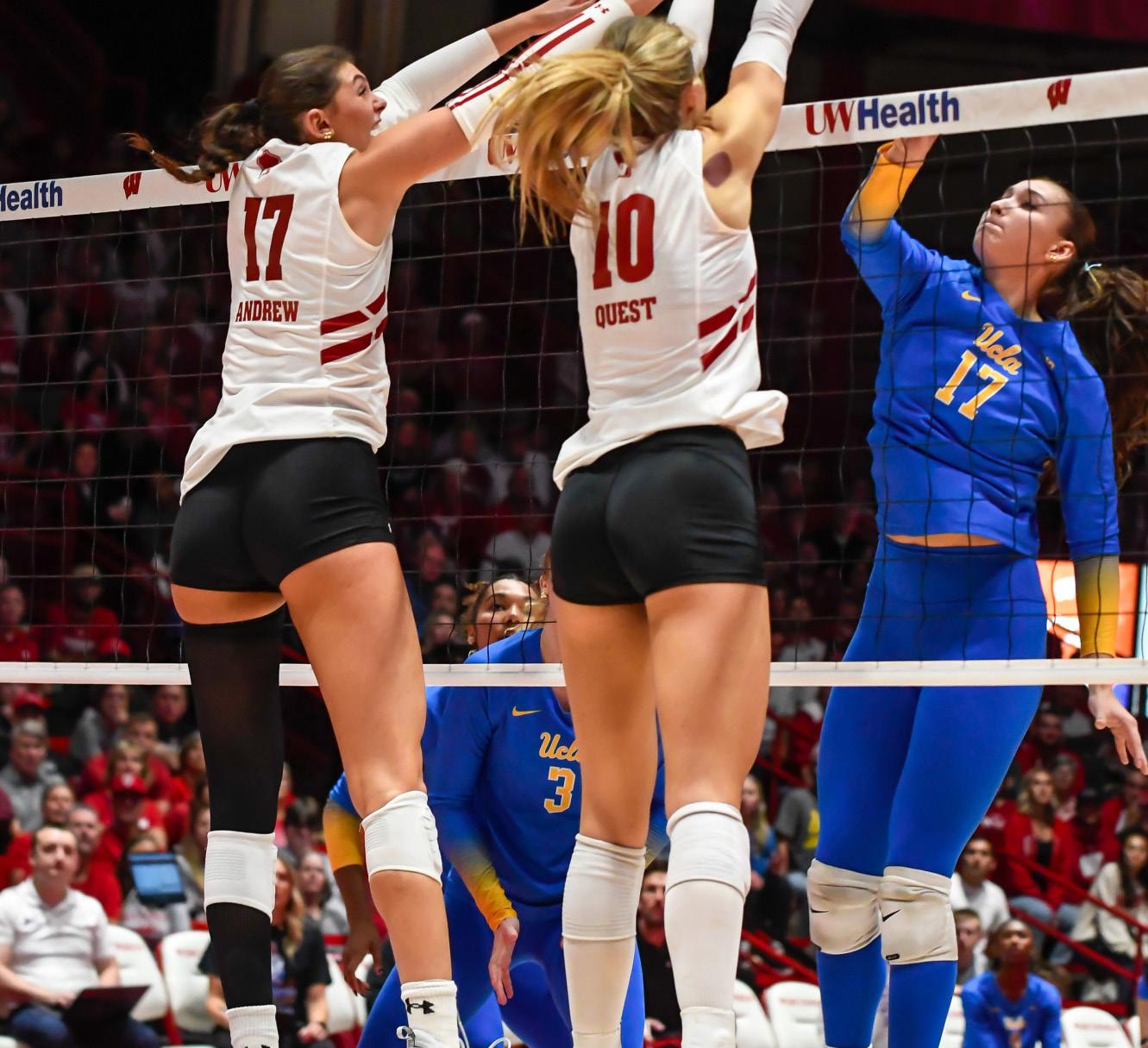
The second set of the night was far closer, with Wisconsin losing the first point, but they gained o ensive advantages quickly with a pair of blocks from Colyer and Alicia Andrew.
Horner recorded another service ace and followed it with a second-touch tap back to UCLA for a trick point. The freshman recorded another point this way halfway through the set.
With a few crucial kills and blocks toward the end, the Badgers finished set two 25-20.
During set three, the Badgers hung close. The Bruins had a more successful return and blocking game.
The final set was the closest of the night, but the Badgers finished strong with a score of 25-21.
Horner set a career high in kills, points and total blocks in the game against UCLA.
Head coach Kelly Sheffield praised her performance, calling it the best performance of her three consecutive starts for the Badgers.
Before facing the last two opponents, Horner had 122 assists. After UCLA and USC, she had 197.
Wisconsin men’s hockey ties twice with Minnesota State
By Haellie Opp SENIOR STAFF WRITER
No. 17 Wisconsin men’s hockey (2-0-2) took on No. 20 Minnesota State Mankato (1-1-2) in their first home games of the season last week, tying both games.
Wisconsin head coach Mike Hastings and sophomore goaltender Eli Pulver faced their former teams over the weekend. Two physical teams gave Badgers fans a game with huge hits, minor penalties and one game misconduct.
All tied up
Wisconsin and Minnesota State each combined for six penalties in the home opener Thursday, . Each time went scoreless on their power play opportunities, however, and tied 1-1 in regulation.
In the first period, Wisconsin received two penalties — forward Jack Horbach for tripping and defenseman Joe Palodichu for cross checking. After four combined penalties from both teams, the Mavericks opened the scoring in the second, getting one past freshman goaltender Daniel Hauser.
Hauser was solid throughout the rest of the game, collecting 21 saves for a .995 save percentage in his third official start of the season.
No. 25 USC
While the score remained close throughout the match, Wisconsin only managed to win one set in the four-set game against USC.
Egan returned to play in this match and helped secure the Badgers’ first set win with a pair of kills early on.
Hitters Colyer and Vajagic also contributed greatly to Wisconsin’s hitting game. Colyer recorded 23 kills and a lower hitting percentage than usual at .239. Vajagic tallied 15 kills throughout the game.
The Badgers found themselves trailing most of set two. At one point, Wisconsin was down by five, but they fought back to within one before USC pulled away with the second set win.
Set three showed the most promise for Wisconsin. Booth and Carter were able to tally kills in the middle of the third set that put the Badgers ahead by three. However, USC slowly came back with two points to every Badgers’ one. Wisconsin lost the set by two.
Set four began disastrously for the Badgers, and USC got ahead 11-2. Wisconsin came back later in the set, getting as close as 21-20, but USC won this final set as well.
Sheffield said his team will learn from this loss going forward. “They forced us to play hard and to play together,” he said. “We will get better because of this match.”
On Sunday, the momentum went USC’s way, but the Badgers will get a chance to gain some of their own next week on the road against Washington and Oregon.
Wisconsin in Friday’s game, securing himself as the starting netminder for the Badgers as they tied 2-2.
Six minutes into the game, Badgers freshman forward Vasily Zelenov was assessed a five minute major for boarding. Zelenov’s game misconduct took him off the ice the rest of the game.
Minnesota State scored two goals quickly after, one coming on a Badger minor penalty kill, ripping the puck past Hauser’s shoulder before he could deflect them.
Junior Quinn Finley put Wisconsin on the board, bringing the Badgers within one on a wrister over Tracy’s right shoulder.
Badgers fans didn’t have to wait long for the game to even out, as senior Simon Tassy scored his second of the season with 07:11 remaining in the second period. Freshman Luke Osburn notched the primary assist on Tassy’s game-tying goal.
The Badgers tied the game in the third when freshman center Oliver Tulk scored his first career goal. Wisconsin couldn’t get another past Minnesota State goaltender Alex Tracy to take the lead, so the game went to three-on-three overtime.
“There were some good things, but there are some things we definitely need to clean up as far as our shift length in that overtime, so you can turn guys so they don’t have to get that worn out,” Head Coach Mike Hastings said.
Neither team secured the sudden death, taking the game to a shootout. Both goaltenders kept the shootout scoreless until Badger freshman Bruno Id ž an snuck one in on Tracy, the 2025 CCHA Goaltender and Player of the Year.
Game one ended in a tie, but Wisconsin took the exhibition shootout.
Keeping the physicality
Hauser was back in net for
After an open ice hit five minutes into the third, Finley was helped off the ice by teammates and a trainer, putting no weight on his left leg. Minnesota State defenseman Campbell Cichosz was assessed a five minute major for tripping and a game misconduct. Cozhosz was booed off the ice on his way to the locker room. With 13:30 to go, Finley skated back onto the ice, much to the relief of the Kohl Center crowd. Wisconsin was unable to capitalize on the five minute power play, but Finley took the final shift as Minnesota State successfully killed their penalty.
Wisconsin freshman Grady Deering’s hit was reviewed for a five minute major penalty, ultimately sending him back to the locker room for the remainder of the game. Deering’s exit marked the third game misconduct of the night Friday.
Finley had his chance at a revenge goal with seven minutes to go, but couldn’t follow through on a breakaway.
The game was once again tied in three-on-three overtime, sending it to a shootout. It went to seven rounds before freshman Blake Montgomery secured the shootout win for Wisconsin.
Wisconsin plays Alaska Fairbanks next at 7 p.m. Friday at the Kohl Center.
MEGHAN SPIRITO/THE DAILY CARDINAL
MEGHAN
arts
Cage the Elephant brings electric energy to Madison
By Maizy Auger STAFF WRITER
age the Elephant brought a dynamic performance to the Sylvee on Oct. 17 and left the crowd speechless. From sharing special, intimate moments with the crowd to flashing lights and surround sound, Cage the Elephant came into Madison with an explosive energy that could not be contained.
After forming their band in 2006, Cage the Elephant maintained popularity into 2025 with crowds young and old, selling out almost all of their venues, including in Madison.
The concert began with an eager crowd ready to enjoy the musical stylings of Vlad Holiday, the first opener. For more than 30 minutes, the indie rock band kicked the night off with a raw and vulnerable set list.
Following them was the second opener: hey, nothing. The charismatic band brought a dif-
ferent, though just as vibrant, energy to the stage, performing a blend of somber ballads and head-banging rock.
Finally, the stage erupted into flashing lights and a musical chaos of instruments.
The Sylvee was filled with confusion and intense excitement as the powerful sound of “Broken Boy,” a song off Cage the Elephant’s “Social Cues” album, echoed throughout the venue. The crowd started dancing and scream-singing. The same magnitude continued throughout the show.
They performed “Cry Baby” next, engaging the crowd even further by running and dancing across the stage. They followed with “Spiderhead,” an explosive song that captured everyone in a vibrant trance.
The following songs flowed nicely into one another. “Too Late to Say Goodbye” and “Good Time” encouraged the crowd to wave their hands and
Good Lorde! The Ultrasound Tour takes over Milwaukee
By Harper Sollish STAFF WRITER
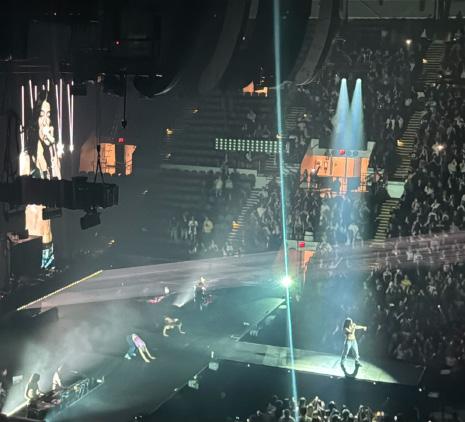
Lorde’s Ultrasound Tour was a rollercoaster of emotions for fans – jumping for joy one song and trying to hold back tears the next at the University of WisconsinMilwaukee Panther Arena on Oct. 10.
The 28-year-old singer songwriter from New Zealand opened the show with “Hammer,” the opening track on her June 2025 album “Virgin.” While it may not be her most popular track from the album, it still set the tone for an immersive night to come.
the edge of the stage, which suspended her a few feet into the air. Behind her, a backup dancer slowly increased the speed on a treadmill until she broke into a run, which Lorde took over for the second half of the song, impressively not missing a beat of the song.
Lorde got even more up close and personal during “No Better,” a song accompanied by close-up shots of her stomach on the big screen. It felt almost sensual, as though the audience was interrupting something intimate and personal.
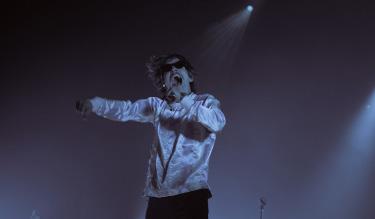
flashlights in the air. The lead singer, Matt Shultz, led this behavior with a contagious energy that made you feel like you couldn’t help but join in.
Cage the Elephant played a multitude of songs off their albums “Neon Pill” and “Social Ques,” such as “Ready to Let Go” and both title tracks. They then followed with “Halo” and “Trouble,” two songs from the album “Tell Me I’m Pretty.”
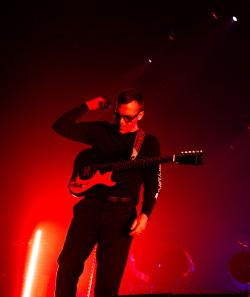
With an already ampedup crowd, Cage the Elephant heightened the energy further. After beginning the song “Ain’t No Rest for the Wicked,” guitarist Brad Shultz jumped down from the stage and into the mosh pit. A dance circle formed around him, and he danced with the crowd.
The band then proceeded to leave the stage after playing “Skin and Bones,” “Rainbow,” “House of Glass” and “Sabertooth Tiger,” gifting a young fan one of their guitars. The crowd was screaming for the band to return, refusing to take no for an answer. The lights stayed dim, so something told the crowd this concert wasn’t over quite yet.
Finally, after about five minutes of endless chants, the band returned to the stage with beaming smiles on their faces, playing “Back Against the Wall” and “Shake Me Down” to reinvigorate the crowd.
Then, the familiar guitar stylings of “Cigarette Daydreams” echoed throughout the venue. With just over one billion streams, this song is by far Cage the Elephant’s most popular. By the middle of the song, Shultz let the crowd take the lead and stopped singing entirely. The crowd continued singing without missing a beat, leaving Shultz emotional.
They then closed the show with “Come a Little Closer,” with Shultz saying this was the “best crowd [on the tour] yet!” With that, they took their final bows and waved goodbye as they triumphantly walked off
After a reminiscent rendition of “Royals,” Lorde began the mystifying experience that was “Broken Glass.” The dance performance from both Lorde and her backup dancers was incredible. One dancer sat and ate an apple slowly, moving her body to the beat while Lorde thrashed around behind her, slowly removing her belt throughout the song. At the climax, she threw the belt away, signaling the start to a more vulnerable section of the show.
Lorde smoothly transitioned into “Buzzcut Season” amid flashing lights, a semiviral song on TikTok and created an introspective trend matching the lyrics, “and I’ll never go home again… I live in a hologram with you.”
Lorde referenced not feeling herself at home and in her real life, saying she lives in a “hologram,” or a fake world to escape reality, while singing into a large fan almost blowing her away.
“Current Affairs” came soon after. Throughout this song, Lorde slowly kicked her pants to the ground, revealing only her Calvin Klein boxers. By removing yet another piece of clothing, she shed her privacy and invited the crowd into her life and music.
Fan-favorite “Supercut” came next. Lorde sang the first half of the song laying down at
After a few more songs, Lorde lit a torch on fire and held it up to the crowd while sitting on a platform high above the stage. With this almost ceremonial act, she began singing “Favorite Daughter” and her pants went back on. This symbolic covering up signaled the end of the most vulnerable part of the show.
Before performing “Liability,” Lorde thanked the crowd. “You give me faith in humanity in these fucked up times,” she said to the arena.
Experiencing “Ribs” as the encore and final song of the night was life-changing. Lorde wore a jacket covered in lights and walked through the crowd while performing — no barriers required. Every single person in the arena was singing their hearts out, jumping and dancing with no end in sight.
“Ribs” is a song about friendship, so being able to stand next to my two best friends on one of their birthdays and sing “you’re the only friend I need, sharing beds like little kids. And laughing ‘til our ribs get tough, but that will never be enough” felt like a spiritual experience. “Ribs” was the perfect end to the show. It is a feel-good song that every fan would know, and it would be hard to believe there was a single dry eye in the house.
MAGGIE SPINNEY/THE DAILY CARDINAL
Mighty Monarchs: Expert talks butterfly migration, population decline science
By Kayla Northway STAFF WRITER
As the weather cools in Madison, monarch butterflies have started to make their way to the warmer Oyamel Fir forests of central Mexico. Unable to survive the cold, northern winters, monarchs fly up to 3,000 miles south to reach their overwintering site in a unique, long-distance migration.
Karen Oberhauser, retired director of the University of WisconsinMadison Arboretum, has four decades of experience studying monarchs and their migration patterns. In an interview with The Daily Cardinal, she uncovered the mysteries of monarch migration and discussed challenges these butterflies face.
Where are the butterflies now?
Using Journey North, a community-input monarch migration tracker that maps monarchs on their journey to Mexico, Oberhauser said many monarchs are already halfway through their journey.
“I just saw some [monarchs] in my yard this morning, so there are still
monarchs in Wisconsin, but the ones that left first are almost at their wintering sites,” Oberhauser said.
Monarchs are known for their unique migration habits, but only a select generation of monarchs, known as the “monarch super generation,” make the journey to Mexico every year. It all depends on when the monarchs emerge: those that emerge as butterflies after the middle of August will migrate and wait months to reproduce, but monarchs who emerge before that reproduce right away and only live for four to six weeks.
“The butterflies we see here in the summertime are ready to mate and lay eggs when they’re about four days old, so their life just goes faster because they’re spending a lot of energy reproducing and it’s warmer where they are,” Oberhauser said.
The lifespans of migrating monarchs are much longer — around eight or nine months. Instead of reproducing right away, monarchs that migrate to Mexico wait until the following spring on their journey north to reproduce, laying eggs along the way.
As soon as they start reproduc-
ing, though, their remaining lifespan is limited. Migrating monarchs are only able to make it around halfway through their journey back north, typically ending up in Kansas and Tennessee. Their o spring complete the journey, making them the first generation of the new year.
During the spring and summer months, monarch butterflies return to their breeding ground in the upper Midwest.
Located in the middle of the monarchs’ main breeding ground, southern Wisconsin has an especially dense monarch population.
“It’s a lot of habitat that has milkweed and nectar plants. There’s a lot of prairie restoration going on, so anywhere those conditions exist, monarchs will find [them],” Oberhauser said.
While monarchs are concentrated in the upper Midwest, they can live in many kinds of habitats. From somebody’s backyard to prairies to the roadside, monarchs only need two things to survive: milkweed and flowers. Milkweed is caterpillars’ only source of food and flowers are food for
Veterinarian’s license suspended after animal cruelty reports
By Lindsey Pfei er SCIENCE EDITOR EMERITUS
Richard Van Domelen, the lead veterinarian at research beagle breeding facility Ridglan Farms in Blue Mounds, WI, had his license suspended by the Wisconsin Veterinary Examining Board (VEB) on Sept. 30.
For local animal activist groups, the suspension is a step towards shutting down Ridglan for good. The local farm has had multiple complaints filed against them with allegations of animal cruelty, including insu cient housing conditions and psychological distress.
In addition to his role as lead veterinarian, Van Domelen is also the facility manager of Ridglan Farms. The VEB suspended Van Domelen’s license after finding he delegated surgeries, such as cherry-eye removals, to unlicensed employees.
The board was petitioned in March by Dane4Dogs, a local animal activist group with a long-standing history against Ridglan Farms, as well as the Animal Activist Legal Defense Project and other animal activist groups, to revoke Van Domelen’s license. However, the board allowed him to continue practicing under certain conditions, including performing surgeries like dental extractions, spays and neuters and cherry eye removals up to “acceptable veterinary standards.”
Now, Van Domelon’s full license has been suspended, and he is no longer able to perform those surgeries.
“The suspension of Van Domelen’s license is a long-overdue acknowledgment of the suffering endured by dogs at Ridglan Farms,” Dane4Dogs President Rebekah Robinson said. “Directing unlicensed sta to perform improper, painful surgeries without proper anesthesia is a flagrant violation of both veterinary ethics and animal welfare.”
Additionally, the Wisconsin Department of Agriculture, Trade and Consumer Protection (DATCP) referred 311 violations to the Dane County District Attorney’s O ce the week prior to the suspension. A special prosecutor appointed in January continues to investigate Ridglan Farms.
Ridglan Farms said in an email statement to The Daily Cardinal there are no o cial findings that the research facility or its employees broke
the law, and said a recent DATCP inspection found them fully in compliance with animal welfare laws.
Ridglan also said Van Domelen will remain as facility manager while they defend his license. While he can’t practice, other licensed veterinarians that work with Ridglan will take care of the dogs, according to the statement.
“We look forward to the opportunity to defend Dr. Van Domelen’s record and also the reputation of Ridglan Farms, which for nearly 60 years has played an important role in the development of health advancements benefitting both animal and human patients around the globe,” Jim Newman, a representative for Ridglan Farms, said in the statement.
The University of Wisconsin-Madison has used Ridglan Farms as a supplier in the past. UW-Madison spokesperson Kelly Tyrrell told the Cardinal in an email that Ridglan could still be used as a supplier for research dogs.
Dogs make up a small portion of UW-Madison research and are used for studies involving cancer prevention and organ transplant research, according to Tyrell. She emphasized UW-Madison screens each dog for mistreatment before including them in research and would look elsewhere for a supplier if they found any sign of mistreatment.
“All animals UW–Madison receives from suppliers are screened to ensure they are healthy prior to inclusion in any research,” Tyrell said. “If animals showed signs of poor condition or mistreatment, the university would take issue with that and find another supplier.”
adult butterflies.
Due to habitat loss, climate change and insecticide use, the monarch population is in decline. However, Oberhauser says this past summer was “pretty good” for Wisconsin’s monarch population, since June and July brought a fair amount of rain and no extreme heat.
But this year’s recovery is no guarantee for next year, Oberhauser said.
Monarchs are highly driven by weather conditions. If the weather is too hot and dry or rainy and wet, monarchs aren’t able to migrate to Mexico and reproduce. Increasing insecticide use also kills o many monarchs, as insecticides kill all insects, not just pests.
“It’s kind of like habitat determines how many [monarchs] there can be and then weather and insecticide use determine whether we can achieve the maximum [population] we can with the amount of habitat that we have,” Oberhauser said.
Eight states, including Minnesota and Illinois, currently designate monarch butterflies as their state butterfly. Legislators recently introduced a bill
to make the monarch the o cial state butterfly in Wisconsin, too.
“I think people have always been really interested in monarchs,” Oberhauser said. “What’s important is that people know about them and care enough about them to help them, and making them the state butterfly just might do that.” people’s own hands,” Halbach said. “The success comes when the real days occur for severe weather and whether or not people are taking action at those points.”
Wisconsin has been the site of 1,537 documented tornadoes since 1844, according to the National Weather Service, with 511 fatalities attributed to these twisters.
Local entrepreneurs Mike Trigg and Max Schauff imparted insights into their careers, starting businesses and making it in the entrepreneurial world to over 50 eager entrepreneurial, business and technology students at the Founder Stories Fireside Chat on Oct.10 at Morgridge Hall.
The event, hosted by Transcend UW and the UW Tech Exploration Lab, brought together UW-Madison alum and LineLeap founder Schau with Wisconsin native Trigg who discussed topics relevant to young entrepreneurs, including risktaking, networking and perseverance.
Schauff, a UW-Madison College of Engineering alum, co-founded LineLeap, a mobile app allowing users to skip lines at bars and won $15,000 at the Transcend UW Innovation Competition in 2018 for the idea.
Trigg spoke about his decades of experience in technology startups, including telecom companies and data analytics firms in Silicon Valley.
Schauff credited Transcend’s prize money for launching the company.
Transcend UW is a student organization that provides students access to entrepreneurship resources, including funding for startups and networking events connecting students to alumni and professionals.
Transcend UW President Siddharth Singh said he “hit [Schauff] up” for the fireside chat because he won Trancend’s competition and is “an inspiration to all student entrepreneurs.”
LineLeap is a success story deeply rooted in the culture of the UW-Madison, Schauff said. Not only did Schauff and his co-founders propel their startup through a UW competition, their app’s ground zero was Whiskey Jack’s “25cent beer night.” On a fateful, frigid Thursday night, LineLeap received its first signups when Schauff promoted the platform to students in line. LineLeap has since been valued at over $100 mil -
lion, serving over 1.5 million users at more than 500 bars nationwide.
Both Trigg and Schauff brought their wisdom to over 50 eager entrepreneurial, business and technology students present at Morgridge Hall.
Founders say youth is an advantage, not a weakness
Shauff, only a sophomore when he started his journey, encouraged other entrepreneurs to start early. ”There’s very little risk at [this] time of your life,” he said.
Trigg said experience in a field can limit a person’s innovation, creating “blinders” to new ideas. “You can be super scrappy [when you’re young], and the learning is tremendous,” he said. They encouraged students to pursue their goals in entrepreneurship and take the first step toward executing an idea, regardless of access to capital or expertise.
Kyle, a senior and business major in the crowd, expressed concerns about finding internships and networking during a Q&A portion of the event.
In response, Trigg stressed the importance of networking “organically” throughout his career, through a series of introductions and connections.
“When you’re starting out your career, that can feel like, ‘oh, I’ve got to do networking,’ and that feels sort of superficial. The best sort of networking happens really organically. The question I like to ask is: Who else would you recommend to talk to?” Trigg said.
Before they took their leave, Schauff and Trigg imparted a final piece of advice for the students.
“We’ve been told ’no’ a thousand times,” Schauff said. ”I think it’s just smiling, taking it on the chin and moving forward. Eventually those ‘no’s turn into ‘yes’es.”
Trigg implored students not to fear failure. “You can move on, and go to the next thing — that’s what makes it fun,” he said.should rule in favor of the lower court and restrict access to the medication.
ISABELLA BARAJAS/THE DAILY CARDINAL
ISABELLA BARAJAS/THE DAILY CARDINAL
opinion
Cardinal View: The Cardinal stands with the Indiana Daily Student
The Tylenol crisis and RFK Jr.’s weaponization of science
The University of IndianaBloomington shut down their newspaper’s print product Oct. 15 and fired the paper’s advisor, Jim Rodenbush, after he opposed the university’s directive to print “nothing but information about homecoming — no other news at all” in its physical issues.
The Daily Cardinal Editorial Board stands with the reporters and staff of the IDS in their resistance to censorship.
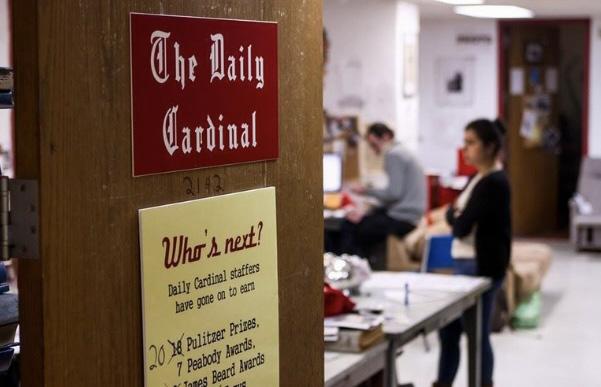
Unfortunately, this is not an isolated incident. As student journalists, we regularly face barriers — albeit not outright censorship — from campus administration and pub lic officials in our reporting, even though we are an independent news source.
Increasingly, we are directed to university communications instead of receiving the opportunity to speak to potential sources on the record.
When Cardinal reporters have approached university officials in-person there have been instances where reporters were repeatedly handed business cards to university communications instead of officials answering our questions or even conversing with us. When university officials have spoken to us at events, they’ve directed us to only question them on particular topics. About a month ago, a university spokesperson interjected in a conversation between a potential source and a reporter. Interactions like this are routine for student journalists.
Censorship isn’t always loud. Sometimes it comes from the fear of
backlash or a subtle warning from administrators.
Rodenbush’s termination was allegedly caused by his “lack of leadership and ability to work in alignment with the University’s direction for the Student Media Plan.” IU Chancellor David Reingold reinforced this message, claiming the administration’s decision “concerns the medium of content, not editorial content” and said the university “has not and will not interfere with their editorial judgment.”
But those words ring hollow for staff at the IDS, whose publication was not on newsstands Oct. 16 and will not be for the foreseeable future.
Many are quick to critique the Trump administration’s repeated attacks on free press, but far from the halls of power on college campuses across the country, similar
abuses are carried out daily without reproach.
Student journalists are not alone in facing increased pressures from people in positions of power.
Watchdog journalism is the backbone of a free press. It is uncomfortable by design. It asks hard questions, uncovers wrongdoing and demands accountability. That duty does not disappear just because the journalist works for a student paper rather than a major news organization.
While our universities claim to support free speech and “pluralism” amid scrutiny from conservative groups that campuses have become echo chambers, it is impossible to do this while withholding press access to campus newspapers, the very places these open dialogues have been taking place for decades.
It was our predecessors here at the Cardinal who promoted campus awareness and support for student demonstrations against the Vietnam War — actions now studied in American History courses. Student press are active participants in history, shaping university policy and the way members of the community understand local news.
When journalists lose their platform, it leads to irreparable repercussions. Our independence as a student-run newsroom lets us make sure that doesn’t happen.
Journalism has never been perfect, but it rarely wavers from holding power accountable. When we are punished for that work, it sends a dangerous message.
By Antonietta Zamarra STAFF WRITER
Many Midwesteners are buzzinPresident Donald Trump and Health
Secretary Robert F. Kennedy Jr.’s claims on a potential link between Tylenol in pregnancy and a rise in autism diagnoses is dangerous and causes public distrust and damages trust in science.
Their statements completely contradict long-standing FDA confirmation that Tylenol is one of the safest painkillers for pregnant women, along with many studies that prove its low risks.
By elevating such an unsubstantiated claim on the national stage, the administration’s misinformation spreads further through the spectacle it creates. This is not only baseless, but also reckless and dangerously erodes trust in public health.
When misinformation is amplified by people in power, conspiracy theories are given false legitimacy.
This distortion widens a divide between those who rely on scientific guidance and those who are misled by false rhetoric. Trump’s weaponization of authority manipulates public health into a tool for political gain.
The FDA followed the press conference stating they would edit the safety labeling of acetaminophen (Tylenol & other brands) to point out possible evidence linking usage during pregnancy to autism and other neurodevelopment outcomes. However, they cautioned this label saying there are studies that disprove this link.
By abiding by the administration’s command despite knowing about conflicting information, it is clear such political manipulation not only creates fear among the population, but also major institutions. This fear deepens distrust in the health authorities society usually relies on to provide truth.
When positions of power are misused to push unverified claims, trusted institutions lose credibility and spark further confusion. As a result, the public fails to distinguish between facts and fearmongering, and society is left susceptible to misinformation. This is part of a larger pattern of pseudoscience promoted by the MAHA movement that weakens trust in health experts.
The Trump administration’s statements on Tylenol come during a wave of false claims relating to public health from RFK Jr.’s Make America Healthy Again movement.
RFK Jr. has loosened requirements on fluoridated water and has blamed synthetic dyes in food for “poisoning our kids.” Like the Tylenol claim, this has caused doubt among the public rather than rely-
ing on verified data.
This movement builds upon the MAHA commission’s promise of reforming America’s health, science and food systems to “identify the root cause of the chronic disease epidemic and make America healthy again,” according to the Health and Human Services website.
RFK Jr. himself long publicly doubted the safety and reliability of vaccines, despite the scientific consensus around their e ectiveness. His views gathered a loyal following that took his skepticism as factual insight.
Many followers of the MAHA movement spoke out against the Tylenol claim, such as Alex Jones of Infowars, who called it a possible “cover for Bill Gates and Big Pharma.”
The right wing spread of misinformation has reached a threshold where its biggest mouthpieces are now turning on each other over whose lies are more credible. Navigating frequent and conflicting misinformation can make the search for truth even more di cult.
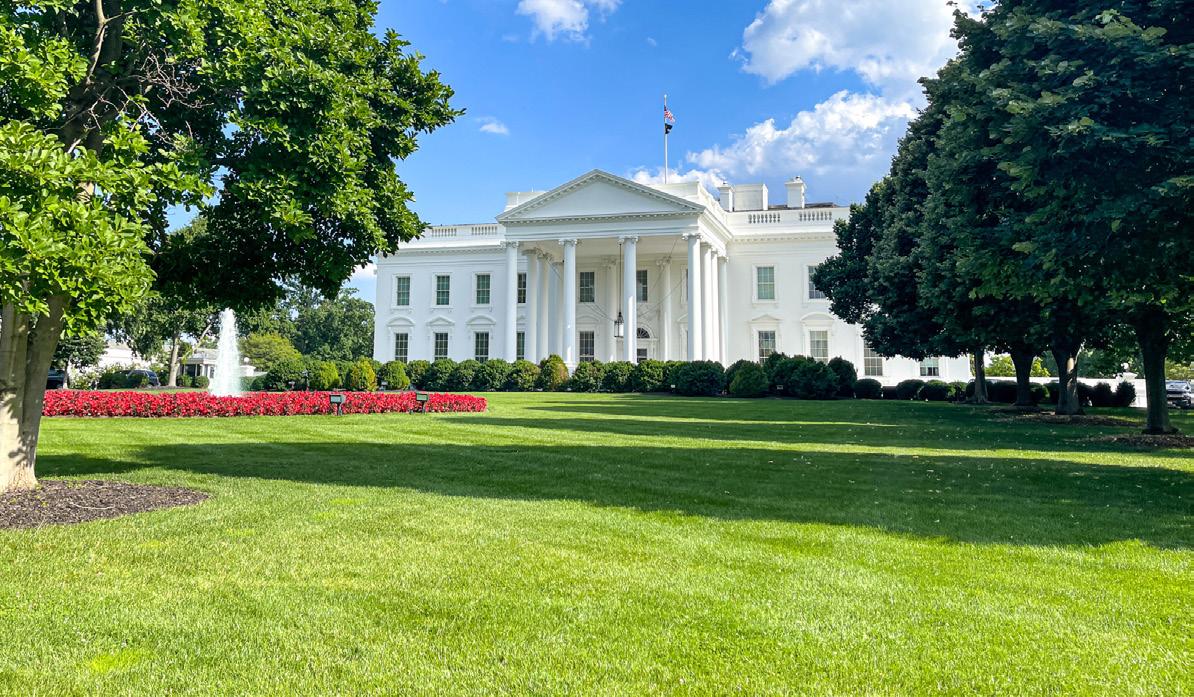
Despite pushback from within the MAGA movement, communicating a conspiracy through a White House press conference created headlines and a political spectacle out of unsupported facts. Framing their claim as truth through a highprofile event made it incredibly difficult for pregnant women and the general public to distinguish fear mongering from facts.
Trump’s press conference and the false claims peddled by him and RFK Jr. have struck unnecessary fear into pregnant women, who now risk losing one of the few painkillers deemed safe for them.
This press conference was yet another dangerous misuse of power on behalf of the president after many other oversteps of presidential power, such as sending the National Guard to major cities like Chicago and Washington D.C.
As this administration has shown repeatedly, when those in power are not held accountable, authority becomes a weapon that even overrides state power and scientific facts.
The administration’s Tylenol claim was yet another example of abusing power and spreading misinformation. By amplifying such a false claim, science has become a political tool used to garner fear. When politicians exploit their authority and manipulate the truth, public trust in our legislative leaders erodes, forcing people to question who truly has the public interest in mind and who wishes to serve themselves.