Acknowledgment without action falls flat. The university must turn words into change.
+ OPINION, PAGE 5
October 16,
The gothic church turned beer hall near the Capitol serves delicious pretzels, wursts and
+ LIFE & STYLE, PAGE 6
Bill package aims to boost UW System affordability
By Shane Colpoys & Michael Reilly SPORTS EDITOR EMERITUS & STAFF WRITER
Democratic lawmakers introduced a package of bills on Oct. 9 hoping to strengthen Wisconsin’s higher education system, by ensuring college in Wisconsin is both affordable and accessible for instate students.
The legislative package includes $40 million in new funding for advising and retention as well as a “tuition promise” scholarship program for low- and middle-income students attending other University of Wisconsin campuses aside from University of Wisconsin-Madison.
Student success, workforce gains bill
The proposal directs $40 million of funding — split evenly between the University of Wisconsin System and technical college system — focuses on helping students finish their degrees and avoid the burden of student loans.
“Where it’s truly devastating is when people put 2-3 years into school, have the loans and for whatever reason need to leave school without finishing that degree,” Rep. Jodi Emerson, D-Eau Claire,
told The Daily Cardinal. “We want students to finish their degrees and use it to get a better job, and then pay it forward to the next generation.”
Improving retention rates is key to strengthening Wisconsin’s workforce and keeping graduates in the state, Emerson said.
The bill allows each campus to determine how to use the funds in ways that best support its students. The funding, distributed through grants, could go towards academic advising, career counseling or new retention programs.
“A higher education degree whether its two years, four years or from a technical school is needed for our state to succeed,” Emerson said, adding supporting students with a wide range of skills — from engineers to medical technicians — is crucial to the bill’s sponsors.
Democratic legislators are seeking bipartisan support as the bill moves forward, but Republican lawmakers on the Committees for Universities and Technical Colleges declined to comment at this time.
“I hope that everybody can get
behind student success and retention,” Emerson said. “Wisconsin is better when everyone succeeds.”
Wisconsin tuition promise
The second proposed bill aims to expand the “tuition promise” program statewide by covering the costs of tuition for in-state students from households with an adjusted gross income of $71,000 or less.
If passed, the bill would work as a “last dollar” grant administered by the UW System Board of Regents, filling the costs of tuition after federal aid and scholarships.
Sen. Kelda Roys, D-Madison, a co-sponsor of the bill, said she hopes that extending the program to all UW System schools will benefit every single young person in Wisconsin who has the work ethic to go to college, but not the “deep pockets.”
UW-Madison administers “Bucky’s Tuition Promise,” which guarantees scholarships and grants to pay for tuition for incoming first year and transfer students
in Wisconsin whose household adjusted gross income is under $65,000.
Roys said Bucky’s tuition promise has given students the ability to change the trajectory of their lives and this bill will extend that opportunity to the rest of the state.
“Madison provides a wonderful education, but so do all of our campuses,” Roys said. “Ultimately, it benefits all of us and our economy if young people are able to pursue a career that will help them support their families and contribute to the state.”
In the past, the Republican-controlled legislature rejected a proposal to fund the Wisconsin Tuition Promise. The UW System funded the program themselves in 2023 and will reinstate it in 2025.
While the bill still faces policy discussion and debate in a Republican-led state legislature, Roys said she hopes to have a “pro-education” legislature next session.
“Every child in Wisconsin should have the full range of opportunity to pursue a career and further education, whether that’s in military, trade, learning, or going to one of our great technical colleges or one of our UW campuses,” Roys said.
Proposed city ordinance eliminates student seat on alcohol committee
By Haellie Opp SENIOR STAFF WRITER
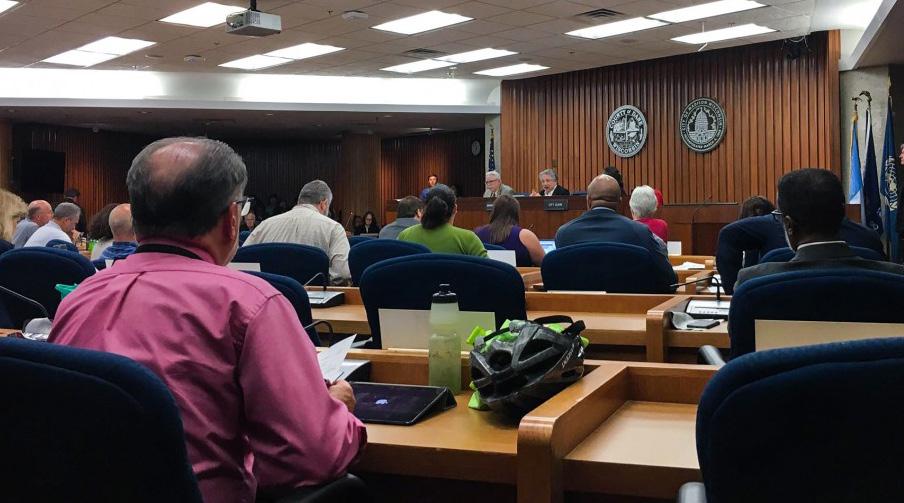
Madison’s Alcohol License Review Committee (ALRC) will consider a proposal that would eliminate the seat reserved for a University of Wisconsin-Madison student government representative at their meeting tonight.
The proposal would eliminate two appointed seats on the committee that oversees alcohol license review — one filled by the Associated Students of Madison and one by a representative from the Tavern League. The ALRC currently includes 14 members, nine of whom are appointed by the mayor.
Colin Barushok, Dane County Supervisor and chair of the committee, released a statement opposing the proposal, while Madison Mayor Satya Rhodes-Conway told The Daily Cardinal in an email statement the proposal would make the ALRC “more efficient” by aligning the membership with other committees.
“Students are an essential part of Madison’s downtown community, and they deserve a voice in local decision-making,” Barushok said. “It would be a big mistake to remove student input from decisions over alcohol policy and nightlife safety.”
After the ALRC votes on the proposal, it will go back to the Common Council on Oct. 28 for a final vote, regardless of whether
the ALRC votes in favor. The final decision will ultimately rest with the Common Council.
The proposal is sponsored by Mayor Satya Rhodes-Conway and district alders, Yannette Figueroa Cole and Carmella Glenn, who are both ALRC members.
“This proposal is designed to make ALRC more efficient by removing staff appointments and non-voting members so the membership is in line with the vast majority of other city committees,” Rhodes-Conway said. “I enthusiastically support more young people and UW-Madison students
holding meaningful roles in city government — including on the ALRC. I welcome those interested to apply for committee appointments on the city’s website.”
Barushok said the committee has not recommended a “substantive change” to ALRC ordinances in a while.
With this new proposal, the mayor could appoint an ASM representative to the committee, but she is not mandated to, and ASM will not have a dedicated seat.
Kayley Bell, a UW-Madison senior and ASM representative, is the only student on the committee.
JON
Bell told the Cardinal she believes the push for this ordinance came from a previous lack of engagement from ASM and the Tavern League. Bell currently has an operator’s license and is very familiar with the alcohol license process.
“I’ve had the best attendance so far of, from what I know, any ASM representative in the past,” she said. “I feel it’s just unfortunate that this proposed ordinance change would remove ASM’s seat when they finally have someone that’s really engaged.”
Barushok approved the agenda on Wednesday, meaning the com-
mittee will have to vote on whether to recommend the Common Council approve the ordinance change. The Common Council’s agenda will show the results of the ALRC vote.
“If the committee recommends approval, then the Common Council will likely take the committee’s recommendation, and they take our recommendations 99% of the time,” Barushok said. “I anticipate the committee will vote to not recommend passage of this, because I think the other members of the committee see it the way I do, including our student member, Kaylee Bell, that we shouldn’t remove the student voice.”
Both Barushok and Bell encourage students to make their voices heard to their alders, the city and the board.
“It’s not only about students being represented on the ALRC, it’s also about this broader concept of shared governance,” Bell said. “We’ve had a long history of very strong cooperation and partnership with the City of Madison, and this would be a back pedal of students losing their voice.”
All ALRC meetings are open to the public and consider public testimony, whether in person, over Zoom or letters written to alders who represent them.
Those who wish to testify in person can do so at the meeting on Oct. 15, 5:30 p.m. at the Madison Municipal Building.
“…the great state University of Wisconsin should ever encourage that continual and fearless sifting and winnowing by which alone the truth can be found.”
BROCKMAN/THE DAILY CARDINAL
Campus-area smoke shops up in smoke after nicotine vape ban
By Paige Armstrong STAFF WRITER
Smoke shops near campus are struggling after the state implemented a ban on several nicotine vape products at the beginning of September.
The ban limits what nicotine vape products can be sold, aiming to reduce youth vaping.
A soft ban first went into effect July 1 when customers saw products disappear from shelves.
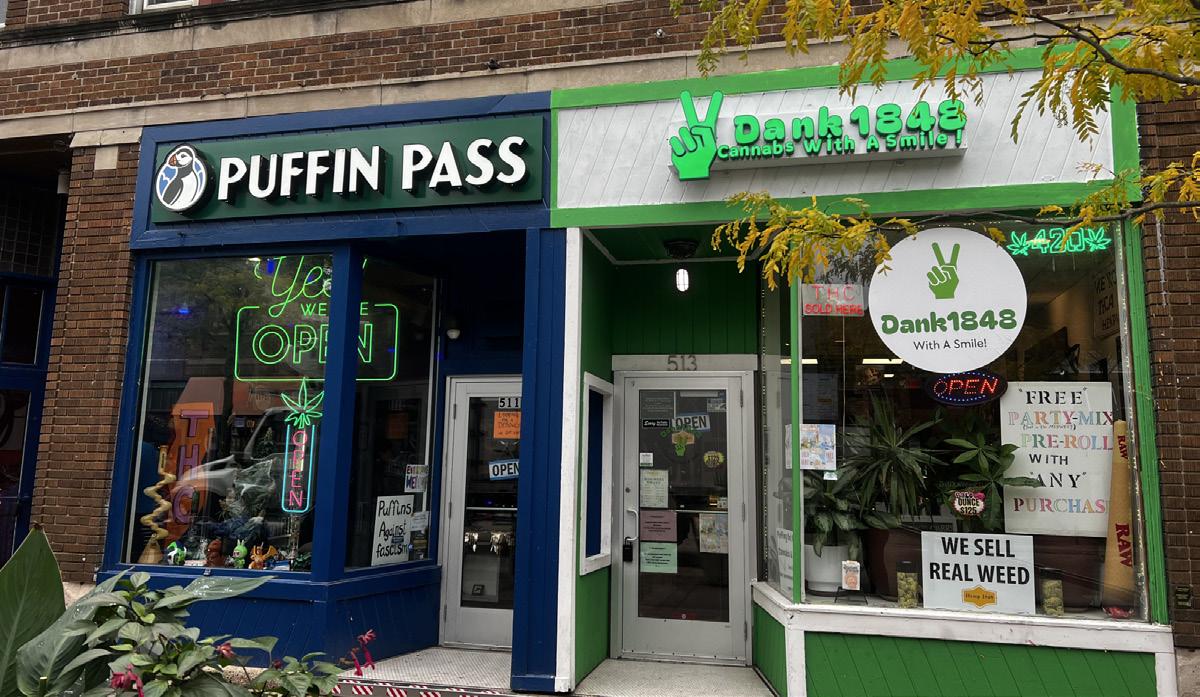
Seth Blackstone, the general manager of campus-area smoke shop Puffin Pass, told The Daily Cardinal businesses have been impacted across the state.
“We were lucky … I know plenty of businesses in Milwaukee and a couple around Madison who relied [on the vape market] pretty heavily and are not doing well or are probably going to go under because they don’t have a market,” he said.
Blackstone also said communication about enforcement of the bans left several unknowns.
“There was little guidance as to what the enforcement would be, what the fines would be … and [the ban] got pushed back and pushed back,” Blackstone said.
Then in September, the hard ban took effect.
Retailers are now limited to the 39 products currently approved by the FDA, according to Wisconsin Public Radio. Stores that sell banned items could face a fine of $1,000 per day per product.
Blackstone said multiple smoke shops in the Madison area have been raided by the Wisconsin Department of Revenue.
“They walk in, say, ‘Oh that’s not approved,’ snatch it, and then it’s on the business to either take them to court to try and prove that it is on the approved list or not,” he said. “It’s been pretty frustrating.”
Ali Shabav, general manager of one Stop N Shop chain location, said officers raided his State Street location with a list of banned products, but didn’t show them the list.
Lack of communication makes it harder for retailers to comply. Shabav noted that most of the notice comes from distributors and not the city.
“We got 15 days warning [from our distributor]. Before that, we didn’t know the vape ban was actually going to happen,” Shabav said. “We used to secure $30,000 to $40,000 worth of business with distributors. It all stopped at once as the ban [went] into effect.”
Some businesses removed nicotine vaping products from shelves altogether. Others have limited their supply, such as Puffin Pass.
“We had, I would say, 200 different devices, different flavors, different companies, different options,” Blackstone said. Since the ban, the store carries only five FDA-approved brands — Juul, Vuse, Blu, Njoy and Crossbar. Blackstone estimated between those brands, inventory reduced to 10 different devices.
Even then, there are limitations. Most devices are only offered in menthol or tobacco — except for the Crossbar, which is popular for the fruit flavors it offers.
Reduced product variety pushes customers to online alternatives or to states without bans, such as Illinois. Some customers switch to Zyn or other approved non-vape nicotine products. As customers find other retailers, sales decrease. Shabav said Two Stop N Shop locations in Verona and Stoughton had to shut down due to lack of revenue Four employees were laid off in the process.
Prior to the ban, the Stop N Shop located on State Street earned $80,000 to $90,000 every month. Now, the store brings in half that amount.
Shabav attributes this plummet to the new regulations.
“We are going to shut [the State
Street location] down because of the vape ban,” he added.
The East Mifflin location where Shabav works hasn’t closed, but it’s lost $20,000 in revenue. The store is bringing in $60,000 in sales, compared to the $80,000 per month it made before the ban. As Stop N Shop waits for the market to restabilize, the company resorts to utilizing reserves saved before the ban went into effect. If the reserves run out, the store might face closure. “Once the savings go zero, we don’t know when we are going to get fired,” Shabav continued. Employees and employers alike face ongoing uncertainty. Businesses rely on university students purchasing their products, just as the students rely on the businesses’ proximity and convenience.
“Definitely it’s scaring me,” he said. “I’m looking [at] jobs too. Just to secure myself.”
UW-Madison students ‘pump up’ to support domestic violence survivors
By Aanya Agrawal STAFF WRITER
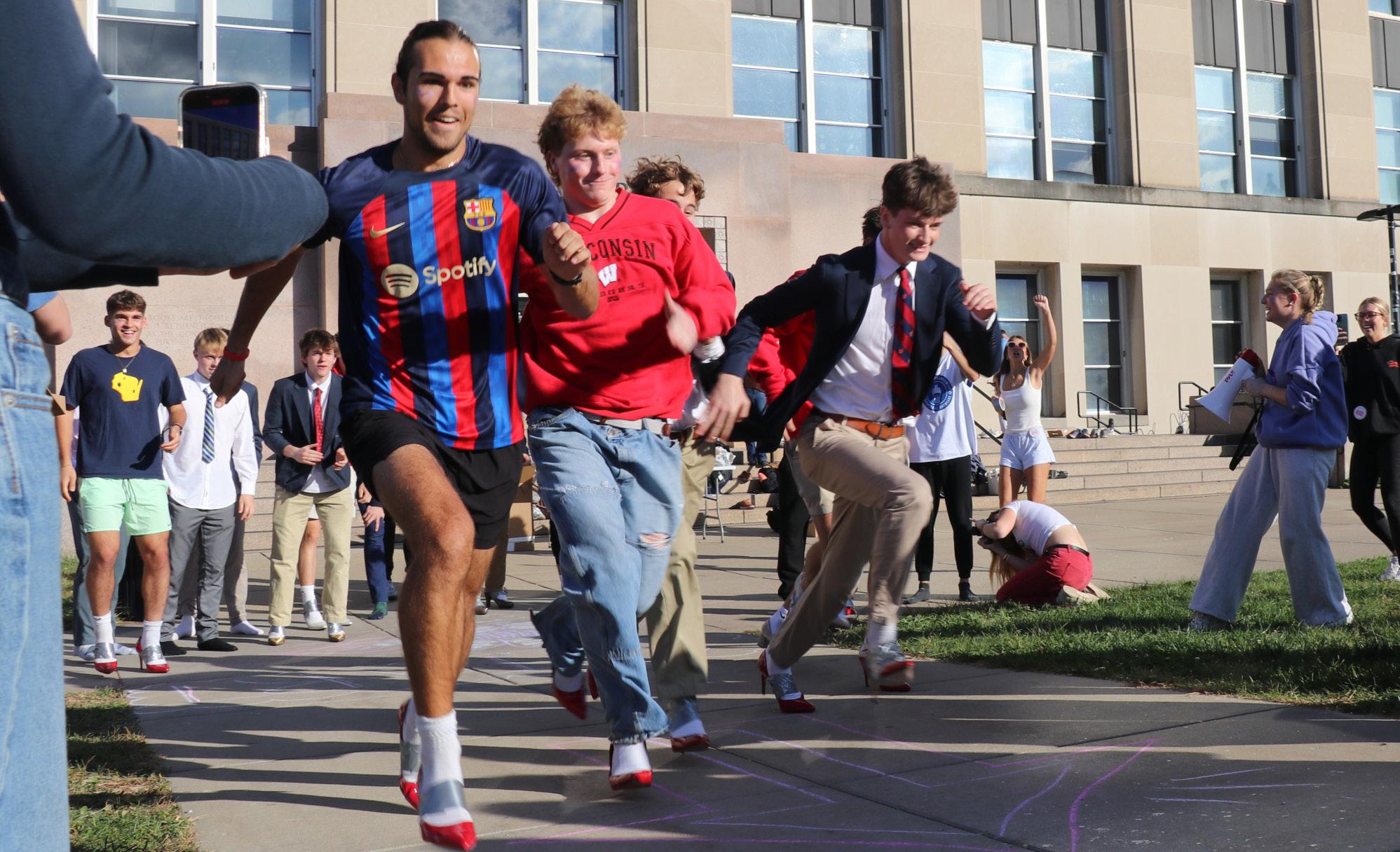
Alpha Chi Omega sorority (AXO) hosted a “Walk a Mile in Her Shoes” event Friday on Library Mall where the University of WisconsinMadison students walked in high heels to spread awareness about domestic violence and support survivors through the Domestic Abuse Intervention Services (DAIS). The event aimed to help raise awareness and funds for domestic violence survivors through Domestic Abuse Intervention Services (DAIS), Dane County’s
local domestic abuse shelter.
Participants who had signed up and donated for the event literally “Walked a Mile in Her Shoes” as part of a relay race competition.
“Even if I am just running in high heels, I am happy to be supporting a cause like this in any way I can,” sophomore Petar Minic said. “I have two sisters, and they would have loved to see this.”
DAIS strives to empower and support those affected by domestic violence, according to their website. They have preventative and support groups and a crisis helpline for those who
need it. They rely heavily on donations and grants.
“It’s a pretty funny concept,” AXO Vice President of Philanthropy Riley Sarsany said. “Literally being put in [a woman’s] shoes, because a majority of victims of domestic violence are women.”
Sarsany added that they wanted to spread awareness and help fundraise for DAIS in a fun and lighthearted way that also engaged members of the community.
Assistant Vice President of Philanthropy at AXO Charlotte Brager, who helped plan and run the
event said she first came across the idea on TikTok and knew that the sorority had to bring it to campus.
“I probably went to like eight different thrift stores to try to find enough heels that are big enough to fit on a guy’s foot,” Brager said.
As the event began, those who wanted to participate filled out waiver forms and then had heels duct-taped to their feet. Seven teams of four lined up at the start. When the race started, a large crowd cheered participants on as they ran their laps. Heels went flying on the track and chaos ensued at the starting line as many of the runners scrambled to pass their pair of heels to the next member of their team.
An audience gradually filled Library Mall as the event progressed — some to participate, others just to observe. “No matter if we had two teams or twenty, I am just happy that people showed up and they had a good time,” Sarsany said.
When asked about events that they plan on doing in the future, both Brager and Sarsany said they were excited for the annual “Mr. AXO” event to be held at the end of the month, also in support of victims of domestic abuse and DAIS.
“DAIS is local. That is really important to Alpha Chi Omega. The goal at the end of the day is to keep DAIS open,” crisis line advocate for DAIS and member of AXO Mackie Boone said. “They have had a federal funding cut over the last six months or so, so we are looking to keep them open and serving the community.”
MAGGIE SPINNEY/THE DAILY CARDINAL
BRAD WENSEL/THE DAILY CARDINAL
Meet the robot dog constructing UW-Madison’s newest building project
By Zoey Jiang STAFF WRITER
The University of WisconsinMadison is employing the work of a unique robot dog at the Kellner Family Athletic Center’s construction site near Camp Randall.
The robot is a part of a study led by Zhenhua Zhu, an assistant professor in the Engineering school and director of UW-Madison’s Digital and Robotic Construction team, to see how robots could support construction workers by performing repetitive, time-consuming or hazardous tasks, such as site scanning and progress monitoring.
Zhu’s research initiative works to increase jobsite safety and avoid human casualties. In 2023, the U.S. Bureau of Labor Statistics reported the construction industry was responsible for roughly one in five workplace deaths.
The Kellner Center, set to open in 2027, will be an indoor practice facility for all 23 UW-Madison varsity sports. The
robot dog, developed by Unitree Robotics, is working with construction firm JP Cullen.
Unitree Robotics focuses on the development and production of high-performance quadruped robots, giving their B2 models the nickname of “robot dog.” UW-Madison became affiliated with the B2 through a grant from the Wisconsin Alumni Research Foundation.
“It requires human oversight, but our study’s purpose is precisely to identify and reduce potential risks so future robots can operate more safely and independently,” Liqun Xu, a graduate student who works closely with the robot, said.
The project captures ‘construction workers’ physical stress exposures in the field over extended periods,” Xu said.
“The primary goal is to understand the real-world navigation challenges that quadruped robots face on active construction sites,” Xu said.
Xu said the project focuses on building better
human-robot relationships in real-world environments. “Eventually, this work can support safer human-robot collaboration in high-risk sectors like construction and infrastructure inspection.”
The Engineering school research team has already noticed improvements while working with Unitree B2.
“The robot’s mobility is excellent. It can handle stairs, uneven ground and tight indoor spaces, making it well-suited for real construction sites,” Xu said. Working with the robot allowed them to reveal navigation hazards that cannot be determined in simulation or lab settings.
But the B2 isn’t without its setbacks. “The robot’s navigation system relies on a geometry-based autonomy stack,” Xu said, “which often struggles with interpreting context, such as fragile objects, symbolic markers like red tape or human work zones.”
Other challenges include insufficient processing power that led
UW’s ‘Fill the Hill’ flamingo fundraiser breaks record
By Zoey Jiang STAFF WRITER
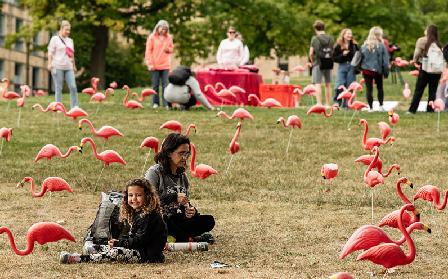
The University of Wisconsin Foundation and Wisconsin Alumni Association (WFAA) broke a fundraising record during the 13th annual Fill the Hill, raising $737,849 in just 24 hours.
Each pink plastic flamingo placed on Bascom Hill represents a gift from a donor. This year, over 4,000 gifts were contributed to a variety of student causes, from funding honors and research programs to providing for the schools and colleges at the University of Wisconsin-Madison.
Comparatively, Fill the Hill raised $511,877 in 2024. In 2013, the first year of the fundraiser, the fundraiser received 640 pledges and donations. That number has now grown to over 25,000 donors throughout the years, raising roughly $4.5 million in total.
Fill the Hill started as a prank performed by Leon Varjian, a member of the Pail and Shovel student government dedicated to absurdity. In September 1979, Varjian purchased 1,008 flamingos and placed them on Bascom Hill in the early morning. By the afternoon, the flock of pink birds were picked off Bascom by students and could be seen around the city.
In 2013, the WFAA revived the flock on Bascom to inspire giving. It melds goodwill with the nonsensical influence of Varjian. Fill the Hill has grown into a way to honor the pranksterturned-philanthropist’s legacy.
Donors receive their own flamingo based on the amount they contribute: $100 for a mini flamingo; $350 for both a mini and full-sized flamingo. To place a flamingo on Bascom Hill requires a minimum donation of $5.
All donations go to different organizations at UW-Madison which get to decide what to do with the funds gifted to them.
“Contributions from Fill the Hill directly affect academic initiatives, scholarships, research and even student organizations,” The WFAA says, explaining that proceeds go to the university’s greatest financial needs in the face of budgeting obstacles.
“[Fill the Hill] is a wonderful way to celebrate some of what we’re doing here,” said UW-Madison Chancellor Jennifer Mnookin in an interview with WMTV15 News. “It’s kind of goofy, but fun. Just like we like to be here at Madison: excellent and a little bit goofy at the same time.”
to failures in mapping surroundings and required human intervention when the robot became stuck in difficult positions.
The primary objective of the research is to bridge robot collaboration with humans.
Unless robots are made context-aware and socially adaptive, they risk becoming ineffective or even dangerous, Xu said.
“Our research helps…
ensure robotic systems are not just functional but trustworthy and safe,” Xu said. “By identifying specific hazards like terrain instability, material contact risks and boundary violations, we aim to inform the design of more adaptive and context-aware robot autonomy systems that can safely coexist with human workers in complex environments.”
Two UW-Madison professors awarded ‘genius grants’
By Lauren Eno STAFF WRITER
Ángel F. Adames Corraliza and Sébastien Philippe joined seven University of Wisconsin-Madison professors since 1981 to receive an $800,000 “no-strings-attached” genius award from the philanthropic MacArthur Foundation.
Twenty-two fellows nationwide received the 2025 “genius grant” in areas such as climate change, global security, social justice and community development.
Recipients are selected based on exceptional creativity, promise for future advances and potential to facilitate creative work through the fellowship. The foundation said the awards are designed to support people, not projects.
Corraliza chairs the Atmospheric and Oceanic Sciences Department’s Climatology division. He studies tropical weather patterns and phenomena using the physics of atmospheric waves with analysis of observational data and climate model simulations, saying the ability to predict and understand these patterns can ultimately save lives.
Corraliza told The Daily Cardinal he is considering supporting projects without funding, such as studying tropical cyclone formation and rainbands and how clouds interact with the tropical environment. He’s also thinking of writing a textbook with Larissa Beck or creating a popular science book on the history and modern science of tropical climate.
Corraliza said the recognition “means everything,” especially as a Latino scientist who wants to “educate the public and improve their wellbeing.” He said that despite living in a time where performing climate research is challenging, “The MacArthur Foundation sees me, sees my work and my people, and what they
see is work worth celebrating.”
Phillipe is an assistant professor in the Department of Nuclear Engineering and Engineering Physics and is a former French Ministry of Defense nuclear security expert. His work combines technical and policy analysis to inform understanding of nuclear risks and support evidence-based solutions. He was appointed to the newly-established United Nations scientific panel on the Effects of Nuclear War in July 2025.
Phillipe told the Cardinal it is an “incredible honor” to be named a MacArthur Fellow, saying the fellowship is a “remarkable gift” supporting creativity and providing research freedom. He added it’s exciting to follow in the footsteps of scientists working on nuclear arms control who have received the award.
UW-Madison Chancellor Jennifer L. Mnookin said Corraliza and Phillipe are “powerful examples of the kind of creative thinkers that make UW-Madison such a rich and creative research environment and wonderful additions to our university’s proud tradition of winners of this prestigious fellowship.”
Minocqua Brewing Company launches hard cider for public education
By Madison Moris LIFE & STYLE EDITOR
Minocqua Brewing Company
released its new Department of Public Education Cider to protest efforts to defund the federal Department of Education — the latest in its series of politicallythemed beverages to support public education in Wisconsin.
“Funding [for] the Department of Public Education has basically been canceled at the federal level,” the brewery’s owner Kirk Bangstand told The Daily Cardinal.
Bangstad said the cider’s
apple theme is symbolic to the teaching profession. “That was our little way of fighting back was to create a cider, because apples and cider …go along with teaching and public schools,” he said.
The cider is the latest effort to support public education since launching political beverages five years ago. A portion of the cider’s sale will go toward the Minocqua Brewing Company Super PAC to advance public education causes in Wisconsin.
Bangstad said the COVID-
19 pandemic sparked him to mix politics with business. “I started becoming very much more political when I thought that his policies were going to bankrupt me,” he said.
He said Trump downplayed the dangers of the virus and failed to support restaurant owners. “We shouldn’t have been open … because that’s where people spread COVID the most,” Bangstead said.
The brewery’s Super PAC financed a lawsuit in 2023 challenging private school charters that were paid for
Raging Granny’s teaching career inspires activism
By Grace Carlson STAFF WRITER
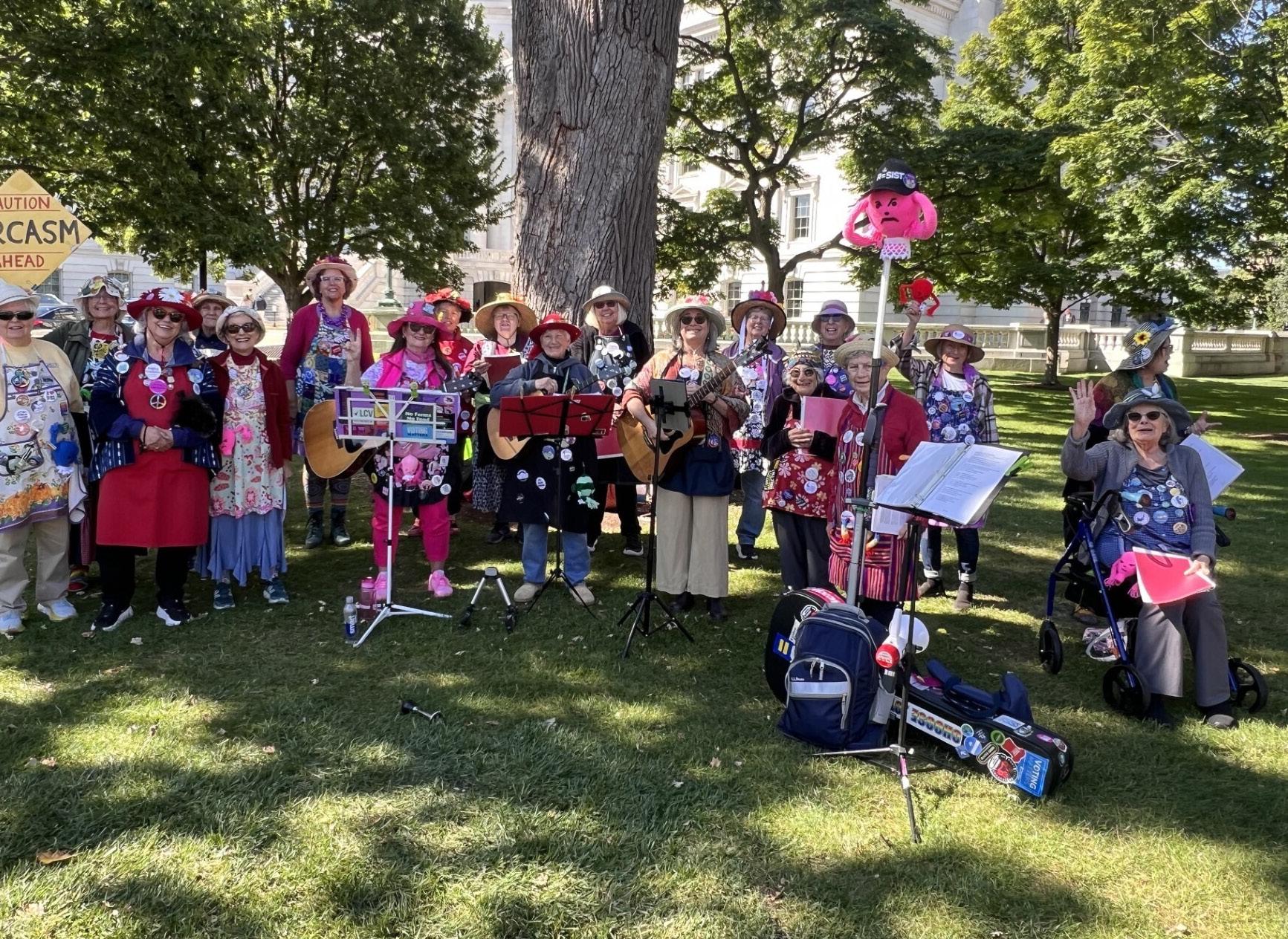
There’s no mistaking Jeanne Nye for a Raging Granny. Her rubber ducky earrings bounce as she laughs, her wide grin is contagious and she energetically waves her hands as she speaks. But before Nye ever picked up a protest sign, she spent 44 years in the classroom, teaching children in Michigan, Texas and Wisconsin.
During her career, Nye dealt with her share of challenges, from navigating strict school rules in a one-room school on the border of Mexico to getting creative, making Halloween costumes for less fortunate children.
“The school I taught at [in Texas] had these terrible strict rules. No boys’ hair could touch their collar, so they would get kicked out. And somehow this bunch of boys knew to sneak over to my room and I would cut their hair,” Nye said.
Nye told The Daily Cardinal her experiences teaching inspired her to join The Raging Grannies of Madison, an informal group of older women advocating for peace and justice, after her career in the formal classroom ended.
The Raging Grannies of Madison, who first performed in Wisconsin’s capital in 2003, are one of more than 50 groups or ‘gaggles’ across Canada and the U.S. The Madison gaggle is a fixture at the Dane County Farmers Market, as well as the recent No Kings protests and Wisconsin Climate March. The Raging Grannies are recognized by their unique style, which consists of aprons, hats, buttons, sashes and bonnets, or ‘granny-wear.’
Through her activism with the other Grannies and drawing from her career, she maintained education and healthcare are the
issues she holds closest to her heart.
“Having worked in the school system with children who didn’t have shoes when they came to school in the wintertime or they come in at 10:30 to school because mom didn’t get up,” Nye said. Her experiences have directed her political activism. “If they take away Medicaid, all the funding for school banks… it just breaks my heart,” she said.
Nye said the Grannies’ distinctive appearance helps protect them from police at protests. “I think that it catches people off guard, and we have a reputation for not being aggressive. You gotta look granny, and harmless, and then zing them with the song,” she said. “[The police] just seem like they pretend we’re not there, like they’re not seeing it so they don’t have to address it.”
Nye also said the Raging Grannies have helped her find her purpose as she grows older and isn’t “needed” as much anymore by her kids.
“We’re all trying, and we’re pushing ourselves to be an involved, better person,” Nye said. She also stressed the importance for elderly people to get involved with activities as they get older, as it builds a sense of community important for mental health.
Nye also had one last piece of advice for the college students of Madison: vote.
“Vote, and you can make big changes. Vote in the little ways. Don’t just go thinking the president’s the one. I mean, go all the way down, vote for your Alderman,” she said.
The Raging Grannies will be at the No Kings’ Protest on Saturday. They also attend the Farmer’s Markets on Saturday mornings, as well as Open Mic Nights at Memorial Union on Wednesdays.
with taxpayer dollars. “We thought private school vouchers were bad for public schools in Wisconsin,” he said.
Bangstad also criticized the Trump administration for removing books from the Smithsonian Institute related to race, the LBGTQ+ community, feminism and the Holocaust. “We need to actually read more so that we can be media literate enough to know when fascism is knocking on America’s door,” he said.
Minocqua Brewing Company will also release a
holiday beer called Snowflake IPA, which Bangstad said is inspired by the outrage people faced for criticizing Charlie Kirk after he was killed. “Why are we celebrating a guy who said the most horrible and bigoted things?” he said.
Bangstad said this beer is about free speech, even if it does not “match the right’s mentality.”
“You only live once and [with] my time on this earth, I want to try to do what I can to make sure America doesn’t fall into fascism and authoritarianism,” Bangstad said.
Student organizations celebrate
Homecoming at annual yard show
By Yareli Gutierrez STAFF WRITER
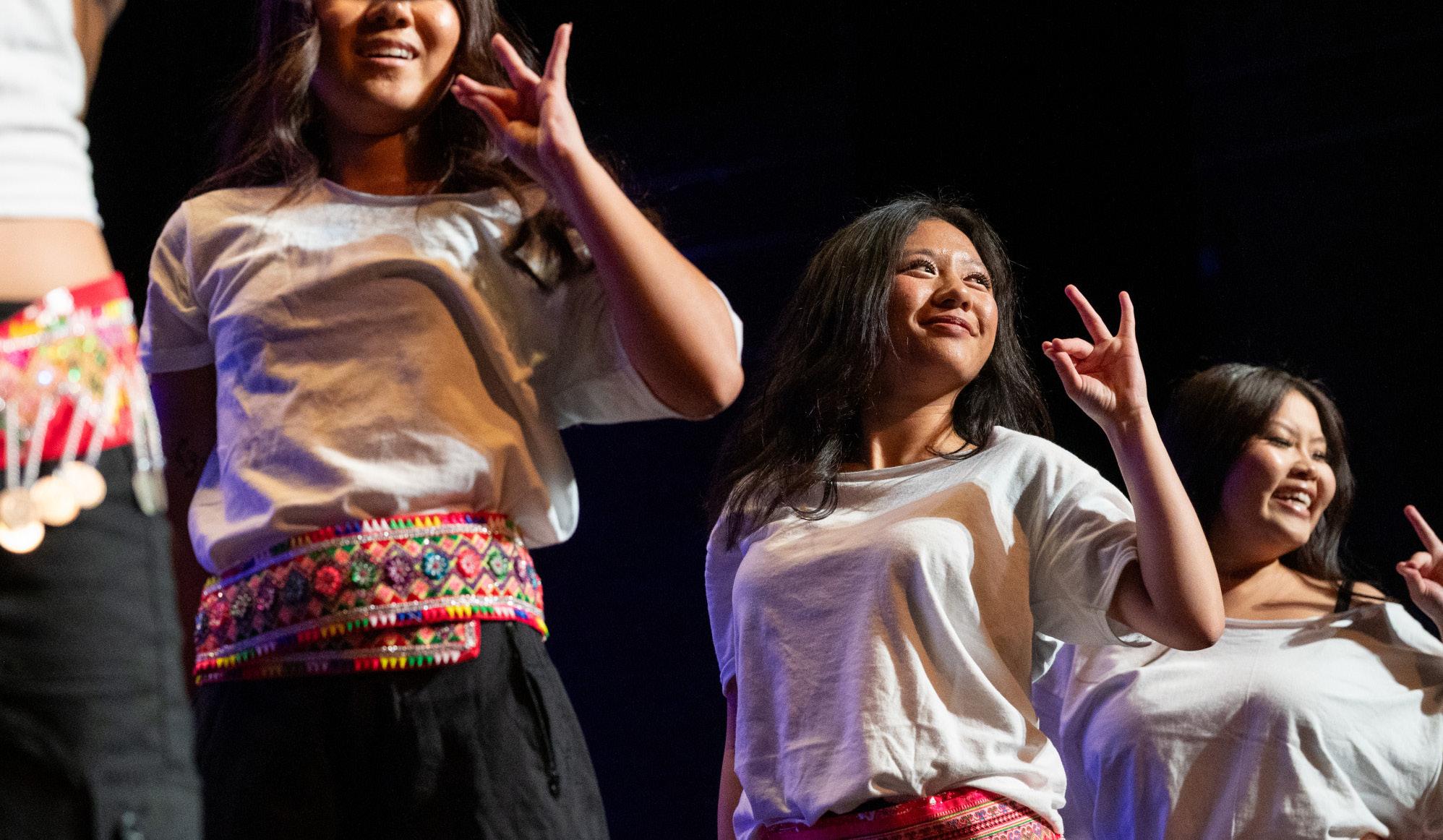
The Multicultural Greek Council (MGC) and the National Pan-Hellenic Council (NPHC) held their Homecoming Yard Show at Shannon Hall on Friday, showcasing their cultures and unity through ‘strolling, stepping and saluting.’ — forms of performance that are prevalent in Greek organizations.
Adhering to the theme of ‘wearing your hearts on your sleeve,’ the MGC and the NPHC gathered to compete in a friendly competition. The Multicultural Homecoming Yard Show, in partnership with the Wisconsin Alumni Association, brought together students, alumni and community members alike for what the Alumni Association called “a celebration of culture, unity and tradition.”
MGC President Solana Quezada, a member of Sigma Lambda Gamma, was one of the emcees of the event and addressed the importance of creativity.
“It brings together people from different backgrounds,” she said. “It highlights and showcases that we [MGC and NPHC fraternities and sororities] are here.”
Quezada, alongside members of NPHC leadership emceed the event, beginning the night by briefly highlighting the significance of stepping, strolling and saluting in Greek culture. Stepping, they said, is a blend of African folk and pop culture that traces its roots to a historical form of storytelling. Strolling is a performance of pride in one’s organization that emphasizes the roots of unity, culture and love. Saluting, a tradition that is most commonly used by Latino-Greek organizations, is described as a “form of poetry in motion” performed in a militaristic, synchronized way that allows mem-
bers to pay respect to previous achievements, siblings and accomplishments.
The event had a panel of judges who were alumni of Greek organizations. In addition, there were also crowd-voted awards, including “best dressed,” won by Omega Psi Phi, who delivered a performance that filled the room with cheering and excitement. With a mix of stepping and strolling, they used a ‘70s-style wardrobe and music, leaving the crowd giggling and amused.
Another crowd favorite was the Alpha Phi Alpha Fraternity, who were voted this year’s best NPHC performance, winning back-to-back years. The fraternity also incorporated a signature whistle, as well as both stepping and strolling in their performance in perfect coordination. Catchy rhymes, full suits and hats were their wardrobe, with their routine leaving the crowd singing “Ice Ice Baby.’’
Another two-time winner, the Sigma Lambda Gammas came away with this year’s best MGC performance. Their performance was both impressive and impactful, incorporating members’ different cultural outfits, matching their countries’ flags, also shown on stage, while wearing their sorority’s signature colors of shocking pink and majestic purple.
One moment that garnered many cheers from the audience was when Sigma Lambda Gamma’s flight-attendant-themed showcase announced, “Now arriving in Palestine,’’ accompanied by a coordinated dabke — a traditional folk dance which celebrates community — from the group. Other parts of their performance also incorporated dances from the member’s cultures, sending the crowd cheering and filling the room with clapping and pride.
JAKE PIPER/THE DAILY CARDINAL
COURTESY OF JEANNE NYER
On Ho-Chunk land, UW-Madison still chooses silence over support opinion
By Safa Razvi OPINION EDITOR
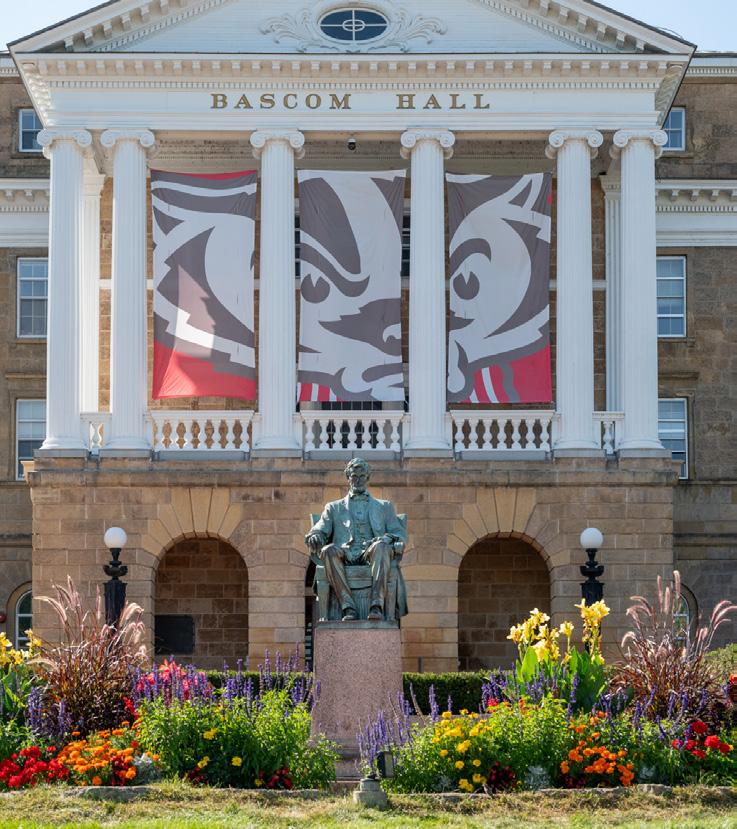
Each year, tens of thousands of prospective students explore campus, weighing the pros and cons of a future education at the University of Wisconsin-Madison. I still remember my own experience visiting campus for the first time. After the customary stops at Library Mall and Memorial Union, we arrived at the bottom of Bascom Hill, where the tour guides delivered a land acknowledgement speech recognizing the Ho-Chunk Nation as the ancestral land the university was built on.
Shortly afterward, we moved on. The words felt meaningful, but also glossed over. I always wondered how the Ho-Chunk people felt about these statements and the administration’s lack of action. That moment made me question how deeply UW-Madison supported the ancestral land the university was built upon.
It is true the university has made symbolic gestures to commemorate the identity of the Ho-Chunk people, such as naming one of its lakeshore residencies Dejope Hall. The name is derived from the word “teejop,” which means “four lakes” in the Ho-Chunk
language. However, the name alone doesn’t erase the history of the land being ancestral.
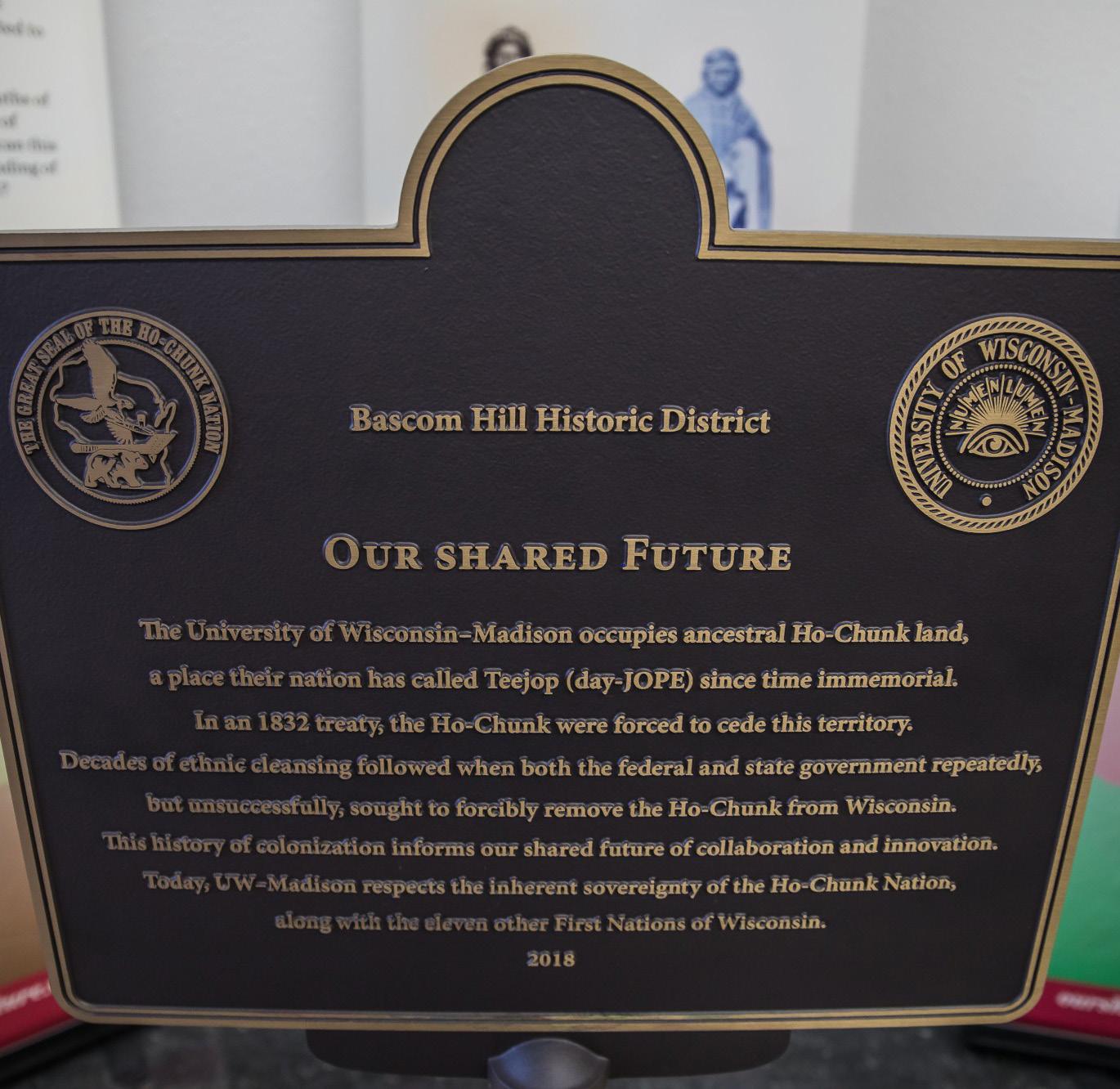
In 2019, UW-Madison created a heritage marker on the bottom of Bascom Hill titled “Our Shared Future,” highlighting the fact the university sits on Ho-Chunk land. However, it begs the question of how these communities are still being recognized in this “future.” More recently, in 2023, the Ho-Chunk Clan Circle sculpture, designed by artists from their community, was added to campus as a reminder of Native American’s presence. These initiatives are meaningful, but they are simply a starting point in the long journey towards genuine inclusion.
On their own, these gestures feel performative. While important, they are simply a beginning. Until Indigenous communities are fully represented and seen on campus, these initiatives will fail in their goals.
Despite UW-Madison’s visible endorsements, which include plaques and flags, there is a notable pause when it comes to advocating for them politically. The university has rarely, if ever, explicitly called out violence against Indigenous people,
or taken a stand on institutional or political issues that affect the Ho-Chunk people. While initiatives like the Wisconsin Tuition Promise help cover tuition for Native Students from federally recognized tribes, it does not offer any systemic change. UW-Madison still chooses not to recognize Indigenous Peoples’ Day as an official university holiday, despite being built on ancestral land, revealing how limited their commitment is. This year, the day largely passed unnoticed and unacknowledged by the administration, showing how recognition stops at the surface. UW administrators have been silent on the enforcement of treaty obligations, land rights or even legal sovereignty, which have all been under threat by the Trump administration.
With 137 Native American students, it is more necessary than ever to support their identity and history as it pertains to the university. Making up less than 1% of the student population, it wouldn’t even require extensive resources to commemorate them and to center their voices. UW-Madison could create partnerships with local Ho-Chunk communities
to preserve language, culture and history. Small but intentional investments would show that acknowledgement is more than words — it’s the university valuing the people whose land it occupies and the history that shaped it.
Acknowledgment without any sort of follow through is hollow. The university has an opportunity and obligation to move past empty gestures
and truly show that Native American people, their complex history and ongoing struggles are genuinely valued. There’s a unique opportunity to demonstrate the school as a powerful force for justice and ally for Indigenous people, honoring the land it inhabits and the people who have called it home for generations by combining recognition with action.
Reading as resistance: Open your mind to banned books
By Siena Ferraro STAFF WRITER
The current version of America is supposedly of the highest technological, intellectual prowess. In theory, this rendering of the country entails a highly intellectualized, seamlesslyfunctioning society which uplifts the access to knowledge and artistic enrichment of all its citizens. In reality, it denotes the rampant self-censorship of educators, vilification of children’s novels and erasure of marginalized groups. This isn’t some behemoth of dystopian fiction, nor is it a hyperbolized depiction.
This is real life. This is America.
The fact is, literature has become a weaponized commodity in our country, a concept brought about by increasingly detrimental Republican legislation nationwide. According to data collected by the American Library Association, in 2024 alone, over 2,400 titles were challenged or banned entirely — no amount of fame nor reputation could salvage these works from subduing such demoralization. Works from prominent authors like Toni Morrison and John Greene have been deemed unfit and dangerous for the American reader.
Yet, such a preposterous assertion could not stray further from actuality. As independent American citizens, it is not only our fundamental right but our moral and scholarly duty to engage with the written word and grapple with topics which may feel unfamiliar
or convoluted to us; in doing so, we commit the grandest act of self-service there is: learning.
Conversely, the Republican party reckons otherwise. In 2023, Texas judges passed Senate Bill 13, which mandates revised policies regarding approved library materials in public
schools. Moreover, the bill, which went into effect in September of this year, gives authority to school boards — not librarians — to determine which titles are prohibited from being accessed by student readers.
This Texas bill is one of many demonstrations of the vehement,
unchecked rampage upon so-called controversial works of literature and the very concept of broadening one’s intellect and worldview. By subverting librarians’ jurisdiction over the works which they dedicate their lives to, as well as by blocking students’ access to said titles, Republican legislators and sympathizers have subsequently declared a war on knowledge.
The responsibility to retaliate lies in the hands of readers nationwide.
Admittedly, quarreling in a knowledge war seems a tall order — how can the average American realistically be expected to brawl with the very governmental systems which exist solely for the purpose of stifling their artistic and intellectual curiosity? Yet, the answer to this question is simple: read.
Read every form of challenged literature you can. Engage with difficult, nuanced texts. Embrace the confusion, curiosity and occasional discomfort that is present in many challenged titles. Through becoming engrossed with banned and threatened literature, we simply become smarter, not just independently, but as a collective societal psyche.
Our reality need not remain Orwellian. So pick up that copy of “The Bluest Eye,”wield your library card and resist the notion that knowledge should be weaponized. The current government administration may be penning the pages of the present — but we, the people, write the story of our future.
TAYLOR WOLFRAM/THE DAILY CARDINAL
TESS VOIGT/THE DAILY CARDINAL
life & style
How to make the best of fall in Madison
By Gabi Marmet STAFF WRITER
While the weather shifts toward slightly cooler temperatures, Madison offers countless opportunities to explore the gorgeous fall outdoors. From exploring the lakeshore path with vibrant, crisp leaves, visiting the Dane County Farmers Market to buy a pumpkin flavored pastry or decorating for Halloween, there is plenty to do around campus.
On campus, there are plenty of chances to put on a warm sweater and enjoy the outdoor weather. The Dane County Farmers Market surrounding the Capitol remains open through Nov. 8, providing a perfect spot to buy produce, taste fall-related foods and enjoy the city.
Additionally, nothing is better than walking down the lakeshore path surrounded by red and yellow leaves — an aesthetic array of fall colors. It’s also essential to enjoy the calming lake Mendota from Memorial Union. It is the perfect study spot to soak up the final weeks of sun while looking out at the lake.
There are countless orchards and gardens off-campus to enjoy fall activities. Enchanted
Valley Acres, located in Cross Plains, Wisconsin, has a pumpkin patch, corn maze, giant slides and wagon rides.
Schuster’s Farm and the Eplegaarden both provide apple cider, caramel apples, pumpkin patches and live entertainment. The orchards are a great opportunity to get away from campus and spend a day or afternoon taking in the fall aesthetic.
Nothing beats a University of Wisconsin-Madison football, volleyball, soccer or hockey game during the fall. The experience of a gameday does not only include attending the game, but also grabbing food, going to a tailgate and celebrating the sport.
One great volleyball tradition involves kids in the stands entering the court to give high fives to the starting lineup. It’s a heartwarming sight that showcases the inclusiveness and culture of UW-Madison’s teams.
Another way to enjoy the fall spirit is to taste some fallrelated flavors — pumpkin, apple, cinnamon and more.
Trader Joe’s fall foods selections are notoriously delicious and definitely worth trying. Their most popular foods
Prost! beer hall captures the spirit of Germany beer
By Jackson Baker STAFF WRITER
There’s nothing like the smell of hops and schnitzel on a chilly fall afternoon. Prost! — an authentic German beer hall east of the Capitol — is the perfect spot to sip a stein with friends.
I remember falling in love with the concept of German beer halls back in fall of 2022. I was visiting a friend in Düsseldorf, and it was game day in the capital city. I watched the waiters in awe as they weaved across the rowdy floor, performing a balancing act of five pitchers with ease. The hall was crowded and Fortuna Düsseldorf fans were tangled in red scarves, hollering their team chants with pride. The experience was hectic, homely and beautiful.
After trying multiple German style restaurants in the area, Prost! is about as close as it gets to an authentic German beer hall in Madison.
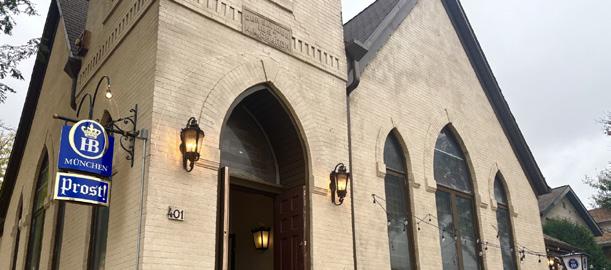
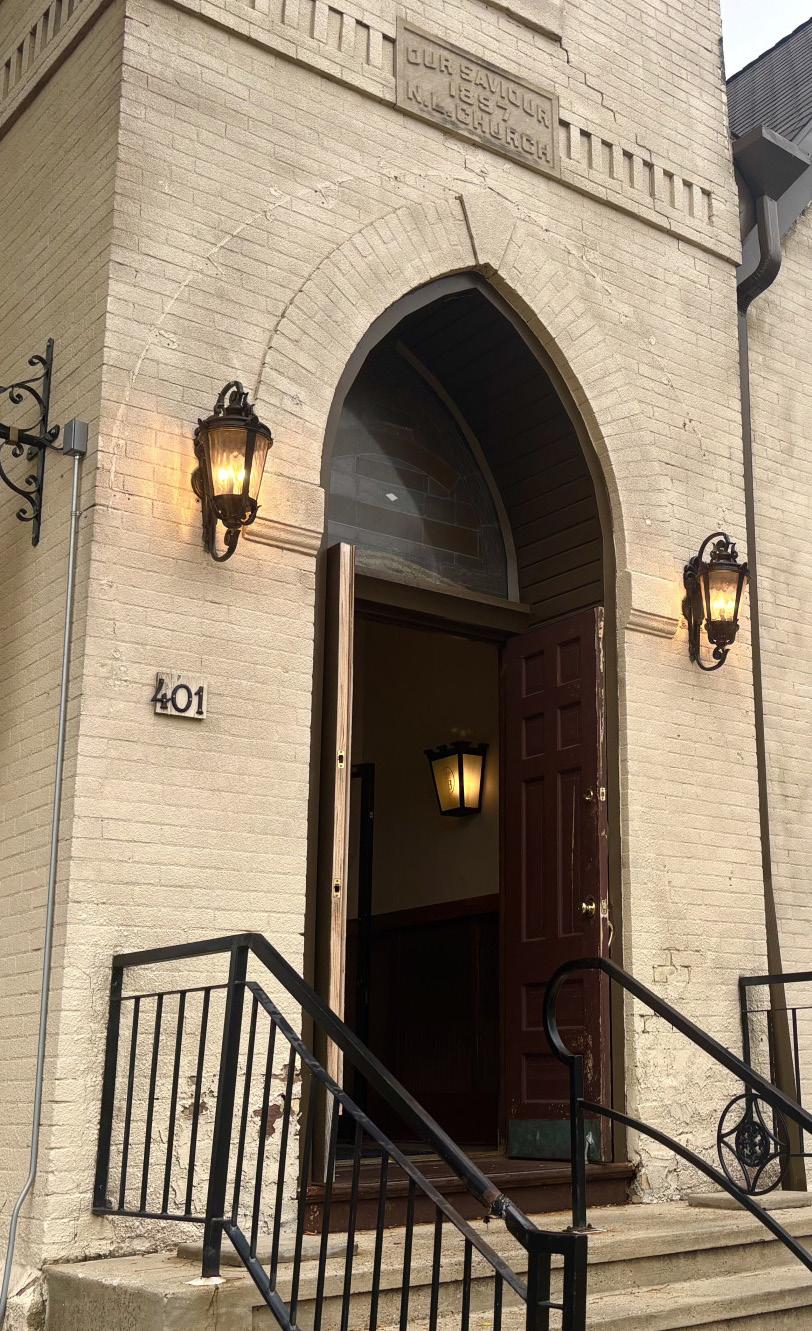
Entering the grand doorway was like stepping into a time machine. The beer hall opened its doors in 2022, but is located in a historic 19th century church with a stunning interior. On the ceiling is a bright fresco that surrounds a central chandelier, and lining the walls are intricate gothic style lanterns that help build a warm and inviting ambience. Colorful stained glass windows also set the mood for an afternoon of gulping down a few godlike beers.
Some of their best drinks are listed under their Oktoberfest specials. The Weihenstephaner
Festbier is a banger to drink and a mouthful to order — golden and full-bodied. If you’re lucky, it might be served in a glass mug the shape of liederhosened buns. The “Spaten Oktoberfest” is also a highlight. This smooth Märzenstyle lager is malty with a crisp finish and perfect for fall.
If you’re feeling hungry, order the pretzel in either the full or half size. The pretzel is easily their most exciting menu item, and the full size is enormous — more than enough for five people. This platter comes with their signature warm beer cheese and an option of three different mustards that gave me a craving only satiated by a second round at Prost! a week later.
Of course, no German restaurant is complete without wursts. I took the Käsekrainer Wurst that combines a flavorful mix of pork, veal and beef. This wurst was an excellent option and rivals some of the best in Madison, which is a high bar.
Prost! offers a more elevated experience when compared to its local counterparts like Essen Haus. The atmosphere tends to be less boisterous, but the hall is loud and full of energy. Whether you’re watching Arsenal matches or UW-Madison football games, Prost! provides a great opportunity for sports viewing with tvscreens all around the bar.
Prost! is a must try if you’re near the Capitol. This gothic church turned beer hall in the heart of Madison captures the spirit of Munich like no other.
include the Pumpkin Cream Cheese Spread and PumpkinSpice Joe-Joe’s.
Coffee shops also change their menus to partake in the deliciousness of the fall flavors, especially for shops like EBNS. Countless students on campus love the Pumpkin Spice Lattes, Apple Crisp Macchiatos and Pumpkin Cream Chai.
Decorating for Halloween can be a great way to incorporate the fall aesthetic and Halloween spirit into your life. Adding a pumpkin or some skeletons into the living space can create a fall vibe.
Target and Walgreens are a great place to start shopping for Halloween decorations, as they already have these items featured in their stores. Additionally, UHS Mental Health Services is hosting a needle felt pumpkin workshop on Nov. 19. With no cost and materials provided, students can choose one hour time slots to learn how to felt.
If you’re ever feeling down or stressed from schoolwork and midterms, partaking in some of these fall activities can be a great way to enjoy the outdoors and celebrate the crisp and spirited feeling of fall before the weather changes seasons.
DANI NISBET/ THE DAILY CARDINAL
CAMERON SCHNEIDER/THE DAILY CARDINAL
Locals protest Line 5 oil pipeline science
By Caitlyn Nalley STAFF WRITER
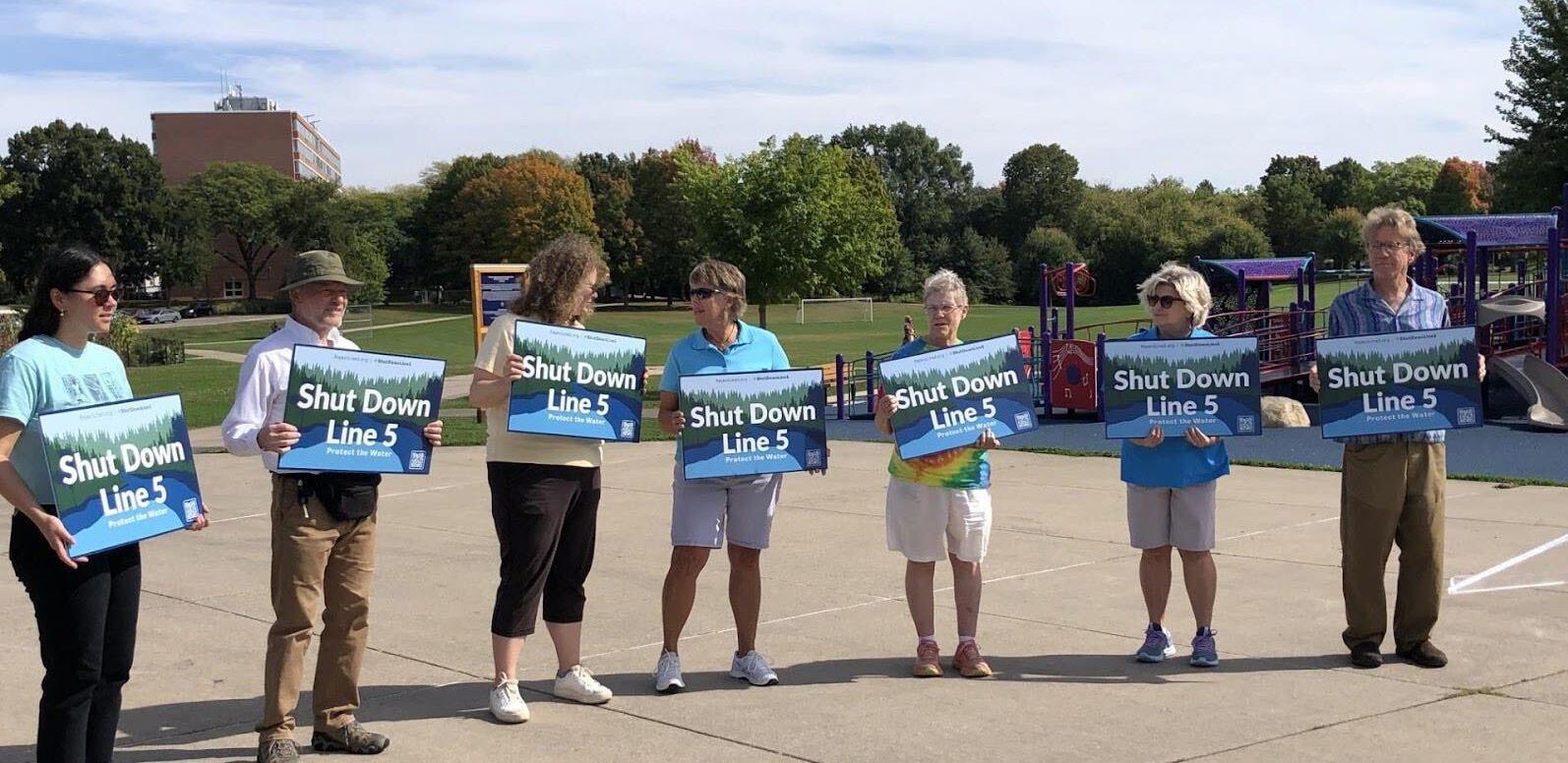
Community members and scientists protested Oct. 1 in Madison after a contested a legal case that will decide the fate of a Canadian oil company’s pipeline through Wisconsin.
Enbridge Inc.’s Line 5 pipeline has come under fire for a planned reroute through Wisconsin, which critics say raises environmental, public health and tribal sovereignty concerns.
Enbridge says their pipeline route poses minimal health and safety concerns, but a UW-Madison physician argued the path of the reroute could easily lead to crude oil spills into surrounding communities’ water supplies, potentially causing birth defects.
Line 5 initially ran directly through the Bad River Band of Lake Superior Chippewa’s reservation. However, in 2023, a federal judge ruled that Enbridge had been trespassing on tribal lands ever since their initial easements expired in 2013, and Line 5 was ordered out of the reservation entirely by 2026. As a result, Enbridge was granted building permits for a 41-mile pipeline reroute around the reservation instead.
In December 2024, less than a month after the reroute permits were first issued, the Bad River Band of Lake Superior Chippewa and several environmental orga-
nizations petitioned against the reroute. The petitioners questioned whether the Wisconsin Department of Natural Resources’ (DNR) issued reroute permits complied with state environmental requirements.
Robert Striker, an infectious disease physician at the University of WisconsinMadison’s Department of Medicine, spoke against Enbridge’s reroute at a press conference put on by Healthy Climate Wisconsin.
“So much of health is really the environment that we grow up in,” Striker said. “And this is a serious, serious risk to our environment.”
Last year, a degraded gasket caused 69,000 gallons of oil from a different Enbridge pipeline to leak out near Jefferson County, though Enbridge’s report claims only four of those gallons reached groundwater.
“These spills can lead to cancer, they can lead to birth defects, they can lead to immune problems,” Striker said. “This is just not something that we want or need in the world that we want our children to grow up in.”
Crude oil is composed of mixtures of various hydrocarbons, molecules made of hydrogen and carbon. Striker told The Daily Cardinal the Line 5 pipeline could route those hydrocarbons into local food supplies, potentially causing birth defects.
“The fact that this pipeline
will go near aquifers in the whole region, and that water is critical for farming, means contamination to our whole food supply,” Striker said. “Once the pipeline is in it’s going to be very, very hard to get rid of it.”
According to Healthy Climate Wisconsin, Line 5 could also have a negative impact on the water quality of the Bad River Watershed, which is home to the largest manoomin (wild rice) bed on the Great Lakes and stocks over 15 million walleye each year. Both manoomin and walleye hold immense cultural and historical significance for the Bad River tribe, and degradation to the watershed could put them in jeopardy.
“I don’t want to see my future being decided by the greed of others, and I don’t want my state government to be afraid to stand up for their constituents because they’re worried about what a Canadian oil company might think,” 17-yearold Waunakee High School student Clara Olson said.
Olson, a member of Waunakee High School’s ECO Club, said several of her peers have sat in on the hearings over the past several weeks.
“As a young person it’s infuriating to see our government allow private corporations to burn our planet and my future to ashes,” Olson said. “High school students like myself will continue to push for the
rejection of Line 5 and stand up for tribal sovereignty.”
In an email, Enbridge told the Cardinal a DNR analysis found Line 5’s reroute would have “no measurable adverse effects to water quality or wetlands.”
The report analyzed over 13,000 scenarios with differing environmental variables and concluded that a leak from the proposed reroute was “highly unlikely at any volume.”
Additionally, Enbridge estimated the project would generate millions in construction spending in local communities and create 700 union jobs.
The case hearing for the Line 5 reroute concluded Oct. 3 with a decision expected in the near future.
UW research challenges federal vaccine guidelines
By Yuhan Wang STAFF WRITER
A University of Wisconsin-Madison professor’s research study shows COVID19 vaccines protect not just individuals, but their relatives, illustrating previously unknown benefits of vaccination in the wake of recent federal restrictions.
Daniel Sacks, an associate professor of risk and insurance at the School of Business, told The Daily Cardinal that the vaccinated not only protect themselves against COVID-19, but also prevent their household members from getting infected.
Sacks fills ‘indirect effect’ gap in COVID-19 vaccine research
When Sacks began his study, clinical trials revealed the direct effects of vaccination, but the indirect effects, such as protecting others, remained an open question.
“The public health guidance seemed to say that even if you were vaccinated, you might still infect other people,” Sacks said. “When we worked on the project, we realized we should also look at the protective effect for their family members.”
New FDA rules limit vaccine access, reducing benefit of indirect effects
Under Health and Human Services Secretary Robert F. Kennedy Jr.’s order, the FDA recently restricted COVID-19 vaccines for younger adults and children. Specifically, the FDA now only authorizes this year’s COVID-19 shot for individuals six months and older if they have a health condition increasing their risk of a severe infection. The drug is also approved for any adult aged 65
and older, but only after a health consultation with a professional.
While most people who previously were vaccinated remain eligible, Sacks cautioned that “there are more hoops for them to jump through.”
While the majority of vaccinations last year were administered in drugstores or pharmacies, some people may no longer be able to receive the vaccines without a doctor’s recommendation, and private insurers might stop covering the cost of the vaccine for those without eligibility.
Moreover, he argued the administration failed to account for the indirect protective benefits of vaccination.
“If a person’s motivation for vaccination is to protect others, this policy change makes it harder for them to vaccinate,” Sacks said.
Sacks also warned of potential supply issues. “Pharmacies may be a little more reluctant to buy COVID vaccines, either because fewer people want them or because insurers aren’t going to cover them,” he said.
Sacks’ methods
Across the United States, early COVID-19 vaccine rollouts caused 12-year-olds to be eligible for vaccination six months earlier than 11-year-olds. The project compared Indiana 12-year-olds to 11-year-olds, finding vaccination reduced the incidence of COVID-19 by 80%.
Sacks and his team found vaccines provided strong protection for those who received them, with an observed protection rate of 80%, albeit lower than rates reported in NIH clinical trials.
Vaccinated individuals also reduced the likelihood of infection among members of their household, showing the benefits of vaccination extend beyond the
individual. COVID-19 incidence rates in household members of the 12-year-olds decreased by 60% compared to household members of 11-year-olds.
However, this indirect protection did not appear in school settings.
Sacks’s study also compared middle school 5th graders, who attended schools with vaccine-eligible children, to 5th graders in elementary schools with-
out vaccine-eligible peers. Unlike with household members, the effects of vaccination on other students’ incidence rates were negligible, which the study attributed to children mixing less within schools than within households.
“[Vaccines] seem to be especially protective in close-contact environments — not so much for people in distant school classrooms,” Sacks said.
CAITLYN NALLEY/THE DAILY CARDINAL
arts
Cocktail bar Cielo hosts ‘coffee rave’ after farmers market Madison Public Library gears up for Wisconsin Fall Book Festival
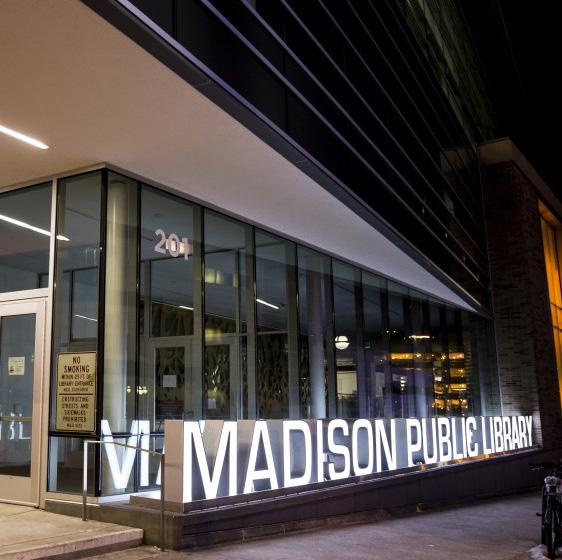
Wisconsin Book Festival and Madison Public Library will host their annual Fall Celebration Oct. 23-26 at Central Library and other venues in downtown Madison. The festival features more than 55 events over the three days, all of which are free and open to the public.
This year’s festival is especially notable because it coincides with the 150th anniversary of the Madison Public Library. When the library was founded in 1875, it operated out of a single room in city hall and served a city with a population just under 10,000.
Attendees can expect events spotlighting genre-spanning authors, including fiction, nonfiction, poetry and memoir. These include lectures, author conversations and book sales. Free books will be available at select author appearances.
The majority of the festival will take place at Central Library, but partner venues will also host parts of the weekend. These include Arts + Literature Laboratory, UW-Madison’s Discovery Building and the
Wisconsin Historical Society. Jane Rotonda, the Wisconsin Book Festival Director, works full-time to plan the fall celebration and other standalone events throughout the year. She explained the library decides which authors to bring in by looking at upcoming book releases. They also have an open proposal period, where authors can submit themselves for consid eration.
Celebrating Wisconsin writers is one of the festival’s core goals.
Uniquely, this year’s festival features Martha Barnette and Grant Barrett. The pair are promoting Barnett’s new book “Friends with Words: Adventures in Languageland” but are best known as co-hosts of the radio show “A Way With Words” where they discuss the history and nuance of language. They will be at Central Library on Oct. 26.
Wisconsin-based fiction writer Jane Hamilton will visit the Central Library on Oct. 23 to talk about her latest book, “The Phoebe Variations,” a coming of age novel.
David Wroblewski, a writer
By Dani Nisbet STAFF WRITER
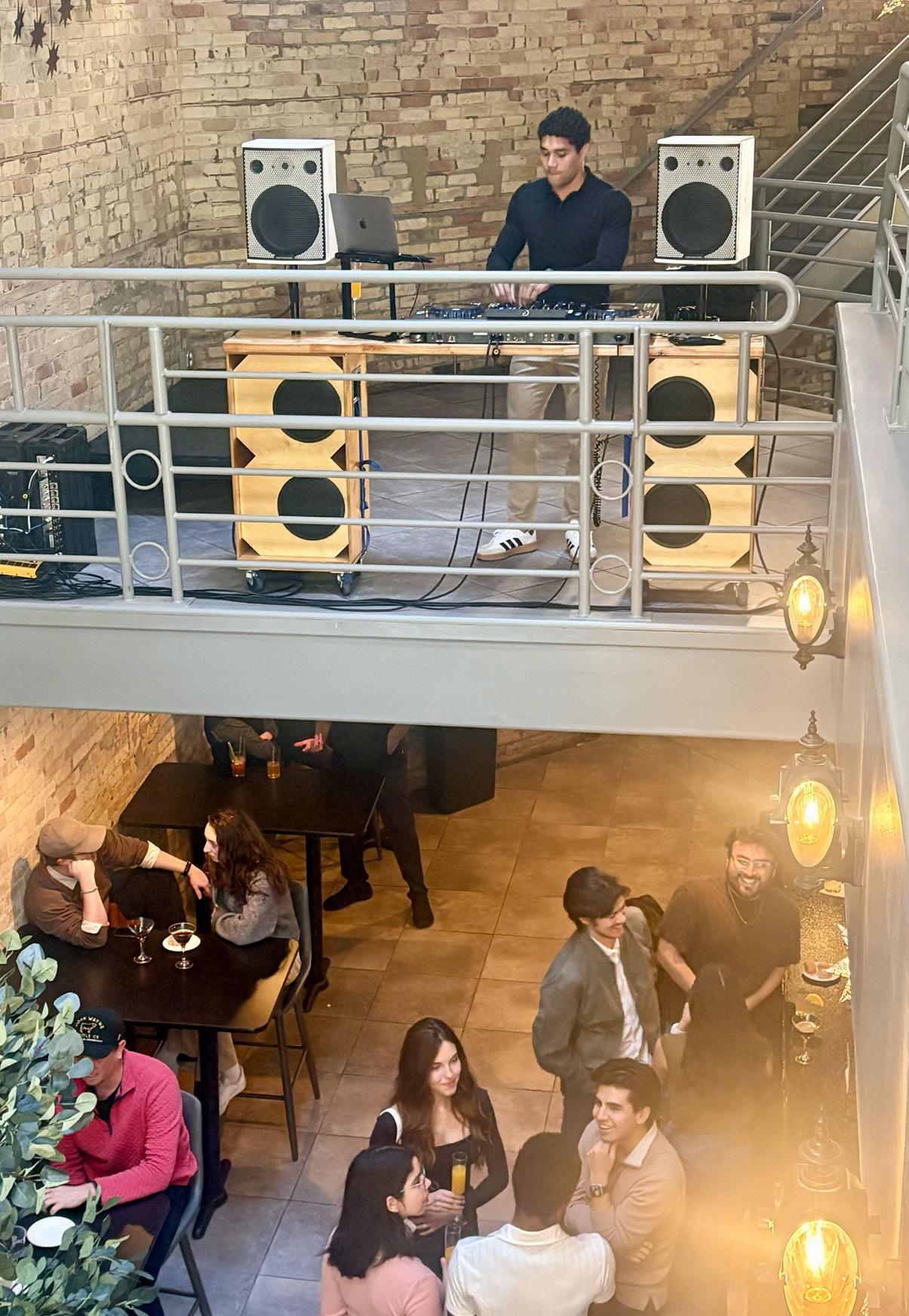
Cielo, a newly opened cocktail bar, hosted a ‘coffee rave’ on Saturday, drawing in customers from the nearby Dane County Farmer’s Market, their first event since opening on Sept. 25.
When you walk into Cielo, you’re greeted by the sight of the DJ booth, sitting atop the second floor on a strip that’s akin to a balcony. Although the place is easy to miss when walking by, Cielo certainly stands out once you’re inside. With brick walls, hanging metallic clouds and star lights, it’s hard not to feel at ease.
During the rave, there were deals for $6 espresso martinis and mimosas. The espresso martini deal is definitely worth looking into for someone in need of a pick-me up.
Half the event was mixed by Mithyka, a Madison-based DJ from Mexico City. He performed a mix of upbeat, remixed house music with Latin and R&B tunes mixed in. After the halfway point, DJ Matta, who is originally from Spain, stepped in and kept the show going strong with equally catchy electronic house music and Latin beats.
David Becker, a 20-year-old bartender at Cielo, described the space as “cozy,” and said the customers have been nice.
Becker studies personal finance at University of WisconsinMadison, and said he is optimistic Cielo will find success on State Street given its already-present groups of regulars.
The owner of Cielo, Susan McKinney, runs the lounge
from Oconomowoc, will be promoting his book “Familiarais,” a prequel to the best selling novel “The Story of Edgar Sawtelle,” on Oct. 24.
Friday will lean even further into the Wisconsin theme with Mineral Point Excellence in Education Foundation Board Chair Kristen Mitchell. She will be discussing artisanal cheese history book “The Wisconsin Whey: Cheesemaking In The Driftless” by Judy Newman Coburn. Cheese samples will be provided at the presentation.
“It’s these heartfelt stories about farmers and their relationships with these animals and the land they live on,” Rotonda said. “It’s about creating this legacy within a community. It’s one of the really fun pillars of our identity as a state.”
Beyond author presentations, the library will also have a poetry reading and panel on Saturday Oct. 25. This will be hosted by poet and academic Donika Kelly, poet and naturalist Elizabeth Bradfield and writer and editor Keetje Kuipers. All three writers will be reading from their latest collections of poems.
alongside her two daughters. The years she lived in Mexico inspired both the menu and the lounge’s design. Given that Cielo means “sky” in Spanish, many of the decorations match this aesthetic.
The stars that hang throughout Cielo were made by one of McKinney’s friends, inspired by the same stars she saw at festivals and celebrations when she lived in San Miguel de Allende in Mexico. She hopes Cielo can be a place where people can come together.
“It’s giving club, but classy,” Cielo bartender Natalie Brown, a 21 year old studying biochemistry at UW-Madison, said.
Brown said Cielo was a space for people of all ages to enjoy. Indeed, people of all ages made an appearance at the rave, chatting and enjoying their drinks alongside friends.
Cielo is a deceptively large building, with the first floor having two bars and two different accessible entrances from the street. Alongside seating, there is a lot of empty space for dancing, which many groups took full advantage of. The third floor has a second DJ booth — which will no doubt get some use at future events.
By the end of the coffee rave, the first floor was flooded with people. It was an impressive turnout for the bar’s first event. This cocktail and coffee joint has the potential to become a trendy hotspot here on campus. With a steadily growing number of regulars, there’s something about his place that draws people back, and it’s not hard to see why.