Paul’s Book Store closes its doors after 70 years as a State Street staple.
+ LIFE & STYLE, PAGE 5
Thursday, March 6, 2025
ANORA SWEEPS OSCARS
“Anora” takes home Best Picture at 2025 Academy Awards.
+ ARTS, PAGE 8
GOP lawmakers introduce anti-trans legislation
By Anna Kleiber STATE NEWS EDITOR
Republican lawmakers introduced legislation that would ban transgender girls in Wisconsin K-12 schools and transgender women attending University of Wisconsin System schools and Wisconsin technical colleges from participating on teams or playing sports that reflect their gender identity.
The first two bills would require each UW institution and technical college to designate each athletic team or sport by sex — for “males” or “men,” or for “females” or
“women.” The bill would further prohibit male students from participating on an athletic team or sport designated for females as well as bar male students from using locker rooms designated for females.
Similarly, the second would do the same for K-12 schools to do the same.
The two bills, both of which were authored by Rep. Barabra Dittrich, R-Oconomowoc, and Sen. Rob Hutton, R-Brookfield, come after the Wisconsin Interscholastic Athletic Association (WIAA) changed its policy in early February to prohibit athletes from compet-
ing on a team that does not match the biological sex that they were assigned at birth.
The change was made in response to an executive order signed by President Donald Trump which banned transgender athletes from women’s school sports. Previously, the WIAA allowed transgender athletes to compete on teams that align with their gender identity.
This decision was celebrated by Dittrich and Rep. Dan Knodl, R-Germantown, who said in a column they plan to reintroduce a bill “to secure women’s and girls’ rights in Wisconsin.”
‘There aren’t easy answers’
Mnookin fields questions on impact of potential NIH funding cut
By Gavin Escott CAMPUS NEWS EDITOR
University of Wisconsin-Madison
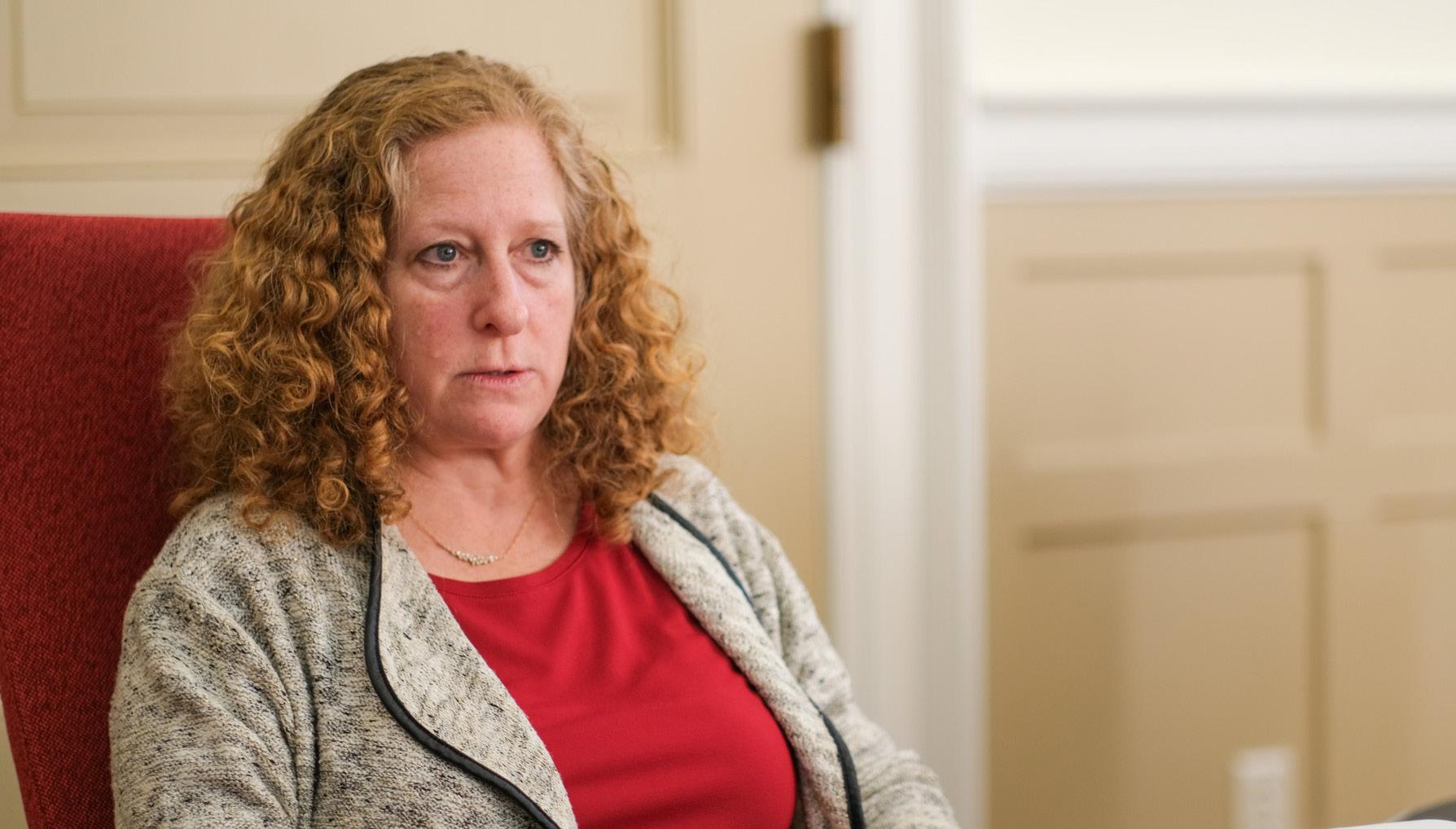
Chancellor Jennifer Mnookin indicated during a Faculty Senate meeting Monday the university would walk back hiring and rethink grant-making if a National Institutes of Health (NIH) funding cut is implemented.
Mnookin told faculty the anticipated loss of $65 million a year would be difficult to manage “without meaningful change.” She said the past six weeks brought an “unprecedented number of significant challenges” — pointing to the NIH’s decision to cap indirect cost rates at 15% — and told faculty questioning the funding cut’s impact there are no “easy answers.”
“The situation continues to unfold,” Mnookin said. “It’s very important we don’t rush into accepting terms without a thorough and collective assessment, including whether there could be legal consequences
or risks to the whole institution.”
The decision capping NIH funding, which comprises UW-Madison’s largest source of federal support, is temporarily paused, with Wisconsin and 22 other states involved in a lawsuit. However, Mnookin said the cut if implemented would deal a blow to UW-Madison’s operations and would force the university to “think about grant-making in a pretty different way.”
Federal law forbids universities from paying indirect costs with grant money. These indirect costs, which include building maintenance, security and electricity, are typically paid for with the indirect cost rate, which the federal government gives in addition to the grants. A severe reduction in the indirect cost rate — UW-Madison’s current rate ranges from 27% to 55.5% — would pose “a huge institutional problem” with the university having to pay the associated indirect cost themselves, Mnookin said.
“It wouldn’t just be that any grant could
necessarily be submitted,” Mnookin said.
Mnookin said the university is developing a range of scenarios for implementing budget cuts but added the university’s research enterprise would undoubtedly be impacted, though the degree would depend on the amount of budget cuts. After a faculty member asked if The Wisconsin Research, Innovation and Scholarly Excellence initiative — a targeted hiring push in key fields that boosts regular hiring by 40% — would be discontinued, Mnookin said it “wasn’t a question” the university would have to walk back faculty hiring in general.
“It certainly is true that if we were in a position of having very substantial cuts, we would probably be curtailing faculty hiring writ large,” Mnookin said.
University leadership told The Daily Cardinal Feb. 12 they won’t lay off faculty if the cuts are implemented.
+ NIH page 3
Abigail Swetz, director of LGBTQ+ rights organization FAIR Wisconsin, said the organization has fought these “discriminatory bills” before and will do so again to ensure trans Wisconsinites can play the sports they love.
“When an athlete gets to play sports on a team where they belong, that can make such a huge difference,” Swetz said in a statement Feb. 24. “Now is the time to show our trans kids love and support, not exclusion.”
+ Trans athletes page 4
Wisconsin rail advocates push for expansion
By Alaina Walsh SENIOR STAFF WRITER
A newly formed coalition of passenger rail associations and advocacy groups gathered Tuesday to promote Gov. Tony Evers’ budget proposal, which includes funding to expand passenger rail service and increase train frequencies in Wisconsin.
Representatives from four passenger rail associations, along with two additional advocacy units, convened to support the state’s investment in rail infrastructure. The event featured speakers from multiple organizations, including the High Speed Rail Alliance, West Central Wisconsin Rail Coalition and All Aboard Wisconsin.
Chris Ott, deputy director of the High Speed Rail Alliance, emphasized the importance of passenger rail in providing economic opportunities, reducing road congestion and improving transportation accessibility. Ott pointed to recent remarks by U.S. Transportation Secretary Pete Buttigieg, who has called for infrastructure investment to be a nonpartisan priority.
“Passenger rail benefits everyone—whether you’re on the train or not,” Ott said. “A million people used Wisconsin’s eight Amtrak stations last year, reducing highway congestion and bringing economic benefits to local communities.”
Currently, Amtrak operates routes serving Sturtevant, Milwaukee Airport, Milwaukee Intermodal, Columbus, Portage, Wisconsin Dells, Tomah and La Crosse. The Borealis train, which launched last year, has already demonstrated strong ridership with over 160,000 passengers since May.
Ott noted the Wisconsin Department of Transportation (WisDOT), with federal support, is considering expanding rail service to Green Bay, Madison, Eau Claire and other underserved communities across the state.
+ Trains page 4
“…the great state University of Wisconsin should ever encourage that continual and fearless sifting and winnowing by which alone the truth can be found.”
LIAM BERAN/THE DAILY CARDINAL
New county jail to improve infrastructure, mental health services
Construction is underway for the new Dane County Jail building following years of back-and-forth in the County Board of Supervisors and ballooning costs.
In Wisconsin, local jails make up roughly 34% of the total population behind bars, with Wisconsin’s incarceration rate higher than most developed nations, including the United States overall. Dane County has a much lower incarceration rate than the national average, though its Black incarceration rate is more than twice as high.
Part of the fight to end mass incarceration, according to Dane County Sheriff Kalvin Barrett, is prioritizing rehabilitation through the construction of the larger, more “humane” jail facility.
The building, which will include a new South Tower and the renovated Public Safety Building, will cost over $207 million — making it the most expensive project in county history. Construction of the South Tower began in March 2024 in the old parking lot of the Public Safety Building, and the project is projected to be completed in mid-2027.
As the new jail facility is being constructed, The Daily Cardinal visited the current Dane County Jail and spoke with law enforcement, activists and a formerly incarcerated student about the state of the current building and its expanded future.
South Tower addresses problematic aspects of current jail, Barrett says
One of the main reasons for building the South Tower, Barrett said, is to significantly reduce the “borderline unconstitutional” use of solitary confinement cells in the current jail. Inmates going through mental health crises or those with airborne diseases such as COVID-19 will have a floor dedicated to their needs in the new facility, he said.
“We [currently] put people that are going through a mental health crisis in solitary confinement because there’s no place else to put them. It’s the worst place to send people,” Barrett told the Cardinal.
Barrett said he is also working with Tellurian Behavioral Health and American Family Insurance to build another facility designed specifically for people with mental health struggles who need assistance that is not “jail, detox or a mental health facility.”
Though the Dane County Jail spends $7 million on its medical contract and has full-time medical and mental health staff, according to Barrett. Its current medical examination room is an all-beige converted former closet with a curtain, toilet and a hard frame for a bed.
“The jail was built in a time where the predominant thought was ‘lock them up and throw away the key.’ We can do better,” Barrett said.
The new jail’s South Tower will have a mezzanine for social activities, a classroom in every housing unit and an improved
medical and mental health wing for women, who Barrett said were sent to the “oldest, worst part of the [current] jail.”
But the renovations will not come without setbacks. The South Tower will no longer have the room which hosts Dane County Jail’s Parenting Inside Out program, which Barrett said is because the county board decided against it due to costs.
“The county expects us to work on rehabilitation and help people, but we have to have resources to do that, or else we’re just trying to survive,” Sheriff Barrett said. “They’re not being effective: they’re just being efficient.”
Disagreement on space, budgeting
The approval of the South Tower plans follows years of negotiations. City officials, the sheriff’s office and activists agree that areas of the CityCounty Building are unsafe and need to be replaced — their disagreements arise from just how big the new building should be.
“If we can have a smaller jail with smaller staff, it means less money for that staffing. And that’s money that could be used for community based … treatments and supports,” Paul Saemann, a colead of MOSES’s Justice System Reform Initiative Task Force, told the Cardinal.
The Black Caucus, a group of county board members who have been advised by MOSES, have
advocated to “[right-size] the jail.”
The Black Caucus used their collective voting power to grant approval of the new facility contingent on the implementation of reforms that would help to reduce the number of people incarcerated. They hope “a facility with 100 fewer beds than previously planned will meet Dane County’s current and future needs.”
But Barrett said a smaller jail may mean a reduced ability to provide the same services that stakeholders advocate for. Most of the jail’s budget consists of fixed expenses like salaries, medical contracts and furnishings, he said, which are mandated by law.
“So what’s left? Extra things that we do to make these better?” Barrett said.
The new jail’s original plans included construction of a full kitchen that would host culinary classes, giving inmates experience that would help them secure jobs in the food service industry, Barrett said, “but the Dane County Board took that out.”
“In order to have appropriate change, we got to pay for it,” he said. “It takes money in order to get the results.”
Formerly incarcerated UW-Madison student speaks out
Thomas, a current UW-Madison student formerly incarcerated at the Dane County Jail who did
not provide his full name for legal reasons, had mixed feelings on his experience. He described the process of being taken into custody and searched as “kind of respectful” even though his overall stay was “stressful.”
“There were a lot of smaller things that were really, really bad that I had to try hard to pull through,” Thomas told the Cardinal.
Thomas said he could not sleep his first night in the jail because his bed had semen stains all over it. He also said he did not shower throughout his stay because “no one bothered to clean it” and because one of his fellow inmates was a pedophile.
“It was weird and scary,” Thomas said. “I didn’t bring anything up to the officers because I would rarely see them, let alone know if they would actually help.”
Thomas was let go from jail after less than a week’s stay. To this day, he gets “very uncomfortable” around Madison police, who he believes have an “extreme power that they really don’t deserve to have.”
But after intensive therapy and reflection, Thomas said he has mostly recovered from his Dane County Jail experience. He said being incarcerated “gave [him] a lot of reasons to keep moving forward” in his life.
“It teaches you to strive as hard as you can,” he said. “You know that right now, you could be inside of jail and wasting very, very valuable time.”
What comes next for graduate students and junior faculty, speakers ask Multiple faculty members asked Mnookin how the university would support graduate students, who have voiced particular concerns about their status in the wake of the NIH decision.
University leadership issued a memo to graduate school deans on Feb. 23 advising them to consider decreasing the number of future students admitted to graduate programs. Some graduate programs have restricted admissions to “direct admit” only, and some students have been told by labs that with funding cuts they don’t believe they can place them, Teaching Assistant Association (TAA) Co-President Maddie Topf told The Daily Cardinal.
The memo acknowledged some programs have already issued letters
of admissions to students, and when asked how to deal with these incoming students Mnookin urged caution, highlighting the uncertainty of the current situation.
“We don’t know where this is going to land, and there’s a worst-case and best-case scenario, and we don’t want to get too far ahead of them,” Mnookin said. “But we also don’t want to, without thinking about it, take on substantial new responsibilities that might make it harder to meet some of the other things just described.”
When pressed on what caution means, Mnookin highlighted each department has different uses for graduate students and a “one-size-fits all” reduction isn’t the answer.
“I don’t feel that from my space as chancellor, I can sort of say, ‘Okay, everybody should aim to cut their graduate enrollment by 35%,’” Mnookin said, “That might be too high for some and too low for others.”
She said the university was encouraging individual deans to develop answers that match their needs.
The university reaffirmed its commitment to supporting graduate students in a release Thursday, adding they’ve instructed departments to do their best to honor existing funding commitments for continuing graduate students.
The university has also said cuts and cancellations at several funding agencies imperil UW-Madison’s ability to conduct research and train future generations of researchers, and junior faculty expressed concern to Mnookin that the national climate could imperil their ability to secure tenure.
Gender and Women Studies
Professor Leigh Senderowicz said she had to “recalibrate” her entire research agenda because the USAID and CDC data she relied on no longer exists.
Mnookin said it was important to balance potentially reduced research
UW athletes read with second graders
By Ronan Rataj STAFF WRITER
For some students, reading is a chance to learn about the amazing world around them or escape to a far away fantasyland. But for some second graders in Madison, reading is a chance to create lasting positive memories with Badgers football players.
Student athletes at the University of WisconsinMadison have visited second grade classrooms in the Madison school district every Monday since September 2024 as part of the Role Model Reading Program, a partnership between the Madison Metropolitan School District (MMSD) and the 2nd & 7 foundation created by Badgers head football coach Luke Fickell.
The Role Model Reading Program is just one aspect of MMSD’s Mad About Reading initiative, which is trying to build off the momentum of a 9% increase in literacy rate since last year.
Visits typically happen in the morning and rotate between classrooms each week, according to Adam Clausen, MMSD director of engagement, diversity, equity and inclusion. There, student athletes meet with the second graders, read books to them and teach them the value of learning.
“For Coach Fickell to support and align with that, give students a book and to be able to have these incredible role models come out to spend time and invest in our earliest learners to
see that reading is not just essential, but it can be fun,” Clausen told The Daily Cardinal.
Fickell is no rookie when it comes to getting students excited about reading. He created the 2nd & 7 foundation in 1999 along with former college teammates Ryan Miller and New England Patriots Head Coach Mike Vrabel. The three Ohio State Buckeyes wanted to give back to their community and provided free books to every second grader in seven different elementary schools, giving the foundation its name. Since then, 2nd & 7 has donated more than 800,000 books to schools across the country.
“For some of [the second graders], it’s their first time learning about the Wisconsin Badgers, it’s their first exposure to what a university is, what college is. I [thought] it would fit great, because we as a district have a priority for early literacy, and have invested heavily in those efforts,” Clausen said.
Fickell’s community engagement has inspired his own players to give back.
“[Coach] and Mrs. Fickell, they’re great people. They teach us to be grown young men and be good adults and always give back to the community,” junior kicker Nathanial Vakos told the Cardinal. “Being able to give back to schools and hospitals and other associations is really good.”
Vakos has participated in the Role Model Reading Program several times. He
said his main goal was to make sure the students had a positive and fun experience, from “popcorn” reading to playing “freeze tag” at recess.
“I think it’s good for them to see older guys that they might look up to, that we don’t even know them very well, but that might be a day that stood out in their week,” Vakos said, adding that he hopes the second graders remember having fun with him, reading, socializing and playing on the playground.
Clausen said the program has also been well received by teachers.
“It’s been fun for our teachers — many of whom are alumni — to get to sport their Badger gear, alumni gear and have Bucky Badger coloring pages,” he said.
Teachers select from a wide variety of books donated from UW Athletics for the football players to read. At the end of each book is an activity, which students and football players do together, according to Clausen.
The program has already gone to six of MMSD’s community schools, which are schools with higher concentrations of low-income students that provide holistic services to the entire community, according to Clausen. The program has been so successful that there are already plans to expand it across the district.
“I think there’s a desire to explore what the future could look like,” Clausen said. “What’s been a joy for both sides is we’re doing it together.”
opportunities with ensuring junior faculty still have opportunities to conduct research required for tenure, though she stressed this wasn’t a problem exclusive to UW-Madison.
Faculty suggest educating public on impact of cuts
Faculty members also floated proposals to address the potential funding cuts, including educating Wisconsinites on the toll it would take on the economy and reducing administrative costs.
Wisconsin receives roughly $654 million per year in NIH grants, which supports more than 7,700 jobs and $1.4 billion in economic activity, according to United for Medical Research, and Mnookin said the capping of indirect costs would have a “ripple effect” on the state’s economy.
She added the university was working to spread awareness of the value of indirect costs, which many people regard as solely overhead, but
highlighted that people across the political spectrum report less trust in universities, which makes educating the public “significantly harder.”
Mnookin also said she “100%” agreed with a faculty member who suggested reducing UW-Madison’s indirect cost rate and cutting administration regardless of if the NIH cap goes through, though she said finding efficiency gains would be difficult as the university requires people to deal with increasing regulatory demands.
“I think we do have a responsibility to ask, ‘How can we reduce administrative costs across our institution,’ and frankly, I think we have that responsibility with or without reductions to indirects,” Mnookin said. “I think that the more that we can [find] ways to do our administrative work efficiently in order to maximize our commitments to the research and teaching service enterprises, [the more] we should be doing that.”
Trump’s tariffs will raise prices of your favorite beer, tequila, whiskey
By Ty Javier TARIFF CORRESPONDENT
President Donald Trump’s executive orders imposing sweeping tariffs on Canada and Mexico took effect Tuesday, with the potential to raise prices for University of Wisconsin-Madison students’ drink of choice.
Last month, Trump put the tariffs on pause, temporarily avoiding a damaging cross-boarder trade war that would have increased the cost of everyday goods. Trump said Monday afternoon there was no chance for a last-minute deal to avoid the tariffs.
Under Trump’s executive orders, all goods imported from Canada and Mexico are subject to a 25% tariff, except Canadian energy products, which face a 10% tariff. The additional 10% on Chinese goods took effect Tuesday.
Tariffs could lead to higher prices for consumers, economists have said. That could mean higher prices for imported Mexican beers and tequilas as well as Canadian whiskey.
If the tariffs are put in place, how long will it take liquor prices to rise?
Consumers could see a swift uptick in prices, though it depends on how much importers, distributors, liquor stores and bars have in inventory. If the tariffs hold, prices will inevitably rise unless a firm along the supply chain decides to eat the increased cost.
How quickly firms are willing and able to raise their prices remains to be seen, Peter
Simon, an economics professor at Northeastern University, told the New York Times in February. While some price increases may represent a legitimate response to rising costs for firms, there is also the risk of opportunistic pricing, companies using tariffs as an excuse to raise prices even more than necessary, Simon said.
Mexican and Canadian spirits are popular among U.S. consumers In 2023, tequila surpassed whiskey as a leading subcategory in the U.S. spirits market, reaching $6.5 billion in sales, second only to vodka, according to the Distilled Spirits Council of the U.S.
All authentic tequila comes from Mexico, which makes it particularly vulnerable to tariffs. Imports are essential to meet Americans’ demand for tequila-based drinks, such as the classic margarita.
Data from 2023 shows Modelo’s market share rose to 10.7%, becoming the most popular beer in America. Summer 2024 data shows Modelo retains the lead with Corona in fourth, together comprising 14.5% of the U.S. beer market.
Canadian whiskeys, including Crown Royal and Fireball, are affected by the tariff. Fireball Cinnamon Whisky, a college bar shot favorite, is imported from Canada and could see a significant price hike.
Consumers and college students alike may substitute for cheaper beers and liquors when prices rise.
Meet UW-Madison’s very own pinball wizard
By Oliver Gerharz
PODCAST EDITOR
The number of pinball machines released each year is much smaller today than it was in the 1960s or 70s, but that doesn’t stop Will DeGoey, a senior engineering student at the University of Wisconsin-Madison, from keeping these neglected contraptions alive.
“When I first got into the hobby, I was working at Six Flags in the maintenance department,” DeGoey said, “My friend Matt also collects pinball machines, and somehow the subject came up one day and we talked about it for a while.”
Around the same time, DeGoey saw a video on electromechanical pinball machines from YouTuber Technology Connections.
After his introduction to the hobby, DeGoey decided to check out Nerd Haven, a retro arcade with a huge collection of pinball machines.
“The convergence of those three things made me go, ‘huh, I’d quite like to have one of those,’” DeGoey said.
The first machine DeGoey restored was called “Beat Time.” The machine featured “The Bootles,” a bootleg of The Beatles. He found the machine on an online marketplace for $1,234 but negotiated the asking price down to just $100.
That $100 price tag, though, meant DeGoey knew he would have to put in a lot of work since “pinball machines, in general, are not a cheap hobby.”
The pinball community is gigantic, with specialists for even the most niche parts of DeGoey’s hobby. Still, the community skews older, and it can be difficult at times to connect with other young hobbyists.
“I haven’t encountered a lot of people my age who are doing this. There’s a couple other guys, but I am yet to find that
Trans athletes
Continued from page 1
Rep. Alex Joers, D-Middleton, told The Daily Cardinal these bills are a clear effort by Republicans to “start another culture war at the expense of our young people.”
“There are so many issues that our communities are facing, and yet Republican legislators prefer to focus their energy on using the full weight of the government to bully the transgender community in our state,” Joers said. “This hateful proposal directly harms our transgender youth by sending the message that our priority is passing legislation focused on excluding them.”
A total of 14 anti-LGBTQ+ bills were introduced during the 2024 legislative session, all of which failed to pass the Legislature or were vetoed by Gov. Tony Evers. Evers has promised to veto legislation targeting transgender Wisconsinites.
The bills were referred to the Assembly Committee on Colleges and Universities and the Assembly Committee on Education, respectively, for further discussion.
Trains
Continued from page 1
Mark Quam, representing the West Central Wisconsin Rail Coalition, spoke of efforts to develop a passenger rail corridor between Eau Claire, Menomonie and the Twin Cities. The coalition secured a federal Corridor Identification and Development grant and has formed a governmental entity, the St. Croix Rail Commission, to advance the project.
“Grassroots organizations working together is the key to making passenger rail effective in the Midwest,” Quam said. “Today is a major step in that direction.”
community,” DeGoey said.
Since working to restore “Beat Time,” DeGoey has restored three other pinball machines. They sit in a neat row in his parents house in Salem, Wisconsin, while two others sit in his campus apartment — one too far gone to fix, so DeGoey is looking to scrap it.
As a mechanical engineering major, DeGoey can appreciate the simple mechanisms behind these machines, but he acknowledges the “rat’s nest of wires” inside a pinball machine wouldn’t usually be his thing. He keeps circuit diagrams of these wires in his living room next to his other projects. Written on disintegrating parchment paper, these sheets show the deep complexities in how these machines are wired.
DeGoey’s proudest restoration project is a machine called “Aztec” — the same one from the Technology Connections video. At first, water damage from poor storage in a humid basement made restoration seem impossible, but after scrubbing away for hours with isopropyl alcohol and paper towels, DeGoey said that “Aztec” was his “hardest and the best result.”
DeGoey said that if he were ever to “homebrew” his own pinball machine mechanics by reworking an existing board, he would make it “Resident Evil”-themed.
Today, DeGoey is always adapting and building his craft. His current project, a poker-themed machine called “Big Deal,” needed a new glass backpiece, something DeGoey has ordered in the past. But this time, after finding out it would be too expensive, he opted to order the technicolor backing and apply it to the glass himself.
“Big Deal” will be installed in Wendt Commons once DeGoey finishes, though the screaming bells that ring for each point scored may need to be disconnected.
Nona Hill, president of All Aboard Wisconsin, reflected on the state’s long history with rail advocacy and cited the success of the Borealis service as evidence that Wisconsinites are eager for expanded rail options.
“By the end of January, the Borealis had far exceeded expectations,” Hill said. “This train is not just for people traveling between Chicago and the Twin Cities — it’s for Wisconsinites who rely on it at every station along the way.”
Evers has proposed $5 million for passenger rail expansion in the 202526 fiscal year and $10 million in 202627. While uncertainty remains around federal funding, the rail advocates argued that Wisconsin must be prepared to move forward independently if necessary.
“We spend billions on highways each year,” Ott said. “Investing in rail is not just reasonable—it’s essential.”
The coalition urged state lawmakers to support the budget proposal and called for broader investments in Wisconsin’s passenger rail network.
OLIVER GERHARZ/THE DAILY CARDINAL
OLIVER GERHARZ/THE DAILY CARDINAL
Remembering Paul’s Books
By Jake Piper STAFF WRITER
Upon stepping into Paul’s Book Store on State Street, the first thing customers always notice is the musty, warm scent reminiscent of used books filling the air. But on Feb. 22, an atmosphere of somber reflection seemed to fill the store instead.
After over 70 years of business, Paul’s Books opened its doors for the last time, inviting newcomers and old patrons alike to share their memories in the bookstore’s final hours.
“For me, I think nostalgia is a big emotion, and there’s some sadness there, saying goodbye to a Madison institution,” said David, a University of Wisconsin-Madison alum who, upon hearing of Paul’s closure, came to say one last goodbye to the store.
Martha Askins, the daughter of owner Caryl Askins, said that as her mother gets older, it’s become “harder and harder” for her to come down to the store.
This caused the family to come together and decide to sell the iconic location last November.
“It really is the end of an era,” Martha said.
For decades, Paul’s Book Store has been a staple of State Street, its cluttered shelves holding over 200 years of history within its rows, enticing any passersby with the soft glow of yellowed paper.
But during its closing sale on Feb. 22, the shelves slowly emptied one by one, some even getting a price tag placed on them once their books are sold. The records, once neatly tucked behind the front desk, laid in crates below the music section of books for $5 a piece. And patrons, boxes in hand, piled books inside by the dozen on a “book saving mission,” as one Paul’s clerk put it.
Even the decorations weren’t spared from the sale — a wooden duck overlooking the crowds was marked with a $25 price tag.
As patrons lined up in front of the wooden checkout desk, some paused and left their wellwishes in a guest book.
“Thank you for all the years of books, a warm place on a snowy day, a portal to different worlds, and a part of what makes this city home,” read one message in the journal.
Another thanked Paul’s for giving them “a daily reminder that there are good people in the world.”
But out of all the people Paul’s Books has touched over
the decades, it most greatly impacted Caryl’s four children.
“When you grow up in a bookstore, books become something different, something more,” Martha said.
Martha spent her younger years coming to Paul’s to help her dad run the store with her siblings. She fondly remembers going out to eat on State Street with her family after the day’s work.
“It was that atmosphere, not so much a single memory, but something you sort of pick up by osmosis,” Martha said, reflecting on her memories of growing up at Paul’s.
Martha’s two other siblings who helped with the move out, David and Libby, were also deeply affected by the closure, she said.
Even though she thinks the closure of Paul’s has left a hole
in the heart of State Street, Martha is happy about the positive impact her mom’s business has had on the Madison area and knows its impact will be felt for years to come.
“My mom has a good philosophical take on it,” Martha said. “For anybody who’s ever been in here, you carry this atmosphere forward with you.”
Surviving a Wisconsin winter: Fashion and self-care hacks
By Cadence Dugre STAFF WRITER
As temperatures drop drastically, University of WisconsinMadison students bundle up in thick coats and scarves, their breath visible in the chilly air. Cloudy skies and short days leave campus feeling cold and quiet. Rarely seeing the light of day, students are left with a lack of creativity in their fashion choices and isolation from the rest of the world.
As a UW-Madison student, I know the struggles of getting through a Wisconsin winter. I have compiled a list of the best ways to incorporate style and selfcare into everyday life that will ensure a smooth and somewhat
less daunting winter experience.
Fashion hacks for winter
Although staying warm is the top priority, finding ways to express your style through winter gear is crucial in order to maintain a sense of individuality. There are several routes to achieving a fashionable yet practical winter wardrobe.
Invest in quality boots and a winter coat: Contrary to popular belief, it is possible to own highquality winter gear and look stylish while wearing it. Some brands that sell fashionable yet durable winter boots include Sorel, Ugg and Columbia. For
winter coats, the Aritzia Super Puff, Patagonia W’s Downdrift jacket and The North Face 1996 Retro Nuptse jacket are a few functional and stylish options.
Layers are a life-saver: Wearing leggings or long underwear under your choice of pants will help keep you warm. No one will be able to tell, and you can wear your favorite pair of jeans without fear of freezing. Also, wearing tall socks is crucial because nothing is worse than a sliver of your ankle feeling the effects of a brutal gust of wind.
Accessorizing for warmth and style: To elevate a winter outfit beyond a coat and boots, try adding accessories like scarves, hats, head-
bands and mittens. Personalize your winter looks by incorporating your favorite colors and patterns, hometown sports team or personal aesthetics into accessories. You can find winter accessories that match your personal style at university bookstores, flea markets, vintage stores or Etsy.
Self-care hacks for winter
Now that you know the fundamentals to making it through the winter in style, here are some selfcare hacks that will help you avoid falling into any seasonal rut. With a lack of sunlight, finding the motivation to go outside or energy to get work done can be a struggle. It is easy for your mental health to decline along with the temperatures. Here are ways to keep your spirits and motivation high as you tackle the harsh Wisconsin weather.
Incorporate movement into your daily routine: Making the trek to a gym may seem impossible during the winter months, but adding a form of movement into your daily routine will benefit your mental health. Whether it’s morning stretches on your living room floor, following along to at-home workout videos on YouTube or simply dancing to your favorite song in the comfort of your bedroom, incorporating movement can help set a positive tone for the rest of the day.
Find joy in the season: Although winter may seem like the worst time of the year, take advantage of what the season has to offer.
Walking on frozen Lake Mendota, sledding down Bascom Hill, making snow angels, going on a ski trip or soaking in the sights of a fresh snowfall can remind you of the joy in the season and lighten the hardships of the weather.
Stay social: It is easy to isolate yourself and spend less time with people when staying home seems more convenient, but planning outings can help maintain social connections. Meeting friends at coffee shops or restaurants, continuing to go to class and club meetings and taking time to call loved ones can boost your mood. Pushing yourself to engage in activities that bring happiness is so important, even when temperatures are below freezing.
Make your space cozy: Spending more time at home is inevitable in winter, so make your space comfortable and inviting. Make your bed every morning, incorporate warm lighting, bring out your favorite blankets, light a candle or buy yourself fresh flowers to create a cozy and enjoyable living environment.
Just because it’s cold outside does not mean you need to stop dressing for style or taking care of yourself. It just means you have to prepare your mindset, wardrobe and routine to survive a Wisconsin winter with ease. As the seasons change, it is important to remind yourself of these self-care hacks any time of the year, whether it’s a rainy day or too hot for comfort.
Trump’s rebuff of Zelenskyy sets a dangerous precedent
By Amina Haniieva STAFF WRITER
February 28, 2025 — mark the date: this was the day American diplomacy turned into a live-action parody.
President Donald Trump, the self-proclaimed master of deal-making, met with Ukrainian President Volodymyr Zelenskyy. The agenda? Strengthen United States-Ukraine ties while securing resources for American industries. The outcome? A masterclass on how to alienate allies and undermine democratic values.
But should we really be surprised? While Trump’s campaigns were paved with grand promises of quick peace deals and a revival of American diplomacy, his time in office tells a different story. Remember the border wall that Mexico was going to pay for? Or the revival of the coal industry that never materialized? Now, he assures us of a quick end to Russia’s war in Ukraine. When Trump’s promises disappear faster than his midnight tweets, it’s not a fluke, it’s a pattern: big talk and no follow-through.
We’ve seen unpredictability before, but this moment marks something different. For those who have trusted Trump, this is a reminder that leadership isn’t just about bold promises — it’s about following through. For those who have dismissed his approach as just another untraditional style, this meeting isn’t just another headline; it marks a global shift with real consequences.
But why was this negotiation so important in the first place? The meeting was intended to solidify a minerals-for-aid agreement, granting the U.S. access to Ukraine’s rare earth resources in exchange for continued support against Russian aggression. Instead, it devolved into a verbal sparring match.
Trump accused Zelenskyy of “gambling with World War III” and lacking gratitude for American aid. Vice President JD Vance chimed in, criticizing Zelenskyy for discussing policy publicly. The meeting then ended abruptly, with the proposed agreement unsigned and a scheduled press conference canceled. Within hours, our commander-in-chief took to the internet to rage tweet about it.
With Ukraine facing mounting battlefield pressure and uncertainty over Western support, the stakes couldn’t have been higher. The Feb. 28 confrontation wasn’t just a tense exchange — it was a clear example of what happens when foreign policy becomes reactive rather than strategic, leaving allies uncertain and adversaries taking notes. It doesn’t take a foreign policy expert to know that this kind of confrontation between world leaders, especially those considered allies, is rare and alarming.
In contrast, previous administrations approached similar moments with strategic diplomacy. Biden’s meetings with Zelenskyy focused on securing long-term military aid, while Obama’s administration provided $220 million to strengthen Ukraine’s economy and counter Russian influence. This meeting was an opportunity to reaffirm U.S. commitments. But instead, it unraveled, raising serious concerns about the future of the alliance.
But, if there’s one thing to be taken away from this confrontation, it’s this: just because we’ve come to expect this kind of behavior from Trump, that doesn’t mean it’s normal.
Throughout America’s legacy in global conflict resolution, our leaders have typically operated behind a curtain of confidentiality. From President Carter’s 1978 Camp David Accords, which led to
Beyond the blame game: Understanding the ‘independent’ Trump voter
By Will Collins STAFF WRITER
My “independent” MAGAvoting roommates claim I pushed them to vote for Trump, that my voice was too critical, too condescending and too accusatory. During the election season, I tended to agree. When it came to marketing Kamala Harris as the next president, the Democratic party repeated the same old strategy — urging voters to consider character above all else — even though the country was clearly begging for policy solutions or honest talk. Surprise surprise, it didn’t work.
Here’s another perspective: I think most people’s political orientations — and the outcomes they vote for — are heavily influenced by where and how they were raised. The reality is that many folks who end up voting Republican aren’t necessarily sitting around plotting to uphold systemic inequalities. Rather, they’ve grown up in a culture steeped in individualism — the idea that if you’re okay, or your immediate circle is okay, then the system must be fine.
a historic peace agreement between Egypt and Israel in a time of crisis, to Nixon’s 1973 Washington summit, which helped us narrowly avoid nuclear escalation with the USSR, discretion and composure have always been a cornerstone of American diplomacy. If past leaders worked to build bridges, Trump seems more interested in burning them in real-time.
The incident is part of a broader pattern where Trump’s actions often contradict his promises. He vowed to strengthen NATO but has repeatedly undermined it. He promised to stand up to adversaries but has cozied up to autocrats. This inconsistency sends mixed messages to U.S. allies and rivals alike. One day, the U.S. is a committed partner. Next, it’s publicly humiliating its allies. That kind of unpredictability makes it hard for countries to trust American leadership.
The Feb. 28 confrontation between Trump and Zelenskyy wasn’t an outlier — it reflects a broader shift in how U.S. foreign policy is conducted. Rather than operating within the traditional framework of strategic diplomacy, this meeting exemplified an approach driven by unpredictability and personal dynamics. If past behavior is any indication, this wasn’t just a misstep; it was a preview of a world where alliances are conditional, negotiations are personal and stability is always up for debate.
The confrontation between Trump and Zelenskyy serves as a stark reminder that foreign policy driven by personal mood swings and public spectacles is not just unproductive — it’s dangerous. If the world stage is a chessboard, this meeting tells us one thing: Trump’s approach is to flip the table whenever he doesn’t like the game.
So, what can we do from here? How do we adjust our strategy? Because, the way I see it, this whole perspective of FAFO, “you shouldn’t be friends with a Trump voter” bullshit is not only the wrong practical strategy but the incorrect moral strategy as well. Before I move on, by we, I mean hopeful, young, liberal-minded people who are still trying to figure out how that large orange con-artist of a man made it back into the Oval Office.
What I hope to do here is figure out what motivated those Trump voters. By “those,” I don’t mean Proud Boys or devoted rally attendees, or even Joe Rogan or Jordan Peterson followers. I’m talking about those young, mostly white men who claim to not pick sides, who say they’re morally grounded, yet end up voting for someone who spouts everything from bigotry to blatantly false claims of immigrant violence.
Ask these “independent” Trump voters about policies, and you’ll get broad answers: the economy, foreign policy or freedom of speech. But they can’t fully explain why that worry overshadows their concerns about Trump’s track record. These voters are aware of his moral failings, but they are not bothered by them. They hold a general apathy toward politics (though not enough to avoid the polls altogether) and they love the idea of separating ethics from politics. So, if we young liberals claim to be the party of empathy, we have been given the perfect opportunity to practice it here.
Vice President JD Vance, while on the campaign trail, advocated for a hierarchy of caring: love your family, then your neighbor, then your community, then your country and only if there’s enough empathy left should you care for anyone else. I find this to be shortsighted and destructive. I also see it as inherently un-Christian… but, I am not here to critique Vance’s understanding of his religion. Still, I see in it a reflection of how we view these “independent” Trump voters. We reduce them to moral failures, assuming they’ve chosen oppression deliberately, overlooking what might be a deeper, less conscious driver of their votes.
It’s fair to call out how this individualistic worldview perpetuates inequality. But it’s also fair to recognize that few people consciously choose to maintain it. They’re born into it, shaped by the news cycles, social media feeds and educational paths that either confirm or challenge their assumptions. By that same token, I grew up a lifelong Democrat. Sure, studying political science informed my perspective, but my upbringing is just as crucial as how I see the world.
If I’m going to acknowledge how much my background affects me, then I should also grant that same courtesy to those who voted for Trump. It doesn’t mean excusing bigotry or pretending harmful policies aren’t harmful. It does mean recognizing that plenty of people don’t view their choices as bigoted at all. In their minds, they’re upholding deeply American principles about freedom and individual rights.
I’m not talking about the people openly celebrating hate. I’m talking about those who seem morally earnest yet cast ballots for someone who stokes fear about immigrants and dismisses entire communities. If I believe the true remedy to political division is greater empathy — asking “how did you get here?” — then I need to live that approach consistently.
So, maybe there is a convicted felon in office because a lot of voters are lacking moral imagination. Or maybe it’s deeper than that — so much less conscious — stemming from a belief system built on individualism, opportunity myths and personal experience. If you feel compelled to shout that society is broken and people need to wake up, I’ll be right there with you. But don’t just place the blame on “independent” voters. Ask how their sense of civic responsibility got overwhelmed by what they perceive to be their own urgent needs. We can’t persuade anyone by dismissing them as beyond reason. Empathy means more than saying “I understand you.” It means trying to unravel why they believe what they do, even if it seems contradictory. Only then can we begin the harder work of showing why the policies they voted for might undermine their own core values.
MARY BOSCH/THE DAILY CARDINAL
Men’s hockey to play Ohio in Big Ten Tournament quarterfinals sports
By Haellie Opp STAFF WRITER
The Big Ten Tournament bracket has No. 6 seed Wisconsin playing the No. 3 seed Ohio State in Columbus, Ohio on March 7. No. 2 seed Minnesota will play No. 7 seed Notre Dame, and No. 4 seed Michigan will play No. 5 seed Penn State.
Wisconsin men’s hockey is seeded second-to-last in the Big Ten rankings. The regular season across the NCAA ended last weekend with multiple Big Ten matchups across the conference.
Penn State played a tough two weekends while at No. 1 seed Michigan State on Feb. 21 and 22 and against No. 2 seed Minnesota last weekend. They took an overtime and a regulation win against Michigan State and split the series with Minnesota.
Michigan State and Minnesota finished as cochampions for the first time in Big Ten hockey history, but due to a tiebreaker Michigan State took the No. 1 seed.
Wisconsin will have a tough match-up versus Ohio State, having lost the last five games played against them.
The Badgers’ statistics have slowly dropped throughout the season, and the team will have to play their best hockey this weekend.
Wisconsin is 7-16-1 in Big Ten play, facing a much stronger 14-9-1 Ohio State. The Badgers have 1,144 shots on goal this season but have only scored 100 goals for a 0.87 shot percentage, while their opponents have a .117 shot percentage.
Wisconsin’s power play could be a saving grace this
series, having a 2.14 percentage compared to Ohio State’s .190 power play percentage. But the Badgers will need their top goal-scorers to step up and get the team on the board, with or without the man-advantage play.
The Badgers are likely to start senior goaltender Tommy Scarfone — who has a .896 save percentage — in net this weekend. He’ll be backed by sophomore goaltender William Gramme, who has a
.878 save percentage.
Wisconsin plays a relatively clean game with little penalties, their power play and penalty kill are ranked average and they can shoot the puck at the net. Their biggest issue is scoring, and they will need to find that strength to face Ohio State.
The Big Ten Tournament starts with the first round in a best-of-three series with the No. 2 through No. 7 seed teams, giving the No. 1 seed
a bye-week until the singleelimination semifinals.
If Wisconsin makes it out of the quarterfinals and Minnesota wins against Notre Dame as predicted, Wisconsin will play Michigan State. Minnesota would then play the winner of Michigan versus Penn State.
Wisconsin has a long road ahead of them to make the NCAA Frozen Four playoffs. They need to win the Big Ten Tournament to be included in the 16-team bracket due to falling out of the NCAA rankings. The six conference champions across the NCAA get an automatic bid, with the remaining spots going to the next 10 best teams as determined by the Division I Men’s Ice Hockey Committee.
Big Ten Tournament play starts on March 7 and will go on until March 22 when the single-elimination championship game is played at the home of the highest-seeded team. Wisconsin’s games will start at 6 p.m. on Friday and 6 p.m. on Saturday at Value City Arena in Columbus. If a third game is needed, the Badgers and Buckeyes will face off again at 6 p.m. on Sunday in Columbus.
Badgers bludgeon Beavers in WCHA playoffs opening round
By Jonathan Mintz STAFF WRITER
The No. 1 Wisconsin women’s hockey team started their WCHA Tournament run last weekend by toppling last-place Bemidji State in two games in LaBahn Arena.
Sneakily dominant on Friday
The Badgers, WCHA regular season champions, were awarded a first-round matchup with last-place Bemidji State.
Fifteen seconds into the game, junior forward Kirsten Simms made a dash toward the Bemidji State net, but an adept stick from an opposing defender sent the puck away from the net. This play represented a game in which Bemidji State blocked 36 shots.
At eight minutes, 47 seconds in the first period, the Badgers and Beavers were tied at five shots on goal apiece.
The Badgers then took the next 31 shots.
With 38 seconds left in the first, junior defender Caroline Harvey drove deep into the Bemidji State zone behind the goaltender. She slipped a pass back to sophomore forward Kelly Gorbatenko, who opened the scoring.
The first penalty for Bemidji came with around 4:45 left in the second period, but the Badgers’ power play never got a chance to show off as sophomore forward Claire Enright found a loose puck near the net to score Wisconsin’s second goal.
Shortly after, with 2:05 left in the period, senior forward Lacey Eden deflected a Harvey point shot that dribbled past the Bemidji State goaltender to put the Badgers up 3-0.
Bemidji State couldn’t offer sophomore goaltender Ava McNaughton a single save opportunity during the second period.
Sophomore defender Ava Murphy received a penalty for body-checking 50 seconds into the third, sending Bemidji to their first power play opportunity of the series where they broke their shot drought.
At 11:43, fifth-year senior forward Casey O’Brien received a tripping penalty, the captain’s first penalty of the season.
Wisconsin outshot Bemidji State 45-12 en route to a 3-0 victory, dominating more than the pedestrian threegoal margin of victory suggests.
The Death Star fires on the Beavers on Saturday
O’Brien entered the game on Saturday with 259 career points, only three shy of tying the all-time Badgers points record set by forward Hilary Knight in 2012. Simms made a dash toward the Bemidji State net 15 seconds into the game, and this time, she scored.
“That creates excitement. Could’ve created the same thing last night if we had scored,” Johnson said about Simms’ goal.
O’Brien had an assist on the goal, her 51st of the season, a school singleseason assists record. Just over three minutes into the game, O’Brien found Simms once again in the high slot to put Wisconsin up 2-0.
At 15:28, a shot from Murphy snuck behind Bemidji State goaltender Kaitlin Groess, and freshman forward Maggie Scannell slammed it home to put the Badgers up by three.
Exactly five minutes in, O’Brien passed to freshman forward Finley McCarthy who moved the puck from her stick to the back of the net.
added another goal top shelf before Scannell was booked for tripping. This led to a 2-on-1 breakaway for Badgers captains O’Brien and Harvey. Harvey sent the puck across the crease to O’Brien, who buried a shorthanded goal for career point number 263.
O’Brien stands alone atop the record book. She managed to climb Mount Knight. She had become the Badgers’ all-time leading point-scorer.
“It made me super emotional, honestly,” O’Brien said of breaking the record in LaBahn. “Wisconsin women’s hockey has the best fans in the country.”
O’Brien notched another assist when she set up Halverson near the end of the first period for a closequarters goal.
Johnson replaced McNaughton with senior goaltender Quinn Kuntz to play the last two periods.
Just over halfway through the second period, O’Brien found Simms in the low slot for O’Brien’s sixth point of the game and Simms’ third goal, completing her hat trick. Wisconsin scored two more goals in the last minute to win 11-0.
The “kid line,” freshman forwards Halverson, McCarthy and Scannell, showed up on Saturday, recording four of Wisconsin’s 11 total goals.
After the game, a special message from Knight congratulating O’Brien on her accomplishment played on the video board.
O’Brien credited her teammates for the record, saying, “I think it’s more than just an individual award, and it should be celebrated for the whole team and each team that I’ve been on.”
Next week, Wisconsin will face the Minnesota-Duluth Bulldogs in Duluth in the second round of the WCHA Tournament.
MEGHAN SPIRITO/THE DAILY CARDINAL
MOLLY SHEEHAN/THE DAILY CARDINAL
arts
An immersive capsule of American history
By Eloise Slipper STAFF WRITER
Dr. Baron Kelly, a professor of Theatre and Drama at the University of Wisconsin–Madison, feels drawn to tell stories that deliver “benevolent gut-punches.” UW-Madison University Theatre’s “Joe Turner’s Come and Gone” invites audiences to experience this powerful sensation.
“Joe Turner’s Come and Gone” is the second of 10 plays in August Wilson’s iconic Century Cycle, capturing a period of African American history through the lens of a boarding house in 1911 Pittsburgh amid the Great Migration.
To Kelly, this particular play in the Century Cycle stands out as a history lesson on a lesserknown part of American history.
“[August Wilson] brings in the African American experience mixed with the struggle of the African experience, and how those two experiences have shaped Black folks in this country,” Kelly told The Daily Cardinal. “People have watched the rehearsals and said, ‘My god, I didn’t know. I did not know this.’”
Kelly directs and acts alongside a talented cast of UW-Madison students, professional actors and local youth on the Ronald E. Mitchell Theatre stage, which has been transformed into the intimate setting of Seth (Dwight Hicks) and Bertha Holly’s (Quanda Johnson) Pittsburgh boarding house.
Drawing inspiration from artist Romare Bearden’s “Mill Hand’s Lunch Bucket” — the same artwork that inspired Wilson to write “Joe Turner’s Come and Gone” — the set’s col-
orful, rustic design introduces an element of magic and mystery to the story from the moment audiences enter the theater.
Among the first of the quirky cast of characters to be introduced is the mystical Bynum (Charls Sedgwick Hall), whose very presence on the stage — true to his name — is the force that binds each of the characters within the house into a sort of unlikely family. Hall’s loveable portrayal of Bynum brings a warm energy to the space that boosts the performances of every actor he shares the stage with.
Bynum has the exceptional ability to connect with anyone he encounters, and Hall embraces this unique trait as the core of Bynum’s character. He grants the same empathy to everybody, from the sweet, heartbroken Mattie Campbell (Jennifer Duarte Castillo) to the brash Molly Cunningham (J’Nya Smith).
These two actresses add beautifully contrasting displays of femininity into the story. Duarte Castillo is the heart of every scene she is in. She takes Mattie Campbell’s feelings of heartbreak and loss and presents them in a tear-jerking, authentically human way to evoke a strong sense of empathy and relatability.
Smith’s Molly Cunningham is drastically different but equally as impactful. She commands the stage with ease from the moment she enters to the moment she exits, embodying the boldness and independence of her character. Cunningham is the one character who manages to push the otherwise affable Bynum to a point of
2025 Oscars: Winners, highlights
By Oliver Ehrhardt STAFF WRITER
The 97th Academy Awards took place Sunday at the Dolby Theater in Los Angeles. This awards show was filled with many highlights, such as an Oscar-worthy performance itself in the opening act, some bigger and smaller names receiving recognition and a lot of firsts.
Conan O’Brien made his debut hosting the event and did an outstanding job opening up the show. He took shots at different people and added some respectful comedy in a somewhat tense awards show, given the recent death of some film legends like Gene Hackman and David Lynch, the California wildfires and recent social media posts from Karla Sofía Gascón.
A ‘gravity-defying’ opening
Ariana Grande and Cynthia Erivo opened the ceremony by paying tribute to the various versions of Oz, including a rendition of “Defying Gravity” from their Oscarnominated film “Wicked.” Grande took the stage first, singing “Over the Rainbow” from “The Wizard of Oz” then Erivo came on after and performed “Home” from “The Wiz.”
Grande then returned for “Defying Gravity,” culminating in one of the best openings in award show history. Erivo closed the act with her nearly angelic voice while the camera panned to the whole theater on their feet and co-star Michelle Yeoh in tears.
being unable to tolerate another person. Smith enhances this moment of the story with her realistic yet humorous and truly memorable brazenness.
Bynum’s affability is especially impactful in his relationship to the mysterious Herald Loomis (Baron Kelly), a boarder who carries the heavy burdens of his past in everything he does. The entire boarding house is changed by his arrival, and no one, including the audience, can fully solve the puzzle of what has made Loomis such an enigmatic person.
Kelly’s approach to the complex Herald Loomis brings an incredible humanity to the character. Through Kelly’s powerful acting, the audience is reminded that Loomis is not just an ominous and intimidating figure, but a father, a husband and a human whose life has been stolen from him.
“[Loomis is] a metaphor for the entire African American cultural struggle,” Kelly said. “I’ve thought about this man being spiritually wrenched from the life that he knew... to be put into this hellish situation, just hellish, and survive, and what he must have seen.”
“The impact of trauma and the power of healing,” Kelly believes, is one of the standout themes of “Joe Turner.” As both the actor playing Herald Loomis and the director of the play as a whole, Kelly has illuminated such powerful themes and presented them to the audience in a way that grants a newfound understanding of humankind as a whole.
“Joe Turner’s Come and Gone” runs through March 9 in the Mitchell Theater.
person to get nominated for two acting awards and win both throughout his career. He now joins the ranks of individuals like Tom Hanks, Denzel Washington, Cate Blanchett, Maggie Smith and Marlon Brando. He also now holds the world record for longest acceptance speech in Oscars history, clocking in at nearly six minutes.
Kieran Culkan won his first Oscar for “A Real Pain,” directed by Jesse Eisenberg. His acceptance speech was both funny and heartwarming. He beat his Succession co-star Jeremy Strong who was nominated for his portrayal of Roy Cohn in “The Apprentice,” telling him on stage, “Jeremy, you’re amazing in The Apprentice, I loved your work… you were great.”
Paul Tazewell became the first Black man to win an Oscar for costume design. He worked on “Wicked” and spent his speech expressing his gratitude.
“Cynthia and Ariana, I love you so much,” Tazewell said. “All the other cast, thank you, thank you, thank you for trusting me with bringing your characters to life. This is everything, thank you.”
‘Anora’ steals the show
“Anora” took home the most awards out of any film, winning five of the six Oscars it was nominated for, including Best Picture, Best Director, Best Actress, Best Editing and Best Original Screenplay.
If the earlier awards were any indication of what would happen at the end of the show, most people could predict “Anora” would take home the biggest award of the night, given the fact that only 28 of 97 times has the Best Director prize gone to someone who did not direct that year’s Best Picture winner.
Sean Baker won four awards for “Anora,” making him the only other person to win four Oscars in one night alongside Walt Disney, who won for four different films. He surpassed a list of people who have received three Oscars in one night, including big names like Bong Joon-Ho, James Cameron and Francis Ford Coppola.
A night of firsts
Adrien Brody became the first
Zoe Saldaña won her first Oscar for portraying Rita Mora Castro in “Emila Pérez,” which received the most Oscar nominations for an international film and tied for the secondmost Oscar nominations ever. The film only picked up two awards on the night, which could potentially be attributed to the resurfacing of offensive social media posts made by lead actress Karla Sofía Gascón, which Conan brought up during his opening monologue, acknowledging Twitter (now X) and taking a shot at one of Conan’s former competitors and recurring Oscars host Jimmy Kimmel.
“Flow” became the first Latvian film to receive an Oscar (and Oscar nomination), winning Best Animated Feature and beating out big studio movies like Disney’s “Inside Out 2” and DreamWorks’ “The Wild Robot.”
Mikey Madison also won her first Oscar for “Anora,” beating out Demi Moore and Fernanda Torres for “The Substance” and “I’m Still Here,” respectively. However, there is criticism surrounding Madison’s win. Most people believed Moore should have won, which is ironic given the central theme of “The Substance,” which is largely about the obsession with young female actresses in Hollywood. “The Substance” was more relevant than ever when Madison won her Oscar, as older actresses are at a disadvantage against their younger counterparts when it comes to awards.