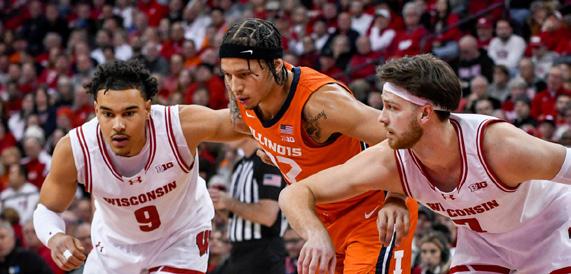
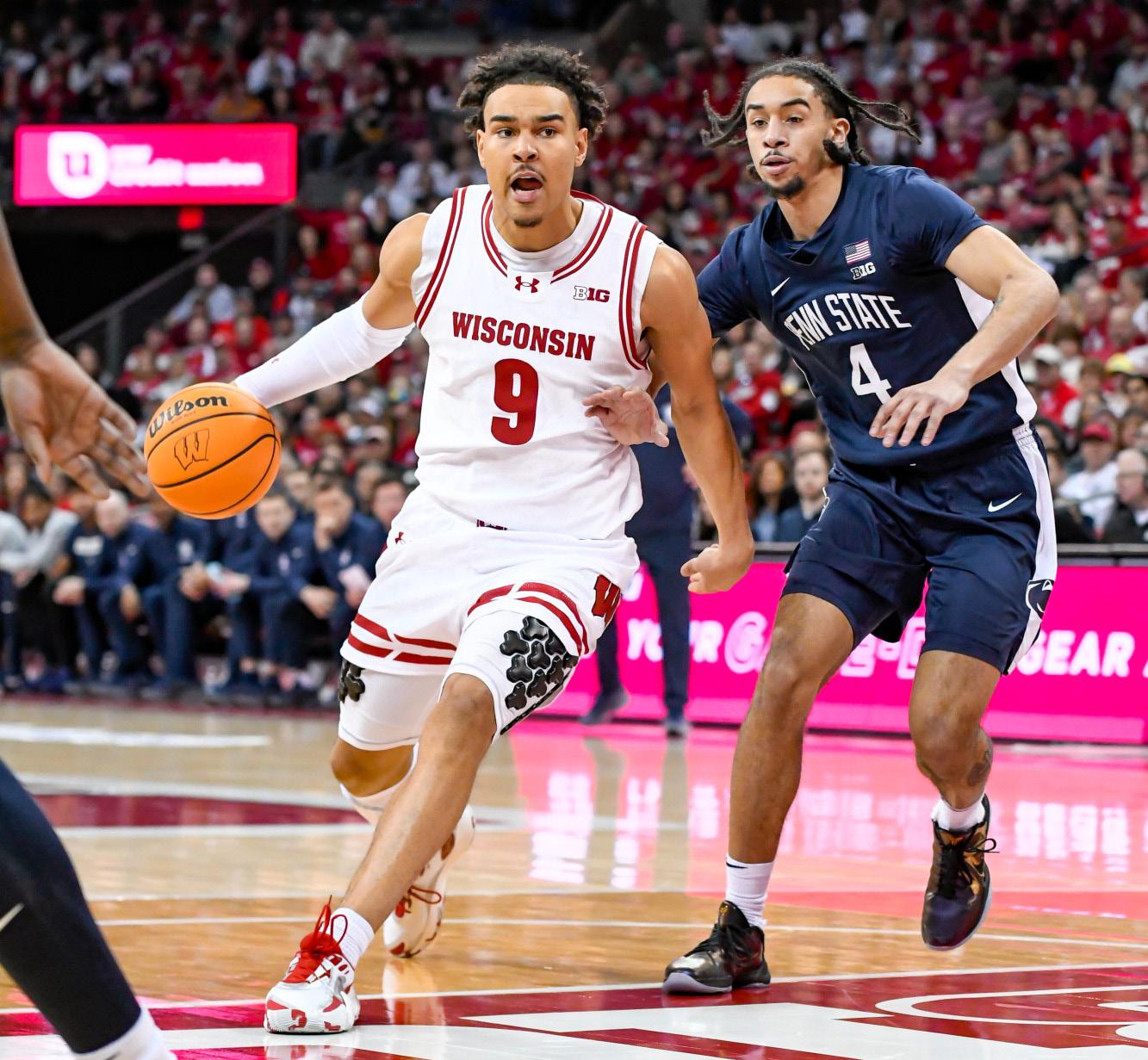
The Badgers play the Montana Grizzlies on Thursday to kick off the round of 64.
+ SPORTS, PAGE 5
Thursday, March 20, 2025
NOOK FOR BOOKWORMS
Molly Fish brings a quirky twist to her downtown book store Lake City Books.
+ LIFE & STYLE, PAGE 8
GOP passes bill to detain undocumented immigrants
By Julia Walkowicz STAFF WRITER
The Assembly passed a bill along party lines Tuesday that would require Wisconsin sheriffs to cooperate with U.S. Immigration and Customs Enforcement (ICE) and detain undocumented immigrants who commit crimes or risk losing state aid.
Gov. Tony Evers has pledged to veto the bill, which is now on its way to the Senate.
The bill, authored by Assembly Speaker Robin Vos, R-Rochester, and Sen. Julian Bradley, R-New Berlin, would require incarcerated people to provide proof of
residency. If they are unable to provide documentation, sheriffs would be required to report them to the U.S. Department of Homeland Security.
Additionally, sheriffs in Wisconsin are required to comply with detainers and administrative warrants from the federal government regarding individuals in their custody and seek reimbursement for related costs. The bill also makes sheriff’s offices responsible for verifying residency and holding people in jail facilities for ICE.
To ensure their compliance with this bill, sheriffs must certify their adherence
to these requirements annually to the Department of Revenue. If they fail to do so, this will result in a 15% reduction in the county’s shared revenue payments for the following year.
The proposed bill also requires sheriffs to maintain records of individuals verified as unlawfully present and their reported crimes, reporting this data to the Department of Justice and the state Legislature. Furthermore, the bill provides immunity from criminal or civil liability for law enforcement actions taken under these provisions.
Khalil arrest sparks fear for future of campus protests
By Wanwa Omot SENIOR STAFF WRITER
U.S. Immigration and Customs Enforcement’s (ICE) detainment and arrest of Columbia University graduate and pro-Palestinian activist Mahmoud Khalil at his university-owned apartment in New York on March 8 sent shockwaves throughout the nation.
The legal justification for the arrest of Khalil, a permanent legal resident who is not officially charged with a crime, has been heavily criticized, though President Donald Trump has doubled down, threatening to cut all federal funding to universities “that allow illegal protests” and promising further expulsions of participating students.
It’s a consequential step in the Trump administration’s push to have “every one of America’s colleges and universities” execute its ideological agenda in immigration and education, and one that has sparked fear among international students for their future.
ICE can’t enter non-public spaces on campus, UW-Madison says
Secretary of State Marco Rubio has claimed Khalil’s deportation is lawful under section 237(a)(4)(c) of the Immigration and Nationality Act of 1952, which grants the secretary the authority to deport individuals whose presence “would have potentially serious adverse foreign policy consequences for the United States.”
Hundreds of University of WisconsinMadison students participated in pro-Palestine demonstrations over the past year, including a 12-day encampment in May and a walkout for Khalil on March 11.
UW-Madison spokesperson John Lucas told The Daily Cardinal a search warrant would be required for federal agents seeking to enter non-public areas, which include private offices and laboratories, residential rooms, classrooms and lecture halls in use and other secured or restricted-access areas.
When asked if UW-Madison would expel students taking place in a protest, Lucas referred to the university’s expressive activity policy, which outlines activities not covered by the First Amendment including interfering with university property, interfering with invited speakers or disrupting the teaching of classes and functioning of the university.
Lucas said infractions could lead to conse-
quences through campus conduct processes or law enforcement.
ICE’s arrest of Mahmoud has sent another chilling effect to universities, already on the brink of losing billions of dollars in federal research funding.
Part of that effect brewed before Trump’s second term. Many universities, including UW-Madison, updated their protest policies before the start of the fall semester with increased restrictions on speech following pro-Palestine protests last spring, including a mandate that UW-Madison leaders maintain neutral viewpoints in matters that do not affect the university’s operations and mission.
Lucas referred to that policy when he told the Cardinal UW-Madison does not have a position on the situation at Columbia University.
‘Legal and constitutional hardball’
International students comprise a significant part of UW-Madison’s research and academic enterprise. They make up 15% of UW-Madison’s student body and have contributed approximately $44 billion to the U.S. economy during the 2023-24 academic year, according to NAFSA data.
Cornell University international graduate student Momodou Taal, along with another doctoral student and professor, sued the Trump administration Sunday arguing its executive orders suppress protected speech that may be “critical of U.S. foreign policy and supportive of Palestinian human rights.”
During the walkout on March 11, attendees warned of the implications of Khalil’s arrest on student protesters and demanded respect for freedom of speech and protest.
“This is a bellwether for what is acceptable in this country. Do we live in a country where
it is acceptable to kidnap a man in the middle of the night because he protested in support of Palestine or not? Because I think that if we live in the former, which we do apparently, then we do not have rights in this country,” protester Dahlia Saba told the Cardinal during the walkout.
UW-Madison political science professor emeritus Howard Schweber told the Cardinal the Trump administration’s actions constitute a “war on higher education,” with Trump’s targeting of international students the “point of the spear.”
Schweber said Trump’s novel actions are raising broad questions that will have to be answered by the judiciary.
“The Trump administration is pushing the bounds of these definitions as far as they will go,” Schweber said, calling Trump’s strategy “legal and constitutional hardball.”
On Friday, the Trump administration canceled $400 million in federal grants and contracts to Columbia University after a Department of Education investigation found “widespread antisemitic harassment has been reported.”
The Department of Education has been investigating 60 universities, including UW-Madison, over antisemitic discrimination and harassment since January 29, 2024.
In a statement on March 11, 2025 after the Department of Education sent out letters to schools, UW-Madison condemned antisemitism and reaffirmed their commitment to promoting “a welcome campus environment for all members of the campus community.”
Lucas declined to comment when asked whether the university was worried that similar cuts from the Trump administration — in addition to pending caps in NIH funding — could occur at UW-Madison if DOE’s investigation yields similar findings to Columbia University’s.
At a pre-session news conference Tuesday, Assembly Republicans defended the bill. Vos called it a way to emulate immigration practices happening in other parts of the country.
“It shouldn’t be controversial,” Vos said during the news conference. “If someone commits a crime who is already here illegally, the simplest thing is for the sheriff’s department to run their names to ensure that they are here legally, if not to cooperate with ICE.”
+ GOP bill page 2
College Democrats, GOP campaign on abortion, safety
By Clara Strecker COPY CHIEF
Ahead of last November’s election, the University of Wisconsin-Madison College Democrats and College Republicans campaigned on abortion rights and public safety, respectively. Now, with the April 1 Wisconsin Supreme Court election weeks away, both organizations told The Daily Cardinal their campaigning tactics have largely stayed the same.
College students play a major role in statewide elections in Wisconsin, with elections often decided by two or three votes per ward. In the 2023 Wisconsin Supreme Court election, record-setting liberal campus turnout propelled the liberal candidate to victory.
Abortion rights and fair maps key issue for Democrats, while Republicans stress public safety
The main issue the College Democrats are highlighting for students is abortion rights, while the College Republicans are pushing safety. College Republicans have pointed to Jerome Windslow, a Madison man who brutally assaulted a student on Langdon in 2019, claiming Crawford gave him a “very lenient sentence.”
“The prosecutor recommended that Winslow be sentenced for 17 years, but Crawford gave him only seven,” College Republicans co-president Ben Rothove told The Daily Cardinal. “We’re really emphasizing that it is a matter of public safety that we support Brad Schimel.”
Winslow pled guilty to two accounts of recklessly endangering safety and a battery charge, but as a part of his plea deal, the charges of false imprisonment and second-degree sexual assault with use of force were dropped.
Crawford sentenced Winslow to seven years in prison plus five years of extended supervision on a count of first-degree recklessly endangering safety, both to be served concurrently. Winslow was also sentenced on a count of substantial battery intending to cause bodily harm to 1.5 years in prison and two years of extended supervision, also to be served concurrently.
+ Campaigning page 3
TY JAVIER/THE DAILY CARDINAL
GOP bill
Continued from page 1
The Dane County Sheriff’s Office previously said in a January statement they would no longer participate in the State Criminal Alien Assistance Program (SCAAP), citing a desire to honor community values.
Editor-in-Chief Francesca Pica Managing Editor Ava
In a February statement, Dane County Sheriff Kalvin Barrett called the bill an “unfunded mandate” that will fall on taxpayers to fund.
“Public safety decisions should
be made by those who understand the complexities of policing and the unique needs of our communities. The separation of power between the Legislature and law enforcement is imperative to ensure that political narratives do not interfere with or influence our responsibilities as law enforcement,” Barrett said.
SCAAP provides funding to agencies that give names of individuals who have spent at least four consecutive days incarcerated and have committed at least one felony or two mis-
demeanor convictions to ICE. While SCAAP has previously provided about $90,000 yearly to Dane County, the funds were not directly given to the sheriff’s office.
Rep. Jim Piwowarczyk, R-Hubertus, a cosponsor of the bill and former law enforcement officer, expressed support for the bill.
“I’ve seen first hand how important it is to keep dangerous individuals off the street,” Piwowarczyk said at the news conference. “This bill ensures that we take every opportunity to hold
individuals who threaten public safety pending federal action.”
Evers has been critical of the bill and outspoken in his criticism of President Donald Trump’s immigration policies.
“I think that’s a decision to be made county by county. Sheriffs are public officials or run for election. They should be able to make those choices,” Evers said Feb. 4 at an event near La Crosse. “We don’t need the Republicans and Madison telling sheriffs what to do.”
The billionaires buying the Wisconsin Supreme Court race
By Ty Javier SENIOR STAFF WRITER
With the April 1 election less than two weeks away, Wisconsin’s Supreme Court race is expected to become the most expensive judicial election in American history.
Waukesha County Circuit Judge Brad Schimel, a former Republican attorney general, faces off against Dane County Circuit Judge Susan Crawford in an attempt to flip the court’s 4-3 liberal majority.
If Crawford wins, liberals will maintain their 4-3 majority until at least 2028. Janet Protasiewicz, who campaigned largely on the issue of abortion rights, won her election to the court in April 2023, establishing a liberal majority for the first time in 15 years.
The race that year blew past national spending records in a judicial contest, with more than $51 million spent on both sides, based on a
tally by the Wisconsin Democracy Campaign. The organization, which monitors campaign spending, held a press briefing Monday to share preliminary findings on spending for the upcoming election.
Executive Director Nicholas Ramos said at the briefing that, at the current pace, spending for this year’s contest could double last year’s total.
Wisconsin Supreme Court races are officially nonpartisan, but political groups often support their preferred candidates. The Democratic Party of Wisconsin has endorsed Crawford, while Schimel has backing from conservative lawmakers like U.S. Rep. Derrick Van Orden.
Successful political campaigns cost money. When races get tight, campaigns rush to raise and spend large sums to get the word out.
The Wisconsin Ethics Commission (WEC) limits the amount individuals can contribute to
a Supreme Court candidate’s campaign to $20,000 per election cycle. This restricts large donors who wish to influence the election in a larger way, this limit can be circumvented by donating to — or founding — a Political Action Committee (PAC).
This cycle, PACs have collectively pumped $21.6 million and counting into the Supreme Court race, according to a Daily Cardinal analysis of Federal Election Commission and WEC data. The graphics below show the top PAC spenders, their party alignment and top donors.
Some PACs may receive unlimited contributions from individuals, corporations, labor unions and other PACs for the purpose of financing independent expenditures — spending for a communication that advocates the election or defeat of a candidate without coordination with any candidate, their campaign or political party.
From CEOs to Elon Musk, the
mega donors listed below leverage their wealth to influence elections according to their ideologies. Notable contributors include heirs of the Walmart fortune, Koch Industries and the CEO of Uline. Independent expenditure committees have reported spending more than $21.6 million to date in expressed opposition and support of the two candidates. PACs and other interest groups form independent expenditure committees and, even ones from out of state, do not have to disclose all of their information to the Wisconsin Ethics Commission. Spending by these groups may not be fully known until after the election, possibly as late as July.
Note: The independent expenditures listed below are exclusively for the Wisconsin Supreme Court race. Donations are made to the PACnationally,althoughsomeonly spendinWisconsin.
UW-Madison dance group connects students with Irish culture
By Avery Chheda STAFF WRITER
For University of Wisconsin-Madison sophomore Audrey Catlin, dance is where she feels most connected to her Irish culture. Catlin comes from an Irish family and grew up going to Milwaukee Irish Fest, where she first experienced traditional Irish dance.
“I thought it was super cool, I just never really did it,” Catlin said.
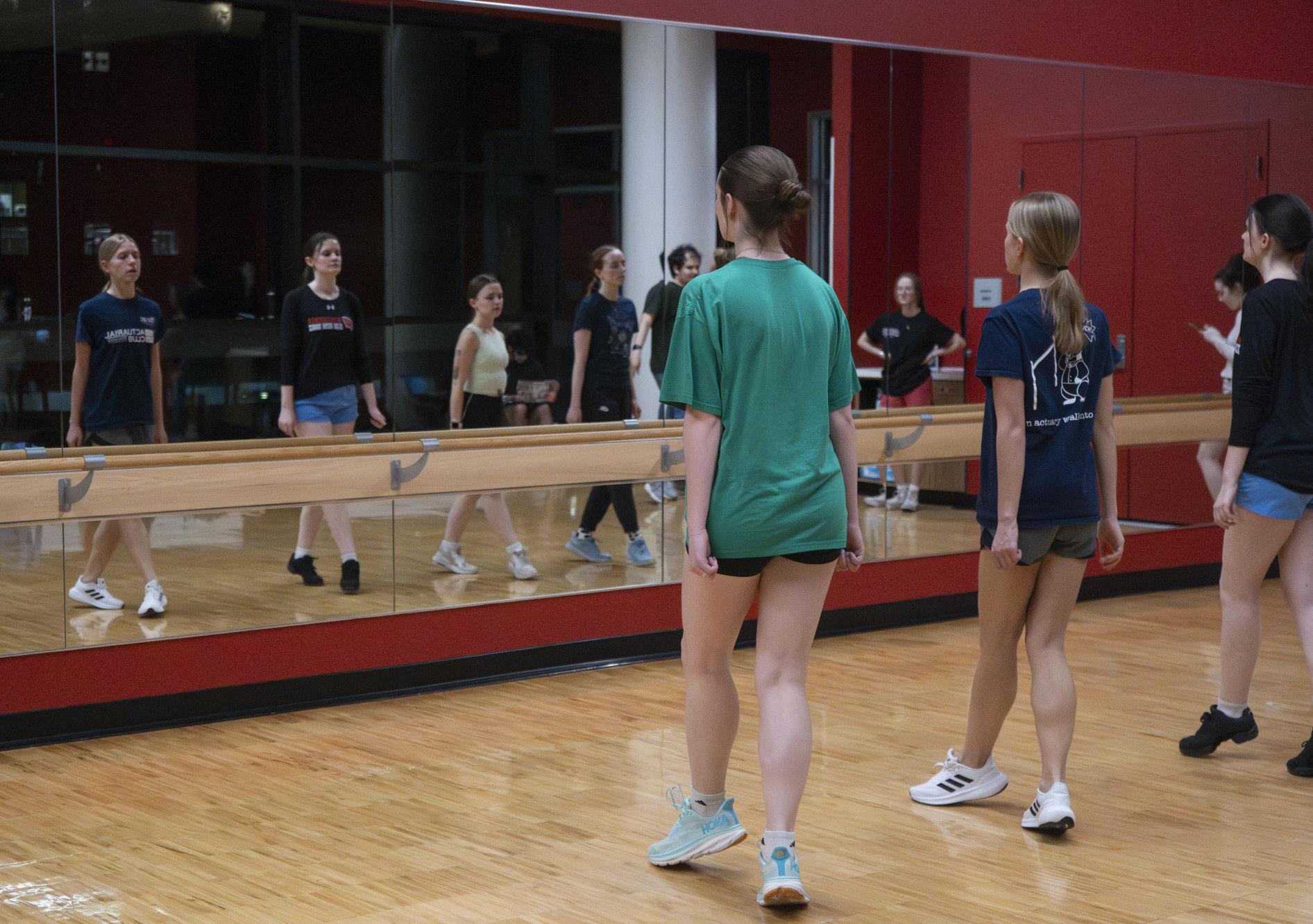
That all changed when Catlin joined Sláinte Irish Dancers, UW-Madison’s Irish dance club. Founded in 2010, Sláinte serves Irish dancers at the competition level and recreationally. The club practices twice a week at the Nicholas Recreation Center.
In addition to performing on and off campus during the school year, Sláinte travels for national competitions. In the past, Sláinte took home the College Ceili Championship at the MidAmerica Oireachtas as well as the video competition at the College Irish Dance Association (CIDA).
Choreographer Vivi Andersen invited Catlin to her first Sláinte practice.
“I was like totally, that sounds like fun, because college is for trying new things,” Catlin said. “I just kind of stuck with it, it’s been one of my new passion projects as an adult.”
After just a couple weeks, Catlin was invited to compete with Sláinte at their first competition of the season, the MidAmerica Oireachtas. She said her experience with Sláinte has given her an opportunity to be more involved with her Irish heritage.
“I feel like Irish dancing is a really cool way to feel more connected and traditionally act on your culture,” Catlin said.
Her favorite way to con-
nect with the community with Sláinte is through performances at bars with live Irish bands and senior centers.
Noelle Cataldo, who spends her days working on her Ph.D. and researching the mechanisms of antidepressants, uses Irish dance as her own form of dopamine.
“It’s really nice to have a creative outlet. It keeps me in shape and all my best friends [dance too],” Cataldo said.
Cataldo is from Boston, a city rich with Irish culture and one of the first homes for Irish Americans during the Irish Potato Famine.
“We have a deep-rooted history living in Ireland. Some of my family still lives there,” she said.
But not all club members come from Irish ancestry.
Andersen isn’t Irish at all, but she said she grew up with an appreciation for the culture, playing the fiddle and dancing at the Milwaukee Irish Fest from seven to 13 years old.
Andersen was recruited at the student organization fair, where she said they picked her out of the crowd.
“They pulled me out and they were like ‘you look like an Irish dancer,’” she said.
She said the club was very welcoming and accepted her with open arms despite her long hiatus.
“It’s so chill, and everybody is super welcoming. I did miss [Irish dance], just not in the environment I was in when I was younger,” Andersen said. “Such a significant portion of our members have no Irish dance experience, and I think something that’s really cool about our club is how accessible it is.”
The club draws beginners and dance experts alike.
One of those beginners is
Campaigning
Continued from page 1
Abortion has been a critical campaign issue for Wisconsin Democrats after the U.S. Supreme Court overturned Roe v. Wade in 2022. The decision triggered an 1849 Wisconsin law banning abortion, though Dane County Judge Diane Schlipper ruled the 19th century law does not ban abortion, leaving the liberal-controlled court to hear a case soon on whether the ban is law and if the Wisconsin Constitution protects the right to an abortion.
Justice Janet Protasiewicz won in 2023, flipping the court’s majority to liberal for the first time in 15 years. Protasiewicz centered her campaign around supporting abortion rights, defeating her conservative opponent by 11 points.
“Reproductive freedom is always a big issue for students,” Joey Wendland, president of the College Democrats, told the Cardinal, adding other important campaign points include workers rights.
In 2011, former Wisconsin Gov. Scott Walker signed Act 10, which eliminated collective bargaining for most public employees and is likely to appear before the new court.
Owen Goff, a graduate student who took up dancing in 2023 after a trip to Ireland sparked a desire to connect with the culture despite having no Irish background. Goff is the only man in the club, which originally held him back.
“I initially was hesitant to join because I realized I’d be the only guy, but then I said to heck with it,” Goff said. He advises others to join despite similar hesitations. “It might be daunting and takes practice, but everyone in the club seems to genuinely enjoy what they do.”
Freshman Zoe Scheel has been dancing since she was four. Although her mom’s side is Irish, Scheel said she dances for the “sport” and “social aspect.”
“The club is so welcoming, and everyone is so kind. They’re the nicest people I’ve ever met,” Scheel said, encouraging anyone interested in dance to join the club.
Before joining Sláinte, Scheel was a member of Glencastle Irish Dancers, where she performed a handful of times at world championships. There are different events at Worlds, such as four- and eight-person Ceilis — or group dances — and individual events.
Scheel qualified for Worlds in 2023 after placing seventh at the Mid-America Oireachtas. At the 2024 North American Irish Dance Championships, Scheel’s U19 4-Hand team took first place.
The club will compete at CIDA in Dayton, Ohio, on April 5,. sending nine dancers to the event. Their performances will include nine solos, two 4-hands, one 8-hand, an Irish dance set to Dolly Parton and one video competition set to the “Mamma Mia!” soundtrack.
little burnt out and tired from politics, so that is why we’re really focusing on door to door and tabling efforts right now, because we’re trying to raise awareness among the student body about this election.”
Wendland also highlighted the importance of social media. Already active on Instagram, the College Democrats have now started posting on TikTok, trying to reach a broader audience and raise awareness there.
While the College Democrats canvas close to or on campus, the College Republicans said their strategy is to go off campus to the Waunakee area to door knock, where they can make a “bigger difference.”
Similarly, Rothove said the College Republicans have not changed their tactics since the presidential election. They also use social media and tabling to raise awareness about the election, and are trying to “make sure” that people involved in Students for Justice in Palestine know that Crawford represented an Israeli pharmaceutical company — trying to make sure the “hard left hates Crawford.”
Wendland also mentioned fair voting maps as an important campaigning issue for Democrats. New legislative district maps were signed into law in 2024 after a prolonged struggle between parties to agree on fair voting districts.
“I’ve talked to different state legislatures from across the state, and what they said is they believe Republicans are itching at the chance to try and overturn the fair maps, and that’s what they’re going to try and do if Brad Schimel wins,” Wendland told the Cardinal.
Campaign strategies remain unchanged, organizations say
Early this year, the College Democrats have been tabling and door knocking to rally voters before the election. These are similar strategies they used for the 2023 Wisconsin Supreme Court race and the presidential election back in November, Wendland said.
“In 2023 we did not start canvassing in February. This year we started canvassing February 8,” Wendland told the Cardinal, adding they knocked on over 1,500 doors. “After the presidential [election] some people might be a
When Crawford was an attorney, she previously represented Teva Pharmaceuticals in a price-fixing lawsuit, and the state has also been in legal battles against the company for manipulating drug prices. Similarly, Schmiel has been criticized for receiving donations from opioid manufacturers like Purdue Pharma.
The College Republicans have held events to raise awareness and get students engaged, including a recent social event with Schimel and a Super Chase event with Turning Point Action and Brittany Kinzer, their preferred state superintendent candidate on Thursday.
Both organizations expressed confidence about the outcome of this race.
“I truly believe that we’ll win this election,” Wendland told the Cardinal, emphasizing the importance of student turnout. “We’ve got to make sure we highlight that to students, and make sure they understand that their vote is going to make a difference.”
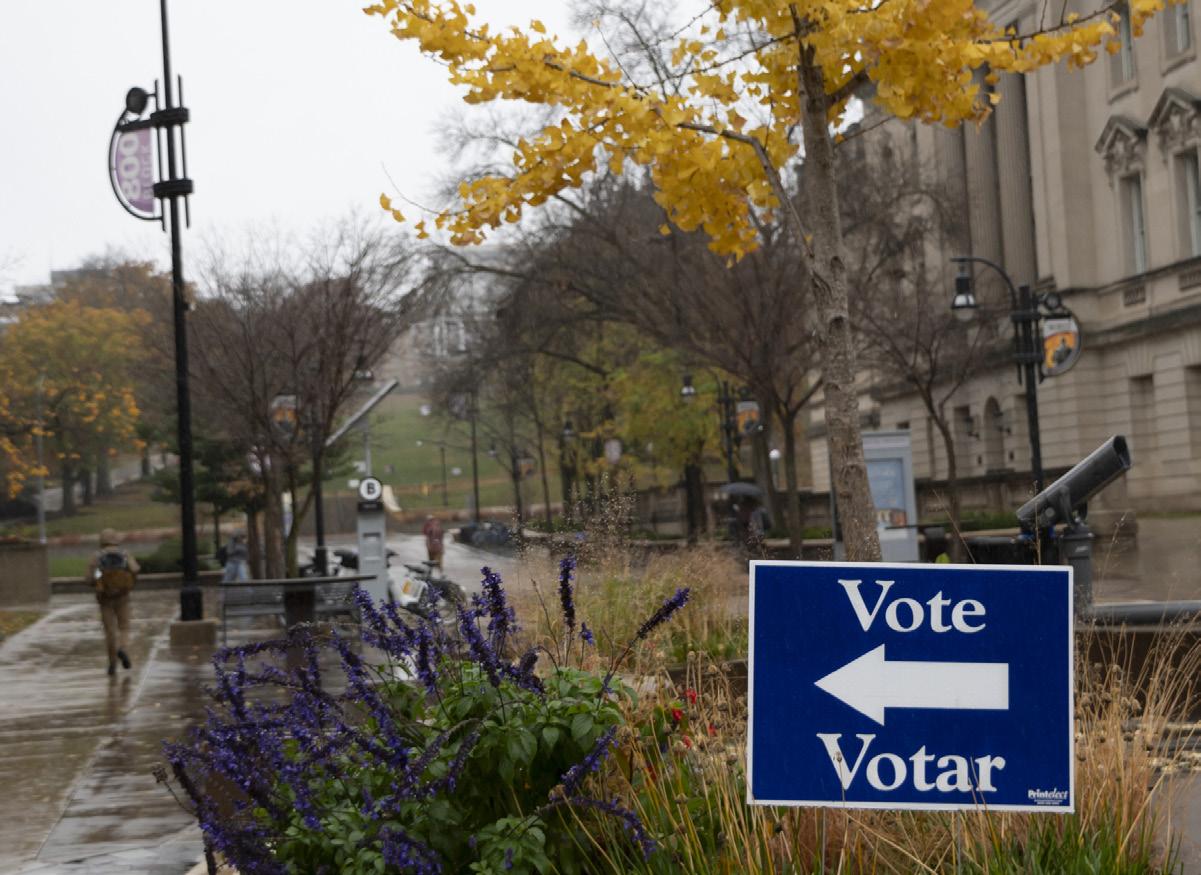
Early in-person voting in Wisconsin started on March 18. On-campus polling locations include Memorial Union and the Health Sciences Learning Center which are open weekdays from 11 a.m. to 5:30 p.m. and at Union South which is open from 11 a.m. to 5 p.m. through March 28.
BAILEY KRAUSE/THE DAILY CARDINAL
Dane County parks receive expansions, improvements ahead of spring
By Vanessa Gavilan CITY NEWS EDITOR
As spring comes to a head, Dane County Parks has made updates and improvements to local parks to make them more suitable for students and the community.
Dane County Parks Advisor Joleen Stinson said in a press release on March 13 that despite the warm temperatures, some parks will remain closed for the transition from winter to spring to prevent damage to trails.
“Visitor use of the county parks, trails and natural resource areas are at an all-time high, but the spring thaw period combined with high use
can have long-term impacts, especially on grassy or limestone hiking trails,” Stinson said.
Stinson said the spring rain and drying winds will help firm the ground, at which point the parks will be reopened.
Improvements made to local parks
During the park’s offseason, three parks had construction projects that will be fully operational starting this spring.
The biggest project, costing $3.5 million, took place in Door Creek park. This project includes a new
shelter with built in fireplaces and kitchens, as well as new basketball and futsal courts.
Door Creek’s shelter will be open year-round and has no official start date.
Tenney Park is building a replacement for the current beach shelter to be opened for the spring season.
In 2021, an application was processed to begin the replacement process for the existing shelter, citing safety and accessibility concerns.
“The existing shelter is an aged facility with inadequate accessibility, inadequate plumbing fixtures and lack of a covered seating area,” the letter said.
Madison top 10 happiest city in U.S., some students not convinced
By Wanwa Omot SENIOR STAFF WRITER
Madison, Wisconsin is the seventh happiest city in the United States, according to a new study released on March 11 by personal finance company WalletHub.
The study was based on research suggesting that having more money increases happiness until a person earns about $75,000 per year — a threshold known as ‘income satiation.’ Earnings beyond that are unlikely to significantly impact happiness.
Some of the cities joining Madison in the top 10 include Fremont, California, Sioux Falls, South Dakota and Scottsdale, Arizona. Studies have shown that where a person lives can impact the income needed to reach that level of happiness.
WalletHub evaluated 182 cities across three dimensions: emotional and physical wellbeing, income and employment and community and environment.
WalletHub analyst Chip Lupo said a happy city should offer more than just a livable income — it should also “provide conditions that foster good mental and physical health, like reasonable work hours, short commutes, good weather, and caring neighbors.”
Elianna Ig-Izevbekhai, a University of Wisconsin-Madison student, moved to Madison from Woodbury, Minnesota. She thought it was a good idea to relocate even though she knew very little about Madison.
“I feel like my only impression of Madison was like corn, cheese, fields, cows, just like Midwestern stereotypes,” Ig-Izevbekhai told The Daily Cardinal.
Now in her fourth year in Madison, Ig-Izevbekhai said Madison both meets and falls short of the conditions for ideal cities. She pointed out how difficult it is to reach the income level associated with higher happiness.
“So it’s really hard to consider a good family life, a good social life, or nightlife or weather and all those things when you’re making $30,000 a year,” Ig-Izevbekhai said.
Madison was also placed ninth in the com-
munity and environment category. That category included data from a December 2024 WalletHub study ranking the most caring cities in the country, in which Madison placed eighth.
Ig-Izevbekhai was surprised when she learned Madison outranked Minneapolis, a city she praised for its opportunities for younger adults.
“I have just observed that everyone there, young adults especially, seem to be a lot happier with their experience,” Ig-Izevbekhai said. “Like nightlife, housing especially, it’s a lot easier there than it is in Madison.”
Although Ig-Izevbekhai loves Madison’s natural environment, especially in the summertime, she says it is not a place she sees herself living in the next five years.
“If I am to make the most out of my 20s and to be able to experience life and also have a good prospect and a future, I think that I would be better served elsewhere,” she said. “Probably still in the Midwest.”
As more students and young adults flock to Madison for school and work, the tightening housing supply is contributing to financial stress. The City of Madison aims to build 15,000 new homes by 2030, with a quarter of those homes having below-market rates.
For Madison native and UW-Madison student Travona Jordan, issues including health care, education and the cost of living come first to mind when thinking about her experience.
“I think the cost of living here just sucks — and for people to only be making $11 an hour or $15 an hour is still not sufficient in this economy,” Jordan said. “It’s honestly a slap in the face to us Wisconsin residents.”
Jordan, a graduate of Memorial High School, applauded programs like IEP and early college academies in Madison helping high school students succeed. She thinks Madison has shown good improvement in the education sector, but said it still has a way to go.
“I think that people are just genuinely happy here,” Jordan said. “It’s just a happy city, but it’s not the happiest city.”
“The popular beach destination lacks amenities like bike racks, bottle fillers and showers.”
The new shelter addresses these concerns and includes solar paneling to support Dane County’s clean beaches initiative.
A similar structure is being built for Country Grove Park on Madison’s West Side, but the shelter may not be finished in time for the opening of the park.
As of this month, over 400 requests for shelters across Madison parks have already been processed, with around 100 of the requests accepted, according to city documents.
Parking fee pilot project paused for 2025
In November, the Common Council approved a proposal to begin charging a parking fee for some local parks for special events.
The program, which was intended to start summer of 2025, would’ve earned the city around $24,000 annually.
However, the project was canceled last month due to concerns from other city officials about the logistics of implementing such a project.
The project will likely be reintroduced to the Common Council in the fall.
Conservative speaker blasts
By Jake Piper STAFF WRITER
Conservative political commentator and author Heather Mac Donald condemned diversity, equity and inclusion (DEI) efforts on college campuses nationwide at a Center for Research on the Wisconsin Economy event Thursday.
Mac Donald said DEI is a “cover-up” for the “racial skill gap” caused by “a culture that makes excuses” for Black communities.
“At its core, the entire diversity agenda is about the academic skills gap, and it’s about racial preferences,” she said.
Mac Donald’s statements come as federal organizations continue to crack down on DEI policies, and many colleges — and their students — have been left in the dark about programs’ futures. While DEI ostensibly covers a range of identifiers including financial status, race and gender identity, Mac Donald and other critics of DEI often focus their criticism — and legislative efforts — on Black students.
The impact of DEI on college admissions
Mac Donald told the crowd DEI programs unnaturally uplift Black students to positions outside their academic skill set, harming university programs through lowered graduation rates for Black students. However, data from the Civil Rights Project shows the opposite is true. Schools with affirmative action programs have both a higher Black student graduation rate and a lower Black-to-white graduation gap than non-affirmative action colleges.
Mac Donald argued the driving force behind DEI efforts nationwide is to “cover up the racial skill gap,” pointing to lower SAT scores among Black students as evidence.
When asked what would help close such education gaps, Mac Donald deflected the question, reiterating that DEI efforts in its current state do not help Black students bridge the gap at colleges.
According to the College Board, Black students in high school scored approximately one standard deviation below the nationwide average on the 2024 SAT. Mac Donald argued these lower scores enable “so-called” underrepresented minorities to be “catapulted into an academic environment for which they cannot competitively qualify” through DEI initiatives at college campuses across the country.
She said DEI programs give preferential treatment to minority groups, allowing them to be admitted to schools with scores that would be “automatically disqualified” if presented by a white student.
Affirmative action is intended to choose the most qualified individuals while achieving equal opportunity for all, according to Upstate Medical University, and does not require preferences. Instead, race, gender or nationality
are factors to be considered similar to preferences given for geographic diversity on college campuses or for children of alumni.
Mac Donald says achievement gap caused by ‘culture that makes excuses’
Mac Donald also argued the Black-white achievement gap can be attributed to “a culture that makes excuses” in education starting at a young age, denying other factors could be at play.
“There should be more early emphasis on excellence in schools and not making excuses. I think we should all emulate Asian parents in their attention to students’ school performance — doing homework, taking textbooks home, not running the streets. I think there needs to be a culture that values academic achievement,” Mac Donald told The Daily Cardinal.
The achievement gap can start as early as nine months old. Socioeconomic disparities, including income and differing levels of education between white, Black and Hispanic parents, often leads to higher-income and more educated families providing more resources for their children to do well in school, such as tutoring, according to the Stanford Center for Education Policy Analysis.
Mac Donald said diversity departments at universities work to “cover up the racial skills gap and come up with a different explanation.” She said DEI officials and “liberal media” at large blame a “systemically racist society” as the reason for introducing DEI efforts.
She argued that academics leverage the idea of the West’s “unique” racism to implement systems of inclusion like “lower requirements” for Black students entering a school compared to their white counterparts, and believes it’s “bogus” that scholars refer to racism as a defining aspect of Western civilization because “there has not been a civilization anywhere that has not practiced slavery.”
Mac Donald referred to the Black Lives Matter movement, which spawned out of the death of George Floyd in 2020 as the “George Floyd mass psychosis.” She said the period of time following his death in which many companies strengthened their diversity hiring practices was a “mathematically illiterate” practice which failed to find the best candidates in the overall job market.
She said corporations were focused too much on hiring the most qualified person within a specific identity group rather than evaluating all applicants equally.
“My being female should earn me no privileges anywhere, and I know it does all the time,” Mac Donald said, noting that Fox News had asked her to panel at an event in which she was “the best female candidate” as opposed to the best candidate.
Badgers lose Big Ten Tournament title for second straight season sports
Takeaways from Wisconsin’s 53-59 loss to Michigan in the Big Ten Tournament championship.
By Josh Murphy STAFF WRITER
The Wisconsin Badgers men’s basketball team came just short of a Big Ten title for the second consecutive season, falling to Michigan in a 53-59 defensive showdown. It was a heartbreaker for the Badgers, as Michigan swept them on the season.
Despite the loss, there were a lot of positives from the game. But there are also plenty of concerns looming over head coach Greg Gard’s squad. Here are the biggest takeaways from the Big Ten championship game as the Badgers gear up for the first round of the NCAA March Madness Tournament.
Shooting drought
Wisconsin had trouble getting their shots to fall against Michigan, shooting only 22.1% from the field and 17.9% from 3. It just wasn’t their afternoon, and the shooting drought ultimately cost them a Big Ten title. John Blackwell led the scoring for the Badgers, coming away with 18 points on 35.3% shooting.
It was by far Wisconsin’s worst offensive showing of the season, and it comes arguably at the worst time possible — right before the first round of the NCAA Tournament. The Badgers’ offense came back to life during the Big Ten tournament following the return of Max Klesmit, but the wheels came off against the Wolverines.
While Michigan had a great defensive game plan, it’s also worth noting that Wisconsin does not match up well with the Wolverines.
Centers Danny Wolf and Vlad Goldin have terrorized the Badgers this year, and their physicality has dramatically hindered their offensive efficiency. In their two matchups, Wisconsin only averaged 58.5 points on 28.0% shooting and 19.7% from beyond the arc.
The Wolverines simply have had the Badgers’ number, and it showed on the court twice this season.
Wisconsin has struggled against elite big men like Wolf and Goldin all year long. They’re sure to face other premier post players in the tournament, so it’s imperative to adapt and game plan accordingly.
Defensive slugfest
In their first meeting, the Wolverines held the Badgers to 64 points, their lowest point total of the regular season. Both defenses came to play once again in the Big Ten championship game in the low-scoring affair, and Michigan held Wisconsin to under 60 points for the first time all season.
The Badgers did an excellent job of rebounding against the Wolverines, racking up a whopping 46 total rebounds including 31 defensive rebounds. For context, Michigan had 18 offensive rebounds in the semifinals
vs. Maryland, but they only totaled six on the day against Wisconsin.
This was a good showing from the Badgers, as rebounding hasn’t necessarily been one of their strong points this season. Opponents average 34.0 rebounds per game against Wisconsin, 12th best in the Big Ten. If they can continue to step up on defense and pick up crucial rebounds, the Badgers’ odds of making it further into the dance drastically improve.
Michigan’s Tonje treatment
John Tonje had an electric performance throughout the Big Ten Tournament, averaging 25 points per game in the three previous tournament contests. He clearly put Michigan on notice, as the Wolverines’ defensive game plan primarily focused on the star guard. Defenders rushed to guard Tonje if he ever got into open space, and as a result, he had a goose egg in the first period.
Tonje, being the player he is, started to pick up the heat in the second half. He started to drive and take more shots in the paint, drawing four fouls. Tonje ended the day with nine points, seven of them coming off free throws. But he went 0-for-5 on 3-point attempts.
The Tonje treatment is especially worrisome for the NCAA Tournament. He is Wisconsin’s best player by far, and the rest of the team couldn’t carry their weight against Michigan when Tonje
got locked up. Other teams will likely implement the same defensive strategy during March Madness, and the Badgers need to find a way to adjust if they want to make a deep run in the tournament. Wisconsin had an uncharacteristic afternoon offensively. Michigan held Tonje under 10 points for the first time since January, and the Badgers scored less than 60 points for the first time in over a year. They’ll need to put their loss in the rearview mirror fast, as they have a quick turnaround and square off against the No. 14 seed Montana Grizzlies in the round of 64 in the NCAA Tournament on Thursday.
The Badgers earned a No. 3 seed in the East region and will attempt to make some more noise in March this year after they were bounced in the first round last season.
Back-to-back losses in the Big Ten Tournament Championship are tough to stomach. But it serves as a timely reminder of the challenges ahead. The painful feeling of defeat is fresh in the minds of the Badgers, and Gard’s squad will, without a doubt, be heading into March Madness with a vengeance. The Big Ten title slipped through their fingers, but the real prize is still within reach. Let the dance begin.
Wisconsin softball takes 2-1 series victory over Illinois
By Haellie Opp STAFF WRITER
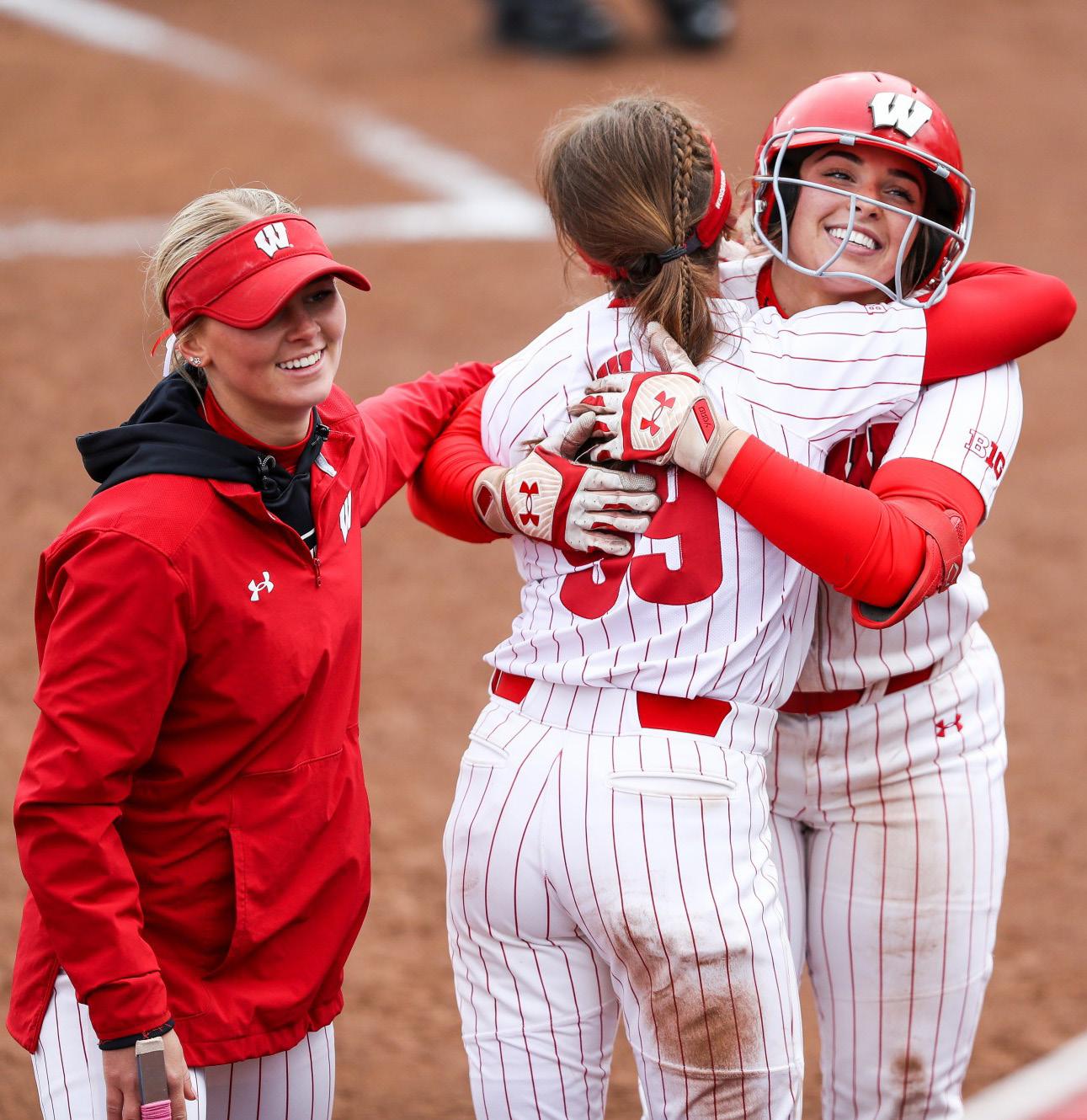
The Wisconsin Badgers softball team scored 29 runs against the Illinois Fighting Illini in a three-game away series Friday and Saturday, coming back in the later game on Saturday.
Crushing victory
The Badgers scored 15 runs against the Illini on Friday, ending the game at five innings due to the run-rule.
The Badgers started slow in the first two innings. Brooke Kuffel singled up the middle for Molly Schlosser to run home to put the Badgers up 1-0. Illinois put up two runs before infielder Danielle Lucy tied it for Wisconsin.
Illinois scored twice more before Wisconsin started their aggressive play toward the lead. Alivia Bark hit a double in the fifth, totaling three hits this game alongside Kuffel. The Badgers hit five home runs, with Kuffel clearing the bases on the fifth with a grand slam.
This game marked Wisconsin’s highest run total of the season and Kendra Lewis’s first-ever collegiate home run.
Losing their lead
Wisconsin fell in the second game of the series with a 9-6 loss to the Fighting Illini on Saturday. Wisconsin scored first from Lewis’ single then went on to give up nine
unanswered runs throughout the third and fourth innings.
Wisconsin got five up on the board between the fifth and seventh innings but ultimately fell short. Lewis showed up with two hits for the Badgers, leading the team early afternoon. At the bottom of the fourth, Lewis stepped up to pitch and struck out two batters. The Badgers hit three home runs starting with Emily Bojan in the fifth, Emmy Wells in the sixth and Lewis to close out the Badgers’ attempt at taking the lead in the series.
Closing it out
Wisconsin took home the three-game series by finishing out on Saturday with an 8-6 victory. They led in the first and second innings with three runs, starting the game with a homer from Schlosser that sent Bark home.
Illinois scored two more before Kuffel’s double in the second that sent Schlosser home. It was more so a back-and-forth between teams to finish out the last game of the series, handing the win to the Badgers after an Illinois run in the seventh.
Pitcher Gabi Salo leads Wisconsin pitchers with 10 wins and six complete games this year. Salo had three strikeouts and zero walks Saturday evening.
Wisconsin heads to Oklahoma City to face Purdue for a two-game series on Thursday and Friday.
MEGHAN SPIRITO/THE DAILY CARDINAL
A fresh American surge in cycling: Why you should tune into the Tour de France opinion
By Owen Puckett
OPINION EDITOR
American sports fans are no strangers to grand spectacles.
From the roar of NFL stadiums to the nail-biting drama of NBA playoffs, the United States knows how to put on a show.
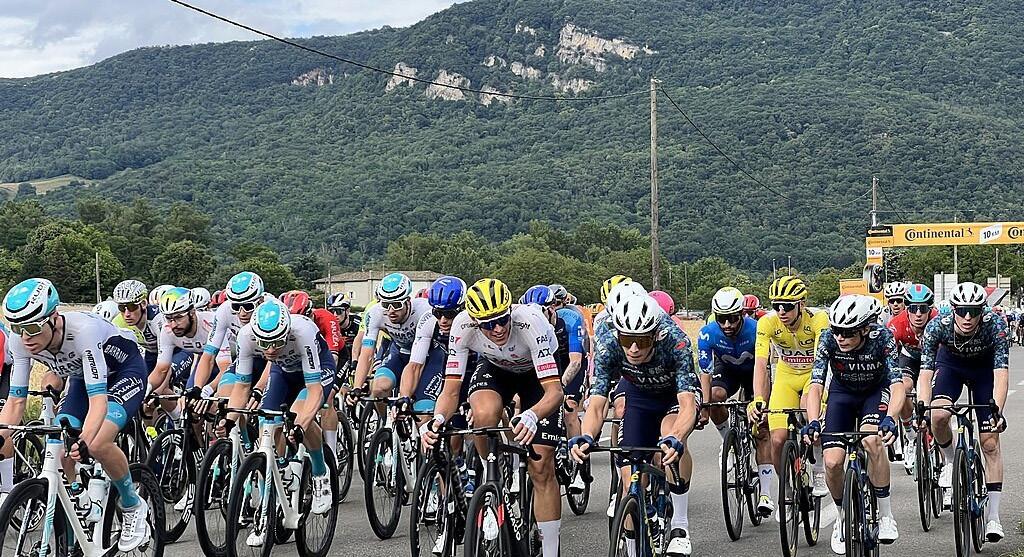
Yet there’s one global event that still flies under the radar for many in this country: the Tour de France. It’s easy to understand why some Americans are skeptical about investing time in a sport that, at first glance, can look like a group of riders pedaling through European countryside.
However, in recent seasons, a new wave of U.S. cyclists has burst onto the scene, posting strong results and capturing headlines abroad. With multiple Americans now poised to make real impacts in the Tour, there’s never been a better moment for U.S. fans to give cycling a chance.
When people ask, “why would I watch a sport that’s just people riding bikes?” The short answer is that it’s so much more than that. The Tour de France is a 21-stage odyssey across multiple regions of France — mountains, coastlines, cobblestone roads and sprawling valleys. Each day, known as a stage, can last four or five hours, with riders pushing their bodies to the absolute limit. It’s part endurance battle, part strategic chess match and part national showcase of culture and scenery.
Watching the peloton (the main group of riders) navigate unpredictable weather, hairpin turns and sudden breakaways soon becomes a riveting drama. Layer on the fact that you can root for several prom-
ising U.S. athletes and you’ve got a recipe for sports entertainment at its finest.
Contrary to the idea that cycling is an “individual” sport, the Tour de France highlights the depth of teamwork required for success. Riders work together to shelter their leader from wind, chase down opponents’ attacks or control the pace of the peloton to set up a sprint finish. Imagine the tactics of a basketball game, multiplied by 150 cyclists working in alliances that can shift from stage to stage. Now, factor in grueling ascents where a rider’s heart rate is soaring as they pedal uphill for miles on end. Add in the threat of crashes, mechanical mishaps and sudden bursts of aggression from rivals. It’s a spectacle rich in tension, where every day can feel like a season-defining moment.
This tactical complexity is precisely what hooks so many fans once they give pro cycling a fair shot. A breakaway — where a small group of riders surges ahead of the peloton — might gain a large lead, only to be reeled in at the final kilometer by coordinated teamwork behind them. Some days, the breakaway triumphs against the odds, proving that bold decisions can pay off. On mountain stages, the race can explode in seconds when a cluster of contenders accelerates, dropping everyone else, possibly changing the Tour’s overall standings. These moments of high drama happen daily.Imagine seeing that drama unfold with homegrown riders making those big moves.
For the uninitiated, the Tour de France also doubles as a virtual travelogue. Broadcasters treat viewers to
stunning helicopter shots of French castles, vineyards and rugged mountain passes. Commentary teams, often including former pros, provide insights into the race’s tactics while also sprinkling in snippets of local culture and cuisine. The Tour is as much about the pageantry and atmosphere as it is about the competition. If you’re looking for a sports event that’s immersive, informative and visually dynamic, it’s difficult to find one more compelling than the Tour. And that’s before you even dive into the individual and team battles that rage for three weeks straight.
Additionally, broadcasts today are more beginner-friendly than ever, with commentators offering straightforward explanations of tactics and team dynamics. Within a stage or two, you’ll grasp the basics: the significance of the yellow jersey (race leader), the polka dot jersey (best climber) and the green jersey (top sprinter).
Watching the Tour with a rooting interest can make the experience even more thrilling. For years, Americans turned away from cycling either because they weren’t aware of any standout U.S. athletes or because the sport’s doping scandals tarnished its image. But the latest generation of American cyclists is writing a new chapter, trading old controversies for results that draw respect from international fans and fellow professionals. Whether they’re wearing the leader’s jersey in a smaller stage race or posting top finishes against the world’s best, these Americans embody a fresh wave of optimism. They’re proving that the U.S. can once again cultivate athletes who can compete at cycling’s
highest levels — and do so cleanly and compellingly.
This growing American presence offers a chance for U.S. viewers to reconnect with the global nature of sports. Cycling is an international affair, blending cultures and languages in one peloton. Athletes from Europe, South America, Africa, Asia and North America race sideby-side, forging friendships and rivalries that transcend borders. For Americans who typically watch domestic leagues, the Tour can be an introduction to a worldwide sporting community. Rooting for U.S. riders in this mosaic of nationalities adds a unique sense of pride and involvement. You’re not only cheering on the underdog story of an American who learned to speak French or Italian to fit into a European team — you’re also witnessing the bridging of cultural gaps through the shared language of athletic excellence.
Of course, it’s impossible to guarantee a monumental performance every single year. The Tour de France is fickle, and a rider’s fortunes can change in an instant. But
the beauty of sport is that unpredictability. One day you might see an American in a breakaway, forging ahead for a stage win that lights up social media. Another day you could see a different rider digging deep to hold onto a leader’s jersey. If U.S. fans join them, they’ll find themselves swept up in a saga of endurance, strategy and national pride that few other sporting events can replicate.
So, if you’re an American sports enthusiast who has never fully understood the appeal of cycling, give the Tour de France a chance this summer. Watch a stage or two. Follow the progress of the multiple Americans in the peloton who are set to carry the nation’s colors across those iconic French roads. In doing so, you’ll discover a sport far richer and more multifaceted than you ever imagined — one where every day’s race can produce a new hero, a new heartbreak or an underdog story for the ages. And for the first time in a long time, there’s a real chance that an American could be at the heart of it all.
Queer Wisconsin spaces are in danger. Time to go to the gay bar
By Phillip Jacobs SENIOR STAFF WRITER
On Sunday, March 9, Wisconsin’s queer community suffered a great loss. This is It, the oldest gay bar in the state and Milwaukee’s unofficial drag hub, shut their doors without warning.
The closure came as a total blindside. The night before, loud music and multicolored lights filled the bar as tips for performers flew through the air. But the very next morning, bar owners took to social media to reveal they could no longer afford to keep the business afloat.
I woke up that morning to texts from friends all across the state mourning the loss of a space in which we felt welcomed and accepted, especially in a state where dedicated queer spaces are few and far between. But this is bigger than This is It: queer spaces in Wisconsin are in jeopardy. In a time where our sitting president used his first day in office to strip LGBTQ+ Americans of a wide variety of federal protections, fostering a strong sense of community in dedicated queer spaces is more important than ever. But if we want their doors to stay open, young queer people need to start showing up where it counts.
In other words, let’s head back to the gay bar.
To sum up about 60 years of LGBTQ+ history, the legacy of “gay bars” in America is pretty important. This is It opened back in 1968, at a
time when marriage equality wouldn’t come to fruition for another 47 years and sodomy laws criminalizing samesex intimate relationships were still on the books. At the time, gay bars were somewhat illegal in Wisconsin, forcing the community hub to operate as an underground establishment. Many queer bars, like This is It, became a place for fostering a sense of community in patrons who either hid their identities or faced discrimination outside of its doors. During the peak of the AIDS crisis in the late 1980s, queer bars used their community outreach to coordinate fundraising and relief efforts for impacted individuals.
Fast Forward to today, 10 years since the passing of marriage equality, gay and lesbian bars are still crucial for queer people to find and establish a sense of community. As a young queer person, I’ll never forget my first time at a gay bar. Growing up, I was from a more conservative part of the state, and I struggled a lot with coming to terms with my identity. At times, I felt alone, isolated and disconnected from my community. But when I found myself surrounded by people who shared some of my experiences for the first time, I finally felt like I didn’t have to exist as an “other.” I finally felt like I could exist, no questions asked. Last week, that bar closed forever.
Despite being a cornerstone of the queer community for decades, queer bars have started to disappear from the
map — from 2002 to 2023, the total number of gay bars in the U.S. decreased by 45%. So, how did we get here?
At the risk of sounding like your parents: it’s all that dang phone of yours. Well, sort of.
With the rise of the internet, digital spaces on social media or “dating apps have broken the bar’s monopoly on helping LGBTQ+ people meet one another.” For the most part, this makes sense. Before the internet, when national attitudes towards queer people were notably more hostile, finding and identifying other queer people without risking self-exposure could be much more difficult and even risky. This made brick-and-mortar queer bars one of the few safe spaces for queer people in the United States.
However, newer digital community spaces offer individuals more convenient access to the stories and experiences of queer people across the country. Digital spaces on social media also serve as a viable alternative for people who prefer not to spend time around alcohol. While these digital community spaces have their benefits, we can’t rely on them alone to preserve the legacy of American queer history and community development.
Queer bars may no longer be our only option to find and spend time with other queer people, but if we don’t show them more support, they won’t be an option at all.
At the end of the day, brick-andmortar businesses rely on consistent
patronage to keep their doors open. This is It’s sudden closure may have come as a tragedy to queer Wisconsinites, but it shouldn’t have come as a surprise. Like many other small businesses, This is It was struggling to overcome the financial impact of the COVID-19 pandemic. While the post announcing its closure received over 20K likes on Instagram, likes will never hold as much power as financial support. The bottom line is: if you want to ensure queer safe spaces and bars are available for years to come, it’s time to go to the gay bar.
COURTESY OF CHABE01/WIKIMEDIA COMMONS
arts
MSO brings tears to audience with Mozart, Strauss performance Mother Monster dips her paws into melodic ‘Mayhem’
By Isaiah Trice STAFF WRITER
By Bryna Goeking ARTS EDITOR
“Mayhem,” Lady Gaga’s seventh studio album released March 7, is as much a return to the artist’s roots as it is a departure into new territory.
As she told “Vulture,” she did not “reheat her nachos,” a joke emerging on Twitter referring to how some creatives mindlessly rip off their past work or the work of others.
“I would say I invented them, and I am proud of them,” she said.
To steal this terminology, the nachos of “Mayhem” offer a crunch and flavor reminiscent of past work like “The Fame Monster” and “Joanne,” with a softness and deep vulnerability interwoven despite high-tempo beats and dance rhythms. They’re cooked up fresh in the kitchen and won’t be going stale anytime soon.
The ethos of “Mayhem” is love in all its forms. From romantic, to self, to platonic and more. As Gaga told the Los Angeles Times in December, “The record is full of my love of music — so many different genres, so many different styles, so many different dreams. It leaps around genre in a way that’s almost corrupt. And it ends with love.”
The love transcends the album, as Gaga has not shied away from showing love to her fans, her “Little Monsters.” In the “Mayhem” era, Gaga has so far emphasized her love of fans, from holding a “Little Monster Press Conference” for chosen fans to the shocking drop of the “Abracadabra” music video during a Grammys commercial break.
She has also remained a
steadfast ally to the LGBTQ+ community amid heightened prejudice and acts of injustice, including anti-transgender legislation and executive orders. She was one of the few artists at the 2025 Grammys to directly call out support to the trans community.
“Trans people deserve love. The queer community deserves to be lifted up. Music is love,” she said.
Gaga’s love of all music shines in this album, tackling a new genre with nearly each song. She explores the past influences of Michael Jackson in “Shadow Of A Man,” Prince’s funk in “Killah” and incorporates Taylor Swift-esque pop in “How Bad Do U Want Me.”
Gaga explores love in the ballad-like “Vanish Into You,” which many fans believe to be about her musical relationship with the late singer Tony Bennett. She incorporates some of Bennett’s most recognized lyrics in the song, and despite no confirmation of this theory, the song serves as a beautiful requiem of platonic or romantic love. Sonically, it’s reminiscent of “Speechless” from “The Fame Monster.”
Two songs in the middle of the record, “Zombieboy” and “LoveDrug,” carry the greatest similarities to her past works, sounding like they could be vault tracks for “Born This Way” and “The Fame Monster,” respectively — through an elevated, retrospective look back at the albums.
Even the more sensual songs remain touched with gentleness, like “The Beast.”
Just as love is vulnerable, it’s dangerous, and sometimes exposing the most raw parts of ourselves to someone can feel
like we’re showing a monster — a transformation to the wild side of desire. Gaga embraces this, calling out to her lover to show her his dark sides.
The album’s penultimate song, “Blade of Grass,” is one of the singer’s most romantic songs. Inspired by her engagement to entrepreneur Michael Polansky, it depicts a love so strong that it can be held together by something as delicate and mundane as a blade of grass used as an engagement ring. It’s impossible to get tired of Gaga’s dance songs, but there is something refreshing about ballads that give her voice the space to shine. After hearing Gaga describe her decades of bad romance, it’s touching to hear her speak so tenderly on love, being able to work through the mayhem of her past.
“Die With A Smile,” the Grammy award-winning duet with Bruno Mars, closes out the album with a delicateness. In an interview with “Las Culturistas,” Gaga explained that she purposefully put this at the end of the album to end the mayhem. It’s like coming home after a long night out, knowing that no matter what life throws at you, there is a deep love in your life, yourself — a pseudocredits rolling on your past to work toward a more peaceful and loving future.
“Mayhem” has so many influences it shouldn’t work, and it wouldn’t work for any artist besides Mother Monster herself. Despite a return to dance pop, the lyrics offer a raw vulnerability and openness into the most strippeddown version of Lady Gaga we’ve ever seen.
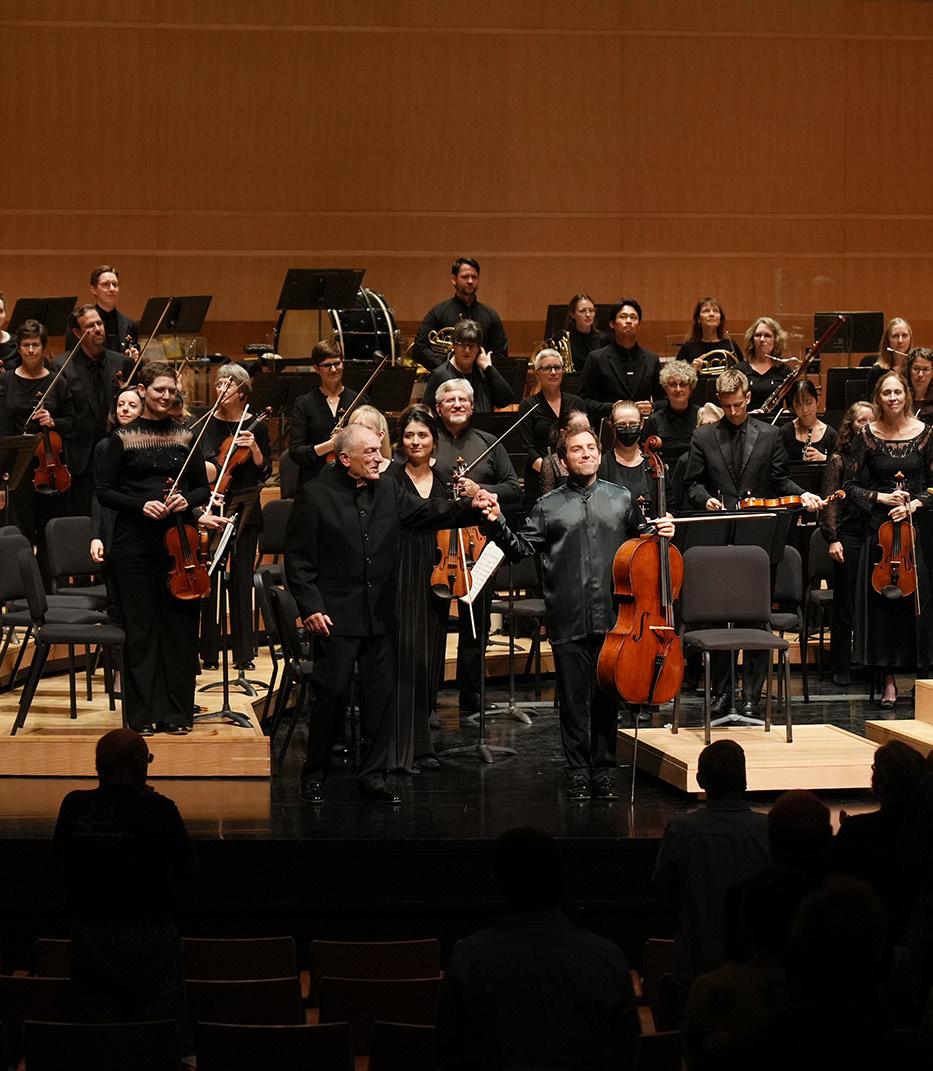
Richard Strauss demands virtuosic agility, and Mozart requires perfection from orchestras. The Madison Symphony Orchestra’s Friday performance titled “Legacy” brought all this and more from the ensemble.
Maestro John DeMain expertly conducted the cavalier theme of young Strauss’ “Don Juan” (1888) who has been chief conductor of the orchestra for more than 30 years. Strauss’ ever-shifting themes, demanding both brevity and precision, captivated concertgoers.
The symphony’s string section played with remarkable reliability under the baton of DeMain.
Strauss was notoriously unforgiving while writing for orchestras, which was shown during the middle of the piece when the principal oboist was required to play a lovely melody in a very high and unstable register.
What was delineated from the performance was nothing short of what Strauss explicitly had planned in the lubricious musical retelling of Don Juan.
Another Strauss piece followed “Don Juan.” “Four Last Songs” (1948), which Strauss composed at the age of 84, showed concertgoers what 60 years of maturity could do to a composer. The concert highlighted the evolution of Strauss from a young composer eager for success to an older, reflective one looking back on a remarkable career.
Strauss’s four songs were performed by soprano Amanda Majeski, whose career has recently taken her to The Royal Opera of London. Majeski sang the demanding pieces with expertise. Her voice echoed throughout the hall with power and control, which left concertgoers entranced by Strauss’s
enchanting harmonies.
The orchestra supported Majeski completely. Soloists from the orchestra included the concertmaster, horn, oboe and clarinet.
Dominick Berning, a concert goer and freshman in music composition at the University of WisconsinMadison, told The Daily Cardinal “the horn solo in the second song nearly brought a tear to my eye.”
Along with the horn, the concertmaster also supported Majeski with weaving counterpoint between the violin and soprano.
After two Strauss pieces that depicted the sunrise and sunset of a career, the orchestra moved back in time to Mozart.
The stage was then filled to capacity with over 100 singers and instrumentalists, including principal organist Greg Zelek. Four soloists included once again soprano Majeski, mezzo-soprano Kirsten Lippart, tenor Martin Luther Clark and bass Matt Boehler. Mozart’s “Requiem” Mass started with a sorrowful opening that quickly evolved into a rapid Kyrie with a strong counterpoint between the voices of the choir and orchestra.
Performed with effortless simplicity despite the music’s demands, Mozart’s “Requiem” took the audience on a journey through the traditional mass texts. The four soloists navigated the cathedral-like colors of the choir and orchestra, singing verses echoed by the choir.
The Requiem ended triumphantly with a return to the Kyrie’s original theme, this time set to the text of the “Communio Lux Aeterna.”
The concert was another great success by the orchestra and conductor, and it left concertgoers excited for the 99th season’s close next month.
ISABELLA BARAJAS/THE DAILY CARDINAL
Dane County Farmers’ Market returns next month
By Madison Moris
LIFE & STYLE EDITOR
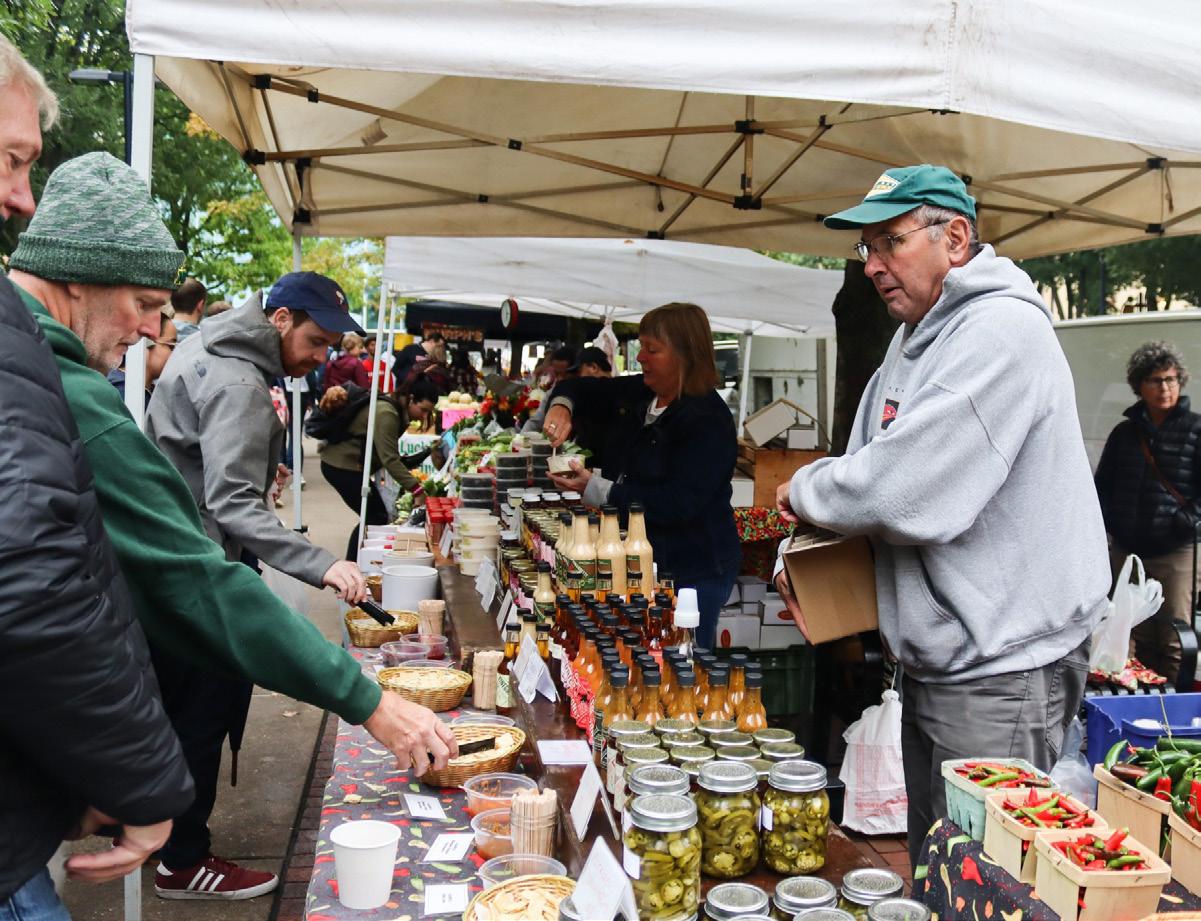
Fresh produce, flowers and hot-and-spicy cheese bread from Stella’s Bakery are staples at the Dane County Farmers’ Market, which will return to Capitol Square Saturday, April 12 and run until Nov. 8.
Over the last 53 years, the largest producers-only farmers market in the United States has blended a rich history of urban and rural cultures. Saturdays on the Square is not the only opportunity Madison residents have to purchase fresh produce from local farmers.
The Dane County Farmers’ Market hosts a Holiday Market at Monona Terrace and a Late Winter Market at the Garver Feed Mill. In addition to fresh seasonal produce, baked goods, sauces, specialty products, arts and locally-crafted artisan goods are available for purchase.
A signature part of the Dane County Farmers’ Market is Hot and Spicy Cheese Bread from
Stella’s Bakery. The original bread, which was accidentally created when baking empanadas destined for the farmer’s market, is now a staple in the community.
Stella’s Bakery is one of over 150 vendors who line Capitol Square every Saturday from 6:45 a.m. to 1:45 p.m. The market offers a large variety of products, but vendors can — and do — sell out of products. If you want the best options, vendors recommend getting there early.
Farmers markets offer a great way to buy fresh fruits and vegetables, but they are also vital community hubs that boost health, foster social connections and support the local economy.
Attendees of farmers markets reported eating healthier because of their purchases, connecting with community members and eating locally when visiting the market.
If you miss the Saturday market, there is also a Wednesday market from 8:30 a.m. to 1:45 p.m. on Martin Luther King Jr. Boulevard.
Embrace quirk and whimsy at Lake City Books
By Caitlynn Hastings STAFF WRITER
Owning an independent bookstore in 2025 isn’t just about selling books — it reaches far beyond that.
As online retailers and nextday shipping tightens its hold on consumers, smaller shops must look to their community for loyal buyers. Owner of Lake City Books, Molly Fish, has done exactly that in downtown Madison.
“I always wanted to own a bookstore… I just kind of jumped with both feet and it’s been great. It’s been almost two years. It’s just growing and growing, I feel really lucky,” Fish told The Daily Cardinal.
Since opening in Lake City Books in April 2023, Fish has turned her precise vision for the store on 107 North Hamilton St. into a vibrant reality.
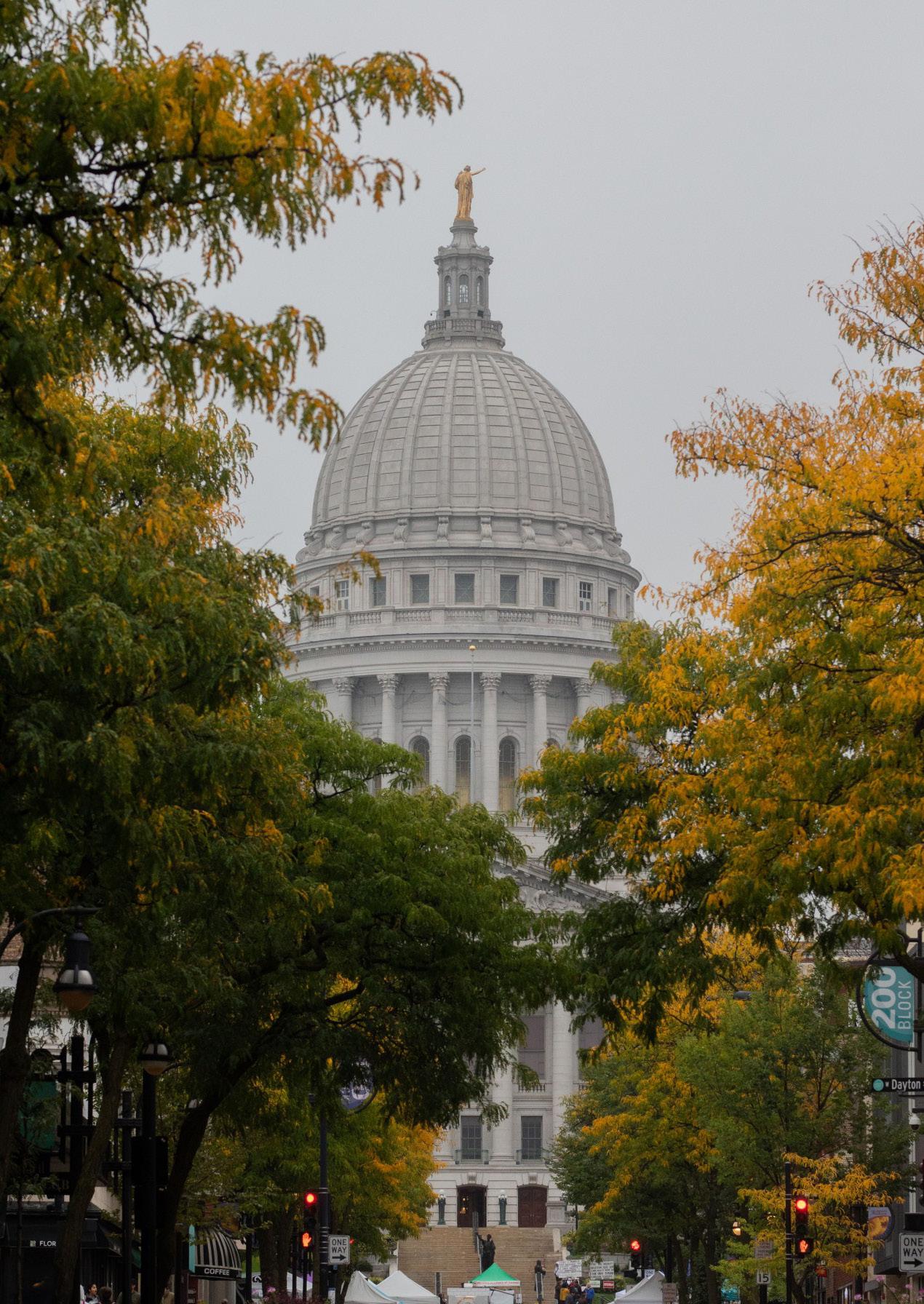
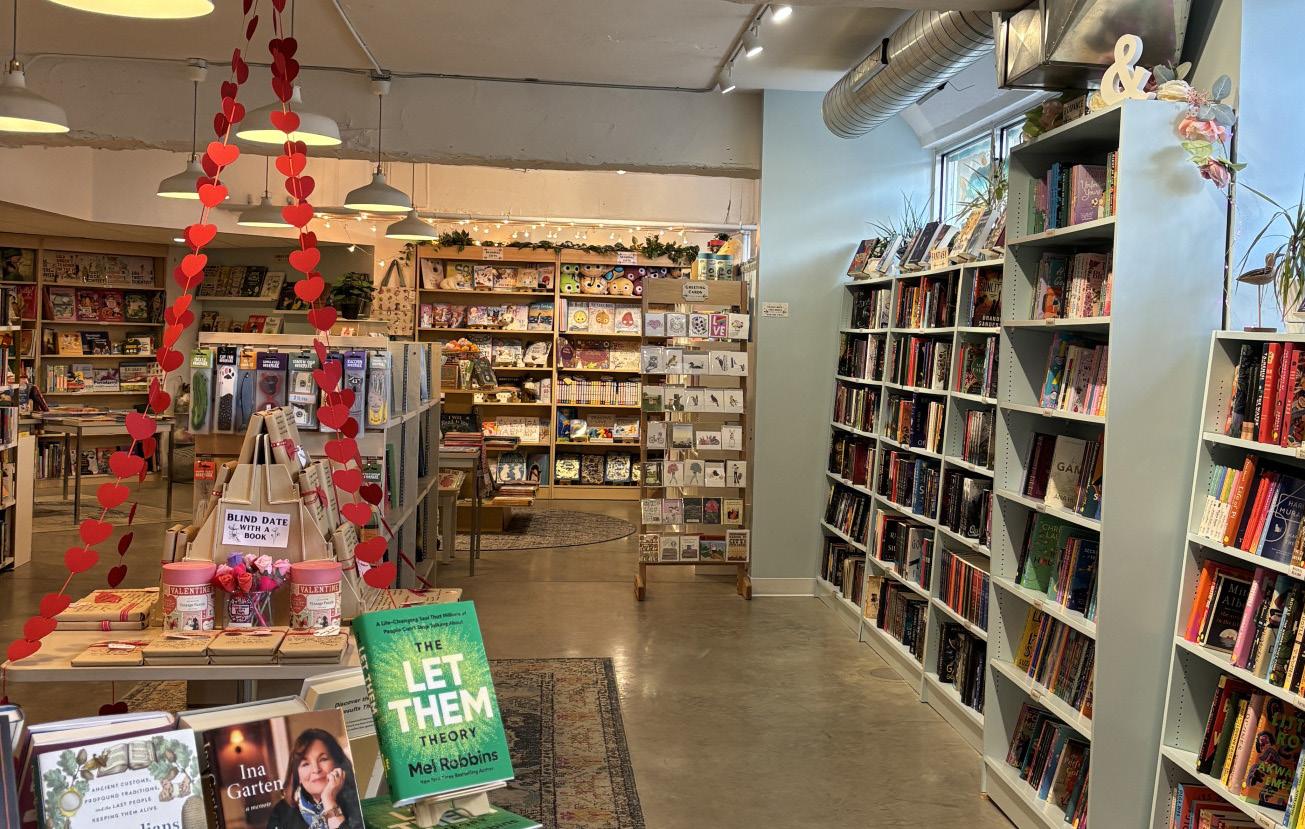
Located just north of the Wisconsin State Capitol, Lake City Books is nestled slightly underground in a comfortable, open space. The store is bright and clean, with sun shining through the windows to illuminate wallto-wall shelves and tables filled with books. They feature unique options with both new and used books, as well as a buy-back system that allows readers to sell used books in exchange for store credit.
“ I was very confident in the fact that downtown Madison needed a bookstore,” Fish said. “I just started by finding the space. I found this, which was unconventional, but the fact that it’s kind of underground and hidden makes it cozier.”
Fish wanted the store to be accessible and mean something to each person who shopped there while providing them with a piece of herself. Her dog, Bowie, sits behind the counter where customers can greet him while they explore the store and purchase books and is regularly included in the monthly newsletter to subscribers, called “Pupdates.”
“ A really important part of my principle of the business is that I just stay authentic to my own vision and my own self,” Fish said.
She described herself as the “target demographic” for the bookstore. Fish understands the mindsets of local consumers, having personal experience in many of the areas that Madison residents occupy.
“I think that’s what’s made it successful. It’s more cohesive because that’s a person’s vision, that is authentic to them. People just relate to your business more when they can see you in it, it’s more personal for you to come in here and shop here and talk to me and see my dog,” said Fish.
Fish was raised in Madison and attended the University of Wisconsin-Madison. As a Madison native, she grew up surrounded by Badger culture.
“I was a huge reader, and when I was going to all those sports games — my family was like 100% sports. I went to every Badger game, we went to every bowl game and I would be reading in the stands,” said Fish.
She worked in software at Epic Systems but always found her way back to her passion for reading. During her previous job at Epic Systems, she was given the opportunity to train and manage teams of larger people, supplying her with the skills necessary to eventually run her own business, she said.
“I actually got a ton of onthe-job training to be a business owner. I was taking some night classes about small business ownership. I really didn’t think Madison would have room for another bookstore… then the pandemic happened,” Fish said.
The pandemic provided Fish with an unlikely opportunity to enter the bookselling market by influencing her to reevaluate her previous career — finally make the jump to open Lake City.
With UW-Madison in such close proximity to downtown Madison, the types of customers the bookstore sees are unique and diverse.
“Having [Generation Z] coming in and connecting with us and our brand and our space, even if you’re not at a place where you’re going to be able to read a ton right now, you will in five years. You’ll have disposable time and income all of a sudden,” Fish said.
Although students may not be the most frequent purchasers, Fish still values the connection that all visitors make with the business. Fish showcases Lake City and its relationship with the community by hosting events for book clubs or anticipated book releases. Fish welcomed customers to bring their friends, family and personal lives even further into the business.
The release of bestselling novel “Onyx Storm” in late January was cause for one of these celebrations.
“We threw a big release party that night. If you pre-ordered the book through us, we had wine, cheese, deviled eggs — you get a whole experience out of it rather than just a book that shows up late and damaged and ships to your door,” said Fish.
Fish hopes to continue highlighting new releases and the authors behind them. On April 28, Lake City will invite author Ali Novak to talk about her novel “My Return to the Walter Boys.”
It’s part of her vision to create in the bookstore a space that welcomes everyone.
“I want to create a place, create events, have products that I would buy and that I would come to and that I would be excited about,” said Fish.