
Students increasingly embrace handwritten over typed notes.

Artists nationwide work with Tandem Press printers to bring their ideas to life
+ ARTS, PAGE 6 + LIFE & STYLE, PAGE 7
Students increasingly embrace handwritten over typed notes.
Artists nationwide work with Tandem Press printers to bring their ideas to life
+ ARTS, PAGE 6 + LIFE & STYLE, PAGE 7
By Clara Strecker STATE NEWS EDITOR
Gov. Tony Evers plans to sign a bill that would shield University of Wisconsin System name, image and likeness contracts from the state’s public records law and give UW Athletics $14 million annually to maintain facilities.
The legislation has faced controversy from Republican senators, citing the use of taxpayer money to fund athletics, and open government advocates like the Wisconsin Newspaper Association, because of the bill’s language exempting NIL deals from public records law.
The legislation passed the senate Tuesday in a 17-16 vote, ultimately needing support from five Democrats to pass.
Britt Cudaback, the governor’s spokesperson, said Evers “supports” the bill in an email to The Daily Cardinal Tuesday.
“Wisconsin Republicans have done little to economically help families and small businesses, but our GOP leaders fought to force taxpayers to begin subsidizing million-dollar payments for UW athletes and further enrich tribal casino operators,” Sen. Steve Nass, R-Whitewater, said in a statement.
“Simply disgusting.”
The bill became controversial among the Senate GOP caucus after Sen. Chris Kapenga, R-Delafield, and three other Republican senators voted against it in multiple committee hearings last week. With a slim 18-15 majority in the chamber, Republicans can only afford to lose two votes to push legislation through.
Kapenga told WisPolitics Monday Senate Majority Leader Devin LeMahieu, R-Oostburg, could possibly lose his lead-
ership position if this legislation, and a second bill to legalize online sports betting, made it to the floor Tuesday.
LeMahieu is the primary cosponsor for the NIL bill.
Kapenga pointed to the “rule of 17,” an informal rule that Senate leadership does not bring legislation to a floor vote without the support of at least 17 Republican senators, which would allow the measure to pass regardless of Democratic support.
“Precedent has always been you’ve got to have the rule of 17, if it’s Republican or Democrat votes,” Kapenga told WisPolitics.
The bill passed the Assembly with bipartisan support in a 95-1 vote on Feb. 19. Dan Knodl, R-Germantown, was the lone no vote, alongside three Democrats who abstained from voting.
UW-Madison Athletic Director Chris
McIntosh supports the legislation, saying it would ensure the university can “preserve excellence” supporting their athletic teams and NIL pursuits financially and legislatively.
McIntosh has recently championed the importance of the bill, especially encouraging the Senate to pass it and telling the Milwaukee Journal Sentinel without these safe guards “everything is on the table.”
Athletics has committed to boosting funding and evolving in the NIL-era of college athletics amid disappointing Badger football seasons. The university argues the bill is necessary to protect the competitiveness of NIL contracts and codifies existing standards for disclosing NIL contracts, while open government advocates have questioned the bill’s language.
UW disability center sees spike in learning accommodations, mirroring national trend
By Maria Knaack STAFF WRITER
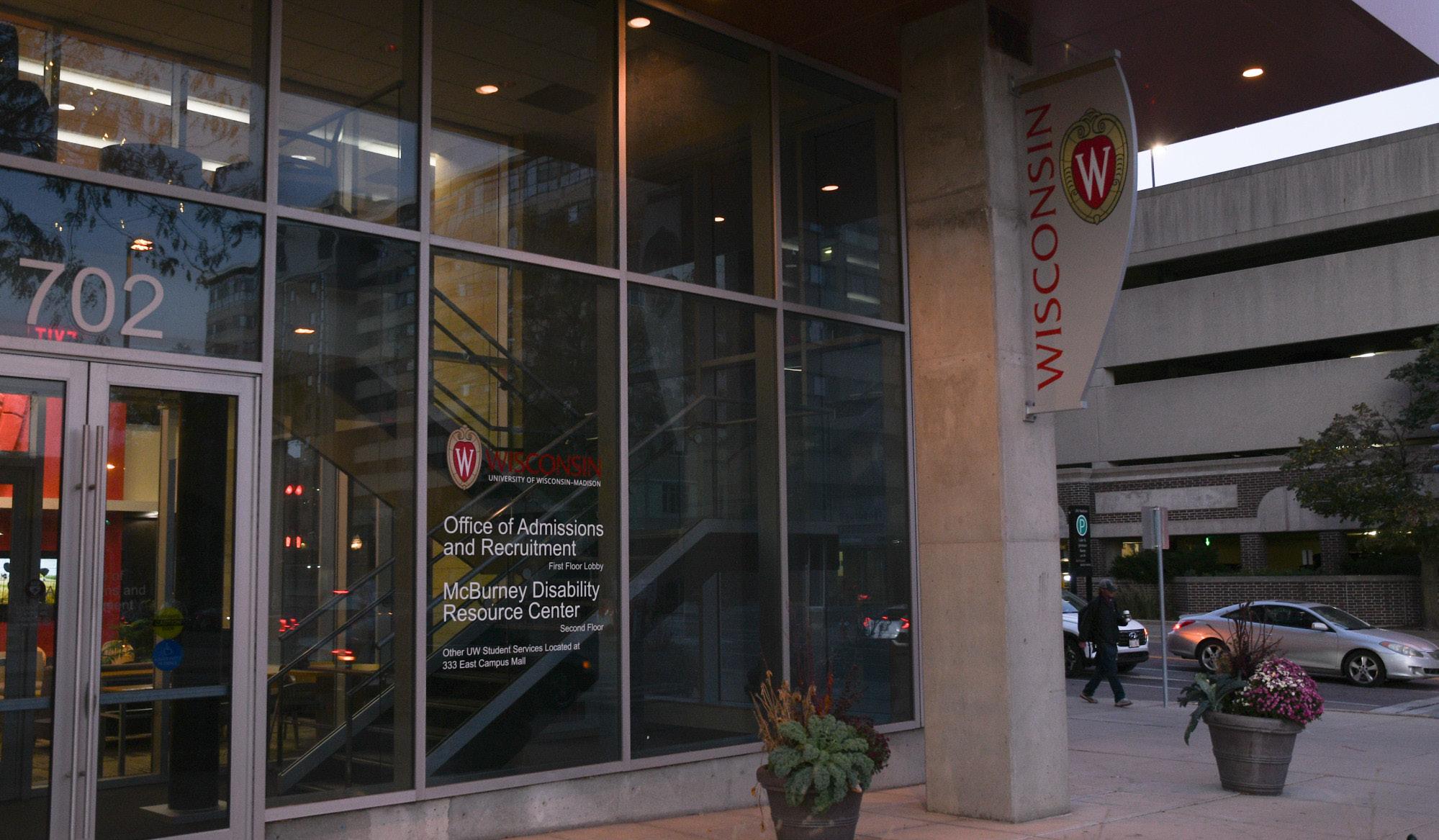
The University of WisconsinMadison’s McBurney Disability Resource Center has seen an almost 250% increase in the number of students receiving accommodations over the past 10 years, according to their director Mari Magler.
Nearly one in 10 UW-Madison students was affiliated with the McBurney Center between summer 2024 and spring 2025, with 5,791 students connected to the center and a fall 2024 enrollment of 51,791.
Just 10 years ago, during the 201516 academic year, the total student affiliation was 1,660.
This trend is not unique to UW-Madison. The number of students reporting disabilities has risen more than 50% over the last decade at institutions across the nation, according to a New York Times analysis of government data.
A rise in attention deficit hyperactivity disorder diagnoses plays a large role in this increase, with nearly 30%, 1,790, of the registered McBurney students reporting having ADHD.
A study by the National Health Interview Survey estimated the prevalence of ADHD in children aged 4 to 17 years to be around 6% in the 1990s, but that figure climbed to approximately 10% by 2016. The percentage rose to 11.4% in 2022, according to the Centers for Disease Control and Prevention.
The process for reporting a disability and getting accommodations, including awareness of the resources available and reduced stigma surrounding it, may also lead to rising numbers, according to Magler.
Liv Abegglen, a junior at
UW-Madison who experiences severe, acute migraines and has registered with the McBurney Center, said registering with McBurney was easy.
“I decided to get accommodations after I had a migraine a day before an exam and, luckily, my professor just believed me and let me skip, but I knew I shouldn’t bank on that in the future,” she told The Daily Cardinal. The accommodation application process begins with an online application through McBurney Connect. Students are then assigned to an access consultant, who contacts them and schedules an initial meeting to discuss their condition and requests. Finally, students submit documentation of their disability.
For Abegglen, the process was simple, and she was able to receive
the accommodations she needed, but not all students have had the same experience.
Lana Fabish, a junior at UW-Madison who experiences chronic illness but has not been diagnosed despite significant testing, told the Cardinal she experiences symptoms including severe abdominal pain, extreme muscle weakness and stomach issues, and that these have led to fatigue and an inability to eat. She said she avoided going to the McBurney Center for her first two years at UW-Madison because her friends, with similar chronic conditions, had bad experiences. However, Fabish eventually felt as though she had no choice because she no longer felt she could manage her classes without accommodations. While she found the process
itself to be simple, she had concerns with the response she received.
She said the McBurney Center “kept trying to quantify my condition in a way that is not possible. I have a dynamic disability, which means that I am able to do certain things sometimes, and other times I need accommodations in order to do them.”
Fabish said she was asked to give a set number of absences needed per semester, noting that this was “impossible” to quantify because she experiences flare-ups which vary in frequency, symptoms and severity year-to-year. She said she could not continue the process of getting accommodations without providing a number, even when she explained that it did not seem to make sense to do so.
“The way McBurney works
seems to be just minimally complying with [the Americans with Disabilities Act] standards in order to not get sued by students. They do not particularly seem to care about disabled students’ feedback, and brush it off,” Fabish said.
Kyle Charters, the associate director of student services at the McBurney Center, highlighted that the ADA says “accommodations must focus on equal access to learning rather than on modifying coursework” and “cannot fundamentally alter the course.”
He said the flexibility team at the McBurney Center designed a questionnaire asking about course design and how much flexibility can be allowed without jeopardizing course progress to determine offered accommodations. According to Charters, the questionnaire “allows for consistent, effective and efficient implementation” to help address chronic health conditions that have unpredictable or episodic symptoms.
He emphasized that while students with chronic illnesses may struggle with attending classes, the attendance flexibility for the students must ensure that they still meet the course requirements and that accommodations must be “reasonable.”
Fabish also noted concern with the control instructors have on accommodations in the classroom.
“Essentially, each of your professors gets to decide on which accommodations they will allow you to have in their class,” Fabish said. “[Professors] are not properly aware of what sorts of accommodations disabled students actually need.”
Continue reading @dailycardinal.com

By Mia Warren STAFF WRITER
With an influx of DePop resellers, some University of WisconsinMadison students see thrifting second-hand clothing as a status symbol in and of itself — a wide turn from thrifting’s once humble reputation.
“It kind of becomes more performative, because people thrift solely for the purpose of selling rather than actually reusing it for a while,” said Kiera Plotner, a Depop seller and UW-Madison fashion student. “It used to be people who genuinely wanted to thrift for a good cause.”
Since 2019, thrift stores have seen a 39.5% increase in foot traffic. As styles from the 90s and early 2000s re-emerge and cement themselves in pop culture, one way to reign as ‘fashionable’ is to shop these styles from the source.
UW-Madison fashion student Colleen Duffy said, reflecting on growing up in the Chicago suburbs, “It used to be entirely older people…at least where I live, we really didn’t ever see a white person in the stores — but now that’s basically all you see.”
There’s a new ambiance in local thrift stores or bins. Instead of shopping out of necessity, it’s now about competition. There’s a fierce fight to find the best item, the rarest brand, the trendiest t-shirts.
“When I see a man in a [thrifted] carhartt jacket, I run the other way. That’s a bad sign, as we know,” Duffy said.
Plotner’s online shop “Repurpose With a Purpose” takes second-hand clothing that is damaged or otherwise unwanted and transforms it into something new.
“I’m not just buying the first clothes I see [or] finding clothes that are more trendy,” Plotner said. “There’s a reason for which I make the clothes, not just that it’s popular on social media.”
With retailers taking notice of resale’s success, chain thrift stores like Goodwill have reflected this in their prices. Madison residents reported on Reddit that children’s t-shirts were
priced at $3.99.
Goodwill has also been criticized for its ‘Goodwill Marketplace’ where they sell donated items online for market prices.
“I feel like I used to be able to buy a shirt for like $2, now it’s not likely,” Duffy said.
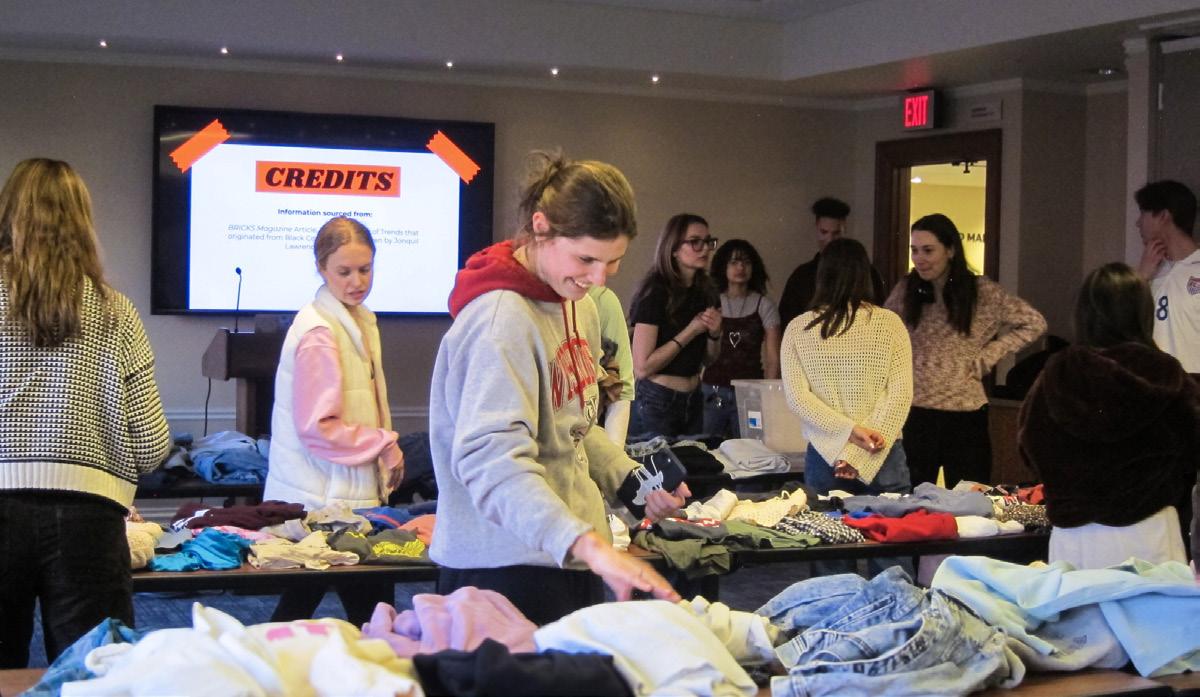
At a Re-Wear It swap, small piles of clothes cover tables. Students can browse, try on and chat without having to worry about price gouging.
“People really kind of take what they need,” Re-Wear It President Jordyn Czyzewski told The Daily Cardinal.
Every other week, the organization hosts ‘swaps’ — where students can donate and pick-up clothing completely for free.
“You don’t have to donate clothes to come and take clothes. I think that’s a really important part of our mission, just trying to make sure that everyone who wants to come and access is more than welcome to,” Czyzewski said.
Czyzewski said students don’t exploit the program and only take what they need.
“We haven’t had any problems with that at all,” Czyzewski said. “We really try to make it clear that our mission is to have the best outcomes for students.”
Traditional thrift stores in recent years have posed a higher risk to overconsumption and waste. Because of the lower cost, consumers are prone to impulse buying.
“It’s ultimately devaluing the clothing in general…if you’re buying something and you don’t actually wear it and use it to its full potential…it just repeats the cycle of buying it and not using it,” Duffy said.
Anika Kozlowski, a UW-Madison researcher and assistant professor, said donation quality is a major issue for stores to handle. Organizations do not have the resources to manage unwearable items, so this clothing just gets sent to landfills anyway.
“Oftentimes, a lot of our donated stuff ends up exported out, and then it ends up in other people’s land-
fills…generally in the Global South,” Kozlowski said. In 2018, the U.S. exported around 790 tons of clothing to various countries.
Kozlowski said part of the problem is that there is not a lot of great recycling infrastructure in North America, so exporting waste to other countries is often the cheapest, most efficient option for thrift stores.
“It keeps flowing through a path of least resistance,” she said.
It’s something UW-Madison design professor Marianne Fairbanks sees as a shame.
“What a burden that other countries have to take our rejected clothing. It just doesn’t make sense,” Fairbanks said.
Increasingly, this waste has also become more synthetic. Clothing from ‘fast fashion’ brands like Zara, Shein and Target rely on cheap, plastic materials to get their clothes on the shelves as fast as possible.
“Fast fashion is trend driven and quickly produced with often cheap materials…the things that end up on the shelves are not generally well made, or made to endure,” Fairbanks said. “I think when we choose something that’s polyester, it’s been positioned as eco friendly… and yet, the microplastics that are a part of that are still something we need to think about deeply.”
Kozlowski contextualized the issue further, saying landfills in the Global
South are not as highly engineered as those in the West. She said many landfills in the US are able to capture methane and have plastic liners to keep out toxic byproduct. “A lot of places where second hand clothes are exported to don’t have these…[so] they can clog dialer gutters, which causes health issues,” she said.
Re-Wear It helps divert this plastic excess before it ends up in foreign lands and oceans.
“If you donate to a Re-Wear It swap, it’ll stay in the campus community,” Czyzewski said.“I’ve picked up a donated item at a Re-Wear It swap, worn it a few times, and then I decided to donate it back. A few weeks later, at a different swap, I saw someone wearing what I donated.”
Re-Wear Its’ excess clothes are even upcycled with Kozlowski using their excess for creative projects and workshops with students.
Czyzewski still warns of the dangers of overconsumption, especially as a college student.
“Thrifting can be a really good tool, but when it’s used in excess or overconsumed a lot of the time, it can become a negative,” Czyzewski said. “[It’s] almost like fast fashion thrifting.”
Cyzyewski said Re-Wear It’s local ties help reduce her consumption habits. “It helps to think about, in what ways can I find this through someone else, through my community network?”
By Sonia Bendre SCIENCE EDITOR
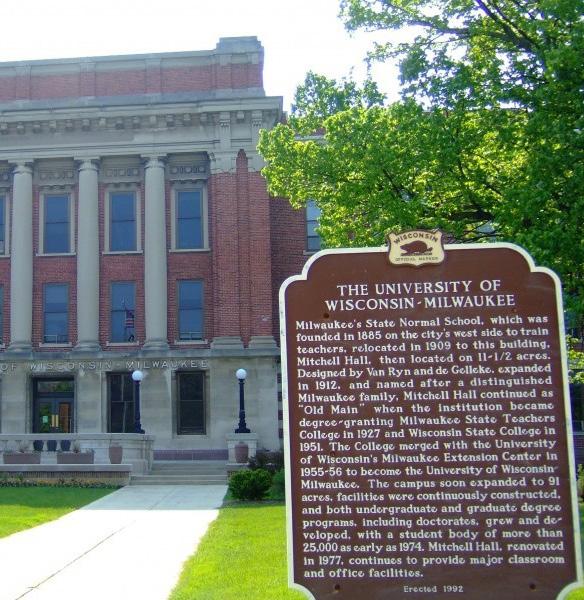
Despite opposition from faculty, industry and federal groups, the University of WisconsinMilwaukee plans to close its undergraduate materials engineering program after next academic year due to low enrollment.
Because of UWM’s new budget model — which prioritizes funding based on undergraduate credit hours instead of research activity and degrees awarded — lower program enrollment and “ongoing financial challenges”, university spokesperson Luella Dooley-Menet said the program will close. Currently, 25 students are enrolled in the program, down from 57 in 2015.
But industry partners and current students argue the program is uniquely positioned to support Southeastern Wisconsin’s manufacturing industry. Wisconsin has the
second-highest manufacturing density in the country, and there has been a nationwide push to expand manufacturing with the field projected to require 122,000 more casting and forging professionals nationwide by 2028.
Had the program stayed open, the Department of Defense planned to offer $1.5 million to UWM for a metallurgical hub in Milwaukee, but Dooley-Menet said it wouldn’t sustain the program long-term. Materials electives will remain available.
Local industries who hire graduates describe a long fight with administration
Last spring, engineering faculty voted for the first time against the materials engineering department closure, but the university still closed many materials engineering teaching assistant posi-
tions and canceled short-term staff contracts, beginning to restrict new undergraduate students from enrolling in the major.
In the fall semester, another faculty vote reversed that process so the program could enroll students again.
Over the summer, four faculty members transferred to other engineering departments, leaving just 2.5 faculty positions in the materials science and engineering department. All transferred faculty are still teaching materials science courses, which “will remain part of the engineering curriculum,” DooleyMenet said.
UWM evaluated “labor market needs, employer input, student interest, program costs and long-term sustainability” before suspending admissions to the program, Dooley-Menet said.
But when news that UWM
was removing the undergraduate materials engineering major broke to students and staff in February 2025, 50 people from 25 companies in Southeastern Wisconsin petitioned against the closure, speaking with UW System leadership in meetings Assembly Speaker Robin Vos, R-Rochester, helped facilitate.
By Ava Diener STAFF WRITER
The Puerto Rican Studies Hub hosted a roundtable Monday featuring three Puerto Rican authors who discussed how their culture and experiences have shaped their writing.
The hub, which the University of Wisconsin-Madison launched in October, has focused on impacting “our local communities on campus and beyond, and creating bridges, solidarities and collective knowledge creation,” co-director and gender and women’s studies professor Aurora Santiago Ortiz told The Daily Cardinal.
Xavier Valcárcel de Jesús, author of “Los Nidos,” a historical fiction about artists delivering paint pigments to the south of the island, discussed his experiences as an author. Through his research and writing process, where he deeply studied the train system in Puerto Rico, he realized the “holes” and various failures that came with modernizing the island.
“I’m honoring the work of Puerto Rican writers that have taken up the task of making visible, problematizing and discussing the incomplete stories,” Valcárcel de Jesús said.
According to Valcárcel de Jesús,
the key to historical writing is to work “historiographically” — the study of how history is written, focusing on shifting interpretations, methodologies and scholarly debates, rather than just a chain of events. This type of writing allows one to have a broader understanding of all perspectives and strengthen the voices of those who have been silenced by history.
Delgado raised concerns about the limited access to resources, such as printing and publishing, in Puerto Rico. She said it causes many artists and writers to turn to different methods in order to produce art freely and in a cost-efficient manner.
Nicole Cecilia Delgado, a poet and visual artist, constructs all her poetry books by hand, a process she feels connects her to her culture and community.
Delgado discussed a social and artistic publishing movement that originated in Argentina under the context of an economic collapse — Cartonera — that she and many Latin American artists use. She said during economic collapse, printing and publishing presses also fell, resulting in writers resorting to different methods to create their art.
She described how writers and
artists alike worked with recyclers to buy cardboard from them, ultimately creating a community of book-makers and publishing spaces to make simple, handmade books with cardboard covers.
Influenced by the movement, Delgado created her own cartonera in 2009, focusing on contemporary poetry.
“I learned how to hand-make books at the same time I was working on my writing,” Delgado said. “For me, writing and literature is not an isolated process. It’s something that is created in community, and relates to filling in the gaps of history or accounts of what life in Puerto Rico is like.”
Delgado said the cartonera movement highlights the resilience of Puerto Rican artists, and “showed a way of making [art] sustainable, even in the context of scarcity.”
Cezanne Cardona Morales, a writer, columnist and professor at the University of Puerto Rico-Ríos Piedros, discussed the importance of immersion in Puerto Rican culture as a key part of the writing process.
“All the contradictions — the suffering and the joy, the pain and the
By Olivia Osika STAFF WRITER
Dane County voters will receive absentee ballots a week earlier than previous elections under a new partnership with Madison-based WPS Data Logistics, county and city officials announced Friday.
At a press conference held at the WPS printing facility, Dane County Clerk Scott McDonell said the earlier mailing timeline is intended to give voters more time to return their ballots before Election Day.
Wisconsin law requires absentee ballots to be received by election officials by 8 p.m. on Election Day in order to be counted. McDonnell said slower mail delivery in recent years has made timing an increasing concern, noting that mail from Madison is often routed through Milwaukee before returning to the city.
“Dane County voters will see their absentee ballots in the mail about a week earlier than this time last year,” McDonell said. “Please be on the lookout in your mailboxes and don’t wait to return your ballot.”
This change comes after Madison missed counting 193 absentee ballots in the 2024 presidential election. The Wisconsin Election Commission ordered the city the next August to make changes.
This additional week, he said, provides more time for ballots to travel through the mail system and be returned by voters.
“This change is a dramatic improvement,” McDonell said. “The high turnout and large population of Dane County can be a challenge when we’re working within a short window of time.”
Madison City Clerk Lydia McComas said the city plans to begin mailing absentee ballots Monday. Approximately 15,000 Madison voters who have requested absentee ballots will be among the first to receive them.
“Madison is a college town. We have lots of students studying abroad and lots of overseas voters,” McComas said. “This extra week will allow them to get their ballots to us.”
Voters can request and track absentee bal-
lots through the My Vote Wisconsin website, where they can view when their request is processed, when their ballot is mailed and when it is received by election officials.
In addition to absentee ballots, WPS Data Logistics will also print Madison’s poll books, the official voter lists used by election inspectors at polling locations. This is another change WEC mandated.
Previously, the city printed poll books about a week before Election Day. Under the new process, they can be printed the weekend before the election, allowing election officials to include voters who cast in-person absentee ballots closer to Election Day.
“That means the accuracy of the poll books is far greater than it had been,” McComas said.
The new contract with WPS will also reduce costs. McDonell said Dane County taxpayers will save approximately $100,000 compared to the previous printing contract.
Following the press conference, reporters toured the WPS Data Logistics facility, where ballots are printed and prepared for distribution to municipalities through Dane County. During the tour, WPS officials demonstrated the printing equipment used to produce ballots and described the processes used to ensure accuracy and security.
Andrew McCready, vice president of WPS Data Logistics, said the company has extensive experience producing secure documents for federal and health care programs. He said similar safeguards, including controlled facility access, employee background checks and chain-of-custody procedures for ballot deliveries, are used in the election printing process.
“We’re proud to support elections in our hometown,” McCready said. “Our focus is simple: accurate, secure election materials delivered on time.”
Officials said the earlier mailing timeline and new printing process are part of ongoing efforts to improve election administration in Dane County and the City of Madison. The changes will be in place for upcoming elections as clerks continue preparing absentee ballots for distribution to voters.
pleasure — of living in [Puerto Rico] allows me to do the writing and have the writing flow,” Morales said.
One of the hub’s three pillars is “Learning and Unlearning Together,” which includes a summer study away program in Puerto Rico and the Luisa Capetillo Cultural Series, including public lectures like Monday’s event.
The series also includes film screenings, musical events and culinary festivals. The first event occurred last October and featured Los Pleneros de la Cresta, a band on Bad Bunny’s most recent album.
The additional two pillars of the hub are “Imagining Puerto Rican Futures” and “Solidarity Ecosystems.”
Santiago Ortiz said the former aims “to create spaces for intellectual interrogation, innovation, knowledge production and scholarly diffusion,” including a lecture series with historian Francisco Scarano and an upcoming April symposium called “Interrogating the Future of Puerto Rican Studies.” Additionally, she said it includes a solidarity mentorship program and mentioned that the hub will sponsor the Puerto Rican Studies Association Conference in 2028.
The “Solidarity Ecosystems” component includes a fellowship program, featuring different artists, writers, scholars and two postdoctoral fellows who will participate in the intellectual life of the campus, according to Santiago Ortiz.
Santiago Ortiz and Co-director Jorell Meléndez-Badillo obtained a $3 million grant from the Andrew W. Mellon Foundation to help fund three years of performances, lectures, fellowships and programming.
“We envision the Puerto Rican Studies Hub as fertile ground for innovative partnerships and as a site for emergent and groundbreaking modes of knowledge production,” Santiago Ortiz said.
The hub is the first of its kind in the Midwest, which Santiago Ortiz said is crucial for starting conversations about issues within the Puerto Rican community — such as migration.
“The Midwest is this ideal location [for migration], and so we want to jumpstart conversations on a regional, national and transnational scale, and we do so while expanding the field of Puerto Rican studies,” Santiago Ortiz said.
By Michael Reilly STAFF WRITER
The Wisconsin Senate passed a controversial bill Tuesday to legalize online sports betting by allowing Wisconsinites to place wagers as long as they are processed through servers located on federally recognized tribal lands.
If Gov. Tony Evers signs the bill into law, users would be able to place bets anywhere in the state via their mobile device. Evers previously indicated support for the legislation but said Wednesday he wants to further look into the bill’s language and discuss it with tribal leaders.
Because casinos servers facilitating the bets must be on tribal lands, prominent sportsbooks such as Draftkings and FanDuel would still be unable to operate within the state.
Lobbyists on behalf of these companies reached out to “key Senate Republican staff” on March 10, arguing online sports betting should be legalized through a constitutional amendment — not a law.
Despite this effort, the bill passed in a 21-12 vote, with nine Republican senators voting against. With a slim 18-15 majority in the chamber, Republicans could only afford to lose two votes to pass legislation without Democrats.
Chris Kapenga, R-Delafield, told WisPolitics Monday that Senate Majority Leader Devin LeMahieu, R-Oostburg, could possibly lose his leadership position if this legislation, and a second bill to shield the University of Wisconsin System name, image and likeliness deals from public records and fund athletic facilities, made it to the floor Tuesday.
A recent Marquette University Law School poll found 64% of Wisconsin voters oppose legalizing online sports betting, including 61% of Republicans, 66% of Democrats and 74% of independents. This poll was brought to attention on the floor by Sen. Steve Nass, R-Whitewater.
Nass further discussed what he views as the “predatory practices” of gambling and its tendency to negatively affect the youth, calling the bill a “dirty deal.”
Sen. André Jacque, R-New Franken, followed in opposition to the bill, saying it would make betting “easier, faster and more perva-
sive.” He warned of the material consequences gambling addictions bring, such as maxed out credit cards and bank loans to fund more bets.
“[The bill] puts a sportsbook in every pocket,” Jacque said.
The bill also sparked debate among Democrats. Sen. Chris Larson, D-Milwaukee, said that while gambling has a place in the state, lawmakers “should figure out some type of taxation that should protect gamblers struggling from addiction.” The bill has no such provisions.
Other Democratic senators voiced their support, emphasizing the bill’s importance for tribal nations. The nations will have their existing gaming compacts expanded, keeping revenues within the state instead of larger outside companies.
Sen. Kristen Dassler-Alfheim, D-Appleton, said gambling already exists “behind closed doors” throughout the state, and urged senators to vote in favor of the bill to provide more oversight of the activity.
“[Gambling] is going to happen in Wisconsin. Taking control of this is a smarter play for all of us,” she said.

l 4 Thursday, March 19, 2026
“Foundries, forges, heat treaters and all kinds of other manufacturers rely on materials engineers coming out of the UWM program,” Dave Palmer, a metallurgical engineer at Racine transmission manufacturer Twin Disc Incorporated, told The Daily Cardinal.
UWM students tend to stay in-state at a higher rate than the University of Wisconsin-Madison students, providing crucial pipelines for industry.
Materials engineers typically work in processing, characterizing and developing materials, including biomaterials, metal casting and specializations in ceramics, polymers, composites and electronic materials.
“If you [UWM] knew something bad was happening, why didn’t you reach out to local Milwaukee industries who’ve been part of the materials program?” Carol Martinez, a materials undergraduate, told the Cardinal. “Why didn’t you reach out and ask for help?”
Martinez is graduating in May and will work in Milwaukee’s foundry industry. Although students could transfer to other universities with fouryear programs like the UW-Madison or the University of Wisconsin-Eau Claire, she said the UWM’s program is the best option for most students.
“[For] a lot of students, moving away wouldn’t be financially reasonable,” Martinez said. “UWM is a pretty affordable school, so making that jump to go to Madison or go to [UW-Eau Claire] would be a really big challenge. I’ve talked to some [students] and they would say that they would stay. It’s just really tough because you’re leaving home, you’re leaving family and all of that.”
UWM fills a necessary niche, professionals say
While UW-Madison has a materials engineering undergraduate degree, Palmer said their program doesn’t highlight metals manufacturing, Southeastern Wisconsin’s primary manufacturing industry, to the same degree as UWM’s program.
UWM hosts the largest metal cast-
ing foundry in the state. It also offers the state’s only Foundry Educational Foundation certified four-year materials engineering degree, awarded for metal casting training. Over 50% of materials engineering majors at UWM receive four-year scholarships from the Foundry Educational Foundation. UW-Madison is affiliated, but not certified.
“UWM really has been the workhorse in providing trained materials engineers for industry in our region,” Palmer said.
UWM’s materials science program works closely with local industry, with students often collaborating with industry members on year-long senior design projects. One recent project saved Saukville steel company Charter Steel $43,000 per year. Students at UWM have also recently won regional and national competitions in forging and metal casting.
Heat treatment and metals casting are Wisconsin’s main manufacturing industries, Perepezko told the Cardinal.
“Wisconsin needs a materials science and engineering campus in Milwaukee — not just for Milwaukee, but for the whole state,” Perepezko said.
Industry says budget model hurts specialized programs
Palmer said UWM’s new budget model unfairly favors higher-enrollment majors that are cheaper to run, despite an industry need for specialized programs.
“From a 50,000-foot view, if you say, ‘All programs are basically equal, so let’s just get rid of the smaller ones,’ it makes sense,” Palmer said. “But when you look at the details, it really doesn’t.”
UWM currently has a strong graduate program in materials engineering that may no longer be able to award teaching assistant scholarships and could lose a pipeline of local students with the materials program’s closure.
UWM plans to continue its graduate and PhD-level materials engineering programs, but Palmer said losing that pipeline of undergraduate students will hurt its strength, especially with access to international talent under threat.
“[UWM] may suddenly find enrollment in the graduate program dropping off very quickly as well, and with it, [their] research money,” Palmer said.
UWM started non-renewals of materials staff contracts, according to meeting minutes. They told materials engineering faculty they could transfer to other departments and continue to teach.
“Apparently the idea is [to] get rid of TAs and non-faculty instructors, then have the faculty members teach those courses,” Palmer said. “In the private sector, that kind of thing wouldn’t really fly. ‘Hey, let’s save money by having a higher paid person do a lower paid person’s job.’ Here, if we said, ‘Let’s get rid of our machinists and just have the engineers be machinists,’ people would say, ‘You’re crazy.’”
Palmer also questioned how much money the move would really save, pointing out faculty salaries are likely the highest expense in the materials engineering program.
Martinez said the hardest part of the closure was seeing its impact on professors: in particular Benjamin Church, her favorite professor and the department chair. She said he inspired her to switch majors, encouraged her to restart a materials engineering club, showed up to all her club meetings even after hours and cared deeply about her education and the program.
“He’s the reason why I stayed in the program and why I have become so passionate about it,” Martinez said. “There aren’t that many people out there who would go out of their way to support others, and he’s definitely one of those that cares about his students… It’s really tough to see him hold up a program when faculty have been removed to other departments.”
For now, the materials engineering department remains open. But by announcing the closure, Perepezko said UWM effectively sounded its “death knell.”
“A lot of people say if you are struggling with something, reach out to your network or reach out to your community, but that’s something that the College of Engineering didn’t do, and didn’t want to try to explore,” Martinez said.
How is UWM’s budget changing?
The UWM College of Engineering is operating in a $3.5 million budget deficit, enrolling 29% fewer undergraduates than in 2011. Cutting the undergraduate materials program would save the university $850,000 a year, university representatives told the Milwaukee Journal Sentinel.
The 2025-2027 state operating budget includes a $256 million funding increase for the UW System, the largest funding increase in a decade. The budget includes $54 million to “recruit and retain” new faculty and $26.5 million annually for general program revenue. UWM also plans to open a general bachelor’s in engineering program next year.
Palmer said the budget increases made him less sympathetic to funding arguments.
“It’s a matter of priorities,” he said. “Yes, maybe the overall funding is too low, but if you look at the cost of the materials engineering program at UWM, and if you compare that to what the UW System spends on special events catering in a year… I’m guessing they’re in the same order of magnitude.”
One source of contention from advocates is the university’s decision to decline a $1.5 million offer from the Pentagon to open a city METAL hub, a center that would support materials engineering workforce development training. Pentagon representatives attended meetings with the Board of Regents in July 2025 in support of the program.
“Every two years, [UWM representatives] go to Madison and all the state legislators, and say, ‘Hey, we don’t have enough money. We’re dying here,” Palmer said. “Then at the same time, they’re turning down $1.5 million.”
UWM told the Cardinal the proposed funding couldn’t be used for financially supporting the undergraduate major, however.
“External proposals to preserve the program using federal funding are not feasible, as these funds do not support undergraduate programs and are temporary rather than a stable source for ongoing operations,” Dooley-Menet said. “Similarly, METAL Hub funding was dedicat-
ed to new training and apprenticeship efforts, not to sustaining the Materials Science department.”
Palmer argued the METAL hub could have raised enrollment. But UWM’s materials department’s smaller size reflects similar schools around the nation, where materials engineering graduates are rare in comparison to larger pools of electrical, mechanical and computer engineering majors, Palmer and John Perepezko, a professor in UW-Madison’s materials engineering department, both said.
“Materials is by its nature a small program,” Palmer said.
Many previous graduates have pursued further degrees at colleges like Northwestern University, or work as metallurgical engineers in the Milwaukee area, joining a field with a 1.1% unemployment rate and an average salary of $97,340 in Wisconsin.
“Especially at a time when people are questioning the value proposition of higher education, this is a really solid career path that guarantees students a solid future with a lot of great job opportunities,” Palmer said.
Industry members offered to fund departmental scholarships and serve as adjunct professors, reducing costs and connecting students to employment.
Palmer, who is currently pursuing a PhD in materials engineering from UWM, said the university could also house the major within another department, avoiding paying for a department chair. The University of Minnesota-Twin Cities, for example, has a joint Chemical Engineering & Materials Science department.
Palmer mentors senior design students, has personally hired six program graduates and has close ties with faculty in the Materials Engineering department. He said Dean Brett Rogers told engineering faculty not to engage with the media about the materials engineering program closure.
Former Chancellor Mark Mone approved the program’s closure, but Palmer and other industry supporters hope the new chancellor, Thomas Gibson, will reverse that decision. University advocates plan to meet with leadership and the UW System Board of Regents in the spring.
By Alexa Cattouse STAFF WRITER
Content warning: This article contains mentions of sexual assault and violence.
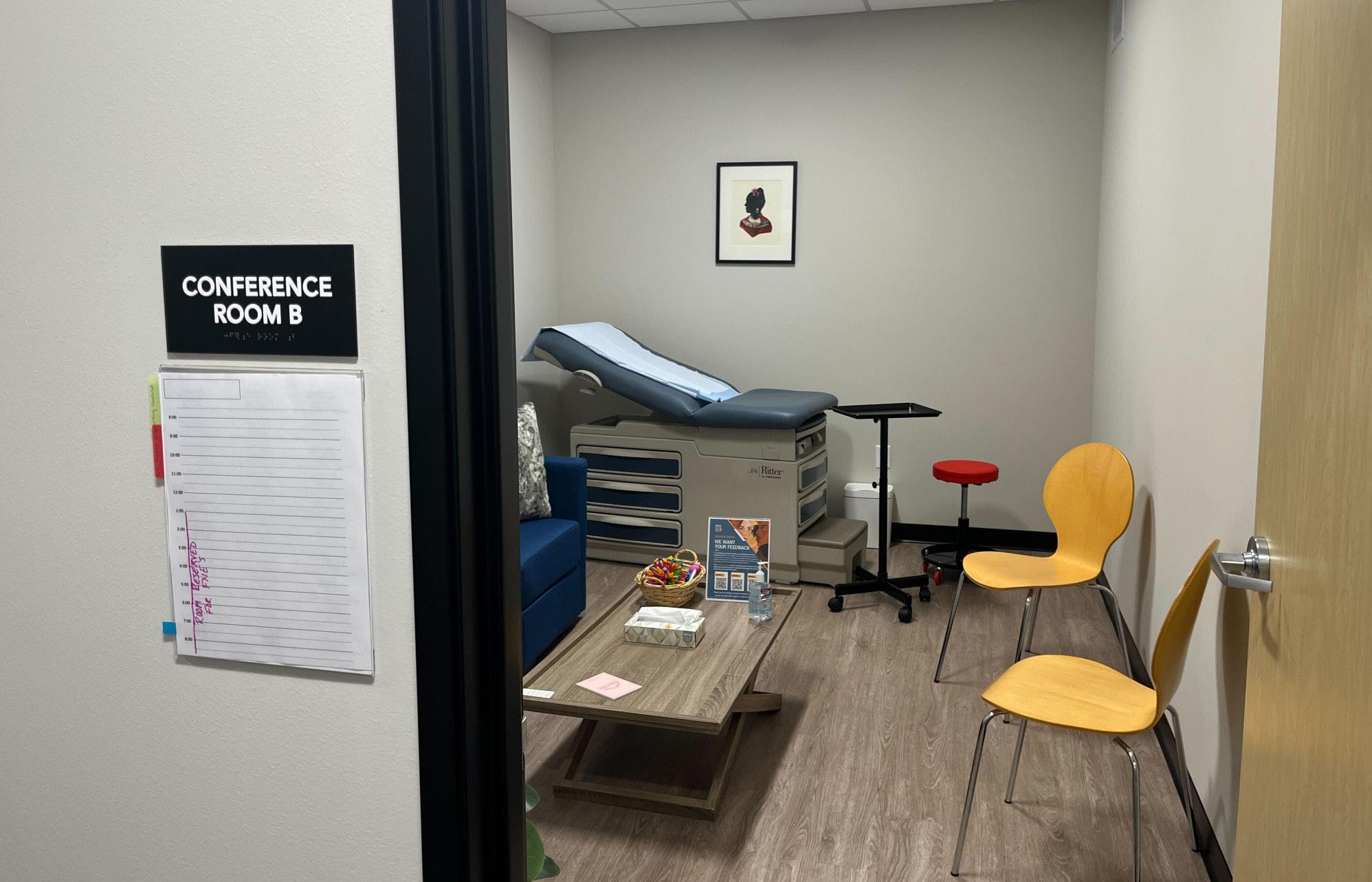
The Rape Crisis Center’s Sexual Violence Resource Center announced a partnership with the Dane County Multi-Agency Center on March 9 to provide free forensic nursing services at for survivors of sexual assault.
The services, which started March 8, include medical care for injuries, pregnancy prevention, STI testing and forensic evidence collection by certified professionals. Described as a “communitybased” option by RCC, all services are free and do not require health insurance, proof of citizenship or law enforcement reporting. The examinations are entirely survivor-led and confidential.
“It’s very rewarding to just give somebody back control after they lost control in an assault. It’s been one of the most rewarding areas of nursing I’ve worked in, just to be able to help someone in that way,” Heather Hentrich, a nurse practitioner at RCC, told The Daily Cardinal.
The RCC Sexual Violence Resource Center has served Dane County sexual assault survivors since 1973 and became one of the first rape crisis center in the nation.
In addition to forensic services, the
RCC offers a helpline in English and Spanish, free one-on-one therapy, support groups and assistance with next steps, whether survivors seek medical attention or legal advice. They have multiple campus offices at Madison College, Edgewood College and University of Wisconsin-Madison, located at the Student Activity Center, though the
forensic nurses are open at their main office on Rise Lane for ages 17 and up from 1-9 p.m. each week, Sunday through Thursday.
According to Rape, Abuse, & Incest National Network, someone in the U.S. is sexually assalted every minute. In 2023, the RCC reported serving 436 sexual assault victims and received over 1,000 calls to their helpline. As of January, Dane County had
107 registered sex offenders.
The RCC has faced funding struggles, losing $250,000 during the last year of the Biden administration and relying heavily on state grants. Wisconsin Attorney General Josh Kaul acknowledged the strain on victim service providers in Wisconsin and across the nation at the press conference.
“We need to make sure that [victim service providers] continue to have support from policymakers because as much as they can collaborate and come up with new solutions. They also need the resources to help ensure that survivors are supported and that justice is obtained in these cases,” Kaul said.
Many sexual assault survivors may feel uncomfortable or intimidated by reporting to law enforcements or undergoing a forensic examination at a hospital acoording to RCC executive director, Dana Pellebon. The RCC hopes to be a safe alternative for those who choose not to go.
DaneMAC Co-founder Kim Curran said the biggest barrier survivors face is not being able to access these services in their community.
“It is not quick and safe and there are no trusted spaces. We’re breaking the paradigm by what we’re doing here in Dane County,” Curran said.
By Siena Ferraro STAFF WRITER
Passivity is America’s deadliest weapon.
Some may argue our nuclear artillery is the country’s most destructive force, far surpassing the impacts of indifference. However, closed-mindedness is parasitically devouring this nation right beneath our noses — far beyond the reach of any weaponry.
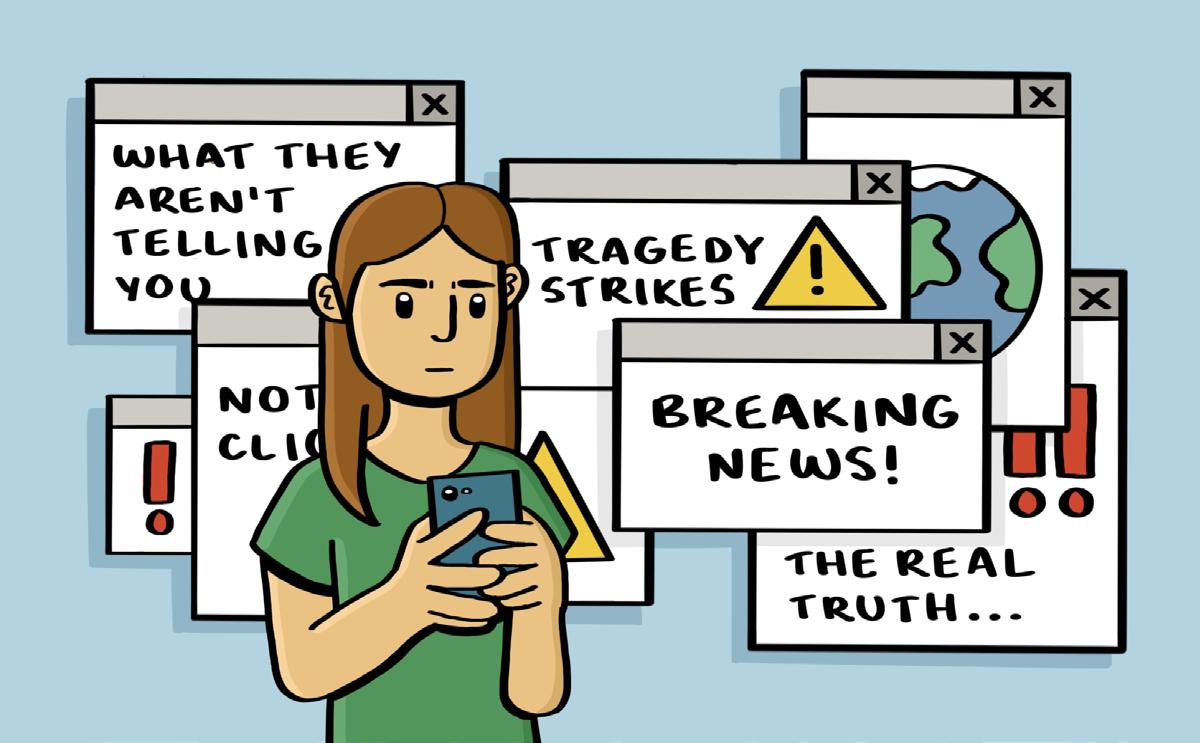
From comment section quarrels to the president’s incessant rants on Truth Social, we are currently living through a historic empathy drought where self-righteousness and apathy have become the norm. This stark uptick in ignorant tendencies has arguably risen out of near-primitive survival instincts exacerbated by the increasingly tense and prejudiced climate shrouding this country.
I noticed this trend of defaulting to indifference after the murder of U.S. citizen Renée Good by ICE agents in January.
While mass protests erupted across the country in her wake, I found myself in conversations with classmates and even friends who said her death had nothing to do with them, and they therefore have no obligation to care. This blatant lack of empathy is further proof of the self-centered habits furthering the empathy drought.
Regardless of its origin, this empathy drought is corroding the United States at breakneck speed. During this tumultuous time, community and intersectional support are more valuable than ever. Yet, collective indifference is thwarting steps taken toward true liberty and justice for all, dampening even the smallest flames of social progress. These flames, however, can certainly be rekindled by sublimating inherent assumptions into the willingness to listen, to be curious and to understand. As deeply-flawed human beings, we possess a
moral obligation to learn and grow from one another, which does not always entail shifting our opinions and beliefs. In fact, when we are confronted with conflicting viewpoints, our preconceived notions of the world can actually have the opportunity to be emboldened.
However, empathy should never be abused to justify bigotry — prejudice should not be allowed to fester under the excuse of broadened understanding. Instead, we should prioritize curiosity when engaging with differing viewpoints, as doing so is ultimately how we cultivate empathy and override hatred.
With that being said, selective empathy can be the antithesis of being open-minded, which is why it is highly crucial to place inquisitiveness at the forefront of our worldviews. Reserving empathy for someone or something can, in extreme cases, be rationalized, but refusing partiality at every
instance of a differing opinion does not strengthen your opinions. It weakens them.
So, as self-prioritization continues to plague our popular and political cultures, I encourage you to open your eyes even the slightest bit wider to appreciate the diversity of thought which makes this country so beautiful. There is something truly powerful about empathy.
By Kate Hlinko STAFF WRITER
College can be, without a doubt, the most vibrant, exciting time of one’s life. But it can also be an experience often overshadowed by stress and anxiety. For many students, college is their first experience living somewhere away from home, surrounded by new people in a completely unique dynamic. To make sure that potential stress doesn’t wash away the fun of college life, it’s key for students to prioritize their own mental and physical health.
A good way for students to make sure they’re taking care of themselves and keeping their health on their minds throughout a hectic college life is by setting SMART — specific, measurable, achievable, relevant and timebound — goals for themselves.
While some may consider it to be a cliché, the advice to live in the moment is widely repeated for a reason. Training your mind to really accept and prioritize the present moment has real positive effects. I have definitely been guilty of putting too much pressure on small decisions, which always leads to more overthinking than the decision is worth. Being a college student makes one very vulnerable to assuming every decision they make will determine their life trajectory, which makes it really easy to fall down unnecessary rabbit holes of stress at any moment.
The issue with college stress is that many of the decisions we make now create big waves in our lives, like choosing a major or a career path. Because every decision we make during these few years does feel so important, it would seem logical to spend time worrying about making the correct decision. However, our priorities are everchanging, meaning that no matter what decisions we make, there will always be a chance of regretting them. Because the human mind is so unpredictable, it’s actually more logical to trust our ability to make the best choices we can and accept the reality that things change and we may make mistakes. It would be silly to base daily decisions on long-
term goals since long-term goals have so much room for change. I am not arguing that students should throw their aspirational goals out the window and live solely on current pleasure, but it would be a mistake to let eustress turn into a daily migraine.
An example of a SMART goal that would help someone live in the moment and avoid overthinking is to start a worry journal. A worry journal involves scheduling a specific portion of time in the day, usually at night, where someone allows themselves to worry about their various stressors throughout the day. For example, one could say they will write all their worries down in their worry journal for 30 minutes at 10 p.m. every night. This method allows someone to trust that there will be time to worry about things that arise during the day later, releasing them from the pressure to overthink in the present moment.
Clinical psychologist Dr. James Miller states that neuroimaging studies have actually found significant evidence that the act of physically translating one’s abstract thoughts to understandable written words reduces activity in the amygdala, the portion of the brain that promotes fear and anxiety. Writing in a journal also simultaneously activates one’s prefrontal cortex, the rational thinking center of our brain. Using a worry journal pushes people to postpone worrying until they have time to think more rationally about their various anxietyprovoking situations, allowing them to spend their time and energy more productively. Additionally, anything that wasn’t worth worrying about in the first place will probably be forgotten about by worry o’clock anyway.
You may have heard the body and mind are connected, but it’s shocking how true that statement really is. The things one eats can actually have a huge impact on your mind, exemplified by the gut-brain axis. According to the National Institute of Health, the gut-brain axis is a communica-
It may be somewhat cliché to say kindness and curiosity are, in combination, more powerful than any venomous jab at a differing perspective. But if empathy is truly the antidote to prejudice, perhaps that cliché is worth repeating. of 1,537 documented tornadoes since 1844, according to the National Weather Service, with 511 fatalities attributed to these twisters.

tion network between the brain and gut, made up of neural, endocrine and immune pathways. Because of this communication system, what we eat directly affects our mood. For example, a diet full of nutrients and fibers from low or unprocessed foods would support good bacteria and mood hormone regulation, while a diet of highly-processed food may inhibit our hormones from properly regulating our moods. Our gut stores 95% of our serotonin, a hormone and neurotransmitter key to mood regulation. Because the majority of our serotonin is in our gut, its ability to perform and send messages to the brain to stabilize our mood is dependent on our diet. Since college is the time of cup noodles and late night
vending machine snacks, it is often difficult for students to access or even remember to maintain a healthy diet. Eating healthy in college is another responsibility that could be easier to achieve with a SMART goal, such as one that I find manageable: eating one green food a day.
Mental and physical health are highly discussed topics with often little followthrough on actual prioritization. College students are especially vulnerable to falling into patterns that disrupt both mental and physical health, which is why SMART goals, whatever they may be for a specific person, can be helpful to keep students in check for keeping good habits in a manageable way.
By Aanya Agrawal STAFF WRITER
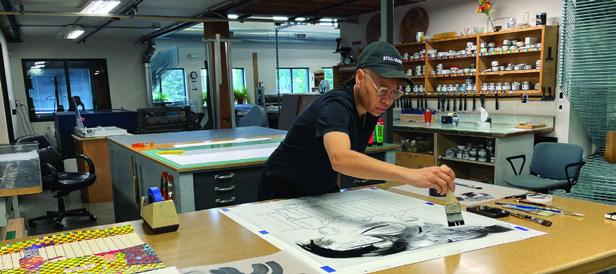
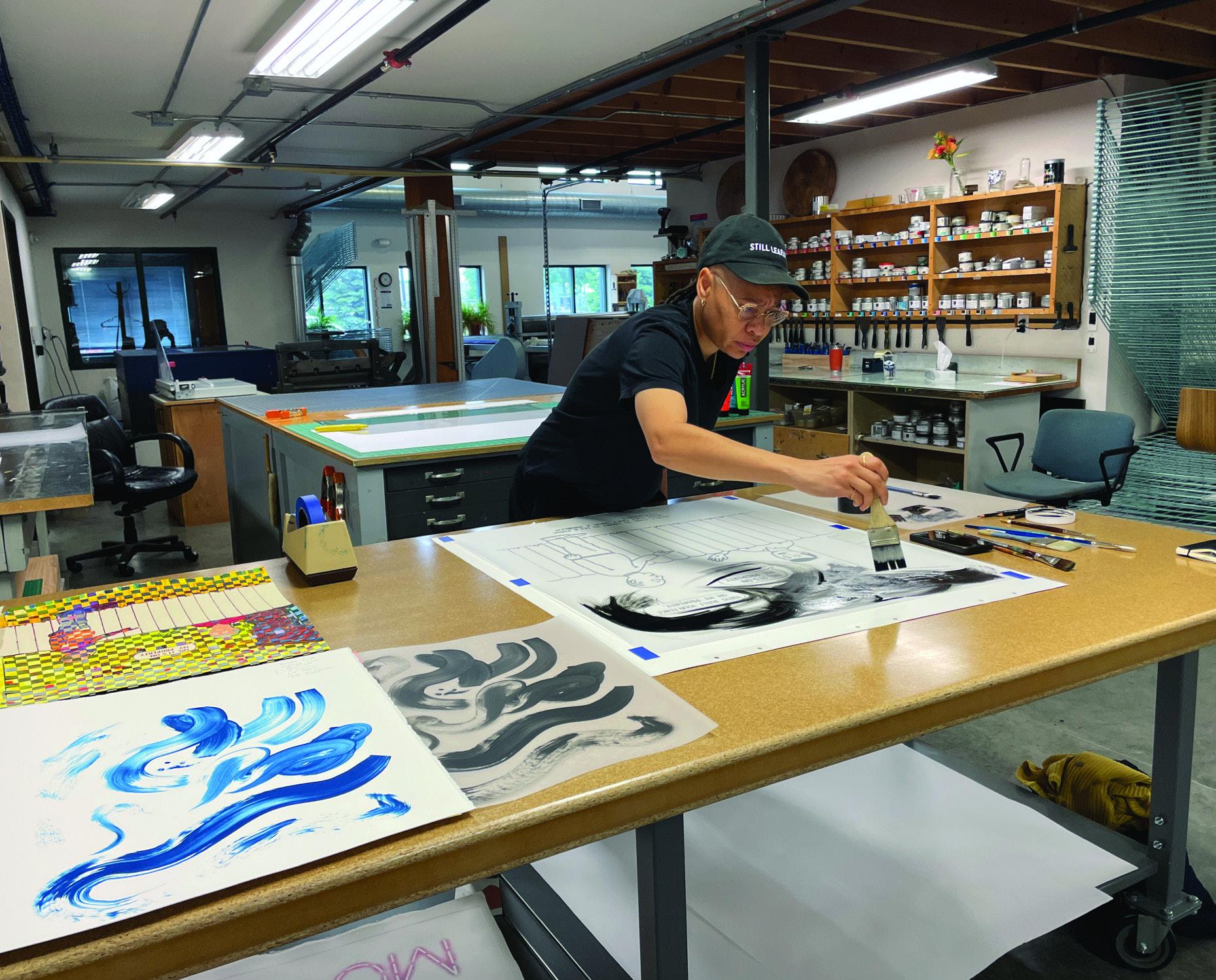
Inside the Tandem Press studio, a hub for collaborative and artistic experimentation just outside the University of Wisconsin-Madison campus, artists, printmakers and curators from across the U.S. work side by side to create limited edition fine art prints.
The studio works with the artists from all over the U.S. to develop pieces through a collaborative printmaking process bringing their ideas to life.
“We invite the most important contemporary artists working today to come to our studio and make fine art prints,” Tandem Press Director Katie Geha said.
“[The artists] come into our studio, and they work with our collaborative printers who have all of the printmaking knowledge and can help the artist realize their work.”
Many of the artists who visit Tandem Press are not primarily printmakers and instead come from backgrounds in painting, sculpture and other mediums. The studio printmakers guide artists through various techniques like lithography, screen printing and engraving, helping translate the artist’s vision into a finished print.
For Tandem Press, collaboration is central to the printmaking process and the studio’s identity.
“The printers and the artist are in constant dialogue, working through ideas, looking at techniques, thinking about the design, all of the fun stuff that happens in the studio,” Geha said.
When an artist starts a project at Tandem Press, the process begins before they even
arrive in Madison. Printers meet with the artist virtually or at their studios to discuss ideas for the print. The artist then arrives at the Tandem Press studio and begins the 10-day process of creating their print.
Artists work closely with the printers, testing ideas and experimenting with techniques to develop the final print.
“We start making the image, mixing colors, printing it, putting it on the wall, letting the artist look at it and having them tell us what they want to change about it. You work through that process until you get to a point where they are happy with the image,” printmaker Jason Ruhl said.
Once the artist is satisfied with the final version of the print, they sign what is called a “right to print.” After that, the printers produce the rest of the limited editions, typically two dozen of them, unless it is a monoprint.
The experimental process of creating the print often involves combining different processes of printmaking within a single piece.
According to Geha, the flexibility the artists have during the entire process is what sets Tandem Press apart.
“I think the fact that we’re so experimental and willing to try anything creates really strong relationships with our artists,” Geha said. “When artists come, we make it a goal to never say no. Whatever idea they have, we are going to work on it and improvise and problem solve in the studio to realize that project for them.”
Founded nearly 40 years ago by William Weege, Tandem Press has grown into
By Annika Bereny CAMPUS NEWS EDITOR
As a blizzard swept through the area, Madison’s alternative scene — outfitted in black ripped jeans, inventive earrings, flannels and dyed hair — found refuge in The Sylvee as Chicago-based punk rock band Rise Against shook the building Sunday night.
Despite the weather, hundreds were in attendance for the show. When asked by lead singer Tim McIlrath, many in the crowd indicated they had seen Rise Against before, but at least half were attending a concert of theirs for the first time that night. The band itself admitted they hadn’t played in Madison for around 10 years, though after experiencing the crowd at The Sylvee, they pledged to return soon.
“The Good Left Undone,” a song about a devastating breakup that repeats the lyrics “all because of you” throughout the chorus. While the meaning of the song is meant to be sad, the band used that “all because of you” lyric to thank the audience for attending.
“Through thick and thin, through rain and snow,” McIlrath said, “we come here because of you.”
Crowd surfers were numerous throughout the show, with a new person being passed around the pit every couple of seconds. Mosh pits formed for most of the songs, except some of the slower ballads, such as “Hero of War,” which laments the destruction of war, both abroad and to soldiers who are serving.
a nationally recognized center for printmaking, attracting artists from all over the U.S.
Sable Elyse Smith, a New York based artist, came to Madison last June to create her first print edition at Tandem Press. Working closely with the studio’s printmakers, Smith created two prints that were then layered and laser cut to produce a final interwoven art piece.
According to Ruhl, the studio in many ways functions like a research environment, constantly experimenting with printmaking.
“[Tandem is] very much like a research facility, in the sense of trying to work with contemporary artists and pushing the boundaries of what printmaking is, and seeing where we can go with that,” Ruhl said.
While the studio collaborates with artists across the U.S., Geha says Tandem Press hopes to strengthen its connection with students on campus.
The studio currently supports two graduate students each year, one working in the print studio while the other assists with curatorial work. In addition, Tandem Press hosts artist talks, exhibitions and open house events where students and community members can go and learn more about the printmaking process.
Even though Tandem Press is slightly off campus, Geha hopes students will visit and explore what the studio has to offer.
“We are really eager to share what we do with students. And I think sometimes, because we’re a little off the beaten path, it can seem intimidating or not for students, but we are absolutely for students,” Geha said.
Openers Koyo and Destroy Boys, from Stony Brook, New York and Sacramento, California, respectively, brought the energy to start the evening. Koyo’s guitars and drums reverberated through the venue, and Destroy Boys was, as their name suggested, proudly feminist, beginning their set with audio from Louis Theroux’s new documentary on the ‘manosphere’ and ending with a call to support trans people.
At a Rise Against show, it was no surprise the politics were unabashedly left-wing. The band has supported progressive politics throughout their career, opposing the Iraq war more than 20 years ago and recently playing a charity concert in Minneapolis for the families of Renée Good and Alex Pretti, who were both killed by immigration agents.
The band started their set around 9:30 p.m. with the song
The show remained political, with McIlrath’s crowd conversations between songs referencing modern American politics.
“We live in a world where the battle for the soul of America is happening right outside of these walls,” he said.
This sentiment was echoed by multiple shouts of “Fuck Donald Trump” from throughout the crowd.
Rise Against’s grand finale was their most popular song, “Savior,” though they had a three-song encore, which officially ended with “Prayer of the Refugee,” a song McIlrath used to speak about immigration.
The crowd sang, headbanged and danced around to the heavy guitars and drums, which literally reverberated through the building and shook The Sylvee’s metal foundation. The show was loud and angry at the state of the world, but also showcased a community dedicated to making it better.

By James Norcross STAFF WRITER
Stand at the back of a crowded lecture hall any given morning, and you’ll get a full picture of the different note taking methods students employ at the University of Wisconsin-Madison. Some opt for the classic pen on paper, while others draw on iPads, type on Google Docs or stare at a full screen view of Tetris.
The spring semester is in full force with midterm exams, papers and projects. But as students scramble for an A, will one notetaking method actually get you the better grade?
Laptop note taking has become increasingly prevalent in the classroom over the years, but this might not actually be the best option.
According to a 2021 study, university students who take notes on a laptop performed worse on questions than those who took notes by hand.
In a generation brought up on screens and social media, the new year has renewed calls to return to analog habits, and some students are choosing the physical notebook over their Macbook.
Carter Austin, a UW-Madison sophomore, handwrites his notes “100% of the time.”

“I did laptop notes my first semester, and it did not go well for me,” he said.
While Austin was unsure if his handwritten habits affected his midterm scores, he said taking notes by hand makes him slow down and pay more attention.
“It’s way better for memory and way better to go back and flip through an actual notebook than to be looking through a Google Doc,” Austin said.
Students who take notes by hand retain information better than those who type, according to a 2025 study.
However, when some professors lead their classes at a
breakneck pace, some students find typing up their notes to be a more optimal experience.
“I’m able to summarize much easier without being scared that I’m going to miss something that’s coming up next,” said Wesley Erpelding, a UW-Madison sophomore.
As a math student, Erpelding uses a mix of both handwritten and digital notetaking in his classes.
“With equations, it’s so much easier just by hand in real time,” Erpelding said.
For his humanities classes, on the other hand, Erpelding opts to type his notes on Microsoft OneNote. He doesn’t
see much difference between the two methods in his ability to retain class material.
While Erpelding enjoys the ease and speed of typing his notes, he said the laptop can be distracting for him in class.
“I’m usually on Tetris in low moments or doing [work for] other classes,” Erpelding said.
From HTML games to texts from friends, unintended distractions can find their way into the digital note taking experience. Both Erpelding and Austin have noticed a push from professors for handwritten notes in the classroom, with allowing for only notebooks or tablets.
“I think it’s unfair to ban people from [using laptops],” Austin said. “If people feel like they work better typing their notes out because it’s faster, they get more ideas across and maybe pay attention with the remaining time they have left over.”
Notably, students with specific McBurney accommodations can bypass these restrictions, allowing them to access assistive technology for disabilities, such as real-time captioning of lectures.
Kajsa Dalrymple, a faculty member in the School of Journalism and Mass Communication at UW-Madison, asks her stu-
dents to take notes by hand in some of her classes due to the distracting nature of laptops. She emphasized that these distractions are not necessarily the fault of the students, but results of the addicting culture of screen use.
“When we commit to something as a community, it means that we’re showing up for each other as well,” Dalrymple said. “We can’t be perfect everyday, but we’re trying the best we can.”
In the classes she only allows handwritten notes in, Dalrymple has noticed greater interaction from students in lecture and more comments on her class evaluations that “indicate more enjoyment of lecture.” She hopes encouraging students to be engaged — and off their screens — can better prepare them for the workplace.
“Classrooms are beautiful spaces where we can be brave,” Dalrymple said. “Unfortunately that’s not mirrored in the workplace.”
Whether or not taking out a composition notebook in class can actually guarantee a higher midterm score, the conversation surrounding digital note taking on campus is one that is sure to continue as technology grows more prevalent in the classroom.
By Cameron Hagen STAFF WRITER
State Street is every Madison foodie’s mecca. From Indian curry to Chinese udon noodles, the downtown strip has one of the most diverse selections of food in the state.
One food it’s lacking? Southern-style barbeque, and the Pink Heifer is changing that.
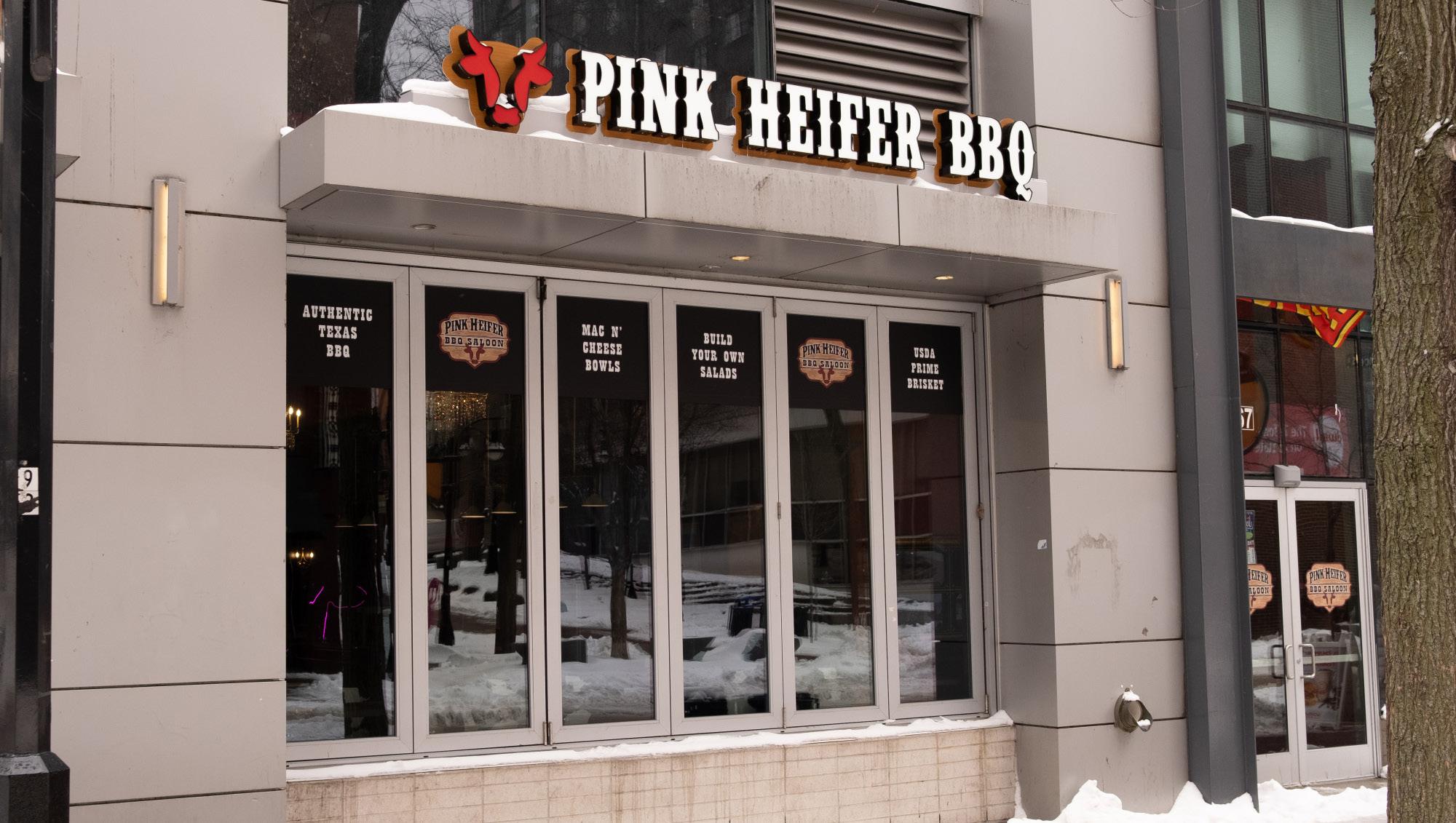
The Pink Heifer BBQ Saloon has been open for just under two weeks now, satisfying local Madisonians’ cravings for Southern-style barbecue and providing a spot for hungry students looking to try something new.
Nestled between Mooyah and Conrad’s Grill on State Street, the Pink Heifer adds a different flavor to one of the city’s most popular routes. This new restaurant comes as part of a 25-location expansion planned over the next five years.
The restaurant’s flagship location opened four years ago in Monticello, Wisconsin. Born from a passion for revitalizing historical spaces and creating unique, high-quality dining experiences, the Pink Heifer continues to expand its outreach, starting off with the Madison location.
The Pink Heifer offers a decent range of menu items, specializing in comfort food and traditional Americanstyle smoked meats. The brisket, pulled pork and chicken are among their main attractions. Some dishes feature customizable bowls or platters that allow diners to pair meats with traditional staples like mac and cheese or coleslaw. Other sides include cowboy caviar, cornbread and a salad bar. In addition, the BBQ Saloon has a mix of traditional alcoholic and non-alcoholic beverage options like tap beer, wine and seltzers.
Inside, you’re met with a twist on traditional Western-style decor through gold-framed historical photographs, spunky cow-print chairs and glass chandeliers — plus a neon pink sign of a heifer paired with the words “Smoke Show.” The restaurant’s comfortable atmosphere and flavorful aroma add to their traditional American-style barbecue offerings.
During a recent visit, I ordered one of their “Mac Bowls” featuring the chopped brisket and a side of coleslaw. Plus, they gave me a couple sweet
pickles on the side, which was nice. For a quick counter-service meal, I’d say it was pretty tasty.
The meat was tender and flavorful and paired nicely with the creamy mac and cheese base layer. The lively decor and casual vibe made it easy to settle in, whether you’re grabbing a quick bite or hanging out with friends.
However, the Pink Heifer’s food and atmosphere are not the only unique features. The restaurant supports local farmers through their Pink Heifer Farmers and Families Initiative.
According to their website, the initiative provides farmers with crucial resources related to mental health, veterinary care and farm sustainability efforts. Certain menu items, like the Pink Heifer’s “Wagon Rolls,” donate a percentage of sales to support this initiative. The initiative comes as a response to unpredictable market conditions and pressure on rural communities.
The Pink Heifer is open each week from 11 a.m. to 10 p.m. Tuesday, Wednesday and Sundays and open until 1 a.m. Thursday, Friday and Saturday.
By Hannah Sarnoff STAFF WRITER
The No. 2 Wisconsin
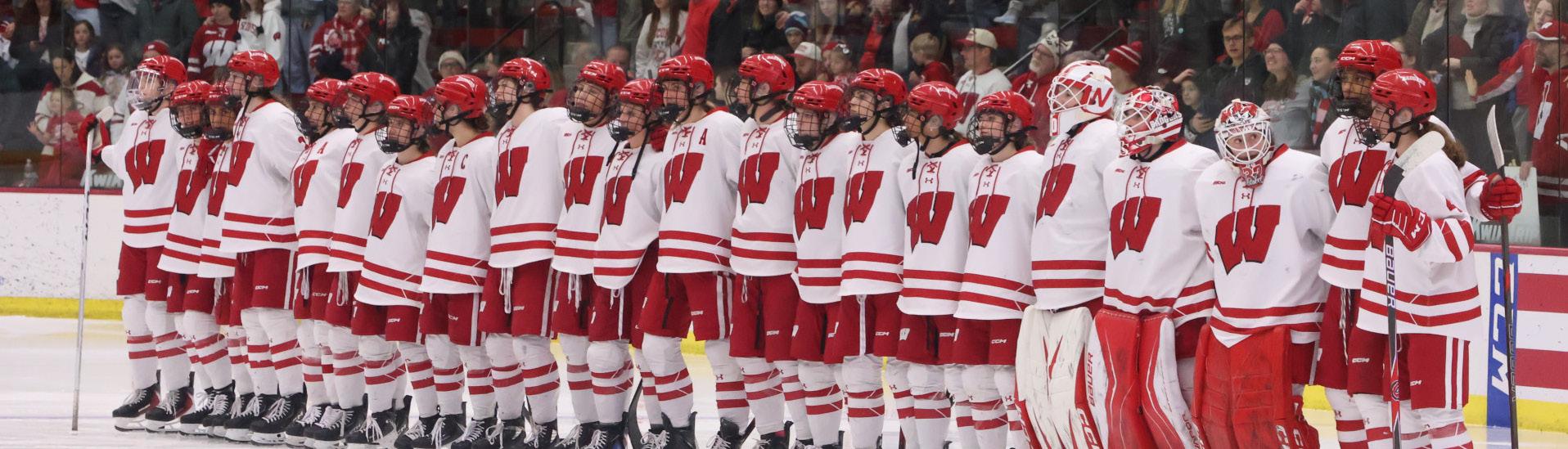
Badgers punched a ticket to their 17th Frozen Four after a dominant 6-0 victory over the Quinnipiac Bobcats.
Wisconsin put the pressure on early, as they flooded goalie Felicia Frank with shots. It didn’t take long for Wisconsin to find the back of the net. With a forward pass from co-captain and forward Lacey Eden, Kelly Gorbatenko snipped one in to get the Badgers on the board first.
“I think, you know, getting that first goal helped a lot, and so we were able to just kind of relax and settle into our game,” Gorbatenko said.
Following the goal, the intensity of the game only increased. The Badgers kept control of their zone.
Laney Potter almost scored from the crease halfway through the period, but Frank
was there to make the save.
With 8:24 left to play, the Badgers were up 11 shots on goal to Quinnipiac’s zero. The Badgers kept high pressure on Frank throughout the first, dominating in zone time.
Swerving around the Bobcats, Adéla Šapovalivová fought to keep the puck in the zone, centered herself and shot right into Frank’s glove.
Just under three minutes remained when Kirsten Simms was taken down by Zoe Uens, who was sent to the penalty box for interference. Only 13 seconds later, Simms converted on a backside shot off the post to put the Badgers up 2-0 going into the second period.
The Bobcats drove down the ice, to begin the second period, but Vivian Jungles was there to make the block.
The Badgers took the puck right back, and Šapovalivová hit the top of the net to make the score 3-0 just over a min-
ute into the second period.
With 16:16 left to play in the second, Ava Murphy skated over to the box for hooking. Wisconsin, the No.1 power play team in the country, took care of business, clearing the puck twice in the first 20 seconds. Laila Edwards took the puck down and tried to get a short-handed goal but didn’t have room to get the shot off, which killed the Quinnipiac power play.
Minutes later, the Badgers went on their second power play of the game. They were almost able to tuck it in from the crease, but Frank held strong.
Then, with just under three minutes remaining, Gorbatenko took the puck off the faceoff and hit just above Frank’s glove side to give the Badgers the 4-0 lead.
To begin the third period, Hannah Halverson was taken down by Mia Lopata, what looked to be just a holding on the Bobcats
led to a four-on-four as Halverson was called for embellishment.
But the four-on-four felt more like a Bobcat power play as they sat in the Badgers zone. Neither team came up within those two minutes.
Just as teams were at full strength, Marianne Picard got taken down in front of the crease leading to a Wisconsin power play. Originally a two minute minor against Taylor Brueske, the call was reviewed for head contact and upgraded to a five minute major.
30 seconds into the power play, Edwards missed a shot just wide. Over the course of those five minutes the Badgers, while giving Frank many good looks,were unable to come up with any points.
With 7:35 left to play, Halverson got called for slashing. The Bobcats decided to pull Frank and leave the goal empty to give themselves a six-on-three advantage.
Just as the Bobcats were setting up, Eden grabbed the puck and sent it down the length of the ice to secure a shorthanded, empty net goal, putting the Badgers up 5-0.
Caroline Harvey sniped a shot toward the goal with just under five minutes on the clock, but it ricocheted off the crossbar and away.
To seal the Frozen Four trip to Happy Valley, Gorbatenko ripped a one-timer with a pass from Mackenzie Jones and secured her second hat trick of the season.
With the 6-0 win, Mark Johnson secured his 700th career win as Wisconsin’s head coach.
The Badgers will face No. 3 Penn State on Friday at University Park for their fourth straight Frozen Four appearance.
“We have a team that has fun, loves hockey and loves each other, and when you have something like that it creates something pretty special on the ice,” Simms said.
By Jacob Szczap SPORTS EDITOR
CHICAGO – As Michigan star Yaxel Lendeborg knocked down a cold-blooded 3-pointer in the final second of Wisconsin’s loss to Michigan in the Big Ten Tournament semi-final Saturday afternoon, he might as well have delivered the Badgers a punch directly to the gut.
Against a team regarded by some as the best the Big Ten has seen in the last 50 years, Wisconsin held Michigan to its lowest scoring half of the season, erased a 15-point deficit in the game’s final ten minutes with a magical 3-point run from forward Austin Rapp and looked primed to beat the 31-2 Wolverines for the second time this season.
After star Nick Boyd hit a contested 3-pointer with 29 seconds left to tie the game at 65, Wisconsin played stout defense for 22 seconds on Michigan’s final possession. But eventually, Michigan point guard Elliot Cadeau coerced the Badgers out of their shell, and as Lendeborg flashed to the wing, forward Aleksas Bieliauskas got caught in Michigan bigman Aday Mara’s screen. Lendeborg found himself wide open and splashed the 3 with a third of a second remaining, sending Wisconsin home and denying them from their third straight Big Ten Championship appearance.
The Badgers, who received a No. 5 seed
in the NCAA Tournament, will play No. 12 seeded High Point on Thursday.
After the loss, Wisconsin seems to be focusing more on the growth they’ve achieved over the past week, than on the thumbnail loss they suffered to one of the best teams in the country.
Wisconsin, despite getting off the emotional rollercoaster of the last 10 minutes of action with a loss, heads into next week’s NCAA Tournament with the confidence of a boxer who knows they can win their next fight. You could see it in Boyd’s eyes as he walked off the court and feel it in the presence of head coach Greg Gard moments after the loss.
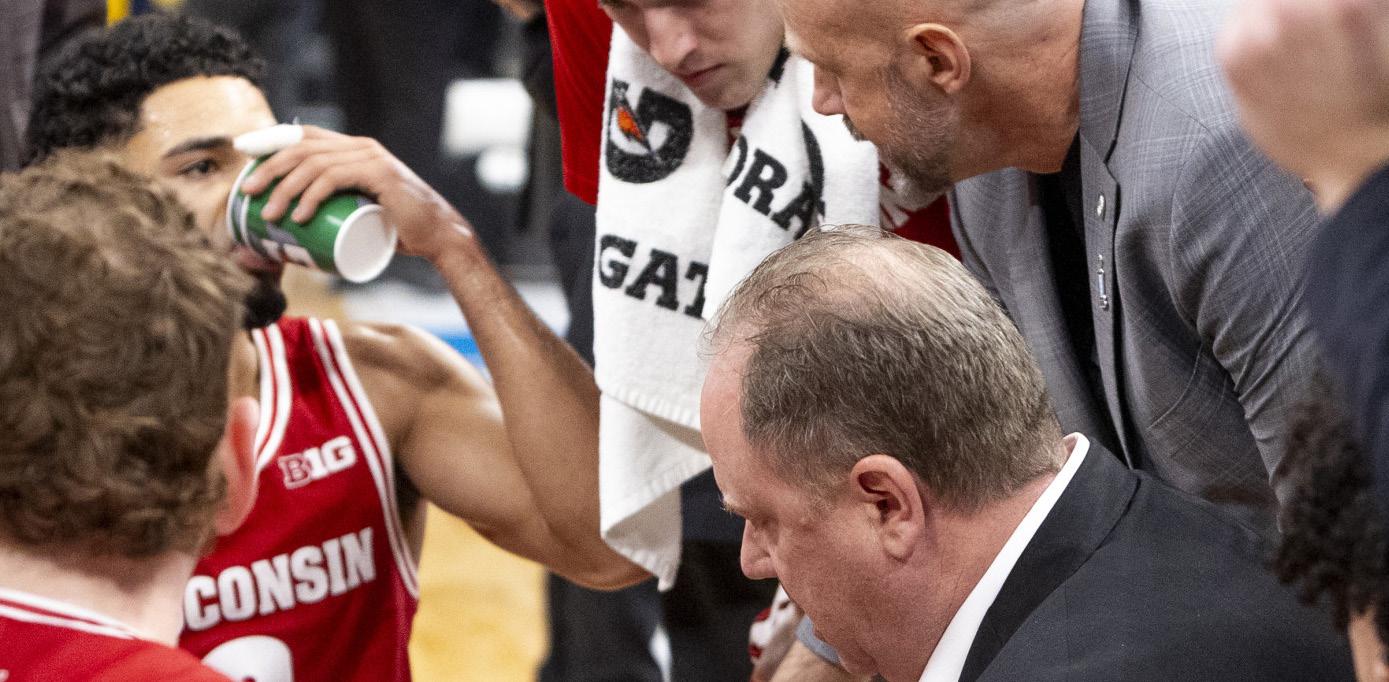
“Extremely proud of [the team] and how we played this week here. This will be good for us because now we’ll get healthy, get some rest and get ready for next week,” Gard told reporters minutes after the game. “This group is battle-tested, and I think hungry to make a deep run.”
Over the course of three days, Wisconsin fended off a feisty Washington team, overcame a 15-point deficit to beat Illinois in overtime and made life miserable for the first-seeded, and third-ranked nationally, Michigan for forty minutes.
“I think this group understands how good they are,” Gard said. “That’s what I
said a week ago when we won at Purdue. This group has gotten better. I think we can still get better. This was a good ‘nother step for certain guys to continue to improve and get more confidence, and ultimately it makes the team better.”
“We’ve proven to everybody we can compete with anybody in the country,” guard Braedon Carrington told The Daily Cardinal in the locker room after the game. “I don’t think we’re too worried about anything.”
The Badgers, by overcoming 15-point deficits on back-to-back days, have proven that they are never truly out of a game, even against the game’s best teams.
On Friday, Wisconsin gritted out their comeback. But on Saturday, the Badgers were lifted by an unbelievable five minute stretch from Rapp. Wisconsin, bullied by Mara, had fallen into a 54-39 deficit when Rapp got the hothand. Rapp, previously 0-for-4 from beyond the arc with no points, hit his first 3-pointer off a dish from Blackwell.
After Carrington and Boyd each scored to bring the game within seven points, Rapp hit 3s on three straight possessions, bringing the United Center to a frenzy, tying the game and forcing Michigan head coach Dusty May to call a timeout. Rapp then proceeded to drill 3s on Wisconsin’s next two possessions to give Wisconsin a 62-58 lead.
Continuereading@dailycardinal.com