
University of Wisconsin-Madison
University of Wisconsin-Madison
YouTuber Andrew Callaghan brought the energy of Channel 5 to Madison’s Orpheum Theatre.
+ ARTS, PAGE 8
Since 1892 dailycardinal.com
Thursday, Marchl 12, 2026 l

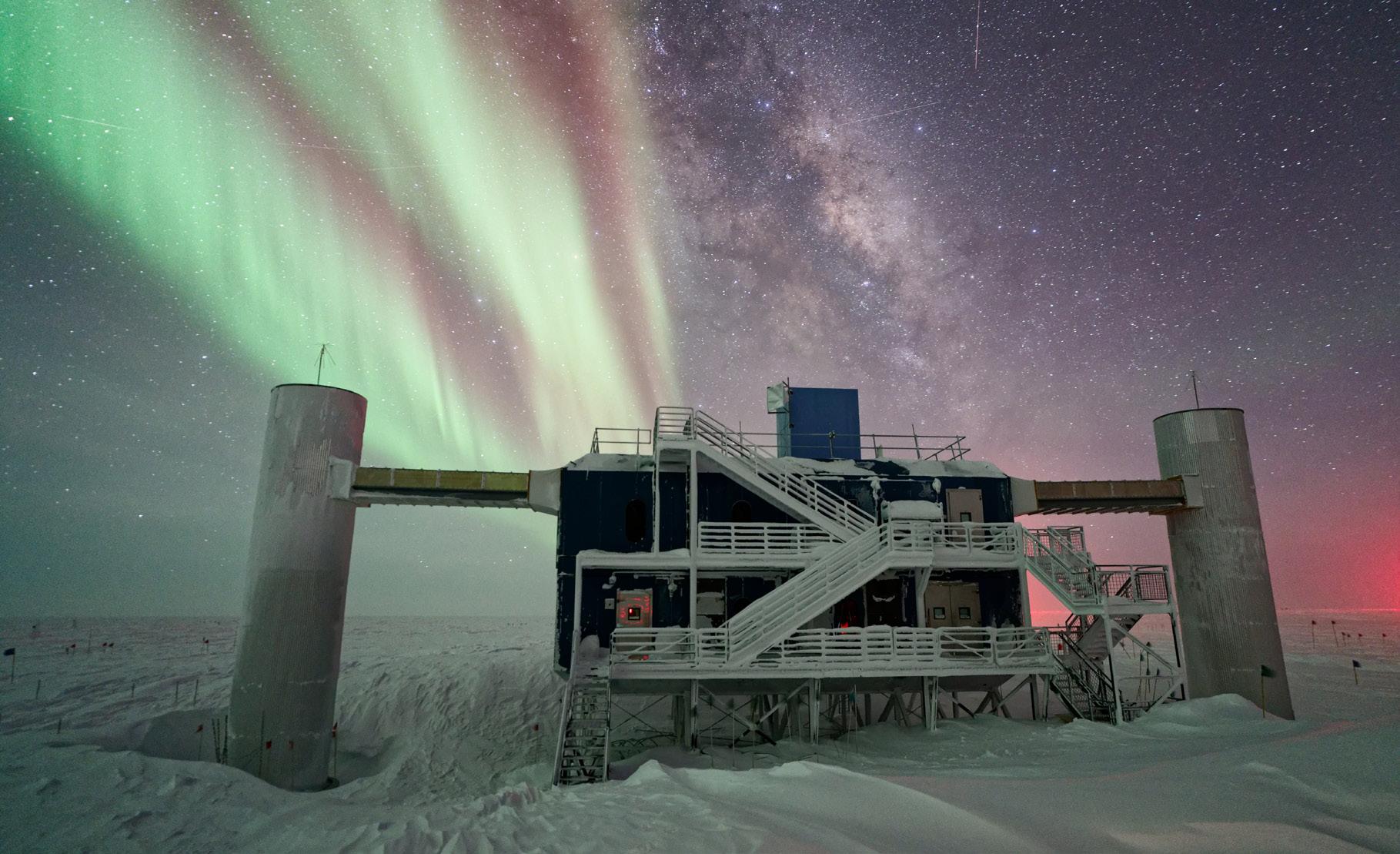
This UW observatory in Antarctica looks to identify dormant black holes.
+ SCIENCE, PAGE 7
By Annika Bereny CAMPUS NEWS EDITOR
Interim Provost John Zumbrunnen has been selected to hold the role of provost permanently, beating out finalists Anna Stenport (the University of Georgia) and Charles Martinez Jr. (the University of Texas-Austin), the University of WisconsinMadison announced Monday.
“John Zumbrunnen is an exceptional academic leader and has earned broad trust from our students, faculty and sta through his thoughtful engagement on a wide range of complex issues and for his strong commitments to the Wisconsin Idea, shared governance, student success and excellence in research and teaching,” out-
going Chancellor Jennifer Mnookin said in a statement.
Zumbrunnen has served as interim provost — the chief academic leader and the second-highest ranking o cial at UW-Madison — for the past nine months following the departure of Charles Isbell Jr. to become president of the University of Illinois Urbana-Champaign.
“I am incredibly honored to serve as provost of this amazing university,” Zumbrunnen said in the release. “Even after nearly two decades on campus, I continue to learn about and to stand in awe of all that UW-Madison is and does.”
The provost is responsible for creating and implementing the academic vision
of the university, as well as leading the deans of UW-Madison’s various schools and colleges — alongside other leaders from the UW Extension, Libraries and other organizations — in advancing and executing an academic mission and vision for the university.
As provost, Zumbrunnen will be navigating what looks to be a tumultuous transitional period at UW-Madison, as the university navigates federal and selfimposed departmental budget cuts as well as the creep of artificial intelligence into higher education. The search for the university’s next chancellor will begin on May 17 of this year when Mnookin o cially departs her role for Columbia University.
During his presentation to students, faculty and sta two weeks ago, Zumbrunnen promised to “never be content” as provost and constantly strive to better serve the state and embody the Wisconsin idea.
“Those words, to me, suggest that the Wisconsin Idea is not just a principle. It’s not just a pride. It is a challenge to us,” Zumbrunnen said last week in his finalist interview. “It is a challenge to us to do everything we can to have UW-Madison be a force for good in the world that will never be content.”
Zumbrunnen said he was “excited to continue the valuable work of the Wisconsin Idea,” in the release.
By Cole Zich STAFF WRITER
The University of WisconsinMadison Academic Sta Assembly passed a resolution on Monday calling for UWPD to end their contract with Flock Safety and publish all other contracts with surveillance technology companies, like Motorola Safeties and Rhombus.
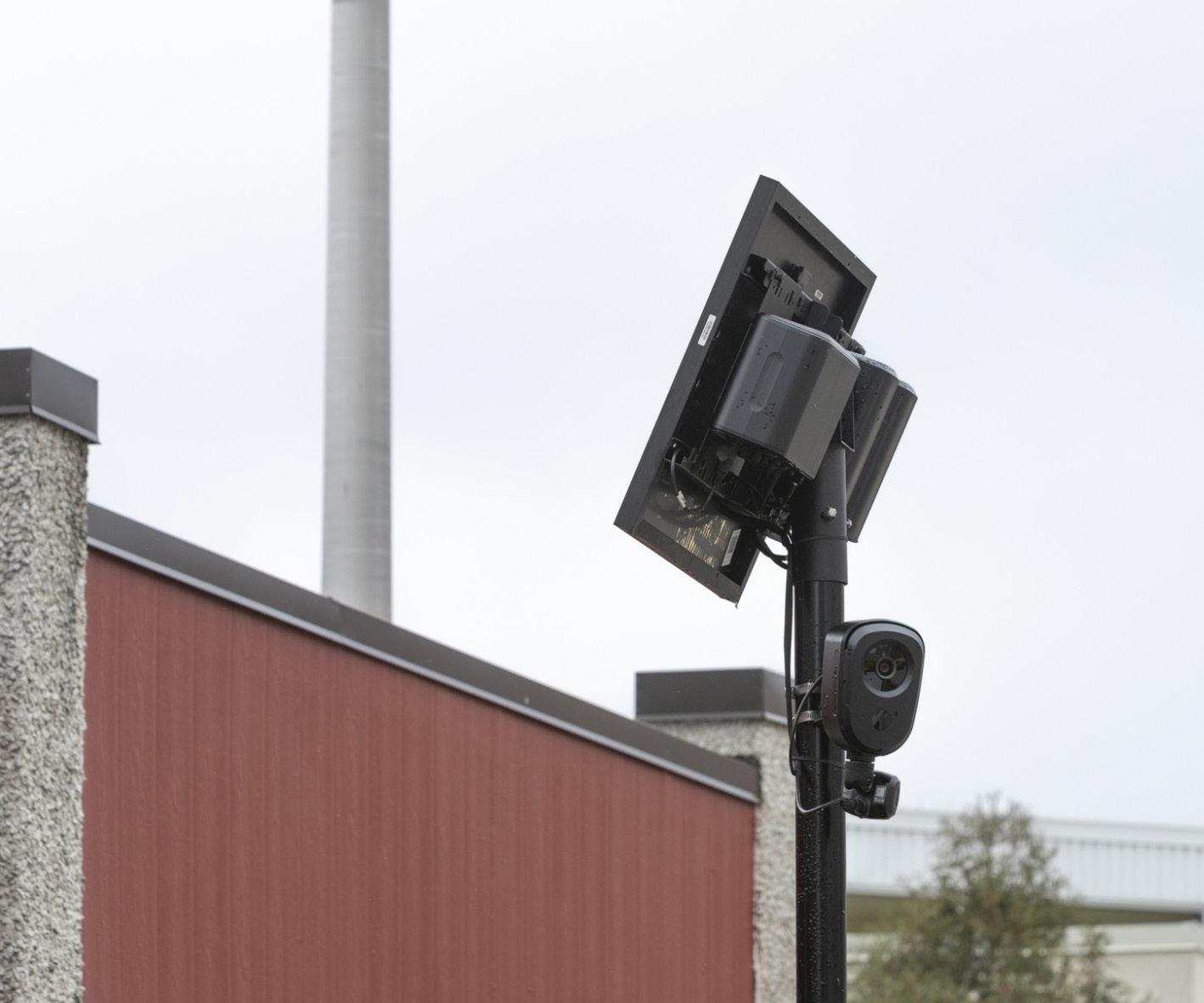
The resolution also called for the university to align its policies on mass surveillance with City of Madison ordinances which ban surveillance technology that uses artificial intelligence. Because of this ordinance, there are no Flock cameras under Madison Police Department jurisdiction, but there are eight flock cameras on campus.
UWPD Chief Brent Plisch argued the cameras are important to maintaining campus safety and said the department has instituted certain safeguards, including limiting access to the data internally and externally, at Monday’s meeting. Faculty and community members still have concerns about Flock’s data sharing, especially as President Donald Trump escalates immigration enforcement.
Flock Safety is a private company who contracts with local police departments like UWPD to provide automated license plate readers. Newer functions, such as information sharing across agencies and the use of artificial intelligence to locate and search vehicles beyond the license plate, have been cause for ethics, security, legality and regulation concerns.
In Colorado in May 2025, a Flock spokesperson admitted the company shared data from its cameras with Customs and Border Patrol through an undisclosed pilot program. Additionally, in cities like Milwaukee and Menasha, o cers have been investigated for using Flock data for
unauthorized searches, like stalking ex-partners.
The resolution also calls for UWPD to clearly display an organizational accountability and reporting structure on its website. UWPD currently has a website aimed at promoting Flock transparency.
UWPD Communications Director Marc Lovicott previously told The Daily Cardinal that UWPD policy says data from campus-area Flock cameras is only shared with in-state law enforcement. However, at the time, Lovicott said he couldn’t speak to what state agencies do with
their data.
Plisch said the department does not use it as a “proactive tool” for monitoring, although he did mention Flock’s potential usefulness for finding those on a Silver Alert list. Instead, he said the cameras are only used for investigation.
He said only nine individuals have internal access to the UWPD’s cameras, and described the paperwork required for an additional individual to review Flock data. Plisch said the department does not allow federal use of the system, and all external users are within the state.
“We have restricted this system to not allow anything a liated with immigration enforcement,” he said. “Agencies within the state of Wisconsin cannot conduct a search of our data for the investigation of … ICE-led cases.”
Plisch said UWPD carefully audits all external requests to determine if other state departments will handle Flock data properly and not abuse it or distribute it to unauthorized federal agencies. He cited the recent case in Milwaukee as an example of the risks associated with not exercising su cient caution with Flock data.
Academic Sta members, however, said they were still concerned about increased surveillance on campus, despite UWPD’s internal safeguards, especially since ICE has contracts with many Wisconsin sheri s departments who can access UWPD’s data.
“This is just another one of those things that’s a reform. This is gonna make us safer,” Barret Elward, an author of the resolution and Co-President of United Faculty and Academic Staff union, said. “It’s used for that sometimes, but it’s also used as a nationwide network to catch members of our community that may or may not be documented.”
The resolution initially included a clause to call for an end to all contracts with surveillance companies on campus, but was amended to only end the contract with Flock and place all other contracts under review.
Elward was also concerned by the lack of information on how the data was stored.
“If we want these surveillance cameras on campus, they should be run by UWPD and UW-Madison, and the data should stay local,” Elward said.
The resolution said Flock has a history of not removing cameras after a contract termination, encouraging the university to remove or disable the cameras themselves if the contract with Flock ends and they fail to comply.
The approved resolution will be referred to campus administration, with the final decision on any recommendation being made by the UW-Madison chancellor, the UW System president or the Board of Regents.
“…the great state University of Wisconsin should ever encourage that continual and fearless sifting and winnowing by which alone the truth can be found.”

By Aanya Agrawal STAFF WRITER
For thousands of international students, coming to the United States for college is more than just a degree — it is an opportunity to pursue an education at a globally recognized university.
But as recent changes to immigration policy under the Trump administration lead to a decline in foreign student enrollment across the country, some current and prospective international students feel uncertain about their future in the U.S.
The U.S. saw its largest decline in foreign enrollment in a decade, excluding the COVID-19 pandemic, as international enrollment for the 2025-26 academic year fell by 17%.
At the University of WisconsinMadison, freshman international enrollment declined by 30%, with only 325 students joining this academic year compared to 506 students the year before.
Beyond federal enrollment restrictions, students said they have noticed how the current political climate subtly shapes their dayto-day experiences.
“When you read up about Wisconsin and the Midwest, there’s this general tone that, ‘Oh, everybody’s super friendly, super welcoming etc.’ I don’t know if that’s particularly true of an international student,” Malaysian transfer student Krish Chandnani said.
For international students already here, UW-Madison’s prestigious reputation and opportunities are key reasons they choose to remain.
Chandnani said he sought out UW-Madison for its nationallyranked computer science program.
“Part of the reason I could convince myself to come to Wisconsin is that I could say that it had a great computer science program without knowing anything about it, just because of how well it was ranked,” Chandnani said.
Junior Aniruddh Nambudiri said the School of Journalism and Mass Communication and its robust alumni network helped UW-Madison outshine the rest of the country.
For him, applying to schools in the U.S. wasn’t something he originally considered, but looking back, Nambudiri said UW-Madison was “the only place I would have actually wanted to come to.”
While students praised UW-Madison itself, Nambudiri described the extensive visa process and current political environment as “a nightmare.”
A three-week long student visa interview suspension in late May, on top of a new social media screening process, resulted in backlogs and delays. Many students didn’t let the delays deter them, but for some, the uncertainty about what a future in the US would look like didn’t seem worth the risk.

Nambudiri speculates current immigration restrictions will lead to a decline in international student interest. “I think a lot of people are now starting to really question their decision and the advantages,” he said.
UW-Madison spokesperson John Lucas said the university remains “committed to welcoming international students as essential members of the academic community” in a statement.
“While international students have faced uncertainty amid changing rules and regulations, the univer-
sity has proactively worked to support them,” Lucas said.
“You never have someone like shouting slurs at you, but you feel it. You feel a certain perception,” Nambudiri said.
Despite these moments of unease, Nambudiri describes his experience in Madison as largely positive, saying the sense of community found on campus has outweighed the broader implications of the national immigration policy changes.
“Personally, I am more drawn to Madison than I am to the U.S.,” Nambudiri said.
By Zoey Jiang ASSOCIATES EDITOR
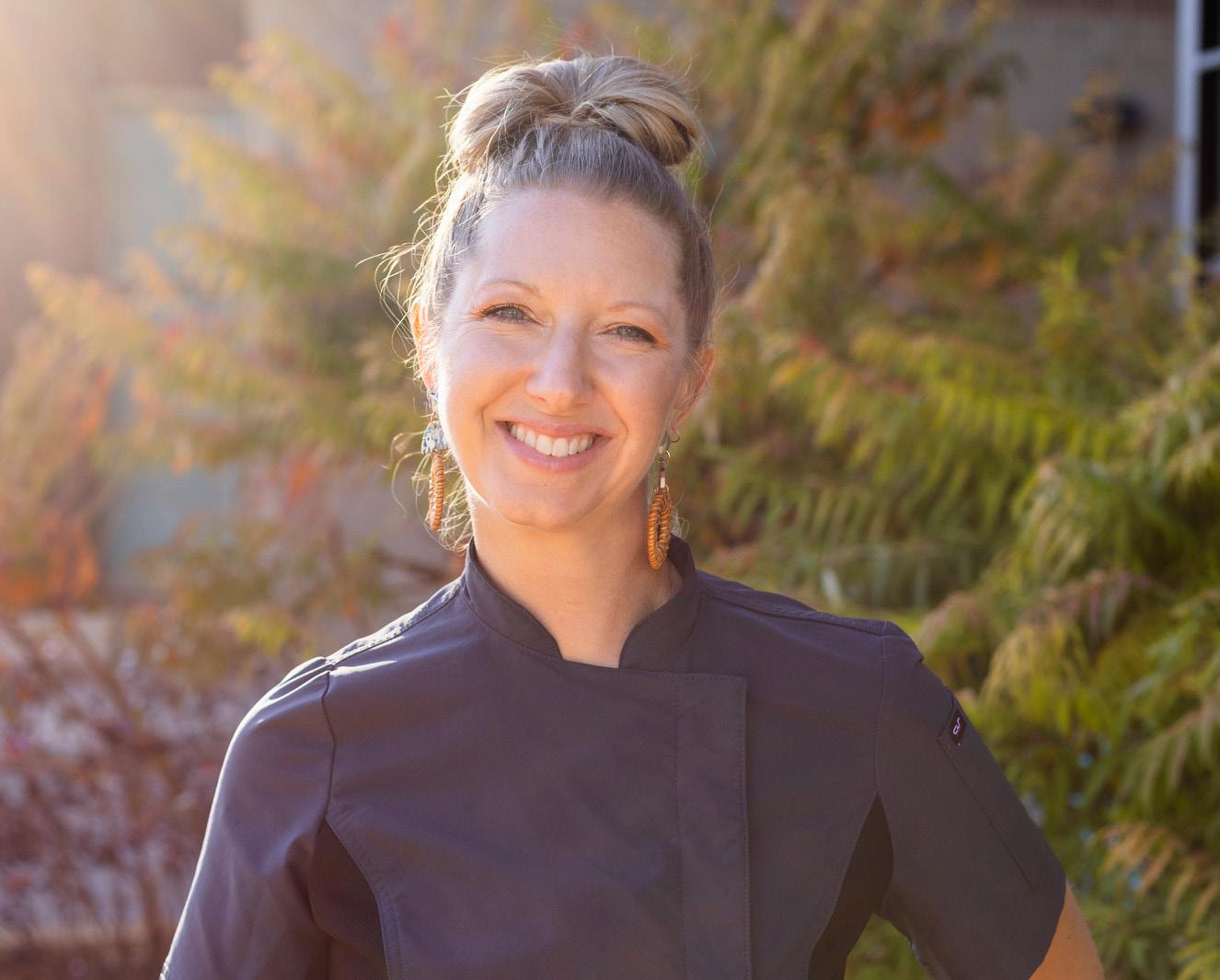
Sigma Alpha Epsilon (SAE) is pr Chef Lauren Montelbano has worked as Wisconsin Union’s first chef-in-residence since last April, expanding vegetarian and vegan options across Union restaurants and collaborating with Union chefs to develop recipes and culinary programs for the Madison community.
Union Director of Dining and Hospitality Carl Korz reached out to Montelbano mid-2024 about furthering vegan o erings at the Union, Montelbano told The Daily Cardinal. The Wisconsin Union Directorate Dining Board wanted more diversity in their culinary o erings across campus, Korz said. Plant-based o erings were a specific request.
“[Our key goals were to] find talented chefs who were passionate and had a strong creative vision about their style of cooking, were locally or regionally available and represented a style that added depth to our current team of talented chefs,” Korz said.
Korz knew exactly who to call — Montelbano.
Montelbano has spent the last 11 years running kitchens in Madison, according to her website. She is an expert in designing meal plans for those with dietary restrictions, having worked as a personal chef for seniors and individuals with special dietary needs.
Montelbano spoke highly of her time with the Union. Over the past
year, she designed dishes for the catering menus, Grab ‘N’ Go areas and the Rathskeller and hosted a cooking demo and class through WUD Cuisine to teach more about vegan food preparation.
“I had the opportunity to collaborate and learn from the highly skilled and talented chefs that have made the Union their home,” Montelbano said. “Their attention to detail, passion for teaching and ability to manage multiple high volume businesses at once was inspiring to witness and be a small part of.”
Montelbano’s passion for food’s connection to vital health sprouted from her own personal experiences with veganism.
“I found better health and clarity through enjoying a vegan diet,” she said. “I’ve always been an animal rights advocate and that’s the area of veganism I’m the most passionate about. I truly feel that another living being should not have to su er so I can survive.”
She encouraged students to learn about the food they’re eating. “Knowledge is power, and I encourage everyone to take a look at where the food you choose to put in your body comes from.”
At Montelbano’s small business, new policies can lead to changes almost immediately. But at larger establishments, like the Union, change is often incremental and takes time and preparation.
“Some of the items I designed are already implemented on menus already, and others will get added for the spring menu. Though things didn’t happen in the timeline I was expecting, they are still happening in the timeline that was needed for them to be successful,” she said.
Montelbano will finish her residency in April, and though her time at the Union will be up, she hopes students continue to engage with plant-based diets.
“I feel so passionately that we can change the world around us when we sit strong in our system of beliefs and are open to sharing them in an inclusive way,” she said. “I think everyone can benefit from learning how to prepare and enjoy plant-based foods, even if you’re not a vegan.”
Montelbano has a strong relationship with Vitruvian Farms, a local and organic farm started by two UW graduates, according to Korz. She has a background in organic farming and makes sure to source her ingredients from a small network of farms and to reduce the environmental impact on the planet.
Korz said Montelbano’s work has been well received by students, alumni and Union chefs so far.
He also complimented Montelbano’s balance between spices, textures, flavors and complimentary ingredients. “Her approach isn’t just good plant-based food — it started by respecting the earth, growers and ingredients,” he said.
By Jane Dardik STAFF WRITER
Dane County Sheri
Kalvin
Barrett reflected on his first four years in o ce and his run for reelection on Nov. 3 in an interview with The Daily Cardinal.
During his term as the first African American sheri in Dane County, Barrett worked through budget cuts, started new social service programs and oversaw Madison reaching its lowest crime rates in the last five years. He also clashed with the Dane County board over 4% budget cuts last November, which ultimately froze 20 unfilled positions rather than eliminating them.
Barrett described tensions with the board as one of the biggest challenges of his tenure.
In an interview with the Cardinal, Barrett discussed accomplishments, ongoing issues and what he hopes to accomplish if given a second term.
This interview has been edited forclarityandbrevity.
What do you feel has been your biggest achievement as sheriff so far?
I think our biggest achievement was implementing our medication-assisted treatment program in April of 2022 in our jail. This is the first time in the history of our sheri ’s o ce we’ve implemented this evidence based approach to substance use disorder by continuing medications for those who are experiencing substance addiction.
Another accomplishment was creating our mental health team. We have deputies that are within the communities that specialize in mental health issues and both short and long-term crises. I think that’s just been a great accomplishment we’ve done together as a sheri ’s o ce under my leadership.
Is there anything you were unable to accomplish this term but could make possible in a second term?
One of the major things I was not able to accomplish is continuing to hire qualified individuals who represent the communities we serve here in Dane County.
Over the past five years, we have experienced a large amount of retirements, and we’re a little bit behind. We were able to continue the success we had in 2023 and 2024. Now we’re looking to set a goal of 50 hires this year, and we are on track to do that.
Why did you decide to run for re-election?
I believe we’ve accomplished a lot of things with me leading the sheri ’s o ce, and there were some things we weren’t able to accomplish. I think the foundation we’ve built together as a team under my leadership will be a great booster into the next four years if the people choose to reelect me as their sheri
I’m just focused on running a
great campaign, being the best sheri I can and continuing to serve the great people of Dane County with character, competence, compassion, courage and communication.
I can tell you this, I am prepared for anything, and I think the body of work that has been accomplished over the past five years kind of speaks for itself.
What are some changes you would like to see and that you would implement if given a second term?
On the legislative level there needs to be some assistance from the state of Wisconsin to prevent our county board from defunding us. We saw that attempt last year, which was met with a ton of pushback, and it led them to only freezing those 20 positions. But there’s current legislation out there that will add sheriff’s offices to the list of police departments that cannot be defunded from their previous fund or their previous staffing levels of the previous year.
For some reason, in 2023 the legislation did not add county sheriff’s offices to the bill. I’m hoping an amendment is signed so we can have the same protections as the police departments we’re assisting on a day to day basis.
What has been the biggest challenge you’ve faced as sheri and how did you overcome it?
The biggest challenge as sheriff is working with the Dane County board and providing them with data and information to support every decision we’ve made. In many situations, if not the majority of them, that data, research and statistics never get taken into consideration.
We focus on distributing good data, and in many cases, they will look at those decisions and choose not to follow the recommendations of the sheri ’s o ce. There’s no one who knows our jail better than me as the sheri and our Dane County Sheri ’s O ce sta
I just hope the Dane County Board trusts us to make decisions for the greater good. There are where the Dane County Board has chosen not to follow the recommendations or the decisions of the Dane County Sheri ’s O ce, and it has proven to go exactly how we expected it to go.
At the end of the day, the only people who were hurt are the same people who elected us to protect them.
What is something that happened this term that you do not want to happen again?
Around two years ago, the Dane County Board made the decision to end the contract with our federal residents in transit. Those who have been sentenced to federal prison would typically be housed in our jail while they were going through their court processes. The federal courthouse is lit-
erally a block and a half from the Dane County Sheriff’s Office, so it was a great partnership. It was a source of revenue for us, and we don’t have any other forms of revenue as a sheriff’s office here.
The Dane County Board, who controls the contracts, decided to end that contract, even though it was bringing in an average of about $1.5 million in revenue. We’re currently in a budget deficit of $31.5 million. Well, now they’re looking to bring that contract back.
We told them repeatedly that we’re going to need that money. It’s something beneficial to the criminal justice system and for those going through it. The transportation isn’t as far compared to coming from 30 to 45 minutes away from other sheriff’s offices.
Now the Board is in the process of discussions with the U.S. Marshals office in regards to how that would work to bring it back. Again, that is one of those exact examples of where we said, “Hey, this is the data. This is what we do. This is how it’s beneficial. Not just for us right now, but for the future,” and they chose to do otherwise. Here we are trying to undo some of the decisions that were made.
Is there anything you would do differently with the federal residents in transit program?
At this point, it’s been two years. The federal system is kind of adjusted and has other contracts with other sheriff’s offices now, so it’s really up to the Dane County Board to negotiate that contract and try to bring it back. I’m not sure how that’s going to go with the current situation and how things have been over the past two years. It’s Dane County that is facing a $30 million plus budget deficit, right?
There is a statistic from the Madison Police Department saying Madison is seeing some of the lowest crime rates in the past five years. How do you take that, and what do you think is the reason behind it?
I would say it starts with the leadership of the Madison Police Department, starting with their previous chief, Sean Barnes, and their current Chief John Patterson, but also through the dedication of the brave women and men of the Madison Police Department who go out and serve the community with character and competence every day.
Then it extends to the partnerships that we have with the surrounding agencies. Us working with them and being a readily available partner to help in any situation. We make sure that we’re implementing appropriate criminal justice reforms that help lower crime.
I think all of us working together as one in unison is the reason why we’re seeing a collective reduction in the crime rates, not just in Madison, but in Dane County as a whole.

By Jake Piper & Peter Fishman SENIOR STAFF WRITER & STAFF WRITER
Madison Students for a Democratic Society (SDS), in conjunction with five other political student organizations, hosted a protest on Library Mall calling for the University of Wisconsin System Trust Fund to divest from weapons manufacturing on Tuesday.
The protest, which drew around 20 participants from SDS, SJP, Jewish Voices for Peace (JVP) and the Party for Socialism and Liberation, along with an Iranian immigrant, was the latest in a long series of rallies which, since Students for Justice in Palestine’s pro-Palestine encampment in early 2024, that have called for the UW System to divest from portfolios which hold stock in companies like Lockheed Martin and Palantir.
At the protest, advocates voiced their disapproval over the U.S.-Israeli airstrikes in the Middle East and their growing humanitarian costs.
Speakers from each group denounced the U.S.-Israeli war on Iran, where chants of “shame” could be heard echoing from the crowd as a Palestinian flag waved overhead.
“We had Palestinian flags and keffiyeh, because there’s a recognition that the genocide in Gaza is connected to Iran,” SDS member Bradley Keenan told The Daily Cardinal. “The IDF carried out a ground invasion, murdered thousands of people in Gaza and is now working hand in hand in the U.S. military in Iraq.”
On Feb. 28 the U.S. and Israel launched a joint assault
on Iran, with airstrikes on multiple cities and killing Iranian Supreme Leader Ali Khamenei. In the 10 days since, over 1,700 casualties have been reported in the region, 12 countries have been struck by missiles and around 140 U.S. service members have been injured.
“Every person in the Middle East is at the mercy of U.S. bombs and Israeli bombs constantly,” Luca, an SDS member, said. “This is totally unjust, and the university — through their investments — sponsors this murder. The school must be held accountable for their illegal actions. We must divest immediately from Israeli companies and defense contractors.”
As of December 2025, the UW System Trust fund has invested over $316 million dollars into BlackRock’s ACWI Index, which includes some companies that have profited from the war in Gaza, assist with tracking for ICE raids, are connected to the attacks on Venezuela or are attributed to human rights violations.
According to a 2024 financial review conducted by the Cardinal, the top 10 U.S. defense contractors made up approximately 1.1% of all investments in the index, while companies that have provided weapons to Israel encompass 4.56%.
“Every dollar spent on war is not only a moral injustice, it is a reminder exactly of what our government values and who it finds expended,” Seth, a member of JVP said. “It is critical in these times that you express your right to protest peacefully, your free expression. Use your voice while you still can.”
By Addison Dama STAFF WRITER
As demand for shelters and resources for Madison’s homeless population increases during the winter, many organizations step up when the unhoused need it most, offering support when services become overwhelmed.
Madison Street Medicine is a volunteer-based organization that brings medical care to homeless people where they are, according to Madison Street Medicine’s Community Engagement Coordinator Donna Maysack. Their teams are especially active in the winter months, providing care to ailments such as frostbite and connecting people to resources.
The Beacon day shelter provides both men and women a place to stay
from the hours of 8 a.m. to 5 p.m.
At night, people are directed to the Porchlight men’s shelter, currently located at 2002 Zeier Road.
When the weather drops to 20 degrees or lower, “inclement weather nights” may go into effect. No person may be turned away on these nights due to capacity, though those suspensions may be unable to stay due to policy.
Porchlight is currently transitioning to a new location. The new permanent men’s shelter is under construction at 1904 Bartillion Drive.
Maysack fears it may not have enough capacity during these freezing nights.
“The men’s shelter capacity right now is about 400, and they were at capacity, which was breaking records during that
really big cold snap,” she said.
The new shelter on Bartillion Drive will reduce capacity to 250 beds, which Maysack said they are worried about.
According to Sarah Lim, a community development specialist in Madison, hotel placements may be available to people and families unable to find other shelter in severe weather cases. Street teams can help connect those without shelter to hotel placements.
Even when these resources are available and staffed, barriers to access remain. It can be difficult for people to store their belongings, find transportation or deal with the stigma surrounding homelessness.
“There’s a lot of stigma
By Audrey Lopez-Stane
SENIOR STAFF WRITER
Gov. Tony Evers called for a special session of the Legislature on April 14 to consider a constitutional amendment which would ban partisan gerrymandering in Wisconsin.
Evers said he hopes to ban partisan gerrymandering permanently, after previously signing new legislative maps into law in 2024. Wisconsin had what experts considered to be some of the most gerrymandered districts in the country.
However, maps are redrawn every ten years, so the districts will be up for grabs again in 2030.
Because Wisconsin doesn’t have an independent districting commission, maps are drawn by the Legislature and passed in a bill-like process. Republicans have controlled both chambers of the Legislature since 2011 which allowed them to draw maps in their favor for more than a decade.
How was Evers able to pass fair maps with Republicans controlling both chambers?
Republican lawmakers said if the Legislature did not pass the governor’s maps, they feared the liberal-controlled state Supreme Court would draw maps in favor of Democrats.
Justice Janet Protasiewicz won a seat on the Wisconsin Supreme Court in 2023, flipping the court’s ideology for the first time in 15 years. During her campaign, Protasiewicz called current maps “rigged” and “unfair.”
When Evers called Republican lawmakers in the past for special sessions, they often gavel in and out within seconds to avoid taking action. But University of Wisconsin-Madison political science Professor Barry Burden said this special session might have potential among Republicans.
Assembly Speaker Robin Vos, R-Rochester, already said he is willing to talk about ending gerrymandering with the governor. Still, Vos raised skepticism over the amendment because it is a single line change and does not include details on how it would ban partisan gerrymandering.
Burden said the amendment is more of an “idea of wanting to end partisan gerrymandering,” not necessarily about the process, adding that the amendment has to move through the legislature, campaigning and voter ballots before it could be approved.
“It’s a long, complicated set of steps. But I
think for the moment, it’s still a live issue and has some potential,” Burden said.
How was Wisconsin gerrymandered?
Districts in the state were split up two ways: condensing highly populated areas and dividing suburbs among surrounding rural areas. This dampened the Democratic urban vote and bolstered rural, Republican-leaning areas.
A prominent example is Sheboygan, Wisconsin before Evers’ 2024 maps, where the city’s blue strongholds, compacted in its urban area along Lake Michigan, were cut in half and divided between districts 26 and 27. The rest of the district contained scattered red areas, which overtook the vote among that constituency.
Republican lawmakers gerrymandered the state in 2011 after taking control of the Capitol and electing Scott Walker as governor. The GOP eventually lost this trifecta after Evers narrowly beat Walker by just 30,000 votes in 2018.
Still, the gerrymandered maps persisted when the Legislature could not agree, leaving the Wisconsin Supreme Court to adopt districts with the least changes from the previous cycle, until Evers signed new maps into law in 2024.
What will this mean for the upcoming elections?
Democrats are looking to flip both the Senate and Assembly in November. They are more likely to win the Senate, as they only need to flip two seats to gain a majority, but they would need to flip five seats to control the Assembly.
With the new maps signed in 2024, Burden said Democrats have a chance at controlling the Legislature for the first time in over a decade. He also said with President Donald Trump’s declining approval rating, Republicans would be “fortunate just to hold on to what they have.”
“Democrats have really not had a fair shot at winning either chamber for about 15 years,” Burden said. “But the combination of the new maps and having a favorable national environment, that’s going to help Democrats out.”
If Evers’ constitutional amendment passes, Burden said Democrats would have a better chance to win elections in the future, like they do with the current maps. But if it does not pass, he said districts are ultimately up to whichever party controls the Legislature.

attached to being unhoused,” Maysack said. “No offense because we have the most amazing, kind-hearted, generous, humble doctors that I’ve ever met in my life, but a lot of the time when you don’t have money and you go to the doctor, you’re not treated very well.”
Madison Street Medicine is dedicated to building trust with these communities and meeting them where they are at in order to reduce these barriers.
Even if people are unable to donate their time, there are many ways that the community can support these resources.
As shelters reach capacity, Lim said they frequently run low on essential items and rely on community donations.
The Beacon relies on volunteers, especially in the winter when demand is high. They have an Amazon wishlist where people can donate items directly to the shelter without leaving their homes.
The donations most valuable to shelters and volunteer organizations change with the seasons. During the winter months, items such as blankets, socks, handwarmers and winter gear are in high demand. As the weather begins to warm, Maysack said items like sunscreen and bug spray become needed.
“There’s a lot of wonderful people with giving hearts in this community,” she said. “There’s a lot of things you can do.”
By Avery Chheda FEATURES EDITOR
Members of the Economic Development Division met with city sta to discuss their use of Tax Incremental Financing (TIF) to increase housing support in a Housing Policy Committee meeting on Feb. 26.
Madison o cials are turning to new housing policies and financing tools as the city works to keep pace with rapid growth and one of the lowest rental vacancy rates in the country.
Launched in 2021, the city’s Housing Forward initiative aims to help create 15,000 new homes by 2030 through expanding housing choice. Some of the completed milestones include renovating rental homes and public housing units, constructing additional a ordable housing and creating a transit district that prioritizes walking and biking access to bus lines.
To continue creating affordable housing throughout Madison, the city’s Economic Development Division said their sta has three main focuses: “[Monitor changes in TIF policies, strategically purchase land and provide accessible public transportation].”
At the committee meeting, Madison’s Economic Development Division Director Matt Mikolajewski said lawmakers at the Capitol have been revising state housing laws in recent weeks.
“One of the most exciting is a proposal to change the number of years that the city can use tax increments for a ordable housing at the closure of a [Tax Incremental District] from one year to two years,” Mikolajewski said.
A Tax Incremental District (TID) is a designated area in a city targeted for supported economic development. Within a TID, the city uses the new development’s future increase in property tax revenue to fund its development. The upgraded infrastructure within TIDs primarily serves the city’s residents and enhances their quality of life.
“The city is able to [closed] districts open for one additional year [and] direct that additional year’s worth of increment towards a ordable housing,” Mikolajewski said. “So at the closure of a TID we would be able to keep it open for two years which would enable us to then have twice as much revenue coming from closed TIDs to the A ordable Housing Fund.”
Mikolajewski said the extra year of housing support will be crucial as several of Madison’s larger TIDs are set to close in the next five years. An additional year of funding directed to the A ordable Housing Fund would allow for more, otherwise una ordable development.
Another change Mikolakewski said Wisconsin lawmakers are considering is the ability to stack TIF funds with additional city and state housing programs.
“[State law] prevented you from using [housing support programs] along with TIF and/ or tax credits, so it really reduced the ability for developers to take advantage of those programs,” Mikolajewski said. “[Legislation] that would allow for developers to stack those new state programs with existing tax credit programs and with tax increment financing [would] be hugely helpful with housing development to be able to provide multiple sources of funding.”
For projects to be eligible for assistance, they must meet the “But For” test, proving the project could not exist without TIF assistance. Cities analyze projects from top to bottom across return rate, rent and construction cost to verify their eligibility.
Mike Tarby, a Resident Relations Coordinator for Steve Brown’s Apartments, told The Daily Cardinal TIDs are crucial for city development.
“Candidly, my biggest concern is that we’re under-utilizing this valuable tool,” Tarby said. He added he believes the city’s main concern seems to be around TIDs experiencing shortfalls and straining the city’s budget.
A shortfall occurs when a district fails to generate enough tax increment revenue to cover the project’s development costs.
Dan Rolfs, Madison’s Real Estate Development Manager, said that hasn’t happened during his 21 years serving the city.
To avoid potential shortfalls, Rolfs said the city closely compares a project’s starting capital, return rate and construction costs to city standards. Rolfs said the city also analyzes job sites for future projects, additional tax increment income and how to apply that to benefit the community. The city also measures the districts’ performance over time and adjusts the flow of funding based on if the TID is performing well or not.
One example in Madison is TID 36 along East Washington Avenue.
“We brought in a whole bunch of projects that we thought might happen, [but] weren’t sure about,” Rolfs said. “Over time, they really started to develop and they took o .”
While Rolfs has yet to witness a TID shortfall in Madison, some failing TIDs have been bailed out by other districts.
“[TID 38 closed] and it was never going to recover,” Rolfs said. “We donated money from other districts [TIDs 35 and 41]...but we don’t want to do that.” Borrowing money from other districts ultimately puts those TIDs at risk of shortfall as well.
With thousands of new residents each year and vacancy rates are reaching historic lows, leveraging TIFs may help shape Madison’s housing landscape for the next decade.
By Haellie Opp SENIOR STAFF WRITER
Rolling into the postseason ranked fourth in the Big Ten, 4-seed Wisconsin men’s hockey (21-11-2, 14-10-0 Big Ten) gets home-ice advantage against 5-seed Ohio State (12-20-2, 8-15-1 Big Ten) on Wednesday.
The Big Ten Tournament starts on Wednesday, with the semifinals on Saturday and the final on Mar. 21 hosted by the higher seed.
The format of the tournament is different from previous years, as the quarterfinals, which used to be a best-ofthree series, are now a single game. Last season, Wisconsin won game one against Ohio State and fell in games two and three to end their year on a low point.
The Badgers are 2-2 against the Buckeyes this season, winning one home game in November and one away game in February. The Buckeyes aren’t nationally ranked, and their hopes to continue their season in the NCAA Tournament depend on the success of their performance in the Big Ten Tournament.
Players to watch
Gavin Morrissey, with eight goals and 24 assists, leads Wisconsin in points. A topline center with a .163 shot
percentage, Morrissey is a playmaker that is sure to be an integral player on Wednesday.
Junior forward Quinn Finley, despite having a down year from last season, is still a top-line winger who will make an impact in the offensive zone. Coming into the tournament with 15 goals and 14 assists in 32 games, Finley could extend his three-game point streak in Wisconsin’s push for the championship.
On the blue line, senior defenseman Ben Dexheimer had a career year, surpassing his points from last season and his goals from the 2023-24 season. With six goals and 18 assists in 34 games, Dexheimer takes up space on the ice and pressures the opposition. Second in blocked shots for Wisconsin with 46, Dexheimer makes an impact wherever he skates.
Junior defenseman Joe Palodichuk has refined his name as a powerful defender on the ice. In his best season with three goals and 13 points in 31 games, Palodichuk’s agility, speed on entries and vision on shot attempts will be crucial for the Badgers. With 63 blocked shots this season, he is someone Wisconsin relies on in front of the net.
Freshman forward Grady Deering will bring the physicality to playoff hockey. The
6’11,’’ 201 lbs center makes his presence felt on the ice.
Without freshman forward Blake Montgomery due to three game misconducts this season, the Badgers will need to fill the middle-six left wing. Senior forward Kyle Kukkonen is proba zble to fill the gap.
Tournament outlook
Wisconsin is likely a shoein to play in the NCAA tourna-
ment, no matter the outcome of the Big Ten Tournament.
The Badgers are No. 4 in power play percentage, while the Buckeyes are No. 16. Both teams are unranked in penalty kill, so the man-advantages during the game are something to watch.
If Wisconsin can crack Ohio State’s goaltenders and stand firm against their power play, the Badgers could face Michigan State Saturday.
1-seed Michigan State gets a
bye for winning the regular season, sweeping past 2-seed Michigan in the final weeks. 7-seed Notre Dame heads to Ann Arbor to face Michigan — a game the Wolverines are likely to dominate.
6-seed Minnesota travels to 3-seed Penn State. If Penn State cleans up their game from the performance they put on versus Wisconsin, they’ll likely advance to the semifinals to face a predicted Michigan.
The Badgers face o against Ohio State at 7 p.m. Wednesday at the Kohl Center.

By Aeron Hanson STAFF WRITER
The Wisconsin Badgers took down the No. 15 Purdue Boilermakers 97-93 on Saturday afternoon in West Lafayette, finishing their regular season with their fourth top 15 victory of the season.
Wisconsin’s 3-point success was instrumental in their win, as the Badgers shot 52.9% from beyond the arc with six players contributing from 3-point land. It was further demonstration that when Wisconsin shoots the 3 well,
they are unstoppable.
John Blackwell led the way for the Badgers, scoring a game high 25 points while shooting 50% from 3. He was fired up this game and hungry for the win. “I think we’re the best backcourt in the country,” Blackwell said.
The Badgers trailed for most of the first half as both teams traded baskets. With junior forward Nolan Winter out, it could have been a disastrous o ensive performance, missing his dominant presence down low and ability to stretch the floor, but the Badgers
proved they could still produce without him.
Wisconsin proceeded to go on a 12-3 run with 7:30 left to take a 37-32 lead, eventually going into half time with a 52-47 lead with momentum building against a relentless Purdue squad.
Wisconsin opened the second half by building a quick nine-point lead, but Purdue quickly responded with a 10–0 run to take the lead at 14:59. With Purdue surging, and a raucous home court on their side, Wisconsin was on the ropes.
The Badgers responded with an
8-0 run to take the lead at 13:03. Freshman forward Aleksas Bieliauskas hit a big 3-pointer to put the Badgers up by five with just under 12 minutes to go in the game.
After a back and forth second half, the Badgers were able to put the game away with crucial free throws at the end and a magical contested layup from Nick Boyd. Boyd, with 23 points and five assists, utilized his elite playmaking to electrify Wisconsin’s o ense.
Austin Rapp, with an elevat-
ed role due to Winter’s absence, added 17 points, knocking down 4 of 8 shots from beyond the arc. His shooting proved crucial, including two big first-half 3- pointers that helped get the Badgers back in the game.
With the regular season coming to an end, the Badgers now turn their attention to conference tournament play in Chicago, which for 5-seed Wisconsin begins on Thursday March 12 at 1:30 p.m. against the winner of 12-seed Washington and 13-seed USC.

By Rachel Gerhardt STAFF WRITER
If you listen closely to members of the University of Wisconsin-Madison student body on a Monday morning as they wake up to their alarms, you will hear a collective groan. Another early start to a long week ahead. With an even closer look, you can catch a glimpse of some of the usual suspects:
Chemistry major Charlie fell asleep at 1 a.m. after submitting his lab report at midnight. Sunday night is always a cram for him; he’s trying to stop waiting until the last minute, but he hasn’t figured out how to do that yet. He snoozes his alarm five times before getting up.
Ari, the art student, has a big critique in class today. She stayed up late and woke up early to get some more work done on her drawing — and she’s got bloodshot eyes to prove it.
Kendra, the comp-sci major, never fell asleep. She has a project due at midnight on Monday, and she plans to skip all her classes to keep working on it. She has downed three energy drinks in the past twenty-four hours. However, Phoebe, the physics student, is an anomaly. She wakes up bright-eyed and well-rested. She turns o her 9 a.m. alarm clock, ready for the upcoming week after a restful weekend. She feels a sense of hope and excitement that most students lose by junior year and certainly don’t feel on a Monday morning. She brews a cup of co ee and eases into the morning, reading, feeling motivated and focused. The question is... how does she do it?
A majority of students do not relate to this steady sense of motivation. Many would claim to be experiencing burnout: the exhaustion of physical or emotional motivation due to prolonged stress. For college students worldwide, this seems unavoidable, an inevitable part of a successful student’s life.
What drives students to success isn’t just their internal motivation, but the same pressure and external stress that contributes to burnout. Most students view stress as a necessary motivator. If they didn’t have the fear of a deadline, stress of grades or maybe even the impending doom of gradschool applications over their heads, what would motivate them to study hard, to do homework thoroughly or to pull an all-nighter for a project?
Modern universities play a large part in putting this pressure on students to sacrifice their personal lives and identities for academics. Many students feel like they must be productive 24/7 in order to stay afloat and on par with their peers, and feel guilty when they can’t manage. This leads to students staying in to study, which quickly turns into cancelling plans for projects, to skipping the gym to finish your to-do list and eventually holding o grocery shopping for one more week because you just don’t have the time.
Campus wide technology and interfaces, meant to make students’ lives easier, have only strengthened the expectation that students (and professors) are always “logged on,” and can be communicated with at any
point. The harm is not in the fact that students stay up late to turn in assignments, but in that the line between when students are expected to be productive and when they can relax is fading. The cost of the convenience of not having to turn in a paper homework assignment in class is the loss of separation between student’s academic and personal lives.
Students have Canvas and Outlook installed on their phones, so even exam scores sent out at 10 p.m. on a Friday night can make or break the mood for an entire weekend. Additionally, professors are able to send out 3 a.m. emails with important information, further contributing to the expectation that we are always logged on; creating a person who is now inseparable from their academics and the stress that comes along with it.
One could even argue that due dates set to midnight, especially on weekends, pushes the harmful cycle of sacrificing hours of the day that shouldn’t be regulated by schoolmandated activities. Before Canvas, midnight deadlines would’ve been unthinkable. Now, they are routine. Of course, students could always finish the assignment early. But chances are, you are already burnt out, and after a long day of class, you need to spend your free-time with some rest and relaxation — like staring at your wall or staring at your phone while trying not to feel guilty about all of the homework you should be doing.
Students don’t get to clock out and drink a beer on the porch after a long shift. Instead, they drink a beer on the

porch and talk about how they really should be writing that essay by now. When students can find a way to separate between when we expect ourselves to actually be productive, and can truly relax without guilt, then, and only then, can they e ectively resist burnout.
There are many rules that students, like Phoebe, use to rid the feeling of being always logged on: not doing homework after 9 p.m. or on weekends, not responding to emails outside of business hours, or even simple things like not having Canvas or Outlook downloaded on mobile devices. Phoebe does not sacrifice her social life or hobbies for her academics, and she tries to see herself outside of her label as a student — but even she admits that this is not always easy.
Picking up a few healthier habits, or even switching one’s mind-
set to allow more time for real rest and relaxation is important and vital to not burning out. We cannot be logged in all the time. We can not always attempt to be productive. We cannot bear stress and surrounding pressure at all times. Instead, one must imagine Sisyphus relaxing. We have resisted this relaxation because we think that if we grit our teeth and bear it to the end of the semester, everything will work out; however, if we let our motivation-battery recharge, we could get more done in a shorter amount of time.
Students must release themselves from the 24/7 expectation of productivity so that, when Monday morning comes, they feel wellrested and caught up for the week ahead: motivated from something internal and passionate, not from the dread of an upcoming deadline in an endless semester.
Is the ‘look good, feel good’ cliché true?
By Aneri Prashant Mehta STAFF WRITER
Do you ever notice how di erent your mood feels when you spend the day in sweatpants compared to when you take the time to dress up? Think about the last time you had an important presentation, interview or event. Did you reach for sweatpants, or did you choose something that made you feel confident and prepared? The way we dress may seem like a small decision, but it can significantly influence how we think, feel and perform throughout the day.
While many people argue appearance should not matter, the way we present ourselves can influence how we feel and how we perform throughout the day. When people put e ort into their appearance, they often feel more confident, motivated and prepared to face challenges. The idea of “look good, feel good” may sound simple, but it reflects an important connection between self-presentation and mindset.
Putting in an extra 10 minutes in the morning can influence how you feel for the rest of the day. Whether it means putting on a nice shirt or doing your makeup, getting ready signals to your brain that you are prepared to take on the day. Psychologists refer to this concept as “enclothed cognition,” an idea that clothing can influence a person’s psychological processes. When individuals wear clothing
associated with competence or professionalism, they are more likely to internalize those qualities.
Research also supports the connection between clothing and performance. A study published in the Journal of Experimental Social Psychology found that participants who wore clothing associated with authority, such as a lab coat, performed better on attention-related tasks than those who did not. This suggests that what we wear can influence not only how we feel but also how we think and behave.
For example, whenever I put on my work pants and suit for job fairs or interviews, I feel a wave of confidence and authority that I would not normally feel while wearing sweats and a hoodie. It changes the way I carry myself. I stand a little straighter, speak more clearly and feel more prepared to interact with professionals. This idea helps explain why many workplaces encourage business casual or professional attire. Dressing well for presentations or meetings can help individuals feel more confident and perform better when sharing their ideas.
Psychological research also suggests that dressing well can trigger a mental shift that produces physical e ects in the body.
According to Bridgette Rae’s Style Group, taking the time to get ready and look presentable can reduce stress, lower cortisol levels and increase the release of dopa-
mine, the hormone associated with happiness and motivation. These psychological changes can lead people to view themselves as more capable and approach tasks with greater confidence.
Another reason appearance can influence mindset is because it a ects how others respond to us. When someone is dressed neatly or professionally, people often perceive them as more organized, capable and confident. These reactions can reinforce the way we see ourselves. For example, a student who dresses neatly for a presentation may receive more attentive responses from classmates and teachers, which can boost their confidence while speaking. This creates a cycle in which the e ort put into appearance leads to positive feedback, strengthening both selfesteem and motivation.
However, looking good does not always mean wearing formal or expensive clothing. It can be as simple as styling your hair, wearing clothes that fit well or choosing an outfit that makes you feel comfortable and confident. Small e orts in personal presentation can still have a noticeable impact on how we feel. At the same time, it is important not to place all of our value on appearance. Focusing on how we look should not come at the expense of our character or personal qualities. Instead, caring about our appearance can simply reflect self-respect and confidence.

Ultimately, the idea of “look good, feel good” goes beyond appearance alone. The e ort we put into how we present ourselves can shape our mindset, influence our confidence and a ect how we approach challenges throughout the day. While appearance should never define a person’s worth, it can serve as a tool that reinforces selfrespect and motivation. By taking a few extra moments to care about how we present ourselves, we may find it positively influences not only how others see us, but also how we see ourselves.
By Jake Piper SENIOR STAFF WRITER
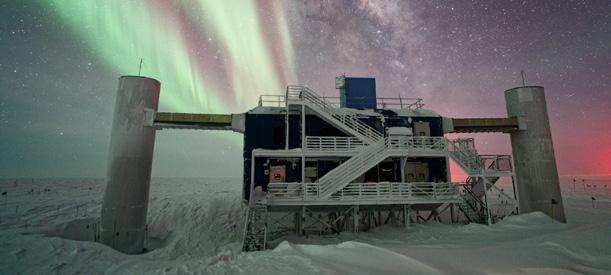
The freezing winds of Antarctica whip across the interior of the continent, kicking up snow into cold, bustling gales of frost. But miles under the surface, inside ice first formed millions of years ago, a di!erent storm is brewing. Zaps of thin blue light, invisible to the naked eye dance through the crystalline sheets, each one a product of the cosmos.
Deep within the ice, so dense its purity is unmatched by anything fabricated in a lab, thousands of electronic spheres are buried. Each is preserved and drilled in the ice, a monolith to scientific research. Their only goal: observe the thin blue zaps — cosmic neutrinos — of our universe.
More than 5,000 of these detectors — called Digital Optical Modules (DOMs) — cover a stretch of ice over a kilometer wide, taking in over 275 million cosmic rays a day for a project headed by the University of Wisconsin-Madison called IceCube. The project, started in 1993, has largely stalled construction since 2010, a monolithic symbol to science trapped in the Antarctic ice. That is, until last year.
After years of planning and negotiation, IceCube has upgraded its equipment for the first time in nearly a decade and a half, keeping what was already a oneof-a-kind detector on the forefront of scientific research by advancing its ability to detect neutrinos.
Neutrinos: the ‘fingerprints’ of black holes
Neutrinos, nearly massless subatomic particles that rarely react with matter, act as markers for high-energy events which occur everywhere, from right here on Earth to galaxies thousands of light years away. At IceCube, over 70 billion neutrinos per year interact with the detector.
“When the neutrino interacts in the ice, it shatters an atom and the splinters from that direction are a lot of energetic subatomic particles,” UW-Madison professor of physics and astronomy — and frequent IceCube collaborator — Justin Vandenbroucke told The Daily Cardinal. “A fraction
of those have electric charge, and they make a flash of blue light.”
That blue light is Cherenkov radiation, the same pale blue that nuclear reactors emit when operational. While the radiation produced might come from the same phenomena, the energy involved is on a completely di!erent scale.
“Neutrinos originate in some of the most violent and least understood events in the universe,” reads IceCube’s FAQ page. Events like supernovas and objects like active galactic nuclei and black holes are just a few possible sources for these subatomic particles which act like “fingerprints,” according to the FAQ page, helping researchers understand more about some of the most enigmatic objects in our universe.
While the high-energy events required to create Cherenkov radiation are exceedingly rare, they have become the driving core of IceCube. They propelled the station’s research into the mainstream when between 2010 and 2012, IceCube discovered the first ever neutrinos from a “cosmic accelerator.”
Cosmic accelerators can be thought of much like the particle accelerators scientists build here on earth, only the particles inside galactic accelerators can reach up to 10 million times the energy of humanity’s best particle accelerator.
The discovered cosmic accelerator ended up being the supermassive black hole at the center of a galaxy known as M77, an object that has been identifiable from our solar system since the late 1700’s as a small dot visible with a telescope.
A new grant and a new life
In December 2025, almost 15 years to the date since he watched IceCube’s last DOM lower into the ice, Albrecht Karle stepped o ! the station’s workhorse military plane into the deceptive chill of the Antarctic summer.
The goal this time? Install seven new strings of over 600 upgraded DOMs, sensors and calibration tools to equip the detector for astronomy and particle physics measurements.
Returning to the same facility and drilling equipment

decade ago, Karle, IceCube’s co-principal investigator and a UW-Madison physics professor, quickly realized his first task was refurbishing the ice drills to a working state.
“It was like in one of those movies where they’re bringing in an old battleship and making it operational again,” Karle said. But because of the drill’s ailing hardware, paired with newly designed programs and a team unused to the complexities of drilling in the Antarctic ice, the first string of sensors took almost 95 hours to drill.
“It was way longer than it should have taken,” Karle said.
After squashing bugs and training an almost entirely new team to drill, work slowly started to progress on what would become IceCube’s first addition in over a decade.
With the harsh cold of the Antarctic and ever-creeping threat of their drilling holes freezing over, Karle’s crew had to work non-stop for days at a time, with researchers picking up night shifts and taking emergency calls to help manage the drilling and stringing of the station’s DOMs.
“At the South Pole, it’s highintensity, almost every day,” Karle said. “You don’t have time to think about [the pressure] too much.”
Despite a series of setbacks and a close call with the team’s drilling equipment, six of seven strings were installed over the course of three months. Both IceCube and its primary funding source, the National Science Foundation, saw the project as a success.
New sensors can bring the Milky Way’s mysteries to light
These new DOMs will increase localized neutrino samples by a factor of ten and are able to detect the highest energy particles physically possible.
Researchers at IceCube hope the new equipment can transition the station from one that works primarily to identify sources of extragalactic neutrinos, to one that can measure the neutrinos’ properties, chart the cosmos and even identify sources of high neu-
trinos in our own galaxy.
That might sound counterintuitive, but in reality, the Milky Way is only about one tenth as bright in neutrinos as the rest of the night sky, Vandenbroucke said.
“Just looking with your eyes, if you’re in a dark place, you see the Milky Way right across the sky,” Vandenbroucke said. “Like a giant, it outshines the other galaxies. And that’s similar in a lot of other parts of the electronic spectrum… It’s not as obvious in neutrinos.”
Researchers like Vandenbroucke theorize this is because our galaxy’s supermassive black hole isn’t currently sucking up any stars, or in other words, is dormant.
“We think that every galaxy has a supermassive black hole, but only some are actively sucking in matter and therefore lighting up,” Vandenbroucke said.
Those active galaxies are what their detector has been spotting, with 10 of their extragalactic particles coming from one singular supermassive black hole.
But where are the neutrinos in our own galaxy coming from? While there are a whole host of possible candidates right now, researchers hope that IceCube, and its proposed Gen2 upgrade, can start giving definitive answers.
The UW physics professor who started it all
The concept of cosmic rays has been around since 1912, but it wasn’t until Francis Halzen, UW-Madison physics professor and co-principal investigator for IceCube, decided to put detectors in Greenland’s glaciers that the world discovered just how readily available they could be.
For years, researchers had known placing DOMs deep underwater allowed them to detect atmospheric neutrinos, but the costs were exorbitant, maintenance pricey and the land required to get usable readings even more extreme.
During the original test, Halzen put DOMs one kilometer deep into the earth with a test reflector to simulate Cherenkov radiation. Immediately after being pulsed,
the whole detector lit up. “But that was it! Nobody had anticipated this,” Halzen said.
He said that while researchers from all over the world had expressed interest in his project, not many thought they’d be able to find anything — let alone neutrinos.
The Greenland experiment “was something of a miracle,” Halzen said.
“You can’t imagine what a ride this was. This was fun and games! We never really thought this would work,” he said. “But the idea was ‘if we make it work, this is fantastic. If we could build a particle detector this big, we’ll find something — it doesn’t matter what it is.’”
Halzen now spends much of his time managing the IceCube project. He joked that “in accelerated physics, we’re used to fighting for [particle accelerator] time, and I suddenly switched to fighting for beds at the South Pole.”
But as intensive as the project may be, Halzen and the other researchers interviewed all agree it’s still exciting to research Antarctica, even if some are on their 15th visit.
Karle recalled one particularly fun January at IceCube. His colleagues snuck a cake in their cargo to celebrate his birthday in the Antarctic, while Vandenbroucke learned how to cross-country ski and watched his colleagues participate in a costumed “race around the world” — a loop around both hemispheres is only about 5km — in his free time.
But for Halzen, the most enthralling part of the project is the interdisciplinary nature of their work, involving not only other particle physicists, but astrophysicists, engineers, astronomers and other researchers at the station.
“Discovering things happens never, or very occasionally,” Halzen said. “The real pleasure of doing science is to learn things.”
And IceCube has been nothing if not an experiment in learning, not only about the cosmos, but about what it takes to create such an extraordinary team.
l 8 Thursday, March 12, 2026
By Cole Zich STAFF WRITER
The Wisconsin Film Festival unveiled plans for this spring’s festival at a preview event March 4. The festival will run from April 9-16 and present more than 100 films, putting local filmmakers, restorations and international cinema on screens across Madison.
The screenings will be distributed across seven theaters: the UW Cinematheque, The Marquee at Union South, the Chazen Museum of Art, Music Hall, the Bartell Theatre, the Barrymore Theatre and Flix Brewhouse.
Beyond highlighting local artists, the Wisconsin Film Festival also brings movies from many larger film festivals to Madison. Artistic director Mike King said he went to Cannes, Toronto Film Festival and Sundance to bring the best films back to Madison.
Students can watch all of the movies for free by presenting their Wiscard at the theater or by claiming early tickets at box offices around the city. UW-Madison film student Kaitlyn Tofte said she attended the festival last year and is excited to see this year’s local offerings.
The festival screens winners of the “Wisconsin’s Own” Golden Badger award. The prize is given to locallyproduced films with “significant technical or artistic achievement,” according to the website.
Many of the movies screened are not available outside of the festival.
“I would say that’s a really cool thing about the festival, that it tries to keep at least a large chunk of it homegrown,” Golden Badger voter Craig Benzine, also known for his YouTube channel WheezyWaiter, said.
A UW-Madison graduate, Benzine used to attend the festival annually as a student. After graduating, he did not attend for multiple years, but he came back to present his documentary “No Packers, No Life” in last year’s festival.
“Blue Heron, I’ve been wanting to see for a while — I was kind of hoping that was going to show up either [at the festival] or at the Cinematheque,” said Vincent Mollica, a filmmaker whose short movie “Bob, Paul... Byrd and Pete Go to the Movies” will be screened during the festival.
Historically, the festival was hosted at Sundance Cinemas, but the theater closed in 2022 and was last used for

the film festival in 2023. Since then, the organizers have distributed the projectors to a few other venues across Madison, creating makeshift theaters out of locations such as Music Hall and the Bartell Theatre.
“If you’re watching movies at those two places, you are literally seeing a reconstruction of… the closest downtown
theater we used to have,” King said.
The festival begins with a screening of “Poetic License,” directed by Maude Apatow, at the Barrymore Theatre on April 9 at 7:00 p.m. The movie follows an auditor at a college who becomes embroiled with two young guys in her class. Early tickets for “Poetic License” and all other movies are available on Saturday, March 7, at noon.
By Jacob Szczap SPORTS EDITOR
Andrew Callaghan, Gonzo journalist of the YouTube generation, stopped in Madison on Friday night as a part of his 22-city live tour, hosting an entertaining evening at the Orpheum Theatre that included screenings of exclusive documentary footage, a Q&A session, a crowd-sourced talent show and a locally-sourced rap battle.
Callaghan has achieved immense popularity through his YouTube series, Channel 5, and “All Gas No Breaks”. Callaghan initially built a passionate following by exploring the subcultures and extremes of American society, where he utilized a deadpan interview style to make near-comedic content, albeit with relevant information pertaining to the subject’s place in the American picture. However, as he gained more journalistic experience, he began to cover more serious political and social topics, while retaining a video-editing style and honest attitude similar to his previous work.
“He’s definitely helped people our age, Gen Z, become exposed to current affairs and current events,” attendee Kenny McAskill of Milwaukee said before the show. “He finds a way to make it exciting and engaging.”
Callaghan’s Channel 5 x All Gas, No Brakes “Carnival” on Friday employed a firm mixture of styles, as humorous talents, such as a woman who “danced” her breasts and a man who played a Swedish mouth instrument, eventually gave way to Callaghan listening to his audience’s views on current political developments and offering his own commentary.
The night began with Callaghan showing a never-before-seen “All Gas, No Breaks” documentary about adult babies, a subculture in which adults dress and act like babies.
“You can’t tell him where to go or what to talk about,” Eric Smith, a fan

who travelled from Milwaukee, said. Callaghan presented shocking and comedic scenes of adults garbed in diapers and onesies before outlining the reasons why people seek out such a community.
“Seeing things from other people’s
point of view makes society better,” Smith said.
After the documentary, Callaghan invited select audience members onstage to participate in a make-shift talent show. Acts included a fantastic Nardwuar impression, a passion-
ate critique of artificial intelligence in German, and a young man eating a 200 milligram edible.
The talent show was followed by an intense rap battle between Madison MCs MCity and Red the Bully.
Finally, local acts like singer/songwriter Devin Gri n, magician Austin Texas and musician Jackson Strong rounded out the talent show. The woman who could dance her breasts won, based on an audience decibel count.
After the talent show, the night became more serious, as Callaghan showed “Finding Orson,” an unreleased Channel 5 documentary about an aging man who loses his pet parrot. The concept of losing a pet, while sad in itself, was compounded by the touching life story of the man who lost the parrot while facing the realities of aging alone. The documentary was emotionally moving and represented a sharp turn in the night’s mood.
Callaghan then opened the floor up to questions, where he talked about his journalistic philosophies, future endeavors and current events.
Throughout the session, Callaghan emphasized the importance of community, telling the audience he currently lives in a trailer home in the Mojave Desert, where the fruits of a tight community can be felt.
When a fan asked about achieving a path towards a less divided country, Callaghan again mentioned community, emphasizing that a lack of people to hold others in check leads to downward spirals into the fringes of extremism. With consistent back-and-forth between the audience and Callaghan and a general lack of formality to the night, the journalist created a sense of community within his own show. By demonstrating that he, too, can be as accessible as the odd subjects he highlights in his videos, Callaghan brought his ethos of understanding from the YouTube videos he publishes onto the stage.