The cob-inspired musical grows for one week at the Overture Center.
+ ARTS, PAGE 8
To save college football, the sport needs to set new rules. It needs a commissioner.
+ OPINION, PAGE 5
By Gabriella Hartlaub SOCIAL MEDIA MANAGER
The Wisconsin Legislative Black Caucus recognized Black History Month in a ceremony at the Capitol on Tuesday. Speakers at the event included Caucus Chair Sen. Dora Drake, D-Milwaukee, Vice Chair Rep. Sequanna Taylor, D-Milwaukee, and other community leaders.
“Black History Month is American History Month,” Drake said in her opening statement.
The event mainly focused on the contributions of Black Wisconsinites, including
those of Attorney Lloyd Barbee, Vel Phillips and Linda Hoskins, the president of the Dane County Branch of the NAACP.
Featured in the event were scholars from One City Schools, a local nonprofit organization that provides “high-quality educational opportunities for young children,” according to the Madison Chamber of Commerce. One City School operates a preschool and an elementary school in Madison. Students from the elementary schools performed drumming to kick off the event and after the speeches.
“Our future is wrapped up in the future
of our young people,” said Rep. Supreme Moore Omokunde, D-Milwaukee. “We want to create a world that’s best for them, including a world that has clean land, air and water.”
Beyond the more famous names in Wisconsin’s Black History, the resolution introduced by the caucus recognized Black Wisconsinites who contributed to the state.
These included Paul Higginbotham, the first African American judge to serve on the Wisconsin Court of Appeals; Shakita LaGrant-McClain, the executive director of the Milwaukee County Department of Health
UW-Madison students troubled by Trump’s gender executive order
By Ellie Huber STAFF WRITER
Transgender and nonbinary students at the University WisconsinMadison feel angry and terrified of future impacts of President Donald Trump’s executive order only recognizing “two sexes.”
Trump issued an executive order Jan. 20 requiring the federal government to only recognize genders “male” or “female,” removing other options like “X” or “other.” The U.S. government will only recognize someone’s sex assigned at birth, rejecting the idea of “gender identity” in the name of protecting cisgender women from transgender women.
The order states those “who deny the biological reality of sex have increasingly used legal and other socially coercive means to permit men to self-identify as women and gain access to intimate single-sex spaces and activities designed for women, from women’s domestic abuse shelters to women’s workplace showers.”
Sex and gender are often used inter-
changeably, but “sex refers to the biological differences between males and females whereas gender refers to the differences between males and females that are determined by cultural and societal factors,” according to a paper by Eleanor Fish, an immunology professor at the University of Toronto.
There is no evidence that trans women are a threat to cisgender women, according to UW-Madison sociology professor Cabell Gathman. Data shows that transgender people are four times more likely to be “victims of violent crime” than cisgender people.
“[The executive order is] not really protecting women,” said Eden Shimon, a nonbinary UW-Madison junior studying genetics and genomics. “The order said federal agencies have to remove extensive public health data related to transgender and LGBTQ+ communities from their websites. A lot of it is really critical information on HIV prevention and contraceptive guidance — a lot of that pertains to women.”
Statistics related to transgender and LGBTQ+ communities have already been removed from resources like the nonprofit Trevor Project and
the Centers for Disease Control and Prevention, but these resources can still be accessed through archives like the WayBack Machine, which is how data will be linked in this article.
Sex vs. gender
Trump’s order claims biological sex is determined immediately “at conception” and belongs “to the sex that produces the large reproductive cell” or the sex which “produces the small reproductive cell,” essentially saying those with a uterus and ovaries are female and those with a penis and testicles are male.
While embryos’ sex chromosomes are determined at conception, sexual differentiation doesn’t take place at conception. During early development the gonads of fetuses are undifferentiated and all female. Other sexual characteristics are developed in the womb, but “sex differences develop and change across the lifetime,” according to the Institute of Medicine Committee on Understanding the Biology of Sex and Gender.
Thursday, February 6, 2025
Legislative Black Caucus honors Black History Month
and Human Services and Marcia Anderson, a retired senior officer of the United States Army Reserve from Beloit, Wisconsin, who was the first Black woman to become a major general.
“Black history is about learning the truth of our collective experience in this country, this world, and creating movements that will hold the United States accountable,” author and educator Linetta Alexander Islam told the crowd gathered in the Capitol Rotunda.
While the event marked the achievements of those in the past, speakers also noted the future of advocacy and Black culture.
Continuereading@dailycardinal.com
Millions spent in Supreme Court race
By Ty Javier SENIOR STAFF WRITER
Waukesha County Circuit Judge Brad Schimel, a former Republican attorney general, faces off against Dane County Circuit Judge Susan Crawford in an attempt to flip the court’s 4-3 liberal majority. If Crawford wins, liberals will maintain their 4-3 majority until at least 2028. The current liberal majority was established when Janet Protasiewicz, who campaigned largely on the issue of abortion rights, won her election to the court in April 2023.
The race that year blew past national spending records in a judicial contest, with more than $51 million spent on both sides, based on a tally by the Wisconsin Democracy Campaign. The group, which tracks spending on campaigns, is estimating that a new record will be set this year.
Wisconsin Supreme Court races are officially nonpartisan, but political groups often support their preferred candidates. The Democratic Party of Wisconsin has endorsed Crawford, while Schimel has backing from conservative lawmakers like U.S. Rep. Derrick Van Orden.
Recent January campaign finance reports showed Crawford raised $2.8 million from individual donors since getting into the race, compared to $2.0 million for Schimel.
The two candidates in this year’s race have raised more money so far than at the same point in the 2023 campaign.
Americans for Prosperity, the Koch-linked conservative PAC, has already poured $1.2 million into independent expenditures supporting Schimel, according to a Daily Cardinal analysis of campaign finance reports. In comparison, Americans for Prosperity only spent around $820,000 advocating for conservative candidate Daniel Kelly in total during the previous contest.
Independent expenditures are spending that advocates for or against a candidate through communications such as advertisements — without coordination with any candidate, their campaign or political party. Political Action Committees (PACs) can receive unlimited contributions from individuals, corporations, labor unions and other PACs, unlike official campaigns with spending limits.
Spending by the Democratic and Republican parties and PACs is expected to far exceed what the candidates spend.
The winner of the April 1 election will serve a 10-year term on the bench.
truth can be found.” University of Wisconsin-Madison
DRAKE WHITE-BERGEY/THE DAILY CARDINAL
Trump cited an MMSD policy in an executive order.
By Vanessa Gavilan CITY NEWS EDITOR
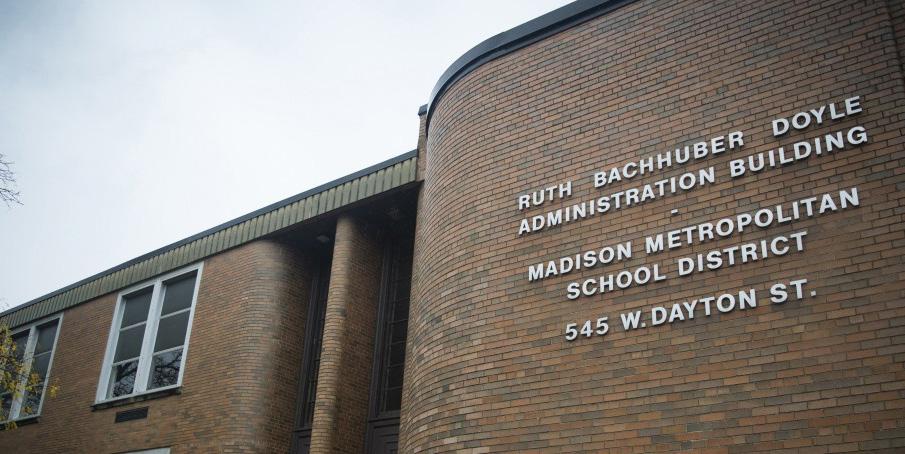
President Donald Trump’s executive order signed on Wednesday cited a policy made by the Madison Metropolitan School District (MMSD) that aims to support all gender identities in the districts’ schools.
This policy, titled “Resolution in support of transgender, nonbinary, and all lesbian, gay, bisexual, transgender, questioning, plus (LGBTQ+) students,” was enacted in May 2021, which aimed to create an inclusive environment for all students regardless of gender or sexual identity.
“The Madison Metropolitan School District Board of Education affirms, supports, and values the gender identities and gender expressions of all our students,” the policy stated.
Trump’s executive order, titled “Ending radical indoctrination in K-12 schools,” denounced this policy, claiming the district encouraged schools to “disrupt the gender
binary” by encouraging students to embrace different gender identities.
The executive order also listed a policy at Harrisonburg City Public Schools in Virginia that encouraged teachers to use students’ preferred names and pronouns.
Trump’s executive order aims to eliminate funding and support for “illegal and discriminatory treatment and indoctrination in K-12 schools.”
MMSD Superintendent Dr. Joe Gothard responded to Trump’s order in a press release on Friday, saying the district would not be changing any policy or procedure based on the new directives.
“We recognize the growing fear and uncertainty among many families in our district and assure you that MMSD remains deeply committed to providing every student with a safe, inclusive, and opportunity-rich learning environment that supports their academic and personal development,” Gothard said.
Nichelle Nichols, president of the MMSD Board of Education,
said in a statement following the executive order the district has a responsibility to provide a welcoming learning environment for all students.
“Through strategic resource allocation, we ensure equitable access to opportunities for all students, supporting their individual needs and potential,” she said. “We stand united against all forms of discrimination, bias, and exclusion.
The order also works to prevent the teaching of critical race
theory, the analysis of U.S. history and institutions through the lens of racism.
Some MMSD schools, including Madison East High School and Vel Phillips Memorial High School, have been offering AP African American Studies since fall 2023.
The executive order gives Trump’s incoming pick for Secretary of Education, Linda McMahon, 90 days to advise the president on future policy related to “ending indoctrination.”
Former UW Choral Union members, director reflect on its end after 130 years
By Nick Bumgardner
FEATURES EDITOR
When Paula Gottlieb arrived at the University of WisconsinMadison as a philosophy professor in 1988, she set her sights on the university’s Choral Union. Having been part of choral life during her undergraduate years in England, she loves to sing but was nervous about making the cut for the Choral Union.
“I had the impression that there was no point trying to get into the choir, I wouldn’t be good enough and didn’t think I had any voice left,” Gottlieb told The Daily Cardinal.
After enough convincing from her friend and colleague Jeanne Swack, a UW-Madison musicology professor, Gottlieb decided to audition anyway.
She passed and spent the next three decades in the Choral Union before deciding to hang it up at the start of the COVID-19 pandemic. When Taylor retired, Gottlieb was so inspired she wrote Choral Union Director Beverly Taylor a letter thanking her for the memories and her “imaginative” spirit.
“Bev[erly] created a kind of community among all these people, and I am still friends with a number of people that I met in the Choral Union,” Gottlieb said.
Stories like these are littered throughout the Choral Union’s 130year history.
Founded in 1893, the Choral Union brought together students, faculty, alumni and community members who, at the end of each semester, performed master works with the UW Symphony Orchestra.
Performances took place in Mills Concert Hall on campus, and for much of its history, the Choral Union drew North of 100 members. For those it touched, it was the “Wisconsin Idea” personified.
But in 2023, that all changed. Over the summer, the Mead Witter School of Music announced on its website it would no longer offer the Choral
Union in an effort to “allow the School of Music to devote resources to our core mission of serving UW–Madison students as well as to focus our public programming around new goals.”
The news came as a shock to members like Janet Murphy.
“For many of us, it was our entry into the university and certainly the School of Music. It was our connection,” Murphy said. “I think a lot of people now feel like as a community, we’re losing all of our connections to the university, and this was a big one.”
A Michigan native, Murphy moved to Madison as an adult. Before long, she found a home at the Choral Union. Murphy sang in the Choral Union as an alto for roughly 15 years from 2008 to its disbandment in 2023. Like other members, she first heard the news online.
“People were pretty upset, obviously, that the choir wasn’t involved in that decision, nor were we even told about it,” Murphy said. “Somebody discovered it on the website.”
Murphy said she felt “blindsided” by the move.
“Disbanding a 130-year-old institution that somehow made it through World War I and II, and the Depression and the riots in the 60s and The [Great] Recession and the pandemic — why?” Murphy said. “This is a pretty important institution that had long roots and really meant a lot to the community in the way the Wisconsin Idea means a lot to the whole state of Wisconsin, and I really thought it was unwise to just end it like that.”
Still, the Choral Union shuttered. In search of answers — and without any way to contact her choirmates — Murphy took a pad of paper to a sight singing event at the First Unitarian Society that July. By fall, she gathered 150 names for a mailing list: Friends of the Choral Union.
In August, Murphy met with School of Music Director Dan
Cavanagh, who was hired just months after the administration canceled the Choral Union. In October, Cavanagh hosted a town hall for members to share their concerns and expressed his sympathy in an email, saying Choral Union was a “stalwart example of the Wisconsin Idea in action.”
Murphy said she applauds Cavanagh’s “professional attitude” and doesn’t blame him for what happened.
“Not everybody felt that way,” Murphy said. “But I thought he told us the truth as best he could and as best he knew. He only started in July.”
The Friends of Choral Union tried to keep their choir alive in the months that followed, even floating the idea of creating an independent “Madison Choral Union.” But despite their best efforts, Murphy said they couldn’t find someone to administer the group, and Choral Union members went their separate ways.
Life after the Choral Union
Today, members are scattered throughout the Madison scene. Murphy spends her time in the Madison Community Chorus and other smaller vocal and instrumental ensembles. Along with Kathleen Otterson, she helps run Bach Around the Clock, an annual festival held in March to celebrate the music and life of Johann Sebastian Bach.
Otterson was an alto in the Choral Union through the 1980s and 1990s under Director Robert Fountain. She joined shortly after graduating the School of Music and in the process said she made lifelong friends.
Otterson went to the October town hall. She was sad when she heard the news, and as a former member, was curious to see what was going on. It didn’t take long to see the frustration.
“People were still very upset. It was difficult,” Otterson said. “If you didn’t understand it before, you really began
to understand people’s devotion to the group and to their participation in it.”
As a UW-Madison alum, she hopes some of that “frustration” and “ill will” toward the School of Music can dissipate. “It’s my alma mater. I’m proud of it,” Otterson said.
And as a music educator, Otterson said she sees the decision from both sides.
“University decision making processes are — what little I know of them — they’re very difficult,” Otterson said. “It’s never just one person, and sometimes the person who’s going to be most affected by it doesn’t have the final word.”
Still, Otterson said she appreciated Choral Union’s “town and gown” dynamic, connecting students and community members around large, orchestral works. The only other outfit in town that can pull off those works, Otterson said, is the Madison Symphony Chorus, directed by former Choral Union director and School of Music professor Beverly Taylor.
That connection, students and the community working with an orchestra, drew Taylor to UW-Madison almost 30 years ago. Choral Union made the School of Music unique.
“The opportunity for townspeople and students, it’s something that’s lost, and it’s one more thing that just isolates one group of people from the other,” Taylor said.
What isn’t fully appreciated, Taylor said, is the amount of active and former faculty members that participated in Choral Union through the years.
Some alumni even had the Choral Union in their will, she said, a testament to its legacy and impact.
“Times change, and I just have to trust that the administration made the decision they wanted for reasons that are theirs,” Taylor said. “I may not agree with it, but since I was not in the room when those decisions were made, I just have to say their decisions took them in another direction.”
CAMERON LANE-FLEHINGER/THE DAILY
Holocaust survivor turns memories into educational mission for young people
By John Ernst SENIOR STAFF WRITER
At just 10 years old, Ben Lesser’s life changed forever. In September 1939, tanks rolled through the streets of Krakow, Poland, shaking his family’s apartment.
“My father called us into the dining room and said, ‘from this moment on, there [are] no more kids. You’re all adults,’” Lesser told The Daily Cardinal. “We grew up overnight.”
What followed would go on to inform his life and his mission.
After being forced to leave Krakow, Lesser fled to thenCzechoslovakia and later to Hungary, where he reunited with family in the city of Munkacs. During a Nazi raid in 1944, he and his remaining
Continued from page 1
Sex can be ambiguous — anatomical, hormonal and genetic variations create each person’s sex, with mutations resulting in intersex people.
“[Trump] definitely didn’t have a scientist with him when he was constructing this order,” Shimon said.
“Ignoring the existence of intersex individuals makes this policy scientifically reductive and exclusionary.”
Camren Livermore, a UW-Madison sophomore and equity and inclusion chair of the Associated Students of Madison, feels the executive order affects all aspects of their life, including studying premed and identifying as queer and nonbinary.
“Declaring two sexes comes across as declaring two genders. [...] Gender is a social construct,” they said.
family were forcibly deported to Auschwitz-Birkenau concentration camp in cattle cars, with more than 80 people jammed into each car. Lesser spent the next two and a half weeks laboring there, he told the Cardinal.
“Every morning we had to stand in line…to be counted, naked, and they would count us and look at us, and if we were too skinny to work, they pulled [us] out and they sent [us] to the gas chambers,”
Lesser said. “Every morning, you didn’t know if you were going to survive.”
Lesser, now 96, described himself as being surrounded by death, witnessing burning bodies, smoky human ashes drifting above the camp and
Negative impacts on trans people
Trump’s executive order also eliminated government programs set up to research and address disparities between transgender and cisgender people and claims that civil rights protections do not extend to transgender people.
Gathman said this reinforces hostility and interpersonal violence toward transgender people, worsening their already disproportionately high rates of health issues, unemployment, poverty and harassment.
“You can make this order, but you can’t actually get rid of trans people,” Gathman said.
“[However], if people pass laws that say you’re not a real person, you can’t have health care, and people are required to call you by the wrong name forever, that’s going to have a severe negative effect on you.”
Anti-transgender legisla -
liberated on April 29, 1945. However, that night, Lesser’s cousin died in his arms, he told the Cardinal. The only surviving member of his immediate family was his older sister, Lola. At the end of his journey, Lesser was 16 years old and weighed just 60 pounds.
Lesser made the journey to the United States in 1947, arriving in New York and attending night school to complete his education, Lesser’s granddaughter Robyn Weber said. He worked many jobs to sustain himself until he moved to Los Angeles, where he worked for the United Parcel Service for 25 years, eventually establishing a successful career as a realtor.
Turning memories into a mission
For 50 years, Lesser kept his story private. He first spoke publicly about his Holocaust experience in 1995 after his grandson asked him to speak to his middle school class, according to Weber.
murders taking place in front of his eyes. He was transported to Durnhau, where he labored in a rock quarry for half a year, narrowly avoiding death many times.
In February 1945, Lesser and other laborers were evacuated from the camp, sent on a seven-week Death March to Buchenwald and then a threeweek Death Train to the Dachau concentration camp. Lesser witnessed many more deaths on his journey, once again confined to a filthy cattle car with no food and overflowing sewage.
“How I didn’t get an infection was a miracle,” he said of his journey.
After arriving in Dachau, Lesser and his cousin were
tion can cause up to a 72 percent increase in suicide attempts among nonbinary and transgender youth, according to the Trevor Project, but statistics from the Trevor Project are already gone due to the executive order.
“The fact that people would rather not be alive than have to essentially be told every day that your existence is not real or people want to harm you because you exist, is horrendous,” Shimon said.
The same goes for bullying and harassing LGBTQ+ students in public schools. Legal protections are no longer under the order, so any students not upholding the gender status quo, like girls bullied for being “tomboys” or boys for being “girly,” could be subject to further abuse, according to Gathman.
LGBTQ+ students are excluded under Trump’s order, but the university can protect them LGBTQ+ students are no
genocide education, because that starts the teaching of what hatred can do,” she said. “One thing schools need to do, as well as parents combined, is really talk about…the root of bigotry and stereotyping and racism. When you teach it at a young age, people are able to form their own opinions without following others.”
Eventually, Lesser transformed his story into more than just a speech. He founded the Zachor Foundation in 2009, dedicating his life to preserving the memory of the Holocaust and sharing his experience to educate youth all over the world.
Lesser designed the foundation to educate around his own experience, providing a dynamic education for students. It has a variety of resources available for teachers including their own Holocaust remembrance curriculum and an interactive AI where students can speak directly with Lesser, a tool used by museums and schools alike.
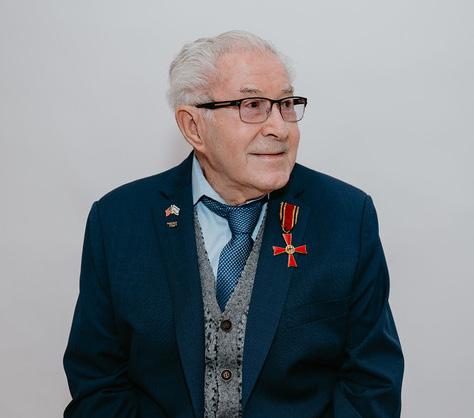
Since his first public story, he has spoken all over Europe and the U.S., distributing materials to classrooms around the globe. In 2023, he was awarded the Cross of the Order of Merit of the Federal Republic of Germany — the highest civilian honor given by the country — for his work in preserving the memory of the Holocaust.
Combating hate has always been the main message in Lesser’s story, he said.
“Hitler and the Nazis did not start with killing, they all started with hate. Hate was able to convert ordinary citizens to murderers,” Lesser said. Weber also emphasized the importance of education to the foundation’s central mission.
“It is so important to be educated, to have Holocaust education, to have any type of
longer protected from discrimination by Title IX under Trump’s order, but Steph Tai, a UW-Madison professor of law, told the Cardinal the university can still independently protect LGBTQ+ students, citing Bostock, the 2020 U.S. Supreme Court decision ruling that discriminating against a person for being homosexual or transgender is simultaneously discriminating against them for their sex.
UW-Madison’s non-discrimination policy prohibits discrimination on the basis of sex and sexual orientation among other protected classes.
“A lot of my work has been involved in making sure that UW-Madison is a safe space for queer and trans students on campus,” Livermore said. “Seeing this executive order come through that essentially erases the identities of many of my peers is disheartening, scary and very disappointing.”
In relation to a recent rise in antisemitism, Lesser believes the way this rhetoric spreads on the internet and social media to impressionable youth can be countered through remembrance of his experience. This surge prompted Lesser to spread his message to even a wider audience.
“I had to push back [against] the hatred and love,” he said. “Why hate? Love and hate are both contagious, so choose love.”
Interested readers can learn more about Lesser’s story by purchasing his book “Living A Life That Matters: from Nazi Nightmare to American Dream.” Purchasing directly from the Zachor Foundation website will put all the proceeds toward funding the organization and spreading its message, Lesser said.
Tai said the decision applies specifically to Title VII on workplace discrimination, meaning the Trump administration will likely argue that Bostock does not apply to Title IX education regulations. Already, several of Trump’s executive orders are being criticized as illegal and unconstitutional by legal experts, and the ACLU referred to the gender order as sex discrimination.
Executive orders must align with applicable laws, and this one doesn’t, according to Suzanne Eckes, UW-Madison’s Susan S. Engeleiter Chair in Education Law, Policy, and Practice in the School of Education’s Department of Educational Leadership and Policy Analysis. Wisconsin, Illinois and Indiana are legally obligated to protect students in public schools according to two Seventh Circuit Court of Appeals decisions.
COURTESY OF BEN LESSER
Trump
Trump taps UW-Madison professor skeptical of tariffs to executive council news
By Wanwa Omot STAFF WRITER
The White House appointed University of Wisconsin-Madison economics professor Kim Ruhl to the Council of Economic Advisers (CEA) Tuesday, appointing a professor skeptical of President Donald Trump’s tariffs policy to the three-person council.
The CEA, housed in the Office of the President, advises Trump on domestic and international economic policy. Ruhl, the co-director of The Center for Research on the Wisconsin Economy, is the first economist from UW-Madison to be appointed to the council.
“I am extremely grateful for this opportunity to apply my training and expertise as an economist to timely public policy issues and I am very
much looking forward to serving my country and my president,” Ruhl said.
Ruhl is an expert in international economics and has written on tariffs in the past, according to the press release. In a livestream with UW-Madison economists in October, Ruhl acknowledged that many economists do not believe the American economy will grow under Trump’s economic policy of using tariffs to limit international trade.
Trump’s reelection was propelled by voter dissatisfaction with the economy, and in his first month in office, Trump announced a flurry of tariffs against Canada, Mexico and China. While Trump paused the tariffs on Canada and Mexico for 30 days before they took effect, a 10% tariff on Chinese imports went into effect Tuesday.
Trump has repeatedly blamed Canada and Mexico for the crossing of undocumented immigrants and China for the flow of fentanyl in the U.S. But whether these tariffs would achieve Trump’s goals of stopping both flows while stimulating the American economy is debated.
“There’s very little evidence that we can create jobs in any meaningful way by raising tariffs,” Ruhl said during the October livestream. “We’re paying dearly for adding a few more jobs. There’s really not much there.”
Ruhl didn’t respond to questions on why he accepted the CEA position given his past stance on tariffs.
Former UW-Madison Chancellor Rebecca Blank served on the CEA while a professor at Northwestern University under the Clinton adminis-
tration, according to the press release.
Walker Family Distinguished Chair and chair of the Department of Economics Christopher Taber praised the appointment in the release, calling Ruhl an “outstanding choice for the CEA.”
“[Ruhl] is gifted with the ability to navigate the gap between academic research and actual implementation of economic ideas, which will lead him to be effective at informing policy, based on evidence,” Taber said. “This is truly the Wisconsin Idea in action.”
South Asian dance competition hosted at UW-Madison draws hundreds from across the country
By Sonia Bendre STAFF WRITER
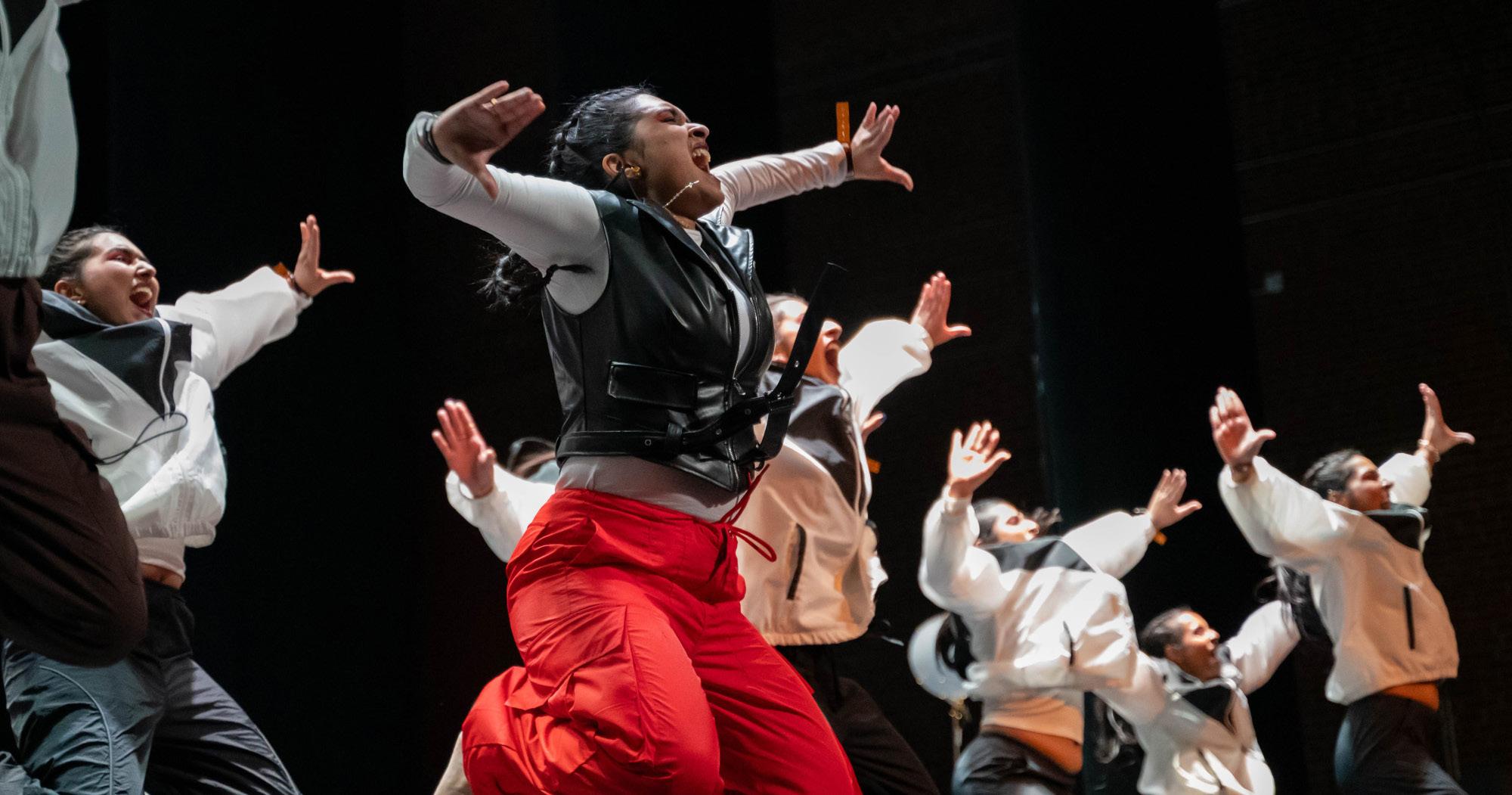
University of Wisconsin-Madison students hosted an annual South Asian dance competition Saturday night, drawing hundreds of attendees to watch teams from across the United States perform choreographed South Asian Fusion dances.
The competition, Aa Dekhen Zara (ADZ), showcased eight teams from states as far away as New York and Texas in a packed Shannon Hall. The teams, who were selected out of over 70 teams who applied, performed eight-to-10 minute choreographed dances designed to tell a story through videography, movements and routine.
ADZ is traditionally Wisconsin’s largest Indian dance competition and one of the largest in the Midwest. This year marked the 15th year of ADZ, whose name translates to “Come Take a Look” in Hindi.
“ADZ has been one of my favorite parts of being at UW,” ADZ Philanthropy Chair Amanjot Kaur told The Daily Cardinal. “It’s such an affirming space because Bollywood Fusion dance combines both our South Asian identity and our American identity through contemporary dance and hip hop and rap music, but also classical and Bhangra, and all of these different parts of us that are showcased in the world of dance and music.”
The competing teams used a combination of props, costuming and homemade edits mixing pop culture and hard-hitting Indian beats to support the stories they were trying to tell.
Each performance consisted of a series of dance numbers, broken up by contextual videos consisting of snippets of film and original dialogue projected onto the back of the stage. The first team to perform, UTD Raftaar from the University of Texas-Dallas, portrayed the origin story of Charlie Chaplin in two main dance numbers.
“We won nationals last year, and our theme was zombies,” UTD Raftaar dancer Antony Sajesh told the Cardinal. “This year we wanted to do something a little bit more lighthearted, and more comedic.”
Sajesh and the other 32 members of UTD Raftaar spent up to seven or eight hours per day practicing after winter break, sometimes holding 14-hour bootcamps. The competitive teams all train to compete in dance competitions like ADZ and are awarded points based on each performance.
Eventually, the 10 teams with the most points will compete at Legends, which is held in Charlotte, North Carolina in April this year. For Sajesh, dancing competitively allowed him to build community and connect to a part of his culture that he hadn’t previously invested much time in.
“I would’ve never considered myself a dancer,” Sajesh told the Cardinal. “Until now, I think it was never something that was a big part of my life, but whenever we would have events at church, or cultural events in my community, you’d do an Indian dance.”
Winners were selected by a panel of judges with extensive dance experience. In first place was ATL Satrangi, a group from Georgia Tech who designed a horror story featuring a vampire, a ballerina, a clown, Annabelle and a bride. Other members wore red-splotched shirts, simulating blood. Like other groups, ATL Satrangi designed and recorded a video featuring members of the troupe, dialogue and Indian-mixed pop beats.
Proceeds from the show were donated to ADZ’s philanthropic partner, the Indian American Cancer Network, which provides resources and financial support to people of South Asian descent who have been diagnosed with cancer. ADZ also ran an on-site blood and bone marrow donation registry with the Leukemia and Lymphoma Society. In addition to these events, ADZ also hosts an annual gala to raise funds for their philanthropic partner.
“There’s inequity in access to treatment for South Asians and minorities in general,” Kaur said. “That gap is even worse for Black and Latinx communities, but it’s also apparent in the South Asian community, largely because of a lot of taboos that keep people from getting registered to donate blood or bone marrow, which is pretty challenging and harmful.”
UW-Madison students say dancing is ‘source of joy’
Four non-competing exhibition teams from UW-Madison also participated in
ADZ: Wisconsin Waale, an acapella group, and South Asian dance groups Wisconsin Rangde, Wisconsin Surma and Wisconsin VIRA. VIRA, an Indian classical dance group, debuted at ADZ three years ago with seven members and now has around 20.
“While we do want to cater to the audience, we always keep the structure and integrity of classical dance,” said Michelle Shaji, a VIRA co-captain who received a BA in Bharatanatyam from a 7-year intensive dance academy in Gujarat, India. “We retain that as much as possible. So even if we’re doing mainstream modern music, we’ll often add certain pieces called jathis that are purely classical dancing.”
The name VIRA translates to “strength” in Sanskrit, according to Sahana Prasad, VIRA founder and co-captain.
VIRA performs many styles of Indian dance, primarily Bharatanatyam, a traditional North Indian dance, and Kathak, traditionally South Indian. Both forms of dance are deeply rooted in Indian and Hindu culture. The captains, all of whom come from a background of Bharatanatyam, took a class together at UW-Madison the previous semester to improve their Kathak.
“When I go to dance and when I have those two hours that I’m just with my people, I feel so good. Yes, it is dance, but it’s also the community that we’ve built… I can just let go, and I feel so much more refreshed afterwards,” Shaji said.
The members work together during practice two times a week to try new choreography, which they create collaboratively, and rehearse old formations for upcoming performances.
“[VIRA] is a source of joy,” said Siya Mahajan, junior and co-captain who, like other captains, has been dancing classically since the age of five or six. “We laugh and have so much fun at practice and we are constantly challenged, not only by each other but by our dancers. We are pushed by our dancers. We push them. Community is undoubtedly one of the best, if not the best, parts of being in VIRA.” VIRA still has fond memories from their first ADZ performance and looks forward to future years of the event.
“We wouldn’t be able to do what we do if we didn’t have a community that backed Indian dance in all its forms,” Prasad said. “The first time we performed [at ADZ], so many people that we didn’t even know came up to us… and that being a debut performance, something that we had worked together on for so long—it just felt so incredible that we were supported by such incredible people.”
A recording of ADZ 2025 can be found on YouTube.
MEGHAN SPIRITO/
College football needs a commissioner opinion
The rules are being made up as we go. Lines need to be drawn, and right now there is no one with the authority to draw the lines.
By Graham Brown OPINION EDITOR EMERITUS
Drastic situations call for drastic measures. College football has been thrust from the before-times, where concepts like “amateurism,” “program loyalty” and “The AP Poll” reigned supreme, into the glitz and glamour of modernity. Quarterbacks driving lamborghinis, riding private jets and outfitting their teammates in diamonds?
Regulation is one of those things that becomes obvious when excess is apparent, and the signs are hard to ignore. Beyond the glut of NIL money that the NCAA has little to no power to regulate, the conference structure — the foundation of the entire athletic system — has been carved up in Darwinian fashion.
The Pac-12, which had existed in some form for over a century, was ripped apart as most programs jumped to larger TV contracts with the Big Ten and Big 12. Stanford and Cal, suddenly out in the cold, signed up with the Atlantic Coast Conference. Does it matter that both schools are 2,500 miles away from the Atlantic Coast? No — the new paradigm says get on board or get left behind.
We are in an unusual predicament. This is not just a problem of enforcing the rules, the problem is the rules are being made up as we go. Lines need to be drawn, and right now there is no one with the authority to draw the lines.
It was in this vain that at his press conference before the Fiesta Bowl, Penn State head coach James Franklin said “one of the most important things we
can do is [to] get a commissioner of college football that is waking up every single morning and going to bed every single night making decisions that’s in the best interest of college football.”
I couldn’t agree more. Commissioners are introduced in times of crisis. Major League Baseball started the trend in 1920, elevating federal judge Kenesaw Mountain Landis amid allegations that eight stars of the Chicago White Sox had fixed the previous World Series. His first act was to ban all of them for life. There’s nothing that sensational here, but college football’s current track is nevertheless dire.
Take star Wisconsin freshman cornerback Xavier Lucas as just one painful example.
The Badgers are suing Lucas for allegedly violating a two-year NIL contract after he jumped ship to Miami this offseason, saying they have “credible evidence” the Hurricanes “tampered” with him. There is a plethora of gray area here that shows the value of having an authoritative voice.
What is the nature of NIL contracts? Are they closer to professional sport contracts or celebrity endorsements? Where can this money come from? Are there limits on the amounts schools can spend? What about boosters? How can these contracts be enforced? Additionally, what constitutes tampering? Are there punishments that can be handed out to violators?
Some of these questions judges are trying to answer, but until they do — and potentially even if they do — wealthy programs will gobble up stars
in the meantime.
The obvious next question is “Who?” Coach Franklin was quick to suggest former Alabama legend Nick Saban, who was quick to say he didn’t want it. Who is less important now — there is certainly a talented lawyer or executive eager to manage the sport millions of Americans love. They must be able to handle the big egos of the conference commissioners and enforce rules that may not always be popular. But most of all, they need to be a singular voice passionately arguing for the virtues of the game.
Legend says players and owners alike
would “quake” when they were called to Commissioner Landis’ office. Doesn’t college football deserve a figure like that? Someone who is willing to stand up for the aspects that make the sport great — and different from the professional game. Tradition and school spirit won’t fight that battle alone, they need a representative. They need a commissioner. Graham Brown is a member of the Cardinal’s editorial board and former opinion editor. He is a senior studying political science and history. Do you think college football needs a commissioner? Send all comments to opinion@dailycardinal.com
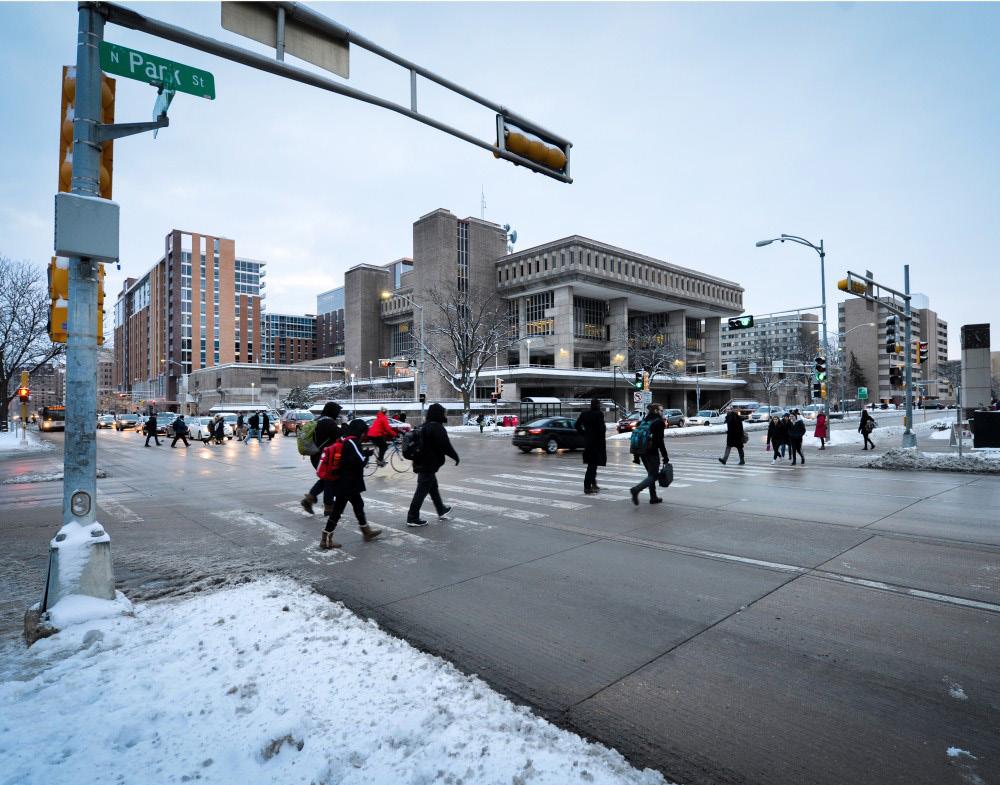
Madison is a pedestrian’s world. It’s time to share the road
By Blake Martin
OPINION EDITOR
It’s noon in Madison, and the last morning lecture has just been dismissed. The streets flood with students. Some are in a rush, with only 15 minutes to get from one end of campus to the other. Others take their time, walking to lunch, the library, work or maybe back home for a midday nap.
Whatever the reason, everyone walks like they have somewhere to be. But anyone unlucky enough to be behind the wheel of a car is stuck in standstill traffic.
If there’s one thing I’ve learned in my four years here, it’s this: Madison is a pedestrian’s world, and everyone else is driving in it. Here, crosswalks are nothing more than a loose suggestion. Flashing orange hands warning of oncoming traffic are ignored, and drivers hoping for a gap in a constant stream of students are invisible.
This probably sounds like small potatoes. But, in the words of my mentor and former Daily Cardinal Opinion
Editor Lauren Stoneman — “what is the point of becoming an opinion editor if I can’t occasionally use the platform to air a small grievance?”
I know what you’re thinking — why should I care?
How we treat each other on campus is a reflection of who we are. Your walk to class might feel like the time to turn on some music and get lost in your world, but we need to do a better job of looking out for each other. Badgers, we can do better, and we can start by sharing the road.
You’ll be doing yourself a favor.
In 2022, more than 7,500 pedestrians were killed in traffic accidents, the majority of which took place outside of intersections on high-capacity urban roads. While in many cases driver’s share responsibility for causing injury, staying alert while walking is important to keep yourself safe.
But, I get it, you probably passed drivers ed, you know this. Besides, we’re on a college campus, you have somewhere to be.
When you’re running late to class, it can be tempting to make a crosswalk anywhere without a car or even ignore stopped cars altogether — especially when everyone else seems to be doing the same.
We’ve all seen it happen — you’re getting ready to cross the street from Library Mall to Memorial Union as students walk in a steady stream of traffic, and cars are backed up waiting for a gap that never comes. Looking around, it’s
almost as if the drivers have become invisible. They stay that way until someone with somewhere to be stops, gives a smile and waves the driver through. It’s a small act of kindness, but it’s one we should take up more often. It might not win you the Nobel
Peace Prize or get you to class any faster, but it’s just the right thing to do. Remember, how we treat each other on campus matters. You might not change someone’s life by sharing the road, but you might make someone’s day.
Stay alert on your walk to class — even when you’re in a
rush — take a breath and remember, everyone has somewhere to be.
Blake Martin is an Opinion Editor for The Daily Cardinal. Do you agree that pedestrian culture in Madison has gone too far? Send all comments to Opinion@dailycardinal.com
LORENZO ZEMELLA/THE DAILY CARDINAL
MORGAN WINSTON/THE DAILY CARDINAL
UW-Madison scientists explain LA fires, satellites that track them science
By Sonia Bendre STAFF WRITER
A series of fires that started on Jan. 7 in Palisades and Eaton burned across Southern California until heavy rains assisted firefighters in fully containing them last week. The fires were accompanied by gusts of wind up to 90 miles per hour and intense drought conditions. And as late as Sunday, Jan. 25, almost two weeks after the first fire, new fires began in the surrounding Los Angeles area. Twentynine people have died, 55,000 acres have burned and more than 15,000 structures have been destroyed. Though the vast majority of fires are contained, air quality warnings continue to plague Southern California as hazardous dust and ash settles across the area.
Volker Radeloff, a fire expert and professor of Forest and Wildlife Ecology at the University Wisconsin-Madison, conducts research on wildland-urban interfaces (WUIs), which are fire-prone regions on the cusp between wildland vegetation, often woodlands or grasslands, and civilization. Nearly half of the world’s population lives in a WUI, and all of the areas that burned in the Los Angeles area belonged to a WUI, Radeloff said.
“When fire starts in the chaparral vegetation of Southern California, the winds will take pieces of burning vegetation, the bark or so, and then blow it into urban areas. We call those burning pieces fire brands or embers, and they can fly for over a mile,” Radeloff said.
Human interference can destructively alter natural fire regimes in the area, especially in densely populated areas like Southern California, leading to more frequent fires and encroachment from invasive species. Both the Palisades and Eaton fires are suspected to have manmade causes.
“The vast majority of [wildfires in California] are started by people,” Radeloff said. “That means they occur at times when fires would not occur naturally, and they occur more frequently.”
Strong evidence suggests the Eaton fire started because of an electrical fault in local transmission lines, causing an arc. The specific cause of the Palisades fire is unknown, but is thought to be man-made as well, according to the Los Angeles Times.
Climate change exacerbated the fires’ effects, according to Radeloff.
“We actually had a year of high rain last year,” Radeloff said. “What that means is that the vegetation can grow quite nicely,
especially grasses and other herbaceous plants. Then they dry out, and there’s a lot of fuel in the landscape. It’s this combination of a wet year followed by a dry year that gives us the highest risk of the wildfires, and with climate change, we see that combination more often.”
Radeloff said wildfire events are also likely to occur in Wisconsin during periods of drought, Typically, the most deadly fires in the United States have occurred in the Midwest, and the deadliest U.S. fire on record, the Peshtigo fire, occurred in Wisconsin in the 1870s.
“It may not be quite as dramatic as what we saw [in California] because we don’t have the same annual winds,” Radeloff said. “A summer of extreme drought… is what it would take for such a devastating fire. Typically in Wisconsin, the fire season is early in the spring or summer, May or so, but then the vegetation greens up differently from California, which stays dry all summer.”
Government officials and citizens alike used UW-Madison satellite technology to track the wildfires. The Cooperative Institute for Meteorological Satellite Studies (CIMSS), which is a part of the Space Science and Engineering Center (SSEC) at UW-Madison, is in the process of developing what it calls a Next Generation Fire System using funding from the National Oceanic and Atmospheric Administration (NOAA).
Previous fire detection algorithms have been designed separately for geostationary satellites, which view the Earth from only one vantage point, and for satellites in polar orbit. But Brad Pierce, an Atmospheric and Oceanic Sciences faculty member and director of the Space Science and Engineering Center who has the development of the Next Generation Fire System (NGFS), said the Next Generation Fire System is “satellite agnostic,” meaning that it can be applied to sensors on both geostationary and polarorbiting satellites.
The NGFS is currently focusing on
upgrading fire detection on the Visual Infrared Imaging Radiometer Suite, a sensor developed by NASA and NOAA that can detect a variety of weather conditions, including snow, ice, clouds and smoke plumes.
The sensor is attached to two polar orbiting satellites, allowing for overpasses four times a day. The NGFS is also developing retrieval technologies for Geostationary Operational Environmental Satellites (GOES), typically the types of satellites whose imagery is shown in weather reports.
“The previous algorithms were designed for global applications, and so some of the detections and the quality control was pretty tightly constrained,” Pierce said. “The NGFS is designed for early detection so that we can get that satellite information along with all the other auxiliary information we need to the ground for the people that are managing the fires.”
Michael Pavlonis, another researcher at the SSEC, originally developed the satellite agnostic software to detect volcano eruptions. The ability of the software to detect thermal anomalies allowed for its modification into fire detection software.
The Los Angeles Fire Department did not rely heavily on satellite imagery in firefighting because the fires started in a populated area and were quickly detected by people on the ground. But geostationary satellites using technology developed at the SSEC were able to detect the fires starting in the same five-minute interval it took for people to discover them on the ground — from 23,000 miles away in space.
“One of the key things that [the NGFS] provides is an estimate of the intensity of the fire,” Pierce explained. “It’s called fire radiation power. We can use that intensity to understand how much smoke and other gases are being emitted from the fire. So it’s important from a fire modeling perspective, trying to picture what’s going to happen and what part of the population would be impacted by smoke from those fires.”
A prototype of the NGFS is currently available through the university, and the technology will eventually be broadly available through NOAA.
A subzero return to campus: The science behind the polar vortex
By Lauren Eno STAFF WRITER
While students at the University of Wisconsin-Madison are no strangers to cold winters, the start of the spring semester saw particularly harsh conditions.
The first day of class, Jan. 21, saw a low temperature of -13 degrees Fahrenheit with maximum wind speeds of 17 miles per hour. Students bundled up, braving a -30 degrees Fahrenheit wind chill to make it to classes and campus events.
The infamous polar vortex claims responsibility for the recent cold snap. The Arctic polar vortex is a stratospheric band of strong westerly winds located 10 miles and 30 miles above the North Pole. The vortex is a counter-clockwise flow that perpetually encloses a band of extremely cold air.
Portions of Northern Europe, North America and Asia feel the effects of the vortex when it is knocked off kilter. Whether the vortex slows, wobbles or splits due to stratospheric upheaval, the associated polar jet stream will often develop a wavy shape with troughs and ridges. Polar air fills low-pressure troughs, bringing icy conditions.
Climate change and extreme cold
While it may seem counterintuitive, scientific research suggests climate change can make these cold snaps more intense. There is no evidence that extreme cold is becoming more frequent or intense, but a rise in Arctic temperatures is weakening weather systems that typically keep cold air trapped around the poles.
Preliminary research published through UW-Madison’s Community Economic Development Division indicates that changing weather patterns may increase extreme cold weather events, like the polar vortex. Swings in temperature can harm important crops like alfalfa, which supports Wisconsin’s dairy industry, or push some species to the edges of survival.
In a joint study with the Cornell Lab of Ornithology, UW-Madison professor Ben Zuckerberg and former UW-Madison postdoctoral researcher Jeremy Cohen found that bird abundance during a 2014 polar vortex decreased for five to 10 days afterwards.
“The data suggests that some birds may have abandoned the area, moved south, and came back. Alternatively, some birds could have laid low because of the stress caused by the cold,” Cohen said.
Cold days ahead for winter traditions
Madison residents were surprised with a brief warm spell, with temperatures reaching 49 degrees Fahrenheit on Friday. Changes in atmospheric pressure allow for a brief push of milder air from the south, causing a temporary (and welcome) shift to warmer temperatures. But don’t worry, temperatures are expected to plunge yet again — just in time for some of Madison’s anticipated winter activities.
Traditions like a series of Winter Carnival activities from Feb. 6 to Feb. 9 and the Lily’s Classic hockey tournament on Feb. 15 — which depend on cold weather — are expected to proceed as planned. Students, keep your long coats and gloves ready — the vortex isn’t done with you yet.
HAILEY JOHNSON/THE DAILY CARDINAL
HAILEY JOHNSON/THE DAILY CARDINAL
sports
Column: Calm down, Greg Gard knows what he’s doing Series preview: Keys to a men’s hockey victory against Penn State
By Grace Cannizzo STAFF WRITER
The Badgers’ playoff window is closing fast after the Gophers swept them in the border last weekend.
By Haellie Opp STAFF WRITER
The Wisconsin Badgers men’s hockey team went to No. 3 Minnesota and lost both games in the border battle series last weekend. The stronger Minnesota team chipped away at any strength the Badgers had in the first two periods, creating a threegoal deficit to end each game.
The Badgers (11-14-3) fall to No. 19 in the wake of the Big Ten Conference losses, losing 2-5 on Friday and 1-4 on Saturday.
A rough weekend led to only three goals scored with two on Friday by junior Simon Tassy and graduate student Ryland Mosley, while freshman Ryan Botterill scored the lone goal on Saturday to prevent a shutout.
Friday showed low energy from Wisconsin as the game progressed. They scored the
first two goals of the game but left five goals unanswered from a powerful Minnesota offense shortly after. Saturday tested the Badgers, as they went down three goals in the middle of the third period. Botterill scored late in the third, but an empty-netter for the Gophers finished the Badger effort.
Wisconsin also faced its first 10-minute misconduct of the season with a match penalty between Badgers freshman Adam Pietila and Gophers graduate student Mike Koster. Both were called for unsportsmanlike conduct just minutes before the final buzzer.
Penn State (12-11-3) is second-to-last in the Big Ten Conference standings, falling three wins behind Wisconsin.
The Nittany Lions average a .213 power play percentage, a tough statistic the Badgers may strug-
gle with. Last week, Wisconsin fell short on their power play, going 0-3 on Saturday.
Wisconsin needs to focus on its strengths: low penalty minutes, high shots on goal and preventing opponents from getting shots on Badger goaltenders. Even with the 33.8 shots per game, as opposed to 26.5 from their opponents, the Badgers let their opponents hold an advantage of .105 shot percentage over their .092.
Senior Tommy Scarfone has been consistently starting for the Badgers, playing the majority of minutes between the pipes. He holds a .904 save percentage and only faces 2.47 goals-against average.
The Badgers’ defense keeps a majority of shots away from him, but the Gophers tested his ability to hold his ground when needed.
With two back-to-back losses, Badgers fans may see sophomore William Gramme in net to start this weekend.
Earlier this season, Wisconsin swept Penn State. Those two wins brought the Badgers to a seven-game win streak against the Nittany Lions. Wisconsin has an opportunity to win some games at home against this visiting team.
Penn State forward Aiden Fink is No. 3 for the NCAA in point leaders. Badgers defenders will face a player whose shot percentage is .200, while sophomore Quinn Finley leads Wisconsin at .188. Strength on the blue line and faith in their goaltenders could determine the fate of this series.
The games begin at 7 p.m. on Friday and 6 p.m. on Saturday at the Kohl Center.
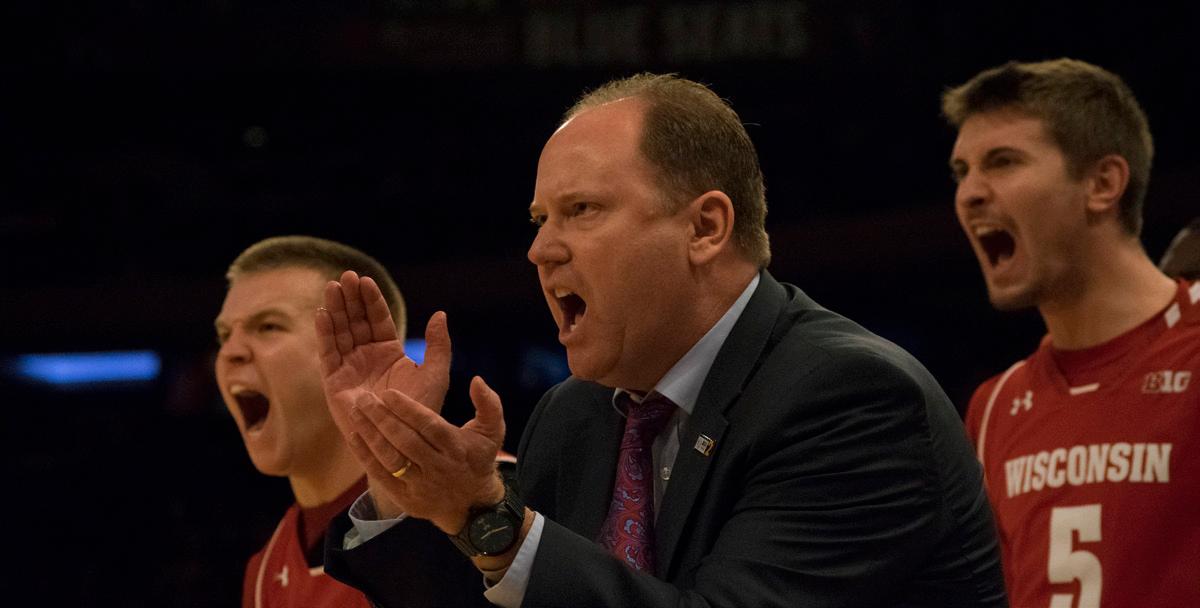
Balancing player development, recruitment and signing transfers in this new age of NIL and the explosion of the transfer portal is, to say the least, not an easy task. Wisconsin men’s basketball head coach Greg Gard has nearly perfected it.
Developing players
After the 2023-24 season, more than 1,800 men’s college basketball players used the transfer portal and that number is only expected to grow. Therefore, it is extremely difficult to keep and develop players. Gard hasn’t had this problem.
Senior forward Carter Gilmore is a prime example of that. Gilmore hasn’t seen the court much throughout his time as a Badger, but he continues to earn his minutes and has established himself as a quality player in Wisconsin’s rotation. Shooting .400 pct from deep and scoring a career-high 15 points last week to aid his team in their win against Northwestern, Gilmore has earned his minutes.
Steven Crowl is another great example of a developed player. He has spent his entire collegiate career at Wisconsin. Crowl didn’t see the floor much in his freshman year, only playing three minutes per game and totalling one block and nine rebounds on the sea-
Likewise, the freshman forward Ricardo Greppi, who boasts professional experience playing in Italy, also generated excitement.
But recently, fans have voiced frustrations with Freitag and Greppi’s lack of playing time.
While their talent is undeniable, those in front of them have earned their way. Gard has built an experienced team of depth. Freitag and Greppi didn’t have collegiate experience until this season.
With newly established NIL and transfer portal rules, it’s easy to lose sight of the fact that developing players is how sports programs have traditionally operated. Gard develops each individual player, and it’s simply impossible to find room in the rotation for Freitag and Greppi.
Remember, Blackwell wasn’t a starter last season — this season, he leads his team in playing time. Their times will come. Stay excited.
Signing transfers
“Well, what about John Tonje?” You can reason that my arguments are nothing but nonsense because the star and leading scorer on the Badgers team transferred in this season. To that, I ask that you allow me to explain why Tonje’s circumstances are different and somewhat unique.
son. As a graduate student, however, Crowl averages 24.1 minutes per game. And as for blocks and rebounds? He leads the team in both statistical categories.
This maturing of players also applies to sophomore guard John Blackwell, who has started every game this season after having only made one start last season. Blackwell has nearly doubled his average points per game between seasons, growing his 8.0 PPG to 15.5.
Even redshirt freshman guard Jack Janicki has seen time on the court. Janicki made his debut this season and now averages 10 minutes per game. He’s earned his minutes in the Badger rotation.
With the influx of portal usage, Gard’s ability to keep and develop these players has been crucial.
Recruiting
Freshman guard and fourstar prospect Daniel Freitag’s commitment to Wisconsin sparked chatter from fans.
It is important to acknowledge that transferring is becoming the new normal. While Gard has done a great job reducing the effects it has had on his team, there is no possible way to evade this new reality entirely. Quite frankly, Gard has done the best that he possibly could in keeping playings in the program. And as for adapting to this new and difficult-tonavigate era of NIL, he was right on the money with Tonje.
Tonje has the experience. He played in 130 career games before transferring to Wisconsin. While it is not ideal that his prime stages of growth weren’t at Wisconsin, coming into the season he played more total games at the Division I level than any of his Badgers teammates.
I’ll leave you with this. Next time that you are watching Wisconsin basketball and practically begging Gard from your living room couch to put in your favorite player, consider this last note:
Gard knows what he’s doing. Trust him.
THOMAS VALTIN-ERWIN/THE DAILY CARDINAL
MEGHAN SPIRITO/THE DAILY CARDINAL
MOLLY SHEEHAN/THE DAILY CARDINAL
arts
It’s a shuckin’ good time at the Overture Center
By Bryna Goeking
ARTS EDITOR
You won’t like “Shucked” if you can’t get a little corny with it.
“Shucked” is the story of a small town in Cob County, whose inhabitants have lived safely inside the high walls of corn for generations. When the crop begins to wilt one day, our protagonist Maizy runs away to Tampa, Florida, where she meets con man Gordy, a fake podiatrist — a self-identifying “corn doctor” — who returns to Cob County as a part of a ruse to repay his debts.
Along the way, characters fall out of love, back in love and make a lot of jokes that cycle between audience laughter and groaning. Its story is driven by two storytellers, narrators who insert themselves into the story to poke fun at moments of insanity and keep the pacing all right.
The show’s puns are constant and without consent — attacking the audience every moment until you don’t know if you’re laughing because you genuinely found it funny, or you can’t believe they managed to slip another one in. Perhaps the best example is delivered by the character Peanut, who rambles three “Well, I think…” one-liners before saying what’s actually on his mind. It was funny, I think.
“Shucked” doesn’t take itself too seriously, which is something else that helps its jokes land. It’s stupid, but you don’t want to be the guy who couldn’t laugh at the lyric
“it’s the same going in coming out.” And yes, they do reference the “Corn Kid” meme, unfortunately aging itself.
The show also pioneered a new dance technique, cornography. Without spoiling too much, audience members can expect corn to be used in ways beyond their wildest dreams.
The characters are charming, and even when they do bad things it’s hard to be mad. The plot is more of a suggestion than a fact, held together just enough by its narrators. Conflict is mostly used as an opportunity for a catchy dance number or ensemblebacked ballad.
The detachment from the outside world as a result of the corn walls created a truly unique group of townies, although there are personalities that might resonate if you’re from a small town. After all, Wisconsin is one of the highest corn producers in the United States.
I was lucky enough to see the original Broadway cast in 2023 and went in with high expectations. It can be hard to follow up the vocals of Alex Newell, who was as much of the muse as the creator for their character and received a Tony for their performance. But this production’s Lulu (Miki Abraham) wasn’t messing around — their rendition of “Independently Owned” brought the house down.
Quinn Vanantwerp, who played Gordy, a former member of the Broadway cast,
‘María
de Buenos Aires’ brings delightful scandal to Madison Opera
By Isaiah Trice STAFF WRITER
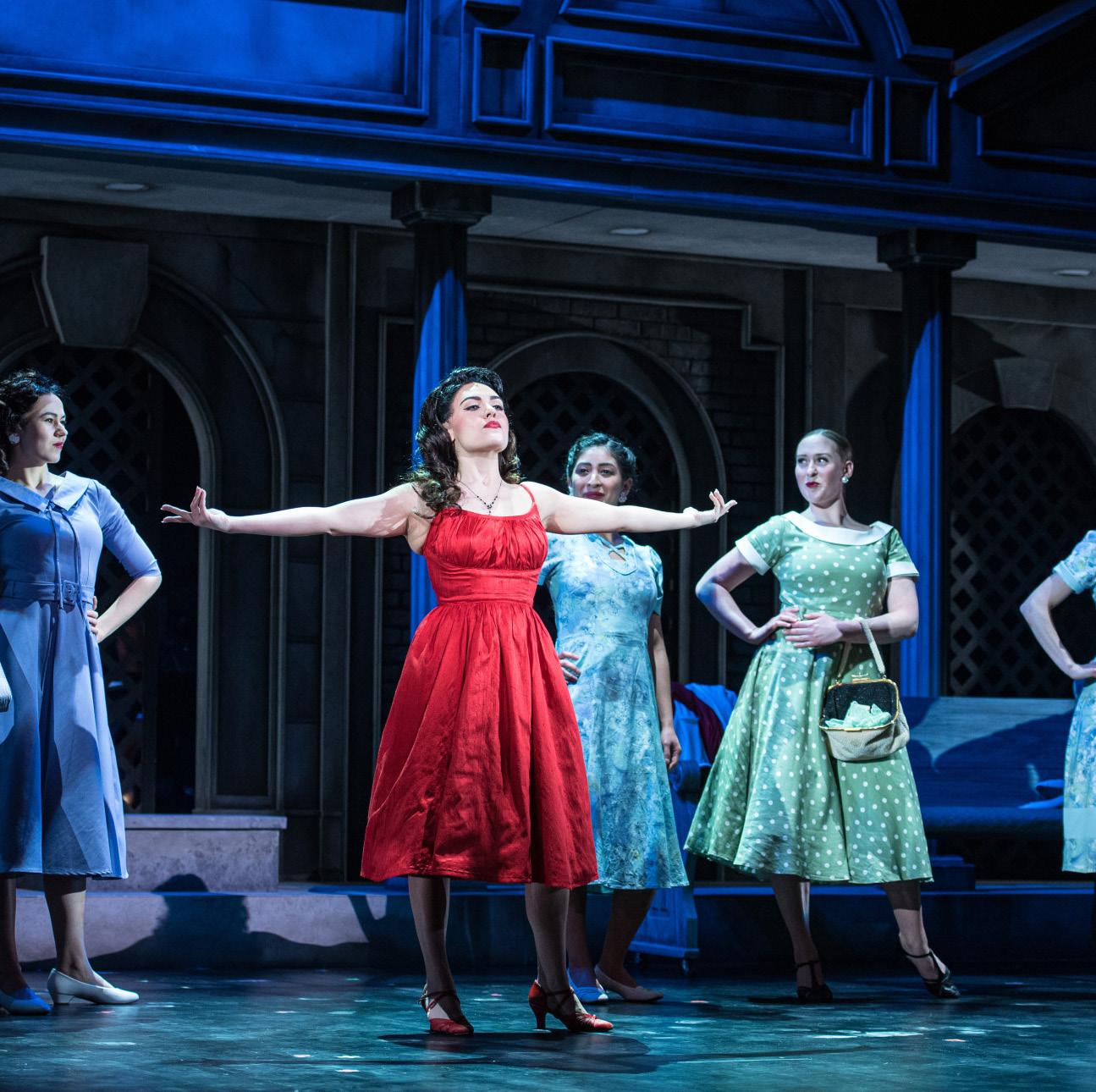
Astor Piazzolla’s 1968 tango opera “María de Buenos Aires” is certainly a sight to see with diva María (Soprano Kelly Guerra) dressed in a beautiful red dress, singing in Spanish outside the setting of a beautiful Argentine Cathedral.
Piazzolla’s “María” is certainly not a typical opera, breaking many of the conventional means by telling such a story. A small ensemble that includes a guitar, bandoneon and piano certainly helped promote the Argentinian Nuevo Tango sentiment.
The honest truth is that diva María did not sing as much as a lead soprano usually does. This, combined with the fact that most of the story was mostly told through a non-singing oration by the Narrator “El Duende” (Played by Kristen Chávez), certainly made for a very interesting evening on the opening night of Jan. 31.
seemed more grounded in the character than when I had first seen the show. Danielle Wade and Jake Odmark’s interpretations of Maizy and Beau were fresh and enjoyable, and Mike Nappi’s Peanut made his offthe-rail moments endearing.
He only had a few lines, but Erick Pinnick’s Grandpa drew some of the loudest laughs from the audience. And lastly, the show would simply not be complete without its heart and soul of Storyteller 1 and 2, played by Maya Lagerstam and Tyler Joseph Ellis (yes, that guy from TikTok).
With a soundtrack of highenergy songs, it’s hard to pick a favorite when the cast is truly radiating joy in each note. Or maybe the audience was drunk on the overdose of endorphins from the non-stop jokes and was easy to draw smiles from.
And yet, something strange happened. Right at the 11th hour, the show hits you with the song “Friends,” a ballad about the power of female friendship. Toward the end, “Shucked” peels back an ear, revealing a softness that can usually only come from being soaked in butter.
It’s no drama, but “Shucked” brings in the right amount of heart to ground an otherwise out-of-this-world story. Whether you take your corn on or off the cob, as long as you can bite it, there’s something in this show for everyone.
“Shucked” is running at the OvertureCenterthroughFeb.9.
The opera began with Narrator El Duende setting the stage, speaking on the state of affairs in 1960s Buenos Aires. María was then introduced, standing ominously as the statue of her namesake Mary, mother of Christ, outside of the Cathedral.
María did not sing immediately, though, and the audience was left to speculate about her intentions while a new character was introduced. El Payador (Played by Baritone Laureano Quant), dressed in a clerical collar, sang a prologue that eloquently painted Buenos Aires and foreshadowed the opera’s themes of desire, fate and the weaving of identity through the tapestry that is the tango.
Laureano Quant’s performance as El Payador was
nothing short of spectacular. His voice echoed throughout Capitol Theater with the power of Milnes and the tenderness of Dieskau.
María then stepped off of her statue’s pedestal and sang in the somewhat confusing, yet poetic vanguardism of librettist Horacio Ferrer. Combined with Kelly Guerra’s incredible performance as María, the opening captured the morose yet fashionable nature of the tragic Argentinian story.
A group of six dancers entered the stage, performing the tango to the famous Aria “Yo Soy María,” while María danced on the top of a bar echoing Salome’s dance for Tetrarch. The dancers then turned on María and murdered her out of their desire.
Narrator El Duende then gave a eulogy, and the scene shifted. María had died but still lived on in hell, but her hell was that of a sick and twisted Buenos Aires.
This is when the opera became very peculiar. From the psychoanalysts who were diagnosing María to the small girl who represented an untainted identity of a woman, it would have certainly been hard to determine a story if it had not been for the wonderful direction of stage director Frances Rabalais.
The second part flew by quickly, though, moving rapidly from song to song. Everyone was going crazy, María was now dressed in a black gown, and the dancers had a larger part to play.
The opera concluded to thunderous applause, and the small ensemble and cast were received quickly by a standing ovation. The performance was nothing short of a wonderful way to finish a scandalous but incredible evening.
PHOTO COURTESY OF ROSS ZENTER
PHOTO COURTESY OF MATTHEW MURPHY AND EVAN ZIMMERMAN