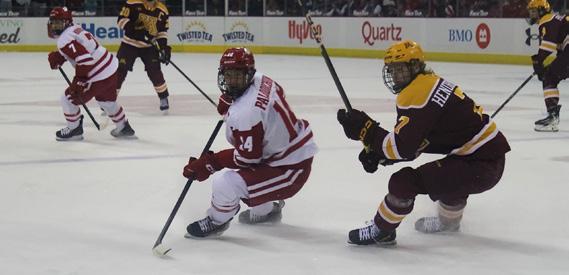
Men’s hockey extends losing streak to six in Minnesota series sweep.
+ SPORTS, PAGE 8
Thursday, February 5, 2026
PIZZA DOUGH BOY
Republican bill would allow minors to operate pizza-dough rollers at work.
+ NEWS, PAGE 4
Students, faculty split on Mnookin’s legacy
By Annika Bereny & Zoey Elwood
CAMPUS & COLLEGE NEWS EDITORS
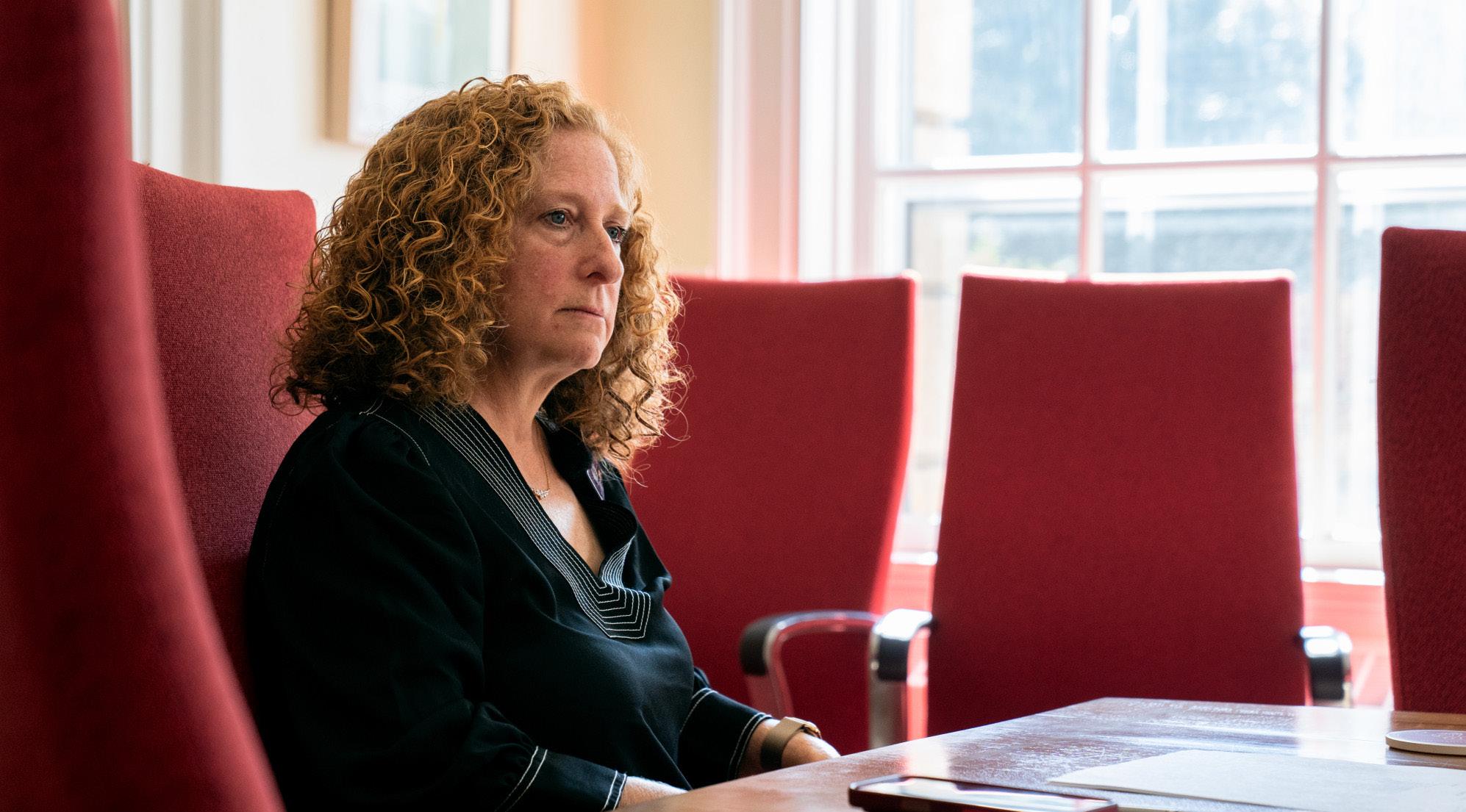
Chancellor Jennifer Mnookin’s decision to leave the University of Wisconsin-Madison for Columbia University has drawn mixed reactions from campus, varying from bittersweet goodbyes from campus leaders to celebratory farewells from Badger sports fans, labor leaders and student activists alike.
Mnookin’s time as chancellor included major accomplishments that increased the university’s global standing, creating new financial aid programs, academic hiring initiatives and campus infrastructure. However, some took issue with
her inaccessibility to students and organized labor, along with the decline of Badger football.
In early 2023, Mnookin launched Bucky’s Pell Pathway, which covers tuition and fees, alongside other expenses, for Pell Granteligible Wisconsinites and has benefited more than 7,800 students. She also introduced the Wisconsin Tribal Educational Promise later that year, which guarantees scholarships and grants to cover undergraduate tuition for students who are members of federally recognized Wisconsin American Indian tribes.
Under her leadership, Wisconsin rose to a top-5 research institution in the country and
debuted the Wisconsin Research, Innovation and Scholarly Excellence (RISE) Initiative, a hiring project focused on human health, artificial intelligence and environmental sustainability.
Mnookin also courted record-breaking philanthropy bringing campus buildings like Morgridge Hall through to the finish line. In late 2025, Mnookin announced the Wisconsin Exchange program, another privately-funded initiative which aims to spur conversation between students who may differ politically.
For campus leaders like Glenda Gillaspy, dean of College of Agricultural and Life Sciences, Mnookin was a friend and treasured
UW professors incorporating AI despite lingering concerns
By Addison Dama STAFF WRITER
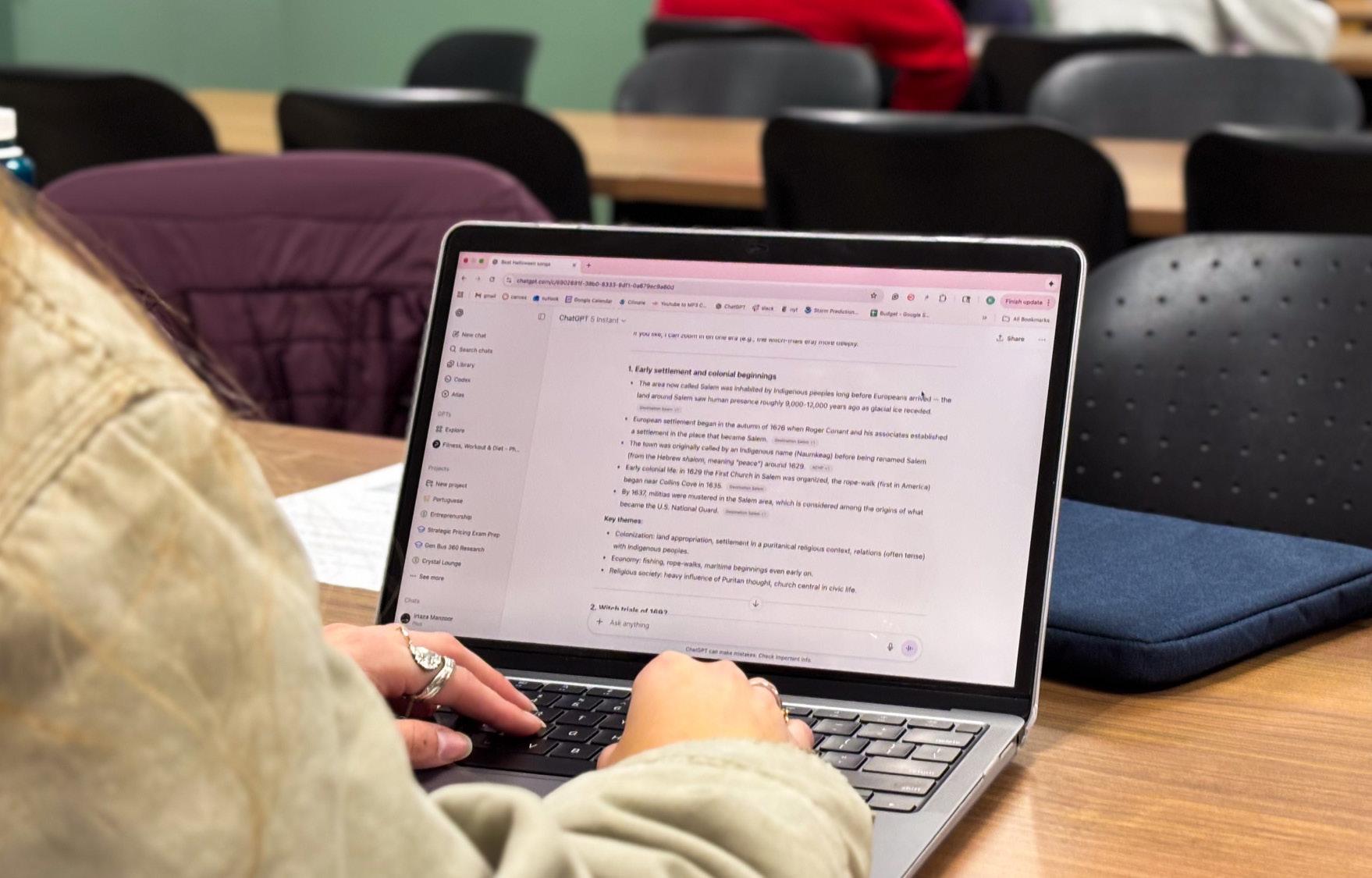
As students return to campus this semester, professors are once again evaluating how artificial intelligence can, and cannot, be a tool for learning in their classrooms.
Despite concerns about generative AI impeding learning, some professors at the University of Wisconsin-Madison are choosing to address and even integrate AI into their course syllabi.
The rapid development of AI technology has left professors and students alike grappling with the uncertainties of what constitutes proper use of AI in the classroom. While just a few years ago many courses explicitly banned AI, the technology is now becoming increasingly embraced.
New courses like “AI and strategic communication” in the journalism department are even structured around how students can apply AI in their strategic communication careers.
According to instructor Tom Beckman, the question of whether students are over reliant on AI is the wrong question altogether. Instead he asks: “Are we teaching students properly to think with AI?”
Nicholas McConnell, an astronomy professor, told The Daily Cardinal the novelty and rapid development of AI opens an opportunity for students and professors to collaborate and discover these new technologies together.
“There will be better outcomes if we’re talking to each other and being honest instead of trying to outsmart each other,” McConnell said.
Across campus, different departments are coming up with unique approaches to the advent of AI. Without a strict universitywide policy, professors and departments are allowed to develop rules and procedures that make sense for their disciplines.
In Stacy Forster’s Journalism 202 course, an entry-level reporting class required for all journalism students, students compare AI-written news briefs against their own real-world news briefs. Later in the semester, students will collaborate on a presentation that addresses the different ethical implications of AI use.
“Its going to be a group learning exercise because I don’t really know what to teach, and we all have to kind of figure it out together,” Forster told the Cardinal.
According to a Nov. 2025 survey of U.S. university faculty conducted by Elon University, 95% of the faculty said generative AI will increase students’ overreliance on AI tools, with a majority also saying
AI will reduce critical thinking skills and decrease attention spans among students.
“I wouldn’t say yet that students are over reliant on [AI],” McConnell told the Cardinal.
Instead, he expressed concern that students will use AI responses “transactionally” for grades, rather than as an aid in their development. He believes students “have a lot of agency to recognize that they can still be prioritizing their own growth.”
In an op-ed, University of Wisconsin System President Jay Rothman acknowledged AI’s role in the workforce, but still emphasized the importance of students’ ability to make informed decisions outside of the technology.
“AI is transforming the workplace, but durable skills like critical thinking, effective communication, adaptability and problemsolving that our 13 universities cultivate remain the foundation of success,” Rothman said. “When paired with AI literacy, these skills make our graduates ‘future ready.’”
A 2025 survey of 1,000 hiring managers found that 81% of hiring managers now consider AI-related skills a hiring priority, with employers looking for candidates with problem-solving or critical thinking skills regarding AI challenges, along with an overall proficiency in AI tools.
To Beckman, teaching AI for students’ careers doesn’t just mean teaching students how to use a specific AI tool — one that may not even be around in 10 years given how rapidly AI is progressing. Rather, he focuses on teaching students the executive
functioning skills necessary to master any tool, whether they’re tools available today or those that will emerge in the future.
Beckman said he and other colleagues in the School of Journalism and Mass Communication focus on the applications of generative AI and large language models, from analyzing large datasets to monitoring customer behavior.
Despite the growing prevalence in both the corporate world and academia, concerns about the ethical use of AI remain among students.
Forster said even in assignments where students are allowed or encouraged to use AI, some refuse to do so, either out of environmental concerns or a general ethical opposition to AI.
She expressed that most students are mindful of how they use AI tools and that a foundational understanding of the material is needed to use AI effectively. Forster previously conducted a survey on students’ AI use and found that “all students said they really want to do the thinking for themselves.”
She, along with Beckman and McConnel, is optimistic about how students will continue to use AI. Forster also said she believes professors and students are agreeing more than she initially anticipated.
Regardless of concerns about overreliance or ethics, AI is a tool that is likely to stay. As more attention and university resources are diverted to AI technology, the future can reshape higher education.
colleague. Gillaspy reflected on traveling with Mnookin across Wisconsin and gave her credit for encouraging new experiences.
“Together, we visited cranberry bogs, farms and cheese factories, and talked with stakeholders about how UW-Madison can better serve Wisconsin. She is the person who finally convinced me to try Limburger cheese — an experience that I’ll never forget,” Gillaspy said in a statement. “I’m grateful for her partnership over the years and wish her all the best at Columbia.”
UW Athletic Board declines to extend Fickell, per coach’s request
By Nick Bumgardner & Noe Goldhaber
MANAGING EDITOR & EDITOR-IN-CHIEF
Wisconsin head football coach Luke Fickell’s contract was not extended by the University of Wisconsin Athletic Board Wednesday at his request.
A formality, the university annually renews contracts for top coaches in a longstanding effort to maintain stability and discourage outside buyouts.
Wisconsin Athletic Director Chris McIntosh said Fickell requested his contract extension not be up for consideration in December shortly after the season ended, one where the Badgers finished 4-8 and missed a bowl game for the second-straight year.
“Luke is completely focused on a successful 2026 campaign. There is no one more competitive than Luke, and he holds himself to the highest standards,” McIntosh said on Wednesday.
Fickell agreed to a seven-year contract with a $7.8 million average annual salary when he started at Wisconsin in 2022. Not extending Fickell’s contract means he is working under a six-year contract that runs through 2032, having received oneyear extensions in 2024 and 2025.
McIntosh announced that Fickell would return for the 2026 season in November despite a disappointing fall season, committing to “more Athletics-funded investments” to solve Badger football’s issues.
“He continues to have our full support and, as we shared widely at the end of last year, Luke is making the necessary changes in the program, our department is increasing our investment and we are aligned with campus leadership in our commitment to football success,” McIntosh said.
In the offseason, Badger football has put that money to use, compiling a top-20 transfer class that includes quarterback Colton Joseph, running back Abu Sama and cornerback Bryce West.
The UW Athletic Board approved oneyear contract extensions for volleyball coach Kelly Sheffield, women’s soccer coach Paula Wilkins and men’s soccer coach Neil Jones, extending each through Jan. 31, 2031. + Mnookin page 3
“…the great state University of Wisconsin should ever encourage that continual and fearless sifting and winnowing by which alone the truth can be found.”
CAMERON SCHNEIDER/THE DAILY CARDINAL
UW student contracts measles
By Zoey Jiang & Cole Zich
ASSOCIATES EDITOR & STAFF WRITER
A University of WisconsinMadison student is recovering after seeking medical care for a confirmed case of measles, John Zumbrunnen, interim provost and vice chanceller, and Jake Baggott, executive director of University Health Services said in an email to all students Monday afternoon.
The officials warned that measles is highly contagious. They said those who are not vaccinated for measles are required to be quarantined for 21 days if they were exposed to the student during their infectious period.
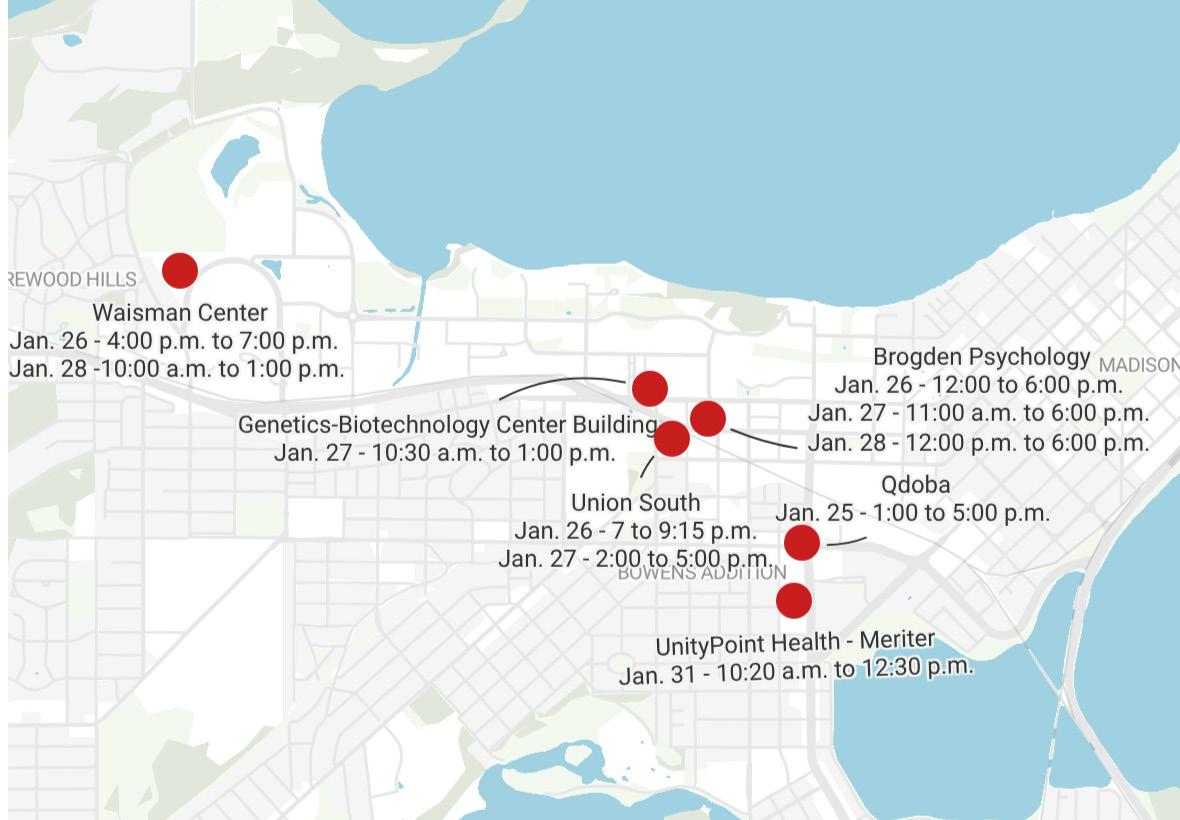
The student lives in an apartment off-campus and visited several campus locations during their infectious period from Jan. 25 to Jan. 28, including the Brogden psychology building, the Waisman Center, the genetics building, Union South and Qdoba. All five campus locations are safe to attend at this time.
“We already directly notified about 4,000 people who may have been exposed,” Baggott said in a Monday press conference, noting that many of those notified were already vaccinated. He added that UHS esti-
NOE GOLDHABER/THE DAILY CARDINAL
Measles exposure locations. Find most up to date information at https://publichealthmdc.com/yourhealth/measles. Madison Metro Transit routes C1, J, O, H, G also potentially impacted
mates approximately 95% of students have the measles, mumps and rubella (MMR) vaccine. UHS asks members of the UW-Madison community to check their MMR vaccine status. Those vaccinated do not need to quarantine but should monitor for symptoms. Immunocompromised individuals should contact their healthcare provider and monitor for symptoms.
Kate Louther, deputy director of Public Health Madison & Dane County, recommended individuals who have not already received the vaccine reach out to their healthcare provider or the public health agency to set up a vaccination appointment in the press conference.
Two doses of the MMR vaccine are 97% effective against measles,
while 90% of the people around an infected person may also become infected if they are not vaccinated. This follows the first case of measles in Wisconsin this year after an individual in Waukesha County tested positive last week. The UW case is related to international travel and not connected to the Waukesha County case, according to the Wisconsin Department of Health Services.
Symptoms of measles start with a high fever, cough, runny nose and red eyes. White spots in the mouth and full body rashes may appear afterwards. UHS says to not go to clinics or hospitals without informing a healthcare provider you may have measles.
UHS also encouraged campus community members to check their MMR vaccination status in the Wisconsin Immunization Registry for instate residents or their state’s immunization website and update their vaccination status in myUHS to avoid a required 21-day quarantine if exposed. UHS is currently working with Public Health Madison & Dane County and the Wisconsin Department of Health Services on this case.
UW-Madison sophomore launches productivity startup aimed at
By Alaina Walsh CITY NEWS EDITOR
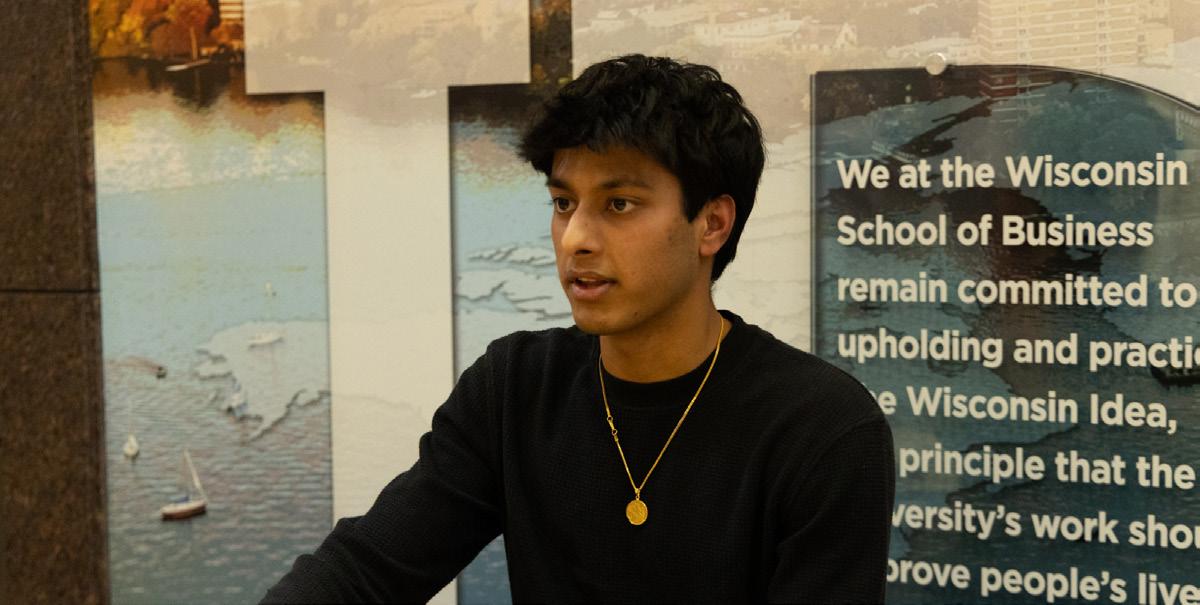
Armaan Jain didn’t grow up thinking he would start a company.
Coming to the University of Wisconsin-Madison from a small town in Minnesota, the sophomore finance major had a pre-imagined path set — classes, internships and a stable job.
Entrepreneurship wasn’t even on his radar. A self proclaimed introvert, he never thought he had what it took to build something of his own.
“I wasn’t very confident coming into college,” Jain told The Daily Cardinal. “I thought, ‘I could never make my own company.’”
Just over a year later, he launched the public version of Priority. a productivity software platform designed to bring calendars, tasks, goals and habits into one cohesive place.
The idea, Jain said, has been quietly forming since childhood.
Growing up in a first-generation Indian household, Jain was thrown into activities from a young age — baseball, basketball, soccer and everything but football. The packed schedule forced him to learn time management early, a skill reinforced by parents who deeply valued education and structure.
“From elementary school onward, I had to have systems in place to succeed,” he said. “I learned early that motivation isn’t always there, so you need something that keeps you going anyway.”
That mindset followed him through high school and into college, where the problem became clearer — and more frustrating. Jain tried every productivity system he could find: Notion, Google Calendar, Outlook, Canvas. But nothing was clicking.
“It was just too many platforms,” Jain said. “And none of
simplifying student life
them felt like they were actually built for how students live.”
Originally enrolled in both finance and computer science, Jain soon realized the coding path wasn’t for him — not because he disliked building, but because he wanted to build something of his own. Dropping computer science freed up time, but it also meant stepping away from a path that looked safe and impressive on paper.
“That was a big sacrifice,” he said. “In a household where education is everything, finance and computer science sounded like the perfect combination. Dropping computer science was kind of a bombshell.”
It was also the decision that made the startup possible.
The project officially began during finals week of Jain’s freshman year in 2024, after a hackathon didn’t go as planned. His team didn’t place, but Jain discovered something more important.
“We did terrible,” he said, laughing. “But we realized we worked really well together.”
He pitched the idea to two friends: Jay Dixit and Joshua Saji, both sophomores in computer science. One connection came from a computer science class, the other from LinkedIn, sparked by a shared interest in philosophy after Jain
SIM YOONJEONG/THE DAILY CARDINAL
noticed Saji reading Seneca.
Over winter break, the trio built their first version of Priority.
“It was objectively a terrible product,” Jain said. “All we had was a grid that looked like a calendar. You couldn’t even do anything with it, but to us, it was the coolest thing in the world.”
Night after night, they worked out of dorm rooms, learning as they went. None of them fully knew what they were doing, and that, Jain said, was part of the point.
“That’s the thing about startups,” he said. “You work the hardest at the beginning, and the product isn’t even good yet.”
The platform has evolved significantly since then. In July, the team released a closed beta to a small group of users. Nearly 90 people tested Priority’s first beta, and over 120 people were on the waitlist before the public version launched on Feb. 1.
For now, the product will be free as the team focuses on feedback, which they collect through built-in forms and blunt messages from friends and early users.
“They’ll just text me and say, ‘You’ve got to fix this,’” Jain said. “And honestly, that’s the best feedback.”
The long-term vision is a sub-
scription-based model, with student discounts built in, and Jain is firm about what the company won’t do: offer advertising or fragmented premium features.
“Our whole point is cohesion,” he said. “Your calendar, habits, goals and tasks all work together. Blocking parts of that misses the experience.”
While UW-Madison’s entrepreneurship resources have become part of his journey, Jain says the university wasn’t why he chose the school. He came for balance — strong business and computer science programs, a respected music department and a well-rounded education. He even played alto saxophone in the UW band his first year. It wasn’t until he arrived on campus that entrepreneurship felt possible.
Looking back, Jain said the biggest lessons he’s learned have little to do with code or business plans.
His first lesson: letting go of other people’s expectations.
“Everyone means well,” he said. “But if you listen to what society says you should be doing, you’ll never start.”
His second lesson: accepting sacrifice.
“There are trade-offs,” he said. “I don’t go out much. I had to drop a major. You can’t do everything.”
And finally, his third lesson: learning by doing.
“No textbook can teach you how to build a startup,” Jain said. “You have to fail. Our first product failed. I’ve failed before. And every time, you learn more than any class could teach you.”
After his first public launch, Jain remains realistic — and optimistic.
“I don’t know exactly where this will go,” he said. “But I know that starting taught me more than waiting ever would.
Yet, many students said Mnookin was inaccessible.
Drake White-Bergey, former Daily Cardinal Editor-in-Chief, recalled learning about the Wisconsin Idea — the idea that UW-Madison should serve not just the university community, but the state.
He said he hopes the next chancellor focuses on Wisconsin students and serving them, saying “for most of us, from poor, working class, rural Wisconsin families, UW-Madison was our Ivy League.”
“Wisconsin is very thoroughly working class,” he said. “UW-Madison provides this beacon of hope for the working class of Wisconsin. Mnookin didn’t see that beacon of hope that we saw, she just saw an opportunity to build her resume out so she can move on to greener pastures.”
But White-Bergey did acknowledge the Tribal Educational Promise and UW-Madison’s rising national profile, which he said will be essential in bringing top faculty to UW beyond Mnookin’s tenure.
These recollections reveal sharp distinctions between how colleagues — and more distant students — perceived her time at UW-Madison. Regarded by many campus administrators as a thoughtful, impressive academic leader, she too was criticized by students who felt their concerns and voices were too often left unheard.
Activism and athletics
From Library Mall to Camp Randall, whether her handling of pro-Palestine protests or the football team’s losing streak, students generally expressed relief toward Mnookin’s departure.
Students for Justice in Palestine member Adam Donahue said the decision seemed “convenient,” pointing to Columbia being a national “focal point” for both pro-Palestine activism and debates over antisemitism.
Mnookin faced large-scale pro-Palestine protests herself at UW-Madison before ultimately reaching an agreement in May 2024 to end the 12-day encampment. The deal later drew criticism from Donahue, who said campus administration ignored their demands as a tactic.
“It was a very good way of slowing down any actual attempts at progress and I think that’s one microcosm of how her general tactic, with respect in responding to pro-Palestine activism, has played out over the years — is obfuscating, delaying and handling the protests and not actually responding to their demands,” Donahue told The Daily Cardinal. “I think that’s probably what Columbia is looking for.”
Donahue also said Mnookin was inaccessible to much of the student body, highlighting her infrequent attendance at student government open forums, calling it her “checklist” for interacting with students.
“I’d like to see a chancellor that is genuinely receptive to the demands of their students, staff and faculty — a chancellor that actually makes real attempts to connect with them. I don’t think students feel actually connected to her, or like they can see her as a representative for their wishes,” Donahue said. “I would like a chancellor that is willing to take students’ wishes to higher ups like the UW System President or the Board of Regents, and actu-
ally advocate for us.”
White-Bergey recalled Mnookin’s reaction to the Blk Pwr Coalition’s 2023 protests and sit-in over a video depicting a student saying racial slurs. Mnookin briefly attended the sit-in, with White-Bergey saying she showed up 30 minutes late and left after 20 more minutes, physically stepping over students to exit.
In a letter delivered to the Blk Pwr Coalition the day after the sit-in, Mnookin thanked protesters for coming to her. “You took time and care to record and share your expectations of me and of your university. Thank you. You belong here and I want you to know that we hear you,” she wrote.
Badger football fans have also made their priorities for the next Chancellor clear: more money and attention directed toward the football program.
“She gave no damn money to that football team. When Mnookie announced that she’s leaving, I was pretty happy, because she screwed over a football team by not giving any money to them, which is why they suck this year,” Andrew Weidemann, a UW-Madison sophomore, told The Daily Cardinal. “I just want to see a lot of football in the next chancellor — a lot of money going to the football team so we can go to the Rose Bowl.”
Fans have expressed public frustration in recent years as Badger football continues to decline, with many directing frustration and blame at the chancellor. During Wisconsin’s homecoming game against Iowa in October, boos directed toward Mnookin and head coach Luke Fickell echoed throughout Camp Randall. Mnookin has stood by both Fickell and Athletic Director Chris McIntosh, pledging more funding for athletics instead of per-
senior year positive here at UW.” UW-Madison sophomore Quinlan Vining had a similar reaction when the news hit.
“I’m so excited. I feel like she did a lot that inhibited our social life, in terms of going out,” he said. “I don’t want to say much more.”
Students often blamed Mnookin for cracking down on nightlife although there is no evidence she played a role in increased drinking enforcement.
Labor at arm’s length
Leaders of UW-Madison’s labor organizations took a critical stance on Mnookin’s tenure.
Due to Act 10, legislation that prevents most Wisconsin public sector unions from engaging in collective bargaining, workers at UW-Madison are unable to directly negotiate
sonnel changes.
For the Badgers, 2025 was their second straight year missing a bowl game, a fall from grace for a storied program that, as recently as 2023, held the longest active streak of consecutive bowl appearances in the country, ending their season 4-8.
Socially, students are also expecting more from the next chancellor.
Joshua Metz, a junior at UW-Madison, was “thrilled” with Mnookin’s departure, saying she didn’t achieve anything “beneficial” during her time at UW-Madison.
“I think the school will be less uptight about a lot of things, which the students, including myself, will be happy with,” Metz said in a statement. “I am looking for someone that meets the interests of the student body. We go to school in Wisconsin where certain things are more important than others to the students. I hope the new chancellor can make my
their contracts.
Barret Elward, president of UW-Madison’s faculty union, United Faculty and Staff, said the union lacked a working relationship with campus administration.
“We have sought to work with the chancellor on many of the challenges facing the university,” he said. “But at every turn, we’ve been ignored or rebuffed.”
Elward pointed to a 2023 push for unions across the University of Wisconsin System to have a ‘meet and confer’ relationship with the chancellors to discuss working conditions.
“There’s nothing stopping the chancellor or UW System from recognizing us and meeting with us regularly,” he said.
In an August 2024 statement, UW-Madison spokesperson John Lucas said Mnookin meets regularly with UW-Madison’s student government and other campus shared governance groups. Lucas said that under state law and regent policy, shared governance groups are the “exclusive vehicles” at UW-Madison for representation and communication regarding faculty, staff and graduate student working conditions.
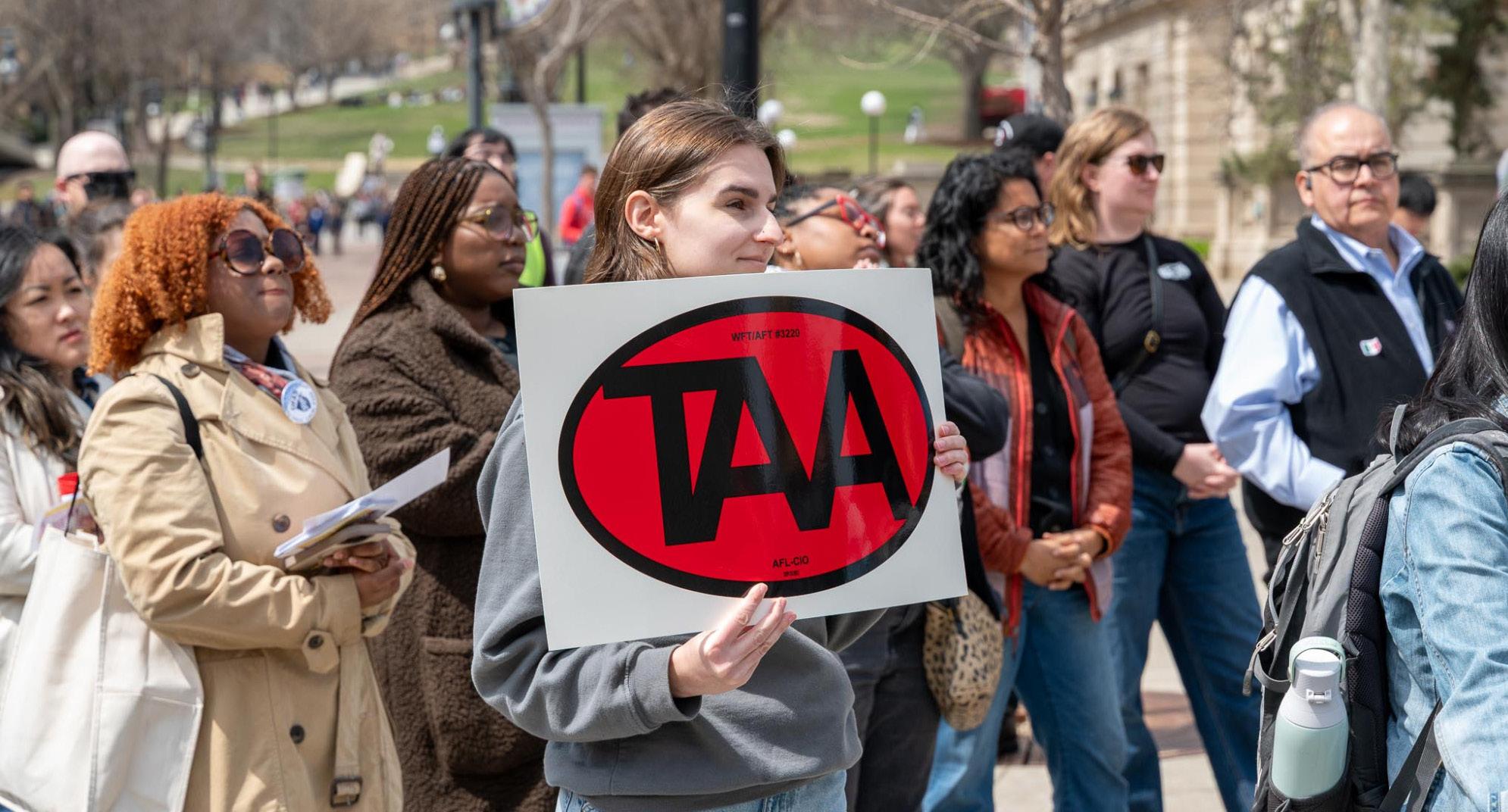
This campaign for a meet and confer relationship, Teaching Assistants Association Co-president Gisel Flores said, was rejected by the chancellor’s office and sent to the Associated Students of Madison, who passed a resolution in support of it.
Even after this, there was no action. “The ball was back at her court,” Flores said, “but she didn’t do anything with it.”
Peter Haney, president of the local chapter of the American Federation of State, County and Municipal Employees, which represents nonacademic staff that work at UW-Madison, also hopes the next chancel-
lor will be more responsive to requests to meet with the unions.
“We haven’t seen much recently [from Mnookin] in the way of efforts to consult with labor organizations on important decisions that are made,” Haney said. “So we look forward to a new administration that takes input from staff and faculty more seriously.”
Deans weigh in
Deans from schools across UW-Madison shared congratulatory messages for Mnookin, highlighting initiatives she led successfully and joyful memories of their partnership with Mnookin.
Soyean Shim, dean of the School of Human Ecology, and Devesh Ranjan, Grainger dean of the College of Engineering, both praised Mnookin’s role in launching RISE.
“Schools and Colleges have benefited tremendously from this investment in strengthening faculty research, including the School of Human Ecology,” Shim said in a statement. “This level of coordinated, strategic investment in faculty excellence is quite rare and represents one of the most significant campus-wide research initiatives in recent years.”
Shim said she hopes the next chancellor will continue to build on RISE while also placing a strong emphasis on the student experience.
“I would welcome a chancellor who places strong emphasis on student experiences, which remain one of the top strategic priorities for UW-Madison. Strengthening the integration of research, teaching and student engagement will be essential for the university’s next chapter,” she said.
Nita Ahuj, dean of the School of Medicine and Public Health and vice chancellor for Medical Affairs, and Ranjan said they hope the next chancellor will remain committed to the Wisconsin Idea “and a willingness to make bold, strategic bets that expand the university’s impact,” in a statement.
Remzi Arpaci-Dusseau, director of the School of Computer, Data & Information Sciences (CDIS), applauded Mnookin’s role in separating CDIS from the College of Letters and Science and establishing a new college focused on artificial intelligence and computing.
“She helped us bring the College of Computing and Artificial Intelligence from vision to reality — the first new college on our campus in nearly 50 years! — and guided the campus through some challenging moments,” Arpaci-Dusseau said in a statement. “I will miss her energy, clear thinking, eloquence and passion for UW. To our friends and colleagues at Columbia: you made a great hire!”
Dan Tokaji, dean and professor of Law at the UW Law School, highlighted the school’s rise in national rankings for best law schools during Mnookin‘s tenure, specifically its climb from No. 43 to No. 28. He said Mnookin, a former law school dean herself, “leaves the Law School and the University in a very strong position, poised for even greater successes in the future.”
Vallabh Sambamurthy, dean of the Wisconsin School of Business, Eric Wilcots, dean of the College of L&S and Jonathan Levine, dean of School of Veterinary Medicine, also commended Mnookin’s leadership and her support for their respective schools.
MAGGIE SPINNEY/THE DAILY CARDINAL
JAKE PIPER/THE DAILY CARDINAL
JAKE PIPER/THE DAILY CARDINAL
Bipartisan antisemitism bill draws controversy over free speech
By Jake Kilander STAFF WRITER
Tensions rose in discussion over a bipartisan bill that would require state agencies, including the University of Wisconsin System, to adopt the International Holocaust Remembrance Alliance’s working definition of antisemitism for any “law, ordinance or policy” when evaluating possible discriminatory intent at a Jan. 28 public hearing.
Republican lawmakers cited a sharp increase in antisemitic incidents in recent years showing a pressing need for the bill, while some Democrats raised concerns adopting the definition could stifle criticisms of Israel — including on college campuses — despite the legislation stating that it cannot be used to infringe on any First Amendment rights.
Daniel Hummel, a research fellow with the History Department at the University of Wisconsin-Madison and an expert on U.S. relations with Israel, said there has been increased “antisemitic rhetoric around campus” since the Oct. 7, 2023 Hamas
attack on Israel.
The Milwaukee Jewish Federation reported 95 antisemitic incidents in Wisconsin in their 2024 audit, a slight decrease from 113 in 2023, but a 458% increase from when the Federation began its annual audit in 2015.
The IHRA defines antisemitism as “a certain perception of Jews, which may be expressed as hatred toward Jews.”
The IHRA lists “contemporary examples” of antisemitism on its website, tying the definition to criticism of Israel. Examples include “drawing comparisons of contemporary Israeli policy to that of the Nazis,” “requiring of [Israel] a behavior not expected or demanded of any other democratic nation,” or “denying the Jewish people their right to self-determination, e.g., by claiming that the existence of a State of Israel is a racist endeavor.”
The ACLU of Wisconsin has come out in opposition, saying “federal law already prohibits discrimination – including antisemitic discrimination – on the basis of race, color, or national origin.” The ACLU also said
the IHRA definition is “overbroad by equating protected speech with unprotected discrimination.”
UW-Madison faculty advocacy group PROFS also opposes the legislation saying the definition would become legally binding, despite the authors of the IHRA calling it non-binding.
Hummel said the IHRA definition is a valuable tool in analyzing the history of antisemitism, or for determining whether modern rhetoric is possibly antisemitic, adding that many activist groups opposed to antisemitism use the IHRA definition in their work. But he also said the definition shouldn’t be used for legislation.
“It’s a definition that can be very useful in certain circumstances, but when you move it into the legal legislation area, it’s just not precise enough,” Hummel said. The definition has “too many ambiguities” within it to be good law, Hummel said.
Hummel also cautioned using the definition in a classroom setting.
“I am sure there are classrooms
Pizza joints debate bill allowing minors to operate pizza-dough rollers
By Avery Chheda
FEATURES EDITOR
Republican lawmakers introduced legislation on Jan. 23 which would allow minors 16 years of age and older to operate pizza-dough rollers while on the clock.
The bill states that minors would only be permitted to operate the pizza dough roller under a clear set of safety guidelines, clarifying that minors would still be prohibited from setting up, adjusting, repairing, oiling and cleaning the pizza dough rollers.
While most pizza joints hand roll their dough, Rosatti’s Chicago style pizza has an industrial dough roller on site. Domingo Conejo, a seasoned pizza professional, said the bill is irresponsible.
Conejo also told The Daily Cardinal the finesse needed to operate an industrial pizza roller is out of a teenagers
skill range.
“The rollers are dangerous,” Conejo said. “Minors employed here only answer the phones.”
But local Italian restaurant Porta Bella owner Edward Schinnick told the Cardinal the bill makes sense.
“With all the safeguards in place, you would have to purposely put your hand in harm’s way,” Schinnick said. “There’s no rhyme or reason not to [pass the bill].”
The bill, introduced by Republican Sen. Andre Jacque, R-New Franken, has garnered support, receiving 10 cosponsors from other Republicans.
The Department of Workforce Development currently has authority over the law and prohibits all minors from operating power-driven bakery machines. Jacque’s bill would require the department to allow for this exception.
in states that have adopted the IHRA definition that are having great discussions, and that’s because there are good teachers,” Hummel said. “But in other cases, you might have really bad enforcers. Or people who are looking to impose it very rigorously because of their personal politics.”
Jewish UW-Madison students met with Chancellor Jennifer Mnookin amid the 2024 pro-Palestine encampment with several demands, including that the university adopt the IHRA definition of antisemitism. The university never publicly weighed in and in a May 2024 text message obtained by The Daily Cardinal Mnookin said she viewed commenting on the IHRA definition of antisemitism as “not something for me ever to do in my institutional capacity.”
The IHRA’s definition was recognized by both the Biden and Trump administrations and has been adopted in some manner by 37 states where its impact has varied.
Florida passed IHRA antisemitism legislation in June 2024 and the state’s university system used
the definition to conduct a full review of course materials with an antisemitic bias.
The state identified class materials to review by searching for keywords in course descriptions and syllabi including “Israel,” “Palestinian,” “Middle East,” “Zionism,” and “Jews.” Courses containing these keywords were then inspected for antisemitic or anti-Israel bias.
The UW System did not reply to a request for comment on how adopting the IHRA definition would impact classroom policy and interactions with campus protests in the future.
The Senate bill has a companion bill in the Assembly, which was introduced on Sep. 19, 2025 and had its own public hearing on Oct. 22, 2025.
The Senate Committee on Judiciary and Public Safety voted along party lines Tuesday to advance the bill, sending it to the Senate floor where the legislation is now available for scheduling.
Madison seed library sprouts community gardening efforts
By Jane Dardik STAFF WRITER
Madison Public Library (MPL) has provided free native prairie and gardening seeds to the Madison community for over a decade as a part of a seasonal program in the winter and spring.
The program, called Seed Library, began in 2014 and distributes approximately 50,000 garden, native plant and produce seed packets annually to the Madison community, according to Rachel Davidson, Sequoya Library’s Community Engagement Librarian.
MPL offers the Seed Library at eight of its nine locations — all except Madison Central Library.
The Seed Library operates in two seasonal phases. Phase one occurs in December or January, depending on the year. MPL distributes native prairie seeds supplied by the Dane County Land and Water Resources Department. These seeds include species such as wild bergamot, butterfly weed and bottlebrush grass.
Phase two starts in March when MPL transitions to garden Seed Libraries, which include vegetables, herbs, tomatoes and flowers. Garden seed suppliers are larger and remain available longer than the native seed collections because MPL can purchase them wholesale.
According to Davidson, the library system typically purchases seeds from Fedco and AP Whaley. They also receive donated seed varieties through AP Whaley’s Seed Cycle program that provides seeds to non-profit organizations.
Community volunteers and the Dane County Land and Water Resources Department package the thousands of seed packets. At Sequoya Library last year, 55 volunteers packaged 8,400 individual seed envelopes over the span of two volunteer events. This year, Davidson said Sequoya will hold three volunteer events since demand is expected to increase.
But Davidson told the Cardinal the Seed Library is about more than just gardening.
“In addition to food access, sustainability and climate resilience, I think there’s also an element of personal and community empowerment,” Davidson said. “Climate change and lack of food access can make people feel powerless, and growing your own crops — however small, and whether in a personal plot or community garden — helps to counteract that.”
Beyond the usual books and computers, Davidson said libraries are meant to be community resource centers, from children’s storytimes to attending a community class, that serve all Madison residents, even those without a library card.
“Libraries are for everyone, and that doesn’t just mean people from diverse backgrounds or of diverse identities, although it means that, too; it also means people with diverse interests and needs,” Davidson said.
Liz Boyd, MPL’s Digital Services & Marketing Manager, told the Cardinal the Seed Library is one of the most popular things they do at the libraries. Alongside the free seeds, she said several MPL branches also host gardening classes and design workshops that explain exactly what first-time gardeners will need.
“Parents and caregivers can use these seeds to grow with their children,” Davidson said. “They can pass down their gardening knowledge, or learn it together. Community members can grow produce and share it with their neighbors, strengthening community ties.”
Madison residents do not need a library card to pick up seeds or attend workshops. However, MPL asks households to only take one packet of native seeds, a rule that does not apply to March’s garden seeds due to a much higher supply, Boyd said.
The Sequoya and Pinney branches ran out of seeds as of Jan. 14, about three weeks after the launch, according to Boyd. She said they ran out of seeds again this year, despite starting with more seeds on hand.
When the economy fails, immigrants are forced to pay the price opinion
By Safa Razvi OPINION EDITOR
The United States has always had a strong response to periods of economic fluctuation: the call for increased deportations. This is political theater and the government’s way of redirecting public anxiety and putting the strain on vulnerable communities, minorities and marginalized people. During economic downturns, labor instability and financial stress lead to heightened immigration enforcement.
These fluctuations themselves foster fear among communities. Rising inflation, job insecurity and market volatility all create curiosity, leaving people with more questions than answers. Rather than confronting these issues, the U.S. would rather find a scapegoat: immigrants.
History shows a pattern of this. During the Great Depression, the U.S. government carried out mass “repatriations” of Mexican and Mexican-American communities, many of whom were legal U.S. citizens. For a long time, immigrants have been framed as “job-stealers” despite evidence showing deportations did little to improve the economy. What these actions did provide was political reassurance — the appearance that something was being done.
Similar patterns arose during the economic volatility of the 1970s, when inflation and industrial decline coincided with increased border enforcement and rhetoric about “illegal labor.” During the 2008 financial crisis, immigration raids and deportations surged once more. Although the collapse
was driven by financial speculation and regulatory collapse, immigration was once again used as a point of blame.
When the economy becomes unstable, immigration enforcement becomes a show of support for citizens. Deportation is sold as an economic solution, but it instead functions more as an emotional fallback.
Immigrants become a target for futile American frustration and discourse. This allows political leaders to claim they are protecting workers without addressing why they are struggling in the first place and getting at the root of the issue.
As a result, anti-immigrant rhetoric spikes during times of uncertainty, because it plays into longstanding ideas regarding who belongs in this country and who is seen as “deserving” of economic prosperity. The idea that removing immigrants will restore the economy is an unfounded, baseless claim grasping at straws even when utterly false.
In truth, immigrants are deeply embedded into the U.S. economy. They are the backbone of our nation. They work in fields spanning across service industries — healthcare, construction, agriculture and manufacturing; sectors that are often hit the hardest during periods of economic hardship. Deportations only worsen these industries, making recovery from an economic struggle more difficult.
Studies project that mass deportation reduces overall economic output, shrinks GDP and lower wages for high-skill workers. This affects nearly two-thirds
of the labor force. Rather than stabilizing industries, deportation policies lead to labor shortages, skyrocketing prices and communities being pulled apart.
Despite these consequences, deportation remains a political tool because it shifts blame.
This pattern is even visible today. As inflation, housing costs and a poor job market dominate public discourse, creating greater rifts between people and government, immigration has once again become a central motivator for economic solutions, creating greater fear among immigrants too. Frustration is being repackaged as anxiety over safety and “illegal aliens.” Structural inequality is reframed as migration crises.
According to the Federal Joint Economic Committee, immigrants have expanded the labor
supply by nearly $580 billion in taxes alone, boosting the U.S. economy, not funneling from it.
However, the truth is that economic instability is cyclical, and so is scapegoating. Deportation spikes aren’t reactions to just immigration levels but to moments when the U.S. government fails to deliver stable economic growth. Rather than addressing those failures, policymakers reach for the easiest way out: increased deportation and enforcement.
These actions tear families apart, further destabilize struggling communities and create lasting fear among immigrant populations, people of color and even those with legal status. Struggles include families arrested in their driveways and innocent people being killed in the streets. Entire communities have learned that economic struggles have always led to violence and punishment, not
protection like promised.
Recognizing this pattern reveals the true function of deportation policy. It doesn’t fix the economy; it manages public perception during a crisis to protect political leaders, not the common man.
Breaking this cycle calls for acknowledging that immigration is not the root cause, nor does it impact economic fluctuation as direly as many make it seem. It is simply an excuse to avoid deeper reform.
Economic justice cannot be met with exclusion. Stability can’t be built by removing those who founded and keep this country running. Until policymakers stop using deportation as a distraction, the same response and same harm will come from economic crises.
History has already brought us here, to this point of destruction. The question is whether we are willing to learn from it.
Why ‘forgive but never forget’ keeps us emotionally stuck
By Shreya Bhargava STAFF WRITER
The phrase “forgive but never forget” is often framed as wisdom — a way to appear healed while staying vigilant. But when you look closer, the phrase carries a contradiction. Holding on to hurt is not forgiveness. It is resentment with better branding.
To forgive while refusing to forget emotionally means keeping the wound open. It means replaying moments that have already passed and allowing past pain to quietly shape how you move through the world: how carefully you choose your words, how quickly you pull back or how often you assume the worst before giving someone the benefit of the doubt. That is not healing. That is preservation.
Forgiveness is never easy, and it is rarely instant. It requires acknowledging that something mattered enough to hurt. It asks you to sit with discomfort instead of turning it into bitterness. That is why many people stop halfway. They forgive in language but not in practice, clinging to memory as leverage which feels like control.
Research shows that genuine forgiveness does not erase memory, but changes its emotional weight. The facts remain, but the charge softens. People who truly forgive are less likely to relive offenserelated thoughts and more able to move
forward without carrying resentment. By contrast, those who cling to this principle often continue to experience the same emotional reactivity each time they recall what happened.
In other words, forgiveness is not about deleting the past. It is about releasing its dominance on your present. This applies not only to major betrayals, but everyday moments. It shows up in small disappointments. In friendships that drift. In words that linger longer than they should. In moments where someone falls short and you quietly keep score. Each of these becomes a choice: either integrate the experience and move forward, or store it away as emotional evidence.
Some situations, of course, are heavier, like real wrongs and betrayals. These are moments that alter how you trust. Forgiveness in these cases is not quick or simple. It does not mean excusing harm or abandoning boundaries. It means doing the slow, internal work of refusing to let someone else’s actions define your capacity for peace. You can remember what happened and still decide not to live inside it.
The idea that forgetting makes you naive is a comforting myth. What actually weakens people is rigidity. Carrying unresolved hurt hardens your reactions. It narrows your openness. It turns past experiences into armor, and over time, that armor becomes heavy.
Forgiveness, on the other hand, is an act of kindness, not just toward others, but toward yourself. It requires recognizing the humanity in people, including their flaws and limitations. It asks you to release the need to be right in favor of being free.
While “forgive but never forget” seems like a mature response, it often keeps people emotionally stuck. True forgiveness is
quieter. It looks like remembering without reliving. It looks like holding boundaries without bitterness. It looks like allowing a chapter to close without needing to reread it every day.
You do not have to erase what happened. You only have to let it stop defining the way you live. That is the harder work, but it is also the work that creates softer hearts, clearer minds and stronger people.
arts
‘Ironbound’ follows love and the American Dream
By Eloise Slipper STAFF WRITER
Forward Theater’s latest production places a spotlight — or rather, a streetlight — on the experience of American immigrants, with Martyna Majok’s dark comedy “Ironbound” set to run from Jan. 29 to Feb. 15 at Overture Center.
“Ironbound” examines the life of Darja (Cassandra Bissell), a Polish immigrant whose story is told through a series of moments captured by the desolate setting of a city bus stop. She seems to be trapped in a perpetual state of waiting. And while she waits for the bus, she is also waiting for her son to return home, her love life to heal and her life to turn around.
In the present day, Darja is in a relationship with an American man named Tommy (Jonathan Wainwright). Their journey throughout the play is driven by conflict in their relationship.
Wainwright keeps the audience feeling conflicted about Tommy’s suitability for Darja. He is able to turn empathy into disapproval, and back again, within moments — an impressive skill that contributes massively to the audience’s emotional connection to the story as a whole.
Flashbacks show a younger Darja at the bus stop with her first husband, another Polish immigrant named Maks (Josh Krause).
The pair hold a sense of youthful optimism between them. Maks dreams of moving to Chicago, planning to pursue his passion for music. It becomes increasingly clear that this ambition will lead to the collapse of their relationship, as Darja’s choices reflect her prioritization of security over love or dreams.
Maks’s actions arguably do not hurt Darja as badly as Tommy’s. However, he lacks Tommy’s likability.
Krause and Wainwright’s contrasting portrayals are responsible for the varying emotions that their characters elicit. While Wainwright allows Tommy to yield himself to Darja, Krause brings a strength and defensiveness to Maks that keeps him and Darja from having the same emotional connection.
Perhaps the most impactful interaction held at the bus stop is between Darja and Vic (Gabriel Anderle), a teenage boy who discovers her curled up beneath the bus stop’s bench. Vic empathizes with Darja in a way that neither of her romantic partners were able to, though he is not able to express it effectively.
Anderle is truly captivating as Vic. In many ways, his portrayal mirrors Bissell’s portrayal of Darja, as both actors expertly balance their characters’ struggles to mask their troubles with their desires to be understood.
It would be wrong to refer to Vic as the comedic relief of the play, as there is no true relief from the striking realness of these characters. However, Anderle’s charm elicits many moments of laughter, making Vic’s scene with Darja one of the most heartbreaking and memorable examinations of humanity within the entire play.
The intense realness of “Ironbound” is largely owed to the precise details of the set. Scenic designer Lisa Schlenker crafted an impressive replica of a run-down bus stop, complete with cracked pavement, scattered trash and graffiti.
Arching above the bench
Behind the scenes of Broadway musical ‘Kimberly Akimbo’
By Britta Sevcik STAFF WRITER
“Kimberly Akimbo,” the five-time Tony Awardwinning musical, is coming to Madison’s Overture Center for the Arts from Feb. 10 - 15.
The show follows the story of Kimberly Levaco, a 16-yearold high schooler who suffers from a genetic disorder causing her to age rapidly. But instead of a sense of foreboding, the story inspires hope in its viewers by forcing them to examine their own mortality and make the most of the time they have.
Gabby Beredo, who plays Delia, a member of the show’s teen ensemble, said, “It is such a telling story of how you can be a better person for the people around you and [how] to be more empathetic.”
Although this is not Beredo’s first national tour, it is her first professional role as an adult. With her past professional credits including “Matilda” and “Annie,” “Kimberly Akimbo” offers Beredo a chance to portray a more mature character.
where Darja’s story unfolds is a tall streetlight. This light is always shining down brightly, representing the bus stop’s role as a place where Darja’s truth is unmasked and put on display.
Such careful precision in designing the story’s environment has succeeded in sending a clear message to the audience: this play is a snapshot of someone’s reality. Upon entering the theater, any person is able to immediately recognize the setting. It is a place everyone has seen and likely avoided before.
But Darja does not have the luxury of avoiding the bus stop. For her, it is a place of comfort, even though it cannot always offer her safety. This reflects Darja’s constant conflict between love and security throughout the play.
Bissell’s body language communicates this conflict beautifully. As Darja, she places a shield around herself. This manifests in the masked emotions expressed subtly on her face, the confidence or lack thereof in her stance and the way she interacts physically with the three men joining her at the bus stop.
Darja is a woman who everyone has passed by at some point in their lives. The realism in Bissell’s performance is what makes this production so impactful. She is hilariously witty, devastatingly vulnerable and, above all, incredibly human.
“Ironbound” is a snapshot of reality. It brings into focus the idea of the American Dream, taking the audience on a bumpy, yet beautiful journey of hope, resilience and discovery through the eyes of one woman representing millions of others in America.
just so driven.”
In the real world, Beredo is similarly working to make her own dreams come true.
She is a sophomore at the Cincinnati Conservatory of Music and uses the tools she learned at CCM in her performances every day, even as the show has forced her to take a gap year.
“In conservatory style, you’re acting, singing and dancing your whole day. That has really helped me build this stamina to be able to do eight shows a week,” Beredo said.
The Kimberly Akimbo National Tour has travelled across the country, but Beredo’s favorite stop was New Orleans.
“New Orleans was just so vibrant,” Beredo said. “I mean, the city’s culture is just bursting at the seams: there’s just so much food to try, jazz music playing on the streets and so much art all around. It was so inspiring to be there.”
When she has time off, Beredo enjoys relaxing or exploring the cities they visit.
“I think the most different part about the role is that she’s just in high school, and she’s assertive rather than other roles that I’ve played… Delia’s pretty much a leader,” Beredo said.
Delia is a driven and fierce high schooler who not only knows what she wants, but also wants to ensure others reach that success along with her.
“[She] can totally be perceived as bossy, but I see her as a fierce, empowered girl,” Beredo said. “My favorite part about playing Delia is being able to play a character that is
“Lately, I’ve been doing a lot of coloring. I love having something to do while I watch movies. I’m really trying to watch all of the Oscar-nominated movies before the Oscars,” she said. “I’m either just being cozy in my hotel room or exploring the cities, the art museums and the food.”
Tickets are still on sale for “Kimberly Akimbo” at the Overture Center for the Arts.
“Come see Kimberly Akimbo,” Beredo said. “You’re gonna laugh, you’re gonna cry and you’re gonna leave the theater feeling inspired to choose joy every day.”
COURTESY OF THE OVERTURE CENTER
43rd annual Wonders of Physics show returns to UW-Madison science
By Nicole Steele STAFF WRITER
Free and publicly available
University of Wisconsin-Madison
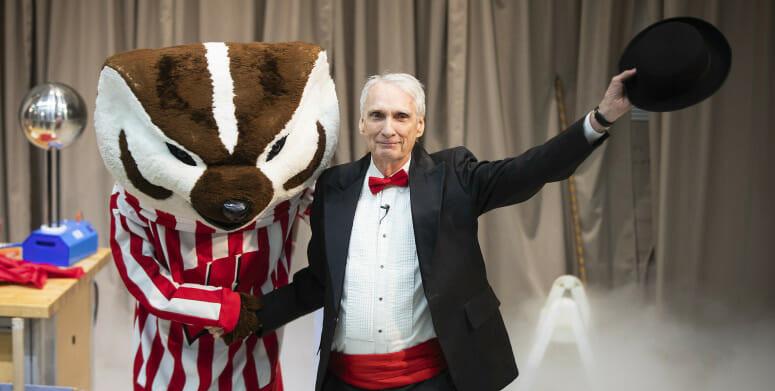
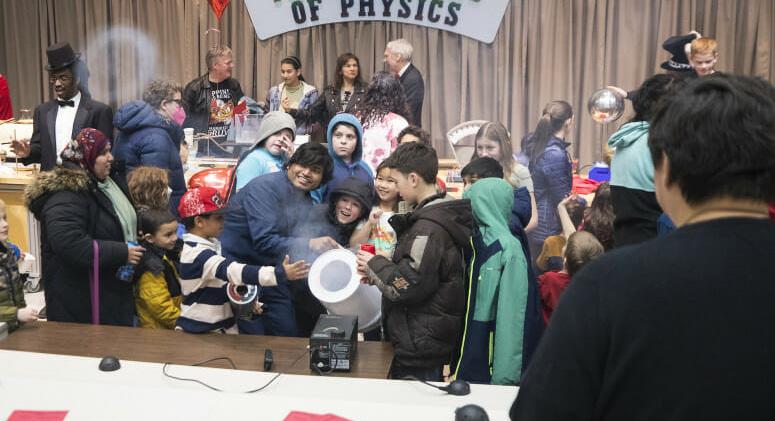
Wonders of Physics shows will continue a 43-year legacy of lively physics demonstrations attended by children and adults alike this year on Feb. 7, 8, 14 and 15.
The program will feature two shows each day, one at 1:00 p.m. and one at 4:00 p.m. with a livestreamed show on the final day.
Haddie McLean, the program’s coordinator and outreach manager, said she looks forward to the show each year.
“I love to see and hear the audience react to the demonstrations,” McLean said. “It’s also fun to have the kids come down to the stage after the show to meet the cast members. It’s very rewarding to see how excited they are about the show and science in general.”
Clint Sprott, a UW-Madison physics professor who retired in
2008, started the show in 1984 as a free, public lecture. He still attends the show every year.
“[My] most favorite is seeing the smiles and enthusiasm of the audience,” Sprott said. “The show was a major part of my life for 40 years, and it is certainly fun to be something of a celebrity.”
Previous shows have demonstrated concepts of air pressure, electricity, heat, light, magnetism, motion, sound and quantum mechanics. Shows have included devices like Tesla coils to create electrical charge with a light bulb and parabolic mirrors that reflect infrared light to create fire without a match.
“The show is scripted so everyone, no matter their age, can learn something,” McLean said. “The goal of The Wonders of Physics program is to inspire the next generation of scientists, and I believe the annual show does just that.”
The fast-paced, familyfriendly events bring crowds
of all ages together to experience the wonders of physics. Sprott also enjoys the familyfriendliness of the show.
“We try to make the show enjoyable for people of all ages, like a circus or magic show,” Sprott said. “It is really aimed at families. Elementary school children seem to get the most excited, and we are happy to be able to plant in their minds that physics is interesting and something they might later want to study or consider as a profession.”
Event goers must reserve a ticket to the show in advance, which can be found on the Wonders of Physics website. Lots 17 and 20 are both free on Saturdays, and additional parking information can be found on the campus visitor parking page.
“Tickets are released on Jan. 1 each year and go fast. Even though all shows are full now, there will likely be openings, especially on the last day,” McLean said.
Experts discuss global antimicrobial resistance, infectious disease control in webinar
By Sophia Han STAFF WRITER
The University of Wisconsin-Madison Global Health Institute convened experts from around the world with UW-Madison faculty for a Jan. 27 webinar examining the growing complexities of infectious disease control.
The discussion, moderated by Daniel Shirley, an infectious diseases professor at the UW-Madison School of Medicine and Public Health, brought together researchers working across human, animal and global health systems to address two converging crises: antimicrobial resistance (AMR) and declining childhood vaccination rates.
Vaccines in Wisconsin
Antimicrobial resistance arises when mutations occur in bacteria or viruses that make antibiotics ineffective. Vaccines play an important role in combating antimicrobial resistance because they reduce the potential for infection outbreaks. Without an infection in the first place, clinicians do not have to treat diseases with antibiotics, potentially creating resistant strains.
According to the World Health Organization, more vaccination could decrease the number of antibiotics prescribed by 22% and decrease the annual cost of treating AMR-related maladies, currently $730 billion, by one third.
But across the United States, cases of preventable diseases such as influenza, hepatitis A and B, meningitis, RSV and rotavirus have risen as the required number of vaccines for children fell from 17 to 11 within the past year. Treating these diseases with antibiotics could increase antimicrobial resistance, which currently contributes to 5 million deaths a year globally.
A vaccination decline has also played out in Wisconsin. In 2013, 88% of Wisconsin twoyear-olds had received the measles vaccine. By 2022, that number fell to 82%, with some countries experiencing even sharper declines. Monroe County, for example, dropped from 82% to just 59% from 2013 to 2023.
Panelists linked a decrease in Wisconsin childhood vaccinations to rising mistrust in healthcare providers and public health institutions.
Resistance levels to antibiotics treating pre-
ventable diseases are likely underestimated because most data comes from hospitalized patients who have already failed earlier treatments, according to Laurel Legenza, an assistant professor in the UW-Madison School of Nursing.
Hospitals with testing capacity, like UW-Madison, play a key role in detecting resistance and guiding care. But even with strong laboratory resources, managing AMR is difficult.
“At UW, we have quite a bit of information: a lot of culture data, a lot of testing for resistance, a lot of access to antimicrobials — and we still face a big problem,” Shirley said.
“There are bacteria… and other organisms that we don’t even have good treatments for.” Some bacteria lack effective treatments, forcing clinicians to rely on combination therapies. Combination therapies involve joining two or more types of treatments in order to treat one infection or virus, often creating higher costs and more potential side effects for a patient.
Antimicrobial resistance around the world
Panelists said limited laboratory capac-
ity and inconsistent data-keeping hinder effective antimicrobial (AMR) research across the globe.
Erta Kalanxhi, whose research involves tracking antimicrobial resistance in Africa, said a lack of digitized data and AMR testing puts low and middle-income countries, where bacterial infections are most prevalent, at risk.
“The data that is available gives an incomplete picture of [antimicrobial resistance],” Kalanxhi said.
She said only 26% of laboratories use electronic information systems, leaving most AMR data stored on paper and difficult to integrate into meaningful research. Additionally, clinicians in low-income settings often lack access to microbial testing, making it hard to identify infections and gather data.
“Many laboratories [are] lacking electronic information systems,” Kalanxhi said. ”The data is there, but it’s difficult for this data to actually inform policy.”
Though Kalanxhi said the AMR data that does exist indicates high levels of resistance, its inconsistent data quality combined with low rates of AMR testing make linking resistance to patient outcomes nearly impossible.
Her research shows that much antibiotic R&D focuses on adults in high-income countries and early-stage drug development, despite bacterial infections primarily affecting people in low-and middle-income countries, according to François Franceschi, an expert in antimicrobial research.
Franceschi, who works for Swiss-based antibiotics nonprofit Global Antibiotic Research and Development Partnership (GARDP), said making all infections treatable, “requires shifting global investment toward high-burden populations, and ensuring that new antibiotics reach the people who need them the most.”
Across all panelists, a shared message emerged: global health is deeply interconnected. Infectious diseases can have consequences everywhere. Protecting health in Wisconsin and around the world requires coordinated action to strengthen laboratory systems, invest in new antimicrobials, improve data quality and rebuild trust in vaccines.
DANI NISBET/THE DAILY CARDINAL
Badgers outlast Ohio State 92-82 sports
By Matthew Schultz SENIOR STAFF WRITER
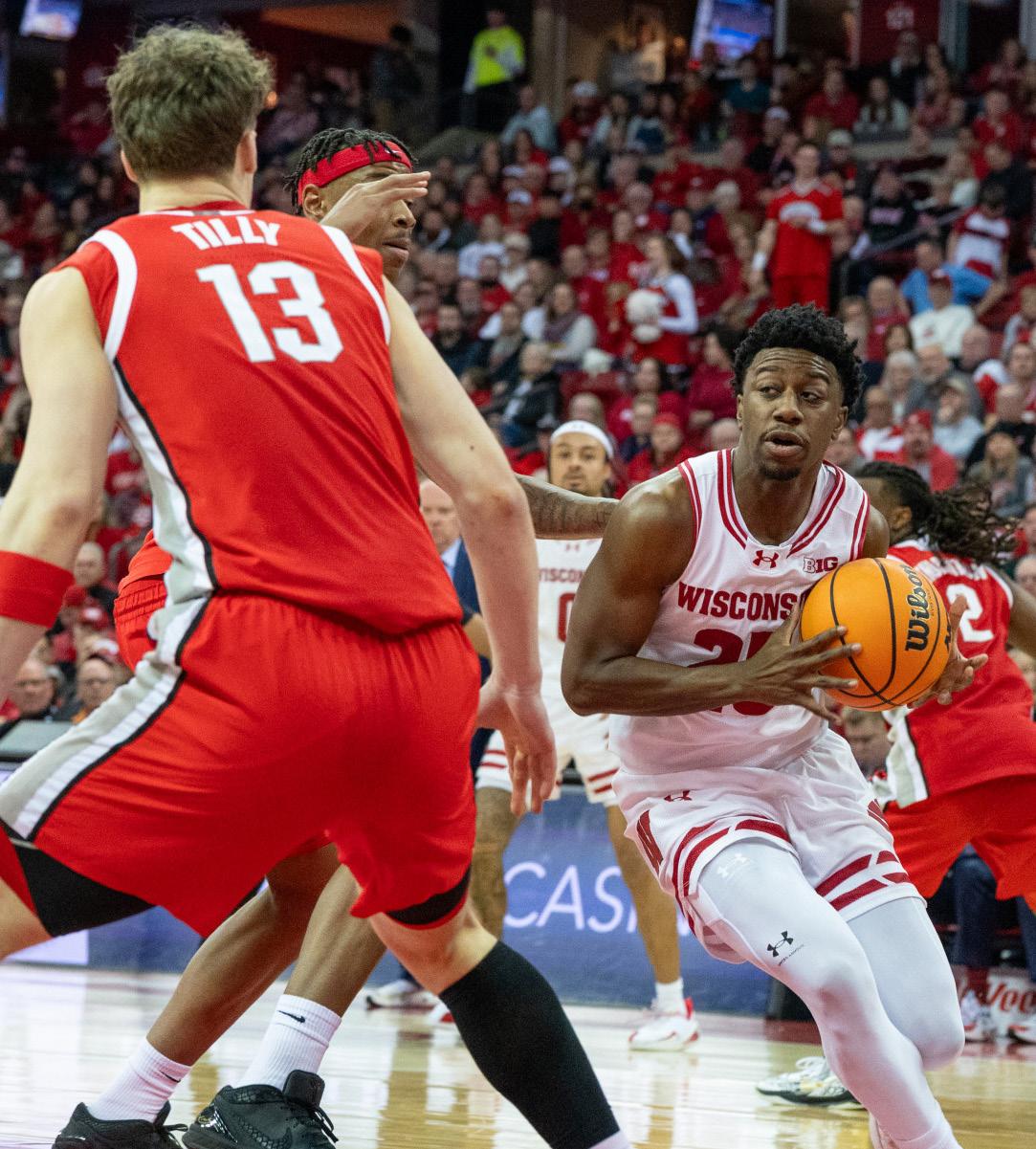
Behind a dynamic performance from guards John Blackwell and Nick Boyd, and an incredible first half hot streak from forward Austin Rapp, Wisconsin took down Ohio State 92-82 on Saturday afternoon, pickup up their second straight win.
Blackwell led the way with 22 points, while Boyd added 21. The win is Wisconsin’s seventh in their last eight games.
Wisconsin continued their recent trend of falling behind early, quickly trailing 15-4 at the [time] mark. But despite a double-digit deficit, and starting two for their first 11 from the field, forward Austin Rapp’s stellar 3-point shooting performance quickly led a Wisconsin comeback. Rapp, who had hit only four of his last 21 3-pointers, shot with blazing confidence, tying the game at 21 with back-to-back 3s.
Rapp rattled in three more
deep balls in the first half, tying a season high of five and igniting the home crowd. Rapp outscored the Buckeyes 19-14 himself over an eight and a half minute span, which surged Wisconsin to a 49-43 halftime lead.
Fueled by the rowdy home crowd, the Badgers refused to let Ohio State back into the game. Wisconsin’s lead never dropped below eight points in the second half and reached as much as 16 with just under three minutes to go. Boyd and Blackwell controlled the pace of the game masterfully, trading buckets and going a perfect 13-for-13 from the line.
Nolan Winter also contributed to the winning effort, tallying his tenth double-double of the year with 11 points and 11 rebounds. While overshadowed by other standout performances, his interior dominance helped the Badgers outscore OSU 42-30 in the paint. Aleksas Bieliauskas, who did not return
to the Minnesota game with a foot injury, added 10 points and seven rebounds as well.
Teams can’t seem to outduel the Badgers in high scoring affairs. Wisconsin has now scored 90+ points nine times this season, and they have won each time. The Badgers also shot 52% from the field, their second highest this season (54% vs. Central Michigan), despite going just 9-for-26 from 3-point range.
The win gives Wisconsin th eir fourth in a row against the Buckeyes dating back to the 2023-24 season. The Badgers now sit at fifth in the Big Ten (16-6, 8-3), surpassing No. 12 Purdue who had lost three straight. Still, the Badgers cannot afford to get comfortable, with their toughest stretch of the season coming up. They’ll take on Indiana Feb. 7 and No. 9 Illinois Feb. 10 on the road before returning home to face No. 7 Michigan State on Feb. 13.
No. 8 Wisconsin embarrassed by Minnesota, drop sixth straight
By Haellie Opp SENIOR STAFF WRITER
The then-No. 8 Wisconsin Badgers (159-2, 8-8-0 Big Ten) were swept by border rival Minnesota (10-16-1, 6-10-0 Big Ten) in Minneapolis, losing 4-1 loss on Friday and a 8-4 loss on Saturday to extending the Badgers’ losing streak to six straight games.
With this weekend’s sweep, the Badgers are in freefall, having lost three straight series against Big Ten opponents in what turned out to be a brutal January for a club with national championship aspirations.
Badger penalty kill gives Gophers lead Minnesota beat Wisconsin 4-1 on Friday, starting a disappointing series for the Badgers.
Struggling freshman goalie Daniel Hauser started opposite Minnesota’s Luca Di Pasquo. Hauser finished the night with a .875 save percentage, contributing to his dropping stats that now sit at a .901 save percentage.
Four minutes into the game, Wisconsin had an early power play but didn’t record a single shot during the two minute minor.
Following a period of slow offense, the Badgers went back on the power play with eight minutes to go in the first. Eight seconds into the man-advantage, the puck ricocheted off senior forward Tyson Dyck’s stick and slipped into the net behind Di Pasquo, despite a Gopher attempting to wack it out of the air. It extended Dyck’s point streak to seven games.
With Wisconsin leading, Badgers freshman forward Bruno Idžan was called for tripping with less than five minutes to go in the first period. Just 12 seconds later, neither Hauser nor junior defenseman Joe Palodichuk could stop L.J. Mooney’s snipe from the left circle, which tied the game 1-1.
Wisconsin struggled early in the second period and went on the penalty kill eight minutes in after senior defenseman
Aiden Dubinsky was called for hooking. Nearing the end of the power play, Hauser was beaten from the left circle once again where Minnesota’s Erik Påhlsson took the 2-1 lead.
Less than two minutes later, Hauser couldn’t glove the redirected puck before Gopher Brodie Ziemer widened the gap 3-1.
The Badgers went on their third power play of the game with 6:17 remaining in the second, but managed zero shots.
Eight minutes into the third period, freshman forward Grady Deering and a Gopher both sat two minutes for roughing. Wisconsin took control of those two minutes but couldn’t narrow Minnesota’s lead.
Wisconsin head coach Mike Hastings pulled Hauser with 3:45 to go, and 20 seconds later, Minnesota’s Teddy Townsend grabbed the Gopher’s empty net to make it 4-1.
Hauser was pulled again after a delayed penalty put Wisconsin on the penalty, but time slipped away from the Badgers.
Angry from the impending loss, freshman defenseman Luke Osburn got into it with Di Pasquo with seconds to go. Wisconsin went on the power play after Osburn tousled with two Gophers.
Sophomore forward Adam Pietila was assessed a cross checking penalty with 22 seconds left, and sophomore defenseman Jack Phelan was assessed a roughing penalty just before the final buzzer.
Swept home
The Gophers crushed the Badgers 8-4 on Saturday as Hauser and Di Pasquo faced off again.
Minnesota had an early power play five minutes in after freshman forward Blake Montgomery was called for boarding. Minnesota took advantage of the power
play, as Hauser was beaten from the right circle off a wrist shot from Ziemer.
Wisconsin had a few close chances to tie the game after a holding penalty put them on the power play, but Ziemer scored short handed after sloppy passes in the neutral zone. Senior defenseman Ben Dexheimer lost the puck to Mooney, who took it into the Badger’s defensive zone and passed it to Zeimer, who shot past Fitzgerald and Montgomery.
The Badgers, still on the power play, retaliated a minute later, as Dyck scored on a rebounding puck to make the game 2-1 with nine minutes left in the first period.
Senior forward Christian Fitzgerald was called for roughing with 6:03 to go in the first, and the Gophers scored a minute later as Ziemer fed the puck between his legs and flipped it over Hauser’s glove to make the game 3-1.
Wisconsin had a power play soon after but couldn’t score.
With 1:34 remaining in the period, sophomore defenseman Logan Hensler checked Minnesota’s John Whipple into the boards as Whipple was in the air. Whipple fell over Hensler, who caught his leg at an odd angle. Hensler was helped off the ice and didn’t return to the game.
Hastings pulled Hauser and replaced him with sophomore goaltender Eli Pulver.
A goal by Minnesota’s Erik Påhlsson with 38 seconds left in the period gave
Minnesota a 4-1 lead.
With 8:32 to go in the second period, and Wisconsin desperately trying to get back in the game, Fitzgerald tore up the ice after Palodichuk won a puck battle on the blue line and beat Di Pasquo glove side to make the game 4-2.
But Wisconsin’s momentum didn’t last, as Dyck was called for hooking with 5:13 in the second period, and Gopher defenseman Luke Mittelstadt scored from a shot on the blue line for the 5-2 lead.
Wisconsin turned up the energy with a three-goal deficit over their heads, but Minnesota’s Beckett Hendrickson scored their sixth goal of the game to make it 6-2 before the end of the period. To the relief of the Badgers, Minnesota was assessed a roughing penalty after the final whistle to put Wisconsin on the man-advantage.
Going into the third period with a power play, Fitzgerald scored his second goal of the night 30 seconds into the period on a left circle snipe to bring Wisconsin within three.
Four-on-four play began two minutes and 14 seconds in when a Gopher was called for holding, while Dyck was called for embellishment. Påhlsson scored in Hauser’s five hole to put Wisconsin down 7-3.
After a faceoff draw with 10:27 to go in the third, Wisconsin continued to hang around, as Pietila scored from outside Di Pasquo’s crease to shorten the Minnesota lead 7-4.
With the Badgers clinging on, Pietila was called for unsportsmanlike conduct with just under seven minutes left in the game, leading to a Minnesota goal on the power play outside the two circles. The goal made the game 8-4 and cemented Wisconsin’s fate.
Wisconsin dominated in faceoff wins and lead in shots, but had nothing to show for it on the score sheet. The Badger defense was unstable in front of the net, leaving Hauser and Pulver to face tough shots against an ailing Gopher offense ranked No. 42 in the NCAA.
The Badgers are on their longest losing streak of the season and are set to face Big Ten opponents to finish out the season. With the loss to unranked Minnesota, Wisconsin is set to fall in the standings and will have to rely on Big Ten wins and the looming Big Ten Championship to secure a place in the NCAA tournament.
The Badgers are back at home at 7 p.m. on Friday to face Notre Dame at the Kohl Center.