Even in moments of national pride, gender equality is only embraced when convenient.
+ OPINION, PAGE 5
Thursday, February 26, 2026
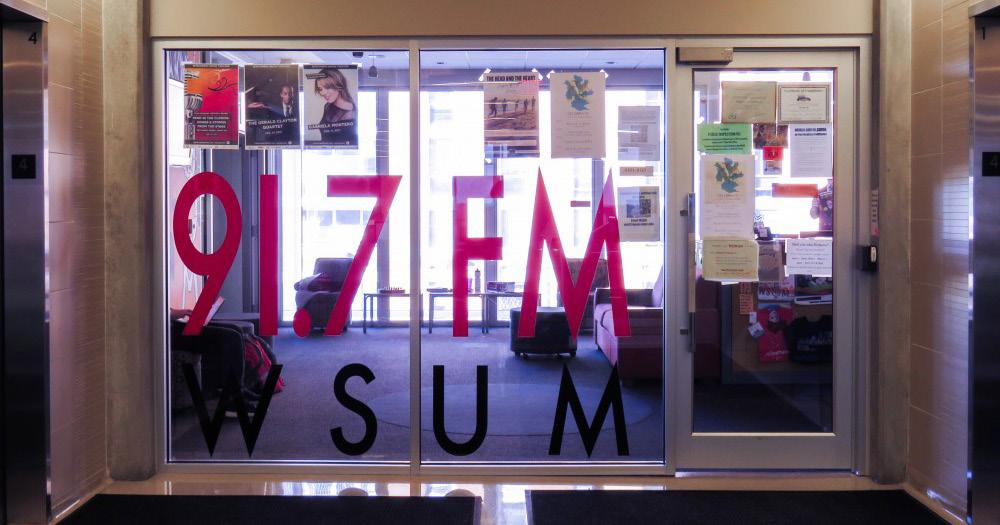
WSUM FM 91.7 received top honors at the IBS Media Awards.
+ ARTS, PAGE 8
UWPD defends Flock camera usage
By Zoey Jiang ASSOCIATE NEWS EDITOR
The University of Wisconsin-Madison Police Department’s Chief of Police Brent Plisch spoke with University Committee members Monday about the presence of eight Flock Safety cameras on campus, addressing their privacy concerns.
Plisch said the Flock cameras are only used for vehicle data and not tracking individuals.
“There is no expectation of privacy for a vehicle, specifically people’s license plates, when it’s being operated on a public property,” Plisch said.
Anyone can see that information, and it’s not protected information, he said. “If the vehicle was parked in a garage, there would be an expec-
tation of privacy.”
UWPD operates eight Flock cameras around campus. “We were seeing a lot of talk about Flock being utilized for facial recognition technology,” Plisch said. “The cameras just don’t do that.”
The Flock cameras are set to capture photos of the rear of vehicles because there’s more information from the rear, Plisch said. “There’s just no way to obtain facial recognition out front. It’s not a high enough quality image to do that.”
Plisch said UWPD is constantly evaluating risks. “We believe we weighed the benefits of the risks and put in the appropriate safeguards.”
One of those safeguards is no agency outside
the state of Wisconsin can utilize the data. “The things that we’ve done to limit exposure to our community is restricting to in-state agencies only. We have an audit trail to follow for every search that’s run utilizing our camera system,” Plisch said.
Plisch mentioned how there are risks with any organization.
“We put requests in with Flock. Could Flock violate that contract? Absolutely they could. But so could Workday. Workday could sell all employee information,” Plisch said. Workday is another widely used organization at UW-Madison.
Plisch said UWPD limits access to data obtained from the cameras to nine members
JUMP INTO GYMNASTICS
By Haellie Opp
SENIOR STAFF WRITER
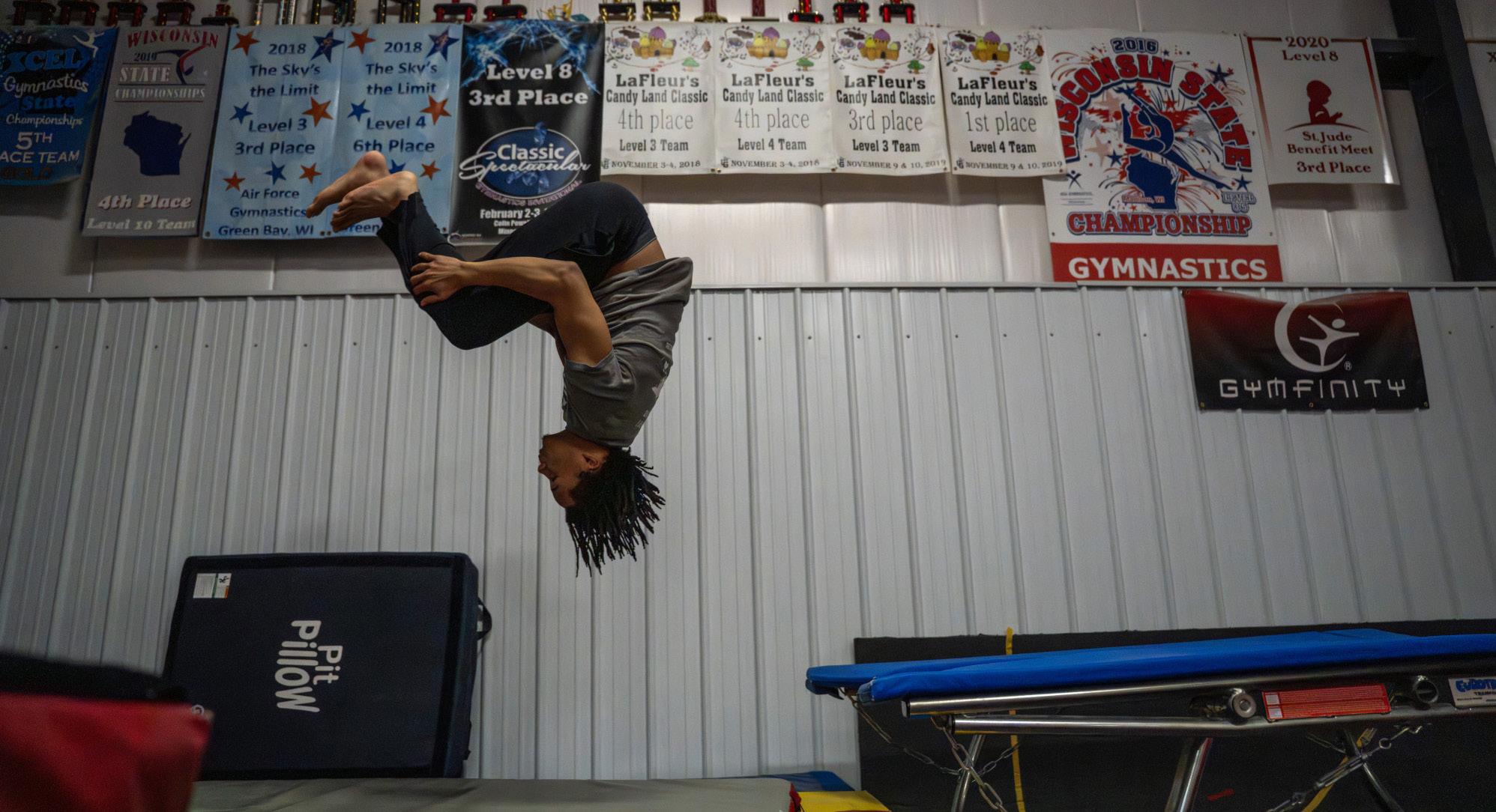
In the early ‘90s, the University of Wisconsin cut a variety of varsity sports, including both men’s and women’s gymnastics. To make up for it, the Wisconsin Gymnastics Club formed in 2002. This year, the club boasts 100 members on their roster.
Competing under the National Association of Intercollegiate Gymnastics Clubs (NAIGC), the club participates in meets throughout the spring.
Becca Tran, Wisconsin Gymnastics Club president, has been in the sport since she was 2 years old. She competed throughout her childhood before quitting in high school.
“I was thinking about how I missed it, [and] I want to get back to the events. So, I joined the club, and it was very fun to keep doing gymnastics, but also a great way to meet new people,” Tran said.
Knowing she wanted to continue with gymnastics, Tran sought out the club from
the website. She said she was nervous as a freshman when joining, but everyone was “super welcoming.”
“There was a very big range of skill levels too, which I thought was interesting,” Tran said. “There was no pressure on the gymnastic side, and it was a really good way for me to have made friends freshman year.”
Wisconsin Gymnastics Club invites all skill levels to practices and competitions. They have a team composed of diverse skills.
At the UW-Madison Student Organization Fair his freshman year, senior member Isaac Alvarez said the club got his attention while he was walking by their booth.
“They said that I looked like a gymnast and [asked], ‘oh, did you ever do gymnastics?’
I [said] no, it always interested me, but there wasn’t an outlet or a program in my hometown for that. I thought that was pretty cool that it just kind of happened,” Alvarez said.
Tran said she’s seen the club grow since her freshman year, where they were more focused on introducing students who had never done gymnastics before to the sport, instead of prospective returning gymnasts.
“I think it’s kind of evolved to support both ends of that,” Tran said. “We are very supportive of members who have never done gymnastics before and would love to teach them everything, but we’re also very supportive of our members who want to be competitive and will give them the means that they need to succeed.”
The club competes every spring semester, where they travel to other universities and compete with other gymnastics clubs. Each year, the team travels to nationals for a three-day meet where most club teams in the country compete at.
of the department. “There’s a process where our officers, if they’re investigating a case, have to submit a request to [use] Flock that’s reviewed by a supervisor before that search is ever done,” he said.
Police officers in cities across the country, including Wisconsin cities like Appleton and Milwaukee, have been investigated for using Flock camera data to track and harass ex-partners.
Plisch added that those searches are then audited, creating audit paths for every piece of data that’s run. “We have an audit path for every piece of data run. We can see everybody who runs data and comes through our system,” he said.
UW’s 3 provost finalists
By Annika Bereny CAMPUS NEWS EDITOR
After a nine-month search to replace the University of Wisconsin-Madison’s second-highest academic official, three finalists — Anna Stenport, John Zumbrunnen and Charles Martinez Jr. — are presenting their visions for the future of campus this week.
With Chancellor Jennifer Mnookin departing UW-Madison at the end of the semester, the next provost will play a key role in shaping campus policy during a transitional period for the university.
Former UW-Madison Provost Charles Isbell Jr. announced his departure in June to become the president of the University of Illinois Urbana-Champaign (UIUC) and vice president of the University of Illinois System.
In the time since, a search-and-screen committee of 15 faculty members, staff and students has been working with executive search firm Isaacson, Miller to conduct the search.
Now, they’ve narrowed the list down to just three finalists, including Interim Provost Zumbrennan, who are presenting on the largest challenges facing research institutions like UW-Madison and how they would approach solving them as provost.
Anna Stenport - University of Georgia
Stenport is the current dean of the Franklin College of Arts and Sciences at the University of Georgia. She has been in this role since 2023 and also serves as a professor of Communication Studies.
Before heading to Athens, she was the dean of the College of Liberal Arts at the Rochester Institute of Technology from 2021-2023. From 2016-2021 she chaired the College of Languages at Georgia Institute of Technology and from 2005 to 2016 worked at UIUC, beginning as an associate professor and ending as the director of undergraduate research. She taught a multitude of subjects, including Comparative and World Literature, Media and Cinema, Scandinavian Studies, Theatre, and Gender and Women’s Studies while at Illinois.
LIZZY LARSON/THE DAILY CARDINAL
4 takeaways from the 2025 Madison housing report
By Mary Al-Bazi STAFF WRITER
Madison’s housing supply is growing rapidly, rent is increasing and homelessness rates remain similar, according to the city’s biannual housing report released on Feb. 16.
The report showed Madison has seen 20,000 new residents since 2020 with Madison being the fastest growing city in Wisconsin. This has been driven by an increase in enrolled University of Wisconsin-Madison students, expanding job sectors and continued emphasis on natural and cultural amenities — all trends that continue to add pressure on the housing supply and lingering affordability and accessibility concerns.
The Housing Snapshot report, published by the Department of Planning, Community and Economic Development, uses 2015 as a benchmark to measure longterm shifts.
How much has changed since 2015?
Madison has built 22,400 new homes — a 20% increase — to supplement the continued growth in population. The report says low-income households may be forced to move out of the city due to increased demand and rent.
Land prices across the Midwest rose more than 50% between 2015 and 2023, contributing to a 41% increase in renter housing costs and a 34% increase for homeowners, according to the report.
Median monthly rent in Madison climbed from $939 in 2015 to $1,364 in 2025.
Homelessness levels have remained relatively steady, but persistent. A 2025 pointin-time survey counted 790 individuals experiencing
Gymnastics
Continued from page 1
“I remember my freshman year, I was very nervous. I [said] there’s a lot of really good gymnastics–which is awesome–and I wanted to put out my best,” Tran said. “That was a lot of stress, for sure, but it was also a really cool experience, being able to meet teams from all over the country, as well as getting to travel to a new place.”
As a former competitive gymnast who has returned to the sport in college, senior Sydney Koch said a memory that stuck out to her the most has been nationals.
“Every year with the teams has been so fun, not just competing, but watching. Especially [watching] my teammate Becca [Tran] making finals every year, and just the electricity of our team supporting her and everyone who goes to finals,” Koch said. “We’re always there to show
homelessness in Madison, compared to 800 in 2015. The report links homelessness in Madison to rising home costs, less single occupancy units and the economic impact of the COVID-19 pandemic.
How students fit in the picture
Of Madison’s 126,000 households in 2023, approximately half were renter households. Around 40,000 fell into an “other” category that excludes families and elderly residents. UW-Madison’s enrollment of 49,724 undergraduate and graduate students also shape Madison’s rental market. The report estimates that around 11,875 renter households are student households.
The report also estimates most student renters earn less than 30% of the area median income.
Gaps in access to housing
The U.S. Department of Housing and Urban Development (HUD) defines a household to be cost-burdened when it spends more than 30% of its income on housing and utilities, and severely cost-burdened when it’s spending more than 50%.
Black and Hispanic residents in Madison are more cost-burdened by rent than white and Asian residents. About 30% of white residents are costburdened or severely costburdened, compared to 47% of Black, 40% of Hispanic or Latino and 35% of Asian residents.
Median income differences among races also shape what rent counts as “affordable.” The report estimates that affordable monthly rent at $2,081 for a median white household, $1,685 for a median Asian household, $1,570 for a median Hispanic household and $1,080 for a
up for our teammates.
It’s just a whole collaborative experience to travel with your team.”
Tran said about 24 members are signed up for Nationals this year in Birmingham, Alabama, April 8-11. In the past three years, the team has traveled to Memphis, Tennessee, Albuquerque, New Mexico and Pittsburgh, Pennsylvania.
As a club run by UW-Madison students, they have no official coach to manage the practices or competitions. In an open gym format, the members run and dictate their own practices.
“I found that my experience [in the club] has become a little bit more independent,” Koch said. “Before, I was really focused on my coach pushing me to do numbers and get me ready for competitions, but here I’m pushing myself to make sure that I know what I need to do going into competitions.”
A typical practice follows
Black household.
Proposed initiatives to solve housing issues in Madison
City leaders continue to rely on subsidy programs and development incentives to expand longterm affordable housing. Madison aims to ensure at least 25% of new housing meets long-term affordability standards by 2030.
Since 2015, the city has invested $46.8 million in subsidies through the Affordable Housing Fund and Tax Increment Financing. Those investments supported the construction of 2,285 multifamily homes — about 10% of all homes completed in the past decade.
a group warmup and stretch, open gym practice and group conditioning, stretching or game. Koch said having no formal coach has “benefitted” her gymnastics, even though she’s found herself being her own coach.
Hazel Skarlupka joined the team this fall as a freshman with no gymnastics experience. With no formal coach or overly structured gymnastics practices, she’s been growing in her skills through dedication and the help of her teammates.
“I came in with no experience, and they’ve taken time out of their individual practices to coach me in any way they can,” Skarlupka said. “[They’re] probably some of the most generous people I’ve met.”
With the open structure of the club’s practices, each member chooses how many practices they would like to attend each week at their offcampus locations.
Tran said most members
Developers who receive city subsidies must maintain affordability for 40 years and provide “supportive services” to tenants whose income is less than 30% of the AMI. By 2024, Madison had completed 2,395 income-restricted homes, with 72% receiving financial assistance from the city. Despite these efforts, the report suggests Madison faces a long-term challenge: balancing growth with equitable access to housing. While new construction and public investment have expanded the housing supply, the data shows affordability gaps remain — particularly for renters, students and communities of color.
attend two to three practices a week, as they run 8-10 p.m. four days a week, with one early afternoon practice on Sundays. It was a change in intensity for her, but she attributes her refound love of the sport to the open practices with Wisconsin Gymnastics Club.
The club has an upcoming competition at the University of Illinois Urbana-Champion and will host the Midwest Regionals in DeForest before traveling to Alabama for the NAIGC Nationals.
“I’m really looking forward to seeing our new members compete and stay with the club. Being president for the first year, I get to do a lot with recruitment and getting to know the new members, so I’m really excited,” Tran said. “We’ve had one competition so far, but I’m really looking forward to seeing how everyone grows in their gymnastics, personally and [in] our future competitions.”
median
JOHNATHAN DYE/THE DAILY CARDINAL
Black History Month keynote speaker leads ‘Black love’ workshop
By Avery Chheda FEATURES EDITOR
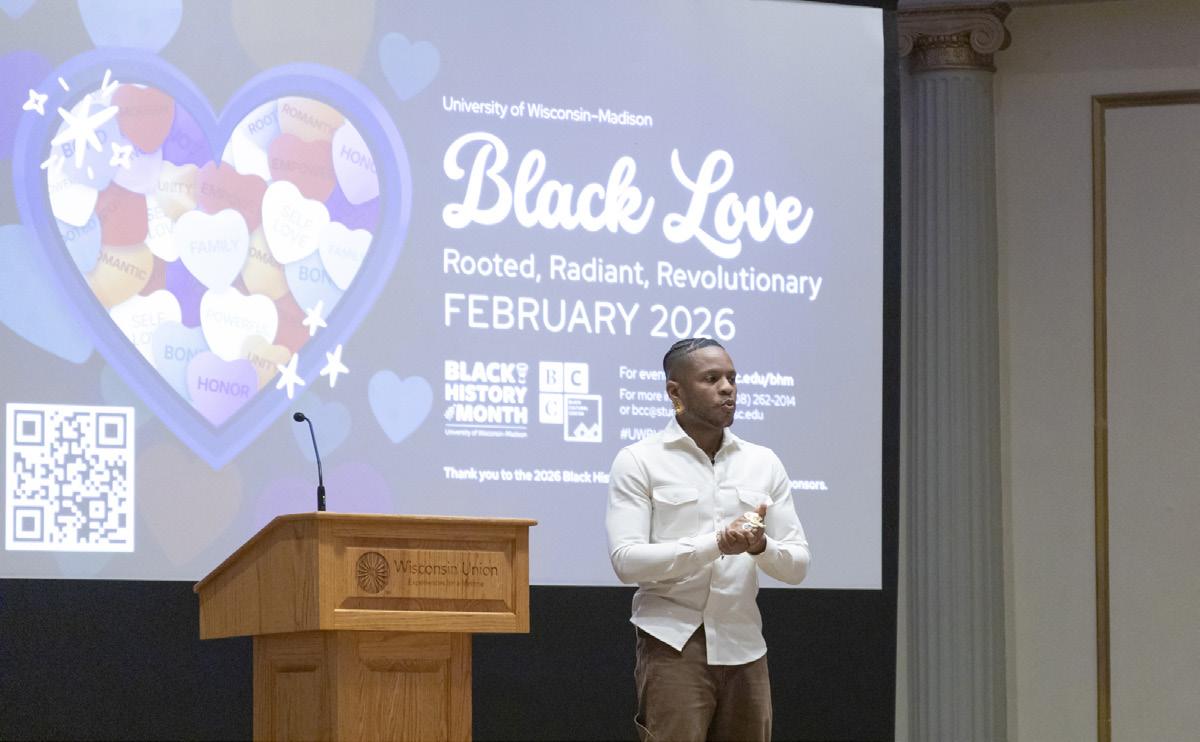
Award-winning writer, healing justice practitioner and yogi Yolo
Akili Robinson hosted Black Love as A Practice: A WorkShop to Help us Embody The Love We Desire Wednesday night, an event planned by the Black History Month Planning Committee (BHMPC) and the Black Cultural Center (BCC) where students rethought Black love not just as a feeling, but as a practice and a behavior.
Robinson told The Daily Cardinal the workshop’s goal was to restructure how attendees show love to themselves and their communities.
“I want people to think about Black love a little more expansively,” Robinson said.
The workshop is just one of many events the BHMPC and BCC are hosting under this year’s Black History Month program centered around Black love. Robinson emphasized the importance of workshops like this one during Black History Month, especially given current challenges facing Black communities.
“When we talk about Black love…we’re talking about our love of Black communities [and] our love
for human rights. We want to have dignity,” Robinson said. “So in these moments, [we’re asking] how is love the solution?”
Pointing to increased economic distress and attempts to restrict voting within Black communities, Robinson said love must be understood as an action.
“What do I do when I love my community?” Robinson asked, “I advocate. I try to build community infrastructure in the face of divestment.”
Robinson also noted that love isn’t limited to a romantic scope. Instead, they emphasized love as a practice to support communities as a whole. Whether hosting workshops or leading the Black Emotional and Mental Health Collective, an advocacy organization that Robinson founded and directs, he can be found uplifting his community through love in every form.
UW-Madison senior Miles Duncan, who was in attendance at the keynote, said Robinson’s holistic outlook on Black love will continue to stick with him.
“[Robinson] didn’t limit his message to celebrating Black love. He expressed the entire spectrum of
UW to launch new
emotion: joy, vulnerability, pain, resilience and hope,” Duncan said. “He inspired me to lean into the full range of my emotions rather than compartmentalize them. I believe everyone in that room walked away with a deeper understanding of Black identity.”
When BCC Co-chair Caasi Woji first approached Robinson about the theme, he immediately agreed to participate. Not only is love one of Robinson’s favorite subjects, but they felt the workshop came at a time when “love is becoming increasingly commodified” and it would help people understand the intention of their love.
Woji said the committee chose this year’s theme to highlight positivity and emotional wellness within the Black community.
“We want to highlight a positive within the Black community, and love is all around us,” Woji said.
“Whether it’s self love, familial love or friendship..I hope [attendees] find a new outlook on love and how to give that back to their communities.”
Before deciding on the workshop theme, the committee toyed around with ideas centering family or community celebrations before settling on Black love as a grounding concept.
aerospace engineering major
By Olivia Ruetten STAFF WRITER
The University of Wisconsin-Madison’s new aerospace engineering major was cleared for takeoff after the University of Wisconsin System Board of Regents approved the new College of Engineering offering on Feb. 5.
Mechanical Engineering Chair Darryl Thelen said the department expects to admit around 100 students for the upcoming fall semester, with enrollment projected to increase to around 150 to 200 students each year.
“The program expands opportunities for students to pursue careers in aviation, space and advanced aerospace technologies while strengthening Wisconsin’s role in the future of flight and exploration,” Thelen told The Daily Cardinal in a statement.
Thelen said as interest and career opportunities in the aerospace engineering field grew, so did student interest in a specialized aerospace engineering degree. He said the lack of a “dedicated” major providing the rigor students and employers look for pushed the creation of the new major.
“Momentum to create a standalone Aerospace Engineering degree gained traction two years ago,” Thelen said. “Since then, it has been an all-hands effort to design the curriculum, equip laboratories, launch faculty hiring and secure approval.”
Thelen specifically pointed to the rapid increase in career opportunities in the space sector. He said the aerospace engineering major will also prepare students for “careers designing and analyzing aircraft, spacecraft, propulsion systems and advanced aerospace technologies.”
In the absence of a dedicated aerospace major, Thelen said UW-Madison students interested in pursuing aerospace engineering added the aerospace engineering option to their major, which would provide experience in applying their education to structural analysis, materials science, advanced dynamics and vibrations in related courses.
Professor and Associate Chair of Engineering Mechanics Riccardo Bonazza played a key role in leading the aerospace engineering option in the Engineering Mechanics program and shaping the aerospace curriculum of today. He taught and created courses focused on aerodynamics, like a lab that allowed students to conduct experiments and analyze data with an oncampus wind tunnel.
“The aerodynamics lab is very popular with the students, who say they really value the hands-on experiences they get through working with the wind tunnel,” Bonazza said in a 2021 interview with the UW-Madison College of Engineering.
UW-Madison joins a long list of institutions including MIT, the University of Michigan, Purdue and the California Institute of Technology that already have aerospace engineering majors in place.
This will be Wisconsin’s first ABETaccredited undergraduate aerospace engineering degree. ABET is an accreditation organization that ranks quality assurance for programs in STEM areas.
More information about the major, including enrollment details and course offering, is expected to be available in June.
With multiple aspects to the workshop, Robinson said they hope people walk away with a new understanding of love and how it shows up in our day to day lives.
Madison Hird, another BHMPC member, said one idea that really resonated with her was the separation of people from their ideas and behaviors.
“[Ideas] don’t correlate to who [someone is] as a person,” Hird said. “[That’s] hard to acknowledge when you encounter someone with opposing views to your own.”
According to Robinson, the best
Provost
Continued from page 1
A native of Sweden, she received both her B.A. in French, Literature and Media Studies and her Masters in Literature from Uppsala University in Uppsala, Sweden. Her PhD in Comparative Literature is from the University of California, Berkeley.
John Zumbrunnen - University of Wisconsin-Madison
Zumbrunnen is currently serving as UW-Madison’s interim provost and has held the role since Isbell’s departure. He is in his sixth year in leadership at UW-Madison, having been vice provost for t and learning beginning in 2020 before becoming the senior vice provost for academic affairs in 2023, a role created with Isbell’s arrival.
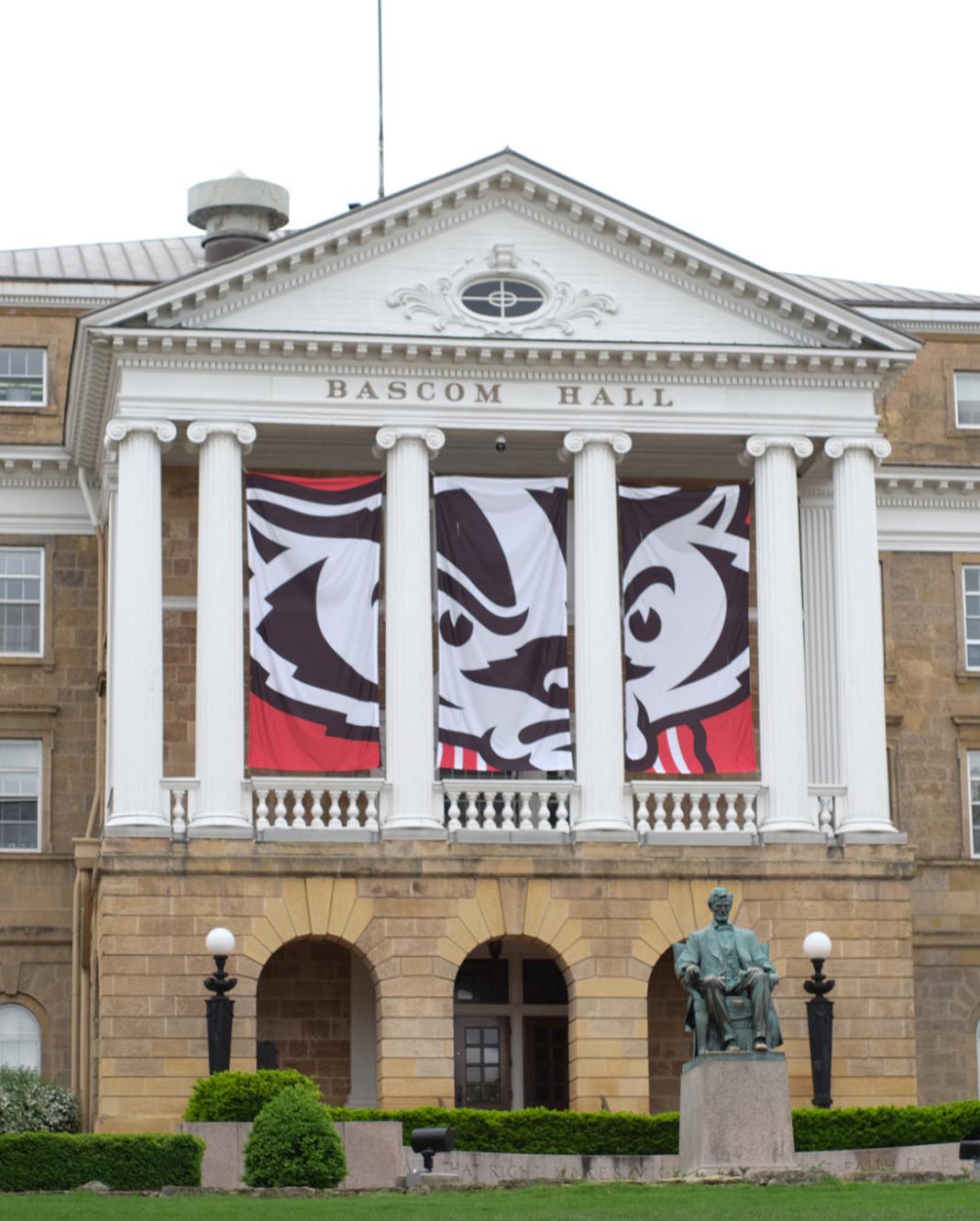
Before moving to Bascom Hall, Zumbrunnen was the Chair of the Political Science department and has been a professor in the department since coming to Madison in 2008.
In Zumbrunnen’s past nine months as interim, he has worked with the Vice Chancellor of Finances and Administration on university-wide budget cuts, helped implement new Act 15 workload policies, overseen the new RISE initiatives and worked with the chancellor to develop the new Wisconsin Exchange program.
Much of this work, such as work on the RISE initiative, began in his role as Senior Vice Provost, where Zumbrunnen’s CV said that he was “involved in many of the core functions of the Office of the Provost.”
Zumbrunnen, a Missouri native, got his B.S. in political science from Southwest Missouri State University and his PhD from the University of Minnesota. Between his PhD and joining UW-Madison’s faculty, he was an Associate Professor of Political Science at Union College in New York for eight years.
Charles Martinez Jr. - University of Texas-Austin
solution is to approach the situation with love instead of criticism.
Hird also said the roots of the topic and theme of the workshop ran deep.
“Yolo reminded us that Black love is in our grasp and can be grown through connection, breaking generational curses and reshaping our behavior to align with love instead of hate,” Hird said. “Black love is genuinely a privilege because it is one of the purest things known to man…it is big, soft, loud, quiet, fluid, forgiving…but really it is light, and I’m beyond grateful to feel it everyday.”
Martinez currently serves as the dean of education at the University of TexasAustin. He has been at UT since 2019, when he was announced as dean.
Before that, he was a tenured professor of Educational Policy at the University of Oregon. Martinez spent 22 years in Eugene, beginning as a postdoctoral fellow at their Social Learning Center studying Mental Health, then becoming an associate professor in 2004, and a research scientist — later senior scientist — at Oregon’s Social Learning center in 2009.
He was also the university’s vice provost for institutional equity and diversity from 2005 to 2011, where he led development of Oregon’s ‘Diversity Plan’ and supported diversity-building programs across their campus.
Martinez is a native of Southern California, having done his bachelor’s in Psychology at Pitzer College in Claremont, California. Both his masters and PhD were done in Clinical Psychology at the California School of Professional Psychology in San Diego.
Martinez will be the last to do his public presentation this Friday at 9:30 a.m. in Morgridge Hall room 7650. The search committee is asking anyone who has feedback on the three candidates to submit it to their feedback forms by this Sunday, March 1.
JONATHAN MINTZ/THE DAILY CARDINAL
COURTESY OF THISISENGINEERING VIA UNSPLASH
New car rental fee coming to MSN as leadership touts new parking garage news
By Ted Hyngstrom PODCAST DIRECTOR
The Dane County Regional Airport (DCRA) Commission voted unanimously to create a new $4.50-per-day charge for all rental cars at the monthly airport commission meeting Feb. 18.
The charge comes as DCRA leaders prepare to fund a new parking structure and other infrastructural upgrades to the airport.
Airport director Mike Papko said costs for the project, estimated to cost roughly $120 million, will now come from visitors to Dane County – not just local taxpayers.
“This is a way for us to spread that out to the traveling public that comes in and visits our area,” Papko said.
The fee will provide the airport with a relatively predictable funding stream for new projects at the airport as leaders prepare a new master plan, the first since 1993.
“Are we growing to the size of O’Hare?” Papko said. “No, but we need to invest in our infrastructure. We need to replace our main runway. We need to replace and relocate our air traffic control tower. We’re doing all these things.”
Some council members raised concerns about the charges being pushed on visitors to Dane County. District 4 Supervisor Matt Veldran drew a comparison to “taxation without representation.”
“This is just telling people that don’t live here, ‘you’re giving us more money,’” Veldran said. “The rental car [companies] don’t care. It’s a pass through. Sure — they’ve got a
hundred bucks. We [the rental car company] don’t care.”
But Papko said travelers already “expect” to encounter the fee at other airports, referencing similar programs at Chicago O’Hare International Airport and Milwaukee Mitchell International Airport.
Without the newly formed revenue stream, he said there could be “serious implications” in “meeting the demands of passengers.”
“This is just a way of doing it that is spreading it out and not having it put on our neighbors,” Papko said. “And it’s having the visiting public that are renting cars again [and] that expect to pay for the service to pay their fair share.”
Building for the future: the Airport
Master Plan
Beyond the charge, Papko told The Daily Cardinal airport leadership is searching for additional funding sources to prepare for the Airport Master Plan — an upcoming initiative he said will outline the next 20 years of improvements made to the airport. It will be the airport’s first master plan since 1998. Airport master plans are typically updated every five to seven years.
Papko said the plan will address the “wear and tear” of airport infrastructure at “the end of its useful life,” drawing a comparison to the cycle of road construction.
“Think of an ‘East Washington Avenue’ — occasionally, we’re going to have to rip it up and repave it,” Papko said. “Its not an easy task because you can’t just close
the runway overnight.”
Though the final plan is still under review, Papko said he expects the capital improvement plan — a byproduct of the master plan — to create “hundreds of millions of dollars” of investment back into the region DCRA serves and the airport itself.
DCRA Economic Impact Study
Papko also presented the results of the DCRA Economic Impact Study conducted by Oxford research group Tourism Economics on behalf of the Airport Commission.
The study analyzed the airport’s economic impact on the region.
According to the report, the total economic impact — business sales that correspond to activity supported by the airport in the region — was nearly $2.6 billion.
The airport also supported 10,176 jobs in 2024 and generated $1.7 billion of direct business sales which supported $425.3 million in wages and 5,512 jobs.
Papko told the Cardinal the report is a sign the airport is more than just a place for travel.
“It truly showcases that people are utilizing our infrastructure and leveraging it for economic benefit,” Papko said. “That we aren’t just an airport that connects people, [but that] we truly are an economic driver in the community.”
The report coincides with a new all-time passenger record at the DCRA. In 2025, the airport served 2.5 million passengers — 6% more than in 2024 and nearly 100,000 more than
the previous all-time record set in 2019.
The release called the new record “historic,” reflecting “sustained growth for air travel.”
“I think it’s exciting to see that the local area and that the catchment area of the passengers that we have of passengers is growing as a whole,” Papko said. “I’m excited to see that.”
The airport added more direct flights to cities in recent months, including Boston, Los Angeles and New York, and also recently announced a new non-stop service from Madison to Raleigh, North Carolina.
Due to a power struggle between United and American
Airlines over airline dominance at O’Hare International Airport, Papko said DCRA leadership is looking to add an extended service to Chicago on both airlines.
“I think it’s exciting to see that the local area and that the catchment area of the passengers that we have of passengers is growing as a whole, and I’m excited to see that,” Papko said. “Not to compare ourselves to Milwaukee, but we were up 7% [total passengers] while Milwaukee was down 6% [total passengers] yearover-year. And that’s a testament to where we’re going and the trajectory that we have, so I’m excited about it.”
Democratic bill would allow for more local landlord regulation
By Jane Dardik STAFF WRITER
Democratic lawmakers introduced a bill on Feb. 17 that would repeal limitations on how local governments can regulate landlords.
Democratic lawmakers said if passed, local governments would be able to regulate landlords by not allowing them to obtain tenant information not required by federal law. The bill would also not allow them to ask for a lease renewal until six months or less remain on the lease, which could help college students across the state scrambling to find affordable housing.
Roys said the measure would “enable local governments to set local ordinances that are appropriate for their communities.”
This bill comes after lawmakers passed several bills limiting landlord regulation in 2019, including speeding up eviction and limiting local power to police landlords. Many members of the Wisconsin Legislature are landlords themselves, with almost one in five lawmakers voting in favor of these laws owning or managing rental properties, according to the Milwaukee Journal Sentinel.
The bill is sponsored by two Democrats in college towns, who say they have growing concerns about housing affordability for college students across the state.
“I suspect there have been a number of landlords in the legislature who put these laws into place in order to make it easier to be a landlord, but not so easy to be a tenant,” co-sponsor, Rep. Brienne Brown, D-Whitewater, told the Cardinal.
Sen. Kelda Roys, D-Madison, told the
Cardinal she has long been concerned by rising rents in college towns. Madison officials have pointed to state laws — like the ones Roys wants to repeal — as reasons why the city cannot enact rent regulation or other reforms housing advocates have called for.
“It is not fair to college students to be putting them in the situation of moving to a new community, starting to live on their own for the first time, and then weeks later, they’re forced to scramble for hous-
ing for a year from now,” Roys said.
Students like Dhriti Nekkalapudi said they struggled with finding housing at the beginning of the fall semester.
“Less than a month after classes began, all I heard around me were people talking about signing leases,” Nekkalapudi told the Cardinal. “I barely knew anything about the area yet, much less who I wanted to live with for a year.”
Both lawmakers said they do not believe this will cause issues with housing or development in Madison or other Wisconsin cities.
“If there just isn’t enough housing in the first place, rents are going to go up because of supply and demand,” Brown said. “If you are now cutting people out of the housing market because you’re forcing them to make decisions a year in advance about where they’re going to live, that creates more problems for homelessness than for landlords.”
Roys said they are open to compromise to make the bill bipartisan, but the Assembly is now out of session making the bill unlikely to advance.
“I’m always open to compromises and to hearing what my colleagues on both sides of the aisle are interested in,” Roys said.
FINNEGAN RICCO/THE
Trump’s Team USA hockey debacle opinion
By Safa Razvi OPINION EDITOR
After Team USA women’s hockey captured gold at the Milano Cortina 2026 Olympics, what should have been a moment of celebration was quickly overshadowed by a viral phone call from President Donald Trump to the men’s team.
The president joked he would “probably be impeached” if he didn’t invite the women. His acknowledgment was political necessity, not recognition of their achievement, which they earned just as much as the men did.
In celebrating the men while snidely diminishing the women, the White House showed that even in moments of national pride, gender equality is only embraced when convenient.
The news took social media by storm with Rapper Flavor Flav extending support for the women’s team. Meanwhile, the women declined the half-hearted invitation to visit the White House. The contrast between the public’s enthusiasm for the women’s team and the phone call from Trump only heightened the scrutiny.
Gold medalists Jack and Quinn Hughes emphasized unity, their personal camaraderie with the women and their shared training. Yet, the brothers also said “we’re proud to be Americans, and that’s so patriotic,” in reference to being invited to the White House. “Everything is so political. We’re athletes. We’re so proud to represent the U.S.” Their mother, a former Team USA player herself, spoke about country over politics. And it is true: Trump did extend an invite to the women
as well.
But these words do not erase impact. The team’s laughter at the president’s words in the moment derails an entire century of work women have done to be half as respected as men. So while they claim to deeply respect them, their actions did not align.
For women in sports, legitimacy has rarely been automatically granted. It’s required qualification, defense and comparison. Even if no disrespect was intended, the exchange reflected a strained dynamic.
Men’s victories are assumed while women’s must be earned.
The men’s reactions landed differently for those who understand what it has historically meant to compete as a woman. To fight not only for victory, but for validation.
Although this is the first time the men have won since the 1980’s miracle on ice team, Trump’s comments tap into a long history of downplaying women’s accomplishments.
This did not end with the phone call. FBI Director Kash Patel was present in the locker room, facilitating the president’s call and celebrating with the men’s team. His presence turned what should have been an athletic triumph into a politicized display of gross overreach.
It’s unusual for a federal law enforcement official to insert themselves in championship celebrations. His involvement highlights how quickly the moment shifted from sports to political theater.
This shift matters deeply. It shows that when government officials embed themselves in these media circuses, the message isn’t about giving congrats, it’s actively shunning the women’s team as a
form of misogyny.
The men’s victory was coined as an act of patriotism, with Oval Office photo ops and public declarations of national pride. Meanwhile, the women’s identical accomplishments weren’t even properly acknowledged or respected. It was instead seen as a necessary means and performative invitation.
While one team’s win was amplified as a national moment, the other was treated as secondary afterthought. During his State of the Union address, Trump announced he would bestow the Presidential Medal of Freedom upon U.S. men’s hockey goalie Connor
Hellebuyck. The award is one of the nation’s highest civilian honors. The men’s win is being magnified outside the rink and catapulting them as a beacon of national pride. Meanwhile, commentary around the women’s team focused on their response and choices rather than their win.
This episode fits into a larger pattern of behavior by Trump, who has repeatedly used sports to reinforce his political messaging. From highly publicized appearances at Ultimate Fighting Championship fights to sideline visibility at NFL games and the storied Army-Navy
Game, he often aligns himself with moments steeped in patriotism and national pride. His push for FIFA to award him a so-called “peace prize” reflects how political figures can attach themselves to the unifying power of sports. Athletic victories carry emotion and symbolism. When leaders step into those moments, they share in that glow. When that recognition is uneven, by celebrating men and minimizing women’s accomplishments, the message is clear.
In moments meant to celebrate athletic excellence, the spotlight should shine evenly. This time, it didn’t, and that matters.
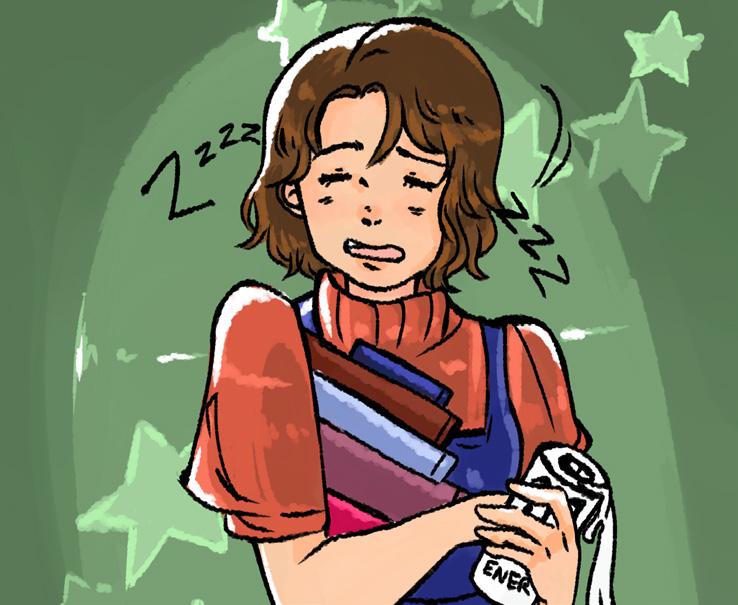
Being busy is not the flex you think it is
By Shreya Bhargava STAFF WRITER
If you walk into almost any conversation on campus, it won’t take long before you overhear talks about people’s schedules. Not conversations about their classes, ideas or what anyone is actually learning, just how busy everyone is. Someone says they haven’t had a free weekend in weeks. Another casually drops that they’re juggling classes, two internships, three clubs and recruiting season. Heads nod with impressed silence or even admiration. But busyness isn’t just information anymore. It’s social currency.
Somewhere along the way, being busy stopped being a circumstance and
started being a performance. On many campuses, that performance carries moral weight. If you are overwhelmed, you must be driven. If you are exhausted, you must be serious. If you are resting, something must be wrong.
This shows up most clearly in the small rituals students barely question. The LinkedIn checks feel less like networking and more like surveillance. From the quiet tallying of internships, fellowships and leadership roles, to the subtle panic when someone our age announces a summer offer in October: we scroll, compare and measure.
It’s not that people are pretending to be busy when they’re not. The workload is often real. What’s new is how much value gets attached to displaying that pressure.
Research on competitive academic environments has shown that people often engage in what sociologists call “visible busyness,” where productivity is performed to showcase commitment and worth. In places where achievement is constantly measured and compared, appearing busy becomes as important as actually being productive. Effort becomes something to show, not just something to experience.
Another body of research on performance-driven institutions sug-
gests that when environments reward measurable output, people adapt by making their work more “visible.”
Education sociologist Stephen J. Ball argues that modern academic institutions operate through “performativity,” where students organize their work around what can be measured, evaluated and shown. On a college campus, that can mean stacking commitments, publicizing achievements and treating free time as something suspicious. If productivity is what earns respect, then visible productivity becomes the safest way to secure it.
That is what makes this culture feel unsettling. College is not just a place where people work hard. It is a place where people learn what hard work means. Between the ages of 18-22, students are figuring out how to define themselves. They are deciding what success looks like, what rest means, what ambition feels like and what kind of life is admirable. These years shape not just careers, but value systems. They are a rehearsal for adulthood.
So when busyness becomes a moral flex, it does more than stress people out. It quietly teaches them that strain is virtue. Worth is proven through overload.
Over time, this culture reshapes how
people relate to their own time. Rest starts to feel unearned unless it follows exhaustion. Empty space in a schedule feels like a waste of opportunity. Even enjoyment can carry an undercurrent of guilt, like something that must be justified rather than simply experienced.
The problem is not ambition. The problem is when ambition becomes indistinguishable from constant selfmonitoring. When productivity stops being about growth and becomes about optics. Students start feeling compelled to demonstrate how hard they are working rather than reflect on why they are working at all.
College is supposed to be a period of transformation. A time when people experiment, question and figure out who they want to become. Yet, when busyness becomes the dominant signal of value, that transformation narrows. Identity gets built around output, character gets measured through capacity and humanity gets filtered through productivity.
That raises a quieter question beneath all the noise about schedules and deadlines: if a generation learns that being overwhelmed is proof of worth, what happens when the work stops and they finally have nothing left to prove?
DANI NISBET/THE DAILY CARDINAL
Badgers in national spotlight with wins over top 10 teams sports
By Jordan Nadel STAFF WRITER
The Wisconsin Badgers have been hovering around the edge of national college basketball media attention for most of the 2025-26 season, lacking the consistency to earn national spotlight status — until now.
The Badgers are talented, competitive and dangerous, and with back-to-back upset victories over top 10 ranked opponents — thenNo. 8 Illinois and No. 10 Michigan State — the Badgers reached No. 24 in the AP poll last week, though they fell out of the latest rankings.
March Madness bracket experts currently project Wisconsin as a six or seven seed in the NCAA tournament. More important than anything national media pundits say, however, is that teams are no longer viewing Wisconsin as a mid-tier team in the Big Ten, but rather as a legitimate tournament threat.
Wisconsin’s game at Illinois was the type of game that can shape a season. In a hostile environment against a top 10 opponent, Wisconsin turned in one of their best offensive performances of the year. The Badgers connected on 16 3-pointers — shooting 44% from behind the arc — and showed great ball security by committing just four turnovers. On the defensive end, Wisconsin forced Illinois to commit 14 turnovers and were able to convert defensive pressure into fast-break points.
Not only did Wisconsin play well, but they also showed tremendous poise throughout. As the game progressed into overtime, the Badgers showed
no signs of panic, and in tense moments, confidently took care of a talented team.
The Badgers built on their win at Illinois just three days later, putting together a dominant game against Michigan State. Wisconsin displayed everything a good college basketball team demonstrates: great tempo and offensive continuity and intense defensive effort.
Nick Boyd led the way again with 29 points, controlling the game from the start. John Blackwell continued his strong play with another 24-point performance, and Nolan Winter recorded a 10 point, 11 rebound double-double as the Wisconsin bigs provided solid interior presence to complement the Badgers’ perimeter attack.
Earlier this season, Wisconsin shocked a then-No. 3 Michigan team on the road. More than a month later, what once appeared to be a random upset now looks like a clear trend.
As the level of competition has increased for Wisconsin, so has the Badgers’ level of play. With three AP top 10 wins, Wisconsin has proven they can beat anyone.
But the opposite has also been true, and immediately following those two huge wins, Wisconsin lost to unranked Ohio State on the road, providing a perfect illustration of their inconsistent play this year. The setback indicated that while Wisconsin is currently one of the most dangerous teams in the Big Ten entering March, they may also be one of the most unpredictable. Wisconsin promptly
rebounded with a solid victory over Iowa on Sunday.
At their peak, the Badgers play beautiful, efficient offensive basketball, with few turnovers and strong physical defense. In particular, Wisconsin’s proficiency from behind the arc has shown they can stretch defenses and create driving lanes for their guards — especially Boyd and Blackwell. When Wisconsin is hitting their outside jumpers, it’s extremely difficult for opponents to defend them.
The emergence of Boyd as a dominant force on the offensive end has been instrumental in Wisconsin reaching their upside. Boyd has been a revelation for the Badgers, another extremely impactful transfer portal addition for Greg Gard. Boyd’s performances against Illinois and Michigan
State are prime examples of his ability to take over games in various ways, including driving to the hoop, spacing the floor properly and being a calming presence during crucial possessions at the end of the shot clock.
Blackwell complements Boyd nicely by providing consistent scoring through his reliable, back-toback 24-point scoring efforts during the Badgers’ two statement victories, along with adding paint presence and perimeter defense to a team that is typically identified for their ability to shoot from long distance.
Current bracket projections put the Badgers in the six-to-seven seed range, which would make them a dangerous match-up for a 1-seed in the tournament’s opening weekend.
With respect to the Badgers’
postseason ceiling, there is no question they have the potential to cause some noise. The question for Wisconsin is if they will be able to find the consistency to maintain their stretches of excellence. If the Badgers can bottle up the version of themselves that shot 44% from deep against Illinois, created turnovers, took care of the basketball and held Michigan State to 36% shooting, — then it will not matter which seed they fall to. They will pose a threat to whomever they come across. At this point in time, the Badgers are at a crossroad in their season. They are currently first out of the top 25, respected throughout the Big Ten and have recently validated themselves as a national presence. Just how good of a team Wisconsin will be has yet to be determined.
Column: Is a repeat in the cards for Wisconsin?
By Hannah Sarnoff STAFF WRITER
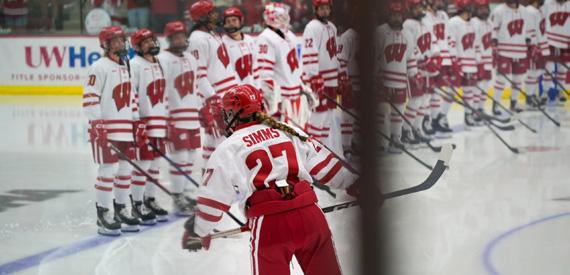
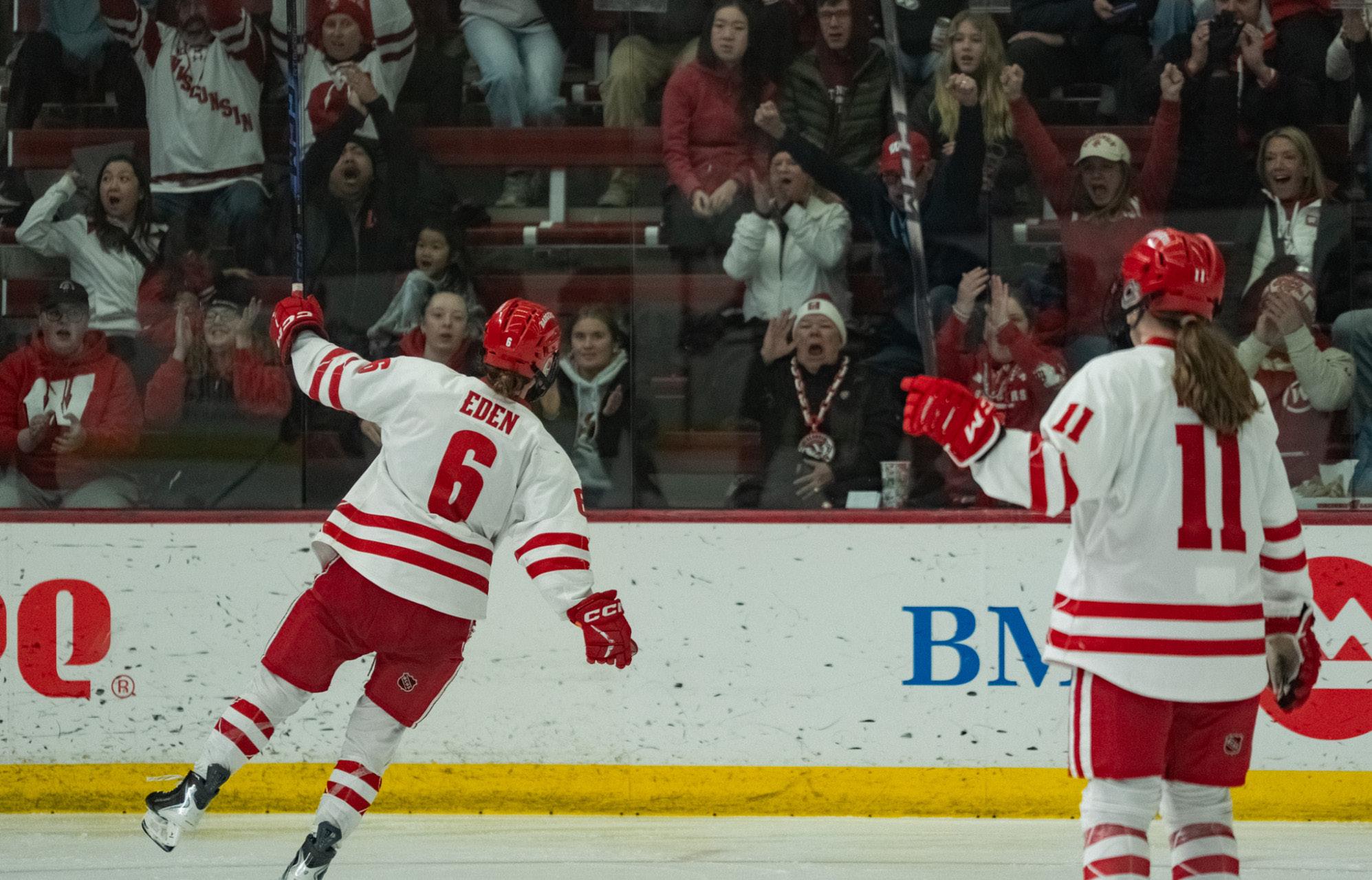
After following up last year’s national championship with another dominant regular season, the target on the back of Wisconsin women’s hockey has grown incredibly large as the program heads into the postseason.
The Badgers have held the No. 1 ranking in the USA Hockey Women’s Poll all season and posted an outstanding 29-3-2 overall record. Even more impressive, they maintained their dominance over the past four weeks while five players, including captain Caroline Harvey, were away competing in the Olympics. The socalled B-squad not only held their own but secured the WCHA regular season championship, beating Ohio State by a mere point in the standings.
That four week stretch proved Wisconsin’s depth, but repeating as national champions presents a different challenge entirely.
Ohio State, last year’s runner-up, has remained the firm No. 2 team in the nation. The Buckeyes’ physical style and offensive depth challenged Wisconsin all season, leading to one of the Badgers losses at home just three weeks ago.
For Wisconsin to capture a ninth championship, its success will likely rest on the performance of three key players: goalie Ava McNaughton, forward Lacey Eden and defender Harvey.
McNaughton has been the backbone of Wisconsin’s defense this season. In 25 games, she has posted a .939 save average and secured nine shutouts, surpassing her total last season. She reached a season-high 35 saves against Ohio State in December, something the Badgers will need in their playoff run.
Eden has certainly cemented her legacy in Wisconsin after achieving 100 career goals last week against St. Cloud State. Eden totaled 27 goals and 41 assists this season. She’s able to win faceoffs and force turnovers in the neutral zone, making her a tough opponent
for any playoff matchup. Beyond her leadership on the ice, Eden stepped up as captain during the Olympic stretch.
“If you watched all eight games we played, you know she was our best player,” Wisconsin head coach Mark Johnson said.
Harvey, meanwhile, has continued to elevate her game, not just in collegiate hockey but in her time in the Olympics. After winning tournament MVP as a part of Team USA, Harvey returns to the Badgers as one of the most dynamic defenders in the world. She contributed 17 goals and 37 assists
in the regular season campaign. Her skating abilities leave opponents gasping, and the projected No. 1 PWHL draft pick knows how to get the puck in the right spot and the right time. Still, Wisconsin’s championship hopes won’t depend on star power alone.
Wisconsin’s depth has been one of its greatest strengths, particularly on the blue line. Alongside Harvey, defenders Laney Potter and Vivian Jungles stepped into larger roles during the Olympic stretch, anchoring the defensive unit. That added experience could prove crucial in the postseason, where Wisconsin may face high-powered offenses like Ohio State and Minnesota.
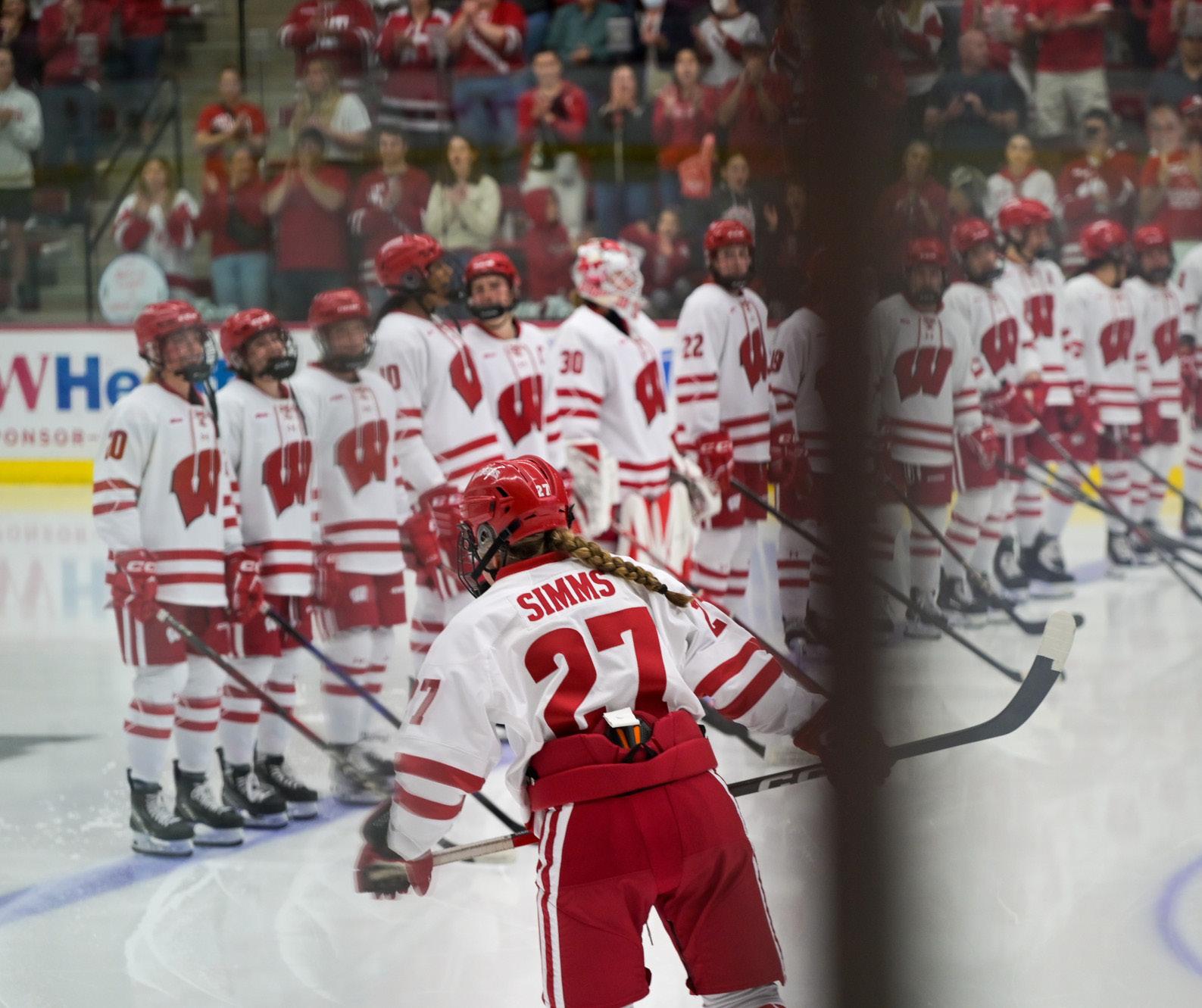
Wisconsin’s depth extends beyond defense. Offensively, the Badgers boast the WCHA’s top scorer in Eden. Playmakers like Simms and Hall provide additional scoring threats. As a team Wisconsin has scored 138 goals, 21 more than Ohio State, highlighting its ability to generate offense across multiple lines. That balanced scoring could be a deciding factor in the NCAA Tournament, where depth often separates champions from everyone else.
While the Badgers have proved why they have been the sport’s best team all regular season, the margin for error in the WCHA playoffs and NCAA tournament is slim. Increased pressure and opponents hungry to snatch Wisconsin’s title hopes will create a whole new environment than the regular season.
MICHAEL O’CONNOR/THE DAILY CARDINAL
BAILEY KRAUSE/THE DAILY CARDINAL
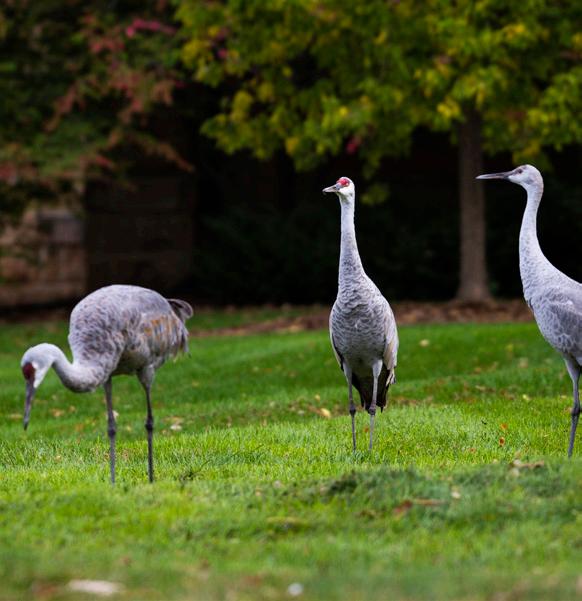
5 takeaways on crane hunting science
By Lauren Eno STAFF WRITER
A bill to establish Wisconsin’s first regulated hunting season for sandhill cranes has reignited a long-running debate over how to manage one of the state’s most visible bird species.
The proposal, which heard public testimonies in November, follows other unsuccessful efforts in past legislative sessions. Supporters argue that a hunting season would help manage a rapidly growing population and fund wetland conservation efforts, while opponents say hunting poses unnecessary risks that outweigh benefits.
Economic tradeoffs
Economic arguments shape the debate over population management in Wisconsin, particularly around crop damage and conservation funding. While previous reporting and testimony have focused on economic considerations, pro- and anti-hunting advocates see these tradeoffs differently.
Bill advocates, including the Wisconsin Waterfowl Association, argue a regulated hunt would generate license revenue to support conservation efforts, provide necessary financial assistance to farmers and generate money for the existing damage abatement program.
Opponents cite conflicting estimates around administering a season and criticize the exclusion of aid for farmers. They also point to alternative management strategies, like depredation permits and seed coatings to deter the birds.
Populations and risk management
Brought back from a population of around 15 breeding pairs in the 1930s, the Eastern Flyway
population of sandhill cranes now tops 90,000.
Sandhill cranes are federally managed under the Migratory Bird Treaty Act, which prohibits take without authorization.
Any hunting in Wisconsin would require science-based management, federal approval and adherence with USFWS protocols.
A spokesperson for USFWS highlighted built-in safeguards like annual population surveys, recruitment monitoring, harvest tracking and adaptive frameworks set in the Federal Register to determine hunting sustainability and permissions.
“WWA advocates for complete, objective science to guide wildlife management decisions. That principle applies regardless of whether harvest allocations increase or decrease,” Brad Heidel, president of the Wisconsin Waterfowl Association, told The Daily Cardinal.
Heidel pointed to a 60-year history of federal crane management and hunters’ conservation contributions. “As long as the population remains above established thresholds, managed harvest remains consistent with federal conservation goals,” he said.
The International Crane Foundation argued that the federal minimum threshold set by USFWS of 30,000 birds does not fully capture risks.
“That’s the minimum number for intervention. Should the population get that low, we would need to step in and do something,” Ryan Michaelesko of ICF said. “We don’t have the information to make a good judgment on this, and neither do the groups that are calling for a hunt.”
The USWFS currently issues thousands of sandhill crane depredation permits a year in
Wisconsin, allowing kills for special circumstances like crop damages.
Risk to endangered whooping cranes
Opponents also raised concerns over accidental shootings of whooping cranes, a critically endangered species. ICF currently researches and monitors an experimental population of whooping cranes in Wisconsin.
Anne Lacy, director of Eastern Flyway Programs for the ICF, said the proposal would threaten whooping cranes in Wisconsin if mistaken for sandhills during the November hearing. Lacy pointed to men in Oklahoma found guilty of killing whooping cranes in 2021.
Heidel of WWA said the Oklahoma was the first documented misidentification instance involving legal sandhill crane hunters and noted identification training was not required at the time.
“No ethical hunter wants to inadvertently shoot a whooping crane,” Heidel said.
Heidel added that identification training would be required under both the proposed legislation and USFWS protocols. “It ultimately doesn’t matter what WWA thinks on this issue,” he said, though WWA officially supports a required identification test.
A USFWS spokesperson said the agency, working with ICF and state agencies, has documented “essentially zero cases of whooping cranes mistakenly shot by legal sandhill crane hunters during open seasons nationwide.” They added that known incidents tied to sandhill hunting involved illegal take.
“The loss of any one whooping crane in this population is more than devastating, and it only takes one bad actor or low-light misiden-
tification to set whooping crane recovery back,” Lacy of ICF said in her November testimony.
Wisconsin as a special case
A spokesperson for the USFWS told the Cardinal that Wisconsin plays a unique role in the Eastern Population that “could warrant additional considerations.”
Wisconsin supports the largest share of breeding habitat and fall pre-migration staging concentrations for the Eastern Population of sandhill cranes, one of six populations in the United States.
Lacy and other opponents raise concerns about disease vulnerability. Ryan Michaelesko of ICF referenced Eurasian crane populations that experienced “consistently large, unprecedented outbreaks of Highly Pathogenic Avian Influenza.” He argued that decreasing crane populations through a hunt would risk Wisconsin’s population being completely wiped out by a similar disease outbreak.
Supporters counter that Wisconsin is not biologically isolated.
“It is not the only state or province with breeding cranes, and hunting is successfully managed in other breeding jurisdictions under USFWS oversight,” Heidel said.
Ethics and conservation philosophy
The debate reflects deeper differences in conservation philosophy and ethics.
“There may be reasons to oppose a crane hunting season here, such as a strong emotional connection to the crane or the optics of adopting a crane hunt in the ‘backyard’ of the International Crane Foundation,” Heidel said. “But an objective scientific basis is not one of them.”
Heidel said opponents rely on what he described as “misinformed, emotion-based public opinion.”
“Passion-blinded wildlife decisions which discount science-based management will tie wildlife managers’ hands and disproportionately impose expanding costs on farmers,” Heidel added.
ICF rejects the framing that hunting is the only population management strategy to help farmers, and Michaelesko said the bill “has been stripped back to where this is pretty much only a hunt.”
“The one thing we agree on is that farmers need support,” Michalesko told the Cardinal. “Rather than pushing for a disingenuous hunting season that will be extremely costly, risk population stability, further endanger whooping cranes and do nothing to resolve crop damage, let’s work together to get funding to farmers.”
All sides say they share the same goal of a sustainable crane population.
“Wisconsin conservationists of any flavor should not be divided on this topic. We share a fundamental commitment to a healthy crane population,” Heidel said.
Where they diverge is how much uncertainty and risks are acceptable in pursuing it.
UW study shows widening political polarization
By Peter Fishman STAFF WRITER
A newly published sociology study from the University of WisconsinMadison found white disadvantaged neighborhoods shifted right politically, while advantaged neighborhoods shifted left in the past few decades.
President Trump’s ascendancy relied on a strong base of economically disadvantaged, majority-white voters. In an era where employees often work far from home, this UW-Madison study explored the intersection of class and politics beyond neighborhoodlevel economics, classifying neighborhoods based on both economic prosperity and where people commute.
Published earlier this month, the study was conducted by Meghann Norden-Bright and Karl Vachuska, 3rd and 4th-year PhD students.
Mobility patterns show how political polarization has intensified
To measure socioeconomic status, the authors intertwined two variables.
Residential neighborhood disadvantage (RND) measured social disadvantage, based on factors like percentage of poverty, unemployment and single-headed households. Meanwhile, mobility-based neighborhood disadvantage (MND) combined the RND measure with cell-
phone location data to reflect where residents traveled, as well as who visited their neighborhoods.
The general trend showed that low MND white neighborhoods connected to more affluent neighborhoods typically cast fewer Republican votes, compared to high MND white neighborhoods connected to economically disadvantaged neighborhoods. Mobility-based disadvantage predicted voting behavior better than residential disadvantage alone.
“When we’re trying to get at questions of political polarization in neighborhoods, voting data is just the most obvious thing to look at,” Norden-Bright said. ”If we try to measure and capture disadvantages in a local context, that gives us a better understanding of how these polarization patterns are happening.”
When mapped over eight years, the disparity between high and low MND voting patterns grew rapidly.
“[MND] wasn’t even really an axis [of neighborhood disadvantage] back in the 2012 election,” Vachuska said. “But fast forward through 2016 and 2020, and all of a sudden it’s this really dominant explanatory factor in how people across space vote differently.”
In the 2012 presidential election, voters in high and low MND neighborhoods voted similarly along partisan lines, differing by a gap of less
than 10% of votes. By 2016, that gap widened to 35%, with three-quarters of votes in mobility-disadvantaged neighborhoods going to Trump. By 2020, there was a 40% gap in partisanship between the most mobilitydisadvantaged and the most mobilityadvantaged neighborhood.
The gap was smaller in the 2018 gubernatorial and 2020 Senate election cycles than it was in the 2016 presidential elections, suggesting Trump may have outsized influence on polarization. But when comparing Senate and gubernatorial trends alone, the differences were still wider than the 2016 Senate elections.
“The extent to which we were able to see [polarization] picking up in 2016 with the presidential election, and then diffusing down to more downstream elections in following years, was an interesting pattern that I didn’t expect to see play out,” Norden-Bright said.
The 2020 presidential election represented the most polarized voting patterns out of all the elections measured; 85% of votes from mobility-disadvantaged white neighborhoods went to Trump as opposed to only 41% of votes in mobility-advantaged white neighborhoods.
This polarized pattern also tracked for the 2020 Senate elections, where 84% of votes in high
NMD white neighborhoods went to Republican candidates compared to 47% in low NMD white neighborhoods. The authors said the similarly sized gaps between the presidential and Senate elections display wider party division stemming from polarization around Trump.
Stronger results than researchers expected
“I was expecting our hypothesis regarding [mobility-based] neighborhood disadvantage to serve as this axis of polarization,” Vachuska said. “I was surprised by how strong it was, and what I was even more surprised by the fact that it’s really just emerged since 2012, basically.”
Economic disadvantage is considered a major factor in the shift of white voters to Republican candidates in the past decade. However, the authors said most metrics used to estimate economic disadvantage rely largely on where individuals live — the average income, employment and education levels in their neighborhoods.
Norden-Bright and Vachuska said this over-simplified view of economic disadvantage doesn’t take into account mobility patterns, where individuals go in their day-to-day lives and who they interact with.
The researchers used cell phone location data, provided via third party brokers such as SafeGraph, to estimate mobility.
“The data we get is this neighborhood-level aggregated data [of]: what other neighborhoods do people who live in this neighborhood visit?” Vachuska said.
Building off the results of a 2016 presidential election study, the authors focused on predominantly white neighborhoods for their analysis, citing the wider variation in socioeconomic status compared to non-white neighborhoods and white voters displaying the greatest overall partisan swing nationally.
Vachuska and Norden-Bright used a regression model to measure relationships between mobility-based disadvantage and Republican vote shifting over several election cycles, starting with the 2012 presidential election and ending with the 2020 presidential election.
“These patterns of political polarization map really strongly, and that’s going to be increasingly important as we sort of look at ways for addressing political polarization and potential downstream negative effects [of it],” Vachuska said.
COURTESY OF BRIAN HUYNH
Concert ticket prices are out of hand. Artists should do something arts
By Gabriella Hartlaub SOCIAL MEDIA MANAGER
Everyone who has ever told you not to give up on your dreams has clearly never sat in a queue for Noah Kahan tickets. If Ticketmaster is telling you you’re 63,000th in line, do not stay in line — you will end up waiting an hour, and there will be no tickets left. I’m saying this from personal experience, and if you’re reading this, chances are you’ve had the same one. I count among my losses the great Ticketmaster wars for Olivia Rodrigo, Harry Styles, Dua Lipa and most recently Noah Kahan.
All of which begs the question: are concerts inaccessible these days?
My answer would be yes. Either due to sheer demand, Ticketmaster allowing scalpers to buy up every last ticket or artists pricing tickets at unreasonable amounts, concert tickets are no longer accessible to regular fans. And before you say, “Not my favorite artist,” it’s probably them too. Noah Kahan promised tickets to his “front porch” seating area, closest to the stage, for all stops on his upcoming tour would be $100 for select fans. A week after both the presale and general sale for the shows, these $100 tickets are nowhere to be found, with reports that front porch tickets for Fenway Park reportedly sold for $318.
Despite Kahan’s transgressions, Harry Styles is the biggest offender by far. Fans logging onto
presale for his upcoming tour found themselves staring down prices of $1,000 for lower bowl tickets at his Madison Square Garden tour stop. Resale prices for tickets closer to the stage were reported to be going for upwards of $3,000. If I had been able to even get past the queue for Harry tickets, I wouldn’t have been able
to afford a ticket on top of travel costs to New York (Oh yeah, his only tour stop in the United States is 30 shows at MSG).
An affordable price to me is $50, which I paid to see Phoebe Bridgers in 2022. I’m sure by her next tour, tickets will be far more because that’s just the stage of society we’re in. For an
artist I really like, I’ll pay $150 per ticket. That’s what I paid to see Noah Kahan at Alpine Valley in 2024, though I never did end up seeing him.
Blame the price hikes on Ticketmaster and resellers all you want, but the government is taking steps to curb those issues. The Federal Trade Commission
is currently suing Ticketmaster for deceiving consumers with lower advertised prices than what they actually will pay and falsely claiming to put limits on how many tickets one person can buy. The FTC has also accused the company of working with resellers to bypass those limits.
As a consumer, there’s only one thing you can really do to attempt to change skyrocketing concert ticket prices and lower availability: stop buying tickets. Kathryn Dickel, co-founder and CEO of Midwestix, an independent ticket-buying platform for smaller artists, told Pitchfork in 2023 that, “the only way consumers are gonna change it — because we’re in a capitalist system — is they’re just not gonna go to the concerts anymore.” So in reality, every time you avoid the queue, you’re protesting its existence. At the end of the day, it’s time for artists to actually take a stand and make concerts accessible for everyone who’s not super rich. This goes beyond simply limiting resale. It means pricing tickets at a level that a college student can actually afford. For ultra-rich celebrities like Harry Styles (net worth $296 Million) and Taylor Swift (net worth $2 billion), a $100 ticket is a drop in the bucket, and for venues like MSG will still equal $2 million.
For now, most of my favorite artists are in the doghouse, and until I see that $100 ticket, that will continue.
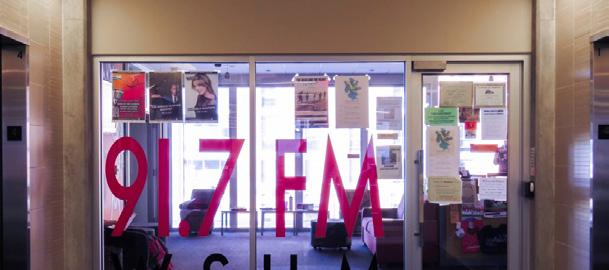
WSUM named nation’s best college radio station
By Alexa Cattouse STAFF WRITER
Wisconsin-Madison’s studentrun radio station, WSUM 91.7 FM, was named best in the nation at the Intercollegiate Broadcasting System (IBS) Media Awards Saturday.
Along with the No. 1 placement, WSUM received four other awards including Best Sports Play-by-Play (hockey), Best News Interview, Best Mobile App and Best College Radio Station of More Than 10,000 Students. WSUM was also a finalist in five other categories including Best On-Air Personality, Best Morning Show, Best Community Outreach Event, Best Promo Series and Best Show Intro.
WSUM members Vincent Hesprich and Johnny Raider accepted the awards on behalf of the radio station. Raider, the station’s production director, said winning the national award was a testament to generations of WSUM members who invested in the station.
“The sound you hear right now on the air reflects both the grit of the station’s history and the energy of the current group. I think this award recognizes all of that collective effort,” Raider told The Daily Cardinal. “I couldn’t have been more proud to accept that award on behalf of all these amazing people.”
In addition to their recognition, the station also celebrated its 24th birthday the following day. General Manager Kelsey Brannan, a WSUM alum, is proud of the students and community
members’ dedication that helped them receive the award.
“The timing invites us to reflect on the thousands of WSUM members, present and past, whose hard work made this achievement possible,” Brannan told the Cardinal. “This award belongs to our entire WSUM community.”
The award show was held in New York City and hosted by IBS, an organization that supports both college and high school media outlets and orga-
nizations. Each year, the organization hosts their annual conference to recognize outstanding student media outlets. According to their website, they’ve received over 3,000 submissions from schools across the country and the globe.
WSUM has over 200 members and a variety of shows ranging from music, sports, news and talk. Their mission is to provide the community of UW-Madison, and the greater Madison area, with alternative news
and entertainment while allowing their members to have on-hands experience to prepare them for the professional field of radio broadcasting.
The station has also previously received awards from the Midwest Broadcast Journalists Association, College Broadcasters, Inc. and Wisconsin Broadcasters Association.
WSUM will attend the 2025 Wisconsin Broadcasters Student Forum this weekend in Green Bay, Wisconsin.