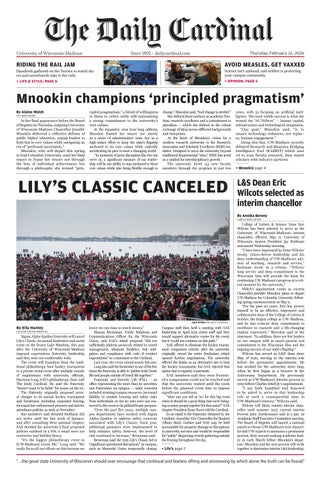
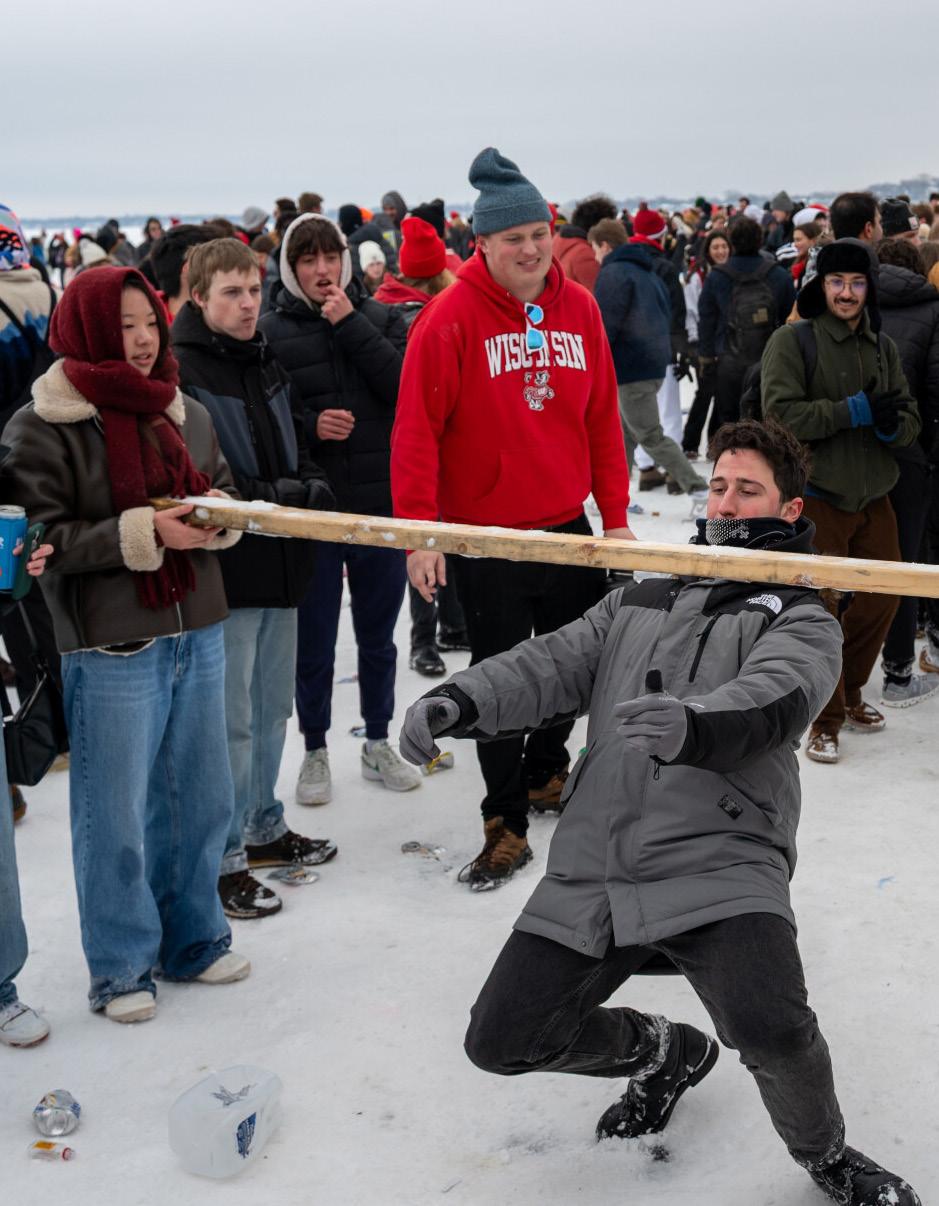
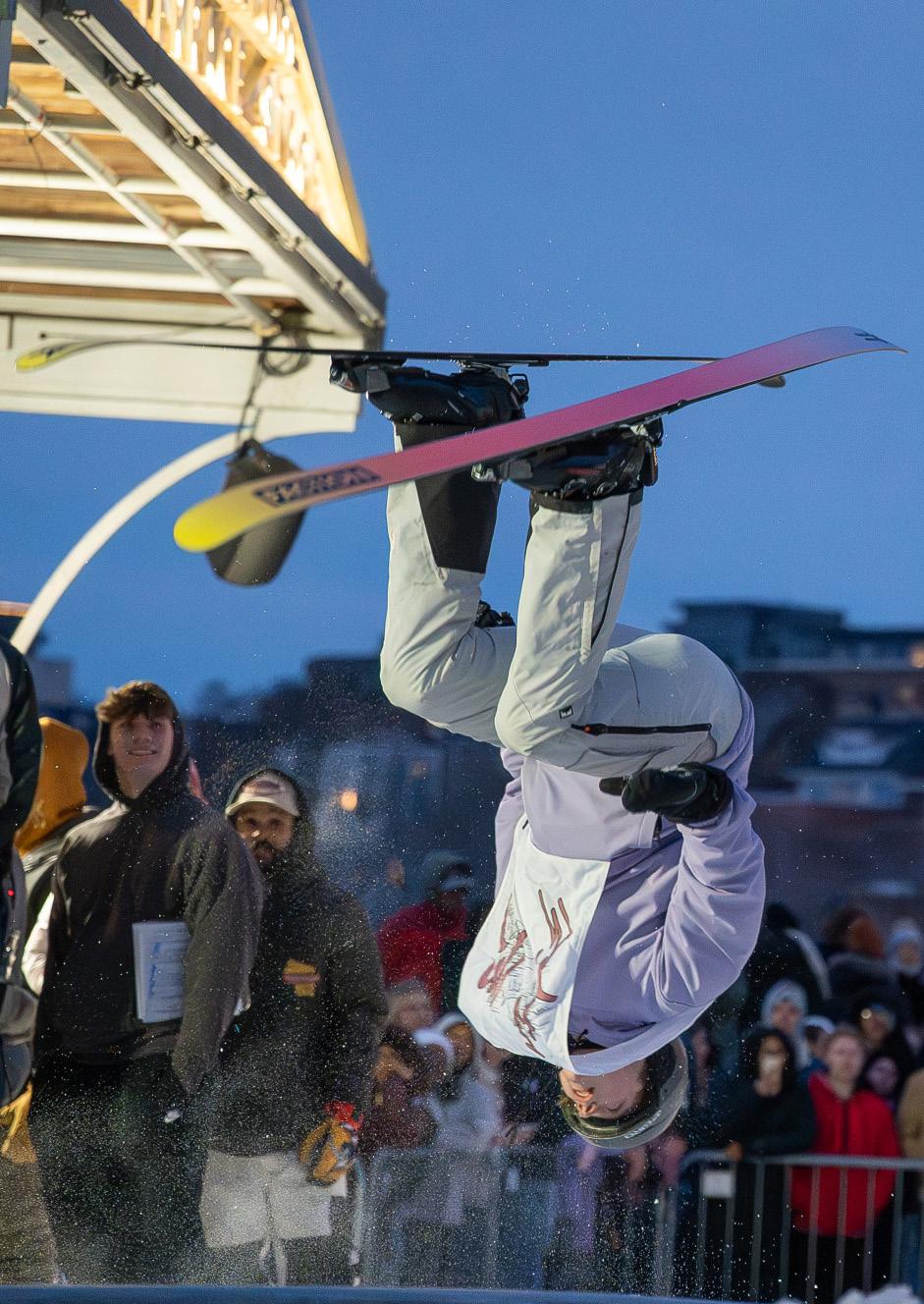
Hundreds gathered on the Terrace to watch skiers and snowboards take to the rails.
+ LIFE & STYLE, PAGE 6
Thursday, February 12, 2026
Science isn’t optional, and neither is protecting your campus community.
+ OPINION, PAGE 5
Mnookin champions ‘principled pragmatism’
By Alaina Walsh CITY NEWS EDITOR
In her final appearance before the Board of Regents on Thursday, outgoing University of Wisconsin-Madison Chancellor Jennifer Mnookin delivered a reflective defense of public higher education, urging leaders to hold fast to core values while navigating an era of “profound uncertainty.”
Mnookin, who will depart this spring to lead Columbia University, used her final report to frame her tenure not through the lens of individual achievement, but through a philosophy she termed “prin-
cipled pragmatism,” a blend of willingness to listen to critics while still maintaining a strong commitment to the university’s core values.
In the expansive, near hour-long address, Mnookin framed her tenure not merely as a series of administrative wins, but as a high-stakes effort to keep the state’s flagship anchored to its core values while radically accelerating its pace to meet a changing world.
“In moments of great disruption like the one we’re in, a significant measure of our leadership will be our ability to stay anchored to these core values while also being flexible enough to
change,” Mnookin said. “And change is needed.”
She defined those anchors as academic freedom, research excellence and a commitment to pluralism — which she defined as the robust exchange of ideas across different backgrounds and viewpoints.
At the heart of Mnookin’s vision for a modern research university is the Research, Innovation and Scholarly Excellence (RISE) initiative. Designed to move the university beyond traditional departmental “silos,” RISE has acted as a catalyst for interdisciplinary growth.
The university hired 133 new faculty members through the program in just two
LILY’S CLASSIC CANCELED
By Ella Hanley COLLEGE EDITOR EMERITUS
Sigma Alpha Epsilon fraternity will cancel Lily’s Classic, its annual fundraiser and social event on the frozen Lake Mendota, this year after the University of Wisconsin-Madison imposed expectations fraternity leadership said they were not comfortable with.
The event will transition from the traditional philanthropy boot hockey tournament to a private social event after multiple rounds of negotiations with university officials, Harrison Long, SAE’s philanthropy chair, told The Daily Cardinal. He said the fraternity “doesn’t want to be liable” for issues on the ice.
The fraternity originally proposed several changes to its annual hockey tournament and fundraiser, including expanded fencing, increased law enforcement presence and stricter attendance policies, as early as November.
But members said detailed feedback did not arrive until the last week of January, and after consulting their national chapter, SAE decided the university’s final proposed policies outlined in a Feb. 6 email were too restrictive and liability-heavy.
“It’s the biggest philanthropy event in [UW-Madison] Greek life,” Long said. “We really focus all our efforts on this because we
know we can raise so much money.”
Shauna Breneman, Public Relations and Communications Officer for the Wisconsin Union, said SAE’s initial proposal “did not sufficiently address protocols related to crowd management, adequate facilities, risk mitigation and compliance with code of conduct expectations” in a statement to the Cardinal.
Last year, the event raised nearly $18,000.
Long also said the fundraiser is one of the few times the fraternity is able to “gather both Greek life and people outside of Greek life together.”
Fraternity and Sorority Life (FSL) — an office representing the more than 60 sororities and fraternities on campus — main concerns included straining campus resources, increased liability in student housing and safety risks from individuals on the ice who were not connected to the event or its philanthropic purpose.
“Over the past five years, multiple campus departments have worked with Sigma Alpha Epsilon to address safety concerns associated with Lily’s Classic. Each year, additional measures were implemented to help enhance safety; however, the level of risk continued to increase,” Breneman said.
Breneman said the 2025 Lily’s Classic led to “significant operational disruptions” on campus, such as Memorial Union temporarily closing.
Campus staff then held a meeting with SAE leadership in April 2025 where staff said they would support alternative routes for the event, but it “could not continue on this path.”
SAE offered to eliminate the hockey tournament component entirely after the university originally vetoed the entire fundraiser, which opened further negotiations. The university offered the Bakke as an alternative site to host the hockey tournament, but SAE rejected that option due to capacity constraints.
SAE members said they were frustrated a compromise could not be reached and that the university waited until the week before the planned event date to impose significant conditions.
“How can you tell us ‘no’ for this big event when it should be a good thing that we’re bringing so many people together for this cause?” SAE chapter President Ryan Noori told the Cardinal.
In an email to the fraternity obtained by the Cardinal, Associate Vice Chancellor for Student Affairs Mark Guthier said SAE may be held accountable for property damage or disruptions to university services and would be responsible for “safely” dispersing crowds gathering outside the fencing throughout the day.
+ Lily’s page 2
years, with 53 focusing on artificial intelligence. The most visible success is what she termed the “AI Trifecta” — human capital, infrastructure and technological integration.
“Our goal,” Mnookin said, “is to ensure technology enhances, not replaces, human engagement.”
Along this line, UW-Madison recently debuted Research and Business Bridging Intelligence Tool (RABBIT) which uses AI to scan faculty research, then match scholars with industry partners.
+ Mnookin page 4
L&S Dean Eric Wilcots selected as interim chancellor
By Annika Bereny CAMPUS NEWS EDITOR
College of Letters & Science Dean Eric Wilcots has been selected to serve as the University of Wisconsin-Madison’s interim chancellor, effective May 17, University of Wisconsin System President Jay Rothman announced Wednesday morning.
“I have been impressed by Dean Wilcots’ steady, values- driven leadership and his deep understanding of UW-Madison’s mission of teaching, research and service,” Rothman wrote in a release. “Wilcots’ long service and deep commitment to the Wisconsin Idea will provide the basis for continuing UW-Madison’s progress at a critical moment for the university.”
Wilcot’s appointment comes as current Chancellor Jennifer Mnookin plans to depart UW-Madison for Columbia University following spring commencement on May 9.
“For the past six years, Eric has proven himself to be an effective, impressive and collaborative dean of the College of Letters & Science, the largest college at UW–Madison, and he has evinced deep commitment to excellence in research and a life-changing student experience,” Mnookin said in the statement. “In addition, there are few leaders on our campus with as much passion and commitment to the Wisconsin Idea and the ongoing success of our state’s flagship.”
Wilcots has served as L&S’ dean since May of 2020, serving in the interim role before his permanent appointment. He has worked for the university since 1995, when he first began as a lecturer in the Astronomy Department. He previously served as UW-Madison’s interim provost in 2023 before Charles Isbell Jr.’s appointment.
“I am both humbled and honored to be asked to serve in this leadership role at such a consequential time in UW-Madison’s history,” Wilcots said.
Wilcots will likely remain interim chancellor until summer 2027, current interim Provost John Zumbrunnen said in a Jan. 29 Academic Staff Executive Committee meeting. The Board of Regents will launch a national search to choose UW-Madison’s next chancellor and UW expects to announce a permanent provost, their second-ranking academic leader, in early March before Mnookin’s departure. Mnookin and the new provost will work together to determine interim L&S leadership.
“…the great state University of Wisconsin should ever encourage that continual and fearless sifting and winnowing by which alone the truth can be found.”
JAKE PIPER/THE DAILY CARDINAL
UW Regents recap: Leaders highlight civil dialogue, AI
By Alaina Walsh CITY NEWS EDITOR
University of WisconsinMadison leaders and students urged campus communities to strengthen civil dialogue, protect free expression and adopt a systemwide artificial intelligence vision responsibility at a Board of Regents meeting Thursday.
Outgoing UW-Madison
Chancellor Jennifer Mnookin told regents UW-Madison has the responsibility to create environments where people can engage constructively across political and ideological differences, even when conversations are uncomfortable.
“We are in a polarized moment,” Mnookin said. “And yet it is incredibly important that universities remain places where people can test ideas, learn from one another and approach disagreement with curiosity rather than judgment.”
The Wisconsin Exchange, launched at UW-Madison last fall, seeks to teach political dialogue skills through classroom practices, student programs and public engagement. Students and faculty appearing before the board in a panel described the initiative as a response to rising polarization on campus and beyond.
Jackson Daniel, a junior who participated in Deliberation Dinners his freshman year and now interns for the program, said the small-group discussions bring students with differing viewpoints together for guided conversations designed to build understanding rather than consensus.
“I can disagree with someone without thinking they’re morally wrong or evil,” Daniel said.
Miranda Garcia Dove, co-founder of Bridge Madison, a student organization affiliated with BridgeUSA, said her group has hosted student-led discussions and bipartisan panels on
topics including elections, health care and gender-affirming care. She said one of the biggest challenges is engaging students who feel their views are unwelcome or who avoid political spaces altogether.
Faculty members framed pluralism and free expression as central to the university’s mission.
Alex Tahk, a political science professor and director of the Tommy G. Thompson Center on Public Leadership, said universities cannot fulfill their role as truth-seeking institutions without openness to competing viewpoints.
Allison Prasch, an associate professor in the Department of Communication Arts, tied the Exchange to UW’s long-standing “sifting and winnowing” tradition, describing classroom strategies that expose students to multiple media narratives and encourage reflection on how beliefs are formed.
What’s next for AI?
UW System President Jay
Rothman outlined a systemwide strategy for AI, emphasizing that AI must complement — not replace — human judgment, mentorship and critical thinking.
Rothman identified six priorities guiding UW’s approach to AI, including using AI to support student success through advising and wraparound services; providing faculty with professional development and trusted AI tools; establishing an AI hub to coordinate procurement, research and compliance; improving operational efficiency while preserving human expertise; expanding AI literacy statewide and convening partners across business, innovation and workforce development.
“AI is not just a tool,” Rothman said. “It is reshaping how we teach and learn.”
Rothman said generative AI has the potential to personalize instruction, expand student support and free faculty to focus on
deeper learning and mentorship. At the same time, officials cautioned that overreliance on AI could weaken critical thinking and creativity and raise concerns about privacy, bias, academic integrity and equitable access. Kyle Cranmer, director of UW-Madison’s Data Science Institute, highlighted the UW-Madison’s Rise AI Initiative, which focuses on human-centered artificial intelligence and integrates research, teaching and public engagement. Cranmer said the initiative aims to position the university as a trusted partner for Wisconsin as AI reshapes the economy and workforce.
Examples of AI initiatives across the UW system included AI-based tutoring pilots at UW-Superior, manufacturing applications at UW-Stout, entrepreneurship efforts at UW-Stevens Point and ethics-focused AI coursework at UW-La Crosse.
The Badger Olympian you’ve never met: Marv Danielski’s marketing magic
By Lydia Picotte ARTS EDITOR
The Olympics aren’t just about sports —or at least, not at their core.
If you asked Marv Danielski, the general manager and former president of St. Louis’ KSDK-TV NewsChannel 5, he’d tell you the Olympics, more than any other sporting event in the world, are about humanity.
It’s his job to promote the Olympics by finding unique storylines in the haystack of national media.
“At NBC, it’s the Super Bowl into the Olympics, into NCAA basketball, into World Cup Soccer into the most political sport of all time: the midterm elections,” Danielski told The Daily Cardinal.
Danielski has worked on promotional events for countless international sporting events, but with the Winter Olympics underway, he’s focused on Milano Cortina. Looking back, he cites his contributions to the official Olympics website as one of his favorite assignments. He was a part of
the team that constructed the very first version of the site.
But aside from the competition, his role as a producer has given him a multifaceted perspective on the power of sports, far beyond any field or court.
“Coming out of the Super Bowl, we have a story about flag football,” Danielski said. “The NFL recognized that there was a CTE and a concussion problem. They’re now recommending getting more kids involved in flag football. We look at that news content and make sure that we promote that programming to make people aware of the story, but more importantly, the ramifications of the story.”
His time spent at the University of Wisconsin-Madison, where he graduated with a communication arts degree, set him up with all the professional skills he needed to succeed. Even more importantly, UW-Madison nurtured his interests beyond the classroom.
“[In Madison] you can access all
this world class stuff. That doesn’t happen everywhere,” Danielski said.
“From medicine to sports to other academics, even walking up Bascom Hill in the middle of winter, it provides a really unique experience. The key is that there’s lots of unique experiences that can happen here that you can wrap into your narrative.”
For Danielski, those experiences were intramural sports teams and campus film societies. He said those film circles contributed to how he sees stories in the media today.
“Even though I’ve really never been in the film business, [there was] exposure to things in the film societies. It was all about narrative, about storytelling, about [how to use] music. I was able to leverage all those things into my Badger experience, and that was very important in terms of how my career has gone,” Danielski said.
Another instrumental factor in Danielski’s success is his ‘impatiently patient’ mindset.
“What you have to do is be impatient to get where you think you need to go, but you have to be patient in terms of how you’re going to get there,” Danielski said. “[You must] keep a global view and see where you have a role and have belief in your own system. That doesn’t mean arrogant, but you have to believe that you have something to say.”
This belief has helped Danielski work in sports and hard news. Still, he said sports remain his favorite, particularly because their immense appeal gives them a unique role in mass communication.
To Danielski, the work isn’t just about winning and losing games. It’s about the leaders, research and conversations that are revealed through the vehicle of sports.
“They’re not all vacuous,” he says. “Sports are the fabric of the United States and other countries. They have such a platform, promise and power that lead to other more positive things.”
MEGHAN SPIRITO/THE DAILY CARDINAL
Republicans push to restore ACT requirement for UW admissions news
By Audrey Lopez-Stane SENIOR STAFF WRITER
Republican lawmakers are advancing a bill to restore the ACT requirement as the “predominant” factor in admission to the University of Wisconsin-Madison.
Rep. Dave Murphy, R-Hortonville, told The Daily Cardinal he coauthored the bill because he wants to see “more objective criteria” in admissions decisions.
The University of Wisconsin System has been test-optional since the COVID-19 pandemic. The testoptional policy expires after the 202627 school year, but Murphy said the University of Wisconsin System could “very well reinstate it” after extending it three times since 2020.
“They’ve done that a number of times, so I have no idea that they’re going to end that policy,” Murphy said. “The bill is about making it happen for sure.”
The bill wouldn’t affect those applying through the guaranteed
admission program, which secures admission to UW-Madison for applicants in the top 5% of their high school class.
Democratic lawmakers on the Committee on Colleges and Universities said they were concerned for students who may need to retake the ACT and could not easily access a testing center at a Feb. 5 public hearing. This particularly affects rural students, whose testing centers may be hours away if they are in northern or western Wisconsin.
Rep. Alex Joers, D-Waunakee, told the Cardinal he worries this bill might deter high school students from applying to college at all if standardized test scores become the largest factor in admissions decisions. He added that many students also cannot afford to retake the ACT or hire a tutor, something he experienced first-hand.
“I was in that situation,” Joers said. “I didn’t have a whole lot of extra funds to be able to put forward... and fortunately, this bill wasn’t law.”
To retake the ACT with the English, math and reading sections costs $68. To add on the writing section is an additional $25 and the science another $4. Joers said these financial and access barriers are “roadblocks in front of students that are just trying to do their best to get into college.”
The bill also says no “partisan tests or any tests based upon race, religion, national origin of U.S. citizens or sex shall ever be allowed” in regards to the student admissions.
Murphy pointed to the 2023 U.S. Supreme Court ruling against affirmative action, which barred universities from using race as a factor when admitting or denying students, and a constitutional amendment Wisconsin Republicans approved which would ban DEI initiatives in “government entities,” including the UW System.
Murphy said this bill would do a lot of what the constitutional amendment would already do.
Rep. Jodi Emerson, D-Eau Claire,
Centro Hispano celebrates Three Kings Day, distributes 2,000 toys to families
By Gabriela Verdeja STAFF WRITER
Centro Hispano distributed more than 2,000 toys, books and hygiene supplies on Jan. 17 as part of the community center’s annual Three Kings celebration which brings together Latino families and community members across Dane County.
Founded in 1983, Centro Hispano serves as a community and resource center for Madison’s growing Latino population. This year’s celebration highlighted both a cultural tradition widely observed in Latin American countries and the organization’s expanded capacity in the organization’s new building.
The event was made possible through Centro’s partnership with Toys for Tots, the Madison Metropolitan School District Play and Learn Program, the Madison Reading Project and additional toys purchased by Centro Hispano to ensure the entire community was served.
Making an impact in the community
Beyond the annual Three Kings Celebration, Centro Hispano provides year-round support to the Latino community through youth programming, immigration and family services, higher educational programs and physical and mental health resources.
The organization also hosts the Mercadito, a recurring market featuring local restaurants and produce stands, crafts and raffles with prizes — a community favorite event that has helped launch small businesses in Madison.
Jovan Chavez, Centro Hispano’s Mercadito and volunteer lead, pointed to Sabor de Puebla, a Mexican restaurant with two Madison locations, as a place that got its start as a food stand at the Mercadito.
“It was just a local community member chef. She was whipping up her favorite recipes, local and regional, from Mexico,” Chavez told The Daily Cardinal. “Year by year, through the Mercadito, she would come back and keep growing a following, and that inspired her dream to start her restaurant.”
Preserving cultural traditions with ‘joy and community’
Three Kings Day, also known as Dia de los Reyes Magos, holds deep cultural significance for many Latino families and is often celebrated as a prominent holiday in addition to Christmas. Chavez reflected on his own childhood experience and why continuing it in Madison matters.
“I would ask about gifts. My mom would tell me you have to wait for Three Kings Day,” he said. “You’d wake up and there were gifts under the bed. It’s a fun tradition that a lot of Latino families celebrate, and the Reyes Magos can still find you in Madison, Wisconsin.”
Families attending the event had the opportunity to meet and take photos with the Tres Reyes Magos after the families received their gifts, a moment organizers said reinforces both cultural preservation and community belonging.
Events Manager Bianca Baker emphasized the celebration is intentionally inclusive.
“Tres Reyes is really big in a lot of Latino culture,” Baker said. “U.S. Christmas is so popular, so we decided to focus on Tres Reyes to bring those traditions and cultures here. You don’t have to be Latino to participate, so we have a lot of other community members who come, and it can be something they learn about as well.”
Throughout the day, staff, volunteers and families filled the new building with music, food and conversation — a reflection of Centro Hispano’s broader mission, Chavez said.
“Centro continues to demonstrate this is a resource center and also a community center for folks,” Chavez said. “Being able to recognize a big holiday that a lot of Latino families celebrate and can continue to celebrate here is really special.”
Baker added that the event shows Centro Hispano’s role as a space of connection and celebration.
“We can be a space of joy and community despite whatever else is going on in the world right now,” she said. This is a space for anyone.”
told the Cardinal that UW-Madison has “great professional folks” working in admissions and said the process should be left up to them.
“We need to continue to leave it in their hands,” Emerson said. “It’s not up to the legislature to micromanage how kids get in.”
She added that she appreciates admissions officers taking a holistic view of applicants, rather than focusing “predominantly” on one factor, such as the ACT, like the bill proposes. She said she would rather admit students who have “overcome some odds” rather than a perfect ACT score.
“I want people who overcome adversity,” Emerson said. “I would hope that our universities are looking at this holistic person when they’re deciding who to admit.”
Emerson and Joers were also uneasy with how fast the bill is moving in the legislature. It was introduced on Feb. 3 and read to the Committee on Colleges and Universities that same day. A public
hearing was held just two days later.
“This bill moved unusually fast for having been drafted last week,” Joers said. “When a bill like that moves at that speed, there are errors made.”
In the public hearing on Feb. 5, 4legislators expressed bipartisan concern for the use of the word “predominantly” in the bill text, which multiple committee members said was ambiguous and vague.
“The bill says that standardized test scores should be used ‘predominantly,’” Emerson said. “Well, what does that mean?”
Emerson and Joers both raised this concern again at a hearing on Feb. 10, but there is still no definition in statute of the word “predominantly.” Both lawmakers worry about the consequences of this wording and the motives of this bill.
“I just have the feeling that this bill is really meant to land one of the campuses in a courtroom at some point.” Emerson said. The bill is on the assembly calendar for Feb. 12.
Students compete for Euchre glory in Bicycle-sponsored tournament
By Cameron Schneider VIDEO DIRECTOR
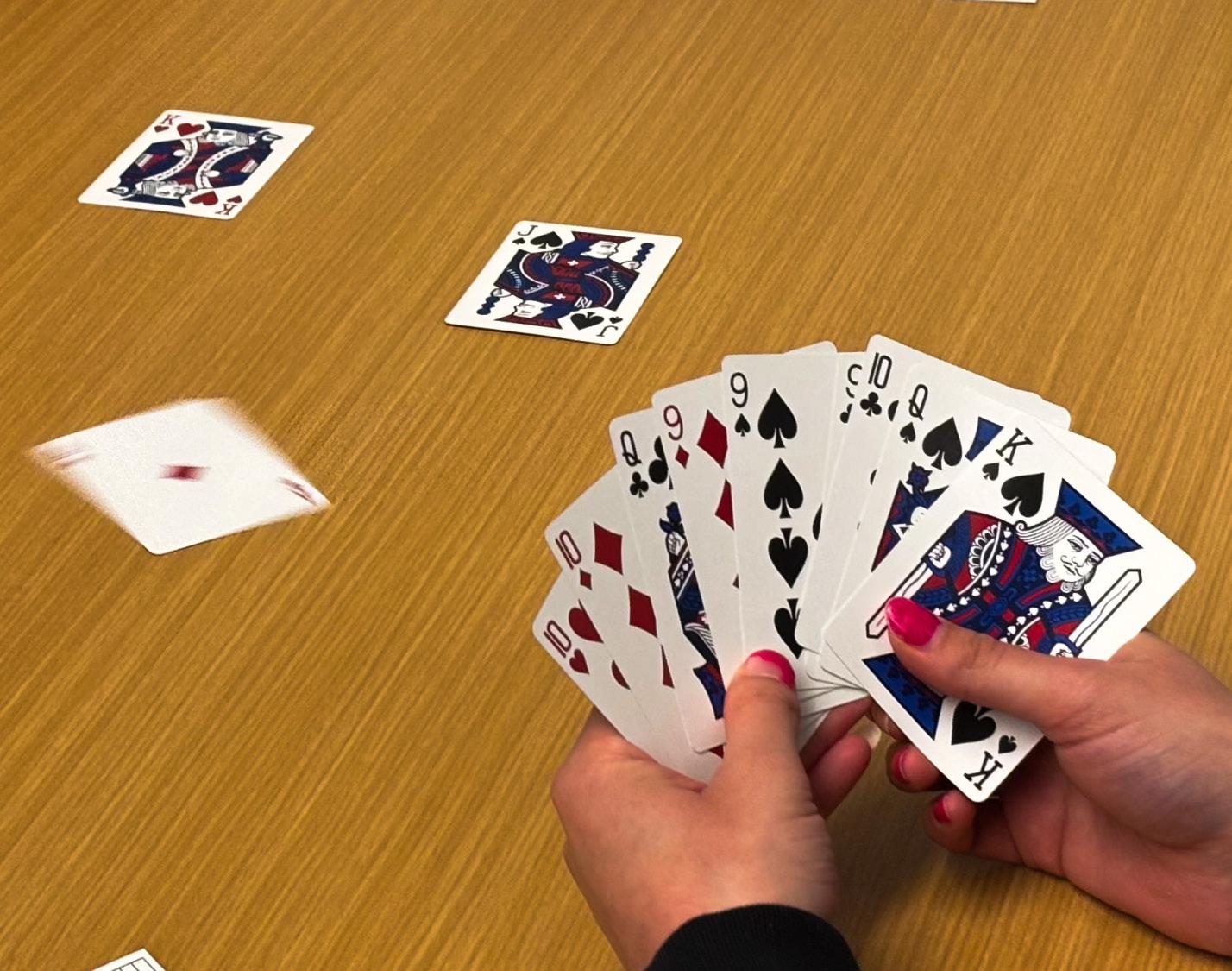
Over 100 students participated in a euchre — a popular midwest card game where teams of two play against each other to win tricks — tournament for a chance to win $1,000 at Morgridge Hall on Monday.
The event was sponsored by Bicycle Playing Cards and hosted by UW-Madison’s Euchre Club, with participants ranging from first-time rookies to seasoned Euchre Club players.
Although there are variations, euchre only uses 32 of a standard 52-card deck.
Sitting at 26 tables, teams competed against each other to claim euchre victory over their fellow badgers. Once the 2o minute timer started, players were flinging tricks across the table like it was second-nature.
Freshman Preston Dallek said he plays euchre with his rugby team all the time. He partnered with his friend, Jet, for the tournament.
“We’re pretty locked in. We like to play euchre on the weekends, so
I think we know what we’re doing,” Dallek said. “But obviously, you know, it’ll come down to luck of the draw.”
In addition to $1,000, winners of the tournament were invited to play against winners from other Big Ten schools. Winners of the Big Ten competition will go to New Glarus, Wisconsin to face off against national euchre players.
Many players, including Euchre Club president senior Evelyn Hentschel, learned euchre during the 2020 COVID-19 pandemic as a new game to pass the time. Others learned from their family when they were younger.
Hentschel has been involved with Euchre Club since she was a freshman.
“The two hours I get to just come and play euchre out of my week have been my favorite parts,” Hentschel said. “It’s a great time to meet new people and to just kind of turn my brain off, have fun for a couple hours a week.”
Euchre club holds meetings on Monday nights, 7 p.m. to 9 p.m., in Engineering Hall, room 2317.
CAMERON SCHNEIDER/THE DAILY CARDINAL
4 Thursday February 12, 2026 l
decline — and the Trump administration proposed a $100,000 fee for H-1B visas.
Continued from page 1
Despite reporting UW-Madison’s recent climb to No. 5 in the nation in federal research expenditures — reaching a record $1.93 billion — Mnookin said there are significant “headwinds” facing the institution.
She detailed a “double whammy” that hit UW-Madison’s federal funding: a 17% decline in new federal research awards and the mid-year termination of 145 existing grants due to federal agency instability and legal challenges that resulted in roughly $27 million in lost spending.
The chancellor also highlighted the human cost of current political and social volatility. International enrollment dropped by 500 students this year amid visa uncertainties — approximately a 30%
“Our international students, faculty and staff are essential,” Mnookin said. “They enrich our campus culturally and academically. We don’t want to see any of them miss the opportunity to be here.”
In her most direct appeal to the Regents and state leaders, Mnookin argued that UW-Madison is currently being held back by “slower era” regulations. She compared the flagship to a “symphony” that requires different tools than its “jazz trio” sister campuses.
“UW-Madison is a center of gravity for the Universities of Wisconsin. The strength of one, I believe, rises or falls with the strength of the other,” she said.
To maintain its status as a global leader, Mnookin called for three specific legislative and policy shifts:
Purchasing Flexibility:
Mnookin asked the Board of Regents to raise the threshold for full Request for Proposal (RFP) bidding from $50,000 to $250,000 to save “thousands of hours” of staff time.
Building Authority: This would give UW-Madison money to construct a new dorm after Republicans cut funding for that project in the last state budget. Mnookin also hopes to streamline the bid and approval process for projects funded entirely by gifts and grants, citing a “serious housing crunch” where 9,000 students are currently living in spaces designed for 8,000.
Bonding Authority: This would grant the university the power to borrow against its own revenue — a tool that allows the university to receive capital upfront in exchange for a per-
centage of future gross revenues. Almost every other Big Ten flagship university holds this power.
Mnookin concluded with a conceptual challenge to the Board of Regents. While acknowledging the importance of the entire 13-campus system, she asked the Board to make UW-Madison’s specific excellence a permanent “north star.”
“Please continue to ask explicitly and consistently: ‘How will this impact our flagship campus?’” she said. “If the answer is ‘it might be not so great for UW-Madison,’ please think about whether there might be another path forward.”
As Mnookin prepares to lead Columbia, she leaves behind a university with the highest student retention rates in its history (96%) and a record-breaking 75,000 applicants for the 2026 academic year.
Madison to vote on art installation for new library
By Elisabeth Carroll STAFF WRITER
Madison arts and libraries groups are seeking community input on a sculpture installation in front of the Imagination Center, Madison Public Library’s first new library in over 25 years.
The City of Madison, the Madison Arts Commission (MAC) and Bubbler, an arts-based program at MPL invites community members to fill out a survey by Feb. 12 at 2 p.m., before giving that feedback to the public arts subcommittee, which will make its decision on Feb. 18.
The Imagination Center is currently under construction at Reindahl Park and will consist of an indoor-outdoor library and community gathering space.
Madison Public Library Director Tana Elias told The Daily Cardinal the lack of community spaces in this particular neighborhood makes the Imagination Center a focal point for gathering and engagement.
MAC selected four finalists from a pool of 36 applicants. The finalists were invited to explore the Imagination Center to draw inspiration for their personalized sculpture. They recently submitted their sculpture proposals, leaving the final decision to a collaboration between community members and the MAC public art subcommittee.
“We hope for all art installations that they engage people, that people are able to connect, engage with the piece itself and be inspired,” Elias said.
The first art proposal, “Inkroot” by CookeSassevill, consists of a feather set upright and planted in an inkwell. Cooke-Sassevill highlights the feather’s reference to literature, authorship and the creation of ideas in relation to the inkwell, which resembles human skin. The combination of these depicts the human impulse to voice their ideas. The inkwell will be treated as a time capsule, giving community members the ability to write a message to store until the capsule is eventually reopened.
The second art proposal, “Suenos de Paloma,” was submitted by Flor Molina, Gabriela Jiménez Marván and Ryan Rothweiler. The title translates to the “Dreams of Paloma,” with the central message highlighting the importance of belonging for all community members, regardless of identity.
Drawing from their own identities as migrants and Afro-Mexican artists, this sculpture depicts a human face, modeled after the sculptor’s features, with a bird’s body. The combination of human and bird is meant to signify freedom, migration and the ability to create a home, regardless of where one comes from. This proposal
highlights the artists’ desires to provide a moment of reflection for people of all races.
The third art proposal, “The Passage of Being” by Nate Page, is a 3D triangular shape with a cutout of a figure holding a book in one hand and raising the other above its head. The first side depicts a road, a symbol of the strength of communities and how they create paths towards nature. Layers of colors are pushing the figure, each found in the national flags of dominant immigrant communities in Northeast Madison.
The other side is a reflective surface showing the park and activities as they are actively occurring. The collaboration of both sides reminds viewers that communities inherit systems but also have the power to develop them through imagination and collective participation.
The final proposal, “Silver Lining: Where Dreams Flow” by Sujin Lim, consists of two structures: a cloud-headed human figure and a floating cloud with five beams of light flowing downward. These figures symbolize how important it is to share individual dreams with others, depicting how imagination, knowledge and activity often work together. The proposal goes on to draw connections between the sculpture and the Imagination Center as a whole.
In a tribute to Mnookin at Thursday’s meeting, Regents President Amy Bogost recounted how Mnookin’s own life was touched by UW-Madison innovation when she donated a kidney to her father in 2020. The organ was transported using a preservation solution developed at UW.
“She embodies the Wisconsin Idea because she experienced its power firsthand,” Bogost said. “She understands that our research isn’t just happening in the lab, it’s out in the world, saving lives.”
Mnookin will remain chancellor through May 17, before taking over at Columbia.
“I will carry with me always a deep affection and profound gratitude for this place,” she said. “And an unwavering faith in the life-changing power of higher education.”
Lily’s
Continued from page 1
“We can’t tell our security to do that, because [people] have every right to be on the ice,” Long said. “If you want people off the ice, get UWPD to do that.”
University officials told SAE in the Friday email the fraternity’s private security, the same group they hired to police last year’s event, would be expected to go onto the ice to move people, according to fraternity members. SAE said it has no jurisdiction over Lake Mendota. Guthier further indicated the fraternity could be held liable if someone were injured on the ice or in Memorial Union.
SAE members also questioned why the Langdon Invitational, a similar philanthropic hockey tournament hosted by Chi Psi last month, was allowed to proceed. University officials told SAE that the invitational was expected to draw fewer attendees than Lily’s Classic.
“It’s kind of weird, because us going from a philanthropy event to more of a party seems like the opposite of what the school would want,” Long said, adding that the changes would likely significantly hurt fundraising endeavors.
Lily’s Classic was last canceled in 2024 due to hazardous ice conditions.
SAE shared hope that Lily’s could return in future years, but Long said the event is unlikely to return in the same capacity as it was last spring.
The Student Organization Resource Team, which handled negotiations with SAE, said they remain committed to working with student groups “to create experiences that prioritize safety and align with campus policies and practices that help protect participants, all campus-goers, and campus resources.”
Mnookin
Stop treating vaccines like an opinion opinion
By Brady Ahler STAFF WRITER
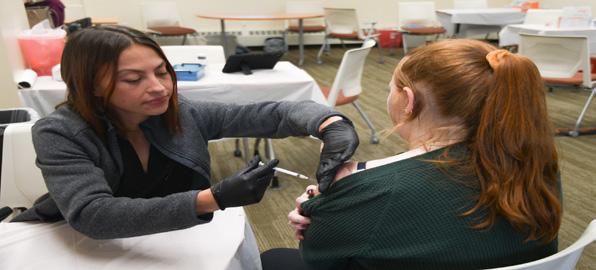
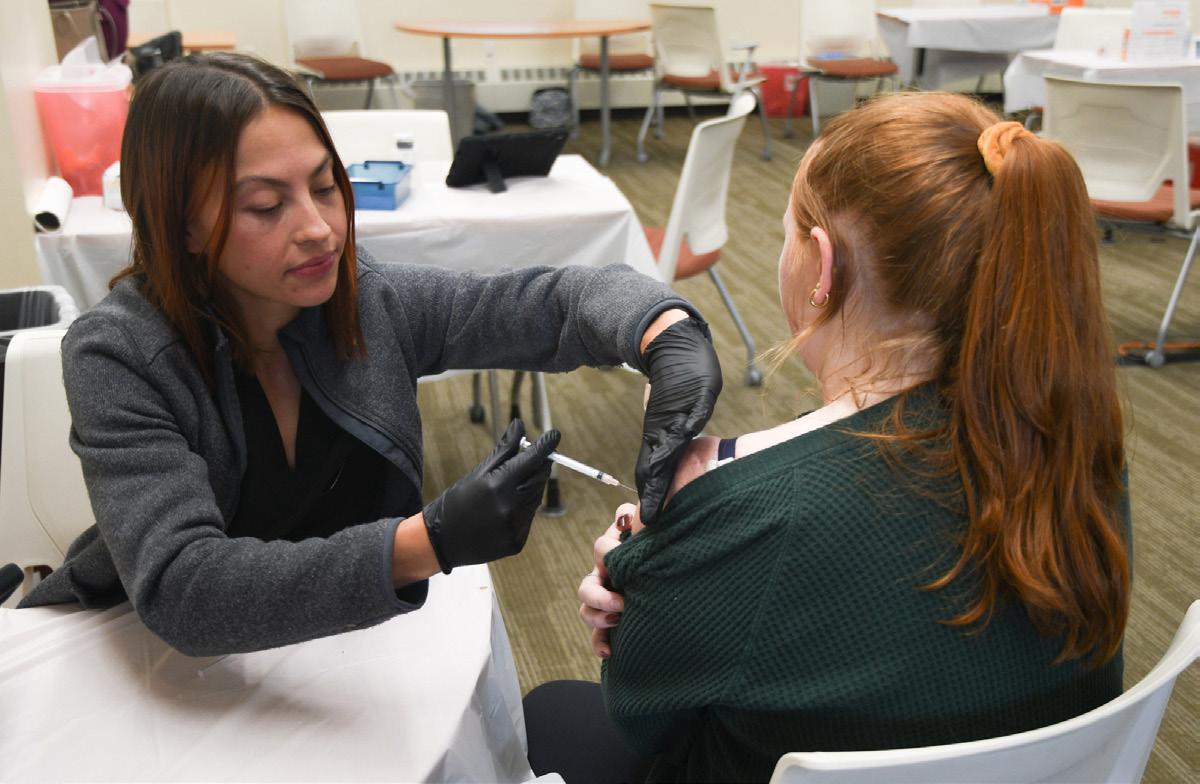
Last week, University Health Services sent an email notifying University of Wisconsin-Madison students about a confirmed case of measles on campus, with 4,000 individuals directly notified of their exposure.
The anti-vaccination sentiment, amplified during the COVID-19 era and legitimized by high-profile skeptics like Secretary of Health and Human Services Robert F. Kennedy Jr., makes “flukes” like this feel routine.
“Anti-vaxxers” were not born with the Make America Healthy Again movement, but have existed since the advent of vaccination itself. Opposition to compulsory vaccination began with the rollout of the smallpox vaccine in 1796. Similar to today’s skeptics, such “free-thinkers” argued this medical practice threatened their civil liberties and invited death.
Defending the safety and
effectiveness of vaccines is like having to defend a spherical Earth; they are debates that only exist because some people insist that reality is optional.
The medical consensus is clear and simple: vaccines are not only safe, but necessary. Over the past five decades, vaccines have saved 154 million lives and have decreased infant mortality by 40%.
Extensive research shows no credible evidence connecting vaccines to developmental or neurological harm, weakened immunity, acute injuries or any other far-fetched claim your aunt posts on Facebook.
Anti-vax activists often argue their decision to forgo life-saving medicine is a personal choice, and in some ways, it is. It is their choice to deny decades of research from leading health organizations, Nobel Prize winning scientists and the overwhelming majority of the medical world. It is their choice to accept missing weeks of work and
school, urgent care bills and long recoveries for something preventable. It is even their choice to face the possibility of extreme symptoms and hospitalization, but in the words of Forrest Gump, “stupid is as stupid does.”
However, when you share air on a campus of 50,000 other students, most of whom you do not know, and whose medical histories, vulnerabilities or past exposures you cannot possibly account for, your “personal choice” extends beyond your own health and safety.
Children who are too young to be vaccinated, immunocompromised individuals, people who cannot receive vaccines for medical reasons, and scores of others are put at risk by the resulting weakened herd immunity. When people who can get vaccinated choose not to, they endanger those around them. Vaccine refusal isn’t just irresponsible, it’s selfish.
Universities encourage students to think critically and approach the world with curi-
How algo-rhythm music
By Rachel Gerhardt STAFF WRITER
On any given day, on any given road, on any given Madison city bus, headphones cover the ears of nearly every public-transit patron. Walking down the street, the picture doesn’t change much — heads-down, thumbs up, poking and prodding an LED-screen to select the new song of the moment while walking down East Johnson Street.
Music is everywhere. Conversation about it is not.
Despite the growing epidemic of these so-called “headphone zombies,” I find there are surprisingly few genuine sentences spoken aloud about music.
Lurking through others’ profiles on music streaming platforms is often the closest one comes to talking about music taste. We hold out our own cryptic playlists at an arm’s length, trigger finger hovering over the “private-listening-session” button, and wait for applause.
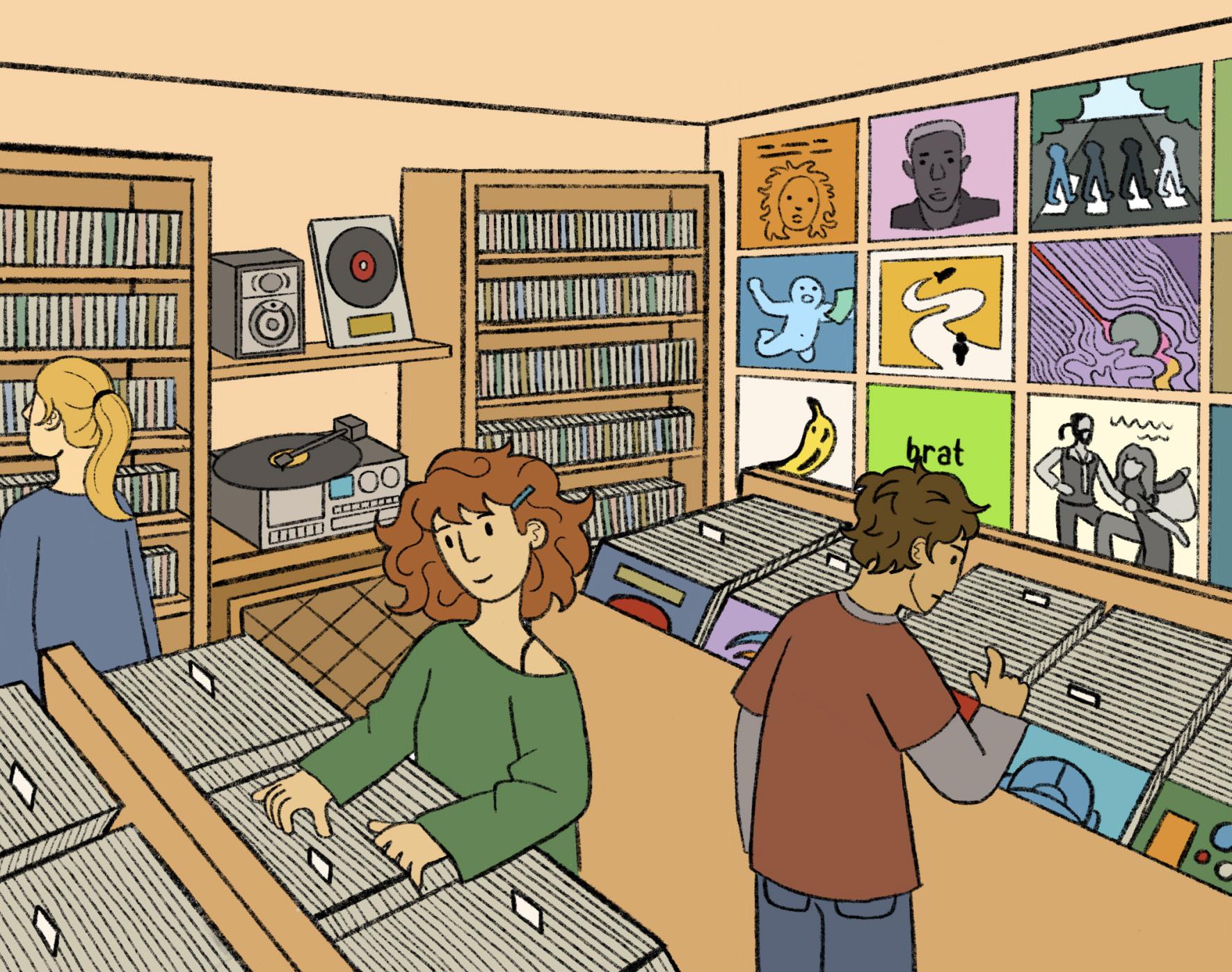
Sometimes we will react to an unfamiliar song with a heart-eyed-emoji, something tasteful, all while the eternal jealousy perfected by the digital age, and practiced from behind the phone, sits like a lump in the back of our throats. Maybe this is our modern day version of, “you’ve never heard of The Cure?” and being scoffed across the music store counter by a woman with a cool haircut and a shirt you can’t quite read, poking out from beneath a worn-out denim jacket.
Music streaming tracking, while perhaps as unassuming as a record-store employee, has begun to stain the background of every song with the panoptical buzz of an ever-watching ear. When one dares to ask about the music someone is listening to, the answers are distant and removed. Picture Mr. Music-Listener, wearing Bluetooth headphones, a Geese t-shirt and jeans that look tired of being cinched repeatedly by vintage leather belts. He would look at me and say something along the lines of, “do you use Spotify or Apple Music?”
I answer first with a headshake, sending Mr. Music-Listener into a state of peril as he pulls his Airpods from his ears. With one quick word I am
ous skepticism. However, such scholarly feats must be rooted in evidence and fact. We do not allow students to opt out of lab safety because they did their own research, and we do not treat rules surrounding academic integrity as a matter of personal freedom. By the same logic, vaccination is a shared responsibility and commitment to protect our community. Is UW-Madison a community that takes evi-
dence seriously, or one that denies science in the name of rugged individualism?
Outbreaks of preventable diseases should be a relic of the past. UW-Madison’s students should not have to worry about measles in Qdoba or hepatitis in Rheta’s Dining Hall. The moral and scientific evidence is clear: get vaccinated.
University Health Services has information on campus vaccine clinics here.
streaming killed music taste
feared. I am unconventional. I am pretentious and misunderstood. I am John Cusack in High Fidelity. I put my lips together and whisper, “neither.”
From interactions like this, I have begun to wonder: what has become of the music-listening world?
Radio stations and curated mixtapes have been largely replaced by widespread, capital-A Algorithms. An answer to “where did you find this?” no longer opens the floodgates for an anecdote, but instead yields one of few simple phrases that are destined to smother any spark of conversation: “I found it on Tiktok.”
The ignition of passion when finding new artists has been taken out of the hands of Mr. Music-Listener and the mustache he’s trying-out, and placed into the automated mouths of big corporations spitting out recommended mixes, creating millions of versions of the same monotonous music taste.
In the awkward cracks of a broken social contract, I asked Mr. MusicListener who his favorite bands are. I was quickly met with the top of his head, as he leaned over to shuffle through his Spotify playlists, uttering, “Uh…let me check,” as if the answer will soon be revealed to him by the tiny DJ behind the digital curtain (don’t get me started on AI DJs).
Data-tracking has become so popular on music streaming platforms, thanks to Spotify Wrapped, that Mr. Music-Listener and the millions of others like him have grown relatively unconscious to their own music taste, while simultaneously boasting the amount of minutes listened to in a year. We have begun to prioritize our quantity of music consumption, as it will cement us in social circles as the guy who “knows music.”
Twenty years ago, the guy who “knows music” knew music. He was the guy in the back of the record store looking through the ‘2-Dollars-andUnder’ bin (what could possibly be in there?), because he knows gold when he sees it. For every song you offered up to him, he would have three in return, a new band you have to listen
to and a biographical description of each of its members. He knew the year, the label, the country of origin, the definition and the spelling, not just the word. He is not Mr. Music-Listener. He is Mr. Music-Lover, a distinction which has been lost in the social consciousness due to the intense automation of music streaming.
Headphone zombies are like moths to the flame of the cultural moment. They switch between favorites as soon as their feed refreshes to the next blank-faced, big-eyed, jaw-locked, messy-haired artist who has most recently conquered the algorithm. Mr. Music-Listener will soon ditch his Geese t-shirt for another band he found on Instagram. Artists are beginning to post content on social media more than ever in hopes of getting swept up into their five seconds of fame. This puts music listeners, once again, in the same hands of a different algorithm.
When will we acknowledge the power of the man behind the screen, the one pushing the songs that play after our playlist ends or the next video on our feed, determining the next artist we,
collectively, obsess over? When will we begin to seek things out after taking a breath, instead of having them handed to us the moment our attention shifts?
If we do not take our music listening habits out of the cold, dead hands of an automated algorithm — not to mention whose pockets the dirty hands of major music streaming platforms CEOs are sliding millions of dollars into — Mr. Music-Lover will be an archaic caricature of a passionate past lost to a passionless present.
The aching, guitar-string imprinted fingertips of Mr. Music-Lover are stretching out from the back of an unlabeled bin in the record store you’ve never spent more than 10 minutes in (you didn’t even know there was a backroom). He’s begging you to buy a CD, to make a mixtape on your friend’s machine, to download an mp3 file off Bandcamp, to make a Rateyourmusic profile and go to a crappy indie-rock band’s show in an off-campus basement. He urges you to take your thumbs out of your ears and take back, into your own sturdy hands, your taste in music.
MARY BOSCH/THE DAILY CARDINAL
ELOISE GUTH/THE DAILY CARDINAL
life & style
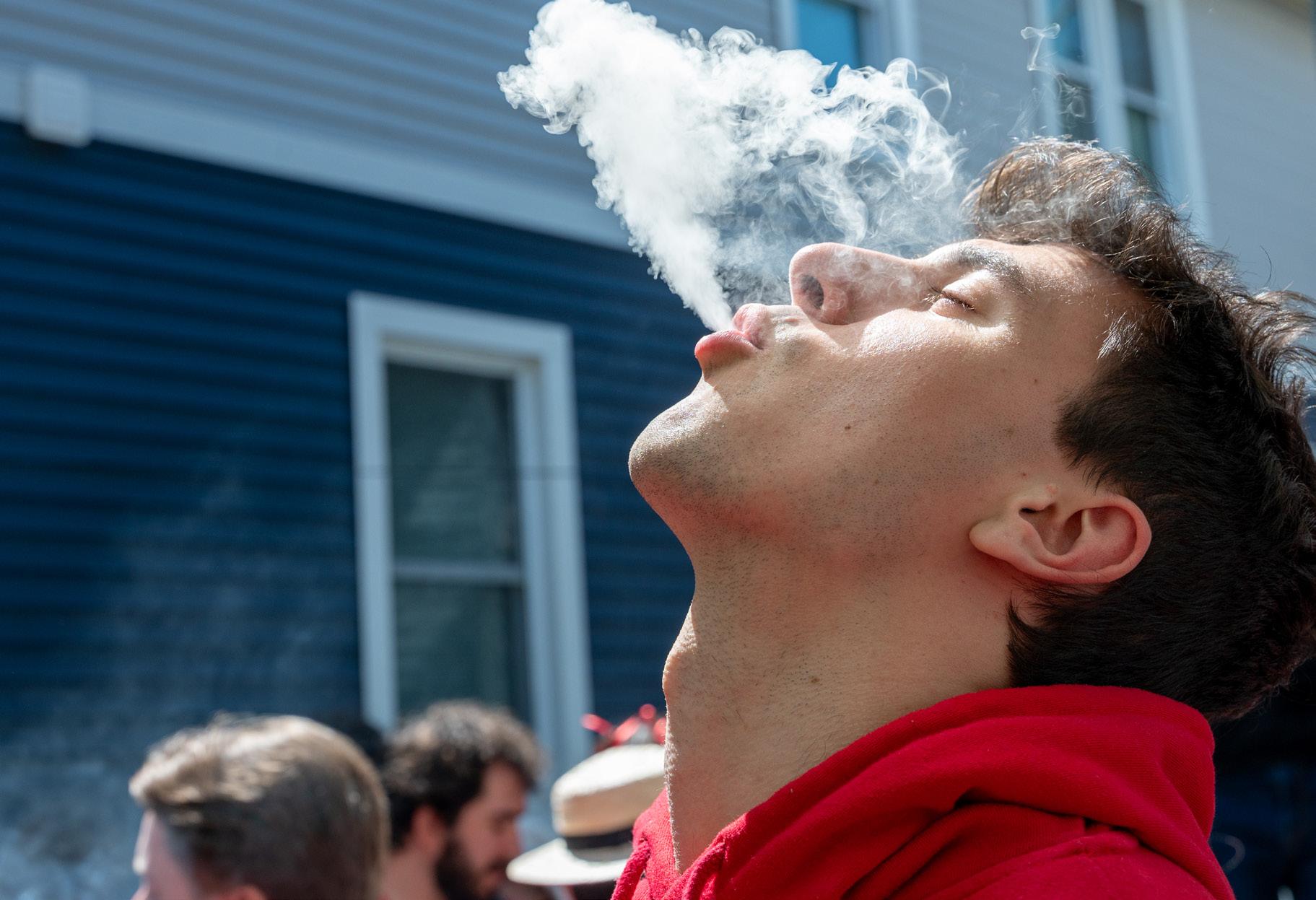
Do drunk cigs count? The resurgence of a nationwide taboo
With smoking back on the rise on college campuses, students and health experts weigh in on the impact of smoking.
By Jake Piper SENIOR STAFF WRITER
With a cigarette gingerly perched between his lips, Gabe Diazmontes, a University of Wisconsin-Madison sophomore, takes a long, hearty drag. “Y’know, I always wanted to be able to smoke like Matthew McConaughey in True Detective,” he said. “Now I finally can.” It’s his third cigarette this week.
Diazmontes, like many UW-Madison students, has started repeating an oft-heard phrase: “It’s just a drunk cigarette. It doesn’t count.”
Semester-by-semester, this phrase seems to become more common on campus. You might have heard your friend say it on a night out, maybe from a stranger looking to bum a smoke, or maybe you’ve even said it yourself.
But coming from a generation raised on smoking awareness campaigns, and a bombardment of pictures and videos of the lived consequences of smoking, where has this resurgence of smoking come from? And more importantly, how bad is one drunk cigarette, really?
One answer to smoking’s resurgence might lie in cigarettes’ comeback on the silver screen. In the past year, TV shows like “The Bear” have brought smoking back to Hollywood. Jermey Allen White, frontrunner of the show, can be seen perpetually sucking in smoke both on and off the screen.
In 2023, 41% of the top grossing movies released contained tobacco use, according to a study by Truth Initiative, a nonprofit dedicated to reduc-
ing the rates of teen smoking.
The study also found smoking depictions in movies increased by up to 70% when compared to 2022.
Jesse Kaye, a scientist at the UW Center for Tobacco Research and Intervention, has noticed the rise in celebrity smoking as of late.
“In the past few years there seems to be an increase in celebrities and media figures smoking again and seeing it as sort of ‘made cool,’” Kaye said.
“And so there is some concern that might increase the likelihood — particularly among young people — that they’re going to smoke.”
With this uptick in smoking, many health professionals like Kaye are concerned about the latent consequences of smoking on younger generations.
According to a study funded by the California Air Resources Board, “relative risks of cigarette smoking were larger for younger and middle-aged individuals than for the elderly.”
The board found “very light active smokers” who consumed three cigarettes or less a day have nearly the same relative risk of heart and lung disease as those who smoked a pack or more a day.
Yet while the health effects of smoking seem apparent to most, a majority of college students either don’t seem to care — or simply brush off — the long-term effects of smoking.
“[Smoking] is a vice, and I enjoy it, but it will still lead to my demise eventually,” Corbin, a UW-Madison sophomore, told the Cardinal, “but it’s better than my liver exploding.”
Corbin, like many other stu-
Winter Carnival Rail Jam brings skiing, snowboarding to Union
By Gabi Marmet & Yael Lechtzin STAFF WRITERS
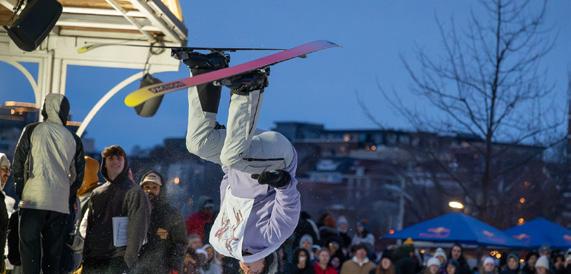
Cloudy and cold conditions didn’t deter competitors at the Wisconsin Union’s Rail Jam from showing off their talent as their skis and snowboards jumped, spun and flipped down a mini terrain park Saturday at the Memorial Union Terrace.
The event, hosted by Hoofers Ski and Snowboard Club, is an annual Winter Carnival fixture, bringing excitement and adrenaline to viewers and competitors alike.
University of WisconsinMadison senior Luke Violich was excited to enter the ski competition, bringing his favorite tricks to the rails — namely, “the Flat Three,” where a skier combines a backflip with a 360-degree horizontal spin.
Violich encouraged junior Connor Kasbohm to compete in the Rail Jam with his snowboard. The two of them traveled every other weekend to local slopes to enhance their skills in preparation for the competition.
Every athlete has different methods of getting themselves in the zone before they attempt new or difficult tricks.
dents interviewed, first started smoking intermittently toward the end of high school before — over time — they gradually started smoking more and more. Now they’ve become daily users.
“90% of people who smoke cigarettes regularly as adults started before the age of 18,” Kaye said.
“It’s addictive. Point blank,” Corbin said. “But I enjoy them, so drunk cigarettes don’t count, and sober cigarettes don’t count either.”
While most interviewees acknowledged their dependence and the harm of cigarettes, they also waxed poetic about the memories and community smoking has given them.
“Y’know, I actually met my girlfriend through smoking,” one UW-Madison junior said. “I mean, yeah, it’s so cool that we connected over something we both love, but now that we’re together, we’ve started smoking so much more.”
On college campuses especially, the prevalence of what Kaye called “triggers” for smoking and relapse like friends, bars or the pressures of academic life, can be a danger for those who want to stay “in line with their long-term goals for their own health.”
Diazmontes finishes his cigarette. The warm, sooty air tumbling upwards into the cold night sky. “When I’m actually drunk, there is something — that charm — about a cigarette,” Diazmontes said. “I know they might be bad for me in the long run, but hey, who cares. Drunk cigarettes don’t count, right?”
“I like to turn on some good music, get my mind right and do some cool stuff,” Violich said. Kasbohm took a different approach. “I like to not think about it and just do it,” he said.
The audience oohed and ahhed as they gathered shoulder to shoulder around the terrace, many even watching from the roof. Many community members attended to support friends and family competing, while others simply came to
enjoy the high-spirited, actionpacked competition.
Nora Zaveri, a UW-Madison junior, returned after enjoying last year’s competition. While her favorite part prior to the competition was the free Red Bull available at the Union, Zaveri expressed her excitement at being able to witness the athletes perform backflips and other impressive tricks.
The competition was not designed for the weak. Throughout the four-hour event, many athletes took a tumble either on the ramp or the rail, with some even losing their skis in the process.
However, none of the competitors let a wipeout get in the way of making another attempt. Their resilience inspired some attendees to consider competing in future years.
Two UW-Madison freshmen, Cooper Johnson and Matthew Plant, attended the Rail Jam for the first time this year. Both are avid skiers and interested in joining the competition next year.
Now that Johnson is aware of the event, he is excited to bring his ski equipment, and his best game to next year’s competition. Plant expressed similar excitement for next year. “I’m not too good on rails. I’m usually better with jumps, but I’d be willing to give it a shot,” Plant said.
The event ran smoothly, providing entertainment to the gathered crowd and an opportunity for skiers and snowboarders to showcase their passion and talent. Community members are already eagerly awaiting watching and participating in the competition next year.
JAKE PIPER/THE DAILY CARDINAL
Badgers back: men’s hockey sweep Fighting Irish, end losing streak sports
By Haellie Opp SENIOR STAFF WRITER
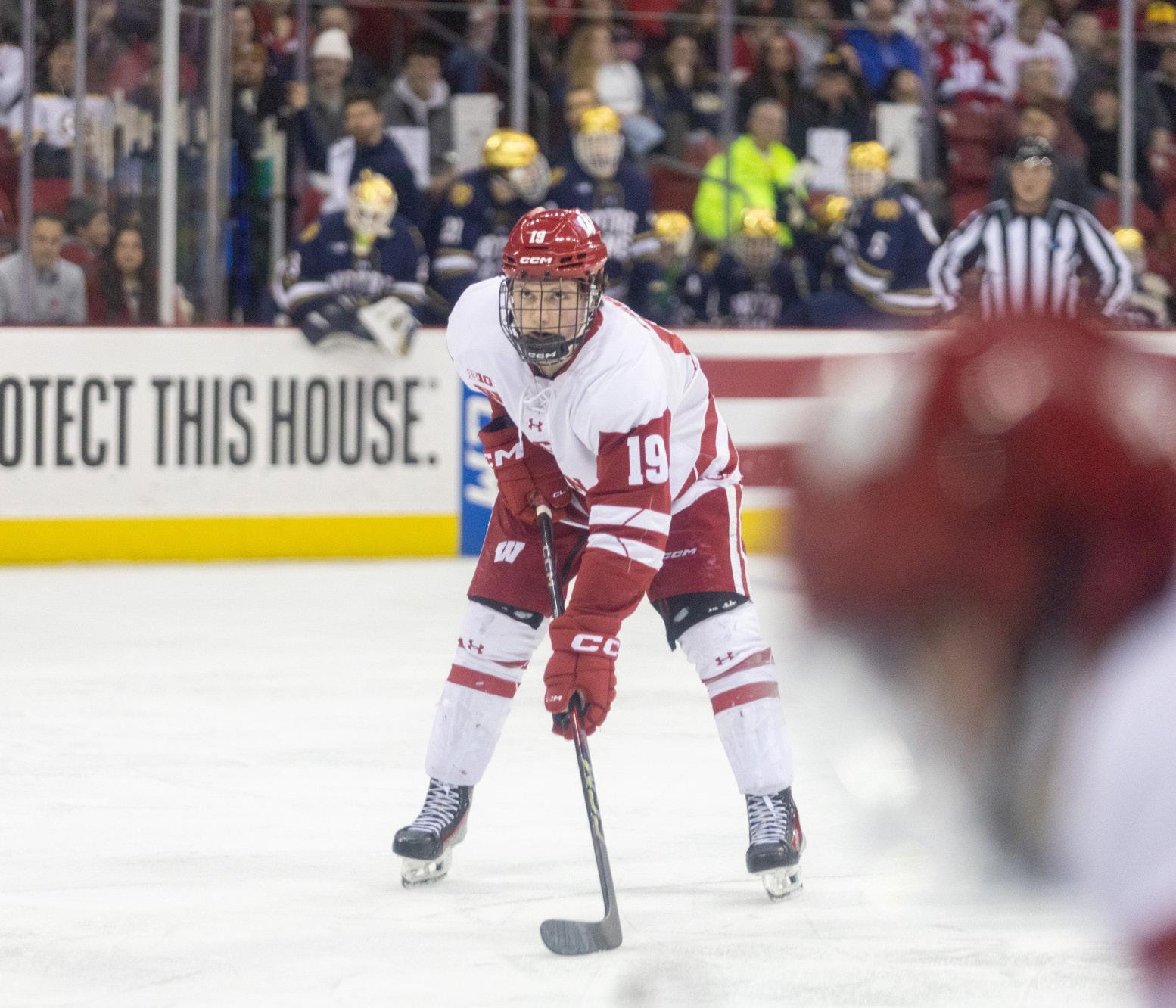
No. 13 Wisconsin men’s hockey (17-9-2, 10-8-0 Big Ten) swept Notre Dame (5-20-3, 1-15-0 Big Ten) in an 11-goal weekend at home, ending their six-game losing streak. Junior forward Quinn Finley scored an electric winning goal in overtime on Friday to snap his goal drought and senior forward Christian Fitzgerald was the difference Saturday, notching his twelfth goal of the season in a 5-4 win.
Freshman shine on Friday
After a rough weekend at Minnesota, freshman goaltender Daniel Hauser went between the pipes for Wisconsin, coming onto the ice with palpable energy. Nicholas Kempf started for Notre Dame on the other end.
Three minutes into the game, the Badgers went on the power play. Just a second before the conclusion of the man-advantage, Badgers freshman defenseman Luke Osburn sniped in the first goal of the game outside the right circle, with assists from freshman forwards Oliver Tulk and Blake Montgomery.
Just 20 seconds later, freshman forward Grady Deering skated into the left circle and grabbed sophomore forward Ryan Botterill’s pass to make the game 2-0.
Notre Dame took a few shots before Tulk was called for hooking at 12:52. The Fighting Irish capitalized 27 seconds later, as Evan Werner put one past Hauser to make the game 2-1.
Two minutes later, the Badgers went back on the power
play with 10:25 to go in the first period. With a helpful jump from senior forward Simon Tassy in front of the net, sophomore forward Gavin Morrissey wristed one in from the left circle to regain the two-goal lead.
Seconds later, Notre Dame won a messy puck battle in front of Wisconsin’s defensive zone. Irish forward Danny Nelson sent a one-timer sailing through Hauser’s glove-side to continue the offensive barrage and cut the Badgers’ lead to 3-2.
Fired up from the close game, Deering notched his second goal of the game with 7:27 remaining in the first. Botteril came out from behind Kempf’s net and passed it to a waiting Deering to widen the Badgers’ lead 4-2.
After Hauser made three saves, Fitzgerald sat two minutes in the box for interference with 1:06 to go. Notre Dame started the second period on the power play, but Wisconsin’s penalty kill kept their two-goal lead.
A slow start to the second period ended when Tulk was assessed a slashing penalty at 16:04, and Notre Dame’s Nelson was assessed unsportsmanlike conduct, leading to four-on-four play.
Hauser held his own in the net before Osburn ripped one in with 9:37 to go in the second. Taking the shot from his knee off a pass from Tulk, Osburn gave the Badgers a 5-2 lead.
Finley had a few shots on Kempf in the dwindling minutes, but Notre Dame ultimately scored with 1:44 to go. Notre Dame’s Cole Brown and Sutter Muzzatti beat the Badgers on a two-on-three with a one-timer to make the game 5-3.
Osburn went back into the box with 24 seconds to go, starting Notre Dame on a power play going into the third period.
Wisconsin’s penalty kill was tested as they killed Osburn’s interference going into the third period and Tulk’s goaltender interference with 15:37 remaining. Werner, who beat Hauser with a stick side slapshot brought the Irish within one with 13:50 to go, making for a tense Kohl Center.
Wisconsin head coach Mike
Hastings pulled Hauser for a delayed penalty at 11:26, but the Badgers couldn’t score on their man-advantage after three shots on Kempf.
Notre Dame then scored on their second attempt of pulling Kempf. With an extra attacker, the Irish tied the game with 1:09 remaining as Werner completed a hat trick to send the game into overtime.
Three-on-three play started slow, with Hauser making two
saves and Kempf grabbing one. But with 3:43 to go in overtime, Finley snapped his goal drought as he faced Kempf alone and beat him stick side. The goal was a sigh of relief for Wisconsin, who was at risk of losing their seventh straight game.
Finley was assessed a 10-minute misconduct when he celebrated his comeback by tossing his stick into the stands as the Badgers swarmed the ice.
Continuereading@dailycardinal.com.
No. 1 Badgers battle No. 2 Buckeyes to weekend split
By Hannah Sarnoff STAFF WRITER
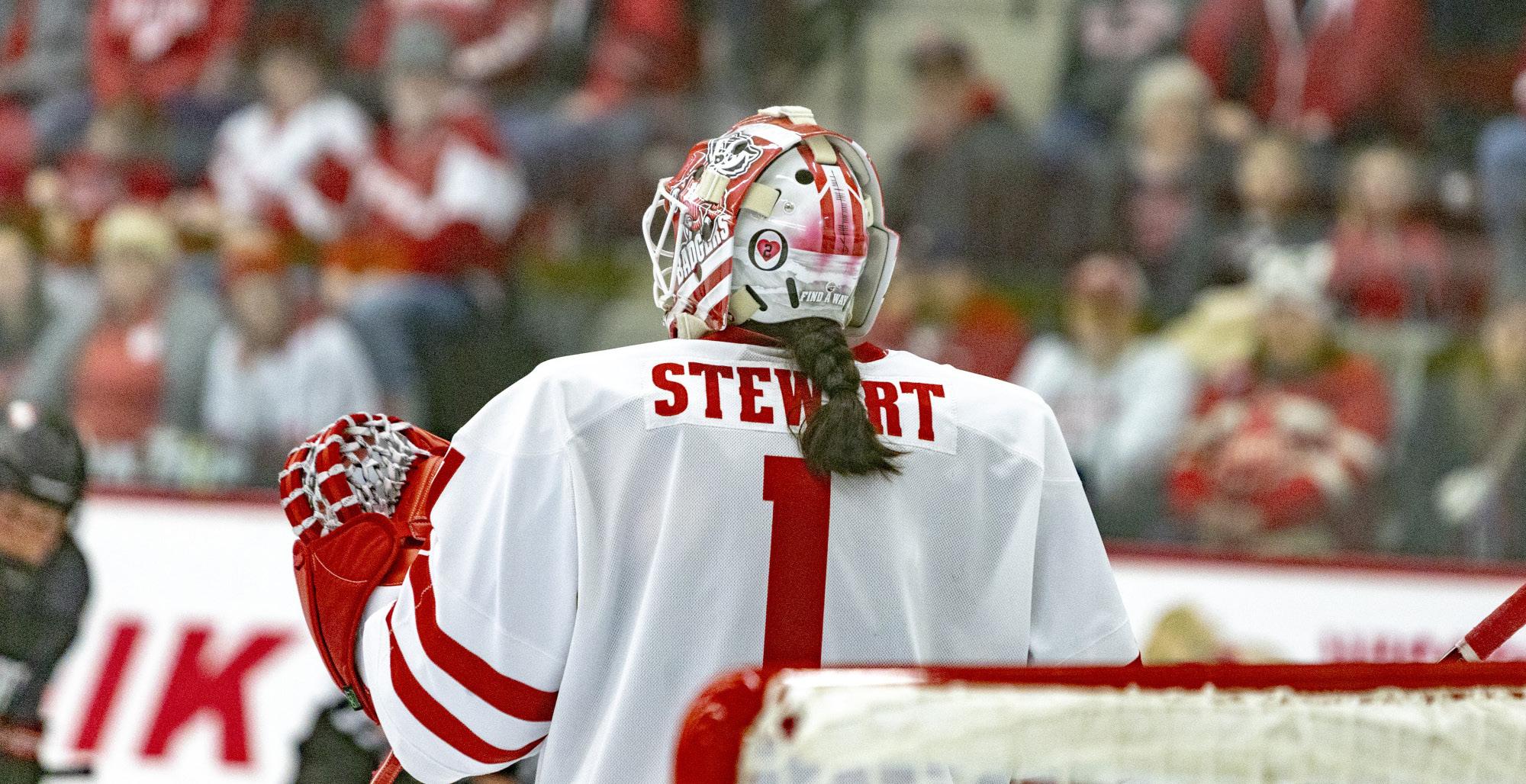
The top-ranked Wisconsin Badgers split their weekend series with the No. 2 Ohio State Buckeyes, falling 4-1 Friday before rebounding with a 4-1 win of their own on Saturday in a top-2 battle in Madison.
Saturday
Fans knew it was going to be a heavyweight weekend within the first 15 seconds, as the Buckeyes immediately tested goalie Rhyah Stewart, who was able to make a glove save.
Soon after, Wisconsin forward Finley McCarthy broke away down the left side but shot just above the crossbar.
With 14:20 to play, Ohio State drove down towards the crease off a line change. This gave Jordyn Petrie a clean shot on Stewart’s stick side, putting the Buckeyes on the board first.
Just halfway into the first period, Hall went on another breakaway, swerved around the Ohio State defense to go on another breakaway, but narrowly missed her shot. The game kept the same fastpaced momentum, but the Badgers were not able to hold the puck in the OSU zone.
Wisconsin captain Lacey Eden was called on a tripping with four minutes left to play in the period. Wisconsin’s
defense pushed Ohio State to the perimeter, using their bodies to block shots. As the penalty wound down, the crease became crowded but Stewart was able to cover the puck. The Badgers killed the penalty completely in their zone.
Ticking down to the end of the period, Wisconsin forward Charlotte Pieckenhagen got called for slashing. With a one man advantage, Buckeyes forward Sloane Matthews was able to slide one in to make the score 2-0 Ohio State at the end of the first period.
The second period began with the same thunder, as Wisconsin received their first advantage in the game after OSU defender Sara Swiderski was called for tripping. The Badgers looked to set up a shot as Hall came in from center and pitched the puck forward, but MacLeod scooped it up. Just after the penalty was killed, McCarthy entered the box for tripping.
The Badgers struggled to keep passes clean throughout the period and turned the puck over in the neutral zone. Halfway through, Wisconsin went on their second power play. The Badgers struggled to set up in its zone, letting the Buckeyes push it out of the blue line.
Seconds after Wisconsin’s power play was killed, the Buckeyes went up on their own power play, as Maggie Scannell was called for tripping. Fighting for the puck,
defender Laney Potter was shoved into the boards. Referees called it a minor, the call went under review for major, but the original call stood.
Both teams were four-on-four, but neither found the back of the net. Even as Wisconsin increased their shots on goal, MacLeod proved to be a wall, controlling the game for the Buckeyes.
Wisconsin’s shooting misfortunes continued four minutes into the third period, as their shots fell just wide.
It was the turnovers in the neutral that really left Wisconsin fighting, putting more pressure on Stewart and tiring out the defense.
The Badgers went on their third power
play with 11:44 left to play, but those two minutes quickly scooted by. Wisconsin was called for having too many players on the ice a few minutes later, resulting in an OSU power play. Buckeyes forward Kassidy Carmichael capitalized on a rebound, giving Stewart no time to block the shot and extending OSU’s lead.
Ohio State was called for a delayed penalty with just under three minutes remaining, and during those critical seconds, defender Ava Murphy slipped a shot inside the post for Wisconsin’s first goal.
The Badgers came to life after the goal, but time was against them, resulting in a 4-1 loss against the Buckeyes.
Continuereading@dailycardinal.com
MADISON TUFFNELL/
Marvel benches usual action in favor of acting in ‘Wonder Man’
In the year of Doom, the Disney+ exclusive introduces a new supe while a fan-favorite makes a return.
By Andrew Holton STAFF WRITER
In a year that will feature iconic characters like Daredevil, Spider-Man, Punisher and the inevitable debut of Dr. Doom, Marvel’s inaugural 2026 hero is none other than Wonder Man.
“Wonder Man,” directed and overseen by Destin Daniel Cretton, is a refreshing take on the superhero genre that puts acting first and the typical action-based plot in the backseat.
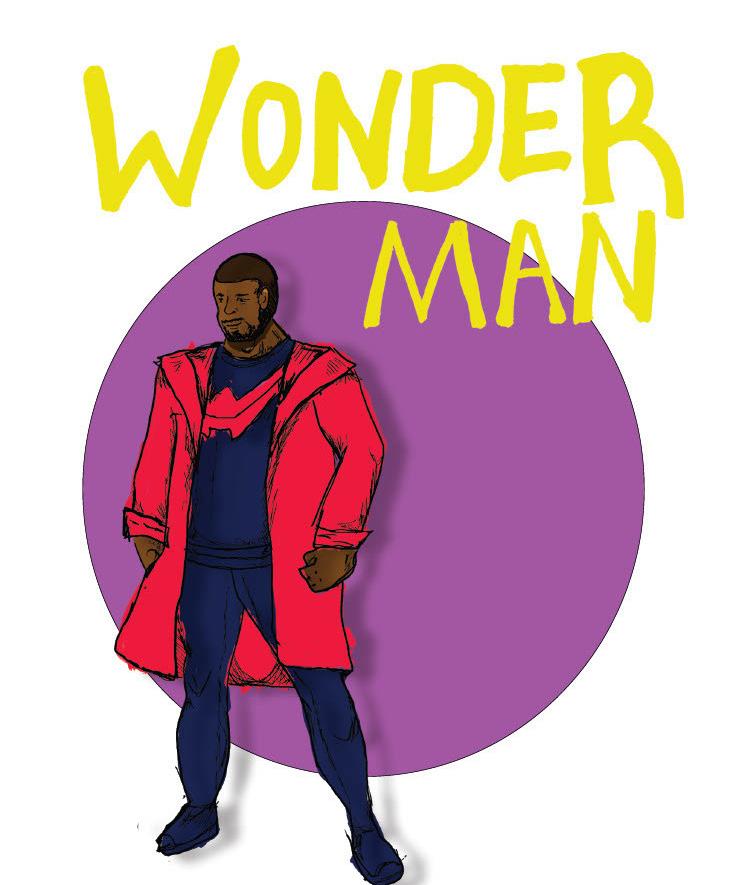
The show follows Simon Williams (Yahya Abdul-Mahteen II), a struggling actor looking for his big break in the cutthroat film industry, when he meets long-time actor and convict Trevor Slattery (Ben Kingsley), who fans will remember from “Iron Man 3” and “Shang-Chi and the Legend of the Ten Rings.” Through Trevor, Simon learns of an audition for a remake of the fictional 1980s film “Wonder Man,” his childhood favorite. Together, the actors set out to be the next Wonder Man and Barnaby.
In addition to Simon’s audition for his dream role as Wonder Man, he must be wary of anyone figuring out he has powers, as super-powered people have been banned from working in Hollywood by the Doorman Clause. Early on, the audience learns Trevor is well aware of Simon’s powers because he cut a deal with the Department of Damage Control to dig up evidence on Simon, who they con-
sider dangerous and unstable.
Abdul-Mateen and Kingsley carry the show with their immediate connection. Kingsley’s role as Slattery showcases his charm and dedication to the art as he mentors AbdulMateen’s lonely, worrisome yet confident Williams. Kingsley, having to weigh the importance of the act within the act, was some of the most genuine acting in recent Marvel history.
Without a doubt, the best performances came from episode six titled “Callback.” Trevor’s ability to erase the doubts Simon had was something special. The eventual payoff when the pair sat in their car, mute and shocked after learning they had gotten the roles, had me hyped.
Comedy-wise, nothing felt corny or too forced and the cameos by Josh Gad and Joe Pantoliano served a real purpose. My favorite bit of humor was Josh Gad guest-starring as himself (or J-Gad if you really know him) in the unique “Doorman” flashback episode where he claims that “Radioactive” by Imagine Dragons is the “most important song of the last three years.”
The risky but well-received “Doorman” episode, which explains how the clause came to fruition, focuses on Demarr “Doorman” Davis’ rise and fall from stardom. Ignoring the implications for Simon’s career, the episode recognizes how eas-
ily Hollywood can fail its actors. After appearing in “Cash Grab” with Josh Gad, Demarr is quickly forgotten by fans. In an attempt to revitalize his career, he joins Gad in filming “Cash Grab 2.” Usually, Demarr’s power is being a human door, but when Gad performs the escape stunt, he doesn’t come out of Demarr, thus causing the ban.
It’s worth mentioning that “Wonder Man” benefits from its lack of connectivity to other Marvel projects, making it more accessible for those who may not be die-hard Marvel fans. There are only two characters who have been in previous works, but watching those is not essential to understanding the plot, and there are some built-in explanations for the two of them.
The most conflicting concept was Simon’s powers. On one side, Simon’s powers are something never seen before in the MCU. His body begins to quake as he becomes stressed and agitated, and his eyes reveal mystic shades of red and purple, releasing powerful bursts of energy and Hulklike strength if not contained. On the other side, there aren’t many scenes where his powers are actually on display. Besides a few times, there are only hints of his power spread throughout the show. The visual design behind his powers was appealing, but the superhero fan in me wanted to see him use
his powers more.
It’s also worth noting that the show was relatively short, with under four hours of run time for eight episodes, and the pacing was slightly confusing. By the final episode, the “Wonder Man” movie is released, even though he just received the part in episode six. There’s another time jump in the finale that could’ve used some sort of indication of time passed as well.
While I’m excited to see what
Dustin Deniel Cretton does with “Spider-Man: Brand New Day” this summer, I hope his crew and the writers can push for a “Wonder Man” season two, as the show left important questions unanswered, like: where does Simon’s power come from? Is he a mutant? Does Wonder Man affect the broader future of the MCU? Will Simon be able to act again after the events of the finale? And where is J-Gad?
MSO’s ‘Harry Potter’ transports audiences to wizarding world
By Cameron Schneider
VIDEO DIRECTOR
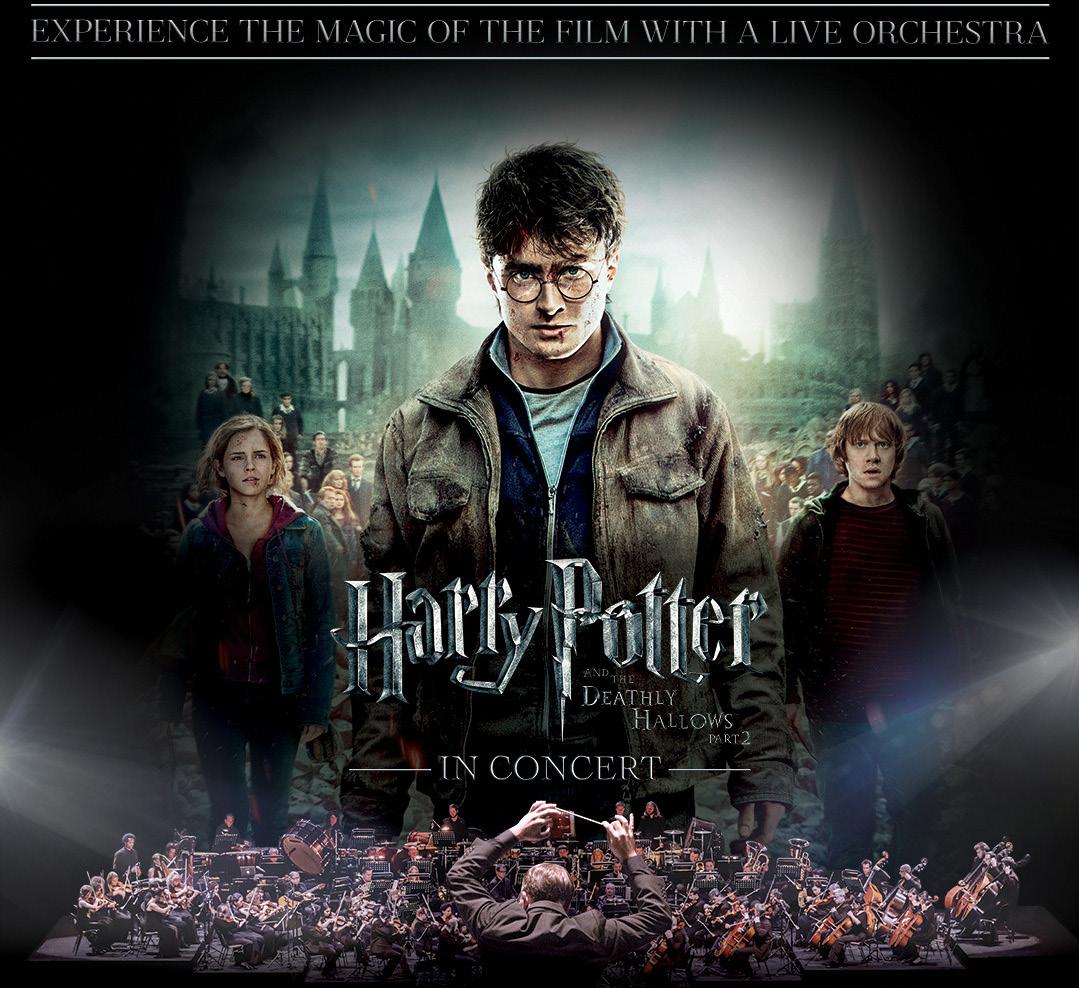
Fans of all ages gathered, on Jan. 31st, to watch the Madison Symphony Orchestra live score “Harry Potter and the Deathly Hallows: Part 2” at Overture Center, transporting viewers to the wizarding world and conjuring up feelings of lost optimism.
The Harry Potter franchise has captivated audiences since 1997 with the release of the first book, “Harry Potter and the
Philosopher’s Stone” (Americans need to get over “Sorcerer’s Stone”). Almost 30 years, seven books, 11 movies, three theme parks and a handful of video games later, the Madison Symphony Orchestra provided a live score of the final film in Harry’s journey at Hogwarts.
The music, composed by Alexander Desplat, is full of leitmotifs, iconic sounds and themes from the entire 8-film franchise. When the film was originally released in
2011, I was never able to watch it in a theater. Seeing the finale of “Harry Potter” on the big screen alone made the experience worth it.
The conductor started the show with a smile, inviting the audience to react and be a part of the film alongside the orchestra. After a short introduction to Harry’s seventh year at Hogwarts, he waved his baton to cast a musical spell, entrancing me for two hours and an intermission.
I was pleasantly surprised by how many scenes were enhanced by a live performance. Smaller-scale scenes like Ollivander reviewing wandlore and Harry’s return to student refugees in the Room of Requirement had more impact with the gusto of the orchestra. Going into the show, there were three moments that I most anticipated being scored by a live orchestra — the fortification of Hogwarts, Snape’s death and the final duel between Harry and Voldemort.
Shortly after McGonagall defeats Snape in a duel in front of the student body, she casts a spell that activates the castle’s forces for defense. She gives a rousing speech, against enchanting violins, to students and faculty to protect the school against Voldemort’s forces. It was enough to inspire me to take up arms with the witches and wizards.
Harry’s final faceoff with Voldemort was carried by eerie strings and bountiful drums. The pulsing strings made me fear Harry was going to die (again!), even though this was my umpteenth time viewing the film. Voldemort’s unnatural magic was made even more unsettling by the orchestra’s cues. I was impressed by how the musicians used their instruments to convey the feeling of flying around the castle. When Harry cast his final disarming spell alongside a timpani drum roll, the entire room held its breath, waiting for the fall of Voldemort.
The best moment came during one of the series’ most iconic scenes. After Snape’s death at the hands of Voldemort, Harry takes his memories to Dumbledore’s Pensieve and witnesses Snape’s perspective of Harry’s life. The reveal of Snape’s history with Harry’s parents — his contempt for Harry’s father, James, and love for Harry’s mother, Lily — and the reveal of his true allegiances after questionable actions, lives on forever in the minds of Potterheads.
The orchestra swelled with “Severus and Lily,” bringing some of the audience to tears. My eyes are glued to the film during other viewings of this scene, but I couldn’t help but be entranced by the MSO’s performance. I almost swore each musician had their eyes closed, performing their part from memory. There were slight timing inconsistencies throughout the show. Some musical cues that needed atomic timing were missed, a downside to the live performance. This often happened during scenes that required complete silence for sudden reveals. However, the emotion conveyed by the musicians vastly overshadowed these inconsistencies.
During the show, I couldn’t help but think of a recent op-ed from British journalist Louise Perry. She attributed Millennial politics to their experiences growing up reading Harry Potter in the 90s. The essay explains a positive worldview that Gen Z no longer identifies with due to years of jaded political events, like being born around the Great Recession and coming-of-age during Donald Trump’s rise to the presidency. When I was asked to take a picture of a family of four with their two boys, holding their wands high and grinning from ear to ear, I couldn’t help but note that this performance of The Deathly Hallows Part 2 brought back that feeling of lost optimism.