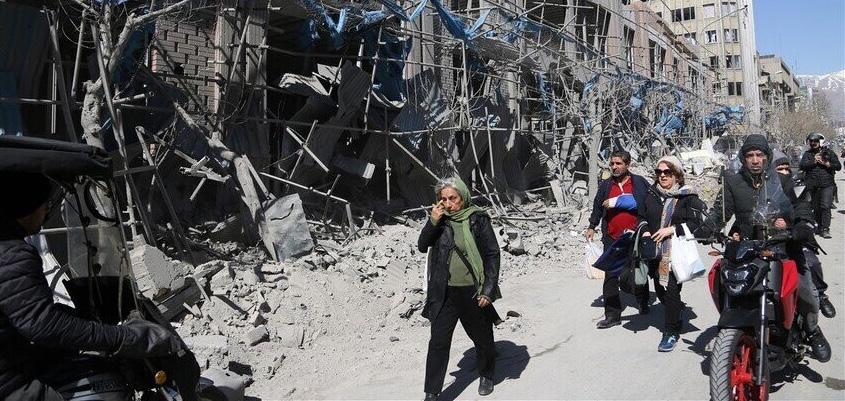
A UW student’s personal account from the night Israel attacked oil depots across Iran.
+ OPINION, PAGE 6
Thursday, April 16, 2026
REPLACING BLACKWELL
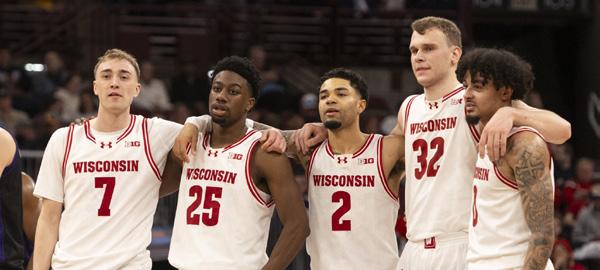
With the star guard leaving town, where do the Badgers go from here?
+ SPORTS, PAGE 4
UW researcher attempts to poison coworker
By Alexa Cattouse SENIOR STAFF WRITER
A University of Wisconsin-Madison lab researcher admitted to adding poisonous chemicals to his coworker’s water bottle and shoes because he was upset the coworker received a promotion and had not been “following rules,” according to court files obtained by The Daily Cardinal.
Makoto Kuroda was arrested Friday for reckless endangerment involving chemicals.
UWPD received a report of chemicals located inside a water bottle and shoes
on April 6. Kuroda’s coworker at the Influenza Research Institute claimed that on April 2, he opened a new plastic water bottle from Trader Joe’s, drank half it and left it out open on his desk. When he returned to his desk on April 4, he noticed a strange odor from his bottle and spat it out after noticing a “chemical taste.”
He reported to UWPD that the odor smelled of chloroform, a colorless liquid that was previously used as an anesthetic during surgery but is no longer used because of its toxicity. The substance is now used to break down other chemical compounds.
The bottle was then collected by the State Lab of Hygiene, and the water residue from the bottle tested positive for chloroform, containing a “high” value.
After admitting what he had done to his coworker, Kuroda was arrested on April 10 on charges of second-degree reckless endangerment safety and held at Dane County’s Public Safety Building Jail.
While being interviewed by UWPD o cers, Kuroda admitted he wanted his coworker to vomit and for his skin to be irritated. Kuroda used a mixture of Paraformaldehyde (PFA) and Trizol in the water bottle and shoes. The Trizol
ROTHMAN REMOVED
Regentscitelackofurgency,transparency
By Annika Bereny CAMPUS NEWS EDITOR
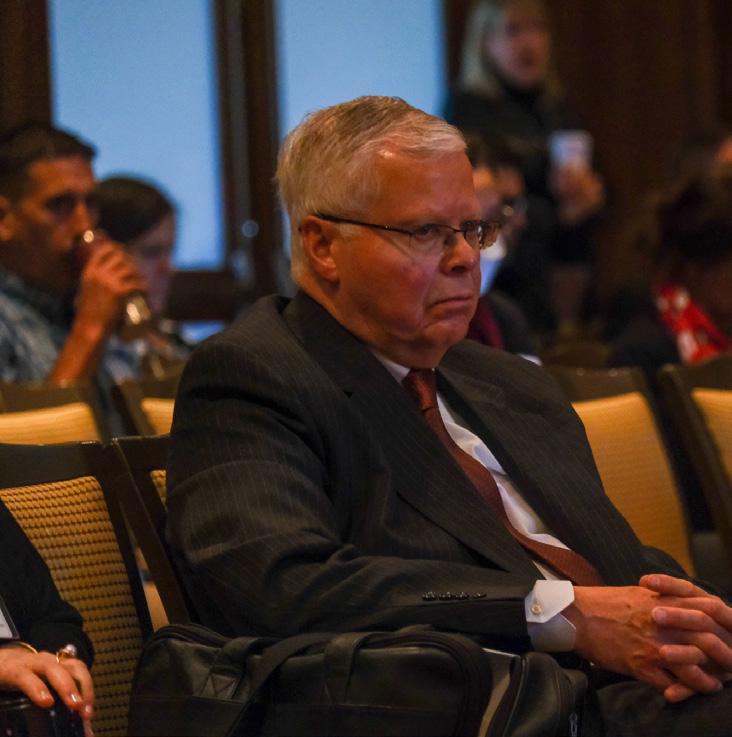
Members of the University of Wisconsin System Board of the Regents told legislators transparency issues, a lagging approach to artificial intelligence and a “top-down” leadership style lead to the decision to unanimously oust system President Jay Rothman.
“[Rothman’s firing] was not political, it was not retaliatory, it was unanimous,” she said. “Boards of regents do not reach 17-0 decisions on a whim.”
Republican senators on the committee criticized the firing, previously labeling it as “secretive maneuvering” and politically charged.
Sen. Patrick Testin, R-Stevens Point, expressed outrage with the firing, calling for retributive firings of unconfirmed Regents.
“Because the Board of Regents decided to remove President Rothman without just cause, I am calling on the Senate to reject every single one of their confirmations,” he wrote in a statement. “As they say, actions have consequences.”
Bogost pushed back, slamming Rothman’s handling of his ouster as “strategic,” “deliberately one-sided” and as causing “real harm” to the UW System.
Bogost and Nixon spoke broadly about the issues with Rothman’s tenure, chiefly Rothman’s sense of urgency around decisions and his reticence to conduct open meetings, but Bogost said personnel matters discussed in closed sessions are confidential and cannot be commented on unless Rothman chooses to waive the confidentiality of the discussion.
Artificial intelligence
One of the clearest reasons Bogost and Nixon gave for parting ways with Rothman was his slow approach to defining and adopting an
artificial intelligence policy across the system.
“We need people that have critical thinking skills, that understand AI,” Bogost said, “because we as humans need to control the machine, not the other way around.”
During the Board of Regents’ February meeting at the University of Wisconsin-Madison, Rothman, having been tasked last November with developing a systemwide approach to AI, presented a 2 hour and 40 minute panel showcasing how various campuses were approaching the subject. The presentation, however, was critiqued by several regents who said it failed to o er actual policy about artificial intelligence.
“I still feel like there is a lack of a cohesive and all-encompassing approach to AI adoption,” Regent Desmond Adongo, one of the two student regents who sit on the board, said at the time. “The concerns that I have continued to raise around the two-tiered educational outcomes based on whether your campus or professor had the opportunity to learn about [AI] and incorporate it still feel unresolved even after seeing all of these great e orts.”
When dealing with pressing issues, such as AI or building new dormitories, Nixon said discussions were sidelined by the system and deemed ‘third-rail’ or too controversial priorities.
“We can ask for anything, but we can’t necessarily write them or do them or move them along,” Nixon said.
“[The Board of Regents] functionally are captives of the UW system administration and the president.”
Looking forward
When Rothman was hired in 2022, the UW System faced a massive structural deficit. In August 2023, 10 of the 13 UW universities
had structural deficits ranging from $600,000 at UW-Superior to $15.1 million at UW-Oshkosh. UW-Stout, UW-Madison and the UW-Stevens Point main campus were the only universities not in a deficit.
In his March 26 letter to Bogost, Rothman highlighted that under his tenure, he had worked with chancellors across the UW System to eliminate structural deficits at all 13 universities two years ahead of schedule.
While the Regents acknowledged Rothman’s leadership in managing budgetary issues, they voiced a desire for a visionary leader who could address evolving issues in higher education like AI.
“In a leader, we want someone to see the future,” Bogost said. “We’re hoping that the next leader can really be transformative, energetic and work with the board closely so we can accomplish more.”
Despite the di culties regents said they experienced with Rothman, when asked by Hutton whether they would do it all again and hire him back in 2022, for both, the answer was yes.
“It was a wise decision at the time,” Bogost said.
mixture used at IRI contains chloroform. Kuroda’s coworker used ChatGPT on his work laptop to ask what would be a harmful amount of PFA and Trizol in humans and animals.
Ingestion of high levels of chloroform for humans can cause an increased risk of liver and kidney function damage. The minimal fatal dose has been reported to be 30mL, although some fatalities have been reported with dosages as low as 10 mL.
Kuroda will now await a preliminary hearing on April 21 at the Dane County Courthouse.
Chairs return to terrace
By Henry Matson STAFF WRITER
The Memorial Union’s famous sunburst chairs returned to the union terrace Wednesday, with a celebration set to signal the start of the Union’s outdoor season for 3 p.m. Friday.
“After a long Wisconsin winter, the return of Terrace season feels like the return of summer, no matter the weather,” Wisconsin Union spokesperson Shauna Breneman told The Daily Cardinal in a statement.
First appearing in the 1920s, the Memorial Union terrace chairs have a long history at the University of Wisconsin-Madison. The iconic sunburst chair design was introduced in 1981 and has been in use ever since.
“The Terrace is a tradition that has brought people together for shared experiences for almost 100 years, whether they’re students, sta , alumni or visitors. A sense of community, rooted in nearly a century of history, is part of what makes this time and this space so meaningful,” Breneman said.
The Union’s terrace serves as a popular gathering space, hosting community events such as movie showings, arts projects and concerts.
Terrace season typically begins in midApril and lasts until late October. Many look forward to the chairs’ return every year as a mark of the end of winter and the return of a common gathering spot.
“I think the tradition of bringing out the chairs is so important, because it’s like the light at the end of the tunnel,” Wisconsin Union President and UW-Madison student Adeline Wood told the Cardinal in a statement. “For those of us on campus, the semester is winding down, the weather is starting to warm up, and the Terrace gives us the opportunity to slow down a bit, sit outside and enjoy the weather, and maybe even get together with some friends to grab a bite to eat.”
Continuereading@dailycardinal.com
LIAM BERAN/THE DAILY CARDINAL
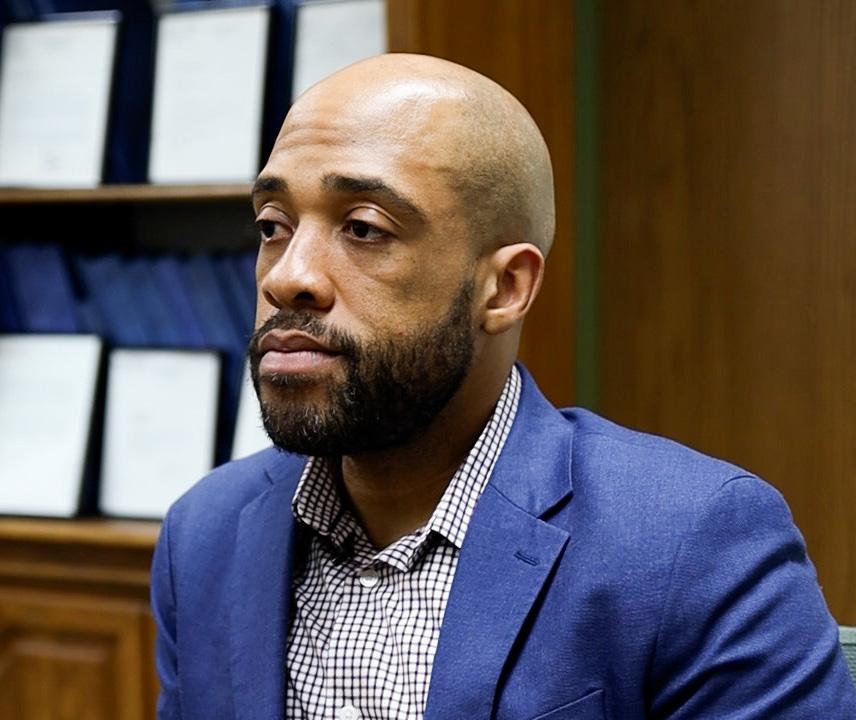
Mandela Barnes talks rising costs, data centers
By Paige Armstrong STAFF WRITER
Democratic gubernatorial candidate Mandela Barnes discussed his affordability, healthcare and artificial intelligence data centers policies while emphasizing the importance of youth voter turnout in an interview with The Daily Cardinal on April 8.
The Milwaukee native previously served in the state Assembly from 2013 to 2017 and as lieutenant governor alongside Gov. Tony Evers from 2019 to 2023. He then ran in the 2022 Senate election but narrowly lost to Republican U.S. Sen. Ron Johnson.
Barnes believes his campaign experience sets him apart, citing his “front row seat” victory in 2018 when he and Evers defeated the “most powerful incumbent in the entire country” — former Gov. Scott Walker — a well-established Republican who briefly ran for president in 2016.
Despite his experience, Barnes is campaigning “as if nobody’s ever heard of [him] before.”
The Democratic primary is wide open. A recent Marquette University Law School poll found state Rep. Francesca Hong, D-Madison, a progressive endorsed by the Democratic Socialists of America, and Mandela Barnes, the only candidates polling above 10%, at 14% and 11%, respectively. But, the poll found that 65% of voters remain undecided.
Republicans, on the other hand, have a clear frontrunner in U.S. Rep.Tom Ti any.
Ti any, who currently represents Wisconsin’s 7th congressional district, received President Donald Trump’s endorsement earlier this year.
As his likely opponent in the general election, Barnes called Ti any “out of touch,” arguing Ti any has “aided and abetted the president every step of the way,” particularly on tari s.
Barnes believes Trump’s tari s hurt family farmers and small businesses across the state, saying they can “no longer pass on costs to consumers.”
A ordability
Freezing utility rates is a key policy for Barnes, who also proposed rate caps to help residents struggling with rising energy bills.
Barnes said “the money we spend on energy has gotten so out of control,” adding that Wisconsin is “so behind a curve when it comes to renewable energy production compared to our Midwest neighbors.”
Experts, however, question the legality of a utility rate freeze. Wisconsin utilities are regulated by the state’s Public Service Commission, which is required by law to approve rates that cover the “just and reasonable cost” of providing service.
Without structured rate-setting, maintenance of system quality and reliability may be at risk.
Connecting rising living costs to wages, Barnes also criticized Wisconsin’s $7.25 minimum wage as “absurd,” arguing that getting more money into the pockets of residents
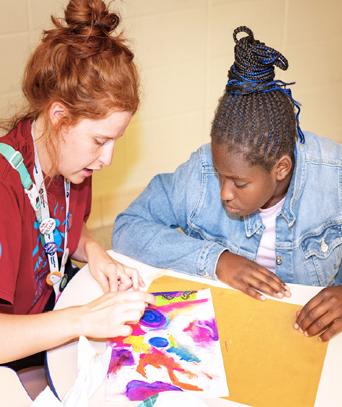
University of WisconsinMadison’s University Health Services is hosting a free art and history gallery this April highlighting campus sexual assault activism over the past 50 years, featuring student-made artwork for Sexual Assault Awareness Month.
The exhibit is open from 9 a.m. to 5 p.m. Monday through Friday on the first floor of 333 East Campus Mall as part of a Connect and Reflect series to raise awareness about sexual violence.
“This is a distinct opportunity to move beyond prevalence statistics to center the all-too-common experience and impact of sexual violence on our campuses,” Molly Caradonna, associate director of survivor services at UHS, told The Daily Cardinal in an email statement.
Student artwork on display includes paintings on canvas, a denim garland and poetry. One art piece depicted a sunflower and its underground roots growing over time. Dozens of students put together the denim garland on Denim Day, April 24, 2024.
A student artist who asked to
will make life more a ordable.
Healthcare
Barnes has pledged to expand BadgerCare, saying the large pool of uninsured people makes it more expensive for everyone else.
As of 2023, approximately 4.9%, or about 282,900 Wisconsin residents, were uninsured, with the national uninsured rate at 8.2% in 2024.
“We’re only one of 10 states that has yet to expand our Medicaid program under the A ordable Care Act. This is 15 years too long,” he said.
Data centers
Throughout his campaign, Barnes said he has encountered “very few” people who are
remain anonymous decided to share their art to the gallery after viewing an online call for submissions. They started their piece during therapy, and the experience allowed them to reflect on trauma and dissociation.
“Art and creativity mean a lot to me,” they told the Cardinal. “I enjoy looking at other people’s artwork and drawing inspira tion from it, and [it] also helps me express myself. Perhaps, I can pass some inspiration on and inspire others, just as I have been inspired.”
They said their sexual assault experience altered their sense of reality, “creating a clear divide between a ‘before and an ‘after.’”
“It felt as though my world had been turned upside down, transforming so much of how I see and understand things, while also leading me to realize how much I had been carrying, often without fully recognizing it,” they said.
excited about data centers, yet recognizes there can be benefits to the state if done right. He called for a study to help understand any negative impacts.
According to a recent poll, 69% of registered voters in Wisconsin believe data centers’ costs outweigh their benefits. Barnes said Wisconsin needs to have a “comprehensive set of standards” surrounding data centers.
Beyond these policies, Barnes said he considers the younger generation vital to his candidacy, pointing to 2022, when Wisconsin led the nation in youth turnout in the November midterms.
“The voice of young people won’t just be reflected in this campaign. It will be reflected through governing,” he said.
The primary election will take place on August 11.
This is the fourth year of the annual exhibit. Caradonna said it has “expanded in scope, engagement and impact each year.”
Continue reading @dailycardinal.com
JONATHAN MINTZ/
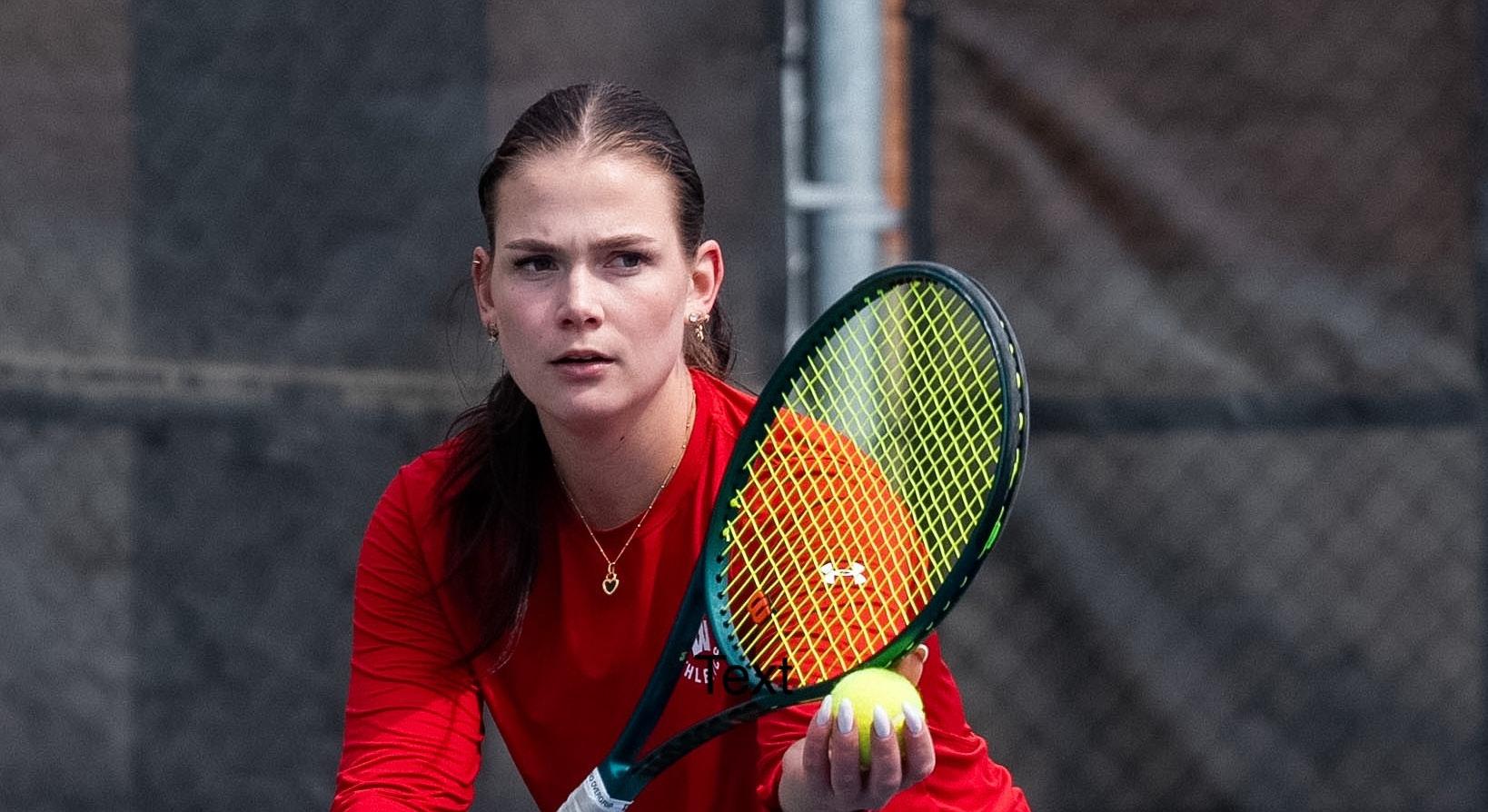
Maria Sholokhova reflects on historymaking Badgers tennis career news
By Iain Chang & Avery Chheda DIGITAL EDITOR & FEATURES EDITOR
Maria Sholokhova’s story didn’t start with a racket in her hand. It began in her mother’s car on the way to gymnastics, where they would pass the same tennis courts every day.
After being told by Russian coaches she was “too tall” for gymnastics, Sholokhova begged her mom to put her in tennis. Eventually her mom relented. Now, 16 years and over 5,000 miles later, Sholokohva, with two Intercollegiate Tennis Association Championships under her belt, is leaving a historic mark on the Badgers’ tennis program.
Before becoming UW’s first tennis player to win the ITA Singles Championship and the university’s first partnership, with Lucie Urbanova, to win the doubles championship, Sholokhova dominated tennis back home in Russia.
Originally from Sochi, a large city sprawling with tennis courts and home to stars like Yevgeny Kafelnikov and Maria Sharapova, Sholokhova was drawn into the sport’s culture. She told The Daily Cardinal her dad was a huge part of her tennis journey.
“He was with me at every practice,” Sholokhova said. “He was driving me to the courts, trying to find players to hit with me. On the financial side of things, he was just trying to work as much as he can [because] tennis is very expensive.”
At 16, she moved to Moscow alone seeking bigger opportunities. Sholokhova spent months
running her own drills and practices. And while dedication and resilience were never an issue, she said the costs associated with high-level tennis were barriers.
“It just got too hard, financially,” Sholokhova said. “I had no coach for [six to eight] months before coming to college, and I had to move back to Sochi.”
Sholokhova was a star for the Russian national team, winning over 30 Russian Tennis Federation titles. But she said the team stopped funding her training in 2022 after the war in Ukraine broke out, limiting progress in the sport in her home country.
Playing in the U.S. allowed Sholokhova to simultaneously pursue an education, an opportunity she did not have in Russia.
“We don’t have any university sports,” Sholokhova said. “You can’t really go to school and be a pro athlete. I [studied] online when I started thinking of coming to the U.S. for college [to avoid] eligibility problems.”
When a former teammate in Sochi and current Badger Alina Mukhortova reached out to Sholokhova, she jumped at the opportunity and arrived in Madison two days before the fall semester started.
While Sholokhova had experience with long work days and living alone, the transition to college in a foreign country brought new changes.
“I practiced every day back home, but mixing both tennis and athletics, I was just shocked by how stressed I was from day one,” Sholokhova
said. “I was crying almost every other day my first semester, but I saw big improvements immediately [as I] got into a system.”
Between morning lifts, practices and a full day of classes and homework, Sholokhova said it was hard to find time for herself. When workloads did get overwhelming, she said UW Athletics o ers student-athletes a variety of academic tutors and advisors. When she can, Sholokhova uses small moments to center her emotions, usually cross-stitching or on video calls with her mother. She also relied on her team to help bring her out of her shell.
“Tennis is such an individual sport,” Sholokhova said. “But coming to college it’s completely di erent. I really love every single girl on my team. Since I got here, they’re all so supportive.”
And while she doesn’t get to visit home often, she gets to keep a little piece of Russia with her on the courts. The Badger’s No. 2 singles player, Ekaterina Ivanova, helps Sholokhova keep the Russian spirit alive, becoming “a big emotional support” for Sholokhova.
Even when the coach who brought Sholokhova to Madison, Kelcey McKenna, stepped down to take up a head coaching position at SMU, Sholokhova knew staying with Wisconsin was the right choice.
Tennis, she told the Cardinal, is as mental as it is physical. “Major crashouts have happened in the past,” she said. “But I would just say I’m
pretty disciplined. I just like to really hold myself accountable.”
Looking back on the moment she made history and became Wisconsin’s first ITA Singles Championship, Sholokhova said the moment was surreal.
“It took me a few weeks to realize how big of an achievement that was, because that was the first time I played the tournament,” Sholokhova said. The year prior, Sholokhova was knocked out in the first round of qualifiers, and two years prior, the first round of pre-qualifying.
“Maybe since I didn’t have any expectations, or, like, I wasn’t putting any pressure on myself, I just played really well throughout that week,” Sholokhova said, “It just felt amazing, like all the work that I’ve been putting in throughout the years [paid o ].”
Other parts of college life surprised Sholokhova in a different way. Her first Badger tailgate introduced Sholokhova to
American football, and she said her first night at Camp Randall “felt like the movies.”
After graduating, Sholokhova knows exactly what she wants to do next. She said while receiving a college education was an important part of playing tennis in the United States, she said she’s hoping to obtain a P-1A visa to stay in the county and play tennis professionally.
“I don’t really see myself working in the o ce,” she said. “I don’t think I’ll do [well] or be happy doing that right now.”
After moving overseas, attending a top-ranked university in a new place and years of playing high-level sports, Sholokhova would hardly change a thing about her journey.
“Maybe I would start thinking of college a little earlier, go on visits, but it wasn’t really possible,” Sholokhova said. “I feel like I’ve done everything I could.”
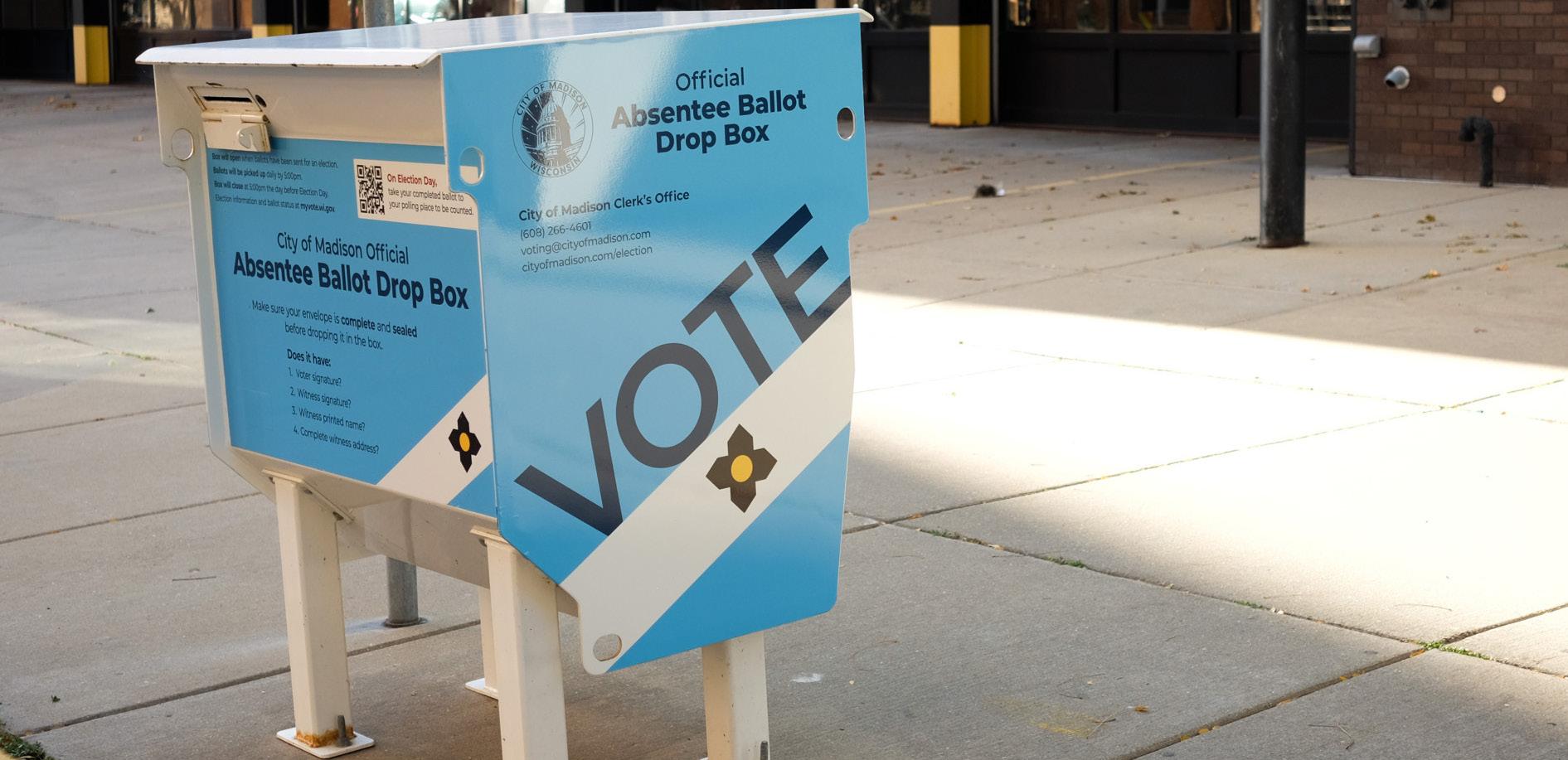
Madison updates absentee ballot process after failing to count 193 votes in 2024
By Jane Dardik
SENIOR STAFF WRITER
After 193 ballots went uncounted in 2 024, new Madison Clerk Lydia McComas told The Daily Cardinal the city reimagined its absentee ballot procedure ahead of this year’s spring elections.
McComas was appointed Madison Municipal Clerk in September 2025 after former Clerk Maribeth Witzel-Behl resigned in April 2025 amid fallout from the city’s failure to count 193 absentee ballots in November 2024. Now, McComas said she is working to rebuild trust with Madison voters.
In a July 2025 investigation, the Wisconsin Election Commission found the City Clerk’s o ce to have “a complete lack of leadership” and an “astonishing lack of action.”
“[Witzel-Behl] demonstrated no urgency, let alone interest, in including those votes in the election tally,” the investigation said. “These ballots were treated as unimportant and a reconciliation nuisance, rather than as the essential part of our democracy they represent.”
Eight voters filed a lawsuit in September 2025 against the city for the miscount, seeking $175,000. The city initially cited Wisconsin law calling absentee voting a “privilege” in the lawsuit. However, the same law also says “[absentee ballots] shall be construed as mandatory.”
Gov. Tony Evers released an amicus brief in January 2026 stating all Wisconsin voters have the right to have their vote counted no matter which way they submit their ballot.
Madison Mayor Rhodes-Conway said she does not believe it sets a good precedent for citizens to sue their government for “human error” in a January 2026 interview with Channel 3000 News.
The lawsuit has not yet been decided, but
Rhodes-Conway said in the interview she does not plan to contest the judge’s ruling, whatever it may be.
McComas said restoring public trust has been central to her work since her appointment.
“When the elections o ce makes a mistake, it’s concerning and it’s really important that clerks’ o ces and election o ces are transparent,” McComas said. “Your vote matters and we take that very seriously.”
According to McComas, the clerk’s o ce implemented several new procedures during the February and April 2026 elections, including more detailed instruction manuals for chief inspectors, staggered ballot courier schedules and in-person reconciliation of absentee ballot totals to catch missing ballots or technical errors before final counts are certified.
These changes were suggested by the WEC in their investigation, and McComas told the Cardinal she is open to guidance from the group with any future issues.
The o ce also hired 200 new election ocials and expanded training e orts ahead of the
spring election cycle.
With the February and April elections, the o ce had a quick turnaround, but McComas said the clerk’s o ce was well prepared. She also said the sta was excited about the changes made and more confident in the elections overall compared to previous years.
“We’ve gotten positive feedback from chief inspectors,” McComas said. “I’m confident our processes are accurate and voters can trust us to make sure their votes count.”
Also, absentee ballots are now only sent to polling places on election day, whereas in past elections, absentee ballots were sent weeks beforehand and could easily be misplaced, according to McComas.
Chief inspectors are now provided with electronic spreadsheets detailing the expected number of absentee ballots at each location before polls open.
McComas has overseen two elections since her appointment — in February and April — both of which she believes went better than previous elections.
During the February election, the o ce was still responding to the WEC order and changing Madison election processes to ensure there would be no more lost absentee ballots, McComas said.
The April election had higher voter turnout and more scrutiny than February, according to McComas.
McComas said the success of the department is also due to logistical support from other city agencies like the mayor’s o ce. There are 109 polling places and 39 in person absentee voting locations in Madison where the clerk’s o ce had to hire a moving company for polling supplies, McComas told the Cardinal.
Looking ahead to the August election, McComas said the o ce’s primary focus will be improving communication with student voters who may be away from Madison during the summer.
“The main thing is making sure students know how to vote absentee,” she said.
Out-of-state students who plan to vote in the August primary election in Madison can go to My Vote Wisconsin and request an absentee ballot. Badgers Vote helps students with their absentee votes and suggests requesting them two weeks in advance for elections.
Many University of WisconsinMadison students choose to register in Wisconsin due to its swing state status.
“UW-Madison consistently boasts among the highest student voter turnout in the nation, even in non-presidential election cycles,” The Wall Street Journal originally reported.
When asked whether she feels absentee voting is a right or a privilege, McComas said, “Any way that a voter votes, their vote should be counted. I value all votes the same. If you vote absentee, if you vote in person, your vote should be counted by my office.”
COURTESY OF MICHAEL O’CONNOR
COURTESY OF CHARLIE BOURDO
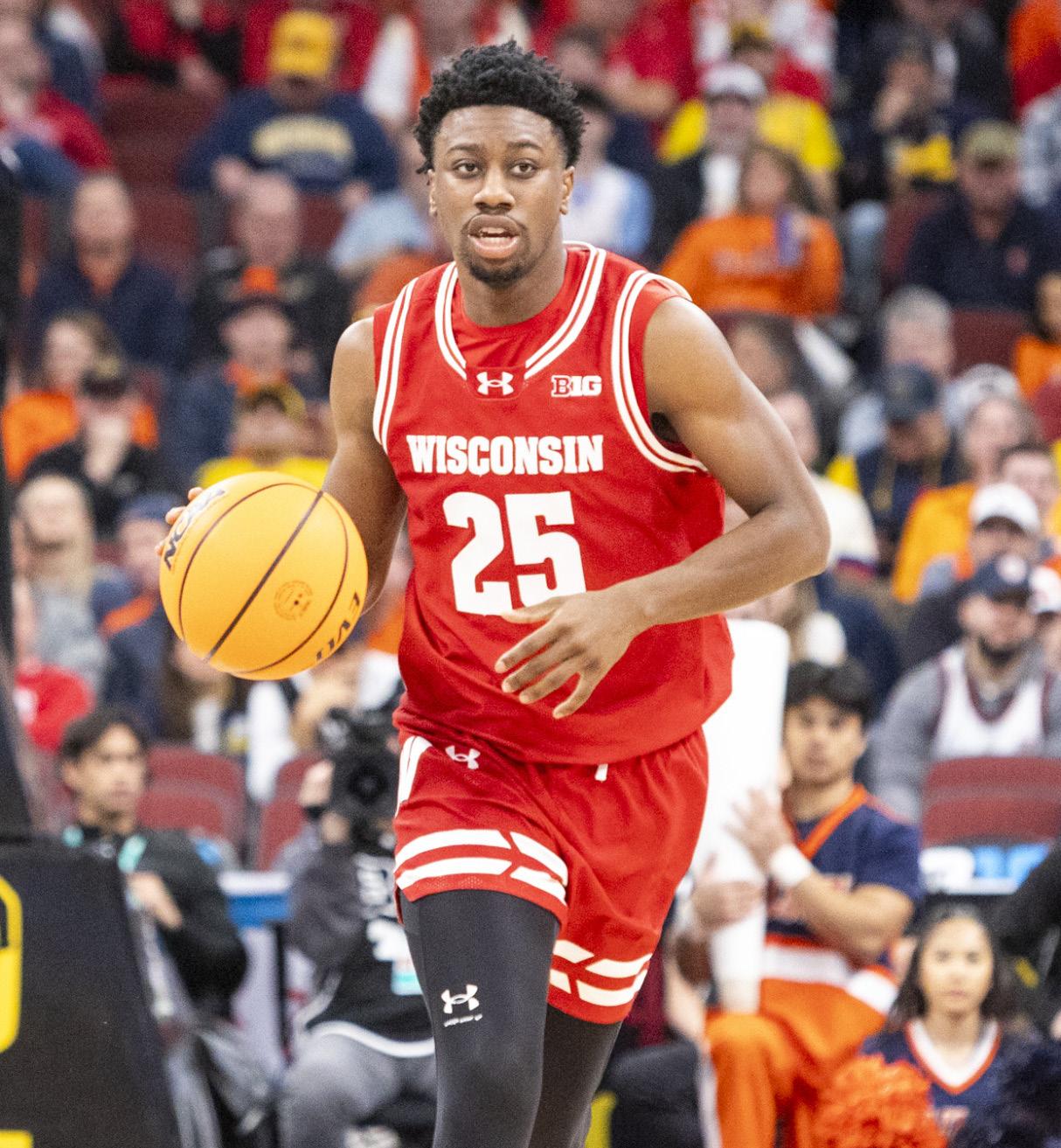
Column: Blackwell leaves Badgers with more questions than answers sports
By Josh Murphy and Ryland Doolittle SENIOR STAFF WRITER & STAFF WRITER
“I’m going to be a Badger for life,” Wisconsin third team AllAmerican guard John Blackwell said last o season. “I want to be remembered as a legend here. I want to be remembered as a guy who stuck around.”
A year removed from that quote, Blackwell said goodbye to Wisconsin, announcing on Monday that he will enter the NCAA transfer portal while testing NBA draft waters.
In his junior season, Blackwell improved in almost all categories. He averaged 19.1 points per game this season, up from his 15.8 last year, while improving his 3-point percentage by over six percentage points to 38.9%.
Throughout the season, transfer guard Nick Boyd took on the role as Wisconsin’s leading ballhandler, but Blackwell still accumulated five games in which he scored 30 or more points, while finishing with at least 20 points in 16 games.
After his sustained success, why the change of heart? Maybe back-to-back gutwrenching defeats in the NCAA Tournament left a bad taste in his mouth? Maybe Blackwell thinks he must leave Wisconsin in order to fulfill his desire of winning a national championship? Maybe the money he could be earning elsewhere — potentially $4 million or more — was simply too good of an o er to pass on? Maybe it’s a combination of the three?
The situation leaves a bitter taste in the mouth of Wisconsin fans, and is an indication of the current place Wisconsin’s basketball program finds itself in during
a turbulent era in college athletics.
“It’s hard for me to accept that we can’t hold people down that literally in interviews last year said Wisconsin’s their home and they want to stay here,”
UW-Madison freshman Carter Bosanec told the Daily Cardinal.
Blackwell, a cornerstone player for Wisconsin over the course of multiple years, was part of a dying breed of college basketball players that have grown from a bench contributor to team leader all at the same school. The fact that a player like him is leaving is a sign that Wisconsin may not have the NIL resources that top schools offer.
“From a player’s perspective, a lot of these players are here so that they can develop and step to the next level,” Bosanec said. “So if they are seeing that they can make this much money while developing, I would, if I was them.”
Regardless of Blackwell’s reason for departing Madison, Wisconsin must march on and retool their roster in the offseason. Blackwell’s departure, along with the graduations of Nick Boyd, Andrew Rohde and Braeden Carrington, leave the Badgers with eight open roster positions to fill, including their three starting guards from last season.
This level of roster turnover raises a lot of intrigue and questions surrounding the team heading into next season.
Will Wisconsin retain Nolan Winter?
Losing Blackwell to the portal is bad enough. Losing Nolan
Winter alongside him would mark a catastrophe for Wisconsin’s 2026-27 roster outlook.
Winter, who led the Badgers in rebounds and was Wisconsin’s third-leading scorer, arrived at Wisconsin in the 2023-24 season and has been a key contributor each of the past two years. He’s one of the few remaining homegrown talents for the Badgers and possesses plenty of pride for Wisconsin’s program.
“I know what it means for us to wear Wisconsin across our chest,” Winter said through tears following an overtime loss to Villanova during the regular season.
Luckily for the Badgers, it seems more likely than not that he will be back in Madison for his senior season. Following Wisconsin’s loss to High Point in the NCAA Tournament, Winter told reporters he was trying to “live minute-by-minute soak this all in” when asked about his future, but “obviously I want to be back here.”
While this is a good sign and fans should rightfully be optimistic, you can never be too comfortable in the current landscape. Blackwell’s statements from last season, and his current situation, is a prime example.
The Badgers have already lost four of their top six leading scorers from the 2025-26 season, and losing Winter would leave Wisconsin without each of its top four scorers from this past year. Simply put, the Badgers cannot a ord to let that happen.
Who will be Greg Gard’s next transfer portal gem?
Head coach Greg Gard deserves his flowers for the work he’s done these past few o seasons in the transfer portal. Bringing in AJ Storr, John Tonje and Boyd in three consecutive years is truly sensational work. If Gard can find another diamond in the rough this oseason, the Badgers could get right back to business.
Tonje and Boyd were one in the same in that they were dynamic guards entering their final year of eligibility. Tonje became an instant program legend, earning unanimous first team All-Big Ten and second team All-American honors. He also set program records for free throws made (231) and free
throw percentage (.909).
Boyd had massive positive ramifications on the offense last season as well, but with a different style than Tonje. His ability to run the offense with efficiency and speed led to incredible production, and he became the first Badger to average more than 20 points per game in a season in more than 30 years.
Storr came in as a sophomore and was named second team All-Big Ten, leading the team in points scored in 2023-24. He transferred to Kansas the ensuing offseason for a reported $1 million in NIL money.
Continue reading @dailycardinal.com
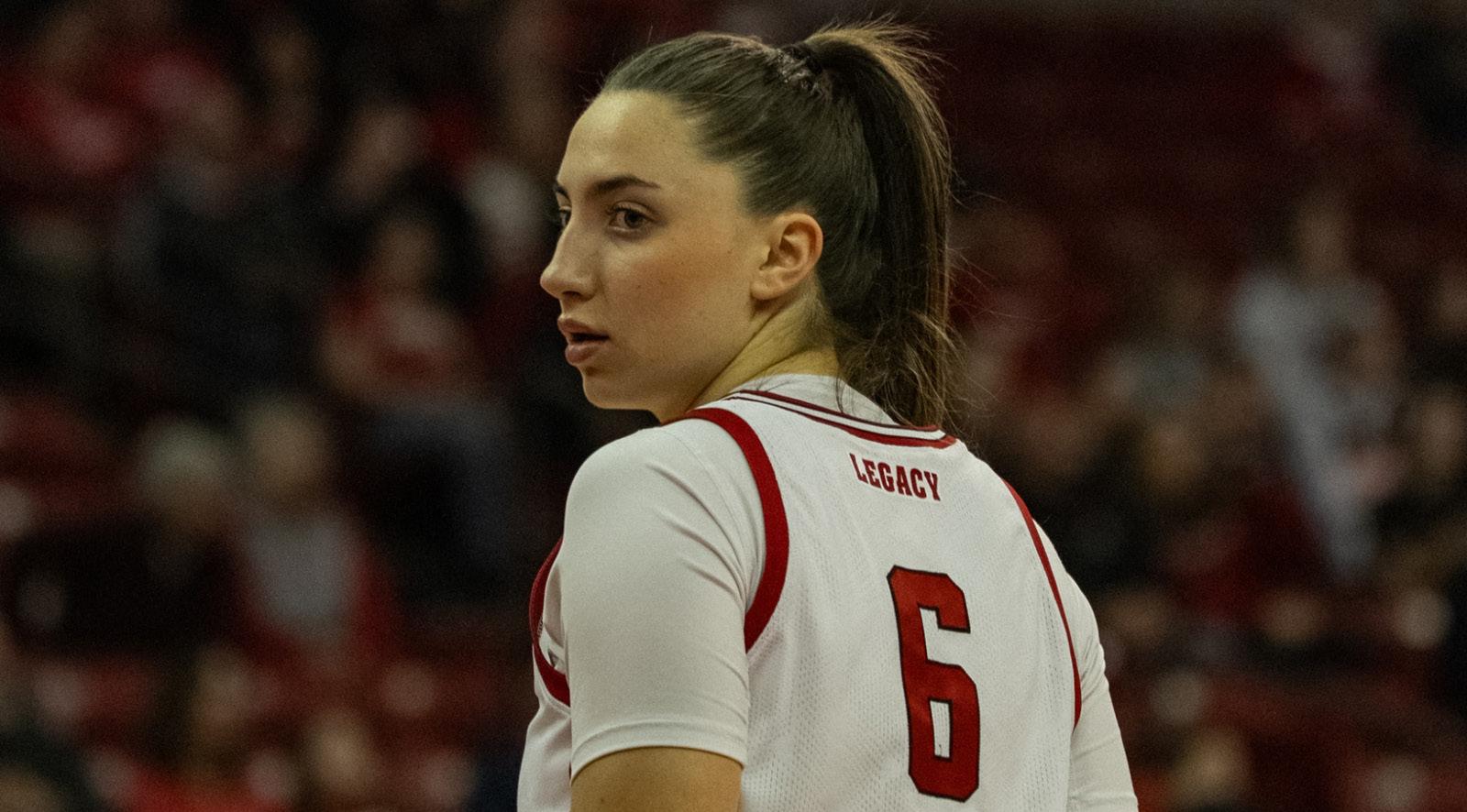
Badger basketball’s Dorja Zaja talks European beginnings, overcoming adversity
By Luca Muehlbauer
SENIOR STAFF WRITER
Heading into the start of the 2025-26 season, Dorja Zaja was relatively unknown in the minds of Badger fans. After all, Zaja was the last addition to the roster in a busy offseason for Wisconsin women’s basketball. The hiring of head coach Robin Pingeton from Missouri took the program in a new direction, alongside the acquisitions of Destiny Howell and Gift Uchenna through the transfer portal.
But by the end of Pingeton’s first year the 22-year-old Croatian center emerged as a key piece for the Badgers moving forward. Zaja’s humble beginnings in Europe prepared her for the ups and downs of college basketball, which Wisconsin certainly faced throughout the season. With three years of eligibility remaining, Zaja is excited about her future at Wisconsin.
“I hope to make this team better — become a leader that’s gonna help our program get to an even better level than it is now,” Zaja told The Daily Cardinal.
Born in Zagreb, Croatia, Zaja started playing basketball because of her sister. Growing up with a big family, it drove a hunger to compete and her love for team oriented sports. Basketball
was a perfect match.
“I played in a tournament when I was 12. I won MVP, and I was like, I love this, this feels so good,” Zaja said.
By the age of 12, Zaja was already playing for the U-14 Croatian national team. She received her first senior national team selection before even becoming a legal adult, playing in her debut at just 17-years-old.
Zaja gained valuable experience from a wide array of national team tournaments
in her early career. She played in the FIBA U-16 Women’s European Championship, averaging 6.7 points in 2018 and 14.6 points along with 12.4 rebounds in 2019.
She also played in the 2021 FIBA U-18 Women’s European Challengers and in Division B of the 2022 FIBA U-18 Women’s European Championship. In the 2022 FIBA European Championship, she averaged a double-double with 14.3 points and 10.3 rebounds, putting her sixth in scoring and third in rebounding
in the tournament.
As she turned 18, coming off major success in Europe, Zaja didn’t have any intention of playing for an American university. Instead, she went to London with the goal of signing her first professional contract. But after months of contractual and Visa issues, she was forced to leave. Fortunately for Zaja, she found a team in a little town called Sopron in Hungary, making it her home for the next year.
“It’s a small team, but they’re really good. They played in the EuroLeague, and they’re the best team in Hungary,” Zaja said.
She left Hungary after sustaining an injury and found herself back in Croatia.
Zaja played for Tresnjevka 2009 W in the Croatian Premier League, the country’s top basketball league. Tresnjevka 2009 W was able to qualify for the playoff phase, where Zaja was a fundamental piece for the squad.
During her time in Croatia, Zaja competed against some of the best talent in her country.
“I played at home for a year, and then I didn’t know where I was gonna go, go back and play in Europe somewhere or come to the U.S.,” Zaja said.
Continuereading@dailycardinal.com
JONATHAN MINTZ/THE DAILY CARDINAL
MICHAEL O’CONNOR/THE DAILY CARDINAL
MSO’s ‘Indiana Jones’ makes history cool again
By Cameron Schneider VIDEO DIRECTOR
Fans of all ages gathered to watch the Madison Symphony Orchestra live score “Indiana Jones and the Raiders of the Lost Ark” at Overture Center on March 28, inviting viewers on an adventure with the film’s famed archeologist.
“Indiana Jones and the Raiders of the Lost Ark” is arguably the most beloved Indy adventure. The movie wastes no time putting viewers in the middle of the action, guided by hunky Harrison Ford as an experienced globetrotter who isn’t afraid to get his hands dirty. As this academic searches for a biblical MacGu n, beats up Nazis and finds love in an old flame, the orchestra sucked me in for every second.
For most of the film, I forgot the orchestra was there. It was almost perfectly synced with the picture. If there were any accidents, I didn’t notice, because the older film allowed for more imperfections. This was a good thing, especially in an era where computers are attempting to make everything perfect. It was nice to see human e ort, and sometimes error, add to the experience.
I had a cathartic reaction watching the film this year. World politics play a factor in the plot as Indy races against Nazis to find The Ark, but academic collaboration takes a front seat. Jones is as comfortable in a classroom as he makes a fool of fascists.
There is always room for Indiana Jones in our lives. The films are classic Americana. There are clear good guys and bad guys. Education is held above pride and rewards. Even though Jones physically triumphs over tombs, snakes and Nazis, his brain and knack for history carry him through the adventure.
As fascism echoes through the American psyche today, Indiana Jones is a reminder that the American ideal is rooted in camaraderie. Jones shows what travelling the world should
‘Paradise’
look like — meeting locals and sharing a meal. He provides the blueprint for joining forces with those who may not look like us, all while having a triumphant score accompany him as he rides into the sunset.
The timeless score, written by John Williams, replayed in my head even as I left the theater. Interestingly enough, the notes closely associated with Indiana Jones are barely featured throughout the film. The majority of the score is musical cues to let the audience in on the character’s emotional beats and moments. With a live orchestra, these small character moments stood out more. It was almost as if the conductor was letting us take a peek into the minds of Marion Ravenwood (Karen Allen) and Indy (Ford).
The orchestra was able to convey that a movie score is not meant to stand on its own, but instead supports the narrative. There may be songs I remember and listen to while studying, but I only enjoy those songs because of the narrative moments they support. The music was guiding the audience like a séance, allowing us to get wrapped up in the escapades of Indiana Jones.
The music made every victory feel important. Even when the odds seemed against him, Jones used his knowledge and charm to get out of a bind. It was inspiring to see someone push back against a global superpower using his own talents. Every punch and every discovery felt like a win when punctuated with a staccato from the orchestra.
The music served as the film’s narrator. Each note and medley was so dynamic that it felt intertwined with the film. The fact the orchestra was performing separately was even more impressive. Almost every cue, I heard a new instrument, from a xylophone during chase or a horn during explosions.
Of course, the stand-out moments were when the famous Indiana Jones theme was fully unleashed. It was restrained for most of the film, allowing these beats to fill the auditorium when they arrived. Just the physical work of the violins and horns playing the song made the orchestra look like it was on a pulp adventure of its own. It was as flashy as the onscreen action.
Season 2 values character development
above all
The Hulu show’s sophomore season, starring Sterling K. Brown, takes the series in a new direction.
By Andrew Holton STAFF WRITER
The final episode of “This Is Us” premiered on May 24 2022. As the credits rolled for the series conclusion, it left me with the irreplaceable, blank feeling of departing with the beloved characters and their stories.
Three years later, “This Is Us” writer and creator Dan Fogelman released “Paradise.” The show felt like the perfect match for someone missing that emotional, six-season rollercoaster.
When a supervolcano under the Antarctic ice sheet activates, head Secret Service agent Xavier Collins (Sterling K. Brown) evacuated President Cal Bradford (James Marsden), his two children and 25,000 hand-picked people to a city-sized bunker in the Colorado mountains. After Bradford’s assassination in episode one, Xavier must uncover the corruption and truth behind his friend’s death. Season 1’s finale revealed that the killer wasn’t from inside the bunker and that Collins’ wife Teri (Enuka Okuma) and others had survived the disaster.
This season expanded the setting beyond the bunker, which made inter -
twining scenes inside and outside the bunker necessary. Outside the bunker, Xavier searches for Teri after he successfully opened the hangar doors in the bunker and escaped by plane to the post-apocalyptic outer world. Inside the bunker, the morally gray Samantha Redomond (Julianne Nicholson), codenamed Sinatra, is dealing with rising tensions in an unstable government and threats from a resistance group outside of the bunker led by a scientist named Link (Thomas Doherty).
Brown, a “This Is Us” veteran himself, and Nicholson remained the driving forces behind the series. Brown’s ability to play a husband determined to reunite his family and Nicholson’s calm and calculated Sinatra work as a great contrast between each other.
“Paradise” takes another highlight of this season straight from “This Is Us.” This season continued the use of flashbacks, woven into the story to drive the character development and explain why a character acts a certain way. The flashbacks always connect through a small detail or character to the current situation. My favorite flashback scenes were learning how Xavier and Teri first met in a hospital and discovering the psychopathic
Agent Jane Driscoll’s (Nicole Brydon Bloom) upbringing.
Although not as present in this season, Marsden’s performance is one of my favorite aspects of the show because he is exclusively in flashbacks. Bradford’s lack of intelligence, paired with his charm and humanity, makes for a refreshing but alarming take on what a president can be.
The first episode titled “Graceland” centers around a failed doctor turned tour guide named Annie, who survived the disaster by living in Elvis Presley’s Graceland Mansion. It comes off as a waste when, in episode three, Annie dies after giving birth. Usually, when an episode was centered on a person who had a meaningful impact like the episodes titled “The Mailman” and “Jane”, it made for an intriguing story. Using an entire episode for someone who dies before the halfway point of a season is disappointing, especially when there’s only eight episodes.
However, Siddharta Khosla’s score for “Paradise” did not disappoint. Khosla, who also wrote the “This Is Us” soundtrack, stuck with Season 1’s soothing theme that advances with the emotionally driven plot. Unfortunately,
I disliked the actual songs used. This season featured covers of songs like “The Final Countdown” by Europe and “Hound Dog” by Elvis Presley. It reminded me of using a slowed down version of a popular song in a movie trailer to invoke nostalgia and excitement, however, these iterations felt too forced and overly dramatic. While still a compelling story, the plot took a direction I wasn’t expecting. At the end of the season, it is revealed that there is a quantum computer, named Alex, deep below the Colorado airport. Alex has unclearly defined and confusing capabilities which include problem solving, predicting outcomes, creating anomalies and possibly even time travel. Xavier and Link have these recurring supernatural visions of each other, presumably from Alex, that have not been explained yet. If used correctly, Alex could potentially help redevelop the world.
Season three is confirmed to be the final season, and though I wasn’t hoping for an AI-centered plotline, I’m looking forward to the show’s conclusion. With a strong first season and a sufficient second season, “Paradise” is definitely worth checking out.
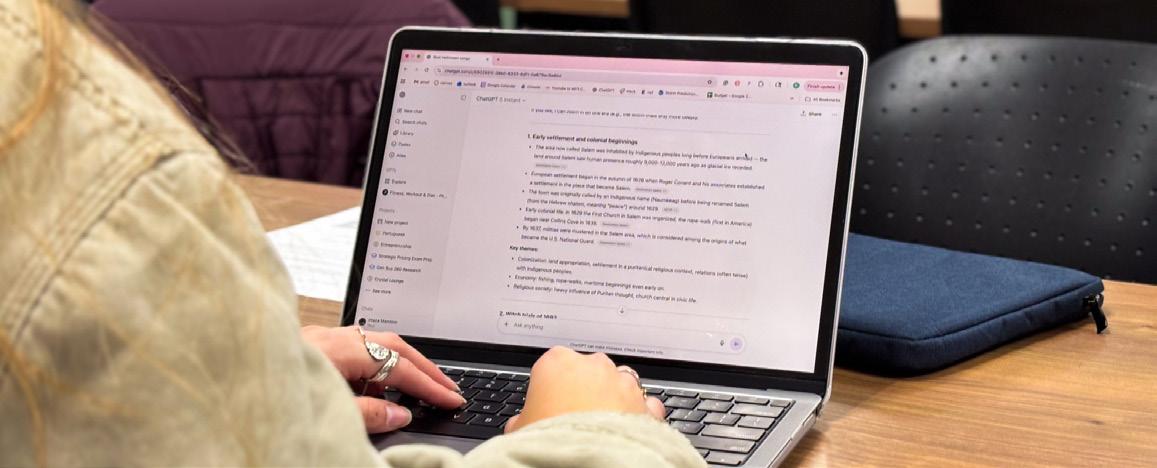
Are college essays dying? Rethinking integrity in the AI era
By Aneri Prashant Mehta STAFF WRITER
Due to increasing capabilities and the usage of artificial intelligence, it is becoming increasingly difficult to draw a clear line between studying and cheating in college. As AI tools like ChatGPT become common study aids, students are left asking a new question: when does using AI stop being learning support and start becoming academic dishonesty?
Over the past few years, AI has rapidly shifted from a niche technology to something embedded in everyday life. From virtual assistants like Siri and Alexa to generative tools like ChatGPT and Google Gemini, AI is now integrated into daily communication, affecting the way they search and create. As these tools continue to evolve, education systems have been placed in a position of uncertainty with a question of how, and whether, students should use AI in academic work.
I have personally used tools like Grammarly to plan essays and ChatGPT to brainstorm ideas for presentations. These experiences led me to the question: if AI is used to support brainstorming, refine ideas or improve grammar, at what point does its use cross into academic dishonesty?
As AI becomes more integrated into student life, institutions like the University of Wisconsin-Madison are facing a critical turning point. It’s no longer a debate about whether AI belongs in education, but on how academic integrity should be defined in response to it.
At its core, academic integrity should prioritize the learning process over the final product. True learning happens through drafting, revising and reflecting, not simply submitting a completed assignment. However, many current course structures rely heavily on single final submissions with limited checkpoints, which can unin-
tentionally encourage students to bypass the learning process in favor of generative AI tools.
A key issue is that definitions of academic dishonesty have not evolved at the same pace as technology. In addition, AI detection tools remain unreliable and inconsistent, making screenings on AI tools both di cult and often unfair.
Rather than solely focusing on the presence of AI, academic integrity policies should shift toward evaluating the nature of its application. Distinguishing between AI-assisted and AI-generated work would allow students to use AI as a legitimate tool while still maintaining accountability. In this model, transparency becomes essential, with students expected to clearly disclose how AI contributed to their work instead of using it in secrecy.
Some argue that permitting AI use will lead to overreliance and weaken critical thinking skills. While this concern is
understandable, it reflects a need for stronger assignment design rather than stricter bans. The current landscape of AI policies in education is highly inconsistent. Di erent professors and departments often enforce conflicting guidelines, some encouraging AI as a learning aid, while others prohibit it entirely. This lack of standardization creates confusion for students and leads to uneven enforcement of academic integrity, leading students to unintentionally violate policies or be held to di erent standards depending on the course. Ultimately, restricting AI use does not eliminate dependence; it simply pushes its use underground, where it cannot be guided or evaluated. As a leading research institution, UW-Madison has an opportunity to shape how AI is integrated into higher education rather than react to it. AI is already embedded in academic and professional environments, and the greater risk lies not in the technology itself, but in policies that fail to evolve alongside it. The question is no longer whether AI belongs in education, but whether universities will define its role — or allow outdated policies to define it for them.
The night the sky turned orange
By Tahereh Rahimi GUEST COLUMNIST
I think it was the orange explosion that changed me. It wasn’t only that my ears heard the blast or that my body felt the shake. My eyes saw it, the color. A sudden, overwhelming orange, as if the fire itself had exploded just in front of my windows. Looking back now, it was one of the most frightening moments -- though not the only one -- that I have lived through since the US-Israel war on Iran.
I am a Ph.D. candidate at the UW-Madison School of Journalism. I had returned to Tehran to conduct fieldwork for my dissertation and was staying with my parents in Karaj, a city about 30 minutes northwest of Tehran, where I stayed during the 40 days of war.
From the first days of the war, we worried about two places near our home. I had the same fear during the 12-days of war in June with Israel, when I was still in Madison. One was an electrical power plant just a few minutes from my parents’ house, and the other was an oil depot about 10 minutes away. Family memory made both feel even closer. During the Iran-Iraq war, older family members said, these sites had been targeted multiple times. Whether fully accurate or not, those stories had become something like a collective subconscious. To us, they marked danger points. After the war began in February, several aunts and uncles called, urging us to stay with them until it ended out of fear for these two locations, which we of course refused.
During those 12 days in June, I followed the war mostly through family and friends inside Iran, especially Fatemeh, my cousin and closest childhood friend, now a mother of three. She lives about 15 minutes from my parents, and her husband, a firefighter, was one of the most reliable sources of information in my circle. Back in June, when I asked her about these two facilities, he had no information about the power plant but had told her that the oil depot had been partially emptied of fuel, though not completely. There were limits to what could be done. It was the eighth night of the war, around 10:30 p.m., I was in bed, scrolling through news channels on Bale, an Iranian messaging app. With the internet largely down, domestic platforms were the only sources available. It had been quiet for a few hours; no fighter jets, no air defenses firing at drones or missiles. The silence made it all the more frightening,
as you were waiting for something, anything, to happen. Like every other night, I refreshed the channels, waiting for updates, matching what I read with what I heard overhead.
It did not take long for the jets to arrive. My heart started racing. I froze in bed, staring at my phone, waiting for the first explosion or the phone alert. It often worked in the same way: you hear the roaring sound of the jets; then either you hear the explosion and feel the shake, depending on how close you are, or, after a few minutes, you see an alert on your phone about explosions in Tehran. One channel would post, and within seconds, the others would copy it word for word. I read that, “Tehran’s oil refinery is bombed!”
The message hit me instantly. A refinery meant something massive, uncontrollable, a chain of explosions and fires. But within a minute, an official channel corrected it: not the refinery, but an oil depot in southern Tehran, in Shahr-e Rey, was hit.
That correction did not calm me; it did the opposite. It brought the danger closer. I immediately thought of the depot near our house. I texted Fatemeh, asking if her husband knew whether it had been emptied. Her husband didn’t know. “If they haven’t,” she wrote, “we’re all done, sis!”
I lay back, put my phone aside, and closed my eyes, hoping that would be the last alert of the night, still hoping they had emptied the depot. Then, with my eyes still closed, I saw it, a sharp orange light behind my eyelids. I opened my eyes. Through the thick fabric curtain, through the thin gaps where it did not quite meet the ceiling, the entire room had turned orange. The white walls, the ceiling; everything was washed in that color. Then I heard the explosion.
I screamed and ran toward my parents’ room. I felt there was another wave of light on the walls of the living room. I could not tell whether it was a second strike or an echo of the first. The living room, with its wall of windows, glowed orange too. My mother was already awake, sitting up in bed. “Is it the power plant?” she asked. “I don’t know, it might be the oil depot,” I said.
My father got up as well. I helped my mother as we moved quickly to my dad’s o ce, the only room in the house without windows or exterior walls. Outside, through the curtains, the orange glow had fallen on the white building across the street. There were voices in the
street, loud, scattered and urgent. When my father opened the door, someone outside was shouting, “They hit the oil depot.” “It’s dangerous! Come in, Dad!” I called.
I was moving without thinking, grabbing blankets, pillows, pulling mattresses from the closet. “We sleep here from now on,” I said quickly. My father resisted at first, insisting he would sleep in his own bed. “It’s safe now,” he said. “No, it’s not,” I replied. He didn’t insist further and eventually gave in.
I kept repeating instructions: don’t open the windows, don’t go outside, we are going to sleep here, and finished making the beds. “Let’s sleep,” I said, as if I had been assigned to that role, as if managing the moment could somehow contain it. Later I wondered why I was like that, what if they did not even want to sleep! While doing all this, I called Fatemeh. Her voice was shaking. “Tahereh, they hit the oil depot,” she said. I told her I knew. In the background, she was shouting at her husband, who was heading to the rooftop with neighbors. The call dropped.
The house was still lit, or maybe I had just left the lights on in the leaving room. Outside, I could still hear voices. My father lay down and somehow managed to fall asleep. My mother sat upright, watching me, asking for updates as I scrolled through the news, and texted family members. I wrote to my sister and others that the depot near us is hit, but that we were safe.
My sister called. Over the phone, I could hear my nephews shouting: “It turned orange!... they hit the other side.” The call dropped. When she called back, she told me they had been watching the glow from the Shahr-e Rey depot in the south when they heard the explosion to their west. We later realized it was Shahran oil depo.
Calls kept coming. Phones rang constantly, mine, my parents’, and our landline. We found ourselves repeating the same short account over and over. One cousin in Azimieh, in northern Karaj, close to where the US later hit the B1 bridge, said they had been terrified by the orange glow, at first thinking it might be a chemical or even a nuclear bomb. A friend who lives near Shahran later told me that Shahran’s explosion was the worst. Not only because of the huge fire and explosions, but because burning oil had spilled into the streets. Tehran, like Karaj, sits on a slope, descending from the foothills of Mount Damavand toward the
plains. From the north you can see much of the south, and things flow in that direction too--water, and in this case, burning oil. Within a few hours, Israel confirmed that it had struck several fuel storage facilities in Tehran and Karaj. Besides the one close to us, there were three others in Tehran: Shahran in the west, Aghdasieh in the northeast and Shahr-e Rey in the south.
At some point, while the sky was cloudy and it was drizzling, my mother said she could smell smoke inside the house, and soon I smelled it too. I called Zahra, a friend who is a nurse. She said we could cover the windows with wet cloth, but that would have required opening them, and I did not want to do it. It did not matter much anymore. The smoke stayed with us. By morning, the cloudy sky had turned dark gray, and we could smell smoke in the air. We stayed inside the entire day. Tehran was di erent, and only by morning did the scale of the attacks became clear. With three major depots burning, even if they had been partially emptied, the city woke to something like another night. Black smoke covered not only the sky but buildings, cars, streets. And then the black rain started falling. People I spoke to, including a cousin who went to work that morning, said it felt as though they were moving through the city at midnight, the air heavy and sticky. Even in their mouth, they told me, tasted like oil. Only after a few hours, with light rain and a slight wind, did the darkness begin to lift. O cials told people to stay indoors. There were warnings about toxic air, even acid rain. Some people went to emergency rooms. A relative of ours, in his seventies, was among them.
That night, I barely slept. I kept replaying the sequence and reviewing every moment, the orange light, the delay before the sound, the run to my parents’ room. The next morning Fatemeh told me that there had been two or three explosions. Since they live closer to the depot, her account should be more accurate. However, in my memory, there is only one. I keep returning to it, trying to locate the exact second when it began. What did I do first? Did I hesitate? Did I really scream as I ran? If the windows had shattered, would I have stopped to put on the sneakers I had left under the bed, just in case?
I do not have answers to those questions. What I have is the color, the dirty burning orange glow.
CAMERON SCHNEIDER/THE DAILY CARDINAL
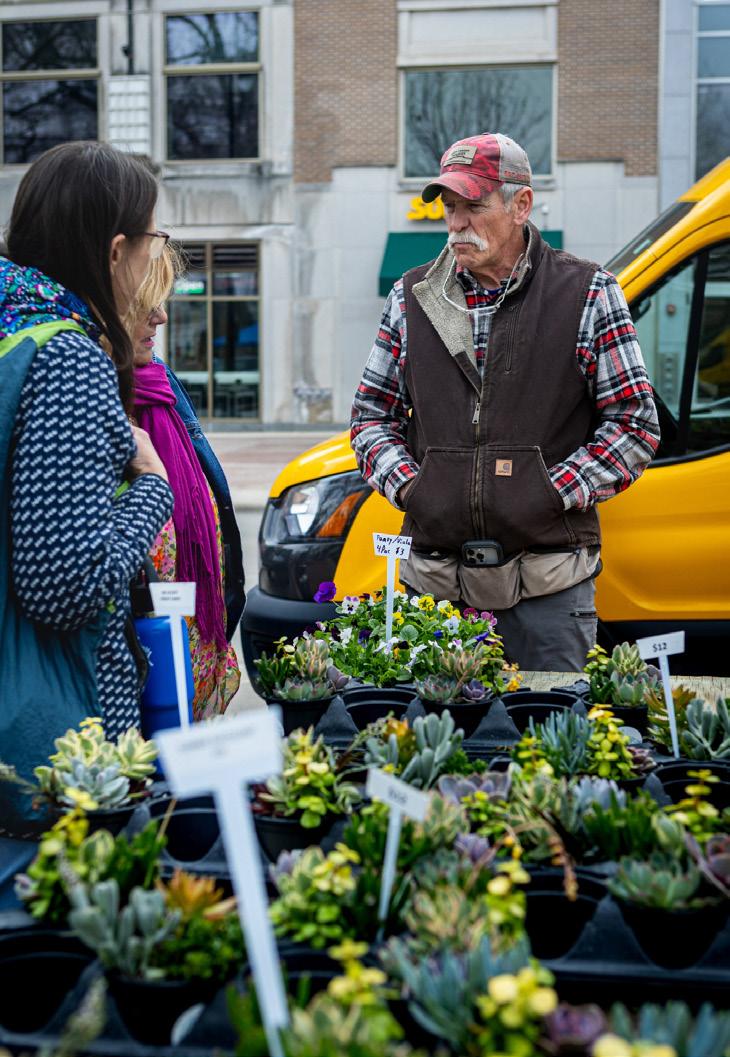
Dane County Farmers’ Market draws eager crowds for spring return
By Yareli Gutierrez STAFF WRITER
The spring semester may not be over yet, but this week, students and community members got a taste of summer on the Capitol Square.
Madison welcomed back the Dane County Farm ers’ Market for its first Saturday of the season Saturday. With winter finally coming to a close, students, families and community members filled the Square to enjoy everything from local produce to live performances and handmade artwork.
The Dane County Farmers’ Market has united local vendors and community members around the Wisconsin State Capitol building for 58 years. The market features over 220 vendors o ering fresh vegetables, flowers, meats, cheeses and more, all sourced in Wisconsin.
The market was already at its busiest by 10 a.m., and sidewalks were packed. In the middle of the square, a small crowd gathered around a live performance by the TimbAché Cuban dance connection, while others looked through vendors’ stands or even took photos in front of the Capitol.
Balloon twister Neil “The Real Deal” Skinner set up his stand in the center of the market, making balloon creations for children and adults alike.
Skinner said his favorite part of the farmers’ market is “making kids happy, making families happy, I always enjoy captivating an audience.”
Skinner does not charge his customers. However, satisfied patrons left him tips after
receiving their balloon creations. From simple flowers to elaborate animals, his stand brought entertainment and a sense of community to the farmers’ market, emphasizing the value of the market as a fun spot for people of all ages.
Walking around the Dane County Farmers’ market, there was a clear sense of community. College-aged friend groups stopped to take pictures in front of the Capitol, many carrying tote bags filled with flowers and other local goods they bought. Couples shared steaming hot empanadas and cinnamon rolls, while children carried apple cider donut holes and cups of fresh lemonade mixed with honey from a local stand. Nearby, vendors handed out free samples of locally produced cheeses and sausages to the crowd.
Being the first market of the season, there was limited fresh produce available. However, many stands o ered mixed greens, potted plants and dried bouquets more fitting of the season.
While the sidewalks were bustling, some stands clearly held longer lines than the rest.
The stand for Stella’s Bakery and their famous spicy cheese bread was one of the busiest, with their line wrapping around the tent.
Another popular stand was run by Larry Haas, best known as the Gourd Guy, who has been a vendor at the farmers’ market for over 30 years and sells
gourds of all different shapes and sizes to community members.
“I love the location of the market, but I guess the best part of coming is selling some gourds and trying to make a little extra money for the biscuits,” Haas said, referring to his children.
University of Wisconsin-Madison students also shared their excitement to have a popular weekly tradition back.
Sophomore Carmen Alvarez said she enjoys going to the farmers’ market every Saturday with her roommates.
“I go all the time with my roommates who also happen to be my best friends,’’ she said.
Alvarez described the atmosphere of the farmers’ market as “love all around.” She emphasized how the market gives the community a space to gather to peruse local goods, enjoy great food and even enjoy live entertainment.
Despite the crowded pathways, the first Dane County Farmers’ Market of the season offered more than just local produce. It created a welcoming space for community members of all ages and backgrounds to spend their Saturday morning together at one of Madison’s most lively local traditions. Saturday on the Square is held around the Capitol every Saturday from April 11 through Nov. 14 from 6:15 a.m. to 1:45 p.m.
Spring semester brings social challenges for UW freshmen
By Addison Balogh STAFF WRITER
When University of WisconsinMadison freshman Elana Meulemans first came to campus in the fall, making friends felt easy. But by spring, without the same on- campus offerings, fostering new friendships wasn’t so simple.
“I think that spring makes it a lot harder to connect with others due to the lack of friction in school activities,” Meulemans said. “It’s important then to keep your connections from the fall semester.”
For many freshmen like Meulemans, the difficulty comes from the sense that social circles have already been formed, and by the spring, there aren’t the same opportunities to meet new people. While the fall semester came with orientation events, new faces and a shared sense of new beginnings, the spring can seem quieter and, for some, isolating.
Without consistent social events that come with the start of the year, many freshman students said they have to be more
intentional about forming connections.
“I do sadly believe that people were settled into friend groups come spring,” Lily Rankin, a freshman at the UW-Madison, said. “Even in October, people were settled in, which was kind of shocking.”
Other students said they related to this experience. UW-Madison freshman Mary Weishan found it intimidating to see how quickly students settled into groups. “It was definitely a fear to overcome,” she said.
Outside of existing friend groups, students named several other reasons why making friends can feel more challenging in the spring.
Some students blamed the colder weather, which can keep people indoors and limit spontaneous interaction, while others mentioned heavier workloads and stricter schedules compared to the beginning of the school year.
“There’s more rigor to my classes as I progress into my major,” Meulemans said. “I mean, I don’t even get out of class until 8 p.m. on Mondays.”
Despite these challenges, some stu-
dents have found ways to build new friendships later in the year.
Weishan said she was lucky to get along with her roommate, freshman Gabi Danza, because she was able to connect with other students through their existing friendship. What started as a small step eventually led to meaningful connections.
“One night Gabi and her friends were going out and without me even being a part of the conversation, [and] they included my name in the plans,” Weishan said. “They just included me within their group, and it made me feel very good.”
While some students described trying to reach out to classmates or attend social events without seeing immediate results, many emphasized persistence.
“I would say making friends in my fall semester wasn’t easy,” UW-Madison freshman Paige Macintyre said. “I made lots of friends, but sometimes they were fake.”
When asked what advice they would give to others struggling to make friends,
students suggested taking small steps rather than making big changes.
“Be open to what you’re comfortable with. If you’re not an extremely extroverted person, don’t force it,” Danza said. “There are endless opportunities to make friends at some point, even if it’s not right away.”
Others suggested introducing themselves to classmates in discussion sections, attending social events consistently, and following up with people they want to connect with. They emphasized that building friendships takes time.
“I’ve come to the conclusion that going out with friends is especially crucial. Don’t stay huddled up in your dorms,” Macintyre said.
While making friends in the spring semester may feel more difficult, students say it isn’t impossible. Instead, it requires patience, effort and a willingness to step outside of one’s comfort zone.
“Don’t focus on making a friend group. That’s very high-school adjacent,” Rankin said. “Making friends isn’t instant. Don’t force it.”