University of Wisconsin-Madison
Since 1892 dailycardinal.com l
Wisconsin vs. Michigan State
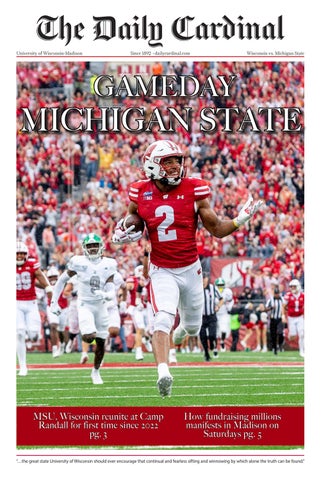
GAMEDAY
MICHIGAN STATE
MSU, Wisconsin reunite at Camp Randall for first time since 2022 pg. 3
How fundraising millions manifests in Madison on Saturdays pg. 5
“…the great state University of Wisconsin should ever encourage that continual and fearless sifting and winnowing by which alone the truth can be found.”
gameday l
2
Wisconsin vs Michigan State
An independent student newspaper, serving the University of Wisconsin-Madison community since 1892 Volume 136, Issue 7
2142 Vilas Communication Hall 821 University Avenue Madison, Wis., 53706-1497 (608) 262-8000
News and Editorial editor@dailycardinal.com
Preview: Wisconsin Football vs Michigan State By Jane Corcoran STAFF WRITER
Editor-in-Chief Alaina Walsh
Managing Editor Avery Chheda
News Team Campus Editor Sonia Bendre College Editor Grace Carlson City Editor Jane Dardik State Editor Audrey Lopez-Stane Associate News Editor Zoey Jiang Features Editor Jake Kilander Opinion Editors Brady Ahler • Siena Ferraro Arts Editors Ryan Kim • Liset Zacker Sports Editors Otton von Sothen • Haellie Opp Sports Associate Editor Luca Muehlbauer Special Pages Editor Natalie Popper Photo Editor Jonathan Mintz Graphics Editors Eloise Guth • Klaire Maduscha Science Editors Lauren Eno • Addison Dama Life & Style Editors Isabella Bajaras • Jackson Baker Beet Editor Lizzi McGann Podcast Directors Yadiel Chavez • Amellia Fowler Digital Editor Meredith Schadrie Video Director Ted Hyngstrom Copy Chiefs Emma Schieffer • Brendan Wolf Copy Editors Isabella Barajas • Delaney Chronister • Kim McGee
Business and Advertising business@dailycardinal.com Business Manager Wyatt Vail Marketing/Outreach Director Lydia Picotte Social Media Manager Aanya Agrawal Ad Manager Lauren Downham The Daily Cardinal is a nonprofit organization run by its staff members and elected editors. It receives no funds from the university. Operating revenue is generated from advertising and subscription sales. The Daily Cardinal is published weekdays and distributed at the University of WisconsinMadison and its surrounding community with a circulation of 10,000. Capital Newspapers, Inc. is the Cardinal’s printer. The Daily Cardinal is printed on recycled paper. The Cardinal is a member of the Associated Collegiate Press and the Wisconsin Newspaper Association. All copy, photographs and graphics appearing in The Daily Cardinal are the sole property of the Cardinal and may not be reproduced without written permission of the editor in chief. The Daily Cardinal accepts advertising representing a wide range of views. This acceptance does not imply agreement with the views expressed. The Cardinal reserves the right to reject advertisements judged offensive based on imagery, wording or both. Complaints: News and editorial complaints should be presented to the editor in chief. Business and advertising complaints should be presented to the business manager. Letters Policy: Letters must be word processed and must include contact information. No anonymous letters will be printed. All letters to the editor will be printed at the discretion of The Daily Cardinal. Letters may be sent to opinion@ dailycardinal.com.
Editorial Board Avery Chheda • Alaina Walsh • Brady Ahler • Siena Ferraro • Safa Razvi Chair Safa Razvi
Board of Directors Scott Girard, Chair • Don Miner • Nancy Sandy • Nathan Kalmoe • Jack Kelly • Gary Achterberg • Jennifer Sereno • Kelly Lecker
© 2026, The Daily Cardinal Media Corporation ISSN 0011-5398
For the record Corrections or clarifications? Call The Daily Cardinal office at 608-262-8000 or send an email to edit@dailycardinal.com.
dailycardinal.com
The Wisconsin Badgers are picking up steam, upsetting No. 13 Penn State at Happy Valley for their third consecutive win and first conference win, bringing them to a 3-1 record. Overcoming a 17-point deficit, the Badgers pulled off the victory and won 24-20, with a last-minute 72-yard touchdown pass from Colton Joseph to Jacob Harris to complete the comeback. The defense was the true standout of the game, allowing only a field goal in the second half and holding Penn State to 233 total yards. The Nittany Lions were forced to punt seven times, and the Badger defense made a huge stop on a fourth down in the final seconds of the game to secure the win. Saturday’s away-victory marks Wisconsin’s first top 25 win on the road since 2021, and they should feel confident going into this weekend’s matchup against unranked Michigan State. The Badgers play at Camp Randall for their homecoming, and the red-out home crowd should give Wisconsin even more momentum going into the game. Although the Badgers go into the weekend as favorites against a Michigan State team on a two-game losing streak, there are still many weaknesses that need to be improved. Wisconsin is set to play three top 25 ranked teams after Michigan State, and key changes need to be made for the rest of the season. Joseph needs to find his footing Colton Joseph has started all four games for the Badgers, and has shown us two sides — one being the confident-clutch quarterback that can deliver in the final minutes of a game — and the other being a panicked turnover machine. Joseph threw for two touchdowns in the last 3:31 of the game to beat Penn State. However, he also threw
three interceptions — one being a 51 yard pick-six — adding up to five total this season in comparison to his seven touchdown passes. These turnovers are part of the reason that the Badgers had to overcome such a large deficit, and against other tough Big Ten competition, Wisconsin cannot afford giveaways like these. “Unfortunately it might just be a little bit of a roller coaster ride,” Head Coach Luke Fickell said in reference to Joseph. “That’s what people see, and yes they see some of the mistakes, we all do. But I think they see the genuine care and love and grind to get better.” “We believe in him,” Fickell said, adding the team’s confidence and support during the final minutes of the Penn State game likely influenced the clutch performance witnessed from Joseph. Michigan State has only forced two turnovers all season, with Kenny Soares Jr. having their sole interception and Charles Brantley recovering a fumble. The differing defense should take some of the pressure off Joseph and give him the chance to build much-needed confidence, especially coming off of his fourth quarter performance. Consistency through all four quarters The story of the Penn State game was the incredible second half turnaround, but the Badgers have not always performed better after the break. Against No. 4 Notre Dame, the Badgers had a strong first half and went into the break down by three, seemingly with the momentum on their side. However, Wisconsin got outscored in the second half 28-3, making the final score a 13-41 loss. You can even point to Wisconsin’s two upset wins against No. 24 Washington and No. 21 Illinois last season. In both games Wisconsin pulled off the win thanks to their
JONATHAN MINTZ/THE DAILY CARDINAL
defense, but failed to play 60 minutes of good offensive football. Similarly to the first half against Penn State, the Badgers had no fight in them and made the game look like it was going to be an expected blowout. But, the Badgers have proved twice now that they can compete with top 25 teams — just not for all four quarters. “To be honest with you, we didn’t play a lot of four quarters of great ball,” Fickell said in a press conference on Sept. 28. “I think, particularly offensively, we did not play very well in the first half. The second half I think we really kind of settled in.” In order to find success against Michigan State and future ranked opponents, Wisconsin needs to find a way to play at a high level through all four quarters, both offensively and defensively. On offense, it could start by running the ball better. Wisconsin averages only 134 rushing yards and 30 attempts per game, ranking in the bottom third of the Big Ten in both categories. On defense, Wisconsin will have to continue forcing turnovers like they did in their last two games.
Michigan State fared similarly to Wisconsin in their game against Notre Dame, trailing by a touchdown at half and eventually losing 27-10. While the score did not look pretty, with Cam Fancher running the ball in for their sole touchdown, it is clear that Michigan State has the potential to compete with good teams. The Badgers need to keep up the intensity as they did in glimpses throughout the season in order to beat Michigan State. Keeping spirits high Wisconsin managed to make a loyal Penn State crowd boo their Head Coach Matt Campbell and turned Beaver Stadium against its home team. The homecoming crowd of one-hundred thousand was rattled by the spirit of the Badgers — especially their defense. Wisconsin needs to bring this energy to Camp Randall and fire up the homecoming crowd. Home field advantage is important for a reason, and big plays can make a big difference in games like these. Continue reading @dailycardinal.com
How to bash with Badgers on gameday at Camp Randall post-kickoff, expect large crowds in red and white, music and drinks.
By Ava Hudson & Aanya Agrawal STAFF WRITER & SOCIAL MEDIA MANAGER
If you have ever been on the streets of Madison on a Wisconsin football game day, it is unmistakable to see Badger fans already preparing hours before kickoff. Football game days at the University of Wisconsin-Madison are about more than just football. From tailgating to everybody’s favorite celebration “Jump Around,” the culture surrounding Camp Randall extends far beyond the team’s performance — it brings students, alumni and the Wisconsin community together. Here’s what separates regular game days from those at UW-Madison. Tailgating By morning, the city is filled with cardinal red and white as thousands of fans gather in dirt and gravel park-
Halftime Performance
JOE KIM/THE DAILY CARDINAL
ing lots and crowded pubs in anticipation of the game. The Wisconsin Union hosts the official UW-Madison football tailgates — The Badger Bash — at Union South two and a half hours before every kickoff. The beloved tradition started in 1972, offering food, drinks and games. You can also sing along to the marching band as they play signature Wisconsin songs —“On, Wisconsin,” “If You Want To Be A Badger” and many more.
Fans can also engage in a friendly game of cornhole — or bags if you are from the midwest. If seeing people with Bucky Badger tattoos on game days makes you want to get one too, the Badger Bash is the place to be. Madison is also renowned for its gameday bar scene. State Street and Regent Street are filled with many bars that are usually full on Saturdays, no matter the time. Whether you are going pre-game or
Once the first half action has ended, it’s time for the band’s spotlight. Performing a new theme every game, the band plays a medley of songs while creating formations on the field for fans to see. Last homecoming, the band chose the theme “Celebrating Popular Music: Through the Decades.” Varsity Varsity has been sung for over a century, giving graduates a time to honor their alma mater and undergraduates a time to link arms with your neighbors, known and unknown, and form a connection with peers at the end of halftime. Continue reading @dailycardinal.com
gameday dailycardinal.com
Wisconsin vs. Michigan State
l
3
What kind of person becomes a main donor in the university’s athletic history? By Lucy Simmons STAFF WRITER
Who are the Kellners? Students at the University of Wisconsin-Madison are likely familiar with the Kellner name, from Kellner Hall in Camp Randall to the Kohl Center’s Kellner Club, and now the new Kellner Family Athletic Center. However they may not know the face behind it — Ted Kellner, one of Wisconsin athletics biggest donors. Ted Kellner has been a life-long Badger sports fan. Growing up, he went to Wisconsin football games at Camp Randall with his father — Jack Kellner, an all American track and field athlete and Big Ten Champion for the Badgers in the 1930’s. Ted Kellner attended the university in the late sixties, where he walked onto UW-Madison’s basketball team and played for three years, and met his wife Mary Kellner while living in Sellery Residence Hall. In 1969, Ted Kellner graduated with a business administration bachelor with a focus in
finance, investment and banking from the School of Business. Kellner went on to become a founding partner and portfolio manager for Fiduciary Management Inc., an investment management firm. Kellner also founded and serves as the chairman of Milwaukee-based Fiduciary Real Estate Development Inc. Kellner’s relationship with Wisconsin athletics has lasted through the program’s good and ugly. Whether the Badgers have had winning or losing seasons, his financial support and commitment has remained consistent, continuing through different coaches, teams and eras of Wisconsin athletics since 2002. Kellner was also an early figure in Wisconsin’s transition into the Name, Image and Likeness (NIL) era. He was among the founding leaders and backers of the Varsity Collective, launching in 2022 — one of Wisconsin’s first organized, donor-led efforts to create NIL opportunities for Badger athletes. The Collective became an early piece of the framework Wisconsin built to navigate
a rapidly changing college sports landscape. With the dramatic expansion of the transfer portal for NCAA football and basketball in recent years, Kellner’s investments in the athletic facilities have been particularly important. Now, Wisconsin is not just competing to recruit high school players, but also competing to retain its own players while targeting high profile transfers from other programs. The goal of creating new facilities and the “Building Championship” campaign is to make an environment in this transfer portal NIL sports economy that can keep up with the rest of the Big Ten programs. The facility, that many might consider as good as ones you can in the NFL, gives Badger athletes the best student-athlete experience in the country. The effects of this new environment Kellner has worked to support became apparent through the 2025 transfer portal cycle, where Wisconsin Football Head Coach Luke Fickell recruited 33 transfers to the roster. Kellner’s involvement
PHOTO COURTESY OF TAYLOR WOLFRAM/UNIVERSITY OF WISCONSIN-MADISON
with Wisconsin goes beyond athletics. His philanthropy also helps support education through the Wisconsin Foundation and Alumni Association (WFAA). Homecoming weekend 2017, Ted and Mary Kellner made a $25 million commitment to the university’s All Ways Forward Campaign – an effort to expand their “dedication to teaching, research and outreach,” according to their website — funded by the WFAA, which Kellner served as chair of. This campaign was a part of a larger $4.2 billion fundraising effort that created thousands of new student scholarships, increased endowment funding for faculty chairs and professorships, funded research and innovation and
supported major campus capital projects like the Nicholas Recreation Center and the Meat Science and Animal Biologics Discovery Building. Kellner’s pockets have a limit. While other Big Ten schools can rely on billionaire alumni, like the University of Oregon with Phil Knight and Indiana University with Mark Cuban to fund their athletic programs, Wisconsin will have to diversify their sources of income and attract other donors alongside Ted Kellner. Kellner’s approach to philanthropy is best captured by a quote he gave to the Wisconsin alumni association in 2025: “you toss a stone in the water, the ripples keep going. That’s what we hope we’ve done here.”
Reuniting after four years: Wisconsin looks for revenge against MSU By Kailen Shah STAFF WRITER
The Wisconsin Badgers and Michigan State Spartans met in East Lansing on Oct. 15, 2022. The Spartans ultimately came out with a 34-28 win in double-overtime. Now, nearly four years later, the two teams will meet again — this time in Madison — for the first time since the memorable matchup. Looking back at 2022 Heading into the 2022 matchup, Wisconsin was 3-3 and Michigan State was 2-4. The Badgers were coming off a dominant 42-7 win over the Northwestern Wildcats. On the other hand, the Spartans were coming off four consecutive conference losses. The matchup was an important game for Wisconsin, who was trying to build off their previous week momentum, and for Michigan State, who was trying to find their footing after coming off an 11-2 season. The Badgers scored a touchdown on their first drive of the game on a fourth and goal rushing touchdown by Braelon Allen, now running back for the New York Jets. In this game, Allen led the offensive charge for the Badgers with 29 carries for 123 yards and 2 touchdowns. After a 14-play drive from the Spartans that put them in a fourth and goal situation on the one-yard-line, they elected to go for it — but running back Elijah Collins was stuffed in the backfield. Just two plays later, Wisconsin quarterback Graham Mertz threw an interception from his own endzone that gave the Spartans the ball inside the red zone. Two more plays later, they scored on a
rushing touchdown from running back Jalen Berger. Wisconsin responded with a touchdown of their own on a second rushing touchdown by Braelon Allen as they went into half with a 14-7 lead. In the third quarter, a 72-yard pass from Michigan State Quarterback Payton Thorne to tight end Maliq Carr led to a rushing touchdown by Elijah Collins with under one minute to go. The Spartans proceeded to capture their first lead of the game just halfway through the fourth quarter on a 27-yard-pass to wide receiver Keon Coleman on a back shoulder ball. Michigan State had a 21-14 lead. Now-Buffalo Bills Wide Receiver Keon Coleman had five catches for 79 yards and two touchdowns. The Badgers responded quickly. On the ensuing kickoff, Running Back Isaac Guerendo returned the kick 45 yards to the Wisconsin 48-yard-line, which helped set up the game-tying touchdown in the back of the end zone to Wide Receiver Keontez Lewis with two minutes remaining. The Spartans had an opportunity to win the game on a 47-yard-field goal with six seconds to go, but a low snap cost them the chance. On the first possession of the first overtime, Michigan State ran a wide receiver pass trick play, where Throne handed the ball off to Reed, who threw a contested 25-yard-touchdown pass to Coleman. Wisconsin had to respond, and they did. On a third-and-10 from the 25-yardline, Mertz fired a pass to Chimere Dike — now wide receiver for the Tennessee
TAYLOR WOLFRAM/THE DAILY CARDINAL
Titans — who ran it in for the score and tied it up at 28-28. But, on the first play of the second overtime period, Allen fumbled the ball on a handoff that was recovered by the Spartans. The defense put themselves in a good position by forcing a third-and-12 from the 27-yard-line, but the blitz the Badgers brought on the following play — leaving their corners in man-to-man coverage — gave the Spartans the edge. Throne threw it to the right side of the endzone to Reed, who ran a fade route and high pointed the ball for the win. Looking to Saturday The Badgers now have an opportunity four years later to redeem this loss. The team is coming off a massive 24-20
win over the Penn State Nittany Lions on Saturday that should fuel their momentum and confidence heading into this game. Michigan State lost their last two games to No. 3 Notre Dame and unranked Nebraska. Already facing challenges within the Big Ten, Michigan State is looking similar to the team that beat Wisconsin four years ago. Since the last time these two teams met, a lot has changed for both programs. Pat Fitzgerald took over as head coach of Michigan State and Luke Fickell is leading Wisconsin. Both teams saw just four wins in their 2025 campaign and are trying to prove themselves in the early stages of conference play. This game in 2022 was electric. Will we see deja vu on Saturday with both teams once again having a lot to play for?
gameday Badgers stun Nittany ‘So what, now what?’: Lions, pull off comeback The mentality that win in Happy Valley drives Mason Posa 4 • Wisconsin vs. Michigan State
dailycardinal.com
By Josh Murphy & Grace Cannizzo STAFF WRITERS
JONATHAN MINTZ/THE DAILY CARDINAL
By Josh Murphy STAFF WRITER
Confidence is a special trait. It allows us, as humans, to trust in ourselves in the face of adversity. To get up when we’ve been knocked down. To keep marching forward. But, confidence is not an inherent trait. Some struggle with confidence — Mason Posa is not one of those people. Posa, the Badgers’ star sophomore linebacker, burst onto the scene as one of the most dominant freshmen in the country last season, earning Freshman All-American honors. He didn’t waste any opportunities to showcase his skillset when he made 13 tackles in his first career start against Oregon, and he followed that up with an 11-tackle, 2.5-sack performance against Washington. Posa remembers feeling the nerves before his first start, but he credits his family for giving him the reassurance he needed before stepping onto the field that day. “I just knew, I was like ‘Mason, this is a chance for you to be a starter for the rest of your career, so you gotta bring it,’” Posa told The Daily Cardinal in a post-practice interview. “There was a lot of pressure, and my dad really helped me a lot. He was like, ‘Mason, go be the kid you’ve always been.’ I give a lot of thanks to my dad, because he helped me a lot that week.” Before arriving in Madison, Posa was a dominant wrestler. Dominant actually might be underselling it; he was unstoppable on the mat. Posa was a four-time New Mexico State Champion for La Cueva High School, posting a record of 129-3 across four weight classes in four years. He participated in the 285pound weight class his senior year despite weighing 75 pounds lighter than the threshold to compete. That didn’t matter to Posa, who posted a perfect 43-0 record that year and was rightfully named the National Wrestling Hall of Fame’s Dave Schultz High School Excellence Award winner for New Mexico in 2025. Although wrestling and football are two completely unique and different sports, Posa believes his background as a wrestler is still present in the way he mentally approaches the gridiron. “In wrestling, you’re kind of just
by yourself. You don’t have to depend on any teammate. So I kind of bring that same mentality [to football],” he told the Cardinal. “Every time I step on the field, I’ll just be like, ‘hey, you’re the spotlight, you got the pressure, you gotta deliver for these fans, you gotta deliver for your teammates.’ So I definitely think my wrestling background has helped me a lot with the mentality of being in that spotlight.” After his monstrous freshman campaign for the Badgers, Posa could have ridden the treadwinds into the transfer portal, where he likely would have received offers from several bluechip programs. Instead, he chose to stay right here in Madison. When asked about this during spring practice, he emphasized his profound love and dedication to Wisconsin football. “It’s the place I fell in love with during my recruiting process … coach [Fickell], I’m ride or die with that dude,” Posa told reporters back in April. “I’ll defend Badger nation with all my heart. I love this place, and I’m willing to die and sacrifice anything for this program to be winning again.” His admiration and loyalty to Wisconsin Head Coach Luke Fickell has remained strong, and Posa elaborated on what makes his relationship with his coach special after practice on Sep. 29. “Coach Fick’s always had my back,” he said. “He’s always wanted the best for me. And no matter what, ups, downs, highs and lows, I’ll always be a coach [Fickell] supporter no matter what.” The Badgers got one step closer to Posa’s goal of restoring a winning culture with Wisconsin’s thrilling comeback win over No. 13 Penn State in Happy Valley. Posa played a huge part in that victory, posting a careerhigh eight solo tackles and an additional tackle for loss. He said what a win like that is big for the program going forward. “[The win] does a whole lot. It gives us confidence going into this next week and also going into Big Ten play. We were really excited after that win at Penn State,” he said. Posa said the victory also made a noticeable impact in the way the team practiced on Sep. 29. “I feel like even today’s practice was a lot different, we were all
sharp, we’re just being overly physical today,” Posa said. Mason Posa is confident in this team and confident in himself. But confidence isn’t linear. Posa knows better than most. “I feel like [my confidence has] changed over time,” he said. “I try to stay humble as much as I can, but you gotta have that confidence to succeed in this world.” Although he tries to remain humble, that doesn’t stop Posa from chasing a not-so humble goal: perfection. He knows it’s impossible, but having that ambition in mind pushes him to become a better version of himself every day. “I definitely think highly of myself. I always try to be the best version [of myself] I can,” Posa said. “I always try to be perfect, and nobody can be perfect so it just makes me work harder every day. I definitely think my confidence has grown every single day, just kind of working.” Posa, like anyone, is human. There are times when that confidence gets shaken and tested. But his ‘so what, now what?’ mentality allows him to regroup and respond to the next challenge ahead. “Obviously, when I give up a touchdown, or when I make a bad play, I get shaken up a little bit,” Posa said. “I also think, ‘so what, now what?’ kind of mentality. So what, I gave up a touchdown, now it’s time to make a play. I always look at the next play going forward.” Posa also credits his friend and fellow inside linebacker Cooper Catalano for helping him in those moments and building his confidence back up. “Kudos to Coop. He does a really good job of hyping me up, saying, ‘hey, Mason, you’re that dog, you’re that guy, let’s go, let’s go make a play,’” he said. “Cooper does a really good job of helping me settle in.” Catalano and Posa, who both earned starting roles as true freshmen last season, have a special bond. They’re close friends, so close that they often treat each other like brothers. And Posa made sure Catalano got the full brotherly treatment after dropping an interception late in the fourth quarter against Penn State. Continue reading @ dailycardinal.com
The Wisconsin Badgers (3-1) stormed back from behind 17, picking up a statement 24-20 win over No. 13 Penn State (3-1) in miraculous fashion. This stands as the team’s highestranked road win since the 2019 season and is a monumental victory for Head Coach Luke Fickell, who remains on the hot seat. Wisconsin snapped their six-game losing streak against the long-rivaled Nittany Lions, who the Badgers defeated for the first time since 2011. It was also their largest comeback win since 2006, when they overcame an 18-point deficit against Illinois. Wisconsin’s defense forced Penn State to fight for yardage from the getgo. The Nittany Lion’s short-lived sixplay, 19-yard opening drive set the tone for the contest. The Badgers offense wasn’t on the same par, a theme that transpired throughout the entire first half. A quick 2-yard, three-and-out stint put Wisconsin’s defense right back to work at their own 40-yardline. Penn State managed to travel 36 yards in seven plays, setting up a 22-yard field goal attempt that split the uprights. Wisconsin trailed 0-3 at the end of the first quarter, where the Badger defense was forced to fight for a remarkable 11:33. Quarterback Colton Joseph’s struggles only heightened in the second quarter. In the midst of his worst start as a Badger, Joseph’s first interception was an underthrown screen pass that was snatched by cornerback Josiah Zayas. Zayas returned it 51 yards to the house to put Wisconsin down 10-0 with 13 minutes to go in the second quarter. The second pick came just three plays later when Joseph’s throw sailed past wide receiver Eugene Hilton Jr. and into the hands of cornerback Daryus Dixson. Penn State quarterback Rocco Becht punched it in on a 3-yard touchdown run on the ensuing drive. It was about as disastrous of a swing in momentum one could imagine. Wisconsin entered the second quarter down three and drove with the ball. Then, in what seemed like the blink of an eye, they were down 17 and faced the daunting prospect of mounting a comeback in one of college football’s toughest atmospheres. The Badgers’ offensive spark commenced with running back Abu Sama III’s 17-yard run on third-and-seven. Wisconsin steadily worked up the field after a notable 22-yard reception by tight end Jacob Harris. Ultimately, a seven-yard quarterback-keeper into the endzone gave the Badgers a breath of life. The Badgers entered halftime down 17-7 with a newfound sense of momentum. The Badgers kept clawing back, and a tipped ball interception by 6-foot-2, 333-pound boundary guard Charles Perkins set the offense up at the Penn State 22-yard line. They settled for a field goal, making it a one possession game and giving Wisconsin some life with just under 11 minutes left in the third quarter. Penn State responded with a field goal of their own, advancing the score
to 20-10. A pair of three-and-outs from each team ate up the clock and the Badgers took over on a seemingly make-or-break possession with 08:11 left in the contest. On the first play of the drive, Joseph did it again, and this time it was Tony Rojas who picked off the quarterback. A short Nittany Lion drive followed, and Wisconsin earned the ball back with 7:02 on the clock. Joseph and the Badgers didn’t waste that opportunity. They put together a methodical 10-play drive capped off with an 11-yard toe-tapping touchdown catch by Hilton Jr. Wisconsin trailed by three with 3:31 left in the game, but momentum was back on their side. The defense forced yet another three-and-out, giving the ball back to their offense with 2:28 left to play and a chance to stun the Nittany Lions. The drive didn’t begin the way they would have hoped, with a couple costly penalties setting the Badgers back at their own 6-yard line and facing a second and 19. This time, Joseph was able to connect with running back Darrion Dupree on a screen pass, who turned upfield for 25 yards and picked up a first down. They weren’t out of the mud yet, and an incomplete pass followed by another penalty forced the Badgers into 3rd and long at their own 28. On third and 13, Colton Joseph found tight end Jacob Harris on a deep slant, who ran furiously toward the endzone and stiff-armed a defender on his way to a 72-yard go-ahead touchdown. Harris, who had two false starts on that drive, was relieved to make the big play after those costly penalties. “Letting my guys down is like the worst thing I could possibly do,” Harris said. “So to be able to make up for it like that in a big moment is really special to me.” The Badgers’ defense clearly outplayed their offense, and Colton Joseph’s three-interception night was a big part of Wisconsin’s offensive struggles. They allowed just 233 total yards on the day and held quarterback Rocco Becht to a lousy 12 completions on 29 attempts for 114 yards, intercepting a pass along the way. They also forced a whopping four three-and-outs in the fourth quarter, the only exception coming on the last drive of the game. Wisconsin’s defense rose to the occasion in the face of adversity. “I like to say, ‘so what, now what?’ So what, they got a pick-six, now what? How are we going to respond? How are we going to punch them in the mouth?” Linebacker Mason Posa said. “We all love the spotlight, we all love the pressure, and we’re going to deliver.” Fickell also shared a rare emotional press conference when talking about how his team dealt with adversity. “I don’t know if I’ve had [a win] more special. I know I haven’t in four years, because I’ve had some bad nights here,” an emotional Fickell said. “To have [the win] the way it did … you couldn’t write it any better.” After a massive statement to open up Big Ten play, the Badgers will return to Camp Randall to host the Michigan State Spartans at 11 a.m. on Oct. 3.
gameday
dailycardinal.com
Wisconsin vs. Michigan State • 5
Column: How fundraisEichorst, Gard discuss ing millions manifests on how Wisconsin is adapt- Saturdays in Wisconsin ing in a changing NIL era By George Atkinson STAFF WRITER
JONATHAN MINTZ/THE DAILY CARDINAL
By Dora Tsai STAFF WRITER
Wisconsin Athletic Director Shawn Eichorst and men’s basketball Head Coach Greg Gard spoke at UW Now Live: The Future of Wisconsin Athletics on Sept. 22 about how Badger athletics is navigating a constantly changing era of name, image and likeness (NIL). Wisconsin Athletics has had a couple of tumultuous years navigating its strategies, especially in revenuegenerating sports in the era of NIL —, including two consecutive losing seasons from the football team. Eichorst, a Wisconsin native, returned as the athletic director in July. He was a senior director in Wisconsin’s athletic department from 2006 to 2011 and later led athletic departments at Miami and Nebraska. Most recently, he served as deputy athletic director and chief operating officer at Texas from 2018 to 2026. He opened the event by saying that coming home was special to him and education remains the most important foundation of college athletics. How the model changed Eichorst walked through how court cases expanded the financial benefits schools can offer to athletes. A 2015 O’Bannon ruling made full cost of attendance a permissible benefit up to $5,000 a year, in addition to the scholarship awards. A 2021 Alston decision added academic benefits of approximately $6,000 a year. A House settlement, which resolved a class-action antitrust lawsuit against the NCAA and the major conferences, now allows schools to pay athletes directly for their publicity rights, implement a revenue-sharing model and set new roster limits. Eichorst named the main sources of “chaos” in the current college sports landscape — the combination of transfer mobility, weak regulations on third-party NIL deals and an artificial marketplace. He said the balance has tilted too far toward athlete mobility. “Whether that pendulum has swung too far to the other side? I think it has in some ways,” Eichorst said at the event. He warned that frequent transfers will eventually show up in graduation numbers of a college athletic program.
“We’re going to have a day of reckoning in the next couple of years when we see these transactional moves,” Eichorst said. “When you move once, it’s hard to graduate. If you move twice or three times, it’s really hard to graduate.” Gard, who has served on national committees, shared the concern. At Wisconsin, he said academics are “not negotiable.” Greg Gard’s four buckets Gard broke down his four sources of roster construction, ranked by priority, into retention, high school recruitment, the transfer portal and international recruiting. Player development has been the program’s cornerstone for the 25 years he has been involved, and it depends on players staying long enough to build knowledge, strength and experience on the court. “That development only happens if they’re back year after year and we’re able to stack days and years upon each other,” Gard said. “So the retention piece is always our priority number one when we enter the postseason.” Gard said his staff looks for players who want to be at Wisconsin beyond transactional reasons. “There has to be tangible motives behind it, and getting your degree and having an experience at Wisconsin sits at the forefront of that,” Gard said. Gard referred to the transfer portal as a net positive, having had successes with portal pick-ups in recent years. He acknowledged the importance of the transfer portal but admitted he didn’t want to completely rely on it when it comes to building a roster. International recruiting has made up a good portion of Gard’s most recent recruitment. Six of the 14 players listed on the 2026-27 roster come from outside of the United States. Gard said NIL has opened international recruiting wider than ever in college basketball history, along with the game’s increased exposure globally. International players, he said, are becoming “more willing to travel and more willing to come to the US.” Through all of it, players still have to fit the program’s culture. “We often say when you come to Wisconsin, you become us,” Gard
said. “We don’t become you.” Gard attributed the program’s consistency to staying tied to what built it, pointing to Wisconsin’s 25 NCAA Tournament appearances in the last 27 tournaments. “We are anchored to our traditions and our culture that have made our program specifically so strong for so long,” Gard said, describing the balance as “old school principles, but having a new school approach.” The team started practice on Sept. 23, with nine newcomers and six returners. Gard said the Badgers are geared with bigger players than last season, trading what he compared to a four wide receivers set for “two tight ends and a fullback.” Fans and non-revenue sports Both stated fan interest has held up. Eichorst called it “super strong,” and Gard said the men’s basketball season ticket renewals remain in the mid to upper 90% range. Gard acknowledged fans have had to adjust to new names on the roster, especially at Wisconsin. Gard said the shift is bigger for Wisconsin than other programs, since its players have historically stayed four or five years. When asked how Wisconsin will protect sports that don’t generate revenue, Eichorst said the department is committed to a broad-based program. “I feel good about where we are from a financial perspective and a commitment perspective,” Eichorst said. “I do worry about that at other places that have to make certain judgments that we may not have to make.” Eichorst said athletics makes up about 5% of the university’s budget, but its visibility is 10 to 20 times that. He said the public rhetoric about the teams doesn’t reflect their day-to-day reality, but was optimistic about the months ahead and acknowledged the work it will take. “We do hard things here,” Eichorst said. “That’s what we do. That’s what Wisconsin’s all about.” Gard, who was also born and raised in Wisconsin, closed by praising his new boss. “If I’m a fan on the outside, I’m extremely excited and extremely grateful to have somebody like Shawn leading our department,” he said.
If you took a college football fan from the turn of the millennium and dropped them inside Camp Randall on a Badger gameday, most things would probably be pretty familiar. The sound of the Badger band playing, pads clashing and thousands of Badger fans cheering in on any given Saturday. But, if you were to tell this hypothetical fan Wisconsin spent around $30 million paying its players to assemble this year’s roster, they would probably look at you like you were living on another planet. The advent of Name, Image and Likeness (NIL) has fundamentally altered the landscape of college sports, and nowhere is that evolution more apparent than in college football. For instance, every single team that has appeared more than three times in the College Football Playoff (CFP) — a system implemented in the 2014 season — spent over 30 million dollars, with the lowest spender being the Clemson Tigers at around 30 million exactly. Every team that has ever played in the CFP championship game since NIL’s implementation in July 2021 has spent over $20 million to build its roster this season. The picture rapidly becomes clear: deep NIL funds are a central pillar of success in the modern age of college football. The Wisconsin Badgers, however, land in a curious position in a study done by the Athletic. Despite the Athletic’s report of NIL spending for Badger football landing at around the $30 million range — where premier programs like Oklahoma, Penn State, Georgia and Clemson live — the Badgers have not been able to replicate the success of those programs. While those four programs averaged nine wins last season, with Georgia and Oklahoma winning 12 and 10 games respectively, the Badgers posted a comparatively woeful 4-8 record, near the bottom of the Big 10. The obvious conclusion is that Wisconsin football is spending like a premier program, yet the on-field program has been far from that. To better understand how Wisconsin’s NIL spending translates to the team’s play on Saturdays, a breakdown of the roster is immensely helpful. Though precise NIL numbers and exact payments to each player remain closely guarded information, estimates are available to give an idea of how the aforementioned $30 million is distributed. It is useful to compare Wisconsin’s roster distribution to the most similar program of the Big Ten conference: the Maryland Terrapins. Like the Badgers, the Terps posted a four and eight record last season, and the most reliable broken-down estimate of NIL rosters by player places Wisconsin and Maryland only $300,000 apart, at $20.9 and $20.6 million respectively. Both teams have a major NIL outlier; quarterbacks Colton Joseph of the Badgers and Malik Washington of the Terrapins both have estimated NIL values of two million dollars or more. These figures, both far more than any other player on either team, compound the pressure on quarterbacks that has historically existed; offensive
system and specific quirks of a team be damned, the man under center has by far the highest expectation to perform. However, there’s also a major difference that emerges in the structure of these two currently middling Big Ten rosters, which might give Wisconsin fans reason to be excited for the seasons to come. 76% of the Terrapin’s total NIL spending, or $15.6 million, was spent on retaining players, with only $4 million spent on the transfer portal. This reflects a relatively low rate of acquiring players in the portal, meaning hardly any major new talents on the teams. By contrast, the Badgers used over half of their NIL spending, or $11.6 million, on recruiting new players in the transfer portal. Quarterback Joseph was the biggest splash, alongside starting running back Abu Sama III, who has averaged 6.8 yards per carry in the first three games of this season. The performances of Old Dominion transfer Joseph and Iowa State transfer Sama have been highlights for the Badgers offensively so far this season. This type of heavy portal spending is likely key if the Badgers want to reinvigorate a once-great program, as we see it corroborated by the very best in the game, even down in the Southeastern Conference. The No. 1 Texas Longhorns spent $12 million in the portal to assemble this year’s roster, picking up key offensive weapons like wide receiver Cam Coleman and running back Hollywood Smothers. The LSU Tigers, spurred by the hiring of Lane Kiffin, dropped a whopping $24.7 million on transfer players — 60% of their total NIL spending — on stars like quarterback Sam Leavitt and defensive end Princewill Umanmielen. This litany of statistics presents a nuance of the NIL era of college football. At least for the moment, developing homegrown talents has taken a backseat to plugging and playing proven performers like Leavitt, a transfer from ASU, or Coleman at Texas, a former Auburn Tiger. The Badger’s on-field performances since the advent of NIL have left a lot to be desired, and results can never be promised for certain. However, all signs point to continued spending in the transfer portal, following the trend set by top programs, will massively aid Badger football in returning to the national prominence of the Alvarez years. While this high spending and aggressive portal tactics certainly inspires hope among Badger fans, it also increases the demand for results, and fast. Deservedly or undeservedly, the ire of Badger fans has been directed onto head coach Luke Fickell. Fickell’s teams have been wrought with injuries — last season saw four different starting quarterbacks — but the expectation, at least for this season, is undoubtedly a marked improvement over last year’s directionless performances. To put it simply, now that the Badgers are spending like a high-calibre program, they are being expected to win like one. Couple that with this year’s schedule being regarded as one of the weakest in the Big Ten, where only three of Wisconsin’s remaining opponents are ranked in the top 25. Continue reading @ dailycardinal.com
gameday
6
l
Wisconsin vs. Michigan State
dailycardinal.com
Running back Abu Sama III shows flashes in his first few games as a Badger By Kailan Shah STAFF WRITER
After spending three years at Iowa State, senior running back Abu Sama III has emerged as one of the most dynamic and explosive players on the Badgers’ offense. Sama has a lot of experience under his belt; in his three years as a Cyclone, he rushed for nearly 2,000 yards and 13 touchdowns. After Iowa State head coach Matt Campbell left for Penn State, Sama entered the portal and committed to the Badgers on Jan. 3. Despite missing Wisconsin’s game against Eastern Michigan after head coach Luke Fickell decided to rest him, and leaving this weekend’s game at Penn State with an upper-body injury, Sama has 28 carries for 190 yards and one touchdown in his first three games played. After rushing for 49 yards in his debut as a Badger against Notre Dame, he scored on the first play against Western Illinois with a 72-yard rushing touchdown the following weekend. He followed the touchdown with an impressive 31-yard run. Sama said his big plays so far with the Badgers have strengthened his confidence.
“All the work that we’ve been putting in through the week and seeing it happen on Saturday, I feel like that’s just what I prepare for,” Sama told The Daily Cardinal. “So I feel like just the more I can stay consistent in what I do in practice, and as a whole, as an offense, we stay consistent and trying to improve and learn from our last game.” Sama characterized his transition from Cyclone to Badger as “amazing,” and added that he’s learned a lot, which has helped elevate his game — including becoming a four-down back. “I think throughout the games I’ve been trying to really hit my gaps and hit my runs and doing what I can to be productive on the field,” Sama said. Standing at 5-feet, 11-inches tall and weighing 214 pounds, Sama said he often uses his physicality to his advantage when running the football. He told the Cardinal he looks up to NFL running backs Le’Veon Bell, Alvin Kamara and Saquon Barkley. “I try to do whatever I can. If that’s trucking them, using my arm as a weapon, or even juking them or jumping over them, I think being able to do all those makes me a very hard person to tackle,” Sama said. Sama said he expects to see the
offense scoring more rushing touchdowns as they continue to progress and get more in sync. He also emphasized the importance of not just the running back room, but the team being “tough, nasty and disciplined.” “I think that’s something that we kind of stand by — just being really physical. I won’t say really nothing changed, just us trying to be consistent at those things and improving that every day,” Sama said. A big part of how successful the Badgers’ run game can be will come down to their offensive line — a group Sama said he’s confident in. He credited them for allowing him to flourish on the field. “I love my whole line. I feel like they’re getting better every day. The better they get, the better we get as a whole,” Sama said. “That just makes the offense be able to do what we want to do and really dominate the offense.” Sama told the Cardinal before games, he takes everything in and remembers all the work he’s put in to get himself in this position. “I think about all the work that I put in, [and] know that I’m here for a reason,” Sama said. “I like looking at my surroundings, looking at the crowd and looking at the place I’m
JOE KIM/THE DAILY CARDINAL
at, because not a lot of people get to do this.” Although Sama may not be a household name yet, he said he’s grateful to be in Madison, repping Badger red. “I feel like I’m in a position where I can say I’m not a regular running back, but I can only talk for myself. So I think I’m a great player, and I’m just learning every day to try to be an amazing player,” Sama said. A team is always bigger than one player, and Sama echoed this message, saying he’s excited for the rest of the season. “We got great players, but not only players, humans, people who know it’s more than football. I feel like we love this place and the way we carry ourselves and we show out on the
field, it shows our everyday lives,” Sama said. After the Badgers averaged only 116.7 rushing yards per game last season, and were ranked 118th in the FBS, improving the run game was something the program stressed in the offseason. The Badgers have shown slight progress running the football through their first four games, averaging 134.3 rushing yards per game. However, in a league known for running the football, this number will need to increase, and Sama has the opportunity to play a big role in this needed improvement. After leaving the Penn State game this weekend with an injury, Sama did not return and is currently questionable for the team’s game against Michigan State on Saturday.
Forty decks of cards and a different mindset: Tyrell Henry finds calm away from football By Wyatt Macpherson
Henry’s first unrestricted season with Wisconsin yielded five receptions, 29 receiving yards and one touchdown. He also had 23 rushing yards and 10 punt returns for 87 yards. His most impactful game was against Maryland, where he was able to return two punts for 35 yards and have one reception for 5 yards.
STAFF WRITER
While Tyrell Henry is defined in the public view by his on-field performances, the Wisconsin wide receiver told The Daily Cardinal he loves learning and performing card tricks as a hobby away from football. Henry said he owns 40 decks of cards and uses them as a way to occupy his mind outside off the field. He also said he likes to make music to reset and recharge his body to be ready for gamedays. “I have a different mindset than a lot of people when I am playing,” Henry told the Cardinal. “I’m peaceful when I play, I think of things that keep me calm, because I don’t like playing the game angry. I don’t like playing the game mad. I like being clear-minded and thinking freely.” Henry said he believes players take football way too seriously for it being a “kids’ game.” He likes to crack jokes and keep the sideline atmosphere loose, trying to make sure his teammates are enjoying playing the game that they all love. That mindset has followed Henry throughout his football career, from his childhood in southeast Michigan to his current role as an increasingly important piece of the Wisconsin offense. Henry grew up in Roseville, Michigan and attended Roseville High School. He played both football and basketball in high school, and earned a three-star rating as the No. 17 high school senior wide receiver in Michigan. Henry committed to Michigan State out of high school. His exceptional route-running and yards-after-the-catch potential also drew interest from other Big Ten football programs like Michigan, Penn State and Nebraska. Cincinnati also pursued Henry out of high school, whose head coach at the time was Luke Fickell. During his college career, he has spent time as a kick and punt returner, along with playing wide receiver at Michigan State and now for Wisconsin.
Redshirt Senior Season
JOE KIM/THE DAILY CARDINAL
Freshman Season Henry played in eleven games for Michigan State his freshman season, primarily on special teams. He did not have any offensive yards in the 2022 season, but he had 10 returned kick offs that totaled 183 yards. His most productive game came against Ohio State, where he had four returned kick offs for 96 yards. Sophomore Season Henry saw an increase in playing time and played in all 12 games for the Spartans during his sophomore season. He was able to increase his special teams numbers to 12 returned kick offs that totaled 205 yards, along with returning 13 punts for 89 yards. He also became more involved in the offensive game plan, catching 24 passes that accounted for 195 yards and three touchdowns. His best game came against Nebraska, with 73 total yards between four receptions, one kickoff return and one punt return. After his second season with Michigan State, he decided to enter the transfer portal. Even though he only played for the pro-
gram for two seasons, Henry told the Cardinal he felt his time there built him mentally and helped him become a better man. While searching for a new college football program to call home, Wisconsin stuck out to him. “I think that out of the portal, I was looking for a place that knew I could call home and I could develop as a player, and I feel like [Fickell] offered me out of high school, and I trusted him,” Henry said. Junior Season He redshirted his 2024 season as a Badger, only playing in five games over his first season in Madison. He was able to return three punts for 17 yards, and one catch for 12 yards. He said he was drawn to the team’s atmosphere and Head Coach Luke Fickell. “I knew him. I know the good things that he had going on, and what he’s done before… I love the family vibe. I love the atmosphere. It felt like a get away from what I’m used to. A lot quieter here, so I just thought it was the best situation for me,” Henry told the Cardinal. Redshirt Junior Season
The 2026 season is Henry’s redshirt senior season. He has played in the Badgers’ first three games of the season. Against Notre Dame, he had a modest four receptions that totaled 42 yards, and one returned punt for three yards. Against Western Illinois, he was able to find more gaps in the defense and led the Badgers with 91 yards over four receptions, including a 51-yard reception late in the fourth quarter. Against Eastern Michigan, Henry was in a record-breaking state of mind. He was finding gaps in the Eastern Michigan defense at will and his stats line more than proved that. He had 160 receiving yards and one touchdown to go along with, a school single game record, fourteen receptions. His 14 receptions broke the previous record of 13 by Matt Nyquist against Iowa in 1995. Henry said the game against Eastern Michigan will always hold a special place in his heart as his favorite memory as a Wisconsin Badger. “I wouldn’t give it up for anything,” Henry said. Tyrell Henry’s determination for growth, on and off the field, has allowed him to position himself as a necessary piece of the badger offense. As his confidence and production continue to rise, he’s quickly becoming one of the players shaping Wisconsin’s identity moving forward.
gameday dailycardinal.com
Wisconsin vs. Michigan State
l
7
Former Badgers make an impact in the NFL By Dora Tsai STAFF WRITER
Wisconsin Football has had a long history of consistently producing talent to the NFL, dating back to 1937 when Eddie Jankowski became the first Badger ever drafted. This spring, the pipeline hit a snag: no player was selected in the draft and none of the undrafted free agents made it to a 53-man NFL roster. Still, 19 players currently represent Wisconsin at the highest level of football as the season heads into week four, and several rank amongst the most productive players at their positions. Andrew Van Ginkel (2017-18) The veteran outside linebacker is the centerpiece of a Minnesota Vikings defense that has led the team to a 3-0 start. Through three games, Van Ginkel has nine tackles, three sacks, a forced fumble, a fumble recovery and an interception. The interception came in the final minutes of Sunday’s game against the Tampa Bay Buccaneers, where the Vikings sacked Baker Mayfield six times. Van Ginkel picked off the quarterback’s final attempted pass on fourth down. With Minnesota’s offense struggling for a second straight week, Van Ginkel and the defense remain the
team’s clearest strength. Van Ginkel is a catalyst in this Vikings defense that has been wreaking havoc so far this season. He’s one of Vikings’ Defensive Coordinator Brian Flores’ favorite weapons in their blitz heavy defense, where he perfectly fits in with his aggressive playstyle. Van Ginkel also opened the season with a strip-sack of Packers quarterback Jordan Love. T.J. Watt (2013-16) The 10th-year Pittsburgh Steelers outside linebacker delivered one of the best individual performances in the week one win over Atlanta. He finished with four tackles, two sacks and an interception which he returned 35 yards for a touchdown. With the pick, he joins Hall of Famer Julius Peppers as the only players with at least 100 sacks and 10 interceptions. Watt now has nine tackles and 3.5 sacks, tied for fourth across the league. Jonathan Taylor (2017-19) The Indianapolis running back remains the star of the Colts’ offense in his seventh season with the franchise. Taylor rushed for 190 yards and scored four touchdowns through the first two weeks, giving the Colts
a physical identity even as they started 0-2. Houston held him to 68 yards on 23 carries Sunday, but the Colts escaped closely with a 19-17 win that finally ended a ninegame losing streak dating back to last season. Joe Huber (2023-24) The second-year guard has carved out a role as the Vikings’ interior backup after making the roster as an undrafted free agent in 2025. Huber, who began his college career as a walk-on at Cincinnati before following Head Coach Luke Fickell to Wisconsin, opened the season listed as the backup to starting left guard Donovan Jackson. He has yet to play an offensive snap this season, contributing instead on special teams, where he has logged 13 snaps across three games. Tanor Bortolini (2020-23) The Indianapolis center enters 2026 as one of the Colts’ foundational young players after a breakout 2025 season. In his first year as the full-time starter, Bortolini played 937 offensive snaps without allowing a sack, and his Pro Football Focus (PFF) grade ranked third among all centers, earn-
ing him a spot on NFL.com’s AllUnder-25 Team. His start to this season has been rockier. Through three games, he has played 190 snaps and allowed one sack and three total pressures without a penalty. The Wisconsin native will look to regain his form from previous seasons as he suits up this Sunday in London against the Washington Commanders. Nick Herbig (2020-22) Fresh off a four-year, $100 million extension signed in June, the Steelers linebacker has continued to prove his worth. Herbig has 10 tackles and a forced fumble this season. His best performance so far came in a week two loss against the Patriots, where he posted a season-high seven tackles and forced a fumble. Keeanu Benton (2019-22) Continuing the tradition of Badgers on Pittsburgh’s defensive line, the Steelers defensive tackle earned a fouryear, $72 million deal this offseason that made him the highest-paid defensive tackle in Steelers history. Benton has three tackles through three games as a key part of the Pittsburgh defensive line’s rotation. Jake Ferguson (2017-21)
The Madison local signed for a 4-year, $52 million contract extension in July 2025, making him the highest paid tight end in Cowboys’ organization history. Ferguson has become one of Dallas’ most reliable red zone targets since being drafted in the fourth round in 2022. He has nine receptions for 72 yards and three touchdowns this season. In Sunday’s game in Rio de Janeiro, he slipped free on a wheel route for a 19-yard touchdown, though he also fumbled on a shovel pass to open the second half. David Edwards (2015-18) The offensive guard signed a fouryear, $61 million contract with New Orleans in March after three seasons in Buffalo. The Saints brought him in to stabilize an offensive line that has ranked near the bottom of the league in recent years, and he slotted in as the starting left guard. Edwards arrived as one of the league’s steadiest pass protectors, posting a career-high 75.0 PFF pass-blocking grade last season while allowing just four sacks and committing three penalties. He has taken 232 offensive snaps and allowed zero sacks for the 1-2 Saints. Continue reading @dailycardinal. com
gameday 8 • Wisconsin vs. Michigan State
dailycardinal.com