Violent crimes near campus create perception of increased danger
dents and fans being kept in the Kohl Center after that day’s Badger basketball game.
Filip Jawdosiuk is a UW-Madison student who moved to Madison from Denver, Colo., at the age of 12. Now 20, Jawdosiuk noted that this year, he has per ceived a much more dangerous Madison compared to when he first moved. He linked this to an increase in gun violence in recent years, something that has trended sharply upwards both nationally and statewide over the last decade.
with the rate of mass shootings rising, and expressed frustra tion with the fact that no noti fication about the shooting was given to students.
UW’s complex emergen cy alert system requires stu dents to actively opt into o campus alerts if they want to hear about events occurring in proximity to, but not on, the UW campus.
WSUM’s studio in the SAC at the time, the message gener ated high anxiety among the group he was with for the hour-long lockdown. Zhu said he recognizes that Madison is a relatively very safe city, but nonetheless felt that “the recent shooting, this stabbing and the attacks earlier this year on Asian students on campus are concerning.”
By Claire LaLiberte STAFF WRITER
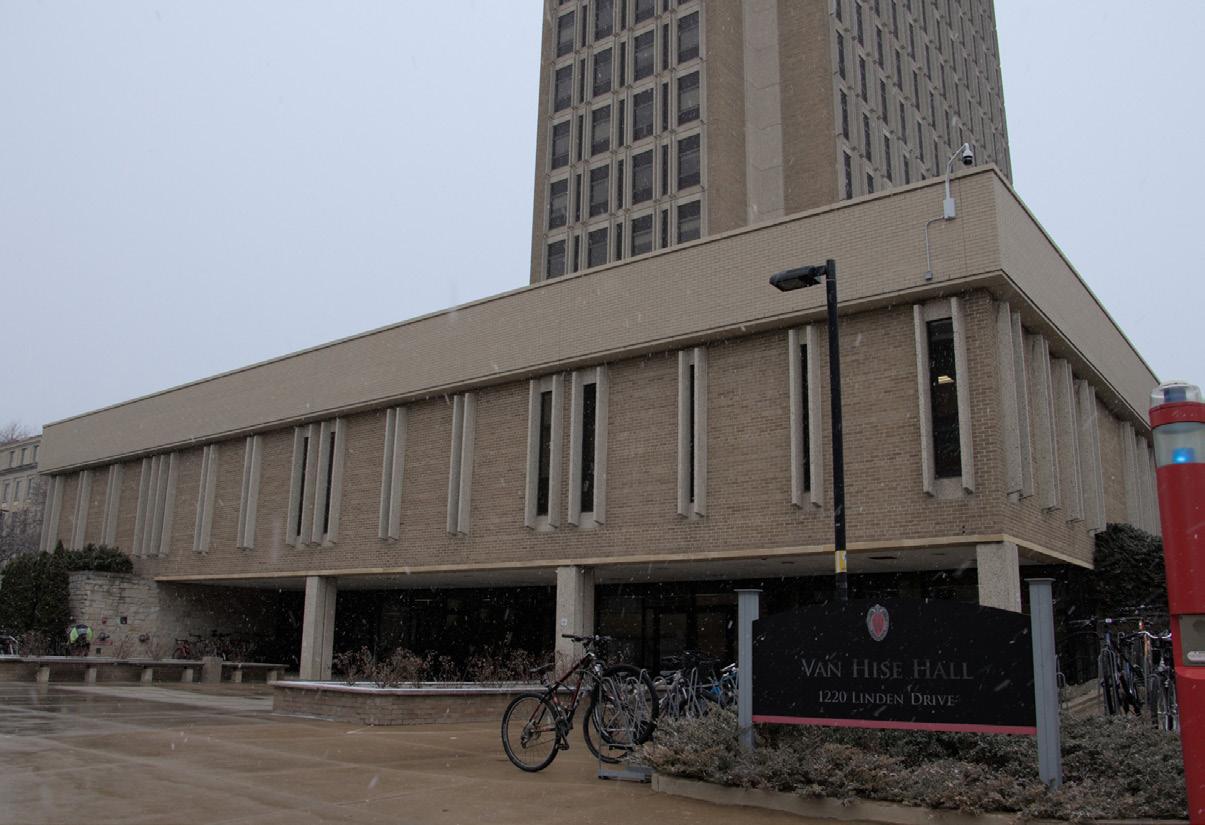
Recent widely-publicized vio lent incidents near the University of Wisconsin-Madison cam pus left many students feeling unsure of their safety. However, the Madison Police Department said that crime downtown is actually on the decline compared to past years.

A statement released by
University of Wisconsin Police Department (UWPD)
Chief Kristen Roman to the UW-Madison community on Tuesday highlighted three vio lent incidents, one of which was an attempted homicide with a firearm on the 100 block of State Street last Tuesday. The police search for the suspect, who is still at large, resulted in thousands of stu
“Regardless of what you think about guns, every single one of us seems to have decent odds to be murdered at any moment,” said Jawdosiuk.
This attitude reflects one that studies have indicated is com mon among Americans, where fear and anxiety about rising gun violence have had a measurable impact on the national psyche.
Ingrid Szocik, a sophomore from Milwaukee, echoed these sentiments. She said that “any act of violence occurring on a college campus is triggering”
Chief Roman’s email also touched upon two events this past weekend, including gun shots on University Avenue and N Frances Street and a stabbing on N Frances Street. In the email, Roman specified that neither event concerned a UW student nor took place on campus.
The latter incident also trig gered a shelter-in-place order from UWPD to everyone at the Student Activity Center (SAC) on East Campus Mall. Those individuals were under orders to stay inside with all doors locked from the initial alert at 2:23 a.m. to the all-clear message at 3:14 a.m.
According to Shawn Zhu, a sophomore who was in
Although Zhu said UWPD “did their job” in that the per petrator was apprehended, he wished the police had more directly communicated with those locked down in the build ing. When the SAC’s motionactivated lights were triggered, he and his friends had not yet been made aware whether they were safe or not.
Students who are concerned about their safety on campus are encouraged to take advantage of a number of resources available to them, including SAFEwalk and opting into off-campus alerts. Those whose mental or physical health has been impact ed should reach out to University Health Services.
UW System requests $24.5 million in state funding for low-income student tuition aid program
By Annika Bereny STAFF WRITER
The University of Wisconsin System is seeking $24.5 million in state funding for its “Wisconsin Tuition Promise,” a new aid program designed to support tuition costs for approximately 8,000 students across all 12 UW campuses.
The request came in the bien nial summary of 2023-25 budget requests released by the Wisconsin Legislative Fiscal Bureau. The UW System submits budget requests for state funding as a state agency.
The state budget cycle happens every two years, beginning in an even year and ending in an odd year. State agencies, including the UW System, submit budget requests and submit them to the State Budget O ce to inform the Governor’s bud get proposal.
The Wisconsin Tuition Promise, set to begin in fall 2023, is mod eled after University of WisconsinMadison’s Bucky’s Tuition Promise program. Bucky’s Tuition Promise guarantees scholarships and grants to cover tuition and segregated fees for in-state students whose annual household adjusted income is $60,000 or less, according to UW-Madison’s Financial Aid O ce.
Now in its fifth year of opera tion, Bucky’s Tuition Promise has fully funded tuition and segregated
fees for nearly 5,000 students at UW-Madison, according to the uni versity. Bucky’s Tuition Promise is funded entirely by private donors as well as money from other insti tutional resources, such as revenue from Bucky-branded merchandise.
The Wisconsin Tuition Promise will similarly provide aid to Wisconsin residents at any of the 12 University of Wisconsin campuses whose annual household adjusted income is $62,000 or less. Though the UW System intends to fund the program with $13.8 million in private funding during the 2023-24 academic year, it plans to cover subsequent years with state funding.
“The goal is to expand opportu nity and access for low and moderate income students so they can attend UW System universities tuitionfree,” UW System Media Relations Director Mark Pitsch said.
The UW System estimates 8,000 students would receive assistance in the first four years of the Wisconsin Tuition Promise in an August press release announcing the program.
“A college degree needs to be within reach for every Wisconsin citizen as a path to a better life, and the Wisconsin Tuition Promise will provide these opportunities,” UW System President Jay Rothman said in the release.
“By ensuring that every Wisconsin
student is given the full opportunity to get a higher education, we will improve those lives directly while building the economic engine and community prosperity that benefit all Wisconsinites,” he added.
Other budget items
The UW System’s budget request also proposed a $114.9 mil lion funding increase over two years to provide ongoing support for dual enrollment programs, diversity, equity and inclusion e orts, Title IX compliance, sustainability and stu dent mental health funding, among other initiatives.
UW’s proposal also included $123.1 million to supplement a 4%
wage adjustment for UW System employees in January 2024 and another 4% wage adjustment on Jan. 1, 2025 for UW System faculty, academic sta , university sta and limited appointments.
Also present in the UW System’s budget request is a detailed list of departments and programs that would receive budget reductions if the Wisconsin State Budget were to be reduced by 5%.
However, these reductions are merely a routine exercise as man dated by Wisconsin’s 2015 Act 201, according to Wisconsin Legislative Fiscal Bureau analyst Erin Probst
“By law, every state agency must

submit a plan for what might hap pen should the budget be cut by 5%,” Pitsch said. “This is an exercise sought by the legislature for budget review purposes.”
The items don’t all have direct implications on the lives of UW students, but some do deal with student support services and academic programs.
Notable funding reduction proposals include cuts to UW’s Tommy G. Thompson Center on Public Leadership, renewable energy, the state Laboratory of Hygiene and graduate psychiatric nursing education.
Items one and eight reduce the UW’s General Public Revenue (GPR) and Program Revenue (PR) appropriations, respectively, which would cut wide swaths of funding for “instruction, research, public service, student services, academic support, farm operations, physical plant operations, institutional sup port and services for students and sta .” The proposals would also cut a total of 700 positions.
The Governor will release his full biennial budget draft based on agen cy proposals early next year. It will then be sent to the Assembly’s Joint Finance Committee for review and modifications before being sent to the Legislature and finally Gov. Tony Evers in early summer.
“…the great state University of Wisconsin should ever encourage that continual and fearless sifting and winnowing by which alone the truth can be found.”
University of
Since 1892 dailycardinal.com Thursday, December 8, 2022 l
Wisconsin-Madison
DRAKE WHITE-BERGEY/THE DAILY CARDINAL
Police o cers from the MPD, UWPD and Wisconsin State Capitol Police responded to a shooting on the 100 block of State Street on Tuesday night.
NICK DUDA/THE DAILY CARDINAL
The Daily Cardinal is a nonproft organization
Divide by design: Gender exclusion at the Nicholas Recreation Center
By Tyler Katzenberger STATE NEWS EDITOR
The term “woman” is used in this article to refer to all woman-identifying persons.
Slamming weights. Inappropriate looks. A chorus of obnoxious grunting, no matter how much weight is on the bar.
That’s what University of Wisconsin-Madison senior Georgia Hancock deals with whenever she lifts in the basement of the Nicholas
ly on display, adding to her unease at the gym. She’s caught multiple men staring at her while squatting.
“You’ll just feel so uncom fortable if you catch someone looking at you,” Hancock said.
Hancock and Matuschka both avoid the Powerhouse dur ing their workouts. However, the Powerhouse is the only floor of the Nick with deadlift platforms and other intensive strength training equipment.
dents. Group members meet two to three times a week at local fitness studios for vari ous workouts, including yoga, Zumba and strength training.
As the club’s president, Matuschka organizes work outs and hosts activities like painting workshops and meditation sessions to foster a holistic wellness experience for approximately 150 Mind Body Badger members.
The guided group work
Wilderman said. “I’ll always remember that… It shows how you can meet such good friends from our club.”
Are group workouts enough?
RecWell used to provide an array of group workout options before the pandemic hit in 2020, according to Van Note.
Van Note said she and other staff are working to bring those spaces back this fall because they understand group workouts are safe fit ness spaces for women and other marginalized students.
“I think it gives a sense of community to a lot of folks,” Van Note said. “[It] gives that level of comfort to come into our spaces.”
Van Note also said the new Bakke Recreation Center, opening in early 2023, will include more space for group workouts and “semi-private” fitness areas that prevent stu dents from feeling like they’re on display when working out.
in chief.
The Daily Cardinal accepts advertising rep resenting a wide range of views. This accep tance does not imply agreement with the views expressed. The Cardinal reserves the right to reject advertisements judged offensive based on imagery, wording or both.

Complaints: News and editorial complaints should be presented to the editor in chief. Business and advertising complaints should be presented to the business manager.
Letters Policy: Letters must be word pro cessed and must include contact information. No anonymous letters will be printed. All letters to the editor will be printed at the discretion of The Daily Cardinal. Letters may be sent to opinion@ dailycardinal.com.
Recreation Center, commonly referred to as “The Nick.” She and other students said the gym’s design creates mascu line strength training spaces that intimidate women, lead ing them toward cardio and group workouts.


“It feels uncomfortable,” Hancock said. “You just feel like you don’t belong.”
The Nick has five floors, each with varying combi nations of training equip ment. Its different “neigh borhoods” are a deliberate design choice intended to offer students diverse work out environments, accord ing to University Recreation and Wellbeing Assistant Director of Inclusion, Club & Community Programs Abby Van Note.
But, Hancock sees an obvi ous gender divide between neighborhoods when she vis its The Nick. Men dominate strength training areas while women populate cardio equip ment along the windows, especially on the second floor.
The disparity is striking on the lower level.
“That area is always 90% men, at least,” Hancock said. “I feel like there’s a gender divide there for sure.”
Even the floor’s name — the “Powerhouse” — makes the space feel more intimidating for women, explained UW-Madison senior Kennedy Matuschka.
“I feel like that in itself is very manly, more masculine,” Matuschka said. “It’s just so intense.”
Hancock added that The Nick’s open floor plan makes her feel like she’s constant
That leaves the women with a tough choice — either brave the Powerhouse to com plete their workout or make do without its equipment in another fitness space.
Group workouts make space
Hancock now does most of her fitness training in group workout classes or intramural sports instead of solo work outs. She said the group envi ronments are less intimidat ing and more private than the overcrowded Nick.
“It feels nice to have that space set aside for group fit ness, as opposed to going and having to wait a super long time for a machine,” Hancock said.
Matuschka found her fit ness community through Mind Body Badger, one of multiple women’s fitness and wellness groups for UW stu
outs are “empowering” and allow women to access the equipment they need without judgment based on skill or gender expression, according to Matuschka.
“There’s so much energy in the room. Everyone’s smiling,” Matuschka said. “You leave feeling good about yourself, no matter what.”
Mind Body Badger’s group workouts also forge friend ships that last for years, according to club vice presi dent and UW-Madison sopho more Alayna Wilderman. She met one of her best friends at a group workout in Hilldale during her freshman year.
“Her and I bonded over being freshmen and liv ing in the Lakeshore dorms, and then we went to Target together and walked home,”
But, group classes aren’t a cure-all for fitness inclusion, according to Hancock. Group fitness rooms at The Nick don’t have heavy weights, meaning Hancock can’t do a full range of strength work outs. If she wants to deadlift, she still has to head down to the Powerhouse.
And that’s assuming she even gets a deadlift platform.
“Ten guys will hang out and use the platforms for way too long,” Hancock said. ”No one else can use the space super effectively.”
Hancock doesn’t mind sticking to lighter weights now that she works out more for mental wellness than physical gains. However, she and other women want the freedom to access Powerhouse equipment in a less intimidating part of the gym.
“I think bottom line, group fitness classes are great,” Hancock said. “But it would still be better if The Nick was set up to have more lifting areas conducive to all of the people that actually want to use them.”
2 Thursday, December 8, 2022 dailycardinal.com news
Corrections or clarifcations? Call The Daily Cardinal offce at 608-262-8000 or send an email to edit@dailycardinal.com. For the record l An independent student newspaper, serving the University of Wisconsin-Madison community since 1892 Volume 132, Issue 16 2142 Vilas Communication Hall 821 University Avenue Madison, Wis., 53706-1497 (608) 262-8000 News and Editorial edit@dailycardinal.com News Team News Manager Hope Karnopp Campus Editor Alison Stecker College Editor Anthony Trombi City Editor Charlie Hildebrand State Editor Tyler Katzenberger Associate News Editor Ellie Bourdo Features Editor Annabella Rosciglione Opinion Editors Priyanka Vasavan • Ethan Wollins Arts Editors Jeffrey Brown • Hannah Ritvo Sports Editors Donnie Slusher • Cole Wozniak The Beet Editor Mackenzie Moore Photo Editor Drake White-Bergey Graphics Editors Jennifer Schaller • Madi Sherman Science Editor Julia Wiessing Life & Style Editor Sophie Walk Copy Chiefs Kodie Engst • Ella Gorodetzky Copy Editor Jasper Bernstein • Noe Goldhaber Social Media Manager Clare McManamon Business and Advertising business@dailycardinal.com Business Manager Asher Anderson • Brandon Sanger Advertising Managers Noal Basil • Sydney Hawk Marketing Director Mason Waas
run by its staff members and elected editors. It receives no funds from the university. Operating revenue is generated from advertising and subscription sales.
and
and
with
The Daily Cardinal is published weekdays
distributed at the University of WisconsinMadison
its surrounding community
a circulation of 10,000. Capital Newspapers, Inc. is the Cardinal’s printer. The Daily Cardinal is printed on recy cled paper. The Cardinal is a member of the Associated Collegiate Press and the Wisconsin Newspaper Association. All copy, photographs and graphics appear ing in The Daily Cardinal are the sole property of the Cardinal and may not be reproduced without written permission of the editor
© , The Daily Cardinal Media Corporation ISSN -5 98 Gavin Escott Editorial Board Em-J Krigsman • Anupras Mohapatra • Jessica Sonkin • Priyanka Vasavan • Sophia Vento • Ethan Wollins
of Directors Scott Girard, President • Herman Baumann • Ishita Chakraborty • Don Miner • Nancy Sandy • Phil Hands • Josh Klemons • Barbara Arnold • Jennifer Sereno
Board
Editor-in-Chief Sophia Vento Managing Editor Jessica Sonkin
TYLER KATZENBERGER/THE DAILY CARDINAL
TYLER KATZENBERGER/THE DAILY CARDINAL
MSN airport most expensive in country
 By Gavin Escott GAVIN ESCOTT
Prices are sky-high at Madison’s airport, which now claims the dubious distinction of having the highest average ticket prices of the 100 busiest airports in the country, up from its pre vious ranking as number two, a study found.
The November study, con ducted by the financial technol ogy company Smart Asset, found that the Dane County Regional Airport had the highest average fare of $526, only one of three air ports with an average price over $500. The other two, Washington Dulles International Airport and Birmingham-Shuttlesworth International Airport, lag behind with respective average airfares of $526 and $503.
According to the study, data from the Bureau of Transportation Statistics show the average cost of a domestic flight in the U.S. increased from $328 to $397 across
the second quarter of 2022 — an increase of 21%. Airfare at the Dane County Regional Airport increased 20.6% during that same timeframe.
Dane County Regional Airport Director of Marketing and Communications Michael Riechers said the airlines are pri marily responsible for ticket costs.
“[Dane County Regional Airport] doesn’t have any direct control or influence over tick et pricing,” Riechers told News 3 Now. “Each airline that really operates here, they’re really ten ants of the airport, so each air line sets their own pricing, they set their own scheduling, they set everything to conduct business.”
In a Smart Asset study from August, Madison had the second highest average airfare in the country, with the average flight costing $436. Only Ted Stevens Anchorage International Airport had a higher average airfare at $456. Madison was identified as
the 10th worst airport in terms of rising costs, with flights $94 higher than a year prior — the sev enth highest increase among the 100 busiest airports from the first quarter of 2021 and 2022. These increases were driven by infla tion and the rising price of jet fuel — which increased roughly 110% between the first quarters of 2021 and 2022.
CheapAir.com CEO Je said smaller cities are seeing high er spikes in ticket prices.
“Traveler demand is contribut ing to the higher prices we’re see ing right now, but fuel prices and sta ng shortages are still the real culprits,” Klee said, adding that larger markets are seeing smaller spikes in domestic airfare prices. “If you live in one of those larger cities — you might see less of a sticker shock than someone from a smaller city.”
The majority of the airports showcased on the most expen sive list are mid-size airports like
UW graduate teaches English abroad
By Jasper Bernstein STAFF WRITER
The International TEFL Academy (ITA) aims to o er a solution to students’ question of what comes next — through the opportu nity to teach English abroad.
“I knew after leaving college I wanted a job that allowed me to work with people of various backgrounds, and I also wanted a job that allowed me to travel,” said Ilsa Strough, a 2020 University of WisconsinOshkosh graduate. “I came across getting certified to teach English abroad, and I decided to do it because it sounded like exactly what I was looking for.”
Founded in 2010, the ITA prides itself on Teaching English as a Foreign Language (TEFL). The ITA o ers a variety of TEFL jobs in over 80 countries. Strough chose South Korea as her teaching destination and moved in November of last year.
“The process of settling into Korea was stressful,” Strough said. “Once I arrived in Korea I had to quarantine, then I had to do a health check, go to the immigration o ce, start work and go to the bank. It all was overwhelming and stressful.”
Strough went on to explain that classes started shortly after the initial move-in.
“I had no prior teaching experience out side of my 20 hours I did to receive my ITA TEFL certification. I had a week of training at my job and in that week I had to learn everything about teaching,” Strough explained. “It was a lot of information, and I know I made mistakes, but I think it all made me a better teacher.”
Strough taught English at a hagwon, a Korean private school. At the school, stu dents came to learn English after spending
their day at public school.
“My working hours are 1:45 to 9 p.m. with only about five of those hours being teaching,” Strough said. “My hagwon is very academic, so we teach students how to write five paragraph essays, we focus on reading, listening, etc. After work, I typi cally head home, relax and get ready to do it all again the next day.”
The ITA o ers opportunities to teach English abroad to students not long after graduation. Strough graduated in May 2020 and decided to get certified through ITA about a year later. However, Strough made it clear that teaching abroad is not for everyone.
“Teaching abroad is a full time job, and the amazing travel opportunities are just a bonus on the weekends or on time o ,” Strough emphasized. “The school and the students deserve 100% of you, so if you have no interest in teaching or just want to move abroad to travel, teaching English abroad is not for you.”
ITA, along with a host of other TEFL schools, is currently accepting applications.
“It is scary, there are so many unknowns, you are picking up your entire life to move abroad and experience some thing completely new,” Strough said. “It is an experience you will never forget. You have a chance to fully immerse yourself in another country and culture, and you will be so thankful you took the chance and did it.”
For students not graduating soon, UW-Madison’s study abroad program o ers opportunities in 65 countries. Students inter ested in teaching English abroad can view opportunities at internationalteflacademy.com.

Madison, reflecting the price dis parity between smaller airports and larger ones. Dane County Regional Airport had around 2,530 flights in November across 31 airlines. In contrast, O’Hare International Airport, which ser vices Chicago, had nearly 60,000 flights last month across 1,396 routes. According to Riechers, larger airports with a higher vol ume are able to keep costs lower.
While Dane County’s air port is located less than 20 miles from campus, some University of Wisconsin-Madison students like senior Jamie Randall say high prices have pushed them to look elsewhere for flights.
“When I look at flights from Madison, they are always double the price compared to [Milwaukee] or O’Hare,” Randall said. “Flying to the East Coast, yes, it’s only
Dr. Carolee Dodge Francis becomes first Native woman department chair
By Natasha Hicks STAFF WRITER
Dr. Carolee Dodge Francis is the first Native woman to serve as the department chair of the Civil Society and Community Studies Department in the University of WisconsinMadison School of Human Ecology.

This role is not something she initially sought out, but she followed a calling which eventually led her to this position.
“I must say [I was] a little apprehen sive because now I was like, ‘Okay, I have to do a really great job,’” she told The Daily Cardinal. “People ask [if] this something [I] planned, and for much of my life it’s not always that I planned a direction but mostly just a calling of where I need to be.”
Dodge Francis is a member of the Oneida Nation and grew up on the Menominee Reservation, where her dad was a logger. When she left for school, she looked forward to returning to the reser vation on breaks.
“When I went o to school, I would really truly enjoy going home because of the calmness of the environment going into the woods,” she emphasized. “It was such a haven.”
Because of her love for the reservation and her Native culture, Dodge Francis knew she wanted to work with Native communi ties, though she was unsure what career path she would ultimately pursue.
“I knew I was working with Native com munities but in what role was unclear,” she said.
Dodge Francis found passion in focusing on community health and working for non profits. She founded two nonprofit organi zations throughout her career – one for HIV/ AIDS in the 1980s and the Dickinson Area Community Foundation, which provides grant money for nonprofit organizations and government agencies.
“This combination of health and non profit has really inspired and driven my career going forward,” she said.
Between her philanthropic work, Dodge Francis established a K-12 diabetes curricu lum alongside the Centers of Disease Control and Prevention, Indian Health Service and National Institute of Health (NIH) to help provide education and prevention of the disease in native communities.
“Type 2 diabetes has been and is epidemic proportions for Native Americans,” she said.
According to Dodge Francis, Tribal lead ers realized the onset of Type 2 diabetes was preventable and went to NIH asking for them to do more, which drove the creation of this curriculum.
“We need to start talking about the dis ease earlier and at a younger age because even today we see our young children, grade school age, high school age being diag nosed,” she said.
In addition to her passion for health, nonprofits and native groups, Dodge Francis is interested in making teach ing and research accessible for stu dents. She is currently in her last year of a NIH R25 grant which helps provide research opportunities for high school juniors and seniors, specifically Native American, Alaska Native and Puerto Rican students.
“I’ve known some of these students since 11th grade,” she said. “It’s really fascinating to watch them grow, flourish and blossom in front of your eyes.”
Dodge Francis is excited to set the path for Native students and hopes that her role as department chair shows her students the possibilities out there.
“I can be that catalyst to show them the realm of opportunities that they might think about, that’s really what inspires me,” she said.
As a professor at UW-Madison, Dodge Francis emphasized that faculty such as herself are here to support students and help them accomplish their goals.
“Be passionate, explore the possibilities and know we are here to support you,” she said.
news
dailycardinal.com Thursday, December 8, 2022 l 3
DRAKE WHITE-BERGEY/THE DAILY CARDINAL
COURTESY OF DANE COUNTY REGIONAL AIRPORT VIA FLICKR
COURTESY OF HUMANECOLOGY.WISC.EDU
The Cardinal’s Best Arts of 2022
By The Daily Cardinal Sta
It’s the end of another year and time to talk about what art we’re taking with us. The Cardinal sta was surveyed on their favorites of the year and some even shared their thoughts. Here’s what we had to say.
Movies
Written and directed by Dan Kwan and Daniel Scheinert, the far and away favorite of the year was “Everything Everywhere All at Once.” This film garnered over half of the sta ’s votes — over twice more than any other film. Here’s what our sta had to say:
Everything Everywhere All at Once
Watching “Everything Everywhere All At Once” feels like a life changing experience, a film that you know for a fact will be treasured and revered for years to come. A refreshing new take on the multiverse trend, writ ers and directors Daniel Kwan and Daniel Scheinert have created some thing that feels truly original. The incredibly messy and overly intricate storyline is brilliantly brought to life by Michelle Yeoh, Ke Huy Quan and breakout star Stephanie Hsu — each of whom deliver incredibly diverse, profound performances. EEAAO is exciting, painful, refreshing, absurd in all the best ways and one of my favorites movies of all time. - Shu Lan Schaut
At once profoundly moving and thoroughly comedic, “Everything Everywhere All At Once” is a special kind of film that you only get to expe rience every once in a blue moon. This movie struck a deep chord with me and opened my mind in some very unexpected ways, which I believe is an experience many can attest to. The movie is beautiful on both a visual and story level. It feels almost organic — like it was grown on some wizened tree in a kindly hermit’s backyard. The evident skill and loving care taken by the team behind this masterpiece is astonish ing. - Noah Fellinger
Honorable Mentions:
Don’t Worry Darling
I didn’t watch many of this year’s mainstream movies, but I would say I really enjoyed “Don’t Worry Darling[’s]” plot and cin ematography, despite it being somewhat predictable. The actors and casting were also very good, so overall it was a well-produced film. - Lauren Aguila
Nope
“Nope” was visually stunning and so, so clever. Did you know they filmed everything during the day and edited it to look like night in post-production? - Zoe Kulka
The Menu
I went into “The Menu” thinking it would be a fun but cheesy “Scary Movie” kind of thing. Instead, it was unlike anything I’ve seen before (in a good way). I laughed, I got nervous, I thought about my life, I kinda want ed s’more after. - Mackenzie Moore
Others of note were “RRR,” “Top
Gun: Maverick,” “The Batman,” “Elvis” and “Glass Onion.”
Music
While Taylor Swift’s “Midnights” received the most votes, and Harry Styles’ “Harry’s House” received the second most, the bronze medal ist “The Car” by Arctic Monkeys, despite garnering three fewer votes than the poll winner, had the most written support from sta ers. Here is what writers had to say:
The Car
After abandoning the intricate guitar ri s of their previous records for the space-age pianos and synths of “Tranquility Base Hotel & Casino,” Arctic Monkeys have found a happy medium in “The Car.” The album combines a disco-influenced lounge aesthetic with explosive guitar fin ishes and some of frontman Alex Turner’s best vocal performances yet. While not quite reaching the heights of some of their earlier work, “The Car” is fresh and creative proof that the band is still evolving almost two decades in. - Spencer Ball
Honorable Mentions:
Midnights
Taylor Swift’s “Midnights” is the closest thing to pop music perfec tion that my ears have ever heard. The elaborate storytelling Swift conveys through her lyrics is not lost, and in fact shines among the unique and upbeat tunes of this album. - Sophia Clark
$oul $old $eparately “$oul $old $eparately” shows Freddie Gibbs can have a broader appeal — signed with a major record label and expectedly this album is stylistic di erent than his previous, but it works. - Alex Clark
Others of note were “You Still Here, Ho?” by Flo Milli, “Free LSD” by OFF!, “Preacher’s Daughter” by Ethel Cain, “CAPRISONGS” by FKA twigs, “God Save the Animals” by Alex G., “Hot Mess” by Dodie, “Gemini Rights” by Steve Lacy, “Stick Season” by Noah Kahan and “Darklife” by death’s dynamic shroud.
Shows & Series
2022 proved to be a year of many great shows with none of them being dominant in the zeitgeist for too long. While a wide variety of shows found some time in the spotlight over the course of the year, the win ner and runner up of our poll were the second seasons of “Euphoria” and “Bridgerton.” However, no one wrote about “Euphoria,” so we’ll call that a forfeit.
Bridgerton
Period movies and shows have always had a soft spot in my heart, and “Bridgerton” is no exception. I love watching “Pride and Prejudice” or “Little Women,” but until recent ly never would’ve thought that someone like me would ever be able to have a place in these universes. “Bridgerton” season two not only includes people of color into this
world, but highlights its women of color characters in leading roles. “Bridgerton” still brings its heat and drama to the screen, albeit in a more anticipatory way. Perhaps I enjoy the enemies to lovers trope a little too much, but for me, season two of “Bridgerton” is an addictive addition to the already successful show. - Shu Lan Schaut
Honorable Mentions:
Andor
“Andor” is dark, gritty and quite di erent from anything we’ve seen in “Star Wars” recently. There is conflict, bureaucracy, secrecy and resilience — the show sheds light on it all. The relative lack of flashy action scenes may be a turn-o to certain fans, but it means there is a greater focus on the granular aspects of fascism from all angles.
- Anupras Mohapatra
Attack on Titan
“Attack on Titan” remains my favorite anime of all time. Hajime Isayama is a brilliant writer, and MAPPA Studios truly brought the story of season four part two to light through their admirable animations and voice actors. I am eagerly await ing the third and final part of season four, which is due to air in early 2023. - Ace Filter
The Bear and Love Island UK I loved “The Bear” because it was really good and made me write up a menu and cook dinner for the rest of the week. But, “Love Island UK” is the GOAT of 2022 TV, I fear. The drama and storylines were unmatched, and the islanders were just so insane that it was perfect TV.
- Annika Bereny
Others of note were the recent seasons of “Abbott Elementary,” “The White Lotus,” “The Rehearsal,” “Obi-Wan Kenobi,” “Rick and Morty” and Gavin.
Games
When it came to 2022’s games, there was a clear favorite: “Wordle.” This game took over the internet for several weeks then spawned an entirely new genre.
Wordle
My mom and I used to play “Wordle” with each other daily. We’re in touch every day anyway, but this added something more to it. When you stay away from home for months on end, every little interaction counts that much more. “Wordle” added something special. The game is so simple as well. Like any trend, it has fallen in popular ity, but it was fun while it lasted.
- Anupras Mohapatra
“Wordle” took over people. It was the basis of two of my friend ships and often the first thing I did every morning. - Brenna Rae
Honorable mentions:
Pokemon Legends: Arceus
To be honest, I just started playing “Pokemon Legends: Arceus” after not having played a Pokemon game since it was on Game Boy. That being said, I
The Cardinal’s 2022 Playlist
BY THE DAILY CARDINAL STAFF
“Lavender Haze” - Taylor Swift
“Body Paint” - Arctic Monkeys
“I Like You” w. Doja Cat - Post Malone
“Fade Persona” - death’s dynamic shroud
“Muddy the Waters” - OFF!
“Do Better” - Ab-Soul, Zacari
“Johnny P’s Caddy” - Benny the Butcher & J. Cole
“Hypothermic” - Goodnight, Texas
“Hammer And The Anvil” - The Longest Johns
“Geronimo” - Young Fathers
“Gibson Girl” - Ethel Cain
“Honda” - FKA twigs, Pa Salieu
“Slaughterhouse” - Chat Pile
“King” - Florence and the Machine
“Way of the Triune God” - Tyler Childers
“Savior” - Kendrick Lamar, Baby Keem, Sam Dew
“The Heart Part 5” - Kendrick Lamar
“High In delity” - Taylor Swift
“On BS” - Drake & 21 Savage
“Dark Hearted” - Freddie Gibbs
“Gasoline” - The Weeknd
“Golden Boy” - Bryce Fox
“Chitty Bang” - Leikeli47
“Kody Blu 31” - JID
“La La” - S H I R A N
“Shirt” - SZA
“Mercury” - Steve Lacy
“As It Was” - Harry Styles
caught a Psyduck a couple nights ago and it brought me indescrib able joy. - Mackenzie Moore
Lego Star Wars: The Skywalker Saga
I am literally a billionaire in “Lego Star Wars: The Skywalker Saga.” The open world nature of the game is great, although there’s still a lot that could be better. Story mode mis sions are shorter in this game versus older Lego Star Wars games, and some planets have limited access. Also, once you’ve done quests, you can’t redo them unless you make a new save. Still my favorite game of the year. - Anupras Mohapatra
Inscryption
2022 felt like a slow year for video games, or at least ones that fit my taste. So despite coming out in 2021, the fact that I finally got around to playing “Inscryption” makes it count as my game of 2022. I’m a lame duck arts editor, so I make the rules and there’s nothing anyone can do about it. This game blew my mind and easily secured a spot in my top five video games of all time. I wouldn’t break the rules for any thing less. - Je rey Brown

Others of note were “Elden Ring” and “The Stanley Parable: Ultra Deluxe Edition.”
Art Around Us
While movies, music, TV and games are all great ways to engage with art, there is so much more art around us. Here’s what the writers had to say about their favorite ways of engaging with art on campus or in Madison.
Sifting and Reckoning
I really loved the “Sifting and Reckoning” exhibit at the Chazen. I was amazed at the amount of history that has been preserved throughout UW-Madison’s his tory. Plus, I learned a lot about the discrimination that has taken place on campus over the years and the administration’s response to it. - Mackenzie Moore
Margaret H’Doubler Performance Space
“bits n’ pieces,” presented by Li Chiao-Ping Dance and the UW-Madison Dance Department, showed me that dance can both present serious themes and be downright hilarious. I had no idea that UW-Madison’s dance program and Lathrop Hall have such a rich history. If you’re looking for a new experience in Madison’s arts scene, I highly recommend checking out a contemporary dance perfor mance in the Margaret H’Doubler Performance Space. - Hope Karnopp
MCOR
My favorite way of engaging in the arts on campus was by attend ing the Multicultural Celebration of Organizations and Resources (or MCOR) at the beginning of the semester. I also enjoyed attending some of the musical productions held at the Hamel Music Center.Lauren Aguila
Wisconsin RangDe
RangDe is a dance group here at Madison that focuses on fusion dance which combines Indian music with all genres, like hip-hop, R&B and more. The shows are a joy to be a part of. - Vee Sridhar
Others mentioned Wheelhouse Studios and improv shows.
arts
4 Thursday, December 8, 2022 dailycardinal.com
HENRY MOORE/THE DAILY CARDINAL
Federal investment in renewable energy spurs hydrogen research
By Erik Pfantz STAFF WRITER
Hydro g en is the small est and most abundant ele ment in the universe. It is lighter than air and produces heat energy when burned. Hydrogen gas is easily gener ated through a process called electrolysis, which invol v es runni ng an electric current through salt water. Humans have bee n able to produce hydrogen for over 200 years but have rarely found a valu able purpose for it.
Early in the 20th centu ry, people tried filling mas sive balloons with hydrogen, using them to float airships which carried passengers on what were essentially plea sure cruises. Like Frisbees, airships are often referred to by their most famous manufacturer Luftschiffbau Zeppelin. However, in 1937, an improbable and wellpublicized accident with the world’s largest airship, the Hindenburg, put a quick end to this fad.
The United States has been rapidly deploying renewable energy systems like wind and solar in recent years, adding 17.6 gigawatts of solar alone in the last year — a 34% increase in the nation’s total solar deployment. Large amounts of energy can be produced on sunny or windy days, but these common renewable energy producers are not always active during peak electricity demand times.
Electric energy must be used at the same rate it is produced. If a renewable energy producer is produc ing more than is demanded, and there is no option for storing energy, its produc tion is “curtailed” or stopped. This curtailment of a renew
able energy producer can be thought of as a loss of ener gy, and it is happening more and more each year. In 2020, California curtailed what would have been 5% of its total solar power output that year, according to the U.S. Energy Information Administration.
Storing renewable energy has been a constant challenge to full utilization of renewable sources. However, research ers are looking to hydrogen to solve this storage issue.
In January 2023 the University of WisconsinMadison will open the Hydrogen and Electrochemical Research for Decarbonization (HERD) Lab, directed by Dr. Luca Mastropasqua, an assis tant professor in mechanical engineering. The lab is focused on using hydrogen to make decarbonized systems — which reduce carbon emissions — for power generation, energy stor age and industrial applications.
“If you can produce hydro gen in a renewable fashion then you can use [it] as a car rier of renewable energy,” said Dr. Mastropasqua.
Energy produced by wind and solar can then be used in industrial processes such as cement, steel or chemical production, sectors which have not had solutions for decarbonization, according to Dr. Mastropasqua. These industries emit 2.3 gigatons (Gt) or 6.2% of global CO2 emissions, 3.3 Gt or 9%, and 2 Gt or 5.4%, respectively. This is about a fifth of global emis sions which are overdue for decarbonization solutions.
Hydrogen gas is difficult to contain because it is small enough to fit through even the tiniest crack. At room temperature, hydrogen mol ecules are gaseous at normal
temperature and pressure. If compared by weight, hydro gen contains more energy than other fuels but when compared by volume, hydro gen takes up much more space unless it is compressed or liquified — both processes which take energy and good safety practices.
Up until now, hydrogen did not have many feasible (or profitable) applications outside of a few chemical production processes, so little funding has gone into researching new hydrogen technologies, according to Dr. Mastropasqua. This has left both electrolysis and hydro gen storage as areas ripe for research and innovation.
The most common way people may think of energy storage is through batter ies, such as the process of charging our phones with their nickel-cadmium or lith ium-ion chemical batteries. However, at the scale of an energy grid, energy storage looks a little different.
Globally, 94% of existing energy storage is pumped hydro. Pumped hydro stores energy by pumping water into an elevated holding tank during periods of excess ener gy production. When there is high energy demand, the water is funneled back down ward and through turbines which generate electricity. Pumped hydro facilities have massive footprints which dis rupt environments and water cycles, so environmental regulations in the U.S. have limited their development in recent decades, accord ing to the Federal Energy Regulatory Commission.
Similarly, hydrogen can act as a storage mechanism but on a molecular level. At
times of high energy produc tion, excess energy can be used to perform electrolysis and hydrogen can be stored in many ways: large gas tanks, enormous underground cav erns, combined with other chemicals, such as ammonia, to reduce storage challenges, or, given the right circum stances, within the existing natural gas systems.
In 2021, the Biden Administration announced “The Hydrogen Shot,” which “establishes a framework and foundation for clean hydrogen,” according to the Department of Energy (DOE). The initiative, which echoes President Kennedy’s “Moonshot,” aims to reduce the cost of producing hydro gen to “one dollar per kilogram in one decade.” Biden’s initia tive promises DOE resources and incentives to get there. One of these resources is the Regional Clean Hydrogen Hubs program.
Wisconsin Gov.Tony Evers announced two efforts with nearby states to submit pro posals for funding from the federal Hydrogen Hubs pro gram. These hubs aim to con nect hydrogen producers, researchers and consumers in order to increase the use of hydrogen as a clean energy carrier. Wisconsin’s flagship universities are certain to play a role in the development of these proposals.
“Right now across the U.S., people, including us, are focus ing their work in developing hydrogen hubs. There will be between four and eight across the U.S. by the time they get funded and those are regional hydrogen hubs that will coor dinate with each other. Their goal will be to research, dem onstrate, design and build
hydrogen projects,” said Dr. Mastropasqua. “Every person I talk to in the hydrogen field is basically coordinating for that. The legislation has had a major e ect on the industry and on the research, so it’s an exciting time.”
Dr. Mastropasqua said he is moving from the University of California-Irvine to UW-Madison to continue his research in hydrogen because of the state’s proximity to water and wind resources. Wisconsin also has several industries, particularly in concrete and metals produc tion, which currently lack decarbonization solutions. Proximity to these industries could allow the HERD Lab to perform groundbreaking experiments and immediate reduction in fossil fuel emis sions, he said.
“There is some research that needs to be done, not in the lab because these things are difficult to reproduce in the lab as compared to real life,” said Dr. Mastropasqua. Wisconsin has had a long history in renewable energy innovation. The state lacks fossil fuel resources, so Wisconsinites have found creative ways to meet their energy needs. For example, the Wisconsin River is known as “the hardest working river in the nation,” a nickname it earned for having nearly 50 hydropower facilities — more than any other river in the U.S. WEC Energy Group man ages utilities in Wisconsin and surrounding states. Their ener gy production portfolio includes 20 years of wind farms, more than 100 years of hydropower and even a nuclear plant which it no longer manages.
Continuereadingatwww. dailycardinal.com
Why it’s impossible to evolve wheels


 By Je rey Brown ARTS EDITOR
There are moments in life, usually around two in the morn ing or in the back of a calculus lec ture, when one asks, “Why don’t any animals have wheels?” After all, they’re a very e cient way to get around: rotational force turns into lateral motion. Cars, buses, trains and bikes replaced horses
Much of the reasoning is that the biological engineering doesn’t seem reasonably feasible.
What would the wheel be made out of? Bone? Cartilage? Keratin? And how would that be connected to the rest of the body so it can be supplied with nutri ents without having blood vessels that would get twisted when the wheel is spinning? How would
possible. Maybe blood vessels can detach while the wheel is in motion and muscles can push against it without getting twisted — but again, whatever hypotheti cal biological concept is going to lack the middle steps.
This brings us to the second point: evolution does not skip steps. Natural selection, the pro cess by which favorable traits
heights similar to today’s flying squirrels. They found it favor able to fall from heights, devel oped limbs with larger surface area to slow their fall and have more control, began flapping, and so forth to wings and flight. The other major theory works in the opposite direction of ground up by imagining the ancestors as leaping, using their limbs to
When we look at an Ambulocetus, it’s easy to imag ine that as the halfway point between four-legged land ani mals and modern whales. But, what is the halfway point between a lizard and a lizardmobile? What comes between no wheels and wheels?
The answer so far seems to be nothing. While it’s nice to know
science
dailycardinal.com Thursday, December 8, 2022 l 5
Column: New Year’s resolutions for Wisconsin sports
By Donnie Slusher SPORTS EDITOR
As a great year of Wisconsin sports wraps up, fans, players and athletic sta ers look ahead to the next.
Some teams excelled — volley ball, men’s basketball and women’s hockey — while others entered a period of transition — football and women’s basketball.

Despite the progress made, or the lack thereof, it’s time to look toward the future. With the incoming influx of Big Ten money, there has never been a greater opportunity to cor rect some of Wisconsin sports’ most obvious issues.
Everybody makes a list of New Year’s resolutions. If I’m Athletic Director Chris McIntosh, these would be my resolutions for Wisconsin sports.
Make men’s hockey matter again
Look at all the country’s best hockey teams — they’re all in the Midwest, and many are in the Big Ten. It should drive McIntosh crazy that all of Wisconsin’s peers are succeeding while the Badgers struggle to even compete against Big Ten opponents.

Despite recent memory, Wisconsin is a historically great hockey program. Head Coach Bob Johnson brought the Badgers their first championship in 1973, and Wisconsin has won five more since. From 1973 until their most recent championship in 2006, Wisconsin averaged a win every 5.5 seasons. It’s now been 16 years since their last.
It would be less alarming if the team remained viable, but the Badgers haven’t surpassed the regional semifinals since 2010. Worse yet, mediocrity is becoming acceptable.
In current coach Tony Granato’s six full seasons, his teams have fin ished with a winning record only twice — most recently in the 2020-21 season when they were led by two top-15 draft picks in Cole Caufield and Dylan Holloway.
A proud hockey program with two top-15 picks barely won 20 games and lost in the first round. Since those two stars left, Wisconsin went 10-24-3 last season and started 7-9-0 this season with a 1-7-0 Big Ten record. We shouldn’t act like this is normal.
Despite recent mediocrity, the Badgers truly aren’t that far away from regaining relevance. Wisconsin still brings in talent. On the current roster, there are currently three top100 draft picks — Corson Ceulemans, Ty Smilanic and Sam Stange. Some project freshman Charlie Stramel to be selected in the first round.
If McIntosh wants to show he’s serious about improving men’s hock ey, the first step is firing Granato. Wisconsin will continue to bask in mediocrity if Granato is at the helm. He’s still able to recruit well, but their talents are being wasted.
The Badgers can become a pow erhouse again, if they care.
Recruit an awesome QB
The potential for a legitimate quarterback at Wisconsin has never been greater.
Everybody knows about Wisconsin’s run-heavy approach. It’s their identity — hence the plethora of great running backs and o ensive linemen throughout
the Badgers’ history. Wisconsin shouldn’t abandon their identity. Every successful team has a clear identity — the Badgers don’t have to worry about that.
However, we’ve seen what Wisconsin looks like when they expect a great running back to cover up an abysmal passing game. The Badgers become predictable, easy to defend and thus easy to shut down — look at the last two years.
Historically, their competition has been other Big Ten West teams with similarly limited o enses. But, the world is changing. Divisions in the Big Ten will be no more in 2024. So, instead of competing with Iowa and Minnesota to reach the Big Ten title game, it’ll soon be Ohio State, Michigan and Penn State.
If Wisconsin wants to sit at the cool kids’ table in the Big Ten, they can no longer be a onedimensional offense.
McIntosh recognized how much the program must improve — hence the hiring of coach Luke Fickell. The Badgers could have easily pro moted the familiar Jim Leonhard, but instead they opted to swing big and hire the reigning national coach of the year. McIntosh and co. must stay aggressive and pour more resources into the recruiting, NIL and transfer departments.
The new regime may also have
better luck than past Wisconsin coaches at bringing in a legitimate quarterback. At Cincinnati, Fickell coached Desmond Ridder, who was just selected in the third round of last year’s NFL Draft.
Fickell spent 15 seasons as an assistant coach at Ohio State. During his final years in Columbus, the Buckeyes’ quarterbacks were J.T. Barrett and Cardale Jones. Fickell observed the blueprint to win in the Big Ten without a super star quarterback.
Luckily for Wisconsin — a his torically lackluster recruiting school — more players are transferring than ever before, including quar terbacks. The Badgers also haven’t been more desperate for a quarter back in years. Graham Mertz just entered the transfer portal. Chase Wolf is graduating.
Currently, the only realistic option on the roster is freshman Myles Burkett, a three-star recruit with five career pass attempts.
Next season will be the last with Big Ten divisions. The Badgers must be aggressive while their competi tion is still Iowa and Minnesota.
If Fickell and co. fail to strike while the iron is hot and don’t get a somewhat decent transfer quarterback, the first year of the Fickell era will likely be riddled with disappointment.
Improve jerseys
Wisconsin has an image issue. We are among the schools that epitomize the Big Ten’s style — white, tradi tional and bland. A variety of factors contribute to that reputation, but one of the easiest to fix is team branding. The Badgers’ uniforms stink. Most Wisconsin uniforms simply look half-assed and forgettable.
The biggest reason for the uni form blandness is the font. In recent years, Wisconsin uniforms have grown to exclusively use the same bold, boring font.
The path to improving uniforms starts with ditching what’s become the norm. This is a potential period of transition for the Badgers. Uniforms should be included in that transition.
Even the football team wants to improve their uniforms. Earlier in the season, running back Braelon Allen requested they change the color of their pants.
“It’s cool to be able to wear some thing di erent,” Allen said. “We’re real traditional, so to be able to throw some di erent things in there is nice.”
I was a fan of the temporary switch. It’s not likely to continue, but it’s a sign of the desire to improve.
Beyond the issues with the normal uniforms, the state of alternate uni forms is even more alarming.
The Forward uniforms are boring and forgettable. There’s far too much white. The banner on the helmet that reads “forward” is the best and most distinctive part of the uniform, but is hardly even visible.
A black alternate uniform would be a simple starting point. Earlier this season, Ohio State destroyed Wisconsin while wearing black alter nates. They looked incredible — mak ing the loss even more painful.
The men’s basketball team even created a black alternate uniform. They ditched the basic font and also added some gold. More of this, please.
Every sport deserves more alter nate options. A complete overhaul is necessary but not exactly realistic, so adding more alternates is a feasible starting point.
By Matthew Neschis STAFF WRITER
With favorable matchups against struggling non-conference oppo nents in the rearview mirror, the Wisconsin Badgers (7-9-0, 1-7-0 Big Ten) welcomed a far more formida ble challenger in the No. 5 Michigan Wolverines (11-6-1, 3-5-0). UW rose to the challenge, securing a hard-fought series split at home.
The Badgers matched their goal total from six prior losses against Big Ten opponents Friday night, defeating the Wolverines in domi nant fashion, 6-3.
Michigan drew first blood in the contest at 10:58 in the opening peri od. Forward Gavin Brindley’s pass deflected to the edge of the crease and found the stick of teammate TJ Hughes, who connected with Rutger McGroarty. The freshman promptly snapped a one-timer from the slot to put the Wolverines up, 1-0.
It didn’t take long for the visitors to double their lead. A quick transition
down the ice left the Badgers flat-foot ed, allowing Michigan’s Luke Hughes to sneak his shot past the outstretched glove of UW goalie Jared Moe at 14:01 in the first.
With the contest teetering towards an early blowout, the Badgers came barreling back with two goals of their own before the closing horn of the first period sounded.
UW forward and A-rated draft prospect Charlie Stramel showcased his blazing speed for the nearly 50 NHL scouts in attendance, skating the puck from the Badgers’ defensive zone and firing it home from the left circle. The breakaway score, which came with 4:37 left in the first, pulled Wisconsin within one, 2-1.
The Badgers were gifted another golden scoring opportunity 20 sec onds later after Michigan’s Johnny Druskinis was assessed a five-minute major for head contact. UW’s Brock Caufield swiftly capitalized on the one-man advantage, corralling the rebound of Tyson Jugnauth’s shot in
the slot and burying the puck through goalie Erik Portillo’s pads.
Wisconsin skated back onto the ice locked in a 2-2 tie as the middle frame began, though wasted little time securing their first lead of the night. Less than four minutes into the second period, forward Jack Horbach dished the puck to Corson Ceulemans, whose shot from the blue line navigated through tra c en route to the back of the net.
Zach Urdahl extended Wisconsin’s unanswered scoring barrage with 5:37 left in the second. After receiving a give-and-go feed from defenseman Mike Vorlicky at the point, the sopho more uncorked a shot from the top of the zone that evaded Portillo and increased the Badgers’ lead, 4-2.
The Wolverines wouldn’t go down without a fight, netting a goal at 5:04 in the third period to pull within one, 4-3. With both sides down a man due to penalties, Michigan’s Adam Fantilli squeaked a sharp-angle shot from the goal line into the net.
UW’s Cruz Lucius returned the favor with 8:40 left in the frame to reclaim the Badgers’ two-goal cush ion. Sophomore Daniel Laatsch’s shot from the point met the stick of Lucius midair and deflected past Portillo for Wisconsin’s fifth goal of the night.
The final blow came from Owen Lindmark, who scored an empty-net goal in the closing minute of the con test to cap o Wisconsin’s upset 6-3 victory — their first conference win of the season.
“That’s a big win,” Stramel said postgame. “We’ve gotten some confi dence. We feel like our team’s taken a big step overall these past few weeks.”
Despite claiming the lead on two separate occasions Saturday night, the Badgers were unable to come away with a win, instead settling for a series split and 4-2 loss.
Horbach netted the first goal of the night at 5:56 in the first period, prompting the 8,619 fans in atten dance to rain teddy bears onto the ice in honor of Wisconsin’s fifth annual
Teddy Bear Toss. After handling a pass from Ceulemans up top, Horbach utilized a screen set by Carson Bantle and wristed the puck home.
Continuereadingondailycardi nal.com
sports 6 Thursday, December 8, 2022 dailycardinal.com l
Badgers finally earn conference win, split
series against Michigan
GAVIN ESCOTT/THE DAILY CARDINAL
DILLON ARONOFF/THE DAILY CARDINAL
It’s more than the economy, stu pid
By Graham Brown STAFF WRITER
A nomadic Twitter user only knows the most accurate American political pundit by his username — @Cityafreaks — or by the dime-sized profile picture that accompanies his written thoughts and, contrary to popular belief, is not Tony Soprano.
The anonymous University of Georgia senior and election aficio nado who runs the account chose an actual Italian felon — media tycoon, financial criminal and three-term Prime Minister Silvio Berlusconi — to represent his persona.
The photo is from a year before his tax fraud conviction. Berlusconi is silhouetted against a foggy moun tain, flashing an impossibly white smile while his glass chalice of wine perfectly catches the sunlight. The star-shaped reflection bisects the cup, contrasting his glistening teeth and his cartoonishly waxy skin with his jet-black Russian state parka and beady eyes.
Standing to his right — cropped out from City’s profile picture — is an uncomfortable, yet stylish, Vladimir Putin. His cherry red ski jacket jumps o the screen as the brightest object in frame. His head is cocked away from the Italian, and his eyes, hidden behind midnight black aviator sunglasses, are trained on the ground.
City chose the image for its depic tion of modern power, and when another poor wonderer sheepishly confused Berlusconi for James Gandolfini’s character, the political connoisseur ripped him, replying that — clearly — “his ass has NOT
read about Eurocommunism.”
This serves as an excellent intro duction to @Cityafreaks and his eccentric online presence. Even the most avid politics fans stumble onto his profile, and the obscure cultural references and recurring tendency to wrap niche political opinions in Twitter memes leaves them scratch ing their heads.

One example is from six days before the midterms, when he tweet ed four cartoons of anthropomorphic lone wolves and the caption “How it feels being a special election truther in November 2022.” This is a reference to his contrarian — but ultimately correct — assertion that Democratic overperformance in multiple August special elections was evidence that polls predicting Republican gains were systematically undercounting a motivated Democratic base in the wake of Roe v. Wade’s reversal.
His pinned tweet, written the day after one of these special elections, opaquely reads: “approvalcels seeth ing over dobbschads.”

City is a “dobbschad,” a leader of the self-proclaimed “alpha” or “chad” school of punditry. The cen tral tenant of their beliefs is that June’s Dobbs v. Jackson Women’s Health Organization Supreme Court ruling, which overturned nearly 50 years of Roe v. Wade, would motivate high turnout among the enraged Democratic base. Additionally, aggressive bans on abortions by red-state Republicans would sway independent voters — predominantly suburban women — into voting blue. The outcome, in this prediction, would be a much
more neutral year than the bloodred wave predicted by the other camp — the approvalcels.
This dominant majority of “ince ls” argued Joe Biden’s low approval rating was a sign that independent voters who backed him two years ago would break heavily against him at the polls, blaming him for high
Bill Clinton’s when they received those respective shellackings. You definitely read some vague lines about how these “historical head winds” would make Democrats unlikely to hold either chamber of Congress this election.
City and the other “dobbschads” rebuttal? This is not a normal elec
Pennsylvania, truck stops in Ohio and state fairs in Wisconsin. They desperately looked for a way to explain the phenomena of white working-class voters and lifelong Democrats who swept Obama into o ce twice, abandoning the party to back a New York billionaire.
The lesson they took back to D.C. was liberals were out of touch. They were “woke” and unconcerned with the economic issues that “real Americans” care about.
Prominent Democrats such as James Carville — Bill Clinton’s geri atric White House advisor who, 30 years ago, coined the famous slo gan “It’s the economy, stupid” — chastised the party for abandoning his winning mantra in favor of an unpopular socially liberal strategy.
“Some of these [Democrats] need to go to a ‘woke’ detox center or some thing,” he told Judy Woodru last year.
inflation and other “kitchen table” economic issues.
By November, this was an over whelming consensus among the pundits and mainstream media. If you casually googled an election night cheat sheet while watching the results roll in, you almost certainly read about how the last two times Democrats went into a midterm with unified control of Washington — as they did this year — they lost 63 seats in the House of Representatives in 2010 and 54 in 1994. You probably also saw that Biden’s approval rating was lower than Barack Obama’s and
COURTESY OF TWITTER
tion, and you can’t treat it like one.
It turns out they were right. Cultural hegemony?
In many ways, the crash-andburn flare to this year’s punditry is the culmination of a judgment national media first made in the early hours of Nov. 9, 2016. Reeling from Hillary Clinton’s shocking defeat, they decided the American electorate was stupid and Donald Trump’s culture war populism was a brilliant and e ective strategy.
Like children visiting the zoo on a hot summer day, the beltway journalists flocked to diners in
“Woke” quickly became a rightwing buzzword — featured in attack ads on corporations, politicians, or just anyone slightly to the left of Attila the Hun as conservatives geared up to punish more “elitist” liberals at the polls.
If anyone called the GOP cul ture war strategy into question after defeats in 2018 and 2020, it was brief and relatively muted.
After all, despite their aggregate losses, Republicans beat four incum bent senators in 2018 and signifi cantly overperformed expectations in 2020, leaving President Joe Biden with razor-thin majorities in both legislative chambers.
Continue reading online at daily cardinal.com
COVID protests in China: Dents in armor of authoritarianism
By Edward Habboosh STAFF WRITER
When the first case of COVID-19 occurred in China on Dec. 31, 2019, the Chinese government moved quickly to identify and isolate the virus, placing the origin city of Wuhan under lockdown less than a month later. The authoritarian regime set prec edent for how they would approach the pandemic through utilizing strict iso lation and testing measures while imposing sporadic — yet lengthy — lockdowns.
Nearly three years after the first COVID-19 case, the Chinese authoritarian government has continued what’s become known as a zero COVID policy. The constituents of this regime include mass testing, strict lock downs — even if only a few posi tive cases were identified — and mandatory home or institution alized isolation. It also includes the closing of all stores except for those selling food, as well as the closing of schools and businesses. These regulations are subject to the interpretation of local authorities. This has led to some locales locking shop pers in stores and workers in factories to contain the spread and ensure unhindered produc tivity. These restrictions are not lifted until no new infections are reported in the lockdown area.
On Nov. 24, a fire broke out in an apartment building in Urumqi. In the Northwest Xinjiang city, 10 people were killed and nine were injured. Outrage erupted as videos emerged that appeared to show fire trucks being hindered by the abandoned cars of isolat ed COVID patients and COVID control barriers. Despite local authorities’ insistence that fire exits and doors were unlocked, social media posts from victims of the fire exposed the fact that residents were locked in their homes and unable to exit the building freely.
This incident sparked waves of protests throughout China across 19 cities starting on Nov. 25, with motives ranging from outrage over restrictions to calls for the resignation of Xi Jinping, the president of the People’s Republic of China and an end ing of censorship. In a turn of events following the govern ment’s brutal police response to the protests, authorities in a mul titude of cities, including Beijing, Tianjin and Chengdu removed a multitude of previously restrictive zero COVID require ments. Jinping himself publicly acknowledged the cause of the protests and suggested wide spread lifting of regulations.
This measured and calcu lated response, in tandem with the brutal crushing of pro tests, could be seen as a con
tinuation of absolute authori tarian control. However, the concessions made on a region al level and the suggestion of nation wide shifts in combina tion with Jinping’s rare justifi cation of the protests have set a precedent. While it would be ignorant to characterize these concessions and acknowl edgements as an indication of the Chinese government’s inability to maintain authori tarian control, this control has the potential to be effectivly contested on a national level — dents in the armor of the authortarian regime.
In previous protests, most famously the 1989 Tiananmen Square protests and massacre, the Chinese government rein forced their power to crush protests with extreme brutali ty. The government ignored the calls for political and economic reform, doubling down on its authoritarian control through the murder of protestors.
While the regime has main tained the essence of this con trol, social media and prolifer ating technology have proved to increasingly contest the effectiveness of authoritari anism. Yes, the Chinese gov ernment can e ectively regu late social media and limit the proliferation of information through censorship. However, the protests in the wake of the
Urumqi fire proved that cen sorship is limited by citizens who reject, bypass and adapt to such restrictions.
In theory, Jinping and the authoritarian establish ment could have rejected any demands for restriction chang es, maintaining the zero COVID policy in accordance with three years of precedent. However, it’s clear that to Jinping and the establishment, change was necessary to quell what could have quickly become a front to authoritarian authority.
The Chinese people have demonstrated a measured tol erance for the regime’s restric tions and censorship, but three years of unbearably strict regu lations pushed that tolerance to its limit. Calls for the ending of censorship and for President Jinping to resign across 19 cit ies has proved that to a cer tain extent, the ability for the Chinese government to main tain its authoritarian control is dependent on its people’s will ingness to co-opt it. The ben efits of stability, safety and eco nomic prosperity provided by the authoritarian regime allow for it to maintain its uncontest ed control. The COVID protests demonstrated that when these benefits became less evident in the eyes of the Chinese people — and censorship and regula tions became more predatory
than beneficiary — authoritari anism will not be tolerated.
It’s di cult to predict the future of the Chinese govern ment and its authoritarian nature. On a historical basis, it would be brash to predict that China will adopt any form of democracy similar to western countries. There is a tradition of centralized control in China that rejects the possibility for true democracy, which decen tralizes authority directly to the people.
However, with emerging tech nology and an increasing rejection of unjustified usage of authoritar ian authority, it can be reasonably assumed that the power dynamics of the Chinese government could see moderate change.
Whether this would involve the ending of Jinping’s ulti mate rule or further autono my for regional authorities, we will see in the coming years. Change or no change, the Chinese people have set a precedent for their voices and interests to be respected by the authoritarian government.
Edward Habboosh is a freshman staff writer study ing History. Do you believe that China’s COVID-19 poli cies are inhumane and alter ing the relationship between the government and its peo ple? Send all comments to opinion@dailycardinal.com.
opinion
dailycardinal.com Thursday, December 8, 2022 7 l
the beet
How to water a beet for world domination
By Mackenzie Moore THE BEET EDITOR
A lot has changed during my time as a contributor and eventual editor for The Beet. When I traded in writing news for being a full time dumb dumb, about one to three articles were pub lished per week — typically written by the same one or two people.
Now, through lots of hard work and dedication, an earth-shattering three to six articles are published per week. They’re usually still written by the same one or two people, but under a way cooler section name this time.
Seeing as I’m not currently fail ing any classes, I’m about to graduate and, consequently, step down from the Daily Cardinal. The transition to a new editor may result in a bit of an awkward phase, but have no fear — as long as people still have thoughts and feelings, The Beet isn’t going any where. In that spirit, I would like to provide a bit of advice for this section’s future writers and editors.
1. Don’t hesitate to poach from the news team
I loved writing news, but you know what I love even more? Converting news into something that has the potential to make some people smile a
little without ignoring what’s going on in the world.
The Daily Cardinal news writers work incredibly hard, often at hours when people should be sleeping. At The Beet, if a writer is working at 1 a.m., they either A) had a funny invasive thought and won’t be able to sleep until they see it through or B) are drunk — that’s what editing is for.
Don’t push too hard — chances are, the news editors are good people and you don’t want to screw them over. But if someone has decided that they’d rather write an article about Mrs. Butterworth’s new “most pulp” maple syrup rather than covering the debate team or something (no shade), let them know that there’s an out.
2. Let the poets poet
Judging from my time here as well as looking through an ungodly number of papers going back to the Spanish Flu epidemic of 1918, it’s safe to say that satire articles have always been published much more than poet ry or other forms of creative writing.
While there’s absolutely nothing wrong with that, try not to lose sight of the fact that, at the end of the day, this is the creative writing section. If people want to reflect on the di cult
transition to young adulthood through their hometown’s changing landscape or pay tribute to a beloved family cat that’s close to making biscuits in the sky, this is the spot. Right next to it can be an article about a little kid unknow
UW-Madison loses entire student body for upcoming semester after Course Search and Enroll crashes
 By Mackenzie Moore THE BEET EDITOR

Students at the University of Wisconsin-Madison have conversations about enroll ment dates similar to how veterans talk about where they were stationed during wartime. Much like the bat tlefield, fellow Badgers enter treacherous territory, never knowing when they may be able to leave or if this is the day that it all blows up in their face.
Inevitably, Course Search and Enroll crashes, leaving thousands of students won dering why they spend at least roughly $11,000 per semes ter to go to a university that apparently is not interested in students being able to sign up for classes.
This time, the situation is even more dire — a system error prevented each of the university’s 49,886 students from enrolling in classes for the upcoming semester. Consequently, the spring semester has been effectively canceled.
One inside source said the app’s team consists of four to five support team members and six development team members. Additionally, there is managerial overhead for each group.
Though the staff is diverse, it is not necessarily in the way that has been asked of the university. Rather, there is diversity of species, as each employee currently lives at Madison’s own Henry Vilas
Zoo. The staff includes sev eral Aldabra tortoises, a
trated Kwapis. “Seeing as I am neither a platypus nor
ingly packing his mom’s weed gum mies for lunch. Pretty dang cool, right?
3. Don’t be a dick
Creative writing isn’t the place for
arrogance or, frankly, high self-esteem. Poets, literaries and comedians are all known for their poor mental health. That’s not great, but have you ever met one of those three types of people that think they’re absolutely amazing? If so, you probably didn’t ever want to be around them again.
“Don’t be a dick” extends into writ ing and editing articles. For one, punch up or at your weight class — never down. No need to stay away from dark jokes, but make sure you’re aiming the joke at the right people.
Well, that’s about all of the advice that I’m likely to squeeze into the top half of the page. If you want to know more, I suppose you’ll have to join the Daily Cardinal and read the (pending) Beet Bible.
The Cardinal is by far the best cult I’ve ever been part of. As is custom ary of cults, I’ll never quite leave, so don’t be stunned if you see me drink ing a $2 beer on the o ce’s brown couch in 20 years (you’ll be able to tell it’s me by the beet permanently inked onto my body). In return, I will not be stunned when the o ce still has not been cleaned.
Grease and love, Mackenzie
Commenter posts take on current situation
By Je rey Brown ARTS EDITOR
Recently on the internet, there was a controversy. Is it com plicated and does it require nuance? That doesn’t matter because a commenter is here to say something really dumb while suggest ing it’s everyone else who’s ignorant.
may shock some, our research indicates that anyone can make an account and proceed to type whatever letters they feel like into their keyboard before press ing the button to post it.
piranha, a Turkey vulture, one North American porcu pine and a Madagascar hiss ing cockroach.
Contrary to the staff direc tory as well as personal fam ily photos obtained by The Beet, University Registrar Scott Owczarek is actually, in fact, a Somali wild ass. A critically endangered animal, it is believed that Owczarek is simply doing his best in exchange for not being turned into food or medicine by Chancellor Mnookin.
Would-be graduate Owen Kwapis told The Beet about his attempted enrollment experience.
“I literally only needed 12 credits to graduate, includ ing one literature class. I had it all mapped out. Then, my enrollment date rolled around only for me to find that the only available class es were ‘Intro to Raw Animal Corpse Consumption’ and ‘Egg Hiding 605: Avoiding Predators,’” said a frus
a Komodo dragon, I did not find these options to be nec essary to my education.”
Customers of UW-Madison (or pupils — whatever) are frustrated with the lack of action on the issue. Unfortunately, it is not expect ed to change any time soon. After all, with little to no stu dents on campus, the Course Search and Enroll team will have less trouble hunting for mice, birds and other favor ite cuisines found in campus’ various ceilings and gutters.
In good news for some, the university’s reputation as a liberal bubble is likely to decrease. This is because rather than showcasing the ideals of sharing when able and demonstrating general benevolence towards others, employees of the Office of the Registrar and Division of Information Technology will instead attack one another whenever cornered or anxious, as is their innate instinct.
“I’m a huge moron,” reads the post. “And it’s important for me to add my dumbass opin ion on this information because I’m too stupid to know I have nothing important to say.”
While the abil ity for internet users to post dumb thoughts
“There is a massive gap in the intelligence needed to post and the intelligence required to create thoughts worth posting,” said a univer sity scientist. “In fact, we often see more intel ligent internet users deciding not to post — especially when doing so would be uninformed and make them look really stupid.”

While the top minds in charge of the
internet work around the clock to uncover ways of preventing idi ots from posting, they suggest doing what it takes to make post ing moronic thoughts unappealing. This often includes cyber bullying, but can also be replying to the post with a picture of a pig pooping on its own tes ticles or even ignoring the post altogether.
“If a user wants to place billboards all over their profile advertising how hol low their skull is, all we can do for the time being is point and laugh,” conclud ed the researchers.
We're always looking for more funny and insightful writers with fresh takes on topics ranging from the UW campus to international news. We accept and encourage creative submissions as well! Any and all submissions are more than welcome. You can send your submissions and any comments or questions to thebeet@ dailycardinal.com. All articles featured in The Beet are creative, satirical and/or entirely fictional pieces. They are fully intended as such and should not be taken seriously as news.
8 Thursday, December 8, 2022 dailycardinal.com
l
COURTESY OF SOUMIL KUMAR VIA WIKIMEDIA
ZOE BENDOFF/THE DAILY CARDINAL
HOPE KARNOPP/THE DAILY CARDINAL
