Colleen Hoover review


As more and more commercial chains open in downtown Madison, residents and University of Wisconsin-Madison students question storefronts’ impacts on the overall culture and atmosphere of the historical State Street.
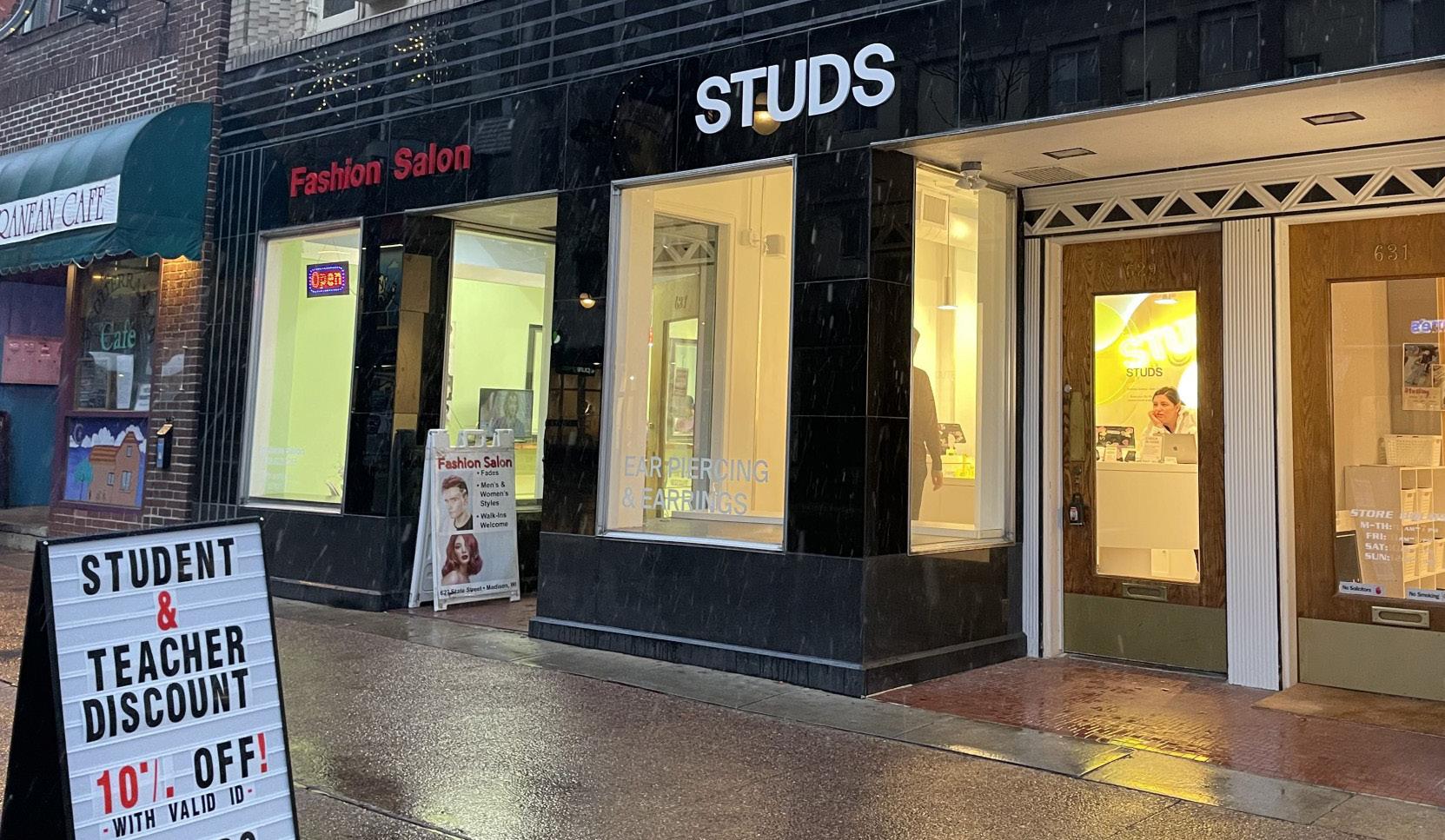
“I am from LA, where Studs is a mas sive thing. I would go at home to get pierc ings, and it was always a super fun place,” said UW student Sophia Goldberg. “In my honest opinion, though, it is the most random thing to open on State Street. Why do we need Studs? I also can’t lie, I got a piercing the day it opened for fun.”

Aside from Studs, a number of com mercial chains are setting up shop on State Street, including Jamba Juice and
will impact local and family-owned busi nesses as well as the historical ambiance of downtown.
“I think that the culture of State Street is heavily dependent on the locality of the businesses. That’s what gives it its appeal — it’s a place where you can go that showcases all the different places and opportunities that Madison has to offer,” Madison local Abbi Adams said.
“My personal fear is that some day, rath er than the historic street full of really cool vibes and local culture, we’re just going to have another copy-and-paste road that you could find anywhere else in the world.”
UW-Madison student Remy Rigby is among those who are not against the cor poratization of State Street.
“I think the chains on State Street don’t directly impact the culture, but I think the further away you get from State and away from campus are the areas that truly feel the need for family-owned busi nesses,” Rigby said.
Auntie Anne’s. Historically, State Street is known for its diverse, locally-owned retail shops and restaurants. Yet, some locals are nervous about how these chains
Jason Ilstrup, president of Downtown Madison Inc., has a different perspective on the matter. He said that despite these fears, the number of locally-owned busi nesses downtown and on State Street has actually risen in the past few years.
“The data clearly shows State Street and the Capitol Square business have remained, and continue to remain, domi
nantly locally owned,” Ilstrup said.
Since 2018, the number of local ly owned businesses on State Street and around Capitol Square has risen from 80% to 82%, according to a 2022 Downtown Madison Inc. report. Since the pandemic, there has been an increase in pedestrian traffic in the area which has resulted in an increase in locallyowned businesses. The number of vacant storefronts decreased from 54 to 40 in October 2022.
“State Street and Capitol Square busi ness areas are organic, always changing
with the times,” Ilstrup said. “There are constantly new shops, restaurants and attractions coming and going from the area. These changes give downtown life and bring more people downtown, all in the search of something new.”

UW students and Madison residents can expect additional cool, interesting changes to the downtown area in upcom ing years, Ilstrup said.
“An ever-changing downtown is a more interesting downtown,” Illstrup added.
Editor’s note: Sophia Goldberg has written for the Life & Style desk at The Daily Cardinal.
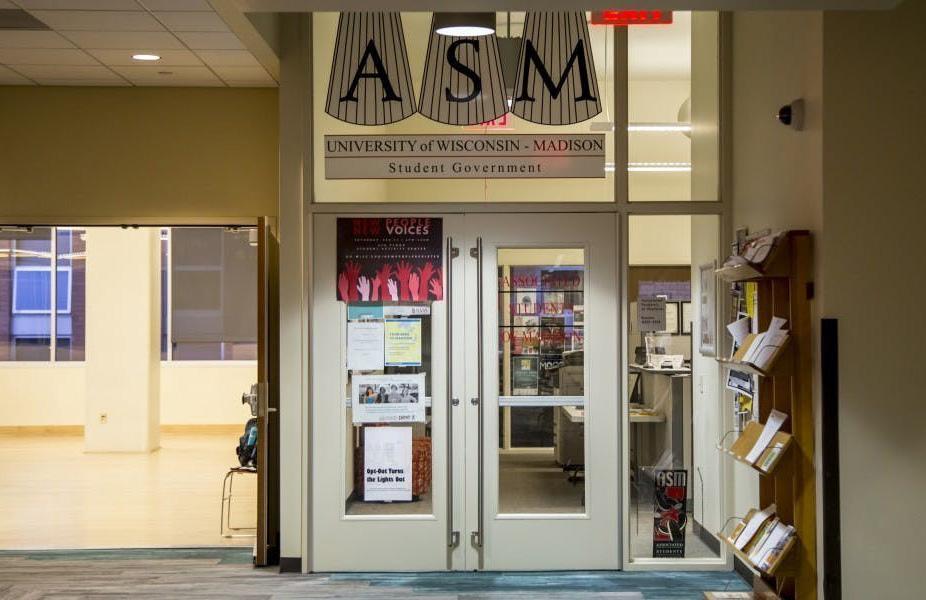
An attempt made by the University of WisconsinMadison’s Associated Students of Madison (ASM) to improve the shared governance body across the UW system failed to pass Monday. This long awaited
decision came over a year after the legislation was originally approved through the Wisconsin State Statute.
The legislation was origi nally supported last fall by UW-Madison’s ASM, along side the student governments at UW-Eau Claire, UW-River
Falls and UW-Stevens Point. It was proposed in an e ort to create a space where all the UW schools could communicate and discuss issues universal across all the campuses.
“The main ability of the UW system student government association (UWS SGA) was that it would unite to lobby the state Legislature on student issues,” which ranged from issues such as “mental health, expansion of shared governance, etc,” ASM Legislative A airs Committee Chair Muralidharan Govindarajan said.
However, a recent ASM press release revealed “the UW-Milwaukee Student Association failed to ratify the UWS SGA Constitution,” and “eight other UW student gov ernments met and decided to discontinue action towards the UWS SGA.”
Govindarajan went on to explain how the multiple stu
dent governments, including UW-Madison’s ASM, initially felt that while there were small degrees of problems, the issues were not significant enough to restart the entire project. He described the thought process behind the ultimate decision to explore other shared student governance options.
“There were some problems with the UWS SGA, which we verbally agreed to fix after the organization was ratified and created,” Govindarajan said.
“However, UW-Milwaukee voiced an opinion that they would rather restart the process and fix the problems at the start rather than later on.”
“After more discussion, all eight schools voted unanimously to end the UWS SGA, and restart the process with a new drafted consti tution,” continued Govindarajan.
Despite this decision made by UW schools, Govindarajan noted ASM has no desire of giving up
on a plan for shared governance.
“There is now a draft in the works that has more input and collaboration than the previous draft ever had,” Govindarajan said, mentioning that this new draft is building on past errors.
ASM’s goal of a shared stu dent governance plan has not wavered. With the collaboration of the other seven student gov ernment groups, they hope it will remain a possibility and lead to an expansion on topics.
“The new and old shared governance body will address issues affecting all/most of the universities, such as mental health, expansion of shared governance, possibil ity of a ordable housing, etc.,” Govindarajan explained.
An open meeting will be held on Dec. 2 to decide on the first draft of the new plan of shared governance. Students and fac ulty members are encouraged to come.
“…the great state University of Wisconsin should ever encourage that continual and fearless sifting and winnowing by which alone the truth can be found.”
“State Street and Capitol Square business areas are organic, always changing with the times”
The Daily Cardinal is a nonproft organization run by its staff members and elected editors. It receives no funds from the university. Operating revenue is generated from advertising and subscription sales.
The Daily Cardinal is published weekdays and distributed at the University of WisconsinMadison and its surrounding community with a circulation of 10,000.
Capital Newspapers, Inc. is the Cardinal’s printer. The Daily Cardinal is printed on recy cled paper. The Cardinal is a member of the Associated Collegiate Press and the Wisconsin Newspaper Association.
All copy, photographs and graphics appear ing in The Daily Cardinal are the sole property of the Cardinal and may not be reproduced without written permission of the editor in chief.

The Daily Cardinal accepts advertising rep resenting a wide range of views. This accep tance does not imply agreement with the views expressed. The Cardinal reserves the right to reject advertisements judged offensive based on imagery, wording or both.
Complaints: News and editorial complaints should be presented to the editor in chief. Business and advertising complaints should be presented to the business manager.
Letters Policy: Letters must be word pro cessed and must include contact information. No anonymous letters will be printed. All letters to the editor will be printed at the discretion of The Daily Cardinal. Letters may be sent to opinion@ dailycardinal.com.
Shelby Fosco has been on the frontlines of several important Wisconsin elec tions. As a five-year veteran of University of Wisconsin-Madison voter engagement coalition BadgersVote, it’s her job to get students to the polls.
“We’ve been saying it all over the place that ‘their vote matters,’” Fosco said. “Your vote really does matter. This election season [was] a great example of that.”
As chair of BadgersVote during the 2022 midterm elec tions, Fosco said she oversaw an electric voting atmosphere with high youth voting turn out. Thousands of students voted early or showed up on election day to choose their preferred candidates in hotlycontested races for Governor, U.S. Senate and other state wide and local offices.
BadgersVote spent the months leading up to Election Day educating students on Wisconsin’s election process. Coalition members hosted multiple informational events to teach students what was on their ballot, what counts as “proof of residence” and how to obtain a vaild voter ID.
One of those team members was Laine Bottemiller, a stu dent intern with BadgersVote. She represents the Andrew Goodman Foundation, a nation wide civic engagement network focused on reducing barriers to youth voting.
Bottemiller spent Election Day printing voter ID cards for students at Union South. The cards fulfill photo ID require ments for students without a Wisconsin driver’s license, making them essential for outof-state students.
UW-Madison issued over 7,000 student voter ID cards between Sept. 1 and Election Day, over half of which were printed on Election Day, accord
ing to data from BadgersVote — an amount Bottemiller said was “crazy.”
“That’s a barrier that really could prevent a lot of students from voting and so the fact that we can have a solution to that and still allow them to vote is super powerful,” Bottemiller said. “It was really a good feeling.”
The League of Women Voters of Dane County (LWV) is another active community force for youth voter registra tion. The LWV is a civic engage ment organization, founded over a century ago, prides itself on expanding democracy and promoting voter turnout.
“If you don’t vote, you really have no say in what is hap pening in your life,” said Dane County LWV Voter Service Co-Chair Sue Fulks. “Voting is how you influence everything from jobs to health to environ ment to whatever is happening in the world. Voting is your chance to make a difference.”
LWV members organized voter registration events across campus this fall, including a three-week bus pass drive at Union South that registered 1,000 students.
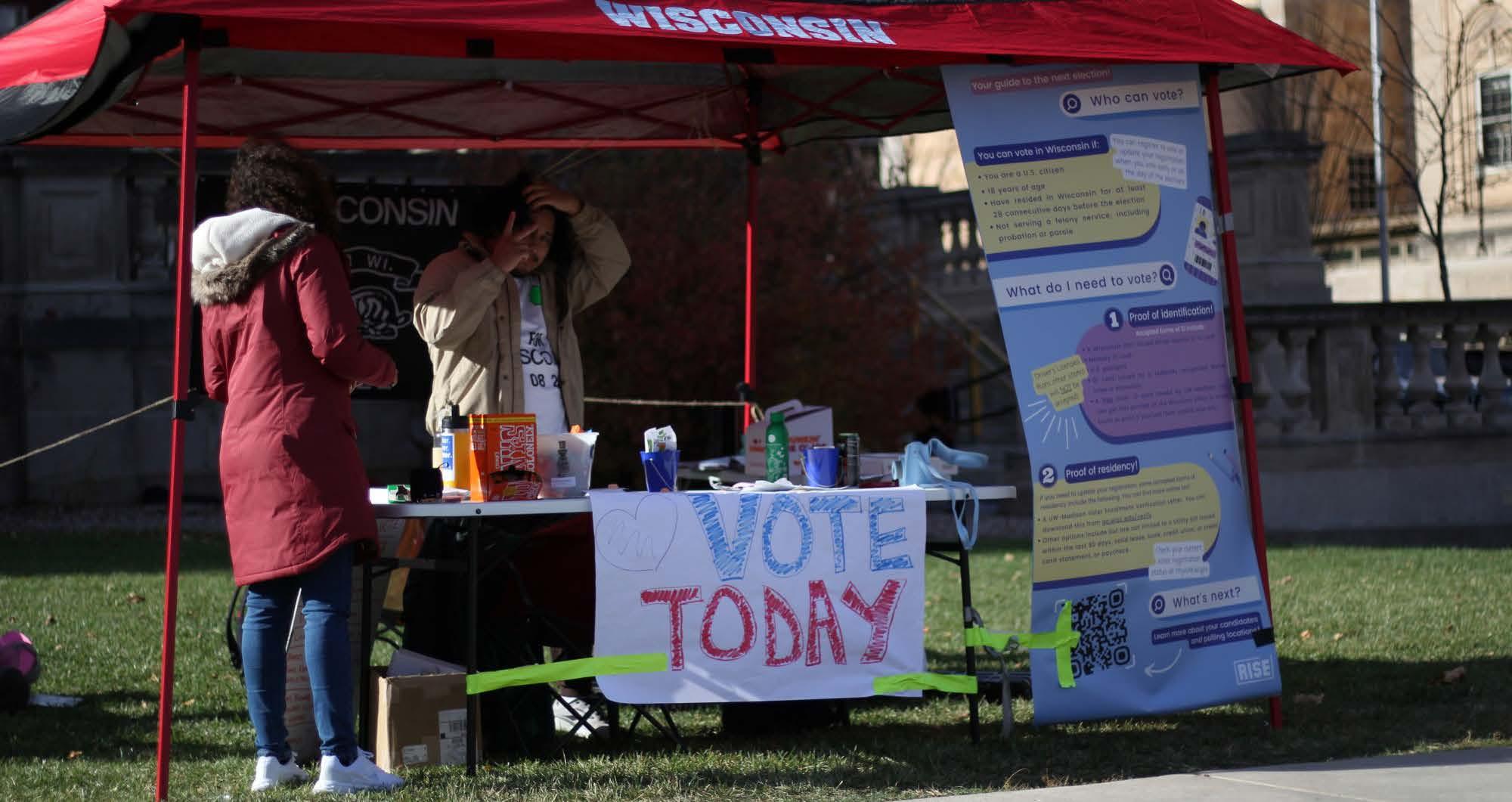
Members spent Election Day helping register students at the polls. Fulks worked at Gordon Dining and Event Center, the polling location for Witte and Sellery residence halls as well as nearby apartments.
According to Folks, student enthusiasm was palpable and the polls were busy for most of the day. She said this year’s youth turnout was “impressive.”
“I thought it was incred ible for students to really be enthused all the way through the whole process,” Fulks said.
“We
nearly 6,000 more voters cast ballots in 2022 compared to four years ago.
Student turnout was espe cially strong, according to a Daily Cardinal analysis of vot ing data. The total number of votes cast rose approximate ly 30% compared to 2018 in the five city wards — 48, 57, 58, 60 and 61 — that contain UW-owned undergraduate student housing.
Four of those wards saw more votes than the number of registered voters reported on Nov. 1, indicating high lev els of same-day student voter registration.
Ward 61, which encompass es Lakeshore neighborhood dorms west of Babcock Drive, reported nearly 50% more votes cast than registered voters on Nov. 1. That means approxi mately five students registered to vote on Election Day for every 10 students who were previously registered.
Ald. Juliana Bennett, who represents the majority-stu dent District 8 in Madison’s City Council, said the 2022 elec tion results were a “long, long time coming.”
“Young people are start ing to see that agency within themselves,” Bennett said. “We deserve to be listened to.”
Voters under 30 recorded an estimated 27% nationwide voter turnout in the 2022 midterms — the second-highest ever in a midterm election — accord ing to a Tufts University report.
Young voters also broke for Democrats by 28% nationwide, according to preliminary exit polling from ABC News.
to be listened to”
Unofficial Dane County vot ing data reflects poll workers’ observations on Election Day. Though voter turnout dropped to 80.4% from 88.0% in 2018,
Some UW students inter viewed on Election Day said they voted for Democrats because the party reflected their views on abortion, climate change and LGBTQ+ rights.
“I just feel like this is a really contentious election and what I believe in is up at stake, so it really motivated me to go to the polls more than any other year,
for governor and for senate,’’ student voter Ian Gross said.
In Wisconsin, voters aged 18 to 29 supported Gov. Tony Evers and Lt. Gov. Mandela Barnes by 40% each over their opponents in the governor and senate races, respectively, according to exit polling from CNN.
Though Barnes narrowly lost the senate race, both he and Evers outperformed final Marquette Law School poll ing estimates for their races. Barnes beat his polling margin by 1.5%, while Evers beat his by just over 3%.
Bennett believes young voters’ overwhelming sup port for Democratic candi dates stalled the “red wave” Republicans expected to see in races nationwide.
“We came out and ... just [gave] a middle finger to the establishment and everything the GOP stands for right now,” Bennett said.
But Bennett warned Democrats not to take youth votes for granted. Instead of relying on texts and emails, she encouraged politicians to hold live campaign events where young voters can engage with candidates.
She added that those events need to happen outside cam paign cycles.
“We’re often so far removed from elected leaders. It’s almost like they come around every four years to get our vote, and then we never see or hear from them,” Bennett said. “I think that young people are often ... looked down upon, doubted on our intelligence.”
Most of all, Bennett said elected officials should take the midterm results as a sign that young people are a growing voting bloc with clear expecta tions for lawmakers.
“We’re not just a bunch of young kids that are angry, ang sty or whatever. We are young adults,” Bennett said. “We have a clear vision of what we want for the future.”
deserve
 By Madeleine Afonso STAFF WRITER
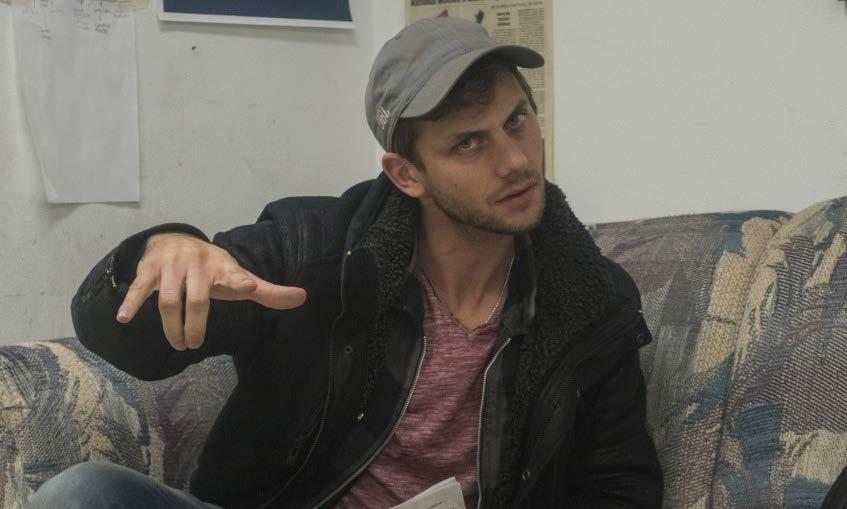
Comedian, journalist and Wisconsin native Charlie Berens was announced as this year’s win ter commencement speaker. Berens graduated from the University of Wisconsin-Madison in 2009 and is best known as the creator of the Manitowoc Minute.
Berens’ comedy focuses on the many niche aspects of Midwest cul ture, usually specific to Wisconsin. His content covers everything from the “Midwest Goodbye” to accents, beer, ice fishing, deer hunting and fish fries.
Berens spoke with The Daily Cardinal about his biggest piece of advice, what’s special about Wisconsin and how the Midwest embraces the good and the bad.
This conversation has been edit edforclarityandbrevity.
Why do you think your niche Wisconsin brand of humor lands so well?
To be honest with you, I hope it’s because it doesn’t have much to do with me at all. I was in journal ism for a long time and, in journal ism, you’re putting a spotlight on something that could use it. I think I’m putting a comedic spotlight on these cultural things that we’ve been doing. I’ve been doing nothing more than observing them and writing jokes about them.
I just try and put a mirror up to some of the funny things we do and get at the heart of why we do it. For instance, saying “drive safe, watch out for deer” is something that I grew up hearing more than “I love
you” from certain family members, and I think a lot of people can relate to that. It’s not that love doesn’t exist and that people don’t necessarily say “I love you” or “don’t love you.” It’s a show, don’t tell kind of thing. You realize that you meet people kind of where they are, and you see what’s at the heart of what they’re saying. There’s a lot of that in the Midwest.
What is something about Wisconsin that a non-native should know?
The best time to go birding in Wisconsin is right now when all the leaves have fallen. You can see all these kinds of birds in the trees, and they’re eating some of the berries that are still there.
You definitely need to watch out for deer. Be on the lookout, and if you do hit one, that is some car bon neutral protein right there. It’s worth figuring out how to clean it, toss it on its back, geotag it and do that whole thing with the DNR (Wisconsin’s Department of Natural Resources). You’re talking about the planet, and that is some carbon neu tral meat that’s right there for you.
If you weren’t a Wisconsin native, would you still gear your humor around the Midwest, or is there something about Wisconsinites and the state that makes it unique?
There’s definitely something about Wisconsin. The sense of humor here is a little di erent — I’m not sure why. There’s a big community feeling here, and there are a few things in Wisconsin that center around the traditions that we have. The University of
Wisconsin is defined as the capital city of Wisconsin [because] it’s got this campus community feel. The Packers are actually owned by the city of Green Bay. It’s the smallest market in the NFL. People spend $250 to be an owner and there’s this community ownership feeling.
a cheesehead. And that wouldn’t even be the craziest thing. When my grandpa died, someone brought a plastic walleye, and of all the floral gifts that were given to my grandma, the one thing that’s hanging in her house right now is that walleye.
How do you usually come up
I love the embrace of good and bad. We got mosquitoes here and they’re a pain in the ass but if you kill the mosquitoes, what are the hummingbirds gonna eat, you know? It gets cold, but without it being cold, how are we going to ice fish and drink beers in an ice shack? You can only do that with ice.
In the Midwest, we sort of embrace the highs and the lows. I think seasons are a perfect example of that. It’s a reminder that time is passing and life is short and we’re here for a very short period of time, so you might as well just be nice. When you are fully able to embrace the lows, the highs are just higher.
Then there are a lot of things that most people would not like in Wisconsin. It gets very cold here and sometimes summer doesn’t come into full swing until late June. But this is a state where as soon as the lakes freeze over, you start ice fishing, or in the case of Madison, you put the Statue of Liberty on the ice. There are ways of making this thing that some people would see as unbearable very bearable and very fun.
I don’t know if there’s something in the water in Wisconsin, but this is a place where you can go to a funeral and someone’s going to be wearing
with your bits for Manitowoc Minute and your other content?
I can’t do all this stu by myself by a long shot, so I have a great team I can brainstorm with. A lot of it is just living and having your ears open. It’s almost like journalism for day-to-day life. You’re trying to take note of the things that we have in common, and what is relatable and what is true. Honestly, sometimes that’s harder than writing jokes. Once you find that relatable thing, that universal thing, you start writ ing jokes about it.
What part of Midwest culture do
The “Midwest Goodbye” is a very real thing. And if you don’t know how to handle that, you will be here for a very long time. Years you could be at the exact same party. Everyone’s nice, almost hatefully so sometimes. I would say the weirdest one is the Midwest Goodbye. Why can’t we just leave when we want to go? Why do we make it feel like it’s their idea that we should go, other wise we feel bad about it?
If you could have brats, cheese curds or beer for the rest of your life, which would you choose and why?
I’d have to go with beer. That’s a very tough one, I don’t take it lightly. It’s really a hopeful one, I do hope at some point they’ll be able to make beer out of brats and make beer out of cheese. And if they do that, I’d be able to have my brats and drink them too.
The newly formed Indigenous Student Center Coalition (ISCC) — a collaboration of six di erent indig enous organizations within the Indigenous Student Center (ISC) — planned a variety of programs and events for Native November, a celebration of Native American History Month.
This year’s theme for Native November is “Beyond an Acknowledgement,” a reference to the University of WisconsinMadison’s land acknowledge ment statement that recogniz es UW-Madison as ancestral Ho-Chunk land.
“I think we’re all aware that the university is pretty adamant about doing the Ho-Chunk land acknowledgement,” said Morgan Spohn, president of the Indigenous Law Student Association (ILSA). “But I think we wanted to call upon the university to act rather than just making acknowledg ments all the time.”
Native November began with a Kicko Feast in early November and will end with the Native November Keynote Speaker on Nov. 29. Indigenous organizations such as ILSA, Wunk Sheek and MadTown Singers planned events throughout the month. MadTown Singers, the indigenous drum group on campus, plans to host a Dance Social on Nov.
22 on top of Bascom Hill.
“The purpose of Native November is to uplift our indig enous student voices, and to really amplify their concerns, their issues and their communi ties,“ said Noreen Siddiqui, the Assistant Director of Cultural Centers at the Multicultural Student Center. “Too often this community is seen as a historical community, as something in the past, that they don’t really exist anymore, and this is a way for us
flags of all 11 federally recognized nations in the state of Wisconsin and the Brothertown tribe of Wisconsin, which is not currently federally recognized.
“I thought it was very impactful to have every single tribe send a representative or at least send their flag to be a part of the flag ceremony because, ultimately, the goal of the ceremony itself was to properly receive the flags from the tribes,” Spohn said.
The Winnebago Tribe of
“To invite the Winnebago Nation up and have them essentially have this homecoming back since 1832 when Madison, or what this area was, was ceded to the U.S. govern ment, it was very important for us to include them,” Spohn said.
The 13 flags will be part of a future permanent display of the flags in the UW Law School set to open in March 2023.
“Law a ects Native people on an everyday basis, so we thought the UW Law School would be the per fect place to essentially be the leader on the permanent flag installation,” Spohn said.
Another notable event was Wunk Sheek’s corn braiding workshop on Nov. 7. The event seeked to foster community among indigenous students and showcase diversity within the indigenous community.
two Native American leaders and will host the event in person at the Multicultural Student Center at 5 p.m. Wunk Sheek and the ISCC plan to announce the speakers soon, as they are working to finalize financing for the event.
Both Sphon and Rodriguez stressed the importance of continu ing to acknowledge and prioritize indigenous perspectives and events outside of the month of November.
“I think the university is get ting more and more engaged with tribal nations — it’s [just] keeping the momentum from November going all year is really crucial,” Spohn said.
to help support our students by supporting [indigenous students] as they continue building com munity.”
ILSA and UW Law School hosted a flag ceremony in early November where they raised the
Nebraska, a formerly displayed tribe from Wisconsin, was also rec ognized despite currently residing in Nebraska. Spohn stressed the importance of including the Nation due to their forced displacement during the Black Hawk War of 1832.
“The purpose of indigenous workshops is to just bring native arts and crafts to campus and also tie in the cultural and traditional aspects of the significance to a cer tain tribe,” said Yelih Rodriguez, the president of Wunk Sheek. “It’s also to show the diversity amongst dif ferent tribes — we’re very di erent, and the only similarities we have is genocide and oppression.”
The final event of the month, the keynote speaker series on Nov. 29, is also hosted by Wunk Sheek. The organization plans to Zoom in
The ISC building will be demol ished in Fall 2023 along with Zoe Bayliss Co-Op as a part of the cam pus master plan, so finding a new home for Wunk Sheek and other indigenous organizations is a future challenge the organization will need support from the university on, according to Rodriguez.
“It’s been very frustrating, especially when we seem to get no type of support from the univer sity. I know my leadership team has been wanting to kind of figure out what we can do to get a new space since they are taking ours away,” Rodriguez said. “Just kind of bring ing the acknowledgement of why we need a space. I feel like it goes back to the theme of more than [a land] acknowledgement.”
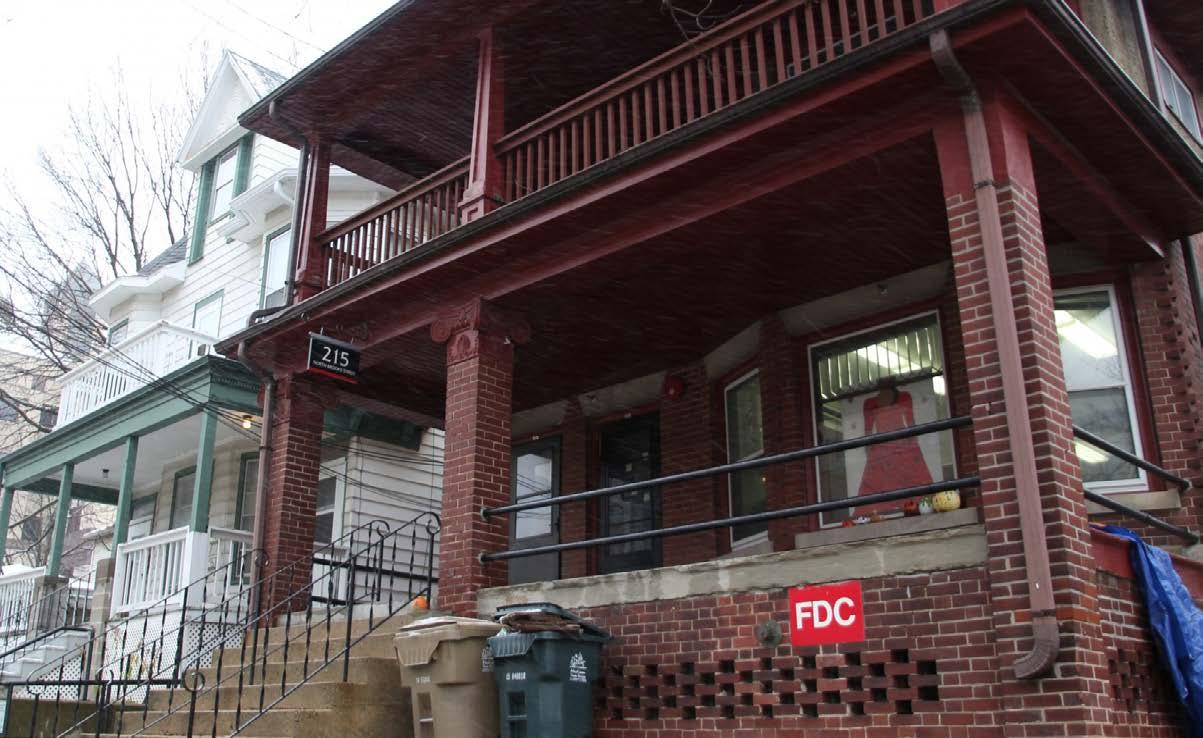
On a windy Saturday after noon, I made my way down to the University of WisconsinMadison Art Lofts to attend the Art Department’s annual Open Studio Day. The event took place from 12 to 6 p.m. on Nov. 5 in the Art Lofts Studios and George L. Mosse Humanities building, each home to differ ent areas of the UW-Madison Art Department.
Families returning from the football game at Camp Randall and others of all ages milled around the Art Lofts throughout the day, exploring the building. Rather unassuming from the outside, the space is ample and modern, boasting many impres sive gallery spaces and some truly unique facilities.
I didn’t know much about our visual arts program before Saturday. Art isn’t the first thing that came to mind when I thought of UW-Madison and its many pro grams. However, after seeing how many diverse disciplines and cool opportunities the Art Department o ers, I think more UW students should get involved.
Historically, Open Studio Day was a graduate studentcentered day where faculty visited student spaces. “In the past four years, [however], we’ve changed it to being more focused on undergraduates,” academic program manager Matthew Mauk explained.
Now, the event is more interactive, inclusive of all art students and the larger Madison population.
“We opened it up to the public — everybody [can] see student work, buy pieces, see exhibitions and just generally see the Art Department,’’ Mauk said.
This year’s event offered glassblowing tutorials, special presentations, and print and glassware sales. There was an
opportunity to visit and talk with over 50 graduate students in their studios, which featured their work on display.
This year marks the 60th anniversary of the most famous Art Lofts facility: the univer sity’s glass lab. UW-Madison boasts the oldest academic glass lab in the United States, accord ing to Mauk.
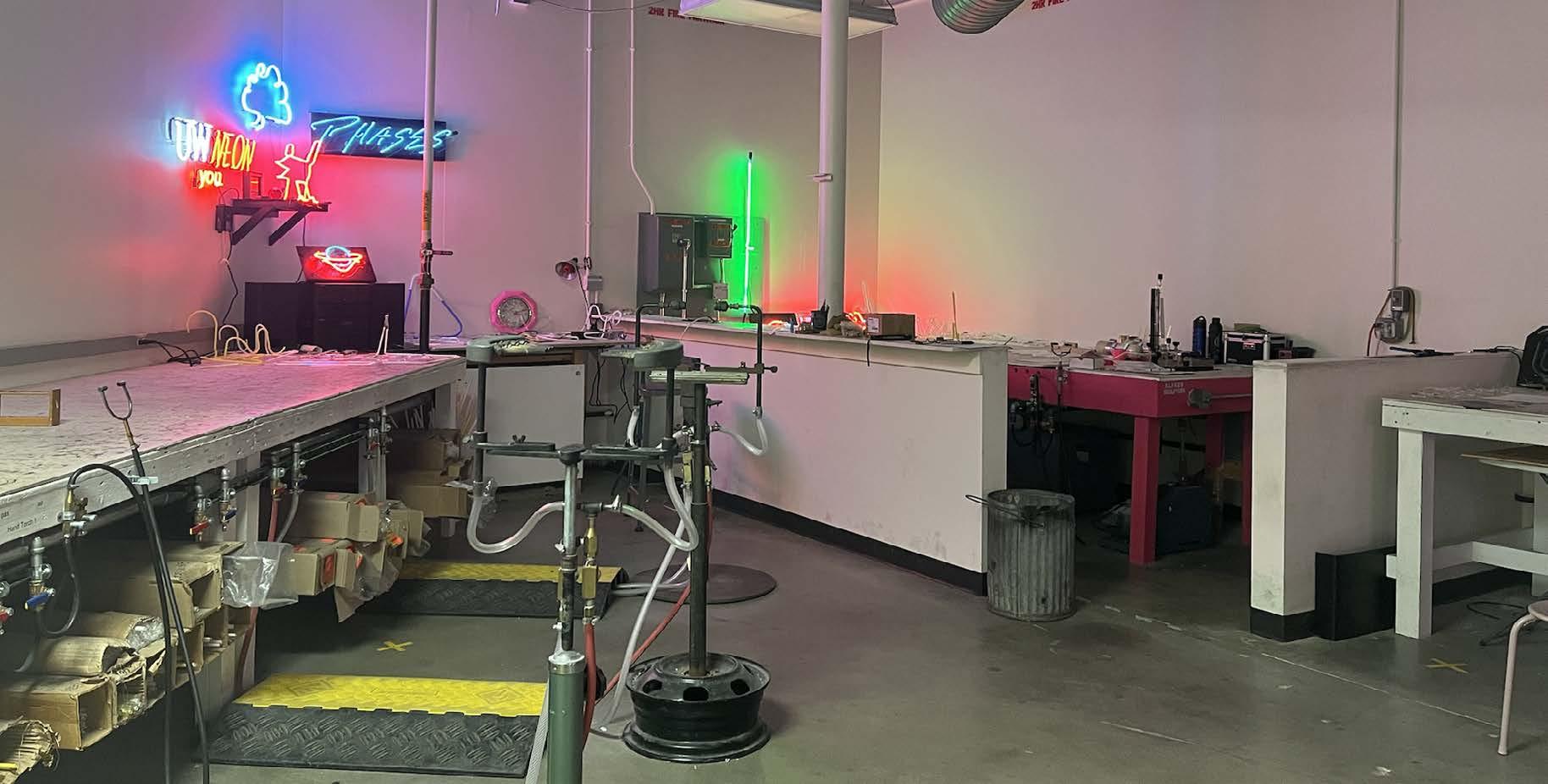
“We’re the very first academ ic glass lab in the entire coun try, and we’re one of three neon
programs in the country. The glass is one of the most unique things… so it’s a really big deal,” he remarked.
The furnaces — which are on for the entire academic year — were busy today as members of the Mad Gaffers — a student org for UW Glass students — helped participants make their own customized ornaments by choosing the color and pat tern, overseeing the process of heating and shaping the glass,
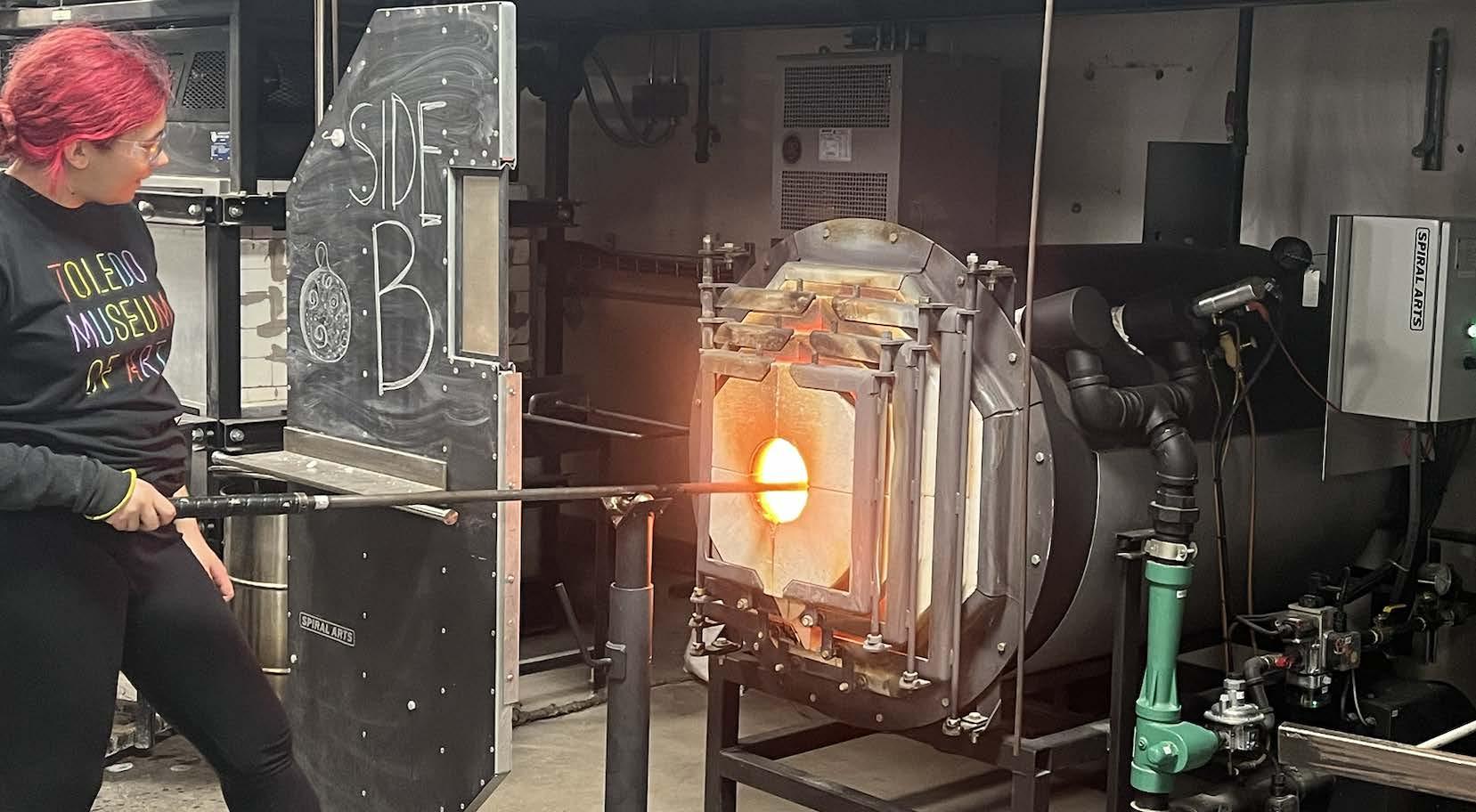
and blowing up the ornament through a tube into its charac teristic round shape.
Glassblowing is only the beginning of what the Art Department has to o er. It is large but growing, admitting 100 incoming students this year. The undergraduate program is divided into 2-D, 3-D and 4-D — encompassing performance and video arts — disciplines. They o er majors, certificates and many classes for non-majors.
I got a chance to visit that week’s student exhibit, “Microdosing Madness,” which was made by the second-year cohort. The exhibits are highly collaborative and rotate often. Every Monday there’s new work being installed, so every weekend there’s some thing di erent to see.
My favorite piece in the exhib it was a collage of students’ handdrawn maps of Madison on the wall. Supplies were set out so visitors could create their own map and add it on. Collectively, the maps showed how one city can be perceived so di erent ly by individuals and how the way we physically conceptualize Madison’s geography is shaped by our own experiences.
I talked with some MFA can didates about their work, which was on display in their studios. Each studio was a step into a di erent world. Every student’s body of work expressed a unique artistic focus, many using a com bination of mediums to do so.
Everyone I talked to appreci ated how their program gave them the freedom to be creative and multidisciplinary in creating their art. They could dabble in sculpture and design or drawing and paint ing while pursuing a photography degree, and were encouraged to explore their diverse interests.
The Art Department hosts Open Studio Day in the fall each year and will hold their annual Holiday Sale on Dec. 17 in the Arts Loft from 9 a.m. to 5 p.m.
The sale will o er another opportunity to make glass orna ments, but this time paired with a holiday arts and crafts sale. If you want to find beauti ful, unique gifts for your loved ones while supporting and get ting to know more about the UW-Madison Art Department, you should definitely go.
Colleen Hoover is dominat ing the New York Times Best Seller list with seven of her nov els in the top 10 spots for the Paperback Trade Fiction catego ry. She has sold over 20 million books. Her best-seller “It Ends With Us,” has been on the list for 78 weeks straight.
Hoover’s books fall into the young adult fiction and romance genres. Some of her novels can be classified as psychological thrillers.
Hoover appeals to women, some of whom pick up her novels to take a hiatus from the current battleground that is “modern romance.” She etches her characters beau tifully. Her words take the shape of our most delightful and vicious dreams.
Hoover’s work is captivating, to say the least. After zooming
through “Verity,” “Ugly Love,” “Reminders of Him” and “It Ends With Us,” I am frantic to continue with “It Starts With Us,” Hoover’s recently released sequel to “It Ends With Us.”
As I impatiently await the opportunity to read more of Hoover’s work, I put together a ranking of the novels I’ve read so far as well as what I consider to be the best line in each.
This book was steamy. I encountered this title on #BookTok — TikTok’s premier book recommendation page — and was not disappointed. “Ugly Love” tells a story of allowing oneself to love again after trag edy. It’s about forgiveness, grief and perhaps what this Hoover novel does best — sex.
Best line: “But the second she
opened her eyes and looked at me, I knew. She was either going to be the death of me… or she was going to be the one who finally brought me back to life.”
This book had me on the edge of my seat. Audible gasps escaped my mouth as I fiercely turned the pages. “Verity” kept me up at night. This psycho logical thriller meets romance novel was wild. It is about a struggling writer who accepts what she thought would be a dream job. “Verity” is unique. From what I know, no other Hoover novel possesses similar thrilling dramatics.
Best line: “I find that com forting — that being alone with me in the room still feels like being alone to him.”
“It Ends With Us” tells the story of a battered woman faced with the same cycle of abuse she witnessed as a child. The book shows how sometimes the one we love the most is capable of hurting us the most. Reading this book gives pow erful insight into the question, “Why did they stay?” “It Ends With Us” is wonderfully packed with drama, intensity and love; however, it lacks the thrills of “Verity” and the fierce passion of “Ugly Love.”
Best line: “Maybe love isn’t something that comes full cir cle. It just ebbs and flows, in and out, just like the people in our lives.”
If you are looking for a story
of strength, reliance and the complicated intricacies that can follow a relationship, this book is for you. It tells the story of a troubled young mother look ing for redemption, a way back into her daughter’s life and a man she meets along the way. I placed this one at number four because it was a bit slower than the other three. But it is still an enjoyable, juicy read.
Best line: “I take a drink of my co ee and close my eyes and cry because life can be so fucking cruel and hard, and I’ve wanted to quit living it so many times, but then moments like these remind me that hap piness isn’t some permanent thing we’re all trying to achieve in life, it’s merely a thing that shows up every now and then, sometimes in tiny doses that are just substantial enough to keep us going.”
What is the best U.S. pro duced sitcom of all time? Is it “Friends”? “The Office”? “Modern Family”? Maybe even “How I Met Your Mother”?
Construing one show over another for this top prize is com pletely subjective; however, “It’s Always Sunny in Philadelphia” surpasses all.
“It’s Always Sunny” follows “The Gang,” a group of five unsuc cessful bar-owning Philadelphians named Dennis, Dee, Charlie, Mac and Frank who spend their days scheming, drinking and arguing with each other.
Whether it is blowing up an Israeli immigrant’s house to pre vent losing their bar or Dennis and Dee becoming addicted to crack cocaine so they can apply for wel fare, The Gang is always up to something ludicrous.
Yet, “It’s Always Sunny” shines in a di erent light than other American sitcoms. In other sitcoms, character arcs resemble something known as prosocial behavior, or any behavior intended to benefit another person or per sons. Examples of this include comforting others, sharing your own resources or helping someone reach a goal. Essentially, it’s being a good person.
From this behavior, we watch sitcoms and see that a character may have some flaws. Yet, we genu inely expect that in the end they will demonstrate something con structive, relatable or good about
themselves. As the show progress es, we get to watch that character grow and learn, ultimately becom
ter human beings, we continue to see them engage in their immoral, lunatic hijinks. Every member of
that will never end up coming.
At the same time, the view er finds themself wishing for the
out, thoughtful message or joke with interludes of a laugh track after a punchline.
For “It’s Always Sunny,” stut tering and talking over one another replaces this flow. The conversa tions are rough and scattered, and jokes — many of which are often improvised — are coming in left and right from character to char acter. It’s utter chaos. The show doesn’t need a laugh track to let you know when to laugh because they know you’re already going to be laughing.
If you look at “It’s Always Sunny” at face value, the show will probably sound insane, but that’s because it is. “It’s Always Sunny” was never supposed to be the typi cal sitcom. The characters suck and are never going to become better, the dialogue is rough and impro vised, and the clothes and set are full of depressing, minute colors.
But that’s why I love it.
It’s di erent.
ing a better person as the seasons goes on.
“It’s Always Sunny,” on the other hand, is the complete oppo site. It’s a show about terrible peo ple doing terrible things. Dennis is a sociopathic narcissist (who is also probably a serial killer), Dee is a severely egotistical wannabe actress, Mac is an extreme racist and homophobe, Charlie is an illit erate stalker and Frank is a socio pathic scam artist.
Each character starts the show o with major flaws, but instead of seeing The Gang turn into bet
The Gang experiences failure after failure — getting in trouble with rival bars, the authorities, gangs, other Philadelphians and drug lords day after day. Yet, there is absolutely zero self-reflection or personal betterment that comes from these failures because the blame is always just put onto some one else.
It’s because of this politically incorrect principle that the viewer becomes locked into a sleazy spec tacle The Gang represents. There is a constant rooting for their success or a moment of personal betterness
inevitable failure that will result from the characters’ actions. This is the fascinating part of the show, as there is something mor ally wrong about watching some of the worst people alive consistently doing some of the worst things… Yet we as viewers enjoy it?
Aside from the general char acters, “It’s Always Sunny” made itself exceptionally di er ent from other sitcoms through its use of dialogue. In most sit coms, the characters’ dialogue is very articulated — flowing from line to line, conveying a planned-

You might hear it in polite conversation when describing someone who is upset.
“Oh, she was so hysterical about her midterm last night.”
“You’re being hysterical; this isn’t a big deal.”
People have no idea how sex ist these comments are.
According to MerriamWebster, the word “hysterical” refers to a feeling or showing of extreme and unrestrained emo tion. Hysterical is derived from the word “hysteria.” Hysteria is referred to as the “psycho neurosis marked by emotional excitability and disturbances of the psychogenic, sensory, vaso motor, and visceral functions.”
The historical connotations of the word “hysteria” date back to ancient Greece. The Greek root word hysteria means “uterus” or “womb.”
This dates back to Hippocrates, an ancient Greek physician (and, ironically, the namesake of the Hippocratic oath — an oath of ethics taken by physicians) who believed physi cal disease was caused by the uterus roaming a woman’s body. Simply put, hysteria was limited to women, and women only.
Throughout medical history, hysteria has been widely diag nosed in place of other diseases.
Considering medicine’s slow improvement during the 16th, 17th and 18th centuries, meth
ods for diagnosing and treating women with actual, relevant dis eases and psychological disor ders were limited. Oftentimes, women were diagnosed with hysteria when they showed “unladylike behavior or emo tion” like anxiety or anger.
While practices of using “sweet smelling concoctions … to attract the uterus back into place” are no longer in use, the repercussions this has carried onto modern day medicine are numerous. In a study from Academic Emergency Medicine, women who went to the emer gency room with severe stom ach pain had to wait 33% longer than men with the same symp toms. The study also found that women were less likely to receive opiates than men if they had abdominal surgery. The dismiss al of women’s pain is clearly not a new phenomenon and unlikely to stop in the near future.
Women can thank doctors who diagnosed hysteria for the current gender stereotypes in modern day medicine. IUD insertion is typically remarked as a fairly straightforward and painless process by medical providers. However, a study found that medical providers often underestimate pain dur ing an IUD insertion. Patients perceived this pain as 64.8 out of 100, while providers estimated it around 35.3 out of 100. It’s also not uncommon to pass out during or after an IUD inser
tion due to a vasovagal reaction, which most women are unaware of. Underestimating the pain of a medical procedure persists, leav ing women wary of future medi cal appointments and the quality of the care they’ve been given. Medical providers should stress the more serious side-e ects — no matter how rare they are.
Diagnosing “female hyste ria” was fairly easy for doctors because there was a broad range of symptoms including: a swollen abdomen, chest pain, excessive emotion, increased or decreased sex drive, increased appetite and increased heart rate. Various treatments included pelvic mas sages, leeches on the abdomen to reduce blood in the womb and marriage. Who knew marriage could solve all my medical prob
lems? You can thank Sigmund Freud for this theory.
Freud enlarged the mean ing of hysteria, expanding it to men and connecting hysteria to sexual abuse, which may cause the Oedipus Complex. It’s hard to justify generalizing the e ects of sexual abuse because Freud himself was extremely contro versial and sexist, claiming, “women oppose change, receive passively, and add nothing of their own.” Although Freud is a famous neurologist, it’s easy to be skeptical of his theories.
Calling someone hysteri cal in a polite conversation is the opposite of being polite. If women show anger, they’re asked if they’re menstruating.
When women express a pas sionate position on something,
Traditional sitcoms will make you feel satisfied throughout the stipulated half-hour, provoking the occasional chuckle. But, “It’s Always Sunny” will have you hanging on to every moment, wait ing for that phrase, expression or situation that will make you pause the show while you laugh your heart out.
Owen Puckett is a soph omore studying Political Science. Do you agree that “It’s AlwaysSunnyinPhiladelphia” is one of the best American sitcoms? Send all comments to opinion@dailycardinal.com.
they’re called crazy. The word “hysteria” has had serious implications on gender stereo types. Expressing your emo tions isn’t a bad thing, and we should stop punishing women for doing so.
Next time you consider call ing someone hysterical, you should reevaluate. Are they overcome by emotion, or are they just expressing their opin ion and you want to invalidate them? The word hysteria has serious connotations. Don’t be surprised if someone gets upset when you use it.
Nina Starynski is a sopho more studying Political Science and Criminal Justice. Do you think hysterical is an impolite word? Send all comments to opinion@dailycardinal.com.
This past weekend, Wisconsin finally won in front of their home crowd. The Badgers swept Long Island University in two highly con tested games.
While winning is great for the team’s confidence, the weekend series left much to be desired. Here is what we learned from Wisconsin’s series sweep over LIU.
In yet another power play-rich series, the Badgers were able to con vert only one of their eight oppor tunities. This drops Wisconsin to 11.1% on the year with a numbers advantage, which ranks 52nd out of 60 in the nation.
Part of Wisconsin’s power play trouble stems from their inability to get shots on goal. During the LIU series, Wisconsin’s shot attempts were repeatedly blocked before reaching the goal. Wisconsin tallied eight shots on goal on eight power plays throughout the two games. If Wisconsin wants to see success with the man advantage, they need to start getting pucks through to the net.
In past series, Wisconsin strug gled with shooting the puck. Their puck movement was impressive, but they failed to actually chal lenge goaltenders. Wisconsin’s evolution to getting shots blocked is a welcome adjustment. Now, the team needs to combine the puck movement with quick deci sion making to register shots and, hopefully, goals.
Neutral zone errors are costly
Wisconsin is a team that tries to play aggressively in transition. They strive to move through the neutral zone quickly to catch defenses out of position. However, in order to play with this style, Wisconsin cannot a ord many mistakes between the blue lines.
During the LIU series, Wisconsin and LIU both failed to assert dominance in the neutral zone — leading to numerous turn
overs from both teams. Wisconsin seemed to make decisions slightly late in their e orts to move through the neutral zone. This led to some possession-costing errors.
Additionally, LIU was able to capitalize on one key turnover in the second game. Following a turnover just past the Wisconsin blue line, LIU players found themselves with space as Wisconsin tried to make a line change. This cost the Badgers as they conceded a goal.
If Wisconsin wants to play their aggressive style, they need to clean up their neutral zone errors. Without cleaner play between the blue lines, Wisconsin will continue to struggle in transition.
So far this season, Wisconsin has played 12 games and collected 135 penalty minutes for an aver age of 11.25 minutes per game.
Comparing Wisconsin’s tally to the number one ranked team in the nation shows how discipline is
essential to top teams. Denver has played 12 games and recorded 98 penalty minutes — an average of 8.17 minutes per game.
The undisciplined nature of this Wisconsin team has created a pleth ora of issues, the first of which being how often penalties come after strong o ensive zone shifts. After having maintained pressure in the o ensive zone, Wisconsin cannot a ord to take a penalty considering their o ensive struggles thus far. Allowing opponents to have a man advantage after building momen tum cannot be tolerated with a struggling o ense.
A second problem facing Wisconsin is their penalty kill percentage. Wisconsin currently kills 78.7% of their penalties. This ranks them 37th in the nation. Until they have consistency on o ense, Wisconsin cannot a ord to concede goals at such a high rate.
Wisconsin scored seven goals
on
On multiple occasions, Wisconsin was able to create quick o ense through a smooth zone entry. What made the entry smooth was how simple they chose to play. Finding easy passes and driving the net created opportunities which the Badgers seized.
Furthermore, Wisconsin uti lized a low cycle where they con trolled the puck in a corner of the o ensive zone, found space in front of LIU’s goal and slipped passes through the Shark defense — creat ing more opportunity.
The zone entry strategy used by the Badgers, as well as the low cycle, are fundamental hockey plays. Wisconsin needs to main tain this simple style that led to victories over LIU.
One of the biggest takeaways for fans and the team alike has to be that Wisconsin can not only win, but they can win close games. The Badgers have played some tough competition this year, including four teams currently ranked in the top 20. In three of those four series, Wisconsin has played at least one game where they lost by one goal.
Losing close against top teams is demoralizing. Knowing how close the team came to winning, but ultimately falling short, is not a welcome feeling.
Wisconsin’s sweep of LIU could be a building block for the rest of their season. While LIU was outclassed by Wisconsin, the close games provided an atmosphere where Wisconsin had to persevere and hopefully build some confidence.
This weekend’s two game series against Lindenwood will provide the Badgers with another opportu nity to build upon the Long Island series and find more success.
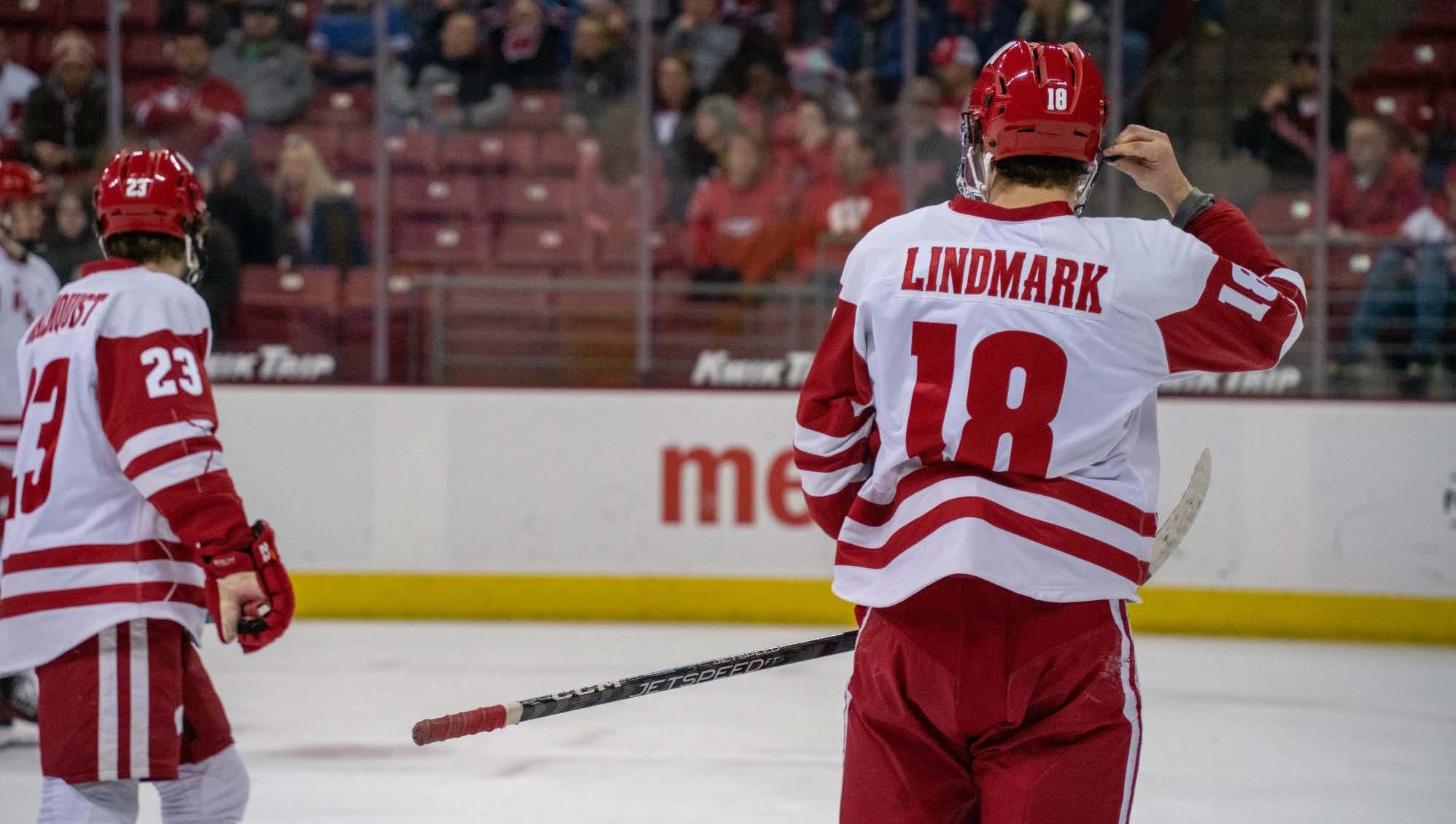
 By Maddie Sacks STAFF WRITER
This year’s Wisconsin women’s hockey team has looked unstop pable. Aggressive o ense combined with concrete defense have given the Badgers an overall record of 10-2-0.
The Badgers won six cham pionships — one of which came two seasons ago. Wisconsin lost in the second round of the NCAA Women’s Ice Hockey Tournament last year, but their chances of returning to championship conten tion seem plausible. With several new players this year, the Badgers have continued to look like a cham pionship-level team. One player in particular stands out this season — Caroline Harvey.
Harvey got her start playing youth hockey in Massachusetts, eventually going on to play for the
USA Olympic women’s hockey U18 team. She and fellow Badgers, such as Lacey Eden and Jesser Compher, are part of a new generation of younger players who have recently taken over women’s hockey as a whole, not just in Madison.
Harvey is currently a fresh man defender at the University of Wisconsin-Madison. So far this sea son, her immense natural talent has resulted in production — totaling six goals and 13 assists for the team so far. Her early play earned her WCHA Rookie of the Month honors for September and October. A day later, Harvey was announced HCA National Rookie of the Month.
Harvey has not only shown o her defensive skills, but she has also excelled on o ense. Of the rookie’s six goals so far, one was the gamewinning OT goal against St. Cloud
during the October series. Harvey has also demonstrated her accuracy with several multi-goal games and goals from the defensive blue line. Aside from great individual play, Harvey has also positively impacted the Wisconsin team as a whole. Her 13 assists show an ability to help the team score goals on paper, but Harvey has also been described as a great teammate both on and o the ice.
A 2021 ESPN article on Harvey’s impact as the younger generation for women’s hockey includes state ments from Harvey’s teammates when she played for Team USA. Harvey’s energy on the ice is men tioned in the article, including a quote from veteran U.S. defenseman Megan Keller.
“She’s so fun to watch, especially at her age, the things she can do with
the puck, her skating ability. She’s a little Energizer bunny out there too,” said Keller.
Harvey’s early contributions to women’s hockey, and specifically Wisconsin hockey, have been noth ing but positive. She, alongside her rookie teammates Kirsten Simms and Claire Enright, paved a path for themselves and other future hockey players.
If the Badgers continue their win ning streak, their chances at another championship win are undeniable. Harvey’s impact continues to spread on and o the ice, influencing the next generation of hockey players.
The Badgers take on rival Minnesota next week on Nov. 19 and 20. These will be important games as Minnesota tends to be one of Wisconsin’s biggest obstacles. Despite Wisconsin’s current domi
nance and chemistry they’ve devel oped, these games should be com petitive and close.
In 2019, freshman me was seeking a taste of home, having spent months away for the first time in my life. Defining “home” has always been tricky for me, but in a culinary sense, I feel most at home when eating Indian or Middle Eastern food.
This makes sense considering I was raised in the United Arab Emirates in an Indian household. The one food item I missed the most at the time was the chicken shawarma wrap.
If you don’t know what shawarma is, you’ve been missing out big time. Shawarma is a cooking method in which vertical stacks of marinated meat are slowroasted on a rotating rotisserie grill.
This style of cooking imparts a unique flavor that standard grilling methods don’t, in my opinion. Related dishes with similar origins include gyros, döner kebabs and al pastor tacos.
The grilling method is what makes a wrap a sha warma wrap. Much to my chagrin, every time I ordered “shawarma” wraps from restaurants in the area, it felt like the chicken had been grilled like normal.
I felt defeated, until I stumbled upon Naf Naf Grill
at 555 State St. One of the first things I saw when I walked in was chicken being cooked on a rotating rotis serie grill, and I felt a sense of indescribable triumph: I finally found a restaurant that could take me home.
The shawarma wraps I ate growing up were very simple in construction, consisting of the slow-cooked chicken, pickles, garlic sauce and fries wrapped in Arabic bread. At Naf Naf, I was able to reconstruct this almost in its entirety.
Naf Naf’s pitas are smaller and softer than the bread I had growing up. While I prefer thinner breads for wraps, these pitas are so good they can be eaten plain. Their garlic sauce is fantastic, with a great con sistency and the right amount of garlic flavor.
Their pickles have the bite that I grew up with. Their chicken is chunky, unlike the thin slices I associ ate with home, but it is great.
While I have seen chicken being cooked on a stan dard grill during rush hour, the aforementioned rotis serie is central to their operation.
The only item that isn’t replicated is the fries. I have never tried Naf Naf’s fries because they look more like chips to me and are served on the side, unlike the fries that belong in wraps I ate growing up.
In recent months, I tried their bowls. I construct them similar to how I construct my wraps, but with more room for experimentation. I have tried different bowl bases like basmati rice and couscous, and dif ferent toppings like lettuce, onions, and s’khug and harissa sauces (both spicy chili sauces). I have grown to prefer s’khug over harissa and couscous over rice.
Recently, I also tried their baklava (layered pastry) and their falafel (fried chickpea balls). The baklava is decent, while the falafel is fantastic.
My Naf Naf experience hasn’t been straightfor ward. I remember eating at Naf Naf before flying solo for the first time after a triumphant first semester. I remember eating their food when we went on spring break in 2020 and never really returned. As COVID19 hit hard, the restaurant closed. I went on to spend over a year away from Madison, and when I returned, the restaurant was still closed. I thought they were gone for good, much like the life I envisioned before COVID-19.
Thankfully, they bounced back this summer, per haps even better than I did. Boy am I glad.
Grade: A
If you’re anything like the average college stu dent, you’re likely balanc ing school with extracur riculars, jobs and a personal life. This means you might forget to call mom and dad back sometimes.
It’s that time of year again — leaves are beginning to fall o the once vibrant trees, the air is getting slightly chillier, and an abundance of indi viduals are forgetting about Thanksgiving and bulldoz ing straight towards a yearn ing for the winter holidays to approach. The November day is typically a rather under rated holiday to begin with; how could it not be when it’s competing with peppermint flavored everything, joyful music and prospects of gifts upon gifts? This leads many students, myself included, to debate whether or not they should even bother heading home for the long weekend.
With the extremely short amount of time o , it’s worth noting the cons that will come from heading home this upcoming break. For start ers, counting travel time, the four day break for some will realistically be shortened even
more. In-state students have a notable advantage as far as travel goes since time spent on the road will likely be less than that of a student who lives across the country.
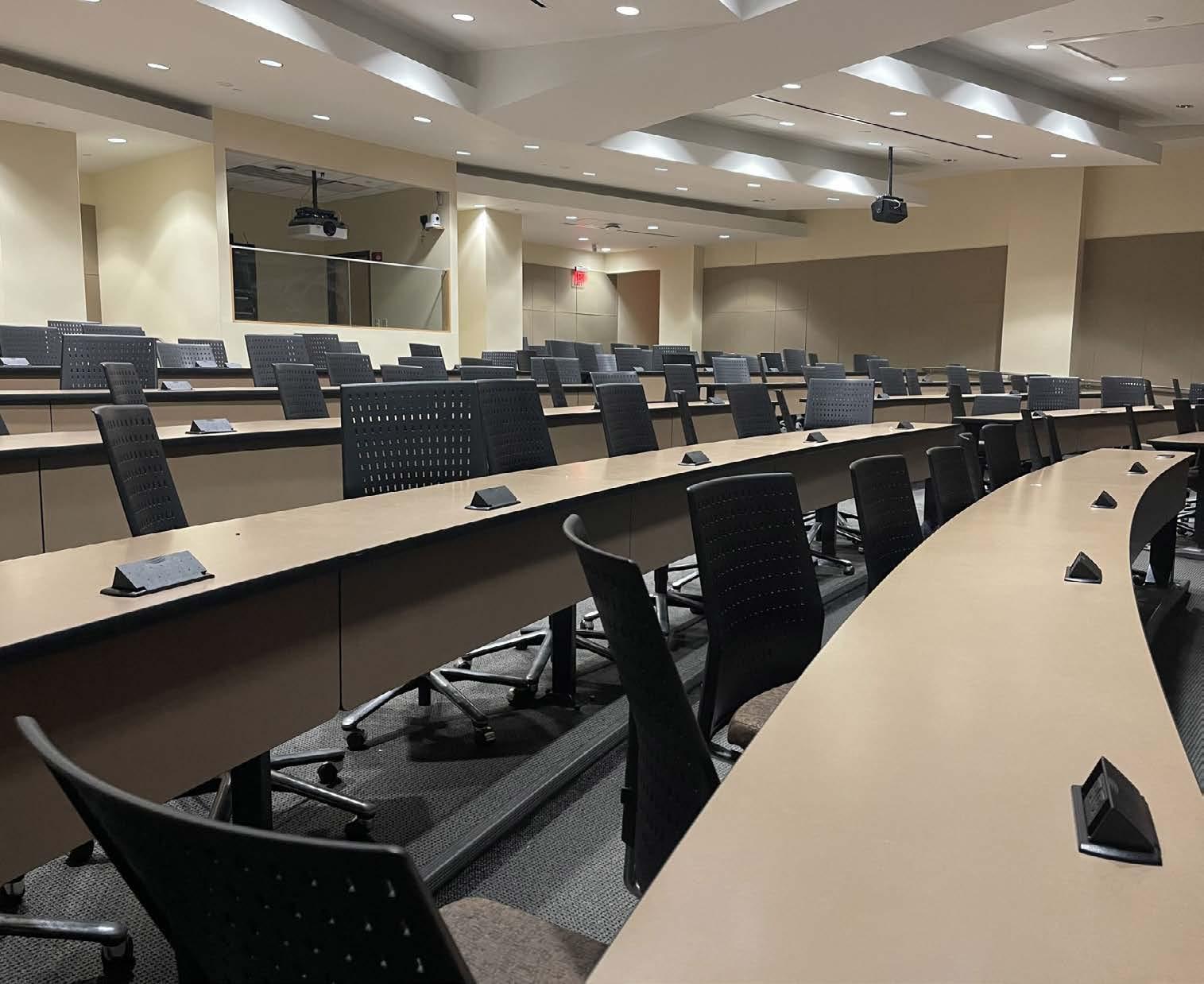
The long hours of travel time might not be the only con cern for students. Being a col lege student and having a suf ficient amount of funds don’t typically go hand in hand, and any form of transportation home will be pricey, especially during the holiday season. Not to mention, homesickness is a real ordeal many students face. For some students, it just simply might not be enough time, and could instead do the opposite of what a trip home is intended to do: provide a famil iar sense of comfort.
That being said, it would be ignorant to ignore the count less benefits of choosing to go home for Thanksgiving break. An immediate plus would be the opportunity to interact with friends and family. After all, that’s what Thanksgiving is all
about: being surrounded by those who you love, reflecting on all you’re thankful for and, of course, eating as much mashed potatoes, turkey and all things pumpkin flavored you possibly can. Besides seeing those you love, there’s a familiar comfort many will feel in going back to their hometown. It can be in the little things, too. Driving the same streets you haven’t in months, stopping for co ee at the place you and your friends always used to frequent in highschool — even just sleep ing in your own bed. And with finals fast approaching as well, giving yourself a much needed break from studying, exams and assignments could very well be exactly what you need to conquer the di cult weeks we all have ahead of us.
Regardless of whether or not you choose to go home this Thanksgiving break, we can all unite in our excitement of a few days o from class and take the time to give ourselves a well deserved break.
It’s okay — we’ve all been there before, and prob ably have felt just as guilty. It wasn’t until I got to college that I realized I wasn’t the best at reaching out to my loved ones, and it was then that I also realized just how important it was. Being away from home, it’s easy to take a few days too long to respond to your grandma’s text or return your hometown bes tie’s FaceTime call, but there are ways to make reaching out a habit — even if it doesn’t come naturally to you.
Here are some tips that have kept me more in touch with my friends and family.
1. Send them something that reminds you of them.
Believe it or not, even the
smallest virtual gesture can make a world of a di erence to someone who misses you. We all spend hours scrolling through social media once in a while — Tiktok is my per sonal time-waster of choice — and there’s plenty of con tent. So, if you see a post or video online that makes you think of a loved one, send it to them.
2. Pick a specific time to connect.
If you’re running on a strict schedule, why not pen cil in some specific time dedi cated to reaching out?
Some say this feels arti ficial, but personally, this is one of the only ways I’m able to completely disconnect from my to-do list and have a genuine interaction with my loved ones.
If you’re able to agree on a day and time every week when you will pick up the phone, you’ll be much less likely to be interrupted by an unexpected call, or miss the call completely.
Avoid the guilt! Make it
easier on yourself and pick a time to make contact.
3. Choose carefully and be consistent.
Feel free to prioritize a smaller group of people who are very important to you — don’t feel obligated to reach out to every person you’ve known since middle school.
Once you’ve identified your go-tos, be consistent. A oneand-done text is not going to make your friend or family member feel appreciated any longer than the five minutes it took you to send that text.
Be genuine! You should be reaching out because you care, not just to be able to say you did it.
The most important tip to take away is to remember not to beat yourself up the next time you inevitably forget to call or text back. We’re all human, and mistakes like those don’t make us bad peo ple — they just mean we’re busy college kids.
But if all else fails, call your mom and dad — they miss you.

The first World War was ini tially coined “The war to end war” by author H.G. Wells in 1914. Unfortunately, that didn’t quite pan out. After a sequel and many spin o s, international relations seem to be reaching their boiling point, caus ing rising concern that World War III is imminent.
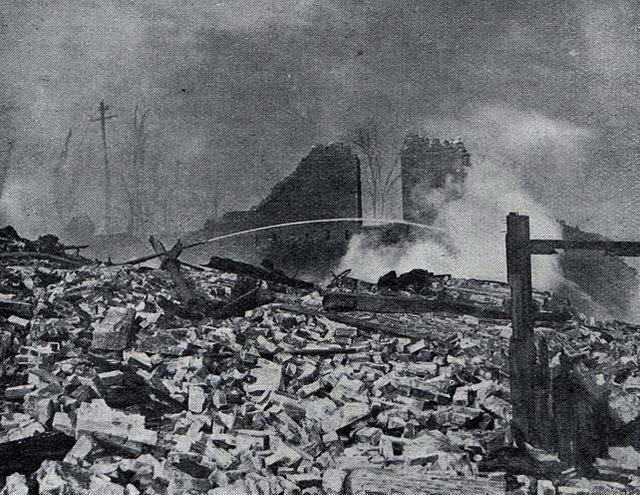
Well, it might be about time to put the macaroni in the pot. On Nov. 15, a Russian attack — which pri marily targeted Ukraine’s energy structure — was believed to also be responsible for a missile that landed in Poland, killing two people.
Though it is now being reported that the missile was launched by Ukraine to defend against the strike, there’s another lingering feeling held by many — at this point, just rip the band-aid o
“It’s not that I want there to be a war, but if there is gonna be one, I’d like to get on with it,” said St. Louis grocery store clerk Jennifer Stozy. “I’m getting kinda tired of waiting around. If something bad is gonna happen, then let’s just fast forward to that part so I can deal with my shit.”
It’s possible that those in the United States are particularly open to the idea of war — after all, accord ing to some, another Civil War is overdo. Still, the sentiment seems to stand worldwide.
“It’s goddamn ridiculous is what it is,” began Dublin firefighter Killian McClannahan. “We put up with all of this bullshit — bickering politicians, little baby boy Putin’s temper tantrums — it’s all just one big pecker measuring contest. At this point, someone’s gonna have to man up and either make things right
or light the fuse. I think we know which they’ll pick, the gobshites.”
Most people in countries that
Former president and cur rent elderly toddler Donald Trump announced his bid for the 2024 United States presi dential race Tuesday night. In a party that seems to be cham pioning Florida Governor Ron DeSantis as its next Republican nominee, it seems strange that Trump would put himself in a position to potentially get his ego bruised.

There’s only one thing Trump has that’s bigger than his sense of self-importance — his desire to not get caught. It is now being reported that in addition to the 300-plus classified materials found in the former president’s Mara-Lago home, there are addi tional documents at the White House that he would like to steal as well.
Those who know the hotel chain owner say he has become increasingly unwilling to take advice from those he once trusted, instead relying on his own wildly stunted instincts.
However, there is a reason for this beyond arrogance — Trump knows what’s in those files, and it will be incredibly embarrassing if some of that stu gets out.
“He’s not acting like himself. He’s just not doing anything he used to do for fun like trying on silly hats, singing the ‘Cats’ soundtrack while he uses the restroom or even playing Yahtzee alone in the tub,” said one of Trump’s concerned advisors.
The struggling business man is also said to be behav ing strangely around certain objects, including big red bal loons, Russian nesting dolls, warm glasses of iced tea and each of his pet children.
Moreover, Trump’s aides have had to take special precau tions with him during severe thunderstorms. This is alleg edly because the stable genius is paranoid that something may happen to him which he had no qualms about poten tially happening to former Vice President Mike Pence — being hanged in a barrage of bullets and fire.
“When he gets afraid of storms like that, it’s a little dicey because nobody really wants to hug him. He doesn’t want us to hug him either because you can feel that
he’s wearing an ab trainer. Instead, we ordered one of those tight outfits peo ple put on their dogs — I think they’re actually called ThunderShirts — to ease their anxiety. The fit is a little awkward since it’s intended for a four-legged Burmese Mountain Dog, but Mr. Trump tends to fall asleep pretty soon after it’s on and doesn’t wake up again until we cut him out of it,” said an anonymous Trump aide.
Donald Trump will hope fully be required to get a grip in order to have a legitimate chance at becoming just the second United States presi dent elected to two non-con secutive terms. Seeing as the key word is “hopefully,” it may also be wise to prepare for absolute mayhem.
could potentially be caught in the conflict’s crossfire agree that politi cians should make e orts to ease
international relations. In the other lane are people who view a theo retical World War III as a potential blanket over what atrocious things their countries did during World War II.
Klaus von Laufenberg provided his point of view.
“The world is like a mar riage, okay? Sometimes you fight, but fighting makes you stronger. Sometimes it’s like ‘Oh, you kissed your father on the cheek? Then I will go ahead and cut o your tongue.’ Then snip-snap-snop, everything goes back to normal. See?” said Laufenberg, Hitlerly.
It’s impossible to know at this point what it might take for coun tries to get boots on the ground. At this point, all the good people of the world can do is hang tight and hope all of the tropical vacation destina tions remain untouched.
One of the biggest stories from the 2022 midterms is the Arizona gubernatorial race. Five days after elec tion day, only 93% of the vote has been counted. As of 1 p.m. on Nov. 14, Kari Lake is trailing Democratic opponent Katie Hobbs by roughly one point.

Some would attri bute the slow results and Hobbs’ lead to hundreds of thousands of mail-in ballots being dropped o at polling locations on Election Day and a strong showing for Democrat and incumbent Arizona Senator Mark Kelly. Unfortunately for the can didate’s frontal lobe, Kari Lake isn’t buying it.
Instead, the former news anchor is taking her turn in the blame game by playing a wild card — blaming babies that look like old people.
“You see these grown adults walking to their polling place with a baby on their shoulders knowing full-well that their child looks like Mel Brooks. That opens up a whole other can of worms, but I’ll let my peers — Ye and Mr. Irving — handle that,” said Lake, pointing a warning finger gun at the journalists in the audience.
Lake alleges that poll workers are allowing babies to vote.
“At that point, these unqualified workers are just assuming these slob ber blobs are eligible to
vote! They shu e them through the process assuming that they’re just flustered because their children don’t take them out of the home that often,” explained a frus trated Lake.
The Illinois native also believes that the babies are responsible for Hobbs’ lead.
“When you think about babies, you think of two colors — pink and blue. Soft colors. Delicate. The Republican party is red — bold. These babies only know soft, so they vote blue,” said Lake, clearly in one of her good moods.
Lake’s campaign is reportedly ready to seek
legal action despite the fact that a winner is yet to be declared. When asked exactly what action will be taken and against who, the campaign said they are still brainstorming which claim would be most politically beneficial to pursue.
With the future of Arizona’s gubernatorial seat uncertain, those a l iated with the election are asked to stay away from both old looking babies and old people who look like those babies. Instead, these groups will be paired together and sent to a commune of sorts until Lake finds a new group to blame for her lack of popularity.
We're always looking for more funny and insightful writers with fresh takes on topics ranging from the UW campus to international news. We accept and encourage creative submissions as well! Any and all submissions are more than welcome. You can send your submissions and any comments or questions to thebeet@dailycardinal. com. All articles featured in The Beet are creative, satirical and/or entirely fictional pieces. They are fully intended as such and should not be taken seriously as news.