How students in Wisconsin’s premier swing county debate politics with dignity
By Tyler Katzenberger STATE NEWS EDITOR
Mock legislature is a rite of passage for Ryan Mussack’s Advanced Placement (AP) Government and Politics stu dents at Sauk Prairie High School. His class writes bills, prepares speeches and debates their ideas during committee hearings — just like a real legislature.
“We all have di erent groups that we work with,” said Sauk Prairie junior Taylor Brown. “This is the biggest project we’ve done so far.”
Sauk Prairie High School hosts students from the twin vil lages of Sauk City and Prairie Du Sac, located 30 minutes north west of Madison in Sauk County.
But the county has more to brag about than the first-ever Culver’s restaurant. Its unique combination of liberal Madison commuters and small-town farmers voted for the winning candidate in 10 of the last 11 presidential elections, accord ing to POLITICO.
“We’re a unique microcosm of people here in this area,” Mussack said. “It’s pretty down the middle.”
Even Mussack’s AP Government class, which he coteaches with colleague Adam Brager, has a track record of voting for winning candidates. The class voted for Donald
Trump in 2016 and flipped to President Joe Biden in 2020, just like Sauk County.
“Every year, it has lined up almost exactly right,” Mussack said. “It’s within the margin of error, in most cases.”
Journalists from across the nation place Sauk County under a microscope each election cycle in a bid to discover why the county votes the way it does, especially in a polarized state like Wisconsin.
News outlets often focus on that polarization. NBC News called Wisconsin “ground zero” for polarization, and POLITICO said the state was “where medi an voter theory goes to die.”
Candidates have also priori tized base turnout more than crossing party lines to win recent elections. Democrats and Republicans called on political heavyweights like for mer President Barack Obama and Florida Gov. Ron DeSantis to energize their voters with just days to go before the Nov. 8 elections.
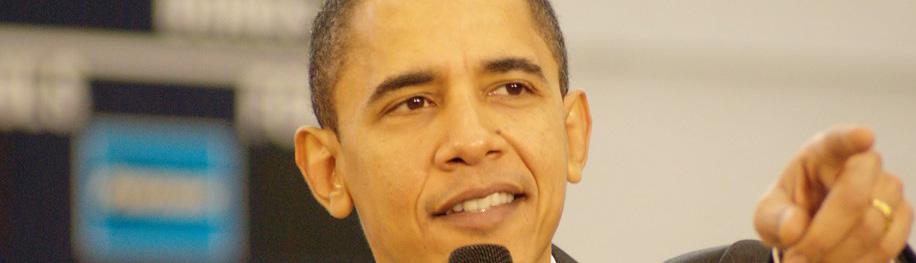
However, Mussack believes much of his class — and Sauk County — doesn’t live on the political fringes.
“Our loudest voices are typi cally a lot more polarized toward the edges of the political spec trum, but a lot of our people are more towards that middle,” Mussack said.
Mussack attributed ris ing polarization to social media, which he said plays into extremism and prevents respectful debate.
“We’re not necessarily get ting all the sides of our story anymore,” Mussack said. “We’re less willing to listen to other sides than we would have been before.”
To counter that, Mussack begins each year with a unit on civil discourse, where he teaches students how to navigate touchy topics while empathizing with diverse perspectives.
He also teaches students how to sort through misinformation and fact-check news coming from social media, the primary news source for nearly seven-inten young Americans, according to the Pew Research Center.
“We stay on topic and also make sure things aren’t person al,” Mussack said. “When we debate, we try not to call each other by name.”
And he’s not afraid to moder ate the discussion.
“If somebody’s getting o topic, he’ll hit the gavel for deco rum and get everybody back in order before they continue,” said junior Nick Stakahovskyy.
Stakahovskyy hopes to fol low Mussack’s lead during the upcoming mock legislative session, where he’ll be moder ating debates as the speaker of
the house.
“You’re just trying to solve the problem together by look ing at both sides, not trying to throw the other side under the bus and make them look bad,” Stakahovskyy said.
Politicians, including Gov. Tony Evers and Sen. Ron Johnson, commented on the stu dents’ respectful conversations in past visits to Sauk Prairie, according to Mussack.
However, Mussack’s students think politicians could learn something from their class.
Junior Vivian Rosch watched the 2020 presidential debates and thought the candidates’ manners were “terrible” compared to her classroom discussions.
“Seeing that 16 and 17-yearolds have better decorum than them could be a good wake-up call that [politicians] really need to listen to each other more,” Rosch said.
She understands real politi cians deal with serious issues but thinks their heated discus sions prevent creative solutions.
“Everyone’s opinion mat ters,” Rosch said. “Everyone’s voice is important, and their opinion can actually really help with certain stu . It gives you di erent perspectives.”
Mussack believes his stu dents’ commitment to respect ful deliberation — even in one of the most evenly-divided
counties in one of the most divided states — proves com mon ground and civility are still possible in politics.
“I think having good exam ples and politicians trying to show better discourse [would] be a huge way of helping us not have those issues going forward,” Mussack said.space generously o ered by Grace Episcopal Church, with help from St. John’s Lutheran Church and First United Methodist Church,” Rhodes-Conway said. “We owe those congregations and their leadership a huge debt of gratitude, but it is long past time that we develop purposebuilt shelter.”
O’Keefe said city o cials met Wednesday morning to examine other options.
“There are other properties we will be looking at,” O’Keefe said. “There’s a strong commit ment on the part of policymak ers to get this done. I’m pretty optimistic we’ll move on and find an alternative.”
Despite Rhodes-Conway’s resolution, the initial phase of the renovation and conversion of the day care center to an interim homeless shelter would not have been completed until 2022.
Since the city cannot use Warner Park as a permanent shelter location, city o cials said they will explore short-term options for 2021.
UW System free speech survey to be released on Nov. 14
By Ellie Bourdo ASSOCIATE NEWS EDITOR

The Student Views on Freedom of Speech survey will be released to undergraduate students at all 13 University of Wisconsin System campuses on Nov. 14.
The survey was set to be released in April but was post poned until the fall semes ter. Tensions over the survey led to the resignation of Jim Henderson, the former interim chancellor at the University of Wisconsin-Whitewater.
“I acknowledge that some chancellors were disappointed in that decision, and it regret tably led to a resignation,” UW System Interim President Michael Falbo wrote in an April statement, referring to
the universities’ Institutional Review Boards (IRB) approv ing the survey .
According to the Associated Students of Madison (ASM), the survey released in spring was met with a large amount of backlash from student govern ments across the UW System. It was then moved back to be released in fall with a promise of more transparency.
On Sept. 28, a draft of the survey was released to UW-Madison Student Shared Governance representatives through Google Forms, where they could provide feedback.
“While it’s fine to assess stu dent’s perceptions of how oth ers will receive their views, this study has a limited ability [to] accurately and reliably capture
how the university, as an insti tution, limits free speech,” an anonymous student comment ed on the draft version.
Upon revisions, UW-Stout and UW-Madison’s IRB approved the survey. With this approval, the survey will be distributed to undergraduate students at UW-Madison and UW-Stout with a goal of receiv ing 500 student responses at each campus. The IRB approv al of the remaining campuses is currently unknown.
On Nov. 14, 2,500 randomly selected students will receive the survey through an email invitation at each UW cam pus. If 500 responses are not received, another 2,500 stu dents will receive the survey on Nov. 21. This will continue
until either 500 responses are received, or until Dec. 14. Only up to 7,500 students on each campus will receive the survey.
According to ASM, the sur vey will ask students ques tions regarding the First Amendment, attitudes on viewpoint diversity, experi ences with free expression, self-censorship on campus and more.
According to the study description, the goal of the survey is “to survey degree seeking undergraduate stu dents 18 or older at the 13 UW System campuses about cam pus free expression, view point diversity, and self-cen sorship. The research aims to provide a systematic and objective description of UW
System student respondents’ perceptions and views.”
The researchers of the sur vey are Timothy Shiell from the UW-Stout Menard Center for the Study of Institutions and Innovation, Eric Giordano from the Wisconsin Institute for Public Policy and Service, April Bleske-Rechek from the UW-Eau Claire Psychology Department, Eric Kasper from the UW-Eau Claire Political Science Department and UW-Eau Claire Assistant Vice Chancellor Geo Peterson.
The data analysis will take place from December 2022 to January 2023. Preliminary results will be available at the end of January and the final report will be accessible through the UW system.
“…the great state University of Wisconsin should ever encourage that continual and fearless sifting and winnowing by which alone the truth can be found.”
University of
Wisconsin-Madison
Since 1892 dailycardinal.com Thursday, November 3, 2022l
+The Beet, page 8
Obama tests out new stand-up rou tine in Milwaukee
Fear-mongering
and the American political campaign
+OPINION, page 7
The Madison Public Market faces yet another financial setback
 By Meghan Spirito STAFF WRITER
County Board Chairman Patrick Miles formally pro posed an amendment to the county’s capital budget to bor row and deliver $1.5 million, aiding the financial gap. Miles recognizes the Madison Public Market as a notable opportu nity for minority businesses as well as economic and social opportunities.
“I think the public market will be a vehicle for econom ic opportunity and provide increased access to locally pro duced foods. I strongly support the project’s goal to increase economic opportunity for lowincome populations and people of color,” Miles said.
The Madison Public Market would be located in the former
two-story, 45,000 square-foot Fleet Services building at 200 N. First St, according to the
a wide variety of entrepre neurs offering cultural cui sines, locally sourced food
and minority-owned business es, according to the Wisconsin State Journal. Although the city would own the property, the Madison Public Market Foundation nonprofit would operate it.
Many are fearful that the project aiming to bring a diverse network of fresh pro duce and food will be aban doned because of the financial gap. The market’s project team, however, continues to promote fundraising efforts and believes that $800,000 to $1 million can be cut from the project.
Wisconsin State Journal. The market’s placement would liven up an area known as a place for traffic and train crossings. The market would feature

David Kahl pleads guilty to 2008 murder of student
By Noe Goldhaber STAFF WRITER
David Kahl pled guilty to firstdegree intentional homicide in late October for the murder of former University of Wisconsin-Madison student Brittany Zimmerman. Zimmerman, a UW-Madison junior studying microbiology and immu nology, was murdered in her apart ment on Doty Street in 2008.
Kahl was a longtime suspect in the case, and in 2018 forensic DNA evidence from Zimmerman’s shirt linked him to the crime scene. In March 2020, a case was filed against Kahl.
Kahl admitted his guilt for the first time in conversations with his attorney Benjamin Gonring over the past few weeks. He will serve a man datory life sentence.
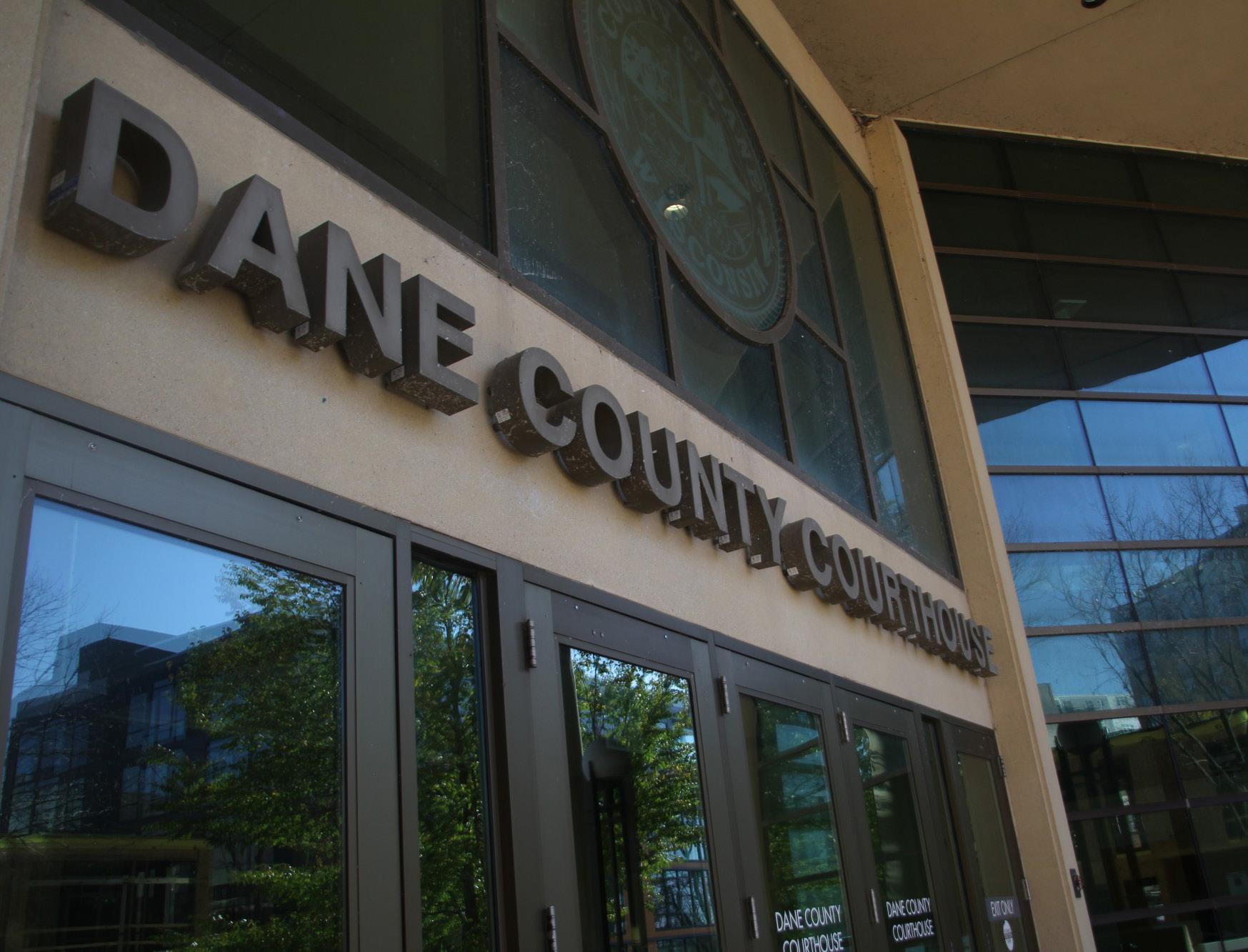
Kahl desired “to do the right thing, to stop the speculation [and his] false accusations,” Gonring said at the Dane County Courthouse. “David wanted today to be about giving closure to some people.”
Kimberly Heeg, Zimmerman’s aunt, also testified in court and argued against the decision to give Kahl a mandatory life sentence now instead of in January at Kahl’s jury
trial. Waiting until January would allow Kahl to move to a state facil ity with better mental health ser vices instead of Dane County Jail, she said.
“I’m glad that he feels that he has a clear conscience at this point, but we, as a family, have nothing but pain,” Heeg said. “We have nothing but daily reminders, and we’ve had nothing but torture for 14.5 years while he did his soul-searching to decide to come clean.”
Gonring explained that Kahl was going door to door asking for money to repair a nonexistent flat tire as part of a scheme to get money for cocaine. Kahl was high at the time of the murder and, after exiting the bathroom at Zimmerman’s apart ment, encountered her on a call and became paranoid.
“He basically lost it, for lack of a better term. He was in the throes of a lot of drug usage and was paranoid and had not been out of prison for all that long,” Gonring said. “[He] was very wor ried about what was happening on the other end of that line and then proceeded to do acts which absolutely fit the criteria for firstdegree intentional homicide.”
and arts and crafts. Within the market, the Food Innovation Center would have services and equipment to boost small
More Common Council members are able to propose amendments to the 2023 capi tal budget before the final bud get is approved the week of Nov. 14.
Bascom Hill packed once again with flamingos as Fill the Hill returns
By Zach Kaplan STAFF WRITER
Every October, Bascom Hill is filled with bright pink fla mingos as part of an initia tive called Fill the Hill, which celebrates a new wave of donations to the University of Wisconsin-Madison.
“The Wisconsin Foundation and Alumni Association (WFAA) is so proud of our alumni, friends, and campus partners for making this 10-year anniversary of Fill the Hill such a success,” said Tod Pritchard, director of media rela tions for the WFAA.
This year, the initiative raised $421,057 from 2,789 gifts, while the initiative’s total amount raised over 10 years now exceeds $2 mil lion. The donations help support major facets of the university and its operations, including the Chancellor’s Fund, tuition assis tance, other schools within the university, the Chazen Museum of Art, a nity groups, libraries and the arboretum, among others.
Each flamingo represents “how private support helps UW-Madison maintain its excellence in educa tion,” according to Pritchard.
“We hope the initiative brought more awareness to the university’s campus initiatives. There were over 90 areas of sup port during Fill the Hill this year, including annual funds for our partner schools and colleges, alumni affinity groups, alumni chapters and departments that focus on boosting student experi ences,” said Mei Li Brown, the marketing coordinator for Fill the Hill.
In addition to supporting the university’s biggest needs, Fill the Hill is a huge source of Badger pride.
“The support of alums speaks to the impact the university had on them during their time here,” said Head of Library Communications Natasha Veeser. “It also shows
their dedication to ensuring the university provides exceptional opportunities and experiences for current and future students.”
Additionally, this was the first year the WFAA offered a “Flamingle on the Hill” event to help educate current students on the importance of philanthropy.
“When our students gradu ate and become alumni, we hope they look back to when they saw flamingos on the hill and decide that it’s their turn to give back,” said Brown.
While the university as a whole benefits from this initia tive, one of the main beneficiaries of this initiative is the UW Library System. The money donated this year went toward the Library Impact Fund, which allows the libraries to address needs such as hiring more students to providing more tables with electric outlets, said Veeser.
“The libraries are a central part of campus life, with nearly every one using a library at some point, hopefully often. Having the com mitment from our alums in con tinuing to support the libraries is a show of their commitment to the university on a larger scale,” Veeser said. “The libraries serve all students, faculty and staff and so every gift to the libraries helps to ensure that students, faculty and staff have the resources that they need in the libraries.”
Ultimately, Fill the Hill serves as an important reminder of the power of the collective in enacting change, Brown said.
“Watching alumni and friends come together to fill the hill with pink flamingos made me feel proud to be part of the Badger community,” said Brown. “The flamingos liter ally visualize how the power of collective giving adds up and makes a difference, which is why it’s so inspiring to be part of this legendary tradition.”
2 Thursday, November 3, 2022 dailycardinal.com news
Corrections or clarifcations? Call The Daily Cardinal offce at 608-262-8000 or send an email to edit@dailycardinal.com. For the record l An independent student newspaper, serving the University of Wisconsin-Madison community since 1892 Volume 132, Issue 12 2142 Vilas Communication Hall 821 University Avenue Madison, Wis., 53706-1497 (608) 262-8000 News and Editorial edit@dailycardinal.com News Team News Manager Hope Karnopp Campus Editor Alison Stecker College Editor Anthony Trombi City Editor Charlie Hildebrand State Editor Tyler Katzenberger Associate News Editor Ellie Bourdo Features Editor Annabella Rosciglione Opinion Editors Priyanka Vasavan • Ethan Wollins Arts Editors Jeffrey Brown • Hannah Ritvo Sports Editors Donnie Slusher • Cole Wozniak The Beet Editor Mackenzie Moore Photo Editor Drake White-Bergey Graphics Editors Jennifer Schaller • Madi Sherman Science Editor Julia Wiessing Life & Style Editor Sophie Walk Copy Chiefs Kodie Engst • Ella Gorodetzky Copy Editors Chris Lopez-Henriquez • Noe Goldhaber Social Media Manager Clare McManamon Business and Advertising business@dailycardinal.com Business Manager Asher Anderson • Brandon Sanger Advertising Managers Noal Basil • Sydney Hawk Marketing Director Mason Waas The Daily Cardinal is a nonproft organization run by its staff members and elected editors. It receives no funds from the university. Operating revenue is generated from advertising and subscription sales. The Daily Cardinal is published weekdays and distributed at the University of WisconsinMadison and its surrounding community with a circulation of 10,000. Capital Newspapers, Inc. is the Cardinal’s printer. The Daily Cardinal is printed on recy cled paper. The Cardinal is a member of the Associated Collegiate Press and the Wisconsin Newspaper Association. All copy, photographs and graphics appear ing in The Daily Cardinal are the sole property of the Cardinal and may not be reproduced without written permission of the editor in chief. The Daily Cardinal accepts advertising rep resenting a wide range of views. This accep tance does not imply agreement with the views expressed. The Cardinal reserves the right to reject advertisements judged offensive based on imagery, wording or both. Complaints: News and editorial complaints should be presented to the editor in chief. Business and advertising complaints should be presented to the business manager. Letters Policy: Letters must be word pro cessed and must include contact information. No anonymous letters will be printed. All letters to the editor will be printed at the discretion of The Daily Cardinal. Letters may be sent to opinion@ dailycardinal.com. © , The Daily Cardinal Media Corporation ISSN -5 98 Editorial Board Em-J Krigsman • Anupras Mohapatra • Jessica Sonkin • Priyanka Vasavan • Sophia Vento • Ethan Wollins Board of Directors Scott Girard, President • Herman Baumann • Ishita Chakraborty • Don Miner • Nancy Sandy • Phil Hands • Josh Klemons • Barbara Arnold • Jennifer Sereno Editor-in-Chief Sophia Vento Managing Editor Jessica Sonkin
COURTESY OF MADISON
PUBLIC MARKET FOUNDATION
DRAKE WHITE-BERGEY/THE DAILY CARDINAL
Student organizations encourage UW vote, some students remain unconvinced
By Ellie Nowakowski STAFF WRITER
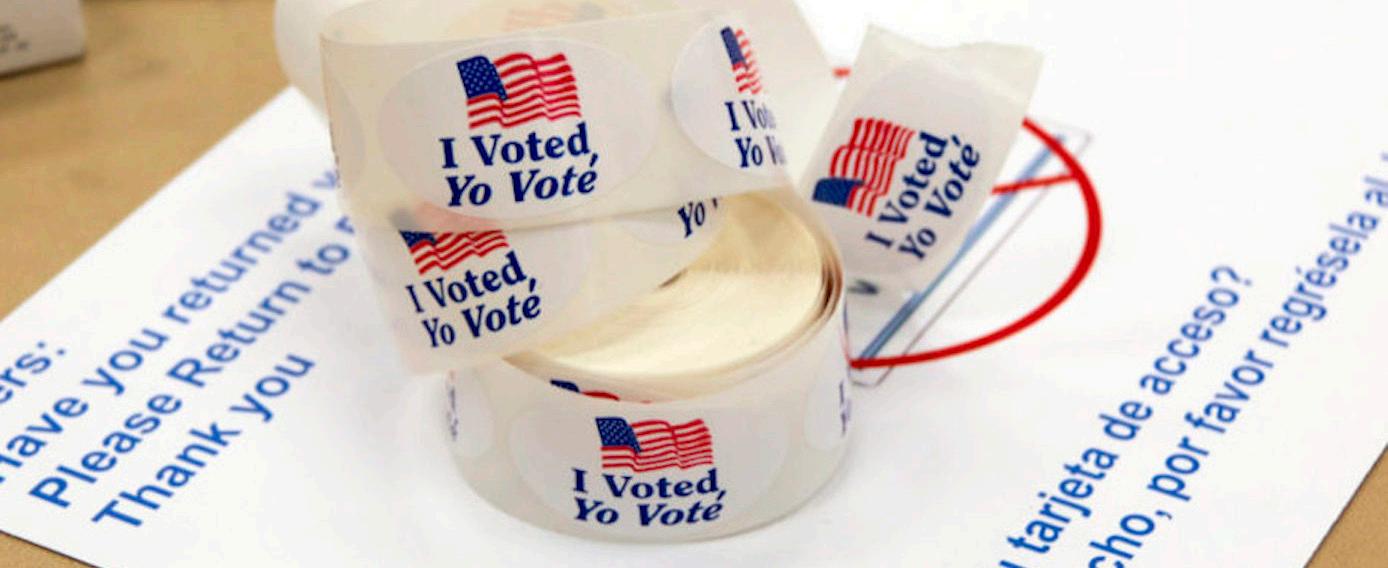
The student vote at the University of Wisconsin-Madison has the power to dictate the scope of politics on local, state and national levels. Student groups across campus are determined to promote student voter registration and turnout, but despite their e orts, some students remain unenthused and unconvinced.
In 2020, 72.8% of eligible students at UW-Madison cast their ballots in the presidential election, higher than the 66% of eligible college students nationally. In 2020, President Joe Biden won Wisconsin’s 10 electoral votes by just over 20,000 votes. UW-Madison student voters surpassed this num ber, as 24,572 students cast their votes. Though surely not all students cast their ballots in Wisconsin, this num ber speaks to the power that the stu dent vote at UW-Madison alone can have on elections nationally.
“Wisconsin is one of the biggest states to watch with student partici pation in elections because [students]
really do have a big voice and they are a big determining factor,” said Shelby Fosco, Co-curricular Programs Specialist at the Morgridge Center.
In her position at UW-Madison, Fosco is the supervisor of BadgersVote, a non-partisan student organization focused on turning out the student vote on campus. The uni versity-a liated group seeks to drive student voter turnout by increasing visibility and accessibility around elections and voting.
“We’re really trying to engage stu dents at any entry point,” Fosco said.
BadgersVote has hosted events weekly but ramped up its program ming as Nov. 8 approaches. The events include debate watch parties, mock elections where students can practice filling out a ballot at a polling place and voter registration events. The group also hosted daily events dur ing National Voter Registration Week. BadgersVote’s ultimate goal is to give students the confidence to go to the polls and vote while promoting voter access and electoral education.
“I think feeling competence in the polling booth and knowing who and what you’re voting for is something that students are unsure of for the midterm elections,” Fosco said. “When it comes to the presidential election, students know who they’re voting for. They know what they’re voting for, but not necessarily the same thing for the midterm election.”
This sentiment rings true for UW-Madison senior Mari Seidler, who has never voted and does not have plans to vote in the upcoming elections. In fact, the Wisconsin resi dent did not realize the election was approaching until a recent conversa tion with her roommates.
“I don’t know either of the candi dates, and I haven’t researched it at all, so I don’t think it’s fair for me to go and vote,” Seidler said.
Seidler explained that time con straints prevent her from taking the time to research candidates. She often disagrees with both parties, and should she take the time to cast her ballot, would ultimately not vote for “either candidate.”
Aside from voter education, anoth er of BadgerVote’s ongoing initiatives is ensuring that students have access to proper voter identification. While the group does not encourage students to vote in one state over another, they focus on educating and empowering
students to vote where they choose.
“You’re here for four years,” Fosco said. “A lot of things happen in four years, that’s an entire presi dential term. So really, it’s up to stu dents where they feel like their vote is most powerful.”
Voting in Wisconsin isn’t just about having sway in national politics. As students at a public university, many of the decisions made on local and state levels have an impact at UW-Madison. Issues that largely impact students, such as abortion access, will be decid ed by politicians running in the 2022 election.
“If we don’t win this race, it will change the face of the UW System, all of the campuses that we’re talk ing about,” said incumbent Gov. Tony Evers at an event with student supporters in Madison. “It certainly will be an issue around reproductive rights, you will not be seeing any one working towards the legalization of marijuana, but most important ly, your lives as students going to a top-class, world-class university will change.”
In order to amplify the impact of BadgersVote and other organi zations on campus, ASM hosted events such as Voterpalooza to teach students about the upcoming mid term elections.
At UW-Madison, the Panhellenic
Association is also working to turn out the student vote in their commu nity and has been working with thirdparty groups to achieve this goal. The organization’s commitment to service translates directly to civic engage ment and democratic participation, said PHA’s Vice President of Civic Engagement Abby Maechling.
“We have such a big community of smart, engaged members, [and] it’s just a matter of getting our members to know that they can share their opin ions by voting,” Maechling said.
PHA is unique in that it has out wardly encouraged students to regis ter to vote in Wisconsin — specifically. Maechling explained that a large part of the Greek life community is made up of out-of-state students, who may come from states which lean heavily Democratic or Republican.
“We believe that it is critical that if you have the right to vote in a swing state, you should because your vote is more powerful there,” Maechling said.

Ultimately, BadgersVote and other on-campus organizations are hopeful about student interest and engagement as the midterm elections approach.
“Typically, midterm election turnout for young voters is a little bit lower,” Fosco said. “But we’re hoping we can keep that turnout level high and get students to the polls on Nov. 8.”
Examining past and future LGBTQ+ activism with GSCC
By Gabriella Hartlaub STAFF WRITER
“Accidental Activism” was the unofficial theme of the University of Wisconsin-Madison’s Gender and Sexuality Campus Center (GSCC) event “We Are Here,” held in mid October at the Wisconsin Historical Society.
The event hosted LGBTQ+ activ ists from throughout the univer sity’s history, spanning the Reserve O cers’ Training Corps (ROTC) pro tests in the 1990s to recent graduates and current students.
As activists talked about their dif ferent experiences, a single theme remained clear: None of them set out to become activists when they first came to campus. Eventually a prob lem presented itself; whether that be discrimination, lack of community for marginalized students or lack of resources. Each one of the panelists rose up to meet the challenge.
“You see something, you want to fix it,” said Jordan Marsh, one of the panelists from the “We Are Here” event. “You fix it or you do what you can do to it.”
A many decades long fight for various LGBTQ+ issues led up to last month’s panel.
Understanding historical context Marsh participated in the ROTC Protests on campus during the 1990s, which in turn inspired movements for the adoption of federal antidiscrimination policies around the United States.
Wisconsin was the first state in the nation to pass non-discrimination policies based on sexual orientation in housing employment, public accom modations and education in the early 1980s, according to politifact.
By the 1990s, however, Madison
students noticed a discrepancy on campus. While the state mandated no discrimination in education, the ROTC on campus followed the federal ban on those who identified as gay or lesbian serving in the military.
After a Faculty Senate vote to remove the ROTC from campus, the Board of Regents voted to continue the ROTC to be active on campus. This led to a five-day student protest in late April 1990 demanding that then Chancellor Donna Shalala do some thing about the issue.
The UW Board of Regents and UW-Madison administration voted not to remove the ROTC from cam pus but put funds towards changing the military’s rules on a federal level. This culminated in the passing of the controversial “Don’t Ask, Don’t Tell” policy in 1993.
Though it hadn’t been established at the point of the protests, this previ ous activism set the stage for much of the future of GSCC.
Remarks at the panel
Kacie Lucchini Butcher, director of the Public History Project, spoke at the beginning of the GSCC panel regard ing pieces of LGBTQ+ history con tained in the “Sifting and Reckoning” Exhibit, which is currently on display at the Chazen Museum of Art.
Lucchini Butcher stressed the importance of education on the long history of activism not only on UW’s campus but around the state of Wisconsin, which is something the GSCC also wants to continue with its work.
“We’re doing this sort of histori cal retrospective — we’ll be part nering with a public history proj ect, ideally on that event, so we can showcase TPS over the years,” GSCC Director Warren Scherer said in ref
erence to the 40th anniversary of the Pride Society.
The Pride Society, originally named the Ten Percent Society, was one of the first LGBTQ+ activist groups on campus. It was also mentioned by one of the panelists at the event, led by Alnisa Algood. Before she became the founding director of the GSCC, Algood arrived in Madison on “a whim.” Eventually, she joined the Ten Percent Society and became involved in what was by then a years long e ort to create a GSCC on campus.
Algood created the center in 1991, however, space began to become an issue during the center’s first five years. Until 1998, the center was housed o campus after years of being denied space both in Memorial Union and the newly renovated Red Gym where the other multicultural centers were housed.
In November 2002, the GSCC intended to participate in Shadow Day, where the university encouraged diversity by allowing students of color and LGTBQ+ students to “shadow” UW students for a day.
UW, however, terminated the GSCC’s participation in the event without telling any of the organizers, which led to student requests for the GSCC to become an o cial o ce of the Dean of Students.
The name was o cially changed to the Gender and Sexuality Campus Center — previously the LGBTQ Campus Center — in 2018 and moved into their current space in the Red Gym in 2020.
Panelist Jelani Rivera talked about e orts in 2016 to reestablish the Black Cultural Center for students to cre ate a better environment for Black students. Rivera also described the e orts of students to disrupt cam
pus administration continuing busi ness as usual, in order to have their voices heard. This included a “die-in” at College Library, where students participated in nonviolent protest to call attention to the issue.
Progress to be made at UW
The panelists noted that, despite such progress, the campus communi ty still has a ways to go in meeting the needs of LGBTQ+ students. Panelist Adrian Lampron, former ASM chair, talked about their e orts to imple ment gender neutral housing options on campus. This resulted in the cre ation of Open House, the gender inclu sive learning community located in Phillips Hall.
University Housing currently o ers three options for LGBTQ+ stu dents. Housing applicants can apply to live on the gender inclusive housing floor in the Lowell Center, for individ ual gender inclusive rooms in Dejope, Phillips, Smith, Waters and Witte or the open house a nity community in
Phillips Hall.
There are 145 bathrooms on campus for gender neutral use and a 2019 university policy mandates there be at least one gender neu tral bathroom per floor in new and renovated buildings.
Panelist Andi Hernandez empha sized the need to create more inclu sive spaces for LGBTQ+ and people of color on campus, drawing on their experiences on campus as a non-bina ry person of color.
Despite the persistence of challeng es on campus, it is still important, the panelists said, to learn about what has been done in the past and how we got to where we are now.
“I think that the Campus Center has to hold space for folks to have both of those conversations,” Schererr said. “Look at where we were, and look at where we have to go. I don’t think that you can have the conversation about where we need to go without knowing where we’ve been.”
news
dailycardinal.com Thursday, November 3, 2022 l 3
DRAKE WHITE-BERGEY/ THE DAILY CARDINAL
TAYLOR WOLFRAM/ THE DAILY CARDINAL
Taking sanctuary at Echoing Overseas
By Kai Wen Li STAFF WRITER
There’s this quiet and modest exhibition on the Chazen Museum’s second floor which I’ve been visit ing occasionally when I’m feeling restless and missing home. During my time in Madison, I’ve developed a habit of roaming around every where vacantly, as if in fielding the long distances I’m somehow col lapsing the empty space between San Francisco and myself.
Shortly after moving back to Madison for the semester and suf fering a familiar pang of displace ment, I somehow felt drawn to the museum — a space which seemed ruminative in its own quiet, expan sive way and which supposedly held an answer for my confusion. It was a kind of personal refuge.
The exhibition, “Echoing Overseas,” takes up a modest room divided into two sections titled “Artworks Overseas” and “Artists Overseas.” Both of these rooms respectively focus on Asian artis tic exchange in pre-modern and modern settings. The curatorial statement explains the focus of the exhibition: to “break down the geo graphical dichotomy of East versus West” and the “cultural opposition of original versus imitation” that pervades narratives of cross-cultur al exchange, especially in the context of Western and Asian interaction.
The gallery itself feels less like an ambitious undertaking — like Chazen’s other exhibition currently on display, “Sifting and Reckoning” — than a personal project. Katherine Alcauskas, chief curator of the Chazen Museum of Art, said the inception of this gallery stems from a renewed interest in highlighting Asian art and how the actual cura torial work depended on finding the “right moment, the right fit.”
Chi-Lynn Lin, the leading cura tor behind the project, is a Ph.D. student in the Art History depart ment at the University of WisconsinMadison whose interest and exper tise in Asian art made her the “right opportunity” to actualize the project.
“I was really excited because we haven’t had an exhibition of artworks from East or Southeast Asia in quite a while,” Alcauskas
explained. “I really wanted to fore front some of our collections in that area. But I myself don’t have the expertise to do that. [Chi-Lynn] had some interest in museum work, and so it was kind of a fortuitous com ing together of the right person, the right project [and] the right time.”
In its modesty, the exhibition feels inviting and sincere. Despite spatial constraints, it has a lot to say, which adds to the gallery’s sense of purpose, even if it extends some margin of regret for the curator.
“I hoped I could do more on the Southeast or South Asia perspective because I [wanted] to include more Indian artists’ works,” Lin said.
Simultaneously, though, she also expressed the constraint in her own expertise of these regions.
“It’s really hard for me to cover everything from different geo graphical areas,” Lin added. “When I look back to our scope, it’s more focused on East Asia, like Japan, Korea and China.”
In its division of pre-modern and modern art, the exhibition feels like an evolutionary chronicle, mapping artistic exchange in two very di erent frames: the cultur al and the individual. “Artworks Overseas” centers mostly on the cultural exchange itself as a di u sion of ideas, artifacts or images through trade, through the profu sion of interregional encounters.
“The pre-modern world is more focused on the 14th to 18th century, a time period when long-term trade happens [as well as] the explora tion of the world, so many di erent people kind of encounter each other [at once],” Lin said.
Pre-modern Asian art, in that sense, seems to center not so much on how similarity indicates cul tural appropriation but rather how similarity actually challenges the meaning of “origin” or “authentic ity.” The stylistic likeness in much of the featured pieces aren’t necessarily appropriative but rather apprecia tive. As folding fans spread from Japan to China, certain distinguish ing features in their respective crafts actually mark a di erence in their sensibilities and traditions. Even the exhibition’s inclusion of English porcelain, supposedly an imitation
of Japanese Imari ware by European manufacturers in the 18th century, seems to shift the narrative of crosscultural exchange as a kind of “steal ing” to an assertion of its naturally mimetic condition.
The exhibition’s modern-art sec tion complicates the view of crosscultural exchange by shifting the focus on the artist itself as a met onym for cultural dichotomy. In jux taposition to the pre-modern section, the modern half of the exhibition demonstrates the flip side of having permeable national boundaries and liberal cultural borrowing. Here, the fluidity and agency of the artwork itself diminishes within the increas ingly rigid national lines of the 19th century. Asian artists themselves, then, become the westward-bound emissaries of “the East” seeking modernity in the West. The dynamic feels dichotomous and stilted. Part of the Asian artist’s struggle is nego tiating the repudiation of their own traditions and embracing an impos ing specter of modernization.
“Many Asian artists [in this time period] had this anxiety not only about their cultural identity but also in thinking about their tradition [during] a time when many [coun tries] are developing their national traditions,” Lin said. “They are not just looking at [the] West, but they are also looking at modernization and thinking [about] the tradition or the essence of their own culture.”
None of this is to say that cultur al exchange in our contemporary reality is somehow bad. In fact, the exhibition’s whole message seems to be that the artist, the uprooted and diasporic, exercises their own agency when nations or empires or the world deprive art of its reflex ivity, its capacity for self-determi nation. Yet, the exhibition doesn’t rebuke anything either. It doesn’t seek to vilify the West as the culprit in essentializing art to nationalist terms. It doesn’t level an attack, necessarily, or advocate a return to the purity of artistic traditions, whatever that means.
In one featured piece, Chinese artist Zao Wou-ki paints a remi niscent water scene in Abstract Expressionist form, which the label description explains is suggestive
of “cultural tension,” of “resistance and reconcilement” in the artist’s use of western medium and tech nique to present what might be read as “Chinese.” In another featured piece, Hiroshi Yoshida explicitly paints the El Capitan monolith of California’s Yosemite National Park using Japanese woodblock print techniques, avoiding a rigid tradi tional landscape aesthetic to appeal to American markets and revitalize a “fresh feel” for the artform.
There’s virtues to be found in these exchanges.
“The message of this exhibition is to find that we are not so di erent,” Lin said.
The whole point is to unearth this grounding notion that beneath the lasting imperial subtext, art is still just art in the same way that language communicates even through di erence.
In contemplating these pieces, however, there’s still the need to reckon how Western audiences ulti mately consume Asian art. As far as how artists represent themselves in the West, Lin said, “Sometimes I think it almost reflects the interna tional student in the Western cam pus … We are often very cautious when people ask us about Asian culture [because] we become a rep resentative of our own culture, and it’s sometimes really terrifying.”
We share an acknowledg ing chuckle.
“Because maybe we don’t know much, or we cannot be rep resentative of all Asian culture,” she continued.
For me, museums have always seemed to represent the transplant’s mode of cultural instruction. I was too young when I immigrated to be culturally aware of things back “home” in Shanghai.
So, Asian art in museums seemed close enough to truth that I used it as a mode of learning and keep ing up with my imagined, “original” self. My mother sometimes seems wary of any ethnic representation on American soil because it’s kind of tainted, inauthentic and maybe dogmatic. But Asian art exhibitions sometimes abstract away cultural specificity precisely for the appeal of a distinctly Asian-American sen
sibility, one that maybe generalizes identity or culture as a protective framework against Orientalism or Western stereotyping. It’s why in viewing exhibitions like these I feel less fraudulent or self-conscious about not knowing enough. The representation, here, doesn’t seek authenticity per se but rather soli darity and rapport, even when it agitates our awareness of mutual disconnection and di erence.
This is why I think the museum bears a personal note, that the cho sen pieces and the thematic arrange ment feel reflective of Lin’s own dis placement, which by extension feels connected to the larger experience of immigration, of transplantation, of removal. For me, there’s a deferen tial inner yearning for a storied past which often leaves me precariously wary of my pretenses about being culturally valid or authentic.
Over the years I’ve inherited this deep desire to trace my lineage back to something I don’t know but which nevertheless feels more truthful or authentic. By grow ing up elsewhere, my heritage had somehow gotten fractured and I’d become just a roaming fragment abroad. In my own family there was constantly this almost mythic invocation of my grandparents and other relatives in stories my parents would tell me regarding their life before they left Shanghai. Those stories are still like fiction to me, dreams that fantasize about undo ing our deracination, maybe even fielding bitter complaints against being culturally misunderstood in America as foreigners.
I stand in the gallery sometimes in a purely observational or appre ciative spirit, as if in being there I’m provoking a sense of kinship or commiseration with the longdeceased and the still-alive artists of these works, themselves living in negotiation of their identities. Or maybe it’s not as sentimental as I’d like to believe. Perhaps the exhibi tion just makes me feel less anxious in its quietude, its personal note, in the comforting fact that it’s there and visible.
“Echoing Overseas” will remain open until Nov. 28 in the Chazen Museum of Art.
Soccer Mommy picks up the Majestic, drives it home
By Diti Belhe STAFF WRITER
On a weekend with no shortage of things to do in Madison, the scene outside the Majestic on Saturday was still bustling. Fans, a mixture of college-aged kids and adults, some clad in costume, some not, lined up outside the theater to see Soccer Mommy perform.
Madison was the second stop on the North America leg of Sophie Allison’s — aka Soccer Mommy — “Touring, Forever” tour. In June, the 25-year-old Nashville native released her newest album, “Sometimes, Forever,” to much critical acclaim.
The record continues her transition from the smooth, coming-of-age pop of her earlier releases to the darker, more mature sound of her newer work that increasingly flirts with the tones of shoe-gazey reverb and dis
cordant guitars.
Lightning Bug, an alternative rock band from New York, opened the show. They filled the theater with a nostalgic, atmospher ic sound that had the audience swaying along.
Soccer Mommy’s new sound was evident from the moment she stepped on stage. The room rever berated with dreamy, psychedelic noise that bridged the silence between songs.
Those who knew and loved Soccer Mommy for her catchy, melodic pop ballads from earlier releases might have been caught o guard by the dissonant tunes and darker lyrics that comprised much of the set. But, those in the audience who got it were fully and truly engrossed — evident in their mouthing along and headbanging to the rhythmic drumbeat
and strong bass in songs like “Unholy A iction” and “Darkness Forever.”
When the singer played her clas sics, everyone was on the same page. Her beloved anthems like “Circle the Drain” and “Scorpio Rising” were greeted with electric cheers. The crowd, mostly young adults, bounced along as they belted bittersweet lyr ics about burnout and complicated relationships — stories that struck chords with the sea of fans.
Allison herself was mostly quiet between songs but occasion ally stopped to compliment the audi ence’s Halloween costumes — she herself was dressed as a vampire. She also made sure to thank the venue and the opener.
The band threw glow sticks into the crowd before announcing her next song, “Lucy.”
“This one’s about the devil,”
Allison proclaimed before croon ing out tongue-in-cheek, satanicthemed lyrics bathed in fittingly spooky lighting.
As her set winded down, Soccer Mommy performed some slower songs. This started with a solo acous tic rendition of “Still Clean” from her 2018 album, “Clean.” Her sweet, melodic voice was utilized to the full est as she repeated the melancholy refrain — “I was only what you want ed for a little while” — to a quietly entranced audience.
The next song, “Still,” was the most soulful of the night. Telling the story of her relatively new fame, the song candidly encapsu lated the complicated tumult of emo tions Allison explores throughout “Sometimes, Forever.”
The concert finished on a lively note as Soccer Mommy performed a
memorable encore with twin bangers that were a mixture of the old and the new. “Don’t ask Me” and “Your Dog” had the catchy ri s and clever lyrics to be a fitting way to end the night.
While she didn’t spend a lot of time interacting with fans, it was clear Soccer Mommy’s focus was on curating the perfect sound in the space. She and her band switched or tuned guitars between nearly every song. Her dedication paid o ; I found the music pleasantly hyp notic even when the show wasn’t the most high-energy.
Soccer Mommy’s tour is just beginning and will continue to make its way through the Midwest with shows in Minneapolis and Chicago before heading down the East Coast. Her newest single, “Darkness Forever (Sophie’s Version),” is out now, and it’s a funky, festive listen.
arts
4 Thursday, November 3, 2022 dailycardinal.coml
UW-Madison research provides basis for the Nobel Prize in Physics
By Peter Waples STAFF WRITER
For the first time in almost 10 years, quantum mechanics reappeared as the inspiration behind the Nobel Prize in Physics. In recognition of their work on quantum entanglement, this year’s highly esteemed phys ics award was split three ways between physicists Alain Aspect, John Clauser and Anton Zeilinger.
Quantum entanglement — a unique subatomic phenom enon that links the proper ties of two seemingly nonin teracting particles — defies all known intuitions of our macroscopic world. This bizarre behavior, along with its connection to real-world applications such as quan tum computing and commu nication, has led quantum entanglement to capture the minds of amateurs and experts alike.
This newly announced Nobel Prize marks the next chapter in this field.
All three awardees were involved in designing and performing various experi ments that deepened our understanding of quantum entanglement. Zeilinger, a professor of physics at the University of Vienna and designer of the most recent set of experiments, was interested in understand ing a peculiar side e ect of quantum entanglement called quantum teleporta tion. In essence, Zeilinger’s experiments showed that, through using two entangled particles, information could be shared over arbitrary dis tances, paving the way for a potentially highly secure com mercial quantum network.
Zeilinger’s experiments were only possible because of the experiments performed by Clauser, a researcher at J.F. Clauser & Associates, and Aspect, a professor at the University of ParisSaclay’s Institut d’Optique Graduate School. Both phys icists independently worked to design an instrument that could analyze the presence of quantum entanglement. Clauser was the first of the two — having begun his tests in the 1970s.
Clauser received promis ing results, but problems per sisted. Ten years later, Aspect was successful in eliminating the remaining issues via an upgraded version of Clauser’s original experiment.
While this may have been the extent of this year’s Nobel Prize in Physics, it only consti tutes the most recent strokes on a much larger picture of quantum entanglement.
To get to the beginning of this story, one needs to travel back in time to the mid-1930s. It had only been 10 years since the field of
quantum mechanics was even theorized. The novelty and uniqueness of quantum mechanics led any discus sion around the subject to rip through the physics commu nity like wildfire. Naturally, given the time period and topic, Albert Einstein worked his way to the mid dle of this discourse.
Throughout the early 1930s, Einstein would pub lish a smattering of papers discussing the various intri cacies of quantum mechan ics. However, it was in 1935 that Einstein would publish one of his most influential quantum mechanics papers. Teaming up with contem porary physicists Boris
position or momentum with absolute certainty, not both, as measuring one would alter the other. Using this, the physicists then established the idea of non-commutabili ty between two particles.
Put simply, two operators — for instance, X and Y — are non-commutable when XY≠YX. It can be useful to think of these operators as “actions” being performed on something. In a mathemati cal context, these operators act on wavefunctions — the equations that represent atomic particles — to produce unique numerical results. However, real-world analo
measured the position first, it would be detected in its unaltered starting point, already showing the inequal ity between XY and YX.
To supporters of quantum mechanics at the time, this idea was solid. What made the EPR paper so shock ing was that they were able to show, through a little bit of math, that in a quantum mechanical framework stan dard physics starts to break down. It would seem that “two physical quantities, with non-commuting opera tors, can have simultaneous realities,” describe Einstein and his co-authors. That is to say, two quantities whose very interactions should envelop them in a cloud of uncertainty are somehow linked, or rather entangled, in such a way that ing
tum mechanics. For several decades after the release of the paper, a leading theory pointed to the existence of some set of “hidden variables” that explain this behavior.
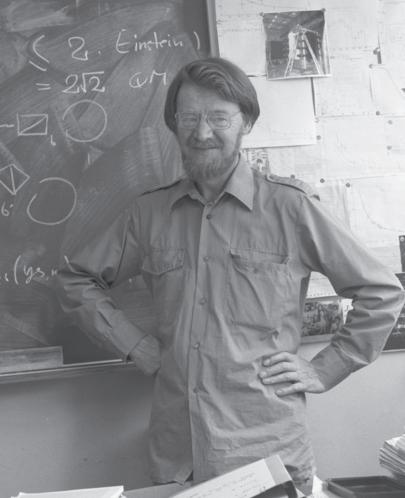
This wouldn’t be seri ously challenged until 1964, when Northern Irish-born physicist John S. Bell was working at the University of Wisconsin-Madison while on leave from the European Council for Nuclear Research (CERN). Bell happened to stumble across EPR’s 1935 paper and, upon reading its interpretation of quantum entanglement and hidden variables, Bell used relatively simple statistical principles to derive the set of inequali ties that would famously go on to later be known as the Bell Inequalities.
Bell published his work in a paper titled “On the Einstein Podolsky Rosen Paradox.” Its contents were dedicated to carefully setting up the momentous inequali ties. Roughly summarized, the Bell Inequalities were able to show that it was in fact possible to “detect” the presence of quantum hidden variables, all without know ing what they were.
If hidden variables were really behind quantum entanglement, then Bell’s Inequalities would hold true — proving the EPR interpreta tion right. However, if it could statistically be shown that the inequalities were not valid, then it could be seen as evi dence that the original under standing of quantum entangle ment is in fact correct.
Bell, for his part, believed the latter — that the inequali ties would be violated — thus solidifying the previous understanding of quantum mechanics. For the time being, however, Bell would have to wait for this confirmation.
one, dictably changes
Considered Complete?”
As the title may sug gest, Einstein and his col leagues argued that certain “physical irregularities” seemed so wild and out of the ordinary that the only logical conclusion is that quantum mechanics must be incomplete. The most obvi ous of these irregularities? Quantum entanglement.
Einstein, Podolsky and Rosen (EPR) set up their thought experiment by first using the notion of the uncer tainty principle — a famous interpretation which shows that for a given particle one could only know either its
gies, like the uncertainty principle, are also useful for highlighting this same idea.
By replacing X and Y with the act of measuring location and momentum respective ly, it becomes reasonable to argue that for a single parti cle these two actions are not commutable. For instance, if we measured the momentum of a particle, the act of doing so would send it flying off in a different direction, giving a location different from its original starting point when measured. If we had instead
Theoretically, if site ends of the universe were watching the same entan gled pair of particles, and one person decided to change their particle’s quantum state, the other person would be able to instantaneously see their own particle react to this change, seemingly far quicker than the speed of light would allow. To EPR, this seemed physically impossible, and they conclud ed that quantum mechanics must be incomplete.
The idea of quantum entanglement, later described by Einstein as “spooky action at a distance,” initiated a new approach towards the com mon understanding of quan
Several years later, John Clauser, a then postdoc at the University of CaliforniaBerkeley, discovered Bell’s work and began thinking about the experiment that would ulti mately become the first of this year’s Nobel winning trio.
To complete this experi ment, Clauser constructed an instrument that could measure the variables Bell’s Inequalities demanded. To the surprise of many, Clauser’s experimental data violated a Bell Inequality, marking the first step in proving the “spooky action” introduced by EPR 30 years earlier.
John S. Bell passed away in 1990, leaving him unable to see the most recent prog ress his work enabled. However, the mathematics he left behind cemented their place as a vital and foun dational piece of this year’s Nobel Prize in Physics.
science l
dailycardinal.com Thursday, November 3, 2022 5
PHOTO OF JOHN S. BELL COURTESY OF CREATIVE COMMONS
Wisconsin avenges loss against Gophers
By Ellie Scheirey STAFF WRITER
In late September, Wisconsin lost 0-3 to Minnesota in Minneapolis – the Badgers’ first and only Big Ten loss. In the nine games since, Wisconsin dropped only five of 27 sets.
The Badgers’ win against the Gophers is their 10th in a row, tied with Ohio State for the longest streak in the conference.
The first set started o close, but the Badgers gradually pulled ahead. Wisconsin went on a three point run after leading 11-9. Devyn Robinson and Danielle Hart com bined for a block, followed by a Robinson kill and then a Hart kill, increasing their lead to five.
Six Badgers combined for the team’s 14 kills in the first set, led by Sarah Franklin with five. Franklin’s last kill also sealed the first set win for the Badgers.
Wisconsin won the set 25-20 – taking their 15th first set of the season out of their 20 matches.
After the first point, Wisconsin controlled the remainder of the first set — their largest lead being six and the di erence in points coming from errors. Both teams totaled 14 kills, but Minnesota recorded nine errors while Wisconsin had four.
In the second set, Wisconsin’s hitting percentage dropped from .244 to .16 while Minnesota’s improved from .132 to .143. The Badgers took the first three points with their strong o ense. Julia Orzol began the set with a kill, fol lowed by another from Franklin before Orzol’s service ace put Wisconsin up 3-0 – the Badgers’ third service ace of the game.
The Gophers rallied back
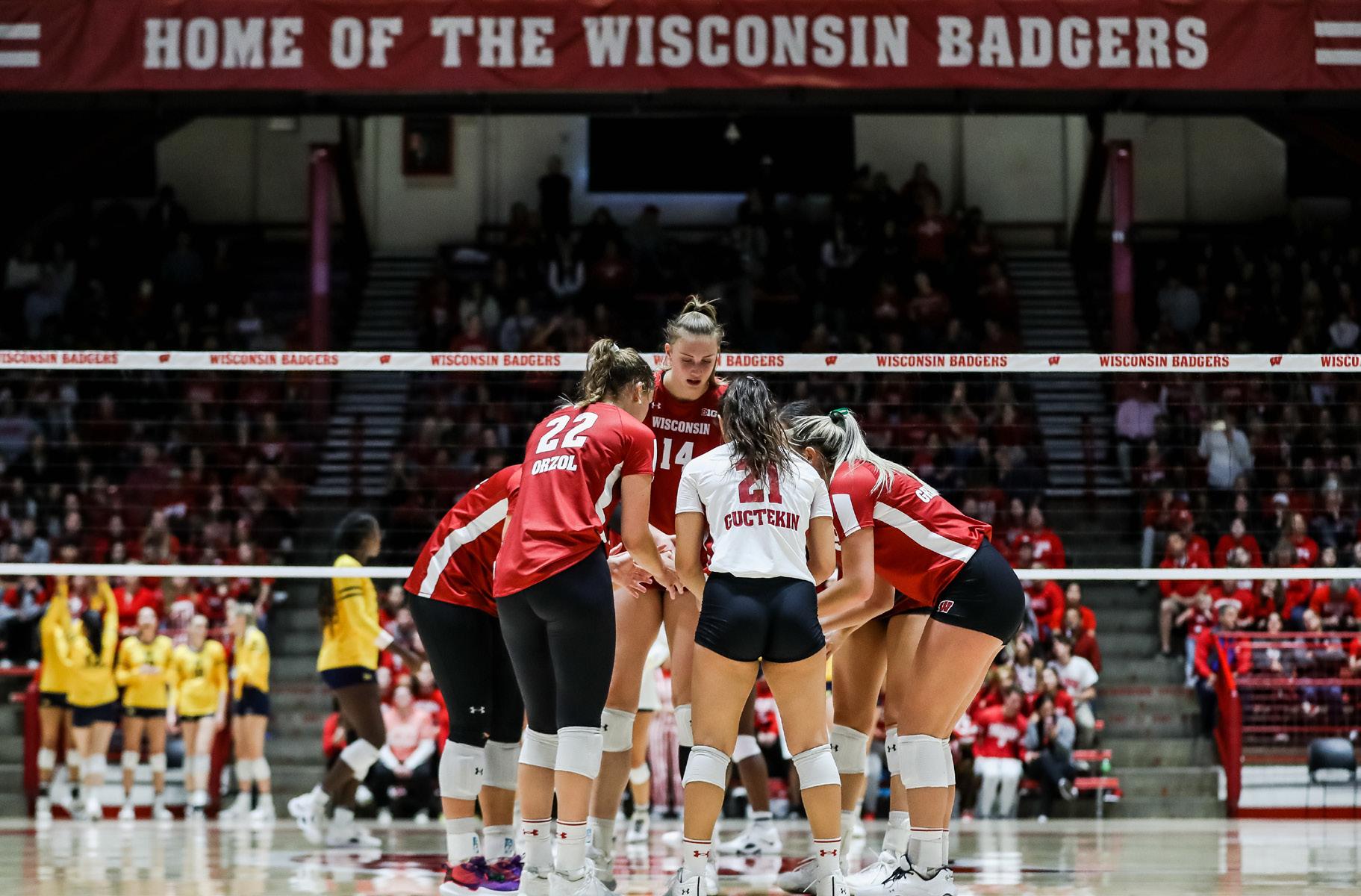
The Wisconsin volleyball team has lost only one Big Ten game all season, against Minnesota in September. The Badgers avenged this loss with the impressive win on Saturday.
to tie the game at 13, but the Badgers regained the lead after winning four consecutive points consisting of two kills and two Gopher errors.
Minnesota got within two points, 20-22, until Wisconsin took the last three.
Because of Gulce Guctekin’s leg injury, graduate student Shanel Bramschreiber earned her first start as a libero for the Badgers.
Bramschreiber had a matchhigh 19 digs and one service ace. Her service ace gave Wisconsin the set point, allowing them to win 25-20.
“That was the first full match
that I’ve played in since December and I just thought it was fitting that my last match was here against Minnesota,” Bramschreiber com mented after the game. “So I think I was just really excited and just more eager than normal to get back out there and kind of get revenge,” she continued. “It was a redemption game for me.”
Minnesota had the match-high .313 hitting percentage in the third set. They managed 14 kills with only four errors. On the other hand, Wisconsin had the matchlow hitting percentage of .075.
In the beginning of the third set, there were five ties and two
Badgers split series against Duluth, lose 9-game winning streak
By Maddie Sacks STAFF WRITER
The Wisconsin Badgers trav eled to AMSOIL Arena to play the Minnesota Duluth Bulldogs on Friday and Saturday.
The team battled in both games, going 1-1 in the series. On Friday, the Badgers lost their nine-game winning streak, before fighting back to win on Saturday.
Friday night, the game started off slow for both Wisconsin and Duluth. Wisconsin dominated the first period in terms of shots on goal, but no shots would fall, leading to no goals for the major ity of the first period.
With under two minutes left in the first, Lacey Eden started off the scoring with a stolen pass. Eden took the puck and skated right up to the goalie, made a move, then backhanded the puck in. The period ended with the Badgers up 1-0.
In the second period, no goals were scored, however, the Bulldogs went on a power play, but the Badgers successfully killed the penalty. Duluth over took the lead in shots on goal in the second.
The third period was smooth sailing for the first 17 minutes. However, with less than three minutes left, UMD forward Gabby
Hughes tied the game up before the third period ended. This pushed the game into overtime before UMD scored the winning goal, resulting in a 2-1 victory.
The game was an unfortunate loss for Wisconsin. However, they came out much stronger Saturday night.
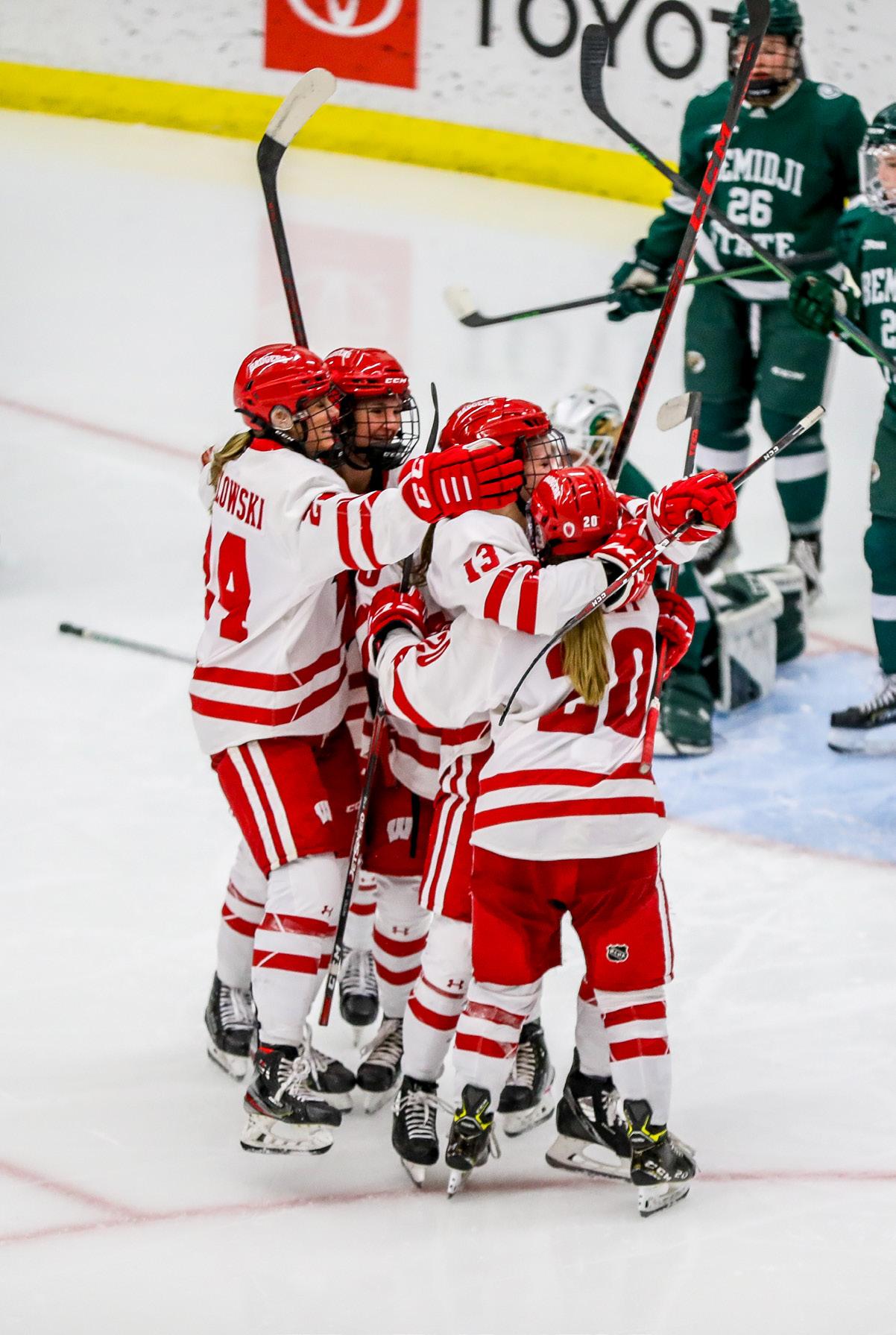
The game started off with the Badgers winning the faceoff. Shortly into the period, Caroline Harvey scored her first of the night. After receiving a pass from Natalie Buchbinder, she skated up to two UMD players and shot through the defense, sailing the puck right past the goalie.
With just under 13 minutes left in the first, the Badgers were called for a penalty. UMD capi talized on the power play, with a goal from Hanna Baskin, tying it at 1-1. The first period ended in a tie, with shots favoring Minnesota Duluth.
The second period started off with the Bulldogs winning the faceoff and UMD’s Gabby Krause scoring 5:30 into the period to take the lead.
With no hesitation, Lacey Eden tied the game at two. Receiving a pass from senior captain Britta Curl, Eden made an impressive wrist shot to tie the game.
Harvey doubled up her scor ing for the night and put the Badgers in the lead. By being in the right place at the right time, she scooped up the puck after it tipped off a UMD player’s stick. Bringing the puck back, Harvey sent the puck blazing past UMD’s defense and goalie, scoring the third Wisconsin goal of the night.
In the third period, UMD won the faceoff, however, Nicole LaMantia extended the Badger lead. After receiving a pass, LaMantia made a far shot into the corner of the goal to make it 4-2 Wisconsin.
The Badgers went on a penalty kill after Jesse Compher received a five-minute major penalty for slashing the goalie.
UMD tied the game up with nine minutes left, and then scored again with just over two minutes left to tie the game. However, the goal was overturned due to an o sides’ penalty.
The Badgers ultimately took the 4-3 win over the Bulldogs.
The next games for the Badgers will be Nov. 19 and 20, against the rival Minnesota Golden Gophers.
Currently, Wisconsin ranks as No. 3 while Minnesota sits at No. 4. Next week’s matchup should prove to be a close and exciting contest.
lead changes until Minnesota pulled ahead, winning five points in a row.
Wisconsin committed three consecutive attack errors, which the Gophers followed with a ser vice ace from Taylor Landfair and then a kill by Landfair. This put Minnesota up 13-8.
The Badgers managed to get within two points of the Gophers, but Minnesota continued to out play them for the rest of the set. Landfair led her team with seven kills, four of which were among Minnesota’s final seven points of the set. The Gophers made the match 1-2 with a 25-16 set win.
Wisconsin came out strong in the fourth set in front of their home-sellout crowd. They took an early 10-4 lead, which included three kills by Robinson, one by Franklin, three blocks and three attack errors from Minnesota.
The Badgers increased their lead 18-11, which consisted of kills and one service ace from Caroline Crawford. However, Minnesota fought back to make the score 19-16.
With a kill from Orzol, the Badgers were one point away from winning the match. However, the Gophers scored the next three points to pull within one, 24-23.
Danielle Hart had the final kill to win the match for Wisconsin. Only six of Wisconsin’s 25 points came from Minnesota errors as the rest consisted of one ace and 18 kills. After the 10th point, the Badgers only recorded kills to seal the win.
Behind Franklin’s match-high 18 kills, Robinson and Orzol both followed with 13 a piece. Orzol also earned her fourth double-double of the season (13 kills, 11 digs).
Despite the loss, Minnesota out-blocked Wisconsin 14-10 and managed a higher total hitting percentage than the Badgers — just the second time this season an opponent has hit better than Wisconsin.
The victory extended Wisconsin’s home Big Ten win streak to 11 matches.
The Badgers will travel to Urbana-Champaign to face Illinois on Thursday, Nov. 3 at 7 p.m. CST. This game comes only a few weeks after Wisconsin took down Illinois 3-2 at the UW Field House.
sports 6 Thursday, November 3, 2022 dailycardinal.coml
TAYLOR WOLFRAM/THE DAILY CARDINAL
The Badger women's hockey team has begun the season in impressive fashion - winning 10 of their first 12 contests. Friday's loss against Duluth was the first since the season opener.
TAYLOR WOLFRAM/THE DAILY CARDINAL
opinion Campaigns take advantage of voters
By Graham Brown STAFF WRITER
“We’re about to break down and cry… we assumed our best support ers (like YOU) would donate. But WE WERE WRONG. We’re at a loss for words.”
This was the first email in my overly-crowded inbox as I sat down to write this piece. No, don’t worry, you didn’t miss anything. It’s just November of an election year where well-educated and well-paid consul tants are telling us that the fate of the American experiment hinges on my $10 — and oh-by-the-way-isn’t-thisconvenient, you can donate with just one click right here.
Inspiration in American politics today is hard to come by. The same country where our leaders once told us “the only thing we have to fear is fear itself” and it was “morning in America” has now devolved into a race to the bottom — so long as it brings in cash.
Because of my nerd-like interest in campaign tactics, I managed to find my way onto a couple of candi dates’ email lists — both favorites and knaves. In recent months, this small number has snowballed as sta ers traded data and donor files with each other. My nice list of occasional press releases has been consumed by poli ticians from Alaska to Georgia clam oring for my money as if I’m the sec ond coming of “Dollar Mark” Hanna.
I am no stranger to the world of campaign finance. In 2020, I served as the deputy finance assistant for Missouri State Senator Jill Schupp’s congressional campaign in my backyard — national bell-weather Missouri’s Second District.
Although Schupp lost narrowly (a microcosm of national Democrats’
puzzlingly lukewarm down-ballot performance that year), the cam paign still managed to turn in an extraordinarily strong fundraising performance — raising $4.7 million, a district record. Helping manage this machine, I learned firsthand there are numerous variables that cause messaging and fundraising strategies to change on a dime.
Key issues can change overnight, certain endorsements come from seemingly nowhere and public poll ing can dramatically impact the way national figures perceive your strength. Make no mistake — fear can be a powerful and e ective moti vator, but it is no one’s first tactic.
When you tell your donors — the base of your base — democracy will collapse if they fail to send you $25, it shows you don’t really believe you have winning issues or an inspiring agenda. And, when you look at it, it’s hard to make the case that either side does this year.
Republicans continue to lie to their supporters that the man who has sat in the Oval O ce for the past two years was illegitimately elected, and that they are the last line of defense against a phantom “Marxist agenda” that should be introduced any day now.
Meanwhile, President Joe Biden is mostly staying on the sidelines this autumn, as many high-profile Democrats see his sagging popular ity as a liability — jumping at the chance to distance themselves from the White House. When reporters do catch Mr. Biden in the Rose Garden, he touts his accomplishments and declares he put the U.S. back on track. The problem is no one, not even his biggest supporters, really believes that. So while the President
is acting like the security guard at the end of “Animal House” (Remain calm! All is well!), the Democrats have embraced the politics of fear as well — sending overly frequent fire and brimstone emails in hopes of salvaging at least the U.S. Senate this fall.
In fact, it was so e ective that they copied the software and intro duced WinRed in an attempt to return to some level of parity in 2019. Not only did they utilize the software, but they even borrowed Democrats’ trepidatious messaging and their utter disdain for their
anecdotal, there is evidence from 2020 that having too much money and running too many ads actually hurts candidates.
The more interesting component for me is why donors are giving unprecedented amounts of money in this day and age — because we’re afraid, and our leaders have told us they are the ones who can make things right.
Yes, you can dispute the validity of those fears, and I firmly believe Republicans are fighting windmills while Democrats’ fears of encroach ing fascism are far more real, but in American culture — where indi vidualism is prized above all else — what you think matters. Our sacred American spirit, the one that turned the tide of fascism in Europe and outlasted the Soviet Union, has dis solved into a child on Halloween who looks around at the cobwebs, spiders, and glowing pumpkins and correctly deduces that something is o — something is not right.
Former New York Governor Mario Cuomo once famously remarked that politicians campaign in poetry and govern in prose. But what happens if your prose reads like a middle school English paper and not Hemingway? Like a filmmaker working with an underwhelming script, the Democrats have resorted to cheap gimmicks and jumpscares to keep their audience engaged. But the scariest part of all? The tactics are working.
ActBlue, a software service used by nearly every Democrat and pro gressive group in America, has revo lutionized grassroots fundraising and allowed them to catch — and ultimately surpass — the tradition ally big-money Republican party.
supporters’ intelligence.
Currently, Democrats still lead when it comes to fundraising. But does that matter? It depends on who you ask.
You would obviously rather have more money than your opponent, but Democrats raised huge amounts of money last cycle to only find mixed success. My friends and I have come to laugh at the oversaturated and comically predictable ads we are all used to seeing these days. Every timeout in a football game gives us a chance to see how Mandela Barnes hates cops and supports defund ing them, and teaches us how the Tim Michels corporation mistreats women. Everyone I know is sick of seeing these ads and, while that is
I don’t have a crystal ball, and I can’t tell you who will win the mid terms. I have my ideas and hot takes like everyone else, but those are just guesses. What I do know is that this is not sustainable. Our politicians tell us America is in trouble and use fear to illicit donations. Our response this Nov.8 will be to send the vast majority of them — the very people who got us to this point — back to Washington for another term.
Graham Brown is a sopho more sta writer studying Political Science. Do you believe that Americans are forced into threaten ingrhetoricaboutthedeclineofour nation which campaigns exploit for theirowngood?Sendallcomments toopinion@dailycardinal.com.
By Alex Clark STAFF WRITER
By any metric, the Centers for Disease Control and Prevention (CDC) did not e ectively control or prevent the spread of COVID-19. Of all countries, the United States had the most confirmed cases, the most deaths from COVID, and the third highest deaths per capita for countries with a population great er than 11 million.
COVID-19 was a quickly moving disease that required an even quick er public health response — one lacking from the nation’s premier health agency. To e ectively con tain future pandemic outbreaks, the CDC needs to adopt a flexible struc ture and impact-driven culture.
The CDC is an agency with an academic culture that quantifies suc cess in scientific papers. Its struc ture breeds employees focused on publications rather than the broader public health picture. However suc cessful a system like this may be for research, it is detrimental to fast action in critical periods.
As outlined in CDC epide miological manuals, timely data collection and analysis are para mount for successful interven tion during a public health cri sis. Lagging data collection and irregular communication since the onset of the pandemic con firmed the agency’s ine ciency.
Multiple defective data track ing systems left the CDC unpre pared to gain an early picture of the pandemic. For example, they tracked travelers from China and often gathered inaccurate passenger information up to a week after flights had arrived in the United States. Statistics from a Johns Hopkins dash board, compiled by an engi neering student — not a public health expert — were frequently cited instead of CDC numbers.
Despite spending over $1 bil lion toward data moderniza tion, forecasting and surveil lance in the past decade, data collection during the pandemic was slow and inadequate. As a result, the CDC could not compile accurate and current counts for most COVID statis tics, including infections, hos pitalizations and deaths.

Communication failures fur ther delayed the CDC response. In 2020, before the first lock down, the agency held 19 tel ebriefings to deliver updates on COVID-19. Over the rest of the year, they had six. For all of 2021, there were just five.
When the CDC did provide guidance, it came late and was filled with scientific jargon and sometimes contradictory advice that confused the public. During
a crisis like COVID, an update, no matter how finely written, is insignificant if it comes a month after it is needed.
The failure of the CDC was near ly predictable. Their rigid operat ing structure prevents meaningful budget redistribution, and their incentive structure favors publica tion productivity over actions that impact public health.
Instead of an agency-wide coordinated focus on the pan demic, many units continued to operate independently. For exam ple, the hundreds of millions of dollars in the injury preven
tion budget stayed in the injury prevention department, where employees continued to study injuries non-related to COVID.
Reflecting on the pandemic, former CDC director Bill Foege asserted that “the public health texts of the future will use this as a lesson on how not to handle an infectious disease pandemic.”
The response from the institu tion designed to protect us from threats like COVID was abysmal.
During a constantly chang ing pandemic, we need a health agency that adapts and responds rapidly — one that
moves at the speed of the dis ease. A more flexible and e cient CDC will minimize excess death and economic loss in the next pandemic. The agen cy must undergo substantial systematic change and do so urgently, as a quick virus won’t slow down for the CDC.
Alex Clark is a junior studying Neurobiology and Economics. Do you believe the CDC’s response to the COVID-19 pandemic was too slow, impacting its e ective ness? Send all comments to opinion@dailycardinal.com.
The CDC’s ineffective response: too little too late dailycardinal.com Thursday, November 3, 2022 l 7 COURTESY OF CENTERS FOR DISEASE CONTROL AND PREVENTION VIA WIKIMEDIA DRAKE WHITE-BERGEY/THE DAILY CARDINAL
the beet
Obama uses Milwaukee rally to test stand up material, special to stream on Netflix
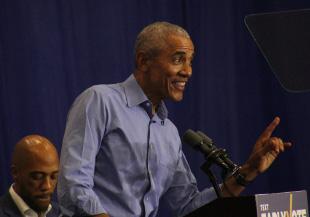 By Mackenzie Moore THE BEET EDITOR
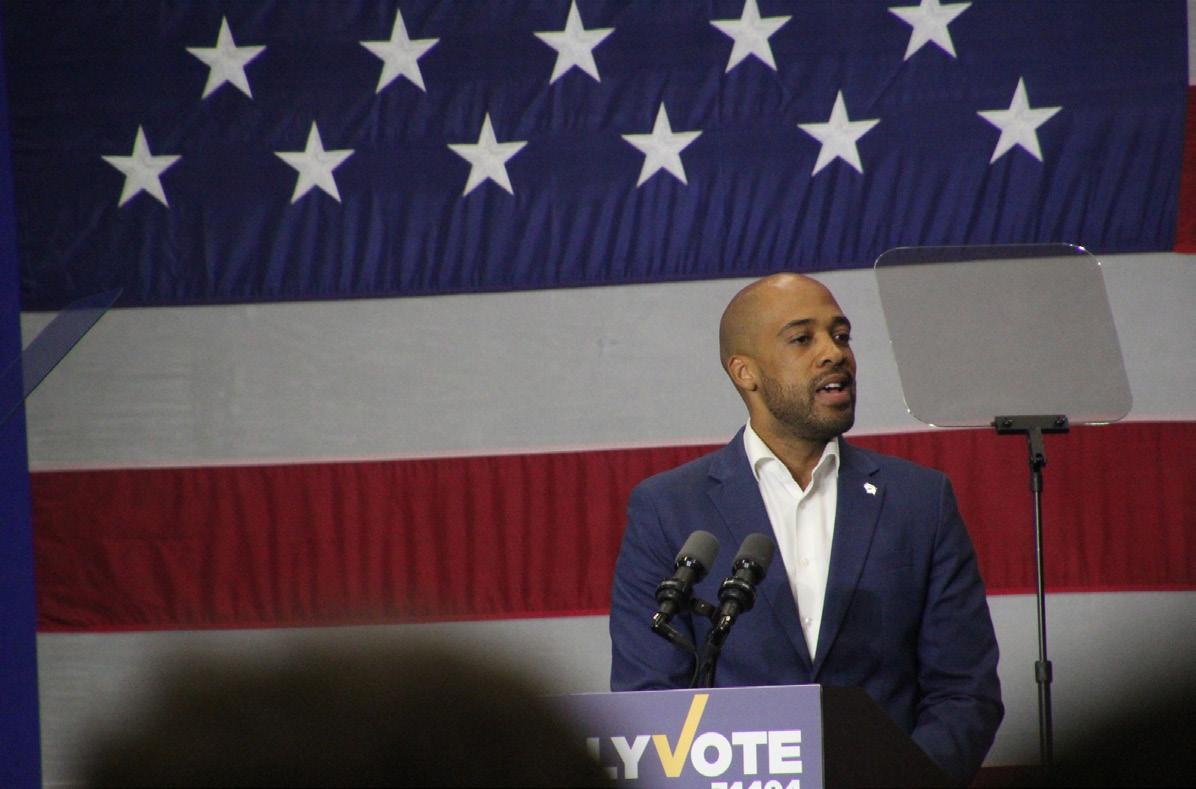
Former President Barack Obama spoke at a Milwaukee rally in support of Tony Evers and Mandela Barnes on Oct. 30. While the Democratic candidates for Wisconsin Governor and U.S. Senator hoped the twoterm president would help ener gize voters leading up to midterms, Obama did no such thing. Instead, he spent his hour-long window working out bits.
Obama, who has a deal with Netflix, is expected to write and perform a stand up special for the streaming service. However, the timing is questionable for the pre vious Commander in Chief. The special is being taped on Nov. 8 — Election Day.
Gov. Evers was not privy to the contents of Obama’s speech prior to it occurring, a decision Obama later referred to as a “strategic move” to ensure that “that lanky old school
teacher didn’t steal [his] jokes.”
“I’m going to be honest with you — that’s not what I was expect ing when I heard Obama agreed to speak today. That being said, he does a pretty good Bush,” remarked Gov. Evers following the event.
Excluding the impression of his predecessor, Obama stayed far away from politics — especially the cur rent state of the federal government. Still, like a politician, Obama tried to be an everyman.
Unfortunately, in going for his Seinfeld “What’s the deal with air plane food?” moment, Obama over looked the fact that being the former President of the United States is eas ily one of the least relatable things someone could be.
Notable topics included trying to remember how to drive after being too important to do so for eight years, the time the White House Executive Chef forgot to add “a proper bur gundy” when preparing beef bour
guignon to be served after a private performance from Beyoncé and the confession that he once vetoed a bill because its sponsor was wearing a cooler suit than him that day, and he didn’t want the senator to be invited on the national news.
Local stoner finds candy in his drugs
By Je rey Brown ARTS EDITOR
When Madison student Benjamin Lang stuck his fingers in the familiar small plastic zip bag this Halloween weekend, he was met with an unpleasant surprise. Instead of buds, the bag was full of duds: Milk Duds.
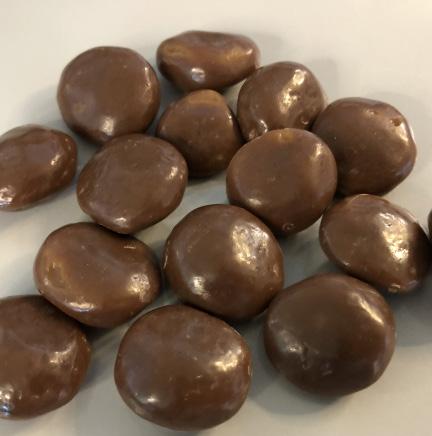
“You hear about it every year, but you just never expect it to happen to you,” Lang told The Beet. “I mean, what if I had smoked it by accident?”
While any instance of drugs being tainted with candy is cause for massive concern, this instance was especially gruesome because candy in your drugs is par ticularly dangerous when the candy sucks.
“Milk Duds are straight up poison even if you’re not smoking them,” Benjamin continued. “But I’ll keep it a hundred — I may have rolled it up if it was a Reese’s Cup.”
Law enforcement is look ing for any tips on who may be hiding candy in drugs, but until the culprit is found, they stress the importance of staying vigilant. They made a public statement to inform community members of the proper steps for staying safe.
“First, take a big bite of your cannabis,” reads the statement from the University of Wisconsin Police Department. “If it tastes like chocolate or a vague fruit, it may be candy.”
However, the second step illustrates the complexity — and danger — of finding candy in your drugs.
“Remember, the taste of candy is not a certainty of candy as it could still be an edible,” adds the UWPD statement.
UWPD stated the only way to know for sure is, unfortunately, to wait it out.
“We get calls all night from concerned stoners thinking their dealer cheated them only to have our o cers arrive 45 minutes later to find satisfied customers,” said a UWPD dispatcher who was on duty during Halloween celebrations. “But we under stand. What if you wait all
night for the edibles to kick in but they were just a nor mal pack of gummy bears? It’s a frightening situation we don’t want anyone in this community to experience.”
This is only the most recent occurrence of dan gerously tampered drugs around Halloween. Last year, a UW student at a Halloween party took a hit of cocaine only to realize they snorted a razor blade too.
“Our community should be a place of safe ty,” Lang added. “But that can’t happen as long as stoners continue to face the threat of finding Milk Duds in their weed.”
Still, there were some glimmers of the comparatively more fathom able — albeit barely — life the Hawaii native now leads. Specifically, that of a 60-something retiree with the time and means to screw around and see what happens. Paired, of course,
with his signature dad banter.
“For eight years, Michelle strug gled with how the presidency took away from our family and marital lives. After I leave o ce, I’m think ing I’m doing a pretty good job at the whole ‘present partner’ thing — spending more time around the house, leaving cups around so she can think of me and smile, asking how her day is going every hour or so,” explained Obama.
“Now I’m telling you — three months in, I caught her work ing the phones trying to get me a job as the ambassador to Syria,” quipped the former head of the Executive Branch.
Though Obama is known for his wisecracking abilities, the comedy world can be harsh when you’re no longer the leader of the free world. With only a week left to hone his material, Americans are hoping that Obama won’t drop yet another bomb.
McDonald’s nearing end of 41-year-old McRib supply
 By Mackenzie Moore
THE BEET EDITOR
By Mackenzie Moore
THE BEET EDITOR
The loved ones of some one who has just passed away often recall that the recently deceased had a moment of clarity — more formally known as terminal lucidity — in which they went from sick and dying to clear headed and alert. Unfortunately, this is often a sign of impending death.
Well, the McRib is expe riencing terminal lucid ity. While the sandwich has experienced sickness and even flatlined multiple times, it was saved by 1994’s “The Flintstones” movie and the Cher model of having fare well tour after farewell tour.
According to a tweet from the fast food chain, there’s no blu ng this time — this is the last time the McRib will be avail able. But it’s not because of
consumer demand, ship ping issues or any other reason businesses tend to give for removing a prod uct with a cult following.
The real reason is much more final — the 41-yearold supply of McRibs is simply running out, McDonald’s CEO Chris Kempczinski explained.
“Back in 1981, a set amount of McRibs were made to be rationed out. Now, the inventory is so low that each franchise only received two paper bags full of our never-frozen sand wiches. It would be impos sible to serve the McRib in 2023 because there simply won’t be any available to us,” said Kempczinski.
Fans of the phenom enon have questioned why McDonald’s can’t simply make more. Well, there’s a good reason — it would
be illegal.
“Things were di erent in those days. Standards were di erent. There weren’t any. It’s the flavors people most enjoy in the McRib that the federal government has since deemed ‘not fit for the consumption of humans or mice,’” explained the CEO.
“The original sandwiches were grandfathered in, but now, there is no path for ward without completely changing the foundation of the McRib to something that’s nearly 100% food. Where’s the fun in that?”
As the McRib’s death’s door nears on Nov. 24, remember to treat it like a weird uncle. He might look like pasty meat, smell like aged sweat and push a little too hard to have you come to his house, but you just have to get through Thanksgiving.
We're always looking for more funny and insightful writers with fresh takes on topics ranging from the UW campus to international news. We accept and encourage creative submissions as well! Any and all submissions are more than welcome. You can send your submissions and any comments or questions to thebeet@dailycardinal.com. All articles featured in The Beet are creative, satirical and/or entirely fictional pieces. They are fully intended as such and should not be taken seriously as news.
8 Thursday, November 3, 2022 dailycardinal.com
l
COURTESY OF FAMARTIN VIA CREATIVE COMMONS
DRAKE WHITE-BERGEY/THE DAILY CARDINAL
COURTESY OF MULLENKEDHEIM
VIA CREATIVE COMMONS
