
Crackdown on Cartan Lot Causes Confusion
by ANYA RAMANI
This spring, Menlo athletes, coaches and parents heading to after-school sports practices and games were met with an unexpected sight: yellow posts blocking entry to the Cartan Field parking lot. Previously removed by early morning and replaced by security staff each night, the posts — known as bollards — now stay up during school hours. This change suddenly cut off access to essential parking that teams at Cartan have relied on for years, reigniting concerns about parking limitations on campus.
According to Head of Security Mustapha Moutri, a Conditional Use Permit between Menlo School and the town of Atherton governs the use of the Cartan lot and limits parking to special athletic events; it shall not be used as daily parking for students.
Though there is little signage or public notice of the policy, Moutri said it has been in place since 1966.
The intent of the policy is to provide spots for visiting sports teams who might otherwise receive tickets for parking in the reserved areas on Alejandra Avenue or in the Menlo College lot. Though the policy had been dormant since the COVID-19 pandemic, Moutri started enforcing it upon hearing numerous complaints from visiting team parents, who were ticketed. “I have the list of all the games for the week, and every time there is a game, we’ll open the parking lot,” Moutri explained.
Per the policy, Menlo School and Menlo College coaches may also park in the lot on event days at both Cartan and Wunderlich Field. However, recent policy enforcement has been intermittent. Although the lot should have been open to coaches on April 22, 2025 for a tennis match versus Crystal Springs Uplands School, both Menlo and visiting team coaches were unable to park there. On this day, Moutri was unaware of the tennis match, and only opened the lot after being informed by a Menlo coach.
On non-game days, the lot should be closed to everyone. But until recent policy enforcement, athletes and coaches who have long relied on parking at Cartan were taken by surprise when the lot was suddenly closed multiple days a week.
Track and Field Head Coach Keith Larsen received no communication from the security team regarding changes to policy enforcement. “The only time that we were told anything [about] parking was when the rain was really bad and some of the students — because

by RAFE WEIDEN
After drawing more interest than expected, Menlo’s new Catalyst program will launch next fall with two full cohorts of 18 juniors and a team of teachers selected for their entrepreneurial mindset and open-mindedness. Each cohort will participate in Catalyst for one semester and return to the regular Menlo schedule for the other half of the year. The program was designed to attract students with an interest in more experiential, hands-on learning. Accordingly, students enrolled in Catalyst will take a seminar in leadership and an applied engineering course in addition to their core classes. Interested students applied earlier this year to join
they couldn’t find any place to park — were parking along the side [of the baseball field] and getting stuck in the mud, and we were told not to park there,” Larsen said.
Moutri’s solution for Cartan Lot closures on nongames is for coaches to park in the gated lot behind the Menlo gym. “[Coaches] can call security and they will let them in if there [are] available spots,” Moutri said.
However, gym parking also appears to be limited. There were only five spots available at 2:53 p.m. on Thursday, May 1 for coach parking, two of which were reserved for electric vehicles. Additionally, coaches — some of whom lack a gate remote — are further delayed while waiting for a security guard to provide access.
Assistant junior varsity girls tennis coach Julie Ford sees Cartan lot closure as a waste of space and an inconvenience for coaches. “I’m confused by [the policy], because driving past Cartan and [seeing] it empty when it could be utilized by [...] all the people that use that parking lot responsibly is frustrating,” Ford said.
Ford also wishes the school and security team would explain what catalyzed the lot’s sudden closure. “If the town hasn’t complained about [people parking at Cartan on non-game days], and Menlo College hasn’t complained, then I don’t understand why [enforcement is] being changed,” she said.
To Ford, the parking shortage is already an issue and stressor for the Menlo community, and responsible users should have available access to parking. “If someone violates one of the rules, or you’re parking in the fire lane,
Get Rid of
the program and went through an application process that included interviews with Upper School Director John Schafer and Director of Academic Innovation Maren Wolf. Acceptance decisions were released on March 7.
“We didn’t know what to expect in terms of enrollment,” Wolf said. “I was prepared to run the program for one semester with just a handful of really committed students if need be. Instead, we ended up with more applicants than we could admit.”
As the lineup of students was finalized, Wolf also put Catalyst, pg. 4




Cartan, pg. 2
Staff illustration: Claire Dickman
Staff illustration: Claire Dickman
May 13, 2025
Science Department Introduces Dual Biology Track, Aiming to Add Choice and Depth to Junior Year Offerings
by SAVANNAH SMITH
Curriculum changes have now made their way to biology and will affect future junior classes. While Menlo has already seen significant changes in its humanities curriculum — most notably the replacement of AP English Language and Literature with Junior English Seminars: Rhetoric and Literature — these changes are now making their way across the quad, from the English classrooms to the science building.
Rising juniors in the Class of 2027 will be the first to encounter two new biology course offerings: “Molecular Mechanisms in Biology” and “Living Systems: Biology in Balance.” Science Department Chair James Formato believes that these additions, aimed at providing more options for Menlo’s eleventh-grade science curriculum, give students more opportunities to tailor their studies to their interests.
structures and biochemical processes that sustain life.
“The course will be largely lab-driven,” science teacher Todd Hardie said.
Students will gain hands-on experience with bacterial transformations, PCR, enzyme catalysis and microscopy, working with lab equipment commonly used in fields like biotechnology and genetics research.

It is exciting to me to see students have more choices about curriculum.
Science Department Chair James Formato
“ “
“No one course can reasonably cover all aspects of introductory biology, and offering two different courses gives a student some choice,” Formato wrote in an email to The Coat of Arms.
Molecular Mechanisms in Biology will take a deep dive into the cellular
The course focuses on uncovering the “hidden machinery of life,” exploring topics such as genetic engineering, medical applications and the molecular code that underlies biological function, according to the course catalog found on Menlo’s website.
Living Systems: Biology in Balance will take a broader approach, zooming out to examine biological interactions on a larger scale. “We will be looking at the bigger picture in Living Systems,” Hardie explained. Looking at this “bigger picture” will allow students to investigate complex topics — ecosystems, evolution and human health — through hands-on experiments and model building.
While both courses will be nonhonors, Formato notes that the content of “Molecular Mechanisms” is closely aligned with — and therefore serves as a prerequisite for — Advanced Topics in Biology and Biotechnology Research.
“Both of these courses require a solid background in the underpinnings of cells and the building blocks of living systems,” Formato wrote. Yet Living Systems will soon be part of its own honors pathway. “In coming years, we are thinking about developing an honors option for Environmental Science, and Living Systems would be a prerequisite for that,” Formato added.
The overlap between the two courses will be minimal: both courses will cover digestion and reproduction, but otherwise, Formato says that the approach and topics will be different. The classes’ vast differences in content could even allow students to take both courses.
The motivation for diversifying the eleventh grade science curriculum
an appointment or they have another engagement right after the game. But mostly, the students should park in the student lot, leave their vehicles there and walk to the field,” Moutri said.
stemmed from a program review conducted two years ago. It was evident that the same students who had struggled in chemistry as sophomores weren't connecting with molecular biology concepts as juniors. This prompted the science department to reevaluate.
The consensus of this review determined that a second course would allow for a more in-depth look at systemslevel biology and environmental themes. However, Formato says that student input was also prioritized.
“It is exciting to me to see students have more choices about curriculum. My hope is that these are both great courses that teach students about life sciences and prepare students for college-level science,” Formato wrote.
lot and Cartan Field. “We’re on a very tight schedule. [...] We’re trying to get [athletes] out of practice and lifting by at least 5:30, so it’s just a huge disadvantage [to have to walk from school],” Larsen said.
from pg. 1
[where] students aren’t allowed to park anymore, give that person a consequence — a ticket,” Ford said.
As for Menlo students accessing Cartan and Wunderlich, Moutri says that they should walk there and leave their cars in the school’s main parking lot. “Th[ere] are individual cases that we may allow students to park there because they have
Even these restrictions on student parking are not always consistent. On April 15, 2025 the lot was open to students during a Menlo tennis match, when it should have been closed. “I didn’t have an extra security guard to monitor the lot, which is why students were able to park there [that day],” Moutri said.
Larsen believes that the sudden enforcement of parking restrictions at the Cartan lot highlights the broader issue of a general parking shortage. This shortage, he says, prevents sports teams from starting and ending practices on time — given the 10- to 15-minute walk between the student parking

We’re trying to get [athletes] out of practice and lifting by at least 5:30 p.m, so it’s just a huge disadvantage [to have to walk from school].
“ “
The lack of parking adds an estimated two hours each week to a student athlete’s commute. Sophomore track athlete Bella Ewers finds that it adds to an already overloaded day that requires juggling sports, homework and sleep. “[The lack of parking] does kind of suck for students, because after practice it’s just nice to get in your car and get home as fast as you can to do your homework, shower, eat and get a good night’s sleep,” Ewers said.
To address the issue of the parking shortage, Larsen thinks that a permit system — similar to that of Menlo’s student lot — would be effective. “You [should] have some sort of valid Menlo parking permit. [...] The juniors and seniors [should be] allotted [some] spots in front of the Cartan tennis courts and when those are full, they’re full,” Larsen said. “When there’s a competition day, [coaches should be able to park] first come, first serve.”
Staff Illustration: Claire Dickman
Track Coach Keith Larsen
Menlo Faculty Say Goodbye
Justin Carunchia
by JACOB REICH
Spanish teacher and Senior Class Dean Justin Carunchia plans to depart from Menlo after five years at the school.
Carunchia is leaving Menlo in order to move in with his soon-to-be husband, a doctor in Florida. In midMay, Carunchia’s fiancé is flying in to marry Carunchia at a local courthouse in the Bay Area. They plan on having a traditional wedding ceremony next year.
In 2020, Carunchia was looking for schools in LGBTQ+ friendly cities and initially excluded California due to tax reasons. At one point, he discussed his future employment situation with the department head at the school in Michigan where he previously worked. “The only [job opening] I've seen is one in California,” Carunchia recalled mentioning to her. “And I told her it was Menlo School, and her jaw dropped
because she was the department chair here at Menlo in the early 2000s.”
Although Carunchia wasn’t able to visit the school due to the COVID-19 Pandemic, he decided to come teach at Menlo due to the strong recommendation from his former department head, the school’s online presence and the existence of a Gender and Sexuality Alliance at Menlo.
Carunchia is going to miss many aspects of Menlo. “First and foremost, I'm going to miss my department. My colleagues are [...] some of the most loving, caring, kind, compassionate, empathetic and affable people that I have ever had the pleasure of working with,” Carunchia said. He will also miss the students and being the senior dean.
Although Carunchia isn’t fully sure what he wants to do next year, he has
Tracey Bobrowicz
by SIENNA LEW
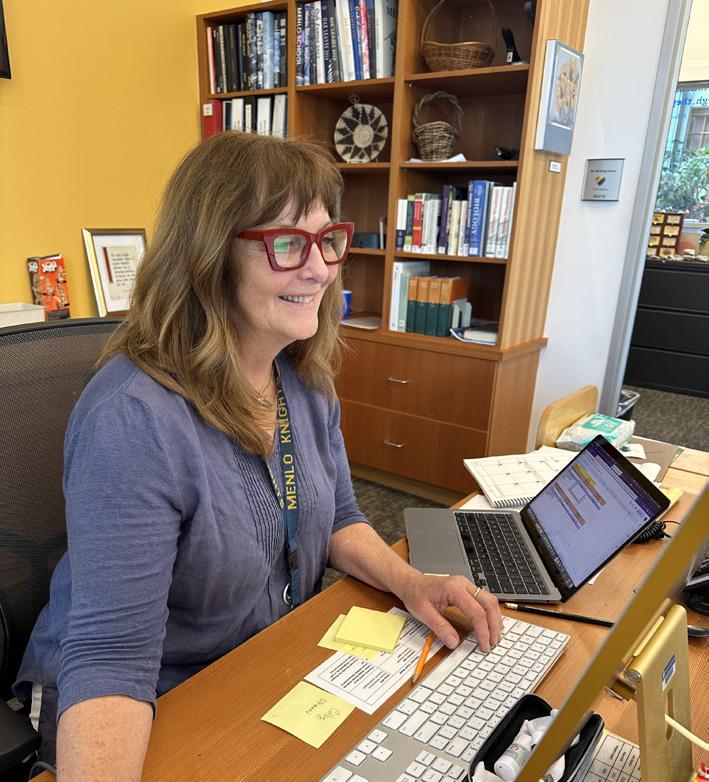
After rounding out her 17th year at the school as assistant librarian, Tracey Bobrowicz will be closing the book on her time at Menlo and retiring.
Bobrowicz plans to move north with her husband to Santa Rosa, where she looks forward to cultivating a new garden just like she did at her home in Menlo Park. “One of the first things we’re going to do [once we move] is to start planning our garden,” she said.
And while she will no longer be working full-time, Bobrowicz is not leaving the education world for good. She is excited about volunteering at local school districts. “I would love to volunteer in at-risk communities, in their libraries [and] in their reading programs,”
Bobrowicz said. “Many kids still don’t have someone who can read to them at home because their parents are working.”
Bobrowicz began her career working in the library just down the road at Hillview Middle School. Eventually, she ended up at Menlo. From managing AP exams and ordering books for the library to creating intricate book displays and acting as an information desk for the school, Bobrowicz always has her hands full. However, she said she loves what she does. “It’s the most rewarding job I have ever ever had,” she said.
One of her favorite Menlo memories was a prior senior prank. “While we were at assembly, all the [seniors] zip-tied all of the backpacks together in a giant mound,” she said.
Bobrowicz’s job is unique in that she is well-acquainted with students from both the Middle and Upper schools; she appreciates gaining so much firsthand experience in education while working at Menlo. “You can have all these great ideas, but [...] there’s a lot of trial and error, and that’s something you don’t really learn unless you’re in a school,” she said.
Bobrowicz will miss the time she spends with Menlo students the most. “The students are great to be around. They’re just so full of their hopes and dreams,” she said. “Being a witness to their growth and maturity, it’s such a gift.”
More Stories Online
Other faculty leaving Menlo include:
• Science teacher Deb Jensen
• Math teacher Timothy Costa
• History teacher Clara Bergander
an idea. “For the foreseeable future, I'm going to take a break and I am already looking for [unaccompanied minor] organizations that work with Latino youth [...] to get them help and to get
Alexis King
by ELAINA HUANG
This spring, Alexis King will complete her 10th and final year of teaching at Menlo. King has taught chemistry, biology and environmental science during her time at the school. Each year, she has also been in charge of planning for MTerm programming and served as an academic advisor.
King ultimately decided that she wanted to cut down her one-hour commute each way and work closer to her home near Half Moon Bay. King has two young children, ages 5 and 1, and wants to spend more quality time with them. Next school year, she plans on teaching chemistry and biology at the Head-Royce School in Oakland.
King grew up in the Bay Area and came to Menlo after working at a boarding school on the East Coast. King knew she wanted a career in education ever since she worked as a teaching assistant in college, a position she found joy in.
She says that Menlo is the best place she has ever worked and that leaving was a very hard decision. “I’ve really loved working at Menlo. It’s a great place to be a teacher since they really encourage
them represented,” Carunchia said. “I'm looking to see if I can interpret or translate, either on a volunteer basis, or if I can get paid for it, that would be great.”
you to develop a curriculum you care about and you’re not stuck following a textbook,” King said.
King has built many relationships with students and was able to watch them grow, which happens to be her favorite part about teaching; she especially loves the energy, curiosity and enthusiasm she witnesses in her students.
King will miss the Menlo community a lot, especially the relationships she has built and the tight-knit science department. She especially looks forward to the annual faculty tradition of giving kudos to each other on the last day of school, which ends the year on a note of gratitude.
Senior Karen Xin, who had King as a teacher for two years, really appreciates her clear and concise teaching style. Xin also loves how she builds students’ capacity to think about applying concepts to real life.
Xin reflected on her fun and positive energy, which she believes is one of the unique aspects about King as a teacher. “She’s one of those teachers who will give you everything she’s got,” Xin said.

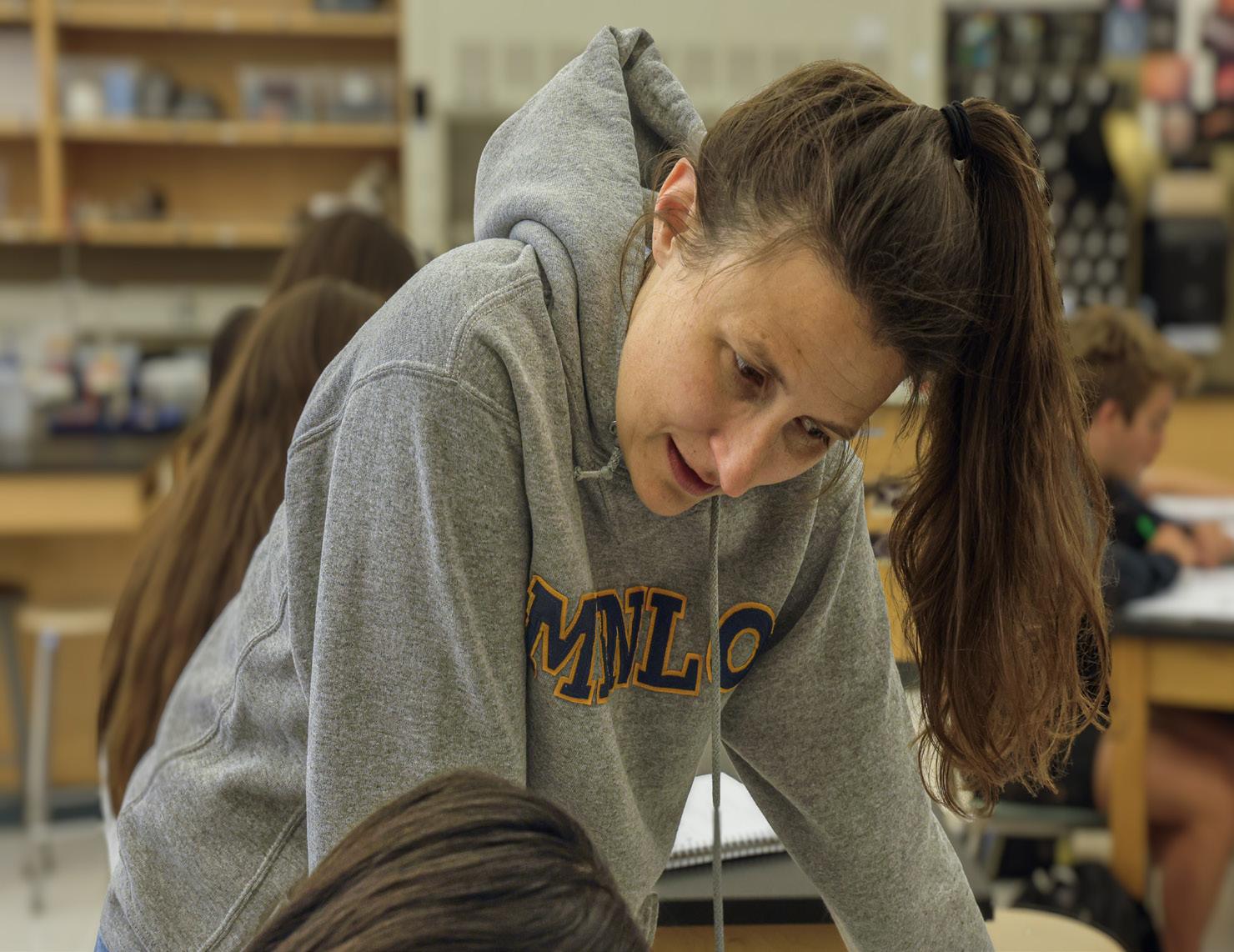
Science teacher Alexis King helps a student in class. Staff photo: Elaina Huang
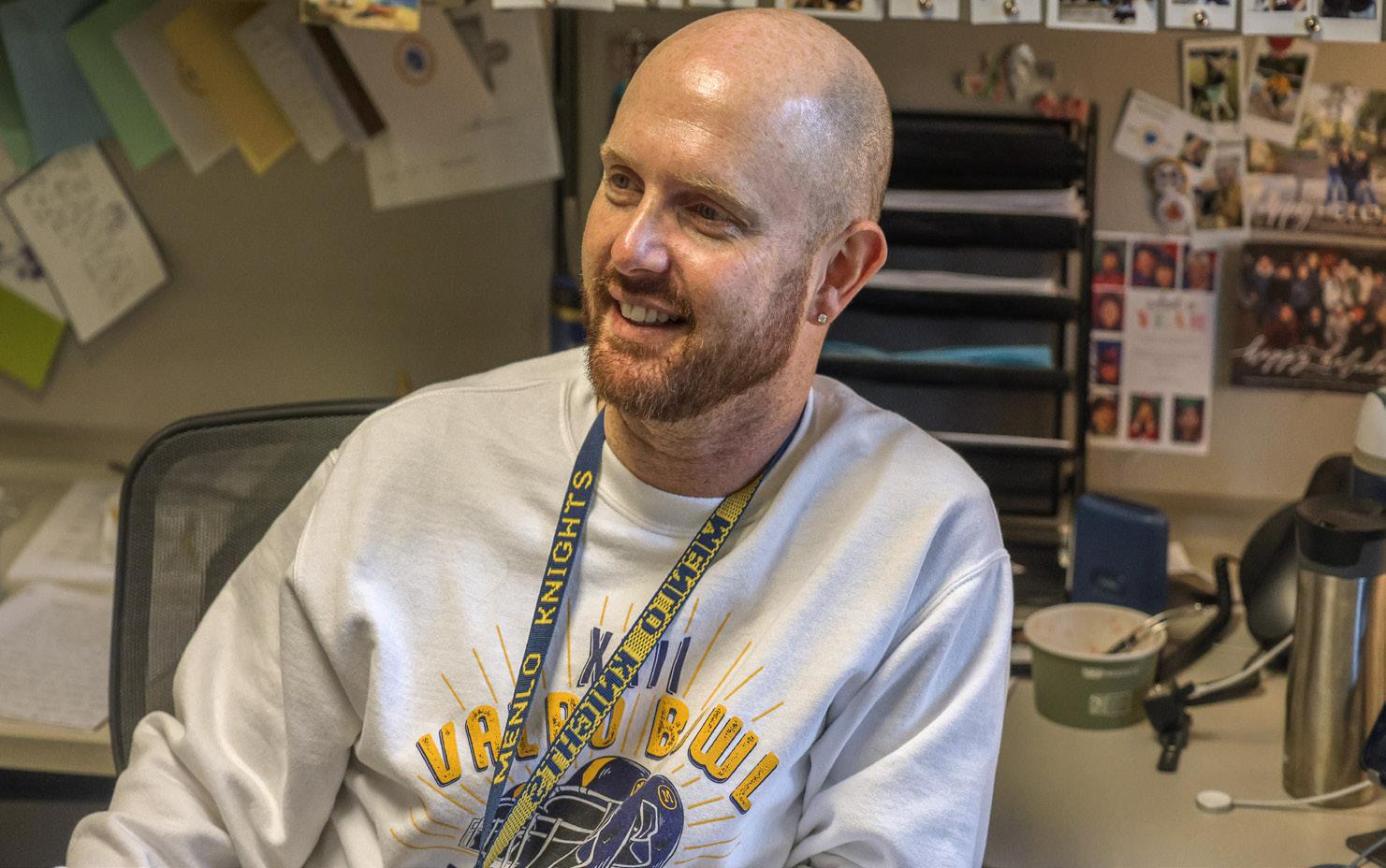
Spanish teacher Justin Carunchia smiles in his office. Staff photo: Jacob Reich
Librarian Tracey Bobrowicz works at her desk.
Staff Photo: Sienna Lew
Continued from pg. 1
together the team of faculty who will teach the program, drawing from both current Menlo teachers and new hires with a passion for creativity and adaptability. “For Catalyst in particular, I looked for educators who embrace entrepreneurship and who are exceptional collaborators because we’re going to be a particularly
Staffillustration:DiyaKarthik
close-knit team,” Wolf said. Science teacher Dietrich Schuhl will be teaching a Catalyst class called Applied Science: Engineering for Extremes. For Schuhl, the decision to teach in the program came from his excitement with the initiative’s bold format. “Catalyst is aspiring to be a very different type of program, with a large focus on
experiential learning, which is something I’ve rarely dealt with, but I want to be part of making sure it gets off the ground,” Schuhl said.

Students enrolled in Catalyst will follow a flexible schedule, spending about three days a week at school with a structure similar to that of other Menlo students, while the remaining two days will be dedicated to off-campus, experiential learning.
The practical impact the program champions is precisely what drew students like sophomore William Lenihan to the program.
“The chance to not just learn, but apply what I’m learning to real-world issues is what’s most exciting to me about the program,” Lenihan said.
In addition to Schuhl and
Wolf, Menlo will be adding three new full-time teachers who will teach classes in Catalyst. Together, they’ve already started developing the curriculum for the program.
Instead, we ended up with more applicants than we could admit. “ “
Director of Academic Innovation Maren Wolf
Wolf believes that this first year of Catalyst has an opportunity to positively impact the entire Menlo community. “I’m excited to share anything we learn from this program that might benefit the school and our students as a whole,” she said. Schuhl also voiced optimism about the program’s impact. “Catalyst has the potential to create something really special for this school. I’m excited for what’s to come,” he said.
From To-Do Lists to Tassels: Menlo Faculty Prepares to Make Graduation Day Memorable
by LAUREN GIESSELMAN
While the graduates are preparing to launch into the next chapter of their lives, there’s another group working quietly behind the scenes to ensure the moment is as memorable as it is meaningful. Though it may be easy to overlook amidst all the emotion and excitement, many members of the Menlo staff dedicate an incredible amount of time and energy to crafting a graduation day to honor the journey each student has taken. From the meticulous planning of the ceremony, to the small, thoughtful details that make the day feel personal, everyone involved hopes their efforts help transform a rite of passage into a heartfelt celebration.
Graduation day is packed with things to do, according to Senior Dean Justin Carunchia, who will be reading off every graduate's name at the ceremony this year. He has been spending a lot of time preparing for the day; Carunchia revealed that in order to pay proper tribute to every student, he had to sit down with Student Council and iron out the correct pronunciation of everyone’s last names. “I know almost every single one of them, but I don’t know most of the last names,” Carunchia admitted.
for Seniors
she has each student's preferred name on their scroll. Bustamante also makes sure the day-of setup for the ceremony is prepared far in advance. This involves collaborating with operations and security to set up audio recording and photography, as well as preparing the list of names for Carunchia to read out loud.
Bustamante emphasized that the process is made a lot easier by the support system she has around her. “I get to see what it all looks like visually on the loop. […] I’m really excited to see it,” Bustamante said.
Staffillustration: ClaireDickman
These are my closest friends and I’m just
sad to leave because
I love high school so much.

Another faculty member who works hard to make the day spotless is Alexis Bustamante, the dean of student life and culture. Bustamante began her long list of duties all the way at the beginning of this year, but since this is her first year at Menlo, she is still learning the expectations. Her tasks include ordering caps and gowns for students and staff, ordering diplomas and making sure
With Menlo staff members like Carunchia, Bustamante hustling behind the curtain and emotions beginning to rise, many teachers express their excitement to see how it all comes together.
Upper School Director John Schafer is trusted to sign the diplomas and select the student speakers. While many aspects of the graduation ceremony hold meaning, Schafer has a unique favorite moment that stands out to him each year. “The faculty and the Board of Trustees now do not process out the back. They go over to the front of Martin Hall and recreate the tunnel that the seniors create for the freshmen at the beginning of the year. So [the seniors], get to walk in and out [of the tunnel they first walked through],” Schafer said.
For all the thoughtful preparation that goes into orchestrating the day, Carunchia and Bustamante reflect on how the day is still centered around the seniors. All the work that goes into orchestrating graduation is meant to allow seniors to enjoy their milestone to the fullest.
Many members of the class of 2025 are sentimental about leaving high school behind. Student Body Vice President Melanie Goldberg reflects on how these last few weeks on campus have been really special to the senior class. “I’m super excited to do the last traditions like senior assassin, ditch day, the senior prank and all that stuff. But I am really sad. [...] These are my closest friends and I’m just sad to leave because I love high school so much,” Goldberg said.
It’s the graduating class's bond that makes letting go so bittersweet for Student Body President Cody Kletter. “It’s been so amazing because I truly consider [these] guys family,” Kletter said.
Goldberg agrees and wants to cherish her last few weeks of high school. “Even these past weeks leading up to graduation, I’ve really gotten to know people I didn’t truly know before and it’s been really special,” Goldberg said.
Senior Melanie Goldberg
Opinions
Let Flip-flops Walk the Halls
by GEOFFREY FRANC
Out of the four pairs of shoes I own, my favorite is a pair of blue Billabong flip-flops I bought on Amazon at least six years ago for $12. I slip them on for everything from a drive to weekend mock trial practice to a three-mile walk with my dog (never sprained an ankle). I even wrote a college essay about them. But I had never dared wear them to school.
On a recent spring day, I finally found the courage to wear my flip-flops to school. It wasn’t too long before someone called out to me, “Why are the dogs out?”
I didn’t feel ashamed. My flip-flops were a clothing choice, and more than anything they were a practicality: it was warm and it takes time to pull on socks and tie shoes. So what was the point of lacing up?
Of course, critics would say “the point” is that flip-flops are a hygiene issue. But frankly, if I get a little dirt brushed under my heel, whose problem is that but my own? Plus, even those wearing the in-vogue socks + Birkenstocks combo will get their feet a bit dirty. Should the lacrosse boys be forced to stop wearing their precious Birks?
And to those who say flip-flops are too casual for Menlo because they distract from a constructive educational environment — I mean, come on. Besides Birkenstocks, Menlo students frequently sport crop tops, tank tops and uber-short shorts without anyone batting an eye. And I don’t mean to vengefully criticize those fashion choices here because I honestly don’t care what you’re wearing as long as it works for you. All I ask is that the same grace be extended to those who elect to wear flip-flops.
Menlo’s
by JULIA LIVINGSTON

Put the ‘Flops’ in Their Place
by SIENNA LEW
To be clear, I’m not advocating that everyone wear flip-flops to school. Some people just don’t want to wear them, and that’s fine — like I would never wear two-inch shorts or a crop top. Indeed, there are many cases when flip-flops would be wholly inappropriate (if one has a chemistry lab or a Whitaker class, for instance).
But to those who criticize flip-flops for being too casual, too revealing or too gross, I invite you to begin an advocacy campaign against all clothing and footwear that offends these principles. Write a letter to our new Editorin-Chief Asher Darling and call for a written dress code, ruler-wielding enforcers and an annual 40 minute assembly on wearing inappropriate clothing to school. Or maybe people should learn to recognize that Menlo students desire and appreciate a culture of acceptance with regard to the diverse ways in which they choose to dress. Do there have to be boundaries? Yes. But is it really that hard to let someone be comfortable in their favorite pair of shoes?
Global Expo Needs
Every other year, Menlo’s unique Global Expo event brings a bright and festive celebration of diversity and culture to Menlo with interesting facts, fun activities, performances and an array of foods from different countries. Students line up at booths with their pretend passports, eager to visit as many countries as possible and learn about the different cultures. As an added bonus, they get to taste the delicious treats that the Menlo parents serve up, some of which are homemade!
This event is always an enormous success –– in 2022, there were more than 40 countries represented, 15 student-led performances and 700 to 800 attendees. Three main components make up the event: country booths organized by parents, students and faculty, booths that showcase Menlo’s global or unique programs as well as student-related clubs and performances by students and faculty. It’s such a popular event, so why not make it annual?
Global Expo has united the Menlo community in so many ways: from inspiring students to appreciate the richness of diversity, to forming camaraderie while supporting and participating in fellow students’ traditional performances. Often, students also bring their extended family to come experience the fun and lively
Sure, maybe flip-flops are the perfect choice for sunny beach days or lounging by the pool, but you shouldn’t wear them to school. Here’s why flip-flops are fittingly called flops in a school setting.
Flip-flops are just impractical for an active school setting. From impromptu group activities to emergency drills, students need to have versatile footwear that can handle more than just walking. For one, Menlo’s got a lot of stairs: up to the library or CADC — and heaps of second-floor classrooms. Nothing feels worse than rolling your ankle when you trip climbing those stairs. I’ve done that many times, and I’m sure you have too.
If that sounds painful, picture going up and down those same stairs in flip-flops, with your feet unsupported by a flimsy piece of rubber. Their thin, floppy soles don’t properly protect the foot against sharp objects on the floor, like rocks or wood chips. And if you’d say, “just be more careful when you’re walking, duh,” it’s not like people are asking to trip. When these situations arise, your feet will not be prepared for that discomfort.
Schools are also high-traffic spaces, so the floors aren’t always pristine. I would find it wholly undesirable to step into the grimy restrooms with my feet out, or grab lunch and risk squishing a tomato or piece of bread under my shoe. The odds of getting food on my toes are too high to take that chance.
Also, most flip-flops provide no arch support nor cushion for the ankles. If you do find a pair of comfortable flip-flops,
you might as well invest in a solid pair of walking shoes for that same price. Take the $4.99 plasticky flip-flop you can buy from Old Navy. Then compare it to the price tag of the Men’s Health top pick for supportive flip-flops: $60. Or GearLab’s women’s pick: $80. If you’re already willing to spend that much on a flip-flop, why wouldn't you pay less for more shoe? Flip-flops won’t move with you when you’re running around from class to class, playing recess basketball or setting up tables for bake sales.
Clothing choices are a crucial part of a student’s self-expression, and students should absolutely feel comfortable in what they wear. However, let's distinguish between expressing personality and ignoring basic safety expectations in a shared space. Want to show off your inner self through footwear? Wear funky socks, stylish sneakers or bedazzled boots. There are countless ways to flaunt your fashion without compromising the safety, hygiene and respect for your environment.
It’s not about forcing students into strict, traditionalist dress codes: we know Menlo doesn’t do that, and that’s one of the many blessings of going here. But it’s reasonable to have some expectations for footwear in a setting where people are here to collaborate, learn and move around safely. Don’t misunderstand: feet shouldn’t be stigmatized as some gross appendage to hide from the world. And no one’s asking for clogs and blazers. I’m partial to chunky platform UGGs, which aren’t necessarily the most formal. But wearing flip-flops to school can make it difficult to participate in everyday school life without risking discomfort and inconvenience.
to Be Held Every Year
atmosphere. Even prospective students are invited to attend the Global Expo, a perfect way for them to get a taste of the Menlo spirit and to see our appreciation of cultural diversity.
In addition to being a vibrant and fun event, Global Expo gives students the opportunity to explore more of their cultural identity and heritage. When I went, Global Expo allowed me to learn more about traditional Korean dance, something I had no knowledge about before and wouldn’t have otherwise gotten the opportunity to perform. By performing at Global Expo, I felt my connection and appreciation for my culture grow. For others, this event also encourages them to branch out and try new foods, experience new cultures and embrace different perspectives.
Some might argue that a biannual event is more special and meaningful. They would likely also argue that it’s too time consuming and expensive to have it every year. While this might be true, the benefits of holding it every year outweigh these costs. The event is such a meaningful symbol of the world in which we live and of Menlo’s diversity. The Global Expo in itself is a love letter to diversity from Menlo, and it’s very significant that Menlo continues to uphold its value of diversity in this age where DEI initiatives are being suppressed left and right. An event this meaningful and important to the Menlo community should really be held every year as a celebration and recognition of each other!
As I know from my own mother’s involvement, as well as my rehearsals and preparations for the Korean fan dance, it is a lot of work for everyone involved. So, if we want to successfully execute the Global
Expo annually, we need to figure out a sustainable way to keep this event going every year with engagement from all parts of the Menlo community. This means increasing volunteer participation from faculty to parents and students (which means more CE opportunities for students) or volunteers trading off each year to decrease the workload.
We should also consider how other Menlo organizations might benefit from making Global Expo annual. Recently, it was decided that Menlo affinity groups will now alternate assembly slots each year. In response to this reduction in assembly presentations, Global Expo could provide a special event or exhibit slot for the affinity groups. The presentations could take the form of an additional performance, or of a 10 minute slot to give more personal talks on their culture. This way, each group can still have an alternate platform to further showcase their unique cultures, in addition to the many cultural affinity groups that already have booths and performances. These are all small, yet easy fixes that can deepen the impact Global Expo might have on community members.

Staff illustration: Claire Dickman
Staff illustration: Maya Stone
Not Just a Car: The Problem Supporting Tesla in 2025
by MALIA CHEN
Just this month, my parents decided they wanted to buy a new car since the lease on our Tesla will be coming to an end. In past years, this decision was automatic: once our lease expired, my parents would swap out our Tesla for another — maybe a newer model or a different color. We never thought twice about it.
When you buy a Tesla, [...] you’re buying into the world Musk has built. “ “
But this year was different. For the first time, the question of what car to replace our Tesla with sparked real debate in my family.
In the Bay Area, Teslas have become as common as blue recycling bins and Starbucks coffee cups. They’re a part of the natural landscape: parked in driveways, stopped at every intersection and even filling the Menlo parking lot. Just a few years ago, they were a symbol of wealth, eco-consciousness and progress. Teslas were the first massproduced all-electric vehicles, bucking the trend of hybrid cars, and that’s what made them such a revolutionary choice.
Driving a Tesla meant you cared
about climate change and making sustainable choices for the future of the environment. But lately, driving a Tesla feels like a different statement. It’s no longer a statement about electric vehicles or technology, but a political statement about who and what you support.
At the center of that change is Elon Musk. Musk isn’t just the CEO of Tesla — he is Tesla. He’s made himself inseparable from the company. Over the past year, his behavior has gone from eccentric to genuinely harmful. He’s amplified conspiracy theories, mocked journalists and critics and used his platform on X, formerly known as Twitter, to push rhetoric that many consider antisemitic and extremist. For instance, after Musk acquired Twitter in October 2022, antisemitic tweets more than doubled, increasing by 106% from an average of 6,204 to 12,762 per week, according to a study by the Institute for Strategic Dialogue and CASM Technology.
He’s also aligned himself with Donald Trump and joined his administration’s Department of Government Efficiency, further politicizing the image of the company and tethering Tesla’s public identity to a far-right wing political agenda. Musk’s presence is loud, unfiltered and impossible to ignore. For many, including myself, that makes driving a Tesla feel more complicated than it ever used to be.
Some people argue that it’s “just a car,” and that you can separate the product
from the person behind it. But I don’t think that applies here. Musk has gone out of his way to make it impossible to separate the two. He’s positioned himself as Tesla’s frontman, delivering updates on social media before the company even issues press releases and actively shaping the culture around the product. When you buy a Tesla, you’re not just driving an electric vehicle — you’re buying into the world Musk has built. He’s already the world’s richest man. By driving a Tesla, you’re supporting him, you’re giving him more money, influence and power.
There have been growing reports of Teslas getting vandalized in cities across the country and parts of Europe — some spray painted with anti-Musk messages. Not because people hate electric vehicles, but because the Tesla name now comes with political baggage.
It’s important to note that this shift in perception of Tesla isn’t a rejection of electric vehicles. In fact, interest in EVs is at an all-time high. According to the International Energy Agency, “Electric cars accounted for around 18 percent of all cars sold in 2023, up from 14 percent in 2022 and only 2 percent five years earlier, in 2018.” Instead, people have simply realized that buying a Tesla is no longer
“A Slice of Summer” Crossword
by MIKI KIMURA


the only — or even the best — way to drive sustainably. Today, there are dozens of EV choices on the market, including models from Hyundai, Kia, Rivian, Ford and BMW, that don’t come with the same controversy. If people care about fighting climate change, then they should also care about who they’re endorsing in the process.
That’s why this time, my family is looking at other car options. There are plenty of other electric cars on the market — ones made by companies that aren’t making headlines for all the wrong reasons. So, next time you or your family considers buying a Tesla, make sure to think twice about what that means for you and who your purchase would support. Because in 2025, choosing a car to purchase is no longer just about design or price — it’s about deciding what you

Across
(1) Surfing is dependent on these (5) __ and behold (7) Things that fly on Halloween (8) A burnt shade of brown (11) Home of the Hawks and Falcons (12) Song on Gaga’s “Chromatica” (13) Mediterranean, for one (14) It’s not important, abbr.
(15) Commonly worn sneaker brand of Tanya Buxton and Zachary Blickensderfer
(16) Spanish infinitive meaning “to go”
(17) Renting out
(18) A Menlo nurse’s initials (19) Singers of “All the Things She Said”
(20) American Eagle, abbr.
(21) Grain-bearing part of corn
(23) Placeholder indicating thinking
(24) Arnberg, Hanson or Ollikainen
(25) “We’re ___ in This Together”
(26) Contraction
(27) Farmer MacDonald’s first two vowels
(28) LeBron or MJ
(30) Peter Parker’s best friend
(32) Hathaway or Green Gables
(33) Spending too much time online? Touch some ___
Down
(1) Striped rind, sweet interior
(2) Nickelodeon kids’ cartoon about the elements, abbr.
(3) Plants __ Zombies
(4) Bikini season beach activity
(5) Tangy, refreshing drink
(6) Places where oranges are grown
(7) Culinary herb
(9) Shakespearean dream
(10) Background, abbr.
(12) Italian form of Aeneas
(17) Textspeak: ttyl or cu ___
(22) Harvard president
(25) Freshman math class
(29) Gonzalez or Gates
(31) Yes in Russian
Staff photo and illustration: Alyssa McAdams
Opinions
May 13, 2025
Don’t Label Yourself a STEM or Humanities Person
by LILA OZDEMIR
Perhaps you prefer to be known as a STEM student and enjoy spending your days engaging in subjects like engineering, science or math. Maybe you thrive in humanities and love your English and history classes. While each student may have their own preferences for one field or the other, individuals should not force themselves to fit a label, since they will benefit more from receiving a well-rounded education.
The pressure of college admissions forces students to decide what their niche will be early on. This stress generally pushes students into two categories: STEM or humanities.
“I think a lot of underclassmen [...] will make decisions that [...] are not ideal just for the sake of putting themselves in a box for college applications,” senior Sophia Chen said. Chen, who has always considered herself a STEM student, says that feeling more passionate about one field over another does not necessarily mean someone should confine themselves to it. Her role as the president of LitMag allows her to engage in humanities-related


activities in addition to STEM ones.
“I know students who, even if they’re interested in math, they’ll drop a math level to make more time for their humanities,” Chen said. This phenomenon also happens in reverse, where STEM-oriented students cut out humanities electives, telling themselves they are either not skilled enough for it or that it will not fit into the “perfect” portfolio for college admissions.
Students should never have to sacrifice a field just so they can say they are a math person, English person, history, language, etc. Each field has its own unique appeal, and students should enjoy all of them. Even if someone does have an idea of which field they like, it’s beneficial for students to receive a well-rounded education to become more versatile.
Similarly, Director of College Counseling Lisa Giarratano agrees that Menlo students feel a pressure to find and develop their passions early.
“I don’t see it playing out in the way they think it will. [...] If you try to make yourself into something you’re not [...] it can be pretty obvious to college admissions officers,” Giarratano said.
Giarratano thinks that if students are interested in a specific path, there is nothing wrong with prioritizing those subjects.

However, students should not be restricting themselves to a certain field until they are positive they want to go down that path, especially since in doing so, they dismiss the interesting classes that are only offered during high school. Even though students feel pressure to decide their preferred path, Giarratano actually believes there is nothing wrong with figuring things out in college. In fact, at many liberal arts colleges, students are allowed to take whichever classes they are interested in before declaring a major by the end of their sophomore year. “Students end up changing their major, you know, two, three, four times in that two year period because they discovered different fact, I think

recommend that they follow their passions. Menlo offers so many opportunities for students to gain a well-rounded education,

either a STEM or a humanities student before you’re ready.


Putanec
Assistant Online Editor................................................Autumn Chambers
Assistant News Editors....................William Gardner, Lauren Giesselman
Assistant Opinions Editors..................................Lila Ozdemir, James Park
Assistant Sports Editors.........................Deven Dholakia, Spencer Toland
Assistant Arts & Lifestyle Editors.................Penny Diehl, Shaan Parikh
Assistant Spread Editor.......................................................Mandy Zhang
Assistant Social Media & Digital Directors..............Zoe Hayes, Lisa Huhs
Assistant Creative Directors............................Baelyn Batory, Ella Skinner
Assistant Video Editor...........................................................Tristan Chen
Staff Writers..............Sonia Dholakia, Sadie Evans, Geoffrey Franc, Amelie Giomi, Miki Kimura, Payton Lee, Alyssa McAdams, Amber More, Jacob Reich, Devon Schaefer, Rafe Weiden
Adviser......................................................................Miles Bennett-Smith
We appreciate hearing your opinions, whether it’s through guest writing, letters to the editor-in-chief or comments on our website and Instagram @menlocoa. Please reach out to the editor at asher.darling@menloschool.org or to
The Coat of Arms is an independent, student-led open forum for student expression. All decisions relating to the management and content of The Coat of Arms are fundamentally the responsibility of students. Coat of Arms reporters strive to acknowledge their internal biases and tell meaningful stories with empathy, fairness and journalistic integrity. The Coat of Arms staff is committed to building on the legacy of past staffs while setting the foundation for future members.
Coat of
Staff illustrations: Diya Karthik
Perks and Pitfalls of Global Online Academy Classes
by AARON WIDJAJA
As part of Menlo’s ongoing efforts to expand the range of learning opportunities available to students, the Global Online Academy program has become an optional part of the curriculum. According to the Menlo website, the GOA program is meant to “reimagine learning to empower students and educators to thrive in a globally networked society.” Throughout the years, many students have turned to the program to take on courses that are not offered within the Menlo curriculum, like Arabic, Japanese, Business Problem Solving and much more. Having taken a GOA Japanese course in my sophomore year, I recognize that the program brings a unique set of both benefits and challenges, so let’s dive into them.
Pros:
GOA helps students explore more unique or specific interests and classes, giving them more opportunities to learn. Particularly, the program offers courses focused on specific topics, like Entrepreneurship in a Global Context, which help students engage more deeply and apply what they learn to real-world situations. Students can broaden their academic horizons, helping them discover potential career paths or passions that might not be covered in Menlo School’s curriculum, offering students more agency.
Another important benefit to the program is its flexibility in times, due dates and assignments. As GOA is online and fully asynchronous, students are able to log in and complete assignments when it suits them — before or after school, on weekends or while traveling (assuming they finish it before the due date, of course). This flexibility is especially helpful for students with demanding extracurriculars or other responsibilities. Additionally, because the GOA courses are meant to give students
freedom to work at their own pace, they can build skills like independence, time management and accountability that are essential for success in college and beyond.
The final benefit — and one that truly sets the program apart from the traditional classroom experience — is the opportunity to collaborate with students from around the world. GOA connects a diverse community of learners representing different countries, cultures, languages and life experiences who approach problems, ideas and texts from distinct cultural or social perspectives. This exposure encourages students to broaden their worldview and think beyond their own familiar contexts.
In breakout rooms with unfamiliar classmates, I learned something new from each conversation about their experiences or perspectives. These interactions were not just occasional; many of my projects and presentations depended heavily on collaborating with partners from different parts of the globe, requiring us to bridge time zones, communication styles and even learning habits. Working across these differences showed me the importance of cross-cultural understanding — a skill that feels increasingly necessary in today’s world.
Cons:
While GOA offers many benefits, there are a few potential drawbacks that must be considered. Particularly, since the program is fully online, students may miss out on the in-person connections and spontaneous discussions that can happen in a traditional classroom.
Even though online platforms do provide space
for discussion boards, video calls and group chats, these formats often lack the intimacy you get in a classroom. Thus, for students who thrive on real-time engagement, peer-to-peer energy or direct teacher support, this virtual environment may feel isolating.
Additionally, another challenge may be the selfmotivation aspect of the program. Without the daily structure of a traditional classroom — set periods, regular check-ins and in-person reminders — it’s easy for deadlines to slip by and go unnoticed. Students are expected to pace themselves, manage long-term assignments and keep up with weekly goals, all on their own time. In my experience, the end of each semester is often the most challenging time, as tests, assignments and final papers all seem to pile up at once.
Managing everything can easily feel overwhelming. However, one strategy that I found especially helpful was making it a personal rule to start assignments the day they were given. By tackling the work immediately,

Without accountability,
Alone but Not Lonely: Normalize Alone Time at School
by SIENNA LEW
As I finish up my third year at Menlo, I’ve realized a phenomenon that, while subtle, needs to be talked about. Walking to classes alone, eating lunch alone or just being alone while at school comes with some strange social taboo. Thus, I ask you: why does it sometimes feel awkward or uncomfortable to be alone at school, even when you want to be? Students shouldn’t judge their peers for who they do (or don’t) spend time with, and having alone time, even in a lively school community like Menlo’s, should be normalized.
In the past, I’ve gotten strange, confused looks when I study alone in an empty classroom, and a group of students pops their heads in and see only one student sitting at the corner desk. When I’m chowing down on my lunch in the student center, I make awkward eye contact with passersby — all in groups — who perhaps find it strange that just one girl is sitting alone and eating her food.
That’s because high school students have a desire to find their tribe. During a time when our brains are still growing, it’s critical that we build meaningful and exciting connections. But as students join groups and form friendships like puzzle pieces snapping into place, we start seeing fewer students floating around on their own.
from the minute you step on campus. But that certainly doesn’t mean those remaining students are friendless or don’t have areas of the school they belong in. Also, even if it’s not blatantly stigmatized, there’s a misconception that people who are alone at school are perhaps lonely, sad or hate their peers.
Solitude is actually perfectly healthy; being around people all day can get fatiguing for introverts in particular. Alone time can help them reset emotionally, take a breather and decompress.
Being alone also creates enough
space and energy to dedicate to creativity and focus. Whether it’s brainstorming for a project or sketching art, many students do their best creative work alone.
Besides, spending time alone can build confidence in oneself, emphasizing that students shouldn’t need constant validation from others to feel content.
It feels like isolation — in a different way — when you get self-conscious over walking to class alone with your headphones, or seeing big groups of laughing students pass you. Have we accepted the idea that when you’re alone, something
must be wrong? I can’t speak for others, but I feel shy walking alone and being noticed by others who have someone to match their stride or laugh at their joke. Because it’s the norm for students to spend time in groups, it can be ostracizing for students who don’t always fit that social pattern. And high school is a time when fitting in matters in our minds. According to a study by Mental Health America, individuals ages 10-24 feel social stressors more intensely and are more sensitive to social stimuli. In their words: “it’s just part of how the human brain works.”

If that’s not you, that’s okay! It’s wonderful to engage in friendships that make you feel supported and fulfilled Staff illustration: Claire Dickman
Normalizing alone time isn’t about fixing this with a tangible solution. In actuality, it’s about being aware that this problem exists. And it’s more about giving those students time and permission to feel comfortable with their social habits. Luckily, we can do that by promoting designated spaces for those students. I’d encourage more “solo-friendly” activities at school like a journaling club, a quiet reading group or a music appreciation club, where it’s perfectly acceptable to attend with friends, but also just as welcome to come alone.
All of this is to say that you don’t have to be with people 24/7 to be happy. I’m Exhibit A, and I’ve grown to be okay with it. I hope the Menlo community also grows to be okay with it — and even learn to embrace it, too.
Staff illustration: Ella Skinner
Students Share Love for Food on Social Media
by Devon Schaefer
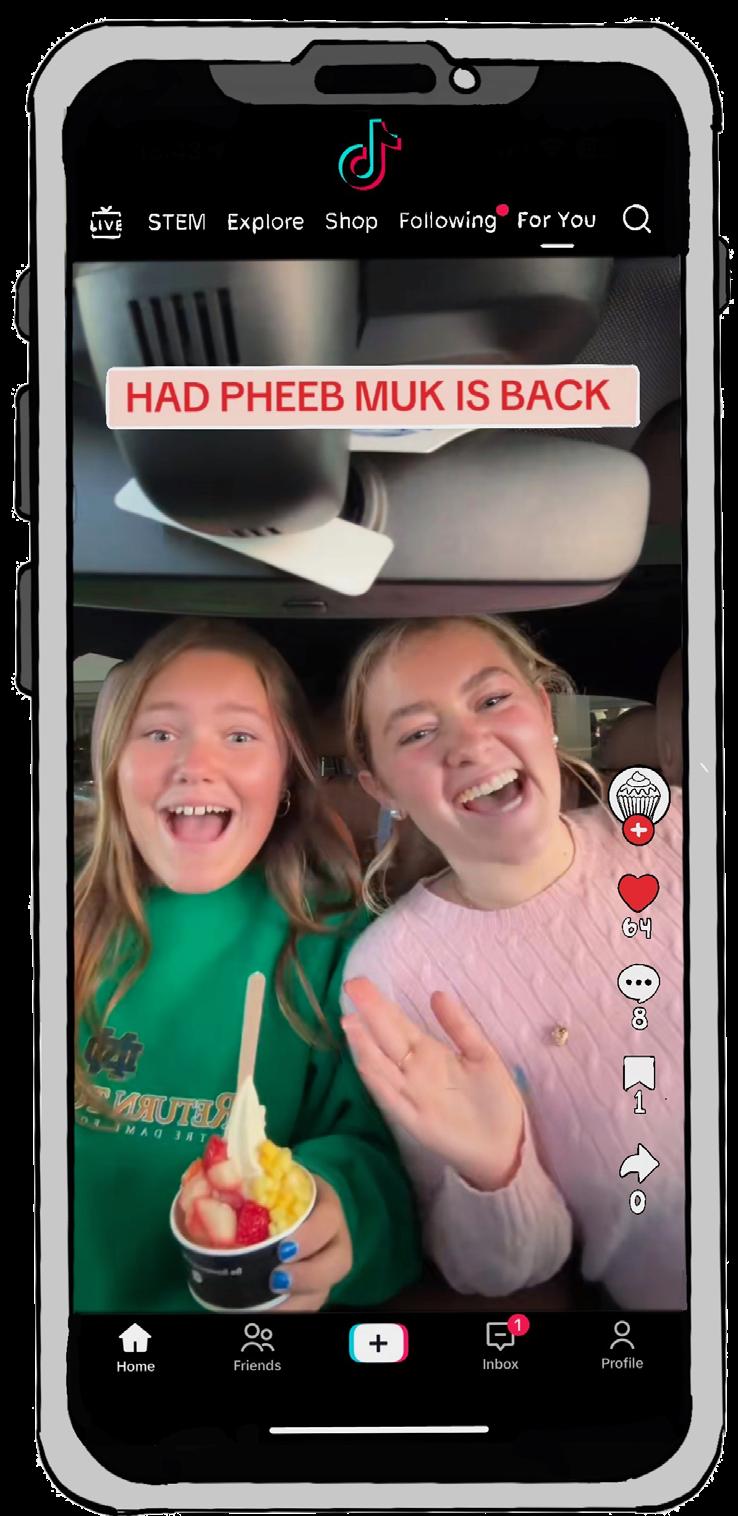
Every scroll through TikTok or Instagram seems to contain a viral Crumbl cookie review or over-the-top mukbang. At Menlo, several students have channeled their inner food influencer and created social media accounts of their own to share their love for food in a casual manner.
“[Our
food reviews]
have been a really big bonding thing for us.”
Junior Hadley
Larson
Juniors Phoebe Crouse and Hadley Larson started a TikTok account, @had. pheeb.mukbang, last February. “When Hadley got her license in sophomore year, we were really excited to go off campus during lunch,” Crouse said. “One day, we were like, ‘Oh my God, we need to make a mukbang, like we eat so much good food.’” Mukbangs are recorded videos of people eating food, typically in large amounts.
Crouse and Larson create videos reviewing different food and drink spots. “We talk about places close to school that are less basic than, like, Starbucks,” Larson said. While their following is small, they have already inspired members of the Menlo community to try new spots. “[Volleyball and lacrosse coach] Quinn Holland is actually one of our active fans. She went [to Andytown], and now it’s one of her favorite spots.”
Crouse and Larson occasionally bring guests on their food reviews.
“Whenever people see us walking off campus, they ask to join and they want to come get featured in the video. So it’s become just kind of a fun thing around school with our friends,” Larson said. “We’ve also brought
Staff illustration: Alyssa McAdams
Photo courtesy of @had.pheeb.mukbang
people from other grades so it’s been a really big bonding thing for us.”
“One day, we were like, ‘Oh my God, we need to make a mukbang.’”
Junior Phoebe Crouse
Similar to Crouse and Larson, senior Brady Kagan started a food Instagram, @bk_eatzzzzz, thanks to an idea from one of his classmates. “I was just getting a ride from [football] practice sophomore year and [senior] James Wernikoff was like ‘You should make an eats account. Everyone will love it,’” Kagan said.
While Kagan hasn’t posted on his account since August, he also felt that his posts inspired people to try new food spots. “People will ask me about [a restaurant] and I’ll tell them where to go. It’s usually local,” he said.
Like Kagan, senior Caroline Herndon has inspired others to try out new restaurants, like her favorite breakfast spot Backhaus. Herndon started a food Instagram account called @thehungryveg in January. “At first, when I was vegetarian, I wanted to tell more people about how delicious vegetarian food could be and I wanted to post about it so that my friends could see [...] that there are other protein sources besides chicken and animal products,” Herndon said. Herndon, a vegetarian since she was five, recently switched up her diet for more variety and ease. “All
my family eats meat and so having a separate dinner, especially when I’m cooking it, is a pain,” she said. In March, Herndon began eating meat and changed her username to @thehungrycarny to reflect the shift – a playful update from her previous handle.
While Crouse, Larson, Kagan and Herndon made their food social media accounts simply for fun, junior Katie Kossow created a business out of her passion for charcuterie. Kossow first made a Thanksgiving charcuterie board a couple of years ago. “I started doing charcuterie as a hobby and, like, for family gatherings and when my parents would have friends over,” Kossow said.
“Sophomore year [senior] James Wernikoff was like ‘You should make an eats account. Everyone will love it.’”
Senior Brady Kagan
More recently, Kossow had the idea to make a charcuterie business as a way to make money. In March, she started an Instagram account, @katies_charcuterie, to post the boards she makes. She’s only had a few orders so far, but she sees it as a hobby, not work. “I really like doing [charcuterie] and it’s a fun way to be creative,” Kossow said.
Fuel Your Future: Menlo Emphasizes Importance of Athlete Nutrition
by Penny Diehl

Student athletes often forget about the importance of nutrition to success; a hard workout is ineffective without proper fueling, both before and afterward. At Menlo, trainers and coaches are working to change this by emphasizing nutrition as much as physical activity.
Assistant Director of Sports Performance Jamie Hegg recently launched a nutritional literacy program that focuses on education, fueling and building autonomy for student athletes. Hegg has met with many upper school girls teams to teach the importance of female nutrition for athletic success.
For years, information and advice on athletic nutrition has been based on male anatomy, with an emphasis on high protein intake. “There is a lot of research coming out right now […] about nutrition needs for female athletes,” Hegg said.
Hegg has also collaborated with Menlo’s athletic trainers to provide students with healthy post-practice snacks like protein shakes, fruit bars and a variety of salty snacks. Vitamins like iron are critically important to athletic performance, and Hegg recommends replenishing these
nutrients soon after exercise. “Key sources of iron [that] are the most well absorbed [are] red meat, chicken [...] and fish,” Hegg said.
For non-meat eaters, Hegg recommends consuming alternative sources of iron or even iron supplements. “Leafy greens, […] even things like quinoa, tofu [and] dark chocolate have a little bit of iron,” Hegg said.
“The worst feeling is feeling burnt out during a race [from underfueling].”
Freshman Emily Dong
The athletic trainers at Menlo also helped improve after-school snacks for athletes outside of Menlo’s partnership with Gatorade. With suppliers, budgets and buying frequency for snacks changing, Assistant Athletic Trainer Stephanie Green and the team of trainers strive to provide balanced snacks. “We try to get snacks that are healthy, but also good for pre-practice,” Green said.
Green, who has been at Menlo for six years, is pleased to see nutrition becoming a focus. “As far as athletics goes, there wasn’t any program of sorts [until Jamie’s program],” Green said.
Similar to Hegg, Green sees the importance of eating carbohydrates before athletic events. Looking forward, she hopes to change the perception around carbohydrates and embrace the importance they have on an athlete’s performance. “I think as a country and as a society we’re really focused on
protein, which is awesome, […] but carbohydrates are our fuel,” Green said.
Sally Hauser, the girls’ distance track and field coach, has been coaching at Menlo for three years and makes her own efforts toward athlete health. “[I] make sure that the day before [a meet] we talk through making sure not only does everyone have their uniform and spikes […] but they’re making sure they had a good meal at lunch,” Hauser said.
One of Hauser’s athletes, freshman Emily Dong, said that her coach’s extra reminders about nutrition help keep her aware and accountable for her performance and recovery. “The worst feeling is feeling burnt out during a race [from underfueling],” Dong said.
Throughout her time at Menlo, Dong’s nutritional knowledge and awareness have grown, as she now understands what her body needs before competing. “Getting in […] protein and carbs a long time before a race is really good,” Dong said.

Staff illustrations: Claire Dickman
What’s Cooking in the Menlo Community? Exploring the Role of Food in Our Everyday Lives
“Ingredient Household” or Not, Menlo Students Find Connections Through Food
by Anya Ramani
The “Ingredients Household” trend went viral on TikTok in 2022 when a group of snack-deprived users started posting about their lives without chips. Poking fun at households that only purchased raw ingredients, the videos showcased creative, but unusual, homemade snacks such as peanut butter, marshmallows and cheese sandwiches, each made with random ingredients. In reality, however, cooking with actual ingredients can help develop both valuable skills around nutrition as well as foster family connections, which resonates in both snack-filled and snackless Menlo households.
“Maybe I’ll pick things up and my parents will cook or vice versa, which is a nice way to connect over a family meal.”
Junior Eliza Low
Junior Eliza Low’s family has never labeled themselves as an ingredient household because they naturally gravitated towards buying vegetables, fruits and legumes to prepare their meals. “I think the term “ingredients household” is a more recent trend because my family has always prioritized shopping for whole foods when we can,” Low said.
Low has been a vegan since she was in fourth grade and avoids most processed foods, which often contain dairy. She also sells homemade soap at the Portola Valley Farmer’s Market, taking advantage of her proximity to local produce. “When I’m [at the farmer’s market], I’ll pick up stuff, depending on what my parents want and then if I’m not selling for a week, my parents will go,” Low said.
Her parents then get creative with the farmer’s market produce, also supplementing from the grocery store. “My dad gets really into [cooking] sometimes and he’ll spend a long time making something fun. [He] likes to make kale chips, which are really good,” Low said.
“It’s kind of like this rotation we do, so maybe I’ll pick things up and my parents will cook or vice versa, which is a nice way to connect over a family meal.”
Similarly, senior Ben Levin’s family also has an “Ingredients Household” and has developed family favorite meals over time. “My family is really into pesto pasta and that’s my favorite meal. I learned how to make it from scratch and we probably have that once or twice a week,” Levin said.
Having a fully-stocked pantry allows Levin, whose parents introduced him to cooking at age 10, to exercise creativity in the kitchen. During the COVID-19 pandemic, Levin cooked meals from different cuisines each night because it gave him the freedom to try new foods while having fun. “One night we would do Italian, [and] another night we would do dumplings. [...] So I had a really fun time experimenting in the kitchen because you can sort of just do whatever you want,” Levin said.
“Growing up in my childhood, my parents had the ideology that we [could] have whatever we want[ed].”
Senior Noelle Lenden
Levin believes that regularly cooking meals — as opposed to grabbing something pre-made out of the fridge — is a way to bring people together. “I love the idea of working together with everybody in your family to make a meal. I hope to do that in the future.”
Just as Levin’s experiences in the kitchen shape eating habits, senior Noelle Lenden’s upbringing reflects her mother’s emphasis on a balanced plate. Because her mother grew up in a household without any refined salts or sugars, she encouraged a less restrictive diet for her kids. “Growing up in my childhood, my parents had the ideology that we [could] have whatever we

want[ed],” Lenden said. Her family both enjoys cooking food from scratch, but also has a cabinet full of snacks. “We’re the type of family [that] makes a lot of things from scratch, like bread, [...] but then we also have a bunch of more [snacks and dessert].”
Cooking has also allowed Lenden to connect with her mother. “When we were bored or hungry [we would] spend our Sundays mak[ing] food,” Lenden said. This shared experience has been valuable for Lenden as she learns how to balance processed and whole foods as part of a healthy diet.
While Lenden has found a balance between cooking meals and keeping snacks on hand, sophomore Grant Kimura often prioritizes convenience for meals — a different but equally personal way to connect with food. Since Kimura’s parents are the primary cooks at home, he was never taught how to cook with fresh ingredients. Consequently, Kimura looks to frozen food as the best option whenever his parents are away.
“Usually [we have] frozen shrimp or chicken. And I’ll throw that in [the air fryer] for eight minutes, and I’ll cut up some fruit [with it],” Kimura said. Kimura’s parents do not emphasize having an “Ingredients Household” because they hope that their children will learn to make healthy food choices that will benefit them later in life. “When we eventually go to college, we will make better choices with more freedom on what to eat,” Kimura said.
Staff illustrations: Claire Dickman
Signature Snickerdoodles
cookies,SophomoreEllaWerlin’sfavoriterecipeissnickerdoodle which she makes for classes, teachers and bake sales. “Those snickerdoodles are the best snickerdoodles you’llevereat,”Werlinsaid.“Theyaresogood,[...]justlikethe perfectmixofflourandsugar.” babysitter,Werlinlearnedthissnickerdoodlerecipefromherformer whousedtoworkatthenow-closedVanillaMoon BakeryinSanCarlos.“Weusedtomake[thesnickerdoodles] together,anditbecame,like,aspecialthing.” beenWerlinstartedcookingatayoungage.“Mymomhasalways school,”reallyintocooking.Mygrandmaactuallywenttoculinary Werlinsaid.“I’vealwaysbeenacookingperson.”
Ingredients
Batter Up!
Students Share Their Favorite Baked Goods
by Miki Kimura

Crackling Croquembouche
The most impressive thing junior Bianca Voltmer has ever made is a croquembouche — a tower of cream puffs held together by caramel, which she made as a final presentation in her eighthgrade personal odyssey project. In the year-long project, Voltmer chose baking as her topic because she was inspired by her mother. “I remember [...] she made me a unicorn cake for my 10th birthday. [...] I just wanted to pick up after her because as she got promoted in her workplace, she had less and less time to bake,” she said.
FortheCroquembouche: 148GlazedDoughnutHoles FoamGlazedDoughnut
Ingredients
Fabulous Flan
Junior Oliver Santiago-Mendez’s favorite recipe is
flan, a Mexican baked custard dessert. “I don’t know how to describe it. [It’s] something custardish I guess, but it holds its shape,” he said. “I brought it here once for Menlo Cooking Club,” Santiago-Mendez said. “People really seem to enjoy it. [...] It’s something about my culture I was able to share here.” Santiago-Mendez began cooking in middle school in order to help out his mother. “My mom has to take care of my brothers as well. And also because it’s fun being able to cook something up and share it with others. It’s something I really like,” he said.
Ingredients
6eggs 1 can lechera 11canevaporatedmilk 5tspvanillaextract dropslemon
ToothpicksCone
ChristmasLEDminilights Ediblegoldleaf 1/4cupconfectionerssugar

FortheVanillaPudding: 11/4cupsugar
1/81/2tbspcornstarch tspsalt 11cupwholemilk 1eggyolk 1/2tbspunsaltedbutter tspvanillaextract
Kool Key Lime Pie
The simplicity of the key lime pie recipe makes it an easy thing to make with friends, even if they’re not frequent bakers. “I find that I’m often making [key lime pie] with family or friends,” junior Connor Burks said. Burks’ parents both grew up in Florida, and his mother in particular lived close to the Florida Keys. She would often visit her parents and bring back key lime pie. “At a certain point, [...] she realized that she could be making it herself,” Burks said. “She’s always been very particular to make sure we make real Florida Keys key lime pie, none of the stuff with green food dye or anything, just because [...] it’s important for her.” For the pie: 5 large egg yolks 14 oz can sweetened condensed milk 1/2 cup freshly squeeze key lime
Ingredients
For the crust: 1 1/2 cups crushed graham crackers 2 tbsp sugar 6 tbsp melted butter
Scan to access the full recipes!
No Nuts, No Problem: Students Manage Food Allergies
by Amelie Giomi
When sophomore Grant Kimura was just 5 years old, a family friend brought what he thought were white chocolate chip cookies over to his house. Upon biting into the cookie, Kimura’s throat started to feel like it was tightening — he was having a severe allergic reaction. “I kind of started panicking [and] I ran upstairs to see if there was something clogging my throat,” he said. “The second I closed my eyes, I went into [anaphylactic] shock.”
Kimura later learned that the white chocolate chips in the cookies were actually peanuts, which he had a severe allergy to.
While the Menlo cafeteria provides an alternate, nut-free entrée daily, Kimura does have to be wary of food served during special events at school. He also must be very careful when eating out at restaurants. “Usually, I’ll pick a food that I’ve either had before or it’s extremely obvious it doesn’t have peanuts,” he said. While foods manufactured alongside peanuts are safe in theory for Kimura to consume, he would rather not risk cross-contamination.
“Living with food allergies is not a huge deal, it’s just more of a minor inconvenience.”
Senior Aaron Lowe
anxiety and stress around even social gatherings or getting food with people, because I have to constantly be thinking about this added layer of caution,” she said.
Now, Kaushek makes sure to carry an EpiPen with her at all times to feel more secure. She also recommends being transparent about food
anything out of the food you eat,” he said. “I was getting injured more often when I played sports and that’s when I kind of just noticed my body was not functioning properly.”

Junior Ariya Kaushek also has a nut allergy and an intolerance for gluten, which makes her exercising and breathing more difficult due to a condition called food-dependent exercise-induced anaphylaxis. Kaushek first discovered she was allergic to nuts when she had an adverse reaction to cashews as a two-year-old.
For Kaushek, the stress surrounding a potential allergic reaction is especially prevalent during social situations that involve food. “I would say [allergies] definitely caused me more
allergies with close friends and family members so they can make sure she is safe. “I think a support system is so important,” she said.
Junior Zach Reynolds also has an intolerance to gluten — but for another reason: he has celiac disease, an autoimmune condition that causes the body to attack itself when gluten is consumed.
Reynolds was first diagnosed with celiac disease in seventh grade, when he went to the doctor for unexplained migraines and injuries. “I got migraines very often, which is a huge part of [celiac disease] because your body’s not getting
Reynolds must be very vigilant when it comes to foods that may contain wheat or gluten. Sadly, he has had to give up many of his favorite foods. “Pizza and bread are the main things I kind of wish I could eat again,” he said.
Reynolds has learned to manage his celiac disease over the years and it no longer impacts his life as much. “I’ve kind of gotten used to it. It’s kind of some routine, checking where ingredients are and stuff, checking if I’m able to eat this. I feel like I’ve kind of adapted to that,” he said.
Senior Aaron Lowe, who is allergic to eggs, dairy, peanuts and all tree nuts, feels similarly to Reynolds.
“Living with food allergies is not a huge deal, it’s just more of a minor inconvenience and something you have to be wary of,” he said.
Lowe was first diagnosed with food allergies when he was only 2 years old after his parents consulted multiple doctors, some of whom misdiagnosed him. Lowe had an especially unique experience, having participated in a clinical trial for oral immunotherapy (OIT) in third grade.
Lowe took an asthma drug called Omalizumab — an immunosuppressant — for eight weeks to gradually build up his tolerance for allergens. After the trial ended, Lowe stopped taking the drug and maintained eating one egg, a slice of cheese and a few nuts every day to increase his tolerance. “Luckily right now, I’m fine for crosscontamination, at least,” Lowe said. “Before it was like even if I got a drop of milk on my skin, I would have an allergic reaction.”
Even though food allergies are just another part of Lowe’s life, he also carries an EpiPen with him at all times. “Once you start having an allergic reaction, you only really have like, five minutes to react. It can be pretty scary,” he said.
From DIY Salads to Custom Sandwiches: Students and Faculty Share Advice on How To Maximize Lunch at Menlo
by Lisa Huhs
Looking to expand their lunch options past the usual entree, some Menlo students have learned how to work the cafeteria to their advantage. These “cafeteria masters” utilize the salad bar’s vast selection of plant proteins, the sandwich bar’s meats and spreads and customize their entrees to their own liking, personalizing their meal.
The salad bar offers a wide variety of bases, like romaine lettuce, arugula and toppings like farro,
beets and artichoke hearts. Some students and faculty, such as Latin and English teacher Tom Garvey and senior Jordana Lenihan, make a “Sweetgreen” salad for their lunch.
Garvey, who’s both a vegan and prone diabetic, chooses to put together a large salad for his lunches. He combines vegetables from both the hot and cold sections with hot sauce and balsamic vinegar on top. And if available, he uses a vegetarian soup as a “dressing.” Since he doesn’t eat meat, Garvey resorts to vegetables, legumes and soy to get his protein in. “Usually, [I’ll add] in some beans or some tofu,” Garvey said.

Similarly to Garvey, Lenihan uses the salad bar to optimize her lunch preferences.
“Sometimes I make salads using chicken from the back of the cafeteria, combined with vegetables and toppings from the salad bar. I like that I can make something different every day and customize it based on what I’m craving,”
Lenihan said.
Lenihan also occasionally
combines offerings from the salad and sandwich bars. “I also make an open-faced sandwich that I love. [...] I will spread hummus on the bread and top it with turkey, tomato and cucumber,” she said. “With so many ingredients in the cafeteria, I think people just need to be creative. You can really make any meal you want if you think outside the box.”
“You can really make any meal you want if you think outside the box.”
Senior Jordana Lenihan
Junior Diya Karthik experiments with the different condiments and toppings from the sandwich bar, creating a dish similar to Lenihan’s. “Usually, I gravitate towards one specific meal. [...] I put hummus on both sides of the sandwich and then sometimes chipotle sauce, [...] lettuce, tomato [and] cheese,” she said.
While Karthik normally prefers sandwiches, she often make side salads to go with them. Some of her favorite salad ingredients include arugula, ranch, tofu, edamame, beets and croutons. “The cold tofu is so
underrated,” Karthik said.
Junior Ava Hua is another sandwich bar enthusiast and even has sandwich-making competitions with her friends. Hua also recommends another cafeteria hack. “I absolutely love Menlo's Asian sweet potatoes. They're these whitish yellow sweet potatoes that are just the perfect balance of sweet and savory, and I wish they had them every week. I cook them at home as well, but the way Menlo cooks them is just the tastiest and most addictive thing ever.”
Freshman McKinley Harding spices up her hot entree instead of creating a new meal. “I always look [out] for greens and chickpeas, to get some additional protein, [and] olives, tomatoes and cucumbers [for veggies],” she said. “I need to keep my body [well-fueled].”
With dozens of options to choose from, Garvey believes it’s important for students to recognize the opportunity to make the lunches of their choosing. “I am always amazed when I see people bringing food from off campus,” he said. “It blows my mind that people don’t actually take full advantage of [the cafeteria].”
Staffillustration: AlyssaMcAdams
Staff illustration: Diya Karthik
Baseball Catches Fire, Tops League Standings at 11-1
by ASHER DARLING
After a rocky 3-7 start to their season, Menlo’s varsity baseball team has gone 13-1 over their past 14 games and currently sits atop the Peninsula Ocean League.
Junior right-handed pitcher and outfielder Jackson Flanagan noted how the team has matured over the course of the season. “We’re younger,” he said. “That was noticeable at the beginning, but we’ve really figured it out. Guys have stepped up and everyone’s been playing really well.”
Flanagan, who holds the team’s lowest ERA at 1.78, said the team’s back-to-back wins against Sacred Heart Prep on March 31 and April 1 were crucial in turning their season around. “Prep was a big series and that sweep really helped us gain momentum. [...] Then we started piecing everything together,” Flanagan said.
Junior catcher Chuck Wynn has powered the Knights’ offense, leading the team with a .439 batting average and slugging percentage at .632. as of May 9.
After winning their first CCS title since 2017 last season, the team fell just short in the NorCal Division V final against Woodland Christian, losing 3-2. “This year we are going to get revenge and win NorCals too,” Flanagan said. “That’s the goal, but we’ve gotta win the league first and then CCS.”
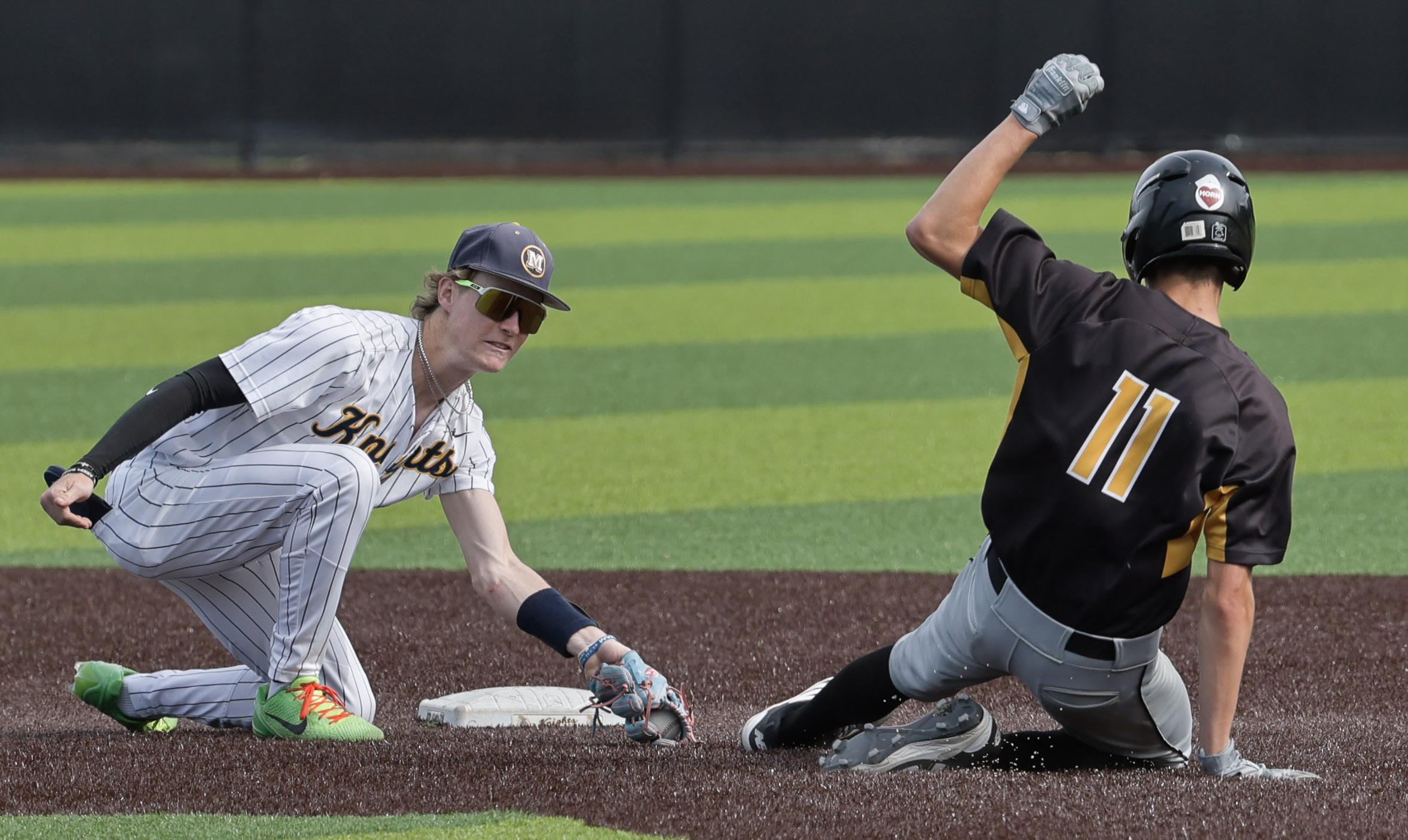
Boys Lacrosse Rides Up and Down Season Into Playoffs
by DEVON SCHAEFER
The Menlo varsity boys lacrosse team finished its regular season 6-10 overall and 2-5 in league. “We’ve certainly had our ups and downs this season, and we’ve lost some close games that I felt we had a good shot at winning,” head coach Blake Kim said.
Junior midfielder Trevor Van Der Pyl agrees with Kim, and also thinks that the
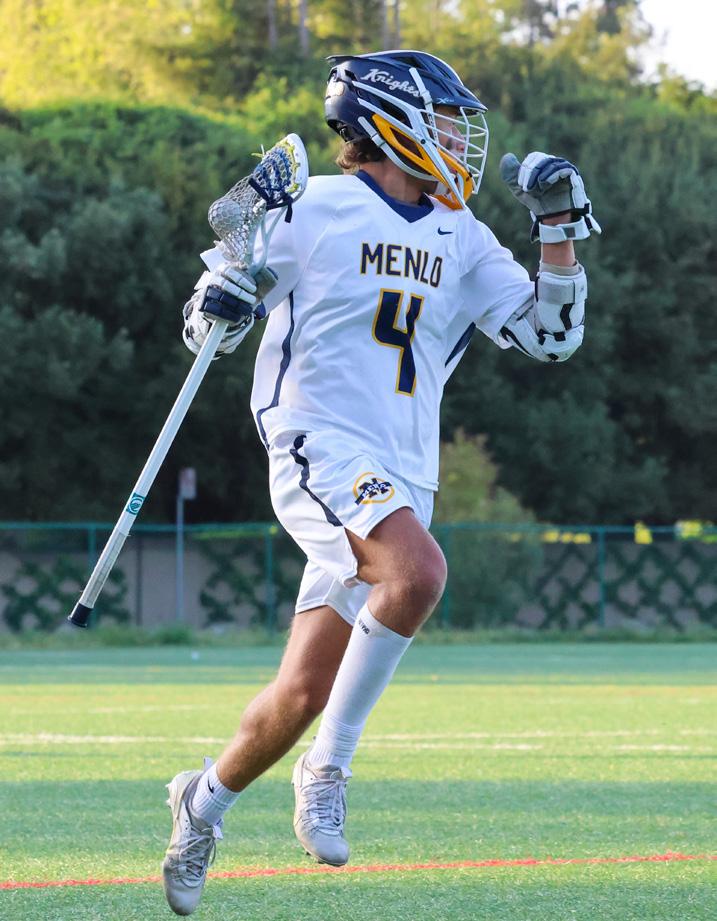
team should have won more convincingly in some of the games they did win.
On May 1, the Knights prevailed 1110 in overtime over Archbishop Mitty, with Van Der Pyl scoring the gamewinning goal. “We should have definitely beat them by more than one goal and [in] overtime,” Van Der Pyl said. “But, it was just so much fun having a close battle like that. We haven’t had one that we won pretty much all season.”
After the West Catholic Athletic League playoffs, the team will play in the Central Coast Section playoffs, which begin on May 12. Kim would like for the team to be in the Division I for CCS playoffs, but only the top eight teams make DI with eight more finding a spot in DII.
“When you look at the top lacrosse programs in the CCS, I believe Menlo should always be a consideration as a top eight team,” Kim said. As of May 3, Menlo is ranked 12th in CCS according to MaxPreps.
Van Der Pyl believes the team needs to clean up some sloppy mistakes, but thinks the team has the right attitude approaching the postseason. “As you can see by looking at our bench, the morale never dips. We’ve got amazing bench energy,” he said.
Girls Lacrosse Rebounds, Eyes Strong CCS Finish
After a slow start to their season, the Menlo varsity girls lacrosse team has turned things around, winning five of their last six games and heading into the CCS playoffs with a 8-12 record.
Head coach Parnika Patel attributes the Knights’ 2-10 start to frequent team illnesses and overlapping winter sports commitments. According to Patel, many varsity players were unable to join the team at the start of the season. “I think that we have really found our footing since then and are in a much better place,” she said.
Specifically, Patel says that the team is very solid defensively. “We’ve definitely maintained [our strong defense] this year, which I’m super happy about,” she said.
Patel is also proud of the team dynamic this season. In particular, she commends the returning seniors, who she says have created a welcoming and energetic environment for new members of the varsity squad.
Senior Ellie Knoll shares a similar sentiment, reflecting on her final year with the team. “We have a really great group of seniors,” she said. “It’s been so much fun.” At the same time, Knoll says that these last couple of months in the
Boys Tennis Rolls Into Postseason at 22-1
by SPENCER TOLAND
In his first season as head coach of the varsity Menlo boys tennis team, Francis Sargeant has guided the team to a 22-1 regular season record.
The Knights wrapped up the play in the West Bay Athletic League at 10-0, extending their undefeated league streak to 23 years.
Senior and captain Kavan Kumar noted significant differences in the coaching styles of Sargeant and the team's longtime head coach, Bill Shine, who retired last year.
“[Shine] was much more laid-back,
but [Sargeant] expects us to go out and work hard every single day,” Kumar said.
The team is focused on winning its 18th CCS title and is also seeking its first state title berth in school history. California introduced a high school state championship in tennis just last year, giving top teams a new level of competition to chase.
“We’re really trying to win CCS because last year we lost in the semifinals,” Kumar said. “We’re trying to get over that hump and then hopefully get through NorCals as well.”

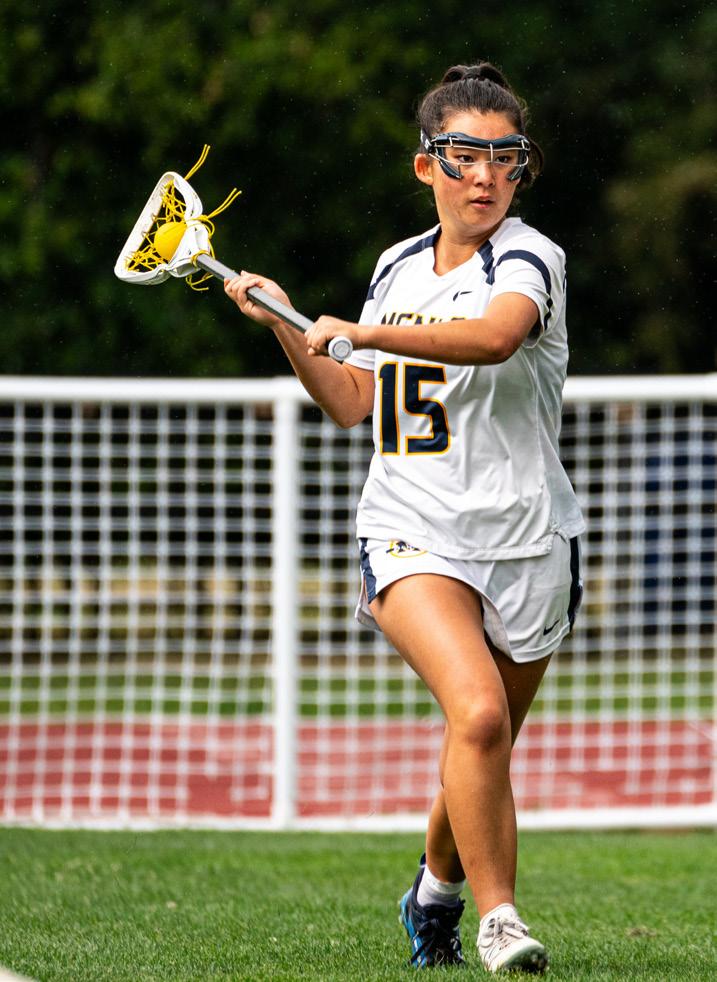
program have been
especially with senior night having passed on April 23 in a 16-9 win over Menlo-Atherton. Patel says that the team’s focus going into CCS is to treat every practice like a game and encourage players to leave everything on the field to round out the season.
Senior Cooper Han hits a backhand shot. Staff photo: Devon Schaefer
Junior shortstop Jack Freehill tags out a Terra Nova runner at second base. Staff photo: Jacob Reich
by CAROLINE CLACK
bittersweet,
Junior attacker Marin Yamada passes the ball.
Photo courtesy of Blake Putanec
Senior attacker James Wernikoff scans the defense as he cradles the ball down the field.
Staff photo: Devon Schaefer
May 13, 2025
Jamie Hegg Brings Olympic Edge to Menlo Athletics
by ALYSSA McADAMS
Assistant Director of Sports Performance and Olympic weightlifter Jamie Hegg doesn’t just lift barbells — she’s lifting the standard for female athletic training at Menlo. In her first year at Menlo, Hegg has quickly established herself as not only an elite competitor and trainer, but also an educator, bringing specialized knowledge about female physiology to coaches and student-athletes alike.
In high school, Hegg was a three-sport athlete and discovered her love for strength training early on, largely thanks to 13 years of gymnastics. She even began doing strength and speed coaching on top of gymnastics coaching while she was a high school student. “I love [being a strength trainer] because I’m very happy doing something all the time, and I like to work with people and do things that are gonna make them better for their sport,” she said.
I
posted a poll on Instagram.
was like, ‘What
next?’
It
sports should I do
And Olympic weightlifting got the most votes.
After running track and field at Seattle University, where she competed in sprints and javelin, Hegg was searching for a new sport while in graduate school. She was invited to join the U.S. national skeleton team — a sport slightly similar to bobsledding, and one that she had no prior experience with — and trained with them briefly before realizing it wasn’t the sport for her.
Lost, she turned to social media to decide her next athletic pursuit. “I posted a poll on Instagram. It was like, ‘What sports should I do next?’ And Olympic weightlifting got the most votes,” Hegg said. “I like doing the Olympic lifts, so I started doing that.”
Today, Hegg attends weightlifting competitions about four times annually, participating in both the snatch and clean-and-jerk events. Hegg has found a lot of success and fulfillment training for her Olympic weightlifting events with her teammates, and has won both nationals and North American finals in the cleanand-jerk. Her proudest moment came recently at a prestigious competition called the Arnold. “I PR’d by quite a bit and got second [place],” she said. “I beat a two-time Olympian and lost to an American record holder.”
Balancing her daily three-hour training with her coaching at Menlo every day requires careful scheduling, but, according to Hegg, Director of Sports Performance
and Wellness Daniel Hicker has been nothing short of supportive. The athletics department has also been supportive of Hegg’s educational endeavor at Menlo — to educate coaches and female athletes about girls’ unique physiological needs.
She has given a presentation to all coaches and around 90 percent of girls’ athletics teams this school year about the ways female athletes need to train and implement nutritional diets differently. “I think the education piece is really important,” Hegg said. “Even if it’s just a bare minimum level. [...] For some people, it’s kind of repetitive, but for other people, if they’ve never heard it, then it’s worth it.”
She first encountered this area of female-focused research in graduate school, when a guest lecturer on the topic visited one of her classes. “I was like, ‘Wow, why have none of my coaches or trainers or even professors in undergrad taught this?’” Hegg said. Before joining Menlo, Hegg worked at Stanford with their Female Athlete Science and Translational Research Program, where she implemented similar programming and conducted research studying collegiate female athletes’ knowledge and physiological patterns.
At Menlo, only 17 percent of Menlo Athletics staff and 11 percent of program directors are female. Hegg recognized that her programming needed to begin with the coaches for that reason, so that all coaches have foundational knowledge about female physiology and their athletes feel comfortable bringing things up with them. “It’s not their fault. They haven’t been educated about this stuff, right?” she said. “Making sure they have the space to learn about that and feel comfortable asking questions so they can better serve the athletes that they’re working with is important.”
Her presentations include evidence-based findings that can significantly impact training approaches, such as performance fluctuations during different phases of the menstrual cycle. She also addresses nutrition misconceptions specific to female athletes, including research on creatine supplementation. Hegg says that both the coach and athlete responses have been enthusiastic, creating a safe space for learning. “In the meeting [with the coaches] we had mostly men, and they had good questions that maybe they wouldn’t have felt comfortable asking elsewhere,” Hegg said.
“ “
I like to work with people and do things that are gonna make them better for their sport.
Assistant Director of Sports Performance
Jamie Hegg
Looking ahead, Hegg is unsure of what the program will look like next year because she wants to avoid redundancy, but she knows she plans to evolve it based on athlete feedback. “I think if female athletes can have fun, be curious and be confident in themselves, they will have a good, fruitful experience playing sports and it will help develop their character wherever they are off to next,” Hegg said.
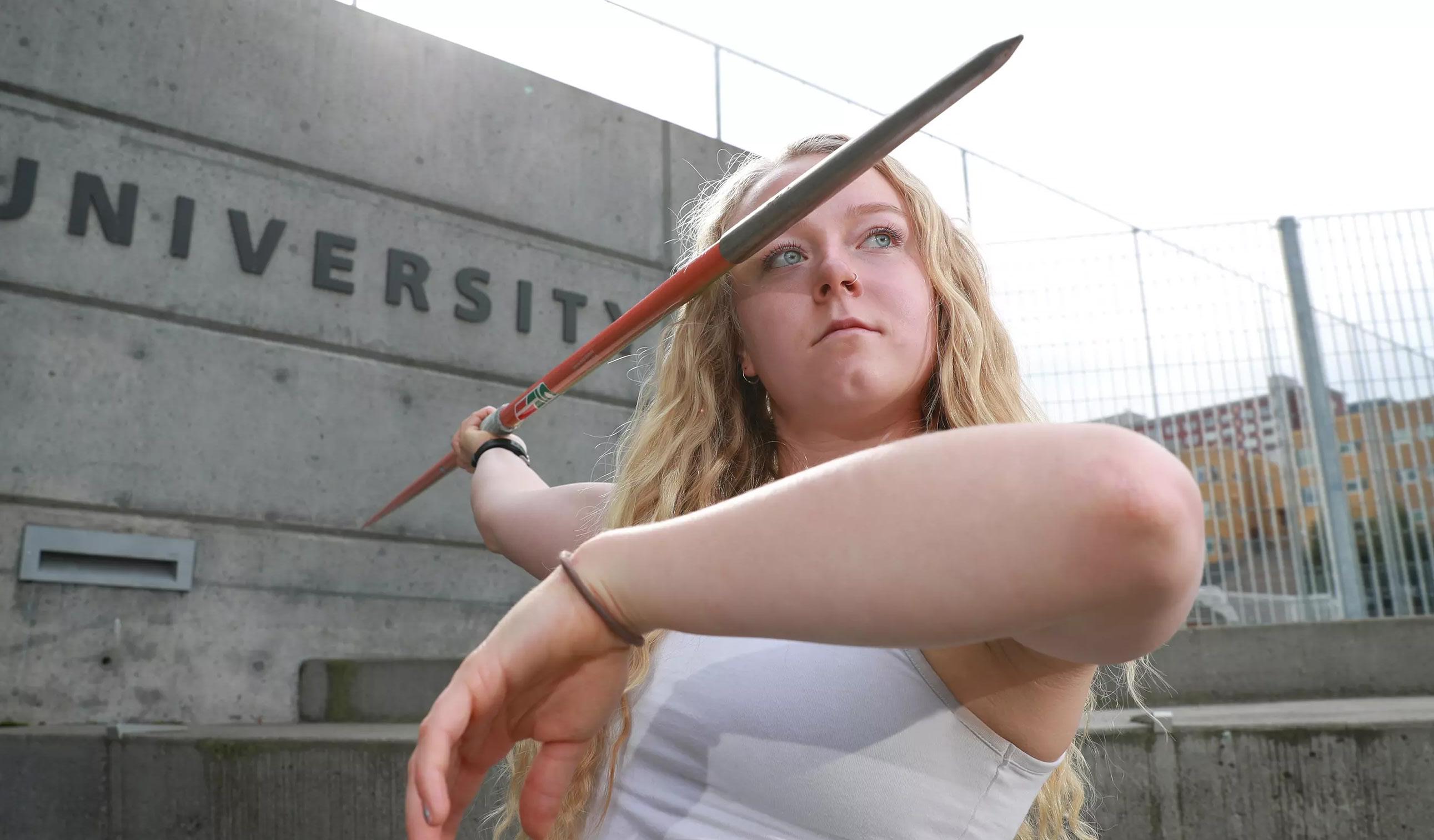
Students Coach, Referee to Give Back to Youth Sports
by BIANCA PUTANEC
One day you’re a kid playing youth sports, looking up to high school coaches and refs who seem so much older – and the next, you’re in their shoes, giving back to the sport that shaped you.
For junior Matthew Franc, the work he’s done since eighth grade at East Palo Alto Tennis and Tutoring has been fulfilling. “After teaching younger kids, I realized I was having an impact while teaching them fundamentals that will stick with them for life,” Franc said.
The organization has a tutoring component alongside tennis lessons for children in elementary school through

high school. Franc's older brother, senior Geoffrey Franc, introduced him to the nonprofit through the CE Fair at Menlo. In Franc's opinion, he feels that coaching infuses purpose into his weekly schedule. “[Coaching] is a great way relax after school, but I spend it in a meaningful way,” he said.
Senior Lily Kautai was first introduced to the idea of coaching when she attended her volleyball club’s open gym sessions as a middle schooler. Alongside professional coaches, there were also high school students helping out whom
she enjoyed working with. “It wasn’t just like the same relationship that you have with an [older] coach, where you listen to their instructions directly,” Kautai said. “I feel like I made genuine connections and friendships with those older girls, and I looked up to them a lot.”
The positive experience she had influenced her decision to start coaching with her club, being one of the first girls on her team to volunteer to help. After hearing about the opportunity, she emailed her coach to get involved. Kautai hopes to replicate her positive experience through her volunteer work. “I hope they get the excitement and fun that I get when playing volleyball,” Kautai said.
Outside of coaching, students like junior Marin Yamada are contributing to local youth leagues by refereeing games.
“I noticed that there was a lack of refs
who had lacrosse experience, so I felt like reffing was a good way of giving back to the community I grew up in,” Yamada said.
After completing the necessary certifications through the official website for women’s northern California lacrosse officials, Yamada had to join the USA lacrosse officiating program, attend virtual sessions and visit one play day with live games before she was ready to referee officially.
Yamada believes she has gained a new perspective on lacrosse through her experience as a ref. “It’s a lot different than playing. You have two very different jobs. When playing, you are more focused on the scoring and winning aspect, but while refereeing, it’s a lot more about keeping the players safe and the game fair,” Yamada said.
Jamie Hegg throws a javelin while at Seattle University, where she competed in track and field. Photo courtesy of Seattle University
Assistant Director of Sports Performance
Jamie Hegg
Do Bay Area Sports Venues Live Up to the Hype?
by SONIA DHOLAKIA & NOAH LEVIN
San Francisco 49ers
Fan Spirit: While I’m not sure I can compare the Niners fan base to the Raiders, there is no denying that NFL fans have a level of aggression and vulgarity that isn’t really seen in other American sports. When I’m at a Niners game, the people around me are loud, angry and screaming things that likely shouldn’t be shouted in public. There is no denying that Niners fans are dedicated. Often in giant gold chains and bright red outfits, their passion, no matter how aggressive, does uplift the spirit of the game. My favorite fan tradition is undoubtedly when the entire stadium sings “Whoomp! (There It Is)” when the Niners’ defense intercepts a pass. If you go to a Niners game, don’t expect a calm, respectful fan base, but do expect a good time.

Levi’s also brings out all types of cuisines to reflect the Bay’s diverse backgrounds. You can find lumpia (Filipino fried spring rolls), rice bowls from Asian Street Eats and “Soul Bowls” from Jackie’s Place. SD
Bay FC & San Jose Earthquakes

Food: I love classic stadium food — hot dogs, chicken tenders, popcorn. And Levi’s Stadium does all of those things well. I especially appreciate the Starbird Chicken chicken tenders upgrade, which feels like a gourmet Chick-fil-A. But
San Jose Sharks
Fan Spirit: Sharks fans are undeniably some of the most loyal in the Bay Area. The SAP Center never fails at providing an exciting atmosphere with fans banging on the glass, waving towels and starting “Let’s Go Sharks” chants after goals or big hits. My favorite part of the experience was the team skating


Fan Spirit: Although Earthquake fans aren’t quite on par with European teams, they bring a wild energy for the entire 90 minutes. I recently went to my first Earthquakes game against Sporting KC, and while the attendance was only 14,147, the spirit was through the roof. The supporters’ section, led by groups like the 1906 Ultras, keeps chanting, waving flags and banging drums from the first whistle to the last. –NL


The Bay FC fanbase was also decked out in the team’s merch, which I have to say, is pretty darn cute. In fact, they have the highest merch sales in the league! It’s easy to see why. After one game, I was inspired to return and immediately went home to order a sweatshirt off their website. –SD
Food: PayPal Park is a pleasant surprise when it comes to the food options. It’s not the classic stadium food,
Food: SAP Center’s food is solid, offering BBQ sandwiches, mac and cheese, sushi rolls and more. For a sweet tooth, the churros and mini donuts are also fantastic options. I recommend getting the souvenir soda to refill during the game too. Lines can get long during intermissions, but the stadium’s built-in mobile ordering system makes it quick and easy. –NL


Golden State Warriors
Fan Spirit: Warriors fans are, on average, a more tame group than Niners fans, but they definitely bring the energy. The fast-paced nature of NBA games
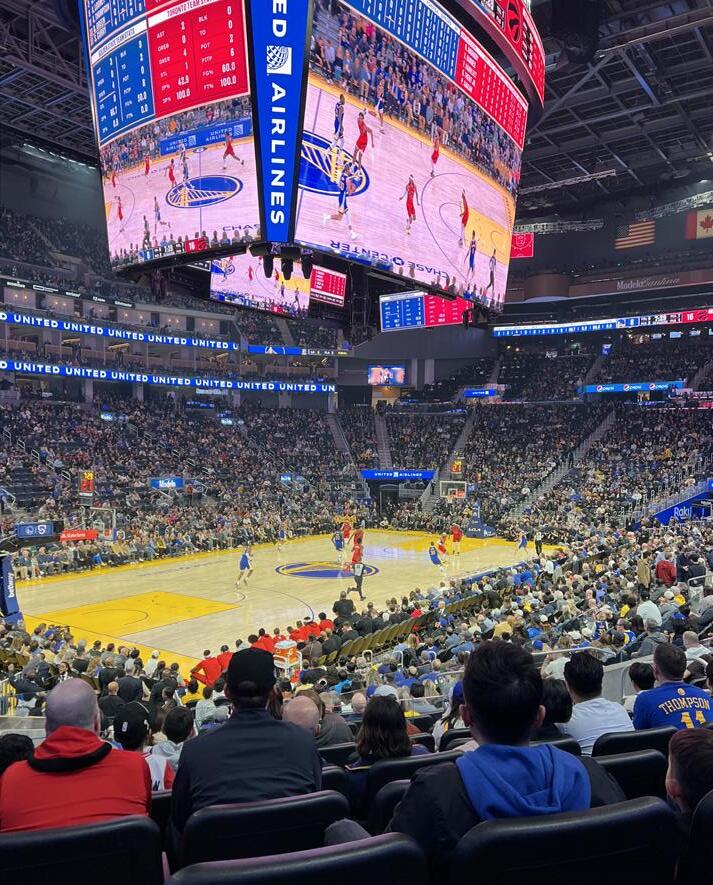

leads to constant audience engagement, and when the communications team plays pre-recorded videos of the Warriors players participating in silly games, it feels like the city really loves the group of players representing San Francisco.
Food: Chase Center opened in 2019, and its food selection certainly reflects that. There are a plethora of high-quality burgers, a Tacolicious, a Modelo Cantina and even a plant-based option, The Greenhouse. The stadium feels new and sophisticated, and the food does too. But it’s also delicious! I highly recommend getting an authentic, Mission-style burrito from La Corneta Taqueria.
hot dogs, pretzels, popcorn (which are also there if you want them), but rather the stadium has a variety of food trucks sharing the local favorites. The food trucks include a wide range of burgers, Mexican street food, sushi and Thai food. I enjoyed the teriyaki chicken bowl, which certainly lived up to its $19 price. So while it may not be as fancy as Chase Center or Oracle Park, PayPal makes up for it with its wide variety of food. –NL
San Francisco Giants
Fan Spirit: In my opinion, the Giants fans are the best of all Bay Area teams, constantly chanting and cheering throughout the entire game. As someone who’s been to many Giants games throughout my life, I’ve never been let down by the G-Men crowd. With the recent addition of outfielder Jung Hoo Lee, section 142 has been designated as the “Jung Hoo Crew,” a dedicated group of fans. Every strikeout, hit or home run, all roughly 35,000 fans erupt harmoniously. With many traditions like “Take Me Out to the Ballgame” and “Bye Bye Baby,” every time the Giants hit a home run, the fan spirit at Oracle Park is second to none.
Food: Oracle Park offers a clean and crowded concourse filled with many food options. The garlic fries are the most famous and definitely live up to the hype. I recommend the
Ghirardelli hot fudge sundae which is fantastic for both day and night games. Another standout feature is Uber Eats’ partnership with Oracle Park, allowing you to order food to your seat in case you don’t want to miss the action. –NL




Staff illustrations: Amber More
Staff photo: Sonia Dholakia
Staff photo: Sonia Dholakia
Staff photo: Amber More
Staff photo: Sonia Dholakia
Staff photo: Sonia Dholakia
COMMITTED CORNER COMMITTED CORNER
Deano Roberts, Stanford University
by SHAAN PARIKH
At the age of three, senior Deano Roberts had too much energy and nowhere to put it, so his parents threw him into gymnastics. Fifteen years later, he is headed to a gymnastics powerhouse: Stanford University.
“Since I was a little kid, [competing at Stanford] was always kind of my goal,” Roberts said. “I’ve trained at their club for 10 years, so I already knew the coaching staff and gymnasts, [...] and it just felt surreal to be there on my recruiting trip. It felt like I already knew the community so well.”
Roberts is looking forward to joining a roster with robust championship DNA. “They’ve won the NCAA championships for the past five [of six] years, and so many of the guys are on national teams,” Roberts said. “Training in that environment is super motivating.”
Roberts began his recruiting journey by sending out emails to programs across the country the summer before his senior year. Slowly, responses arrived, then came phone calls and finally offers. Still, Stanford seemed like the perfect spot for Roberts throughout the whole process.
Roberts feels like the sacrifices have paid off. “The hardest part has honestly been the time commitment,” he said. “Four hours a day, six days a week and missing out on dances or vacations.”
Even though gymnastics is an individual sport, Roberts finds himself leaning on his teammates for support. “It’s a brutal, lonely sport, but having people to train with makes a big difference,” Roberts said.
One of those teammates, Yotam Rachman, has trained closely with Roberts for the past two years. He caught

on to Roberts’s work ethic and leadership quickly. “He was a very committed person, very hardworking and I don’t think [that's] changed very much,” Rachman said.
Other than his personal accomplishments, Roberts also energizes and educates the group around him. “He definitely helps motivate our team. He gives us a lot of energy,” Rachman said. Even though Roberts isn’t an official team captain, he often acts as a leader: “There’ve been numerous occasions where Deano stepped up to be the leader of the team.”
Now, embarking on the first pages of a new chapter, Roberts’ goals are set. “[I want to] push gymnastics as far as I can […] and win another championship,” he said. “And academically, I just want to explore all the options.”
Isha Gupta, Columbia University
by JAMES PARK
When senior Isha Gupta first stepped onto the squash court, she had no idea the sport would change her life completely. What started as a once-a-week hobby quickly developed into a passion, taking a lot of her time, playing tournaments around the world and ultimately resulting in an opportunity to play Division I squash at Columbia University in the fall. “I found out about squash through a family friend. Once I got on court and tried playing, I fell in love with it,” Gupta said.
During the recruiting process, Gupta considered schools such as Yale, Penn and Stanford. On visits, she met with coaches and players and watched practices, allowing her to observe the team culture and understand the programs better. For Gupta, her main concern was how the school balanced squash and academics.
“Some school teams were either solely focused on squash, and not so much academics, while others were focused on academics, and not so much squash,” Gupta said.
Gupta chose Columbia because she believed it was the best of both worlds.
“The team at Columbia had a good balance between squash and academics,” Gupta said. “Some of the girls on the team are focused on squash, and others are focused on academics, which allows me to be flexible with my priorities as I go through college.”
To play at the next level, Gupta had to develop beyond just technical skills. Gupta’s personal squash coach, Charlie Johnson, is proud of Gupta’s growth.
“I’ve coached her for over eight years, and she has been able to mature not only as a squash player, but as a person,
Devon Schaefer, Williams College
by SONIA DHOLAKIA & GEOFFREY FRANC
After four years as Menlo’s starting goalie and six years on a nationally competitive club team, senior Devon Schaefer committed to play Division III lacrosse at Williams College in Williamstown, Mass.
Schaefer began playing lacrosse in third grade at a recreational level, but she was always participating in a plethora of different sports. “I just loved sports. I did every sport in elementary and middle
school, and I still like playing other sports too,” she said.
As she began to narrow her focus on lacrosse, Schaefer was drawn towards the goalie position. She initially started out as a goalie because her team needed someone in the goal, but ended up enjoying the position because it didn’t mean racing against her opponents.
In middle school, Schaefer continued to play both in the goal and on the field,
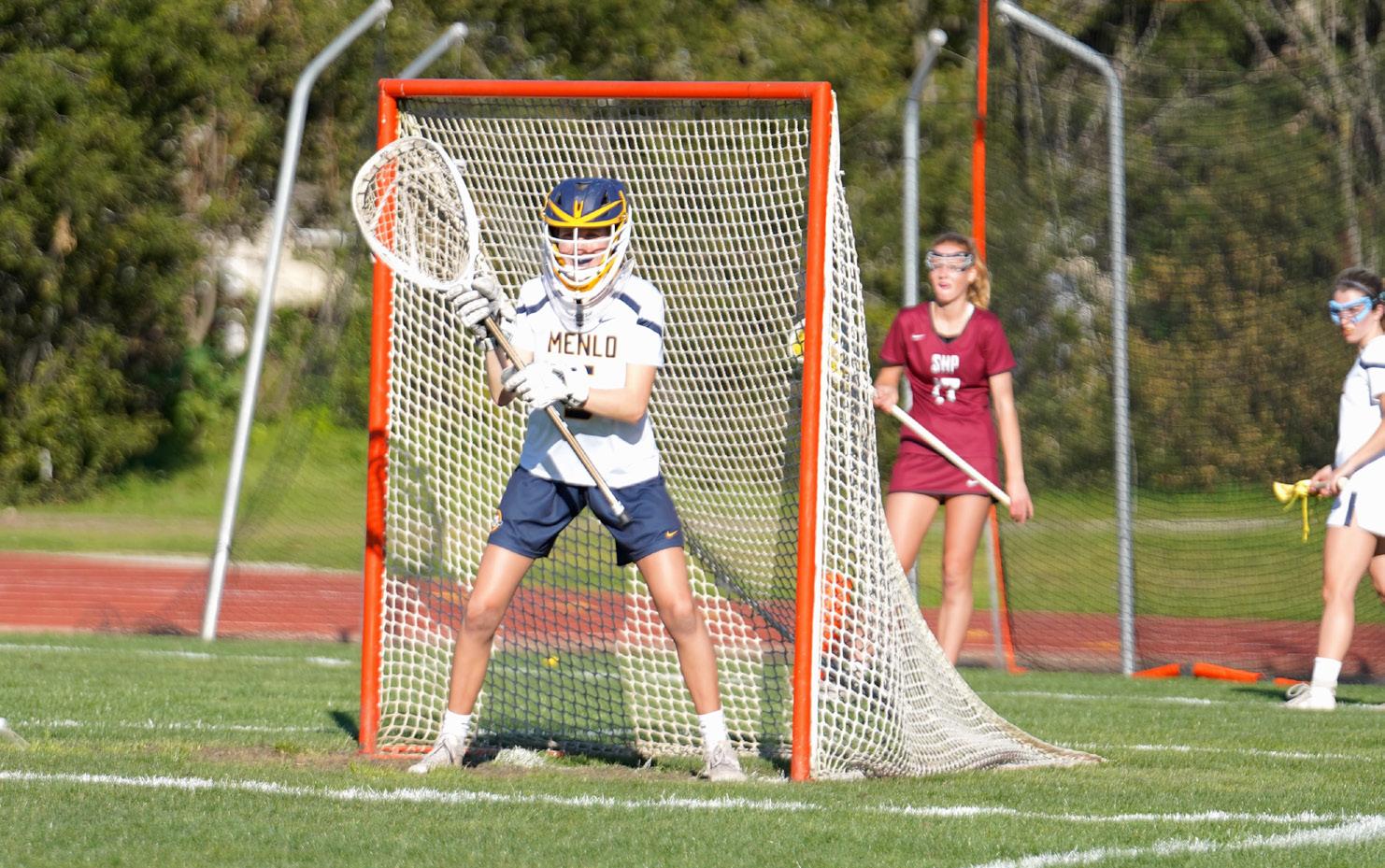
but when she got to high school, she dedicated herself fully to the goalie position. As the only goalie in the varsity girls lacrosse program, Schaefer was the starting goalie her freshman year. “Our team wasn’t too good. We only won two games the whole season. But I faced so many shots so it was such a good learning experience and I improved a lot,” Schaefer said.
Senior Mia Monsalve, a defender on the Menlo varsity girls lacrosse team, trusts Schaefer’s talent on the defensive side. “I’ve really enjoyed being with Devon on defense. After every goal, I look forward to running back to her to give her a high five,” Monsalve said.
On the recommendation of her lacrosse coach, Schaefer tried out for and joined STEPS California, a club lacrosse team, in seventh grade. “A lot of the marketing around them was about how they got so many people to play in college,” Schaefer said.
Starting her sophomore year of high school, STEPS began guiding Schaefer through the college recruiting process. As Schaefer reached out to colleges to gauge interest, her coaches leveraged their relationships with colleges on her behalf.
Because of higher interest from DIII
and [was] able to learn not to let failure control her,” Johnson said.
Although Menlo does not have a squash team or squash facilities, Gupta credits the school’s ability to accommodate her conflicts with squash. “If you are on top of things, teachers are happy to reschedule things and [help you] make up what you missed,” Gupta said. Gupta is enthusiastic about her tenure at Columbia and plans to continue her growth and involvement in squash. As she transitions to the collegiate level, she hopes to keep pushing her limits and exploring new opportunities within the sport. “I really want to play a professional squash tournament,” Gupta said, “I don’t see squash ever leaving my life, since I can take it wherever I go, whether that’s in New York or anywhere else.”
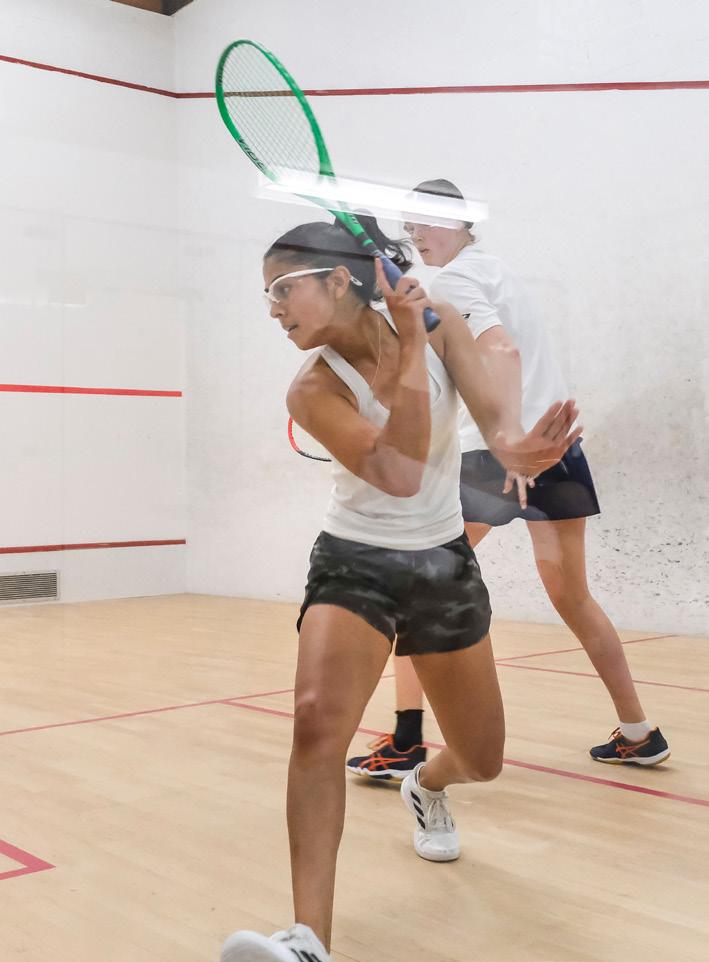
schools, Schaefer set her sights early on colleges playing in the New England Small College Athletic Conference.
“It’s a super competitive conference for lacrosse,” Schaefer said.
Once her junior year started, she continued attending prospect camps with DIII schools and began having calls with schools that were interested in her.
The winter and spring of her junior year, Schaefer visited several schools in the NESCAC and attended their camps. “I really liked [Williams] when I visited,” Schaefer said. “All the girls on the team were super nice.”
“Being in the cold and middle of nowhere is, like, difficult, but it is really pretty,” Schaefer added.
On July 1, 2024, Schaefer got a call from the coach at Williams, offering her support in the admissions process and a spot on the team. “I was definitely just, like, relieved that the whole process was over,” she said.
Schaefer credits her mom with supporting her throughout her lacrosse journey and the commitment process. “[She was helpful in] making sure I was signed up for camps and that I sent my emails on time,” Schaefer said. “But she never pressured me to do anything.”
Deano Roberts performs a bars routine during a meet. Photo courtesy of Roberts
Devon Schaefer stands ready in goal during a game against SHP. Photo courtesy of Dai Yamada
Isha Gupta lines up a backhand during a squash match. Photo courtesy of Gupta
Arts & Lifestyle
Promposals or Performances? Faculty and Staff Weigh
by ELEANOR KINDER
As prom season rolls around, students at Menlo begin planning how they’re going to ask someone to the dance. Perhaps it’s performing a dance or dressing up, but usually it ends up being a clever poster. While students may see promposals as an annual tradition, some faculty members are questioning the motivations behind the spectacle.
Upper school dance teacher and Menlo alum, Angela Curotto-Pierson ('07), thinks that promposals now seem fake. “It’s not about the person actually being asked,” Curotto-Pierson said.
Curotto-Pierson isn’t against prom asks. In fact, she fondly remembers the two promposals she received when she was a student. As a junior, her date decorated her car, and as a senior, her date waited in her room to surprise her after dance practice. What concerns her is the increasing pressure for students to make a show of it in front of an audience. “The circle is so weird to me,” she said. “It’s so much about this performance, which is

in
why I hate it.”

Though she acknowledges that public asks can relieve pressure when they happen all at once, CurottoPierson would still rather promposals remain private. She believes there would be less pressure if it was one-on-one and not on the same day.
English teacher Margaret Ramsey shares a similar discomfort with the public nature of the promposals. “If you already have your date and you’ve already made the ask, then why are you presenting it?” Ramsey questioned. “It just feels kind of mindless and showy.”
Ramsey emphasized that the promposal culture at the school has improved in some ways. Students now tend to check in with one another before making public asks, a shift she welcomes. “[Promposals] used to be so much worse, because they would be these big, performative things and there wasn’t the whole [tradition of asking] permission beforehand,” Ramsey said. Still, she finds the presentation puzzling. “Would you still want to do it if it wasn’t going on social media?” she asked. “Just do it and don’t film it.”
Upper School Director John Schafer has similar concerns. “I find promposals jaw-dropping to me. I understand people get into it and it’s a public event and so forth, but when I was in high school, I would’ve rather been beaten over the head with a sledgehammer than have to publicly ask someone to the prom. That would’ve mortified me,” Schafer said.
Ramsey is also concerned about the gender dynamics behind most promposals. She doesn’t like the expectation that boys have to ask and she would love to see it be a free-for-all. “If you want to have a date to prom, then ask,” Ramsey said.
While some teachers voice skepticism, others find
value in creativity and effort. Administrative Assistant Courtney Tyler enjoyed seeing the Class of 2022’s promposals. “I really liked a lot of the promposals that grade. I felt like there was a lot more creativity beyond what we see currently with posters,” Tyler said.
One promposal in particular stood out to Tyler: a student coordinated a full dance number with his friends and the support of his advocate, complete with tuxedos and a performance of Justin Timberlake’s “Suit & Tie.” “That was super memorable for me,” Tyler said. “I would love to see more fun and unique ways [to ask someone to prom], whether they include a poster or not."
Would you still want to do it if it wasn’t going on social media? Just do it and don’t film it. “ “
English teacher Margaret Ramsey
Like Ramsey and Curotto-Pierson, Tyler appreciates that students usually ensure the answer will be yes before making a public gesture. She agrees that putting someone in an awkward position is never good. “The culture at Menlo is good in asking people in advance,” Tyler said
Anonymous Q&A with @menlopromdress2025
by SADIE EVANS
The following has been pared and edited for clarity.
Q: What inspired you to create the Instagram account?
A: As an underclassman and even as a middle schooler, I saw an account for posting people’s prom dresses in advance at other schools and then when my sister was going through junior and senior year she was always talking about it.
Q: How anonymous is your account? Do many people know you’re the one running it?
A: I feel like it’s not anonymous at this point. So many people have figured it out, but I don’t really care that much because it's not like it’s a secret.
Q: What’s the process like for running the account?
A: People just DM their dress to my account and then DM again if they want to delete it or change it.
Q: Have any posts stirred up any drama?
A: Just to the extent of people being like, “But I wanted to wear that.” But no real drama, I’d say.
Q: Do you have any favorite dresses that have been posted?
A: I really like this pale blue one that has a rose and a pretty back.
Q: Have there been any dresses you absolutely hate?
A: There have been some that aren’t my personal style, but for the most part they are all cute.
Q: When’s the best time to start looking for your prom dress?
A: I think getting it super early isn’t really necessary, but waiting until the last minute is way too stressful. I’d say about a month before.
Q: What does your perfect prom dress look like?
A: My dress is a floral pink LoveShack one, but ideal is a princess dress look. Kind of like Sherri Hill but a little less cheugy. Something like that is definitely more for senior year, though.
Q: Do you think two people wearing the same dress is an issue?
A: If you’re in the same friend group and taking photos together, then yeah, it can be awkward. My freshman year, I had the same semi dress as a good friend, and it bothered me. But if they’re in a different grade or the dress is a different color, it’s not a big deal.
Q: Do you have any thoughts on people sending multiple dress options if they haven’t decided yet?
A: It’s kind of annoying — but also relatable. I had tons of options at one point
and wanted to post them all too. So I get it. But if you're sending seven and want me to post them all, you’re just being selfish.
Q: Do you have any advice for people who are struggling to find their perfect prom dress?
A: Use every form of social media to find it. Also, utilize Pinterest.
Q: How did you find your dress?
A: Some of my friends were renting from LoveShack, which I hadn’t considered. I was stuck on Revolve, so I checked it out — and they had new releases!
Q: What does your perfect promposal look like?
A: At Menlo, it’s just a poster without anything else. The creative ones have flowers, or maybe a matcha, stuffed animal, little things like that. If you’re dating or know the person really well, that’s a nice way to spruce it up.
Q: Do you think it’s better to do a promposal at school or at someone’s house?
A: I’ve always thought it’s kind of weird that Menlo has one big mosh pit. Doing it somewhere more private — or
at least a different spot on campus — might be nicer. We’re the only school that does it this way, but it’s become the norm.
Q: Who do you think should do the asking for prom — the girls or the boys?
A: The girls asking for junior semi actually went better than I expected—it was super organized and we pulled it off. It’s nice to switch it up. I think it should be the boys’ turn this year, but honestly, I’m indifferent.

Staff illustration: Ella Skinner
Staff illustration: Ella Skinner
Arts & Lifestyle
Move Over Love Island, Menlo’s Success Rate is Better
by CAROLINE CLACK
Thousands of people compete to be on Love Island USA every season with the goal of finding their perfect match, yet the hundreds that apply to Menlo every year have better success in finding lasting love. From trauma-bonding over difficult classes to unconventional prom date success stories, many Menlo students form romantic relationships together that can linger long after graduation.
Menlo alumni Abby Becker (’23) and Colin Dhaliwal (’23) were thrown together in the final moments of their
Menlo careers at prom during their senior year. Becker and Dhaliwal followed up on their prom experience with a first date at a San Francisco Giants game. “It was history after that,” Becker said. At the beginning of their relationship, Becker and Dhaliwal spent their freshman year of college continuing their relationship long-distance. “It was difficult to adjust to a new school in a new place, while also maintaining a relationship, but at the end of the day it was so worth it in every aspect,” Becker said. After

Dhaliwal transferred his sophomore year to Georgetown, where Becker attends, the two reunited on the same campus.
Unlike Becker and Dhaliwal, Kimberly Nye (’97) and Zach Nye (’97) didn’t begin dating until after their Menlo graduation, after they both ended up on the East Coast at Princeton University. Although they weren’t close during high school, the Nyes bonded over their shared Menlo experience when they ran into each other at a social event. “It was nice to see someone from a familiar background on a new campus,” Kimberly Nye said. The Nyes currently have two daughters at Menlo: senior Lily Nye and freshman Maggie Nye.
Stella Buch (’24) and Garrett Tran (’24) started dating after becoming close friends throughout a difficult math class their junior year. Buch and Tran found themselves going to different universities after Menlo within the same city, a situation they both felt was perfect for them. “It felt like a weight lifted off our shoulders,” Buch said. Despite the proximity, finding time to face the commute and see each other on top of classes and extracurriculars has been difficult for both of them. According to Tran, they’ve balanced their relationship and school lives by utilizing public transportation, completing homework assignments together and prioritizing Sunday nights together.
Danika Biscevic (’21) and Jeremy Yun (’21) first met after Biscevic transferred to Menlo her junior year, shortly before the onset of the COVID-19
Selected Student Profile: Gio Magana
by SAVANNAH SMITH
The following has been pared and edited for clarity.
Q: What advice do you have for those going abroad after going to Tanzania?
A: Bring gifts. I gave my host family LEGO flowers — something lasting. They put them in the living room. One day, their kids’ kids might see them and think, “A student from America brought us this.”
Q: Can you tell us about your youth program volunteering and working with law enforcement?
A: I’m a part of the Law Enforcement Explorer Academy. It teaches me discipline, time management and how to be responsible. It’s really about serving the community. After I graduate in two weeks, I’ll help with traffic and behindthe-scenes work.
Q: What’s your favorite part of the Menlo community?
A: Sports and Latinos Unidos are both up there. But I don’t want to stay in a bubble — I’m Latino, obviously, but it’s important to branch out. Being part of sports lets me see how other people live; that’s huge.
Q: What would your freshman self be proud of?
A: I got into college!
Q: Dream job?
pandemic. They quickly became friends because of shared senses of humor and started dating after getting closer during the COVID-19 pandemic. After getting into their dream schools, which happened to be 90 minutes from each other, the couple experienced a lot of relief. “We got really lucky geographically that some of our top choices were right next to each other,” Yun said. “I’m incredibly lucky to have met her, let alone having everything work out [like that].”
“ “
I’m incredibly lucky to have met her.
Jeremy Yun (’21)
All the couples mentioned agreed that staying healthy after high school means prioritizing life outside your partner— cultivating individual interests while still enjoying things together. Becker believes that the key factors of a healthy relationship include honesty, vulnerability and communication, especially throughout long-distance.
Biscevic emphasizes being a source of joy for your significant other while also supporting their life outside of the relationship. “Just trust that they love you and want what’s best for you and vice versa,” Biscevic said.
A: Whatever it is, I just want it to reflect my values. Whether it’s in business or government, I’d want to do something that helps people — not just for the money, but to make a difference in some way.
Q: What’s something you’ll thank yourself for later?
A: Staying healthy. You always hear, ‘Go to the gym, eat right.’ Then you talk to your grandparents and they’re like, ‘Oh, my back, my knees.’ So yeah, being healthy is up there.
Q: What can you tell us about your summer internship with the Meta Summer Academy?
A: It was amazing. We got money and a laptop — I gave mine to my mom. We built a VR game with “Come and Get Your Love” playing while you shoot targets.
Q: If you could give a TEDTalk on a topic of your choice, what would it be?
A: “Atomic Habits” by James Clear. It was the first book I actually read on my own — like, by my own will. The idea that if you get 1 percent better every day, you’ll be 37 times better by the end of the year really stuck with me. It made me think about how much small habits add up.
Q: Life motto?
A: Seek discomfort. If you haven’t heard of Yes Theory on YouTube, I’d definitely recommend them. I went to a Ranger conference, and the big takeaway was: being kind is free. It sounds so simple, so why don’t people just do it.
Q: What was a time where you stepped out of your comfort zone?
A: Coming to Menlo, I didn’t know anyone. But really, almost everything I do [is stepping out of my comfort zone].
Like this past summer, I was biking everywhere: to the gym, to Menlo to volunteer at Peninsula Bridge, to the grocery store and back home. I didn’t have to do any of that., I mean, I didn’t have my license, so I kind of had to. But still — no one has to do anything. You just try to push yourself.
Q: Who makes you laugh the most?
A: Two people — my mom and Juan [Lozada Tahuiton].
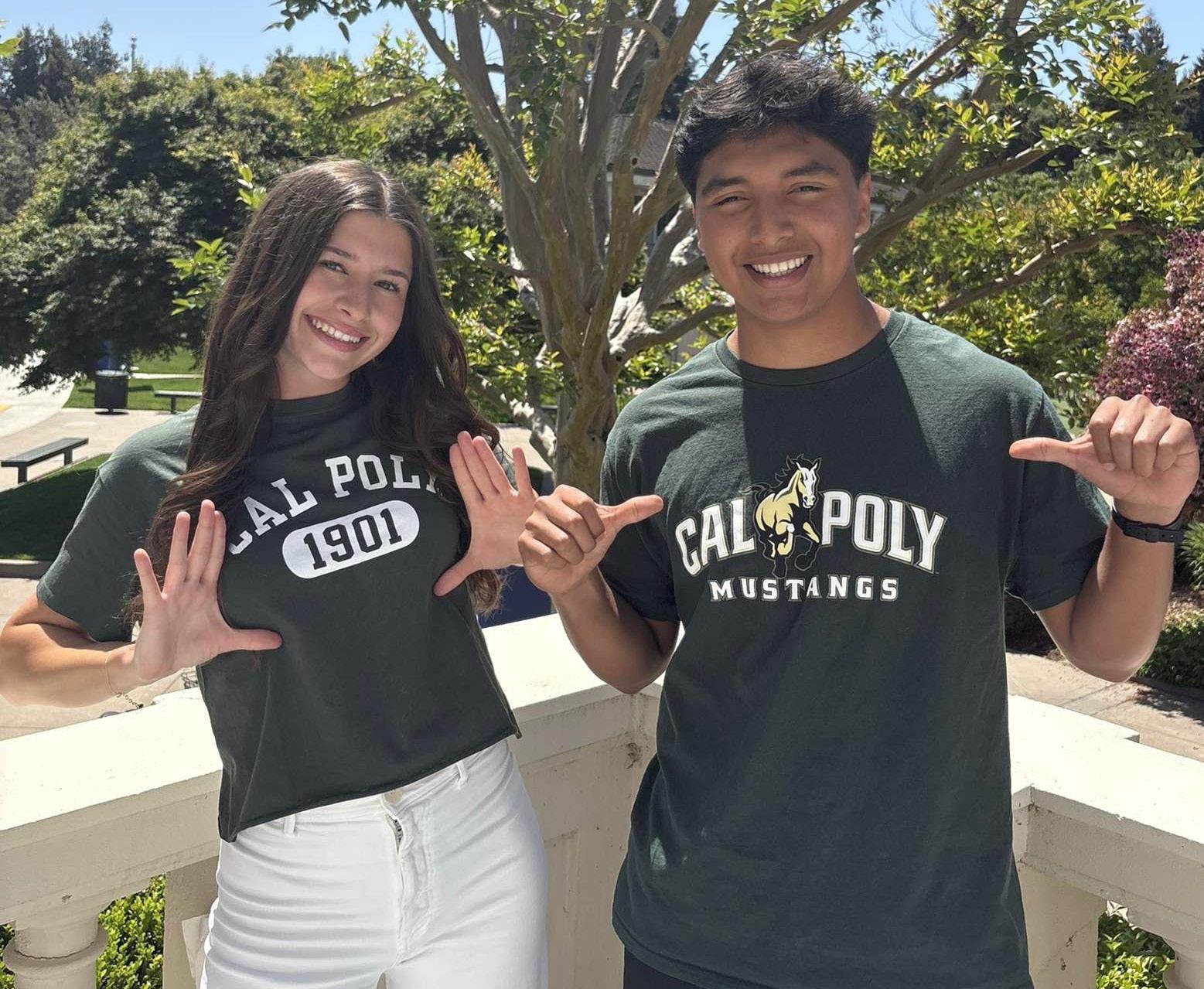
Gio Magana poses with fellow future Mustang, senior Scarlett Bundy, in their Cal Poly t-shirts. Photo courtesy of Magana.
Staff illustration: Claire Dickman; photo courtesy of Biscevic and Buch
Arts and Lifestyle
A Final Curtain Call: Steven Minning’s Last Menlo Show
by AUTUMN CHAMBERS
“All right guys, this is a really important rehearsal,” Vocal Teacher Marie Finch said. She stands before a group of Curtains cast members, each of them holding a script. The words “LOCK IN” are written in big, bold letters on a whiteboard, a perfect way to describe how everyone in the room is working hard to make the show perfect. This show is extra special to the Menlo Drama program. After 12 years, Drama Teacher and former Creative Arts Department Head Steven Minning takes his final bow at Curtains.
“I’ve been thinking about Curtains for a long time,” Minning said. “I’ve looked at it for several years, but I didn't feel it fit right with the other shows that we were doing.” Minning describes the show as a Broadway-style comedy murder mystery.
Minning was first interested in joining Menlo’s community because Menlo’s mission and values aligned with his own. “I felt it was a very progressive, yet wellgrounded school,” Minning said.
Minning’s first show at Menlo was Little Shop of Horrors. “[When] I went into that show, I didn't know any of the students. There was no blueprint,” he said.
Looking back on his first show, Minning says that his teaching style has changed dramatically, as he's directed over 36 shows since then. His goal is to be flexible with his students’ skill levels, wanting to challenge them individually as performers. “There was more of a relaxation and flowing with what was best for Menlo… much more customized to who our students are,” said Minning.
Freshman Wanis Moutri, who plays Christopher Belling in Curtains, sees this tailored directing firsthand. “He [Minning] brings out the best in a lot of us,” He said. “Whether it’s scene changes, tech, or acting, it’s always nice to have Mr. Minning putting a spin on it and helping our character personalities really shine.”
Junior Claire Barnett has participated in Menlo’s drama program since her freshman year and particularly appreciates Minning’s attention to detail. “I've learned to
isolate each specific action and choice that I make in my performances,” she said
However, her favorite memory of Minning was a few days before last year’s production of Mean Girls. The cast was posing for an Instagram photo, and Minning decided to lie on the stage to display the Menlo Drama logo on his sweatshirt. After the photo, Minning stood up with a smile. “Oh my gosh, I feel so comfortable around you guys, I would have never done that in the past years,” Minning said, according to Barnett. “It just felt really special because it felt like we had all bonded,” she said.
Minning has given students opportunities to elevate their theater skills beyond Menlo’s campus. “Menlo was very proud [of]for being chosen to take our kids to the Edinburgh Fringe Festival,” he said. He guided students
Junior Kira Pande has worked on several of Minning’s productions and been a student in his Beyond Words class.
Pande says that Minning has helped her with her acting and public speaking skills. Her role as Officer Lockstock in Menlo’s production of Urinetown required her to perform a monologue to open the show. Pande appreciates his advice on how to craft her character to deliver a perfect performance. “It's clear that he knows what he's doing and that he has just so much experience and knowledge about public speaking,”
Pande said. Minning says sharing his passion for theater with his students is what makes him truly proud of his career. “The look on their face when they're doing a show in front of an audience and they finally recognize, they get it,” Minning said.
As the curtains close on Minning’s Menlo career, he has high hopes for the program’s future. “I would like to leave that continuous curiosity about the arts and how the arts are so important to our culture,” Minning said. He advises the next drama teacher to embrace the community and listen.

Menlo Shadow Visits Lead to Lasting Friendships
by MALIA CHEN
Every year around March, the freshman population seems to double. Not officially, but with admitted students visiting campus, it definitely feels like it. For many students, their first experience at Menlo came not as a student but as a visitor, and what they remember most is the person who showed them around. Shadow days, now known as campus visits, take place each spring after admission decisions are released. Admitted student visitors are paired with current student hosts and spend the day with them — sitting in on classes, meeting new people at lunch and getting a
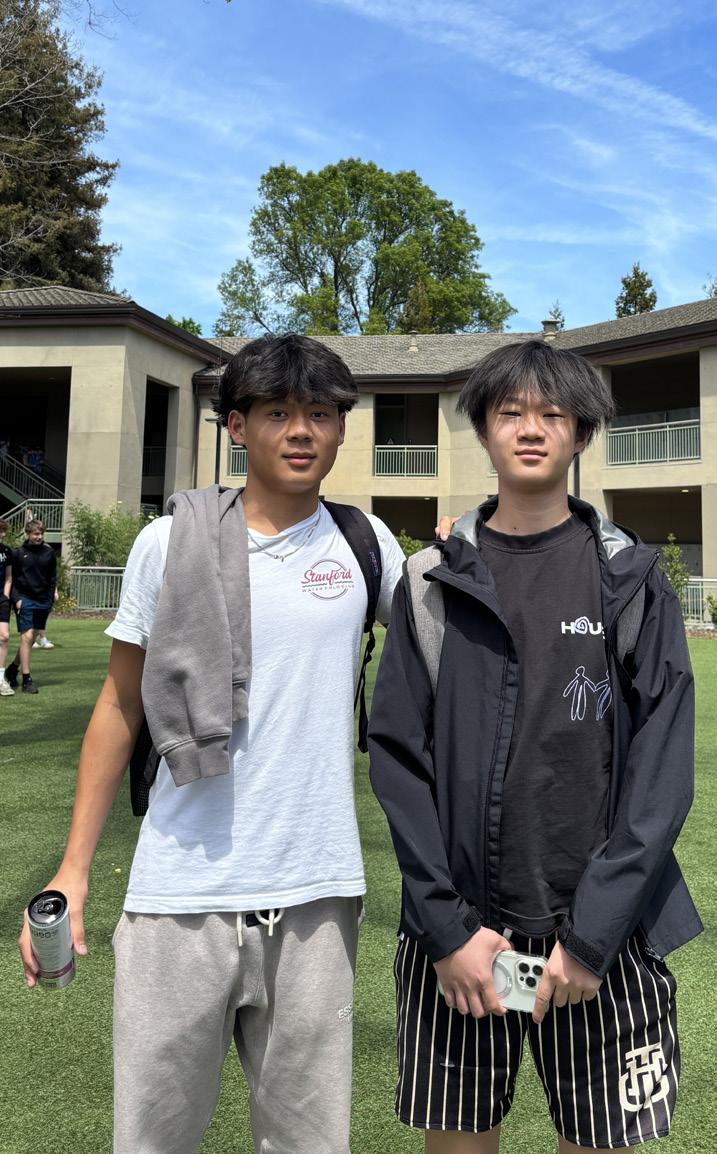
feel for daily life at Menlo.
Arriving during tutorial, visitors attend two classes and eat lunch with their host. These visits often mark the beginning of lasting connections, a familiar face for students to look out for when they arrive in the fall.
Beyond classes and lunch, visit days allow admitted students to ask current students questions about athletics, clubs, academics and more. Importantly, visiting students are shown a perspective that might not be available through admissions. “The student-to-student perspective is really important,” Upper School Associate Director of Admissions Melanie Rossi said.
Rossi oversees the logistics of the visitor program, matching accepted students with hosts based on class schedules, shared interests and the occasional gut instinct. “Once I get their schedules and their interests, I try to just kind of align up who I think will match,” Rossi said. “Everyone can opt in. I never make anyone do it that doesn’t want to, [...] but it’s something that I want all kids to get involved with.”
While it may seem like a small decision, those pairings can leave lasting impressions — and, in some cases, create lasting friendships. Junior Brendan Wong was paired with then-prospective student Connor Hou during Hou’s visit, and the two have been friends since.
When they first met each other, neither knew what to expect. “I thought he was taller and I thought he was a little scary,” Hou said. Both Wong and Hou agree that their perceptions of each other have changed significantly since they first
met. “I just look at Connor differently now, starting from him being a stranger to now where he is someone who I know I can talk to,” Wong said.
On his visit day, Hou attended Wong’s Chinese and English classes. Hou found that his visit gave him perspective on what the community and classes at Menlo are like. “I remember I really liked the environment and the vibe [at Menlo],” Hou said. “[Visiting] really helped me make the choice to actually come here.”
Junior Josie Lee fondly recalls shadowing senior Natalie DeCherney. “I remember her being really nice and sweet, and I felt like we had a little bit of a connection because we did similar sports, since at the time she did soccer and lacrosse,” Lee said.
Similarly, junior Julia Im shadowed senior Lauren Dempsey and she visited Dempsey’s freshman physics class. “I distinctly remember going to physics class with her because I was sitting between her and a couple of her other friends,” Im said. “They were all trying to include me in what they were doing even though I had no idea what was going on.”
Neither Lee nor Im said shadowing made or broke their decision to come to Menlo since they both had older siblings already enrolled, but they appreciated the comfort it offered. “It was nice knowing the schedule I was going into and stuff,” Lee said. Im had a similar experience: “I think it was really nice to get to know how [...] the classes worked and the social aspect of Menlo,” she said.
Both Im and Lee found that their shadows were incredibly caring, friendly and welcoming. “Since I was kinda quiet,
I thought it was really nice that during lunch she kinda included me with all her friends, and they were all trying to get to know me and talk to me,” Im said.
“I remember Natalie took an effort to sit with her friends who also had shadows, so I got to get to know other potentially
“ “
I remember I really liked the environment and the vibe [at Menlo]. I think [visiting] really helped me make the choice to actually come here.
Sophomore Connor Hou
incoming students,” Lee said. “[It] was kind of nice to know that I wasn’t alone.”
For many admitted students, the feeling of being welcomed and the experiences they have during their visit make the decision to come to Menlo an easy one.
Campus visits are designed to help prospective students decide if Menlo feels like home and imagine themselves as part of the community. “There are so many different kinds of kids here,” Rossi said. “Whether or not they end up at Menlo, my role is to help them see if they can picture themselves here.”
Brendan Wong and Connor Hou pose together on the quad. Staff photo: Malia Chen
Photo courtesy of Menlo Flickr; Staff illustration: Claire Dickman
Grounds for Review: Amber and Jaya Have a Latte Opinions on Best Menlo Park Coffee

Between the two of us (Amber and Jaya), we have faced the infamous “do you want to get coffee?” question at least once per day. Being coffee enthusiasts (addicts?), we tend to say “yes” probably a lot more often than we should. The immediate follow-up, of course, is “where?” There are simply so many options, usually a blessing but sometimes a curse, when you’ve only got the light on Valparaiso to decide. Sometimes coffee is the main event, sometimes it’s a backdrop against gossiping or studying or sometimes it’s an accompaniment to a more exciting snack. So where exactly do you go depending on the occasion?
We decided to take one for the team, visiting spot by spot and organizing their niches and quirks into an organized, comprehensive guide. To create our comprehensive guide, we set about ordering vanilla lattes as a control group, while assessing each cafe’s specialty drink on an individual basis.

Mademoiselle Colette encapsulates the glamor of cafes; that is to be expected since the word “café” originates from France, just as this business. With its coquette decor and cozy, popular vibe, it’s earned the nickname “Madame Coco” among Menlo students, who stop by for macarons, Americanos and good company

Iced Vanilla Latte (3.5 stars), ordered by Jaya: My iced latte was decent — not too sweet, but not too bitter. It was a tad watery and the coffee was not very strong. This latte is a waste of attention at Mademoiselle Colette when there is an amazing selection of fresh pastries right in front of you. My favorite combination to order is a cappuccino and an almond croissant to dip it in — perfect for a tutorial or lunchtime snack.

Hot French Macaron Latte (3.5 stars), ordered by Amber: I love Mademoiselle Colette and its employees (shoutout Fernanda!) but to be honest, I don’t usually come for the coffee. So upon scanning the menu with a coffee-focused intent, the French Macaron Latte was new to me. I appreciated the ambition to pastry-ify coffee, and I thought, if anyone could do it, it’d be Madame Coco! I’m sad to report that they really couldn’t do it. There was virtually no difference between my usual vanilla latte and this specialty flavor, granted, it was described to taste like French vanilla.

Levant brings a fresh Middle Eastern perspective to nearby cafes, not only through its levantine pastries but also through the community of customers they foster. Overshadowed by its Dubai chocolate strawberries and baklava, you may not have known Levant even serves coffee.

Levant Coffee (4 stars), ordered by Jaya: The Levant Coffee is a unique coffee experience for Menlo Park. For reference, it’s about a three-ounce cup of coffee, heated in hot sand for an even temperature distribution. It is also very strong — I was only able to take extremely small sips at a time. It came with crystallized sugar on a stick that I immediately added that melted into the coffee, and a small sesame cookie on the side. I would not get this coffee regularly, but it was cool to try. If you are feeling bored of the regular, classic-style cafes, go check out Levant!

Hot Vanilla Latte (3 stars), ordered by Amber: Considering the menu only featured “Latte” with no additional flavoring options, I was pleasantly surprised when they said they could do a vanilla latte. But upon trying the drink, there seemed to be scarcely any vanilla? Not to say that the drink was bitter, in fact it was mysteriously sweet still. Similar to Mademoiselle Colette, the coffee’s a trusty sidekick to the extraordinary array of treats they specialize in.

Saint Frank may be a small, stealthy pop-up location, but it is mighty! The outdoor patio, nestled in the sun away from all the hustle and bustle of downtown

Iced Café Miel (4.5 stars), ordered by Jaya: A cozy twist on a vanilla latte, with honey and cinnamon in the aftertaste. But my favorite part of Saint Frank is their attention to detail: just a few big ice cubes that don’t water down your drink, straws that stay sturdy, and baristas who know their stuff — from brewing to banter about beans and movies. Plus, there’s simple syrup and brown sugar outside so you can sweeten to your heart’s content — a great way to espresso yourself!
Hot Honey Lavender Latte (4.5 stars), ordered by Amber: I usually go for the Cafe Miel or their Jasmine Song Tea, but to try something caffeinated, I got their Honey Lavender Latte. You may be surprised to hear that it tastes just like the Salt & Straw flavor: not that in-your-face-soapy-floral lavender but rather a fragrant note on top of the velvety blend. It wasn’t unbearably bitter as served — I could easily finish it without adding their simple syrup, but I went to town with the sweetener just because I could. Saint Frank is great for beginner coffee lovers working their way to espresso snob — don’t worry, even the barista admitted he started with Starbucks Frapps before graduating to black coffee.

Cafe Borrone has always seemed like it could be the set of a Nickelodeon show, like it could be deemed “The Spot” (if only it were open every day). It has that quintessential hipster vibe with hanging light bulbs and classic chalkboard signs and about a million scattered tables and a friendly, personable staff ready to walk you through the extensive menu for bites and sips.

Legendary Frosted Mocha (4 stars), ordered by Jaya: The “Legendary Frosted Mocha” is one of Cafe Borrone’s signature drinks. I would describe it as a blended ice cream coffee and it is surely the sweetest of sweet treats. I highly recommend getting the frosted mocha after a hard test; I promise it will make you feel better. There is nothing to assuage the feeling of failure (shoutout Mr. Garrett and Mr. Chang) like a cold, sweet, caffeinated drink.

Hot Vanilla Latte (1.5 stars), ordered by Amber: Unfortunately, I found my latte too sugary, which actually matches the Nickelodeon plotlines that could play out here. Think boba sweetness level maxed out! I was significantly more impressed by the bite options here, offering a lot more savory options than a typical cafe, so maybe that’s why the lattes land on the sweeter side: to offset.



Menlo Park, is simply lovely.
Staff illustrations: Amber More