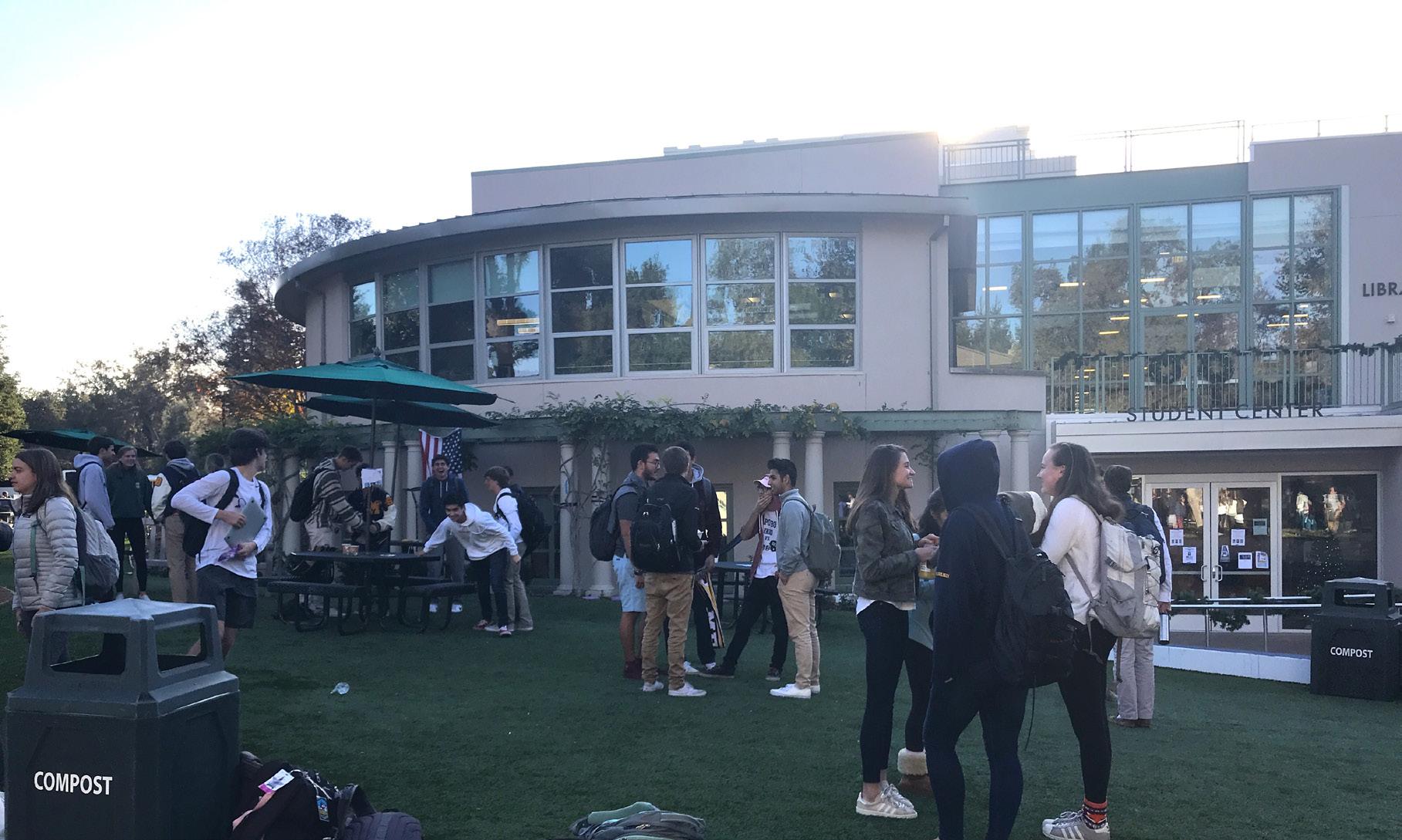
On Nov. 7, the senior class was assembled for a class meeting regarding their position as the leaders of Menlo’s Upper School. In the meeting, the seniors discussed how to be better leaders for the school. Part of the conversation concerned how seniors treated freshmen and their response to freshmen stepping on the Senior Quad. In recent years, the section of the Upper School quad located closest to the Student Center and Library has been reserved exclusively for the senior class to use. As it does not interfere with any pathways to campus buildings, only staff and seniors are allowed to hang out with friends on it or even walk across it.
The unspoken rules of the Senior Quad have been respected by the other classes, with few exceptions. Each year there are rebellious individuals within the freshmen class who enjoy the thrill of pushing the limits, oftentimes expressed through them stepping on the Senior Quad.
However, this year, there have been several instances of freshmen walking on the Senior Quad and posting pictures on the quad on social media. However, this issue did not start to arise at the very beginning of the year. “[The freshmen] seem to have come on our quad when we were gone on the Senior Retreat, that was when it first started and then it has kind of
spiraled out of control since then,” senior Thomas Brown said.
Although the majority of the seniors seem to be mostly unfazed by these incidents, some have taken the matter into their own hands and chased freshmen off the Senior Quad. On Nov. 9, a freshman was seen running onto the Senior Quad, looking to receive attention from the senior class. Seemingly fed up with the freshmen antics, two seniors ran after the freshman until he left the Senior Quad. According to the seniors, both the freshman and the seniors were laughing throughout the entire ordeal.
However, upon seeing this situation unfold, a Menlo teacher intervened and told the seniors to go back to their quad and scolded them for their actions. One of the seniors emailed her with an apology, including Head of School Than Healy in the email.
“We take the senior quad pretty seriously because we respected it throughout our prior three years at
Menlo and it is kind of a tradition. It symbolizes class unity,” Silas Stewart said. Healy proceeded to meet with the seniors and discuss his actions and how he can improve upon them in future altercations with freshmen, should they arise.
Although this issue does not seem to be affecting a large group of students in either grade, the apparent disrespect of some freshmen towards the seniors has not gone unnoticed within the senior class. “[The members of the senior class] have a Facebook group, and there have been posts about freshmen going on the Senior Quad and there has definitely been a lot of resentment about that,” senior Kristin Sellers said.
Yet in spite of senior class members arguing that this year’s freshmen class is more rebellious and less respectful than previous classes, freshman Zayd Mahmoud said that he has not experienced any form of harassment from members of the senior
class and in fact thought that their tradition on the first day of school was very mild. “I think the freshmen are aware [of the traditions], but some of them think it’s funny to encroach on [the seniors'] space but I’m not quite sure how everyone sees it,” Mahmoud said. “It’s also definitely not the entire [freshman] grade that’s trying to push the limits, but it’s a handful of people that make our grade appear this way.”
Some members of the senior class do seem to be aware that this issue is concerning a small number of individuals in the freshman class, not the grade as a whole. “I honestly think the whole series of 'Senior Quad incidents' was pretty overblown. It gave off the impression it was one grade against another when in reality it consisted of only a few seniors and a few freshmen,” senior Grant Dumanian said.
Continued on page 2
The impact of Juuls on the Menlo community
E-cigarettes, which are normally used as a means of breaking habits of smoking, have recently become nationally popularized. However, this trend has stretched beyond cigarette smokers trying to quit and infiltrated high school halls across America. According to the Center for Disease Control and Prevention, the most used tobacco product amongst high school students is e-cigarettes. Among these e-cigarettes is the Juul which is popular amongst teens. “The Juul vaporizer has regulated temperature control and uses nicotine
These e-cigarettes have made their way into the hands of Menlo students
salts as found in the tobacco leaf rather than free-base nicotine, unlike standard e-cigarettes. These qualities are unique to Juul. By accommodating cigarette-like nicotine levels, Juul provides satisfaction to meet the standards of smokers looking to switch from smoking cigarettes,” the Juul website states.
Juuls have found their way into the hands of teen students and Menlo is no exception to the Juul overtake. “[Juuling at Menlo] has grown so much in the past year, even people who used to advocate against it have started using [Juuls and] a lot of people have become addicted which is bad and there’s a little network of people who sell [Juul flavor pods] to each other,” said one Menlo senior who Juuls regularly. Many students in our community own a Juul. “It has definitely negatively impacted some people who need it everyday and feel sick without [it],” Jai Mehra said. At the heart of the appeal of Juuls is the fruity tastes that the nicotine pods come in such as mango, mint, fruit and creme. “I’d say a lot of people are more open to trying [a Juul] because of the taste and how it is less noticeable and dangerous,” Mehra said. The social aspect of Juul is also a reason some students take up the nicotine device. “I have it for when I hangout with friends or parties sometimes or if I’m stressed I’ll use it because it helps with that,” a student said.
Officially, you must be 21 to buy and use a Juul. However, students have gotten around this rule by providing a salesperson with a fake ID when purchasing a Juul in a store. While it is possible to buy Juuls online, the site has a strict system that prevents underage buyers from getting a Juul. The Juul site has a social security number verification which ensures that only legal aged buyers can purchase the nicotine products. While e-cigarettes are supposedly less harmful to one’s health there are still many negative effects of using one. For example, The New England Journal of Medicine claims that e-cigarettes contain formaldehyde, a known carcinogen, which has been known to cause cancer. In addition, Juuls contain nicotine which is a drug that is extremely dangerous for its addictive properties. This means teens can get addicted to Juuls and develop a dependence on the product for a daily fix of the drug.
In an email correspondence with Victoria Davis of the Juul Labs, which does research on their product, she made it clear that Juul’s can be harmful for young teens. “Nicotine is addictive. An individual who has not previously used nicotine products should not start, particularly youth,” Davis said.
Continued on page 2
AHEAD
Dec. 13: Holiday Assembly
Get excited for the beloved Menlo holiday assembly. Listen to some holiday songs sang by the chorus and watch festive dances, then show your spirit in the annual singing of the "Twelve Days of Christmas."
Finals start on Dec. 14th with morning exams beginning at 8:30 a.m. and afternoon exams starting at 1:00 pm. Get sleep, study hard and don't be late! Dec. 14 - 19: Finals Exams
Dec. 20 - Jan. 3: Holiday Break
After a hard week of exams enjoy a two-week break to celebrate the holidays and spend time with loved ones.
Download the CoA App
Stay updated with our CoA iPhone app. Search "Coat of Arms" on the app store today!
News: 1-3
A&L: 4-6
Spread: 7-10
Opinions: 11-13
Sports: 14-16
Seniors socializing on the senior quad after school. Staff photo by Eva Herr.
Photo of the Issue
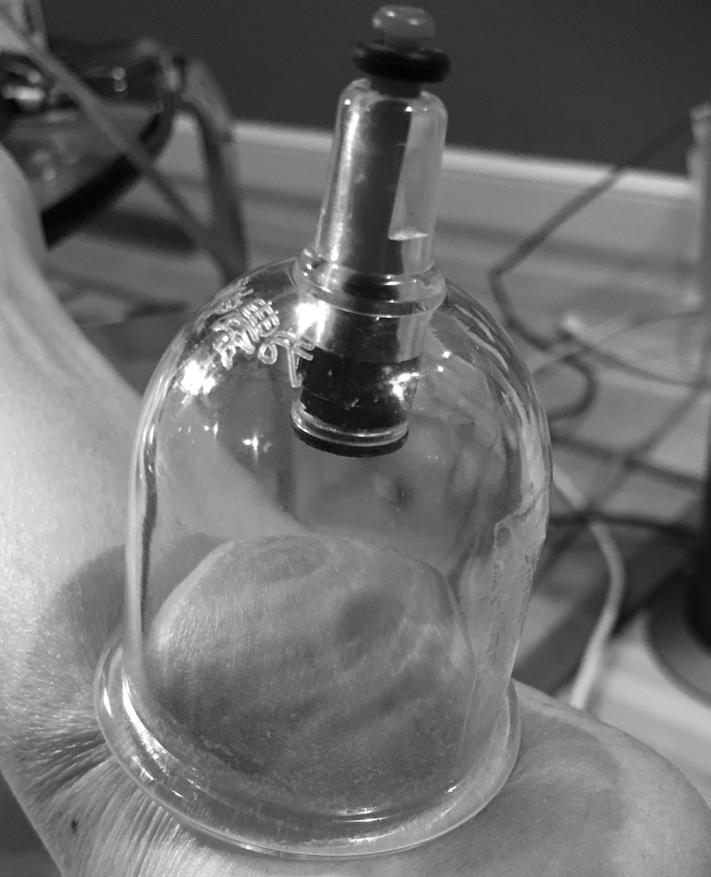
A regular pack of Juul flavor pods and a Juul device. Staff photo by Bella Scola.
by BRIDGET QUIGLEY & KATE JEFFRIES
by EVA HERR
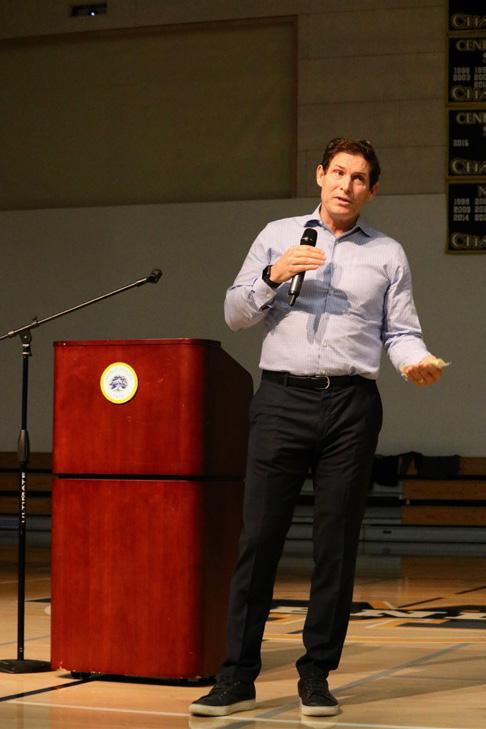
Steve Young speaks at assembly about his experience with anxiety throughout his childhood and football career. Staff photo by Bella Scola.
Seniors & admin, cont.
As Menlo prides itself on the values of love, respect and kindness, the administration has done its best to handle each situation peacefully when it has felt certain incidents have gone too far. “Traditions are great when they create spirit and [a] sense of belonging, when they go the other way, it’s time to think about whether or not to eliminate them,” Dean of Students Tony Lapolla said. Despite the belief of various faculty members’ and students’ that the tension on the quad this year has been more of an issue amongst individuals rather than a class issue, Senior Class Dean Cathy Chen took these incidents, along with others, as a chance
to discuss leadership with the entire senior class.
“Seniors do get certain privileges such as better parking, more choices on their classes and they are the first to be dismissed from assembly, yet some seniors self-assert other privileges that we may have not signed off on,” said Upper School Director John Schafer.
The administration wanted to remind seniors of their leadership and exemplary role on campus and make sure the senior class was aware that while they want to uphold the traditions of the quad, they should continue to treat all classes with respect and kindness.
Use of Juuls, cont.
“Recent science raises concerns about the adverse effects of nicotine on adolescent neurodevelopment.” Many sources, including the University of Rochester Medical Center, claim that the human brain is not fully developed until the age of 25. Therefore, when teens use nicotine products they could be injuring their brain as it develops.
While there has been significant research on nicotine’s addictive properties the long term effects of e-cigarettes and Juuls specifically are largely unknown because of the novelty of the products. Because there are unknown risks and potential health complications that could be connected to Juuling, it is important for all users to Juul with caution.
Juuls have also affected the way students interact. “It is sad to see that an addiction to nicotine is the only thing creating or holding friendships in high school,” junior Riley Holland said. “It’s becoming so much a part of people’s lives and con-
Bridging the gap between the Middle and Upper School
by ABBY WOLFENDEN
Whether it be the Holiday Assembly or the Homecoming pep rally, the Menlo administration has been working towards bridging the middle and upper school in order to create a close-knit, supportive community. The bridging initiative started taking shape when Head of School Than Healy joined the Menlo community five years ago. The goal of bridging the schools became a bigger focus when Middle School Director La Vina Lowery came to campus three years ago.
“This is my third year here and the year I started, the one thing that I tried to do was [bridge] the Homecoming, [...] so inviting 6-12 to the pep rally, to the game, to even have food booths. [We wanted to be] really getting involved in the fun stuff because you always want to start with the fun stuff,” Lowery said.
In years past, some of the things
that have been shared between the middle school and upper school have been all-school assemblies and Homecoming. In the future, Lowery and Upper School Dean of Students Tony Lapolla hope to bridge the two schools in other ways. Lowery wants to make sure that middle schoolers feel prepared and excited for the transition to high school. “Getting our 8th grade more over there so that the transition is smoother, or just putting it out to everyone in the middle school ‘come on over’ […] I would love to see the student council coming over to talk to our students more about some topics. We have the same issues as the upper school in a different way,” Lowery said.
Lapolla also wants to ensure a smooth transition from the middle school to the upper school. He believes that keeping programs like advocacy and the new schedule consistent in both schools helps to do this.“Things for the future: build on what we’re already doing, keep doing more of it, [and] be consistent […] we’ve talked about mentors and also tutors in the two divisions [...] Ultimately, we are one school and we should continue to build on that,” Lapolla said.
Lowery commends the new student center and cafeteria, as this common space has allowed for more integration of middle school and upper school students. “Just having the new student center helps, having that new cafeteria helps. That is a huge step because […] they look up to [upper school students],” Lowery said.
In terms of bridging the schools inside the classroom, Lowery praises the Creative Arts Department. “Having ‘Oliver’ for the musical in the spring [...] is a wonderful bridge. The dance concerts going back to back with each other [is] fabulous. [...] Creative Arts is on it when it comes to bridging middle school and upper school with performances,” Lowery said. All in all, both the middle and upper schools are working towards becoming more in tune with one another in order to create a stronger, more cohesive learning environment for all.
trolled how they associate with other people and it’s directing friendships at Menlo.”
A Menlo senior who Juuls also saw an impact of Juuling on their social life. “Since people know I have a Juul they will ask to hangout and use it or during parties they will come and ask to use [my Juul],” the student said. “If you have Juuling in common with someone else you actually make new friends which is funny.”
While in some groups of students “Juuling” is normal, some students do not participate in the activity. “A lot of my friends do it, I honestly don’t understand the appeal,” junior Sianna Houghton said.
Most of the time the use of Juuls happens at events outside of Menlo such as at parties. However, since a Juul is a compact, easy-to-hide device, students have reported using it during school hours. “[I have used my Juul at school in] bathrooms in between classes if I’m stressed,” a student said.
While there are Menlo students that choose to ignore facts or do not know about the dangers of Juuling, there are many students that are aware of these negative effects and oppose Juuling. “I think people don’t really know how addicting it can be,” senior Kristin Sellers said. “I’ve never experienced the high or head rush that you get, but nicotine and that feeling can be extremely addicting.”
Juul Labs also stated that they condemn the use of Juuls by minors and are hoping to reduce the number of minors that use the product. “Our goal is to further reduce the number of minors who possess or use tobacco products, including vapor products, and to find ways to keep young people from ever trying these products,” Davis said. “We approach this with a combination of education, enforcement, technology and partnership with others who are focused on this issue, including lawmakers, educators and our business partners.”
Underequipped facilities stresses staff members
by DAVID QUEZADA
The new Student Center, Cafeteria, and Technology Support Center have benefitted students and teachers immensely, but what effect are they having on our facilities staff? Menlo facilities workers have expressed that they’re underequipped, which leaves them unprepared to care for the new spaces. The facilities administration sees this as a more temporary issue that should fix itself.
In addition to the buildings that Menlo has previously had, our facilities staff now has to take care of the new Cafeteria, the Student Center and the recently built Technology Center. With no additions to the facilities staff, it makes sense that this might create stress for the current workers.
One longtime Menlo facilities staff member who has worked full time at Menlo for over 10 years believes that the facilities staff is inadequately staffed to properly take care of the new spaces.“There’s more space, which is more work for us,” the facilities source said. Although this facilities source is aware that there is a new job opening, they don’t think this addition will be sufficient. “Supposedly we’re hiring new people, maybe one or two, but we need more.” the source said.
In addition to being understaffed, this facilities worker expressed that the higher-up administrators in facilities either don’t see a problem or aren’t willing to listen. “Sometimes we try to tell the supervisors [about the lack of staff...] They say ‘well that’s what we have right now,’ and I have to do the work myself.”
Another facilities worker, Hung Kat Yuen, feels like the problem may be due to the workers lack of technical education and experience working with the new equipment. “Maybe if the facilities got more education, people could benefit from it [...] Better training could solve the problem,” Yuen said.
Although some of the facilities workers believe that they’re understaffed, the Director of Operations and Security, Loren Arms, doesn’t see the same problem. “We have a great team, a very happy and
dedicated team. All in all things are good,” Arms said. Although Arms acknowledged that the facilities operation is not perfect, he speculated that the situation was temporary. “I think anytime you take on something new, there’s a learning curve associated with it,” Arms said.
Despite his belief that the spaces were pretty much covered by the current staff, Arms acknowledged that they might need a new person to handle the maintenance of the new Café. “We haven’t hired anyone new, we currently have an opening for a new custodial position,” Arms said.
It seems as though the facilities staff as well as the administrators recognize a problem but disagree on how it will be resolved. The workers themselves would like to see more staff hired, while the administrators believe that this problem will fix itself with time and more knowledge about how to be efficient with the new spaces.
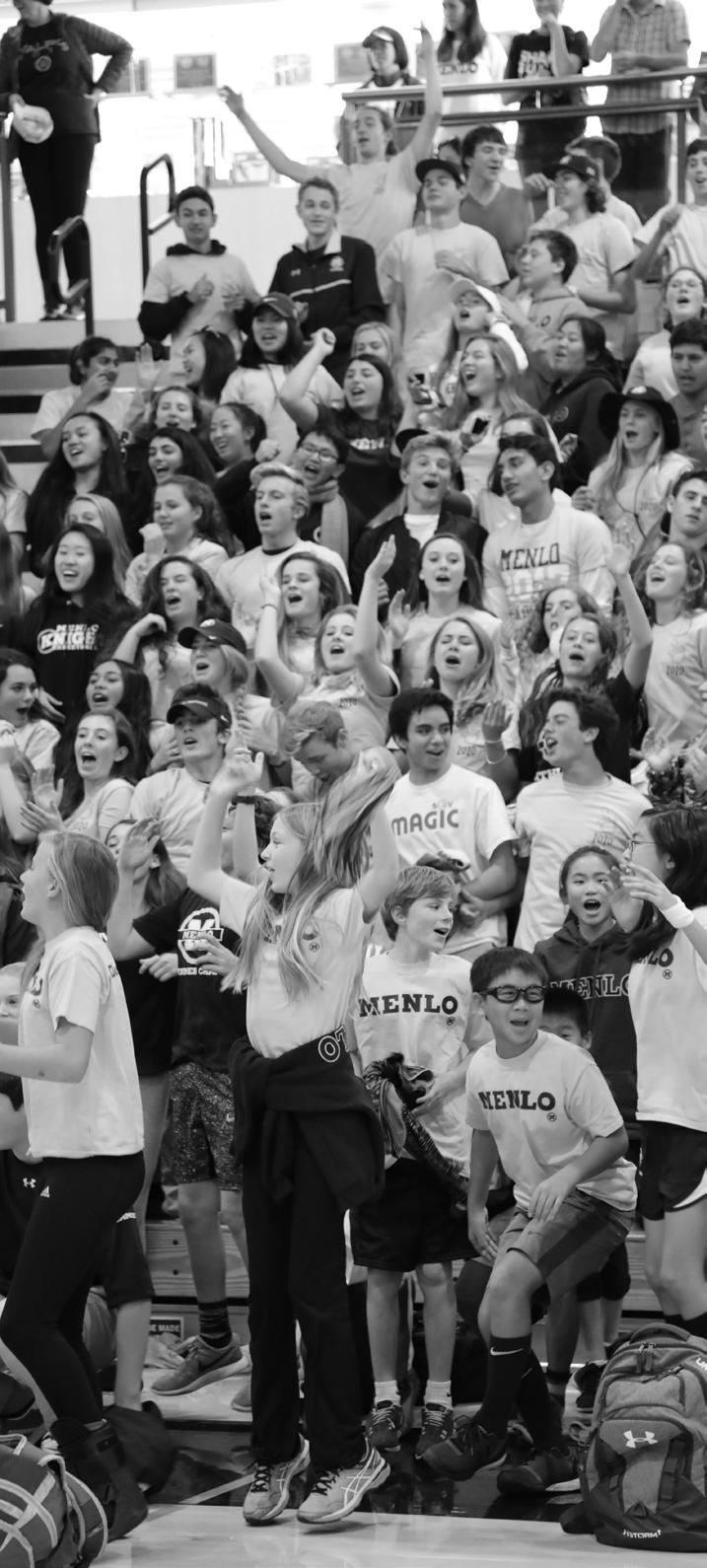
Freshmen and middle schoolers cheer on Menlo during a homecoming pep rally. Photo courtesy of Tripp Robbins.
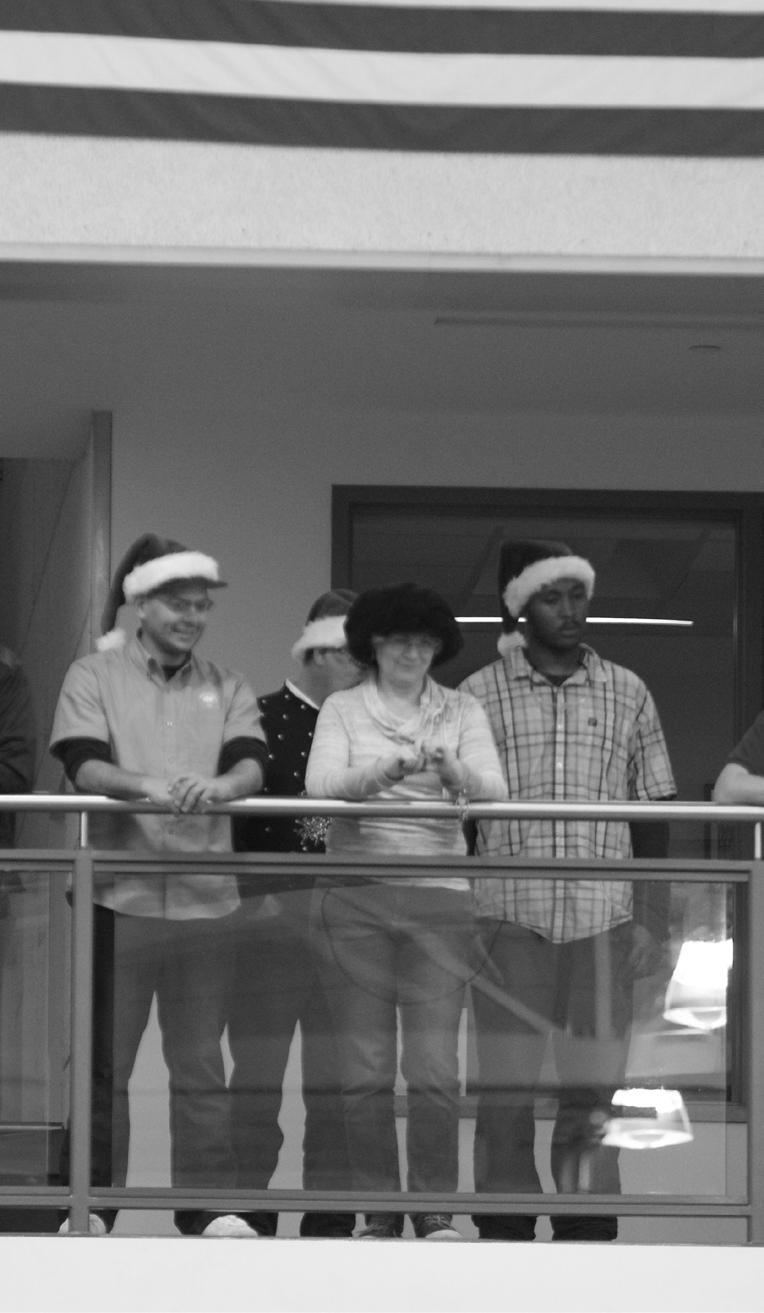
Facilities workers enjoy the annual holiday concert.
Photo by Tripp Robbins.
Model UN club participates in Standford MUN Conference
by TY CORLEY
The Menlo Model United Nations team recently competed at the Stanford Model United Nations Conference. The group participated in several mock international conventions while at the conference. These included acting as Soviet Union members in the 1945 Joint crisis, representing the Greeks in the
Trojan War, acting as delegates in the Constitutional Convention and many more.
Model United Nations conferences seek to simulate the real United Nations. Students are asked to follow appropriate procedures in order to further replicate the actual meeting of the world’s nations. Students represent different countries at the conference that have a variety of different issues they need to address. The end goal is to form resolutions and contracts in order to solve these issues.
The Menlo Model UN team had been prepping for over three weeks for this conference. They had to practice important debate skills before the conference but they also learned many techniques throughout the experience. “We are very passionate about debate,” junior Jake Martin said. “During the debate we learned valuable skills and the importance of compromise in order to form solutions.”
At the conference, delegates attended a number of committees and caucuses with students from other schools. In the 1945 Joint Crisis, delegates had to deal with negotiations concerning the Chinese Civil War, the end of World War II and the onset of the Cold
War. Students needed to come up with solutions to various problems acting as representatives for different countries. Menlo’s representative was a delegate in the Soviet Union. “In my council, the USSR, we debated, drafted and passed laws relating to rebuilding Russia after WWII, developing a nuclear arsenal, and converting China into a communist state,” senior RD Babiera said.
Menlo also had delegates entrenched in debates over Black Lives Matter, South African development, the World Health Organization and environmental problems. While students learn valuable debate and public speaking skills, the Stanford MUN conference is also very informative for students. “We learn about the art of negotiation while learning about international affairs and global issues,” senior club leader Roshan Chandna said.
While the process is very intensive and demanding, delegates have a lot of fun and are very passionate. “Menlo school delegates spent over twelve hours over the course of three days pushing their countries’ policies in committee. It is a lot of work but it is very rewarding and fun,” Chandna said.
Menlo Abroad trips aim to empower students
by SAM FORTENBAUGH & EVA HERR
The new Menlo Abroad program offers students an experience of cultural immersion through traveling in foreign countries. Students can create new relationships and gain a stronger sense of global citizenship, leadership skills and self-awareness. Menlo offers four different programs: Guatemala, India, China and Tanzania. Only grades nine through eleven are eligible for these programs and can apply online.
Every program extends from May 29 to June 20 and 12 to 16 students can go on each trip. There is financial aid available, but the trip costs range from $4,400 to $5,500. To apply for a trip, one does not need a language background, and there are no class prerequisites.
Global Programs and Studies Coordinator Peter Brown describes what the programs offer. “We want to invest the time and energy in the country to really particularly understand the culture […] It also takes time to engage with communities, to know them better, as opposed to Knight School when we did not have the time for that,” Brown said.
Brown stated that there are five main intentions of the global programs: learn more, cultivate attitude of caring, develop connectedness through homestay, give students a sense of meaningful work like addressing common issue and to bring those experiences back to Menlo. Brown also commented on the type of student that should apply to a Menlo Abroad trip. “You have to be open to new environments and cultures. You have to be able to deal with discomfort,” Brown said.
One of these offered global trips is the threeweek trip to Guatemala which will run for the fourth time. The leaders for the trip are two faculty members, Upper School English Teacher Nick Romeo and Associate Admissions Director Roger Zamora, as well as two country experts from the teen travel agency Where There Be Dragons.
On this trip, the students will stay with host families, study Guatemalan history, contemporary issues, sustainable agriculture and rural agrarian life through service projects. To learn about Mayan food preparation, the students will take a tour and cooking class with De La Gente Farms.
Another Menlo Abroad program is a trip to India which will be running for the third time. The
trip leaders are History teacher Matthew Nelson, School Counselor Nina Keebler, Head Librarian Cathy Rettberg and a translator in Ranikhet who will teach students elementary Hindi and translate as needed.
The goal is to introduce students to the NorthIndian religion and culture. The students visit the cities of Delhi, Rishikesh, Haridwar and the rural Himalayan community of Ranikhet. The students live with host families in Ranikhet. Through the students’ work with the Pan-Himalayan Grassroots Development Organization, they will contribute positively to address pressing local and global issues. The students also get to relax with yoga lessons from a yoga master.
One of the new global travel programs is a trip to China which will be lead by Mandarin teacher Mingjung Chen, Math teacher Amber Corcoran and two country experts affiliated with Where There Be Dragons. By visiting Beijing, the Great Wall and villages of Yunnan, students will be introduced to the geographical, linguistic and cultural diversity of China. This first hand experience will also familiarize students with the rapid changes in China. The students will develop Mandarin language skills and a stronger cultural understanding of China.
Another one of Menlo’s new trips is to Tanzania. The trip leaders are Assistant to the Upper School Director Frances Ferrell, Photography teacher Pete Zivkov and two trip leaders from our affiliate organization World Leadership School. The students will hike on Mount Kilimanjaro and visit other interesting destinations. The students will spend most of their time in Karatu, a diverse community in Northern Tanzania. In Karatu, the students will stay with families and immerse with the community. They will take Ki Swahili lessons and meet with students and teachers at local secondary school involving different types of community development work.
The Menlo Abroad programs are a unique opportunity that previous students positively reflected on. “My best moment was spending time with my host siblings playing jump rope, teaching them English and taking walks at sunset to pick up things from the market,” junior Meredith Power, who went to India, said. Other students similarly
had unforgettable moments while abroad. “If I had to choose one moment that I know will still stay with me forever is when a couple of friends and I arrived back at my house after a long, rainy day out doing research, and all of the sudden I looked up and gasped. The clouds in the distance had cleared and we had a perfect view of the Himalayas, which to this day are the biggest things I’ve ever seen in my life,” senior Kelly Campa, who also went to India, said.
Power not only made long lasting memories but also learned about herself and the similarity between her and others. “My biggest takeaway was learning that I can be independent and that people around the world aren’t as fundamentally different from me than I thought,” Power said.
Students also enjoyed their stay with host families while on their abroad trips. “My biggest takeaway was that I could go halfway around the world, live with a family that I had nothing in common with, and have the best time of my life,” Campa said. Power similarly loved her homestay. “Going into a new country and staying with host families is a unique experience. Staying in a host family was amazing because even though we couldn’t communicate verbally they still made me feel apart of the family,” Power said.
Power had some advice for all those applying for or going on Menlo abroad trips. “You have to have a thick skin and be up for anything,” Power said.
Seniors Kelly Campa and Julissa Torres and junior Meredith Power on the Menlo Abroad trip to India. Photo courtesy of Kelly Campa.
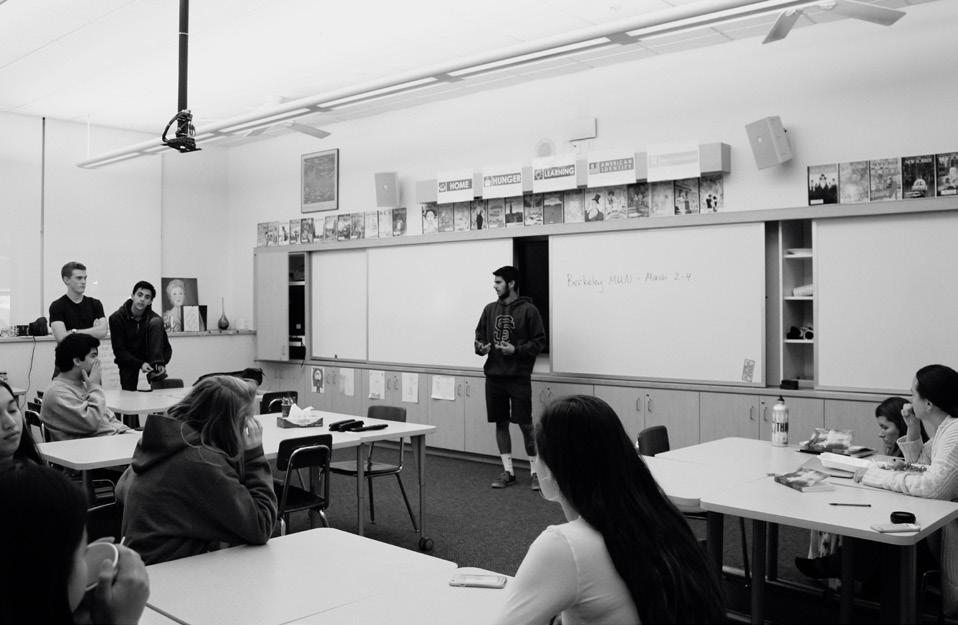
Students in Model United Nations club listen to the club leader, Roshan Chandra, as he presents to the group about the Berkeley MUN conference. Staff photo by Ty Corley.
On the Quad:
What
is the first thing you’re going to do after finals?
“Throw away all my papers.”
-Grace Macdonald ‘19
“Play Mahjong with my Grandma.”
- Jake Shiff ‘18
“Go to KFC.”
-Joseph Ma ‘19
“Sleep and spend a lot more time with my siblings while they are home.”
- Emma Dressel ‘20
“Definitely just chill out with my friends and family, watch movies and make good food.”
- Taylor King ‘19
The multi-talented artist: Chloe Lai
by SHELBY RENDE
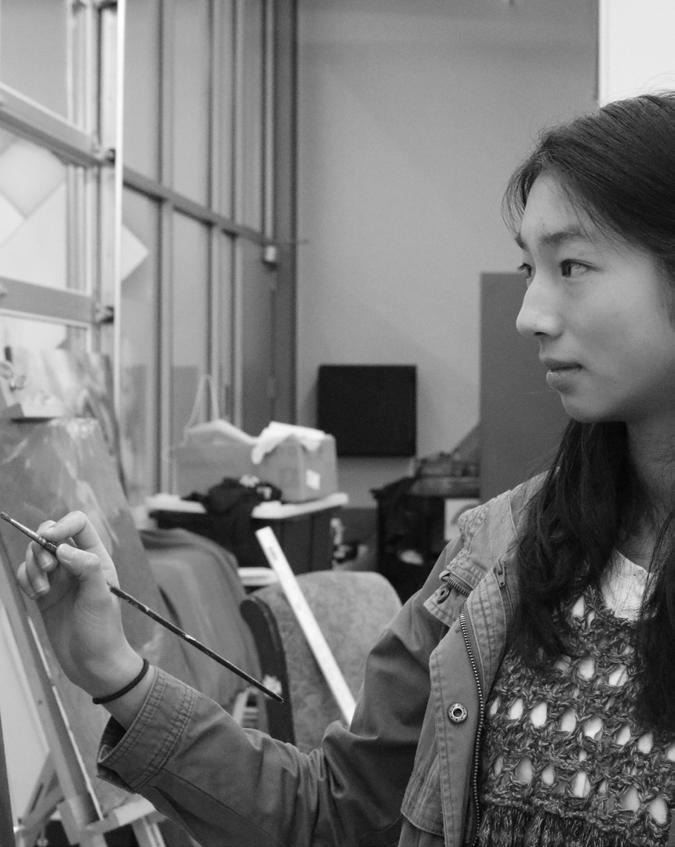
Chloe Lai is the female Artist of the Issue because of her talent in visual and studio art. She attributes her skill in art to her many years of practice. “I have always been better at art than sports as a kid,” Lai said. She also says that music helped her get into the arts in high school.
Lai is a Teacher Assistant (TA) for an advanced art class this year. In the past Lai has taken advanced art her sophomore year and art outside of school her junior year because it didn’t fit into her school schedule.
“This year as a TA for Advanced Art, Chloe is preparing mini-teaching modules on modern art movements as well as some fun activities in collage techniques,” Art teacher Nina Ollikainen said.
Ollikainen has worked with Lai since freshman year and has seen a lot of progress since then. “She continues to challenge herself to improve on her skills by working hard and asking great questions,” Ollikainen said.
Most of Lai’s work includes people and landscapes.“I really like [drawing] people. I think people are really beautiful [to draw],” Lai said. She has painted many pictures such as her painting “The women with the corn.” She especially likes this piece because of the background and the village behind her.
She found inspiration for her painting while on a Menlo Abroad trip, where she saw a very peaceful moment of a woman cleaning corn preparing to make masa. Lai want-
ed to focus on elevating an everyday task and making it beautiful.
Lai chooses her artwork from outdoor inspiration, where she likes to find specific scenes to paint. “I like to take pictures and then I just go through them and pick one that stands out to me and paint that,” Lai said.
Looking forward in her life, Lai would like to take more art classes in college. “I want to learn more types of art, like 3D and [...] more big art [pieces],” Lai said. Although Lai wants to take art classes in college, she doesn’t think she will ever have a career as an artist. However, she still wants to include art in her life.
“I will probably take a nap.”
- Davis Mead ‘21
“Have a Christmas party with my friends, and bake, and do a gift exchange.”
- Grace Enright ‘18
Will Buxton’s passion for violin
by CLARA GUTHRIE
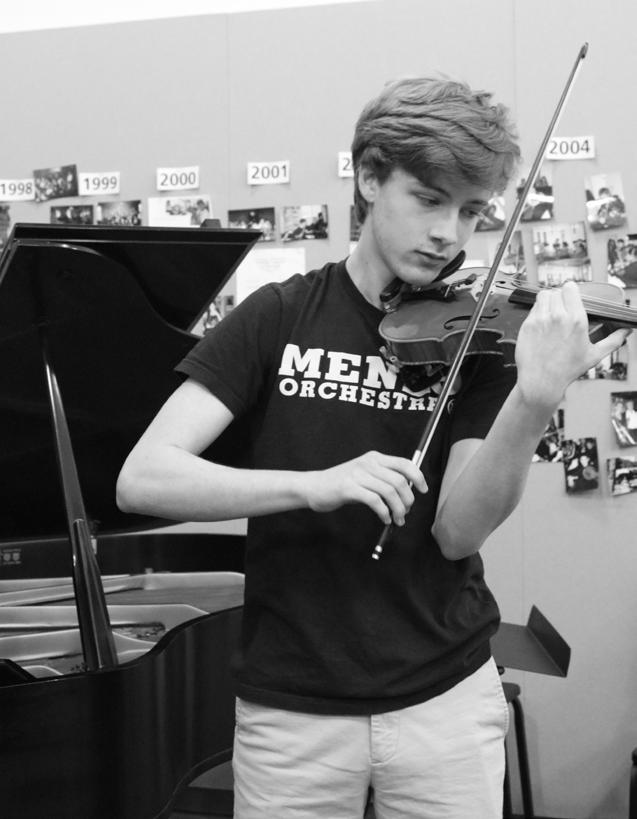
Junior Will Buxton is the male Artist of the Issue because of his passion for playing the violin, specifically in orchestra. Buxton began his violin training in elementary school after seeing his mother play the same instrument. “I was like any other violin student who starts out being forced by their parents, [...] but the ones that don’t quit by middle school are the ones [...] doing it for their own good. Now I love it,” Buxton said.
Buxton first played in an orchestra at Menlo Middle School and with PACO, the Palo Alto Chamber Orchestra, later continuing to Menlo Upper School orchestra. He attributed his staying with orchestra to his love of music. “The main reason why I do orchestra is just to play music and make a finished product that sounds good and that I’d be proud of,” Buxton said.
This year, Buxton has risen to the challenge of being first chair of the violin section, leading the other violinists during practices and performances. “I need to be good at my part so I can help the other [violinists] and make them sound better,” Buxton said.
Orchestra transitioned its leadership this year and is now under Leo Kitajima who praises Buxton’s abilities in the group. “[Buxton] leads his fellow violinists with confidence and intuitive musicianship. A musician like [Buxton] is capable of demonstrating musical phrases that make it easier for others to hear and use as a reference point,” Kitajima
said.
Buxton also has high regards for the abilities of his peers within orchestra. “It is the biggest class at Menlo, so you have people from all over Menlo, but [...] we all have a universal goal of making music sound good,” Buxton said.
Beyond orchestra, Buxton plays in a trio unaffiliated with Menlo called “Midsummer Trio” with other Menlo students. “I play in a violin, piano, cello trio with [juniors Avi Gupta and Walter Li] and we do some gigs,” Buxton said. The group formed in the Menlo Middle School when the three boys were asked to play live music for the middle school play, “A Midsummer Night’s Dream.” Their last performance was a fundraiser for North Bay fire relief on Monday, Nov. 13.
Chloe Lai adds finishing touches on her latest painting. Staff photo by Bella Scola.
Will Buxton plays a song on his violin. Staff photo by Bella Scola.
TOP 10: Holiday Gifts
by ERIC CHANG, SAM FORTENBAUGH, & SID CHARI
Cold
by ERIC CHANG & SID CHARI
Holiday Season
Hot Chocolate from the Bookstore
“Cold” Weather
Students with long commutes
by ABBY WOLFENDEN
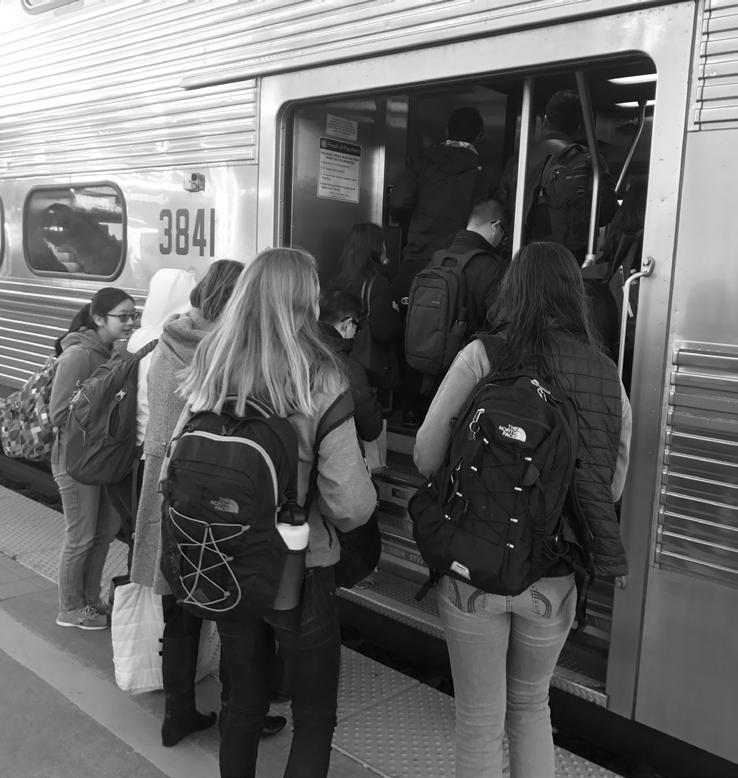
While for many of us, a morning commute to school is a 10-minute drive down Valparaiso, some students that attend Menlo have long commutes to school, coming from places as far as Pacifica and Oakland.
Beyond just the inconvenient early wake-ups and bumpy bus rides, long commutes can have an impact on a student’s academic, social and extracurricular life at Menlo. However, most students with long commutes knew exactly what they were getting into during the application process for Menlo.
“After I decided to come to Menlo, I knew since I had older siblings here that I would have to commute a long ways, and so that was just one of the factors that went into my decision of coming to Menlo, and that was something I was aware of throughout the process of applying to high school,” senior Kathryn Wilson said. Wilson lives in Hillsborough, which is about a 40 minute drive to school in traffic, but only a half hour commute by train. She has ridden Caltrain to Menlo every day for her four years--from the Millbrae train station to the station in Menlo Park.
Living in Millbrae, a 50-minute commute by car, sophomore Alyssa Sahami has a similar situation as Wilson, but rotates between carpools and train rides. “I switch off taking the train and carpooling with some friends and teammates who live around me,” Sahami said. “The commute to school definitely has affected my daily routine since I pretty much have to plan out exactly when or how I am going to get to school [...] I wake up at 6:30 when I take the train or 7:00 when I carpool with friends.”
Living in the East Bay, freshman King Christian has a more daunting trek to school than most students--with roughly an hour and a half commute from Oakland. In order to get to Menlo, Christian must take two trains: Bart and Caltrain. After Caltrain, he takes
the shuttle bus to Menlo. “Sometimes [I enjoy my commute] but other times it’s very rough. Most of the time I usually just sleep on the train, which is enjoyable,” Christian said. He has learned various things from his long commute and developed a strict schedule. “I’ve learned a lot about people who have to work long days and wake up early and have to make a long commute,” Christian said.
Sophomore Bella Guel also has a particularly long journey to school from Pacifica. She wakes up at 6:00 in the morning in order to be on time for her 25 minute carpool ride to the train station and 30 minute train ride to school. “I definitely have learned how to time manage and plan ahead. I already was fairly good at keeping myself extremely organized prior to coming to Menlo but living an hour away brought that to a whole new level. I now do a lot of studying and reading on the train or reply to emails in order to maximize my time,” Guel said.
“I just think that commuting in general is definitely more of a hassle because taking a long time to get places requires a lot more planning in advance.”
For the most part, Menlo students dislike having such long commutes to school, as it can be draining to have to deal with early wakeups, traffic, and public transportation. “I just think that commuting in general
Finals
is definitely more of a hassle because taking a long time to get places requires a lot more planning in advance [...] I’ve missed a train a good amount of times throughout my four years, so having to rely on something else is definitely an issue, but something that everyone who takes the train has to deal with. Other than that, public transportation is a really reliable way to get places,” Wilson said. Christian finds that waking up early in the morning has been the most frustrating aspect of his commute. “I wake up at 5:10 in the morning, and then I usually get home somewhere around 7:00. I don’t really have time for extracurriculars since I have a long commute […] I can’t really hang out that much with friends on the weekends and stuff since I live so far away. And then also during the day it can be tough to stay awake because of the long commute,” Christian said.
Senior Shreya Agrawal also lived in the East Bay, which was a 30-minute drive without traffic, but could be an hour or more during the morning rush. She finds that her commute can contribute to her stress.“My commute has made it difficult to balance my academic, social, and extracurricular life at Menlo. There have been points in time where my commute and academic life together has caused me to take breaks from my outside of school activities, like dance. For the most part, it hasn’t made a significant impact on my social or extracurricular life, but it has made some school days more stressful,” Agrawal said.
However, Menlo students try to see the positive side to commuting as well. “I would like to
think that [my long commute] hasn’t affected me too negatively. In fact, I usually get stuff done on the train. It’s not really a bumpy ride, so I can always work on something, so maybe I’ve even been able to have a time where I’m focused for half an hour. I try not to focus on the negatives too often because it can be easy to look at it that way,” Wilson said. Sahami has also noticed both the ups and downs to a long commute. “I wouldn’t say I enjoy the commute because it takes a while to get home, but commuting has definitely made me closer to some of my friends, because we always spend time with each other getting to or from school,” Sahami said.
Similarly, Guel appreciates the friendships she has made. “My friends have been extremely helpful with supplying a ride or a place to stay if I need it which has made the commute doable. I also have met some of my friends through the train. There are easily 10 other sophomores that take the train consistently as I do or at least once every other week. I got to know those people first when coming to Menlo, as I didn’t know anyone ahead of time,” Guel said.
Students take Caltrain to Menlo. Staff photo by Abby Wolfenden.
Gillian’s Cooking Column: German Chocolate Cake
by GILLIAN BRESSIE
Every Christmas celebration I can remember has involved either my mom or my grandma making a German chocolate cake to share with the family. Here is a recipe for you to share with yours this holiday season! INGREDIENTS:
FOR THE CAKE
8 ounces (2 sticks) unsalted butter, plus more for pan 2 1/4 cups all-purpose flour
1/4 cup unsweetened cocoa powder
1 teaspoon baking soda
1 teaspoon salt
1/2 cup
1/2
1
FOR THE GLAZE
3 ounces bittersweet chocolate, chopped 1/2 cup heavy cream 2 tablespoons unsalted butter
DIRECTIONS:
1. Make the cake: Preheat oven to 325 degrees. Butter a 14-cup Bundt pan. In a large bowl, whisk together flour, cocoa, baking soda, and salt. Mix milk and sour cream in a glass measuring cup.
2. With an electric mixer on medium-high speed, beat butter and sugar until pale and fluffy, 3 to 5 minutes. Add eggs, 1 at a time, beating well after each addition; add vanilla. Reduce speed to low; add flour mixture in 2 batches, alternating with the milk mixture
Random Student Profile: Jai Mehra
CoA: What is an average Saturday?
JM: Do homework during the day, maybe play some video games, then go out with my friends at night.
CoA: How was Santa Cruz?
JM: Typically, it’s pretty fun.
CoA: What do you do when you wake?
JM: I have bowls of chocolate cocoa krispies cereal.
CoA: What is your favorite type of fish?
JM: I don’t know.
CoA: What is your favorite brand of gum?
JM: Spearmint.
CoA: How would you explain the color yellow to a blind person?
JM: Vibrant.
CoA: I’m going to say some words and you’re going to tell me the first thing you think of.
CoA: Chickens.
JM: Food.
CoA: Oranges.
JM: Tangerines.
CoA: Football Helmets.
JM: Concussions.
CoA: Toothpaste.
JM: Brushing.
CoA: Mangoes.
JM: India.
CoA: Who is your favorite person under the age of eight?
JM: I don’t know anyone under the age of eight.
CoA: Who is your celebrity crush?
JM: Selena Gomez.
CoA: Tell me about your mom.
JM: She is lovely, just lovely.
CoA: What is your favorite state?
JM: California.
CoA: What’s your favorite city?
JM: Philadelphia.
CoA: What do you want to do when you grow up?
JM: I want to go into finance and economics.
CoA: Cats or dogs?
JM: Dogs.
CoA: Red or yellow?
JM: Red.
CoA: Bowls or plates?
JM: Bowls.
CoA: Trees or the sky?
JM: Trees.
CoA: Sweatshirts or shirts?
JM: Sweatshirts.
and beginning and ending with the flour; beat until just combined.
3. Transfer batter to prepared pan; smooth top with an offset spatula. Bake until a cake tester comes out clean, about 55 minutes. Transfer pan to a wire rack to cool completely.
4. Make the glaze: Place chocolate in a heatproof bowl. Bring cream to a simmer in a small saucepan; pour over chocolate. Let stand 2 minutes. Add butter, and mix until smooth. Let stand, stirring occasionally, until slightly thickened. Pour glaze over cake. If you choose not to use the glaze or don’t have time, use a strainer and a spoon to dust powdered sugar lightly over the top of the cake.
Menlo students and faculty share their holiday traditions
by CONNOR VAN LIGTEN
Menlo is a school full of students of many different denominations. With the holiday season in full effect, Menlo families are participating in their unique yearly traditions. Many students at Menlo enjoy celebrating Christmas, a popular holiday throughout the United States and the world. Traditionally, Christmas is a Christian holiday celebration that commemorates the birth of Jesus Christ; however, in our day and age many families use Dec. 25 as a time for giving and receiving gifts as well as celebrating family and unity. Other Menlo students celebrate Hanukkah, a jewish holiday that celebrates the rededication of the Holy Temple in Jerusalem. It spans over eight days and is also known as the “festival of lights” due to the nightly lighting of the menorah. Like Christmas, some jewish families involve gift-giving and feasts during Hanukkah, with traditional jewish foods such as potato latkes. Lastly, while largely uncelebrated by Menlo students, Kwanzaa is a week-long tradition that celebrates African heritage, unity, culture. It also involves gifts and special foods. Although most Menlo students no longer believe in Santa Claus, it seems like some families still like to partake in the timeless tradition of cookies and milk. “My mom still puts out cookies and milk for Santa, and eats half of each cookie for herself,” senior Ryan Thompson said. Christmas TV specials and movies, although less popular now, are also still a staple for some families. “We always watch Christmas on Sesame
Street,” Jessie Thomas Brugos, English teacher and Director of Community and Civic Engagement, said. Other more modern Christmas movies enjoyed by Menlo students include Home Alone and Elf.
Often, holiday traditions involve more Menlo families than one. “My family goes to the Kafayi household, and we have a speech and debate competition,” senior Atreya Iyer said. “But nobody lets Kevin speak.” The holidays are a much needed period of relaxation for students and teachers alike, especially after the tough stretch of first semester finals. “I take part in the holiday tradition known as sleep,” joked History teacher Matthew Nelson, who also attends Christmas day mass with his partner each year.
For those who celebrate Hanukkah, the traditions are just as prominent. “The four of us go out to our favorite Chinese food restaurant and […] just absolutely gorge ourselves. We then go home and watch an action movie before going to bed early and continuing on with our vacation,” freshmen Ben Siminoff said. “Hanukkah is really more of a kids’ holiday, so, when I was little, we might also play a game of dreidel before or after exchanging presents, which my parents stretched out across all 8 nights,” Upper School English Chair Maren Adler said. “Now, I try to make potato latkes or other seasonal foods and desserts and my husband and I only exchange one present on the first night.”
Whether one celebrates Christmas, Hanukkah, or something else, the Holidays are an exciting time for families to get together and celebrate.
The yummy finished product. Staff photo by Gillian Bressie.
Photo Courtesy of Menlo School by ELECTA NARASIN & ERIC CHANG
OUR IMPACT ON THE ENVIRONMENT
Carpool Parking at Menlo
by Gillian Bressie
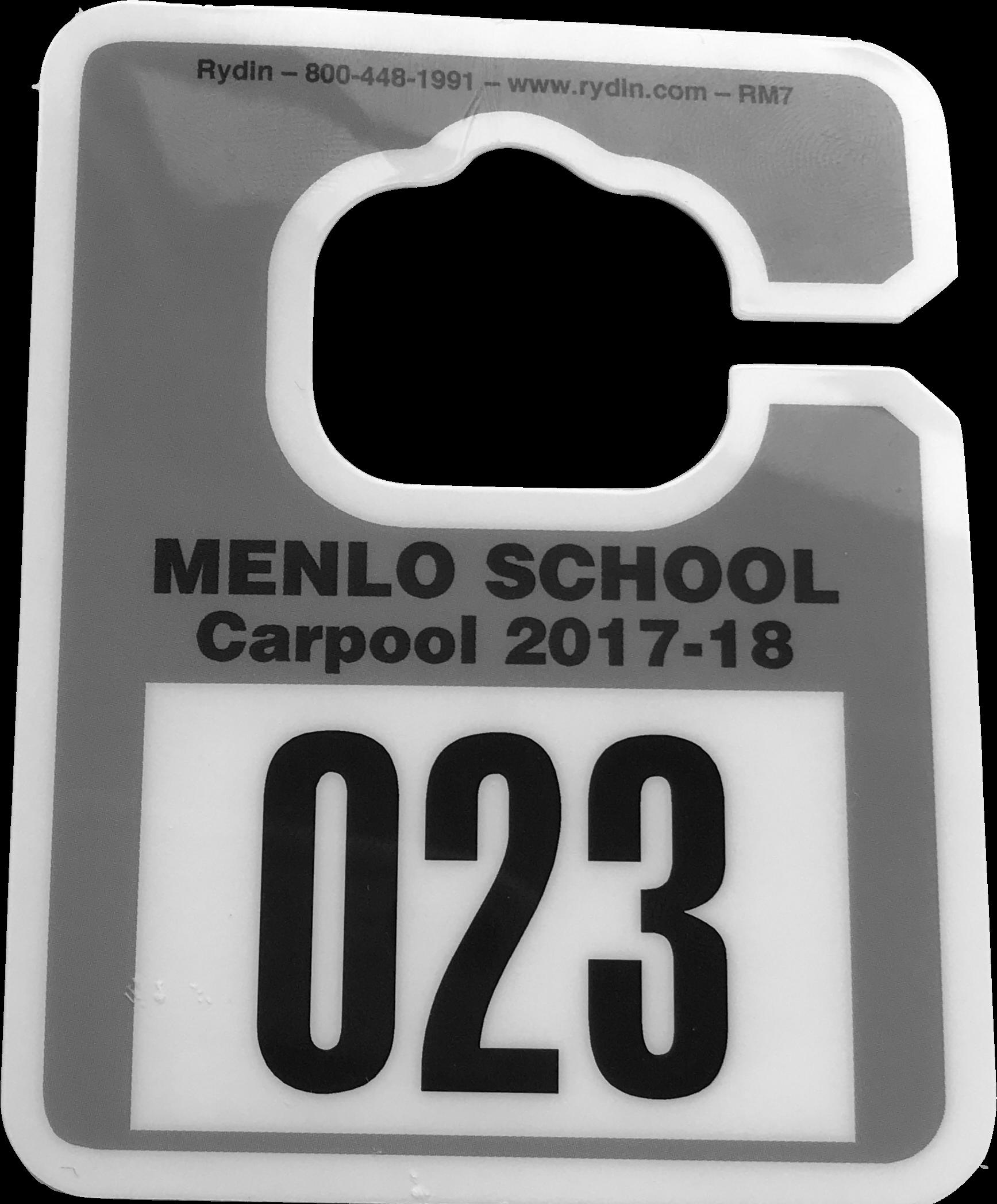
For the last six years, Menlo has had a carpooling initiative in which preferred parking spaces are reserved for those with specific carpool passes as an incentive for carpooling. The program started out small and has since grown, with carpool spaces taking up an entire row of the Valparaiso student parking lot. “The whole transportation program was started when I arrived in August 2011 and we had maybe 10 carpool spots at the time then it expanded,” Director of Sustainability Kevin Conner said. “I would say the carpool spots were the main incentive [...] The incentive was a shared responsibility to reduce our traffic coming to campus.”
In order to get a carpool pass, a form must be submitted to the student life offices including the names of either one student from another family that you plan to carpool with, or two siblings.
For students, the convenience and availability of parking spaces serves as an incentive to carpool with students who live nearby. Many upperclassmen who have had their license for a year choose to drive underclassmen who do not yet have a driver’s license. “Mine comes in handy because I
drive [senior Ashley Dreyer] almost every morning and especially living far away, it gives me peace of mind that there will be parking for us,” senior Kate Gruber said. Others agreed, citing the location of the spots as their primary incentive to drive others. “Carpool spots are a lifesaver,” junior Abby Doll said. “I drive a full car so it’s super helpful having spots near the front that not everyone can use, especially now that the [Valparaiso student parking lot] became a junior and senior lot.”
However, the availability of carpool spaces has diminished due to how easy to attain these passes have become. Students only have to write down two students’ names with whom they plan to carpool. Since carpool passes have become so easy to get, more students have them and carpool spaces are less readily available, thus diminishing their appeal. “I think it’s too easy to get one. People lie to get them all the time. At some point all that lying will defeat the purpose,” Gruber said.
Student Ryan Thomspon’s
Service Initiative
by Baily Deeter
Throughout high school, Menlo senior Ryan Thompson has contributed significantly to important environmental causes through foreign service work. His main focus has been preserving biodiversity in Central America.
During the summer before his junior year, Thompson went on the Menlo Abroad Guatemala trip and the summer before his senior year, Thompson went on a solo trip to Panama. Both trips were focused on specific causes to help the environment. Thompson presented his research and takeaways from both projects at a school assembly in October.
The Guatemala trip was with a small group, and it spanned three weeks from mid-June to early July. “During the day, we worked on the Chico Mendes reforestation project, and at night, we would go back to our homestay families to eat and to sleep,” Thompson said. The reforestation project entailed planting trees on a large hill where deforestation had occurred.
Thompson indicated that the Guatemala trip helped him in many different areas of his life. “It was a great opportunity to learn more about Guatemalan and Mayan culture, to improve my Spanish and to contribute to an important restoration effort,” Thompson said.
The next summer, he took his efforts a step further with his Panama trip. He single-handedly designed the project and received the HAND Grant through Menlo. The HAND Grant is awarded to students by the HAND Foundation in order to allow students to investigate a serious societal issue in great depth, often entailing research in foreign countries. This grant allowed him to put his plan into action.
Thompson prepared extensively beforehand so that he could successfully implement the project. “The focal point was field study of tropical systems and satellite imaging,” Thompson said. “I got in touch with a satellite company called Planet Labs and used their images in conjunction with geographic information systems software to map large-scale changes to ecosystems.”
Additionally, Thompson worked with local farmers to identify some of the region’s key environmental problems. “We honed in on the use of cancer-causing pesticides and herbicides and dumping of chemicals into rivers as key factors contributing to a loss of biodiversity,” Thompson said.
Thompson has always had a strong interest in this area and he cited his desire to make a legitimate impact as reasons for his projects. “The way I see it, we all have a choice to make,” Thompson said. “It’s a global issue at this point, and I felt obligated to go out and to do my part to make positive change as opposed to sitting on the sidelines watching it get worse.”
Spotlight on Environmental Coordinator Andrew Kim
by Clara Guthrie
Junior Andrew Kim has served on Student Council as the Sustainability Coordinator for the past two years. This year, he’s taken on the added responsibility of running Menlo’s Environmental Club with senior Kathryn Wilson.
Kim was first motivated to run for Sustainability Coordinator last year because of his strong love of nature. “I’ve always liked nature. My mom says I used to walk in nature with my grandma. It reminds me a lot of my grandma who passed away recently,” Kim said.
Kim’s initial goal last year was to slowly introduce sustainability to the Menlo community. “I wanted to create Menlo [into] a more ‘gogreen’ place, so I first focused on helping the Menlo garden grow,” Kim said. The biggest project Kim completed last year was the first annual Menlo farmer’s market in partnership with Menlo College. “The college really helped and we were able to form a relationship,” Kim said. Kim is currently planning the second annual Menlo farmer’s market. “We’re going to work with Flik, so this one will be more Menlo-based,” Kim said.
Additionally this year, Kim is shifting his focus to a very relevant issue in
“I wanted to make Menlo [into] a more ‘gogreen’ place, so I first focused on helping the Menlo garden grow.”
the Menlo community. “[Environmental club is making] ‘clean up your trash’ posters and we’re planning on putting them up in the cafeteria soon,” Kim said. Beyond just cleaning up after themselves by throwing their trash away, Kim is adamant that the Menlo community puts all of their trash in the correct places. “We’re trying to redesign the trash cans [on campus]. [...] We’re planning on making visual representations to show people, ‘this is what you put in the recycling’.”
Dean of Students Tony Lapolla has worked closely with Kim for the past two years throughout his involvement with student council and is proud of Kim’s dedication to making Menlo a more environmentallyfriendly place. “[Kim] is committed to educating the community on issues related to the environment and locally sourced food,” Lapolla said.
Beyond his work on student council, Kim sees a future for himself in the world of environmental issues. “I feel like we’re really responsible for our earth. It’s our earth. [...] It’s about raising awareness and trying to make [it] a better place,” Kim said. “One of my dreams is to be President of the United States and one of my goals would be to handle [climate change].”
Kevin Conner’s Role in Menlo’s Sustainibility
by Eva Herr
Seven years ago Menlo added a brand new faculty position: Director of Sustainability. Kevin Conner filled this role and started to push environmental initiatives on the school. Some programs are noticeable such as the carpool spots in our parking lots, but others fly under the radar like his work with facilities to help regulate the drought. Regardless, his full time job is to ensure Menlo is sustainable and to help educate our community about our environmental responsibilities.
Conner first became interested in environmentalism as a student at Boston College where he minored in Environmental Studies. “[I did a] capstone project where I analyzed water use on Boston College’s campus and then presented a report on different ways the campus could reduce their water use,” Conner said. This hands-on project propelled Conner’s interest in environmental issues. “For me that project was the most exciting project I worked on at Boston College so my focus definitely shifted at the end of my school year,” he said.
In 2011, Conner was hired at Menlo and began working to help the school’s environmental sustainability. “I would say my main responsibility is to manage the transportation program,” he said. “What I do most is speak with incoming families about how important it is to our school that they participate in [sustainable transportation] options, then I work with each family individually to find what options work for them.”
Additionally, while we have become accustomed to the multicolor disposal bins that remind us to be mindful of when to recycle and compost, Conner spearheaded that project just seven years ago. “There were once just gray tubs everywhere and I was the one who pushed for recycling and compost all over campus,” Conner said.
Along with transportation and sustainable waste, Conner recently helped educate the facilities staff about ways to be drought-friendly. “[I worked] with facilities on providing drought resistant plant[s] and vegetation and thinking of
other ways to reduce our water use,” he said. Conner commented that Menlo only uses 30% of the water that would be expected of a school our size: a good indication of an environmentally friendly campus.
Outside of his work with facilities, Conner is involved with educating students in the classroom. “I’m involved with May Term. I’m currently planning a course on California water so students will have an opportunity to see how historical trends affected what our California water’s like now,” Conner said.
Not only is he working on a May Term course, but Conner is also planning a full class with Upper School science teacher James Dann. “[Dr. Dann is] going to be talking about the science and engineering behind dams [such as] fluid dynamics, chemistry, and biology [...] whereas I’ll be looking at history and politics,” Conner said. Through this class Conner is hoping to educate students and hopefully build a more informed electorate. “I don’t think a lot of people know about [water policy] and for students who are going to be in our society voting, it’s super important to know,” he said.
Within the community, Conner is encouraged by passionate environmentalist students. “There are some really committed students [...] It’s great to see those students who are really passionate,” he said. “I also get to meet some of them at the welcome events and I get to talk to them about coming to Menlo and working with me on environmental programs and projects.”
Still, Conner hopes that the community engages in environmentally sustainable practices with more enthusiasm. “If the administration and the board push sustainability that will make it more visible around the campus,” he said. However, with these new environmental educational programs in the works and Conner’s continuous spirit on campus, our community will have endless ways to learn about and adopt sustainable practices.
No means no. No does not mean yes. No does not mean maybe. No does not mean “I’ll think about it.”
A two-letter word synonymous with the common action of shaking one’s head. A simple, yet definite action that conveys to a person precisely what is being communicated. It is simple and easy to understand, yet it is not always respected.
Last year when I was a student at Palo Alto High School, I attended an overnight program with a group of my classmates. One night, we were split up by gender. Once the boys had left the room, we were instructed to list as many negative phrases and stereotypes associated with males that we could think of, the more derogatory the better. The boys were asked to do the same about females in another room. When the boys came back into our room they sat directly opposite us, providing them with a full view of our reactions. Under the list that the boys created, was the saying “no means yes, and yes means harder,” a phrase synonymous with rape. Next to each term or phrase was a number of tally marks representing the number of students who anonymously voted that they would pass that phrase down to their children: a value they hoped to in-
“No”
means “No.”
by BRIDGET QUIGLEY
still in later generations. The highest number of tallies written was 6+, indicating too many votes to count out. Next to the “rape” phrase sat a large 6+ written in red marker, a sight I will remember for the rest of my life.
Immediately after, 25 girls in the room burst into tears. The boys were immediately ashamed, pulling up their hoods, hiding their faces and looking at the ground, as they realized the impact that their words had on us. This was the lesson of the activity, to raise awareness about the power of someone’s words and their potential actions.
After that night, I have viewed the word “no” in a different light than before. In almost every scenario, the word “no” is seen as a negative answer, used to prohibit something from happening. But does it always have to come equipped with such negative connotations? In some cases, “no” is the right answer in order to preserve your safety. If you find yourself in a dangerous position and in need of escape, “no” can be a useful resource. “No” can easily remove you from an uncomfortable situation, but only if your answer is accepted by the person receiving it. However, regardless of your
answer, there are many instances in which “no” can translate into whatever answer the person receiving it wants to hear. For example, if force is involved, it can turn into a “yes” without the consent of the person in question. Therefore, when it is
“No” is a powerful word. It gives a person the opportunity to control their own fate, to escape dangerous circumstances, and to preserve their own safety.
not respected, “no” can lose both its meaning and its power. Another factor is the reaction of the person awaiting the response. Like many other words and phrases, “no” can be interpreted differently by each person who hears it. It becomes more negative when the per-
Thought Bites:
The subtle things that go through our minds
“ “
How many miles has your thumb scrolled?
Is there another word for synonym?
“
Why is there an “L” in “Noel” if it’s “No-el”
”
son who wants to hear “yes” is expecting to hear “yes,” because not only is the answer the opposite of what they want, it becomes a disappointment because their hopes were already set high.
In addition, there is a certain expectation that is held by a person when someone says “yes.” They expect “yes” to be the answer every time. While the shock of “no” can result in disappointment, it can also translate into anger which can have dangerous consequences. This is also related to consent: if a person agreed to something once, they are not expected to always respond with “yes”. However, if a person expects to hear “yes” because that has been the previous response, hearing “no” can cause an angry response which could result in potential violence or danger.
“No” is a powerful word. It gives a person the opportunity to control their own fate, to escape dangerous circumstances and to preserve their own safety. It allows for them to be certain of and responsible for the consequences that will result if they are in control of their situation. But it is worth nothing if it is not respected by those receiving it.
“
If tomatoes are a fruit, isn’t ketchup just a smoothie?
”
Why we should return to the old history curriculum
This year is the first year that U.S. History has been offered to sophomores, which includes AP and Regular U.S. History. I am taking APUSH this year and it’s one of my favorite classes, but I am not sure it was the best choice to allow students to take APUSH their sophomore year versus their junior year. It is a huge jump from last year’s World Religions class and I wonder if we will get as much out of this important class as we would have if we took it as juniors.
Freshmen will now take Modern World History and then APUSH, but I think it’s helpful to get the extra year of Menlo history classes under your belt before taking APUSH. I think the extra year of gaining writing skills and learning how to write SAQ’s (short answer questions) and timed essays is very helpful. Last year I had three inclass essays (including final exams) in English and History. This year
by SHELBY RENDE
I have already had five. There are also many “classic APUSH things” that I will miss out on. For example, I will not be able to go to the Stan -
Even though taking APUSH my sophomore year is freeing up my schedule for more AP’s later in highschool, I now feel like I have to take more AP’s my junior and senior year.
ford Library for my research paper this year, because you must be over 16 to go without an adult and like a lot of other sophomores, I am still
15. This means a lot of work will be done online, which I personally don’t like as much as going to an actual library because it will make my experience less immersive.
Even though taking APUSH my sophomore year is freeing up my schedule for more AP’s later in high school, I now feel like I have to take more AP’s my junior and senior year. Last year, taking World Religions prepared me somewhat for what I had to do this year, but I still found that at the beginning of this year there was a lot of catching up and learning basic tools, such as SOAPStone (a method used to breakdown primary sources and understand a document) and how to write DBQ’s (document based questions).
Freshman year is usually difficult because you are adapting to high school and by making APUSH for sophomores, freshman history classes will become harder and
stress levels will increase. In a study done by the University of Florida, Dr. Shannon Suldo and Dr. Elizabeth Shaunessy-Dedrick found that students from 2004 to 2015 taking AP or IB (International Baccalaureate) classes experience much higher levels of stress than the average student. Adding the stress of having a good grade to take an AP to an already difficult transitional year is a lot to ask of freshmen. The extra year of figuring out how to be a good history student after adapting to Menlo is exactly what I think is needed for students to excel in their writing and school in general.
Senseless Facts of the Issue
#1: A small child could swim through the veins of a blue whale.
#2: The twitter bird has a name: Larry.
#3: Bananas are curved because they grow towards the sun.
#4: The elephant is the only animal with four knees.
#5: The flamingo can only eat when its head is upside-down.
What to value this holiday season
by CLARA GUTHRIE
For a majority of high schoolers, hearing the word “December” immediately reminds them of one thing: finals. The month is defined by late-night studying and stressful back-to-back exams. On a basic level, students become self-absorbed as we are engulfed with a seemingly never-ending stream of schoolwork.
But December should not be synonymous with finals or stress or nightly
Much sweeter is the love of family, friends and the spirit of giving that is sparked within us all.
breakdowns in between studying. December should simply be seen as the best time of year because it means giving and family and joy.
I think it is a common misconception that the holiday season is “the most wonderful time of the year” because it means gingerbread in the oven and presents under the tree. While those things may be exciting and exclusive to the holiday season, they are purely one-dimensional and hon-
The problem with honors classes at Menlo
by CAROLINE FRANTZ
At a rigorous and demanding school like Menlo, almost every class is an honors course. Every class challenges students and holds them to higher standards than many other schools would. With a school that is already challeng-
The setup of Menlo’s honor courses present issues that make it harder for students to enjoy their classes.
ing in normal classes, the setup of Menlo’s honor courses present issues that make it harder for students to enjoy their classes.
There are students in my junior biology class who have an advantage over other students in my class. They gained this advantage during sophomore year when they took Accelerated Chemistry. For sophomore year, the chemistry classes are split into two levels: Accelerated Chemistry and Conceptual Chemistry. However, in junior year all students are put into one level of biology with the expectation that each student has the same level of previous knowledge as they enter the class. Accelerated Chemistry teaches students at a faster pace, and more topics than Conceptual Chemistry. I have no problem with Accelerated Chemistry; for those interested
in STEM, it is a great opportunity to challenge themselves and learn more than they would otherwise. I do, however, take issue with the fact that after students are separated into these levels, they all get put into one level of biology. The transition from these chemistry courses to biology is an excellent example of the discrepancy between regular and honors courses at Menlo. Although honors courses are beneficial to many students, they create a knowledge divide between the students that is hard to bridge later.
Another subject that has issues with its honors classes is junior math. The three levels of junior math are Principles of Precalculus (PoP), Analytic Precalculus (Analytic) and Precalculus Honors. Despite the fact that there are three levels, the difficulty level between each class is not the same; Analytic is significantly harder than PoP. In fact, before the 2017-18 school year, the administration debated on whether to allow an Honors GPA bump for the students who take Analytic. Ultimately they decided not to add the bump, but the class still deserves one.
Analytic is much closer to Honors than to PoP, so many students choose not to move up even if they aren’t feeling challenged in their class. This extreme difference between classes leave students with the choice between being engaged in their class but with no reward for the difficulty, or a class that is boring to them but will benefit their grades overall.
estly meaningless. In the grand scheme of things, cookies and unwrapping gifts are not the treats we should be savoring. Much sweeter is the love of family, friends and the spirit of giving that is sparked within us all. The original meaning of whatever holiday you may celebrate has nothing to do with the materialistic emphasis we’ve forced upon it. They were all created on a foundation of not greed and receiving but selflessness and giving. Our society has altered the definition of the holiday season.
Take Black Friday, for example. Immediately following Thanksgiving, a day of familial celebration and publicly announcing our gratitude, people swarm to the mall to trample one another for a discounted flatscreen TV. Or consider Christmas. Instead of enjoying the family and friends surrounding us and how we can give to the less fortunate, we count the presents under the tree and the money we’ve spent.
At the end of the day, the original meaning of the holiday season has been lost in the midst of our consumer-capitalist society. We get so caught up in selfish needs, whether it be the finals we hope to ace or the presents we hope to receive. This upcoming season, I urge everyone to focus on the true meaning of the “best time of the year,” the people around us and what we can give to the less fortunate.
Why spirit activities shouldn’t be taken so seriously
by CONNOR VAN LIGTEN
Spirit activities have been a part of the Menlo community for years, and yet, some people have trepidations about how they are run. It has been known by practically everyone that the seniors will often break rules in order to capture victory, or handicaps will be employed to skew results. However, this habit does not take anything away from the joy of spirit activities: fun and wild competitions where students embarrass themselves publicly for the sake of bragging rights and class pride. These methods of “cheating” are entirely
Competition and the end results aren’t the most important parts of spirit activities. It’s about the fun of the process that creates long-lasting memories.
harmless and often hilarious in their own right, due to the blatant nature of the cheating.
Competition and the end results aren’t the most important parts of
spirit activities. It’s about the fun of the process that creates longlasting memories. A great example of this is dodgeball, where no grade is safe and endings are often dramatic and down to the wire. However, when organizers interfere too much with the game itself and try to enforce too many rules, it becomes frustrating for everyone involved. Just as the saying goes, “let them play!”
Cheating by seniors is not seen by all students as detrimental to the enjoyment of spirit activities. As an underclassmen, I didn’t care that seniors bent the rules in order to win, because I knew everything was for fun. After all, the students who have been at Menlo for that long and are leaving soon deserve to have that kind of privilege for something so minor. As long as the spirit activities remain the silly endeavours they always have been, playing hard or slightly bending the rules will result in the same enjoyment. Ultimately, these activities don’t need to be serious. As long as things are kept under control, they will remain what they always have been: a time for members of each class to embarrass themselves for the sake of school spirit.
Why we need gun control
by ABBY WOLFENDEN
The headlines of mass shootings and gun violence in America never seem to end. Especially after the Las Vegas and Sutherland Springs attacks, gun control is a topic that can no longer be ignored.
According to the Gun Violence Archive, in 2017 alone there have been 57,037 gun violence incidents, 327 mass shootings, 29,209 gun-related injuries, and 14,381 deaths by firearm in the United States. When we think of gun violence, many of us think of mass shootings, but in reality, mass shootings only account for a small percentage of gun violence in the United States. In fact, according to the Centers for Disease Control and Prevention (CDC), 62 percent of gun deaths in the U.S. are suicides. Many firearm deaths are from domestic conflicts and accidents, and on an average day, seven American children are killed with guns according to statistics by Every Town Research.
Guns have been the cause of so much violence and suffering in the U.S., so why hasn’t Congress done anything about it? Even after the tragedy that occurred at the Sandy Hook Elementary School in 2012, where 20 school children and six teachers were killed, Congress failed to pass the Manchin-Toomey Amendment, which was a gun control measure to enforce universal background checks on firearm purchases.
Compared to other countries, the United States’ gun violence death rates are off the charts. An Every Town Research graph showed that an American is 25 times more likely to be killed by a gun than a citizen of other developed nations such as Canada, Denmark, and the United Kingdom. And yet, despite all the headlines, statistics, and deaths, there have been over 100 proposals on gun reform since 2011, all of which failed in Congress as reported by a 2016 CBS News article.
One of the main arguments against enacting gun control policies is that it’s considered “unconstitutional” under the Second Amendment, which declares “a well regulated militia being necessary to the security of a free State, the right of the People to keep and bear arms shall not be infringed.” If you read carefully, you will find that the primary concern of the Founding Fathers was not to ensure that every person gets a gun, but to ensure that the United States will always have “a well regulated militia” to provide for the national defense and security of our nation. The Second Amendment was ratified during a time when common farmers and businessmen made up the United States Army. Nowadays, it is not necessary for everyone to
have a gun because we have an established military and local police forces throughout the United States.
Additionally, the National Rifle Association believes that gun laws won’t actually stop mass shootings or prevent criminals from obtaining guns. Such assertions are not well researched, because the point of gun reform and enforcing gun control policies is not to confiscate all the guns in the U.S., but to eradicate the loopholes that exist for people to buy guns without background checks. Not only will background checks help limit the number of criminals who purchase guns, but it may also help to decrease the number of gun-related suicides. If someone battling depression attempts to buy a gun, a background check of their mental history could be what saves their life or encourages them to seek help.
Moreover, hunters and sportsmen are also opposed to gun reform. However, what they may not understand is that the point of gun control is not to limit the use of guns for sport, but to limit the use of guns for violent acts. Handguns, not hunting rifles, are often the cause of domestic gun violence, and they are small and easily accessible, making them ideal for criminals. In addition, a hunter, sportsman, or any citizen for that matter should never need to rapidly fire several rounds of ammunition without reloading. A bump stock, or an attachment that enables a semiautomatic rifle to fire faster, was found on several of Stephen Paddock’s guns after the Las Vegas shooting. The New York Times described how Paddock had 47 firearms in his hotel room and home after the Las Vegas Shooting. Even those who oppose gun control must understand that a single human being does not need 47 assault rifles under any circumstance. Furthermore, those who argue that guns allow self protection should understand that even in a case of self defense, a bump stock’s ability to fire rounds faster is completely unnecessary.
I’m not saying that guns should be completely eliminated from American society. I’m saying that there needs to be more government control on the selling and purchasing of weapons. This could be in the form of ensuring that all guns are registered, enforcing stringent background checks on gun buyers and limiting the types and number of guns that can be sold to an individual. If Americans fail to see the need for gun control in the United States, we can always consider bullet control. After all, I don’t recall the Constitution ever mentioning ammunition.
Guns don’t kill people, people kill people
by GILLIAN BRESSIE
The gun control debate is one that sparks controversy across the nation as advocates on both sides have passionate opinions on the matter. Given that we live in the state with the most restrictive gun laws in the nation, as California has banned all semi-automatic rifles and restricted both shotguns and rifles to permits given out upon the subjectivity of the state government, at Menlo and in California as a whole, many believe that the cause of all the recent violence must be the weapons used to commit these atrocities.
By advocating for gun control as a measure to prevent American deaths, you place the blame on the weapon rather than the person. Those in favor of gun control cite statistics of countless shootings in which guns were used as the weapon and therefore claim that guns were the cause of that violence. The cause of the violence was a person being so hateful or unstable they decide to commit a mass murder. The cause of the violence was not the weapon they happened to select in order to do so.
Statistics cited by liberal media often fail to mention the instances in which armed shooters have been stopped at the aid of armed citizens. Similarly, instances in which the weapon used is actually unregistered and illegally obtained go unaddressed. According to an article published by USA Today in October of 2015 75 percent of all mass murders are committed using a gun. If guns were banned or if gun availability were limited, who is to say these violent individuals wouldn’t find another weapon with which to cause destruction. If 25 percent of mass murders are committed using weapons like car bombs or even trucks, banning guns doesn’t eliminate these individuals ability to cause destruction.
In 2013 there were 33,636 firearmrelated deaths according to the Center for Disease Control. Of those deaths, 21,175 were suicides, 505 were accidental discharges, and 11,208 were homicides or firearm assaults. According to this same report, motor vehicle accidents caused 33,804 deaths and being poisoned caused 48,545. According to these statistics, Americans are more likely to be killed by both poison and motor vehicles. Regardless, every time gun violence comes up in the news gun control advocates use this as
an opportunity to support their cause while far greater causes of death are rarely even mentioned. That is not to belittle the deaths that have come as a result of this senseless violence; it is just to say that guns themselves are not to blame.
Many who propose anti-gun legislation claim that the Second Amendment is outdated due to our developed and sophisticated defense systems, police and armed forces. While we have come a long way since 1791, we haven’t come so far as to negate a citizen’s right to protect themselves. A commonly cited national average response time to a 911 call is approximately 10 minutes. The average response time of a AR-15 is 3300 feet per second. In all seriousness, in the time it takes to contact armed protection, you could already be in immediate danger.
In early November, a former National Rifle Association (NRA) instructor, Stephen Willeford, came to the rescue of churchgoers in Sutherland Springs, Texas. He heard the first shots next door and came outside with his personal assault rifle that he keeps in a safe in his home. Two of his shots hit and wounded the shooter, preventing further violence. It is people like Willeford that would be affected by gun legislation; left defenseless against dangerous individuals. Guns are often viewed as a mass killing machine only used by bad people. We fail to consider the fact that guns can save lives too. No data can represent the lives that may have been saved not only at that church in Texas, but in other instances as well.
As is frequently preached by the NRA, making good people helpless won’t make bad people harmless. Bad people are always going to find another tool with which to cause destruction. If it isn’t a gun, it’s a car or a bomb. The people who are impacted by gun legislation are the people who abide by the law and those planning mass murder are likely if not certainly unconcerned with the law. You can’t make more laws in order to stop people who already don’t follow the law. Violating Americans’ Second Amendment rights and taking away guns from lawabiding citizens won’t stop the people who want to do others harm from doing so.
CORRECTION: On the November 9 issue of The Coat of Arms, the article “Menlo’s M-Best” on page 10 states that Director of M-BEST Nina Arnberg was unavailable for an interview. However, this statement is misleading as she was not given adequate time to organize an interview with our staff reporters. The Coat of Arms regrets this error.
The Coat of Arms
Editor-in-Chief....................................................................Kaitlyn Tom
The Coat of Arms 50 Valparaiso Avenue Atherton, California 94027 (650) 330-2001
The mission of The Coat of Arms is to deliver honest, comprehensive and accurate coverage to the Menlo School community. As a student publication we strive to present the diversity of voice, interest and activity within the school. We will remain relevant and accessible by using multiple forms of media, offering new angles on subjects significant to the community, and encouraging dialogue and feedback.
Athletes seeking alternative methods of pain relief
by SID CHARI
For all athletes, two big aspects of maintaining success are managing to get better in their respective sport and preventing and recovering from injuries. The latter may seem unimportant, but without taking care of yourself and staying healthy, you won’t be able to improve in the first place. Stretching before and after practice is a common and necessary way to keep yourself loose.
Mainstream methods like pain relievers and physical therapy have recently been used along with other holistic methods, like saunas, cupping therapy, acupuncture, and ice baths. These alternative and natural pain relieving practices have become increasingly popular, as they provide mental benefits along with physical benefits and have little to no side effects. These forms of medicine are not restricted to a specific sport; all types of athletes use them.
Saunas have intense heat that causes you to sweat heavily, opening up the pores on your body and relaxing you. Because of the extremely high temperatures, it’s recommended users don’t stay in it for more than fifteen minutes. This also results in looser muscles. Steam rooms are
in the same category as saunas; however, instead of dry heat, steam rooms provide moist heat. They are mostly meant to increase circulation, reduce stress and clear congestion, but they have many other positive effects. “The sauna and steam room loosen me up and help clear my sinuses,” senior basketball player Joe Foley said. “They also help me stay awake and responsive.”
Cupping is also a very helpful method which rose in popularity when swimmer Michael Phelps was seen with black circles on his back during the olympics. Cupping therapy is where hot cups are placed on sore areas and create local suction. This is believed to assist blood flow, calm the nervous system and relax muscles. The local suction causes black circles to form on your back where the cups were put, which is often a little tender but harmless. “Playing water polo nearly everyday gets my muscles really tight so I started to do cupping to see if it would help relieve the pain. Now it’s something I do regularly and I recommend it to all athletes,” water polo player senior Niko Bhatia said.
Acupuncture is a traditional Chinese practice where thin needles are inserted
into the body. These thin needles stimulate acupoints on the body which, in turn, can help relieve pain and improve sleep among other things. Acupuncture can assist with pain all over the body, including the lower back, neck and knee. If delivered properly, acupuncture tends to have zero bad side effects and has the ability to make you feel better in just a day. “I do acupuncture about once every three weeks during football season,” junior football player Aidan Pak said. “It relaxes my muscles and allows me to recover and feel better.”
Ice baths are also a very common practice with athletes. Because of the cold temperature, they are able to constrict blood vessels, flush waste products and reduce swelling and tissue breakdown. With the submersion of nearly your entire body in the cold water, it is more beneficial than a small ice pack because it is treating more than just a concentrated area. Many elite college athletic facilities contain ice baths because of how it helps the athletes’ bodies recover and prevents tightness. “Ice baths give me energy and help keep me fresh,” Foley said. “I take them about two to three times a week.”
These alternative pain relieving methods are becoming more common with athletes and will definitely gain more popularity as time goes on.
Blake Kim hired to fill lacrosse coaching vacancy
by TY CORLEY
After a recruiting violation caused the head boys lacrosse coach to be removed from the program, New York native Blake Kim has been named as the new head coach. The previous coach, who had been with Menlo for three years, was dismissed early in the fall. A committee of players, coaches and teachers immediately started looking for a replacement. The search culminated with the of hiring of Kim.
Kim is set to join the team as the head coach with his brother Cort joining as an assistant coach. “Nearly every coaching job I have had, Cort has been on the sideline with me,” Kim said. He also had
a two-year stint coaching at Sacred Heart Prep. Kim simultaneously worked with the sports equipment company, Easton, in their lacrosse division which eventually caused him to leave his coaching position at SHP. While working at Easton, Kim kept up his passion for coaching as he was heavily involved with many local youth programs such as the Firehawks club team. When the Menlo position opened up, Kim decided that he wanted to coach high school lacrosse again.
One of Kim’s primary goals for his team is to bring about a deep respect for the origins of the game. “Having grown up in upstate New York, [I] was intimately aware of the Native American roots of the game. We were only two hours from [the] Onondaga reservation,” Kim said. “We played several games against the Iroquois national team in both high school and college.” Kim hopes not just to garner a respect for the fundamentals of the game but for the sport in general as well. “I want our kids to have a deep appreciation for the sport of lacrosse, not just stick skills and X’s and O’s. I think that can sometimes get lost on the West Coast.”
The Knights will enter the season as a new member of the West Catholic Athletic League league which includes formidable foes such as Saint Ignatius, Bellarmine and Sacred Heart Prep. They were previously in a three-team league with Sacred Heart Prep and Menlo-Atherton. “It’s no
Recent scores
by EMILIO SIMBECK
Football: Gilroy 38, Menlo 21
Menlo fell to Gilroy in the CCS Division V championship game to a Gilroy team that finished the season 13-0. This was Menlo’s second straight year advancing to the section title game.
Boys Soccer: Menlo 2, Terranova 2
The Knights drew in their first match of the year. After a scoreless first half, they came from behind in the second half behind goals from seniors Billy Hamilton and Marc Velten-Lomelin.
Girls Soccer Menlo 1, Urban 1
In an early non-league matchup, Menlo played their way to a tie versus the visiting Urban Blues. Sophomore Cameron Boom scored the lone goal for Menlo off of an Electa Narasin assist.
Girls Basketball: Menlo 62, Fortuna 36
The lady Knights opened up their season in dominant fashion, blowing out Fortuna in the first round of the Marin Catholic tournament. Senior Mallory North led the way with 22 points.
secret that Saint Ignatius is the cream of the crop. Bellarmine also has a very strong program,” Kim said. “It’s going to be great competition in the WCAL.”
Even with the new heightened competition, Kim is expecting success this season. Kim stated that he observed the varsity team in several games last year and is more or less familiar with the personnel. “This is one of the more complete teams Menlo has seen in awhile,” Kim said. “We have a great senior class that has lots of leadership and experience. We also have a strong underclassman group. There is strong talent across the board.” This group of seniors is the heart of the team and Kim wants to make sure their experience is a good one. “We want to make sure that the seniors have a great final season experience.”
Aside from coaching the varsity team to success in their new league, Kim hopes to work to develop some of the younger players at Menlo. “I am very excited to work with [Middle School Athletic Director and Upper School Interim Athletic Director] Joe McDonald to really develop the middle school program,” Kim said. “When you have a limited student body compared to some of these bigger public schools, you want to maintain a healthy pipeline for the program.”
As for his coaching staff, Coach Kim stated that he was in the process of hiring assistant coaches. “I take the pro-
by EMILIO SIMBECK
cess very seriously. I want to make sure we get quality people. People who can help build character and who are aligned with some of the life lessons we want to teach here through lacrosse,” Kim said. Kim also hopes to help people reach their goals at the next level citing NCAA recruitment as a component that he would like to assist the kids with.
Given the situation in which Kim was hired as the new varsity head lacrosse coach, Kim hopes to promote strong morals for his kids as well as his assistant coaches. The former lacrosse coach who had been at Menlo for three years was dismissed earlier in the fall for a recruiting violation. “We are under close watch by the CCS. I don’t anticipate any issues but we are going to do everything right moving forward,” Kim said. Kim’s hiring has the approval of many veteran Menlo lacrosse players. “Kim is a great addition to the Menlo lacrosse program. He has top notch lacrosse IQ and is a great leader,” said senior Villanova lacrosse commit Brody Laporte. Laporte was a member of a committee made up of players, faculty and coaches that interviewed potential coaching candidates.
Coach Kim’s season goal is clear: “It’s all about bringing forward an appreciation for the sport and a love for the game.” With a strong senior class and talented underclassmen, the men’s lacrosse program looks set up for success in a new league.
Alumni corner
John Wilson / Johns Hopkins waterpolo:
Captain Wilson, a senior this year, has had an enormous role over his time at Hopkins. Through his junior year, he totaled 529 saves, playing in over 190 quarters of games.
Andreas Katsis / Johns Hopkins water polo:
Katsis, a junior, has had an incredible start to his collegiate career. In two seasons, hes totaled 64 goals 51 steals and 40 ejections drawn.
Lizzie Lacy / Amherst Cross Country:
Lacy had a fantastic junior season running for Amherst. She placed in the top 60 in the NESCAC Championships and in the top 20 at the Smith Invitational in September.
Amanda McFarland / Vassar soccer:
McFarland was named to the Liberty League 1st Team and totaled seven goals and four assists in her 2017 season.
Blake Kim has recently been hired to be the varsity boys lacrosse coach at Menlo. Photo from @blakekim twitter page.
While traditional cupping therapy uses hot cups, more modern therapy involves a manual suction cup that can be applied to the body. Staff photo by Kaitlyn Tom.
Boys basketball poised for glory behind senior class
by CONNOR VAN LIGTEN and EMILIO SIMBECK
Last year, the Menlo Boy’s Basketball team had an amazing season, capturing the CCS championship. The team made it all the way to NorCal quarterfinals, and looks to surpass that milestone this season.
This season, the Varsity Boy’s basketball team features returning senior starters Joe Foley, Riley Woodson and Thomas Brown. Returning seniors RD Babiera and Ty Corley help round out the Knight’s roster. Joe Foley, although committed to Lehigh University for 2018, is focused on helping lead the team to victory this year. Sophomore Cole Kastner is also returning to the team, who played a large role as a freshman, playing regular minutes in big games by the end of the season.
Although the Knights’ season started with a nonconference matchup against the Menlo-Atherton Bears on Dec. 2, the team competed in the Stuart Hall invitational only 3 days from that date. After the invitational, Menlo will take on their opponents at the Orange Holiday Tournament. Once those two tournaments have concluded, the Knights will start their tough league schedule in 2018, featuring matchups against challenging opponents such as Woodside Priory, Sacred Heart Prep, and many more.
“We were tested early against a great Saint Ignatius team that is ranked number two in all metro, a
strong Palo Alto team, and our schedule won’t get any easier from there,” Joe Foley said. “Nonetheless, we are eager and determined to make it as far and further than we did last year and having this tough schedule will push us early in a positive direction.” If Foley’s vote of confidence is any indication, this may be a good season for the Knights.
Unfortunately for the Knights, senior JH Tevis,
After last year’s brilliance,
by ERIC CHANG
Boys’ Soccer:
who has been starting on the team since his sophomore year, will not be returning to the hardwood for his final season in the blue and gold. Tevis, a big bodied forward who could also stretch the floor with his shooting, is not playing for personal reasons. Committed to play college football at Cal, Tevis needs to keep his body healthy and in shape to hit the gridiron next fall.
Without Tevis, the Knights will look to the dominant Riley Woodson to play an even bigger role in the pain. Woodson, who stands at 6’6” and towers over most opposing players, had a breakout year for the Knights in his junior season. He wasn’t able to play the majority of his sophomore year due to a back injury, but came back in a big way the following year, averaging over 12 points and 10 rebounds per game.
Head coach Keith Larsen, who joined the Menlo program with the current senior class three years ago, will now get to enjoy the first ever class that he has been able to coach for all four years of high school. In a sport that requires such strategy and understanding of the system in which a team plays, this could have a major payoff for the Knights over the course of the 2017-2018 season.
soccer teams aiming high once again
The boys’ soccer team set high expectations for themselves this year after winning league last season with a 12-1-3 overall record. “We don’t really have any singular outstanding players, everyone is very solid at their position and we work as a team to win,” senior Billy Hamilton said. Although they lost notable players Danny Hausen, Nolan Peterson, and Charlie Lambert to graduation, in addition to senior Washington University St. Louis commit Alistair Shaw to academy, the team is still confident in its ability to perform well.
The team will be led by senior captains Marc VeltenLomelin and David Quezada in addition to junior Ben Lasky. Some goals of the season set by both fifth season head coach Marc Kerrest and the team itself are to win league, win open division CCS, minimize amount of red cards, and of course beat Sacred Heart Prep twice. “To fulfill these goals we will work hard, instill respect into the underclassmen, and run more to get in better shape,” Hamilton said.
“We had five red cards last year, which is very bad compared to almost any other season in Menlo’s boys’ soccer history. We definitely want to cut this number down in order to better represent Menlo and set a good example for the younger kids,” captain Marc Velten-Lomelin said.
This season the team is looking bright and young and with the correct instruction, great success is ahead. “Our coach is great, he keeps everyone focused and makes sure we respect each other and the game. We should be able to do really well this season with him leading us,” VeltenLomelin said.
Girls’ Soccer:
With brand new coach Yvan Trevino the girls’ soccer team looks forward to a promising season and new beginnings. Last year the team had a powerful 11-4-1 overall record and this season they plan to improve upon this and rebuild. “Coming into it everyone was generally excited for a new coach. Yvan brings a different culture to the team as he is more serious, and I think everyone needed to adjust but I believe it is definitely for the better,” senior captain Julia Wang said.
After losing their star forwards the team is rethinking their approach and strategy. “Yvan has a different coaching style and a big change this season will probably be us becoming more possession oriented after we lost [alumni Cleo King ‘17] and others,” senior captain Kate Gruber said.
The team lost six seniors to graduation and four wouldbe juniors to academy making this year focused around rebuilding and developing the younger players. “I would say that our most defining strengths are our fantastic bonds as a team and how we have a welcoming environment for new players. This allows us to have great teamwork and success follows,” Wang said.
Along with adjusting to a new generation of players, some of the team goals this year are to improve upon last season’s record and CCS run, compete well in tournaments, and beat Sacred Heart Prep. “Hard work is the theme of this year. We plan to improve fitness, go over more video to improve tactics, and adjust to an overall new approach,” Wang said.
Football team enjoys success, falls short of ultimate goal
by SAM FORTENBAUGH
The Menlo Knights’ football team finished their season with an 8-5 record, but have much to be proud of. They won the first outright league championship in the 21st century, and lost in the CCS finals.
The Knights faced adversity with significant injuries to seniors Xavier Dickinson, Brody Laporte, and captain Aidan Israelski. In addition, junior Dillon Grady battled injuries all year and was sadly not able to play in the last game of the season because of a head injury.
The Knights’ season wasn’t perfect, but it certainly did not disappoint.
Menlo lost two games early in the season to East Nicolaus and Palma. East Nicolaus is currently 13-0 and playing in a NorCal title game, hoping to earn another state title, and Palma advanced to play in the CCS DIII Open playoff bracket. One highlight of their season was the homecoming game. In the much anticipated game, the Knights steamrolled right over the Woodside Wildcats, winning 51 to 6.
After defeating a 7-0 Hillsdale team for a league title, they took on Sacred Heart Prep in the Valpo Bowl. In the intense rivalry game, Sacred Heart emerged victorious by one point, making good on the 2-point conversion to end the game 25-24.
was solid all year. Senior Captain Emilio Simbeck finished the year with 2172 throwing yards, 308 yards on the ground and 29 total touchdowns. Grady finished the year with 446 rushing yards. Senior wide receiver David Schmaier racked up 816 receiving yards and 12 touchdowns.
The senior quarterback was sidelined for a game, but still put up impressive numbers. Something that does not show up on the stat sheet is his leadership. “Having him in the huddle before every play brought us together and gave us a calming, reassuring presence,” junior Kevin Chen said.
The Knights fought hard until the end. Senior Captain John Henry Tevis led the charge of the Knights defense. He finished the year with 14 sacks, 32 tackles for losses and 79 total tackles. Another big contributor for the defense was senior Captain Baily Deeter. He had 3 sacks, 106 tackles, 16 tackles for loss and 2 fumbles forced.
Unfortunately, the team was not able to end the year on a high note. They lost to Gilroy 38-21, in the CCS division 5 championship. The Knights were winning the game 14-10 at one point, but Gilroy ended up winning.
“The way the season ended was disappointing, especially because we were not able to end with a victory for the seniors. It is tough to believe it was the last time the seniors will ever suit up again at Menlo. I will miss the boys out there next year,” junior Conor McCusker said.
per game. The offense
The Knights’ offense finished the year with 398.4 yards per game, 1370 rushing yards, 2560 receiving yards, and 30.3 points on
average
Senior David Schmaier gets brought down by pair of Scotts Valley defenders. Menlo won the game in the final minutes to advance to the CCS Championship. Staff Photo by Bella Scola.
Junior Ben Lasky goes on a skill run down the sideline vs TKA in a game last year. Lasky, a three year starter, will be a captain this year. Photo courtesy of Carol Hamilton.
Senior Thomas Brown goes up for a lay up versus Half Moon Bay in the CCS championship game last year. Photo courtesy of Thomas Brown.
Athletes of the Issue
Pretre racing to success Grady carrying the Knights
by SAM FORTENBAUGH
Dillon Grady, junior running back, safety, punter and kicker, has been selected as the male Athlete of the Issue due to his solid and versatile performance on the football field this year. Grady has been a huge part of the Knights’ success on all sides of the ball.
“My passion for football comes from my dad and always watching football at a young age,” Grady said. “This offseason, I focused on team chemistry, knowing my position and switching from linebacker to safety.”
With senior captain Aidan Israelski
going down with internal bleeding in his leg after their game against South San Francisco on Oct. 6, there were big shoes to fill. Grady has embraced the next-manup philosophy and has picked up exactly where Israelski left off on offense. Grady has excelled in his increased role and has run for 446 yards this year with an impressive average of 5.7 yards per carry. He is also a good receiver coming out of the backfield with 17 receptions for 242 receiving yards.
On the defensive side of the ball, Grady has also performed nicely as a starting safety. He has racked up 61 total tackles. In the air, Grady is a ball hawk with nine interceptions on the year, leading the team.
Lastly, Grady has been solid on special teams. He is the team’s kicker and punter. Many wondered how the Knights would fare with the transfer of Dylan Williams, their former kicker, but Grady has done an exceptional job, especially considering how worn out he gets during games playing both offense and defense. He is 37 for 40 on extra points and field goals, averaging 35.4 yards per punt.
“Dillon always seems to make impact plays for us during key moments. On offense, he is a big play waiting to happen. He has great instincts and is always around the ball,” teammate junior Matt Flower said.
“I am most proud of how we have come together as a team and how players have filled in when starters got hurt,” Grady said.
by SAMANTHA STEVENS
Kyra Pretre has been selected as female Athlete of the Issue due to her phenomenal athletic ability in cross country among other sports. This season in cross country, Pretre’s average mile time was 6:10 while she led the girls cross country team to the Central Coast Section (CCS) league championships and the California Interscholastic Federation (CIF) State Championships. Pretre also runs track and plays soccer.
Pretre came in second place in the league finals, the Artichoke Invitational, and the West Bay Athletic League (WBAL). With such a high placement, Pretre led her team as a unit to first place in the Artichoke Invitational out of 16 other schools. Pretre and the varsity cross country team is now heading to the CIF State Championships.
She started competitive running at the age of nine to help improve her speed in soccer. Pretre has managed to juggle soccer along with cross country, even though her first cross country coach urged her to quit soccer and dedicate all her time to-
Committed Corner Committed Corner
Robert Miranda, Yale University
by BAILY DEETER
Senior Robert Miranda, a standout on the track, recently committed to Yale University for cross country.
Miranda has been a force to be reckoned with on the track throughout his four-year varsity career. He punctuated a stellar cross country season with a Division IV championship in the CCS finals, enabling him to advance to the state finals. At the CCS meet, he astoundingly beat the second-place finisher by more than 24 seconds. Overall, he has had a phenomenal career thus far.
With such an impressive track record, Miranda had a lot of choices in the college process. However, he was especially captivated by the stellar balance between academics and athletics at Yale. “It was
the combination of the team, the coach and the academic environment that encouraged me to commit,” Miranda said. “It had everything I was looking for in a school.
It was an easy choice.”
Miranda had been in contact with Yale coaches throughout the summer and was hoping for the opportunity to commit. “I’d been talking to the coaches during the summer and into the start of my senior year,” Miranda said. “I went on my official in midSeptember, and I had committed by mid-October.” He mentioned that cross country recruits tend to commit later than athletes from other sports, so his October commitment is relatively normal.
After committing, Miranda is more focused on finishing his
Ashley Dreyer, Yale University
by DAVID QUEZADA
Menlo cross country season the right way. “[Committing] has made me want to enjoy the last bit of time I have with Menlo sports,” Miranda said. “I’ve only got so many races left, so I’m trying to be in the moment at every practice, every workout, and every race.”
Menlo looks forward to watching Miranda continue his success on the track during the remainder of his senior year and throughout his four years at Yale.
Senior Ashley Dreyer, a four year varsity starter and captain on Menlo’s volleyball team, verbally committed to Yale in October of 2016.
Throughout Dreyer’s 362 total sets played over four years, she recorded 118 total digs, 123 blocks, 761 total kills and recorded a 100 percent service percentage. During her Menlo career, Dreyer has been an instrumental part of Menlo’s volleyball success. She earned all-league honorable mention as a sophomore, and was named first team all league in her final year as a senior. In the 2016 season, Dreyer played a large role in the team’s state championship run. “Winning state last year was one of our greatest moments as a team and I think that throughout all four years we’ve improved as a team,”
wards cross country. “[My coach] wanted me to [...] run four days a week when I was really young, which I did not want to do because soccer was my first sport,” Pretre said.
After departing from her former team, Pretre’s mother, who ran cross country at Harvard University, started her own club, which Pretre was apart of all throughout middle school. Her mom still runs her own team while assistant coaching for Menlo’s cross country team.
Up until high school, cross country was simply a second sport for Pretre; her main focus was soccer. Now, cross country is Pretre’s primary focus in addition to track. “[The two sports are] a different kind of rush. Track all happens so quickly and then you’re done [...] very adrenaline filled. But then cross country is more elongated and definitely a lot more mental in the 20 minutes that you’re running,” Pretre said.
Pretre views being a three-sport athlete as a mutually beneficial opportunity to improve in all aspects of her athletics. “I think especially [soccer and running] really compliment each other well because I get a lot of my speed from soccer and I get a lot of my fitness that I need for soccer from running. I don’t think I could be as good at either without the other one,” Pretre said.
Apart from her naturally competitive attitude, Pretre’s motivation is rooted within the personal connections with her teammates and competitors. She also loves the physical aspect of running. “The feeling that you have after a good race or a good workout [...] is the reward,” Pretre said.
Now that cross country has concluded, Pretre is one to keep an eye on as she heads into soccer season this winter.
Dreyer said.
This past year, the Menlo team competed in the Open Division during the CCS playoffs, competing against the best girls volleyball teams in the section. “For the division we were in, we did really well, we had the potential to go to state in our own division, but we took the hard route,” Dreyer said. Dreyer decided to choose Yale due to the program’s overall appeal. “I love the team and the coaches were great. It’s a super academic school, which I look forward to.” Looking to the future, Dreyer hopes to help Yale continue its success at the D1 level. “I’m really excited for [Yale] because they actually won the Ivy League championships last year and I hope I can help them continue their success,” Dreyer said. With athletics in her DNA, it is no
surprise that Dreyer is playing Division I sports. Her twin siblings both committed to play collegiate sports on scholarship, with one playing football at Stanford, and the other playing volleyball at UCLA. Dreyer has been a standout for four years in the program, and it almost seems as if she was destined to make it to crank her athletic career up a notch.
After a long and rewarding four years at Menlo, Dreyer is ready to succeed at the next level.
Dreyer jumps up for a block versus rival Sacred Heart Prep. Staff photo by Bella Scola.
Miranda makes his way towards the finish line in a race earlier this year. Staff Photo by Bella Scola.
Grady had 109 receiving yards and 44 rushing yards during the Valpo Bowl. Photo courtesy of Cynthia Yock.
Pretre runs hard while trying to overtake an opponent. Staff photo by Bella Scola.