








serving Menlo's upper school since 1973



by SAMANTHA STEVENS
There’s a reason it’s called the “study drug.” Adderall is a stimulant drug primarily prescribed to those who have Attention Deficit Hyperactivity Disorder (ADHD) and Attention Deficit Disorder (ADD) to help improve attention and focus. Adderall, along with other similar

“study” stimulants, is a Schedule II drug, meaning that it has a high potential for abuse, according to the United States Controlled Substance Act. Other Schedule II drugs include morphine, codeine and fentanyl. According to the California Health and
Safety Code, possession of a non-prescribed Schedule II drug is a misdemeanor, while intent to sell a Schedule II drug is a felony.
For the sake of clarity in this article, all prescribed stimulants that have similar effects to Adderall will be referred to as Adderall, even if those stimulants have a different brand name, such as Ritalin, Dexedrine or Focalin.
Historically associated with misuse within college campuses, Adderall and other prescribed stimulants are also abused by high school and college students, mainly to improve academic performance. For the Menlo students who were interviewed for this article about their illicit usage of Adderall, the lure of a higher SAT score, an A-worthy essay or just increased focus is what led them to take the drug before major assignments or assessments. Many experts, such as Dr. Anjan Chatterjee, chair of neurology at the University of Pennsylvania, credit the highly-competitive
The current annual Menlo tuition is $47,000. Have you ever wondered where that money goes?
by ADLEY VOGEL
It is not lost on the students here how much of a privilege it is to attend Menlo School. We enjoy immensely qualified and dedicated teachers, a gorgeous campus complete with a stunning creative arts building and cafeteria, and facilities members who help feed students and work to make the school run as seamlessly as possible. But, all of these luxuries didn’t just appear—they had to come from somewhere. It costs money to transform and modernize the many buildings on campus, and many teachers cannot afford to teach with their only compensation being the satisfaction of knowledge passed along. Menlo needs money to function. So, where does the school get that money? And, how
does each individual student’s tuition contribute to the continued operation of the school?
Menlo’s Form 990, a U.S. Internal Revenue Service (IRS) form that documents the revenue returns of income-tax exempt (nonprofit) organizations, contains the answers to most of these questions. The form, made available online by ProPublica, shows that approximately 78% of Menlo’s revenue comes from the $47,000 annual tuition paid by the 795 students enrolled at both the Upper and Middle Schools. In the end, tuition brings in around 37.4 million dollars for the school to spend in various ways. The remaining 22% comes from the philanthropic Menlo Annual Fund (10%), endowment withdrawals (5%), restricted
Continued on page 3
nature of modern society with promoting stimulant drug abuse. In the Netflix documentary “Take Your Pills,” which explores the growing use of Adderall on college campuses and in the workplace, Chatterjee remarks, “When I was in college, people did drugs to check out. Now, people do drugs to check in.”
Although Adderall can be enticing for the perceived productivity benefits, there are serious health risks associated with taking Adderall without a prescription. Because Adderall is a stimulant, it raises blood pressure, body temperature and heart rate. All of these symptoms can lead to sleeping issues and a loss of appetite. Over time, the rise in heart rate and blood pressure can damage or weaken parts of the cardiovascular system, according to the American Addiction Centers. In fact, for one anonymous student, the negative aspects of the drug outweighed the benefits of

by ELISABETH WESTERMANN
Sparked by multiple celebrities sharing their personal stories, the public was shown the harsh truth of sexual misconduct in the workplace and on college campuses. More attention, however, must be turned to the serious problem of sexual harassment and assault in American middle and high schools.
A 2011 study conducted by the

American Association of University Women (AAUW) found that 48% of middle and high school students surveyed across the country reported that they had experienced sexual harassment. The study also found that students who have experienced sexual harassment report lower grades, more absences from school, quitting activities or sports, lowered concentration, less participation in class, decreased

quality of work and loss of friends. Despite the evident severity of the problem, many middle and high schools fail to treat sexual harassment with the seriousness it merits, and in doing so, fail to create safe environments for their students. The AAUW study found that only 12% of students thought their school did a good job addressing
Continued on page 13

Continue to page 6 to learn more about Menlo's annual Dance Concert, set to include dancers from Menlo-Atherton High School.
1-3
7-10
11-13
14-16
Weinstein, Spacey and
Cosby:
what is next for this movement?
by CRYSTAL BAI
In late 2017, accusations of sexual harassment, assault and abuse committed by famous and powerful men filled headlines across the world. The phenomenon, later coined the “Weinstein effect,” was triggered by an October 2017 Pulitzer Prize-winning exposé from The New York Times breaking the first reports of decades of sexual misconduct claims against Hollywood film producer Harvey Weinstein.
Ten days after the Times article was published, actress Alyssa Milano crafted a tweet that read: “If you’ve been sexually harassed or assaulted write ‘me too’ as a reply to this tweet.” In the first 24 hours after Milano’s tweet, the hashtag “MeToo” was tweeted nearly half a million times, reigniting the now-famous phrase originally created in 2006 by social activist Tarana Burke.
Day after day, reports of new allegations emerged as survivors stood in solidarity: from “House of Cards” actor Kevin Spacey to Minnesota senator Al Franken to NBC’s “Today” show host Matt Lauer, it seemed that the stream of accusations would never end.
That stream may have slowed down, but it certainly has not stopped. More than one
year later, large-profile events surrounding the once-taboo topic of sexual misconduct have changed American cultural conversation forever.
On Jan. 1, 2018, a group of more than 300 women of Hollywood formed an antisexual harassment coalition called “Time’s Up.” At the 75th Golden Globe Awards later that month, almost all of the attendees wore black in support of the #MeToo and Time’s Up movements. Some activists, including Burke and Billie Jean King, attended the ceremony as guests of Hollywood actresses.
In September 2018, actor and comedian Bill Cosby was sentenced to three to 10 years in state prison for a number of sex offenses, such as rape, drug facilitated sexual assault and child sexual abuse. Cosby’s punishment
The #MeToo Movement took the world by storm in 2017 and has successfully help it’s ground in 2018 and the beginning of 2019. made him the first celebrity of the #MeToo era to be sent to prison.
Also in September 2018, Dr. Christine Blasey Ford testified in front of the Senate Judiciary Committee that now-Supreme Court Justice Brett Kavanaugh had sexually assaulted her in high school. The hearings were highly publicized and led to not only further hyper-partisanship between left and right, but also between men and women. Ultimately, Kavanaugh was confirmed by a
vote of 50-48. His case was likened to that of Justice Clarence Thomas’ in 1991, when attorney Anita Hill accused him of sexual harassment and was ridiculed by the maledominated Senate.
In January 2019, Lifetime network aired a docuseries investigating the longtime sexual abuse allegations against singer R. Kelly. Kelly has been the subject of numerous allegations of sexual misconduct since the 1990s, such as charges of child pornography and running a sex cult. Following the viral hashtag #MuteRKelly, RCA Records dropped the singer.
These four events are monumental, yet they cover only a fraction of the many sexual misconduct allegations that have permeated the spheres of industries from Hollywood to music to academia to politics in the past year and a half.
It seems that the #MeToo Movement’s attempt at increasing the visibility and gravity

of sexual misconduct has not been in vain.
According to a 2017 Washington Post-ABC poll, the proportion of Americans who say that sexual harassment in the workplace is a “serious problem” in the U.S. rose from 47% in 2011 to 64% in 2017.
The #MeToo Movement took the world by storm in 2017 and has successfully held its ground in 2018 and the beginning of 2019. As more survivors, both high and low-profile, continue to come forward, the conversation surrounding uncomfortable topics such as sexual misconduct have made and will continue to make headlines.




by KYRA GESCHKE & ALEXANDRA VIRET
Even though the application process has concluded for the roughly 800 fifth and eighth graders who applied to Menlo at the end of January, work is still in full swing for the Menlo admissions team.
Once the potential students’ applications were turned in on Thursday, Jan. 10, the admissions team got to work going through the 455 Upper School and 368 Middle School applications in order to send out decisions by March 22.
Although Menlo has been around for over 100 years, the admissions process is always changing and adapting as the school grows. There used to be two admission teams: one for the Middle School and one for the Upper School. “Five years ago, we became one admissions office operating under [a] one-school philosophy, imagining that we’re admitting sixth graders who will ultimately be ninth graders,” Associate Admissions
Director Cindy Lapolla said.
Technology has also started playing an important role in shaping the application process for both the admissions team and the applicants. Having the written part of the application process submitted online through Ravenna, a shared online platform between many independent schools, has made applying to Menlo a much easier process for potential students. “Every year, there’s a meeting of the Bay Area admissions directors, and we choose the common questions that we’re going to use so that kids who are applying to multiple schools will only have to answer the same question once,” Director of Admissions and Financial Aid Beth Bishop said.
In addition, the electronic process has made it easier for the admissions committee to simultaneously access an applicant’s file and assess them in depth.
A crucial part of the application process is the parent statement, which is a two-question prompt that allows the admissions committee to learn why Menlo would be a good fit for a potential student. “[We] ask [the parents] about their child’s learning style, and we want to know if kids have any sort of learning challenges. We want to be sure those are brought to our attention so that Menlo can serve [the student],” Bishop said. “We would never discriminate against an applicant like that, but we really need to know what [their academic] needs are.”
Students are also required by Menlo to take either the Secondary School Admissions Test (SSAT) or the Independent School Entrance Examination (ISEE), which are standardized tests used to assess students
applying to private schools. Both Bishop and Lapolla do not see much difference between the SSAT and the ISEE, and they feel that the tests are not the most important part of a student’s application. They also feel that applicants focus too much on these tests and that SSAT or ISEE tutoring classes are unnecessary. “I wish kids didn’t worry so much about standardized testing. I feel frustrated with the fact that [there are] all these prep classes,” Lapolla said.
In accordance with the Central Coast Section (CCS) policy on recruiting, Menlo coaches do not recruit students, as it would result in sanctions being imposed on the school. These policies prohibit coaches’ influence on a student’s decision to attend a school, and all contact must be disclosed. Coaches cannot reach out to applicants unless they are approached first. Athletically motivated transfers, as well as giving students financial benefit, are prohibited.
“Certainly, our coaches are eager to talk with students who are interested in potentially being a part of the [athletic] program,” Bishop said. “But, the only time a coach can even talk to a student-athlete is at our open house or on the student visit day.”
On the other hand, there are no rules around recruiting for Menlo’s Creative Arts Department. However, art teachers do not usually recruit applicants. “It’s just kind of a cherry on the top if you get somebody who’s [exceptional], but now there’s just so much focus on STEM in the Bay Area, even though that same area has produced some of the best artists in all fields, working and creating new work and beauty for society as a whole,” Upper School dance teacher Jan Chandler said.
Siblings also play a role in an applicant’s admission. Having an older sibling attending Menlo gives new applicants an advantage, but it is in no way a guarantee that they will be accepted. “We recognize that the school and the family benefits if more than one child from a family attends because it builds the community and the family’s loyalty to the school [and] also [increases] their involvement [with the school],” Bishop said. Additionally, if an older sibling declined Menlo’s offer of admission, the admissions team recognizes that a younger sibling would most likely rather attend the same school as their older sibling. However, according to Bishop, if the younger sibling demonstrates a clear preference for Menlo over the other school, it would not significantly affect the student’s chances of being admitted to Menlo.


Written by Carly McAdam and compiled by Caroline Frantz.
Continued from page 1.
donor gifts (4%) and smaller sources of revenue such as rent and service charges (3%), all totalling to about 8.6 million dollars.
Just by looking at these percentages, it is clear that student tuition is primarily what allows the school to function. But, in a simplified world where student tuition composed 100% of Menlo’s revenue and each student’s tuition was proportionally allocated to each of Menlo’s expenses instead of all being pooled together and dished out, how much of each student’s tuition would go to teacher salaries? Teacher benefits? Feeding the school at lunch? Unsurprisingly, just as student tuition makes up most of the school’s revenue,
teacher salaries and benefits make up most of the school’s costs. In this “perfect” scenario, of each student’s $47,000 tuition, $36,660 is paid to the 221 Menlo School employees: teachers, facilities and administration. Included in that $36,660 are salaries and benefits such as healthcare and retirement plans. The other $11,280 goes towards general operating expenses, such as Flik, the cafeteria food provider.
Scaled down once again, every Menlo family ends up paying each of their teachers an average of $209 a day and around $64 to use the printers, cafeteria and similar utilities that require constant upkeep.
These numbers emphasize the enormous investment that families have made towards Menlo education. The true adjusted daily cost will be lower than the numbers stated above, but the significance of the numbers stand. Menlo student tuition is essential to allowing the function of the school, and according to the numbers, every single dollar of it counts.

Continued from page 1.
taking it. “A lot of my friends take it, and then [...] they’ll get these super good essay SAT scores [...], so it’s really tempting. But then I have also seen the other side of it, where one of my friends got kind of addicted, and they won’t really admit it.” The student also noted that their own loss of appetite and trouble sleeping were major deterrents for taking the drug a second time.
Within Menlo, an overarching reason for the few that illicitly use Adderall is to manage a stressful workload. Another anonymous student, who started illicitly taking Adderall during the beginning of their sophomore year and stopped midway through their junior year, used the substance about once a week to do homework and study. “[Adderall] makes you a little more energetic in the same way that a Red Bull would, but [it’s] like you’re more focused, and there’s a weird feeling of euphoria, which is nice, and you feel like you’re getting more work done,” they said.
Another anonymous student, who bought five Adderall pills from a recent Menlo alum, stated that their reasoning for taking the pills was to focus on their college applications. (This student does not recall the exact dosage of the five pills.) They got the idea to try out the benefits of the “study pill” from one of their good friends at Menlo-Atherton High School, who takes illicit Adderall regularly, according to the anonymous student. “It was finals and college [application] season, so it was a lot on my plate, and I was like, ‘Let’s just see if [Adderall] will help me focus and get stuff done better,’” they said.
It’s important to note that many Menlo students who take Adderall do so legally, that is, with a medical prescription, and for good reason, because the medication helps with their ADHD symptoms. For example, senior Taylor King takes prescribed Adderall to aid her ADHD symptoms. “[My ADHD] is definitely prominent in my life. It’s super hard to sit down and stick to a single task and not be distracted by other things, [...] and it definitely affects my motivation [...], which is why a day is really bad at school if I don’t take my medication,” King said.
According to an annual survey sponsored by the National Institute on Drug Abuse in 2018, 4.5% of surveyed 12th graders had taken a stimulant drug within the past year, compared to 7.4% in 2013. Although the non-medical use of Adderall in high school has steadily declined across the nation over the past few years, the reasons for students resorting to use an illegal substance are still relevant to discuss in a broader conversation about stress culture.
In late March, The Coat of Arms will be publishing a special edition issue on sexual assault and harassment in our community. We thank the students who reached out and shared their stories with us. If you are still interested in being interviewed for this series, please email Caroline Frantz, Kate Jeffries or Clara Guthrie.
caroline@frantzfamily.com katejeffries7@gmail.com claraguthrie0@gmail.com
by SOPHIA ARTANDI
Menlo’s Upper School performs three shows every year; each requires weeks of work from the actors, director and crew. Putting on a play or musical is a tremendously time-consuming project. According to Director of Creative Arts Steven Minning, musicals take eight weeks of rehearsal before opening night, and plays take six to seven weeks. Actors can be required to rehearse from 3:15 p.m. to 6 p.m., depending on the size and involvement of their role.
The complex process of putting on a play begins with making the decision about what show to do for that coming year. With
help from his colleagues, such as Assistant Director Evanne Barcenas, Minning chooses the three shows before the school year even begins. “I make the decision based on the talent that I have [seen in the students],” he said.
Though Minning usually makes the final selection by early August, he spends a lot of time thinking about it. “Picking [the show lineup for the year] is a very hard decision because you want to get a range of things that are somewhat recognizable for the public and challenging for the students,” Minning said.
The set is another key piece in putting on Menlo shows. Andy Hayes has been

Menlo’s technical director for almost three years. Hayes is responsible for making the floor plan and filling the Florence Moore Auditorium’s (Flo Mo) somewhat small stage with a set that he and other volunteers build. “My job is to re-engineer the look [of the set] and make it fit in our space,” Hayes said. They only have one month to finish building the set before the cast members need to start rehearsing. According to Hayes, he must be ready at any moment for the director to change his mind about the set, even if it is already halfway done. “We need to be pretty dynamic to [any] changes [Minning wants],” he said.
Roughly a week before opening night, the cast and crew begin technical rehearsals, where lighting, sound and props are added into the mix. The entire show is usually blocked by this point, meaning that the actors know their entrances and exits, as well as where they are supposed to stand on stage. Hayes is in charge of lighting, but sophomore Henry Wallace and seniors Thomas Woodside and Sam Rosenberg have learned how to operate the lighting board.
“We usually have a week and a half of rehearsals, and for some shows that are more involved, we fall behind almost immediately. This leads to a constant pressure to keep moving and often exceedingly long days,” Rosenberg said.
Students also work the sound booth and make up the backstage crew. “It’s best if it’s an all-student production, because [the shows] are about giving a full student experience,” Minning said.
Technical rehearsals are also when actors start rehearsing in their costumes; however, the actual costume design starts
by KATE JEFFRIES

CoA: How do you feel about the nickname “Arnie”?
Arnav: I’m ambivalent. I think it’s pretty endearing. I’ll take it; there could be worse nicknames.
CoA: Who is your favorite teacher?
Arnav: Are you trying to destroy my relationships with all my other teachers? Do I have to answer this? I feel like this is a lose-lose situation for me. I’m going to pass [on] this one.
CoA: Who do you have beef with?
Arnav: Anyone that’s beefing with me—I will retaliate. [...] Can we move on from this personal attack now?
CoA: Okay. Do you have any pets?
Arnav: I don’t have any pets currently, but I have had three fighter fish throughout the
course of my life.
CoA: Were they all in one tank?
Arnav: No. I had them at separate times. I could tell you some stories about them. They were really good fish.
CoA: Be my guest.
Arnav: The first one was named Finley Fin the Fighter Fish, subsequently there was Finley Fin the Fighter Fish II and then [Finley Fin the Fighter Fish] III. You see, the first two met unfortunate deaths while we were on vacation, but the third lived a long and happy life, and now they are all buried.
CoA: What happened to the first two?
Arnav: They were overfed and became morbidly obese.
CoA: Do you have any siblings?
Arnav: I do. I have an older brother.
CoA: If you drop soap on the floor, is the floor clean or the soap dirty?
Arnav: The soap is dirty because unless you are really using the soap to clean the floor, that s*** ain’t clean. You can’t just drop the soap on the ground and be like, “Oh I cleaned it.” That’s just not how it works.
CoA: What’s the last dream you had?
Arnav: I really don’t dream anymore; it’s kind of sad. I really can’t remember having a dream in the last year.
CoA: Would you rather be itchy or sweaty for the the rest of your life?
Arnav: Damn. Those are both a** options. I think I would rather be sweaty, even though it’s super gross. At least you’re not horribly uncomfortable for your whole life.
CoA: What is your middle name?
Arnav: I don’t have one.
CoA: Why not?
Arnav: I want to say it’s an Indian thing, but I don’t think that’s true. I think my parents were just like, “Nah, we’re good.”
CoA: Does your brother have a
middle name?
Arnav: No.
CoA: Why do noses run, but feet smell?
Arnav: I really want to name-drop this term, but I don’t know if it’s actually representative of the situation.
CoA: Go for it.
Arnav: I think it’s because humans are paradoxical creatures, and we tend to do unorthodox things like that.
CoA: Can you slam a revolving door?
Arnav: Absolutely not. How would you ever do that? It’s just going to keep spinning; it’s never going to slam.
CoA: Does Lightning McQueen [from “Cars”] get life insurance or car insurance?
Arnav: It’s got to be car insurance since while he is an animated car and he is alive, his life is being a car.
CoA: What shape is the sky?
Arnav: What?
CoA: What shape?
Arnav: It’s an ellipse. Actually no, it’s a sphere. We are just in a giant bubble that’s expanding.
CoA: If you ate yourself, would you become twice the size you are today, or would you disappear completely?
Arnav: That is one of the strangest questions I have ever been asked. Okay. Wait, that’s not possible. You can’t eat yourself.
CoA: Why not?
Arnav: Let me walk you through my train of thought. You eat your hand … bang! Your hand is gone. Then, you keep munching-if you are that flexible, which I don’t think I am-until your whole right side of your body is gone. You are going to reach a point where everything except for your head is gone, and you can’t eat your own head. So, it’s just going to be your head.
CoA: What is your personal motto?
Arnav: I’m not really one to go by a motto. I blaze my own path. *pause* That was
before rehearsals begins, when the director and the costume designer come together to brainstorm ideas. For the past few years, Barcenas has been the costume designer. “I go all over the Bay Area to hunt down the right costumes,” Barcenas said.
Though she does buy some costume pieces, most pieces are rented. In addition, some pieces are already owned by Menlo and stored in a costume closet next to the Whitaker Lab. According to Barcenas, costuming usually takes two weeks, though it varies for each show.
While putting on a Menlo show is time-consuming and exhausting, finishing the show can be extremely rewarding. “We come together to create something for others, [which is] each and every one of our goals,” Rosenberg said.

one of the dumbest things I have ever said. Don’t put that in.
CoA: If there is a puddle in front of you, do you walk through it or around it?
Arnav: I’m jumping into that puddle. CoA: But, what if you need to get past the puddle since you have somewhere to be? Arnav: I would jump into the puddle, then walk through it. Don’t fixate on the jumping part. I’m going to jump, then keep going.
CoA: If you could meet any person, dead or alive, who would you meet and why?
Arnav: I feel like I’m obligated to say someone that is super influential and important to history, but that wouldn’t really be true. I feel like I [have] got to say George Washington. There are so many

things I would ask him.
CoA: Why did you leave The Coat of Arms?
Arnav: You know what, I’m ranting about this: [journalism adviser] Tripp [Robbins] once told me that my work was A-level, and my behavior was C-level. Not that it’s all about the grade or anything, but I was just upset about my work not being rewarded.

by CLAIRE EHRIG
Guitarist, songwriter and member of William Jeremy Music, sophomore Jeremy Yun is this issue’s male Artist of the Issue. Yun’s love for music began around 10 years ago, when he saw his father playing guitar for a group of people around a campfire. “I was just like, ‘I want to be that guy who’s bringing people together with music,’” Yun said.
When he turned six, Yun received a guitar for his birthday, and after attending a rock camp that summer, Yun met William Lipton, his current bandmate. Four years later, with Yun playing guitar and Lipton on vocals, they sought out drummer Max Simas and became known as WJM. Simas left the band five years later, leaving Yun and Lipton, better known as William Jeremy Music.
The premise of Yun’s band is that it is a social cause band, which means that the two donate all of the profits made from performances to local charities. They send their profits to local children’s charities specifically centered around healthcare and music, such as Stanford Hospital and Live in Peace. “[Donating to charities is] something I’ve really come to love […] throughout the last 10 years, both in and out of the band,” Yun said.
Yun and his band have been invited to play at venues in many locations, from the United States to Germany. Two of Yun’s most memorable performances have been over the last two summers, when he and his band had the opportunity to play an hour of original content at Burning Man, an annual week-long festival dedicated to anti-consumerism without corporate sponsorship.
“The atmosphere is great [at Burning Man] because [...] you can’t buy or sell anything […], and there’s no cell service so people aren’t looking at their phones,” Yun said. Yun’s band has been producing their own music for the past four years. Currently, they have released three EPs, extended play albums, and 16 songs total, and they are currently working on a fourth EP. However, at many of their performances, they

Jeremy Yun performs at the SAP Center. Photo courtesy of Yun.
don’t perform all original content. “We try to play as many songs that people can connect to. [...] That just gets the crowd going, and that [is] the most fun music for me to play,” Yun said.
The bonds that Yun has formed with his bandmates, both former and present, are especially meaningful to him. “They’re some of my best friends, and I really enjoy spending so much time with them,” Yun said. In addition, over the last 10 years, Yun has found a love for performing with his band. “[When we can connect] with the audience, [and] when they love a song […], [it’s] a cool feeling,” Yun said. He is excited to continue producing and performing rock and pop music with William Jeremy Music.
by VIONNA ESHGHI
Seniors Izzy Banatao and Kayla Zamanian have been selected to be the female Artists of the Issue due to their outstanding talent in dance.
Banatao and Zamanian are both Knight Dancers on Menlo’s varsity dance team. They classify their personal styles of dance as jazz, contemporary and hip-hop, though Banatao trained in ballet for 12 years. “[I feel like] we’ve tried everything, [...] all styles,” Zamanian said.
Zamanian has been dancing for the past 13 and a half years, while Banatao has done it for the past 13, both taking classes at and outside of Menlo. “I’ve been doing dance since middle school here [at Menlo], and we’ve [been on] the dance teams all of high school and have taken classes,” Zamanian said. This year, Zamanian is taking dance class at Menlo, while Banatao is a teacher’s assistant for an Advanced Dance class.
Banatao first found her love of dance with the help of her mother. “My mom was a dancer, so growing up it had always been something she wanted me to do, and I really liked it, so then I continued,” Banatao said. Zamanian initially got into dance through Persian dance at the age of 4. “I’ve always loved moving and as a child I was super vibrant and artistic--my parents and I danced in our living room together every night so I started to love dancing even before I tried Persian dance or took classes in ballet or jazz,” Zamanian said.
What Zamanian loves most about dance is its collaborative aspect. “I feel like being able to be on a team with girls from multiple grade levels is really beneficial because you get exposed to so many different mindsets and perspectives on creativity that you wouldn’t normally get to have,” Zamanian said. “When we do have the opportunity to
do group choreography, I think it’s a good environment for us to promote collaboration between each other’s [arts] rather than competition, and I think that dance, and all of the arts in general, are so beneficial and imperative to promoting unity. [...] Dance is our one language that we share, in my opinion, and we can all connect through that.”
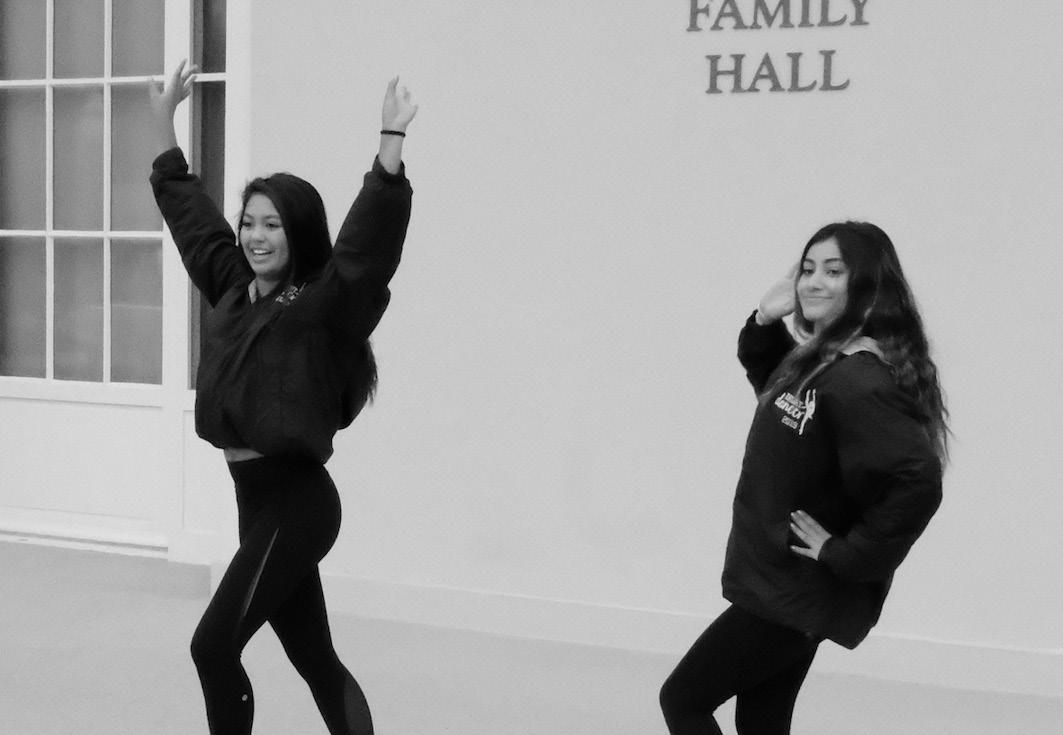
Zamanian also loves how dance allows her and her team to be a part of something bigger. “The dance concert allows us to be a part of something greater than ourselves, we have the incredible opportunity to use our craft and performance to give back to the audience,” Zamanian said.
Dance inspiration for Banatao comes from the media and TV shows such as “Dancing with the Stars.” “Sometimes on [the show], I’ll be watching one of the professional dancers, and I’ll just think, ‘Wow she’s so good, I wish I was her,’ but there’s no specific person I [idolize],” Banatao said. For Zamanian, her inspiration is found within the Knights team. “Honestly, the girls on our team inspire me, and there’s things I learn from [them],” Zamanian said.
by KYRA GESCHKE & SARAH NORUM
Although most students fill up their schedule with regular academic classes and free periods, there are several other unconventional ways to fill a block. These options include enrolling in a Global Online Academy (GOA) course, being a teacher’s assistant (TA), taking an independent study or creating your own Interdisciplinary and Personalized Scholars Program (IP). There are currently 67 students who are taking these courses, and most of these students encourage others to take on this unusual challenge to individualize their schedules.
GOA is an online organization where students can enroll in semester-long classes or take a summer class. There are a wide range of courses available to students, including classes covering topics in arts and media, learning studios, math and technology, science and health, social sciences and world languages.
“Without the inevitable constraints of a larger class, I can learn and develop the skills that I enjoy the most, tailored by myself and my advisor.”
There are currently 26 Menlo students who have chosen to take a GOA for the 2019 spring semester, taking classes in each of the different departments offered. Junior Emma McGaraghan is taking Abnormal Psychology for the second semester. “I took this class instead of a Menlo class because Menlo doesn’t offer the
class. I was really excited about the idea of a flexible work schedule and getting work done on my own time,” McGaraghan said.
Although GOA is different from a typical Menlo class, McGaraghan feels as though taking an online course has benefited her learning and has been worthwhile in her high school experience. She considers GOA classes to be less work than typical Menlo classes. “I think it’s less work than a Menlo class simply because you get to work through lessons at your own pace, so you can get through things pretty quickly while still learning in depth,” McGaraghan said.
Being a TA has also become increasingly popular over the years, with options to help out in English, various art electives, STEM classes and more. Senior Cameron Ekstrand is a teacher’s assistant for Science and Engineering teacher Marc Allard’s Design and Architecture elective. “I chose to TA because I really liked the class last year, and I’ve done an internship and summer program in Architecture, so I felt prepared to TA it,” Ekstrand said. As he took on this leadership role, he has learned a lot about what it is like to teach. “I like being a TA because I can share my thoughts with the students, and I get to see what’s it’s like to be a teacher,” Ekstrand said. “I honestly don’t think there’s anything I don’t like about being a TA.”
Another option with which students can fill a block is an independent study: a project that a student can create to pursue any intellectual interest. Each project requires a teacher advisor to monitor a student’s work and progress. Independent studies culminate in a presentation of what the student has learned by the end of the semester or the year, depending on the set length of the course.
Junior Ian Collins is doing an indepen-


dent study on historical fiction writing. “I chose to take the independent study [instead of] a free period because it was something that I am truly passionate about,” Collins said. “Without the inevitable constraints of a larger class, I can learn and develop the skills that I enjoy the most, tailored by myself and my advisor.”
Collins has benefited from the varied curriculum, as it gives him the flexibility to focus on what is important and engaging to him. “The loose structure allows me to cut out the things that I feel are less worthwhile and focus on bigger projects,” Collins said. “I really enjoy the material and the freedom to study what I like and produce something that I can be proud of.”
Many Menlo students also have created their own IP capstone project, where they demonstrate independence and initiative by learning about something that falls into one of the four categories: Civic Leader-
ship, Community Engagement and Impact, Arts & Letters and Global Scholars. The students take required classes and then apply that knowledge to create something that embodies all that they have learned.
Junior Trevor Perez has taken on his own IP project and created a concept album that highlights how American music has changed from the 1920s to the present day. “I chose to take an IP because creating music is something I love to do, so being able to work on music as a part of school just seemed like too good of an opportunity to pass on,” Perez said.
Although his project required a lot of hard work, Perez thinks it paid off. “Being able to create music was a lot of fun, but I also had to put in many hours into researching the genre and writing papers for the class,” Perez said. “The course definitely required a lot of work, as the IP capstone program is an honors one.”
by STELLA EL-FISHAWY
The annual Menlo School dance concert will take place from Thursday, March 14 to Sunday, March 17 and will showcase roughly 32 acts.
on the quad

Upper School dance teacher and director of the dance concert Jan Chandler always looks forward to the dance concert and sees it as a culmination of all the hard work and skills the Menlo dance groups—Knight Dancers, Midknights, Knight Life, PE rotations and dance classes—put in throughout the entire year. “The best part of the dance concert is having people who have never danced before getting on stage and just having a ball,” Chandler said. “It’s the fact that kids are conquering their fears, and the fact that they feel comfortable enough to do that in front of people is amazing.”

“Every year it’s different. It’s like a variety show—it just depends on what dances everybody’s coming up with,” Chandler said. The main difference between this year’s show from previous years is that it will feature a Pacific Islander dance,

with students from Menlo-Atherton High School joining the performance.
The commitment and hard work that goes into putting on this popular production forces the dancers to spend a significant amount of time together and to get closer with each other as a team. “We always get closer during the dance concert and just getting to spend time with those girls is going to be really fun,” Knight Dancers senior co-captain Izzy Banatao said.
Banatao also looks forward to the dance concert as a time to exhibit her passion for dance. “[The best part of the dance concert] is getting to perform for your friends, family and teachers because you’re getting to show them what you love to do and a different side of you that is non-academic,” Banatao said.
Fellow Knight Dancer and senior co-captain Kayla Zamanian echoes this sentiment. “[The best part of the dance concert is] being able to be a part of something that not only we as dancers enjoy, but also the audience can enjoy,” Zamanian said.


Pythagoreantheorem:

quadratic formula:

by Kate Hammond
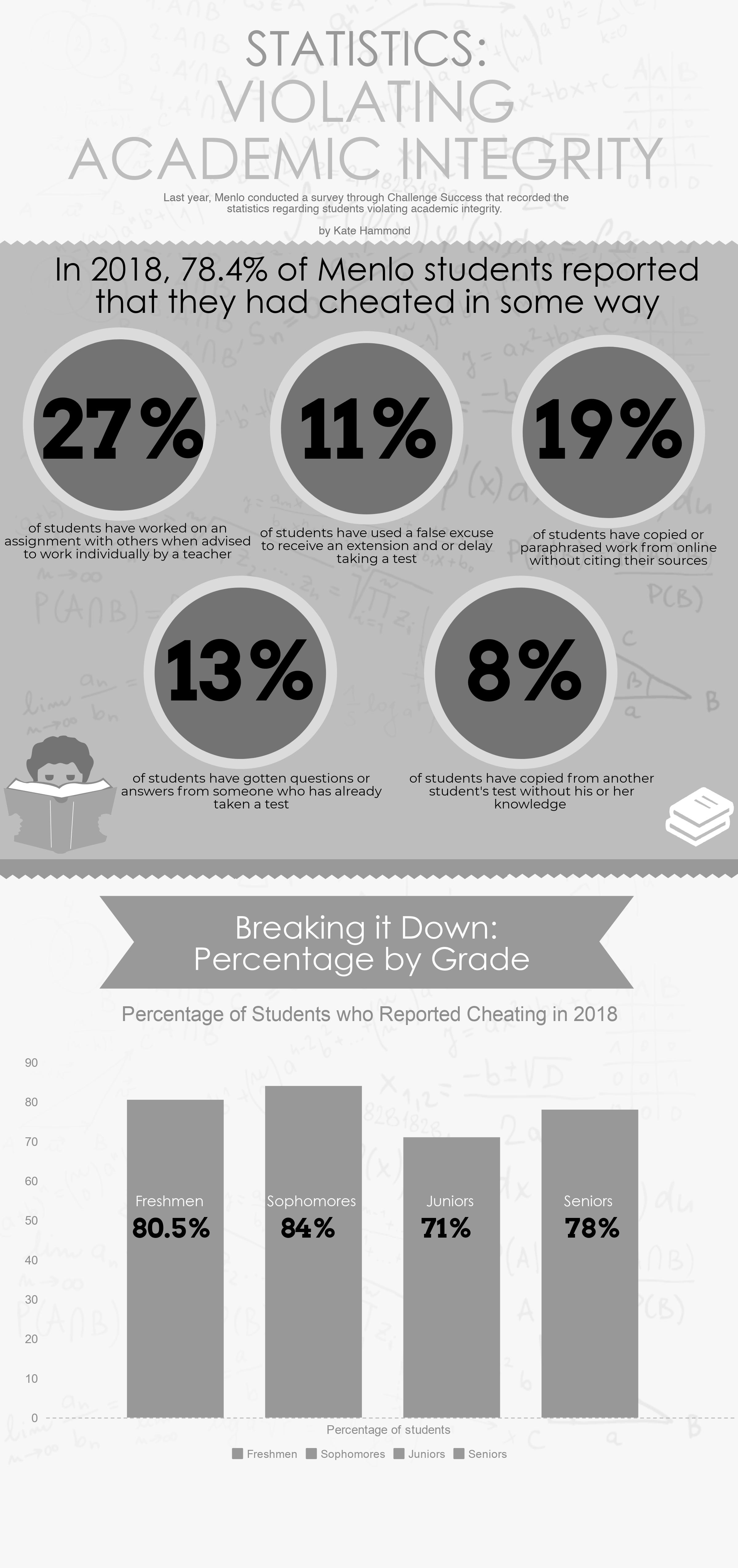
Here at Menlo, students are expected to hand in honest work that reflects their individual academic achievements. Although most students understand these expectations, students seem to have different definitions of what qualifies as cheating or not.
Menlo’s academic integrity policies are taken very seriously; violating these rules can cause warnings and often further punishments. Menlo expects students to take responsibility for all their work and abide by the rules of the assignment and teacher.
According to the Menlo School Student & Parent Handbook, the first aspect of academic dishonesty includes: “Presenting as one’s own an idea or statement taken in full or in part, or even paraphrased, from some other source, whether another person, a published work (including material in electronic form), or another student’s work.”
Other examples given include using unauthorized notes or aid during a test, letting another student copy your work or telling them the answers to a test they have not yet taken, plagiarism, obtaining help from parents or tutors on take-home tests or homework and finally, stealing or destroying educational materials, such as school computers.
Last year, all Upper School students took a survey through Challenge Success regarding academic dishonesty. Challenge Success partners with schools and implements research-based strategies to promote students’ engagement in school.
“We conducted a survey last year and learned that it was not uncommon for students to copy others’ homework or work in a group when the teacher says [to] work individually on a specific assignment,” Upper School Director John Schafer said.
“There were much lower numbers on things such as cheating on a test or snuck-in answers or, ‘[I] plagiarized stuff and put it in my paper.’”
From that survey, the school learned that some students have different definitions of what cheating is, from copying homework to using SparkNotes to help oneself write an essay. “Students have slightly different definitions of what [is] a serious breach of academic integrity. We think academic integrity and following the teachers’ instructions is really important [and that] your own work is really important, but students categorize things differently,” Schafer said.
Most cases of academic integrity that go to the disciplinary committee are when a students presents one’s work as their own, such as plagiarism from the internet or turning in a fellow classmate’s


work. However, not all cases of cheating get to the disciplinary committee. “Typically, when students work on things with groups when their teacher says [to] work on it individually, the teacher will handle it individually in the classroom,” Schafer said. To learn more about the disciplinary committee, read the story by Editor-in-Chief Clara Guthrie and Print Editor Bridget Quigley on the following page.
According to Schafer, instances of cheating are much higher in the spring semester than in the fall semester. Most of the cases that come to the disciplinary committee happen between spring break and the end of the school year. “Most students who come to the disciplinary committee are mortified and embarrassed that they did this. They know it is a mistake and that they made an ethical shortcut. They are most likely in a jam or have a lot going on. For example, instead of going to talk to the teacher knowing they weren’t ready to turn [an assignment] in and asking for an extension, they cut and pasted paragraphs,” Schafer said.
For several years, Menlo conducted an online tutorial with Head Librarian Cathy Rettberg that included videos from teachers explaining academic integrity within their respective subjects. There would be reading and multiple choice questions that students would complete. Students would take it online to show that they understood the rules and expectations. Although this tutorial has not been conducted for all subjects in three years, the History Department is still using the online anti-plagiarism tutorial.
According to Schafer, Menlo does not train their teachers to identify plagiarized work, but each teacher is trusted and expected to use their own moral compass and decide what a high school student can produce. “If a teacher reads something and sees it is really good, it can become a tricky situation. If they do not believe that the student could have written it, that could signal that they do not believe that the student could produce great work,” Schafer said.
Menlo has taken steps towards combating violating academic integrity, such as moving towards more in-class writing or assigning work that cannot be completed with an easy Google search. In general, Menlo expects its students to be responsible for completing honest and individual work that follows and respects the teachers’ expectations and rules.



March 8, 2019
by KYRA GESCHKE
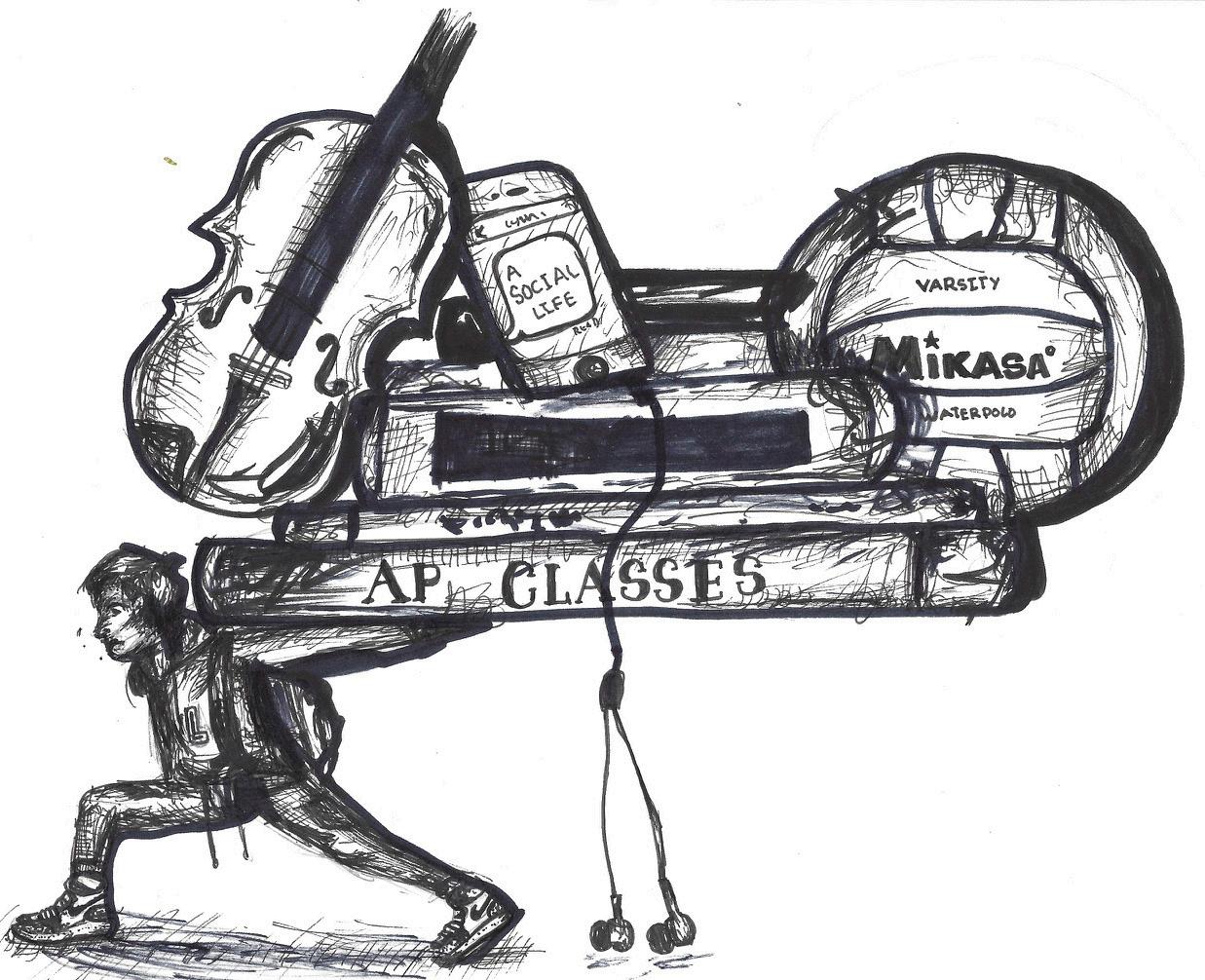
Being a teenager at Menlo comes with a multitude of challenges; balancing school, athletics and relationships with family and friends takes a large amount of energy that students, with usually less-than-eight hours of sleep, generally cannot handle. For Menlo students, this pressure is felt on a daily basis as we juggle not only rigorous academic schedules and extracurriculars, but also preparation for the looming competitive college process.
This pressure to perform well in all aspects of our lives is unhealthy and potentially detrimental to teenagers’ mental health, according to the Mental Health Foundation. Competitions for who is the most stressed and overworked, who got the least amount of sleep or who has the most tests in one day should not be the measure of our worth or intelligence. It should be considered honorable and extraordinary that a student is capable of taking four Advanced Placement (AP) classes, playing an instrument, being a varsity athlete and simultaneously maintaining a social life, but this should not be a standard that all students are expected to meet.
Due to the competitive nature of surrounding schools, the stress of college admissions and comparison to peers, many Menlo students feel the need to overload their schedules and extracurriculars in order to outdo one another. Menlo students have
a compulsive need to keep up with their classmates’ grades and honors courses, but the reality is that stressing yourself out over the one A- instead of an A on your transcript is not worth it. Letter grades do not determine your worth or even your intelli- gence. Though it is admirable
to be able to handle a plethora of classes and extracurriculars, the benefits of taking such a substantial workload often lead to too much stress for a teenager to be expected to handle.
According to a study conducted by the American Psychological Association (APA) published online in 2014, teenagers nationwide report that their stress level during the school year is much higher than the APA believes to be healthy. Teenagers today have a stress level of 5.8 out of
10 versus the healthy level of 3.9 out of 10. These numbers far exceed adults’ reported stress levels, as the average stress level for adults is 0.7 lower, at 5.1 out of 10.
Teenagers’ high stress levels can be extremely detrimental in the future.
The ramifications of extreme high levels of stress in life can cause anxiety, high blood pressure and a weakened immune system, according to the APA. In addition, students who experience high levels of stress are more likely to suffer from mental health is-
sues, such as anxiety or depression. So, while students may believe that letting go of one AP class could potentially ruin their transcript all together and their chances to get into a prestigious college, I believe that sacrificing your mental health is not worth the 0.5 grade boost. Due to our school’s setting, the nationwide culture of stress for teenagers and the ever intensifying stress of the college process, students are working themselves harder and harder every year, thus losing the ability to control their stress. Though I understand the desire to load your schedule with just one more rigorous class in order to “outdo” another student, your GPA is not more important than your mental health.
Although it is easy for me to tell you to let go of the expectations of your GPA or to “stop stressing,” the culture that our local community and our nation has fostered is one that thrives off of competition. While it feels as though “winning” this stress competition will put you ahead of the rest of your classmates, where do we draw the line? It seems as though we are asked in high school to be perfect at everything all the time—why don’t we let go of just one thing? Why don’t we lose one thing and use the extra time for an additional hour of sleep, to support a friend at a sports game or to spend time with your family? One A on your transcript is not more important than your happiness and health.
by KATE JEFFRIES
Whether it’s a baby shower or a toddler’s birthday party, it is undeniable that the effects of society’s binary gender expectations are noticeable. From the celebratory blue balloons for a baby boy to the dainty, pink party decorations for a baby girl, society defines who you should be from the day you are born.
While some of the earliest examples of the enforcement of gender roles are visible in the widespread practice of “boy colors” versus “girl colors,” the idea that one must conform to societal expectations does not stop with baby showers and birthday celebrations. In many circumstances in your early life, how you are treated by adults is often rooted in your sex. For example, when I was young, I enjoyed playing with Legos, toy cars and Nerf guns. Yet, whenever I was given a present for my birthday,
Coat of
Christmas or any other special occasion, I received jewelry-making kits, dolls and a variety of sparkly, pink accessories. While I was a fan of Disney princess movies, American Girl dolls and other stereotypical toys designed for young girls, the adults in my community made the assumption that since I am a girl, those were the only toys I was interested in.
Something as small and seemingly irrelevant as the difference between which toys we associate with boys versus girls can subconsciously enforce traditional gender roles from a young age. For example, boys are often given toy blocks and Legos, which can lead them to pursue engineering or architecture; while young girls are given dolls and Easy-Bake ovens, which support the idea that women should be domestic. While I don’t believe that something as small as giving a little girl a toy doll would prevent her from pursuing a successful ca-
Editor-in-Chief..................................................Clara Guthrie
Print Editor....................................................Bridget Quigley
Online Editor......................................................Kate Jeffries
News Editor...................................................Caroline Frantz
Arts and Lifestyle Editor................................Vionna Eshghi
Spread Editor................................................Kate Hammond
Opinions Editor..................................Elisabeth Westermann
Sports Editor.............................................Samantha Stevens
Copy Editor..........................................................Crystal Bai
Staff Photographer......................Sadie Stinson, Bella Scola
Staff Reporters........................Sophia Artandi, Claire Ehrig, Stella El-Fishawy, Tessa Frantz, Kyra Geschke, Ashley Grady, Emily Han, Ella Hartmanis, Chase Hurwitz, Carly McAdam, Sarah Norum, Parina Patel, Shefali Sahai, Sylvie Venuto, Alexandra Viret, Page Wolfenden, Ryan Young
Faculty Adviser..............................................Tripp Robbins
Staff Illustraters ..............................................Melody Zhou, Tzy Ying Yee, Nic Garcia
reer in STEM, it is undeniable that society makes premature assumptions of who you are based on your gender from a young age.
Furthermore, adolescents often subconsciously internalize and replicate what they see in the media. Because movies and television shows often promote traditional gender roles, it is easy for children of all ages to assume that they too should conform to the same ideals and positions in society. Martha M. Lauzen, an internationally recognized expert in women in film and the current Executive Director of Center for the Study of Women in Television and Film at San Diego State University, analyzed the presence of traditional gender roles in modern media. Lauzen tracked the roles of men versus women in television shows that aired between Sep. 2016 and May 2017. Out of the roughly 4,000 characters she examined, she found that wom-
We want to hear your voice!
Share your opinions with us on any topic, whether we’ve covered it or not. Send a letter to the editor at: Visit
clara.guthrie@menloschool.org
The Coat of Arms 50 Valparaiso Avenue Atherton, California 94027 (650) 330-2001 or to
en played “personal-life” roles while men played “work-oriented” roles across the board. While many companies are making a conscious effort to break stereotypical gender norms in their productions, current books, television series and movies continue to fall into the pattern of assigning roles based on gender.
Traditional gender roles are so ingrained in our culture that they often take conscious effort to break. From little actions such as assuming a boy plays a sport or a girl is interested in makeup, we continue to fall into the trap of making inferences about a person based on their sex. Everyone should have the opportunity to decide who they are before their environment decides for them. In order to achieve this, we need to break out of these binary molds society has created and let each individual define themself.
The mission of The Coat of Arms is to report accurately and thoroughly on news that is significant to the greater Menlo School community. We will chronicle in context the different events and perspectives within the school, while ensuring unbiased coverage. We welcome feedback and aspire to create an open dialogue with our audience by being accessible on multiple platforms and by striving to remain neutral in all circumstances.
On the Quad: How do you think the college process impacts your high school experience?



“It is hard not for students to think whether what [activities and classes] they choose ‘will look good’ on their application.”
- Brynn Brady ‘22
“I’m
still choosing courses and electives, free periods, et cetera based on my interests, [...] but these interests are also shaped with college in mind.”
- Daniel Tan ‘21
“Personally I don’t think college admissions has impacted my high school experience that much except for adding a little bit of pressure incentivizing me to try my hardest to perform well on assessments.”
- James Leupold ‘20
by CHASE HURWITZ
As an American, I love the national anthem as much as anyone else. Where else can you get ramparts, twilight and red glare all in one song?
It’s always nice to have one unifying force at the beginning of every American sports game, regardless of team affiliation. Engraved in my mind are memories of “The Star-Spangled Banner” blasting throughout the stadium with a few mistimed whistles in the background while everyone stands together. Well, almost everyone.
Colin Kaepernick polarized both NFL fans and Americans when, on Sept. 1, 2016, he chose to kneel during the national anthem. “I am not going to stand up to show pride in a flag for a country that oppresses black people and people of color,” Kaepernick told NFL Media in 2016. “To me, this is bigger than football.”
In my opinion, Kaepernick is peacefully protesting in hopes to change America for the better, and I find no wrong in that. Although I fully support his nonviolent use of
“As the college process gets more competitive, it creates more and more of an impact on students.”
- Mia Rosenblatt ‘19

“To my surprise, stress from college apps didn’t seep into my high school life. I also think it taught a lot of us to be cautious of what we were saying and to be more respectful of each other. I think this month is really the first time a flurry of decisions come out and hope we can continue the good vibes and thoughfulness!”
- Neha Tarakad ‘19
the First Amendment, it is undeniable that his original message has been buried under all the subsequent events. The kneel was meant to spark a conversation about police brutality against black men and women, but it feels like since day one, the conversation has always been about his actions and his football career.
I think Kaepernick probably could have protested in a way that would have created less controversy and drawn more attention to his cause. What attracts more discussion these days is whether the league owners colluded against Kaepernick to keep him out of the NFL and if that collusion was racially influenced.
Could a league with over 70% African-American players be racist toward those same players? I don’t think that if the NFL colluded against Kaepernick, they simply kicked him out due to his race. A much more believable motive for kicking Kaepernick out forms when looking at those who are making the big decisions in the NFL.
Precisely 0% of NFL CEOs and owners are black, as reported by CNN. Is it pos-
sible that white NFL owners conspired to remove an African-American quarterback (QB) who was stirring trouble for the league in order to suppress similar demonstrations from other players in an African-American majority league? Absolutely.
Kaepernick was certainly struggling during 2016, his last season; however, his overall QB ranking was higher than 13 other starting QBs at the time. Keep in mind— there are only 32 starting QBs in the league. It does seem suspicious that 13 teams would pass up on the opportunity to have a higher ranked player.
The NFL vehemently denies claims of conspiracy, using the argument that teams made that decision independently. However, Kaepernick won his settlement surrounding his grievances about the NFL conspiring against him on Feb. 15, 2019. It’s under a strict confidentiality deal, so the most that the public knows is that they came to some agreement. If the NFL could reach an agreement to keep the settlement from reaching public courts, then Kaepernick’s lawyers must have some pretty
damning evidence.
I cannot say for sure that this proves that the NFL conspired against him, but if this case went to court, more substantial evidence would have been shared regardless of the outcome, giving the NFL a large legal bill and an even larger mess to clean up.
Many NFL fans are fed up with commissioner Roger Goodell, and this situation only further proves his and the league’s incompetence. Had this been handled the right way since Sept. 1, 2016, with the NFL recognizing and accepting each player’s right to peacefully protest, then all of this controversy could have been avoided. The league wouldn’t even have had a settlement to lose, Kaepernick would have a job and maybe, just maybe, the San Francisco Forty-Niners would have another Super Bowl ring.
Sports should be a unifying force not one that divides America, but it feels like with Kaepernick, we’ve been fixated on the wrong thing. We should be talking about police brutality, not Kaepernick’s alleged disrespect for the flag and lacking athletic abilities.

by ELISABETH WESTERMANN
Continued from page 1.
sexual harassment, and only 9% of the students who reported being sexually harassed told an adult at their school what had happened.
In our last issue, The Coat of Arms reported that the Palo Alto Unified School District (PAUSD) has faced scrutiny for mishandling reports and incidents of sexual misconduct. In response to their mistakes, PAUSD made personnel changes and instituted policy reforms in order to address these issues. A new incident involving the sexual harassment of a Gunn student seems to indicate that, despite these reforms, PAUSD still does not take sexual harassment as seriously as it should.
According to court documents, in the fall of 2018, PAUSD investigated and found that a female Gunn student was a survivor of serious sexual harassment by
a male Gunn student based on review of text messages and interviews with 14 witnesses. If the investigation’s findings are correct, the harassment included humiliating the female student in graphic terms in front of classmates both during class and at lunch and tormenting her with inappropriate text messages.
In response to its findings, PAUSD initially took the kind of action that would usually be expected. According to court documents, PAUSD issued a safety directive to protect the female student from contact with the male student who had sexually harassed her. PAUSD permitted the student to remain at Gunn, but took steps to minimize contact, including, logically, prohibiting the male student from attending meetings of the robotics team, an activity that both students had previously participated in.
In early January, however, PAUSD modified its decision to allow the male student to participate in robotics team activities
by SADIE STINSON
Four years ago, as I was browsing the internet, I came across an article that exposed the true horrors that animals on meat and dairy farms face. After reading that article, I vowed never to eat meat again.s a vegetarian for four years and a vegan for three months, I have saved over 900 animals and 8,000 pounds of carbon dioxide.
To produce one pound of beef, you need about 1,799 gallons of water. The average person eats about 222 pounds of meat per year, according to Forbes. That would mean that the average person wastes about 399,378 gallons of water per year. For comparison, that amount of water could fill more than 10 24 feet by 40 feet pools. America’s meat consumption has more than quadrupled in the last 50 years, and that trend continues to grow.
Eating meat and dairy is extremely harmful to the environment. According to
on an alternating schedule with the female student, reportedly because the male student’s mother filed a complaint that the district failed to determine whether the boy’s behavior was a manifestation of a speech disability. The details of this disability are not disclosed in the court documents used for this article. Allowing the boy to continue to participate in robotics would effectively punish the female student for being the survivor of sexual harassment by forcing her to limit her own participation in the activity.
If PAUSD truly appreciated the full long-term continuing harm of serious sexual harassment and fear of its recurrence, it would not have modified its initial safety directive even if it found that a speech disability caused the male student to commit repeated sexual harassment. When the sexual harassment is as serious as it reportedly was in this instance, the school’s uppermost priority must be to protect the survivor of sexual harassment by both mit-
igating the injury from the past harassment and taking every reasonable measure to prevent future harassment. The reason the perpetrator committed the serious sexual harassment is beside the point.
After the district changed its decision, the family of the female student had to incur the expense and suffer the publicity of hiring a lawyer to sue PAUSD to reinstate its previous decision. The court found the female student was likely to prevail in the suit and issued a temporary no-contact order that reinstated the original removal of the male student from the robotics team until the case is finally decided.
The larger point here is that the school system of one of the most progressive cities in America seemingly persists in failing to take sexual harassment as seriously as it should, even though it is under intense scrutiny for its past failures. This repeated failure demonstrates the extraordinary effort it will take to address this problem in school systems nationwide.
NPR, nearly 30% of the Earth’s ice-free surface is dedicated to livestock production, while only 5% is needed to produce crops. Moreover, livestock produce 18% of our greenhouse gas emissions, including 37% of our methane emissions. While meat and dairy only produce 18% of calories, they take up 83% of farmland. A vegan world, or even just one with less meat consumption, could mean more forests, less greenhouse gas emissions and less demand for water.
Additionally, the conditions that livestock and poultry live in are completely horrendous. The majority of chickens are kept in cages so small that they can’t even spread their wings. Also, six million male chicks are suffocated or ground up every year simply because they cannot produce eggs. The same goes for male calves, who live up to roughly eight months and then are killed for veal.

“A world with less meat consumption could mean more forests, less greenhouse gas emissions and less demand for water.”
Finally, going vegan can have several health benefits. According to the American Journal of Clinical Nutrition, going vegan can lead to lower blood pressure and lower levels of cholesterol. Going vegan can also lead to a lower risk of diabetes, cancer and heart diseases. The animals in the meat industry are also injected full of unnatural hormones that can cause serious health problems for people. According to a study done by the Harvard School of Public Health, eating red meat can cause an elevated risk of cancer, car-
diovascular disease, and overall mortality. Moreover, according to the same study, eating one serving of red meat per day can increase the risk of total mortality by 13%.
So, the next time you are sitting down for a meal, think more consciously about where your food comes from. Try cutting down on your meat consumption or going meatless for one day a week. Trust me— the planet, your health and the animals will thank you for it.
Editor’s Note:
This op-ed was was written by a guest writer. If you are interested in writing an op-ed for The Coat of Arms, please contact Editor-in-Chief Clara Guthrie at: clara.guthrie@menloschool.org



Girls soccer: 8-0-2
Boys basketball: 9-5
Boys soccer: 10-1-1
Girls basketball: 10-2
* All records include varsity West Bay Athletic League (WBAL) games.


by EMILY HAN
The Knights’ varsity baseball team ended last year with a 7-17 overall record and a 3-11 record in the Peninsula Athletic League Bay division. This year, the team lost alumni Landon Smith (‘18) and Ty Corley (‘18), as well as junior pitcher Kevin Alarcon due to a collarbone injury and junior shortstop Sam Weseloh due to shoulder surgery. However, the baseball team this year is very promising, according to Head Coach Tink Reynoso. “We have 13 juniors. […] They know and understand what’s needed of them,” he said. Reynoso also sees potential in the team’s freshmen. “It’s not the wins and the losses [that makes coaching baseball special]— that comes and goes. It’s the kids that I’ve taught,” Reynoso said.

Girls Lacrosse
The varsity girls lacrosse team concluded last year with a 15-5 overall record and a 13-1 record in league, meaning that they placed first in the West Bay Athletic League. Head coach Liz Shaeffer was happy with last year’s team and the season’s results; she also sees good potential for this year. “I hope that this year we can start implementing our offense and defensive plays faster and build on them as the season goes,” Shaeffer said in an email. “I think if everyone comes in with the right attitude to work hard each day, we will be in a good place.” She believes that the key to a successful season will be improving each individual player, as well as cultivating a supportive team environment.
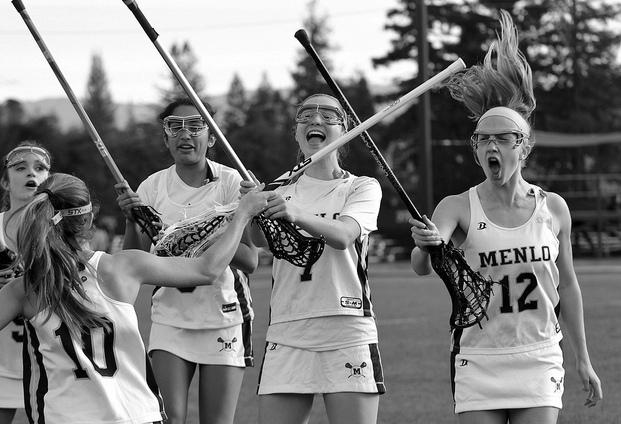
Last year, the varsity boys lacrosse team had a 13-5 overall record, placing third in the West Catholic Athletic League (WCAL) with a 5-2 league record. “We had what I felt was a very successful year last year. It was our first year in the WCAL,” head coach Blake Kim said. “Its reputation is that of a very strong lacrosse league.” This year, the team lost Brody LaPorte (‘18), one of the program’s best players ever, according to Kim, and seven other seniors. The current team still possesses much talent and potential, according to Kim. “We have a strong team from top to bottom,” Kim said.

On the swim team, swimmers compete individually but train together as a co-ed team. Last year, eight Menlo students made it to CCS, but none advanced any further. This year, however, coach Lauren Malthaner and new head coach Laura Reynolds are hopeful that at least three swimmers will qualify for State, which is the next step up from CCS. “We have a very young team this year,” Malthaner said. Two freshmen in particular, Emory Tudor and Gregory Hilderbrand, stand out to Malthaner and Reynolds. There were no seniors that trained full-time with the team last year, but due to a scheduling change with practices, more swimmers are able to swim on the Menlo team in addition to their club teams this year.

In track and field, girls and boys practice together but compete and get scored separately. Last year, the girls’ league-winning record was led by junior Charlotte Tomkinson, who won CCS and placed 6th in State. The boys placed fourth in League. While the team has lost seniors such as long-distance runner Robert Miranda (‘18), Head Coach Jorge Chen thinks that the team will
be very successful this year. “I am very optimistic about this team,” Chen said in an email. “I believe the girls will repeat as League Champs and hopefully earn a team CCS podium spot too. […] [The boys] will be a lot more competitive this year as well.” He believes in the importance of each team member being motivated by their teammates and that the team will excel if they can develop a close community of fellow athletes.

The varsity boys golf team will welcome new coaches Mark Madayag and Bruce Jaffe this year; former coaches Tom Hitchcock and Gary Missel retired after last year’s season. They had a successful 2018 season with a 9-1 record, winning their league and ending third in the state championships, according to Hitchcock. Golf plays in an open division, which means that they compete against a wider range of teams. For the upcoming season, freshmen Marcus Ying and Saaz Ahuja will be joining the team, as well as sophomore Troy Demmon and junior Seiji Yang. “The biggest struggle for us will be in Central Coast Section (CCS) finals because most of our Norcal big competitors come from our section,” senior captains Seth Pope and Charlie Hsieh said in an email. Pope and Hsieh believe this year’s team has the potential to make it to State, and they look forward to the season.

Last year, the Menlo boys tennis team was the national champion. “Last year’s team was very unique because we played two tough tournaments, and we ended up winning both of them,” Head Coach Bill Shine said. “Their camaraderie [helped the team last year], and they really got along and wanted to win for each other. And, their talent [was] out of this world.” This year, Shine believes the team can be just as good. Although five seniors left the team last year, the six new freshmen who have made the team show potential, according to Shine. “Our goal, every year, is just to get better and better and [to] work as hard as we can,” he said.

March 8, 2019
by PARINA PATEL

Like Menlo students who go on to play collegiate sports, some Menlo teachers were athletes in college.
Upper School English teacher Margaret Ramsey was encouraged to join the swim team at a young age by her parents and later swam at Amherst College in Massachusetts. “When I was a 9-year-old, we did town sports, and I just didn’t like sweating all that much and how loud things were,” Ramsey said.
Later on in high school, Ramsey was on the cusp of choosing between swimming Division I or Division III. “I was somebody who was being recruited at [the] DI [level] but [had] been at the end of the pile. At DIII, I would’ve been able to join and make an impact right away,” Ramsey said. Because she fractured one of her vertebrae during her senior year, Ramsey decided to swim at the DIII level to recover at a better pace than she could have at the DI level. “Getting back into it took a lot of mental toughness,” Ramsey said.
After Ramsey’s experience at the collegiate level, she respects the amount of energy put into playing a sport. Despite her past experience competing in high
school sports, Ramsey does not think that she treats student-athletes any differently than other kids at Menlo. “It would be hard for us to find a Menlo kid who didn’t do sports or exercise in some capacity.”
“Everyone at Menlo has something that they care about deeply,” Ramsey said. She went on to explain that knowing any kid’s special interest helps her talk to everyone.
Ethics and philosophy teacher and Menlo varsity boys water polo coach Jack Bowen played DI water polo at Stanford University. There, he had as good of a college experience as he could imagine.
“[My coach] recruited the top driver, the top center forward, the top left-handed player and the top goalie in the United States, and we all came to Stanford at the same time,” Bowen said. “We all got along so well, as we’d been playing with the national program together.”
Since they were not working out five hours a day but remained “immensely intense,” Bowen had the best of both worlds. “We had the college life and this great athletic experience,” Bowen said. With this work ethic, the Stanford men’s water polo team ended up
winning national championships two out of the four years Bowen played for Stanford. He even went on to be an alternate goalie for the USA team in the 1996 Summer Olympics.
While Bowen did experience balance in his college years, he believes that sports are given too much priority in our society. “I think we spend too much energy on winning, losing and the amount of time devoted to sports in an academic institution,” Bowen said.
Bowen can empathize with athletes in the same way as with actors during “tech week” for a show, which is when actors undergo long rehearsal hours. “[It’s like] they’re preparing for a championship game,” Bowen said.
Bowen’s classes, as well as his water polo team, are based off of mutual trust, where he does not feel that most of his students or athletes try to get away with anything by using school or sports as an excuse for not doing homework or missing practice. This is why he does not treat student-athletes any differently than students who do not play sports.
One-Woman Team: Fenyo Represents Menlo Diving
by PAGE WOLFENDEN
While many Menlo students participate in a variety of high school sports, junior Meredith Fenyo is the only one who represents Menlo diving. Fenyo started diving in seventh grade, with a background in gymnastics. “I had always loved gymnastics since I was extremely young, but I had broken my feet so many times from playing soccer that my mom was worried the same would happen if I continued gymnastics,” Fenyo said. “We had never really heard of diving until we were talking with family friends, and they told us their daughter had just started and loved it, so we decided I should try it out as well.” Fenyo devotes much of her time to diving outside of school for Stanford Diving Club. Her training schedule varies depending on the season, but is relatively high-commitment. “During the summer, I usually dive four times a week for one and a half to two hours each time, but during the school year I tone it down a little so I can focus more on school,” Fenyo said. “As of right now, I usually dive three times a week, sometimes four if I am really feeling it.”

Fenyo used to compete for her club team around four times a year; however, she decided to stop at the beginning of her junior year. “[I now] do diving as more of a recreational activity, which has ended up being really fun,” Fenyo said.
Although Fenyo no longer competes in club diving, she still dives competitively for Menlo. “I dive for Menlo at [Central Coast Section (CCS)] each year. Since I am the only diver at Menlo, there isn’t really a team, so I don’t have a coach at Menlo. I just train with my coach at Stanford to prepare for high school meets,” Fenyo said.
While other schools have entire seasons of diving, competing often, Fenyo only has one meet before CCS. “The first meet is hosted at [Palo Alto High School], and it is to qualify for CCS. You have to get a certain number of points to qualify. Then, [if I qualify], I compete at CCS in May,” Fenyo said.
Despite competing in CCS, Fenyo does not receive high school sports credits for diving at Menlo. Instead, she earns her credits from club diving, 36 hours equaling one sports credit for Menlo.
Because Fenyo now dives recreationally rather than competitively, with the exception of CCS, she is not actively pursuing diving at the collegiate level. “I am not looking to go to a school specifically for diving. However, I do think it would be fun if the school I go to has an intramural diving team. I would totally consider doing that in college,” Fenyo said.
“I think diving is the perfect combination of fun and focus. Because I am super close friends with a lot of the people I dive with, I really enjoy going to practice,” Fenyo said. “Diving isn’t for everyone, but I am a complete daredevil, so I personally find doing consecutive flips to be super fun.”
by RYAN YOUNG

Every year, one of the most famous tournaments in sports takes place between 68 of the best Division I men’s college basketball teams in the country. In a single elimination format, teams must pass seven rounds to be declared national champions. Although there are over nine quintillion possibilities of brackets, many avid basketball fans and contributors try to guess the correct bracket, as well as the score of the final game on platforms like ESPN and CBS. Nobody has ever guessed it 100 percent correctly, although many competitors hope their bracket is the winning combination.
Whether you’re competing against your friends to get the most accurate bracket, or you’re trying to understand how the season has gone so far and what’s likely in store,
here’s what you need to know about the 2019 March Madness tournament. Coming in at the number three rank in the Southeastern Conference are the University of Tennessee Volunteers. Continuing an 18-game win streak, Tennessee handily beat Florida State at the start of February. A mix of both older and younger players, the Volunteers have the offensive strength to beat nearly every team they play, including defensive powerhouses like Michigan and Virginia. The Volunteers are the favorite to win the South-Eastern Conference Championship, likely over the University of Kentucky.
Another team which many predict will win the tournament is the Duke Blue Devils. Duke University is ranked number three in the Atlantic Coast Conference and is in
the top five in the country, due to their 24-4 record, along with many serious threats on the court. Their lineup includes arguably the most dominant college basketball player ever: freshman starter Zion Williamson. Standing at 6’ 7” and weighing 285 pounds, Williamson averages 22 points per game. With fellow freshman starters Cam Reddish and RJ Barrett to back him up, it seems like Duke’s offense and efficiency are nearly unbeatable.
One of the main reasons that the Blue Devils have potential to lose is because of their young team. With four freshman starters, their players do not have the experience other teams have. Although they clearly outmatched Syracuse University earlier this season, Duke fell in double overtime to the underpowered team. Duke also recently lost to Virginia Tech by a mere five points in their eighth away game.
Some believe these freshmen will be unable to deal with the pressure as well as some of the other seasoned players on high-ranking teams like University of Michigan or Tennessee. This leaves a high probability that Duke will be upset, as some correspondents speculate. Other experts and fans are optimistic about Duke and believe that the raw talent of these young players will carry them to a championship win.
The NBA requires college basketball players to play a minimum of one year, so the best players will often go straight to the NBA after their freshman year and leave
their college education unfinished. Duke’s impeccable recruiting has led to many freshman going straight to the NBA after their first year; many expect team leaders like Williamson and Barrett to follow. With an incredible record of 24-4, the Michigan Wolverines are a very strong contender for the championship as well. The seasoned Michigan starting lineup is projected to be one of the most reliable programs to make it deep into the tournament. Four of the starters made it to the biggest stage in college basketball last year against Villanova: the NCAA tournament championship game. Although the Wolverines lost last year, they have come back this year with new threats and yet another successful season under their belt. As a consistently highly-ranked team, Michigan predictions are key to having success in the bracket challenge.
Although there is much speculation about how the top teams will do and many shared opinions of who will beat whom, the unpredictability of the tournament is what makes it such an enticing sporting event. Every year, there seems to be some wild upset or buzzer-beating shot, like the University of Virginia vs. the University of Maryland Baltimore County game or Loyola Chicago’s deep playoff run last year. Understanding how the top-ranked teams match up to each other is important, however, nobody can truly say what will happen in March and April.
by ELISABETH WESTERMANN
For senior Taylor Gould, tennis has been a part of her life since she could walk. Since first picking up a racket at age two, she has won five state championships with her club team, won the match that clinched Central Coast Section (CCS) for the Menlo varsity girls tennis team as a freshman, been ranked 20th in the state, been named Athlete of the Week by the Palo Alto Weekly twice and been chosen as the West Bay Athletic League’s (WBAL) MVP. Her most recent tennis achievement was committing to play DI tennis at Villanova University in Pennsylvania.
As a kid, Gould tried out an impressive


number of sports, including diving, soccer, swimming, basketball, golf and water polo, before deciding to focus on tennis at age 13. Although she only decided to focus on tennis right before high school, Gould had developed a passion for the sport long before them. “From the age of 6 or 7 I knew that tennis was the sport I wanted to carry on. [...] The other sports were more for fun,” Gould said.
In part what drew Gould to the sport was her interest in the strategic aspect of the game, which involves planning points and shot selection. Two of Gould’s grandparents coached tennis at Stanford, and as a result, she grew up watching the Stanford tennis teams play, which also inspired her love for the sport.
One of the most difficult parts of focusing solely on tennis for Gould was getting used to the individual aspect of the sport. “It was really hard for me [to transfer] to tennis—even though I love it, it wasn’t a team sport, and that’s what I like. I like the culture around [being on a team], and I like playing for a bigger purpose than yourself,” Gould said.
One reason Gould has enjoyed playing Menlo tennis is the team culture. “The team atmosphere is really positive, and everyone is trying to make each other better. [...] Whether you lose a match or you win a match, you always have a group of people to fall back on,” Gould said.
Gould committed to Villanova in the fall of 2018. She was drawn to the school because of its excellent athletics, its size, its engineering program and the opportunity to play tennis at the Division I level. After visiting the school, Gould felt that she had connected with the team there in a way she hadn’t at other schools. “The team was awesome, and I got the feeling that I would be really happy there,” Gould said.
by RYAN YOUNG
Senior Jack Pimlott committed to play Division III lacrosse at Hamilton College this past August. Pimlott has played lacrosse since sixth grade and has contributed to the Menlo boys varsity team for the past three years. He has been recruited as a long-stick midfielder (LSM), which is a specialty position that requires a lot of running and defensive prowess.
Pimlott first started to consider playing lacrosse in college after his sophomore year season. This was the first year he began to play defense, as he had played attack every


year prior. As a new defenseman during his sophomore summer, he quickly learned the position on various travel teams and began to narrow down his schools of interest. He looked at nearly every school in the New England Small College Athletics Conference (NESCAC), which is an extremely competitive DIII conference comprised of 11 schools.
As Pimlott headed into his junior year at Menlo, Blake Kim was hired as head coach of the lacrosse program and was quick to help Pimlott in the recruiting process. “Coach Kim was a huge advocate for me and helped steer me on the right path,” Pimlott said. Kim helped Pimlott narrow down the aspects he was looking for in various schools and then helped him in reaching out to the various coaches.
Pimlott believes that Hamilton is the best school for him because, in many ways, it emulates the aspects of Menlo that he enjoys. “One of the things that makes Hamilton attractive to me is that it’s a small school that has the same learning environment I found I really love at Menlo, and it gives me the opportunity to play in a really competitive lacrosse league,” Pimlott said. He plans to study economics at Hamilton, which he believes will give him a good balance between academics and lacrosse in college.
Pimlott would tell anyone trying to play college sports that the process is very long and requires a lot of effort. “Stay patient, but at the same time be really diligent and don’t expect a certain outcome,” Pimlott said.
Some of Pimlott’s favorite memories playing for Menlo lacrosse are the home game in his junior season against Archbishop Mitty High School and spending time with Silas Stewart (‘18) and Nick Barrett (‘18) in the first three years of his high school career.
by CRYSTAL BAI
Senior Charlie Hsieh is one of the male athletes featured in this issue for his commitment to play Division III golf for the New York University (NYU) Bobcats in the fall.
Hsieh started playing golf at age 5 after his older brother also began the sport. His favorite part about golf is the problem-solving aspect involved. “There are so many variables— wind, lie, slope et cetera— [that] you have to keep track of and so many different strategies,” Hsieh said. “When you hit a good shot, it’s extra rewarding.”
Despite the early start to his golfing career, a collegiate golf experience was not always in the cards for Hsieh. “I started thinking about [playing] college golf right after my freshman summer,” Hsieh said. “I improved a lot from the year before, and that’s when I knew I could do it.”
According to Hsieh, the recruiting process was both long and stressful, but ultimately rewarding. “Making phone calls [and] meeting with coaches was hard, but finally making a decision made it all worth it,” he said.
When looking at schools, Hsieh was interested in some DI schools and many DIII schools. However, he wanted a mixture of golf and academics that was harder to find at the DI level.
“I ended up picking NYU for its good mixture of golf and academics,” Hsieh said. “The program is getting better each year; they play a great schedule where we get to travel a good amount. I also have a lot of family that live in New York, so having them there is a bonus.”
In his time at Menlo, Hsieh has made a positive impact on the varsity boys golf team. “Since [my] freshman year, I’ve been playing matches with Charlie, and
he always has a positive attitude that carries through to the rest of the team,” junior teammate Kripa Dharan said. “He’s always relaxed, yet brings his game every match. He keeps everyone in a good mood and is overall a great influence on the rest of the team.”
Hsieh’s main inspiration in golf is Kiradech Aphibarnrat, a 29-year-old professional golfer from Thailand. “He’s just really funny, and he reminds me to keep it light when I’m out on the course,” Hsieh said.
Although Hsieh is excited to play college golf, he does not plan to play professionally after graduating. “I think my main goal is to have a good college career and then play [golf] casually,” Hsieh said. “Pursuing [golf] as a profession, while fun, is super competitive, and I think I’ll be able to benefit from the skills learned on the course in other aspects of my life.”


by SARAH NORUM
Senior Lauren Ferguson committed to play Division III lacrosse at Hamilton College in early July. Ferguson has been playing club lacrosse since sixth grade and has been on Menlo’s girls varsity lacrosse team all four years of high school. She plays midfield for Menlo, but she is planning on playing defense in college.
Ferguson has always loved all of the different aspects of lacrosse, including the bonds created between teammates. “My favorite part of lacrosse is being on a team and all the spontaneous times that come with it,” Ferguson said.
In the summer before her senior year, she decided she wanted to continue to play at the collegiate level. “I never really knew if I wanted to play in college because I knew I didn’t want to, or wouldn’t be able to, play Division I, so I decided to go through the Division III recruiting process to see what my options were,” Ferguson said. “It just so happened that Hamilton was interested in me, and it was definitely a school I wanted to go to, regardless if I was playing lacrosse or not.”
After spending time at The Mountain School, a semester school located in rural Vermont, Ferguson was looking for a similar East Coast experience in college. “I really like how Hamilton is a small school where there is an emphasis on student-teacher connections,” Ferguson said. “I also really like the feeling of being known, and I really got that vibe at Hamilton.”
Although Ferguson was looking at other DIII schools, Hamilton seemed to be a perfect fit. “The other schools I was looking at all were good options, but after visiting their campuses and talking to professors, students and athletes, I felt like I would fit in and like Hamilton the best,” she said. Over the course of high school, Fergu-
son has had a great experience on the Menlo lacrosse team and is excited to maintain her teammate relationships, carry her skills into the next four years at Hamilton and play more rival schools. “My favorite part of Menlo lacrosse would be the girls on the team and the excursions we go on,” Ferguson said. “Also, I have a lot of fun playing Sacred Heart [Preparatory].”
Ferguson is thrilled for what is to come in the next four years. “I am excited to play at a higher and more competitive level and to meet new girls who are potentially, or probably, better than me,” Ferguson said. “I am also excited for the adventure of playing in the cold.”