
Influenza Outbreak Sweeps Across Upper School Campus
by ARAHA MODI AND MANDY ZHANG
Influenza A, an unprecedented mutant of the seasonal flu, swept into crowded classrooms when students returned from holiday break. More students and staff are calling in sick, while others push themselves to show up with aching throats, runny noses and fevers. The Menlo Health Office reported 65 cases and counting of Influenza A by Feb. 2, urging the community to maintain proper hygiene as numbers continue to rise nationwide.
Although the current flu shot or vaccine reduces the probability of serious hospitalization, it only offers minimal protection against this mutation on
a day-to-day basis. Every February, the World Health Organization predicts possible flu variants in the Northern Hemisphere and creates vaccines based on their research. According to the Centers for Disease Control and Prevention (CDC), this year’s vaccines targeted three prominent virus strains: two Influenza A strains (H1N1 and H3N2) and one Influenza B strain (B/ Victoria Lineage). However, Subclade K, a previously dormant mutant of Influenza A H3N2, has resurfaced and is not adequately protected against.
Sophomore Caitlin Wong received a flu shot in late September but caught Influenza A as soon as she came back from winter break. “I felt like death,” she said. “It sucks because it’s hard to fully rest when you know how much work is waiting for you.” Despite her sore throat and lingering cough, Wong stayed in school to avoid falling behind, noting that missing even one day of class could lead to multiple nights worth of catching up. “[Staying in school while sick] is definitely a universal problem,” she said. “People are worried whenever someone next to them coughs or sneezes.”
Upper School Administrative Assistant Jocelyn Rodriguez believes that students should find a healthy balance between motivation and rest. “If you don’t take the day off, you only prolong the sickness
and risk spreading it to others who are perfectly fine,” she said. Rodriguez has also observed an increase in students only attending school for half of a day, a pattern she hopes they will reconsider.
On the other hand, English teacher Jay Bush argues that missing class only adds pressure to his already tight schedule. “The worst part about getting sick as a teacher is that you feel a strong responsibility for your students,” he said. “And if you’re not there, then one of your colleagues, all of whom are completely booked and exhausted and working as hard as they possibly can, is going to have to cover for you.”
Bush caught the flu three separate times between November and January, missing two school days in a row for the first time since he joined Menlo in 2019. As a result, he had to grade over 100 written assignments — around 40 hours of work — for his sophomore and senior classes in just a few days.
For teams that rely entirely on participation, lastminute fevers and chills can undermine months of preparation. Mock trial faculty advisor Joseph Mitchell says

Students Turn Curiosity Into Capital Through Investing
by ASHER DARLING
At 2 a.m., while likely all of his classmates were fast asleep, junior Solomon Mungai stared at his computer screen, watching as cryptocurrency prices rose and fell in real time. Since the crypto market never closes and often peaks while Americans are asleep, Mungai stays up late trading most nights. “During my early time with crypto, [...] I’d probably be spending two and a half to three hours [trading] every night,” he said.
Mungai was introduced to crypto investing by his cousin in 2022. But
What’s Inside?
before putting his savings on the line, he practiced on a risk-free platform called TradingView Papertrading, where he learned to read market patterns and trends. “I learned how to trade with fake money,” he said.
Mungai said investing has helped him learn patience and discipline. “[The transition to real trading] was scary,” Mungai said. “I could take big losses with the fake money and just make it back by spending some more, but once I started trading real money, it really hit me that like ‘wow I could lose all my money right

now.’ [...] It forced me to be strategic and to not trade more than I could afford to lose.”
Until this past summer, Mungai day traded crypto on the Solana blockchain platform. Since then, he’s shifted his focus to longer-term investments, specifically in biotech stocks and Exchange-Traded Funds (ETFs). “I just thought that [day-trading crypto] was too risky,” he said. “I’ve taken a lot of wins and a lot of losses.”


Influenza, pg. 2
Staff illustration: Claire Dickman
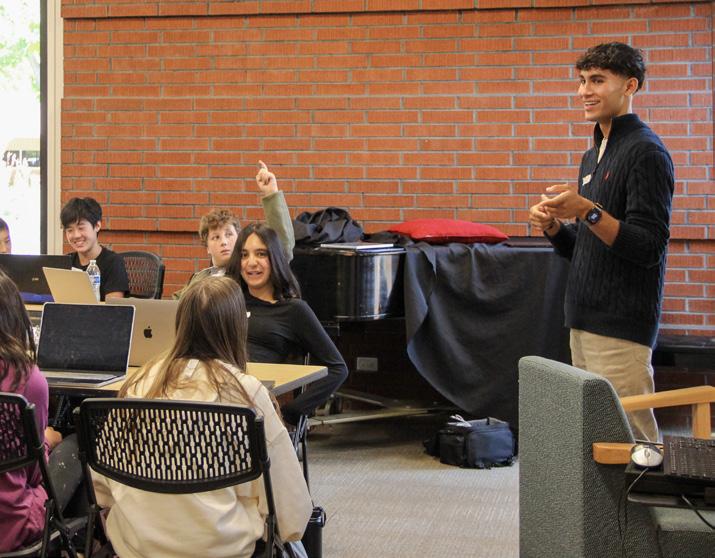
Senior Raj Kaushek teaches a group of students during a OneUp Summer Camp session. Photo courtesy of Kaushek
February 6, 2026
New Club Requirements and Administrative Crackdown Spark Student Pushback and Campus Wide Controversy
by WILLIAM GARDNER
Menlo began auditing clubs for the first time in the 2024-2025 school year; the audits were focused on evaluating club productivity and determining whether some clubs needed to be cut. New requirements for clubs are being enforced this school year, including minimum membership requirements, new club leader limits and new planning standards. Upper School Dean of Student Life and Culture Alexis Bustamante and Student Council Club Coordinator Lauren Rukavina have continued to audit Menlo’s clubs throughout the school year to make sure clubs meet the new requirements. The audit includes collecting attendance data from club leaders, visiting clubs during meetings and talking with club leaders.
Some of the club requirements include how club leaders have to publish their meeting plans for the year on Menlo’s new club website. “A lot of it really is just
about planning ahead [and] making sure they have plans. [...] Just a little more structure to it, especially since [the clubs] are Menlo sponsored, [...] and so we want to make sure that we’re honoring everyone’s time,” Bustamante said. In the previous audit, the Menlo Choreography Club was cut for failing to schedule a meeting with Bustamante.
Included in these requirements were limits that only allowed two leaders and a minimum of five regularly attending members per club, which will go into effect next year. Bustamante explained that this was not only to help remove any dormant clubs, but also help unburden teacher advisors and student leaders of multiple clubs: “You might have a teacher who’s doing like five clubs and that’s a lot for them. I also don’t want to ever limit [club leaders], but to help students lessen [their] plate[s]. Also, it leaves room for other students to step up and be leaders,” Bustamante said.

Continued from pg. 1
that missing key members hurts the team’s performance in court. “Usually, they just take a lot of cold and flu meds, but it doesn’t work out as well,” Mitchell said. In hopes that the teams’ hard work
Bustamante also revealed that equity played an important role in creating club requirements and performing club audits. Some clubs on campus receive school funding, a policy she hopes to continue with greater equity across Menlo’s different clubs. “I want to make sure that if we’re giving funds to a club, we make sure that’s fair and equitable. Especially if there’s, let’s say, a club that’s asking for $200 that only has three members versus a club who’s asking for $200 that has 20 members,” Bustamante said.
Junior and president of Menlo’s Trivia Club Neil Hutton noted that not every club receives school funding.
“Especially if [the clubs] are not a waste of [the school’s] money, I don’t think the school should care that much about [the size of] them,” Hutton said. According to
Winter sports teams have also experienced an uptick in cases following holiday break, a challenge that boys varsity soccer coach Daniel Hicker says is always difficult. “We try to maneuver through these weeks, because now we’re in the second half of our season,” Hicker said. “We want everybody to be as healthy as they can.”
With practices and competitions six days a week, Athletic Trainer

Stephanie Green warns that students in sports are especially prone to spreading airborne viruses like the flu. “If someone on the soccer team gets sick, we suspect there’s probably going to be a few more kids on the soccer team that are going to get sick just because they’re in close proximity for so long,” Green said. In an attempt to reduce widespread
Rukavina, the new club audits have allowed them to also better observe the atmosphere and leadership of the many club meetings that take place on campus. “I think we just want to see intention with the clubs, intention in meetings and intention in the events that they’re doing, because we really don’t have many analytics to go off of,” Rukavina said.
I think clubs have become a much more school-run process, instead of [...] a group of people who just want to [...] have some fun while sharing a similar interest.
Junior Neil Hutton
However, some club leaders think that new requirements could harm smaller or more casual oncampus clubs that don’t fit some of the requirements and are at risk of being cut. Hutton believes it could negatively impact the welcoming and casual atmosphere that many clubs on campus emphasize. “I think clubs have become a much more school-run process instead of clubs being, like, a group of people who just want to hang out and have some fun while sharing a similar interest. [The new requirements] have made it overall much harder for clubs to exist,” Hutton said.
Hutton also expressed concern about the demands of balancing a heavy workload while being a club leader. “We’re spending so much time doing work because we’re in a competitive school. So I think having [...] the additional work on top of that really hurts. [Especially] as a club leader, sometimes if I don’t have time, I’m scared that I will not have a club which I do care a lot about,” Hutton said.
Bustamante and Rukavina both reinforced that the purpose of the new audits and club requirements are to help keep clubs engaging for students and inviting within the Menlo community. Part of the purpose of a club is to foster community within a shared interest or hobby. “It’s how we can make sure that [clubs] branch out and it’s not just a small group of friends meeting,” Bustamante said.
transmission, Green pushes athletes to avoid sharing personal items, particularly waterbottles.
Wash your hands. Wash your hands. Wash your your elbow, get enough don’t touch your face.
the dance, Menlo’s Health Office sent out another email cautioning the community about Influenza A and other respiratory viruses. According to Barada, Influenza cases have only surged since the dance. Until hospitals can produce a successful vaccine against the new variant, Barada strongly advises everyone to take additional precautions and stay home until they are fever-free for at least 24 hours. “Wash your hands. Wash your hands. Wash your hands,” she said. “Cough into your elbow, get enough sleep at night and don’t touch your face.”
School Nurse Joan Barada echoed Green’s statement after sending multiple students home from the winter semiformal. Barada noted the crowded gym could further the spread of sickness. Watching students packed shoulder-toshoulder on the dance floor for over three hours, Barada dubbed the virus “The Semi-Formal Flu.” On Jan. 29, a day after

Staff illustration: Claire Dickman
Staff illustrations: Claire Dickman
February 6, 2026
Atherton Reduces Speed Limit on Valparaiso After Collision
by AUTUMN CHAMBERS, CAROLINE CLACK & ELAINA HUANG
On Oct. 22, 2025, the Atherton City Council adopted a resolution to lower the speed limit on Valparaiso Avenue from 30 mph to 25 mph. The decision came after a September accident on Valparaiso during high traffic morning commute hours, where a Menlo-Atherton High School student riding an e-bike was injured in the collision.
Valparaiso is a major road at the border of Menlo Park and Atherton. Menlo sits on the east end of the street, and Sacred Heart Prep is down the road. The proximity of the two schools creates heavy traffic every morning. According to Public Works Director at City of Menlo Park Azalea Mitch, the decision to reduce the Valparaiso speed limit was part of an ongoing effort by the Town of Atherton and the City of Menlo Park to ensure community safety. “Since last year, we have made a focused effort to reduce speed limits throughout Menlo Park as the law allows for safety reasons,” she said.
E-bikes are bikes with an electronic pedal assist. The fastest e-bikes, Class III, can reach a maximum speed of 28 mph. Although these e-bikes are built with embedded speed restrictions, those limits can be bypassed and reach speeds of up to 50 mph.
Menlo Park public schools have also banned students from riding Class II and Class III e-bikes on school grounds since Nov. 13. The schools will lock any e-bikes found on their properties and report the student to Menlo Park law enforcement. Beyond emailed instructions to avoid the area
and exercise caution after the accident, Menlo currently has no e-bike-specific restrictions in place.
Every school morning, students travel to school on e-bikes alongside traffic. The popularity of e-bikes has skyrocketed in the Bay Area since the pandemic. In 2024, San Mateo County recorded a 357% increase in emergency room visits for e-bike accidents, according to the US Consumer Product Safety Commission.
I feel like it’s a norm for everyone to drive above the speed limit [unless there’s traffic].
Senior Elise Chen, who witnessed the September e-bike accident, believes that the incident wasn’t necessarily caused by speeding. She added that the majority of accidents on Valparaiso occur in the morning, when traffic would prevent speeding. Instead, she attributes the accident to the chaos of everyone trying to get to school during morning rush hours.
However, Chen believes that people don’t always adhere to the speed limits posted on streets. “I feel like it’s a norm for everyone to drive above the speed
limit [unless there’s traffic]. [...] I feel like there’s definitely reckless driving,” she said.
On the contrary, Director of Security Mustapha Moutri believes that speeding was likely a contributing factor in the accident, along with phone usage and failures to adhere to yield signs or right of way. Moutri appreciates the City of Menlo Park and the Town of Atherton’s efforts to prevent future incidents. “Both cities, Menlo Park and Atherton, did a great job before this year’s school start by adding more signs, repainting the crosswalks and increasing police presence on Valparaiso Ave, especially during peak school hours,” Moutri wrote in an
email to The Coat of Arms.
Menlo parent Wiley Anderson allows his two daughters to ride e-bikes to school. However, he first had them ride together as a family on busy roads, including Valparaiso Avenue and El Camino Real. “Drivers aren’t always predictable,” he said. “Our safety lessons were bike rides together as a family.” By riding together, Anderson taught his kids the rules of the road, helping them make safe decisions. He advises families considering allowing their kids to ride e-bikes to establish clear rules for riding.

Menlo Reacts to U.S. Capture of Venezuelan President
by ASHER BECK
Several Menlo students returning from their holiday breaks in early January were met with severe travel delays as their flights were suddenly cancelled. These air travel issues were caused by the United States’ capture of Venezuelan President Nicolás Maduro on Jan. 3, 2026, in an operation that forced the Federal Aviation Administration (FAA) to shut down airspace across the region.
The mission was the culmination of months worth of planning from the American government, much of which involved communication with sources inside Venezuela that helped infiltrate Maduro’s safehouse in Venezuela’s capital, Caracas. According to history teacher Joseph Mitchell, the city faced American bombardments, marking the climax of tensions between Venezuela and the United States, tensions that had been escalating since Sept. 2025, when the U.S. began striking Venezuelan boats allegedly trafficking drugs in the Carribean.
We were packed up for the airport, about to head back, and my mom told my dad our flights were cancelled [...] because there was a military conflict.
Junior Merrick Ward
Junior Merrick Ward had been staying on a boat in the Caribbean at the time of the conflict, ultimatelymissing a week of school after his flight was cancelled. “We were packed up for the airport, about


[...] because there was a they had to shut down the
Staffillustration: DiyaKarthik

also had difficulty traveling back to the U.S. from Oaxaca,
had been staying with his grandparents. “I woke up and my grandparents were talking about it. They saw it on the news. We [our flight] was canceled. There was no
States’ recent operation. Former President of Panama Manuel Noriega, a dictator who was arrested in 1989 following an American bombardment of Panama City, had similarly been brought back to the U.S. to face
an indictment on drug trafficking charges. Mitchell noted that there were a few key differences between the situation in Panama in 1989 and Maduro’s recent capture. “The difference, [and] the unprecedented part, is the combination of destroying vessels in both the Caribbean and in the Pacific [and acting] without any due process,” Mitchell said.
According to a Global Witness article published on Jan. 28, Venezuela is estimated to control 303 billion barrels of oil, most of which have gone unexported to the U.S. as a result of economic sanctions since 2017 and resource mismanagement from Venezuela’s government.
Senior Maxwell Johnson believes that the U.S. invasion of Venezuela was motivated by natural resources, but will ultimately benefit the South American country. “I feel like the main objective was for the oil, but I feel like even if you were to ask Venezuelan citizens, they would be very grateful [...] because Venezuela was in a very dire situation,” Johnson said.
I think establishing some type of leadership is really necessary. A fair [system], one that people will get behind.
Assistant Director of Student Belonging Courtney Tyler
Assistant Director of Student Belonging Courtney Tyler said that, economy aside, Venezuela needs stable leadership first and foremost. “I think establishing some type of leadership is really necessary. A fair [system], one that people will get behind, [...] is really important, to repair this situation,” Tyler said.
Staff illustration: Ella Skinner
Senior Elise Chen
February 6, 2026
New Library Activities Spark Creativity and Community
by SADIE EVANS
This year, librarians Brittney Otero and Christina Appleberry have launched new activities in the library, including crafts, raffles and clubs in an effort to promote reading. Introducing programs like these for students has been a goal of Otero’s since she joined Menlo in 2022 in order to encourage student engagement within the library. With Appleberry now a part of the library team, they are starting to bring those ideas to life.
Before joining Menlo’s library, Appleberry previously worked at Castilleja School and gained a lot of experience from leading activities during her time there. “When interviewing to fill the librarian role, I wanted someone who could connect with kids and beef up our programming,” Otero said. “That’s why Ms. Appleberry is a great fit.”
affinity groups, clubs and interest groups,” Otero said.
Both Appleberry and Otero have already observed a shift in how students are approaching the library since introducing their initiatives. “I have definitely noticed a change in comfortability and students are getting more familiar with us,” Otero said.
Everyone knows you can go to the library to get books [...], but [libraries] are also so much more.
Librarian Christina Appleberry
“ “
Together, Otero and Appleberry have introduced a gallery called Shelf Life, where any member of the Menlo community can display their work. “It’s soliciting collections, artwork and artifacts that people have,” Otero said. “It highlights the interests and passions of members of our communities, and it’s a great catalyst to someone’s story.”
This year, the librarians have also started the Library Loyalty Program, where students receive punch cards and get a hole punched for every 20 minutes they read. Once a card reaches six hours, it is turned into a raffle ticket where students can win gift cards to coffee or boba shops. “Hopefully the program will grow because it means that students are reading, which is the ultimate goal,” Appleberry said.
Otero said she hopes these activities for the students encourage a space where kids can destress and take a break from academic intensity. “We feel like libraries have the potential for being a community hub, and our library especially, because we are in the center of campus,” Otero said.
Appleberry echoed that sentiment and emphasized the importance of connection between students. “Everyone knows you can go to the library to get books or help with homework, but [libraries] are also so much more,” she said. “They are very community oriented, and I hope kids think of libraries in bigger ways and as a place where fun things happen.”
Most of the recent initiatives in the library have been different kinds of crafts and art projects, such as a mason jar decorating activity. “Creative self expression is important and I really care about the process, not really the product,” Appleberry said.
Appleberry highlighted how the programs make it easier for students to engage with one another and with the library. “I hope the students want to try more things, and they want to come to the library more.”
The librarians are also looking for ways to involve other Menlo groups into their programs. “We would love to collaborate with
Junior Yuna Lee said she’s noticed a difference as well, describing the library and its activities as a way to unwind. “[The scrapbooking activity] felt like a complete break from Menlo’s really studious environment,” Lee said. “We were allowed to do anything we wanted creatively and it was a very useful part of my day.”
Both Otero and Appleberry have goals to continue to grow their library programs, hoping to get more inspiration and ideas from students. “The hope is that at some point, our ideas will be more community generated,” Appleberry said. “A good library serves its community and is there to meet their needs of what they want.”

Peer Coaching Hours on Fortress Hit Record High
by ELAINA HUANG
Peer coaching sessions booked through Fortress this school year have already reached a record high. The number has surpassed 550 in the first semester alone, more than the amount booked throughout the entire 2024-2025 school year.
“ “
The word is out on how helpful peers are.
Writing Center Instructor Maura Sincoff
English teacher and Writing Center Instructor Maura Sincoff believes that the spike in sessions is a result of more teachers encouraging students to utilize peer tutoring as a resource, an initiative the Writing Center has also advocated for.
According to Academic Coordinator and Learning Center Co-Lead Lily Lam, English and history were the most common subjects peer tutored. Lam noted that the record number is partly due to the Learning Center’s continued initiative to establish peer tutoring as part of Menlo students’ everyday academic experience.
Since the height of the pandemic, Lam and the rest of the Learning Center Team have worked to expand opportunities for structured peer tutoring. Previously, peer tutoring was not a school-sponsored program, so if a student needed support, Lam would reach out to
teachers to recommend a student who could help to establish a lasting system and encourage consistency.
Freshman Anya Simard finds the Fortress peer coaching system and the Writing Center to be good resources, as oftentimes her teachers are busy with other students.
“It’s easier to communicate with a peer than it is [with] a teacher, because it feels less like you have to be less formal. Just having somebody to run my ideas by is helpful because they can help [me] refine them and point out things I might not have noticed,” she said.
Junior and Writing Center Logistics
Lead Celina Chen said she’s seen the student culture shift around peer coaching. “I remember my freshman year, no one really asked a tutor for help. But now, in my sophomore year and my junior year, almost every single person has gone to at least one coach to look over their essay,” Chen said.
Lam agrees that the peer tutoring system has been working well. “I really want [students] to stay committed to offering the sessions. I think one way is to match individual students up so that they can have an ongoing relationship,” Lam said.
In the fall of 2023, Menlo launched Menlo Fortress, a platform where peer
tutors can publish their availability and any student seeking support can book a one-on-one session. “We [wanted] to make it accessible to everybody, not just on a case-by-case basis,” Lam said.
Since the launch of Fortress, Lam has made announcements at grade level class meetings and talked to teachers in each department to encourage students to peer tutor, book sessions and spread the word, among other initiatives. “The word is out on how helpful peers are in helping the freshmen and the sophomores get better at writing. And it’s so cool to see how they’re just sort of naturally evolving into

Sincoff believes it’s crucial to keep the Writing Center’s leadership team and club members motivated. The Writing Center has around 50 club members, and students with the most hours earn certificates, gift cards and homemade treats for their contributions.
“
It’s better to have boundaries around the responsibilities.
Writing Center Instructor Maura Sincoff
“
This year, the leadership team has decided to start cutting members who don’t consistently log their hours or attend meetings. “We made it very clear that we want to hold our club members up to a certain standard, like a certain [number of] hours or requirements to go to a certain number of meetings, [which] has been really beneficial,” Chen said. Both Chen and Sincoff will ensure Writing Center Members are contributing to the community, not just being part of the organization in name. “We’ve had situations where teachers ask [club members for help, and] the people who say they’re going to show up don’t show up at all. [...] It’s better to have boundaries around the responsibilities,” Sincoff said.
Staff illustration: Yuna Lee
Let’s See if the $100 Chicken Downtown Is Worth It
by AUTUMN CHAMBERS
For $100, you could get through 10 months of a Netflix subscription, an Amazon Echo, maybe even a Warriors ticket and… a chicken? Known for its expensive roasted chicken, Cafe Vivant opened its doors last October in downtown Menlo Park. One whole roasted chicken for two costs up to $120, which begs the question: is it worth it?
Cafe Vivant’s owners, Jason Jacobeit and Daniel Jung, take pride in their poultry’s illustrious and delicious flavor, but I found myself skeptical and needed to try this dish for myself. While the restaurant ambiance was top-tier, ordering the chicken itself was the real highlight.
Before the chefs carve it, waiters bring it to your table and present it on a bed of herbs, making sure you approve how it looks. I had two choices of chicken: Delaware Chicken for $54 and Plymouth Rock Chicken for $58. The prices are per person, so my family of four ended up paying around $200 just for the chicken.

I’m no stranger to roasted chicken. My sensitive stomach loves this mild, versatile food, and I’ve tried hundreds of chickens from various restaurants in my lifetime. As a certified chicken lover, I don’t use this statement lightly: this was the best chicken I’ve ever had.

Jacobeit and Jung exclusively use heritage chicken breeds from farms in Pescadero, Calif., and it makes all the difference. Most restaurants use hybrid breeds that you can easily find at your local grocery store, but Cafe Vivant uses purebred, free-range chickens that have enhanced flavor, larger legs and are less likely to be infected with bird flu or salmonella.
The heritage chicken’s flavor is superior to regular chicken, and my meal was cooked to perfection. Despite the only seasoning being salt and pepper, the flavor was the most saturated I’ve ever tasted in roasted chicken. Think about the bland flavor of regular chicken,
multiply it by a thousand and sprinkle in some mineral and turkey flavors — that’s what Cafe Vivant’s chicken tastes like.
Jacobeit and Jung claim not to use any high heat or marinades when cooking, which keeps the chicken uniquelyflavored and warm. The chicken doesn’t have to hide behind sauces’ flavors, but if you absolutely need it, you can order two sauces on the side.
I also saw the cooking technique shine through when I cut my piece, and the knife moved through the mouthwatering meat as if it was butter.
Moreover, the combination of brussels sprouts, carrots and other vegetables I had on the side was delicious on its own, and their flavors blended perfectly with the chicken, creating a harmonious experience for my palate.
So yes, the chicken is phenomenal, but is it worth the price? My analysis is yes, but only for special occasions. Cafe Vivant’s chicken is perfect for an upscale family dinner, impressing your Valentine’s Day date or just to check off your bucket list. You aren’t just paying for the chicken; you’re paying for the experience.
I like to think of this dining experience like most people think about skydiving: it can drive some people away, but it’s something people are drawn to try at least once, and in my opinion, definitely deserves more hype.
Can AI Help Teachers Without Hurting Students?
by LAUREN GIESSELMAN
Artificial intelligence (AI) is no longer a tool teachers hide from. It is a classroom resource that many educators use to make their teaching more efficient. But to what extent should educators, often enforcers of AI policies, have to abide by their own set of rules?
At Menlo, students are not taught to simply avoid AI; instead, they are taught how to use it reasonably and responsibly. Yet sometimes, the teachers who create and inform students of these boundaries utilize AI in unexpected ways.
Their use of artificial assistance may blur the line between helpful and ethically questionable. Some teachers have begun using AI during test creation and review, which actively chips away at the academic integrity of the grading process.
If teachers need to put in so much extra effort to ensure their application of AI is flawless and appropriate, perhaps the tool does not need to be used in all the ways it currently is. AI should be a resource for teachers, but it should never replace their voice or judgment — especially when it comes to rubrics and grading.
French teacher Corinne Chung shared that she uses AI in her class in a variety of ways, such as designing projects or creating rubrics. Additionally, history teacher Glenn Davis uses NotebookLM, an AI research and

notetaking tool, to assist with his teaching.
“When I discovered NotebookLM, I started creating podcasts as a study tool. That just sort of blew my mind. And I’ve also used it to just create like, quizzes and note guides,” Davis said. “I’m inserting the presentations I make, the worksheets I make and the books or the chapters I assign from the textbook. AI is taking that and repurposing it.”
Although AI has many potentially beneficial applications in the classroom for both teachers and students, when the line between authentic and artificial feedback begins to fade, it stops being a tool and becomes an unethical shortcut.
One example is in the grading process. While AI can create assignments and projects, helping with extra busy work, should it ever be used to evaluate student work? AI should not

be used throughout the grading process because teachers’ grades are meant to be a direct reflection of how they assess their students’ work, and only the teacher who taught the curriculum and set expectations can give appropriate and fair feedback.
“Making assignments is one thing with AI, but grading papers with AI, that’s insane. You’re not a teacher anymore, you’re just a bridge between the AI and the student. I think it’s completely unjustified,” sophomore Ari Glenn said.
AI-based errors come up in teacherassigned exams.
“I’ve had bad surprises with mistakes and errors, so if you want to generate a test, you really have to tell ChatGPT exactly what you expect, and sometimes [...] modify it until you get what you want,” Chung said.
If Menlo students are expected to use AI ethically and transparently, we should be seeing the same practices from our teachers. As artificial advancements continue to grow into


A comic series by guest illustrator Jonah Block
February 6, 2026
Too Much Work, Too Little Payoff: Honors Molecular Bio
by JAMES PARK
There is always that one class in your schedule that you realize is increasingly becoming one of your main concerns. It’s the class that seemed to have ramped up in material and pace so rapidly that you begin feeling unprepared for the quizzes each week. For many juniors at Menlo this year, that class is Molecular Biology. On paper, it is a standard, non-honors biology course. But behind that non-honors label is a class that definitely deserves an honors credit.
If both courses are labeled the same on a transcript, that difference in depth and intensity disappears.
Last fall, Menlo introduced a change to its junior science curriculum, dividing the previous biology course into two yearlong options: Molecular Biology and Living Systems, both offered as non-honors courses. But with the first semester already over, the day-to-day experience between the two classes is a lot different.
Don’t get me wrong, Living Systems has a lot of overlap with Molecular Biology — both
classes cover a similar curriculum and the same core biology topics. However, the key difference with Living Systems is that it leans more towards real-world applications with broader concepts of biology.
On the other hand, Molecular Biology lives in detail. The course demands that you not only understand the big ideas, but also that you memorize every precise step, structure and term that makes those ideas work at much deeper levels.
In Molecular Biology, you memorize complex pathways, subtle differences between similar terms and diagrams that you need to remember from weeks in the past. The class pushes you to understand topics in such depth that falling behind occasionally feels almost inevitable.
If both courses are labeled the same on a transcript, that difference in depth and intensity disappears. Students who choose Molecular Biology are signaling that they are willing to take on more demanding material, heavier memorization and a faster testing schedule. Junior year is when many of us are trying to show colleges that we challenge ourselves academically, especially in subjects we might want to

pursue later. It feels unfair for two classes with such different expectations to carry the same label. Giving students who take Molecular Biology an honors credit would create an honors track. I believe this change would inspire interest from students. If students want to develop their biology skills beyond high school, being limited to only two standard-level biology course options makes it difficult to showcase effort and dedication to colleges, especially when they may perceive students taking a nonhonors class as less prepared for more advanced topics.
Molecular Biology asks students to think and perform at an honors level, even if the course catalog says otherwise. Recognizing it as an honors class would finally match its difficulty, crediting the students who go through a more demanding path, whilst also distinguishing it from Living Systems. If Menlo wants its course titles to reflect the true rigor of its classes, Molecular Biology deserves an honors credit.
Fire Bops or Total Flops? I Review Madison Beer’s “Locket”
by SIENNA LEW
Yet another artist who transitioned from social media stardom to pop sensation, Madison Beer’s new album “Locket,” was released on Jan. 16. When you open a locket, you’d expect to find a significant photograph; a snapshot of the memories you want closest to your heart both physically and emotionally. This album is not that. Some elements are good, and they have potential. But overall? “Locket” feels like tofu. It absorbs flavor, but has none of its own. It’s big-box pop that doesn’t feel personal or authentic. Let’s dive into the first five songs to give you a taste.
Wistful and airy, this intro song to the rest of the album contains surprisingly resonant vocals despite the gentle string instruments and piano chords layered in the melody. Lyrically, this song is a metaphor about a locket being both a safe space for a past relationship’s memories and a vessel to hold the pain it caused. Some critics might find this track a bit modest, almost like taking a deep breath before plunging into the beautiful chaos of the rest of the album. I agree, but only because it’s a short one minute and 30 seconds long. Extending the song would provide more room for experimentation. I would personally love to hear even more layered instruments — some harp chords, for example, could add another layer while still maintaining its delicate atmosphere. The vibe? Ethereal and angelic. Does it stand out? No. Its job is to be more of a mood-setter priming you for the rest.
yes baby: 8/10

playing this album in chronological order, the fadeout from “locket theme” into the intro for “yes baby” feels like a total 180. Is this really the same album? “yes baby” is a pure dance-pop highlight that’s flirtatious and high energy. Imagine fast synthy percussion pulsing underneath an EDM-filled melody, which makes this track feel both restless and fierce. We’re hitting the town with this one. A single, addictive refrain in the chorus makes up most of the song (and inspires its title): “yes, baby, yes.” To offset the intensity of the instrumental, Beer’s vocals are on the lighter side, but it positions her as both sultry and confident. It’s a song you can imagine blasting in the car with your friends, the sunroof open and midnight wind in your hair. As you’ll come to understand later, I think Madison Beer does uptempo songs the best.
The vibe? Club-ready and bold. Does it stand out? Yes — it’s one of the harder-hitting tracks on this album.
angel wings: 6.5/10
One word — whiplash. If you’re
A more laid-back, almost R&Btinged track, “angel wings” has some remnants of 2010s Ariana Grande. Beer most definitely played it safe with this one. Sonically, it’s palatable but flat; the instrumental is minimal and forgettable. Honestly, I don’t know why I keep reviewing pop albums if half their tracks feel like eating dry chicken. One Pitchfork user put it perfectly: “[This] sounds like a mediocre impression of other
more famous artists” and that “[Beer] needs a stronger identity to be taken seriously.”
Don’t get me wrong; this song is not bad by any means, just excruciatingly predictable. Except for the ending. That’s the only thing I’m giving her total kudos for. You’ll see what I mean if you listen to it — I don’t want to spoil the delight of hearing it for the first time! And there’s a reason I didn’t touch on the lyrics or message. There’s nothing special to say.
The vibe? Yawn. Does it stand out? Nope, except for its oddly crunchy-feeling ending (seriously, skip to 3:25).
for the night: 7/10
Billie Eilish, is that you? This song
my bad days,” is a lyric I’d love to pick apart. It initially points toward emotional numbness, but immediately softens the blow by framing love as the easy panacea. Could she be any more original? Evidently, the album’s cohesion is all over the place — from “I’m getting over you but you’ll stay here in my locket,” to “I need only you to put me back together.” I understand toying with a variety of moods and genres, but the messaging is constantly mixed, creating an overall fractured listening experience. The vibe? Sleepy and understated. Does it stand out? It’s more sonically unique than “angel wings,” but the song is not a shocker.

bad enough: 8/10
This song is a ballad done better. The instrumental, almost shimmery synths underneath the vocals provide actual depth to the song, and her vocal range is able to shine as well. Beer is a talented vocalist, and I loved listening to her harmonies in the background. The bridge does a wonderful job of playing with the song’s tension, especially when it pauses for a second before hitting the last chorus more melodically than ever. And honestly, the lyrics are also more interesting. This song explores the complexities of staying in a problematic relationship while juggling a palpable attachment to a lover (but rationally knowing that leaving will benefit you). The vibe? Dreamy and yearning. Does it stand out? Yes.
locket theme: 7/10
Staff illustration:
Sienna Lew
Why Mamdani’s Campaign Will Influence the Future of Politics
by CAROLINE CLACK
If you opened TikTok in October 2025, you might have scrolled past trendy food recipes, dramatic storytimes or AIgenerated dog videos. You also might have landed on a video dubbed “Red Rose Mamdani”: then-New York City Mayoral Candidate Zohran Mamdani clutching a rose in a re-enactment of “The Bachelor,” asking New York City residents to accept his promise for free public transportation and lower cost of living.
Mamdani rejected abstract, distant messaging, and as a result, his campaign evolved into a movement.
as the 112th mayor of New York City on New Year’s Day.
His campaign, best known for its grassroots efforts, technological effectiveness and democratic socialist platform, managed to successfully balance digital and on-the-ground campaigning. And, despite federal level skepticism and a lack of political experience, he beat former Governor Andrew Cuomo and thenincumbent mayor Eric Adams. So what about his campaign was so effective? And what does that mean for political campaigns in the future?

In another TikTok, known by his supporters as “Very Cold Mamdani,” Mamdani plunges into 44 degree ocean water at the Coney Island Boardwalk as he guarantees rent freezes on New York City rent-stabilized units. Exactly one year after filming “Very Cold Mamdani,” Mamdani was sworn in
To me, the most remarkable aspect of Mamdani’s strategy was its heavy reliance on volunteers, amplifying impact by blending grassroots mobilization and advanced technology. NBC News reported that over 100,000 individuals volunteered for Mamdani’s campaign, knocking on more than 3.1 million doors, making 4.6 million calls and sending 2.7 million text messages to
A Very Feb-ulous Crossword
by SIENNA LEW

Bolded clues are February themed! Find the answers by scanning this QR code:
New Yorkers. Viral social media content, like the TikToks listed above, and also collaborations with influencers and local content creators, sparked extensive online attention; this motivated New Yorkers, especially young New Yorkers, to get involved with his campaign. According to Tufts Circle, 75% of young New York City voters ages 18-29 voted amdani. But that’s not all. In what LinkedIn called “the most techintegrated field operation in American politics,” Mamdani’s campaign leveraged the internet in two key ways. In addition to using free social media platforms for mass mobilization and authentic communication, Mamdani spoke on podcasts, conducted Q&As and collaborated with public figures online to reach audiences beyond those of traditional news outlets. Secondly, Mamdani’s campaign utilized technology to better manage its extensive volunteer network, collect voter information for targeted door-knocking and garner feedback to adjust campaign strategy faster than relying on slow
polls. Campaign content was linked directly to frictionless volunteer sign-up forms, which then triggered automatic follow-up with potential volunteers, including texts, onboarding calls and training invites. Mamdani’s campaign also utilized a system called Solidarity Tech, a specialized platform designed to manage voter outreach and volunteer information. Mamdani rejected abstract, distant messaging, and as a result, his campaign evolved into a movement. By helping voters feel listened to, advocated for and even excited about politics, Mamdani mobilized New York City residents and made campaigning fun through efforts like city-wide scavenger hunts.
The implications that Mamdani’s mayoral bid will have on the future of political campaigning are simple. In order to make the most of the model Mamdani demonstrated, politicians should directly address voters’ lived experiences and top concerns, personally engage with voters in ways that feel authentic and invest in reaching new voters of all ages. I would be shocked if we don’t see shadows of Mamdani’s effective campaign strategy as we look toward the 2026 midterm elections, and even further down the line in 2028 on a more national level.
ACROSS
(1) You’ll feel cool as a cucumber after a trip to this establishment.
(4) Unlike sushi, this “roll” can’t be eaten. It can be sung, though.
(6) The imperial family whose reign met a “revolutionary” end in 1917.
(10) Lady Gaga song or ethereal Roman goddess of love and beauty?
(11) This university (abbr) is one of few that probably doesn’t have a coffee shop.
(13) The stretch between winter break and ski week will make you cry like this emoticon.
(14) See (19) down. Marrying your Valentine? Better not propose to them with this…
(15) You might ___ your favorite couples a little harder this February. It’s the month of love!
(16) Apologies… didn’t mean to trip on your colorful Indian garment!
(17) While 4-13 this year, this team (abbr) won a Super Bowl this month in 2012.
(18) The Rockets’ Slim Reaper, abbr. (20) To ugly cry, maybe if you’re single on Feb. 14.
(22) Who knew this expensive pen could save lives?
(24) This kind of Minecraft “boom” box won’t exactly play music.

(25) These insects would definitely call their Valentines “honey.”
(27) Hard pass.
(29) Moving to the U.S.? You might find this class helpful.
(31) We got this crossword before ___ six.
(32) This kind of new year, coming this month, involves horses.
DOWN
(1) You shouldn’t step on this quad, abbr. (2) That TikTok caption used by someone who definitely doesn’t know its meaning.
(3) Purple stone of February birthdays.
(4) A quintessential (and fragrant) symbol of love.
(5) A certain Rhetoric teacher says you should add this suffix when writing their name.
(7) This play was performed at Menlo in February 2024!
(8) In the Greek alphabet, this looks like a V but is actually an N. (9) The most “arrow-dynamic” figure in February.
(11) Common plastic additive often followed by “-free” on water bottles. (12) Tiny pup that sounds like it’s from the Empire State (or England)?
(15) This element, like many others, has a La-Tin name.
(19) See (14) across. Marrying your Valentine? Better not propose to them with this…
(21) The bulletproof boy scouts, abbr.
(22) The Coat of Arms’ leadership council, abbr.
(23) Most of your Valentine’s Day chocolate probably comes from this state, abbr.
(26) Male Menlo students have achieved this very knightly status.
(28) An extra period on the scoreboard, abbr.
(30) Your first grade backpack probably came from ___ Bean.
Staff illustration: Baelyn Batory
Does the Fifth and Final Season of “Stranger Things” Land Rightside up or Upside Down? (Spoiler
by ZOE HAYES
The final season of “Stranger Things” set out to do the near-impossible: bring one of Netflix’s most iconic series to a satisfying close. Blending action, nostalgia and emotional resolution across eight episodes, some of it landed beautifully. But some of it didn’t. Here’s what I loved and what left me wanting more.
Episode 1, “The Crawl”: 8/10
The first episode shares what all our favorite characters have been up to during the one-year gap since Season 4. A strong opener that successfully sets up the emotional tone, central relationships and looming dangers the plot might bring, this episode shows the characters performing a “crawl” — a check through the upside-down to find Vecna. The scene suggests that these “crawls” have become routine, starting us right where we left off at the end of last season, with our favorite characters once again exploring evil.
“ “
Some of it landed beautifully. But some of it didn’t.
Episode 2, “The Vanishing of Holly Wheeler”: 9.5/10
While Episode One sets the stage, Episode Two quite literally drives the glass in your face when Karen Wheeler stabs a Demogorgon with a wine bottle. A new main character introduced in this episode and season is Holly Wheeler, played by Nell Fisher. Several of Holly’s friends, such as “Dipshit” Derek (or should I say “Delightful” Derek), are
also new to Season Five. Their presence highlights how much the main characters have grown up throughout the seasons and shifts them into more mentor-like roles. This sense of passing the torch is surprisingly emotional, and as someone who has watched the show since I was 10, adding a new generation of kids really makes this season feel like a finale.
Episode 3, “The Turnbow Trap”: 10/10
This episode is everything fans love about “Stranger Things.” “The Turnbow Trap” was one of my personal favorites of the whole season. It follows the group orchestrating an elaborate plan involving kidnapping and pie poisoning. We even get the Steve and Dustin duo back, even though they’re still kind of at odds. Hopper and Eleven’s relationship remains heartwarming, and their conversations in this episode feel genuine and emotional. As the stakes rise higher and the tension builds, it’s hard not to keep coming back for more.
Episode 4, “The Sorcerer”: 10/10
Starting strong, we finally see Max Mayfield, played by Sadie Sink, again after being trapped in Vecna’s mind! I love her character and the whole Camazotz plotline, which takes place inside Vecna’s mind, where he traps all of his victims. Additionally, Will’s character arc hits its peak when he finally embraces who he is instead of hiding it. After watching him be used over and over again, it’s so satisfying to see him take back his life. His self-acceptance being the source of his “sorcery” is incredibly sweet, especially with Robin’s speech in the background and the videos from his childhood. Overall, “The Sorcerer” is truly one of the best episodes across all five seasons of “Stranger Things.”
Episode 5, “Shock Jock”: 8/10
After Episode Four’s big reveal
Editor-in-Chief...................................................................Asher Darling
Print Editor.........................................................................Caroline Clack
Online Editor.......................................................................... Malia Chen
Opinions Editor......................................................................Sienna Lew
News Editor.........................................................................Elaina Huang
Arts & Lifestyle Editor....................................................Savannah Smith
Sports Editor...........................................................................Noah Levin
Spread Editor.......................................................................Anya Ramani
Creative Director..............................................................Claire Dickman
Director of Marketing & Community Engagement.............Bianca Putanec
Head Copy Editor..............................................................Aaron Widjaja
Video Editor....................................................................Julia Livingston
Photo Editor............................................................................Evan Grant
Copy Editor.............................................................................Asher Beck
Assistant Online Editor................................................Autumn Chambers
Assistant News Editors....................William Gardner, Lauren Giesselman
Assistant Opinions Editors.................................Lila Ozdemir, James Park
Assistant Arts & Lifestyle Editors.................Penny Diehl, Shaan Parikh
Assistant Sports Editors.........................Deven Dholakia, Spencer Toland
Assistant Spread Editor.......................................................Mandy Zhang
Assistant Social Media & Digital Directors..............Zoe Hayes, Lisa Huhs
Assistant Creative Directors............................Baelyn Batory, Ella Skinner
Assistant Director of Marketing & Community Engagement.......Sadie Evans
Assistant Video Editors........................................Tristan Chen, Payton Lee
Staff Writers....................................................Riley Huang, Araha Modi
Adviser......................................................................Miles Bennett-Smith
Alert)
(Will’s powers), Episode Five serves more as a tension builder. By this point, it really feels like the show is ramping up for the finale. The episode comes off as somewhat messy and hard to follow, with multiple plotlines that feel as if they’re switching every two minutes. I love the dynamic between
Steve in this episode; it feels like such a pivotal moment for their characters. Their friendship is one of my favorites to watch, and their argument-turned-apology scene had my heart warm and my eyes watering.

Episode 6, “Escape from Camazotz”: 7/10 You can really immerse yourself in the “Stranger Things” world while watching Max star in this episode.
Sadie Sink is the best actor on the show, and her journey through Henry/Vecna’s mind is definitely a high point of this episode. However, we definitely reach a low in Nancy and Jonathan’s confession scene. It’s emotional, but the actors have such good chemistry with each other that it does not come across as a breakup at all. In fact, when I watched it, I thought they were getting married! The Duffers actually had to confirm their breakup in an interview, which implies they didn’t make that scene very clear. Also, why was the world melting? While I was initially immersed in the world of “Stranger Things,” the ending of this episode took me right out of it.
We want to hear your voice!
We appreciate hearing your opinions, whether it’s through guest writing, letters to the editor-in-chief or comments on our website and Instagram @menlocoa. Please reach out to the editor at asher.darling@ menloschool.org or to
The Coat of Arms 50 Valparaiso Avenue Atherton, California 94027 (650) 330-2001
Visit us online at menlocoa.org
Mission Statement
The Coat of Arms is an independent, student-led open forum for student expression. All decisions relating to the management and content of The Coat of Arms are fundamentally the responsibility of students. Coat of Arms reporters strive to acknowledge their internal biases and tell meaningful stories with empathy, fairness and journalistic integrity. The Coat of Arms staff is committed to building on the legacy of past staffs while setting the foundation for future members.
The Coat of Arms
Want more? Read the rest of this review online at menlocoa.org!
Community Reflects on Shift in Federal Environmental Policy
BY ASHER BECK
In 2025, the Environmental Protection Agency (EPA) revised its website as the Trump administration and EPA Administrator Lee Zeldin took office. The website was quietly altered to no longer include human activity as a cause for climate change, along with censoring language related to environmental justice. For some Menlo students, these alterations have raised concerns over government rhetoric, as well as skepticism over the decision to move away from environmental justice initiatives.
The revisions themselves have followed an ideological shift regarding the environment within the federal government, moving away from conservation and promoting an initiative of “Unleashing American Greatness,” which encourages natural resource exploration. In addition, the Trump administration declared a national energy emergency in Jan. 2025, citing “an active threat to the American people from
high energy prices.”
According to the White House, by declaring a national emergency, the administration hopes to “unleash American energy” through a focus on exploring fuels and minerals on federal land, and rescinding agency regulations on abundant natural gas and oil resources. For Menlo students, this heightened resource extraction could result in more prominent wildfires and worsen air quality statewide.
Climate Coalition Club co-leader Tess Vogel feels that prioritizing American energy is essential to maintaining Menlo’s campus. “We have a beautiful campus that would probably not look the same if we had other values regarding nature and water quality [and] food production, things that couldn’t be produced if we didn’t have access to very specific [resources],” Vogel said.

History Department Chair Katharine Hanson noted that California has a particular inclination toward environmental initiatives. “Being a Californian, we’re steeped in the importance of the environment and the coastal communities and the effects that they’re seeing with climate change,” Hanson said.
According to Hanson, the national focus on climate change and the importance of environmental policy has diminished in recent months. “Five years ago, [environmental values] were top of mind, and it’s kind of remarkable how the Trump administration has just really moved that to the back
burner,” Hanson said.
According to the EPA, the ongoing national energy emergency has justified the shift away from environmental justice policies, reasoning that with electrical and gas prices being too high, the government cannot focus on sustainability initiatives. To this line of reasoning, Hanson is skeptical that trying to increase the abundance of natural resources would actually resolve the emergency.
“Being
a Californian, we’re steeped in the importance of the environment and the coastal communities and the effects that they’re seeing with climate change.”
History Department Chair Katharine Hanson
“[The costs of] natural gas [and] electricity, are based on things besides just the supply. I think that corporations make decisions about prices,” Hanson said. “There’s rhetoric about the need to secure more for the United States, and that’s something that determines fracking and whatever else we’re doing to [extract] natural resources. I’m skeptical about that reasoning.”
As dialogue surrounding environmental justice continues to shift over time, Vogel says that students should be mindful of what information they consume and how it impacts their perspective on climate change. Being cognizant of opinionated or unfounded claims can form better perspectives. “Misinformation itself might not seem directly harmful, but if you’re looking to progress forward and understand the world and how you can assist it [...] we need to bear it in mind,” Vogel said.
Menlo Seniors Take to the Outdoors for Camping Trip
BY ANYA RAMANI
Menlo seniors Sohum Berry, Adrian Collantes, Jacob Elkes and Beckett Porter didn’t spend their weekend playing video games. Instead, last November, they headed to Pinnacles National Park for a two-day camping trip — full of challenges and surprises.
“When we reached the top of the peak, we were speechless seeing the beautiful landscape.”
Senior Adrian Collantes
The group chose Pinnacles as it was just a two-hour drive from Menlo. “Overall, [the trip was planned] last minute. I remember we arrived [at Sohum’s house] and we said ‘let’s just buy food right now and let’s go up there,’” Collantes said.
Porter drove the group straight to their first hike, which brought back childhood memories for Elkes. “We do a lot of rock climbing, and Pinnacles is a great spot for [it]. My dad took me there when I was young,” Elkes said.
They set out around mid-morning for a hike and found themselves on
a 13 mile loop with limited water and no food. “I didn’t think we were doing that whole hike. That’s why I didn’t bring that much stuff. And I was just not in the right clothes at all,” Porter said.
The trail offered opportunities to see rare wildlife. “We saw condors up close enough [that] we could read the tags on their legs because they’re an endangered species. [...] We saw 66, [...] but I can’t believe [it]. That was a really cool moment,” Elkes said.
Avid rock climbers, Berry and Elkes took every opportunity to explore caves that housed rocks for bouldering. “We’re on the trail. We’re having fun, and [Jacob and I] have our climbing shoes on, so we’re looking for little boulders to climb on along the way,” Berry said.
Realizing they could see dramatic rock formations and the surrounding valley, they decided to hike to Pinnacles Peak. “We found this [sign of] a carabiner [and we decided to] go to the top of the peak and see what it looks like in the view. So we get there and we realize it’s [actually] a three to four mile climb,” Berry said.
Porter was dehydrated and chose not to climb, but Berry, Collantes
and Elkes made the ascent. “When we reached the top of the peak, we were speechless seeing the beautiful landscape,” Collantes said.
The breathtaking landscape belied the challenges faced by the hikers. The group was low on water and food. “We had maybe two liters of water [total] left at this point. And we were at mile five or something of the 13 mile hike. Thankfully, [...] down a mile there was a water spigot [...] [where] we were able to get water,” Porter said.
The group steadily progressed for approximately seven more miles to the car, after replenishing their water supply. “I feel like what was really nice, too, about the trip was that no one was really complaining. [...] It was a really positive environment,” Collantes said.
While setting up camp for the night, they found themselves unexpectedly fighting off a horde of raccoons, but were buoyed by the thought of a steak and pumpkin pie they had stored in the car. “I was so excited and looking forward to steak. [And then we realized] that it was hot as hell in the car, and we did not put in any ice. So instead, we split up
some ramen, and we had a pumpkin pie,” Berry said.
Looking back, the group appreciates the ups and downs that made the trip memorable. “If you really want to do a camping trip, just try to push for it to happen. Because look what happened after. We have a ton of nice memories,” Collantes said.
Staff illustration: Ella Skinner
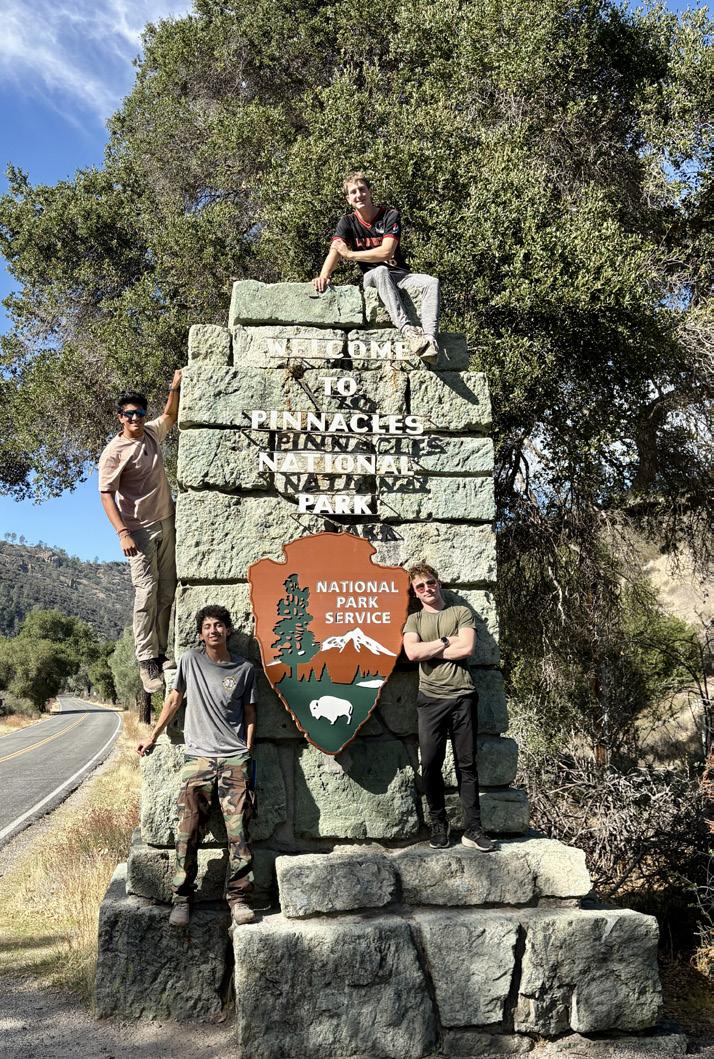
The group poses on the Pinnacles National Park entrance sign, ready for a hike. Photo courtesy of Elkes

Menlo Community Nurtures
The Roots and Rumors of The Redwood Grove
BY MANDY ZHANG
At some point, the Redwood Grove appeared on the edge of the Upper School campus — no one has ever been quite sure why, when or how. The trees tower over the math and science buildings, each one stretching as tall as 150 feet. From below, the smell of fresh pine lingers around the canopies, offering a peaceful environment perfect for long walks and quiet reflection. In early 2022, Menlo officially recognized the Redwood Grove as the Frances C. Arrillaga Memorial Grove to honor Frances Arrillaga, John Arrillaga’s wife. John Arrillaga, a devoted Bay Area philanthropist, helped fund and construct many of the current Upper and Middle School buildings. Before he passed away, Arrillaga requested to have the Redwood Grove renamed, and the school installed a stone plaque in honor of his late wife.
“It’s nice to have a little plot of nature in between the campuses, somewhere separate from the other buildings.”
Applied Science and Engineering Teacher James Dann
Science teacher David Spence took a hands-on approach two years afterward, building a wooden pergola — an outdoor structure similar to a gazebo — in the center of the Redwood Grove for his Experimental Archaeology elective. The class worked outside every day, hammering bronze seals, casting waxes and building firepits.
However, the grove has otherwise remained unchanged over the years despite constant campus renovation. Applied Science and Engineering teacher James Dann suspects that the trees were intentionally planted long before he joined Menlo in 2006. “I knew that it meant a lot to the school when they pointed it out to me for my interview,” he said. According to Dann, architects purposely revised the blueprints for the Whitaker Lab’s new entrance when its construction threatened to disturb the Redwood Grove in 2021. “It’s nice to have a little plot of nature in between the campuses, somewhere separate from the other buildings.”
“If we felt that we needed a change of space, we went outside.”
Junior Murohn Zhang
Since then, students and teachers have explored new strategies to enjoy the natural space. Dann and retired science teacher Mark Allard once spent the night in the Redwood Grove with their night school class, building shelters from different regions around the world. From there, Allard and Dann tested if the shelters would hold in their respective environments. “Whether they were in the Gobi Desert in Mongolia or the floodplains in Tahiti, we went out there and blew sand and dumped water,” Dann said. “We did it at

4 a.m., too.”
Students in Catalyst, Menlo’s newly launched interdisciplinary learning experience, also spend a considerable amount of time in the Redwood Grove. Junior Murohn Zhang recently completed her first semester of Catalyst and appreciates the fresh air of the Redwood Grove. “If we felt that we needed a change of space, we went outside,” she said. “We could always go to the Redwood Grove without being disturbed by passing periods.” Other classes offered at Menlo, such as English teacher Whitney Newton’s Literature of the American Wilderness and Jay Bush’s Modernist Poetry Worshop, occasionally host discussions in the Redwood Grove for a change of scenery as well.
After a procedural accident briefly forced sophomores




Nurtures a Love for Nature
Anya’s Insights on Bay Area Hiking Trails
BY ANYA RAMANI
Throughout January, I took Bay Area naturalist John Muir’s famous words to heart: “The mountains are calling and I must go.” I ran or hiked four popular Peninsula trails: Windy Hill, Waterdog Hiking Trail, The Stanford Dish Trail and Sawyer Camp Trail. For your sake, I reviewed the trails based on hiking difficulty, runnability, dog-friendliness and unique history, among other things. The trails are no more than a 30-minute drive from Menlo, so let’s jump in and see which trail is the best fit for you.
Waterdog Stanford Dish
Waterdog Hiking Trail is a hidden gem in residential Belmont. As you drive down Ralston Avenue and turn right down a steep street, hidden on the left is a cutout that marks the South Trailhead — my favorite place to start. You’re greeted by a large porta-potty and dog poop bag dispenser, so you won’t have to sheepishly hide your pet’s business with sticks. The name “Waterdog” is apt, as the park is a dog-friendly space to take your pet swimming in a canyon lake. Unfortunately, my dog Luna has a cat-like aversion to water, but other dogs will have a blast.
The Stanford Dish Trail is notorious for its steep slopes, making it the most tiring trail on this list. The prospect of climbing the massive hills outside my car window caused me to miss the arbitrary left turn to parking spots. This is my first complaint: non-existent parking signage. So keep your head on a swivel.
Take one of two trail options that feature either a direct or circular path to the lake. Luna chose the direct path, so we walked down a shady dirt trail for just over a mile before reaching the lake. Additionally, waterdog sits right below the surrounding houses, making the lake essentially a backyard swimming pool. However, if you’re looking for a more traditional, difficult hike, Waterdog may not be your spot. Overall for its community, lake for dogs and shady path, I give Waterdog a 9/10
Sawyer Camp
My irritation vanished when I stepped onto the Dish Trail and breathed the crisp air, even though it was surrounded by traffic. A bathroom sits at the entrance, along with signs banning dogs and bikes. You can either take the 3.6 mile roundtrip route for a direct view of the Dish, or take the right side path to reach Piers Gate. I went to the right and regretted forgetting my hat because there was no shade.
The Dish Trail is completely paved, so it is convenient for ambitious walkers and runners. The absence of key hiking trail characteristics like rocks and sticks bored me, so I turned back after a mile. The view of the Dish is cool if you’re interested in the ionosphere, but to me it looked like a hunk of junk. Complaints aside, the Dish elevated my heart rate considerably, so I’ll give it a 7/10
Windy Hill
Sawyer Camp Trail is a personal favorite. The trail winds alongside the Crystal Springs Reservoir. Though we’re all for finding dog-friendly trails here at The Coat of Arms, the reservoir is a protected watershed, so your furry friend cannot join you. You can either head south towards Highway 92 or north towards Millbrae. Most people head north on the trail that continues for six miles.
Sawyer Camp is my preferred running trail because it’s paved and flat until you reach about three miles. The crowd significantly thins by this point, but I’m still willing to conquer the hills (without having to tailgate a small child on training wheels). Sawyer Camp not only physically offers a spectacular trail, but you’re likely to see a family of deer or wild turkey sauntering across the path.
Additionally, Sawyer Camp ties for winner in the “history” category as the reservoir covers the remnants of a small town where wealthy San Franciscans would vacation during the mid-1800s. Supposedly, all structures in the valley were cleared when authorities built the Crystal Springs dam, but rumors of an underwater town persist. For that history alone, I would give Sawyer Camp a 10/10, but the rating gets downgraded for the uncontrolled toddlers to an 8.5/10
Last but not least is Windy Hill Open Space Preserve. Off to the side of a windy road in Portola Valley with limited cell service, Windy Hill features a traditional dirt trail. It’s not just dog-friendly, as horses are welcome too. Originally for logging and ranching, a 1970s housing development plan threatened the area, so two public agencies bought the property and created Windy Hill Preserve.
Parking was easy at Windy Hill, which features a convenient bathroom at the trailhead. The thorough trail map makes it difficult to get lost and offers a variety of hiking routes. Luna and I took the Spring Ridge Trail leading towards the summit of Windy Hill, which had rolling hills and switch backs — keeping us on our toes/ paws. The overhead tree cover protects from sunburn, but allows some light to peek through.
You’ll never be bored on a hike here because squirrels constantly scamper across the path. Your pet is likely to make a friend or two, and the oak trees and grass that line the path captivate your attention. The one downside of this trail is that it gets quite muddy after rain. You don’t even have to reach the summit to be taken aback by Bay Area views. You’ve probably realized by now that Windy Hill is my winner, and I award it a near-perfect 9.5/10
February 6, 2026
Whitney Newton Redefines Wilderness in the English Classroom
BY MALIA CHEN
The stereotypical image of the wilderness clouds the minds of many Americans: untouched forests and breathtaking landscapes. However, the Literature of the American Wilderness class, taught by English teacher Whitney Newton, encourages students to view the wilderness not as distant or untouched, but as something humans are deeply intertwined with. The fall semester senior honors English elective traces the evolution of the American understanding of our relationship with nature. Through literature, history and art, students examine how American attitudes toward the wilderness have shifted over time, changing their perception of the natural world.
Newton was first introduced to the subject while working as a teaching assistant at the University of Michigan for a course with the same name. Initially, she was unsure about the concept. “I did not see myself as a very crunchy person. I was definitely still living in my cerebral landscape,” she said.
“When people say, ‘I’m not an environmentalist,’ I’m like, ‘what do you mean? You live on this planet.’”
English Teacher Whitney Newton
The course, however, quickly changed Newton’s perspective, helping her connect with nature after feeling disconnected from it for years. “What is cool about this class is it got me back into nature, which I was connected with as a kid, but then wasn’t when I was an adult for some reason,” Newton said.
Inspired by the experience, Newton decided she wanted to teach a similar class when she began
working at Menlo. Some of the readings students discuss in the class today are drawn directly from the original syllabus, though Newton has spent years adapting and expanding the course to make it her own. She taught the class for five years when she first arrived at Menlo in 2012 before temporarily retiring it.
“We impact the environment around us on so many different levels through our everyday choices.”
Senior Hanna Yu
This year marks the course’s second year since its return. “That class [at Michigan] catalyzed a part of my identity that I needed to have turned on,” she said. “Now [...] I [hope to] catalyze that for students.”
The course has six units that trace how Americans’ relationship with nature has evolved over time. Students dive into the cultural tensions between wilderness as a site of survival versus leisure, the creation and consequence of public lands and the growth of environmental consciousness in the mid-20th century.
Senior Hanna Yu, who took the class last semester, said the variation in assignments was one of its most engaging aspects. “We had to write a letter to our future kids about a sustainability ethic, analyze a series of paintings by Thomas Cole
and [...] I also wrote an essay on Beyonce’s Cowboy Carter album,” she said.
While Newton likes all of the units, she particularly enjoys teaching about frontier myths and cowboy mythologies. “I feel like that one’s fun for the students,” she said. “But for me, the joy is just, like, watching the pieces fit together and build on each other over time.”
Senior and co-leader of Climate Coalition Tess Vogel really enjoyed the class. “It was very discussion-based, which I liked a lot,” she said. “Everybody was just very into the material, which made it super fun to come to class.”
Newton believes constricting ideas about what an environmentalist should look like or how they should act leaves people out. “When people say, ‘I’m not an environmentalist,’ I’m like, ‘what do you mean?’” Newton said. “‘You live on this planet.’”

By the end of the semester, Newton hopes students walk away with a more nuanced understanding of environmentalism. “I hope that everyone walks out feeling like ‘I have a stake in this planet, and what happens to it matters to me and [...] I am part of this instead of separate,’” she said.
Yu found that the class challenged her to reconsider the idea of wilderness as something separate from herself. “Previously, I thought of wilderness more as ‘other’ and ‘a different space,’” she said. “But I’ve since learned that [...] we impact the environment around us on so many different levels through our everyday choices.”
Student Clubs Find Refuge and Adventure in the Outdoors
BY AARON WIDJAJA
When students hear the word “club,” the first thing they picture is a room filled with snacks and people sitting in chairs, listening to a lecture or presentation. But for Menlo’s nature-related clubs, meetings aren’t constrained within four walls — walking to the edge of the Redwood Grove or managing a beehive offer students an escape from mundane school routines and a chance to reconnect with nature.
Menlo’s Outdoors Club organizes field trips across Northern California and brings in guest speakers ranging from professional whitewater
kayakers to Menlo alumni to teach practical outdoor skills and share personal stories from the field.
Junior and Vice President of the Outdoors Club Ryan Weinswig, who has always wanted more chances to spend time outside, detailed how the club gave him a way to turn that interest into something real. “I’ve really always wanted to kind of have the opportunity to go on these hikes. [...] When my friend approached [me asking] me to join this club and potentially lead it, I thought it was a perfect opportunity,” Weinswig said.
Beekeeping Club has also grown

in popularity among students. During afterschool meetings on Mondays and on weekends, members care for the hives, bottle honey and make beeswax products like candles.
According to junior Inaya Abdulkariem, leader of Beekeeping Club, her environmental consciousness stemmed from this involvement. “Beekeeping Club motivated me to become more active. Knowing that our work directly supports the environment made me want to be more involved and committed,” Abdulkariem said.
She feels that managing real tasks — from organizing events to caring for the bee colony — has allowed her to find a purpose. “I learned that when people feel trusted with real responsibility, they step up, and that creates a stronger sense of community,” Abdulkariem said.
Inspired by his goal to try new experiences and appreciate as many nature areas as possible, history teacher Nicholas Merlesena became the faculty advisor of Climbing Club, which involved completing a DIY climbing wall located in Redwood Grove, as well as providing more opportunities for climbing outdoors and indoors.
“I am a big fan of nature and the outdoors [...]. Going to areas like Shoreline or Castle Rock or all the different hiking slash trails in Pacifica and Half Moon Bay have all been amazing experiences,” he said.
“Connecting with nature doesn’t have to be extreme. It can be simple, welcoming and meaningful.”
Junior Inaya Abdulkariem
Weinswig’s motivation also stems from the dissatisfaction of constantly staying indoors, buried in homework and stuck in the same school day routine. “I’m on my screen, on my phone, my computer. Having the opportunity to step back and get out in nature on a hike is really relaxing,” he said.
While Outdoors Club offers more adventure, Beekeeping Club proves that helping the environment doesn’t have to be complicated. Small, hands-on activities like packaging honey can make a difference in the community. “Connecting with nature doesn’t have to be extreme. It can be simple, welcoming and meaningful,” Abdulkariem said.
Staff illustration: Tali Kauffman Beekeeping Club extracts honey from Menlo’s beehives. Photo courtesy of Sara Kassaei
Arts & Lifestyle
February 6, 2026
Valentine’s Day Gift Ideas for Every Relationship Stage
by LISA HUHS
With Valentine’s Day just over a week away and many still scrambling for the perfect gift, this special day can quickly become more stressful than exciting. Choosing the “right” gift for someone special can feel complicated, especially when relationships don’t all look the same. A box of chocolates and flowers might feel perfect for one person, but over-the-top for another. Whether you are talking, newly official, in a long-term relationship, celebrating with friends or even yourself, Valentine’s Day gifts often come with unspoken, unpredictable expectations. Finding something thoughtful without going too far is a balance many struggle to meet; the “right” gift isn’t about cost, but rather intention and timing.


Talking/Situationship:
For those stuck somewhere between friends and something more, Valentine’s Day can feel especially tricky, making simplicity the safest and most thoughtful approach to gift-giving. Gifts for this stage in a relationship should be low-pressure, casual and gesture-focused, rather than a statement of commitment. These should show interest without implying exclusivity or long-term expectations — you don’t want to pressure them.
Recently Labeled:
After establishing labels, gift-giving often shifts towards items that feel more intentional, while still avoiding anything too intense. However, rather than grand or overly romantic gestures, many couples opt for tangible, low-key gifts. These gifts should balance being thoughtful and restrained, allowing couples to celebrate becoming official while also not implying any future pressures or defining the relationship past what it is already

After a few months together, Valentine’s Day becomes less about playing it safe and more about choosing something personal. These gifts should reflect shared moments and memories, because sometimes experiences can matter more than objects — there’s no need for something excessively extravagant or expensive if there’s no thoughtfulness behind it.


Gift Ideas:
Flowers: a small bouquet, nothing too extravagant. Heartfelt card: easy, simple and thoughtful. Favorite food: snack, dessert or drink of choice.

Jewelry: dainty, simple and can be personalized with an initial.
Clothing: basic staples like hoodies, crewnecks or zip-ups; versatile items (tailor to their style.)
Perfume/cologne: can never go wrong with mini/ travel-sized scents.
Stuffed animals: gives them a daily reminder of you.

Three Months: Gift Ideas:
Personally tailored items: something they mentioned they wanted or liked.
Casual outing: a low-key dinner date, lunch or picnic. Experiences: visit somewhere you’ve never gone together aquarium, boardwalk or a new city.

Six Months:
At the six-month mark, couples often lean towards gifts that are coordinated or meaningful, signaling comfort and intimacy. Couples at this stage are typically more comfortable expressing commitment, so feel free to do something symbolic, intentional or formal.
One Year and Over:
After a year together, Valentine’s Day often becomes less about tentative gestures. Gifts at this stage can and should reflect the comfort and understanding that come with time spent together. Long-term relationships allow for greater creativity, significance and boldness in your gift choices.

Valentine’s Day isn’t just limited to romantic relationships; it can also be an opportunity to celebrate family members and close friends. Gifts in these relationships tend to focus on appreciation and fun, making thoughtful but laid-back options ideal.

For those without a partner — or those simply prioritizing themselves — this day can also be a reminder to practice self-care.
Coordinated: matching pajamas, jewelry/accessories — still personally tailored though.
Dinner date: romantic and adjustable based on age range and budget. Shared experiences: can take inspo from the three-month marker.

Valentine’s Day baskets — can include blankets, stuffed animals, bodycare, food, clothes, accessories, etc.
Engraved jewelry: can be personalized for them or a symbol of your relationship.
Elaborate dinner or day trip/vacation: this depends on restrictions (such as budget and parental rules).

Inside jokes: cards, foods, objects, anything that reminds you of specific moments together.
Stuffed animals: small but always appreciated.
Flowers: who doesn’t like a little pop of color in their room?
Small gifts: jewelry, wallet, accessories, etc, anything really works here.
Ideas:
Spa day: facial, nails, sauna, massage, meditation.
Treat yourself: meal out, purchasing an item you’ve been wanting, visiting somewhere new, anything goes.
Exercise: hiking, walking, going to the gym, nothing can beat that post-workout serotonin rush.
Staff illustrations: Claire Dickman
Investing
Continued from pg. 1
Senior Raj Kaushek said that his passion for investing stems from his interest in financial spending habits. That curiosity led Kaushek to start saving early and eventually open his first investment portfolio in fourth grade, at the age of 10.
Like many beginners, Kaushek’s early investments were marked by trial and error. “I didn’t really know what I was doing,” he said. “I lost some money, and then I got hooked.”
Kaushek emphasized that his investing philosophy is all about having patience. “I advocate against daytrading. Not much money is made in the short term compared to the long-term, and that’s kind of how I orient my portfolio,” Kaushek said. “A lot of people get discouraged super early on, and a lot of the time that’s because they’re not thinking about that long-term mindset.”
Kaushek’s personal interests in investing and finance have fueled him to make a communitywide impact. As a freshman, he created an investing club at Menlo and founded OneUp Financial Education, a nonprofit focused on improving financial literacy through student-led programs and summer camps.
Kaushek said much of his motivation for starting OneUp came from his own early experiences with investing. “[My early time investing] was all really trial and error,” he said. “That was a big reason why I started OneUp, because I think it’s important for other kids to learn this and not have to figure it out on their own.”
In its first four years, OneUp has taught over 500 students, reached 30,000 people nationwide and raised more than $35,000. Kaushek has expanded his organization’s reach to include a team of over 50 student ambassadors and chapters across the world — from Dubai to India to Nigeria.
Investing club, which meets every Thursday at lunch in room B206, has
evolved into a chapter of OneUp. In the first semester, the club focused on investment competitions. “We learn about how to build a safe portfolio and what good research looks like when you’re [investing],” Kaushek said. “I think [those] are really formative things.” Currently, the club is working on creating its own crypto currency.
Junior Maya Sharma is also involved in Menlo’s Investing Club and will become its president next year after Kaushek graduates. Sharma’s experience in investing didn’t begin with trading, but instead with research.
She started learning about investing in eighth grade alongside her dad, writing about companies and evaluating them as if she were going to invest in them.
Arts & Lifestyle
how these businesses work,” she said. Sharma said she doesn’t have a large a portfolio yet, but has a small amount of money in individual stocks and plans to invest more as she gets older.
If you’re not investing now, get started as soon as you can.
Senior Raj Kaushek

Sharma said one of the most surprising aspects of learning about investing has been how accessible information is online. “It’s not totally closed off like most people would think,” she said.
Sharma takes pride in being a woman in a predominantly maledominated area of interest. “Only a small percentage of capital that’s managed out in the world is managed by women, so [I] definitely want to shift that in the future,” she said. Sharma said she thinks that more people should get involved with investing. “There’s index funds, ETFs, like, there’s a lot of safe [ways to invest]. It doesn’t have to be like this crazy gamble,” she said. “Most times, it’s just a way for people to start building wealth [when they’re] really young, which I feel like is a really cool concept.”
Kaushek agrees that more students should hop on the investing bandwagon. “If you’re not investing now, get started as soon as you can,” he said.
Mungai, on the other hand, suggests that students interested in getting into investing take a methodical approach, watching videos to learn and first practicing with fake money. “Don’t just go in blind with your money,” he said. “You’re gonna lose it all.”
Selected Student Profile: Ethan Blaydes-Greenberg
by SAVANNAH SMITH & WILLIAM GARDNER
The following has been pared and edited for clarity.
Q: What is your favorite instrument?
A: Well, I play cello, so it has to be that. I was probably six when I started playing. I used to practice every day.
Q: What is your favorite song to play on the cello?
A: One piece that I would like to play, which is pretty epic, is the Dvorak Cello concerto. It’s like [Hums Cello Concerto in B minor, Op. 104].
Q: Who’s your favorite composer?
A: If you mean classical, I like Shostakovich. He was a composer from the Soviet Union, and he used music to rebel against the government. There’s a cello concerto that goes: [Begins to hum Shostakovich’s Cello Concerto No. 1] and it’s supposed to represent secret police knocking on your door.
Q: If you had to put yourself in a Harry Potter house, what would you put yourself in?
A: Hufflepuff.
Q: What is your least favorite instrument?
A: Uh, maybe something that’s really high and shrill that hurts my ears, like the piccolo.
Q: Who is your favorite music artist in general?
A: Recently, I’ve been liking Mac Miller. I think his music is really interesting. I also like Tyler the Creator: weird, norm-defying artists.
Q: Okay, if you could have any animal as a pet, what would it be?
A: Dog, easily. I actually have a miniature schnauzer.
Q: What is your favorite watching order for “Star Wars” movies?
A: First I’d watch “A New Hope” and “The Empire Strikes Back,” then watch the entire prequel trilogy to get the backstory. And then I would finish it off with “Return of the Jedi.”
Q: Do you have a favorite character from “Star Wars”?
A: I think Lando Calarisian is a cool character. He betrays Luke and Leia and Han. But eventually he turns toward their side and helps them out, so he’s kind of more complex.
Q: Who is your least favorite Harry Potter character?
A: Umbridge because she’s so hateable.
Q: Is there something that you like that everyone else hates?
A: I like peanut butter on my everything bagels. Is that crazy? My dad likes to bake, so he makes bagels, and I always force him to make everything bagels and I put peanut butter on them.
Q: What’s one thing you wish you could do, that you can’t do now?
A: I wish I could code or do stuff related to either web design or game design.
Q: If you had to perform one karaoke song in front of the entire school,
what would it be and why?
A: Probably something basic, like “Piano Man.” It’s just really catchy.
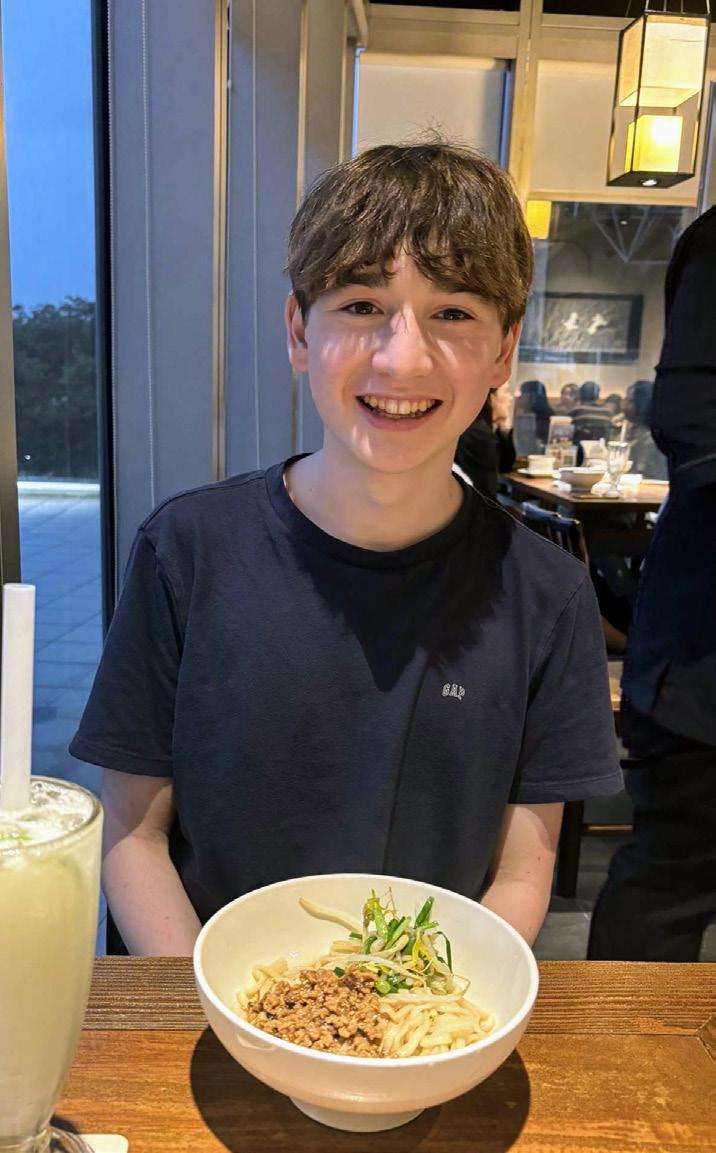
Junior Ethan Blaydes-Greenberg eats dinner with his family. Photo courtesy of Greenberg
Arts and Lifestyle
EDM Finds Its Beat at Menlo
by BAELYN BATORY
It’s homecoming, and you are bouncing up and down to the music blasting out of the speakers. You look up at the DJ table to see who is spinning this fire set. Wicka wicka what? Is that a Menlo student behind the table?
Last homecoming, senior Arki Temsamani was given the opportunity to DJ part of the dance, which he said was an amazing experience. “It’s always nerveracking because you don’t want to make a mistake in front of everyone, but we put a lot of time and effort into preparing, and it felt like people enjoyed it,” Temsamani said.
Since its debut in the 80s, the electronic dance music genre (also known as EDM) has been on the rise. Recently, it’s become a postpandemic craze and a newfound passion for younger generations, with DJs like Australian producer Fischer selling out massive concerts.
Free DJ apps (digital audio workstations) allow anyone with a device to experiment with pre-made loops, audio and virtual instruments. One of these apps, Apple’s GarageBand, is where sophomore Rex Labatt learned how to mix beats after watching some of his friends experiment with it. “I think it’s really fun to be able to control the music,” Labatt said.

Moreover, Labatt and two other sophomores — Deven Dholakia and Evan Grant — have expanded their tunes beyond their computer speakers and found some success DJing in public places. Through their joint DJing account on Instagram, “devex.music,” the group has received some gig opportunities in downtown Palo Alto and continues to post when and where they will be DJing next. “[The account] is really fun because we all equally love the activity,” Labatt said.
For those who prefer a more advanced way to scratch and blend, Menlo offers a music producing elective called Push Play, which uses more technologically advanced materials than those you might find on a laptop or phone. Because students wanted to expand their skills past the keyboard after the pandemic, instrumental music teacher Leo Kitajima Geefay introduced the semester-long art class in response to the craze. The class uses Akai Professional MPCs, a special type of sampling sequencer introduced in 1988, that allows students to create new beats and experiment with different types of music using
“It is cool to see so many people now realizing that you don’t have to be a formally trained musician to be able to join the music making community,” Kitjima Geefay said. Kitajima Geefay said the freespirited nature of the hobby allows novice DJs to express themselves through the music, just like one might while painting or singing. “I consider that to be an art because you’re not just playing a certain song. You’re kind of creating things as you go,” Temsamani said. Temsamani first got into DJing because his mom felt it might be a way for him to channel some of his energy into a useful and creative skill. After his mom gifted him his first DJ board, the visions became a reality. Now, Temsamani feels that he can even have a future in DJing due to his love for the activity. “I want to start getting into producing my own music, so if I ever do that, there is definitely a future,” Temsamani said.
February 6, 2026
My Word! Fix
by TOM GARVEY
Welcome to "My Word!," a Coat of Arms column where Menlo faculty trace the surprising histories behind everyday language. In this edition, Upper School Latin & English teacher Tom Garvey dissects the word “fix.”
Language loves a good makeover, and “fix” has undergone more than a few. Born of Latin figere, meaning “to fasten,” the word first entered the English language in the 14th century with a sense sturdier than duct tape: to make something firm or secure. That’s its etymological anchor, the sturdy core meaning that keeps its later wanderings tethered. Early speakers used “fix” to describe setting something firmly in place, but, as language does, it refused to sit still.
By the 17th century, the word wobbled a bit, developing the figurative sense “to settle or determine.” This is a fine example of metaphorical extension: fastening now applied to ideas, not objects.
From there, “fix” fixed its sights on preparation (“fix supper”), problem-solving (“fix the leak”) and even deception (“fix the match”). The last shift rides on semantic drift, when context gradually stretches meaning like linguistic elastic.
American English added a dash of folk rebellion. To “get your fix” borrows that solid, satisfying sense of repair and retools it for craving, physical or otherwise. Drifting dialectically to the South, we encounter the phrase “fixin’ to,” meaning “about to.” Linguists call this grammaticalization, when a concrete verb morphs into a verbal prelude. But “fix” is no angel of consistency. It doubles as a contronym, a word that contradicts itself, like “to sanction,” which can mean permit or punish. “Fix” can mean both “to secure” and “to rig” (a race, an election), both “to mend” and “to manipulate.” Such semantic oppositions aren’t confusion; they’re evidence of flexibility.
What ties these scattered senses together is the concept of control, whether tying down, setting right or scheming up. “Fix,” in every guise, remains committed to certainty, even when it’s slyly mutating yet again.
Seniors Turn Semi-Formal Into a Sea of Bedazzled Suits
by SHAAN PARIKH
When the Menlo seniors stepped onto the floor for the annual semi-formal dance, the real show had started well before their arrival. It was not the music or the decor that turned heads; it was their bedazzled suits.
This semi-formal tradition has slowly grown into something louder, brighter and more chaotic each of the past three years at Menlo. This year, a record number of senior boys strided into the dance dressed like they were prepared for a costume party; a frenzy of flamingos, sequins and cartoon characters emblazoned across suits and pants as the seniors flooded Menlo’s West Gym dance floor.
It was so uniting.
The tradition was introduced to Menlo just three years ago, but it has rapidly reached the whole grade. “I got involved because it’s kind of just a fun senior tradition that everyone does, and I think it makes semi even more fun than it already is,” senior Landon Lee said.
For senior Jackson Flanagan, the tradition first intrigued him as a
sophomore. “I was like, ‘why are these seniors wearing these weird suits? Why aren’t they like the rest of us?’” Flanagan said. “As soon as I finished my finals this year I knew what time it was. I had to start looking for my suit,” Flanagan said.
Flanagan started searching at the beginning of the new year and he finalized his order weeks before the dance. His final choice: a flamingo suit, matching some of his buddies. “We wanted whatever looked visually unappealing, but also pretty funny or cool,” Flanagan said. “We thought the flamingos [were] pretty sweet, so we had to do that.”
However, different friend groups had different ways of approaching this fun. Some choose a theme of animals, video games or TV shows for their suits, while others just strive for a complete eyesore.
“There’s like six of us [in my friend group] and we’re all doing different [suits],” Lee said. “They’re all neon colored, but black as a background. Mine is a kind of fireworks and it’s gold and black.”
For senior Andrew Levitt, the night was a mix of humorous and nostalgic emotions. “I think just seeing all my friends wearing the matching suits, getting together for photos — it was really special. It was kind of emotional in some way. It was my last semi,” Levitt said. “It made it feel like an experience rather than a serious event. It made it more fun, like we were all united friends.”
Lee and Flanagan believe that the tradition perfectly encapsulates Menlo’s personality and values. “I think Menlo is very academically focused, but also knows how to do fun stuff and not think too deeply about things,” Lee said.
Flanagan loves how people across campus enjoy the goofy nature of the tradition. “Teachers always get a kick out of it,” he said.
Levitt also appreciated the support and appreciation from their parents and teachers. “The teachers were all like, ‘Yo, I love your suit.’ It gave us so much confidence. And actually the funniest part
was the parents at the pre-party because they were just laughing at all of our suits.”
Flanagan thinks the suits are more than a simple joke or a one-off tradition. “It matters, especially to seniors, because it’s their second-to-last huge social gathering at Menlo with the whole community,” Flanagan said. “Everyone’s just looking to have a good time.”
Levitt said this tradition was a defining moment in his four years at Menlo. “It just [was] an awesome way to start the semester,” Levitt said. “It was so uniting and it just felt surreal.”
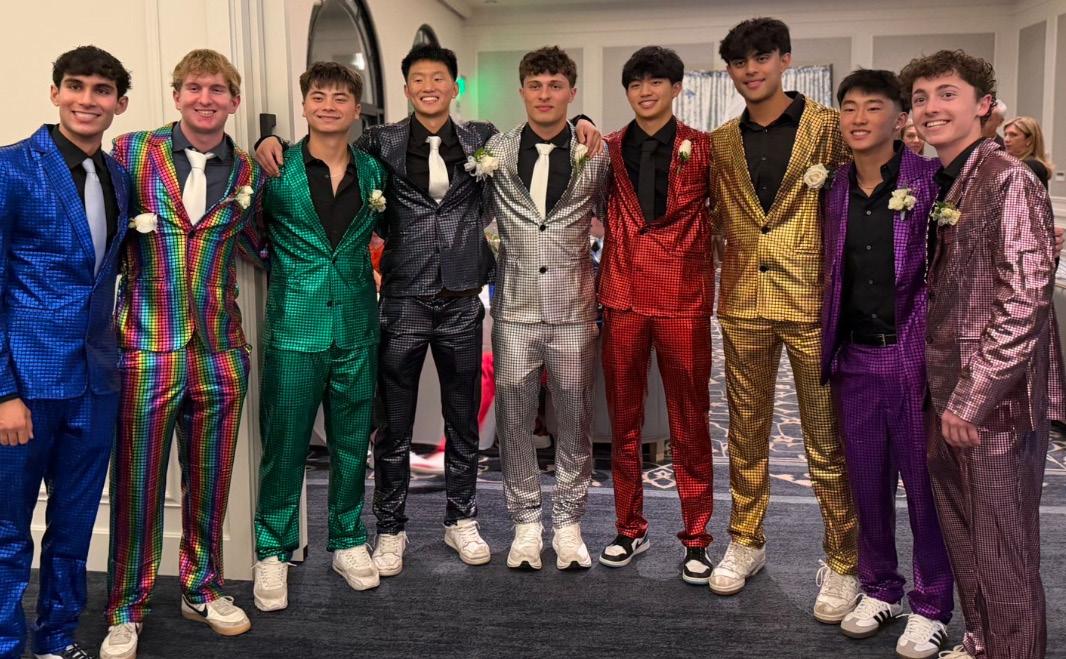
Staff illustration: Baelyn Batory
(Left to Right) Seniors Raj Kaushek, Bodie Callaghan, Reed Sunwoo, Ethan Zhao, Cameron Rafati, Jude Yuen, Amay Srinivasan, Charlie Allard and Andrew Levitt pose in their crazy suits for a group photograph during the senior pre-party at Menlo Circus Club. Photo courtesy of Yuen
Senior Andrew Levitt
From Bunny Slopes to Backcountry: The Coat of Arms Reviews Tahoe Ski Resorts
by NOAH LEVIN & MALIA CHEN

Sugar Bowl Resort:


Sugar Bowl Resort is a medium-sized, independently owned ski and snowboard resort located in northern Placer County on Donner Summit in the Sierra Nevada mountains, making it the closest major ski resort to Sacramento and the Bay Area. It offers excellent terrain without the overwhelming crowds and long lift lines found at larger resorts like Northstar or Palisades. Unfortunately, the short lift lines and uncrowded slopes come at a price; since Sugar Bowl is an independent resort, it doesn’t participate in popular multi-resort season passes such as the Epic or Icon passes, which helps keep the mountain less busy.
Although the base areas are simple and the food options are more limited compared to larger resorts, they are efficient and convenient for quick breaks between runs, and the compact layout of the resort, with express lifts, makes it quick and easy to get onto the mountain. Sugar Bowl offers a diverse set of terrain with a variety of strong intermediate runs, very solid black diamond runs and great beginner runs. In terms of pricing, Sugar Bowl is cheaper than Palisades Tahoe and most peak rates at Northstar, but more expensive than true small hills like Donner Ski Ranch or Boreal.
Northstar California Resort:
Northstar California Resort is an ideal ski resort for families. Located near Truckee and the northwest shore of Lake Tahoe, Northstar provides a great overall experience for skiers and snowboarders looking for a fun, stress-free day!
Northstar’s terrain is largely on the easier side, with a plethora of beginner and intermediate runs. This makes it the perfect resort for newer skiers and snowboarders who are looking to build confidence on wide, well-groomed slopes.
However, Northstar’s popularity comes with drawbacks; the mountain can be very crowded, especially on the green runs that funnel skiers down to the base of the mountain. Village Run, which leads directly into the Northstar Village, is particularly busy at the end of the day and can be dangerous with many inexperienced skiers and snowboarders sharing the slope.
While it may lack the more extreme terrain of Palisades or Kirkwood, Northstar makes up for it with its accessibility and convenience, along with having one of the best base villages in Tahoe. The Northstar Village offers ice skating, fire pits and a variety of restaurants and shops, making it a popular place to relax after a long day on the mountain.
Though Northstar is not typically associated with difficult terrain, it still provides plenty of challenging runs for advanced skiers and snowboarders. The Backside offers steeper and less crowded runs, including Burnout, a groomed black, and The Rapids, an ungroomed run that is great for people looking for a long run with plenty of moguls.
Additionally, Northstar’s terrain park consistently ranks in the top 10 terrain parks in North America. Overall, Northstar is an excellent, family-oriented resort for those looking for a relaxed, reliable Tahoe skiing experience.
Palisades Tahoe:
Palisades Tahoe, formerly known as Squaw Valley, embodies a versatile ski environment. Its complete mountain terrain and wide base village make it one of the most popular mountains in the U.S. However, this comes at a cost, as Palisades is consistently one of the most expensive resorts in the Tahoe region. As a member of the Ikon Pass, Palisades and other mountains offer cheaper year-round access to popular mountains.
For many families, the investment in a Palisades Tahoe experience is justified. Palisades offers a variety of runs catered to skiers and snowboarders of all levels. Off the mountain, the Olympic village provides a variety of restaurants, shops and entertainment throughout the year. Compared to other resorts, Palisades leans more into the Après-Ski vibe, with music nights and disco tubing down the mountain.
The mountain itself is world class. The terrain ranges from mellow groomers to world-famous technical lines. Whether you are at the top of the Aerial Tram or KT-22, Palisades offers stunning views of Lake Tahoe year-round. Palisades also dominates other resorts in sheer size. It boasts 3,600 skiable acres, which makes it one of the largest in the area. As mentioned above, the lift KT-22 provides skiers with access to some of the most technical chutes in North America, with Chute 75, West Face/Mosley’s and most famously McConkey’s/Eagle’s Nest, which is one of the most famous and challenging runs in the world.
Don’t worry, though, beginner and intermediate skiers still thrive at Palisades with Shirley Lake Express and Gold Coast lifts offering great blue groomers.
Kirkwood Moutain Resort:
Located on the southern side of Lake Tahoe, Kirkwood offers a great landscape for hard-core skiers. Unlike Palisades and Northstar, Kirkwood is a much smaller resort and doesn’t try to impress with luxury. It caters to skiers who care more about pure skiing than the all-around experience. This emphasis on hard-core skiing is reflected in the price tag as Kirkwood remains quite affordable compared to other resorts in the area and remains on the Epic Pass.
Families visiting Kirkwood will find a more chill environment, free of the bustling crowds of larger resorts. Lift lines are often short and while the restaurants remain calm. That being said, Kirkwood is not a beginner’s paradise. Its terrain is more unforgiving and offers fewer groomed runs than other resorts. Kirkwood is best suited for families who value long, hard days on the slopes rather than a full tourist experience.
Kirkwood’s challenging terrain and consistent snowfall make it truly one of the best mountains in California. The Wall lift gives skiers access to some of the hardest runs in California. The Wall run itself is a double black and is highly regarded as a top run in all of Tahoe. It also features other classic runs like Look Out Janek (double black), Palisades (not to be confused with the resort) and Sentinel Bowl. Although there are fewer beginner and intermediate runs at Kirkwood than at other resorts, chairs two, seven and 11 all provide a great spot for proficient skiers. Unlike other resorts in Tahoe, Kirkwood aims to give skiers an authentic, old-school experience that they’ll never forget.
Staff illustrations: Ella Skinner and Claire Dickman
Boys Soccer Finds Form Ahead of Rematch With Crystal
by RILEY HUANG
Menlo’s boys varsity soccer team is entering 2026 with a single focus: the Central Coast Section trophy. Last year, the Knights were a goal away from history, narrowly losing 5-4 in penalties to Hillsdale for the CCS title. With seven returning starters and a few new underclassmen, the team is eager for redemption.
“We’re definitely trying to avenge that [loss] from last year, because we deserved that CCS final,” senior captain Cameron Rafati said.
The Knights have started their season 8-3-3 as of Feb. 3, but head coach Daniel
Hicker said it’s been a lackluster start.
The Knights lost 4-1 to Crystal Springs on Jan. 14, marking the first time the team has lost to Crystal in its history. “We had an underwhelming preseason, and we have a lot of room for growth to reach and maintain the standard we want,” Hicker said. We didn’t quite perform the way we believed we could.”
Despite a shaky start, sophomore Ryder Shaw believes their January trip down to San Luis Obispo has set the team up for success. “The chemistry’s way better now,” Shaw said. “At the end of the day, we’re a team [and] we’re family.”
Recent results have been promising, including last week’s 2-2 draw against Sacred Heart Prep. The team is in form for today’s critical home rematch with Crystal according to Shaw. A win would put them back into first place in the WBAL.
“It would be the first time in our history winning [league] three years in a row,” Hicker said. “Another goal is to win CCS outright. This program has never done that. [...] I’d love nothing more than for them to lift that trophy — for themselves, the coaches and the players who came before.”
Boys Basketball Falls to SHP Again
by SPENCER TOLAND
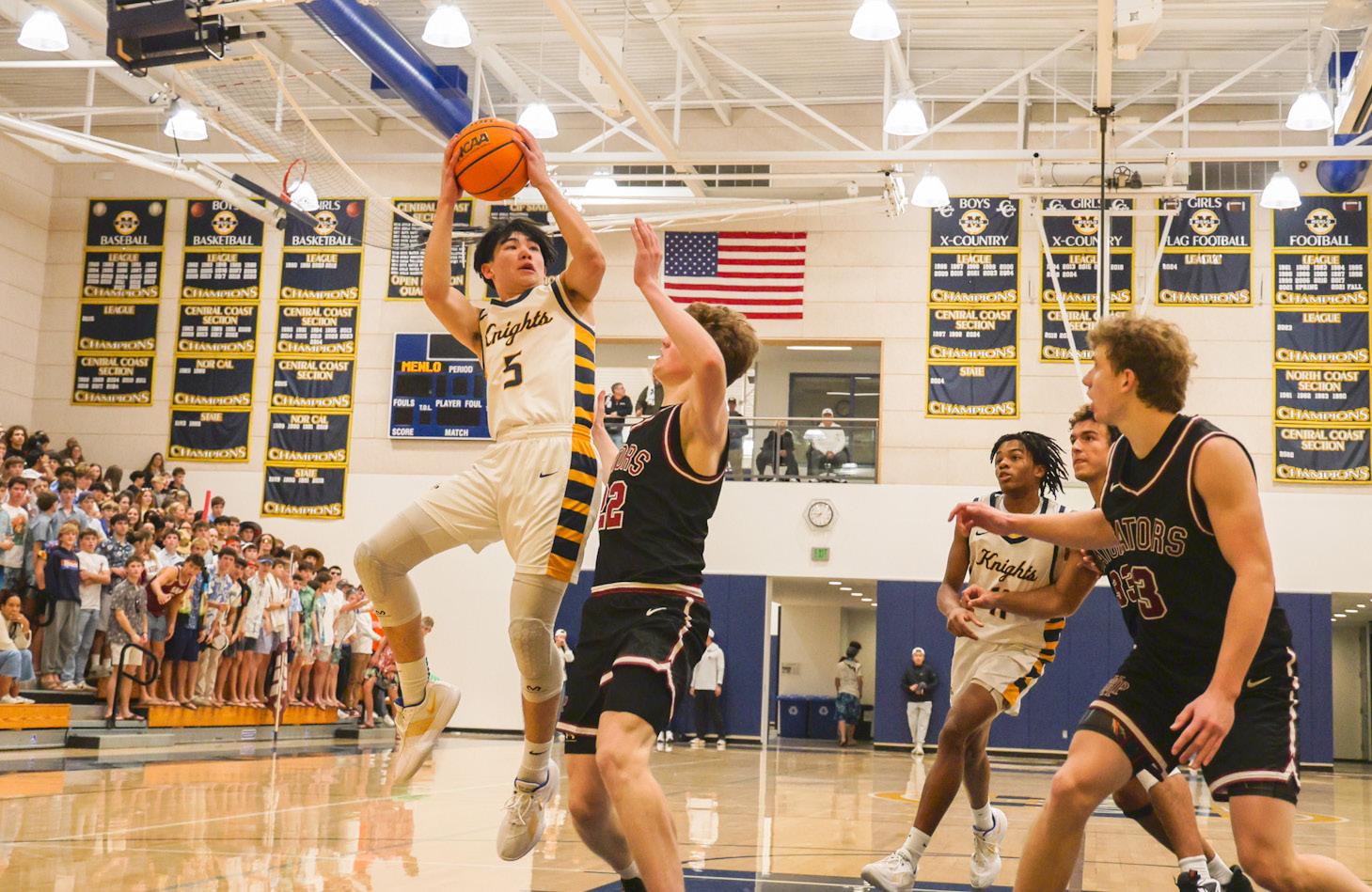
The last time Menlo boys basketball beat their archrivals, Sacred Heart Prep, was Jan. 17, 2020. It’s been a 14-game streak that’s included two crushing playoff losses and a variety of regular-season defeats. With a thrilling overtime 59-53 loss on Jan. 20, the Knights fell just short of breaking that streak.
The Knights have started the season with a 10-9 record and are 2-4 in league play as of Feb. 3. After starting with four straight wins, the team has been up and down since a 59-53 win over Pacific Grove. The Knights also took on four schools in a Southern California tournament over holiday break, finishing with
a 2-2 record. Head coach Ben Batory is satisfied with the team’s performance thus far and is optimistic for the rest of the season. “We’ve won the games we were supposed to win but we’ve lost the games we were supposed to lose,” Batory said. “We need to flip that script.”
Batory said the team’s league schedule is particularly challenging this season. “We’ve been working hard to raise our level,” Batory said.
The Knights hopes to reverse what has been a one-sided rivalry with SHP. “Scouting the tendencies of opposing teams and exploiting them is going to be important,” sophomore guard JayAr Davis said.
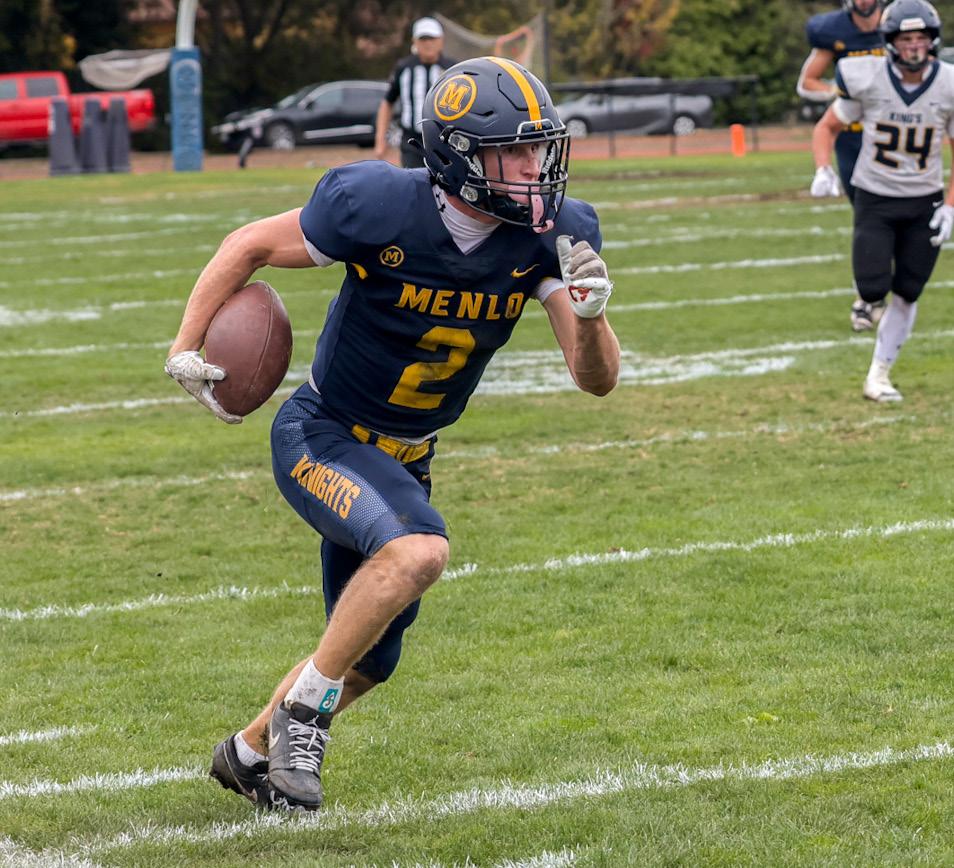
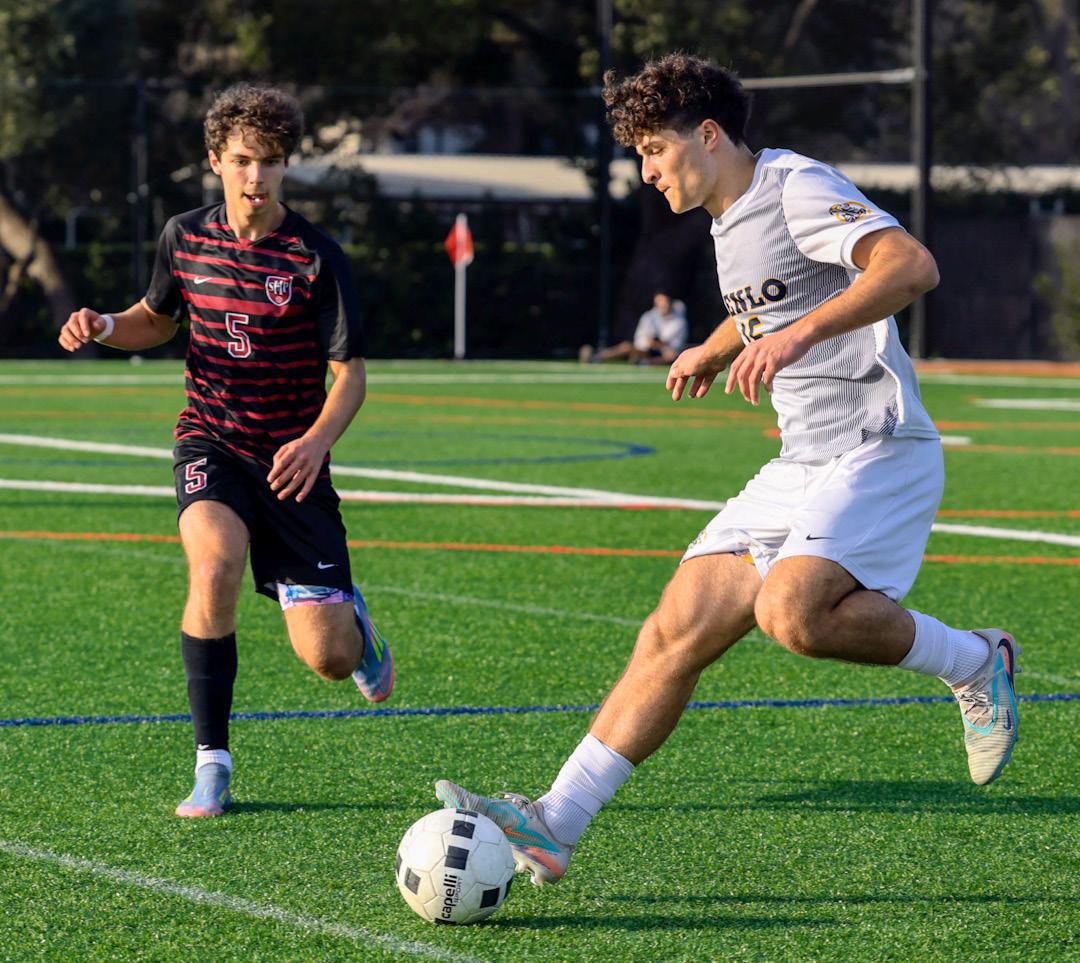
Girls Basketball Eyes Another Title
by PAYTON LEE
After losing its two highest scorers, Karen Xin ‘25 and Ruiqi Liu ‘25, Menlo’s varsity girls basketball team has opened its season 14-5 and 3-3 in league as of Feb. 3 in search of its fifth straight CCS title.
Head coach Ryan Cooper said Liu and Xin’s absences have allowed other players to step up as leaders. “I’ve noticed the girls finding a rhythm together and a newfound confidence in their ability to [...] score together,” he said.
Sophomore Anika Shah has emerged as the team’s leading scorer, propelling the team to a 46-44 victory over Homestead on Jan. 10. “[It] was a really hard-fought game [...] so I’m glad the outcome matched it,” Shah said.
The team’s two seniors, Sophie Housser and Maren Mulloy have played leadership roles for the Knights. “[Housser’s] taken on a captain role in terms of energy and the bench,” Cooper said. Meanwhile, Mulloy has anchored the team defensively. “We build our game plan around her on the defensive end,” Cooper said.
Cooper sees this year as an opportunity for the team to learn. “The fun is going to be in every day, just being together and watching [...] our team continue to grow.”
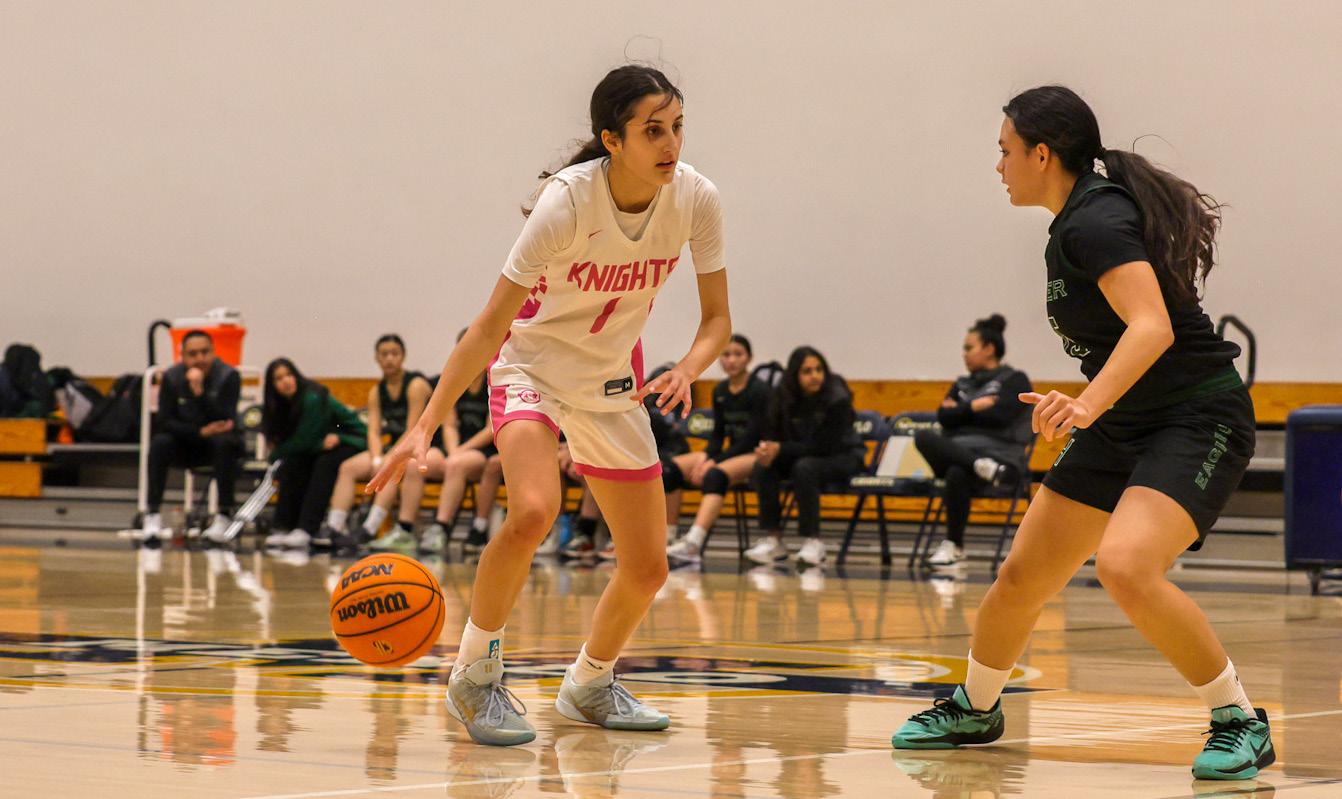
Girls Soccer Pursues Back-To-Back CCS Championships
by PENNY DIEHL
Following a CCS title and its deepest playoff run in program history last year, the Menlo girls varsity soccer team currently holds a record of 5-3-4, and sits in fourth place in the WBAL as of Feb. 3.
The team opened its season on Dec. 2, tying Menlo-Atherton High School 1-1, and went on to earn another 1-1 tie in its second match against Burlingame High School on Dec. 4. In the two months following their return from winter break, the team has only lost once, winning four games and tying two others.
Head coach Ross Ireland has worked on shaping the team to work together, communicate effectively and play the best game possible. The team has faced challenges this season, particularly surrounding player injuries. “If we can stay healthy, I think this team can challenge our league,” Ireland said.
Sophomore McKinley Harding has
seen how injuries have affected the team, but believes in its ability to respond.
“When some of our starters and players get hurt, we have other ones that can stand up and take their place because we have such a talented team and deep bench,” Harding said.
Senior winger Krista Arreola has been a valuable asset, according to Ireland. “She’s the most feared winger in the league,” he said.
Ireland also said senior Bianca Putanec, the Knights’ primary goalie, has been a standout player this year.
“We have the best goalie in the league,” Ireland said.
Sophomore Parker Sunwoo feels that this season, the team has been especially unified on and off the field. “Even when it’s an intense practice, […] everyone finds ways to laugh or to make jokes,” Sunwoo said.

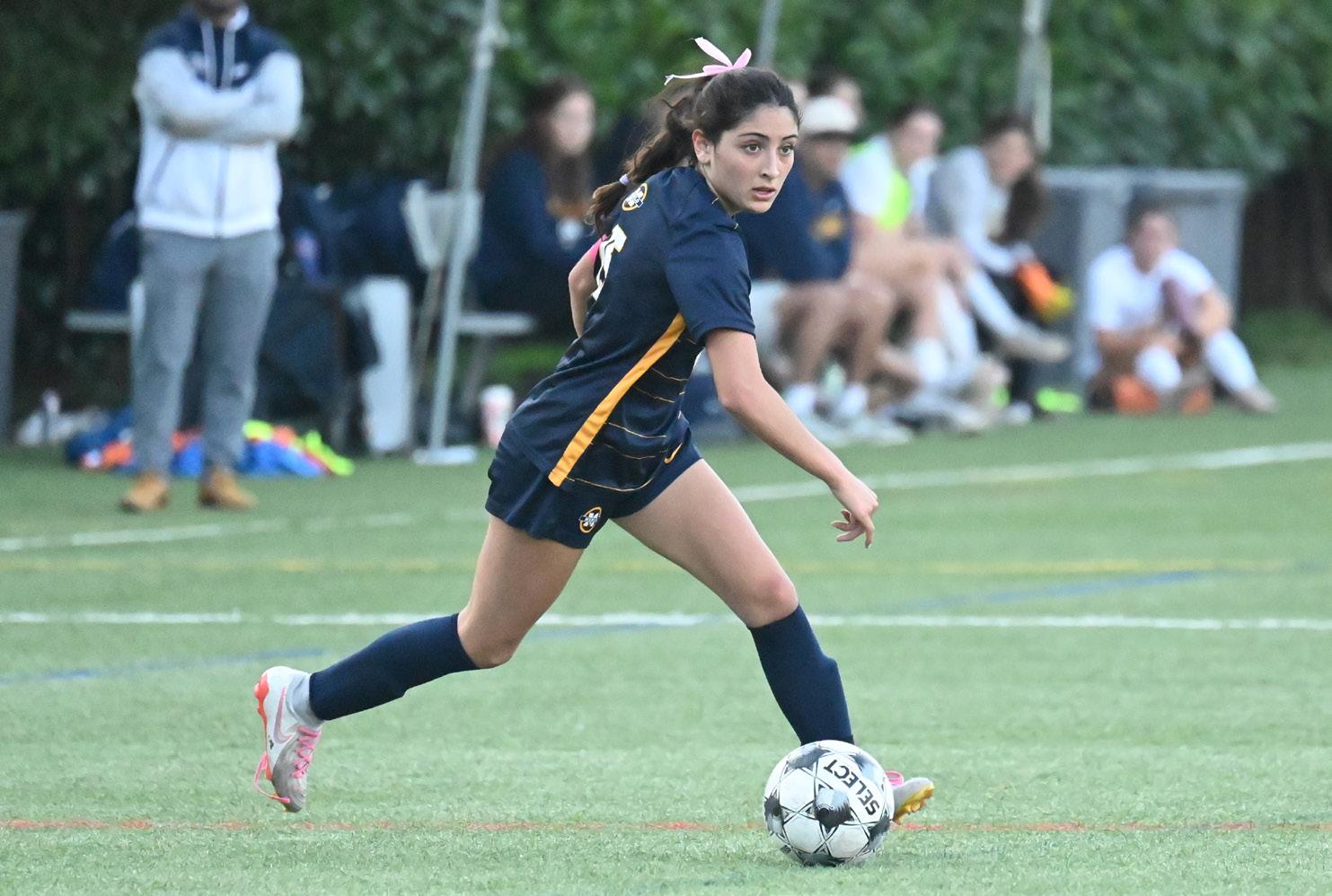
Senior forward Krista Arreola dribbles the ball before passing to a teammate during a game against Notre Dame Belmont on Jan. 27. Photo courtesy of Pam McKenney
Senior Cameron Rafati dribbles around an SHP defender. Staff photo: Shaan Parikh
Junior guard Sophia Longinidis facilitates the Knights’ offense against Harker on Jan. 30. Staff photo: Savannah Smith
Freshman guard Ethan Love goes up for a contested layup during Menlo’s matchup with SHP in January. Staff photo: Noah Levin
Brandon Schneider ’97 Elevates the Golden State Warriors
by CAROLINE CLACK
From religiously supporting Bay Area sports teams as a high school student at Menlo to helping manage the most valuable franchise in the NBA, Golden State Warriors President and Chief Operating Officer Brandon Schneider ’97 had no idea his love for sports could result in a career that didn’t involve being a sixfoot-eight professional athlete.
Schneider said playing soccer, tennis, baseball and track at Menlo helped contributed to his competitive spirit and ambitious drive. “I just think you learn a lot from sports,” Schneider said. “You learn a lot about competitiveness, but also teamwork and how to collaborate with other people.”
Beyond athletics, Schneider appreciates the uniquely intelligent and supportive environment Menlo had to
offer, both from students and faculty members, many of whom he remains close with today. “To this day, some of my best friends are people that I went to Menlo with,” Schneider said.
After graduating from Menlo and majoring in business and economics at UCLA, Schneider expected to engage in a career in investment banking or venture capital, but a hiring freeze prevented him from pursuing those fields.
After a brief stint as a waiter at Il Fornaio in Burlingame, a family friend and industry professional connected him with the then-Warriors President, who offered him a position in ticket sales on the spot. From there, he joined the Warriors community and never looked back. “We’re a really small company, so you really feel like you’re having an
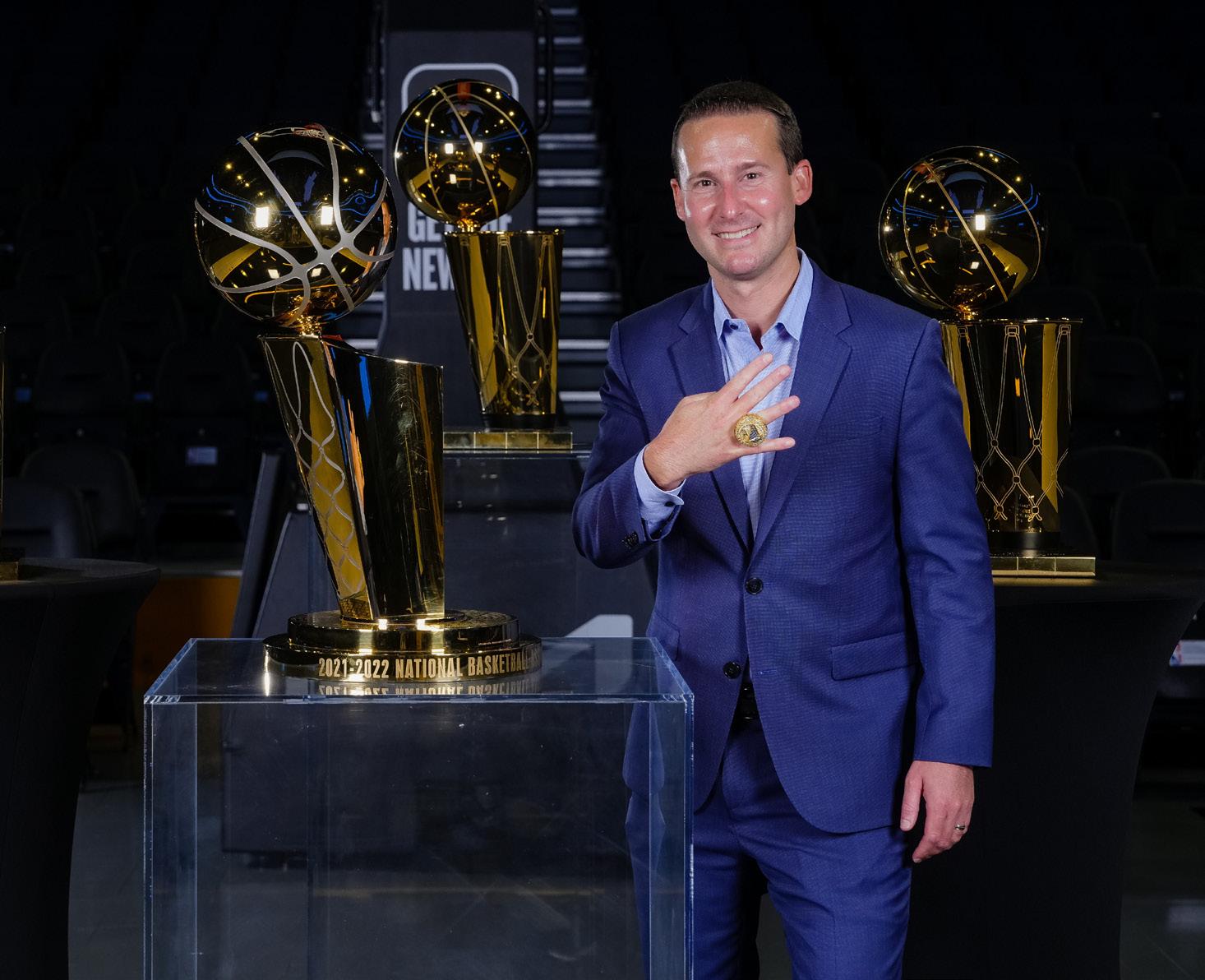
impact on the success of the company,” Schneider said.
After 23 years with the Golden State Warriors, Schneider appreciates how his time with the organization has helped him develop as a person and build lasting relationships “I’ve constantly had the opportunity to learn and grow,” Schneider said.
For Schneider, learning and curiosity didn’t end when he completed his formal education. He continues to face new challenges and develop new knowledge and skills throughout his time with the Warriors. From helping launch the Golden State Valkyries in May 2024 to designing Chase Center during the pandemic to bringing the NBA All-Star Game to Chase Center in 2025, Schneider has learned how to build team culture, navigate the restaurant industry and work with local government officials, among other skills. “All of these things were totally outside the scope of anything I’ve ever done,” Schneider said.
On a daily basis, Schneider manages many aspects of the Golden State Warriors franchise, from communicating with other Bay Area sports franchises, collaborating with other NBA teams across the country and overseeing internal departments. In his position, Schneider has faced some of the difficulties of leadership, learning to balance what is best for the company with what is best for each individual on the Warriors team. “No matter what you do, someone’s not gonna like it,” he said.
According to Schneider, in an entrylevel position, an employee is judged on how much they accomplish and the value they add as an individual. As as he has grown in the company, Schneider has realized that success as a leader is measured by the success of everyone around you.
Despite the challenges, Schneider loves his professional community and has enjoyed each day within the company, no matter the position. “I work probably more than anyone that I know, but I do it because I want to, and I love what I do,” he said.
Schneider encourages Menlo students to enter careers in which they will find joy and wholeheartedly believes in the saying that if you find something that you love, you will never work a day in your life.
I’ve constantly had the opportunity to learn and grow. “ “
Warriors
Brandon
’97
As someone in an industry that is eager to better utilize advanced technologies, Schneider encourages Menlo students to take advantage of their education around artificial intelligence and other innovative technologies to capitalize on them in their careers.
Schneider also hopes that Menlo students take advantage of networking opportunities, whether that be connecting with parents at their younger brother’s soccer games like Schneider did or building relationships with other community members. “Sometimes it’s more who you know than what you know,” Schneider said.
Inside Menlo’s Innovative GPS Tracking System
by DEVEN DHOLAKIA
Before a Menlo athlete ever feels tired, sick or sore, the data already knows. Why? For the past three years, Menlo has implemented a GPS tracking system across its athletic programs, using wearable devices to better understand player performance, health and fatigue.
The system is overseen by the Menlo sports performance staff, which includes Daniel Hicker, Jamie Hegg and Cole Marmor. Hicker said this technology has primarily been used at the collegiate or professional level.
Hicker said the idea came from his experience working with the GPS trackers in Major League Soccer (MLS), where he was head of athletic Performance for the San Jose Earthquakes.
“The primary goal is intelligent load management where we are pushing adaptation without increasing risk,” Hicker said. The GPS trackers help understand what athletes are actually doing on the field and connect that information to training and recovery. “If we’re not collecting real data from the field, we’re missing one of the most important pieces of effective athlete management,” Hicker said.
Menlo’s GPS program started with a donation of eight tracking units. These were first used with the varsity boys soccer team as a trial run in Jan. 2023. After a successful trial run, utilizing the data to help athletes recover faster, the program gradually grew. It first expanded to track movement of football and lacrosse players and eventually full rosters across multiple boys and girls teams.
The device measures factors such as distance covered, maximum speed, acceleration and overall workload. According to Hicker, this data helps staff understand which muscle groups are being stressed,
allowing them to focus on recovering those groups while working on other areas. For example, Hicker would put more focus on the hamstrings during a lift if the data showed that the team had heavy quad exertion. “When athletes stay healthy, performance takes care of itself,” he said.
“The GPS trackers have definitely played a positive role in my performance this season,” sophomore varsity soccer player Ryder Shaw said. “It allows me to know when to push myself or to focus on my recovery, which has helped me stay healthy throughout the season,” he said.
After practices and games, the data is reviewed for weekly trends rather than single-day results. Hicker explains that the data allows him and his staff to determine when athletes should train harder and when recovery should be prioritized. “We share this information with coaches so they can plan with intention. If it’s the day farthest from competition, we can push a little more. If the data shows fatigue, we adjust and pull back to protect the athletes.”
Hicker emphasized how the data is meant to inform rather than dictate coaching decisions. He also believes that the GPS tracking was crucial to the boys varsity soccer team’s playoff success last year, as they were able to keep their athletes as healthy as possible.
important for athletes who play multiple sports or log heavy minutes. A player can’t contribute if they’re sidelined, which is why the GPS system plays a vital role for Menlo athletic teams. “The best ability is availability because you can’t contribute if

Hicker said long-term data tracking is especially
approaching sickness. “In some cases, we can see the warning signs in the data before symptoms show up. A day later, they were sick. The metrics had already told the story,” Hicker said.
Schneider poses with the Larry O'Brien trophies and championship ring. Photo courtesy of Schneider
President and COO
Schneider
Marin Yamada, Smith College
by AARON WIDJAJA
In August 2025, senior Marin Yamada announced her commitment to the admissions process at Smith College in Massachusetts, where she will continue her lacrosse career at the Division III level.
Yamada began playing lacrosse in fourth grade. Originally, Yamada’s father only signed up her brother, Rio Yamada ‘29, for a local lacrosse club, but one of the girls’ program directors encouraged her to get out and play. “[My dad] told her about me, and she was like, ‘Oh, why doesn’t she play?’ [...] And he just signed me up, and [I’ve fallen] in love with it ever since,” Yamada said.
Yamada said she has wanted to play
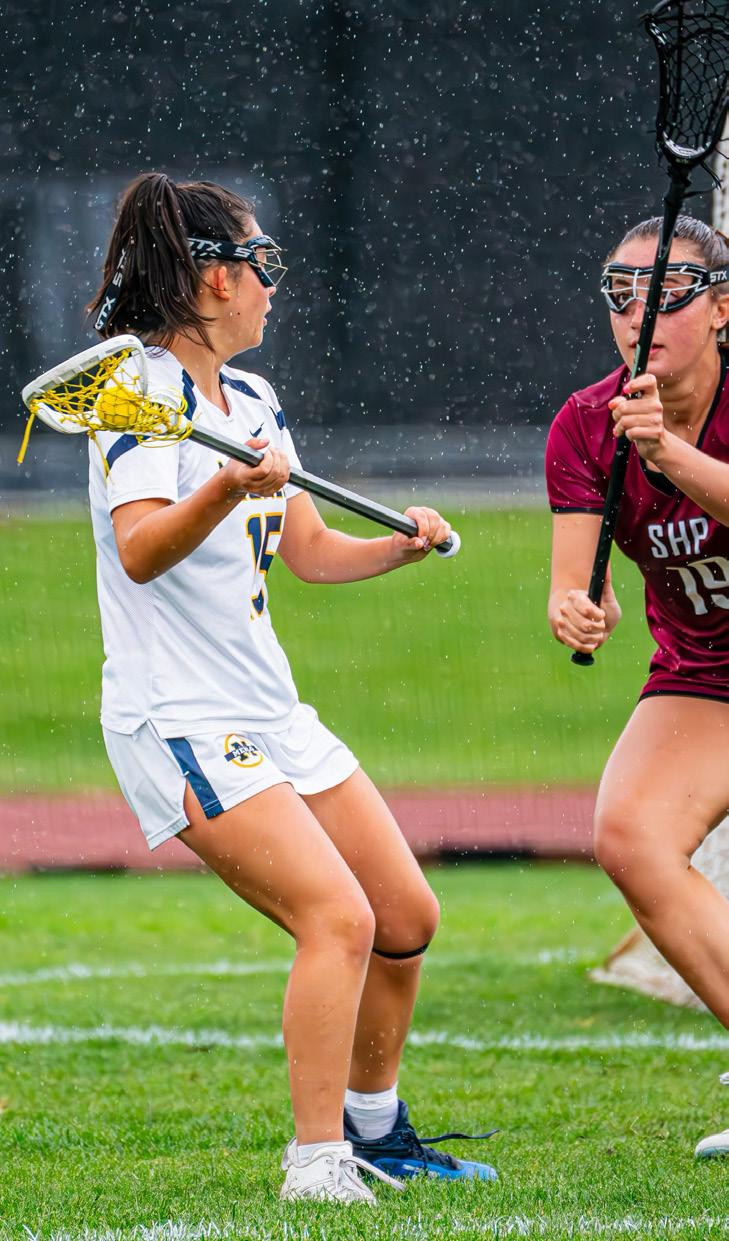
COMMITTED CORNER COMMITTED CORNER

lacrosse in college for a long time. “The thought of it probably emerged around sixth grade, but I started my process around late seventh grade into eighth grade,” Yamada said.
During the recruiting process, her club lacrosse team held seminars and helped her find colleges, attend prospect camps and send emails.
According to Yamada, her dad played an instrumental role in her recruitment.
“He not only helped me find prospect camps and other opportunities, but he also was the one obviously supporting me and traveling to these places so I could have those opportunities to get in front of the coaches,” Yamada said.
Yamada said she chose Smith College primarily because of its reputation as a STEM school with good research opportunities. Because it’s a DIII school, Yamada believes that it will give her more freedom as a student-athlete. “I’ve always wanted to study abroad, which is an opportunity that a lot of DIII schools offer their athletes and many students at Smith [take advantage of],” Yamada said.
Sophomore Kaelee Wang, Yamada’s teammate at Menlo, is excited for Yamada to play collegiate lacrosse. “She’s definitely a leader. She’s patient, kind and always willing to help others,” Wang said. “I’m glad that she was able to find a school that she likes, both academically and through sports too.”
Yamada is looking forward to being part of the Smith community. “I’ve met some of my teammates already, and they all seem like really cool people,” Yamada said. “I value community a lot. That’s a big reason why I chose to come to Menlo, and that’s a big reason why I chose Smith.”
Ethan Zhao, Pomona College
by DEVEN DHOLAKIA
In December, senior Ethan Zhao officially committed to play Division III basketball at Pomona College. A two-time all-West Bay Athletic League selection, Zhao’s commitment marks the next chapter in a journey that began when he first picked up a basketball at four years old.
Zhao was selected to play on Menlo’s varsity team as a freshman, an experience that he says helped shape his growth as a player and a teammate. “I think it was really beneficial to be a freshman on varsity because although I didn’t play as much, practicing with the older guys and watching them play really helped me develop a good sense of what high school basketball was like,” Zhao said.
Zhao’s recruiting process ramped up towards the end of his sophomore year and into his junior year. “That [junior] season was really important,” Zhao said. “You basically have to send a lot of film [and] a lot of highlights, while continuing to compete in club basketball, showcases and summer camps to stay in contact with college coaches.”
Zhao said he was looking at DIII schools known for their strong academics. Pomona was not initially on his radar although it fit what he wanted. “You never know who could be interested, so keep your options open with recruiting,” he said. His interest in the school surged after a Pomona coach reached out following one of Zhao’s AAU tournaments last year. “He seemed really interested, and because of that, I really started to focus more on Pomona,” Zhao said. After visiting campus,
Elise Chen, University of Chicago
by JAMES PARK
Inspired by her father’s love of tennis, senior Elise Chen was long determined to play the sport at the collegiate level. In November 2025, she committed to play Division III tennis at The University of Chicago.
As a child, Chen focused primarily on competitive dance, as tennis was more of a fun hobby she played with her father. At 12, Chen decided to step away from dance and pursue tennis. “I liked [playing tennis] a lot more than dance, so I started training harder and playing more tournaments.”
At the start of her junior year, Chen faced a tough decision during the recruiting process. Considering both the strength of the sports program and academic rigor, Chen was stuck between pursuing Division I and Division III. “I’m really indecisive,” Chen said. “I was talking to the UCs, some Ivy League schools and some [DIII] schools. That’s probably why the process went really long for me.”
As she began receiving offers, Chen narrowed her options down to Columbia University, the University of California San Diego and UChicago. “My offer from UChicago came much later,” Chen said. “It definitely wasn’t my first.” Ultimately, Chen picked UChicago for its campus and the balance of a strong tennis program and academics.
Chen has been a reliable presence on the Menlo girls tennis team since her freshman season. “On the court, you never know if Elise is winning or losing because she always remains so calm and collected,” Chen’s teammate Sulia Gayle said. “Off the court, she is always so supportive and dedicated to the team.”
“I’m so proud of Elise because I’ve

meeting the team and seeing all that Pomona has to offer, Zhao felt right at home. “When both sides reciprocated the effort and interest, that’s when it really all worked out,” he said.
Varsity head coach Ben Batory praised Zhao’s impact on the program. “Ethan’s one of my favorite players I’ve ever coached, and that’s saying something


seen how hard she works, and I think there is no one more deserving,” junior teammate Sophia Jia said. Chen was also able to meet the girls on the team, which she said helped her feel that UChicago was the right place. “I really like the girls on the team, especially the incoming freshmen,” Chen said. “They recruited five girls, and I knew them from previous tournaments, and they’re all amazing.”
from over 25 years of coaching,” Batory said. He added that Zhao was a leader both on and off the court.
At Pomona, Zhao is most excited about playing for head coach Charles Katsiaficas, who is in his 38th season with the team. “I’m really excited to play under him since he’s so experienced and loved there,” Zhao said.
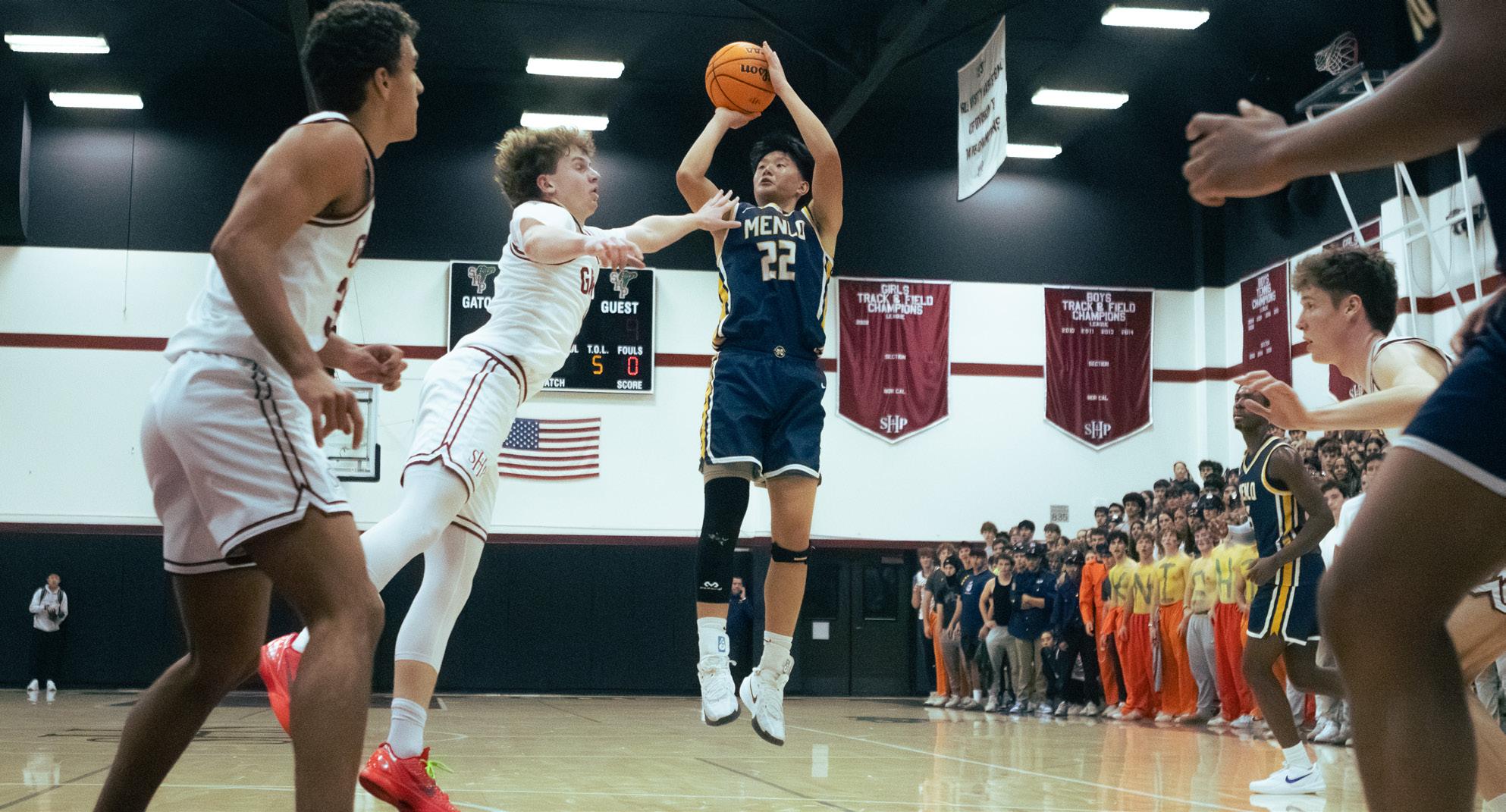
Senior guard Ehan Zhao shoots over SHP’s Alex Osterloh during a game on Jan. 17, 2025. Staff photo: Evan Grant
Senior Marin Yamada looks to shoot in a game against SHP. Photo courtesy of Blake Putanec
Senior Elise Chen serves in the Billie Jean King National Championships in San Diego last year. Photo courtesy of Chen


by SHAAN PARIKH
To the rest of the world, the Super Bowl is a much-awaited four quarters of football, but for the host city, the Super Bowl is an entire week where the whole region’s battery jumps to 110%. Before Super Bowl LX kicks off at Levi’s Stadium on Feb. 8, the Bay will be in the midst of a fullblown festival, bringing with it an economic boom, fierce fandom and celebrations of art.
Levi’s Stadium and the Bay Area weren’t chosen to host the biggest American event by accident. For the NFL, the Bay is the perfect conglomerate of clear skies and pure infrastructure. Seahawks fan and senior Brad Engel agreed that the Super Bowl coming to the Bay solidifies this area as a worldwide hub of culture. “This Super Bowl feels like Levi’s is more established now, and it’s probably going to host Super
Engel said. In San Francisco, the ampedup environment arrives long before the coin is flipped. Starting Tuesday, Feb. 3, the Moscone Center in San Francisco will be a well-oiled football factory packed with player interviews, a Pro Bowl flag football showdown and the NFL’s Super
concerts and nightlife that come with the Super Bowl, senior Richa Patnam is still appreciative of the economic impact that comes alongside these events. “I think the economic impact will be huge,” she said. Nearly 10,000 jobs were supported, and tens of millions of dollars were

Combs and Teddy Swims are the perfect pick. Continuing the dream lineup of artists, country legend Chris Stapleton will bring his earthy strums as well. The Killers will also continue the narrative of a diverse music scene. Countless other all-star artists like Post Malone and Calvin Harris will be throwing down parties across the peninsula, but to a 21 plus audience. “It definitely feels more like a Bay Area event,” Engel said, recognizing the variety of events throughout the Bay, not just in San Francisco or San Jose. Patnam was thrilled that some of her favorite artists were flocking to the Bay. “I think it’s going to be really chaotic and fun,” she said. When Levi’s Stadium hosted a Super Bowl 10 years ago, the Bay Area was placed on a global scale. Engel remembers the magnitude of the Super Bowl being introduced to Levi’s Stadium. “Levi’s hosting the Super Bowl 10 years ago felt like a huge deal because the stadium had just opened. It was almost like a ribbon cutting,” he said. A decade later, the NFL is offically back in a way that fully captures the Bay’s spirit. Engel also believes that the Super Bowl’s return will bring full attention to the Bay on a global scale. “This [Super Bowl] is cementing Levi’s Stadium and the Bay as a solid destination for the whole world,” he said.

Staff illustrations: Claire Dickman