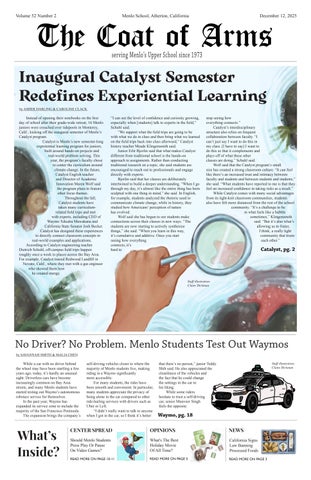
Inaugural Catalyst Semester Redefines Experiential Learning
by ASHER DARLING & CAROLINE CLACK
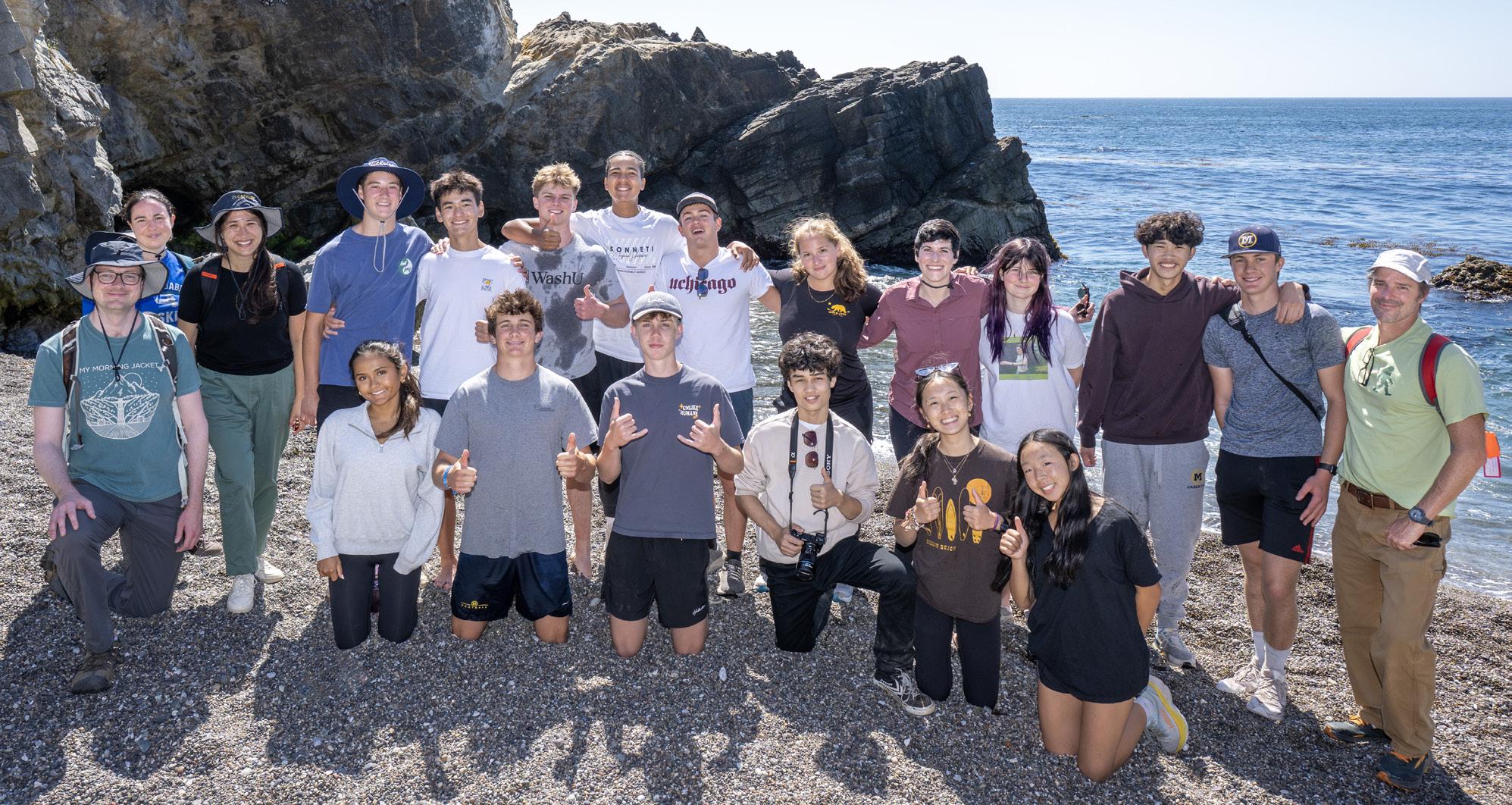
Instead of opening their notebooks on the first day of school after their grade-wide retreat, 16 Menlo juniors were crouched over tidepools in Monterey, Calif., kicking off the inaugural semester of Menlo’s Catalyst program.
Catalyst is Menlo’s new semester-long experiential learning program for juniors, built around hands-on projects and real-world problem solving. This year, the program’s faculty chose to center the curriculum around climate change. In the future, Catalyst English teacher and Director of Academic Innovation Maren Wolf said the program plans to feature other focus themes.
Throughout the fall, Catalyst students have taken many curriculumrelated field trips and met with experts, including CEO of Waymo Tekedra Mawakana and California State Senator Josh Becker. Catalyst has designed these experiences to directly connect classroom concepts to real-world examples and applications.
According to Catalyst engineering teacher Dietrich Schuhl, off-campus field trips happen roughly once a week to places across the Bay Area. For example, Catalyst toured Redwood Landfill in Novato, Calif., where they met with a gas engineer who showed them how he created energy.
“I can see the level of confidence and curiosity growing, especially when [students] talk to experts in the field,” Schuhl said.
“We support what the field trips are going to be with what we do in class and then bring what we learned on the field trips back into class afterward,” Catalyst history teacher Meade Klingensmith said.
Junior Eilir Bjorlin said that what makes Catalyst different from traditional school is the hands-on approach to assignments. Rather than conducting traditional research on a topic, she said students are encouraged to reach out to professionals and engage directly with experts.
Bjorlin said that her classes are deliberately intertwined to build a deeper understanding. “When I go through my day, it’s almost like the entire thing has been sculpted with one thing in mind,” she said. In English, for example, students analyzed the rhetoric used to communicate climate change, while in history, they studied how Americans’ perception of nature has evolved.
Wolf said she has begun to see students make connections across their classes in new ways. “The students are now starting to actively synthesize things,” she said. “When you learn in this way, it’s cumulative and additive. Once you start seeing how everything connects, it’s hard to
stop seeing how everything connects.”
Catalyst’s interdisciplinary structure also relies on frequent collaboration between faculty. “I can’t just say I want to do this in my class. [I have to say] I want to do this so that it complements and plays off of what these other classes are doing,” Schuhl said.
Wolf said that the Catalyst program’s small size has created a strong classroom culture. “It can feel like there’s an increased trust and intimacy between faculty and students and between students and students,” she said. “What students have reported to me is that they feel an increased confidence in taking risks as a result.”
While Catalyst comes with many social advantages from its tight-knit classroom communities, students also have felt more distanced from the rest of the school community. “It’s a challenge to be in what feels like a bubble sometimes,” Klingensmith said. “But it’s also what’s allowing us to foster, I think, a really tight community that trusts each other.”

Students

by SAVANNAH SMITH & MALIA CHEN
While a car with no driver behind the wheel may have been startling a few years ago, today, it’s hardly an unusual sight. Driverless cars have become increasingly common on Bay Area streets, and many Menlo students have started testing out Waymo’s autonomous robotaxi service for themselves.
In the past year, Waymo has expanded its service zone to include the majority of the San Francisco Peninsula. The expansion brings the company’s
self-driving vehicles closer to where the majority of Menlo students live, making riding in a Waymo significantly more accessible.
For many students, the rides have been smooth and convenient. In particular, many students appreciate the privacy of being alone in the car compared to other ride-hailing services with drivers such as Uber or Lyft.
that there’s no person,” junior Teddy Shih said. He also appreciated the cleanliness of the vehicles and the fact that he could change the settings in the car to his liking.
While some riders hesitate to trust a self-driving car, senior Munveer Singh feels the opposite.
“I didn’t really want to talk to anyone when I got in the car, so I think it’s better Waymo, pg. 18

Should Menlo Students Press Play Or Pause On Video Games?



Staff illustration: Claire Dickman
Spike in U.S. History Honors Enrollment Sparks Controversy
by LAUREN GIESSELMAN
This year, the vast majority of sophomores enrolled in the mandatory sophomore U.S. History course initially opted into the honors option. But after a record number of honors signups and controversy from both students and teachers, many have chosen to drop the honors version of the course.
The ratio of honors to regular course takers in the U.S. History class saw a massive spike this year. This increase caused tension within the sophomore class and debate between students and the history department over the effectiveness of honors-only assignments and variation in class difficulty across different teachers.
All 28 of U.S. History Department
Head Nick Merlesena’s students initially signed up to take the honors course, with only one of 28 having dropped out so far. To accommodate the number of students still getting a feel for the program, the drop date was pushed to late November, and sophomores who were hesitant about staying in honors were urged by their teachers to reconsider their academic priorities.
History Department Chair Katharine Hanson shared her perspective on what has caused the large increase in honors enrollment
this fall. “Many were excited about the GPA boost, which is understandable,” Hanson said. “But I think we struggled to communicate clearly what the honors track really entails. Maybe we also just have a particularly motivated or historyfocused sophomore class this year,” she said.
With such a large percentage of the grade taking the honors-level course, many students have said that assignments have become increasingly difficult to keep up with and impractical at times.
“Honestly it’s just busywork. You can’t seriously argue that watching four Edpuzzles on the same topic is useful. It doesn’t really make sense,” sophomore Jake Waldorf said.
Sophomore Linnea Arnberg attributed her decision to drop from honors to the workload, not her lack of passion for the content. “I decided to step out of history
honors because the workload became more constant busywork than meaningful learning, and I made the choice to focus on classes that seemed more productive,” Arnberg said.
On the contrary, the history department sees a deeper value in assigning a wider variety of assignments. The teaching team believes the variety in coursework is a deeper learning opportunity, not merely assignments that are mostly busywork. “Students should approach honors as an opportunity for growth and challenge, not just for a GPA boost. Teachers are working hard to expand students’ historical understanding through research, writing and alternative assessments, not just traditional tests,” Hanson said.

Continued from pg. 1
Junior Matthew Majalya said that the program sometimes makes him feel disconnected from his nonCatalyst peers. “Sometimes it can feel like you’re a little bit cut off from the rest of campus,” junior Matthew Majalya said. Despite this, Majalya believes the Catalyst directors have done a good job making sure Catalyst students are still active members of the Menlo community.
It’s certainly been the most rewarding experience of my entire career. I’m excited to keep growing it and seeing what it can become.
While Schuhl believes that every student can thrive in the alternative kind of learning environment Catalyst provides, he understands that the change from
On a different note, Merlesena understands how students may feel as if the workload is inequitable across classes. He says the history department is working to make U.S. history classes less varied in terms of assignments and assessments. “We are absolutely hearing that feedback, [and] we’re going to continue to brainstorm and work together to make sure it’s a stronger course and better option,” Merlesena said.
He also pointed out that the department’s recent approach of allowing every U.S. History teachers to take their own slightly different approach to the curriculum may contribute to the perceived inequity.
“Moving forward, one of the goals of our team, across all the teachers, is to make sure that it’s literally going to be the same assignment schedule, […] starting in our next unit,” Merlesena said.
Dropping out of honors leaves no demarcation on report cards; while an opportunity that allows students to assess their
learning may be harder for some students to acclimate to. “To learn in this way will be more challenging for some students than others,” Schuhl said. “For a student who needs structure and certainty, Catalyst might be an adjustment.” Schuhl added that any student willing to be flexible and lean into the discomfort that comes with less-structured learning would be a particularly good fit for Catalyst.
Wolf and the rest of the Catalyst team will welcome 18 new juniors into the program in January and have already begun promoting Catalyst to Menlo sophomores.
situation and decide to go back to the more straightforward curriculum, alternative pressures still play a role in the situation for many students. Waldorf believes it’s hard for students to leave a course that the majority of their peers have opted into. Beyond the quad, students are facing family pressure and expectations to be a high-level student too. “I think a lot of people are more worried about what their parents would think,” Waldorf said.
Trevor McNeil “
Is it about a challenge? Is it about the grade, or is it about a love of history?
U.S.
History Teacher
“
U.S. History teacher Trevor McNeil urges students to remember that an honors-level course is not for everyone, especially given students’ varying priorities and time commitments. McNeil has historically seen a significant drop in honors participation, with only 58 percent of his students remaining in the honors track as this semester closes. He offered advice on how sophomores should set aside social and parental pressure and assess their classes. “First, put your classes that you have in order of which you’re most excited about. If history’s not in the top five, don’t do honors. […] It’s just not worth it,” McNeil explained. The history department urges students to reflect on the true meaning of taking the honors-level. “Again, is honors about distinction? Is it about a challenge? Is it about the grade, or is it about a love of history? And I think it should be about a love of history,” McNeil said.
“I’m eager to see if, with increased clarity, there's increased demand or not,” Wolf said. “It's certainly been the most rewarding experience of my entire career. I’m excited to keep growing it and seeing what it can become.” Wolf commends Catalyst students for the attitude they have brought to learning every day. “They have brought so much enthusiasm and curiosity and risktaking and open-mindedness and good-heartedness,” she said. “We [the teachers] can model that all we want, but [the students] have shown up so fully, so that the community and culture in the program is really strong.”
Staff illustration: Lauren Giesselman
traditional
Catalyst students and teachers visit Monterey Bay during their program retreat in August. Photo courtesy of Dietrich Schuhl
Catalyst Teacher Maren Wolf
Visa Crackdowns Reshape College Admissions Landscape
by AARON WIDJAJA
The Trump administration’s tighter visa rules have raised questions about their impact on U.S. colleges’ international enrollment. Increased federal scrutiny and new restrictions have already contributed to declining applicant numbers. Public threats on social media targeting international students have only intensified these fears.
Assistant Director of College Counseling, Elena Wong believes that these judicial and legislative decisions will have only a modest impact on application outcomes. “Do I suspect some schools will bring in a larger class in early decision? Sure. I think waitlists will probably grow,” she said. Wong believes that waitlists will grow as colleges seek more flexibility amid increasingly unpredictable yield rates. Still, she expects overall application patterns to remain relatively stable. She noted that interest in highly selective colleges is unlikely to change, since the highly competitive schools Menlo students typically target will continue to attract large applicant pools.
Wong speculated that the next few application cycles could look different, predicting that colleges will experiment with new strategies to protect their yield, while still attracting
the students they want to enroll. “Colleges are businesses and so they want to protect themselves foremost,” Wong said.

Senior Ananya Goel wasn’t surprised by this trend in the decline of international student enrollment. She views the policy changes as a continuation of the administration’s beliefs of prioritizing America, which has involved a long period of tightened policy on immigration pathways and clampdowns on nonresidents. “I think a large part of college and the experience of college is to learn from a diverse range of perspectives. [...] And I think when you get rid of that international perspective from people of different socio-economic and racial backgrounds [...] it limits a lot of the learning and kind of opportunities you can have to kind of grow as a person,” Goel said. Junior Celina Chen also expressed concern about the broader national implications of the policy changes. “The people coming to the U.S. on visas for college or grad school are the best and brightest from other countries. [...] I think a lot of them would choose to
stay in America, contributing to our science, tech and economy,” Chen said. She worries that limiting these pathways will have long-term consequences for the country’s talent pipeline and innovation.
Colleges are businesses and so they want to protect themselves foremost. “ “
Assistant
Wong also emphasized that colleges are still interested in attracting global applicants. “I think it’s important to note that colleges are still actively recruiting international students because they bring a different perspective,” Wong said.
Goel believes that reduced international enrollment could also affect domestic applicants. “I think by reducing the number of international slots that they have, it will help us, or they might end up keeping that same number of slots. I think it depends on future decisions,” Goel said.
Chen also expects acceptance rates to rise for domestic college applicants this year. “The international students who come to America tend to be very qualified candidates and they tend to make up like 15%-20% of the undergrad student body at a lot of top schools,” Chen said. She highlights how competitive the international applicant pool typically is.
California Signs Law Banning Processed Foods in Schools
by ASHER BECK
This past October, California Gov. Gavin Newsom signed the Real Food, Healthy Kids Act aimed at eliminating ultra-processed foods (UPFs) from school cafeterias. In a country where two-thirds of teenagers get their calories from overprocessed foods, California has become the first state to make strides toward banning UPFs altogether.
By using organic [foods], you’re getting a better product.
The California Department of Public Health (CDPH) will have until 2028 to determine exactly what foods will be banned. They are expected to target foods containing heavily processed additives, such as saturated fats or artificial sweeteners, including hot dogs, certain cereals and even flavored yogurt. Once the CDPH has picked out the foods they want out of cafeterias, public schools in California will have until 2035 to stop distributing those items on school campuses statewide.
The impact of this policy will be apparent almost immediately at Menlo,
according to Head of Dining Services Thien Hoang. He specified that Flik School Dining is already opting to start phasing out certain foods from the snack shack and from the daily lineup of meals served to students.
Hoang said that Flik already limits its use of UPFs, so the transition to more organic food alternatives should take less time at Menlo. Flik will be experimenting with ways to supplement foods that are currently classified as being overprocessed, such as cereals and certain meat products. “The policy that Flik is trying to institute is when we take away a product that has processed food, we have to find a comfortable replacement for it,” Hoang said.
One of the suppliers for Flik’s ingredients is Menlo’s own Gardening Club, led by juniors Lauren Rukavina and Murohn Zhang. According to Rukavina, Menlo’s dining staff frequently uses carrots, radish and bok choy, among other foods, to incorporate into their salad bar.
“As a gardener, I recognize how much more expensive and tedious it is to source [organic food], but I think it’s important to prioritize [...] healthy and fresh food. [It] is crucial for energy and well-being, which every kid deserves,” Rukavina said.
Hoang acknowledges that distributing organic food is more costly for Flik, but he believes Menlo’s dining program is better off spending more on healthier organic products than using cheaper foods. “You know, for us, it’s actually a little bit [more] expensive [...]
[taking food] from farm to table,” Hoang said. “[But it’s] the philosophy of Flik. We try to get products that are sustainable [and] products that are local, so that it cuts down on [our] carbon footprint.”
While freshman Lily Gazor is disheartened to see that certain cafeteria foods will be filtered out of rotation, she recognizes that their organic alternatives are important to integrate into Menlo’s cafeteria. “I think it’s also fun having some foods like chips and yogurt, which can [taste] good for students. So I guess I’m kind of in between,” Gazor said. “I think that there should be a balance,
because it’s important to have healthier and sustainable foods.”
According to The New York Times, chemical additives in UPFs often take away from their flavor in favor of preserving them for as long as possible. As a result, aside from being healthier, organic foods also have more flavor due to their fresh ingredients.
“All the things that they put in [ultraprocessed foods] to keep it fresh and keep the shelf stable are the things that [take away] from a lot more flavor,” Hoang said. “By using organic [foods] [...] you’re actually getting a better product.”

Staff illustration: Ella Skinner
Director of College Counseling Elena Wong
Head of Dining Services Thien Hoang
Guest illustration: Tali Kauffman
December 12, 2025
San Francisco Spared From National Guard Deployment
by WILLIAM GARDNER
Since taking office in January, U.S. President Donald Trump has ordered the deployment of over 7,000 National Guardsmen to cities across the U.S. In October, Trump had said he would deploy the National Guard to San Francisco, but recently he changed his mind.
According to executive orders signed by the president, the purpose of these National Guard deployments is to protect immigration personnel and facilities from protesters, while assisting local law enforcement on patrol.
Junior Kai Ruwitch still has concerns despite the National Guard not being deployed to the Bay Area.
“The reason I’m worried is because I’m [uncertain about] the future of our country. While I’m not directly affected by what the National Guard is doing yet, I am indirectly affected right now.”
Ruwitch believes the president’s deployment of troops in American cities violates the First Amendment. “If the president can use the United States military on dissidents who are expressing their opinion according to the First Amendment, then that has implications on all of us,” Ruwitch said.
These deployments have been extremely controversial on social media. At the state level, California, Oregon and Illinois have all sued the federal government over the use of the National Guard as a law enforcement entity.
Title 10 of the United States Code allows the president to federalize the

National Guard of a state, placing them under his command. However, this also places strict restrictions on what the National Guard can be used for, particularly with regards to law enforcement;it is these restrictions that have become the source of the controversy. Title 10 allows the use of the National Guard as law enforcement in two circumstances: in the event of an insurrection or armed rebellion in the United States.
Federal lawyers have argued that Title 10 grants broad exceptions when it comes to enforcing federal law. State lawyers have argued that the protests that led Trump to deploy the National Guard do not meet the standard of insurrection or rebellion.
History teacher Joseph Mitchell is concerned about Trump’s use of the National Guard as a law enforcement entity and its seemingly extralegal motivations. “His politics seem to be guiding his hand about where he wants to send these National Guard units, which is, I think, the most surprising,” he said. Mitchell said it’s not only citizens’ rights that are a concern, but also the safety of civilians when military units are used for crowd control and law enforcement. Investigation by The New York Times revealed that National Guardsmen often lack the same equipment that local authorities have
for handling protests or riots. As Mitchell explains, the presence of armed soldiers itself can also be inflammatory, causing protests to possibly become violent. “ I’m just waiting for something bigger to happen. Some sort of violent clash would be pretty significant,” Mitchell said. “So I don’t know, not that I want that to happen, but I just kind of predict [it will].”
However, it’s not only [our rights] that are a source of concern, but also the safety of civilians.
History Teacher Joseph Mitchell
Upper School history teacher Trevor McNeil said that court rulings on the legality of Trump’s National Guard deployment have been inconsistent with the Illinois case set to go to the Supreme Court. McNeil thinks the decision that the Supreme Court makes on the case may shape the role of the National Guard going forward. He emphasised that the ruling could redefine the balance of power between federal authority and states’ rights for years to come.
The Alpha-Beta-Gammas of Ancient Greek Come to Menlo
by MANDY ZHANG
Mount Olympus has come to campus. Every Tuesday at 8 a.m., students dive deep into Roman and Greek culture, art, philosophy and language, exploring works from great thinkers like Plato and Socrates to famous poets such as Homer, author of The Odyssey and The Iliad.
Learning Greek made me realize how many modern ideas come from these [...] texts.
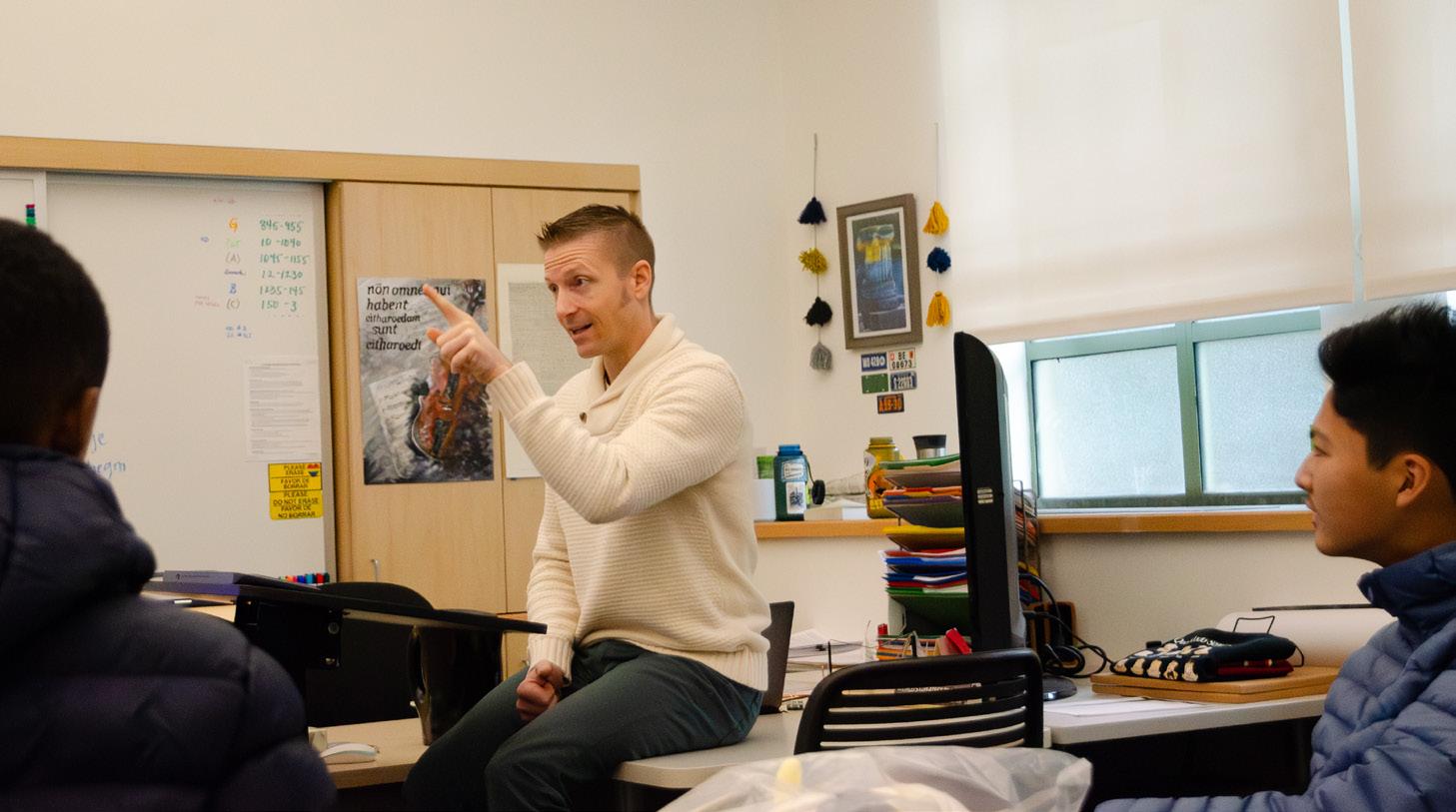
English and Latin teacher Tom Garvey has launched an ancient Greek class covering a subset of classical studies, a major often offered in college and graduate school.

While Latin and ancient Greek are widely considered dead languages, Garvey is one of the select group of people who can read, write and speak both at a proficient level. He has also taught an ancient Greek class before, at the University of Virginia, The Meadows School, Kenyon
College and Brooklyn College.
When Garvey first joined Menlo’s Latin department three years ago, two upperclassmen — Patrick Galligan ‘24 and Jackson Coleman ‘25 — who were curious about his Greek background, asked if an independent study credit was possible. After consideration, the three of them met a few times a week and made a fair amount of progress. Garvey gradually expanded the curriculum as more students expressed interest in the subject, but class times remained flexible due to scheduling conflicts between freshmen and seniors.
Currently, the class has nine students: two freshmen (Christopher Dodd and Larry Zhao), four juniors (William Gardner, Landon Olson, Yuna Lee and Vivian Sun) and three seniors (Brad Engel, Will Farrell and Hadley Larson).
“Something very unique to Menlo is that a lot of teachers have the freedom to explore subjects that they feel are worthwhile for both the students and for themselves,” Lee said. “It’s been a very rewarding experience to learn something that is not really offered anywhere else.”
Like Lee, Sun began taking the class at the start of the year out of appreciation for Greek culture.
“I’m glad that Dr. Garvey is taking time out of his week to teach us.
Learning Greek made me realize how many modern ideas come from these ancient texts,” Sun said.

Although related to Latin in certain aspects, Ancient Greek is a digression from the required language’s core material. Garvey loves the expansive literature covered in his Latin class but emphasizes how students only have so much time in a day.
“They need to be self-starters, and they need to be willing to do some work on the side,” Garvey said. Students without full, seven-block schedules are eligible to receive an independent, passfail course credit for the class. If they are already taking seven classes, however, the course will not appear on their transcript.
Garvey finds linguistics fascinating and always begins class with the Greek alphabet. “The first thing that the Greeks wrote down wasn’t for the purpose of bookkeeping or merchant records. It was to write down amazing, epic poetry,” he said. Slowly, Garvey introduces new grammar structures and vocabulary until
students gain a solid grasp of the material. They learn about the science behind word pronunciation and environmental changes, breaking down comparative linguistics week by week. To reinforce or preview new information, students must also complete small amounts of homework before every class meeting. While the class is mostly made up of Latin students seeking a complementary subject, Garvey encourages anyone with a slight interest to consider exploring Greek culture. “From mythology to thinking about languages as math problems to be solved, any mathematically-oriented person, anybody who likes comparative linguistics or people who just enjoy learning for the sake of learning [would like this class],” Garvey said.

Staff illustration: Baelyn Batory
Junior Vivian Sun
Staff illustrations: Baelyn Batory Garvey stands with his ancient Greek class students. Staff photo: William Gardner
Reviewing the Classic Holiday Flicks That Reign Supreme
Holidate (2020)
by CAROLINE CLACK
As someone who binges holiday rom-coms way more than I should admit, I thought I’d seen every mistletoe cliché out there. But “Holidate,” featuring Emma Roberts and Luke Bracey, is a refreshingly comedic take on your typical holiday Hallmark love story. The story follows Sloan and Jackson, two commitment-phobic, sarcastic and somewhat relatable individuals, who are tired of familial pressure to date. So, they decide to become each other’s holidates, or date for every holiday. “Holidate” accurately portrays holiday pressure, from awkward family member interactions to the all-consuming need to give the perfect gifts. Its slightly edgy festive cheer makes it a charmingly formulaic (and very much nostalgic) modern spin on a heartfelt romantic comedy.
Home Alone (1990)
by JULIA LIVINGSTON
There’s nothing like settling down into a cozy corner of your couch with a mug of hot chocolate and turning on the Christmas classic “Home Alone.” From the chaotic energy of the McCallister family to Kevin’s witty personality (brought alive by Macaulay Culkin), the movie is bursting with the festive fun that I crave in my holiday watches. But what truly makes this movie timeless is its heart. It’s a story about family, love and connection, the very things that define the Christmas spirit. So, if you’re looking for a comforting, laugh-out-loud classic to watch with your loved ones this holiday season, “Home Alone” is the perfect choice to remind you why family will always be worth coming home to.
Elf (2003)
by SADIE EVANS

Every year, the holiday movie I look most forward to rewatching is Elf. It’s classic, it’s hilarious, and the fact that Will Ferrell plays the lead role is reason enough to watch it. The movie follows Buddy, a human raised by elves at the North Pole, as he heads to New York to find his real dad. But being a grown man in a bright elf outfit who eats cotton balls for fun (and fights a mall Santa), nothing goes smoothly for Buddy. This movie is fast-paced and filled with absurd moments that never get old, even if you’ve seen it 100 times. At the same time, Elf is surprisingly wholesome, showing how family, kindness and strong holiday spirit can win over even the biggest cynics.
The Grinch (2018)

by MANDY ZHANG
a cranky green grump with an addiction to binge eating and a hatred for holiday cheer. That is, until a young girl named Cindy Lou Who changes his life forever. I’m not a fan of overly sentimental movies, especially ones catered toward younger audiences, but “The Grinch” captures the magic of Christmas joy perfectly. I still remember leaning on my mom’s shoulder and singing along to “You’re a Mean One, Mr. Grinch,” mouth covered in cotton candy residue and eyes drooping from a long day of play. Even now, the story’s original message still resonates: the holidays are meant for family and connection.
The Coat of Arms
Editor-in-Chief...................................................................Asher
Clack
Editor.........................................................................Elaina Huang Arts & Lifestyle
Smith Sports Editor...........................................................................Noah Levin
Editor.......................................................................Anya Ramani
Creative Director..............................................................Claire Dickman
Director of Marketing & Community Engagement.............Bianca Putanec
Head Copy Editor..............................................................Aaron Widjaja
Video Editor....................................................................Julia Livingston
Photo Editor............................................................................Evan Grant
Copy Editor.............................................................................Asher Beck
Assistant Online Editor................................................Autumn Chambers
Assistant News Editors....................William Gardner, Lauren Giesselman
Assistant Opinions Editors.................................Lila Ozdemir, James Park
Assistant Arts & Lifestyle Editors.................Penny Diehl, Shaan Parikh
Assistant Sports Editors.........................Deven Dholakia, Spencer Toland
Assistant Spread Editor.......................................................Mandy Zhang
Assistant Social Media & Digital Directors..............Zoe Hayes, Lisa Huhs
Assistant Creative Directors............................Baelyn Batory, Ella Skinner
Assistant Director of Marketing & Community Engagement.......Sadie Evans
Assistant Video Editors........................................Tristan Chen, Payton Lee
Adviser......................................................................Miles Bennett-Smith
Miracle on 34th Street (1947)
by SAVANNAH SMITH
Christmas came absurdly early when “Miracle on 34th Street” premiered at the start of summer. Studio executives, expecting more movie-goers in the warmer months, released this classic in May of 1947. Despite its off-season debut, Edmund Gwenn remains the only actor to ever win an Academy Award for playing Santa Claus. If that doesn’t sufficiently prove the enduring magic of “Miracle on 34th Street,” allow me to elaborate. Sentimental without being shallow, it reverses the basic formula of children believing in Santa: six-year-old Susan Walker is a skeptic raised to dismiss fairy tales. Yet, after meeting Kris Kringle, a man who claims to be Santa himself, she starts to doubt her beliefs. The film follows Kris Kringle as he is brought before the Supreme Court, which suspects that his claims of being the real Mr. Claus constitute insanity. After the whole hour and 41 minutes, every character has earned their happy ending. The film ends on a more ambiguous note: was Kris truly Santa? Director George Seaton refused to confirm. But in the end, there’s nothing cozier than a black-and-white Christmas movie about cynics believing in the holiday spirit.

We want to hear your voice!
We appreciate hearing your opinions, whether it’s through guest writing, letters to the editor-in-chief or comments on our website and Instagram @menlocoa. Please reach out to the editor at asher.darling@ menloschool.org or to
The Coat of Arms 50 Valparaiso Avenue Atherton, California 94027 (650) 330-2001
Visit us online at menlocoa.org

Mission Statement
The Coat of Arms is an independent, student-led open forum for student expression. All decisions relating to the management and content of The Coat of Arms are fundamentally the responsibility of students. Coat of Arms reporters strive to acknowledge their internal biases and tell meaningful stories with empathy, fairness and journalistic integrity. The Coat of Arms staff is committed to building on the legacy of past staffs while setting the foundation for future members.



’Tis the Season to Enjoy the Bay’s Best Wintertime Activities
by LAUREN GIESSELMAN
It’s time! We are entering the most magical time of Bay Area chill without the hassle of plowing snow. Whether you’re all about ice skating under twinkle lights next to the grand Macy’s holiday display or hiking through misty redwoods, winter in the bay has its own kind of magic. Here’s my list of top local holiday activities and the best ways to make the most of this enchanting season.
Whether you’re all about ice skating under twinkle lights [...] or hiking through misty redwoods, winter in the Bay has its own kind of magic.
Ice skating in Union Square, in downtown San Francisco, is the classic Bay Area holiday experience, and while
it may be touristy, you don’t want to miss out. Standing next to a towering Christmas tree surrounded by festive department stores, the experience feels like a big city postcard. While the number of skaters from all over the bay cannot be comfortably accommodated by the size of the rink, seeing the overwhelming joy of the crowds of all ages is part of the charm. And yes, the rental skates are dull, and it is not the best rink in the bay, but that slightly chaotic energy is what makes Union Square skating feel so distinctly San Francisco. The music pumping through the speakers is a perfect holiday soundtrack that is impossible not to get swept up in. If you can book a time slot for dusk, the glow from the tree and surrounding storefronts makes the rink feel like a Hallmark classic, easily the most magical moment you’ll get in the city. Despite the cramped space and downtown bustle, Union Square delivers the kind of festive, big-city holiday spirit that makes the whole outing worth it.
If you like the vibe of thousands of Christmas lights provided by high-profile events, but you’d prefer to stay more reserved or on a budget, Fantasy of Lights in Los Gatos’ Vasona Park is the perfect night out. With the much cheaper options to drive or walk through the park’s light
displays, everything about the after-dark, at-your-own-pace experience screams family holiday nostalgia. No matter what festivities you will be celebrating this winter, it is undeniable that going through the bridges of lights with a thermos of hot cocoa while leaning out the top of your car’s sunroof will make you feel like an overjoyed sixyear-old all over again.
Sometimes the perfect winter activity doesn’t need sparkling lights or big decorations, just the scent of fresh trees and frost nipping at your nose. If you want to reconnect with a truly magical piece of Bay Area nature, spend your morning taking a calm hike through Henry Cowell Redwoods State Park near Santa Cruz. The Redwood Grove Loop Trail has countless hidden secrets, from creatures to creeks and redwoods standing as tall as time. On top of the beauty of your surroundings, if you want an extra boost of holiday spirit, ride on the Roaring Camp Railroads Redwood Forest Steam Train — it’s a special


holiday-themed excursion that will take you on a tranquil trip around the gorgeous Santa Cruz winter scenery.
Throughout the year, Filoli Garden in San Mateo is a gorgeous Georgianstyle mansion on a vast, luxurious estate. Even better, each winter, the historic estate transforms into a shimmering wonderland, with thousands of twinkling lights draped over its gardens, reflecting ponds and grand houses encompassing a variety of winter package experiences. The atmosphere of soft holiday music, firepits with hot cider and the staff fully committed to the holiday spirit makes the whole experience feel nostalgic and elegant rather than over-commercialized like many of the other opportunities in its upper-middle price range. Unlike the numerous other crowded light shows, Filoli’s gardens give you space to breathe and wander at your own pace, soaking in the true luxury of the chilly season. The mix of nature, history and artistry makes it feel almost like an cinematic experience. Whether you are looking for a family outing or a group event, Filoli offers a serene yet dazzling escape that perfectly captures the holiday spirit.
CE Credit Requirements Undermine Meaningful Service
by PENNY DIEHL
Getting to the end of the school year and realizing that, despite your best efforts, you are still three CE credits short has to be one of the most frustratingly relatable experiences for Menlo students. When the school year wraps up and the CE credit requirement grows increasingly daunting, I usually resort to cramming in singular, one-credit service experiences whenever I can.
As the year progresses, service credits become increasingly difficult to fulfill, particularly for those with busy weekends. As a result, finding something that you are passionate about contributing to becomes more challenging with every passing month.
Subsequently, many students resort to attending Knight Vision meetings during lunch or participating in crafts to gain extra credits here and there, often going to as many low-effort experiences as possible to fulfill the requirement. However, this can feel as if students are just checking the box rather than intentionally choosing the areas where they want to make a difference. So, here is my question regarding the way Menlo runs the community engagement scene: Are short, individual experiences really beneficial to the community and students? Does this type of system align with the true reason behind doing service?
The short answer is that doing anything to help the community is impactful; all volunteer experiences benefit the world around us. The slightly longer, and possibly controversial, answer is that I think the way Menlo runs its community engagement is not benefiting students’ awareness and learning as intended.
Sophomore Joann Taualo participated in a twoday mental health summit for community engagement through Menlo, during which she spoke to a panel about student mental health. “I felt more connected to [the experience] because I spent more time on it,” Taualo said.
Her more time-consuming, larger engagement experience perfectly sums up how Menlo community engagement should be reconstructed. Here is my proposal: At the beginning of every school year, each student will connect with one organization of their choosing and repeatedly complete service throughout the year for the organization they selected.
A singular ongoing community experience would not only be more engaging and productive for students and their respective passions, but also more impactful on our community. When a student builds a relationship with one organization, they learn to take initiative, build responsibility and can complete more complex and impactful tasks over time.

Not only would students sticking with one organization better impact our community, but it would also be a better system for teaching students the meaning of community service, societal awareness and compassion. According to the National Institutes of Health (NIH), the human brain creates neurological connections and pathways through repeated actions in a
process called neuroplasticity. In other words, doing one community engagement experience isn’t really helping you learn or absorb important skills, compared to that of year-long participation under one philanthropic organization.
“ “
Are short, individual experiences really beneficial to the community and students?
Despite what I believe would be more beneficial, Menlo’s community engagement system is still far from ineffective. Many students have still found their true passions in service via our CE program, and the impact that student-led service has on our community is undeniable. Even the opportunity to participate in such organized service is a privilege, but furthering it using a more focused, year-long commitment can be transformative — both for Menlo students and the communities we serve.
The way I see it, the way CE is currently run at Menlo highlights obligation instead of curiosity and ambition. The idea of participating in service can evoke stress instead of empathy, social awareness or reflection. Thus, Menlo should support students in working with one organization throughout the year to create a deeper connection to a singular issue, so that service becomes a meaningful relationship and not just a graduation requirement.
Staff illustrations: Lauren Giesselman
Staff illustration: Claire Dickman
Here’s How the Lunch Line Can Stop Serving up Delays
by LILA OZDEMIR
11:50. Shoot, some students are already leaving. 11:51. Ugh, I can’t concentrate. 11:52. Can we please be dismissed? 11:53. I’m going to be late. 11:54. There’s probably a line by now. 11:55. Run.
At Menlo, if you’re on time for lunch, you’re already too late to avoid the long line. Students race for a spot in the lunch line, some resorting to sneaking in with friends or wrongfully stealing food amidst the rampaging students.
It’s never that there is not enough food; after 15 minutes, anyone who wants more can come get a second bowl and additional toppings. Yet, the reality is, it takes far too long for the line to get to that point, with the last student in line having lost nearly half their lunch period just waiting for food. There have been so many times when I’ve spent 10 or even 15 minutes waiting in line instead of actually enjoying my lunch period.
Director of Dining Services
Thien Hoang says that feeding around 680 Upper School students in a timely manner takes excessive planning. Often, it takes around 10 to 15 minutes for the line to finally dissipate, though it can easily be much longer on the days when students are released at the same time, such as after assemblies.
As a student, I feel beyond grateful anytime my teachers let us out even just a couple of minutes early for lunch, and Hoang fully affirms the positive impact.
“[Early dismissal] totally helps because if, [...] say, two or three teachers do that, you’re getting about 150 to 200 students going through the line five minutes before all the [other] kids come,” Hoang said.
In fact, Hoang believes the best way to speed up the lunch line is by adding a slight stagger, even if only by a couple of minutes. One potential way the school could implement an official measure is by allowing students in a particular class — such as an elective — to leave just five
minutes earlier on the days when class is prior to lunch. Making that change would trim the line by tons of students and save everyone a significant amount of time waiting.
Measures need to be taken to shorten the line because it will only worsen as Menlo continues increasing class sizes. “[Menlo’s] adding probably an extra 60 students [per grade] from both [the freshman and sophomore] classes [to] the student population,” Hoang said. “And you know, as you add students, as you add to the population [without increasing] your dining space, that’s [when] you start getting into congestion.”
Many students have grown so frustrated with the line that they sneak in to get their lunch sooner. However, every time they do so, they force students behind them to wait longer.
Director of Security Mustapha Moutri is tasked with pacing the lunch line and preventing cutting. “If you’re first, you’re going to eat first;
nobody should come and cut the line and go eat in front of you. That’s the whole idea; it’s just fairness [for] everybody,” Moutri said.
Staff illustration: Baelyn Batory
“Snow Much to Solve!” Winter Crossword
by WILLIAM GARDNER & SIENNA LEW

ACROSS
(1) Found between “Ro” and “Bo” in this hand game
(3) A noisy black bird’s aggressive call (5) Deck the halls with this singable note (hint: either works!)
(6) First name of a renowned African American journalist & suffragist
(8) Mariah doesn’t care(y) about these (11) Home security company with an octagonal logo
(12) These jolly singers are banging on your door!
(15) The second word of a spicy-sounding soft drink
(16) Fiction aimed at teenagers or an affirmation in Malay
(17) At this point, you should know what the powerhouse of the cell makes.
(19) One who takes your vitals and gives shots, abbr.
(20) In science, it represents viscosity; in traveling, check the clock.
(23) The queen of talk show TV (26) Card that lets you call (27) Half of all integers
There have been so many times where I’ve spent 10 or
even 15 minutes waiting in line instead of actually enjoying
my lunch period. “ “
According to Moutri, when someone is caught cutting the lunch line, they are given a warning the first time. The second time, they are reported to Upper School Director Adam Gelb, who may task them with cleaning the cafeteria for a week. An anonymous student who occasionally cuts the lunch line said they are either rushed or impatient. This student also suspected that at least half of the student body has cut before or does so on a regular basis. However, they said the anti-cutting measures implemented by Menlo definitely make it difficult to do so in some cases. “It has stopped many students. I would say it has stopped me from doing it really often, but there are still people who find a way to cut somehow,” they said.

DOWN
(1) Maple syrup in its original form
(2) A December spot where lips meet lips
(3) This archipelago wishes you a Feliz Navidad
(4) Eating grapes at midnight? Be sure to make one of these (or 12!)
(7) Land of the Audi or Porsche, for short (9) Once in a blue moon
(10) Tokyo today, ___ yesterday
(12) Striped holiday treats or chicken restaurant?
(13) Seward’s folly, abbr.
(14) The first word of what you cover your leftovers with (18) What is required to watch many UFC events, abbr.
(21) Your calculator is probably made by this company, abbr.
(22) Verb that becomes a time of day when capitalized?
(24) Subject line, abbr.
(25) A very prestigious club for A+ students, abbr.

Menlo’s Toxic Grade Sharing Culture Should Get an “F”
by WILLIAM GARDNER
“What did you get?” These four small words seem to have the largest impact on how I feel about every assessment handed back to me. As a student, I spend a lot of time obsessing over my own grades, using them as representations of my intelligence, success and even self-worth. For some, grades can serve as a motivator, but for many, including me, it can be a toxic cycle that inhibits learning and progress.
Letting go of the grade you receive can help you forge more honest and healthy relationships with your teachers and peers. “
In some ways, it’s inevitable that Menlo’s culture is so hyper-focused on grades. “When you aggregate a ton of kids with the same general academic motivation, it does leave a hyperfocus on the outcome, which in the academic case is a grade,” Upper School Wellness Counselor Jake Fauver said. But, there are steps that Menlo students can take to make their relationship with their grades healthier.
The biggest step towards making our relationships
with grades healthier is letting go of them from time to time. I am not recommending, nor do I practice, ignoring every grade I get in a class, but we don’t always have to check every single score we get on a test. Asking teachers to omit listing specific grades on some papers and tests handed back and focusing on errors or areas of improvement are options open to every student and can carry lots of benefits.
Letting go of the grade you receive can help forge more honest and healthy relationships with your teachers and peers: ones based on your interest in growing as a student rather than scoring well. Teachers appreciate students who take initiative in asking for feedback and areas of improvement rather than fixating on the number of right or wrong answers they wrote. “I actually have a decent number of students who want to come talk about how to get better and don’t even ask how they did on the essay, [...] and that to me is beautiful, because they’re really just here to continue learning,” Latin and English teacher Tom Garvey said.
De-emphasizing grades can also actually improve your academic performance. Studies from the National Institutes of Health (NIH) show that academic stress related to grades worsens academic performance. Managing a full

workload on top of always worrying about the grade you get is stressful, so by forgetting the grades every once in a while, we can reduce the academic stress that can be harmful to our learning process.
In the haze of grade obsession, we tend to forget that learning new things is fun and that acquiring new knowledge helps us better understand the world in which we live in a way that is gratifying and irreplaceable. That freshman history class isn’t about dates and DBQs; it’s a map of the world today, how we got here and the power that each of us has to decide where we go next. But all of that can quickly be spoiled by obsessing over grades. By moving past those scores, we are able to focus on what brings us to Menlo in the first place: learning. “It wasn’t until college that I stopped [focusing entirely on my grades], and I enjoyed school so much more. [...] It’s just so freeing,” Fauver said.
At the end of the day, you won’t remember the score you got on that random geometry test freshman year.

But you will remember the way school made you feel about yourself. I hope we leave Menlo knowing grades do not define us, but the relationships, experiences and learning we reinforce at Menlo do.

Why College Football Is Miles Better Than the NFL
by SPENCER TOLAND
When the North Texas Mean Green defeated the Charlotte 49ers in an unassuming Friday night game in the American Athletic Conference (AAC), it seemed like just another forgettable game. Especially to NFL fans, this game was anything but important: lackluster football and an uninteresting matchup.
However, Mean Green quarterback Drew Mestemaker set the conference record for passing yards in a single game with 608. So why did his remarkable achievement fly under the radar?
The NFL objectively has the highest quality football in the world. But that isn’t what America loves. Talent alone doesn’t capture the attention of millions of Americans.
The history-making stories and narratives in the college landscape, like Mestermaker’s, are what make the sport infinitely more captivating.
College football has something for everyone to enjoy: powerhouse programs for casual fans and diehards alike. And the spirit of college football is unmatched.
NFL games can’t hold a candle to the influx of fans, tailgates and excitement
on Saturdays across the country. Schools like Penn State, Georgia and Tennessee host blackout and whiteout themed games, promoting fan involvement, creating wild environments for opposing teams and giving inspiration to high school fans across the country.
Close NFL games are exciting, don’t get me wrong. But the reality is, in college football, matchups and rivalries are different. When college football
teams square off against their biggest rivals for their last game of every season during Rivalry Week, it’s bigger than football.
Georgia vs. Georgia Tech, for example, is an exciting rivalry dubbed by fans as “Clean, Old-Fashioned Hate.”

NFL rivalries are incomparable to rivalries as heated as this. The connections between the team and fans are far deeper than multimillionaire NFL players just trying to secure their next contract. When the Army takes on the Navy in a representation of American troops, the game has far more significance than a divisional game in the NFL.

College football rivalries also have wild upsets, with smaller teams being paid to play blue blood programs and sometimes pulling off shockers.
For example, the Northern Illinois Huskies were paid $1.4 million to come to South Bend, Indiana and take on the Notre Dame Fighting Irish. When the Huskies won, it rocked the college football world. You can't find that
fiery fan bases take rivalries a step further in college football.
Sure, the NFL offers teams filled with global superstars, games that are fun to watch and a singular league that is easy to follow. However, the storylines, energy, variety and thrilling matchups in college football make one thing obvious: Saturdays reign supreme. Just like the Southeastern Conference (SEC) slogan says, “It Just Means More.”
A comic series by guest illustrator Jonah Block
Staff illustration: Diya Karthik
Violent Video Games Raise Concerns, Yet Remain a Favorite
by Asher Beck
Video games have become as much a part of the American routine as drinking morning coffee or taking your daily commute. Whether it’s experiencing a compelling story-driven adventure, liberating automaton strongholds in space or socializing with friends on a virtual island, gaming has evolved to offer something for just about anyone. According to the Pew Research Center, over 60% of all U.S. citizens and 85% of teenagers aged 13 to 17 game somewhat regularly. Amid the plethora of games played, some categories are scrutinized more than others.
One such group is “violent games,” categorized by the National Institute of Health (NIH) as games where users intentionally kill or harm other characters. While some believe they provide an outlet for strategizing and enabling higher levels of cognition through improved memory and reasoning, others think that they contribute to real-life aggressive behavior, especially among youth. According to research conducted
by psychology professors Brad Bushman and Rowell Huesmann, and annotated by the Youth Violence Prevention Center (YVPC), there is an accepted connection between violent video games and increased aggression. Even with that said, the solution to behavioral dilemmas does not lie in eliminating video games, according to Oxford University.
On the contrary, the American Psychological Association

(APA) concluded that video games, especially violent firstperson shooter games, can strengthen players’ cognitive, spatial navigation and overall coordination. The APA correlated these psychological benefits with improved problem-solving skills for youth observed in the study.
Upper School Wellness Counselor Stefie Dominguez feels that the amount of time spent online and the type of game played are important factors to consider when evaluating violent video games’ effects. “The longer you play [a video game] and the more violent it is, the risk goes up that it will affect you negatively,” Dominguez said.
“Not all games are about competing and winning.”
Computer Science teacher Douglas Kiang, who also teaches Principles of Game Design, believes that players should understand that the gore of a game does not actually attract users. “It’s not the blood that makes [violent games] interesting, it’s the act of winning,” Kiang said. Junior Jacob Wang believes that playing violent games can be an
effective way for students to detox after stressful days. “I think as a teenager, it’s probably not best to play too much of one game. But, it can be fun sometimes, you know, to just jam and [fight] some enemies,” Wang said.
“The longer you play [a video game] and the more violent it is, the risk goes up that it will affect you negatively.”
Dominguez recommends that students be mindful of the types of games they play and how long they interact with them. “I think that most things in life are not necessarily bad, in moderation. You should have the agency to know what works for you and do that,” Dominguez said.
Kiang affirmed the importance of finding games that are fun to play, rather than titles that unnecessarily use gore. “A lot of the violence and the blood and the violence is just window dressing, because if a game sucks, it doesn’t matter how much blood and guts are in it, it’s still not going to be a fun game to play.”
Menlo Teachers Power Up Friendships Through Gaming
by Shaan Parikh
When a their teacher at home, students might imagine them grading tests as they sip tea under the dim light of a desk lamp, not hunched over their computer, pressing their fingers into a keyboard, enthralled by a video game. Some Menlo teachers have found a sense of camaraderie in playing video games together — a hobby that connects them through friendly competition.
Assistant Director of Student Belonging Courtney Tyler started gaming at a young age, and her interest in gaming has continued into adulthood. Her older brothers and father introduced her to the realm of gaming, but she soon found her own gaming style.
“I really got into it and found my own path as an independent gamer with more campaign and action-based games when I was in fourth grade. I remember that we got a PS3. […] It was the coolest thing ever,” Tyler said.
“I just feel like [gaming] is very relaxing. It’s mindless.”
With long days of work at school, some faculty face the difficult task of fitting gaming into their busy schedules. “My goal is not to play [games] too much during the week, but I’ll allow myself like an hour or two of gaming during the week,” Tyler said. She added that
she is a morning gamer, not a night gamer. Instead of attending Saturday brunches, she kicks off her weekend with a controller in hand.
Director of Institutional Belonging Carmen Borbón uses gaming as an escape and way to wind down after long days as well.
“It’s always really nice to come home and play,” Borbón said. “I just feel like [gaming] is very relaxing. It’s mindless.” However, for some teachers, gaming is not only a means of relaxation but also a way for them to socialize. For history teacher Franco CruzOchoa, gaming helps him maintain old friendships outside of the Menlo community.
lives, and it’s very hard to connect with those individuals.” For Cruz-Ochoa, gaming bridges that gap.

“As an adult, I don’t really get to see most of the people I’ve remained friends with since high school,” he said. “We all live in different parts of the country, we all have different
Video gaming opens doors for Tyler to socialize as well. Sometimes, with friends she has met online or with other teachers.
“I’ve played Fortnite with Justin Carunchia, Ms. Borbón and Ms. Magaña,” she said. Cruz-Ochoa and Tyler feel that gaming helps them keep meaningful relationships with those they care about. Tyler loves it when students find out she plays games. “It always opens the door to a super fun conversation, and you learn more about them and they learn more about me.” Gaming allows Tyler to interact with her students. “I love it because I’ve gotten to connect with a lot of kids in a way I normally wouldn’t have, and that's my favorite part,” she said.
Staff illustration: Ella Skinner
Staff illustration: Diya Karthik
Upper School Wellness Counselor Stefie Dominguez
Director of Institutional Belonging Carmen Borbón
Computer Science Teacher Douglas Kiang
Should Menlo Students Press Play
CoA Evaluates Best New York Times And LinkedIn Puzzle Games
by Sadie Evans
Every day, without fail, I play all eight New York Times and all six LinkedIn games. They have become my daily ritual as a brain workout, a competition with friends and an in-class distraction. I’ve played them so religiously that my laptop now opens the sites on command with just one letter typed in the search bar. At this point, I believe I’ve earned some authority on the topic, and it’s time to settle once and for all which online games site is the best?
“Your success in Spelling Bee really depends on your ability to brainstorm long, obscure words that earn more points, rather than your general vocabulary.”
Let’s start with the veteran, The New York Times games. Wordle, the Mini Crossword and Connections are all online game staples. Especially during the COVID-19 pandemic, Wordle served to bring people together through friendly competition. My friends and I would wait in anticipation for the 24-hour countdown to end so we could beat each other to the next day’s word.
Then there’s the newcomer: LinkedIn Games. Released in May of 2024, the LinkedIn games came out almost 10 years after The NYT’s. When my classmates catch me playing during school, I often get asked what site I’m on. LinkedIn games have six quick, strategic-based puzzles to play that make you feel productive even when you’re procrastinating.
To compare the two fairly, I came up with three main criteria: difficulty, game variety and overall fun. These three elements capture what really makes a game worth coming back to. If it’s not fun, fresh and a little challenging, why play? Both The New York Times and LinkedIn offer enjoyable puzzles, but each one has its own provision that dominates.
The New York Times games easily score higher in the challenge criterion. Even if you play these games daily and think that you can recognize the patterns, each one manages to surprise you every time you play. Connections, where you have to put 16 words into four separate categories, constantly shifts its logic and often tricks its players into wrong guesses. Your success in Spelling Bee really depends on your ability to brainstorm long, obscure words


that earn more points, rather than your general vocabulary. And finally Pips, NYT’s most recent addition, is challenging because players have to combine dominoes to match target values, testing both a player’s math and logic skills.
The next criterion, game variety, also goes to The New York Times. The site has a total of nine games to play, from crossword puzzles to word association games to sudoku. By contrast, the LinkedIn games such as Mini Sudoku, Zip and Cross Climb pretty much play the same way, so you’re not getting any element of surprise from them. If you’re looking for a broader menu of games on a singular app, I would definitely recommend The Times games for you.
For the last criterion and arguably the most important, the most fun games go to LinkedIn. Their games take a different approach than The Times, and it works. The LinkedIn puzzles are much quicker and are perfectly structured for a mental break between classes. You breeze through the six available puzzles, which leaves you wanting to play them all over again. The games are so compelling that I’ll admit that when I’m finished playing, I’ll go play the “Unlimited” versions, bootleg copies that people post online. Also, they don’t rely on complicated instructions to play. You can jump into any game and understand it instantly! So if you ever need a fun, relaxing break from everything, the LinkedIn games are for you.
“If it’s not fun, fresh and a little challenging, why play?”
Even though LinkedIn may be the most fun, The New York Times definitely has the best games. They’ve been around for longer, and they’re more played. However, LinkedIn is a close second. The websites make the perfect pair, and playing them will guarantee that you become, like me, addicted to these games.


Play or Pause on Video Games? Video Games Serve a Useful Social Outlet
in Moderation
by Anya Ramani
For Menlo students juggling school, extracurriculars and sleep, video games can provide an outlet for socializing, community and an escape from a busy life. However, the hours spent on gaming can add up fast, pushing assignments and in-person interaction to the side. For most students, the goal isn’t to stop playing video games altogether, but to find a balance between them and other activities within chaotic schedules.
“Some of my closest friendships I’ve built through gaming.”
Senior Maxwell Johnson
Senior Maxwell Johnson, and leader of Menlo’s Video Game Club, maintains long-standing friendships through gaming. He previously lived in Texas and regularly games with his old friends to stay connected. “Some of my closest friendships I’ve built through gaming,” Johnson said. “A good portion of the time we’re talking about things that happen at each of our schools, and in life in general, [not gaming].”
Johnson also believes that video games can create a team environment similar to sports within a school community. In October, the Video Game Club hosted a Clash Royale tournament that attracted roughly 30 Menlo students. Johnson feels that utilizing games to connect with others over a shared interest creates friendly competition, leading to lasting friendships. “It’s similar to sports where competition fosters connection. Games like Clash Royale add this sense of camaraderie,” he said.
Sophomore Keira Lew agrees that gaming strengthens friendships, but can lead to bandwagon behavior. Lew started playing Roblox out of interest but also as a way to fit in.
“I used to watch videos of YouTubers playing and I
thought it was a super fun thing, and I didn’t want to be left out. [...] If you don’t have friends [to play with] it’s kind of lonely, and I wouldn’t enjoy it as much,” Lew said.
Lew now plays Roblox a few times a week, mainly because it is a fun way for her to connect with friends. “Most of the games I play are teamwork and collaboration games. If you don’t [play with] friends, they’re kind of lonely and I wouldn’t enjoy them as much,” Lew said.
For senior Benjamin Chock, it’s most important to find balance between playing video games and other activities. “I feel like in moderation, with controlled usage, [video games] are a perfectly fine thing to [play]. I would agree that spending eight hours on your computer [...] is definitely not the most healthy thing,” Chock said.
“You just have to understand that the game wants you to spend money.”
Senior Benjamin Chock
Chock believes that moderation is critical because video games are often designed to prompt players to spend money on in-game purchases to improve their performance. “You just have to understand that the game wants you to spend money. Most [companies] are making you spend your money to level up and keep playing the game, which is kind of addicting.”
“If you don’t have friends [to play with] it’s kind of lonely, and I wouldn’t enjoy it as much.”
Sophomore Keira Lew
Upper School Computer Science teacher Douglas Kiang agrees that every mechanic behind a game is intentional, whether it is beneficial or harmful. “Some games are really good for critical thinking [...] [and others] are a way to
relax. So if you’re agitated, spending a few minutes playing a puzzle game [...] can actually help calm you down a little bit. I think that’s important,” Kiang said.
Kiang believes that games, like all other activities, should be played in moderation. “I don’t think there’s anything intrinsically bad about games,” Kiang said. “I think that if you are playing the game in excess [...] [and] if you’re using the game as a way to [avoid] doing other things, then I think you should look carefully at that [behavior].”

Staff illustration: Claire Dickman
December 12, 2025
From Player to Creator: Senior Beckett Porter Advances Game Design
by Anya Ramani
For senior Beckett Porter, designing video games has become more rewarding than just playing them. Porter’s friend in elementary school first introduced him to multi-player games, and over the years, his interests switched from controlling to creating.
“I got into doing game development by actually seeing a YouTube channel of some guy making a cool [game],” Porter said.
The video sparked Porter’s realization that it was possible to create a 3D digital, interactive world in under an hour. “I [thought] ‘what if I could actually have a game like this?’ [So] I started learning how to program and make stuff that goes inside these environments that I made, and I kind of just built on that,” he said.
Porter soon learned how easy it was to find information detailing how to create different types of video games. “I learned 95% of the stuff through YouTube tutorials. [...] If you have the motivation to learn, you can find as much content as you want,” Porter said.
Despite not taking any classes or having
any formal education in video game creation, Porter has turned the activity into a potential career opportunity. “You don’t have to go to college to learn how to do this whole career path. [...] I now have all the skills I need to both make games myself and go work in the industry,” Porter said.
Porter has designed and released two games — Cryptis and Harbinger — on the platform Steam, where people purchase and play personal computer (PC) games. For every new project, Porter starts by brainstorming the feeling or atmosphere that he wants players to experience, then starts building. “Last Halloween I wanted to make some sort of [game] that was like autumn and Halloween vibes. [...] I tried to do all the lighting to make it moody, and added fog and different effects that you can do inside the game engine I use,” Porter said.
But according to Porter, designing a game is only half of the work. Advertising the game is equally important, and the total process takes anywhere from three months to a full year. “Cold outreach to a bunch, I mean like thousands, of YouTubers by sending them the game for free ahead of time, so that they can make an early review of it before it comes out [to promote] the game,” he said.
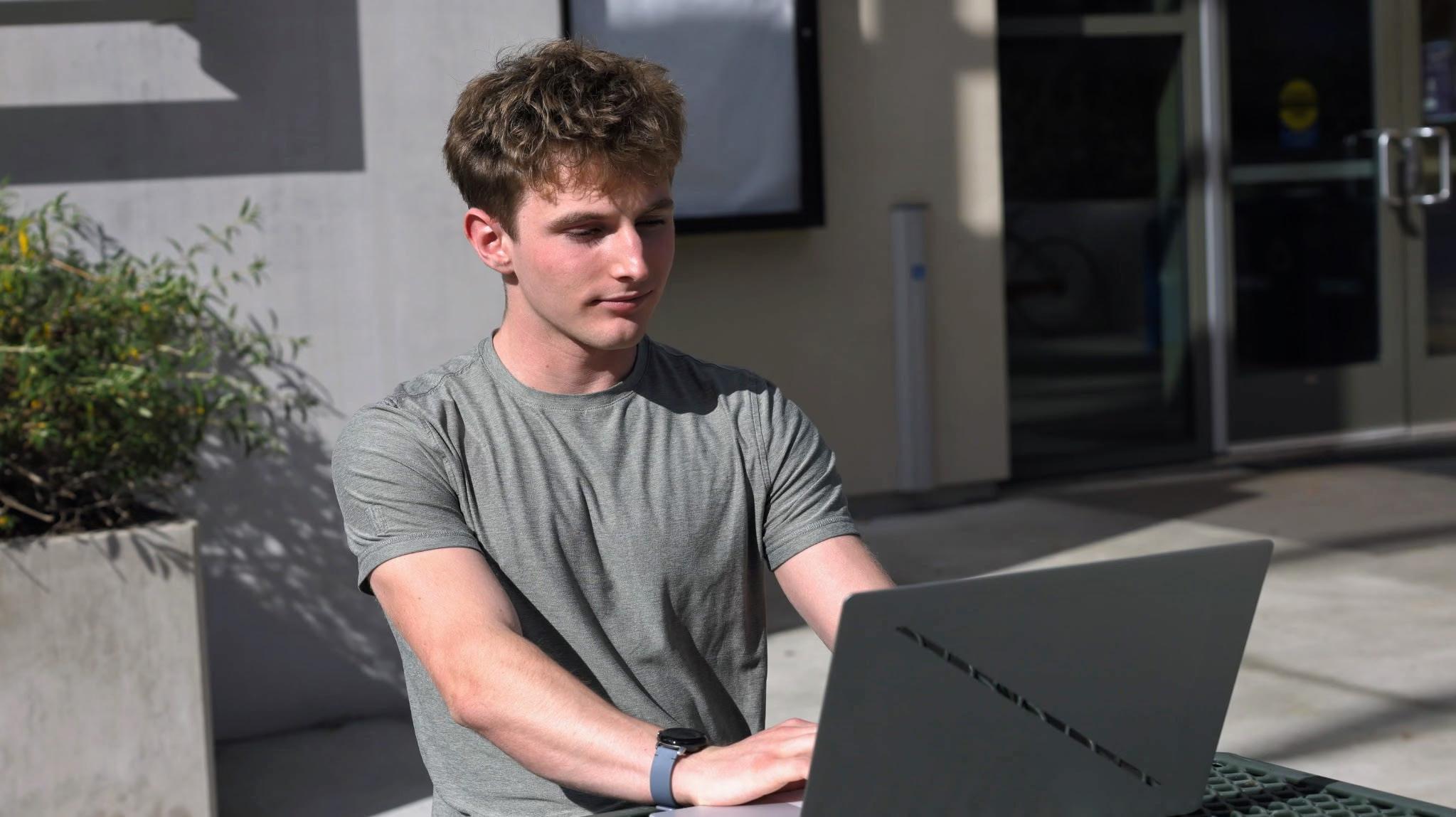
Porter reached out to around 70 YouTubers to advertise his most recent game, Harbinger, a first-person shooter game. Initially, he didn’t expect to get much play
from it, but over 34,000 people have tried the game. Porter hopes to reach out to even more people for his next release. “I’m doing like 800 emails, and I have a list of almost 1000 people I’m gonna email now because it’s literally just a numbers game of how many people you reach out to,” Porter said.
“You
don’t have to go to college to learn how to do this whole career path. [...] I now have all the skills I need to both make games myself, and go work in the industry.”
Not only is Porter’s goal to have his next game attract more viewers, but he also hopes to make some income from it since his prior two games were free. “My next release is gonna probably cost around $15. So that means that every time someone buys it, I’ll probably get $10 since Steam takes like a 30% cut,” he said. “That’s why it’s so important to send out all these marketing emails because that’s the main way to get people to actually [...] purchase the game, which is cool, because then you can make money.”
Porter’s advice to those interested in making video games is simple: start creating. “You can spend a ton of time researching the best game engine to use, or searching for all these courses to teach you how to do it. I would say just find some YouTube videos and just follow them and learn the basics. And then I would recommend you go and try to make something yourself, not following one of the tutorials, because that’s how you can actually learn how to do it yourself,” Porter said.
When Should You Start and Stop Gaming? Students and Teachers Weigh In
by Aaron Widjaja
A five-year-old clicks “play” on his tablet and is unknowingly matched against an 80-year-old chess veteran, waiting with bated breath. The young prodigy leans forward, eyes locked on the glowing board, as his opponent, with decades of experience, calculates. Moments like these raise a curious question: in the boundless world of online gaming, does age still matter?
Senior Veer Vohra began gaming at the start of the pandemic. “When Covid started, it was a great way for me to continue to stay connected and socialize with friends, especially with the strict social distancing measures that were being implemented during the time,” Vohra said.
Similarly, senior Niko Madriz started playing in fourth grade after receiving his first PlayStation. “I remember the first official video game that I played was Fortnite. [...] I was able to make a lot of good memories with friends in a fun, chill environment,”
Madriz said.
Both Vohra and Madriz agree that there’s no specific age to start gaming, but they also recognize how its appeal can fade over time. As schoolwork, responsibilities and social lives grow, gaming often takes a back seat. Madriz has felt that shift firsthand.
“My dad would let me play above the age category if I wrote him an essay arguing why I should be allowed to play the game.”
“I remember when I was younger I couldn’t wait to get home from school, hop on the game [and] play with my friends and stuff. [...] Nowadays nobody plays anymore, so there’s not really that much of an incentive for me to hop on the game either,” he said. Vohra echoed that sentiment, citing increased homework and other
commitments as reasons for stepping away from gaming.
However, Vohra believes there’s no age when someone should stop playing video games, so long as balance is maintained. “The main thing is keeping a balance between the fun, relaxing parts of life and the deeper aspects like family, friends and the things that really matter,” Vohra said.
For English teacher Oscar King IV, the question is about the value of the game, not age. Growing up, King didn’t face strict limits on his gaming, and he says that freedom shaped his current point of view. “My dad would let me play above the age category if I wrote him an essay arguing why I should be allowed to
play the game,” King said. He believes that what truly matters is the kind of game being played.
“I don’t think there’s an age to start or stop playing. [...] It’s more for what is the game and what is the kind of heuristic or the hope of the game, and how are you engaging with it,” King said.
Looking ahead, King sees gaming as something that will remain part of his life, as a lasting form of creative expression. “I think games are just increasingly a kind of storytelling that I really enjoy,” King said.

Madriz shares a similar perspective, noting that several of his relatives still enjoy gaming today. “My uncles, who are [...] a little bit older, still love playing video games,” he said.
“If anything, there’s just a stigma around video games being unprofessional.”
Senior Beckett Porter works on his newest video game, Undertaker, a stealth-action game. Staff photo: Anya Ramani
Staff illustration: Claire Dickman
Senior Beckett Porter
English Teacher Oscar King
Football Retains Valpo Cup, Outmatched by SI in Playoffs
by NOAH LEVIN
Menlo’s varsity boys football team finished their season 9-3. They defeated rivals Sacred Heart Prep and Menlo Atherton High School for the second consecutive year on their way to a second place finish in the West Bay Athletic League.
The team’s season ended in the CCS Division II semifinals, where they fell to top seeded St. Ignatius High School 42-6. Menlo started off the season with a 7-0 record, averaging 46 points per game. “We started off the year really well,” senior quarterback Jack Freehill said. “Every game we played well on
both sides of the ball and kept making explosive plays.” Freehill led the way for the Knights with 31 total touchdowns. Senior wide receiver Trevor Van Der Pyl accounted for 11 of Freehill’s 22 passing touchdowns on the year.
Menlo suffered its first loss of the year to Los Gatos High School and then forfeited its matchup with Wilcox High School due to injury and illness, dropping their record to 7-2. However, the Knights retained the Valparaiso Cup the next week with a 21-6 win over SHP in the 23rd annual Valpo Bowl. “That was a huge win for us this year,” junior quarterback Caleb
Cohen said. “We needed a big win after the [Los] Gatos game, so it was great to get back in the win column entering playoffs.”
Despite falling short of a CCS championship, Freehill was happy with how the team went out. “I’m really proud of the team and how we fought, and how we played that last drive shows how much heart we have,” Freehill said. “We’re down 42-0 to a team that we could have had. We all knew we didn’t play well and to put the ball in the end zone on that last drive was a great way to end our year.”
Flag Football Wins First CCS Title
by SPENCER TOLAND
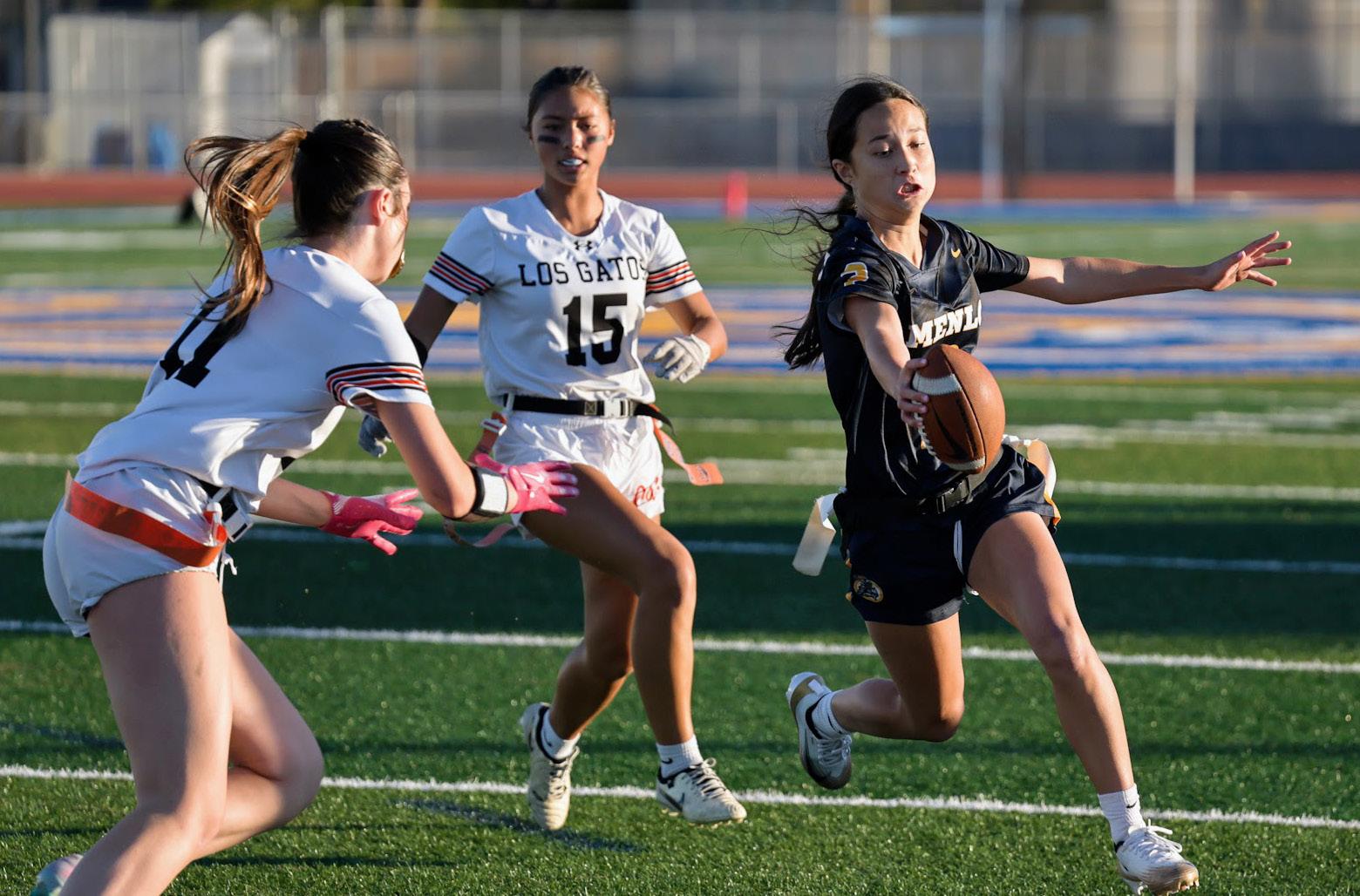
This November, Menlo’s varsity girls flag football team made program history, beating Los Gatos High School 27–13 to capture the sport’s first-ever CCS Open Division Championship.
“Going into the season, we obviously wanted to try and win the CCS championship as it was the first one,” sophomore wide receiver and defensive back Anika Shah said. According to MaxPreps, the 16-2 Knights ranked No. 15 nationally at the end of their season.
Menlo’s season, however, wasn’t all smooth sailing. The Knights suffered their first loss in over two years to Carlmont High School, snapping their 32-game winning
streak. “When we were faced with adversity like the loss to Carlmont, we just had to stay focused and not let that distract us from getting better,” Shah said.
The Knights split their two-game regular-season series with Sacred Heart Prep. In their first matchup, Menlo stormed back from a 12-0 halftime deficit to win 13-12.
Shah said the camaraderie of the team was a key factor in helping them make plays on the field. “The culture of the team was super special,” Shah said. “The seniors and captains had phenomenal leadership, and we’re all anticipating next season.”
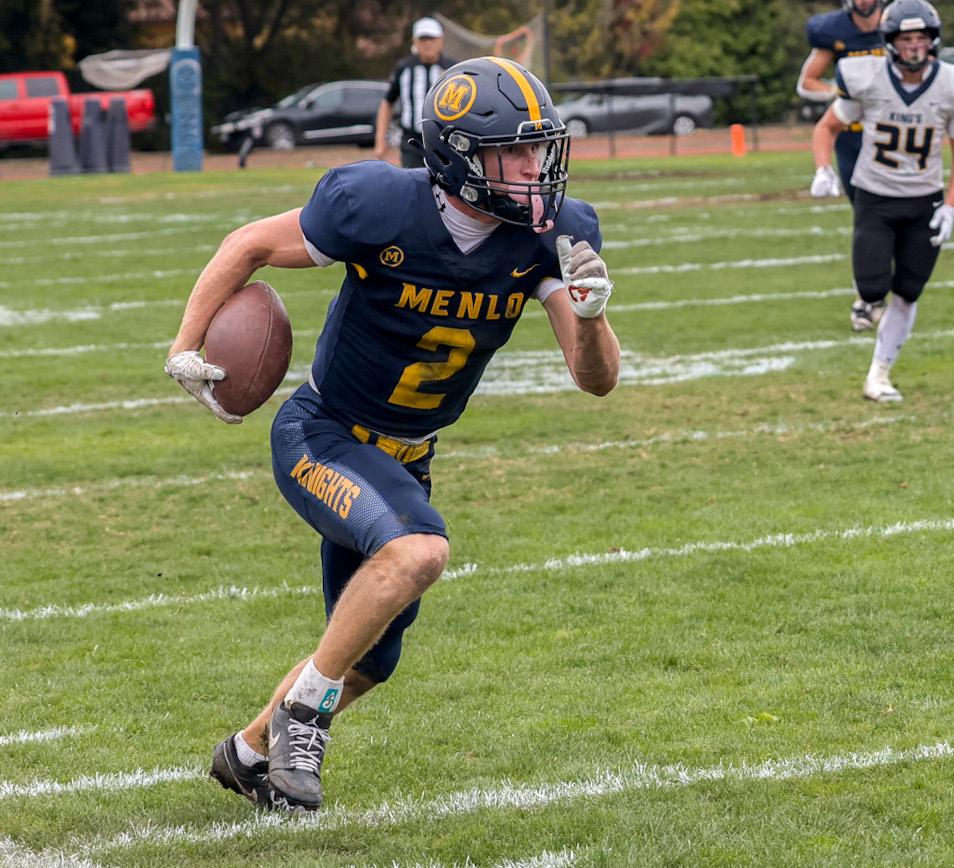
Cross Country Thrives in States
by TRISTAN CHEN
The Menlo boys and girls varsity cross country teams finished strong at the Division V California State Championships last month, placing second and 11th, respectively.
After a historic 2024 season, including a state title and Nike Cross Nationals appearance, the boys team faced pressure to replace three valuable seniors.
“It was a pretty difficult task to rebuild,” senior Amay Srinivasan said. “The expectations weren’t set as high, but we still held ourselves to the same standards as last year with ambitious goals.”
The girls demonstrated similar grit in the postseason. “Coach Sally [Hauser] did an incredible job really nurturing the team,” head coach John Dagata said.
Senior Ariya Kaushek was proud the team stepped up when it mattered most. “I believe what made our experience unique was that we were all competing for each other, fully aware it was the last race for all the seniors, and it was an opportunity to give it our all,” Kaushek said.
With both squads battling injuries and illnesses all fall, Dagata praised the athletes’ proactive approach. “We couldn’t have had more adversities that came our way,” Dagata said. “But I felt like we handled [them] well.”

Boys Water Polo Falls to SHP for Third Time in CCS Final
by SHAAN PARIKH
Menlo’s varsity boys water polo team capped off a successful season with a 21-9 record, climbing to No. 13 nationally, according to MaxPreps, while battling many of the top teams in the country.
Early in the season, the Knights placed third in the annual Roche Tournament at Menlo and finished second in the S&R Cup in Orange County.
“We played the top teams in the United States,” head coach Jack Bowen said. “By the last third of the season [we were] playing like a top 20 team in the country.”
In the CCS Open Division championship, the Knights fell to Sacred Heart Prep 16-11, marking their third loss to the Gators this year. The team saw its season end in the first round of the NorCal Division I playoffs, losing to De La Salle High School 15-11.
Bowen was proud of the team’s
resilience in the postseason. “The comeback wins throughout the playoffs were the most impressive snapshot of this team’s character,” he said.
Senior captain and goalie Connor Burks said the team started to catch its stride when its underclassmen settled in.
“Once our freshmen started becoming more comfortable with things, […] that was very pivotal for us,” he said.
Burks added that the team’s many injuries opened doors for new contributors. “Some injuries allowed some of our players, who didn’t really get as much playing time, to really step up, and I think that was great to see,” he said.
Burks said the Knights’ driven mindset helped them have such an impressive season. “I think our team culture has been very positive and definitely familial with our brotherly relationships among teammates,” he said.

Sophomore Hunter Coleman launches a shot on goal during a game against La Jolla High School at the Roche Invitational. Staff photo: Evan Grant
Senior Trevor Van Der Pyl turns upfield against The Kings Academy. Staff photo: Noah Levin
Senior Amay Srinivasan nears the finish line in the Division V state championship race. Photo courtesy of West Coast XC
Junior quarterback Ava Allen reaches for the pylon in the CCS championship against Los Gatos High School. Staff photo: Asher Darling
Winter Sports Gear Up for Action
Boys Basketball Awaits Tough League Schedule
by NOAH LEVIN
After a heartbreaking Division IV CCS loss to rival Sacred Heart Prep last year, Menlo’s varsity boys basketball team is preparing for what they hope is a deep playoff run.
A key shift for the team will be adjusting to the loss of former stars Tate Cohen ‘25 and Aidan Stull ‘25. “Both Tate and Aidan were the main source of our offense last year, so it’s going to be hard to replace their production,” junior Zander Deutch said.
The Knights will be lead by returning upperclassmen senior guards Ethan Zhao and Evan Arcilla, as well as junior center Kai Mawakana. Mawakana believes that underclassmen can provide a fresh spark to the offense. “I mean, we have a lot of young guys with a lot of

offensive potential,” Mawakana said. “But we definitely will need to play as a team this year. So we’ll need to play for each other and play for the seniors.”
After going 0-6 against the top three teams in the West Bay Athletic League last year, both Deutch and Mawakana agreed that the team has and will do what it takes to perform at a high level throughout the season and into the playoffs. “The main goal this year is to win the CCS championship,” Mawakana said. “I believe we’ve got the team to make that happen.
I think we can make a deep run in states this season.”
Menlo has begun its season 4-0 including wins over Jefferson High School and Washington High School. They will travel to Los Gatos High School for the Los Gatos Tournament on Thursday, Dec. 11.
Boys Soccer Seeks To Avenge Last Year’s Final Loss
by BIANCA
One penalty separated the Menlo boys soccer team from being the 2024 CCS Division II Champions. It was already the furthest the team had gone in the history of the program, and by the end of that loss the whole team, not just the current seniors, were feeling the weight of their achievement. The game had a heavy emotional effect on the team. “It was really impactful for me,” senior Reed Sunwoo said. “I thought it really showed how far the team had come and just in terms of wanting this [win] as a collective.”
For assistant coach Eric De La Cerda, the way in which the team lost showed him just how close they were towards reaching their ultimate goal.
“Having a zero-zero drawn game and then [the game] coming down to penalties, ultimately it became fifty-fifty. It was really anyone’s game at that moment,” De La Cerda said.
Sunwoo is confident in building off of last year’s success. “I definitely think we can make it back to the same place, and I’m hoping we can even make it farther, whether that’s winning DII finals or making it into a higher division,” Sunwoo said.
De La Cerda also has high hopes for the team this season. “If you look at our trajectory the past three years, we have done nothing but go up,” De La Cerda said. “We have ultimately almost [won the
Girls Basketball Aims For Fifth Straight CCS Title Win
by LILA OZDEMIR
The Menlo girls varsity basketball team is working to win its fifth straight CCS championship this year. After losing key contributors Karen Xin and Ruiqi Liu, the team will rely on it's young roster to step up. According to head coach Ryan Cooper, Xin and Liu were the center of the varsity team all four years and great contributors to the team’s success. “Those two graduating have left a legacy. They’ve been wonderful ambassadors for girls basketball here at Menlo, and they’ve done a lot in terms of leaving the program in a really good place,” Cooper said.
Sophomore Annika Lecybil, who was on the varsity basketball team last year, believes the team this year’s girls basketball team holds a lot of promise, and will be able to adapt in their absence.
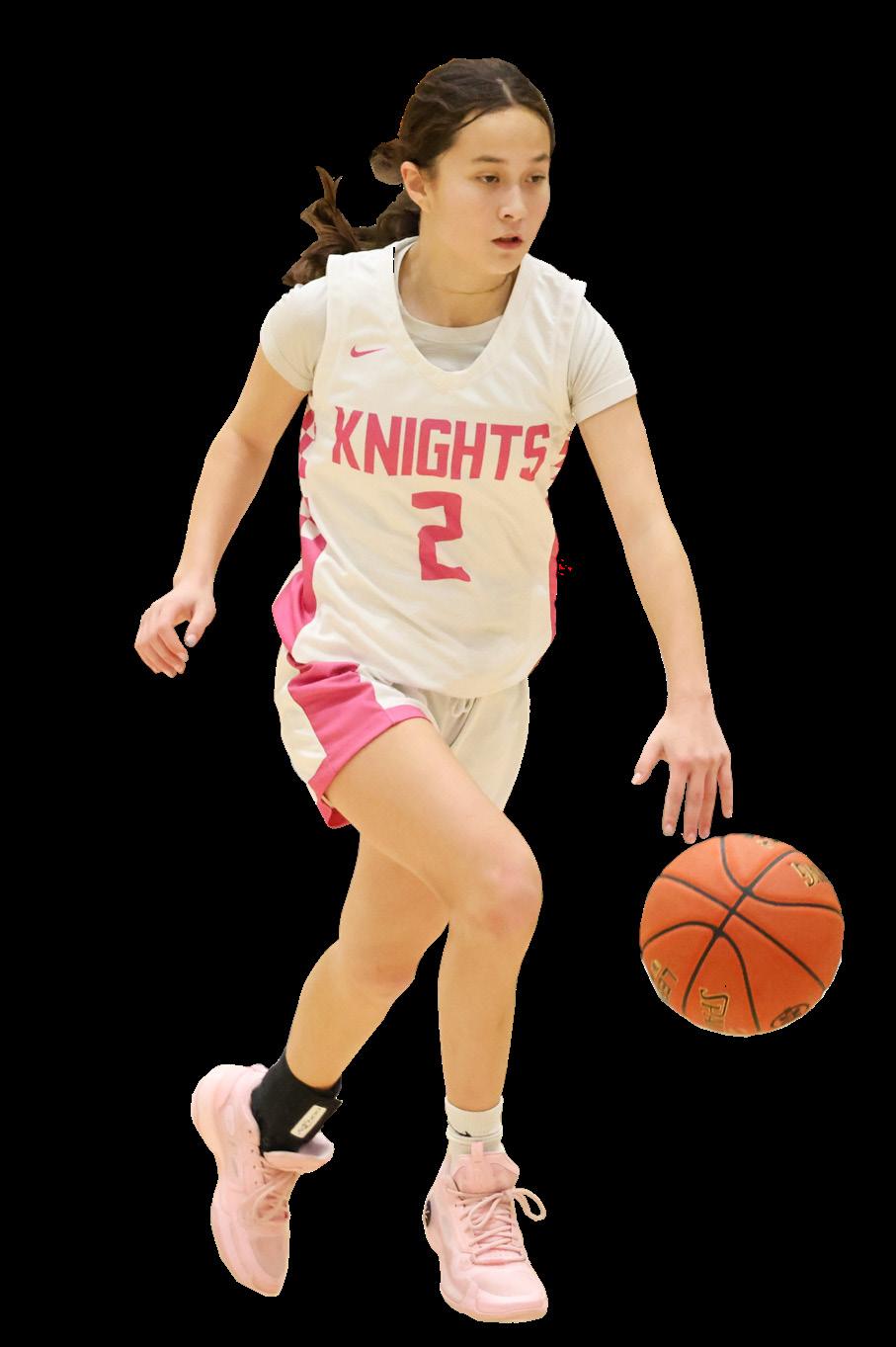
“Obviously, it’s
CCS finals]. This year, it’s just a matter of getting to that final push.”
According to De La Cerda, the group of returning players, including senior centerback Cameron Rafati and senior midfielder Kieran Vazquez will have to adjust with a younger team this year. “With a new set of boys coming in, it’s a reset,” De La Cerda said. Sunwoo believes that filling in the gaps left by last year’s seniors will be a priority this year. “Trying to manage that and finding personnel to kind of cover for that will be really huge, especially in the preseason,”

Both players and coaches are looking forward to their annual winter break trip, where they will play a non league game at California Polytechnic State University against San Luis Obispo High School. “It will be a great experience. The trip always helps with just the chemistry and getting everyone to start kind of playing together as a team just before the regular season starts,” Sunwoo said.
gonna be a lot harder without Ruiqi and Karen, but there’s going to be a lot of opportunity for us to step it up this season,” Lecybil said. Lecybil stresses that as they continue to practice, the team will improve exponentially as the year goes on. Cooper feels similarly and said the team will grow from mistakes thorough the year to peak in the postseason. “Hopefully by playoff time we’re playing our best basketball and we have the most confidence in ourselves and our roles and we are competing for another championship,” he said. Cooper also feels the roster is more balanced offensively this year, meaning more players will have the opportunity to score for the team.
Girls Soccer Looks to Repeat as CCS Champions
by JAMES PARK
After defeating Mountain View High School in the Division III CCS final, the Menlo girls varsity soccer team capped off a historic 2024-2025 season advancing to the NorCal semifinals for the first time in school history. “It was a great group of girls, and the team spirit was the best it’s been in my three [seasons at Menlo],” senior captain Julia Axelrod said. Despite falling to the eventual NorCal Division III champion, Maria Carrillo of Santa Rosa, Menlo
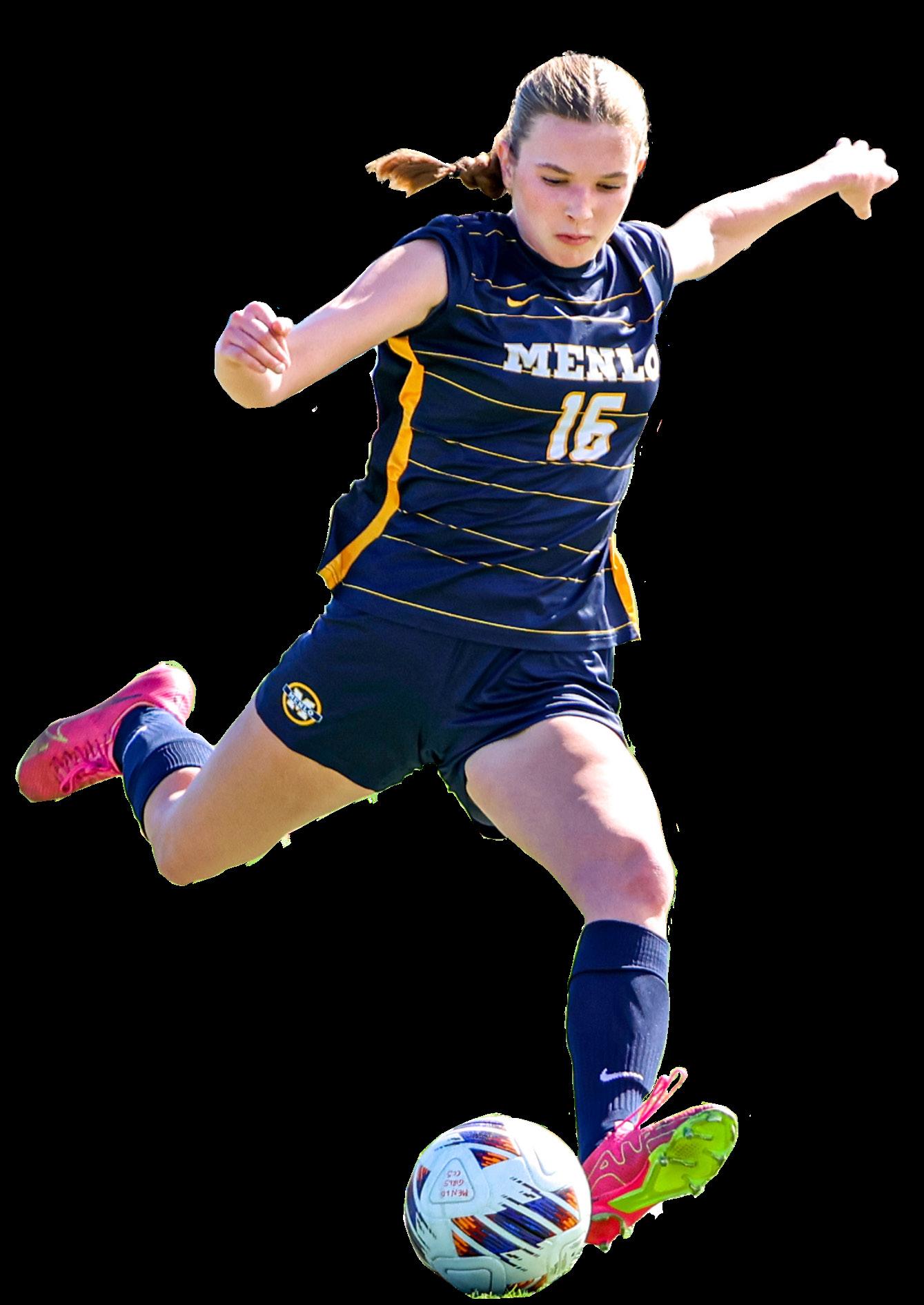
achieved the level of success that girls soccer head coach Ross Ireland had envisioned. “The team really played to the potential of where I thought they could go,” Ireland said. This season, girls soccer will be replacing nine seniors, including starter Angelica Chou ‘25, who scored 17 goals and added seven assists in just 10 games. Axelrod hopes the returning players and incoming players can make up for the loss and sustain the same energy and chemistry from
last season. “We’ve already met all the prospective players in late September, and hopefully we can carry the momentum from last year and have a team with good chemistry and have fun,” Axelrod said. Ireland agreed with Axelrod, emphasizing the impact of the team’s camaraderie on their level of play. “I’m hoping we can attain the level of connection the team had [last year], which I think played a key factor in the
Looking ahead, Ireland also plans to take a new approach in selecting this year’s roster. “I’m going to look for players who are really committed [to the team],” Ireland said. “I want to reward the players who are willing to do whatever it takes to be part of the program.” The Knights will play their next game after break on Jan. 2 against Notre Dame San Jose.
PUTANEC
Staff photos: Noah Levin
COMMITTED CORNER COMMITTED CORNER
Maren Mulloy, Stanford University
by JAMES PARK
Inspired by her father and older brother playing collegiate sports, senior Maren Mulloy set her sights on being a college athlete. In December of 2024, Mulloy committed to play Division I lacrosse at Stanford University. “Stanford was always my dream school,” Mulloy said.
Although most athletes pursuing a college career choose to narrow their focus on one sport in high school, Mulloy decided against it, having played varsity flag football, basketball and lacrosse at Menlo. Mulloy believes that being a three-sport athlete has contributed to
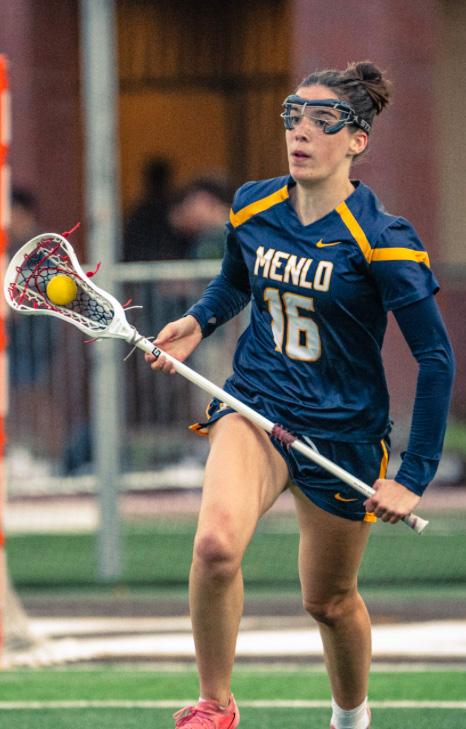
her success in lacrosse. “A lot of the defensive footwork and strategy really translated well, so I actually think playing my other sports was super beneficial,” Mulloy said.
Despite her love for flag football and basketball, Mulloy’s true passion is lacrosse, which deepened when she started competing at a higher level.
During the recruitment process, which began the summer before her junior year, she often traveled away from home, particularly because lacrosse is a very East Coast-oriented sport. “For the past few summers, I’ve basically lived in Maryland because that’s where the best competition and tournaments are,” Mulloy said. “Playing eight or nine hours a day was also a challenge, but I think I learned a lot from being there.”
As Mulloy began exploring her collegiate lacrosse options, academics were a crucial factor for her. “Schools with good academics, like the Ivy League and high DIII schools, were especially the places I was looking at,” Mulloy said.
When her older brother, Cormac Mulloy ‘24, committed to play Division I water polo at Stanford, Mulloy started to see Stanford as a dream destination. “Stanford was my first offer, and I took it right away,” she said. “It’s always been my number one school throughout the whole process. It’s the perfect balance of great academics and great lacrosse.”
Mulloy’s presence on the Menlo girls lacrosse team has a big impact, according to teammates. “She works really hard, and she sets a really good example both on and off the field, especially for the younger girls,” senior Elia Choe said.
Cameron Rafati, Tufts University
by SHAAN PARIKH
For senior Cameron Rafati, his love for soccer began when he spent weekends chasing soccer balls at Kids Love Soccer, a small, local soccer camp that his father sent him to. Rafati’s beginnings at Kids Love Soccer have turned into something much bigger: a commitment to play Division III soccer at Tufts University.
Since his start at laid-back youth camps, Rafati credits soccer for shaping much of who he is today. “I’m a pretty selfless person. I care a lot about the people around me and bringing them up with me,” Rafati said. “Soccer, being a team sport, has really helped me with that.”
When it came to thinking about college, Rafati didn’t originally expect soccer to be the focus. But after introducing himself to coaches and reaching out to schools he was interested in, he realized playing soccer in college was a very viable option. “When Tufts gave me an offer, I researched a lot about them and realized that they were a great school. That’s when I decided to accept,” he said.
Rafati looked into the program’s culture and characteristics, as well as its coaching staff. “The head coach of Tufts was just so nice,” Rafati said. “His personality definitely separated him from all the other college coaches I talked to.”
Since joining Menlo’s varsity soccer team in his junior year, Rafati has been known for his leadership. “He connects people on our team. […] He’s just a very good leader in that sense,” Rafati’s teammate, senior Charlie Allard said. “He plays at a higher level, and so he sets the standard for other people.”
Jack Freehill, Columbia University
by NOAH LEVIN
Senior shortstop and quarterback Jack Freehill announced his commitment to play baseball at Columbia University, fulfilling his lifelong dream of playing collegiate sports at a Division I level.
Freehill’s recruiting process officially began in his junior year, though he had been dreaming of being a professional baseball player since a very young age. “It was always my dream to play professionally. I didn’t have any colleges in mind, but to this day, my goal is to play professional baseball in the MLB,” Freehill said.
In April of 2023, the NCAA Division I Council decided to implement new rules that restrict communication and recruiting activity in baseball until the prospect’s junior year of high school. Because of this, Freehill decided to participate on a competitive travel team, NorCal U, the summer before his sophomore year, putting himself on many coaches’ radars.
Although he received offers from Division I schools like the University of San Deigo, Freehill decided to commit to Columbia because of their elite academics and the opportunity to have an immediate impact in the starting lineup. “I thought it was the best fit for me. Especially nowadays with the Power Five schools,
NIL and the transfer portal, it’s really a mess and I wanted to go somewhere I would feel comfortable,” Freehill said. “And the coaching staff is great. They were the first school to offer me and always showed a lot of interest.”
Beyond athletics, Freehill also emphasized the value of Columbia’s academics and the long-term security it offers. “I also knew that going to an Ivy League school would set me up well, no matter what happens,” Freehill said. “If pro baseball doesn’t work out how I want, I’ll still have a great education.”
Freehill originally had his sights set on playing baseball in college, although he garnered interest from coaches to play football as well after his standout junior year, in which he totaled 35 touchdowns.
This season, Freehill passed for 22 touchdowns and added 11 more on the ground. His performances led to him receive an offer to play Division I football at Columbia as well.
Currently, Freehill is undecided on whether he will play football at Columbia but anticipates to make a final decision sometime in the spring. “I’m thrilled to have an offer from [the Columbia] football program. They have a great coaching staff over there,” Freehill said.

Now, Rafati is motivated to embrace this upcoming chapter, both as a student and as an athlete. “What excites me most is the fact that it’s a new journey,” he said. “I’m going on the other side of the United States, and everything about it being new is super interesting. I’m just really excited.”
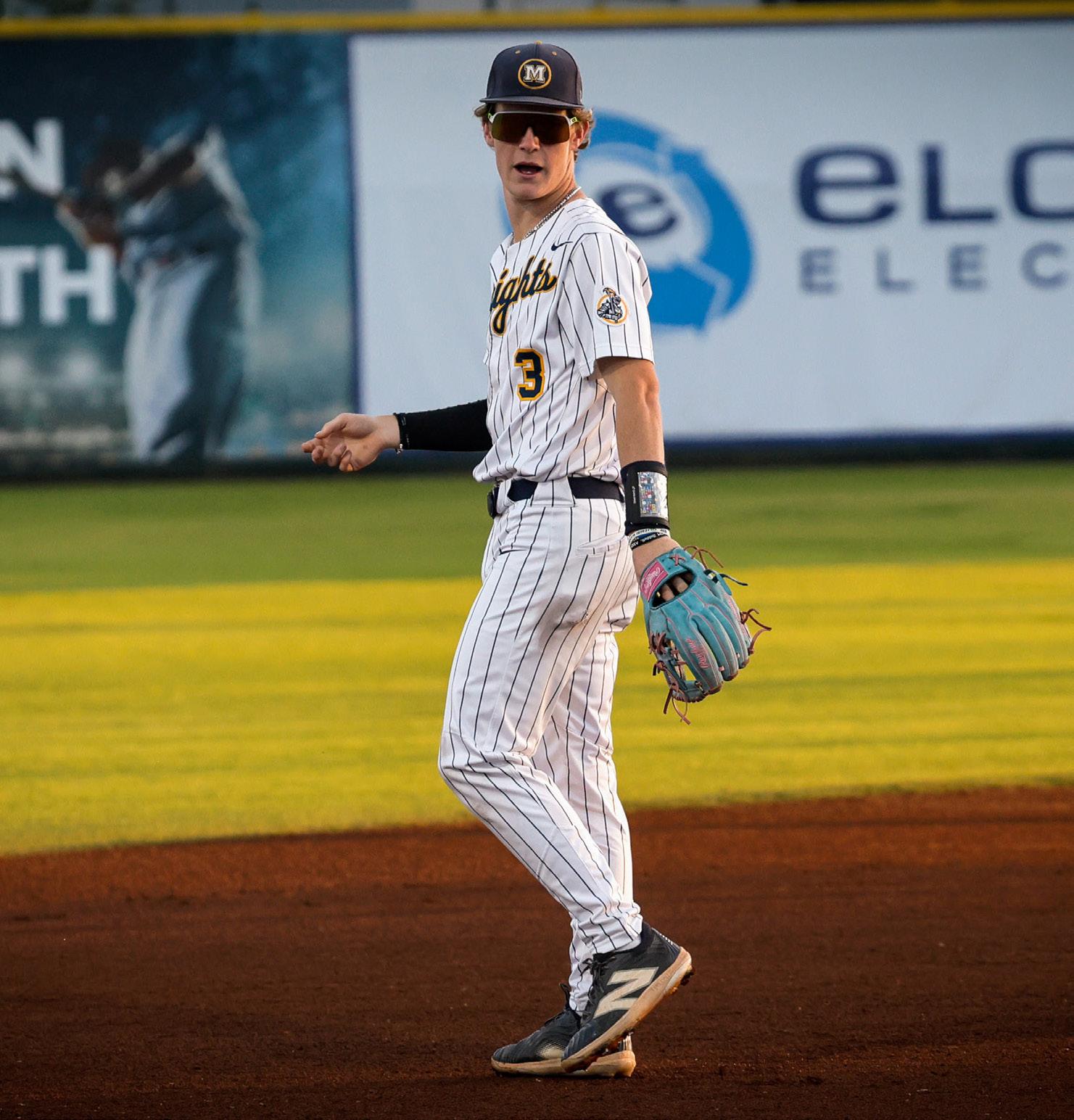
Senior Jack Freehill roams his position between pitches. Staff photo: Jacob Reich
Senior Maren Mulloy cradles the ball down the field during a game in the Knights’ 2025 season.
Photo courtesy of Mulloy
Senior Cameron Rafati lines up a deep pass to to his teammate during the 2025 CCS Division II final. Staff photo: Noah Levin
From Menlo to Stanford, Kate Paye Continues to Inspire Athletes
by BAEYLN BATORY
From coaches to professional athletes to championship winners, the Paye family has it all. Kate Paye, the Stanford women’s basketball’s head coach, graduated from Menlo in 1991, while her brother John Paye graduated from Menlo in 1983. Throughout her career at Menlo, she led the varsity girls basketball team to three state championships.
After graduating from Menlo, Paye received offers to play basketball at Division I schools like Harvard and Princeton. Instead of jumping on those offers, Paye went on to try out for Stanford’s team, where she had been playing in basketball camps ever since she was little.
She was offered a spot and walked on as a point guard. “I wanted to find the right fit where I could grow both as a player and as a person,” Paye said.
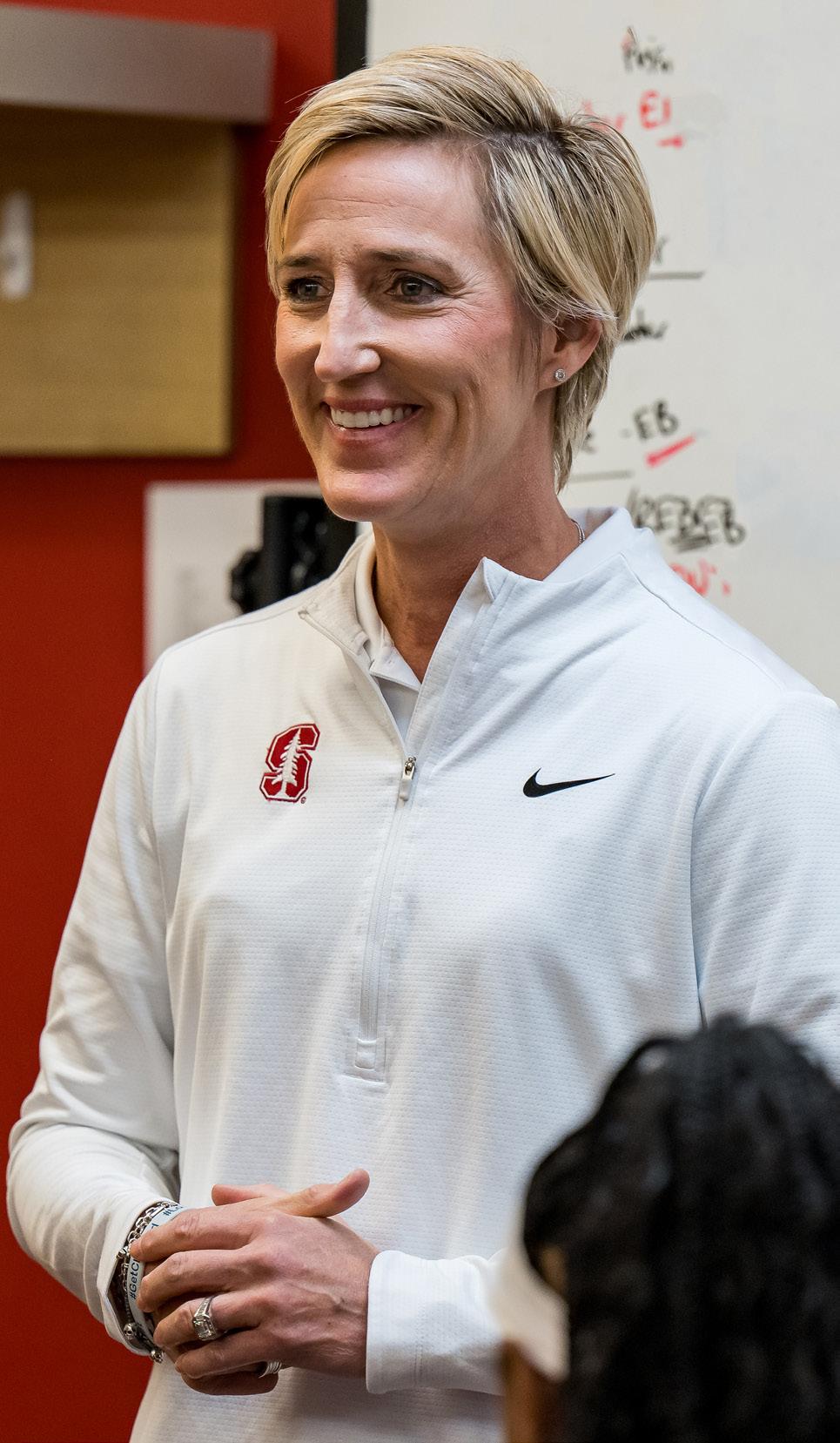
After making the team, Paye played on Stanford’s 1992 national championship team before earning a scholarship. After her career at Stanford, Paye became an assistant head coach at San Diego State University during the 1995-96 season, before playing in the WNBA for the Minnesota Lynx and Seattle Storm for six years.
During her career in the WNBA, Paye attended Stanford Law and Business School. Upon being waived by the WNBA, Paye briefly worked as a corporate attorney for Palo Alto-based Cooley Godward LLP before rekindling her coaching career. Soon enough, she was back at Stanford again, this time as an assistant coach. For 17 years, Paye worked under the most winning coach in college basketball history, Tara Vanderveer.
During Paye’s time as an assistant, the Cardinal were consistenly one of the top teams in the nation, going 543-102 (.842) and winning the 2021 national championship, while advancing to two other title games and nine total Final Fours. Stanford’s 527 wins in her time as an assistant were the second-most of any team in the nation over that span.
“Tara is amazing. I mean, her leadership, her vision [and] the way she handles herself and the team. It’s really inspiring,” Paye said. From coaching under one of the most well-known coaches in collegiate women’s basketball, Paye learned a lot about what it means to be a leader. “Leadership is about example, integrity, hard work, listening and motivating people to be their best,” Paye said.
As an assistant coach, Paye was named the Division I Assistant Coach of the Year in 2022 and again in 2024, becoming the only coach to win the award multiple times. With Vanderveer’s retirement in 2024, Paye was hired as the next women’s basketball head coach at Stanford.
After going 16-15 in her first year as head coach and missing the NCAA tournament, Paye looks forward to bouncing back after bringing in the third-best recruiting class in the nation, according to 247 Sports.
Since Paye’s Menlo days, basketball and women’s sports alike have gone through some major changes, one of the most prominent being the growth in popularity of women’s sports.
“There’s more investment, more visibility, more opportunities and people finally recognizing the value,” Paye said.
Paye encourages the next generation of athletes to be bold. “Don’t be afraid to write your own story,” she said.
The Cardinal are 8-2 so far on the season.
Cartan Field Needs an Upgrade
by DEVEN DHOLAKIA
Last year, after a football game against Wilcox High School, I vividly remember overhearing a Wilcox parent say, “For a school so rich, it’s a shocker that their field is so terrible.” Unfortunately, she isn’t wrong.
Walking around campus, you can see why Menlo is renowned for its resources and facilities. From the 40,000-square-foot Spieker Center for the Arts unveiled in 2021 to the 55,000-square-foot athletic center constantly praised by visitors, Menlo certainly has multiple impressive features. However, members of the Menlo community who spend time at the Cartan Field are likely to see the dirt field, porta-potties, unsightly stands and question exactly why there is such a big difference.
As a member of the Menlo football program, I’ve experienced the downsides of Cartan’s poor conditions firsthand. Due to rain, the muddy grass has caused many players to slip, leading to drills being stopped in fear of safety. Aside from worsening playing conditions, the real grass takes significant amounts of money, time and effort to maintain. It’s time we change to artificial turf to be playable all year round and be as high-performing as our football team is.
I’d also like to point out the locker room situation at Cartan, or lack thereof. The locker room is an enclosed outdoor space with a couple dozen foldable chairs and a tent surrounded by a frayed wire fence. This not only affects the football team, but also cross country, track, lacrosse and other athletes. Every day we walk from the main campus to the field and get ready on the side of the track. Instead of the current “locker rooms,” Menlo should invest in an athletic field house; a standalone building with locker rooms, real restrooms that aren’t porta-potties or trailer restrooms, concessions, a press box and more.
I hope to one day see future Menlo athletes playing on a state-of-the-art athletic complex, which will better match the rest of Menlo’s campus.
Pro Lacrosse Player Hired as Boys Lacrosse Head Coach
by WILLIAM GARDNER
Members of the Menlo boys lacrosse team received a notification on Sept. 22 that William Mark, a professional goalie for the Premier Lacrosse League’s (PLL) New York Atlas, would become their head coach.
Over the summer, Blake Kim, previously the boys lacrosse head coach for seven years, moved to become the girls lacrosse head coach. After a search committee highlighted Mark as the primary candidate, he was interviewed by members of the lacrosse team and Head of School Than Healy before being hired.
Athletic Director Earl Koberlein believes Mark will be a great addition to the boys lacrosse program. “It’s exciting to see his passion. He’s so excited about building a program, a program that we could be proud of and he could be proud of. [He] wants to be here for the long haul,” Koberlein said.
Mark began playing lacrosse at boarding school in Connecticut and continued through college, first attending Long Island University and
later transferring to Syracuse University.
During his time at Syracuse, Mark became a candidate for the Tewaaraton Award in 2023 and 2024, which recognizes the best college lacrosse player in the nation. Last year, Mark signed with the Atlas and competed in the team’s PLL Championship-winning 2025 season.
Mark is excited to coach high school lacrosse for the first time. “The more I went through the process, the cooler the opportunity got and the more excited I am to be here,” Mark said.
He believes that his role as head coach extends beyond just making players good at lacrosse, but rather teaching them valuable lessons off the field. “We’re not chasing a professional contract for millions of dollars, we’re chasing human lessons and challenges. And we are learning to face adversity in a really safe landscape and push through that adversity in the right way, in the right setting,” Mark said. “Lacrosse can produce better humans, and I fully plan to do that as well.”
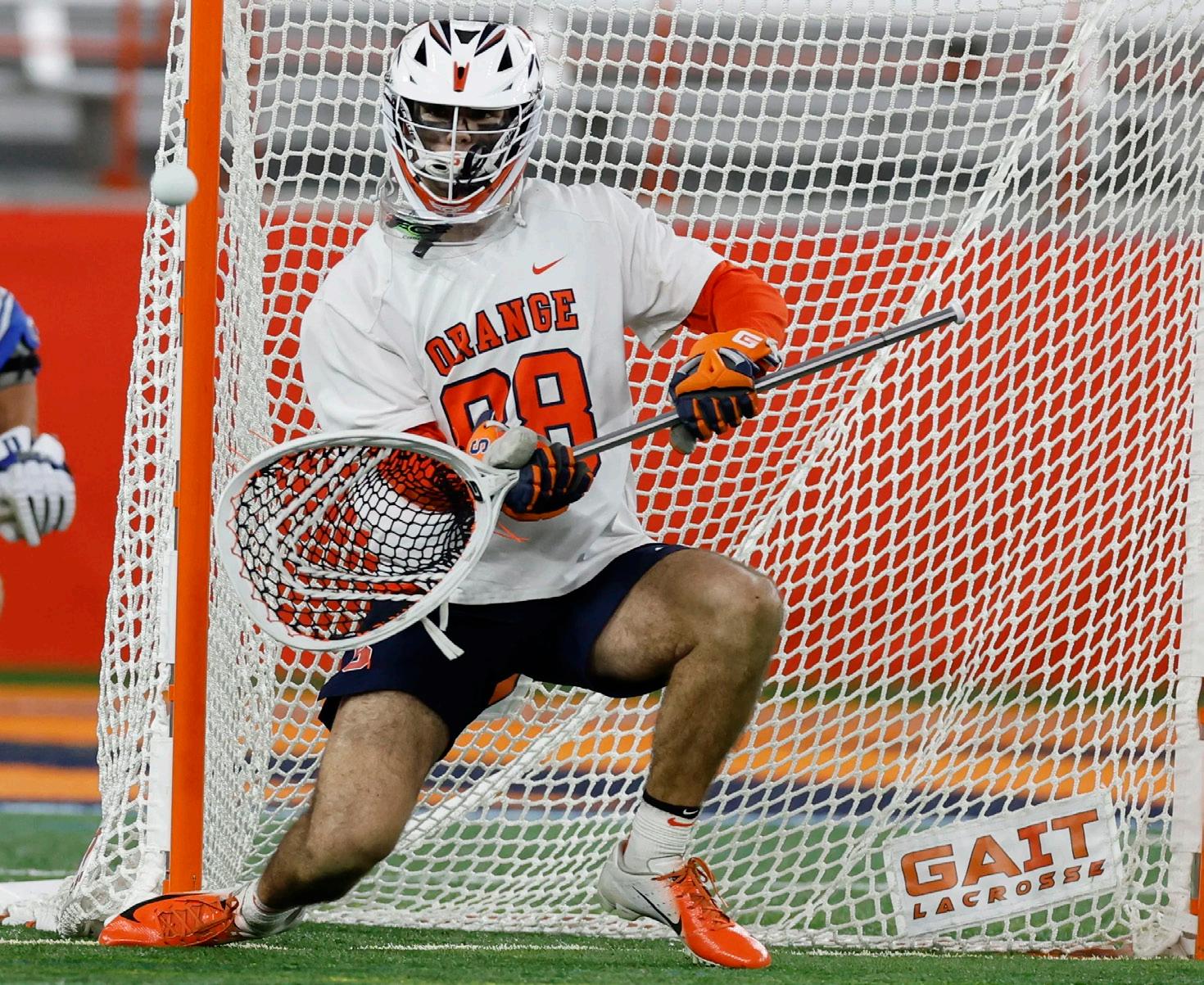
Stanford women’s basketball head coach Kate Paye reviews plays during a team meeting. Photo courtesy of Paye
Will Mark defends a shot while playing for Syracuse. Mark was recently hired as Menlo’s boys lacrosse head coach. Photo courtesy of ADVNC Lacrosse
A patch of dirt near the end zone at Cartan Field. Staff photo: Evan Grant
Arts and Lifestyle
Meet Dewey: A Working Dog at Menlo
by SPENCER TOLAND
If you see a yellow labrador trotting around campus with its vest on, odds are it’s Dewey, sophomore Jacob Marks’ guide dog-in-training. While it can be tempting to play with him, it’s important to let him roam and learn when his training vest is on.
Animals have always been a significant part of Marks’ life and his family’s lifestyle. He has had 10 pets in his lifetime, ranging from bunnies to guide dogs-intraining — Marks’ latest adventure.
Marks started working with an organization called Guide Dogs for the Blind this year, a group focused on harnessing the power of dogs to transform the lives of people with visual impairments. While their main

campus is in San Rafael, Marks works with the Palo Alto club.
In June, Marks took on a puppy named Dewey to train. “When I got him, [Dewey] was just a bare bones puppy,” he said. “He’s a much better dog now.” Marks will spend a total of 15 months with Dewey, which started in June and will end in late 2026. “I’m really just training him [to have] good habits and to be a good dog,” Marks said. “He has to be able to be calm in distracting environments.”
Marks watched his sister, Alea Marks ‘23, go through the same program while she was in high school at Menlo and was inspired to do the same. “I learned how I would be truly impacting someone’s life,” Marks said. “I met the woman who her dog went to guide, and it was super rewarding.”
Marks’ family has always been a big animal household. Marks says training Dewey is a way for him to make a difference in a field that is very important to him. “It’s really valuable to be able to possibly affect someone’s life in that big [of] a way,” Marks said. The organization is a nonprofit dedicated to pairing guide dogs with individuals who have impaired vision. They breed labrador retrievers and golden retrievers. Marks’ job is to train his dog to eventually become a service dog for someone who needs assistance navigating daily life.
The program has participants from ages nine to 90. After this period, the dog will return to the organization’s campus in San Rafael for formal training, after which it can be matched with an individual.
Marks isn’t sure what the future holds for him in regards to guide dog training. “I do think it would be a lot of fun to do again,” Marks said. “But it’s such a big responsibility and it does take up a lot of my time.” If Dewey doesn’t go through formal training, he would become Marks’ pet, an outcome Marks would be happy with. “[But] if Dewey does fail, then he will become my pet dog, and I don’t know if I want to have that many dogs around the house [if I start training another],” Marks said.
Training Dewey is extremely gratifying for Marks, and he would encourage others to go through the same process. Dewey sometimes comes to Menlo and can be out on the quad. Allowing him the space to learn and work is a vital part of the process.
December 12, 2025
My Word! Commute
by CHARLES HANSON

Welcome to "My Word!", a new Coat of Arms column where Menlo faculty trace the surprising histories behind everyday language. In this edition, Upper School History Teacher Charles Hanson unpacks the word “commute.”
President Trump’s decision last October to commute the prison sentence of disgraced Congressman George Santos is remarkable for several reasons, one of which is the opportunity it provides to reflect on the double meaning of the word “commute.”
The legal sense of this word is the original one: by commuting a sentence, a king (or a president) changed it to a shorter one. That’s the echo of “mutation” you hear. But in everyday speech, we almost always use it to mean “go to work and back.” Where did that come from?
As it turns out, we know exactly how this happened. When the Boston and Maine Railroad was built in the 1830s, it was designed to move crops, not people. But farmers in Maine soon decided that it was a convenient way to travel to Boston. Being practically minded Yankees (that is, cheapskates), they asked the railroad if they could get a discount if they promised to ride the train a certain number of times per month or year. Such season passes became known as “commutation tickets,” since the railroad agreed to commute the normal fare to a lower one. The person who bought one was called a “commuter.”
The American coinage caught on all over the English-speaking world, but I don’t know of any other language that recast the old Latin word this way. In French, going to work and back is called “doing the ferryboat,” a nice visual image. Even more vivid is “doing the pendulum,” as both the Germans and Italians say. In Spanish and Portuguese you just go to work and back, which makes sense too.
Selected Student Profile: Sophomore Anika Shah
by PAYTON LEE
The following has been pared and edited for clarity.
Q: Describe yourself in three words.
A: I would describe myself as caring, determined and thoughtful.
Q: What are you most passionate about?
A: I am most passionate about sports, but specifically basketball because I think playing sports is super fun, especially a team sport. I think it’s a good way to bond with people.
Q: What’s one thing on your bucket list that you want to accomplish by the time you graduate high school?
A: By the time I graduate high school, I want to go skydiving. My brothers and I have always talked about going. I’d want to skydive over mountains.
Q: What’s your favorite way to unwind after a long day?
A: Netflix. My favorites are either Outer Banks or Gossip Girl.
Q: If you could spend a day doing anything, what would your “perfect day” look like?
A: It’s summer, at the beach with friends, watching the sunset and having a bonfire. But in the winter, it would be skiing with a lot of friends and family and a cup of hot chocolate afterward.
Q: What is your favorite food and why?
A: Sushi because I just really like fish. I recommend the dragon rolls and sashimi at Kyosho, in downtown Menlo Park.
Q: Early bird or night owl?
A: Early bird. I always wake up early. Like, I can’t sleep in. I wake up between 7:30 a.m. and 8 a.m. every day, no matter what.
Q: If you could have dinner with any two people (dead or alive), who would they be?
A: Steph Curry and Michelle Obama. I really like watching and playing basketball, and the Warriors are one of my favorite teams. Michelle Obama because in third grade I did a project about her and I thought she was just really interesting as a former first lady.
Q: If you could have any superpower in the world, what would it be?
A: Teleportation. I would be able to save so much time. And I could go to a new place every day.
Q: If you could teleport anywhere right now, where would you go?
A: The Maldives or the Bahamas.
Q: What’s your favorite class this year at Menlo?
A: My capstone class. I can work on a project that I really care about and that I’m interested in. It makes work a lot more fun.
Q: If you could instantly master any skill, what would it be?
A: I would want to be an amazing chef.
Q: If you could have any animal as a pet, what would you choose?
A: A lion cub.
Q: What is your go-to Starbucks order?
A: An iced chai latte with light ice, especially in the fall.

Marks holds Dewey outside Guide Dogs for the Blind.
Photo courtesy of Marks
Shah at a family photo shoot thon November 20th Photo courtesy of Shah.
December 12, 2025
Continued from pg. 1
“I think Waymos are safer because the computers are better at driving than humans are,” Singh said. Singh believes autonomous vehicles will be the future of transportation. “You’re probably going to see companies like Uber and Lyft adapt their models to be more autonomous.”
“
It makes me feel like this is kind of the future of driving.
Senior Sulia Gayle
“ Waymo
Senior Amanda Wu tried taking a Waymo in Los Angeles with her parents. Her dad decided to call a Waymo because it was the cheapest option. Prices for Waymo, Uber and Lyft usually fluctuate, but they tend to stay fairly competitive with one another. One downside Wu noticed is that Waymos sometimes only drop off or pick up at limited locations. When her family visited her sister’s college campus, for example, the Waymo
would only stop on a specific side of campus. However, she and her family did appreciate how the vehicle consistently drove the speed limit, making them feel safe throughout the ride.
Some students note that Waymo still struggles with the location accuracy of drop-off spots, a problem also reported by a Forbes article titled “Self-Driving Cars Are In Trouble Over Pick-Up/ Drop-Off. They Can Fix It.” Senior Cole McKenney took his first Waymo ride over the summer. Although the Waymo ride was about five dollars cheaper, it dropped McKenney and his friends off three blocks away from their intended destination.
Senior Sulia Gayle tried out Waymo for the first time outside of the Bay Area, in Atlanta, another Waymo expansion hot spot. Gayle appreciated the fresh smell of the car and the peacefulness of a solo drive. “There was no creepy person talking to me, the car smelled really nice, it was just a chill drive,” she said. “It makes me feel like this is kind of the future of driving. And I like that.”
As the son of Waymo’s co-CEO Tekedra Mawakana, Waymos have become a staple in junior Kai Mawakana’s life, and he typically take them around twice a week.
Growing up alongside Waymo’s expansion, he’s learned about the ways in which Waymos
Arts & Lifestyle
are actually safer than human drivers. “Humans are naturally distracted; we all get distracted at one point or another,” he said.
Tekedra Mawakana is able to bring her experience as a parent to her work. “I relate to the challenges of busy parents, and enjoy knowing we can lighten their load by helping our kids safely get where they need to go,” she wrote in an email to The Coat of Arms. Waymo’s teen accounts give younger riders (ages 14 to 17) the ability to ride on their own across the Phoenix metro area as long as they
autonomous ride-hailing partner of USC Athletics and the USC Trojans. “Sports is such a powerful way to engage with people, and we aim to expand the fan experience by getting USC fans safely, reliably and magically to and from the Coliseum on game days,” Tekedra Mawakana wrote.
Through these initiatives, Tekedra Mawakana is excited to see Waymo’s technology used by youth, like Menlo students. “It’s truly exciting for us when Waymo becomes part of [young people’s] daily lives,” she wrote.

What’s Cooking in Downtown Menlo Park? Here Are Three New Restaurants and Selected Dishes to Try
by LISA HUHS

Clark’s
Clark’s is a mere 10-minute walk from Menlo. It has a nautical 1950s Americana vibe, and despite its steep fees and slow service (taking an hour and 15 minutes to bring out the entrées), I thoroughly enjoyed each dish.
Octopus: 2/5
The $26 Oak Grilled Spanish Octopus dish was garnished with olives, Fresno chiles, bay leaf aioli and “torn sourdough croutons.” Although delicious, it was average. The octopus was cooked nicely and the sauces and individual flavors complemented each other well, but it just didn’t stand out to me.
Oysters: 5/5
Clark’s carries an array of oysters from across the country, each $4.50 apiece. I’m not typically one to order oysters, but I did it for you guys, and ended up loving them. Each was fresh, flavorful and served with sides of horseradish, cocktail sauce, mignonette (vinegar sauce), saltines and a lemon. The toppings perfectly complemented each other and each oyster tasted slightly different than the last.
Burger: 4/5
The Pan Roasted Black Angus, served with Sauce Gribiche & Gruyere with Clark’s Fries (or substitute for slaw), was delectable. I highly recommend it, even with its price of $26. The fries, on the other hand, I didn’t particularly enjoy — hence the subtracted star. They were mostly just oil, and fried-ness? Anyways — maybe next time I’ll get the slaw.

Yeobo, Darling
This upscale, casual Korean-American restaurant feels like a welcoming reemergence of modern Korean comfort food, reimagined, this time, with a California flair. The interior is dimly lit, stylish and cozy, with an open kitchen that aromatizes the seating area. The service was attentive but relaxed, and the dishes were inventive.
Lu Rou Lasagna: 5/5
This dish encapsulates both Taiwanese lu rou fan and Italian nonna comfort. The layers of lasagna noodles are soaked with intensely savory, soy-braised pork, topped with melted cheese that somehow works perfectly alongside the umami sauce. It’s a dish that isn’t too fancy, yet delivers Michelin-level execution.
Scallion Croissant With Rou Song Butter: 4/5
An innovative take on the breakfast pastry, this croissant is flaky and buttery with layers that give that satisfying crackle upon first bite. The addition of scallion gives it a mild, yet onion-y sharpness that balances out the richness and the rou song (pork floss) butter adds a fun, saltysweet contrast. My only complaint? It’s small, almost too small for how much flavor is packed into each bite.
Darling Chicken Wings: 4/5
Crispy, sticky and satiating. Coated in a glossy gochujang glaze, they’re served with pickled daikon on the side. While they’re not reinventing the dish, the execution is spot-on. However, I chose to subtract one star due to the utter messiness of this dish — and if you know me, you know how much I hate sticky hands.

Eylan
With bold, smoky Indian dishes (with a California twist, of course), Eylan’s concept centers on live-fire cooking — a glowing tandoor oven visible from where you’re seated — and the entire space smells of a warm campfire and roasted spices. It’s relaxed but refined, with on-point service and a menu that incorporates both tradition and experimentation.
Taro Root Chaat: 5/5
This was easily my favorite dish at Eylan. The taro root is thinly sliced and fried until it’s almost shatteringly crisp, then layered with yogurt, tamarind and mint chutneys. It’s tangy, sweet, crunchy and creamy all at once. Every bite has an intense flavor that you’ll be missing for days.
Chilled Green Grape Chaas: 4/5
A creative take on the traditional yogurt-based drink, this version has a slightly fruity sweetness. The grapes add a fresh, unexpected note that makes it ideal for pairing with spicier dishes — especially since my spice tolerance is suboptimal. It’s unusual, but refreshingly so; it kind of feels like summer in a glass.
Eylan Crispy Chicken: 3/5
Eylan’s fried chicken is unlike any other: marinated in a blend of Indian spices and fried to a dark golden crisp. The chicken itself is juicy and flavorful; however, I found the batter a tad too thick. The accompanying green chutney was bright and herby, though, and made up for the overwhelming doughiness.
Staff illustration: Claire Dickman
Staff illustrations: Baelyn Batory
Arts and Lifestyle
New Administrative Assistant Brings Passion to Menlo
by SADIE EVANS
When Jocelyn Rodriguez learned that the administrative assistant position at Menlo had opened after Courtney Tyler stepped into the role of Assistant Director of Student Belonging, she knew she had to apply. Her colleague at her old school, Assistant Director of Family Support Fatima Taungahihifo, also now part of Menlo staff, encouraged her to apply for the position.
Rodriguez worked at ACE Esperanza Middle School, a San Jose charter school focused on kids having a difficult time in public schools, before coming to Menlo. “I learned a lot about myself teaching there because you have to be tougher to deal with some of the behaviors we experienced on a daily basis,” Rodriguez said.
“Menlo makes me re-love being in an educational setting.
Administrative Assistant
Jocelyn Rodriguez
““At my previous school, I had to speak Spanish a lot because we had a high number of Hispanic or LatinX parents that were part of the school,” Rodriguez said. Rodriguez was born in Mexico and immigrated to the U.S. at four months old, becoming a U.S. citizen in 2020 via a drive-by swearing-in ceremony due to the
COVID-19 shutdowns.
After a few years at ACE Esperanza, Rodriguez was promoted to assistant principal, but shortly after sought out a new position for the sake of her mental health. “I wanted to find a role where I was going to be happy still doing a bit of what I was doing before, so when I heard about the administrative assistant position [at Menlo], I applied,” Rodriguez said.
Rodriguez was a psychology major in college and had aspirations of becoming a marriage and family therapist. However, after one of her professors told her an urban myth about how prisons determine the number of beds to add to the facility based on how many children fail third grade, Rodriguez did her own research and learned that many incarcerated people can’t read above a fourth-grade level.
“That was a wake-up call that I should be in education because kids need good teachers,” Rodriguez said.
Menlo’s environment stood out to Rodriguez immediately when she came to campus for the first time. “When I came for an in-person interview, I noticed that everyone smiled. The teachers and staff want to work here,” she said. “I walked away thinking, ‘there’s something in the Kool-Aid here.’”
Rodriguez’s day begins with checking the student life email, including messages about tardies and absences from parents. From 8:45 a.m. to 9:15 a.m., she manages all tardies for students coming in late to school. Throughout the day, she helps organize faculty meetings and manages all of the technology for them. “The job is very task-oriented. I love checklists because of the satisfaction of crossing something off your list,” Rodriguez said.
Rodriguez is also a co-advocate for a group of

freshmen. “It’s really cool to mentor kids from freshman to senior year,” she said. “I’m excited to work with kids that I’ll get to see walk across the [graduation] stage one day.”
Looking ahead, Rodriguez outlined what she hopes to build in her role at Menlo. “A goal is to become more trusted among the staff,” she said. “I think when you’re new, everyone wonders how [you] work, so I want them to know they can trust me and [that] I will get my work done.”
Reflecting on her transition to Menlo, Rodriguez noted the difference she’s felt since joining the school. “Menlo makes me re-love being in an educational setting,” Rodriguez said. “I know this sounds really silly to say, but I’ve never been thanked so much in my life by kids.”
Three Alums Reflect on What Matters Most in High School
by SAVANNAH SMITH
Whether it’s running through a tunnel of seniors as a freshman or walking through the styrofoam arches as a Menlo graduate, the intensity and uncertainty that comes with being a Menlo student can make this school feel like the whole world. But every year, around 150 students leave this place, bringing their Menlo memories with them into their next chapter. Three of them came back to tell us what they’ve learned, what actually mattered and what they wish they’d realized while they were Menlo students.
Jordana Lenihan ‘25, just months into her first year at Northwestern, reflects on her time at Menlo with a fresh memory. Lucinda Schafer ‘24, starting her second year at Williams College, looks back on her high school journey, which began during the pandemic and ended with a cross-country leap. Travis Rettke ‘01 reflects on his post-Menlo, non-linear career path. Together, their reflections offer those of us still in the Menlo bubble
at heart. “I find energy in the things I’m learning still, and I think that’s because Menlo’s such an energetic place to go to school.”
Rettke’s most significant lesson wasn’t academic in nature. “More important than an econ test, sport or an AP score is learning the skill set and way to operate in high-pressure environments,” Rettke said. Rettke recounts high school as a time with a very hyper-focused perspective. “I was the center of my universe,” he said.
Despite graduating over two decades later than Rettke, Lenihan’s advice echoes that sentiment. “Nothing matters as much as you think it does in the moment, [whether that be] a grade, or a teacher or a fight with a friend,” she said. Lenihan emphasized how messy, emotional and impossibly fast senior year can feel. “But looking back, I wish I lived more in the moment and really focused on my friendships,” she said. “It was never as
conviction in your ideas, but don’t be so blind to other ideas or be dogmatic about them,” Rettke said. “That’s what makes you a better business person, a better friend, a better partner, etc.” He remembers Menlo as a place with many driven, hyper-focused people — a platform for critical thinking and open dialogue. Yet in many of those situations, as in life, it can be people talking past each other rather than with each other. “If I had a chance to go back and do it again, I would have listened a lot better both to my classmates and my teachers,” Rettke said.
All three alums stressed the importance of embracing unpredictable times. “So many parts of your life are not going to be completely planned out. [...] If everything was, then there’s no risk and therefore no reward,” Lenihan said.
Schafer elaborates that the only constant, irreplaceable thing in life is yourself. “No matter what college you

yourself,” Schafer said. “You know one thing about this next year, which is that you will still be you.”
Nothing matters as much as you think it does in the moment, [whether that be] a grade, or a teacher or a fight with a friend.
’25
Jordana Lenihan

Rettke shared a piece of advice he learned from his mom, one that has helped him keep connections strong while navigating different transitions. “Whenever somebody comes to mind, or an experience comes to mind, whether it’s a text message, an email or a call, it never hurts to send somebody a note saying you’re thinking about them.” That simple habit, he shared, has opened doors and strengthened old ties.
Overall, after leaving Menlo, the most important thing has been maintaining strong connections. Rettke shared that some of the most rewarding experiences in his professional career and closest friendships have stemmed from Menlo. “My biggest mentors are people that I either met through Menlo or met through Menlo connections,” he added. “I owe so much to that school.”
Photo courtesy of Rodriguez; staff illustration: Claire Dickman
December 12, 2025

by MALIA CHEN


Arts & Lifestyle

With 2026 right around the corner, new style trends await, and there is so much fashion to look forward to! While some beloved trends from 2025, such as polka dots, will be making a comeback, new prints, eye-catching bold color combinations and versatile accessories are set to make their debut. This year, designers are embracing finding a balance between classic styles and creative new twists, resulting in trends that feel both timeless and innovative.


Bold Color Combos:
Monochrome is out; maximal contrast is in. The colors of 2026 will be as vibrant as ever — think neon pink with forest green or cobalt blue clashing with marigold yellow. Stepping away from the neutrals that many people have become accustomed to, fearless color palettes signal a shift toward optimism and individuality. Gone are the days of being afraid to mix colors; expect to see daring color blocking and unusual shade pairings everywhere next year. Don’t believe it? Check out Prabal Gurung’s spring 2026 runway collection for proof. Who knew citron and baby blue were a perfect pairing?






Scarves:
If you’re still only wearing scarves to stay warm, you’re missing out on their full potential. In 2026, scarves are no longer going to be just winter staples; they’re quite versatile and can be styled in tons of different ways. On the Miu Miu runway, models wore them knotted like ascots, transforming simple outfits into elegant, vintage-inspired looks. Beyond the neck, scarves are going to be styled as belts, wrapped around waists for added texture, tied onto handbags, layered over baseball caps and even draped as tops. If you haven’t already, it’s time to invest in a few good scarves because pretty soon, they’re going to be fashion’s most adaptable accessory.



Polka Dots:
Polka dots have already dominated 2025 fashion, and there are no signs of that changing in 2026. Polka dots are back, they’re bigger than ever and they’re here to stay. According to Trendalytics data, there has been a 260% increase in the search volume for polka dot items in 2025. Once associated with nostalgia and retro charm, the playful print has taken off with a modern twist, becoming a bold, statement-making staple.


Deer Print:
Move aside, leopard or cheetah print: 2026 is the year of the deer! Also known as fawn or Bambi print, deer print’s soft, speckled pattern is a subtle alternative to the traditional bold animal prints that have risen in popularity over the past few years. It still features the warm, woodland aesthetic that people love, but with a slightly more sophisticated touch. Spotted in Sandy Liang’s viral GAP collection, Tory Burch’s Fall/Winter 2025 collection and on the wool jacket worn by Sofia Richie Grainge as she announced her fashion line, deer print is an understated animal print that’s perfect for minimalists.




Staff photos: Malia Chen
Models: Simone Lev, Asher Lev, Elise Darling, Nate Lee, Aaron Lee
Staff illustrations: Claire Dickman