The Coat of Arms The Coat of Arms
serving Menlo's upper school since 1973

serving Menlo's upper school since 1973
by CHASE HURWITZ

by ERICA FENYO

The world of sports betting is complicated. To the untrained ear, seemingly meaningless terms dominate all conversation: parlay, over/under, covering the spread. While this activity is usually associated with the bookies in
“Students should be clean, neat and dressed appropriately for school. Upper School student dress may not depict the following: […] drug paraphernalia, an act of violence, any other illegal act, profanity, explicit sexual material, nudity, explicit sexual acts or racist or sexist language,” according to the Menlo Student and Parent Handbook.
Many students, especially girls, believe that there is still a bias against how they dress, despite the
Menlo Teachers Reveal Unexpected Tattoos, pg 7
Vegas (someone who collects bets and sets the odds), some Menlo students are illegally placing their own bets on professional sports.
“It just makes the games more interesting,” an anonymous student said. “I’ve Betting, pg 13
lack of an enforceable dress code.
One freshman girl asked to remain anonymous to protect her identity from her peers and faculty members, so she will be referred to as Casey Mullins. Mullins has no issue with a dress code, but she believes that equal application of the rules is vital. “If everyone is held to the same standard, then I don’t think [a dress code] really matters,” Mullins said. “But […] if people are held to different standards, then I think I have to care.”

Mullins also shared her experiences with being shamed by her teachers for the way she dresses.
“My advocate [came up] to me, and she [said that] multiple […] teachers [had] emailed [her] about [my] ‘boobs showing in class,’” Mullins said.
Mullins also believes that many teachers repeatedly target the same girls, even if they dress similarly to
Dress Code, pg 5
Here’s the Scoop: A Look Into Menlo’ s Social Culture, pg 9
Following a report from the Wall Street Journal, increased scrutiny has been placed on social media companies for their role in negatively impacting teenagers' mental health
by ALEA MARKS
When a teenage girl clicks on the Instagram app and the first thing that appears on her feed is an airbrushed and edited photo of a model with her friends, it’s easy for her to feel bad about her own life. The toxic effects of social media are not a new discovery. Even officials at the parent company of Instagram, Meta (previously named Facebook), are aware of the negative effects the platform has, yet no progress is being made to improve it, according to The Wall Street Journal.
Facebook changed its corporate name to Meta, which is short for Metaverse, to support the concept of a virtual universe that users can navigate freely, distancing itself from the problematic social media app that is Facebook. According to The Washington Post, the rebranding was made in an effort to distance itself from the recently exposed “Facebook Files” that revealed the lack of efforts the company has taken to combat the concerning statistics about their platform's impact on mental health, as shown from Meta’s own research.
In March 2020, researchers commissioned from Instagram found that “32% of teen girls said that when they felt
32% of teen girls said that when they felt bad about their bodies, Instagram made them feel worse.
bad about their bodies, Instagram made them feel worse.” A slide presentation with this information was posted to Meta’s internal message board, which was reviewed and published by The Wall Street Journal.
“Teens blame Instagram for increases in the rate of anxiety and depression,” another slide read. Junior Natalie Westermann attributes some of her insecurities to Instagram. “It’s easy to feel isolated because you see people hanging out with their friends and looking really happy,” she said.
For the past three years, Meta has been conducting surveys to better understand how Instagram affects its millions of young users. The Wall Street Journal reviewed numerous surveys with results showing that Instagram is harmful for a majority of its users, specifically teenage girls. Another slide had statistics from teens who reported

suicidal thoughts, and 6% of American users traced their suicidal ideation to Instagram, as reported by The Washington Post.
Despite this alarming research, Meta continues to deemphasize the app’s negative
Despite this alarming research, Meta continues to deemphasize the app's negative effects on teens and doesn't publicize the research that exposes these numbers.
effects on teens and doesn’t publicize the research that exposes these numbers.
The Wall Street Journal noticed that the company is dependent on its base of users under 22 years old, which comprises more than 40% of the total users.
Compared to other social media platforms, Instagram focuses the most on body and lifestyle and on specific moments of the user’s choosing. Westermann chooses to delete and redownload Instagram periodically because she finds herself falling down the rabbit hole of comparison. “Instagram is a highlight reel; it’s not representative of people’s lives in reality,” she said. Not only does Westermann feel the effects of negative social comparison, but she also finds the app to be very distracting and a vehicle for procrastination. In order
"I post for myself and turn off my likes [...] people compare their worst selves to other people's highlight reels, but nobody is perfect."
to combat this, she deletes the app.
An Instagram researcher involved in the “Facebook Files” noted that teenagers don’t like that they spend so much time on the app, but they still struggle to turn it off. “They often feel ‘addicted’ and know that what they’re seeing is bad for their mental health but feel unable to stop themselves,” the Instagram research manager explained to colleagues, according to the documents.
Sophomore Theo Sanders, who doesn’t use Instagram, feels left out and behind on trends because he isn’t on the app. “[I miss out on] knowing what’s going on in people’s lives,” Sanders said.
Sophomore Madison Brown mainly uses Instagram to promote her business, a brand focused on upcycling clothes. She is able to combat the negative sides of Instagram by using it as a platform to be creative. “I post for myself and turn off my likes,” she said. That way, she is not measuring her worth based on the number of likes, comments or followers she has, which is something she notices her friends doing. Still, she sometimes gets caught up in the comparison. “People compare their worst selves to other people’s highlight reels, but nobody is perfect,” Brown said.

Restrictions could be lifted if case rates drop and new variants don't develop by
LOUISA SONSINI
“I am hopeful the COVID-19 policies will change in the next few months, but that is based on the overall health of the community at large, and can’t be predicted this far out,” School Nurse and Health Services Coordinator Joan Barada said. The pandemic is constantly changing, and there are unpredictable factors that could alter the school’s second-semester agenda.
The most significant factor that could change the school’s plans is the emergence of another COVID-19 variant. According to the Centers for Disease Control and Prevention, unless more of the planet is vaccinated, variants will continue to develop and infect the population.
While it is expected that new variants will develop, the symptoms they may cause are not predictable, according to the CDC. Head of School Than Healy, informed by Barada and Assistant Nurse Laurel Marks, has developed an approach to these shifting circumstances. “Our approach has not been to try to plan against a particular future,” Healy said. “Our approach has been about developing agility, flexibility and then an
array of tools that we could put in play or remove.” Weekly testing and masking are some of those tools, according to Healy.
Another predominant factor that would impact the school is a shift in formal COVID-19 guidelines from the county and state. From a legal standpoint, the school is required to follow San Mateo County Department of Health regulations along with state-wide mandates — masking indoors in schools is among California’s requirements. Sometimes these guidelines don’t align with the CDC, and the school can decide whether it should follow the CDC protocols in addition to the county and state.
Barada can also foresee the school lifting the weekly COVID-19-testing requirement if vaccination rates increase in San Mateo County and COVID-19 cases decrease. “Testing might change [...] maybe if more people were vaccinated like the sixth graders and maybe if the numbers in San Mateo were looking good,” Barada said.
The school follows a decisionmaking process for securing additional COVID-19 preventative measures. Healy regularly meets with the school nurses to discuss the current state of California, the country and the local community. Healy ultimately makes decisions with the Senior Administrative Team, which has doubled as
the COVID-19 response team and meets with them every other week. “[The Senior Administrative Team] is a wide-ranging group who bring different perspectives, but everyone’s working for the same goal:
"Our approach has been about developing agility, flexibility and then an array of tools that we could put in play or remove."
how do we have as normal a school year as possible, given the fact that we’re wrestling with a pandemic,” Upper School Director John Schafer, a member of the response team, said. Healy also keeps members of the School Board in the loop on his decisions, and they’ve been supportive for the past 20 months, according to Healy.
In these decisions regarding the pandemic, the school’s priority is to ultimately keep the community safe while maintaining some sort of normalcy. “The question is [...] when something comes [our] way, what is the best combination of tools to deploy so that [we] can try to balance safety with the student experience,” Healy said. “That’s what we’ve been trying to do
for going on two years now.
Schafer agrees that safety is a priority and that the school shouldn’t make hasty decisions. “We have to be cautious and prudent and do things that keep everybody safe. But we’re in a much better place now than we were a year ago,” he said.
In the future, keeping the school safe might mean a school-wide COVID-19 booster mandate. "Nobody was thinking about booster shots two and a half months ago. All of a sudden, we're thinking about booster shots now,” Healy said. “[Boosters are] going to make things safer for everybody if they choose to get [them]. I think a lot of our adults on campus are choosing to do that.”
Schafer is among the faculty members who have received a booster. “I got a booster because I read the data that the efficacy of the Pfizer vaccine wanes over the course of months,” he said. According to data from a CDC study, the Pfizer vaccine was initially 91% effective in preventing hospitalization, but after 120 days, it fell to 77% effective. “I can imagine [a schoolwide booster mandate] but that wouldn’t be my call,” Schafer said.
Regardless of the school’s decisions, the community has been receptive and supportive. “The community has granted us a lot of patience and grace with stuff. I think

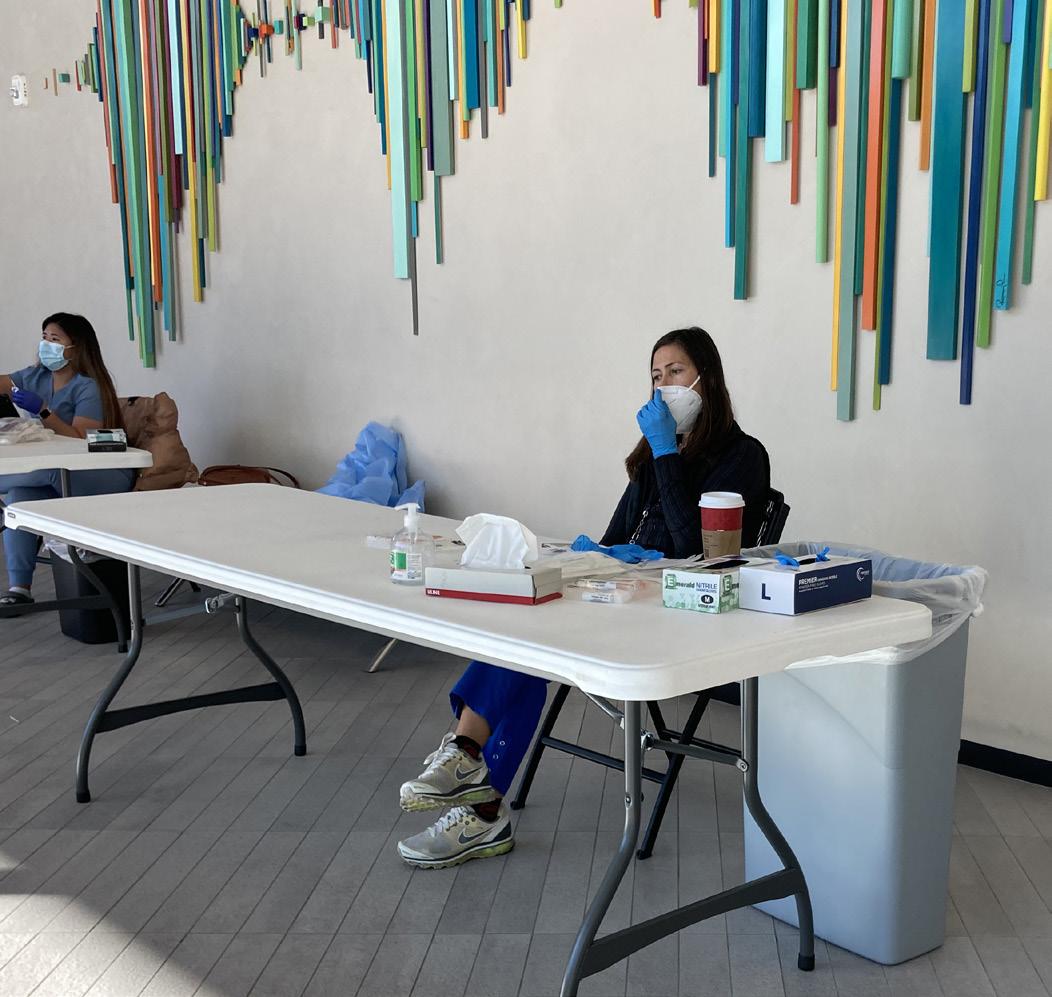
(Above left) Inspire Diagnostics lab technicians prepare test kits in the Spieker Center lobby. Starting in September, students have been required to test weekly regardless of vaccination status, a protocol implemented by the school but not required by county or state law. Staff photo: Abigail Becker
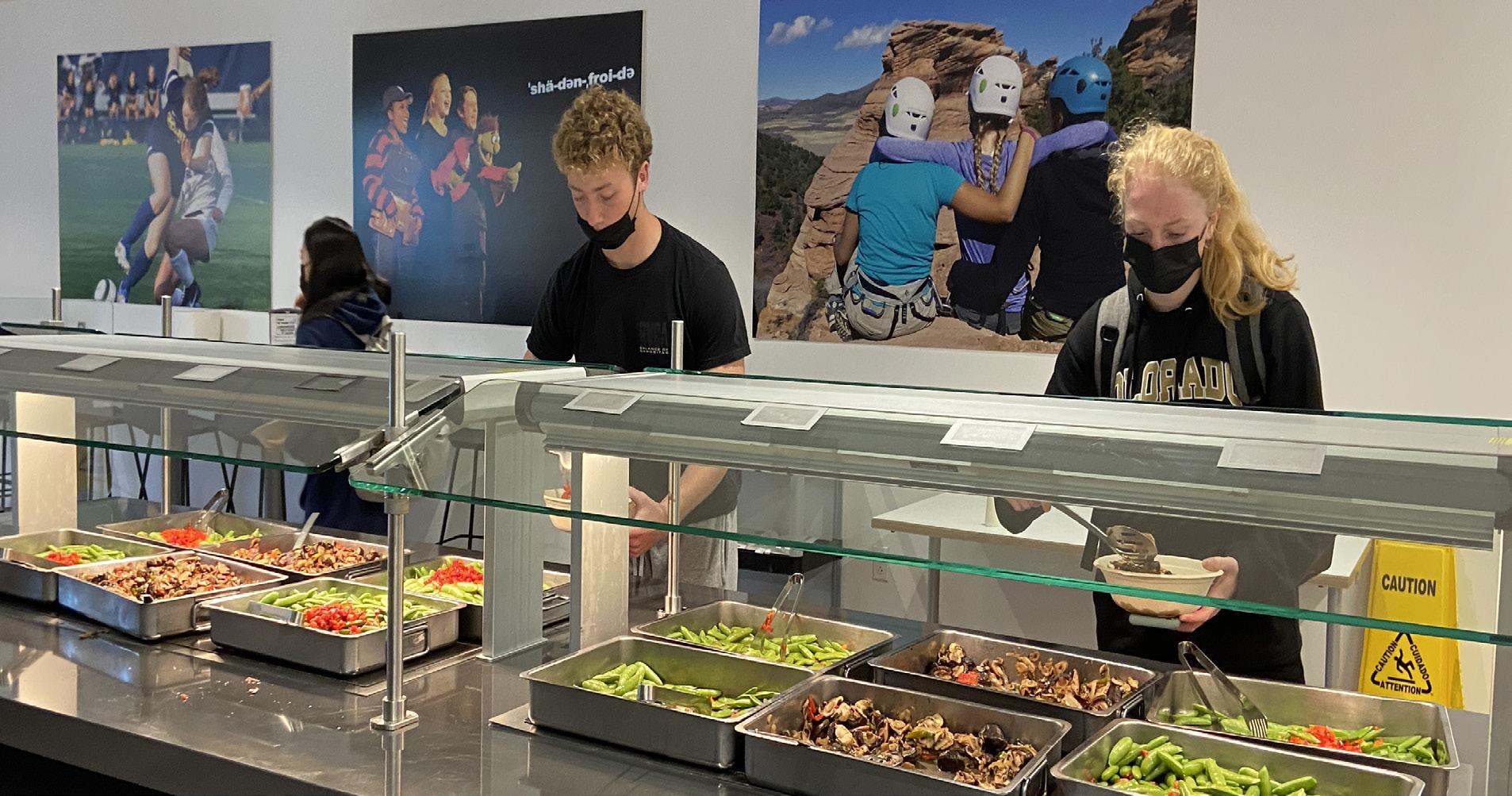
(Above right) Students serve themselves vegetable sides in the cafeteria. As of November 18, students are still not allowed to eat indoors and not all cafeteria options are available, such as pizza and the salad and sandwich bar. Staff photo: Alex Levitt
assembly was the first indoor, full-school event the school has hosted since the beginning of the pandemic in March 2020.
by PARINA PATEL
After last year’s virtual admissions process, the Menlo admissions team is excited to offer in-person events that prospective students missed last year. Director of Admissions Beth Bishop called this year of admissions “Menlo’s hybrid year,” being the third iteration of the admissions process, the first iteration being before the pandemic hit and the second being the 2020-21 school year.
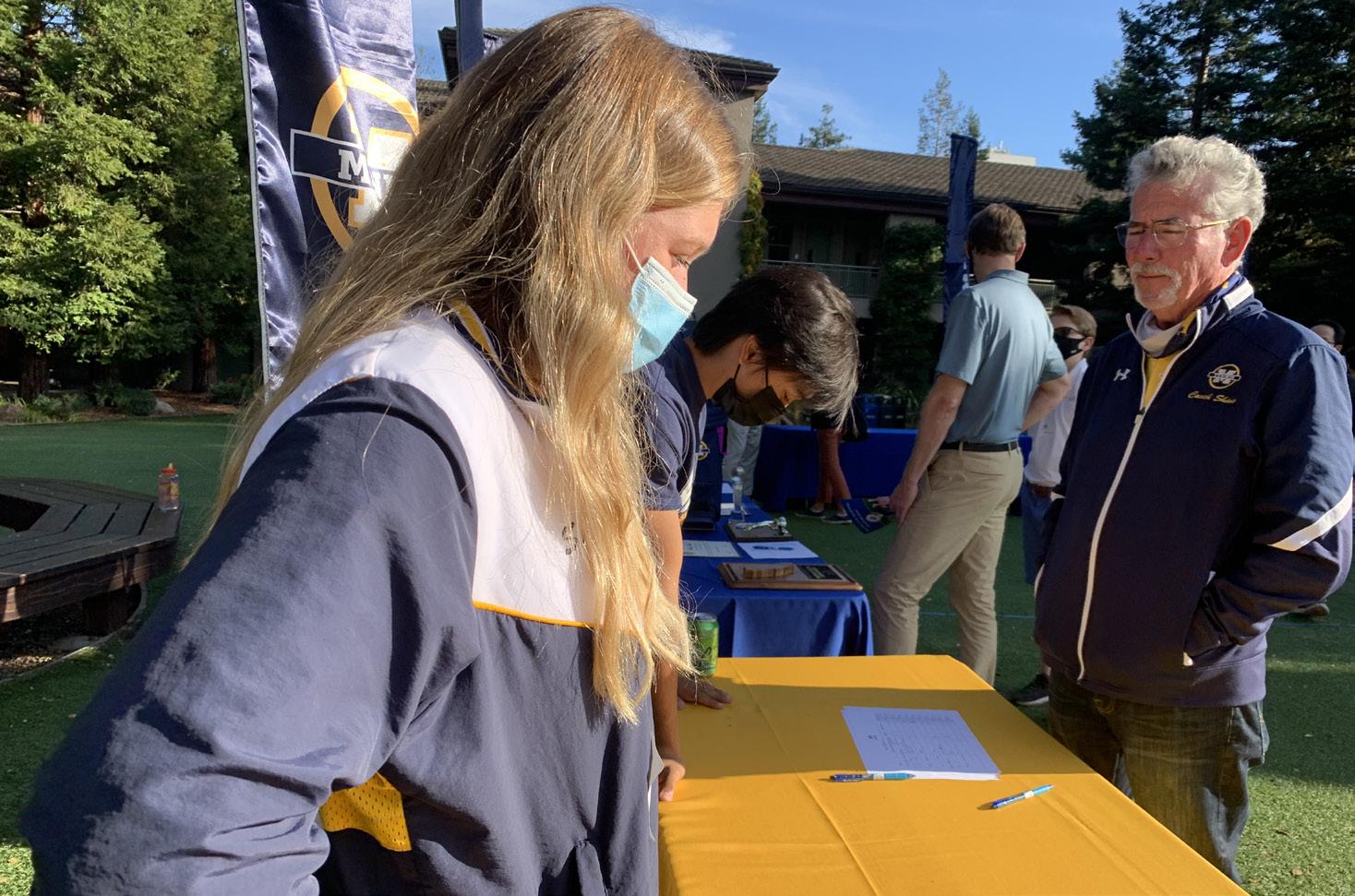
During Preview Day, Menlo parents take about eight or nine visiting parents on a tour, while Menlo students take about 3 visiting students on a tour.
This year, Upper School Preview Days and Middle School campus tours are being offered in person with modifications to abide by county COVID-19 restrictions.
“Preview Day is running four times instead of two to keep the groups smaller,
and we’re mostly doing it outside. So instead of having the big Preview Day in the gym, we’re doing it out on the loop,” Bishop said. During Preview Day, Menlo parents take about eight or nine visiting parents on a tour, while Menlo students take about three visiting students on a tour.
This personalized tour option also allows for a semblance of a campus visit day, or a shadow day, for Upper School students. “All our prospective students are getting is a tour from a Menlo student. Their parents won’t be with them, and they can have a little bit of time to learn about Menlo from a current student. Because of COVID-19, we are unable to offer traditional campus visits,” Bishop said.
According to Bishop, implementing campus visit days would not have been easy to plan, taking into consideration the vaccination status of prospective students and the possible risk of being inside classrooms for most of the day.
Prospective students and parents are invited to partake in parent information sessions, Equity, Diversity, and Inclusion events, Middle School Preview Days, student interviews and alumni panels.
One Upper School prospective student who is working through the hybrid process is Andrew Levitt, brother of Alex Levitt (‘23). “I truly haven’t really started much on the admissions process. I have plans to do the online essay. I have plans to do the Zoom interview. Also, we are taking the tour on Menlo campus,” Andrew said.
Andrew feels that having a sibling in the Upper School is advantageous.
“I would love to get more emails from Menlo about the admissions process. My brother has been telling me a lot about the process, but I personally have not gotten any notifications about that,” Andrew said. He also acknowledges how the admissions process could be different for kids who don’t have a sibling at Menlo or a person who is familiar with the school.
Menlo’s application is test-optional this year, just like last year’s. “We didn’t feel that we could require them, so we went test-optional. 75% of last year’s applicants didn’t submit any kind of test score. And when the dust settled and we looked at who
we admitted, 75% of the kids admitted did not submit a test, and 25% had, so there was no penalty for not submitting test scores,” Bishop said.
According to Bishop, Menlo being testoptional could be in the cards for a long time depending on how the next few classes pan out. “We’ll see. It’ll be a few years before we have the data to know whether it was a good decision or not and to see if those classes do just as well as other classes have done before without testing. But we’re eager to try it,” Bishop said.
by KAYLIE WU
The average senior is drowning in a sea of college application stress. Deciding where to apply, what essays to write and how to stand out among other applicants are just some of the tasks to complete. Therefore, many seniors look to counselors for help. While not every Menlo student can afford to hire an independent counselor, many are navigating between independent and Menlo college counselors.
Between 1990 and 2021, admission rates for selective universities have lowered each year, indicating an increase in competition, according to US News. To navigate through the intimidating application process, Menlo offers its students a college counseling program, where each student is assigned their own counselor to help them with decision making. Despite this direct resource, Menlo students often seek guidance outside of school from independent college counselors.
Senior Mira Devgan is one example of a student with both a Menlo counselor and an independent counselor. “I got an independent counselor because my sister had one when she was in high school,”
"Menlo college counselors tend to tell students to play things a bit more safely"
Devgan said. “My family and I weren’t sure what kind of support Menlo gave yet, so we wanted to be on the safe side.”
According to Devgan, she has received differing advice from both of her counselors.
“Menlo college counselors tend to tell students to play things a bit more safely, but my outside counselor advises a little differently in terms of shooting a bit higher

for schools, applying to more [colleges] and having a more unbalanced list of safety schools, targets and reaches,” Devgan said. An unbalanced list includes a higher number of reach schools, rather than only a few. Reach schools tend to have low admission rates and are considered difficult to be accepted into. Overall, Devgan has received more individualized advice from her private counselor, since they are able to spend more time together during meetings, which are sometimes over two hours long.
Senior Sammie Dostart-Meers similarly has an independent counselor, agreeing that
"I spend a lot more time brainstorming essays with [my private counselor than my Menlo counselor]"
personal guidance is a major benefit. “I spend a lot more time brainstorming essays with [my private counselor], whereas I send essays to my Menlo counselor for smaller edits and approval,” Dostart-Meers said.
Even though Devgan and DostartMeers’s independent counselors have felt more personalized, they both pointed out that there are several major benefits to Menlo’s counseling program, too. Menlo counselors are helpful resources when students are deciding their course loads, according to Dostart-Meers. Because the counselors are part of the Menlo community, they directly understand how demanding each course can be, and therefore are well-suited to offer students recommendations.
Additionally, according to Devgan,
Menlo counselors are educated on Menlospecific topics, such as what colleges Menlo students tend to like.
Similar to Devgan, Menlo college counselor Matt Mettille agreed that Menlo counselors offer insight on particular topics that private counselors do not have. For example, many of the Menlo counselors, including Mettille, have worked previously in college admissions, and therefore have inside knowledge on applications. “[Menlo counselors] understand what colleges are looking for and have a really good understanding of the landscape, and I think that [is what] makes our program so strong,” Mettille said. With this knowledge, Menlo counselors can cater their advice more specifically to students.
In addition to previous experience, Menlo counselors have built direct connections with many colleges. “A huge part of our job is networking and building relationships with colleges,” Mettille said. With these connections, Menlo counselors are able to accomplish two main tasks. First, they can answer specific questions from their students. And, more importantly, Menlo counselors can advocate on behalf of their students to colleges.
Even though independent counselors can also be connected to colleges, this is not as common, according to Mettille. “I have so many friends who work in college admissions, and they won’t talk to independent counselors,” Mettille said. “It varies based on the school of course, but when colleges have questions, they’re always going to talk to us.”
Mettille is just one of Menlo’s five college counselors. The Menlo counseling program divides students among these five counselors, meaning each counselor works with around thirty students per grade.
their peers. “I think a lot of the dress coding in the middle school, and even I guess in the high school, is very subjective,” Mullins said. The Menlo Middle School instructs students much more specifically about forbidden articles of clothing, such as “offensive or inappropriate t-shirts or outfits that are excessively bare, such as tube tops, low-cut tops, low-cropped pants with bare midriffs or skimpy shorts or skirts.” According to Mullins, she would wear the same things as her friends, but she would be dress coded and they wouldn’t. “I felt like it was more [based] on bodies and less on the actual clothes,” she said.
Ultimately, Mullins believes that Menlo should either fully commit to a dress code or instruct teachers to stop discussing students’ clothing. “I think it’s either all or nothing,” Mullins said. “[Either] there is a dress code and [teachers] can dress code people, or, no, [teachers] don’t say anything […] about appearance. [Teachers either] have the right [to dress code students] or they don’t.”
"I felt like [the dress code] was more [based] on bodies and less on the actual clothes."
However, some Menlo faculty feel the need to address students’ clothing choices and believe that their comments come from a place of concern. Upper School Academic Coordinator Lily Lam does not believe Menlo needs to create a stricter dress code, but she thinks that Menlo should spark more conversations about appropriate attire. “Dress [codes] allow you to just [say], ‘[the rules] say [that article of clothing] is not allowed here,’ and that’s the end of that conversation. That doesn’t really lead to a [lasting change in the way students dress],” Lam said.
Lam often has trouble deciding whether or not to address the dress code issue with students. “The majority of the struggles that I’ve had have mostly been me trying to decide [whether I] should have a conversation with a student, and in the end, I don’t know what to say, so I let it go,” Lam said. “I might have a conversation with other teachers or [administrators] about it, but I feel like I have only really talked to two kids that I felt like I knew well and had a good relationship with.”
Upper School English teacher Whitney
"I think the thing that kids lose sight of when they wear things that are too revealing or too provocative is that [...] their audience is larger than their own peers."
Newton thinks that more conversations about appropriate clothing options should occur at Menlo. “I don’t think the solution is necessarily to impose [more] rules, but I think that it might be worthwhile to occasionally have a conversation with students, not individually, […] but as a whole,” Newton said.
Newton believes that students sometimes forget their broader audience when deciding what to wear to school. “I

think the thing that kids lose sight of when they wear things that are too revealing or too provocative is that […] their audience is larger than their own peers,” Newton said. “Their audience is also teachers and administrators and parents who are on campus or prospective students.”
However, when teachers confront students about their clothing choices, it can sometimes leave the student feeling uncomfortable. A junior girl who asked to remain anonymous and will be referred to using the fake name, Laurie Rosen, had a conversation with a faculty member about her clothing choices. “One day I was just walking up the stairs, and I was wearing shorts,” Rosen said. Then, Rosen recalled an interaction with the teacher where she was told that her clothing was too revealing, and the teacher told her to pull down her shorts. An anonymous source that witnessed the incident described it as “extremely awkward.”
Rosen thought that the conversation
was unproductive and left her feeling uncomfortable. “I felt extremely violated,” she said. “I’m pretty close with [the teacher], but I felt like that was a bit out of pocket and not something a teacher should say if they respect a student.”
Upper School History teacher Matthew Nelson is in favor of the relaxed dress code but believes the lack of structure
Then, Rosen recalled an interaction with the teacher where she was told that her clothing was too revealing, and the teacher told her to pull down her shorts.
leads students and teachers into the trap of conformity. He thinks discussions within the Menlo community should address
how to represent students’ uniqueness and professionalism through their clothing choices. “I wonder if a lack of dress code in a way, ironically, encourages people to just conform to one very flattened idea of fashion or idea of cultural assimilation,” Nelson said. “[Maybe] if there were some standards and dress code, perhaps that would encourage more students and more faculty to express themselves and express individuality through the clothes that they choose.”
Nelson believes the Menlo community should discuss how to dress in a way that presents students’ best self. “Let’s start a conversation about what clothes represent and how we can express ourselves. Class meetings, tutorial or Chat and Chew, the student-run conversation group, would be a great place to have these conversations,” Nelson said. “What I don’t want to see happen is the laying down of absolute dress code standards that are not connected to ‘values and virtues’ conversations.”
November 18, 2021
by PARINA PATEL
Q: How did you win the push-up contest during spirit week?
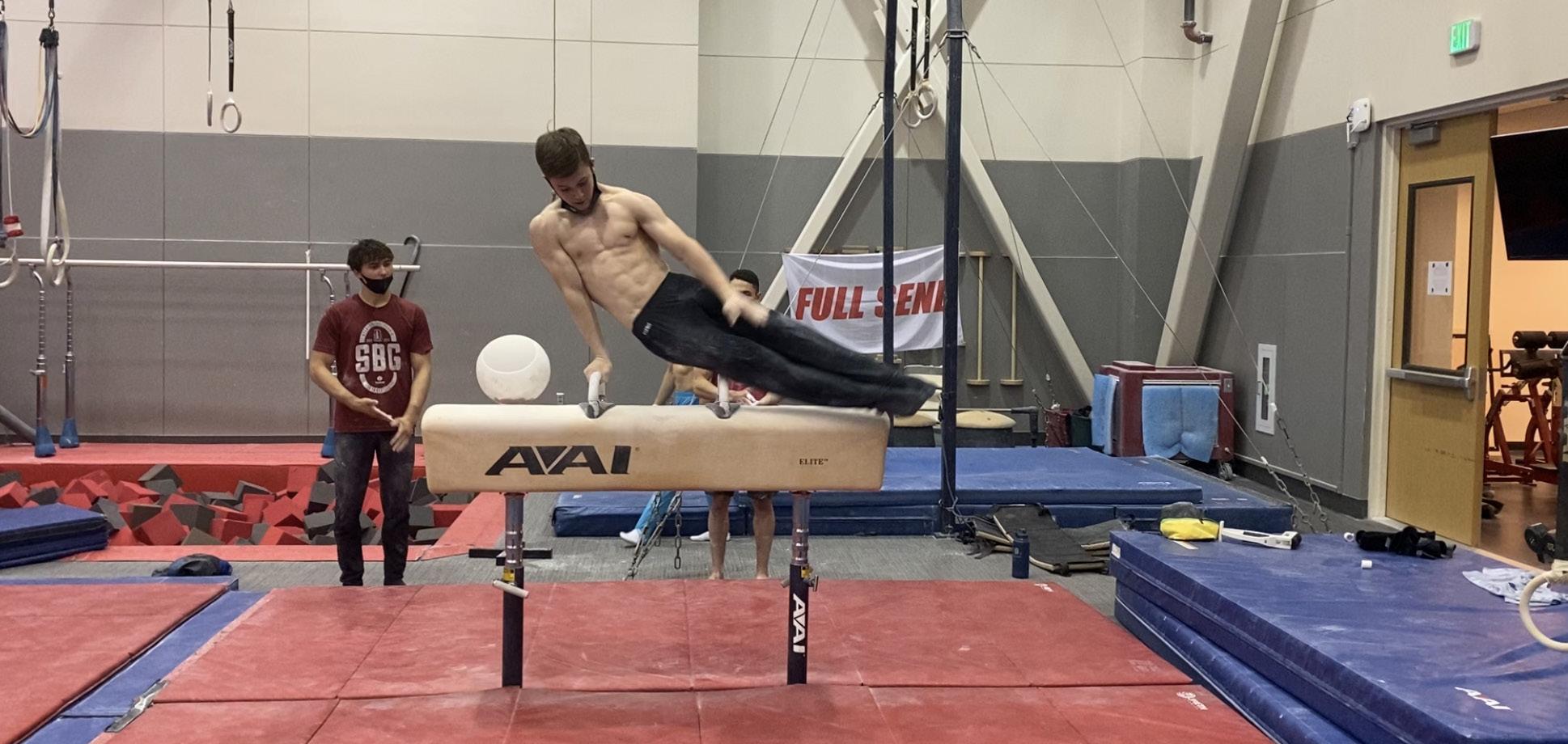
Well, I’ve been doing gymnastics for a long time, so I think that was the major reason. A lot of gymnastics training gets you pretty strong.
Q: Why did you decide to participate in the contest?
My friend Jasper Sands (Menlo ‘21) was on my gymnastics team and he won the push-up contest a few years before, so I felt like I had to carry on [that tradition] and I volunteered, so I felt like I needed to win.
Q: What was going through your mind during the contest?
It was longer than I thought. During the last two or three minutes, I was definitely struggling a lot. I just kinda tried to get out of my head and listen to the music and not think too much about anything else.
Q: Since you won, tell us the right way to do a push-up.
Hands shoulder-width apart, feet together and make your body straight like a plank. Push all the way down so your chest touches the ground and then push all the way back up.
Q: Tell us about your accomplishments in gymnastics.
Two years ago I made it to Nationals, and then the year before I made it to Regionals.
Q: Are the Olympics in your future?
I mean, maybe. It’s insanely hard, but it’s definitely in the realm of possibility. Small chance.
Q: How did you get into gymnastics?
My parents kinda just put me in it, and I liked it, so I kept doing it.
Q: How often do you hit the gym?
*laughs* So I do gymnastics six days a week for four hours each day [....] I go to the Stanford Boys Gymnastics Center at Stanford.
Q: Do you not get tired of going to the gym?
There are times when my [body breaks down], but I really love the sport and my teammates are super kind and I have a great coach, so it’s a fun environment to train in.
Q: Have you been told you look like Nile Wilson?
Yes! Well, I haven’t been directly told I look like him, but people point that out like, ‘Oh, Nile Wilson, the one popular
Q: So you’re not related to Nile Wilson?
I’m not related to Nile Wilson.
Q: Did you get clout from winning the push-up contest?
I did get clout. It’s funny. You’d think winning a push-up contest, you’d get a lot of girls, but you get a lot of dudes asking how you got so strong.
Q: I was going to ask how many phone numbers you got.
I got no numbers. I was denied.
Q: If you were a superhero what would your powers be?
I think being able to teleport would be really cool. Like going to Japan to eat breakfast or something.
Q: Do you live, laugh, love every day?
I do try to ‘live, laugh, love’ every day. I have a lot of crewnecks with inspirational quotes on them. I think it’s really important not to take things too seriously and just enjoy whatever you’re doing.
Q: What’s your record number of pushups?
I have no clue. I haven’t recorded myself doing a max amount of push-ups.
Q: Could you do 200 push-ups in 30 minutes?
Uh yes. I would be able to do 200 pushups in a row.
Q: So like in 5 minutes?
Probably.
Q: Can I have your autograph?
Yes, if you want my autograph, you can have it.
by JAKE LIEBERMAN
As part of the generation that grew up with TV at their fingertips, Menlo students have varying opinions about their favorite shows.
Freshman Aidan Stull’s favorite show at the moment is “Brooklyn Nine-Nine.” “I like it because of the comedy aspect, and solving crimes [is] dope,” he said. “Brooklyn Nine-Nine” is popular among Americans. According to YouGovAmerica, 67% of the people surveyed had heard of “Brooklyn Nine-Nine,” and it’s ranked as the 135th most popular contemporary TV
show. The series “Brooklyn Nine-Nine” is about New York City Police Department detective Jake Peralta and his precinct. The show follows the group in their dayto-day lives arresting criminals and their relationships as a friend group.
Freshman Raj Keswani likes “Friday Night Lights.” “My favorite show is probably ‘Friday Night Lights’ [...] because of the characters. The show does a great job developing them, and you really feel a connection towards them. I also love how there’s football in the show because it gives you something to look forward

to every episode,” he said. Shows such as “Friday Night Lights” and “All American” are similar because both are about football programs, and they dive into the characters’ lives as well as their experience with the sport.
"Overall, ["The Office"] just a great comfort show that I can watch over and over again and still laugh every time."
In terms of which shows are trending, according to Reelgood, “Succession,” “Squid Game,” “Ted Lasso” and “The Morning Show” are currently among the most popular shows. Squid Games is the most-watched Netflix series ever. Additionally, Jason Sudeikis, who stars as the Head Coach in “Ted Lasso,” won eight awards in the Emmy Awards this year. According to junior Will Eggemier, one of his favorite shows is “Star Wars: The Clone Wars.” “The [final] season of it [aired] last year, and I continued to love it. It was my favorite childhood show growing up and stuck with me forever. It additionally develops the ‘Star Wars’ preculture very well in my eyes. The characters are awesome, and it’s Star Wars, so I love
it,” Eggemier said. “The Clone Wars” was the most-watched series premiere in Cannon Network history.
Sophomore Paige Miller said her favorite show is “The Office.” “Overall, it’s just a great comfort show that I can watch over and over again and still laugh every time,” Miller said. She especially enjoys how the show has both a comedic and emotional appeal. “It also has a ton of variety with the characters, all of them are so different, yet the dynamic between them is so funny and unpredictable,” she said. On the other hand, junior Charlie King loves the show “Daredevil.” “Daredevil,” similarly to “Brooklyn Nine-Nine,” is set in New York. The show follows a man who was blinded as a young boy and uses his heightened senses to fight crime. Attorneyat-law during the day, and “Daredevil” by night, the protagonist aims to protect the city and fight against injustice. “The acting is just off the charts. You won’t find acting any better,” King said. “Also, the cinematography is incredible, and the action scenes are absolutely wonderful. It’s truly a must-watch show for Marvel fans out there. You certainly won’t be disappointed with it.”
"The acting is just off the charts. You won't find acting any better."
by ABIGAIL BECKER
People get tattoos for a wide variety of reasons: to commemorate important events, remember impactful moments or even just for fun. Tattoos can be deep, lighthearted or comical. While this may come as a surprise, many Menlo teachers have tattoos, most of which are not always visible.
Physics teacher Deb Jensen has three tattoos. Her most recent is a Hawaiian pattern on her arm. She got the first one, a star-design Mimbres tribe tattoo, during an eclipse in the 1980s. The Mimbres are a prehistoric people who lived in Southwest present-day New Mexico around AD 1000; Jensen got this tattoo to memorialize them and her Southwestern roots. She also has a Southwestern-style tattoo across her back and collarbone, which she got in 1991
to remind her of where she grew up: Tucson, AZ. “This one artist really resonated with me, and he did really cool black tribal-type designs,” Jensen said.
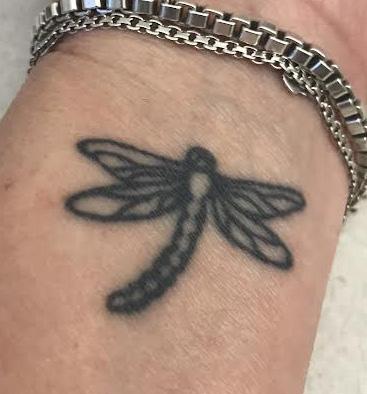
Spanish teacher Rebecca Mouser has a dragonfly tattoo on her wrist. She’s had it for about five years. “I chose to get a dragonfly tattoo because it’s my favorite word in Spanish: libélula,” Mouser said.
Math teacher Christine Walters was inspired to start her fitness journey that led to her tattoo after watching a vlog by football player Richard Sherman about his training routine. “He made this one statement ‘Heroes are made in the summer when no one is watching.’ I was really struck by this idea, that for me to drop weight and get in shape it had to be personal, private and require a serious commitment
by me, for me,” Walters said.
After losing over 110 pounds and joining many active sports, she commemorated her journey with a tattoo of the insignia from the starship in “Star Trek,” the USS Enterprise (NCC-1701). “This show was my first science fiction vision of a safe, inclusive society, and it affected me so much I went into engineering to help focus on designing tools for the future,” Walters said.
Science teacher Todd Hardie has many tattoos which commemorate important events and motifs in his life. He got his first one — a yin-yang on his ankle — to mark a time of great change in his life when he called off an engagement and began to embrace his sexuality. “Yinyang was this balance between masculine and feminine, this whole dichotomy that we all talked about with gender and sexuality,” Hardie said.


A quote across his arm reads,
“All great changes are preceded by chaos.”
According to Hardie, the meaning behind this tattoo is that some of the biggest changes in life are unexpected and are usually uncomfortable and chaotic. His most recent tattoo is also a quote: “Thi5 i5 it.” Hardie explained that the fives in this tattoo represent his recent 55th birthday. “The slogan kept coming up, like, this is it in life and as you get older, you realize that time is getting shorter,” he said.
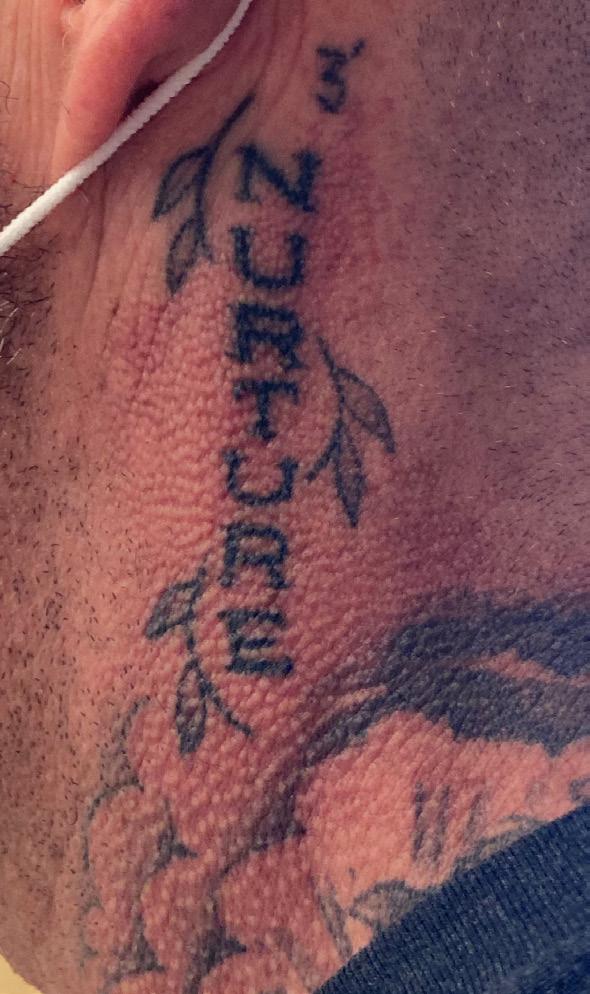
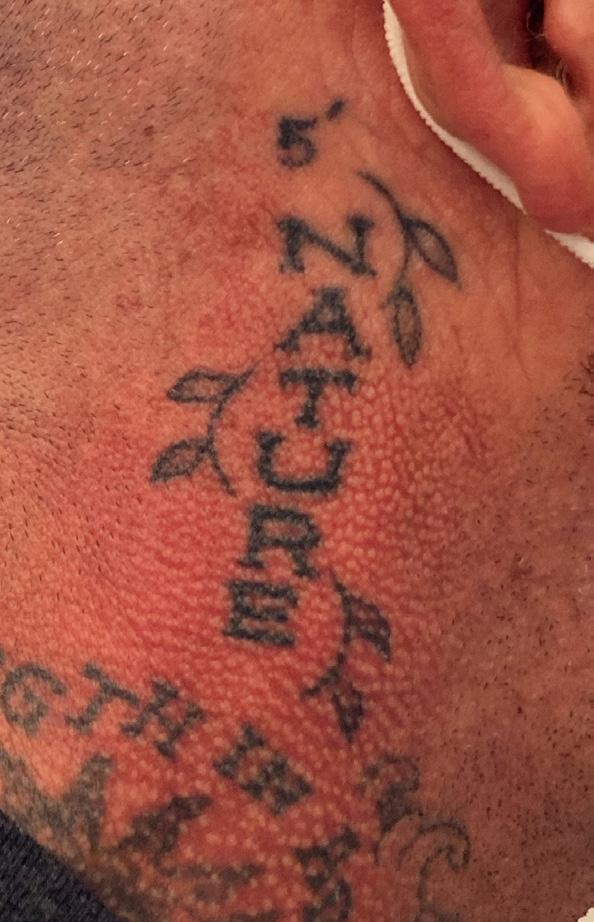
Another one of Hardie’s tattoos is the matching words “Nature” and “Nurture” behind his ears, encompassed by helices made of vines. According to Hardie, these represent his journey from his childhood — nature — to everything he’s been through to make him into the person he is today — nurture. The five and three above each word have a double meaning, as well. The first is that he got the tattoo when he was
"The slogan ['this is it'] kept coming up, like, this is it in life and as you get older, you realize that time is getting shorter."
53-years-old. The second is related to his roots as a biology teacher. “DNA has these ends called the 5’ and 3’ ends. When students study nucleic acids, they will learn how the orientation of DNA (the 5’ and 3’ ends) are important in the replication of the hereditary molecule,” Hardie said.
Hardie also has student-designed tattoos, such as a starfish on his elbow, which was created by a former student for a senior project. “I let her design [it] and then she came with me to the tattoo place,” Hardie said.
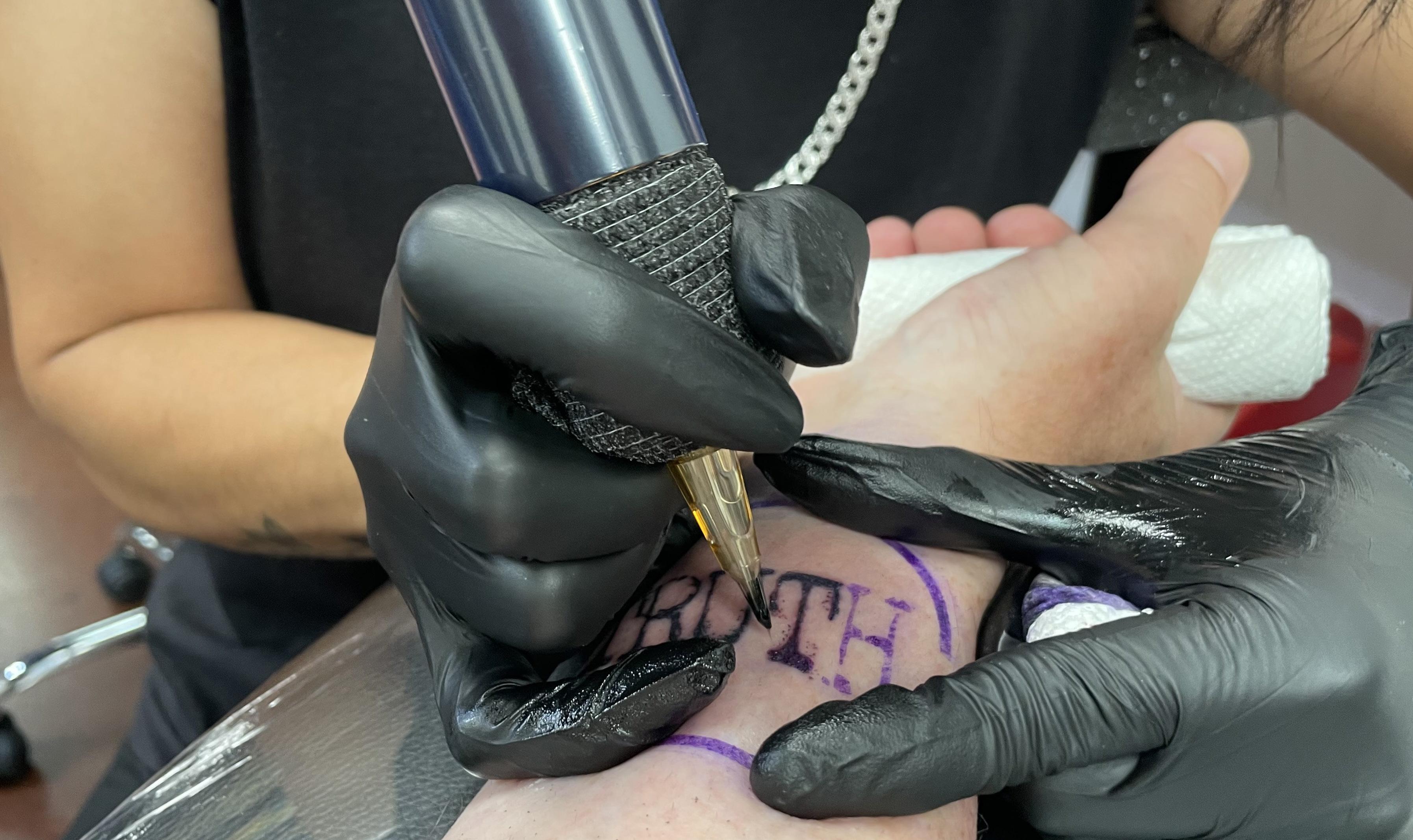
Another interesting tattoo belongs to journalism advisor and media arts teacher Tripp Robbins. His tattoo is the word “truth” printed in a typewriter font across his wrist. Inside the word “truth” is the word “more” hidden in the top right corner of the “T.” “Because if you look closely, there’s always more to the truth,” Robbins said.
Robbins plans to get more words tattooed around the word “truth” in the formation of a “C.” According to him, the C-shape represents context. “That’ll have words like attribution, facts, data and evidence forming a C around [the ‘Truth’ tattoo] for context, because you can’t understand the truth unless it’s in context,” Robbins said.
According to Robbins, the inspiration for his tattoo was misinformation, propaganda and lies being spread on various media platforms. He wants to use his tattoo to teach students about the importance of truth. “I tell students to get to the truth, and I just wanted to be able to give them that visual demonstration,” Robbins said.
18, 2021
by SOPHIE STONE
For Menlo students with hopes of attending top colleges, pressure to do well in both academics and extracurricular activities starts early. As freshmen make the transition from middle to high school, the emphasis on preparing for college increases and with it, so do students’ stress levels. Whether it’s finding the right extracurriculars for applications or taking honors and advanced level courses in all classes, Menlo students often challenge themselves with a rigorous schedule in the hope that this will gain them favor with colleges.
The worries start as early as middle school for some students, usually when taking the eighth grade placement tests for high school. Some freshmen with older siblings also start to think about it earlier than others. “This past year, I’ve thought about college a lot because my older sister was going through the college process. It made me think about what I’ll do when I’m that age,” freshman Avani Ganesan said.
Freshman Roya Rezaee also said that watching an older family member go
through the college process made her think more about her future. “I do think of college, and this probably comes from my older cousin who is also looking at colleges, and I feel that I should start early,” Rezaee said.
For some freshmen, getting a bad grade on a test can seem like a huge impact
"Sometimes if [grades] aren't the best, then some of my friends will say, 'Oh this will ruin my chance at this college' or something totally extreme."
on their transcript and GPA. “When you get a bad grade, it can compound that stress immensely because you’re thinking, ‘Well this is gonna ruin my transcript,’” freshman Henry Mishkin said. Since students at Menlo have high expectations when it comes to academics, bad grades tend to
hurt worse. “I think definitely getting grades back is a huge topic, and sometimes if they’re not the best, then some of my friends will say, ‘Oh this will ruin my chance at this college’ or something totally extreme,” freshman Ella Krane said.
Although the interviewed freshman said that outright competitiveness is rare in their grade, they agree that the feeling of wanting to measure up to their classmates causes stress. “When my friends talk about [college applications and transcripts] it sometimes makes me think ‘What am I not doing that I should be?’” Krane said.
Comparing grades when tests and quizzes are handed back is also common. “I think I’ve thought about — and I’m sure my friends have also — ‘could this person have a better college application than me, how do I compare to this person when applying to this college, does this person have better grades than me and so on,” Mishkin said.
In some aspects, attending a prestigious high school with students that are all equally college-driven can be beneficial. “I think here, everyone is more open and kind of laid back about it, but I definitely have been

in environments where you can see people are competing,” Ganesan said.
There is also pressure to take honors and advanced courses in all subjects. “I think a lot of people jump into stuff they’re not ready for because it looks good on a college application to be doing those things,” Mishkin said. Some students even find that their motivation for doing well in school is driven by wanting to attend a prestigious college. “I do often find my goal being to do [schoolwork] for good grades rather than doing it to learn, but I have been trying to shift that, since it’s such a counterproductive mentality to just focus on college,” Ganesan said.
In addition to academics, choosing which extracurricular activities to do can be influenced by which ones will look good on applications. “Even some clubs and extracurriculars market themselves as being good for college, so I would say that some of my extracurriculars are definitely based on that,” Ganesan said. “However, I do try to find a balance between passion activities and ‘college’ extracurricular activities.” Some students believe that having a wide variety of extracurriculars will look more appealing, while others just want to have as many activities on their applications as they can.
The source of these pressures varies with each student. Mishkin believes that some parents make college out to be the most important thing. “‘Go to a good college, and guess what, you’re set. And if you don’t, you’re in trouble,’” he said. Menlo has put several measures in
"I think a lot of people jump into stuff they're not ready for because it looks good on a college application to be doing those things."
place to discourage any toxic grade-related mindsets, one of these being that students are not allowed to see their overall grades until quarter grades come out, and another being that transcripts only include end-ofyear grades.
However, stress still emerges when getting quizzes and tests back and comparing scores with friends. “Maybe students starting to think about [college] earlier is specific to Menlo because it can be a very stressful and competitive environment,” Krane said. “I think there is a very high standard from the high achieving parents and the high achieving kids.”
Another common theme is Menlo’s history of sending students to top colleges. “Of course, the amazing schools we attend send students to such amazing colleges, and you feel like you need to either live up to your family or the school’s name by going to a top-tier college,” Ganesan said.
One of the freshmen mentors, senior Jazlin Chen, offered advice for freshmen who were worrying about college. “It sounds really cliché, and I know that I heard it so much as a freshman, but it’s really important to just talk to your teachers and honestly over communicate,” Chen said. She added that the jump from middle school to freshman year is a huge transition, and it is unrealistic to expect perfect grades during the first several months.
“In your freshman year, you can’t expect to be perfect, especially if you are really pushing yourself,” Chen said. “As long as you feel that you’re doing your best and you’re doing the most for yourself, don’t feel too stressed about it.”
by TESSA FRANTZ
According to their reputation, Menlo is an academically rigorous college prep school, which means students are expected to work hard and make academic success a top priority in their lives. But when walking onto Menlo’s campus, students are often on the quads conversing with one another, playing music or tossing a ball. The student center is a hub of friendly interaction and community. During free time, students may spend time in empty classrooms, visit their teachers or immerse themselves in projects. Menlo’s academic life is very demanding, but its vibrant social life is just as crucial to the culture and spirit at Menlo. Menlo is a social school just as it is an academic school, and its social scene

plays a key part in its inner workings.
“I would say Menlo is very social. It definitely de-
pends who you look at, but overall, Menlo is a very social school,” junior Sydney Fish said. Menlo’s social presence can be seen both during and outside of school events. At sporting events, the Menlo section provides energy and
spirit for the teams, which reflects the overall enthusiasm Menlo holds. “I feel like everyone goes crazy for sports events,” senior Jason Hoppe said. Menlo’s social and academic life are interconnected and balance each other out. For some students, Menlo’s rigor is tamed by fun events and outings with friends. Socializing can also help distract kids from their workload. “I think that kids at Menlo are very serious academically and don’t joke around, but once they get their stuff done, they’re not very concerned with anything,” Hoppe said. Similarly, many feel that forg -
by TATUM HERRIN
At Menlo, clothing is often an expression of wealth, a way to fit in or a form of categorization and a way to associate oneself with different cliques. But for sophomore Bella Chen, junior Montse Contreras and senior Josh White, fashion is a way to stand out and express creativity.
Chen puts together a new and interesting outfit nearly every day. “I try my best to keep up the reputation of caring about what I wear, and it’s really fun to dress up,” she said. “Whenever I’m wearing an outfit that I love, it makes me feel better the whole day.”
When she came to Menlo in 9th grade, Chen felt comfortable expressing herself through clothing. “I’m not really one to be afraid of judgment,” she said. However, while she finds Menlo’s community to be mostly supportive, there are instances where she wished she had opted to fit in instead.
“One time in math class last year I was doing a little layering moment [...] it was so cute,” she said. “Then this guy asks me ‘how are you wearing half a
“It’s annoying because people will come to school and be like, ‘Ugh I look so disgusting’ [while wearing] matching Aviator Nation sweats and jacket and Golden Goose [shoes],” she said.
“I think it’s attention-seeking, but at the same time, it makes sense. Everyone around you is doing it, so you want them to know you can too,” Chen said. “The culture here is don’t be that person who stands out. The school is so small, everyone’s gonna notice when you’re different.” Montse Contreras loves to shop second-hand and utility clothing. Some staples of her closet are leather, platform shoes, and floral patterns. She always shops with financial and environmental responsibility, capping off most purchases at $20.
Contreras has always had an eye for fashion. “When I was younger, I played a lot with Barbie dolls, but I never bought a lot of clothes. And I learned to sew at a pretty young age, so I started making mini dresses for them and stuff like that,” she explained.

Contreras finds that the people who judge someone based on their appearances are not the people whose opinions she cares about. “I never look at someone and think, wow, they dress really awfully, they’re probably a horrible person. And if you do, you probably have a problem,” she said.
“I think most people are more focused on themselves than others,” she said. “Wearing fun colorful stuff or big platform boots is exciting to me, so I’m gonna do it.”
Contreras has never been attacked or made fun of for her style within the Menlo community, though she still finds the fashion culture flawed. “I’ve never experienced any resistance [to my clothes], I mean, maybe behind my back,” she said.
“When you look on the quad you see everyone wearing the same stuff and the same shoes. I think that comes from a place of insecurity,” Contreras said. “If you see clothing as a way to express yourself, you should do it, instead of dressing to look good for other people or to fit in.”
“Some people just want to dress for comfort, and that’s fine, that’s cool. But I’m someone who honestly craves attention, and enjoys looking like a TV show character,” Constreras said.
ing connections with others and having fun is a key part to enjoying high school. “If there’s too much academics, then there’s really nothing to look forward to and work for. You’re not really getting anything out of the high school experience,” sophomore Allie Bienaime said. Hanging out with friends pushes her to work hard in school so that she has a good balance of fun and work. But Bienaime also mentioned that she felt that having a social life at Menlo is part of the norm. “I feel like there is some pressure to have a social life, but that may happen at all schools,” she said. Similarly, students use social events to destress and distract themselves from the pressures of school. “If you don’t have the play hard aspect of ‘work hard/play hard,’ then you’re constantly thinking about stressful things,” Hoppe said. Working hard and engaging in school is important, but having fun and letting loose is crucial to many students for success. According to Fish, she enjoys Menlo’s rigor, but relies on social interaction to manage stress levels. “It depends on the person, but for me, [...] I like to feel very busy and productive in my life while being challenged academically. But on the other hand, I’m able to have a good time and distract myself from stress.”
After spending 14 years in the U.K. and two in the Bay Area, Josh White can say with confidence that the styles of kids in London and at Menlo are very different.
“The style in London, since it’s a major city [...], is really prominent. Whenever I go back my friends are always wearing something cool,” he said. He believes this comes from the fact that kids who live in major cities are exposed to a much wider variety of forms of expression, cul-

ture, and high levels of fashion. “[At Menlo], it’s mostly just shorts and t-shirts,” he said, laughing.
However, the fashion-forward aspects of London have stuck with White even after moving. “I enjoy being able to dress,” he said. “It kind of gives you somewhat of an identity, that one thing that makes you different.”
“It doesn’t have to be fashion, but I personally enjoy wearing cool clothes and having things that just change [my] appearance in some way,” he said. White enjoys the aspect of accumulating a collection of pieces and assembling them in different ways.
“If you don’t dress up [even though you want to], why? What’s stopping you?” White said. “If you’re worried about someone judging you for dressing well, how could that be a bad thing?”
White understands the desire to conform at Menlo, but he doesn’t find it reason enough to shy away from expressing himself. “It would make you stand out. But that’s part of the point. You’re diversifying yourself and diversifying the way that other people see you. That’s a good thing,” White said.

Whether it be through TV shows, movies or social media, traditional events such as formal homecoming, prom royalty and cheerleaders have been ingrained in high school culture. Menlo lacks all three of these traditions. Even though they are a stereotypical part of American high school, many students agree that Menlo is better off without them.
Coordinator of Student Activities Frances Ferrell doesn’t know when or how the decision not to hold these activities at Menlo was made, but she believes it may always have been this way. “I asked [former Dean of Students Tony Lapolla] if he knew when [they decided not to have cheerleaders or homecoming and prom royalty], and he didn’t know the answer,” Ferrell said. “It’s been that way for [at least the 30 years Lapolla worked here before 2021]. It’s possible that Menlo has never had this.” Ferrell is glad that traditions like these don’t happen at Menlo due to the potential for exclusivity.
“Withourhomecoming,Ilike thatawhole gradecomes together,”
of spirit when we include everyone,” Corbett said. Freshman Rianna Tejada, also in her first year of high school, feels that the absence of these traditions hasn’t negatively affected her experience. “I think it’s good for Menlo to not have these events because [...] I feel like [they] would drive us apart instead of bring us together,” Tejada said. Ferrell is also glad Menlo doesn’t have these events because of her past experiences at other schools. “I’ve worked at other high schools and [homecoming or prom royalty are] usually just a popularity contest. [...] [They’re] exclusive and often highlight the most popular, good-looking or athletic kids,” Ferrell said.
Junior Eloise Thompson agrees that not having these stereotypical high school events allows Menlo’s inclusive atmosphere to thrive. However,
high school. “When I first started high school, I was kind of disappointed that Menlo didn’t partic ipate in these traditions because these were the parts of high school that were always highlighted on TV, and I felt like I would miss out on a normal high school experience,” Thompson said. “It didn’t take long for me to realize that it didn’t matter that Menlo doesn’t have a lot of these events cause we have so many oth er fun traditions that are unique to our community.”
“[They] only showcase a few students, and kind of elevate them [socially],”
Ferrell said. “With our homecoming, I like that a whole grade comes together,” Ferrell said. “A couple of students design a t-shirt, a few more work on a float together and then they all [unite] and dance in front of the stands; it’s very inclusive.”
Sophomore Max Corbett values the inclusivity and closeness he has experienced in his first year of American high school because Menlo does not include these traditions. “I think students have many different ways of expressing their Menlo pride, and it makes for more genuine moments
Menlo also does not hold a formal homecom ing dance. “As fun as it is to get dressed up and have a formal [dance], I appreciate Menlo’s unique tradition of dressing up for the senior’s theme for homecoming,” Thompson said. “We already have two other formal dances throughout the year, so I don’t think we are missing out on a formal homecoming.”
Senior Sam Scola also understands the is sues these types of traditions would bring. “I feel like [these traditions can be] really exclu sive,” Scola said. “It doesn’t feel very Menlo.”
While Menlo’s lack of homecoming and prom royalty is widely accepted by students, some see the potential benefits of having cheerleaders. “Watching other schools’ football games always makes me think it would be super fun if we had a cheerleading team that would perform for the crowd and get us all hyped up at football games or pep rallies,” Thompson said. “[But] I have heard students in the past talk about gender norms and how cheerleading can be very sexist.”
Scola doesn’t see much of an issue with cheerleaders but appreciates the dance team that often performs at games, rallies and assemblies. “It’s fun to watch and [increases] the spirit of the spectators,” Scola said.


Trouble with tradition: causing harm and good
by Tatum Herrin
A tradition is the transfer of customs from generation to generation, a way to remember where we came from, a source of commonality, a familiar homestead to return to. But tradition can also be a tie to toxicity. It can be an obligation to outdated customs, or entitlement to experiences not deserved. Homecoming Week. The Senior Quad. The Holiday Assembly. These words hold a greater significance for the members of the Menlo community than those outside of it. They possess the weight of history, of Menlo tradition. Many Menlo students know the connotations of and the drama that follows giving out a jersey, and this knowledge binds us as a community.
“Traditions carry on the Menlo spirit,” sophomore Nicky Scacco said. He believes Menlo establishes a unique and distinctive culture that students can be proud of by upholding traditions. Junior Jordan Brooks agrees with this tie between culture and tradition.
“Traditions are what makes Menlo Menlo,” Brooks said. She believes recurring events give students a communal Menlo identity. A popular tradition at Menlo is for sports players, most often football players, to give their jerseys to another student to wear in the stands at their game. The jersey tradition at Menlo can boost the turnout at games and be a wholesome way to show affection to a friend or significant other. It also serves as a good-spirited hazing ritual. It can be something that everyone on the team has to do as a way to connect players.
Scacco, a JV football player, enjoys the tradition. “I think everyone likes it, and it’s a good way to get more people in the stands,” he said.
However, to Brooks, the jersey tradition has its drawbacks. “It’s basically a popularity contest,” she said. “And if you never get a jersey, you kind of feel like, ‘am I not popular enough? Or good enough?’ And some sports make such a big deal about giving or getting one,” Brooks said.
Senior Uma Misha hasn’t given much thought to the tradition before, but upon further reflection, agrees with Brooks on the matter. “I’ve always found it funny, but now that I think about it, it can be really negative,” Misha said. “Freshman guys, they’re supposed to give it to girls who are
most [of the school],” Brooks said. She believes that the seniors can sometimes be overly hostile in protecting the quad. “It obviously can cause problems, but I think other grades just need to respect [the tradition],” Scacco said. He said that, as long as other grades wait patiently, the Senior Quad can be a fun experience for everyone. “I think it’s a good tradition, you know. I want to eventually have the Senior Quad for myself,” he said.
Freshman Ben Levin remains impartial to the debate of whether or not the Senior Quad should remain at Menlo. “I feel like since it’s been around for so long, [the Senior Quad] is cool. It’s cool to be a senior, and the quad kind of represents that, so I get why people want to have it after waiting four years, ” he said.
Techel agrees. “ I mean, [the Senior Quad] is pretty easy to avoid, it’s kind of out of the way in the corner. You don’t have to walk on it. It’s a cool experience and those seniors had to wait for years to get there.” he said.
Misha hopes that the quad can continue, but understands why the tradition may have to be terminated. “It’s a fun tradition and I really hope [it] continues, but that being said, if it’s creating so much animosity and anger between grades, losing it isn’t the end of the world,” she said.
But despite her leniency, she finds the way the Menlo community has handled the quad to be absurd. “The fact that it’s gotten to this point is kind of ridiculous. I think after the fight everyone got kind of trapped in this bubble, kind of over-emphasizing the importance of it all,” Misha said. She predicts that the high tension over the fight will eventually dissipate, and the Senior Quad’s place at Menlo will be reaffirmed.
“I remember when I was a freshman, I got shot with water guns when I accidentally stepped

“Traditionsthecarryon Spirit”Menlo
November 18, 2021
by TESSA FRANTZ
Friend groups are a key part of the social structure at any high school. Close connections make students feel comfortable and safe in the school environment and give a sense of community. But what defines these friend groups? Is it common interests or goals? Are they defined by subconscious biases, including race, appearance or socioeconomic status? At Menlo, friend groups seem to be defined by a number of things, but according to students and teachers alike, race tends to be a key component in friend groups.
According to history teacher Carmen Borbón, friend groups based on race are not a new phenomenon. “I would say that [friend groups based on race] are not just at Menlo. [...] I think that human beings naturally flock to people who are like them,” she said. Subconsciously, humans often feel comfortable and safe with people who are similar to them. This can apply to the friends students make, because they will seek out other students that seem the most relatable to them.
Senior Rohan Shah contends that at Menlo, separation by race is clear. “Friend groups can be segregated,” he said.
Shah also said that there may be other factors that go into defining friend groups, such as location. “To some extent friend groups are [defined by race], but they’re also defined by a lot of other things, like where you live for example.” Living in the same location gives kids something to relate to and bond over: a shared community. Shah pointed out that with social distancing and the effects of COVID-19,

proximity was one of the only points of relatability for students. “I think [that idea] has been reinforced even more because of COVID-19, because no one was willing to travel as far,” Shah said. Because of

constraints, students often didn’t seek out others who lived in different locations and communities.
Similarly, senior Josh White contends that friend groups are not entirely based on race, but that it is a factor. “You can’t really say that [friend groups] are entirely based on race, but it’s circumstance, the way you’re raised, location, etc. that leads to who you’re friends with.”
In terms of creating more integrated classes and grades, Borbón explains that though there is no right answer to solve this issue, change can happen on an individual level. “Talking to more people definitely helps. [...] I think that once people start talking to each other, you might find that you have more in common than you don’t,” she said. Borbón also explained that a lack of interracial or intergrade conversations can create a culture of exclusion. “I do think that some kids might feel left out or like they’re not getting invited to things because of their background. And it could be [their] racial or socioeconomic background, or even both. But there is this feeling of exclusion.”
by SUTTON INOUYE
Many social media accounts have gained popularity due to their relevance to Menlo culture. Two accounts that have gained traction this year are the @metoomenlo Instagram account and the group Snapchat story called Quad PDA. Other accounts include @learntoparkmenlo and @moccermoneyshots. @metoomenlo is a student-run Instagram account that is not affiliated with Menlo School. When creating the account, the leaders decided to not include the administrators in their content or how the account would be run.
The content on @metoomenlo consists of anonymous stories submitted by a Google Form found in the account’s bio. Menlo students can share their experiences and opinions to the account’s followers.
After an anonymous student’s submission was posted on the account, Head of School Than Healy sent an email to the Menlo community on Oct. 12, addressing the post. The student’s submission addressed their feelings and concerns around the lack of support from the administration when it comes to sexual assault.
Healy addressed the entry and reviewed Menlo’s process of how to handle situations concerning sexual assault. According to Healy’s email, he and the other school leaders “feel strongly that [they] have addressed all allegations of sexual assault and harassment with integrity.” However, Healy explained that they are continuing to review their processes and support systems so that they can respond to the best of their abilities.
The @metoomenlo account leaders are not comfortable speaking about their account and have asked for anonymity. They explained that the account is in a period of change and is taking time to decide their next steps and the future of the account. However, their support from students around campus continues. “I think [the account] is a good platform for people to speak out, especially when they might have feelings or experiences that other people might share,” senior Lorraine Cioffi said.
“I think it has a positive and negative impact on the community. Some people try to guess who wrote each post, which is a negative part because we should respect the privacy of the people who submit them. But I also think that with more than a dozen posts now, it shows [survivors of sexual assault] that they’re not alone,” Cioffi said. “You don’t hear a lot of people talking about this stuff on campus, and it is concerning to see the other side of it,” junior Sophie Leupold said. Leupold feels that the account reveals more about the experience of some Menlo students that was previously hidden. While @metoomenlo was made to spread awareness to the Menlo community, the “Quad PDA” Snapchat story was made for fun. The “Quad PDA” Snapchat group story, a story whose members can all add posts, was started last year by a junior girl. “I started it my sophomore year with around 10 of my friends. I made it because I feel like there’s a stigma around talking to someone of the opposite gender on the quad or engaging in PDA with someone,” the account owner said.
“People will add me on Snapchat and ask to be on the story, and I’ll put them on it. It’s not supposed to be exclusive at all,” she said.
Senior Kami Israelski is one of the 103 people on the “Quad PDA” story. “I think that Quad PDA is funny, but sometimes it’s a bit invasive. Overall though, I think it’s a fun and light-hearted [Snapchat] story,” Israelski said.

“Quad PDA can be funny sometimes, [then] other times it’s not and the joke goes too far. Also, when the same people are posted many times in a row, it gets ‘unfunny,’” junior Finn Byrne, another member of the story, said.
The Quad PDA story has recently grown to be a platform to post on out of school. Some students have expressed feeling uncomfortable when they are posted at other social events or on the weekends. “It’s Quad PDA, not out-of-school PDA, so let’s keep it that way,” Byrne said.
Another casual social media account is the @learntoparkmenlo Instagram account. This comedic account posts photos that either the anonymous owner takes or photos that were submitted via direct message. The photos show poor parking jobs done by the Menlo community. Some clever captions to accompany the photos posted include, “Is there not a spot right there?” or “Money can buy a Model S, but it clearly can’t buy spatial awareness.”
Another Instagram account, @moccermoneyshots, is run by senior Carolina Espinosa and is unlike other official team accounts. The account posts casual pictures of the team and videos of teammates having fun during practice.
“My favorite part about it is just how random it is. I think it’s a great representation of the girls soccer team,” Espinosa said.
been betting on predominantly NFL games, NBA here and there, and some postseason baseball.”
Students across the grades tend to bet on the sports they consider themselves most knowledgeable in. “I’ve only really bet on the NFL so far. I already watch a ton of football anyways, so this just makes it more exciting,” another anonymous student said. “There’s definitely an adrenaline rush when you win money. When you lose, it can be pretty devastating.”
Sports betting is illegal in California, even on online platforms. This means that all websites, such as FanDuel or DraftKings, while still accessible in California, technically operate outside the state and in a grey zone of legality. Regardless, the site used by many Menlo students is not a licensed sportsbook. “Honestly, I’m really not that worried. I know it’s illegal, but it’s pretty harmless. If I lose, I lose my money. Kids will drive each other without having a full year on their license. That’s illegal and puts multiple lives at risk,” an anonymous student said.
Most betting students wager in small increments. “We keep our bets really lowkey. Most people only bet about 15-20 bucks in a week at most. Right now, I’m about five dollars net positive. We aren’t making huge wagers to the point where we could lose serious money or get in trouble if we lose,”
an anonymous student said.
“On the [Menlo] quad, I see kids playing Ping-Pong for money. Loser pays five bucks to the winner. To me, that’s not really any different than betting on professional sports. We’re wagering similarly small amounts too. The only difference is we use a website to do it,” another anonymous student said.
Most Menlo students bet on a website they got referred to from another student
however, students feel confident in the website and have had reason to keep trusting it. “It works through a bookie who I don't really know, but I trust because I pay them and they pay me. There’s mutual respect. Plus, I don't bet the kind of money where someone would come looking for you if you don't pay,” an anonymous student said.
Sports betting is impossible to predict accurately for so many reasons. Unassuming
bets when I make them. I have made a few impulsive bets for fun, but I’m almost always considering the odds. Which teams are playing, who has momentum and a bunch of other factors that go into the game determine where I place my money,” another anonymous student said.
While dozens of types of bets exist, there are three that are most common. Firstly, the moneyline, the most basic bet. In its simplest form, it is a wager on which team will win the game. Secondly, the over/ under: betting on the combined total of points from both teams. Lastly, covering the spread, the most difficult to understand. In covering the spread, one bets on how much one team will win by or how much a team will not lose by. For example, if someone bets on the Menlo Knights to win and the spread is -8.5, they will need to win by 9 points. If the spread is +8.5, they can lose by no more than 8 points and the betters will still win the bet. The .5 is called the hook, ensuring there is no tie. The spread is a number created by oddsmakers.

“I don’t really have one bet I go for. Sometimes I’ll go for the moneyline, sometimes I’ll try to cover the spread. It just depends on where I think the game will go,” an anonymous student said.
“There are different aspects of the game that are more predictable than others,” another anonymous student said. “You may not know who is going to win, but you might be confident that; regardless, it’s going to be a close game. I’d cover the spread and avoid the moneyline in that case.”
by MADISON LIU
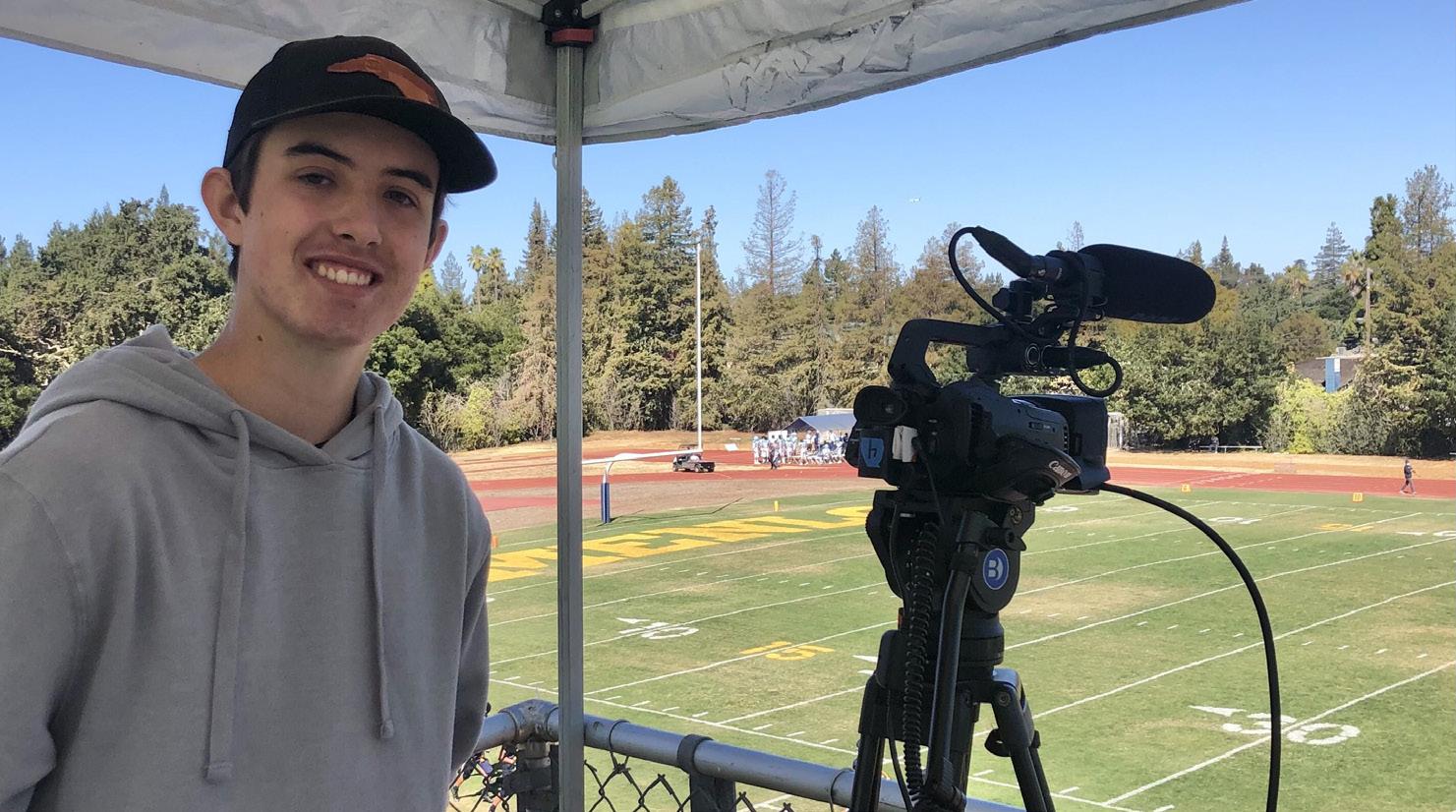
Since the second game of this season, senior Devon Mahaffey has helped broadcast Menlo football games for sports livestreams. Each home game, Mahaffey stands over the students in the bleachers, operating his camera from the highest platform for the best view.
At the beginning of the year, having had previous experience in sports broadcasting, Mahaffey reached out to Athletics Director Earl Koberlein, expressing an interest in the livestreams. “I reached out to [Koberlein] and asked how they put on the
livestreams because I was just interested. After reaching out, he connected me to Skynet, the company that does our [football] broadcasts,” Mahaffey said.
Skynet offered Mahaffey a job right away. “[Skynet said] that I could come check [a game] out. When I showed up, they asked me to start working, and I’ve done it ever since for the football games.”
Mahaffey is not a volunteer, but an employee of Skynet and makes up to $100 per game. “I originally thought of [filming for Menlo] as just volunteering
to get experience, but it’s turned into [a job], which is super nice. Now, I've got opportunities to do other sports.” Aside from broadcasting all of Menlo’s football home games, Mahaffey also plans to help film upcoming winter sports, including soccer and lacrosse.
At Skynet, Mahaffey is just one member of a broadcasting team. “There are two camera operators that work the livestream. I’m technically called the “hero” camera, so I’ll get the close up shot from a tighter angle, so I can have closer insight into the action,” Mahaffey said.
Mahaffey has been involved in sports broadcasting for three to four years, and was first introduced at a summer camp he attended by chance. “My mom signed me up for a summer camp that one of my friends was doing. It was on sports broadcasting, so it was a pretty obscure subject where they teach kids how to use camera equipment, become commentators and learn how to use editing software,” Mahaffey said. The summer camp was run by a nonprofit called Midpen Media Center, a company that broadcasts events and runs trainings around the Palo Alto area.
It was at Midpen where Mahaffey began filming games and building real experience. “We'd go to [Menlo-Atherton High School] Friday night basketball and football, and film games to put them on the local channel.” Mahaffey still volunteers

with Midpen, attending either a Menlo or local event every week.
For Mahaffey, filming was not an easy skill to pick up, especially setting up and breaking down all of the equipment. However, his skills are slowly improving. “They've gotten better over time and still have a lot of room to grow.”
Mahaffey hopes that he can continue to pursue sports broadcasting in the future, both in college and beyond. Working with Midpen and Skynet have helped him build connections to make that a possibility. “It’s an industry that’s dominated by freelance work, so having connections is really helpful, and I think I'm forming a lot of those right now,” Mahaffey said.

Department strives to give each opportunities and resources. inequalities that girls have experienced while playing on Menlo sports teams. They hope the club will continue
boys JV and varsity soccer teams each night before it gets dark is difficult because all four teams are not
IllustrationbyNicGarcia
by ANNIE STENT
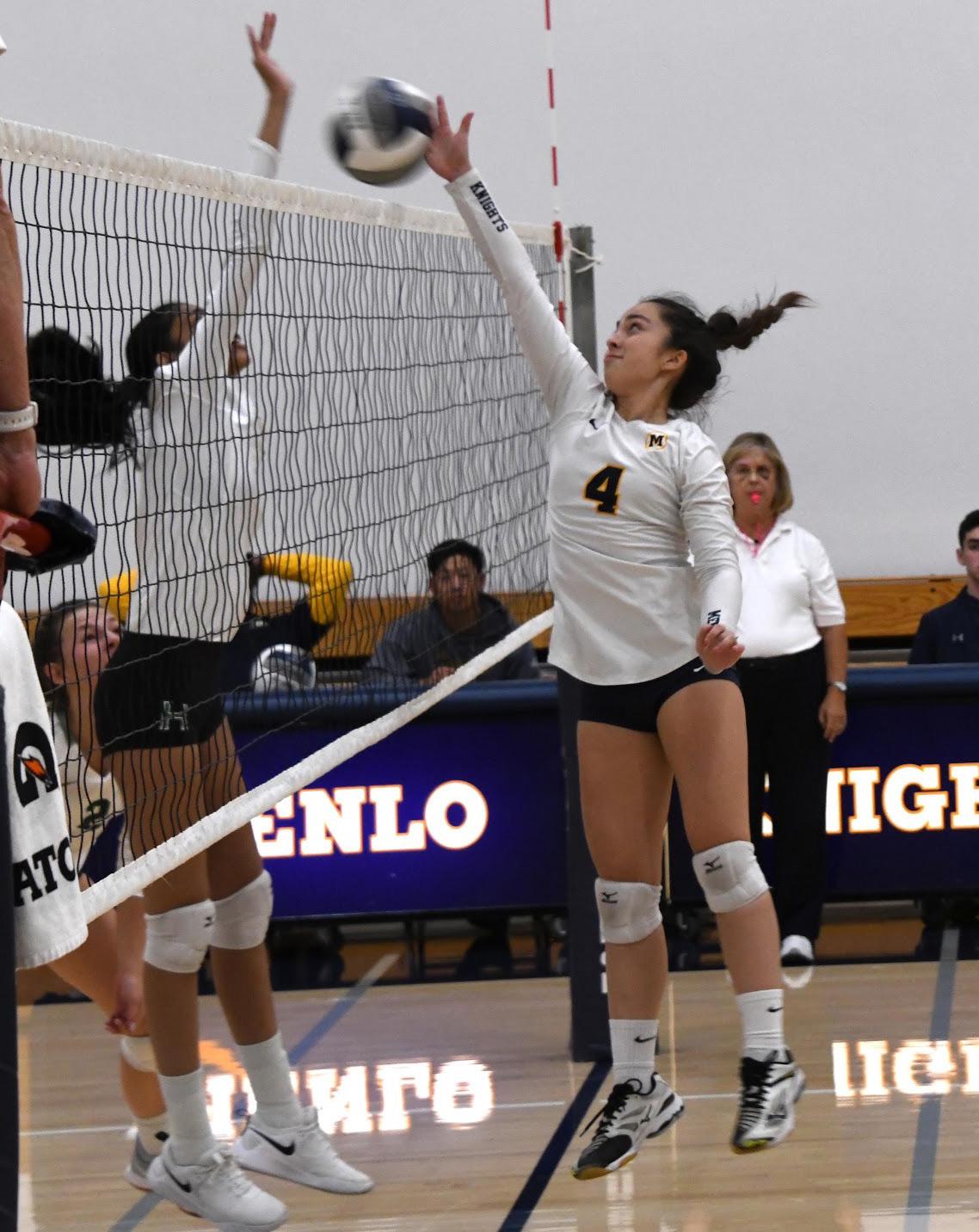
This August, senior Zoe Gregory committed to the admissions process at Tufts University to play Division III women’s volleyball.
Gregory has been playing volleyball since she was in fifth grade, and her history with the sport was a quintessential part of her decision to play collegiate athletics. “[Volleyball] has just been a part of my life for so long [...] I wanted to see if I could pursue it at the next level.”
After deciding to play collegiately, Gregory began the recruitment process. “I emailed a lot of schools and was persistent
even if I didn’t get responses right away,” Gregory said. She was able to make a connection with her future coaches through emails and phone calls, which she had to rely on as COVID-19 hindered her recruiting process.
According to Gregory, coaches had fewer opportunities to watch players in person due to pandemic restrictions, so getting and sending film was very important for Gregory to receive offers. “I sent a lot of highlight videos,” she said.
For each school she reached out to, Gregory focused on both academics and

by CHARLOTTE PALMER
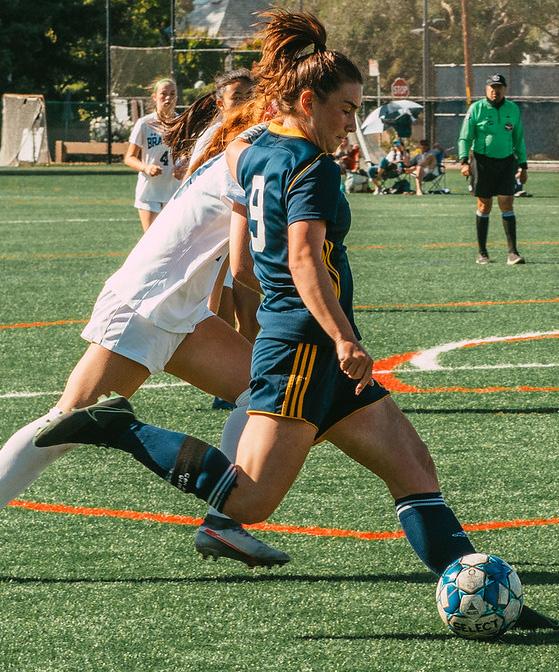
This summer, senior Carolina Espinosa verbally committed to play Division III women’s soccer at Middlebury College.
Espinosa began playing soccer when she was three but became more involved in sixth grade when she began participating in programs to promote herself as a player. “I was getting noticed a lot as a player when I was younger, so I started taking it really seriously,” Espinosa said.
“My first two club teams were where I developed who I am as a player, skillswise,” Espinosa said. She then began training with a coach that developed her tactical skills. “[He taught me] about moving off the ball.
That was the other half of what I needed to develop as a player,” Espinosa said. “There wasn’t one coach who made me who I was.”
She began the recruiting process in eighth grade, when she started sending out a soccer resumé to college coaches. During her sophomore year, the Next College Student Athlete made a recruiting rule that players could not have contact with a coach until junior year, so she could only email them without hearing back. Then, when COVID-19 hit during her junior year, the entire process got shut down. “[It happened] right when my biggest recruiting moments were supposed to be happening, and I was
athletics. She wanted to find a prestigious academic school where she could also play volleyball, which led her to the New England Small College Athletic Conference (NESCAC). Within the conference, Tufts had always been her top choice. She loved the campus, location, academic programs and team culture. “[The coaches] always had really positive things to say about their team and their program and just seemed like great people to play for.”
Gregory’s teammates are very appreciative of everything that she has given the program and are incredibly excited about this opportunity. Freshman Lily Kautai is the only freshman on varsity volleyball this year, something she
was initially nervous about, but has seen Gregory as a calming supportive presence this season. “From the beginning, [Gregory] has always been super kind and welcoming [...] she really helped my transition [to the team],” Kautai said.
Varsity volleyball is led by a tightlyknit, nine-person senior class this year. The team has built invaluable connections over the years that will last for many years to come. “When I part ways with [Gregory] [after graduation], I know that it’s going to be more of a temporary goodbye than a forever goodbye,” fellow senior Jazlin Chen said. “No matter how old I am, no matter where I am in my life, she’ll be there for me if I need her.”

going all over the country and the world to play,” Espinosa said. “They had what was called the ‘dead period,’ so no one was being recruited at that point.” This period did not end until January during her junior year, and all she could do was create training videos to send to colleges.
Espinosa was originally less interested in Middlebury than other potential schools, but after she met the coaches and toured their campuses, she knew Middlebury was where she wanted to go. “I fell in love with every aspect of it,” Espinosa said. She was offered a spot at the end of her tour, and accepted the offer within a week.
Espinosa had expected to commit to a large school. “Instead, I ended up at a liberal arts school in the middle of Vermont,” Espinosa said. She is thrilled about her unexpected path. “I’m so excited to play with a whole new set of girls and work with the coach,” Espinosa said.
Senior Francesca Prescott is a cocaptain with Espinosa on the Menlo girls varsity team, and admires her drive and leadership. “She’s a natural leader and always puts in her best effort. You can just see her drive and her love of the game,” Prescott said.
by PENELOPE STINSON
The NFL is back in boom for its second season since COVID-19. Fans are eagerly watching the performance of rookie quarterbacks such as Trevor Lawrence and Justin Fields, the dramatics with the Chiefs continue as they lose momentum they once had with Patrick Mahomes, and Tom Brady is still dominating at the ripe age of 44. The league’s ratings are up by 17% compared to this time last season, according to CNN, and fans are finally back in stadiums. But with the epic highs come the missed goals. Most notably so far this season are the issues within the newly relocated Las Vegas Raiders.
On Oct. 11 2021, former Raiders head coach Jon Gruden stepped down from his position after The New York Times released emails he sent containing misogynistic and homophobic remarks. Gruden, a Super Bowl winning coach, had commented on the abilities of female referees, the ability of players to kneel during the national anthem and the acceptance of a gay player into the league. One email sent between Gruden and his colleagues included attachments of half-naked women. A different email included racist terms used to describe DeMaurice Smith, the executive director of the N.F.L. Players association. Another email included terms such as “f****t” and “clueless anti-football p***y” to describe NFL commissioner Roger Goodell. These emails were sent as early back as 2011 and continued for years, until at least 2018.


they draft. When teams choose to draft players who have histories of domestic violence or homophobic remarks, they are worsening NFL culture. The locker room dynamics that occur in every sport have dominated the NFL, and these issues have been overlooked for too long. Players, coaches and teams need to commit to simply doing better. Firing Gruden is a step in the right direction, but it’s nothing to
not just those with players who make homophobic or racist remarks, need to consistently attend sensitivity and equity training. The NFL has a major opportunity to set the tone for what inclusion and awareness can look like at the highest level of football, inspiring lower, collegiate and high school leagues to pursue the same.
by KAYLIE WU
Each year, Menlo School only allows juniors and seniors to park in the student lot. This rule seems simple, yet it has always been a prominent issue among students. Due to limited spaces, parking feels like a luxury at Menlo. However, for many students it is also a necessity, and the administration should treat it as one.
There are not nearly enough parking spots at Menlo for the upperclassmen. According to Director of Security Mustapha Moutri, there are only 165 spots for students in the parking lot, while there are 289 students in 11th and 12th grade. This means that every school morning, a handful of unlucky students must find somewhere else to park. Juniors Mitali Srinath and Reese Weiden are two students who have had to find last minute parking near Menlo upon arriving at a full lot. “Now I feel like I have to get to school at least ten minutes early, so that I have a secure spot,” Srinath said.
Many sophomores also park in the student lot, even though this goes against Menlo policies, according to Moutri. Even though sophomores are instructed to avoid the parking lot altogether, this is nearly impossible to regulate.
Sophomores aren’t the only additional drivers in the lot; some parents drop their high schoolers off in the student lot in the mornings. While this doesn’t fill up any actual parking spots, it still clogs the lot. As a result, some students park late and risk being marked tardy. Parents have no logical reason to drive through the parking lot in the mornings, especially when the loop is equally available and convenient to them.
The parking situation isn’t just a problem in the morning before school starts. It also affects students who
have free periods. Even though upperclassmen are allowed to leave campus during their free periods, many don’t due to the risk of losing their parking space. During the very first week of school, junior Ginger Quigley drove off campus for only fifteen minutes during her free period, and when she returned, her spot had already been taken. Since the lot was completely full, Quigley scrambled to find a random parking space on Valparaiso Avenue and risked being late to class. “I didn’t expect my spot to get taken that quickly, especially since this was my first week of even driving at Menlo,” Quigley said.
For the first quarter of the 2021-22 school year, junior Charlie King had his own designated spot in the student parking lot. According to King, his parents won the spot for him through the 2020-21 annual auction. “I don’t ever have to worry about getting to school early,” King said. Even though King’s spot was supposedly secured, he often found it taken by his classmates. Because parking is so limited at Menlo, students often resort to parking in spots they aren’t supposed to, such as King’s spot, carpool parking and visitor parking.
King’s situation is extremely unique; only two families at a time have a designated space in the lot. However, many schools assign parking spots to all of their eligible students, not just two. At Menlo, designated parking spots may not be a realistic idea due to limited spots, but the administration should still devise a similar, temporary solution. For example, the administration could label carpool spots with student names. Designating spots to specific students who carpool would be reassuring, similar to King’s assigned
spot. Since this eliminates the risk of having to park on University, many students would be motivated to carpool and qualify for their own personal spot.
The school should also further promote Menlo’s Go Green program, which encourages students to rely on ecofriendly transportation modes. Rather than driving, students can bike or walk if possible. Menlo could also add more bike racks to its campus to encourage this. Students who bike a certain amount of days a week could be rewarded, with items like food, Menlo merchandise, gift cards and other cash incentives. The program should advertise itself at allschool assemblies, where students can be told about specific advantages of eco-friendly transportation. Parking at Menlo currently unloads unnecessary stress onto its students, and it should instead take shape in a happier tradition.

November 18, 2021
by ANNIE STENT
When I was a kid, going to the toy store to pick out a new toy was monumental. I would look forward to it all day long, and the ultimate decision between which two toys to pick felt like the most important choice of my young life.
Whenever I walked into toy stores, there was very clearly one side with “boys’” toys and one side with “girls” toys. Although I had these two polarized options, I don’t think that I recognized my assigned section. It didn’t resonate with me that whichever section I picked a toy from was a side that I chose. I had all the quintessential “girls” toys: Barbies, American Girl dolls, ponies and pretty much everything pink. But I also had an all-consuming obsession with dinosaurs, which are typically known to be a more traditional “boy” toy.
I didn’t see this as anything odd. Obviously, as a five-year-old, I didn’t realize that there was a specific way I was supposed to interact with the store and its contents.
My parents never inhibited my fascination with dinosaurs and supported my apparent need to own everything related to the prehistoric beasts. The separation in the toy stores, which was based on a strict gender binary, didn’t impact me because it didn’t impact the people around me. However, not every family functions like this, and not every child
has the open-minded parents that I do. When children are forced into assigned gender sections, such as with toy stores, it impacts their development and promotes the capabilities assigned to their gender.
The toys that children have expose them to skills early on in their lives, even if they do so unintentionally. According to a Michigan State University article, typical “boy” toys tend to teach large motor development and spatial skills. In contrast, typical “girl” toys tend to teach more fine motor skills as well as language and social skills. Children spend a lot of time playing with their toys, so their toys end up being their primary teachers.
In addition to teaching early childhood developmental skills, children’s toys also imply to them what they are destined to become. “Girl” toys are often representative of motherhood and other aspects of domestic life, whereas “boy” toys are more professionally oriented and are often more likely to have a basis in science and math according to an article from The Washington Post.
If each binary is only set up to teach certain skills and inspire children into specific paths, children will not only be lacking certain developmental skills, but also will be conditioned to believe that they can only be one thing. The California state government has taken note of this impact and enacted policy to address it.

On Oct. 9, 2021, Governor Gavin Newsom signed Assembly Bill No. 1084 into law. The bill will require that any department or retail store that sells children’s toys with over 500 employees have a gender neutral toy section. It will be set into action on Jan.1, 2024, and once it is, any story that does not comply will owe a $250 fine the first time and a $500 fine for any subsequent offense.
While the law does require a gender neutral section, it does not officially ban stores from having a “boy” section and
a “girl” section.
The law has faced some pushback. According to the Washington Post, some business groups and conservative groups are concerned that it is an obstruction of the free market. They feel that business owners face enough difficulties, especially this past year and a half with COVID-19, and should not be given another requirement. Despite the pushback, this law is vital to children's well-being and will make a positive impact on their experiences.
Picking out a new toy is a significant event for children, and they should be able to enjoy doing so without limitations due to their gender. For kids like me, with families that didn’t live quite as deeply in the gender-binary as the stores do, the sections didn’t set this limitation on me. Unfortunately, not every child is as fortunate.
This law will help those kids. While it doesn’t remove assigned toy sections right now, it does provide an additional place for children to pick their toys from. In addition, it takes a step in the right direction away from such strict gender binaries that start young and have long lasting impacts. If the law succeeds, it could set a non-gendered precedent as the norm, eventually pushing stores completely away from gendered


by ALEA MARKS
Emily Mariko is not your typical TikTok influencer. Instead of posting videos of her lavish life jetsetting to exotic locations, Mariko lives a quiet life right here in the Bay Area. Her videos range from running errands and cooking to doing laundry and organizing her fridge. Although this doesn’t seem like very eye-catching content, Mariko has over six million followers and her videos average more than two million views.
Plastered all across the TikTok “For You” page — a tab of the app consisting of a random assortment of popular videos tailored to TikTok users — is Mariko’s recipe for her trendy salmon rice bowl. The dish is one of Mariko’s signature plates, and it has taken over Tik Tok just like famous celebrity recipes have in the past, such as Gigi Hadid’s vodka pasta or Lala’s pickled garlic. Some users don’t understand the hype, which they convey through comments on her videos saying that she is just another “skinny” and “blank” influencer. After all, her videos are simple, consisting of her toasting bread or chopping up carrots or organizing her eggs by size. As she whips up these meals, her workspace stays immaculate, not a crumb or smear or dirty dish littering her counter.
When scrolling through endless videos on my TikTok “For You” page, I often ignore aspirational lifestyle videos as they are unrealistic and just make me feel bad about my own life. But then Emily Mariko came along. My immediate response was admiration for her perfect tidiness and pristine organization. But with this sense of awe came intimidation. I do not have farmers market hauls with all locally sourced, organic foods that I then methodically put away in my fridge. Nor do I constantly look so clean and put together, my whole house meticulous and in order. But last came a feeling of peace, that Mariko has mastered the most tedious and arduous chores in life. There is a sense of joy in watching someone else accomplish these typically burdening things in a refined,
beautiful and polished manner that prompts you to want to do the same.
The draw to her videos is their simplicity: she takes mundane tasks and breaks them down into step-by-step processes. Filled with sounds of chopping, washing, cutting and cleaning, Mariko’s videos are oddly satisfying. Her house is spotless, and she always looks poised but never overdone. Her apartment is modest and she wears casual clothes with little makeup, contrary to most influencers with layers of makeup, designer clothes and state of the art recording equipment.
Mariko is 29, but her fanbase is mostly Generation Z, people aged 9-24. The comments on her videos are often young women who write that they are inspired to live a more “healthy” lifestyle and ask questions on how they can achieve it. But Mariko isn’t trying to advertise a diet or certain way to live; she is setting an example for a balanced lifestyle. She eats a variety of foods, ranging from very healthy options to more indulgent ones, which she enjoys guilt-free. Her portion sizes are not always modest, emphasizing that food is fuel.
Her videos are refreshing, because rather than displaying only the best moments of her life, Mariko’s content is realistic and relatable. Typically on social media, highlight reels of airbrushed models traveling the world or trying on designer items on their perfect bodies take over the main pages of the apps, making it easy to fall prey to toxic comparison. Mariko, on the other hand, encourages people to romanticize their lives and enjoy the little things.
Mariko’s success goes far beyond her salmon rice bowl that has taken over the internet. After a global pandemic where everything was uncertain and changing, Mariko is a reminder that life moves forward, and that we can find joy in daily activities. Her lifestyle inspires people to strive to make their lives better in a realistic and achievable way.
Arts & Lifestyle Editor...................................Laura Artandi
Assistant Arts & Lifestyle Editor.........................Kaylie Wu
Opinions Editor........................................Penelope Stinson
Assistant Opinions Editor.................................Annie Stent
Video Editor.......................................................Ari Krane
Social Media Director.......................................Lexi Friesel
Creative Director..............................................Sophie Fang
Head Copy Editor..............................................Parina Patel
Copy Editor....................................,.........Charlotte Palmer
Marketing Director...............................,.........Madison Liu
Staff Writers.................................................Lizzie Freehill, Sutton Inouye, Claude Kingsley-William, Noah Kornfeld, Andrea Li, Jake Lieberman, Alea Marks, Ty Richardson, Avery Romain, Sophie Stone
Staff Illustrators..................................Michele Hratko, Dorinda Xiao, Grace Tang, Andrea Li

The Coat of Arms is an independent, studentled open forum for student expression. All decisions relating to the management and content of The Coat of Arms are fundamentally the responsibility of students. Coat of Arms reporters strive to acknowledge their internal biases and tell meaningful stories with empathy, fairness and journalistic integrity. The Coat of Arms staff is committed to building on the legacy of past staffs while setting the foundation for future members. Editor-in-Chief.............................................Sophia
Adviser.......................................................Tripp Robbins



by ALEX LEVITT
Warning: this story contains spoilers for the Netflix show “Squid Game.”
Since its release on Sept. 17, 2021, Netflix’s newest Korean drama show, “Squid Game,” has taken the world by storm, rapidly becoming Netflix’s most watched show ever with over 111 million accounts tuning in, according to the company. It also has a score of 93% on Rotten Tomatoes and a score of 8.1/10 on IMDb. The show constructs an ultra-violent setting in which poor Koreans compete in childrens’ games to amass millions of dollars, and losers are either killed by fellow competitors or masked guards. The plot twists and turns throughout, with notable subplots including Detective Hwang Jun-ho’s attempts to take down the game and find his brother, and the discovery of the identities of the Front Man and VIPs by Jun-ho and protagonist Seong Gi-hun. However, what has allowed the show to be so widely respected by critics is its deep messages about society and humanity that are portrayed through various symbols and character actions. Let’s dive into some of these themes, specifically the most popular yet controversial topic: capitalism.

In life, people have unequal starting points, which directly affect their chances of success.
Seen throughout the show, both in the game and the real world, is how many people must fight their way out of challenging situations if they want a chance to survive and prosper. In their precompetition lives, fan-favorite contestants Abdul Ali and Kang Sae-byok escaped their native countries to build a life for themselves and their families in South Korea, only to be cheated out of their fair share. Ali’s boss never pays him for his work, while Kang is rejected the necessary money to liberate her parents from the North. The creator of Squid Game purposely includes these descriptions early to highlight the misery of the working class, but also to show why they would risk their lives just to get compensated.
Once in the competition, two games underscore this philosophy: sugar honeycomb and glass stepping stones. In both games, random draws essentially seal players’ fates for that round, symbolizing the unquestioned influence of randomness and luck in a competitive environment. In fact, this takeaway is stated by Player 119 after failing to break his shape in sugar honeycomb— guaranteeing his death—as he holds a guard at gunpoint and yells, “What kind of a sick game is this? Why do some get an easy shape when others are stuck with difficult ones?” The shapes signify life opportunities, as all people have the opportunity to be happy and successful, yet the current system prevents those opportunities from being equal.



The free-for-all capitalist system that rules much of our world creates monsters out of innocent people.
Possibly the central takeaway from the show, this conclusion is embodied by



People in control are always changing the rules, forcing citizens or “players” to fend for themselves
Along with bad luck, a lack of control over their lives and decisions leads to poverty and death throughout the show. Specifically, powerful figures are able to constantly change the standards for success, rigging the game of life in their favor and against working class citizens. In his realworld life, Seong almost loses his organs to loan sharks after failing to pay off his debts. While the original contract had nothing to do with him being physically punished, he is forced to sign a new and abusive contract while held at knifepoint. This sudden shift of fate is evidence of the fact that desperate citizens— and gamblers in particular— have no control over their fortunes, and sometimes even their bodies. A similar theme arises when we learn that Ali is not being paid by his boss, and his only chance at a survival wage is through violence at his boss or fellow Squid Game participants. Episode 7 which illustrates the power dynamic between the VIPs and the players, further shows the severe lack of power for players and the immediate, life-changing amount of power for executives. When Player 017 draws upon his prior work in a glass factory and figures out how to distinguish tempered glass from regular glass using light refractions, the Front Man quickly turns off the lights. Player 017 is then unable to determine the difference, and he plunges to his death courtesy of a shove by survivalist Sang-woo, evidence of the loss of control he suffers when at the hands of more powerful and strategic people.

Cho Sang-woo (Gi-hun’s childhood friend) and Oh Il-nam (the elderly man). Sang-woo loses his childlike spirit as he is corrupted by his years of experience in the business world. In the first couple episodes, it is slowly revealed that he became corrupted by his desire for more money — cheating his clients out of their money, falling into heavy debt and subsequently cutting off ties with his mother. In the game, he is shown as an extremely cerebral player, saving his team from certain death in tug-of-war and tricking his opponent to win in marbles. However, he admits to his teammates that he “just did it to save [himself],” and makes no effort to save his fellow competitors in other games, even killing his fellow finalist who appeared to be his friend. So, the question beckons: does achieving success and accumulating wealth lead
to happiness? According to Squid Game creator Hwang Dong-hyuk, it does exactly the opposite. After earning ridiculous amounts of money, game founder Oh Ilnam and his wealthy friends were bored with the monotony of life, so they set up the annual Squid Game competition solely for the sake of their entertainment, watching the games and placing wagers from around the world. Their excess money left them with no appreciation for human life, as they have no visible reactions when they see players die in Episode seven, “VIPs.” All the ultra-wealthy elite see poor people as disposable players in a grand system to provide fleeting happiness, a system seen in giant corporations in the real world such as Amazon or various meat production companies. Still, Dong-hyuk doesn’t provide an all-out
rebuke of capitalism. The show makes no comment on the happiness of the middle class, and even denies communism by including the backstory of pickpocket Kang Sae-byok, who is desperately trying to pay for her parents’ escape from North Korea.