In the midst of the global pandemic and government-imposed restrictions, many downtown Menlo Park businesses are fighting to adapt to the tectonic changes and retain their employees.
For example, running apparel store Fleet Feet in downtown Menlo Park has seen a 29% decrease in business since 2019, the independently-owned franchise’s owner Lisa Taggart said to The Coat of Arms. While sales were initially down 75% in March, at the beginning of the shutdown, the ability to partially reopen to in-person customers allowed the business to begin to recover, according to Taggart. With the partially reopened store, all customers and staff are required to wear masks, customer temperatures are checked upon entry and the number of customers in the store is limited to 25% of the original capacity while San Mateo County continues to be in the most severe health risk level, known as the Purple Tier.
Kepler’s Books similarly struggled as a result of the shutdown with the on-site bookstore remaining closed from mid-March through August 2020, according to Praveen Madan, Kepler’s Books CEO and Kepler’s Literary Foundation Board Member. During that period, Kepler’s revenues were down by as much as 55% compared to the same period in 2019, with most of sales originating from Kepler’s website, Madan said.
Similarly, dry cleaners Hoot ‘N Toot’s
Downtown, page 3
Dethroning the “Tiger King” — Menlo Alum Carney Anne Nasser Advocates for Tiger Rights
by LEXI FRIESEL
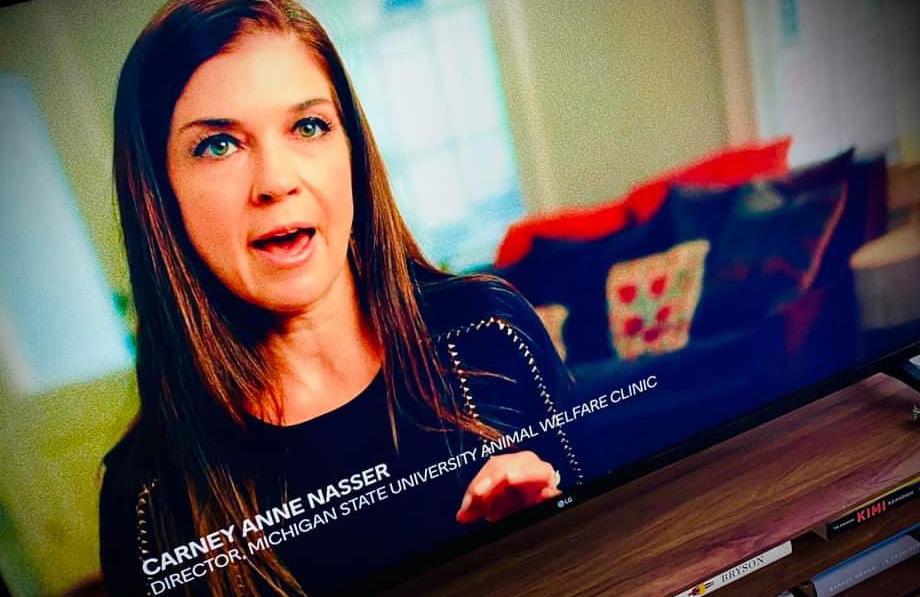
Menlo Class of 1993 graduate and professor at Michigan Law School Carney Anne Nasser has been an animal rights activist for nearly her entire life. She specializes in the fight to end trafficking and cruelty towards tigers in America. Nasser has been featured in The New York Times, the Chicago Tribune and most recently the National Geographic documentary series, “Trafficked.”
Last year, the absurdity of the eightpart Netflix documentary “The Tiger King: Murder, Mystery, and Mayhem” captured the attention of viewers across the globe. The central character of the show, Joe Maldonado-Passage, better known as “Joe Exotic,” has been in prison since January 2019, after being charged with murder for hire, animal trafficking and animal cruelty.
Nasser first met Maldonado-Passage when he came to Louisiana to testify in court on behalf of a man who was keeping a tiger at a gas station. “At that hearing, he met some folks from Shreveport who had a failing Big Cat facility and were participating in some shady activity,” Nasser said in an interview with The Coat of Arms. “They called Joe Exotic and sent a bunch of cats to him. Through a Freedom of Information Act request I obtained a bunch of documents and pieced them together to figure out the story.”
After sorting through the documents, Nasser built a case against MaldonadoPassage and pitched it to the US Fish and Wildlife Service, thus beginning the federal investigation on him and his facility, Greater Wynnewood Exotic Animal Park, LLC. “The wildlife trafficking violations and the endangered species act crimes had been investigated, and he was going to be indicted for that,” Nasser said, “He’s just as outrageous and ridiculous in person. On top of it, he documented everything on social media
which made it clear it was only a matter of time before he went down.”
A couple of years after the initial charges, Nasser received a call from one of Joe Exotic’s former employees. “[The employee] said Joe had hired someone to kill Carol Baskin. I alerted the feds, and that tipped them to work on that issue as well.”
In 2018, Maldonado-Passage was charged with murder for hire then superceding indictment for wildlife crimes. He was sentenced to 22 years in federal prison. According to Nasser, who was in the courtroom at the time of the indictment, the judge on Maldono-Passage’s case, U.S. District Judge
Scott Palk in Oklahoma City, referred to Joe as a “master manipulator” during the trial.
Nasser has mixed feelings about the Netflix documentary released in March 2020. “[The director Eric Good] runs nightclubs and hotels,” Nasser said, “His ultimate goal was to twist the story to create clickbait, which he succeeded in doing. However, awareness has grown and has given other shows like National Geographic[’s “Trafficked”] a chance to give a more factual and informative stance.”
Nasser has been friends with Carol Baskin, the owner of another big cat facility
Tigers, page 4
Menlo Community Mourns Loss of Sophomore Boy
by SOPHIA ARTANDI
The Menlo community is mourning the loss of sophomore Michael Enright. On Saturday, Jan. 16, Enright and two other teenagers were involved in a car accident on Valparaiso Ave. According to The Almanac, the car rolled over after hitting a light pole near the intersection of Valparaiso Ave. and Altschul Ave. All three teenagers sustained serious injuries, but only two of them, including Enright, suffered life threatening injuries, according to The Almanac. Enright died at 5:30 p.m. on Monday, Jan. 18 surrounded by his immediate family.
“Michael was a witty, interesting, and insightful student who had a unique perspective and bravely spoke his mind. As a freshman, he was also a member of last year’s undefeated JV football team where he showed his resiliency and determination and worked hard to gain the respect and love of his teammates,” Head of School Than Healy wrote in a letter to the Menlo community.
In an email to The Coat of Arms, a family member mentioned the history of accidents on Valparaiso Ave. According to a statement from Fire Chief Harold Schapelhouman, the area where the accident occurred, known as Sharon Hills Park, is a “significantly steep section of road for this area that slightly winds about with some pedestrian traffic at times.”
Menlo will hold a virtual tribute event for Enright during a student life period on Wednesday Feb. 10, according to an email to the Menlo community from Dean of Student Life Programs Eve Kulbeida. Community members can make a 2-3 minute contribution such as a song, photo, video, poem or statement to be included in the event, according to Kulbeida. There is also a tribute board for people to post messages and photos honoring Enright in the Menlo College Counseling Office.
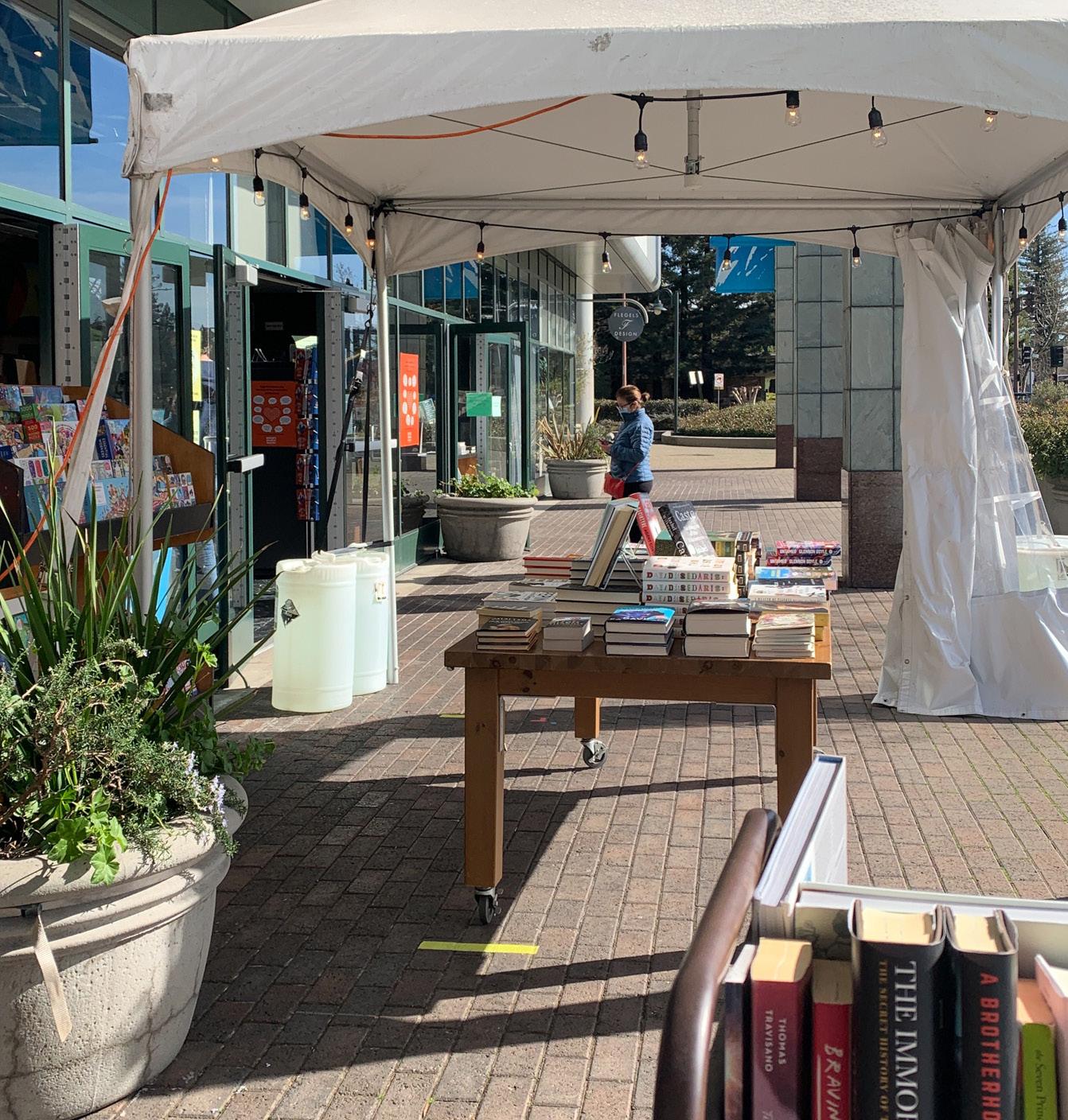
Books sit outside open windows and doors of Kepler's bookstore as a form of health saftey measures. Restaurants and other businesses in downtown Menlo Park have had to rethink their normal business models admist the pandemic. Staff photo: Carly McAdam
Staff illustration: Michele Hrakto
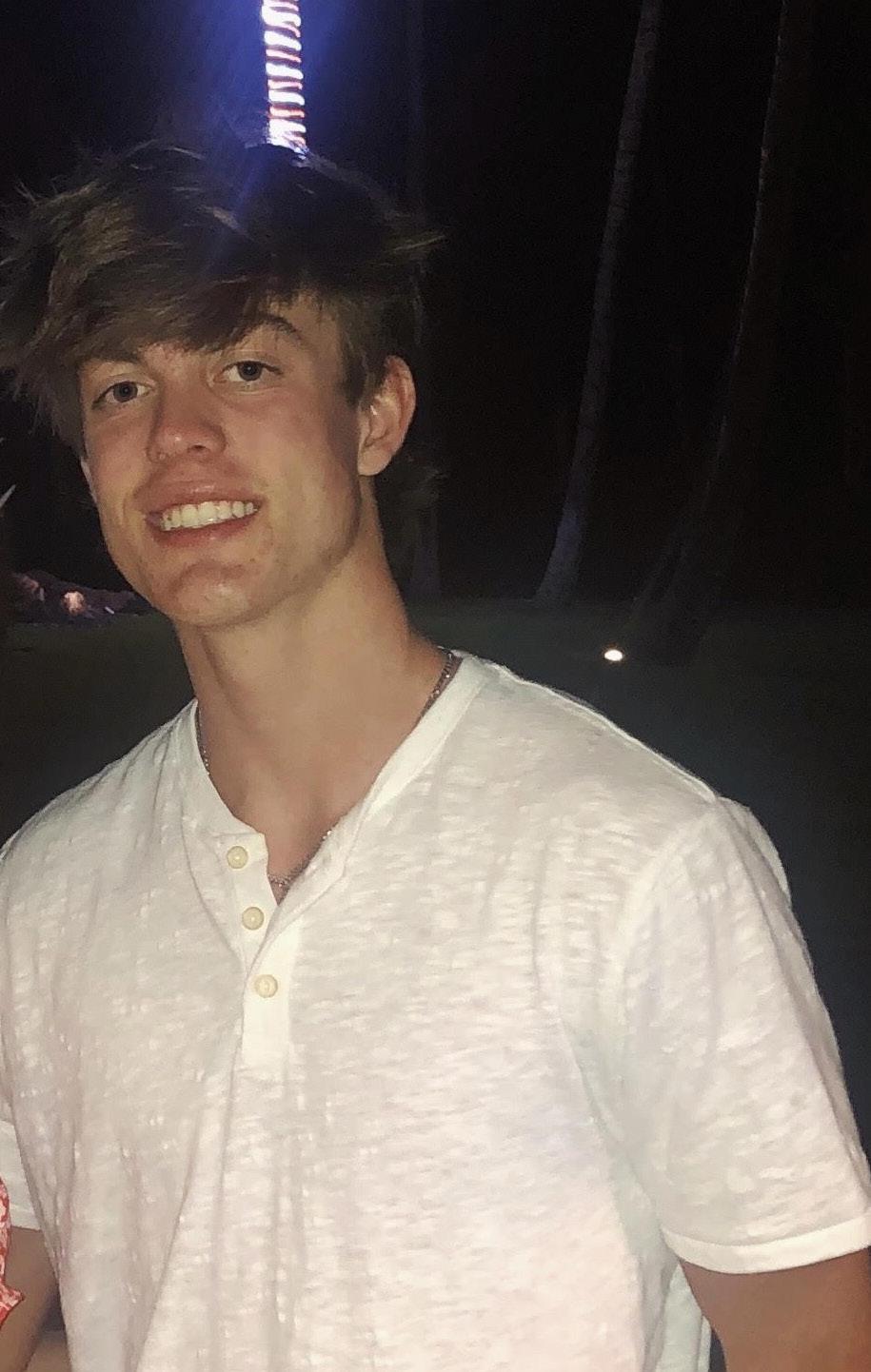
Sophomore Michael Enright died after sustaining injuries in a car accident on Saturday, Jan. 16. Menlo held a special assembly the next Tuesday and is planning to hold a virtual tribute event for Enright on Feb. 10. Photo courtesy of the Enright Family
VACCINES AUTHORIZED FOR PUBLIC USE
What Do Local and National Experts Have to Say About Them?
by ALEA MARKS
With the FDA’s authorization of the Pfizer-BioNTech and Moderna COVID-19 vaccines and the likely authorization of other vaccines in the coming weeks and months, Americans understandably have many questions and concerns about the shots. While there are still many questions about the vaccine’s rollouts and impacts, scientists have conducted a significant amount of research to closer examine the vaccines.
Unlike most vaccines, the COVID-19 vaccine is mRNA based, according to Sequoia Hospital physician assistant Carl Tjerandsen
According to Harvard Medical School, “mRNA, or messenger RNA is a genetic material that contains instructions for making proteins.” A string of mRNA is injected into the patient when they receive the vaccine. “It allows your body to recognize the spike protein that [is on the surface of] the virus,” Tjerandsen said. “So when it sees this protein in the future your body will recognize it and be able to kill it.”
While two companies have been approved to distribute their COVID-19 mRNA vaccine (Pfizer-BioNTech and Moderna), both vaccines require two doses. After the first dosage, you are 50% protected from the virus. After the second dose you are 95% protected against COVID-19 with the Pfizer-BioNTech vaccine and 94.1% protected with the Moderna vaccine, according to Sequoia Hospital Chief Medical Officer Dieter Bruno.
“[Receiving the vaccine] is better than [getting] COVID,” Sequoia Hospital Nurse Kristi DeSmidt said. She received the COVID-19 vaccine a few weeks ago which was especially important for her after seeing her daughter very sick from contracting the virus. After the initial injection, DeSmidt felt tired and had a sore shoulder. Three weeks later when she received the second dose, she experienced mild cold-like symptoms.
Similarly, Bruno received the first dose of the Pfizer-BioNTech vaccine on Dec. 29; 17 days later, he received the second dose. Other than a slightly sore arm, he said he has experienced no side effects. He downloaded an app produced by the CDC that checks in about his experience with the vaccine and how he is feeling.
"It allows your body to recognize the spike protein that [is on the surface of] the virus."
DeSmidt concurs with President Biden’s Chief Medical Advisor Dr. Anthony Fauci
and hopes that 60% of the population will be vaccinated by summer. However, because the Pfizer-BioNTech vaccine must be kept at -80 degrees fahrenheit and the Moderna vaccine at -20 degrees fahrenheit, according to Bruno, it needs time to defrost before the patient receives it. Once it is defrosted, it cannot be refrozen. If it is not used within a four hour window, it will expire.
Currently, President Joe Biden’s vaccine plan is to administer 100 million vaccines at two doses per person in his first one hundred days in office, which would result in roughly 50 million people being vaccinated. Fauci believes that the vaccine will be available to the general public at the end of March or early April. He is hopeful that the majority of the population will be vaccinated by next fall. If Biden reaches his
distribution goal, 280 million Americans will still need to be vaccinated before fall if Fauci’s projection is correct.
So far, roughly 11,000 people have been vaccinated in San Mateo County, including many healthcare workers, nursing home residents and people over the age of 65. “As impressive as that sounds, it is only scratching the surface,” Bruno said.
As of Jan. 23, San Mateo County transitioned into the next phase of COVID-19 vaccinations, Phase 1B. This tier expands the vaccination pool to those at risk of exposure in education and childcare positions, emergency services and food and agriculture jobs. The goal is to vaccinate people at a faster rate than the virus can mutate so the vaccine remains effective at protecting the body against COVID-19.
Menlo Faculty, Parents and Community Begin Receiving COVID-19 Vaccines
by EMILY HAN
As several Menlo staff members and parents receive COVID-19 vaccines, the school is preparing for more widespread distribution. In February, vaccines will likely become available to teachers and school staff; still, it may take many months before students get their first doses, according to Health Services Coordinator Joan Barada.
Since Barada is a healthcare worker, she received her first dose of the Moderna vaccine on Jan. 14. After registering for the vaccine through an online form, Barada visited a drive-through site where she showed her ID information, got the shot and waited 20 minutes in case any abnormal reactions emerged.
“It was really easy,” Barada said. The entire process took around 30 minutes, and she will receive her second dose in midFebruary. “[It was] kind of like when you get a tetanus shot or a flu shot,” she said. “It wasn’t that bad.”
Menlo parent Dr. Drew Chavinson, father of sophomore Malia Chavinson and eighth-grader Kc Chavinson, works in El Camino Hospital’s emergency department and was recently vaccinated. Like Barada, he likened the COVID-19 vaccine to a flu or tetanus shot. But according to Chavinson, some of his co-workers felt low-energy for three to four days after getting the vaccine.
“I consider myself fortunate. I had minimal side effects,” he said.
Chavinson has received both doses of the Pfizer-BioNTech vaccine. At El Camino Hospital, only around 3% of healthcare workers have declined the opportunity to be vaccinated, according to Chavinson.
Menlo parent Kari Wolf is a nurse at Sequoia Hospital and has also received both doses of the Pfizer-BioNTech vaccine. She has two Menlo students, juniors Madison and Max Peña. “To be totally honest, I was nervous [to get vaccinated],” Wolf said.
Wolf feels that California’s vaccine distribution plan is inefficient. “It’s the slowest, most horrible process,” she said. Wolf recently registered her 91-year-old father for a vaccine and believes he would not have been able to navigate the process without her help. “There’s no way he could have stayed online, signed all the paperwork and uploaded all the required information,” she said.
Still, as the state now transitions to Phase 1B of its distribution plan, teachers and school personnel might start receiving vaccines.
Menlo’s administrators and One Medical have discussed the possibility of using campus as a part-time distribution site to facilitate vaccinations for school community members, according to Barada. “They have access [to vaccines], and they are ready and willing — as soon as they can distribute to teachers — to put that in place for the Menlo community,” she said.
"It's the slowest, most horrible process."
For students, however, vaccines are distant. California’s priority groups do not include younger age groups; moreover, patients must be at least 16 years old to receive the Pfizer-BioNTech vaccine and 18 years old to receive the Moderna vaccine. Menlo has not yet planned for the event of students receiving vaccines, according to Barada. “If everybody was vaccinated, we’d be able to come back to full participation,” she said. “But I think
the administration is holding a wait-and-see position because we haven’t even started vaccinating the adults.”
Barada, Wolf and Chavinson all believe that students should welcome any vaccination opportunity. “I would encourage Menlo students to talk about vaccines, do their own investigation and homework and make up their own mind,” Chavinson said. “But at the end of the day, [I believe vaccines] are a very big benefit to our personal and public health.”
“The vaccine has really relieved most, but not all of the anxiety that surrounds going into work in a frontline profession,” he said. Chavinson’s wife also works in healthcare and recently received the Moderna vaccine. He did not notice a significant difference between his and his wife’s vaccination experiences.
Barada agreed that there is little distinction between the Moderna and PfizerBioNTech vaccines. “I would take whichever you can get,” she said.
Wolf hopes the Menlo community trusts the vaccine’s safety and efficacy. “There are studies behind this vaccine,” she said. “I know a lot of people are nervous about getting it because they think it hasn’t been researched.”
Barada understands that many people are increasingly impatient with the pandemic. “It is crazy. It’s tiresome. Everybody is tired, and it’s just terrible,” she said. But she hopes that Menlo students, staff and families remain optimistic.
“It’s coming. It’s coming soon. I know I’m in the first group, but they're going to get to everybody, and I’m hopeful that the end is in sight,” Barada said. “It’s like when you’re running a marathon. It’s those last few miles that are the hardest.”
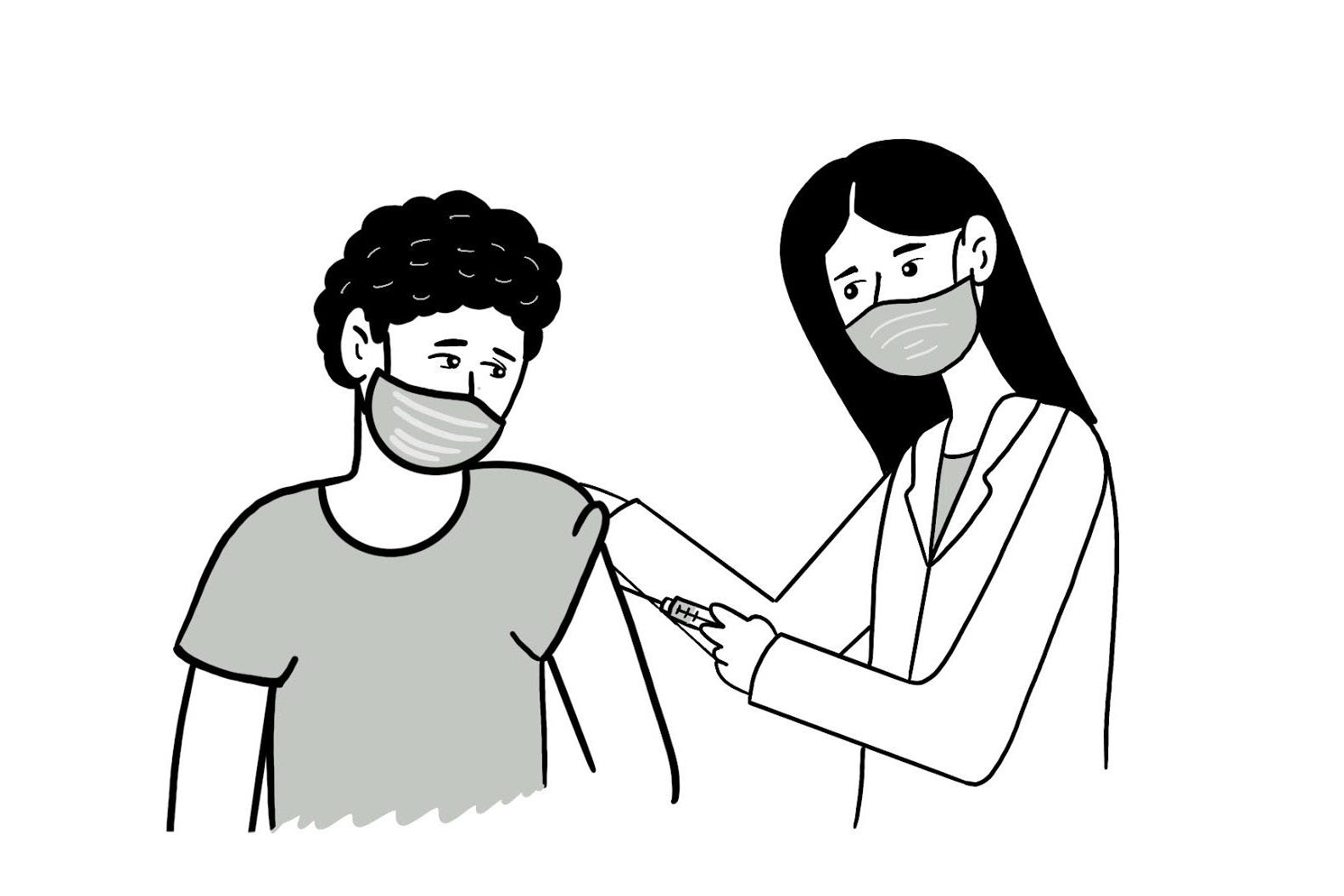
Staff illustration: Sophie Fang
Staff illustration: Tatum Herrin
In Memorium:
Michael McDonough Enright
(March 5, 2004 – January 18, 2021)
Michael passed away quietly at Lucile Packard Children’s Hospital in the arms of his immediate family. Loving brother, loyal friend and beloved son and family member, he was loved and will be missed by everyone who knew him. “Big Mike,” as some of his friends called him, was a kind and caring young man with a warm smile that lit up the room. He loved animals, especially his dogs Hunter and Honey, and cats Abby and Pimsley, a 22 lb adopted cat he nicknamed “panther” that slept in his room every night. Michael grew up in Portola Valley and attended Ormondale elementary and Corte Madera middle schools. He had a clever sense of humor and deep empathy, especially for younger children and people in need. Michael was a member of the class of 2023 at Menlo School, where he was a witty, interesting, and insightful student who had a unique perspective and bravely spoke his mind. As a freshman, he played on last year’s undefeated Menlo JV football team, where he showed his resiliency and determination and worked hard to gain the respect and love of his teammates and coaches. He was quick to offer support to others, be it a teammate, friend who needed comforting or a stranger struggling with their groceries, and he loved to bestow affectionate “bear hugs” on friends and family alike. In addition to playing football for Menlo School, his interests included sports (tennis, golf, weightlifting), music (he played trumpet and enjoyed classic rock), and more than anything else, spending time with friends. He is survived by his sister (Grace), brother (Braiden), and parents, Patrick and Mary. In honor of his memory, his family has made and encourages donations in his name to the Peninsula Humane Society/SPCA and to Lucile Packard Children’s Hospital. Michael’s family has created a celebratory website for him which can be found at this URL: https://michaelenright.theplot.com/223#/
business is down 33%, Store Manager Yooseon Hwang said to The Coat of Arms, and toy store Cheeky Monkey’s business is down 20% from 2019, according to Cheeky Monkey owner Anna Chow.
For businesses like Cheeky Monkey, government guidelines have forced the majority of their business online, Chow said. While Cheeky Monkey’s website previously was not a core part of their business. Once Cheeky Monkey had to close down to the public, the Cheeky Monkey experience shifted completely online, according to Chow. When COVID-19 restrictions allow the business to open, regulations are put in place as to how many people can be in the store at once, depending on San Mateo County’s COVID-19 severity tier.
Disruptions in the supply chain additionally hurt Cheeky Monkey’s business, according to Chow. Many toys that Cheeky Monkey sells are made in China, and transport has been slowed because of the pandemic, she said.
Supply chains have also been disrupted for restaurants such as Left Bank, according to Left Bank Sales and Events Manager Rayane Abi Abboud. The Santa Cruz Avenue restaurant, whose revenue is down around 60% since the start of the pandemic, has shifted from their “lively French” dine-in atmosphere to only to-go orders with outdoor dining banned during the San Mateo County stay-at-home order. “We had to transform what we do [at Left Bank] into a box and make it exciting for guests to take home and enjoy,” Abi Abboud said.
As Left Bank is currently making 40% of its 2020 revenue solely from to-go food, the restaurant plans to keep the to-go option in place post-pandemic, according to Abi Abboud.
Another downtown restaurant, The Refuge, has also been forced to focus on to-go food, according to owner Matt Levin. “We basically turned [our business model] inside out,” Levin said.
The Refuge has had a similar 50% decline in revenue
Downtown, page 4
New Contact Tracing Devices Aim to Create Safer Campus During Pandemic
by ANNIE STENT
On Jan. 19, Menlo resumed classes in its hybrid model. In order to help ensure the safety of students, teachers and staff, Menlo introduced contact tracing using POM tags.
The biggest challenge with contact tracing before Menlo used POM tags was keeping track of the location of people in proximity of others during lunch and passing periods. Before POM, students used Google Forms to log the location where they ate lunch as a step in contact tracing.
According to Menlo’s nurse, Joan Barada, contact tracing isn’t difficult when students are in the classrooms. “POM isn’t the only thing we look at for contact tracing. We look at who makes contact with each other in each classroom as well,” Barada said.
Barada helped in organizing the contact tracing system. The choice to use POM tags over another service was due to the privacy protection it offers. POM tags use bluetooth technology in order to gauge who was in contact with whom and for what duration of time. “It’s really just POM talking to POM,” Dean of Students Tony Lapolla said.
Other tags use GPS for contact tracing, tracking the location of someone and who else was there. “I won’t know if you went to Starbucks, whereas other tags had more features like that, and we didn’t like that,” Barada said.
All of the information from the tags goes into a dashboard once people upload their data to the iPad stations. The dashboard has tiers of contact. Close contact is being within six feet of someone who has tested positive for COVID-19 for over 15 minutes.
Another tier is “indirect” contact. “Indirect contact might be if you use the same bathroom [as someone who has tested positive for COVID-19],” Barada said.
The contact tracing team at Menlo have all been trained to identify the tier of contact through a six-hour course at Johns Hopkins University, according to Barada.
Currently, Barada is the only person tasked with notifying people who have come into contact with someone who has tested positive for COVID-19. If there were several simultaneous cases, the whole team of six contact tracers— including Director of Academic Innovation Maren Jinnet, Middle School Assistant Director Mima Takemoto, Dean of Students Tony Lapolla, Head Athletic Trainer Aubrey Fennell and Assistant Athletic Director Steph Swan along with Barada—would aid Barada in the tracing process and in notifying people. They keep track of who came into contact with who and what tier of contact it was before notifying the people impacted.
According to Lapolla, the biggest concern isn’t that
anyone will refuse to participate in the POM tracking, but that students may forget. “I think that people understand why we are doing it, and it’s for the well-being of the community, so I don’t think we will have [issues with participation in contact tracing procedures],” he said.
Sophomore Avery Romain and Upper School science teacher Mary McKenna completed their first week of the hybrid model with their POM tags on Jan. 22.
Romain’s experience using the tag has been mostly
positive and seamless. For Romain, the tag itself doesn’t necessarily make him feel safer, but he is reassured by how quickly he could know if he came into contact with someone who has COVID-19.
McKenna shared a similar opinion. She feels safer in this model of hybrid—with the POMs—than the original model in the fall. Her new assurance comes from the heightened efficiency of contact tracing.
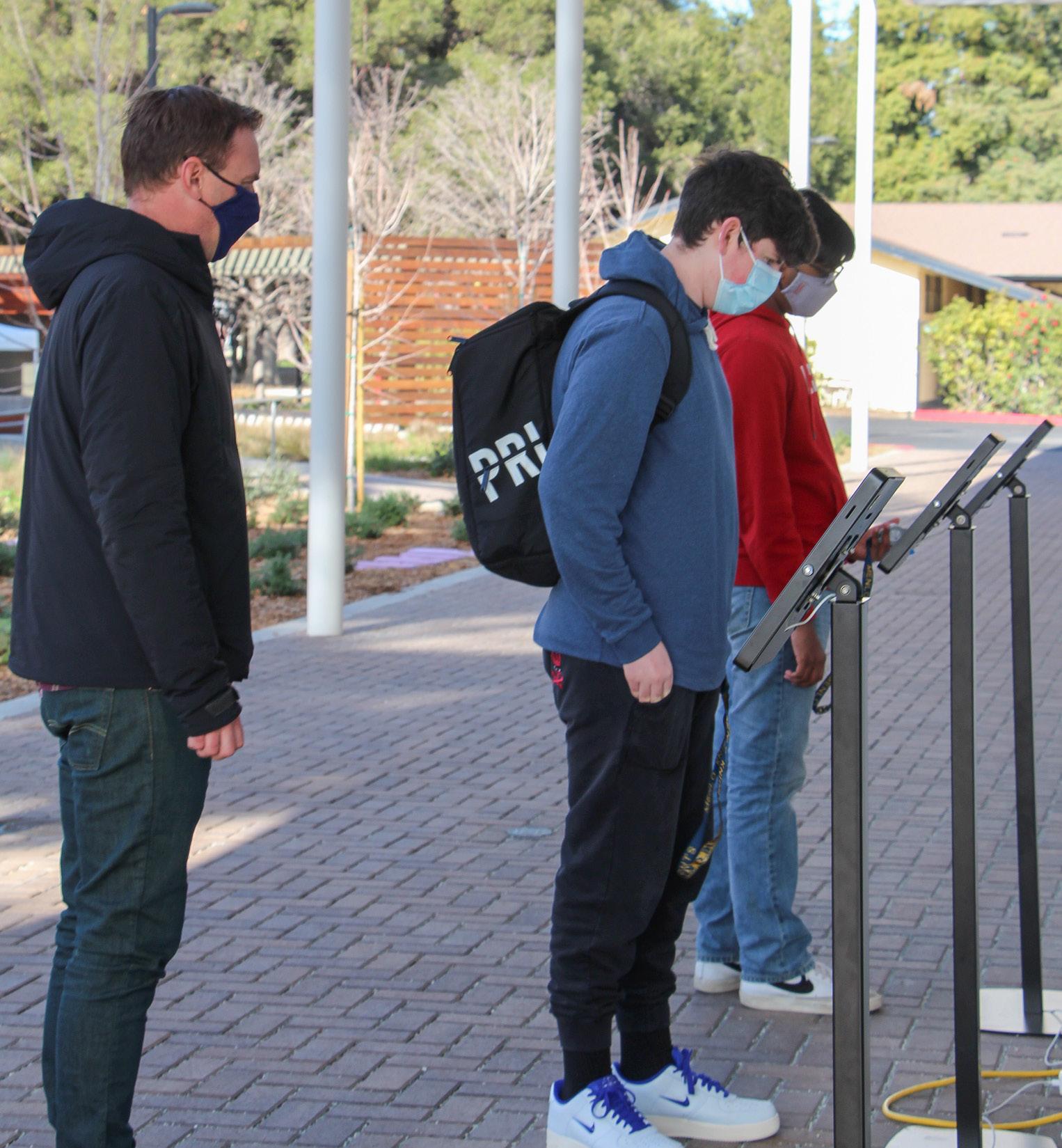
Upper school sophomores Eli Housenbold and Sudar Kartheepan scan their POM tags under supervision of Educational
Technology Specialist Mike Kulbieda at iPad stations near the Spieker Center for the Arts. Staff photo: Sadie Stinson
Downtown, cont.
at its downtown Menlo Park location and a 40% decline in revenue at its San Carlos location, forcing Levin to halt construction on a third location in Hillsdale. “We basically work to pay my team’s salaries, just to keep people present, just to keep it alive,” Levin said.
Before the pandemic, The Refuge had 70 employees across both locations, yet the restaurant is now working with a “skeleton crew” of 12 to 15 employees, including Levin and his wife, co-owner Melanie Roth. Levin highlighted the dedication and great work of his employees throughout the pandemic.
Levin expressed the difficulties of working with a small number of employees, especially when one has symptoms of the coronavirus or has had an exposure to the virus. “It’s super difficult because you can’t just call [a new employee] in for two weeks [while another employee is quarantining],” Levin said. He also stated that some of the
“[We] always believe we can find a way up and out.”
employees he had to let go have been receiving unemployment benefits, and others have started doing delivery jobs through companies such as DoorDash and Uber Eats.
Chow similarly let her part-time employees go upon learning that they would be eligible for additional unemployment compensation from the government. Nonetheless, Chow has enabled her
Tigers, cont.
full time employees to decide whether they want to work at Cheeky Monkey at the store or from home due to health issues. Employees at the store work with in-person customers and fill orders, while employees working from home add products to the website and handle purchasing.
“We’re doing everything we can to make sure we keep all of our full time employees employed so that they have a job as well as health insurance. That’s critically important to us,” Chow said.
“It’s important for people to understand the difference between those who have jobs where they can work from home and those who have jobs that require them to leave home,” Chow said. “People come into the store, and because it’s not their dayto-day experience of coming out of their homes, they expect things to be the same in the store sometimes, and they just aren’t.”
Levin voiced frustration at the state’s fluctuating permission to open, especially after purchasing outdoor dining equipment. “It’s really hard to turn around a moving ship. It takes a massive amount of coordination and effort to work with state mandates, sually with little or no notice,” Levin said.
Levin also advocated for the opening of outdoor dining. “Shutdowns don’t work. [It is important to get] people out into the air and let them go to an environment where the staff are trained to follow health protocols and standards, which are restaurants. [Restaurants] are one of the safer places to go,” Levin said.
Madan, however, viewed California’s implementation of restrictions and shutdowns as too haphazard. “[In May and June 2020, California] Governor Gavin Newsom foolishly rushed into reopening too quickly and failed to control the pandemic, leading
featured in the show, for years and was not thrilled with her portrayal.
“Her facility meets extremely rigorous standards, and she’s one of very few true sanctuaries for big cats in the U.S.,” Nasser said, “The director wanted to portray it like it was a battle between two similar facilities when in reality it was completely different.” Unlike Maldonado-Passage's Zoo, Carol’s facility, Big Cat Rescue, had much larger enclosures and did not allow any contact with the animals, according to Nasser. On the show, the director would just show imagery of the small feeding area and not the whole area, so it looked like the tigers were in tiny cages, according to Nasser.
In the third episode of “Tiger King,” “The Secret,” the show focuses on the mysterious disappearance of Carol’s former exhusband, Don Lewis. “The director wanted to create a false narrative to dredge up the
fictional story that Carol Baskin killed her husband,” Nasser said, “They debunked the ‘Carol Baskin Killed her Husband’ story decades ago. Actual reputable newspapers didn’t bite into that story because there was nothing there.”
Through her work against the industry, Nasser also met Mahamayavi Bhagavan “Doc” Antle, the owner of another roadside zoo located in South Carolina. In the documentary, Antle claimed that his zoo has been helping conservation and the movement to save the tigers. However, his beliefs about himself may not be correct, according to Nasser. “What I saw in a facility was white tigers being bred with white lions to create white ligers,” Nasser said, “He’s not contributing to conservation or the movement; he’s playing ‘mad scientist.’”
Both Maldonado-Passage’s former partner Jeff Lowe and Antle have been
to thousands of unnecessary deaths and much suffering since then,” Madan said. Madan wrote an open letter to Newsom in August, urging further restrictions.
Madan additionally expressed disappointment in California’s pace of administration of the COVID-19 vaccine. “The state is failing to administer [the vaccines] expeditiously. This is evidence of pure incompetence especially since they had months to prepare for this,” Madan said.
Taggart similarly criticized the federal government’s handling of the pandemic.
“The lack of effort, abdication of responsibility, at the federal level cost thousands and thousands of lives. And this is a terrible tragedy; the worst I hope to witness in my lifetime,” Taggart said.
Still, the economic aid from the
indicted for wildlife trafficking and animal cruelty and are currently awaiting trial. There are still ongoing legal battles against Maldonado-Passage as he was charged with stealing Baskin’s copyrighted logo.
Currently, Nasser is working on other film related projects, independent consulting and independent expert work relating to her work advocating for tiger rights. “I’ve been really grateful for the opportunity to raise awareness about these issues,” Nasser said.
Nasser has been an animal rights activist since she was in the sixth grade at Hillview Middle School in Menlo Park and learned about the animal testing happening at Stanford University. Throughout her time as a Menlo student, she volunteered at a local animal rights organization. After some time initially working as a sports lawyer, Nasser’s career switched direction dramatically, and
government helped some businesses stay open. Fleet Feet’s business loan through the U.S. Small Business Association (SBA) was forgiven for six months under the CARE Act, and the business also received a Paycheck Protection Program (PPP) loan, which aims to help businesses continue to pay their employees through the pandemic, according to the SBA website. “If we hadn’t had that, we would have felt on the brink,” Taggart said.
Cheeky Monkey similarly received a PPP loan, which “helped tremendously,” according to Chow. She also empha -
sized the impact of the community’s support during November and December, with individuals and nonprofit toy drives choosing to shop at Cheeky Monkey instead of big box stores. Customers similarly rallied around Fleet Feet, with friends of Taggart purchasing shoes from the store from the East Coast, according to Taggart.
Levin too highlighted The Refuge’s interaction with the community as a key reason the business has remained open. “This is obviously not going to be a record breaking year or anything like that, but people can have something they can go to and spiritually lift themselves through coming to us. We’re actually living up to our name at this point,” Levin said. Still, Levin remains hopeful. “[We] always believe we can find a way up and out,” Levin said.
she began to use her law degree to help animals. After her first job with the People for the Ethical Treatment of Animals (PETA), she decided to specialize in working on the tiger problem.
It is Nasser’s hope that people will stop paying roadside zoos and other similar facilities that abuse and kill animals for profit. In an ideal world, Nasser would like laws to be put into place to prevent animal cruelty towards tigers. “One law that keeps being introduced is the ‘Big Cat Public Safety’ act that ends public contact with exotic animals,” Nasser said. “I’d also like to see the Animal Welfare Enforcement and Improvement Act passed, which establishes a citizen suit provision in the Animal Welfare Act which is critical to ensuring that animal exhibitors meet minimum standards of care.”
In the 2020 Netflix documentary “Tiger King,” Menlo Alumni Carney Anne Nasser is interviewed regarding the criminal activities of Joe Maldonado-Passage, known as Joe Exotic. Nasser is an animal rights activist who advocates against the mistreatment and abuse of big cats.
Photo courtesy of Carney Anne Nasser
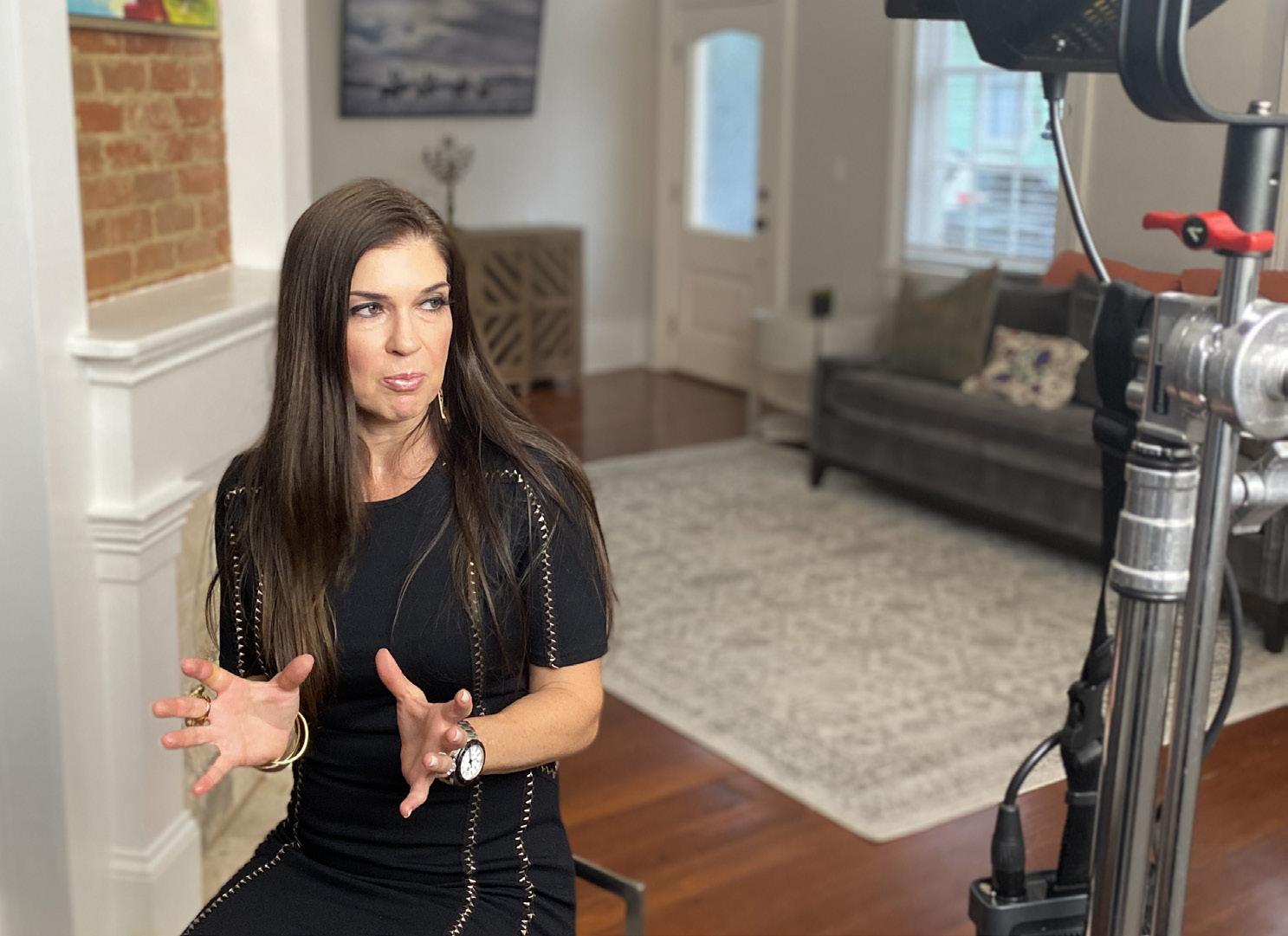
Menlo Alumni Carney Anne Nasser is interviewed by film crews. Photo courtesy of Carney Anne Nasser
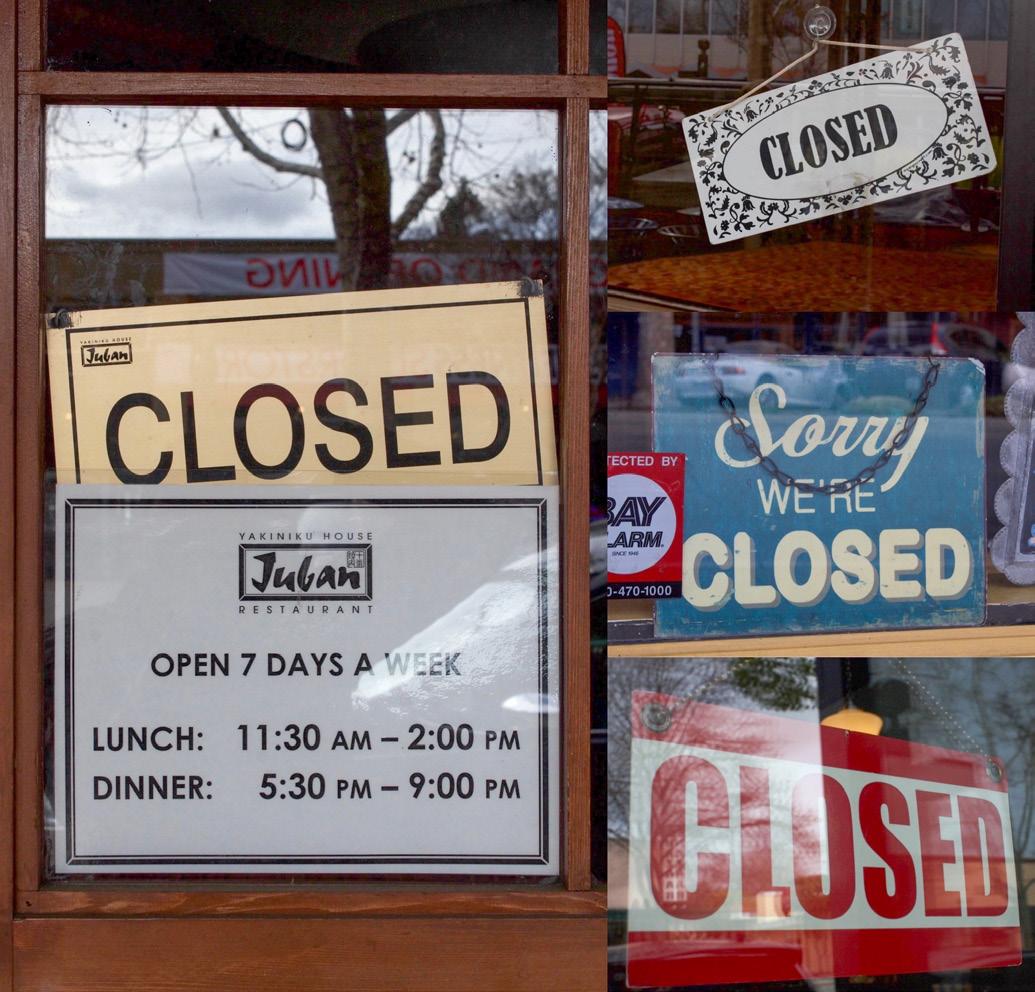
Closed signs hang on the doors of many businesses in downtown Menlo Park, which were forced to close as a result of the pandemic.
Photo collage by Reena Kagan
Let There Be Light: Menlo Football Granted Temporary Lights
by ARI KRANE
Most of the Menlo Upper School football program, along with Upper School Athletics Director Earl Koberlein and Head of School Than Healy, met with the Atherton City Council on Dec. 2 to deliberate Menlo’s request for temporary lights during practice this season. After hours of discussion, the Council members approved Menlo’s request, giving the football program the ability to practice for longer periods of time.
In December, the California Interscholastic Federation (CIF) postponed the official start of football season to January, at the earliest. Now that football has the approval to practice, the early sunsets pose a different problem: football, normally a fall sport, does not have enough time to practice with the lack of daylight. To combat this, football coaches, players and Menlo administrators rallied together and advocated for an exception to the no-lights policy currently in place.
“It is critical [to have lights] because in order for Menlo to have success on the football field, we have to teach the core fundamentals in a safe manner,” JV football head coach Noah Lubarsky said. “The only way we’d be able to teach the rising freshmen to tackle is if we had access to a field with lights.”
Given the early winter sunsets, the practice times would be cut close to 45 minutes without lights. Atherton City Mayor Elizabeth Lewis empathized with the challenges that Menlo would face and voted in favor of the temporary lights. “The school has been very reasonable and thoughtful,” Lewis said. “I have a heart for kids and a heart for sports, and I think that it is important [for them to play].”
Additionally, Lewis voiced concern with
the excessive noise pollution from the generator that would power the lights. “Standing right next to the generator at Cartan field, it is way over the decibel sound limit, but it is further away from the housing,” Lewis said.
The Atherton City Council unanimously passed the request for temporary lights, and the Atherton Planning Commission did so as well on Dec. 28. “[The Planning Commission] asked very good questions and did a thorough job of vetting the approval process,” Lewis said.
Along with Lewis’s concerns, three neighboring residents officially spoke in opposition to the request for temporary lights. In support however, 16 coaches, players, alumni and parents expressed their feelings about the temporary lights and even shared stories about the importance of football.
Junior Josh White moved from a school in the United Kingdom to Menlo prior to his sophomore year and joined the football team a few weeks into the season. “I had no history in football [...] and made friends during the season,” White said. White expressed the difficulty he had making friends at first and credited football with helping him “both physically and socially.”
White made a “split-second decision” to speak in the Atherton City Council meeting in favor of the temporary lights after being inspired by coaches and teammates who spoke before him. “I think the benefits that I’ve gotten out of football made me want to give input to the conversation,” White said.
“I talked about being a foreign student who hadn’t had really any experience with football or school in the U.S. [...] I [explained that I] joined a program full of guys who had already situated themselves, but they embraced me and helped
me work my way into Menlo,” White said.
White was among nine students who discussed the impact Menlo football has had on them, and the significance of having lights during practices. Seniors Brady Kline, David Corsinotti, Elliot Kinder, Ronier Babiera and Chris d’Alencon and juniors Will Murphy, Saaz Ahuja and Griffin Perks all contributed their opinions to the Council meeting.
The discussions lasted multiple hours
and concluded with Menlo football securing permission for lights until March 14, 2021. Given the multiple postponements of the football season and the possibility for further postponement or cancellation all together, it is unclear if football will even have the opportunity to play at all. Even so, the football program celebrated their small victory during Zoom meetings and are scheduled to practice under the lights during the weeks to come.
The Steezy Stepbros: Menlo Students Connect Over Skateboarding
by VALENTINA ROSS
The first time sophomore Trey McNair picked up a skateboard was in the seventh grade. Every day after school for two hours he would skate. Skateboarding became an outlet for McNair when he wanted to get his mind off anything. “I skate because it’s an escape for me. Whenever I have problems or if I’m tired of school, I just go and skate,” McNair said. As a result of online school, McNair has been able to skate more and improve his skills.
Junior Max Peña started skateboarding on Thanksgiving of 2011 after he saw one of his friends skateboarding. Similar to McNair, Peña feels that skateboarding functions as an escape for him. “It’s something you don’t have to think about. You just go and do whatever you want and have fun. It’s important to get outside and take your mind off things,” Peña said. Peña tries to skate everyday. At 11 years old, junior Josh White picked up skateboarding for the first time when he
lived in the U.K. and would skate at skateparks with his friends. Flash forward to the summer of 2020: White began skateboarding more seriously with his friends Peña and juniors Mick Tamas, Ben Banatao and Carter Jung. “I was really bad at the beginning, [...] so I started skateboarding at this middle school near my house. I would skate off curbs and stuff just to try and get used to the board again,” White said.
Skateboarding helped White bond with some of the boys in his grade when he first
transferred to Menlo as a sophomore. “I forgot how much fun it was to skateboard. Because I had never learned any tricks in the first place, I discovered a whole new side of skateboarding that was a lot more fun than just going up and down ramps,” White said.
Similar to White, Tamas took skateboarding more seriously when he started skating with Peña, McNair, Banatao, White and Jung. “When Josh came to Menlo from the U.K. he didn’t have many friends, so we bonded over skateboarding,” Tamas said.
The juniors knew a group of people who skated, and Peña and McNair met each other through baseball. “The week before school started, we all decided that we would go to Stanford to meet up and skate together. We ended up having a lot of fun and decided to make an Instagram account. Ever since then we’ve started meeting up and skating on the weekends,” McNair said.
Together they formed The Steezy Stepbros. On their Instagram account, @steezy. stepbros, they post montages and clips of them messing around and hitting tricks. According to McNair, Jung came up with the name. “Steezy means stylish,” McNair said. “If I did a trick and it looked really cool I would say it is steezy. And then stepbros is just a funny word that goes well with steezy.”
There is the main group who skates every weekend, but sometimes other skaters from other schools tag along. Steezy Stepbros is not an official group or title but simply a nickname for a group of friends. “[Steezy Stepbros] has no real significance. It’s just kind of a funny name,” Peña said. “We just like skating together and having fun. Not much to it.”
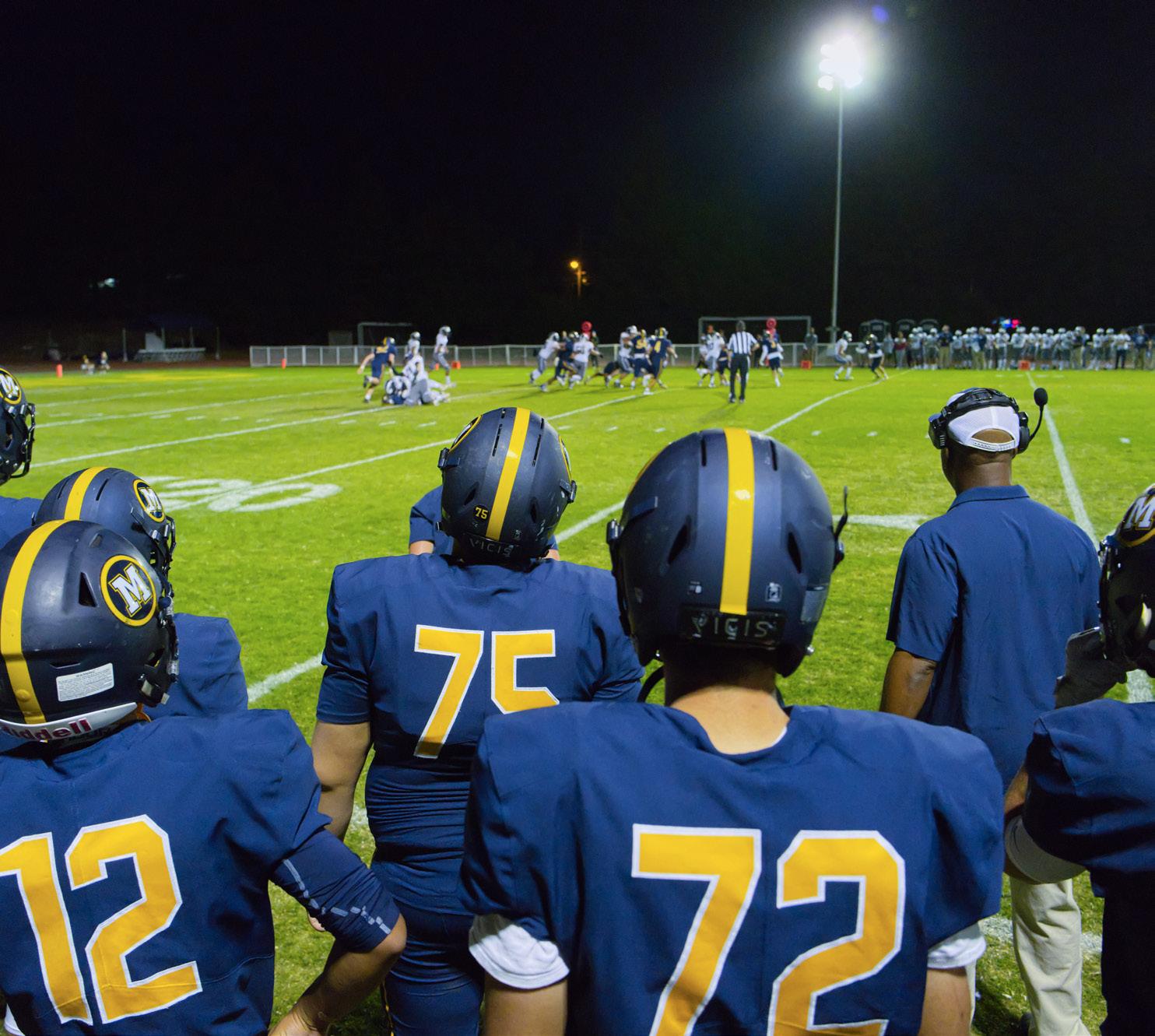
Menlo football players watch their team from the sideline as lights shine over the field during the 2019 Homecoming Game. After hours of discussion with the city council, the Menlo football team’s request for temporary lights on their field was granted. Photo courtesy of Cyrus Lowe
Max Peña gets together with his friends at schools, parks and various other places nearly every weekend to skate. According to Peña, skating has given him and his friends something to bond over. Photo courtesy of Max Peña
Calvin Katz, Yale University COMMITTED CORNER
by DANIELLE MCNAIR
Senior Calvin Katz committed this past September to run Division I track and cross country at Yale University. Katz has been on both varsity track and cross country since he transferred to Menlo School his junior year.
Katz began running track and cross country in 8th grade after the running coach at his middle school watched one of his soccer games. “He told me that I should try out running since I was always sprinting up and down the soccer field,” Katz said. “I was still pretty hesitant to try running; however, after fracturing my pinky [finger] from basketball, my choices were ei-
ther not playing a sport or trying running.”
Throughout high school, Katz has developed a serious passion for track and cross country. “I’m super passionate about running because it allows me to be fully in tune with my body, push myself to the limits, get out in nature [to] explore the wildest places and meet a lot of fun, new people,” Katz said.
It was not until junior year that Katz felt running at the collegiate level was an attainable goal. “During my freshman and sophomore year at Sacred Heart School, running in college seemed way out of my reach. I didn’t think I was good enough; the idea of running in college seemed foreign and impossible,” Katz said. However,
“I’m super passionate about running because it allows me to be fully in tune with my body, push myself to the limits, [and] get out in nature [to] explore the wildest places.” After receiving the motivation he needed, Katz decided that running in college was his ultimate goal. Photo courtesy of Pam Tso McKenney
his junior year at Menlo, Katz received the motivation he needed to decide that running in college was something he really wanted to do. “From that point on, I fully committed to training and began thinking about what I had to accomplish to make that dream a reality,” Katz said. Katz credited Menlo’s track and cross country coach, Jorge Chen, with helping him grow into the person and athlete he is today. “[Chen] is the person who motivated me, supported me and pushed me throughout my journey as a runner. My freshman and sophomore year, I had been a somewhat timid and unconfident runner, but thanks to [Chen’s] coaching and mentoring, I have developed into a much more confident competitor and [have] run my
Stella El-Fishawy, University of Chicago
by DANIELLE MCNAIR
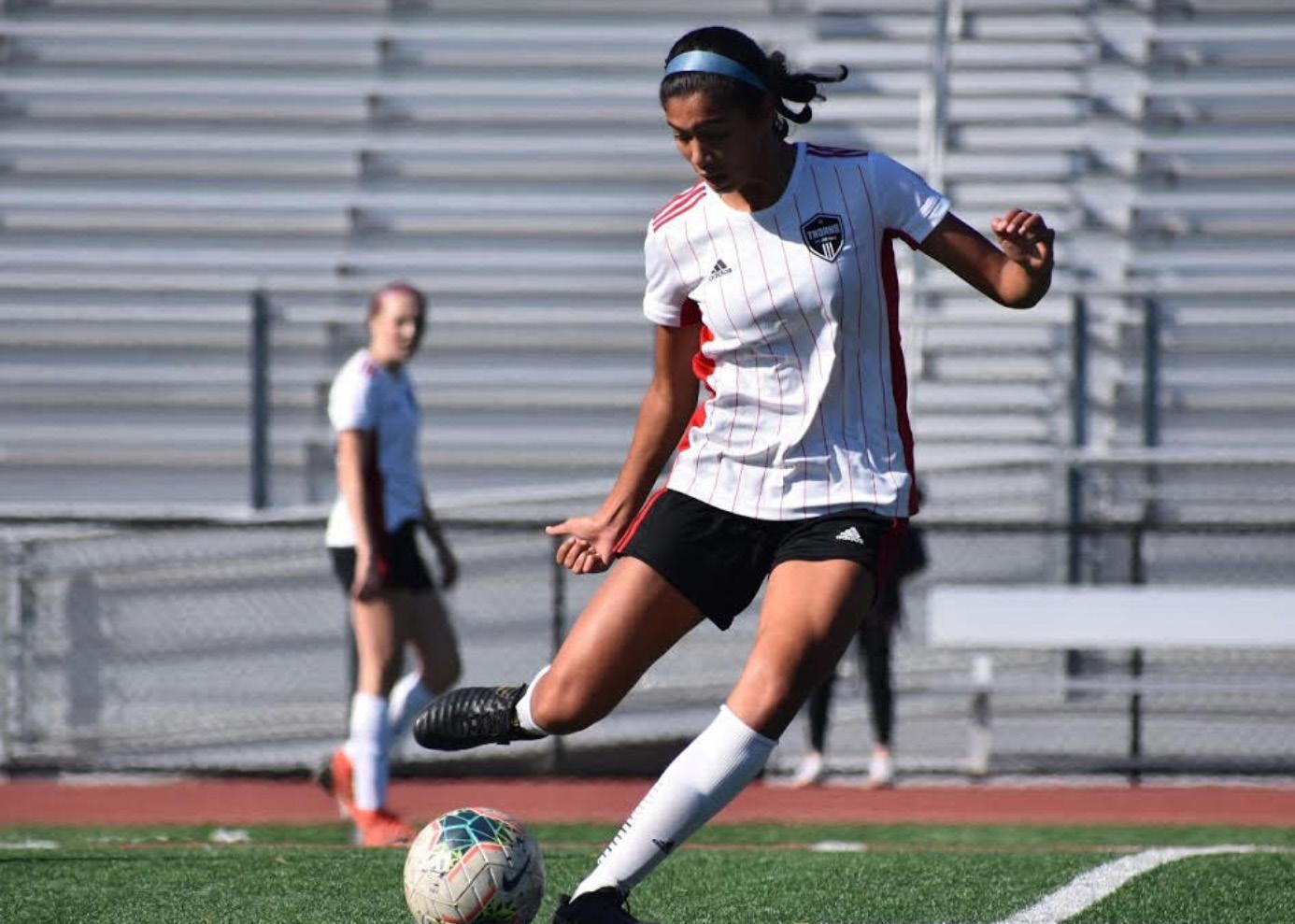
Senior Stella El-Fishawy committed in 2020 to play Division III soccer at the University of Chicago next fall. El-Fishawy currently plays for De Anza Force Elite Clubs National League and has been influential in the success of Menlo’s varsity girls soccer team.
El-Fishawy began playing in the American Youth Soccer Organization (AYSO) at the age of five. “My dad coached me a little bit growing up, but at the time I still played basketball and other sports,” El-Fishawy said. “But I realized I really loved soccer in fifth grade and began playing competitively from then on.”
El-Fishawy shared that her passion for
“I realized I really loved soccer in fifth grade and began playing competitively from then on.”
soccer stems not only from the game but also the people she plays with. “When you have been teammates for so long, you form a connection with your teammates. We root for each other and always want to play the best [we] can for each other.”
El-Fishawy is a talented player who at-
heart and soul out every race,” Katz said. When it came to deciding on where Katz wanted to continue his running career, he chose Yale University. “Firstly, when I visited the campus last February, I was blown away. The facilities were unbelievable and the people I met were super welcoming and seemed like people I wanted to collaborate and study with,” Katz said. “Yale also has highly regarded programs in environmental studies and environmental engineering, those being the subjects I want to major in.” Katz got a great feel for the running team through talking with the coach and the team members and looks forward to running alongside his close friends Robert Miranda (‘18) and Kyra Pretre (‘20) next fall.
tributes part of her success on the field to influential coaches on her club teams throughout her career. “My coaches, Gary and Carine Ireland, taught me how to be disciplined, but they also instilled a competitive fire in me,” El-Fishawy said. “My current coach, Lloyd Grist, made the game even more fun. He allows an open play style that makes me more creative.” El-Fishawy believes this asset will help her succeed at the collegiate level.
Ever since she began playing competitively, El-Fishawy knew she wanted to play in college. “I wanted to play soccer in college because I saw a lot of the older girls doing the same thing and it seemed like a great experience,” El-Fishawy said. She also
emphasized that she wanted to continue her soccer career because she could not imagine life without soccer. “I want to be able to play as long as I can,” El-Fishawy said. El-Fishawy ultimately chose the University of Chicago because she feels it has the perfect balance between rigorous academics and a strong soccer program. “According to the girls on the team, there is a great culture on campus and the coach was always nice and welcoming. She always made me feel really at home,” El-Fishawy said. El-Fishawy always dreamed of going to college near a big city, and she looks forward to being close to Chicago and taking advantage of what the area has to offer.
Katz credited Menlo’s track and cross country coach, Jorge Chen, with helping him grow into the person and athlete he is today. “[Chen] is the person who motivated me, supported me and pushed me throughout my journey as a runner.” Photo courtesy of Allison Virsik
El-Fishawy currently plays for De Anza Force Elite Clubs National League. She emphasized that a life without playing soccer in college was unimaginable for her. Photo courtesy of Stella El-Fishawy
El-Fishawy attributes a lot of her success to club coaches Gary and Carine Ireland and Lloyd Grist. “[They are] strict and taught me how to be disciplined, but they also instilled a competitive fire in me.”
Photo courtesy of Stella El-Fishawy
“The
Queen’s
Gambit” Captures Viewers: Chess is Making a Comeback during the Pandemic
by MADISON LIU
Although chess has long been a popular pastime, it has never been as popular or had as large an audience as other professionally played games such as soccer, basketball or even League of Legends. However, a recent Netflix series released in Oct. 2020 called “The Queen’s Gambit” has pushed chess into the spotlight and greatly increased its popularity.
“The Queen’s Gambit,” a seven-episode series based on a 1983 novel by Walter Tevis, follows fictional chess prodigy Beth Harmon throughout her life as she attempts to become the best chess player in the world. The series is highly acclaimed by critics and, according to Netflix, is their biggest scripted limited series to date, garnering over 62 million views in the month after it was released on the streaming platform.
“The Queen’s Gambit” had a tangible effect on chess popularity. According to toy industry analyst Juli Lennett in a New York Times article, sales of chess sets grew 125% after the premiere of “The Queen’s Gambit.” More than 100,000 new members registered for a popular online chess website, Chess.com, each day in November — five times more than average, according to Nick Barton, Chess.com director of business development, in an interview with Business Insider.
The show and resulting media attention have also inspired several Menlo students to learn how to play chess. “I’ve watched ‘The Queen’s Gambit,’ and I think seeing it on TikTok and hearing so many people talk about it made me want to learn chess,” junior Uma Misha said. Misha began playing chess at the end of last year.
“The Queen’s Gambit” isn’t solely about chess — other themes, including substance abuse, family and gender were highlighted, which resonated with sophomore Taara Banerjee. Banerjee learned to play chess in second grade at her school’s chess club, where she was the only girl. “[Beth] was the only girl playing chess and she played
against all boys, which was my connection to the show and what inspired me to play more,” Banerjee said. Even to experienced players, “The Queen’s Gambit” was still captivating and intriguing.“What I liked about [‘The Queen’s Gambit’] is that they used actual games that were played by masters and the chess terms and strategy they included were also real, so the whole show seemed very authentic,” math teacher Henry Klee said. Klee has played chess for most of his life and previously advised Menlo’s chess club.
Aside from drawing in new players, “The Queen’s Gambit” also changed public perception around chess. “I think that [‘The Queen’s Gambit’] definitely had an impact on the rise in chess popularity,” Misha said. “Chess is kind of branded as a nerdy or geeky thing to do and the show has rewritten the narrative around chess and made it seem cooler.”
A second factor in the rise of chess popularity is Hikaru Nakamura, an American
chess Grandmaster (the highest rank a player can achieve) who is ranked first in the world for blitz chess (International Chess Federation) and is also one of the most popular chess streamers on Twitch. With over 889,000 Twitch followers and 702,000 YouTube subscribers, Nakamura (@gmhikaru) has played a major role in increasing the visibility of chess and bringing it to a larger audience. “Everyone doesn’t have their whole life to spend playing the game, so for me, it’s more important to bring the game to everyone,” Nakamura said in a Twitch stream.
Another popular chess YouTuber named Antonio Radić, better known as Agadmator (@agadmator) has over 971,000 subscribers and makes analysis videos about matches that are easy to understand for all skill levels. “I’ve watched [Agadmator] a lot. He has broken down a lot of the games from ‘The Queen’s Gambit’ which were interesting, and he is always very energetic and enthusiastic,” Klee said. Even after this initial boom in chess, people continue to play because it is a way to connect with others. “I think chess has definitely been a good activity to do with friends, and it’s also been a good way for me to connect with my parents too, so it does have a unifying factor,” Misha said. The main reason chess has become so popular is not because of a TV series or YouTube but because the game is so complex and unique. “Just when you think you have chess figured out, you realize you don’t know as much as you thought,” Klee said. “Chess is one of those things that you work your whole life to try to get good at it, but you can always get better.”
Staff illustration: Dorinda Xiao
Increase of Female Coaches in Menlo Community and Professionally
by PARINA PATEL
In recent years, there has been an increase in female coaches in male sports leagues. San Antonio Spurs assistant coach Becky Hammon, San Francisco Giants coach Alyssa Nakken and Miami Marlins general manager Kim Ng are all women who have made great strides in opening up opportunities for women and girls all over the world.
For Menlo’s Head Athletic Trainer Aubrey Fennell, these hires are a step in the right direction. “If we see women coaching, then younger girls are going to grow up with the idea that they can be a coach too, which I think is relatively new for our youth,” Fennell said. Fennell noted the disparity in our own Menlo community. Among all of Menlo’s girls teams, there is only one female head coach. “I think there still needs to be a shift of just thinking that males are the
only ones who can coach,” Fennell said.
“Definitely there’s a lot more work to do, and it’s not just at the professional level.”
Freshman Brooke Stroh was introduced to lacrosse by her dad and brother, and she grew up playing with them, who she noted were older and “obviously better” than Stroh. “I’ve kind of grown up with the idea that boys are better at sports, so to make this leap and to have women be such leaders in men sports is a really big thing for me,” Stroh said.
Menlo girls volleyball coach Tony Holland especially recognizes the disparity as a male coach for girls teams. “If you look at D1 college volleyball, all the men coach that. [There are] a few women here and there, which is unfortunate because I’ve been coaching women since 2008, and it’s always been important to me to be on a staff
that has women on the staff,” Holland said.
“I think [the female hires] are long overdue. John Dunning and Russ Rose, two of the most successful volleyball coaches in the last 20 years. Neither one of them played volleyball, and they were very very successful. So if they could figure out how to get to the top level of our sport collegiately, sending kids to the national team to represent us, then I don’t see why it would be unexpected that a woman could coach men’s basketball or football because it’s about learning. It’s about being able to apply yourself and understanding the Xs and Os and understanding the team management and all those things,” Holland said.
Menlo girl’s assistant basketball coach Melanie Murphy goes beyond male sports leagues, explaining that it is imperative that men are supporting roles
in a woman’s successful career because we live in a man’s world. In the context of the NBA, respectable and great players like Stephen Curry and late Kobe Bryant showed their support to girls and minorities who are unrepresented in the basketball world; Curry came out with a girls version of his sneakers, and Bryant wore a WNBA sweatshirt to a Lakers game.
“Women will continue to have a platform, and that platform will continue to grow, especially in the way male players view women. A lot of male players that are actually good players respect women sports. It’s typically the everyday male who can’t play who are the ones who are more biased against females,” Murphy said. “I think our entrance into the male’s game will be more and more as time goes on because the respect is there at a professional level.”
Lessons Learned From Menlo Athletic Department’s Wellness Program
by DANIELLE MCNAIR
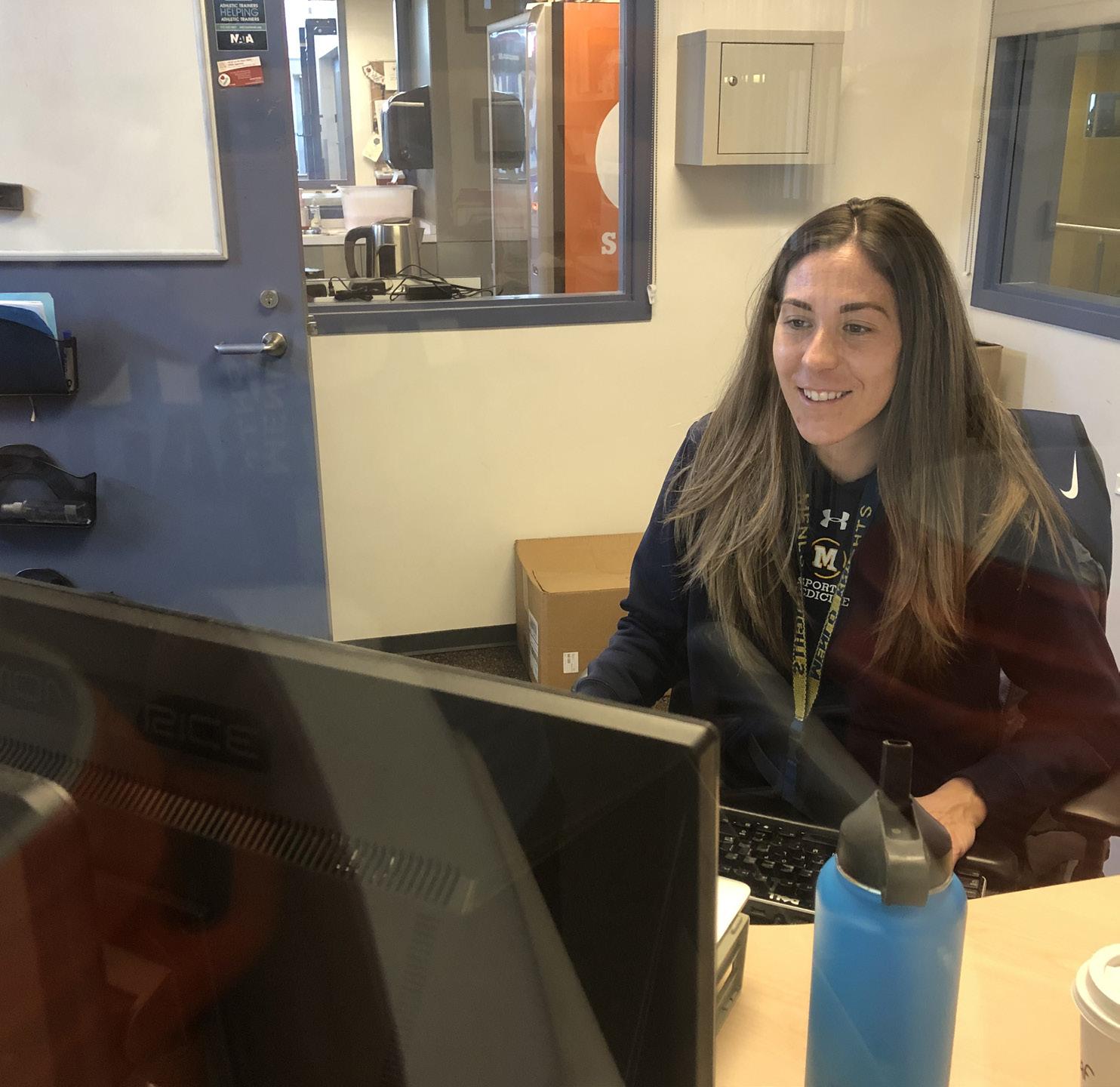
Head Athletic Trainer Aubrey Fennell and Assistant Athletic Trainer Stephanie Swan partnered with Director of Sports Performance and Wellness Jesse Lindenstein and strength and conditioning coach Sam Leeper to create a virtual Wellness Program at Menlo that teaches the community about maintaining a healthy lifestyle and staying physically fit during COVID-19.
The program emphasizes the Menlo Athletic Department’s mission and values: “Pursuing excellence, celebrating team, honoring the game and upholding strong values.” When Fennell and Swan started to brainstorm for the Wellness Program, they hoped to provide information to coaches, athletes and parents in the Menlo community to help them perform their best on and off the field. “We asked ourselves the questions, ‘What are students not learning because their practices are no longer in-person?’ and ‘How can we help improve our student-athletes’ experience at Menlo?’” Swan said. “My only hope was that students take away little pieces of information each week that they can implement in their life to improve their health and wellbeing.”
Members of the Menlo community have been attending these virtual meetings weekly to learn more about themselves and ways to improve their style of living. “Through attending the Wellness Program, I learned the importance of taking care of your body. How you treat your body directly impacts your performance in sports, whether it is making sure your body is properly nourished with plenty of water and a balanced diet or getting enough sleep,” sophomore Chris Liao said. Junior Hanna Hoffman shared that her biggest takeaway was about how train-
ing to prevent an injury can be more important than maxing out her energy and strength during each workout. “It’s hard to always give 100% effort, and it’s not sustainable. Not to mention that your body needs off days or training sessions that are physically less demanding but equally as important,” Hoffman said. “Before hearing [Fennell and Swan] talk about this in the Wellness Program, I thought in order for your workout to count as ‘good,’ you need to feel sweaty and exhausted, but now I know that’s not the case.”
The Wellness Program has featured guest speakers from within the Menlo community, as well as from the local community. Upper School counselor Jake Fauver spoke as a guest about the importance of sleep and a routine sleep schedule. “Mr. Fauver’s talk about sleep and sleep cycles was really helpful because I did not previously understand how the different stages of sleep function,” senior Roxy Karrer said. “I also thought it was nice to learn about the effectiveness of naps depending on what kind of energy you need.”
“The information regarding our sleep cycles was something I learned a lot about,” Menlo varsity girls volleyball coach Tony Holland said. “Specifically, what happens with the cycle when our sleep is interrupted.”
Fauver’s talk also resonated with Hoffman. “One takeaway from this talk was how critical sleep is not only [for] your performance but also preventing injury,” Hoffman said.
Social media influencer and mental health advocate Victoria Garrick spoke as a guest about body positivity and body image in athletics. “I think one of the most important lessons was that bodies can and will look different between different sports or different positions,” Karrer said. “As an
athlete you need to train your body to best suit your own unique athletic needs, such as training to jump higher as a front row volleyball attacker versus training quick lateral movement as a defensive player.” Garrick emphasized that striving to perform your best and feel your best is far more important than training to fit a beauty standard. Junior Simone Adam summarized what Fennell and Swan hoped the community
would learn in her takeaway. “There are so many aspects to an athlete’s life that can either help or hinder their performance on the field or court. Before the wellness program, my mindset was that training and playing were the most important, but I’ve learned that things like mindset, a healthy and balanced diet, a good amount of sleep and staying hydrated are also vital for success in your sport,” Adam said.
Fennell leads a wellness talk. Swan and Fennell launched the Wellness Program over Zoom last fall to teach the Menlo community about health and fitness. Photo courtesy of Aubrey Fennell
Staff ilustration: Sophie Fang
Accountability Extends to Politicians, Not Just Celebrities
by guest writer Jack Rosenberg
“As hard as Democrats try, they can’t cancel our heroes [...] they can’t contest their bravery, and they can’t dismiss the powerful sense of service that lives deep in their souls […] Joe Biden, Kamala Harris and their radical allies try to destroy these heroes because if there are no heroes to inspire us, government can control us.”
This statement from the 2020 Republican National Convention by Sen. Marsha Blackburn from Tennessee is two things. First, it is an argument for voting for Republicans in the November election. As a convention speech, its main purpose is to rile up the base to get people out to vote. However, more importantly, it exposes a dangerous trend in politics: fear-mongering about the supposed ‘cancel culture’ crisis. Referring to police and military officers, Blackburn asserts that liberal America is attempting to “cancel our heroes” by rallying for sweeping police reform and corrections of racial injustice; however, these consequential issues are clearly not akin to the sort of pettiness we have come to associate with social media’s cancel culture. Cancel culture is founded upon the principle that, since celebrities are made popular by the people, if celebrities do not live up to the collective expectations set by their fame, they can be rightfully deplatformed. That’s why I disagree with the notion that we have a cancel culture problem in the first place. In the James Charles incident in 2019, Charles lost millions of fol -
lowers after fellow beauty YouTuber and former mentor Tati Westbrook levied accusations of sexual misconduct by James to other men. While the claims were later disproven (and Charles regained his subscribers), in the moment it made sense for Charles to lose his celebrity— serious allegations deserve serious responses. Cancel culture implies a petty, trigger-happy public who is willing to crucify any and all celebrities for the slightest slip-up; however, since celebrities exist under the condition that their supporters admire them, when they are exposed for their misdemeanors, they rightfully get punished. Politicians that express a distaste for this idea simply fear their self-undoing by their bigoted policy decisions and racist words, as they know they are increasingly unpopular in a diversifying America. Therefore, new terminology must be adopted for issues of greater weight that currently reside under the cancel culture umbrella, whether in pop culture or politics. With the idea of cancel culture seeping into politics, it is more important than ever to create clear distinctions between the pettiness of social media drama and real political actions. Two definitions of cancel culture are being developed in parallel: one where influencers
Staffillustration:SophieFang
feel as though they deserve more chances for their wrong actions and one with deep political ramifications for the future of our country. Politicians should not be lamenting about cancel culture, as extreme issues, such as police brutality are too high-stakes and important to be a simple matter of character. Citizens protesting against police brutality don’t just dislike police officers; they acknowledge the severe systemic injustices so prevalent today, and the real deadly situations they create. So, as we do with our celebrities, we must hold our leaders accountable when they don’t perform in the ways that work for us. Instead of complaining about cancel culture, let’s shift our policy conversations to a more substantive, helpful place, where we can criticize our public figures and politicians for their actions without seeming frivolous, or quick.
CancelCulture Overshadows Real-WorldProblems
byRileyHuddleston
Whether you participate in cancel culture or watch from the sidelines, the extreme effects it can have on celebrities and influencers are unmistakable. Because people in the public spotlight are under more scrutiny than others, it seems that their every move, past and present, is expected to be perfect. Influencers, celebrities and politicians walk on their tiptoes trying to navigate a seemingly endless maze of what’s right and wrong. Without meaning any real harm, a simple comment on a livestream or to paparazzi can be reposted millions of times, allowing for throngs of users to drown them in hateful backlash. Meanwhile, bigger problems, such as issues ingrained within society itself, lose the attention they need. Another issue with cancel culture is the hateful language that accompanies it. Rather than focusing on the harmful actions it aims to stop, canceling usually results in people receiving hateful comments on unrelated topics, such as their appearance, content, family and more. Canceling encourages an online
environment of hostility and negativity that results in influencers and celebrities avoiding being canceled to avoid the negativity surrounding their image rather than just not wanting to be hurtful. In short, people should be canceled for repeated, purposeful and current harmful behavior. Whether it be the language they use or their actions, if they are causing physical or emotional harm to a group or an individual without apparent regret, they should be held accountable, and canceling may be appropriate. Cancel culture is fostered by two types of “cancelers:” those that genuinely hope to stop the spread of a hurtful practice through educating and those that are not qualified to speak on the issue at hand and merely join with large groups to spread unnecessary levels of hate. While we should continue trying to prevent practices and actions that harm others, we need to do it through deescalation, not escalation. Condemning people through negativity that includes no explanation as to why they were wrong, or is unrelated, undermines those who truly want to better society by teaching others. Canceling someone should be a last resort when they continue to ignore criticism and those trying to educate them. If a person demonstrates that they understand a mistake and move to improve in the future, allowing them to do better with their platform will foster a more positive online environment where people are allowed to learn from their mistakes. Canceling anyone who has ever made a mistake not only shuts down opportunities for us to grow but spreads the unhealthy idea that we are expected to always have been and always be perfect.
Online Posts Limit Privacy
user: charlotte palmer
“There is no delete key on the internet,” Menlo’s Director of Technology Gabe Schwarzer said. According to Schwarzer, once something is posted online, it could be available forever, so students need to be mindful of what they post.
Junior Jazlin Chen recently switched her Instagram account back to the private setting after having it set to the public setting since eighth grade. She had initially set it to public due to her interest in modeling. “Someone from modeling reached out and said it was better to have a public account because it’s more like a portfolio,” Chen said. “But I was so nervous because my mom freaked me out all the time. She was like, ‘People are going to kidnap you and message you all these weird things.’” Despite her initial misgivings, however, Chen soon found ways to regulate the people who followed her account. “I had an app to track it and I would go through my new following weekly or biweekly to filter out people I didn’t know,” Chen said. Chen has also gotten message requests from scammers who prey on young girls interested in modeling.
“I’ve had fake brand ambassadors who ask you to send photos of yourself to them,” Chen said. “The best thing to do is block them and not even respond because a lot of the time it’s an automated message.” Privacy is another issue Chen has struggled with online. Recently, she had procedures done that left her with a gap in her teeth. After posting images on her Instagram and TikTok accounts where the gap was visible, she started hearing rumors among Menlo students and students she had gone to middle school with. “People were saying that I got it done for modeling or that I liked the aesthetic of it. I didn’t have the privacy to have this [tooth gap] and just be done with it in a year and nobody would know,” Chen said. She decided to address the rumors in a TikTok video. “I made a video explaining it, and at the end I had a list of common questions and answers to them. I wanted people to ask me directly if they had questions,” Chen said. Because Chen has a following
on her public social media account, the public inevitably learns private details about her life. “You just feel like what you post is private, but it’s not,” Chen said. This sentiment is echoed by Schwarzer. “Whatever you put online will be available forever. These could be posts that come back to haunt a student later in life,” Schwarzer said. If a student wants to put themself out on the internet, Schwarzer recommends that they take steps to ensure their safety. “Make sure you talk to an adult who you really trust, and get their opinion on what you’re about to share online. If you feel unsafe, always talk to an adult,” Schwarzer said. He believes that parents and educators must do their part to help students navigate the online world. “You need to explain to them why something was not a good choice, but don’t judge them for it, or they won’t talk to you again. Students are going to be looking for role models, and adults need to be those role models,” Schwarzer said
Replies
Cancel Culture Causes Social Media Users to Shelter Their Opinions
user: kaylie
Social media platforms such as Instagram and Twitter are some of the fastest ways to spread opinions to their followers. However, voicing a controversial opinion on social media is more complicated than it seems, especially when the entire world can have access to what you write.
On social media, people are quick to attack statements they don’t agree with, whether the topic is something as light-hearted as food or as heavy as politics. In extreme situations, this leads to what is known as cancel culture. Anyone can be cancelled online in the matter of seconds for sharing an opinion that even just a few users disagree with. In 2020, a research study from Yahoo News concluded that 56% of Americans view cancel culture as a major growing issue.
In most cases, victims of cancel culture experience online harassment: one simple mistake has the power to cause rejection and hate from an entire community of people. According to a 2018 survey conducted by the Anti-Defamation League, one in three 12 to 17-year-olds experienced online harassment first-hand. Typically, people are cancelled for racist, homophobic and other discriminatory content. However, due to the rapid expansion of cancel culture in recent years, breaking social norms online can also result in more
potential problems — such as degrading mental health — than benefits. This toxic facet of social media has caused many users to be more careful about what they post on their accounts. Even if the user isn’t trying to communicate an offensive opinion, it’s easy for others to perceive posts in a different way than intended. Those who have already experienced online harassment fear it, and those who haven’t want to keep it that way.
One possible solution to prevent online harassment is the utilization of private accounts. A handful of social media applications such as TikTok and Instagram don’t require every user to operate public accounts. Instead, users can switch their accounts to the “private” setting. Owners of private accounts must approve or decline their follow requests, ultimately controlling who is able to view their published content. While this somewhat minimizes the chances of online harassment, it doesn’t necessarily stop it. Social media users can still view and shame the opinions of any account they follow — it doesn’t matter if the account is public or private. Additionally, followers of a private account still have the ability to screenshot and repost content for anyone to see.
Another strategy to combat cancel culture is to privatize your opinions rather than your account. Some social media users, especially popular creators, remain
silent about their perspectives regarding widely debated subjects in order to eliminate the risk of being cancelled. This form of protection proves how cautiously users must behave online even when expressing a reasonable opinion, highlighting the damage that cancel culture has caused to the online community. On social media, people are supposed to feel safe, not at risk of toxic cancel culture. In a perfect world, all users would feel compelled to share their voice without being disrespected or harshly singled out. However, with the continuous development of cancel culture, the gap between this expectation and reality seems to be increasing. Although social media users can take certain measures to lessen their chances of being cancelled, stopping cancel culture altogether is a more difficult task. This is because some people claim that cancel culture does not exist; according to a Forbes article written in Sept. 2020, many participants in cancel culture protect their hate speech using the 1st Amendment. Ultimately, cancel culture will not end until social media users learn to respect other people’s points of view — including the ones they don’t personally agree with. For now, people can individually contribute to a solution by keeping themselves from participating in this unhealthy practice and instead focusing on kindness, open communication and empathy.
wu
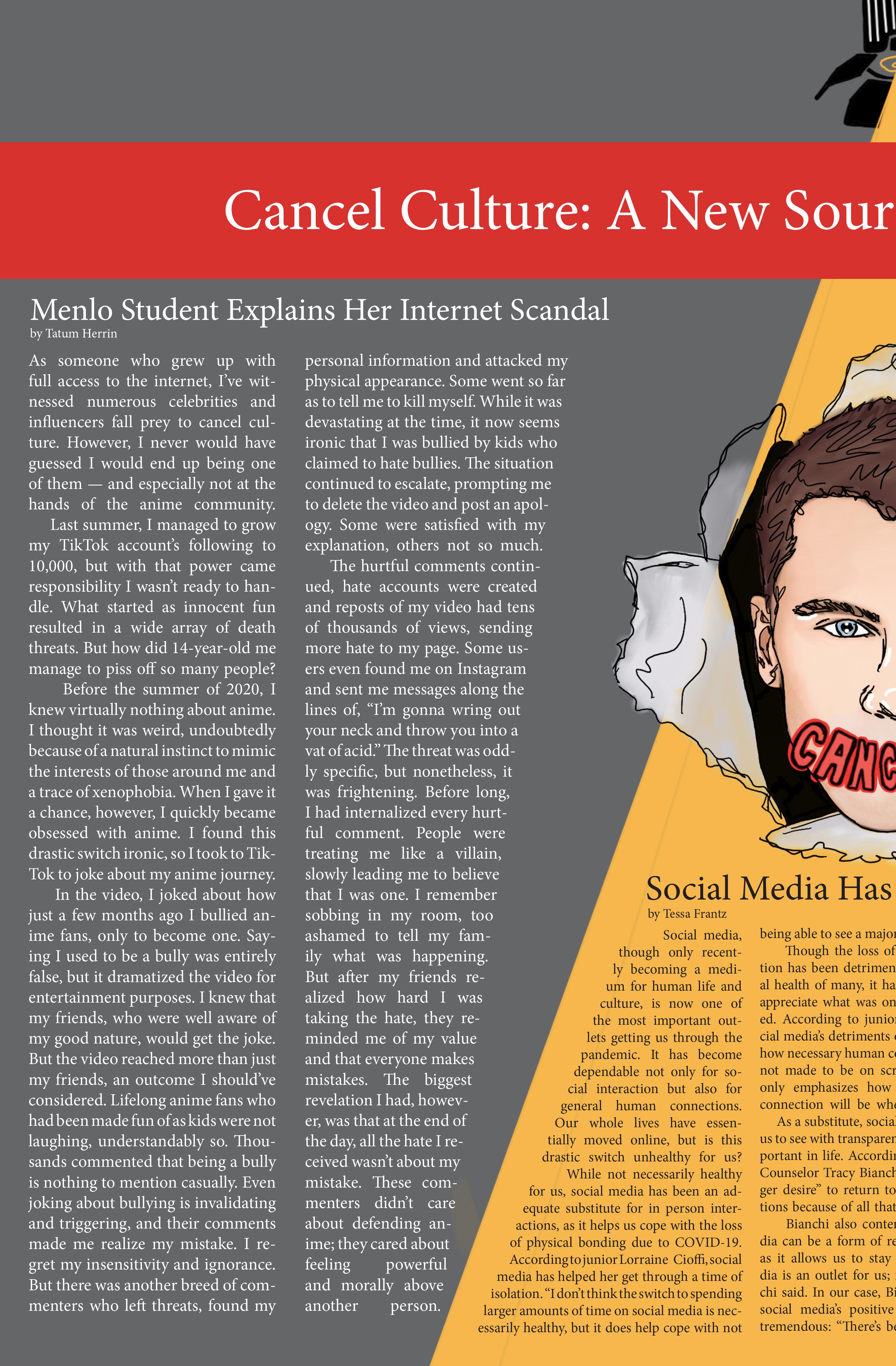
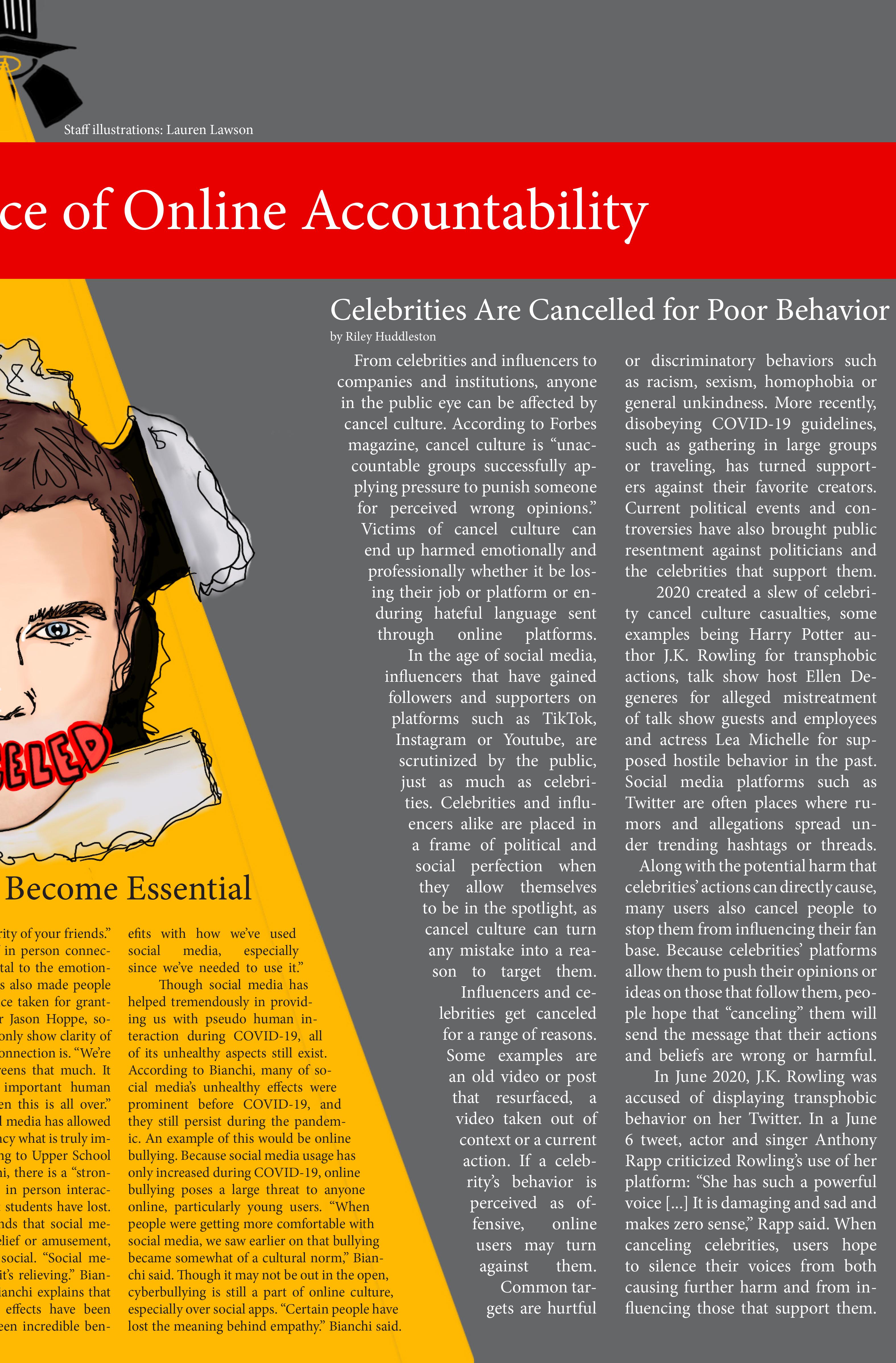
Staff illustration: Lauren Lawson
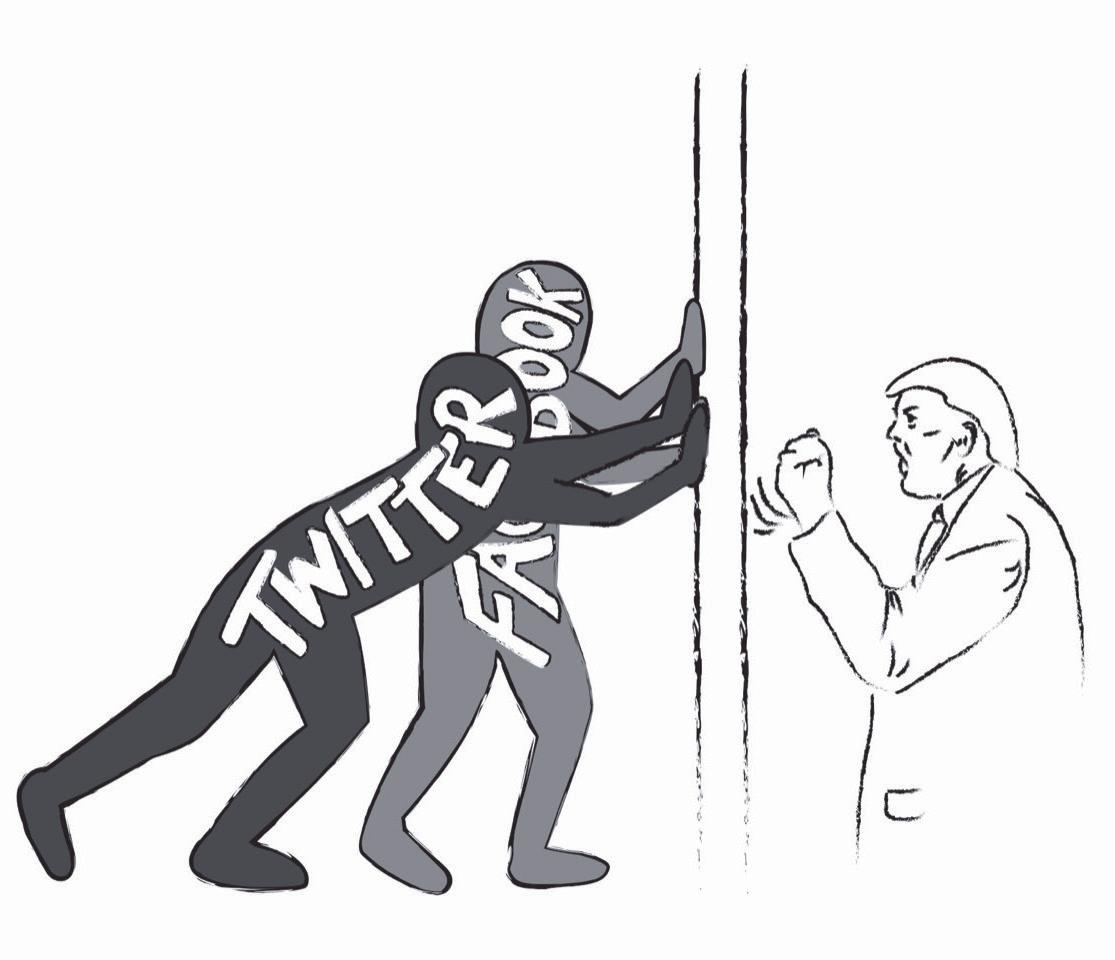
Should Social Media Applications Be Able to Ban Donald Trump?
Social Media Should Not Ban Trump
by PENELOPE STINSON
A Twitter troll is someone who posts “offensive, divisive or argumentative remarks” on Twitter with attempts to “unfairly warn people away from certain topics,” according to Forbes. Before Friday, Jan. 8, Donald Trump was a Twitter troll. He weaponized his Twitter account, capturing the attention of his 88.5 million followers and flagrantly spreading misinformation, according to Vox. However, on Friday, Jan. 8, two days after the deadly Capitol Hill Riots, Twitter decided they would not give Trump a platform anymore and banned him from the app.
Although it’s true that Trump abused his Twitter account and spread falsities about the results of the election, among other things, banning him from Twitter was not the right decision to make in order to damper the violence spread by his supporters. More importantly, it certainly won’t prevent another tragedy similar to the one that occurred at the Capitol.
After Twitter banned Trump, his supporters flocked to apps such as Parler, an alternative social media platform similar to Twitter mainly used by conservatives, where they wouldn’t have to worry about being censored, as they believed they were on Twitter, according to The New York Times. Parler quickly became one of the most downloaded apps on the Apple App Store, and the app was filled with enraged right-wing users, even including U.S. senators.
Banning Trump from Twitter only encourages his followers — especially farright conspiracy theorists — to find other platforms that don’t regulate their speech or ban their “leaders.” This process only leads to more violence, conspiracy theories and disinformation. Instead of banning users who spread misinformation, Twitter should be placing more warnings and factchecks on their Tweets. It’s true that Twitter has done this in the past with Trump’s tweets, but they should have done it more aggressively and should continue to do so more aggressively. They only started factchecking Trump’s tweets in May of 2020, according to CNN. Although this change isn’t a perfect situation, it’s really one of the only options Twitter has left. Twitter needs to be careful about banning people who spread misinformation because those people will only find other platforms, such as Parler, where their misinformation can’t be fact-checked.
There’s also a difference between false information and language that incites violence. When Twitter banned Trump, they claimed that he was inciting violence and therefore fell under their Glorification of Violence policy, a policy which aims to prevent the glorification of violence that could inspire others to replicate dangerous acts. But, in reality, they were really just saving face in a tense situation. If they had
If they had truly cared about preventing violence and conspiracies, they should have banned and fact-checked Trump years ago, according to USA Today.
truly cared about preventing violence and conspiracies, they should have banned and fact-checked Trump years ago, according to USA Today. The Tweets that Twitter chose
to ban Trump for were certainly false but not enough to incite violence. For example, one of the Tweets Twitter claimed incited violence was: “To all of those who have asked, I will not be going to the Inauguration on January 20th.” This Tweet, while
This Tweet, while rude and egotistical, never clearly indicates any need for violence or chaos.
rude and egotistical, never clearly indicates any need for violence or chaos.
However, for the Tweets that truly and explicitly incite violence and chaos, Twitter should choose to block them. Nonetheless, the issue with these Tweets is that many of them just broadcast a pre-existing
Social Media Should Ban Trump
by CHASE HURWITZ
First things first: I have to laugh a little bit at Donald Trump’s social media ban. He barely even has access to the Internet. My three-year-old cousin has the same restrictions on the family iPad as the president. Even Pinterest banned him. What kind of Pinterest mood board could Trump post that could incite violence? Despite some of the humorous repercussions, the circumstances in which this ban occurred are slightly less amusing.
Firstly, nowhere in the Constitution, case law or administrative regulations are statements regarding the right to a social media account. Regardless of how one may feel ethically about Trump’s ban, it’s hard to argue it was illegal.
The only sane legal argument I’ve heard criticizing big technology companies’ response to Donald Trump was some kind of First Amendment violation, which is easy to disprove. The first amendment states:
extreme rhetoric. For example, this rhetoric is already prevalent on other sites such as Parler where dangerous, white supremacist groups can form violent plans in more discreet servers than Twitter. Simply blocking
Simply blocking Tweets and banning people won’t prevent attacks such as the one in the Capitol.
Tweets and banning people won’t prevent attacks such as the one in the Capitol. Many of the violent plans implemented by rioters at the Capitol were formed on Parler. The issue of censorship on social media platforms is, first and foremost, that it spurs division, especially in today’s polarized climate. It’s dangerous for social media platforms to ban important political figures, as problematic as they are. It shows that social media companies have decided it is acceptable for them to make editorial decisions, according to BBC. In the end, it gives them the power to decide which political party has a platform, fostering problematic political disagreement.
“Congress shall make no law respecting an establishment of religion, or prohibiting the free exercise thereof; or abridging the freedom of speech, or of the press; or the right of the people peaceably to assemble, and to petition the government for a redress of grievances.”
It’s right there in the first word: “Congress.” Twitter is not Congress. Just as Donald Trump has the right to free speech, Twitter — a private company — has the right to ban members who don’t comply with their rules.
Ira Glasser, former Executive Director of the American Civil Liberties Union (ACLU) roughly equates Twitter to publishing companies. Just as the New York Times, for example, has the right to publish whoever they want and fire whoever they choose, Twitter has the first amendment right to do the same.
I follow the rules of private companies all the time. When I walk into a grocery store, I don’t just eat my food and then leave without paying. I know not to do that because that’s just not how grocery stores work. They never explicitly told me not to eat their food, but I can use my best judgment. The difference for the president is that Twitter explicitly lays out their rules
and makes you sign a contract.
When Trump setup his Twitter account, he signed the Terms of Service like every single other user. Why should the president be above the rules of a private company? That’s like saying Trump should be allowed to walk into an ice cream parlor and scoop out a cone of vanilla with his bare hands (only after he signed a contract stating he explicitly would not scoop vanilla ice cream with his bare hands). It goes against common sense and a written obligation.
Moral issues with this ban are justified, but legal ones are not. Personally, I’m concerned that big technology companies, although within their legal boundaries, are amassing too much power. I’m not sure we should leave it up to the billionaire CEOs to decide who the bad guys are that need banning. Around the globe, it sets a dangerous precedent for political opponents in oppressive countries who could be blocked from their following.
Nonetheless, in the short term, I’m glad Trump is off Twitter, or any social media. But this is not new; many of Trump’s supporters, such as Alex Jones, Roger Stone and Steve Bannon, have been kicked off Facebook, Twitter or both for inciting violence, threatening journalists and spreading hatred. The social media platforms are stripping Trump of his presidential privileges and finally treating him as just a regular user.
Trump’s Tweets of election fraud had been kindling and enabling his supporters’ anger, leading up to the events of Jan. 6. He and his bootlickers helped create the Capitol riot, and I don’t think that should go unpunished. Completely unavoidable deaths occured because Trump could not cope with losing an election even after los-
Completely unavoidable deaths occured because Trump could not cope with losing an election, even after losing dozens of judicial system cases.
ing dozens of judicial system cases. I’m glad he no longer has a platform to spread blatant misinformation.
What if Trump had Twitter during the impeachment? Or during Biden’s inauguration? One rogue Tweet could have sparked a whole other riot. Taking away his platform was like taking matches away from an angsty teenage boy — safety precautions.
Despite all this, I think all of this is too little too late. I’m not proposing a different solution to curb Trump’s destructive presence online, nor am I claiming I even have one. I’m just saying the damage has already been done. There are people who would go to war for Donald Trump. Some of these people believe all Democrats are pedophiles, enhancing themselves with child blood sacrifices.
These sentiments will exist far after Trump’s gone from office, but he wasn’t even the one who created them. The sense of disenfranchisement had been festering for years, Trump just took advantage of it. So ban Trump from Twitter to avoid any further inflammatory claims. But this isn’t a long term solution at all. We need to confront extreme Trumpism at its root to avoid another day like Jan. 6.
Staff illustration: Michele Hratko
The Capitol Police Officers Need to Be Celebrated, Not Criticized
by ALEX LEVITT
Americans witnessed an insurrection on Jan. 6, 2021. Right-wing rioters stormed the Capitol building, frustrated by the results of the democratic presidential election. To make matters worse, the Capitol Police was understaffed, unable to stop the mob from entering the Capitol and damaging and/or stealing property. But at the same time, some of the officers’ brave actions on the front lines saved lives. For that, Americans should be grateful — not critical, as is the typical response.
Take, for example, the actions of Capitol Police Officer Eugene Goodman. A viral Huffington Post video shows that as rioters approached the Senate chamber — all in the midst of a debate over the certification of Arizona’s electoral votes — Goodman asked the mob to stop advancing. Predictably, the mob still advanced. But instead of retreating to the Senate chamber, where Goodman could find backup, he tricked the intruders into following him up the stairs and away from the Senate. In doing so, he used himself as bait, buying time for the Senate to evacuate. Additionally, Goodman is Black, and many of the mob members were known white supremacists and neo-Nazis, adding a possible target on his back.
Stories like this one serve as lone bright spots in the darkness currently associated with police. Sadly, many Americans still choose to ignore these heroic acts, blaming all police officers for the horrific attack. Of course, there is no denying that the Capitol Police was severely understaffed and ill-prepared for the masses of rioters on Jan. 6, and Americans have a right to be angry. But it should be targeted anger, targeted toward the few law enforcement leaders who either intentionally or unintentionally allowed the Capitol to be breached, targeted toward the intruders for attempting to prevent democracy, and targeted toward former President Trump for inciting the mob. Simply stating, “all cops are bad,” a saying that has circulated through social media since the spring Black Lives Matter protests, is unreasonable. The promotion of this false claim just leads to more division in a time when unity must be stressed to avoid another attack on democracy.
Rumors about whether there was some sort of organized decision by the police to allow protestors into the Capitol or of the police giving them a “free pass” because the majority of the protesters were white conservatives have circulated in the wake of the attack. This is largely because videos show a few cops posing for pictures with the intruders. But, once again, this accusation is just grasping at straws, as the vast majority of footage shows officers trying to push back, officers pointing guns at the intruders or acting in other brave ways. In fact, a New York Times visual investigation published online on Jan. 22 shows three police officers struggling to defend a west-side door into the Capitol building. In the footage, rioters subsequently drag and beat them with stolen police shields, sticks and poles. There were also 50 officers injured in various struggles, and Officer Brian Sicknick tragically died after being hit on the head with a fire extinguisher.
Somehow, a lot of observers suggest that the police should have been even more aggressive in defending the Capitol, by firing their guns and other weapons, as detailed in a New York Times article, “Racial Double Standard of Capitol Police Draws Outcry.” But with the deadly weapons involved, a two-way bloodbath in the nation’s capital could have ensued, sending a poor message to the nation. That’s not how policing in America is supposed to work: human life always comes first, even if it means accepting the fact that intruders may damage historic property in the Capitol. Of course, with the proper amount of officers, the Capitol could have been sealed off from intruders without a significant amount of bodily injury, but that option was not in the cards on Jan. 6.
To classify these officers as anything other than brave and heroic is a disrespect to all law enforcement around America and frankly to the institutions that protect our coveted democracy. The Capitol Police was abhorrently understaffed, yet they still were able to save every Congressman from bodily injury, and put themselves at risk to save democracy. That needs to be celebrated, not admonished.
Capitol Police Officer Eugene Goodman protects the Capitol. Staff illustration: Andrea Li
Online School Turns Out To Be More Beneficial Than We Thought
by KAYLIE WU
Due to COVID-19, Menlo School shifted to an online learning model on Thursday, March 12, 2020. In a completely online learning model, students participate in school from their homes via video conferencing technology such as Zoom and Google Meet. Virtual learning has its downsides such as more distractions, missing face-to-face interaction and difficulty recreating the experience of an actual classroom online, which are in no way insignificant. However, less talked about are the many upsides to online learning that balance out these negative factors.
In the 2020-21 school year, Menlo shifted its start time from 8:30 a.m. to 9 a.m. In addition to the later start, students no longer need to commute to campus with distance learning. Both of these adjustments allow students to sleep in and prepare for the day. So with the later start, a student with a thirty-minute drive to Menlo could now potentially sleep for an extra hour. Although one more hour of sleep doesn’t sound like too drastic of a change, a study conducted by BBC in 2013 highlighted that an extra hour benefits memory, prevents various illnesses and boosts athletic performance.
Extra sleep isn’t the only benefit of online school. Learning from home also provides students with increased flexibility. Instead of sticking to a strict, rigorous schedule all day, students have lengthier
breaks between classes. Students in distance learning can manage how they spend these breaks, allowing them to focus on whatever they feel is necessary, whether it’s school, an extracurricular or even a Netflix show to destress.
Students know their minds and capabilities better than anyone else, so working at a preferred pace means they can learn academic content in the most effective way possible. One study from the Department of Psychology at the University of Illinois found that those involved in self-paced learning have boosted efficiency, memory and overall performance.
Remote learning’s flexibility also creates more time for students to focus on other aspects of their lives besides school. According to the 2020 Online Education Trends Report, students listed convenience and flexibility as the number one benefit to online school for four years in a row. This data suggests that students in online classes can balance out commitments more easily.
In an online learning environment, students acquire important life skills such as self-discipline and motivation. Because students are no longer surrounded by their peers and teachers in a classroom, they must rely solely on themselves to stay on track. Virtual students also regularly practice communication—another crucial skill—both verbally and in writing over Zoom calls.
2020: The Year We Noticed the Blue Sky
by LAUREN LAWSON
2020 was a lot of things, but predictable is the last thing on that list. From loss of life to a loss of 11 months of our life, 2020 flipped us on our backs. Now freshly into 2021, many of us are still trying to get back on our feet.
When we face adversity, we channel our fight-or-flight response, forcing us either into or out of our comfort zone. Some of us thrived with the extra time on our hands, while others wilted. I, for one, wilted. You may have seen me build a successful magazine on social media that showcased topics such as mental illness, social injustice and fast fashion. After seeing my project, you may have thought that I was someone who flourished having more time to myself. Little did you know that my magazine was my only outlet keeping me going for a long period of time over the quarantine. Some of our peers at Menlo follow a similar path, producing music, making clothes or doing online internships while silently struggling. Something that 2020 showed me is that nothing is ever as
it seems.
Before COVID-19, our lives were already, give or take, 50% on social media and 50% in person. It’s easy to compare yourself to someone who seems to have the ideal life … on the internet. When we don’t have in-person social interaction and the only interaction we have is through a heavily filtered screen, comparison becomes ever more dangerous. Peering into someone’s life that is a curation of posed photos and sunset landscapes is simply a highlight reel. After eleven months away from real human flaws, we have forgotten that.
In a completely digital world, we know names as usernames and conversation as comments. I am guilty of falling into the trap of comparison and becoming insecure from it. 2020 has shown me that it is both completely normal and abnormal to be addicted to social media after it was nearly our only means of social interaction for so long. Coming from someone who feeds off the energy of my friends and peers, stripping school and after-school Coffeebar
dates from my schedule ripped a whole part of my stability out of my body.
As we begin seeing the light at the end of this long, long tunnel, we must leave comparison behind.
As we begin seeing the light at the end of this long, long tunnel, we must leave comparison behind. It is so easy to see a successful, happy life path online and strive to mimic it and forget that we all have different paths to our ideal future. When life reboots, we will have no time to waste striving for something that we don’t actually want. Eleven months wasted, isolated away in our homes. Now, the day we get our lives back, we have eleven months to make up for. Surround yourself with the
people who make you happy, not those who you think will boost your status. Dress the way that makes you happy, not the way that society “accepts.” When you step out your front door, peer up at the sky. I’ve learned that nothing is ever promised, but a blue sky always is. Even if it’s blanketed by a layer of dark clouds, it will always be there. Be thankful for that and thankful for everything else that you may see as a regret, mistake or waste of time. Our regrets shape us, so make them worth it. See your mistakes as a place to evolve, don’t waste time regretting and instead work towards how to proactively fix it. This year has taught us that we can’t waste time dragging the past — rather, we must live in the present to sculpt our future. If we want to make this past year worth our time, dedicate yourself to taking advantage of every day, no matter how cloudy or blue skied. Life is many things, but promised is not one of them. 2020 showed me that, but shockingly, it’s always been that way.
Staff illustration: Dorinda Xiao
Vastly Different Learning Conditions, AP Tests Remain the Same
by ERICA FENYO
The College Board announced a return to full-length Advanced Placement (AP) Tests on March 20, 2020 for the 2020-2021 academic year, despite on-going changes to academics due to COVID-19. In a typical year, the AP Tests span several hours. Usually, these tests consist of a multiple-choice section, followed by free-response ques
exams this year due to the ongoing pandemic. Last year, the College Board altered exams due to students being inadequately prepared, and there has been very little change to the circumstances since last March.
Online learning has often led to less class time and, for many, more distractions from technology, family and their
Menlo students have, on average, 7.5 hours less of class-time every month.
These hours quickly add up, meaning a student’s class time is cut short by roughly 50 hours this year due to Menlo’s revised online learning schedule. Yet, students are somehow supposed to be equally prepared for the AP exams.
Menlo is incredibly privileged with
Trust-West organization surveyed 1,200 parents across California. This study found 38% of low-income families (families with a household income less than $50,000 per year), and 29% of families of color are concerned about accessibility in online learning for their children because of unreliable internet access.
tor will enable the student to take the exam digitally.
Along with these changes, all cancellation fees are void for the 2021 exams due to many students’ uncertainty regarding their school’s testing conditions. However, the College Board will release more information about the schedule in February of 2021.
The College Board should modify AP
mean that students are ill-equipped for the regular full-length exams.
In an average year, Menlo Upper School students have 225-300 minutes of each class per week. However, this year, Menlo students only have 120-180 minutes of each subject per week. This change means that
the class time we currently have, even though it is less than prior years. Many schools across the country have had no inperson learning the entire year, and many less affluent students have little technology access.
A study conducted by The Education
Regardless of online learning, Menlo students have access to free academic support tutors, and
Staff Writers.................................................Abby Becker, Alexander Chen, Sophie Fang, Erica Fenyo, Lizzie Freehill, Sohan Gaitonde, Alyssa Grosso, Tatum Herrin, Sutton Inouye, Adam Karr, Claude Kingsley-William, Brady Kline, Ari Krane, Sofia Labatt, Sophie Leupold, Andrea Li, Jake Lieberman, Madison Liu, Alea Marks, Danielle McNair, Cormac Mulloy, Julia Naik, Makenna Olson, Charlotte Palmer, Annie Stent, Kaylie Wu
Staff Illustrators.................Michele Hratko, Dorinda Xiao, Sophie Fang, Kate Richardson, Grace Tang Adviser............................................................Tripp Robbins
many have the means to hire additional tutors outside of school. This discrepancy creates an additional barrier for low-income and public school students who were already less able to afford private tutors.
With less class time to cover all the necessary material and less engaging online lessons, the typical AP Tests would hurt all students’ chances at performing well. Additionally, low-income students and students of color will be adversely affected by the decision to return to full-length AP Tests because of less access to tutoring services and in-person classes at large public schools.
Many students, especially students of color and low-income students, will be inadequately prepared to take a full-length test compared to prior years. Therefore, I believe that the College Board should modify the AP Tests to accommodate students’ needs.
Mission Statement
The Coat of Arms is an independent, student-led open forum for student expression. All decisions relating to the management and content of The Coat of Arms are fundamentally the responsibility of students. Coat of Arms reporters strive to acknowledge their internal biases and tell meaningful stories with empathy, fairness and journalistic integrity. The Coat of Arms staff is committed to building on the legacy of past staffs while setting the foundation for future members.
Staff illustration: Lauren Lawson
Menlo Mock Trial Adapts to Online Environment
by LOUISA SONSINI
Menlo School's Mock Trial team has won titles at the county level, state level and even the national level, making them one of California's most decorated teams. But what has their season looked like amid COVID-19?
Similar to pre-pandemic times, both the varsity and junior varsity teams practice twice a week for two hours on Wednesdays and three on Sundays, totaling five hours per week. Routinely, the season began in late September and is currently ongoing. However, due to the pandemic’s restrictions, all practices and competitions have been Zoom-held.
This shift to online has prompted new, unprecedented hurdles but has also had its unexpected advantages. From a beneficial standpoint, virtual practices are more accessible, especially regarding tournaments. “It’s a lot more convenient because you're just on Zoom, so you don't have to travel for competitions,” freshman Theo Sanders, a JV team witness, said. “Instead, you're just doing them from your bedroom.”
For junior Maya Julian-Kwong, varsity team attorney, Zoom competitions have generally been less taxing. “When the competitions take place in-person and in a courtroom, you have to constantly look attentive to be a good team. But, when you're
on Zoom, you can turn your camera off when you're not speaking,” Julian-Kwong said.
Menlo's competition range has also widened immensely, an unanticipated outcome for 2021. Previously, Menlo would primarily compete against Northern California teams, but now, they can go up against teams from Southern California, Central Valley and even the East Coast.
Regarding the social aspects of Mock Trial, social distancing mandates have inhibited the team’s opportunities to develop close-knit relations. Although online tournaments have been more accessible, they eliminate the team's ability to bond while traveling. For Julian-Kwong, the most notable downside of virtual Mock Trial is this absence of travel. “I love traveling. During tournaments, we [got to] go out late and do bonding activities, something I definitely miss,” Julian-Kwong said.
Although virtual Mock Trial has had its downsides, Sanders has reaped its many social benefits, serving him well for the pandemic-impacted year. While in-person school hinders his ability to befriend freshman classmates, virtual Mock Trial allows him to do so. "I've been able to meet new people and bond over our shared interests," Sanders said.
Concerning tournaments and competitions, the JV and varsity teams have prepared per usual, despite everything being online. The first official annual tournament is the NorCal Invitational, and during the twomonth lead-up to this tournament, Menlo’s Mock Trial teams participate in virtual scrimmages against local schools.
In the practices before the NorCal tournament, the team rehearsed different scenarios in preparation for all possible outcomes. “We do this thing called checkboxes for almost every competition,” junior Meera Rajagopal, varsity team witness, said. “We'll prepare for every possible situation by running through the case slowly and quickly, doing amped-up characters and hyper-objections [from the attorney].”
While the teams spend each month preparing for tournaments, January is the most demanding time of the Mock Trial season because, in addition to normal practices, counties take place every Thursday from 5-9 p.m. “We had a ramp-inline from September to December and then now cramtime in January, starting with the NorCal tournament,” Rajagopal said.
Independent from Counties, which is how members of Menlo Mock Trial refer to the county competitions, the NorCal invitational has been co-hosted by Stanford Mock Trial
and Menlo School for 11 years. Because the tournament is invitational, Menlo hosts 16 of the strongest and most successful Northern California teams, constituting a competitive atmosphere. According to Menlo’s Mock Trial webpage, NorCal has “an environment that is relaxed and low pressure but competitive enough to mimic the intensity of actual competition.”
This tournament took place on Saturday, Jan. 9 and Sunday, Jan. 10. On Saturday, the tournament began at 9 a.m. and lasted until 5 p.m., and on Sunday, it lasted from 9 a.m. to 4 p.m. Five trials were split across these two days, with three on the first day and two on the second.
Typically, the tournament takes place on Menlo’s campus, but due to the pandemic, it was virtual this year, presenting a new aspect of unfamiliarity. Despite the shift to an online platform, teacher-advisor Dan Devitt was satisfied with the outcome. “It was flawless considering we had 16 teams, 300 people [and] scorers from across the country,” Devitt said.
Menlo’s varsity team emerged victorious, claiming first place for the fourth year in a row. “It felt good to win Norcals, and it feels good to think that we’re still in it online,” Rajagopal said.
Devitt was also pleased by Menlo’s performance: “While we love County and we
love state, NorCal is our Super Bowl, so for us to be four-time champions at this tournament is a really special thing.”
While the varsity team has continuously claimed first place in the NorCal tournament, the JV team set a new record this year. Surpassing last year's twelfth place by six ranks, they placed sixth in the tournament and received various awards for their performance. Sanders, for example, received an award for second-best witness. Menlo sophomore Sophia Crouse also was awarded as the second-best witness.
Currently, both Mock Trial teams are participating in Counties, the qualifier for State competition. Counties began Thursday, Jan. 23, and will continue for three rounds, one taking place each week. Aside from some technology set-backs, they have gone well thus far. “It was a bit rough with some of the technology, but our first round went successfully,” Devitt said. “I have no doubt that the success of the team will continue this year.”
Student Council Strategizes for Second Semester
by SOPHIE FANG
The unprecedented format of the 2020-2021 school year has challenged the Upper School student council to take on a larger role within the Menlo community. After a difficult first semester, the student government plans to stay hard at work in order to improve school spirit and the student experience.
Distance learning cuts off the casual communication that students were able to have with the administration in previous years. Senior and Student Body President Lindsey Canessa hopes that student council can provide the link. “We want to develop the student voice and make sure students
are represented in [the] administration and in administrative decisions,” Canessa said.
Senior Class President Sareena Sandhu said that the student government also hopes to create a streamline of communication for teachers and students. “We talk with [the administration] about inconsistencies between how the teachers think things are going and how the students think things are going,” Sandhu said. By having these conversations, the members of student council hope to relieve the stress students have been feeling.
Boosting school spirit in the second semester is another focus of the student government. This is a struggle because they
have had to balance designing fun activities while making sure they adhere to COVID-19 safety guidelines. Despite these challenges, Senior Activities Coordinator Brooke Weinstock has planned a virtual event with a DJ in place of the annual semi-formal and hopes to safely host dress-up days and two traditional homecoming weeks, one for each group, this spring. “Spirit was nearly impossible and much more challenging to engage students virtually in the first semester,” Weinstock said. “We are planning lots of COVID-safe events that will bring the spirit back to Menlo.”
One of the biggest projects the student council will be taking on this semester is
forming a Wellness Committee. Junior and Mental Health Coordinator Kate Richardson hopes to create a team of students with as much of the student body represented as possible in order to have significant conversations around mental health. “We can make major headway in understanding the needs of the students and finding common ground on [mental health] in a more effective atmosphere,” Richardson said.
Junior Class President Sharon Nejad feels that student council is paramount this year. “The questions [student council] answers now are not as trivial as they used to be. [...] There are definitely higher stakes, but it’s worth it [to be a part of it],” Nejad said.
Seniors Madeline Levin and Libby Eggemeier are both on the varsity Mock Trial team, and in past years they have performed in real courtrooms. However, during the pandemic, Mock Trial members join trials through Zoom. Staff illustration: Grace Tang
Senior Daniel Tan Creates Unconventional Designs
by GEORGIA PAYE
Senior Daniel Tan started upcycling his clothing junior year because he was tired of spending money on new clothing and was in search of a creative outlet. “I was planning on taking a brief hiatus from piano that year as well, so this functioned well as a ‘replacement’ creative outlet for a bit,” Tan said. His goal was to “create unconventional media to create conventional items,” which resulted in a “Worm on String” T-shirt, a garment constructed of 250 cotton worms on a string that are reminiscent of his childhood and thepsych “Backpack Pants,” made out of The North Face backpacks.
Tan enjoys using ordinary objects from everyday life to create something new and innovative, which is where the inspiration came from for his “Worm on String” shirt and “Backpack Pants.” “There’s something interesting to me in being able to deviate from something that is already known, already recognized, already in the cultural hivemind we have either here in Silicon Valley or as teens in general and create some spin on that that has been unprecedented,” Tan said.
Building upon the maximalism trend, Tan enjoys making things that serve a purpose but in an unconventional way. “I like functional things, whether [it’s] clothing, furniture or architecture, and I wanted to draw from the ‘more is more’ trend that existed at the time, one that capitalized on sizing blown out of proportion and excess instead of absence in detailing. I think it is a direct contradiction to the minimalism
sively out of 250 cotton worms in a variety of colors. Photo courtesy of Daniel Tan
trend that existed simultaneously,” Tan said.
Tan ventured into shoemaking and leather working after his summer internship was canceled due to COVID-19. “It took a while to build up the confidence to pull that trigger and budget time and money out for hides, tools and self-teach-
ing, but I’m glad I did,” Tan said. “I found leatherworking to be the next logical step after having experimented with textiles. [Leather is] tougher to work with, more [of a] durable final product [and] now considered more a lost ‘artisan craft’ than a teenage endeavor.”
Tan has made a couple of pairs of shoes; his favorite being a pair of white sneakers that consisted of leather from five different sources and of five different textures, colors and thicknesses, which proved that
Tan made his “Backpack Pants” out of multiple North Face backpacks. Photo courtesy of Daniel Tan shoemaking is not an easy job. “It took me straight up four pairs of experimenting with material, technique, proportion, design and foot support before I made something that was actually wearable,” Tan said.
After a request to create face masks from a friend, “Daniel Tan Facemasks” became a fun project for Tan to take on that he was able to sell to his peers. “I wasn’t initially interested in doing [it] because I don’t like mass production, but a sample run given to a few Menlo teachers created enough demand for me to justify making a few more and earn some coffee money,” Tan said.
Tan doesn’t believe in sketching idea after idea waiting for something to come out of it that inspires him. Instead, he prefers the slow process of gaining inspiration from his everyday life that comes from no one particular source. “Sometimes it’s a single word in some book I’m reading that’s enough to launch a thorough investigation into it. [...] Sometimes it’s a gas station sign that I see for a fraction of a second on no road in particular,” Tan said. “Designs that people have already spent years on exist everywhere, and we tend to take them for granted, so that’s always a good starting point.”
When Tan has an idea in mind, he turns
BENEFITS & CHALLENGES OF SMALL BUSINESS
Thousands of small firms have been driven out of business during the pandemic while their larger counterparts, such as Amazon, have survived and in some cases are experiencing increased sales.
According to the Small Business Advocate report, in 2016 there were 28.8 million small businesses across the U.S., accounting for 99.7% of all U.S. businesses. However, Womply, a software and business-services provider, collected small business transaction data that show that about one in five businesses that were open in January 2020 have stopped transacting entirely, meaning they most likely have permanently closed.
The danger of small businesses closing is that as a result, the economic power in the U.S. will reside in fewer hands. In turn, this could reduce entrepreneurship and monopolize the economy.
Small businesses that can't afford rent in January 2021
to a pencil and paper. He first writes down the basics of his idea. He considers what he wants out of that idea, what the idea in itself entails and what the idea draws from, what the idea has traditionally been taken to be and what the idea has no issue becoming. Tan then begins to sketch. “Some variant is bound to please me and ends up getting carried out in much more of a precise form than the ‘rushed’ process could ever allow,” Tan said.
Tan is currently working on a pair of combat boots. “I’m particularly excited for
a project on digital addiction that I’m involved in where I am messing with a pair of combat boots to create the essence of being ‘trapped’ by technology — namely, tangling, tension and creating a sole composed entirely of broken cables like phone chargers and earbuds,” Tan said.
Tan is not planning to sell or market any of his creations, excluding his “Daniel Tan Facemasks.” Tan is more focused on putting his mind and hands to work; however, he is open to creating things for friends or causes that he supports.
Tan’s “Worm-on-String” t-shirt is made exclu-
Tan’s original white sneaker design is made out of leather. Photo courtesy of Daniel Tan
Menlo and College Admissions During COVID-19 Pandemic
by LIZZIE FREEHILL
The COVID-19 pandemic has changed the format of college admissions. In response to the obstacles presented by the COVID-19 pandemic, many universities and Menlo have made accommodations to help students stay safe and find a college that fits them.
Due to shelter-in-place and social distancing orders, students nationwide have been affected by virtual learning, lack of access to safe SAT or ACT testing sites and being unable to visit colleges in person.
Harvard University, for one, is being considerate of the difficulties of virtual learning when looking at applications, according to Richard Weissboard, the director of the Human Development and Psychology Program at the Harvard Graduate School of Education. “[The Deans] also want students to know they will primarily base the evaluation of their academic achievements on their work before and after the pandemic,” Weissboard said in an interview with The Harvard Gazette.
Still, Menlo has maintained a strong virtual learning presence and continued to run on a letter grading system. “I feel really
lucky because Menlo has done so much to help us with online school,” senior Egan Lai said. “They’ve gotten teachers Zoom carts, they’ve given us testing [and] they’re trying their best to get us on campus.”
Similarly, junior Kayla Davis expressed her appreciation of the administration’s efforts for a better virtual learning system, as virtual learning is not an easy task.
Universities such Cornell and the University of Michigan have made standardized tests optional on applications during the 2021 college admissions cycle. However, other colleges still require standardized test scores. Menlo was able to offer on-campus SAT testing in early October, and 45 Menlo seniors attended, according to Director of College Counseling Matt Mettille.
While most Menlo seniors submitted their test scores on their application, those who felt it did not fully reflect their abilities were not required to when applying to testoptional schools. “For kids who don’t submit test scores, it puts emphasis on all the other components,” Mettille said.
Beginning with the 2021 college admissions cycle, schools such as Butler University and Davidson College have
permanently gone test-optional. Colleges including Fordham University and Middlebury College have announced that they will be test optional for the next two to three admissions cycles. University of California schools will be test optional until fall of 2024 when they hope to have a new test that reflects what the system looks for in students.
According to Mettille, the most significant change the college counselors at Menlo have faced is helping students research and get a feel for colleges that they were unable to visit due to the COVID-19 pandemic.
Senior Allison Pittman said that Menlo succeeded in helping students get to know schools virtually. “Menlo organized a ton of virtual admissions events that were super convenient and super easy to sign up for,” Pittman said. These virtual events replaced what would usually be on-campus visits from college admissions officers from over 120 schools and Menlo’s annual college fair.
Davis and fellow junior Cassidy Hurwitz feel that their college counselors have informed them on what they need to know throughout the past year as sophomores
and juniors. As meetings with their college counselors begin, both believe that they will be able to find what they are looking for in a school. “I [met with my college counselor recently], and I definitely think it was helpful because [the counselors are] encouraging you to look at all kinds of different schools, so then you can start to narrow it down from there,” Hurwitz said. “By the end of this year, I’ll probably be pretty confident that I’ll be happy wherever I’m applying.”
Menlo students should take full advantage of being at Menlo and having the ability to work with Menlo’s experienced college counselors, according to Davis. “I am very glad that I have this opportunity to have this experience with college counselors who [are experienced] in admissions,” Davis said. “I am going to take full advantage of this opportunity.”
As for freshmen and sophomores, Pittman expresses the importance of working hard and listening to the college counselors. “[Students should] trust the college counselors because they’ve done this many times, and all the recommendations and all the dates they give you to have things done are there for a reason,” Pittman said.
Sophomore Shares Creation Process of His COVID-19 Children’s Book
by KAYLIE WU
During the COVID-19 pandemic, students have been forced to spend the majority of their time at home. Although this situation is not ideal, sophomore Sean Nesamoney viewed this spare time as an opportunity to collaborate with his sister and help others around him.
In July 2020, Nesamoney and his older sister Sophia cured their boredom one night by matching different letters of the alphabet to COVID-19 themes, such as “M is for masks” and “P is for pandemic.” After brainstorming for a while, the siblings realized they could turn this random game into a book titled “The ABCs of Coronavirus.” Within a matter of days, they began formal work on their project.
The first step to creating this book was designating a COVID-19-related word to each letter of the alphabet, which Nesamoney and his sister worked on together. According to Nesamoney, it was important to make sure that the book was entirely kid-friendly. “We noticed that a majority of popular news sources are quite
mature for younger audiences,” Nesamoney said. “Sometimes the news segments can be alarming and nerve-wracking, and we wanted to create a resource for younger kids to learn about how to stay healthy in an entertaining, lighthearted and educational way.”
This was also the biggest obstacle for Nesamoney and his sister, according to Nesamoney. Writing from the perspective of a young child was unexpectedly difficult. “The main challenge throughout the creating process was putting ourselves into the shoes of an elementary school student,” Nesamoney said. “As a current high school student and college student, my sister and I had a little bit of difficulty with wording and explanation for each page.”
After they completed a basic outline of the book, Nesamoney’s sister focused on the actual writing while Nesamoney concentrated on the illustration process. Nesamoney created each drawing for the book digitally on his iPad.
“The creation process of the book took around two weeks,” Nesamoney said. “At the end of the second week, we had completed [the first] prototype of the book in a digital PDF form.” Nesamoney and his sister shared their first draft with family and close friends for feedback. By the middle of August 2020, they had made a few adjustments, and the book was officially ready for distribution. The first school Nesamoney pitched his book to was Phillips Brooks School. Nesamoney attended the elementary school years ago, and he thought it a good place to start. After he emailed with Phillips Brooks Head of School Scott Erickson, “The ABCs of Coronavirus” was added to the Phillips Brooks website so that local families could easily read it. However, as Nesamoney’s book spread more and more, local schools began asking them to translate it to other languages. To meet these requests, Nesamoney and his sister recruited additional help from people more familiar with these languages. Sophomore Charlotte Yao was tasked with translating the book into Mandarin. “I worked together with [Castilleja senior] Skylar O’Brien and her Mandarin teacher
Here is one of the pages inside of Nesamoney’s book. According to Nesamoney, the illustrations on this page were much more time-consuming to complete compared with other pages that used more simple designs such as masks and hands. Photo courtesy of Sean Nesamoney
to translate each page of the book,” Yao said. “We organized the document as a table, with one side in English, the other side translated into Mandarin and dozens of comments on the sides.”
Even though Yao learned Mandarin at a very young age, she is not completely fluent in the language. Yao worked especially hard to translate complex phrases, and she checked them with online sources to ensure they were accurate. “I think the skill of problem solving surfaces a lot in translation,” Yao said.
To help advertise Nesamoney’s book even more, Yao included it in several articles she wrote in a blog for Peninsula Bridge, a nonprofit in the Bay Area that helps underprivileged students. According to Nesamoney, it is important that “The ABCs of Coronavirus” is free and accessible to everyone. “We didn’t want a price to get in the way of learning from the book,” Nesamoney said. “The ABCs of Coronavirus” is available to download for free on How To Coronavirus, a website Nesamoney and his sister constructed.
Nesamoney designed the cover of “The ABCs of Coronavirus” digitally on his iPad. This is just one sample of the many illustrations Nesamoney incorporated in his book. Photo courtesy of Sean Nesamoney
February 5, 2021
Fashion Trends Predicted for 2021
by PENELOPE STINSON
Although the majority of 2020 was spent staring at Zoom screens, fashion trends flourished and grocery stores became our designer runways, perfect for debuting outfits curated under stay-at-home orders. Sustainable fashion began to take off in 2020; thrifting, as well as upcycled clothing brands exploded on TikTok, according to Vogue, and the resale industry for clothes expanded, according to Forbes. As designers crafted their runway shows in 2020, they were forced to think outside of the box and often used more alternate methods of displaying their designs. In September 2020, TikTok hosted a “fashion month,” and labels such as Saint Laurent and Louis Vuitton streamed their fashion shows on the app. TikTok also influenced many of the trends in 2020, from early 2000’s fashion, under the hashtag #Y2KFashion, to a strawberry tulle dress that went viral on the app during the summer.
Now, as we move into 2021, many of the trends, creative clothing styles, brands and apps that allow clothing to “go viral,” will continue from last year. The pandemic forced clothing brands and designers to reconsider their methods and reevaluate their consumers. Companies began to shift to more online retail and were forced to make bold and adaptive choices in order to stay alive in such a tumultuous market, according to The State Of Fashion report from McKinsey, a report focused on looking at the effects of COVID-19 on fashion and fashion marketing. Social media has been and will continue to be an important tool for clothing brands to advertise their products, and for shoppers to determine the hottest trends. Small, independent Instagram and TikTok clothing brands, many of which were started by teenagers, are predicted to prosper in 2021, according to Medium. Sustainable fashion is still important, and 88% of consumers continue to want brands to be more environmentally friendly, according to research done by Forbes. With all of these different mediums to find fashion, it can be difficult to ascertain what the up-and-coming trends will be for 2021. We put together a list of the top eight trends we predict will take off in 2021, based on runway research from Vogue, WhoWhatWear and Harper’s Bazaar, as well as interviews from Menlo students and perspectives from the writer.
prints such as checkerboard, cow print and swirly psychedelics with bright colors that can make a statement. The show-stealing pants can be worn with simple shirts such as white turtlenecks, or, as seen across TikTok, they can be paired with a pastel-colored, fur-coated cardigan for a bolder look.
The women at the inauguration of President Joe Biden stole the show with their outfits and followed a trend currently seen on many spring 2021 runways: monochrome. Monochrome means the outfit is all one similar color. However, by no means does that limit the stylistic choices of such an ensemble. “I really think monochrome is gonna be in, like one color outfit scenarios and jackets,” freshman Maddie Brown, leader of the Fashion Design Club,
After Netflix released the show Bridgerton in late December 2020, corsets took over TikTok, ranging from full-on lace-up and boned corsets to sheer, cropped bustiers. The design is flattering on practically all body types, due to the hourglass shape of the corset structure, and today’s corsets are, thankfully, designed to be less restrictive than the ones worn in the 1800s. Most of the corsets popular on TikTok can be found for relatively inexpensive prices on Amazon, and are commonly worn with a white button-down or turtleneck underneath it and a pair of jeans.
Although many people opt to ignore their pant choices on Zoom calls, funky printed pants are becoming the centerpiece of outfits in 2021. Small, sustainable brands, such as Lisa Says Gah, Holiday the Label and Hot Lava and more cost-effective brands, such as Dolls Kill or Zara, produce
said. The monochrome trend can be as simple or as creative as one chooses, and it’s relatively easy to put together from clothes you already own.
Although you might think of layers as what your mom forces on you before leaving the house, layering is one of the most important styling tools, and layering using unique pieces is definitely coming into style for 2021. Creating layers using white button-downs and turtlenecks, which are paired with distinct tops such as corsets or knit vests, are going to be particularly stylish in 2021. This is in part thanks to the layered sweater looks served by Princess Diana in the 90s that have recently come back in fashion.
As we look ahead to spring, dainty, midlength tea dresses will replace the chunky knit sweaters and colorful pants we donned in winter. Particularly, designs with pastel colors and puff sleeves have been making runway appearances lately and are perfect for the outdoor spring picnics you plan
ence of singer Harry Styles who inspired a trend on TikTok of crocheting sweaters and the release of Season 4 of The Crown which reinvigorated the fashion trends set by Princess Diana years ago, interesting and quirky knit sweaters will be all the rage in 2021. In particular, the brand Zara does an excellent job of frequently producing new sweaters and knitwear, with designs ranging from sheep to stripes to lake scenes. “Knit sweaters that have incorporated graphic designs like wording or pictures [are also going to be popular],” Brown said.
It’s surprisingly difficult to find interesting and inexpensive button-down shirts at many large retail stores such as Urban Outfitters, but button-down shirts are hidden gems at thrift stores and often one of the easiest items to successfully thrift. Both patterned and plain button-down shirts are incredibly versatile and can be worn as an
with your friends. Nevertheless, many of these tea dresses are comfortable enough to wear around the house, and the flattering and sleek silhouette provides a polished yet utilitarian outfit.
Although knit vests dominated clothing stores this winter, sweaters with abstract designs and landscape images on them will be the popular knit this year. With the influ-
oversized layer or paired with a matching pant to provide a more refined look. Different button-down silhouettes provide different looks; a more fitted long sleeve button-down creates a 70s throwback impression, whereas a short-sleeved, more loose button-down, also called a bowling shirt, can give a more androgynous feeling to an outfit.
Models: sophomore Sydney Fish, sophomore Taara Banerjee, senior Lindsey Canessa, senior Sareena Sandhu. The models were wearing masks for the entire shoot, but took them off to get these photos taken. Staff photos: Sadie Stinson