The Coat of Arms The Coat of Arms
serving Menlo's upper school since 1973
Editor's Note: As the COVID-19 pandemic continues to have a heavy impact on both the


serving Menlo's upper school since 1973
Editor's Note: As the COVID-19 pandemic continues to have a heavy impact on both the
by LOUISA SONSINI
brid learning, the Upper School and Middle School have shifted and adapted to an entirely new campus setup. The administration and technology department continue to apply -
paring for the school's next scheduled round of hybrid learning in January.
In late March, Menlo's technology department developed a technical solution for both on-campus and off-campus students. First, the department spent four to six weeks before moving onto the execution stage,
determined how to pay for the technology, where to purchase it and how to install it.
In addition to working under a time concompany that sold the necessary equipment.
-
technical solution [...] that would work for 75 the needed technology when other schools [were] competing for the same inventory.” purchase the supplies, the technology depart-permitted physical distance mandates. This -
Lightspeed audio system for each classroom. At the beginning of hybrid, the transition to a new technological setup prompted an [had] to educate our teachers on a lot of new according to teacher feedback, such as their
Debrief, page 3

by ALEX LEVITT
After four weeks of hybrid learning, Menlo School students are set to return to campus on Jan. 19. So far, hybrid learning has been seen by members of the administration as an immeasurable positive force in the learning and happiness of students and staff, even with a few issues that the school looks to resolve in the next month.
“It’s pretty clear that students like being on campus, teachers like having students on campus, students feel like they learn better on campus, they see their friends, and it’s just been a spike in energy,” Upper School Director John Schafer said.
Part of the reason that the experience went smoothly was the concept of students and staff members acting for the most part on the same set of values, according to Head of School Than Healy. This was especially true regarding new precautions set in response to COVID-19. “I thought [the students] were
found a lot more problems with students taking their masks off or refusing to distance or just kind of being a pill about things, and our students just weren’t,” Healy said.
However, there are still a number of improvements the school is making in preparation for when hybrid learning resumes in January, following a two-week “quarantine period” of distance learning after Holiday Break. Specifically, Healy wants to increase on-campus testing, further prepare for distanced outdoor lunch in the rain and make sure that all classes have ample room to keep students at a six-foot distance from each other and the teacher.
testing. Basically, we’re going to have January, page 3
by EMILY HAN
In response to the coronavirus pandemic, the Menlo admissions department has adjusted nearly every aspect of the application process this year. In an effort to maintain connection with applicants and their families and to replicate the normal process as much as possible, the admissions team has produced a host of new virtual programs and resources.
While application numbers are slightly behind where they were a year ago as of
Eighth-grader Jolie Wang also enjoyed her preview day. According to Wang, the admissions team also emailed her a reminder several days before the session. “That kind of helped me to stay organized,” she said. “And they respond to my emails very quickly.”
In addition to these preview days, the admissions team is also coordinating an alumni panel for prospective families to attend, according to Cindy Lapolla.
The admissions department has also de-
with the admissions team for the interview,” she said. However, the virtual format was not ideal. “The online interview was kind of hard. I feel like [at an] in-person interview, I would be less nervous,” Wang said.
Lapolla is optimistic about the potential to utilize the family interview structure beyond the pandemic. “It’s a great investment of time,” she said.
As another way to meet families, the admissions team hosts small-group parent
Dec. 1, Director of Admissions Beth Bishop expects them to catch up by the Jan. 7 deadline. In addition, she has not seen a change in the percentage of students applying from public versus private schools.
Bishop worries that the pandemic has led to uncertainty for prospective families, especially around visiting campus. “Not getting a tour has been the hardest part — and also not getting to see the teachers,” eighth-grader Brady Kagan, who is applying to Menlo, said. Kagan, whose sister (Junior Reena Kagan) attends Menlo, has visited campus before but would have enjoyed the opportunity to do so again.
Applicants normally gain a sense of Menlo’s culture through campus visits, according to Associate Admissions Director Cindy Lapolla. Without that opportunity this year, the admissions team has grappled withgible aspects about the school. “It’s easy to duplicate the transmission of information,” Lapolla said. “It’s harder to get someone to feel what it’s like to be a part of the Menlo community.”
To confront this challenge, the admissions department worked on several new projects over the summer and throughout the fall. They now host virtual Open House preview days, where applicants join a Zoom call to hear from members of the Menlo administration and meet a panel of student speakers. “My favorite part about applying is getting to know the people at Menlo; I got to know the admissions staff through the open house,” Kagan said.
veloped more website content, which Wang has found extremely helpful. “I really love Menlo’s website. It gives me a lot more details about what Menlo is, and it just gives me a better understanding of the school,” she said.
The new website content includes a new video tour, which Bishop described as a big summer project, as well as an interactive campus map and recorded Zoom classes. According to Lapolla, the team also created videos about school spirit and athletics. “We wanted to show that Menlo is not just all about recorded Zoom classes,” she said.
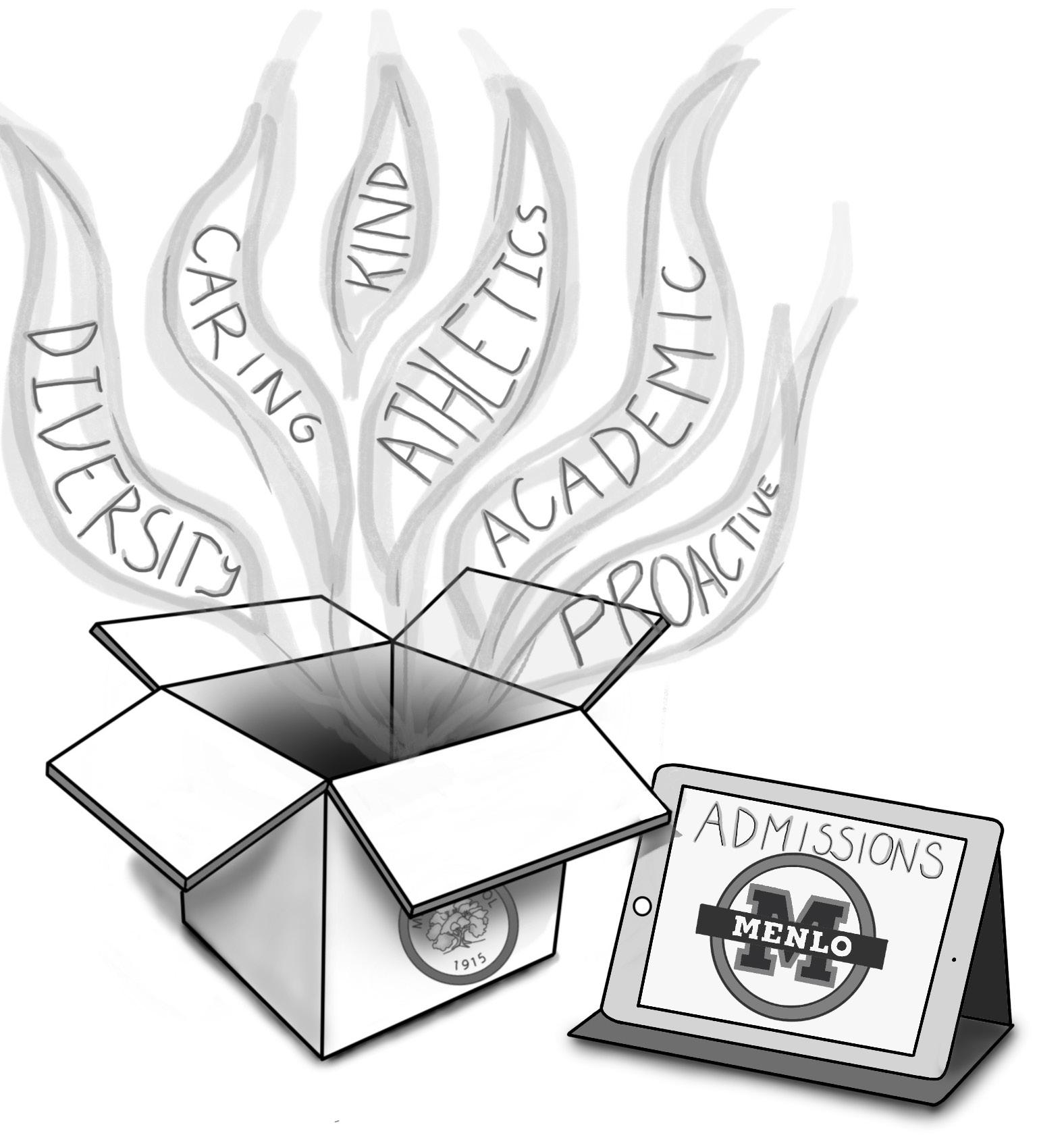
For Middle School applicants, the admissions team was particularly creative; they assembled at-home kits that applicants could pick up from campus. These boxes included interactive materials to accompany recorded lessons from Middle School teachers. “It was a big effort to get all the videos made, [to get] all the supplies collected and boxed and [to] schedule the pickup of the boxes,” Bishop said.
Another change that has proved especially positive this year is Zoom interviews. Rather than only speaking with the applicant, interviewers now set aside an additional 20 minutes for a family interview portion.
For Lapolla, these interviews have been year. “[Interviews have] been when I felt like I was making a real connection with families,” she said.
Wang said that she and her parents enjoyed their family interview. “My favorite thing [about applying] was that I got to meet
peninsula to facilitate these sessions.
Bishop also participated in webinars this summer and found inspiration from national admissions groups. Still, she prioritizes the personalization of the Menlo admissions process. “Although I heard lots of ideas from other schools on webinars this sum-
the mission and values of Menlo,” she said.
“I think one of the most challenging things about admissions work is [that] it’s hard to differentiate yourself and make people understand what makes your school special and different,” Bishop said. Throughout this admissions season, she has focused on ensuring that applicant families have opportunities to meet the admissions team and vice versa.These new efforts have led to an increase in the admissions budget, according to Bishop. “We’re spending more in some ways,” she said. “But those are all good investments that will live on way past the pandemic.”
Bishop said that resources like the interactive campus map will be useful even after the pandemic is over. “The pandemic pushed us to improve our digital resources,” Bishop said.
Kagan is still as excited to apply to Menlo as he was before the pandemic. “I know whether it would be over Zoom or in person, [attending Menlo] would still be a really good experience,” he said.
Wang, who feels the same way, also sees during the pandemic; she hopes to play on the tennis team and learned that they have been practicing in person. “The pandemic is not really going to affect [my experience at Menlo],” she said. Nonetheless, Lapolla does not think that Menlo’s coronavirus response will be a leading factor in families’ decisions to apply. “I believe that what will draw families to Menlo [this year] are the things that have always drawn families to Menlo: Menlo's strong sense of community, our kind and inclusive culture and a[n] experience that is supportive and inspirational,” she said.
information Zoom sessions eight times a week. Lapolla enjoys getting to know families through this program, but she misses in-person interactions. “I like my old life better,” she said. “I’m sitting alone in my every day, and while I like that, I would rather move around a little bit and actually walk and talk to people.”
Moreover, the admissions team has created a student ambassador program, where current students. “We’re trying to get student voices heard by the applicants as much as possible,” Lapolla said.
There is also a new parent ambassador portal that connects prospective and current Menlo parents; families can access this resource through a platform called PeerPal.
The admissions department also became standardized test-optional for this year. “I think it was a good decision because in eighth grade, there’s already a lot to do — a lot of projects [and] tests. And because of distance learning, my teachers are rearranging everything, so I feel like it took a little bit off my shoulders,” Kagan said.
Lapolla is unsure about whether Menlo will remain test-optional after the pandemic. “We will have a lot to review at the end of this season, […] and that’s one thing that we will clearly be talking about,” she said. For students who opt out of standardized test-taking, Menlo requires participation in a proctored writing session. According to Bishop, the admissions team collaborated with six other independent schools on the


January, cont.
Pandemic Gatherings Are Okay
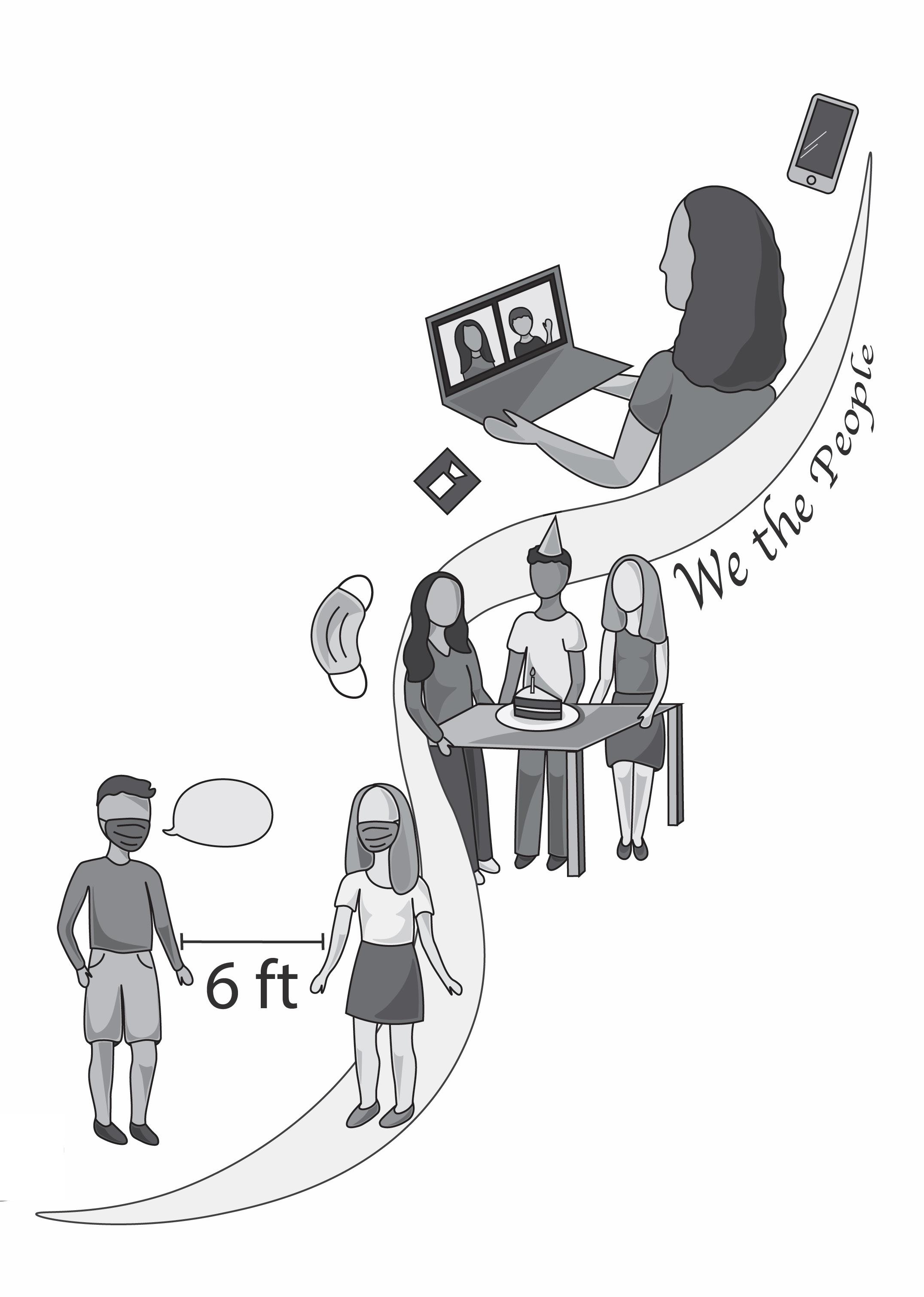
along with the precautions public, shows that social gatherstop being as the scapegoat COVID-19.
Pandemic Gatherings Are Not Okay
17, there has been a 40% increase in COVID-19
crease in cases in the
ID-19 cases are getting worse but the government’s restrictions
The Centers for Dis-
ness in both preventing the panthe wearer from the virus.
Beijing by the CDC, when one member of a housebut everyone else wore
tistics from the CDC that show the
trillion. if everyone consistently follows them. Al-
follow the COVID-19 regulations besome of them aren’t. We have to contin-
— because it will give us the best chance of school staying six feet apart.with these intense restrictions. There are
The virus is not something that can be
that as few lives are lost as possible.
A Message From the Editor...
by guest writer ELODIE TAM
As of Dec. 6, 2020 alone, 1,016 people were killed by the police, according to Mapping Police Violence. Of these deaths, African Americans have been killed at a -
cally, Black people make up 28% of those killed by police in 2020 despite making up only 13% of the population.
Throughout America, racial injustice is an ongoing issue, especially in the police force. Nonetheless, only 44% of people believe that white and Black Americans have unequal opportunities, according to the Pew Research Center. This is slightly
These data reveal the problematic and false perception of racial inequality in the United States. How exactly does this false perception affect inequality and our society?
Menlo School is in Atherton, a location
Nonetheless, according to the Pew Research Center, only 44% of people believe that white and Black Americans have unequal opportunities.
looked. Americans don’t commonly recognize issues such as these, yet they play a role in persistent injustices and in solidifying societal division. The media’s sensationalist nature creates a lack of awareness around seemingly small issues and, without this knowledge, we cannot act.
Simply put, society does not treat people
small part of daily injustices faced by the Black community, and they may seem in-
begin to treat everyone equally, all hope to eliminate racism in our society is lost. In order to combat racism in America, we must change how we treat others daily. Initially, these do not need to be dramatic changes: it is more in our daily comportment and an awareness of our personal shortcomings in equally treating others as well as our preconceptions and prejudices.
Additionally, we, including the media, should not only focus on the most horrible events such as the killing of George Floyd.
faces. For example, many top articles in the media on police brutality, such as “Nigerian Forces Accused of Killing Anti-Police Brutality Protesters”, “Deadly Attacks on Protests Over Police Brutality, Corrup-
We can’t only focus on brutality; rather, we must also focus on daily issues that the Black community faces.
in Paris Charged in Beating of Black Music Producer,” cover death and more sensational news, according to CBS News. Consequently, there is a gap in education of racial injustice, especially pertaining to less recognized issues. Without knowledge of these issues, we cannot better ourselves by improving daily behavior and becoming more aware of our actions.
Furthermore, school systems
December 14, 2020 5
comes more awareness over one’s autonomous actions and thus creates a sense of responsibility and motivation to address the issue.
African Americans compared to those of other ethnicities is a consequence of institutionalized racism in our society. These instances of structural racism and racist biases force African Americans into a lower class, preventing society from moving forward.
society hinders a member of a lower class’s ability to purchase goods. If they had that -
centivize new creations of goods, creating more jobs, as shown in “African-American Women: An Ecological Perspective”. In other words, the creation of an equal society that allows those in lower classes to
suppressing those in lower classes due to their race and preventing social mobility, we deny ourselves economic improvement.

equality, we need to correct daily behaviors and create a new precedent of education. It will not be easy, as racism is deeply ingrained in our nation, but we as society have the power to implement change and create a new standard.
December 14, 2020
By CHARLOTTE PALMER
Currently, students face an overwhelming temptation to use outside sources during a test: they can easily type a few keywords into the Google search bar, click twice to access a worksheet from class or glance over at an open binder. Now, more than ever, teachers are worried about students cheating on assessments, which are administered online in light of the COVID-19 pandemic.
While teachers share this worry, their approaches have been different, with some undesired outcomes. Some, like math teacher Jackie Arreaga, have chosen to keep their assessments closed-note despite the obstacles of online learning. “[Teachers are] trying to make this situation as normal as possible even though it’s very much not,” Arreaga said. “When I give a test, I want to know what [students] know in the moment after taking the time to study,” Arreaga said.
The COVID-19 pandemic has heavily impacted the lives of many, and most of us simply want to return to normalcy. However, this model of pre-COVID-19 test-taking may not be the best course of action based on the prevalence of cheating during online learning. The Washington Post published an article containing cheating statistics from ProctorU, a company that provides online proctoring services to universities. From January through March, the company caught cheating on fewer than 1% of 340,000 proctored exams, but that number rose to 8% from April to the end of June. However, despite her suspicions of cheating in her own classroom, Arreaga believes that responsibility lies with the students. “This is about being an honest person and living with integrity,” said Arreaga. “It’s not about whether or not I catch someone. It’s about whether or not they can live with it themselves.” Students make choices that will impact their school career, just as they will make choices as adults that will impact their professional careers. “That’s the way it’s going to be in life,” Arreaga said. Her beliefs are in ac-
cordance with Menlo’s Mission and Values in their encouragement of students to be honest citizens. The Mission Statement says “Menlo School’s mission is to empower students to [...] become ethical, responsible, and engaged members of ever also dedicated to student honesty. Menlo’s Values say, “At Menlo School, we are passionate about encouraging students to: [...] Demonstrate courage, integrity and a commitment to ethical behavior.” Despite its commitment to promoting student ethicality, however, Menlo must also take into account the ripple effect cheating could have on its students.
“Cheating only hurts the person doing it,” Arreaga said. A junior boy at Menlo disagrees. “I know a lot of other people who are [cheating], so it wouldn’t be fair if I didn’t,” he said. He said that the different approaches create inequality among students, with some teachers choosing to make
their tests open-note while others do not. “Why do teachers get to make my classes harder than other people’s?” he said. In group chats or on the quad, students frequently talk about how they have seen others cheat or ways they have done it themselves. Regardless of whether one agrees with students’ reasons for cheating, it is obvious that it is taking place, as proven by national statistics and examples from the Menlo community. Similarly, whether or not students agree that teachers’ different approaches are creating unfairness, we have to acknowledge that this line of reasoning is what motivates some students to cheat.
Identity theft is not a joke, Max. Millions of families suffer every year.
Sincerely, Upper School History teacher Charles Hanson
Editor-in-Chief............................................Carly McAdam
Print Editor...................................................Sophia Artandi
Online Editor.......................................................Emily Han
News Editor....................................................Sylvie Venuto
Assistant News Editor..........................................Alex Levitt
Spread Editor......................................................Tessa Frantz
Assistant Spread Editor..............................Riley Huddleston
Arts & Lifestyle Editor..................................Ella Hartmanis
Assistant Arts & Lifestyle Editor.....................Georgia Paye
Sports Editor.................................................Chase Hurtwitz
Assistant Sports Editor.......................................Lexi Friesel
Opinions Editor.............................................Louisa Sonsini
Assistant Opinions Editor..........................Penelope Stinson
Design Editor................................................Lauren Lawson
Head Copy Editor...............................................Parina Patel
Copy Editor....................................................Valentina Ross
Video Editor.....................................................Laura Artandi
Photo Editor.....................................................Sadie Stinson
Staff Writers.................................................Madison Liu, Danielle McNair, Brady Kline, Charlotte Palmer, Jake Lieberman
Staff Illustrators.................Michele Hratko, Dorinda Xiao, Sophie Fang, Kate Richardson, Grace Tang
Adviser............................................................Tripp Robbins
Math teacher Lauren Lax made her decision based on the assumption that this reasoning could be an issue. “While I’d like to think students value academic integrity enough not to consider cheating, I did not want to be in a situation in which suspicion arose,” Lax said. Additionally, to help make her decision, she looked to other examgivers for guidance. “I used the APs, which were open-anything in May, as a model,” Lax said.
While Menlo is a much smaller community that prides itself on academic honesty much more so than an entire nation of AP test-takers, other teachers echo Lax’s stance by choosing greater academic honesty over lessons in morality. No matter a teacher’s stance, they are all ultimately trying to do what is best for their students. I do not believe that teachers who continue to give closed-note tests are naive and think that all students are saints; nor do I believe that teachers who give open-note tests are inherently suspicious people. However, from what I have seen for myself and heard from my fellow classmates, I know cheating has heightened during online learning, both nationally and locally. Open-note tests


The Coat of Arms is an independent, student-led open forum for student expression. All decisions relating to the management and content of The Coat of Arms are fundamentally the responsibility of students. Coat of Arms reporters strive to acknowledge their internal biases and tell meaningful stories with empathy, fairness and journalistic integrity. The Coat of Arms staff is committed to building on the legacy of past staffs while setting the foundation for future members.
by Laura Artandi
Junior Jack Rosenberg rst came out to his family when he was an eighth grader at Menlo Middle School. Rosenberg sent his parents a text on the bus on the way to school, telling them that he was bisexual. “I had a math test [a er that] so I was not able to look at my phone, which was a bit stressful,” Rosenberg said. Rosenberg texted his parents telling them that he was “bi,” a shorthand term for bisexual. ey didn’t completely understand this abreviation at rst, and Rosenberg had to explain that he meant he was bisexual, meaning that he was attracted to both men and women. “ ey were really supportive, [and] I’m super grateful for them,” Rosenberg said. Although at rst he thought he was bisexual, it took Rosenberg about a year to realize that he doesn’t have attraction towards women, and
he currently identi es as gay. Rosenberg emphasizes that he genuinely believed that he was bisexual and wasn’t trying to use that identity as a sort of stepping stone. “I didn’t want to perpetuate the stereotype of bisexuality being a phase because that’s a misconception a lot of people who do identify as bisexual face when coming out,” Rosenberg said. e rst people Rosenberg came out to, prior to his family, were a few of his friends at Menlo. He sent messages to individual friends whom he trusted in order to tell them. Rosenberg used the app Snapchat to come out to his friends because the app sends noti cations when screenshots are taken. “Because I’d come out to my friends before I came out to my parents, I was afraid of what might happen, [and] I didn’t want anyone to spread anything,” Rosenberg said, explaining that it was an extra precaution that he felt he needed to take. Rosenberg said that the best way to react if someone comes out to you is by voicing your support of them. “Obviously, there’s no ideal [reaction] for every single person,” Rosenberg said. “I’d say the best thing that someone can do is

say ‘thank you for telling me, I’m glad you are able to trust me and con de in me.’” Rosenberg said that there is no need to be too ceremonious or overaggressive. “Chances are that person really had to work up to tell you that,” Rosenberg said. Rosenberg rst began questioning his sexual identity when he was a seventh grader at Menlo. “Looking back now I feel like it’s kind of obvious,” Rosenberg said. However, before Rosenberg began questioning, he had been called gay by people in an accusatory tone. “At the time I had no concept of what sexuality was, so I just took it as an insult and I was really o ended because I just didn’t know that I was,” he said. Over time, Rosenberg’s reaction to people calling him gay has changed. “It just became like if someone [called me gay,] it wasn’t an insult. Just living as me and not wanting to deny it is empowering,” Rosenberg said. “At the time I had no concept of what sexuality was, so I just took it as an insult and I was really o ended because I just didn’t know that I was,” Rosenberg said.
by Tessa Frantz
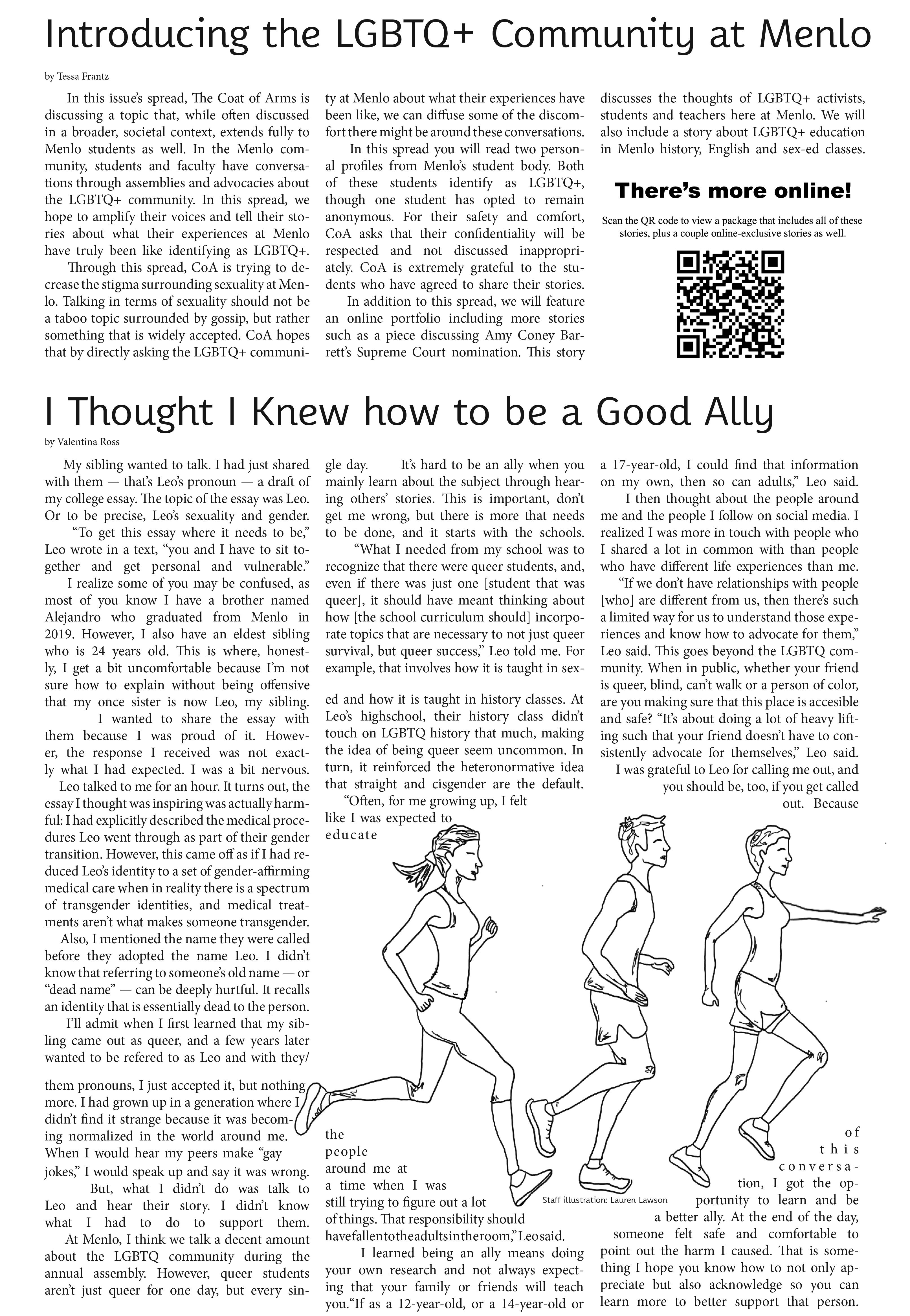
At Menlo, the LGBTQ+ community has had an ampli ed voice over the past few years, starting with the emergence of Spectrum Club, numerous assemblies and advocacy sessions. rough di erent forms, Menlo students have been able to have conversations surrounding gender, identity, sexuality and more. But representation aside, the current hope for many members of the LGBTQ+ community focuses on acceptance and the removal of a current stigma around their community. Generally, members of the LGBTQ+ community maintain that considering the cultural sentiment around sexuality, Menlo is relatively inclusive. However, that does not mean that the school is totally accepting of all genders and sexualities, according to junior Emory Tudor. “I think both teachers and students make an e ort to be inclusive. But it’s hard, especially if teachers don’t ask for people’s pronouns,” they said. For Tudor, simply accepting LGBTQ+ students isn’t enough. In order to fully include other communities, we must rst normalize and validate LGBTQ+ students’ di erences, like using a person’s correct pronouns, for example. In turn, a more inclusive school setting will help students feel more comfortable with their straight or cisgender classmates, Tudor said. Despite Menlo becoming more inclusive over the past few years, the presence of subtle homophobia exists at Menlo and continues to ostracize students whether intentional or not. While more rash and hurtful forms of homophobia ex-
ist,
microaggressions can still harm a community greatly. Everyday, common homophobia does not always seem outright hateful, and o en the person talking does not realize they have said something harmful. “People will say ‘oh that’s gay,’” one junior girl who prefers to remain anonymous said. “It’s those passive, outwardly homphobic comments that don’t make me feel safe.” Menlo’s small size also contributes to a culture of gossip, which only makes it harder for sexuality to become a normal conversation. “We’re a small school. Everyone knows everyone’s business to some degree,” the junior girl said. e gossip surrounding sexuality at Menlo makes it very uncomfortable for both out and closeted members of the LGBTQ+ community. “No one wants anybody speculating about their sexuality,” the junior girl said. However, it is important to distinguish that despite the small representation at assemblies and in classes, the LGBTQ+ community is much larger than we recognize. According to the junior girl, the small, known demographic does not represent the actual amount of non-heterosexual students. is is because many students have chosen not to come out for a variety of reasons. “It seems like a small de-
mographic, but in reality, I know a lot of people who don’t identify as heterosexual,” the junior girl said. One of the reasons that many people stay detached from the out LGBTQ+ community is that there may be several con icting parts of one’s identity. When people are a part of more than one marginalized group, they can feel that they have to choose the part of themselves that they identify more with. is means that within the LGBTQ+ community, members who are also part of other a nity groups may feel that they have to choose to focus on just one of them, according to certain facets of their identity, such as race “I don’t want anyone to feel le behind or excluded from the conversation because they’re discriminated against more,” she said.

by Tessa Frantz
*In this story, this member of our community would prefer to remain anonymous. We will refer to her as a freshman girl.
For many members of the LGBTQ+ community, identity is something that takes time to fully understand and accept. While it can take months, years or even longer to come to terms with one’s sexuality, the act of coming out to friends and family is a moment of bravery for an individual. For a freshman girl in particular, the coming out experience was incredibly releasing. Partly because she didn’t feel much pressure to self identify, the act of coming out was purely for herself. “It was really nice [and] it got a lot o of my shoulders,” she said. Currently, she is out to a few close friends but not the general public or her family. She explained that the people she con ded in were more than accepting about her identity because of their friendship. “Everybody was so supportive,” she said. She contended that in Menlo’s cultural envi-
ronment, large acts of homophobia do not regularly occur, but there is a general discomfort around the topic. “ ere’s de nitely a stigma around it. You can sort of feel the uncomfort around the topic,” she said. Because of this uncomfort, the act of coming out is more di cult. “Being a part of such a small population of the school who are out is uncomfortable because you don’t know how people will react,” she said. Menlo’s small size makes it a sort of haven for gossip. According to her, this only fuels the discomfort around the LGBTQ+ community and further ostracizes them. She also said that because of the stigma around her community, microaggressions are much easier to occur accidentally. “People need to be more educated on [my community.] People need to understand it better so they won’t be homophobic unintentionally,” she said. For her, homophobia results mostly in small comments that have a much larger impact than people realize. An example of this is when a friend assumed that being bisexual and pansexual were es-
sentially the same sexuality. “It can really invalidate people’s identity,” she said. She has also felt immense internalized homophobia a er realizing her identity. “Right a er I nally came to realize I might be bisexual, I had a couple of months of self loathing. at was really, really hard on me,” she said. “It made me question everything I had previously thought about myself,” she said. Her changing sexuality caused her to question other facets of her identity as well. In addition, she considered herself abnormal. “I thought I was weird,” she said. Her sexuality has somewhat changed over the past few months. While she started out a few months ago thinking she was bisexual, she now realizes that she could be lesbain. She stresses that nothing is concrete; her identity is constantly evolving and changing. “Sexuality is uid,” she said. She feels that while coming out is an important step for LGBTQ+ people, sexuality is constantly changing over time and growing with a person. She feels that now that she is out to her friends, she can be supportive of other LGBTQ+ members that are currently struggling with their identity. “When you are a part of the community, more people start to come out to you because they know you’ll be accepting,” she

In 2011, according to e New York Times, California was the rst state to require schools to teach LGBTQ+ history in schools, mandating that the contributions of members of the LGBTQ+ community be included in social science instruction and textbooks. Since then, three other states, Colorado, New Jersey and Illinois, have done the same, according to US News. According to research done in 2016 by the Gay Straight and Lesbian Education Network (GSLEN), a national advocacy group for LGBTQ+ students, just under a quarter of students say they have learned about LGBTQ+ related topics in their classes. Additionally, in seven states in the U.S., there are “no promo homo” laws, which explicitly prohibit the positive portrayal of homosexuality in schools, particularly in sexual education classes, according to NBC News. At Menlo, inclusion of LGBTQ+ topics is often di cult to nd in English and history classes, according to members of the spectrum club. e Modern World History class that all freshmen are required to take and the Regular US History and Advanced Placement US History classes that sophomores take often do not have time to cover more than the set curriculum. “ ere is no sustained treatment of LGBTQ history in these curriculums,” history teacher Matthew Nelson said.
by Penelope Stinson
Although Nelson understands that histor should not be taught with the interest of identity politics or with atomized social communities as the focus, he believes that history should be taught from the perspective of marginalized groups. “It’s really vital for us to reclaim those voices and center them in what we teach in schools,” Nelson said. In one of Nelson’s history classes, Modern Political Rhetoric, he spends more time covering LGBTQ+ history simply because he believes it is historically signi cant in political rhetoric. Although there are currently no plans moving forward about including more LGBTQ+ topics in the freshmen and sophomore history classes, Nelson feels con dent that the department will move in that direction in the future.
Junior Emory Tudor, a member of Menlo’s Spectrum Club, believes that the freshmen and sophomore year history classes o en ignore LGBTQ+ narratives. “I think when they say Modern World History, they really mean white European history, and when you get into European history, there is not going to be an LGBTQ+ narrative since it’s been suppressed for so long,” Tudor said. In the English department, although the literature in the freshmen and sophomore curriculums do not have explicitly LGBTQ+ leads, many of the authors of books read are not heterosexual. Additionally, because many of the books read in English 1 and 2 are coming-of-age stories, there is o en a larger conversation about sexuality and gender based on what the characters in the books experi-
ence. e English department also used to assign a book called “Fun Home” as part of the sophomore curriculum. “Fun Home” was a graphic novel that told the story of a lesbain protagonist. ere were several scenes in the book that depicted a lesbain couple during intimacy and, according to the Upper School English Chair Margaret Ramsey, that was a nonstarter with the broader community. As a result, the book was ultimately taken out of the curriculum. Ramsey noted that the English department is dedicated to asking themselves how their books are representing their students and whether they are representative of experiences that students will have or things they are curious about, as well as how they can change the curriculum to re ect that.
Senior Langley Ward, co-president of the Spectrum Club, described that she felt there was little to no representation of the LGBTQ+ community in her English 1 and 2 classes. e most she remembered talking about sexuality and gender was a brief conversation while reading “ e Great Gatsby” about the possibility of a character being not straight. “I think it would be bene cial, at least for people in the LGBTQ community, to read about people who are like them and who are complex rather than a stereotype or just a background character. It could give them an example of what good representation can look like for di erent communities,” Ward said.
by SOPHIA ARTANDI



by GEORGIA PAYE
In the age of social media, students often curate their own eclectic and unique style based on what they see online. Social media platforms such as Instagram, Pinterest and TikTok allow students to discover fashion
help create their unique style.
“I would say that almost my whole Michelle Li said. “Through Instagram and Tiktok, I see so many people around the world with slightly different styles that inspire me to take little unique fashion inspos from each person I see online and
mix of preppy, indie and year 2000 (y2k), featuring a lot of baggy clothes. Li tries not to buy too many clothes and stays away from
fast-fashion brands. Instead, she uses what
inspired by Instagram posts by Bella Hadid (@bellahadid), Emma Chamberlain (@ emmachamberlain) and Devon Lee Carlson (@devonleecarlson).
“These people have really distinct fashion styles with really sick and unique
page on TikTok where the occasional fashion video pops up.
of her fashion inspiration from social media.
said. She describes her style as constantly



changing as she is exposed to new inspiration on Instagram, TikTok and Pinterest every day. Social media was also how she got into
and wanting to try their aesthetics, which inspired me to create a mixture of styles that
began thrifting and sewing, which initiated her love for one-of-a-kind pieces.
social media, as well as fashion magazines, fashion shows and what she sees in stores.
“I get a lot of my style from Instagram and Pinterest. I set up different Pinterest boards for seasons or trends that I want to follow.
my style, I would say it affects my shopping habits as people recommend brands and more of a preppy aesthetic but experiments a lot and is not afraid to make a statement. Her
Princess Olympia of Greece. “I really admire
Unlike Li, Chen and Biscevic, senior affected by social media. “The thing about the clothes I wear is that they aren’t anything new or exciting in the ‘fashion world.’ Button-down shirts and pleated trousers have been around for decades, if not centuries. That’s part of the reason I like those pieces so much. There’s something to be said
and timeless pieces and likes to dress in whatever makes him feel confident and does follow some Instagram accounts that embody this aesthetic such as Denaun Montez Porter (@mrporterlive), Val Lin (@ theaestheticminimalist) and Mads Keilberg (@scandinaviancloset).
by RILEY HUDDLESTON
On Oct. 26, the first of four cohorts attended a week of on-campus learning at Menlo in the new hybrid learning model. While many students attended their assigned week, both teachers and students opted out and continued with online learning.
Junior Ayla Seddighnezhad was worried about contracting COVID-19 and spreading it to members of her family. “I thought that it would be safer if I didn’t go seeing as I live also felt like the administration rushed into
“Overall, I’ve become more productive by working from home. All the time I would’ve spent [commuting] between home and school I used to sleep in or do homework.” -Schmidtke
Ayla Seddighnezhad was worried about contracting COVID-19 and spreading it to members of her family. “I thought that it would be safer if I didn’t go seeing as I live with my grandma... I also felt like the administration rushed into it quickly.”
opted out because she had become accustomed to her routine and habits while learning from home and didn’t want to change them for one week. “I felt I had more time to myself which I could use for
I’ve become more productive by working from home. All the time I would’ve spent
Upper School science teacher Marc Allard is not participating in in-person
teaching for undisclosed reasons. Although he would rather be teaching students faceto-face, he also doesn’t mind online teaching given the current circumstances. “We are in
students are getting a quality education with teachers going out of their way to make the also noted the importance of recognizing what you have to be grateful for amidst the pandemic. “I feel like everyone complains about what they’re missing out on this year as opposed to appreciating the things that
Two other teachers were also contacted about their decision to opt-out of in-person school but declined an interview. Both Seddighnezad and Schmidtke feel like what they missed out on most was spending time with their friends and teachers. “A connection with teachers is important, Schmidtke said.
While students won’t be returning to semester, the administration announced plans for hybrid learning in the second semester in a Dec. email. After spending 2 weeks in distance learning in order to allow time for
“We are in a [...] pandemic and everyone
Even online, Menlo students are getting a quality education with teachers going out of their way to make the experience as normal as possible.” - Allard
families to quarantine locally, students and teachers will return to school for hybrid learning on Jan. 19. Instead of 4 cohorts of students having separate weeks, A and B groups will be combined to have 2 cohorts of students, meaning campus will be operating at 50 percent capacity. Seddighnezhad isn’t sure if she will return. “I really do want to go back to school, but I don’t want to put
the Bay Area in the coming months, I will
by MADISON LIU
Due to the coronavirus pandemic and subsequent county regulations, Menlo School’s campus remained closed which impacted numerous senior traditions.
Typically, senior year at Menlo includes many activities and events that students look forward to throughout high school. However, most of those heavilyanticipated traditions have been delayed, adapted or canceled this year, which was disappointing to many seniors. “To not have these experiences is really sad because we have worked so hard for this. Senior year is supposed to be one of the best times of your life,” senior and Sea of Gold Captain Avery Lee said.
This year, seniors missed all of the traditions that typically come along and small. “We missed out on picking a theme, designing shirts for the incoming freshmen, decorating the Quad and even school assembly,” Lee said. “We never got to sit in the senior section of the bleachers, either, which is a small thing but still sad.”
A second-missed event is the holiday assembly and the popular “Twelve Days of Christmas” singalong. “There is also the big holiday assembly, and we won’t get to experience that amazing feeling of paper and blow horns and pots and pans,” Lee said.
However, Menlo event planners are trying their best to adjust activities to make them COVID-19-safe instead of completely canceling them. “We
by DANIELLE MCNAIR
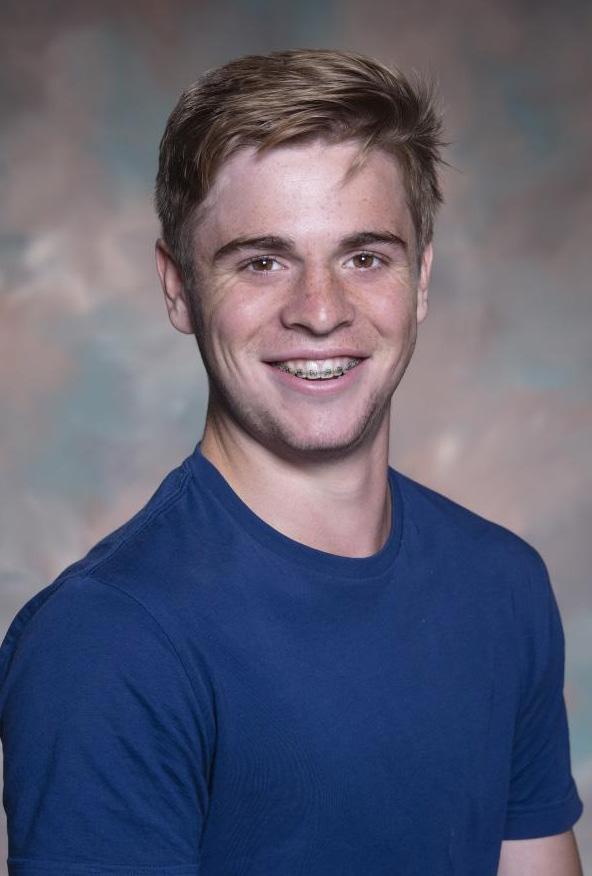
CoA: What would you name your boat if you had one?
Adam: The Cruiser.
CoA: What’s the strangest item in your refrigerator?
Adam: Probably this thing called Vegemite. It is this Australian spread. I don’t know why it’s in there.
CoA: How do you feel about milk?
Adam: Fat-free milk is delicious.
CoA: What about milk that is not fat-free?
Adam: No. It’s too thick. But, I drink fat-free milk a lot.
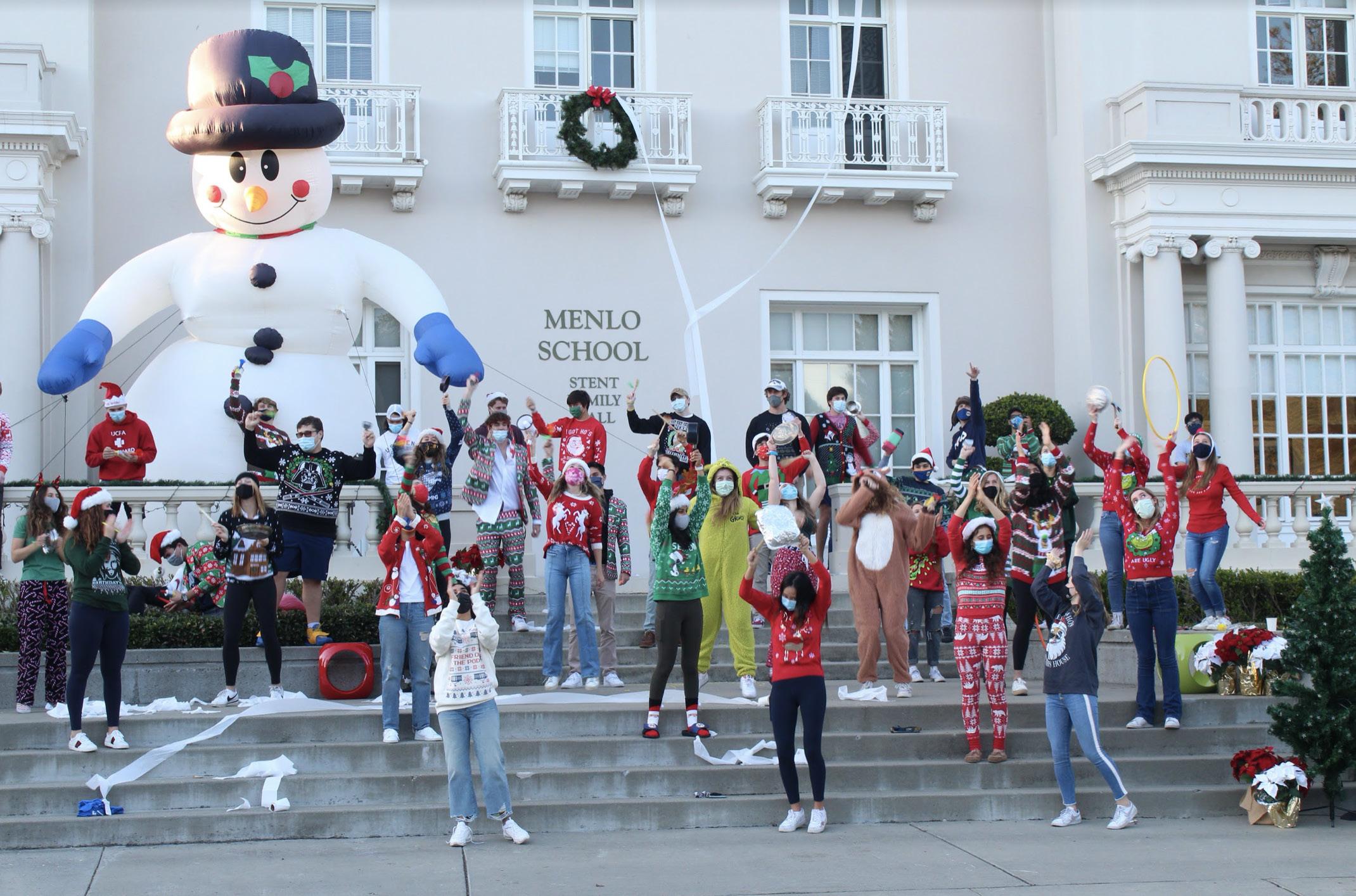
golden rings’ part of the ‘Twelve Days of Christmas’ like in the holiday assembly,”
Senior Class Dean Chris Young said. “We try not to cancel senior events completely. We try to adapt them and then hope to be able to do them more fully in the future.” Halloween was another event that Menlo put on for the seniors in place of the normal costume contest and spirit
CoA: If you could make up a word what would it be?
Adam: Smif.
CoA: What does your new word mean?
Adam: A smif is what you call someone when they do something really, really stupid. It’s like funny and stupid and an action that blows up in your face.
CoA: Do you prefer to have crazy dreams or scary nightmares?
Adam: Crazy dreams.
CoA: Why?
Adam: You just never know what's going to happen.
CoA: affect your mood?
Adam: Not at all.
CoA: If you had the entire world’s attention for 30 seconds, what would you say?
Adam: That’s a big question. I don’t know. Maybe a joke, probably a joke. Nothing serious.
CoA: What language do you wish you were
Adam: French. It is a sexy language.
CoA: What was cool when you were young, but isn’t cool now?
Adam: Beyblades and Bakugan.
CoA: If you could change your name, what would you change it to?
Adam: Oh! Zach. I’m not sure why but
traditions. “On Halloween, one-third of the class at a time came to campus dressed up and did some pumpkin carving and some other bonding activities,” Young said. Even though Halloween wasn’t the same this year, the seniors still appreciated the event.
“We’ve had one event on campus so far [on Halloween] [...] it was really nice just to get on campus with each other,”
CoA: Would you rather only be able to use a fork or only be able to use a spoon?
Adam: Spoon, spoon for sure.
CoA: What food would be most challenging to eat if you only had a spoon?
Adam: Probably like steak, but I could just go at it with my teeth.
CoA: Do you have a good joke to tell?
Adam: Yes. Knock knock.
CoA: Who’s there?
Adam: Europe.
CoA: Europe who?
Adam: No, Euro-poo.
CoA: If you could trade lives with someone, who would it be?
What food would be most challenging to eat if you only had a spoon?
Probably like steak, but I could just go at it with my teeth.
Adam: I don’t think I would. You never know what goes on in someone else’s life.
CoA: What is your favorite sound?
Adam: That’s hard. The sound for Red Zone, like for football on Sundays.
CoA: Do you have any nicknames?
Adam: Either my last name, or, as a kid I went by buckleberry for a couple years.
Lee said. “I know those events take a lot of planning, so it was amazing for the faculty and the parent team to put that together for us.”
Although both faculty and students are disappointed to be missing senior traditions, they are still as optimistic as possible. “What can we do but adapt and try to make the best of any situation?” Young said.
CoA: If someone narrated your life, who would you want to be the narrator?
Adam: Probably Danny DeVito because he is a funny guy, funny voice. He could make it entertaining.
CoA: or water?
Adam: Water, yeah.
CoA: Do you by chance know the secret formula for the Krabby Patty?
Adam: I do not.
CoA: What weird food combination do you really enjoy?
Adam: I guess the weirdest is ranch in cereal milk. I don’t think I’ve told people that before, but I do that all the time. That’s how I eat cereal. I put a little bit of ranch in the milk, mix it around, and then put the cereal in.
CoA: If you could only use one word the rest of your life, what word would you choose?
Adam: Mice. I feel like it can be used in a lot of ways.
CoA: Is there an app you hate but use anyway?
Adam: Twitter.
CoA: What is something you tried once that you will never try again?
Adam: Wrestling. Not horsing around, like the actual sport.
CoA: Do you have anything else you would like to contribute?
Adam: Anything else? Just that I am a part-time anti-masker. I bet that is pretty controversial. part-time anti-masker. I bet that is pretty controversial.
by LAURA ARTANDI
Since its release in Aug. 2018, TikTok has become extremely popular and so have many creators on the app. TikTok is a social media platform where users
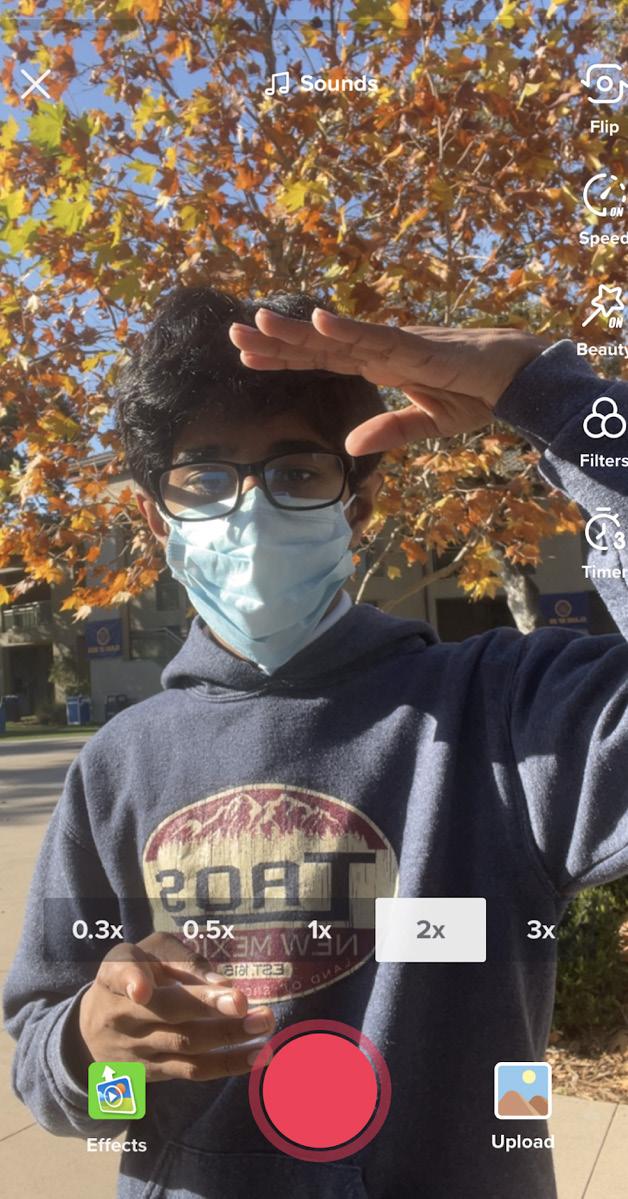
can post any type of video, from dancing challenges to comedy videos. The app is also known for its algorithm which allows for people’s videos to go viral more easily than other social media platforms. Because of this algorithm, many people can become “TikTok famous” with just one viral video. This is a term that TikTok users use to describe people on the app with many followers who typically get many views on their videos.
Senior Chris Cook’s rise to popularity on TikTok came after posting a video with a friend in Aug. 2019. The video ended up getting 4 million views, but Cook attributed most of the video’s success to luck. “I think we got really lucky. It using that sound [and] it was right when TikTok [became] less frowned upon to use,” Cook said. He now has about 30,000 followers on the app.
Sophomore Sean
to go viral was posted last viral TikTok was a video of him singing a trending song, which he posted for fun. “I felt mainly shocked and excited [when I saw that it was blowing up] because obviously that’s something pretty cool [and] unexpected,” Nesamoney said. Nesamoney went on
to describe how he began
by VALENTINA ROSS
Thanksgivings and winter breaks in the past were one of the prominent times where some would visit loved ones. However, the pandemic has altered these plans for many Menlo families. Is it still possible to enjoy the winter season during COVID-19? Various Menlo students share what their holiday plans look like for the 2020-21 school year.
Freshman Tate Lee and her family went to Hawaii during Thanksgiving break to visit extended family which, according to her, hasn’t happened in years. “Usually, we travel to Hawaii during Christmas break on the first flight of Christmas morning, but because the pandemic [mixed] things up, we visit[ed] them during Thanksgiving break,” Lee said.
She was very excited to see her mom’s side of the family and celebrate her baby
“I feel like a lot of TikTokers aren’t under the same stress that Menlo students are. Maybe if I didn’t go to Menlo [I could] focus [more] time on social media.” - Cook
gaining popularity as his music videos tended to garner a large number of views. He now has 140,000 followers on the app. “[One of] the main things that [was] cool
to follow me,” Nesamoney said.
Nesamoney enjoys using TikTok, especially for music but hasn’t been very active lately because he wants to focus his efforts on school. “I think I stopped posting for a while with sophomore year starting,” Nesamoney said.
Cook agrees that being active on social media and being a Menlo student of TikTokers aren’t under the same stress that Menlo students are. Maybe if I didn’t go to Menlo [I could] focus [more] time on social media,” Cook said.
Sophomore Ralston Raphael says that TikTok is a hobby of his; however, he believes that social media could play a role in his future. “I’m thinking of going into sports medicine, so maybe I could be a social medicine,” Raphael said.
Raphael’s first video to go viral was posted in Dec. of 2019. It received around two hundred thousand likes and took Raphael’s account from 900 followers to eleven thousand followers. He now has about 100,000 followers on TikTok.
my family celebrates are always very spirited and fun. We have a very large family that includes many cousins, aunties, uncles and grandparents. We not only enjoy gathering together and enjoying a
nice homemade meal but also distributing a variety of themed gifts to everyone. We have so much to be thankful for. I know I [...] really appreciate our special time together,” Lee said in an
Raphael, Cook and Nesamoney’s friends and family have all been extremely supportive of their successes on TikTok. “[My family] is happy, but it also comes with limits because of course, I’m representing [them] when I make these videos,” Raphael said.
Cook believes that although he has a large following on TikTok, his friends don’t treat him any differently and are mostly supportive. Cook said that the only difference now is that people will ask to make TikToks with him.
- Nesamoney
he began receiving supportive messages from many people. “I was getting [messages] from my old elementary school friends, and even some kids in [my] grade I’m not particularly friends with, which is really great because it allowed me to get to know new people and form friendships that I hadn’t had before,” Nesamoney said.
“I felt mainly shocked and excited [when I saw that it was blowing up] because obviously, that’s something pretty cool [and] unexpected.”
Although Nesamoney appreciates the influx of support, he doesn’t consider himself to be TikTok famous. “I don’t think [I am] because I think a lot of accounts have the same range of following that I do,” Nesamoney said. Instead of calling himself TikTok famous, Nesamoney thinks he is “TikTok recognized.” He believes he doesn’t have enough followers to consider himself have some recognition. 13 December 14, 2020
email to the Coat of Arms.

Unlike Lee, sophomore Sydney Burnett will not see her extended family face-to-face or go on her annual trip. “Usually, for Thanksgiving my family and I go to Michigan to spend it with my grandparents on my mom’s side. We’ve spent all of our Christmases with my cousins and grandparents on my dad’s side. It’s
my cousins live far away, and we don’t get to see them that often. So we always have a great time,” Burnett said. This year, Burnett will be spending her holiday break at home with close family friends, while also using FaceTime to see her cousins and grandparents.
Similarly to Burnett, junior Emilio VeltenLomelin will not be going on his yearly trip to Mexico to see extended family. “Since we want to be safe about [COVID-19], my family and I decided not to travel to Mexico like we usually do. We usually go to Mexico City and spend the holidays with my mom’s or dad’s side of the family, depending on what year it is,” VeltenLomelin said. Instead, his mom’s cousin who lives in Los Gatos will come over and celebrate through a Zoom call with his cousins and family
Although it’s disappointing not to be able to be with all my cousins and family, I know that not being of everyone,” Velten-Lomelin said.
by ELLA HARTMANIS
For the entirety of their lives, brothers freshman Baz and junior Luke MacNaughton have been near the ocean, seeing rsthand how the environment is a ected by climate change and pollution. To help protect the environment and share their love of the outdoors with others, they created a website called PacBleu. According to its mission statement, PacBleu’s purpose is “to shine a light on people, brands, and NGOs who are innovating and living lives of hope, passion and purpose on behalf of the big, blue, Paci c Ocean.” e MacNaughtons were born in California but moved to Oahu, Hawaii in 2010, where they lived for four years. Before moving to Hawaii, Luke spent time in the ocean, but while living there, he dedicated more time to sur ng. A er returning to California, he surfed less frequently because of the demands of school and other sports, but the COVID-19 pandemic has allowed him to surf more. “With the pandemic, I have been sur ng a lot more again because I’m not doing a sport and have a
little bit more free time,” Luke said. On the other hand, Baz’s passion for sur ng was invigorated a er returning to California and joining the Half Moon Bay Surf Team. e brothers created PacBleu along with their cousin, Corbin Mason, in March 2020. “We’d always done beach cleanups and stu , but we wanted to do more. So, we just thought that [because] we had a lot of free time, it was a good time to start something,” Baz said. Nine months later, the team has gained 11,600 followers on Instagram (@pacbleu), giving them a platform to promote environmental change.
e team has gained 11,400 followers on Instagram, giving them a platform to promote enivornmental change

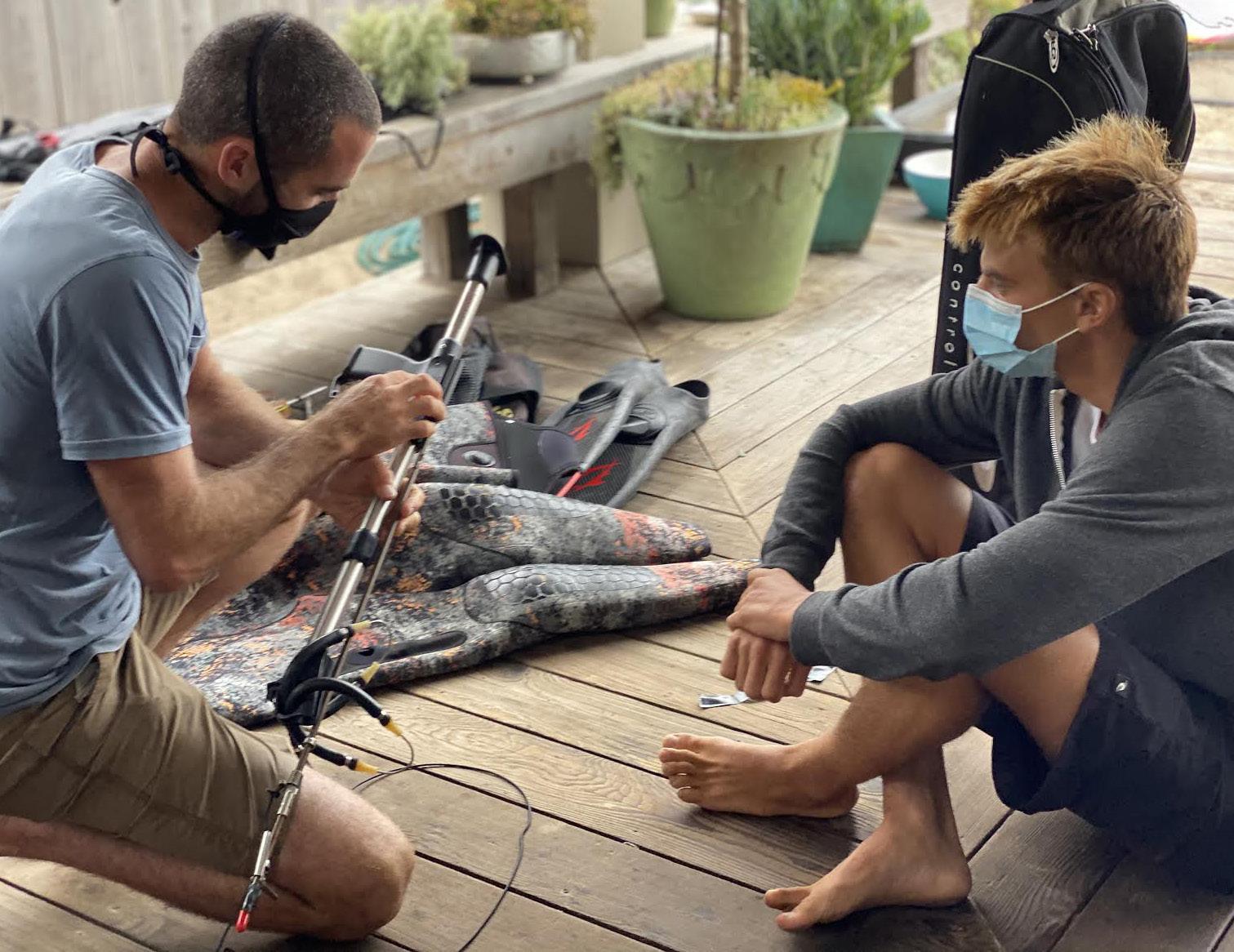
Leading up to the November general election, PacBleu focused on encouraging people to vote for candidates who have a history of supporting environmental legislation and strive for an economy based on sustainable business practices. ey started by reaching out to close friends and asking them to lm a short clip to share on social media urging people to vote for environmentally-friendly candidates. To in uence a larger audience, they reached out to popular and in uential creators to create short clips as well. In the videos, the hashtags #votebleu and #voteocean were used to create unity. e PacBleu leaders have interviewed in uencers, celebrities and companies that support sustainability and share their love for the ocean. A er fortuitously meeting YouTuber Casey Neisat while sur ng, the team was able to interview him about his successes, struggles and newfound
love of sur ng. ey also interviewed the co-founder of Ventana Sur oards, David Dennis. Based in Santa Cruz, Calif., Ventana Sur oards makes all of its products from reclaimed wood and other waste materials, combining their passion for the ocean along with sustainable business practices. Currently, the interviews are posted on the PacBleu website, but in the future, Luke hopes to turn the interviews into podcasts. Although their cousin moved to Los Angeles for college this fall, both Baz and Luke hope to expand their brand further and to work with larger sustainable businesses. “ e ideal situation would be to be in a place where we have enough followers that we can in uence people but also have a spot where people can use their voice and have a platform,” Luke said. Another aspiration of the two is to create a YouTube channel and post videos in which they review sustainable clothing and environmental products.
by CHASE HURWITZ
e Central Coast Section (CCS), the league in which Menlo’s athletics teams play, has been paused since March due to the COVID-19 pandemic. As select private schools in the Bay Area start to incorporate a hybrid learning model, many speculate as to when Menlo athletics teams can resume play.
“CCS has treated fall like the summer period,” Upper School Athletics Director Earl Koberlein said. is allows teams to hold voluntary workouts, like they would in previous summers, with speci c regulations. “ e County Health Department has dictated what is allowable — outdoors only, physically distanced, pods of 12 [and] no shared equipment unless sanitized,” Koberlein said.
CCS has also pushed all sports a season later than they would be under normal cir-
“ e County Health Department has dictated what is allowable — outdoors only, physically distanced, pods of 12 [and] no shared equipment unless sanitized” - Upper School Athletics Director Earl Koberlein
cumstances. Many sports were supposed to begin mid December, such as football, volleyball and water polo; however, the state has not released new guidlines for youth sports — new guidelines will be released Jan. 1 at the earliest. erefore, the mid December start for fall sports has been pushed back to at least Jan. according to Koberlein. Winter and spring season sports will be combined into one season during the spring. Tennis, golf, soccer and swimming are scheduled to start Feb. 22 and will potentially continue through late May and mid-June. Baseball, basketball and lacrosse seasons will start on March 15 and continue through midJune, according to the CCS website. ese schedules, however, are only a hypothetical at the moment, as the pandemic breaks new records. According to the CCS website, “[they] are continuously monitoring the directives and guidelines released from the Governor’s O ce, the California Department of Education, the California Department of Public Health, and local county health departments and agencies as these directives and guidelines are followed by our member schools [and] school districts with student health and safety at the forefront.” e pandemic is surpassing 200,000 daily cases at the time of publication. California was the second state, a er Texas, to reach one million cases: 1,341,700 at the time of publication, according to the California Department of Public Health. With cases only expected to rise during the winter, some are speculating as to whether any sports are going to play this year. “ is

is a possibility, though I hope not,” Koberlein said. “I agree that it is better to be safe if there are any doubts that we can play safely.” Furthermore, since the 2020 presidential election, there has been speculation that President-elect Biden will impose a four to six-week nationwide lockdown. Dr. Michael Osterholm, one of the COVID-19 advisors to President-elect Biden, oated this idea to Yahoo Finance as a way to get the
pandemic under control. However, he later clari ed in an interview with NBC that, “it was not a recommendation. I have never made this recommendation to Biden’s group.” Furthermore, a Biden transition ofcial has said that a shutdown is not in line with what the President-elect is thinking. Nonetheless, with rumors ying and cases soaring, a return to the postponed CCS schedule seems increasingly unlikely. As of Dec. 6, Governor Gavin Newsom moved San Mateo county up to the purple tier on a four-tier ranking system, indicating that the spread of COVID-19 is substantial. e county was previously at the red tier. At the date of publication, nearly all non-essential businesses must close while many can operate outdoors with modi cations. Meanwhile, all surrounding counties, including Santa Clara County, are at a purple tier, indicating that the spread of COVID-19 is substantial. If San Mateo County stays at the purple tier, the possibility of a CCS season this year is unlikely. Additionally, the inter-county play between schools is very unlikely due to the worsening conditions surrounding San Mateo County. However, if schools from di erent counties are scheduled to play each other, their respective counties must clear them to play. Coaches and athletes are looking for their season to resume. Yet, many are aware of the possibility that there will be no season. “We will try and do what we can to still have fun,” Koberlein said.
“[We hope] to creatively train student-athletes to improve themselves if they are looking to play in college while o ering team unity and team building activities.”
by DANIELLE MCNAIR
Senior Connor MacMitchell committed to play Division I water polo at the University of California San Diego (UCSD) this fall.
MacMitchell has played on Menlo’s varsity water polo team since his freshman year. MacMitchell began playing water polo in sixth grade after suffering three major concussions from basketball and soccer. “The doctor said I had to play a sport with less contact,” MacMitchell said. “I had a friend who played water polo, so I decided to give it a try.”
“Water polo is such a unique sport where you can have your own play style,” MacMitchell said. “I feel like it is a combination of sports I played in the past.” This sense of familiarity drew MacMitchell to the sport.
At 12 years old, MacMitchell began play-

ing for Stanford Water Polo Club, where he played with the same teammates over the years. We have been together for all the ups and downs. I am really going to miss playing with those guys,” MacMitchell said.
At Menlo, varsity head coach Jack Bowen has also been a huge part of MacMitchell’s development. “I have learned so much from [Bowen]. He helped take my game to the next level.” Bowen stands out
cares about him as a player and person. Bowen attributed MacMitchell’s water polo success to his work ethic and devotion to the sport. “[MacMitchell] has a unique blend of playfulness and outright commitment to be his best. He is the epitome of a competitor and never settles for victory. He always looks ahead at how he can be better for the next competition,” Bowen said. When MacMitchell began thinking about college, the question was never whether he wanted to play or not, it was always where and at what division level. With COVID-19,
visits. “I had to rely on phone conversations with coaches and players on the teams to learn about schools,” MacMitchell said. MacMitchell chose UCSD because of the balance between academics and water polo, as well as the comradery of the team. “From an academic standpoint, I liked UCSD because they prioritize school. For water polo, I really liked the direction the program is headed. There aredent we can grow the success of the team.”
by JAKE LIEBERMAN
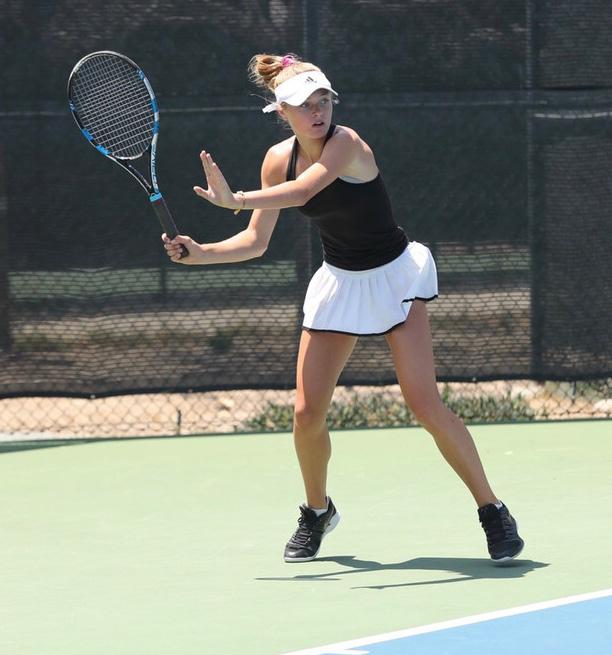
Senior Addie Ahlstrom committed to play Division I tennis at Brown University. Back in February, she and her family decided that she was going to take her talents to Rhode Island in the fall of 2021.
“I chose Brown for so many different reasons. I love the coach and team, as they visit. I felt a sense of belonging from the moment I stepped on campus and I could tell the team was super motivated and focused but also tight-knit and upbeat,” Ahlstrom said in an email to The Coat of
“I love the coach and team, as they were all so welcoming during my o cial visit”
Arms. Ahlstrom also mentioned that she loved the location and the academics that Brown offers. “I’ve always wanted to go to school on the East Coast and loved that [Brown is] so close to Boston. I was also drawn to Brown for its academic offerings, -
tion under Brown’s Open Curriculum.”
Ahlstrom has been playing tennis her whole life but did not get into playing tennis competitively until she was in high school. Her mother and uncle both played in college, which boosted her desire to
by LEXI FRIESEL
This fall, senior Chris d’Alencon committed to play Division III football at Trinity College in Hartford, Conn. as a wide receiver. “Trinity stood out to me as a good learning environment, and the team culture and chemistry seemed right for me,” d’Alencon said. “I look forward to meeting all my new teammates, becoming part of a new program and experiencing college. My goal is to work as hard as possible, get better and make an impact on the team.”
Although he did not begin playing tackle football until his freshman year, d’Alencon’s interest in the sport began

much earlier. “When I was little, football was something I’d watch with my dad,” football and football with my friends.”
Upon joining Menlo’s Junior Varsity football team as a freshman, d’Alencon was inspired by his coaches and older teammates to continue pursuing the sport. “I didn’t really know what to expect, but the coaches were knowledgeable and super nice, so that really made me want to play,” d’Alencon said. “Freshman year we also had a lot of really good seniors on varsity and getting to see those guys was amazing. I learned a lot from them, and they were also super supportive of the younger players, so I strive to do that now.”
d’Alencon also mentioned that he has met some of his best friends through football.
In particular, current Varsity boys football head coach, Todd Smith, has had an impact on him. “He goes out of his way to help us with problems, and I know I can text him about anything,” d’Alencon said.
Smith has known d’Alencon since he was in sixth grade. “I have a really good relationship with Chris, and I speak with him a few times a week on a personal level,” Smith said. “Our relationship continues growing closer and closer. I think he feels comfortable that he can reach out and rely on me to be more than a football coach but also a mentor and a friend. I hope at Trinity he is rewarded with everything he’s worked for and earned.”
According to Smith, d’Alencon also spoke on the Menlo virtual student-athlete panel, “He’s been a real ambassador for our program,” Smith said.
follow in their footsteps. “It was always a dream of mine to play a sport at the collegiate level, but I wasn’t sure if that would be in soccer or tennis until high school,” Ahlstrom said. She later quit her club soccer team in high school, which resulted in Ahlstrom being fully committed to tennis.
Menlo has been a powerhouse in both boys and girls tennis. Ahlstrom felt she owed much of her success to Menlo Varsity Girls Tennis Coach Bill Shine. “He’s such a positive presence on the court and has never doubted me or my potential. I feel like I owe so much of my improvement to him,” Ahlstrom said. She said she feels ready to make noise on the Brown tennis team in the near future.
by BRADY KLINE
Senior Elizabeth Woodside committed to row for the Division I program at the University of Pennsylvania this summer. Woodside started rowing her freshman year after tearing her posterior cruciate ligament (PCL), a ligament in the knee much like an anterior cruciate ligament (ACL). This forced her to give up the sports she played that involved too much lateral movement, such as soccer. Woodside had always dreamed of being a collegiate athlete. She instantly fell in love with the sport and knew that she wanted to row in college. Woodside suffered an especially harsh setback sophomore year, when she tore her ACL while skiing. While that injury would normally sideline most athletes for close to a year, Woodside was fortunate that it only took her a month to get back on the urg, the stationary machine used to practice rowing. Nonetheless, that was still long enough for her 2k time, the measurement most rowers use to compare speed, to slip well beyond a high level Division I time. There was one coach in particular, Stefan Evano, who was instrumental in Woodside’s recovery. “[Evano] was always there. He gave me a training plan and he helped me drop 15-20 seconds in a summer,” Woodside said. She worried that it wasn’t doable to drop her time of time, but because of Evano’s train-
ing plan, she was able to accomplish this goal, earning her an offer from her dream school, the University of Pennsylvania.
While many Menlo athletes have shared how COVID-19 negatively affected their recruiting process, Woodside says it actually helped her, noting that it gave her the opportunity to stay at home and focus on her urg time, which was much more important to her at the time than getting out on the water.
Woodside has a message she wanted to leave to the rest of the student body: “If you or your parents are tall, you should row. Or, if you’re small, you can be a coxswain [the person in the front of the boat, responsible mainly for steering and usually the smallest member of the crew].”




by PARINA PATEL
Upper School Computer Science teacher Douglas Kiang was an avid skydiver back in his 20s. He grew up in Hawaii, where his dad was a colonel in the Marine Corps. “When I was growing up, I used to go out to the pineapple elds in Hawaii,” Kiang said. “Some of my earliest memories are looking up in the sky and looking at all these parachutes [...] coming down, knowing one of them was my dad.”
Kiang’s rst jump took place in Connecticut at the age of 16. His dad got him a lesson doing a static line jump, a military-style jump where the parachute gets pulled automatically. “I wouldn’t say that I was passionate about it. I didn’t really think much about it, and I don’t even think it was legal,” Kiang said. It wasn’t until college at age 21 when Kiang decided to try parachuting lessons. He didn’t expect to have needed to do a tandem (attached to an instructor) jump before jumping on his own, but he recalled his rst non-military style jump that shook him. “I remember feeling like I was going to pass out just from the adrenaline and also the shock of being in freefall,” Kiang said.
roughout his life, he was so sure that he wanted to learn how to parachute like his dad. “I remember thinking, ‘why do I need to go jump with somebody else? I already know that I want to be a parachutist. I’m going to be a skydiver.’ But a er that rst jump with someone else, I realized if I hadn’t been with that person, I probably would be dead,” Kiang said. Despite this experience, Kiang was determined to give parachuting a second chance. “If the reason I didn’t go back was because it was hard or because I was scared, then that was not a good reason,” Kiang said. “Going back represented something like, ‘what are you going to do in your life when you’re faced with something di cult that terri es you,’ and I decided I didn’t want to be the kind of person who walked away from that.” e second jump was a magical experience, according to Kiang. A er 20 more jumps, Kiang got cleared to have an A license, which is the lowest-level license. He then went through his intermediate (B license), then advanced (C license) and ultimately his master (D
license) skydiving license over the span of a couple years. “I had a lot of di erent adventures and met a lot of neat people. You know, it was a neat hobby, expensive hobby, not cheap,” Kiang said. Today, Kiang no longer parachutes. He stopped his hobby a er nearly 300 jumps. e sport lost its thrill and became the same thing every jump. Furthermore, he wasn’t considering joining a competitive team. Having a baby was also a contributing factor, as his parents-in-law were concerned about the future for Kiang’s family.
Middle School Computer Science teacher Mary Kiang has also skydived a couple times herself. “Both our children went skydiving when they turned 18 as their birthday present, so everyone in the family has had the experience,” Mary said. “ e thing about skydiving is I liked to do it more just to prove to myself that I could do it. I mean, it was a pretty unique experience because it’s the only thing that I had in my life where literally everything depended on me,” Douglas said. “ ere are a few things in life that are as thrilling as being in freefall.”