COVID-19 Unexpectedly Alters the Semester Abroad Experience
by SYLVIE VENUTO
Anna Guiragossian (‘19) found out at 2:30 a.m. that she might have difficulties returning to the U.S. because of the COVID-19 outbreak — eight hours later, she was on a plane home from her semester abroad trip in Paris.
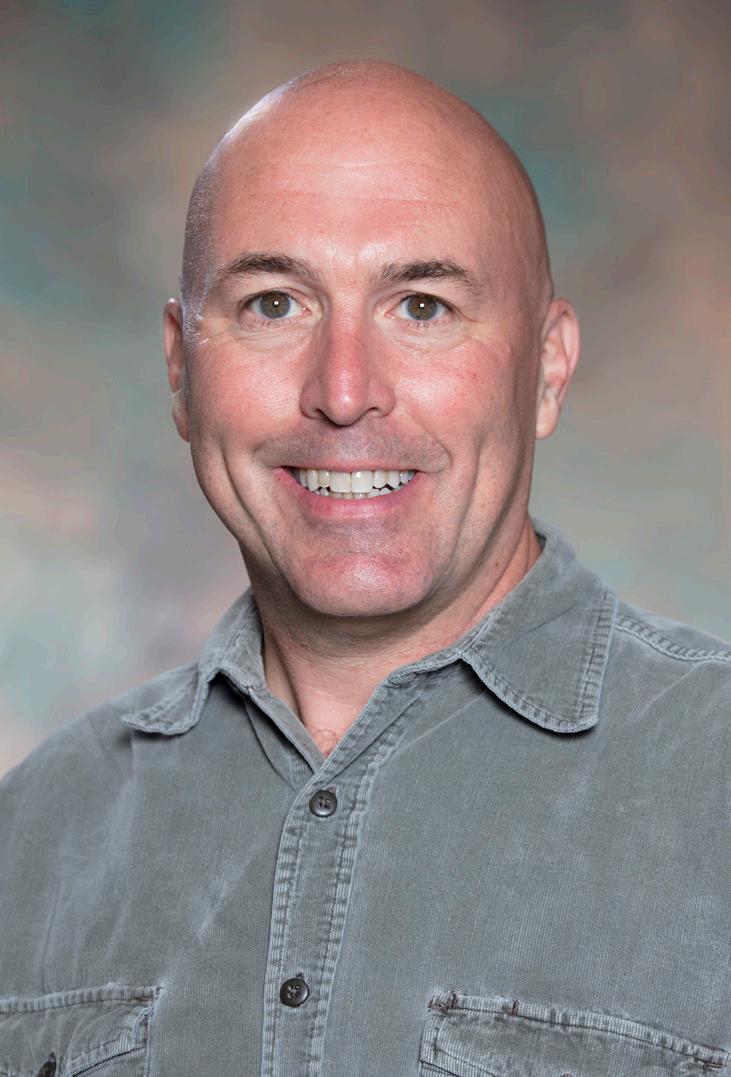
For Upper School Director John Schafer, who is spending an unpaid semester abroad with his family, and Menlo alums Sara Hewitt (‘19) and Guiragossian, the COVID-19 pandemic significantly altered their prolonged stays overseas.
Schafer, who went on his “dream sabbatical trip” to Madrid after the end of the first semester, remains in his Madrid apartment with his family, where regulations prohibit more than one person exiting their home at a time, according to Schafer.
Schafer’s average day consists of sleeping in without setting an alarm, reading news-
Teachers Adapt Schedules and Daily Life to Online Distance Learning
by ELLA HARTMANIS
Distance learning has been a challenging adjustment for students, but how has it affected teachers? Each teacher is adapting differently. Those with classes that heavily rely on face-to-face interactions and handson learning don’t translate well online; however, virtual classes also provide teachers with more flexible schedules, not to mention additional time spent with their families, according to math teacher Leanne Rouser.
During the current remote learning schedule, Menlo teachers typically teach four blocks and are given a three-hour period for each of their classes weekly. The three-hour period allows teachers to divide instruction time based on what they think works best for them and their students. Rouser said that she uses 45 minutes of the period to teach a
Teachers, page 3
papers to stay updated on the global pandemic, helping his daughters with their homework and trying to find a way to work out in his apartment. “If I knew that there was going to be a coronavirus breakout, I wouldn't have gone on sabbatical. I would have stayed at school, tried to help out there, and then at least if I was sheltering in place, I could be in my backyard and getting some sun. I’m in an apartment on the fourth [floor] of an eight floor apartment building that never sees the sun,” Schafer said.
Still, Schafer has seen a sense of hope in the Madrid streets. Each night at 8 p.m., people come to their balconies and clap in appreciation for the healthcare workers. “It’s a steady, heartfelt applause. It’s like buying war bonds, I guess. You’ve got to feel like you’re some part of a larger effort,”
Menlo Community Members Continue to Work Essential Jobs Amid Pandemic
by EMILY HAN
While most students and their families have to stay at home under the statewide shelter-in-place order, some members of the Menlo community continue to go to their jobs that the U.S. Department of Homeland Security (DHS) has deemed essential.
The Cybersecurity and Infrastructure Security Agency, which operates under the DHS, published a memorandum on March 28 advising the nation about which businesses should stay open, such as those in healthcare, public safety, food, energy and various other industries critical to combating the pandemic.
Medical personnel are among those essential workers, spending exhausting hours caring for patients who have the coronavirus and other medical conditions. Medical Director of Stanford Express Care Clinics Dr. Maja Artandi (mother of freshman Laura and sophomore Sophia Artandi) works 12 hours a day, seven days a week.
Dr. Artandi often conducts video visits with patients, many of whom are concerned that they might have COVID-19. After meeting with them virtually, Dr. Artandi decides whether or not they should get tested in person. If testing is necessary, the patient can visit the drive-through testing site at Hoover Pavilion, where Dr. Artandi spends most of her work hours.
“It’s interesting to work in a pandemic,” Dr. Artandi said. “We, of course, never expected that.”
Nevertheless, out of the 32 health care providers Dr. Artandi works with, no one has
stopped going to work out of personal health concerns. “Everybody’s actually working much harder,” she said. “People actually ask me how they can help more.”
In addition to the health crisis, another major problem recently is economic recession. Most people are not essential workers, so countless families are losing their incomes. According to CEO of Palo Alto Housing Randy Tsuda (father of sophomore Benjamin and senior Hailey Tsuda), 25% to 30% of the residents his company serves are experiencing income loss.
Workers, page 3
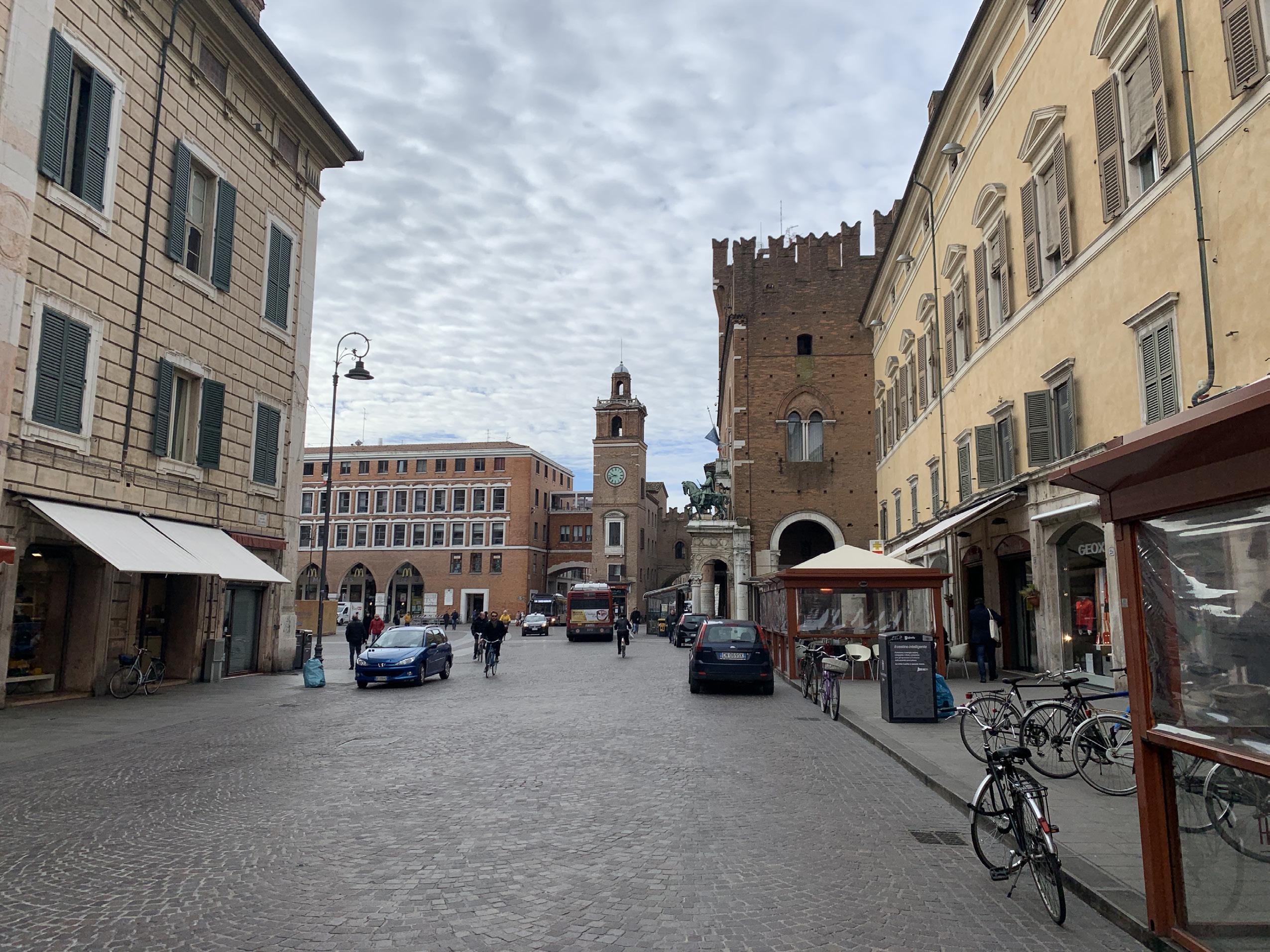
People continue to bike and walk freely in the streets of Ferrara, Italy on March 5. Progressive mitigation measures were introduved by the Italian government on March 9, according to The Lancet Journal. Photo courtesy of Sara Hewitt.
Palo Alto Housing employees, including CEO Randy Tsuda, prepare a food distribution event for residents the company serves. The site also serves as a drive-through to limit face-to-face contact with residents who have vehicle access. Photo courtesy of Randy Tsuda.
Editor's Note: As the COVID-19 pandemic continues to have a heavy impact on both the Menlo and global communities, The Coat of Arms would like to recognize and honor the essential workers who are risking their lives to keep our communities safe. The Coat of Arms hopes that this paper can serve as a source of uplifting news to connect our community in this uncertain time.
Coping With Stress and Anxiety During the COVID-19 Outbreak
Video: What Does the Coronavirus Do Inside Its Host?
Dos and Don'ts of Social Distancing
As Menlo students and faculty have shifted their workplace to their homes, the Menlo campus is officially closed, but in ways, still being maintained. The school is only doing what is defined by San Mateo County as “essential,” and that can be done while abiding by social distancing regulations.
According to Menlo’s Director of Operations Loren Arms, Menlo is ensuring that all life safety systems continue to be maintained. Examples of this include fire alarm systems and fire extinguishers in addition to equipment that requires periodic servicing. “Some of the service frequencies are required by regulations, and some are necessary to ensure the equipment is not damaged. Examples of this would include electrical systems, elevator servicing and inspections, et cetera,” Arms said in an email to The Coat of Arms. “Although much less than normal, we are still cleaning areas of the campus as we are keeping track of any areas that are used.”
Aside from tangible maintenance to the
campus, Menlo is doing all they can to maintain the remote aspects. “For example, [we] make sure all emails and phone messages are answered, ensuring invoices are paid, and preparing and planning for future work so we are ready once the relevant agencies allow us,” Arms explained. “There is still a lot of work that we are doing related to our construction projects. Again, this is work that we can do remotely via our computers or phone.”
While the campus may be closed, Menlo’s security force is now doubled. “Now, we have two security guards per shift, three shifts a day; that's 24/7,” Director of Security Mustapha Moutri said in an email to The Coat of Arms. Currently, security at Menlo entails one guard at the front of campus and one guard at the back of the campus, by Wunderlich Field. “[The guard] at the front of campus has the duty of monitoring the entrance of the school and checking in and out faculty and staff,” Moutri explained.
“[The guard] at the back of the campus by Wunderlich Field keeps an eye on the rear entrance of the school and also does patrol checks of all the buildings and sports fields to make sure they are secure."
Only staff members who provide essential tasks for the school are allowed on campus for short periods of time and must be checked in by security guards. “These could be members of the Business Office, Facilities Office and senior administration. Teachers are [also] allowed on campus to pick up essential supplies for their teaching,” Upper School Dean of Students Tony Lapolla said in an email to The Coat of Arms.
Teachers have also been allowed to visit their offices or classrooms if they experience technological issues in their homes that would negatively impact their teaching. “All staff members must sign in and out with security at the Valparaiso entrance to the school,” Lapolla said.
Abroad, cont.
Schafer explained.
When Guiragossian returned home from Paris, she self-quarantined for two weeks and has since been taking her classes online and watching recordings of lectures instead of live ones, as her classes still take place in Central European Time.
Hewitt, who was in Ferrara, Italy for her gap year as the COVID-19 pandemic unfolded, also returned home, but noted that while she was in Italy, there was very little commitment to following the regulations that were put in place to prevent the spread of the virus. “Coming from Italy, a country where I saw nobody stay at home and nobody social distance until absolutely forced to, I can promise you that is not the way to go,” Hewitt said.
Reflecting on her abbreviated experience in Paris, Guiragossian said, “I kept on thinking, ‘I can’t believe that coronavirus robbed me of my experience abroad and in Paris,’ [...] and I was just so devastated about that. I kind of only looked at it like only my time is ruined, but I think that this is a global crisis. Every single individual has been affected, and you just have to remember that, yes, this isn’t an ideal situation, but there are people who are suffering, there are people who are dying from this, and there are people who are in serious, serious danger because of the coronavirus.”
Looking for more?
Check out the corresponding video story on our website at menlocoa.org!
Menlo Parent and Physician Bruce Patterson Consults Administration on School Shutdown
by HAILEY TSUDA
Physician Bruce Patterson, father of Menlo senior Penelope Penfold-Patterson, was the virologist who consulted with Menlo when the school was initially shut down after an employee came into contact with COVID-19. He offered guidance to the senior administration as to how the facilities should be cleaned, what the school could do to prevent transmission of the virus and when students could safely return to campus, but this isn’t his first time working on an epidemic nor was he unfamiliar with the epidemiology of COVID-19. After graduating from Northwestern University’s School of Medicine, Patterson worked to develop the protease inhibitor drugs which help to stop the transmission of HIV, the virus responsible for the AIDS epidemic.
In early March, when Menlo was initially shut down, Patterson reached out to Health Services Coordinator Joan Barada and offered to assist the school in their efforts to
contain virus spread on campus.
Patterson was highly complimentary of Head of School Than Healy’s decisions regarding coronavirus. “I was proud of the school for taking [the situation] seriously at a time when many people weren’t taking it seriously. Than was making the difficult decisions that had to be made. I think [Than] can take tremendous comfort in the fact that he sent his kids home without an infection. At the end of the day, that’s what will be remembered,” Patterson said.
“[The administration and I] were pretty sure that the students were safe, but we went to measures like those South Korea deployed. We tried to identify where the staff member went on campus, and that was the purpose of the deep cleaning,” Patterson said.
In addition to consulting the Menlo administration on the COVID-19 virus, Patterson has been working to find a drug that can be
used to combat COVID-19.
After becoming the Medical Director of Diagnostic Virology at Stanford University Hospitals and Clinics, Patterson started his own company called IncellDx. While IncellDx typically does diagnostics for cancer and viral diseases, two months ago the company “discovered a way to use a cancer drug (leronlimab) against COVID-19 [...] to break the cycle of a cytokine storm,” Patterson said. Patterson calls the drug an immune modulator or regulator, helping the immune system from harming itself. The drug is not a vaccine.
When a patient contracts coronavirus, molecules called cytokines (which are part of the immune system) attack virus-infected cells and help rid the body of the virus. But, according to The New York Times, in up to 15% of patients, the cytokines continue to attack cells even when they are not needed. This leads to a “cytokine storm,” which is often followed by a fatal acute respiratory failure.
In many cases, it is the body’s own immune response that kills a patient rather than the actual virus. Leronlimab helps “restore normalcy to the immune system,” Patterson said, which causes cytokine storms to stop as well.
The drug is currently in phase three clinical trials meaning it is being tested in COVID-19 patients. So far, leronlimab has been given to 25 patients and according to the Associated Press, the results are promising.
According to Patterson, multiple patients have fully recovered and been removed from ventilators after receiving the drug. Patterson hopes that the drug will be approved for use in treating COVID-19 by the FDA in early summer.
Patterson said that while the number of
COVID-19 cases is expected to peak in April (for the United States), we have to be careful about allowing people to return to regular life too soon because, without adequate testing, cases could surge again.
Serology testing (also known as antibody testing) for COVID-19 has recently been developed and can tell “whether or not you’ve been exposed and have protective immunity,” Patterson said. This type of test can help release people out into the workforce in waves based on immunity; this can be especially useful for medical staff.
“I think it is still going to take some time [to return to normal life], into the summer,” Patterson said. While some people are predicting a resurgence in the fall, Patterson is hopeful that new treatments, such as leronlimab, will prevent that from happening.
“It will get better. Every pandemic does get better, and this too will get better. People should be hopeful,” Patterson said.
Photo courtesy of Bruce Patterson.
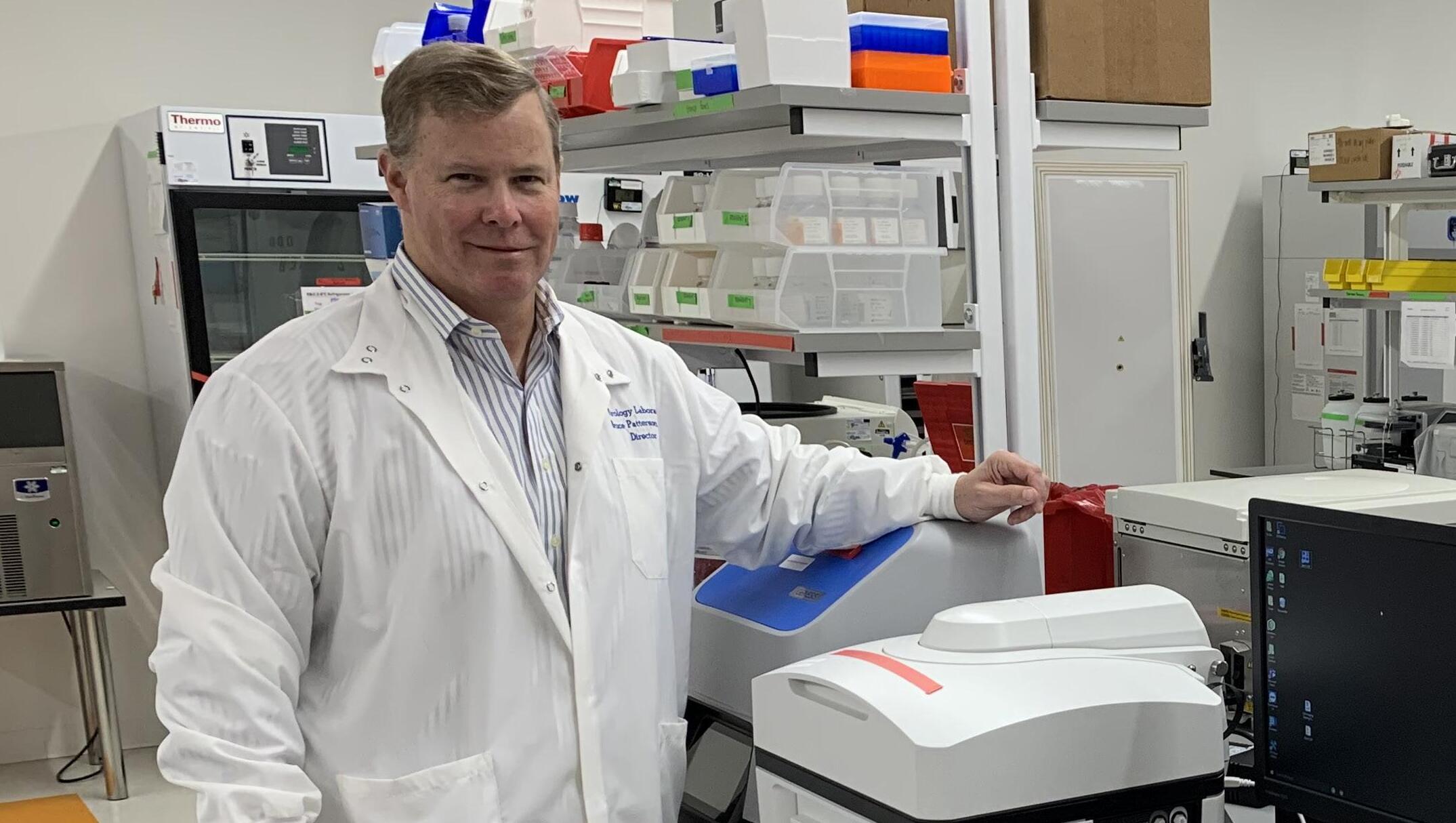
Patterson poses for a picture in his virology lab. Photo courtesy of Bruce Patterson.
A sign is put in place at Menlo's entrance to limit visitors. Security has doubled, according to Moutri. Photo courtesy of Tripp Robbins.
Teachers, cont.
to teach a lesson and then has students work on an assignment in a small group while periodically checking in with the groups. On the other hand, English teacher Rebecca Gertmenian uses the entire period for full class discussions, group work, short group presentations and individual work for her classes.
Online classes also allow teachers to have flexible schedules. “I am able to do things like go on a walk or bake in the
middle of the day, which would normally be more weekend activities,” Rouser said in a phone call with The Coat of Arms.
The adjustment to distance learning has proven to be more difficult for teachers with less technological experience than others. “At the beginning of distance learning, I was working 10 hours a day, seven days a week because I was struggling with the technology, but now I work probably 6 hours a day,” Rouser said.
Due to the shelter-in-place and school closures, all members of the Menlo community have been faced with the unprecedented experience of mixing their home and school lives 24 hours a day. “My daily routine is a mix of home life, managing my kids' schoolwork, and teaching. I am much more used to ‘compartmentalizing’ my life, and having all three zones of responsibility merge in and out of each other is kind of fun, kind of confusing and definitely
Workers, cont.
Palo Alto Housing, an independent nonprofit that helps low-income families find affordable housing, has created new protocols in response to the coronavirus outbreak. “We put in a lot of new processes, to balance the need to protect the health of our residents and our staff but also really to increase the amount of phone contact that we’re having with our residents to see how they’re they’re coping,” Tsuda said.
Although Tsuda used to work in the office on most days, he now works almost entirely from home. He only leaves the house to sign physical documents at the office once a week and to help distribute food to residents every other Friday.
Freshman Montse Contreras hopes that people who work from home realize they are lucky to do so. Contre-
distracting,” Gertmenian wrote to The Coat of Arms via email.
Another hurdle in online learning is the lack of face-to-face interactions. Many teachers rely on visual cues to interact with their students. “The biggest challenge for me with distance learning is not being able to fully see my students! In terms of not being able to ‘read’ their mood when they come into the classroom with a smile, a frown, a need to let me know something private before class, et cetera. I also mean this in terms of not being able to see the eye flashes, the halfraised hand, the parting of the lips — all the tiny clues that let me know if a student has a comment, question, or confusion
ras’ mother, Azucena Sandoval, works at a pet care facility in San Carlos, and Contreras worries about her mother leaving the house every day to go to work.
“Going [to and from work] — I’m pretty worried about that, even if it’s getting gas and just stuff like that,” Contreras said. “[The virus] is so contagious.”
According to Contreras, Sandoval was one of only about five people who are allowed to keep their jobs during the pandemic. Despite Contreras’ health concerns, Sandoval continues to go to work, especially because the income it provides is important to their family. “This is affecting everyone very differently, especially low-income families,” Contreras said.
Senior Olivia Velten-Lomelin works at Trader Joe’s, and her family also worries about her going to work. However, Trader Joe’s has implemented new policies and
are lost, even with video-conferencing,” Gertmenian wrote.
“A lot of business gets done by reading body language and just checking in with folks over the salad bar. I cannot do that now and feel disconnected,” Head of School Than Healy wrote to The Coat of Arms via email.
These adjustments have been far from easy, and teachers continue to learn what works and what doesn’t in order to help students understand the material. Considering that Menlo offers classes ranging from photography to philosophy, teachers have to get creative in how they structure and teach their classes to ensure that their students continue to learn. For example, dance teacher Jan Chandler is working on and experimenting with how to produce the annual Dance Concert and then provide an online recording.
With multiple weeks of distance learning yet to come, the Menlo faculty anticipates that more adjustments will be made to improve the experience for everyone. “We’ve already made some changes, but we’ve always viewed this endeavor as being iterative. Our entire, incredible, faculty just instantly became first-year teachers again…and every single student was just asked to play a very different game, and no matter how well we respond, doing all of this has a huge cost. So the mindset that we are going to do our best and make the adjustments we see as being necessary, perhaps not all at once but over time, is going to be an important way to think about this project,” Healy said.
rules to protect their employees and customers, VeltenLomelin said. For example, customers now have to wait in a line outside before shopping in order to limit the number of people inside at once. “During the first two weeks of this, even though there was no food in store, it was a sea of people,” Velten-Lomelin said.
“We were making more money than we were during the Christmas season,” she said. “By the end of the day, it would look like someone literally took out every single item of the store.” According to Velten-Lomelin, some employees worked 12 to 16 hours during these particularly busy weeks.
Although her mom wanted her to stop going to work, Velten-Lomelin decided to keep going in. “We have a lot of senior [citizens] working there, and I’d rather be working than have them working,” she said.
Some Students Complete Senior Projects From Home
by PENELOPE STINSON
After the announcement on March 25 of the cancellation of Senior Projects, many Menlo seniors were forced to put their end-of-the-year ideas to rest and halt their proposed plans. But for a handful of seniors, continuing their work at home was an option they were able to pursue.
Seniors Meredith Fenyo and Ethan Yan have continued their joint Senior Project, despite having to rely solely on Facetime and Google Docs to be able to communicate. Their Senior Project, developed from their shared interest in mock trial, was to write a mock trial case. They planned to teach the case to the mock trial elective at Woodside Elementary School that they had been helping with the previous semester.
When news of the school cancellation hit, Fenyo and Yan agreed that they would obviously be unable to teach their case to the elementary schoolers at Woodside Elementary School but decided to continue writing it nevertheless. “We thought writing [...] the case would serve as a really good and sentimental end to our high school mock trial experience,” Fenyo said via email.
But Fenyo is optimistic that once the case is finished, it will benefit her fellow mock trial teammates as much as it did her and Yan. “We hope more than anything that the case will provide some much-needed fun and laughter for our teammates as they read it. It definitely has for us, at least.”
she said via email.
For senior Sonya Lebedeva, whose project dealt with breaking the cycle of incarceration, there was little question of whether or not she would continue with her work. “These people are still in the prison, [so] the work shouldn’t stop,” Lebedeva said via email.
The purpose of Lebedeva’s project was to help people who have committed crimes find their authentic self and start to become emotionally vulnerable again. Lebedeva is able to engage in this work with a volunteer organization called California Reentry Institute. She used social media to help create a brand for the organization, as well as create content for their Instagram. As part of her work she also helps to raise money for the organization. Lebedeva attends weekly Zoom meetings with the California Reentry Institute, something she looks forward to during her quarantine.
Lebedeva also hopes to spread the message of her project to Menlo students. She pitched the idea of hosting interactive Zoom calls for Menlo students to allow them to get educated on the issues of criminal justice and incarceration in our area and earn Community Engagement credits by attending.
Senior Emma Dressel is actually able to take advantage of the fact that she no longer has a mandated timeline for her Senior Project to produce a more thoughtful product. For her project, Dressel had intended to work with a screenwriter based in San Francisco to create a full-length film script on
the intersection of sexual assault and mental health. With time on her hands due to quarantine, Dressel believes she will be able to more thouroughly research the topic of sexual assault and trauma therapy.
Dressel is passionate about the cause of sexual assault, and similar to Fenyo, Yan, and Lebedeva, has decided to use the unexpected gift of free time to continue to build a project that shows her passion.
Staff Illustration: Grace Tang
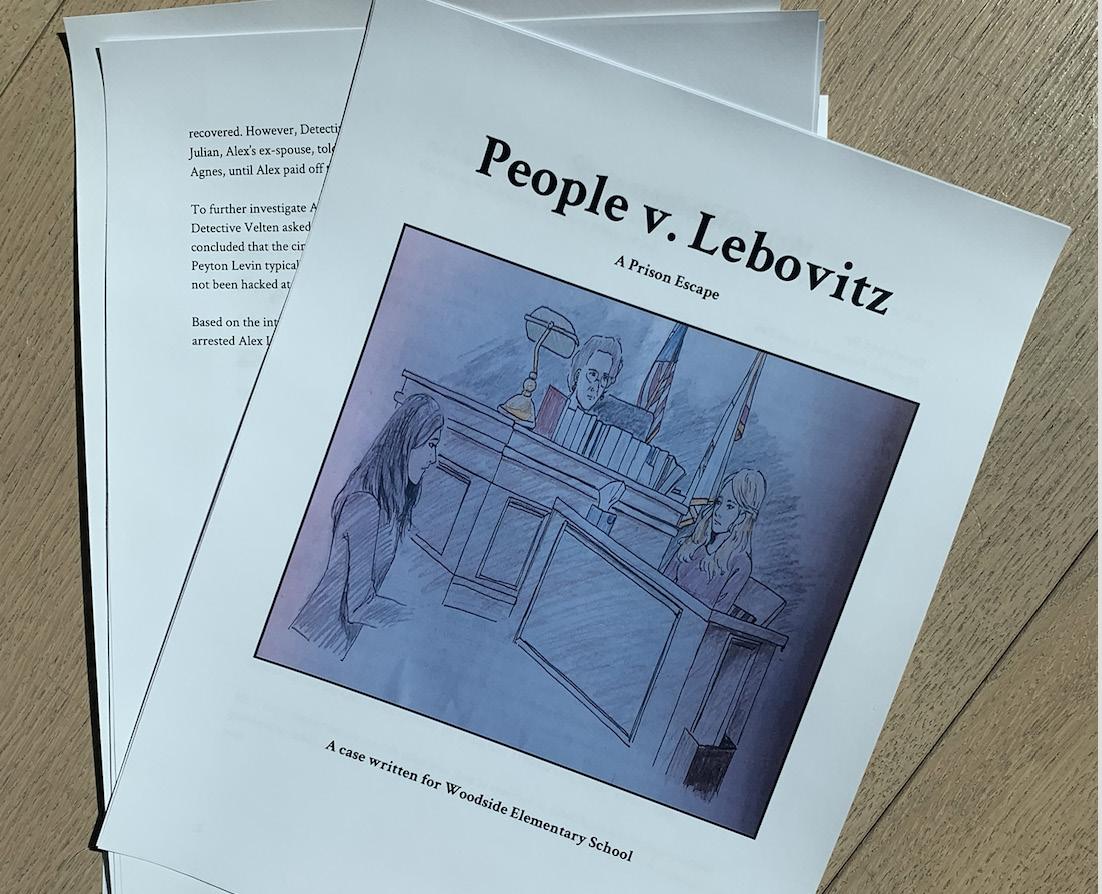
Fenyo and Yan continue to complete their mock trial case for Woodside Elementary School. Staff photo by Penelope Stinson.
Selected Faculty Profile: Upper School History Teacher Dan Devitt
by ASHLEY GRADY
CoA: Where were you born?
Devitt: I was born in Chicago.
CoA: Do you prefer the West Coast, East Coast or Midwest?
D: I have been in San Francisco long enough to definitely prefer the West Coast.
CoA: Do you have any pets?
D: I have two cats, although for the record, I am not a cat person.
CoA: What are their names?
D: Bananas, because he’s bananas, and Junie, because she and her sisters were called April, May and June when they were found on the street.
CoA: Do you have any allergies?
D: I’m asthmatic and think I’m actually allergic to cats — thank you very much — but I’m not really sure. Maybe cheese, which is a problem because I’m from the Midwest.
CoA: Which of your classes is your favorite to teach?
D: The politically correct answer is all of them are my favorite because children are perfect beings. The actual answer is an AP Government class three years ago. But I can’t tell you which one.
CoA: What do your students do that most annoy you?
D: Probably the things they do currently when doing online learning, which is playing games while I’m lecturing, doing their makeup while I’m teaching class — I won’t mention names. Also, snoring during my online lectures.
CoA: What have you been able to do in this shelter-in-place that you wouldn’t have done
otherwise?
D: I have taken so many walks in our nearby park that I am beginning to recognize different types of pinecones, which I think demonstrates how fragile my mental state is right now.
CoA: Have you ever met anyone famous?
D: I’ve met, oh, many people, but I’ve met Supreme Court Justice — this is a shoutout to [senior] Ethan Yan – Stephen Breyer, who graduated from the school I taught at in San Francisco.
CoA: What’s your favorite state?
D: My favorite state has to be my adopted state of California — no offense to Wisconsin, where I grew up, and Illinois, where I was born.
CoA: What’s the longest time you have been awake for?
D: Oh, that’s a good question. I would say it would have to be in college for obvious procrastination reasons. That was probably 22 hours straight to finish a paper.
CoA: What’s one class you wish you could teach at Menlo?
D: I think I’m teaching it. It’s called Intro to Law. And I hope everybody signs up for it. It’s actually one of my favorite classes.
CoA: If you weren’t a teacher, what would you be?
D: When I was in high school, I had some weird obsession to be a police officer. So while I’m not strong or smart enough to be a police officer, my secret fantasy is to be a stand-up comedian or investigative journalist.
CoA: If you could have dinner with one person alive or dead, who would it be?
D: Malcolm X. Do I need to say why?
CoA: If you want.
D: Malcolm X because I would love to hear what he would have to say about the 21st century.
CoA: If you could get a custom license plate, what would it say?
D: COVID-19.
CoA: What food would you never give up?
D: Pizza.
CoA: What’s one thing you don’t miss about Menlo?
D: No offense to the seniors, but hands down, 100%, assassin.
CoA: Can you give me one word to describe your time at home this past month?
D: Anxiety producing. I don’t think that’s one word, but that’s the truth.
A Physician’s Perspective on How COVID-19 Has Changed Her Life
by SOPHIA ARTANDI
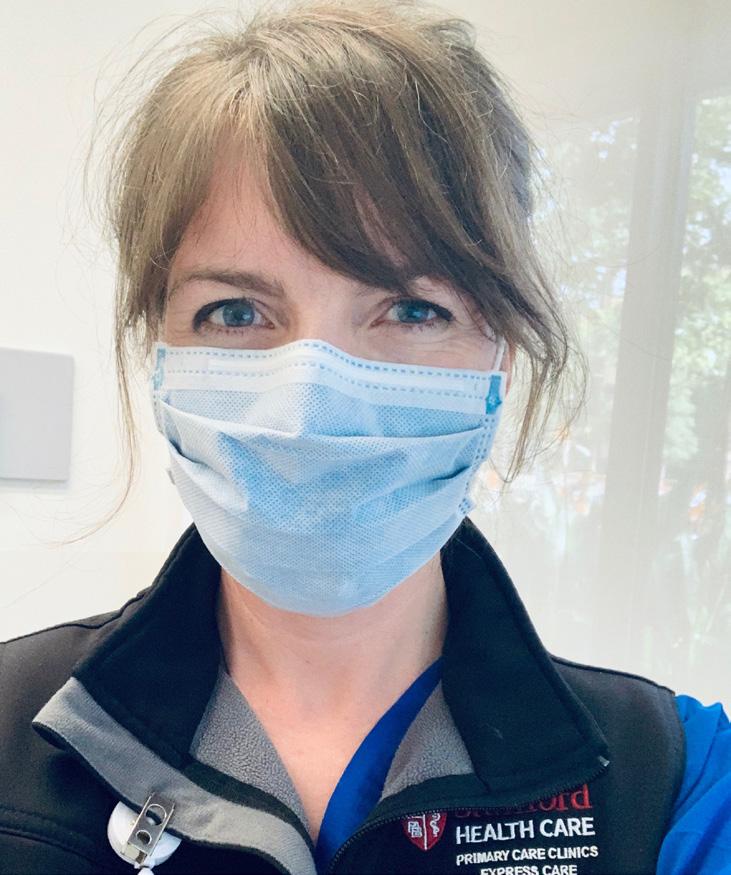
In the midst of the coronavirus pandemic, the lives of doctors worldwide have become more complicated, and not just because they are treating patients with a highly infectious disease. Clinical Associate Professor of Medicine at Stanford University Dr. Lucy Kalanithi, who has been working at Stanford since 2014, has had to adapt in more ways than one, from wearing masks at work to balancing her personal life with a demanding workload to thinking about the potential moral distress that the pandemic could put her in.
Dr. Kalanithi is a primary care doctor and usually sees 20 patients a day who have any sort of symptoms or health concerns. The clinic she works in functions similar to an urgent care center, meaning she only sees patients with same-day appointments. Now, every patient Dr. Kalanithi sees either has coronavirus or is concerned that they might have it.
The onset of coronavirus has prompted Dr. Kalanithi and others in the medical community to find creative ways to tackle the problem. For example, she has gotten back in touch with the doctors she did residency, a stage of medical training, with via WhatsApp, a messaging app. The original purpose of the thread, which includes around 40 doctors who work in various parts of the U.S., was for emotional support. “It’s the doctor equivalent of calling home in an emergency,” Dr. Kalanithi said. The WhatsApp thread has also become a place where they share information and protocols.
In addition, Dr. Kalanithi is learning a lot about the coronavirus from the Twitter hashtag, #medtwitter. “Everyone is learning in real time and then sharing what they’re learning,” she said.
The pandemic has also contributed to the rise of telemedicine. According to Dr. Kalanithi, most appointments in her clinic since the beginning of coronavirus have been over video. “The whole set up is extremely different,” she said.
Stanford has mandated that all medical personnel wear procedure masks anywhere in the clinic and do a daily temperature
check at the building entrance. When treating coronavirus patients, doctors wear full N95 masks, gowns, eye shields, hair covering and gloves. According to Dr. Kalnithi, some doctors have taped photos of themselves without their masks to their scrubs to help put patients at ease. “With our colleagues and all other patients, social distancing isn't always possible. We can’t always stay six feet away from each other in a hospital or clinic,” Dr. Kalanithi said. Though there is a worldwide, critical shortage of personal protective equipment (PPE), Stanford keeps doctors updates and still has weeks of supplies left, according to Dr. Kalnithi.
The coronavirus has brought significant changes to Dr. Kalanithi’s personal life. She has a 5-year-old daughter and usually drops her off at school, then sees her again for dinner and has time to do work at home. Now, she’s either at work or at home and finds herself staying up late to get extra work done. “It’s been really intense, but it’s also the most satisfying, interesting thing I’ve ever done in my medical career,” Dr. Kalanithi said. “I look around at my [colleagues] and I feel like we’re the grownups. We have to figure it out,” Though she mentions having felt this on an individual level in the past, such as with patients or when doing a medical procedure she’d never done before, it’s amplified in the presence of the pandemic.
Dr. Kalanithi is slighly scared of getting coronavirus, but given that she and her daughter are healthy and that it doesn’t tend to affect people in their age groups significantly, she is more concerned for her parents and others who have a higher chance of contracting the virus.
She is the most anxious about the moral aspect of the pandemic, as it could overwhelm the healthcare system. According to Dr. Kalanithi, the reason why everyone is sheltering in place is because if everyone contracts coronavirus at once, there won’t be enough hospital beds or ventilators. In some places, like Italy, doctors can only answer calls for an ambulance if the patient is in critical condition and must leave some behind. Some doctors have been comparing this to having to participate in a real-life “trolley problem.” The trolley problem is a thought experiment that discusses what to do if there’s a trolley that’s about to kill five people as opposed to one if the person makes the decision to divert it. “Some feel as if they have to decide who lives and who dies! It's something we aren’t trained
for and that prospect was keeping me up at night,” she said.
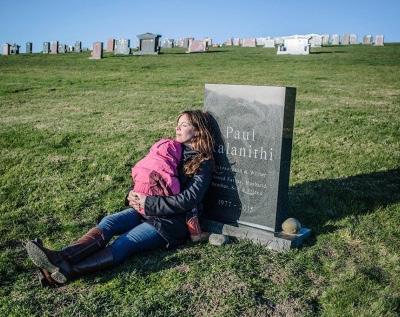
Five years ago, Dr. Kalanithi’s husband, Dr. Paul Kalanithi, a neurosurgeon and author of “When Breath Becomes Air,” passed away from terminal lung cancer. “People always said, ‘Don’t you think it’s unfair?’ and I never thought so. It was wildly unlucky. Getting terminal cancer is not morally distressing, but this [pandemic] is. It’s straining our health care abilities and it’s even worse for people of color and for people in nursing homes, homeless shelters and prisons,” Dr. Kalanithi said.
Dr. Kalanithi mentioned a viral photo she saw online, which showed two doctors in full PPE, holding up a sign. “We came to work for you, you stay home for us,” the sign reads.
“Especially for high school students, not being able to be social is hard. I want to say thank you to everybody for staying home,” Dr. Kalanithi said. “It’s really going to save many, many lives, and it’s the reason that we will have enough equipment in California to treat anybody who does get sick.”
Dr. Lucy Kalanithi and her daughter visit Paul Kalanithi's grave. Photo courtesy of Lucy Kalanithi.
Dr. Kalanithi wears a mask in her clinic. Photo courtesy of Lucy Kalanithi.
Photo courtesy of Menlo School.
The Show Will Go On for Menlo's Spring Musical, "Pippin"
by PENELOPE STINSON
The show must go on, and in the case of the Menlo spring musical, "Pippin," the show will go on.
In light of the recent school closure, many Menlo extracurricular activities have decided to either take a break or cancel their respective events. But despite the fact that school is canceled until summer, Upper School Director of Creative Arts and director of the spring musical, Steven Minning, has chosen to continue the show, only now as an online performance.
Although the show is still continuing, the format will be modified in order to comply with all of the issues that come with performing and rehearsing online. Minning plans to cut down the two-hour-long musical to be around 30 to 45 minutes. He contends, however, that his goal is to keep the plotline consistent, “[so] it’s not necessarily just a review of the songs,” Minning said.
This 45-minute version of the show will be a compilation of videos sent in by cast members singing, acting and dancing their respective parts. In order to blend these videos together and mix the audio, Minning plans on hiring a video editor.
For the online version of “Pippin” to come together, Minning is depending on the help of the student actors. Since students are their own cameramen and crew for their video clips, Minning is laying out clear-cut instructions for them. “There will be very
specific guidelines [for filming], like you have to be six feet away from the phone, and you have to turn on the sound at a certain point,” Minning said.
Minning believes that continuing the show is something that the actors who are part of the production need. “I wouldn’t have continued [the show] if I didn’t feel that they really wanted it,” Minning said. He also added that it was important for the students to feel good about overcoming strong odds and being able to thrive because of the production.
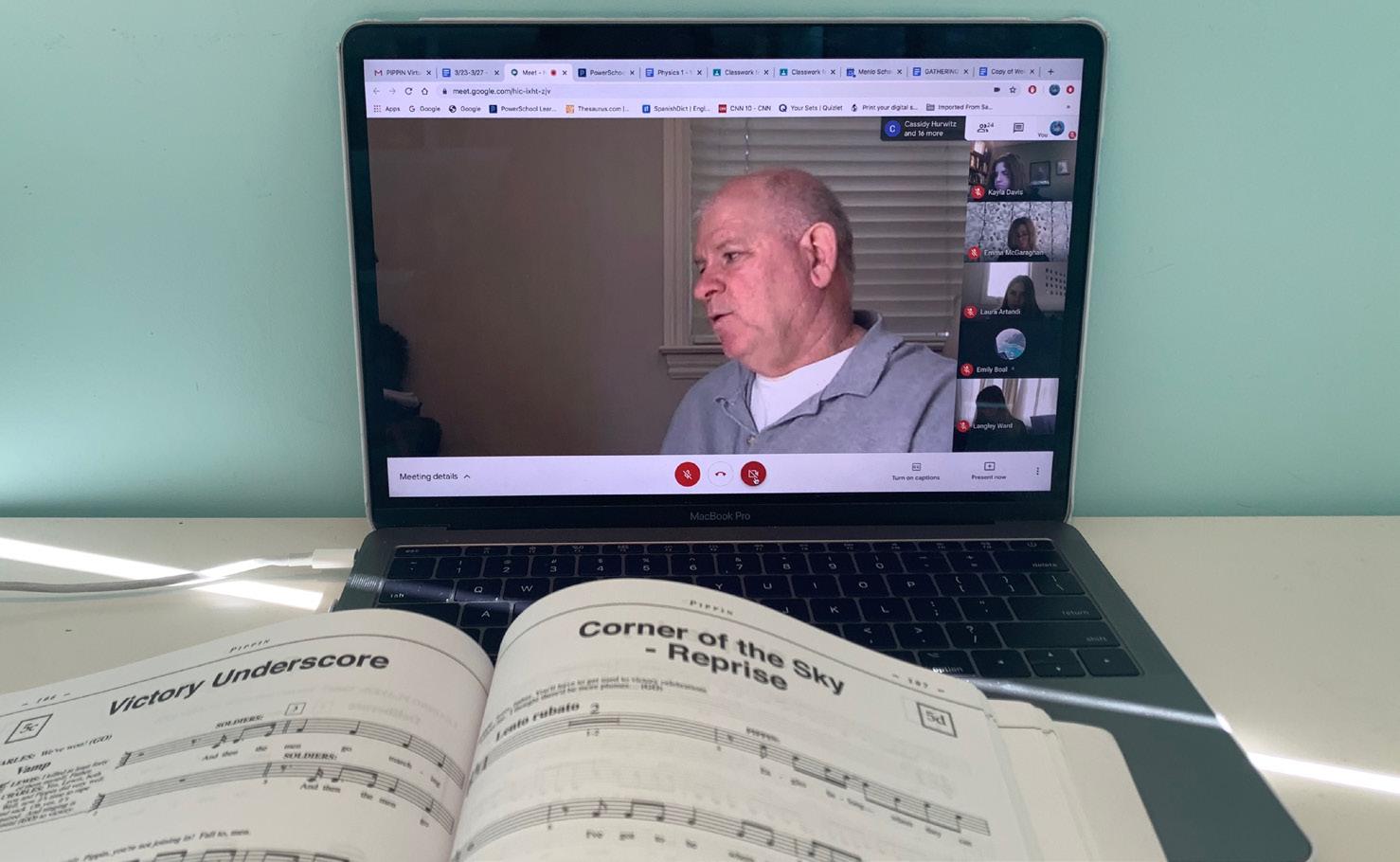
“Art really does make everything lighter and brighter, [...] music really heals the soul and I think theater does too,” Minning explained. Because they are unable to have in-person rehearsals during the closure, Minning has held rehearsals online via Zoom. In the full cast rehearsals, cast members join a Zoom, mute their microphones and sing along while the vocal instructor Rick Reynolds teaches them their vocal parts. Minning also holds smaller online rehearsals with specific actors, when he works on small scenes from the show.
Cast members of "Pippin" seem to be grateful that the show is still on, specifically senior Emma McGaraghan, who plays the part of the Leading Player, and sophomore Tucker Gold, who plays the part of Pippin. Both are excited to still be able to participate in "Pippin," and McGaraghan is also appreciative to have something to break up her day under the shelter-in-place order.
McGaraghan additionally emphasized
a similar point to Minning in which she highlighted the benefit of the arts, specifically theater, during such an uncertain time.
Both McGaraghan and Gold find the specific, small group rehearsals in Zoom to be very helpful for working on their characters, but McGaraghan noted that it’s slightly more difficult to do the full cast rehearsals. “With 35 people all on one video call, there’s no way to check that everyone understands everything and that everything sounds good and is blending all together,” McGaraghan said.
Due to the coronavirus outbreak, Min-
ning is one of the few directors who is able to continue their show and has chosen to do so. According to their website, the theater department at Palo Alto High School had to cancel their spring play, "Tartuffe," due to their school shutdown. Additionally, all Broadway theater shows have been suspended until June 7, according to a statement on Broadway.com.
Minning doesn’t have an exact timeline for the screening of the online version of “Pippin” but believes it will be towards the end of May.
Isolated at Home, Students Create Original Music
by GEORGIA PAYE
While in shelter-in-place due to the coronavirus pandemic, Menlo student musicians find themselves with a lot more time on their hands to create music. However, finding motivation and collaborating with others have become obstacles while isolated at home.
Senior Birdo Gonzalez-Zaragoza, singer and songwriter, has found it easier to focus and create his music from home. “I feel as if this period has allowed me to isolate myself and really listen to my feelings,” GonzalezZaragoza said. Junior Leo Jergovic has also found that the extra time has pushed him to spend more time creating his jazz music, as a singer and pianist. “I have more time to practice, write and work on projects than I would during the school year,” Jergovic said. However, distractions at home can make it difficult to find the motivation to work. “It's way harder to find motivation because I have so many other distractions at home. I'll have small bursts of motivation that don't stick longer than an hour,” senior rapper Miles Hester said. Similarly, Jergovic found that some days are harder to work than others. “There certainly are the occasional days where fatigue, extra work for school or other external factors have made it difficult to motivate myself to spend the hours I have spent each day on my music thus far,” Jergovic said.
Many musicians at Menlo collaborate and work together to produce music. With social distancing in place, students cannot meet in-person to collaborate. Jergovic has used this time to write and create more of his own music. “I have utilized the time to write more of my own music, using music as an outlet for my emotions and creative expression,” he said.
For instance, Jergovic has released two of his own solo projects called “Social Distancing Part 1” and “Social Distancing Part 2,” with musical contributions from senior Aaron Morgan on drums and sophomore Gretchen Witte on the saxophone, which he has released music videos for on YouTube
and Instagram.
When it comes to collaborating with others, Jergovic takes advantage of phone calls and a music software called Logic, where he can virtually exchange project files with his collaborators. Hester and Gonzalez-Zaragoza, on the other hand, primarily rely on FaceTime to communicate with one another.
While it may have been an interesting transition, being in shelter-in-place has not stopped Menlo students from creating and expressing themselves through music. Hester is currently working on multiple features: a mixtape, his own album and a collaboration album with Gonzalez-Zaragoza. Gonzalez-Zaragoza is also working on his own solo album called “Project Minus.” In addition to Jergovic’s social distancing series, he has also released a song called “Rainy Day” in collaboration with Morgan on YouTube and IGTV, which will soon arrive on Spotify, iTunes and other streaming platforms.
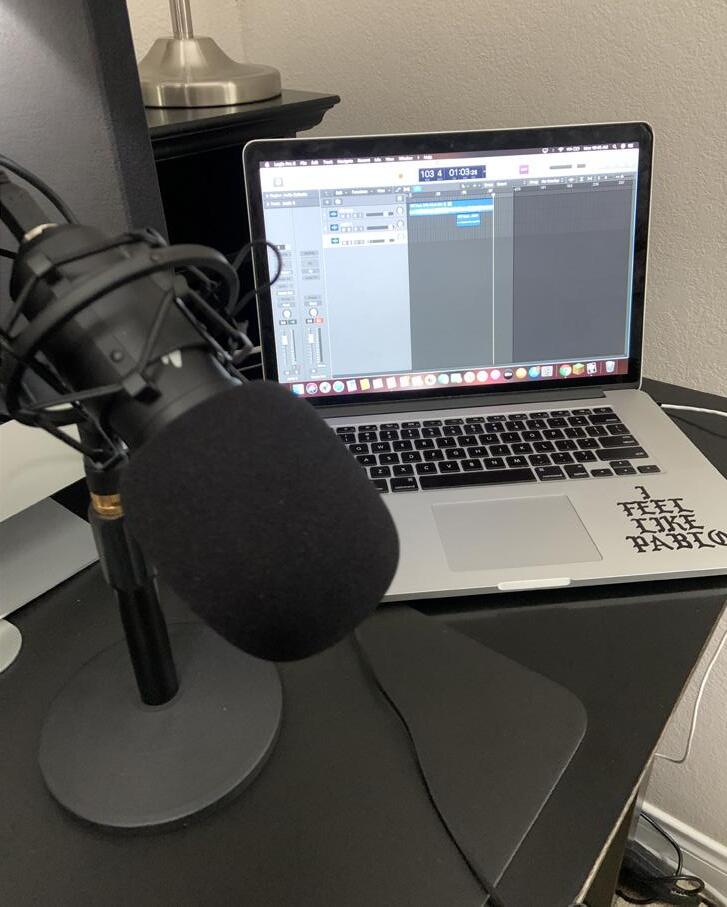
Hester makes music from home by using a portable microphone and music software on his laptop. Photo courtesy of Miles Hester.
Vocal instructor for “Pippin” Rick Reynolds leads the cast in singing one of the songs from the show over Google Meet. Staff Photo: Penelope Stinson.
Construction on the Spieker Center for the Performing Arts, Menlo’s new performing arts facility, is perhaps the most visible project in progress on campus. BeginningwiththedemolitionofseveraloldbuildingsonApril 1, 2019, the plan to build the Spieker Center stayed on schedule until the school closure in March 2020. Head of School Than Healy announced the project for the first time in a schoolwide email on March 11, 2019. In the email, he said that the building will be named in honor of Carol and Ned Spieker (‘61), who contributed a major donation that helped fund and initiate efforts to plan the new building. “The 40,000-square-foot center will feature a stateof-the-art theater with approximately 400 seats as well as dressing rooms, a green room, an orchestra pit, a set building shop, a lobby event space, and offices for Music@Menlo,” Healy said in the email. Most performances by Menlo drama and dance have previously taken place in the Florence Moore Auditorium on the Menlo College campus. However, that auditorium is limited in size, and the backstage area is primarily made up of a narrow hallway at the back of the building. To make space for the new center, Devcon — the general contractor company that the School hired
by EMILY HAN
to oversee the project — first demolished the old dance studio and the former C Building, which had housed the Mandarin program and the Campus Store.
The Creative Arts and Design Center (CADC) was renovated to accommodate a new dance studio this year, and Mandarin classes were relocated to A-123. The Campus Store is now inside the Tech Center. Before the school closure forced progress to temporarily halt, construction for the new building hit many significant milestones. After the demolition in April 2019, construction workers spent the summer digging on the site and then started laying the base for the foundation soon after the 2019-2020 school year started. Construction was still on schedule before the school closure this spring. With the interior walls in place, the team was about to add glazing and stucco. “The exterior is almost entirely completed,” Perez said in an email to The Coat of Arms. He added that the building will take about five more months to finish once construction can resume.
“While we don’t know when the shelter-in-place restrictions will be lifted, we remain optimistic that we’ll be able to use the theater this fall, contingent upon the social distancing guidelines we receive from San Mateo County and the Department of Health at that time,” Perez said. The only advances in construction since the campus closure have been certain time-sensitive elements like finishing the roofing, according to Perez. Situated between the Student Commons, the Athletic Center, and the CADC, the Spieker Center will be at the center of the Upper School campus. In his April 2019 State of the School Address, Healy pointed out that the location represents Menlo’s well-rounded approach to developing its various programs. “The fact that you’ll leave the academic area and walk through the arts area to get to the athletics area is symbolic of our strengths as a school,” he said in his speech.
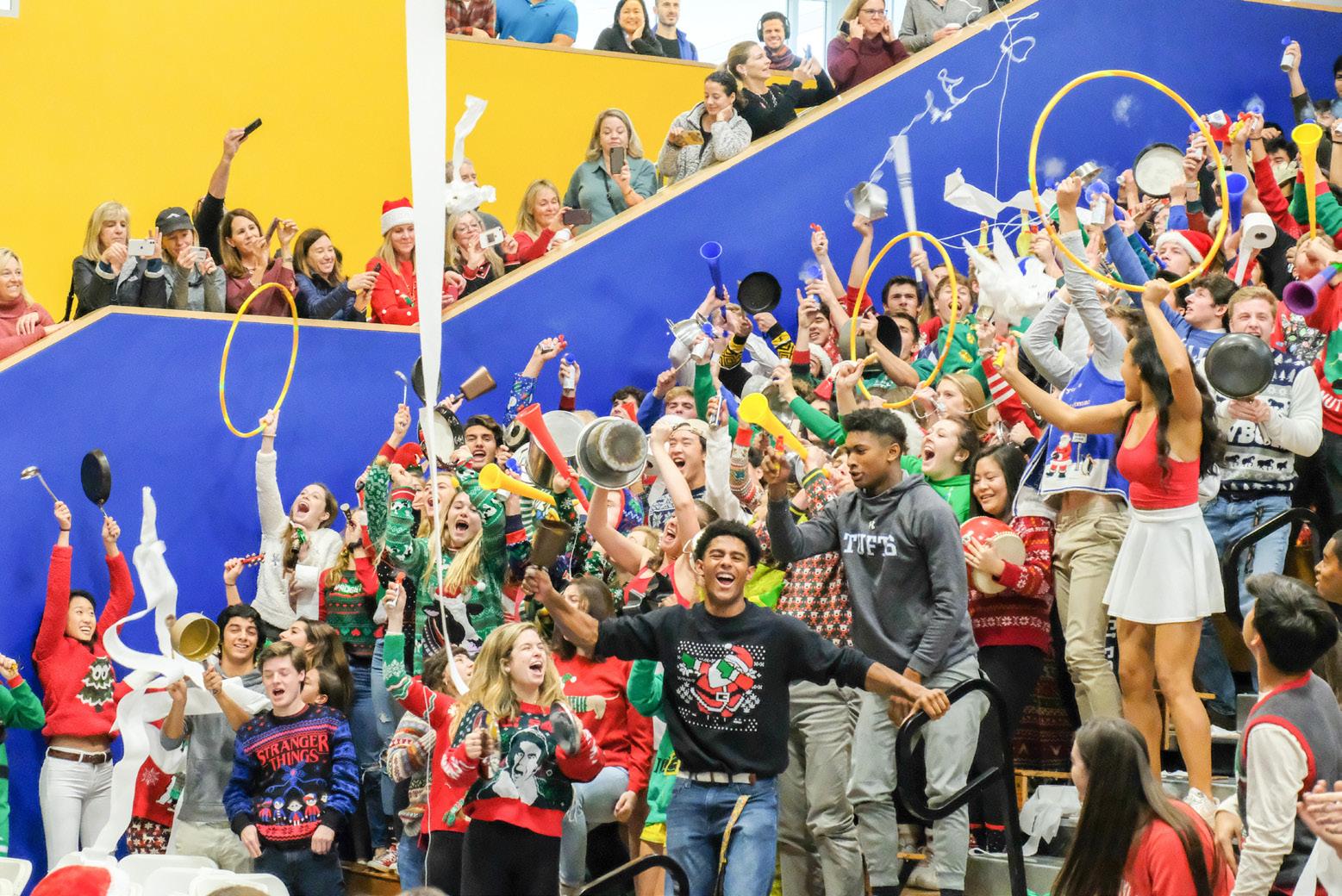
At the annual Holiday Assembly, the senior class cheers, uses noise makers and throws toilet paper during their part in the “12 Days of Christmas” song. Photo courtesy of Pete Zivkov.
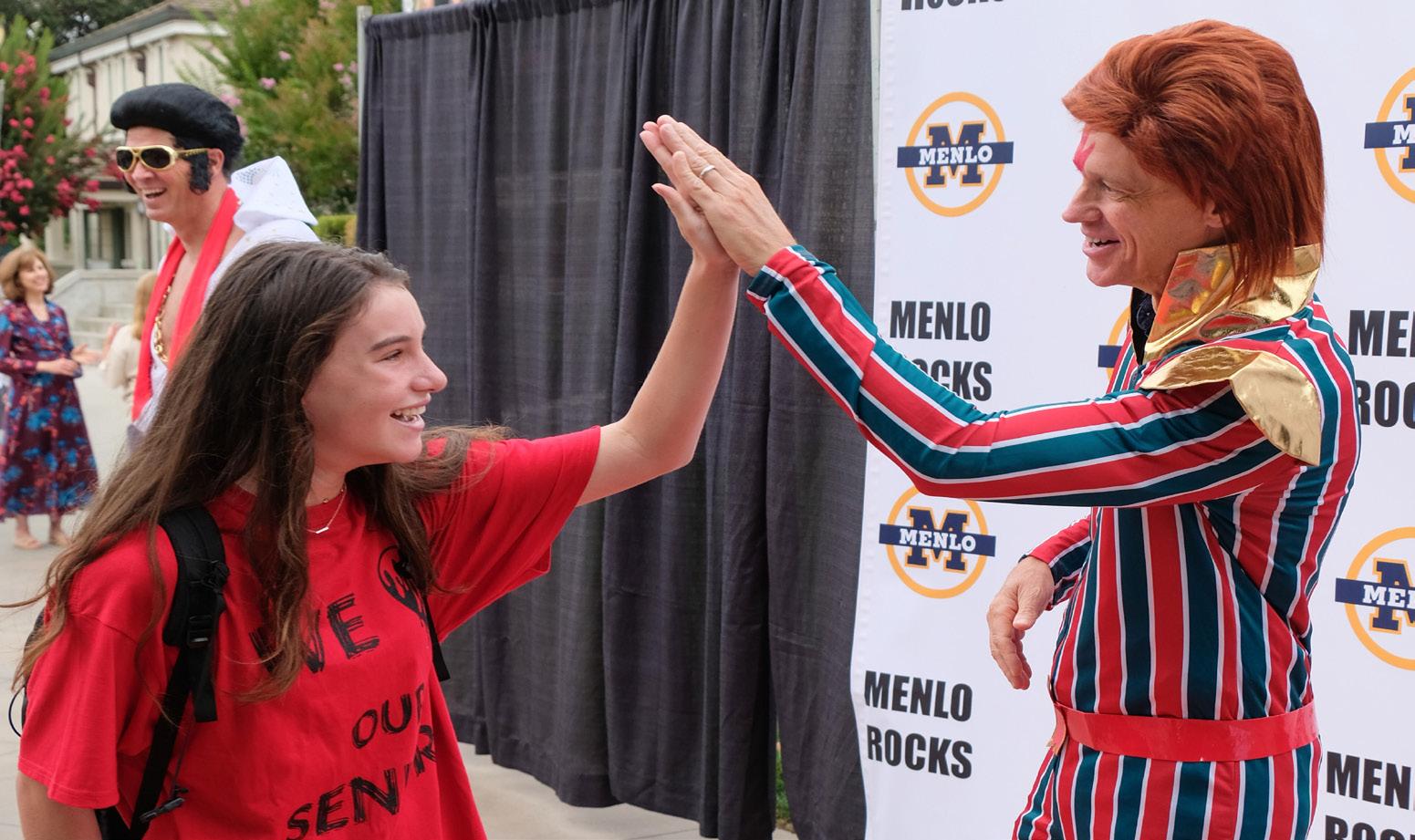
Freshman Riley Jensen high-fives Upper School Director John Schafer while walking in on the first day of school. Both Schafer and Jensen were dressed up for the “rock stars and groupies” theme picked by the Class of 2020. Photo courtesy of Pete Zivkov.
Knights See Victories in Basketball, Football and XC
by TESSA FRANTZ
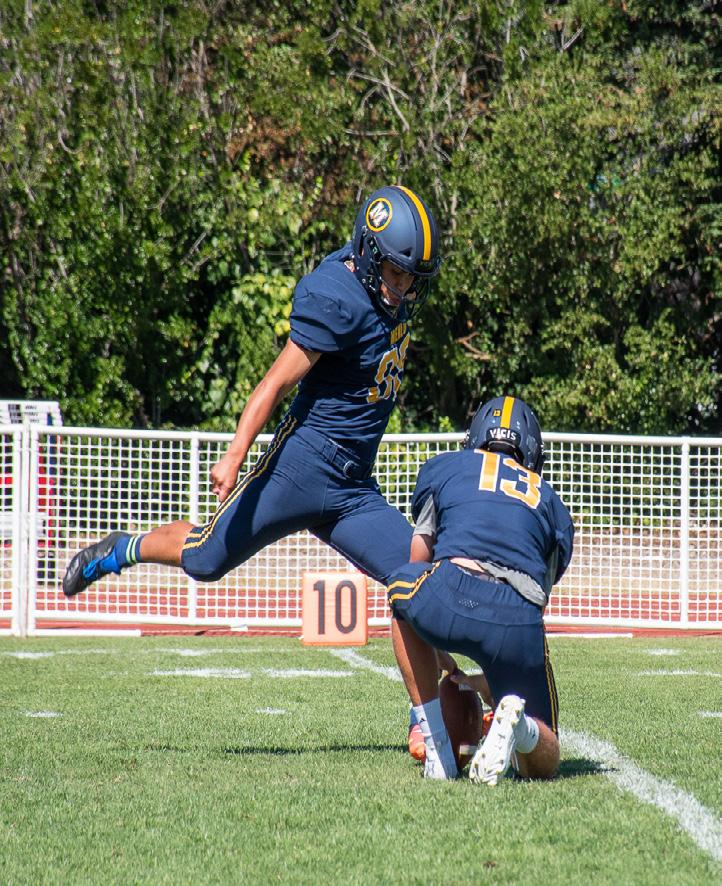
With Menlo’s closure, all spring sports were forced to end their seasons early. However, looking back on the school year as a whole, one can appreciate some of Menlo’s athlet- ic accomplishments in the fall and winter seasons. The girls and boys cross country teams competed at States this year, and both teams placed in the top 10. Menlo brought home a win during the varsity football homecoming game against Carlmont, challenging the notion that Carlmont had a pow- erhouse football team. Girls and boys basketball both had successful seasons, with the girls bringing home a win against SHP and earning a victory at the State Championships.
On Nov. 30, 2019, the girls and boys varsity cross coun- try teams competed in the CIF State Cross Country Cham- pionships at Woodward Park Cross Country course, locat- ed in Fresno, Calif. The girls varsity team placed second, and the boys placed 15th out of 25 teams. While the girls have participated in the state championships for the past four years, placing second this year was their best result. “We’ve been to States all four years, but this was the first time we ever really had the chance to do well. It was looking really promising all season, and then everything just came together the day of the meet,” senior Charlotte Tomkinson said. This was the boys varsity team’s first time competing at States since 1998. “We were happy to be at [States] in the first place, our goal being that we place in the top 15, which we ended up achieving,” junior Kamran Murray said. On Oct. 11, 2019, Menlo’s varsity football team delivered
The girls varsity cross country team lines up to start their race. The team wore pink accessories during their races in October to pay tribute to breast cancer awareness month. Photo courtesy of Allison Virsik.
a victory against Carlmont High School in the Homecoming game. The game ended with a score of 23 to 17, an impres sive score considering Carlmont’s well regarded football program. During the game, the team had many highlights from senior Jaden Richardson, who scored multiple touch- downs and held 303 yards that game. Senior quarterback Kevin Alarcon also proved to be a crucial asset during the game, continuously getting past defensive linemen. Though their season was cut short, girls and boys bas-
ketball had plenty of wins this season. But on Feb. 7, 2020, both teams participated in heated games against SHP, resulting in a fierce victory for the girls but a loss for the boys. For the girls, the team ended with a winning score of 54-30 against Prep. Furthermore, had COVID-19 not disrupted the season, the girls basketball team was set to play in a Division I state playoff game in early March. For the boys, they finished their season sharing the top ranking with Prep, despite losing the rival game 62-57.
Historic 2019 Homecoming Creates New Traditions
Despite the school year ending on an abrupt note, one of the highlights of the 2019-2020 school year was the spirited week of Homecoming. On Oct. 11, 2019, Men- lo held its first night football game, a significant event in its history. That same afternoon, Menlo launched its centennial fundraising campaign, which raised money for projects such as the expanded library, dining com- mons, student center and renovations to athletic facilities. The week started off with Muscle Monday, when students dressed in athletic attire and competed in many spirit ac- tivities, one of which being the annual junior vs. senior girls football game. Tuesday brought the Color War, as each grade dressed in their assigned color. Students wore their wackiest apparel for Wacky Wednesday and enjoyed classic spirit activities such as apple bobbing. On Movie Theater Thursday, each grade dressed to a specific movie theme, and the homecoming theme was announced: NASCAR. Menlo spirit built up throughout the week, and as the week came to an end, Friday was an exciting and fun- packed day. After the assembly to send off the Men- lo varsity football team, the loop was filled with food trucks from a variety of cuisines and the quad with games and an ice cream station. Menlo welcomed parents, alumni and friends of those with connections to Menlo. The attention shifted toward the homecoming football
by PARINA PATEL
game as people made their way to Cartan Field where the Menlo Knights played the Carlmont Scots. Since this event took place at night, Cartan had lights surrounding the field, a component that boosted the homecoming spirit.
Out of respect for neighbors, Menlo administration decided to not have a PA system, which would be loud and disruptive. Instead, each attendee received headphones that broad casted announcements that would’ve been heard on a PA sys
tem. Menlo worked with Quiet Events — a company special- izing in “silent disco parties” — to provide the headphones. What was first seen as unorthodox became a huge success. As the night continued on, the Knights beat the Scots 23 to 17, and the Homecoming dance, held in the West gym, ended the historic night.
On the movie-themed spirit day, the
porary stage on the quad to watch their classmates participate in “Name that Tune.” Spirit week took place Oct. 7 through Oct. 11, leading up to the historic night football game and dance. Photo courtesy of Pete Zivkov.
student body gathers around a tem-
It’s Time to Start Reconsidering Your Summer Plans
by ELLA HARTMANIS
Original summer plans have now either been put on pause or been canceled altogether for many members of the Menlo community. This stems from all of the uncertainties caused by the COVID-19 pandemic and the resulting restrictions. There are currently numerous unknowns including the duration of the shelter-in-place restrictions, public facility closures, travel bans and most importantly, the development of an effective COVID-19 vaccine. The 2020 Tokyo Summer Olympics, which was postponed until the summer of 2021, is one of the many summer events that have been postponed or canceled as a result of these unknowns. However, other organizations are waiting as long as possible to make changes because they are hopeful that some events will be able to proceed.
“I have been looking forward to the program for a while now, and I am really hoping it won’t be canceled, but that doesn’t seem very likely at this point.”
- sophomore Cassidy Hurwitz
Currently, the U.S. has a Level 4 Travel Advisory in place, which states “do not travel.” There are similar travel bans worldwide and currently, 93% of the world’s population, roughly 7.2 billion people, live in countries with travel restrictions on noncitizens and non-residents, according to Pew Research Center. Additionally, when the travel bans are lifted, it is likely that the flow of travel will be lower than before the pandemic, according to an article published
on April 9, 2020, in The Chronicle Of Higher Education.
This won’t only affect those who have preexisting travel plans but will also greatly impact the worldwide economy. With less travel, the global tourism industry will suffer, and for many countries, the tourism industry is the largest contributor to their economies. In 2017, North America generated $252.4 billion in gross receipts, yet tourism is a small part of the U.S. economy, according to The World Tourism Organization. However, other countries rely heavily on tourism, and likely they will greatly suffer from far fewer visitors. For example, Macau is the number one country most reliant on tourism, as it makes up 43.9% of its economy, according to World Atlas Online.
The majority of colleges hold academic, athletic and artistic programs or internships during the summer. The revenue generated
from these programs can account for up to 10% of their annual incomes, William G. Tierney, a professor emeritus of higher education at the University of Southern California said in The Chronicle Of Higher Education. Some colleges are monitoring the situation while other colleges, such as Duke University, have already canceled various programs. While some academic programs can hold virtual classes, it is not an ideal or easy option for artistic and athletic programs, according to The Chronicle Of Higher Education.
College summer programs often introduce low-income students and underrepresented minorities to the college environment, according to The Chronicle of Higher Education. Therefore, these programs aren’t only a financial loss for the colleges, but also make the college adjustment and admissions process harder for minority students.
Several large entertainment venues are also closing. For example, the Lincoln Center for the Performing Arts in New York City recently announced that it is canceling all in-person summer programs. However, the Lincoln Center has created an online option where they will hold virtual classes and performances. Additionally, The Broadway League announced all Broadway theaters would remain closed through June 7 while continuing to closely monitor the situation. Considering that New York City is a COVID-19 hotspot, Broadway theaters likely will not reopen until Labor Day, according to The New York Times.
Sophomore Cassidy Hurwitz plans to attend The School of The New York Times, run by The New York
It seems more and more likely that people will be spending much of their time closer to home this summer, so it is important to take advantage of your local resources. Hiking, camping and going to the beach are always popular summer activities; however, currently, all California state parks, including state beaches, are closed, according to the California Department of Parks and Recreation. That, along with public pool closures and the postponement of professional sports provides little certainty about what will be available to do this summer.
Improved Freshman Arts Program Will Be Implemented Next School Year
by SARAH NORUM
With the arrival of the new school year this fall, many changes will be implemented to improve different programs on campus, one of which being the transition from the previous Freshman Arts Rotation to the new Freshman Arts Experience, abbreviated FAX.
In the past, freshmen have been required to participate in abbreviated arts courses including dance, art, drama and chorus. But new courses are in the process of being created in order to provide a more enriched program that blends two or more art mediums together. “Our goal is to create an inclusive and interesting way of engaging with the arts,” said Upper School Orchestra and Jazz Band teacher Leo Kitajima-Geefay. “Since freshmen come with a wide spectrum of experience with the arts, our new classes will enable the students to focus more on the process of art-making, rather than honing skills for a specific discipline.”
FAX has five guiding philosophies as described by Kitajima-Geefaywhich include the exploration of one’s multi-layered identity, creative and playful classes, a balance between student choice and exposure to new concepts, a dual-teacher leadership style, and a focus on process rather than product.
Kitajima-Geefay believes that the implementation of this new program will be much more engaging and effective than the previous one. “I am really excited that the Creative Arts Department is collectively modeling the collaborative and exploratory
dispositions that we wish to instill in our students,” he said in an email to The Coat of Arms. “Instead of viewing the arts as siloed disciplines, we are promoting the arts through an interdisciplinary approach.”
In terms of logistics for this program, similarly to past years, four classes will be offered every quarter that will meet during a specific block. In order to balance what students are already interested in with having them try new things, everyone will be given the opportunity to rank the classes in
“I’m excited to create new classes with my colleagues to engage more freshmen in the dynamic and expressive nature of the arts.”
- Upper School Orchestra and Jazz Band Teacher
Leo Kitajima-Geefay
order to ensure that they are learning about material they are interested in. “Freshmen would prioritize their top two classes out of four options, but we’re still working on the specifics of the student selection process,” Upper School photography teacher Pete Zivkov said in an email to The Coat of Arms. All of the Upper School arts teachers will be involved and will pair up to create new and interesting courses. Not every class has
been established, but some teachers know what they plan to focus on. For example, Zivkov and Upper School studio art teacher Nina Ollikainen will be teaming up to develop a class that combines studio art, photography, design and personal identity.
The Creative Arts Department decided to make this curriculum change for many reasons. “We were looking for ways to improve by providing more engagement and a richer, more exciting set of arts offerings to our youngest and newest students,” Zivkov said. “The time spent with freshmen [in the current Freshman Rotation model] was also very brief and limited and did not cover many aspects of the creative arts,” Ollikainen said in an email to The Coat of Arms.
Many of the arts teachers are looking forward to this change, including KitajimaGeefay. “It will be interesting to break out of the mold of how our subjects are presented at Menlo,” he said. “There are so many ways to get students to appreciate the power of sound, and I’m excited to create new classes with my colleagues to engage more freshmen in the dynamic and expressive nature of the arts.”
Not only does this program intend to provide a more exploratory approach for students, but teachers are excited to learn from each other too. “I’ll be learning new skills and working more closely with my colleagues,” Zivkov said. “I want to get new perspectives and learn about observation and art from [Ollikainen]. Our new class will offer me, and our students, a playground for doing all that.”
Students who participated in the previous arts program also believe this will offer a more engaging experience for incoming freshmen. “I wish that for my freshman rotation we had the new model because in
“Since freshmen come with a wide spectrum of experience with the arts, our new classes will enable the students to focus more on the process of art-making, rather than honing skills for a specific discipline.”
- Kitajima-Geefay Times, in late June, and the program hasn’t been canceled yet. “I have been looking forward to the program for a while now, and I am really hoping it won’t be canceled, but that doesn’t seem very likely at this point,” Hurwitz said.
our year we were not able to have a photography class, so we were not able to see all art classes offered,” sophomore Rupal Nimaiyar said in an email to the Coat of Arms. “I think blending the art forms is a good idea, so it does not feel like too much time is spent on one art form that someone is not interested in, and it would be easier to find an art class that someone likes.”
Over the summer, teachers will develop their interdisciplinary courses and the program will be implemented in the coming school year. “The bigger objectives and the framework of the new FAX program have been developed, but the specific details of individual FAX classes won’t be ready until August 2020,” Zivkov said.
The California Department of Parks and Recreation has temporarily closed vehicle access to all state parks and full access to some parks. Photo courtesy of Jack Clayton on Flickr.
On the Zoom Call: What have you been up to during the
“My family and I have been spending our free time watching a lot of movies; we made a long list of ones we want to see and are trying to get through all of them!”
- Cassidy Hurwitz ‘22
“I’ve had lots of time on my hands to pursue passions such as digital art, poker and cooking.”
- Mick Tamas ‘22
“I’ve pursued activities such as unsuccessfully baking lemon tarts, doing YouTube workouts [...] and rewatching ‘The Office’ for the third time. Other than that, this break has helped me reflect on how grateful I am for the health of everyone I love.”
- Gabby Kogler ‘21
“I’ve been keeping busy by starting new TV series on Netflix, like ‘Love is Blind’ or ‘Shameless.’”
- Sutton Inouye ‘23
California’s Shelter-in-Place Order Actually Has a Silver Lining
by ALEX LEVITT
Despite the many tragedies that are happening due to the coronavirus pandemic, there are a few benefits to being quarantined that are often overlooked. This global disruption causes a significant change to everyone’s daily activities, which can actually be positive for those frustrated with typical school or work days. I’ve found that all of this time in my day has allowed me to explore more opportunities, such as learning new things online and spending time with family.
With the busy days that high schoolers experience during a typical school year, there is almost no time to follow interests not part of the school curriculum. People in our community and beyond are staying positive by taking online classes about their passions, starting gardens in their backyards, cleaning and organizing their houses, and much more. The key about all of these mood-elevating activities is that they are all mentally or physically active, so your brain cells get the stimulation they need. According to Business Insider, sitting in front of a computer without other activities can cause irritation, anger and possibly depression, but by doing other stimulating tasks, you can reduce these risks.
Personally, I’ve tried to do more cooking in my free time. To me, it’s the perfect quarantine activity as it provides an engaging exercise for my mind that is also extremely rewarding. After so much time
sitting in front of a computer doing schoolwork or watching Netflix, it’s a nice break from technology that gives me a sense of normalcy.
Television, video games and social media can all be entertaining, but they don’t fill the void for the meaningful activities you may be doing on a regular school day. Tasks such as the ones listed above, though, can be entertaining while also filling in the gap of previous extracurricular and schoolrelated events. By doing these, you can stay busy and satisfied while also pursuing interests that you may not have been able to do in the past.
In addition, a multiple-month quarantine is a great way to become closer to your family members, even if it may feel like you are arguing all the time. In my household, there is much more disagreement than there typically is throughout the normal school year, but that is likely because each action in the house affects everyone. This process may feel taxing, but in the long run it will help family members understand each other better. As long as disagreements can remain civil, people will leave this shelter-in-place more understanding of their family members than ever before.
By pursuing extracurricular interests and making an effort to bond with family members, quarantine can be an opportunity for growth. It may feel like a struggle, but being thoughtful and productive throughout this pandemic will pay off for years to come.
“I have tried to keep up with friends through social media and video games, and spend as much time as possible outside exercising.”
- Jackson Randal ‘20
“I’ve been spending a lot of time running, and I look forward to getting out of the house everyday to do it. I’ve also been watching a lot of Netflix and reading.”
- Kamran Murray ‘21
What is the Best
Way to Practice Social Distancing?
by SAMMIE DOSTART-MEERS
During the current school closure, the day-to-day lives of the Menlo community have been affected in several ways. One change in particular, the lack of face-toface interactions, has shifted the way we experience human connection. But how realistic are the social distancing measures we are taking now in preventing the spread of COVID-19?
According to the Menlo Park Almanac News, the city of Menlo Park declared a “local state of emergency” on March 12. Since then, the town has extended its stayat-home order while adding extra precautions banning the travel of over five miles for recreation and using public recreational facilities such as parks and hiking trails. Other cities in the area, such as Palo Alto and San Mateo, have made similar decisions.
While the city’s efforts are admirable in protecting the health of its citizens, the practicality of the measures and mental health impact need to be looked at carefully. Long periods spent without face-toface human interaction can cause mental strain. “People in quarantine show signs of confusion, depression, and anger,” said Dr. Dana Garfin, a health psychologist, in an interview with CNN, explaining how interactions over technology aren’t making up for what people typically experience face-to-face.
But if mental health is at risk at the cost of endangering the physical health of oth-
er people, what makes sense for our social interactions during the shelter-in-place?
According to Johns Hopkins Medicine, staying six feet apart from one another is a viable solution to avoid the spread of COVID-19 because the virus can only travel up to six feet through air particles. Similarly, NPR urges readers to stay six feet apart, while adding that interactions with one person at a time and meeting outside is the best way to ensure that the virus is not being spread.
So what can we do in our day-to-day lives that allow us to connect with others while still being safe?
We can go on walks with friends; however, it is essential to take separate cars and remain six feet apart during the walk. Spending time outside either in yards or open public spaces while maintaining safe distances is a fantastic way to see friends; activities such as parking lot car hangouts have been especially popular on social media. If you are unable to get out of the house, using FaceTime or Zoom to create some type of social gathering over the internet — like having meals or clubs — is an easy way to connect with loved ones.
The bottom line is this temporary way of life is hard, but by reaching out to each other and trying to maintain some normalcy in this strange situation, we can survive the quarantine with the help of others.
To Do During Shelter-in-Place: Subscribe to Your Local Newpaper
by ELISABETH WESTERMANN
“Among the important steps you should take during this crisis: Wash your hands. Don’t touch your face. And buy a subscription to your local newspaper,” wrote Steven Waldman & Charles Sennot, in The Atlantic on March 25. As the COVID-19 crisis is demonstrating more than ever the necessity of quality local journalism, it is posing a new threat to the very existence of it. As a result, it is vital for our community to rally around our local newspapers during this time to ensure they make it through this crisis.
The COVID-19 crisis threatens to be the final tipping point for already struggling lo cal newspapers across the country by dry ing up what is left of their advertisers. The small businesses — restaurants, theaters, real estate agents — that frequently popu late the ad pages
of local newspapers have pulled their advertisements after being unable to operate. Papers across the country have suffered the consequences. The Dallas Morning News cut salaries by between three and 15%. The Portland Mercury had to cut their print edition and layed off 10 of their 18 staffers. Papers in Sacramento, Reno, St. Louis, Vermont, Florida, and elsewhere have had to make similarly devastating decisions.
The crisis local journalism is facing is hitting close to home. The Almanac (which covers Menlo Park, Portola Valley, Woodside and Atherton) and The Mountain View Voice recently cut their and laid ees to presby COVID-19. The Palo Alto Weekly significantly reduced their print circulation. Bill Johnson, the publisher of these three papers has offered a plea to our community: “Today’s public health emergency, and
Letter from the Editor in Chief
by SAMANTHA STEVENS
Almost all high schoolers seem to hold the legendary “second semester senior year” on a pedestal — it’s when the accumulation of late nights, tears shed over essays, and the prioritization of school work over mental health are all finally deemed worth it. However, if this abrupt school closure has taught me anything, it’s that you cannot delay your present contentment for the expectation of future success or satisfaction that may never come.
Before I begin my sentimental (and unsolicited) advice to underclassmen, I’d like to acknowledge that the loss of life is much heavier than the loss of my second semester of senior year. I’m writing this with that in mind — that absolutely
no amount of canceled events can come close to equating the suffering occurring worldwide right now.
While understanding that this pandemic is deeply affecting billions of people, we can also learn about ourselves from how we react to the loss of an expectation. Coronavirus has forced all of us to let go of some sort of expectation,whether it be a sports season, a spring break vacation or even just a concert you were really looking forward to. For me, as a senior, coronavirus wiped out my expectation of having an idealistic senior year.
Despite my second semester being quashed, I was surprised to find that I quickly accepted that my final day of high school occured on an ordinary Wednesday in March. Sure, I was disappointed that I wouldn’t have a senior prom, that I
The Coat of Arms
Editor in Chief........................................Samantha Stevens
Print Editor.........................................................Crystal Bai
the economic devastation that threatens all small businesses, may very well be the final blow that ends local journalism as we know it. [...] We are betting our future on you.”
Other newspapers that serve members of the Menlo community such as The San Mateo Daily Journal have posted similar messages to readers on their websites.
Local newspapers are of vital importance to our communities, and now more than ever. During this time, local publications have been providing essential news such as coronavirus case counts in their counties, local government policies, information about testing, the situation at hospitals, and how our institutions and community-members are being affected and responding to the crisis. But local newspapers aren’t just necessary during times of crisis.
By shining a light on the operations and decisions of our local governments, schools and businesses, local newspapers serve as a check to corruption and misconduct in our institutions. Most of us don’t have time to attend city hall or school board meetings. We need publications to inform us of the decisions being made. Oftentimes the policies enforced on the local level are the ones that affect us most and we need the public to understand what is happening so our local leaders continue to report to us.
By supporting our local newspapers, we also fund valuable investigative reporting. As some examples from this year, our local papers have reported on nepotism, mismanagement, and possible election fraud committed by a water company servicing East Palo Alto and Menlo Park. They further
wouldn’t get to run around with a nerf gun playing assassin, and that I wouldn’t get to sit on the senior quad (as a senior) one last time, but I wasn’t devastated. I felt that on the whole, I had put my all into Menlo, both socially and academically.
Throughout my time at Menlo, for the most part, I tried to avoid waiting to be happy, waiting for a good grade to feel like I could finally exhale a sigh of relief. Yes, there were plenty of stressful nights in which “happy” was not the word I would use to describe my mood. But, I was mostly content with the school work I was doing because it wasn’t my whole world. I truly believe that the balance I found between friendships and school work allowed me to be at peace with high school’s sudden end. The relationships fostered throughout high school and throughout our lives are a part of
We want to hear your voice!
Share your opinions with us on any topic, whether we’ve covered it or not. Reach out to the editor at: samantha.stevens@menloschool.org or to
The Coat of Arms 50 Valparaiso Avenue Atherton, California 94027 (650) 330-2001 Visit us online at menlocoa.org
uncovered that the Mountain View government had been publishing the public notices on government affairs they are required to disseminate in an obscure legal paper with only 49 subscribers. Local journalists have also conducted in-depth reporting on Stanford’s attempt to expand and why it ultimately failed and the challenges and successes of charter schools in East Palo Alto. All of these pieces won first or second place awards in their respective categories in the California State Journalism Awards.
In addition, in a world where we seem to be increasingly isolated from one another, local newspapers help bring us together. Having your high school sports team featured for a successful season, reading a feature article on your neighbor’s quirky hobby, or learning about the challenges your neighbors face reminds us that we are all members of a vibrant community. Through our local papers, we can celebrate the successes of our community-members and learn how we can better serve each other. By supporting local journalism, we demonstrate that our local communities and the people living in them matter.
It takes very little from each of us to help save these papers. If you’re able, consider subscribing and donating to the paper that serves your community. Subscriptions can be as little as $10 monthly — just two Coffeebar lattes! These papers are demonstrating that they care about the communities they serve, most of them removing the paywalls on their websites during this crisis to ensure we get the information we need. It’s time we return the favor.
our learning experience. Don’t discredit the little moments of connection because they don’t have immediate numerical value like a grade does.
Waiting to be content is no way to live a life because in reality, those tests that are preventing you from fulfillment will keep coming. Maybe they won’t be in the form of an algebra assessment, but I can guarantee you will have hurdles that will test your selfsatisfaction.
You can’t just trust that you’ll eventually be fulfilled once you reach a certain goal — whether that goal be a grade or a certain time period in your life — because it might not happen. My advice to underclassmen is to be hopeful, but not expectant. Don’t delay your happiness because you think you’ll be rewarded after sacrificing it.
Mission Statement
The mission of The Coat of Arms is to report accurately and thoroughly on news that is significant to the greater Menlo School community. We will chronicle in context the different events and perspectives within the school, while ensuring unbiased coverage. We welcome feedback and aspire to create an open dialogue with our audience by being accessible on multiple platforms and by striving to remain neutral in all circumstances.
Coronavirus Pandemic Complicates the College Recruitment Process
by SYLVIE VENUTO
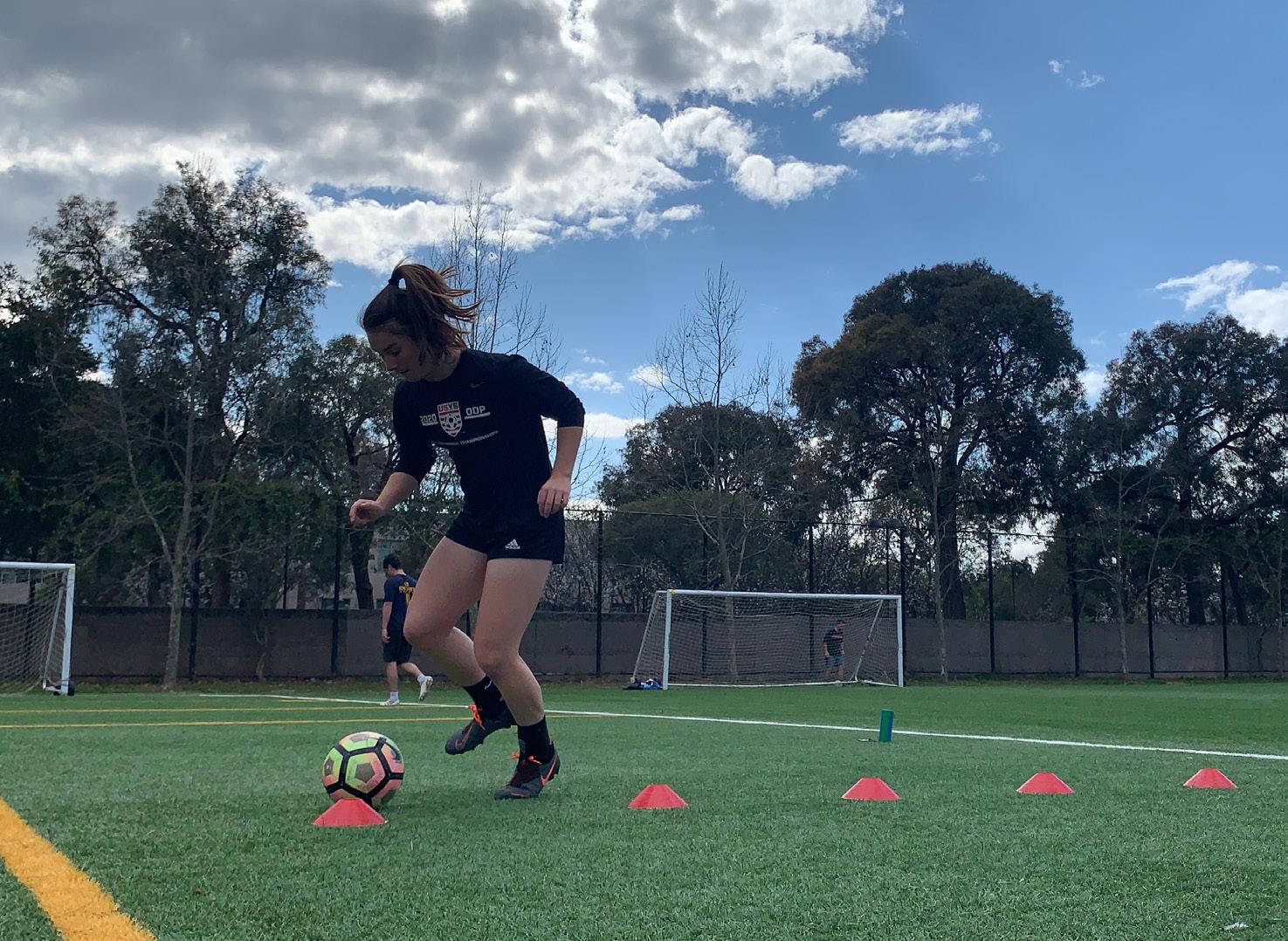
The COVID-19 pandemic has heavily impacted Menlo student-athletes who want to play their sports in college. For juniors Kamran Murray, Tatum Constant, Theo Kim and Calvin Katz and sophomores Carolina Espinosa, Emory Tudor and Sharon Nejad, the shelter-in-place order in San Francisco, Santa Clara, San Mateo, Marin, Contra Costa and Alameda counties has ended regularly-scheduled sports practices and potentially affected the athletic recruitment process for college.
“For all athletes trying to play in college, this recent closure was most likely somewhat devastating,” cross country and track runner Katz said.
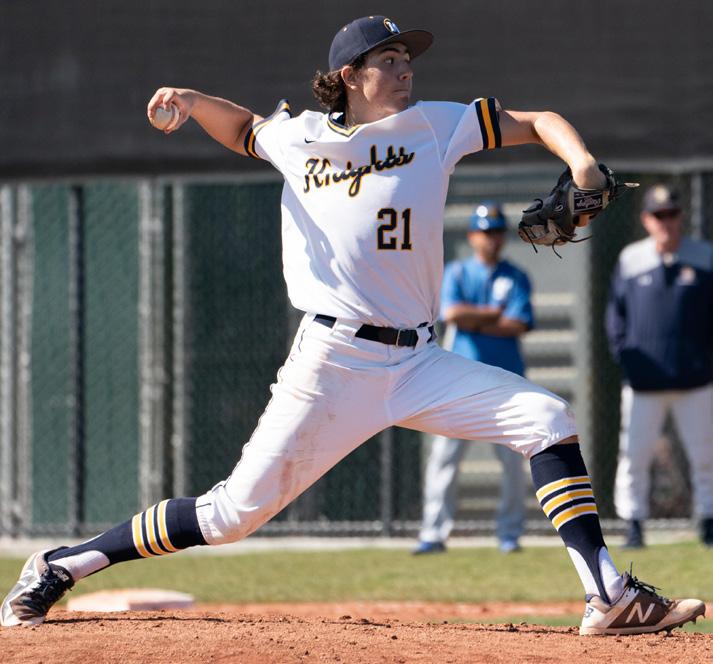
For Murray and Katz, who both run track and cross country, the Menlo track season has been canceled, with no team practices or track meets currently occurring, according to Murray. “When it comes to college recruiting for runners, the track season of your junior year is the most essential season of high school,” Katz said.
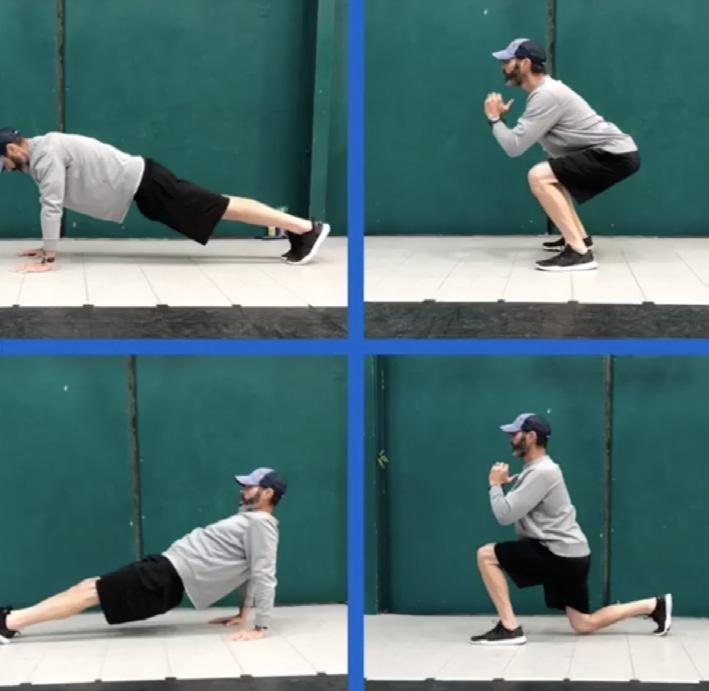
Both Murray and Katz are still running despite not being able to run with the Menlo track team. For Murray, the less-structured school schedule of online learning allows more time for him to run. Track and field coach Jorge Chen sends the team a set of workouts to complete each week, and with the additional flexibility of the new schedule, Murray is able to structure his runs and workouts along with strength and conditioning (which can all take a total of 3 hours and 40 minutes spread out throughout the day) in an effective way.
Both Murray and Katz expressed difficulties in not being able to practice with their teams, which Constant and Espinosa echoed. “I think that when we are as a team, we push each other a lot more to improve
our fitness, and we all have a lot more motivation when we are all together, but now that we are all separated, for a lot of us, our lack of motivation to work out is going to hit us hard when the season rolls around again,” soccer player Espinosa said.
Constant, a lacrosse player, had her Menlo season postponed and is now completing skills training and strength and conditioning workouts at her house. “It is devastating to be missing part of my junior season and especially because I put in so much work in during the offseason,” Constant said.
Kim, who also plays lacrosse, said that his coach has been sending his team lacrosse film to watch in his downtime.
Amidst her inability to practice with her team, which Constant said is what makes her happiest about lacrosse, Constant’s SAT tests in March and May were canceled. For the college recruitment process, SAT scores are supposed to be submitted for processing by June of the student’s junior year, yet the SAT has been canceled across the country, according to Constant, who says that she is “in a standstill” with her progress in the recruitment process.
Espinosa, who wants to play soccer at the Division I level in college and professionally, has had two ID camps (showcase camps observed by college coaches), and a trip to London, where she was going to play in international soccer games, canceled. Top soccer coaches were going to coach the London games, while top European coaches were going to be observing the matches, according to Espinosa. Espinosa has additional ID camps over the summer that have yet to be canceled.
Basketball and volleyball player Nejad, who is looking to be recruited for both sports, has also had several college view-
Menlo Performance Keeps Athletes Training
by LEXI FRIESEL
Along with the rest of the school and athletic department, Menlo student athletes are no longer using the Menlo performance facilities on campus or working with the athletic trainers in person. However, despite the challenge of not being able to work with students in person, the trainers still have a plan to keep athletes in shape. “We are giving students the option to be emailed their training sheets,” Director of Sports Performance and Wellness Jesse Lindenstein said in a phone call with The Coat of Arms. “So far, we have had over 52 kids contact us.” However, according to Lindenstein, there is a disadvantage to having kids train at home because he cannot monitor them like he does when they train on campus.
The Menlo performance team has also provided Menlo athletes with tips to keep in shape through social media. “The athletic department is trying to help athletes be successful,” Lindenstein said. “We want to provide help on training, nutrition and wellness.”
The trainers have published several posts on Instagram (@menlo_performance) since the school’s closure, providing students with at-home training ideas, agility drills, nutrition advice, department updates and facts about conditioning to help keep athletes disciplined during this unforeseen time. Also, the trainers recently began designing and implementing home training videos that will be sent out.
The performance department has already begun preparing for summer training sessions and fall sports. “We have a huge
ing events be canceled. Nejad pinpointed her sophomore year as the year that she is able to start gaining attention from colleges who will be able to reach out to her on June 15 of this year and as a year for her to be able to choose which sport she wanted to hone in on.
Nejad says that the most difficult part of the closure is her inability to practice. “Practicing was a great way to get all my energy out and stay in shape, but now that practice has ended, I have no way of releasing my energy, and I am having trouble falling asleep,” Nejad said. Nejad also emphasized the difficulty of not being able to practice with her teammates, whom she is very close to.
Tudor, who swims, has been unable to go to a pool for over a week, as all public pools have been closed. For Tudor,
who normally has eight swim practices per week, the closure has been especially difficult. “I think that this has made it really hard to communicate with coaches since everybody is scrambling to try and find pools to swim at or ways to stay in shape,” Tudor said. Tudor has been trying to do cardio workouts for two hours a day and has been pursuing swim-related yoga in place of going to the pool to swim.
Still, amidst all of the disruptions of their athletic schedules, the Menlo athletes have kept perspective on the situation. “We need a sense of perspective on this whole situation - we have to respect these decisions that are made based on the safety of others, which is the priority. There are people dying, so in the big picture, while a shame, sports seasons being canceled isn't the end of the world,” Murray said.
training program over the summer for eight weeks,” Lindenstein said. ‘We have about 120 to 140 kids coming in a day for fall sports or off-season training.” During the summer program, the performance department is planning both weight and sprint training for the athletes, working around club sports schedules.
Although much has already been done by the Menlo performance department to try to keep athletes in shape, Lindenstein also noted that he has been reaching out to other athletic programs, including both local high schools such as Sacred Heart Prep as well as much larger colleges such as the University of Texas, Stanford University and San Jose State University, to incorporate new strategies.
In the midst of the entire process, Lindenstein is also planning on taking an online nutrition certification through Cornell University over the summer. “We want to be able to provide student athletes with not just training, but also nutrition and wellness,” Lindenstein said.
Despite School Closure, Sports Teams Continue to Meet — Virtually
by MADISON LIU
In April 2020, the California Interscholastic Federation (CIF) released a statement announcing the cancellation of the spring sports season due to the COVID-19 pandemic. The CIF, which controls both public and private high school sports in California, officially canceled all sectional, regional and state events, according to its website. Although spring sports have been canceled, several Menlo sports teams have been meeting virtually to continue staying in contact while quarantining at home.
While Menlo has not required teams to meet online through platforms like Zoom or Google Meet, it is recommended. “Coaches are strongly encouraged to keep in touch with their student athletes and hold virtual meetings and send workout programs,” Athletic Director Earl Koberlein said via email. Several teams, such as varsity girls lacrosse, varsity boys golf, and track and field, have held “practices” online, using the meetings as a way to help the team stay connected during isolation. “The purpose of those meetings was to keep the team connected to each other, keep them mentally healthy and positive, and to make sure they would be ready if the season would resume,” golf coach Mark Madaya said.
Supporting one another remains a priority for teams and is a major reason to hold virtual practices. “I suggested having a Zoom meeting to the rest of our captains because I felt like it was a good way to check in with each other, bring a smile to our faces and try to keep spirits up,” said junior Tatum Constant, a varsity girls lacrosse captain.
During this unique time, online meet-
ings help to keep some semblance of normality and consistency. “These meetings are good for the team because they are a step closer to the face-to-face interactions that we’re so used to during normal practice and miss so much,” said senior Kyra Pretre, a track and field runner. Track and field holds hour-long virtual meetings every Tuesday evening.
Online practices affect underclassmen and upperclassmen in different ways, with seniors devastated that their last high school sports season ended early. “These meetings are especially important for seniors because it’s our last time talking to them, and it’s a good way for us to spend time with them,” sophomore golf player Saaz Ahuja said. Although people are focused on supporting seniors, the meetings are also helpful for underclassmen. “I think [online meetings are] also helpful for the younger athletes on the team to still feel motivated to train and remain connected to the program,” said senior Charlotte Tomkinson, a track and field captain.
During meetings, teams not only work on physical activities, but also play games or just talk in order to remain socially connected. “We’ve also started playing “How well do you know me?” and “Family Feud” team games,” Tomkinson said.
While sports such as boys golf and track and field invite coaches to online meetings, girls lacrosse has been holding Zoom meetings without coaches, allowing players to feel more comfortable. “We just did the call with the players because we felt like it was a nice way to connect without any pressure of having our coaches there,” Constant said.
Espinosa trains at a soccer field during the shelter-in-place. Espinosa’s club soccer coach sends her team drills that they are required to complete. Photo courtesy of Carolina Espinosa.
Director of Sports Performance and Wellness Jesse Lindenstein demonstrates different exercises in an Instagram post on April 10. Screen Grab from Menlo Performance Instagram.
by VALENTINA ROSS
Senior Julien Hernandez committed to play Division III baseball at Whitman College in October 2019. He has played on Menlo’s varsity baseball team since his sophomore year.
Hernandez has played various sports since he was young, but baseball was always his favorite. “My dad taught me a lot about the game, and we would play out in the street every day until I was about 9 years old,” Hernandez said.
He has always loved the physical and mental competition of baseball. “Every second is tactical and requires true knowledge of the game. Whether it is in the five seconds throwing a pitch or the 15 seconds before trying to outsmart your opponent, it forces a player to be physically and mentally strong throughout,” Hernandez said.
Hernandez didn’t start playing at a competitive level until he was 11 years old. He played for Xtreme Baseball in Menlo Park and later for GamePrep Baseball Academy of San Carlos. Hernandez has played on Menlo’s baseball teams all four years of high school, and during the fall and summer he plays travel baseball for GamePrep. Hernandez came to Menlo’s baseball team as a catcher and a shortstop, but he would also pitch if the team needed a pitcher. For the majority of his freshman and sophomore years, he trained as a catcher and infielder, not a pitcher. However, due to team injuries and a small roster, Hernandez filled in as a starting pitcher during his sophomore year.
The summer after his sophomore year, Hernandez found success pitching at national tournaments, which he felt proved he could pitch at the national level. “With all this success, I started to like pitching more than catching, causing the switch to
Committed Corner
Committed Corner
Julien Hernandez, Whitman College
the mound,” Hernandez said.
Since he was 12, Hernandez wanted to play baseball at a college level. That’s when his coach was Menlo College Head Baseball Coach Jake McKinnely. “He taught me a completely different side of baseball that further extended my love for the game,” Hernandez said. McKinnley enabled Hernandez to spend quality time with the Menlo College team. “I would watch practices from the dugout and sometimes work out with some of the guys,” Hernandez said. The time he spent with the college athletes gave Hernandez a glimpse of what baseball at the next level was like. Hernandez chose Whitman because he wanted to be part of a great baseball program, while also getting a good education. “[Competing in one of the best conferences for D3 baseball] will push me to develop into a better player as soon as I step on campus while getting the opportunity to compete immediately,” Hernandez said. Whitman was also a great academic fit for Hernandez due to its small size and strong STEM department.
Santi Garcia-Mendez, Carleton College
by CARLY McADAM
Senior Santi Garcia-Mendez will continue playing football next year as the kicker on the Division III football team at Carleton College in Minnesota. Garcia-Mendez has been playing football for three years, but he previously played soccer for eight years. In addition to football at Menlo, Garcia-Mendez also played on the varsity lacrosse team and the junior varsity soccer team. Garcia-Mendez took his foot skills from the soccer field onto the varsity football team when he was a sophomore and has played kicker for three seasons.
Garcia-Mendez was a consistent kicker this past season for Menlo, completing almost every extra point that he attempted. In Menlo’s opening game against Fremont-Oakland, Garcia-Mendez completed a whopping eight extra points. In addition, Garcia-Mendez scored at least one extra point in every game this past season, and he had notable 27- and 37-yard field goals.
Garcia-Mendez loved playing football with the Menlo team. “Football at Menlo as a whole was a great experience,” Garcia-Mendez said. He particularly enjoyed the traditions that are part of the football team, especially for seniors. “My favorite memory is all of the speeches that seniors do at the end of the year. It’s a great opportunity for students to address some of the most respectable of their peers in a great way,” he said.
Garcia-Mendez is not only looking for-
Noah Housenbold, Johns Hopkins University
by GRACE WILSON
This past December, senior Noah Housenbold committed to Johns Hopkins University to play Division III water polo. Since joining Stanford Water Polo Club in fourth grade, Housenbold has maintained a love for the sport.
The physical and mental demands of water polo, along with the intensity of games, keep Housenbold passionate about playing. “My favorite part is the continuous one-on-one battles of strength and technique that occurs with every pass, shot and drive that is made throughout the game,” Housenbold said.
Prior to his water polo career, Housenbold played baseball and had joined a swim team, giving him the throwing and swimming skills necessary to excel in water polo. In his first competitive season, Housenbold was able to move from his club’s C team to A team, assisting in winning five state- and national-level tournaments throughout his time at Stanford Water Polo Club. Upon entering Menlo as a freshman, Housenbold joined the varsity water polo team and has contributed significantly to the team’s success over the past four years.
“[Menlo boys water polo coach Jack Bowen] will always be very special to me, and will probably be what I miss most about water polo at Menlo,” Housenbold said. “Jack not only cared about our water polo skills and how we played in the pool, but he deeply cared about us as people in his life. Through our team motto ‘Be Your Best,’ Jack has profoundly changed my life as a coach and a mentor, pushing me to become both a better player and a better person.”
Some of Housenbold’s most memorable
Jack King, MIT
by LUCY PIKE
ward to continuing his football career at Carleton next year, but he is also excited to dabble in other sports as well. “I’m looking forward to playing intramural sports next year, [such as] badminton, soccer and ping pong,” he said.
With many years of athletic experience under his belt, Garcia-Mendez encourages other high school students who are interested in pursuing college athletics to remember to have fun with sports. “My advice for younger athletes is not take themselves too seriously,” he said.
Senior Jack King committed to play Division III water polo at the Massachusetts Institute of Technology (MIT) in December 2019.
King began his water polo career in middle school and started to play at a competitive level entering high school. At Menlo, King is an active member of the boys water polo team and played on varsity for the past three years. Outside of Menlo, he competes with Stanford Water Polo Club. King played utility for the majority of his water polo career until this year, when he picked up center defender. “I’ve always mostly played utility, but this year we needed a center defender, and I found I really enjoyed it,” King said via email. He believes that he will most likely continue to play as a center defender in his collegiate career at MIT.
King enjoys many aspects of the sport, especially the physicality and teamwork in order to win and play well. King’s position as center defender necessitates very physical play. “My main job is to overpower and out-maneuver generally the biggest opposing player in the pool,” King said. In regards to the team component of the sport, King enjoys playing and having his teammates by his side. “I also like [water polo] because it’s a highly team-based sport. Because it’s played in the water, it’s relatively slow so you need a team to move the ball; it’s hard to be a one-man team,” King said.
King first knew he wanted to continue to play water polo at the collegiate level
moments from Menlo water polo include a game at the Roche Invitational tournament his freshman year. “This was the first [high school] tournament [...] and [senior] Connor Enright and I were just the baby little freshmen on the team. Winning the game and tournament was obviously great, but the Roche tournament has always meant so much more to us,” Housenbold said. “It’s a memorable moment because [...] I was able to contribute as a part of the team, and [I] really started to feel the sense of camaraderie and friendship that would be a part of my everyday life for the next four years. It was at that moment that I thought to myself: I’m going to have a great time hanging out and playing with these guys at Menlo.”
Housenbold feels that Hopkins will allow him to pursue water polo and an excellent education alongside like-minded teammates. “This balance [...] really suits my personal desire for what I want my college life to be like, and I am fortunate enough to be able to join the team this upcoming fall.”
during his sophomore year at Menlo. When deciding where to pursue water polo in college, King factored in an academic institution’s ability to balance his athletic and academic life in a healthy manner. King also searched for a college that offered a great interdisciplinary approach to STEM and humanities programs. According to the official website of MIT Athletics, the men’s water polo team earned the highest grade point average in the nation during the 2019 season, with twelve of the student-athletes on the team honored for their academic excellence by the Association of Collegiate Water Polo Coaches. The team is also on a competitive streak, as the 2019 season led them to finish third at the inaugural USA Water Polo DIII National Championship. MIT checks both of these boxes for King as the academic and athletic opportunities will be immense.
Although Hernandez came into the Menlo baseball program as a catcher and a shortstop, he quickly adapted to a new role on the team as a starting pitcher his sophomore year. Photo courtesy of Julien Hernandez.
Housenbold cites Coach Jack Bowen as what he will miss most from Menlo water polo. Nevertheless, he is eager to begin his water polo career at Hopkins this fall. Photo courtesy of Noah Housenbold.
Garcia-Mendez completed at least one extra point in every game his senior season. He took his skills from the soccer field to the football field sophomore year. Photo courtesy of Santi Garcia-Mendez.
“My main job is to overpower and out-maneuver generally the biggest opposing player in the pool,” King said. Photo courtesy of Jack King.