

The Coat of Arms The Coat of Arms
serving Menlo's Upper School since 1973
ON THE 12TH DAY OF CHRISTMAS, MENLO
GAVE TO ME...
by SOPHIA ARTANDI
The holiday assembly, which happens every year before break in December, is a way for students to get into the holiday spirit and de-stress before finals. Over time, it has expanded and evolved to become the celebration that now involves the Middle School and multiple performances from various arts. The most significant change has been a shift away from a Christmas-focused assembly to accommodate and acknowledge other cultures.
According to Director of Communications Alex Perez, the holiday assembly was started by the creative arts department in the 90s. It began as a small celebration with performances from the jazz band and chorus, as well as a message from the Head

“The tradition has evolved [...] with an increased awareness that not everyone celebrates Christmas.”
of School. “In the early 2000s, the program began to see more changes. The school now had an orchestra,” he said. According to Perez, the orchestra and chorus led a sing-along of “Hallelujah Chorus,” by Handel for several years. Shortly after, the famous “Twelve Days of Christmas” tradition was started.
How the annual holiday assembly came to be, and how Menlo strikes a balance between tradition and inclusivity

change the school has made is broadening the cultures and traditions that are honored.
According to Associate Admissions Director Cindy Lapolla, who has worked at Menlo since 1991, the assembly predates the new athletic center. Before it was built, the assembly was held in the Menlo College gym. She said that a significant
“The tradition has evolved over my time here with an increased awareness that not everyone celebrates Christmas,” Lapolla said. According to Lapolla, her daughter (‘06) was singing holiday songs from around the world in choir as a freshman, as opposed to just Christmas songs.
According to Upper School dance teacher Jan Chandler the Middle School was not always part of the assembly, nor were
Menlo Middle School Moves Away From Traditional Letter Grades
ADLEY VOGEL
student should be able to do independently at the end of each grading period. The video created for parents gives this example: “English 6: Analysis and Interpretation of Texts: Identify and explain by
This year the Menlo Middle School began rolling out a new comprehensive student evaluation program called Standards Based Learning (SBL), which eliminates traditional grades on assessments but aims to give highly specific feedback to students regarding where they are excelling and where they need to improve. Currently, there are no plans to bring SBL to the Upper School, but Upper School Director John Schafer agrees with the underlying philosophy of the new program.
“Two years ago, after much research and thought, the Middle School began shifting our teaching and reporting to become more standards based, with the goal of promoting student growth and learning, as well as fostering curiosity and engagement,” Middle School Director LaVina Lowery said in a video created to explain SBL to Middle School parents. SBL revolves around the idea of standards or targets — skills a
The grading policy has shifted toward more of a
focus on showing the skill growth.
the impact of a text’s chosen point of view.” Throughout the grading period, students practice this skill through a series of formative assessments designed to gauge each students’ mastery of the given skill, eventually receiving a ru-
Grading, page 3
any of the dance performances. Chandler and Upper School chorus teacher Karen Linford agree that the push for a more inclusive holiday assembly first came from former Head of School Norm Colb, who is Jewish.
According to Lapolla, in the past, people have voiced that the holiday assembly should not exist. “The conversation of whether or not it’s okay to have Santa has gone around, and, if we’re being honest, it’s [a conversation] that exists every-
where,” she said. In addition, Lapolla said that finding songs to represent all cultures is difficult because a lot of popular holiday music is about Christmas. According to Linford, the holidays should be about celebrating life and family. “It’s important to respect that not everyone celebrates Christmas,
Holiday, page 3
Menlo Abroad Adds Senegal Destination, Drops India
by PARINA PATEL
Menlo School has introduced a new Menlo Abroad destination: Senegal. Menlo Abroad is a program offering immersion trips to four different countries: Guatemala, China, Tanzania and now Senegal. Menlo Abroad ‘20 will take place from May 19 to June 7. Menlo Abroad Senegal replaced Menlo Abroad India due
to a significant fire in Ranikhet during the 2019 trip, where the program is based. “It really took the wind out of the sails of the [non-governmental organization] that we work with there. It was difficult for them, and it was re-
Senegal, page 3

In February 2019, history teacher Peter Brown traveled to Senegal to assess the viability of a Menlo Abroad program there. Photo courtesy of Peter Brown.
The Class of 2019 sings “Twelve Days of Christmas” during the holiday assembly. Photo courtesy of Menlo School Flickr.
Students View Instagram’s Removal of Likes Optimistically
by VIONNA ESHGHI
Instagram CEO Adam Mosseri announced on Nov. 8 that the company will begin hiding “likes” on some U.S. posts, and some Menlo students have no problem with this change. Instagram tweeted that this change would allow Instagram users to “focus on the photos and videos [they] share, not how many likes they get.” However, likes won’t be completely gone. One can still view the like count on their own posts privately but can’t view that of others.
Instagram began testing this new initiative in July 2019 in countries like Australia, Brazil, Ireland, Canada, Italy, Japan and New Zealand. Now, instead of a photo
The concept of removing likes is “about creating a less pressurized environment where people feel comfortable expressing themselves.” saying “liked by @menlocoa and 100 others,” for example, a post would say “liked by @menlocoa and others,” under the uploaded photo.
According to Wired, Mosseri explained that this change was implemented for the well- being of users. “We will make decisions that hurt the business if they help people’s well-being and health,” Mosseri said. He explained that the concept of removing likes is “about creating a less pressurized environment where people feel comfort-
able expressing themselves,” according to Buzzfeed News.
This decision has received both backlash and positive feedback. Users tend to think this decision will take away the issue of “status” in the social media world, as many perceive likes as something that bolsters one’s online persona. Others enjoy the confidence brought by likes, such as the social media influencer known as Nikita Dragun.
In a recent instagram post from Nov. 10, Nikita expressed that posting her journey of becoming a transexual woman on the platform of Instagram over several years has allowed her to “educate and shine a light on [her] community that often isn’t as
visible in media.” Furthermore, “likes” has allowed her to achieve her dreams, because she perceives likes as “a representation of someone somewhere in the world apart from [her] journey,” Nikita said, “Yes, I understand the negatives of ‘the like button;’ however, I have felt the positives of it first hand.”
However, junior Tatum Constant, who has her own blog on Instagram, views this change as a positive one. Constant believes that it is wrong for teenagers to associate likes with their self- worth. “I think [removing likes] could alleviate some anxiety or depression that is associated with social media and kind of make it more of just a platform to express yourself rather than to

make yourself feel better,” Constant said. Constant feels that this change does not affect her personally and, in fact, has many benefits. “I have a blog about clothing and food and traveling. I kind of just made it for fun, [and] I like taking pictures of the food I eat or the clothing that I wear, and I kind of just express myself in that sense,” Constant said. “But I think that I look more at likes on my personal account than my blog [because] it’s not going to impact [my blog] negatively in anyway.”
Constant believes that some benefits of removing likes include that people will be more relaxed and less stressed about making their feeds look perfect. “[People will be] less like, ‘Oh my god, did I get the perfect shot?; ‘Will people judge me for this?’
“[People will be] less like, ‘Oh my god, did I get the perfect shot?’; ‘Will people judge me for this?’”
I think it will make [Instagram] less of a judgement platform and more of [a place to] express yourself [and] post what you like and keep it casual.”
Senior Olivia Velten-Lomelin agrees with the benefits Constant stated. “I do think it’s a good idea for Instagram to take away likes because [this platform] was created to share posts and tell stories,” Velten-Lomelin said. “I think the validation people get from their stories may not always be genuine and is feeding into an insecurity people have in their lives.”
Menlo Teachers Compare Previous Impeachment Hearings to Trump’s
by SYLVIE VENUTO
Impeachment hearings regarding President Trump’s “quid pro quo” with Ukraine have intensified in recent weeks, so The Coat of Arms asked Menlo math and computer science teacher Michael Thibodeaux, history teacher Dr. Charles Hanson, English and history teacher Rebecca Gertmenian and history teacher Andy Kitt to reflect on their experiences with the Nixon and Clinton impeachment hearings and to compare their experiences to the current Trump impeachment proceedings.
Thibodeaux, who was in graduate school during the Nixon impeachment hearings, said that he was “extremely well informed” about current events and the impeachment process. “I didn’t feel that our nation was in peril [during the Nixon hearings],” Thibodeaux said. “This was
“We didn’t feel like the country was being betrayed [during the Clinton hearings].”


especially true when, after fighting tooth and nail for Nixon, the tapes’ smoking gun forced even Republicans to counsel Nixon to resign.” Throughout Nixon’s hearings, the divide between party lines was still small enough that both sides were able to come together for the good of the country.
Hanson was 13 at the time of the Watergate hearings. While he did not follow the Nixon hearings as closely as he followed the Clinton hearings, Hanson has since been continuously learning new information about them, most recently through a podcast called “Slow Burn.” “I guess I feel like you can never really close the book on any of these stories,” Hanson said.
Gertmenian, who was in graduate school at the time of the Clinton hearings, said she was uninformed about the Clinton hearings, recalling only large broad strokes and conclusions. She was neutral about Clinton as a president because although she is a Democrat, Clinton seemed slightly conservative to Gertmenian. “I remember [Clinton’s affair with Monica Lewinsky] being quite scandalous, as well as kind of gossip that’s fun to talk about because it was so embarrassing and tawdry,” Gert-




menian said. “I thought [Clinton lying to Congress] was bad and that he should be censured, but when I put it in the context of why he did lie — he was ashamed about a private sexual affair that would hurt his family, so I kind of understood it.”
“We didn’t feel like the country was being
“I guess I feel like you can never really close the book on any of these stories.”
betrayed [during the Clinton hearings],”
“I remember not feeling [...] like this was probably something somebody should be removed from office for,” said Kitt, who was about 30 years old during the Clinton hearings.
Thibodeaux noted that the Clinton impeachment changed political tones in the United States, as it marked the first time that political parties hated — rather than disagreed with — their political opponents.
The political climate is similar around the Clinton and Trump hearings, as in each circumstance, the president’s opposing party is controlling the House of Representatives and the president’s own party has control of the Senate, Kitt said. This resulted in Clinton being impeached but not removed from office, a pattern that seems likely to occur with Trump, in Thibodeaux’s opinion.
“[The current charges are] quite different because [they] involve national security and our relations with foreign powers and even a misuse of representatives of the government and personal representatives of the President,” Kitt said.
Gertmenian said that she is “confused and frightened” about the Trump hearings, as it seems to her as though Trump is putting his personal interests ahead of national security.
For the Trump hearings, Hanson has been staying up to date by reading The
page 3

“I did not have sexual relations with that woman.”

Staff illustration: Lauren Lawson
Grading, cont.
-bric that shows whether a student is “progressing, proficient, excelling or needs additional support” with the specific skill.
“The grading policy has shifted toward more of a focus on showing the skill growth through these standards. We still have an aggregated letter grade that summarizes the learning for that trimester, it’s just supplemented with how to improve learning within the course,” Middle School science teacher Bobbi Lynn Monroe said. The Middle School has yet to implement “full SBL,” which would entirely eliminate grades, according to Middle School english teacher Becki Phillips. Currently, the only instance in which letter grades are given to students is at the end of a trimester. All other assessments are returned with a rubric explaining areas of strength and improvement, a change the Middle School hopes will make learning more about self improvement and less about comparing grades with peers.
SBL also takes into account each student’s “Habits of Learning.” Habits of Learning fall into four categories: learning attitude, organization, engagement and col-
“The whole school is thinking about assessment and thinking about feedback and thinking about skills.”
laboration. These are assessed separately from the targets and letter grades but still provide students with feedback on how to become better students.
Impeachment, cont.
Wall Street Journal and The New York Times so that his news is already digested and analyzed for him. “In the same way that I don’t tend to tune into the NBA Playoffs until Game Seven Finals, if we get to an actual impeachment vote in the House, if we get to an actual Senate trial, yeah, I think I’ll tune in,” Hanson said.
Hanson recommends that students read newspapers — which the library provides hard copies of each morning — because someone else analyzes the often complex impeachment proceedings for them. “I realize this means that [readers] are taking in bias, but I don’t mind biased analysis, as long as it’s analysis,” Hanson said. Kitt offered the media website AllSides.
“I don’t mind biased analysis, as long as it’s analysis.”
com as a means to combat this potential bias. The website displays headlines with links to stories from newspapers from across the political spectrum about the same topic, allowing readers to see the different ways current events are being covered.
Thibodeaux and Gertmenian both advocated for the New York Times’ Daily Briefing, which gives short snippets of the day’s current events.
“You are going to keep learning new things about [the Trump impeachment hearings] for the rest of your life because people are going to be writing books about it and articles and new stuff is going to come out,” Hanson said.
While SBL is currently unique to the Middle School, the underlying philosophy isn’t. “Parents and students want more info more frequently. That’s just the bottom line,” Upper School Director John Schafer said. “The whole school is thinking about assessment and thinking about feedback and thinking about skills. The Middle and Upper Schools have slightly different points of emphasis, but we’re
“Parents and students want more info more frequently.”
working in tandem and in parallel.”
“We already have our version of [SBL],” Schafer said, but went on to explain that it would be hard to ever directly implement the system in the Upper School due to how SBL would complicate communications with colleges, who need grades to understand how a student is doing in school.
As it currently stands, SBL will only be implemented in the Middle School, and the Upper School has no immediate plans to revamp its grading policy.
Holiday, cont.

Senegal, cont.
it can get in the way of the joy we wish to create,” Linford said. Chandler adds that characters who were born out of Christianity, such as Santa Claus, are becoming nonreligious symbols. “It’s not Christian, it’s Santa Claus!” she said.
“We’re trying to show that it’s about celebration, community and joy.”
Director of Creative Arts Steven Minning, who has been the primary organizer of the holiday assembly for the past three years, said that he has not made very many significant changes other than smoothing the transitions between numbers.
However, since Minning has started coordinating the assembly, he has continued with the effort to include all cultures by asking students to speak about how they celebrate the holidays. “We’re trying to show that it’s about celebration, community and joy. [...] It’s centered around the spirit of Christmas, rather than a specific religious holiday,” he said. However, according to Minning, the assembly is about the holiday feeling, rather than the cultures that the songs represent. “We make sure the message of the song is about joy, warmth and family, so even if you associate it with a Christmas song, it really is about those different types of feelings,” he said.
According to Lapolla, the school is trying to be inclusive and respectful of all cultures, in the holiday assembly and otherwise. “I hope it isn’t seen as being politically correct, [but] making sure that everyone feels respected,” she said.
-ally difficult for the students who were there and our teachers who led that trip,” Global Programs Coordinator Peter Brown said. Menlo students may have the chance to go to India in the future depending on how the NGO is doing, according to Brown. “We loved the program, but it was this environment we live in, the environment of global warming [that caused us to suspend the trip for this year],” he said.
There are many reasons why the Menlo Abroad team is interested in Senegal, Brown said. Firstly, it has an interesting history. Senegal is a Francophone African country, that is, a country where the population uses French as its first or second language. It is where the transatlantic slave trade began, and its people practice an open form of Islam. Senegal’s culture includes the practice of polygamy. Senegal is known for a quality called Taronga, which means friendliness and openness.
Secondly, there hadn’t been a language-immersion program for students who study French until the addition of Menlo Abroad Senegal, a place rich in French colonial history. However, for all Menlo Abroad trips, there are no language requirements.
Lastly, Senegal is a safe country, according to Brown. ”It’s one of the only countries in Sub-Saharan Africa that doesn’t have a history of coup d’etat takeovers of state,” Brown said. According to the State Department, which uses a scale from one to four, Senegal is among the level one countries, which are the safest countries.
The Menlo Abroad team is coordinating the Senegal trip with Global Citizen Year, an organization specializing in immersive gap years abroad for “bold high school grads who are hungry to experience the world and make an impact before college,”
according to the Global Citizen Year website. They have programs in Brazil, Ecuador, India and Senegal. “The advantage of working with [Global Citizen Year] is they have a long history of working with homestay families, particularly in that community, as well as other connections,” Brown said.
While Brown does not know the main focus of work for the trip, there are a variety of different kinds of projects to choose from. Some involve working with children who are abuse survivors, some involve working around the environment and some would possibly be working with medicine, according to Brown.
Upper School history teacher Matthew Nelson and Cal State Pomona Anthropology professor Dorothy Wills are the leaders for Menlo Abroad Senegal. Wills speaks both French and the indigenous language, and she’s been to Senegal many times. “I learned a lot from these people about how to relate to others, how to appreciate all the little and large connections we have in communities. Go to Senegal for the people,” Wills said.
Although Nelson has never been to Senegal and doesn’t speak French, his sense of adventure is insatiable. “It doesn’t matter where in the world I am,” Nelson said. He also knows quite a bit about Senegal’s history and has a general awareness of its culture. “Being in Senegal will provide me an opportunity to teach about Sufi Islam, so I’m really excited to be able to teach something that I know something about,” he said.
Staff illustration: Lauren Lawson
When a Chicken Sandwich Becomes Political: Chick-Fil-A’s Controversy
by GRACE WILSON
On Monday, Nov. 18, headlines that read “Chick-fil-A announces a new approach to charitable giving” and “Chick-fil-A concedes” permeated national news. No stranger to controversy, the fast-food chain’s prolonged involvement with organizations —some known to be rooted in homophobia —has provoked dissension from both within the Menlo community and worldwide. This “new approach to charitable giving,” however, has caused confusion among some Menlo students, with some wondering whether Chick-fil-A has terminated all involvement with external organizations and confusion as to whom Chick-fil-A was donating to in the first place.
Historically, Chick-fil-A has been regarded as a corporation with a strong religious undertone, evident through its founder and values. Truett Cathy, a devout Southern Baptist, founded the chain in 1946 and has since passed away. His son, Dan Cathy, acts as Chick-fil-A’s current CEO and upholds similar beliefs to Truett. “[Chick-fil-A] is a company that operates on biblical principles,” Dan said in a 2011 statement. “They really work.” Dan has maintained this perspective, and has since explicitly stated his beliefs as they pertain to marriage. “I personally [...] support [...] the biblical definition of marriage,” Dan said in a 2018 interview, emphasizing that his statements about marriage have never been “anti-this” nor “anti-that.”
Many critics do not deem Chick-filA’s overt religious affiliation as problematic; rather, the controversy lies within the homophobic nature of the organizations that Chick-fil-A continually donates to. As

of 2012, WinShape (Chick-fil-A’s charitable arm) had received over $8,000,000 from Chick-fil-A Inc., according to a report conducted by Equality Matters. The publicly available report lists the specific organizations that WinShape supports, along with the monetary value of the donations. Organizations involved include the National Christian Foundation, the Family Foundation and the New Mexico Christian Foundation.
The National Christian Foundation, the sixth-largest U.S. non-profit and the largest Christian grantmaker in the world, “has been funneling millions of dollars to anti-LGBTQ hate groups, including the Alliance Defending Freedom and the Family Research Council,” according to the Advocate, an LGBT magazine.
Chickfil-A’s political agenda causes
some Menlo students to withdraw any support for business. “Personally, I don’t [go to Chick-fil-A] after finding out that they support anti-LGBTQ organizations,” senior Olivia Velten-Lomelin said. “It’s not like if someone takes me there I won’t eat something, but I’m not personally going to make the effort to go there and spend money.”
Senior Mara Lebovitz resonates with Velten-Lomelin’s belief and refuses to eat at Chick-fil-A. “I am very aware that Chick-fil-A, like many other corporations, donates to organizations with an-
my money is being spent. Voting with your dollar can be an effective way to show companies what consumers support or don’t support. That being said, [...] There needs to be more of an effort to regulate corporations from influencing our lawmakers.” For other students, Chick-fil-A’s charitable donations do not affect their decision to buy food from Chick-fil-A. Senior Lily Loftis, aware of WinShape, eats at Chickfil-A once every two weeks. “In the case of Chick-fil-A, I think that everyone can do what they want. I’m not going to restrict where I buy my food [based on political differences],” Loftis said. “I’m not necessarily just giving my $5 or $10 to the company, I’m also giving it to the local members of my community.”
ti-LGBTQ+ agendas. The company has acknowledged itself as Christian, conservative and traditional, and their donations to such organizations highlight their agenda,” Lebovitz said.
“I try to always think about the greater implications of where
Senior Jackson Aldrich, who goes to Chick-fil-A once every two months, holds a similar sentiment to Loftis. “I do think about [the greater implications of my money], sometimes,” Aldrich said. “Unfortunately, [...] the food is so good I can’t see myself stopping. I really couldn’t. If someone is like, ‘Are you gonna stop eating Chick-fil-A forever?’ I’d be lying if I said ‘Yeah.’” The announcement made on Nov. 18 regarded Chick-fil-A’s decision to discontinue their charitable donations to the Salvation Army and the Fellowship of Christian Athletes, only two of the many organizations that they donate to. “I had no clue that they are continuing to donate to the same organizations,” Aldrich said, a frequent Chick-fil-A customer. “The news articles made it seem like Chick-fil-A had ceased all donations.”
Rosenberg Becomes His Own Director Serrano Brings Graffiti to Menlo
by SARAH NORUM
Sophomore Jack Rosenberg has been involved in Menlo’s drama program since sixth grade, and uses this experience to

compose his own musical in his free time. Rosenberg has been acting since second grade when he discovered this passion. “I used to live in San Carlos, and there’s a theater called San Carlos Children’s Theater with a minimum age of eight,” Rosenberg said. “It looked interesting, so I tried it and ended up really liking it.”
Since then, Rosenberg has been a fundamental part of Menlo’s drama program in both middle and high school. In the February performance of “The Old Man and the Old Moon,” he played a shopkeeper and many shadow puppets in the spring production of “Bye Bye Birdie,” he played Harvey Johnson, and this past November, he played a Kit Kat Boy in “Cabaret.” “‘Cabaret’ was my favorite show because not only was it really fun to perform, but we also built a really tight community, which was a really great ex-
perience,” he said. “Acting itself is always really fun, but getting to know people and building community is definitely a perk.”
Rosenberg also participates in weekly classes outside of school put on by Teen Company at the Hillbarn Theater. “I go there two days a week, and the focus alternates between singing, acting and dancing classes,” he said. “It has been really great as there are about 25 other people my age, and in the spring we’re performing ‘Chicago.’ Right now it’s classes, but it’ll become a show later.”
Not only does Rosenberg participate in plays on and off the Menlo campus, but he has also begun composing his own show. “I am really interested in composing, and theater is a passion of mine, so I am currently writing a musical,” he said. “My musical takes place in a fairytale-type realm where the royal children’s fates are decided before they are born. It follows Prince Wesley who is the first prince in history to be foretold to be rescued by another prince,” he said.
Overall, the process of creating a musical has been challenging, but Rosenberg begins by composing music and tunes. “I usually like to start my creative process with writing music since composing is probably my favorite part. I really enjoy finding interesting chords and cool melodies I like, and my background in piano really helps,” he said. “I try to always be writing something; I almost constantly bombard my friends asking for feedback.”
The more difficult aspect comes into play when he has to write the script itself. “Writing dialogue comes less naturally to me, and it’s something I need to work on, but I’m excited to get better,” he said. “I love playwriting, and I’m happy I get to combine my love of theater with my love of music.”
by VALENTINA ROSS
Senior Marilyn Serrano has been selected to be the female Artist of the Issue due to her creative artwork of graffiti and cartoon characters. Serrano brought her artistic skills to the Menlo community in AP Studio Art this year.
Serrano has been interested in art since elementary school when her parents bought her “How to Draw” art books, and she replicated the drawings from the book. This interest sparked Serrano to watch “How to Draw” videos, where she started to pick up her own style.
Serrano gets her inspiration from various places, including comic and cartoon artists on social media. For example, she follows graffiti artists Cesism (@ ces4wish), Pemex (@pemexs), Bakeroner (@mr.bakeroner) and Salmos (@salmos. sp). She also follows comic artists’ accounts like Brutally Honest (@brutallyhonestcomic), Safely Endangered Comics (@safely_endangered) and Strange Planet (@nathawpylestarngeplanet).
“I kind of look at how they create their characters, and then I go on and try to im-

plement similar techniques to make my own,” Serrano said. She also uses the people around her as characters for her comics.
As for graffiti, Serrano has been able to meet with a few graffiti artists who have inspired her own art. Serrano met Pemex during her sophomore year when he taught a class during M-term. “He was the first graffiti artist I had met and the first one to introduce me to graffiti as an art style and not just vandalism,” Serrano said. Before she met him, she didn’t see graffiti as an art style, so after seeing him, Serrano became more appreciative of the art style and “because it takes a lot of creativity and technique to do a really good job at painting a really dope throw up.”
Serrano also met artist Scape Martinez for an interview for an English class. Although she didn’t learn any technical skills from him, she learned that he is passionate about working with his community and expanding his knowledge of graffiti through art classes in community centers. Their work inspires her own, and seeing graffiti around her neighborhood influences her writing style.
Serrano equally enjoys doing comic art and graffiti. “Although, I think that graffiti was something that came to me a little bit more naturally,” Serrano said. She always enjoyed drawing out words, and over time, she continued to improve her skills. As for comics, Serrano enjoys creating different characters, but it is harder for her to come up with content. “When I do make comics, they’re usually little stories of a funny moment between my friends and [me],” Serrano said. “But I think that overall, the mood I’m in when I’m drawing really influences what I draw and how I draw it.”
Rosenberg, right. in the fall production of “Cabaret.” Staff photo: Bella Guel.
One of Serrano’s graffiti drawings. Photo courtesy of Marilyn Serrano.
Staff Illustration: Lauren Lawson
Students Showcase Their Art on Instagram
by GEORGIA PAYE
In recent years, there has been a growing trend of students creating separate Instagram accounts to share their artistic interests.
These accounts are used for a variety of reasons; for example, junior Tatum Constant created a lifestyle Instagram account this past summer called @TotallyyTatum. “I post my daily outfits at school or the meals that I make for breakfast, lunch or dinner. I also post some of my workouts and where I like to travel with my family and friends,” Constant said.
The inspiration for the creation of the account came from Constant’s friend, who has a similar account and who posts about lifestyle, food and fashion, according to Constant. “I felt like my personal Instagram wasn’t really a platform that I could use to post that much about clothing, food and traveling. I would feel strange to post that on my main account,” Constant said.
Similarly, senior Ian Collins created an artistic Instagram account, @IanCollins_ photo, in 2018, giving him a platform to share his love of photography. Collins posts photos that he has taken that he believes to be interesting or cool. “It’s a collection for me to keep me inspired and keeps me wanting to create stuff,” Collins said.
For Collins, his account is less about showing off to other people and more about posting things for himself. Therefore, he created a separate account, so people could decide if they wanted to follow his art or not.
“I don’t want to have to think about whether people care or not,” Collins said.
Junior Mallika Tatavarti’s Instagram account, @MallikaTatavartiArt, started out as a calligraphy account. “It progressed [to
include] all the art I was making. So now it’s not really a lettering calligraphy account anymore,” Tatavarti said. Tatavarti uses her account to share her art and get inspiration from other artists to help her progress her artwork. “Before, I never thought of doing digital art, but then I saw a bunch of really cool digital artists online. So I decided to download an app and start doing it, and that’s my main thing now,” Tatavarti said.
Tatavarti likes how a separate Instagram account concentrates art in one place.
“I think it’s nicer to be able to post in an environment that is more centered around art because you can feel more inspired and feel like part of a community,” Tatvarti said.
Sophomore Bella Ting uses her Instagram account, @IsabellarTing, as an online portfolio for colleges to look at, as well as to track her personal progress.
“It’s so I can see what I’ve improved on and what I need to improve on. I also like that other people can look at my work if they want to,” Ting said. Ting likes to keep her personal and artistic Instagrams separate so colleges can focus on her artwork, rather than her personal photos.

Halabe Develops a Love of Stand-Up Comedy
by PARINA PATEL
Junior Jacob Halabe has always been interested in stand-up comedy and has decided to pursue it as an independent study. Stand-up has always been an interest of Halabe’s, but he got a taste of trying it at a comedy program at the University of Southern California this past summer. To continue his involvement in stand-up, he decided to take a one-semester independent study. “I felt like I needed some type of structure to force myself to do [stand-up],” Halabe said.
Halabe’s independent study advisor is Upper School English and Latin teacher Jude Morris, who has been Halabe’s Latin teacher for the past three years. Morris was surprised when Halabe first proposed his idea to him because Morris had never taught comedy. “We do a lot of literary analysis in Latin class. [Halabe] thought we could apply that experience to thinking about comedy as literature, and that it would make [me] a good advisor since we’ve worked together for a couple years on both,” Morris said. For his independent study, Halabe watches a comedian he hasn’t heard of, runs new jokes by Morris or goes over the recordings from his past performances to see what he can improve on. “I try to offer feedback on how to make the process of developing his comic routine more strategic, the same way I would offer feedback on the writing process,” Morris said. Halabe usually performs at an open mic in Mountain View, but he’s looking to perform at another one in San Jose in the future. After getting chances to perform, Halabe can reflect back on what went

well and what jokes didn’t work. What Halabe enjoys most about performing is seeing his audience laugh. “It’s like performing [in a play] and getting a reaction that you know you want,” Halabe said. Some of Halabe’s favorite stand-up comedians include John Mulaney, Patton Oswalt and Jim Gaffigan. “Besides from the fact that they’re all really funny comics, they have distinctive approaches to comedy. For example, John Mulaney has a really practiced style on stage, while Jim Gaffigan tends to make fun of himself during his own performances,” Halabe said. Although the independent study proposal Halabe submitted to Upper School Director John Schafer lasts for one semester, he is considering extending it to two semesters because he really enjoys it. He also wasn’t able to perform standup often because of his involvement in the Menlo School fall play, “Cabaret,” which took up most of his time.
Selected Student Profile: Junior David Corsinotti
by KYRA GESCHKE AND KATE HAMMOND
CoA: How do you feel about your popularity within the student body?
David: Well, I feel like it's kind of overhyped because I don’t really do too much at school. I just do homework, and sometimes I play video games at school, but not much. I just talk to all my friends and hang out with everybody.
CoA: What conspiracy would you like to start?
David: That Casey Kline should have been [student body] president.
CoA: Is a hot dog a sandwich?
David: Yes, it has bread.
CoA: If you could make a rule for a day and everyone had to follow it, what would it be?
David: That everyone who [plays] video games has to get off the WiFi, because it sucks when you're trying to do homework and everybody's playing video games and you just end up watching videos.
CoA: If peanut butter wasn't called peanut butter, what would it be called?
David: Um... I'm allergic to it. So sunflower butter.
CoA: Would you rather be a hobbit or an elf for 24 hours?
David: A hobbit because I've seen all the “Lord of the Rings” movies.
CoA: If someone asked to be your apprentice and learn all that you know, what would you teach them?
David: Just to be expressive, do what you want and just be yourself.
CoA: If you were famous, what would your stage name be?
David: Corso, because no one calls me by my [actual] name.
CoA: What's the last song that was stuck in your head?
David: The “Wizards of Waverly Place” theme song because I was just watching Disney+.
CoA: Where do you want to be in an hour?
David: Home. I had a big history paper due today, so I didn't get much sleep.
CoA: What was your dream job as a child?
David: A professional video game player.
CoA: Is that still your dream job now?
David: Nah, I want to do something in the medical field or probably design video games.
CoA: What was the last text you sent?
David: It was in our football group chat, talking about random jokes that [senior Santiago Garcia-Mendez] sent.

CoA: What's your least favorite breakfast food?
David: Cereal. I'm a big meat guy, so I don't like cereal.
CoA: What kinds of meat do you eat for breakfast?
David: Bacon, sausage or a ham steak.
CoA: What does no one know about you?
David: My middle name.
CoA: What is it?
David: Leonardo. I'm Italian.
CoA: What's your unpopular opinion?
David: I really don't know my unpopular opinion. I certainly don't have many [controversial] opinions that I talk to people about and they try to confront me on.
CoA: (Kate) Mine is that Santa is still real. (Kyra) Mine is that I don’t like Christmas music.
David: Why don’t you like Christmas music?
(Kyra) CoA: It’s too cheesy.
David: I’ve already been listening to Christmas music. Nov. 1!
CoA: Do you have any pets?
David: Yeah, I have a dog named Bella.
CoA: If you could ask Bella three questions and she could respond, what would they be?
David: Why do you bark at me? Why do you wake me up in the middle of the night? Why are you always so hyper?
CoA: Which TV family is most like your own?
David: “The Simpsons” because my family cracks jokes a lot. My dad makes a lot of jokes.
CoA: What's your favorite smell?
David: The smell of an apple pie cooking in the oven.
CoA: What's your favorite animal sound?
David: A seagull because I'm known for some of my calls I do in the middle of the quad.
CoA: What's the best part of your day?
David: When I get to school because I just forget about a lot of stuff and talk to people [about] how their day was.
CoA: What movie title best explains your life right now?
David: “Hell Day.” I’ve just had a lot of assignments due and a lot of work to do.
CoA: Do you have any siblings?
David: Nope, I am an only child.
CoA: Do you like being an only child?
David: Sometimes because I get away with more stuff. But sometimes it's just boring, so I use my phone a lot to talk to people.
Photo courtesy of Pete Zivkov.
Tatavarti creating a painting to post on her Instagram. Staff photo: Sadie Stinson.
Halabe performing in the Dec. 5 Poetry Slam hosted by LitMag. Staff photo: Bella Guel.


Caffeine Maintains Presence on Menlo Campus, Primarily with Upperclassmen
by EMILY HAN
Despite the ubiquity of caffeine and its apparent connection to students’ alertness across campus, many Menlo students do not feel reliant on caffeine. However, upperclassmen with large workloads tend to consume more caffeine to stay awake.
Junior Yvonne Li often drinks tea while studying late. “I’m not a night person; I get super tired, so I drink a cup of tea to keep myself awake,” she said. Drinking tea is beneficial, according to Li; however, she does not feel she is reliant on it.
“[I don’t feel] dependent, but [coffee] definitely helps,” senior James Kinder said. “I don’t know what [an] alternative would be in the morning if I’m super tired.” Kinder estimates that he drinks coffee three times a week.
Like Kinder, many students use caffeine as a means of compensating for the energy they lose from a lack of sleep. “I feel like a lot of people […] get [coffee] every morning before coming to school as a source [of] energy because no one really gets sleep here,” junior Tejal Gupta said. While she personally does not drink caffeine regularly, Gupta commented that many of her friends do.
Underclassmen seem to drink less caffeine. Sophomore Francesca Prescott only has caffeine approximately once a week. “Caffeine is not really a necessary part of my life; I just drink coffee or tea because of how it tastes,” she said.
“The majority of the time, [I drink coffee or tea] because it tastes good, but sometimes because it helps me wake up,” freshman Marco Troper said. Most freshmen, including Troper, do not know many students in their
class who consume excessive amounts of caffeine.
“I just started drinking coffee. I try not to have caffeine after […] lunch because then I know I won’t be able to fall asleep. But I like having a [cup of] coffee in the morning,” freshman Penelope Stinson said.
While most underclassmen do not rely on caffeine as a way to stay alert throughout the day, there are still some students who do. Sophomore Gretchen Witte drinks about three or four cups of coffee a day. “I do feel like it’s a habit that I need to do in the morning to feel normal,” she said.
An upward trend in caffeine consumption evolves as students grow older and take more advanced classes with added pressure from college applications. “When I’m tired, or I have a test and I stayed up late, I always go and buy one of those big sugar-free Red Bull cans,” senior Lily Loftis said. “ And if it’s really bad, I have caffeine pills at my house. My brother takes them a lot, but I just take them once if I’m really tired.” Loftis sees caffeine as a convenience and thinks it can be advantageous on days when she needs extra energy but does not depend on it.
Senior James Leupold has researched the prevalence of caffeine among seniors, discovering that a significant number of students rely on caffeine on a daily basis. “I actually did a [statistics] project on coffee as it relates to gender and found that a lot of people are addicted and drink coffee every day,” he said.
Senior Emma Dressel resonates with the main conclusion of Leupold’s data. “Caffeine is my husband,” she joked.



“Red Bull Gives You Wings”: Some Students Fly Too Close to the Sun with Energy Drinks
by CHASE HURWITZ
“Red Bull gives you wings.” Over the past two decades, this energy drink’s advertising campaign has differed from its competitors and is likely why it is the most popular energy drink in America, according to Statista. They sponsor and host extreme sporting events such as cliff diving, motocross and winter sports instead of just publishing commercials. Even though Red Bull may advertise their product alongside extreme athletes, the reality is that energy drinks can have adverse effects when consumed by adolescents and should not be drunk at all by athletes.
The Academy of Pediatrics’ official statement made in 2011 explains, “[Energy drinks] are not appropriate for children and adolescents, and should never be consumed.” The main health concern for energy drinks stems from the high levels of caffeine and sugar. While an energy drink has about the same amount of caffeine as a cup of coffee, it has far more sugar. An eight-ounce Monster has 54 grams of sugar in it, while a cup of black coffee has zero grams of sugar. Additionally, energy drinks have added ingredients that the FDA has not been able to investigate extensively, so their effects are largely unknown. Along with this, excessive sugar and caffeine intake can cause heart disease, diabetes and weight gain, yet specific effects of energy drinks are largely unknown, as there is yet to be extensive research on the topic, according to the Mayo Clinic.
Mhatre said. The burst of energy and immediate alertness is what makes these beverages so appealing to consumers.
For students who often find themselves losing countless hours of sleep, energy drinks are an attractive supplement. “I drink energy drinks because I have insomnia and sleep two to three hours a night,” senior Surya Nathan said. “Energy drinks help me stay as focused as my peers throughout the school day.”
For some, consuming an energy drink is about staying alert before any drowsiness can set in. “I drink them before I’m tired; it’s like taking a Motrin if you think a headache is coming on,” sophomore Uma Misha said.

Even though it is a well known fact that an exorbitant amount of sugar is bad for one’s health, teenagers continue to drink energy drinks – Menlo students and athletes included. Sophomore Adam Mhatre played JV football this year and can speak on behalf of energy drinks. “I drank Red Bull before almost every game, and that got me pretty wired,”
Even though these drinks may have positive short-term effects, like feeling more awake and energized, they can cause long term ramifications on one’s brain. Caffeine acts as a neurotransmitter and can partially rewire how the nerves signal one another, according to the Mayo Clinic. During adolescence, the brain is still forming circuits that control different cognitive functions like awareness and sleep. Excessive caffeine intake can alter these circuits while they’re still being formed, which can affect rage, impulse control and reactions, according to University of Michigan Medical School. These types of beverages may seem ideal when in need of a quick pick-me-up or to get energized before a big game; however, the truth is, as an adolescent, energy drinks should not be consumed at all and can leave lasting negative impacts on one’s health. So, while it may seem like these drinks “give you wings,” those who indulge too much may be flying too close to the sun.
STIMULANT
RELATIONSHIP WITH STIMULANT
StaffIllustrationby:LaurenLawson
Coffee as a Trend:
A Ritualistic Part of Teen Culture
by HAILEY TSUDA
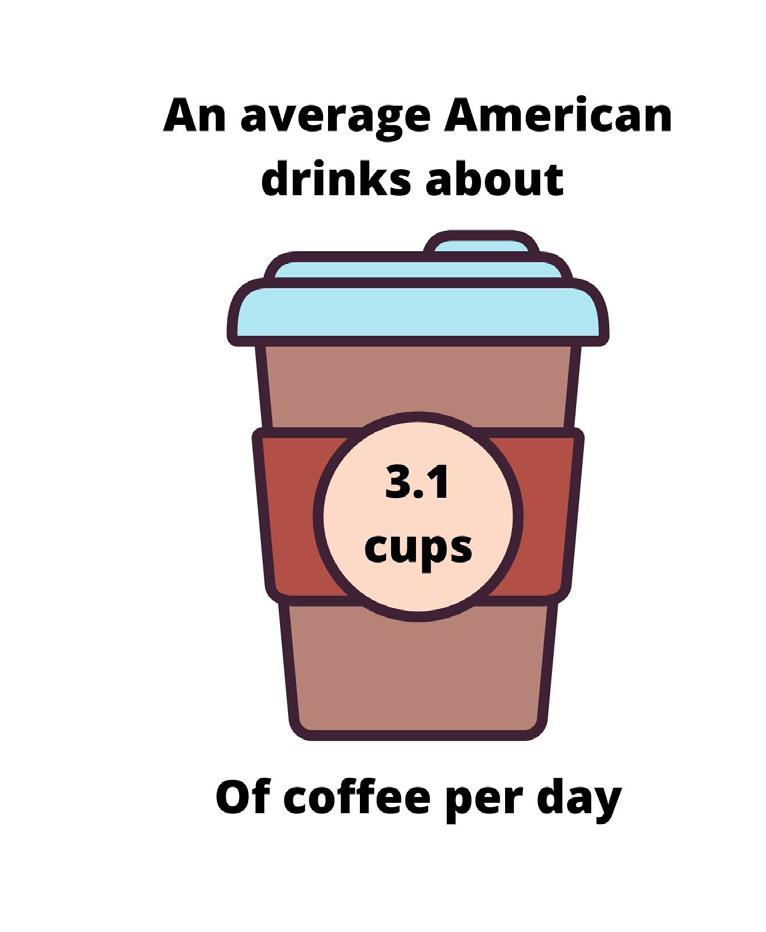
Here at Menlo, it seems as though students from all grades can be seen with a cup of coffee in the morning. According to Medical News Today, this phenomenon is not just specific to Menlo. In fact, their study found that 83.2% of teenagers regularly consume caffeinated drinks, such as coffee. Drinking coffee has become much more than a medium by which to get caffeine and for many has become a ritualistic act. Senior Emma McGaraghan and her sophomore brother Gus McGaraghan have made it part of their everyday routine to stop and get coffee on the way to school. They both began drinking coffee because their dad stopped to get coffee in the morning, but for Emma it has become more than just a source of caffeine. “[Drinking coffee is] part of my routine and is a big part of the start of my day,” she said.
Sophomore Tessa Tomkinson makes herself a cup of coffee every morning before school but expressed that the culture around coffee plays a role in how much she drinks it. “[If drinking coffee weren’t such a part of our culture], I probably wouldn’t [drink it as much] just because it’s not as accessible,” Tomkinson said. “At this point in my life I need [coffee], probably not as much [as I drink it], but still a substantial amount.”
While many begin drinking coffee in high school, sophomore Sammie Dostart-Meers has had a different experience with coffee. “I started [drinking coffee] in fourth grade. I started because I really liked the taste and I would make myself a small coffee. And it just became a thing where I was the ‘coffee person’ [in my class],” Dostart-Meers said. She also noted that even though she enjoyed the taste of coffee as a child, she may not have begun to drink it as consistently if coffee was not a representation of status.
“I definitely saw [drinking coffee] as like an adult thing because adults drink cof-
fee and as a fourth grader it’s cool being like, ‘Oh, yeah, I’m a high schooler. I drink coffee every morning. I need it because I’m sleep deprived.’ That’s not the reality in fourth grade, but I just felt older when I was drinking it,” Dostart-Meers said. Despite her early onset of coffee consumption, the past few months, Dostart-Meers has stopped drinking caffeinated drinks, but she still finds herself using coffee shops as a place for social interactions. “The biggest reason I go to coffee shops is the social aspect of grabbing something with a friend,” Dostart-Meers said.
Several students including Tomkinson, McGaraghan and senior Lindsey Chao, agreed with Dostart-Meers that coffee shops tend to be a social hub. For Gus McGaraghan, despite the fact that he typically goes to coffee shops just to get coffee, he also noted that he will go with a group. “I definitely go just to get my coffee, but if a group of people are going, I’ll go because it’s a social experience” McGaraghan said. Similarly, Chao often uses coffee shops as a place to do homework. “[When I go to a coffee shop], I either [just go to] get coffee, or I go there to study,” Chao said.
Upper School math teacher Leanne Rouser, who has taught at Menlo for 29 years, has also observed the increase in coffee consumption in her students. In particular, “[there were some students who were probably] in the class of 2015 who would always come into class with their Starbucks. Even if they were going to be late for class, they still made it to Starbucks and came in with their coffees,” Rouser said. However, this year, she hasn’t noticed as many of her students walk into class with coffee. “I’m noticing more water bottles or maybe an energy drink, [but] not as much coffee,” Rouser said.
Decades After the Cold War, the U.S. Should Leave Bolivia Alone
by ADLEY VOGEL
Since early Nov. 2019, Bolivian democracy has been put through the wringer. Their former president Evo Morales, the country’s first indigenous president, was recently chased out of the country after allegations of election interference which sparked widespread protests that eventually turned violent against members of Morales’ party.
Morales had been the president of Bolivia since 2006 and had ushered an era of unprecedented growth and social progress for the resource-rich country, fiercely combating discrimination against indigenous people and eliminating illiteracy and lifting Bolivia’s poorest out of abject poverty. In 2017, the Financial Times called Morales “one of the world’s most popular leaders,” with The Guardian attributing this success to “extraordinary socio-economic reforms.” Morales was extremely wary of the United States’ and international corporations’ power and worked to keep Bolivia sovereign.
By all measures, Morales led his country as well as anyone could have. But while running for a fourth term (which whether or not he should have done is an entirely different discussion), a remnant of the United States’ Cold War campaign against leftism in South America sowed doubt regarding the legitimacy of the election and ultimately led to the demonstrations that forced Morales out of Bolivia practically at gunpoint.
The Organization of American States (OAS), a non-government, continental organization based in Washington D.C. that unifies all 35 countries in the Americas to further human rights and economic devel-
opment (and has a history of supporting
A remnant of the United States’ Cold War campaign against leftism in South America sowed doubt regarding the legitimacy of the election.
violent US intervention into leftist Latin American democracy) released a brief, unsubstantiated statement in the middle of the elections, claiming “deep concern and surprise at the drastic and hard-to-explain change in the trend of the preliminary results.” The hard-to-explain trend? A 2.1% increase in Morales’ total votes between two vote-counting periods. This brief statement ignited protests in the nation, with citizens demanding a second election. Morales quickly respected the OAS statement and agreed to hold new elections.
But the damage had been done. The military and police, leveraging a history of racial apartheid and oppression, turned their backs on Morales’ indigenous government. They sacked his home, called for his arrest and ushered in an impossibly racist interim president who in 2013 tweeted, “I dream of a Bolivia free of satanic indigenous rites, the city is not a place for Indians, they must go to the highlands or the plains.”
The interim president, Jeanine Anez, was not elected, and in the days since she took power, has absolved the military and police of all accountability as they kill
It’s the most wonderful time of the of the year—why not make the holiday season one month longer?
by KATE HAMMOND
It’s 11:59 p.m. on Oct. 31. My fingers are hovering over my computer’s keyboard, impatiently waiting to press down on the mouse that is floating over my “Christmas Favorites” playlist on Spotify. My eyes are burning as they are glued to the clock, just waiting for midnight to hit so that Mariah Carey and her beautifully angelic Christmas album can overpower all sounds in my room.
Yes. I am someone who starts listening to Christmas music, getting festive drinks and watching holiday movies on Nov. 1. There is no reason to hate or judge me; Christmas time makes people happy, so why wouldn’t we want to extend the time of our happiness? November is technically the Christmas month (December) Eve, so why wouldn’t you want two full months to anticipate the best holiday ever? There are simply too many movies I want to watch, activities I want to partake in and holiday joy that I want to spread for the Christmas season to only last 25 days.
Christmas time makes peope happy, so why wouldn’t we want to extend the time of our happiness?
I mean, I am not the only one who feels this way. Walking into Target, Home Goods, Walgreens or really any store you can name, you will find Christmas decorations. Even Stanford Mall has been in full Christmas mode since November with
protestors in the streets. On Nov. 15, the army fired into a crowd of peaceful indiginous protesters in the city of Cochabamba, killing eight and wounding dozens. Anez justified the actions as “the restoration of order and public safety.” Morales is currently living on a Mexican military base, exiled from his own country.
This was not a country throwing off a dictatorial tyrant who broke the democratic system in order to cling to power — Bolivia is not better off now that Morales is gone. The transition of power to this extreme right-wing government will undo decades of social progress that saw the indigenous people of Bolivia empowered and represented in their government. The modern history of Latin America is defined by the rise and fall of authoritarian regimes ushered in by the U.S.; what is happening in Bolivia is nothing new.
The OAS is an organization whose interests have often been aligned with those of the U.S. They preemptively called foul play on the Bolivian elections, giving Morales’ right-wing opposition the justifica-
tion they needed to seize power because Morales and his government opposed U.S. interests in the region by nationalizing the countries’ immense reserves of natural resources. It can be hard to believe that the U.S. (via the OAS), much less any other country, would meddle in another country’s democracy in this way. But remember that our nation is currently being gripped by a similar crisis of our own. It is now clear that President Trump attempted to use Ukraine to interfere in our upcoming 2020 elections. Understanding that we’re going through a democratic crisis of our own helps us empathize with the situation in Bolivia.
We’ve got to recognize when the will of people– American, Bolivian or otherwise –is overturned, and speak out against it. The world can’t let this crisis fade into obscurity while the indigenous people of Bolivia are set back decades. We have to stay informed and look out for our fellow people before it’s too late.

Wait until pie is served to bring out the tinsel—start celebrating Christmas after Thanksgiving
by BELLA GUEL
their Christmas tree on display.
I understand that people might get sick of Christmas music faster. My own dad won’t let me play it in our house until after Thanksgiving. But there are so many versions of the classics and so many artists creating new music that you can always find something sounding new to your ears — come up to me on the quad if you need any new suggestions. Additionally, I do not intend to hate on our old friend Thanksgiving. If you ask any of my friends, I really love Thanksgiv ing, but I believe that it and Christ mas can be cele brated simulta neously. Both are times to re flect on what we are thank ful for and people we love.
There is no better time to start cele brating Christmas and all its glory than Nov. 1. Prolonging the best time of the year does no harm to anyone, so please, there is no need to be a grinch.
Let’s get this straight — I am not a scrooge or a grinch. Instead, think of me as an advocate for a holiday that’s slowly losing appreciation. I am talking about Thanksgiving.
With decorations sprawled across the aisles of Michael’s and Black Friday emails flooding inboxes before leftover Halloween candy has even been eaten, advertisements and the media practically beg us to start celebrating Christmas so early.

Don’t even get me started on the Hallmark Christmas commercials that have already begun air-
The unavoidable Christmas propaganda makes us feel obligated to break out the garland and stockings before we even have a chance to consider what we are overlooking, but I am asking you to take a second and reconsider. You are probably rolling your eyes if you have made it this far,
thinking about why you would withhold yourself from singing karaoke to Mariah Carey, but hear me out.
Thanksgiving is a time for reflection. We are called to consider all of the things we have been lucky to inherit and the things we have worked tirelessly to obtain. Whether it is health, shelter, food or a promotion, it doesn’t matter.
In recent years, the concept of mindfulness has become an overwhelming theme in health. We see it being featured in TED talks and implemented in classrooms in hopes of improving our society’s mental health. Well, if we are being honest with ourselves, Thanksgiving is a holiday dedicated to mindfulness in the most palatable way possible. No one is asking you to meditate, concentrate on your breathing or even sit still. All the holiday calls for you to do is reflect with intention.
I understand that when considering fun activities, mindfulness and celebrating gratitude doesn’t compete with Christmas tree lightings or Pentatonix covers. Trust me, I hear you. My family binge-watches cheesy Christmas classics, goes to Night of Light in Half Moon Bay and makes tamales on Christmas Eve. We have traditions that I cherish, but we also have Thanksgiving traditions that are equally meaningful. On Thanksgiving mornings, we all go over to my grandmother’s house, where the price of entry is a homemade meal.
All I am asking is to give Thanksgiving the respect it deserves by just keeping the tinsel packed away until the reflecting has finished and the pumpkin pie has been served. Frankly, we owe the holiday and ourselves that much.
Illustration by Cassidy Hurwitz
Bolivian citizens listen to a 2013 speech by recently ousted former president Evo Morales. Creative Commons photo: World Bank Photo Collection on Flickr

Pro: College Athletes Should Be Able to Receive Compensation
by ELLA HARTMANIS
Imagine walking into the Stanford campus store and buying your favorite player’s jersey. You might think that you are supporting that player, but the reality is that the player doesn’t get anything from the purchase even though their name is on the jersey.
The National Collegiate Athletic Association (NCAA) made more than $14 billion in revenue in 2019 from merchandise and ticket sales, according to the New York Times. But why isn’t any of that money going to the players? College athletes are not allowed to make money from endorsements or their image; however, without the athletes, the NCAA wouldn’t be making any money in the first place. “Colleges reap billions from these student-athletes’ sacrifices and success but, in the same breath, block them from earning a single dollar… That’s a bankrupt model — one that puts institutions ahead of the students they are supposed to serve. It needs to be disrupted,” California governor Gavin Newsom said.
As well as the NCAA, some college coaches, specifically football coaches, are making millions of dollars per year because of their players’ successes. For example, Clemson University won the College Football Playoff National Championship in 2019, and Clemson’s head football coach made $9,315,600, according to USA Today. The coaches earn money off of their team’s victories, but the players earn nothing, whether they win or lose.
Recently, Newsom signed the Fair Pay to Play Act, which allows college athletes in California to earn compensation for the use of their likeness, sign endorsement deals and hire agents to represent them. California is the first state to pass a measure allowing collegiate athletes to earn revenue from their image, and other states like North Carolina, Washington and Colorado are trying to do the same. The measure will not take effect until Jan. 1, 2023 to allow California colleges and universities to prepare for the change and to give the NCAA time to possibly change its own strategies, according to The New York Times.
Not allowing college athletes to make money puts them at a disadvantage to all other college students who are allowed to promote their image for money. “Every single student in the university can market their name, image and likeness; they can go and get a YouTube channel, and they can monetize that… The only group that
can’t are athletes,” Newsom said.
In addition, college athletes devote a large amount of time to their sport, which can be physically and mentally exhausting. They have the added challenge of balancing school, which some athletes miss regularly due to travel for away games, and how time-demanding their sport is. “Collegiate student-athletes put everything on the line — their physical health, future career prospects and years of their lives to compete,” Newsom said.
Fewer than 2% of almost half a million college athletes go on to play professionally, according to the NCAA. “College is the only time they have to profit off their hard-earned athletic successes,” Hayley Hodson, a former Stanford volleyball player, said during legislative testimony in July 2019.
“Colleges reap billions from these studentathletes’ sacrifices and success but, in the same breath, block them from earning a single dollar.”
Athletes being able to promote their image also brings back the question concerning video games with college athletes. There were previously multiple video games like “NCAA Football” and “NCAA March Madness”; however, in 2013, a lawsuit was brought against the NCAA and EA Sports saying that they used the players’ likeness in the games without compensation for the players, according to ESPN.
While the passing of this measure may only be in California, it has caused the NCAA to rethink their policy. “We must embrace change to provide the best possible experience for college athletes,” NCAA Board Chair Michael Drake said. However, the NCAA is unsure about how and what changes they plan to make, according to NPR.
There is still a question of whether or not the athletes would have a salary and how that would differ between players and schools. However, considering that being a college athlete is basically a fulltime job with practices, conditioning and preparation off the field, it seems logical that athletes are paid for their services.
Editor-in-Chief.............................................Samantha Stevens
Print Editor..............................................................Crystal Bai
Media Director........................................Vionna Eshghi
Patel Social
Video Editor.............................................................Emily Han
Photo Editor..............................................................Bella Guel
Assistant News Editor.........................................Sylvie Venuto
Assistant Arts & Lifestyle Editor............. .........Sophia Artandi
Assistant Spread Editor............................. ............Tessa Frantz
Assistant Opinions Editor..................................Chase Hurwitz
Staff................................................... Ashley Grady, Ella Hartmanis, Lauren Lawson, Georgia Paye, Lucy Pike, Valentina Ross, Shefali Sahai, Hailey Tsuda, Grace Wilson, Sadie Stinson
Adviser................................................................Tripp Robbins
Con: College Athletes Should Not Receive Compensation
by PAGE WOLFENDEN
College athletics have long been defined by amateurism. In other words, student-athletes at the collegiate level don’t get paid to compete. This amateurism has maintained the integrity and passion of college sports for decades and has rightly prioritized academics, the core of higher education.
However, this concept of amateurism has recently been threatened by California’s Fair Pay to Play Act, proposed by California State Senator Nancy Skinner and signed into law by Governor Gavin Newsom in late Sept. Under the new California law, schools within the state are prohibited from punishing student-athletes for monetizing their “name, image and likeness.”
The NCAA followed California’s lead, announcing that they will work to modify current rules to allow college athletes to be compensated for use of their “name, image and likeness.”0 This move towards compensation completely complicates the line between professionalism and amateurism, and poses dangerous implications for college sports.
Many proponents of compensating college athletes believe it is a matter of mending financial injustices, considering the high revenue certain college teams bring in without their players reaping any of those finances. This concern is valid, given that college athletic departments collectively brought in $18.1 billion of revenue in 2017, according to The Economist. However, it is crucial to follow the finances directly.
It is undisputed that revenue is high, but the situation becomes more nuanced when looking at profit. Cody McDavis, law student and former Division I basketball player, sheds light on the issue, writing, “According to the NCAA, most of those revenues are spent covering operating expenses for the school’s athletic programs and paying tuition for their student-athletes. The majority of Division I colleges in the NCAA operate at a loss.” While large figures backing the drive for compensation are quick to call upon fiscal injustice, in reality, the high revenues of the large universities associated with this “injustice” are essentially redistributed for the benefit of the players.
In an interview with the Sacramento Bee, Skinner referred to the apparatus of college sports as “a deeply unfair system,” contending that “the NCAA, the universities, the media, they’ve made billions of
We want to hear your voice!
If you are interested in writing a guest opinion piece, reach out to the editor at: samantha.stevens@menloschool.org
The Coat of Arms 50 Valparaiso Avenue Atherton, California 94027 (650) 330-2001 or to
dollars on the talent of athletes while the athletes have not received anything.” However, she is wrong to assert that student athletes “have not received anything” merely because they have not received direct compensation.
Having prowess in their respective sports has enabled these athletes to pursue higher education in the first place. Additionally, the top players even in the conversation of compensation are likely receiving partial, if not full, scholarships. Per NCAA rules, Division I basketball teams are allowed 13 full-ride scholarships to be distributed amongst the players. Division I football teams have up to 85. To put it into perspective, the 2019-2020 men’s basketball rosters at Duke University, Villanova University and the University of Kentucky are all comprised of 14 players, sharing 13 full-ride scholarships available.
Education and scholarship money are compensation enough for student-athletes. Jesse Washington, writer for ESPN’s Undefeated, highlighted an example with University of North Carolina at Chapel Hill basketball.”Start with four years of tuition, fees, room and board that total $80,208 for in-state students and $180,536 for those from outside North Carolina. Add the benefit of a diploma from a top institution,” Washington wrote. Players are certainly not “receiving nothing,” as proclaimed by Skinner. They are already reaping significant benefits including a college education with financial assistance.
Further, destroying amateurism in college athletics by monetizing players will taint the purity and competitive spirit of sports. It will create an environment in which players on the same team are no longer teammates but competitors for third-party endorsements. College sports will no longer be grounded by a passion for the game but instead by self-interest and money. The team aspect of college athletics at the highest level will unravel as compensation weaves its way into the culture. At the end of the day, players are referred to as student-athletes for a reason: they are students first. Playing on a collegiate team means experiencing college as any student would, with the additional opportunity to compete in the sport you love, foster relationships with teammates and gain personal skills that come with balancing academics and athletics. Top players will have their chance at compensation at the professional level. Destroying the model of amateurism by paying for play will
The mission of The Coat of Arms is to report accurately and thoroughly on news that is significant to the greater Menlo School community. We will chronicle in context the different events and perspectives within the school, while ensuring unbiased coverage. We welcome feedback and aspire to create an open dialogue with our audience by being accessible on multiple platforms and by striving to remain neutral in all circumstances.
The Coat of Arms
Committed Corner Committed Corner
Connor Enright, Brown University
by LUCY PIKE
Senior Connor Enright committed to play Division I water polo at Brown University in the summer of 2019.
Enright has had a long water polo career starting in the sixth grade but he didn’t begin competing until seventh grade with the Stanford Water Polo Club (SWPC). He has remained with SWPC since seventh grade and will end his club career this summer. At Menlo, he has played on the varsity team since his freshman year.
Enright is a shooter and driver on the 4-5 side due to his left-handedness. “This has always been my position, and I will likely continue to play this position with the rest of the teams I play for,” Enright said. Boys water polo coach Jack Bowen mentioned that Enright will be replacing Brown player and Menlo alumni James Thygesen (‘16) who just finished his final season on the team.
Bowen has coached Enright since his first season on the team and knows his strength as a player firsthand. “[Enright] has been a strong leader ever since day one on our team, and he’s proven himself as one of the top left-handed players in the country. So it’s no surprise that top college programs wanted someone like [Enright] to be a part of their culture and their team in the way they have,” Bowen said.
Enright greatly values the team aspect of water polo. “I love playing intense games with my teammates,” Enright said. Playing in the moment is his favorite component of the sport. “There is no better feeling than being completely immersed in the game with your boys. I forget about
everything else,” he said.
His love for the game is telling, given his sole dedication to water polo.“I never seriously considered playing another sport at a competitive level,” Enright said. In terms of his water polo trajectory, playing in college has always been in Enright’s sights. “I’ve always known I wanted to look into playing water polo in college, but I knew I wanted to play at a higher level beginning around my sophomore year in high school,” Enright said.
When deciding where to play water polo in college, Brown had always been Enright’s number one choice. Factoring in athletics, academics and school culture, Brown appeals to Enright in all aspects. “There are unique aspects of the academic philosophy,” he said. In regards to the campus athletic presence, Enright has “heard many positive things about the team culture there as well as the coaches.”


Sophie Golub, Brown University
by KYRA GESCHKE
This fall, senior Sophie Golub committed to play Division I water polo and continue her education at Brown University. Golub started her career in the pool with competitive swimming when she was younger. “My dad tried to get me [to play water polo] for a really long time, but I did competitive swimming, and I vowed to never play water polo,” Golub said. However, due to a hernia in seventh grade, Golub fell behind her peers on her swim team and took the opportunity to try water polo at Menlo Middle School. She started to play more competitively in the fall of eighth grade.
Golub plays for both the Menlo varsity water polo team and the Stanford Water Polo club. “[Menlo water polo] is great. It is definitely different from club because we have more variety of skill level, but I think it is interesting to play different roles for different teams. It is a really great atmosphere to learn and grow,” Golub said.
Due to her success in both club and school water polo, Golub was selected to participate in the National Team Selection Camp, where the National Team coaches choose 50 of the best players for women’s water polo to come train, and eventually the coaches choose the national team. “Getting chosen as one of those 50 players is definitely one of the things I am most proud of when it comes to water polo,” Golub said.
Along with getting chosen for the National Team Selection Camp, Golub feels honored to have committed to what she considers to be the school of her dreams. “I chose Brown because the team is super
supportive, all the girls are nice and the coach is very cool and knows a lot [about water polo]. Also, [I like] the school itself. The open curriculum and academics are something I really like.”
Golub attributes her success in the pool to her family along with her coaches. “I’d obviously like to thank my parents for driving me to very far away places and flying me to the middle of nowhere in Southern California for tournaments in 105 degree heat and supporting me [along the way]. But, also [I attribute my success] to my high school coaches and club coaches who helped me and saw that I could become a good player.”


XC Teams Compete in State Championships, Girls Take Second
On Saturday, Nov. 30, both the girls and boys varsity cross country teams competed in the CIF State Cross Country Championships at Woodward Park Cross Country course, located in Fresno, Calif. Both teams finished off their seasons with dominant race times from individual and group scores. The girl’s varsity team placed second and the boys placed 15th, both out of 25 teams.
While the girls have participated in the state championships the past four years, placing second this year was their best result. The team finished with a total of 121 points, following Sage Creek High School, who came in first place.
“We’ve been to States all four years, but this was the first time we ever really had the chance to do well. It was looking really promising all season, and then everything just came together on Saturday,” senior Charlotte Tomkinson said. Tomkinson had just recently fractured her foot and was unable to run on Saturday, but she still attended the meet to support her teammates. “Even though I wasn’t running, I was still super proud of everyone,” Tomkinson said. Senior Kyra Pretre led the Menlo girls and finished 13th out of 212 individuals, completing the 3.1mile course in 18:27.
This was the boys varsity team’s first time competing
at States since 1998. Although individuals had competed in previous years, this year was a monumental achievement for the team as a whole. At the CCS finals, the Menlo boys team ranked ninth out of 125 high school teams. Juniors Kamran Murray and Calvin Katz finished third and fourth respectively, which allowed the team to qualify for States. “We were happy to be
at [States] in the first place, our goal being that we place in the top 15, which we ended up achieving,” Murray said. The top runner on the boys team was Murray, who led the Menlo boys and finished 19th overall.
For the seniors on both varsity teams, going to States was an impactful experience. Overall, six seniors competed in the state championships, four on the girls team
and two on the boys team. Seniors on both teams agreed that competing at States was a very meaningful experience. “It was really just a great way to end, especially for the seniors, although it was a little bittersweet,” Tomkinson said.
On the boy’s team, seniors Jackson Aldrich and Luke Virsik were the fourth and fifth runners all season, and both made impressive appearances at the meet. “Overall, it was just a good experience to have everyone there, especially for [Virsik] and [Aldrich] to finish off their cross country careers on a good note,” Murray said. With memorable wins on both varsity teams, the season concluded as one of Menlo’s best in history. “I’m beyond proud of this team and the leadership. This season was very different because of the support we got from the Sea of Gold and the community at CCS, which was Menlo at its best. I couldn’t be more grateful for all the support we got this season,” cross country coach Jorge Chen said.

The cross country season has officially ended; however, many of the runners plan to run track in the spring season.
Enright has been a strong player on Menlo’s varsity team all four years. Photo courtesy of Doug Peck.
Although initially opposed to trying water polo, Golub has found her passion for the sport and looks forward to playing in college. Staff photo: Bella Guel.
For the first time in Menlo history, both the varsity boys and girls cross country teams qualified for States. With strong performances from both teams, the girls took second and the boys secured 15th. Photo courtesy of Amanda Foster.
by TESSA FRANTZ
Fall Sports Teams: Season Recaps

Sophomore Greg Hilderbrand. The boys varsity water polo team finished their season 20-10 overall. The Knights took second place in the West Catholic Athletic
Tournament Championship, falling to SHP in a close 9-8 match. Their season concluded with the NorCal Quarter Finals against Miramonte, ultimately falling 15-7. Staff



Junior Addie Ahlstrom. The girls varsity tennis team had a strong season, finishing with a season record of 26-3 and winning both the CCS and NorCal championships. This was the first time since 2015 that the Knights secured the NorCal title. The entire match came down to number one singles with junior Addie Ahlstrom. The tight match went to a tie-breaker, and Ahlstrom ultimately prevailed over her opponent from Saint Francis, securing the victory for the Knights. Staff photo: Bella Guel.
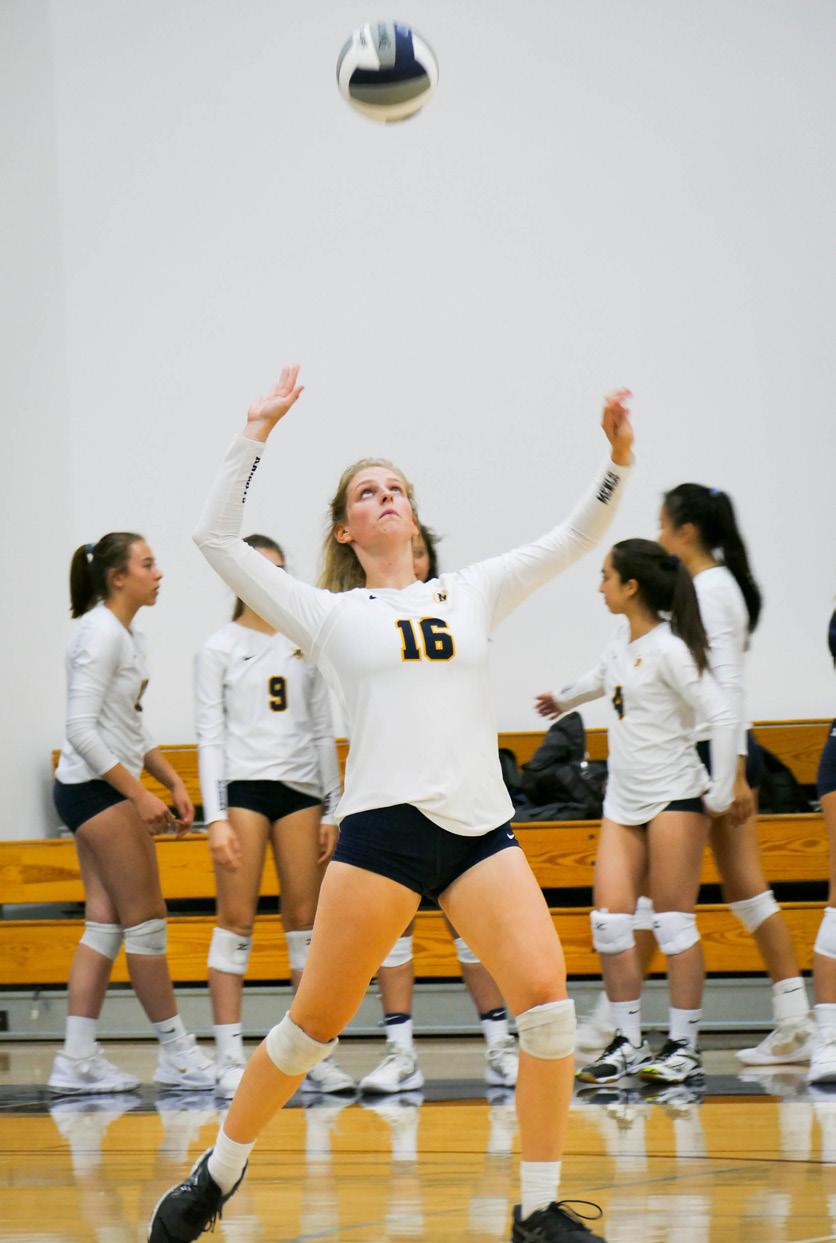
Senior Emma Holland. Varsity volleyball went 18-14 overall and 8-4 in the WBAL. The Knights took second place in the league, finishing their season with a win against Mercy San Francisco. They proceeded to compete in CCS but fell in the opener against top-seed Sacred Heart Cathedral. To close the season, the team competed in the first round of the CIF Division I NorCal championships, falling to M-A in a tight five-set match. Staff photo: Bella Guel.

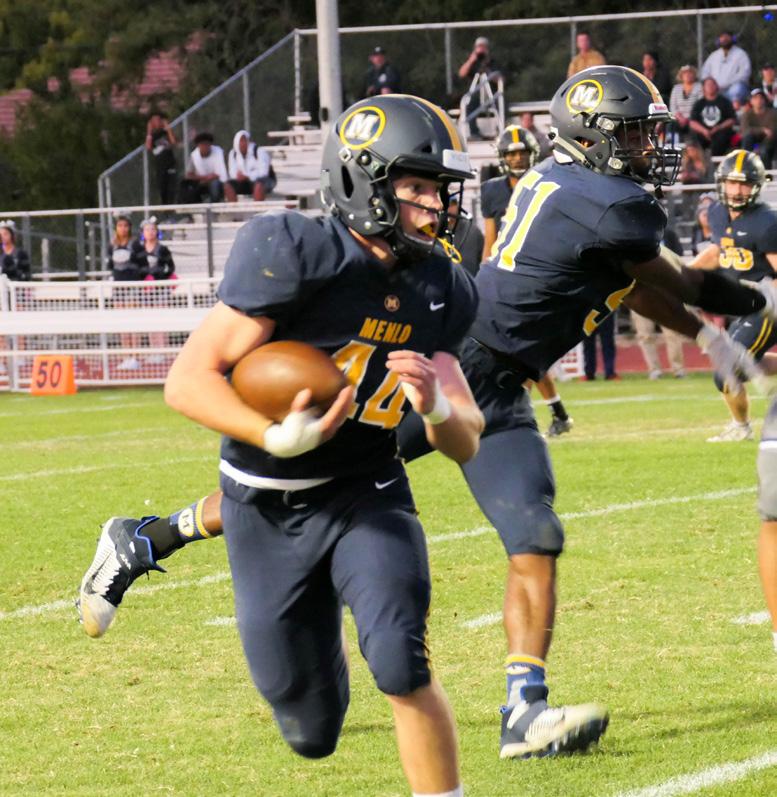

Pictured (left to right): Juniors Alex McCusker and Marisa Castagna and senior Amanda Foster. The varsity girls cross country team had an especially successful season. They went undefeated during their season until taking second place out of the 25 teams that qualified in the state finals. The team had a strong senior presence, comprised of five four-year varsity runners: seniors Charlotte Tomkinson, Kyra Pretre, Katie Aufricht, Amanda Foster and Cameron Boom. Photo courtesy of Doug Peck.
Pictured:
League (WCAL)
photo: Bella Guel.
Pictured:
Pictured:
Pictured: Senior Vikki Xu. The girls golf team finished their season with a record of 10-2. The Knights took second place in the West Bay Athletic League (WBAL) finals and fifth in the CCS finals. The team had a strong senior presence. Seniors Gianna Inguagiato and Sulwen Ma both led the team with 77s in the CCS championship match, and senior Vikki Xu led the team in the CCS finals, scoring a 78. Photo courtesy of Doug Peck.
Pictured: Senior Samson Axe. Varsity football closed their season 3-7. During their season, the Knights experienced a first-ever occurrence: a home night game under the lights for Homecoming. In a competitive game, the boys prevailed over opponent Carlmont with a 23-17 final score. The Knights played the annual Valpo Bowl game against rival Sacred Heart Prep to end their season. In a tough game, the team fell to Prep 49-14. Staff photo: Bella Guel.
Pictured (left to right): Juniors Kamran Murray and Calvin Katz. The varsity boys runners took third in CCS, progressing to take 15th at States. For the first time in Menlo history, both the varsity boys and girls cross country teams qualified for States. Front-runner junior Kamran Murray won the league finals. Photo courtesy of Allison Virsik.
Pictured: Senior Annie Bisconti. Varsity girls water polo had a 15-10 season record. During their season, the Knights had their best-ever performance in the Acalanes Invitational, finishing in the top eight, and won the Santa Teresa Tournament. To close, the girls fell to Leland High School in the CCS Open Quarter Finals. Staff photo: Bella Guel.