
Menlo releases pamphlet about grading
by EVA HERR

On Oct. 5, 2017 the Menlo administration sent out a pamphlet to the school’s families and teachers regarding grading, rigor and wellness titled “Preparing Students for Success in College and Life.” The report outlines Menlo’s mission and values along with the steps that have been taken to improve the quality of life of students and the school's academics.
On May 10, 2017, two Menlo parents sent out a letter to Head of School Than Healy and Upper School Director John Schafer titled “Menlo’s Grading Policy.” It compared Menlo’s GPA and SAT scores to the data of peer schools Harker,
Pamphlet contains comprehensive analysis of academics, college admissions, health and wellbeing
Sacred Heart Preparatory, Choate and Castilleja. It suggested that a Menlo student would get a higher GPA at these peer schools. This letter was passed around by parents and students who were concerned by the information.
While Menlo’s pamphlet does respond to many of the assertions made by the report, Schafer made it clear in an interview with The Coat of Arms that the pamphlet was part of a long-standing series of initiatives that Menlo had been working on prior to the report. “The school’s been working on balance, stress reduction, standards, grades, college admissions and appropriate expectations [...] for a long time,” Schafer said. “From our perspective, we have been working on this stuff for many years, the [content related to the letter sent by Menlo parents] is just one piece of it.”
Included in the pamphlet are Menlo’s conclusions about college admission success based on an in-depth study comparing Menlo students’ GPA’s and standardized tests scores to those of neighboring schools. This study was headed by AP Statistics teacher Lauren Lax.
“We asked some peer schools for their Naviance data from [the past] three years,” Schafer said. Menlo was able to create a detailed report by looking at thousands of data points rather than just a few averages, which was what the parents' letter did. “Naviance will show you GPA, SAT
scores, ACT scores, number of honors and AP classes, and the verdicts at each of these colleges, which is pretty radically different than what [the letter by Menlo parents] did, which was they looked at average by quintile at various schools,” Schafer said.
With this information, the college acceptances of peer schools were also compared to Menlo’s success in admissions. According to the school’s report, Menlo students’ college acceptances are equivalent to peer schools or better. “What we concluded was Menlo students are not disadvantaged. Menlo grades are slightly lower than the peer schools we looked at, and it doesn’t seem to be detrimental to our students because we do extremely well, better than these peer schools, in a lot of these super-competitive schools' admissions,” Schafer said.
The study was also a way for Menlo to evaluate the college admissions process in general. “The other thing we learned is there [is] no magic formula of GPA and SAT scores […] there is way too much noise in the data for that,” Schafer said. “We also learned that applying early decision, as an on-target student, was a much better predictor of success in college admissions than SAT scores and GPA.”
Continued on page 2
Smoke from fires in Napa and Sonoma drift South
Menlo community responds to fires with bake sales and canned food drives
by CLARA GUTHRIE
Smoke from the Northern California wildfires caused poor air quality in the Atherton area, temporarily halting all outdoor student activities and triggering relief efforts among the students.
On Oct. 11, students and families received a letter from school nurse Joan Barada regarding air quality. “If your student has a history of asthma or another respiratory condition, and if they have a prescription inhaler for said condition, we ask that they keep that inhaler on their person throughout the day,” Barada said in the letter.
For two days following that, Dean of Students Tony Lapolla sent out one email per day keeping the student body updated on the smoke levels and asking students to stay inside as much as possible. “Please go to a classroom, Student Center, library or Dining Commons during all free times,” Lapolla requested in his Oct. 12 email.
“[Menlo has] some consulting pediatricians [...] and we were using this chart that shows different air quality levels. [...] When you get to over 150 [in the air quality index], you have to start restricting activities,” Lapolla said in an interview discussing the process that the administration underwent to handle the decrease in air qual-

smokey
ity. The air quality index measures the concentration of unhealthy substances in the air; when the index exceeds 150, it is deemed “unhealthy” for those with respiratory issues and all others, especially children.
Additionally, outside sports practices and games were either canceled or rescheduled for the athletes’ health. According to varsity boys water polo coach Jack Bowen, since Oct. 9, the team had five games and two practice cancellations, including practice the day before the Sacred Heart game. “As a coach, it's always a bit unsettling going into a game without taking the time to prepare for one's opponent. I'm sure the players felt this as well. But this unique experience has been just one of many that can't be predicted and make a sport season so rich and such a journey,” Bowen said.
As of Oct. 19, varsity boys water polo had not trained regularly
in two weeks. “It blatantly set us back, but every team in CCS has been set back. [...] We're all in this together, with the athletes’ safety as our primary concern,” Bowen said.
Similarly, varsity girls golf had to postpone two matches until the end of the season. “[The postponements] put a lot of academic strain on our girls because all league matches have to be concluded by a certain date for them to count,” senior Sophie Siminoff said. “Our first match back after a week off definitely didn't go as well as we had hoped [...] I'm sure [canceled practices due to the air quality] played a fairly large role in everyone being semi-rusty.”
The Menlo administration continues to keep a close eye on the air quality, but for now, outside athletics have resumed. “Yes, they’re getting the fires under control, yes, the wind patterns are more favorable, and there’s also
rain coming. All of those are indications that the air quality will get better,” Lapolla said.
While following rules to stay inside during free times, seniors Lauren Creamer and Kathryn Wilson ran a bake sale, raising close to $200 for a Santa Rosa school district after going to Nike Tennis Camp this past summer with students from that area. “They were sending us pictures and updates of what was going on. We have a few friends whose houses actually burned down and our counselor works at a school, and half of the school burned down,” Creamer said.
“As [Creamer and I] spoke to our friends [who had been evacuated], they were distraught, and one of them even compared it to being ‘like an apocalypse,’” Wilson said, noting the devastation in Santa Rosa.
Continued on page 3
AHEAD
Nov. 16 - Nov. 19: "Heathers"
The upper school play “Heathers” opens the Weekend of the 16th. Shows on Thursday, Friday and Saturday start at 7:30 p.m. with a Sunday matinee playing at 5 p.m.
Be an ambassador for Menlo on Saturday, Oct. 19 at the Open House for prospective Menlo students. Nov. 19: Upper School Open House
Nov. 22 - Nov. 26: Thanksgiving Break
Spend time with family and friends to celebrate Thanksgiving during this five-day break.
Download the CoA App
Stay updated with our CoA iPhone app. Search "Coat of Arms" on the app store today!

The
haze over the 280 highway. Staff photo by Bella Scola.
Photo of the Issue
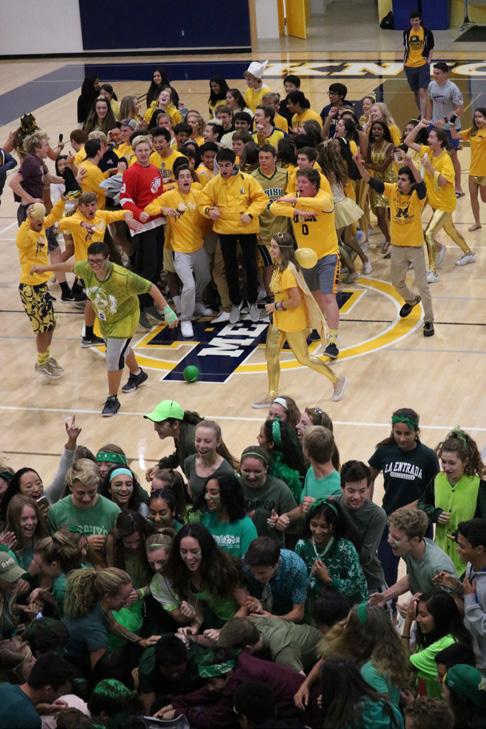
After a spirit week dodgeball match the freshmen class (in green) and seniors (in gold) stormed the court to celebrate. Staff photo by Bella Scola.
The title page of the recently released pamphlet regarding grades, well-being, and rigor. Image from the Menlo pamphlet.
Menlo releases pamphlet about grading cont.
by EVA HERR
Overall, the administration feels that based on their study the school is not hurting its students in the college admissions process. “We learned a lot of stuff […] that allows us to say we don’t have a problem that needs to be fixed,” Schafer said. Although there seems to be no apparent problem, Schafer is still working on initiatives that will help Menlo students’ well-being and hopefully help their success in college admissions.
For example, the school has continued efforts to standardize all sections of multisection classes in order to eliminate grade inequalities that would arise from different teachers. “Every marking period I get a grade report of the grades by team, [for example] I can see all the grades in Biology by teacher[s] so I analyze those and share them with the department chairs,” Schafer said. “Usually there is a great deal of consistency across the teams; when there’s not, I raise a question or ask them to investigate that.”
As the pamphlet states, the Upper School has also recently implemented yearlong grades as a means of destressing students. “Yearlong grades kind of work in that it takes the pressure off. Every test doesn’t matter that much,” Schafer said. “Additionally, the second semester is two weeks longer than the first semester, so it’s unfair to count the second semester
as worth the same as the first semester,” Schafer said.
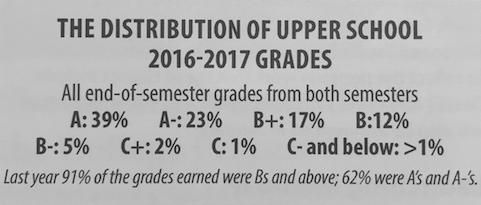
As an effect of yearlong grades, students transcripts are expected to be stronger. “I do predict that grades will go up because more students do better in the second semester,” Schafer said. According to the school’s data from the 2016-17 school year, 39% of the grades given were A’s, 23% were A- ‘s, 17% were B+’s, 12% were B’s, 5% were B-’s, and less than 2% were in the C range or lower.
Schafer also mentioned the school’s recent elimination of using quintiles as a way of ranking students. “We don’t need to provide [colleges with that] level of granularity so we have a new profile […] we will report the top grade and we will report the mean grade” he said. This shift is an attempt to acknowledge that all students at Menlo should be considered for top-tier schools regardless of where their GPA falls among their class.
“There are some colleges like Georgetown, Rice, Williams, University of Virginia that, when they go out and recruit students nationally, say ‘we want the top 10 percent of your class,’ and that’s fine when you’re going to certain high schools, [but it’s] totally not fine here,” Schafer said. “There are many more [Menlo] students than just the top ten
percent that would be totally admissible to do good work at those schools.”
The school has also recently considered increasing the GPA bump given to honors, AP and AT classes. They will have this new grading system figured out by January, 2018 which will go into effect for the 2018-19 school year. “Given what honors classes and AP classes are asking of students .3, which was a number set over 20 years ago, is time for revisiting,” Schafer said.
The school has also gotten more non-honors classes to be considered honors by University of California (UC) schools. Some classes at Menlo that recently were accepted by UC’s as honors include Analytic Pre-Calculus, Upper Intermediate Spanish, Upper Intermediate French, Advanced Seminar Topics in French Language and Culture, Advanced Seminar Topics in Spanish Language and Culture, Humanities I & II. Other classes such as Regular United States History and all senior English electives have been treated as honors by the UC’s for years.
Additionally, the school has also undertaken an initiative to create more humanities honors classes because far more students are enrolled in honors STEM classes due to availability. “Right now there are more honors in math because we have [an honors math track] so we need to build up more honors in the humanities,” Schafer said. “We are trying to create more options or opportunities for humanities focused students to shine and to get the benefit of the honors bump.”
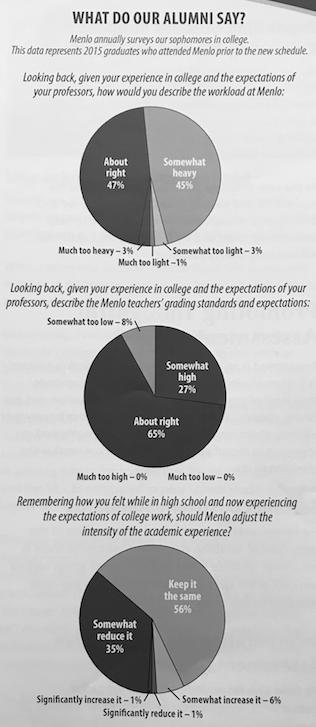
Regarding how Menlo’s workload is preparing students for college and life beyond high school, the pamphlet includes graphs and quotes suggesting Menlo alumni are prepared for college and were comfortable with the rigor at Menlo. According to the poll that surveyed 2015 Menlo alumni, 47% of 2015 graduates felt their workload at Menlo was about right. However, 45% felt their workload was somewhat heavy.
Expanded TA initiative helping students thrive
by SILAS STEWART
The Menlo teacher assistant (TA) initiative has been slowly growing with more students helping teachers in their classes, but the program has accumulated a variety of opinions.
Across the nation, the TA system is most common in the undergraduate programs within universities. The main purpose of teacher assistants in colleges is for students to pay for their graduate school education by helping professors teach courses.
Menlo is starting to adopt the initiative for a different reason. Menlo is a very academically challenging and competitive school that requires extra support for students. “Teacher assistants provide that extra help that students need to succeed,” sophomore Declan Stanton, who has a TA in his English class, said.
Students can simply ask the teacher assistant for quick and simple advice in or out of class instead of waiting to see a teacher. The initiative was started by alumni Natasha Lasky ‘15 three years ago with a pilot year in which she was the only teacher assistant. Last year, the program evolved with several more
teacher assistants. Currently, there are a handful of Humanities classes and several STEM classes that are supported by teacher assistants.
Most students in the classes with TAs view teacher assistants as a benefit to their academic success. “A lot of my peers believe the TA in this class is very helpful. Teacher assistants are a little less daunting to approach because they are simply peers,” senior Cole Dollinger, who has a TA in his Applied Science Research (ASR) class, said.
Senior Miller Geschke, a teacher assistant for ASR, believes it will help students use class time more effectively. “Students can save [...] broader questions for the teacher to answer in front of the entire class, whereas I can answer specific questions for them so they don’t have to spend time waiting for a meeting with the teacher,” Geschke said.
Students are therefore able to work more efficiently and will get advice quicker, consequently the students will yield better results on projects or papers. However, Geschke also doubted their need in many classes. “I do be-

lieve they are necessary in engineering and possibly humanities classes where individual projects and papers require immediate help in some cases, yet they aren’t really needed in many math and science classes,” Geschke said.
Although the TA initiative for STEM classes may not be growing as rapidly as the initiative in the English classes, the assistants are still providing valuable help to students they are helping to teach.
Maura Sincoff, who runs of one the largest teacher assistant programs on campus, believes that the program is evolving and has many benefits. “One benefit of the program is that it creates more one on one help for freshmen outside of class,” Sincoff said. She also believes that it allows for students to meet with someone during tutorial other than the teacher and for students who thrive in humanities to let their skills shine and benefit the community at the same time.
The classes in her program include freshman English classes, some sophomore classes, and a junior AP English Language course. Senior Grant Dumanian, a teacher assistant for Wilson Taylor’s English 1 class, says that he thinks being a teacher assistant is very fulfilling. “English 1 during my freshmen year really helped build the foundation for my writing today, so it is super rewarding to help as a TA because I still remember how helpful my TA was three years ago,” Dumanian said.
However, even though the TA program overall usually yields positive feedback, there are some who have mixed feelings about it. Senior John Weingart, who has a TA in his computer science class, doesn’t see them as a major benefit to his learning. Yet,
When asked to describe Menlo teachers’ grading standards, 65% of alumni felt it was about right. These new initiatives have commendable goals of lowering stress, creating stronger classes and helping students be admitted to colleges and universities and will hopefully be successful.
he also thinks the initiative can really help students who aren’t understanding the material as well as others. “The student to student advice can truly aid some students in certain cases. However, the assistant often doesn’t contribute to my learning,” Weingart said.
Marc Allard, who has had teacher assistants in his Design and Architecture course in the past two years, also has mixed feelings surrounding the program. He believes that “TAing” can be valuable to both the teacher and the student in the class. However, he believes that the TAs themselves don’t gain that much from the experience. “Even though I have had teaching assistants, and even though I have found them to be helpful, I can’t help but feel that their time would be better served doing a ‘deep dive’ independent study project,” Allard said. He believes that students see “TA-ing” as a means to bolster their college resumé without putting in as much effort as doing an independent study, so if they truly are passionate about that subject, they should look to complete an independent study.
Even though the program has garnered mixed views, the overall opinion has remained firm: it is very helpful. “In my opinion, teacher assistants are very valuable to those who need it,” senior Thomas Brown said. The program is still evolving. Sincoff believes the future of the program lies within the students’ hands. “While I have no way of predicting this trend [growth of the TA program], I do know it is useful and needs to be an embedded part of student culture. The more students realize how useful it is, the more it will grow,” Sincoff said.
English TA, Elisabeth Engelson, helps freshman Sonia Agarwal with the book Catcher in the Rye. Staff photo by Bella Scola.
Grade distribution information from the 2016-2017 academic year. Image from the Menlo pamphlet.
Alumni responses to Menlo’s workload, grading and overall intensity. Image from the Menlo pamphlet.
Wasps damper dining experience
by BAILY DEETER AND SILAS STEWART
With the completion of the new cafeteria, the on campus lunch experience certainly has a lot to offer Menlo students. Many enjoy sitting outside to enjoy the California weather and to look out at the walkway to the center of campus. However, lately, many students have reported that their lunchtime experience has been disturbed by the recurring presence of yellow jackets at the outside dining space. With the mid-fall weather still yielding relatively warm temperatures, the wasps are still frequently seen flying around the lunch tables. Yellow jackets, which are notably more aggressive than bees, have the obvious threat of a stinger, in addition to simply being a nuisance.
Many students have reported being disturbed by the yellow jackets. “I think the bees are very annoying and prevent me from eating in peace,” sophomore Finn Leschly said. “I constantly have to try and scare them away from my food.”
Some students have reported taking measures to avoid the bees during lunch. “I’m often motivated to sit inside so I don’t have to deal with the bees,” junior Taylor King said. Junior Abby Doll agreed, citing that other students have noticed this as well. “I usually sit inside to stay away from the bees,” Doll said. “I’ve noticed that the cafeteria has gotten more crowded as more and more people choose to sit inside to avoid them.”
Senior Parsa Habibi noted that, on certain days, the yellow jackets are much more likely to bother students. “When I have ham, chicken or other meats on my plate, I generally choose to sit inside knowing that the bees are more attracted to those foods,” Habibi said. “The same goes with the weather; I usually sit inside on a warmer, sunnier day to avoid them.”
The bees are generally attracted to protein, so math teacher Leanne Rouser suggested an approach to distract the bees. “I suggest putting out a decoy plate of protein out at a separate table to occupy them,” Rouser said.
Senior Drew Wadsworth brings a more creative approach to dealing with the yellow jackets. “To me, the wasps are endless entertainment,” Wadsworth said. “The key is to always have a cup at your side to trap them if they attempt to take your food. The highlight of my year has been catching nine of them in one cup.”
While Wadsworth’s feat is impressive, his enthusiasm for dealing with the yellow jackets doesn’t appear to be shared by many students. Luckily, as winter comes around, the yellow jackets will become less of an issue. Wasps cannot fly at temperatures under 50 degrees, and they are less effective and present as the weather gets cooler. In other words, the issue will likely soon resolve itself for the time being.

Tech building: more than a computer lab
by BRIDGET QUIGLEY
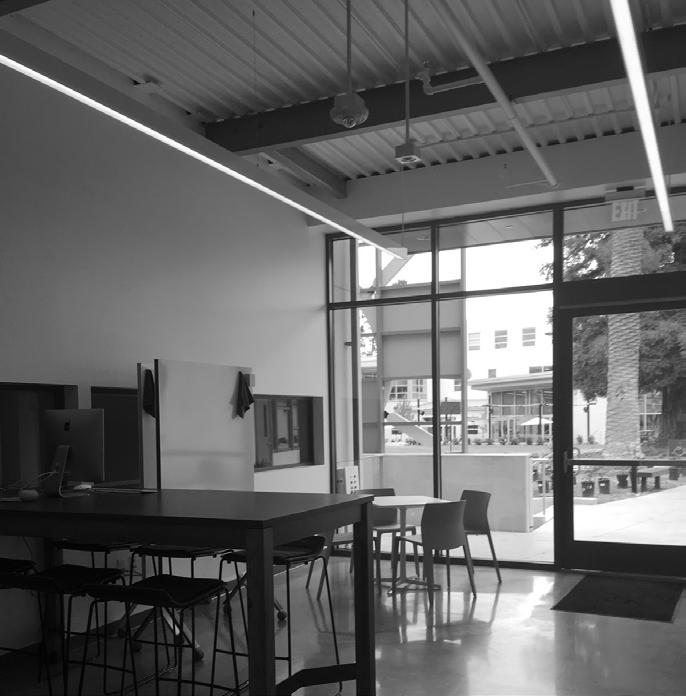
The technology building, located next to Menlo’s Creative Arts and Design Center, is a new addition to the campus. Due to the recent construction of the Student Center and Dining Commons, the technology department had to move out of the bottom floor of Stent Hall and find a new location.
According to Menlo’s Educational Technology Specialist Katie Miller, the new technology building will have a similar purpose as before. “We are open for teachers and students to drop by to get help with technology,” Miller said. The building is used mainly to house the staff and the operations of the technology department. In addition, students are encouraged to utilize the building for technology support, as well as a place to study, provided by the lounging spaces and conference rooms on the first floor. “There’s a lounge area where
New APUSH program now open to sophomores
by DAVID QUEZADA
After last year’s decision to pilot the history program for sophomores, changing U.S. History from traditionally being a junior class, the implementation of the new program seems to be going smoothly.
This year is a special year for the history program, the current sophomore class of 2020, who is currently in Advanced Placement United States History (APUSH) and Regular United States History (RUSH), is the first class of sophomores to take APUSH at Menlo. Beginning their high school history adventure with World Religions, this year’s sophomores will never be required to take Modern World History (a traditionally sophomore class) due to the transition of APUSH into a sophomore class.
“This is the transitional year, the cost of the switch is that the class of 2020 will not have the opportunity to take Modern World History,” longtime APUSH and Economics teacher Charles Hanson said. In the following years, freshmen will be starting their Menlo history ventures in Modern World History, completely phasing out the class traditionally taught to freshmen, World Religions.
The current APUSH class taken by sophomores is also different than the traditional junior class. “It’s a multi-year process because this year’s juniors and this year’s sophomores have different levels of preparation, and next year’s sophomores will have different preparation than the current ones.” Hanson said. Modern World history is a better introduction to the research intensive AP U.S. History class than
World Religions due to the fact that there is a research paper, which is a sort of “warm up” for the traditional APUSH research paper, according to Ryan Dean.
“The sophomores spent a lot of time at the beginning of the school year working to develop the kind of writing and thinking skills related to historical research that the juniors and seniors acquired in Modern World history,” said current sophomore APUSH teacher and history department leader Ryan Dean. “It’s also the case that we cover a little bit less [curriculum], and that the research requirement has been scaled back,” Dean noted. This was all done in an effort to make APUSH more suitable for sophomores, while still being regarded as a rigorous class.
Even though the current APUSH class is slightly less research intensive, the sophomores right now are taking the new challenges that APUSH is proposing in stride. “They’ve been great; as Menlo students often are; [the sophomores] have risen to the challenge proving that a great US History student isn’t necessarily 15, 16 or 17, but rather a passionate student of history,” Dean commented.
Although having our current sophomores not take Modern World History may be considered a loss by some, the benefits will be realized soon. “One reason schools may do APUSH sophomore year is to free up time to take more APs later in high school,” Hanson speculated. Menlo is cur-
Fires in Napa and Sonoma cont.
by CLARA GUTHRIE
Continuing their efforts with the Knight Vision club and Director of Community and Civic Engagement, Jessie Brugos, Creamer and Wilson are now working on a canned food drive for the victims. “We are looking for donations of ready-to-eat meals, like ramen or macn’- cheese, canned soups, fruit cups, and fruit pouches,” Wilson said.
Adding to the student body’s sympathy for victims, certain students have family in the area affected by the fires. “My aunt and uncle were actually in their house in Napa [...] at the time, so they were evacuated and it was kind of scary [...] not knowing if they were okay
or not, but they’re fine,” sophomore Kate Hammond said. “I’ve spent a lot of my time [in Napa], especially in the summers, so it was kind of scary thinking of losing something like that.”
While the fires have been brought under control in both the Santa Rosa and Napa Valley area, Menlo’s canned food drive continues in an effort to help evacuated and newly homeless victims.
you can work on something while getting assistance from a tech person, a workshop where we assemble and repair computers, printers, and networking equipment, and a room where we plan to run tech workshops for teachers,” Miller said.
With a total of eight current faculty members in the department, the first floor is comprised of five staff members who will help with technology support and computer analysis. The first floor houses Technology Support Member Chris Sapyta, Computer Analyst and Assistant Director of Technology Joanne Meager, Upper School Educational Technology Specialist Katie Miller, Middle School Educational Technology Specialist Erica Chesley, as well as the Director of Technology, Eric Spross. The second level holds the offices of the Computer Support Technician, the Principal Software Engineer and PC and Database Support. Menlo is currently interviewing to fill the position of a Network Manager.
The new building is equipped with more storage space to house technology equipment, two conference rooms and a lobby with couches and chairs available to students throughout the day.
Although the construction of the building itself is finished, the technology department is continuing to finalize what activities they will have available to students. According to Miller, the staff is hoping to make more use of the building in the near future.
rently in the process of adding more history electives, and the change of APUSH into a sophomore year class will free up more time for those new electives.
The transition of APUSH from a junior year class to a sophomore year class appears to be part of an effort from Menlo to give more variety in class opportunities. Menlo has traditionally provided many STEM electives for juniors and seniors, and the switch will hopefully give future Menlo students the ability to pursue history more intensively.


Students in a sophomore APUSH class do an actiivity on the board. Staff photo by Bella Scola.
A wasp flies around a plate of food being eaten in the outdoor seating area of the cafeteria. Staff photo by Silas Stewart.
A study area in the new technology building which is located next to the CADC. Staff photo by Bridget Quigley.
Burned building in Napa leaves ashy ruins. Staff photo by Bella Scola.
Arts clubs offer opportunities for student expression
by ELECTA NARASIN
Menlo has taken steps to integrate more arts into the educational and extracurricular programs. One way for students to get involved in the arts in a low stakes way is through clubs. Although Menlo does not offer a wide variety of these clubs, there are a couple organizations Menlo students can get involved with on campus.
The options for these clubs include art club and singing club. Art club is run by junior May Li. “I started the club in late September [...]. My main goal is for art club to be a chill gathering place for students to just hang out and do art,” Li said. The art club meets every Friday and is open to all. “There’s no expected skill level that you need to be, it’s open to anyone who wants to learn, practice, or im-
prove their art,” Li said.
Along with these weekly meeting, Li hopes to expand the club beyond campus. “I’m [...] planning on organizing some art outings with Nina so that we can explore different styles and types of art,” Li said. “We’ll probably go to museums, do figure drawing, do some hiking and sketching or try something else.”
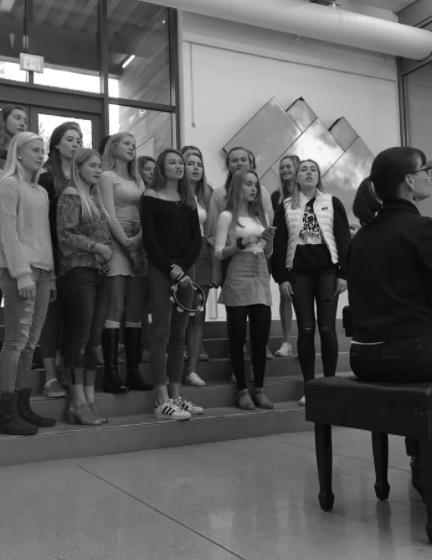
Along with the art club, singing club offers a space for students to share their talent and love of singing. Seniors Lauren Creamer and Kathryn Wilson serve as the leaders. “Singing club is a fun way to relieve stress in the week by singing some of our favorite songs with friends during lunch,” Creamer said.
While there are performances
by SID CHARI & DAVID QUEZADA
during lunchtime concerts, they are not mandatory to club members. “Most girls in the club don’t usually perform, so it is a cool opportunity and outlet for girls who enjoy singing and harmonizing,” Wilson said. The club is a great way to get involved in chorus at Menlo if you don’t have time to take a full class. “We sing a couple songs every meeting, and are constantly finding new harmonies. We will be performing about every other month this year during [a] lunchtime concert,” Wilson said. The club meets on Thursdays during lunch and is open to all.
Overall, if you don’t have time to make the major time commitment to being in an art class, try going to one of these clubs for a fun and relaxed experience.

Cold

“Heathers:” get ready for a beautiful musical
by SHELBY RENDE
This year’s fall musical is “Heathers.” It follows the story of students JD and Veronica as they find their place in the high school social scene. At first glance, some might be concerned with the overall message of this musical since it deals with the sensitive topics of teen depression and suicide. However, the overall theme of the

musical seems to be more about acceptance and inclusion.
Senior actor Rishi Varma, who plays the role of Kurt’s Dad, explained the message of the play as something less controversial and more inspiring. “I think for people that are concerned about this, come out and watch it [...] come out and see it and understand that these are real problems.” Varma said.
He further explained some common misconceptions that non-cast members may have. “I think a big misconception people have is that it
“The impact [of “Heathers”] is that the community thinks they did commit suicide so it encourages the community to talk about mental health.”
takes these topics and makes it funny. But it actually takes these topics in a serious way and in a form [...] people can benefit from.” Varma said. “It’s a show not about suicide, but acceptance
and loving each other.”
Senior Rachel Perkins, who plays Martha in “Heathers,” believes that speaking about these topics in a musical takes the stigma away. She believes opening students’ eyes to teen suicide in a non-traditional way can start a conversation. “The impact [of “Heathers”] is that the community thinks they did commit suicide so it encourages the community to talk about mental health.” Perkins said.
As “Heathers” prepares to open, the Menlo community has an opportunity to share the experience of “Heathers” and talk more openly about mental health, issues of acceptance and what these topics mean specifically for our community. “I feel like our school has been starting to address this in a healthy way which I think is excellent because I think in the past people didn’t really talk about mental health. I feel that it’s great now that Menlo is talking about it,” Perkins said.
Junior Braedon Young, who is playing JD, is anticipating a positive reaction to the play and how it deals with these complicated issues, “I am definitely excited for the show, not only for the performance aspect of it, but for the impact it should have on all of us here at Menlo. It’s a powerful show that I feel will really strike a chord with everyone who sees it,” Young said.
Singing club performing during lunch. Staff photo by Electa Narasin.
“Heathers” cast poses in costume. Staff photo by Bella Scola
Dressel takes on lead in upcoming school production, “Heathers”
by SHELBY RENDE
Sophomore Emma Dressel is the female Artist of the Issue because of her love for musical theatre and performing arts.
Dressel has had a long love of singing and musicals starting when she was in fourth grade. “I did a lot of little tiny theatre productions and skits or something starting when I was in fourth grade,” Dressel said.
Dressel took film acting classes at First Take in Los Gatos then at the Portola Valley Theater Conservatory. In eighth grade she decided to take the leap and start doing musicals at Menlo instead. “Our first fall play was ‘The Lion, the Witch, and The Wardrobe.’ I got a leading role and it was the White Queen. [...] It got me super interested in theatre instead of acting,” Dressel added. “I actually started to really start liking theatre.” During her freshman year, she participated in the musical “How to Succeed At Business Without Really Trying.” She was in the ensemble but learned a lot from working with others and watching her peers act.
Dressel also credits her love of musical theatre to her background in chorus and singing. Last year she was a part of mixed chorus, where she learned technical skills in how to warm up her voice and being able to make her voice sound good in a group. “[I learned how] to sing songs you typically wouldn’t want to but will expand your vocal range. I thought [chorus teacher Karen] Linford really helped me with that.”
“She is a great student and she works hard and she loves what she does,” chorus teacher Karen Linford said. Linford
Landon
also added that Dressel’s voice is very versatile and helpful when singing different styles of music, such as musical theatre.
This year, Dressel has a leading role, Veronica in “Heathers.” Dressel has found that Veronica is a role she is able to connect with on a personal level. “Veronica [is] a character you could relate with and a lot of her qualities were ones I encompass [...] I think there are characters that a lot of people can relate to. I think they all have something someone can relate to. Specifically, Veronica resonates with me,” Dressel said.

Smith continues his passion for moviemaking
by SAM FORTENBAGH
Senior Landon Smith is the male Artist of the Issue because of his passion for movie making. “I first started making movies in seventh grade. When I was 12, I got the GoPro Hero 2 when it first came out, and I started filming random things from biking and skateboarding to surfing and skiing, and everything just grew from there,” Smith said.
After entering Menlo Upper School, Smith decided to take Intro to Moviemaking. “That’s when I really started to make interesting movies that actually had decent storylines. I’m taking Advanced Moviemaking this year, and I think what’s helpful about the class is being able to get feedback and advice from other like-minded people,” Smith said.
Smith has a YouTube channel that he and senior Ty Corley own called Corley Smith Industries. “All my movies are on YouTube on the Corley Smith Industries channel,” Smith said. They have eight videos published, and one has over one thousand views. In his short movie-making career of about six years, Smith has made a plethora of movies. “My favorite piece of work has to be ‘TyCor Parkour,’ It’s just a classic. It has a lot of flaws, but I think that adds some comedic value to it,” Smith said.
Smith has made a variety of different films. “My favorite genre to make is comedy. I also like horror movies, but
Random Student Profile: Kevin Yang

by TY CORLEY & BAILY DEETER
CoA: What is something no one knows about you?
KY: I can’t swallow Pepto Bismol. I’ve tried tens of times.
CoA: What burger topping is a deal breaker for you?
KY: I don’t do tomato.
CoA: Menlo has a ban on DoorDash but there have been multiple sightings of you with outside food from far away. How do you get this food?
KY: I like to think the food just comes to me.
CoA: From DoorDash?
KY: Um, no comment.
CoA: We have several sources saying you crumple a substantial amount of paper in class. Can you explain this?
CoA: Sorry, it’s already written.
CoA: Many have reported listening to your broadcasts for the Menlo Radio Club. Can you describe how this activity is an outlet for you to relieve stress?
KY: It’s a great platform for me to voice my ideas. It’s a lot of fun.
CoA: Will you be participating in no-shave November?
KY: I don’t think that will be good for anyone.
CoA: Do you consider yourself more of a cubist painter or an impressionist?
KY: Um. I want to say cubist.
CoA: What are your thoughts on the Communist Manifesto? What do you think of the teachings of Karl Marx?
KY: It’s an interesting piece of literature.
CoA: Can you read this question?
KY: Would you rather be a narwhal for the rest of your life or an Australian desert armadillo?
CoA: Narwhal.
CoA: If you had a parrot that could only say one thing, what would it say?
they’re hard to do. I think we might try to make another horror movie later in the year, so look out for that. I’m currently working on a music video and a short comedy video,” Smith said.
Smith believes he will continue making movies after high school but less often. “I’m not planning on majoring in film, but I will definitely pursue it either as a minor or just as a hobby,” Smith said.

KY: I’m recycling. It’s good for the environment.
CoA: That doesn’t make sense.
KY: The paper is being recycled. Reduce, Reuse and Recycle.
CoA: What’s a typical Kevin weekend day?
KY: I wake up at 12, watch a few hours of TV, procrastinate, and eventually go to bed.
CoA: Nice. Which tropical bird family do you like the best?
KY: Macaw. No, toucan.
CoA: Are you sure?
KY: Yes. Wait, no.


KY: Simmer down.
CoA: What are your thoughts about this quote: “The woods are lovely, dark and deep. But I have promises to keep, and miles to go before I sleep?”
KY: Can you repeat the quote?
CoA: No.
KY: Okay.
CoA: If you could change one thing at Menlo, what would it be?
KY: Bring back DoorDash.


Dressel reads over her script for “Heathers.” Staff photo by Bella Scola
Landon Smith is currently in his second year of adcanced moviemaking. Staff photo by Bella Scola.
6th grade photo of senior Kevin Yang. Photo courtesy of Menlo School.
On the Quad: What is your favorite thing to do on Black Friday?


“I wait for Cyber Monday so I can get the same deals online.”
- Jack Pimlott ‘19
“I go to the mall even if the sales aren’t good because it’s fun to go.”
- Skylar Deeter ‘20


“I beg my mom to come shopping with me, but she doesn’t come.”
-Grace King ‘19
“Go to stores that have great deals and look around but not buy anything because I never save my money. ”
- David Corsinotti ‘21


“I stay at home and watch Snapchat stories of people shopping.”

- Beth Sanford ‘19
“The night before I head over to my local REI and spend the night in a tent inside the store so I can wake up the next the morning and get all the good deals.”
- Cooper Stewart ‘18
Gillian’s Cooking Column: Pumpkin Pie
by GILLIAN BRESSIE
We are coming up upon Thanksgiving break, and you know what that means, turkey, cranberry sauce, stuffing, sweet potatoes and best of all, pumpkin pie. This pie recipe is a personal favorite of my sisters and I that we love sharing with our family each year. We hope you choose to share it with yours as well.
Ingredients:
9” pie crust, unbaked (store-bought or homemade)
1 (15oz) can pumpkin puree
1/2 cup heavy whipping cream
1/2 cup evaporated milk
1 cup brown sugar
2 tsp pumpkin pie spice
1/4 tsp salt
3 eggs
Instructions:
1. Preheat oven to 400 degrees.
2. Prepare your pie crust by rolling it out and putting it in a 9 inch pie pan.
3. In a large bowl, mix together all the ingredients except the eggs. Once blended together add eggs one at a time. Beat for an additional 3-5 minutes or until light and fluffy. Pour into prepared pie crust and bake for 10 minutes at 400 degrees. Reduce heat to 350 degrees and bake for an additional 35-40 minutes. Remove from oven and let it cool to room temperature.
4. Cover and refrigerate until ready to serve. Serving with whipped cream is recommended.


Creative Arts Week showcases student artistic talent
by ABBY WOLFENDEN
Creative Arts Week, which took place from Oct. 23-Nov. 3, is always an exciting week for artists and spectators alike. It is a fun Menlo tradition where artists of all skill levels and art types can showcase their talents either on stage or in a gallery. “One of the main goals of Creative Arts Week is just to give students a place where they can showcase everything they’ve been working on to the school. Especially things that might not have regular showcases like [...] orchestra [which] doesn’t get to perform for the school as much. It also helps people to see how great the arts community is. It might inspire more people to join, and it’s just a great way to celebrate all the hard work that people have been putting in,” said Menlo student body arts coordinator Maddie Bernheim.
This year’s Creative Arts Week began on Monday, Oct. 30 with lunch time performances by Menlo faculty and staff. Onlookers included students, teachers, and administrators, and a variety of talents were displayed. Some of the performances included piano by
english teacher Nick Romeo, violin by orchestra teacher Leo Kitajima, and songs by chorus teacher Karen Linford, Flik employee Louie, and counselor Nina Keebler.
On Tuesday, Oct. 31, Menlo students celebrated Halloween with face paint by art students and art teacher Nina Ollikainen during lunch. There were a wide variety of exciting costumes that were made even more interesting with various face-painted designs.
Wednesday, Nov. 1 was about expressing art through writing and poetry. Litmag combined spoken word with music for wonderful performances in Martin Hall during lunch. The music helped to make the poetry more powerful, and the poets and musicians included sophomore Litmag co-president Bella Guel, sophomore Aaron Morgan, senior Chloe Lai, and freshman Egan Lai, among others.
Menlo students were able to share their talents during the lunchtime student Talent Show on Thurs-
day Nov. 2. Performances ranged from piano solos, to singing solos, to a group song by Singing Club. “I’d like to think I know a lot of the artists here at Menlo, but there are a lot that I’m not aware of, so seeing people get up and sing and play piano that I had never seen before was kind of eye opening to remind myself that there’s so much talent here that doesn’t always get celebrated,” Bernheim said. Creative Arts Night was also held on Nov. 2, with high attendance by both parents and students.
On Friday, Nov. 3, there was the Creative Arts Assembly which showcased a variety of student talents. From art to photography to dance to music, all forms of art at Menlo were shown. Students enjoyed performances on stage by Menlo chorus, dance, orchestra, and drama. Galleries in the gym displayed visual art such as painting and photography. Whether you’re an
artist, an art enthusiast, or just an observer, Creative Arts Week at Menlo is definitely an exciting time for all. “What I love about the arts is that I think arts unite people. [...] I think arts are how people connect with each other, they’re how people learn to understand other people,” Bernheim said.
The yummy finished product. Photo courtesy of Mackenzie Bressie.
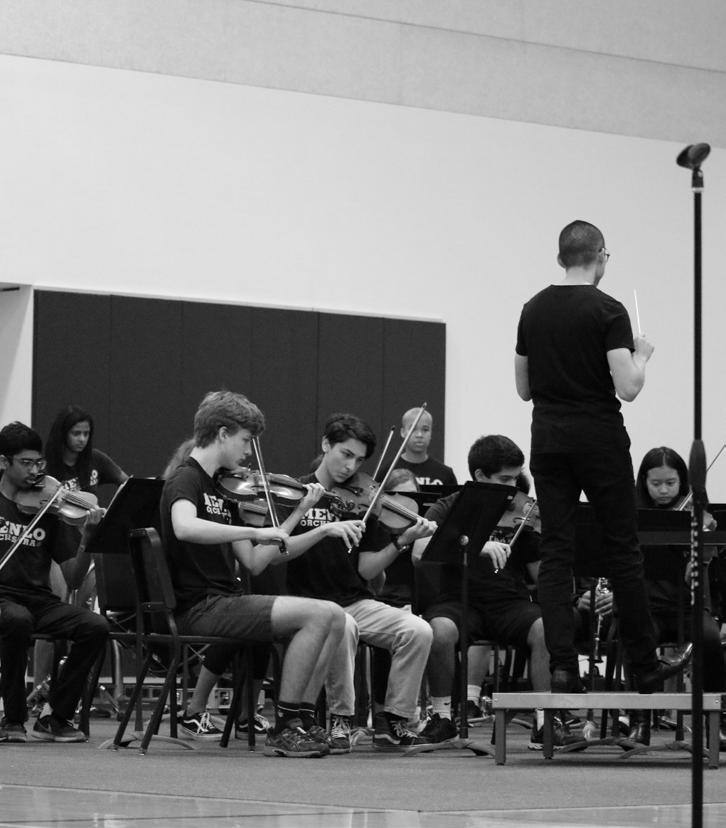
Orchestra performing during Creative Arts Assembly on Friday. Staff photo by Bella Scola.
Compiled by ELECTA NARASIN, BRIDGET QUIGLEY & BAILY DEETER
Feminism A T MENLO



Gender Clubs at Menlo
At Menlo, there are many students who are pushing to change the stigmas surrounding gender roles and feminism. There are four clubs whose purposes are to address inequalities branching from specific gender roles at Menlo.
One of these clubs is called Gender Equality Matters club, also known as GEM. Run by juniors Sara Hewitt, Kayla Zamanian and Clara Guthrie, this club more broadly addresses gender issues that are relevant to the Menlo student body. GEM members discuss different topics surrounding women and inequality such as the objectification of women through media, the portrayal of women in music and stories of inequalities they have experienced in their own lives. GEM aims to destigmatize the word feminist. “Feminism is a word that is misused quite a lot at Menlo,” Zamanian said. “GEM wants to create a community where everyone feels comfortable being a feminist. That means that they support the equal rights of women and men.”
In March, GEM will host an assembly during the week of International Women’s Day, where they will have a panel including many female figures who can inspire both girls and boys in the audience. “This panel will inspire girls to be bold,” Hewitt said. “It will inspire the student body to stand up for women’s rights.” Zamanian, Hewitt, and Guthrie hope to at-
by Caroline Frantz
tract women from the local and national scale including Sheryl Sandberg, the Chief Operating Officer of Facebook, Laela Sturdy, a partner at Google’s investment department, and maybe even Gloria Steinem, a famous activist and journalist who believes strongly in equality for women.
Another club that focuses on gender is Gender Equality in Politics (GEIP) which is run by junior Ashli Jain. Jain started her club this year that focuses on highlighting the unfair treatment of women in politics. Although female representation in government is slowly increasing, there is still a strikingly low number of female representatives in the federal government, specifically in the Senate with only 21% of senators being female.
Jain’s club has two main goals: inspiring students to get involved in politics, and helping to inform male students on how their support is important for those students. Additionally, Jain wants to show girls in the Menlo community that there are easy ways to get involved in politics. “Politics and gender inequality [are] both local and relevant on a bigger scale,” Jain said.
Focusing on a different aspect of women’s equality, the club Girls Learn International, or GLI, is striving to help change the inadequate education many women are receiving around the world. GLI is a big organization that has
chapters in many schools around the country, including Menlo. The three sophomore club leaders, Emma McGaraghan, Brooke Hodge and Kendall Weingart, are hoping to raise money through Menlo to help sponsor the education of three African girls. Combined, the total money needed to meet this goal is $1200, and these leaders have already started with the fundraising. So far this year GLI has organized two fundraisers including a crepe sale, where they raised $1000.
The last club that addresses the importance of breaking gender boundaries is Spectrum Club, a club that also focuses on breaking stigmas around sexuality. Leaders junior Elise Thompson and senior Lizbet Jacobo encourage students to promote an environment where students can identify beyond the gender binary. “Spectrum club is a place where students can express who they are not be judged for it,” Thompson said. “There isn’t enough discussion about gender roles at Menlo specifically for those who don’t identify with either gender or may be transgender.”
Through their clubs, these women are all hoping to make a difference at Menlo with how students view gender roles. Each one hopes to see support from males on campus, in addition to girls supporting each other.
Student art by Melody Zhou

Weare stronger thanfear
REGRESS
Women’s March Update
by Siddharthi Chari & Eric Chang
In January of 2017, millions of women across the nation marched in protest of current policies regarding human rights and women’s rights. While the protests were partly aimed towards Trump’s recent inauguration, the main goal was to address the inequality towards women that they feel is prevalent in society. The first protest was held in Washington D.C. and, according to Wikipedia, about 500,000 people showed up. It sent a strong message to the new administration and inspired many across the nation, as it was followed by marches in numerous big cities, including San Francisco.
San Francisco’s main march was held on January 21, where over 200,000 people showed up. The participants were protesting for a variety of reasons, from LGBTQ rights to gender inequality. Due to its immense media coverage, the march sent a message even to those who weren’t in attendance. It also was successful in garnering many administrators’ attention, mainly President Trump.
Locally, women marched together in in San Francisco in an effort to bring awareness and change to some of society’s issues. The Women’s March was brought to the Menlo community as various students chose to participate in the movement. “We all strongly felt that change had to happen and we wanted to actively make efforts to see this change through,” senior Sarah Kornfeld said.
One repeated highlight of the experience for Menlo students was the supportive environment that the march provided. “It was a very


special feeling: everyone felt united under one cause and you could see progress being made,” senior Elana Rich said.
Sophomore Kendall Weingart, co-leader of the Menlo club Girls Leadership International, also commented on how supportive she felt the people of the march were to one another. “During the march, I was surrounded, literally hugging because we were so close, with people I had never met before, and yet felt so connected to, as we were all fighting for the exact same thing. I have never felt more comfortable, respected, and safe than in this environment,” Weingart said. “I have always been extremely passionate about women’s rights and gender equality, so to see a gathering of this many people with that same passion was incredibly empowering.”
10 months later, the ideas that the movement brought forth are ongoing and continue to be relevant to some Menlo students today. “I would say that politically there has not been much, if any, change. But socially, more and more people are agreeing with the movement’s values,” Kornfeld said.
Similarly, sophomore Emma Dressel said, “This march will continue to be very important going forward because now more than ever women’s rights are at high risk for being jeopardized. As women we must make our own progress for our own rights and this march marks a enormously impactful day in history where women rights were acknowledged in a colossal way.”



Photos courtesy of Kelly Campa, Sarah Kornfeld, and Kate Barrett.
Glass ceilings are meant to be broken
Even in a relatively liberal place, such as the Silicon Valley, the term “feminism” is often perceived as a dirty word. It has a certain connotation of male-hatred and male-oppression that makes people, specifically men, hesitant to acknowledge or identify with it. Here at Menlo, the male community lands on all ends of the spectrum, many expressing confusion and concern about the word “feminism.”
Merriam-Webster diction-ary defines the term as, “the theory of the political, economic, and social equality of the sexes.” US history teacher Charles Wetherell’s personal description of feminism aligns with that definition, “The principle that gender are equals; [...] you treat men and women equally, in all things,” Wetherell said.
Junior Max Dostart-Meers recognizes the many forms that feminism takes on, along with his concern for its modern conno-
Girls just want to have fun-damental rights
Men of Feminism
by Clara Guthrie
tations. “It’s become more of an insult than an ideology. I worry that new-wave feminism creates a lot of resentment in men that’s ultimately self-defeating.” Dostart-Meers said.
While being a definite supporter of gender equality, US history teacher Ryan Dean echoes that lingering hesitancy surrounding feminism. “I wasn’t going to be a bra burner in the 1960s, but it’s okay to say that I’m a bit of a feminist,” Dean said, “I’m just not sure I’m entirely comfortable using the term because I don’t want to be misunderstood as representing something that I don’t.”
A point of agreement among males at Menlo is where their views on feminism stem from: their mother or other female relatives. “[My mom] spent a lot of time when I was a little kid writing a book about women in the workplace. That, along with outrageous things that she had to put up working as a woman on
Released May 25, 2017, “Wonder Woman” is now the highest-grossing live action film directed by a woman. Director Patty Jenkins inspires women, children and filmmakers alike with the superhero story of Princess Diana (Gal Gadot), an elite warrior member of the Amazons. The film follows Diana throughout World War I and her mission to stop German forces. She forms an alliance with an American spy (Chris Pine) in order to end the war, which Diana believes was started by the Greek God, Ares, who is seeking revenge against humankind.
In an article by Nivea Serrao of Entertainment Weekly, tweets on both Patty Jenkins and Gal Gadot’s twitter accounts were shared. Young boys were trading Iron Man lunch boxes for Wonder Woman, and girls are having “Wonder Woman” themed birthday parties. What is particularly inspiring about Diana is that her strength and tenacious attitude stem from the sense of love and family that was given to her by the Am-
Wall Street, [... has] always made me identify with the cause,” Dostart-Meers said.
Similarly, having an older sister has changed junior Luke Arnold’s outlook on feminism, especially in the way in which he looks at the news. “Because I’m not a girl, it’s really easy for me to slip into thinking about current events in a purely theoretical sense. Having [a sister] to provide realism is very helpful,” Arnold said.
The topic of feminism extends beyond the family into the realm of school and extracurriculars. In the classroom, Dean dedicates time to discuss topics such as sexism in past generations. “I none-so-subtly [point] fingers at men in the classroom to remind them that [...] they are just as susceptible to pushing things forwards as they are to lapsing back into the past,” Dean said.
Wetherell notes a similar idea when discussing his involve-
Wonder Women
by Abby Wolfenden
azon women. This image of women supporting and mentoring other women sets a great example for our society as a whole.
In terms of filmmaking as a profession, Patty Jenkins has paved the way for future women filmmakers everywhere. Since less than 4% of all film directors are women, the success and plot of the “Wonder Woman” film are particularly inspiring. In a tweet, she said, “I believe women can and should be everything just like male and lead characters should be. There is no right and wrong kind of powerful woman.”
At Menlo, “Wonder Wom an” has had a large impact on both male and female students. While not all students enjoyed the actual plot, they appreciated the role of Wonder Woman as a fe male hero. “From a male perspective, ‘Wonder Woman’ is epic. I think it is empowering because it shows wom en can save the day, and not just be the damsels in distress [...] ‘Wonder Woman’ is a testament to the strength
ment in the football program, both as a player here at Menlo under Mark Newton and as the former Junior-Varsity coach. “There’s all these conversations about masculinity and toughness [...] and that’s not anti-feminist, but it is sort of sexist,” Wetherell said, also noting Newton’s dedication to confronting sexism within his program.
Interestingly, many current male students tend to view Menlo as a school strongly leaning towards feminist beliefs, some men even feeling excluded from pro-female initiatives. “M-BEST is a program to learn about mechanical and scientific topics, but it’s only limited to girls [...] so they can combat gender inequality. [...] I think that is a totally valid point, but I would like see M-BEST be open to men as well,” Freshman Troy Demmon said.
and power of women, and it inspires young girls out there that they too can save the day,” freshman Egan Lai said.

Junior Sara Hewitt, club leader of Gender Equality Matters (GEM), was extremely praiseworthy of the film as well. “This film absolutely affected me. Not only was it empowering to watch a superhero movie about a strong heroine who wasn’t completely sexualized, but it was really inspiring and exciting to see the film have so much success in the box office and know that so many others were affected by it, too,” Hewitt said. “I think the film was excellent, and I believe that a large part of that was that it was made by a female director who knew how to portray a real, strong women without objectifying her and without taking away from her main story with men that save her, or anything like that. And aside from the women’s empowerment aspect, it was just a really good, entertaining movie.”
*These messages are from posters used during the women’s marches in early 2017. They do not represent Menlo’s or the CoA’s opinions.
Contributing to the growing effort to get young American women into STEM, Menlo’s Bridge to STEM program, M-BEST, was created for Middle and Upper School girls to foster female interest in STEM programs (science, technology, engineering, and mathematics.) While Menlo has a large amount of STEM classes, including Engineering, Applied Science Research (ASR), or Biotech, available to any interested students, M-Best specifically pertains to women.
Senior Ellie Kunwar, co-leader of M-BEST, said that the club focuses on providing opportunities to female students, whether it be peer tutoring, networking, or help with internship opportunities. “The goal of M-BEST is to encourage girls to pursue any of these fields (most of which are currently maledominated) and provide a support system for girls in STEM, as a lot of the STEM classes at Menlo tend to have more boys than girls,” Kunwar

Menlo’s M-Best
by Gracie Hammond & Connor Van Ligten
said. “M-BEST also provides various mentorship and educational opportunities, such as the Technovation Challenge, RoboMagic and other STEM based programs for girls and we are really just trying to expose girls (especially middle schoolers and underclassmen) to the STEM field and encourage them to pursue it.”
M-BEST was co-created in 2009 by former upper school science teacher Joan Banks-Hunt, who currently teaches at Virginia Tech University. “[Teachers were prompted by] the visible absence of girls in advanced science and math classes” Hunt said. Hunt’s initial role was co-director. “I shared the role with Grace Limaye, in the middle school science/math department. My vision in 2009 was to give STEM a new appearance at our school, one that served to bridge the “BEST” experiences in STEM,” Hunt said. (Upper school science teacher Nina Arnberg cur-

rently runs M-BEST, but she was not available for an interview.)
“The vision was simply about three pillars: (1) exposure, (2) building our school’s community of girls interested in STEM, and (3) leadership, confidence, and opportunities through the program and connections to the school leadership.” Hunt left behind a philosophy on how M-BEST would be run. “I sought to introduce girls to STEM career professionals […] motivating all students, with an emphasis on girls as members of underrepresented groups in the STEM talent and leadership pipeline,” Hunt said.
Although the overall increase in female STEM participation at Menlo has not skyrocketed, Hunt pointed out that there has been positive change. “[So far, the outcomes have included] more girls being recipients of upper school academic awards in math and science, the community of girls inter-

What is Mansplaining?
by Electa Narasin
As a woman, I have experienced the look one gets when others think that you’re stupid before even engaging in conversation. Some of the things I will mention are generalizations. This is to say that they do not represent the male gender as a whole. These are simply reflections on experiences I have had with the phenomena of mansplaining.
First, I will explain what I mean when I say ‘mansplaining’. This word describes the action when a man condescendingly explains a common piece of knowledge or experience as if they are explaining it to child. I have coincidentally had the definition of mansplaining mansplained to me.
I have been in many situations where I was fully capable of completing a task but a man stepped in, assumed I couldn’t do it, and took over. While this isn’t mansplaining, it holds the same idea of men placing themselves above a woman after assuming the woman is unaware of what is going on. In America, we live in a culture that allows this type of condescending behavior to persist. If we elect a man to be president that disrespects women and their fundamental rights, why can’t everyone? Right? Wrong. The leader of our nation is setting a negative precedent that putting men above women is okay.
ested in advanced STEM courses (such as computer science, ASR, robotics, and engineering) has increased from none to some, and girls populate some academic courses in STEM at Menlo more than others (BioTech Research, Advanced Chem/Bio, Architecture, and former hands-on engineering courses that I taught,) and school leadership in M-BEST and student government.”
Hunt advises that girls interested in STEM should take advantage of their educational opportunities. “Continue participation in organizations and clubs like M-BEST during your years at Menlo, college, and career professional life,” Hunt said, “Trigger new experiences in STEM by attending M-BEST workshops, community conferences, and informal conversations with teachers, friends, and parents. Build a network of contacts.”

We need to create a culture in which women and young girls feel confident to learn without the fear of being overpowered by those of another gender. Innovations like M-BEST allow this by giving girls a chance to explore new opportunities without the fear of being patronized. M-BEST offers STEM initiatives for middle and high school aged girls without the fear of being looked down upon by their opposing male classmates. They do not have to fear that something they are completely capable of learning will be “dumbed down” for them. Because of this, they are able to take advantage of a stronger learning opportunity. Aside from creating these areas for women to learn in a supportive environment, we need to teach boys from a young age that women are equal and don’t need to be patronized. This is a big task to take on, but it can start small in developmental learning facilities. I am not blind to the fact that this is not necessarily going to happen anytime soon, especially given our country’s leadership, but I do think it can be attained eventually. I do not think that all men will respect women and see them as equal, but I believe we can make an impact on young children’s lives by teaching them as equals.
Why are we competing over our stress levels?
by SAMANTHA STEVENS
Oftentimes, when I walk onto the quad hoping for a pleasant conversation with friends, I’m instead met with frantic students radiating stress. Students are constantly chatting about their amount of work, and it’s a problem. I think that Menlo students use their lack of sleep or highstress levels as a way to measure their amount of work against one another, which does not make for a healthy environment.
Just by listening to students on the quad, it becomes evident how people use their lack of sleep or stress levels as a bragging line. I’m constantly hearing people trying to one up one another with how little sleep they are
Students are constantly chatting about their amount of work, and it’s a problem.
getting each night by saying things like, “I stayed up so late studying that I only got five hours of sleep last night!” Consequently, another student feels the need to respond, “Well I got four and a half hours and I have two tests today, not just one.” It’s almost like it’s something I’m supposed to be impressed about, which is worrisome.
Don’t get me wrong, for the most part I don’t think that people are purposefully bragging to one another about their busy schedule, but the back-and-forth banter turns this type of conversation into a competition.
I’ve personally gone down this road where the conversation starts out with a simple complaint on how little sleep someone got the night before, then within an instant, everyone is chiming in with their own academic stresses, causing stress levels within everyone to rise.
Some people could argue that venting out your worries with others provides connection, like you’re in it together, but what good does that do right before taking a test? I often times watch as my classmates stress each other out just minutes before an exam, only to begin the assessment more flustered than they were before walking into the classroom.
This trend isn’t only at Menlo. Research was conducted by Silvia Bellezza, Neeru Paharia and Anat Keinan for the Harvard Business Review showing that a busy person was perceived as being of high status by others, suggesting that our culture outside of Menlo encourages us to be competing for stress.
It’s not easy to fix this problem, but I think that if students want to be less stressed, we should try stopping from adding an additional complaint to the conversation. Instead, just listen to that friend who’s tired or stressed. Sometimes, just having someone listen to your worries is enough, because comparing separate problems to the initial one can often come off as bragging or even undermining. I know it is all easier said than done, but if we think before comparing ourselves to one another, the students here at Menlo could be a little less anxious.
Breaking the therapy stigma
by GILLIAN BRESSIE
We all know how stressful and anxiety-inducing high school can be, however those who look outward for assistance in managing this stress oftentimes experience embarrassment or shame about seeing a therapist. By awkwardly telling people that you “have an appointment” or trying not to make eye contact when you see someone you know walking out of the office, therapy is treated like something to keep secret. I am here to break the silence. I go to therapy, and it’s awesome.
Seeing a therapist gives you a non-judgmental and completely uninvolved third party to give you their objective opinion. Though talking to your friends can give you an equal amount of support, especially for social stress, it is really beneficial to have someone who is entirely removed from the conflict. Oftentimes, your friends are involved in the same drama you may be, so when talking to them about it, they come to the conversation with a biased view of the issue. Your therapist only knows the details of the situation as you share them and only understands the situation as it is relative to you. Therapist’s sole priority is resolving the situation as it is best for you. This gives you the ability to work through anything that is bothering you and know that the feedback or advice you receive
only comes from a consideration of your well being.
Similarly, seeing a therapist regularly gives you a consistent time to decompress and discuss the things that are relevant to you. Keeping time set aside to discuss what’s important to you can help you realize the importance of certain interactions. In many instances, I’ve had conversations with my therapist that have made me realize certain interactions were more significant to me than I thought they were before I discussed my feelings. In reflecting on my week and choosing to bring up certain instances over others, I more completely understand how situations made me happy, sad, stressed or anything in between.
Once you get to know your therapist and find a person that you get along with well, they understand you, your feelings, and the things that cause you stress sometimes even better than you do. My therapist has oftentimes suggested things that I hadn’t even realized could be stressing me out. When you have a person whose entire job is to concern themselves with how you feel, you are able to better understand your own feelings and move forward maturely.
Therapy gives you an opportunity to constructively work through your emotions with a person whose entire job is your well being.
Thanksgiving crossword

Across
3. Thanksgiving is celebrated on the __________ Thursday of November.
5. What Native American tribe participated in the first Thanksgiving?
11. What bird did Benjamin Franklin want for the national bird?
12. ____________ is the fluffy foundation of Thanksgiving.
Down
1. Along with the United States, Canada, and some of the Carribean Islands, which country celebrates Thanksgiving?
2. How many turkeys do Americans eat each Thanksgiving?
4. What state grows the most cranberries?
6. What is the day after Thanksgiving?
7. What is the most popular character in the Thanksgiving day parade?
8. The rock where the Mayflower landed is called.
9. The heaviest turkey on record (in pounds).
10. This brown sauce is popular to serve on Thanksgiving.
Culture not costume
by ELECTA NARASIN
No one’s culture is here for you to sexualize and wear as a skimpy halloween costume with the intent of looking “hot”. Maybe you are thinking, “wow, this chick is aggressive. I am not being offensive, all I am doing is dressing up.” I am not trying to be aggressive, but I am here to tell you that dressing up as a race or culture is offensive and not to be tolerated.
In the past, Americans have been taught that blackface is not okay. A good lesson to learn. Although this has become an accepted belief, people continue to find it “funny” or “cool” to use someone else’s race as a costume by making light of or sexualizing it for a fun halloween costume.
Media and liberal news sites catch occurrences of blackface and broadcast the culprits to make a public scene. This does not stop racist individuals from finding this publicity entertaining, but it does make a negative example of the individuals involved. These occurrences are examples of blatant racism with no regard for the race these people intend to emulate,
but this idea of mimicking a culture can occur in much lighter ways. People seem to think that dressing up as generally Asian or Native American is okay because it isn’t blatantly racist. I am not calling all people that do this racist, but the act itself is. We need to create an environment in which people do not feel poorly represented or stereotyped and that can only be achieved if we stop using culture as a costume.
Minority cultures need to be respected and praised rather than being reduced to a $45, polyester, cartoon costume. This racism is pushed under the rug and covered up by using explanations like “she’s a Disney princess” or “it’s just a joke.” These offensive costumes that may seem like a joke to the wearer can negatively affect the people of the culture they are portraying. Young, impressionable people of minority groups see their race being over simplified and assume that it is something to be made fun of instead of something to be praised; this is a problem.
The recent editorial by Clara Guthrie in The Coat of Arms, “Dress code, detrimental to self esteem” provided stimulus for thought from a range of perspectives.
From the teacher perspective, it stimulated a review of and consideration of the Menlo School policy and the role of students, parents, and teachers in enforcing it. As times and fashion have changed, the Menlo Middle School dress code has evolved to this current gender neutral version.
Students should dress for school in a manner that allows them to participate fully, safely and comfortably in school activities. Students are expected to set an appropriate example for their peers. Specifically, students must wear clothes that cover their underwear (no boxer shorts or bra straps showing), are not transparent, and shoes must be worn at all times. Students may not wear offensive or inappropriate T-shirts or outfits that are excessively bare, such as, camisoles, tube tops, low-cut tops, low-cropped pants with bare midriffs, or skimpy shorts or skirts. Shorts and skirts must be mid-thigh in
Letter to the Editor
length (minimum 4” inseam. Additionally, hats or baseball caps should not be worn inside the classroom. Expectations of field trip attire may differ depending on the location. Teachers will talk to students about appropriate dress before each field trip. Swim suits, Lycra bike shorts and volleyball shorts are not to be worn outside of the athletic center or swimming pool area. If students are going to a game or event, they can wear sweats or regular athletic shorts over volleyball shorts, swim suits or bike shorts. Parents should address Menlo’s dress code with their children at home before coming to school in the morning and also while shopping for school clothes. Teachers or advocates will address students who are not suitably dressed for school, and parents will be contacted if a pattern develops. As we view discipline as a cooperative effort between parents and the School, we expect parents to be supportive of School values on this subject (as well as others).
This is a thoughtful policy developed by the Menlo School’s Administration that outlines reasonable norms to avoid the potential of re-
Thought Bites:
vealing or disrespectful clothing that might offend fellow students, parents, teachers, and staff. As teachers it is not optional for us to enforce this policy, it is our job. If there are components of this dress code that Menlo students consider inappropriate, they should forward their concerns to the Administration.
Other greater societal dynamics presented in this editorial are timely and worthy of further exploration and student discussion. Why are women blamed for distracting men? This inquiry can be expanded to why does society largely blame women for the violence that is incited against them by men? Women suffer horrible pain inflicted on them by men all the time, all over the world, from the Myanmar genocide to Harvey Weinstein. Considering and addressing such issues Menlo students have the opportunity to mature into true agents of change fighting to resolve some of the world’s pressing inequities.
The subtle things that go through our minds
“ “
Why do people think vanilla ice cream is plain? It’s vanilla-flavored. Plain would be just frozen cream.
”Gifs are just small silent films.
“”If you expect the unexpected, doesn’t that make the unexpected expected?
”
— Martine Gullung
Menlo middle school French teacher
“” A moustache is really just a mouthbrow... or eyebrows are just eyestaches.
The downside of Menlo’s happiness initiatives
Menlo School often promotes mental wellness and happiness, whether it is meditation sessions, bake sales or the happiness club. The Menlo website states, “Health and Wellness at Menlo School supports and promotes the mental, physical, emotional and social well-being of all members of our community. Specialized classes teach students how to make healthy decisions and discover their own identities. Counselors actively reach out to students.” Although these initiatives may reduce some of the stress felt by students pressured by schoolwork, Menlo’s approach to relieving stress doesn’t make room for those who face serious mental health problems, depression or even suicidal thoughts.
To be clear, I don’t think these initiatives should be done away with. The Menlo website describes the goal of these initiatives as cultivating “a campus environment that supports a healthy lifestyle and encourages all members to engage in an ongoing commitment to caring for oneself and for one another.” This is good for those who are stressed by campus life, but the website has notable absence of any information regarding treatment for those with depression. The problem isn’t things like yoga sessions or bake sales themselves, it’s the lack of a prominent initiative tailored towards those whose problems are worse than just stress.
People who face mild or severe depression don’t necessarily choose to feel sad. The National Institute of Mental Health (NIMH)
by CONNOR VAN LIGTEN
makes an important distinction between regular sadness and depression. According to NIMH, “Untreated depression is a more intense feeling of sadness, hopelessness, and anger or frustration that lasts much longer, such as for weeks, months, or longer. These feelings make it hard for you to function as you normally would or participate in your usual activities.” Worse, basically telling someone with depression to chin up shows a lack of understanding for their problems and can be seen as patronizing.
People with depression cannot just be happier. Often, they struggle with complex dark thoughts that are hard for them to share with others. This is the key problem with happiness initiatives; blind encouragement prevents the opportunity for a dialogue by effectively shutting away dark thoughts and emphasizing bright ones. According to the NIMH, communication with a support figure, such as therapists or counselors that understand the complex feelings and moods people with depression feel, is an important step to treatment. For people who struggle with depression, pure encouragement is counterproductive. It creates a stigma against having dark thoughts, instead of creating an opportunity for people to open up about their problems. The mindset used in relieving stress by telling people not to think bad thoughts, when applied to those with depression, shuns them for feeling that way, instead of providing an opportunity to open up about their feelings.
Since the happiness club and other wellness initiatives are more geared towards stress than serious mental problems, this isn’t necessarily their fault. But there is a lack of a club or public initiative for students dealing with depression that is equivalent in exposure and prominence to the happiness club. The happiness initiatives themselves promote clarity and positivity in an environment with lots of stress and pressure, which is great. But outside of mental health counselors, which require students to miss classes often and is very inconvenient for the busy Menlo life, it’s hard for kids to find a dialogue to discuss their problems with depression in school. Missing class can seriously set a student back, so finding times to meet with counselors, who often are already busy during the week can be very hard. Having a form of therapy or treatment that fits into the Menlo schedule better is important, yet Menlo does not offer this. Happiness initiatives do not need to leave, but the grim reality of depression should not be pushed away. Instead of shunning dark thoughts and painting them as bad, Menlo should introduce public initiatives to create a dialogue and opportunity for students to share serious problems or struggles without judgment. Before we can think about happiness, we need to focus on empathy and understanding first.
Senseless Facts of the Issue
#1: About 3 billion pounds of potatoes are used to make McDonald’s french fries each year. This is about 8% of all potatoes grown in the U.S.
#2: Air Force One is only called that when the president is in the plane.
#3: An average beef cow produces enough meat to make about 4,500 hamburgers at McDonalds.
#4: Apple trees are a member of the rose family.
#5: Bank of America was originally named Bank of Italy. Even though it was founded in the United States, it was founded by people of Italian heritage.
The power of positive outlooks
by BRIDGET QUIGLEY
In high school, there are plenty of stressful things that keep students occupied for the majority of their four years: grades, external pressures, extracurricular activities, college applications and much more. Although these things affect students on a daily basis, that does not mean that these negative experiences have to consume their lives. Instead, it’s important for students to find something new, an exciting and unfamiliar experience that will bring something positive into their lives. It could be a new friendship with someone outside of school, a new hobby or simply a trip to another city. Regardless, this new experience can help someone boost their confidence and expand their comfort zone in a way that will counteract the negative aspects in their life and result in a more positive attitude and mindset overall.
One way to stay positive is to broaden your horizons. I speak from experience when saying this. Transferring to Menlo as a junior was a scary thing. It wasn’t familiar. I was about to be spending more than 30 hours a week with 500 teenagers that I didn’t know. But I can proudly say that this transfer experience has had a very positive impact on my life because it forced me to adapt to a brand new environment, something that will be beneficial when I am an adult. It has taught me that reaching out to new people and expanding my comfort zone have the power to increase my confidence in unfamiliar situations.
This is by no means an article to persuade you to switch schools. However, I am trying to show you that by finding something suitable for you that allows you to experience something unknown or create new friendships, you open yourself up to a world of new possibilities.
I have a friend who was extremely burnt out with living in the Bay Area and going to school here. After the first semester of her sophomore year, her family decided to move to Barcelona for the rest of the school year, a place she had never been to filled with people she had never met. A brand new experience filled with unknown. When she came back, she told me it was the best experience of her life. She had the opportunity to start fresh in a brand new place and broaden her horizons in so many ways: language, culture, new friendships, a new environment, and a new country. I understand that this is an extreme version of a new experience. I also understand that many people are not as fortunate to have that kind of opportunity. But this new experience doesn’t have to be huge. It could be as small as reaching out to a neighbor, someone who doesn’t go to your school. This person can serve as someone who will offer you a fresh perspective instead of the opinions you hear from the same people every day. It could be a new sport, a hobby that you have always wanted to try, a city you want to visit. Whatever you choose, if you to step out of your comfort zone even slightly, it will be worth it. Along with these new opportunities comes a sense of revitalization, a new source of energy and eagerness about your life because of all of the exciting things happening around you. Due to this newfound excitement and positivity, you will become more eager to talk about that than your excessive homework or the five hours of sleep you got last night. This changes your conversations from negative to positive, thus surrounding you in a more positive atmosphere that will ultimately improve your wellbeing.
The importance of arts in schools
by CLARA GUTHRIE
Over my six years at Menlo, I have been in 14 shows: nine musicals and five plays. I have taken nine semesters of arts classes. I have taken six quarters of dance. My point? I have been an active participant in the arts at Menlo ever since I arrived, and over these past six years, the arts have formed me into the person I am today.
I remember being a sixth grader in my first show with middle school drama teacher David Mugglebee; I was merely a wide-eyed, self-conscious kid who had little to no comfort on the stage. All I knew was that I liked putting copious amounts of makeup on in the green room and hearing applause when it was my turn to bow. However, over the following two years of middle school, I began to find a sort of home in the arts world, wheth-
er it be on stage or in the classroom.
I felt more comfortable with myself when I was under the stage lights or when I gripped a paintbrush or when I harmonized with the voices of others.
I learned firsthand that the arts is all about expression of self and connecting with the creative fire within us all.
Moreover, I learned that the arts teaches us things about ourselves that core classes or sports will never be able to do. I remember last year during the winter play, I was forced to dig deep into a character, assuming their perspective on life and disposition as my own. To be honest, it was not easy. It was nowhere close to easy. But, looking back from the other side, I realize that discovering the character that I was playing led me to discovering myself.
The Coat of Arms
Editor-in-Chief....................................................................Kaitlyn Tom
Print Editor ......................................................................Gillian Bressie
Online Editor.......................................................................Baily Deeter
News Editor...............................................................................Eva Herr
Arts and Lifestyle Editor.............................................Abby Wolfenden
Spread Editor..............................................................Gracie Hammond
Assistant Spread Editor..................................................Caroline Frantz
Opinions Editor................................................................Electa Narasin
Sports Editor..................................................................Emilio Simbeck
Copy Editor..........................................................................Kate Jeffries
Video Editor.......................................................................Clara Guthrie
Marketing Director............................................................James Kinder
Social Media Director.............................................................Ty Corley
Staff Photographer.................................................................Bella Scola
Staff Reporters....................................................Eric Chang, Sid Chari, Sam Fortenbaugh, Casey Kline, David Quezada, Bridget Quigley, Silas Stewart, Shelby Rende, Samantha Stevens, Connor Van Lighten
Faculty Advisor................................................................Tripp Robbins
Additionally, performing teaches you the value of patience and dedicat-
Moreover, I learned that the arts teaches us things about ourselves that core classes or sports will never be able to do.
ing yourself to an event that is only momentary. A typical rehearsal cycle
SEND LETTERS TO THE EDITOR TO kaitlyn.tom@menloschool.org
lasts two months, but we only perform four or five times. You learn to savor the process and not just the product. Perhaps most important of all, my involvement in the arts at Menlo has taught me the lifelong lesson of teamwork. Being in a show or singing in a choir is built on the foundation of working together for a common goal. A common statement from the Director of Creative Arts Steven Minning? “We are only as strong as our weakest link.”
I genuinely urge everyone at Menlo to be vulnerable and test the artistic waters. The lessons of self-expression and collaboration gained cannot be understated and the sense of self it grants cannot be forgotten. So give the arts a chance and who knows… you might surprise yourself.
Mission Statement
Visit us online at coa.menloschool.org or to
The Coat of Arms 50 Valparaiso Avenue Atherton, California 94027 (650) 330-2001
The mission of The Coat of Arms is to deliver honest, comprehensive and accurate coverage to the Menlo School community. As a student publication we strive to present the diversity of voice, interest and activity within the school. We will remain relevant and accessible by using multiple forms of media, offering new angles on subjects significant to the community, and encouraging dialogue and feedback.
Boys water polo experiences familiar success
by CONNOR VAN LIGTEN
The high-octane varsity boys water polo team came into 2017 looking to continue their dominance. Thanks in large part to superb scoring by junior Sam Untrecht, the team has dominated the competition, opening the season with an 11-3 record overall and a 3-0 record in league play. The Knights captured another major victory at the Roche Invitational tournament and finished third place in the CCS/NCS tournament.
The team has come up with some big wins in crunch time this season. In the finals of the Roche memorial tournament against San Ramon Valley, Untrecht broke a 9-9 tie, scoring with 2:53 left to give the Knights the victory. Unfortunately, when CCS/NCS rolled around, the rematch didn’t quite go as well, as the team lost 7-6 in an overtime heartbreaker. In the third place game against Bellarmine, the Knights rallied from a three-goal deficit to capture third place at the tournament, defeating the Bells by a score of 8-7. In a thriller against St. Francis, sophomore goalkeeper Josh Poulos had seven saves, as the Knights narrowly escaped with a 11-10 overtime win. Unfortunately, the Knights fell 14-8 in their later matchup against their rival, Sacred Heart Preparatory.
The North-South tournament, which featured consecutive matchups against the Gators, was canceled due to bad air quality from the recent stretch of forest fires, removing an easy chance at revenge for the Knights. However, after smoothly dismantling Woodside in a 18-2 smackdown, the Knights clinched at least a share of the Peninsula Athletic League (PAL) title.
In the PAL tournament, the Knights dominated their opener against Carlmont in a 22-2 victory. The dismantling improved the team’s record to 16-6, setting up a semifinal match against Hillsdale, where they again performed a clinic on their opponents, winning 23-7. However, against Menlo-Atherton in the finals, the Knights were down 4-1 late in the game. They rallied back to tie it 4-4. In an amazing finish, senior Jayden Kunwar scored a buzzer beater goal to give the Knights an incredible championship victory.
The Knights have now moved into CCS play, winning their first round matchup against M-A 5-4 once again. They continue CCS play this week.

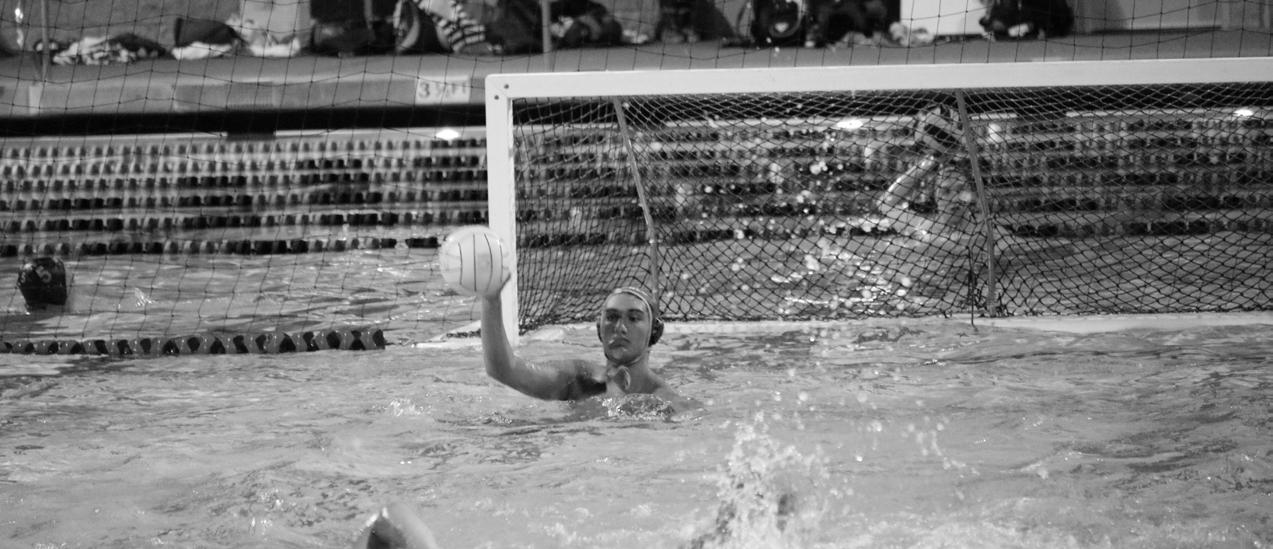
Girls water polo thriving under second-year head coach
by SAMANTHA STEVENS
The girls water polo team has had a season unparalleled since 2006. The last time the girls water polo team has been in or won CCS was back in 2006. Now, the program has made a quick two-year turnaround, as they are in the midst of CCS for the second year in a row.
Last year, they lost in the second round of CCS, but were still proud to have qualified after having not made the playoffs for 10 years. Now, the team is hoping to get

even further than last year by winning their playoff games this coming week.
The team’s head coach is Alana Burgess, who formerly coached at San Jose State and San Diego State. It is no coincidence that the team has been hitting a stride these past two seasons, as this is Burgess’ second year coaching Menlo girls water polo.
Burgess has ignited eagerness throughout the girls, while serving as a fresh voice to hear from. “I’m very competitive. I want to try to make [the team] as competitive as possible and let them know: we deserve this [...] We can get to this championship game even though we haven’t been there in so long,” said Burgess.
Burgess also admires the students’ ability to balance school work and water polo among other extracurriculars in and outside of Menlo. She mainly credits the recent success to the team attitude of dedication and friendship. “They get along; they work hard because they like each other. They do it for one another,” Burgess said.
Assistant coaches have been a major help this season as well. “This year we have an unbelievable coaching staff [...]
They have guided me through being a better person and being a better player,” senior co-team captain Parker Callender said. Assistant coaches Claire Howie and Orla Brazell are able to offer different perspectives or coaching techniques, which has been beneficial. “It’s really helpful to have assistant coaches so that you’re not only hearing one voice but many and having many people to support you,” Callender said.
Along with additional coaching, senior leadership has been strong this season. Senior captains Sarah Donato, Callender, and Gillian Bressie lead the team in warmup, inclusion, and communication between the coaching staff and players. Callender notes that the team, specifically during practices, is more organized than ever before.
Donato has learned various life lessons from being apart of the Menlo water polo team, such as learning to lead effectively, and credits this to her teammates. “[Water polo] really defines me as a person because of the people that have been apart of the team,” Donato said.
Donato attributes their recent success to overall team unity, along with more technical improvements specific to the
sport, such as the increased amount of swimming during practice, ball handling skills, offensive plays, and shut down defense. “I think in the past years, we’ve kind of relied on one player, [but] this year, more than any other year, we’ve learned to play as a unit which is really special,” Donato said.
The emphasis on commitment has been a beneficial difference this season. Back when Donato was a freshman, players would often skip practices leisurely, showing the lack of team devotion. In contrast, she now believes the team is consistent for one another.
The increased level of individual skill has also been helpful, considering how many more people played water polo before joining the team, as opposed to past years where Donato described herself as starting on varsity as a freshman simply because not much of the team were experienced players. Thanks to the relatively new coaching staff and team unity, the girls are inspired to reach farther than they thought was achievable before these past couple years. “I came in my first day last year saying, ‘look, we want to win CCS’,” Burgess said. Now, it looks like the Knights might have a chance of reaching a goal that may have once seemed over-ambitious.
Recent scores
by EMILIO SIMBECK
Football: Menlo 33, Hillsdale 10
Menlo clinched a share of the PAL-Ocean title in their win over the fighting knights. Emilio Simbeck threw for four TDs, with receivers Landon Smith and David Schmaier each contributing two.
Boys Water polo: Menlo 5, Menlo-Atherton 4
Senior Jayden Kunwar beat the buzzer with a game winning goal in the final seconds to beat cross-town rival MA.
Girls Water polo: Menlo 7, Aptos 5
In the first round of CCS, the Knights defeated their opponents with standout plays from junior Meg Reinstra.
Girls Tennis: Menlo 7, Harker 0
The lady Knights overcame WBAL opponent Harker with ease in their final league match of the season.
Volleyball: Menlo d. Harker 25-15, 25-18, 25-11.
Menlo’s girls volleyball maintained their undefeated league record and closed out their league play with a clean sweep of the Harker Eagles.

Alumni watch
by DAVID QUEZADA
Payton Mack / Gonzaga volleyball:
So far, during the 2017 season, college sophomore Payton Mack has tallied 112 kills, with 2.07 points per set through 73 sets played at Gonzaga University.
Chris Xi / Princeton water polo: Chris Xi (Menlo Class of 2016), notched 11 goals, 13 assists, and 10 steals in his second season as a Princeton Tiger.
James Thygesen / Brown water polo: During his second year playing water polo for Brown University, James Thygesen tallied eight goals, eight assists, and eight steals.
Jaye Boissiere / Stanford soccer: Through 19 games played in her senior season as a Stanford Cardinal, Jay Bossiere has started in 18 and has six goals, eight assists, and 20 points.
Senior Ben Gur looks up to pass during a game earlier this season. Staff photo by Bella Scola
Sophomore Josh Poulos prepares to pass the ball to a teammate in PAL league semi-finals against Burlingame. Staff photo by Bella Scola.
Sophomore Sydney Bianchi swims the ball to set up on offense. Staff photo by Bella Scola.
Saint Ignatius passes the ball around before taking a shot. Staff photo by Bella Scola.
XC programs triumphing behind Miranda, Pretre
by CONNOR VAN LIGTEN
Menlo’s cross country program was primed to continue its success this year, with senior Robert Miranda leading the boys team and sophomore Kyra Pretre leading the girls team. Coming into the season, the varsity squads were looking to improve off of their past season and work towards a CCS title. For Miranda, it’s been an ace effort so far. In his first five races this season, he finished first in every one. Miranda, a long-distance and track athlete with Division 1 potential, missed the 2016 season after suffering a devastating injury. In 2017, Miranda has come back with thunder, crushing PRs along the way as he racked up five consecutive golds.
However, the girls team is not to be ignored. Anchored by strong performances from sophomore Kyra Pretre, the girls’ team ascended into greatness, not only by finishing in the upper half of meets, but capturing victories in the WBAL Opener and in the Artichoke Invitational. Pretre, who showed great potential as a runner during the track season last year, has improved her finishes, going from 25th place to 11th place to second place. Pretre is an underclassmen, but her develop-
Menlo’s
by BAILY DEETER
ment has been stellar this season, leading the girls team to strong overall finishes in meets.
Adding to a growing list of team accomplishments this season, Miranda was named the Sports Star Norcal Athlete of the Week for the week of Oct. 13. Freshman Kamran Murray is currently a top 10 runner in the CCS and could possibly qualify for the state meet. Sophomore Charlotte Tomkinson has made great improvements for the girls’ team’s efforts this year.
Following up that effort was a dominating performance at the Baylands Park WBAL meet. The varsity girls’ team won the meet with Pretre and Tomkinson both finishing in the top 10, clinching a share of the WBAL title. The boys’ team finished 5th overall, with freshman Kamran Murray finishing second.
At the Mt. Sac Invitational, a prestigious race featuring top runners from all over the bay, Robert Miranda finished 4th out 94 runners in the Division I-II team sweepstakes race. Miranda’s time of 15:01 was the fastest out of all Division IV runners despite the lack of training due to poor air quality.


take on national anthem protests

Ever since former San Francisco 49ers quarterback Colin Kaepernick decided to kneel for the national anthem before a game last season, the topic of the justifications for kneeling has been hotly debated. Recently, president Donald Trump’s remarks criticizing those who have knelt during the anthem have sparked even more significant protest. Kaepernick’s protest originated as a means to protest police brutality and racial injustice in the United States, and he has stated that his goal was not to disrespect the military or the country. Since he began his solo protests, he’s been joined by many other players hoping to spread the same message. Players and entire teams have protested by kneeling, locking arms, raising their fists or sometimes even remaining in the locker room during the national anthem. In a game during Week 3 of the NFL regular season, the entire Pittsburgh Steelers team remained in the locker room with the exception of one player, right tackle Alejandro Villanueva, who served as a captain in the United States Army.
On the Menlo football team, no players have knelt for the anthem, although other high school teams in the Bay Area are following Kaepernick’s lead. In Menlo’s game against South San Francisco on Oct. 6, the South San Francisco players raised their helmets in the air at the end of the anthem. During the 2016 season, the week after Menlo played Mission San Francisco, the entire Mission team knelt in protest.
Many Menlo students are in support of kneeling for the anthem. “I completely support the players’ constitutional rights to kneel for the anthem,” sophomore Kyra Geschke said. “It isn’t worth supporting a country that doesn’t support you.”
On the other end of the spectrum, other Menlo students believe that respecting the American flag and what it represents is more important. “I believe it is disrespectful to the military and to those who work hard to make America a great country to kneel for the anthem,” senior class president Cole Dollinger said. Dollinger cited a tactic that San Jose Sharks superstar Joel Ward, one of the only African-American hockey players in the league, uses to protest injustice. “Ward believes athletes can use their media platform to make positive change at their postgame press conferences, which gets the message across without disrespecting the flag,” Dollinger said.
This topic has been debated much more significantly recently due to Trump’s comments, as he indicated that Kaepernick should have been suspended for kneeling. Dollinger, while in support of standing for the anthem, believes that Trump could have done a better job getting his message across. “I think Trump was overly aggressive in his remarks,” Dollinger said. However, in spite of Trump’s inability to convey an appropriate message, Dollinger still maintains his position that kneeling for the anthem is disrespectful.
Knights fall one-point short to SHP in Valpo Bowl
by ERIC CHANG
The 15th annual Valparaiso Bowl between Menlo School and Sacred Heart Prep (SHP) ended in a heart wrenching 25-24 loss for the Knights. Sacred Heart now leads the series 8-7 and has won five out of the last six charity games.
The game can be best described as a four quarter tug-of-war battle. The score remained within one touchdown throughout the game and the victory came down to SHP’s successful two-point conversion with less than a minute of play remaining.
Although Menlo did not prevail, several players had noteworthy performances. Senior quarterback Emilio Simbeck was 18 for 32 with a total of 273 yards, a career best. “Simbeck was phenomenal,” head coach Mark Newton said. His main targets were junior running back Dillon Grady and senior wide receiver Landon Smith. Grady alone had over 150 all-purpose yards and Smith was a major contributor to Menlo’s second half momentum, catching a touchdown on their opening drive after halftime.
Both teams fought back and forth for the first two quarters resulting in a 10-10 halftime score. Whatever went on during Menlo’s midgame meeting gave the Knights momentum as the offense
exploded in the third quarter. Simbeck started the second half with four completed passes in a row and continued his success throwing two touchdowns to Smith and Grady. However, in between these two scoring possessions, Simbeck threw a pick-six to Sacred Heart’s senior Garrett Gavello which maintained the game’s tense score. Menlo led 24-17 going into the fourth.
The final quarter was stressful for all those present. Menlo locked down SHP for 11 minutes but faltered when senior wide-receiver Kyle Cody caught SHP’s game changing touchdown with 53 seconds left. SHP’s daring decision to go for the two-point conversion led to one of the most nail-biting moments in Valpo history. Unfortunately, Menlo’s defense could not stop SHP’s attempt and the trophy went back to Sacred Heart.
Being the biggest game of the season, the fan support was phenomenal. Hundreds of students and parents from both sides came to spectate and cheering was a battle of its own. Although it was a disappointing loss for the Knights, Menlo’s CCS run is still hopeful.

Senior David Schmaier gets brought down by a swarm of Sacred Heart defenders after making a big catch. Staff photo by Bella Scola.
Menlo football players stand for the national anthem before their homecoming football victory. Photo courtesy of Pete Zivkov.
The boys cross country team huddles before the Lowell Invatational in San Francisco. Photo courtesy of Sally Li.
Kyra Pretre leads the pack early on during the Lowell Invatational in San Francisco. Photo courtesy of Sally Li.
Athletes of the Issue
Athletes of the Issue
Untrecht rising above Gould smashing competition
by SAMANTHA STEVENS
Junior Taylor Gould has been selected as the female Athlete of the Issue. She has been on the girls varsity tennis team for all of her three years at Menlo, and was recently named league MVP.
This season, the girls tennis team has a record of 15 wins and four losses so far, and Gould has been a large part of their success. Her personal record includes 10 wins and three losses, though she remains undefeated in league matches.
Gould has not only succeeded this year in tennis, but as an underclassman as well. During her freshman season, she was only defeated once.
Tennis runs in Gould’s blood, hav-
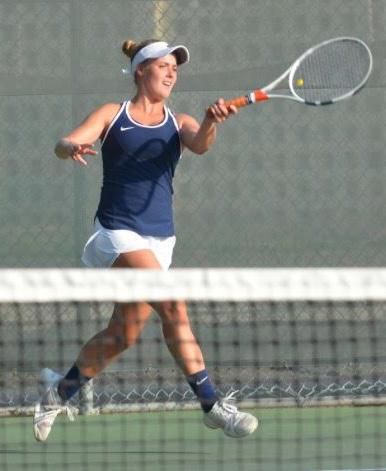
ing two grandparents who coached men and women’s tennis at Stanford University. Gould started the sport at a young age with the support of her grandparents, though Gould notes that they didn’t put too much pressure on her, which she is grateful for.
Gould considers herself to be very close to her teammates, citing them as some of her primary motivators. She plays with the notion that she’s playing for her teammates, not just herself, even though tennis matches are scored individually. “I try to win for my teammates because you can’t really control how they do, […] but I can control my outcome so I [try to] get my job done, and then support the rest of my teammates,” Gould said.
Teammate Penelope Penfold-Patterson, sophomore, views Gould as a source of energy for the team. “I would describe Taylor as one of the most hard working people I have ever met. She never plays a match without putting in her all and doesn’t go down without a fight,” Penfold-Patterson said.
During the past couple weeks, Gould has had to apply her persistent character more than ever to get back on the court after suffering an ankle injury that kept her out for three weeks. Her schedule includes tennis practice at Menlo along with physical therapy.
“The main thing is that it was really hard for me to not play tennis during that time because tennis is my outlet,” Gould said. She is thrilled to be back playing with her teammates, and is hopeful for a strong finish this post-season in CCS.
by SID CHARI

Sam Untrecht, a junior driver on the varsity boys water polo team, has been selected as the male Athlete of the Issue due to his exceptional performance in the pool. Untrecht, who has been on varsity since his freshman year, has been a top scorer in his three years at Menlo. So far this season, he has been a major part of their success, leading the Knights to a 13-4 record and an undefeated 5-0 league record.
The junior isn’t new to the sport; in fact, his father was a college player. “My dad played water polo at Purdue University, so I tried it out in elementary school and have been playing ever since,” Untrecht said. He also loves how the sport is played in water. “I hate sweating, so thanks to water polo I do not have to go through that every practice and game,” Untrecht said.
Untrecht also plays for a club team, Stanford, where he was able to win the biggest tournament of the year last season. While some of the aspects are dif-
ferent for club, both require lots of energy. “A similarity is the level of intensity at which we play at. Both Menlo and my club team play at very intense levels and the grind never seems to stop,” Untrecht said. Although they both are taxing, he cited the practice atmospheres as being different. “One of the main differences between high school and club is the dynamic of practices. In high school you are always preparing for some big game coming up, but in club there are big games here and there and you are mainly working up towards the end of the year tournament, Junior Olympics,” Untrecht said.
He says the Knights have one goal that they are really determined to accomplish this year - win CCS. “We would really enjoy beating Sacred Heart [in CCS]. We have battled SHP in CCS finals for the past several years and it has been a while since we were able to come out with a win,” Untrecht said. He also has a personal desire to beat them. “Some of my best friends play for SHP and play with me for club so it would be really sweet to beat them,” he said.
Untrecht has had many impressive personal accomplishments thus far in his career at Menlo. “My greatest accomplishment was probably being named the second best player in CCS as a sophomore last year, and being named a First Team All-American,” Untrecht said.
His plans to play the sport don’t stop at high school. “In terms of my future in water polo, I would like to play in college and continue to play for Team USA.”
Committed Corner
Committed Corner
Sophie Siminoff, Princeton University
by ERIC CHANG
This issue’s highlighted committed female athlete is senior Sophie Siminoff. Siminoff is verbally committed to play golf for Princeton University next year. Princeton is one of the most prestigious universities in the nation, and its reputation was a major influence to her decision. “Princeton has a fantastic blend of academics and athletics and is the best school in the country for my planned major - International Studies. During my visit, I instantly appreciated the team culture and coaching style. I also liked the surrounding suburban area which had a nice “college town” vibe to it and it’s also close to a city where I have family, “ Siminoff said. She picked up her first club when she was seven years old. “I started about 11 years ago with
the encouragement of my dad, who used to play golf at the semiprofessional level,” Siminoff said. However, sometimes being a father and coach results in conflict and puts stress on their relationship. “My father built my swing and has really been my sole coach,” Siminoff said. “Unfortunately, even though he has been fully supportive during my entire career, I just get too nervous when he watches me live and I had to ban him from tagging along on tourneys.” Nowadays, she has changed her pre-game routines and has learned to control her nerves. “I used to throw-up before every tournament but I have improved my confidence since then, and now I control my emotions.”
Golf is the most individual-
ized sport and this attracts people with strong solo-play mindsets. “It’s a very solo sport and everything good or bad is credited to you alone. I like the fact that I can control the outcome of a tourney with how well I perform instead of relying on anyone else,” Siminoff said.
Although Siminoff considers herself to be a bad starter, this also means she has consistently strong comebacks. “One of the most memorable moments I’ve had is when I was playing in a big tourney in front of college coaches and the day before they came I doubled the first hole but when they watched me I bogied. [That] doesn’t sound too eventful but I was proud of the fact I could control my nerves and hit well under
Brody Laporte, Villanova University
by CASEY KLINE & BRIDGET QUIGLEY

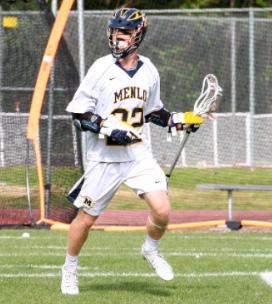
Senior lacrosse player Brody LaPorte committed to play Division I lacrosse at Villanova University in August of 2016. LaPorte will enroll in the fall of 2018. He has played all over the field for the Knights, having started at attack, long-stick midfield and defense since he made the varsity team his freshman year. He was team captain during his junior season and will be once again during his senior year.
LaPorte was a first-team All-League long-stick midfielder his sophomore year. Additionally, in his junior year he was a First Team All-League selection at midfield, although he primarily played attack.
LaPorte plans to play long-stick midfield at Villanova, although he has sufficient experience in may positions which will make him a versatile player
pressure,” Siminoff said.


in college. Villanova’s coach is Mike Corrado, who led the team to a solid 9-6 record last year. LaPorte chose Villanova for many reasons. “Coach Corrado and the rest of the staff already feel like family to me.” LaPorte said.
LaPorte is excited to study business in Villanova’s renowned undergraduate business program. “Villanova has a top-of-the-line business school with great school spirit,” LaPorte said.
When he started playing in the fifth grade, he played both field lacrosse and indoor box lacrosse. Indoor box lacrosse generally tends to be more physical and compact, which helped LaPorte refine his skills. “Box helped my field game a lot. There are a lot of translatable skills between the two so whenever I have a chance to get in the box I will learn as much as possible,”
LaPorte said. LaPorte’s recruitment started in the summer after his freshman year, and he began fielding offers the following summer. He committed to Villanova at the end of the summer before starting his junior year.
LaPorte said that a few coaches have helped him on his path to college lacrosse. “[Former Menlo coach] Greg Weigel had been my coach since I was in sixth grade,” LaPorte said. “[Bay Area youth coach] Doug Appleton has always been there to teach me the necessary skills to play LSM [long-stick midfield]. I think I coach myself a lot more than other kids as well,” LaPorte said. LaPorte is looking forward to his final season for the Knights and Menlo’s first season as a member of the West Catholic Athletic League.
LaPorte surveys the field while playing his secnodary position of attack. Photo courtesy of Menlo Flickr.
Siminoff tackles a tough lie on senior day. Staff photo by Bella Scola.
Gould has been undefeated in league play this season. Photo courtesy of Taylor Gould.
Untrecht surveys the pool as he prepares to make a pass. Photo by Bella Scola.