Athletic director Kris Weems accepts position for Santa Cruz Warriors
Menlo Athletic Director Kris Weems has decided to step down from Menlo to pursue a coaching position with the world-renowned Golden State Warriors basketball organization. Kent Lacob, a Menlo Alum who played under Weems, was promoted to General Manager for the Santa Cruz Warriors, (the G-League associate of the NBA team) last year and offered Weems the opening of assistant head coach.
“Initially, I said ‘no thanks’ as I was unsure how it would be financially or how it would impact my family, but after some time Kent reached back out to me and I decided to see it through,” Weems said. Weems’ last official day was Friday Sept. 22 as he would have to attend NBA Training Camp which began on Sept. 23. “Although I’m already familiar with the Warrior’s practice system, I’m going to view how Steve Kerr and his coaching staff run things so when the NBA season starts and the Santa Cruz guys come to us, I’ll be ready to teach them” Weems said.
Although Weems will miss Menlo, he is excited for this new opportunity to coach the sport he loves. “Basketball has given me everything, I wouldn’t be where I am if I didn’t decide to go to Stanford out of
highschool,” Weems said. “I just want to be around the game and be around a team full-time and that’s what I’m looking forward to the most,” Weems began his career at Menlo as a basketball coach but temporarily left to work with the Warriors organization before coming back again. “I really love Menlo School and the great family [and] community environment. It’s one of the things I will miss the most,” Weems said. “Taking [my daughter] to games and having her be on campus at a place of learning and athletics was very cool and I appreciate everyone involved.” Over the past decade, Weems has been a major part in improving the many athletic programs at Menlo and has played a
huge role in the community.
Weems’ dedication to improving Menlo athletics can be seen by the massive success of all teams in recent years, “A major milestone was last year when every team from fall to winter to spring qualified to compete for CCS championships,” Weems said. “Seeing volleyball win state championships was an even prouder moment, [because] when I played basketball back in high school I made it to states three times and won twice and I just know the insane amount of hard work it takes to get there, so I’m very happy and proud of the volleyball team for playing at a high level and coming out on top,” Weems said.
For Weems, the wonderful
Menlo's doors close to DoorDash
The popularity of DoorDash, Postmates and Uber Eats has grown at Menlo in the past few years. However, Menlo has recently instituted a ban on delivery services that will last from 8:30 a.m. until 4:30 p.m. every school day. The decision, made by Tony Lapolla, has been met with mixed reviews from students.
Lapolla emphasizes that while the decision is controversial, there are strong reasons for the ban. “I would never establish a policy for the sake of establishing a policy,” Lapolla said. He also further commented on the exclusive culture that delivery services create on campus. “[Delivery services
AHEAD
and experienced staff he has worked with during his time at Menlo has made his coaching job memorable. “I have learned a tremendous amount from the athletic administrators and the talented coaches on staff. Some of these coaches have won outstanding awards such as Jack Bowen getting honoured for CIF-model coach and Marco Paglialunga who was California coach of the year. Seeing their leadership come full circle and being really positive are things I will miss,” Weems said. “But most importantly, I will miss the spirit of our students, how hard they train, and how they love and care for their teammates.”
DoorDash and other food delivery services banned from campus
create] pockets of people on campus who only interact with each other.” Lapolla said. With the new Commons, Lapolla felt as though delivery services were no longer necessary because Menlo’s new cafeteria space, along with the option to go off campus, eliminated the need of delivery services.
Dean of Student Life Programs Cathy Chen has a similar perspective to Lapolla on the issue. “It creates a division between people, in terms of who has access to services like DoorDash,” Chen said. Ms. Chen recognizes the advantages of food delivery services, but she ultimately agrees that they create division in the long run.
Another concern that the ban raises is how clubs and other student groups such as sports teams would get food for special lunches and events during school. For example, the volleyball team often orders pizza for team lunches on game days, a ritual that would be stopped if the ban didn’t allow for it. For cases such as these, Lapolla made sure to note that any club or group can let the cafeteria know that they need food, and tables can be reserved for their event.
For clubs, teams and students that want to order food after 4:30 p.m., such as the Mock Trial team who has meetings in the evening, food delivery will be permitted. In order to implement this policy, the security team will monitor the delivery cars and not let them on campus. In some cases, security will write down the name
of whoever ordered the food to prepare for possible disciplinary action.
Some students have a different perspective on the new ban, emphasizing that it is an example of Menlo overstepping its boundaries. Senior Ben Gur, although not a frequent delivery service user, voiced his perspective against the ban.
“This is not a thing that’s up to the school,” Gur said.
Junior Max Colowick also felt the ban was intrusive and challenges some of Menlo’s values. “They have no responsibility or right to interfere here, especially when they emphasize trust and independence,” junior Max Colowick said. “The fact that Menlo is disallowing us to eat what we best see fit, and thus, what we are most interested in, contradicts Menlo’s values,” Colowick said.
One other student agreed with the reasons behind the ban, but advocated against the ban. “I do agree with [the divisiveness] but I still don’t like the ban because of the food,” sophomore Birdo Gonzales Zaragoza said.
Although there was no representation from our current student council in the process leading up to this decision, the administration is very transparent about the reasons for the delivery service ban. This change is the latest feature of Menlo’s quest to create a more inclusive community, and will hopefully do just that.
The week of October 30 is
teachers and students showcase their creative arts talents.
The memorable spirit week which ends with the homecoming football game is coming up. The Knights will be playing the Woodside Wildcats at Cartan field. Oct. 16 - 20: Spirit Week
Oct. 26:
End of First Quarter
The first quarter of the 2017-2018 school year will be ending October 26. This will also be the first quarter under the new grading system.
Download the CoA App Oct. 30 - Nov. 3: Creative Arts Week
Stay updated with our CoA iPhone app. Search "Coat of Arms" on the app store today!
Kris Weems giving presentation at Menlo School Sports Hall of Fame. Photo courtesy of Pete Zivkov.
Creative Arts Week! Get excited to see
Photo of the Issue
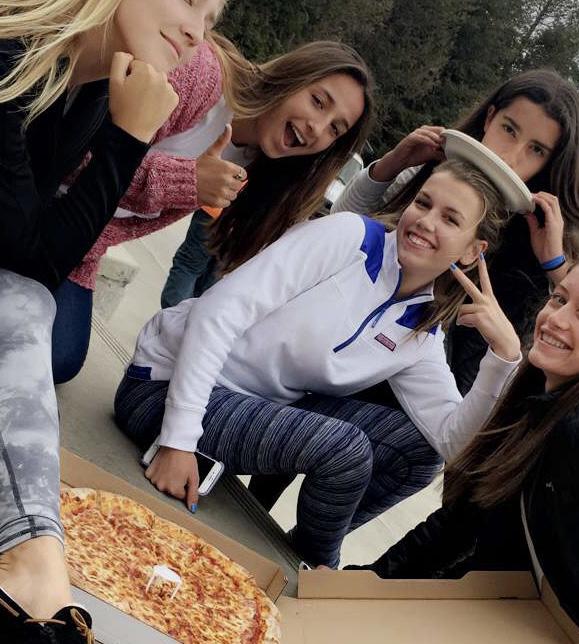
Students on the Menlo girls soccer team eat pizza orded to school. Staff photo by Electa Narasin.
by ERIC CHANG
by DAVID QUEZADA
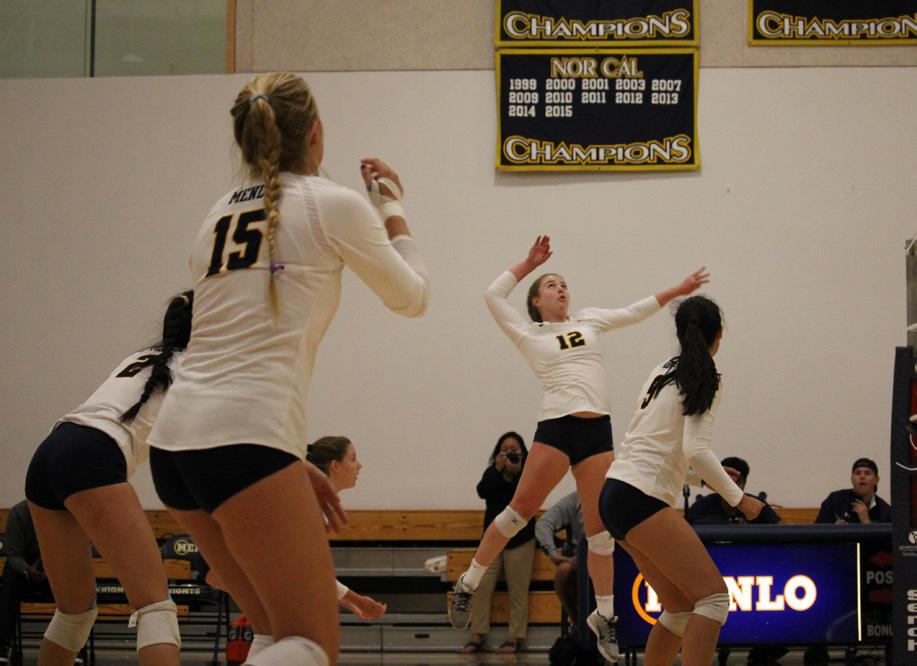
Students watch girls volleyball play SHP in blackout theme. Staff photo by Bella Scola.
New faculty profiles:
by KAITLYN TOM & EVA HERR
Abby Baez
Abby Baez, replacing Alisyn Crowder, is the newest addition to the upper school Student Life team. Coming to Menlo, Baez immediately felt welcomed by the community. “My first day in Menlo, I was greeted by [Human Resources], welcomed, and offered a bagel with a cup of coffee [...] It gave me a sense of which type of community Menlo was and it confirmed Menlo as being a very caring and supportive community,” Baez said. “There’s a lot of history in Menlo and I am proud to be contributing to it.”
In her free time, Baez enjoys going
on road trips on her street bike and riding motorcycles, an activity she has done for five years.
Katherine Sanden
Katherine Sanden is a Menlo alum who recently worked at a charter school in San Francisco teaching math and electronic music. Sanden is thrilled to be back at Menlo. One of her fondest memories as a student at Menlo was learning Spanish. “For the first month, the kid next to me would translate the instructions to me and whisper when to get out my notebook [and] turn the page,” Sanden said.
Sanden’s interest in math began in college, where she discovered
that creativity and math were more related than she had thought initially. She’s hoping to bring her enthusiasm for the subject to the classroom. “I’m hoping to help my students see the creativity and playfulness in math, through problem-solving and math puzzles,” Sanden said. “Every day I’m grateful to be here.”
In her free time, Sanden is an avid music-lover. Her personal goal is to complete a small electronic music project each week. Most recently, she’s been working on creating a cover of the beginning of “Fireflies” by Owl City.
Tyson
Another addition to the Menlo English department staff is Tyson Morgan. Before coming to Menlo, he lived in Houston, Texas where he taught English at Kinkaid School for three years. Morgan was raised in the military, living in Hawaii, California, and Maine through his early life.
So far, Morgan has really enjoyed his time at Menlo and its unique environment. “I like the casual atmosphere here,” Morgan said. Along with English, he will be teaching two senior electives: magical realism and fiction writing. In these classes, Morgan hopes to expand his students perspective of the literature world. “I’m hoping to shake up my students’ idea of what a story is,” he said. “I’m hoping to show [students] genres and styles they might not have encountered so far.”
Outside of the classroom, Morgan is also a die-hard Blazers fan and says he shames any bandwagon Warriors fans.
Jane Ridgeway
One of the new freshman English teachers this year is Jane Ridgeway. Before coming to Menlo, Ridgeway taught at an independent high school in Honolulu. When Ridgeway moved to California, she worked as a reporter at a local newspaper. Ridgeway’s favorite part about Menlo, aside from the students, is
the redwood grove behind the science buildings. Ridgeway has a passion for English and is excited to bring that to the classroom. “I want to bring my genuine love for my subject to my students, plus a sympathetic knowledge of what hard work writing can be,” Ridgeway said. Outside of the classroom, Ridgeway loves to watch all types of horror movies, including bad horror movies. “The worst horror movie I’ve ever seen was called ‘Weasels Rip My Flesh,” Ridgeway said.
Nick Romeo
Before coming to Menlo to teach English, Nick Romeo was a Phd student at Stanford. At Stanford, Romeo taught for the pre college studies program. In addition, he’s been a professional writer working with national publications including The Washington Post, Rolling Stone, The New Yorker, and NPR.
Romeo has been impressed by the students at Menlo. “The students are polite and hard-working and have a lot of interests,” Romeo said. “The faculty also seem very great. They’re all very helpful and knowledgeable and supportive.”
Outside of the classroom, Romeo has a love of music and enjoys playing piano, a longterm passion of his. He’s carrying his love of piano through his new club, opera club.
Upper school science teacher Denise Dowsett immigrated from Singapore in 1969, moving to the Bay Area. She’s familiar with independent schools in the area, having been a student at both Harker Academy and Castilleja. Before teaching, she worked in marketing at a variety of companies including Motorola and Yahoo.
Dowsett was thrilled by the resources for students at Menlo. “I was blown away by the Whitaker Lab as well as the intellectual horsepower of my colleagues,” Dowsett said. She especially enjoys teaching in an area where science is celebrated. “I take inspiration from the SF Exploratorium and Monterey Bay Aquarium and pioneers such as Paul Hewitt in approaching science conceptually and through inquiry,” she said.
Dowsett’s love for science is not limited to the classroom; she enjoys going on trips where she can observe the different marine life. “My
best trips have been diving in the Bligh Water off Fiji, or in the Rangiroa atolls of Polynesia, and ages ago,1979, off Cozumel when the reefs were still healthy and full of huge grouper and fresh conch,” Dowsett said.
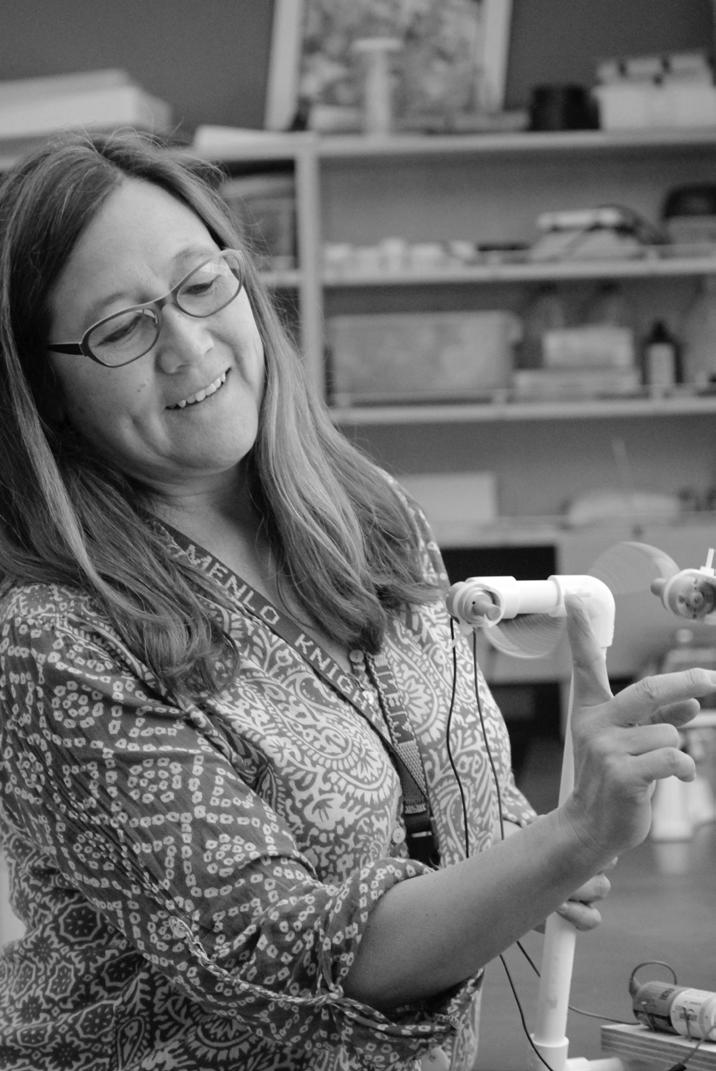
Staff photo by Bella Scola.
Denise Dowsett
Morgan
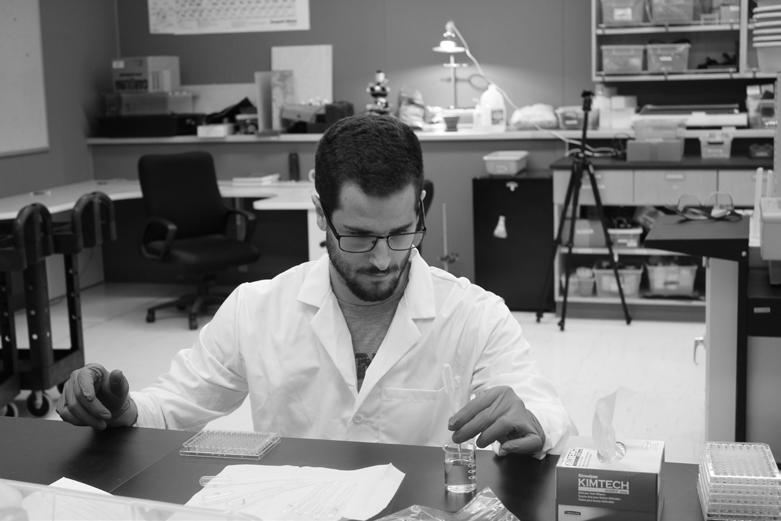
Staff photo by Bella Scola.
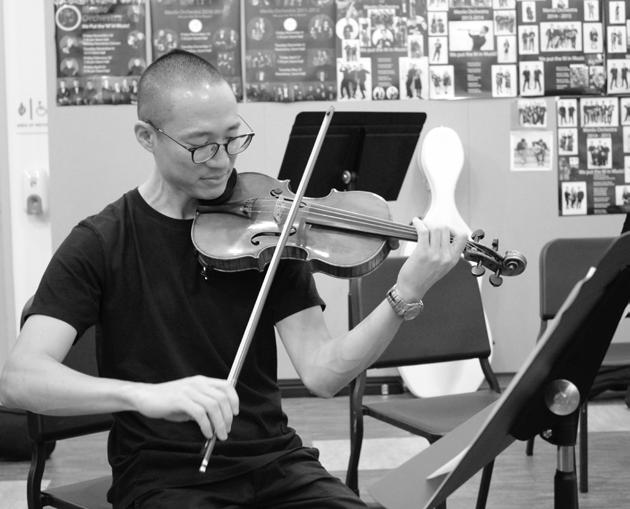
Staff photo by Bella Scola
Staff photo by Bella Scola.
Staff photo by Bella Scola.
Staff photo by Bella Scola.
Ben Bauer
Ever heard of a lab manager? This year Menlo added the new position of lab manager to assist the lab-heavy science classes and Ben Bauer is filling the role. His main duties are to assist with the setup and development of science labs and demonstrations. In the future, Bauer will also be assisting students with lab-related work outside of class and will assume the position of safety officer for the science department.
Before coming to Menlo, Bauer was tutoring at a small private high school in the East Bay. At the time he was living in North Beach, San Francisco. Before the tutoring, Bauer worked as a lab technician for an international gold mining
company in Denver, Colorado.
So far Bauer has loved working at Menlo. “I love it here. While the pace of life is fast and sometimes hectic here, I always leave work with a deep sense of fulfillment and a smile on my face,” Bauer said.
In his new job, Bauer is hoping to create and develop as many demonstrations as possible for the science department. “I believe that if science class doesn’t inspire a ‘wow’ or ‘cool,’ then we should be working harder to make it more exciting. In-class demonstrations are a great way to make that happen,” Bauer said.
Something that students may not know about Bauer is he is an is avid outdoorsman. “I love the sport of rock climbing almost to the point of obsession, but I also enjoy backcountry skiing, mountain biking, and hiking,” Bauer said. “I have recently been practicing the skills needed in order to climb the enormous walls of Yosemite.”
Laura Davidson
Another edition to the Menlo faculty is Laura Davidson. Before coming to Menlo Davidson worked in the IB Program at Sequoia High School and lived in nearby Redwood City. Her husband graduated from Menlo in 2002 so she knew about the school and was excited to work here. “I always knew that the school was a safe place where students could challenge themselves personally and academically and be encouraged to pursue individual passions and research,” Davidson said. Davidson is hoping to bring a new approach to English by asking students to focus on the arguments that arise from their readings and the world around them. “I love engaging in conversations where we critically consider the world around us; since everything’s an argument, the world is ours to interpret. I encourage students to bring in arguments that we can read and interpret together in an effort to better understand our context and the context of others,” Da-
vidson said.
Since working at Menlo she has been energized by all the students and faculty that surround her. “My students inspire me daily, and I have wonderfully supportive and innovative colleagues. I couldn’t ask for anything more,” Davidson said.
Outside of Menlo, one might find Davidson at a Britney Spears concert. “I’ve seen Britney Spears in concert three times. I’m a huge fan.” she said.
Esther Mansdorf
From New York City, Menlo welcomed Esther Mansdorf who previously taught at an independent school in the Upper West Side of New York City called The Columbia Grammar and Preparatory School.
Mansdorf says the Menlo community has been very welcoming and supportive. “My initial impression of Menlo has been a very positive one and I am delighted to have joined such a wonderful school. I have been loving my time here,” Mansdorf said.
She is excited to help students discover the beauty of history and
its relevance to the present day and future. “It’s essential that students have a nuanced understanding of the world around them and an opportunity to hone in on their critical and analytical thinking skills through their studies,” she said. “My goal is that they can pick up a newspaper today and see how some of these current events are directly linked to political, economic and social events and people of the past.”
A new approach she is hoping to bring to the classroom is the use of other mediums such as paintings and photographs. “Images are a powerful way in which we can connect to history and view it from multiple perspectives,” Mansdorf said.
Mansdorf is excited to be part of the community and work with the students. “I feel grateful to have landed in such a kind community. I am looking forward to getting to know my students and exploring world history together,” she said.
Leo Kitajima
The new Director of Orchestra and Chamber Music is Leo Kitajima who was previously the orchestra director at Westridge School in Pasadena, California. Kitajima was born and raised in Los Angeles and worked nearby at Westridge for nine years. While Menlo is double the size of his previous school, Kitajima feels welcomed by the supportive community. “On [a] scale from one to 10, [I have liked Menlo an] 11,” he said.
As the new orchestra head Kitajima hopes to celebrate musical diversity in his new job. “Everyone here has such an eclectic musical palette and the more we can celebrate that, the more we can connect with one another,” he said.
Additionally, Kitajima is excited to expand outside of the orchestra room and collaborate with the other arts disciplines. “Music is a magic portal into all other disciplines so I’m very interested in
collaborating within and outside of my department,” Kitajima said.
One of Kitajima’s beloved hobbies is roasting his own coffee beans, and he’s brought his beloved . He also loves the band The Roots and his favorite sports team is AC Milan.
Community responds to new cafeteria
“I think the fruit is really good. I like the watermelon and they have tons of great fruit everyday.”
- Alexander Herrod, sophomore
“It has a lot of flavor. There’s big servings [and] it doesn’t taste fake, it tastes fresh.”
- Jack King, freshman
“It’s incredible, in terms of the space and the food it’s been great and the service [...] this amazing new building, and the facilities, and just the quality of the food has been great.”
- Rolando Victoria, Spanish teacher
“They have horrible vegetarian options. They consider vegetables a meat substitute, but they’re not a meat substitute because they’re not as substantial as meat.”
- Natalia Cordon, senior
“I think the new cafeteria is awesome, man. I love the new food they have. They actually worked out the lines well, actually, I’m very impressed by it.”
- Ben Gur, senior
“I think that the new cafeteria is outrageously great, it provides copious options, [...] the dishes themselves are complex, I am so surprised that a high school cafeteria has this much variety for students.”
- Matthew Nelson, history teacher
“It’s too crowded and the lines are too long, everyone goes at one time so it’s pretty packed.”
- Lauren Hamilton, junior
Staff photo by Bella Scola.
Staff photo by Bella Scola.
Staff photo by Bella Scola.
Staff photo by Bella Scola.
Say yes to the dress (code)
by EVA HERR
Fashion takes on many roles in life: a profession, a passion and a form of expression. While many people have no issues with fashion being a part of everyday life, controversy emerges on the topic of dress codes and uniforms in schools. I believe a uniform would promote a more inclusive, safe and comfortable environment for students.
Many students, teachers and parents argue that a school uniform would inhibit a student’s expression through fashion. For some teens, the way they dress is a source of pride. They regularly shop for clothes and beg for a new accessory for their birthday. The clothes they wear to school is an expression of their individual artistic taste and they do not want this to be silenced through a school uniform. But, most importantly, their appearance is a huge part of their identity, something cultivated primarily as a teen. With a school uniform, students feel they would lack an important part of building their identity.
As a high school student, I love my closet more than one should. I have dresses that are too small that I can’t give away because they are too beautiful to part with and I shop with my sisters constantly just for the thrill of putting on a brand new outfit. While I acknowledge the fun fashion brings to my life, I know that a school uniform would actually promote a more inclusive and academically focused school environment.
When students are young they lack the maturity to make good choices about what they wear. Girls may inadvertently wear sexually inappropriate clothes that distract others from learning. Clothes can also represent gangs, have obscene meanings, or mock certain cultures, which some students are too young to understand fully. School should be a safe environment where violent groups and obscene topics are not promoted amongst students.
Often times there are students who cannot afford the latest fashion trend and therefore feel left out.
“
If you are waiting for the waiter, you become the waiter.
There are innumerable misconceptions surrounding martial arts, many of which include the idea that members of the martial arts community are unstable or inherently aggressive individuals. Countless people have asked me over the years if it is purely a sport for those with anger issues or people who solely want to hurt others around them. Neither of these statements are true. In fact, in my personal experience with taekwondo, a Korean martial art, the entire sport emphasizes completely different moral values. Instead of focusing on the potential for violence, the sport revolves around the concepts of respect, precision, and dedication. I have trained in taekwondo since the age of five when my Dad forced me to attend my first class. I absolutely hated going to class when I first began training, especially since I stood out among
School should not be a place where socioeconomic discrimination is encouraged, but rather a place where all kids should feel safe to learn without the stress of fitting in.
But it is not just economically challenged students that suffer. Young teens are extremely judgemental. Some kids may have a certain fashion look that does not conform to the general crowd’s taste, subjecting them to harsh criticism. I have been the girl that proudly wore a handpicked skirt and blouse combination only to be teased by friends that it did not match. This is a mild example of the situation, but I have seen it more extreme. I have heard friends laugh at a girl for wearing heels to school. I have seen looks exchanged if a girl’s top is “too sexy.”
When you are a fragile adolescent, the judgements of others bear a large importance on your happiness. These small remarks can quickly result in a student feeling out of place and not accepted by his or her peers, something that teens already struggle with in high school. As a high school student you constantly look to others to determine your own self worth, something that is only exacerbated when your outer appearance is being judged.
A uniform would allow students to be free of the social criticisms that arise from a free dress policy. It would also force students to evaluate their peers on a more intellectual level rather than judging them based on their appearance.
If administrators could do something as simple as having a school uniform to alleviate the social exclusion of students, why wouldn’t they do it? Students may feel like they cannot express themselves and find their true identity; however, these freedoms are only possible in a safe and inclusive environment which can only be created free of the social pressure of fashion. There are clear negatives to a uniform, however the happiness of all students is far more important.
The
Dress code, detrimental to self esteem
by CLARA GUTHRIE
My eighth-grade self was sitting in class when I heard my teacher’s accented voice echo through the room, “Clara!” I glanced up, expecting to be asked to conjugate a verb on the whiteboard or to answer what I did over the weekend in broken French. Instead, she scanned my outfit from head to toe and back again.
It was the first day I got to wear my new, maroon romper that my mom had bought me. I remember putting it on that morning, looking in the mirror and feeling confident; I had felt pretty.
However, I felt my self esteem waver as my teacher asked me to stand before the entire class and place my arms at my sides. The tips of my fingers stretched just beyond the hem of the romper: an absolute no in the middle school dress code.
Tales like mine were no rarity among my female peers. At one time or another during middle school, almost all of my friends were pulled aside by teachers and asked to change into baggy Menlo sweatpants to ensure that the entire campus knew that they were being punished for dressing “inappropriately.”
According to the Menlo Student Handbook, middle school students must dress “in a manner that allows them to participate fully, safely and comfortably in school activities,” and in a way that “[sets] an appropriate example for their peers.” While the handbook employs the gender-nonspecific language of “students,” there are seemingly only two rules put forth for male students: no boxer shorts showing and no hats in the classroom. Meanwhile, female students must comply to a laundry list of restrictions.
Any dress code for any aged student is not created with the purpose of allowing them to learn “fully, safely, and comfortably.” Confining the way young girls dress is not to “set an appropriate example” for her fellow students. All dress codes circulate around a worry that male students will be distracted by too-short or too-revealing clothing.
Thought Bites:
subtle things
“
that go through our minds
You hate your alarm both when it works and when it doesn’t.
The benefits of martial arts
all the other kids because my uniform, known as a “gee,” took weeks to arrive so I was forced to wear a pair of shorts and a tee shirt. After months of dreading the 30 minute drive to class everyday, I told my Dad I wanted to quit. He told me he wasn’t going to force me to keep going to class, but he knew I would regret it if I stopped going. Since the last thing I wanted was for my dad to be disappointed in me, I decided to stick it out for a little longer. To my own surprise, I slowly began to fall in love with the sport. I started making friends and becoming better at the moves I was being taught. Not to mention my gee arrived so I was finally able to tie my tiny white belt around my hips. Once I was able to stop seeing taekwondo as something I was being forced to do by my parents, it became something that I enjoyed and wanted to do for myself. When I was younger, going
by KATE JEFFRIES
to taekwondo was a way that I could release all my built up energy after a long day of sitting in school. However, now it is not only a great workout, but it has also helped me in countless other aspects of my life. Taekwondo teaches young children the ability to have complete control of their movements and bodies as well as improving their physical strength and stamina. I can confidently say that having a background in martial arts has helped me in other sports and made me an overall healthier person. From a young age, my instructors emphasized the importance of stretching and drinking water before a workout. Before I train or take classes, I am required to stretch for at least 15 minutes to make sure I am warmed up before learning new moves or sparring my peers. In addition to helping me establish healthy habits, at the end of every class we do core workouts
I have heard the stereotype “boys will be boys” many times. The argument basically states that boys going through puberty are subject to hormones that they cannot control. These hormones cause them to be easily distracted by girls, specifically if the girls are wearing seemingly scandalous clothing. If this is the case, and boys really are distracted by a girl’s outfit, shouldn’t the boys be punished for disrespecting their female peers, instead of the other way around? Boys should be taught to not objectify women, as opposed to girls being taught to comply with boys’ needs.
“Boys should be taught not to objectify women, as opposed to girls being taught to comply with boys’ needs.”
I’m not arguing that boys’ hormones can be curbed, but that the boys need to learn how to deal with such hormonal urges. Perhaps the middle school administration could have an assembly and explain the repercussions of unintentionally disrespecting their female peers. As an entire society, we need to work together in pushing our young boys to grow into respectful and mature men rather than teaching our girls to hide.
Girls are inevitably vulnerable during middle school because they are in the beginning phases of puberty. A list that constricts how they can express themselves at school, and having teachers they respect punish them for their outfits does nothing but tear at a girl’s confidence. As an educational institution, the middle school should be teaching their girls to be empowered, confident and strong women; a humiliating dress code is in no way conducive to such growth.
“ ”which are helpful for people of all ages to burn calories and develop strength. Taekwondo is not only helpful for one’s physical well being, but it has also has many mental health benefits. When I have had an off day or am feeling down, going to taekwondo class always improves my negative outlook on the day. My instructors emphasize having complete focus while in class and leaving all your other concerns or thoughts outside of the studio. Although this might sound cliché, it is extremely helpful since it forces me to take a few hours of my day and solely focus on practicing taekwondo with people I love to be around. After going through physically painful experiences with other people in addition to inflicting equal pain on one another, you develop a special bond among your peers in a martial arts community. The friends I have made at taekwondo
No one has ever set foot on the moon. There is always a boot in the middle.
have become the equivalent of a second family to me. Since there are individuals of all ages at my studio, there is always someone to get advice from or to give advice to, making it a very trusting space.
Although you may think that my positive experience with martial arts is a specific case to my life experience that is not necessarily guaranteed for everyone who takes a form or martial arts, the general values and culture I have experienced at my taekwondo studio is definitely not specific to my studio or my branch of martial arts. Other martial artists who practice different forms of martial arts and attend different studios have expressed their similar experiences with the sport and how it has become a positive place they can go to to improve both their mental and physical well being just as I do in my taekwondo studio.
Menlo in Action: Sports and health in our community
What to eat when you are training
It is not hard to find a Menlo athlete working hard in the gym running sprints. It is not hard to find a Menlo athlete lifting that extra 20 pounds in the weight room. However, it is equally as easy to find Menlo athletes gorging leftover advocacy donuts on the quad or enjoying a massive milkshake from the Circus Club at lunch.
Menlo athletes take their sports seriously. It is clear that they care about their statistics and their performance, which means that they should care about what they’re fueling their bodies with. Most scientists and coaches claim that eating healthy is not only important for most people, but absolutely vital for athletes if they desire to constantly improve and succeed in their sport.
At Menlo, many people are knowledgeable about what healthy eating means, but when they are stressed and sleep deprived they often don’t listen. However, for training, and especially for lifting weights, it is essential that students have a lot of food as long as they choose the right ones. Harshly limiting a diet to only “healthy” foods can cause crazy craving that could eventually lead back to an unhealthy diet. Instead,
many food researchers and nutritionists suggest that carbohydrates and protein should be the two main components of an athlete’s diet.
According to a Mayo Clinic article, for a male eating a 2,000 calorie diet, they should be consuming 900-1300 of those calories from carbohydrates. This is another word that often gets confused. Though typically used in place of the word “bread,” carbohydrates can be consumed through healthy grains such as oats, quinoa and whole grains. In addition, some beans and even vegetables have high-protein content such as edamame, lentils and spinach.
Beyond Menlo, nutrition is something to think about regularly regardless of becoming a collegiate athlete or not. At Stanford, the school nutritionists consider all their students’ and athletes’ needs when they serve their food at the dining hall. According to their website, Stanford nutritionists “translate the latest scientific evidence into practical nutrition recommendations” for students, especially student athletes.
Jackie Bertoldo, the head nutritionist at Stanford, said she became interested in nutrition dur-
How athletes stay injury free
by Caroline Frantz by Baily Deeter
Many high school athletes partake in rigorous training on a yearlong basis, doing everything they can to put themselves on the map of college coaches. However, constantly participating in tournaments, showcases and games can take a toll on an athlete’s body.
For players who are participating in taxing physical activity like running, quick-twitch movements or physical contact, injuries are certainly a concern. This forces athletes to take steps to ensure that they remain healthy and able to compete. Often, this requires extra physical and mental preparation off the field or court. Many athletes stretch to combat the common soreness that they experience after rigorous exercise and to prevent straining a muscle in the future.
Senior Brody LaPorte, a varsity lacrosse and football player who is committed to Villanova for lacrosse, heavily emphasizes stretching for injury prevention. “In contact sports like football and lacrosse, it’s essential to stretch since you become sore so frequently,” LaPorte said. LaPorte has hip impingement, which prevents full range of motion in the hip socket. “I have
to do extra stretching before and after games and practices to make sure it doesn’t evolve into something worse.”
While athletes certainly have to make sure to stretch on their own, the Menlo performance staff has taken many steps to aid them in this
Stretching and icing are certainly helpful, but taking care of yourself at home by fueling and preparing mentally is also extremely effective.
process. For starters, many Menlo athletes enter their freshman year with no experience lifting weights. “[They] have no idea how to perform basic techniques such as jumping, landing, squatting or even jumping rope,” Head Athletic Trainer Jon Cohen said. “[Head athletic trainer
ing her time as a college athlete. “I discovered what I ate had a direct impact on how I felt and performed,” said Bertoldo.
Menlo coaches encourage healthy eating, but more importantly, encourage a healthy lifestyle. Varsity men’s water polo coach Jack Bowen thinks athletes should be mindful about what they are putting in their body, but not restrict themselves from enjoying good foods.
“People and athletes especially gain energy from the food they put into their body,” Bowen said. “It’s in their best interests to be intentional about, and take ownership, of the things they are eating.” Bowen has been playing sports for 38 years and believes that the best fuel is water. “Hydration is the best thing you can do for your body,” Bowen said.
Additionally, he encourages students to take advantage of the healthy food in the brand new dining hall. “The opportunities [to eat well] during the school day are huge, and it is so easy to eat well,” Bowen said. “It is an amazing opportunity to start developing lifelong habits regarding thinking about what you are eating.”
Jesse Lindenstein] does a great job of teaching these basic movements as a platform for more advanced movement patterns such as Olympic lifts.”
In addition to starting with the basics, the Menlo training staff starts and ends each training session with stretches. “Our number one goal is to make sure the players don’t have any injuries,” Lindenstein said.
Stretching and icing are certainly helpful, but taking care of yourself at home by fueling and preparing mentally is also extremely effective. “Taking in enough calories, protein [and] fats as well as food loaded in anti-oxidant and anti-inflammatory properties ensures an athlete is doing everything they can to get back on the field to help their team,” Cohen said.
Ultimately, by preparing themselves properly through adequate physical training but also through balanced nutrition and proper recovery techniques, Menlo athletes tend to be in prime position to stay healthy throughout their athletic seasons.
Specialized athletes more prone to injuries?
by Ty Corley
In today’s ultra-competitive athletic world kids are trending towards specialization, where athletes devote all their time to perfecting one sport as opposed to playing several.
Many kids resort to athletic specialization and playing on year-round club teams in order to try to secure a college scholarship or preferred walk-on status. According to several experts, specialization may have destructive effects on young athlete’s bodies.
The idea that specialization results in a higher possibility for injury is hardly speculation at this point. A recent study by the American Journal of Sports Medicine tracked over 1,500 high school athletes and determined that athletes who specialize have a 50% greater chance of sustaining a lower extremity injury which largely stems on too much pressure being put on the shins, knees, feet, etc.
Dr. Mark Safran, the Chief of Sports Medicine and Orthopedic Surgery at Stanford Medical, specializes in joint and ligament injuries which largely come from kids who play one sport for an extended period of time starting at a young age.
According to Safran, injuries in specialized athletes are largely due to overuse of specific muscles; kids who play the same sport all year are using the same muscle groups and not giving them a rest. “Just like you need to change your car’s tires, you need to change up what your body is doing,” said Menlo Strength and Condition-
ing coach Jesse Lindenstein. Younger specialized athletes seem to be at an even greater risk for overuse injuries.
“There is definitely more concern about overuse injuries for kids who specialize early,” Safran said.
Younger kids, whose bodies are still growing, put too much strain on certain muscle groups by doing one activity all year without rest. This leads to injuries that shouldn’t happen until the athlete is much older. Safran,
The idea that specialization results in a higher possibility for injury is hardly speculation at this point.
whom among other things treats shoulder sprains, ACL tears, and Tommy John elbow injuries, stated that these injuries are more commonly seen among young specialized athletes who are entering their teenage years.
“When I was growing up we didn’t have club or year-round
sports. Everyone played two or three sports and we didn’t have or even see the injuries that we do today,” Lindenstein said. Lindenstein says he works with kids in the performance room who have injuries that he shouldn’t see until they are much older. However, the imbalance of muscle usage has caused these injuries to happen.
While there are definitely advantages to specialization, such as competing on club teams and getting a leg up on the college process, there are also several benefits to playing multiple sports. “We do see trends of specialized athletes being more susceptible [to injuries] but I also think an upside of playing for your school and playing multiple sports is better for your overall high school experience,” Menlo Head Athletic Trainer John Cohen said. “Kids who play on a restrictive club team miss out on being a part of their school teams which is a valuable experience not just athletically but it makes you a better team player.”
While the injury risk is higher, young athletes still choose to specialize. “It means they have to take the recovery process even more seriously,” Lindenstein said. “They need to vary their movement patterns and they need to rest.” Specialization is certainly a growing facet in today’s world with the benefits it can bring. However, specializing just makes it even more important that young athletes take responsibility for maintaining their bodies.
New cafeteria’s health approach
by Shelby Rende
With the new cafeteria open, a variety of healthy food choices and options for students with dietary restrictions have been provided. Flik, the new food service, uses a customized approach to cooking to find healthy options that students will like just as much as unhealthy ones.
“We try to stay fresh, as local as much as we can, we change our menus to stay within a season. Anytime you are working with fresh products it is a lot healthier for you. Everything we do [to make food] we try to do it the day of and not freeze it,” former Executive Chef Justin Bailey said.
Baily left his position in late September, and Mark Geis stepped in as interim exexutive chef.
Terumi T. Neufeld, the District Manager of Flick, said that the food that is still good goes into the next day’s menu. The rest of the leftover food is given to an organization, Chefs to End Hunger, which distributes the food to homeless shelters.
Flik adds healthy food to traditionally less nutritious dishes to get people eating healthier.
“You know it’s the healthier choice, but we have a thing called ‘revved up’ where we make a tomato
sauce that has pureed beets. So we are sneaking in some [healthier] stuff without altering the taste and the flavor profile,” Bailey said.
Flik sources food from an approved company, SF Specialty, to handle produce from around the bay area. “[SF Specialty] has the infrastructure to get corn [...] out by Discovery Bay, so they kind of network with the local farms, the peach farm-
Anytime you are working with fresh products, it’s a lot healthier for you.
er, the plum farmer and they are built to handle that,” Bailey said. “We trust them that they have the systems in place to monitor the food safety and that we are serving students fresh food that is healthy and safe.”
Many students who are vegetarian, lactose-intolerant, etc. have been able to find good alternatives in the cafeteria with the new healthy options. Sophomore Mara Lebovitz a vegetarian, has recently expressed her feelings that the new cafeteria has many substantial options for those with dietary restrictions.
“I definitely think that the meals are a lot more substantial [...] It’s not just taken out of a refrigerator which you can like taste the difference in the quality. I think [the vegetarian options are] healthier and taste better,” Lebovitz said.
Although students like Lebovitz have enjoyed the new changes in the cafeteria, some feel that it isn’t enough. Senior Julia Fry, who is lactose intolerant, still feels that there aren’t enough options for her. “I usually just go to the salad bar just because it’s the easiest and I know that there’s no dairy in it,” Fry said.
Menlo’s P.E. credit system
by Abby Wolfenden
Most high schools in the United States require students to take two years of physical education (PE). At most public high schools, PE entails an entire block during school hours designated to running miles, swimming laps and passing the Physical Fitness Test.
At Menlo, however, four semesters of PE outside the classroom are required. Many students can fulfill this requirement by playing junior varsity or varsity sports through the school’s program, but students can also take different paths to receive PE credit.
According to the official Menlo School Physical Education Requirements, by completing the Freshman Wellness Program, each Menlo student receives one semester of credit after ninth grade. Through this program, students learn first aid and become CPR certified. Without playing for a Menlo sports team, students can earn the rest of their credits by enrolling in a wellness program (yoga,
fitness, pilates), a Menlo dance class, or participating in outside activities which Menlo cannot offer (ie., crew, rugby, gymnastics, etc.).
While many students enjoy participating in a school-sanctioned sport, there is still a population of students who don’t participate in athletics at Menlo. For example, dance is an option for students. “I usually only have a handful of students who take [dance] for PE credit. I think the majority do it for Arts [credit],” Dance teacher Jan Chandler said.
Extracurricular dance teams such as Knight Life and Knight Dancers do not count towards PE credit, but taking a dance class does. “Just taking class fulfills [PE credit] because [students] are so actively engaged and working hard on strengthening, anatomy, alignment, and safe movement [...] besides having fun creating, exploring and working collectively toward a performance,” Chandler said. Much like sports at Menlo, participating in dance entails being a part of a team. If a student chooses to participate in dance, they can get all four semesters of credit through two years of classes.
Another common way to achieve three additional semesters of PE credit is to participate in workouts run by Jesse Lindenstein and Anton Karbushev. In the training room, students will focus on improving flexibility, ground-based
Fun Facts
Regular exercise can lower cancer risk, but only if you get enough sleep
If a student chooses to participate in dance, they can get all four semesters of credit through two years of classes.
movements, acceleration and agility development.
For all the horseback riders, martial artists and fencers, “contracting out” is a possibility for Menlo students. This option is helpful to such students because much of their time is already dedicated to sports outside Menlo’s campus.
“Contracting out” acknowledges students’ achievements beyond Menlo, and students can complete part of their PE requirement while continuing to play the sport they love. In addition, Menlo students can stay active and fulfill their credits by taking yoga, boxing, or spinning classes.
“I took a boxing class at this place called Undisputed Boxing Gym in San Carlos. I did it with my mom and my sister, and we would go before school [...] it was really fun,” senior Toni Rende said.
Senior Jeff Frenkel-Popell took an especially unique path to fulfill his PE Credit, as a flying trapeze artist. “There was a form that I had to turn in [...] I had to explain to [former Athletic Director Kris Weems] what it was, and that was doing flying trapeze. Then there was a certain number of hours that you had to do. It was a 16 week period in which you needed to log 36 hours, and by the end of the first 12 weeks I had logged like 42, so at that point I just filled out the form and I turned it in.”
Exercise helps boost brainpower and mental clarity, due to an increase of serotonin in the brain
Moving your body can help decrease stress levels
Exercise can slow or prevent heart disease, high blood pressure, and Type 2 diabetes
All photos by Bella Scola.
Erin Dunn brings talent and passion to Menlo’s Chorus
by SHELBY RENDE
Senior Erin Dunn is the female Artist of the Issue because of her love of and devotion to chorus.
Dunn has had a love of singing since a young age. “I’ve always had a passion for singing, and I think that probably started when I was really little,” Dunn said. She started choir in elementary school, where her choir teacher let her pick the songs she wanted to sing and express her creativity.
After coming to Menlo, Dunn decided to take women’s chorus as an introduction to choir at Menlo. “It was a class of about eight of us, so we had freedom to choose different songs because we were so small,” she said. After she took women’s chorus her freshman year, Dunn decided to join chamber choir in her sophomore year, “My sophomore year I did chamber and that was really fun,” said Dunn. Because she enjoyed chamber choir so much, she chose to continue with that in her junior year as well.
“She has gained so much more confidence and strength as a performer. She is really not just a singer, she really is performer. She is so expressive. I think she is one of the most expressive kids I have taught,” chorus teacher, Karen Linford said. “When she sings, her face is just radiant.”
Dunn’s favorite genre to sing is
pop because of its wide variety and flexibility. She has the freedom to play around with the music and the rhythm. She continues to grow in her singing abilities, as she is inspired by artists like Adele, who has a similar vocal tone. Even though she gets inspiration from other artists, as Linford said, “She is uniquely her own.”
Dunn is in mixed chorus this year, and hopes to continue singing in college, “I would hope to sing in maybe a choir in college [...] just something fun and laid back that can help me be part of a community and have fun and just be creative,” she said.
Luke Arnold shines on the stage
by ABBY WOLFENDEN
Luke Arnold has been selected as this issue’s Male Artist of the Issue due to his outstanding work in the Menlo Drama Department. Arnold has been a consistent member of the drama community at Menlo since his freshman year. This October, he will be playing the role of “Ram” in Menlo drama’s version of “Heathers the Musical.”
Despite never taking a drama class at Menlo, Arnold has excelled in three major roles since his freshman year. “Freshman year I was a general in [‘A funny thing happened on the way to the] Forum’ [...] in ‘Anne Frank’ I was the father of the family, Mr. Van Daan, and in ‘Heathers’ I am one of the jocks,” Arnold said.
Arnold has been participating in drama from a young age, and he hopes to continue to pursue his love of performing in college as well. “My first play that I ever did was in fifth grade, I went to a Christian elementary school, so I was the Angel Gabriel. It was a momentous role [...] I was very proud of myself. All through middle school I did shows [...] I try to do one a year,” Arnold said.
Arnold loves drama because it allows him to relate to another character and be a part of the strong community that comes with creating a performance. “My favorite part is definitely taking a character and what it’s supposed to end up like and then finding the little bits inside my own personality that align with that character,” Arnold said. “It’s really fun when a role allows you to be kind of arrogant. In ‘Forum’ [my character] is so self obsessed, he has an entire
Random Student Profile: Connor MacMitchell
COA: How are you liking Menlo so far?
CM: It’s really fun.
COA: What’s it like being the only freshman on varsity water polo?
CM: It’s definitely weird because there’s no other freshmen that I can talk to about struggles with the team or something like that, but the upperclassmen and my teammates have been really supportive.
COA: What’s an average ‘C Saturday’?
CM: We usually have a water polo game, so I’ll go the game, and then we’ll come back, I’ll maybe knock out some homework, pop on a couple of shows.
a desert island with three things, what would you want?
CM: I would probably bring Oliver [Diner]. I would probably bring my phone, and a charger.
NP: Where’s the outlet?
CM: I would get a solar charger.
COA: Apples or oranges?
CM: Oranges.
COA: What is something nobody knows about you?
CM: I have 10-year-old fish.
COA: You have a 10-year-old fish? You kept a fish alive for 10 years?
CM: Ya and it’s just a normal goldfish.
COA: Are you from Tennessee?
CM: No, I’m not. *laughs uncomfortably*
COA: What’s your dream dog’s name?
CM: Coco.
COA: What do you wear on Wednesdays?
song about how great he is, and so it’s so fun to allow yourself to be completely self absorbed.”
He also commends the strong camaraderie between cast members during each play. “Especially when the show starts picking up, you’re with the same people for 35 hours plus a week, so you get pretty close. One of the things that I really love is that even if people don’t get the role they were going for or something doesn’t work out they’re still very supportive. It pretty much never feels like a competition. It’s definitely an environment of people building everyone up, instead of just trying to be the best.”
COA: Who was your favorite Teletubby?
CM: The yellow one.
COA: What is your favorite shade of grey?
CM: Probably light grey. Ya know?
COA: Who is your celebrity crush?
CM: Blake Lively. Maybe Selena Gomez, actually.
COA: How would you explain the color yellow to a blind person?
CM: It’s a mix… oh… if you think of a bright color and something gross, and combine them, that’s how you get yellow.
COA: They can’t think of a bright color if they’ve never seen color before.
CM: Alright, think of something warm.
Nicole Priestley: You know when you eat that really sour fruit that isn’t a lime or an orange, it’s a lemon. It’s the color of that.
COA: If you were stranded on
CM: I like to wear clothes on Wednesdays.
COA: Thoughts on Thursdays?
CM: Thursdays are the worst.
COA: What is your favorite swim stroke?
CM: Freestyle.
COA: Is October 3rd significant to you?
CM: No it is not significant.
COA: Taco Tuesday or Salsa Saturday?
CM: Taco Tuesday.
COA: Do you know what you are going to name your kids?
CM: Nope.
COA: Tell me about apples.
CM: Not a fan.
COA: Tupac or Miley Cyrus?
CM: Miley.
COA: Are you aware that you’re everyone’s favorite freshman?
CM: Yes. *smirks*
Arnold poses for a picture. Staff photo by Bella Scola.
Dunn singing in the choir room. Staff photo by Bella Scola.
Photo courtesy of Menlo School. by ELECTA NARASIN
TOP 10: HALLOWEEN COSTUMEStumes
by SAM FORTENBAUGH & SID CHARI
by ERIC CHANG & SID CHARI
Gillian’s Cooking Column: Pumpkin Chocolate Chip Cookies
by GILLIAN BRESSIE
Tired of pumpkin spice lattes?
This is a delicious cookie recipe that is perfect for fall! I made it for my family and friends and it was a huge hit.
Ingredients:
1/2 cup canola oil
1 cup 100% pure pumpkin
1 cup sugar
1 egg
1 tsp. vanilla
1 tsp. baking soda
1 tsp. milk
2 tsp. cinnamon
by ABBY WOLFENDEN
2 tsp. baking powder
1/2 tsp. salt
2 cups flour
2 cups semisweet chocolate chips
Directions:
1. In a bowl, combine oil, pumpkin, sugar, egg, & vanilla. I used a spatula, but a whisk also works great.
2. In a separate bowl, combine baking soda & milk. Add this to the pumpkin mixture.
3. In a separate bowl, combine cinnamon, baking powder, salt, &
Founded in 2011 by the Visual Supply Company, VSCO is a mobile application for capturing, editing and publishing photos. The app is widely used across the United States, and it is especially popular amongst female Menlo students. While VSCO can be considered a social media platform, it is more of a tool for artists, photogra-
“I think it’s a fun way to share pictures where you don’t need to worry about likes and followers.”
phers and creators alike. VSCO offers unique photo editing options as well as a community of inclusivity and expression.
Unlike other forms of social media, VSCO is not centered around having “followers” or “friends.” Instead, it’s focused on sharing with others, being inspired and channeling one’s inner creativity. “I think it’s a fun way to share pictures where you don’t need to worry about likes and followers,” senior Lauren Creamer said. “It’s a fun way to show all of your artsy pictures as well as pictures with your friends.”
For senior Kathryn Wilson, a frequent VSCO user, the app is an outlet for humor and creative photo captioning. “I use VSCO [by] sarcastically commenting on how artsy my life is and adding captions to every photo [...] I really love the filters [on VSCO] but I use the posting aspect of VSCO as a form of comedy for my own amusement,” Wilson said.
In order to show an appreciation for others’ posts, VSCO has a feature called “republishing.” While personal posts go in one’s journal, publishing another’s post adds that particular photo into your collection of images. This concept of republishing can be very widespread and meaningful throughout the VSCO community.
For instance, one VSCO user posted a collage of screenshots to advocate for mental health and suicide prevention. One of the screenshots read that for every republish, they will donate one dollar to the National Suicide Prevention Center in honor of her mother, who committed suicide. This VSCO post received over 3,000 republishes. Other ways for spreading posi-
flour. Add this to the pumpkin mixture.
4. Fold in chocolate chips.
5. Preheat the oven to 350°.
6. Allow batter to sit for 15 minutes.
7.Using a cookie scoop, place batter on baking sheet.
8. Bake for 10-12 minutes, and then allow them to cool. Enjoy!
tivity are accounts such as “Quoteson-VSCO.” This popular account quotes novels, fellow VSCO users, memes, and poets.
In addition to spreading messages of love and social activism, VSCO is an important outlet for art.
The VSCO creators run their own account where they post images and selectively publish the images of other VSCO members. Every time the official VSCO account republishes an image, every user can see.
The entire community is not only exposed to various styles of photography, but also different cultures. VSCO has over 30 million international users. Each of these individuals has their own corner of the world to share, and this is what makes VSCO so interesting. “I am constantly thinking of and looking out for cool new things that I could put on my VSCO that are different from what everyone else is putting up on theirs [….] When people repost your photos it’s a great feeling,” junior photographer Bella Scola said. “Also, I get a lot of inspiration for VSCO from the many different accounts I follow.” Scola is an experienced photographer, as she has taken Menlo’s regular and advanced photography classes, as well as an independent study in
Fantasy football
13th
Lack of Senior Quad shade
photo journalism. From a photographer’s perspective, VSCO is great for editing and producing unique photographs. The app includes various filters, black and white options and tools not offered by the iphone’s standard photo editing functions. VSCO has the ability to change the angle of the photograph through “X-skew” and “Y-skew,” alter skin tone and the darkness of shadows and increase the graininess or vignette of a photo. “[VSCO] gives me an easy way to do the basic edits that I need and their filters are really cool and bring out a lot of color, which I like,” Scola said.
The yummy finished product. Staff photo by Gillian Bressie.
There are numerous tools available on VSCO. Screenshot by Abby Wolfenden.
In May of 2017, the Menlo Coat of Arms published an article entitled, The Extra Time Dilemma, where the writer asserts that students with learning disabilities such as ADD and dyslexia would potentially struggle at our school so much that the Admissions Office might find they would “be less likely to be deemed fit to handle the rigorous academic workload at Menlo.” In addition, the writer states that “giving students extra time on tests does not prepare students for a real-life experience, which is essentially what school is supposed to do. “ While I recognize that this might be the opinion held by a few members of our community, I would like to point out a few reasons to counter the author’s assertions.
While I agree that we are selective in choosing our students through admissions at Menlo, I emphatically disagree with the opinion that students needing accommodations are “less likely to be […] fit to handle the workload.” Menlo students with learning differences may require simple accommodations such as extra time, laptops or separate settings; they do not require a different school. An accommodation such as extra time is allowed for certain students because their fluency (or speed at which they can perform a given academic task) is a bit slow. Research shows that this “speed issue” has nothing to do with a student’s ability to master subject matter. In fact, speed at which one can perform a task has little relevance to one’s overall cognitive ability and intelligence at all,
Senseless Facts of the Issue
#1: The Bible is the most shoplifted book in the world
#2: Birds don’t urinate
#3: George W. Bush was once a cheerleader
#4: One in every five adults believes that aliens are hiding in our planet disguised as humans
#5: In France it is illegal to name your pig “Napolean”
Letter to the Editor
so allowing for students to have more time is a natural adaption to support learning variability. Our dyslexic students who use laptops due to challenges with spelling are no less capable than others in the class to coming up with excellent and imaginative ideas to express their thoughts; the use of a laptop simply eliminates their difficulties. There are many famous inventors and entrepreneurs who provide us with real-life examples of what is capable of those with Learning Differences. For example, look at Charles Schwab, a Stanford Economics graduate whose entrepreneurial spirit opened up trading in the stock market to everyone. He has been quoted to say that if laptops had been available when he was in school, he may have not flunked English twice. Dr. Dale Archer wrote in Forbes Magazine in May of 2014, “What do Virgin CEO Richard Branson, Ikea founder Ingvar Kamrad, and Jet Blue founder David Neelman have in common? ADHD, and they attribute it as a reason for their success.” ADHD’s positive characteristics traits such as creativity, risk-taking, high-energy and resilience allowed for these individuals to develop their entrepreneurial spirit. And, while we are on the subject of these traits, aren’t these characteristics also seen in our students and respected in our learning environment here? At Menlo, we are grounded in the appreciation for diversity, and learning diversity is essential to our collective. There is a wide range of learning variability that is demonstrated every day in the creative spirit
of our enthusiastic students, and the speed at which students perform tasks has little to do with their ability to understand and process the academic material that is given to them.
I disagree with the assertion that students who need extra time accommodations will not be prepared for real-world experience. Individuals gravitate to professions that they excel in and are passionate about. Given this, fluency issues that have been problematic in school tend to be reduced or non-existent. Accommodations such as laptops become an every day tool that everyone benefits from. Humans rarely gravitate to work environments or professions that are difficult for them; they select jobs and activities that demonstrate their strengths. This fact undermines the argument that is presented in the May Opinion Piece. At Menlo, we strictly adhere to guidelines set by the Americans with Disabilities Act which ensures that students are provided with accommodations that allow them to demonstrate their knowledge, acknowledging that time constraints during assessments can undermine their achievement and success. Our faculty and administration appreciates learning diversity and will continue to allow students with diagnosed learning differences to demonstrate their knowledge with the use of accommodations such as extra time.
— Kathryn Gray Academic Support Coordinator
The transfer student experience
“Breathe,” I told myself as I stared at my reflection in my bathroom mirror for what felt like the one-hundredth time that morning. I needed to make sure I looked presentable. Not because I am incredibly vain and think that appearance is the most important thing in the world, but because I needed to make a good first impression.
It was my first day as a junior at Menlo, and unlike everyone else in my grade, I knew basically nobody. I was the only junior transfer student, attempting to make friends with people who have known each other for years.
Walking into school on the first day, I was beyond nervous. Along with the nerves came the set of irrational fears and questions that had begun to haunt me weeks before:
What if nobody likes me? What if I get lost? What if my classes are too hard? What if no one cares enough to try to reach out to the new girl?
Of course, I now realize these were a bit extreme. However, before I could think of any other potential outcomes of my first day at school, I snapped back to reality when a large group of rowdy seniors dressed in togas formed
The Coat of Arms
Editor-in-Chief....................................................................Kaitlyn Tom
a tunnel for the students walking into the quad. I quickly realized that the first day back to school must be a spirit day for the senior class.
Following the crowds of people into the gym, I found a girl who had reached out to me before the school year started. While I sat with her, I watched what appeared to be a spirit rally unfold, completely foreign to me as a first day tradition. It had only been an hour, and I could already feel the positive energy bouncing off of the walls of the gym, each student as excited as the next to be back at school. Coming from a large public school averaging 500 students per grade, there had rarely been opportunities for the entire student body to unite and form such a community. The atmosphere in the gym was both electric and contagious, and the rally, as cheesy as it sounds, truly made me feel like I was a part of something, as if I belonged to this community already. This was a valuable thing to me, especially after fearing that I would not fit in at all.
Throughout my days here at Menlo, I am constantly surprised with how accepting and welcom-
SEND LETTERS TO THE EDITOR TO
kaitlyn.tom@menloschool.org The Coat of Arms 50 Valparaiso Avenue Atherton, California 94027 (650) 330-2001 Visit us online at coa.menloschool.org or to
ing the people here really are. The smaller size of the student population creates a tight-knit community that I have come to appreciate as a refreshing change of pace in comparison to the public schools I have attended in the past.
Due to the small class sizes, it seems that not only does each student know everybody in their grade, but they also know virtually everyone in the grades above and below them. This is another wonderful aspect about Menlo because you never feel alone, you never feel as though you have no one to turn to because wherever you look, there is always a familiar face.
When I decided to transfer to a private school last year, I had the option to apply to many schools. However, I chose to only apply to one. I felt that junior year was going to be my new beginning and I felt strongly about starting it in a place full of strangers, a place that would force me to push myself to make new friends, do well in school, and grow as a person. And after only three weeks at Menlo, I strongly believe that I made the right choice.
Mission Statement
The mission of The Coat of Arms is to deliver honest, comprehensive and accurate coverage to the Menlo School community. As a student publication we strive to present the diversity of voice, interest and activity within the school. We will remain relevant and accessible by using multiple forms of media, offering new angles on subjects significant to the community, and encouraging dialogue and feedback.
The Coat of Arms | Sports
Menlo football opts for tougher preseason schedule
by CONNOR VAN LIGTEN
After last year’s success, the Menlo football program decided to ramp up the schedule dramatically this year. The coaches decided to challenge the team with a tough preseason schedule featuring numerous challenging matchups. In the past, the preseason has not always consisted of the most challenging opponents, but this year, the Knights tested themselves from the get-go. Their hope was that these challenging teams would prepare them well for their critical league matchups.
The Knights opened up their 2017 campaign against the formidable East Nicolaus Spartans. East Nicolaus made it to the state-semifinals in 2016 and won the state championship the year before. Menlo held a 9-8 lead going into the quarter, but East Nicolaus scored with 10 minutes left in the 4th and converted a two-point attempt to make it 16-9. The Knights couldn’t convert on 4th down in East Nicolaus territory, but recovered a fumble at their own 29 with 2 minutes to go. The Knights marched all the way to their own 47 before turning it over on downs, ultimately losing the close-knit, hard-fought matchup 16-9. The Spartans currently sit at 6-0 this season en route to
another long, successful season.
Fortunately, the Knights did have one easier matchup in the preseason. The Knights followed up the East Nicolaus game with a huge win against the lowly Stevenson Pirates in a 56-6 home opener smackdown. Scoring a whopping 35 points in the first quarter alone, Menlo held Stevenson to a pathetic two first downs the whole game.
The Knights then traveled up to the East Bay to take on the Piedmont Highlanders, who won their first two games 41-17 and 50-0. The Highlanders came into the game very confident taking on a much smaller Menlo team. The Highlanders struck first, scoring on a 63 yard strike early on. After starting slowly out of the gates, however, Menlo began firing on all cylinders. The Knights held the bumbling Highlanders scoreless from that point forward, only allowing three first downs the whole game. The Knights emerged victorious, winning 28-7.
After that victory, Menlo returned to Cartan to battle perennial a CCS powerhouse, the Palma Chieftains. The Chieftains have won numerous league championships in their program’s storied history, and entered the contest fresh off of tough
matchups against Menlo-Atherton and Saint Francis. After a close first half, Palma held a mere six-point lead over the Knights. The Knights came out the gates strong in the second half as junior safety Dillon Grady returned an interception for a touchdown. However, the special teams unit didn’t convert the extra point attempt. Additionally, Grady, the punter, was injured and did not play in the second half. This became costly for the Knights throughout the game, as nearly all of their punts in the second half were botched or ruined by bad snaps.
For a frame of reference, last year, the Knights preseason schedule started off against the measly Lincoln and Mission programs from the San Francisco AAA league, and then proceeded to shut
out Harker and Carlmont by a combined 91 points. Although they may not have a perfect record going into league play like they did last year, the team feels much more prepared as they enter the heart of their season.
So far, the tough non-league schedule is paying dividends. The Knights shut out The King’s Academy 28-0 in their league opener and followed that up with a 48-13 win at South San Francisco.
The Knights league schedule will be nearly the same as last year, except they will play an undefeated Hillsdale team instead of an undefeated Half Moon Bay team.
Student initiative drives new intramural volleyball league
by TY CORLEY
While many students choose to pursue athletics in the competitive arena, a Menlo student has taken the initiative to open up volleyball to the student body in the form of intramural competition. All members of the Menlo community including teachers are eligible to form a team and play. In order for someone to start a team and play a game, they just need five other teammates and to challenge another team.
League founder and commissioner, senior Keeton Martin, said that his inspiration came from the fact that many boys were interested in playing volleyball but there was not an official team. After talking with several boys who said they would be interested to play, Martin decided to create the league.
He also stated that the intramural aspect is one prevalent in college and Menlo should be able to do it. “The main purpose of the league is for people to play and hang out with different people and have fun. Volleyball is a sport everyone can play,” Martin said.
It is going to be up to the teams to find a place and time in which to play and then report the score to the league commissioner. The amount of wins a team records in the “preseason” period will then be used to rank the teams for an end of semester tournament. “Currently, there are about 15 teams. We are hoping to start playing games in October. Team captains just need to fill out a game form and report the score to me,” Martin said.
Recent scores
by ERIC CHANG
Football: Menlo 48, S. San Francisco 13
Menlo traveled to South City in a dominant win over the Warriors. Senior QB Emilio Simbeck totaled five touchdowns and top wideout David Schmaier exceeded 200 yards receiving.
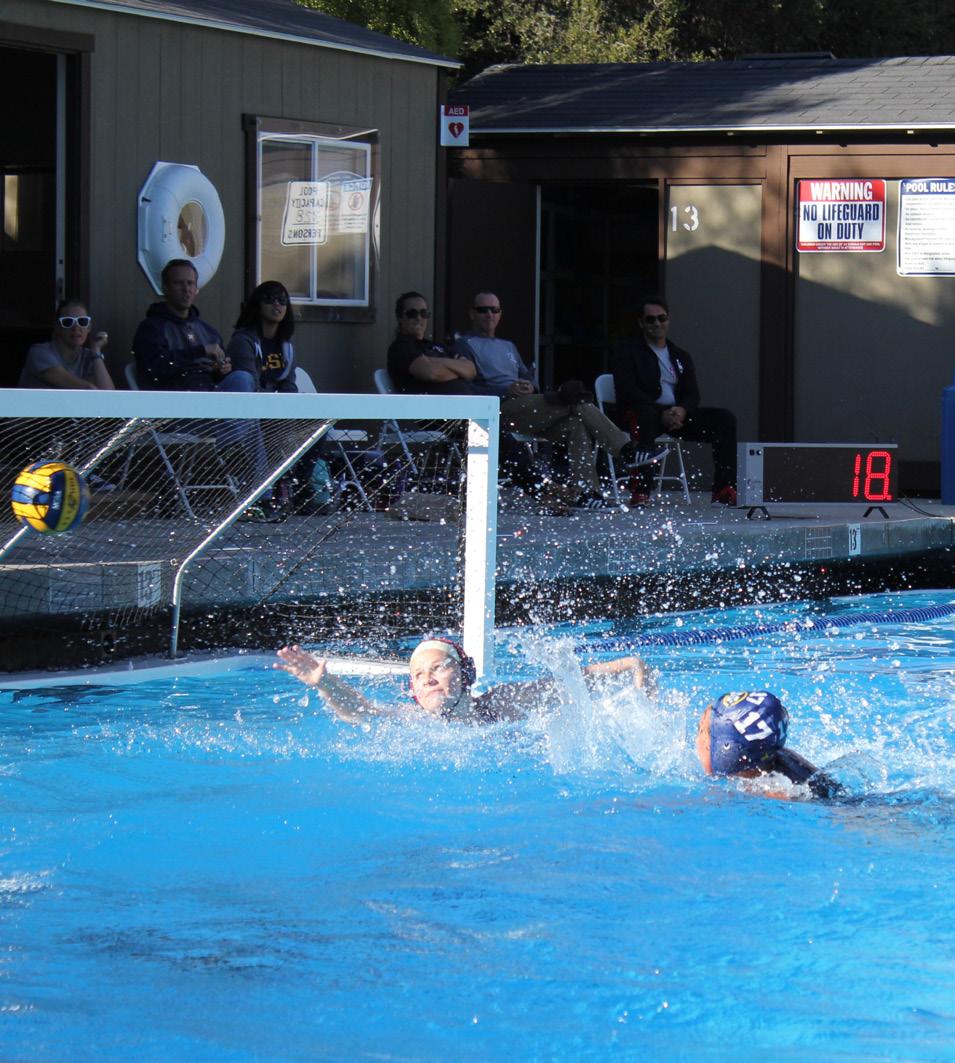
Boys Waterpolo: Menlo 11, St. Francis 10
In a tight game going to three-OTs, Menlo came out on top against the Lancers. Junior Sam Untrecht and senior Jayden Kunwar both contributed hattricks.
Girls Tennis: Menlo 6, Harker 1
The lady Knights overcame WBAL opponent Harker in a routine 6-1 victory to extend their 241 league match winning streak.
Volleyball: Menlo d. Harker 25-13, 25-16, 2830, 25-10
Menlo’s girls’ volleyball maintained their undefeated league record behind strong performance from senior middle blocker Ryan Hodge.
Some of the interest in the organization surrounds the possible games and matchups according to Martin. “It will be interesting because we have a variety of different friend groups, clubs and sports teams signed up to play one another,” Martin said. “We could have girls basketball playing boys lacrosse or Sports Analytics club playing Radio club.”
Another benefit of the intramural league is that students who don’t have the means to compete at the varsity or club level can still show off their game. “This is a great opportunity for people who don’t want to fully commit to varsity volleyball, to play an awesome sport,” said senior varsity volleyball player and intramural referee Ashley Dreyer. Students are also excited to display their talent in the new league. “It’s an incredible opportunity to showcase my skills in a sport which is not offered for me at the varsity level at Menlo,” sophomore Cole Kastner said.
While volleyball is the only intramural sport at Menlo for the time being, Martin hopes that the success of the intramural volleyball league will drive the creation of other intramural sports teams at Menlo. “Hopefully volleyball will convince people of the fun of intramural sports and we can get more started here,” Martin said.
Alumni watch
Jack Heneghan / Dartmouth Football:
The senior captain of the Dartmouth Big Green football team has started off the 2017 season in top form, completing nearly 70% of his passes with four touchdowns and zero interceptions The Big Green are undefeated thus far.
Philip Hausen: / Harvard Soccer:
So far this season, Harvard sophomore Philip Hausen has started all nine games for the Crimson. He has one goal scored and three assists to date.
Maddie Huber / Princeton Volleyball: Senior Huber played in every single set for Princeton’s volleyball team during the 2016 season, averaging 2.57 digs per set. Now, in her last year, she looks to lead the Tigers to greatness once more.
Maddie Stewart / Tufts Volleyball: Stewart, a sophomore for the Jumbos, had a great 2016 season, playing in 70 sets and logging 137.5 points, 118 kills, and 39 blocks. Her block total was third best on the roster.
Junior Sam Untrecht winds up for a shot. Untrecht has been a force throughout his entire career at Menlo. Photo courtesy of Menlo Flickr.
The Knights’ offensive line squares up against the Palma Cheiftains in their last game of the preseason. Staff photo by Bella Scola.
Senior varsity volleyball star Kristin Sellers has volunteered to be a student referee for the league in order to help ensure safety, technique and order. Staff photo by Ty Corley.
Athletes of the Issue
Athletes of the Issue
Israelski off to fast start Captain Dreyer standing tall
by EMILIO SIMBECK
Senior volleyball captain Ashley Dreyer has been selected as the Athlete of the Issue. Dreyer has played on the varsity team for four years.
Dreyer recently led the Knights to a huge first place victory in the Chandler Invitational Tournament, which took place on Saturday, Sept. 9.
When asked about the driving factors to the immediate success, Dreyer cited a great practice environment. “Our coach has been pushing us really hard every day and we’ve all been pushing each other really hard as well,” Dreyer said. Fortunately for the Knights, the bulk of their players have returned, only losing a couple key seniors. Although there
weren’t many losses, there were a few spots where the Knights had to step up, and they did. “The middle blockers have been doing a great job and the passers are crushing it,” Dreyer said. She generously credited much of her success to her teammates, whose play has enabled her to get 87 kills through her first 35 sets of the season; that statistic ranks second on the team.
Dreyer, a right side (also known as opposite) hitter, is a 6’3” left handed player, whose physical gifts are very apparent when on the hardwood. After defeating Mercy High School on Thursday Sept. 15, the Knights jumped up to 30th in the state rankings. Dreyer, a starter for several years now, has a hitting percentage of .296 so far in 2017.
Dreyer, 17, comes from a family of terrific athletes. She is the youngest of three, and both of her older siblings play Division I sports in the Pac-12. Her older sister, Alexa, plays volleyball at UCLA. Her brother, Jack, is an offensive lineman on the Stanford football team. After leading the Knights in her senior season, Dreyer will follow in the footsteps of her family, playing volleyball at Yale College. She announced her verbal commitment to the prestigious Ivy League university via Instagram on October 3. She is the second Yale commit in the Menlo class of 2018.
by SID CHARI
Aidan Israelski, senior running back and cornerback, has been selected as the Male Athlete of the Issue due to his outstanding performance on the football field this year. Israelski, who has played varsity football since his sophomore year, is an invaluable piece of the Knights’ offense and defense.
He has demonstrated strong leadership as one of the four captains, helping the team to a 4-2 record. His senior season has gotten off to a memorable start, with nine touchdowns and 530 total yards in his first four ganes.
Israelski is a very experienced football player; he began playing the sport at a very young age. “I got into football
in fourth grade when my friends were playing on a flag football team,” Israelski said. “I really wanted to play, so I convinced my mom to let me go out with them and I’ve loved the sport ever since.” Israelski makes use of his skill set outside of school also. “This will be my 6th season playing [tackle] football [...] I’ve played for the Redwood City 49ers and the Menlo Atherton Vikings in pop warner,” he said.
Israelski’s talent and passion for the game is clearly visible on the football field where he’s seen trucking through opposing defenders. Being a two-sport athlete, he has taken valuable aspects from both football and rugby. “Football at first helped me get started with rugby as the pure physicality of the game was very similar. But as I played more rugby, I realized that it actually helped me a lot with football,” Israelski said. “[In rugby], I get to play against elite competition, which completely takes away the fear factor in playing against kids who are bigger than me in football.”
However, rugby hasn’t only helped him physically, but also strategically. “Rugby has also taught me patience when I run, which allows me to make cuts and jukes I otherwise wouldn’t be able to,” he said. Israelski has had many notable moments throughout his football career so far, however, none have been more special than last year’s Valpo Bowl. “I am most proud of us breaking the losing streak we had against SHP,” Israelski said. “This year we’re going to defend it with all we have.”
Comitted Corner
Comitted Corner
Kristin Sellers, Brown University
by SAMANTHA STEVENS
Senior Kristin Sellers has committed to play volleyball at Brown University after a long recruitment process. She made the commitment last April during her junior year. A four year varsity setter, Sellers is looking forward to bringing her game to the collegiate level.
Sellers began playing volleyball in fourth grade at Encinal Elementary, taking after her mom who played volleyball at Stanford University. That same year, she transitioned to club volleyball for a higher level of play.
Sellers already knew that she wanted to pursue volleyball in college at the age of 11, thanks to the inspiration of her mother. “My mom went to college for volleyball, so immediately once I started, I was intrigued
by the idea [of playing in college],” Sellers said.
Sellers does not only have one collegiate athlete as a parent, but two. Her dad, who played football in college, also contributed to her future aspirations. Sellers considers both parents to be a large inspiration for her.
Until entering high school, Sellers had always imagined herself at a bigger college than Brown, but her transition into a small high school like Menlo shifted her perspective in terms of what schools she began considering.
Sellers’ recruitment process started out slowly as an underclassman.
“During freshman and sophomore year, the process was all kind of one
way. [Colleges] weren’t allowed to contact me because of NCAA rules, so it was more of me sending emails saying ‘I’m interested,’” Sellers said.
Once colleges were allowed to reach out to her to express mutual interest in her junior year, the process ramped up. She had two to three phone calls a week with different coaches. “I remember it was just a lot of work and a lot of time,” Sellers said.
Although she’ll miss Menlo volleyball, Sellers is looking forward to attending Brown and taking advantage of its rigorous academics while playing volleyball. “I’m really excited to take classes that really interest me because Brown has an open
curriculum so I’m not required to take anything [in particular],” Sellers said.
John Henry Tevis, University of California, Berkeley
by EMILIO SIMBECK & KAITLYN TOM
Senior defensive end John Henry Tevis has announced his verbal commitment to play Division I football at the University of California, Berkeley. He will enroll at Cal in the fall of 2018.
Tevis has been a dominant player on the varsity team at Menlo for the last three years, making a serious name for himself as a football recruit in the Bay Area. Although both his father and grandfather both played at Stanford University, when JH was offered a scholarship to its archrival Cal, it was an easy decision to make.
Tevis gravitated towards Cal because of the emphasis on academics and athletics as well as the broad range of opportunities Cal has. “It is a public school, it is a very traditional program, it is a very good academic school [and] has a great combination of football and school,” Tevis said.
In addition, he cited staying close to
home as a motivating factor. The Tevis family recently moved to Piedmont, meaning that he will have the amazing opportunity to play ball and go to class very close to home.
Tevis not only credits his father as his inspiration, but also varsity football coach Todd Smith. “[Coach Smith] is such a dedicated person on and off the field. I really want to replicate that in my life and in my football career in the future. I want to be disciplined, hardworking, selfless and honorable like he is,” Tevis said.
“It has always been a dream of mine to play college football,” Tevis said. Although at times he felt that his goal was far-fetched, it ultimately paid off. “I was extremely grateful to have been given the opportunity to play, I couldn’t ask for more.” he said.
Although Tevis has been a true defensive end during his three year tenure
on the varsity squad, he will be asked to play a different role at the next level. New Cal head coach Justin Wilcox has installed a 3-4 base defense at the University, and Tevis will be asked to play as more of a hybrid outside linebacker/defensive end. This will entail him dropping into pass coverage and blitzing from depth, somethings he is not used to and will have to work to get better at.
“I am going to have to work incredibly hard this offseason and once I get to Cal; playing Division I football is no easy task,” Tevis said.
Tevis has been a key part of the Knights’ defense this season once again. Staff photo by Bella Scola.
Sellers rises above the net for a spike in a match earlier this season. Staff photo by Bella Scola.
Dreyer spikes the ball against rival SHP. Menlo swept the match 3-0. Staff photo by Bella Scola.
Israelski breaks off a large run against The Kings Academy in Menlo’s first league game.