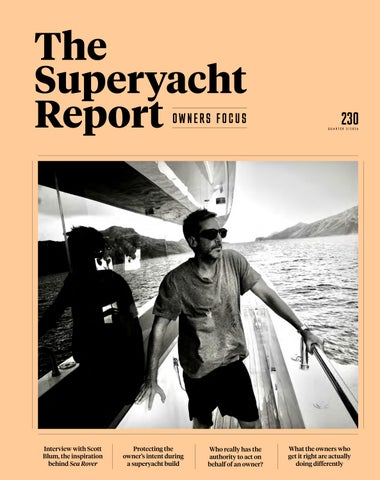
The Superyacht Report OW N E RS F O C U S
Interview with Scott Blum, the inspiration behind Sea Rover
Protecting the owner’s intent during a superyacht build
Who really has the authority to act on behalf of an owner?
230
QUARTER 3/2026
What the owners who get it right are actually doing differently
THE BEGÜM EXCELLENCE SYSTEM (BES®) The Standard Behind Every Successful Operation What BES® delivers: Proactive operational management
Transparent communication
Regulatory compliance
Continuous risk monitoring
Complete confidentiality
One dedicated team
Download our Excellence System Guide to discover the complete BES® methodology: THE BEGÜM EXCELLENCE SYSTEM (BES®) The Standard Behind Every Successful Operation
Click here to download
EDITOR’S LETTER
WHAT IF…?
The Editor-in-Chief explores what could be done to improve our industry.
BY MARTIN H. REDMAYNE
The Superyacht Report Owners Focus ISSUE 230
O
n pages 96 to 103, there is a major piece on the blue-sky ideas and radical thinking from our expert group who travelled to Bergen this year for Innorvation 26, all responding to the question “What if..?”. So I decided to add into the same issue a couple of my own ‘What ifs’ to stimulate reaction, relate them to a few recent headlines and explore some brave ideas for the future: What if… there was a fully transparent and open system for fees, commissions and financial rewards for thirdparty involvement and client advisors in the superyacht sector, so owners, charter clients and buyers were absolutely clear on the deal-worth to the people involved, so they can judge for themselves how much value is being delivered? What if… shipyards, designers, captains and project managers had the time and support teams to properly evaluate the brand new innovations, products and technology that many small companies bring to market, but often struggle to get through the door and prove that it is something worth testing? What if… all yacht crew were given very clear and detailed contracts that provided security, stability, recognition, reward and help them feel like they are on a professional career path and not just a fragile seasonal contract. Plus that every contract reflected an annual salary and bonus structure that was linked to performance of the yacht in terms of guest service, maintenance quality, hours worked and for operating within budget? What if… everyone in the industry had a joined up ethical mentality that
ensured everybody acted in the best interests of the client, gave accurate and trusted advice and had the knowledge and experience to tell the client when they are making the wrong decision? What if… as an industry we worked out how to make ownership and operations more cost effective so there is less wastage – or perhaps remove the opportunity to spend the owner’s money when we don’t need to? What if… (this is a little selfinterested) every expert, advisor, captain, naval architect, builder, broker, manager, consultant, lawyer, surveyor and any other smart thinker in the superyacht market found an hour or two in their year, quarter or month to sit at their computer and write 800 words with their candid and honest opinions or share their ideas or innovations, so The Superyacht Report and SuperyachtNews. com became the primary source of highquality advice and opinions? What if… every yacht in the fleet – and I mean every yacht – changed their operational profile to save energy at every level, by consuming less of everything, turning down the air-conditioning, reducing speed by a couple of knots and generally reducing their impact, then measuring how much energy they have saved, combined with how much money they’ve saved and then shared this data with the Water Revolution Foundation? What if… we all created a series of personal and company “What Ifs?” and started to apply them and convert them into ‘How can we actually do this..?’ to make a series of improvements and strategic changes to our wonderful and unique industry. MHR
1
CONTENTS
Guest columns
Features
Buying a superyacht: value first, negotiate second Will Christie, Founder & CEO of Christie Yachts, explains why understanding a yacht’s true value is so important in minimising future depreciation.
22
Compliance, governance and the value of certainty Jo Assael, Yachts Commercial Director, IRI | The Marshall Islands Registry, explains how conformance is integral to asset credibility and value.
44
So you want to build a yacht? Moving from serial charterer to first-time owner can seem a natural progression. Nick Gelevert, CEO at Boatsters Black, argues that commissioning a large yacht demands a very different kind of experience.
58
Jumping through hoops of fire Kate Shaw, Manager, Yachting, at Affinity, encourages owners to draw on the services of corporate service providers to ensure the mitigation of potential risks.
70
A marine-weather forecast is not an operational decision Oceanographer and co-founder of AlongRoute, Dr Georgia Kalantzi explains how an observation-led, physically informed approach helps decision-makers understand not only the expected conditions, but also the probability of operational limits being exceeded.
The unsecured owner Shipyard failure is not a rare event in yacht building and most build contracts leave the owner badly placed should the worst happen. The proceedings running through the Court of Florence in July show the machinery in motion. Jack Macnally of Foreland Marine explores the consequences of insolvency.
14
The zero-emission mission Royal Huisman’s futuristic AERA has just received a verified YETI score, marking the first concept to do so. But how do you approach a mission of this ambition without an owner in the control centre?
28
What a judge already told us about yacht valuation Marine surveyor and consultant Andrew Williams explains why length is a poor proxy for value on any individual hull – and draws on a judicial specification for how to value a yacht.
54
Superyachts and the modern family office Nic Arnold, Head of JTC Private Office UK, on how family offices are professionalising and what this means for luxury assets and family legacy.
64
94
The yacht people ask for by name 110 What reputation do you want your yacht to have five years from now? Lisa Airasca, Head of Charter Management Europe at Fraser Yachts, explores how the choices made by the owner are fundamental to shaping a memorable charter. Beware of trespassers! Benjamin Maltby , lawyer and General Secretary of The Owners Club, offers a practical guide to the do’s and don’ts for prospective new yacht owners.
2
118
CONTENTS
Features
Reports
A conversation with Scott Blum on Dutch Design Exclusive interview with the US tech entrepreneur and yacht owner about the inspiration behind Sea Rover.
72
Don’t waste my water! Steve Monk of DG Maritime dissects an incident of mistaken assumptions to explain why yacht owners should know how their yacht really works.
78
Where art meets yachting A dialogue between art wealth management and yacht finance, featuring exclusive insights from Massimo Perotti, Executive Chairman of Sanlorenzo. By Laurent Issaurat and Adina Bates, Societe Generale Private Banking.
84
What owners bring to crew 104 The best-run vessels in this industry share one thing in common and it isn’t in the naval architecture. Karine Rayson explains what the owners who get it right are actually doing differently.
To be authorised – or not ... Who really has the authority to act on behalf of an owner? Sarah Allan of law firm Penningtons Manches Cooper sets out the risks should stakeholders make assumptions about the powers held by the owner’s representative.
25
Reincarnation – a guide Andy King, Yachting Technical Director at Foreship, maps out the key considerations to take on board when bringing a classic vessel back to life.
39
Driven by wind Why is the superyacht industry still ignoring the free energy blowing all around it? A group of experts debates how wind power can be harnessed.
46
Trademark and design law in the luxury yachting industry A case law analysis in light of Riva, Benetti and recent WIPO decisions – by Serap Sargin, Attorney at Law/Arbitrator and Founding Partner, Sargın Law Office.
60
The 3% case What the residual value gap between a certified expedition yacht and an explorer-styled look-alike actually costs. Ben Abbott, founder of Utrinque Yachts, presents a model consistent with real transaction behaviour.
88
Energy and efficiency What if ... a group of industry VIPs gathered to discuss the vital topics of energy and efficiency at Innorvation ’26? The findings from this inimitable event, held earlier this year in Bergen, Norway, are presented here ...
96
The biggest market in yachting is also the most broken 114 Why the sub-40-metre segment has the most potential buyers, the least margin – and what nobody is doing about it. By Werner Puntschart, strategic advisor and interim executive.
Reports V2V – from vision to vulnerability An owner’s vision gives a superyacht its purpose, yet unless it is tested, challenged and translated into a mature specification before the build contract is signed, it can become one of the project’s most far-reaching – and expensive – risks. Presented here is a well-informed strategy to protect the owner’s intent during a superyacht build.
The Superyacht Report Owners Focus ISSUE 230
6 Crew stability – why recruitment, employment and development should be one investment 120 How do we create an environment where people choose to stay? Here Laura Henighen, Head of Acadamy at Hill Robinson, offers an approach to solve the issue of high crew turnover.
3
The Superyacht Report
Guest Authors Ben Abbott Utrinque Yachts Lisa Airasca Fraser Yachts Sarah Allan Penningtons Manches Cooper Nic Arnold JTC Private Office UK Jo Assael IRI | The Marshall Islands Registry
QUARTER 3/2026
Adina Bates Societe Generale Private Banking
For more than 30 years The Superyacht Report has prided itself on being the superyacht market’s most reliable source of data, information, analysis and expert commentary. Our team of analysts, journalists and external contributors remains unrivalled and we firmly believe that we are the only legitimate source of objective and honest reportage. As the industry continues to grow and evolve, we are forthright in our determination to continue being the market’s most profound business-critical source of information.
Andy Brennan Captain/chief engineer Will Christie Christie Yachts Nick Gelevert Boatsters Black Laura Henighen Hill Robinson Laurent Issaurat Societe Generale Private Banking
Front cover: Scot Blum, founder, Dutch Design
Dr Georgia Kalantzi AlongRoute Andy King Foreship
ISSN 2046-4983 The Superyacht Report is published by TRP Magazines Ltd (trading as The Superyacht Group) Copyright © TRP Magazines Ltd 2026 All Rights Reserved. The entire contents are protected by copyright Great Britain and by the Universal Copyright convention. Material may be reproduced with prior arrangement and with due acknowledgement to TRP Magazines Ltd. Great care has been taken throughout the magazine to be accurate, but the publisher cannot accept any responsibility for any errors or omissions which may occur. The Superyacht Report is available within The Superyacht Group Library, which is open to everyone in our audience so you can enjoy the highest quality journalism and analysis in the market – Reports Worth Reading. Download or read at your leisure on your desktop or your tablet: https://issuu.com/the-superyacht-group
Editor-In-Chief Martin H. Redmayne martin@thesuperyachtgroup.com
Jack Macnally Foreland Marine
INTELLIGENCE
Benjamin Maltby The Owners Club
Senior Research Analyst Amanda Rogers amanda@thesuperyachtgroup.com Data Analyst Miles Warden miles@thesuperyachtgroup.com
DESIGN & PRODUCTION Content Manager & Production Editor Felicity Salmon felicity@thesuperyachtgroup.com
Steve Monk DG Maritime Werner Puntschart Werner Puntschart E.U. Karine Rayson The Crew Coach Serap Sargin Sargın Law Office Kate Shaw Affinity Andrew Williams Williams Superyacht Index
4
ADVERTISING
SuperyachtNews Spanning every sector of the superyacht sphere, our news portal is the industry’s only source of independent, thoroughly researched journalism. Our team of globally respected editors and analysts engage with key decision-makers in every sector to ensure our readers get the most reliable and accurate business-critical news and market analysis. Superyachtnews.com
1999 - 2024
The Superyacht Report The Superyacht Report is published four times a year, providing decision-makers and influencers with the most relevant, insightful and respected journalism and market analysis available in our industry today. Superyachtnews.com/reports/thesuperyachtreport The Superyacht Agency Drawing on the unparalleled depth of knowledge and experience within The Superyacht Group, The Superyacht Agency’s team of brilliant creatives, analysts, event planners, digital experts and marketing consultants combine four cornerstones – Intelligence, Strategy, Creative and Events – to deliver the most effective insights, campaigns and strategies for our clients. www.thesuperyachtagency.com
Follow The Superyacht Group channels on LinkedIn @thesuperyachtgroup Instagram @thesuperyachtgroup @superyachtobserver @superyachtagency
YOUR COATING CONSULTANTS With over 25 years of experience, we have overseen more than 150 successful new-build and refit projects in all major international yacht locations. Trust us for state-of-theart materials, cutting-edge technology and unparalleled expertise. Guarantee a flawless finish with WREDE Consulting.
Join The Superyacht Group Community By investing in and joining our inclusive community, we can work together to transform and improve our industry. Included in our Essential Membership is a subscription to The Superyacht Report, access to SuperyachtIntel and access to high-impact journalism on SuperyachtNews.
YO U R C OAT ING S O LU T IO N IN FO@W R E D E- C O N S U LT ING.C O M +49 4 0 8 81674 5 - 0 W W W.W R E D E- C O N S U LT ING.C O M HAMBURG • BREMEN • LA CIOTAT • BARCELONA • PALMA VIAREGGIO • AMSTERDAM • SOUTHAMPTON • SOUTH FLORIDA
Explore our membership options here: www.superyachtnews.com/shop/p/MH
The Superyacht Report Owners Focus ISSUE 230
Wrede 221.indd 1
5 09:03 22/08/2024
V2V – FROM VISION TO VULNERABILITY An owner’s vision gives a superyacht its purpose, yet unless it is tested, challenged and translated into a mature specification before the build contract is signed, it can become one of the project’s most far-reaching – and expensive – risks. Presented here is a well-informed strategy to protect the owner’s intent during a superyacht build.
6
A guide to meeting the owner's expectations
The Superyacht Report Owners Focus ISSUE 230
7
BY ANDY BRENNAN
E
very superyacht begins with intent: a family sanctuary, charter platform, explorer, wellness retreat or freedom on the water. Whatever the ambition, the true measure of a successful build is how faithfully the yacht translates that intent into life on board. A superyacht, however, is more than an object of beauty. It is a complex, interconnected environment in which architecture, engineering, regulation, crew operation, service delivery and the owner’s lifestyle must coexist. It’s also home to the crew responsible for operating and maintaining it. A decision made in one area rarely remains confined there, and its full consequences may not be apparent until long after the yacht has entered service. It is within this gap between intention and consequence that Vision to Vulnerability – V2V – begins. V2V describes the point at which legitimate owner ambition starts to create unintended project risk: when intended use has not been fully explored, the specification remains immature or significant decisions continue to evolve after design, procurement and production are underway. The owner may believe the dream is being refined; the shipyard may experience the same request as disruption to systems, sequence, programme and budget. The danger lies not in ambition, but in allowing it to evolve without a tested, realistic and contractually coherent project baseline. Choosing the team around the owner That translation begins with the team around the owner. It must interrogate requirements and convert ambition into a practical, achievable and contractually robust build. Appointing the core team six to twelve months before contract signature allows time to establish expectations, reporting lines and contractual standards. The team should include the owner’s representative, project manager, designer
8
and naval architect, together with technical, legal and commercial advisers and have appropriate input from the classification society and flag. If a management company will assume responsibility after delivery, it should also be represented from an early stage by an experienced yacht manager to help align the build with the future operational requirements. Wherever possible, the future captain, chief engineer and chief stewardess should contribute. Their experience can reveal weaknesses in machinery access, crew circulation, storage, service routes and interior practicality before arrangements become fixed. A purser may later prove invaluable but should not replace the chief stewardess as the principal voice for owner-facing service during design. Team composition matters, but so does cohesion. Advisers must challenge decisions constructively, without allowing disagreement to become personal or political. Responsibilities and escalation routes should be clear. Continuity also matters, losing senior personnel can weaken the transition to operations and erode owner’s intent. The specification – where vision becomes obligation Once in place, the team must translate the owner’s vision into a mature build specification. More than a schedule of equipment, materials and finishes, it defines the yacht the owner believes is being commissioned and the shipyard has agreed to deliver. It converts the owner’s intended life on board into measurable technical, operational and contractual obligations. A mature specification should establish where the yacht will operate, guest capacity, crew and service circulation, tender and toy requirements, redundancy, servicing and maintenance. These decisions influence dimensions, gross tonnage, stability, machinery, electrical generation, tankage,
Superyacht planning may appear far removed from military campaign planning yet both confront the same challenge: consequential decisions must be made before every variable is known.
HVAC capacity, escape arrangements, crew numbers, storage, maintenance access and classification approval. The specification therefore becomes the project’s technical and contractual baseline, against which the yacht is designed, priced, built, tested and accepted. If it is incomplete or ambiguous, the owner or shipyard may believe they have agreed the same project while holding different expectations. What is not clearly defined before contract signature rarely disappears; it usually returns as cost, delay, operational compromise or contractual dispute. Before contract signature – converting uncertainty into control The specification cannot remove every uncertainty, but planning can expose many before they become embedded. Superyacht planning may appear far removed from military campaign planning yet both confront the same challenge: consequential decisions must be made before every variable is known. Dwight D. Eisenhower observed, “Plans are worthless, but planning is everything.” No plans survives unchanged, but planning forces assumptions into the open before they are built into the yacht as expensive mistakes in steel, cable, pipework and joinery. Donald Rumsfeld distinguished between “known knowns”, “known unknowns” and “unknown unknowns”. Applied to a superyacht build, the framework should include a fourth category. “Known knowns” are stated requirements; “known unknowns” are visible but unresolved matters such as tender selection, range, crew numbers, flag and system redundancy; “unknown unknowns” are circumstances no reasonable planning could anticipate. The fourth category – “unknown knowns” – may be the most dangerous. These are matters that someone within the team already knows or suspects, but which have not been raised. The captain may foresee difficult tender
The Superyacht Report Owners Focus ISSUE 230
9
handling; the chief engineer, inadequate machinery access; the chief stewardess, impractical storage of service routes. If such knowledge is suppressed by hierarchy, politeness or project politics, it becomes embedded risk that may remain invisible to other members of the project team and to the crew who later inherit the yacht. An experienced team adds value only when its knowledge can be expressed, challenged and incorporated before decisions become contractual commitments. Planning must therefore extend beyond drawings and commercial momentum to expose unresolved questions and test solutions against the yacht’s intended operation. This is front-end loading: concentrating definition, analysis and decisionmaking at the earliest stage of the project. In a major capital project, this is protection rather than delay. Applied to a superyacht build, it safeguards the owner’s investment by resolving uncertainty before contract signature and reducing avoidable change orders during construction.
10
Digital drawings, 3D models, virtualreality tools and mock-ups allow critical spaces to be evaluated before decisions are irreversible. Their cost is modest compared with dismantling completed accommodation.
The owner should receive a dashboard showing change status, cumulative costs, programme movement and unresolved risks. One alteration may appear modest; a pattern may reveal drift from the original brief, budget or operational intent.
Front-end loading does not give every early decision equal weight. The Pareto Principle, or 80/20 rule, helps identify the few choices that exert disproportionate influence over what follows. Length, speed, range, guest capacity, tender strategy, machinery philosophy and cruising profile may initially appear broad preferences. In practice, they shape thousands of subsequent design, engineering, procurement and operational decisions, determine many of the demands placed upon the build programme and influence the owner’s eventual experience on board. When a change order becomes more than a change Once design and production are underway, even a modest departure from the agreed specification can have consequences far beyond the altered area. From the owner’s perspective, the request may appear straightforward: move a bulkhead, enlarge a bathroom, redesign a bar, alter the glazing, accommodate another tender or upgrade a technical system. Within a superyacht build, however, few changes remain isolated. Moving a bulkhead may appear simply to improve a guest suite, yet it can require reconsideration of structural integrity, fire boundaries, insulation, HVAC routes, cabling, lighting, plumbing sprinkler
The Superyacht Report Owners Focus ISSUE 230
coverage and furniture design, together with subdivision, flood protection, escape arrangements and classification approval. Drawings may need to be withdrawn or reissued. Bespoke materials or join-ery may already have been ordered, manufactured or installed. Specialist subcontractors may have to return outside sequence, while completed work is dismantled without damaging adjacent systems of finishes. The resulting additional costs extends far beyond labour and material. It may include redesign, engineering review, project-management time, wasted components, accelerated procurement, retesting, revised documentation, shipyard contingency and classification approval. The owner sees a discrete alteration; the shipyard must assess, manage and price its entire chain of consequences. Timing is equally important. Changing a drawing is one matter; changing a yacht after equipment has been installed, spaces closed and finishes completed is quite another. Protecting delivery may require overtime, expedited freight or resequencing, increasing cost and complexity while consuming commissioning time and creating coordination risk elsewhere. Some changes will be justified and may significantly improve the finished
yacht. The essential equipment is that their full technical, commercial and programme consequences are understood before they are authorised. Decision gates – preventing design creep Preventing such consequences requires planning to be carried forward through disciplined project control. Front-end loading and specification development establish the yacht’s direction; decision gates and design freezes preserve it through design, procurement and construction. Their purpose is not to restrict creativity, but to ensure that important choices are made while they can still be incorporated efficiently. A decision gate converts discussion into commitment before uncertainty becomes delay and delay becomes cost. C. Northcote Parkinson observed that “work expands so as to fill the time available for its completion”. An owner’s decision may appear to have ample time, but that time ends when procurement or dependent work must proceed. Beyond that point, even modest delay can affect sequencing and the wider programme. The design programme should contain clear decision gates within the project Gantt chart. Each should identify what must be approved, by whom, when it is required and what follows if deferred. A design freeze allows subsequent work to proceed against a baseline rather prohibiting change. Digital drawings, 3D models, virtualreality tools and mock-ups allow critical spaces to be evaluated before decisions are irreversible. Their cost is modest compared with dismantling completed accommodation. The same discipline applies to owner-supplied items. A tender must be stored, launched, recovered, fuelled and maintained. Artwork, gym, equipment and specialist toys carry similar integration demands; purchase price is rarely the full project cost. Design creep occurs when individually reasonable decisions exceed the assumptions of the original platform. It can result in weight increase, a rise
11
Handled well, vulnerability is converted back into value and the Change control – keep the completed yacht build aligned Decision gates and design freezes establish the project baseline; formal remains a faithful change control protects it once work is under way. Although sometimes mis- expression of the taken for bureaucracy, it is disciplined stewardship of the owner’s vision owner’s original throughout construction. Its purpose is not to prevent sensible improvement, intent. in electrical demand, narrower cooling margins, storage being consumed, maintenance access becoming harder and the crew’s workload growing. Together, these effects can alter the yacht’s character, increase cost and erode simplicity.
but to ensure that no alteration enters the project informally or without clear assessment. Every proposed change should follow a recognised process: it should be described, justified and reviewed by the appropriate technical and commercial advisers. Changes affecting cost, programme, performance or regulatory approval should be considered at a formal project meeting before authorisation. Effective change control preserves traceability. The record should identify who requested, assessed and approved or rejected the change, what consequences it carries, and which drawings, specifications, schedules or contractual documents have been revised. The owner should receive a dashboard showing change status, cumulative costs, programme movement and unresolved risks. One alteration may appear modest; a pattern may reveal drift from the original brief, budget or operational intent.
From vulnerability back to value Change is inevitable in any complex custom build, whether initiated by the owner, prompted by an omission or proposed by the shipyard as an alternative component or technical solution. The
12
finest superyachts are created neither by excluding the owner after contract signature, nor by allowing every late idea to pass directly into production. They emerge from a disciplined relationship in which ambition is encouraged, consequences are clear and authority is exercised with care. The owner should remain curious, involved and demanding, yet the most valuable question may not be, “Can we change it” but rather, “Why was this not resolved before we committed to build?”. That question redirects attention beyond invoice towards its causes: team quality, specification maturity, communication, planning and project control. When the specification is mature and the owner’s intent is clearly understood, the yacht’s interconnected systems create a coherent whole. When the vision evolves without sufficient control, the same connections transmit disruption through cost, programme, quality, operation and the experience on board. Vision to Vulnerability (V2V) is not an argument against ambition; it is a reminder that ambition must be defined, challenged and protected before it is translated into steel, systems and finished spaces. Handled well, vulnerability is converted back into value and the completed yacht remains a faithful expression of the owner’s original intent. Handled poorly, it risks becoming a monument to avoidable compromise, unmanaged expectations and unnecessary expense. AB Andy Brennan has more than four decades of operational, engineering and leadership experience across the Royal Navy Submarine Service, aviation, the superyacht industry and UK road transport, He spent 18 years in the superyacht sector as a captain and chief engineer and has also worked in strategic planning, technical training and highrisk operational environments.
A�UBY 10
I 230
ABEKING & RASMUSSEN
The effects of shipyard insolvency
The unsecured owner
14
Shipyard failure is not a rare event in yacht building and most build contracts leave the owner badly placed should the worst happen. The proceedings running through the Court of Florence in July show the machinery in motion. BY JACK MACNALLY, FORELAND MARINE
Florence, July 2026 n 10 June 2026, five yacht owners won the right to walk away from their contracts with The Italian Sea Group (TISG). By 6 July they had lost it again. TISG, the builder behind Admiral, Tecnomar, Picchiotti and, since 2022, Perini Navi, entered composizione negoziata – Italy’s negotiated procedure for companies in crisis that can still be saved – on 16 March 2026. On 20 April the court confirmed protective measures for four months: creditors were held off and contracts frozen in place while the yard negotiated. Five of its owners appealed, arguing that the part-built yachts they were paying for should not be caught in the freeze and on 10 June the court agreed. The vessels, it held, “are neither assets of the entrepreneur nor assets instrumental to the conduct of the business”, and the five could exercise their termination rights (TISG disclosure, 10 June 2026). Then, on 1 July, with discussions with its owners at a standstill, the board abandoned the negotiated procedure and filed for concordato in bianco, a reservation filing under Article 44 of the Codice della crisi that gives the company 60 days, extendable, to produce a restructuring plan. The Court of Florence opened the procedure on a going-concern basis and appointed three judicial commissioners. On 6 July, at the company’s request, it confirmed new protective measures and granted, provisionally pending a hearing on 22 July, something stronger: owners may not terminate their contracts even for the yard’s own breaches, may not call the refund guarantees they hold and the banks that issued those guarantees may not pay out on guarantees already called (TISG disclosure, 7 July 2026). The measures were listed for argument before the
O
The Superyacht Report Owners Focus ISSUE 230
15
court on 22 July; no ruling had been published as this article went to press and the provisional order stands in the meantime. At 31 May the group reported overdue positions of 266.8 million euros, of which 77.6 million euros were owed to suppliers, a bank debt of 154.6 million euros, a net financial position of 178.7 million euros and 7.5 million euros in cash. A capital increase of around 100 million euros is proposed for the fourth quarter, conditional on binding agreements with owners, suppliers and lenders. The scale of the repair was set out on 22 July, when the shareholders’ meeting, held the same day the precautionary measures were announced, acknowledged a net loss of 163.8 million euros for 2025 and negative shareholders’ equity of 399.2 million euros at 30 April 2026, the share capital entirely eroded (TISG disclosure, 22 July 2026). The record of the meeting also notes the KPMG forensic audit commissioned when cost overruns surfaced across most contracts in February, and a criminal complaint against certain former senior executives. Founder Giovanni Costantino resigned as chairman and chief executive on 20 July, and under the company’s articles the whole board falls with him; a meeting to appoint its replacement is being convened. The proceeding may still end with hulls delivered; concordato in continuity exists to keep companies trading and the order book is the main thing any rescuer would be buying. What it has already shown is how the machinery treats the people paying for the boats: rights recovered on 10 June were suspended again three weeks later.
The buyer finances the build Custom-yacht building is financed by its customers. A typical schedule in the 30 to 60-metre range takes 10 to 20 per cent at signature and the balance in instalments pegged to milestones (keel-laying, hull completion, superstructure joining, launch), with a final payment at delivery. Commercial shipbuilding lawyers put the pre-delivery proportion at 40 per cent or more (Watson Farley & Williams); in customyacht work it is routinely well over half and on some projects as much as 90 per cent (Port Royal Group). The money is not held in trust; it funds the steel, the subcontractors and the yard’s general working capital, and in a stretched yard it can end up funding other projects entirely. The certificates that release those instalments are thinner documents than most buyers imagine. On yard-standard contracts the milestone is often self-certified: the yard states that the hull is structurally complete, an invoice follows and nothing in the contract requires an independent surveyor to have looked. On a 12-million-euro build paying in five stages over 30 months, the owner’s exposure just before launch is in the region of 9 million euros. A lender advancing that much against a half-built asset would hold security over the asset, covenants and audited accounts. The owner typically holds a contract and a record of payments made. Two instruments genuinely improve the position and both have limitations in this market. The first is the refund guarantee, a bank’s promise to return pre-delivery instalments if the yard defaults. Charles Buss of Watson Farley & Williams
Yards do not fail suddenly. Prices are cut to win deposits, because new deposits are the cheapest funding available to a yard in trouble. Senior technical staff leave. Suppliers start ringing the owner’s representative to ask, carefully, whether the last instalment has been paid, because it has not reached them.
16
The Italian Sea Group’s Marina di Carrara headquarters.
calls refund guarantees “the lifeblood of shipbuilding”, and in commercial shipbuilding they are; no shipowner’s board would release stage payments without one. The description does not travel to yachting. “The majority of shipyards simply don’t have the credit lines available to them to be able to arrange refund guarantees,” said HFW’s Alex Sayegh, and the selection runs the wrong way: the yards strong enough to provide guarantees are the ones that rarely fail. Where a guarantee does exist, it needs maintenance that, in our experience, it rarely gets. Expiry dates are commonly set against the contractual delivery date, and multi-year builds run late, so cover can lapse in exactly the period when the risk peaks. A material variation agreed without the guarantor’s consent can void the instrument and a three-year custom build generates change orders by the hundred. In practice, the guarantee is rarely repapered as the specification moves, and the defect tends to surface only when the instrument is called. The second is title. Ownership of a hull under construction is decided by the law of the country where it is being built, no matter which jurisdiction the parties chose for the contract. “The law that governs the ownership of the yacht during construction is the local law,” HFW partner Jay Tooker told a panel on shipyard insolvency. In Italy, the yard owns the yacht during construction unless the parties agree otherwise in writing (PG Legal), and that agreement protects the buyer in an insolvency only once it is transcribed in the
The Superyacht Report Owners Focus ISSUE 230
registro navi in costruzione, the register of vessels under construction at the local Harbour Master’s office. Germany keeps a shipbuilding register for the same purpose. A vesting clause in an Englishlaw contract, on its own, leaves the buyer proving ownership to an Italian trustee with a document the trustee is not bound to recognise and a buyer in that position ranks as an unsecured creditor of the estate. None of this is sharp practice and it matters to say so. There is no industry standard new-build contract: MYBA’s form covers the sale of existing yachts, ICOMIA’s covers refit and new-build terms are negotiated deal by deal, usually from the yard’s own draft. Financing construction from stage payments is simply how the market has always worked. At 80 metres the buyer’s legal team perfects title and matches guarantees to instalments as a matter of routine. At 30 metres that work is frequently not commissioned at all. Twenty-six years of practice Foreland’s review of yard failures since 2000, compiled from trade press and court records, counts some 25 events across the custom and semi-custom fleet, in three clusters: the post-2008 wave that took Royal Denship, Baglietto and Cantieri di Pisa; the mid-2010s failures of Christensen, ISA, Moonen, Mondomarine and Oyster; and the run from 2020 that includes Tansu, Perini Navi, Nobiskrug twice and now TISG.
17
“Even where the owner can see that the yard is in trouble, it cannot take action under the contract,” Linda Roxburgh, legal director, Wikborg Rein. The outcomes for buyers turned less on the merits than on structure, and sometimes on luck. Oyster’s 26 in-build customers were made whole in 2018, but only because Richard Hadida bought the whole company six weeks into administration and the order book was the value he was buying. At Christensen in 2015, suppliers’ liens attached to the named hulls and ranked ahead of the buyers. At Tansu, a client who had prepaid 5.52 million euros for a 44-metre never received a boat; the Istanbul court found assets had been moved in bad faith to another company. Perini Navi’s largest in-build exposure, 54 to 56 million euros, went into the Lucca bankruptcy as an ordinary unsecured claim. I would like to quote recovery percentages here and cannot. Trade press reports filings and rescues; it almost never reports the creditor waterfall, and the honest position is that nobody outside the proceedings knows what unsecured yacht buyers
Nobikrug has filed for insolvency twice in the past five years.
18
typically recover. What is visible in the record is the split: buyers holding enforceable guarantees or registered title generally kept their boat or their money, and buyers holding neither queued with the other creditors. Seeing it coming Yards do not fail suddenly. Prices are cut to win deposits, because new deposits are the cheapest funding available to a yard in trouble. Senior technical staff leave. Suppliers start ringing the owner’s representative to ask, carefully, whether the last instalment has been paid, because it has not reached them. We have watched this sequence more than once, and it is recognisable a year or more before any court is involved. The contract is no help during that year. Termination clauses are triggered by formal events, the opening of proceedings or the appointment of an
administrator. “Even where the owner can see that the yard is in trouble, it cannot take action under the contract,” Linda Roxburgh, legal director at Wikborg Rein, wrote in 2024. Yards file late, when the cash is gone, which is also when the least is left to recover. Even after the filing, the clause is weaker than it looks, because modern restructuring law overrides it. Article 94-bis of Italy’s Codice della crisi makes termination of essential contracts for the filing itself ineffective; protective measures suspend the rights that survive; German courts have held insolvencytrig-gered termination clauses invalid where they undermine the administrator’s statutory election. This is what the five TISG owners encountered: rights that remained valid on paper but were suspended by the court’s protective measures. The strange part is that the information was public the whole time. TISG, under a CONSOB order, publishes its financial position monthly. Anyone advising an owner there could have read the deterioration in the filings while the instalments went out. Roxburgh observes that “the financial stability of shipyards is rarely a top priority for owners when selecting” a yard, and in my experience it is not revisited after signature at all. I am not aware of any credit-monitoring service for yacht buyers. The disciplines lawyers recommend (independent verification of milestones before payment, escrow of advance instalments, a watch on the registers and the guarantee diary) are practised at the top of the market and almost nowhere below it. Why has nobody built this? Partly because the customers are not repeat customers. An owner commissions once or twice in a lifetime, learns at
the worst moment and takes the lesson out of the market when they go. A line drawn in 1969 The other inefficiency worth naming has nothing to do with insolvency. It costs owners space and design freedom rather than deposits. It belongs in the same article only because it comes from the same place: rules written for merchant ships applied to yachts. Of the 1,093 yachts of 24 metres and above on order or in build in the 2026 Global Order Book, 932 measure under 500gt, and over 150 yachts in build today are focused on the sub-500gt sector, with a build volume of exactly 499gt. At 500gt a commercially operated yacht picks up the full SOLAS construction and fire package, the full ISM Code with shore-based management, the ISPS security regime and a heavier manning scale. Below it, the Red Ensign Group’s yacht code and a lighter safety management system apply. Designers respond by designing to the line. “We billed 64,000 man-hours of design and engineering time last year and 20,000 hours were spent on squeezing yachts to measure under 500gt,” says naval architect Gregory C. Marshall. Perry van Oossanen puts the underlying complaint plainly: “We are trying to apply the logic of a 56-year-old rule about cargo ships to measuring luxury yachts.” Inside that fixed envelope, compliance keeps taking volume. MLC crew accommodation minimums apply to commercial yachts of any size. Tier III exhaust after-treatment applies to yachts under 500gt built since 2021 and the engine room grows to take it; the industry’s attempt to extend
An independent milestone survey costs less per instalment than the owner will spend on crew uniforms. What does not exist below roughly 500gt and 30 million euros is the habit of using [surveys] or any professional function that owns the security position between signature and delivery ... Responsibility for the file, in the banking sense of the word, sits with no one.
The Superyacht Report Owners Focus ISSUE 230
19
the exemption was rejected at the IMO in 2019 and the US enforcement deferral expired at the end of 2023. Thom Conboy of Ocean Independence puts the combined cost at 25 to 50gt or 5 to 10 per cent of the yacht. It is a broker’s estimate, but nobody has published a better one. Conboy’s remedy for the rule itself is blunt: “I’d like to see it blown up. We should all just stop following it.” The instinct is widely shared in the design community and I think it is wrong. The requirements anchored at 500gt do real safety work; abolish the measurement without rebuilding the thresholds and the cliff moves rather than disappears. The defensible complaint is narrower: gross tonnage measures enclosed volume, and the risks the rules police scale with people and operation, not with volume. The refit version of this problem gets less attention than the design version and deserves more. Remeasurement is triggered by a substantial variation in tonnage, which class guidance reads as anything over 1 per cent. On a 499gt yacht that is five gross tons, roughly one enclosed deck module. Cross the line and the commercial package applies to a hull that was engineered to avoid it. The Red Ensign Group’s 2024 tonnage guidelines set out which exterior spaces may be excluded, confirm that permanent deck additions may not be and
20
carry a caution of their own: exclusions accepted by one flag “might not be accepted by another Flag State or Port State”. I know of no published case of a yacht caught this way retroactively. Surveyors keep flagging the risk anyway, which says something about how often the tonnage check is missing from refit scopes. The missing habit Every protection discussed in this article exists and is in daily use somewhere. Commercial shipowners take refund guarantees as standard. The Italian and German registers are open and registration costs a rounding error on the contract price. An independent milestone survey costs less per instalment than the owner will spend on crew uniforms. A tonnage check before a refit scope is signed takes a naval architect a day. What does not exist below roughly 500gt and 30 million euros is the habit of using them, or any professional function that owns the security position between signature and delivery. Lawyers are engaged to negotiate the contract and are released once it is signed; brokers are remunerated at signature; surveyors attend milestones only where someone has thought to instruct them. Responsibility for the file, in the banking sense of the word, sits with no one.
Baglietto’s La Spezia base. Following Baglietto’s bankruptcy in 2010, the new ownership has been linked with the possible acquisition of TISG’s shipyard in the same yacht-building district.
A buyer contracting today can close most of the gap with measures that are modest against the exposure A buyer contracting today can close most of the gap with measures that are modest against the exposure: financial due diligence on the yard before signature, with an unusually keen price treated as grounds for more scrutiny rather than less; title or security perfected and registered in the form the build jurisdiction recognises; any refund guarantee matched to the instalment schedule, its expiry diarised against the long-stop date, and the guarantor’s written consent obtained for material variations; no instalment released without independent verification of the milestone behind it; and, in refit, a tonnage calculation in the scope before it is signed.
The industry’s contribution would be larger and slower: a standard new-build contract form with minimum security provisions, of the kind MYBA’s memorandum gave the brokerage market decades ago and a yacht-specific approach to tonnage measurement, which the designers quoted above are already arguing for on the record. None of it requires new legislation. Twice before, in 2009 and 2017, the market absorbed a cluster of failures without changing how it contracts. Whether it does so a third time is, for once, a decision buyers can make individually: every measure above is available to any owner, on any build, from the next contract signed. JMN
Yard
Year
Proceeding
Buyer outcome
Baglietto (IT)
2010
Bankruptcy
In-build work stopped; assets sold through insolvency; brand revived under new ownership 2012
Christensen (US)
2015
Receivership
Supplier liens attached to the named hulls and ranked ahead of buyers
Moonen (NL)
2015 and 2019
Suspension of payments, then bankruptcy
In-build hull resumed under rescuers after roughly a year of delay
Mondomarine (IT)
2017
Liquidation, fraud investigation
Customers among the complainants; deposits ranked behind an estate under criminal investigation
Oyster Marine (UK)
2018
Administration
All 26 in-build customers made whole after a whole-company rescue
Tansu (TR)
2020
Bankruptcy on a client petition
5.52 million euros prepaid, never delivered; assets found moved in bad faith
Perini Navi (IT)
2021
Bankruptcy
Largest in-build exposure, 54 to 56 million euros, ranked as an unsecured claim
Nobiskrug (DE)
2021
Insolvency
77-metre project completed after the owner re-signed under new ownership
Nobiskrug and FSG (DE)
2024
Insolvency
Pipeline stalled; yards passed to Lürssen and Rönner Group
The Italian Sea Group (IT)
2026
Concordato con riserva (live)
Terminations and guarantee calls frozen; ruling awaited after the 22 July hearing
Compiled by Foreland Marine from trade press and court records, July 2026. The full review counts some 25 failure events across the custom and semi-custom fleet since 2000, arriving in three clusters: 2009 to 2012, 2015 to 2018 and 2020 to 2026.
The Superyacht Report Owners Focus ISSUE 230
21
Guest Column by Will Christie
Buying a superyacht: value first, negotiate second Will Christie, Founder & CEO of Christie Yachts, explains why understanding a yacht’s true value is so important in minimising future depreciation. One of the questions many prospective yacht owners ask me is surprisingly simple: "What sort of discount off the asking price should I expect?" as if it’s a general rule. It is an understandable question, but in my experience, the size of the discount achievable varies massively deal to deal. What really matters is whether you are buying a yacht at fair market value. That may require negotiating a seemingly massive discount, sometimes tens of millions, while at other times paying the asking price is totally justifiable. The challenge is that unlike almost every other major asset class, the superyacht market remains remarkably opaque. There is no publicly available register of completed sales. There is no equivalent of Land Registry data for residential property, no stock exchange showing yesterday’s closing prices and no database that accurately reflects what comparable yachts actually sold for. Buyers therefore begin one of the largest purchases of their lives without easy access to perhaps the single most important piece of information – what a boat is truly worth. That lack of transparency creates one of the biggest
22
risks in yacht buying. It also explains why getting the right advice can save a buyer many millions of Euros. I struggle to think of another asset class where the gap between asking prices and achieved selling prices is consistently as wide as it is in superyacht brokerage. Discounts can be deceptive I once represented a buyer interested in a yacht with an asking price of EUR 24.9 million. The yacht suited his requirements extremely well, but I believed the asking price bore little resemblance to fair market value. My client initially told me he would happy to buy it for EUR 19.9 million. Psychologically, paying less than EUR 20 million would have marked a successful negotiation for him. After all, that represented a very significant discount of approximately 20 per cent from the asking price. Many buyers would have congratulated themselves if they had achieved this. Instead, after carrying out a detailed appraisal of the market, I advised that we should offer EUR 15 million as the boat was worth not a penny more than that. He felt this was too aggressive, but nothing ventured, nothing gained! The negotiations lasted around three
months, when we dug in our heels and presented the market data to support our valuation. Eventually, the seller accepted. Five years later we sold the yacht again for essentially the same amount. Had my client purchased it for EUR 19.9 million, he would almost have suffered almost EUR 5 million of unnecessary depreciation, despite the market remaining relatively stable. The lesson is simple – a large discount from an unrealistic asking price is not necessarily a good enough deal. Equally, paying the full asking price is not necessarily always wrong, as sometimes an asking price genuinely reflects fair market value. I have advised two clients to pay the asking price where it represented good value. Those deals were both over EUR 100 million, but market conditions, replacement cost, lack of supply and recently reduced asking prices from motivated sellers meant that it was totally justifiable in those particular situations. The alternative was waiting four to five years to build a new sistership at twice the cost. However, without professional advice from an experienced advisor on your side of the deal, how do you know what you should be aiming for in the first place?
Why asking prices are often so detached from reality Owners often invite several brokerage houses to compete for the instruction to sell their yacht. That is entirely understandable. There is an inherent tension in any competitive pitching processs, however: owners naturally like to hear optimistic valuations and brokers naturally want to win listings. The result can sometimes be asking prices that prove difficult to justify once the market begins speaking though . If the market responds with offers at a significantly lower level, but at fair market value, the very broker who originally suggested a very high asking price is now placed in the uncomfortable position of recommending that the owner accepts an offer well below the figure they themselves suggested. That is never an easy conversation. In some cases, valuable months are lost while the yacht remains on the market chasing a price that buyers were never prepared to pay. Eventually the asking price is reduced, but by then the yacht may already have become stale in the eyes of the market. Ironically, an owner often ends up achieving a lower sale price by starting too high. Every yacht is unique Valuing superyachts is also far more complex than many buyers might appreciate. Two yachts of the same length, built by the same shipyard and delivered in the same year can have dramatically different market values. One may have recently completed a full
repaint, which is incredibly costly and time consuming. The other may require one within the next twelve months. One may have a very functional layout which appeals to the wider market. The other may have been designed entirely around one family’s very specific requirements. One may have benefited from meticulous maintenance. The other may have accumulated years of deferred work. One may have a fairly neutral interior that is easy to personalise, the other may have more of a fussy interior with lots of stones and panelling that are very expensive to change. On paper they may appear similar. In reality, their value may differ by millions, if not, tens of millions. That is why simply comparing asking or even sale prices can be misleading. Small differences often disguise enormous differences in value. Negotiate only once you truly understand a yacht’s value Until one understands the fair market value of a yacht, there is no point entering a negotiation. Only then can a buyer decide whether an asking price is attractive, ambitious or entirely unrealistic. Without that knowledge, every subsequent negotiation is based largely on emotion, rather than evidence. The objective should of course be to negotiate the biggest discount possible, but if negotiations don’t reach fair market value, one should move on. I never recommend chasing a deal. Better to wait for the owner to wake up to reality a few months down the line.
If one does that, future depreciation becomes far easier to manage. If you don’t, no amount of negotiation skill will recover the difference later on. The value of independent advice Ultimately, this is why I believe buyers should think carefully about who sits on their side of the table during the process. Buying a superyacht is not simply about finding the right yacht, it’s about understanding value in a market where genuine pricing information is remarkably difficult to obtain and judge. Seemingly insignificant differences between two similar yachts can have a profound impact on what they are truly worth. Experience matters, market knowledge matters, and independent judgement and advice matter. Most importantly, buyers need someone willing to tell them not what they hope to hear, but what they need to hear. Because when the day eventually comes to sell the yacht in the future, no buyer remembers how large the discount was. They remember only one thing – whether they bought the yacht at the right price in the first place. In yacht broking, negotiation is not about beating the seller, it’s about minimising future depreciation, and the only way to do that is to understand a yacht’s true value before you begin the process. One day, every yacht will return to the brokerage market for sale. The price you pay today will be the largest factor determining the depreciation you will experience in the future. WC
Buying a superyacht is not simply about finding the right yacht, it’s about understanding value in a market where genuine pricing information is remarkably difficult to obtain and judge. The Superyacht Report Owners Focus ISSUE 230
23
You own We advise You charter We inform You cruise We plan You explore We guide You manage We research You buy We analyse You sell We connect You design We report You build We create You repair We strategise You service We market You are The Superyacht Market. We are The Superyacht Group.
superyachtnews.com 24
An examination of legal authority
To be authorised – or not … Who really has the authority to act on behalf of an owner? Sarah Allan of law firm Penningtons Manches Cooper sets out the risks should stakeholders make assumptions about the powers held by the owner’s representative.
G
ood governance and due diligence are often viewed as matters solely for the owning entity of a superyacht and its directors. Equally, it is commonly assumed that any consequences arising from a failure to exercise proper governance are risks borne only by the owner itself. In reality, that assumption is misplaced. Shipyards, contractors, brokers, managers and suppliers would be well advised to pay close attention to the authority of those who purport to act on behalf of an owner. The title ‘owner’s representative’ is one frequently encountered in the superyacht industry, whether in relation to a new build, a refit project or the vessel’s day-to-day operation. However, there is an inherent risk that stakeholders make assumptions about what that title means and, more importantly, the authority that accompanies it. Superyachts are typically owned through a special-purpose vehicle, often
The Superyacht Report Owners Focus ISSUE 230
forming part of a wider corporate, family office or trust structure and the concept of ‘owner’ is to that entity rather than the ultimate beneficial owner. Beyond the directors of the owning company, there may be multiple individuals involved in decision-making at various stages of the yacht’s lifecycle. These may include family office personnel, the owner’s representative, the captain, yacht managers and project managers. The result is often a complex web of relationships in which authority is not always clearly defined. Making assumptions as to authority can be risky. A representative who exceeds their authority, or who acts without authority altogether, may unwittingly bind the owner to obligations which the owner would never have agreed to assume. The worst-case scenario is that a shipyard, contractor or supplier who relies upon such instructions may subsequently find itself unable to enforce
the resulting contract against the owner. The term ‘owner’s representative’ is most understood in the context of a build or refit project. They may represent the owner’s interests throughout the design, construction, refit, delivery and often warranty phases of a yacht project. Since 2023, the industry has benefited from the introduction of the Yacht Owner Representative Programme (YORP) developed in conjunction with the Superyacht Builders Association (SYBAss), providing formal training and accreditation for individuals acting in this role. However, professional qualifications and technical competence are distinct from legal authority. An owner’s representative may be highly experienced and technically proficient, yet have little or no authority to commit the owner contractually. The critical legal question is whether during a build or refit the representative is acting merely
25
Sarah Allan, Partner, Yachts, at Penningtons Manches Cooper,
as an adviser with obligations to report back to the owner or whether they have authority to affect the legal relations of the principal with third parties. It is unlikely that an owner’s representative will sign a build contract on behalf of an owner. However, they may frequently make decisions during a build or refit which have the effect of being legally binding. One must distinguish between what is a mere advisory role, and an individual who is authorised as an agent of the Owner to enter into binding agreements whether that be, by example in the context of a build or refit, a variation or sign off on a milestone, or procuring the supply of goods and services. English law recognises several forms of authority. The most straightforward
Where authority cannot be established, the owner will generally not be bound by the contract. Under the doctrine of breach of warranty of authority, a person who purports to act as agent impliedly warrants that they possess the authority they claim.
26
is actual authority, where authority is expressly conferred by the owner by way of a formal written appointment or contract setting out the scope of delegated powers and, where appropriate, having a power of attorney in place. Equally, the relevant shipbuilding or refit contract should clearly identify who is authorised to issue instructions and make binding decisions on behalf of the owner. In practice, however, authority frequently extends beyond what is contained in the written documentation. Authority may also arise by implication through a course of conduct. In HelyHutchinson v Brayhead Ltd [1968] 1 QB 549, the court recognised that authority may be inferred where an individual has repeatedly been permitted to act on behalf of a principal in a particular manner. Consequently, where an owner’s representative has routinely approved variations or issued instructions over an extended period, a court may conclude that implied actual authority exists. A representative may also possess ostensible or apparent authority. In Freeman & Lockyer v Buckhurst Park Properties (Mangal) Ltd [1964] 2 QB 480, the Court of Appeal held that a principal may be bound where it represents to a third party that an individual has authority and the third party relies upon that representation. Importantly, the representation may arise through conduct rather than express words. The question is whether the owner’s conduct would reasonably lead a third party to conclude that such authority exists. For instance, the appointment of an owner’s representative in a build contract would suggest that such authority exists. One can see how misunderstandings might arise, particularly if there is a degree of time pressure on a project to get something done or the work is of a more routine nature. For instance, an owner’s representative might say something which gives the impression
From the perspective of shipyards, suppliers and contractors, it is ... dangerous to assume that either a captain, management company or owner’s representative possesses unrestricted authority to enter into contractual arrangements or binding agreements merely because of their title. that they hold the authority of an agent as opposed to an advisor. Equally you could have the seemingly absurd situation where an ultimate beneficial owner expresses that someone is so authorised, but without having the authority of the directors of the owning entity. Further, a situation could arise where more than one person, as in an owner’s representative and manager, are both authorised and there is a potential for conflicting instructions to be given. Where authority cannot be established, the owner will generally not be bound by the contract. Under the doctrine of breach of warranty of authority, a person who purports to act as agent impliedly warrants that they possess the authority they claim. In such circumstances, the contractor’s first target may be the owner, relying upon arguments based on actual authority, implied authority, ostensible authority or ratification. If those arguments fail, the contractor may be left to seek recovery from the representative personally on the basis that authority was falsely represented. Other parties that fall into the decision-making matrix are the yacht captain and manager. A captain is not merely an employee but traditionally occupies a unique position in maritime law as the owner’s agent for the purposes of operating and preserving the vessel. Historically, captains/masters have been recognised as possessing authority to take urgent decisions necessary to protect the vessel, crew, passengers and
The Superyacht Report Owners Focus ISSUE 230
voyage. A captain will therefore generally possess actual or implied authority to enter into contracts reasonably necessary for navigation, safety and the ordinary operation of the yacht. Absent express authority, the rationale for broad implied authority is significantly reduced when the vessel is in port and the owner, family office or management company is readily available to provide instructions. By contrast, a yacht management company has no inherent authority simply by virtue of being appointed as manager. Its authority must be established through ordinary principles of agency. The management agreement will usually give the manager actual authority to enter into contracts for crew employment, maintenance, bunkering, insurance, compliance services etc. However, the extent of that authority will depend on the services contracted, which can be limited. Authority can also arise by implication from a course of dealing where the manager has regularly contracted on the owner’s behalf and those contracts have been honoured without objection. In some circumstances, a management company may also acquire ostensible authority where the owner has held it out to suppliers and contractors as the person or entity responsible for the yacht’s affairs. From the perspective of shipyards, suppliers and contractors, it is therefore dangerous to assume that either a captain, management company or owner’s
representative possesses unrestricted authority to enter into contractual arrangements or binding agree-ments merely because of their title. Equally, even if there is a letter of authority or power or attorney in place it must be checked to ensure that it is widely enough drafted to cover the action and without limits. Family offices or directors will often include time limits on the validity of the power of attorney. Therefore, it should be checked to ensure it has not expired and time limits diarised. Another wrongful assumption is where it is assumed that someone can stand in for an authorised agent when they are away on leave. In an industry where ownership structures are increasingly complex and decision-making is frequently delegated amongst multiple parties, clear allocation of authority is not merely good governance, it is an essential riskmanagement tool. Additionally, with the increased use of technology to simplify processes and reduce the paper trail, companies would be well advised to ensure that such proper legal process is not inadvertently overlooked when using such platforms by the mere click of a mouse or Docusign. In conclusion, owners, shipyards, contractors and suppliers alike should ensure that authority is properly documented and verified before relying upon instructions which may carry significant contractual consequences. There is little downside to double-checking the basis of the authority. SA
27
50-metre hybrid catamaran concept
28
THE ZERO-EMISSION MISSION Royal Huisman’s futuristic AERA has just received a verified YETI score, marking the first concept to do so. But how do you approach a mission of this ambition without an owner in the control centre?
The Superyacht Report Owners Focus ISSUE 230
29
BY CONOR FEASEY
O
n a stretch of the Vollenhover Kanaal, a few hundred metres from the Royal Huisman sheds, sits an unassuming 22-foot keelboat with an eight-metre carbon wing through its deck and enough cable, lights and flashing data readers that more resemble the inner workings of the Starship Enterprise than a small sailboat. For its first two years of testing, the wing’s flaps were driven by remote-control actuators wired to a power drill battery and the whole rig was rotated by hand. It has since acquired an electric motor and a control algorithm written by Artemis Technologies, and when it goes back in the water this month, it will trim itself autonomously. The wing is a quarter-scale prototype of the rig on AERA, the 50-metre hybrid catamaran concept that dominated Royal Huisman’s stand at last September’s Monaco Yacht Show. And as I sit with Hermen de Jong, Royal Huisman’s head of innovation, on a sunny morning in Vollenhove, it is easy to see why. Without even delving into the functionality of the mindboggling on-board tech, the aesthetic design alone is striking enough to let you wonder if it might set course for another galaxy, let alone cruise the Nordic fjords. De Jong explains to me that there is no client behind the build, not yet at least, but that has afforded a freedom not typically found at a shipyard renowned for building custom sailing vessels for the highest end of the market. It has allowed them to be radical and explore what the next iteration of yacht design actually looks like, with lots of exterior space to consider what a 70-metre monohull yacht would offer. Moreover, it has allowed the team to experiment, research and focus on what they anticipate the future of owners to look for in a sailing and motoryacht alike. “AERA is a culmination of different developments that we’ve been working on, looking at smart use of energy, targeting a new type of audience and being more sustainable by applying those technologies,” he says. “Yes, the design is radical, but also the underlying technology under the hood is profoundly different to anything we have done before.” What the yard has done instead is reverseengineer an owner from years of observed behaviour.
30
Extensive testing of the wing prototype
How do owners, guests and crew actually use their yacht? What will and won’t their crews risk? What do they really want then they buy a yacht of a specific overall length? And what makes a prospective wander onto a stand in Monaco with a look of ethereal awe? Every technical decision in the concept is an answer to something a real owner, crew member or charter guest has been seen to do. Since its unveiling in Monte Carlo last year, AERA’s YETI score has been independently verified by MARIN, which de Jong says makes it “the first concept design that’s verified by an objective third party under the Water Revolution Foundation’s methodology.” The verified figure places AERA 20 to 25 per cent below the reference line for comparable yachts. De Jong, however, argues that the figure undersells the yacht, because the scoring model has not yet caught up with what AERA actually changes about how a yacht gets used. HVO, for instance, is treated as an operational choice rather than a design feature. “We can’t check whether you’re actually using HVO or you’re just filling up with regular diesel, so we’re not going to include that in the score,” he explains. “Also, the wingsail by Artemis
The wing ... is automated, so nobody needs to trim it. It has almost nothing on deck to be frightened of, so nobody can break it. And it never comes down, so the half-hour of rigging that talks a crew out of sailing simply does not exist. Technologies and Rondal is quite a new type of rig and there are certain assumptions about the amount of time you’re using the sails. That’s a fixed assumption based on actual data from existing yachts, but this has a much lower threshold to use it. Essentially, you must make an active choice not to use it, because it’s always available.” Setting sail on a large conventional sailing yacht can occupy a crew for half an hour or more, demands trained hands on deck through the night and carries the ever-present risk that something expensive breaks on somebody else’s watch. Faced with that, a crew delivering a yacht across the Mediterranean without the owner aboard will rationally reach for
the throttles. So in reality the technology problem is a human one at its core. “We’ve learned over the years that we make beautiful rigs, as you see on those yachts out there,” De Jong tells me, gesturing towards the sheds. “But we also know that it takes time to set them up. There are lots of parts and components and sometimes that limits people from actually using the sails when they do a crossing. They do it by motor. But when the owner is not on board, the crew is mostly reluctant to do it, because they might break something, for example. And they need more crew on board during the night to operate it. Basically, all these limitations lower the amount of time using the sails.”
By using a powered system completely hidden inside, the wing can be tilted to a stowing position for passing bridges, extreme weather and yard periods.
The Superyacht Report Owners Focus ISSUE 230
31
Designer Cor D. Rover notes that everything began from a “meandering shape” to connect the decks. It starts at the mast collar and winds its way to the waterline.
AERA isn’t a sailing yacht with a motor or even necessarily a motoryacht with a sail, but a multihull superyacht with a power-generating sail.
32
AERA’s dynamic package makes it fit for tomorrow.
The wing is the direct answer to that behaviour since it is automated, so nobody needs to trim it. It has almost nothing on deck to be frightened of, so nobody can break it. And it never comes down, so the half-hour of rigging that talks a crew out of sailing simply does not exist. Notably, the imagined owner at the end of all this is not a sailor and De Jong is careful on this point, because Royal Huisman’s order book is full of people who love their Bermudan rigs precisely for the sport and ceremony of them. The pitch is not that they have been doing it wrong for a century, it’s that there is a second audience out there, far larger, that the effort has always excluded. “This is much more about inspiring people who are not acquainted with sailing to start using this than telling hardcore sailors that what you have been doing with those typical Bermudan rigs is wrong. No, it’s not wrong. It’s just sportier and it’s a lot more effort. But people are willing to do that.” At its core, the project is a distinctly different proposition for a shipyard that has built a fleet of motoryachts you can count on two digits. AERA isn’t a sailing yacht with a motor or even necessarily a motoryacht with a sail, but a multihull superyacht with a power-generating sail. The catamaran platform follows from the same logic. Heel is limited to roughly what a motoryacht owner already tolerates, so that guests and crew with no sailing background need neither knowledge nor nerve, and the twin hulls attack the metric that owners actually experience once the contract is signed. The superyacht sector talks endlessly in metres, but life
The Superyacht Report Owners Focus ISSUE 230
on board is lived in volume and it is on volume that sailing yachts have historically lost the argument to their motoryacht rivals. From the perspective of a typical owner who has just a motoryacht, it’s not necessarily controversial to say that sailing yachts are considered to be less efficient in their space consumption. They’re pricier per cubic metre of volume, whereas this is radically diverging from that. If we look at the numbers, the Cor D. Rover-designed AERA carries 694 square metres of exterior deck, comparable to a typical 65 to 70-metre monohull motoryacht, on a 50-metre platform that still ducks in the sub-500gt threshold, with the distinctive lattice cut-outs pulling double duty by shading the glazing to cut air-conditioning load while keeping the semi-open walkways out of the tonnage calculation altogether. Below decks, the energy system is built around the same question of how owners actually live aboard, too. Over the past few years, the ability to sit at anchor in silence overnight with no combustion engine running, no vibration through the hull and no exhaust drifting over the aft deck has become a non-negotiable for new owners. The market has largely reached for the same solution, ever-larger battery banks and it is a solution De Jong believes collapses under its own weight, sometimes literally. Royal Huisman’s alternative is deliberately unheroic in scale. AERA carries a comparatively modest 580kWh battery bank and, alongside it, compressed hydrogen stored at 500 bar feeding a fuel cell, a configuration for which the shipyard holds an
33
AERA ... is less a sail than an aerofoil that happens to stand upright. It is unstayed, closer in spirit to a DynaRig than to the stayed wings of the America’s Cup and held on just two bearings inside the hull. approval in principle from Lloyd’s Register covering gaseous hydrogen storage below deck, believed to be a first for a sailing yacht. The hydrogen is not there to propel the boat, it’s there to buy time, functioning as a zero-emission battery extender for the silence itself and the arithmetic behind it is striking for how little of the stuff is required. “Whenever the battery system has a state of charge that’s too low and you don’t want to run the generators, you can consume the hydrogen in your fuel cells, so it’s still silent and still zero emissions. It’s only 180 kilogrammes of hydrogen, but that will give you an enormous extension of your silent period.” Those 180 kilogrammes translate into a 72-hour
34
zero-emission window at anchor and the shipyard has modelled what that means across a realistic itinerary rather than a laboratory one. In its simulation of a typical cruising week, sailing by day, anchoring by night, one call alongside for shore power, eight hours or charging while the generators are used for propulsion is sufficient. For the remaining 160, guests hear nothing at all, with the hydro generators beneath the hulls quietly recharging the batteries whenever the yacht sails. The innovation department that produced AERA, serving Royal Huisman along with sister companies Rondal and Huisfit, is an aggregated think tank of the group’s multidisciplinary experts. Leaders from production, sales and engineering
694 square metres of exterior deck space span AERA’s50 metreplatform, comparable to a typical 65 to 70-metre monohull motoryacht.
To keep volume below 500gt the lattice structure openings are not filled with glass, and the covered passageways reduce interior heat loading.
page 3 of 57
than circulating drawings departmeetKEEP together periodically to bring their THE expertise to Rather TO VOLUME BELOW 500GT LATTICE STRUCTURE OPENINGS AREbetween NOT FILLED
the table. The agility of not having a fixed innovation ments and reconvening weeks later, everyone is GLASS: THE COVERED PASSAGEWAYS PROVIDE SECURE, brought together in one room, once orAtwice a week, team is a deliberate hedgeWITH against the failure mode for AND a full REDUCE morning during the conceptual phase, that haunts corporate innovationRESIDENTIAL teams that driftFEEL INTERIOR HEAT LOADINGin into abstraction and ideas grow more elaborate the teams of up to twenty. The door, I am told only half further they travel from the people who will end in jest, is locked from the outside and only coffee is up having to build them. Pulling engineers and allowed in. “We bring all those different disciplines into one boatbuilders into the development work keeps the concepts honest and it gives the ideas their first room and then based on predefined topics, or areas on board that are difficult to solve, we try and solve hostile audience long before any client sees them. “There’s always the risk that you get very distant those issues on the spot in a working session,” he from the actual day-to-day work. And for people says. “It’s not discussing and then everybody goes who are in that space, it’s also nice to be able to think away and finds their position. It’s designing and outside the box and be part of those development developing on the spot. Sometimes you see that projects,” says De Jong. “Sometimes it happens, one discipline gives in by five per cent and that is they say, that was a very bad idea, let’s make it more a gain of 50 per cent for somebody else. And if you practical. And then the chance of succeeding in can do the reverse on other topics, then you have a your development also increases, because they’ve win-win situation. It’s a lot of human work, because it’s all about understanding each other’s problems. taken out some of the risks.” The firm scales up the same philosophy it uses And often we include architects and owners’ reps in in its shipyard to design its client yachts, through a those meetings.” method it calls Concurrent Design & Engineering. The latter admission is a fundamental aspect of
The Superyacht Report Owners Focus ISSUE 230
35
Image: © Guillaume Plisson
AERA incorporates the same retractable azimuthing e-propulsion technology fitted on 60-metre sloop Sarissa (above).
a project yet to find an owner and to understanding their trending needs and wants. And in a typical meeting for a commissioned build, the owner’s team is naturally present for the design and decisionmaking process. At the design stage, as De Jong puts it, making a change is cheap and the benefits are huge, and the same methodology is put into the conceptual phases with AERA. De Jong is a captivating innovator, knowing the room from both sides, having served as project manager, engineering on three new builds before taking the innovation role, hosting the sessions himself, setting the agendas and making sure everybody got something to say. And his route to the Vollenhove waterways also explains a great deal about the rig outside. After graduating aerospace technology at Delft University, De Jong worked at Airbus on high-lift devices, the control surfaces used in landing and take-off and later at Fokker Aerostructures on components for Gulfstream private jets over a five year tenure,
36
but was dissatisfied with the speed of progress in avionic innovations. But when you look at AERA, the aerospace inheritance is legible everywhere in its wing, which is less a sail than an aerofoil that happens to stand upright. It is unstayed, closer in spirit to a DynaRig than to the stayed wings of the America’s Cup and held on just two bearings inside the hull. “All the complexity is basically centred and not spread across the boat. With a normal sailing yacht, you introduce a lot of loads throughout the boat that also create bending of the hull,” he explains. “For designers and shipyards, this is much easier to integrate, because you have just one area of complexity that you need to focus on and the rest is all pretty simple. This is just four electric motors and actuators on the flaps, but that’s it. On a boat like that, you will have maybe 20 winches that all combined have an order of magnitude higher power consumption.” And so, we return to the little boat on the canal.
Captains have been finding the concept by themselves and their interest may be the most telling signal of all, because nobody understands the gap between how yachts are specified and how they are used in reality better than the people who run them. A render, however handsome, persuades nobody who matters in this market and the shipyard knows it. What changes minds is evidence that the radical thing already exists in miniature, has stood through two Dutch winters and can be walked past on the way to a meeting. This J22 is De Jong’s persuasion device for future owners and captains. As De Jong shows me footage of “the real stuff” that a marketing render wouldn’t necessarily want to publish. The clips show the inside of the J22 test boat filled with electronics, the motor driving the wing’s main shaft and Artemis engineers feeding the control system changing inputs to debug it before it goes anywhere near the water. In one, a colleague stands beside the boat holding a motion sensor, tilting it to simulate heel while the wing responds in real time. “The top flap has a lot of influence on the heel of the boat. If you depower that one, you basically come upright again,” he explains. “The test set-up is at the moment all on a 12-volt system. And we are actually very happy with the speeds that we achieve, trimming all the surfaces.” Among the owners’ representatives the shipyard courted after Monaco, some, whose clients hold commercial shipping interests, arrived already convinced by wind-assisted propulsion’s advance through that sector. Others were less sure and scepticism about a render is best answered with a thing that exists. The captains, meanwhile, have been finding the concept by themselves and their interest may be the most telling signal of all, because nobody understands the gap between how yachts are specified and how they are used in reality better than the people who run them. “At Monaco there was quite some feedback from captains. You see that a lot of people come on our stand and they are a captain on a motoryacht, but
The Superyacht Report Owners Focus ISSUE 230
by background they are sailors. They really like to enter our booth. They’re just very enthusiastic to see that crossover that combines both worlds that they live in.” It is a fitting observation from a man who left aerospace because it moved too slowly and who now finds himself four years into a five-year mission to make zero-emission yachting something a shipyard can genuinely offer; with methanol the declared final frontier and the combustion engine marked for retirement. In De Jong, Royal Huisman has found its own Captain Kirk, steering the shipyard’s enterprise towards the next generation of yachting, designed for owners it has not yet met. Whether anyone ever signs for the 50-metre wingsailed catamaran is, in a way, the least important measure of whether AERA succeeds as an idea, because Royal Huisman has run this play before and knows how it ends. None of the shipyard’s previous concepts was built as drawn, yet their component technologies kept resurfacing in their own fleet and beyond. Even the retractable propulsion units in each of AERA’s hulls are technology that was delivered on the 60-metre sloop Sarissa in 2023 and collected an industry innovation award the following year. “From an innovation and technology development perspective, four years ago we set ourselves the goal that in 2025 we wanted to be able to offer zero-emission yachts and I think with a concept like this we’re very close to that,” De Jong says. “There’s one more step, making sure that we can apply methanol, in combination with fuel cells. Then you can reach a very high level of comfort while being near-zero emission. That’s a big step, getting rid of combustion engines completely. And we are tantalisingly close to achieving that.” CF
37
What makes a successful conversion
Reincarnation – a guide Image courtesy of Naval History and Heritage Command
Andy King, Yachting Technical Director at Foreship, maps out the key considerations to take on board when bringing a classic vessel back to life.
The Superyacht Report Owners Focus ISSUE 230
USS Cythera, November 1943
39
Introduction ome of the most interesting yachts afloat today did not begin life as yachts. Around the world, former offshore support vessels, research ships, patrol vessels and commercial craft are finding a second life as luxury yachts and yacht support vessels, offering owners an opportunity to create something genuinely unique. While new-build projects continue to push the boundaries of design and technology, vessel conversions provide a different appeal for owners. The attraction may lie in preserving part of a vessel’s history, retaining a distinctive and purposeful styling, or transforming a proven commercial platform into a highly capable yacht. The newly converted yacht may be better suited for long-range cruising and exploration. The historic link to older and more traditional vessels is important; for many owners, the story behind the vessel can be just as alluring as the finished product itself. Take the example of the 72-metre classic yacht Argosy, which is currently undergoing a rebuild in the Netherlands. The vessel was originally built in 1931 and has undergone several conversions over its almost 100-year lifespan. It was originally built as a luxury yacht and has served as an escort ship, US Navy gunboat during World War II [see image on previous page], an immigration passenger ship and latterly as an Italian coastal passenger ferry. With this latest conversion, the history and stories can be wrapped up and continued under a new chapter. However, successful conversions require much more than a creative vision. Every donor vessel will bring its own opportunities, limitations and technical challenges, many of which are determined by decisions made years, or even decades, before the conversion project begins. Understanding these factors can be the difference in ensuring that the planned conversion dream becomes a successful reality. In this article, I explore some of the key considerations when assessing a donor vessel for conversion into a luxury yacht, and the importance of establishing a clear technical and regulatory roadmap from the outset.
S
40
My role and Foreship As the Yachting Technical Director at Foreship, part of RINA, we are governed by the avoidance of conflicts of interest and hence Foreship is able to offer consulting services irrespective of the classification society involved. Foreship’s independent position within RINA allows us to support owners, project teams and technical partners with objective assessments and practical engineering advice. This is particularly useful and evident during the early stages of complex projects such as vessel conversions. Why convert rather than build new? For many owners, the decision to convert an existing vessel rather than commission a new-build yacht is about far more than economics. A well-chosen donor vessel can offer a combination of character, capability and individuality that may be difficult to replicate through a conventional new-build project. One of the strongest attractions is the opportunity to preserve and continue a vessel’s story. Many donor vessels have spent years operating in demanding environments around the world. Whatever their original usage, these vessels often tell a unique story. They also tend to have a distinctive and traditional appearance with classic, curving lines that can be retained and celebrated as part of the conversion process. Conversions can also provide a highly capable platform for owners seeking adventure and exploration. Commercial vessels are frequently designed for endurance and operation in challenging conditions, with robust structure and differing internal arrangements. These characteristics can make them particularly attractive candidates for expedition yachts and yacht support vessels that are intended to operate away from traditional cruising areas. Sustainability is another factor increasingly influencing owner decisions. Extending the life of an existing vessel and reusing significant portions of its hull and structure can align with efforts to reduce waste and make more efficient use of resources. Whilst conversion projects still require substantial engineering and refurbishment work, they offer an
Argosy awaiting conversion in Holland.
alternative pathway to creating a bespoke yacht without starting entirely from a blank sheet of paper. Perhaps most importantly, a conversion allows owners to create something genuinely unique. They bring with them the opportunity to reimagine an existing vessel around their own operational requirements, aesthetic preferences and cruising ambitions. The result is often a yacht with a personality and history that cannot be found elsewhere. However, whilst the benefits can be compelling, every donor vessel presents a different set of opportunities and constraints. It is important to identify
The Superyacht Report Owners Focus ISSUE 230
these at an early stage and work through the technical challenges to ensure a successful project. Common challenges and areas of focus While a donor vessel may present an attractive opportunity on paper, successful conversion projects begin long before any firm decisions are made. A thorough technical assessment is essential to understand not only the vessel’s current condition, but also its suitability for the intended use. One of the most important early steps is conducting a comprehensive prepurchase survey. Class records, main-
tenance histories and previous inspection reports can provide useful information, but they should not be relied upon in isolation. The condition of the hull structure, machinery, tanks, piping systems and electrical installations can have a significant influence on both the feasibility of the project and its overall budget. Issues identified early are generally far less costly to address than those discovered once conversion work is underway. It is equally important to undertake a detailed technical and regulatory gap analysis. A vessel originally designed, for example, for offshore support will have been designed and built to fulfil a very
41
Image courtesy of Pendennis
different purpose from that of a luxury yacht. While the underlying platform may offer excellent capability and robustness, compliance, arrangement and performance expectations are likely to differ considerably. Internal arrangements often present one of the earliest challenges. Commercial vessels typically prioritise operational efficiency over guest comfort, meaning accommodation spaces, access routes and public areas may require substantial reconfiguration. Introducing larger guest areas, owner accommodation, wellness facilities or entertainment spaces can have implications for the vessel’s structure, systems and overall arrangement. Structural modifications will need to be considered carefully. Features frequently requested by owners, such as larger windows, beach clubs, swimming platforms, helidecks or additional deck spaces, often require detailed engineering assessment to ensure the vessel’s strength and integrity are maintained. What may appear to be a relatively straightforward alteration can have consequences throughout the vessel’s structure.
42
The refit of the iconic 1957 tug conversion Seawolf is a fascinating exercise in energy re-purposing. The 59-metre Seawolf started life as the tug vessel Clyde and was transformed into an expedition superyacht at Astilleros de Mallorca between 1998 and 2004. Its two-year technical rebuild at the Pendennis Shipyard in Falmouth, UK, completed in October 2024, addressed the issue of how to start to meet the sustainability standards that do not accommodate its beautifully engineered but outdated modes of power generation. Seawolf now has multiple modes of operation, ranging from conventional diesel to fully electric.
The changing and addition of structure will then bring focus on the details of stability and weight management. Luxury interiors, upgraded outfit, additional accommodation and new amenities can introduce significant weight, often higher in the vessel than originally intended. Without careful evaluation, these changes can affect stability characteristics, trim, maximum draft and overall vessel performance. A clear understanding of weight growth and its impact should form part of the project’s early feasibility assessment. One of the biggest differentiators between donor vessels and luxury yachts is with noise and vibration. A vessel designed for commercial operations may, almost certainly, never have been intended to meet the comfort expectations associated with a modern luxury yacht. Machinery arrangements, hull characteristics and equipment selections that were perfectly acceptable in the vessel’s original role may require modification to achieve the levels of comfort expected by those on board. Ultimately, the most suitable donor vessel is not always the most affordable or the most readily available candidate.
One of the biggest differentiators between donor vessels and luxury The importance of early engagement with Class and Flag Alongside the technical assessment of yachts is with noise the donor vessel, early engagement with both a classification society and Flag and vibration. A administration is beneficial to the success of any conversion project. While a vessel vessel designed may have operated compliantly in its original role for many years, a change in for commercial operational purpose can trigger a range of new regulatory requirements that may operations may, significantly influence the design and almost certainly, what can be achieved. Understanding which rules, codes and standards will apply at the outset never have been helps avoid unexpected compliance challenges later in the project. Early intended to meet discussions can also help identify opportunities where existing arrange- the comfort ments may be retained, as well as areas where upgrades or modifications will be expectations required. Establishing a clear regulatory road- associated with map from the beginning provides greater certainty for owners, designers a modern luxury and shipyards alike, helping to ensure that the project progresses efficiently yacht. A successful conversion relies upon understanding both the opportunities and limitations of the platform from the outset, allowing informed decisions to be made before significant investment is committed.
throughout the conversion process.
The importance of technical partners Given the complexity of yacht conversion projects, independent technical support can provide significant value from the earliest stages of vessel selection through to project completion. Before acquisition, a specialist consultant can assist with technical due diligence and feasibility assessments, helping owners understand whether a particular donor vessel can meet their objectives. As the project develops and decisions are made, independent naval architects and engineers can help evaluate design proposals, assess technical risks and coordinate discussions between the many stakeholders. Equally important is the ability to provide objective advice when balancing aspiration against technical, regulatory and commercial realities. By identifying opportunities and constraints early, owners are better positioned to make informed decisions,
The Superyacht Report Owners Focus ISSUE 230
manage project risk and maximise the likelihood of a successful conversion journey. Selecting the right technical consultant can be just as important as selecting the right donor vessel. A good consultant should be able to provide objective advice from the outset, including advising when a preferred vessel may not be the most suitable candidate. Independent assessments, realistic budgeting and the willingness to challenge assumptions can often save significant time and cost later in the project. Owners should also consider the breadth of expertise available within the technical consultancy. Successful conversions frequently require input from a range of maritime disciplines and access to these services is vital in dealing with technical challenges and developing solutions. Ultimately, the best technical consultant for a conversion project is not necessarily the one who tells an owner what they want to hear, but rather the one who helps them make informed decisions based on a clear understanding of the vessel’s opportunities, limitations and long-term potential. Conclusion Converting an existing vessel into a luxury yacht can provide an extremely rewarding and distinctive journey for an owner. The combination of heritage, traditional design and individuality offers owners the opportunity to create something truly unique, whilst giving a proven platform a new lease of life. However, successful conversions are built on more than vision alone. A clear understanding of the vessel’s condition, technical limitations, regulatory requirements and long-term suitability is essential from the earliest stages of the project. With thorough due diligence, early engagement with regulatory bodies, and support from experienced independent consultants, owners and project teams can better navigate the challenges and unlock the donor vessel’s full potential. Every conversion project is different. Those that begin with informed decision-making are ultimately the most likely to deliver a yacht that not only meets expectations but tells a story that continues for decades to come. AK
43
Guest Column by Jo Assael
Compliance, governance and the value of certainty Jo Assael, Yachts Commercial Director, IRI | The Marshall Islands Registry, explains how conformance is integral to asset credibility and value.
There is a conversation I have had more times than I can count, and it tends to follow the same path. Somewhere between insurance renewal and crew payroll sits a budget line item called “compliance”, a figure set aside for classification society (Class) surveys, flag state (Flag) inspections, International Safety Management (ISM) audits, among others, and it gets treated the way most cost lines get treated: as something to be minimised. What I say to an owner or his/ her principal representative is this: compliance and corporate governance are part of the value of the yacht, the same way engineering and design are. When treated as part of asset management, compliance and governance reduce operational friction, enhance resale certainty and strengthen governance credibility. The industry is good at explaining legal
44
yacht with deferred items, last-minute scrambles before a survey deadline and a dormant safety management plan easily creates avoidable operational drag. That difference may be reflected in insurance premiums, operating expenses and the credibility a yacht has with Class and Flag when warranted extensions or exemptions Some owners view governance as a series of administrative tasks, a survey are requested. here and a filing there. However, the commercial market may interpret Then there is the moment where something different in the paperwork everyone focuses – the sale. A which provides a running record of prospective buyer’s team does not how much uncertainty may exist just inspect the yacht, they dissect its behind the asset. Governance is one of documentation. The documentation tells a story whether anyone intended the clearest signals insurers, lenders, it to or not: whether it shows buyers and crew have for assessing interrupted Class, recommendations the uncertainty behind the asset. left open longer than they should have been or a registration history A yacht with a clean survey history, with changes of Flag that were never current certification and a safety fully explained. Each of these raises management system that is actively a question in a buyer’s mind that no used moves through its annual cycle with minimal friction. By contrast, a amount of interior refit will gloss over. obligations, but weaker at explaining why they matter commercially. That gap is where value is lost, even on yachts whose owners are investing heavily in other aspects of the asset. This attitude can cost owners more than the compliance itself ever does.
A robust ownership structure, one with clear beneficial ownership, appropriate transparency for the jurisdiction, and documentation that holds up under scrutiny from insurers, financiers and port State authorities alike, forms part of the asset’s credibility in the same way its Class and Flag record does.
The yacht’s condition today is only a part of the picture; buyers pay a premium for certainty, and a clean, consistent compliance record is one of the few things that delivers this certainty. However, not every part of that picture comes from paperwork. The Maritime Labour Convention, 2006 (MLC, 2006) is often a red flag in plain sight. As an internationally agreed minimum for the living and working conditions of crew that is mandatory on commercial vessels but not on private yachts, I regularly hear some version of “It’s not required, so it’s not done”. That single sentence does more damage than nearly anything else I see in this line of work. An owner that is prepared to not take into consideration the wellbeing of crew in order to save cost is unlikely to draw the line there. Crew take notice of this, and crew retention suffers along
The Superyacht Report Owners Focus ISSUE 230
with service standards and on-board safety culture. Insurers, managers and buyers read the same signal, which raises a fair question about what else is being sacrificed.
or inconsistently maintained, it slows down financing, complicates crew employment arrangements and becomes one more thing a buyer’s lawyer flags during due diligence.
Corporate structures can also fall foul of this attitude and, in my experience, get very little attention once established. Owners and their advisors will spend real time on tax efficiency and asset protection when a structure is established, and understandably so, but the structure itself is rarely revisited as a living piece of the yacht’s governance. A robust ownership structure, one with clear beneficial ownership, appropriate transparency for the jurisdiction, and documentation that holds up under scrutiny from insurers, financiers and port State authorities alike, forms part of the asset’s credibility in the same way its Class and Flag record does. When that structure is opaque
As yachts become subject to increasingly sophisticated financing, insurance assessment, beneficial ownership requirements and transaction due diligence, the marketdictated value has just as much to do with whether compliance is treated as a baseline exercise or intrinsic to the operation of the yacht. Owners and their representatives need to stop pushing governance to the background and start incorporating it as part of the commercial profile of the asset itself. Yachts that hold their value best are not simply those that are well built or well maintained, but those whose governance gives the market fewer reasons to hesitate. JA
45
Royal Huisman’s Sea Eagle at the New Zealand Millenium Cup.
46
Photo: Jeff Brown
DRIVEN BY WIND Why is the superyacht industry still ignoring the free energy blowing all around it? A group of experts debates how wind power can be harnessed. BY MARTIN REDMAYNE
The Superyacht Report Owners Focus ISSUE 230
Wind as a sustainable energy source
A
t last year’s Superyacht Forum, I hosted a panel discussion with a unique team from Lürssen, Oceanco, Royal Huisman, Dykstra Naval Architects and an audience of industry specialists, including fellow designers, sailing experts, rig manufacturers, sailing yacht captains and project managers. The room was primed for a discussion on the use of wind as the most interesting and sustainable energy source for the future, not only for sailing yachts but also wind turbines being applied as energy providers for motoryachts at anchor or underway, to generate what is essentially free energy. The following is a detailed synopsis of the 75-minute debate and one that I think is both thought provoking and an opportunity for the industry to challenge the way they think about the amount of wind that flows across the vast deck spaces of motoryachts, coupled with the concept of motor sailers and other wind energy systems that can be used across the fleet. The panel discussion was centred around one major question: why is the superyacht industry still ignoring the free energy blowing all around it? The industry wastes that energy, and it’s time to treat wind not just as propulsion but as an energy source in its own right. Every yacht is surrounded by harnessable wind, yet almost nothing in the current way yachts operate captures it. The case for change starts with a simple point: a sail never works in isolation. Using one to cut fuel consumption opens up a chain of possibilities, because lower fuel burn makes alternative fuels viable, makes hydro generation off the
47
propellers worthwhile and lets energy on board be handled holistically rather than as a single bolt-on. The sail becomes an enabler for a whole system, not an end in itself. Whether that system makes sense depends heavily on the client and there is a real split in the market. Some owners want a ‘hotel on the water’, zero heel, zero motion, maximum comfort and square metres, nothing like being hard on the wind at 20 degrees of lean. Others are passionate sailors, tech enthusiasts who treat yachting as the Formula One of technology or increasingly eco-conscious owners. Wind is not a single product for one of these buyers, it’s a tool, and the question is which technology sits behind it: a high-performance rig for the racer, kites for an explorer heading somewhere remote, flettner rotors or wind turbines that deploy when guests leave, or a Dyna Rig for someone who wants pure ease and comfort. The comfort-focused client is often the hardest to convince, but the assumption behind that reluctance no longer holds, because sailing does not have to mean discomfort. Modern rigs such as the Dyna Rig and solid wingsails have no sheets, blocks or deck gear. Push a button, wait roughly six minutes and the boat is sailing on autopilot without the guests ever being disturbed. The heel can be programmed and capped; on one catamaran it was limited to five degrees and worked fine. Rigs can be feathered or their top sails rolled up automatically when a heel limit is reached, so motion stays within whatever the client will accept. If the comfort barrier can be solved technically, the commercial barrier comes down to how easily the system installs and runs. One approach kept the boat and the rig as two entirely separate items right up until the final combined price, which let a shipyard with no sailing experience build it, because the system was genuinely easy to install and
48
Yachts spend most of their lives not moving, in marinas or at anchor, around 90 per cent of the time. Traditional sails only help the 5 to 10 per cent spent actually propelling, so the real prize is covering all that idle time with wind, solar, hydro and alternative fuels.
operate. If a new owner can understand and run it, it sells; an elaborate rig full of code-zero complexity does not. The payoff, for the right client, can be dramatic. A transatlantic crossing with no fossil fuel is achievable, but only by harvesting several types of energy at once: a Dyna Rig for propulsion plus controllable-pitch propellers doubling as hydro generators to charge the batteries while sailing. A request that first looks unanswerable becomes an iconic project rather than a problem. The bigger opportunity, though, sits outside propulsion entirely. Yachts spend most of their lives not moving, in marinas or at anchor, around 90 per cent of the time. Traditional sails only help the 5 to 10 per cent spent actually propelling, so the real prize is covering all that idle time with wind, solar, hydro and alternative fuels. Reducing the load matters as much as generating power: use less energy on board, then draw what is needed from multiple sources. Those sources are not equal. Hydro generation is the strongest option for many cases. Underwater, out of sight, silent and with a lot of energy stored in flowing water, it can generate while sailing and store power for later use at anchor. Wind turbines are harder to justify, being noisy and low-yield relative to their intrusion. Small sailing boats are effectively self-sufficient with a masthead turbine because their loads are tiny, but a motoryacht’s electrical loads are far higher and it lacks a large mast, so a deck turbine runs into stability and force problems. That constraint is what makes an energy-generating kite attractive. It stores in a small area and can be flown up to 800 to 1,000 metres to pull a generator, producing 400 to 1,000 kW, roughly a hotel load, usable even when moored. The catch is practical: operating such a kite could require closing airspace to helicopters, which is unworkable somewhere like Monaco but
Photo: Jeff Brown
fine in remote cruising grounds. Where generation alone falls short, alternative fuels close the gap. Because sailing reduces fuel requirements, smaller quantities of hydrogen or methanol become feasible on board, enabling silent periods and reducing the tankage needed, which in turn saves internal volume and weight. Matching a motoryacht’s autonomy to a sailing yacht’s would otherwise require a much bigger boat, so there is a positive spiral in cutting fuel burn. None of this is straightforward and the discussion carried a healthy dose of scepticism. Convincing most motoryacht builders to add sails is genuinely hard, and the commercial-shipping business case - fuel savings, often subsidised by EU-funded projects - does not translate directly to yachts. The rigs can also look ugly, even from a distance. But that visibility cuts both ways: a fuel cell or hydrogen system is invisible, while a sail signals from far off that the owner cares about the environment, something a growing set of clients actively want to project. Beyond aesthetics, feasibility comes down to how the boat is used, because
The Superyacht Report Owners Focus ISSUE 230
106.7-metre Black Pearl, built for the late Oleg Burlakov, has covered more than 60,000nm under full sail, with approximately 85 per cent of its time under sail.
operational profile decides everything. Wind-assist works on merchant ships partly because they run fixed, highmileage routes; a yacht crossing the Atlantic twice a year with uncertain wind direction is a weaker case. It only works if the client accepts sailing on the wind’s terms, adjusting route and schedule to conditions rather than committing a year in advance to a specific restaurant on a specific evening. For the right client and the right profile, a modern easy-touse rig makes sense; for the wrong one, the same ecological goal is better met with different technology. That reframing points to who actually benefits, which may be the crew rather than the owner. The boat can be sent around the world under sail, taking its time, cheaply, when the owner is not aboard. The pitch, then, should not ask an owner to sacrifice comfort. It should lead with reputation, hybrid bragging rights, unlimited range and lower running costs for the large share of the year the boat sits guest-off. The sail hardware could even live on a separate sailing ‘tug’ or chase vessel that tows the yacht when winds are favourable, keeping the rig off the main boat entirely, commercially interesting,
49
50
Across commercial shipping and the cruise sector we have seen the emergence of foiling wings and rotating rigid sails to add a level of efficiency and free energy on long passages. The time has come for motoryachts as well as sailing yachts to harness the wind.
The Superyacht Report Owners Focus ISSUE 230
51
Wing sails may not be the most aesthetic addition to a large ship or motoryacht super structure, but in the current weather conditions, wind is a powerful source of energy, even while sitting at anchor. The systems exist today.
The people who need convincing are not only the builders but the gatekeepers – brokers, designers, owners’ representatives – who tend to put the familiar in front of owners.
52
although clients are reluctant to invest in anything beyond their own asset. A common objection is that sails cost deck space, but the ‘lost real estate’ concern is weaker than it looks. On a large enough platform there is room to carry sails and keep deck space for sunbathing or a helipad; modern sail systems fold down, hide away and can take sun pads on top. A Dyna Rig’s tube is roughly 1.8 metres in diameter over what would be an engine-room-like space anyway. Putting a sail on a motoryacht does not make it a sailboat, it creates a new type of vessel with unlimited range. Compared purely on the numbers, a sailing yacht costs more gross tonnage, more complexity and fewer luxury square metres, so it only makes sense when the specific client’s driver is understood and the story is told around it, rather than pitting sail against motor. Retrofitting existing boats is a mixed picture. Adding a rig to a fully optimised motoryacht is naval-architecturally hard. There is no spare weight, space or stability, and the added heeling forces would need extra ballast or a keel, making it a rare case-by-case exercise. Converting a whole yacht into a motor-sailer is often so drastic that a new build is easier. But refitting for energy efficiency – regeneration, battery storage, hydro – is very doable, and with the refit market booming as ten-year-old yachts start to feel outdated, upgrading older high-powered boats toward the efficient cruising speeds they actually run at makes strong sense.
Multihulls are an underused answer to the comfort problem that runs through all of this. A catamaran or trimaran offers far more space, and with appendages deployed a sailing cat gains roll damping. The main reason more are not built is that clients perceive monohulls as more comfortable at low sea states most of the time, but a spacious, low-heel multihull could give a motoryacht owner both the space and the rig. For all the individual technologies, the unifying conclusion is about narrative. The industry keeps showing clients what has already been done, because it is safe, when it should be showing what can be done. The people who need convincing are not only the builders but the gatekeepers – brokers, designers, owners’ representatives – who tend to put the familiar in front of owners. There is no preference between wingsail, Dyna Rig, rotor or kite; what matters is a tailored solution for each owner that also serves a better planet and equipping the whole chain to inform clients properly. The goal is not to predict a trend but to set one and to inspire owners so the conversation starts from possibility rather than concession. Project Zero, built fossil-fuel-free with all its knowledge open-sourced, shows how far a committed owner can push and how that knowledge can seed the wider market. If the industry stays exactly as it is, it will not just fail to improve; it may not survive. MHR
KEY TAKEAWAYS • Wind should be treated as an energy source, not only propulsion – for hotel load, charging and range, not just pushing the boat. • Wind is a tool, not a product for one buyer; the right technology depends entirely on the client’s operational profile and desires. • Yachts sit idle ~90 per cent of the time, so the biggest opportunity is powering marina-and-anchor life through hydro, solar, wind and alternative fuels. • Modern rigs are push-button, autopilot, deck-gear-free, with programmable heel limits - sailing no longer means discomfort or a large expert crew. • Wind propulsion enables everything else: lower fuel burn makes hydrogen, methanol, hydro and battery storage viable, and can shrink fuel tanks to save space and weight. • Hydro generation is the strongest generation option (silent, invisible, energy-rich); wind turbines are noisy and low-yield. • Energy-generating kites solve the motoryacht stability problem but can require closing airspace to helicopters, limiting them to remote areas. • Installation simplicity and storytelling sell it; the industry markets ‘what’s been done’, not ‘what can be done’. • Aesthetics cut both ways: rigs can look ugly, but visible sails signal environmental commitment that some owners want to project. perational profile decides feasibility; wind-assist only works if the client will sail on the wind’s terms •O rather than a fixed schedule. • The crew and running costs are the real pitch, not owner comfort; sail the boat around the world cheaply when guests are off board. •N ew builds beat retrofits for adding rigs (optimised hulls have no spare stability), although energyefficiency refits are practical and the refit market is booming. • Multihulls offer space and roll damping and could suit motoryacht owners, but are held back by comfort perceptions. • Fresh concepts: Ocean Wing explorer yachts, sailing tug/chase boats that tow the yacht, and Project Zero’s open-source, fossil-fuel-free build. • Don’t predict the trend; set it. Inspire owners and gatekeepers or risk the industry’s stagnation and irrelevance.
The Superyacht Report Owners Focus ISSUE 230
53
A legal judgement on market value
What a judge already told us about yacht valuation Marine surveyor and consultant Andrew Williams explains why length is a poor proxy for value on any individual hull – and draws on a judicial specification for how to value a yacht.
F
ourteen motoryachts are on the market today at 50 metres – not ‘about 50’ – and each sits within 20 centimetres of the figure, which is to say they differ in length by less than half of one per cent. The cheapest is asking €8.0 million, the dearest is asking €31.5 million, while the median is €24.3 million: four times the money for what a spreadsheet would call the same boat. Three of them were built in the same year, 2011. They are asking €10.8 million, €15.2 million and €24.0 million. They are the same length, same vintage and more than twice the money between the cheapest and the dearest. The only material thing separating them is who built them. I mention it because this industry has a habit of treating length as a proxy for value – and, in aggregate, it very nearly is. The index I publish prices motoryachts on three variables: length overall, age and builder tier. Between them they explain roughly 92 per cent of the variation in asking prices across the brokered fleet, which is a high figure for a cross-sectional asset model. However, ‘across the fleet’ is doing an enormous amount of work in that sentence. R² [the predictive accuracy of a statistical model] measures how well a model ranks vessels against each other, it says nothing about how accurately it prices any particular hull. On that measure my own model carries an error of ±35 per cent, which I publish for the same reason a surveyor writes his limitations on the face of his report.
54
You might reasonably take that as an admission that the model is weak. It is worth knowing that the alternative isn’t better, it’s worse, and we have known so, in detail, for over a decade. Two experts, one yacht, three times the money In 2015 the Commercial Court decided Involnert Management v Aprilgrange – the Galatea case. A Riva 115 had been insured for an agreed value of €13 million. The yacht’s owners had obtained a market valuation putting it at €7 to €8 million, and through 2011 it was marketed for sale at €8 million. Neither fact was disclosed to the underwriter. In December 2011 the vessel caught fire at its mooring in Athens and was damaged beyond economic repair. Leggatt J [Sir George Leggatt (now Lord Leggatt), formerly Justice of the High Court] held that both facts were material, and that the non-disclosure – although entirely innocent – entitled underwriters to avoid the policy. The yacht was a total loss and the claim failed in its entirety. That finding alone deserves to be better known than it is: no fraud, no concealment, simply a gap between the figure the yacht was carried at and the figure it was worth, which nobody in the chain thought worth mentioning. The part of the judgement this industry ought to read is the valuation evidence. Each side called an expert valuer to say what Galatea was worth in May 2011 – the same yacht, at the same date, on the
Estimating the value of a large yacht ... is “a very imprecise and subjective exercise”, because the market is illiquid and opaque and every hull is close to unique. same facts, with both experts on oath and crossexamined across a three-week trial. The claimant’s expert put its worth at just under €10 million, while the insurers’ expert put it between €3.5 and €4.5 million – nearly three times apart. Faced with that, Leggatt J declined to find a ‘true’ market value at all – he decided he did not need to – and instead wrote a passage headed “The indeterminacy of market value”. Estimating the value of a large yacht, he found, is “a very imprecise and subjective exercise”, because the market is
The Superyacht Report Owners Focus ISSUE 230
illiquid and opaque and every hull is close to unique. Sale prices, he noted, are not published and are known only to the parties: “The only publicly available price information consists of asking prices, which may often differ substantially from actual sale prices.” That is a High Court judge, ten years ago, describing the central problem of this market more plainly than the market usually describes it itself. Asking prices are imperfect; but they are also very nearly all there is.
55
The judge’s specification What makes the judgement valuable is that Leggatt J did not stop at declaring the exercise imprecise. He said why each expert’s method failed and in doing so he effectively wrote a specification for defensible yacht valuation. It has gone largely unread. The claimant’s expert reasoned from depreciation: a Riva 115, well maintained, would lose about 25 per cent of its value over four years, so €13 million paid becomes €9.75 million. The judge rejected it and the reasoning is worth quoting: there was no objective evidence for the rate and the method took no account of market conditions: “There is accordingly no such thing as a typical or expected rate of depreciation”. Anyone who has ever produced a valuation by applying a percentage to a purchase price should sit with that sentence for a moment. The insurers’ expert reasoned from comparables: 13 broadly similar yachts then on the market, average asking price €5.68 million, less a 30 per cent discount drawn from sales brokered by his own company between 2010 and 2012, giving roughly €4 million with a range of half a million either side. The judge preferred that structure – and then took its execution apart on three specific grounds. First, sample selection. The expert had left out a comparable Riva 115 asking €9.8 million, on the grounds that he thought the asking price too high. The judge did not accept that as a reason: the need to discount asking prices was already built into the method, so “omitting Cleopatra biased his sample”. A comparable may not be dropped for being inconveniently priced.
56
Don’t reason from a depreciation rule of thumb, don’t drop comparables you dislike. Adjust for builder and know what is inside your discount. Second, quality. The expert accepted that Riva was a better yacht than some in his comparison table, but made no adjustment for it, so his average asking price was understated. Those three 50-metre yachts from 2011, asking €10.8 million, €15.2 million and €24.0 million, are the same criticism in live data: average them and you have a number that describes none of them. Third, and most instructive, the discount itself. Around a quarter of the sales from which he had derived his 30 per cent were forced sales by banks – transactions the expert accepted were likely to depress price and were not apposite to Galatea. A discount measured partly on distress is not a measure of the market. The judge’s conclusion: “It is not possible to quantify the overall effect of these biases, but it seems to me that they make Mr Maclaurin’s estimates too low.” He would have found, had he needed to, that a realistic figure was €5 to €6 million.
For a buyer below 40 metres, asking prices are softer than a flat index implies, and one seller in four has already shown a willingness to move. For a buyer at the top, headline prices are firm, comparables are few and patience is the instrument that matters. So … don’t reason from a depreciation rule of thumb, don’t drop comparables you dislike. Adjust for builder and know what is inside your discount. That is not my checklist. It’s a judge’s and it’s free. That last criticism is pointed at me as much as at him. My own discount – the 15 per cent I use to convert asking price to estimated transaction value – came from 61 matched deals where I knew both the advertised price and the price achieved. They came from one brokerage’s book, in 2007, because that is where I was and that is how anyone gets this data at all. One house, one moment, near the top of the market. His came from one house’s book near the bottom of it. That is the bargain anyone who tries to measure this ends up making: the only people who know what yachts actually sell for are the people who sold them. So no, my 15 per cent is not the market’s number handed down from somewhere – it’s a reading, from one book, taken at a moment that has passed. I publish it, and the workings, so that it can be argued with, and I would revise it tomorrow if this market produced the data to revise it against. It doesn’t and that is the whole problem, and it is why all of us are still estimating. Where the discounting actually is Which brings us to what is happening now. The second-quarter index barely moved — 100.7, up 0.7 per cent, statistically indistinguishable from flat. Beneath it, the market was anything but uniform. Of the motoryachts listed in both the April and July snapshots, one in five reduced their asking price, by a median of 11 per cent. Those reductions were not spread evenly – see table below.
Size band
Sellers who cut
Median cut
24–30m
24%
−9%
30–40m
23%
−12%
40–50m
17%
−10%
50–60m
5%
−13%
60m+
7%
−30%
The Superyacht Report Owners Focus ISSUE 230
In the most liquid part of the market, close to a quarter of sellers marked down. Move up the size ladder and reductions become rarer – above 50 metres, only about one vessel in 20 moved at all. It is tempting to read the large-yacht end as resilient, but note the last row. When a 60-metre-plus vessel does move on price, it moves hard: a median reduction of around 30 per cent. Firmness at the top is not strength, it’s the absence of price discovery – and it is exactly the condition Leggatt J was describing. What it means For a buyer below 40 metres, asking prices are softer than a flat index implies, and one seller in four has already shown a willingness to move. For a buyer at the top, headline prices are firm, comparables are few and patience is the instrument that matters. For a lender or an insurer, Galatea is the cautionary text and its most alarming feature is that nobody involved did anything dishonest. The figure on the policy and the figure the market would pay had simply drifted apart and the drift cost an owner his entire claim on a total loss. And for the rest of us: 14 boats, 50 metres, €8 million to €31.5 million. Two experts, one yacht, €4 million and €10 million. The spread is not noise around the answer, it is the answer, and the profession’s task is to be honest about its width rather than to disguise it behind a decimal point. A note on method These figures come from advertised asking prices across the brokerage houses I track, refreshed quarterly. Asking prices are used for the reason the court identified: sale prices in this market are not published. A disclosed 15 per cent discount converts modelled asking price to estimated transaction value. The 14 50-metre yachts are listed across three brokerage houses, and the cheapest and the dearest are at different houses; each one has a veri-fied builder and a live listing behind it. The 50-metre-plus bands in the table are thin – around 60 vessels each – so those rows are indicative rather than precise. The comparison is possible only because there are now two quarterly snapshots to set against one another. The method is published in full and is independent of any brokerage. AW
57
Guest Column by Nick Gelevert
So you want to build a yacht? Moving from serial charterer to first-time owner can seem a natural progression. Nick Gelevert, CEO at Boatsters Black, argues that commissioning a large yacht demands a very different kind of experience. Someone who has spent ten years chartering large yachts rarely thinks of themselves as a newcomer to yachting. They have crossed the Mediterranean several times over, spent winters in the Caribbean, know the yachts they like and, quite often, the designers and shipyards that built them. They understand good service, have strong opinions about layout and may know more about certain cruising grounds than many people working in the industry. Then they decide to buy. I find that transition fascinating because familiarity can create its own assumptions. A highly experienced charterer knows a great deal about being aboard a yacht. Ownership asks different questions. One of the first things I tell a client making that transition is that chartering has taught them something extremely valuable: what they enjoy. My job is to work out how much of that should influence what they own. The two aren’t always the same. This becomes particularly important
58
as yachts become larger. A client may arrive with 70, 80 or 100 metres in mind, but length is a fairly crude starting point for a conversation about how somebody intends to live. I want to know who will be aboard, how often and where. Do three generations of the family travel together? Will there regularly be ten guests or occasionally twenty? Does the owner want everyone congregating around one part of the yacht or enough separation to disappear for half a day? How important is spontaneity? Where will the yacht spend winter?
once occupied the extreme edge of private ownership is becoming a more established part of the market. Shipyards have accumulated experience, technical possibilities have expanded and owners arriving at this level have more routes into ownership than their predecessors did. More choice does not necessarily make the decision easier. If anything, it places a greater premium on knowing what matters.
These sound like lifestyle questions because they are. They also have technical and operational consequences. At the larger end of the market, the landscape has changed considerably. At the end of 2020 there were 145 yachts over 80 metres in operation. Five years later, that figure was approaching 185. The 100-metre fleet has moved too: from 56 yachts at the end of 2021 to more than 70 in operation by mid-2025.
I recently worked on the sale of an Amels 80 new build. What struck me about that conversation was that price wasn’t driving it in the way people might assume. The owner kept coming back to going bigger. That sounds simple, but it required us to understand what greater scale was actually going to give him. At this level, there is always another capability to add, more volume to create, something else the yacht could carry. The useful conversation is about how those capabilities will be used.
There is something important in those numbers. A size of yacht that
Is 80 metres a sweet spot? For some owners, absolutely. It delivers serious
Image © Reborn Yacht Media
A good deal has to leave everybody able to work together the following morning. Wanting a deal to work for all parties does not mean abandoning your client’s interests. Sometimes preserving goodwill is firmly in the client’s interest ... reputation travels quickly and memory is long. range, volume and capability while remaining a yacht that can work for the way they actually live, but size alone is no measure of progress. The right yacht is the one that fits the owner. Knowing when the next build slot exists, which opportunities are being discussed privately or who needs to be brought into a conversation remains part of the job. I have built much of my business through those relationships and through information entrusted to me privately. Discretion matters, yet information alone is becoming less impressive. Owners are surrounded by it; what they need is judgement. There are opportunities I know about that I won’t put in front of certain clients. If I understand what somebody is trying to achieve, part of my job is filtering out the noise. Bringing ten possibilities to the table when only two make sense isn’t better service. That sometimes means telling somebody to stop. I do it regularly. It may mean advising against a particular project, changing direction or simply saying that now is not the moment to proceed. There are occasions when another season of chartering will teach a future
The Superyacht Report Owners Focus ISSUE 230
owner more than rushing into a build because the opportunity happens to be available. Of course, that can postpone a commission. Over the course of a relationship, I think it is also very good business. I am an entrepreneur. I enjoy putting deals together and I like the momentum of finding a solution when something initially appears difficult, but the transaction cannot become the objective. Large-yacht transactions involve extraordinary sums and sophisticated parties, and nobody expects an adviser to be commercially timid. I will push hard for my client. What I don’t believe in is confusing aggression with good negotiation. This is especially apparent in a new build. The contract may be signed today, but the owner, their team and the shipyard could be working together for four years. There will be changes and difficult conversations. There will almost certainly be a moment when the contract doesn’t contain a neat answer and somebody has to decide how they want to behave.
I have seen negotiations where somebody becomes so focused on winning that they lose sight of the relationship they need for the next three or four years. A good deal has to leave everybody able to work together the following morning. Wanting a deal to work for all parties does not mean abandoning your client’s interests. Sometimes preserving goodwill is firmly in the client’s interest. The yacht business is smaller than its global footprint suggests – owners, yards, designers, captains, project managers and brokers meet repeatedly, reputation travels quickly and memory is long. Perhaps this is something first-time owners should demand more explicitly from those advising them. They should be looking for a partnership that can extend through their yachting life and for an adviser whose loyalty isn’t dependent on the next transaction. Ask what somebody knows, certainly, but also how they decide what to do with that knowledge. Ask when they last told a client to walk away. For me, the most interesting part of a transaction is difficult to capture in a sales announcement. The photograph, the length, the GT and the shipyard tell you that a deal happened. They tell you very little about whether it was a good one. That answer comes later. It comes when the yacht has been used rather than imagined; when the children and grandchildren have spent time on board, when plans have changed at short notice, when something technical has gone wrong, and the owner has discovered which spaces they actually inhabit and which impressive features they rarely visit. It comes after the first summer, and probably after the third. If they call me when they’re ready to build the next one, I know we got it right the first time. NG
59
Safeguarding competitive advantage
Trademark and design law in the luxury yachting industry
A case law analysis in light of Riva, Benetti and recent WIPO decisions – by Serap Sargin, Attorney at Law/Arbitrator and Founding Partner, Sargın Law Office.
60
The dispute illustrates the Introduction importance The luxury yachting industry represents a highly specialised sector in which of trademark technological sophistication, aesthetic design and brand identity converge. protection in Unlike mass-market industries, luxury yacht manufacturing is characterised by luxury markets, a strong emphasis on exclusivity, craftsmanship and reputational value. In 1.3 Unfair competition where reputation this context, intellectual property law – In addition to registered intellectual particularly trademark and design law – property rights, the doctrine of unfair and brand plays a central role in safeguarding com- competition provides supplementary petitive advantage. protection against dishonest commercial recognition Yachts are not merely functional practices. Article 10bis of the Paris objects, they are embodiments of brand Convention establishes a general oblioften constitute identity and aesthetic expression. Conse- gation to prevent acts contrary to honest quently, legal protection extends beyond practices in industrial or commercial valuable technical innovation to encompass visual matters. appearance, model denomination and In the luxury yachting industry, commercial assets. brand recognition. This article examines unfair competition may arise through the 1. THE IMPORTANCE OF INTELLECTUAL PROPERTY LAW IN THE LUXURY YACHTING INDUSTRY
In the luxury yachting industry, design is a key determinant of market differentiation. Elements such as hull configuration, superstructure geometry, window layout and deck arrangement are not purely functional but contribute significantly to brand identity. As such, design law provides an essential mechanism for preventing imitation and preserving exclusivity in highly competitive and design-driven market.
3
the legal framework governing trademark and design law in the luxury yachting industry, with particular reference to European Union law, international trademark systems and relevant case law.
1.1 Trademark law Trademark law protects signs capable of distinguishing the goods or services of one undertaking from those of others. Under European Union Law and international systems such as the Madrid System administered by WIPO [World Intellectual Property Organization],1 trademarks may include names, logos, model designations and other distinctive signs. In the luxury yachting sector, trademarks serve as indicators of commercial origin and are closely associated with reputation, quality and prestige. Given the high economic value of yacht brands, trademark protection plays a crucial role in preventing consumer confusion and safeguarding goodwill. 1.2 Industrial design Within the European Union, industrial design protection is primarily governed by Council Regulation (EC) No 6/2002 on Community Designs.2 Industrial design law protects the appearance of a product, including its lines, contours, shape, texture and overall visual impression. Protection is granted where the design is novel and possesses individual character.
The Superyacht Report Owners Focus ISSUE 230
imitation of unregistered designs or misleading practices capable of creating confusion as to commercial origin.
2. TYPICAL TYPES OF INFRINGEMENT Disputes in the luxury yachting industry typically arise in several forms, including design imitation, confusingly similar trademarks, unauthorised distribution and digital misuse of branding.4 The assessment of infringement often depends on overall impression and likelihood of confusion. 3. LEGAL PROTECTION STRATEGIES Effective protection requires a multilayered strategy including design and trademark registration, contractual safeguards and digital monitoring mechanisms.5 These measures are essential for maintaining brand integrity in a global market. The dispute illustrates the importance of trademark protection in luxury markets, where reputation and brand recognition often constitute valuable commercial assets. 4. ANALYSIS IN THE LIGHT OF CASE LAW 4.1 Benetti trademark dispute (WIPO decision, 2023) A significant example of trademark enforcement involving the luxury yachting industry is the domain name dispute
61
The matter demonstrates the challenges faced by courts when distinguishing between protectable creative features and elements dictated by technical considerations.
brought by Azimut-Benetti S.p.A. before the WIPO Arbitration and Mediation Center (case no. D2023-2143).6 The dispute concerned a domain name incorporating the term “Benetti”, a trademark associated with one of Italy’s leading luxury yacht manufacturers. The complainant argued that the disputed domain name was confusingly similar to its BENETTI trademark and had been registered and used in bad faith. The WIPO Panel examined the complaint under the Uniform Domain Name Dispute Resolution Policy (UDRP). Although the panel acknowledged the existence and reputation of the BENETTI trademark, the complaint was ultimately denied because the complainant failed to establish all of the elements required under the UDRP. Accordingly, the requested transfer of the domain name was not granted. The decision demonstrates that even highly reputed trademarks do not automatically guarantee success in domain name proceedings. Rights holders must provide sufficient evidence regarding the respondent’s lack of rights or legitimate interests and bad-faith registration and use. The case further illustrates the growing importance of digital brand protection in the luxury yachting sector.
62
4.2 Riva S.p.A. v Diva Yachts (Italian PTO, 2015) An example of trademark protection within the luxury yacht industry is found in opposition proceedings reportedly initiated by Riva S.p.A. against the registration of the sign “Diva Yachts” before the Italian Patent and Trademark Office.7 According to publicly reported accounts of the proceedings, Riva argued that the proposed sign created an association with the well-known RIVA trademark and could benefit from its commercial reputation. The opposition was reportedly successful and the contested application was refused. Although the full administrative decision is not publicly available, the dispute illustrates the importance of trademark protection in luxury markets, where reputation and brand recognition often constitute valuable commercial assets. It further demonstrates the willingness of established yacht manufacturers to oppose potentially conflicting marks at an early stage. The matter demonstrates the challenges faced by courts when distinguishing between protectable creative features and elements dictated by technical considerations.
4.3 Design similarity and unfair competition in yacht manufacturing (reported litigation concerning HanseYachts AG and Cantiere del Pardo S.p.A.) A notable example of design-related enforcement within the yachting industry concerns the reported dispute between HanseYachts AG and Cantiere del Pardo S.p.A. regarding the Fjord 42 and Pardo 43 yacht models.8 According to industry reports, the dispute focused on alleged similarities between the two vessels, particularly concerning deck configuration, exterior profile and overall visual appearance. It was argued that the similarities were capable of creating an impression of commercial association and amounted to unlawful imitation. Reported accounts indicate that interim measures were granted restricting the commercialisation of the allegedly infringing vessel. The dispute has frequently been cited as an example of the difficulties associated with protecting industrial designs in sectors where aesthetic choices coexist with technical and functional requirements. The matter highlights the practical importance of design rights and unfair competition principles in the luxury
The Superyacht Report Owners Focus ISSUE 230
yachting industry. It also demonstrates the challenges faced by courts when distinguishing between protectable creative features and elements dictated by technical considerations. 4.4 Observations on industry practice Many disputes in the luxury yachting industry are resolved through confidential settlements, coexistence agreements or negotiated commercial arrangements rather than publicly available judgements.9 Nevertheless, the available decisions and reported disputes demonstrate the strategic importance of trademarks, design rights and unfair competition rules in protecting brand identity and product differentiation within the sector. Taken together, the Benetti, Riva and HanseYachts disputes illustrate the diverse legal mechanisms available to yacht manufacturers seeking to preserve commercial reputation and design exclusivity in increasingly competitive international markets. 5. CONCLUSION AND RECOMMENDATIONS Trademark and design law are essential tools for protecting innovation and brand identity in the luxury yachting
industry. Courts adopt a strict approach to similarity and confusion, particularly in high-end markets. Manufacturers should adopt comprehensive strategies combining registration, contractual protection and enforcement mechanisms. Effective IP protection remains a strategic necessity in maintaining competitive advantage. References 1. Council Regulation (EC) No 6/2002 on Community Designs [2002] OJ L3/1 2. WIPO, ‘Madrid System for the International Registration of Marks’ 3. Paris Convention for the Protection of Industrial Property (1883), art 10bis 4. EUIPO, ‘Design and Trademark Protection Guidelines’ 5. WIPO, ‘Enforcement of Intellectual Property Rights’ 6. Azimut-Benetti S.p.A. v Grace Huo, WIPO case no. D2023-2143 7. Riva S.p.A. v Diva Yachts (Italian PTO, 2015) (Reported opposition proceedings discussed in Martini Manna Avvocati) 8. Genoa Court decision concerning HanseYachts AG and Cantiere del Pardo S.p.A (discussed in industry publications and legal commentary) 9. Chambers and Partners, ‘IP Trends in the Yachting Industry’. SS
63
Protecting value and legacy
Superyachts and the m
64
modern family of f ice
The Superyacht Report Owners Focus ISSUE 230
65
Nic Arnold, Head of JTC Private Office UK, on how family offices are professionalising and what this means for luxury assets and family legacy.
T
he world of the high-net-worth client is evolving rapidly. Wealth is increasing, along with the complexity that comes with it. Families are operating across multiple jurisdictions, holding a more extensive range of assets and navigating a level of scrutiny, regulation and intergenerational challenge that is markedly different from even a decade ago. As a result, the conversation has moved well beyond simple wealth preservation. Today, families are asking broader and more nuanced questions: what does ‘good governance’ look like for family wealth? How can it be passed on sustainably and proactively? How well does our wealth reflect our family values? How should each asset sit within the family wider picture? Superyachts, while still assets of the heart, nevertheless warrant the same high standards of governance and strategic planning as other assets, such as the family business or an investment portfolio. This shift in focus is reshaping the role of the family office and the advisers who support these families. Increasingly, clients are not looking for isolated technical answers, but for thoughtful, joined-up guidance that reflects the realities of their lives. A trust, a business, a property portfolio, a philanthropic project or a luxury asset may appear distinct on paper, yet in practice each forms part of a wider ecosystem. Decisions made in one area can have significant consequences in another, which is why families are increasingly demanding an overarching governance and legacy framework for their lives and assets. Global families need even more joined-up support The need for joined-up support increases as wealth grows and diversifies internationally. Families will have members living in different countries, business interests spread across regions, assets in and moving between jurisdictions, not to mention complex structures that are often no longer fit for purpose or aligned with the family’s changing profile and priorities. Tax, regulation, reporting, succession planning and developing family governance strategy and policies all now require a much greater level of coordination. What may once have been managed through a relatively simple structure or a longstanding trusted relationship now often calls for deeper expertise and a more strategic perspective. At the same time, family offices themselves
66
are professionalising. Many are moving away from informal arrangements with reactive decisionmaking towards support systems which are more structured, deliberate and robust. There is greater emphasis on transparency, reliable data, clearer accountability and a stronger focus on risk management. Families are also asking what expertise do we need in-house and what should be outsourced to maintain a cost-effective model that has the right people doing the right work. Families want to understand not only what they own, but why they own it, how they hold it and whether it is genuinely serving the long-term interests of the family as a whole. Next-generation values are changing the conversation Much of this professionalisation is being driven by the vast movement of wealth to the next generation and the differing priorities and values they often have. Younger family members are often more willing to ask difficult questions. They want to understand how decisions are made, whether longstanding arrangements still make sense and how wealth should evolve to remain relevant. Their priorities may include sustainability, philanthropy, digital assets, impact and reputation and they are often less interested in preserving structures purely for taxation benefits. This is changing the dynamic within wealthy families in meaningful ways. Conversations that may once have been postponed are now taking place earlier and more openly. Questions around succession, stewardship and legacy are no longer abstract. Families are increasingly looking at the responsibility of wealth and asking what this means to them. How do they balance the creation, protection and consumption of family wealth and, importantly, how do family members interact with the wealth in a sustainable way, maintain continuity and avoid conflict? These are not always straightforward discussions, but they are becoming an essential part of responsible wealth planning. Holding advisers to account Alongside this, expectations of advisers are changing. Clients want more than administration or execution; they want context, challenge and foresight from advisers who can see the whole picture, not simply one part of it. The days of
accepting ‘this is how it is done’ without explanation are fading. High-net-worth families are more knowledgeable, more confident in challenging assumptions and more focused on ensuring that advice is tailored to their own circumstances, rather than based on generic market practice. Taken together, these shifts point to a broader truth: modern wealth requires a more holistic model of support. Families are not simply looking to protect assets in isolation, they are seeking coherence across their affairs. That means aligning structures with values, balancing opportunity with risk and ensuring that assets are positioned not only for present enjoyment or utility, but also for continuity over time. So how do superyachts fit in? It is within this context that superyacht ownership becomes especially revealing and these luxury assets are a powerful reflection of these wider trends. A superyacht is often described as an asset of the heart, and rightly so. It is deeply personal, highly experiential and often bound up with family identity, lifestyle and the creation of shared memories. Yet in today’s wealth environment, it is much more than that: it offers a particularly vivid lens through which to view many of the wider shifts taking place across the world of private wealth. Above all, it illustrates the move away from isolated decision-making. A yacht can no longer be treated simply as a standalone purchase or a lifestyle indulgence existing outside the rest of the family’s affairs. It must be considered in the context of the wider family wealth, multi-jurisdictional exposure, reputation management, succession planning and overarching family governance. In other words, it needs to sit comfortably within the same broader framework as any other significant asset.
A yacht can no longer be treated simply as a standalone purchase or a lifestyle indulgence existing outside the rest of the family’s affairs. It must be considered in the context of the wider family wealth, multi-jurisdictional exposure, Tailored ownership is replacing one-size-fits-all thinking reputation management, succession Superyacht ownership also highlights the growing importance of tailored advice. In the past, there planning and overarching family may have been a tendency to default to familiar ownership models or established market norms. governance. Today, however, clients are much more likely to ask whether a structure genuinely suits their circumstances and is reflective of an internationally accepted approach rather than the view of one
The Superyacht Report Owners Focus ISSUE 230
67
The superyacht remains a symbol of freedom, enjoyment and aspiration, but increasingly it also reflects what modern wealth now demands: joinedup thinking, strong governance, tailored advice and a clear understanding of how personal assets support a family’s long-term story. jurisdiction or adviser. A family’s profile may span several jurisdictions, its family dynamics may be complex and its intentions for the yacht may include private use, charter, legacy priorities or even philanthropic activity. The answer, therefore, cannot be off the shelf; it must be designed around the client. Governance protects both value and legacy Superyacht ownership also brings governance into sharp focus. These are high-value assets with substantial operating costs, reputational visibility and cross-border considerations. Protecting their value is not solely about maintenance and management, important though those are. It is equally about ensuring that the right oversight, reporting and structures are in place and that the right question is asked of the right source, at the right time, in the right place. As with other areas of wealth, owners increasingly want clarity, transparency and confidence that the asset is being managed in a way that supports the wider family strategy. It is not uncommon for a client purchasing a yacht for charter to want to focus solely on the acquisition and operational setup, only for the conversation to broaden quickly into wider areas. Questions around the hidden complexities of operating a yacht commercially, reputation risk, scheduling, cashflow management and ownership oversight soon become just as important, particularly once it becomes clear that inconsistent use or poor planning could affect both charter appeal (a charter yacht is after all a brand in itself) and long-term resale value. What can begin as a lifestyle decision will ultimately require the same level of governance and strategic thought as any other major family asset. The superyacht industry is, however, responding to this shift in demands from owners, and becoming increasingly joined up and closely attuned to
68
the needs of modern owners. There is growing recognition that clients benefit from coordinated expertise, regionally relevant solutions and advice that reflects the broader context of their wealth, rather than treating the yacht in isolation. Succession planning matters just as much at sea Superyachts also bring succession into focus in a particularly human way. Families may be clear on the legal ownership of an asset, yet less clear on what happens to it in practice if the principal owner dies or becomes incapacitated. Who makes decisions both legally and practically, how it is funded and whether the next generation even wants it are all questions that can quickly become pressing. The yacht owned by a recent client had become deeply associated with the principal’s idea of legacy and continuity. Once succession planning discussions began, however, it emerged that the next generation held very different views about keeping and running the family yacht. Some saw it as part of the family story, while others saw only cost and responsibility. The real progress came from addressing those differences early and planning for continuity in a way that was practical as well as emotional. A more thoughtful model of ownership is emerging Ultimately, the superyacht is not separate from the wider world of private wealth; it is very much part of it. More than that, it epitomises the changes taking place across that world. As families become more global, more professional and more intentional, every asset is being viewed through a broader lens. The superyacht remains a symbol of freedom, enjoyment and aspiration, but increasingly it also reflects what modern wealth now demands: joinedup thinking, strong governance, tailored advice and a clear understanding of how personal assets support a family’s long-term story. NA
Essential reading for Owners, Captains and Senior Crew – wherever you are in the world
The Superyacht Group Library is open to our audience so you can enjoy the highest quality journalism and analysis in the market – Reports Worth Reading. Download or read at your leisure on your desktop or your tablet: https://issuu.com/the-superyacht-group/docs
Guest Column by Kate Shaw
Jumping through hoops of fire Kate Shaw, Manager, Yachting, at Affinity, encourages owners to draw on the services of corporate service providers to ensure the mitigation of potential risks. Whether browsing or buying at the Monaco Yacht Show this year, corporate ownership and structuring may not be uppermost in your thoughts – and quite right too! No owner envisions purchasing possibly the most exciting luxury asset they’ll ever own while prioritising registrations, VAT and tax, and regulatory compliance (the list goes on, believe me). Owners buy yachts to explore the world, spend time with friends and family and escape to somewhere beautiful. After more than a decade working in corporate services, overseeing a portfolio of yachts across five jurisdictions, I believe that the best ownership structures are those which make the complexity appear effortless, despite all the moving parts below deck and behind the scenes. I like to lead with a remarkably simple question for owners: “What do you want?” It’s a broad question, but
70
plotting all the expectations you have for this venture early on is important, to ensure the correct framework is in place for maximum enjoyment. Gone are the days where you could embark on a trip with (almost) unbridled freedom; now there are many hoops to jump through and some of them are on fire. No doubt by this point you have engaged with a specialist lawyer, so you may have a good idea of what you can expect, but a full ownership operation can cross multiple jurisdictions, tax regimes, regulatory requirements and commercial considerations. Here we move onto the importance of the role of the Corporate Service Provider (CSP). A CSP, usually licensed and regulated, is tasked with forming and operating the yacht-owning entity on an ongoing basis. We should be able to bring the right professionals together, and draw on our own expertise, to ensure mitigation of potential risks. When everything is
working properly, the complexity seems much less complex. Not only do we need to consider your immediate plans – yacht delivery, check. Registration, check. Crew, check. Insurance, check. Yacht manager, check – we need to understand the long-term plans, like where would you like to take the yacht? Often, owners can wait a little too long in the build or purchase process to ensure that the correct VAT planning is in place to understand flag registration, import and export requirements and charter licensing, which may be imperative to use their yacht for charter or privately. Bringing in a CSP early, to ask those questions and bring together various experts, will make for a much more enjoyable experience in the long run. Essentially, we are your one-stopshop; gathering the information you need, packaging it into a format that makes sense and running it, so you don’t have to.
It’s often seen as invasive to ask for passports, addresses, source of wealth etc, but these are required to deliver a clear picture to whomever we are dealing with to maintain smooth sailing, quite literally. Working with a trusted and informed partner ensures that clarity does not have to mean exposure. Having collaborated with a fantastic range of clients, some for my entire career, I’ve learned a lot about future considerations and long-term impacts. As mentioned, the world has changed so much over the last few years, especially regarding the dreaded GDPR, compliance rules, antimoney laundering and the plethora of other regulatory CDD and KYC requirements, that are inevitable. As regulated CSPs, we are made aware of any requirements and changes at an early stage and can ensure that these are being met (with a little cooperation from our owners and partners). It’s often seen as invasive to ask for passports, addresses, source of wealth etc, but these are required to deliver a clear picture to whomever we are dealing with to maintain smooth sailing, quite literally. Working with a trusted and informed partner ensures that clarity does not have to mean exposure. KYC and CDD are currency in today’s world. Ownership structures need to be transparent enough for suppliers, banks and lenders, which can seem like overkill to clients, but the corporate structure is designed to mitigate
The Superyacht Report Owners Focus ISSUE 230
liability and maintain privacy for the owner. Finance being a particular point of interest for some of my longstanding clients, some of whom have found the data gathering exercise to be tedious, having to dig up source of wealth documents, structure charts and financial statements from years past. It is important to provide a clear picture of your journey to wealth to your CSP and keep them abreast of any changes, so that when seeking finance, it can be as painless as possible. Once finance is secured, the Memorandum of Agreement is drafted or you’re ready to get underway on construction, new-build yacht owners, especially, should consider sustainability. Yachting continues to strive towards this end, with the general global consensus being that changes must be made – the luxury yacht industry is taking this seriously. Bring your flag registry as early as possible into your build process, so regulations and survey expectations are clearly laid out. There is nothing worse than having to do this when the yacht is about to be registered and you’re so close to getting on board.
Every yacht owner, particularly before construction, should consider their crew and its welfare. During recent conferences and discussions, it has become clear that crew welfare is being brought to the forefront, with the MLC policies likely to be upgraded. The yacht won’t run without them, so it is best to ensure they are taken care of to the best of our ability. Forward planning makes your life easier when dealing with those hoops I mentioned, but at some point, you may wish to sell the yacht. Making it as future-proof as possible will make resell a much easier prospect, particularly if buyers are looking for their big dream, not a ‘project’. It is important to consider the longevity of the yacht both today and in the future. With advances in technology and social media, AI can be a wonderful thing but it’s important in my view, certainly for now, not to rely on it. It often tells you what you want to hear, not what you need to hear. That’s where the CSP comes in; realistic planning, striving to get the best out of the yacht and the structure it sits within, helping you achieve your dreams, in a practical way. KS
71
Sea Rover – an exclusive interview
A conversation with Scott Blum on Dutch Design BY MARTIN H. REDMAYNE
72
The Superyacht Report Owners Focus ISSUE 230
73
Exclusive interview with the US tech entrepreneur and yacht owner about the inspiration behind Sea Rover.
W
e’ve been watching the arrival and development of a very cool and interesting new yacht project called the Sea Rover, the brain child of Scott Blum, a US tech entrepreneur and yacht owner. Over the years we have witnessed a variety of owner investors who have challenged the market and started building their personal project in an attempt to deliver something not only unique, but perhaps what they couldn’t find in the current market. There are many aspects of the project that are interesting to watch, but first of all we wanted to get some clarity about the project from the man himself: TSR: Out of all the sectors out there, with good ROIs and potentially easier returns, what makes Scott Blum build superyachts? Blum: I’ve never approached Sea Rover as a financial exercise. It began because I believed there was an opportunity to create something that simply didn’t exist. Throughout my career, I’ve always enjoyed building businesses around ideas that improve people’s experiences, and this project is no different. The superyacht industry is incredibly rewarding because it combines design, engineering, innovation and craftsmanship at the highest level. For me, creating something that genuinely moves the industry forward has always been far more motivating than pursuing the easiest return. What was the catalyst/eureka moment that inspired you to create Dutch Design and Sea Rover or did it evolve over time and is still evolving? Sea Rover wasn’t the result of one single moment, and it evolved over many years of owning, chartering and spending time on yachts. I found myself continually asking why so many spaces were designed around tradition rather than the way people actually live today. Eventually I realised I was describing a yacht that didn’t exist and that’s when I decided to create it. Even today, the project continues to evolve because we’re constantly refining every detail to better serve the owner experience.
74
What motivates and drives someone like you to create a specialist yachting company like Dutch Design, in a market that has a wide spectrum of yacht offerings and is renowned for not being the best investment sector? Our motivation has never been to become another yacht builder offering another variation of what’s already available. Dutch Design was created to pursue a very clear vision of how a yacht should enhance the owner’s life. We deliberately chose to focus on a small number of exceptional yachts so every decision could remain intentional. If we can influence the direction of yacht design by proving there’s another way to approach luxury, then we’ve achieved something meaningful. Did you ever consider building or buying Sea Rover from an existing shipyard to remove some of the risk or is this a personal/passion investment that was designed to challenge the way our industry treats the client? The latter. From the beginning, this wasn’t about acquiring something that already existed. Sea Rover was conceived from the ground up because the yacht I envisioned simply didn’t exist in the market. I never approached it with a fixed timeline or financial pressure. My priority has always been to create something truly different without compromising on quality, space, design or materials. Every decision, from the steel superstructure to the white oak finishes and carefully selected interior materials, was made with longevity and the owner’s experience in mind. My investment has always been in building the right yacht first, with the belief that lasting value will naturally follow. How has the market, the various client advisors and the potential clients reacted to the current plan and project – is it what you expected or is their more to be done, and if so, what’s next on the agenda? The response has been extremely encouraging because people immediately understand that Sea Rover isn’t trying to follow existing conventions. Many experienced owners and advisors have told us
Dutch Design was created to pursue a very clear vision of how a yacht should enhance the owner’s life. they’ve been waiting for something that approaches yacht design differently. At the same time, we’re still early in the journey. Our focus now is to continue educating the market, share more of the project’s development and ultimately allow people to experience Sea Rover first hand, because that’s when the philosophy truly comes to life. What do you really think of the superyacht market and have your personal experiences, good or bad, led to this passion project? The superyacht industry has extraordinary talent, but I also believe there has been a tendency to repeat familiar formulas. My own experiences as both an owner and charter guest certainly influenced this project. Rather than focusing on what frustrated me, I focused on what could be improved. Sea Rover is ultimately the yacht I always hoped someone would build – a yacht designed around how owners actually want to spend time on the water today.
The Superyacht Report Owners Focus ISSUE 230
Is there anything about Dutch Design or Sea Rover that you think needs reinforcing, clarifying or explaining better, that may have been missed or misunderstood by the market? One misconception is that Sea Rover is simply another explorer yacht or another wellness-focused yacht. In reality, it’s neither. Wellness isn’t an added feature, it’s the element that informed every design decision. Likewise, exploration isn’t just about where the yacht can travel but also about how it supports the owner’s lifestyle on every journey. The more people understand those principles, the more they understand what Sea Rover really represents. What’s the biggest lesson you’ve learned or even mistake you’ve made on the Dutch Design strategy or journey? Perhaps the biggest lesson has been that challenging convention always takes longer than you expect. When you’re creating something fundamentally
75
76
different, there isn’t a roadmap to follow. We’ve spent years refining layouts, engineering solutions and design details because we refused to compromise the original vision. Looking back, I wouldn’t change that process because it’s what ultimately created a better yacht. Is Hull No. 1 for you or for sale or perhaps Hull No. 10 is for you, once the Sea Rover is perfected over time…? Yes, Hull No. 1 will be my own. From the beginning, Sea Rover has been deeply personal, shaped by years of experience as both an owner and charter guest, and refined through countless hours of design and engineering. I wanted to create the yacht I’ve always hoped to own, so it only feels natural that I’ll be the first to experience it. At the same time, we’ve approached every decision with future owners in mind. The goal was never to build a yacht just for myself, but to create a platform that delivers an exceptional ownership experience for everyone who comes after. Very little information has been released on the technical elements of Sea Rover, machinery, engineering, systems etc, so is there anything unique or innovative coming that will add to the wellness and the smart, cool, efficient style that has become the projects signature? We’ve deliberately taken a very practical approach to the technical side of Sea Rover. Rather than pursuing complexity for its own sake, we’ve focused on proven engineering, refined and executed to an exceptionally high standard. A key part of that philosophy has been bringing on Arjan Zutphen, whose more than four decades of experience in Dutch yacht building have been invaluable throughout the project. Having worked at one of the Netherlands’ leading shipyards and later running his own technical company, Arjan has helped ensure every system is thoroughly engineered, highly efficient and built around longterm reliability. In many ways, we’ve intentionally over-engineered the yacht behind the scenes while keeping the solutions themselves straightforward, dependable and easy to live with.
When you set out on this journey, are you where you want to be, when you look back over the evolutionary years of Dutch Design? In many ways, yes. The original vision for Sea Rover has remained the same, but the yacht has become stronger through years of collaboration and problem-solving. Every challenge pushed us to think more carefully and improve the experience for the owner. Looking back, I’m proud that we stayed true to what we set out to create while continuing to improve it. Looking ahead, I’m excited because the most rewarding part of the journey is still to come: seeing Sea Rover on the water. Once Sea Rover is launched and delivered, how are you going to present it to your potential market, because surely a yacht show is not the right place? We’ll certainly participate in yacht shows, but that’s only one piece of the puzzle. We’re still shaping exactly how we’ll introduce Sea Rover to the market because we believe it’s something people need to experience first hand to fully appreciate. Is there anything else you’d like to share that you think the potential buyer of Sea Rover should know, from your perspective? I’d simply encourage people to look beyond the specifications and focus on how Sea Rover is intended to make them feel. Every decision, whether it’s a layout, a material, a wellness space or an engineering solution, was made to improve the owner’s experience over the years of ownership. We didn’t set out to build the biggest yacht or the most extravagant yacht, we set out to build a yacht people genuinely enjoy living on. For me, that’s the greatest measure of luxury. We look forward to seeing Sea Rover evolve and arrive in the market as a finished project, but more importantly, we look forward to seeing if the concept of a wellness superyacht project that is simple, pure and elegant will trigger more owners to join Dutch Design and be part of the Blum Club. MHR
We didn’t set out to build the biggest yacht or the most extravagant yacht, we set out to build a yacht people genuinely enjoy living on. For me, that’s the greatest measure of luxury.
The Superyacht Report Owners Focus ISSUE 230
77
Understanding the yacht's systems
Don’t my w
Captain and chie Steve Monk of DG M of mistaken assu owners should kno
78
T
t waste water!
ef engineer Andy Brennan and Maritime and dissect an incident umptions to explain why yacht ow how their yacht really works.
he first thing the owner saw was water being used – a great deal of it. Crew were already in motion, hoses were deployed and a powerful jet was arcing across the aft deck towards a tender that had caught fire alongside. From a distance, the response looked immediate, decisive and controlled, yet something didn’t seem right. That volume of water, used so quickly, triggered an instinctive reaction: “Don’t waste my water!” It was a reasonable assumption. On a yacht, freshwater is produced at significant cost – through energy, machinery, time and careful management. It is stored, monitored and protected as a valuable on-board resource. Seeing large volumes apparently being dis-charged without restraint seemed, at best, inefficient and, at worst, unnecessary. But the assumption was wrong: the crew were not using freshwater, they were using seawater, drawn directly through the yacht’s fire main system, exactly as it had been designed to operate. In that moment, rather than making a costly mistake, the crew had made the correct decision – one shaped by professional training ashore and reinforced by practical drills at sea. Why seawater was used The decision to use seawater rather than freshwater is a clear example of that hidden operational logic. The fire main system on a yacht is designed specifically to use seawater and, when necessary, to deliver it in considerable volume. This is a deliberate and critical design decision, and most definitely not a compromise. Seawater provides three qualities that matter in an emergency: availability, volume and immediacy. It is effectively unlimited, can be delivered at high pressure and is available the moment it is required. Freshwater, by contrast, is a carefully managed resource produced through energyintensive systems, stored in finite tanks and allocated across numerous on-board requirements – from drinking and hygiene to laundry, housekeeping and guest services. Its value lies precisely in its scarcity, and because freshwater is finite, costly to produce and essential to daily life on board, it must be protected and carefully managed. In an emergency, the priority was not to use the ‘best’ water, it was to use the water that can be delivered instantly, continuously and without constraint. In that moment, seawater wasn’t the second-best option, it was the only correct option. Cost versus capability This distinction highlights a broader difference between conventional land-based thinking and the operational realities of life at sea. In most successful
The Superyacht Report Owners Focus ISSUE 230
79
A modern yacht is a highly complex, self-contained system operating in an inherently hostile, unstable and unforgiving environment. ... What holds this complexity together is more than just engineering, it’s people.
businesses, resource decisions are driven by efficiency – optimisation, cost control and the elimination of waste are not merely desirable, they are absolutely essential. Those instincts often what underpin commercial success. At sea, however, the governing principle can shift dramatically. Capability matters more than cost and the question is not ‘what is the most efficient resource to use?’, it becomes ‘which resource ensures the most reliable outcome under pressure?’ This same principle explains why so much of the equipment on board a yacht – pumps, hoses, electrical systems, safety equipment, all specified, certified and installed to standards that can feel unnecessarily high – can initially appear excessively complex or costly to the owner compared to landbased equivalents, The equipment on board a yacht is not selected merely for convenience but to mitigate consequences of risks materialising. Every critical system on board must operate reliably in a harsh, hostile, corrosive and unpredictable environment. It must satisfy the requirements of Classification Societies, Flag States and international mandatory regulations. It must continue to function in abnormal conditions, often without immediate technical assistance from shore, where redundancy is built in and failure margins are minimised. Apparent simplicity may be sacrificed in favour of reliability, resilience and continued operational capability. Crucially, crew are not expected to improvise with these systems. They are trained to use them correctly, consistently and without hesitation. That consistency is developed over time, reinforced through experience and passed from senior crew to junior colleagues through mentoring, supervision
80
and practical exercises. From an owner’s perspective, this level of complexity and training can feel counter-intuitive, but from an operational perspective, it’s essential and non-negotiable. When success meets a different environment It is important to recognise that many of the assumptions an owner brings on board originate in environments where those assumptions are entirely valid. Yacht owners are, almost without exception, highly successful individuals. Their instincts around efficiency, optimisation and decision-making have been shaped and repeatably proven – within demanding land-based organisations. In many shore-based settings, systems are comparatively stable and well supported, where problems can be escalated, outsourced or resolved with access to specialist assistance, and supply chains are established and expertise is usually within reach. However, conditions at sea are fundamentally different. At sea, a yacht is a closed and largely selfreliant system, carrying its own infrastructure, resources and risks. When something fails, the solution must come from on board through crew’s knowledge, available spare parts and the ability to adapting operating routines while remaining safe and operational. The illusion of simplicity One of the defining characteristics of a well-run yacht is how effortless everything appears – service is seamless and systems are invisible. Problems, if they occur at all, are resolved quietly and with minimal disruption. From an owner’s perspective, this can create a powerful – and entirely understandable – impression that the yacht itself is
a relatively simple environment. In reality, the opposite is true. A modern yacht is a highly complex, self-contained system operating in an inherently hostile, unstable and unforgiving environment. It combines marine engineering, industrial safety systems, navigation, communications and high-end hospitality within a single vessel that must function continuously, often far from immediate shore support. What holds this complexity together is more than just engineering, it’s people: committed and capable professionals who have been trained, guided and developed over time, frequently through consistent mentoring as much as formal instruction. The better that system functions, the less visible it becomes – and the less visible it is, the easier it is to misunderstand. The human system Within that environment, the most important (and potentially the most fragile) system is the human one. Crew live within the same milieu in which they operate – the yacht is both workplace and home. Boundaries blur, privacy is limited and periods of genuine disconnection can be difficult to achieve. Expectations remain high, even as operational pressure and fatigue accumulate. This creates a dynamic that can be difficult to appreciate fully from outside the vessel. Yachts have sometimes been described, somewhat provocatively, as a ‘gilded prison’. Crew are, of course, free to leave, but the phrase captures something of the intensity of the environment: the continuity of responsibility, the confinement of living and working in the same space, and the pressure to perform flawlessly and consistently.
This is where mentoring becomes critical. Strong crews are developed on board within a professional, supportive and empathetic environment. Senior crew guide junior colleagues in the development of judgement as well as the performance of tasks. Knowledge is shared informally, confidence is built through supervised experience and mistakes are corrected before they become failures. When the tender caught fire, there was no time for discussion, to debate options or conduct a costbenefit analysis; the crew acted immediately and decisively. That response was the product of training, drills and clearly defined procedures designed to remove uncertainty under pressure. It was also the result of something less visible: experience shared over time, confidence built through repetition and the quiet influence of continuous mentoring within the crew. Where owners add the most value For owners, the greatest value lies in clearly understanding the system within which decisions are made rather than questioning individual decisions made under pressure. The most productive questions are often the simplest: • What are the most significant, or critical, risks on board? • Which systems manage those risks? • Where does the yacht have redundancy – and where does it not? • How are the crew trained to respond when something goes wrong? The final question is particularly important because it recognises that systems alone are not enough – the systems must be understood, practised and embedded through people.
Beyond asking the right questions, owners add significant value by clearly defining strategic intent. These objectives, developed with appropriate input from the captain and management company, provide direction for how the yacht is operated, maintained and where priorities are set
The Superyacht Report Owners Focus ISSUE 230
81
82
A yacht operates as a closed system, often far removed from external support. When a problem emerges, the quality of the response depends not only on systems and training, but how accurately that problem is understood in the first place. Beyond asking the right questions, owners add significant value by clearly defining strategic intent. These objectives, developed with appropriate input from the captain and management company, provide direction for how the yacht is operated, maintained and where priorities are set. Without that clarity, decisions risk becoming reactive or inconsistent. With it, the entire team operates with purpose and day-to-day actions become aligned with longer-term objectives, ensuring that effort, investment and operational focus remain coherent. The value of honest advice Alongside systems, equipment and procedures, another factor plays a critical role in how a yacht operates: the quality of advice that key decision makers use. Yachts are, by their nature, hierarchical environments and strategic decisions ultimately rest with the owner. The captain translates those decisions into operational reality and the crew deliver the required outcome. Within that structure, information can sometimes move upwards in a filtered form. Messages become softened, concerns are carefully rephrased and problems may be presented only once a proposed solution has already been identified. This is rarely deliberate, it is often driven more by professionalism, respect and a desire to avoid causing unnecessary concern. Over time, however, this can create a subtle distortion. The full reality of a situation may not always be visible at the point where the most important decisions are made. In high-performance, land-based organisations, this challenge is well understood. Effective leaders actively seek accurate and unfiltered information. They create environments in which people are encouraged to speak openly, particularly when something is wrong. The same principle applies at sea, but the consequences of failing to achieve it may be more immediate.
The Superyacht Report Owners Focus ISSUE 230
A yacht operates as a closed system, often far removed from external support. When a problem emerges, the quality of the response depends not only on systems and training, but how accurately that problem is understood in the first place. In a high-risk environment, small gaps in understanding can quickly become much larger problems. This is where culture matters. Strong operational cultures are built on trust, but also on honesty. Senior crew must feel able to describe what they see rather than what they believe others would prefer to hear. Captains must be willing to present situations as they are, rather than as they would like them to be. Owners, in turn, must create an environment where that honesty is welcomed, even when it is uncomfortable. On a yacht, the most valuable advice is not always the easiest to hear, but it is often the advice that makes the greatest difference – preventing waste, damage and disruption before they occur. It was never about water Returning to that moment on deck, the owner’s initial reaction is easy to understand – water was being used rapidly, in considerable volume and without apparent restraint. From a distance, it looked inefficient, even wasteful. The assumption was simple: something valuable was being used unnecessarily. But that assumption was incorrect. On a yacht, not everything is as it first appears. What appears excessive may be precisely what ensures safety, what appears costly may provide essential resilience and what looks inefficient may prevent a far greater loss. That distinction between waste and wisdom only becomes clear when the system behind the decision is properly understood. This was never really about the water, it was about the understanding how a yacht actually works and how the people employed on board are trained to respond when it matters most. AB & SM
83
Where art meets yachting A dialogue between art wealth management and yacht finance, featuring exclusive insights from Massimo Perotti, Executive Chairman of Sanlorenzo.
Looking after the owner’s assets
84
BY LAURENT ISSAURAT, HEAD OF ART BANKING SERVICES, AND ADINA BATES, HEAD OF YACHT FINANCE AT SOCIETE GENERALE PRIVATE BANKING
S
ociete Generale Private Banking combines two widely recognised areas of expertise: yacht finance and art wealth management. While each discipline serves distinct client needs, both are rooted in the same values: craftsmanship, vision and the careful transmission of exceptional assets across generations. To explore this convergence, we spoke with Massimo Perotti, Executive Chairman of Sanlorenzo, one of the leading players in the global yachting industry, whose longstanding commitment to design, architecture and contemporary art has fostered a unique dialogue between yachting and artistic expression. Art and collectible assets: a new dimension of wealth For several decades, Societe Generale has been deeply committed to the field of contemporary creation, particularly through an art collection whose 30th anniversary we have just celebrated. It is within this highly fertile environment that art wealth management operates within the Private Bank, aiming to provide comprehensive support to our clients at every stage of the lifecycle of their collectibles, ranging from acquisition and sale to inventory management, collection building, financial protection, art patronage or anticipating the transmission of these assets to future generations, among many other key topics. The financial challenges tied to ‘passion assets’ are all the more critical to understand, as the vast majority of the artwork, collectible automobiles, watches, furniture pieces and/or jewellery owned by high and ultra-high-net-worth individuals go hand in hand with high financial stakes and are set to change hands over the next 20 years, as part of the wealth transfer from baby boomers to the next generation. The world of yachting perfectly embodies this area of interest, where financial considerations intertwine with a myriad of passions, be it for technology, design, exceptional craftsmanship, nature or, in some cases, fine arts. We are deeply grateful to Massimo Perotti for his insights into Sanlorenzo’s commitment to contemporary art, as well as the essential considerations for anyone wishing to bring artworks on board.
The Superyacht Report Owners Focus ISSUE 230
85
Interview with Massimo Perotti, Executive Chairman, Sanlorenzo Here, Massimo Perotti shares his personal perspective on the relationship between art, architecture and yachting, and explains how Sanlorenzo has developed a long-standing dialogue with the contemporary art world.
What interests me most is creating contexts where art can be experienced. In many ways, it is a way of giving back: offering access, opening doors and allowing works to live rather than remaining confined to private spaces. This is why, at Casa Sanlorenzo, we chose to make important pieces accessible to the public.
LI: Could you share some insights about Sanlorenzo ’s commitment to the arts, which has now reached a new peak in Venice? MP: Our commitment to the arts comes from the fact that at Sanlorenzo design means shaping spaces and experiences. It began with the clear and deliberate choice to bring architecture and design on board, collaborating with designers such as Dordoni Architetti, Piero Lissoni, Patricia Urquiola and Citterio Viel. This decision changed the way space is conceived in our industry, introducing open layouts and a new continuity between interior and exterior. From there, the dialogue with contemporary art came naturally. Over the years, we built meaningful relationships with institutions including Art Basel, the Peggy Guggenheim Collection and the Venice Biennale. These were important milestones yet still tied to specific contexts and moments. At a certain point, we felt the need to create something more permanent, a place where this dialogue could evolve with continuity and depth. This is how Casa Sanlorenzo was conceived: not as a traditional exhibition venue, but as a cultural home in Venice, a space for research, production and exchange where art, design, sustainability and the culture of the sea can coexist. Projects like UN_Material, presented at Milan Design Week 2026, continue to explore design as a cultural language, translating the yacht into an architectural experience; but Casa Sanlorenzo is where all these elements converge. I don’t see it as a peak. It is simply the next step in a coherent journey, one that gives continuity to what we have been building over the last decade.
Is it possible to showcase art on a yacht? Any examples of collectors who have pursued this? Absolutely, and it is happening more and more, but it requires a very precise approach. A yacht is not a static space like a house or a museum. It is a moving environment, exposed to light, humidity and vibrations, so the integration of art on board has to be carefully considered. This is why, at Sanlorenzo, we have always worked on the idea that art should not simply be placed on board but should become part of the overall spatial experience. The way surfaces, light and volumes are designed is already, in a sense, a form of dialogue with art. That said, there are collectors who have taken this further, bringing important works on board their yachts. We have also seen examples where owners commission site-specific works or integrate pieces that interact with the architecture of the yacht itself.
What sort of art lover are you and what kind of art are you most interested in? I would describe myself as someone who approaches art with curiosity: I am particularly drawn to contemporary art, because it reflects the complexity of our time. It has the ability to question, to challenge assumptions and to open new perspectives, qualities that resonate deeply with the process of designing a yacht. My relationship with art is closely linked to my work. It is a way to keep challenging what we do and to remain open to new possibilities.
86
Are some artworks more suitable than others for display on a yacht? The marine environment imposes real constraints, and honesty is important here. Works on paper and certain photography pieces require very careful humidity and light management. Paintings with delicate varnishes need vibration-dampening solutions. That said, technology has advanced considerably. What tends to work beautifully are bronze or stone sculptures, site-specific installations conceived for the vessel, and large-format photography behind museum-grade protective glass. Neon and LED works also translate remarkably well, there is something poetic about light art at sea. The ideal approach is to involve the artist or a specialist curator early in the design phase, so the work and the space are conceived together rather than adapted after the fact. What type of yachts would be the most suitable to display works of art? In our experience, the most suitable yachts are those where architecture, engineering and a thoughtful approach to integrating art and space work together. The goal is to create a setting where art can be experienced naturally, where it becomes part of the lifestyle on board.
Laurent Issaurat, Head of Art Banking Services, and Adina Bates, Head of Yacht Finance at Societe Generale Private Banking.
Every superyacht project begins with an idea, but its success ultimately depends on the people who bring that idea to life. Projects depend not only on expertise, but also on relationships. For Sanlorenzo, this is where the dialogue between art, design and the sea becomes a way of shaping culture and giving something back to the world that inspires us. Building relationships before building yachts Every superyacht project begins with an idea, but its success ultimately depends on the people who bring that idea to life. Projects depend not only on expertise, but also on relationships. As financing may play an important role, the quality of collaboration and a shared appreciation of each participant's priorities are essential. At Societe Generale, we are able to support projects from very early construction stages and adapt our contracts and security package to the shipyard’s and client’s contractual framework. Variation and change orders are often agreed throughout the project, and financing arrangements evolve accordingly, which require all
The Superyacht Report Owners Focus ISSUE 230
parties to adapt and discuss on a regular basis. This approach, often extending over two to three years, reinforces the need to maintain regular dialogue throughout the construction process. This is why discussions should not be limited to ongoing financing projects, and we need to create opportunities to discuss other subjects, such as industry trends in order to explore common interests and help build stronger connections. The conversation around art and culture provides a particularly relevant example, as it creates a framework in which the bank and the shipyard can engage beyond commercial considerations, as their relationship built over time contributes to mutual understanding. Ultimately, the strength of the superyacht industry rests not only on engineering excellence or financial expertise, but also on the initiatives that encourage dialogue outside the immediate pressures of transactions. LI & AB
87
88
Polar Star, formerly Northern Star, 65-metre Lürssen-built expedition yacht.
Examining the value gap
The 3% case What the residual value gap between a certified expedition yacht and an explorer-styled look-alike actually costs. Ben Abbott, founder of Utrinque Yachts, presents a model consistent with real transaction behaviour.
The Superyacht Report Owners Focus ISSUE 230
89
O
n a 50-metre acquisition held for 15 years, the residual value gap between a properly certified ice-class hull and a vessel that merely looks the part runs to approximately 16.5 million euros. That’s not a marketing claim, it’s the output of a depreciation model built from brokerage-reported rates across the segment, and it deserves to be examined rather than simply quoted because the reasoning behind it tells buyers and their advisors something the specification sheet does not. Start with what ice class actually is: Lloyd’s Register Ice Class 1D is built for Baltic winter conditions. It is a legitimate, useful classification and it is common across this segment. It does not convey Polar access. Polar Class 5, an IACS standard, covers year-round navigation through medium first-year ice with old ice inclusions. A vessel carrying that certification can operate somewhere a Lloyd’s 1D vessel will be stopped at the ice edge. Rather than a grading of quality between two good options, this is a binary constraint. Either the hull is
certified for the water the owner wants to reach or it is not, and no amount of exterior styling changes that fact once the vessel is at sea. That distinction shows up immediately in what these vessels can earn on charter. A standard 50 to 70-metre motor superyacht in the Mediterranean char-ters at somewhere between 80,000 and 150,000 US dollars a week in season. An 88-metre vessel certified for Norwegian and Polar operation has chartered at 490,000 to to 590,000 US dollars a week. A 48-metre vessel with Antarctic access has commanded 245,000 US dollars a week in the Polar season, a rate well above what a much larger conventional yacht earns in the Mediterranean at the height of summer. Certification does not add a premium to the same product but opens an entirely different, thinner and more valuable market. That earning gap is the mechanism, the depreciation gap is the consequence and this is where the 16.5-euro figure comes from.
Why the data problem exists A family office buying a townhouse in Mayfair can pull 20 comparable sales from the Land Registry within an afternoon. A private jet buyer has decades of published transaction data through specialist valuation services built specifically for that market. Fine art, an asset class no less opaque in its own right, still publishes auction results that anyone can search freely. A principal contemplating an eight or nine-figure expedition yacht has none of that. What exists instead is a handful of asking prices, most of them stale by the time anyone sees them, and a scattering of headline sale figures repeated across trade press with no consistent way to check whether any of them are accurate. Ice class notation compounds the problem rather than resolving it, because the term itself is used loosely in marketing material. A vessel can be described as ice-classed, ice-strengthened or built to expedition standard without any of those phrases mapping onto a specific, checkable
Charter rate comparison by vessel type and certification 490k–590k
Weekly charter rate (US$ thousands)
US$600k
US$500k
US$400k
US$300k
US$200k
245k
80k–150k
US$100k
US$0k
Standard Med superyacht (50-70m)
88m Polar-certified (Norwegian/Polar operation)
Sources: Named charter listings and reported rates, 2025-2026, Utrinque Yachts
90
48m Antarcticcertified (Polar season)
Indicative residual value curves (15-year hold) Certified ice-class explorer Conventional Mediterranean superyacht Explorer-styled (no certification)
Residual vlaue(% of delivery price)
100%
80%
60% 245k 40%
20%
0%
0
1
2
3
4
5
6
7
8
9
10
11
12
13
14
15
Years from delivery Indicative model built from brokerage-reported depreciation rates, 2025-2026. Utrinque Yachts
certificate. Two vessels can carry nearidentical marketing language and sit at opposite ends of what they are actually capable of doing at sea. That is precisely why the classification certificate, not the brochure, is the only document worth trusting in this part of the due diligence. The depreciation curve I have modelled indicative residual value curves for three vessel types across a 15year hold: a well maintained, genuinely ice-classed explorer, a conventional Mediterranean superyacht and a vessel styled to look like an expedition yacht without the underlying certification. The three curves start together, at 100 per cent of delivery price, and diverge from year one. By year 15, the certified explorer retains approximately 59 per cent of its original value. The conventional superyacht sits at 44 per cent. The explorer-styled vessel without genuine capability falls to 26 per cent. On a 50-million-euro vessel, the 33 percentage point gap between the certified explorer and the look-alike is the 16.5-millioneuro figure.
The Superyacht Report Owners Focus ISSUE 230
I want to be precise about what that model is and is not. It is built from brokerage-aggregated depreciation rates published across several yacht finance and brokerage sources, not from a single verified valuation service, and no peer-reviewed academic study of superyacht depreciation currently exists. The segment is too opaque and too thinly traded for one to have been produced. What the model represents is a considered, directionally sound estimate consistent with how brokers who work this market describe it, not a certified valuation. Anyone advising a principal on the strength of this figure should treat it as an informed estimate rather than an audited number, and I would say the same to any advisor reading this before they repeat it to a client. What lends the model credibility is that it is consistent with observed, real transaction behaviour, not just theory. Two confirmed sales, 18 months apart I maintain a private comparable transaction register for the 50-metre-plus expedition and explorer segment. Most
of what sits in it cannot be used for pricing analysis, prices undisclosed, sanctioned assets, private transfers with no arm’s length negotiation. Two entries, however, are genuine, industry-reported transactions close enough in time and specification to compare directly. Polar Star, formerly Northern Star [see image on pages 88-89], a 65-metre Lürssen-built expedition yacht carrying Lloyd’s Register Ice Class 1D, sold in 2024 at approximately 35,400 dollars per gross tonne. Q, formerly Ragnar, a 68-metre Polar Class 5 conversion, sold in 2023 at approximately 37,400 dollars per gross tonne, despite being eight years younger, a factor that alone would ordinarily be expected to widen the gap further, and despite the two vessels transacting within 18 months of each other in the same segment. Age ordinarily pulls price per tonne down as a vessel gets older relative to a comparable. Here it did not overcome the higher ice class. That single data point will not carry a model on its own, and I have said elsewhere that the ice class premium implied by these
91
two transactions, once age is roughly controlled for, sits somewhere between 1,500 and 2,500 US dollars per gross tonne. But it is directionally the same story the depreciation curve tells over a longer horizon: the market is pricing genuine ice-class capability as a durable asset, not a cosmetic feature, and it is pricing the absence of it as a liability that compounds every year the vessel is held. What this means in practice For a principal weighing a 50-metreplus acquisition, the practical question is not whether a vessel looks capable of expedition cruising, it is whether the classification certificate, not the marketing material, confirms it. A hull styled with an X-bow, a shallow draft and expedition branded interiors can still be built to conventional Mediterranean specification underneath. The certificate will say so plainly; the brochure will not. A vessel is either built for the water the owner wants to reach or it is not, and that single fact, more than length, more than styling, is what the market appears to be paying for over the long run. For an advisor structuring the acquisition, the residual value implication is the one worth carrying into the negotiation. A 16.5-million-euro divergence over 15 years on a 50-million-euro
asset is not a rounding error against the purchase price. It changes the exit assumptions the entire ownership structure is built on, and it is a variable that standard superyacht depreciation benchmarks, built from the broader market rather than this specific segment, do not capture at all. There is a second, less obvious implication for advisors specifically: because reliable comparable data barely exists in this segment, an advisor who simply repeats a headline asking price to a principal as though it were a grounded market figure is passing on more confidence than the underlying data supports. A 40-million-euro asking price on a vessel with no genuine ice classification sounds specific and considered, right up until someone checks whether any comparable vessel of that specification has actually sold at that level. Often none has. The more defensible position is to say plainly that reliable data does not yet exist for the exact comparison a client is trying to make and to price that uncertainty into the advice given, rather than to borrow false precision from a market that has not earned it yet. The honest conclusion is not that certified ice class always justifies its premium at acquisition. Plenty of owners
Confirmed transaction price per gross tonne US$40,00
$37,400/gt
Sale price per gross tonne (US$)
US$35,000
$35,400/gt Higher ice class commands premium despite Q being eight years younger
US$30,000
Q, formerly Ragnar, a 68-metre Polar Class 5 conversion.
US$25,000 US$20,000 US$15,000 US$10,000 US$5,000 US$0
Polar Star (ex-Northern Star) 65m Lurssen Lloyd's Ice Class ID Sold 2024
Q (ex-Ragnar) 68m Polar Class 5 conversion Sold 2023
Industry-reported transaction figures. Not independently broker-confirmed. Utrinque Yachts.
92
Image: Sanguiniō, CC0, via Wikimedia
never intend to leave the Mediterranean and for them the certification buys optionality they may never use. The honest conclusion is that the premium and the depreciation gap both exist, are measurable in the way described above and are currently under-priced in how most advisors frame the decision to their principals. A vessel is either built for the water the owner wants to reach or it is not, and that single fact, more than length, more than styling, is what the market appears to be paying for over the long run. Methodology note The residual value curves are an indicative model, not a certified valuation, built from brokerage-reported depre-
The Superyacht Report Owners Focus ISSUE 230
ciation rates published across multiple yacht finance and brokerage sources during 2025 and 2026, cross-checked against each other for consistency. No peer-reviewed academic dataset on superyacht depreciation exists at the time of writing. Charter rate figures are drawn from named, sourced listings and reported rates, cited beneath each chart above. Transaction figures for Polar Star and Q are industryreported and not independently brokerconfirmed; euro-denominated prices are converted at the approximate exchange rate at the time of sale. All figures should be independently verified before being relied upon for a specific transaction. BA
93
Guest Column by Dr Georgia Kalantzi
A marine-weather forecast is not an operational decision Oceanographer and co-founder of AlongRoute, Dr Georgia Kalantzi explains how an observation-led, physically informed approach helps decision-makers understand not only the expected conditions, but also the probability of operational limits being exceeded. The riskiest marine-weather forecast aboard a yacht may be the one that appears most certain. A clean wind arrow, a single wave-height figure and a precise line on a chart are easy to absorb. Yet that apparent clarity can conceal what matters most at the point of decision: how wrong might the forecast be and what options remain if conditions develop differently? For an owner, this is not primarily a question of choosing a familiar marine-weather app, it’s a question of governance. Guest expectations, berth commitments and the itinerary can all create pressure to keep to schedule. The captain may hold ultimate responsibility for safety, but the owner and management team shape whether precautionary decisions are supported or made more difficult by operational, financial or itinerary pressures. That distinction matters even more in a warming Mediterranean. Copernicus reports that, from 2023 to 2025, every part of the Mediterranean experienced
94
at least one day of “strong” marineheatwave conditions. Warmer seas can add heat and moisture to developing weather systems. They do not cause severe storms on their own, but can favour intense convection when other ingredients align. Instability, wind shear, pressure patterns, topography and local coastal effects all influence what ultimately unfolds.
range ensemble forecasts, introducing small variations in the initial conditions and model physics. The resulting spread across these outcomes is not merely noise to be ignored; it is a clear indication of forecast uncertainty, even in today’s most sophisticated forecasting systems.
This changes the question on the bridge from “What is the forecast?” to Although today’s climate information “What is the probability of exceeding can provide insight into global, regional our operating limits? How quickly and potentially local risk trends, it could conditions deteriorate? Which cannot provide an operational forecast direction leaves us most exposed? for conditions at a specific anchorage When is our last safe opportunity to on, say, Tuesday night. move, and what evidence will trigger that decision?” The answers will differ At the same time, the operational for a 40-metre motoryacht alongside, a sailing yacht at anchor and a tender forecasts available through wellexposed to a cross-sea. There is no known apps and websites have universal red line. limitations that no attractive interface can overcome. Metocean processes Owners and their representatives and their interactions are chaotic, should therefore ‘dive beneath the observations remain sparse and incomplete, and models approximate surface’ and seek specialist metocean behaviours they cannot fully resolve. support, including probabilistic ECMWF therefore produces 51 medium- guidance based on thresholds tailored
to the yacht, location and operation. Options should be agreed in advance: once guests are aboard, a berth is committed or marine-weather is deteriorating, an itinerary can become physically or commercially difficult to change. The framework should cover exposure at sea, at anchor and alongside; limits for tender, guest and crew activities; lightning and convective risk; securing time; alternative shelter; and the time needed to move people safely. It should also establish the provenance and validation of the information, confidence in estimates of an event’s likelihood and development, who monitors updates, when specialist advice is required and who may alter the plan without further negotiation. This reflects the wider maritime principle that the master has overriding authority on safety. Yet authority written into a manual can be weakened in practice by repeated requests to “wait for the next update”. Good ownership sends the opposite signal: uncertainty can be a legitimate reason to act before certainty arrives. The information itself must also be treated with discipline. Opening five apps is not independent verification if several display output from the same underlying model. Meaningful scrutiny asks where the data originated, when the forecast was issued,
which observations informed it, how performance varies by location and lead time and whether the provider’s output has been validated against measurements. For rapidly developing, highly localised events, radar, lightning data, high-frequency local observations and expert interpretation may matter more than another longrange model run. Artificial intelligence can accelerate improvements in forecasting, but it should not be treated as a sophisticated stand-alone answer. In 2025, ECMWF made its Artificial Intelligence Forecasting System operational alongside its physicsbased Integrated Forecasting System. “Alongside” is the important word. AI can learn recurring patterns and errors from vast datasets and generate forecasts rapidly. It cannot eliminate gaps in the observing system or make every rare, highly localised extreme inherently predictable. This is the problem we are working on at AlongWave, the commercial brand of AlongRoute Data IKE. We combine oceanographic expertise with satellite and in situ observations, reanalysis datasets and physics-aware AI. We reconstruct historical marineweather conditions across the global ocean, validate the estimates against measurements and translate them into metocean data and operational evidence.
The aim is to make the boundaries of forecast confidence more visible and operationally useful, supporting better-informed decisions under uncertainty. The Superyacht Report Owners Focus ISSUE 230
For us, AI is the vehicle, not the differentiator by itself. The value lies in an observation-led, physically informed approach. We use AI to reconstruct past conditions and the resulting record to train models designed to improve forecast quality. These forecasts can support localised, threshold-based guidance that helps decision-makers understand not only the expected conditions, but also the probability of operational limits being exceeded. We are not promising the exact footprint of every downburst. The aim is to make the boundaries of forecast confidence more visible and operationally useful, supporting betterinformed decisions under uncertainty. In our view, the same discipline should continue after a voyage or incident. Model outputs, observations, decisions and their timing should be retained. A reconstruction is not the equivalent of having a ‘magic camera’ continuously recording conditions at every point across the global ocean. It is an evidence-informed estimate derived from observations and AI models. Used rigorously, it can support post-voyage reviews, claims analysis and the refinement of future thresholds. Used carelessly, it can create an impression of retrospective certainty that the underlying evidence never possessed. The sea will never be kind enough to provide decision-grade certainty on demand. Owners can, however, ensure that uncertainty has somewhere useful to go: into defined thresholds, clear escalation triggers, practical response options, protected decision-making authority and an evidence trail from which the yacht can learn. The mature question is not simply whether the forecast was right, but whether the decision system was prepared for the ways in which it might be wrong. GK
95
Blue-sky thinking in Norway
96
WHAT IF…?
ENERGY AND EFFICIENCY BY MARTIN H. REDMAYNE
The Superyacht Report Owners Focus ISSUE 230
97
What if ... a group of industry VIPs gathered to discuss the vital topics of energy and efficiency at Innorvation ’26? The findings from this inimitable event, held earlier this year in Bergen, Norway, are presented here ...
E
arlier this year, we hosted the second edition of Innorvation ’26, our unique event in Norway. This time it was based in the maritime hub of Bergen, where DNV has a maritime R&D centre, Corvus has its batterymanufacturing centre and Norwegian Hull Club has its headquarters and situation room, all of which formed a key part of the experience. In the countdown to Innorvation ‘26, we asked all of the VIP delegates to ask themselves the wide-open question ‘What if...?’ By the time we arrived in Bergen the diverse array of topics and questions raised gave us confidence that this valuable gathering of designers, naval architects, shipyard technical experts, yacht managers, experienced captains, environmental thinkers, project managers and owners’ reps would generate some dynamic and interesting ideas. The following list is a sample of these pre-Innorvation What ifs..?, all of which are designed to trigger future conversations and opinion pieces in The Superyacht Report or SuperyachtNews. com in the future: What if… we start looking at alternatives to traditional yacht paint? We can't justify the environmental impact of a full cycle of yacht paint for the long run. What if… nuclear energy becomes so inexpensive that we will end up with an energy abundance? What if…. fossil fuels were banned as means of propulsion on superyachts from 2030? What if… speed limits were to be made obligatory in local jurisdictions and or territorial waters, thereby enforcing a reduction in energy consumption? What if… science and technology are not the limiting factors in the adoption of meaningful innovation, but the invisible
98
constraints shaping how we collaborate within commercial reality are. What would need to change to unlock progress at scale in the maritime sector? What if… yachts were built to accommodate the right number of crew to match the expectations of owners, management and maintenance, all within MLC’s HoR? What if… we look past energy and efficiency, what else can we innovate and improve – could it be the ecosystem, employment, enjoyment, (on-board) environment, experience etc? What if… we reframed every client request, workshop problem and engineering road block with the three words: “How might we…” To start off with, how might we start looking at our industry innovations in a more holistic manner? What if… the definition of luxury shifts from unlimited energy availability to a conscious use of energy, so we can
fully enjoy what matters today without compromising the ability of future generations to do the same? What if… next-generation solid-state battery density advances so rapidly by 2030 that the total system-volume of a battery powertrain undercuts a green methanol set-up? The above sample list of What ifs…? demonstrated the intellect and creativity of those delegates due to attend Innorvation ’26, and rather than dig into these various individual questions during the event, we decided instead to take everyone on a unique journey by cable car to Bergen’s highest point, Mount Ulriken. Once at the top of the mountain, after a relaxed lunch and debrief, we split the group into very diverse teams and sent them off across the rocks in the stunning Norwegian blue sky and asked them to spend a few hours discussing and developing a unique What If..? with the “How Might We..?” strategy to add to the brainstorm, all under the strategic theme of Energy and Efficiency.
The following is a synopsis of the various ideas and innovations that came out of the team’s literal blue-sky thinking.
TEAM 1
What if… we limit the amount of dirty energy used on board? With the key theme of Energy and Efficiency, the idea of speed limits was explored, and it was agreed that operational profile dictated that propulsion was a fairly limited consumer of energy and therefore its impact would be less important than other sources of consumption. Therefore, a holistic view was taken and it was decided that all sources of energy should be considered as part of the limitations. Within the limited timeframe of this session, finding a definition of ‘dirty’ energy was challenging for the group. However, we settled on a simple suggestion that any external input energy used by the yacht that could not be proven/certified as an equivalent zero-emission and
The Superyacht Report Owners Focus ISSUE 230
zero-environmental impact would be considered as part of any energy limit. This would include any fossil fuels or derivatives, or any other alternative fuels or source of power, including nuclear and even shore power, in which case this source of energy would be excluded from the limit imposed. The view was that this energy limit was to be paired alongside broader society and personal responsibilities, an example being that on a personal level we should all aim to emit less than a given amount of CO2 emissions to stay within certain international environmental goals. Why should yachting be excluded from this virtuous activity? The team reflected on the increasingly negative view of certain sectors in yachting, where if those sectors do not self-regulate and self-limit their impact, more severe regulations and limits could follow which may then become an existential threat to the survival of the industry. The most interesting aspect of this recommendation is the concept of a selfimposed limit that would essentially set a
standard and demonstrate to the world that the superyacht market is being holistically responsible and working together to clean up their act. As a relatively small industry, this may seem feasible and realistic, but it does need a joined-up strategy. It was interesting to observe how the discussion evolved independently as a brain-storming session in a breathtaking environment away from the usual day-today pressures. At no time did the team directly refer to ongoing international regulatory efforts to limit environmental impacts at IMO and other levels, but no doubt it had a subconscious bearing on our discussions. The main focus of our discussion was more centred on the principle of treating dirty energy itself, regardless of its source (if external to the yacht), or efficiency levels as a finite resource rather than infinite, and introducing a limit or quota of total dirty energy used would encourage deeper industry attention to seek greater efficiency and cleaner energy use, while also avoiding greater energy use.
99
TEAM 2:
What if… we defined ‘luxury by example’? At first, we threw out all sorts of ideas, discussing what other topics can make an impact, such as: reducing energy consumption / adapting design ideas. The conversation then shifted to defining the purpose of a yacht and evolved to a discussion about what luxury means to everyone. The discussion revolved around key topics like: • Self-sustainability, including growing your own food on board or on a shadow vessel, producing certain types of mineral water from the environment around the vessel and even having domestic animals on board, but it was decided that these were less than feasible and less than practical for the wider fleet. • Reduction of amenities, taking the Norwegian “hytte” [a traditional Norwegian cabin or second home used for nature escapes] as an example, whereby the new focus is on tranquillity, connecting with nature and the disconnection with the world and technology, but again it was decided it was too individual and subjective for the entire fleet, although a nice idea to contemplate! So the outcome was that ‘luxury’ is an individual perception and cannot be generalised. We cannot tell people what luxury is and what they should or should not enjoy. We can say that luxury is something that is aspirational and it is something that not all people can have, which therefore makes it desirable. Ultimately, ‘luxury by example’ became the new definition, where the superyacht market can creatively and collectively change public perception by trying to make more sustainable solutions, make sustainable yachting desirable and leading by example ourselves. Imagine the impact of a superyacht built completely out of recycled materials and making this desirable for the next generation of clients, or revisiting the two key topics of self-sustainability and amenity reduction to make this new type of luxury more desirable. This obviously needs much more detailed discussion over a longer timeframe.
100
TEAM 3
What if… we imposed a 1 per cent levy on all superyacht revenues? We have recently proven that we are a 54Bn-euro industry and growing at a reasonable single-digit rate, but we are facing significant challenges along the way and many of the major players have to invest in parallel to explore and analyse the future solutions for the industry. Why can’t we all contribute to the industry’s success by investing 1 per cent of our total economic value into a future development fund. As a 54B-euro industry, the minimum contribution is half a billion euros a year, every year, which is a significant fund that dwarfs what the largest superyacht companies spend on R&D, for example. The key opportunities to invest in as an industry with this 1 per cent fund include developing future-focused skilled labour to solve one our biggest challenges in the manufacturing side of the industry, through to creating highly intelligent content that shows the reality of our industry to counter some of the contradictory content via channels like Below Deck or misinformation focused on high-profile individuals that taints the world of ownership. Part of the fund could be deployed as an innovation fund to help all key players explore and analyse the optimal solutions for technologies like fuel cells, yacht specific batteries, nuclear, AI and cyber, to ensure that it is not just the major investors taking the lead, but the
whole industry being able to benefit and therefore the end customer is getting the best solution. The outcome of the 1 per cent fund would be strategic awareness, holistic responsibility and value creation beyond our industry, especially through knowledge transfer beyond our sector. However, to apply this thinking we would need well-defined and managed NGO, rather than an industry association, and a combination of an industry-led steering board and an academic-led steering board, all of whom would be charged with managing a significant fund and deploying it strategically and intelligently for the benefit of the whole industry.
TEAM 4
What if… superyachts could be bought back to basics to reduce the levels of complexity? Just imagine if we could go back to the halcyon days of yachting, with purity in design and using materials that don’t cost the earth, financially and literally, simple areas for crew to live in without big maintenance demands. If we focus on the Coco Chanel approach: what have I got and take one piece off – “Before you leave the house, look in the mirror and remove one accessory”, we remove the complex functionality that is superfluous to the enjoyment of a yacht and apply the ‘less is more’ philosophy. As Espen Øino (team leader) explained, ‘back to basics’ is first of all
“I believe our industry would benefit tremendously if we somehow could turn the clock back a bit and be inspired by the much simpler and often more functional yachts of the past.”
a philosophical topic; in the strictest possible terms, what is the minimum we need materially speaking, to enjoy our time on the water? I have always been telling whoever wants to listen that it is being on the water that is important – the type and size of craft is secondary. Above is a picture I took some years ago at the Borgo in Naples, Italy, when leaving for Capri in my little boat. Look at the expression on the faces of the people in the little rowing boats they are renting for the day for a very modest sum of money; they were probably having more fun than many superyacht owners! To me this picture tells it all; the joy of yachting is not proportional to the size and complexity of the yacht and this is something we often overlook. • Basic is the opposite of complex. • Complexity is not only a cost driver, it is also very often at the origin of many frustrations among both crew and guests on board yachts, causing unhappiness and bad vibes. Basic can also be interpreted as • the opposite of ostentation. Today many yachts are designed and built to standards which are not fit for purpose, often with very ostentatious interiors and exteriors. We should try to dissociate yachting and ostentation: the latter is not needed to have a good time on the water. A successful yachting experience should be defined by the functionalities and suitability the yacht has to offer, not just subjective aesthetic considerations, which is what most media and sales brochures are looking to highlight. • I believe our industry would benefit tremendously if we somehow could turn the clock back a bit and be inspired by the much simpler and often more functional yachts of the past. This is perhaps the most exciting What If, and one that I feel everyone in the industry would benefit from, especially the owners.
or impose levies or penalties on visiting fleets, it’s an interesting perspective and would need some serious consideration. Clearly this would be a massive impact on freedom of movement Key elements of customer enjoyment of yachting would need to be maintained by the industry: • Exclusivity • Privacy • Being at sea • Beautiful anchorages • Seascapes • Fine dining • Access to local beauty spot and points of interest The team concluded that the concept of the private yacht would morph into
something akin to a non-propelled floating island, moored in a chosen area, on an FBSO-type mooring, with services provided locally. • Limited slots in areas of beauty • Anchorages • FBSO-type support • Provision of all infrastructural services by local areas • Some areas become more exclusive • Government must demonstrate that there is state and local benefit from yachts • Change in local perception of yachting • Power and services provided locally • Taxes paid locally, not where the money is made
TEAM 5
What if cross-border pleasure-yacht usage was banned? This concept was slightly more obscure, but definitely triggered some interesting ideas. When you consider how the various regions of the world are treating superyacht visitation or looking to control
The Superyacht Report Owners Focus ISSUE 230
1 01
The following is a series of strategic benefits identified by this blue-sky idea, that came out of their brainstorms on the rocks: MANAGEMENT • Easily rotational crew • Different crew profile – more catering/ land-base orientated • Solves many traditional problems • Operational costs reduced • Opex 40 to 45 per cent payroll wages • Ownership changes owner’s lease for five years • Economic benefits locally • Crew generally want to be in the same location for family reasons FLAG • Vessels are flagged in country of location • Less competition between flag states • Tax benefits change • Towage provisions
102
• Some individuals might move to international waters to form an independent state DESIGN • Huge opportunities for design both interior/exterior • Reduced R&P constraints in terms of hull form • Reduced machinery/tech volumes • On-board services – grey/black/electrical distribution BUILDING • Massive opportunities for builders • Whole concept change to the yacht • All emissions are lost • Generate power onshore – solar/wind/ nuclear • Service vessels • Yacht Island may re-locate under tow • Subsidiary shipyards would be set up – shipbuilders (island builders) in the Caribbean for example
INSURANCE • Risk changes dramatically • Increased mooring security • Experience from offshore energy applied – known risks
TEAM 6
‘What If… ’ the crew are involved in the design of the superyacht? We think that there has been a shift in the past decade where yachts have been built in a way that makes crews’ daily tasks more difficult. Generally speaking, fewer crew per vessel size than in the past makes it very difficult to achieve the level of service expected by the guests and still meet mandatory hours of rest [set by flag] along with being able to get experienced crew to work in environments that are getting more challenging to deal with. Obviously, yacht owners are paying large sums of money for their yachts and want a product perfect for them, which
Modern superyacht design for yachts below 80 metres has increasingly prioritised expansive guest spaces over essential crew quarters and technical areas ... Integrating senior crew into the early design phase is critical to ensure safety, optimal service standards and long-term satisfaction for the owner. is of course fair and expected. However, we believe there is a very important point being missed: the service, and in turn the experience the owners and their guests receive, is what really matters. Without the right set-up from an operational point of view, the elite level of service that superyachting is known for will be hard to achieve, resulting in a disappointing on-board experience. That’s not to say that some yachts aren’t still being built with experienced crew input and by reputable and experienced designers. However, our experience with recent designs shows that many of these custom superyachts, especially in the below-80-metre-size range, are very focused on open spaces, balconies, beach clubs, where almost all the operational space has been taken out of the equation. Crew accommodation has been reduced to the bare minimum requirement, crew recreational spaces are virtually non-existent, mainly because they are not required by the authorities or loopholes have been found, and therefore leading to less efficient operation of the crew, which results in slower service, tired crew, a lower quality of crew willing to work on these vessels and higher crew turnover. In turn, this creates more damage, a lower quality service and, ultimately, unhappy owners and guests. Also to be taken into consideration is the well-documented increase of the number of accidents due in part to the fact that the captains and crew with experience are refusing to work
The Superyacht Report Owners Focus ISSUE 230
on those yachts. Those who will accept the position will be frustrated and less efficient, and it will result in them working longer hours day by day to try to make the smooth operation of the yacht work. This will inevitably lead to consequences. Due to these factors, we propose that during the design phase it is important to consider how the yacht will be used and operated. Crew-circulation paths, technical spaces and storage areas need to be properly considered to achieve an optimal design. However, in turn, these areas are directly competing for space with the luxurious accommodations for the guests. For example, generally a yacht will have a much better resale value if it features a large, open main salon with expansive windows. This comes at the expense of storage space for the interior serviceware and results in a less practical layout for the interior crew. Given the market’s current pressure to recruit and retain high-quality crew members, keeping the crew satisfied in their positions is becoming increasingly important. Modern superyacht design for yachts below 80 metres has increasingly prioritised expansive guest spaces over essential crew quarters and technical areas, which has in turn led to operational inefficiencies, fatigue and higher turnover. Integrating senior crew into the early design phase is critical to ensure safety, optimal service standards and long-term satisfaction for the owner. The goal of this report is to present
clearly the results of our team efforts. It will hopefully help to improve awareness in the superyacht industry in order to improve design from a point of view of those living on board and operating yachts safely – the crew. Summary We took a very experienced group of experts into the outdoors, split them into varied teams, with designers, yards, managers, captains, consultants and innovators all sitting on rocks across the mountain overlooking Bergen, and asked them to create their mutually agreed “What If… ?”. What is fascinating and valuable is that they all created a range of distinct and highly workable ideas that make sense for the future of our industry. Some of these ideas will be explored further and built into more concrete projects, and I can assure you that more discussions of this nature will form the architecture of the future experiences we intend to deliver in the coming years. We all seem to have better and clearer ideas when we are away from conference rooms or yacht shows, with the freedom to share what we really think and what needs to change. I’m already looking forward to next year’s Innorvation’27 and a few new event projects too. MHR You can watch the video of this year’s event here, and if you’d like to join INNORVATION’27, somewhere in Norway, visit www.innorvation26.com and register your name.
1 03
The owner effect
What owners bring to crew The best-run vessels in this industry share one thing in common and it isn’t in the naval architecture. Karine Rayson explains what the owners who get it right are actually doing differently.
I
am hearing more owners ask for a family feel on board, and that ambition sits close to crew retention. Rotation has real advantages, but does it directly shape crew morale, on-board culture and a sense of belonging? Does it solve turnover on its own? Not necessarily and here’s why. Culture is an organic microcosm of evolving behaviours, all interconnected. If one part is out of balance, it ripples through everything else. I’ll explain it plainly. Nobody sits down and designs the culture. It grows from how people actually treat each other day to day, and it keeps shifting with every crew change, every guest trip, every decision leadership and management makes or avoids. Culture behaves more like a living organism. It either stays healthy or it gets sick, depending on what it’s fed. Rotation can buy crew rest, but it doesn’t buy them belonging on its own, and belonging is what retention is actually built from. That’s the harder work and it starts at the top. Owners, as the ultimate decision makers, are the ones with the influence to set that microcosm up well, so crew have the opportunity to do their best
104
work in a psychologically safe environment, free of the psychosocial hazards that build up in closed systems left unattended. The bigger question is whether owners are actually privy to what’s happening on their own vessel from a people and culture perspective. In a conversation with Captain Chris Durham, he described the culture on board M/Y Savannah as starting with the owner. It was not something handed down as a set of policies. Instead, he empowered the leadership team with his vision and tools to execute. Josephine De Luca, who began working with the owner as a stewardess and ultimately became executive officer, told me the owner used to say the most important thing that comes out of a mine is the miner. On board, they translated that directly. The most important thing on a yacht is the crew. These weren’t empty sentiments. The owner understood that creating a strong crew culture meant recognising capability and giving people responsibility that matched it. He felt that the title ‘purser’ no longer reflected the scope of what
Image: © Feadship
The culture on board M/Y Savannah starts with the owner, who said the most important thing that comes out of a mine is the miner. On board, that was translated directly – the most important thing on a yacht is the crew.
she actually did. He didn’t just expand the job description, he changed the structure. The financial responsibilities became a separate financial officer role, while De Luca was elevated to executive officer, a genuine partnership with the captain to run the vessel as a business and a programme. On-board culture doesn’t exist in isolation, it’s interconnected – an extension of every culture the vessel and its crew have already inherited before the yacht ever leaves the dock: how the shipyard operates, what the management company prioritises and the tone set from the owner’s office. A vessel absorbs all of it. What’s missing across most of this industry is a genuine culture conversation between every party involved, so the shipyard, the management company, the owner’s rep and the owner are actually aligned on the values the vessel is meant to run on, rather than each operating in isolation. The impact of that culture on Savannah showed clearly in the retention numbers. The vessel achieved a 77 per cent retention rate at four years and above, across a ten-year programme. Thirteen crew stayed longer than five years, some since build. Even through a prolonged sale process, crew retention remained above 70 per cent. Set that against an industry-wide survey of over 800 crew, which found close to half leave their role within
The Superyacht Report Owners Focus ISSUE 230
the first year, rising to almost seven in ten among junior crew. De Luca put it simply: what you put into the crew, you get back tenfold. She framed it as commercial logic – value crew the way any serious business values its talent. That responsibility runs wider than most owners realise. A well looked after vessel spans everything from technical compliance and class certification to maintenance schedules, insurance, financial administration, leadership development and crew welfare; in other words, the full suite most yacht management companies are built to cover on an owner’s behalf. However, it’s important to note that a vessel can be flawlessly compliant on paper, meeting every safety and technical standard required, and still be an unsafe place to work because compliance measures the vessel, not the people running it. What’s usually missing is a funded commitment to human potential: the growth and development of the meta-skills, communication, leadership, emotional intelligence – these all determine whether a crew actually functions well together. I have worked with owners who engaged our Uplevel Program purely because they wanted crew retention. It works the same way a technical survey does: an independent, structured read on how a vessel’s culture, leadership and engagement are actually functioning. It doesn’t stop at diagnosis. We
1 05
Karine Rayson, founder of The Crew Coach.
also work directly with crew and leadership to bring the human operation back to full function, the same way a technical team restores a system that isn’t performing to spec, and we make clear what that dysfunction is costing and provide the solutions to fix it. If culture starts at the top, the question becomes what owners can do with that responsibility. The first step is being fully informed of what that influence actually looks like from a crew perspective. Owners should be across the intricacies involved in building a resilient, loyal crew and a positive working culture that lasts, not just for the balance sheet sitting underneath it. As an industry, I am concerned our good intentions are backfiring on us. We feel we’re safeguarding the owner by only sharing information we deem a priority and sadly the subject of crew doesn’t appear on that priority list for a lot of owners, particularly during the sale or purchase of a vessel. I have sat with more than one captain mid-build who was navigating a relationship with a new-build owner’s rep, a great guy doing his best, but without deep industry knowledge behind him. There’s a common assumption in this industry that crewing gets under-costed at the build or purchase stage by whoever is selling the vision. Josephine De Luca reflected on a common trend: during a new build, an owner is often advised that a chief stewardess or purser can join a month before launch, because it looks more cost effective on paper. It’s given without full visibility of what happens six weeks later, when the interior isn’t ready and the crew left to cover the shortfall are the ones who pay for it. This is exactly the shortfall Yacht Owner’s Representative Program (YORP) was built to close.
On-board culture doesn’t exist in isolation, it’s interconnected – an extension of every culture the vessel and its crew have already inherited before the yacht ever leaves the dock: how the shipyard operates, what the management company prioritises and the tone set from the owner’s office.
10 6
One reputable management company has reported that their HR manager looks after 2,000 crew. At 2,000, response times slow, cases queue for weeks rather than days and rapport becomes close to impossible to build. Backed by SYBAss and accredited under IAMI GUEST, it exists because for years there was no formal qualification for a role making seven and eight-figure decisions on an owner’s behalf. Completion now leads to a place on the Owner’s Representative Register, so an owner can select someone genuinely qualified for the role, applying the same due diligence they’d expect of any advisor managing a seven or eight-figure decision on their behalf. That question of genuine qualification is exactly what Jack MacNally, co-founder of an independent yacht management consultancy, has spent two years asking directly: who is actually working for the owner? He and his business partner built a nine-question independence test owners can apply to anyone advising them, including their own representative, because undisclosed incentives in this industry are common and rarely flagged. The same principle should extend to crew. An owner’s rep who knows the industry inside and out understands that staying connected to crew, not just the build schedule, is part of the job. The second area is the management layer. Owners typically engage management companies for operational and administrative support, and the support is invaluable. What I see frequently, and what much of the industry would probably agree with, is that yacht management has reached a high standard in technical compliance. Crew management sits in a different category. It’s a specialised discipline in its own right, one that benefits from the same formal training any HR function ashore would expect of its people. This is a premium service industry and the standard of leadership needs to reflect that. It isn’t adjacent to culture, it is culture. That standard shows up in practical decisions too. Training budgets that favour deck and
The Superyacht Report Owners Focus ISSUE 230
engineering over interior send a message about whose development matters, whether it’s intended or not. Paid leave to study is an investment, not a perk, and time off the vessel should mean exactly that: time with family and genuine rest, not admin and not catching up on courses the vessel never budgeted for during the season. If I were an owner, having every aspect of vessel management sit in-house under one company would concern me. Where inappropriate behaviour, or worse, occurs on board, research consistently shows crew are reluctant to use standard reporting procedures. Every crew member should have access to a neutral third party to handle workplace grievances, one that sits outside management entirely. Jack MacNally put it bluntly: senior management too often sit in an ivory tower, sending decrees down from on high, when the real value comes from being present on board and known to the crew, including the junior ranks. In any organisation, relationship building is fundamental to open communication and positive working relationships. The real question is whether that relationship is even feasible at scale. One reputable management company has reported that their HR manager looks after 2,000 crew. For comparison, standard HR practice recommends one HR professional for every 50 to 100 employees, and even the most automated, hands-off HR functions rarely stretch past 150. At 2,000, response times slow, cases queue for weeks rather than days and the rapport MacNally is describing – someone crew actually know and trust – becomes close to impossible to build. At roughly 20 to 40 times the recommended ratio, the risk isn’t only to crew waiting for a response. It’s to the single HR manager expected to catch every warning sign, resolve every grievance and prevent every
1 07
crisis, alone, with a caseload no one person could realistically carry. When the only route to report runs through the chain of command, and the problem sits inside that chain, there is no route at all. This is exactly the failure point Caroline Blatter and I set out to address when we co-founded the Crew Culture Think Tank under the Superyacht Alliance. We’re building an evidence base, drawn directly from crew, on
Gabe Newell is the clearest public example of the influence owners can have on culture and retention. On his new build – Leviathan – the names of the 2,000 craftspeople who built the vessel are etched permanently into the main stairway.
108
why existing reporting mechanisms, so necessary in principle, so often fail in practice within our industry. Our aim is a credible, independent case for reform, built to a standard that can eventually be put in front of the IMO, not another well-meaning conversation that goes nowhere after the next Superyacht Forum panel. The reporting problem is one part of the picture. The cultural argument for owner involvement is just as strong, and it’s already being proven on the water. Gabe Newell is the clearest public example of the influence owners can have on culture and retention. On his new build – Leviathan – crew were brought into the design process from day one, materials were chosen specifically to reduce their maintenance burden and free up time for highervalue work, and the names of the 2,000 craftspeople who built the vessel are etched permanently into the main stairway. My recommendation is that as an industry we need to build a continuum of care model with four stages: prevention and early identification, active support once a concern is raised, formal intervention if risk escalates, and proper follow-up once the acute moment passes, rather than a case simply closing the moment it’s no longer urgent. Models like this already work in far higher-risk environments than a yacht – in healthcare, in the justice system, in structured rehabilitation settings. If a continuum of care model can hold there, it can hold on a vessel. Applied here, it means the emotional climate on board isn’t left to chance, or only discovered in a crisis. It’s built the same deliberate way as every other part of vessel culture: from the top. Workplace culture isn’t a mission statement or a values poster in the crew mess, it’s the sum of everyday behaviour: how decisions get made, who gets consulted, what gets rewarded, what gets ignored and what crew learn, often without anyone saying it directly, about what actually matters on board. All of it traces back to the same source. An owner sets the tone whether they mean to or not, and everything downstream – the captain’s leadership style, the management company’s priorities, how grievances are handled, all take their cue from there. The owners who appear to get this right show a genuine interest in the crew. Evidence is showing that an owner who takes crew seriously as central to the operation is the one who ends up with a vessel that performs. Ownership philosophy can genuinely shape culture, performance, and the relationship between owner, captain, crew and management. KR
16 - 17 November 2026 RAI Amsterdam
Accelerate the Evolution The Superyacht Forum brings together the people shaping the future of the superyacht industry. Over two focused days, industry leaders, innovators and emerging talent explore the forces driving change across yacht construction, operations, ownership and workforce development. Programme highlights include: •
Jaap de Hoop Scheffer on geopolitics and leadership
•
Erik Floor presenting the latest SYBAss Economic Report
•
Interactive industry brainstorms
•
Talent, ownership, operations and future market insights
•
High-value networking with senior industry professionals
Created for the industry, by the industry, The Superyacht Forum helps turn ambition into action through practical insights, fresh perspectives and valuable connections.
One ticket. Full access. Meaningful conversations. Secure your place at thesuperyachtforum.com
Organised by
Powered by
Founding Partner
Endorsed by
Guest Column by Lisa Airasca
The yacht people ask for by name What reputation do you want your yacht to have five years from now? Lisa Airasca, Head of Charter Management Europe at Fraser Yachts, explores how the choices made by the owner are fundamental to shaping a memorable charter. Sooner or later, almost every owner asks the question that turns pleasure into strategy: Should I charter my yacht? It’s a sensible question, but not always the most revealing one. Sensible questions tend to arrive wearing the clothes of spreadsheets: running costs, projected revenue, charter weeks and availability. All of that matters. A yacht is a serious asset and sentiment is no substitute for sound management and fiscal responsibility. But when an owner asks me whether charter is worth it, I usually begin somewhere else: what reputation do you want your yacht to have five years from now? A charter yacht is no longer only a private asset, it has entered public life, albeit the discreet, rarefied version that exists between Capri, St Barths and a handful of anchorages whose appeal lies partly in not being too widely discussed. Every guest leaves with a memory, every broker forms an opinion, and every captain, chef, stewardess and deckhand contributes to an experience that travels quietly through the market.
1 10
In yachting, reputation rarely announces itself, it circulates. That is why the most successful charter programmes are not built around revenue alone. Revenue is the visible return, the line one can point to. Reputation is more elusive but far more powerful. It influences who books the yacht, which brokers recommend it, whether guests return, whether crew stay and how the vessel is perceived, valued, and eventually sold. I learned this early through CHRISTINA O, one of the rare yachts people remember before they ever step on board. It was my entrance into the industry, and what a grand entrance it was. CHRISTINA O taught me that a yacht can be more than elegance, engineering or provenance; it can carry history, glamour, mythology and human presence. To be close to a yacht like that is to understand stewardship: honouring those who have cared for it before, while protecting the story for whoever comes next.
The market has been resilient, even exuberant in places. For Fraser, 2025 marked its strongest year to date, with more than 7,000 charter days booked. Demand for exceptional yachts remains robust, supported by a growing global population of ultra-high-net-worth clients. Many are younger, more international and less interested in luxury as theatre. They are not impressed by abundance alone, they have already seen the marble, the beach clubs and the infinity pools. What they want is harder to buy: privacy without stiffness, service without performance, imagination without fuss. They want to feel understood before they have explained themselves. This is where many first-time owners misread charter. A great charter yacht is not necessarily the newest, largest or most aggressively equipped. It is the yacht guests ask for by name because they remember how it made them feel. It has a point of view, the coherence of a brand and the quiet
confidence of a place that knows exactly what it does well.
few golden hours, they were pirates in earnest.
A great charter yacht has something in common with a great hotel, except the expectations are higher and the excuses fewer. On a vessel, there is nowhere for disappointment to go. The experience is intimate, uninterrupted and intensely personal. If something is wrong, it is wrong at breakfast, at lunch, at anchor, at sunset and again at dinner.
These gestures are not decoration, they are the product, and they are impossible to fake at scale. A crew that has worked together over several seasons develops a kind of choreography: the small glances, the anticipated movements, the calm handover before a guest has noticed a need. That fluency is one of the great luxuries on board, precisely because it is invisible when executed properly. For this reason, owners who invest in crew stability are investing in every guest experience. They are also protecting the yacht’s reputation.
Design, amenities and condition all matter. Yet over the years, I have come to believe that the most valuable asset on any charter yacht is the one no shipyard can install: a happy, experienced crew. It sounds simple, which is perhaps why it is so often underestimated. Guests rarely return home talking about specifications. They remember the chef who overheard a passing remark and recreated the dessert their grandmother used to make. They remember the captain who found a quiet anchorage just as the light began to fall. They remember the crew who transformed an afternoon treasure hunt into a private epic, convincing the children that, for a
The same far-sighted approach should guide the calendar. Success is not measured simply by how full it looks. A yacht, unlike a hotel, cannot absorb volume endlessly; it needs space for maintenance, for crew to rest, for standards to remain sharp. The best charter programmes are therefore curated as carefully as they are managed. That discipline continues far from the guest’s sight. It lives in the enquiry answered at midnight, the negotiation handled with tact, and the careful
orchestration of dates, cruising areas, owner use and operational rhythm. It also means being almost infinitely flexible, while knowing in advance what simply cannot be done, quietly steering the yacht and crew away from impossible situations. When all this is done well, nobody notices the machinery, they only feel ease. This is the point worth saying plainly: every owner’s decision leaves a trace. The condition of the yacht, the confidence of the crew, the respect for each enquiry, the quality of the experience on board – together, these choices become the yacht’s standing in the market. And the market, however confidential, is not blind. It can tell when a yacht is genuinely cared for, and when it is simply available. After many years working alongside owners, captains, brokers, owner’s representatives and charter guests, I have learnt that the best charter programmes are crafted by owners who care about something larger than income: pride of ownership, consistency and the generosity of sharing what first drew so many of us to yachting: the freedom, beauty and deep emotional pull of life at sea. LA
This is the point worth saying plainly: every owner’s decision leaves a trace. The condition of the yacht, the confidence of the crew, the respect for each enquiry, the quality of the experience on board – together, these choices become the yacht’s standing in the market.
The Superyacht Report Owners Focus ISSUE 230
111
We don’t do Events. We deliver Experiences. With Seriously Experienced Speakers. Highly Experienced Guests & VIPs. A Moderator with 35 years of Experience. Experiences in Unique Places. Experiences Worth your Time. Experiences that Deliver Real Business. Experiences you’ll never Forget! Create your next Experience with The Superyacht Agency. Contact lera@thesuperyachtgroup.com to create your next experience.
thesuperyachtagency.com/events
Fixing the mid-sized market
The biggest market in yachting is also the most broken Why the sub-40-metre segment has the most potential buyers, the least margin – and what nobody is doing about it…
BY WERNER PUNTSCHART
T
operational complexity. Buyer attention and broker energy are following that trend, upward and away from the segment that once anchored the midmarket.
Squeezed from above A decade ago, no catamaran builder appeared in the top tier of the global superyacht order book. Today, Sunreef Yachts ranks sixth, the only multihull builder in that ranking, with 41 projects totalling over 1,100 metres in build. The Sunreef 100 alone has logged 16 sold units. The buyer who five years ago might have considered a 35-metre monohull is today looking at a 24-metre catamaran that offers more living space, dual-season capability and a fraction of the
The trap from within The sub-40-metre segment is, on paper, the most competitive in yachting. Dozens of European builders, and a growing number from Turkey and Asia, compete in this space. Most of them produce essentially the same product with similar layouts, similar specifications and similar aesthetics. The only real differentiation is price, and when price is the only differentiation, the only commercial response to competitive pressure is to discount. The consequences compound predictably: margins compress, marketing budgets inflate as builders try to create the impression of differentiation that the product itself cannot deliver, R&D investment stalls because there is no margin to fund it and dependency on charter fleet operators, who buy in volume but demand further discounts, increases. Furthermore, the used market, which is abundant and well-priced in this segment, puts permanent downward pressure on new-build valuations. One major builder in this segment reported a consolidated loss of €12.9 million in a year when revenues grew by 23 per cent and prices rose by 30 per cent. This shows there is a problem with the structural economics rather than the volume.
he global superyacht fleet now stands at 6,239 vessels over 30 metres. The construction book holds 685 projects. The average build length has reached an all-time high of 48.5 metres. The 60 to 90-metre segment has grown by more than 35 per cent since 2020, while the 80-metre-plus segment had a record sales year in 2025. At the top end of this market, everything is working. But the sub-40-metre segment, which still represents 63 per cent of the operating fleet, tells a different story. Its share of the construction book has fallen to 40 per cent. Projects in this size range declined in 2025 and the structural pressures bearing down on it are not cyclical, they are architectural. Rather than being a market in temporary difficulty, the market has been building the wrong product, for the wrong buyer, through the wrong model, for years – and the pressure is now coming from every direction.
1 14
When the segment above you grows faster, in volume, in capability and in buyer appeal, you are not just facing competition, you are also facing structural displacement.
The Superyacht Report Owners Focus ISSUE 230
115
The capital problem nobody names Institutional capital is entering yachting: private equity, infrastructure funds and major investors are buying marinas, refit yards and brokerage houses. The consolidation is real and it is accelerating, but instead of the capital flowing into the sub-40-metre manufacturing segment, it is flowing to the top, where assets are larger, margins more defensible and returns more predictable. The mid-market manufacturer is left competing in a price war without the capital to restructure, differentiate or innovate. For some, this creates an opening: the right investor, at the right moment, with genuine industry understanding, can provide the runway to rebuild commercial architecture before the erosion becomes irreversible. For others, those who wait too long or take capital on the wrong terms, it becomes the final chapter. The risk and the opportunity are the same moment.
The model the industry offers this buyer is either too much – full ownership – or too little – anonymous charter. The space between them is almost entirely empty.
1 16
The buyer the industry ignores Here is the paradox at the heart of this market. According to the Capgemini World Wealth Report 2025, there are approximately 21 million individuals worldwide with investable assets between one and five million dollars. They represent roughly 90 per cent of the global HNWI population and hold 40 to 43 per cent of total HNWI wealth. This is the segment that maps most naturally onto the sub-40metre-yacht market in terms of purchasing power. However, the yachting industry barely speaks to them, not because they lack the means nor because they lack the desire, but because the product on offer does not match how they think about money, time and access. This buyer wants a different structure, not a smaller yacht. They want two or three weeks of exceptional yachting per year, without the year-round weight of ownership: the crew, the maintenance, the berth, the insurance, the management company, the VAT complexity, the survey cycle. They want the experience without the infrastructure. Charter partially solves this, but charter in the sub-40-metre segment is increasingly commoditised – a growing pool of largely identical vessels competing on price, mediated by platforms that further erode both margins and differentiation. The experience is transactional so the relationship becomes disposable and therefore loyalty is zero. The utilisation problem no one fixes A yacht used six to eight weeks per year is not a business, it quickly becomes an expensive storage arrangement with occasional intervals of joy. The charter model was the industry's answer to this inefficiency, but as more vessels enter the charter pool in this segment, supply is growing faster than the demand that can absorb it at sustainable prices. The major operators set the price floor and independent owners follow, so the asset, which
The next-gen buyer and the Silent Trillion wealth holder, 21 million globally mobile entrepreneurs, are not waiting for a better brochure, they are waiting for a structure that fits how they live. cost millions to build, crew and maintain, earns a fraction of what the economics require to justify the investment. This is a design problem rather than a market problem. The asset was conceived for one model of use, but the world has since moved to a different model – and the industry has responded by building more of the same asset. Furthermore, the infrastructure around that design is tightening and marina capacity globally is not keeping pace with fleet growth. In prime markets, the shortage is acute, with seven boats competing for every available slip in some South Florida markets and Mediterranean berths for larger vessels are now leasing at rates that rival luxury real estate. The owner of a sub-40-metre yacht pays for 52 weeks of infrastructure to use it for six. What a different structure looks like The solution lies in a better architecture around the boat; a better boat is not the answer. A curated fleet of 80 to 90-foot catamarans, the size range where space, comfort, dual-season viability and economics converge, structured as a membership model rather than a charter product, operated across Mediterranean summers and Caribbean or Gulf winters, changes the fundamental economics of the segment. The member pays an entry fee and an annual contribution. They commit to two, three or four weeks per year. They arrive, they enjoy, they leave. There is no crew management, maintenance coordination, berth negotiation or survey anxiety. The experience is curated and so the relationship becomes long-term. For the operator, the economics invert where predictable recurring revenue replaces volatile spot bookings and utilisation rates climb from eight weeks towards 25 or more. The fleet builds a community rather than a transaction record and the client, who came for two weeks of yachting, becomes a relationship that evolves over years,
The Superyacht Report Owners Focus ISSUE 230
towards a larger vessel, towards full ownership and towards referrals into the network. This model exists in private aviation. It also exists in luxury residence clubs. The insight is not new, but the application to yachting’s mid-market is almost entirely absent. The next-gen buyer and the Silent Trillion wealth holder, 21 million individuals with one to five million in investable assets, nextgeneration inheritors, globally mobile entrepreneurs, are not waiting for a better brochure, they are waiting for a structure that fits how they live. The question worth asking now There is a misalignment in the sub-40-metre, the market is not dying – the buyers are there, the desire is there and the capital, at scale, is there. What is missing is the commercial architecture to connect them: the membership structures, the fleet logic, the access models, the distribution that reaches buyers who have never thought of themselves as yacht owners because nobody has offered them a reason to. For manufacturers navigating this segment, the question is not how to compete more aggressively on price –that race ends in one place – the question is whether the commercial leadership exists, internally or externally, to build the structures that this market is waiting for. For investors and family offices looking at yachting as an asset class, the sub-40-metre segment isn‘t about a broken market, it‘s about a market with 21 million potential buyers and no product that fits them. That gap is not a problem, it‘s an opportunity and it will not stay empty indefinitely. WP Sources: Boat International Global Order Book 2026 · State of Yachting 2026 · Capgemini World Wealth Report 2025 · Knight Frank Wealth Report 2026 · Superyacht Intelligence 2026 · University of Florida Warrington College of Business Marina Study · Werner Puntschart, Structural Pressure in the Global Yacht Industry 2026–2032 (June 2026).
117
Guest Column by Benjamin Maltby
Beware of trespassers! Benjamin Maltby , lawyer and General Secretary of The Owners Club, offers a practical guide to the do’s and don’ts for prospective new yacht owners.
From the buyer’s perspective, it all looks so straightforward. They have money, and they wish to exchange it for a large, shiny boat. They browse websites, attend some yacht shows, view some vessels, shake hands and sign an agreement – et voilà – it’s theirs. Except, of course, it isn’t that straightforward. And the reason why buyers need expert representation is because, left to their own devices, they’ll become trespassers – to their detriment.
1 18
is brilliant at making money, they’ll still need help when buying. And that, argues the professor, is exactly as it should be.
skills – for example, you’ll be shown the stability booklet but you haven’t got a clue what hydrostatic particulars are.
Epistemology is just the term given to that branch of philosophy devoted to the study of knowledge: its nature, sources, justification and limits. Epistemic expertise requires both sufficient knowledge and the skills required to use that knowledge properly. Being an ‘expert’ here doesn’t mean omniscience: experts can disagree with each other while still meeting the thresholds of knowledge and skill.
3. Lacking both knowledge and skills – for example, you don’t know what you don’t know about class compliance or charter restrictions.
What’s trespassing? In his eponymous 2019 paper, Nathan Ballantyne, Associate Professor of Philosophy at Arizona State University, defines what he calls ‘epistemic trespassing’. This is when someone who is an expert in one field trespasses into another – in which he or she lacks the knowledge and/ or skills needed for good judgement, and yet confidently makes decisions anyway – leading to suboptimal outcomes.
1. Having the skills but lacking knowledge – for example, you’re excellent at negotiations, but lack certain technical facts, such as the realities of deferred maintenance.
In other words: just because someone
2. Having knowledge but lacking the
Forms of trespassing Specifically, trespassing takes one of the following forms:
Most trespasses occur due to the hybrid nature of the subject matter. So while buyers will be familiar with asset procurement, superyachts are a very different proposition from, say, real estate or aircraft. Similarly, their businesses may employ vast numbers of workers, but their rights and expectations will differ significantly from those of seafarers. The Dunning–Kruger effect also comes into play. This is the academic label applied to situations where people who lack knowledge are also oblivious to their inexperience, leaving them unreasonably confident in their judgement. It’s a ‘double curse’ of inability, plus an inability to detect that
inability. Trespassers may have just enough knowledge to feel confident, but not enough to avoid error. Not always obvious But why isn’t trespassing obvious to the trespasser? Ballantyne has identified three main defences, which, in the context of a superyacht purchase, are as follows: 1. They’re trespassing in a field whose experts’ opinions do not affect their conclusions. They might think that surveyors are pessimists or that their crew can surely put things right later. They could be right, they could be wrong, we’ll see. 2. They’re trespassing, but they think that they already have all the knowledge they need. They’ll have seen from their own inspection that everything looks fine, so it probably is – but that’s not knowledge, it’s vibes. 3. They’re trespassing, but they consider their existing skills to be sufficiently transferable and give them all the expertise they need. They’ll treat the purchase as just another deal to be completed, without sufficient thought to the long term.
Practical do’s and don’ts So now we know that trespassing is a recognised behavioural pattern, what, from the buyer’s perspective, are the resulting dos and don’ts when buying a superyacht? Here’s ten of each: Do: 1. Accept that you’re an expert in many things – but not everything 2. Put together a team, covering all aspects of the purchase, not just the technical, including legal and tax, in all relevant jurisdictions 3. Model a five-year plan of true likely operating costs and any charter income 4. Discuss the vessel and your itineraries with insurers as soon as possible 5. Start engaging with candidate shoreside technical managers if required 6. Obtain full references from candidate captains and crewmembers 7. Get to the bottom of what any recent ‘refit’ did or did not entail 8. Look out for obsolete equipment with poor support
Superyacht ownership is not simple. It is a sustained exercise in managing complexity across multiple domains simultaneously – technical, legal, regulatory, financial, operational and interpersonal. The Superyacht Report Owners Focus ISSUE 230
9. Treat sea trials as screening rather than proof 10. Seek second opinions if need be Don’t: 1. Accept a non-standard sale and purchase agreement: the industry standard contracts aren’t ideal but the parties’ positions are broadly known and understood 2. Allow ‘private use’ as an excuse for thin paperwork and a lack of certification and records 3. Skip any due diligence for the sake of beating a competing purchaser 4. Rely on charter projections without discussing with charter brokers first 5. Engage technical managers on a lowest-bid basis 6. Rely solely on the reputation of the builder 7. Treat any test or trial as conclusive 8. Think that your crew will be able to fix every defect picked up in the survey 9. Agree to any refit work without a works scope and fixed payment milestones 10. Dismiss bureaucratic stages and documents as mere paperwork Superyacht ownership is not simple. It is a sustained exercise in managing complexity across multiple domains simultaneously – technical, legal, regulatory, financial, operational and interpersonal. The people who do it well are not the people who understand all of it themselves, they are the people who understand that they don't and who surround themselves accordingly with people who do. BM This article does not provide or replace legal advice.
119
Why investing in people matters
CREW STABILITY – WHY RECRUITMENT, EMPLOYMENT AND DEVELOPMENT SHOULD BE ONE INVESTMENT BY LAURA HENIGHEN, HILL ROBINSON
One of the biggest investments an owner makes isn’t the yacht itself, but the people who bring it to life. So how do we create an environment where people choose to stay? Here an approach is offered to solve the issue of high crew turnover.
120
1. THE IMPORTANCE OF INTELLECTUAL PROPERTY LAW IN THE LUXURY YACHTING INDUSTRY Introduction The luxury yachting industry represents a highly specialised sector in which technological sophistication, aesthetic design and brand identity converge. Unlike mass-market industries, luxury yacht manufacturing is characterised by a strong emphasis on exclusivity, craftsmanship and reputational value. In this context, intellectual property law – particularly trademark and design law – plays a central role in safeguarding competitive advantage. Yachts are not merely functional objects, they are embodiments of brand identity and aesthetic expression. Consequently, legal protection extends beyond technical innovation to encompass visual appearance, model denomination and brand recognition. This article examines the legal framework governing trademark and design law in the luxury yachting industry, with particular reference to European Union law, international trademark systems and relevant case law. 1.1 Trademark law Trademark law protects signs capable of distinguishing the goods or services of one undertaking from those of others. Under European Union Law and international systems such as the Madrid System administered by WIPO [World Intellectual Property Organization],1 trademarks may include names, logos, model designations and other distinctive signs. In the luxury yachting sector, trademarks serve as indicators of commercial origin and are closely associated with reputation, quality and prestige. Given the high economic value of yacht brands, trademark protection plays a crucial role in preventing consumer confusion and safeguarding goodwill. 1.2 Industrial design Within the European Union, industrial design protection is primarily governed by Council Regulation (EC) No 6/2002 on Community Designs.2 Industrial design law protects the appearance of a product, including its lines, contours, shape, texture and overall visual impression. Protection is granted where the design is novel and possesses individual character.
The Superyacht Report Owners Focus ISSUE 230
In the luxury yachting industry, design is a key determinant of market differentiation. Elements such as hull configuration, superstructure geometry, window layout and deck arrangement are not purely functional but contribute significantly to brand identity. As such, design law provides an essential mechanism for preventing imitation and preserving exclusivity in highly competitive and design-driven market.
x
1.3 Unfair competition In addition to registered intellectual property rights, the doctrine of unfair competition provides supplementary protection against dishonest commercial practices. Article 10bis of the Paris Convention establishes a general obligation to prevent acts contrary to honest practices in industrial or commercial matters.3 In the luxury yachting industry, unfair competition may arise through the imitation of unregistered designs or misleading practices capable of creating confusion as to commercial origin. 2. TYPICAL TYPES OF INFRINGEMENT Disputes in the luxury yachting industry typically arise in several forms, including design imitation, confusingly similar trademarks, unauthorised distribution and digital misuse of branding.4 The assessment of infringement often depends on overall impression and likelihood of confusion. 3. LEGAL PROTECTION STRATEGIES Effective protection requires a multilayered strategy including design and trademark registration, contractual safeguards and digital monitoring mechanisms.5 These measures are essential for maintaining brand integrity in a global market. The dispute illustrates the importance of trademark protection in luxury markets, where reputation and brand recognition often constitute valuable commercial assets. 4. ANALYSIS IN THE LIGHT OF CASE LAW 4.1 Benetti trademark dispute (WIPO decision, 2023) A significant example of trademark enforcement involving the luxury yachting industry is the domain name dispute
1 21
L
et’s be honest – when we talk about investing in a superyacht, our minds naturally go to the things we can see: refits, technology, maintenance programmes and compliance. They’re all essential, and owners rightly invest significant time and money in keeping their yachts operating at the highest standard. But when you stop and think about it, one of the biggest investments an owner makes isn’t the yacht itself, but the people who bring it to life. Without the right crew, even the most impressive vessel can’t consistently deliver the exceptional experience owners and guests expect. And yet, people are often viewed through separate lenses. Recruitment sits in one budget, employment in another, and training or professional development is sometimes seen as an investment only when there’s time or money left over. In my experience, I’d argue that’s the wrong way to look at it. Recruitment, employment and professional development aren’t separate investments competing for budget; they’re three parts of the same strategy. When they work together, they create something every owner is looking for: stability. Across Hill Robinson’s Crew Services division, we have the privilege of supporting clients throughout the entire crew journey, from finding exceptional people and employing them to supporting their wellbeing and investing in their ongoing development. Looking across that whole lifecycle gives us a unique perspective, and one thing stands out time and time again: The yachts with the strongest, most consistent teams are the ones taking a long-term approach to their people, not necessarily the ones paying the highest salaries, because while salary might attract great crew, it’s rarely the only reason they stay. The cost of turnover isn’t just financial The reality is that crew turnover will always be part of the industry. Careers progress, people relocate, opportunities arise and sometimes a change is the right decision for everyone involved. But there’s a significant difference between healthy movement and constant churn. One creates opportunity, while the other creates instability. When we talk about the cost of turnover, it’s easy to focus on the numbers we can calculate. Recruitment
122
fees, agency costs and the time it takes to fill a vacancy all add up quickly. In fact, replacing an experienced captain can cost upwards of €60,000 before they’ve even stepped on board. Those costs are significant, but they’re only part of the picture. The greater challenge is often the one that’s much harder to quantify. Every time an experienced crew member leaves, they take with them something that’s incredibly difficult to replace. They understand how the owner likes things done without needing to ask. They know the rhythms of the vessel, the expectations of the captain, the dynamics within the team, and the countless small details that create a seamless guest experience. You can’t hand that knowledge over as a checklist and it takes time to learn from scratch, and while a new crew member is settling in, someone else is picking up the slack. Captains and heads of department spend more time on-boarding, coaching and supporting new joiners, all while maintaining the same standards of safety, service and operational excellence. From an owner’s perspective, this impact isn’t always obvious. It doesn’t necessarily appear in a monthly report or an annual budget, but in the subtle things that define exceptional yachts: communication that isn’t quite as effortless, service that lacks confidence or a team that’s still finding its rhythm. Those moments might seem small in isolation, but together they shape the on-board experience.
Today’s workforce is looking for more than a competitive salary. They want opportunities to learn, clear expectations and regular feedback. When they find those things, they’re High-performing teams don’t happen overnight far more likely This is where my learning and development background shows up. One of the to build a career theories I find myself coming back to time and again is [American psychologist rather than simply and educational researcher] Bruce Tuckman’s model of team development. It complete a contract. suggests that teams move through four stages: forming, storming, norming and performing. In simple terms, high-performing teams aren’t created overnight; they develop through shared experiences, trust and time. That’s why every crew change matters. When someone joins – or an experienced crew member leaves – the team dynamic changes. Relationships shift, responsibilities evolve and people naturally need time to adjust. Even the most capable crew member still has to learn how this new team works.
But that doesn’t mean recruitment has failed. It simply reminds us that building a high-performing team is about far more than hiring talented individuals. It’s about creating an environment where those individuals can become a high-performing team. And that’s exactly why recruitment, employment and professional development should never be viewed in isolation. Leadership is the difference This is where I think the conversation sometimes misses an important point. When a crew member leaves, we naturally focus on finding the right replacement, but we don’t always think about the people responsible for helping that new joiner succeed once they’re on board. Every new crew member needs time to settle in, understand the yacht’s culture and build relationships with the team around them. That doesn’t happen by accident, but because captains and heads of department invest time in supporting and integrating new people while continuing to deliver the exceptional standards expected by owners and guests.
The Superyacht Report Owners Focus ISSUE 230
It’s a difficult balancing act, yet we would never expect someone to step into a technical role without the right training. We wouldn’t promote an engineer and assume they’ll instinctively know how to maintain complex systems they’ve never worked on before. So why do we often expect leaders to build highperforming teams without giving them the same level of investment? Managing people requires a completely different skill set. Giving constructive feedback, handling difficult conversations, coaching individuals, resolving conflicts and creating an environment where people feel motivated to perform are all learned skills. They aren’t simply a by-product of being an experienced captain or head of department. That’s why I believe professional development is an investment in the people who have the greatest influence over whether talented crew choose to stay. It shouldn’t be viewed as something reserved for junior crew or introduced only when there’s a performance issue.
When a crew member leaves, we naturally focus on finding the right replacement, but we don’t always think about the people responsible for helping that new joiner succeed once they’re on board.
1 23
The yachts that will define the future of our industry won’t simply be those with the finest design or the latest technology; they’ll be the ones that recognise their greatest asset has always been their people – and invest in them accordingly. Creating a culture people want to be part of Over the past few years, we’ve seen a noticeable shift in the conversations we’re having with owners and management teams. Increasingly, they’re asking a different question: Not ‘how quickly can we replace someone?’ but ‘how do we create an environment where people choose to stay?’ That feels like an important change to me. Today’s workforce is looking for more than a competitive salary. They want to work for leaders they respect, be part of a positive team culture, and know that someone is invested in their development. They want opportunities to learn, clear expectations and regular feedback. In many ways, they’re looking for the same things people value in every other high-performing industry. When they find those things, they’re far more likely to build a career rather than simply complete a contract. A different way of thinking One client we worked with came to us with a challenge that will sound familiar across the industry. Recruitment wasn’t
124
the issue – they were attracting talented crew – the difficulty was keeping them. So, instead of treating each vacancy as a separate problem, we looked at the bigger picture. Alongside recruitment, we reviewed the wider crew experience, from on-boarding and leadership support to learning opportunities and career development. Captains and heads of department were given practical tools to support their teams, while crew had greater visibility of the development opportunities available to them throughout their careers. The result wasn’t just lower turnover, although that improved too. The biggest change was consistency. Teams settled more quickly, leaders felt more confident in developing their people and crew engagement improved because individuals could see a future beyond their next contract. For me, that’s the real measure of success. One investment, three disciplines Perhaps it’s time we stop thinking about recruitment, employment and professional development as separate conversations; they’re all trying to
achieve the same outcome. Recruitment brings the right people on board, employment creates the environment that helps them succeed and professional development and training gives both individuals and leaders the tools to continue growing. Remove any one of those elements and the whole strategy becomes weaker. But bring them together, and they become a powerful investment in crew stability, operational excellence and, ultimately, the owner experience. Let’s face it – there will always be pressure on budgets and every investment should deliver value. But if replacing an experienced captain can cost upwards of €60,000 before they’ve even stepped on board, perhaps the better question isn’t whether owners can afford to invest in their people, it’s whether they can afford not to. The yachts that will define the future of our industry won’t simply be those with the finest design or the latest technology; they’ll be the ones that recognise their greatest asset has always been their people – and invest in them accordingly. LH
If you could ask the market one question what would it be? S H A R E YO U R Q U E ST I O N
For the past 30 years, The Superyacht Agency, the consultancy division of The Superyacht Group has investigated, analysed, researched and explored what’s really happening in the market, asking very specific questions from owners, investors, CEOs, marketing teams and entrepreneurs who want to better understand the industry from their strategic perspective. We ask the right questions to the right people, generating unique insights, opinions, intelligence and opportunities to deliver strategic analysis and customised research that informs your business, so you can act and react accordingly. No matter what the question, we can find the answer.
Discover Our Consultancy
STERN WORDS
MIGHT BE TOO HOT BY CONOR FEASEY
A
t the time of writing, the forest of Fontainebleau is on fire. More than 2,000 hectares of the ancient woodland where half of Paris goes at weekends to climb boulders have burned, some 850 firefighters have spent days containing two separate blazes and around a thousand people have been evacuated from their homes. It is France’s third major heatwave in under two months. In late June the country recorded its hottest day since measurements began in 1947, with a reading of 44.3 degrees at Pissos in the Landes. Elsewhere, a wildfire in southern Spain killed 13 people, homes were evacuated in north Wales and blazes in the south of France briefly inconvenienced the Tour de France, which in fairness takes some doing. Just when you needed a cool respite enters ever fiery French politics. The Paris appeals court has cleared Marine Le Pen to contest the 2027 presidential election, meaning the tug of war between left and right will now consume the nation for the next ten months and several thousand years. And of course yachting, or more aptly the excessive wealth yachting is deemed to symbolise, has become a political pawn amid the climate crisis and wealth disparity. Hence Proposition de loi n° 2968, tabled in the National Assembly by Thomas Portes, the La France insoumise deputy for Seine-Saint-Denis. Portes describes the vessels as ‘climate bombs’ and their owners as ‘climate criminals’ engaged in ‘rich people’s separatism’. The bill itself would prohibit the access, mooring, anchoring and use of any recreational vessel of 50 metres or more in French territorial waters and port infrastructure, with exceptions only for maritime emergencies. Sanctions range from fines of 1 to 15 per cent of the vessel’s estimated value to outright confiscation, with the state free to redeploy seized yachts for purposes deemed “more useful to the general interest”. Hmm, that is interesting.
126
The proposal did what proposals about superyachts always do and sent a particular corner of the internet to its battle stations with sneers, jeers and the usual speil that yachting is worth roughly €6.3 billion in turnover to France, 49,000 direct jobs and perhaps 150,000 dependent ones. And obviously that Spain and Italy will be delighted. And, of course, they have a point. The bill is performative and maths shaky at best. The economic case for is more textured than the caricature of an owner’s party ordering an extra crate of Whispering Angel. Yes, the florist gets a bigger order and the wine merchant an extra pallet or two, usually routed through a provisioner rather than handed over the counter, but the deeper value sits with the crew, who rent flats in Antibes and Golfe-Juan, move their families, put their children in local schools and spend their salaries across an entire community rather than in one gilded corner of it. That is a genuinely diversified economic footprint and it might be the strongest card the currently industry holds. The trouble is that the industry keeps playing its weakest one instead. The ‘we generate jobs’ and ‘we’ll take our yachts elsewhere’ brigade’s argument is tired. In fact it’s just a threat with a spreadsheet attached and the public just isn’t impressed. Look at Albania, where a €1.4 billion resort is planned for Sazan Island and the protected Vjosa-Narta wetlands, home to flamingos, seals and nesting sea turtles, enabled by a 2024 law that conveniently permits five-star construction in protected areas. The development gospel of jobs and investment was preached there too and the response has been the largest protests Albania has seen since the fall of communism. Money arriving in a country is not the same thing as benefit arriving in a community and people increasingly know the difference. Telling a coastal town it should be grateful while its ecosystem is bulldozed is the divorced
dad of economic arguments: throwing cash at a mardy teenager who actually wanted your time. What makes yachting worth defending is so easy and through the pages of this issue you can see it through crew-led initiatives, yards and engineers building genuinely revolutionary zero-emission technology – an evolutionary survival strategy. Then the scientists aboard platforms like REV Ocean, Yachts for Science and the International SeaKeepers Society demonstrating what these vessels can do when pointed at something other than the Pampelonne shoreline. That work needs to move from the margins of the industry’s story to the centre of it through more uptake because it might be the only version of the story anyone outside the industry has any reason to care about. The utterly plain truth of it all is that yachting lives and dies on the ocean. If marine ecosystems continue to fail, so do the coastal communities that depend on them, the very communities parts of this industry claim to champion. This is what economists call “a negative externality”, generating prosperity in one place while destroying it in another. In a summer of searing heat and combustible politics, ‘but we create jobs’ does not cut the mustard if the thing creating them is helping to unmake the world they exist in. Monsieur Portes’ bill will almost certainly fail, but the sentiment around it will stick, for a time at least. And if the court of public opinion can turn against yachting in France, it can turn anywhere. In my final Stern Words, I won’t insult you with a 10-point plan. The industry must learn to make its case in a currency other than its own revenue or it will keep losing arguments it insists it deserves to win. It has the people, the technology and, for now, the time. Whether it has the humility is another article altogether. Thank you, it has been a pleasure and please, try not to burn the place down. CF
SALES
I CHARTER I YACHT MANAGEMENT I NEW BUILD
() +971 4 303 1900
@ www.phoenix-yachts.com
PHBENIX YACHT MANAGEMENT
88m | Launched
ISTANBUL - FORT LAUDERDALE turquoiseyachts.com