The Superyacht Report
227
QUARTER 4/2025
REFIT FOCUS
A REPORT WORTH READING SPONSORED BY
Paint – how the coatings market is developing in the refit sector
Where passion meets purpose – Huisfit’s rebuild of Atlantide
An expert’s guide to taking the Stability (Master Yachts) Course
The marketing landscape in the superyacht sector
Design that moves you. © 2025 Dutch Design LTD , Blauwburgwal 18, 1015 AT, Amsterdam, The Netherlands. DUTCH DESIGN AND SEA ROVER ARE REGISTERED MARKS. contact@dutchdesign.com
dutchdesign.com
+31 20 792 0888
EDITOR’S LETTER
WHY DO WE DO WHAT WE DO? BY MARTIN H. REDMAYNE
H
aving just returned from our latest unique experience, the Italian Yacht Masters MASTERPIECE event, it was reinforced to me that the industry really is a people industry, full of really good ones who care. As part of the opening of MASTERPIECE, I sat on stage with a very good friend at the Yacht Club de Monaco, Captain Brendan O’Shannassy, who made the interesting statement “We’re in the service industry” and posed the following question, “Why do we do what we do?”, inviting everyone to ask this question of ourselves. Brendan’s answer was interesting and really important – as a captain: “To change how guests view their world. I want them to leave with a different outlook than when they arrived on board.” This made absolute sense and, in essence, changes the language of why people own and charter yachts, if this “why” is achieved. I thought long and hard about “Why I do what I do” and concluded that it’s actually quite simple: “To deliver information, intelligence and ideas that improve the way our industry serves our clients/ owners.” If we can reach owners through their advisors and influencers, so their decisions, experience and enjoyment are the best they can be, we have achieved many of our goals. However, jumping back to the topic of people who really care, I wanted to add that I can’t do what I do without the people on my team, my crew. My core team who help me do what I do deserve a huge shout-out. I’ll start with Conor, my News Editor, one of the best journalists in the market, someone who really cares about getting the story right and asking the important questions. We do not try to publish every story that flows through the market, but we do focus on the bigger and more challenging topics that others don’t touch. This almost guarantees that those reading Conor’s words, or mine for that matter, take our content seriously and value the quality and integrity that he applies. Alongside Conor is Felicity, my long-
The Superyacht Report Refit Focus ISSUE 227
est-standing and most loyal team member, our Head of Content, who works tirelessly to bring all of the brilliant information and valuable content on to our two platforms, SuperyachtNews.com and The Superyacht Report, with efficiency and experience. Then we have Jack, Head of Creative, a silent and stealthy designer and art director who works alongside me on some superb branding and marketing projects. Jack’s interpretation of a brief and understanding of what works in this unique industry has created some powerful campaigns for many of our Superyacht Agency clients. In our Intelligence Consultancy team, there is Miles, our Head of Data, and Amanda, who leads research, working in synch on a variety of intelligence projects both in house and for our myriad clients. Their analytical skills, interpretation of data, algorithms and research models seem to explore and uncover unique insights that are becoming respected and renowned across the sector. It’s never just about how many, where or what is being built, but exploring why and when the market shifts and evolves, combined with nuanced analysis of individual segments. Working alongside me, and supporting the rest of the team, is Stephen, our Sales & Operations Analyst. Stephen plays a major role in managing our customer and sales data and interrogating our CRM system, to ensure we maintain strong relationships with our large network of valuable contacts, all of which feeds the various projects the team are focused on. Even though we have moved out of the big saturated events business in the past two years, we are still focused on delivering experiences and connections that are focused, effective and curated. To deliver on this mission, we have Lera, our multilingual, creative marketeer and Head of Experiences, who is meticulous when it comes to bringing the right people to the right place for the right conversation. I would also like to thank our num-
erous valued contributors from the wider industry who regularly offer their expertise, knowledge and enthusiasm. As we end 2025 with a wonderful extended break and look forward to the New Year, I personally am very excited at the prospect of some significant changes that are on the horizon. To give you a hint at what’s to come, we are going to be investing in SuperyachtNews.com to make it an even more valuable fully open source platform for anyone and everyone to share their ideas, experience and knowledge – a place where the market can find relevant and valuable information, on demand, an education archive and forum that will help us achieve our “why” goals. Our events business will expand in 2026, with the arrival of our revived Make Your Mark marketing forum in March, combined with an exclusive mix of very cool and innovative experiences throughout the year that I think you’ll like. Then finally, we are going to be launching a variety of research projects that are designed to extract insights, opinions and forecasts that will become powerful trend reports and leadership tools for the market, so our audience can get a transparent and candid sense check of the various sectors’ performance. Going back to the topic of “good people”, having shaken hands with hundreds of people over the past few months, interviewed several in our interesting greenhouse at METSTRADE, and had coffee, lunch and dinner with many more, I feel very lucky to have such strong relationships with such a diverse and interesting network of individuals. This expanding and powerful network is a key part of our future success, and as we grow the business into the New Year, our Superyacht Group community will become our core strength and strategy – a community full of good people who really care. Oh yes, and while you’re roasting your chestnuts on an open fire, ask yourself, “Why do you do what you do?” MHR
1
CONTENTS
Guest columns A refit paint job is not a paint job Rory Marshall, owner and director at Newmar Overseas Ltd, spells out why setting priorities early is the only path to a quality result.
Features 24
Cost of paint by type of refit, 1990-2030 Euros millions 120 Light
100
Medium
80
Surveying – the facts and nothing but the facts Richard Franklin, managing partner of Yacht Survey Partners, outlines the lessons learned from managing major insurance claim repairs in a shipyard.
34
Preparation is everything Bob Wagemakers, naval architect and project director at Virtue Yacht Projects, on the value a project manager brings to the unique complexities of refit.
56
How to de-risk a refit Lee Stevenson, co-founder of OCCAM, explores how to keep control of complexity – and why the best results come when captains, crews, shipyard and project teams work as one.
70
Superyacht refits: ensuring your insurance is fit for purpose Alex Emley, Director of Special Risks at Willis Marine, offers specialist insurance insight for superyacht owners navigating complex refit projects. Choosing the right shipyard for refit Marine engineering consultant Terry Allen spells out how selecting the right yard for a refit or major maintenance period can make the difference between success and disaster – and whether the owner walks away from a project.
2
Heavy
60 40 20 0
1990
1995
2000
2005
2010
2015
2020
2025
2030
Treading a fine line You might not want to sit and watch paint dry, but as the margin for error diminishes, you will definitely want to keep an eye on how the coating market is developing in the refit sector...
7
The superyacht lifecycle – upgrading the fleet Spelling out the true refit proposition – an opportunity to invest beyond cosmetic personalisation ... how upgrading yacht systems can reduce operating costs as well as meet regulatory requirements before they are enforced.
26
Raising refit standards A summary of the Refit Advisory Group’s meeting held during the 2025 Monaco Yacht Show.
31
The heart of the Mediterranean A recent trip to Malta gives Martin H. Redmayne a real perspective on the potential of this small but powerful island, perfectly positioned between the East and West Mediterranean.
36
82
96
CONTENTS
Features
An expert’s guide to taking the Stability (Master Yachts) Course Andy King, naval architect and yacht stability expert, offers unique insight into the Stability (Master Yachts) Course: how it works, what it comprises, how best to prepare and how seafarers can take it forward in their careers.
43
51
The marketing landscape in the superyacht sector A survey-led overview of how superyacht marketing leaders are navigating an evolving landscape, from budgets and channels to challenges, opportunities and future priorities.
72
When representation fails Is the Professional Yachting Association the voice of yacht crew? Following the debate arising from Rod Hatch’s article in the Owner issue of this publication, Sandra Jordaan of The Yacht Purser® poses the question ...
85
Image: Cory Silken
The Italian MASTERPIECE Martin H. Redmayne reflects on the recent Italian Yacht Masters event attended by a harmonised gathering of like-minded individuals.
Reports
A century in the tides There is an inescapable cyclicity to life. And in yachting, this is where passion meets purpose ... the rebuild of Atlantide.
The Superyacht Report Refit Focus ISSUE 227
60
Unlocking the hidden potential of the legacy superyacht fleet Simon Brealey of Lateral Naval Architects sets out how owners can modernise their existing yachts to align with contemporary environmental and technical standards.
98
3
The Superyacht Report
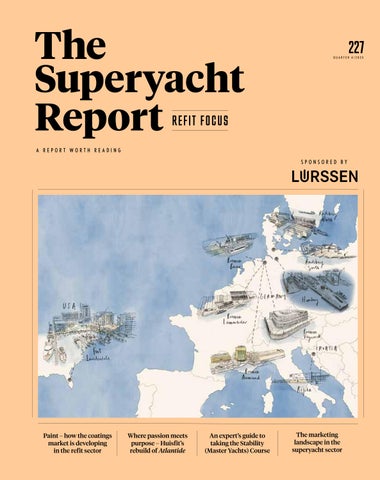
Front cover: Lurssen’s shipyards and business network.
QUARTER 4/2025
For more than 30 years The Superyacht Report has prided itself on being the superyacht market’s most reliable source of data, information, analysis and expert commentary. Our team of analysts, journalists and external contributors remains unrivalled and we firmly believe that we are the only legitimate source of objective and honest reportage. As the industry continues to grow and evolve, we are forthright in our determination to continue being the market’s most profound business-critical source of information.
Editor-In-Chief Martin H. Redmayne martin@thesuperyachtgroup.com
Guest Authors Terry Allen Marine engineering consultant
News Editor Conor Feasey conor@thesuperyachtgroup.com
Simon Brealey Lateral Naval Architects
INTELLIGENCE Senior Research Analyst Amanda Rogers amanda@thesuperyachtgroup.com
Alex Emley Willis Marine Richard Franklin Yacht Survey Partners Sandra Jordaan The Yacht Purser®
Data Analyst Miles Warden miles@thesuperyachtgroup.com
Andy King Naval architect
DESIGN & PRODUCTION
Rory Marshall Newmar Overseas Ltd
Content Manager & Production Editor Felicity Salmon felicity@thesuperyachtgroup.com
4
Lee Stevenson OCCAM Bob Wagemakers Virtue Yacht Projects
ISSN 2046-4983 The Superyacht Report is published by TRP Magazines Ltd (trading as The Superyacht Group) Copyright © TRP Magazines Ltd 2025 All Rights Reserved. The entire contents are protected by copyright Great Britain and by the Universal Copyright convention. Material may be reproduced with prior arrangement and with due acknowledgement to TRP Magazines Ltd. Great care has been taken throughout the magazine to be accurate, but the publisher cannot accept any responsibility for any errors or omissions which may occur.
The Superyacht Report is printed sustainably in the UK on a FSC® certified paper from responsible sources using vegetable-based inks. The printers of The Superyacht Report are a zero to landfill company with FSC® chain of custody and an ISO 14001 certified environmental management system.
ADVERTISING
SuperyachtNews Spanning every sector of the superyacht sphere, our news portal is the industry’s only source of independent, thoroughly researched journalism. Our team of globally respected editors and analysts engage with key decision-makers in every sector to ensure our readers get the most reliable and accurate business-critical news and market analysis. Superyachtnews.com
1999 - 2024
The Superyacht Report The Superyacht Report is published four times a year, providing decision-makers and influencers with the most relevant, insightful and respected journalism and market analysis available in our industry today. Superyachtnews.com/reports/thesuperyachtreport The Superyacht Agency Drawing on the unparalleled depth of knowledge and experience within The Superyacht Group, The Superyacht Agency’s team of brilliant creatives, analysts, event planners, digital experts and marketing consultants combine four cornerstones – Intelligence, Strategy, Creative and Events – to deliver the most effective insights, campaigns and strategies for our clients. www.thesuperyachtagency.com
Follow The Superyacht Group channels on LinkedIn @thesuperyachtgroup Instagram @thesuperyachtgroup @superyachtobserver @superyachtagency
YOUR COATING CONSULTANTS With over 25 years of experience, we have overseen more than 150 successful new-build and refit projects in all major international yacht locations. Trust us for state-of-theart materials, cutting-edge technology and unparalleled expertise. Guarantee a flawless finish with WREDE Consulting.
Join The Superyacht Group Community By investing in and joining our inclusive community, we can work together to transform and improve our industry. Included in our Essential Membership is a subscription to The Superyacht Report, access to SuperyachtIntel and access to high-impact journalism on SuperyachtNews.
YO U R C OAT ING S O LU T IO N IN FO@W R E D E- C O N S U LT ING.C O M +49 4 0 8 81674 5 - 0 W W W.W R E D E- C O N S U LT ING.C O M HAMBURG • BREMEN • LA CIOTAT • BARCELONA • PALMA VIAREGGIO • AMSTERDAM • SOUTHAMPTON • SOUTH FLORIDA
Explore our membership options here: www.superyachtnews.com/shop/p/MH
The Superyacht Report Refit Focus ISSUE 227
Wrede 221.indd 1
5 09:03 22/08/2024
AUSTRALIA’S FULL-CUSTOM NEWBUILD & REFIT SUPERYACHT BUILDER
NEWBUILD | REFIT | PAINTWORK| FABRICATION | ENGINEERING | FITOUT | ELECTRICAL | HVAC
www.echoyachts.com
|
sales@echoyachts.com
32.1545° S, 115.7752° E
|
+61(0)410535005
Report on the future of coatings
TREADING A FINE LINE You might not want to sit and watch paint dry, but as the margin for error diminishes, you will definitely want to keep an eye on how the coatings market is developing in the refit sector ...
P
aint has been one of the more predictable parts of the yachting economy. Given typical coatingsystem degradation and cyclical repainting schedules, the work arrives with a degree of regularity that yards and suppliers accept as part of the territory. It’s that very predictability that has long made paint a dependable contributor to refit and, client-induced headaches aside, it’s caused little future-facing concern thus far. But looking at the fleet’s inflation, tightening environmental regulations that reduce coating effectiveness, rising labour and raw material costs, the notion that there is no cause for concern within this segment of the market is becoming difficult to sustain. We’ve dissected data provided exclusively to The Superyacht Group by Wrede Consulting to map a forecast of where this stalwart corner of the superyacht sector will be in five years based on current data and market conditions. We’ve tracked the fleet from vessels above 30 metres launched in 1990 onwards to help contextualise the scale of the market with the fleet that is most actively in the repainting cycle. Paint volume is
The Superyacht Report Refit Focus ISSUE 227
BY CONOR FEASEY
measured in litres of applied coating among three refit cycles – light (one year), medium (five years) and heavy (10 years). The reference to cost refers only to materials, not labour, which we have measured in hours per litre applied. There is more to the climbing data lines than meets the eye. At first glance, it might appear to be a standard chart of industry growth, but several things can be true simultaneously. The data indicate that stress points are accumulating pressure at a rate that could have serious detrimental effects on the entire refit market. This is not to say that a dramatic impact on the industry is unavoidably imminent, nor to say that shipyards are not already getting ahead of the curve. But this adaptation has to move in the right direction to avoid the former and achieve the latter. In essence, the growth of the market, not just by the number of actual vessels in the fleet but the growth in the 60-metreplus market, is leading to a bottleneck. A greater surface area entering repaint cycles requires more labour hours per litre applied. In absolute terms, this is a markedly different landscape from the
one the industry faced even a decade ago. If we rewind to 2005, the market applied just under 860,000 litres of paint to refit projects each year. That’s around 1,200 Boeing 737s. But in 2015, that figure had risen to 2.4 million litres, an increase of 175 per cent over the decade (3,300 Boeing 737s). By 2025, it stands at 3.8 million litres, up 60 per cent in ten years. That’s a lot of jets and a total increase of 340 per cent over the past 30 years. The next five years will add around another 900,000 litres, so there is no sudden break in trend. But by the end of this decade, the refit market is processing close to 5 million litres of paint annually, a level that fundamentally changes the labour, time and capacity required to deliver what remains ostensibly routine work in an already stressed market. Not to mention this data does not explicitly cater to the projected growth of the fleet by LOA. Although it may be a factor to some degree, it’s not necessarily changes to owner behaviour driving this growth, nor is it due to more frequent repainting across the fleet. The main driver is from the interaction between refit cycles and increasing fleet composition.
7
Source
The Superyacht Intelligence Team
Cost of paint by type of refit, 1990-2030 Euros million
Light
Medium
Heavy
120
100
80
60
40
20
0
1990* 1992
1994
1996
1998 2000 2002 2004 2006 2008 2010
2012
2014
2016
2018 2020 2022 2024 2026 2028 2030
Volume of paint by LOA(m), 1990-2030 Litres million
30-40m
40-60m
60-90m
90m+
5.0 4.5 4.0 3.5 3.0 2.5 2.0 1.5 1.0 0.5 0
1990* 1992
1994
1996
1998 2000 2002 2004 2006 2008 2010
*All calculations are based on yachts built from 1990 onwards, with first paint cycles beginning in 1991.
8
2012
2014
2016
2018 2020 2022 2024 2026 2028 2030
THE COATINGS MARKET REPORT
The market by paint volume Annual maintenance continues to absorb a large share of refit capacity. The pressure builds not from refit cycles but from how paint demand scales with yacht size. As vessels increase in length, the relationship between LOA and paint demand becomes nonlinear. Yachts above 60 metres account for around a quarter of total refit paint volume, but closer to 30 per cent of incremental growth over the forecast period. Their disproportionately larger exterior surface area results in more litres applied per metre, more hours per litre and more time spent on each project. Larger yachts also introduce greater technical sensitivity and scale. Increased surface temperatures on darker hulls, combined with modern fairing materials that are less forgiving, reduce tolerance and increase the likelihood of additional sanding and preparation cycles. Set against that backdrop, the data shows a layered market driven by distinct refit cycles. Light refits, operating on a one-year cycle, form the foundation. In 2019, annual work accounted for just under 1.9 million litres of exterior paint. By 2025, this rises to 2.38 million litres, reflecting steady but persistent growth.
Heavier refits carry a different operational weight. So while five-year repainting accounted for around 440,000 litres in 2019, it rose to roughly 670,000 litres by 2025, and ten-year refits followed a similar trajectory. They increased from just under 580,000 litres to around 725,000 litres over the same period. And notably heavy refits are where the most disruption occurs – when paint outcomes are rejected on these projects, corrective work is rarely incremental and can involve re-scaffolding, re-wrapping and weeks of additional time alongside. By 2030, the refit market is expected to support nearly 3 million litres of annual work, around 730,000 litres of medium refits and just over 1 million litres of tenyear refits, working alongside each other every year. And these operations rarely work in isolation. When paint schedules slip, the effects are felt across engineering, carpentry, rigging and outfitting, magnifying the impact of overlap between refit cycles. This layering of light, medium and heavy concurrently explains why headline growth remains orderly even as operational pressures intensify. Light refits set the baseline, medium refits tighten schedules and heavy refits absorb disproportionate time, labour and capacity.
There are more refit projects in the ecosystem than ever before. And what is changing is how those projects behave once they enter the yard. As the fleet shifts upward, a growing share of refit paint volume and labour is attached to larger yachts.
The Superyacht Report Refit Focus ISSUE 227
The collision of size and cycle Growth continues across all length segments of the fleet, but its consequences are uneven. An increasing share of refit paint volume is tied to yachts in the 60 to 90-metre and 90metre plus categories. In 2019, vessels above 60 metres accounted for around 650,000 litres of exterior refit paint, equivalent to 23 per cent of total volume. By 2030, that figure rises to 1.32 million litres, representing around 30 per cent of the market. This is where the scales could begin to tilt. There are more refit projects in the ecosystem than ever before. And what is changing is how those projects behave once they enter the yard. As the fleet shifts upward, a growing share of refit paint volume and labour is attached to larger yachts. These projects are longer, more complex and less forgiving of interruption. They sit in docks for longer, demand sustained access and absorb skilled labour for extended periods. When several coincide, they pull disproportionately on the same finite resources. These are the reasons why pressure builds even as headline growth remains orderly. Project counts rise with litres of white, blue and (now a lot of) grey paint. But capacity tightens because a rising share of work occupies space for longer and resists compression. Schedules will lose elasticity, and the domino effect will compound for shipyards. Under these conditions, recovery options rapidly diminish. Early condition assessment, realistic and clear agreement on quality criteria, are seen by most refit operators as more effective than attempting to correct issues once work is underway. Four million more hours and counting Labour is where the refit paint market’s long-established sense of predictability really begins to thin. Over the past two decades, demand has grown steadily, but the labour required to meet it has grown faster and with far less flexibility. In 2005, the coatings market absorbed around 3.35 million labour hours across all refit cycles. By 2019, that figure had
9
As refits get larger and run for longer, more capital is tied up by default. By the end of the decade, the refit paint market will not just be busier but also less forgiving when projects slip ...
risen to over 11 million hours. By 2025, total labour demand is projected to be nearly 15 million hours and by 2030, it is projected to reach around 19 million hours. On the surface, paint volume and labour appear to rise in step. Over the period from 2019 to 2030, paint volume increases by just over 60 per cent, broadly in line with labour hours. Operationally, the two are not interchangeable. Labour is slower to expand and harder to substitute than material throughput. Modest increases matter when baseline capacity is already absorbed. That pressure becomes clearer when labour is viewed through the lens of refit cycles. Annual work continues to account for the largest share, but heavy refits are absorbing a growing share of total hours. By 2025, ten-year refits alone require more than 3.3 million labour hours, rising to just under 5 million hours by 2030. These projects remain fewer in number, but their labour demands are sustained, intensive and challenging to reschedule. Length compounds the effect. In 2005, yachts above 60 metres accounted for just over half a million labour hours. By 2019, that figure had risen to 2.57 million hours. By 2030, it will exceed 5.3 million hours annually. That is roughly 605 years of continuous work by one person
10
So what matters is concentration. A growing share of labour demand is tied to larger yachts, longer refits and narrower sequencing windows. By the end of the decade, the refit market will not simply be doing more work but also more labourintensive work. Skilled labour, not paint, is where the refit market’s margin for error continues to narrow. And if labour is where the market tightens operationally, materials are where it becomes more exposed financially. All this, and at what cost? The refit paint market is not just getting more expensive because paint prices are rising. It is becoming more expensive because more paint is being used on larger yachts more often and simultaneously. Between 2019 and 2030, annual spending on exterior refit paint materials rises from €68.2 million to €110.3 million. Those figures assume no inflation and no price changes. Unit costs are held flat at 2025 levels throughout the forecast. The increase comes entirely from volume; more paint is moving through the system. Another way to look at it is pace. On current pricing, the refit market will spend around 25 per cent more on paint materials over the next five years than it did over the previous five. That spending
is not spread evenly either. As we’ve seen, heavier refits and larger yachts account for a growing share of material use. Tenyear repainting absorbs far more paint than it used to, and the fastest growth in material spend is in the 60 metre-plus fleet. It’s the same story: bigger yachts require larger quantities. In practical terms, that means paint stops being a small, easily absorbed line item. Some commentators have even disclosed that they aren’t even making a (notable) profit from the work, but do it to maintain their reputation. Large systems also need to be purchased before the job is complete, often before labour demand peaks. When several long refits run concurrently, more paint is tied up for longer across fewer projects. If a project slips, the paint and capital remain committed. It is important to be clear about what this does and does not show. These figures cover paint materials only. They exclude labour, access, scaffolding, containment and all other costs. They do not attempt to predict inflation or supply disruption. They simply show how much paint the refit market must purchase as the fleet grows and refit cycles overlap, based on today’s prices. Seen this way, materials are not the main constraint on delivery. Labour still determines whether projects can be completed on time, but materials shape the financial exposure underlying the work. As refits get larger and run for longer, more capital is tied up by default. By the end of the decade, the refit paint market will not just be busier but also less forgiving when projects slip. That is the context in which adaptation stops being about capacity alone and becomes a question of planning. Rising volume should not be taken as a proxy for ease of delivery. The refit paint market is doing more work, on larger yachts, over longer cycles, with less room for recovery when outcomes fall short. The data shows no sudden break in trend, but it does point to a system where tolerance is steadily narrowing. Sure, paint remains a dependable contributor to refit, but its ability to absorb disruption is no longer what it once was.
Leading provider of luxury outfitting for yachts, hotels, private aircrafts and homes.
Streamlined Service We offer a complete customer experience with historical purchase information, billing and quotations. Enabling a simple reorder process and removing the need for multiple suppliers. We offer storage service and inventory control assistance.
In-House Design Our interior designers will help you with all aspects of a project. From reviewing the finer details to implementing a major refit. Our graphic designers will assist with branding, logos and supporting artwork.
Industry Experts Backed by 20 years of experience in the yachting industry, we work with the best brands and artisans to ensure that only excellent results are delivered to our clients. We offer free advice and consultancy to make sure our clients take the right decisions.
EXPERTS IN CREATING BEAUTIFUL SPACES
fionasatelier.com
info@fionasatelier.com
(+34) 933 157 941
P
aint is where expectations, regulation and practical reality collide most visibly. The pressures aren’t due to a single change – skilled labour has become harder to secure and more expensive, particularly at the level required for large, high-profile yachts. At the same time, finish expectations have continued to rise, with darker hull colours and “nearnew-build standards” now commonplace, even though refit conditions remain defined by existing substrates, access constraints and fixed schedules. Environmental regulation has added another layer, with a variety of requirements now shaping how paint projects are planned and executed. While generally accepted as manageable, their consequences become painfully apparent when outcomes are rejected: repeated sanding, extensive shrink-wrapping and weeks added to already complex refit timelines. Paint also rarely operates in isolation. Taken together, these factors help explain why paint has become such a sensitive part of the refit equation. And how those pressures translate into day-today delivery is best understood through the captains of industry managing refits in practice. The interviews describe a refit market that has become far less forgiving. Labour availability emerges as the primary constraint and heads of industry consistently point to shortages of skilled painters, supervisors and inspectors as the most notable driver of cost and delay. Of course, environmental regulation is widely accepted as a necessary part of the landscape, but it also carries practical consequences. Naturally, we look to technology, but it cannot compensate for poor preparation or unrealistic expectations. Paint in the refit sector remains a technically mature and well-understood discipline but the margin for error is wafer-thin. More paint moving through established cycles means more labour tied up for longer and more projects whose outcomes are less tolerant of delay, which will have ripple effects across the market. That’s not to say the market can’t and won’t adapt, but it’s the canary in the coal mine indicating it should. CF
12
WHERE DO YOU SEE THE BIGGEST PRESSURE ON PAINT REFIT COSTS TODAY – IS IT LABOUR, MATERIALS, REGULATION OR CLIENT EXPECTATION, OR SOMETHING ELSE? HOW HAS THAT BALANCE SHIFTED IN RECENT YEARS AND HOW DO YOU EXPECT IT TO CHANGE FURTHER?
GIANNI PALADINO COMMERCIAL DIRECTOR LUSBEN The main pressure on paint refit costs today is due to a mix of reasons. On one hand, we see the rising prices of materials, while on the other, the cost of skilled labour has increased even more sharply in recent years and is now the dominant element in the overall project expenditure. Added to this, owners’ expectations have changed
dramatically. It’s increasingly rare for clients to accept standard finishes; most projects now demand a final aesthetic level of excellence that requires more time, greater expertise and highly refined application processes. To meet these expectations, and to ensure durability over time, we often recommend higher-end coating cycles supported by professionally planned preparation procedures and carefully structured workflows designed to guarantee the best possible final result. They not only offer superior protection but, above all, ensure better long-term repairability, which has become an essential requirement in today’s market and inevitably influences the cost balance. Looking ahead, we expect demand for tailored, owner-specific solutions to grow even further. Exclusive colours, custom shades and trademark hues will become increasingly common as owners seek deeper customisation. As this shift accelerates, the industry will likely see prices gradually levelling upward, reducing the wide variations that currently exist and establishing a more consistent market baseline.
INDUSTRY FIGUREHEADS ON THE COATINGS MARKET
STEFAN CORONEL GENERAL MANAGER HUISFIT ROYAL HUISMAN
Photo: BMfotografie
Next to the basis of having skilful craftsmen at work, two things are important to ascertain success. Firstly the agreement set of clear quality criteria and a well organised process of signing off by subject matter experts. To get to the desired result an accurately managed process of preparation, environmental control and obviously craftsmanship is key. It is important to realise that the biggest challenge on costs associated around the paint of refits is in the effects of any issue within the paint scope for other disciplines. Carpenters, engineers, riggers, outfitters – the progress of all the work may suffer serious effects when issues arise in the paint.
KAY WREDE CEO AND CREATIVE HEAD WREDE CONSULTING
REMY MILLOTT CEO GYG LTD Material costs have significantly increased over recent years, with shortages in raw materials and manufacturers obliged to change formulations to meet new environmental regulations, which is of course very positive but is another example of cost increases. Other sustainable decisions, such as avoiding painting works while the yacht is afloat or in marinas, will also have a cost impact in the future, as out-of-water hardstanding slots are more expensive than in-water berthing but are far more secure and efficient as the fleet size increases.
The greatest cost pressure in paint refit projects today clearly comes from “labour”, closely followed by client expectations. While material prices have increased, they remain a smaller portion of total refit costs compared to labour hours. Skilled painters, supervisors and inspectors are increasingly scarce, and wages have risen accordingly. At the same time, owner expectations regarding finish quality, colour consistency and longevity continue to increase – often to new-build standards – while refit realities (existing substrates, time pressure, access limitations) remain unchanged. Compared to five or ten years ago, the balance has shifted decisively from material-driven costs to labour- and quality-driven costs, and this trend will continue.
Material prices remain a smaller portion of total refit costs compared to labour hours.
To get to the desired result an accurately managed process of preparation, environmental control and obviously craftsmanship is key.
The Superyacht Report Refit Focus ISSUE 227
13
TXEMA RUBIO COMMERCIAL DIRECTOR MB92 GROUP Energy costs have risen well above inflation in recent years, and new regulations combined with more sustainable working methods mean that ancillary services are far from negligible. There is also a second layer of associated costs, some optional, depending on whether you choose to be simply compliant or to go further. For example, a VOC filtration system that eliminates 97.5 per cent of emissions can cost three times more than a basic filter. Heating is another case in point: traditional fuel heaters remain far cheaper than using HVO or investing in more complex systems such as geothermal solutions.
Energy costs have risen well above inflation in recent years.
14
ALBERTO PERRONE DA ZARA DIRECTOR SALES YACHT REFIT LÜRSSEN
MANUEL DI TILLIO TECHNICAL & SALES DIRECTOR AMICO & CO I believe that there are two main factors that influence the costs of a painting project: 1. A widespread problem in this industry, as in almost all others, is the availability of skilled labour, especially for specific tasks that require a specific level of quality in an ultra-luxury sector such as ours. 2. The management of interferences that are becoming increasingly necessary to maximise the efficiency of a construction period. Amico manages to remain competitive by combining a number of strategic factors, such as: specialised in-house or highly loyal labour (not only for painting); investing in facilities such as modular warehouses and telescopic covers for basins, pre-fitters with scaffolding and equipment, which minimise the impact of managing the interference generated by multiple processes; entrusting the management of this complex efficiency machine to a large team of project managers and department heads specialised in the various predominant sectors: engineering, paint, teak, and maintaining full control of internal shipyard logistics.
Paint is, without fail, the item that creates the most arguments, because it is the most open to subjective interpretation. We are talking about hundreds and hundreds of square metres of surface on yachts that are 100 metres long. And if you arrive by tender from 100 metres away, you often cannot distinguish whether a yacht is badly painted or perfectly faired. Despite that, the differences that are discussed are worth millions. Paint surveyors and specialists assess orange peel, dust inclusions and image distortion, sometimes using a one-metre-square frame to identify a very small number of particles. At the same time, paint is getting worse and worse and more difficult. Everyone seems to want a grey, dark grey, light grey and blue hull now. These colours are a loaded gun. It is like Russian roulette, except every chamber is loaded. And then when a paint job is rejected, repainting is a massacre. You need to rescaffold, reshrinkwrap and redock. A 100-metre yacht requires around 44,000 square metres of shrinkwrap. Reshooting a side can add eight to ten weeks.
THE LEADING REFIT & REPAIR NETWORK IN THE MEDITERRANEAN
SAVONA MARSEILLE
RIJEKA ANCONA
MONACO
NAPOLI
MESSINA
DISCOVER MORE
MALTA
MAINTENANCE
>600 YACHTS REFITTED IN THE LAST 5 YEARS CREW CARE
REFIT
CONVERSION
YACHT CHANDLER & SHOWROOM PALUMBO CHANDLERY E-COMMERCE
UPGRADE
CONTACTS
+33 (0) 6 70 44 40 04 info@palumbosy.com
HOW ARE NEW ENVIRONMENTAL REGULATIONS AND SUSTAINABILITY GOALS CHANGING THE WAY PAINT PROJECTS ARE PLANNED, COSTED AND DELIVERED?
KAY WREDE CEO AND CREATIVE HEAD WREDE CONSULTING Environmental regulations are fundamentally changing how paint refits are planned, specified and executed. VOC limits, waste handling, blasting restrictions and local environmental rules increasingly influence product selection, application methods and yard choice. This leads to: • More complex specifications • Higher preparation and containment costs • Longer planning phases and tighter process control. Sustainability is no longer just a ‘nice to have’; it is becoming a cost and risk factor that must be actively managed early in the project.
16
Photo: BMfotografie
STEFAN CORONEL GENERAL MANAGER HUISFIT ROYAL HUISMAN
Not a hurdle for the industry. It sometimes takes adaptation to deal with new regulations or changing products due to the development of more sustainable materials. We believe this to be manageable and not a hurdle for the industry.
REMY MILLOTT CEO GYG LTD There are already technical solutions in place to meet potential future regulations, but they definitely have an impact on the final price of a paint refit. On the other hand, new innovations and technologies in paint-application systems will improve efficiencies and deliver higher quality performance, which will have a positive impact on reducing refit timeframes and the ancillary costs of a project.
INDUSTRY FIGUREHEADS ON THE COATINGS MARKET
MANUEL DI TILLIO TECHNICAL & SALES DIRECTOR AMICO & CO
We always aim to execute paint projects within dedicated, permanent, covered paint hangars. They have not really changed things a lot for us, as we have already been working with appropriate procedures and systems for some time. In the field of yacht-coating products, we have yet to see a real change in products dictated by sustainability requirements, whereas in other sectors, such as the automotive industry, this has already been experienced. In terms of facilities, at Amico & Co we always aim to execute paint projects within dedicated, permanent, covered paint hangars; these facilities are already equipped with overspray extraction, heating, lighting and humidity control systems, allowing for a defined project duration, unaffected by extreme weather, but above all the ideal environment for an optimal project execution, while at the same time reducing project gas consumption costs by around 70 per cent with respect to temporary solutions.
The Superyacht Report Refit Focus ISSUE 227
ALBERTO PERRONE DA ZARA DIRECTOR SALES YACHT REFIT LÜRSSEN Environmental regulations have completely changed paint and fairing. The intention is right, but many of the components that made fairing effective in the past are no longer allowed. It might be bad to say, but those poisonous components were exactly what made it work. And as a result, the fairing today is far less forgiving. You need multiple sanding cycles, grain changes and extensive preparation. It is no surprise that fairing cracks more, especially on dark hulls that get extremely hot in the sun. You can make scrambled eggs on a dark hull. That heat then has consequences for insulation, interior temperatures and air-conditioning loads. On one side we do everything we can to reduce UV through glass. On the other side, we paint hulls pitch black. At the same time, we talk a lot about being environmentally responsible, but the reality of repainting tells a different story. A repaint can involve enormous amounts of shrinkwrap, repeated sanding and reapplication, all for issues that are often only visible when you are very close or inside a shed. On one side, we say we are trying to do the right thing environmentally with the chemicals in paint. On the other hand, we accept corrective actions that have a significant environmental footprint.
GIANNI PALADINO COMMERCIAL DIRECTOR LUSBEN Environmental regulations and sustainability objectives are reshaping the paint refit landscape in a profound way. On the product side, they have already led to the phasing out of certain materials and to a broader adoption of eco-friendly alternatives. On the process side, they demand far more controlled, precise and virtuous application cycles. These changes pose challenges, both technical and organisational, but we see them as a positive force. They push the entire industry towards more responsible and efficient ways of working, encouraging long-term thinking and elevating the standard of environmental stewardship across the sector. Ultimately, this shift is driving innovation rather than limiting it.
The changes have already led to the phasing out of certain materials and to a broader adoption of eco-friendly alternatives.
17
AS THE GLOBAL FLEET GROWS IN BOTH NUMBERS AND SIZE, DO YOU THINK THE INDUSTRY HAS SUFFICIENT SKILLED CAPACITY AND INFRASTRUCTURE TO MEET REFIT DEMAND OR ARE WE ALREADY APPROACHING A BOTTLENECK? GIANNI PALADINO COMMERCIAL DIRECTOR LUSBEN
REMY MILLOTT CEO GYG LTD With the current growth in the superyacht industry, skilled labour resources are stretched, resulting in much higher labour costs. Addressing this is going to be crucial for future growth.
TXEMA RUBIO COMMERCIAL DIRECTOR MB92 GROUP MB92 is in the process of launching a new training academy that will focus on developing skill sets across the refit sector. The pressure on skilled capacity is currently a limiting factor, but deseasonalising might help relieve these constraints.
18
We are not at a true bottleneck yet, but the need for expanded infrastructure and workforce capacity is increasingly clear. If the industry does not grow in a balanced way, it risks being unable to respond promptly to rising demand. What matters, however, is not just quantity. Crucially, every facility must be equipped to deliver the exceptional level of quality required by contemporary refit projects. At Lusben, we have significantly expanded our capabilities at the Livorno site, following substantial investments in infrastructure and available space. This allows us to meet current refit demand with confidence. That said, we are fully aware that the market is evolving quickly, and we are prepared to continue strengthening our capacity in the near future.
Skilled labour resources are stretched, resulting in much higher labour costs.
INDUSTRY FIGUREHEADS ON THE COATINGS MARKET
KAY WREDE CEO AND CREATIVE HEAD WREDE CONSULTING In short: no. The global fleet is growing in both number and size, but the pool of highly skilled painters and coating specialists is not growing at the same pace. In key refit hubs, we already see capacity bottlenecks during peak seasons. This shortage affects not only execution but also supervision, quality control and realistic scheduling. Without targeted training programmes and long-term workforce development, this bottleneck will intensify.
MANUEL DI TILLIO TECHNICAL & SALES DIRECTOR AMICO & CO Not only are vessel numbers increasing: the fleet is aging and – in particular since Covid - being used more and more by owners who are not only embracing the lifestyle that yachting can offer but also spending more and more of their daily lives on board, living and working on the vessel. While the availability of infrastructure is constantly being renewed – in some areas at breakneck speed – any possible bottleneck to the refit industry meeting the client demand lies with the availability of skilled human resources to manage refit projects. By this we intend both refit shipyard projectmanagement resources and skilled technicians, as well as the corresponding OEM technicians and service networks necessary, to assist vessels with their maintenance and repair requirements. Amico & Co is working hard to create a more reactive technical network, in order to work more efficiently with the equipment manufacturers and to be able to dovetail their highly specialised workforces with our refit specialised in-house technicians, reducing the pressure on their afte- sales teams. However, in order to be able to navigate this period, in which vast numbers of the current operational fleet meet their special survey class requirements, clients should be advised that efficient forward planning is necessary, in particular in order to be able meet their project timeline goals and maximise the period in which they can enjoy their asset.
The Superyacht Report Refit Focus ISSUE 227
Without targeted training programmes and long-term workforce development, this bottleneck will intensify.
19
WHAT ROLE WILL TECHNOLOGY PLAY IN IMPROVING EFFICIENCY? ARE WE ALREADY SEEING A MEASURABLE IMPACT IN REAL PROJECT OUTCOMES?
Photo: BMfotografie
GIANNI PALADINO COMMERCIAL DIRECTOR LUSBEN
STEFAN CORONEL GENERAL MANAGER HUISFIT ROYAL HUISMAN Technology will often have a purpose in increasing efficiency. For example, advanced climate control and extraction systems help create optimal working conditions, ensuring that all disciplines can carry out their tasks without disruption. These technologies contribute to a comfortable, safe and efficient environment, allowing work processes to run smoothly and productivity to remain consistently high.
20
Technology is already a central driver of efficiency, and Artificial Intelligence is currently at the heart of this transformation. AI is streamlining the way we prepare quotations, plan activities and manage projects, and in these areas the impact on efficiency is measurable today. On the operational side, technology is improving how work is carried out on the ground. Faster and more capable transport equipment, innovative scaffolding systems, upgraded quay services and digital solutions for monitoring energy consumption are all contributing to smoother, more precise operations. A concrete example is the centralised water-treatment system we recently implemented in Livorno, part of a broader effort to bring cutting-edge infrastructure into the refit environment.
AI is streamlining the way we prepare quotations, plan activities and manage projects, and in these areas the impact on efficiency is measurable today.
INDUSTRY FIGUREHEADS ON THE COATINGS MARKET
KAY WREDE CEO AND CREATIVE HEAD WREDE CONSULTING
ALBERTO PERRONE DA ZARA DIRECTOR SALES YACHT REFIT LÜRSSEN Technology only works when common sense is behind it. We are increasingly moving toward clear coating, similar to what is common in the automotive industry. The chemical components are the same as paint, but without pigment. Clear coating allows polishing, which is something you cannot do with traditional paint. Once you polish the paint, its life is finished. At the same time, clear coating introduces new challenges. It creates a lens effect. If there is an imperfection underneath, you actually see it more. We see the same problem onboard. Systems become so complicated that owners need to call someone to their cabin just to start a movie. Complexity for its own sake does not improve what it means to let down your hair and be on a yacht.
MANUEL DI TILLIO TECHNICAL & SALES DIRECTOR AMICO & CO Technology has historically always improved efficiency and will keep doing so; from a technical point of view, this process is obvious. One important new challenge for the human being part of the efficiency will be the relationship with Artificial Intelligence; AI combined with software is the route for an efficient planned and managed future refit approach.
The Superyacht Report Refit Focus ISSUE 227
Technology will play a supporting but not replacing role. We already see measurable benefits from: • Digital inspection and reporting tools • 3D scanning and surface analysis • Improved spray equipment and process monitoring. However, technology cannot compensate for insufficient preparation or lack of craftsmanship. The biggest gains come when technology is combined with experienced personnel and clear quality standards.
The biggest gains come when technology is combined with experienced personnel and clear quality standards.
21
LOOKING AHEAD, WHAT DO YOU SEE AS THE NEXT MAJOR CHALLENGE OR TURNING POINT FOR PAINT AND FOR THE WIDER REFIT MARKET? WHAT CAN BE DONE, OR IS ALREADY BEING DONE, TO ADDRESS IT? STEFAN CORONEL GENERAL MANAGER HUISFIT ROYAL HUISMAN Photo: BMfotografie
MANUEL DI TILLIO TECHNICAL & SALES DIRECTOR AMICO & CO
TXEMA RUBIO COMMERCIAL DIRECTOR MB92 GROUP Regarding paint, in our opinion, the next challenge will be adapting to the use of more sustainable coating products while maintaining high quality standards. At the same time, the superyacht market is increasingly demanding treatments that offer greater durability and flexibility in terms of maintenance, while maintaining the same quality standards.
22
Being able to forecast higher demand by signing contracts well in advance would improve project planning, allow better utilisation of labour and enable shipyards to reduce refit timeframes. This would have a major positive impact on project performance, budgeting and overall refit costs.
I believe that traditional yacht paints are more or less fully developed, and we should start looking for new alternatives. A good example of this is the base coat/ clear coat system. These high-solid products still offer plenty of room for innovation and have the added advantage of providing more easily repairable top layers in case of damage. For interiors, I would mainly consider water-based products, which have been widely used in residential construction for many years, but in which the yacht-building industry is still lagging behind.
INDUSTRY FIGUREHEADS ON THE COATINGS MARKET
GIANNI PALADINO COMMERCIAL DIRECTOR LUSBEN
ALBERTO PERRONE DA ZARA DIRECTOR SALES YACHT REFIT LÜRSSEN
Refit is becoming more organised, more structured and more aligned with new build. In the paint sector, the next real turning point will come from technological innovation. New products and application methods are already being tested, and we expect them to redefine how high-level finishes are achieved in the future. For the refit market as a whole, the transformation is even broader. The sector is rapidly moving away from the traditional “workshop” mentality and evolving into a fully structured industrial ecosystem. Every year, it gets closer to the standards and operating models of new construction. We see this in the growing professionalisation of owners’ representatives, the increasing use of formal assessment protocols and the general trend towards standardised, repeatable processes. Refit is becoming more organised, more structured and more aligned with new build, and this evolution is raising quality standards across the entire industry. It’s an important shift that will shape the future of refit for many years to come.
The Superyacht Report Refit Focus ISSUE 227
At some point, we need to look each other in the eye and be honest about the level of perfection we expect for objects as large as an Airbus. We are overcomplicating paint jobs, especially in medium and low-visibility areas. These are areas that will never be seen again unless the yacht is in a shed and someone is walking around with a magnifying glass, counting dust inclusions. The corrective actions that follow are completely disproportionate. Repainting a yacht of this size means weeks of additional time and enormous amounts of shrink wrap. Very often owners are not spoken to in a direct way. Many of today’s owners are new to yachting. But they are rational people. They would accept practical solutions if the conversation were more honest. Instead, there is a whole economy that revolves around this level of perfection and many people live well from it, which makes it very difficult to challenge.
KAY WREDE CEO AND CREATIVE HEAD WREDE CONSULTING The next major challenge will be aligning new-build level expectations with refit realities – technically, economically and environmentally. This requires more transparency, better early-stage condition assessments and realistic budgeting based on the actual substrate condition, not assumptions. Industry-wide standards, clearer specifications and better education of owners and managers will be key to avoiding disputes, delays and cost overruns. Paint refit projects succeed or fail long before the first spray gun is used. Early diagnostics, realistic scopes and experienced supervision are far more effective cost-control tools than trying to save money on materials or labour rates.
Refit is not ‘new build light’ – it is a discipline of its own.
23
Guest Column by Rory Marshall
A refit paint job is not a paint job Rory Marshall, owner and director at Newmar Overseas Ltd, spells out why setting priorities early is the only path to a quality result. In the superyacht world, people often speak about “a paint job” as if refit and new-build coatings were the same thing. They aren’t. A refit paint cycle is its own discipline: faster, more constrained, shaped by past repairs and constantly pressured by the vessel’s schedule and annual programme. Captains and yacht managers who treat a refit as if it behaves like a new build quickly find themselves battling delays, unexpected substrate issues and rising costs. But there is a way to control it. In fact, there is only one decision that consistently leads to successful outcomes: Define the priority early: time, quality or cost. Pick two and accept the consequences of the third. Build the refit around that choice. Every refit lives inside that triangle, whether acknowledged or not. Making that decision at the very beginning is the single biggest factor in achieving the result the vessel requires. Before we get there, it’s important to understand why refit paint work behaves differently. Refits begin with a past, not a blank surface A new build begins with clean steel, aluminium or composite. A refit begins with history.
24
Under the existing paint we routinely find: • Legacy repairs, some excellent, some questionable • Aged filler and fairness shrinkage • UV fatigue and micro-cracking • Contamination from years of crew maintenance • Fairness deviations hidden beneath old coatings. Your priority choice determines how much of this legacy is corrected and how much is carried forward. Refits run on the vessel’s calendar, not the yard’s New builds follow the yard’s production rhythm while refits follow the vessel’s operational plan. That means:
• Fixed departure dates, seasonal repositioning and charter windows • Access limitations because multiple trades need the boat • Environmental conditions that are harder to control • Scaffolding and wrapping removed earlier than ideal. • Extremely limited tolerance for overruns as the next programme date approaches These aren’t problems, they are the realities of maintaining an active yacht. The triangle determines how you navigate them. Responsibility is shared, not centralised In a new build, the yard owns the entire chain: facilities, sequencing and conditions.
From my experience, the most important early discussion is: “Which two matter most: time, quality or cost?” Avoiding the question guarantees friction. Answering it creates alignment.
In a refit: • The yard provides the platform • Subcontractors execute the application • The captain and yacht manager manage the schedule • The vessel’s itinerary defines the timeline • The environment influences the result more than anyone likes.
• Higher labour and overtime • Night shifts and weekend work • Enhanced tenting and environmental control • Rapid decision-making by the captain and yacht manager • Increased cost if hidden defects appear • Painters receiving priority over other trades
Only when the priorities are declared does this structure operate smoothly.
This delivers exceptional results to a fixed schedule, but it is the most expensive direction.
Why the time–quality–cost triangle must lead the project From my experience, the most important early discussion is: “Which two matter most: time, quality or cost?” Avoiding the question guarantees friction. Answering it creates alignment. Here are the four realistic paths. THE FOUR PATHS 1. Time + cost prioritised: “Fast and economical” Used when the yacht must return to service quickly without a large spend. What must be accepted: • Fairness will not be rebuilt • Older print-through may reappear • Gloss and texture will be good, not perfect • Colour matching is practical, not ultra-precise • Limited rework because time windows are small • Shorter long-term durability than a quality-first cycle This approach suits tight programmes or upcoming charters. 2. Time + quality prioritised: “High finish under pressure” The deadline is fixed and the finish must be refined. Achieving this requires manpower and control. Expect:
The Superyacht Report Refit Focus ISSUE 227
3. Quality + cost prioritised: “Best result, sensible budget” Aims for the highest-quality finish without spiralling cost. The compromise is time. This requires: • A longer refit window • Full curing times for fillers and primers • Deeper substrate correction and fairness work • Waiting for clean spray conditions instead of forcing them • Slower but more controlled sequencing This option offers the most stable, long-lasting result at a reasonable cost. The price is patience.
• Environmental controls adequate, not exceptional • Minor defects corrected only when they impact presentation This creates a reliable, predictable result that matches the practical realities of active yachts. The priority decision unlocks everything Once the preferred path is chosen, the entire refit becomes manageable: • Substrate work is scoped realistically • Schedules stop being optimistic guesses • Environmental controls are scaled correctly • Budgets track with expectation • The yard knows which standard to aim for • The captain and yacht manager know what the vessel can expect From my experience, this early clarity transforms the project. Most refit frustration comes from pretending all three sides of the triangle can be maximised simultaneously. They can’t – but they can be balanced intelligently once the priority is named.
4. The balanced compromise: “Acceptable time, acceptable cost, acceptable finish” The middle path where no single element dominates and each is moderated.
Conclusion: refits succeed when priorities are honest A refit paint job is not just “a paint job”. It is a negotiation between legacy substrate, real-world conditions and the vessel’s operational calendar. Technical skill matters, environmental control matters – but priority clarity matters most.
What this really means: • A timeline that fits the vessel’s wider programme in a steady, realistic way • A finish that is good, consistent and clean, but not perfectionist • Costs controlled, but with room for limited rework • Fairness improved, but not rebuilt to new-build standards
Choose the two that matter most or choose the balanced compromise and accept the trade-offs. Then build the refit around that decision. Get this right and the refit becomes predictable, efficient and structurally sound. Get it wrong and the project becomes reactive, rushed and frustrating. Refit paint success isn’t about perfection. It’s about alignment. RM
25
Embedding sustainability into refit
THE SUPERYACH UPGRADING
26
HT LIFECYCLE – G THE FLEET
The Superyacht Report Refit Focus ISSUE 227
27
Spelling out the true refit proposition – an opportunity to invest beyond cosmetic personalisation ... how upgrading yacht systems can reduce operating costs as well as meet regulatory requirements before they are enforced.
BY MARTIN H. REDMAYNE
The word “lifecycle’ has become very well used in the past few years as part of the superyacht refit language but has not quite become embedded into the sector in the way it is commonly used in aviation or shipping. I sat in on a workshop during the recent Superyacht Forum and a panel of yards, naval architects and engine manufacturers were discussing the art of sustainable refits and what the true potential looks like. It seems that in all of these conversations there are two common themes: one, it costs too much and two, there is no real driver for change. Therefore, I wanted to distil some of the conversations and share some of my thoughts as an advocate of sustainability and a founding board member of the Water Revolution Foundation. On analysis of the facts and figures, it’s clear that no one is forcing an owner to upgrade their yacht and reduce their impact, but the refit proposition is not completely clear and, in my humble opinion, is not being sold well enough. However, as we have said many times within The Superyacht Report, the technology is there, the understanding is there and the opportunity is there. Any broker that sells an existing yacht to a client should very simply explain the true benefit of a systematic upgrade that reduces energy consumption and increases efficiency. More importantly,
28
there are many engineers, naval architects and shipyards willing and able to help craft the sales pitch, with tangible figures and operational savings. If we take any yacht that has been built in the last 15 years, the list of energy optimisation solutions is considerable, and no matter what the second-hand price is, there is a real opportunity to present the lifecycle model to any buyer that shows the level of investment and the reduction in waste, energy and costs. The latter is perhaps the most important factor, as owners and their advisors are rarely incentivised to focus on sustainability, apart from image and reputation, but if there is a clear lifecycle plan over, say, ten years, that shows five stages of technical upgrades every two years, the investment becomes more palatable.
Over the next ten years, we can comfortably predict that the refit market is going to grow considerably and demand for yard slots will increase; therefore, there is even more reason to plan ahead and create a lifecycle approach to not only routine refit works, but also the topic of sustainability upgrades. Consider the fact that logical projects like lighting, glass and HVAC system upgrades can have a significant improvement on the yacht’s energy consumption, and even heat recovery can be optimised for a whole host of uses on board. Yet when refits are discussed with the owner, they tend to be more of a cosmetic nature relating to personal preferences, or fundamental repairs and improvements due to wear and tear of key systems. A significant topic has been raised in a myriad of forums and meetings
There is a real opportunity to present the lifecycle model to any buyer that shows the level of investment and the reduction in waste, energy and costs.
I’ve attended recently which relates to “owner education”; how we solve this challenge is a current conundrum. Owners are typically highly educated people and clearly not afraid of investing in opportunities and strategies that increase their wealth. However, it seems that when buying a yacht, their decision is focused on their needs when on board, and due to limited time afloat, perhaps they feel their impact of 10 weeks’ cruising per annum is negligible. If those people who have a direct influence on their owners’ decisions could spend a bit more time sharing the facts and figures of what really makes sense and how they can upgrade their yacht to actually reduce operating costs, there may be a momentum shift when it comes to lifecycle planning and sustainable upgrades. Over the next decade, it’s fair to say that regulations will appear that will impact our fleet, and yachts will have to adapt and upgrade to meet these potential requirements. So how can we be proactive and create a more intelligent approach to refit and lifecycle management to start educating the owners that it really does make sense to start now? It’s almost inevitable that energy ratings, pollution levels, waste management and fuel use and consumption will become a key list of regulatory requirements; therefore, the idea of converting and optimising should become high on the agenda. Rather than wait for and react to regulation as we have done in the past, the time has come to guide our clients on a safe and logical path. The alternative is facing the fallout when owners say, let’s sell the yacht rather than invest when the rules are imposed. I’m not saying it’s going to be easy, but having listened to the many experts in the market who understand the gains achievable if you upgrade the thermal properties of your glass or optimise your HVAC system or look at how to reuse all
The Superyacht Report Refit Focus ISSUE 227
The list of opportunities to improve, optimise and reduce waste and consumption is wide ranging, all of which will reduce operating costs and environmental impact – with some estimates of 50 per cent energy reduction over a long period of rebuilding and improving the yacht’s technical systems.
of the waste energy and heat on board, it’s all about making a lifecycle plan. It would be wonderful to think that we can advise our owners to seriously consider the idea of planning well ahead when it comes to refits, telling the captain, OK you have three six-month windows over the next 10 years to apply all of the upgrades required, to improve our performance and reduce our impact. Many will say, the owners may not keep their yachts for the next ten years, but imagine the benefits for all concerned if some of them did apply this thinking. Yards could plan well in advance, subcontractors could secure long-term arrangements with the same yard for the same yacht and the crew could plan their lives too, not to mention that a longterm contract with a shipyard is likely to offer significant financial benefits when negotiating. In summary, the word “lifecycle” has been used more and more in the various narratives and messaging from the refit sector, but it seems to me that the yachts themselves have not yet embraced the topic fully. The list of opportunities to improve, optimise and reduce waste and consumption is wide ranging, all of which will reduce operating costs and environmental impact – with some estimates of 50 per cent energy reduction over a long period of rebuilding and improving the yacht’s technical systems. The opportunity today is to explain to our owners and their money men that investing now and over a sustained period of time in clean energy and efficiency will pay dividends. Plus, there is every chance that your yacht will become more attractive in the future to potential buyers who can see the financial and operational benefits. Just think of the bragging rights over dinner as to how much energy you’re saving and the grandchildren’s recognition that their grandparents’ yacht is optimised for their future. MHR
29
Make Your Mark is back! 19 - 20 March 2026 Make Your Mark 2026 is the Superyacht Marketing, Advertising and Digital Strategy Summit. Two focused days where the best ideas from the wider marketing world meet hard data from the superyacht market. makeyourmark26.com
Hosted By:
Book Your Seat:
The future of refit
Raising refit standards A summary of the Refit Advisory Group’s meeting held during the 2025 Monaco Yacht Show.
BY NORINA EDELMAN AND MARTIN H. REDMAYNE
T
he Refit Advisory Group (RAG)’s 2025 session brought together more than 20 professionals including yacht managers, owners’ representatives, lawyers, insurance experts, captains and technical supervisors. The discussion – moderated jointly by IMM and The Superyacht Group – was both candid and constructive, revealing key systemic challenges within the refit sector and identifying tangible priorities for industry-wide action. Core issues identified The 2025 discussion confirmed and expanded upon themes from the initial RAG interviews and survey work undertaken in 2024. The consensus was clear: despite growing investment in refit capacity globally, the industry continues to face significant gaps in education, qualification, planning and coordination. Owner education and expectation management A recurring theme was the lack of education for yacht owners and their advisors –particularly brokers and emerging family office professionals – regarding the realities of refit complexity, cost and timelines. Some of this may be due to lack of knowledge, as with family offices; some may be more willing blindness. But whatever the cause, it’s one factor that contributes to dissatisfaction in the refit area. There is a misalignment of owner expectation with reality as well as a lack of appreciation as to the investment required, what the return on that investment could be and the consequences of underinvesting in the refit process.
The Superyacht Report Refit Focus ISSUE 227
“Brokers sell yachts as assets without explaining the lifecycle costs. By the time an owner learns what maintenance and refit really entail, it’s often too late to plan properly.” And although many vessels have management companies involved, there is a standard management contract that may not clearly identify that refit-specific management is not included in the contract scope. Owners may, in fact, think that they are paying for something that is, in fact, not included in the scope of services. RAG participants pointed out that there is a “race to the bottom” phenomenon whereby no company has an incentive to point out this exclusion to all be competing on the same level field – even if the level is the wrong one! Participants noted the need for clear communication of total cost of ownership (TCO), integrating capital expenditure (CAPEX), operational expenditure (OPEX) and long-term maintenance planning into ownership advisory services. Furthermore, providing white papers to educate owners by an independent body both as to refit requirements and as to management contracts would be effective in closing the expectation gap. These changes would help reduce disputes and support more sustainable, data-driven decisions. Qualification standards for project managers and owners’ representatives Perhaps the most emphatic concern was the absence of recognised professional standards for project managers and owners’ representatives in the industry overall, and specifically in the refit sector. “Right now, anyone with a business card can call
31
themselves a surveyor or a project manager. That would never happen in commercial shipping.” The group highlighted the contrast with commercial shipping, where structured qualification pathways exist – through chief engineer progression, naval architecture degrees or established certi0fication systems. RAG members expressed strong support for exploring or endorsing a standardised certification pathway for yacht refit project management, potentially aligning with class societies or academic distance learning providers. Refit planning and budgeting, and total cost of ownership Participants unanimously agreed that early-stage planning is the most critical – and most neglected – phase of a refit project. The current market tendency toward “last-minute” planning results in misaligned expectations, under-scoped budgets and schedule overruns. Recommendations included: • Formalising a six-month advance specification phase for major refits. • Creating white papers outlining best practices for pre-refit planning and budgeting. Encouraging managers and brokers to adopt a lifecyclemanagement mindset rather than transactional sales behaviour. Insurance, contracts and risk mitigation Contractual and insurance-related issues continue to derail refit projects before they even begin. Disputes over policy coverage, unclear risk allocation and a lack of vetted, balanced refit contracts were all cited as recurring problems. “It’s not uncommon for an owner to change shipyards before work starts, simply because contract terms can’t be agreed upon. That’s a failure of communication, not capability.” RAG participants supported the development of standard contract templates and explanatory guides, legal and insurance best practice papers as well as creating working groups with key stakeholders to try to close the gap on legal and insurance disconnects. Workforce shortages and training gaps The global shortage of skilled professionals – from welders and engineers to project managers – was described as one of the most urgent structural challenges facing the industry. “Shipyards are expanding, but they can’t find enough qualified people to fill the new roles.”
32
The Refit Advisory Group (RAG) was established in 2024 by International Marine Management (IMM) with the goal of improving yacht refit for the ultimate end-user. Originally conceived as part of IMM’s development of its new refit facility in San Juan, Puerto Rico, the initiative quickly evolved into a think tank comprising industry insiders with a stake in improving the refit offer. In 2025, Martin Redmayne and The Superyacht Group were invited to partner in the initiative to assist with achieving the RAG’s goal. RAG is an independent, not-for-profit initiative dedicated to improving standards, fostering collaboration and creating open dialogue between all parties involved in refit, from owners’ representatives and shipyards to technical managers, contractors and captains. During its initial stage of development, RAG membership is open by invitation to active professionals directly engaged in the refit process, focusing on the end user. This ensures that the group remains productive and representative of diverse operational perspectives. The RAG’s mission is simple yet ambitious: to enhance the refit experience by driving professional standards, encouraging stakeholder collaboration and implementing practical, measurable improvements. Its founding principles are rooted in: 1. Ongoing improvement is essential 2. Participation of stakeholders must guide that improvement 3. Intelligence and insight will be shared 4. Concrete actions and solutions must be proposed 5. Aspire to global continuity of the highest quality service that responds to owners' wishes and needs. As the refit sector continues to grow, with more vessels, rising owner expectations and increasing technical complexity, the need to improve the offer and organise is paramount.
While initiatives such as the ISS Talent Pledge were acknowledged, participants called for stronger links between education providers, shipyards and management companies to establish coherent pathways for technical and managerial training. There was also consensus that the RAG could play a role in curriculum development and in promoting mentorship and apprenticeship models across the refit sector. Immediate next steps Following the Monaco session, the RAG will take several concrete steps to sustain momentum: • Establish a private RAG LinkedIn community to encourage ongoing dialogue and resource sharing. To be found here – RAG LinkedIn • Form specialised working groups focused on core issues such as contracts, training and qualification standards. • Next meetings: We will host four meetings every year, two digital and two in-person (PBIBS 2026 and METS 2026 to be confirmed). • Develop a collaborative workspace for drafting white papers and best-practice guides. Long-term objectives To ensure measurable impact, the RAG aims to: • Publish a white paper on key subjects and ideas/ solutions before 31 December, 2026. • Contribute to or endorse a refit project management certification framework. • Facilitate dialogue between shipyards and ownerside professionals to harmonise standards.
The Superyacht Report Refit Focus ISSUE 227
• Develop educational materials and seminars to support owner and broker understanding of lifecycle management. • Promote talent development initiatives addressing skill shortages across the sector. Conclusion The 2025 RAG session reaffirmed the collective will of the industry to address deep-rooted issues in refit operations through cooperation. As one captain aptly concluded: “If we don’t professionalise this sector, someone else will do it for us and probably not in the way we want.” The RAG is therefore not a trade association but a neutral, not-for-profit collaboration that exists to serve the greater good of the refit community. Its purpose is to raise standards, build trust and deliver practical tools and frameworks that make yacht refit more efficient, transparent and rewarding for all stakeholders. Looking ahead, RAG’s next phase will focus on turning discussion into action publishing educational materials, creating standardised processes and facilitating long-term cooperation between shipyards, owner-side professionals and industry educators. The future of refit depends on collective organisation, data-driven improvement and shared accountability principles that RAG is proud to champion from its foundation. NE & MHR
33
Guest Column by Richard Franklin
Surveying – the facts and nothing but the facts Richard Franklin, managing partner of Yacht Survey Partners, outlines the lessons learned from managing major insurance claim repairs in a shipyard. If an owner is very unlucky, his yacht may sustain damage that requires time in a shipyard to undertake repairs. The purpose of this article is to explain what can be expected by the owner’s team, and how they, the shipyard and the surveyor can work together to deliver a successful outcome. The surveyor’s role Your insurers will usually appoint a surveyor to assist them with the claim. The surveyor’s role includes providing technical support to the underwriter to assist them in assessing the claim, advising on them on the correct scope of repair, reviewing shipyard repair proposals, advising on the fair and reasonable cost of repairs, maintaining an overview of repairs as they progress, reviewing final accounts and supporting underwriters in their adjustment of the claim.
34
Assessing damage and agreeing the scope of repairs Although it may be possible to assess simple claims remotely, there’s a lot of value in the surveyor assessing the damage first hand. This helps to ensure that there is a detailed scope of repair that can be shared with the shipyards, which is an important step towards obtaining quotes which are readily comparable. Quotes and shipyard selection Although the boat may have a preferred shipyard, this can’t override the need to ensure that repairs are carried out cost effectively. For this reason, most insurers will usually want to see three quotes, in order to be reassured that the costs quoted are reasonable. The surveyor will compare the quotes against the agreed of scope of work to ensure that they are
comprehensive but also that works quoted are only those that are strictly required. The surveyor will also review items quoted as time and materials or unit rate and will provide an estimate of these costs, in order to provide underwriters with an accurate picture of likely final costs. While owners have the final say in where the boat goes for repairs, if their choice appears to be more expensive than the other options, it may be that owners have to accept that they bear the additional cost of using their preferred shipyard. Issues to consider from the owner’s side It may be tempting for the owner’s team to think that an insurance claim requiring an extended stay in the shipyard is a great way to get the
A good surveyor will keep on digging until they have the correct answer, so in the interests of time (and sanity) clear reporting makes everyone’s life easier and enables the claim to get agreed and settled faster. costs of a pre-planned shipyard period covered by insurance. Alas, it doesn’t work this way! If there are owner’s works as well as insurance-claimrelated works, owners should generally expect to share shipyard costs during the period in which insurance repairs and owner’s works overlap. They can also generally expect to share one-off shipyard costs such as hauling and launching. If the pre-existing condition of the boat or its equipment or its finish was poor, owners should be realistic about what they can expect from underwriters, remembering that the insurer’s obligation is to pay the fair and reasonable cost of returning the boat to pre-incident condition, bearing in mind that betterment is not admissible. When it comes to invoicing, it may be tempting for owners to ask the shipyard to provide separate invoices for owner’s works and insurance claim works, perhaps allocating shared costs in a way which would be favourable to the owner. Doing so can cause delays, as the surveyor won’t be able to start reviewing final invoices until they have full accounts for the shipyard period. We get push-back on this request
The Superyacht Report Refit Focus ISSUE 227
sometimes, often on the spurious basis of confidentiality. Believe us when we say that we’re not interested in the details of owner’s works; we just need to make an objective assessment of what are genuinely costs associated with insurance claim works. When it comes to paying, remember that marine insurance is a contract of indemnity which requires the owner to pay out and then to seek reimbursement from insurers. Captains will need to ensure that repair costs are budgeted for in the normal way and allow time for the claim to be processed when seeking reimbursement. Issues to consider from the shipyard’s side Reviewing, as we do, many shipyard quotes, we see the good, the bad and the ugly when it comes to transparency; on second thoughts, perhaps just the bad and the ugly! Surveyors review shipyard proposals week in week out, so we’re pretty adept at seeing through the omissions and the items quoted as time and materials or unit rate in order to make a quote appear less expensive. We’ll get there to the right number in the end using our own estimates for missing costs,
but having a really well put together shipyard quote with realistic ratebased inputs and a bottom line that accurately reflects what the owner can expect to pay benefits everyone. When it comes to transparency with shipyard invoicing, we’ll skip the good and the bad and go straight to plain ugly. I’m sure that captains and managers scratch their heads as much as surveyors do, trying to work out why costs have spiralled. We’re realists; projects evolve, so where costs have increased, providing a clear explanation of any variance is much better than burying the increase. A good surveyor will keep on digging until they have the correct answer, so in the interests of time (and sanity) clear reporting makes everyone’s life easier and enables the claim to get agreed and settled faster. A fair outcome Having to make a major insurance claim is something that every owner and captain would prefer to avoid at all costs. But if you do end up having to deal with one, hopefully the advice above will help it to run smoothly, ending up with a well-handled claim in which the owner and captain feel that the final outcome is fair. RF
35
Malta and Melita Marine Group
36
The heart of the Mediterranean A recent trip to Malta gives Martin H. Redmayne a real perspective on the potential of this small but powerful island, perfectly positioned between the East andWest Mediterranean.
The Superyacht Report Refit Focus ISSUE 227
37
“We just get things done – no frills, no gimmicks, just a solid dry dock, a good team and responsive shipyard approach to deliver on a project scope.”
F
or many years Malta has been recognised for its VAT schemes, Flag of Registry and maritime heritage, combined with some classic architecture and robust infrastructure. It was the latter that drew me to Valetta Harbour to discover and explore the Melita Marine Group and meet its charming Chairman, Pierre Balzan, for a superb Italian lunch and one or two wonderful suppers. Pierre, the Chairman Pierre, the Founder as well as the Chairman of Melita Marine Group, is a real character with not only a deep passion for the sector but also a long-term vision for Malta and the Med, from Melita’s perspective, where his personal network and customer relationships extend over decades. His deep, booming voice and wide beaming smile capture the attention of a room in seconds. Wherever he is in the Melita HQ, his team know he’s in the room and they listen carefully to every word, making sure they interpret his expectations to perfection; after all, Pierre is a true perfectionist. Over the past few decades, he has captured the attention of the market and built a business based on service and quality, driven by his obsession to deliver what his clients want and expect. Speaking to a few of his long-term clients, it’s immediately apparent that there’s a huge mutual respect and bond that keeps captains coming back for more. What was also evident was his matter of fact approach: “We just get things done – no frills, no gimmicks, just a solid dry dock, a good team and responsive shipyard approach to deliver on a project scope,” explained Balzan. What was both fascinating and surprising was his charming nature with all his team – he really cared and enjoyed introducing them all and telling stories or sharing anecdotes
38
about their background, skills or longevity. They all beamed with pride or chuckled as he explained how valuable they were to him and the company. The team Focusing on the team, it was a real pleasure to walk around the dry dock, shipyard and offices meeting various team members. Characters in the shipyard were focused and engaged, happy to say hello for a few minutes, but then went straight back to the task in hand after the initial pleasantries. The office was full of finance people, sales and marketing people, project managers, team leaders and support teams, of all age groups, all smiling and jumping up to say hello and shake hands. Some had been part of Melita’s story for decades, others for a few months, but ultimately there was an aura of passion and dedication that had been indoctrinated by the Chairman. When asked about their various roles and what they enjoyed about Melita, their responses echoed sentiments about supporting each other, partnerships with clients, wanting to deliver on time and doing things right. But there was one shared message that emerged from our various conversations that I think will become more of a visible: “Because we care”. The more we chatted, laughed and discussed the future of the market, this care approach became more and more visible. This was first uttered by Pierre’s son, John Balzan, currently being mentored and developed for the future succession plan of the Balzan empire. The shipyards During the whistle-stop tour of Malta and Melita’s facilities, it was good to see the scale and scope of the operation as my perspective had, until then, been very different from the reality. Nothing I had read or
Image: Andy Johansen
Pierre Balzan, Founder and Chairman, Melita Marine Group.
about Melita had ever given me the impression “By combining our Malta seen that this was a significant business serving so many sectors – power generation, military, energy, shipyard with our growing market commercial marine and obviously yachting – but more Pierre and I discussed the scope of services presence along the Côte d’Azur, the and facilities across the Med, it was clear that this business with serious financial stability we are bridging two of Europe’s isanda serious structure. Maybe Pierre had chosen to remain and stealthy in his communication to the most strategic yachting hubs.” humble yacht market, perhaps enjoying being perceived as
just a good yachting shipyard in Malta. The reality was so different from what I expected while walking around a vast hard standing alongside neighbouring commercial facilities, adjacent to vast building and engineering sheds that have so much potential for expansion. This space alone could accommodate possibly 30-plus superyachts on the tarmac, with a couple of mobile lifts in place, and the prospect of growing into a full-service centre with paint sheds, metal work and so much more was evident. This combined with a spectrum of subcontractors and workers across the maritime hub there gave me a clear picture of what the future of Malta looks like. Another rapid ride across Valetta to its 110-metreplus floating dry-dock location with a 5,000-ton capacity, perhaps Melita’s most important asset
The Superyacht Report Refit Focus ISSUE 227
39
in the business apart from their team, made me realise that there was so much more in progress for the future. Functional, robust and exclusive are my description of this large yacht facility, a dock that is designed to lift almost any member of the big-boat fleet. Yes, it’s a well-used floating platform and has all the scars and blemishes of a dock that is seriously active, but it was the potential of this unique shipyard site that impressed the most. Slightly hidden from the rest of Malta’s infrastructure, just across the harbour, with a secure gateway and enough dockside space to allow trades and subcontractors to have direct access, you could immediately see the attraction for bigboat captains. The most interesting aspect was the fact that once a 90- or 100-metre yacht is raised in the dock, this Melita facility becomes exclusively the shipyard of one project, with offices, trades, some parking, project management, tender storage and repairs and 24-hour security all focused on
40
one contract at a time. In my opinion, this is a valuable and unique proposition and so much so that, as Pierre explained, some clients come back to secure “their shipyard” slot, where essentially the shipyard belongs to the yacht for the duration of the contract. While visiting the dock, we were shown a sneak preview of the expansion plans and designs for this facility: a modern, future-proofed office and shipyard facility that definitely raises the game at Melita. Rather than being purely a functional and highly practical engineering company, this planned investment is designed to create a modern Mediterranean service hub, able to compete with the well-known refit brands. The future During this year’s Monaco Yacht Show, Melita Marine Group, alongside their regional friends AG Advisory, hosted a huge private party at The Yacht Club de
Image: Andy Johansen
It is apparent that everyone on the island recognises the value and importance of raising their game and their profile on the yachting stage. Monaco for their friends, teams and clients. It was here that Pierre and his team were able to announce the formation of Melita Shipyard Services France, which immediately expands its operational coverage from Monaco to Marseille, with new offices and workshops in Biot and Antibes. This strategic expansion complements Melita Marine Group’s existing network of offices and infrastructure across the Mediterranean, enabling the company to provide France-based yachts with comprehensive mobile shipyard services through its own technical teams across the full spectrum of their on-board skills and competencies. “The South of France expansion marks a defining moment for Melita Marine Group,” said Pierre. “By combining our Malta shipyard with our growing presence along the Côte d’Azur, we are bridging two of Europe’s most strategic yachting hubs. This allows us to serve our clients wherever they cruise, with our own people, standards and commitment to excellence, showing that We Care.” After reflecting on 48 hours in Valetta Harbour and on the dynamic island of Malta, the key
The Superyacht Report Refit Focus ISSUE 227
takeaway for me was the energy and passion that exist across this superyacht hub. The weather, the people, the culture and the heritage, combined with its geolocation in the heart of the Mediterranean, make this a wonderful place for captains and crew to spend the end of their season as well as their preseason to optimise and upgrade their yachts. Over lunch and dinner in a few of Malta’s excellent restaurants, it was clear it’s not only Pierre’s passion and investment strategy that’s going to make a huge difference to Malta, but also the Maltese Government and other stakeholders who are working on a strategic development programme to ensure that the infrastructure and services on the island are supported and invested in for the future. It is apparent that everyone on the island recognises the value and importance of raising their game and their profile on the yachting stage, and with Pierre as one of the advocates and champions, with his deep, booming voice and elegant charm, I’m confident it’s going to happen. To watch the short documentary of our whistlestop tour of Melita Marine visit this link. MHR
41
SINCE 1942
REFIT & REPAIR SHIPYARD
Phi-losophy of craftmanship
a a+b = = b a
WWW.ASTILLEROSDEMALLORCA.COM
= 1,618
An aid to passing the stability exam
An expert’s guide to taking the Stability (Master Yachts) Course Andy King, naval architect and yacht stability expert, offers unique insight into the Stability (Master Yachts) Course: how it works, what it comprises, how best to prepare and how seafarers can take it forward in their careers.
From approvals to training As a naval architect working for a marine design and engineering consultancy, most of my career has been spent at a major classification society specialising in stability approval matters – dealing with a range of new builds through to existing yachts with stability issues – along with supporting various stakeholders, from designers to management companies and flag administrations. Latterly, I have made contributions on stability regulatory developments, giving stability training to crew on board and sharing stability insights at industry technical forums. Having taught the Stability (Master Yachts) Course for the past year at the UKSA on the Isle of Wight, I first attended the course to observe how it works and then took up teaching it for
The Superyacht Report Refit Focus ISSUE 227
the remainder of the year. During the course, I decided to see what it’s like to take the exam, so I sat it along with the other candidates. It was the first time I’d sat a traditional exam since leaving university nearly 20 years ago. I felt confident as it was my specialist subject, so to speak, but I found it a stressful experience. I thought I would finish with sufficient time to read through my answers, but I ended up finishing with about one minute to spare! However, it did serve as an excellent experience to know what it’s like for candidates and what kind of questions to expect. Introduction The Stability (Master Yachts) Course is a week-long training course offered by several training providers worldwide. It is a deck management training course
which contributes to the training required to become a Master on board yachts up to 3,000gt. The course covers a range of stability-related topics, from basic hydrostatics, static and initial stability, through to angles of list and longitudinal stability. It also covers key theoretical topics such as incline experiments, dry-docking and the importance of stability information booklets. The stability of any vessel is vital to its safe operation. It’s particularly important for yachts that have very specific operations when it comes to tenders, opening beach club doors, helicopters, swimming pools and overall guest comfort. The course aims to provide the theory to back up real-world experiences and explain why and how something is happening.
43
The course is all about giving specialist and sufficient knowledge so that seafarers can move through their career with a solid stability understanding of a key safety area for a yacht. Syllabus and exam The syllabus for the Stability (Master Yachts) Course is set out online and provided by the MCA. It’s worth studying this before attending the course to be fully aware of what will be covered. It highlights which topics are explaining/ describing-type questions and which topics are calculation-based questions. The course is 4.5 days of teaching and learning and then the final 0.5 day is spent taking the exam. The Stability (Master Yachts) Course exam is 2.5 hours long and split into two parts. The first part comprises four questions and covers certain aspects of the syllabus and the second part two questions covering the rest of the syllabus. Candidates must achieve 60 per cent overall in the exam and at least 40 per cent in each part of the exam. This is to ensure that knowledge is broadly even across the syllabus. The part of the course that may cause the most concern for candidates is the calculation answers. It should not be feared and can be easily overcome with good preparation and plenty of practice during a training week. These calculation questions can be summarised into four main areas: 1. Box or ship-shaped vessels 2. Vertical changes in the centre of gravity and the impact on stability 3. Transverse changes in the centre of gravity and the impact on list (and what should be done to remove that list) 4. Longitudinal stability and the change on trim.
44
How to prepare before attending The course is only 4.5 days of teaching; this isn’t much time for a content-packed syllabus and a lot of complex theory. It is therefore important to come to the course as prepared as possible. This means asking the training provider for pre-reading material and revising or obtaining some basic skills. In terms of pre-reading, the training provider will commonly provide a handbook or the presentation material that candidates can familiarise themselves with before attending. This is useful so that the stability content is not all brand new on day one of the course. It is also useful to go over any previous General Ship Knowledge stability training already undertaken – certainly around refreshing the memory on terminology and general principles. In terms of skills for the course, there are some definite key skills that will make it a whole lot easier if coming prepared. These are the key skills that can be thought of as the necessary tools in your toolbox, ready to go, so they can be used confidently to move onto the syllabus content and tackle the exam questions. Some of these skills may not have been used for several years so it’s vital preparation. It also means the teaching week is not dominated by recapping these skills. I can speak from personal experience, wasting time in the exam because I used a calculator I was not familiar with and it was in the wrong mode. Lesson learnt!
The key skills can be broken down into five key areas: 1. Calculators – The stability course demands the use of a scientific calculator. Get comfortable with using one before attending and arrange it so that it displays answers as decimals, and know how to use the Tan button. 2. Units and decimal places – A lot of numerical calculations are required in the stability course, so it’s necessary to be comfortable with giving the appropriate units to an answer and the right number of decimal places. 3. Re-arranging formulae – There are several formulae in the stability course which need to be re-arranged. This means changing a formula to be able to calculate a different value in the equation. There are some easy mathematical rules to do this, and it is worth practising before attending. 4. Trigonometry – During the stability course, the Tan function will be utilised to calculate an angle of list of a vessel. It’s important to revise the meaning of the Tan function and how to calculate it on the calculator. 5. Interpolation – This skill often causes confusion; it’s all about using linear (straight line) interpolation to find out an unknown number between two known numbers. It will be needed for the stability course so data can be read from the hydrostatic tables of a yacht. During the course and exam The course is certainly a lot of content to cover in a short period of time. During the course I teach at the UKSA, we focus a lot on moving through the theory and content in the order of the syllabus. My aim is to provide material so that candidates can always follow where they are in the course. We provide plenty of time during the course for questions and discussions and there is certainly a lot of time spent drawing and sketching on the board. There is plenty of theoretical and numerical question practice to learn how to perform the calculations. The key to doing this is to provide the question, let the group tackle the
problem and then work through the answer with explanations and clarity. At the UKSA, we typically move through the course content in three days and then spend the remaining 1.5 days going back through certain areas and cementing the learning ahead of the exam. When it comes to the exam, there are certainly some good tips and tricks to share. It sounds obvious but always plan your exam time carefully (about 20 to 25 minutes per question) and always read the question and the number of marks available. Numerical calculations are involved and these need to be laid out clearly and logically, always showing the formulae used along with the workings. When tapping into a calculator, always double check the answers to ensure a simple slip of the finger hasn’t produced an incorrect answer. It also involves sketching some diagrams; these will need to be suitably large, clear and easy to read. It’s worth putting yourself in the shoes of the examiner, thinking that they are going to be marking several papers like yours and you don’t want to consume their time in trying to work out what you’ve written. The course does not stop with the exam! It should be said that the content of the Stability (Master Yachts) Course is not just about preparing for, and crucially passing, the exam. It’s all about giving specialist and sufficient knowledge so that seafarers can move through their career with a solid stability understanding of a key safety area for a yacht. There are some fundamental areas of the syllabus that will provide realworld tangible benefit. In my experience of seeing many new and existing yachts with stability issues, these areas are inclining experiments, weight growth, free surfaces (slack tanks), dry-docking, stability booklets and limiting KG curves. Looking at your own yacht’s stability When attending a stability training course, make sure to spend some time
The Superyacht Report Refit Focus ISSUE 227
As a naval architect, I’m a technical engineer and have not personally been to sea. It is therefore always fascinating for me to be able to bring my knowledge and explanations to the classroom and to hear the views from those on board. 45
When attending a stability training course, make sure to spend some time studying your own yacht’s stability information booklet before attending. This will help to piece together some of the language before arriving at the course studying your own yacht’s stability information booklet before attending. This will help to piece together some of the language before arriving at the course and ensure that you are refreshed on any specific requirements or arrangements for stability on board your yacht. I’ve had candidates attend my course and bring along their stability booklets to be able to ask specific questions and put the theory into practice, especially around terminology and the reasons behind specific instructions or restrictions in the booklet. It should be noted that confidentiality is always respected, and non-disclosure agreements should be checked before stability information booklets are brought along for a one-toone discussion.
46
Comparing the textbook with real life As a naval architect, I’m a technical engineer and have not personally been to sea. It is therefore always fascinating for me to be able to bring my knowledge and explanations to the classroom and to hear the views from those on board. It becomes possible to compare the theory behind why something is happening with the actual reality of how a vessel is behaving, what is being felt or how the yacht is operated. Future stability course changes At present, the MSN1858 yacht route provides certification of competency only up to 3,000gt. A new and significant development is now in progress – the introduction of an enhanced pathway
that will enable seafarers to progress beyond the 3,000gt limit and obtain an unlimited certificate of competency, specifically designed for the yacht sector. Following the implementation of this unlimited pathway, the existing modules for yachts under 3,000gt will undergo a comprehensive review and update to ensure they accurately reflect current industry standards and modern yacht operations. In parallel, the Yacht Training Record Book is also being revised to align with contemporary yacht practices. These updates will collectively ensure that our certification structure remains modern, relevant and fully responsive to the evolving needs of the yacht industry. AK
LA CIOTAT / TOULON HARBOUR / BORDEAUX / CARIBBEAN / SXM
You own We advise You charter We inform You cruise We plan You explore We guide You manage We research You buy We analyse You sell We connect You design We report You build We create You repair We strategise You service We market You are The Superyacht Market. We are The Superyacht Group.
superyachtnews.com
The Italian Yacht Masters
The Italian MASTERPIECE Martin H. Redmayne reflects on the recent Italian Yacht Masters event attended by a harmonised gathering of like-minded individuals.
The Superyacht Report Refit Focus ISSUE 227
51
A
t the end of November, at the Yacht Club de Monaco, 150 guests arrived for a very interesting day and evening with the Italian Yacht Masters, a passionate group of Italian yacht captains who want to improve the way we do things in our industry. The IYM Masterpiece, as it was called, was a unique experience that brought together captains, shipyards, managers, brokers, designers, lawyers, marinas and key stakeholders from across the market. The objective was to build relationships, share ideas, have fun and enjoy each other’s company in a dynamically different way. One of the key things about this event was the interesting exchange between a highly experienced captain and the audience, by way of a wake-up call, and then the myriad of brainstorms that emerged between the attendees. It’s worth reflecting on what Captain Brendan O’Shannassy said and sharing some of the ideas that emerged from the brainstorms, as they both had some serious messages, smart ideas and opportunities for the market. Brendan, a highly experienced master mariner and author of two exceptional books about our rarefied industry, took to the stage and shared some passionate pleas and recommendations that need our attention as an industry. The most interesting analogy that resonated with the audience was that of his superyacht description: “A superyacht is the ultimate guest house with the best water feature”. Although this might be an over-simplification of the vast oceans a yacht can enjoy, when considering how owners and their guests use their yacht, he’s absolutely right. Rarely does an owner enjoy long passages with the salty spray in their hair, watching the horizon, but chooses to snooze during short passages, only to wake up in a quiet anchorage with a new water landscape all around. The range of comments and suggestions that emerged from Brendan’s wake-up call covered the human element, design flaws from an operational perspective and why owners buy yachts. He was very clear in his guest-house analogy: that everyone in this industry is in the ultra-luxury service business and we can never forget this. He asked the audience to consider how we can elevate yachting for the new customer or next generation. He suggested it’s not enough to show guests having a massage in a spa or playing basketball on a helideck
52
or jet skiing in heart shapes off the bow – or, worse, still sliding down a vast inflatable slide that may be only used by guests for 45 minutes until they get bored, something that may have taken the crew several hours to inflate and then even more hours to deflate and stow again. His cry, “Mediocrity is invisible until passion exposes it!” was powerfully delivered, suggesting that we have to create better experiences and reasons to enjoy the yacht, and stop repeating the same visual narrative. Brendan called out designers in the room, asking them to prioritise operational efficiency and ergonomics, rather than investing all of the money in aesthetics and guest areas. If we can’t deliver service excellence, the experience becomes flawed. If the crew can’t do their job to the expected levels of service delivery, things go wrong and guests start to question the value proposition and put even more pressure on the captain and crew.
“Owners buy yachts to disconnect from their shorebased world and create privacy and intimacy with family and friends and, hopefully, completely lose track of time ... We have to bend time for clients and deliver excellence at every level!”
Captain Brendan O’Shannassy asking the audience to consider how we can elevate yachting for the new customer or next generation.
When discussing the topic of people on board, specifically the crew and the increasing demand for new talent, his candour and experience resonated, with messages to the managers that every crew member needs to be client-facing and understand they are in the service industry, not just following procedures. He cited examples from private aviation, cruise and VIP hospitality, where excellence is indoctrinated through great training and career-development programmes, stating that if we want to attract new talent, we have to stop offering short-term jobs to fill bunks and start offering proper careers and hire people who see the long-term opportunity, not the shortterm cash. As a major supporter of ISWAN and the various organisations focused on crew support and security, Brendan added to the conversation that to build careers and long-term opportunity we need to focus on crew stability and psychological safety, where the crew feel valued and supported at all levels.
The Superyacht Report Refit Focus ISSUE 227
In conclusion, Brendan went on to talk about purpose and mission, explaining that for our industry to grow and succeed we all need to have a clear understanding of our industry’s purpose and mission, but first we need to define it. When asked why owners buy yachts, he was very clear in his response: “Owners buy yachts to disconnect from their shore-based world and create privacy and intimacy with family and friends and, hopefully, completely lose track of time,” suggesting that our mission is quite simple: “We have to bend time for clients and deliver excellence at every level!” Brendan went on to explain that some incredible yachts have been designed and built over the years, ground-breaking and stunning in all physical and aesthetic ways, essentially technical excellence, but the post-delivery element needs more attention. The quality of service does not always match the investment and is easily questioned by those who fund everything we do. Brendan then asked everyone to consider why we do what we do,
53
The purpose was to encourage smarter advice and decisions, all the way through to better communication between all stakeholders and parties to help everyone plan better and deliver service excellence at all touch points, without friction. essentially getting the audience to think about their purpose, which clearly triggered some furrowed brows and scribblings among the Masterpiece audience. Following Brendan’s “wake-up call”, everyone was split into teams of ten and asked to brainstorm as a group to identify core problems, solutions or fresh ideas that related to any key aspect of our industry. Then spend the next 90 minutes to explore and map out a unique idea or intelligent solution that would improve our industry. It was interesting to watch the intense roundtable conversations, stimulated by Brendan’s candour and experience, and as the clock ticked closer to lunch, many asked for more time to debate and explore their ideas. A quick synopsis of some of the key ideas or recommendations demonstrated the range of people and their passion for change and improvement. They ranged from owner-education, open-source information platforms, knowledge transfer to and from the yacht, exploring optimisation and inefficiencies for the build yard – essentially a feedback loop, plus the opportunity to raise the profile of quality and qualified people in the market. The purpose was to encourage smarter advice and decisions, all the way through to better communication between all stakeholders and parties to help everyone plan better and deliver service excellence at all touch points, without friction. All of the brainstorm ideas are being explored and expanded further, to be shared on our digital platforms over the coming weeks. However, my favourite idea that I wanted to share was essentially an extension of the
54
current KYC rules, but more from an operational perspective – to help every stakeholder who wants to serve the end user to better understand customer expectations. Let’s label this KYO, or Know Your Owner, whereby a profile is created of the owner and their family, even their regular guests, so the captain, the crew, the marina, the yacht agent and any other stakeholders have a clear understanding of what the owner expects from their yacht. This would provide information about their culture, behaviour, preferences, level of ownership experience, demands, expectations, crew engagement levels and do’s or don’ts that will ensure a perfect guest experience. Clearly, it’s an ambitious idea, but if we can remove some of the unpredictability in guest behaviour, maybe we can manage expectations without expensive or critical surprises that can lead to rolling heads. In summary, the IYM Masterpiece was a bit of a masterpiece when it comes to the copycat events landscape. It had a well-curated audience, without too many predictable and repetitive speakers; it put the emphasis on the audience discussing the things that matter to them; and, more importantly, there were no agendas or promos. We added a wonderful amount of fun and interaction that generated smiles and laughter, with everyone enjoying the full day’s programme rather than enduring it, as is often the case. The message is very clear from the Italian Yacht Masters: the Masterpiece was a huge success and it will be repeated, so watch this space for future announcements. MHR
CHART A COURSE INTO THE FUTURE WITH A GUIDE YOU CAN TRUST.
Discover our solutions to drive sustainability and improve value
Guest Column by Bob Wagemakers
Preparation is everything Bob Wagemakers, naval architect and project director at Virtue Yacht Projects, on the value a project manager brings to the unique complexities of refit.
With so many yachts out there and a limited number of high-end shipyards that can service them, early refit planning and booking is essential. Yachts have been getting bigger and more complex and rely increasingly on the original equipment manufacturers (OEM) for the service maintenance tasks. If you want to go to the quality refit yard of your choice and use your preferred service contractors, you need to prepare well in advance. Making a call at the end of the summer season to see if a shipyard has space is likely to lead to disappointment and a chaotic refit process. Talking to owners, captains, shipyards and other industry stakeholders, stories of refits gone wrong are still too common. The reasons why are broad, but most would agree that if the project was better prepared, the chances of success would have been far greater. For years, we’ve been advocating having a dedicated refit professional
56
involved from an early stage: someone who works with the crew, owner’s office and management to implement the client’s wishes, define the scope of works and advise on the best route to take. From there on, this person aligns with the vessel’s operation and has a transparent communication loop with all stakeholders, always making sure everyone is informed of what is happening. This brings a lot of synergy to the project and gets everyone’s knowledge on board. Taking a proactive role in designing and organising the project and not leaving the shipyard to figure everything out brings leadership and control to the project. Having had the chance to work with various clients who understood the time required and who were willing to make the investment in a timely approach, the proof exists that refits can be highly successful in a minimum amount of time, at the shipyard of choice, with the preferred OEMs, in a cost-effective manner (read: less time
in the yard and less emerging work and surprises) and with a positive experience for owner, crew and shipyard. Recent discussions with refit professionals at the Refit Advisory Group at this year's Monaco Yacht Show raised the topic of client education and the investment in qualified project management. Something that is often a hard sell is that the project management comes on top of the operational crew and (technical) management costs. Owners may ask: ‘Why can’t the crew prepare the refit and why is the refit preparation and management not part of the standard management fee?’. It’s because of the time and experience required to get it right, especially for more complex refits and with larger vessels. The crew, knowledgeable as they are with the vessel, also need to run the boat and ensure an amazing guest experience. The technical management fee normally cannot cover the time it takes to specify
and manage the project, and many management companies are not able to cover the refit needs for their complete fleet. Skills acquired from managing dozens of refits for both shipyards and owners bring leadership to the table, which is key to preparing correct specifications and taking balanced decisions, as well as being able to progress with authority when dealing with all parties involved. Another aspect is making a plan and sticking with it, which is not always easy when owners do not want to commit early to a refit period. But the fixed periodicity of Class intermediate and renewal surveys can help with long-term planning. Late changes in the project preparation phase or once the refit is underway can have devastating effects on cost and timeframe. We now see some of the main service providers having four to six-month lead times for booking technicians, whose slots will need to be rescheduled if the plans change. The best refits are those where most of the work is clear, specified and contracted well before arrival, with only emerging works that could not possibly be foreseen added to the scope, but that
equally demand a reasonable and healthy budget contingency. Further, we witness a growing desire from clients and crew to reduce the environmental impact of their yacht. Although a lot of gains can be made from simple operational changes (optimising cruising speed and route planning, HVAC consciousness, waste management etc.), some more profound changes like propulsion optimisation, hybrid retrofits, HVAC upgrades or waste-heat recovery require feasibility studies, engineering and Class approval. These points all require timely planning but may have a major positive impact on the client’s experience and the future value of the vessel. So what makes somebody qualified to run a refit (or a new-build) project? There is obviously no single path to follow, but our opinion is that the professional in charge should have a broad knowledge of all technical aspects, contract and project management. This comes from both professional education and experience, which is preferably validated by a professional body’s committee. Having worked on both sides of the fence for both owners and shipyards is a plus
Refit tends to distinguish itself from new-build projects in a more dynamic environment, with more risk of surprises and generally less time for planning. This thus requires more flexibility and creativity. The Superyacht Report Refit Focus ISSUE 227
and creates a profound understanding of the tasks and challenges involved, as well as empathy and mutual trust in the project. While a single all-rounder project manager may be running the show on the ground, we, for example, back this up with a team of specialists for naval architecture, marine engineering, electrical engineering, (interior) outfitting, project and contract management to thoroughly cover all facets of the project. This is then supplemented by a longstanding network of trusted industry partners that have a successful track record. It is important that the same person(s) is (are) involved from the early contact through to completion of the project. Too often, a client pays to have a good spec made, but the same team is then not following the project through and part of the effort is lost. Finally, how are the demands of a refit different from those of a new build? Refit tends to distinguish itself from new-build projects in a more dynamic environment, with more risk of surprises and generally less time for planning. This thus requires more flexibility and creativity. Also, plans are more likely to change, as the yacht is in use (and owners like using them!). The shorter nature of refits makes them often more intense. While new-build projects, especially in the 100-metre-plus segment, involve owners’ teams comprising various specialists, a refit manager needs a very broad knowledge from machinery to paint works to yacht operation and from liaison with Class and Flag to interior outfitting. One thing is for sure, the experience that comes from refit projects brings a huge benefit to a new build and, vice versa, the structured approach and in-depth knowledge from new builds profits the refit. BW
57
PARTNER CONTENT
Upgrading yacht glazing Viraver Technology quantify the benefits of making energy efficiency a core value of refit projects. As sustainability increasingly shapes the lifecycle of superyachts, refit projects are no longer driven solely by aesthetics or modernisation. They have become a concrete opportunity to enhance comfort, efficiency and on-board performance. Among the many areas where innovation is reshaping the refit landscape, glass stands out as one of the most impactful – transforming from a passive surface into an active component for energy optimisation. For over two decades, Viraver has been at the forefront of marine glazing technology, developing advanced solutions that combine optical quality, strength and energy performance. Today, that same innovation finds a second life in the refit sector, where upgrading obsolete glazing systems can generate measurable improvements in thermal comfort and energy efficiency, while extending the vessel’s overall lifespan. From replacement to redesign In most refit operations, the glazing upgrade can take two main directions: replacement or redesign. In a replacement, the existing windows are reproduced exactly as they are – same geometry, colour and curvature – to restore the original configuration without altering the vessel’s design or certification parameters. This approach is often adopted when the refit scope is limited in time or focused on maintenance rather than innovation. A redesign, on the other hand, allows for a complete re-engineering of the glazing system, introducing modern materials and technologies to achieve improved thermal, optical and structural performance. Both approaches share a
58
common challenge: integrating modern glazing into an existing structure. The glass seat – the structural recess where the panel is bonded to the yacht’s hull – must often be adapted. Updated regulations or revised design pressures may require thicker glass, while modern design tools and materials sometimes allow for thinner sections. Balancing these aspects without compromising alignment, waterproofing or optical continuity demands precise engineering, 3D measurement and class approval coordination. Engineering beyond replacement Each Viraver refit project begins with a detailed technical assessment. When the composition of the existing glass is unknown – which is often the case – the team reconstructs the original buildup using available drawings, on-board inspections and optical measurements. Once the input data are validated, new glass configurations are dimensioned according to ISO 11336-1, ensuring compliance with the latest structural requirements from classification societies.
Key to Viraver’s methodology is the combination of chemical strengthening, structural interlayers and energyselective PVBs. Chemically strengthened glass can achieve up to twice the flexural strength of thermally tempered glass, enabling lighter constructions with greater durability and improved resistance to surface damage. Structural interlayers such as SentryGlas™ provide a shear modulus more than 100 times higher than standard PVB, ensuring rigidity and long-term stability. Quantifying the benefits To translate this approach into measurable performance, Viraver conducted a comparative study on yacht glazing, evaluating a typical main deck side window (3.0 × 2.5 metres). Three configurations were analysed: 1. Traditional laminated glass (10/10/12, thermally tempered) 2. Modern insulating glazing unit (6/6/8– 16–6, chemically strengthened) 3. The same IGU with a low-emissivity coating. The results were significant:
Parameter
Traditional (10/10/12) TTG
Modern IGU (6/6/8– 16–6) CTG
Modern IGU with Low-e coating (6/6/8–16– 6) CTG
Improvement (Traditional gIGU)
Improvement (Traditional gIGU) + coating
Notes
U-value (W/m²K)
4.6
2.5
1.3
-46%
-72%
Thermal transmittance
g-value
0.48
0.25
0.20
-48%
-59%
Solar factor
Weight (per m²)
90
74
74
-16 kg (18%)
-16 kg (18%)
Per sqm
Panel weight (7.5m²)
675
555
555
-120 kg (18%)
-120 kg (18%)
Per single window
VIRAVER TECHNOLOGY
Since its foundation in 2000, Viraver Technology has transformed the glass and polycarbonate sector. Viraver has established itself in the market as a leading company in the transformation of these transparent materials into an element that can give shape to the vision of designers and engineers. Glass is increasingly appreciated not only for its aesthetic appeal, but also as a structural design element in cutting-edge projects. Viraver’s mission is to anticipate and meet the needs of customers, perfectly blending aesthetics, functionality and safety. Viraver is future-oriented, committed to providing innovative and design solutions. With the “turnkey” project management system, Viraver offers its customers an all-inclusive service, starting from the pre-design phase, up to installation or, if required, maintenance. Over the years, passion, innovation, quality and training have consolidated Viraver’s leadership in the transformation of glass and polycarbonate, ensuring high quality products for the yachting, automotive, architecture and industry, defence and security sectors. Quality, reliability and custom projects Viraver’s future vision is represented by the constant commitment to developing, managing and creating new solutions to meet the needs of customers. The ambition is to always give a concrete answer, building an advanced form of co-design in the design phase in order to guarantee the most suitable solution for the creation of a product of excellence. For 25 years, Viraver has been synonymous with innovation, quality and safety.
The Superyacht Report Refit Focus ISSUE 227
Such gains translate into direct benefits for on-board comfort and energy consumption. A lower U-value reduces heat loss (an improvement of up 72 per cent), improving insulation and stabilising interior temperatures, while a reduced g-value limits solar gain (an improvement up to 59 per cent), easing the load on HVAC systems. Combined, these effects support smaller, more efficient air-conditioning units a tangible impact on both fuel consumption and operational costs. Addressing technical complexities Upgrading glass in existing vessels, however, is rarely easy. Colour matching is one of the most delicate aspects, as tonal variations can depend on both the glass substrate and the interlayer pigmentation. Optical uniformity must be ensured under varying light conditions, especially when the replacement concerns just a part on the windows. The bonding area may also require adaptation. Over time, adhesives, sealants and interface materials evolve; modern structural silicones provide better mechanical performance and UV resistance but demand precise control of tolerances. Moreover, class societies may require renewed calculations and approvals, particularly when replacing single laminates with IGUs or when using chemically strengthened plies. Viraver’s in-house engineering department supports yards throughout this process, from 3D scanning to final class validation, ensuring compliance
and smooth coordination across all refit phases. Beyond energy: comfort and longevity While numerical performance is easily measured, some of the most valuable improvements are perceptual. Modern glass systems not only enhance thermal control but also reduce noise transmission and increase visual comfort, thanks to improved optical clarity and UV filtering. These aspects, though intangible in metrics, have a profound influence on the on-board experience. Furthermore, upgrading glazing extends the service life of the yacht itself. By integrating materials engineered for durability, refit operations prevent obsolescence and align with a circular vision of sustainability, maximising the value of what already exists rather than replacing it entirely. Conclusion Refit is not just about restoration, it’s about evolution. Through innovation in glass technology, Viraver transforms every glazing upgrade into a step towards greater efficiency, comfort and longevity. By combining structural engineering, materials science and aesthetic precision, the company continues to redefine what yacht glazing can achieve, proving that sustainability, when approached through intelligence and precision, is not an add-on but a natural extension of excellence.
59
Image: Cory Silken
The rebuild of Atlantide
60
A century in the tides There is an inescapable cyclicity to life. And in yachting, this is where passion meets purpose ...
The Superyacht Report Refit Focus ISSUE 227
61
BY CONOR FEASEY
W
hen Atlantide emerged from Royal Huisman’s Huisfit facility on a crisp November morning in 2023 you might have questioned your own perception. The Côte d’Azur icon appeared out of the autumnal mist as a simultaneous embodiment of an enduring present and a storied past. Approaching a century afloat, having supported championship sailors, featured on the silver screen, graced the golden era of Mediterranean yachting and rescued troops from the beaches of Dunkirk, Atlantide felt less like a restored yacht and more like a vessel reborn. What began as a standard refit quickly became a complete rebuild under the stewardship of seasoned yachtsman and Silicon Valley trailblazer Jim Clark. His fleet includes some of the most ambitious sailing yachts of the past three decades: Hyperion, Athena, Hanuman and Comanche. The latter set the 24-hour monohull distance record in 2015 with a run of 618.01 nautical miles, then broke the monohull transatlantic record the following year, completing the crossing in five days, 14 hours, 21 minutes and 25 seconds. When Atlantide entered the market, Clark saw potential for a classic motorsailer to complement his J Class. Rather than wait for a yard slot, he sent the vessel to the Netherlands immediately. Once opened, the project revealed far more than anyone expected, ultimately requiring the replacement of almost 40 per cent of the hull, deck, and frames. It was a seismic undertaking. To understand why Atlantide resonated so strongly with Clark and why the yard approached the project with such care, we must return to the beginning. Atlantide’s story begins in 1930, although under a different name and in a different era. Originally launched as Caleta at Philip & Sons in Dartmouth, the craft emerged from a shipyard famed for dependable naval and commercial builds, so it was an appropriate birthplace for a commission that valued utility above display. The order came from Sir William Burton, a prominent figure on the British yacht-racing circuit in the early twentieth century, having helmed Sir Thomas Lipton’s America’s Cup challenger J Class Shamrock IV in 1920. Burton required a no-nonsense, sturdy, seaworthy vessel to operate as a support vessel for his 12-Metre
62
races – one that was consistent enough to form the infrastructure behind competitive sailing, knowing first hand the demands of a serious campaign. A 12-Metre does not operate in isolation, of course. The design was penned by Alfred Mylne, who had established himself as one of Britain’s most exacting naval architects in the interwar years with a portfolio that stretched from racing yachts to auxiliary craft. His work balanced a timeless class with pragmatism, favouring clean lines, structural integrity and efficiency over complete luxury, principles Caleta reflected. The 37-metre motorsailer that took shape in the south of England had a slim steel hull and a functional rig that allowed the vessel to make around seven knots under sail when needed. The accommodation was restrained too, focused on operations. That clarity of purpose would echo through the decades, long after the name changed and long after the yacht found itself in far more dramatic circumstances. A decade on from its launch, Caleta’s transition from racing support vessel to wartime asset came with little ceremony. Like many private craft of the period, the yacht was requisitioned by the Royal Navy at the outbreak of the Second World War. In May 1940, the Admiralty issued an urgent call for small vessels to join the evacuation of Allied troops from northern France – Caleta was among those that answered, and on 31 May, the vessel set out for Dunkirk in company with two other craft, Glala and Amulree. Crossing the channel was fraught with smoky horizons, aircraft whirling overhead amid the low percussion of artillery drumming ever closer, but Caleta and its crew continued operating off the beaches for the better part of a week. The defining episode occurred mid-operation, when the crew encountered a damaged landing craft still carrying 35 British troops. With the beaches under fire and evacuation routes narrowing by the hour, the yacht took the men aboard and attempted to tow the vessel back to England. But the state of the sea, strain of the tow and the sheer volume of traffic conspired against the effort to save the landing craft. The tow repeatedly failed; the crew of Caleta attempted to salvage whatever they could from the battle as the line kept breaking. But as air attacks persisted,
Atlantide prior to refit.
Jim Clark did not wait for a yard slot or a feasibility sequence when he saw the yacht on the market. He acquired Atlantide and almost immediately shipped it to the Huisfit facility in the Netherlands.
so too did the resolve of those on board until all aboard, and the damaged landing craft, reached the shores of old Blighty. It was a role in one of the most extraordinary yet most poignant escapes of British history and an act that earned Caleta the right to fly the St George’s Cross, a distinction recovered for vessels of Operation Dynamo. Caleta returned to civilian ownership in 1946, when the vessel was sold to a Greek yachtsman,
The Superyacht Report Refit Focus ISSUE 227
who renamed it Ariane; the transfer marking a major two-year rebuild at Vosper Thornycroft in Southampton. The work ultimately modernised the vessel by overhauling the steelwork and reconfiguring the accommodation, resetting the yacht for a new chapter after the strain of wartime service. By the early 1950s, Ariane had settled into a long Mediterranean life. For nearly 50 years, the vessel cruised between the South of France and the eastern Med, becoming a familiar presence in Cannes, Antibes and Rhodes during what is fondly referred to as the golden era of yachting. And while it might not have been the headline act, it was easily recognised by its proportions and white hull, which became a visual signature throughout this period. In 1960, however, the yacht was renamed Corisande, only to appear on the screen two years later in the 1962 adaptation of Tender is the Night, featuring in sequences filmed along the Riviera. It was a brief role, but it places the yacht in the wider cultural memory of the era and offers a rare, fixed point in an otherwise lightly documented chapter of its life – there are no small roles, only small yachts, after all. The next noteworthy change came in the late 1980s when Venetian aristocrat Count Nicolo dalle Rose acquired the vessel. He restored the white hull once more and named it Atlantide, which the yacht has carried ever since. Under his ownership, the vessel was based in Monaco. Then nearly 70 years old, Atlantide entered a new phase in 1998
63
64 Image: Tom van Oossanen
“It appears that some early work may have been more about cosmetics or meeting a deadline than longevity of the vessel. Everything that Royal Huisman replaced was done with the highest quality.”
Atlantide during rebuild at Huisfit.
when Silicon Valley venture capitalist Tom Perkins acquired the vessel. Perkins already owned the 1915 Herreshoff schooner Mariette and would later go on to commission the DynaRig pioneer Maltese Falcon. Atlantide fitted neatly into the lineage of a historic yacht with strong fundamentals and the potential for an extensive rebuild. Perkins sent the vessel to Camper & Nicholsons in 1999 for a major reconstruction. Around 90 per cent of the hull plating was renewed and the superstructure was replaced with a new deckhouse designed. The interior was completely reimagined, too: Perkins commissioned a highly detailed art deco scheme featuring quilted maple, ebony, padauk and abalone inlays, combined with Lalique glasswork and custom metal fittings. The effect was a deliberate, period-inspired interior executed in a contemporary context, part of Perkins’ broader philosophy of combining heritage with advanced
The Superyacht Report Refit Focus ISSUE 227
engineering for the time. Once complete, Atlantide became a travelling companion to Mariette and an active cruising yacht in its own right, crossing the Atlantic, cruising the fjords of Norway and ranging along the Pacific Northwest as far as British Columbia. Its supporting role as a tender to Mariette returned the vessel to something close to its original purpose until it was eventually sold in 2012. So by the time Atlantide resurfaced on the market, the vessel carried nearly a century of accumulated history from racing support, wartime duty, to half a lifetime in the Mediterranean, a significant late-century rebuild and the highly individual stamp of Perkins. It was a craft that required a particular kind of owner – someone with both the appetite and the infrastructure to take on a storied project that mattered. Jim Clark is one of the few individuals who fit that profile. Clark did not wait for a yard slot or a feasibility sequence when he saw the yacht on the market. He acquired Atlantide and almost immediately shipped it to the Huisfit facility in the Netherlands, with the initial intent of refreshing the structure, correcting obvious issues and then evaluating longer-term potential. It was only when the steel went back to bare metal that the full picture emerged and it wasn’t a pretty one. Distortions in the plating, uneven stress patterns and inconsistent repairs revealed a vessel that may have been maintained in good faith, but not in good method. In several areas, the team discovered filler laid nearly two inches thick, applied over time to disguise movement and/or compensate for ageing steel. When the deckhouse windows were removed, they had been set into shaped filler, pointing to the improvisations of decades past. “The previous owners did not keep a full-time crew on the boat as they tended to use it only in summer and it suffered a bit for that,” Clark recalls. “And it appears that some early work may have
65
CROATIA FRANCE ITALY SPAIN
GREECE
CYPRUS
MALTA
MELITA MARINE GROUP HEAD OFFICE
WORLD CLASS SUPPORT ACROSS THE MEDITERRANEAN From Malta to Greece, Cyprus to France – Melita Marine Group gives you direct access to trusted shipyards and service centres wherever you cruise. Whether it’s a refit, service or winter maintenance, our strategic locations deliver efficiency, flexibility, and world-class support with minimal downtime.
Watch our latest Melita Marine Group documentary Melita Marine Group, Malta info@melitamarinegroup.net | melitamarinegroup.net
MPD info@melitapower.com | melitapower.com
W
Above: Atlantide’s wheelhouse during rebuild.
been more about cosmetics or meeting a deadline than longevity of the vessel. Everything that Royal Huisman replaced was done with the highest quality.” Huisfit recast the entire programme. For the next six months, the team studied, scanned and redesigned the boat in 3D. They noted that they had to use “sailboat thinking” to plan for fitting new equipment, systems and lights, as there was almost no space behind the walls or above the overheads. Designing solutions as they dismantled became its own discipline. One of Huisfit’s managers described the process as “an interesting puzzle”, adding that the yard is rarely forced to redesign a vessel midrefit: “That’s what took time. We rarely get involved in designing because it is usually already designed before a yacht comes in for a refit.” What followed was one of the most substantial restorations the yard had taken on. Close to 40 per cent of the hull, deck and internal framing was recreated entirely with the precision expected of a new build. Where the steel remained fundamentally sound but had lost form, the plates were heatstraightened rather than cut away, a time-consuming but sympathetic technique that allowed the vessel to retain as much original fabric as possible. The teak deckhouse was lifted off in one piece and moved intact into the workshop, where it was dismantled and rebuilt under controlled conditions. The skylights were also re-engineered to match their original geometry and any areas affected by galvanic corrosion were cut out and reconstructed too. Wherever possible, Huisfit chose conservation. Much of the original exterior teak – including the massive cap rails – was removed, restored and pieced back into the rebuilt structure. Even the 60 to 70-year-old winches were retained where feasible,
The Superyacht Report Refit Focus ISSUE 227
Below: And after rebuild. Image: Cory Silken
stripped and brought back to working order. Old and new hardware alike received an aluminium-bronze chemical treatment that delivered a smooth, satin, subtly patinated finish, allowing the yacht’s exterior to read as coherent rather than partly renewed. The engineering programme was no less extensive. Atlantide’s original Gardner diesels – the crownjewel heritage machinery, each weighing around three and a half tonnes – had to be extracted through a two-and-a-half-metre opening cut into the hull. They were sent to the UK for a full refurbishment, returning with new twin-disc reversing gearboxes and a working lifespan measured towards the next century. With the machinery space empty, Huisfit installed new generators, a fresh electrical system, new plumbing, new watermakers and new control infrastructure. The HVAC system required custom square-section ducting so that it could be fed through limited voids without disturbing the
What followed was one of the most substantial restorations the yard had taken on. Close to 40 per cent of the hull, deck and internal framing was recreated entirely with the precision expected of a new build.
67
“It’s a work of art. What I like is the historic quality of this boat; nothing is plastic. I’m a classic boat snob. I like the old wood look; big modern boats do nothing for me.”
68
Image: Cory Silken Image: Cory Silken
Image: Cory Silken
Image: Cory Silken
Image: Cory Silken
Right and below: Atlantide after rebuild.
The Superyacht Report Refit Focus ISSUE 227
rebalanced interior. Performance was addressed with equal rigour as the rudder surface area increased by roughly 20 per cent. New stabilisers were fitted with fins around 18 per cent larger than the previous units and Naiad AtRest controls were added to give stability at anchor, suitably important given the nature of her newly assigned brief. The rig, too, was brought back to its roots. A new mast and sails were constructed to the vessel’s 1930 Alfred Mylne plan, retaining the original sail geometry and restoring the motorsailer’s ability to make around seven knots under canvas. The interior was rebuilt from the ground up. DeVosdeVries Design created a layout that honoured the vessel’s 1930s origins while avoiding pastiche. French walnut joinery, finished using architectural renovation experts Acanthus’s 14-step antiquing process, anchored the aesthetic. The saloon and forward accommodation were reconfigured for practicality. A new staircase was built, the wheelhouse retained its varnished teak and the aft deck was formalised as the primary dining area beneath. The result? Atlantide now reads like a book deserving of its storied past. “It’s a work of art,” adds Clark. “There were parts of the yacht [both the interior and the mechanical spaces] that were not well thought out before. Now it is. What I like is the historic quality of this boat; nothing is plastic. I’m a classic boat snob. I like the old wood look; big modern boats do nothing for me.” There’s a twang of irony when you consider that when Caleta left Dartmouth all those years ago, people were entirely sceptical of a boat running solely on diesel engines. Some things do change, but there is also an inescapable cyclicity to life. It’s not surprising that the rejuvenation of the J Class has also given rise to a reverence for these classic dayboats – a classical call-back to a romanticised era in the not-too-distant past. Atlantide’s emergence from Huisfit that November morning felt like a culmination, as if the vessel left that shed finally made sense of its own story. The steel carries the imprint of a racing tender; the lines still hold the memory of Côte d’Azur summers and the structure bears the authority of war and curiosity in equal measure of those who imagined and reimagined from Dartmouth to Southampton, to Monaco and Vollenhove. Almost one hundred years after Caleta was built to shadow a 12-Metre, Atlantide once again supports a racing yacht. Its rebirth at Huisfit by Royal Huisman draws on chapters of original practicality, cultural ease, the confidence of the Tom Perkins era and Clark’s ambition to pair passion with purpose. CF
69
Guest Column by Lee Stevenson
How to de-risk a refit Refit remains the great leveller in yachting. Whether a full systems upgrade or a scheduled maintenance period, every project tests planning, communication and leadership. Lee Stevenson, co-founder of OCCAM, explores how to keep control of complexity – and why the best results come when captains, crews, shipyard and project teams work as one.
Refit is the great leveller in yachting. No matter how capable the team or how refined the vessel, every yacht will reach a point where reinvestment becomes necessary. It is at this moment – when the yacht is out of service, often under pressure of time and budget – that the real challenges of leadership are revealed. It’s where the ideals of design, operation and management converge – and often collide. Every refit carries the promise of improvement but also the potential for disruption. For owners, their teams and captains alike, it’s a period that tests planning, communication and trust. Costs rise, schedules move and standards slip when complexity isn’t properly managed, but none of this is inevitable. The difference between success and struggle often comes down to timing, structure and the quality of informed decisions made along the way. Understanding the range of refit Every captain knows that no two refits are alike. Each carries its own blend of technical, aesthetic and regulatory demands – from major system overhauls and engineering upgrades to smaller seasonal maintenance periods. What defines them is not the scale of work but the compression of time in which that work must be achieved.
70
When refit planning is squeezed between tight operational windows and demanding cruising schedules or charter seasons, crews often find themselves balancing owner expectations and the operational needs of the yacht with the refit planning clock already ticking. In these moments, structure, preparation and clear lines of responsibility, especially between rotational crew, make the difference between control and compromise. It’s here that effective support makes the difference. The strongest results come when project management experience integrates seamlessly with the yacht’s existing team – reinforcing the captain’s and HODs’ leadership and giving them the time and information to make informed decisions for the owner. The Nature of refit risk Refit risk is rarely about capability, it’s about bandwidth. Yachts operate to intense schedules, and the technical and administrative demands of a refit can easily exceed what even the most experienced crew can deliver while maintaining their operational duties and ongoing qualification and training development. A refit brings together a web of interconnected tasks: mechanical,
cosmetic, regulatory and logistical, each drawing on different contractors and suppliers. Even with the best intentions, those moving parts can start to pull in different directions once the clock starts ticking. Tight schedules, limited yard capacity and compliance demands all compete for attention, so coordination has to start early. The real risk rarely comes from the work itself, but from how and when that work is sequenced and shared between parties. When the plan, timing and communication are clear before arrival, the refit has a greater chance of staying under control, with the yacht’s team leading the pace rather than chasing it. The pre-refit window The best way to de-risk a refit is to start the process long before the yacht reaches the yard. The months leading up to the yard period are when the real groundwork happens: gathering information, confirming priorities and setting expectations. This pre-refit window is where structure creates control. Ideally, refits would sit within a planned five-year maintenance and upgrade cycle, but operational demands don’t always allow for that. Even so, a little extra preparation time before arrival can make a measurable difference to cost, schedule and quality.
A disciplined pre-refit plan involves: • Defining a realistic work list that distinguishes between essential, elective and cosmetic tasks. • Evaluating shipyards based on capability, availability and suitability for the scope of work. • Issuing a clear tender package with photographic evidence and itemised scopes for accurate comparison. • Coordinating specialist input from paint, AV/IT, class and engineering consultants before contracts are signed. • Managing crew logistics so captains and teams can focus on their operational responsibilities without distraction. • Establishing clear lines of communication, responsibility and decision-making authority from the outset. In this pre-refit stage, the goal is to translate the owner’s intent into a structured, executable plan. It’s about preparation, informed decision-making and clear delegation of responsibilities - principles yachts should already apply when at sea. Transparency and teamwork Every captain has seen how quickly scope and cost can shift once the refit starts moving. With so many moving parts, transparency isn’t a luxury, it’s essential. Hidden costs, unclear allowances and late changes create uncertainty that spreads through every level of the project. A clearly defined budget, purchase and change-order system, and a well-
audited contractor quoting process help keep everyone working from the same reference point. Just as important is how suppliers are engaged. In a market where every yard and vessel is requesting two or three comparative quotes, the approach to tendering must be respectful of this fact and precise. Rushed or incomplete quote requests often cause the very inaccuracies that lead to far greater issues later. The real value lies in calm, confident clarity – particularly when multiple contractors, designers and specialists are involved. Transparency isn’t about oversight, it’s about alignment. Captains and management teams remain at the centre of every decision, supported by the right level of refit experience and insight. When communication between the captain, the yard and the wider project team flows through that same framework, the refit stays coordinated, efficient and on course. The role of culture A refit is both technical and human. The culture surrounding it – collaboration, respect and shared accountability – often determines its outcome. When project management, crew and owner’s teams operate as one integrated unit, the dynamic changes. Problems are solved earlier, decisions are clearer and everyone works towards the same definition of success. Captains who feel supported, not substituted, deliver stronger outcomes because their operational knowledge of the yacht
A refit is both technical and human. The culture surrounding it – collaboration, respect and shared accountability – often determines its outcome. The Superyacht Report Refit Focus ISSUE 227
remains at the centre of every decision. A culture of partnership enables flexibility. Some projects require external leadership to take the helm of the refit entirely; others benefit from a collaborative structure that stands alongside the yacht’s crew, providing additional technical, contractual and reporting capacity to keep the process balanced and transparent. The approach should always be adaptable to the yacht, the captain and the owner’s expectations. Managing the middle Once the refit begins, process becomes the steadying force. Changes will happen, but process ensures they are managed rather than absorbed. Clear change-order control, milestone-based reporting and open communication between the captain, yard and owner’s team prevent surprises. The emphasis is always on shared information, measured decisions and precision delivery. Refit projects succeed when everyone has visibility of the same data and works to the same framework towards the same goal. They falter when communication breaks down or assumptions take over. A strong process doesn’t just document progress, it drives it. Beyond delivery A refit doesn’t end when the yacht leaves the yard. Sea trails, warranty and early operational feedback are all part of the same lifecycle. Integrating warranty management into the refit plan ensures that rectification work aligns with the yacht’s operating schedule, not against it. Post-refit review – what worked, what could be improved and what was learned – creates valuable data for future planning of the yacht’s refit periods. A culture of open reflection benefits not just a yacht’s leadership, but the wider crew and the teams that support them. The measure of success is not how many challenges are overcome, but how few occur in the first place, with a simple, first-principles approach. LS
71
Analysing marketing investment trends
THE MARKETING LANDSCAPE IN THE SUPERYACHT SECTOR 72
A survey-led overview of how superyacht marketing leaders are navigating an evolving landscape, from budgets and channels to challenges, opportunities and future priorities.
BY CONOR FEASEY AND AMANDA ROGERS
S
ocial media might be awash with self-styled business moguls who claim visibility is the currency of success, but the cliché resonates for good reason. Sound, targeted and effective marketing is one of the sharpest tools your business has in a rapidly changing competitive marketplace. Yachting has come a long way from the colony of seagull images and an array of compass badges to a far more succinct, digitally fluent market. But, as the Superyacht Agency’s latest data reveals, there is still far more to be done to adapt and stay ahead of the curve.
The Superyacht Report Refit Focus ISSUE 227
As the superyacht sector becomes increasingly complex and globally competitive, marketing teams are facing growing pressure to deliver more with less. And with nearly half of companies operating on annual marketing budgets under €50,000 and many relying on micro-teams to execute strategy and content, it’s a difficult environment to navigate with clarity and confidence. Marketers are increasingly being asked to act as strategists, content creators, analysts, storytellers and technologists all at once and still achieve tangible business outcomes. So to give organisations a clearer view of what is changing, The Superyacht Agency has released the Marketing Survey Report 2025. The report gives a comprehensive analysis of marketing investment trends, strategic pressures, channel performance and emerging priorities across the industry. Here, the views of senior marketing leaders and decisionmakers across the industry reveal how audience behaviour is changing, expectations are rising and communication strategies are being forced to evolve.
73
These leaders from across the ecosystem, from shipyards and suppliers to brokers and charter firms to marinas and agencies, reveal an ambitious but constrained sector: keen to innovate but held back by traditional habits, digitally curious but unevenly equipped; outwardly confident but internally conflicted about what is actually working. And these are exactly the questions we will put under the microscope at the return of the superyacht marketing, advertising and digital strategy summit Make Your Mark in 2026. Yachting is a sector still driven by events, but will that be enough? Among the clearest trends identified is the enduring importance of face-to-face events. A majority of companies (63%) continue to allocate the largest share of their marketing budgets to events and yacht shows, particularly Monaco, Cannes and Fort Lauderdale, which remain central to visibility and relationship-building. However, budgets seem to be gradually diversifying. Even as spending on events and yacht shows continues to grow, companies are beginning to devote more attention to areas such as website improvements, video content and digital tools that extend the impact of shows long after they finish. Marketers are increasingly focused on how to translate event conversations into ongoing engagement and measurable pipeline outcomes, using digital channels as the connective tissue between touchpoints. And although events remain the industry’s comfort zone, rising costs and questions around ROI mean marketers are increasingly focused on how to extract more meaningful value from them.
“Boat shows are expensive and you have to question the ROI.” Marketing manager, shipyard
74
These shifts signal a recognition that future visibility will rely on more than just turning up in person. It will depend on how well brands connect, communicate and follow through once the crowds have gone home. Of course, events still matter, but the rules around how they drive value are changing. Presence without performance is no longer an acceptable trade-off.
“Adding boutique events and meaningful campaigns.” CMO, shipyard Digital influence is the new currency of trust The shift to digital is not about abandoning what works; it is about enhancing it. Digital channels allow brands to maintain momentum between shows, build community around stories and engage clients long before (and after) these events. Even so, capability gaps persist. Many teams lack the time, tools or content to execute consistently. Paid digital channels remain underutilised; CRM systems are often disconnected from sales; and measuring what works is still a developing practice rather than an established standard.
“Limited understanding by brands of how to develop their digital media strategy.” Senior management, media / marketing / PR company
“We don’t have the right marketing research or data – no proper CRM integration, poor follow-up, a lot of missed opportunities.” CMO, brokerage / charter service
To keep pace with audience expectations, digital influence must become a deliberate, strategic discipline, not an occasional activity. AI and automation are also starting to gain momentum, particularly as marketers look for smarter ways to manage pipelines and personalise engagement at scale. But adoption is still in its early stages, not due to a lack of belief but rather a lack of capacity and structure to implement properly. As pressures increase, these tools will become essential for scaling impact without compromising quality.
“Invest in a better CRM with marketing automation for customer journey mapping.” Marketing manager, marina / ports
“Clever AI client-targeting tools.” Senior management, brokerage / charter service What shared structural challenges are limiting growth? Knowing what must change is one thing. Making it happen is another. The report illuminates structural challenges that continue to restrict growth: • Limited budgets remain the most cited barrier • Many marketing teams operate as small or oneperson departments
• Content access is often blocked by privacy and confidentiality factors • Difficulty reaching the right audiences, even with increased channel activity Layered onto this is a growing sense of saturation, with respondents repeatedly highlighting how hard it has become to stand out in a market where brands often look and sound increasingly similar. Differentiation has become one of the hardest battles in the market. Marketers described rising pressure, shrinking bandwidth and the challenge of being “everywhere at once” with the resources of a microteam. Perhaps the more striking finding is that almost half of the companies from our survey do not invest in market research and analytics. This suggests that marketing efforts often proceed without the evidence required to understand what is working or to justify meaningful change. Activity continues, but confidence in performance does not. An evolving client base with changing expectations There is no question that luxury is changing hands. The next wave of UHNW buyers are younger, more diverse and shaped by a digital culture. They expect seamless and immediate access to information, personalised engagement and brands that reflect their values, not just their status. These clients are less persuaded by traditional markers of exclusivity. They are more drawn to experiences over ownership, innovation over tradition and authenticity over formality. This demands a shift in how brand value is communicated. Brands must meaningfully articulate not only what they build, but why it matters.
“Futureproofing the client base. Younger generations have different goals and interests.” Senior management, media / marketing / PR company
“Owners are getting old and younger potential owners are not being targeted.” Senior management, supplier / manufacturer If the industry wants to earn relevance with this new audience, its marketing needs to evolve from guarded perfection to something more characterful, more conversational and more reflective of the world UHNW clients live in today.
The Superyacht Report Refit Focus ISSUE 227
75
Sustainability and purpose: value beyond the product Sustainability is beginning to feature more prominently in marketing conversations, particularly as companies anticipate shifting expectations from future clients. While it is not yet a leading investment priority, respondents acknowledge that environmental responsibility is becoming a more visible consideration in how brands present themselves.
“Clients become more sustainability oriented.” Senior management, brokerage / charter service
“We have to invest more in finding sustainable solutions to make yachts acceptable for the next generation.” Marketing manager, shipyard This suggests a transition phase: the industry is aware that sustainability messaging will need to strengthen, but companies might still be determining what role it should play in their brand narrative and how to communicate it credibly.
“It should be real and genuine.” CMO, marina / ports
76
Where do the biggest opportunities lie? The data points to five core areas where marketers see opportunity and expect the most meaningful impact: • More intentional, high-value events • Deeper digital storytelling • Sharper narrative differentiation • Improved CRM and data infrastructure • Smarter audience targeting These priorities reflect a sector ready to evolve, one that can maintain its heritage and human connection while also embracing digital sophistication and a more measurable approach to value. They also allude to a sector ready to break the cycle of sameness that many see as inhibiting growth, with clearer, more distinctive brand personalities. Coupled with this is a growing desire to shift from reactive marketing to a more evidence-based, performance-driven approach. The full report can be read here. So what happens next? Superyacht marketers are under more pressure than ever. Budgets are tight and timelines are shorter. The report offers the clearest picture of how the industry is changing, but understanding the challenges is merely the first step; Make Your Mark 2026 will tackle real, tangible solutions. In Amsterdam from 19 to 20 March 2026, the two-day summit is a place to pause, reconnect, rethink and return to your desk more creative. Here you will get a concise playbook for contemporary superyacht marketing, learn from real campaigns with numbers, hear candid panels, benchmark your strategies against both peers and competitors and then leave with clear priorities, times and metrics you can own. CF & AR
Looking ahead: future concerns and considerations When asked about their concerns for the future of the superyacht market, respondents revealed a mix of structural tensions, ethical reflections and market-driven uncertainties ...
“Our target group is probably the smallest one on the planet and if the world is not in order (war, political instability), clients hesitate to invest in yachts.” “From a marketing standpoint, the narrative must shift from image-driven to service and support. Long-term success will come from communicating expertise, reliability and trust, not just from selling lifestyle.”
“Bad reputation (unsustainable, opaque, lack of governance, inequality…) deterring newcomers.” “The industry continues to ignore emerging markets and climate change and doesn't adapt to the changing needs of the new generation of superyacht owners.”
“It’s a very male-dominated world, with a lot of greenwashing. It should be more real and genuine.” “Innovation and development with ESG … the changes have been appearing so quickly that most shipbuilders do not follow them at the right pace.”
“Futureproofing the client base – younger generations have different goals and interests. The appeal of the industry has to evolve and attract.”
“Influx of influencers who only see the shiny side of yachting and don't have any real experience. Companies being wowed by big social media and web traffic numbers and not understanding that quantity is not always best in the superyacht sector.”
“The large number of start-ups saturating the industry and consequently standards dropping.” The Superyacht Report Refit Focus ISSUE 227
“Superyachts could be regulated out of existence on environmental grounds.”
“Owners are getting old and younger potential owners are not being targeted.”
77
78
PARTNER CONTENT
Lürssen’s long game The Superyacht Report Refit Focus ISSUE 227
79
While big yachts naturally attract all the attention, getting the attention of those who own these big yachts is an entirely different playing field. The secret, according to Lürssen, is through a very select set of interpersonal skills and an unrelenting commitment to placing people first. “Everyone admires and stands in awe at the big leagues,” says Alberto Perrone Da Zara, Sales Director Yacht Refit at Lürssen Werft Hamburg. “But catching a big 'fish’ takes months, years even, of attentive and careful relationship management to land your tools on one of these large yachts.” It is precisely this focus on people and relationships that has been a huge driver of Lürssen’s success over the past 150 years. It plays the long game, nurturing relationships that have been passed on from generation to generation, just like the shipyard itself. When Lürssen acquired the 451,000square-metre shipyard in the heart of Hamburg, previously operated by Blohm+Voss, the century and a half of knowledge and expertise was shared like an open book. The complexities it’s renowned for – pushing the needle on innovation one new build at a time – translate directly into its refit and service operations. This philosophy of tackling the bigger and more complex projects has made Lürssen Werft Hamburg a magnet for large yachts from shipyards around the world, with 80 vessels redelivered in the past decade alone. “Major refits are equally exciting as they are challenging,” says York Ilgner, Managing Director at Lürssen Werft Hamburg. “They require equal measures of creativity and pragmatism. You have
80
to have strict and disciplined time management and project planning, with a degree of flexibility baked in, ready to absorb emerging work, regardless of how big or complex they might be.” JUBILEE was one such yacht. Three years following her delivery, the then-largest private motoryacht ever built in the Netherlands changed ownership. Naturally, her new family promptly scheduled a refit. As could be expected from any new owner, the requirements and constraints were equally demanding. They wanted to preserve the beauty and heritage of their newly acquired vessel, blend their personality and lifestyle into the design and get out on the water as soon as possible. In 20 months, Lürssen, in collaboration with Reymond Langton – a partnership that also gave birth to the 122-metre art nouveau KISMET – reimagined more than 1,500 square metres of interior spaces. The shipyard also extended the usable upper aft deck and transformed the transom. All works were completed during the COVID-19 pandemic, and it was relaunched in late 2020 ready for new adventures, as KAOS. KAOS has remained under Lürssen's care ever since. As part of a longterm service partnership, the Service Department of Lürssen Werft Hamburg has supported KAOS at regular intervals, each time ahead of the season, at various locations. Over the years, the work has included scheduled maintenance as well as the targeted replacement of key technical systems, including MTU engines of the type 12V 2000. In addition, the Lürssen Service team oversaw the refurbishment of the crane
Image: Klaus Jordan
BY ALEXANDER GRIFFITHS
Image: Klaus Jordan
Lürssen’s success over the past 150 years comes not only from its expertise but also from nurturing the relationships that have been passed on from generation to generation ...
KAOS, ex-JUBILEE refit (above and top).
PARTNER CONTENT
systems and ensured the timely delivery of spare parts to multiple locations worldwide. Just before the summer season, the Lürssen team was on the eastern Spanish coast offering on-site support to KAOS. After six years of extended cruising, the yacht required substantial technical upgrades. In Barcelona, the Lürssen team replaced its generators, serviced its two 20V 4000 M73L MTU engines, and maintained the cranes and garage doors. “The collaboration with the chief engineer, his technical department and the captain of KAOS has now extended over nearly a decade,” explains Noel Bandholtz, Head of Services at Lürssen Werft Hamburg. “This long-standing
The Superyacht Report Refit Focus ISSUE 227
and trusted partnership has allowed us to develop a level of technical knowledge that is almost equivalent to caring for one of our own new-build yachts. As a result, the collaboration today is highly efficient, well-coordinated and truly partnership-driven.” Once again: relationships. First, with the captain and crew, developing timely solutions to manage refits and services either on location or through pre-planned shipyard visits for larger works, but also, just as importantly, with suppliers and service providers. Operational yachts don’t necessarily require the latest equipment. With one of the industry’s largest inventories of spare parts and deep knowledge-sharing
relationships with trusted partners, Lürssen can source whatever is needed and guarantee the most appropriate solution. KAOS exemplifies what sets Lürssen apart in an industry crowded with capable shipyards. It’s not the technical expertise alone – although that’s worldclass – it’s the commitment to enduring relationships, the trust built through consistent deliveries and the understanding that a yacht’s value lies not in the specifications but in the experiences it enables. Lürssen’s long game isn’t about winning refit contracts, it’s about earning the kind of loyalty that spans generations, one relationship at a time. AG
81
Guest Column by Alex Emley
Superyacht refits: ensuring your insurance is fit for purpose Alex Emley, Director of Special Risks at Willis Marine, offers specialist insurance insight for superyacht owners navigating complex refit projects.
Refitting a superyacht is a bold and exhilarating undertaking, whether you're refreshing interiors, upgrading propulsion systems or embarking on a full structural transformation. But amid the excitement and planning, one crucial question often gets overlooked: is your insurance ready for the refit? To safeguard your investment, forward planning, expert consultation and a proactive risk management approach are essential. Here’s a practical guide to navigating the insurance landscape during a refit. Choosing the right shipyard – beyond craftsmanship Selecting a shipyard isn’t just about quality workmanship, it’s about risk mitigation. Key factors to evaluate include: • Original build yard and parts availability • Complexity of the refit and the yard’s experience • Financial stability and use of standard contracts (for example ICOMIA
82
Standard Yacht Refit/Repair Vs BIMCO REPAIRCON 2018 Contract) • Project management capabilities: planning, tracking and subcontractor oversight. Insurers will also scrutinise: • Claims history and recent risk surveys • Handling of alternative fuels, for instance lithium-ion battery systems • Fire safety and waste protocols during hot works • Collaboration between shipyard and owner teams. For complex refits, insurers may require a JH143 Survey, a third-party risk assessment that evaluates the shipyard’s safety standards, capabilities and compliance with international standards. This survey is pivotal in identifying and mitigating risks, giving insurers a clearer picture of the project’s exposure. Insurance essentials – are you adequately covered? A successful refit demands more than technical precision; it requires a carefully
structured insurance programme that accounts for every layer of risk. From ongoing liability under protection and indemnity (P&I) coverage to the protection of tenders and the strategic benefits of an Owner Controlled Refit Policy, owners must ensure their coverage is as comprehensive as the project itself. Shipyard insurance – understanding shared risk Shipyards typically carry Ship Repairer’s Liability policies, reflecting a shared-risk model. Owners should: • Confirm the shipyard’s coverage limits • Obtain insurer approval before signing any waivers of subrogation. Ultimately understanding how your policy interacts with the shipyard’s is vital to a cohesive risk strategy. Owner Controlled Refit Policy – why it matters Before any work begins, owners must seek approval from their hull and machinery insurer. If coverage is
Tenders and other auxiliary vessels may be used independently or stored offsite during the refit. Their risk exposure differs from the mothership, so it’s critical to ensure they’re properly covered – either under the refit policy or a separate arrangement. declined, an Owner Controlled Refit Policy should be arranged. This policy protects the vessel throughout the refit and sea trials, with coverage reverting to the navigation policy upon completion. Every refit is unique, so this policy offers two major advantages:
and other personnel remains active, even if the yacht is out of navigation. Maintaining P&I coverage ensures protection against third-party claims for injury, illness or operational liability during the refit, especially when crew remain on board or contractors are working on-site.
Financial control • Owners retain full control over their insurable interest • Coverage reflects the vessel’s true value – pre-refit value plus contract value – reducing the risk of underinsurance.
Tenders and ancillary craft – don’t forget the extras Tenders and other auxiliary vessels may be used independently or stored offsite during the refit. Their risk exposure differs from the mothership, so it’s critical to ensure they’re properly covered – either under the refit policy or a separate arrangement.
Risk management oversight • Full transparency on policy terms, especially express warranties • Ensure compliance with JH143 recommendations to uphold express warranty terms • Clear understanding of which policy applies at each stage. An express warranty is a binding condition within your insurance policy. It’s not advisory, it’s mandatory. Breaching it, even unintentionally, can void your coverage. Compliance is non-negotiable. P&I coverage – don’t overlook ongoing liability While hull and machinery or Owner Controlled Refit Policies often takes centre stage, P&I insurance is equally vital. Liability for crew, project managers
The Superyacht Report Refit Focus ISSUE 227
Claims – be prepared for the unexpected If issues arise, a well-structured insurance programme simplifies the claims process. Owners can work directly with insurers to assess damage, confirm coverage and expedite settlement. Understanding the claims procedure and required documentation is key to avoiding delays. Returning to your navigation policy Once the refit is complete, notify your builders risks insurer and transition back to your original navigation policy. Key considerations include: • Valuation: The insured value post-
refit isn’t simply the pre-refit value plus costs. Expenses like dockage and staffing may not affect final valuation. Discuss with your broker to establish an appropriate figure. • Certification: Significant structural changes may require revalidation by Class to maintain certification. What to expect from your insurance broker Your insurance broker should be more than a provider, they should be a strategic partner. Look for: • Specialist expertise: Yacht-specific knowledge across refits, hull and machinery and P&I with a deep understanding of your unique needs • Tailored solutions: Programmes designed around the specific risks of your project which provide seamless end-to-end coverage. • Proactive guidance: Support with warranties, subjectivities and compliance • Global reach: Strong insurer relationships and innovative programme management The best insurance strategy begins early. Engage with your insurer as soon as planning and yard selection begin. Contracts should only be signed once insurance arrangements are firmly in place. AE
83
29 April - 2 May 2026 Moll Vell - Palma
A response to the recent PYA article
When representation fails
Is the Professional Yachting Association the voice of yacht crew? Following the debate arising from Rod Hatch’s article in the Owner issue of this publication, Sandra Jordaan of The Yacht Purser ® poses the question ...
The Superyacht Report Refit Focus ISSUE 227
85
Trigger warning: This article discusses themes of sexual assault, harassment and violence.
T
he recent PYA article by Captain Rod Hatch, “The professional yachting world – some inconvenient truths,” The Superyacht Report: Owners Focus, Issue 226 (2025), uses strongly worded if not inflammatory language, contains what appear to be factual inaccuracies, employs rhetorical devices that may be misleading and includes implied character criticisms, all of which could undermine confidence in the PYA’s ability to offer objective and professional leadership on issues affecting crew wellbeing. Such a tone may be incompatible with the duties of a representative body that claims to be “the voice of the yacht crew” and warrants scrutiny. Notably, the piece appears in the Owners Focus edition aimed at yacht owners rather than crew. The PYA seems to be reassuring owners by downplaying or dismissing issues such as sexual harassment, rather than addressing them transparently. This reflects attitudes that have shaped the industry and continue to hinder meaningful progress on crew welfare. The PYA article contains statements that may be harmful and appear selfpromotional, while attempting to quash all other voices and professing to be the only voice of the yacht crew. The yacht purser background My advocacy draws on both onshore and on-board experience, spanning nearly two decades in the yachting sector, supporting, training, mentoring and career coaching yacht crew. I contributed to the development of the IAMI GUEST Purser accreditation and have taught the purser course for over six years. I manage a professional WhatsApp group of more than 60 active pursers, which keeps me closely connected to current operational realities. I hold an honours degree in Business Science (Law) from
86
the University of Cape Town and a Superyacht Management Diploma. I served on the PYA Welfare Council for several years until 2023, where I regularly engaged with flag states on welfare issues, particularly bullying and sexual harassment. I have seen the great work that the PYA is capable of. I am also the daughter of an airline pilot, which has informed my views. My father, Captain Colin Jordaan, spent his career at South African Airways (SAA), where he was active in the pilots’ union and successfully advocated for better remuneration for pilots. He also served as Commissioner and CEO of the South African Civil Aviation Authority (the FAA equivalent). I was one of the vocal advocates calling for safety reform in the yachting industry following Paige Bell’s tragic death. My advocacy has never been about assigning blame or speculating on the events leading up to her passing. I do not publicise the advocacy work I undertake privately. My commitment has always been to crew welfare and the promotion of fair, safe and professional standards across the industry, with a continued focus on advancing safety, accountability and meaningful support for all yacht crew. Is the PYA its own worst enemy? The PYA has publicly articulated views that risk diminishing their own credibility. SuperyachtNews published an article written by PYA CEO Christophe Bourillon titled “PYA – the voice of yacht crew” in July 2025, which could be interpreted as implicitly critical of Nautilus. Nautilus issued a reply in the same publication a month later, highlighting what it views as a structural conflict of interest, noting that the PYA represents businesses, not just crew, stating: “[The PYA] cannot directly challenge an employer who is abusing crew members’ rights.” I examine the most concerning statements in the PYA article, noting what may
be an emerging pattern of responding critically to groups or organisations whose approaches or mandates differ from or appear to threaten its own. I have underlined for emphasis. Using tragedy to silence advocacy The first two statements examined in the PYA article, appearing in the opening paragraph on page 37, set the tone for the remainder of the piece: “It may be some consolation for her parents to feel sure that Paige worked in an environment of caring and sensitive friends, shipmates and colleagues.” “...one has to hope that those parents never become aware of the crass behaviour by some totally insensitive individuals who attempted to capitalise on their daughter’s death by promoting their own commercial interests.” (p. 37) Invoking Paige’s parents serves no factual purpose; it functions solely as an emotional device that discourages scrutiny and casts advocates as insensitive. This risks undermining the seriousness of the issues being raised and detracting from the imperative to address systemic failures within the yachting industry. “Crass” is a disparaging description that may discredit the targeted group before the audience can form an independent view, shifting focus away from the real issue of crew welfare. “Some” is ambiguous, allowing the author to imply a group without identifying who they are, which avoids specificity while casting suspicion broadly. The author later becomes more specific about what these “some” have been advocating for. “Totally insensitive individuals” risks framing those calling for safety reforms after Paige’s death as lacking compassion, which could have the effect of undermining their credibility. This language may have a chilling effect, discouraging open discussion of safety concerns. “Who attempted to capitalise” could
be interpreted as alleging deliberate exploitation for personal gain, implying unethical conduct without providing supporting evidence. “On their daughter’s death” uses a highly emotive reference to a tragic event, which could intensify the perceived seriousness of the alleged conduct. “By promoting their own commercial interests” appears to attribute motive (profit) and behaviour (promotion), without evidence being provided. This portrayal risks implying selfish or exploitative conduct, rather than a focus on crew welfare or safety. The sentence relies heavily on emotionally charged language, provides no factual substantiation and risks being interpreted as defamatory if taken to assert factual wrongdoing. Online noise a hindrance The following statements should be read together: “A lot of online noise by individuals who sometimes have very limited onboard experience and who now aspire to be the sole valid voice of yacht crew is [sic] a hindrance to working towards achievable goals.” (p. 37) “...social media are [sic] currently awash with demands for a ‘new’ approach to yacht crew working conditions, such as owner accommodation to be offset against expanded crew living spaces; expanding [sic] safe manning levels; standardised pay levels; safe working conditions; universal legal coverage for yacht crew against unfair dismissal; enforcement of hours of work and rest; and even a nebulous entity to monitor remotely all on-board crew interactions and send back recommendations to the on-board chain of command.” (p. 38) These statements attempt to discredit advocates by portraying their concerns as mere “online noise” and “blabber”. Highlighting “very limited onboard experience” is factually incorrect and dismissive. Such language may give the impression that those calling
The Superyacht Report Refit Focus ISSUE 227
for improved safety measures are illequipped to offer practical suggestions, negatively affecting their professional standing. Calling safety advocacy a “hindrance” reframes crew welfare as an inconvenience. It appears to discount the right to raise legitimate concerns. The author then characterises the advocates’ “new approach to working conditions” as unrealistic or excessive “demands”. Is it unreasonable to “demand” the following concerns, which the author appears to take exception to, including that: • Safe manning levels are reviewed, given that large yachts have become more complex, face stricter regulations and require more skilled crews? • Manning levels be increased because yacht crew report that they are overworked, stressed, fatigued and suffer from burnout and PTSD? • Pay levels are standardised? • Working conditions are safe? • Crew receive universal legal coverage from a membership association against unfair dismissal, considering the significant imbalance of power between crew and captains, yacht management and yacht owners? • Hours of work and rest are actually enforced?
Insufficient manning and fatigue go hand in hand. Fatigue is a wellestablished precursor to accidents, misconduct and poor decisionmaking.
Minimum safe manning, welfare and fatigue I have proposed that large yachts should carry a purser on their minimum safe manning because the purser is responsible for an enormous share of the vessel’s legal, regulatory, financial and administrative compliance. This includes administrative tasks for SOLAS, MARPOL, MLC, ISM, ISPS, STCW, FAL, customs, immigration, importation, charter compliance, tax, VAT, payroll, class, flag and port state obligations. I am fully aware of the political sensitivities at play at both the IMO and flag state levels. Including a purser in Minimum Safe Manning under SOLAS
87
would increase crewing costs across all ship types, not only yachts. At the flag state level, particularly within the MCA or Red Ensign Group large commercial yacht codes, such a requirement could also encourage owners to choose flags of convenience with lighter manning requirements. IMO Resolution A.1047(27), Principles of Minimum Safe Manning, states that manning must “ensure the welfare and health of seafarers through the avoidance of fatigue”. Annex 2 of A.1047(27) confirms that safe manning must include the ability to “undertake administrative tasks required for the safe operation and the security of the ship”. MLC 2006 Standard A2.7 requires safe manning to account for the actual and peak workloads, and to ensure hours of rest to limit fatigue. Insufficient manning and fatigue go hand in hand. Fatigue is a well-established precursor to accidents, misconduct and poor decision-making. Rajapakse and Emad (2023) make this point bluntly in Marine Policy (Vol. 155). They highlight that fatigue remains a significant cause of maritime accidents, driven in part by “insufficient crew on ships, job insecurity, inadequate work rest regulations, and technological advancements”. As recently as 2025, marine insurer Gard also called for the minimum safe manning provisions to be reassessed for the maritime industry as a whole, noting that current manning levels are set at a minimum rather than an optimal level. Is it unreasonable to suggest that the minimum safe manning requirement be reviewed for large commercial yachts, particularly those over 2,000gt? I will examine this topic in a future article.
a dark secret which pertains especially to yachting?” (p. 42) This type of reasoning suggests that, because the non-occurrence of harassment cannot be measured, prevalence cannot be assumed. The phrase “dark secret” could be interpreted as casting doubt on systemic concerns, rather than acknowledging unique risks associated with working and living at sea and the barriers to reporting. The PYA does not reference its own 2018 survey, which it conducted “to explore the impact of sexual harassment on yachting crew across the industry”. In a blog from 15 October 2018, the PYA states: “As part of its members’ assistance service, the PYA has seen a marked increase in the number of incidents of sexual harassment reported by crew members. The PYA has therefore conducted an industry survey to give crew members a voice to bring forward their own experiences of sexual harassment in yachting.” The results were reported at the Sea Changes Forum at the Monaco Yacht Show in 2018 and produced some “shocking statistics and personal testimony”. The data demonstrates the extent of the issue. Survey respondents reported that: • 65.9% had witnessed or were aware of an incident of sexual harassment (physical or verbal) involving others on board • 39% had personally experienced unwanted physical contact while working on board, perpetrated by:
Abuse on board does not Sexual harassment and the PYA’s necessarily stem from people institutional gaslighting Next, the author appears to minimise failing to get along; it arises and cast doubt on whether sexual harassment is a widely reported problem from power imbalances, a within the yachting industry. “Let’s ask if it’s true that sexual harasslack of independent reporting ment is ‘rife’ within our industry.” (p. 42) “Rife”, placed in quotation marks, mechanisms and fear of retaliation implies exaggeration and positions anyone raising concerns as alarmist. for speaking up. “There have always been accounts of its occurrence. There is no measurable way of tracking its non-occurrence on secure yachts, so there is no percentage data about its level of frequency. Is it really
88
Essential reading for Owners, Captains and Senior Crew – wherever you are in the world
The Superyacht 217 Operations Report Q2/2023
SPONSORED BY
The Superyacht New Build 216 Report
The Superyacht Refit Report
215 Q4/2022
SPONSORED BY
A REPORT WORTH READING
Q1/2023
A REPORT WORTH READING
Photo by Tim McKenna
Photo: Tom van Oossanen
A REPORT WORTH READING
Ocean Census – redefining our understanding of the ocean ecosystem
Is the industry doing enough for crew transitioning to shore?
Sea Eagle: the 81-metre schooner set to explore the Pacific
A report on the findings of a survey about crew mental health
An iconic meeting: Peter Lürssen and Henk de Vries
Behind the scenes at 69-metre Vitters ketch Project Zero
Is methanol the real future of the yacht energy market?
Project Aeolus, the concept that aims to decarbonise the large-yacht sector
Lürssen, the new-build and refit giant, adds commercial conversions to its porfolio
The introduction of hybrid technology on 29-year-old sailing yacht Juliet
Seawolf 3.0: the refit of one of the fleet’s most iconic classic yachts
The trend behind the purchase of US refit yards by huge, publicly traded corporations
The Superyacht Group Library is open to our audience so you can enjoy the highest quality journalism and analysis in the market – Reports Worth Reading. Download or read at your leisure on your desktop or your tablet: www.superyachtnews.com/reports/thesuperyachtreport/opensource
– 49.5% a crewmember – 12% a guest – 38.5% both a crewmember and a guest • 50.75% reported receiving unwanted sexual or sexist comments on board, which came from: – 49.6% a crewmember – 7% a guest – 43% from both a crewmember and a guest The survey responses reveal a consistent pattern of fear, retaliation and institutional inaction. Crew reported being “too scared to lose your job and captain [sic] is always right”, and believed that complaints would not be taken seriously, stating, “I no longer feel like I can complain because nothing is done about it”. Several reported direct retaliation: “Everyone who complained or raised the issue was removed from the boat” and “All the crew that [sic] reported were let go by the management company.” One said, “I got fired the next morning.” Others described a complete absence of safe reporting pathways: “Who would I report it to? On both occasions it was the owner or the captain.” At the same time, another warned, “Reporting actions of captains would result in my being fired or no longer hired in the industry.” These accounts demonstrate that harassment is not only occurring, but is actively silenced through fear, hierarchical control and the absence of independent safeguarding mechanisms. What happened to this survey and why does the narrative now appear different? The author continues: “Well, the Me Too movement did not spring from our industry… [Sexual harassment] is globally endemic.” (p. 42) Drawing attention to harassment in other industries deflects responsibility and dismisses the need for industryspecific reform. I agree with the assertion that sexual harassment and assault are not endemic to yachting. Violence against women has drastically increased all around the world in the last ten years. South Africa declared GBVF a national disaster in November 2025, following a petition that garnered over 1,000,000 signatures and a wave of purple profile pictures across social media. However, the PYA does not address the distinct circumstances that make yacht crew particularly vulnerable, such as isolation, confined living conditions,
90
Is it unreasonable to expect that, at a minimum, yacht captains undergo criminal background screening, followed by heads of department, and that all crew provide a basic police clearance certificate or equivalent from their country of passport or residence?
male-dominated hierarchies, limited access to independent reporting mechanisms and significant power imbalances. These factors intensify both the risk and the harm of misconduct. They reinforce the need for a stronger and more informed response from within the industry. Crew members have a right to be safe at work. Why is this so controversial? “Crew recruitment and retention are perennial topics at yachting conventions and seminars. Paradoxically, bullying and sexual harassment are often equally regular topics on the same day’s agenda. The balancing act is addressing the reality of the latter without impeding the former.” (p. 43) This frames crew safety and recruitment as competing priorities. It implies that acknowledging bullying or sexual harassment could interfere with hiring. Crew have disclosed situations in which senior crew or officers accused of misconduct are often protected to preserve their career progression. In contrast, junior crew (usually female interior crew), who are typically the targets of such behaviour, are sidelined or pushed out. This reinforces a culture in which perpetrators advance, and victims bear the consequences. In a June 2023 blog post, Nautilus International revealed that cases of abuse, bullying, harassment and discrimination (ABHD) among yacht crew rose by 125% in the first quarter of 2023, compared with the previous quarter. The same report noted a 33% increase compared with the same period in 2022. This rise could reflect a greater willingness by crew to speak up; it also highlights systemic issues that need to be addressed, not swept under the rug. According to Quay Crew’s “Crew mental health – The state of the superyacht sector 2024” survey findings, poor mental health and leadership issues were most frequently reported by interior and galley departments. Twice as many women said that discrimination, bullying and/or harassment contribute to poor mental health on board. The author omits that there has been a regulatory response to bullying and sexual harassment at the IMO level. From 1 January 2026, the revised STCW Code requires the PSSR basic safety course to include mandatory training on the prevention and response to bullying,
Providing safe working environments protects the yachting industry’s reputation and reduces costs to yacht owners in the long run.
harassment, sexual harassment and sexual assault, including definitions, contributing factors, impacts, reporting obligations and trauma-informed responses. The Maritime Authority of the Cayman Islands has also issued Guidance Note 05/2025 Rev 1.0 regarding sexual harassment, confirming that harassment and sexual harassment are pertinent issues reported to them. The Guidance Note states: “The Cayman Islands Shipping Registry (CISR) receives a regular and concerning number of complaints relating to harassment and inappropriate sexual conduct on board Cayman Islands registered vessels… “In addition to potential prosecution, there is power within the law to remove a Cayman Islands endorsement where an individual commits a crime or is seriously negligent in their duties.” This CISR Guidance Note indicates that advocacy around bullying and harassment has had an impact on the yachting industry. During a PYA Welfare Group Flag States Webinar posted to YouTube on 7 June 2023, James Hatcher, Senior Maritime Policy Adviser and Shipping Master at the Cayman Islands Shipping Registry, along with other flag representatives from Malta, the Isle of Man, the UK MCA and the Marshall Islands, was on the panel. During this session, I asked (at 42:11): “If there is a seafarer who has had numerous complaints made against them, and you can see that there is a pattern of behaviour, what can you do to revoke a CoC… or Flag Endorsement? Is
The Superyacht Report Refit Focus ISSUE 227
there something that can be done to look into a seafarer who has had numerous complaints and is likely to be a threat to the rest of their seafarers?” With this overwhelming legislative response, one must ask why the PYA insists that this is not an issue. As Michaela Kennedy Cuomo notes in the Brown Political Review, “when trusted institutions take action to underplay the crime and silence the victim, the institution causes significant harm against the healing of the victim.” Defining criminality The author asserts that “there are no standard norms which define criminality”. This may be technically true, but the example he relies on, involving public alcohol consumption in “Mombai” [sic], undermines his argument rather than supporting it. The suggestion that “countless tourists are de facto criminals in India” is a problematic comparison. The example conflates trivial, location-specific regulatory offences with serious violent or sexual crimes that are directly relevant to crew safety. Arguing that criminal background checks are unworkable simply because public drinking in Mumbai is technically illegal is a form of false equivalence. It misrepresents the purpose of safe-guarding checks, which is to identify genuinely high-risk behaviour. Consent and criminality What would have been helpful is an analysis of sexual harassment, sexual coercion and sexual assault laws across yachting hubs and countries and what
constitutes consent. Most modern legal systems are moving from a force-based definition of rape to a consent-based definition, where the absence of freely given, informed, ongoing consent is sufficient to constitute sexual assault even without proof of physical violence or resistance. However, these jurisdictions are at different stages of reform. France’s Parliament has adopted a consent-based definition of rape in a landmark 2025 bill that states that “any non-consensual sexual act constitutes sexual assault”. Consent is defined as “freely given, informed, specific, prior and revocable” and evaluated according to the circumstances. Consent “cannot be inferred solely from the silence or the lack of reaction of the victim”. Furthermore, there is no consent if the sexual act is committed “through violence, coercion, threat or surprise, whatever their nature”, it states. This follows 16 European Union member states that have already introduced consent-based definitions of rape into their legislation, including Denmark, Finland, Spain, Greece, Croatia, Cyprus and Malta, according to the European Institute for Gender Equality (EIGE). The United Kingdom does not follow a full affirmative consent model (yet) under the Sexual Offences Act 2003, which states that “a person consents if he agrees by choice, and has the freedom and capacity to make that choice”. As former Nautilus Council Member Ann Pletschke noted at the 2024 WISTA Golden Jubilee, there is “a need for comprehensive education about consent to be made mandatory for all cadets,
91
alongside stronger mechanisms for reporting harassment and sexual assault onboard.”
Yacht crews are acutely aware of what they have and the benefits of yachting, which is the reason they put up with so much.
92
Criminal background checks Criminal background checks will never be a complete solution; however, that does not make them invalid or “daft”. In England and Wales, fewer than 1% of rape incidents result in a conviction, meaning that over 99% of perpetrators do not face legal consequences and will likely have no criminal record. According to the Office for National Statistics (ONS), in the year ending June 2024, there were around 69,184 cases related to rape. However, the ONS victim survey data show that only 14.7% of rape or penetration victims report to the police. Using this figure, it is estimated that around 494,000 rapes occur annually, meaning more than 415,000 are never reported. Crown Prosecution Service (CPS) data confirms that in 2023/24, there were only 2,283 rape prosecutions and 1,220 convictions. Against the estimated annual total of 494,000 rapes, this means that only around 0.24% of alleged perpetrators are convicted. Of those convicted, 98% were male, reinforcing that sexual offending is overwhelmingly gendered.
Criminal background checks also do not reliably show civil remedies, such as protection orders for harassment, stalking or domestic violence, unless a breach results in a criminal conviction. With that in mind, is it unreasonable to expect that, at a minimum, yacht captains undergo criminal background screening, followed by heads of department, and that all crew provide a basic police clearance certificate or equivalent from their country of passport or residence? “Protective bonding” not a safeguarding strategy The author states: “With imagination and creativity it is not difficult to create protective bonding between people living in the close confines of a yacht. The payoff is immeasurable.” Protective bonding is not a safeguarding measure. In yacht environments defined by hierarchy, dependency and physical confinement, closeness can increase vulnerability rather than reduce it. Abuse on board does not necessarily stem from people failing to get along; it arises from power imbalances, a lack of independent reporting mechanisms and fear of retaliation for speaking up. The ETF Workplace Policy Guidance on Addressing Violence and Harassment (ETF, 2023) confirms that harassment at sea is driven by “abuse of power relations” and “gender, cultural and social norms that support violence and harassment”, not by individual misunderstanding, poor communication or lack of bonding. In hierarchical, often male-dominated maritime environments, interpersonal closeness and “tight crew culture” can sometimes reinforce silence. The Welfare of Yacht Crew: Annual Review 2024 by the International Seafarers’ Welfare and Assistance Network (ISWAN, 2024) notes that “both females and males are scared of repercussions if they speak up”, and women are 4.2 times more likely to report violence, harassment or sexual assault. The Women Seafarers Report (The Mission to Seafarers, 2022) similarly
highlights that when living and working on board, “proximity, closed environments, dependency on senior crew and fear of retaliation” significantly reduce reporting. Familiarity does not prevent harm. It often conceals it. Harassment, coercion and abuse are not prevented by bonding but by structure: clear reporting pathways, external oversight, independence from the chain of command, trauma-informed responses and enforceable consequences. Safety is not achieved through interpersonal trust, but through accountability and responsibility. Other problematic phrases and patterns Several other phrases in the PYA article reinforce patterns of minimisation, defensiveness and resistance to reform. “…raising a hysterical cry for mandatory criminal checks on all yacht crew. The proposal is a nonsensical distraction from taking a responsible look at lessons to be learned.” (p. 36) The word “hysterical” is historically gendered and misogynistic in connotations. It functions as a character attack rather than an argument. Coupled later with the word “totally daft”, it portrays anyone who asks for criminal background checks as emotional, unintelligent and incompetent, rather than addressing the merits of what is being proposed. Quay Crew and other reputable recruitment agencies working with CrewPass have been conducting criminal identity and background screening for some time. Impact Crew and Quay Crew have analysed the true cost of crew turnover, demonstrating that replacing a crew member can easily run into tens of thousands of dollars once recruitment fees, travel, visas, administration time, on-boarding, uniforms and training are factored in. For a captain, the figure is estimated at around €60,000 and for a chief stew at €31,700. Crew turnover adds additional stress placed on existing crew, disrupts team dynamics, erodes trust and results in
The Superyacht Report Refit Focus ISSUE 227
the loss of knowledge on board. Within this context, a one-off screening cost of approximately £199 for identity verification and criminal background checks is neither excessive nor disproportionate. It is a reasonable due diligence measure aligned with both professional standards and responsible vessel management. “Advancing beyond online discussion and ‘likes’ to establish a new organisation aimed at realising a wishlist of changes would soon hit the wall of reality.” (p. 38) By warning that new organisations with reform agendas will “hit the wall of reality”, the message is clear: change is unwelcome, and those who challenge the status quo are unrealistic or disruptive. What the PYA fails to understand is that providing safe working environments protects the yachting industry’s reputation and reduces costs to yacht owners in the long run. “The Professional Yachting Association (PYA) does not blabber in the cyber world. We have the recognition and credibility to act in the real world and we get results.” (p. 38) “Does not blabber in the cyber world” appears to mock crew and advocates who use digital platforms to raise concerns, even though digital spaces are often the only place where crew can raise their voices collectively. “A perfect risk-free work environment does not exist in any industry. Risks associated with any employment need to be identified and guarded against as much as is humanly possible. But dwelling exclusively on risks and accidents and tragedies promotes a picture of the yachting industry that is a small part of its reality.” (p. 41) No one is asking for a “perfect risk-free” workplace. This is a strawman argument that reframes legitimate efforts to address harassment, assault and death as “dwelling exclusively on risks and accidents and tragedies”, trivialising the experiences of those harmed and suggesting that speaking about them is somehow unfair to the industry. “What is missing is education rather than more legislation.” (p. 42)
Crew turnover adds additional stress placed on existing crew, disrupts team dynamics, erodes trust and results in the loss of knowledge on board. Within this context, a one-off screening cost of approximately £199 for identity verification and criminal background checks is neither excessive nor disproportionate.
93
This implies that the primary problem is crew ignorance rather than structural issues such as power imbalances, underreporting, enforcement gaps or a lack of accountability. I agree that education is vital; however, it must be traumainformed. Education is not a substitute for enforceable rules, independent investigation or consequences for perpetrators and negligent employers. The MACI Guidance Note makes this explicitly clear. “The industry is not sustained by down trodden wretchedly compensated crew. There is no yachting proletariat that needs to have its woes raised abroad by a workers’ council that sounds like something out of the Soviet Revolution.” (p. 43) This language caricatures concerns about welfare conditions, and the reference to a workers’ council being something out of the “Soviet Revolution” could be perceived as an attempt to discredit collective representation by associating it with extremism. It is inflammatory language with a discriminatory undertone, like the rest of the article. “WE NEED TO CELBRATE [sic] WHAT WE HAVE and then work to preserve it.” (p. 44) This statement, especially in the broader context of the article, appears to favour preserving existing structures rather than addressing systemic problems. It implies that speaking up or calling for reform could harm the industry, suggesting that by raising our voices, we risk capsizing the industry or, metaphorically, ‘cutting off our nose to spite our face’. Yacht crews are acutely aware of what they have and the benefits of yachting, which is the reason they put up with so much. The PYA risks implying that because of this, the crew must get on with it and look the other way.
94
Words matter The article was not the language of an organisation that engages constructively with crew as partners in safety and reform. When an institution that claims to represent crew uses its voice to downplay harm and discourage critique, it may risk failing in its core duty. If the PYA wishes to remain credible as “the voice of yacht crew”, it would need to align its public messaging with evidence, law and the lived experiences of crew, rather than with the comfort of owners and captains. The PYA article underscores the need for alternative voices in yachting to be heard and represented because words matter. Resources If you have experienced or are currently experiencing bullying, harassment, discrimination, sexual misconduct or any form of unsafe or exploitative working conditions, you are not alone. Support is available. International Seafarers’ Welfare and Assistance Network (ISWAN) – Yacht Crew Help Website: www.yachtcrewhelp.org 24/7/365 confidential helpline: WhatsApp: +44 75 1450 0153 or Call: +44 20 3713 7273 Email: help@yachtcrewhelp.org Contact YachtCrewHelp for emotional, well-being and practical support. Download the ISWAN for Seafarers app for access to all our helpline contact channels and offline access to resources and useful information for seafarers. Safer Waves Website: www.saferwaves.org Email: support@saferwaves.org Confidential emotional support for seafarers affected by sexual harassment, assault or gender-based abuse.
PYA Maritime Assistance Service (MAS) Website: www.pya.org Telephone: +33 (0)4 93 34 91 16 Email: advice@pya.org Confidential support, guidance, and dispute assistance for yacht crew. Nautilus International | Nautilus 24/7 Website: https://www.nautilusint.org/ en/assistance/nautilus247/ UK head office: +44 (0)20 8989 6677 Email: helpline@nautilus247.org Members can chat to an advisor in an emergency 24/7. Offers legal advice, welfare guidance and representation. Download the Nautilus Fair Treatment App to record incidents during any emergencies. SJ
EDITOR'S NOTE
Recent reactions to Captain Hatch’s opinion piece have shown how strongly many in the industry feel about the issues it raises. We want to address that directly. SuperyachtNews and The Superyacht Report publish analysis, reporting and commentary from a wide range of voices. Opinion pieces are intentionally labelled as such; the views expressed are those of the individual authors and do not reflect the editorial stance of the publication. Our role is to provide a platform for informed perspectives, even when they are challenging. That said, we also have a responsibility to ensure that all published commentary meets our standards for accuracy and constructive contribution to the wider industry conversation. We welcome the feedback we’ve received and remain committed to hosting open, informed dialogue across the sector and to continually refining the way we support that.
IT’S TIME TO STAND OUT FROM THE CROWD 01 U N R I VA L L E D INSIGHTS
INTELLIGENCE
We deliver the superyacht industry’s most trusted insights using our network of key stakeholders and decision-makers.
STRATEGY
We build brands and businesses from the ground up - with purpose, DNA and multi-channel marketing strategies.
03 INSPIRED SOLUTIONS
02 INFORMED DECISIONS
CREATIVE
From brand identities to full-scale campaigns, we develop standout visuals, digital platforms and marketing assets.
CONNECTIONS
We offer high-level gatherings, and meaningful conversations that move the market forward.
A S U P E R YA C H T G R O U P S E R V I C E
04 INCREDIBLE EXPERIENCES
D OW N LOA D O U R C R E D E N T I A L S :
Guest Column by Terry Allen
Choosing the right shipyard for refit Marine engineering consultant Terry Allen spells out how selecting the right yard for a refit or major maintenance period can make the difference between success and disaster – and whether the owner walks away from a project. Starting on the right foot is always a good start. This overview of opinion, as it is based on my experiences, is perhaps to a degree biased yet, I hope, informative enough that one day I might save an investor/owner from experiencing the disasters we have all seen by choosing the wrong tool for the job. Selecting the right shipyard for a refit or major maintenance period is a critical decision, one which should be weighed out carefully – planning is something that rarely happens in this industry. The choice determines not only the technical outcome of the work, but also the time, cost and overall experience of the project. Of course, one important item of consideration in this industry is how far are the restaurants and bars for the crew as the crew element of this industry does impact the decision. Every shipyard can paint, weld and pull shafts, but not every shipyard has the same mindset, infrastructure or operational culture. The key is to understand what type of yard you’re dealing with and match that mentality to the job at hand. Broadly speaking,
96
there are three main categories in our world: new-build yards, refit yards and commercial yards. Each operates under a different philosophy, and each brings advantages and risks depending on your vessel, your scope and your expectations. The new-build mentality If you want a new boat then you are in the right place, but for refit, let’s look at the mentality aspect. New-build shipyards are structured around process, control and predictability. Their strength lies in design and fabrication under a controlled environment, where every system is installed in sequence and every discipline follows a tightly defined production schedule. A refit is absolutely none of the above and a refit in this environment collides with that same rigid structure. A refit, by nature, is full of surprises: corroded studs, components that do not come apart like it says in the book, design compromises that no drawing can predict. New-build teams struggle with this level of fluidity. On the other hand, if your refit involves major structural modifications or significant integration with new
technology, returning to the new-build yard of origin adds the knowledge of the vessel’s build and systems, and combined strong new-build engineering capability can be a great advantage. You just have to ensure they understand that refit work moves by diagnosis, not by schedule. In a new-build yard, production efficiency is king. In a refit, problemsolving is king. When the two cultures clash, costs and timelines can spiral if expectations aren’t managed clearly from the start. We’ve all seen examples of this happening, to the point where the owner drops the project and walks away. The refit yard mentality Dedicated refit yards are built around the opposite principle: flexibility. Their business relies on existing vessels returning for maintenance, upgrades and surveys. They deal daily with incomplete information, changing scope and Class survey deadlines.
A successful refit isn’t just about skills or cranes, it’s about mentality alignment. The right shipyard is the one whose culture fits your project’s profile DNA. The best refit yards understand that a yacht under refit is a living, breathing environment: crew still on board, systems partly operational. This environment requires fast decision-making, clear communication and, above all, respect for the vessel’s operational life. Where a new-build yard might need a technical drawing to change a bracket, a good refit yard has an engineer who will measure, fabricate and install the fix within the day. That practical, can-do attitude is the essence of a true refit yard. However, flexibility can also mean variability. Some refit yards grow rapidly and take on more projects than their infrastructure can handle, leading to shared trades and shifting manpower. Selecting a refit yard isn’t only about their facilities it’s about their projectmanagement discipline, their ability to deliver on time and ability to understand the task and reaction time on the constant changing parameters. In the best refit yards, you’ll find experienced technical managers with solid engineering experience who understand the yachting standards and requirements and who know how to communicate directly with the owner’s team rather than through layers of office management. These yards succeed because they know that the refit experience is as important as the result. The commercial yard approach I have considered this element because it has become a small trend with explorer
The Superyacht Report Refit Focus ISSUE 227
vessels and conversions, which is still a refit. The ship already exists so it’s not a new build. Combining the knowledge and the mentality is the key here. The commercial yards have great engineering and design teams but lack the understanding of the functionality of the ‘yachty’ requirements. On paper, they can handle any technical task: hull steel, propulsion systems, piping, heavy lifts, blasting and painting. They often have deep-water access, large cranes and competent tradesmen. The difference lies in mentality. Commercial yards work to a price, not an experience. Their usual clients are fleet operators who want reliable function, not fine finishes. That makes them extremely efficient for engineering work or machinery overhauls, but potentially ill-suited for cosmetic refit or guest-area work unless a yacht outfitting company is included in the contract and planning of the project. That doesn’t make them the wrong choice, it simply means they must be matched for the task at hand. A commercial yard can save substantial cost on mechanical and structural work, provided the project team defines boundaries clearly: where their work ends and where yacht-standard subcontractors take over. Matching yard to mission Choosing the right yard is therefore not about finding ‘the best’, it’s about finding the right fit for the specific scope.
Consider these three key questions: • What is the primary driver of this refit? • How much owner or crew interaction is expected during the period? • How adaptable is the shipyard’s management culture? A successful refit isn’t just about skills or cranes, it’s about mentality alignment. The right shipyard is the one whose culture fits your project’s profile DNA. A refit yard lives in the real world: quick decisions, changing scopes and lastminute surprises. A new-build yard lives in the world of order and procedure. A commercial yard lives in the world of cost efficiency and turnaround times. A new-build yacht yard converting a commercial vessel – we have all seen how that finishes in tears when designers and dreamers try to convert a floating workhorse into a vision of fantasy. Understanding these differences and choosing accordingly will save not only time and money, but also relationships, reputations and sleep. It may also inflate the faith of the owner/investor in the yachting industry so they don’t walk away with a bad taste in their mouth as we have also seen happen before. The best projects I’ve seen are the ones where the yard, the owner’s team and Class work as partners, not adversaries. That starts with choosing the right yard for the right job. TA
97
Optimising refits for the future
P
98
UNLOCKING THE HIDDEN POTENTIAL OF THE LEGACY SUPERYACHT FLEET
The Superyacht Report Refit Focus ISSUE 227
99
Simon Brealey, Head of Consulting Services at Lateral Naval Architects, explores what is fast becoming an existential issue for the sector – sustainable refit – and sets out clearly how owners can modernise their existing yachts to align with contemporary environmental and technical standards.
A
t the 2025 Superyacht Forum, the subject of sustainable refits once again rose to the top of the agenda. This was hardly surpising. With more than 3,000 superyachts currently in operation worldwide, most of them delivered within the last 30 to 35 years, the industry finds itself confronting an unavoidable reality: much of the global fleet was designed and built in an era when sustainability, energy efficiency and lifecycle emissions were peripheral concerns at best. In contrast, today these topics sit at the very centre of discussions around responsible ownership, regulatory risk and the long-term viability of yachting itself. For many stakeholders, sustainability is no longer a question of incremental improvement but an existential issue for the sector. Against this backdrop, a seemingly obvious question emerges: should owners not be modernising their existing yachts to align with contemporary environmental and technical standards? From an engineering perspective, the answer is both encouraging and complex. Through the growing body of work undertaken on legacy yacht refits, one conclusion is clear: most older yachts possess enormous, untapped potential for improvement. The challenge lies not in whether this potential exists, but in how best to unlock it in a way that is technically sound, operationally sensible and aligned with owner ambition.
100
First-hand experience over the last 20 years illustrates how and why legacy yachts differ so markedly from their modern counterparts. The early 2000s marked a period of explosive growth in large-yacht construction. Design priorities during this era were shaped by a particular set of market drivers: headline speed figures of 18 to 22 knots, large direct-drive diesel engines and hull forms optimised for performing at maximum speed. Superstructures were often bulky, with design features aimed at maximising interior volume and usable square metres per gross ton or metre of length.
These yachts delivered extraordinary levels of luxury and comfort, and they remain impressive platforms today. But the simple fact is that very few of them operate anywhere near their top speed at any other time than the original sea trial. Because they are often optimised around use of space rather than efficiency the penalty for this speed is very high, many of them carry large machinery around for no good reason. In this era there was no priority given in the design for real-life operations and factors such as fuel efficiency, emissions and energy management. Over the past decade, the industry
Most older yachts possess enormous, untapped potential for improvement. The challenge lies not in whether this potential exists, but in how best to unlock it in a way that is technically sound, operationally sensible and aligned with owner ambition.
has undergone a quiet but profound shift. New-build yachts are increasingly designed around how they are used rather than how they might be marketed. Comfort, efficiency, reliability and range now dominate design briefs, normally with lower speeds specified that suit real-life operations. This evolution has been driven partly by changing owner expectations and also by the maturation of enabling technologies such as electric propulsion, energy storage and datadriven tools. The result is a widening gap between the design philosophy of modern yachts and that of the legacy fleet, a gap that represents a significant opportunity for refit-led modernisation. When sustainability is raised in the context of refits, often the discussion can quickly become unfocused. Owners and their teams are often confronted with a bewildering array of technologies and competing priorities. It is important to take a systematic approach based on available data and a strong understanding of the owner’s overall aims and ambitions. A refit study that begins with a fundamental analysis of how energy is generated, distributed and consumed on board is key, together with a structured approach to analysing design improvements. These improvements should also consider that sustainable refits rarely revolve around a single intervention. Instead, they sit at the intersection of multiple objectives: ongoing preservation of the yacht, improving reliability, addressing equipment obsolescence, enhancing on-board comfort and providing more operational capability. The risk profile and ambition of the owner is also vital in identifying solutions which meet these objectives. It’s key to understand the limits and expectations surrounding the cost and accepted time out of service, balanced
The Superyacht Report Refit Focus ISSUE 227
It’s key to understand the limits and expectations surrounding the cost and accepted time out of service, balanced against the owner’s desire for innovation and tolerance of risk and failure.
against the owner’s desire for innovation and tolerance of risk and failure. Some owners are curious about the latent potential within an asset they already value highly. Others are new custodians, eager to put a personal stamp on their yacht or to rectify perceived shortcomings. Some are driven by environmental values, others by operational frustrations, reputational considerations or future resale value. One of the most important lessons learned from sustainable refit studies is that there is no universal solution. Yachts of a similar design can also require different solutions depending on how and where they are operated. Is the yacht a globe trotter, covering high mileages and operating in diverse areas of the planet’s oceans? Or does the yacht operate a single season in the Mediterranean? Is the yacht’s power generation optimised? How fast does the yacht cruise? What impact does the crew have on energy consumption on board? These factors will all present different opportunities. Before any meaningful engineering decisions can be made, the yacht itself must be understood not only in how it was designed and specified but also how it is operated today. It’s highly likely that the yacht will have changed hands and/or the original management team or crew which worked on the project’s build will have departed, so it is an important task to decode the original design intention of the yacht. A large amount of insight can be extracted from original documentation: general arrangements, machinery layouts, system diagrams, stability booklets and electrical load balances. Reverse-engineering these drawings using the experience of a newbuild process often reveals mismatches between original assumptions and current reality.
1 01
The current reality can often be difficult to distil accurately with a wide discrepancy of data and understanding within the fleet. Crew interviews, voyage itineraries, engine logs, maintenance records and operational anecdotes all add valuable context. Increasingly, big data also plays a central role. Automatic Identification System (AIS) data, when combined with weather and oceanographic datasets, allows a reconstruction of how a yacht moves through the world. By processing this data, it becomes possible to create a virtual operational profile: typical speeds, time spent at anchor, generator loading patterns and environmental conditions encountered. This can be enlightening to a crew, management team or owner. It allows guess work to be reduced. Simply put, to improve, one must first measure. This data allows a basic digital twin of the yacht to be modelled. Using Areas of a yacht suitable for refit to improve engine efficiency .
102
developed knowledge, in-house databases and project specific calculations the impact of changes can be estimated. This allows changes to be simply illustrated as either reduced energy consumption, improved comfort, reduced fuel usage in real percentage terms and reduced greenhouse-gas emissions. Data-driven analysis often produces surprising results. For some owners, the absolute scale of energy con-sumption is eye-opening and somewhat sobering. For others, it can challenge perceptions. Sometimes it becomes apparent that despite modest cruising speeds, propulsion energy use is comparable to or even higher than the hotel load required to support onboard systems. This revelation can be useful to understand why changes to the propulsion efficiency of the yacht may be just as valuable as changes to the hotel load.
A representation of the energy savings possible with various degrees of ‘refit’.
Given the scale of opportunity, one might expect sustainable refits to be far more common than they are. However, uptake remains limited. The primary reason is not technical feasibility, but the absence of compelling external drivers.
The Superyacht Report Refit Focus ISSUE 227
These insights help identify the socalled low-hanging fruit: interventions that deliver disproportionate benefits for relatively modest effort. They can also highlight operational practices that, if adjusted, yield immediate gains. As an example, correlating fuel consumption with time since the last cleaning of the hull normally provides compelling evidence of the value of proactive hull maintenance. In many cases, a combination of minor technical upgrades and operational refinements can reduce total energy consumption by 5 to 10 per cent. Measures in this category include: properly sized and utilised shore power connections – while most of the fleet now operate on low-carbon efficient grid energy in marinas where it is available, some yachts may need upgrades to allow them to operate effectively (or at all). Full conversion to LED lighting is very normal for most yachts, adopting it will reduce electricity and get further gains from reduced air conditioning demands. The introduction of variable-frequency drives on pumps and fans, especially those which continuously operate, can ensure that power demand is drastically reduced. Replacement of outdated domestic appliances to newer more efficient models reduce electricity, heating, and water requirements. Operational optimisation of loading conditions, route planning and
maintenance combine to provide quick benefits. Although these improvements are worthwhile, many yachts have already implemented some or all of them. To achieve more substantial gains in energy, more ambitious interventions are required. While there are many ways to measure the effectiveness of a sustainable refit, such as fuel consumption or greenhouse-gas emissions, energy efficiency is the best metric. By using less energy many of the other important factors will follow. Using less energy should be a clear, sensible goal for all refits. This would apply even if the yacht were considering switching to a dropin renewable fuel option, such as hydrogenated vegetable oil (HVO). HVO can offer an immediate reduction in lifecycle carbon emissions of up to 90 per cent, a significant solution for legacy yachts concerned with environmental impact. However, availability constraints and cost premiums relative to marine diesel mean that energy efficiency becomes even more critical when using HVO, maximising the environmental benefit per litre consumed. Moreover, questions around longterm HVO feedstock supply and competition for that feedstock suggest it may need to be considered as an interim solution. This reinforces the importance
1 03
Right: The image depicts a typical layout for a stateof-the-art new-build yacht with electric propulsion and capable of dual diesel/ methanol operation.
While there are many ways to measure the effectiveness of a sustainable refit, energy efficiency is the best metric. By using less energy many of the other important factors will follow. Using less energy should be a clear, sensible goal for all refits.
104
Left: The image indicates a typical legacy yacht installation using diesel direct-drive engines.
The Superyacht Report Refit Focus ISSUE 227
1 05
of reducing overall energy demand first, thereby limiting fuel consumption and emissions regardless of fuel type. When refits are aligned with larger yard periods, the scope for meaningful improvement expands significantly. At this level, opportunities emerge across multiple systems: • Advanced antifouling coatings can reduce resistance and simplify cleaning. The appendages on the hull will very probably have been originally designed for speeds the yacht now never operates at. Adjusting them will improve efficiency for actual operating speeds. • Re-optimised propellers designed for realistic cruising profiles can deliver propulsion efficiency gains, resulting in less power usage. • Basic waste-heat-recovery systems can heat or preheat domestic hot water using heat rejected by the engine, reducing electrical energy consumption and generator load. • Replacing obsolete engines or generators can address spares availability, improve emissions compliance and lower fuel consumption. • While modest in absolute terms, ambitious solar photo voltaic instal-
106
lations can still make a meaningful contribution when integrated into a broader energy strategy. With a good data-driven understanding of how and where the yacht operates, this benefit can be easily quantified. • Modern battery systems can correct generator mismatches or errors in the initial electrical load estimate. This can potentially reduce generator lowload operation where perhaps multiple generators operate. Avoiding low load running can reduce the individual running hours of generators thereby extending maintenance overhaul timescales. Operating generators in an optimum load setting can also improve reliability, efficiency and reduce exhaust emissions. • Upgrades to chillers and chilled water systems often yield some of the largest efficiency improvements available due to the constant high energy consumption of these systems. • During a refit it may be possible to incorporate increased exterior shading into other planned design changes which can dramatically reduce cooling loads and subsequent energy demands of the air-conditioning system.
Using the data to map a yacht’s operational profile can help to drive choices in refit.
• The stabilisers can be upgraded to use the latest high-efficiency hybrid hydraulic power packs or replaced entirely with electric stabilisers. These upgrades reduce energy consumption while also providing an opportunity to correct any suboptimal seakeeping behaviour and enhance on-board comfort. Taken together, these measures can typically reduce a yacht’s overall energy consumption by 25 to 35 per cent. Beyond this lies a more radical category of intervention, where the line between refit and rebuild becomes blurred. These projects involve longer downtime and greater investment, but they unlock transformative potential. Advanced HVAC architectures, improved glazing with superior thermal performance, comprehensive highcapacity waste heat recovery systems, hybrid electric propulsion systems and hull lengthening can all be considered. Alternative fuels and power systems can also be considered. While regulatory and technical challenges remain significant, and commercial risks are high, options such as methanol reforming fuel cells may represent the ultimate upgrade for a small number of innovation-focused owners. When combined holistically, such measures have the potential to reduce energy consumption by up to 50 per cent, fundamentally altering the operational footprint of a legacy yacht. Given the scale of opportunity, one might expect sustainable refits to be far more common than they are. However, uptake remains limited. The primary reason is not technical feasibility, but the absence of compelling external drivers. Regulatory pressure remains weak and even emerging
The Superyacht Report Refit Focus ISSUE 227
For sustainable refits to gain momentum, the wider yachting ecosystem must evolve. Shipyards, naval architects, engineers, yacht managers and crew all have a role to play in reframing the narrative.
environmental frameworks are unlikely to provide enough of a clear return on investment for refit-based sustainability measures. Without clear environmental regulations most owners, quite understandably, struggle to justify the cost and inconvenience of extensive upgrades. There is also a psychological divide between new builds and refits. New construction is associated with excitement, innovation and vision. There remains a small core of visionary new-build owners who have and are creating iconic yachts by taking risks and making emotional decisions. Refits, particularly technical ones, are often perceived as expensive necessities rather than opportunities. An engine overhaul rarely inspires the same enthu-siasm as a new concept on a blank sheet of paper. For sustainable refits to gain momentum, the wider yachting ecosystem must evolve. Shipyards, naval architects, engineers, yacht managers and crew all have a role to play in reframing the narrative. We need to present refits not as compromises but as opportunities to rediscover and reinvent valued assets, to restore classics to their former glory. For owners that have technical interests and a spark of curiosity, we must ensure that we can provide them with the correct information and data to fuel their fire. This requires trust, creativity, and a willingness to challenge conventional thinking. While some ideas may initially seem unconventional now, the reality is that the fleet will continue to age while technology advances relentlessly. In time, restoring and rebuilding a yacht may become less of an emotional decision and more of a rational decision based on avoiding obsolescence and unlocking opportunity. SB
1 07
STERN WORDS
LINES IN THE SAND Influence in this industry is uneven, but listening should not depend on who is speaking the loudest.
BY CONOR FEASEY
T
he end of the calendar year often brings with it a sense of finality, paired with the optimism that accompanies the new one. New year, new me. A list full of goals and aspirations for the months ahead. But in reality, most of us are not reinventing ourselves. We are evolving, shaped by reflection on what has passed, the conversations we have had. The moments that stay with us. During my time in this industry, I have been fortunate to speak with people from every corner of yachting, from senior crew and C-suite executives to budding entrepreneurs and seasoned industry veterans. Each conversation offers a different perspective, and listening to those viewpoints is a privilege I do not take lightly. My role is not to arbitrate those perspectives but to ensure they are part of the wider conversation. It is in that context that an article published in the previous iteration of The Superyacht Report, written by Captain Rod Hatch, gained significant traction. Disagreement is nothing new in yachting, but this particular discussion touched on something that clearly struck a nerve. The response that followed was a welcome and timely reminder that this industry still has work to do, highlighted by the strength of feeling around what it means to be heard. No single voice should be amplified or diminished. The right to reply has since been exercised throughout this issue and across SuperyachtNews, reinforcing the importance of open dialogue, even when it feels uncomfortable. For some, the article reflected a familiar, well-worn perspective, rooted in appreciation for the progress made over decades of hard work. For others, as has been expressed to me directly, it landed very differently, perceived by some as a form of punching down, in which certain voices are given more value than others. That is a perception worth paying attention to, because it speaks to how messages are
received as much as how they are delivered. And that is where the broader conversation begins. Your story matters. Your voice matters. Without people speaking up, nothing changes. Yachting is an incredible industry for many reasons, but some archaic structures and well-entrenched attitudes have not evolved at the same pace as the market itself. At what point in history has any progress come from silence? It comes from challenge, reflection and the willingness to question longheld assumptions over and over again. To be clear, speaking up is not about creating division or drawing lines in the sand, nor is it about personal attacks or assigning or deflecting blame. At its best, it’s about contribution, about ensuring that lived experience from across the market has space to exist within the same conversation. Just as important is how those voices are received. Accountability does not mean shutting people down. This industry is mature enough to handle nuance and resilient enough to withstand scrutiny. At least it has to be. What has become increasingly clear to me is that discomfort is often mistaken for failure. More often, it is a sign that something meaningful is happening. Friction from opinions and well-lived perspectives can either slow progress or push it forward. The difference lies in whether we choose to actually listen. So, as we move into a new year, there is an opportunity to evolve together, to keep conversations open and to recognise that progress lies in the reality that accountability is not a threat but a moral responsibility we must abide by. If we are going to work and live in an industry that claims it values professionalism, it must also value dialogue, especially when it challenges us. No single voice will define the future of our market, but the willingness of the many to speak up, to listen and to stay engaged just might. CF
The Superyacht Report (ISSN 2046-4983) is published four times a year by TRP Magazines Ltd and distributed from the UK. Postage is paid in the UK on behalf of TRP Magazines Ltd. Send address changes to: hello@thesuperyachtgroup.com
108
FEWER LAYERS. GREATER EFFICIENCY. Awlgrip® Gloss Finish Primer combines a show coat and finish primer so you can detect imperfections and prepare for your topcoat in one go – achieving more with less labor. Because it combines two steps in one, you’re not cutting any corners or compromising on the high quality you’ve come to expect from our Awlgrip system – you’re simply being more efficient.
www.awlgrip.com
M AN Y FAC I LI T I ES. ON E BRA I N . L ÜRSSEN REFI T.
Safe hands, synchronized by heart and brain:
Whether your yacht was born a LÜRSSEN or not, you can trust on class-leading engineers, facilities and highly skilled craftsmen ready to refloat your dreams. Discover the difference.