
n o T re d ame and s ain T m ary’s
debate examines meaning of marriage
Scholars explore dynamic between traditional definition, expanded interpretation of marriage
By MARGARET HYNDS
a
ssociate
news e ditor
o n Tuesday, the debate
“ w hat is m arriage?” examined the definition and meaning of marriage and looked at both sides of the same-sex marriage debate.
The Tocqueville p rogram for i nquiry i nto r eligion and a merican p ublic l ife and the d ean’s Fellows of the c ollege of a rts and l etters co-sponsored the event, which featured John c orvino and s herif g irgis, two recognized scholars on either side of the debate. p olitical science professor p atrick d eneen moderated.
The event comes on the heels of a recent s upreme
c ourt decision to review a case challenging state bans on same-sex marriage.
d eneen introduced g irgis, a current p h d candidate in philosophy at p rinceton u niversity and law student at yale l aw s chool, as “on the side of defense of the more traditional definition of marriage between a man and a woman,” and c orvino, chair of the philosophy de
partment at wayne s tate u niversity, as “seeking an argument on the behalf of the expansion of that definition to include same-sex couples.”
i n his opening statements, g irgis said the audience at
see marriage PaGe 3
activist promotes stalking awareness

By KIERA JOHNSEN news writer
s aint m ary’s b elles a gainst v iolence o ffice ( bavo ) hosted d ebbie r iddle, who spoke Tuesday evening to promote awareness of stalking. r iddle’s sister p eggy k linke was stalked by an exboyfriend, p atrick k ennedy, who murdered k linke in 2003. h er murder led to a

congressional briefing and declaration of n ational s talking a wareness month celebrated every January. r iddle said the highest rates of stalking occurs between the ages of 18-24.
“ w hen we surveyed college-age women during a nine-month period, which is one year on a college
see sTalking PaGe 5


ESPN challenges NDSP’s status as private agency
By ANN MARIE JAKUBOWSKI
e ditor-in- c hief
espn inc.’s lawsuit against the university hinges on notre dame security police’s (ndsp) status as either a public or a private agency, according to documents filed in st. Joseph superior court on Jan. 15.
The sports media giant’s lawsuit claims ndsp’s refusal to release campus police records
violates indiana’s access to public records act (apra), which allows public access to records of public agencies.
espn reporter paula lavigne requested police incident reports and logs related to student athletes in september and november 2014 but was turned down both times.
a s evidence to support its claim, espn included two recent written opinions
by indiana public access counselor luke britt, who departed from the statements of several of his predecessors to write that his office “considers [ndsp] a public law enforcement agency for future public access requests.”
The question of whether private university police forces should be considered public
Panel discusses use of torture
By MATTHEW McKENNA news writer
n otre d ame’s c enter for c ivil and h uman r ights hosted a discussion panel Tuesday titled, “Tortured n ation: m orality, s ecurity, and Torture,” examining the moral and legal implications of a recent report on detention and interrogation of terror suspects from the u nited s tates
see TorTure PaGe 4



EMMET FARNAN | The Observer
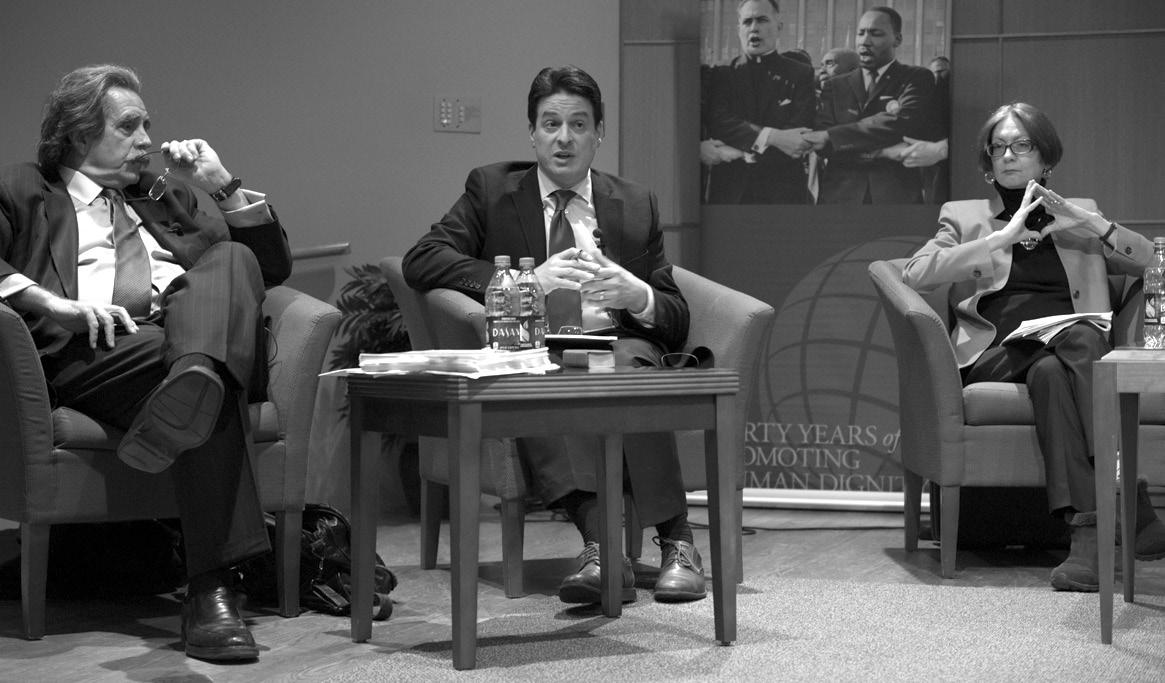
John Corvino (left) and Sherif Girgis discuss the implications of widening the interpretation of marriage in the Carey Auditorium of the Hesburgh Library on Tuesday.
SARAH OLSON | The Observer
Thomas Durkin, Paolo Carozza and Jean Porter (from left to right) debate the benefits of torture as an intelligence method.
CAITLYN JORDAN | The Observer
Debbie Riddle shares the story of her sister, Peggy Klinke, a victim of fatal stalking, in a lecture sponsored by Belles Against Violence.
see espn PaGe 4
bhartnet@nd.edu Assistant
Question of the Day:



Sports
(574) 631-4543 sports@ndsmcobserver.com Scene Desk (574) 631-4540 scene@ndsmcobserver.com
Saint Mary’s Desk kkonya01@saintmarys.edu
Photo Desk (574) 631-8767 photo@ndsmcobserver.com
Systems & Web Administrators (574) 631-8839
Policies
Brendan Thielsen junior knott hall
“my set of pokemon cards from when i was younger.”
Paul Handal sophomore duncan hall
“broken video games.”
Katie Martin junior cavanaugh hall
“old running shoes.”



Amber Thomas junior cavanaugh hall
“my favorite stuffed bunny from when i was three.”
Connor Fitzgerald senior alumni hall
“gym shorts from grammar school.”
Meghan Kosman senior walsh hall
“my old ice skating leotard from when i was six.”
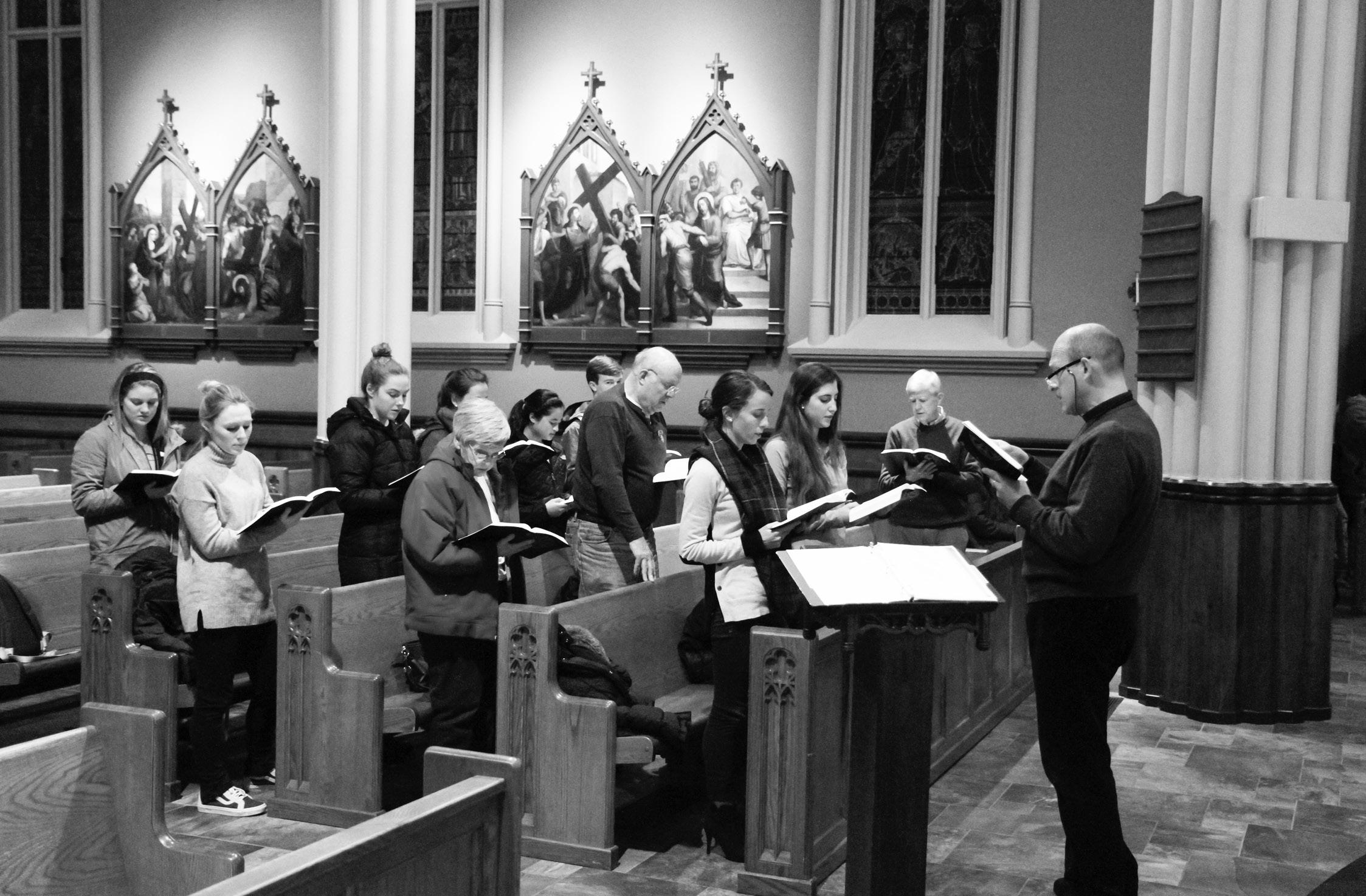
Lector training ws held in the Basilica of the Sacred Heart on Tuesday night for future lectors of both the Basilica and residence halls. Fr. David Scheidler leads the training.
Today’s Staff
Sunday
Corrections
The observer regards itself as a professional publication and strives for the highest standards of journalism at all times. we do, however, recognize that we will make mistakes. i f we have made a mistake, please contact us at (574) 631-4541 so we can correct our error.
Fischoff’s
Marriage
n otre d ame was different than many he had faced before, particularly when debating c orvino.
“This is also the first time i ’m at a place where things might be a little more evenly divided in the audience, if not a little bit slanted towards me, so i ’m going to do what many of you might regard as tying both hands behind my back,” g irgis said. “ i am not going to argue for
morality. i ’m not going to argue from tradition — the way that things always have been, and it’s the way they have to be. a nd i ’m not going to argue from religion although i ’m a c atholic, and i think that religious arguments are perfectly reasonable.”
g irgis said grounds for his argument against the expansion of the definition of marriage may be found in a fundamental flaw within the argument for such an expansion.
“ i ’m going to argue that what i ’m going to call the
revisionist view of marriage, that marriage should include same-sex relationships, actually has deep contradiction at its core,” g irgis said. “... i t actually ultimately undermines the very thing it’s trying to do, which is to describe the principle difference between marriage and other kinds of companionship.”
c orvino said marriage as an institution has traditional origins, but it has at times had a more flexible definition and practice. p erceived distinctions between “marriage and other kinds of companionship” are subjective, c orvino said.
“ m arriage is a social institution recognizing committed adult unions, which are presumptively sexual and exclusive … and which typically involve sharing domestic life, mutual care and concern, and the begetting caring for children,”
c orvino said. “ i say ‘presumptively’ and ‘typically’ in there because we can look throughout history and find exceptions that we would still recognize as marriage. we may not think they’re ideal, we may not think they make for good marriage policy, but they are still marriage.”
c orvino said the expansion of the definition of marriage encourages inclusivity within a merican society.
“ w hy do people find the idea of same-sex marriage
paid a dverT isemen T
compelling?” c orvino said. “... i think it boils down to some very simple premises, including the idea that relationships are good for people, that marriage is good for relationships, and that some of our fellow citizens happen to be gay.”
e choing that theme, c orvino said in his closing statements that the benefits of marriage transcend the boundary between homosexuality and heterosexuality.
“ r elationships are good for people; they help people grow,” c orvino said.
NDtv holds open auditions for ‘The Irish Bachelor’
By MADISON JAROS news writer
This spring, a group of women will compete for one n otre d ame man’s heart on nd tv’s The i rish b achelor.
“ m arriage as a public commitment and as a personal union is good for relationships. a nd that this is true for those of us who do not, or cannot, engage in the sort of sex that includes coitus.” g irgis and c orvino also appeared on vantage p oint, the c ollege of a rts and l etters npr radio program on Tuesday night, in a segment entitled “ w hy g et m arried?” with n otre d ame professor of sociology r ichard w illiams.
Contact Margaret Hynds at mhynds@nd.edu
nd tv s tation m anager c aitlin c rommett said the idea for the i rish b achelor was prompted by the success of last year’s i rish b achelorette — a dating show modeled after abc ’s The b achelorette.
“[ we thought] it might be fun to bring in people that aren’t in nd tv to be in nd tv, and we had extreme popularity – we weren’t expecting this many people to turn out for everything,” c rommett said.
c rommett said the station received numerous requests for an i rish b achelor.
“ we of course said we couldn’t have two i rish b achelorettes in a row, so we thought we’d move on to The b achelor,” c rommett said.
c laire r embecki, who will work production for The b achelor, said the show’s predecessor, The i rish b achelorette, prompted discussion on the dating experience at n otre d ame. This year, the show plans to delve deeper into issues posed last season, she said.
“[ d ating at n otre d ame is] such a weird phenomenon,” r embecki said. “ we kind of want to put that on camera, not because we want to make people fall in love – obviously, if that happens it’s great, we don’t have that high of expectations. ... we kind of want to put [the contestants] in front of a camera and see what it’s like – when you first talk to the guy you find attractive, when you first go on a date, when you’re weighing whether to date them or not — it’s fun to watch.”
r embecki said last year’s show also drew some negative responses on campus.
This backlash, along with the popularity of the show, made the role of The i rish b achelorette difficult, last year’s b achelorette k irsten Fernandez said.
“The b achelorette ended up being much bigger than i originally thought it was going to be,” Fernandez said. “ i did not expect that so many people would recognize
me from the show and ask me about it while i was in class, at work or out with my friends. a lthough most people’s comments to me about the show were positive, i did not enjoy that kind of exposure and the negative comments on social media and The o bserver were hurtful to deal with. i don’t think i would choose to do it again.”
This year, the show plans to make a few changes, including a longer production time and more focus on documenting the dating experience at n otre d ame, r embecki said. d ates the contestants go on will also be primarily off campus, she said.
“We kind of want to put
[the contestants] in front of a camera and see what it’s like — when you first talk to the guy you find attractive, when you first go on a date, when you’re weighing whether to date them or not — it’s fun to watch.”
Claire Rembecki junior
“ we’re looking at getting more out into the s outh b end community, so doing dates in s outh b end, maybe even in neighboring cities,” r embecki said. “To get us away from the show we had last year, but also more in touch with the community because there’s so much of an issue with being in the n otre d ame bubble, so we wanted to use the show, which is kind of a social experiment in itself, to break out of that.”
c rommett said The i rish b achelor is hosting open auditions this year. a uditions for the show’s hosts, the b achelor and the contestants will be open to students in the s orin r oom of l aFortune on Thursday from 5 to 7 p.m. and Friday from 3 to 5 p.m.
Contact Madison Jaros at mjaros@nd.edu
John Corvino
greece elects new prime minister
Associated Press
aT hens, greece — greece’s new left-wing prime minister, a lexis Tsipras, picked an outspoken bailout critic as his new finance minister Tuesday, signaling his resolve to take a tough line with eurozone lenders in an effort to write off a massive chunk of rescue debt.
e conomist yanis varoufakis, 53 — who has described the bailout as “fiscal waterboarding” — took up the position amid a rating agency warning of a worsening financial situation that sent the country’s stock market sharply lower.
The governing syriza party on Tuesday announced a c abinet that includes officials from its coalition ally, the anti-bailout and right-wing i ndependent greeks.
moody’s ratings agency described syriza’s election win sunday as “credit negative,” arguing it would prolong risks to financing, economic growth and bank liquidity. The agency said it expected the government’s “policy uncertainty” to slash 2015 growth to 1 percent from the 2.9 percent predicted in the state budget.
The main stock index in athens fell on the news, sliding 5.4 percent before recovering some losses to close down 3.7 percent amid losses across europe.
Tsipras won a landmark general election victory after campaigning on a pledge to renegotiate the bailout deal and seek forgiveness of more than half the debt — a message that resonated with voters who have suffered through harsh austerity measures that have included pension and salary cuts.
“we are determined to implement our program with courage and determination and not take one step back,” said senior syriza official dimitris stratoulis, who was appointed deputy minister for state welfare.
Theodoris dritsas, incoming deputy minister for marine affairs, said the new government would halt plans to privatize more of the country’s main port of p iraeus — despite official interest from six bidders for a two-thirds stake.
“p ublic ownership of the port will remain. The privatization ... stops here,” dritsas said.
The new c abinet was sworn in Tuesday.
law enforcement agencies or not has come across the state’s public access counselors’ desks many times. in its definition of “public agency,” apra includes “any law enforcement agency, which means an agency or a department of any level of government that engages in the investigation, apprehension, arrest or prosecution of alleged criminal offenders.” it lists a variety of examples, including state police departments, excise police and conservation officers, but does not mention university police forces.
notre dame’s lawyers highlighted this detail in a written response sent to britt in october which was filed with the lawsuit, stating “the general a ssembly was quite careful to specify the law enforcement agencies that would be subject to apra — those of government and those of political subdivisions. private campus police departments were not included.”
a 2011 written opinion by former public access counselor a ndrew kossack agreed with the university, explaining that the key difference between public and private agencies lies in the institution from which the police authority is derived.
indiana law grants educational institutions the power to appoint police officers, prescribe the duties of its officers, direct their conduct, prescribe uniforms and operate emergency vehicles, and kossack wrote it is crucial that these powers were granted “not to ndsp, but to ‘the governing board of an educational institution.’”
“consequently, ndsp does not exercise state powers on its own; ndsp exercises only those powers granted it by the university’s governing body,” kossack wrote in his decision. “consequently, if the ndsp is
a public agency by virtue of the fact that it exercises the executive or other powers of the state, the entire university would be subject to the apra along with ndsp
“i do not believe the general a ssembly granted police powers to private universities with the intent that doing so would subject the entire institution to the apra.”
kossack’s 2011 opinion lined up with the decisions of two of his predecessors who also determined that private university police departments are not public agencies. a 2009 opinion involved valparaiso university, and a 2003 opinion involved Taylor university.
britt’s oct. 31 opinion differs from his predecessors’ statements on this matter. w hile previous counselors based their opinions on the university’s total authority over the police force, britt’s statement notes that “the authority for private universities to create police departments is not inherent. it is granted by the state of indiana through the general a ssembly.
a private entity is deemed a state actor when the state delegates a traditionally public function to the entity itself.”
britt cites ndsp’s description on its own website as evidence that the department “holds itself out to be an actor of the state of indiana,” and reiterates that “police powers come from the state — they do not spring forth organically.”
“This may be inconsistent with previous public access counselors’ opinions, but i do not believe that it is inconsistent with the spirit of the [apra],” britt wrote. “The ultimate test is from where their power is derived. The police force is established by the governing body of a private institution, but their powers are not inherent nor are they derived from notre dame university.”
under this reasoning, britt
notified ndsp in october that his office considered it a public agency. lavigne filed another document request in november and was denied again; after her second complaint to britt’s office, his January response held that “if the notre dame security police department has documentation regarding any suspected crimes, accidents or complaints involving the individuals named in [lavigne’s] request and has not released that particular documentation, then they have violated the access to public records act.”
a s an appointee of indiana gov. michael pence, britt’s opinion is not compulsory and doesn’t carry the force of law. The superior court’s decision will.
in the october response to britt’s opinion, notre dame lawyers argued that because the general a ssembly could have defined “public agencies” more broadly to include all law enforcement departments, including university police forces, there shouldn’t be a reversal in opinion without a corresponding change in the law.
notre dame lawyers cited precedent beyond indiana as well, where courts found police departments at mercer university, harvard university and elon university were not public agencies. The lawyers’ letter to britt also listed implications of ndsp’s status as a private agency beyond apra — for example, under the Fair labor standards act, university police “are not considered a ‘public agency’ engaged in ‘law enforcement activities’ for the purposes of determining whether its officers must work more than 40 hours … to qualify for overtime pay.”
“state police or other public safety officers also receive certain federal benefits that unfortunately are not available to the university’s police officers,” the letter stated. “For instance,
public safety officers are eligible for federal death benefits. … The police officers of private universities are not eligible, given that they are not working for a ‘public agency’ under federal law — the very same concept that we must consider under apra.”
other differences mentioned include the law enforcement officers’ safety act’s exclusion of the university’s campus police from being permitted to carry concealed firearms, the income tax university police officers must pay on personal and commuting miles of takehome vehicles received from the university that governmental and public police officers do not have to pay and federal assistance with body armor, which is available to state or governmental police but not the university police.
“accordingly, there are fundamental differences between governmental law enforcement and private campus police departments,” the letter stated. “broadening apra beyond its plain terms and beyond prior [office of public access counselor] advisory opinions to include anyone who wears a badge would risk treating many private institutions, not just private universities like the university of notre dame, as ‘public agencies.’”
espn’s lawsuit asks the court to “order the police department to release the requested information for inspection and copying, order the police department to pay espn the statutory civil penalty, as well as reasonable attorney’s fees, court costs and other reasonable expenses of litigation and for all other just and proper relief.”
no hearing date has yet been set.
Contact Ann Marie Jakubowski at ajakubo1@nd.edu

Torture
s enate s elect c ommittee on i ntelligence.
d irector of the c enter for c ivil and h uman r ights and panel moderator d aniel p hilpott said a university committed thoroughly to social justice must confront and discuss the question of torture given the c ommittee’s report.
l ast month, the u nited s tates s enate s elect c ommittee on i ntelligence released a report that details the c entral i ntelligence a gency’s ( cia ) secret interrogations of terrorism suspects immediately after s ept. 11, 2001. The report revealed the methods employed in the cia’s interrogation program, including waterboarding, slamming prisoners against walls, sleep deprivation and confinement in cramped space. Further, the report suggested that these methods were not necessary because they did not yield information necessary to foil terrorist plots, p hilpott said.
d irector of the k ellogg
i nstitute for i nternational s tudies p aolo c arozza said the c ommittee’s report exposes massive institutional and moral failure in the u nited s tates.
“Torture is about destroying the human person,” c arozza said. “ i t is a direct, intentional attack on the very elements of the human personality — on human identity and on the human capacity for truth. i t is a way of taking human beings and destroying their personhood to such an extent that they can no longer be a part of the human community.
That’s why torture has been condemned for 200 years, and that’s why today it’s a problem.”
Thomas d urkin, attorney and co-director of l oyola u niversity c hicago’s n ational s ecurity and c ivil r ights p rogram, said he is most concerned by those seeking legal justifications for torture and the potential incorporation of torture into policy.
“ o ne thing i ’m absolutely certain of is that it is a mistake to make exceptions to the law and try to shoehorn something into the
law that doesn’t belong in the law,” d urkin said. “The more i look into these actions, and the more i become radicalized by my defense work at g uantanamo, i witness a continuous state of exception.”
n otre d ame professor of theological ethics Jean p orter said the only effective way to reverse this policy is to take strong, public steps.
“ i think the Justice d epartment should move immediately to prosecute those involved,” p orter said.
“ i think that victims should be transferred to open court and tried if at all possible and be paid reparations.
“ i think we have an obligation of justice to the victims of torture. i happen to be old-fashioned enough to believe in retributive justice. we may never be able undo the psychic damage that we have done to these men, but we may, in some way through the legal system, be able to publicly affirm our belief in humanity.”
m ichael d esch, chair of the d epartment of p olitical s cience and codirector of the n otre d ame i nternational s ecurity
p rogram, said public moral revulsion to torture suggests it may be unhelpful to achieve the nation’s longterm strategic goals.
“ you need to distinguish between the tactical effectiveness of torture, whether it’s ever useful to get information that people otherwise wouldn’t give you, or is it useful for terrorizing people into doing what you want them to do,” d esch said. “ i think that all the evidence points to its effectiveness on the tactical level.
“Then there’s the question of its effectiveness on the strategic level or the policy level. h ere, i think the arguments of critics of are far more compelling. e ven if torture is often beneficial on the tactical level, the connection between that and achieving strategic or policy goals is often less clear. “
i n order to reduce the egregious effects of torture, d esch said it is important to consider how often the cia uses torture.
“ w ould we never use enhanced interrogation on someone we suspected of having knowledge of a ticking time bomb? w ould we
never use it for a hostage situation in which the timely location of hostages was essential? i ’m not sure i could safely say i would never do it,” d esch said. “ i f we’re honest with ourselves, and it was our son or daughter’s life at stake, i think we’d have a hard time saying we’d never use extreme methods.”
k elly Jordan, d ean of s tudents at h oly c ross c ollege and a former c ommander in the u s a rmy, said the u nited s tates should respond to the information in the report by having its leaders work to repair the damage and pledge it will never happen again.
“ s urrender to the allure of torture and justification of its use is indicative of the triumph of a culture of narcissism over a culture of honor,” Jordan said. “The trauma of these things on character, requiring someone to conduct or support morally questionable acts, destroys the capacity within an individual for social trust, and i would argue, within our nation itself.”
Contact Matthew McKenna at mmcken12@nd.edu
campus, 13 percent of women surveyed reported being stalked,” r iddle said.
“ s o when you apply those numbers to the s aint m ary’s population of just over 1,500 students, at a rate of 13 percent you would have 197 stalking cases. That’s putting 200 women in this room and labeling them as stalking victims.” r iddle said through her three-year-long relationship with k ennedy, her sister suffered emotional abuse.
paid a dverT isemen T

“The behavior is cyclical,” she said. “ w omen that are in an abusive relationship sort of learn to know the ebb and flow of this behavior; it is pretty predicable, but sometimes they don’t know what is going to set them off.
“This is what p eggy lived with. p atrick was very good at removing p eggy from her social circle.”
r iddle said the most critical time for women in abusive relationships is when they decide to leave. s he said soon after p eggy left p atrick, he began to stalk her sister.
“ b asically [victims] are asking, what is my punishment going to be when we walk away from this? w hat will he do to me?’” r iddle said. “… s he called me and she said ‘you are never going to believe this, you know what he is doing to me? h e’s stalking me.’ … w hat he started with was 55-155 text messages, phone calls every single day. This went on for days; she wouldn’t answer her phone, she wouldn’t respond to text messaging. h e began to follow her in his truck, sit outside her work, outside her gym.”
r iddle said stalking includes noncriminal behaviors such as texting, phone calling, leaving music on someone’s voicemail and more -- anything that instills fear in a victim.
“The behavior will tend to escalate overtime; it won’t stay consistent,” she said. “ i t might start out in text messaging and end up in murder.”
r iddle said her sister’s habits as she was stalked illustrate the profound psychological toll stalking may take on its victims.
“ n o eating, no sleeping, hyper-vigilant, certainly wouldn’t stand in front of any windows, wouldn’t stand in front of a door, wouldn’t answer the door, wouldn’t answer the phone,” r iddle said. “ s he was very edgy. i t seemed like everything scared her. s he was afraid of everything. i t was so painful to look at her and really not be able to do a thing for her.”
r iddle said even after receiving death threats from p atrick, the police department was reluctant to deal with the case. r iddle shared details about her sister’s final moments spent trapped in her bedroom with her friend r achel, in a violent confrontation with p atrick.
“ p eggy knew this was the end, and i think what p eggy felt was, ‘Thank g od this is over. Thank g od it’s done,’” she said.
r iddle said telling her sister’s story helps her own healing process.
“ i started putting things together, people are coming in and out of the house and i sort of became the spokesperson of our family,” r iddle said. “ e very time i told the story, it made my heart heal more and more. i can make the world a safer place for women like you.”
InsIde ColuMn
growing up
Sara Shoemake graphics
in about 15 days, i will celebrate my 22nd birthday, and my birthday only reminds me of a difficult truth i must face. each birthday comes and goes, and i’m still waiting to shift from teen to adult. sure, at 16, the open road is yours for the taking once you get your driver’s license. you’re even officially considered an adult on your 18th birthday and are opened up to a plethora of adult-only activities like voting and buying lottery tickets and cigarettes.
i exhibit mild symptoms of adulthood in my daily life. my roommates and i have spent more than a few evenings staying in to play card games and make jigsaw puzzles. There was talk of turning our laundry room into our personal completed puzzle gallery. i get excited at the prospect of a costco membership because of how much i’ll save on gas. i keep a bag of those werther’s caramel candies that only retirement homes have in my glove compartment. i’ve uttered the dreaded soccer mom motto, “i’d like to speak to a manager,” while shopping at best buy.
despite all of this, i don’t consider myself a grown-up. i am a perma-teen, boy band fan.
it started with the classics like The backstreet boys and n’sync. Fast forward a few years and i’m in the nosebleeds of a Jonas brothers concert. Freshman year, i lied to my roommate claiming i was at the library when i was actually driving to chicago to see one direction alone. Three years ago, i took up four computers in the laFun computer lab to buy tickets to their up all night tour. i walked out of a 150-person macroeconomics class because their “live w hile we’re young” music video leaked.
a few weeks ago, i deliriously bought $17 of korean pop music from iTunes and discovered eXo, a boy band with 12 members. They’re the korean one direction, but there are more of them to love, and i usually have no idea what they’re saying. They also perform highly synchronized dance routines and wear eyeliner. i’d spent so much time watching their 12-episode reality show that i actually got a little panicky because i felt like i hadn’t devoted enough time to one direction. i’d basically been a two-timing lowlife who needed to spend more time with the group i’ve already committed too and not the hot guy who winked at me across the bar and somehow landed in my iTunes library and took over my recently played artists on spotify. maybe this is the year. i’ll wake up on Feb. 13 and be completely over boy bands, understand how the stock market works and stop using my parents’ netflix account. or maybe i’ll be cursing through the computer at a teen girl who can.
Contact Sara Shoemake at Sara.E.Shoemake.1@nd.edu
The views expressed in the Inside Column are those of the author and not necessarily those of The Observer.
The better angels of our nature
notre dame is union made, and notre dame has labor problems. administrators have fought campus unionization, workers have limited bargaining power and the university’s capital investments have little moral oversight. a nd yet, notre dame is union made. This contradiction is key to the proposed changes to our university’s licensing policy. we have many precedents to choose from, so let us be guided by the better angels of our nature.
There has been controversy surrounding the campus crossroads project, which has brought sprawling construction to our university. but for all the arguments, none have suggested that the construction would be poorly done — that the workers would be poorly trained, the bricks poorly laid and the roofs poorly raised. union workers erect our buildings in the vast majority of cases. in a union town like south bend, why would we trust the very body of our university to the tools of the underpaid, the overworked and the rightless?
more than any other thing, notre dame football carries the standard of our university in the public eye. at every home game, the nation sees roaring crowds decked in The shirt. This symbol is union made, in a factory in the dominican republic where the workers have won wages three times the national average thanks to their militant labor union. we can wear it proudly.
we stand on this solid ground as we look to the china policy. at the moment, the university refuses to manufacture its licensed products in countries that refuse to allow workers the right to form independent labor unions. china is the focus of this policy, as it is a global manufacturing hub where unions exist but are not independent of the state. The office of e xecutive v ice p resident John a ffleck-graves has proposed a change to this policy to instead assess manufacturers on a case-by-case basis in a pilot program. a fter speaking personally with m r. a ffleck-graves, i am assured of his good will in hoping this change allows the university to engage with the chinese government in making improvements to workers’ rights.
The china policy is certainly ineffective, however. it recognizes only state power in repressing workers’ rights. private coercion is no less harmful in busting unions, and it happens from south bend to singapore. in 2013, a factory in bangladesh collapsed — killing 1,129 workers. Technical legal rights meant little as corporate power kept workers from winning decent and safe conditions. This disaster threw the issue into stark relief, but daily struggles against
abusive bosses in all corners of the world speak to the scope of this problem. more than national laws define individual manufacturers. in this light, i welcome the administration’s reassessment of its licensing policy. however, vague “case-by-case” assessment is insufficient. mr. a ffleck-graves assured me that there would be a set of decent standards applied to manufacturers everywhere, and this is cause for praise. but we must go further. individual assessments without hard standards are ripe for abuse, either next year or next decade. we can never rely solely on the good will of current administrators, as others will occupy those positions someday.
we stand on solid ground — union made ground — when making these changes. on Tuesday, they make the decision. i call on all to write to the administration with this single demand: keep notre dame union made. add to the new policy that university licensing must seek out unionized factories for manufacture. if current agreements prevent this, implement it when new contract terms are up. The online “union made apparel directory” lists dozens of manufacturers in the u s. and canada alone. cost is no excuse, as The shirt is union made, cheaper than many other T-shirts in the bookstore and still makes money for charity funds. only if union manufacturers are exhausted should we contract with nonunion factories, and only those that pay decent wages. This may include some chinese manufacturers.
For the enforcement of this clause, i suggest a commission headed by non-administrative faculty. some faculties — such as those affiliated with the higgins l abor studies program — are natural choices, but all have a stake in university operations. in the spirit of worker participation, the faculty should choose this commission from its own ranks. campus workers, students, priests and local labor activists should also be incorporated into the commission, to assure maximal consideration for the rights and dignity of affected workers.
unions bring workers more control, more safety and more dignity. They raise wages and lower abuse. l abor unions save lives. The university has understood this in the past and must expand that to all its dealings. we’re not there yet, but we’re on the right path. so with the policy change coming soon, email and call the office of the e xecutive v ice president and tell the administration to follow the better angels of our nature — keep notre dame union made.
Billy McMahon is a senior studying Latin American history and is active in the labor movement. He welcomes all comments at wmcmahon@nd.edu
The views expressed in this column are those of the author and not necessarily those of The Observer.

edITorIal CarToon
Billy McMahon blue collar blues
Politics across the Atlantic
g reece, like many e uropean countries, is governed by a multiparty system revolving around the parliament. e uropean elections can rival the e lectoral c ollege in complexity, but are often more frequent and result in greater swings in control than their a merican counterparts. This was evident when s yriza, a self-described radical left-wing party, took control of the g reek government a few short days ago. They are a newer political party, with little experience governing and even less with international diplomacy, but will be leading g reece in the face of some of its most important decisions since joining the e uropean u nion. Their primary message was to halt the austerity measures put in place for g reece to service their massive amount of debt. This is a radical break from the past and from the rest of e urope, where countries unable to pay their sovereign debts have had to implement strict austerity measures — mandatory programs that cut spending and attempt to raise revenue — in order to pay back other e uropean countries. The full repercussions of the election are not known yet, but could have major implications across e urope and the world.
i n recent u s . political news, m itt r omney and Jeb b ush met in u tah, presumably to discuss their competing intentions to run for president in 2016. b oth r omney— the 2012 r epublican presidential nominee, former governor of m assachusetts and son of a former
m assachusetts governor — and b ush — the former governor of Florida, brother to former us president g eorge w b ush and son of former us president g eorge h w b ush — have publicly stated they are “seriously considering” a presidential bid. i f either is successful in obtaining the r epublican nomination, they will most likely face another known quantity from the d emocrats — h illary c linton, the wife of former u s . president b ill c linton, former senator from n ew york and former s ecretary of s tate. a t the very least, a mericans will recognize some of the names when they step into the voting booth in 2016.
o ne driver of g reece’s radical shift is the dire nature of the country’s current circumstance — within the month they may be unable to pay their debt or even remain a part of the e uro. b y contrast, the u nited s tates has been recovering more rapidly from the recession by the month. c ould this alone explain the difference in political actors? p erhaps. h owever, when the presidential campaign fell in the middle of the worst financial crash since the g reat d epression, the country selected an “outsider” who came from one of two primary political parties, and whose policies have echoed the same priorities as his predecessors. p resident o bama’s 2008 victory is nothing like the s yriza seizing g reece after being only a marginal player until 2012.
The contrast between the familiar faces and policies of a merican politics and the rapid shifts seen in g reece just days ago is stark. a key difference between the two political systems is g reece’s reliance on multiple parties forming coalitions as opposed to the two-party
system found in the u nited s tates. This, along with other factors, contributes to the pros and cons of each system. w hen it comes to these two systems, it means the ability to react radically to a popular movement versus the stability that comes with fairly consistent governing. h ow should a mericans view the difference between their governing and that of e uropeans and g reeks? i t is incredibly important to first know the difference exists. o ther countries have broader discussions about their government than simply r epublicans versus d emocrats. This freedom comes with sacrifices (such as i taly averaging a new government every year since w orld w ar ii ), but provides an alternative to well worn narratives heard from a merica’s political parties. This may come as a relief to those tired of the apparent collusion from r epublicans and manifest destiny of the d emocrats. The benefits of the a merican system — stability, institutional knowledge, consistency, etc. — are incredible, and have contributed to the success of the nation. That being said, no operation improves without new inputs and information. a t the very least, a mericans need to know that they have more options than choosing from the same few last names every four years.
Tim Scanlan is a senior finance major with a minor in public service. He is a former resident of Morrissey Manor. He encourages debate on his columns and can be reached with any comments or questions at tscanlan@nd.edu
The views expressed in this column are those of the author and not necessarily those of The Observer.
don’t just start over, forgive yourself
a s the second month of the new year approaches, i want to remind you, whether you are going strong with your 2015 resolutions or have already messed up one or two of them, that you can start over anytime. n ew beginnings are not, and should not, be exclusively celebrated and embarked upon at the beginning of each new year.
o ne of the most incredible things about humans is that until we find ourselves six feet under a graveyard, we are not finished products. w e are dynamic, metamorphic beings who, with the right dose of willpower, have the potential to take this world by storm and make an unforgettable impact. h owever, before anyone can do that, they must learn to find empowerment in the setback, hope in the midst of despair, strength in the hardships and joy in the bigpicture journey. s ometimes we set goals that we don’t reach, and there’s an inherent sense of disappointment and anger that settles into our minds. w hen you stray from your goals, it’s easy to say “ i ’m just not meant to be that kind
of person or accomplish that specific thing.” i t’s easy to settle for average. b ut is settling for average, which in this case counts as giving up on yourself, easy to accept? o f course not. w e are our own greatest motivator, biggest fan and cruelest critic and no one ever wants to feel disappointed in themselves. i n order to move on and grow from that disappointment, one must learn the art of forgiving yourself and letting go of the failure.
i think we forget sometimes that messing up truly is not the end of the world and that there will always, always be another opportunity. Failure doesn’t mean that you cease to exist to everyone else, that you are a bad person, that you are weak or that you aren’t good enough. m ake the decision to start over. d on’t waste time wishing you could change the past, keep looking forward and move along with your head up. i f you are at peace with yourself, it’s both easier to imagine new ways to meet a previously unsuccessful goal as well as to make the decision to try one more time.
i f the stars in your vast sky of resolution aren’t aligning, find a way to rearrange them yourself. d o not allow yourself to be defined by failure; let it go, find a reason and do something
that intimidates you. d o something that a year from now would make you say “ i ’m so glad i did that,” no matter how difficult and trying it may be. d o something that you would be proud of yourself for.
a t the end of the day, if you aren’t failing every once in a while then you aren’t trying hard enough. i t’s that simple. d o not let your failures leave you in ruins of a goal or resolution that you no longer believe in. g ive yourself permission to start over and try again, but more importantly, forgive yourself for your past and what went wrong. you can’t carry on if you let who you were yesterday get the best of who you could be tomorrow. you are the captain of your adventure, so remember us n avy c aptain James l awrence‘s famous last words when the going gets rough: “ d on’t give up the ship. ”
Opinion columnist Haleigh McGill enjoys aggressive games of Catch Phrase and perusing crop circles for signs of alien life forms and The Rocky Mountain Collegian is the student newspaper serving Colorado State University’s community. Please send comments to letters@collegian.com
The views expressed in this column are those of the author and not necessarily those of The Observer.
Tim Scanlan pardon the p rose
uWIre
Haleigh McGill
The rocky mountain collegian

By CAELIN MILTKO
writer
a fter reading “gone girl,” i hardly had any desire to return to that world. a my frightened me; nick angered me. gillian Flynn could write, i could respect that and i didn’t need to know anymore.
For some reason, this reaction didn’t stop me from seeing the movie when it came to notre dame last week. i went and once again discovered the complicated machinations of a my and nick’s relationship. i was still disturbed, but instead of shying away from the emotions, i wanted to delve into this type of storyline further. as much as i hated her, i wanted more a my. it was with this frame of mind i picked up paula hawkins’ “The girl on the Train.” it had been hailed as the new “gone girl” (along with harriet lane’s “her”) and i was curious. was it possible that hawkins could create the same sense of disturbed horror and grudging respect i felt upon finishing “gone girl?"
it should be said that expecting a novel to give you this type of feeling sets itself up for failure — i immediately distrusted every character that was introduced and was constantly waiting for one of them to reveal themselves
as the crazed psychopath. it takes away the sense of real surprise and betrayal i felt upon reading a my elliott dunne’s confession the first time.
still, if i step away from gillian Flynn comparisons, hawkins’ novel is quite good. she’s not nearly as good as Flynn at probing the sociopathic tendencies of the “bad guy,” but her characters have other strengths. They aren’t likable, but they are human.
rachel, the so-called “girl on the train,” is a struggling alcoholic whose only joy in life seems to be creating a perfect marriage and life for a couple she sees every day on her way into london. as a narrator, she is frustrating because of her inability to recall everything accurately (or at all) — the reader, at times, wants to reach in and shake her until she puts down the wine. still, she’s likable. hawkins gives you what Flynn denies — someone to root for.
The other two narrators, megan and a nna, are less developed. Their story lines are almost peripheral, except for the moments when they cross paths with rachel. megan is particularly frustrating, prone to continually talking about a vague “him” whose identity seems as though it could shift throughout the novel. it’s necessary, yes, for hawkins’ eventual conclusion, but it remains one
of her weakest attempts at creating tension.
a nna, on the other hand, seems entirely unnecessary. her point of view rarely serves to move the story along, and i think the book would have been stronger had this aspect either been developed more or dropped entirely. as they stand, her chapters vacillate between providing almost interesting insight into a character who could be easily demonized and simply distracting from the main storyline.
hawkins’ strong point lies in rachel’s voice. she is the heart of the novel, and her chapters and her struggles are what motivate the reader to continue on. at times, even the main driving plot of the novel seems like it could be dropped if only rachel would move on with her life and finally let go of the alcohol. in the end, i’m not quite sure “The girl on the Train” lives up to its hype as the new “gone girl.” but i’m also not sure it should — to me, the name seems like a bit of a misnomer. hawkins isn’t trying to be gillian Flynn, and none of her female voices are meant to be a my. her aim is quite different, and i think i would have enjoyed the book better had i remembered that from the beginning.
Contact Caelin Miltko at cmoriari@nd.edu

By ALLIE TOLLAKSEN scene e ditor
i’ll never forget where i was when i read the news. sitting on my couch with a cup of coffee in one hand and my phone, open to Twitter, in the other, i read that skymall, the beautiful brookstone of the sky, may be no longer.
last Friday, skymall announced its parent company is filing for bankruptcy. Though this doesn’t guarantee the death of the famous in-flight catalogue, talk of skymall’s ultimate demise has been abuzz. so forgive me for presenting what may be a premature eulogy, but i need to say a few words to commemorate the ginger ale-stained, endlessly entertaining magazine.
at age 25, just a few years older than me, skymall has been an unwavering presence in the lives of air travelers. nestled between the airsickness bag and the “in case of emergency” card on the back of airplane seats, its goods have been overpriced and unrealistic through thick and thin, recession and recovery.
no matter what may lie ahead — a delay on the tarmac, a screaming baby or an aggressive seat-recliner
— frequent flyers could always take comfort in perusing the pages of skymall, ogling over “lord of the rings” memorabilia and outdoor speakers that look like rocks. w here will we go now if we want to buy a dog raincoat and a glow-in-the-dark toilet seat in one fell swoop? how will we spend $5,000 if not on our own “Fire burning portable hot Tub” after three glasses of a merican a irlines nondescript white wine? in an age of still unreliable in-flight wi-Fi, how else will we pass the time once our iphones die? will we be forced to actually watch the in-flight safety demonstration?
These are questions we’ll have to answer with the tragic loss of skymall. until then, we’ll remember it not just as a collection of insane pool gadgets, yard ornaments and pet accessories, but as a symbol of the a merican dream. Forget the white picket fence — nothing says “i made it” more than soaring at 30,000 feet in a steel vessel, sipping tomato juice and deciding to treat yourself to a remotecontrolled, infrared reflexology foot massager. as a child, i remember imagining my dream home and filling it with skymall’s wonders. Flipping through the catalogue, i’d make a mental checklist of all of the house’s amenities — a castle for my cat, a floating island cup
holder for my outdoor pool and various kinds of hanging chairs to furnish each room. The house would have a room wallpapered with the world’s largest maps and crosswords, and the backyard would be filled with wacky statues and elaborate sprinkler systems. gel pen in hand, i’d circle all the goods that would some day be mine. my interest in interior decorating has since waned, but i’ll still miss the comfort of leafing through the beloved catalogue. even if you can’t hope or dream to own anything in the catalogue, you can scan though its pages with awe and wonder, like the world’s Fair is sitting on your lap. skymall is the embodiment of the scene in “willy wonka and the chocolate Factory” when gene wilder sings “pure imagination”: elaborate, bedazzling and just a little scary.
w hether we’re building a dream home, buying the bests gifts or simply browsing, skymall has seen it all from a seat pocket. now, after what its website describes as “25 years of cool stuff,” the sky-high staple may close its pages on us and go away to the great a irplane in the sky. if so, we’ll miss you, skymall.
Contact Allie Tollaksen at atollaks@nd.edu
scene

By JOHN DARR scene writer
The dodos’ arsenal is small, yet their ambition is huge. adventurous songwriting and exquisite musicianship have kept them rolling for the past 10 years, stretching their lone guitar, drum set and pair of voices into a plethora of shapes and sizes. The decade has seen them ramble from acoustic sing-alongs (“walking”) to massive anthems (“black night”) to noisey surf-tinged rockers (“confidence”). a healthy dose of friendly melodies woven into the tricky rhythms and complex song structures has helped the dodos receive a decent amount of blog love without losing their experimental edge.
Their new album “individ” finds the dodos sticking pretty closely to their previous strategies. drums and guitars remain at the heart of each track as vocal melodies pop in and out of the mix. each song is alternately flooded with noise and pared down to its most accessible ingredients, giving each song a propelling pushand-pull dynamic.
however, “individ” seems to find the dodos stretching their limits even more than usual. shoegaze-esque guitar waves flow through the album, adding to the noisy side of the duo’s compositions. such crushing guitar lines appear in different forms throughout the record, sometimes groove-dominating and relentless
(“precipitation”), while other times psychedelic and gentle (“bubble”).
The backbone of the album is formed by a set of songs that seem to race themselves to the finish. “individ” is performed with extreme precision, making its speed intriguing and accessible despite the record’s often distorted production. l ead single “competition” showcases this with a profound ease. The track is pinned down by a guitar riff, beginning each measure in a jackhammer strum and ending by rapidly sliding into a higher chord which then leads to the next measure. meanwhile, simple melodies complement the driving rhythms, allowing the band to make the most of a pair of ideas which many other groups would be unable to reconcile.
at the same time, many songs boast a stretch of relative quiet where the song’s melodies or lyrics are granted the space they truly deserve. “darkness” assembles a crescendo from acoustic guitar arpeggios and beachy drum rhythms, eventually climaxing in a driving groove. however, the dodos then brilliantly cut out to a beautiful harp-like, finger-picked, acoustic falling guitar riff, augmenting the sense of calm with soft overlaid choral harmonies. “bastard," the penultimate track, jettisons the band’s signature breakbeat tempos for a gospel-like stomp, pushing its unusual yet satisfying chord progression to the forefront.
“individ” is in many ways nothing new for the dodos. it is the product of a unique band that continues to improve slowly but surely, creating new works from old materials while never employing predictable songwriting tactics. in a world which places four out of four hiphop beats on pedestals for their production values and often pushes experimental artists away from conventional instruments, the dodos fill a much-needed role in the world of music. Their time-signatures are crazy; their production is unabashedly rough, yet they anchor their compositions with good old riffs and choruses that can still get stuck in your head. “individ” finds the group very alive and well, playing to their strengths while simultaneously improving upon them.
Contact John Darr at jdarr@nd.edu
“Individ”
The Dodos
Label: Polyvinyl
Tracks: “Bubble,” “Competition,” “Darkness”
If you like: The Books, Tokyo Police Club

In appreciation of non-football fans

Samantha Zuba a ssistant managing e ditor
The best parts of the s uper b owl-watching experience are all the people watching who really don’t care about football at all.
They’re at the game watches for the buffalo chicken dip, halftime show and hysterical commercials, not so much the game. most of all, they’re there for the company. That is, unless you really, really like chips and dip.
These non-football types are great to have around during the s uper b owl for several reasons.
This first one is a bit selfih, but you can’t deny that nonfootball fans provide a welcome distraction for your know-it-all friends.
you know, the friends who are the best thing that could happen to football if they actually played football. They know things about football and want everyone to know they know. They throw better than p eyton m anning, catch more reliably than r ob g ronkowski and tackle harder than c lay m atthews.
w ith authority (read: a loud voice), they will correct coaching decisions and claim they “could have caught that pass.” you know, the one that sailed two feet over c alvin Johnson’s head.
“d o you know how many yards b art starr threw for in s uper b owl iii ?” they’ll ask. “no? p ssh, well you’re dumb.” e veryone has at least one of those friends. never mind that those friends probably won’t actually tell you how many yards b art starr threw for in s uper b owl iii , because they probably don’t actually know — they just like to pretend. a nd definitely never mind that b art starr did not even play in s uper b owl iii you love those friends but don’t always want to give your undivided attention to their lectures. w ith non-football fans at your party, you don’t have to. k now-it-alls can smell lack of football knowledge a mile away and will key in on the person with the least as soon as they arrive. a nother advantage for you: non-football fans likely will ask the questions you’re too embarrassed to ask.
i n fact, many others in the room probably want to ask the same questions but just won’t, for fear of falling into the hands of the know-it-alls.
Questions like: w hat is an out route? w ho’s playing today? w hy does b ill b elichick’s sweatshirt not have sleeves?
a ll this knowledge and more is at your fingertips when you have brave nonfootball fans in your midst — or g oogle.
b ut none of those explanations is the best reason to have non-football fans around at your s uper b owl game watch.
w hen i studied abroad, i was asked if the s uper b owl was a national holiday in the united states. i said it wasn’t but then thought a moment about how to describe it. i didn’t want to make the s uper b owl seem more important than it is, but it comes pretty close functioning like a holiday when you consider how much people drop whatever they’re doing to watch the big game.
a lot stops for the s uper b owl, and that’s pretty cool, not because we need to pay homage to the game and its players — we could probably do a bit less of that as a society — but because people get together for it.
how often do you see your entire group of busy friends together in one place? hopefully, that’ll happen on s uper b owl s unday. The day does not celebrate an important person or historical event, but if any day can slow a busy group of people down, it earns importance points in my book.
i’m a firm believer that any happy excuse to gather with family and friends is a good one. The s uper b owl gives me that excuse, and i get to watch a good game to boot.
a s for all the people watching who don’t care about football? h aving them around reminds you they’re really there for the people they’re watching with.
e ither that or the dip and halftime show.
Contact Samantha at szuba@nd.edu
The views expressed in this Sports Authority are those of the author and not necessarily those of The Observer.
VCU remains undefeated in Atlantic 10 play
Associated Press
richmond, v irginia — Freshman Terry l arrier scored 15 points and no. 14 vcu pulled away with a 16-2 run early in the second half to beat g eorge washington 72-48 on Tuesday night for its 12th consecutive victory.
l arrier’s point total was his highest since conference play began for the rams (17-3, 7-0 atlantic 10), and it came on a night when vcu scoring leader Treveon graham managed just seven points on a still-tender left ankle and struggling melvin Johnson continued to do so, scoring eight on 4 of 10 shooting.
kethan savage scored 18 to lead g eorge washington (16-5, 6-2) and Joe mcdonald had 11.
The colonials went behind for good when vcu scored 12 of the last 14 points of the first half to lead 29-21 at the intermission. a fter g eorge washington used a 6-2 burst to get within 31-27 early in the second half, the rams turned up their defensive pressure
and turned the contest into a runaway.
The game was the rams’ first at home in 17 days, and once their pressure started gtting to the colonials, leading to runout baskets and a fast-growing lead, the outcome was quickly determined.
The colonials’ inability to make shots from close range also was a huge factor. They made just one field goal in the final 10:50 of the first half, and were 2 for 21 until the game’s final minutes.
vcu, meantime, pulled ahead getting points from almost everybody.
mo a lie-cox, who finished with 10 points and eight rebounds, scored their first basket after halftime, and after two free throws by savage, graham, Justin Tillman, l arrier, JeQuan l ewis, briante weber and Johnson also contributed as the run whipped the crowd into a welcome back frenzy.
The game was a back-andforth affair until late in the first half.
Trailing 19-17, the rams tied it on a layup by l ewis, sparking a 12-2 run to end the half. sx of the points came from l arrier, and the last four from a lie-cox on an inside basket and two free throws.
The colonials managed just five points after yuta watanabe’s layup with 10:51 left in the half.
T ip-ins : g eorge washington: The colonials made 12 3-pointers in their previous game, a 7459 victory against duquesne. it was the most 3s they have made in a game since november 2008.
vcu: The latest rpi rating from the ncaa list vcu’s non-conference schedule as the toughest in the nation and its ovberal schedule as the second-toughest, trailing only k ansas.
up ne XT:
g eorge washington: plays at r hode island on saturday. vcu: hosts city and a-10 rival r ichmond in the first of two meetings saturday.
Mountaineers hold on, prevent upset
Associated Press
manhaTTan, kansas —
Tarik phillip matched a career-high 12 points and west v irginia, relying on its highpressure defense, shut down kansas state for a 65-59 victory Tuesday night.
in a game marred by fouls and poor play, the mountaineers (17-3, 5-2 big 12) forced the w ildcats (12-9, 5-3) into 25 turnovers while holding them to 36 percent shooting from the field.
west v irginia’s leading scorer, Juwan staten, had just 11 points while dealing with foul trouble all night. secondleading scorer devin williams had eight points and nine rebounds.
The wildcats played most of the way without nino williams, who had been averaging 21 points his last two games. The senior forward appeared to be dealing with a left knee injury, spending time on a stationary bike and then wrapping it in ice during the second half.
marcus Foster led the wildcats with 15 points, but also committed six turnovers. wesley iwundu added 12 points, yet missed a crucial free throw in the closing minutes.
in fact, the foul line proved to be nearly as good defensively as the mountaineers. kansas state was just 20 of 35 from the stripe, including a 2-for-7 effort from Jevon Thomas.
considering the teams are two of the scrappiest in the big 12, it was hardly a surprise that the game was played at a slogging pace that prevented either from gaining any momentum.
The teams combined for 27 turnovers in the first half alone, k ansas state getting whistled for a 5-second call on four occasions. They also combined for 25 fouls and shot 26 free throws.
Those are ugly numbers for a game, let alone a half.
b y the time west v irginia turned the ball over with 20 seconds left, and k ansas state
turned it right back just before the buzzer, the mountaineers had forged a 26-24 halftime lead.
west v irginia extended its lead to 49-41 midway through the second half, finally putting together a couple of solid offensive possessions. phillip was the surprising catalyst, following up a three-point play with another bucket with 8:31 remaining to keep k ansas state at bay.
a s the mountaineers got into foul trouble — Jonathan holton and Jaysean paige had each picked up their fourth by that point — the w ildcats tried to make one last run.
Foster’s first free throw with 2:04 left made it 55-50, but the a ll-big 12 guard missed the second of them. a nother missed opportunity by k ansas state in a night full of them. The mountaineers were still leading 63-57 after Foster’s 3-pointer with 24 seconds left, but staten made the first of two free throws at the other end to put the game away.
nCaa Men’s baskeTball | wesT virginia 65, kansas sTaTe 59
penguins defeat w innipeg with late power-play rally
Associated Press
pi TTsburgh — david perron and brandon sutter scored power-play goals less than 4 minutes apart in the third period and the p ittsburgh penguins rallied for a 5-3 win over the w innipeg Jets on Tuesday night.
nick spaling, steve downie and patric hornqvist also scored for the penguins. k ris l etang had a career-high five assists as p ittsburgh ended a four-game losing streak despite playing without injured stars sidney c rosby and evgeni malkin. Thomas greiss stopped 19 shots.
adam l owry, Jacob Trouba and c hris Thorburn scored for the Jets, who saw their fivegame winning streak snapped when they couldn’t protect a third-period lead. o ndrej pavelec made 25 saves but was sloppy in the third period.
l owry gave w innipeg the lead 59 seconds into the third before perron and sutter delivered on p ittsburgh’s patchwork power play.
The penguins limped into the a ll-star break with their longest losing streak of the season and began the second
half without their two unquestioned leaders. c rosby received an injection last Thursday to treat a lowerbody injury suffered against montreal earlier this month and missed the a ll-star game. w hile c rosby could return on wednesday in washington, malkin is not skating at the moment and could miss a week or more.
For a night anyway, p ittsburgh survived without them.
The penguins moved to 9-0-1 in games when they’ve been without both c rosby and malkin since 2011. having the blossoming perron in place certainly helped. buried on the third line in e dmonton, perron has become the kind of scoring threat p ittsburgh needed to take some of the pressure off c rosby.
perron has six goals in nine games with p ittsburgh after having just five in 38 with the o ilers. he jabbed a shot between pavelec’s legs 4:23 into the third to tie the game and sutter followed with the winner 7:52 into the third. hornqvist chipped in an empty-net goal with 27 seconds remaining as p ittsburgh improved to 9-2-1 against the
paid a dverT isemen T
western c onference.
spaling gave the penguins a 1-0 lead 7:09 into the game following a pretty sequence in which l etang hit perron with a long stretch pass. perron, who has blossomed since arriving in a trade from e dmonton on Jan. 2, drew two defenders — and pavelec — as he streaked down the right side. perron’s centering pass landed right on spaling’s blade and he flipped it into a wide-open net for his seventh of the season.
w innipeg responded with two goals in the second period. Thorburn made a pretty deflection off a feed from adam l owry 2:13 into the second and Trouba followed with a heavy slap shot from the point that made its way through a sea of sticks and over greiss’ glove.
The penguins tied it late in the period after a heady play by downie. w ith the clock ticking down, downie moved in on the left side. r ather than force a shot he waited for l etang to hop on the ice and sent a crossing pass l etang’s way. l etang’s slap shot smacked off pavelec’s right pad to downie, who pounced on it to make it 2-2 with just 4.6 seconds left.

TraCk and fIeld
Notre Dame turns to Turner
By MAREK MAZUREK sports writer
The i rish made a lan Turner’s first n otre d ame i nvitational as head coach a memorable one this weekend, winning four events and performing well in the middle distances.
The meet also marked a milestone in n otre d ame’s transition of head coaches. For the last forty years, Joe p iane helmed the i rish, but after his retirement this summer, the team turned to Turner, who coached 18 a lla merican i rish sprinters and jumpers as an associate head coach and assistant coach.
a s a track athlete at i ndiana, Turner was a three-time a lla merican, won the long jump indoor national title in 1991 and led the h oosiers to five straight b ig Ten titles.
Turner said he is indebted to p iane for his mentorship and the program’s foundation of success.
“ i ’ve learned a lot from Joe [ p iane],” Turner said.
“ p robably the main thing i ’ve learned from him are the subtleties of a coach ... knowing when to push an athlete very hard and when to back off. m any times in this sport, we’re on a high-wire act with how hard we push somebody.”
p iane also left Turner with a successful, winning culture, Turner said. b ecause of this, Turner said he doesn’t think he needs to change the identity of the team.
“ i definitely want to put my imprint on the program,” Turner said. “ b ut we have a great identity, and people know that when you run against the i rish, you have to bring it. i want the program to be top three in the acc and top 20 in all our sports — that’s cross country, indoor track and outdoor track.”
i n addition to the coaching
change, n otre d ame is still adjusting to a shift to the acc , Turner said.
“The b ig e ast only had about three or four really competitive teams, whereas in the acc , there’s a lot more depth,” Turner said. “ i t’s a lot harder to get people in the finals. Trying to hang with Florida s tate is a formidable task [because] they’ve been a dominant team not only in the acc , but also nationwide.”
The new conference will require Turner to change his recruiting habits, he said, due to the different events run in the acc
“There [were] a lot of middistance events and relays [in the b ig e ast] where we needed more 800-meter runners and more mile runners,” Turner said. “That’s not necessarily the case in the acc we can’t skew the team with distance runners, because in the acc there’s no 500-meters [and] there’s no 1,000-meter.”
d espite these challenges, Turner said he is cautiously optimistic about the i rish’s chances this year.
“o ur women this year should do pretty well in the acc ,” Turner said. “o ur men’s team — we’re going to have to really show up that day if we want to crack the top three. we have some work to do. we’ve been up and down, but i want to get it where we’re consistently a top-20 program. we’re going to get there. i t’ll take some years, but we’re definitely going to get there.”
n otre d ame will split into two squads for its next meet Jan. 30, traveling to the i ndiana r elays in b loomington, i ndiana, and the r azorback i nvitational in Fayetteville, a rkansas.
Contact Marek Mazurek at mmazurek@nd.edu
Irish rely on doubles play early in season
By CHRISTINE MAYUGA sports writer
hosting three of the top teams in the nation in one the most competitive pods of the i Ta k ick- o ff weekend, no.
14 notre d ame anticipated a series of close matches this past weekend at e ck Tennis p avilion.
a lthough the i rish walked away with the 4-3 victory over no. 24 o klahoma state in the first round, they just missed the mark in the final match of the weekend, falling to no. 16 c olumbia, 4-2, on sunday.
This wasn’t the first time the i rish competed in matches decided by razor-thin margins. e arlier this season, the i rish earned a 4-3 win over no. 18 k entucky, mounting a comeback in the singles round.
notre d ame is the only team in the nation to have two doubles pairs ranked in the top 10: no. 8 junior a lex l awson and senior billy pecor, and no. 9 sophomores Josh h agar and e ddy c ovalschi. The i rish have captured the doubles point in two of three matches so far this year, but the squad has
had a tough time keeping that lead in singles play, where it is has compiled an 8-9 record.
s o far, the i rish have managed to come out on top in a majority of these showdowns, but more consistency under pressure is a skill the team is working on as it moves forward, i rish coach r yan s achire said.
“i talk [about this] with the team a lot,” s achire said. “[ i ] know we will be in a lot of competitive matches, but we can’t get too high or too low through our results, good or bad.”
a gainst o klahoma state, the i rish displayed some of the poise s achire wanted, securing a 4-3 win on a third-set tiebreaker of the final singles match. Junior e ric s chnurrenberger rallied from a 2-5 third-set deficit to c owboys freshman Tristan meraut and managed a long return on the serve for match point and the eventual 6-2, 5-7, 7-6 (8) win.
“i thought we did a good job playing and competing this weekend,” s achire said. “ we had an absolutely knockdown,
drag-out battle against o klahoma state and came out on top. a gainst c olumbia, we just came up a little short.”
The loss to the l ions, however, was close all the way through. The outranked pecor and l awson came from behind to beat the no. 6 senior duo of m ax s chnur and a shok narayana in a 7-6 (3) upset. b ut h agar and c ovalschi had a surprising loss to junior m ike vermeer and senior w inston l in. The latter duo came back from a 1-5 deficit to secure the win.
i n singles play, the i rish struggled early, losing four of six first sets. o nly pecor bounced back to take the final two.
“[ we have] one of the toughest schedules in the country,” s achire said. “a s long as we are competing with the right mindset and put ourselves in the position to win, we will be successful this year.”
notre d ame stays at e ck Tennis p avilion to take on northwestern on Jan. 30.
Contact Christine Mayuga at cmayuga@nd.edu
MICHAEL YU | The Observer
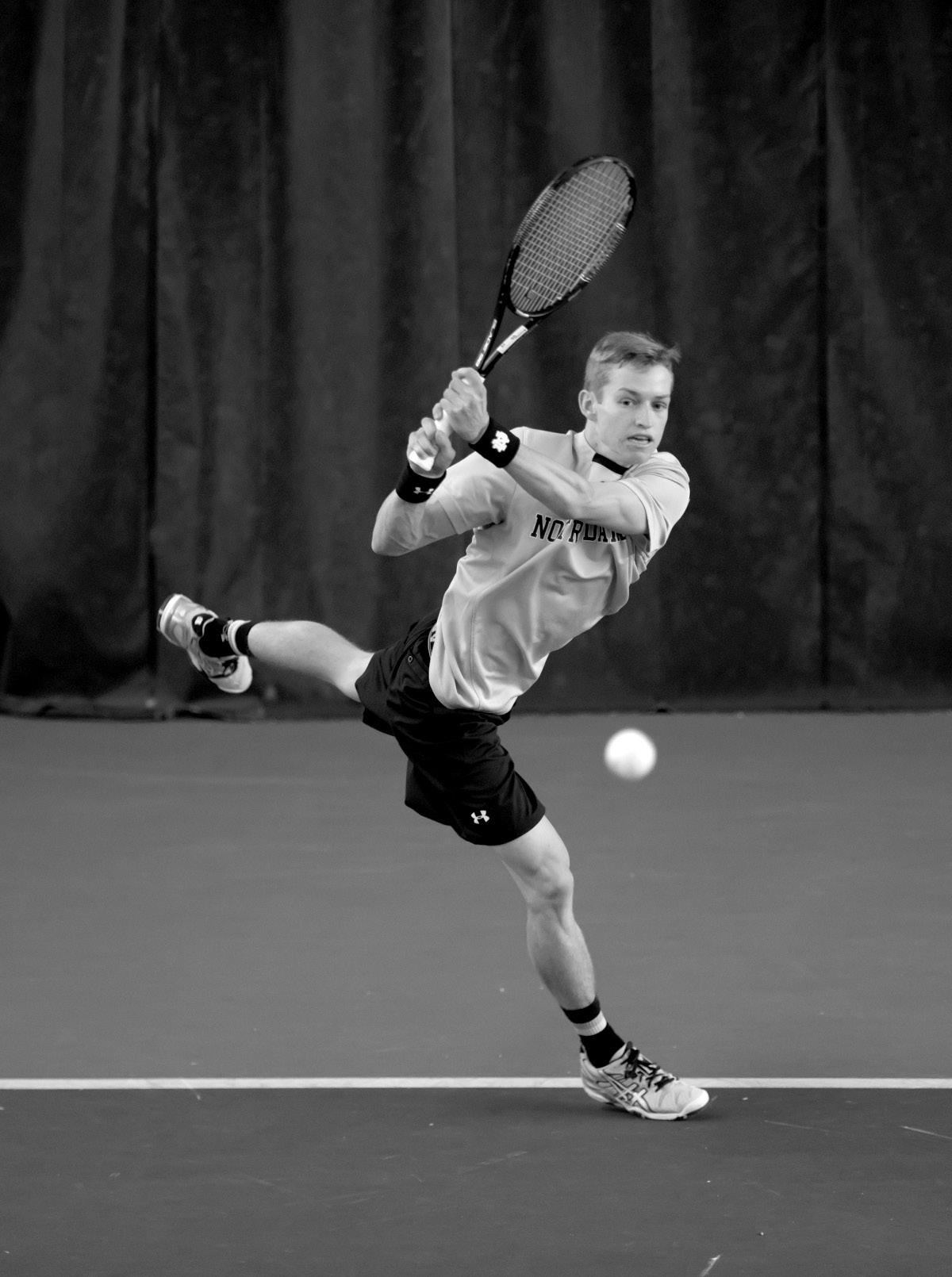
Notre Dame sophomore Josh Hagar follows through on a shot during a 4-3 win over Oklahoma State on Jan. 24 at Eck Tennis Center.
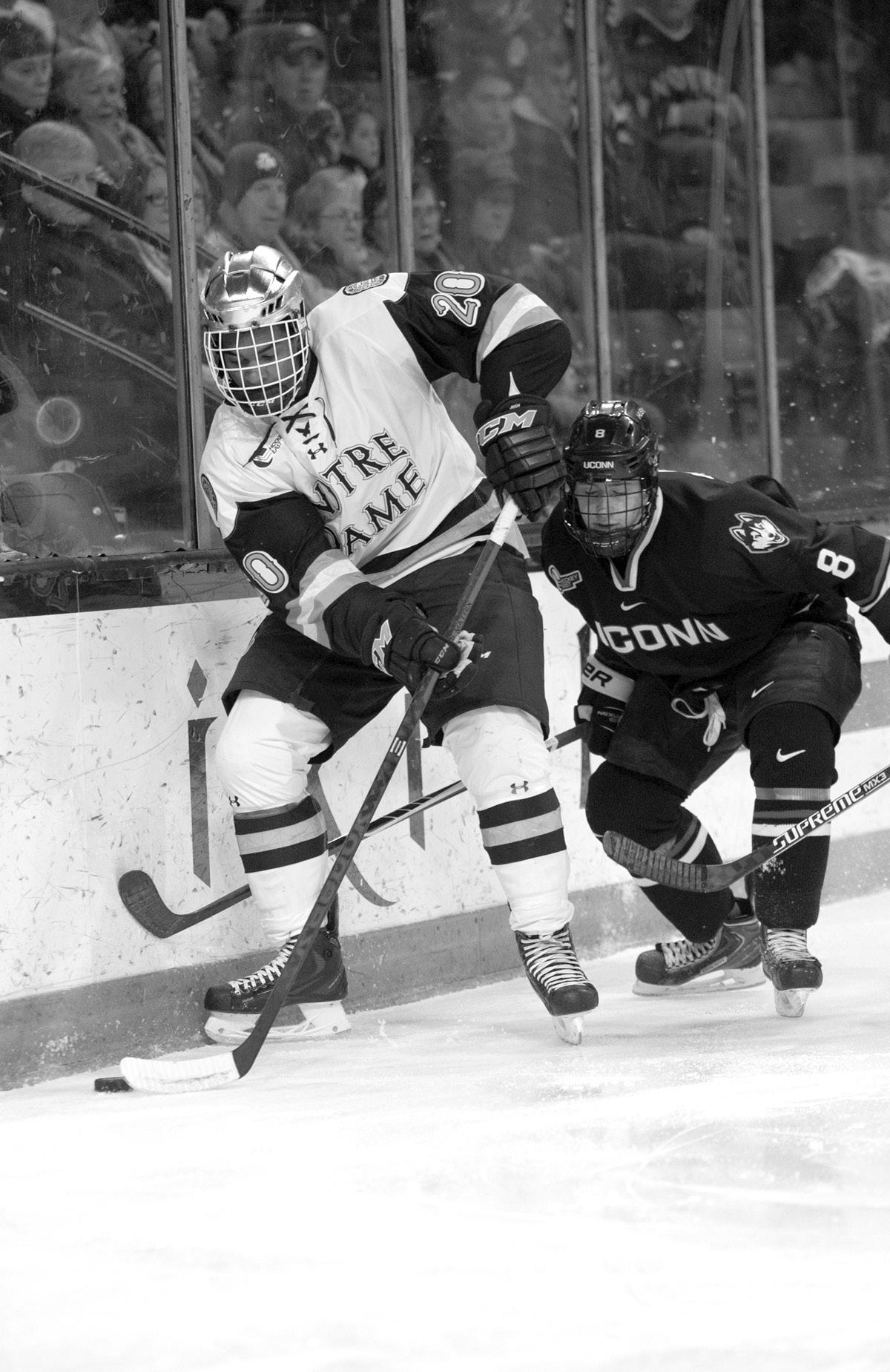


anything that resembles a second rivalry in the league. a nd just take a look at the notre dame roster. a n astounding 17 players come from the m idwest. how many come from new e ngland? o ne. That would be junior goaltender nick stasack, who has yet to see the ice in his first season as a walk-on.
i f you aren’t in new e ngland, don’t have many players from new e ngland and don’t have rivals in new e ngland, what made anyone think this arrangement would work?
o n wsbT r adio’s sportsbeat broadcast monday, Jackson told host darin p ritchett that he was concerned the i rish were still treated as an “outsider” in the league and that there was a “double standard” in play against the team. a nd he’s absolutely right in that assessment. b ecause the i rish are outsiders.
we have been seeing it on the ice now, too, specifically from the guys wearing the white-and-black striped shirts. The i rish were denied an opportunity at overtime Friday when northeastern directly benefitted from a
Ivey
con T inued F rom page 16
irish guards melissa] lechlitner and Tulyah [gaines] did,” ivey said. “so many points guards have gone through this program, so it’s a blessing to be in this role.” before she was in that role, ivey was a freshman guard, sitting on the bench and redshirting her first season after suffering a tear in her knee.
but she calls even that injury a “blessing in disguise” because it allowed her to come back for a fifth season with the irish in 2001. by that time, she had grown into a finalist for the nancy lieberman award as the country’s top point guard and helped the team to a national championship in her hometown of st. louis.
“That was hard for me because that was my first injury, so for my first injury to cause me to be sidelined, that was really something that i had never experienced,” she said. “but in hindsight, my senior year, i found out [the Final Four] was in st. louis, so that was a goal of mine. it was kind of motivation for me to get back home my senior year, so it definitely was a huge blessing in disguise.”
a fter that, ivey played for five seasons in the wnba before interning under current ohio state coach kevin mcguff, then at Xavier.
Two years later, she received a call from mcgraw that had her packing her bags and heading back to south bend.
“it’s been amazing, as a player, being able to help build the program as a point guard, win the national championship and then
missed slashing call in the final two minutes of the game. This non-call came on the heels of a conference game earlier this year when the i rish were denied a win against umass l owell after officials failed to review a missed offside call. Jackson asked for a review, the correct process in this situation, but none happened. a dd these incidents to the growing list of referees’ decisions that have baffled the i rish coach over the past two seasons, and it’s not hard to see a trend developing.
o f course, as with anything, the element of money is involved. w hen notre dame joined hockey e ast, it did it alongside the announcement of an agreement to air i rish home games on nbc sports network. That agreement got underway last year — notre dame’s first in the league — and puts the i rish on national television as much as any other college hockey program.
d oes that happen if notre dame went independent or joined the national c ollegiate hockey c onference ( nchc ), the other league the i rish considered?
p robably not. had the i rish gone independent, it is likely that they would have
struggled to find quality opponents late in the season. This weekend, vermont and penn state are the only teams playing a non-conference contest. The following week, it’s just northern m ichigan and m innesota-d uluth. w ith such uncertainty in scheduling, it’s easy to see why nbc might not have been interested in such an arrangement.
a s for the nchc ? it’s hard to say. a t face value, nbc might have preferred the hockey e ast teams to a slate headlined by m iami ( ohio) and north dakota. b esides, it’s difficult to say if the conference would have let the i rish negotiate their own T v contract because it already has an agreement with cbs sports network.
s o, yeah, if a television contract is the most important thing to swarbrick and the program, they probably made the right call.
but it’s left them in a conference where they’re outsiders in almost every way. a nd i’m not sure that will ever change.
Contact Alex Carson at acarson1@nd.edu
The views expressed in this column are those of the author and not necessarily those of The Observer.
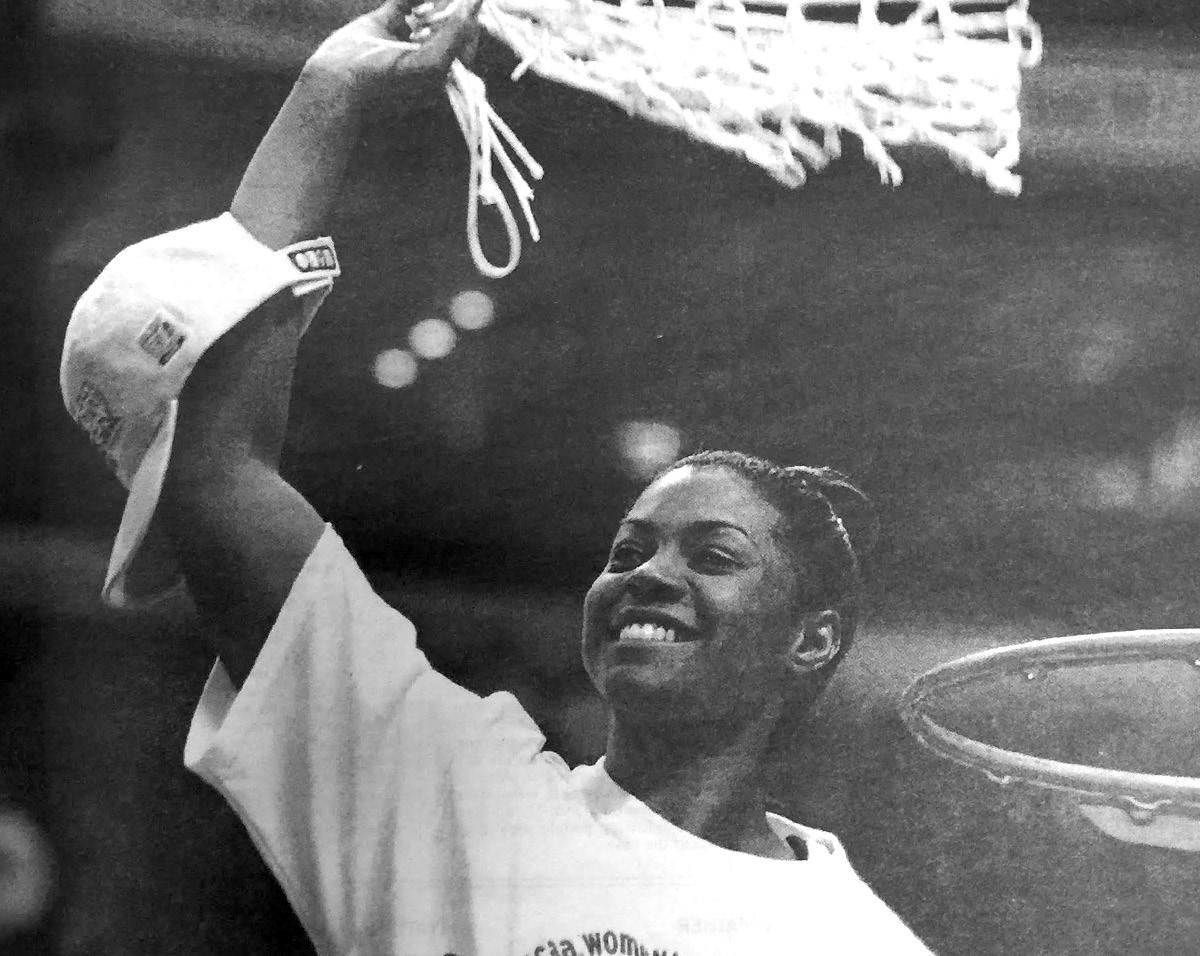
come back,” ivey said. “For me, it’s what i love. it’s my passion, notre dame, and to be able to have my first job to be back here under coach mcgraw, a hall of Fame coach, to me has been a dream come true.”
coming from a family that enforced the value of education, ivey said her decision to come to notre dame as a player was a no-brainer. now, almost 15 years after ivey’s graduation from the university, mcgraw said the choice to bring her back as a coach was just as simple.
“it was the best and easiest decision i’ve ever made,” mcgraw said. “i think that she was exactly what i wanted and needed because she had such great experience as a player, played at the highest level.
“… she just has the kind of personality that is charismatic and really attracts people to her, so i thought that she’d be
tremendous.”
ivey said taking the job at notre dame was the best move not only for herself, but also for Jaden, who has grown up with the program and regularly travels with her.
“he’s a gym rat, so my job is something that he loves to do, so i’ve been blessed to have such an amazing son who can handle the role that i play as a coach, having to do so many things,” she said.
a lthough her job description entails trying to convince some of the country’s best prospects to play for the irish, she said she isn’t focused on recruiting another ivey to notre dame — at least not yet.
“he’ll be 13 in a month, so i’m still looking at high schools,” ivey said with a laugh.
Contact Mary Green at mgreen8@nd.edu
CAITLYN JORDAN | The Observer Irish sophomore defenseman Justin Wade handles the puck during a 3-3 overtime tie with Connecticut in Compton Family Ice Arena.
Observer File Photo
Former Irish guard Niele Ivey celebrates after Notre Dame’s 68-66 win over Purdue in the NCAA championship April 2, 2001.
M bball
con T inued F rom page 16
2000. d uke went 26-9 overall and 13-5 in acc play although it was upset by m ercer in the second round of the ncaa tournament.
“That may have been the highlight of our season last year, beating d uke,” b rey said in his weekly acc conference call m onday. “a fter that, we didn’t have much of an identity in the league. we were competitive but couldn’t finish them, certainly not like we’re finishing them this year.”
That has been one area of improvement for the i rish this year — n otre d ame is 6-2 in games decided by less than 10 points, including 2-0 in overtime. The team is also off to its best start since 1973-1974, the year it snapped ucla’s 88-game winning streak and and finished with a 26-3 record.
d uke features a talented young lineup, notably freshman center Jahlil o kafor. averaging 18.9 points per game and 9.4 rebounds per game, the potential numberone pick in this year’s nba draft combines with freshmen guard Tyus Jones and forward Justise w inslow and senior guard Quinn c ook to power the b lue d evil offense.
“They’re really talented,” b rey said. “ i was just reading today about all the firstround picks they’ve got on their roster. s o we’ve got our hands full.”
The i rish have thrived off guard play this season, using four smaller guards and forwards around junior forward Zach a uguste inside on the offensive end. h owever, the b lue d evils’ size inside, with the six-foot-11 o kafor and seven-foot junior center m arshall p lumlee will test n otre d ame physically, b rey said.
“That’s something we’ve got to make a decision on.
w hat do you do with o kafor?” b rey said. “a lot of people have [doubleteamed] him. … we really haven’t done that much, but that’s something we’ve got to digest a little bit.”
s till, b rey said his team is confident and ready for the challenge.
“ i like the way we’ve been playing, and our group believes they can get it done against just about anybody,” b rey said.
Tonight will mark the
second game between top10 teams at p urcell p avilion since 1980, and the first such matchup since Feb. 9, 2003, when n o. 10 n otre d ame upset n o. 4 p ittsburgh, 66-64.
w hile k rzyzewski achieved his milestone s unday at m adison s quare g arden, tonight could potentially be significant for n otre d ame. s enior guard Jerian g rant, who leads the i rish in scoring (17.1 points per game) and assists (6.2 per game), will make his 100th career start in an i rish uniform, and a win would be the 600th i rish victory at p urcell p avilion, where the team has played since the 1968-1969 season.
n otre d ame will aim to make its own history tonight when it hosts d uke at 7:30 p.m..
Contact Zach Klonsinski at zklonsin@nd.edu
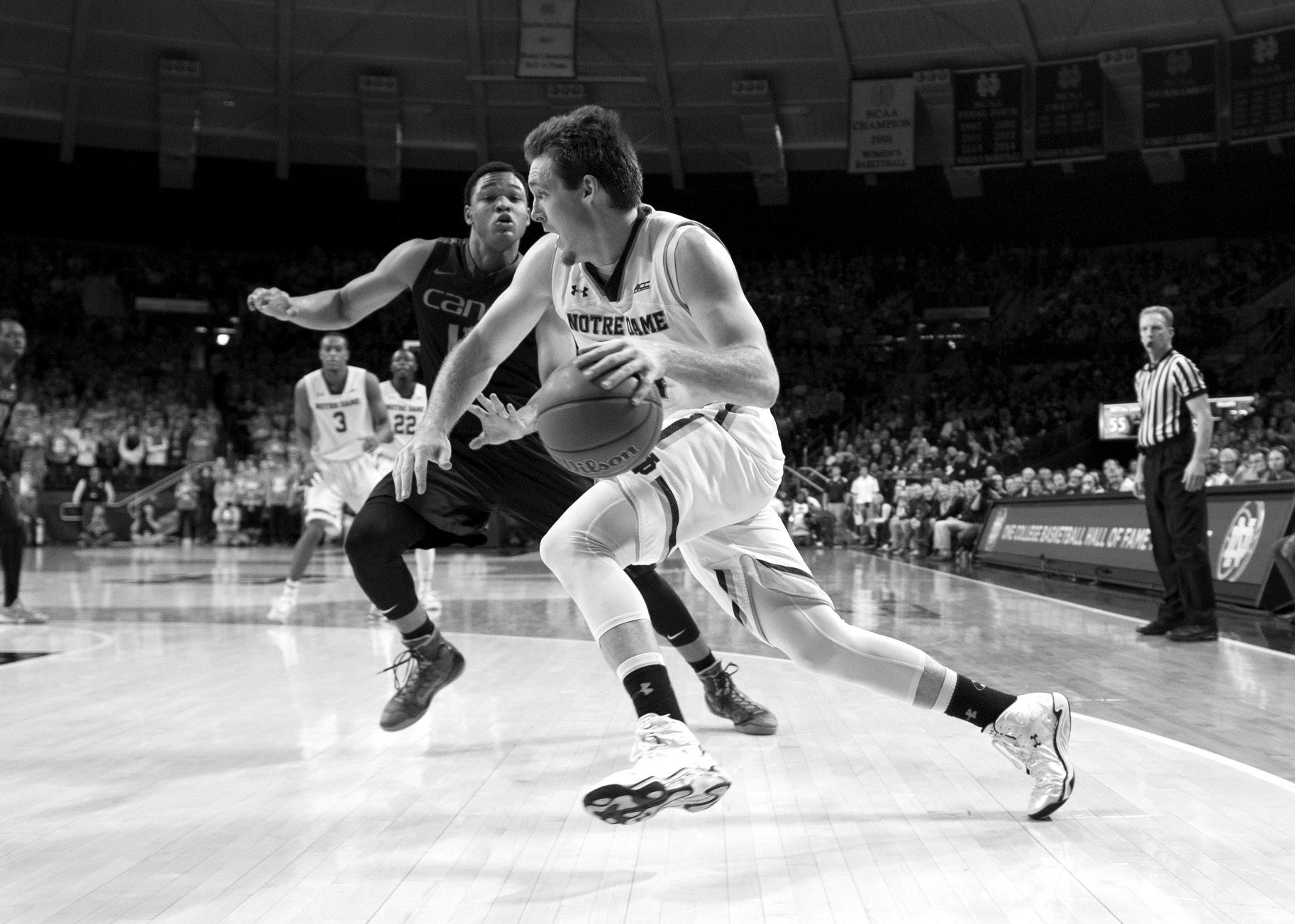

MICHAEL YU | The Observer
Irish senior guard/forward Pat Connaughton drives past a defender during Notre Dame’s 75-70 victory over Miami on Jan. 17 at Purcell Pavilion. Connaughton finished the game with 10 points.
Happy Birthday: you will have the wherewithal to jump into action and get things done. your ability to take on additional responsibility will position you well for advancement. e motional matters are likely to build if you don’t take care of them swiftly. l ove and romance are highlighted, and an attentive, nurturing display of emotions will lead to domestic and personal improvements. your numbers are 3, 11, 21, 27, 33, 36, 48.
ARIES (March 21-April 19): Think big, but budget wisely. keeping things in perspective will make any gains you accomplish sweeter. romance is on the rise, and a positive change in your current living arrangement is apparent. a commitment can be made.
TAURUS (April 20-May 20): s hare your thoughts and do your best to help others. keep a close watch on the changes going on around you, but don’t let the temptation to follow suit get the better of you. Too much of anything will set you back.
GEMINI (May 21-June 20): romantic relationships will suffer if you don’t address your concerns honestly. s orrow will result if you let anyone limit your freedom. Think twice before you make a promise you will live to regret. a personal move will be beneficial.
CANCER (June 21-July 22): g et into something that you have wanted to pursue for some time. a creative venture that allows you to use your imagination will turn out well. romance is on the upswing, and sharing your feelings will bring you closer to someone special.
LEO (July 23-Aug. 22): Travel will open up new possibilities through the experiences you have or the people you encounter. c onsider signing up for a seminar that will help you expand an interest or skill you’d like to learn to enhance your marketability.
VIRGO (Aug. 23-Sept. 22): use your attributes wisely. d on’t let anyone put demands on you that will infringe on your ability to be and do your best, allowing you to reach your set goals. p ut yourself first.
LIBRA (Sept. 23-Oct. 22): keep your conversations with others light and playful. you will face difficulties if you address issues that you know aren’t favored by others. use your intelligence to identify those you would like to work with.
SCORPIO (Oct. 23-Nov. 21): s ay little and do a lot. it’s how you handle situations that will count in the end. i f you pontificate without following through, your reputation will be jeopardized. Take an innovative but serious approach and you will advance.
SAGITTARIUS (Nov. 22-Dec. 21): Focus on what you have accomplished in the past and you will bring about positive changes at home and at work. e xpect someone to challenge you, and be ready to question the facts being offered to make you appear incompetent.
CAPRICORN (Dec. 22-Jan. 19): g o over unexpected alterations being made by others. l ook for obscure solutions and implement what you feel will protect you, your family and your current lifestyle. d on’t be afraid to take action even if you are forced to do so alone.
AQUARIUS (Jan. 20-Feb. 18): you will get the push you need to make selfimprovements. a dded discipline and greater opportunity are heading in your direction. keep emotions steady and refrain from getting into conversations with anyone who appears unstable. l ove is highlighted.
PISCES (Feb. 19-March 20): m ake an honest assessment regarding who you are and what you have to offer. l ook back at past experiences and correct the mistakes you’ve made before you move forward. g et the credentials you need to reach your goals.
Birthday Baby: you are determined, unstoppable and proactive. you are smart and imaginative.
juMble | david hoyT and JeFF knurek
sudoku | The mepham group
hIGhly PunlIkely | chrisTopher brucker
doMe nuTs | aleXandria wellman
Top-10 throwdown
No. 8 Irish to face No. 4 Blue Devils in home ACC matchup for second straight year
By ZACH KLONSINSKI sports writer
w hile “1 k ” has already been secured, n o. 8 n otre d ame still has a chance to make history tonight at 7:30 p.m. when it welcomes n o. 4 d uke to p urcell p avilion.
The b lue d evils (17-2, 4-2 acc ) mounted a comeback late in the second half s unday against s t. John’s, 77-68, to earn coach m ike k rzyzewski his 1,000th win as a head coach. s o instead of a chance to keep k rzyzewski in triple digits for a few more days, the i rish (19-2, 7-1 acc ) will have to settle for the opportunity to do what no other team has done before — beat a coach with 1,000 wins.
“ o bviously [1,000 wins] is an unbelievable milestone,” i rish coach m ike b rey said after his team survived an overtime thriller with n orth c arolina s tate, 81-78, on s unday. “ i don’t know if anybody else is going to be able to get that.”
i f anyone at n otre d ame knows about the b lue d evils,
it’s b rey. a former assistant under k rzyzewski at d uke from 1987-1995, b rey became the first of k rzyzewski’s former assistants to ever beat him as an opposing head coach. The i rish pulled off their biggest win of last season by shocking the then- n o. 7 b lue d evils, 79-77, on Jan. 4 2014, at p urcell p avilion. b rey said he has good memories of his time in d urham, n orth c arolina.
“ i had great years with him, and i owe a lot of what i ’m doing now to his mentorship,” b rey said. “ i ’m just honored to have played a very small part in that.”
The victory last season came in n otre d ame’s first acc game ever and snapped d uke’s streak of six consecutive wins in conference openers. The programs went separate directions after that though. n otre d ame limped to a 6-12 record in acc play and finished 15-17 overall, b rey’s first losing season since taking over as head coach in
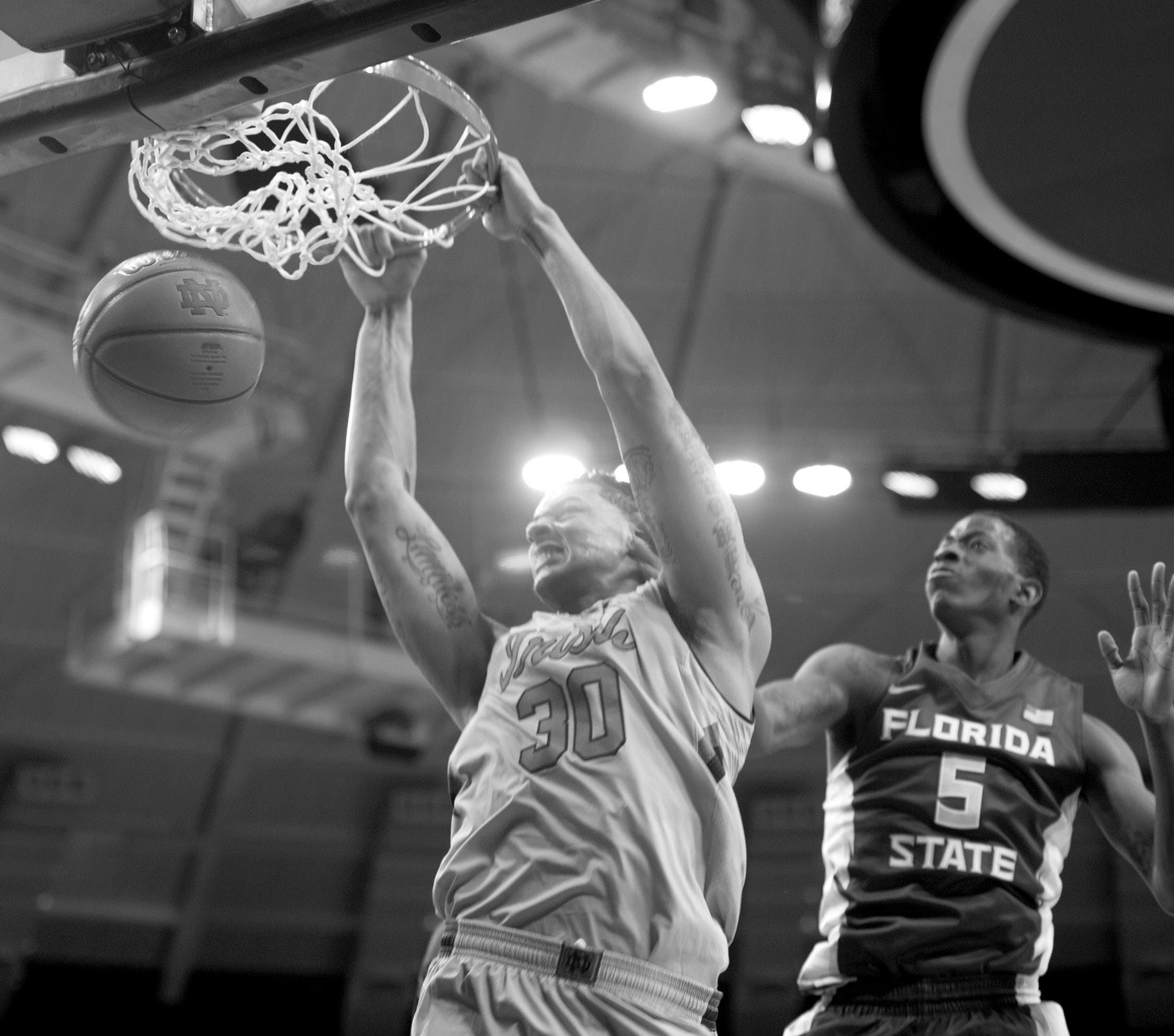
Ivey ‘blessed’ to mentor new guards at alma mater
By MARY GREEN sports e ditor
ask niele ivey about anything — her time as point guard under irish coach muffet mcgraw, her current role as irish women’s basketball recruiting coordinator and assistant coach or her 12-year-old son, Jaden — and one word will keep coming up.
“blessed.”
it’s difficult to become an a ll-a merican and groom players like former irish guard and current wnba a ll-star skylar diggins without talent, hard work and a keen understanding of the game.
“she was always one of the hardest workers in the gym,” mcgraw said of ivey’s career with the irish. “she was always the person that could be completely intense on the court, and the minute she stepped in the locker room, be kind of the life of the party and the one that made everyone laugh and kept everybody loose.” however, ivey dishes out
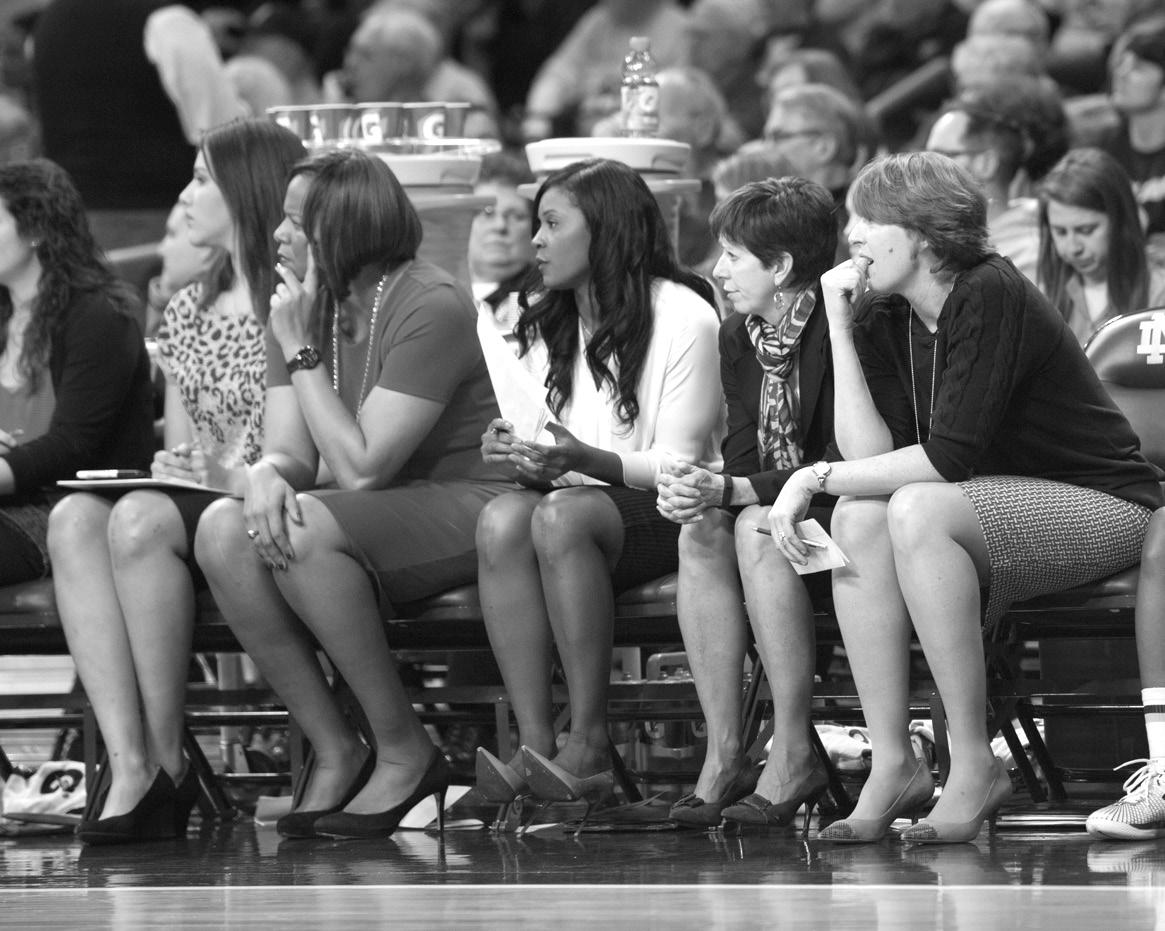
credit for her success just like she used to dish out assists for notre dame.
in her eight-year run as an assistant coach, ivey has worked specifically with the point guards, overseeing the development of players such as diggins and current sophomore lindsay
a llen, a freshman a ll-a merican last season.
“For me, i’m kind of a proud mom, sitting back, seeing the success, seeing the work ethic, seeing what skylar’s done after she’s graduated, what [former
nd left on outside in hockey east

w hen conference realignment came to the college hockey world a few years ago, notre dame had a decision to make. The conference the i rish had been a member of for the better part of 20 years, the ccha , was folding at the end of the 2013 season due to the impending departures of m ichigan, m ichigan state and ohio state to the newlyestablished big Ten hockey conference.
The ccha was, in many ways, a great league for the i rish. They had natural, crosssport rivals in the wolverines and spartans and developed strong on-ice duels with teams like western m ichigan and m iami ( ohio). but unfortunately, that had to come to an end.
o n o ct. 5, 2011, notre dame officially joined hockey e ast. it was touted as a great move
for the i rish program — i surely heard the phrase “the nation’s premier hockey conference” thrown around enough by the athletics department — and one that would put the team’s influence at a national level. but despite a thletic d irector Jack swarbrick’s reassurances that notre dame fit well in the conference, it was clear from the start that the i rish were going to be outsiders in this new league. it all starts with geography and goes from there. notre dame is the only school in the conference not located in new e ngland. e very time the i rish play a road conference game, a somewhat lengthy plane ride awaits them. w hen the i rish joined hockey e ast, b oston c ollege was the only school against which they really had any sort of competitive sports history, and in the 18 months since, they’ve yet to establish
CAITLYN JORDAN | The Observer
Irish junior forward Zach Auguste slams down a dunk during Notre Dame’s 83-63 win over Florida State on Dec. 13 at Purcell Pavilion. Auguste led all scorers in the game with 26 points.
hoCkey
WakInG The eChoes | niele ivey
Alex Carson sports writer
AMY ACKERMANN| The Observer
Irish assistant coach Niele Ivey, center, sits courtside during Notre Dame’s 89-76 win over Georgia Tech on Jan. 22 at Purcell Pavilion.
see m bball PaGe 14