Print Edition of The Observer for Monday, March 21, 2016
Grotto service reflects on sexual assault
Student government responds to recent sexual assault report and promotes increased awareness
By RACHEL O’GRADY Associate News Editor
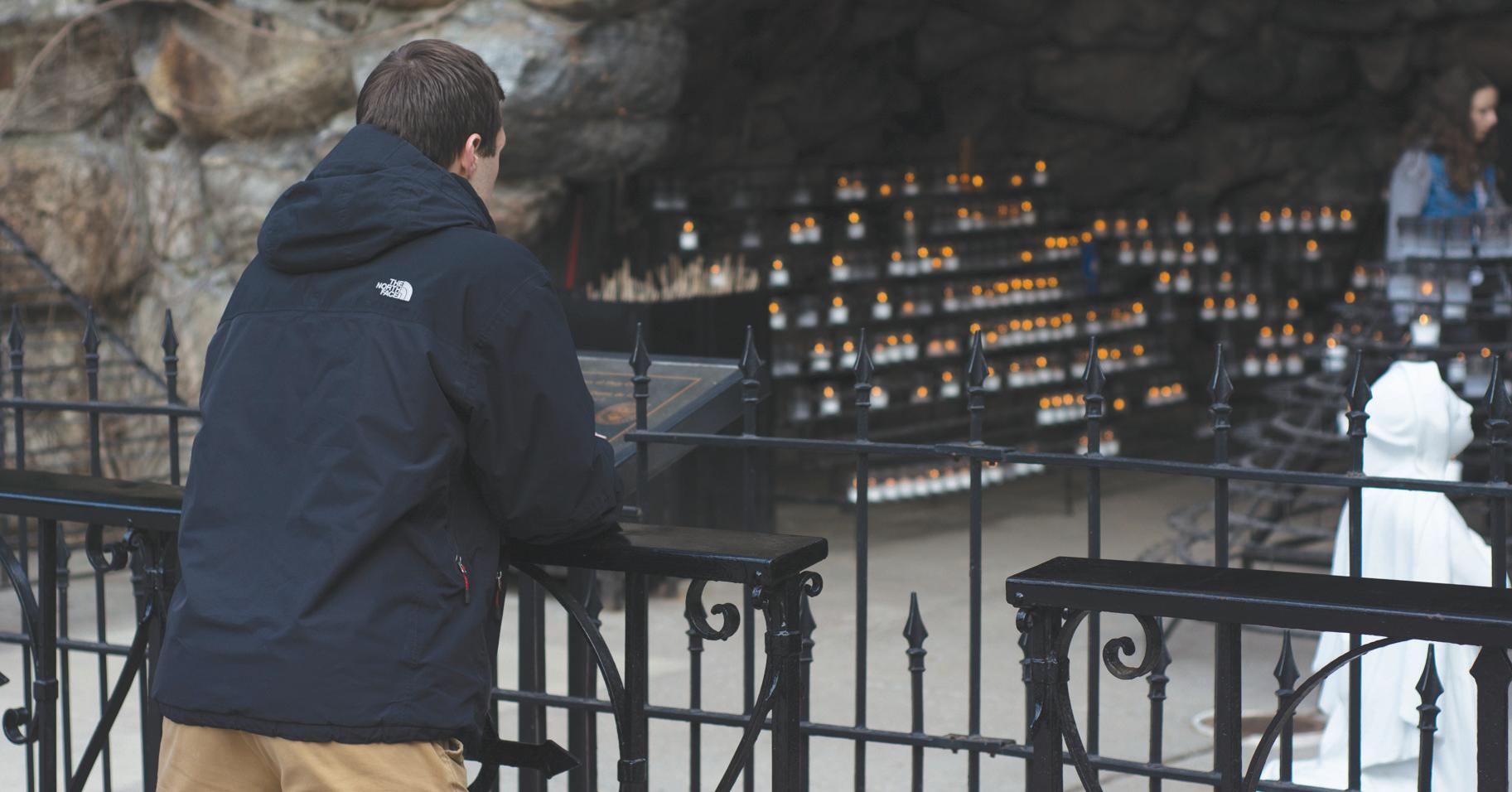
Students gathered to pray for healing Friday afternoon at the Grotto in response to a Feb. 24 off-campus sexual assault reported by a Notre Dame student to the South Bend Police Department.
Dan Sehlhorst, former student body chief of staff, offered a reflection on the reported assault.
“Community, charity, hope, heart, zeal, family, love. As we stand here together in this beautiful grotto, these words awake within our hearts a feeling of what it means to be a member of the Notre Dame community. At Notre Dame, we always
hear that we stand for more than just learning in the classroom, success on the field or discovery in the lab,”
Sehlhorst said.
Sehlhorst said Notre Dame stands for justice, unique human dignity and “standing for each other.”
“As I look at the group of us today, I sense that that feeling runs deeper in our hearts. Today, however, we also grapple with another set of feelings,” he said.
According to Sehlhorst, the University community fell short of its “mandate and our collective responsibility to meet the demands of our Catholic mission.”
SMC Dance Marathon raises money for hospital
By IZZY KEHNER News Writer
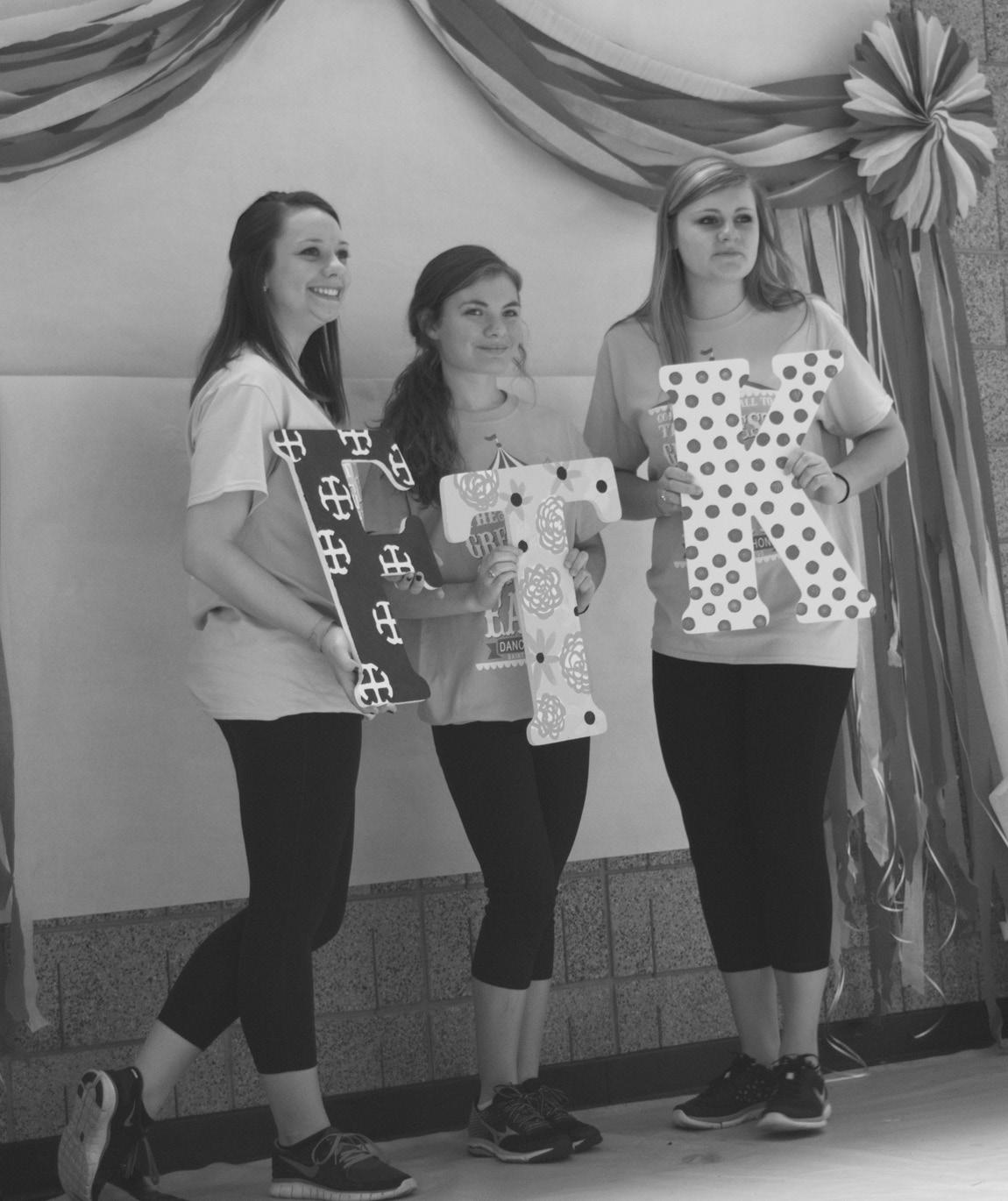
Saint Mary’s Dance Marathon (SMCDM) raised its largest ever total Saturday, bringing in more than $105,000 in donations for the Riley Hospital for Children in Indianapolis. The funds raised
during the 12-hour dance marathon as well as in the months leading up to it help to provide treatment for children regardless of their families’ ability to pay.
Maranda Pennington, Saint Mary’s Dance Marathon
response to an off-campus sexual assault reported on Feb. 24, student government
at the
on Friday, encouraging
Diplomat analyzes Vatican
By AIDAN LEWIS News Writer
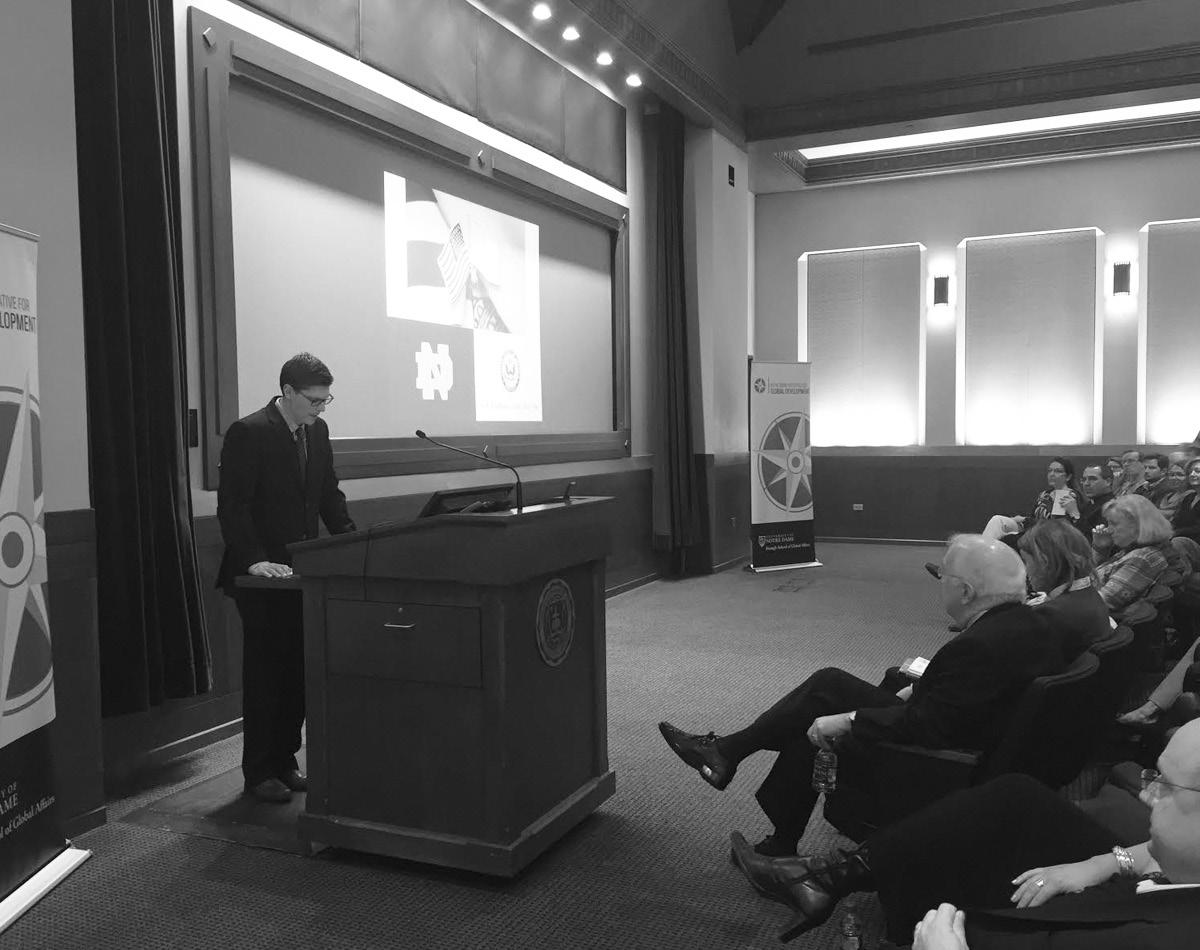
Ken Hackett, the United States Ambassador to the Holy See, spoke about Pope Francis and his vision for the Catholic Church at Eck Visitors Center on Friday afternoon. Hackett, who works closely with the Vatican, said Pope Francis is the most reform-minded pope in recent history.
“Pope Francis has kept the
Church’s vision sacred, but uses it to influence policies and actions more dramatically than has been done in a long time,” Hackett said.
Considering he is more radical than his predecessors, Hackett said it was inevitable that some people would disagree with his vision.
“When a new boss arrives and implements new ways of doing things … there’s going to be resistance,”
Hackett said.
Hackett said one controversial action was Pope Francis’ appointment of a financial overseer for many Vatican sub organizations.
“When an institution has evolved over so many years, and its sub organizations have grown accustomed to a certain degree of operational and financial autonomy, you’re bound to have
ND alumni develop app
By SELENA PONIO Associate News Editor
With the summer swiftly approaching, students often find themselves lost in a sea of internship applications and turn to sites such as LinkedIn or GoIrish to help them in their search.
Two Notre Dame alumni aim to simplify the career and internship search with CareerLightning.
Frank Bugaris, who graduated from Notre Dame in 1999 with a
major in accounting, created CareerLightning, a mobile app that aims to create “immediate and impactful real world career introductions,” according to its website.
“A big part of the career I had in the past 10 to 15 years has been trying to find and hire people,” Bugaris said. “Although it’s one of the most rewarding parts of managing, it’s also extremely difficult. Lots of the methods are really slow or relying on word of
mouth or it can cost a small fortune.”
Bugaris said newspaper advertisements and websites such as LinkedIn often charge a lot for access to their resources. He said CareerLightning offers a more affordable alternative for prospective job candidates, and its results are also more immediate.
“It’s all designed to be solely on your mobile device, so there’s nothing to
CAITLYN JORDAN | The Observer
In
held a prayer service
Grotto
students to promote awareness and discussion about sexual assault.
CAITLYN JORDAN | The Observer
A girl plays on an inflatable slide as part of Saint Mary’s annual 12 hour Dance Marathon that supports Riley Hospital for Children.
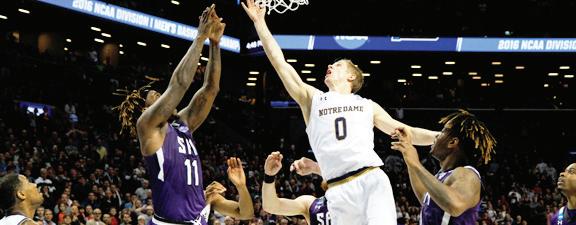
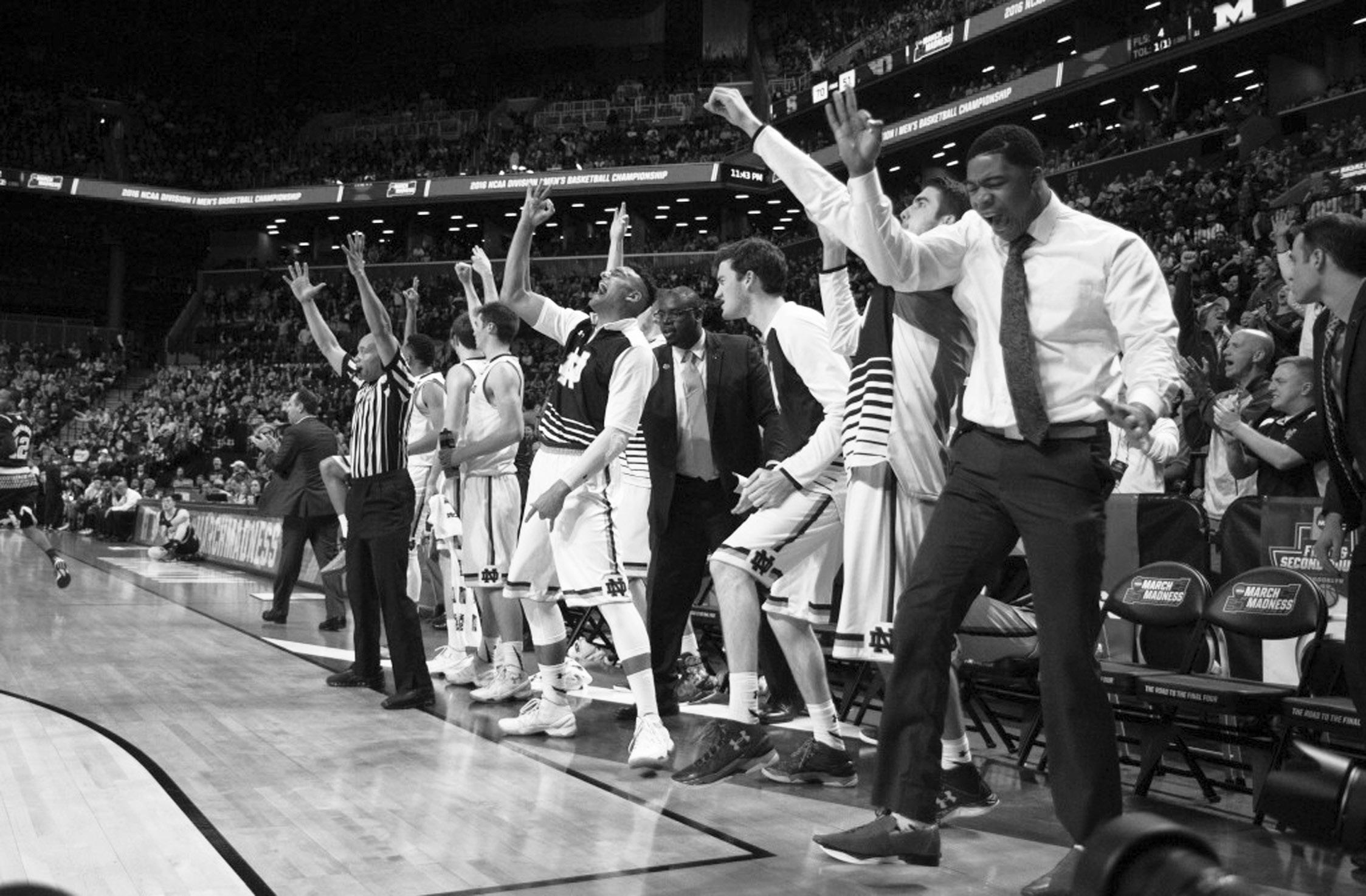
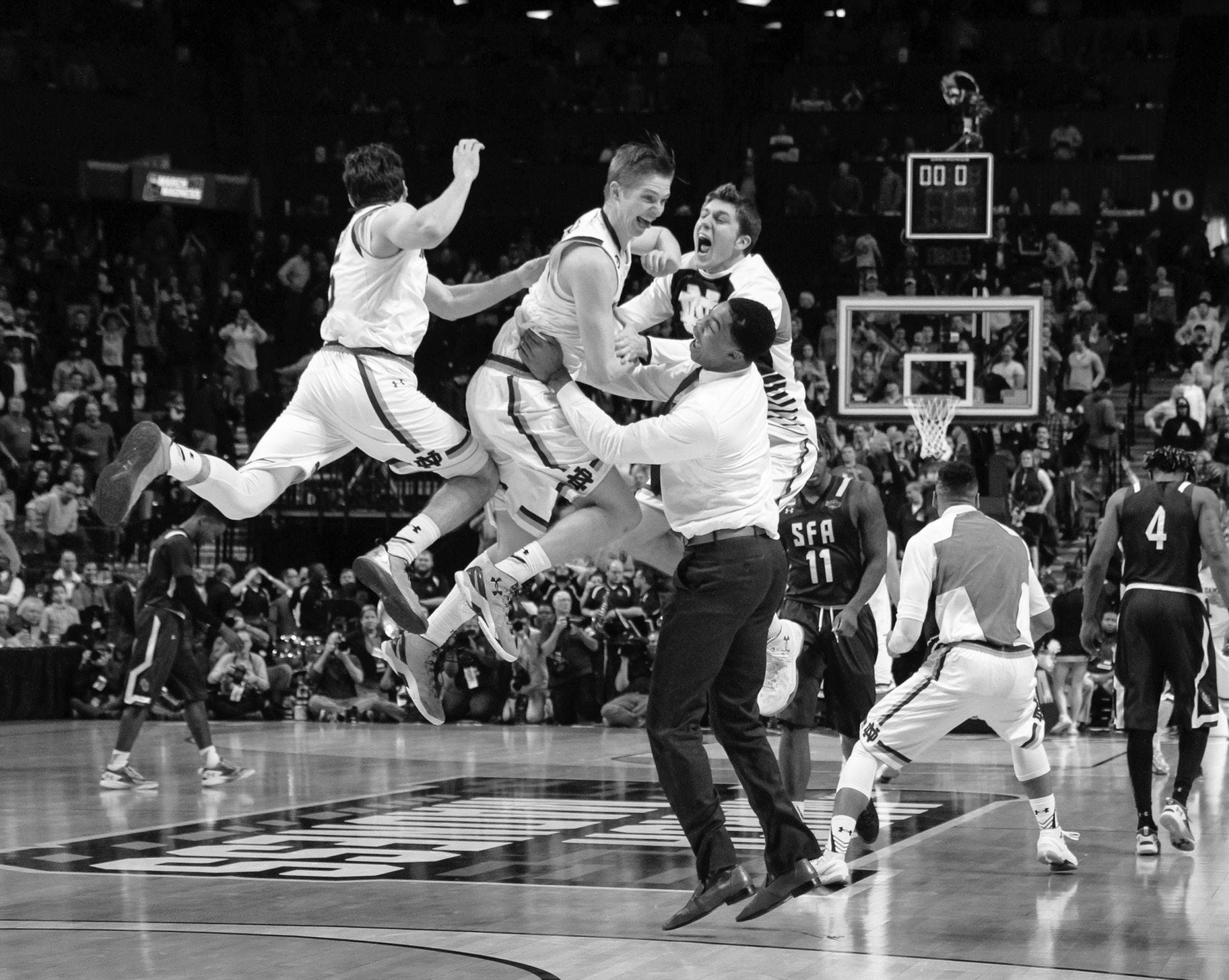
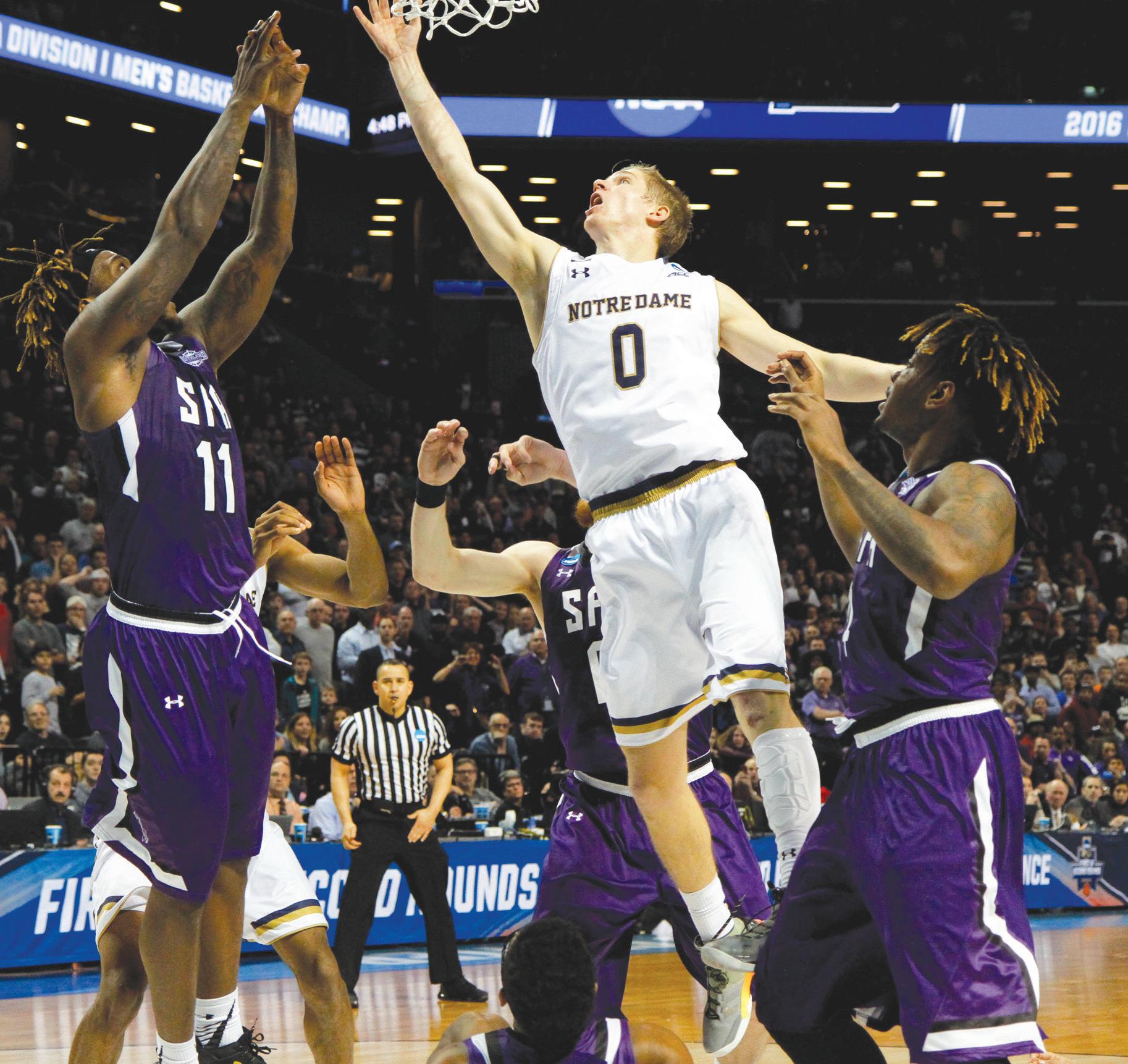
The Notre Dame bench celebrates during its 70-63 First Round victory in the NCAA Tournament versus rival Michigan on Friday night in Brooklyn. The Irish went on the beat the Stephen F. Austin Lumberjacks on Sunday and will advance to the Sweet 16.
Today’s Staff
News
Rachel O’Grady
JP Gschwind
Lucas Masin-Moyer
Graphics
Lauren Weldon
Photo
Corrections
Llorens
The Observer regards itself as a professional publication and strives for the highest standards of journalism at all times. We do, however, recognize that we will make mistakes. If we have made a mistake, please contact us at (574) 631-4541 so we can correct our error.
Monday
Chili Cook-Off Harper Hall
4 p.m.-6 p.m.
Proceeds benefit Relay for Life.
Women’s Basketball vs. Indiana Joyce Center
6:30 p.m.-8:30 p.m.
The Irish take on the Hoosiers.
Tuesday
Factulty and Staff
Interfaith Forum
Lafortune Center
12:15 p.m.-1 p.m.
Explore world religions.
Softball vs. Eastern
Michigan
Mellissa Cook Stadium
5 p.m.-7 p.m.
The Irish take on the Eagles.
Wednesday
Tax Assistance Program
Geddes Hall
3 p.m-5 p.m.
Prepare tax returns.
Softball vs. Michigan State
Melissa Cook Stadium
5 p.m.-7 p.m.
The Irish take on the Spartans.
Thursday
Evening Mass
Basillica of the Sacred Heart
5 p.m.
Lord’s Supper Mass.
Guided Tour: The Easter 1916 Rebellion
Hesburgh Library
5:30 p.m.
Explore works from the Easter Uprising.
Friday
Morning Prayer
Basillica of the Sacred Heart
9 a.m.
Prayer for Good Friday.
Stations of the Cross Basillica of the Sacred Heart
7:15 p.m.
Ceremony open to the Public.
Notre Dame students launch Friends of Israel Club
By ANDREA VALE News Writer
Four students have founded the Friends of Israel Club on Notre Dame’s campus, aiming to educate students on the history and current political situation within Israel. The club, which began meeting last month, is a bipartisan political group which also hopes
as a group this past February. The other three co-founders are junior James Argue, graduate student Brendan Roche and senior Matt Matigian.
Olohan said he was inspired to start the club after noticing a bias in the information provided to students.
“After attending the ‘Understanding Gaza’ panel, I was very disappointed that all
“I founded The Friends of Israel to spread awareness of the rich history of Israel from Joshua to David, from subjugation and exile at the hands of the Assyrians, Macedonians, Romans, Byzantines, Arabs, Ottomans, English and others, to independence in 1948”
Tom Olohan co-founder and president Friends of Israel
to offer opportunities to support Pro-Israel politicians and legislation.
According to junior James Argue, co-founder of the club, the Friends of Israel’s stance is opposed to the Boycott, Divestment and Sanctions (BDS) Campaign.
“We hope to … provide an alternative point of view on campus,” Argue said in an email. “We believe that most Notre Dame students would strongly support the American-Israeli alliance if they examined these issues more closely. We hope to provide that opportunity and to help create an informed and meaningful dialogue throughout campus.”
According to senior president and co-founder Tom Olohan, the club was founded in December 2015 and first met
the attendees left that room with only one side of the story of the 2014 conflict between Israel and Hamas,” Olohan said in an email, “While I published an article that addressed some of these issues in The Observer the next spring, I soon realized that a student club would be the most effective way to educate students on these issues.
“I founded The Friends of Israel to spread awareness of the rich history of Israel from Joshua to David, from subjugation and exile at the hands of the Assyrians, Macedonians, Romans, Byzantines, Arabs, Ottomans, English and others, to independence in 1948.
Students need to know about the dangerous regional situation of Israel and the incredible benefits Israel provides for the United States. Finally,
PAID A DVERTISEMENT
I founded the club to let students know about Pro-Israel politicians and legislation and offer students the opportunity to support both.”
According to Olohan, the club’s primary activity involves coordinating presentations geared at educating students on important American-Israeli issues, and on the history of and current political situation in Israel. Additionally, the club brings in Pro-Israeli speakers throughout the year, and will host an event towards the end of the spring semester celebrating Israeli culture and the American-Israeli alliance.
On Wednesday, the club is planning to present at the College Republicans club meeting to both introduce the Friends of Israel Club and its goals, as well as to present opportunities to support the campaigns of pro-Israel legislators.
According to Roche, other events planned for the semester include a March 30 talk by yuval Shaham, current Israeli Emissary to the Jewish Federation of Saint Joseph Valley, as well as an April 8 event in South Bend co-sponsored with the Jewish Federation of Saint Joseph Valley during which ArabIsraeli diplomat George Deek will speak.
Roche said that students should be interested in Israel because it “[provides] the [United States] with key intelligence regarding nations in the surrounding area.”
“They also have cooperated in the United States, particularly in the field of technology, which has helped the profitability of U.S. companies. It is also important that it is a democracy, unlike the majority of countries in the region, and that it is a true ally in the face of many regimes that have a very unfavorable view of America,” Roche said.
“We are hoping to reach out to the incoming class, as well as providing an alternate point of view for those already on campus,” Argue said. “The public is often only given one side of the story, and this is just as true at Notre Dame as elsewhere. We want to provide the missing information and to be a voice on the other side of the issue. Again, we want to stress that we are a bipartisan group and that we support a two-state solution in the right conditions. Ultimately, we want to raise awareness of the plight of Israel and to be the catalyst for meaningful debate on our campus.”
Contact Andrea Vale at avale@nd.edu
dance
president, said the marathon itself is a culmination of a year’s hard work.
“The biggest [events] include our FT5K run/ walk in October and then
“We raised $105,963, the biggest [amount] in Saint Mary’s history”
Maggie McKinnon Saint Mary’s freshman
Riley Week in February,” Pennington said. “During Riley Week, our goal is to spread the message of Riley to the student body and make people more interested in participating with Dance Marathon.”
Pennington said several families whose children have sought treatment at Riley Hospital are invited to share their stories at Dance Marathon each year.
“[The stories of Riley] really put matters of my life into perspective,” Pennington said. “I can be stressed out of my mind for school or other reasons, but then I will remember the work I’m involved with in Dance Marathon and all the kids that are literally fighting for their lives. It has made me more grateful and more willing to advocate for those in need.”
Pennington said these testimonies have reaffirmed her decision to become a nurse because they continually remind her of the importance of caring for those in need.
“A major part of being a nurse is being a holistic advocate for your patient,”
Pennington said. “I feel like my experiences and skills I have acquired as a leader in Dance Marathon and as a nursing student making me better at both roles.”
Pennington said she hopes Dance Marathon continues to engage students in fundraising efforts for sick children.
“I hope that we continue to increase our efforts to raise awareness and funds for the amazing kids and families at Riley Hospital for Children while also gaining more student participation each year,” Pennington said. “The passion and dedication of the women I work closely with all year is amazing.”
First-time participant freshman Maggie McKinnon heard about SMCDM from her sister, junior Bridget McKinnon.
“We raised $105,963, the biggest [amount] in Saint Mary’s history,” Maggie McKinnon said. “It was a lot of fun. I think my favorite part was when we did … a circle and they played the song ‘Angels Among Us’ and we just stood there and sang along. The [SMCDM executive board members] would come along and find their committee members and just give them hugs and it was just really nice.”
Freshman participant Nicole Blandin said she found the experience inspiring.
“I was very emotional [when the families were sharing their stories of Riley Hospital],” Blandin said. “It kind of showed us the whole point of the evening and gave us a better perspective and more connection to the families.”
Contact Izzy Kehner at ikehner01@saintmarys.edu
CAITLYN JORDAN | The Observer
Saint Mary’s students take part in SMC Dance Marathon, which raises funds for Riley Hospital for Children.
some tensions,” Hackett said.
Hackett said this initiative is part of Pope Francis’s plan to rid the Church of its excesses and refocus attention on the poor and suffering.
“He counsels [bishops] to move amongst their people, and to shed the trappings and the luxuries of higher office,” Hackett said.
Pope Francis does this himself, Hackett said, by interacting frequently with the deprived and lowly.
“His preference is generally to meet and have encounters with the simple, the meek, the troubled, the sick, the prisoners and the homeless,” Hackett said.
According to Hackett, Pope Francis ensures his actions and reforms are just by consulting a group of nine cardinals from around the world.
“He uses these cardinals as a sounding board, and as a kitchen cabinet,” Hackett said.
Hackett said the best example of Pope Francis’s collaborative reform is seen in “Laudato Si’,” his encyclical on climate change.
Pope Francis realized the importance of meticulous
research when formulating this encyclical, Hackett said.
“He was prepared and aware that if he was going to issue an encyclical on climate change, he would have to apply tough, scientific rigor, since it would be picked apart,” Hackett said.
Hackett said Pope Francis assembled a diverse team of
“His preference is generally to meet and have encounters with the simple, the meek, the troubled, the sick, the prisoners and the homeless.”
Ken Hakcett
experts to help write the environmental encyclical.
“He came with a group of international legislators from around the world who were interested in environmental climate change, and they met in the Vatican and shared their research,” he said.
The resulting encyclical, Hackett said, has had a
profound impact because of how it framed climate change as a moral issue.
“The encyclical gave moral cover to those politicians who had to make very difficult decisions and commitments on climate change,” he said.
Hackett said the impact can be seen in particular in Mission Innovation, an initiative signed by the United States, China and several other countries focusing on expanding clean energy research, and the American Business Act on Climate Pledge, which aims to make large corporations more sustainable.
According to Hackett, Pope Francis helped to catalyze these reforms.
“He was influencing the global agenda,” Hackett said. “It was an agenda that resonated for many in the United States and worldwide.”
Hackett said these reforms and the widespread influence they have had are helping to rebrand the Catholic Church.
“These changes are gaining credibility for how the Church and the pope are perceived on a world stage,” Hackett said.
Contact Aidan Lewis at alewis9@nd.edu
Ambassador to the Holy See United States
ROSIE LoVOI | The Observer
United States Ambassador to the Holy See Ken Hackett speaks about his Vatican experience at the Eck Visitors Center on Friday afternoon.
“It is imperative to accept our burden in a culture that does not do enough to prevent violence,” he said.
Sehlhorst said public support for preventing sexual violence on campus was strong at the beginning of the fall semester.
“It was bolstered further by a string of reports of sexual
assault during the first weeks back on campus. Students, faculty and staff called for change. Students began to mobilize, many impassioned discussions were held, and the anger around sexual violence was palpable on campus,” he said.
Sehlhorst said he felt that same feeling deeply, and saw it in others on campus. However, he said he saw this anger fade as the year went on.
PAID A DVERTISEMENT
PAID A DVERTISEMENT
“Then midterms rolled around. Then finals. Holidays crept closer, which meant for me … a growing list of to-dos. Job applications stacked up, as did the assignments and the reading materials. And with the distractions of my day-to-day life, I stopped asking questions about what was next in the fight against sexual violence,” he said.
Sehlhorst said he forgot what it meant to be part of the community and thus what it meant to stand for one another.
“Perhaps you’ve felt the pressure for change lessen in your heart too. Perhaps you, too, forgot. Let this moment together serve as a wake up call for all of us. Today is not only a moment of shortcomings and brokenness … our
presence here today sends another signal,” he said.
The prayer service sends a message of hope across the community, Sehlhorst said.
“We hope for a fuller, stronger, more just Notre Dame — safe from the threat of sexual violence and healed from the wounds of sexual violence,” he said.
Sehlhorst said he dreams of a Notre Dame fully devoted to the care of each individual and a community unified in its commitment to preventing sexual violence.
“This commitment of heart must also translate into tangible action. When you hear an inappropriate sexual joke, speak up. When friends put themselves in unsafe situations, do not let it slide. Write the Viewpoint demanding
greater transparency on sexual assault cases. When the weekends come around be aware of your surroundings. Don’t let friends leave without the group,” he said.
The prayer service concluded with the Alma Mater, and attendees each lit a candle in solidarity with survivors of sexual assault.
At the end of his reflection, Sehlhorst said he encourages students to take responsibility for one another.
“This task will not be easy. It will not be quick. But it is our task, our calling … let us never forget who we are as a Notre Dame family. Let us never forget to stand for each other,” he said.
Contact Rachel O’Grady at rogrady@nd.edu
plug in to your computer — it’s all on mobile,” Bugaris said. “Right now, I’m targeting start up technology companies and the candidates that they’re looking for. It could be a recent graduate, an intern or someone who has been out for 10 years doing all kinds of stuff.”
Bugaris worked with Ben Roesch, a 2008 alumnus and co-founder of Cultivate Labs, the company responsible for the design and programming of the app.
“Working with Frank was probably the strongest draw for us,” Roesch said in an email. “Lots of people have an idea or a vision for an application, but a lot of them are pretty haphazard concepts where they want to pull
“The most attractive part of CareerLightning, to me, is the fact that it is focused and light-weight. It’s something that you can peek in on when you have a few minutes here or there.”
Ben Roesch co-founder Cultivate Labs
feature X from Facebook, feature y from Twitter and 20 other features from all over the place. Frank had a much tighter, focused vision for the concept that became CareerLightning.”
Roesch said CareerLightning gives applicants the opportunity to simplify their career search by eliminating any unnecessary frills.
“The most attractive part of CareerLightning, to me, is the fact that it is focused and lightweight. It’s something that you can peek in on when you have a few minutes here or there,” Roesch said. “Contrast that with something like LinkedIn where there is so much going on that it can get overwhelming and distracting, rather than focusing on the actual career search.”
Bugaris said his hope is that the app makes a difference in peoples’ lives by alleviating some of the stress that comes with any job search and decreasing the time it takes for individuals to get their applications out to potential employers.
“I think it cuts down on the ‘submit your resume into the email black hole of no responses’ nonsense that seems to happen to other people,” Bugaris said. “My biggest feelings are that it decreases the time substantially from the time someone posts a position to when they can potentially get a response from somebody. Right now it’s nothing, it’s free for applicants and technology companies.”
Contact Selena Ponio at sponio@nd.edu
A reincarnation of the 1960’s
For a moment, it’s 2016. I am twenty years old. I imagine that relatively soon I’ll look back on 2016 in the same way that older relatives and teachers look back on the sixties — it was a strange, strange time, I’ll say.
Racial tensions are flaring up again, in Ferguson (Newark), Baltimore (Watts), for racial profiling, heating up then bursting in summer riots and shootings in cities a little too close to us.
Again, college campuses are hotbeds of activism. Berkeley is still roaring, I guess, but yale and Missouri seem to be stealing that stage. It’s hard to fish the meaningful out of the constant, the ever-present, the sea of protest and offense. Every day something newly shocking.
We’re fighting a war that a lot of people think we have no right to be fighting. Some are disturbed by our own all-too deliberate and aware infliction of pain on civilians. Some are angry that anyone could see it that way, saying what did you ever think war was, this is our soldiers dying for us to preserve safety and freedom and it goes so far beyond that CNN shock value. It’s polarizing, dividing.
Some people love our president. Some people make Warhol-style pop-art with his face on it, calling him a socialist.
There are so many words that sometimes you just want to shut your eyes and stop thinking. Everyone has an opinion, everyone is overanalyzing, so deeply and so often that most of it doesn’t have substance anymore and it’s all starting to feel a little numb.
Free love again? We’re broadening our definitions once more, but it’s not sexy this time around — this time it’s honorable. Interracial love was love. Now gay love is love. Queer love is love.
The American Dream is changing again. Immigrants continue to come and be protested, and suburbia and cubicles are being rejected a second time over.
We’re turning on, tuning in and dropping out just like Timothy Leary told us to — but instead of psychedelic drugs, we’re escaping reality through technology.
HAIM is the new Fleetwood Mac.
And, if you care about things like that, the fashion is coming back.
My professors and bosses and relatives look back on the sixties as bewildering, exhilarating, exhausting — but above all, they look back on them. This feels real to us now, especially to us on college campuses — when and how will we clamber out of the surreal we’re buried in, and how will we look back on it?
Contact Andrea Vale at avale@nd.edu
The views expressed in the Inside Column are those of the author and not necessarily those of The Observer.
A monumentally important nomination
On March 16, 2016, President Obama nominated Merr ick Garland to the Supreme Court of the United States. While this issue is being politicized in the press, Republicans are rightfully rejecting any nominee at this time.
Judge Garland does have a history of arguably centrist positions. For example, in 2003, Judge Garland joined in an opinion that detainees of Guantanamo Bay did not have a right to judicial review of their status in federal court. Judge Garland was subjected to substantial criticism from the left as a result of his decision. He also ruled in favor of expanding the rights of corporations regarding campaign finance and in support of eliminating federal limits on campaigning financing, much to the chagrin of the liberal left.
There are nonetheless major concerns being heard from the Republican camp concerning Judge Garland’s nomination. A persistent source of anxiety among conservatives relates to Judge Garland’s seemingly hostile stance on issues relating to the Second Amendment right to bear arms. In 2007, the D.C. government passed a ban outlawing handgun ownership even for purposes of self-defense. The D.C. Circuit Court struck down the ban, which led Judge Garland to attempt to revisit (and, presumably, overturn) the ruling. Given the importance of Second Amendment in the current political climate, it is not surprising that a Supreme Court nominee who has demonstrated antipathy toward gun rights may spark controversy.
The Republican-controlled Senate certainly has a right to reject this late-second-term nomination. The larger policy debate centers on whether the Senate should even hold hearings on the nomination, to which some Republican Senators cite the “Biden Rule” as support.
In 1992, nearing the end of President George H.W. Bush’s second term, then-Senator Joe Biden, as Chair of the Senate Judiciary Committee, argued that if a seat on the Supreme Court were to open within the last months of his presidency, President Bush should withhold nominating a replacement and that the Senate need not consider a nomination if made under those circumstances. Senator Biden proclaimed from the floor of the Senate that withholding the selection “is what is fair to the nominee and central to the process. Otherwise, we will be in deep trouble as an institution.” He explained “It would be our pragmatic conclusion that once the political season is under way, and it is, action on a Supreme Court nomination must be put off until after the election campaign is over.” If Mr. Biden was sincere in wanting to show respect to a late term
Bush nominee, why should the present Senate not show the same respect to Judge Garland. If there were concerns in 1992 that the nomination process would be politicized for purposes of the election, why is the current climate any different?
It is clear that the political environment surrounding Judge Garland’s nomination cannot be ignored. Irrespective of fault, politics presently are polarized and we are faced with what could be an ugly, combative presidential campaign. In fact, the current political climate is reminiscent of that existing when then-Senator Biden first espoused the “Biden Rule,” as he then predicted that the 1992 campaign would be “one of the bitterest, dirtiest presidential campaigns we have seen in modern times.” Nearly twenty-five years later, we find ourselves in this same condition where application of the “Biden Rule” is both appropriate and prudent.
Importantly, the philosophical balance of the Supreme Court cannot be ignored. Judge Garland is, of course, being appointed to fill the vacancy created by the death of Justice Antonin Scalia, a staunch conservative. It is disingenuous for Democrats to now claim that the political balances of the Court should be ignored. This certainly was the position of Democratic leaders Chuck Schumer and Harry Reid in their 2007 effort to tank the nomination of Leslie Southwick to the United States Court of Appeals for the Fifth Circuit. In supporting Senator Reid’s opposition to the nomination, Senator Schumer proclaimed that it was the Senate’s obligation to consider the “history behind the seat to which a candidate has been nominated,” as well as the “ideological balance within the court to which this nominee aspires.” When the composition of the choir changes, the Democrats seem to change their tune.
Would it be politically expedient for Senate Republicans to at least hold hearings and seriously consider President Obama’s nomination? Perhaps. But it is of far more importance that the balance of the nation’s highest court be respected. The fact that President Obama could have appointed a far more left leaning nominee, such as Justices Sotomayor or Kagan, does not justify ignoring the “Biden Rule” in this contentious political climate. A presidential election is upon us, and whoever ultimately occupies the nation’s highest office should have the right to make this monumentally important nomination.
Jordan Ryan, sophomore resident of Lyons Hall, studies political science and peace studies along with minors in Constitutional studies and business economics. She can be reached at jryan15@nd.edu
The views expressed in this column are those of the author and not necessarily those of The Observer.
Jordan Ryan Words of WisDome
Andrea Vale News Writer
Charlie Ducey English, Channeled
The feeling of not being there
Notre Dame is not a place that is easily detached from its geographic bearings. It just doesn’t make sense to imagine the University anywhere else than the capricious climate of the Midwest with Chicago looming across the flatlands of northern Indiana. The lake effect and late arrivals of spring belong to the Our Lady’s university as much as brown brick and Marian statues do. There’s a whole spatial mystique to the place. It’s hard to put it into words, but you feel it when you’re there.
In what follows, though, I want to describe the rare and bizarre moments in which this feeling of being there slips away — when, for a brief, elevated instant, the dominant associations you have with a place vanish and you experience a once familiar setting anew. Gertrude Stein may have captured a similar sensation when she described her childhood home with the perplexing formulation: “There is no ‘there’ there.”
Perhaps what she was getting at, and what I hope I’m getting at, too, are these moments when worldly concern gives way to a less inhibited form of perception, when what stands before you is not “that building where I have a test in two days” or “the dreaded stretch of South Quad” but verdant grass, nameless brick facade and sky.
These are, in effect, quasi-religious experiences, brief flickers of transcendence, which, above all else, result in a feeling of peace. In my own life, such experiences are rare but not without precedent. Just this morning, as it happens, I was walking onto campus after a 24-hour-long fundraiser at the Robinson Community Learning Center — Shakespeare plays were read, donations
were pledged — only to find that I was not on the University of Notre Dame campus at all, but in a field standing before a massive stone building with a billowing portrait of a priest on its southern face. DPAC was right in front of me. But I was not there.
Admittedly, the two hours of sleep I had managed to squeeze in between a group reading of “Macbeth” and “The Twelfth Night” may well be the source of this momentary delusion. But the local cause of this experience for me carries little importance compared to the substance of the experience itself.
Somewhere in his philosophical inquiry “Being and Time,” the German philosopher Martin Heidegger defines the world not as a composite set of objects but as a network of concerns projected by self-aware entities. For Heidegger, the line between experiencing subject and experienced object coalesces into a unitary phenomenon he calls “Being-in-the-world.” In this view, then, DPAC is not some spatial arrangement of bricks and glass but a set of experiences and concerns I associate with the place — a screening of student films, a production of “Hamlet,” a shortcut to escape the cold. Nor am I a radically separate entity, isolated in my own private mental theater of thoughts and musings, but an incorporated member inextricably bound to being in the world.
Now, I bring up needlessly esoteric German philosophy because this idea of the world and myself as an interconnected network of concerns relates to the sensation I’m trying to describe (albeit in a circuitous and blundering way which testifies to the essentially ineffable/non-transferrable nature of such experiences). The feeling of not being there effects a kind of amnesia toward these concerns. All your schemes and mental designs just sort of fade out and give way to immediate experience. And, if you are constituted by your concerns, then you start
to fade out, too, thinning into a pure, disinterested observer. And if that is what the world is, then the world, in such moments, fades away with you. Without getting too carried away with the selfabnegation bit, which sounds something like the Buddhist doctrine of anatta, I want to consider the significance of moments like these. On one hand, they can be seen as a kind of escapist flight of fancy in which we pine for the cessation of worldly concerns as sources of stress that dissipate into the fray of whatever we’re experiencing just then. Who wouldn’t take up the chance to forget about that upcoming deadline and bask in the sunshine instead? The whole point of these moments, though, is that we don’t choose them. They just happen.
On the more edifying hand, then, such place-less moments can serve as reminders that whatever seemingly grand strategies or monumental worries we associate with a place like Notre Dame, they are only part of a much greater scheme comprised of the concerns of others and the powers that be (God, taxes, Middle Tennessee men’s basketball), all of which are largely beyond our own control. Despite our attempts to navigate the labyrinths in which we find ourselves, this oddly displacing sensation, the feeling of not being there, could lead us to question how many of the labyrinth’s walls which we’re concerned about are really worth the worry. In other words, we might consider that some of the concerns we think are there, especially in a place of relative privilege, might not be there at all.
Charlie Ducey waxes poetic without warrant, but who needs a warrant to write poetry? He studies English and German and is in his final year at Notre Dame. Please direct fan art and gripes to cducey@nd.edu
The views expressed in this column are those of the author and not necessarily those of The Observer.
‘I am not a feminist’
“I’m not a feminist,” she flippantly stated as she took a bite of her sandwich. My friend who was sitting to her right immediately concurred with a fervent nod of her head. Before making any rash statements that I would surely soon regret, I worked to confirm the statement I had just heard.
“Did you just say you are not a feminist?” I asked in complete disbelief. Her response was simple; she had meant exactly what she had said. She stated that she “just doesn’t care that much.” Realizing my disgust was less than effective in changing opinions or keeping this topic of conversation afloat, I made a joke and changed the subject. I could not, however, completely erase my friend’s statement from my mind. This was not because it was particularly shocking or obscure; it was because it is a claim that I have heard time and time again from men and women alike.
Stereotypes regarding the pushy, imposing demeanor of the women who so proudly deem themselves feminists have rendered bouts of disapproval and irritated eye rolls for generations; a hasty Google search of the phrase “Feminists are annoying” renders a shocking 421,000 results. To establish this perspective in more objective terms, Merriam Webster defines the term “to annoy” as “to disturb or irritate, especially by repeated acts.” And it is true— most influential feminists adhered to this definition, relentlessly demanding change until someone finally made their requests a reality. These feminists have been, by definition, annoying—and that was exactly the intention.
In the wake of so many events regarding women’s rights in the past few years, it is important, even crucial, that every woman—and man, for
that matter—understand why feminism is so important. It is crucial that every educated person does begin to care, because feminism is not simply about girl power or uniting as females or denouncing the importance of men. It is about an acknowledgement and implementation of equal rights for all people.
Let’s begin with a topic familiar to the vast majority of those reading this article: Notre Dame. The University of Notre Dame allowed women to first join an undergraduate class in the fall of 1972. Thanks to the strong voice and conviction of Father Ted and so many others who knew that women had the same right to a Notre Dame education as men, even those who now attend the University and claim they are not feminists are benefiting from the work and determination of these people. Today, female graduates from Notre Dame go on to change the world for the better, contributing to science, medicine, law, business, politics, the arts and countless other fields.
In contrast to the thousands of females who graduate from the University of Notre Dame each year, Malala yousafzai, a Pakistani girl who is now an internationally recognized human rights activist, was shot by the Taliban for defying her country’s law prohibiting girls’ education. While there are so many people in America chiding the loud and unrelenting women who demand that the voices of the feminist movement be heard, girls such as Malala are generations behind us, still fighting for the right to learn. To deny feminism and all its causes and petitions today is to deny the legitimacy of Malala and the girls of Pakistan, Afghanistan and a number of other countries who are still simply asking to be recognized for their ability to learn and contribute.
To sit in the classrooms of DeBartolo, Mendoza and Jordan every day and claim we are not feminists is to claim that we are not grateful for the privilege of education that so many girls are denied. Because of those who repeatedly, unabashedly demanded more, who insisted that their voices be heard, asserting that the minds of women were worth developing and cultivating, the world has begun to embrace a deeper sense of equality. So today, as a proud feminist, I thank Notre Dame, I thank Father Ted and I ask all women to consider the privileges granted due to the relentless actions of past feminists. I ask everyone to consider how advocating for the many causes feminism supports could allow other girls and women across the world to truly reap the benefits we as Notre Dame students so often take for granted.
The fight for feminism is far from finished. Malala cannot return to Pakistan due to her insistence upon the right to education. Today in America, equally qualified women still make less money than their male counterparts. There are countless grievances that keep feminists asking for more. To claim one is not a feminist is to claim that these problems are not worth fighting for. Every person, man or woman, should embrace the ideals that feminism represents, because they have no easy solutions; these issues require people with strong minds and voices, those who can continue to face being deemed frustrating nuisances, but who will, like the inspiring feminists of the past, see anything less than change as inadequate.
Ellie Welch senior
lEttEr to thE EdItor
By JOHN DARR Scene Writer
“There’s one girl who lives in Carroll and her name is Sally.”
That’s when Moby’s “Flower” thunders forth through the third-floor hallway of Cavanaugh Hall. Rainbow lights dance across the walls and laughter ripples through the crowd, and most of the attendees are already in push-up position on the carpet. The infamous “Sally” exercise, like the signature yellow tank-tops and contagious goodwill, is a Third Floor Abs staple. In case any students are new, Third Floor Abs founder and “coach,” Carroll Hall Resident Assistant (RA) Carter Boyd, explains the exercise for the crowd: every time the song bellows “bring Sally up,” ab enthusiasts go from a plank to pushup position; on “bring Sally down” they go back into a plank. After the exercise, which ends every session of Third Floor Abs, there’s a lot of back-patting and good-natured complaining among students. “Coach Carter, I’m dead,” groans Cavanaugh RA senior Emily Belin, who helped organize the collaborative exercise event between the two dorms. But she can’t help but smile with the rest of the students as they mill about for a much-needed break after the session. The positive spirit surrounding Third Floor Abs is a product of the key elements that make exercise a force of good in the lives of those who embrace
it: health and a community of support. This past Monday, I had the chance to talk to Boyd about just what makes Carroll Hall’s Third Floor Abs the force of nature it has become today.
***
John Darr: How did Third Floor Abs start?
Carter Boyd: There’s a long tradition in Carroll, of “doing” abs. [It was] started by soccer player Conner Miller my freshman year and it kind of fizzled out. But every third or fourth week after hall government there would be second floor abs, and we only did it probably three or four times. One of the RAs the next year, Tim Brazleton, did it a couple times, and it kind of fizzled out after a year. But this year, it’s coming full force, better and bigger than ever.
JD: So what’s different?
CB: What’s different? We’re scheduled. We meet biweekly, every Monday and Wednesday, 11 p.m. Mondays and 11:30 p.m. Wednesdays. Last semester, we were in Carroll Monday and Wednesday, but we figured we wanted to branch out and spread Abs to the greater Notre Dame community. So we’ve been traveling on Mondays. We’ve visited eight dorms at this point and we’ll get to all the girls’ dorms at the end of the year. We do Mondays on the road and Wednesdays here in Carroll and we’re getting a great showing at both locations.
JD: How’s the reception been at the
dorms you’ve traveled to? And what’s needed for a great session of Third Floor Abs in another dorm?
CB: I think it’s all about marketing. Third Floor Abs has been really lucky. Early on we filmed a short video which we were able to send out and post in our Facebook group and that got a lot of people excited. Third Floor abs was also lucky to partner with the physiology lab here on campus and there’s actually a scientific study that suggests the effectiveness of Third Floor Abs workouts. That all gets sent to the girls’ dorms, the RAs and the hall governments to get people excited and advertise the event. Then everyone shows up and has a great time.
JD: From beginning to end, what exactly goes on during a session of Third Floor Abs? Is there a workout schedule that has certain exercises or does it change week to week?
CB: I would say on the road we have a set group of exercises. We go ten minutes. We have ten different exercises and we do thirty reps of everything. It gets the heart pumping and everyone sweating. Then we finish with post-abs fraternization where everyone gets to enjoy the community aspect of abs.
JD: Is the session here in Carroll longer or harder?
CB: We go a little longer, closer to fifteen minutes here with a few exercises to work some of the different muscles we’re not targeting during the workouts
on Mondays.
JD: Have you seen any sort of impact that Third Floor Abs has had on the community of the dorm? Carroll’s culture has changed a lot this year; would you say that Third Floor Abs is more a result of that change or a facilitator of it?
CB: I would say that it’s certainly a facilitator for the community. On Monday and Wednesday nights, guys after doing their homework are in their rooms, watching T.V. or playing videogames. It gets the guys out of their rooms, into the hallways, and after that, people are hanging around, joking, and talking about their days. It gets all sorts of conversations going. I think that’s where the real community aspect is of Third Floor Abs.
***
On the back of each custom Third Floor Abs yellow tank top is a quote from ‘Coach’ Carter that has come to dwefine the activity: “Third Floor Abs is a culture, a lifestyle, one might even call it a social experiment.” It’s quite clear that the experiment has been a success. Given the vibrancy of those who have taken it on as a lifestyle, there’s little doubt that Carroll Hall’s Third Floor Abs will be a force for good in the Notre Dame community — and in the definition of its students abdominal muscles — for years to come.
Contact John Darr at jdarr@nd.edu
By ADRIAN MARK LORE Scene Writer
As election season thrusts forward unapologetically — for better or for worse — it is hard not to feel the growing tensions once again unzipping a rift between the American populace, one filled with the land mines that are those controversial issues we diligently avoid around the dinner table. As ludicrous as all election years seem to turn out, the rhetoric this time has rung particularly strange in my ears. Every word uttered seems to echo fear. Parallel to the increasing polarization and radicalization of politics in recent years have electronic producers, and particularly producers of UK bass, been more and more interested in capturing — bearing witness to, one might say – the explosive and often violent atmosphere of major urban centers today, which in the worst cases, mimic that worlds we would
rather only read about in dystopian fiction.
Fitting this trend comfortably, Fatima Al Qadiri’s “Brute” dropped earlier this month quite intentionally like a bomb, squarely over the politicized denizens of an America in the middle of a primary season that has deepened existing animosities, created unprecedented new ones, and has notably led to the eruption of racial violence at political gatherings, all as the country continues to tackle these same century-old issues. And in the tune of the candidates on both sides of the political rift, Al Qadiri’s LP sings with trauma and terror.
The statement Al Qadiri is making here is conveyed bluntly on opener “Endzone,” which resonates with field recordings of riot police clashing with civilians, a portrait of urban volatility that is reminiscent of the demonstration and subsequent outbreak of violence that took place in Ferguson,
Missouri almost two years ago.
As strong as the album may kick off, however, it must be said that the most impactful tracks on this album, unfortunately, are those which incorporate these kinds of field recordings.
“Brute” is similar in style and mood to the paranoid bass music of fellow electronic producer Untold, especially on his 2014 debut “Black Light Spiral.” But while Untold’s tracks use virtually no sampling and still blister with entropic tension, the majority of the sample-less tracks on “Brute,” which amount mostly to somewhat minimalistic bass-rich instrumentals, do significantly less to evoke the same sense of tension and strife. In fact, for the most part, they fall flat, as they fail to fully immerse the listener in the atmosphere that the album is attempting to create.
Overall, Fatima Al Qadiri succeeds in painting her music the right colors — blue uniforms, red tape, yellow
caution lines — but is less successful in saturating its aura with them, and the album recedes into the background without music protest. “Brute” could be a warm-up listen, an initial catalyst for the bumps on your skin. But it would take a lot more to get your blood boiling. Maybe you could go watch a political debate instead.
Contact Adrian Mark Lore at asanch11@nd.edu
“Brute”
Fatima Al Qadiri
Label: Hyperdub
Tracks: “Endzone,” “Blood Moon,” “Curfew”
If you like: James Ferraro, Untold, Dutch E Germ
By MATHEW MACKE Scene Editor
Stephen Colbert’s first week as the host of the Late Show easily distinguished him as a different sort of late-night host… at least when compared to the existing easilydigestible major network late-night lineup. For one, Colbert interviewed major politicians, like Joe Biden and then-Presidential candidate Jeb Bush, and game-changing CEOs, like Elon Musk and Uber CEO Travis Kalanick, rather than just celebrities. Not even Conan O’Brien, the Harvard-educated elder statesmen of late-night, welcomed such weighty guests, let alone broached serious topics with them.
Colbert – finally having a chance to play Stephen Colbert, the person, and not Stephen Colbert, the character — had no such reservations.
I remember watching Colbert’s interview with Joe Biden and feeling something. Something that I had never felt while watching an interview — let alone a talk show “interview.” Colbert delicately coaxed the Vice President to talk about the death of his son, Beau, and his potential presidential bid. At the end of the touching interview Colbert eloquently stated, “I think that your experience, and your example of suffering … and service, is something that would be sorely missed in the race. Not that there aren’t good people on both sides running, but I think we’d all be very happy if you did run … ”
That made me pause. Not only to collect myself because of the segment’s heartwrenching nature, but because of the personal aspect of the request. Colbert felt that the Vice President could bring something to the campaign trail that no one else could.
In order to understand what Colbert saw in Biden that Colbert didn’t see in anyone
else, it’s important to recognize one of the “real” motivators behind Colbert›s actions. ***
I am a Catholic, from a Catholic family, who has gone to Catholic school off and on now for 16 years. In all that time, I’ve found that there are very few Catholic celebrities in Hollywood who make a young kid proud to be Catholic. Stephen Colbert is one of those illusive icons — «the cool Catholic.» He is unabashed about his faith, going so far as to have a “Catholic throw-down” with actress Patricia Heaton during his short time heading the Late Show.
In the world of late-night television, though, what makes Colbert remarkable is not his faith, but his willingness to talk about it.
Jimmy Fallon, Jimmy Kimmel, Conan O’Brien, Larry Wilmore and Samantha Bee are all current or former Catholics.
That’s right, there are as many as six Catholic-influenced hosts airing their shows on any gIn an interview with NPR a few years ago, Fallon said, “I just — I loved the Church. I loved the idea of it.” But when asked if he still went to Church, he admitted, “I don’t go to — I tried to go back … I went to church for a while but it’s kind of, it’s gotten gigantic now for me.”
Larry Wilmore still goes to church every Sunday, but even he conceded to the Wall Street Journal that “I don’t agree with everything the Church says or does, but I like its traditions. But then, I’ve been at odds with the Catholic Church since I was a kid.”
Wilmore’s disagreements center around the Church’s stance on gay marriage.
Samantha Bee, on the other hand, has developed real antipathy towards the religious institution, boasting, “I’m a lapsed Catholic … A terribly lapsed Catholic, so it is joyful for me to [satirize the pope and the Church]. That is pure pleasure for me, I will say …
I don’t have any of that Catholic guilt. I’ve worked my way through that.”
These perspectives seem to be representative of larger trends in American Catholicism. The 2014 Pew Religious Landscape study found that the number of Catholics in the U.S. decreased by roughly three million people when compared to their last study in 2007. While that decrease is likely in part due to the drop in Hispanic immigrants in the wake of the 2008 recession, it reveals that without an influx of immigrants to bolster the statistics, the Church in the United States is shrinking.
The downward trend has also coincided with an increase of doubt among believers. The number of Catholics who admit to be “absolutely certain” that God exists dropped 8 percent, from 72 percent to 64 percent, while those who were “fairly certain” increased from 21 percent to 27 percent.
yet, with doubt has come an increased dependency on religion for moral direction. The percent of Catholics who look to “religion most for guidance on right and wrong” climbed from 22 percent to 30 percent. The amount who relied on science also increased, though from 7 to 10 percent. (It should be noted that most of the increase came at the expense of common sense, which fell from 57 percent to 48 percent.)
The economic crisis did more than shake Catholics’ faith and reduce their fellow believers, it also caused a ripple in their political beliefs. Four percent of Catholics, who have traditionally skewed Democratic, switched over and now lean Republican. Understandably, this transition has led to greater percentages of the faithful interested in smaller government and less environmental regulation.
The two most popular Catholic social issues defy this trend, however. Support for abortion stayed firm at 48%, while
opponents of legal abortion rose incrementally to 47 percent. Acceptance of homosexuality exploded in the opposite direction, as 70 percent of Catholics felt that homosexuality “should be accepted,” up 12 percent from 2007. Fifty-seven percent even admitted to being in favor of same-sex marriage.
“I grew up Catholic, in a culture that saw homosexuals as sinners in the eyes of God. But because I went into show business, I worked with homosexuals at a very early age. I had evidence in front of me that the people I knew were good, and that was against the values of the society I was brought up in.” Apparently, “society” is coming around to Larry Wilmore’s way of thinking, at least when it comes to homosexuality. ***
Colbert is an outlier among the late-night crowd. He has the liberal lean of the other hosts, but expresses religious fervor that they don’t. He will openly invite Bill Maher back to the faith one night and relentlessly attack Ted Cruz on his stance on gay marriage the next.
The Late Show host beseeched Joe Biden to enter the 2016 presidential race because he identifies with him. Both lean Democratic, support gay marriage and are open about their faith. They are representative of a new movement within Catholicism. The same movement that Pope Francis has helped publicize all over the world. American Catholics may be shrinking in number, but they are focused less on social issues and more on faith.
There may be fewer Jimmy Fallon’s and Samantha Bees filling the pews every Sunday, but there are certainly still believers like Colbert. At least, that’s what late-night TV tells us.
Contact Mathew Macke at mmacke@nd.edu
By JIMMY KEMPER Scene Writer
After 16 albums and a few decades of aggressively stamping on the throat of conventional rock, as he blazed a path for punk rock with the ferocity of a napalm bomb, Iggy Pop certainly deserves a rest. But rest he does not. At the ripe, young age of 68, the former frontman of The Stooges rages harder than an Alumni kid at a St. Paddy’s Day darty on his 17th and supposedly final album, “Post Pop Depression.”
If this is to be Iggy Pop’s last record, it’s a hell of a note to end on. Raw, fierce and uncompromising, Pop’s last stand is everything you could want out of the legend.
“Post Pop Depression” is a rather unique album, even for Iggy. It’s been billed as a sort of sequel to his 1977 proto-punk classic, “Lust for Life.” For those who don’t know, this was one of two albums Iggy Pop recorded in Berlin with the help of the late David Bowie. Even if Bowie’s earthly presence is gone now, his influence lives on eternal, seeped
in the bones of this album. Everything about this record, from the stellar production to the spacey harmonies to the sharp lyrics, screams of Bowie’s otherworldly touch.
It’s haunting, especially when placed in the context of Bowie’s last album, this past January’s “Blackstar.” Like “Post Pop Depression,” “Blackstar” was designed to be a swan song as Bowie secretly suffered from cancer. While his dear friend’s final work represented that of a man accepting his fate, Iggy’s is that of a man struggling to come to terms with the inevitable.
This fear most strongly manifests itself in the lyrics, as Pop howls that death “is a tough pill to swallow” (“American Valhalla”) and acknowledges that “time is so tight, it’s closing in” (“Break Into your Heart”). Iggy’s anxiety reaches its zenith when, during a moment of quiet reflection between tracks, Iggy repeatedly groans “I’ve got nothing but my name.”
Death is fundamental to “Post Pop Depression,” but with it comes a chance for reflection, redemption and the ridiculous.
To this end, Iggy Pop has enlisted the aid of Queens of the Stone Age’s Josh Homme. Together, Iggy Pop and Josh Homme are Butch Cassidy and the Sundance Kid, two punk outlaws charging out in a blaze of glory. The clash of Pop’s sexualized, swirling baritone against Homme’s jagged guitar licks is the sonic equivalent of Ben Affleck’s Batman taking on Henry Cavill’s Superman: It’s powerful, awe-inspiring and just plain fun to be a part of.
Like Affleck, Iggy should be far past his prime, but that doesn’t stop him from showing the world that he can go round for round with the new kids on the block. Iggy’s riotous, undying punk spirit has never been more apparent than on the album closer “Paraguay.”
Just when you think Pop is willing to let the music die, he knocks you out with a sucker punch, screaming: “you take your m----f-----’ laptop and just shove it into your g----- foul mouth, down your s--- -heeled gizzard, you f------’ phony, two-faced, three-timing piece of turd” as Homme shreds in the background. What a great note to end on.
“Post Pop Depression” is so much more than just Iggy Pop’s swan song though. It’s the passing of Hades’ torch to Josh Homme, a hellish, one-of-a-kind tribute to David Bowie and the screaming, final shot of punk’s flare gun against the cold night of corporatism. Iggy Pop’s final album kicks butt, and that’s just the way it should be.
Contact Jimmy Kemper at jkemper2@nd.edu
“Post Pop Depression ” Iggy Pop
Label: Loma Vista Recordings
Tracks: “Paraguay,” “Gardenia,” “Sunday”
If you like: Lou Reed, David Bowie, The Clash
Happy Birthday: Balance, integrity and the ability to see both sides of any situation you face will be essential. your focus should be on getting along and working with those who are trying to bring about the same reform as you. Deals can be made, but only if the end result promotes equality. Protect your physical and emotional well-being. your numbers are 9, 14, 16, 21, 27, 33, 46.
ARIES (March 21-April 19): Accept the inevitable and put your energy into something you can get concrete results from. your fortitude and quick mind will help you reach your goal and dodge anyone trying to get in your way. you deserve to be rewarded.
TAURUS (April 20-May 20): An opportunity must not be disregarded just because it comes from an unusual source. Take advantage of anything that can offer you knowledge, connections or inside information. Make love and romance a priority.
GEMINI (May 21-June 20): Don’t feel you have to share with someone who is continually taking and never giving anything back. Protect against being used and consider how you can change your ways to better protect yourself from poor influences. you deserve better.
CANCER (June 21-July 22): Embrace change instead of worrying about it. Be willing to contribute and be a part of what is going on around you, and you will be in a better position to control the outcome. A pick-me-up will enhance your attitude and your appearance.
LEO (July 23-Aug. 22): Share your ideas and put them into play. The more intent you are, the easier it will be to turn your plans into a reality. Positive changes at home or to the way you live will attract attention. Share your feelings.
VIRGO (Aug. 23-Sept. 22): Learn through observation and try your hand at implementing what you discover into your daily routine. Taking better care of your health will make a big difference to the things you can do in the future. Get moving and get fit.
LIBRA (Sept. 23-Oct. 22): Take a stance on what you want rather than giving in to someone who doesn’t think the same way as you. Keeping the peace is fine, but not when it causes agitation and stress. Showing a little strength could have a positive impact.
SCORPIO (Oct. 23-Nov. 21): you’ll face some opposition, but as long as you feel good about what you are doing, you should move forward. your intuition will not let you down and will help you make crucial decisions that can influence your personal life. Love is encouraged.
SAGITTARIUS (Nov. 22-Dec. 21): Rely on your own initiative and information to get your ideas up and running. Protect against loss, theft and poor investments based on someone else’s get-rich-quick schemes. Look for positive changes and discard what isn’t working for you.
CAPRICORN (Dec. 22-Jan. 19): Make a couple of personal alterations to the way you look or how you live and you will enjoy the outcome. Spending time with people who can open your mind to new ways of doing things will encourage positive lifestyle changes.
AQUARIUS (Jan. 20-Feb. 18): Fix anything that has been slowing you down. Making sure that your world is running smoothly will help you make your way to a better future. Embrace new possibilities and enjoy yourself.
PISCES (Feb. 19-March 20): you’ll be tempted to do things that may put you at risk physically. Choose your activities carefully and stay prepared in order to avoid a setback. Being honest about what you are capable of doing will help you achieve success.
Birthday Baby: you aim for perfection, uniqueness and loyalty. you are relentless and courageous.
To receive The Observer in your home, complete the form below. Make checks payable and mail to:
Enclosed is $130 for one academic year
Enclosed is $75 for one semester
JumblE | DAVID HOyT AND JEFF KNUREK
Sudoku | THE MEPHAM GROUP
JuSt Add wAtEr | JOHN RODDy & ERIC CARLSON
FlInG by SPrInG | RILEy MCCURRIE
Mid-majors hurt by tournaments
Alex Carson Assistant Managing Editor
In a year where we’ve seen so much parity at the top, so many upsets across the board and a record number of double-digit seeds winning in the NCAA tournament, it looked like a perfect year for Valparaiso and Monmouth to make deep tournament runs, the kinds that could have put them aside George Mason, the truest underdog to reach a Final Four.
And ignore the error the selection committee made by putting Vanderbilt and Tulsa in over Valparaiso and Monmouth — yeah, it was far from the right call, but it should’ve never come to that.
Because the Crusaders and Hawks should’ve never had to prove one more time they were the best teams in their conference.
you see, that’s because 18- or 20-game, season-long samples tell you a lot more about the relative quality of teams than a two- or three-game conference tournament does. And the argument that follows is a normative one — I believe small conferences should be making every attempt to send its best team to the tournament, not simply the one that gets hot for a few days in March.
Don’t believe me? Just look at the results this weekend.
Of the nine mid-major schools seeded No. 10 or higher that won a game in this tournament, six of them — Hawai’i, Wichita State, yale, VCU, Stephen F. Austin and Little Rock — were outright or co- regular-season champions in their conference. Another two, Northern Iowa and Gonzaga, were No. 11 seeds, theoretically bubble teams given their résumés.
Only Middle Tennessee State, a No. 15 seed that pulled the shocker of the tournament, was a school that came out of nowhere to get its upset win in the first round.
Weird then, in a year where so many upsets occurred in conference tournaments, that the teams that were really good during the year, well, had the most success with wreaking havoc in the NCAA tournament.
My parents are youngstown State alums, and I grew up in Indianapolis watching Butler, so I’ve always got a keen eye on the Horizon League. And it wasn’t even close: Valparaiso was hands-down the best team in the league. They went 16-2 in conference play and won the regular-season crown by three games.
But when March hit, the Crusaders were bounced by Wisconsin-Green Bay in the semifinal of the Horizon League tournament. All the work they did over the 18game schedule straight down the drain on a neutral site, overtime loss to a team it beat twice during the regular season.
Why?
Of course, in past years, Valparaiso probably would’ve been fine. Before this season, the Horizon League played its conference tournament on campus sites, with the highest-seeded team hosting semifinals and the championship. The Crusaders would’ve been at home, rather than in dull, lifeless Joe Louis Arena in Detroit, and that probably would’ve gotten them the bounce to secure a win in regulation.
But this wasn’t past years, and Wisconsin-Green Bay had the honor of being sacrificed to No. 3-seeded Texas A&M on Friday instead.
A couple weeks earlier, the league had a Crusaders team fully capable of being this year’s Cinderella story. And they threw it away because of the insistence on having a conference tournament.
Which is what makes the Ivy League’s decision to move to a four-team tournament all that more maddening to me. The conference has always held a special place in my heart for its “14-game conference tournament,” because it’s so simple: Be the best over the long run, and you’re probably the team deserving of a spot in the NCAA tournament.
And I get why conferences go the tournament route, I do. Not only do these conference title games bring in revenue and produce exposure, but it’s also about the coaches whose teams finish second, third or fourth in the regular season: They want another chance at it.
At the end of the day though, think about it: you probably didn’t watch Wisconsin-Green Bay down Wright State to earn its bid in the NCAA tournament a couple weeks ago.
But I’m willing to bet you watched Stephen F. Austin, yale or Little Rock last week.
Small conferences should give their best teams the chance to shine on the largest stage. Even if it means giving up their precious league tournaments.
Contact Alex Carson at acarson1@nd.edu
The views expressed in this column are those of the author and not necessarily those of The Observer.
Belles suffer road loss against Polar Bears
Observer Staff Report
Saint Mary’s suffered its third loss of the season Saturday, falling on the road to Ohio Northern, 10-7.
The game got off to a quick start as the Polar Bears (24) scored first before Belles sophomore midfielder Clare Theisen responded just three minutes later to pull the game back to a 1-1 tie.
However, Polar Bears freshman midfielder Alexandra Miller went on to score three unanswered goals, two of which were free-position goals, to give Ohio Northern a lead it would not relinquish.
The Belles (2-3) kept fighting, however, and pulled the game closer following a goal by freshman midfielder Kate Kelly.
Following another goal by the Polar Bears, Belles captain and junior goalkeeper Shannon Weyer, who had given up five goals and had made only three saves in the game, was replaced with freshman goalkeeper Cara Givens. The Belles then conceded another goal before the end of the half, giving the Polar Bears a 6-2
advantage at the break.
The Belles struggled to take advantage of the Polar Bears’ mistakes, as they failed to capitalize on the four free-position shots they were given or take advantage of the 17 turnovers by Ohio Northern in the first half.
The Belles were able to turn the game around in the second period, however, especially on the offensive side of the ball, as they outscored the Polar Bears five goals to four. Theisen scored three of those goals, one of which came on a freeposition shot. The other two goals were unassisted, which was a trend for the Belles as five of their seven goals in the game were scored without an assist or on a free-position shot. Sophomore attack Hanna Makowski scored one goal, but the Polar Bears answered with two additional scores of their own. Kelly capped off the Belles’ tally on the day by scoring with eight minutes left in the game, bringing the game to a score of 10-7 in favor of Ohio Northern, which was where the game stood until the final buzzer.
Although they suffered
the loss in the contest, the Belles found themselves led by the impact play of Kelly and Theisen. Kelly added two goals to her season total, giving her 14 on the season, and she picked up six ground balls and six draw controls over the course of the game. Theisen, on the other hand, scored four of the team’s seven goals, making her the team leader in that category for the year with 16.
In their next game Tuesday, the Saint Mary’s is set to host Elmhurst. The Belles last took on the Bluejays (1-2) in 2015, but they struggled in the contest and fell by a large margin, 14-5.
Then, on Thursday, the Belles will play another home game, this time hosting Illinois Tech. They have had great success against the Scarlet Hawks (4-2, 2-1 MWLC) in the past, defeating them 16-4 and 14-2, respectively, in each of the last two seasons.
The Belles will face off against the Bluejays at 5 p.m. Tuesday and the Scarlet Hawks on Thursday at 5 p.m. Both games are scheduled to be played on the Holy Cross College south field.
Saint Mary’s falls to Wheaton in doubleheader
Observer Staff Report
Saint Mary’s lost both games of a doubleheader to Wheaton on Saturday, extending its losing streak to four games.
In the first game, the Belles (8-5) got on the scoreboard first, as a single by sophomore outfielder Cassie young plated her twin, shortstop Jamie young, in the bottom of the third inning. The Thunder (113) responded with two runs of their own in the top of the fourth inning to take a 2-1 lead.
Saint Mary’s had a chance to even the score in the bottom of the fifth but was unable to capitalize. Following a two-out double by sophomore outfielder Makenzie Duncan, Cassie young singled to the second-base hole, but Duncan was thrown out at the plate attempting to score.
Wheaton extended its lead to 6-1 in the top of the sixth with a four-run inning, including a three-run home run. The Belles were unable to get anything going offensively the remainder of the game, and the Thunder closed out their 6-1 victory. Saint Mary’s was unable to convert several scoring
opportunities, as they left six runners on base in the contest.
Although the Thunder only outhit the Belles 9-7, they were able to score five more runs.
Despite suffering the loss, Belles senior pitcher Sarah Burke reached an impressive milestone, registering the 200th strikeout of her Saint Mary’s career in the game. In the second game of the doubleheader, the Belles continued to struggle offensively. Senior third baseman Kayla Chapman had their only hit of the night with a single in the bottom of the fifth inning. A couple of other runners made it on base, including senior captain and catcher Jillian Busfield, who drew a walk, and sophomore second baseman Kelsey Richards, who reached first on an error by the Thunder.
Wheaton was able to get on the scoreboard in the top of the second inning, and the score didn’t change for the remainder of the contest. The Thunder scored two runs following a base hit with two outs. Sophomore pitcher Morgan Raymer took her first loss of the year despite only giving up four hits and notching three strikeouts in a complete-game effort. Saint Mary’s will next play Aurora on Tuesday at the Chicago Bandits’ Stadium, a professional softball venue. The Spartans (5-5) are also coming off a doubleheader sweep by Wheaton, losing to the Thunder two days before the Thunder’s series with the Belles by scores of 9-5 and 6-2, respectively. Prior to their series with the Thunder, however, the Spartans had scored twenty-five runs over the span of three games.
First pitch between the Belles and Spartans on Tuesday is scheduled for 4 p.m.
However, the Belles’ defense shined in the game, despite the lack of offensive productivity. With no errors on the night, the Belles were able to minimize the production of the Thunder lineup. In the first inning, they foiled a Thunder suicide squeeze attempt as Busfield tagged out the runner from third at the plate. Busfield also threw out a Wheaton runner attempting to steal second base in the seventh inning, ending a potential scoring opportunity for the Thunder.
ND wins first ACC game, loses series to NC State
By HUNTER McDANIEL Sports Writer
Though Notre Dame picked up its first ACC win of the season with Saturday’s win over No. 13 North Carolina State, the Irish dropped two of three to the Wolfpack in Raleigh over the weekend.
The Irish (8-10, 1-5 ACC) won their first conference game of the season with an 8-4, 12-inning thriller Saturday afternoon.
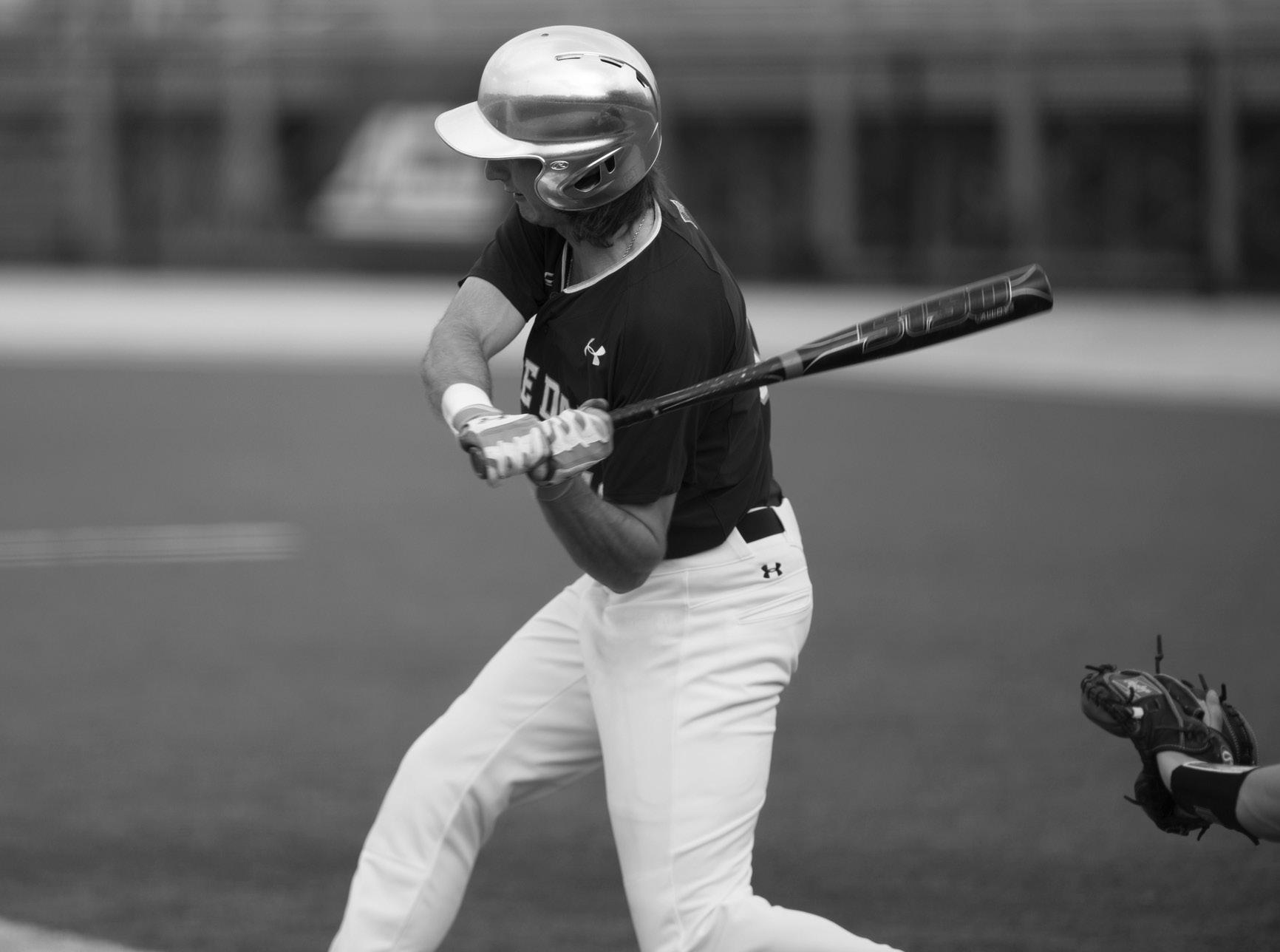
After trailing 4-0 through four innings, the Irish bats exploded by scoring eight runs on 16 hits over the remaining eight innings. They cut the four-run deficit in half before the start of the ninth inning, but juniors second baseman Cavan Biggio and outfielder Torii Hunter, Jr., each crossed the plate on hits by sophomore utility player Jake Shepski and senior shortstop Lane Richards, respectively, to extend the game into extra frames.
The Wolfpack (16-6, 3-3 ACC) and the Irish traded scoreless extra-inning frames until Notre Dame broke through with four runs in the top of the 12th, including a bases-clearing single off the bat of senior first baseman Zak Kutsulis.
Irish head coach Mik Aoki said he was proud of the way his team fought back from a deficit against a pitcher who has had its number in the past.
“I thought that was a really good effort by our guys,” Aoki said. “It would have been easy to sort of pack up our bags and go on home being down four runs to a kid who’s had as much success as (sophomore lefty) Brian Brown has had in this league. ... He handled us
pretty well in the tournament last year, so to come back, chip away at him and to get through some quality arms in their bullpen — I thought that was really good.”
Friday’s and Sunday’s games saw offensive explosions from N.C. State, however, as the Wolfpack picked up 9-1 and 16-6 victories for the series win.
The “big inning” plagued Notre Dame throughout the weekend, even in Saturday’s win. A five-run seventh inning Friday, a four-run fourth Saturday, and both a five-run and six-run inning Sunday gave the Wolfpack 20 of their 29 runs scored in the series.
“I think it’s what happens when you play a really good hitting team like N.C. State,” Aoki said of surrendering runs in spurts over the weekend.
“When you give away as many free [walks] as we did. Whether it was walks, whether it was finding ourselves in negative counts, we just pitched it really poorly unfortunately today.”
The five-run seventh was the highlight of Friday night’s game, but junior right-handed pitcher Ryan Smoyer kept the Irish in the game by surrendering just two runs on three hits through 4 1/3 innings. N.C. State did, however, force Notre Dame to use seven pitchers on the night, with the loss going to Smoyer. The Irish scored their only run of the game with two outs in the ninth inning when senior utility player James Nevant came into the game as a pinch hitter and smashed his first career home run to spoil a complete game shutout for Wolfpack junior right-hander Joe O’Donnell.
Irish finish season at NCAAs
By MICHAEL IVEY Sports Writer
Notre Dame finished its season this past weekend with four of its members competing at the NCAA championships at the Georgia Tech Campus Recreation Center in Atlanta.
team after the meet how proud he was of them and how he hoped to keep building the program.
Then, on Sunday, what looked to be a second consecutive conference win for the Irish early in the contest turned into an overwhelming victory for NC State. The Irish took a 5-0 lead into the bottom of the third before the Wolfpack plated 16 runs through the next five innings. Highlights for Notre Dame included a two-hit day for Kutsulis and two RBIs for freshman third baseman Cole Daily. Sophomore righthanded pitcher Peter Solomon picked up the loss for Notre Dame as he gave up three hits and three runs, including the go-ahead run in the fifth inning. Because NC State was up by 10 runs through eight innings, the ninth was not played.
Notre Dame returns to action Tuesday when it welcomes the University of IllinoisChicago to campus.
“They’re a solid team,” Aoki said of the Flames (9-10, 2-1 Horizon). “They compete really hard. Offensively they have some kids who swing the bat really well, and so we need to play well. But that’s kind of the goal every day, right? It doesn’t really matter who the opponent is. We try to play as well as we can. Certainly after today, we want to get right back out there, get ourselves going again and try get some consistency built where we’re playing at a really high level day in and day out.”
First pitch between the Irish and the Flames is set for 6:05 p.m. Tuesday night at Frank Eck Stadium.
Contact Hunter McDaniel at hmcdani1@nd.edu
Freshman Ella Moynihan, sophomore Annie Crea and seniors Emma Gaboury and Lindsey Streepey represented the Irish and competed against the top swimmers and divers in the country during the first two days of the championships. In the morning preliminary round for the 1-meter dive, Gaboury placed 38th and Streepey finished in 41st. Then, in the 3-meter dive Friday, Gaboury finished in 29th place while Crea placed 43rd. In the preliminary round of the 200-meter freestyle, Moynihan finished in 5oth place in the event and rounded out the weekend for the Irish.
Irish head coach Mike Litzinger said he knew some of his competitors would have to adjust mentally to compete against the top swimmers and divers in the country.
“The NCAA swimming & diving championships is one of the toughest meets in the world ... period,” Litzinger said. “To get there takes a maximum effort, and once you are there, you have to adjust your mentality to realize you are among the elite in the country. To experience that, and come to terms with that, is exciting and a bit nerve wracking at the same time.”
Litzinger said he was pleased with the performance of his swimmers and divers in the NCAA championships, especially given their lack of experience.
“I was impressed by all of our women as it was everyone’s first NCAA’s,” Litzinger said. “For the seniors, it is their last competition, and I thought that they dove well. Annie is only a sophomore, so her experience is one that will lend itself to future performances. As for Ella, I really think she swam well as she qualified for two of the toughest events. ... She too is a first year qualifier. ... Experience is everything.”
Litzinger said he told his
“I told them and [diving] coach Caiming Xie that I was proud of them,” Litzinger said. “It was truly a new season for everyone, and to finish with four qualifiers [for the NCAA championships] was a great achievement. Our task is now to look forward and continue to build the team into one where we will have relays and more individuals at the meet.”
Litzinger said his team’s overall performance on the year was strong in some ways but could be improved in others.
“Again, it was a new season for everyone,” Litzinger said. “A first year coaching staff, losing the most prolific swimmer in the school’s history [in Emma Reaney] and adding the men’s team halfway through the year. I would give us an A for coming together as a group, but a C in performance ... and that is a tough grade, but I expect the best from everyone, including the coaching staff.”
When asked about the future, Litzinger said there are some key questions that need to be answered, and that he hopes his swimmers will use their experience this year to build on the future.
“The key is where do we go from here. ... Do we stay combined or do we split?” Litzinger said. “That will determine how we truly move forward. Both groups have excellent recruiting classes coming in for the fall. Our women have one of the best [classes] in the country, and that will certainly help.
“However, the measure of our expectations lie in how we train this spring, how we develop our current freshman, sophomores and juniors. There is some tremendous talent there, and can they take what they have experienced this year and apply it?”
Notre Dame’s men’s squad finishes its season next weekend when it sends a few members to the men’s championships in Atlanta.
Contact Michael Ivey at mivey@hcc-nd.edu
MICHAEL YU | The Observer
Irish senior first baseman Zak Kutsulis swings at a pitch during Notre Dame’s 4-2 loss in 14 innings to NC State on April 18 at Frank Eck Stadium. Kutsulis had 4 hits and 2 RBIs in the win on Saturday.
this season. However, Kelly announced that Wimbush would compete for the starting job in spring ball.
working on. I think everyday is another process for me and my growth and development, and I know I gotta be at the best of my shape at all times to help this team win football games. Everything else is kinda like whatever. you’re going to do what you gotta do. Whenever they give me my chance, I’m going to take advantage of it.”
Kizer also emphasized personal growth over competition, but said the addition of Wimbush to the mix gives this spring’s competition a different feel than last year’s.
“The way that coach [Brian Kelly] approaches every offseason is that there’s no position handed to anyone, so there’s going to be a competition no matter what,” Kizer said. “ you know, last year there was a situation where Malik goes down, and I’m asked to step in, but at the same time, you know, I was competing with a great quarterback behind me in Brandon. So this is another opportunity where there’s three guys instead of two.”
The third challenger for the job, Wimbush, was until recently, expected to redshirt
Regardless, Wimbush said his approach to the spring practices did not change with Kelly’s announcement.
“It might sound cliché, but my mindset didn’t change really from when he made that first announcement to when he made this past week’s announcement,” Wimbush said. “I prepare every day as if I’m going to be the starter. That’s the only way I can go about my business. I control only what I can control.”
Secondary shakeup
In addition to the quarterback position, the safety spots may be in for a shakeup since key players from last season, Matthias Farley and Elijah Shumate, have graduated. Two players who will look to fill their shoes are senior Max Redfield and junior Drue Tranquill.
Redfield started 11 games for the Irish last season, but was suspended for the Battlefrog Fiesta Bowl against Ohio State for violating team rules prior to the game. Redfield said he has moved on from that incident and is ready to be a leader for the secondary.
“Kind of like I mentioned
c arson
CONTINUED FROM PAGE 16
Lumberjacks were staying poised, calm and collected in an attempt to solidify themselves as the tournament’s biggest Cinderella story.
But then, led by junior guard Demetrius Jackson, the Irish turned in two minutes of basketball so many knew this team was capable of doing.
In those final two minutes, Notre Dame made every possession count. Literally.
There were five full possessions in the final 120 seconds: The Irish scored on all three of theirs and held the Lumberjacks scoreless on their two.
The funny thing? Jackson and the Irish could have continued that panicked-looking performance they had put out over the previous seven minutes. But they didn’t.
Every move down the stretch was with purpose.
There was the great inbounds play that fed Jackson and cut the lead to three. Then Notre Dame let Lumberjacks senior guard/forward Thomas Walkup take a semi-contested deep 3-pointer — and senior forward Zach Auguste came up with the big rebound with just over a minute on the clock.
Irish head coach Mike Brey knew what he wanted: a 2-for-1.
And the Irish got a smart one, when Jackson drove the ball to the hole to get to the line for two with 47 seconds to play.
earlier, [we need to] harness those details on and off the field and just being conscious of basically everything you’re doing at all times to just move forward and benefit your game on and off the field,” Redfield said. “That’s something I need to be a little more conscious of and make sure that everybody is conscious of [with me] being a leader at this point.”
Tranquill also figures to be in the mix for a starting safety job as he returns from an ACL tear suffered last season during the Georgia Tech game Sept. 20. Tranquill is not fully healed, but he said he looks forward to competing for the starting job come summer practices.
“It was great competition with Shumate last year,” Tranquill said. “We were kinda going back and forth, but they can obviously use me in a lot of different packages so I presume they’ll do that the same this year. Obviously, my role at safety will take up a little bit more, so I’m excited for that. Obviously, I’m assuming they’ll use me in some different packages as well.”
get to the hole, but he was always asking a little too much of himself to hit there. But that aggressiveness forced a defensive breakdown from the Lumberjacks, with a doubleteam trying to keep Jackson from getting the bucket.
Auguste had his chance on the put-back — where he was fouled, mind you — but he missed as well.
Brey wanted to take advantage of “chaos,” he said. But more importantly, he kept the kid who hit the game-winning shot on the floor.
you see, had Brey taken a timeout to set a play up, he likely would’ve taken Pflueger out of the game for sophomore forward Bonzie Colson. Needing a bucket, Colson would’ve been a much better choice to have in than Pflueger, who hadn’t scored a field goal since March 5, especially given Colson’s ability to thrive in the lane.
But he didn’t take that timeout. And Pflueger stayed on the court, in position to win Notre Dame the game.
Unlike last year’s Elite Eight loss to Kentucky, where the Irish pushed too many of the wrong buttons, they pushed the perfect ones tonight. And at the end of the day, that’s what good teams — led by great players — do. They rise to the occasion in the final minutes, make the plays and, you know, get a little bit of that luck any team needs to make a run.
Other teams might have panicked in that situation and down by three, many would have launched the 3-pointer in an attempt at glory. But not Notre Dame on this night.
After another defensive stop and Auguste board, Brey had a timeout but chose not to use it.
Jackson drove and tried to
A team of destiny? Perhaps. We’ll answer that over a cheesesteak in Philadelphia next weekend.
Contact Alex Carson at acarson1@nd.edu
The views expressed in this Sports Authority are those of the author and not necessarily those of The Observer.
WEI LIN | The Observer Irish junior quarterback DeShone Kizer eludes the pass rush during Notre Dame’s 44-28 loss to Ohio State in the Battlefrog Fiesta Bowl on Jan. 1. Kizer finished 8-3 last season in his 11 starts for the Irish.
EMMET FARNAN | The Observer Irish junior forward V.J. Beachem shoots a 3-pointer in Notre Dame’s 76-75 win over Stephen F. Austin at Barclays Center on Sunday.
all day.
Until it mattered most.
Pflueger got a touch to the ball and tipped in the game-winner with 1.5 seconds left, sending Notre Dame (23-11, 11-7 ACC) past No. 14 seed Stephen F. Austin (28-6, 18-0 Southland), 76-75, and into Friday’s Sweet 16 in Philadelphia.
“I just saw the ball come off and I just attacked it and luckily it went in,” Pflueger said.
“I just wanted to attack, be aggressive and try and get it up on the rim and make a shot,” Jackson said. “That’s why you’ve got a team. My teammates were able to get there.”
“I can’t thank Rex enough for finishing that,” Auguste said. “The ball was missed, I went up, was aggressive on the glass, tried to draw a foul and got some contact, missed my layup. Then I fell, and I just see the ball go through the net and I look and it was Rex, the one that tipped it in, and I couldn’t believe it.
“ … Rex had to remind me we had to play some defense, there’s still some time left. We got back in it and then they miss the shot and it was the game.”
“When I saw it go in, I just think I blacked out,” sophomore guard Matt Farrell said. “I jumped up and [sophomore forward Martinas Geben] caught me.”
“Rex plays volleyball in the summertime, so he was playing some volleyball on the backboard,” Jackson said.
For Irish head coach Mike Brey, the final minute of the game reflected lessons learned in Notre Dame’s 68-66 Elite Eight loss to Kentucky last year.
“We had a similar situation in the Kentucky game and we set up for a 2-for-1 and we didn’t do it,” Brey said. “We said after that game, ‘Any time we have that
situation, we’re gonna go 2-for1.’ [Assistant coach] Martin Inglesby was great reminding me before I went in the huddle and it worked out great for us because we wanted to be in a position to have that last shot.
“[Demetrius] gets to the foul line, sticks ‘em, great defensive possession. Zach got that rebound, I looked up, 20 seconds [left]. Someone yelled, ‘Call timeout,’ I said, ‘Shut the hell up. We’re not calling timeout.’ We’re gonna play ‘cause you wanna take advantage of a little chaos and because of chaos, we were able to get the tip.”
Once the Lumberjacks got ahead 73-70 with 3:35 to play, Stephen F. Austin went to a patented Brey tactic: The burn.
And while it shortened the number of possessions left, it also slowed the pace of the game — one that had become frantic during a 20-8 Lumberjacks run that swung a seven-point Irish lead into a five-point deficit.
Notre Dame’s defense responded though, giving up just two points on Stephen F. Austin’s final four possessions.
“We may not be a great defensive team overall — or some people may say that — but just getting timely stops,” junior forward V.J. Beachem said. “When we need to, we always feel like we can rely on our offense. So if we can get stops, it makes everything easier.”
It set the stage for Jackson, who was aggressive all night, throwing down a vicious dunk in the second half, to push the issue on the final two offensive possessions to ensure the Irish weren’t going home this weekend.
“[I was] just really determined, wanted to bring a sense of urgency, play with heart, play with passion and give it all I had,” Jackson said after finishing with a team-high 18 points.
When Notre Dame opened up a little breathing room by way of a seven-point lead
with nine minutes to play, the Lumberjacks pulled right back: Senior guard/forward Thomas Walkup drew three fouls in one possession that finished with an and-1 before senior guard Demetrious Floyd drained two 3-pointers to tie the game, 64-64.
It was a Floyd 3-pointer that pushed the Lumberjacks ahead with 3:35 to play, setting the stage for the game’s finale.
Pflueger’s tip-in to win the game will likely overshadow strong performances from Beachem, who followed a perfect shooting night Friday with a 15-point game Sunday, and senior forward Zach Auguste, who notched his 21st double-double of the season with 16 points and 15 rebounds, including a few big boards down the stretch.
For Beachem, who struggled in the tournament last year, succeeding this time around is special.
“It’s meant a lot,” Beachem said. “[I’ve] just really been blessed with the opportunity to play in the NCAA tournament again after everything that I went through last March and blessed to be able to perform at this level.”
Auguste deflected credit for yet another double-double, saying Sunday’s performance was a team one.
“I gotta give a lot of credit to my teammates, my brothers,” Auguste said. “They distributed the ball very well.”
Notre Dame handled Stephen F. Austin’s pressure well, turning the ball over just four times in the first half en route to a 42-41 halftime advantage and 13 times overall — the Lumberjacks forced the most turnovers per game in the NCAA this season.
“They were a great defensive team and they like to turn people over” Jackson said. “I think we did a solid job handling the pressure. We had turnovers here and there but we really moved
onto the next play really quick.”
With the win, Notre Dame will make back-to-back Sweet 16 trips for the first time since 1979, when head coach Digger Phelps’ Irish capped a run of six straight trips to the regional semifinals.
“As a senior, a lot of questions had been raised, ‘How are you guys gonna come back from last year? What are you gonna do from last year?’” Auguste said. “Everybody talks about the past. … Really just being a part of this legacy and this tradition and trying to make a run has been amazing.”
The Irish move on to play seventh-seeded Wisconsin on Friday — but they aren’t content with simply going to Philadelphia.
“It’s a great feeling,” Beachem said.
“But we’re not done yet.”
Notre Dame 70, Michigan 63
Sunday’s magic almost never had the chance to happen though. The Irish trailed 11thseeded Michigan (23-13, 10-8 Big Ten) by 12 at the half, 41-29, staring the prospect of a firstround exit to a rival right in the eyes.
With a strong start to that second half, however, the Irish quickly closed the gap: They tied the game at 48-48, and in the four minutes Friday night, the game was knotted up, 59-59.
Winning time.
The question was simple: Who would step up? Would he be from Michigan or Notre Dame?
The answer came by way of junior forward V.J. Beachem, who hit a 3-pointer and followed it with another bucket to put the Irish ahead 64-59. They would never trail from there in a 7063 win Friday night in the first round of the NCAA tournament.
The five points were the final of the night for Beachem, who led all scorers with 18 points on a perfect 7-for-7 night from the field.
“All of them were open shots, so we just had great movement, and the guys found me when I was open,” Beachem said. “I was just able to step up and knock them down.”
The Wolverines answered to close the Irish lead to 64-61 and again to cut it to 66-63, but it was Notre Dame’s defense that stepped up, forcing a 3-point miss from Wolverines junior guard/forward Zak Irvin in the closing seconds that secured the Irish win.
As the Irish trailed by double digits at halftime, Brey launched into a spirited halftime speech.
“[The] conversation started nice and calm, and then I just started to lose it a little bit,” Brey said. “As far as, ‘I love you. you’re great guys, you have done everything we’ve asked, but either you’re gonna be a little tougher or this is gonna be another North Carolina game all over again. But everyone’ll pat you on the back because you’re nice guys and you get good grades.’” It worked, as the Irish held Michigan to just 22 second-half points to advance to the second round.
“Everyone was communicating with each other, our switching was better, our overall on-ball defense was better,” freshman guard Rex Pflueger said. “And I think the intensity that Coach installed in us at halftime really pushed us forward.”
Contact Alex Carson at acarson1@nd.edu
EMMET FARNAN | The Observer Irish freshman guard Rex Pflueger, middle, celebrates with his teammates after the final buzzer in Notre Dame’s 76-75 win over Stephen F. Austin at Barclays Center on Sunday night.
EMMET FARNAN | The Observer
Irish senior forward Zach Auguste goes up for a layup during Notre Dame’s 76-75 win over Stephen F. Austin on Sunday.
mEn’S bASkEtbAll | ND 76, STEPHEN F. AUSTIN 75
By the tip of a finger
ND earns Sweet 16 berth for second straight season
By ALEX CARSON Assistant Managing Editor
BROOKLy N, N.y. — Sixthseeded Notre Dame was in a bind Sunday afternoon at Barclays Center. The Irish were down 75-70 to No. 14-seeded Stephen F. Austin with two minutes to play, searching for someone to save their season.
Junior guard Demetrius Jackson hit a layup with 1:34 left, drained two free throws with 47 seconds to play and after the Irish got a third successive stop defensively, looked to win the game for Notre Dame.
He drove, with the game on the line, but his wild shot didn’t come close. Senior forward Zach Auguste, who was a perfect 8-for-8 from the field, grabbed the rebound and tried for a put-back, but he too was unable to get the job done.
But there stood freshman guard Rex Pflueger.
The 6-foot-6 native of Dana Point, California, didn’t score
nd womEn’S bASkEtbAll
Irish players step up with game on the line
BROOKLy N, N.y. — I thought Notre Dame was done. Under the pressure of the NCAA tournament and the bright lights of New york, the Irish were wilting. In the matter of seven minutes, sixthseeded Notre Dame’s 62-55 lead turned into a 75-70 deficit. And just two minutes remained.
For 31 minutes Sunday, the Irish had handled pretty much whatever 14th-seeded Stephen F. Austin threw at it defensively, but in that seven-minute stretch, it was going downhill. There was freshman guard Rex Pflueger getting called for a charge on an out-of-control drive, junior guard Steve Vasturia missing a contested layup trying to do too much and three turnovers in a ninepossession stretch.
All the while, the
see CARSON PAGE 14
Irish host Hoosiers with Sweet 16 berth on the line Quarterbacks discuss battle
By DANIEL O’BOYLE Sports Writer
Top- seeded Notre Dame will take on in-state opponent and ninth-seeded Indiana for a place in the Sweet 16 in Monday’s NCAA tournament second-round matchup.
The Hoosiers (21-11, 12-6 Big Ten), in their first NCAA Tournament appearance since 2002, earned their second ever tournament win when they defeated Georgia 62-58 at Purcell Pavilion in the Round of 64 on Saturday. Hoosier head coach Teri Moren’s program ended the regular season on a high, winning seven of its last eight games. Irish head coach Muffet McGraw said Moren’s success in just her second year with the program was extremely impressive.
“She’s done a fabulous job,” McGraw said. “I think that’s a huge turnaround, to come in fourth in the conference after just her second year. We see a lot of the players who go there so we know
By MAREK MAZUREK Sports Editor
As Notre Dame enters spring practice, all eyes will be on the three quarterbacks competing for the starting job: Senior Malik Zaire, junior DeShone Kizer and sophomore Brandon Wimbush.
“Spring ball is going well,” Wimbush said. “It’s a time for the three guys who are the helm to compete for job and see how that goes.”
Kizer started 11 games for the Irish last season, going 8-3 after opening-day starter Zaire injured his ankle in Notre Dame’s second game against Virginia.
Nearly six months after his surgery, Zaire said he is almost back to one hundred percent.
“I’m getting there, pretty much there right now,” Zaire said. “[I] continue to rehab like I’m supposed to and feeling good. I’ve been practicing full-fledged, so that’s always a good sign. ... I’m still working
on my mobility, getting my range back. Strengthening up the tendons and the things I got injured, so it’s ahead of schedule. I’m doing good. I’m feeling good.” Zaire was the clear-cut starter going into last season, but now finds himself embroiled in yet another battle for the starting quarterback job. The Kettering, Ohio, native said he believes he is the best quarterback on the team, but plans to focus on improving himself rather than worrying about the competition. “ you just really wonder what it’s going to take to finally convince people enough that I’m able to do the job,” Zaire said. “Like I said, I don’t make decisions so I just keeping balling and doing what I gotta do, and that’s being the best in the country every time I gotta be out there and proving that to myself. I know I’m a championship quarterback. That’s something that we’re
EMMET FARNAN | The Observer
Irish freshman guard Rex Pfleuger scores the winning basket on a tip-in during Notre Dame’s 76-75 win over Stephen F. Austin at Barclays Center on Sunday. It was Pfleuger’s only basket of the game.
see M BBALL PAGE 15
Alex Carson Assistant Managing Editor
FootbAll
KATHLEEN DONAHUE | The Observer Irish senior guard Michaela Mabrey