Print Edition of The Observer for Monday, September 19, 2016
e arly exit
Michigan State ends Notre Dame’s playoff aspirations just three weeks into 2016 season
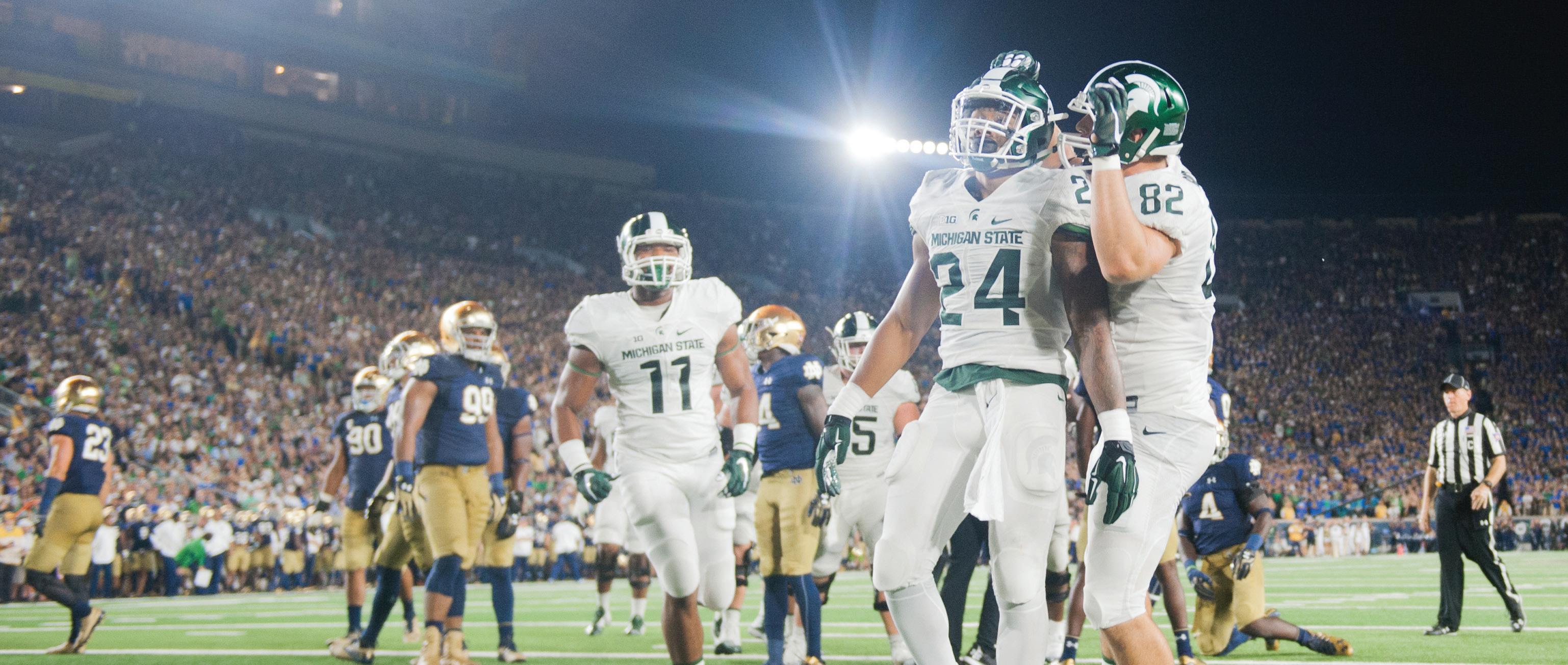
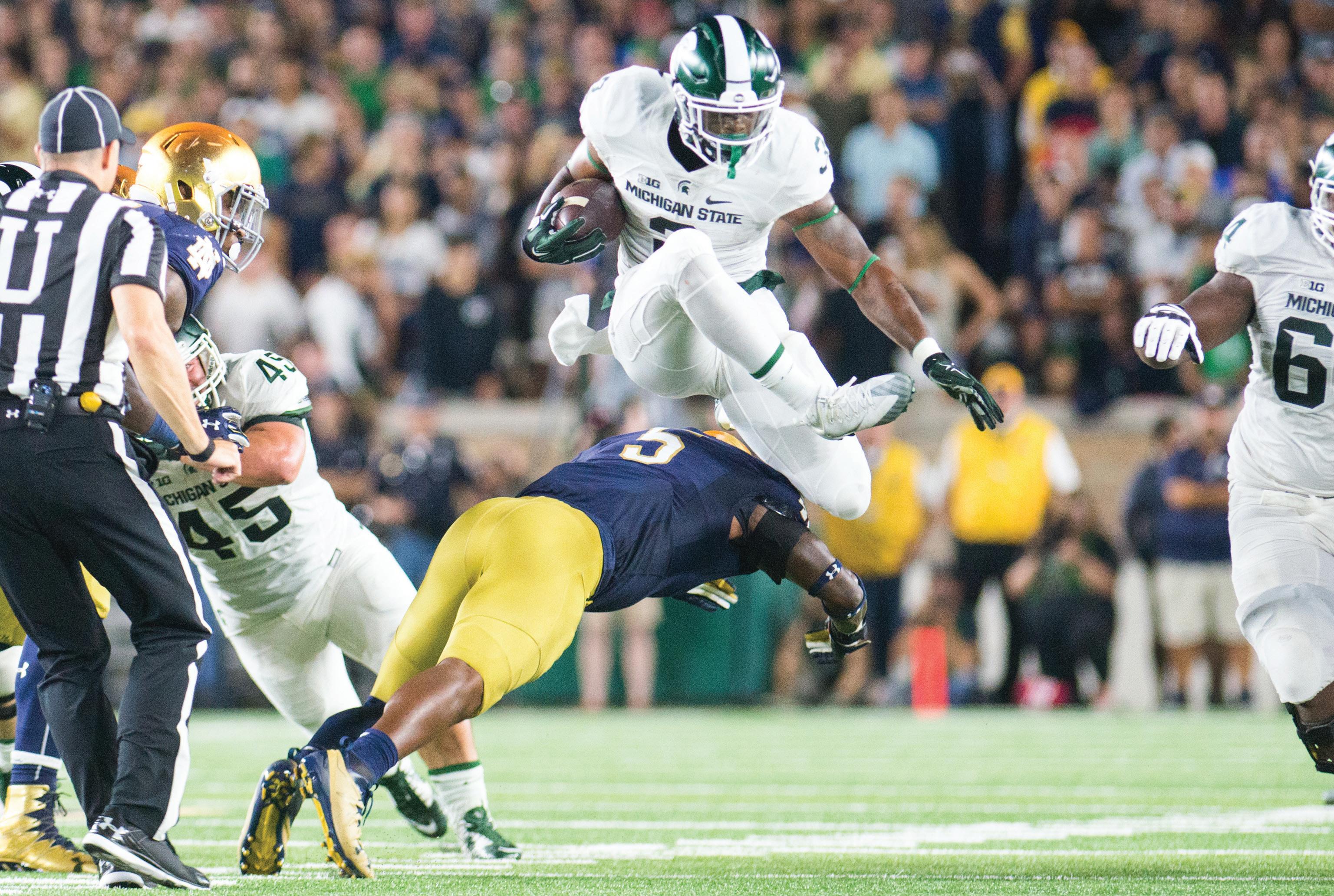
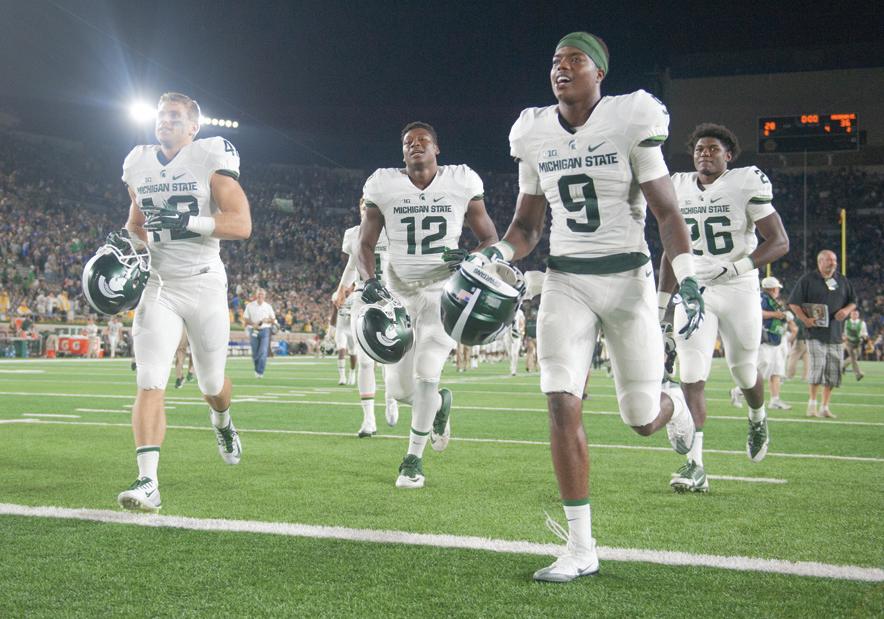
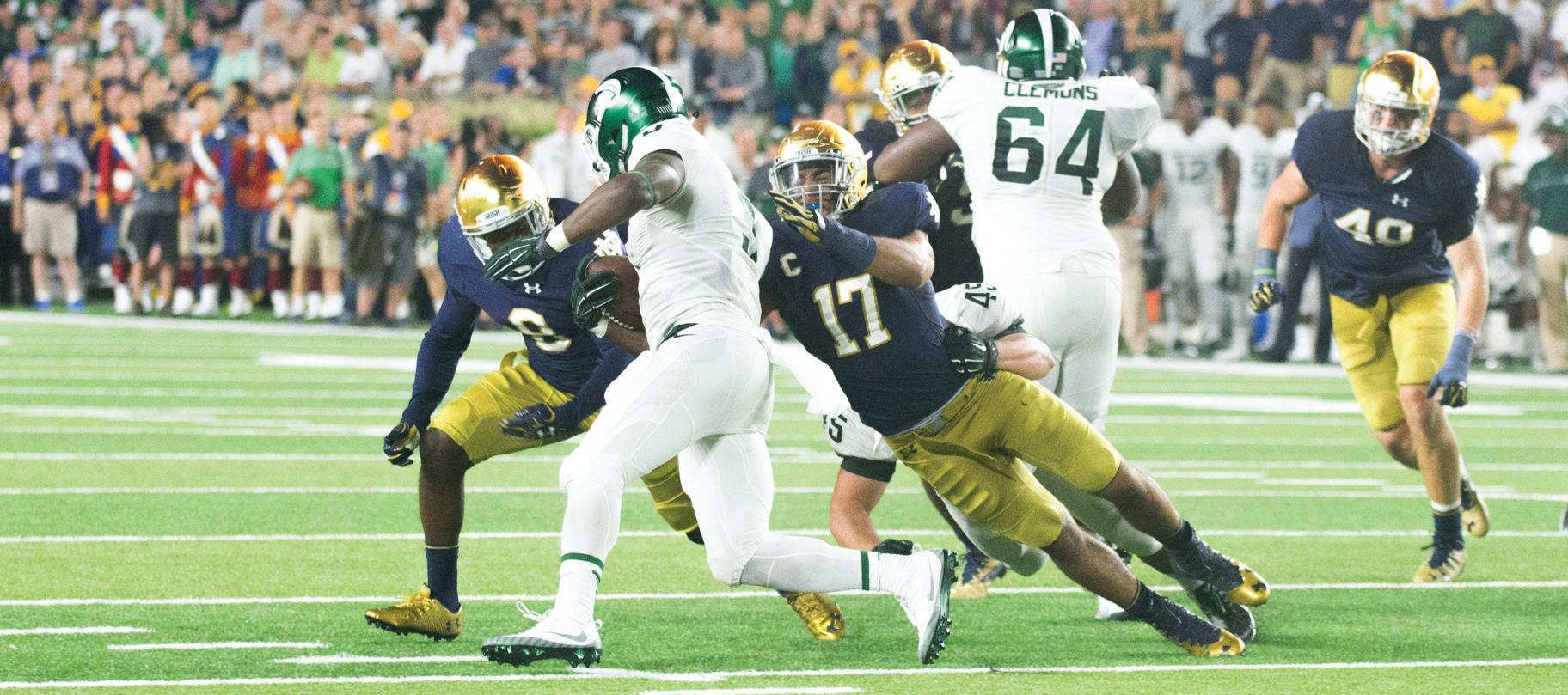
Junior running back Gerald Holmes and the Spartans celebrate Holmes’ first of two touchdowns during Notre Dame’s 36-28 loss to Michigan State on Saturday at Notre Dame Stadium. Holmes ran for 100 yards on 13 carries in the game, pacing the ground attack for the Spartans, who outrushed the Irish, 260-57, en route to 501 yards of total offense.
Notre Dame not playing up to its potential
Ben Padanilam a ssociate sports e ditor
“i think this football team in a nutshell, for everybody here today, is one that’s going to have to do the ordinary things extraordinarily well.”
those were the words brian Kelly used to describe what would be required of his notre dame team this season at the start of fall camp. in order to play at the level that would be expected of them, they would only need to execute and be technically sound in order for their talent to flourish.
and the job of execution is a two-way street. coaches put forth a strategy they expect to work and adjust it when it doesn’t. Players perform the task assigned to them, nothing more and certainly nothing less.
but somewhere along the line, those words grew empty, becoming nothing but a mere cliché for this notre dame team. because in its two losses this season, the only thing this team has done “extraordinarily well” is fail to play up to its level of talent.
after the loss to the spartans on saturday, brian Kelly said the
By DANIEL O’BOYLE sports Writer
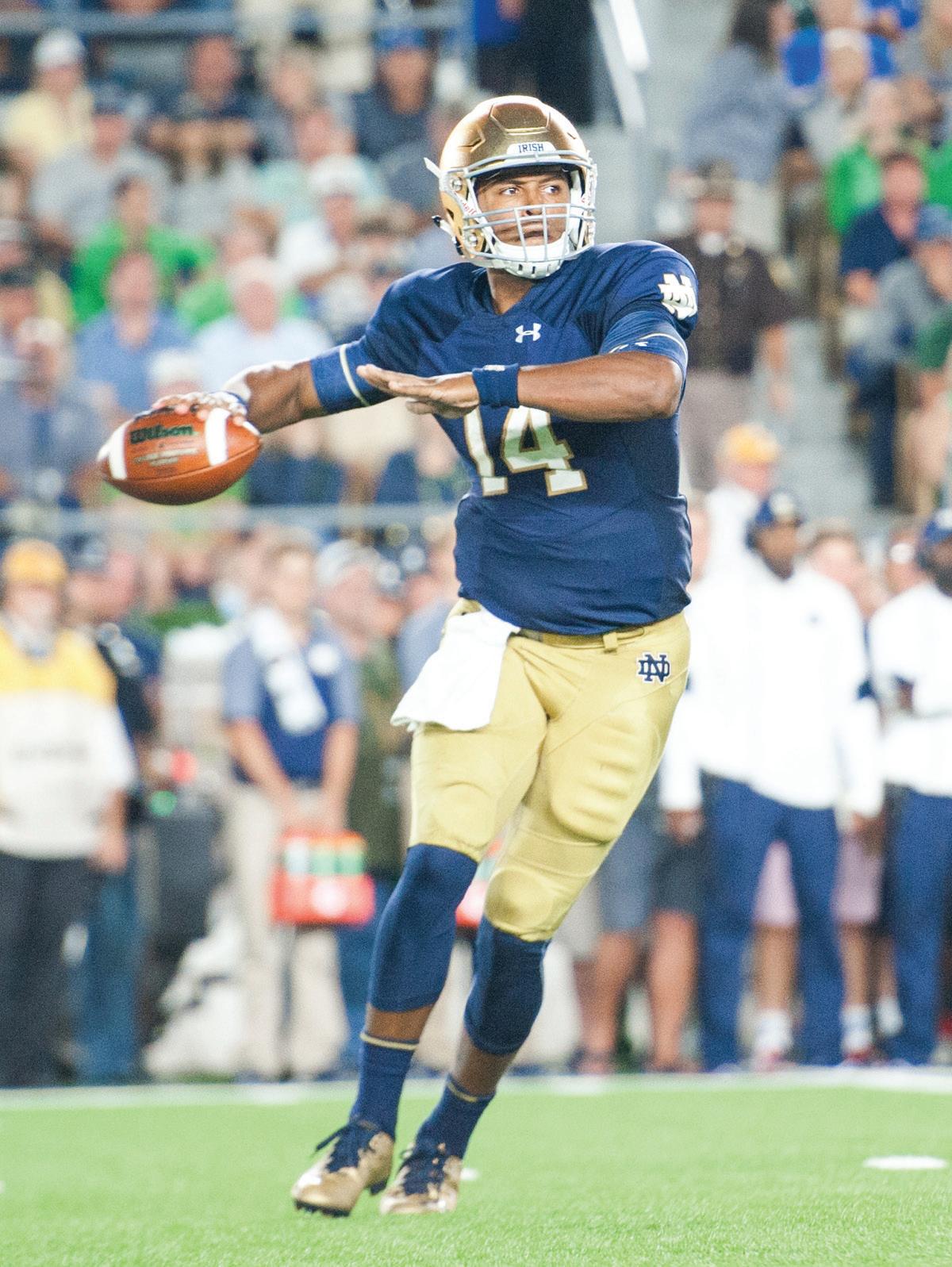
another star performance from junior quarterback deshone Kizer. timely stops from a defense that couldn’t find any a quarter earlier. a narrow fourth-down conversion. a tipped catch barely an inch in bounds to start it all off. the ball back in Kizer’s hands with notre dame needing only one score and having plenty of time. notre dame’s performance late against Michigan state on saturday night had all the makings of a legendary comeback. except, of course, for the final eight points. the spartans (2-0) held on to the lead they built up late in the third quarter for a 3628 victory. 11 seconds into the game, the irish (1-2) believed they had the early lead. sophomore receiver cJ sanders took the opening kickoff all the way for a touchdown. a holding call, though, brought the play back all the way to the notre dame 10. after an exchange of punts, junior quarterback deshone Kizer took over at his own 9-yard line and led the first touchdown drive of the game, finishing it himself with a 14yard run into the corner of the endzone.
after freshman defensive lineman daelin hayes tipped the ball into the hands of freshman safety devin studstill
for an interception at the start of the second quarter, things seemed to be going notre dame’s way. a lthough the offense couldn’t score on the ensuing possession, a punt from sophomore tyler newsome pinned the spartans at their own 12-yard-line. a Michigan state three-and-out seemed certain to set the irish up with strong field position. but then the game turned. as sophomore receiver Miles boykin attempted to block a Michigan state gunner downfield, spartan sophomore Jake hartbarger’s punt bounced off boykin’s leg — officially a fumble — and was recovered by the spartans. they took advantage immediately, as freshman receiver donnie corley grabbed a pass that seemed destined for the hands of irish senior cornerback cole Luke in the endzone. a fake field goal play for the two-point conversion gave Michigan state a lead that they would not relinquish for the rest of the game.
senior defensive end isaac rochell said the special teams turnover was difficult to deal with.
“it’s tough,” rochell said. “any time you get a big stop, and then you have to come back and defend them 40 yards closer to scoring, it’s frustrating [and] it’s tough, but it is what it is.”
Just before halftime, spartan senior quarterback tyler
o’connor engineered a 92-yard touchdown drive, putting the irish eight points behind at the half, 15-7.
in the third quarter, the spartans began to pull away.
First with a 10-play touchdown drive finished by junior running back gerald holmes. then a 9-yard scoring run from sophomore running back LJ scott three plays after a Kizer interception. Finally, a 73-yard run from holmes through the middle of the irish defense gave the spartans their third touchdown of the quarter.
suddenly, Michigan state had stretched the lead from 15-7 to 36-7 in just over four minutes of play.
it was on the very next play that notre dame began the chase. Kizer found senior receiver torii hunter Jr. deep for a 47-yard catch, and three plays later, sophomore receiver equanimeous st. brown tipped the ball to himself and kept his foot in bounds for what would be ruled a touchdown after review.
Kizer said he didn’t find it difficult to get back into a groove and lead his team down the field.
“When you know you are executing what you’re supposed to do, and you simply do your job, you’re going to score points,” Kizer said. “it’s not tough at all.
Third quarter
proves costly for Irish in defeat
By JOE EVERETT sports Writer
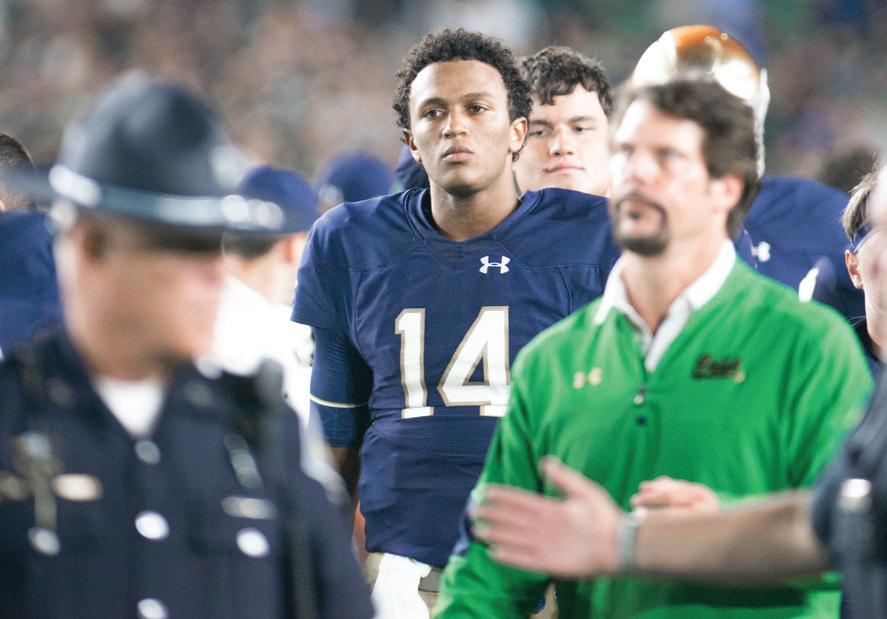
as deshone Kizer’s hail Mary slipped through the outstretched fingers of freshman receiver chase claypool, notre dame ended the first half trailing Michigan state 15-7, despite having played far from its best football.
Within striking distance in a one-score game, the no. 18 irish (1-2) looked to make their necessary half-time adjustments and retake the lead they had previously enjoyed in the first quarter. that didn’t happen however, as the irish gave up 21 straight points to start the second half and failed to answer on time offensively, digging themselves too deep a hole to climb out of as no. 12 Michigan state (2-0) held on late to win, 36-28. in college football, momentum can be a devastating weapon, and Michigan state took full advantage of it in the third quarter, capitalizing on a variety of mistakes from the irish, and eventually opening up the floodgates on offense, scoring on three straight drives and ballooning the lead to 29 points.
the damage started on
MICHAEL YU | The Observer
You just go out and do your job. o nly reason we hit the low is because i wasn’t doing mine, that simple.”
g etting the ball back early in the final quarter, the i rish wasted no time in bringing it deep into s partans territory, reaching the Michigan s tate 5-yard line in less than a minute. o n the ninth play of the drive, Kizer ran it in for his second rushing score of the game.
t hen, after r ochell blew up a Michigan s tate third-down running play for a nine-yard loss, Kizer took over again, and in a drive consisting of eight consecutive passing
plays, he took the ball 69 yards downfield and connected with senior tight end d urham s mythe to make it a one-score game.
a quick three-and-out gave n otre d ame the ball with 4:18 remaining, but with Kizer sacked on third-and-two, i rish head coach b rian Kelly elected to punt the ball away and hope for another defensive stop. Kelly said he stood by the decision to punt rather than go for the first down
“We still had two timeouts,” Kelly said. “We had gotten a couple of stops defensively and felt like they certainly were going to run the football. We got them into a good third down situation, and we don’t do a very good job on two vertical and give them
an easy completion. We put ourselves back in a position even after that situation with another timeout. We make a stop there, and looks like a pretty good decision.”
t he i rish had a chance to get that stop after two rushes left the s partans with thirdand-7. o ’c onnor’s pass on that play to c orley was underthrown, but with no defender anywhere near c orley, it was an easy completion, and c orley took a knee knowing the game was all but over. o ne more first down three plays later guaranteed the win for the s partans. Kelly said the blame for the completion to c orley rested with him.
“We’re in a position — we gotta make that play, obviously,” Kelly said. “ t hey got
two verticals, pretty standard deal, corner’s trying to midpoint two vertical, we buzz it with the underneath coverage guy, and we’re not in good position. t hat’s poor coaching. We’re not coaching it well enough. o bviously, if our players can’t execute a simple two vertical corner sitting over the top and the safety coming underneath, that’s on me. t hat falls on my shoulders, and we’re not getting that done. s o we’re either not capable of running that coverage or we’re not coaching it well enough — one or the other — so i gotta do a better job.”
With no two-loss team having ever placed higher than n o. 6 in the playoff committee rankings, the loss
effectively ends any hopes the i rish may have had of contending for the national title. r ochell said he hopes the team will not focus on how the game has affected their playoff chances.
“We can’t look at it that way,” r ochell said. “We have to keep it small, game by game. We have a relatively young team, so it’s just a matter of getting better, keeping attitudes right, not looking at the big picture, but just thinking, ‘Let’s grind, let’s do it.’”
t he i rish will next be in action against d uke on s aturday. Kickoff is at 3:30 p.m. at n otre d ame s tadium.”
Contact Daniel O’Boyle at doboyle1@nd.edu
at
Play of the game
g erald holmes 73-yard touchdown run
during the second and third quarters, the spartans went on a 36-0 run that gave them a lead the irish would be unable to overcome. t hat stretch was capped off by a 73-yard rushing touchdown by junior running back gerald holmes. holmes busted through the middle of the irish defense nearly untouched on the play, and the score would prove to be one too many for notre dame to recover from in the 36-28 defeat.
Player of the game
in a game the spartans ran for 260 yards against the irish defense, the biggest difference came perhaps from the play of o’connor. t he senior quarterback was making his third start of his career, and he threw for 241 yards and two touchdowns. More importantly, he was able to extend multiple plays and threw for two first downs on the team’s final drive to help the spartans run out the clock and secure the win.
s Partan senior quarterback tyler o’connor
KATHLEEN DONAHUE | The Observer
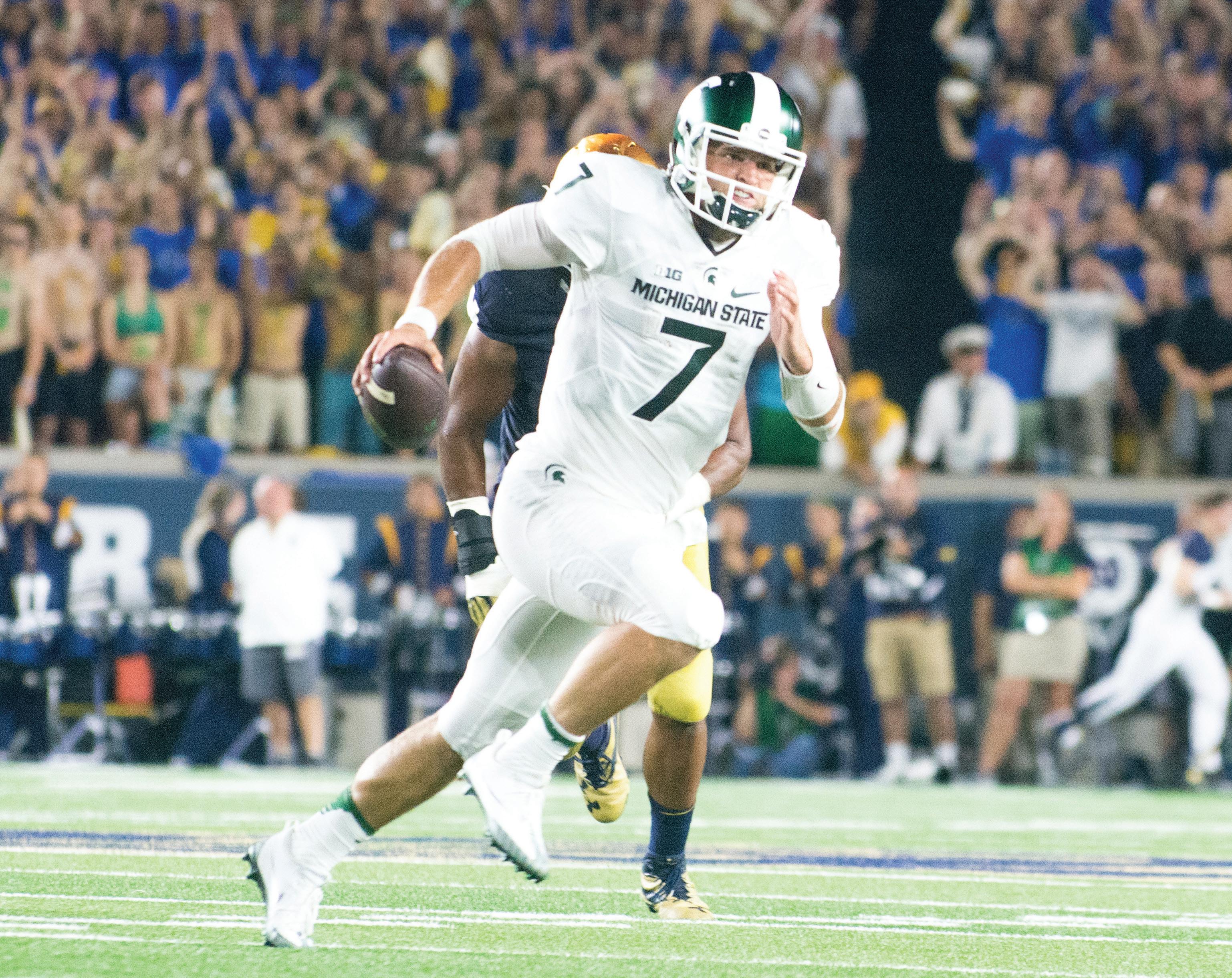
Senior quarterback Tyler O’Connor evades the Irish pass rush during the Spartans’ 36-28 win over Notre Dame on Saturday
Notre Dame Stadium. O’Connor threw for 241 yards and two touchdowns in the win, and he also rushed for 43 yards. He proved elusive to the Irish pass rush all game, as Notre Dame remains without a sack through three games.
ne
Flag football: more than a game
Hundreds of students take part in Notre Dame’s tradition of interhall and co-rec flag football
By COURTNEY BECKER news Writer
With the college football and national Football League seasons well underway, notre dame students have been anticipating the kickoff of one more season: flag football, which officially began on sunday.
a decades-old tradition at notre dame dating back to 1975, flag football has become an integral part of the fall semester for many students. a ssistant director of intramural sports a rianne Judy said this is
partly due to the inclusive nature of the sport.
“Flag football is kind of … a sport that skill and previous knowledge ... play a part in people being successful or wanting to participate, but … you don’t have to have that knowledge and/or experience and you can still participate in it,” Judy said. “typically, if you think of gender norms or stereotypical kids growing up, a lot of women don’t get the opportunity to play [football]. a nd so that’s what makes our interhall
so see FLag paGe 4
University allows Uber to pick up, drop off on campus
By JP GSCHWIND news Writer
t his semester, more travel options are available for students looking for a ride. Following a pilot program last year, Uber is now officially allowed on campus, according to notre dame security Police chief Keri Kei shibata.
Previously, Uber drivers could only pick up students at public access points, like main
circle and library circle. now, they are treated the same as cab drivers and allowed to go directly to student dorms and other locations on campus to pick up students.
shibata said the newness of Uber as a service for students was a red flag for the administration, so they wanted to take a close look at it before fully approving it. a fter the success of pilot program during the spring semester of 2016, shibata said
Uber proved it should be treated the same as cabs.
“it’s just a new program, and we weren’t sure what the impact might be,” she said. “a nd so we allowed them to come on campus and closely monitored to make sure there weren’t any problems.”
t he rationale for slowly introducing Uber was more about practical than safety
SDH evacuates briefly due to fire
Observer Staff Report
s outh d ining hall was evacuated and the start of dinner delayed sunday afternoon due to a small fire in the serving area, dining hall staff said. d ining hall manager d ennis smith said the open flame was not big enough to trip the fire alarms, but it was close enough to an oil spray can to risk a small explosion, so dining hall staff evacuated those
who would be in the affected area — the serving area and reckers. t he announcement, made through pager and Pa systems, did not reach the observer office in the basement of the building.
t he building was closed for about 30 minutes past the start of dinner hours at 4:30 p.m. notre dame Fire d epartment officers at the scene said the cause of the fire was still under investigation.
Justice Friday talk addresses facial recognition
By KATHRYN MARSHALL news Writer
i n the world of Facebook, i nstagram and other forms of photo-based social media, the social justice issue of facial recognition technology and an individual’s privacy is at hand, saint Mary’s senior Kimberly orlando said during last week’s Justice Friday event.
orlando said she first became aware of the issue after reading about download Festival — a music festival in the United Kingdom — where many attendees unknowingly had their faces scanned
and cross-examined with the UK’s digital base and criminal records.
a s she learned more about the issue, orlando read about the 2001 super bowl in tampa bay, Fla. — an event called the “snooper bowl” by some.
“t hey scanned everyone in attendance at that super bowl … and from that, 19 people were identified for very petty crimes,” orlando said. “no one was arrested, nothing came of this, but people went insane when they found out this happened. t here were mixed reviews as to whether fans knew they were under surveillance.”
such events raise the question of how much consent should be required to use facial recognition technology, orlando said.
t he issue is becoming more and more prevalent as the technology gets increasingly accurate, she said, because the idea behind the technology is not super new. i n fact, people have been playing around with computer recognition since the 1960s.
t he v iola-Jones algorithm allowed this area of study to take off in the 2000s, orlando said.
Observer File Photo
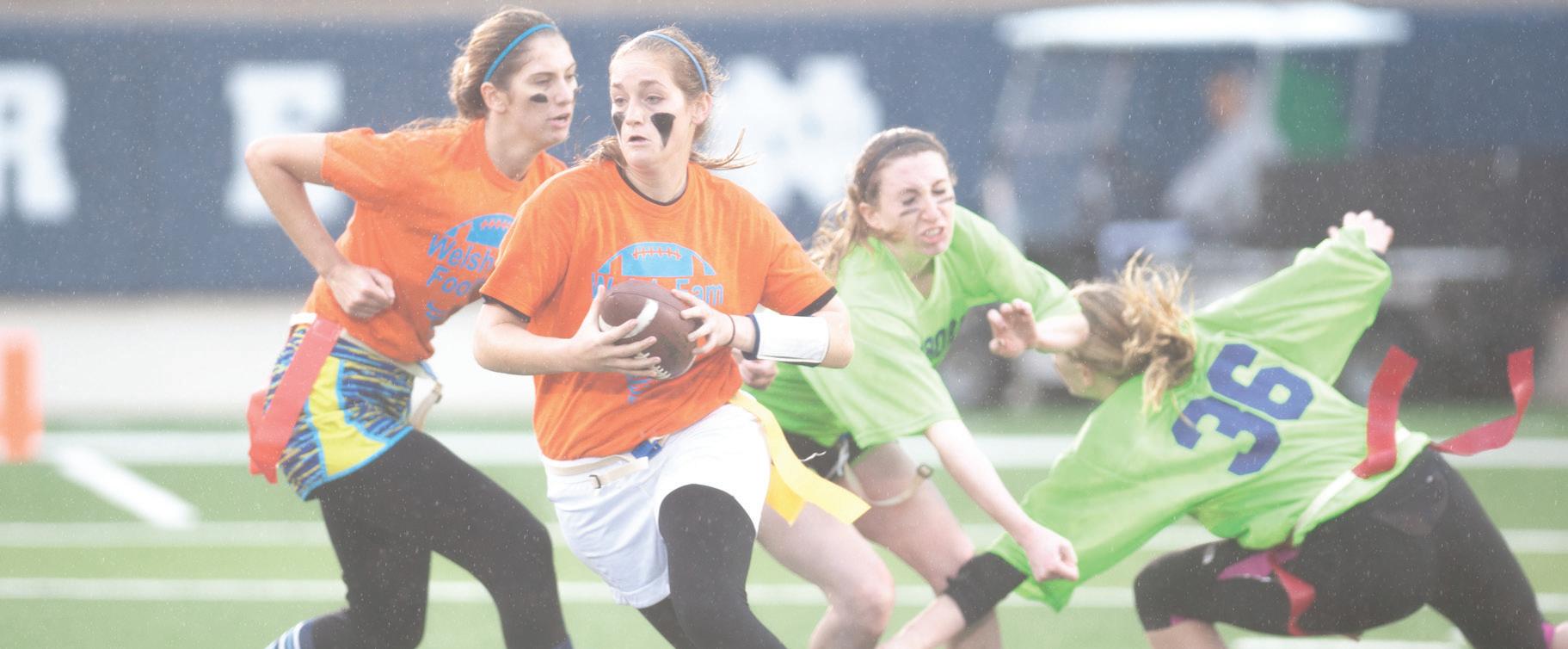
A student representing Welsh Family Hall evades a defender from Pangborn Hall during a women’s interhall flag football championship on the field in Notre Dame Stadium in Nov. 2014.
KELLY VAUGHAN | The Observer
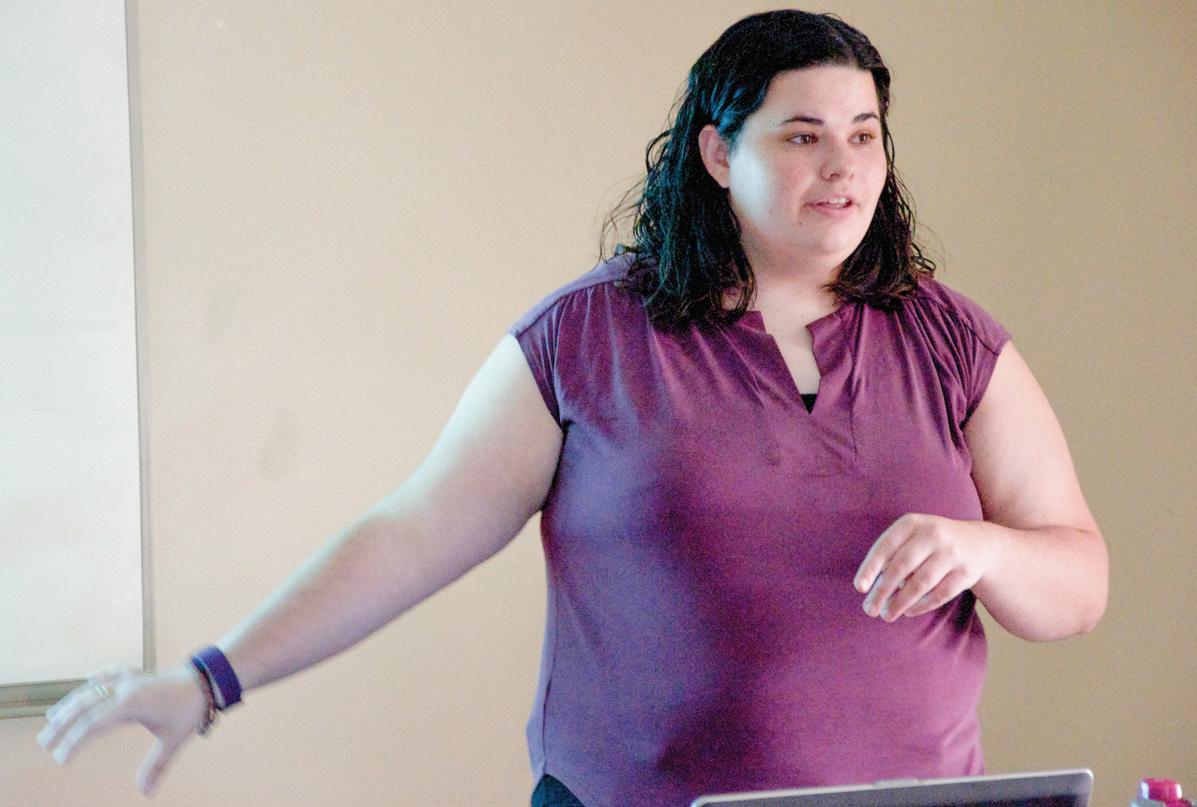
Saint Mary’s senior Kimberly Orlando delivers a lecture about facial recognition technology during a Justice Friday event at the College.
Have a question you want answered? Email photo@ndsmcobserver.com
Jemma Yeadon freshman Walsh hall
“‘diva’ by beyonce.”
Megan Holzgrefe freshman cavanaugh hall
“‘stressed out’ by 21 Pilots.”
MK Kriscovich freshman Pasquerilla West hall
“‘g ood Life’ by Kanye West.”
Today’s Staff
Corrections
i n the sept. 16 edition of the observer, Kelly hogan stewart’s name was misspelled in the story “McWell caters to changing needs of students.” t he observer regrets this error.
Monday
Respect Life Mass and Reception
Basilica ofthe Sacred Heart
5:15 p.m. - 6:45 p.m. Open to the public.
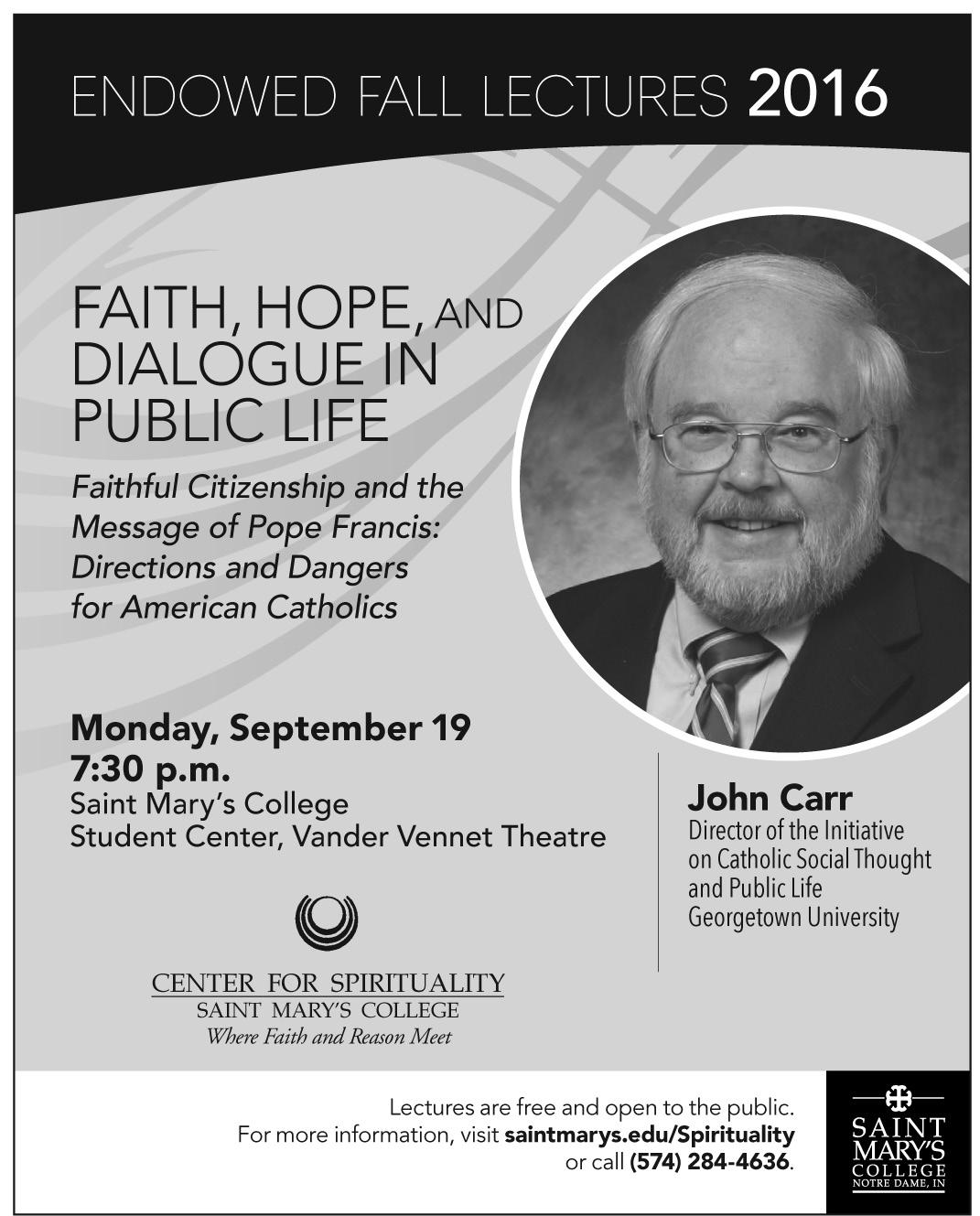
Center for Spirituality’s Fall Lecture Series Vander Vennet Theatre
7:30 p.m. Free and open
Tuesday
President’s Address to the Faculty
Thursday
Conference: “Fifteen Years After the 9/11 Terrorist Attacks” Law School
9 a.m. - 4:30 p.m. Reception to follow.
Panel: “Is
CAITLYN JOrDAN | The Observer
Service husky Juniper plays with students in the grass on South Quad on Friday. Juniper is a diabetes alert dog for sophomore Amy Mansfield, one of several students on campus with a service animal.
Hall rectors’, ARs’ pets brighten dorm life
By DEVON HARFORD news Writer
o f all the tearful goodbyes between students and their friends and family at the beginning of a new school year, one of the saddest is saying goodbye to the family pet.
b ut sometimes, students are welcomed to their oncampus phones by a furry friend, for rectors have the privilege of keeping a pet.
“People will walk past him, stop, turn around and suddenly say, ‘ c an i pet the dog?’” c arol Latronica, rector of Welsh Family h all, said about her six-year-old labradoodle, Lucca.
i n many dorms, dogs are some of the most popular residents.
“ e veryone knows t he g oose — he’s just one of the guys in Keenan,” n oel terranova, the current rector of the hall, said of his dog.
i f terranova had to guess, he said t he g oose is probably a mix of a boxer, a lab and a shepherd. o ver the years, terranova has trained a number of seeing-eye dogs for the organization Leader d ogs for the b lind — b acon and c hampion were wellloved by Keenan residents.
s tudents will often come
by to spend time with t he g oose, even taking him for walks, terranova said.
“ i ’ll write a note on the whiteboard and leave the leash outside the door. … a nd they take him out — and it works great,” he said.
v isits to see t he g oose often coincide with visits to see the rector.
“ t hey stop by to see the dog, and then they end up talking to me,” terranova said,
t he same is often the case in Welsh Family h all, Latronica said.
“People will come by and say ‘ i need a dog fix, can i come in and see Lucca?’” she said. “a lso, he’s good [for comfort], if people need to come in and talk to me about something.”
a manda s pringstead, the rector of h oward, has a special situation with her standard poodle, Lola. s ince s pringstead has family in s outh b end, Lola stays with them and visits h oward every other week.
“ i host ‘c ookies with Lola’ whenever she is here,” she said. “People come and pet Lola and chat about their days.”
r ules need to be set when rectors have pets, terranova
said. c ertain issues, such as allergy concerns, need to be addressed.
“ i f [ t he g oose] wants to roam the building, i trained him not to go into students’ rooms,” terranova said. “ i never allow the dogs in my office, so it’s a space where guys can meet with me.”
a lthough Lucca and Lola are hypoallergenic, hall staff still needs to be considerate of residents, s pringstead said.
“Lola is always on a leash,” she said. “ s he’ll go in the other room if someone needs to see me, or i ’ll meet [them] in my office.”
a ll three of the rectors said any student who feels uncomfortable about the dogs is encouraged to come and speak with them to find a resolution.
a s for whether other rectors should get pets — often a request made by residents — it’s all up to the rector, terranova said.
“a dog is a lifetime commitment. … a t the beginning and the end of the entire proposition, there is one human that will take care of [the dog] for its whole life — not a group of students,” he said. “When it gets cold, i don’t see guys taking the dog
for a walk.”
d espite the difficulties, animals bring something special to the dorm community, terranova added.
“[ t he g oose’s] best buddies in Keenan are the housekeepers,” he said. “ h e knows exactly when their breaks are, and he runs [to each] and gets a treat, and they love it.”
i t’s just one more thing that makes the residence halls feel like home, s pringstead said.
“ e very time [Lola] leaves,
she is so exhausted. t his is more excitement than she’s used to,” she said. “ s he’ll go home to my family and sleep all the next day.”
a nd for many, a little time with a dog makes the day a little brighter, Latronica said.
“[Lucca] loves to smile,” she said. “ i ’ll have him in the lobby, and people will go up to him and say, ‘ d o you have a smile for me?’”
Contact Devon Harford at dharford@nd.edu
Dunne Hall selects president, mascot, colors
By ERIN SHANG news Writer
t he d unne h all s entinels have elected their new leaders, selecting sophomore n icholas Wilt as president of the newest men’s dorm on campus from a four-ticket ballot.
Wilt said the dorm is ready to make its first year a big one.
“ o ur current goal is to bring the enthusiasm together by organizing all kinds of events in our hall,” he said.
“We will continuously try
out everything — from charity to sports — being active in this campus.”
Wilt, a transfer from Knott h all, said he wants to help build this brand new community from scratch. h e said he saw this kind of enthusiasm in the newly arrived freshmen, too.
“ e very freshman was so excited in creating our new hall traditions, such as what we do prior to football games,” he said. “ o ur newest and most unique one is that everyone must go through the main gate instead of side gates. t his way, people will greet familiar faces every day, and thus we will foster our sense of brotherhood.”
Wilt will work closely with d unne h all s taff in the coming days to select the dorm’s commissioners. a ssistant rectors ( ar s) and resident assistants ( ra s) had been temporarily functioning in those roles.
“We want a strong percent of people getting involved in the g ree nd ot program, so that everyone can go through this process together and everyone will feel protected by each other during this process,” Wilt said. “We want this community to be one that everyone feels welcomed and respected.”
t he torch is passed on to the newest members of d unne h all, rector Fr. Matt Kuczora said in an email. Major initiatives like signature events, service relationships and building hall traditions are beginning to process, forming their new community’s identity for years to come.
d unne h all announced its colors, mascot and motto last week.
t he dorm’s new motto is “the competence to see and the courage to act,” a line selected from the c onstitutions of the c ongregation of h oly c ross. t heir mascot is the s entinel — fitting, as the dorm is located in the perfect position to watch over the east entrance to campus, Kuczora said.
“ t his signifies our determination to recognize injustices in the world to make the world a better place,” he said. “ t hey strive to become watchers for not only n otre d ame, but also for all the citizens on earth. t hey spirit is to watch for all the dangers as well as act when necessary to raise the alarm.”
t he residents of d unne selected quad green, h esburgh blue and s tonehenge gray as their colors.
“Quad green reflects our
brotherhood, as they enjoy cookouts and music on their lawn,” Kuczora said. “ h esburgh blue symbolizes the development of our mindset as our residents study in places like h esburgh Library to gain ‘the competence to see,’ whereas the s tonehenge gray recalls the bravery of those who are memorialized in the c larke Memorial Fountain, inspiring them to have ‘the courage to act.’”
t he colors are similar to the s eattle s eahawks’ uniforms, sophomore tai verbrugge, d unne’s vice president, said. b ut they also reflects the goal of becoming a part of the campus community.
“We will never be ‘ d unne’ with building the dorm,” verbrugge said. “ n o matter how good the facilities are, how hotel-like it is, we will always continue building the community and establishing d unne as a relevant dorm in the bigger n otre d ame community.”
a nd they’ve got big plans for how to do it, Wilt said. “ d unne is just getting started — but we are coming for ... h all of the Year,” he said.
Contact Erin Shang at yshang@nd.edu
Photo courtesy of Noel Terranova
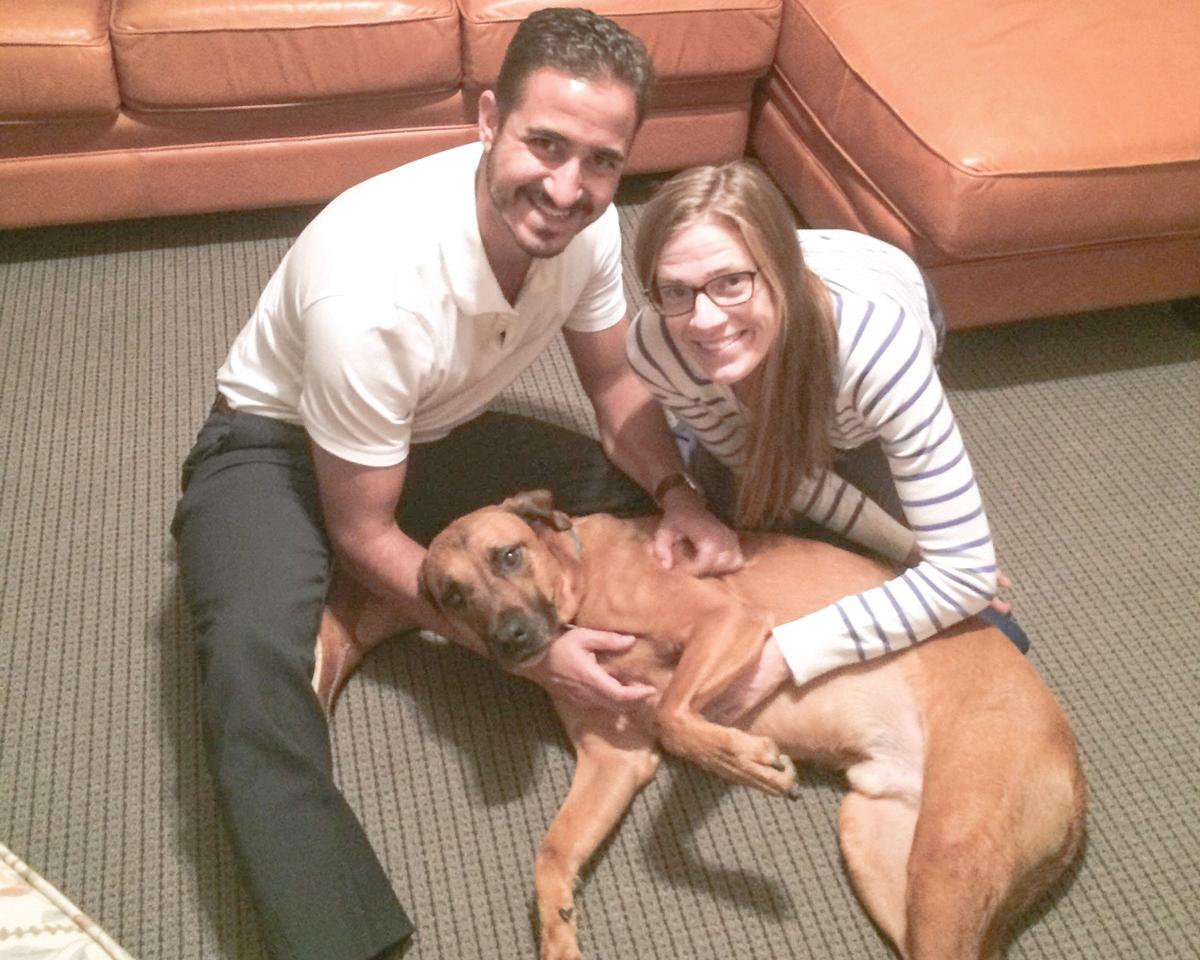
Keenan Hall rector Noel Terranova and his wife Jaclyn pose with their dog The Goose, who lives with them in the dorm.
popular and so much fun.”
s ophomore Meg Wagner, co-captian of the Pasquerilla West hall b team, echoed Judy and said she was happy to be able to pick up the sport so easily without any prior experience.
“i was a cheerleader so i never played … [anything] that involved catching a ball or doing anything like that. s o last year when i came out i was really nervous,” Wagner said. “it comes really easily. i thought for sure i would just be riding the bench, but i played and it was not as hard as i thought it would be. it’s definitely fun and easy to pick up.”
Popularity for the women’s interhall flag football league, with 14 women’s halls represented in the a league and seven with additional teams in the b league this year, also stems from its affiliation with community, Judy said.
“t here’s definitely that community base to it, and i think with that comes the accountability piece, too,” she said. “t here’s that hall allegiance.”
Wagner said she uses flag football as a way to meet more people in her hall who she wouldn’t necessarily cross paths with otherwise.
“i’ve become closer with girls i wouldn’t have been friends with,” she said. “t here’s a lot of freshmen and girls that aren’t in my section, so i get to know them just because i’m on their team and we play together and get to work at practice together.”
a nother attraction for the women’s interhall leagues is the championship games being held on the field in notre dame stadium, Judy said, an honor originally reserved only for the men’s interhall tackle football games.
“We are very fortunate to have the relationship that we have with athletics as far as being able to use that facility,” she said. “here, it’s different just because of the rich tradition and the football history for the students to be able to play on the field. it is a big deal to play at Knute rockne’s stadium.”
Wagner said she and her team appreciate the significance of this unique opportunity.
“it’s a very rare experience, obviously,” she said. “to be on the notre dame football field is not something that many kids get to do even when they go here, so being able to have pictures and to have that memory is really special just because notre dame football is such a big deal, so when you get older, being able to say that you were on the field and you actually got to play a game is very rare and special.”
Judy said there are other factors that lead to participation in co-rec or all-campus men’s flag football teams, such as wanting to play a sport with friends that might be outside one’s hall.
“i n our co-rec leagues, it really is dependent that you reach out and get teams together with friends and people that are outside,” she said. “it’s more of an opportunity to get your friends together … [and] it brings in a mix of students.”
s enior flag football official t imothy Zdunek said he was excited to discover how many students participated in flag football in one way or another.
“i knew that interhall tackle football was big for the guys’ dorms, but i didn’t realize how big it could be for, obviously, the women’s dorms and then co-rec and all-campus guys leagues,” Zdunek said. “i was rather surprised to see how so many students competed in flag football here. it was really great to see.”
Judy said each flag football league plays by the national i ntramural and recreational sports a ssociation ( nirsa) rules, which have been adjusted over the years to create a more unique environment for the sport.
“o riginally, i think that they tried to have a large affiliation with high school rules for tackle football — obviously modified to make flag football a non-contact sport,” she said. “i think that, over time, they really have focused on creating rules that are more in line with creating the atmosphere that they want.”
t hese rules are enforced by student officials, creating an additional entry point for students who want to be involved with flag football in some way. Zdunek said he became a flag football official to become involved with football on campus, even though he doesn’t play.
“it just looked really cool as a way to get close to the action and everything without playing because i know i’m not exactly the greatest athlete in the world,” he said. “t his was a way for me to really stay involved in that kind of stuff.”
For Wagner, the women’s interhall b league serves as a good way for students who live in dorms where flag football is too popular for just one team to get involved.
“it’s really nice just because i don’t think i’m skilled enough to be on a team, [and] it’s a lot less pressure,” Wagner said. “s o obviously, the girls that are competitive and want to have a competitive nature go up on a team and that’s for them, but b team is a lot more relaxed and low-pressure. a nd we have a lot more fun, i think.”
Contact Courtney Becker at cbecker3@nd.edu
concerns, shibata said.
“it was partially for security and partially because space is limited on campus, and we weren’t sure how large the demand would be,” she said.
shibata said the University allows all cabs licensed by the city of south bend to access campus and pick up passengers.
“if there were any companies we had continuing problems with, we would restrict their access,” she said. “but so far, there haven’t been any.”
the rise of Uber has led to some students taking on roles
as drivers. off-campus junior david connelly said he started driving for Uber after an upperclassmen recommended he try it.
“i just drive whenever i’m not too busy, and it’s a good way to make money for study abroad,” he said.
While Uber has increased in popularity, shibata said cabs still remain the most frequent choice for students and can sometimes lead to safety issues because they often cram in more students than they have seats for.
“there are some forms of vehicles that are exempt from having a seat belt in every position,” she said.“but regardless, it’s not safe for there to be more passengers
than there are seats.”
While this practice is not illegal under indiana state law — which exempts cabs from seat belt requirements, along with other public transportations like buses — shibata said ndsP wants to discourage this potentially dangerous practice. because notre dame is private property and ndsP is a private police force, cabs can be pulled over and targeted for overcrowding when on notre dame’s campus.
“When they’re on campus, we have the ability to say that’s not acceptable,” she said.
Contact JP Gschwind at jgschwin@nd.edu
t he results of this algorithm and deviations of it are present in everyday examples, such as the tiny square that identifies a face when taking a picture through a digital camera.
“it’s a rough estimate of how computers will map a face by taking little points on your face. supposedly these distances between points will be different on every person’s face,” she said. “With that, you can run an algorithm to give you a unique number based on the proportions of your face. … i f you like crime shows, this is usually what you see when they have a face in their database and they take a sample image and try to compare the two. t hat’s basically what this algorithm tries to do.” since its development, the algorithm has been widely used. now, g oogle has an algorithm that can identity you with 99.63 percent accuracy; Facebook is at 97.25 percent, and the U.s. government’s accuracy is somewhere between 50 percent and 85 percent, orlando said.
t he difference between the government, Facebook and g oogle stems from the data these entities are using, she added.
“g oogle and Facebook have a lot of images of us,” orlando said. “Facebook has around 250 billion photos — as of a year ago — with 350 million more uploaded every day.”
orlando said the U.s. government only has straight-on mug shots, while Facebook has photos from all directions, in different light settings, with odd shadows and across wide ranges of time. in this way, Facebook is provided with everything needed to match a random photo to a face.
“We only have a Fourth a mendment against search and seizure,” orlando said. “if the U.s. government wants, they can ask Facebook to protect photos of you in order to make their facial recognition better.”
on a positive note, this technology can be used in helpful ways, orlando said. casinos can use it to track gambling
addicts; companies such as Master card, which develop credit cards, can use the face associated with each credit card number to limit fraud and track down criminals.
however, this technology could also mean law enforcement uses information and tagged photos from Facebook to issue warrants, orlando said.
“a nd with the U.s. government, there are no laws that once they take the photos, they can’t keep them,” she said. “t hose photos are in their database in case you do something again.”
orlando said this technology isn’t just limited to high ranking citizens. it can be used by anyone — including two individuals in russia who developed a mobile app called FindFace using information from a Facebook-like russian social media site.
“FindFace lets you take a photo of a person passing by, checks it against the database and then you can discover that person’s real name,” orlando said. “t here were people who would try to find a girl’s name so they could ask her on a date … silly things like that, that
could change into stalking.” in the U.s., the big concern is the lack of federal laws regulating scans being taken of your face, orlando said, although i llinois and texas have laws against using this technology to identify people without their informed consent.
“i llinois is trying to lobby right now to change their existing law to make it so only in-person scans need consent,” she said. “so, Facebook wouldn’t apply anymore, instagram wouldn’t apply anymore. … a lot of people are guessing Facebook is behind the lobbying because if this change were to happen, the person with the most to gain would be Facebook.”
in connection with this issue, someone sued Facebook and the case will be going to trial, orlando said.
People need to be aware of the permissions they grant when agreeing to the fine print on app contracts, she added, and also need to be aware of this issue to consider if and how this technology violates a balance of security and liberty.
Contact Kathryn Marshall at kmarsh02@saintmarys.edu
Paid a dvertise M ent
By CAELIN MILTKO scene Writer
Father e dward “Monk” Malloy released the final installment of his three-part memoir on a ug. 25 and a book launch at notre dame followed on s ept. 14. “Monk’s tale: t he Presidential Years” completes a project Malloy originally intended to be a single book, until he began writing his childhood years — the first book — and realized a single book would be far too long.
t he final installment is 421 pages, but Malloy says, unlike the previous two, a good portion of the production of the third book was in editing. o riginally, he wrote over 1000 pages, which have been saved in the notre dame a rchives. i n the writing process, he relied on newspaper articles, yearbooks, institutional records and the diaries he wrote as president.
“ t his book is much more about the institution and the people of this institution, so there are a lot of people wondering what ... i [said] about them or about events. obviously, you can have different interpretations of the same event through the same reality and so i’ve tried to be fair, but other
people can give a different account of the same thing,” Malloy said.
t here are 18 chapters in “ t he Presidential Years,” one for each year of Malloy’s presidency. Malloy describes his experience as president through a series of short segments, each with its own heading. d epending on the subject, the heading is accompanied by a few sentences or pages of explanation.
t he story is told mostly in chronological order, with a few longer segments on people, projects and places Malloy felt required more detailed explanation. For example, Father hesburgh, the c enter for s ocial c oncerns and notre dame’s involvement in a sia all receive their own detailed segments in various chapters that hop around chronologically, but provide a more complete picture of the idea in question.
“ t he first chapter is the longest one because it covers a typical year in my life that would apply to every year and then what i try to do in the other years is to focus on particular events that were of significance,” Malloy said.
a t times, the book is a bit dry. t here are long lists of people honored at each commencement ceremony, projects and committees Malloy worked on, and places and people he visited
in his travels. o ften, Malloy is more concerned with mentioning all the important people, places and events than providing detailed stories about his time as president — but this is perhaps partially a result of cutting more than half of what was originally written.
e specially toward the end of the book, Malloy’s stories become more detailed and personal. c hapter 15 “ t he Year of 9/11 and its a ftermath (200102)” is particularly well-done. it is one of the longer chapters in the book, featuring a segment where Malloy describes notre dame’s reaction the day of 9/11 and another on his trip to ground Zero and the tour he was given there.
t hese two portions are among the most moving of the book and include more detail than Malloy gives to most of the events he discusses — not as mere lists of people and places, but personal accounts that emphasize the emotional gravity of those days.
c hapter 15 also underlines a peculiar stylistic quirk in Malloy’s book. t he use of segments, separated by headlines, eliminates the need for completely smooth transitions. a s such, c hapter 15 devotes its first half to the tragedy of 9/11 and its second half to “t he s earch
for a new Football c oach.”
i n another book, written in another style, the transition would be too jarring to work. e ven here, like many of the segments, there seems to be more to say about what came before, but the style of book allows time to move forward without the need to tie up everything that came before.
o ccasionally, this gives Malloy license to mention potentially interesting events, without detailing them further. e arly on in the book, he refers to the one significant disagreement he had with hesburgh, but never delves further on the subject.
o verall, however, Malloy is candid in his discussion of events and people over his time as president: c hapter 11 includes a brief discussion of Malloy’s meeting with presidential nominee d onald trump and c hapter 16 discusses frankly the events that ended with Father t im s cully’s resignation as executive vice president.
a s for Malloy’s plans now that his memoirs are finished, he says, “i have my next book in my head. i just haven’t written it yet.”
Contact Caelin Miltko at cmoriari@nd.edu
By ALVARO del CAMPO scene Writer
t he latest release from c omptonbased label top dawg e ntertainment ( tde ) is i saiah r ashad’s debut LP “ t he sun’s t irade,” a hazy and dense production addressing topics like fame, addiction and depression. t hroughout the record, the slow hip hop instrumentals complement r ashad’s flow and knack for lyricism, with frequent shifts in vocal inflections and singing styles keeping the experience varied yet cohesive when viewed at as a whole project.
i saiah r ashad shares stylistic similarities with labelmate and good friend Kendrick Lamar. i nstrumentally, “ t irade” sounds reminiscent of projects like “good kid, m. a a .d city” with beats that have a vinyl distortion track underlying them, giving the album a distinctly lo-fi feel that contrasts r ashad’s modern flows throughout the record.
i n “Free Lunch” and “Wat’s Wrong”
r ashad showcases his vocal versatility while throwing down some melancholic lyrics about the struggles of his past, from being on free lunch programs while in school to feeling like his progress is stagnating. t he latter track features Lamar with a fiery verse that feels right at home with the hazy instrumental that is decidedly one of his stronger environments musically. t he guitar and sample heavy instrumentals make for a musical experience reminiscent of Flatbush Zombies’ last album. r ashad’s flow cements “ t he sun’s t irade” as a trademark tde project.
Lyrically, “ t irade” explores various avenues of r ashad’s psyche, addressing topics from growing up in an underprivileged environment to struggling with depression and addiction. b efore this project, r ashad struggled for years with an addiction to Xanax and alcohol, and his journey to sobriety and success is documented in songs like “rope // rosegold.” t he album shifts emotionally between melancholic
reminiscence and celebratory tracks which help to balance the otherwise heavy subject matter.
While “ t he sun’s t irade” has many positive traits, it falls short on variety of style. t he whole project is mellow, and while this isn’t necessarily a problem, the album loses some steam as songs start to sound a bit too similar from track to track. t he instrumentals on the album, while smooth and well produced, share similarities to the point where it can be hard to remember which song is which.
o verall, on this latest album i saiah r ashad delivers an admirable collection of tracks with mellow instrumentation, deep lyricism and a variety of flows and vocal styles. however, this cohesiveness comes more from the lack of stylistic variety throughout the album than an actual thematic thread. r ashad’s talents are on full display in “ t irade,” though he is outclassed technically on some songs with features. o n “Wat›s Wrong,” Lamar’s verse overshadows r ashad’s parts.
i n general, not many of the tracks on the album are particularly memorable or exciting, and as a result the album itself feels ultimately forgettable for all but the staunchest of hip-hop heads. d espite its downfalls, “ t he sun’s t irade” is still worth a listen if only for the vibes that it exudes and the classic hip hop instrumentals on display, even if you won’t remember too many specific moments or songs.
i have this fantasy of waking up with a flip phone on my nightstand. not that i would ever act on this fantasy, but it still makes me smile to think about reclaiming my old Motorola razr from antiquity.
Unfortunately, the reality is i’d be a mess without the abundance of resources afforded to me via my iPhone. a ssets like gPs, Facetime, curated playlists and messaging services have become indelible parts of my daily routine. but that’s also a problem. a long with useful applications come the not-so-usefulones — most notably, social media apps. Whether it’s from Facebook, instagram, twitter or snapchat, the presence of social media is hefty and rarely positive, and its constant close proximity via my pocket internet machine presents an issue.
i want to make it clear that i’m not one of those charlatans whose idea of a dystopia involves a crowd of teenagers silently glued to their respective smartphones. in fact, i find the legion of elders scoffing at the digitally obsessed youngsters as they reminisce about the good ol’ days when “people use to talk to each other” a bit uniformed, not to mention condescending.
sure, the lack of actual human interaction today is a bit concerning, but that’s just the way of the world. the reality is that the progression of new technology will always present a tradeoff, but the iPhone and all its wonderful features — as well as the pesky ones — are here to stay, at least, until something “better” comes along. Luckily for me, though, i have the millennial’s greatest weapon locked and loaded: the complaint.
What exactly is a snapstory? What is its purpose? Why do we post snapstories? a re we creating a living breathing representation of our lives in 2016? or is everyone just trying to one up each other in an ironic attempt to prove higher levels of “coolness?” My hunch is the later. every time i brainlessly peruse the ever-updating list of my “friends’” snapstories, i feel like i’m watching some version of keeping up with the Joneses if the Joneses went to a ton of parties and were all heavy drinkers. Look, i have no problem if you participate in college culture, but why does every one of your contacts need to know you do via poorly shot footage and even worse audio? better yet, why do i ever look at snapstories?
While i have this pitiful pulpit, i have to ask, why is Facebook the forum of choice for political manifestos? nothing screams, “hey, take me seriously, you guys!” like a post sandwiched between my aunt’s vacation photos and an ad for a pair of shoes i never pulled the trigger on. i get it; in theory, Facebook should be an appropriate place for an educated discussions involving a diverse group of friends and acquaintances. but that’s just not what Facebook has become in practice — it’s now mostly a place for materialism and narcissism. a bit harsh, i know, but in a recent bend bout of self-righteousness, i deleted my iPhone’s Facebook app, only to re-download it when i realized i had forfeited the ability to retrieve information on my peers (spy?) — so please forgive my brashness. irony sucks.
regrettably, i don’t see my iPhone going anywhere, at least for now. i will, however, be more wise when it comes to my interactions on social media. t hat being said, though, make sure to friend, follow and add me on all appropriate formats.
Contact Adam Ramos at aramos6@nd.edu
The views expressed in the Inside Column are those of the author and not necessarily those of The Observer.
Last week, my buddy a lec and i arrived home in the morning hours after a cheery tuesday evening at the bar, to find our third amigo, drew, typing on his laptop at the dining room table.
surprised to find him awake and working so late, i asked, “hey man, whatchya been up to?”
“t he career Fair is tomorrow,” he said, with his head in his hands.
i could hear a lec in the kitchen, searching through the fridge. he returned with two beers and gave me one, as drew explained all the work he had done to prep for the career Fair: sending emails, writing cover letters, calling recruiters.
Listening to drew, a lec stumbled a little, drunk, or maybe just nauseous from thinking about his own future. We went outside to drink our beers and talk nonsense.
a fter a rare pause, a lec asked, “should i go to that?”
“g o to what?”
“t hat career thing,” he clarified.
he had a curious look on his face, as if this was the first time he was considering that college would end and he might need to find something to occupy his time after graduation.
“i don’t know. do you want a job?” i asked him.
“not really,” he said.
“Me neither.”
We laughed.
i laid up a little restless that night. truth be told, i hadn’t thought much myself about what i was going to do. a fter a summer interning at a bank — inside an office staring at six computer screens for 10 hours everyday — i vowed that post-graduate employment would be the last thing on my mind as i enjoyed senior year of college, our last year of youth and freedom.
Yet it seems to be everyone’s favorite topic: Where did you work last summer? did you like it? a re you going back? no? What are you doing after graduation then? What’s your five-year plan?
see, lately i’ve been wondering why it is that we have to get jobs. Like why don’t we just not? i’m kind of kidding, but also not really.
Why do we work?
at least because we have to survive, right? For those of us without trust funds, we’d rather not starve or be homeless, so we need some cash for groceries and rent. but the economic math doesn’t add up for this to be the only reason we work.
according to a 2011 heritage Foundation research report, “Most of the persons whom the government defines as “in poverty” are not poor in any ordinary sense of the term. t he overwhelming majority of the poor have air conditioning, cable tv … are well housed, have an adequate and reasonably steady supply of food and have met their other basic needs, including medical care.”
James Q. Wilson wrote, “t he poorest a mericans today live a better life than all but the richest persons a hundred years ago.”
t his is because after the first i ndustrial revolution, circa 1750, real world gdP began to increase significantly for the first time in history. t hen, in 1900, the gdP graph hockey-sticked and began to grow exponentially faster than the global population. today,
our generation divides, though not equally, relative to history, with exponentially increasing amount of real wealth amongst a population that is not growing nearly as fast.
t he census bureau in 2009 defined a family of four whose income was below $21,954 as poor. our career center reported in 2014 that the median first year salary of a notre dame graduate was $58,000. so, without adjusting for inflation, an individual notre dame student in their first year of work will earn almost three times as much as a family of four requires for their basic needs, including air conditioning, tv and sometimes internet.
suffice to say, we don’t work just to survive. t hanks to economic progress, the income from an unemployment check, part-time job or seasonal job is plenty to sustain life in modern a merica.
My next theory is psychological. i like to think of human behavior in terms of needs-based motivation, one of the most useful frameworks being Maslow’s hierarchy of needs. i n this context, it seems we began work in the early caveman ages motivated by our physiological and safety needs for food and shelter. We literally had to fight to survive; this is no longer the case.
today, per the economic argument, our basic needs are met much easier. a nd according to the hierarchy, our motivations then focus on higher needs: love, esteem and self-actualization.
a nd because our culture is such that the majority spends most of their days working, we use our jobs as a source of satisfaction for these higher needs. We want to be hired to the most prestigious firms and make the most money so that we are respected and empowered. it’s even common to hear things like you should “love what you do.” but is “love” not an awkward thing to say about our work, and why is it that “what we do” is necessarily a job in the first place?
i think it is extremely difficult to self-actualize via a traditional job, especially in a big company, mainly because the self is, to some degree, an inherently individual thing, but also because the nature of the modern U.s. economy is such that its labor roles are highly specialized.
Where i worked this summer, it was one person’s job to trade Latin a merican credit default swaps, and he had been doing it for almost a decade. a nd even though that guy’s life was so much more than venezuelan cds, he spent the majority of each weekday doing that one thing.
We cannot expect our creative identities to be cogs that fit perfectly within the gears of the economy. e specially for a generation so dynamic and welleducated, maybe it’s time to take a break from the capitalist Kool-aid. Finally afforded the opportunity to rest in the armchair, we might divert significant resources away from industrial progress and to the arts, especially to thought on the human condition. For it seems to me that progress has brought us here, to this frontier of human history, but progress might also bring us down.
t his is all to say: maybe it’s alright if you don’t take that job.
Deep hows and outer spades, art and idiosingsongs; email Cole at colejfeldman@gmail.com, nonsense only please.
The views expressed in this column are those of the author and not necessarily those of The Observer.
Cole Feldman t he a bsurder
Adam Ramos scene Writer
t his year marks the 40th anniversary of one of the most critical supreme c ourt decisions on race and discrimination, and yet few people are likely to have heard of it. Washington v. davis (426 U. s. 229 (1976)) involved the constitutionality of test 21, originally created by the federal government and used by various entities, including municipal police forces, to assess the qualifications of job applicants. t he use of the test by the d istrict of c olumbia police force was challenged by a frican-a merican applicants who had failed the test.
i n addition to other facts presented to the lower court, the applicants pointed out that between 1968 and 1971, 57% of black applicants failed the test, as compared to 13% of white applicants. t he test was intended to be “race neutral,” but the plaintiffs in the case asserted that the effect of the test was to disproportionately favor white applicants, in violation of the e qual Protection c lause of the 5th a mendment of the U. s c onstitution, one of the reconstruction a mendments that gave the rights of citizenship to newly freed slaves.
c onsider this statement taken from test 21: “a lthough the types of buildings in ghetto areas vary from the one-story shack to the large tenement building, they are alike in that they are all drab, unsanitary, in disrepair and often structurally unsound.” t he quotation best supports the statement that all buildings in ghetto areas are a) overcrowded; b ) undesirable as living quarters; c ) well-constructed; d ) about to be torn down; or e ) seldom inspected.
While i am not sure what this type of statement has to do with identifying effective and competent police officers, it reflects a cultural norm and perspective that is unfamiliar, if not outright hostile, to minority applicants. i n addition to the condescending tone of the question, it uses idiom and vocabulary that may have proven difficult for applicants that dealt with generations of baked-in inequality in
Letter to the edItor
Smoking guns
education. black applicants were likely not surprised, but perhaps greatly disappointed, to face yet another seemingly race-neutral measure that operated to discriminate against otherwise qualified individuals. t he U. s c ourt of a ppeals, d istrict of c olumbia c ircuit, agreed with the plaintiffs and held that test 21’s disproportionate impact on black applicants was unconstitutional. t he d c . police appealed to the supreme c ourt.
Writing the majority opinion for the c ourt, Justice b yron White stated that precedent did not support the proposition that a law can violate constitutional equal protection solely based on its effect; it also needed a showing of governmental intent to discriminate. a s with so many of the standards established by the supreme c ourt — e.g., “arbitrary and capricious,” “rational basis,” “clearly erroneous” — the standard used is often dispositive of the result. i n this instance, Justice White employed a lower “rationally related” standard, where all the c ourt had to find to support use of the test was to determine that the test was rationally related to some legitimate government purpose. i f such a rational relationship could be shown — e.g., assuring a minimum level of verbal skills — then the constitutionality of test 21 was certain. t he c ourt held out a glimmer of hope for future cases in stating that the additional evidence of intent may be enough to trigger a higher standard of review, i.e., strict scrutiny. d ecades of litigation have demonstrated that without the smoking gun of intent, disproportionate impact cases since the holding in Washington v. davis have been difficult to win. a quick historical footnote about Justice White: b yron “Whizzer” White was an a ll-a merican football player at the University of c olorado. he was appointed to the supreme c ourt by President Kennedy, and over time White proved to be an increasingly conservative voice on the c ourt. he dissented as to the requirement of the notice of rights in the face of police interrogation in Miranda v. a rizona, and also objected to the c ourt’s opinion legalizing abortion in roe v. Wade. i n an interview in the Los a ngeles t imes, he characterized the court’s ruling in the latter case as
“an improvident and extravagant exercise ... of raw judicial power.”
now minority litigants facing disproportionate negative impact from government actions must meet the challenge of finding the fabled smoking gun — persons so intent on discrimination that that they leave clear evidence of their intent to deprive a segment of citizens of their constitutional rights. Perhaps it should not be a surprise, in this time of open-carry supporters, smoking guns still can be found.
recently, in north c arolina v. nc c onference of naac P ( o rder of august 31, 2016), the supreme c ourt denied north c arolina’s request to stay a federal appeals court ruling striking down the state’s restrictive voting law, blocking voter id requirements and restoring early voting, same-day registration, preregistration and out-of-precinct provisional voting. t he law was challenged as allegedly discriminating against a frican-a merican voters and burdening the right to vote, in violation of the U. s c onstitution’s 14th a mendment and the voting r ights act.
Prior to the supreme c ourt ruling, the executive director of north c arolina’s republican Party emailed a memo to state elections boards, urging them to push for “party line changes” that cut back on early voting hours. t he memo said that republican board members “should fight with all they have to promote safe and secure voting and for rules that are fair to our side,” and that “republicans can and should make party line changes to early voting.” such clear evidence of partisan intent is rare, but the open display of such “smoking guns” may well serve to cause self-inflicted wounds on those who encourage racist actions in the guise of raceneutral restrictions.
Ray Ramirez is an attorney practicing, yet never perfecting, law in Texas while waiting patiently for a MacArthur Genius Grant. You may contact him at patrayram@sbcglobal.net
The views expressed in this column are those of the author and not necessarily those of The Observer.
a clarification of catholic sexuality
i would like to begin by thanking bryan r icketts, former student body president, for his recent letter to the editor entitled “a catholic case for same-sex marriage.” While i do not agree with the conclusions of his letter — as i will make manifest later in my own — i think it is important for catholics to recognize, confront and interact with the areas of the faith where they have difficulties. Letters like these help facilitate interactions, as they demonstrate areas of questions and misunderstandings. it is my hope that i may be able to meet his inquiry, which is undoubtedly shared by others, with a greater understanding of catholic teaching on the subject. on to my contentions: the argument of the letter falls largely on his interpretation of the “reciprocal self-giving” and “transmission of life” components of the marriage. i n short, the argument is that L gbtQ people have the same capacity of self-giving and lifebringing acts of love as heterosexual people do. here, the author is unequivocally right. a person’s sexual orientation in no way inhibits one’s ability to love his or her neighbor, and the c hurch would agree. My attractions, be they to a man or a woman, do not affect my ability to support those suffering with aids, comfort those confronting hatred and bullying, or serve in any other capacity to those in need. i n these ways, all relationships can be a gift of self to the vivacity of others.
Marriage, however, is not simply a relationship of ministry to each other and to others — it requires sexual activity. t his is where the issues of unity and
procreation take a different level of importance, an importance i believe the “catholic case for same-sex marriage” fails to fully recognize. because marriage is a sacrament deeply connected to sexual union (the sacrament of Matrimony is completed and renewed with consummation), the nature of sexual activity is inherent to the nature of marriage. homosexual sexual acts do not have the potential for procreation; this is a biological fact. For this reason, homosexual sexual acts do not reflect the nature of marriage because they do not expand procreation from solely charity, which is life-giving, to marital love, which is life-generating.
a s for the argument that there are men and women who are married for whom sexual activity is not procreative, i.e. the infertile or the elderly, there is also an explanation. t he sexual act must be open to the procreative, just as all social interactions should be. however, not all expressions of the sexual act result in life, just as not all actions of ministry, service or care lead to successful promotion of life. t he importance is that the sexual act holds the potential for the creation of life: this is obviously true for fertile, young people, but even infertile or elderly couples still have potential for life in their sexual act — for examples of this, one could read the bible, or look up news of miraculous or extraordinary pregnancies.
Finally, i would like to discuss a myth that members of the L gbtQ community are the only people affected by this teaching of the procreative sexual component of marriage. i n section 1084 of the c ode
of canon Law, it is stated that “a ntecedent and perpetual impotence to have intercourse, whether on the part of the man or the woman … nullifies marriage by its very nature.” t hough this can be a difficult teaching to accept, because it affects people on grounds uncontrollable by themselves, it offers for those confused with catholic teaching against gay marriage a possible consolation: the obstacle for c atholic same-sex marriage is not one of sexual identity or orientation, but rather a consistent and holistic understanding of the marital act being open to life both socially and sexually.
i hope that this letter might add some clarity for those who are struggling with this teaching of the catholic c hurch. i will admit, it is a difficult one, because it so drastically impacts us, whether we are a member of the L gbtQ community or simply love one who is. t hat difficulty, however, is all the more reason for us to enter into dialogue of it; it is only in entering dialogue in connection with our continual prayer that we can grow in our understanding of the issue and our ability to catechize, evangelize and love all our neighbors. t his is the method by which all of us, regardless of our sexuality, marital status or vocation, can share in the life-giving, self-sacrificing love so prized by bryan r icketts, myself and all of the catholic c hurch.
evan holguin junior sept. 18
Raymond Ramirez t he c rooked Path
Happy Birthday: take a step forward and make a choice to walk away from situations that are holding you back or causing you grief. strive to reach your goals and to pursue the life that will make you happy. You are the master of your destination, so take hold of the situation and do what needs to be done. Your numbers are 10, 13, 23, 34, 38, 46, 49.
ARIES (March 21-April 19): b eing affectionate will have a much greater affect than complaining or being critical. Keep busy, challenge yourself and strive to achieve a closer bond with someone who means a lot to you. a n interesting position will grab your attention.
TAURUS (April 20-May 20): a trip or attending an event that brings you closer to your roots will have a beneficial influence on the way you think and what you decide to pursue in the future. refrain from overspending.
GEMINI (May 21-June 20): Let your feelings help you make the right decisions when dealing with others. a realistic and honest approach to relationships and what you are willing to offer will be honored if you are straightforward.
CANCER (June 21-July 22): d on’t jump to conclusions or let someone’s moodiness ruin your day. it’s important to avoid arguments at all costs. c onsider taking a timeout to rejuvenate, catch up on reading or get your personal papers in order.
LEO (July 23-Aug. 22): take pride in what you do and you will gain respect and the expertise to teach others. a trip with a romantic theme will bring you closer to someone whom you believe makes you a better person. Make plans for the future.
VIRGO (Aug. 23-Sept. 22): t he way you handle your finances, legal issues and medical affairs will determine how things will unfold at home and in your personal life. d on’t ignore the signals or messages you are getting from someone you love. You can’t buy happiness.
LIBRA (Sept. 23-Oct. 22): Partnerships should be your top priority. e xpress your concerns and offer alternate solutions as well as incentives. a n emotional situation is best dealt with affectionately, not with badgering or criticism. Walk away from anyone who is trying to control you.
SCORPIO (Oct. 23-Nov. 21): Put your time to good use. c onsider your skills and make plans to alter the way you live to better suit your current needs. Personal changes that will improve your professional situation are favored.
SAGITTARIUS (Nov. 22-Dec. 21): i f an argument breaks out, try to avoid getting involved. You’ll gain far more by making personal changes to the way you live or the way you look. Let love, romance and family fun be your focus.
CAPRICORN (Dec. 22-Jan. 19): take precautions and develop what you want to see happen with precision and hard work. refuse to let an emotional situation cost you physically or financially. b e cautious around anyone who is making demands on your time.
AQUARIUS (Jan. 20-Feb. 18): You’ll have a good eye for what will work and what won’t. Put your energy behind what you believe in and you will get what you want. a personal or financial gain is likely.
PISCES (Feb. 19-March 20): Finding out more about your heritage will give you greater insight into what you should be doing and how to go about it. d on’t let frustration and anger set in when you should be putting your energy into self-improvement.
Birthday Baby: You are authentic, progressive and original. You are adaptable and outgoing.
JUmbLe | david hoYt and JeFF KnUreK
sUdokU | the MePhaM groUP
JUst add water | eric carLson John roddY
Cubs need to pull it off this year
i would now like to call in my one free gloat as a cubs fan. so here goes: cubs baby! a ll the way! never a doubt — i told you so!
a h, that felt good. i’m glad i got that out of my system. so now what?
a s you may have heard, the cubs clinched the national League’s central division t hursday night, becoming the first team in the majors to do so. c linching home field advantage will happen in another week. so now, while the rest of the league fights for a playoff spot, the cubs get to take a step back, rest up and get ready to attack the playoffs.
i f you’ve been around any cubs fans this season, you know how … intense we can be. a fter all, to be a cubs fan, it takes something special. We’ve been strong in our support all year, and if that puts you off, i’m not sorry.
i n all seriousness, however, it hasn’t been hard to be a cubs fan this year. a side from a brief losing streak before the a ll-star break, we’ve been on top of the league virtually all season. t here haven’t been many moments of doubt, and the cubs seem to be just killing time until the real test starts. but the real test is about to start, and the pressure is about to be ratcheted up for the team and fans alike.
so listen when i say this: i f the cubs want to win the World series, they need to do it this year. For all his genius every offseason, t heo epstein has only given the cubs one season in which they will be able to seriously compete for the championship. t hat may sound harsh, but it’s true.
First, consider the cubs’ rotation. t he cubs currently have three c y Young-caliber pitches in Jake a rrieta, Jon Lester and Kyle hendricks. t his trio has proved deadly this season, but next year, the cubs may be out of luck. a rrieta is only under contract for this season, only signing a one-year, $10.7 million contract after much feet-dragging. a rrieta wanted a long-term deal, but the cubs simply weren’t able to pay him
long-term money. Luckily, a rrieta agreed to a bandage, short-term deal, but next year may be different, and there are plenty of other teams who would overpay to sign the ace. a n a rrieta-less cubs is a real possibility.
a nd then there’s hendricks. hendricks has been playing out of his mind this season, with a 2.03 era and 15 wins. i f hendricks continues this level of play for years to come, the cubs will be in good shape, but there is little to suggest he will. 2016 is only hendricks’ third major league season, and in his past two seasons, he hasn’t blown the baseball world away. i n 2014, he only started 13 games, and last year as a fulltime starter, he posted an era of almost four. t he cubs need to win this year to capitalize on hendricks’ breakthrough, because it’s unlikely he will duplicate it.
beyond pitching, the cubs have been lucky to avoid the injury bug. a key to a championship team is staying healthy, and 2016 has been good to the cubs in that regard. t he north siders lost slugger Kyle schwarber for the season early on, but other than that, center fielder dexter Fowler’s monthlong absence to a hamstring issues is the only real injury the cubs have had to deal with. Just look at another contender, the c leveland i ndians. i n the last two days, c leveland has lost catcher Yan g omes and starting pitcher carlos carrasco. t he law of averages being what it is, it is unlikely the cubs make it through 2017 as healthy as 2016.
Yes, the cubs offense will be good for the foreseeable future, led by young guns a nthony r izzo and Kris bryant, but if a rrieta bolts, hendricks has a step back and the injury bug hits, the cubs will be brought down to earth. a nd fast. so if you bleed cubbie blue, you should hang onto this postseason run with all you can. take in every moment, because it may be the cubs’ only chance.
Contact Marek Mazurek at mmazurek@nd.edu
The views expressed in this Sports Authority are those of the author and not necessarily those of The Observer.
Brewers out last Cubs, Hendricks at Wrigley
Associated Press
chicago — a year ago, Kyle hendricks might have been satisfied giving up a couple runs in a start.
now, as a c y Young candidate, hendricks expects more from himself.
hendricks, the major league era leader, allowed two runs in six innings and remained stuck on 15 victories as the Milwaukee brewers beat the n L c entral champion c hicago c ubs 3-1 sunday.
“it definitely means my mentality is just in a different place,” hendricks said. “ t his game last year, i probably would have been a lot happier with it. resulting in a loss, i feel like i could have done a little more just with the tools i have available to me, where i’m at this year.”
hendricks (15-8), making his first start since losing a no-hit bid in the ninth inning at st. Louis, struck out nine and gave up six hits. h is era rose from 2.03 to 2.06 as he lost for the first time since July 26 at the White s ox.
Last year, he went 8-7 with a 3.95 era in his second season.
“We have not supported
him run-wise a lot this year, and there’s another great example today,” c ubs manager Joe Maddon said. “he definitely pitched well enough to win, and we only came up with the one run, so it’s just unfortunate. he didn’t have his best stuff, but nine punchouts and two runs in six, pretty good day.”
tyler t hornburg struck out Kris bryant and a nthony r izzo with two on in the ninth to earn his 11th save in 16 chances.
t he c ubs have lost four of six and are trying to secure home-field advantage in the playoffs. t hey resumed playing their regulars after clinching the division t hursday.
t he c ubs went 0 for 10 with runners in scoring position.
“We hit the ball well,” Maddon said. “ t his is one of those days (with) the culmination of the wind blowing in and their defense played well. We had good at-bats.”
c hris c arter homered and Martin Maldonado and pitcher Wily Peralta (7-10) added rbi singles for the brewers, who took three of four games from the c ubs.
Milwaukee slugger r yan braun got a scheduled day off
after hitting two home runs s aturday.
“a s much as anything, it just speaks to them finishing the season and finishing it strong and continuing to play at a high level,” brewers manager c raig c ounsell said.
hendricks hasn’t allowed more than two earned runs in a home start since a pril 15 against c olorado. i n each of his last 21 starts, he has surrendered three or fewer earned runs.
“Fastball command just wasn’t great,” hendricks said. “s o it’s something i’ve got to hone back in this week in my bullpens. but that happens from time to time. it shouldn’t be too much of an adjustment.”
t he right-hander struck out the first three batters before allowing a single to hernan Perez to start the second inning. t he brewers hit three straight singles to score two runs.
“ t hey’re playing good baseball right now,” hendricks said. “ t heir lineup, everybody is putting together good at-bats. t hey’re aggressive, but then they’ll surprise you at times when they’re patient.”
Luck struggles in colts’s loss to broncos
Associated Press
For three quarters, a ndrew Luck was the quarterback the i ndianapolis c olts needed him to be — not flashy, sometimes downright boring, but most importantly, a quarterback who valued patience and didn’t make mistakes.
t he b roncos forced that other a ndrew Luck to show up in the fourth quarter, and it cost the c olts the game.
First, Luck tried to squeeze a third-and-15 pass over an oncoming rusher to a completely covered receiver. d enver’s a qib talib picked it off and returned it 46 yards for a touchdown.
From there, the c olts
entered comeback mode, and that ended badly, too: Luck never felt von Miller coming from his right for the sack and strip that led to s hane r ay’s 15-yard fumble recovery and the clinching score in s unday’s 34-20 loss.
“ i know a ndrew would love to have it back,” c olts coach c huck Pagano said of the pick-6 that gave d enver a 23-13 lead.
“We’d all love to have it back. You’ve got to take care of the football in that situation. i f we don’t get a first down, we don’t get the first down, you punt the football and it’s a three-point game.”
o ne main story line on Luck coming into this game was how last week, even
though it ended in a 39-35 loss to d etroit, was more like what the c olts needed from the man they made the league’s highest-paid player in the offseason — the quarterback who, over his first three seasons, won 33 games, made the playoffs three times and showed all signs of being the n FL’s n ext g reat Qb
c ritics noted, however, that some of his stats have often been stockpiled in comebacks made necessary by his own mistakes. he threw four touchdowns in this season’s opener. n o interceptions. d idn’t put the football or his own body at risk. More of that would equal good things.
Marek Mazurek sports e ditor
shots they did have weren’t really that threatening. s o i think we felt we should’ve had the better of the game. “
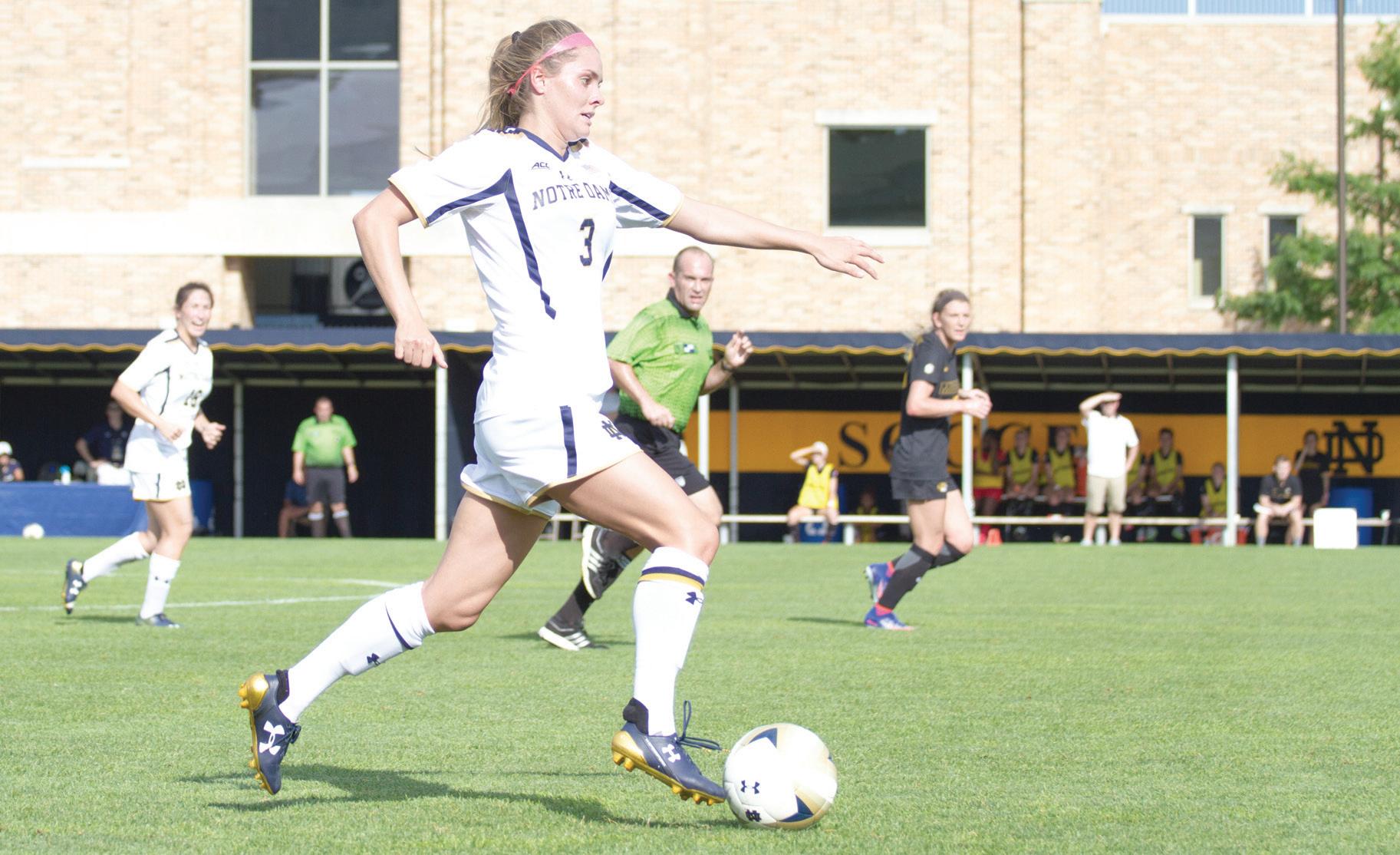
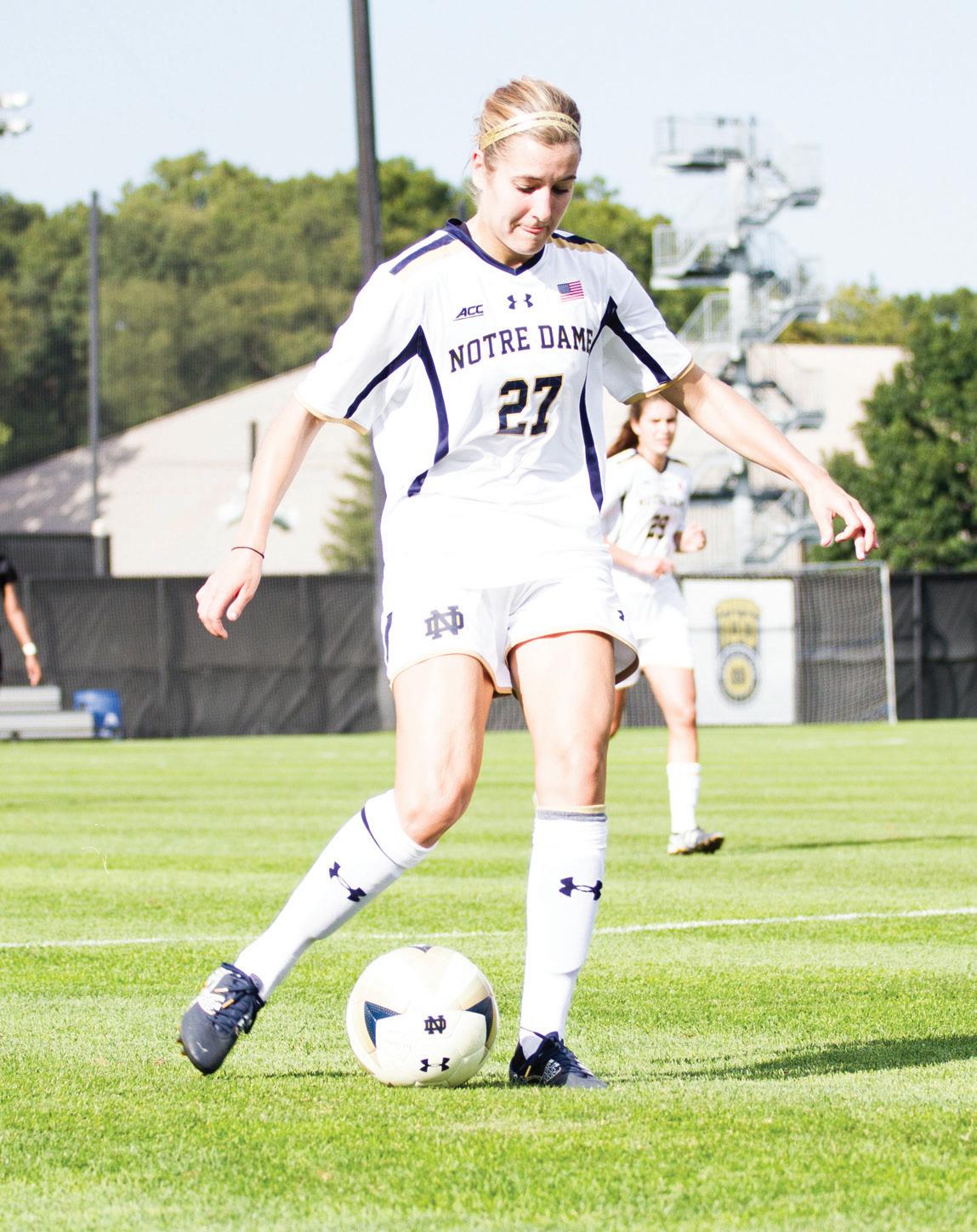
t he i rish started brightly, as the first 15 minutes saw the team manage four shots, forcing s yracuse sophomore goalie c ourtney b rosnan to make two saves. b ut a common trend for n otre d ame recently once again emerged, for as the half progressed, the o range started to play better, and in the 33rd minute took the lead thanks to junior forward e va g ordon, who put in the rebound on a corner kick for her third goal of the year, and the half would end that way.
i n the second period, the i rish looked for an equalizer, and got it in the 53rd minute thanks to junior midfielder taylor Klawunder, who managed to bundle the ball in from the resulting scrum in front of goal for her second
of the season. o ther than that, however, n otre d ame only managed two shots, and were kept in the game thanks to senior goalkeeper and captain Kaela Little, who had three saves late in the half to send the game to overtime. o ver the two overtime periods, the i rish had the better chances, but simply couldn’t find the back of the net. i n the first 15 minutes, the i rish had four shots to the o range’s two, and in the second period, Klawunder came closest when her shot hit the post, but it just was not going for n otre d ame, and the game ended scoreless. a fter traveling to c alifornia last week and playing back-toback double overtime games, fatigue may have been a factor.
“ i think we need more polish in the final third— we want more quality,” r omagnolo said. “ i think that’s what we’re disappointed with, just that final pass, final decision on the ball, we just need more quality out of
our attacking players.”
t his was the first of many conference games for the i rish, and the schedule includes games against fifth-ranked v irginia, seventh-ranked n orth c arolina, thirteenth-ranked c lemson, and others.
r omganolo said on the season so far, “ i think we’ve done some things very well, and we haven’t done some things very well. What we need to see is more consistency in performance, and so i know we’re young, but you can only keep saying you’re young for so long before you need people to step up and make experienced decisions. s o that’s where we’re at, just wanting to see more consistent performances over 90 minutes.”
t he i rish continue their season this coming t hursday when they travel to r aleigh to take on n orth c arolina s tate.
Contact Tobias Hoonhout at thoonhou@nd.edu
Volleyball
d ame squared off against host no. 22 Michigan s tate. t he s partans (11-1) ended the i rish’s season-long win streak of four matches. Unable to find the same rhythm and success as in its first match of the tournament, notre d ame dropped three straight sets of 25-17, 25-13 and 25-19.
Junior setter c aroline holt stood out for the i rish in the loss, contributing 23 of the team’s 24 total assists in the match.
notre d ame faced d ePaul in the final game of the tournament on s aturday. t he b lue d emons (6-6) took control of the game from start, winning the first two sets, both with a score of 25-19.
c onfronted with a major deficit, the i rish, for a second time this year, came back from an 0-2 deficit to take home a victory. t he team made a complete
turnaround starting with the third set, posting 14 service aces in route to the win.
“We just kept rowing the boat: we just kept going and that was the most valuable lesson,” McLaughlin said. “We stayed in it and we kept battling, and we battled long enough to where things started happening. We settled down and we were thinking good thoughts and cleared our minds.”
notre d ame came out with urgency in the third set, leading d ePaul 16-8 on its way to a 25-16 win. t he boost of confidence from the third set continued in the fourth, with the i rish securing a 22-25 victory.
g oing into the fifth set in the match, notre d ame had all of the momentum on its side. t he tie-breaking set was close until the teams were knotted up at 11. t hree kills and a block by senior Katie h iggins in the closing moments of the match secured a 15-12 victory for the i rish and McLaughlin was proud of his team’s character in the comeback.
“it is too easy in life to give up, and it shows that they have the character and the heart to keep battling and sticking with it,” McLaughlin said about the team coming from behind. “ t he girls care about each other enough to not throw in the towel for each other, and that’s a big deal. You got to be connected with your hearts and we are learning those lessons.”
Freshman Jemma Yeadon led the team with 14 kills and four service aces in the match. Junior c aroline holt had another outstanding performance with 52 assists and sophomore r yann d eJarld again led the team in digs with 20.
notre d ame returns home to open acc play on Friday against Louisville at the Joyce c enter at 7 p.m.
Contact R.J. Stempak at rstempak@nd.edu
Paid a dvertise M ent
EMMET FArNAN | The Observer
Irish sophomore defender Natalie Ward carries the ball up the field during Notre Dame’s 1-0 victory over Missouri at Alumni Stadium on Sept. 4. Notre Dame tied Syracuse 1-1 in Sunday’s match up.
MICHAEL YU | The Observer
Junior middle blocker Meg Morningstar tips the ball over the net during Notre Dame’s loss to Coastal Carolina on Sept. 2.
women’s InterhaLL
Women’s flag football season kicks off
By RYAN LOKHORST, PATRICK SKRINE, MEAGAN BENS, MIA BERRY and BRENNAN BUHR
Lyons def. Lewis 18-6 behind a strong rushing attack, Lyons defeated Lewis with a score of 18-6 sunday in the first game of the interhall flag football season.
t hree rushing touchdowns by senior quarterback bella bianco, along with three interceptions by her defense, sealed the victory for the Lions.
a lthough the game ended in a loss for the c hicks, junior captain g eorgi a ndrews feels that the young team gained valuable experience from its first game.
“More than half of the girls are freshmen,” a ndrews said. “so they were able to get the rules under their belt.”
t he c hicks looked dangerous on offense for much of the game, however, a ndrews noted that the game was decided by a buildup of small mistakes.
“We need to work on the little things like flag guarding rules,” a ndrews said. “a lso getting the plays hammered out.”
Lewis will look to improve these little things for next week and for the rest of the season.
t he Lions, on the other hand, hope to build on their strong start, according to their captains, junior carly Meacham and senior Melissa hoelting.
“We have a lot of good new girls this year,” Meacham said. “We’re really excited about our prospects for the season.”
Freshmen Fabi shipley and Lily Merrigan played key roles at offensive line and receiver, respectively for Lions, leading other newcomers who added to the solid overall play. t he captains praised the better play on both sides of the ball and the positive energy on the sidelines
that aided in the victory.
Lyons will look to continue this positive energy and team play throughout the season. t he Lions will go head-tohead against badin at 10 p.m. Monday at r iehle Fields and the c hicks will see their next action sunday at 4 p.m. at r iegle Fields when they play cavanaugh.
pasquerilla west def. badin 21-14
Pasquerilla West and badin opened the interhall season on sunday with a hard fought game that resulted in a 21-14 victory for Pasquerilla West. t he game consisted of a few costly penalties for both teams and frequent momentum shifts, with one lucky bounce that favored the Purple Weasels.
despite losing the game, badin captain Melange gavin said she was pleased with her team’s performance and energy.
“i loved the effort, especially from the new girls we had come out today,” gavin said. “We have been pretty rough in the past, so this was a promising first game for us.”
both teams found the majority of their success through the air, but Pasquerilla West had one successful long ball that gave them the edge. Purple Weasels captain Monica busse said she did not think the passing completions were a fluke.
“We started practice early this year and we kind of diversified our route tree, so we had a lot of options and that let us put in plays that fit well with our personnel,” busse said.
t he bullfrogs went into the half trailing 13-7, but came out with energy in the second half, firing at all cylinders on both sides of the ball. badin took the lead, but Pasquerilla West stuck to its game plan to come back
and win.
“everyone did their job consistently throughout the game which helped us win,” busse said.
t he bullfrogs and Purple Weasels have a lot of good things to look forward to and build off of in the coming weeks, considering the big plays made today.
badin will next take on Lyons on Monday at 10 p.m. at r iehle Fields and Pasquerilla West will face off against Mcglinn at the same time and place.
pasquerilla e ast def.
Cavanaugh 12-6
Pasquerilla e ast relied on interceptions to defeat c avanaugh with a score of 12-6 in the women’s interhall opener.
two minutes into the game, Maddie Mc g overn, senior cornerback for the Pyros, intercepted the ball inside the 20-yard line. o n the next play, junior running back s ydney boll capitalized on the turnover with a spin move and touchdown to put Pasquerilla e ast up 6-0 at the end of the first quarter.
a second touchdown soon followed as freshman cornerback e mma shimek scored on a 40-yard interception return. Pyros senior captain noelle g ooding said she was pleased with her defense’s first performance.
“i can confidently say i think our defense is definitely one of the best in the league,” g ooding said. “i’m really proud of those guys. t hey did awesome. i think we’re definitely going to come out and be able to get more wins.”
at the beginning of the second half, the c haos managed to create their own string of interceptions, starting with senior captain a lyssa a nton.
a nton hauled in the first inception on the first play of the second half, and thirty seconds later, she caught a touchdown reception — the first of the game for c avanaugh. With two minutes left, the c haos stole their second interception of the game.
a lthough c avanaugh’s comeback efforts were stopped short when Pasquerilla e ast caught an interception with four seconds remaining to seal the win, a nton has an optimistic outlook for the rest of the season.
“i’m super excited,” a nton said. “i think we are looking better already than we did all of last year. We have a lot of freshmen, lot of young players, so i think everyone picked up on the offense and defense pretty quickly. Last year we had a smaller team, we definitely have more people this year. t he program is growing and i’m glad to see that.”
t he c haos will take the field next on sunday when they play Lewis at 4 p.m. at r iehle Fields and the Pyros will play Mc glinn at 5 p.m. sunday at r iehle Fields.
welsh Family def. howard
39-0
Welsh Family dominated on both sides of the ball sunday evening, shutting out howard 39-0 in the opener of the women’s flag football season.
Led by senior standouts Fran Mancuso and a riel navotas, the Whirlwinds raced to an early lead on a long, firstquarter touchdown run by Mancuso and never looked back. t hey scored again only a few minutes later on a catchand-run by navotas, who weaved her way through multiple defenders before charging into the end zone for the first of her two scores on the
evening.
Welsh Family’s’ defense also came up big in the win, stifling howard’s run and passing games throughout and totaling two interceptions.
Mancuso, who accounted for four of the Whirlwinds’ six touchdowns on the day, was very optimistic about her team’s chances going forward after such a resounding win.
“We can definitely keep this up all season,” Mancuso said. “We expect to be playing in the stadium this year, without a doubt.”
o n the other hand, the d ucks were clearly dissatisfied with their scoreless performance. however, junior captain a lannah Mc c ann had a positive message for her team after the game.
“i think it’s really important to have some adversity early in the season,” Mc c ann said. “ t he same thing happened to us last year and we ended up in the stadium, so we’re very optimistic about how we can adjust things and move forward.”
With the win, Welsh Family moves further into the regular season with an offense and a defense that are both clicking on all cylinders, while howard look to put this tough loss behind them as it prepare for its next game.
Welsh Family will face off against r yan on sunday at 5 p.m. at r iehle Fields, while howard will take on Flaherty at 7 p.m. at r iehle Fields on tuesday.
Contact Ryan Lokhorst at rlokhors@nd.edu, Patrick Skrine at pskrine@hcc-nd.edu, Meagan Bens at mbens@nd.edu, Mia Berry at mberry1@nd.edu and Brennah Buhr at bbuhr@nd.edu
Golfers compete at Pebble Beach
P ebb L e beach , c alif. — Paul b roadhurst birdied the par-5 18th at Pebble b each on s unday to win the P ga tour c hampions’ n ature valley First tee o pen.
t he s enior b ritish o pen winner at c arnoustie in July for his first victory on the 50-and-over tour, b roadhurst made a 6-foot birdie putt on 18 after running his first attempt past the hole.
t he 51-year-old e nglishman finished with a 4-under 68 for a one-stroke victory over b ernhard Langer and playing partner Kevin s utherland. b roadhurst joined b en h ogan and tom
Watson as the only players to win at both Pebble b each and c arnoustie.
“ o bviously, the scoreboards are all around the last four holes so i was well aware of what was going on and knew i needed to birdie the last to avoid a playoff,” b roadhurst said. “Probably hit two of the best shots i ’ve ever hit up 18. Perfect tee shot and a really good utility into the green just on the front edge. i managed to two-putt from 30 feet, so yeah, absolutely delighted.”
Langer birdied the last for a 66, and s utherland birdied the final two holes for a 70. s utherland, from s acramento, missed a chance to win the home
event for this first senior title.
“ i waited to the end to make some birdies but better late than never, i guess,” said s utherland, a stroke ahead of b roadhurst entering the round. “ o ne thing about Pebble, i didn’t get the first seven holes. i didn’t make any birdies on those holes, so it kind of gets you behind a little bit. b ut i played the back side solid, so it’s a little disappointing coming up one short.”Joe d urant bogeyed the 18th — lipping out a 3-footer — for a 67 to finish fourth at 9 under.
b roadhurst finished at 11-under 204 for two rounds at Pebble b each and one at Poppy h ills. h e won six
times on the e uropean tour and played in the 1991 r yder c up.
“ i t certainly felt more relaxed today, definitely,” b roadhurst said. “ i don’t know if it’s because you’re older or whether it’s experience or just getting in the frame at the b ritish recently helped an awful lot, but i felt fairly comfortable. i would be lying if i said i wasn’t nervous, but i felt fairly comfortable out there apart from 14, which i made a bit of a mess of.”
t he seniors played alongside boys and girls from t he First tee programs throughout the country, with Michael a llen and 16-yearold Patrick Fernandez of
Phoenix winning the team title.
“ i ’m really grateful to be out here,” Fernandez said. “ i ’m thankful to all the sponsors, n ature valley, t he First tee, and just thankful to everyone that helped me get here. ... t he n ine c ore values is a key thing with t he First tee. t hey teach you honesty, integrity, perseverance. r eally, the key things that you need in life.”
a llen and Fernandez tied with s utherland and Jonathan tanihana, and b illy a ndrade and r oss Funderburke at 18 under, and won in scorecard playoff, with the team’s birdie on the par-3 12th the deciding factor.
notre dame falls to Louisville in heartbreaker
Observer Sports Staff
it was the first time no. 1 notre d ame was left scoreless in their last nine games. t he i rish (6-1-0, acc 1-1) fell for the first time this season losing 1-0 to acc foe Louisville in a game that seemed to go notre d ame’s way in nearly every aspect of the game.
s urrounded by a hostile crowd of 4,043 c ardinals’ fans fans at Lynn s tadium, notre d ame outshot Louisville (5-11, acc 2-0-0) 6-3, had six corners to the c ardinals’ three and committed fewer fouls throughout the course of the contest. b ut none of that made a significant difference in stopping the i rish from losing.
i n the 25th minute, Louisville junior forward Mohamed t hiaw received a pass from junior defender Joey Kunkel and fired it into the back of the net 35 yards out to give Louisville an early 1-0 lead. t hiaw, a junior college transfer from c incinnati s tate technical and c ommunity c ollege who was named a national s occer c oaches a ssociation of a merica a ll-a merican twice,
needed just two shots to do the trick against an i rish defense that allows just .32 goals per game, which ranks tied for fourth best in the country. it was his fourth goal of the season, which leads Louisville.
a fter t hiaw’s goal, the i rish struggled to finish on opportunities. Four minutes after the Louisville goal, graduate student midfielder e van Panken sent a corner that failed to place the i rish on the scoreboard. r ight before the half, sophomore midfielder t homas Ueland connected on a header but was off the mark of the goal.
notre d ame began the second half with two more corner kicks dished out by Panken, but again, the i rish could not find a way to make them count against Louisville’s stout defense. notre d ame had just three of its six shots made on goal — all by junior forward Jon g allagher. Louisville held the i rish to 10 shots below its average per game, and Louisville graduate student goalkeeper s tefan c leveland had a strong showing with three saves as he recorded his third consecutive shutout. t he game marked
nd women’s soCCer | nd 1, sYracUse 1
the first time n otre d ame has failed to score a goal in a regular season game since o ctober 16 of last year versus v irginia.
n otre d ame’s best scoring opportunity came in the 85th minute on the foot of Jon g allagher who fired off a shot from inside the box. c leveland was quick to react, however and punched the ball over the crossbar and kept the i rish scoreless.
a s tough as the c ardinals’ defense was on n otre d ame’s offense, the i rish also showcased a dominant defense in the second half holding Louisville to one shot in the game’s closing period. t he c ardinals have managed to average 13.3 shots per game through seven games this season.
n otre d ame will return to a lumni s tadium continuing to play through the acc slate of its schedule Friday. s yracuse, who defeated the i rish 1-0 last season in the acc final, will be the n otre d ame’s third conference opponent this season. t he rematch of last season’s conference tournament title will kick off at 7 p.m.
nd ties syracuse after double overtime effort
By TOBIAS HOONHOUT sports Writer
o nce again, the i rish battled for 110 minutes, only to emerge with a draw as s unday’s 1-1 contest with s yracuse proved to be the third straight double overtime draw the i rish (5-1-3, 0-1 acc ) have played in, and while they did battle back from a first half deficit, i rish head coach t heresa r omagnolo thought the team deserved to win.
“ i think overall the feeling we took away from the game was disappointment,” r omagnolo said. “We felt we played well enough where we should’ve won the game, although we did come from behind and i think that was good to battle back, at the end of the day we felt disappointed. We created enough chances where we could’ve won the game, and we didn’t really feel like they had that many great chances, the
Irish beat Hawks, Blue Demons
By R.J. STEMPAK sports Writer
notre d ame finished its non-conference schedule over the weekend in e ast Lansing, Michigan, at the s partan c lassic. t he i rish won two of their three games in the tournament, bringing their record to 9-3 on the season.
t he tournament began on Friday against Maryland e astern s hore with notre d ame coming out with a victory in a sweep. With their 8-2 record, the i rish were off to their best start in eleven seasons. i rish head coach Jim McLaughlin felt his team was ready to play coming into the tournament.
“We had a good week of practice,” McLaughlin said. “ t here wasn’t anything i felt that we weren’t prepared and ready for in all three matches. s o i felt good about the team and they felt good about themselves going in. t he weekend was good for us. We responded to some different situations.”
notre d ame dominated the match with its high-percentage attacking play, posting a kill percentage of .305 as a team, compared to Maryland e astern s hore (7-8) who only hit with a .098 percentage. Junior s am Fry led the i rish with 14 kills, and sophomore libero r yann d eJarld led the team in digs with 14. Freshman Jemma Yeadon, senior Katie h iggins and junior s ydney Kuhn each contributed five or more kills in the sweep.
a s a team, notre d ame controlled the first set, winning with a score of 25-12. t he h awks kept the game closer in the second, keeping with the i rish until the score was tied at 11. t he i rish found their form from the first set again and closed out the set, 2520. Ultimately, notre d ame outplayed Maryland e astern s hore throughout the day, winning the third set convincingly, 25-13.
Later that night, notre
EMMET FArNAN | The Observer
Senior forward Kaleigh Olmsted dribbles during Notre Dame’s 1-0 victory over Missouri on Sept. 4 at Alumni Stadium.
nd VoLLeybaLL | sPartan cLassic
KATHLEEN DONAHUE | The Observer Irish junior forward Jon Gallagher controls the ball during Notre Dame’s 1-0 double overtime victory over UConn on Sept. 13 at Alumni Stadium.
Michigan state’s second drive of the quarter, as senior spartan quarterback tyler o’conner engineered a methodical 10-play, 75-yard drive, capped by junior tailback gerald holmes’ 3-yard touchdown run to make it 22-7. the irish offense did not respond well, as Kizer was promptly intercepted on the second play of the drive by junior Michigan state linebacker Jon reschke. the spartans offense took over inside notre dame territory, and it took sophomore tailback LJ scott just three plays to rumble into the end zone, stretching the lead to 29-7 and swinging whatever momentum was left on the irish sideline towards the spartan one. the irish offense again could not stay on the field long, responding with a threeand-out, and a tired defense was quickly sent out to once more try and weather the storm. Lightning soon struck in the form of holmes, who sprinted 73 yards untouched into the end zone, an exclamation point on a dominant stretch of football by Michigan state.
“You know, [we] got too far behind and certainly when you get yourself in that kind of hole, it’s hard to dig out against a really good team,” irish head coach brian Kelly said. “[We] put ourselves in a position to do
padanilam
contin U ed F roM Page 1
team’s shortcomings start with coaching. and that’s one of the things he’s actually right about so far.
everyone will point to brian vangorder’s continued struggles as defensive coordinator. the defense once again looked overmatched, this time allowing 501 yards and 36 points to an offense that managed merely 361 yards and 28 points against Furman. Yes, Furman of the Fcs’s southern conference, a team that went 4-7 while allowing an average of 29 points per game just last season. that same team had a better defensive performance against the spartans than the irish did.
but as much as he might deserve to be fired, vangorder has seemingly become a scapegoat for every issue notre dame has. a lot of the blame for the team’s struggles falls on him, but the buck doesn’t stop there. Let’s look on the other side of the ball, for instance. brian Kelly said he had a poor day calling deep passes and failed to stretch the defense in the team’s win over nevada, and he apparently decided not to make any adjustments this saturday — at least not until it was too late. the irish spent too much time early on in the intermediate and short passing game, which wasn’t finding much success against the spartans’ press coverage. Kelly’s decision not to stretch the field led to little room for the run game
some things in the second half and then g[a]ve up too many big plays defensively, and offensively never got anything going until a little later in the third quarter.
“We’ve been down twice big against two really good football teams, and we put ourselves back in a position to win both games, and we couldn’t because we made too many mistakes. We’re sloppy as a football team.” that sloppiness was often apparent in the notre dame defense, which once again faced issues with tackling, particularly in the secondary. however, the defensive line also had their share of struggles, as they failed again to register a sack and were pushed around by the spartan offensive line to the tune of 260 total rushing yards. senior defensive end and captain James onwaulu noted the defenses play was flawed and inconsistent.
“We gotta play tough, consistently — that’s really the biggest thing,” onwualu said. “there are drives that a couple guys slip up, or one guy misses a tackle, and it’s a big play and we miss it. [We] gotta play consistently tough.”
overall, the spartans proved the tougher of the two teams, dominating the irish by continually pounding the ball and outrushing them 164 to 5 in the third quarter alone, while nearly doubling the the time of possession in the quarter, 9:52 to 5:08. Kizer’s interception and two costly 15-yard penalties added
— thus, a mere 57 yards on 25 carries for the team — and stunted the offense for three quarters. it wasn’t until he let deshone Kizer take shots down the field — picking up chunk yardage via completion or pass interference — that the rest of the passing game found any sort of rhythm. and by then it was already too late to get the running game going.
When a coach says he failed to do his job, often times he’s merely taking blame for the players. but in this case, brian Kelly was right. he and the rest of the offensive staff that supposedly “collaborates” on the game plan waited way too long to make any adjustments to that game plan, and it cost the irish dearly.
but that’s not to say the players don’t share any of the blame here. because, after all, they largely are the ones who failed saturday night.
as much as people want to blame his scheme for the defense’s problems, vangorder isn’t responsible for the numerous missed tackles by the defense. those are the types of mistakes which lead to the 36-0 run the spartans went on during the second and third quarters. While the lack of a single sack through three games is easy to blame on vangorder, it’s just as easy to blame it on the poor angles taken by guys like freshman cornerback Julian Love, who had spartan quarterback tyler o’connor dead to rights but failed to capitalize on what was a perfectly called blitz by vangorder in the second quarter.
insult to injury for the reeling irish, who finally managing to right the ship with 3:45 left in the quarter, as the offense shook out of its slump with a 65-yard drive capped by a difficult catch by equanimeous st. brown in the end zone. Ultimately, the offense proved to have found its rhythm too late, with Kizer taking full responsibility for the third quarter lull.
“We were running great plays, but as a commander of the offense, i failed to execute my job,” Kizer said. “in the third quarter when we hit that low, that’s 100% on me, from communication errors to balls in the dirt to not making the plays on my feet like i’m supposed to. i take this 100% on my back.”
in a game of ebbs and flows, of momentum swings and stretches of domination, what ultimately doomed notre dame was their third quarter execution. From special teams gaffes such as sophomore nicco Ferrati’s unsportsmanlike conduct penalty, to the sluggish offense, to the inept defense, notre dame made too many mistakes and was pushed around on their home field. Kelly summed up the night accurately.
“this is everywhere, and this is on me,” Kelly said. “We gotta clean up everything. We are a sloppy football team.”
Contact Joe Everett at jeveret4@nd.edu
there’s also the mental mistakes, like sophomore safety nicco Fertitta’s unsportsmanlike conduct flag that pushed the irish out of great field position in the second quarter and stopped a potential momentum shift to open the team’s first drive of the second half or sophomore receiver Miles boykin’s lack of focus when he got too close to the punted ball and it kareened off his leg, giving the spartans the ball back in irish territory. after all, that play was followed by the first Michigan state touchdown of the evening, starting the run that didn’t end until nearly two quarters later. does any of this sound like a team doing the “ordinary things extraordinarily well?”
now it’s the third week of the season, and notre dame is out of the playoff picture. the rest of this season for the irish is about pride, the same pride they didn’t show until the fourth quarter saturday.
and while it starts with the coaches, it certainly doesn’t end there. there’s plenty of blame to spread around in the program, but that also means there’s equally enough opportunity for everyone to correct their mistakes and show us what they are made of these last nine games. because this team is too talented not to be doing the “ordinary things extraordinarily well.”
Contact Ben Padanilam at bpadanil@nd.edu
The views expressed in this column are those of the author and not necessarily those of The Observer.
n otre d ame 7, michigan state 0 deshone Kizer 14-yard run (Justin Yoon kick)
3:07 remaining
Drive: 10 plays, 91 yards, 4:24 elapsed
michigan st 8, notre dame 7
donnie corley 38-yard pass from tyler o’connor (Matt Macksood pass to Josiah Price for two-point conversion)
9:30 remaining
Drive: One play, 38 yards, 0:08 elapsed
m ichigan state 15, n otre d ame 7
r.J. shelton 10-yard pass from o’connor (Michael geiger kick)
0:23 remaining
Drive: 11 plays, 92 yards, 4:43 elapsed
m ichigan state 22, n otre d ame 7 gerald holmes 3-yard run (geiger kick)
7:48 remaining
Drive: 10 plays, 75 yards, 4:53 elapsed
m ichigan state 29, n otre d ame 7 LJ scott 9-yard run (geiger kick)
6:28 remaining Drive: Three plays, 39 yards, 0:47 elapsed
m ichigan state 36, n otre d ame 7 gerald holmes 73-yard run (geiger kick)
3:45 remaining
Drive: Two plays, 78 yards, 0:41 elapsed
m ichigan state 36, n otre d ame 14 equanimeous st.brown 15-yard pass from Kizer (Yoon kick)
2:40 remaining
Drive: Four plays, 65 yards, 1:05 elapsed
m ichigan state 36, n otre d ame 21 deshone Kizer 3-yard run (Yoon kick)
11:45 remaining
Drive: Nine plays, 80 yards, 2:23 elapsed
m ichigan state 36, n otre d ame 28 durham smythe 12-yard pass from Kizer (Yoon kick)
6:02 remaining
Drive: Eight plays, 69 yards, 1:45 elapsed
for more rushing yards alone than the Irish did as
Punting away oPPortunities
The Notre Dame defense struggled again, allowing 36 straight points and 501 total yards to Michigan State. DeShone Kizer and the Irish mounted a comeback, as Kizer threw two touchdowns and 216 of his 344 yards in the second half, but the effort came up short. The Spartans were able to run the clock out to end the game, rounding out their 260 yards on the ground.
MICHAEL YU | The Observer
Spartan sophomore running back LJ Scott hurdles Irish junior linebacker Nyles Morgan during Notre Dame’s 36-28 loss to Michigan State on Saturday at Notre Dame Stadium. Scott carried the ball a team-high 22 times for 98 yards and a touchdown in the win for the Spartans; he accounted
a team.
KATHLEEN DONAHUE | The Observer Captain and senior linebacker James Onwalu attempts to bring down Spartan running back LJ Scott behind the line of scrimmage during Saturday night’s game. Onwalu had five tackles in the loss.
KATHLEEN DONAHUE | The Observer
DeShone Kizer looks on with disappointment at the conclusion of Saturday’s loss to Michigan State.
MICHAEL YU | The Observer
A group of Spartan players trot off the field after their 36-28 win over Notre Dame on Saturday.
MICHAEL YU | The Observer Irish junior quarterback DeShone Kizer rolls out and looks to fire a pass during Notre Dame’s 36-28 loss to the Spartans on Saturday.