Print Edition of The Observer for Tuesday, October 10, 2017
New NDSP K-9 unit enhances campus safety
By NATALIE WEBER
a ssociate news e ditor
n otre d ame s ecurity Police ( nds P) implemented a K-9 program this semester to add another layer of security to its operations.
The two black Labrador retrievers who were recently added to the police department — 3-year-old s keet and 18-month-old Toxi — are nds P’s first security dogs, c lark said. c lark is s keet’s handler, while security officer Jarret Gilpin is Toxi’s handler.
“ i believe it’s pretty much an innovative thing,” c lark said. “We made the choice so we’d have another layer of security. The way the world is changing, people are exploding things — today’s suicide bombers, the b oston marathon run [and] what happened there. a nd you know, it’s easier for the dogs to detect explosives than it is for us with their sense of smell.”
nds P’s efforts to ensure safety during home football games was one of the driving factors that lead the department to implement a
K-9 program, deputy chief s tephan s mith said.
“We did our research and found that this is some of the best technology that’s out there, and it’s definitely a direction we wanted to go,” he said. “ i t’s important to say there is no imminent threat to n otre d ame or our community at this time. h owever, we just felt that this is something worth investing in because, you know, everybody’s safety — not only on game day but every single day here on campus — is our priority.”
c lark said Toxi and s keet are “vapor wake dogs,” which means they have been trained to detect explosives. The dogs underwent intensive training for about three months, Gilpin said.
“ … Probably out of 100, two dogs had the qualities and stuff like that of a vapor wake canine that they were looking for,” Gilpin said. “They have high independence and a high drive and stuff like that, so [Toxi’s] been training since she was like 3 months [old] or so, i believe.”
Though he has worked for nds P for 27 years and seen
three proposals for a K-9 program, c lark said Toxi and s keet are the department’s first security dogs. c lark said the new K-9 program has been “a dream come true” for him.
“ m y dad actually trained dogs in c ompton, c alifornia, in the ’70s,” c lark said. “ h e was a carpenter, so he started training dogs to watch the property out after he had repaired it. h e’s always had a love for dogs, so i guess that i got the fever, too.
“ s o i ’ve been involved in training them for a very long time — in obedience, in protection. To me, it’s like i ’m not even working anymore. i ’m just enjoying myself.”
c lark said the dogs have contributed to a new routine within the police department.
“ i f there’s any special events going on, they like for us to work the special events,” he said. “When dignitaries come, we will probably sweep the building they’re in before they return. We kind of do our lock-up differently now.”
Gilpin added that since
they have only been working with the dogs for about seven weeks, he and c lark are still adjusting to the changes.
“We’re still learning and they’re still learning,” he said. “They’re from a labama and now they’re in i ndiana, and it’s just kind of a different atmosphere for them. i ’m looking forward to seeing [Toxi] in snow because she probably hasn’t seen snow yet.”
o ne of the biggest challenges to integrating the dogs into the police department is getting to know their personalities, Gilpin said.
“ e ach dog is different. m y issues are different than [ c lark’s],” he said. “They’re similar but different. e ach dog is a different personality. i t’s getting used to where we work together better. We’ve only worked together for seven weeks.”
c lark described s keet as “an eager beaver” who enjoys work, while Gilpin said Toxi was “very playful and loving.”
“When it comes time to work, she works, but it’s just one of those things where
her personality is, ‘ h ey, let’s play,’” Gilpin said of Toxi. “ s he wants to play tug-ofwar, loves playing fetch like any other dog. s he’s just very affectionate.”
s tudents should not be afraid of the dogs, c lark said, as they are not aggressive.
“Their basic job is to protect the University,” he said. “ i f you see us, you’ll notice they’ll smell garbage cans. b ecause they’re vapor wake dogs, they’ll hit on the backpacks and if they hit on it, they’re smelling it — their job is to make sure there isn’t explosives there.”
The dogs have served as great outreach tools in the community, s mith said, and nds P would like to continue to use the dogs to connect with people across campus.
“You know, if somebody says, ‘ h ey, i ’m having this event, and it’d be nice to have one of the nds P canines and the handler there,’ we’d love to do that,” he said. “We’d love to find new ways to connect with our community.”
Contact Natalie Weber at nweber@nd.edu
right now is not just the loneliness epidemic — and i don’t use that word lightly,” nelson said. “some doctors are coming out and calling it the number one public health issue of our time.”
“Loneliness is simply your body’s way of giving you information that there’s something your body needs,” nelson said. “i must need more meaningful connections.”
The effect of loneliness on a
person’s physical health are the equivalent of smoking 15 cigarettes a day or being an alcoholic and is more harmful than not exercising and obesity, nelson said.
“Today’s profile of a lonely person, the loneliest people in our culture right now are successful, ambitious, accomplished and often around people all day long and yet they’re still not feeling seen in a safe and satisfying way,” nelson said. “They’re amazing with people, they’re caring for people [and] they’re giving to
people but they’re the loneliest people.”
nelson defines friendship not as how much you like somebody but as “a relationship between two people where both people feel seen in a safe and satisfying way.”
The epitome of a healthy relationship, according to nelson, is “frientimacy.”
“We all need more intimacy in our lives than romantic relationships can provide,” nelson said. “We are meant to be connected, we are meant to be known, we are meant to feel safe, we are meant to be seen in a safe and satisfying way and that is frientimacy.”
research has shown that deepening current relationships is the issue, rather than not meeting the right people. To deepen relationships we have, repair unhealthy relationships and embark on new friendships, nelson uses the acronym P vc, which stands for positivity, vulnerability and consistency.
“Positivity means we need to feel good for having been with each other,” nelson said. “We need to have five positive feelings for every negative stresser that relationship experiences or brings to your life.”
e xamples of positivity in friendship are affirmation and validation, acts of service, experiencing laughter or moments of pride and awe together.
“our friends we get to choose and whether we know it or not we are going to gravitate towards the people who make us feel better,” nelson said. “hopefully every time i’m with
my friends they leave my presence feeling better about themselves and their life.”
nelson said a sense of stability is also necessary in healthy relationships.
“consistency means repetition,” nelson said. “it means regularity, it means building history, it means logging the hours, it means making the memories it means we are spending time together.”
The repetition of seeing each other makes a friendship feel safe because a person’s actions can be predicted, nelson said.
one of the biggest complaints she receives, nelson said, is that people feel the effort of initiating spending time together is one-sided in a friendship.
“some people need to practice it for sure,” nelson said.
“at the end of the day if i need friendship i just need to say i will be the initiator. i am actually building my friendship, i am doing for me what needs to be done.”
men are told at a young age that vulnerability is only acceptable in romantic relationships but it is extremely important for male friendships as well as female, nelson said.
There are several ways to express vulnerability, nelson said, including sharing insecurities, initiating contact and sharing moments of success.
“We don’t need to downplay who we are,” nelson said. “i f we can’t practice shining in front of our friends what chance do we have of doing it in a world that desperately needs us to show up in our best greatest biggest selves.”
Though combinations of positivity, vulnerability and consistency can create great experiences, nelson said, at the end of the day they are not healthy friendships unless they include all three.
“a healthy relationship is when you practice these three things,” she said. “it has nothing to do with how much you like each other. The more you like each other the more you’ll practice these three things and the more you practice these three things the more you’ll like each other.”
often people blame loneliness on not having met the right people and that friendships just magically happen, nelson said.
“The truth is you are meeting people every day who could be your best friend. The trick is how do i be consistent with that person, when i see them how do i add positivity to their and be open to vulnerability when it’s ready,” she said.
nelson concluded with a call to action, asking people to practice consistency, positivity and vulnerability in their relationships.
“The only place you do any personal growth in this world is in your relationships,” she said. “don’t back down, keep leaning in [and] keep loving. You need it, it’s the number one thing for your health. The world needs, it, it’s the number one solution to our addictions, to our homelessness and to our mental health. We need each other, we were made for this.”
Contact Marie Fazio at mfazio@nd.edu
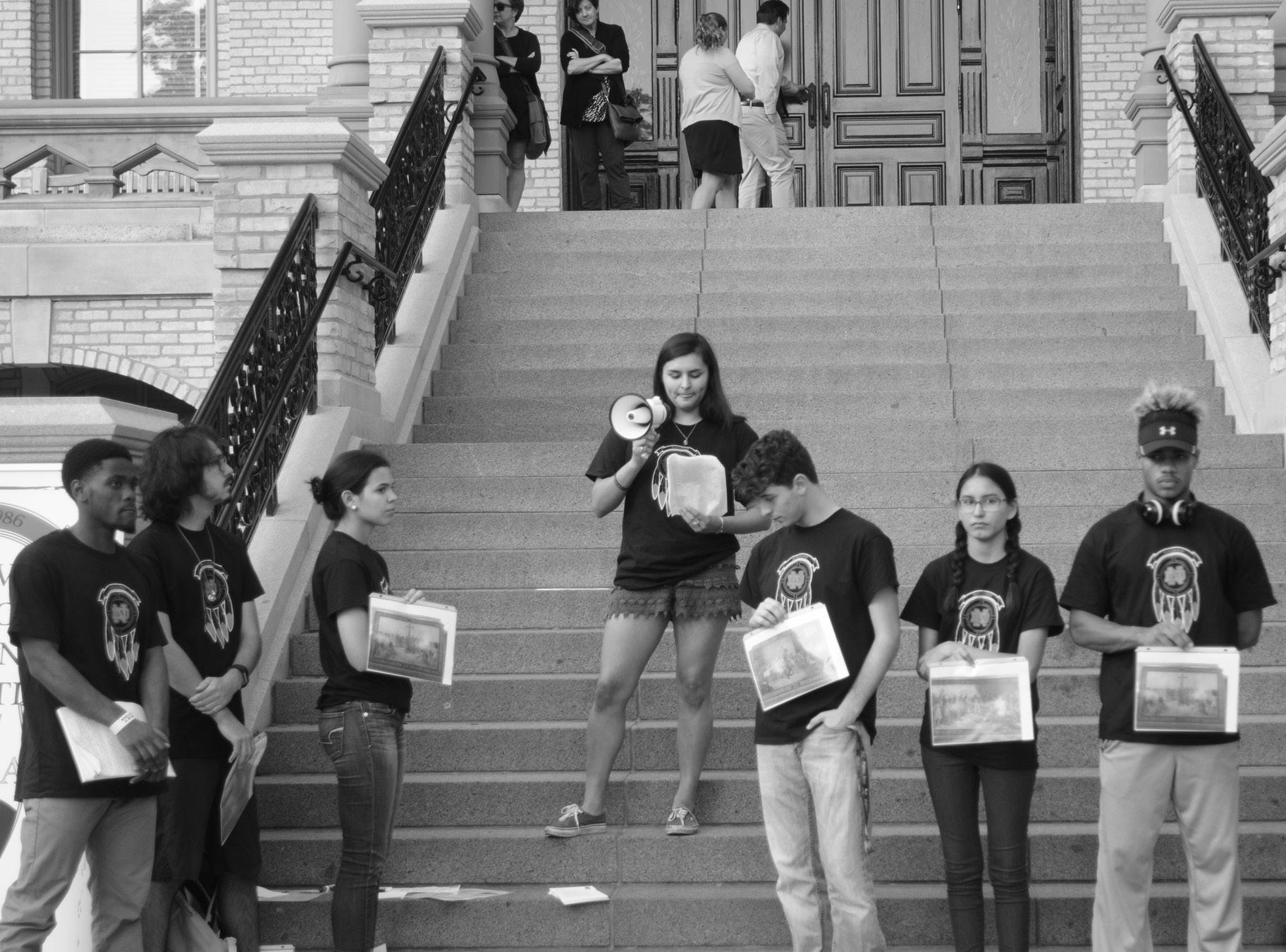
sentiment and make people aware of native american culture and significance.
“in an attempt to address these understandably controversial, and what our group would even call openly marginalizing murals, we are reminded that like this quote suggests, we must recognize the past because it is still here with us,” acri said.
in addition to making students, faculty and administration aware of nasand’s desire for greater recognition and inclusion from the University, the organization has detailed goals for greater diversification throughout the school year.
acri said the student group wants to be talked to, not talked about. nasand wants to hold a town hall meeting regarding the status and further actions in dealing with the Gregori murals, something acri said is strengthened by the involvement of allied
members.
“What we need is for people to get behind us and help our movement gain momentum,” acri said. among other important plans are the group’s hope to serve as a connection to the Pokagon band — the tribe whose land notre dame rests on. acri said nasand would like to assist in the recruitment of a native american faculty and establish a native american studies program, bring back the notre dame powwow and achieve greater involvement in notre dame’s “Walk the Walk” event.
“a diverse community strengthens notre dame’s mission and allows students to open their minds to new perspectives,” acri said. “but when the only representation that we have right now is these murals, we don’t think notre dame is fulfilling that goal. We wanted to have this event in order to help notre dame achieve their mission.”
Contact Lucy Lynch at llynch1@nd.edu
medical school interviews, having already tackled the trickiest of ethical questions in class and while volunteering.
“i’ve also had former students tell me that in dealing with a sick parent or making a difficult decision about care, they thought back to our experiences, readings and discussions,” Zwart said.
This course has also allowed smc students to create lasting relationships in the local community, many of which continue even after the culmination of the class.
“i think any opportunity to broaden your perspective by engaging with others who have different experiences than you do is an opportunity that will pay dividends later, in both your career and your life,” Zwart said.
at saint mary’s college, students are given the skills needed to respond to the “complex needs and challenges of the contemporary world.” Technological advances in the field of medicine have transformed the face of healthcare, and they have subsequently introduced complicated moral questions. Zwart hopes that her course will help college students answer these questions with responsibility and compassion.
“by equipping students with critical reasoning skills, helping them develop tools to investigate their own beliefs and engage with the views of others and giving them the opportunity to engage with healthcare providers and patients in our community, i hope the class helps prepare women to be engaged contributors to the world beyond saint mary’s,” Zwart said.
Contact Maeve Filbin at mfilbin01@saintmarys.edu
Paid a dverT isemen T
ROSIE LoVOI | The Observer
Native American Student Association of Notre Dame members protest the inaccurate portrayal of the treatment of Native Americans by early explorers and ask for greater recognition from the University.
A review of ‘new north’
The grilled chicken was so tender, it pulled apart with just a slight effort on my part and a fork.
Which was fortunate, since the only utensil north dining hall deemed sufficient to cut its food were knives that were in reality just butter knives, and butter knives being a generous term for shreds of steel with about one in 50 boasting just the slightest hint of serration.
This mixed bag of highs and lows were representative of “new north” as a whole, with the highs outnumbering the lows overall.
The first meal I had at the newly renovated dining hall was paella. having studied abroad in spain, one of my favorite memories was being welcomed home from school with the smell of freshly cooked paella and the sound of my host dad humming reggaeton tunes as he bopped around the kitchen for spices.
With paella being so closely intertwined with these fond memories, I was nervous that trying north’s paella would taint them. however, I was pleasantly surprised — it was edible. not only was it edible, it was okay.
What made north’s paella particularly enjoyable was the shrimp. I braced myself for the “shrimp” that north usually put in their stir-fry or their pastas — a sprinkling of something pink and curled up that kind of resembled a shrimp, but that dissolved on your tongue immediately, as though it were ice. I’m still under the impression that it might have been.
but the shrimp on the paella was not this. I was pleasantly surprised to have to peel this shrimp, and to see a juicy, pink thing underneath the skin that I can say with confidence was definitely shrimp. overall, north’s paella might not have added any additional fond memories to my experience with paella, but it didn’t add any negative ones either.
The pasta stir-fry at north, a crowd pleaser that was one of old north’s redeeming qualities, delivered yet again. While north was under renovation last semester, we had to part with this beloved dining option for several months. It came back with a vengeance this year and greeted us with an assembly line of ingredients and the pesto that could shatter any hesitations anyone had about pesto coming out of a squeezable tube.
While the pasta stir-fry itself had the power to make any day, bad or good, just a little better, the process of getting one dulled that effect. As usual, the line for pasta stir-fry was long, which was to be expected, but its central positioning at the dining hall meant more congestion and interference with the other food stations. This was especially irritating if you were not in line for pasta stir-fry but had to weave your way through the hoard of people that were in line in order to grab some mashed potatoes from the home-style line or broccoli from the veggie station.
As for its new infrastructure, the new tables, chairs, high tops and booths added refreshing diversity to north that was nowhere to be found in its past of laminated wooden chairs and grey tile. The silver touches added modernity, and the glass plates and glass cups made you feel adult in a way that parietals and the new six-semester housing rule never could. The new glassware was a step up aesthetically from the cloudy plastic cups of the past and the plastic plates that always seemed to have a slight film of grime; though it would be interesting to do a count at the end of the semester of how many plates and glasses were accidentally dropped and broken.
The semester-long wait for this new north was worth it, and the previously inferior dining hall is now up to par, and maybe even better, than south. not only did north receive a facelift in terms of its appearance, but the food has improved with it. Just be sure to bring your own knife.
Contact Selena Ponio at sponio@nd.edu
The views expressed in the Inside Column are those of the author and not necessarily those of The Observer.
Protect survivors of sexual violence: ambiguous waiver policy needs clarity
“We understand the decision to move off campus is motivated by a number of good reasons.” In a move that sparked immediate debate on s ept. 13, Father Jenkins announced changes to the housing requirement via an email sent at midnight. “[ b ]eginning with the matriculating class of 2018, the University will require first-year students, sophomores, and juniors to live on campus for six semesters,” the email stated. Though unreferenced in the email, Father Jenkins and m s. e rin h offman h arding mentioned the formation of a waiver system from the requirement in a town hall meeting scheduled only twenty hours later.
m any before me have raised concerns about the effect of this requirement on students of color, LG b TQ students, students of low socioeconomic status and students with disabilities, among others. A robust and well-planned waiver system could mitigate students’ justified fears about this change. h owever, the University implemented this policy without a fully formulated plan to protect students disproportionately harmed by this new requirement. I fear this housing policy and its ill-conceived waiver system will cause undue harm to survivors of sexual violence.
m y criticism must begin with the remarkable dearth of information regarding the procedure of the proposed waiver system. In an email responding to my questions concerning the waiver system, associate vice president for residential life h eather r akoczy r ussell stated, “We are still in the throes of designing the waiver process, so it would be premature for me to share specifics that are currently still undecided.” While I understand that policies take time to formulate, I object to the establishment of such a system without adequate preparation. Any policy that will affect thousands of students must be designed to address every likely situation, and the circumstances I present below clearly follow from present conditions, indicating that they will not be rare.
o perated through residential life, the waiver system could require students to “out” themselves as survivors of sexual violence in order to receive permission to move off campus before the requirement is met. m ost administrators are mandatory reporters, which means that if students share any account of sexual violence committed against them or someone else, the mandatory reporter must file a report to the Title IX office. e ven if the student does not desire an investigation, the Title IX office can exercise discretion as to whether or not to investigate. e ssentially, then, a Title IX investigation could be inadvertently triggered by simply asking to move off campus.
h owever, why would a student resist participation in a Title IX investigation if his or her claim of sexual violence is true? Put simply, Title IX investigations are harrowing for complainants and respondents alike. s ecretary of e ducation b etsy d evos recently lifted the time limit of 60 days on Title IX cases, essentially permitting them to drag on indefinitely.
Title IX investigations can also incite undesired publicity, inflict a stigma of reporting and put a survivor at risk for retaliation. n o c ontact o rders, standard fixtures of Title IX proceedings preventing contact between the complainant and the respondent, do not prevent “unintentional contact,” such as chance run-ins in the gyms, dining halls, library, LaFortune, football games or off-campus parties, which can affect survivors’ mental health for days, if not longer. r esearch shows disproportionate levels of PT sd (34 percent of survivors, 9 percent of non-survivors) and depression (33 percent of survivors, 11 percent of non-survivors) among survivors of sexual violence. All of these factors suggest reason for survivors to (a) resist participation in a Title IX investigation, and (b) choose to move off-campus.
Furthermore, I am frustrated that n otre d ame announced these housing changes without addressing the underlying issues that already plague residential life. r egarding student feedback, Father Jenkins wrote, “[ s ]ome were put off by a lack of consistency in procedures and rules across residence halls.” This casual reference indicates an administrative awareness of the widely known power dynamics between male and female residence halls, specifically due to an unequal enforcement of rules regarding alcohol and “social gatherings.” s exual violence is often predicated on power, not simply sexual desire. In situations where there exists “alcohol-soaked parties in all-male residences with no official administrative oversight ... a high-level of gender inequality in social life, [and] a pervasive attitude [of] male sexual entitlement,” sexual violence is more likely to occur. The University should have addressed these barriers to community before imposing a haphazard blanket “solution.”
The University of n otre d ame aspires in its mission statement to form “an authentic human community.” Yet, in the recent town hall meeting, Father Jenkins asserted that “ n otre d ame is not for everyone.” The new housing requirements suggest the administration is willing to listen to student feedback but not act upon it. Though the announcement email states that “students overwhelmingly value the community formed in their halls,” the University clearly prioritizes the experience of the majority over the daily realities of underrepresented and unacknowledged students. I urge the administration to heed undergraduate input and finalize its waiver system with these students, including survivors of sexual violence, in mind before any admitted student must commit to attendance next year. n otre d ame may not “be for everyone,” but it should be.
Show Some Skin is a student-run initiative committed to giving voice to unspoken narratives about identity and difference. Using the art of storytelling as a catalyst for positive social change across campus, we seek to make Notre Dame a more open and welcoming place for all. If you are interested in breaking the silence and getting involved with Show Some Skin, email nreifenb@nd.edu
The views expressed in this column are those of the author and not necessarily those of The Observer.
Isabel Rooper show some skin
Selena Ponio Associate news e ditor
Fusion cuisine is something of its own nature, where two cultures collide to create some tasty dish vaguely reminiscing something authentic, but not quite. They use traditional flavors, change the presentation that incorporate local customs and, in some cases, have become a staple for countries around the world. In America, h ispanic foods have some of the most popular variants, as the huge and still growing Latino population is integrating its food with American staples.
b ut some questions still remain — at what point is something considered authentic or culturally insensitive to do? In regards to food from Latin America, which has arguably had one of the largest impacts in the U. s ., there is a lot of flexibility in authenticity. n ational chains like r ubio’s and Taco b ell are nothing close to Latino except for the occasional s panish name on the menu, but they aren’t quite fusion cuisine, either. They are their own entity of deliciously unhealthy, inauthentic food transcending cultural foods.
The mixing of so-called “ethnic” foods is in no way a new concept. Italian cuisine didn’t incorporate tomatoes until the discovery of the n ew World, as they are native to the Americas.
Fusion cuisine
Tex- m ex has its own flavors that emphasizes southern staples like cheese and meat with traditional m exican dishes like beans, corn and salsa. m ore modern creations include Korean tacos, commonly sold from food trucks in s outhern c alifornia. The diversity of h ispanic food that spans two continents has lent itself to easily fuse with foods of other cultures. e ven many of the Latino foods that we consider fundamental to a particular country or culture came from a combination of native foods with those of other cultures. Tacos al pastor, one of the most traditional styles of tacos in m exico, have their origins from Arab immigrants in the 1930s. The meat is based off the Lebanese shawarma, a variation of the Turkish doner kebab, which r on s wanson from Parks and r ecreation eloquently described as a “hot spinning cone of meat.” d airy products were introduced by e uropeans, who brought along cattle and horses when colonizing the Americas. While chocolate comes from m esoamerica, it wasn’t turned into the sweet dessert we are familiar with now until the e uropeans came. The nostalgic bars of c hocolate Abuelita or d on Gustavo, depending on your preference, are now a staple in many Latino households, used to make a traditional milk-based hot chocolate.
While I’m inclined to say that the mixing of two cultures through food is a good thing — I personally like my chocolate to taste sweet — it
is important to remember that for many foods, there is a story that can’t be ignored, and in some cases, is representative of a bloody history of genocide. It’s not the case for everything, though, because some great things can happen; those Korean tacos sound pretty tasty, and tacos al pastor are now standard street food. b ut gentrification of foods that stems from cultural ignorance does raise questions as to whether charging $8 and marketing it as something “hipster” is an insult. In no way am I advocating for gatekeeping of foods; they are one of the best ways to share our culture with others, as meals emphasize community and discussion. b ut the appreciation of the food experience could be enhanced with a bit of that cultural background, and adding our own flair to it can, indeed, make it more personal. m aybe next time we look up how to make a modernized Pinterest version of champurrado or morir soñando, we take a moment to look up the history and meaning of the foods.
Natalie Howe is a coffee aficionado, but it may be an understatement considering it is her main food group. Majoring in finance and environmental science, she enjoys talking about weather patterns and Latin American multiculturalism. Any inquiries and weather complaints can be sent to nhowe@nd.edu.
The views expressed in this column are those of the author and not necessarily those of The Observer.
Why do people kneel during the national anthem?
them, as well as what it has.
A lot of my peers and national figures (notably, the president) have immediately criticized the idea of protesting something deemed so sacred by the United states. Personally, I think they’re not putting enough thought into their criticism.
don’t forget, you can criticize the protest of the national anthem. Feel free to critique it. Question its validity. my request is that, before you do those things, you do some research on the reason behind the protest.
Let’s talk about symbols. A lot of the criticism of the protest isn’t about what the protest means but about the symbol it’s protesting. There’s concern about the protest in that the flag takes on so many meanings. many would consider the protest inherently provocative, and frankly offensive, to those that have laid their lives down to the flag. I get it. Kneeling at the flag signals a rejection of the freedoms that the disenfranchised do have in the United states, and it calls attention to the kneelers’ discontent rather than at the country at large.
The thing is, that’s the exact point: to give attention to people that have been ignored for far too long in the United states. Kneeling is supposed to be “offensive” to call attention to something far more offensive: marginalization. To many, the American flag sometimes carries a symbol of entrapment rather than freedom, a painful reminder of their displacement. In its inception, the flag was not meant for “all,” but instead a small sample of elites. This country’s history is fraught with oppressive laws and culture, and for many, the flag is merely a visual reminder of all that America has not yet done to serve
The protest isn’t about the flag, or about veterans. In its initial outset, the protest was due to the poor treatment of African Americans in the United states. To folks like colin Kaepernick, kneeling represents a dissatisfaction with the country to which they’re supposed to pledge. To assume that it’s merely about the flag would be akin to assuming that suffragettes ran hunger strikes to protest food. It’s reductive and is often done to benefit an opposition argument rather than to gain true understanding.
Those that use this argument to discourage the protests forget that those within this country are allowed to use their voices as they see fit. Those veterans that are brought up fought specifically for the freedom to disobey the flag. With the first amendment comes the ability to express political beliefs, whether they appear on a local or a national scale. even though the n FL is privately owned, it has released statements that allow its players to protest as they see fit.
critics also argue that this kneeling won’t benefit anyone, and if Kaepernick truly wanted change, he would put his more time into charity than kneeling. While Kaepernick actually has been rather active in pursuing a better racial environment, the protest was still effective because it brought attention to both him and his goal. Kaepernick specifically chose both a controversial symbol and a well-publicized venue so that eyes would be on the action itself and not just him. As a professional football player, Kaepernick already had national attention, so through his protest, he could force publicity on the issue. If he chooses to use his fame to bring attention to this American problem, to something that he believes is bigger than
himself, he’s constitutionally free to do so.
As I mentioned before, if you’re going to critique the n FL protests, don’t do so without full knowledge of the intent behind them. As of the most recent n FL games, what was a practice exhibited by a few football players has spread to multiple athletes, coaches and owners on teams across the country. regardless of my own personal opinion on the protests, I can recognize that perhaps this new influx of protests might not be about disenfranchised blacks but rather about the president and his tweets. There’s also a concern coaches are doing this as a marketing tactic rather than out of sincerity: If there is a sincere national kneeling movement, why is Kaepernick still unemployed? has the protest merely become something popular rather than a statement about racism? If kneeling loses its initial focus, it loses its power and whitewashes its goal.
Those are the real critiques of the movement, critiques that add to the conversation rather than shutting it down. If we want to learn anything from this, it’s important that we discuss it as it is and not in reductive arguments that ignore the argument’s complexity.
so go ahead and criticize the protests. Just read a little before you do it.
Delaney Roberts is a sophomore marketing major living in Pasquerilla West.
The viewpoints expressed in this column are those of the individual and not necessarily those of BridgeND as an organization.
The views expressed in this column are those of the author and not necessarily those of The Observer.
Delaney Roberts bridging the Gap
Natalie Howe beyond the Wall
happy b irthday: Live and learn. Take notes and show interest in what others do. e xpanding your mind will give you greater insight into what you can do in the future. c hange is possible, but it has to be on your terms, not because someone is pushing you. Time is on your side, and a slow but stable strategy will plant you on solid ground. your numbers are 9, 16, 19, 26, 32, 44, 46.
ARIES (March 21-April 19): i f something bothers you, talk about it. use intelligence and positive strategy to persuade others to see things your way or to let you continue without interference. partnerships will undergo change, but it will benefit everyone involved.
TAURUS (April 20-May 20): pour your attention into doing the best job possible. b eing passionate about what you do or produce will encourage others to respect your progress. a change to improve your position is in the stars. negotiate on your own behalf.
GEMINI (May 21-June 20): Take the initiative and talk your way into whatever you want to see transpire. you may not please everyone, but as long as you refuse to become angry and you respond with a positive incentive, you will get what you want.
CANCER (June 21-July 22): b e discreet about the way you live or who you love. keeping your personal life a secret will help you avoid interference and being judged. Less talk and more action will lead to a better position. personal growth is encouraged.
LEO (July 23-Aug. 22): your generosity is commendable, but keep in mind that charity begins at home. m ake sure that you secure your position, your holdings and all your personal passwords and documents. d on’t be too trusting. use your intelligence.
VIRGO (Aug. 23-Sept. 22): Listen to what’s being said or offered and retreat to a quiet place where you can consider your options. it’s in your best interest to be cautious and to avoid anyone trying to pressure you to make a decision.
LIBRA (Sept. 23-Oct. 22): b e strategic. p lan your actions and implement what you want to see happen precisely. refuse to let anyone take over or lead you astray. Work alone to avoid interference. s elf-improvement and personal growth are highlighted.
SCORPIO (Oct. 23-Nov. 21): e motions and money won’t mix. Joint ventures or paying for someone else’s mistakes will lead to regret and resentment. d o your own thing and don’t be fooled by someone who exaggerates. personal gain and improvements should be your priority.
SAGITTARIUS (Nov. 22-Dec. 21): p ick your words carefully. d on’t leave room for anyone to misinterpret you. i ntelligent suggestions will help you avoid a problem with those you collaborate with. a ppeal to those showing trepidation by offering an alternative solution or greater incentive.
CAPRICORN (Dec. 22-Jan. 19): focus on your health and financial wellness. d on’t take chances when it comes to your personal life. s ort out any differences you might have with someone before matters escalate. romance is featured and will improve an important relationship.
AQUARIUS (Jan. 20-Feb. 18): you can wheel and deal until you get what you want. personal investments, contracts and taking care of business to benefit you in the future are encouraged. renewing your promise to someone you love will bring you closer together.
PISCES (Feb. 19-March 20): s elf-deception is apparent. d on’t let confusion lead you astray. i f you aren’t seeing a personal situation clearly, ask a trusted friend to give you some input. refuse to let uncertainty lead to arguments and regrets. remain positive and patient.
Birthday Baby: you are talkative, clever and engaging. you are adaptable and adventuresome.
Jumble | david hoyT and Jeff knurek
sudoku | The mepham group
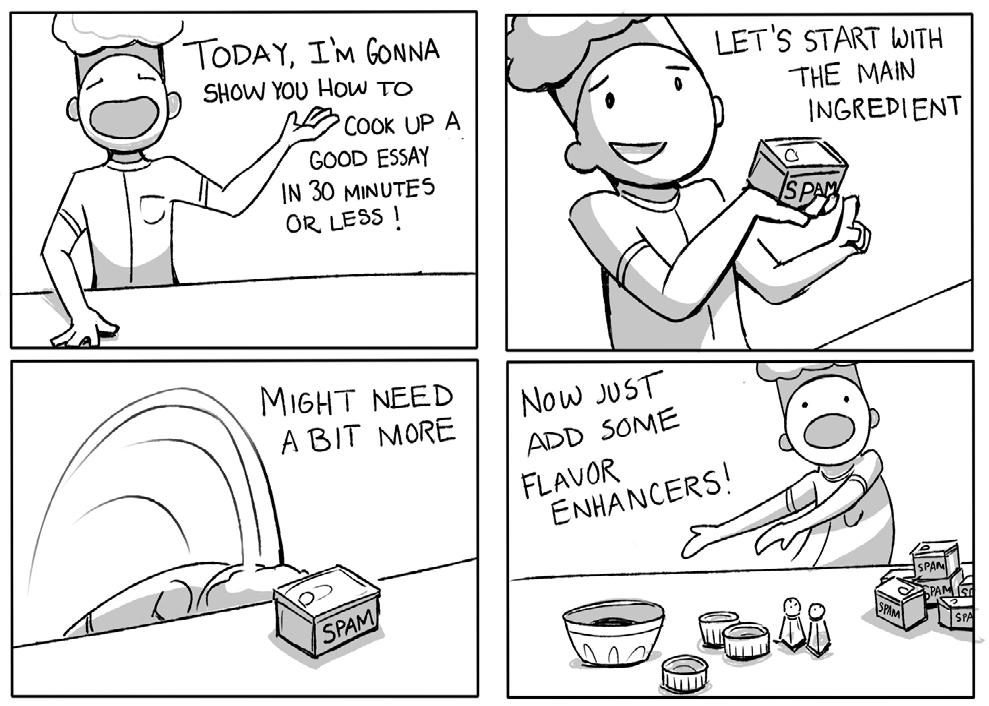
WINGIN’ It | oLivia Wang & baiLee egan
nbA, take notes on restructuring
Mia Berry sports Writer
It’s a pretty well known fact that the new era of super-team basketball has rid the nb A of its competitiveness over the last few years.
The unequal distribution of competitive teams in the e astern and Western c onferences only aid the growing problem of repeat finals matchups. You don’t even have to be a basketball fanatic to accurately predict that the c leveland c avaliers and Golden state Warriors will once again meet in the finals. Whether the c avs or Warriors will manage to win the championship is the only variable up for debate. Under the current system, the c avaliersWarriors saga for the nb A championship will have more sequels than the “rocky” series or “The Fast and the Furious.”
There’s a very simple solution to rectify this problem: conference-less basketball.
c onference-less basketball isn’t a new concept. The W nb A first employed this system two years ago after it too suffered from the unequal distribution of teams in conference play. As is true in the nb A, the Western c onference in the W nb A dominated the league, and the Western c onference finals were always more competitive than the actual finals themselves.
c onference-less basketball was implemented to alleviate that issue. The new format takes the top-eight teams and staggers the series based on rounds, with the first two rounds being single elimination and the last two rounds being the best-of-five series. The risk paid dividends for the W nb A, including a 24 percent increase in finals viewership over the last two seasons. The increase in viewership could be a direct result of the conference-less playoffs or the fact that the lack of competitive nb A finals has drawn unsatisfied viewers toward the W nb A, but nevertheless, it’s a change in the positive direction and has promoted good basketball.
sure, it can be argued that the new format is producing its own repeated rivalry between the m innesota Lynx and the Los Angeles sparks, both of whom have competed in the last two W nb A finals, but single-digit margins of victory and winner-take-all game fives are necessary for the expansion of the league, and the two iterations of the finals have been labeled the
most competitive games in the league’s history. d ue to the potential loss of revenue, I wouldn’t expect the nb A to commit to a staggered format, but eliminating conferences is well within the power of nb A commissioner Adam silver. Assuming that each of the 32 teams has schedules roughly similar in strength to one another, translating a conferenceless basketball setting from a league with 12 teams to a league with 32 should be easy. The only real change to the current format is that the new system would take the top-16 teams. Taking the top16 teams increases the competitiveness within the league because teams will no longer be competing with just the 16 teams in their conference for playoff spots, but the entire league. The risk with taking the top-16 teams for the playoffs is that it might be skewed primarily toward the “old” Western c onference teams over the other, but if that’s what it takes to get close, competitive matchups all throughout the playoffs, then so be it.
If conference-less basketball is implemented within the league, consider the intriguing possibilities of matchups between the c avs-spurs, Warriors- c eltics or ThunderWizards in the second or third round of the playoffs. There’s a higher potential for upsets within the conference-less format, as neither the c avs nor the Warriors have a “free-ride” to the finals. If implemented, the playoffs will be the ultimate showdown of super-team versus super-team for the coveted nb A championship. Given that quite a few superstar veterans such as James harden, c armelo Anthony, russell Westbrook and John Wall are without rings, it will be intriguing to see how they would capitalize on a new playoff system.
c onference-less basketball may not end the c avsWarriors series, but at least there will be exciting matchups throughout the playoffs and a restoration of some of the competitiveness the nb A has been lacking for years. And if, in a few years, conference-less basketball has restored most of the competitiveness in the nb A, it can be attributed to the fact that the W nb A did it first and got it right.
Contact Mia Berry at mberry1@nd.edu.
The views expressed in this Sports Authority are those of the author and not necessarily those of The Observer.
Irish take home win at Fighting Irish Classic
Observer Sports Staff
The Irish emerged victorious this weekend in the 12th annual Fighting Irish c lassic at Warren Golf c ourse. The Irish had a consistent performance throughout the twoday, 54-hole event, finishing day one atop the leaderboard and remaining there for the remainder of the tournament for a wire-to-wire win.
round one proved a team effort for the Irish. Four players — freshman davis c hatfield, sophomores hunter o strom and John Felitto and junior m iguel delgado — each carded 2-under-par 68s. These performances left the team atop the leaderboard at 8-under par heading into the second round. Junior Kevin c onners had the best firstround performance of any notre dame player, finishing with a 3-under-par 67, though he was competing as an individual in the event.
The Irish managed to dial it up in the second round, shooting a combined 10-under, which brought the team to a 18-under par for the event. Junior ben Albin shined in round two, shooting a 4-under 66. chatfield kept his pace from the morning, carding a 3-under 67, while ostrom remained under par with another 68.
With a comfortable 13-stroke lead heading into the final round, the Irish fired off a combined 280 (even) in
MLb | YAnKees 7, IndIAns 3
the final round, winning the trophy for the weekend. In the final round, Albin put up another solid performance, shooting a 2-under 68. With this 18-under-par team finish, the Irish set a new team totalto-par record for the Fighting Irish c lassic. Individually, c hatfield and o strom finished third and tie for fourth, respectively, while Albin came
in at a tie for seventh place. The team’s record-breaking win over the weekend provides some early momentum, as the majority of the season still lies ahead. The Irish will look to continue their winning streak as they head to d uluth, Georgia, for the Autotrader c ollegiate c lassic beginning monday.
Yankees avoid elimination, prolong series
Associated Press
neW YorK — Luis severino, Aaron Judge and the new York Yankees are headed back to c leveland for a decisive Game 5 — thanks to plenty of help from the Indians.
Gary sanchez homered and a slumping Judge laced an early two-run double for his only hit of the series to go with 12 strikeouts in 15 at-bats.
severino got only one out in the wild-card game against m innesota last Tuesday, but was bailed out by his teammates as new York advanced with an 8-4 victory. This time, the 23-year-old ace was determined to come through, and
he did.
Tommy Kahnle relieved a wild dellin betances in the eighth and got six outs for his first save of the season as new York improved to 3-0 when facing playoff elimination this year.
sanchez hit his second home run of the series off bryan shaw in the sixth to make it 7-3.
brett Gardner singled and, after a mound visit from Indians pitching coach m ickey callaway, Judge had a gritty at-bat. The rookie slugger was 0 for 11 with nine strikeouts in the series before fighting back from 0-2 to a full count and lining a two-run double to the
left-field wall on one hop. bauer managed only five outs after tossing two-hit ball with eight strikeouts over 6 2/3 innings during a 4-0 win in the series opener last Thursday. All four runs he allowed were unearned.
Urshela’s two-out throwing error with the bases loaded in the third made it 5-0.
Frazier reached on pitcher danny salazar’s two-base throwing error to start the fifth. he scored on Gardner’s shallow sacrifice fly to center fielder Jason Kipnis, a second baseman moved to the outfield late this season. Kipnis began the year on the disabled list with a shoulder problem.
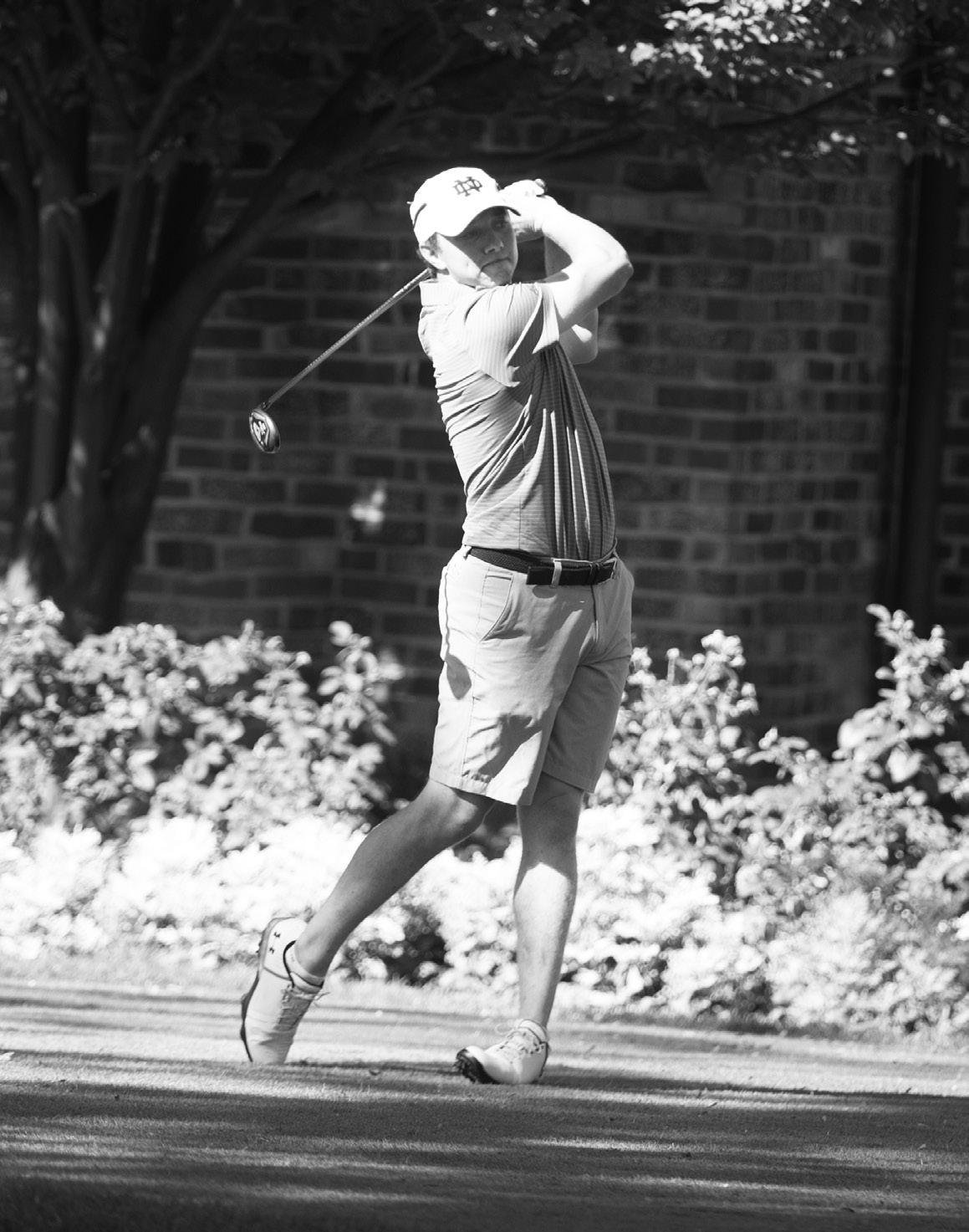
CHRIS COLLINS | The Observer Notre Dame junior Kevin Conners watches the ball as he follows through on Warren Golf Course. Connors led the team opening day.
m att Gamble was named the tournament’s most o utstanding Player.
notre d ame head coach r yan s achire liked his team’s overall performance over the weekend.
“It was a great weekend in general, particularly on s unday,” s achire said. “o ur guys did a really awesome job of how they competed and ultimately it affected how they played as well. o ur results were really good, but I think the thing that I was most happy with was just how their attitudes were super positive and they embraced being in very challenging situations because they embrace adversity and did a great job of battling through some tough situations and were ultimately successful, so it was a really good day.”
s achire said he loved how all his players performed but singled out the performances of junior Alex Lebedev — who was playing at the All-America c hampionships in Tulsa, o klahoma — and of m att Gamble, Grayson b roadus and William howells, who were undefeated on the weekend.
“Alex Lebedev was in Tulsa for the All-America c hampionships,” s achire said. “It is maybe the second biggest tournament of the year nationally, so all of the best college players were there and he finished in the
top 16 there and had two really significant wins. s o he had a really great weekend down in Tulsa.
“At our tournament here, m att Gamble, Grayson b roadus and William howells all won each of their matches and all were undefeated on the weekend, so, I think from a results perspective, you have to single out those four guys probably. It was really hard to differentiate between any of them but beyond that, I was really excited about our whole group and how we competed [ s unday] especially, but throughout the whole weekend too and I think the identity our program had this weekend was really positive.”
The Irish will be back in action next week when they will compete in the ITA m idwest r egional c hampionships in Ann Arbor, m ichigan, starting o ct. 19.
s achire said his team will look to improve its doubles play leading up to the tournament.
“We’re getting ready for the regional championships, so all of the schools in the m idwest will be competing in about 10 days from now at the University of m ichigan,” s achire said. “I think we need to play more doubles and work on our doubles. We haven’t played a ton of doubles this year and there are some things that we can certainly do better there. b eyond that, there is really nothing that sticks out in terms of a collective thing that we need to work on. It comes down to each individual guy’s game,
but I think doubles will be a big focus once we start preparing for regionals and then trying to help each guy improve one or two things between now and 10 days from now when we are back at it again.”
s achire said the strong opponents his team has played against during the fall season will prepare them for tough competition down the road.
“I think if you look big picture, you’re looking at the spring season and we play one of the toughest schedules in the country and there are no easy matches when we get to the springtime,”
s achire said. “ s o I think just being ready for that level of competition match in and match out. I think it is really important to know and understand the level of play that you’re going to be playing at and competing against and by playing events like this with strong competition, you are just much more prepared for it when you see it down the road.”the springtime,” s achire said. “ s o I think just being ready for that level of competition match in and match out. I think it is really important to know and understand the level of play that you’re going to be playing at and competing against and by playing events like this with strong competition, you are just much more prepared for it when you see it down the road.”
Contact Michael Ivey at mivey@hcc-nd.edu
Volleyball
25-22.
The Irish took an early lead in the fourth set, but the c avaliers fought back to make it 13-11. f rom there n otre d ame took control, extending its lead to 19-12 at one point and finishing the set with a 25-16 win.
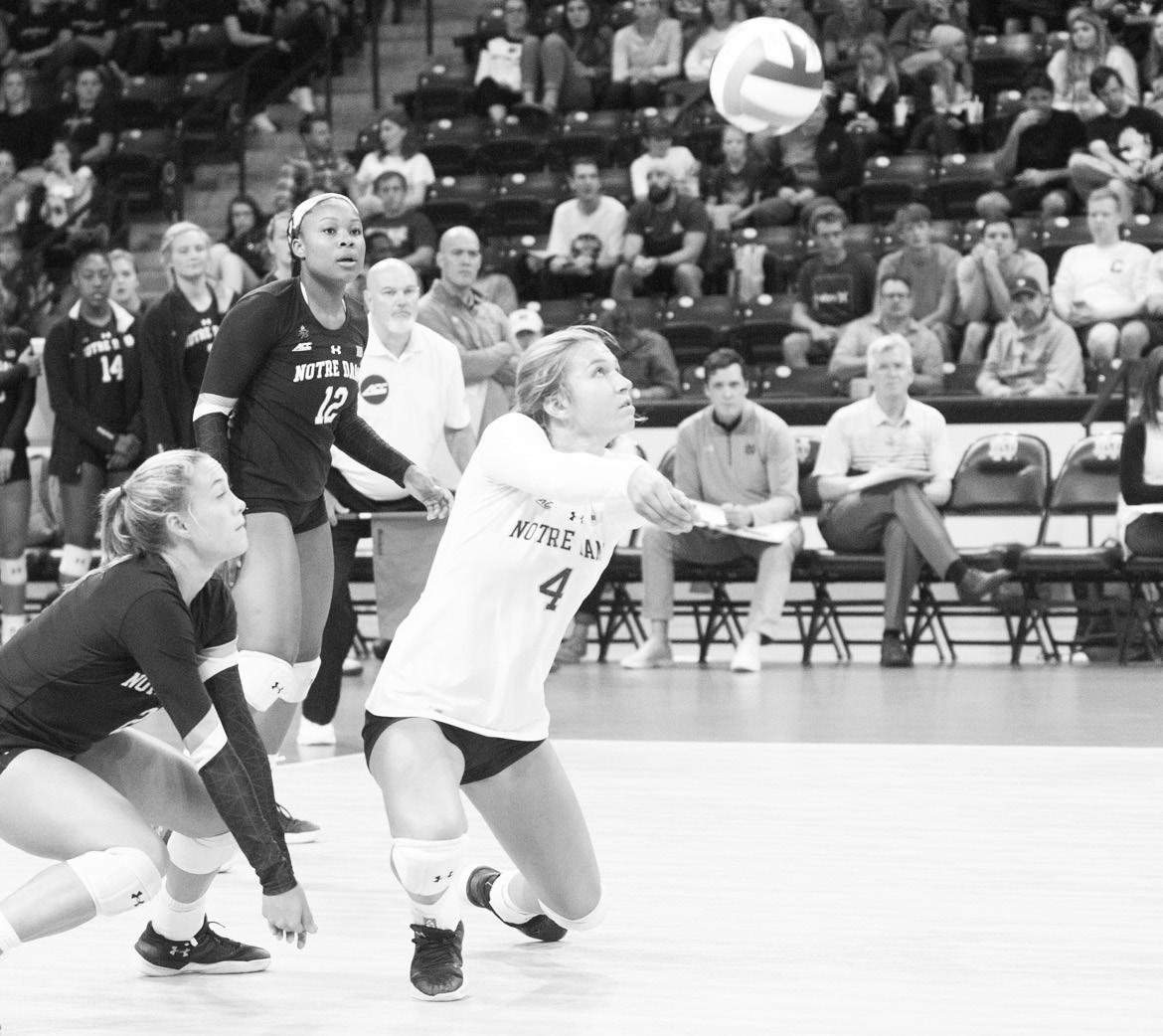
n otre d ame’s performance against v irginia was characterized by their strong defensive side, with senior middle blocker s am f ry contributing 10 blocks, matching her season high, and junior outside hitter r ebecca n unge delivering seven blocks. s ophomore outside hitter Lauren Woodard also contributed 12 kills in the victory.
o n s unday afternoon, the Irish defeated v irginia Tech (7-10, 1-5 A cc ) by a score of 3-1, with Yeadon continuing her dominant performance with 15 kills on the day.
s enior setter c aroline h olt was also a key contributor for the Irish, putting in a team-high 42 assists. f reshman defensive specialist m adison c ruzado
earned her first career start against the h okies and tallied eight digs.
n otre d ame took the first set by a score of 25-17 but allowed the h okies to tie the match at 1-1 after falling in the second set 25-21.
After n otre d ame went ahead early in the third set, v irginia Tech managed to come back and tie it at 17-17. Led by f ry, the Irish completed the set in a tight 2523 victory.
They closed the afternoon with a 25-19 win, recording 7.5 blocks as a team in this last set. h olt and f ry each picked up six blocks on the day while junior middle blocker m eg m orningstar added five of her own.
Junior libero r yann d eJarld picked up 23 digs against the hokies and 21 digs versus the c avaliers, giving her her thirteenth and fourteenth matches with 20+ digs in a match this season. d eJarld also recorded four service aces in the match.
Looking ahead, the Irish will host Georgia Tech on f riday at 7 p.m. and c lemson on s unday at 1 p.m. with both matches taking place at Purcell Pavilion.
ANN CURTIS | The Observer
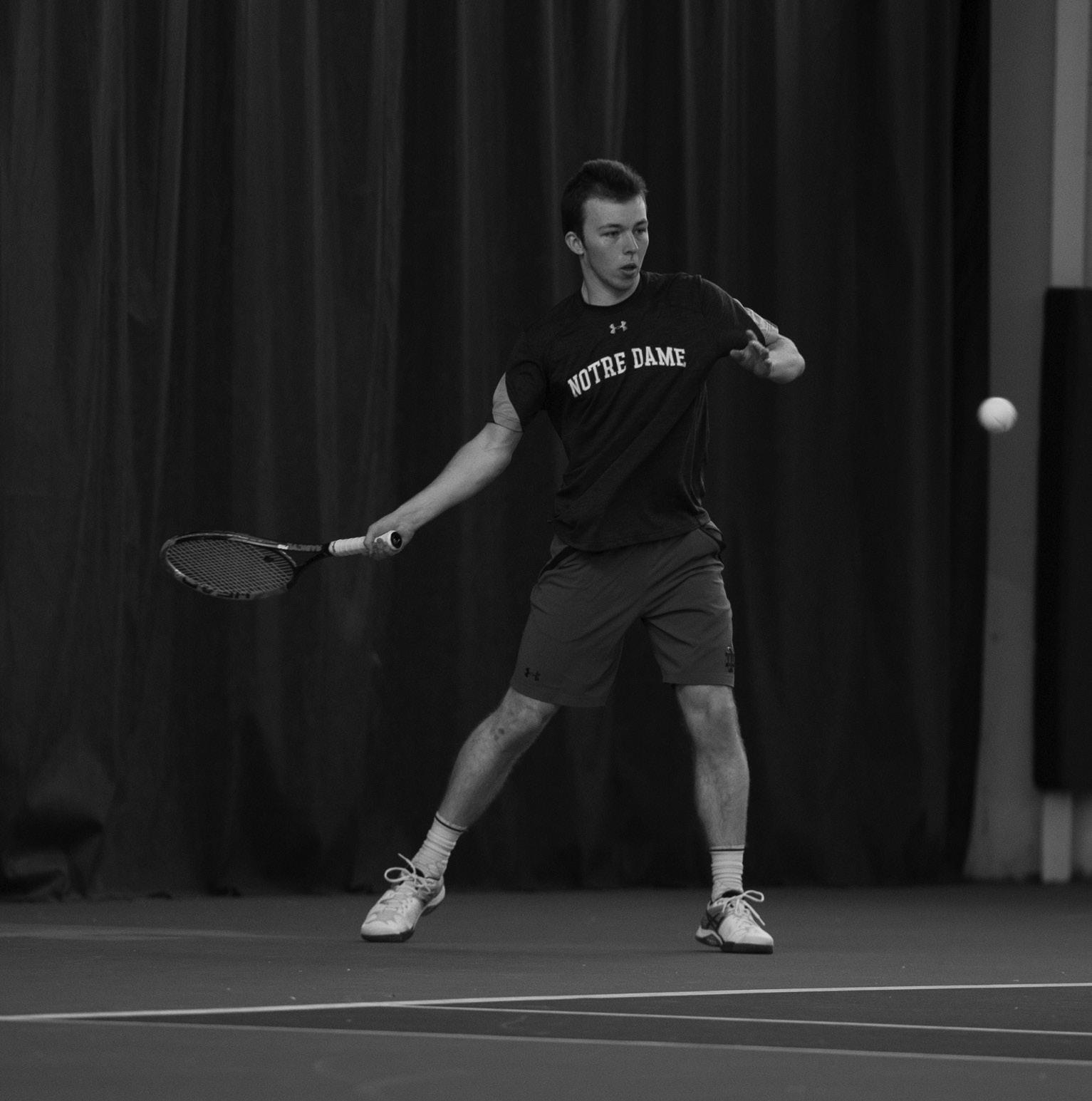
Irish sophomore Matt Gamble prepares to hit the ball in a 7-0 win against Boston College on Feb. 11 at Eck Tennis Pavilion. Gamble won both his singles and doubles matches against the Eagles.
CHRIS COLLINS | The Observer
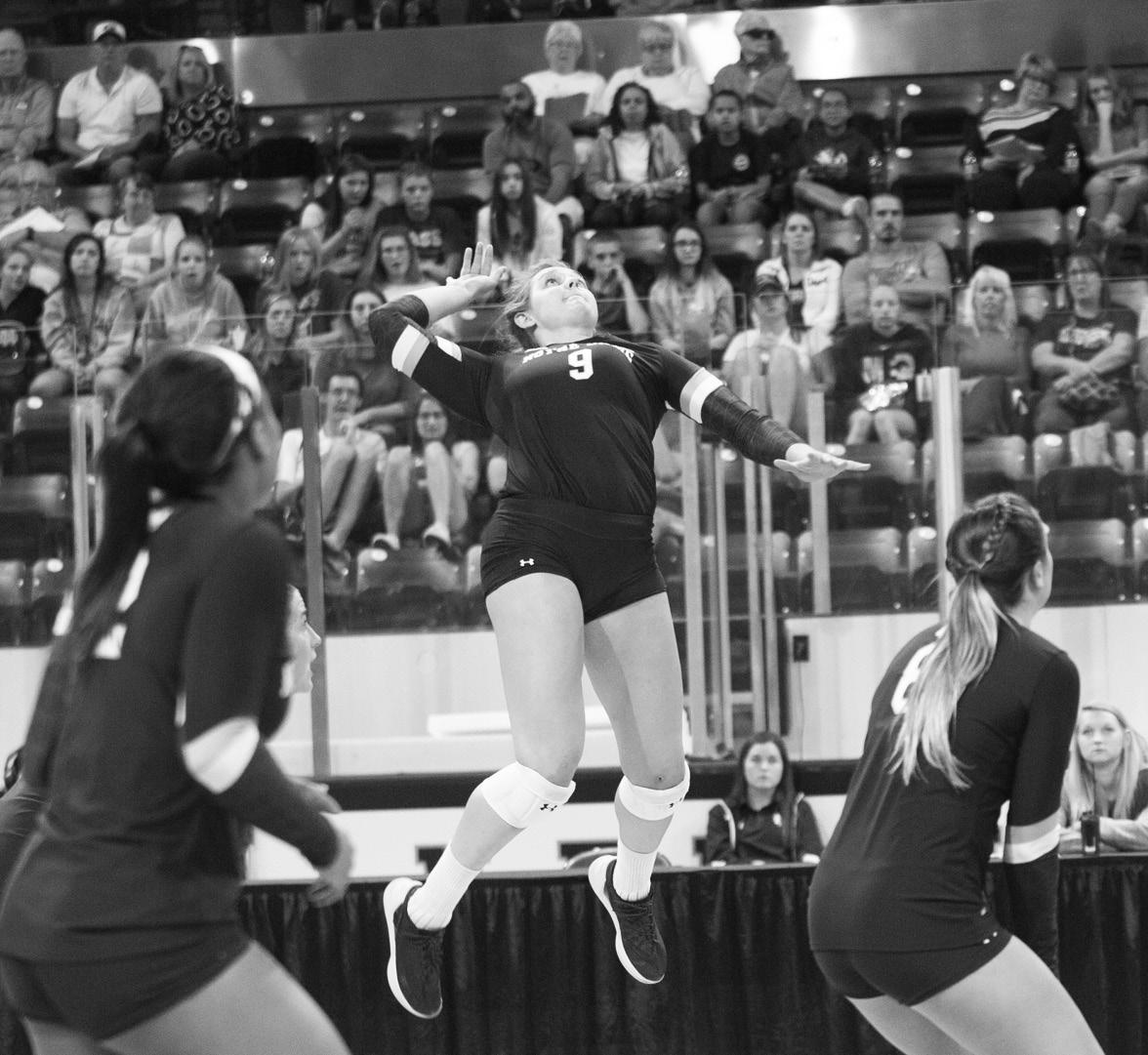
Irish sophomore outside hitter Rebecca Nunge prepares to deliver a kill during the 3-1 win over Valparaiso on Aug 25.
CHRIS COLLINS | The Observer
Irish junior Libero Ryann DeJarld digs a ball with her teammates looking during Notre Dame’s 3-1 win over Valparaiso on Aug. 25.
see her get rewarded for it. This is a very talented team, and they get better by being pushed by each other. i know this will motivate the others to try and get their first win.”
While the squad struggled to maintain a strong performance over the course of last season, h olt attributes her team’s newfound success to one thing: consistency.
“The consistency has come from just playing to [the team’s] potential from day to day,” h olt said. “a lso knowing if they don’t, it will greatly impact our ranking due to the competitive schedule we play every year. We fell victim to that last year.”
o ther top finishers for the i rish at the b ettie Lou e vans i nvitational included juniors m addie r ose h amilton and i sabella d iLisio, who tied for fourth and 20th places, respectively. h amilton’s three-day total was 70-73-73 for an even-par 216, while d iLisio
carded a three-day total of 72-80-71 for a 7-over-par 223. Freshman a bby h eck finished the tournament 72-74-76 for a total of 222 (6over par), which tied her for 15th overall.
a fter a two-week hiatus, the i rish will return to action o ct. 27, when they compete in the Landfall Tradition i nvitational in Wilmington, n orth c arolina, which features a competitive field, including acc rivals d uke, v irginia, c lemson and n orth c arolina s tate.“ e mma has continued her great play from last year and it’s great to see her get her first win,” h olt said. “ s he works hard on her game and i am really happy to see her get rewarded for it. This is a very talented team and they get better by being pushed by each other. i know this will motivate the others to try and get their first win.”
While the squad struggled on and off last season, h olt attributes her team’s newfound success to one thing: consistency.
“The consistency has come from just playing to [the team’s] potential from
day to day,” h olt said. “a lso knowing if they don’t, it will greatly impact our ranking due to the competitive schedule we play every year. We fell victim to that last year.”
o ther top finishers for the i rish at the b ettie Lou e vans i nvitational included juniors m addie r ose h amilton and i sabella d iLisio, who tied for fourth and 20th places, respectively. h amilton’s three-day total was 70-73-73 for an even-par 216, while d iLisio carded a three-day total of 72-80-71 for a 7-over-par 223 (+7). Freshman a bby h eck finished the tournament 72-74-76 for a total of 222 (+6), which tied her for 15th overall.
a fter a two-week hiatus, the i rish will return to action o ct. 27, when they compete in the Landfall Tradition i nvitational in Wilmington, n orth c arolina, which includes a competitive field, including acc rivals d uke, v irginia, c lemson and n orth c arolina s tate.
Contact Mia Berry at mberry1@nd.edu
be in the confines of a lumni s tadium for Tuesday’s match, c lark said the m ichigan game will not be any easier than the c lemson game.
“ i would say c lemson was very powerful, but having said that, i don’t think there will be a big gulf,” c lark said.
“ o nly thing is that we will be playing m ichigan at home, at a familiar territory. b ut if we were playing this team at m ichigan, would it be harder? i don’t know. i think home field advantage is roughly overstated. We have about the same size fields. They’re a good team, and i don’t see them being easy.”
c ontinuing to work together well with g allagher and put points on the board, Farina has been more of a threat in the box this year than in seasons past, c lark said.
“ i f Jeffrey [Farina] gets himself in the box, he will score goals, and he has been doing that better this year,” he said.
“ h e’s very good at setting up plays outside the box — he links up well. b ut after he’s linked up, he then has to get in the box [because] he can be a very good guy to get on the end of things. This year, he is either getting goals or he is around goals. h im and Jon are tremendous and play off one another well.”
The i rish and the Wolverines will face off
Tuesday at a lumni s tadium, with kickoff set for 7 p.m.than the c lemson game.
“ i would say c lemson was very powerful, but having said that, i don’t think there will be a big gulf,” c lark said. “ o nly thing is that we will be playing m ichigan at home, at a familiar territory. b ut if we were playing this team at m ichigan would it be harder, i don’t know. i think home field advantage is roughly overstated. We have about the same size fields, they’re a good team and i don’t see them being easy.”
c ontinuing to work together well with g allagher and put points on the board, c lark said Farina has been more of a threat in the box this year than in seasons past.
“ i f Jeffrey [Farina] gets himself in the box, he will score goals, and he has been doing that better this year,” c lark said. “ h e’s very good at setting up plays outside the box, he links up well. b ut after he’s linked up, he then has to get in the box cause he can be a very good guy to get on the end of things. This year, he is either getting goals or he is around goals. h im and Jon are tremendous and play off one another well.”
The i rish and the Wolverines will face off Tuesday at a lumni s tadium beginning at 7 p.m.