
THE
INDEPENDENT NEWSPAPER SERVING NOTRE DAME, SAINT MARY’S AND HOLY CROSS
TUESDAY, FEBRUARY 10, 2026 | VOL. LX, NO. 44
Saint Mary’s adds new residence hall buildings
By Soledad Castellanos News Writer
After welcoming the largest freshman class since 2007 this fall with 497 students, Saint Mary’s College will open up more space for residence halls next fall in order to accommodate the increased demand for housing.
Juls White, director of residence life and community standards, has worked closely with administrators, the Board of Trustees and Facilities Operations to solve housing concerns. White explained that the College will use the second, third and fourth annexes of Le Mans Hall, the second floor of Regina Hall, the entirety of McCandless Hall, the fourth floor of Regina South Hall, and the first two floors of McCandless Hall in order to house the incoming freshman class.
In addition to reserving sections of some dorms for freshmen, White shared that campus has acquired new buildings from the Sisters of the Holy Cross. The Board of Trustees passed funding to purchase Lourdes Hall,
Augusta Hall, Bertrand Hall and Bertrand Annex for use as residence halls, finalizing the purchase last week.
With 44 rooms available on the third and fourth floors, Lourdes Hall is expected to be available for senior and graduate students. “It’s predominantly singles, so there’s one triple and two doubles. The second floor is a very large lounge that will be a spot for people to hang out”, White said. “In the hot months there will be in-unit air conditioners, with laundry rooms and kitchens on each floor, a reflection room of some sort for those who hold faith.” All Saint Mary’s College single rooms require an additional single room fee of $1,106.
The addition of Lourdes Hall is not the only change that have been made to the housing options for the current and upcoming year. White noted that the College also converted some lounge spaces in Regina Hall into dorm rooms, as well as some unused rooms in Le Mans Hall.
Some students still have concerns about what housing and
other campus resources could look like next year as increased enrollment continues to impact living conditions. Sophomore Isabella Cicak expressed concerns with how rising enrollment was squeezing housing options.
“My main concern is with admissions and the students they’ve been increasingly accepting, because last semester, there was a lot less selection and a lot more areas closed off and exclusive during the dorm selection process,” Cicak said.
Students have done their best to acclimate to the changed housing environment after returning from studying abroad. Making the adjustment back to her double, sophomore Eileen Mara said that her process for applying for a returning room was simple.
“To me, it functioned basically the same as selecting the room at the beginning of the year, but I also had communicated with a friend beforehand, and she was studying abroad in the spring, and so I took her place over so I’m
“SMC” on page 3
Saint Mary’s TPUSA vice president steps down
By Aynslee
Dellacca and Berhan Hagezom
Assisant Managing Editor and Saint Mary’s News Editor
Junior Elysia Morales, the former vice president of Turning Point USA at Saint Mary’s College and Indiana national committeewoman for College Republicans of America, has stepped down from both her roles, as first reported in a recent story in The Wall Street Journal.
Following the publication, Morales has faced hundreds of comments of backlash in various online forums. In an interview with The Observer, she said that she has always had reservations about both organizations.
“Originally, College Republicans of America was only put in place because we were not allowed to have Turning Point. So once Turning Point got approved, we all switched over to Turning Point, because we
NEWS | PAGE 4
Rwandan genocide
Immaculée Ilibagiza challenges the Notre Dame community to forgive others with her story.
were still operating within Turning Point off campus,” she said.
According to the College’s director of communications Lisa Knox, the College’s chapter was approved because it met all the College’s values for student organizations, including civic responsibility, dialogue and community building.
“As an institution of higher learning, Saint Mary’s has always dedicated itself to free expression and the respectful exchange of ideas. We apply a consistent review process to any and all club applications to ensure that the organization is aligned with the mission and values. Clubs are expected to be non-discriminatory, open to all membership, and committed to respectful engagement,” Knox wrote.
Nursing professor Rick Becker, the TPUSA chapter’s advisor, said that the chapter started as an opportunity for students to be more
OPINION | PAGE 5
Everyone is watching Grayson Beckham argues why Notre Dame must remain steadfast in its community.
politically active on campus, focusing primarily on forming social ties on campus.
“I knew that the College Republicans were up and running when I got here, so that seemed to fill the gap for students of a more conservative worldview … But I do think that TPUSA, especially because of its particular outreach to and energizing that college age cohort ... that the students were very excited about the idea of it starting up,” he said.
Morales said that TPUSA’s mission of creating a campus environment that allows students to discuss their ideologies initially drew her to the club.
“Even if we were in disagreement, the commitment to discuss, debate and critique, to not just better ourselves, but to better our party and
“Turning Point” on page 3
SCENE | PAGE 8
Halftime show
Bad Bunny’s Super Bowl performance sparked both celebration and controversy.
By Matthew Morin News Writer
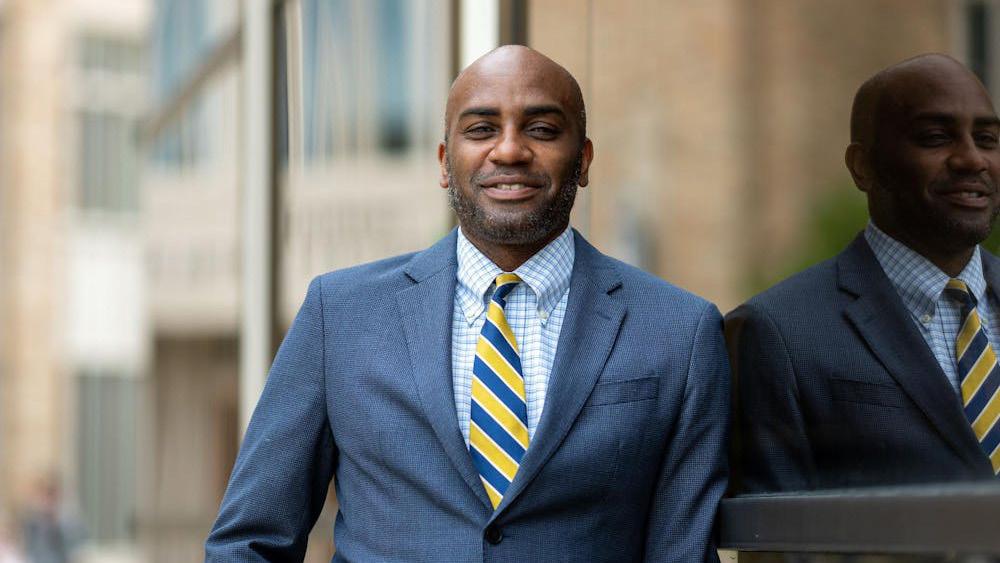
Ernest Morrell, professor of Literacy Education, passed away on Feb. 6 after a long battle with cancer. He was 54.
The National Council of Teachers of English, where Morrell was a member for over three decades, was the first to announce his passing early Friday morning.
“Dr. Ernest Morrell, a legendary scholar in our field and
ND prof. Ernest Morrell dies at 54 ICE conduct sparks debate
By David Murphy News Writer
Last December, the Trump administration announced Operation “Metro Surge,” a major federal immigration enforcement campaign focused on the Twin Cities of Minneapolis and St. Paul.
The effort has sparked nationwide controversy following the deaths of Renée Good and Alex Pretti, two U.S. citizens killed during encounters with federal immigration agents, triggering widespread protests and debate over ICE’s enforcement practices.
“When families are torn apart, citizens are unjustifiably killed, and entire communities are forced to live in fear, immigration enforcement ceases to be about law and becomes an instrument of cruelty,“ Notre Dame College Democrats wrote in a statement to The Observer. “Catholic Social Teaching
SPORTS | PAGE 9
Wisconsin beats ND
The Irish hockey team gave ranked Wisconsin two difficult wins in a thrilling series.
multifaceted leader who helped pave the way for critical English education as a practice, passed away surrounded by family members,” its statement read. “His reputation as a scholar, as a mentor, and as a respected colleague is unparalleled.”
Morrell worked for NCTE for more than three decades, serving as its president in 2014. He was director of the organization’s Office of Policy Research since 2020.
shows us the inherent dignity of every human person … the administration’s actions through ICE stand in direct opposition to these principles.”
Meanwhile, the Notre Dame College Republicans voiced firm support for President Trump’s immigration enforcement policies in their own statement to The Observer.
“The Notre Dame College Republicans unequivocally endorse the President’s resolute enforcement of federal immigration statutes. These deportation mandates were duly enacted by Congress through the constitutional legislative process and carry the full force of United States law,” the club wrote. “Should agitation escalate into sustained violence or armed interference against federal law enforcement officers, we strongly urge
“ICE” on page 3
SPORTS | PAGE 11
Men’s hoops falls Notre Dame men’s basketball lost in heartbreaker at home in a tightly contested game.
MATT CASHORE |University of Notre Dame
Ernest Morrell was a distinguished professor in the Department of English and Department of Africana Studies at Notre Dame.
QUESTION OF THE DAY:
Daniel Burke Sophomore Coyle Hall
“Today.”
Janie Schnell Sophomore
Johnson Family Hall
“There have been days I couldn’t even get to class.”
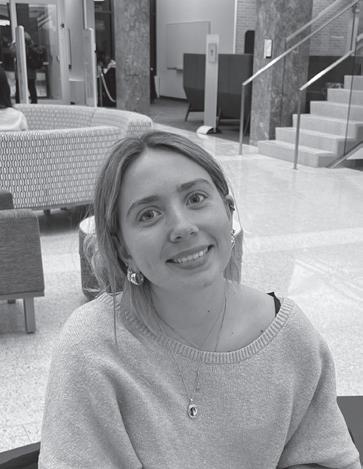
Mikayla Olsen
Sophomore
Pasquerilla East Hall
“Last year on the way to McGlinn casino night.”

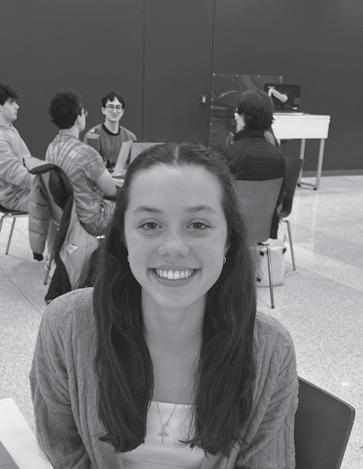
Morgan Casey
Sophomore McGlinn Hall
“Directly in front of McGlinn.”
Maria Maringer
Sophomore
Pasquerilla East Hall
“Two days ago near PW circle.”
SOCIAL MEDIA POLL
Have
Email dstangel@nd.edu
What was your favorite part of the
THE NEXT FIVE DAYS
Tuesday
“Arte en español” A guided discussion of painting titled “A Mayan Prince” (1949). 3:30 p.m. - 4 p.m.
Raclin Murphy Museum of Art
Wednesday
Holy Hall Talent Show and Bake Off Join Holy Cross College’s Holy Hall Tournament week. 8:30 p.m.
Driscoll Auditorium
Thursday
“No Other Choice” As jobs dwindle due to AI, coworker brutality ensues. 9:30 p.m. Browning Cinema, DPAC
Friday
Notre Dame hockey vs. Minnesota
Support the Irish against the Badgers at home. 7 p.m. Compton Family Ice Arena
Saturday
Met Opera Live in HD: Cinderella
Come see a rendition of the classic love story. 1:00 p.m. - 2:35 p.m.
Browning Cinema, DPAC
PHOTO OF THE DAY | KEIRA JONES
ICE
Continued from page 1
the President to immediately invoke the Insurrection Act of 1807, deploying the United States military as necessary to restore order, suppress the rebellion, and ensure the faithful execution of the nation’s laws.”
For Notre Dame students and faculty alike, the discussion over ICE’s activities has been shaped by the University’s Catholic mission, which advocates for the human treatment and protection of migrants. Professor Antônio Lemos, a teaching scholar in the Notre Dame Department of Theology who published a dissertation on migration ethics in July 2025, noted the Church’s longstanding support of migration.
“It was very unanimous in the 20th century, pretty much every single Pope said that people have a right to migrate,” Lemos said. “It’s not just that we should be nice to migrants, but that migrants have a claim to migrate across international borders.”
Catholic Social Teaching emphasizes the human dignity of all people, but Lemos emphasized that this obligation does not absolve a society of its right and responsibility to secure its borders. For Lemos, the core policy question for Catholics is how
SMC
Continued from page 1
sharing with her roommate from last semester,” Mara said.
The rise in interest and anticipation is felt across campus as both students and the residential life office look forward to the new spaces and traditions that Lourdes Hall and the other new residence spaces will bring to campus. The Residence Life office plans to hold preview dorm walk throughs open to all students on Feb. 27 and March 2.
Contact Soledad Castellanos at scastellanos01@stmarys.edu
to craft a system that both recognizes the human dignity of all people while allowing the state to care for its citizens.
“Popes realized [migration] was not an absolute right. People cannot just migrate whenever they want … states have a duty, not just a right, but a duty, to secure their borders, to avoid criminals, to stop terrorists and to make sure that their communities have everything they need,” he said. “You cannot receive migrants and put them on the streets during winter because you don’t have a place to accommodate them. So for the migrants themselves, each country must take into consideration how many people they can receive.”
Theology professor David Cloutier, who specializes in moral theology and Christian ethics, also argued for a prudent immigration policy, highlighting the need to address what he views as structural issues within America’s immigration system.
“I don’t know how anyone can look at the present American system, even if they want low migration, and think that our system is working … Migration that is not well planned is very hard for societies to handle, no matter how rich they are,” he said. “There are inevitably structural problems that have to be dealt with. Big problems in the world
Turning Point
Continued from page 1
to better our political climate, that was what was important to me, never just solely the ideals,” she said.
As vice president of the College’s TPUSA chapter, she managed events, coordinated with the local GOP and maintained relationships with chapter members.
“I think at the core of our chapter was just maintaining relationships and making people feel safe,” she said. “[We are] giving them an outlet to talk about things that are not accepted, sometimes, within certain environments at the College.”
She reflected that she has always
require various kinds of planning ... and right now we’re particularly bad on the question of these operations.”
Minneapolis has become a flashpoint of this broader immigration debate. The White House has framed Operation “Metro Surge” as a vital step in “removing [dangerous criminal illegal aliens] from our country,” while critics argue that ICE has acted unethically by using excessive force and possibly violating civil rights.
“Another problem our local bishop, Kevin Rhodes, was denouncing is the violence, but also the limitations to religious freedom,” Lemos said. “Church raids, that’s bad, or people who were arrested and cannot have the support of a minister … [meaning] priests or pastors cannot visit them in their retaining centers.”
For Minneapolis students at Notre Dame, the situation is particularly personal and divisive. Drew Hemmesch, a sophomore in O’Neill Family Hall, viewed the Trump administration’s enforcement practices as a pretext to inflict harm and terror across immigrant communities.
“ICE’s operations in my home city of Minneapolis over the past year and particularly over the past few months have been extremely reprehensible and repulsive,” he said.
given her close friends the benefit of the doubt in political conversations. However, the increasingly hostile rhetoric from both political parties led to her departure from the club.
“I can’t sit idly by when the rhetoric is out of control from both sides of the aisle without wanting to make some change,” she said.
The new Saint Mary’s TPUSA president, senior Macy Gunnell, argued the club is determined to continue in their mission despite pushback.
“Leftist students have attempted to silence, intimidate and discourage us for four years now. Their continuing pushback only fuels our fire to build our presence on campus even more. These liberal
“Although ICE is supposed to be a government institution that upholds the law, they have made an egregious overreach of power and have continually terrorized and killed the people of Minneapolis that they were supposed to protect … people do not understand the severity of the situation for immigrants in Minnesota.”
Nathan Ward, a sophomore from Minneapolis living in Graham Family Hall, offered a contrasting perspective, viewing ICE’s actions as a justified response to rising crime in the Twin Cities.
“Crime has gone up. They need to figure out a way to deal with the unrest. I understand that the actions the current administration is taking are not popular with everyone,“ he said. “People do have concerns about the human aspect, and I think those are warranted concerns to have, but at the same time, I think … there is a duty to make sure we are following the rule of law and are promoting our own stability as a country. All that is to say, I generally am supportive of what is going on right now.”
Nolan LaMere, a Siegfried Hall freshman who also hails from the Twin Cities, expressed reservations about ICE’s actions. While in favor of enforcing immigration law, he specifically had problems with its implementation.
tantrums prove to me, I, as a conservative leader on campus, am doing something right. We will continue, unbothered,” Gunnell wrote.
In her most recent interview with The Wall Street Journal, Morales was described as once being “all-in for the MAGA movement,” but now “her support for Trump is at a newfound low.” She said that the former statement is not true and she never fully was engrossed into any political party.
“I have never been all in for any political candidate or any political ideology ever. I voted for Democrats, I voted for Republicans, so that’s the first thing I’d like to correct,” Morales explained.
The Conscience of a Catholic Conservative
5:00 p.m. Tuesday, February 10, 2026 215–16 McKenna Hall

Sam Tanenhaus, prize-winning author of books on American politics and media, will explore how Catholicism shaped the thought of William F. Buckley Jr. on issues ranging from Church teachings to civil and human rights, family values, and free markets.
This lecture is free and open to all. Learn more at cushwa.nd.edu/events

“I think that immigration policies should be enforced, but there are a number of groups that should be prioritized more than others,” he said. “Recent crossers who have not established roots, individuals with extensive criminal histories and consolidated crossers near the border. Individuals who have established roots in the United States, while still being here illegally, should be de-prioritized in immigration enforcement.”
Although Operation “Metro Surge” remains ongoing, the Trump administration recently announced a partial drawdown, withdrawing roughly 700 agents from Minneapolis, even as the effort continues to fuel national debate.
“I recognize that the immigration issue is a very nuanced and complex problem that requires a lot of sensitivity and a lot of thought,” Ward said. “At the same time, two things can be true. I think we are called to show dignity and concern for all while still respecting the rule of law … I think we must keep that in mind so that we as Americans can promote human flourishing for all people.”
Contact David Murphy at dmurph23@nd.edu
She said she agreed to be featured in The Wall Street Journal because she knew that there may be others who are scared to speak up or show a change of political values. As a woman of color with conservative ideas, she described being censored by peers at times because of her political background.
“I think staff, my peers and administrators, have assumed my beliefs without talking to me and painted me to be a traitor to my own race and undeserving of the same ability to converse and discuss,” Morales said. “I’ve absolutely been censored at times, I’ve been told that I make people feel unsafe. I’m not negating how you feel, but I pause because you don’t know me. You’ve heard things about me, but you’ve never made an attempt to converse with me.”
Morales said she plans to move forward by building relationships and creating political dialogue for people to see different perspectives outside of their own and hopes to focus on immigration policy in the future.
Gunnell wrote to The Observer that former treasurer, junior Sabrina Olivarez, and former firstyear representative, freshman Jadyn Johnson, will become covice presidents of the chapter.
“We love Elysia and are unequivocally supportive of her departure to pursue more middle-ground means of political activism,” she wrote. “It would be hypocritical of us as advocates of free speech to try and censure her conservative ideals — even and especially those that may not align with that of TPUSA.”
Contact Aynslee Dellacca at adellacca01@saintmarys.edu and Berhan Hagezom at bhagezom01@saintmarys.edu
Rwandan survivor urges forgiveness
By Juliet Powell News Writer
“What do you do when you have lost everything?” Immaculée Ilibagiza shared to the audience, clutching the rosary in one hand.
On Saturday morning in Dahnke Ballroom, Ilibagiza described how living through the Rwandan genocide helped her turn to God. This lecture was a part of Notre Dame’s annual Catholic speaker series, a Campus Ministry and student government collaboration.
Sophomore Matthew Mrosla, co-director of the department of faith within student government, helped organize the event. He stated that it was time for the series to have a female guest speaker who met the theme of this year.
“In the past, we have had Fr. Mike Schmitz, Bishop Robert Barron and last year was Marcus Freeman. This year, we really wanted to get a female speaker out — the first one ever,” Mrosla said. “So we thought Immaculée’s story of hope and forgiveness was just perfect, especially with this year’s theme of cultivating hope.”
Ilibagiza remembered growing up hearing about apparitions of Mary at the school of Notre Dame in Kibeho, Rwanda in 1982, 12 years prior to the genocide. The teenagers who saw the apparitions described the Blessed Mother warning of coming danger and bloodshed if the country did not develop their faith. These apparitions were recognized by the Catholic Church in 2001.
“I remember one time my parents were there and Our Lady said, ‘A terrible thing is going to happen to the country if you don’t come back to God.’ That’s all she was doing. She was calling us to come back to God,” Ilibagiza stated.
She further described instructions that Our Lady told them for her tribe to do in order to be saved.
“She said, ‘Make prayer groups in every village and pray for peace in this country. If you do, this will not happen. And for those who will remain, if it happens, then nothing will console them, only by the grace of God.’”
Ilibagiza recounted the preparations of her tribe and her family as the radio started to broadcast the deaths of countless families in Rwanda. As reports of organized massacres were broadcasted over the radio, Ilibagiza shared her final interaction with her father before going into hiding in a neighbor’s house.
“My father came to me and gave me a rosary … He sent me to a neighbor who was from the other tribe and who was a good man,” she said.
She described the challenges in hiding for safety and the impact that it had on her as a child.
“He put me to sit in this tiny bathroom, three by four feet. When I thought it was too small for me, we became eight people in three by four feet … At the end of the week, I remember, I thought I’ve had it, I was still just a kid somewhere,” she said.
The women hid in the bathroom for 91 days. They learned the scope of the atrocities through a radio in the room next door.
“[The leaders] were out on national radio calling everyone to kill everyone in my tribe,” she recalled. “I remember one government minister said … ‘Don’t forget children. Don’t forget elderly people. We are going to remove everybody, so we can live in a paradise,’” she stated.
She said she felt trapped in her situation but knew there was no other way to maintain her safety.
“You think it was bad to be in one place for a week. But to know that somebody is going to come to hunt for you, it was the worst pain I’ve known,” she said.
Ilibagiza described the terror as the house she was hiding in was searched by a large group from her village. She recounted how she learned that the killers had searched the entire house, even opening suitcases to check for babies, but stopped right in front of their hiding spot.
“I remember asking for a specific sign ... ‘If you can hear me, don’t let the killers open the door of the bathroom.’
[Later we were told] one of them touched the handle and before he pulled, he looked at [the owner] and said, ‘You know what, we trust you, you are a good man. You cannot hide these bad people,’” she shared.
“And he turned around and left. I remember, [the man hiding us] said, ‘I don’t know how you are praying, but whatever you are doing, keep doing it.’”
After their miraculous survival, Ilibagiza remembered how her trust in God and faith was renewed.
“For the first time in my life, I said, ’Okay, God is real. It’s up to me now to really do the work,’” she said.
As she accustomed herself to the pages of the Bible, Ilibagiza discussed how difficult it was to read about reconciliation after the genocide.
“One thing that was jumping from the pages of the Bible … was forgiveness,” she said. “Love those who hate you. Close that page! How do I love somebody who’s hating me? What do you deserve? Close that page.”
Unable to process the command to love her enemies, Ilibagiza described how she put down the Bible and picked up the rosary, praying it constantly.
“I prayed 27 rosaries every single day. So after time praying the rosary, I feel sheltered [and] I feel like my heart is together … I felt Jesus was there. He really was there with me throughout the whole genocide, especially when I was praying,” she said.
Despite this comfort, she still struggled with the ‘Our Father’ prayer, especially the line: ‘Forgive us our trespasses as we forgive those who trespass against us.’
“Anytime I said those words,
it was like a red flag. You’re lying, you’re lying to God … I still didn’t know how I could forgive,” Ilibagiza said, “So I started to skip that part.”
She drew strength from her faith to recognize the humanity of her killers and turn to love over hatred.
“Then something that followed that changed my heart. [Our Lord] told me, in that place of love for Him, they don’t know what they do … They truly don’t know what they’re doing,” Ilibagiza said. “I realized that those killers were also the children made by God … They can maybe repent, they deserve mercy. So instead of waiting for them, I started to pray for them.”
This revelation fueled her life’s mission after the genocide. Ilibagiza described going into the refugee camps and helping those who were sick or struggling. Serving and uplifting, Ilibagiza spread the love of the gospel in the midst of extreme suffering.
As a parting call to action, Ilibagiza left valuable lessons with the Notre Dame community. She asked the audience to reconnect with their faith, harness the power of the rosary and consistently live out God’s word.
“I want to encourage you to please love God … Go to Mass, not because others are looking, [but] because you know you receive the graces from God. Please pray the Rosary, love the Rosary, the Rosary is a power,” she said. “It is a weapon.”
She shared that forgiveness is essential towards living and it was what allowed her to grow.
“Lastly, if I can forgive, anyone can forgive. Please dare to go there. There’s so much joy there, let it grow. Forgive every day, little things,” Ilibagiza said.
Contact Juliet Powell at jpowell8@nd.edu
PAID ADVERTISEMENT
THE JOHN RUSKIN BIRTHDAY LECTURE
Not Numb Numbers

Continued from page 1
Morrell was a recipient of the NCTE’s James R. Squire Award in 2025, as well as its Distinguished Service Award. Morrell was also a member of the National Academy of Education, an elected fellow of the American Educational Research Association and the American Academy of Arts and Sciences.
The University released a press statement that included a message from University President Fr. Robert Dowd and many of Morrell’s colleagues.
The release also noted Morrell will posthumously receive the 2026 President’s Award.
This is an abbreviated version of this story. The full version can be read online at ndsmcobserver. com.
Contact Matthew Morin at mmorin2@nd.edu

MONA CHALABI
Congo? In this talk, Pulitzer Prize-winning writer and illustrator Mona Chalabi will explore ways that combining the humanities and the arts gets us closer to reality rather than further from it. Chalabi, who uses data as the foundation for her
and Amazon Studios, and her work can also be found at The New Yorker, The Guardian, Netflix, NPR, the BBC, and National Geographic
THURSDAY, FEB. 12
5:30 p.m.
Leighton Concert Hall
DeBartolo Performing Arts Center
Love us or hate us, you still watched
By Grayson Beckham Columnist, “Citizen Gray”
College Football Playoffs. Bowl Game. Marcus Freeman. Ice Chapel. The Liu Institute. In just the past three months, the University of Notre Dame has provided the national media with no shortage of front-page worthy news. Our Lady’s University is perhaps the most prolific producer of clickbait headlines among the world’s greatest institutions of higher learning. Notre Dame SNUBBED from College Football Playoffs. Notre Dame is a CRYBABY program. Marcus Freeman LEAVING Notre Dame. Ice Chapel Mass draws THOUSANDS to North Quad. Major backlash after PRO ABORTION PROFESSOR appointed to leadership!
At times, this level of constant, emotionally-charged attention can feel exhausting. The recent appointment of Professor Susan Ostermann as director of the Liu Institute for Asia and Asian Studies has once again placed Notre Dame in the national spotlight. Ostermann’s appointment has drawn ire due to her public history of pro-choice advocacy, leading to think-pieces published from right wing publications like the National Review, Fox News, The Irish Rover to even our most esteemed Observer.
My personal opinions on the matter are irrelevant. I’m not a Roman Catholic, nor am I in the Keough School of Global Affairs. Before her appointment apparently roiled the global Christian community, I had never heard of Susan Ostermann. That being said, I don’t quite understand why the Liu Institute director

should be required to pass an ideological and religious purity test to lead a non-theological institute at a school committed to fostering freedom of expression and academic belief.
As Father Dowd explained two years ago, “Some of the views expressed [at Notre Dame] may not be in accord with the principles of Catholic teaching or the values of the University, even as we ensure that Catholic views are represented on campus. Our commitment to freedom of expression permits controversial opinions.” But, again, that’s not my fight.
I am deeply concerned, however, with the fight itself. A Notre Dame emeritus professor and Holy Cross priest recently published an article in First Things, one of the nation’s most widely read and influential Christian magazines. Rev.
Wilson Miscamble wrote in late January that the appointment marks a “crisis of Catholic fidelity” on campus.
Personally, I struggle to see faltering “Catholic fidelity” when approximately 2,500 students stood in freezing temperatures to celebrate the Holy Mass at a student-built ice chapel just five days after Miscamble published his article, also printed in the Rover. Miscamble’s article is articulated very well and presents valid, good-faith arguments. He knows more about the Catholic faith than I ever will. But to attack one of his colleagues so publicly in the national media hurts our University much more than Ostermann’s appointment ever will.
On Saturday, I encountered two nuns and a companion in the Zahm Hall parking lot. They looked lost. I approached,
asking how I could help. “Where can we see the Ice Chapel?” They asked. I wonder now: Did those saintly sisters of the faith, who drove out to our school in 20-degree temperatures, question the Catholic fidelity of the University of Notre Dame?
The discourse regarding Ostermann and the Liu Institute is nothing new. When I was home for Christmas break, I encountered many friends and acquaintances whom I had not seen since graduating high school. Without fail, they asked me what I thought about Notre Dame not making the playoffs, boycotting the bowl season and whether or not Marcus Freeman would leave for the NFL. I responded, and they would stand politely — although not really listening — until I finished speaking. Immediately, they all launched into minutes-long
diatribes about their personal opinions about Notre Dame. That we’re soft. That we never deserved to be in the playoffs. That we got robbed. That they support us.
All of these controversies and triumphs have taught me an important lesson. The world is watching us. They will celebrate when we fall. They will notice when we succeed. People expect something higher from the sons and daughters of old Notre Dame.
We might be intimidated by such attention. Notre Dame and her students are mere human beings — that fail, make mistakes and at times even make ill-informed decisions. But it’s also one of the most loving, intelligent and faith-driven communities that I’ve ever encountered. Since the national media clearly wants to focus on the negatives, we’ll all be a little bit happier if we stay on the sunny side.
Upon his retirement from the sport, legendary professional bowler Pete Weber, famous for his “WHO DO YOU THINK YOU ARE? I AM!” remark after a strike, also said “Hate me or love me, you still watched. That’s all you could do.” Whether one hates Notre Dame or loves Notre Dame, they still have an opinion about Notre Dame. That’s all they can do.
We must afford that responsibility the gravity it deserves.
The views expressed in this column are those of the author and not necessarily those of The Observer.
Contact Grayson Beckham at gbeckham@nd.edu
Finding pleasure in the pain, in Russian
By Sienna Stephens
Usually what people look forward to after a long day of classes is the sense of relief when you can throw all your things on the ground and hurl yourself into the sheets, pillows and blankets of a bed. Finding themselves in such comfort and peace, they most likely fall asleep in the bed’s protection from deadlines, homework, laundry and dorm room cleaning.
While I do not know if everyone does this, I instead find myself hunched over my computer of common Russian words, my note-taking app open and my apple pencil in hand, listening to a video explaining how to write and pronounce the Russian alphabet for what feels like the millionth time.
Before I ended up stumbling over Russian words, the thought of drifting away into my dreams became my routine, becoming
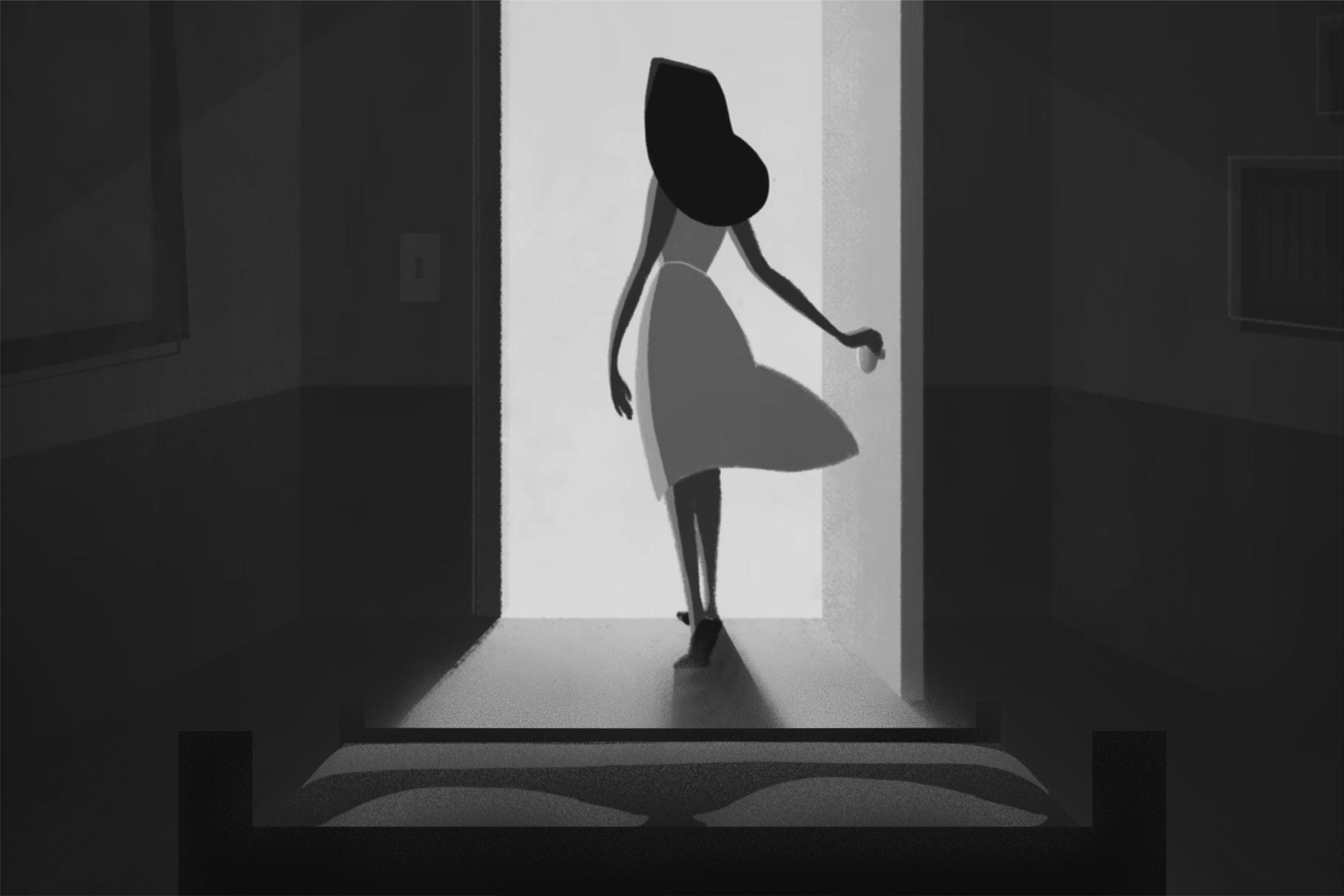
the uncomfortable, known as endless amounts of homework, deadlines, papers to write and hours of studying I knew I had to do later.
healthy when all you want is that sweet treat in the dining hall.
In my Sociological Imaginations class, we learned about the major sociological theoretical perspectives of sociology. From the concepts of functionalism to symbolic interactionism, I found myself drawn to the sociological perspective of utilitarianism.
myself out of my bed to sit at my desk staring at a textbook of math equations. In any way I could, I found myself wanting to maximize that pleasure and -
ent shapes in our lives, not just small paper cuts or physical injuries. Pushing yourself to go workout when you want to relax in your room, studying when you want to doom-scroll, eating
Utilitarianism, founded by English philosopher Jeremy Bentham, is the doctrine or perspective that supports the actions that foster happiness or pleasure while opposing actions that bring pain or unhappiness. The theory suggests that if an action brings happiness to support a group then it’s right, and bringing unhappiness means the action is wrong.
I am no philosopher or sociologist, only a college freshman, but this concept intrigued
see “Russian” on page 6
Columnist, “Not Your Average Post”
MEG HAMMOND | The Observer
GRAYSON BECKHAM | The Observer
Notre Dame has received over 20 inches of snow within the last two weeks. Many campus stories have made national headlines, including a mass held in an ice chapel and a faculty op-ed resurfacing from 2022.
Russian
Continued from page 5
me because it held some truth to it. People looked for any opportunity to increase happiness in their lives and looked to decrease pain. But, the reality is, that desire for happiness and comfort is often abused in our modern society.
Mostly, I blame AI for this principle becoming more relevant in the 21st century. AI has taken over students’ minds with the concept of convenience disguised as saving time for other activities. With just a few clicks, essays can be drafted, questions answered and ideas generated, all without the discomfort of sitting with confusion or struggling through the uncertainty of your writing. It feeds directly into the utilitarian desire to maximize pleasure and minimize pain. Why struggle for hours when technology can do it in seconds?
In this way, utilitarianism
becomes distorted in its principle. AI encourages us to choose what feels best in the moment rather than what is most beneficial in the long run. It minimizes immediate stress, confusion and frustration, but it also minimizes the meaningful challenge of using our own thoughts and turning them into words on a paper.
I see this pattern not only in academics, but in other areas of life as well. We choose scrolling over studying, convenience foods over nutrition, rest without balance over self-discipline. It reinforces a mindset where comfort is prioritized above all else, even when discomfort is necessary for growth. The bed becomes more than a place of rest, but a symbol of choosing ease over effort.
Over time, I began to realize that I had become a victim to the pleasure-over-pain principle. Comfort was easy to me and I greeted it with open arms, but it left me satisfied. Lying in bed scrolling on my phone
OPINION
or avoiding my responsibilities gave me temporary relief, but it always left me feeling more stressed later. I started questioning whether what felt good in the moment was actually good for me in the future. Instead of using my free time to escape my workload or my thoughts, I made a small but intentional change. I started learning Russian in my free time. At first, it was so uncomfortable, I already struggled with Spanish pronunciation and some English too, but this felt more awkward. Grammar rules were frustrating, too many words in Russian meant the same and different thing at the same time, and don’t get me started on learning the alphabet.
But unlike my usual relaxation, the challenge became something more meaningful, something that turned from a small idea to an obsession. My discomfort from immersing myself into a new language resulted in opening a new version
LETTER TO THE EDITOR
of myself. What surprised me most was how quickly learning Russian became pleasurable to me. The more I practiced my speaking and writing the more I wanted to improve and become fluent. Memorizing new vocabulary words, recognizing patterns, and understanding sentences I once couldn’t read became deeply rewarding. More rewarding than wasting time away on my phone.
It quickly turned into me watching my favorite movies and shows in Russian with English subtitles, listening to Russian music, and spending my mornings participating on AirLearn to learn basic conversational phrases.
In this way, my relationship with utilitarianism shifted. I no longer sought pleasure by avoiding the uncomfortable, but by embracing and immersing myself in it. The happiness I gained from learning a new language was not instant or effortless, but it has been lasting. It came from
the drive for growth, discipline, and the satisfaction of knowing I am actively trying to better myself.
Through this experience, I learned that pleasure is not only found in itself, but also found in the pain. The difficulty of putting in the work, challenging yourself, and removing yourself from the comfort of your metaphorical bed. The most meaningful form of happiness comes from choosing a challenge over the ease of everyday life. By redefining what pleasure meant to me, I found something far more rewarding than relaxation: a genuine love for learning and the motivation to keep pushing myself, even when it is difficult and still hard to pronounce the Russian alphabet.
The views expressed in this column are those of the author and not necessarily those of The Observer.
Contact Sienna Stephens at sstephens01@saintmarys.edu
Ostermann makes Notre Dame great
Upon opening Instagram recently, I saw a post titled, “A Crisis of Catholic Fidelity at Notre Dame” from First Things Mag that immediately called back emotions of the 2023 spring semester. Over three years later, Susan Ostermann continues to come under public fire for the views she expressed in a 2022 letter to the Chicago Tribune where she spoke as a policy expert, and not a representative of the University (which is clearly stated).
As a member of the inaugural class of undergraduate students to have a primary major in Global Affairs through the Keough School, I believe I had the opportunity to know Ostermann well. She
was my instructor in a class titled “Global Politics and Policy,” my research advisor for my senior capstone project and my frequent host at office hours throughout my tenure at Notre Dame. I also took several classes within the Liu Institute and served as a student worker for four years. It is almost laughable that Ostermann continues to receive flack for exercising her academic and literary freedom. Of course, I am angry at those who continue to question her place at Notre Dame and the Keough School, but a clear irony exists to any of her students reading these naysayers’ remarks. Ostermann is undeniably qualified for her position as a professor
and as the new leader of the Liu Institute: She is an accomplished scholar, Silicon Valley attorney and orator. Frankly, her resume should answer any question as to why she was appointed to direct the Liu Institute. What sets her apart to me and many other Keough students is her empathy, understanding and unbridled commitment to her students.
While Ostermann was researching in India over spring break, she still took my calls with questions of how to pivot my own research when an essential study fell through. She has accompanied me alongside my own career discernment. She has always encouraged her students to do
what is right, and not what is easy. During a session of Global Politics and Policy, Ostermann shared with us that Keough students were some of the most tolerant and open-minded students she had instructed during her teaching career. She told us that we were “able to discuss difficult topics with a respect that leads to understanding.” I can say with full confidence that Ostermann expressed nothing but respect to all students’ viewpoints, which is a cornerstone of seeking to understand. Of course, now I am angered that that same understanding that Ostermann reflects to each of her students is not being reflected to her. A
diversity of experiences and backgrounds is what makes a global university, and part of what makes Notre Dame great. The core of academia is seeking to understand; and the core of the Keough School is seeking to understand how to best accompany our fellow man to the full realization of their human dignity. Ostermann’s academic work champions that pursuit. My ask is that the Notre Dame community grants Ostermann the same respect that she has reflected to each of her students in the great pursuit of realizing human dignity.
Alaina Reed Class of 2025 Feb. 7
What Confucius taught me about success
By Ana Prestamo Columnist, “Mind the Gap”
In the “Analects,” a collection of conversations attributed to Confucius, moral life is compared to archery: When the arrow misses the target, the archer looks inward, not outward. Confucius’ message:
“Competing does not at all help one achieve victory. One must seek for victory within oneself … ‘if you miss the center of the target, turn and look for the cause within oneself.’ One seeks the bull’s-eye by means of deference and self-cultivation, not for the sake of competing for victory in order to shame others.” (Confucius, trans. Slingerland 19).
For us (almost) graduating seniors — and really for everyone
— I think this passage is worth dissecting. What follows is my own reading (maybe biased by the phase I find myself in), but the insights, I believe, apply far beyond this moment, speaking to nearly every phase of life. Consider the first sentence: “Competing does not at all help one achieve victory.” How much of our time is spent measuring ourselves against others: comparing grades, internships, offers, salaries and trajectories? And how much of this competition prevents us from taking risks, from following the path that genuinely calls us, not the one that looks good on our resume? If we’re not careful, external validation might dictate our trajectories, and before we know it, we might look back at a life validated by everyone except ourselves.
“One must seek for victory within oneself.” How often do we blame the circumstances for our losses, rely on chance to dictate our fate and base victory on where we stand against others? Our understanding of victory is inseparable from how we define success — and too often, success is measured by metrics that are shaped by collective expectations rather than by any (genuine) sense of personal fulfillment.
“One seeks the bull’s-eye by means of deference and self-cultivation, not for the sake of competing for victory in order to shame others.” Confucius forces a harder question beneath ambition itself: What is actually driving our goals? So often, our motivation is external — recognition, prestige, approval, the reassurance that we are doing “better” than someone
else. Yet self-cultivation asks for a different orientation: progress measured not by applause, but by genuine alignment between who we are becoming and what we are aiming at.
For anyone at a crossroads, I think this is a passage worth lingering on. Confucius reminds us that, in a world where success is so often measured by salaries, titles and external validation, we must pause and ask what target we’re actually shooting for, and whether it’s worth hitting at all. This might mean taking the time (amid the pressure of applications, interviews and expectations) to return to prayer, reflection, service or intentional studies. We must stop and ask whether our daily choices reflect, not just where we want to go next, but who we hope to become.
So, as an (almost) graduating senior, who is all too familiar with the question that worries us all: “What comes next?” I encourage you to think of life as an archery practice: look within when things don’t go the way you might have planned, and focus less on hitting others’ targets and more on improving your aim, discipline and self-correction. This way, when we do hit the intended target, we can be sure it looks and feels like our own — because along the way we’ll have cultivated not only our skills but our hearts.
The views expressed in this column are those of the author and not necessarily those of The Observer.
Contact Ana Prestamo at apresta2@nd.edu
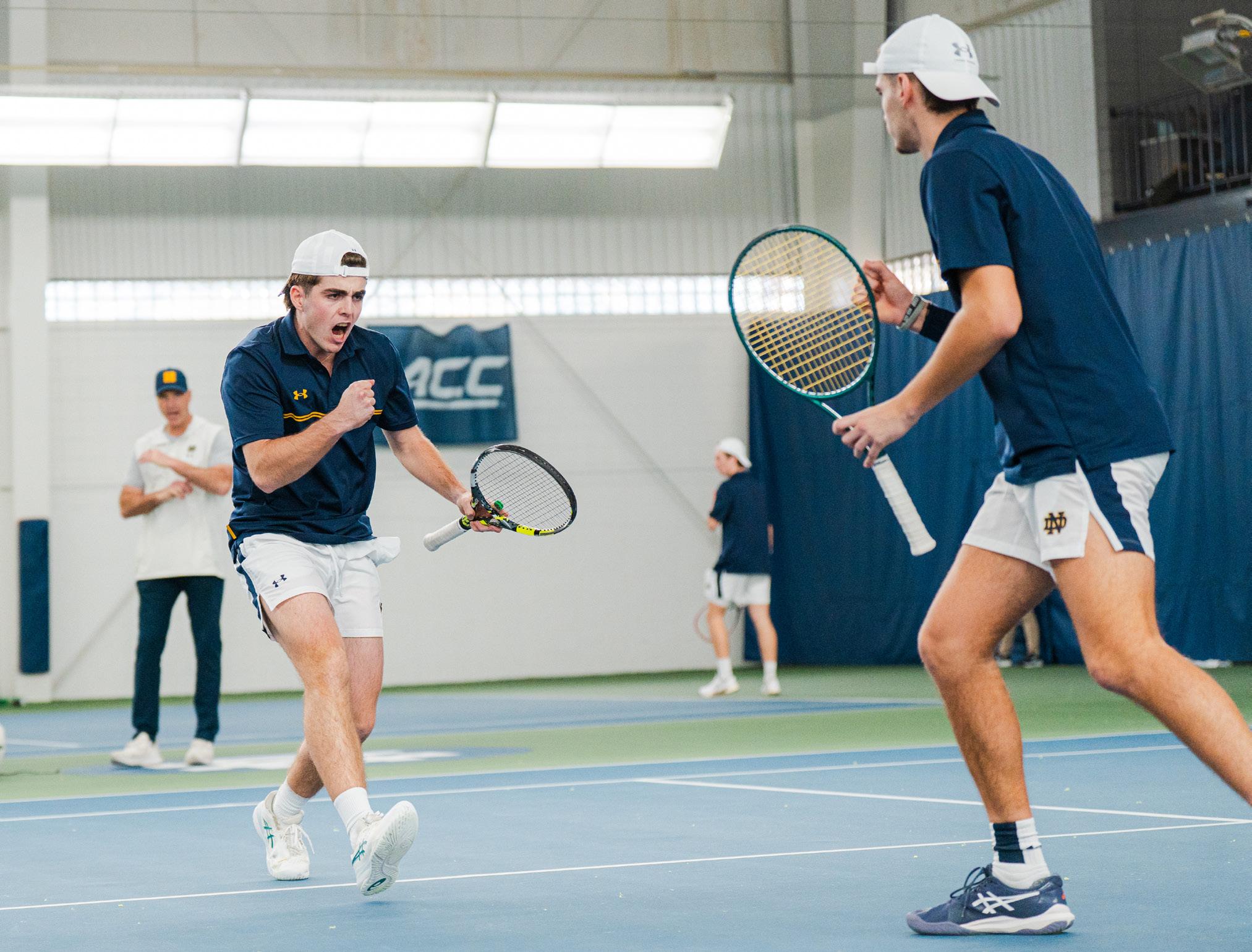

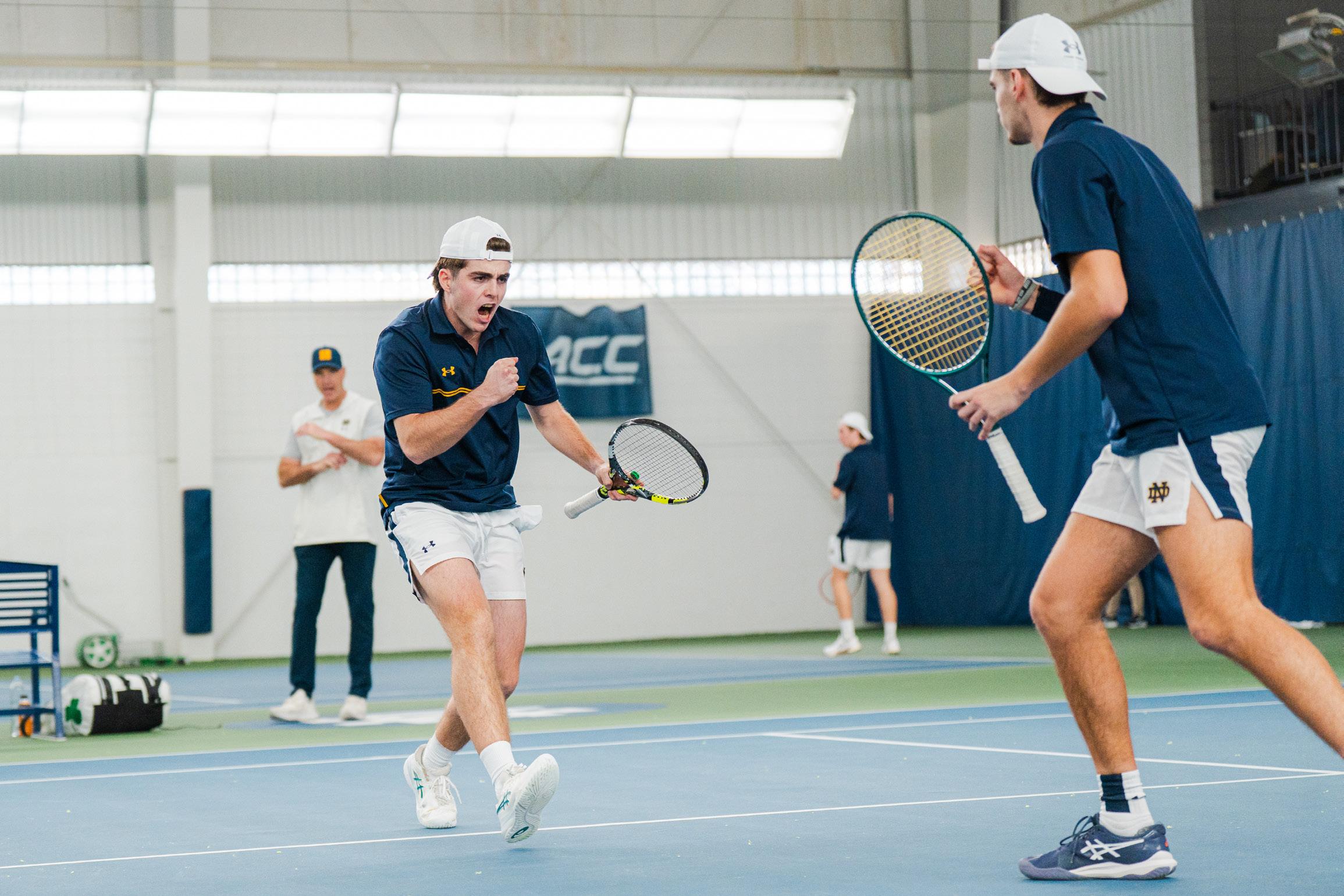



Photography by Kevin Sanchez
Notre Dame men’s tennis faced Marquette Sunday, Feb. 8, in Eck Tennis Pavilion. The Irish won 4-0.
Bad Bunny and the battle over American identity
By Isabela Garza Sanchez Scene Writer
“Together we are America.” This was the core message Puerto Rican rapper and singer Benito Antonio Martinez Ocasio, commonly known as Bad Bunny, highlighted during the 60th edition of the Super Bowl halftime show on Sunday, Feb. 8, at Levi’s Stadium in Santa Clara, Calif. Following the performance, President Donald Trump, who skipped the Super Bowl and instead attended a watch party in Florida, wrote in a post on Truth Social: “The Super Bowl Halftime Show is absolutely terrible, one of the worst, EVER! It makes no sense, is an affront to the Greatness of America, and doesn’t represent our standards of Success, Creativity, or Excellence … There is nothing inspirational about this mess of a Halftime Show.”
President Trump wasn’t the only one who has publicly criticized Bad Bunny since his selection was announced in September. YouTuber-turnedboxer Jake Paul called Bad Bunny “a fake American citizen performing who publicly hates America,” later asking his followers two hours before the kickoff to boycott the show entirely, pushing fans to realize that they “have power” to use their voices. It’s surprising to hear this from a man who currently resides in Puerto Rico as well. Similarly, there were many other accounts on social media that were calling the artist out, such as u/ EdwardArnett4 on Reddit: “the worst performance I’ve seen. Who the hell thought this was a great idea?”
Despite Puerto Ricans having U.S. citizenship since 1917, social media

users, “professional” boxers/ influencers and even politicians still question if they deserve to perform at the “AllAmerican” halftime show. Could this backlash be tied to Bad Bunny’s recent success?
He has been named Spotify’s #1 Global Artist for 2025 for the fourth time, claimed the #1 spot on US Apple Music with his track DtMF (DeBÍ TiRAR MáS FOToS) and won the Grammy Award for Album of the Year, becoming the first Spanish-speaking album to win the prestigious award. In his speech, he used his time on stage to deliver a political message: “Before I say thanks to God, I’m gonna say: ‘ICE out!’”
The phrase “ICE out” has been used to protest against the U.S. Immigration and Customs Enforcement (ICE) agency, advocating for its abolition or restriction.
“We’re not savage, we’re not animals, we’re not aliens, we are humans and we are Americans,” he continued. “The hate gets more powerful with more hate. The only thing
hate is love.”
Alongside Ocasio, other artists, including Billie Eilish, Kehlani and Best New Artist Olivia Dean, addressed this political issue in their acceptance speeches. Along with praise towards immigrants, “ICE OUT” pins were worn by Justin and Hailey Bieber, Finneas and Amy Allen. Benito’s speech touched many but infuriated others, including President Donald J. Trump, who labeled the 2026 Grammy ceremony as “garbage” and “unwatchable” on Truth Social and even threatened to sue host Trevor Noah. Ocasio’s Grammy win and halftime performance are massive professional peaks, yet they are deeply rooted in a personal history that remains tied to the island he defends. Who is the person behind the stage name ‘Bad Bunny’?
“Buenas tardes, California, mi nombre es Benito Antonio Martinez Ocasio. Y si estoy aquí en el Super Bowl, es porque nunca — nunca — dejé de creer en mí, y tú también
debes de creer en ti. Vales más de lo que piensas.” He opened the staging, telling the world who he is: “My name is Benito Antonio Martinez Ocasio, and if I’m here today, it’s because I never — never — stopped believing in myself, and you should believe in yourself too. You’re worth more than you think.”
Ocasio was born on March 10, 1994, in Vega Baja, Puerto Rico. He was raised in a lower-middle-class household in Vega Baja’s Almirante Sur neighborhood. His father was a truck driver, and his mother taught English. He has two younger brothers, Bernie and Bysael. He got the name “Bad Bunny” because of his childhood. In an interview with ET in 2018, he shared that he once had to dress up as a bunny in school, and there’s even a photo of him in the costume with an annoyed face. “It’s a name I knew would market well. A bunny is something so common that I thought to myself, every time someone sees one, they’ll remember my music.”
After gaining popularity in 2016 through sharing his music on SoundCloud while still in college, he began getting calls from producers. With collaborations with Maluma, J-Balvin and Cardi B, Ocasio rose to fame.
A decade later, he announced on live television, “The only thing more powerful than hate is love.” The performance set a new record with over 135 million viewers and is considered the mostwatched NFL halftime show of all time. Boosted by surprise appearances by award-winning pop icon Lady Gaga and legendary Puerto Rican singer-songwriter Ricky Martin, the show was a mix of Latin culture and English music that proved his point: “Together we are America.” With a real wedding, cameos by Karol G and Pedro Pascal and his newly won Grammy, the show was a significant moment for Latin representation, showcasing the Puerto Rican culture. It builds a bridge between cultures, breaking racial barriers and uniting people across the Americas. By naming all of the South and North American countries with their flags at the end of his performance, he gave significance to all of the people of America. And just like Benito Antonio Martinez Ocasio, let me end with, “God bless America! O sea, Chile, Argentina, Uruguay, Paraguay, Bolivia, Peru, Ecuador, Brazil, Colombia, Venezuela, Guyana, Panamá, Costa Rica, Nicaragua, Honduras, El Salvador, Guatemala, Cuba, República Dominicana, Jamaica, Haití, Las Antillas, México, United States, Canada, and Puerto Rico!”
Contact Isabela Garza Sanchez at igarzasa@nd.edu
The Winter Olympics opening ceremony
By Cate Stephens Scene Writer
While the snowy South Bend weather continues piling up and the scarves are nowhere near being put away, we all need a winter romanticization. The Winter Olympics are now here to bring us comfort amid the chaos and to remind us that community and culture still stand with positive human achievement. The 2026 Milano Cortina Olympics rang in this hopeful message with its opening ceremony at the San Siro Stadium in Milan, Italy, last Friday night.
The ceremony featured a colorful, lively illustration of Italian culture while also sharing the stage with other popular global figures like Mariah Carey and Charlize Theron. This ceremony demonstrated that even in a sporting
event, there is always room for art to further illuminate the joy of global solidarity.
The ceremony opened with a beautiful depiction of Italy’s contributions to the arts and culture throughout history. Starting with an elegant ballet number with dancers dancing around Italy’s well-known busts and sculptures, the exuberance continued with the famous Italian actor Matilda De Angelis conducting a multitude of dancing music notes. The circular stage allowed the musicnote dancers to move freely while still following a pattern. This symphonic setting was joined by the representation of three puppeteer heads of esteemed Italian Opera masters.
The dedication to music quickly transitioned to art, where three paint tubes with strings of color descended from the ceiling.
Around the tubes, performers in vibrant colors wore costumes with a cartoonish, creative popart effect. Models also strutted across the stage in suits of red, green, and white to pay homage to the legendary impact of Italian fashion. Amongst the dedication of Italian artistry, there were also riveting performances by Mariah Carey, Andrea Bocelli and pianist Lang Lang.
After the iconic Olympic rings shined in the sky, athletes from over 90 countries entered the arena, showcasing their pride in representing their countries with smiles, waves, phone recordings and dancing. Each country lovingly held its flags and sported fashionable outfits created by esteemed designers. America’s preppy and cozy flag sweater outfits were created by Ralph Lauren, while Canada’s maple
leaf puffer jackets were designed by Lululemon. Italy wore Armani jackets, while Brazil wore Moncler puffers.
After each team walked in, Italy’s president Sergio Materella and UN Peace Ambassador Charlize Theron delivered impactful speeches, emphasizing the hard work the Olympians put in to be present and calling for unity and peace in these times of trouble. The unforgettable torch was passed by three Italian Alpine ski racers in both Milan and Cortina.
Retired skiers Deborah Compagnoni and Alberto Tomba lit the flame in Milan, while Sofia Goggia, who is participating in these games, continued the ceremony in Cortina. After the cauldron lighting signified the start of the games, the performance then concluded with other heartwarming odes to Italy and the Olympics.
Another riveting dance routine livened the circular stage with groovy neon hockey and skiing attire that celebrated 100 years of the Winter Olympics. Finally, an opera and dance ensemble closed out the bright evening. The expression of art in the opening ceremonies and Olympic athletic events always demonstrates joy in human flourishing. These moments serve as reminders that goals can be achieved, art can have meaning and admiration in any atmosphere, and the roots of global love and hope lies in sharing talents and emphasizing togetherness against all odds. The Olympics always serve both as a source of entertainment, motivation and cooperating comfort that I look forward to at every game.
Contact Cate Stephens at cstephens01@saintmarys.edu
Hockey barely bested by No. 13 Wisconsin
By Nikki Stachurski Associate Sports Editor
The Irish traveled to face No. 13 Wisconsin for the second time this season and played their best hockey of the year, despite losing both games. The Irish returned from a three goal deficit late in Friday’s game to force overtime, where Wisconsin scraped by with the game-winning goal less than two minutes in. In Saturday’s matchup, each Badgers’ goal was answered shortly after by one from the Irish, before senior forward Christian Fitzgerald scored the go-ahead late in the third period that gave the Badgers the win.
Both Friday and Saturday’s games were physical, and the referees established early into the series they would only award penalties for intense play. The decision was understandable after the boiling intensity felt when the teams last played each other, resulting in disqualifications and misconducts. However, the style of play calling caused frustration on both sides who felt as if they were slighted in getting power plays, especially in Saturday’s game where each team only had one power play all night.
Game One
The sold-out crowd in Wisconsin’s Kohl Arena was not expecting Notre Dame to come out of the tunnel with every
intention of settling the conflict with the Badgers, and the underestimation allowed the Irish to find confidence in their play early on. Both teams were eager to get on the scoreboard, with six goals scored in the first period alone. Wisconsin got on the board first with two goals within 20 seconds, the first a power play goal by freshman defenseman Luke Osburn through traffic on the blindside of Irish sophomore goaltender Nick Kempf. The Badgers were fired up, and freshman forward Grady Deering used the electric atmosphere of their home barn to put the Badgers up 2-0. The Irish were not unsettled by the back-to-back goals, and junior forward Evan Werner scored a beauty of a power play goal two minutes later to get the Irish on the board. Halfway through the first period, Wisconsin sophomore forward Gavin Morrissey landed a snipe from the left face-off circle to give the Badgers another power play goal and to reestablish their two goal lead. 12 seconds later, junior forward Danny Nelson kept the Irish within one goal after beating Badgers’ freshman goaltender Daniel Hauser on the left side of the crease.
After the halfway mark of the first period, Deering scored his second and final goal of the game after beating Kempf on the left side to put the Badgers up 4-2. After six goals in 13 minutes, the remainder of the
first period was scoreless but fast-paced as each team was determined to continue their momentum.
The first half of the second period continued without a goal from either side, until Osburn scored another goal for the Badgers, giving the home team the 5-2 lead. With two minutes remaining in the second period, Notre Dame freshman forward Cole Brown scored from the right side of the net to once again reduce Wisconsin’s lead to two.
Entering the third period, the Irish kept the Badgers from finding the back of the net as Werner scored two goals to tie the game. Werner’s three goals not only earned him a hat trick, but forced the game to overtime, something the Badgers fans were not expecting after Wisconsin’s dominance over Notre Dame the last time they met. Just over a minute into overtime, Wisconsin junior forward Quinn Finley landed a central shot directly in front of the net, calling game and giving the Badgers the win.
Game Two
The high-intensity style of play continued into the second game of the series as the Irish faced the Badgers in Wisconsin on Saturday. Despite Hauser starting the night before for the Badgers, the coaching staff elected to give sophomore goaltender Eli Pulver the start. The
Irish started Kempf once again, a decision that has been consistent throughout the season. In similar fashion to the night before, the first period was riddled with goals. The Badgers once again got on the board two minutes in as senior defenseman Ben Dexheimer scored from the top of the crease. Not wanting to be left out, the Irish scored four minutes later as senior defenseman Michael Mastrodomenico found a hole in the right side of Pulver’s defense.
Recreating the success they found last night, both Finley and Werner scored a goal in the first period, three and a half minutes apart. In the last minute of the period, Badgers senior forward Simon Tassy scored the final goal of the period, giving Wisconsin a 3-2 lead heading into intermission.
Just before the halfway mark of the second period, the Irish tied the game with a goal by Danny Nelson, then junior forward Jayden Davis gave the Irish their only lead of the game two minutes later. After the Daniels goal, the Wisconsin coaching staff pulled Pulver, who allowed four goals, and replaced him with Hauser. With the Irish leading 4-3, Wisconsin sophomore forward Ryan Botterill tied the game with a goal through traffic, ending scoring for the second period.
The third and final period of the game was low-scoring, and as the teams stepped onto the
ice tied 4-4, the exhaustion of fast-paced play caught up with them. Both teams were trying to make sure they did not give up a penalty and played smart hockey. Despite efforts on both sides, it was the Badgers who emerged victorious after Fitzgerald scored the game-winner with 10 minutes left in the period. The Irish could not beat Hauser in the net, and Wisconsin once again won the game by one goal.
The Irish did not earn another win against the ranked conference opponents, however, they played tight, cohesive hockey that utilized the first, second and third lines on offense. Kempf was outstanding in net as usual, with 56 saves for the weekend.
Notre Dame proved to the nation, but most importantly to themselves, that they can compete with high-caliber teams and that their witty style of play can be adapted to correct mistakes from previous matchups. The Irish will need to continue with the success and newfound motivation as they prepare to host Minnesota, who beat the Irish 3-0 and 4-1 the first time they met in early November.
Minnesota travels to Compton Family Ice Arena to face Notre Dame Friday at 7 p.m. and Saturday at 6 p.m. as the Irish continue their revenge run on Big Ten opponents.
Contact Nikki Stachurski at mstachu2@nd.edu
HOCKEY
MARIELLA TADDONIO | The Observer
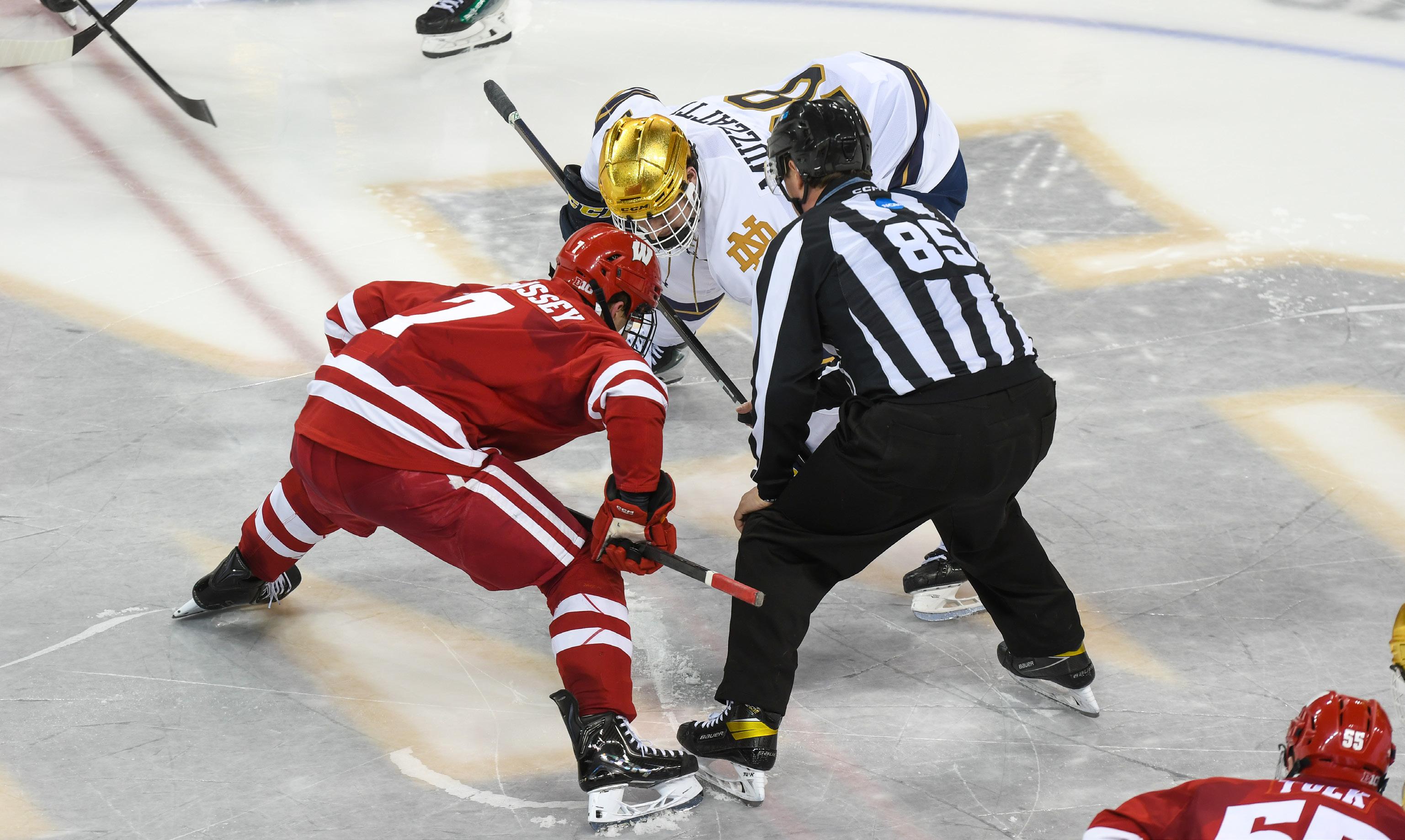
Graduate forward Sutter Muzzatti prepares to challenge No. 13 Wisconsin sophomore forward Gavin Morrisey on the face-off when the Badgers visited Friday, Dec. 5, to battle the Irish at home. The Badgers defeated the Irish 4-7 despite junior forward Evan Werner and junior defenseman Paul Fischer scoring the first two vital goals of the Big Ten matchup.
SPORTS

Saint Mary’s,
By Claire Watson Associate Sports Editor
Over the past week, Saint Mary’s basketball and Holy Cross men’s and women’s basketball teams were in action.
Saint Mary’s finished its week 0-2 with a loss to Calvin and Kalamazoo, the Holy Cross men’s basketball team went 0-2, and the Holy Cross women’s team earned two wins.
Saint Mary’s
With the two losses, the Belles fall to 7-14 overall in conference and 2-10 in conference. The team now prepares to host Trine on Feb. 11 with tipoff set for 7 p.m.
Calvin
In their first game of the week, Saint Mary’s played at Calvin and got dropped for a 74-41 loss, its offense seemingly the cause of its defeat, especially with a lack of three-point shots. Despite out-shooting Calvin, Saint Mary’s was unable to find the rim, costing them the loss. Calvin, on the other hand, came out aggressive and capitalized on the Belles’ turnovers.
Sophomore guard Ella Notaro led the team on the court with 11 points, followed by freshman guard Liv Fry with seven points and sophomore guard Elle Andree with six. Fry and Passinault finished the game recording team-highs of six rebounds each.
Calvin came out strong in the first quarter, finishing with an 18-6 lead. Saint Mary’s struggled, only being able to shoot 20% from the field goal line in comparison to Calvin’s 40%.
Calvin kept on rolling in the second quarter, drawing a 3416 lead as they shot 35% from the field. Saint Mary’s defense
Holy
was able to stop them from the three-point line, only allowing them to put in a single threepointer. The Belles, on the other hand, went 25% from the field goal and 33% from the arc.
Saint Mary’s seemed to show a stronger side of themselves after the half as they went 40% from the field in comparison to Calvin, who went 29.4%.
Despite this, Calvin finished the third quarter leading 5530. While the fourth quarter looked aggressive from both teams, the Saint Mary’s offense continued to struggle, going 0-4 from beyond the arc.
Kalamazoo
In an intense matchup and one that was definitely worth watching, the Belles’ second game of the week was against Kalamazoo. While it was a tough battle, the Belles fell short and took the 58-53 loss. Overall, Andree and senior forward Hannah Outlaw led the team on the court, each putting up 11 points for themselves, while Notaro finished her game with nine and junior guard Kate Restovich added on seven. While both teams traded points back and forth throughout the entirety of the game, Belles’ struggle in the fourth quarter ultimately gave Kalamazoo the final win.
Holy Cross men’s basketball
The Holy Cross men’s basketball team fell to 9-15 overall and 4-12 in conference play after suffering two losses, the first to Saint Xavier (95-81) and the second to Olivet Nazarene (90-67).
Saint Xavier
On Feb. 4, 2026, the Saints faced off against Saint Xavier
SMC, HCC BASKETBALL
Cross College teams compete
but fell short. Overall, some of the game leaders for the Saints included junior guard Donovan Mukes, who led the team with a high total of 21 points, going 7-11 from the field; freshman guard Donovan Waleskowski added on 18 points; junior forward Jayden Sanders tallied 16 points and sophomore forward Karl Birgisson added on five. In addition to leading the offense, Mukes also added three rebounds and three steals, and alongside him was Sanders, who had five rebounds and two steals. Birgisson was a key player on defense for the Saints, leading the team with a teamhigh of eight rebounds.
Overall, the Saints were 28 for 57 from the field (49.1%), totaled 36 rebounds, 17 assists, 12 turnovers and went nine for 17 from beyond the arc. In comparison to this, Saint Xavier went 34 for 66 in the field goal, 14 for 26 from beyond the arc, 34 rebounds, 17 assists and seven turnovers. While the Saints’ defense was strong, it was their offense that seemed to cost them, as they did not take as many chances in the paint as Saint Xavier did. Another cost was not capitalizing on the free throw line, as they only went 16 for 26 while Saint Xavier went 13-15.
Olivet Nazarene
In their second game of the week, the Saints fell to Olivet Nazarene. While the Saints’ defense continued to be strong, forcing 11 turnovers against Olivet Nazarene and 32 rebounds, the shots could not seem to fall for Holy Cross despite attacking harder offensively. The Saints finished the night going 27-70 from the field and only 7-24 on threepointers. On the other end of
the court, Olivet Nazarene seemed to show equal offensive struggle, going 36-68 in field goals and 9-25 from the threepoint line. A big offensive difference that contributed was, again, free throws. Holy Cross finished going 6-9 at the charity stripe while Olivet Nazarene finished going 9-10. Olivet Nazarene also capitalized on the Holy Cross offensive struggle as they finished the game with 46 rebounds.
Holy Cross women’s basketball
The Holy Cross women’s basketball team also competed in two games over the past week and was the only team to find success with a 79-52 win over Calumet and a dominant 10345 win over Mount Mary. The team now rises to 15-10 overall and 11-6 in conference play.
Calumet
On Feb. 7, Holy Cross faced off against Calumet and took a swift win. The offensive drive from the Saints would prove to be the reason for the win as multiple players throughout the game contributed.
Sophomore Allie Caldwell led the Saints on the court with 18 points and six rebounds. Sophomore forward Kaiden Hanley added on 15 points and eight rebounds, freshman forward Sincere Coleman-Francis
finished her game with 14 points, eight rebounds and three steals and senior guard Audrey Tallent, while only having six points, contributed four rebounds, four assists and three steals. Junior center Brock Bittermann came off the bench and contributed 11 points, eight rebounds and a single steal. As a team, Holy Cross’ offense struggled a bit as they went 32-72 from the field and went 3-16 from beyond the arc, but their defense made up for this as they controlled the glass with 46 rebounds.
Mount Mary
The Saints’ second game of the past week, played on Feb. 7, was against Mount Mary and was certainly a dominant win for the Saints. Caldwell once again led the team on the court with 29 points, Hanley had 23 points, Bittermann came off the bench, putting up 12 points alongside freshman forward Malea Steele, who added on 12 points and seven rebounds for herself. As a team, the team continued to control the glass just as it did in their previous game with a total of 55 rebounds, went 10-11 from the free throw line, only allowed eight turnovers and went 11-34 from deep.

KIERA JONES | The Observer
Sophomore forward Karl Birgisson jumps for a heavy block against a Saint Xavier defender in the matchup Wednesday, Jan. 14 where the Saints beat the Cougars 83-69 in their first meeting of the season. The Reykjavik, Iceland, native has recorded 17 points, 11 rebounds and 3 assists in the two games against Saint Xavier, where each team has won once.
Irish fall to Virginia in ACC away loss
By Caloe Peretti Sports Writer
Notre Dame women’s basketball dropped an Atlantic Coast Conference road contest Sunday afternoon, falling 81-70 to Virginia at John Paul Jones Arena. A decisive third quarter by the Cavaliers shifted the balance of a game that had remained competitive through the first half ultimately handing the Irish their sixth conference loss of the season.
Notre Dame fell to 15-8 overall and 7-6 in ACC play with the loss, while Virginia improved to 16-7 and 9-4 in conference action. The game opened evenly, with Notre Dame setting the early tone by edging Virginia 18-17 in the first quarter. The Irish played with pace and intent, attacking the basket and moving the ball effectively through the half court. Defensively, Notre Dame limited Virginia’s transition opportunities and forced the Cavaliers to work deep into the shot clock on several possessions.
Virginia stayed close behind physical interior play and steady ball movement, but Notre Dame’s early execution allowed the
Irish to control tempo through the opening 10 minutes. The Cavaliers struggled to find consistent offensive rhythm in the first quarter while Notre Dame capitalized on opportunities to establish a narrow lead.
Momentum shifted in the second quarter as Virginia increased defensive pressure and began dictating the flow of play.
The Cavaliers outscored Notre Dame 22-13, using forced turnovers and second-chance points to build an advantage. The Notre Dame offensive efficiency dipped as Virginia tightened its perimeter defense and disrupted passing lanes, limiting clean looks and preventing sustained scoring runs.
Several empty possessions by the Irish allowed Virginia to gain confidence and the Cavaliers took advantage by converting key shots and drawing fouls. Despite efforts to stabilize before halftime, Notre Dame entered the break trailing 39-31, facing an uphill battle against a Virginia team that had settled into its game.
The third quarter proved to be the ultimate game changer. Virginia emerged from halftime with renewed urgency and
control as they quickly established momentum on both ends of the floor. The Cavaliers pushed the pace selectively, capitalized on mismatches and executed efficiently in the half court, putting constant pressure on Notre Dame’s defense.
Virginia poured in 26 points in the third quarter holding Notre Dame to 15, stretching the lead and creating separation. The Cavaliers consistently found quality shots while Notre Dame struggled to match the scoring pace. Missed opportunities on offense and defensive breakdowns allowed Virginia to control the quarter, forcing the Irish into a reactionary position. Although Notre Dame showed moments of defensive resistance, it was unable to string together the stops needed to halt the Virginia momentum. The Cavaliers’ ability to move the ball and finish possessions limited Notre Dame’s chances to shift the game’s trajectory. By the end of the quarter, Virginia had firmly established control.
Facing a significant deficit entering the fourth, Notre Dame responded with urgency and composure. The Irish outscored
Virginia 24-16 in the final period, showing improved ball movement and increased defensive intensity. Notre Dame attacked the basket more effectively and generated stops that briefly brought momentum back in its favor.
For stretches of the fourth quarter, Notre Dame threatened to close the gap, cutting into the deficit and forcing Virginia to execute under pressure. However, the Cavaliers responded with poise, managing the clock and converting timely opportunities to prevent a full comeback.
Virginia’s ability to protect the ball and limit Notre Dame’s second-chance opportunities proved critical down the stretch. While the Irish continued to compete and showed resilience until the final buzzer, the third-quarter deficit proved too much to overcome. The loss underscored the importance of sustained execution across all four quarters, particularly on the road in ACC play. Notre Dame won both the first and fourth quarters, but the Cavaliers’ dominance in the middle two periods defined the outcome.
For Notre Dame, the performance reflected both
competitiveness and inconsistency. The Irish demonstrated the ability to control tempo early and respond late, but lapses in execution and defensive cohesion allowed Virginia to dictate long stretches of the game.
As the season moves deeper into February, games like Sunday’s carry increased significance in conference standings and postseason positioning. Notre Dame remains firmly in contention but will need to find greater consistency, particularly coming out of halftime, to turn close games into wins.Meanwhile, Virginia reinforced its position in the ACC race by defending home court with disciplined play and efficient execution. The Cavaliers’ third-quarter control highlighted their ability to adjust and capitalize on opportunities, especially against conference opponents battling for positioning.
For Notre Dame, the challenge moving forward will be maintaining focus and execution for a full 40 minutes as the Irish prepare for the final stretch of conference play.
Contact Caloe Peretti at cperett2@nd.edu
KIERA JONES | The Observer
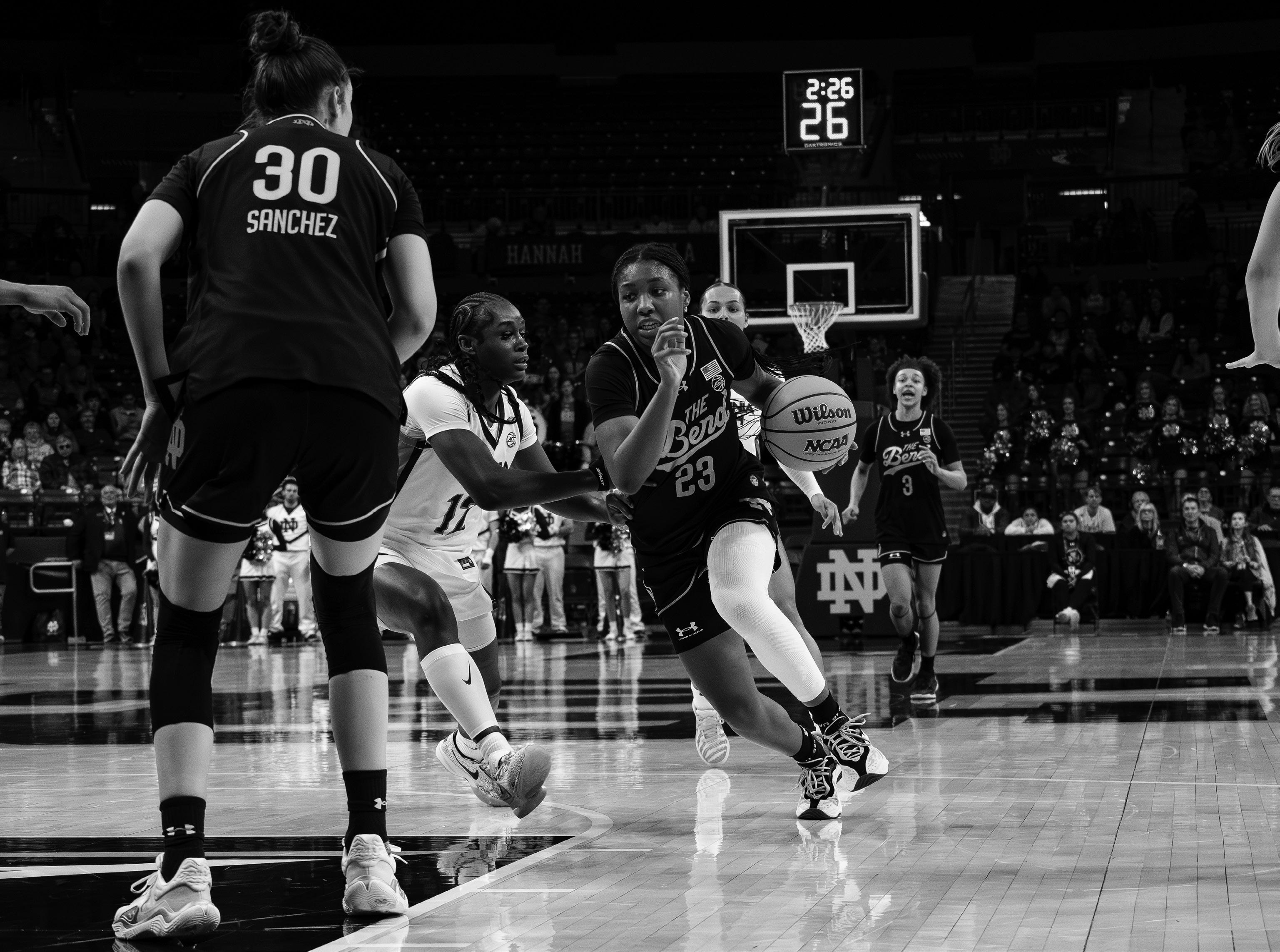
Senior guard Iyana Moore fends off Virginia Tech sophomore guard Samyha Suffren as she drives to the basket in the Notre Dame offensive zone on Thursday, Feb. 5. In the 80-70 Irish win at home, Moore tied graduate forward Gisela Sanchez and senior guard Cassandre Prosper for 14 points each, second to junior guard Hannah Hidalgo who had 16.
Notre Dame falls just short against Florida State
By Lauren Ryan Sports Writer
The Notre Dame men’s basketball team entered its Saturday afternoon tilt against Florida State with dwindling hopes of an invite to the ACC tournament bracket. Those chances fell further after a 82-79 loss in Purcell Pavilion.
Notre Dame came into the match with three consecutive losses to Virginia, Syracuse and Louisville. The Irish are just 2-8 in conference play, which leaves them out of the current ACC tournament bracket. Florida State came to South Bend at 3-6 in ACC play, but riding back-to-back wins against Cal and Stanford.
The start of the game was anything but positive for the Irish. The first Irish possession ended with a shot clock violation and Florida State’s Lajae Jones drilled a three on the other end. Little did the Irish know, that three from Jones was only the beginning of a barrage from Florida State. The Seminoles knocked down three more threes on their next three possessions, triggering an early Irish timeout.
The Seminoles came out of the timeout aggressively on the defensive end of the floor, eventually stripping junior guard Braeden Shrewsberry. They converted that turnover into their fifth made three-pointer of the afternoon. The Irish were already facing a 2-15 deficit by the under-16 minute media timeout. The Notre Dame defense had no answer for Florida State’s shooting.
Shortly after the timeout, the Seminoles knocked the ball from junior guard Logan Imes’ hands and then converted at the rim, showing their willingness and ability to attack from anywhere.
Notre Dame’s first field goal was a Shrewsberry three-pointer that came after almost six minutes of play. Overall, the Florida State defense limited driving lanes and Notre Dame’s offense looked frantic, as evidenced on their very next trip down the floor when freshman guard Jalen Haralson turned the ball over and Martin Somerville drained another FSU three-pointer.
Micah Shrewsberry said after the game, “I gotta have us ready to play from the start. I thought we were way too casual.”
By the time sophomore guard Sir Mohammed made the second Irish field goal, Florida State was more than tripling its early scoring at 7-22. After the under-12 minute timeout, Mohammed blocked an attempted FSU layup and a wideopen graduate student forward Carson Towt slammed it home for two. However, the lackadaisical Irish offense soon committed another turnover. The subsequent transition layup, a highlight-reel block from Robert McCray V and a three from Chauncey Wiggins, the life was sucked back out of the Irish.
Towt and sophomore guard Brady Koehler both missed the

front ends of one-for-one opportunities, a bad omen for later in the game. Through the next several minutes of play, the Irish showed primarily three types of offensive possessions: forcing highly contested drives late in the shot clock after a relatively stagnant first several seconds, rushing ill-advised three-pointers or getting bailed out by a Florida State foul. Meanwhile, the Notre Dame defense could not prevent Florida State’s AJ Swinton from joining the three point party.
Baskets from Mohammed, Shrewsberry and sophomore guard Cole Certa helped break that pattern, cutting the deficit to 12 by the under-4 minute media timeout. The final 3:32 of the half would be critical for the Irish, who had a little momentum on their side but could not afford to get any deeper into a hole. Shrewsberry knocked down a three to finally cut the FSU lead to single digits. Swinton answered for the Seminoles with a wildly impressive dunk, but Koehler and Mohammed together cut off an errant pass on their next defensive possession, and Mohammed went on to nail a three. Mohammed put together one of the best halves of his career providing a little energy to the desperate team. He finished the first half with nine points, a steal, two rebounds and as the only Notre Dame player with a positive plus/minus.
Florida State took a nine-point lead into the locker room. The Irish of the last few minutes were a significantly more promising team than they had been at the beginning of the game, but there was still plenty of work to do. Haralson started the second half strong for the Irish, finishing at the rim, deflecting a pass out of bounds to
disrupt a play on the other half of the floor, and then driving to convert an old-fashioned three point play. Towt also made a difficult layup and drew a foul, but missed his foul shot. A Wiggins three-pointer extended the FSU lead back to 10. In an unfortunate turn of events for the Irish, Haralson picked up his third personal foul, so Notre Dame’s most dominant player up to that point in the second half headed to the bench. Other guys stepped up to keep Notre Dame’s momentum alive, though. A made three-pointer from Shrewsberry made it 44-52 heading into the under-16. Shortly thereafter, Shrewsberry buried another three, this one from the monogram. Sophomore forward Garrett Sundra added a layup extending the Irish run to 8-0 and cut it to a one-possession game. The second half was shaping up to be a competitive battle entirely unlike the first.
Haralson reentered the game at 12:36, with the score 51-54, but almost immediately picked up his fourth personal, so his return was short lived. The stretch that followed featured both offenses in their rhythm, with FSU knocking down two threes and Notre Dame answering with a layup and a three of their own, all within less than a minute. After the under-12 timeout Certa confidently drained a corner three. Momentum swung briefly back in Florida State’s favor after Koehler turned over the ball leading to a Jones dunk, but Certa nailed another three to ensure that did not last long.
Certa scored again at 5:40 to cut it back to a one-possession game and trigger an FSU timeout. The Irish had erased 15 of what
had once been an 18-point lead, and their offense looked fluid and poised. Sundra then made two free throws. With five minutes left, the Irish were down just one, the best situation they had been in all game. Though FSU’s Alex Steen finished a layup, extending FSU’s lead back to three, the Irish still were applying pressure rather than under pressure, a radical change from the first half.
With a little over four minutes left, Haralson reentered the game, and it appeared that his nearly nine minutes on the bench had done nothing to dampen his momentum. He quickly was able to draw a foul and go 2-2 from the charity stripe. Only a few possessions later, he turned a defensive rebound into a transition dunk, giving the Irish a huge energy boost and their first tie since 0-0. However, the freshman picked up his fifth foul on the next defensive possession and exited the game for good.
Imes made up for Haralson’s absence by draining a three despite being fouled in the process. Wiggins answered to restore a twopoint Seminole lead. As minutes left on the clock turned to seconds, FSU inbounded the ball with significant difficulty against the full court pressure of the Irish. From there it became a fouling game, with the final 39 seconds lasting an eternity. Jones missed the first half of his one-and-one, and Towt was quickly fouled after he secured the rebound. Towt had yet to make a free throw, and he unfortunately extended that streak, going 0-2. Jones was fouled again, and made both attempts this time, making it 79-75. Koehler then scored for the Irish on a jumper.
Wiggins was fouled but missed both free throws, much to the relief of the Irish faithful. After Koehler secured the rebound, Micah Shrewsberry called a timeout to direct the Irish offense. FSU smartly chose to foul Towt, who missed another pair at the line.
“[Towt] has been struggling from the line ... If he catches it, we foul,” Florida State head coach Luke Loucks said after the game.
The rebound from Towt’s miss fell to the Seminoles’ Somerville, whom Mohammed promptly fouled on a steal attempt. He made one of his two opportunities, and Florida State decided to foul, sending Shrewberry to the line. He made both free throws, but then Florida State made a pair as well.
With 6.7 seconds remaining and the score 82-79, Notre Dame took their final timeout. After a well executed quick offensive play, Certa had a wide open corner three, exactly the shot Notre Dame would have wanted. Unfortunately, he just could not find the bottom of the net on that one, and a second three-point attempt from Shrewsberry likewise was unsuccessful.
The clock expired, Florida State escaping with a three-point victory and knocking ND to 2-9 in ACC play. Despite Notre Dame’s valiant second-half comeback effort and found improved offensive rhythm, they ultimately need to learn how to win tight games. The next test for the Irish will be Tuesday on the road against SMU, where they will seek to snap what is now a fourgame losing streak.
Contact Lauren Ryan at lryan5@nd.edu
DECLAN LEE | The Observer
Freshman guard Jalen Haralson hangs from the rim after scoring a dunk against Florida State on Sunday, Feb. 7 in Notre Dame’s 79-82 loss against the Seminoles. Haralson recorded 15 points, 4 rebounds and 1 assist despite playing less than 16 minutes in the contested ACC matchup.