THE INDEPENDENT NEWSPAPER SERVING NOTRE DAME, SAINT MARY’S AND HOLY CROSS
FRIDAY, MAY 1, 2026 | VOL. LX, NO. 62
FRIDAY, MAY 1, 2026 | VOL. LX, NO. 62
By Aynslee Dellacca and Berhan Hagezom Managing Editor and Saint Mary’s News Editor
While the average cost of college tuition continues to rise, room and board rates have risen faster, becoming not only the fastest in growth rate, but also one of the costliest factors in college expenses.
Saint Mary’s College is no exception to this challenge.
Not only is the College expecting to enroll one of its biggest classes in history, the administration also faces the challenge of providing enough affordable housing for its students.
The cost of room and board places an additional burden on students when it comes to choosing their housing, on top of choosing specific sections, and even needing to navigate
an entire building being closed off for incoming freshmen.
Juls White, director of Residence Life, told The Observer that beginning this year, freshmen have certain sections provided to them for every dorm on campus.
Base cost housing is the minimum total cost for room and board on campus.
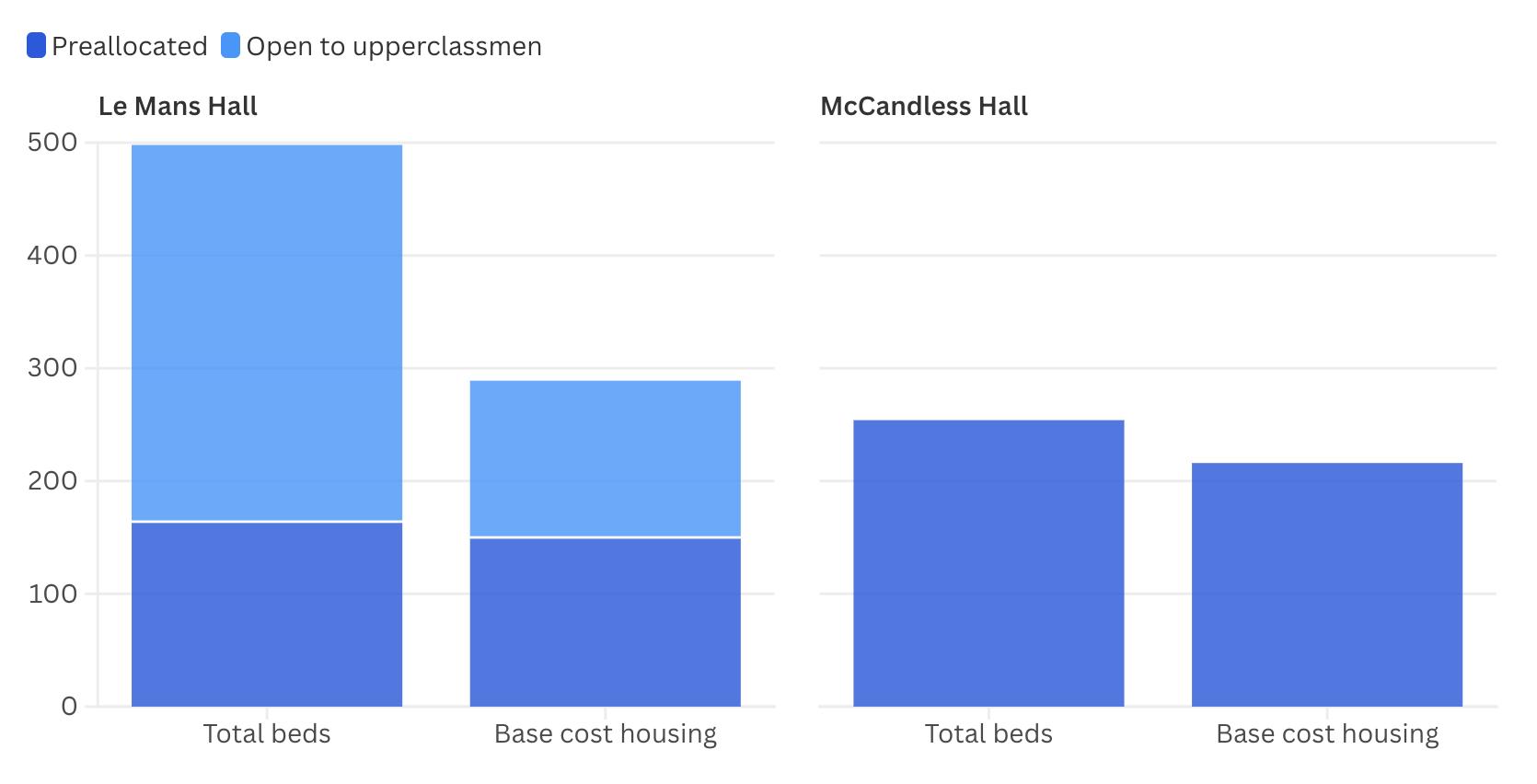
At least 40.4% of base cost housing has been pre-allocated for incoming freshmen, a review of College housing data concluded. The percentage includes base-cost housing in three halls that do not provide exact statistics on pre-allocation for freshmen: Regina North Hall, Regina South Hall and Holy Cross Hall.
During her housing selection process, freshman Adamaris Cortes planned to choose a double in the Regina Halls. Cortes said she wanted to live
in a double because the surcharges for a single are too expensive and she was told there wouldn’t be singles left for rising sophomores. However, when the time came to choose her room, there were no doubles left in either Regina Hall and very few remaining in Holy Cross Hall — causing her to take a single.
“Luckily I have a room, but I felt stressed because this made it a financial thing. Also, I was very disappointed, because why were there no rooms at all?” Cortes said.
She said many of her friends and classmates felt similarly and believed there was a lack of base-cost room availability by the time rising sophomores chose their rooms.
In Le Mans Hall, there are 109 base cost dorms out of 260 — 41.9% of rooms in the hall. Forty-eight of these are
By Mara Hall Associate News Editor
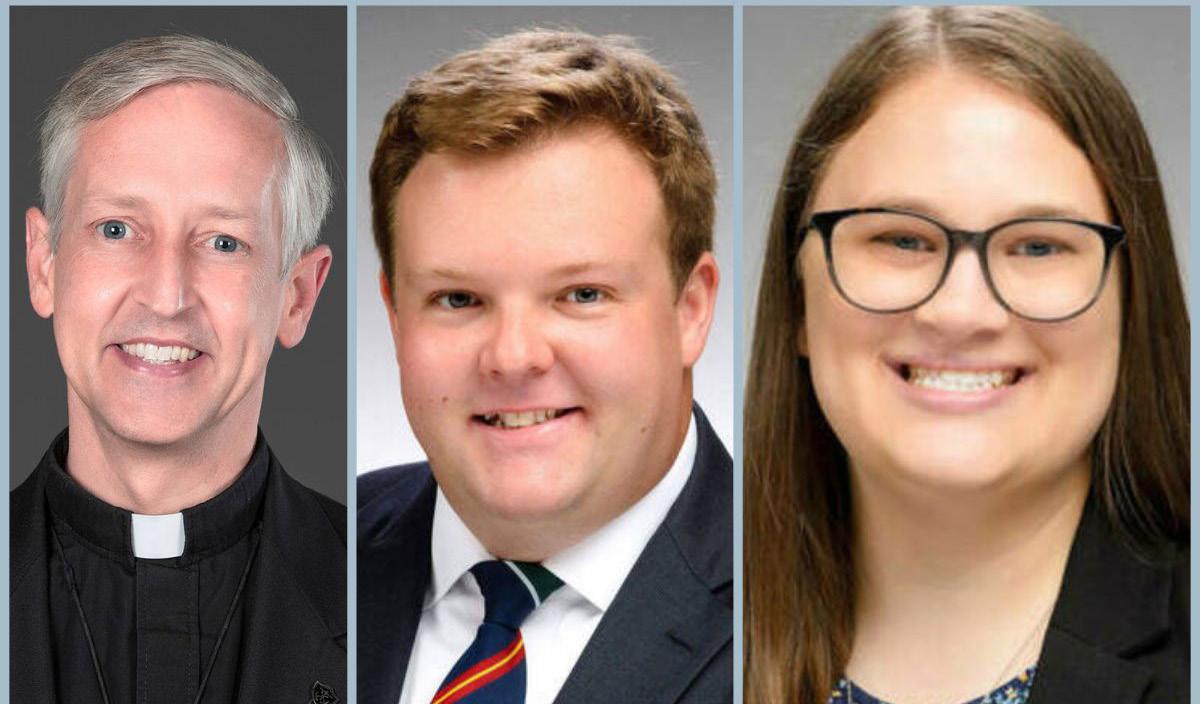
Three Notre Dame residence hall rectors, Fr. Eric Schimmel of Dunne Hall, Cory Hodson of Keenan Hall and Ally Liedtke of Ryan Hall, are set to leave their roles at the end of the academic year.
Eric Schimmel
Schimmel has served as rector of Dunne Hall for six academic years. Before taking on the role, he spent much of his time in parish ministry. When Holy Cross asked him to consider becoming a rector, he said “my initial response was that was not on my radar.”
In conversations with the Holy Cross community, Schimmel said he was reminded that he had consistently mentored young adults throughout his career. That realization, he said, helped him embrace the role and see “the beauty in the vow of obedience.”
Schimmel explained that the Congregation of Holy Cross in the United States practices the vow of obedience through annual discernment about roles and assignments for their members.
Reflecting on his time in Dunne,
| PAGE 3
Schimmel described the experience as “a tremendous blessing.”
“The men of Dunne have brought a lot of joy into my life even when they are doing things, which they think might not be as fun for a rector to have to deal with,” Schimmel said. He emphasized the joy of living alongside students and watching them grow over time as a benefit of the role.
Among his favorite traditions, Schimmel highlighted “the feast,” a dinner held near the feast day of Blessed Basil Moreau, the patron of the Dunne chapel, which brings
| PAGE 6
together current residents and alumni.
“It has been fun doing more strange things,” Schimmel said, noting he has been taped to a wall in North Dining Hall several times to raise awareness for Andre House of Arizona, a Holy Cross ministry in Phoenix where he worked for six years.
Schimmel acknowledged the challenges of the role, particularly moments of accountability and navigating university bureaucracy.
see “Rectors” on page 3
| PAGE 8
has preallocated the
reserved for incoming freshmen, meaning 44% of base cost dorms are no longer available for sophomores, juniors or seniors.
Junior Emma Paris, who plans to live in a quad next year in Le Mans, chose base cost housing, as opposed to other senior-living options
such as Opus Hall, due to the high surcharge rates in Opus and wanting to live with her friends. However, she said they felt frustrated at the lack of options available for her and her friends when choosing a room. There are 27 quads
see “Housing” on page 4
By Matthew Morin Associate News Editor
The geological sciences major’s legacy remains visible since it has been absorbed into the Earth sciences concentration in the Department of Civil and Environmental Engineering and Earth Sciences. One example is Kelsey Evans Young, a 2009 Notre Dame graduate who serves as Artemis science flight operations lead as well as the Artemis II lunar observations and imaging campaign lead at NASA.
Young returned to her alma mater April 28 for the first time since 2016 to give a lecture titled “Artemis Lunar Science” in DeBartolo Hall.
The lecture began with a video introduction to the Artemis II mission, followed by remarks from Clive Neal, professor of civil and environmental engineering and earth sciences, who taught Young when she was a student.
Young received her master’s and doctoral degrees from Arizona State University and worked at the Lyndon B. Johnson Space Center before becoming a civil servant involved in the Artemis II mission.
Young said her interest in
geology began in Neal’s physical geology class during her freshman year, where she realized geology could be used to study not only Earth, but other planets.
Young has helped develop a handheld X-ray fluorescence spectrometer and became the first science officer to sit on console in Mission Control during an Artemis mission.
Young said the Apollo missions were “generational in what they provided to lunar and planetary science.” She said Artemis builds on those missions and other lunar orbiters from the early years of spaceflight.
The mission launched April 1 from Kennedy Space Center at Cape Canaveral, Florida. Young showed the audience the mission’s flight path and said it was the first flight of the Orion spacecraft. The crew used three Nikon cameras with three different lenses to take photographs from space. They were also tasked with making verbal descriptions of what they saw and annotating their images.
Young displayed several images of the moon taken by the Artemis II astronauts, who flew roughly
see “Artemis” on page 3
| PAGE 11
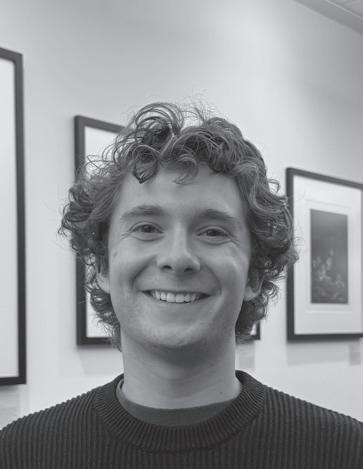
Lucas Padowan sophomore Keenan Hall
“Gen chem 2.”
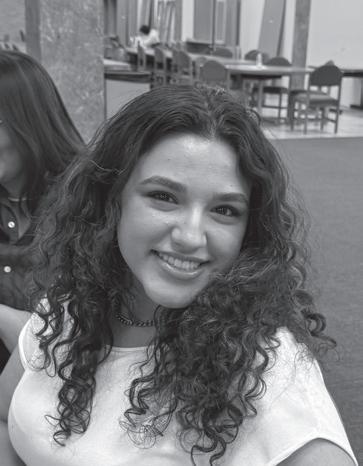
Isabella Contreras sophomore Ryan Hall “Calc.”
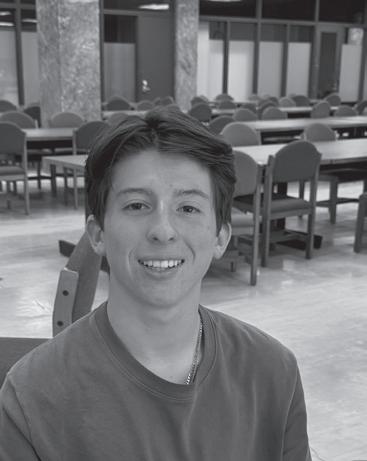
Eduardo Lopez sophomore Knott Hall “Structural mechanics.”


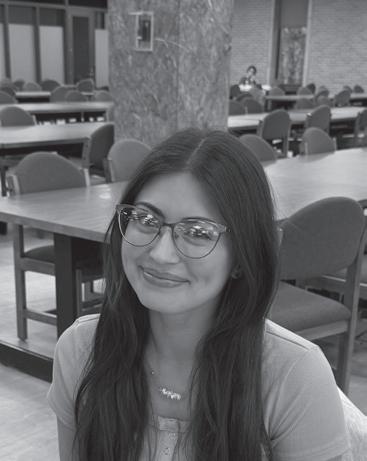
Yezenia Palacio sophomore Ryan Hall “Corporate finance.”
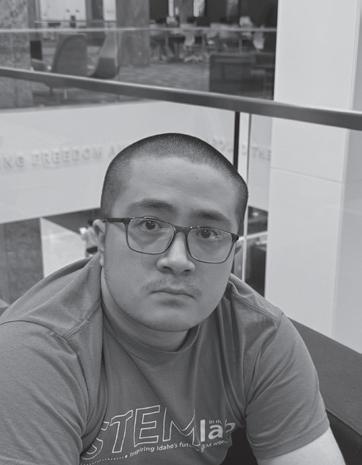
John Tran junior Keenan Hall “Intermediate mechanics.”
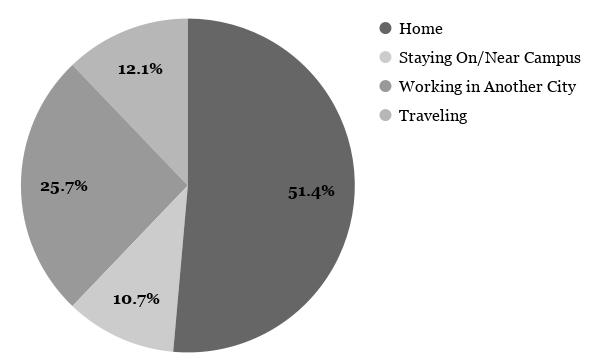
Where will you spend your summer?
Friday
Notre Dame baseball v. Stanford
The Fighting Irish face off against the Stanford Cardinal. 4:30 p.m. Frank Eck Baseball Stadium
Saturday
The Met Opera Live in HD: “Eugene Onegin” Experience this adaptation of Pushkin on the big screen. 1 - 5:05 p.m.
Sunday
Curator-led tour of modern and contemporary art Director of the Raclin Murphy Museum guides tour. 1 - 2 p.m. Raclin Murphy Museum of Art
Monday
Daily Mass
Monday of the Fifth Week of Easter. 5:15 p.m. Basilica of the Sacred Heart
Tuesday
Daily Mass
Tuesday of the Fifth Week of Easter. 5:15 p.m. Basilica of the Sacred Heart
By Andrew Poulton News Writer
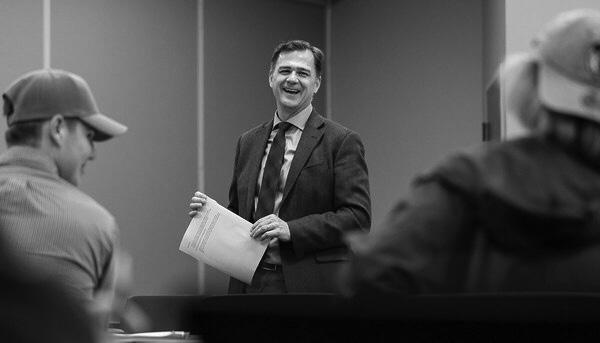
David Campbell, a political science professor and director of the Notre Dame Democracy Initiative, has been elected to the American Academy of Arts and Sciences.
Founded in 1780, the Academy was established by 60 revolutionary figures including John Adams and John Hancock, who, according to the Academy’s website, “understood that a new republic would require institutions able to gather knowledge and advance learning in service to the public good.”
The Academy has since welcomed more than 14,500 members, described as leaders in the arts, business and sciences as well as public affairs and philanthropy. These members inform public policy through prominent studies.
Campbell referred to his appointment to the Academy as a “landmark” of his career. Campbell came to Notre Dame as faculty in 2002.
“It is humbling to see your name listed among such luminaries,” Campbell said. “It is also gratifying to think that the work that I’ve done has been recognized by my peers.”
Before his election, Campbell
Continued from page 1
5,000 miles from the lunar surface. She said astronauts were able to view parts of the far side of the moon that had not previously been seen from that perspective.
The astronauts also photographed Earth before the moon flyby. As lead scientist, Young said she spoke with the astronauts immediately before and after the flyby.
Young described the Lunar Geography Review and Lunar Targeting Plan, two tools used to help astronauts understand what they were viewing and what they were supposed to photograph.
Young said the flyby went smoothly because of the training NASA put the crew through. The
Continued from page 1
“Sometimes you can feel like you are banging your head against a wall,” he said.
After leaving campus, Schimmel will serve at the Holy Cross Novitiate as assistant director of novices and is expected to transition to director of novices after approximately one year. He has also worked with Moreau Seminary and received formal training in spiritual direction.
As he prepares to leave, Schimmel said he feels both excitement and sadness.
“I am leaving behind a lot of great men who have no idea how much of the culture they have been directly responsible for,” he said.
had already done work with the Academy as a member of the Commission on the Practice of Democratic Citizenship. This bipartisan commission published a report titled “Our Common Purpose: Reinventing American Democracy for the 21st Century,” which included 31 recommendations to “strengthen America’s institutions and civic culture to help a nation in crisis emerge with a more resilient democracy,” the Academy’s website states.
Campbell explained that the recommendations focused on areas such as civic education, reform of democratic institutions, rebuilding civic society and attention to higher education. Campbell contributed to the report on higher education.
As for his future with the Academy, Campbell hopes to continue the work of promoting democracy within society. He said, “I do look forward to further work in that area, both with the Academy as an institution, but also with other Academy members, because this is a topic of great concern for many of us.”
Campbell noted the Academy is special given its lack of any ideological or organizational ties, which allows the Academy to incorporate
preparation included taking astronauts to the Icelandic Highlands to study topography, training them in camera use and preparing them for worst-case scenarios.
As the crew got closer to the moon, Young said, “you could just feel the excitement and the passion start to rush up with the crew.”
Young also described the crew’s reaction as they approached the moon.
“They had this childlike joy,” Young said.
She discussed several geologic features on the moon, including Aristarchus, an impact crater, and Mare Orientale, an impact basin. The crew also photographed “Earth-set,” a solar eclipse from the moon’s perspective and views facing away from the moon into the solar system. Young said the
Cory Hodson
Hodson has served as rector of Keenan Hall for three academic years. Before coming to Notre Dame, he worked at his high school, where he said he felt he had reached “the ceiling” of his role.
Seeking a mission-driven environment, Hodson said he was drawn to Notre Dame’s residential life system. He described the rector role as encompassing four areas: “the administrator, the pastoral leader, the university connector and the community cheerleader.”
Reflecting on his time in Keenan, Hodson described the experience as “full.”
“I think it is a place animated by a sense of authenticity and enduring humor,” he said.
When discussing his favorite Keenan traditions, Hodson
a wide range of perspectives into their research, not limited by academic discipline, university faculty or political affiliation.
He recently released a book with fellow political science professor Christina Wolbrecht, titled “See Jane Run: How Women Politicians Matter for Young People.” They found that when women run for office, teenage girls become more politically engaged, and a number of boys shift their attitudes regarding the role of women in society, thereby reversing internalized sexism.
When asked about the current state of democracy in America and the advice he would give to college-aged individuals feeling discouraged, Campbell reiterated what he told his section of his course Keeping The Republic in a recent lecture.
“We are living through strange times,” he said. “We’re seeing lots of things happening both here in the United States and worldwide that are unprecedented.”
While this may sound discouraging, Campbell noted that history gives reason for optimism, stating, “In the past, when the country has faced these kinds of challenges, the country has actually come through those often better off because people of goodwill got together and
crew also saw impact flashes on the moon.
Young said the team on Earth felt “moon joy.”
“We were so, so, so happy and full of pride and full of joy,” Young said.
During the question-and-answer period, Jack Benchik, a 1965 Notre Dame graduate, said he studied geology and worked as a lunar geologist on Apollo 11. Benchik asked about cooperation between NASA and the U.S. Geological Survey.
Young said the next goal is to create a moon base to support the “next generation of lunar science.”
Speaking with The Observer after the lecture, Young said returning to South Bend caused her to reflect on the impact of her Notre Dame education.
She specifically pointed to “the
explained that since Keenan does not have any type of common room on its residential floors, the students who opt to live in quads or “six man” rooms tend to become centers for the community.
He also highlighted formal traditions such as the Keenan Revue, which he described as a “gobsmacking spectacle in all the best ways.”
Hodson started a hall program called “monthly monday meals,” in which a group of eight to 12 residents visit Ciao’s Italian Restaurant for family-style food.
“I take a cross-section of guys. It is an event where you cannot sign up with friends. You sign up generally, and then I pick the group and make sure intentionally people are coming from different age groups, majors, sections in the building.”
During these dinners, Hodson
said, things aren’t working. We need to try something new.”
Shifting his focus to the present, Campbell continued, “We are in a period where many people are sitting around saying things are not working. And so we have a choice collectively as a society to say, well, are we just going to give up? Or are we going to do what Americans have done in the past and try to rebuild a better civil society? And I think if we’re going to build a better civil society, Notre Dame students should be a part of that conversation.”
Campbell expressed that Notre
interdisciplinary nature of the education and experiences I got here.”
“Because geology was integrated into engineering, I was required to, and given the opportunity to take, engineering classes in addition to the fundamental building block geology classes,” Young said.
Young said the department required her to take two spring break geology trips. She also took a research trip to Iceland, after which she presented at a conference. She said those experiences helped lead her to her current career.
“I think it kind of started me developing the confidence to chart my own path a little bit and not be freaked out, but rather inspired by this idea that not having a path laid out in front of you actually represents this world of
explained that they share “some authentic conversation about where we are at as a community and where we hope to go.”
Hodson will return to Massachusetts this summer, where he will work in golf operations and retail at a country club. He previously worked in retail at Brooks Brothers from 2009 to 2020. He said it’s likely he will eventually return to secondary school leadership. Hodson formerly served as a campus minister at the Xaverian Brothers High School in Westwood, Massachusetts.
Hodson described his time at Notre Dame as helping to “clarify priorities” and celebrate himself.
Dame students are well prepared to engage in productive dialogue, stating, “We have a very ideologically diverse student body, and I think that’s to our credit. I think it trains our students, gives them experience in what it means to interact with people who maybe come from a different part of the country, maybe have different views than they do, maybe have a different political perspective and yet nonetheless can rally around a common cause.”
Contact Andrew Poulton at apoulton@nd.edu
opportunity,” Young said.
Young also offered advice to Notre Dame students.
“Don’t do something just because you think that’s the right thing to do,” Young said. “Do it because you love it and you’re interested in it.”
“Not every class you’re going to take and not every internship you’re going to do, you’re going to love every second of it,” Young said. “But if you love the destination that you have in mind, it’s going to make all those other things much easier and totally worthwhile. Do what excites you, do what’s going to make you excited to go to work every day and surround yourself with people who think the same way.”
Contact Matthew Morin at mmorin2@nd.edu
While noting that he found the community in good shape, Hodson hopes that he is leaving behind a community with “a little bit more in the sense of responsibility.”
He explained that he believes empowering residents to take ownership of the community culture, from the start of their time on campus prompts people to avoid “problematic behaviors.”
Ally Liedtke
Liedtke has served as rector of Ryan Hall for five academic years. She did not respond to a request for comment.
A University spokesperson confirmed Liedtke has informed her hall community of her departure at the end of the 2025–2026 academic year. She is engaged, with a wedding scheduled for July.
Contact Mara Hall at mhall27@nd.edu
By Annelise Demers
Notre Dame News Editor
The Notre Dame Police Department has a new recruit from Texas, weighing about 90 pounds and covered in long golden fur. While Buck may not wear a badge, he is working to fill a high demand for NDPD’s Comfort K9 program.
Buck, a golden retriever, is the newest member of the Comfort K9 program, an initiative designed to support student mental health and strengthen connections between NDPD officers and the campus community. Whether he’s stationed in a student lounge, attending a campus event or walking through high-traffic areas, Buck’s presence tends to draw a crowd.
Junior Ryan Davey said his first interaction with Buck was simple but memorable.
“Very soft, very calm,” Davey said.
Buck’s path to campus began long before he arrived in South Bend. His handler, Trina Barlow, said he had already been working as a therapy dog in Texas before making the move.
“When we got here, I knew someone at the Robinson Community Learning Center and started him in the after-school program,” Barlow said. “Then we started
Continued from page 1
available in Le Mans, but only four were available for returning students.
While excited to be with her chosen roommates, Paris said they are “a little frustrated because we thought we were going to have more options to work with, and that wasn’t the case.”
Paris said the quad-style rooms still available in Le Mans were considerably smaller and felt they were less desirable than the quads now sectioned off in the second, third and fourth annex hallways. In an effort to bring attention to their frustration with Residence Life, Paris and her roommates sent an email to White asking why such limitations were in place.
“We were trying to bring it to her attention that the room selection process is very limited, that there weren’t that many options left for us, at least in our specific housing situation,” Paris said.
The next highest number of base-cost dorms can be found at McCandless Hall. In McCandless, 72% of the dorms are base cost, most of these include sinks, but not full bathrooms in each room. The entire hall is designated for freshmen. Base-cost housing options
connecting with the police department and offering him as an additional resource.”
Buck has now officially joined the department’s Comfort K9 team, helping meet a growing demand for visits across campus. The department expanded the program after seeing early success with its first comfort dog.
“We added Finn and Buck after Orla — once we saw that student, faculty and staff wellbeing was improved by Orla’s presence and availability on campus during high-stress times, or even everyday life,”
NDPD’s Molly Di Carlo, marketing program director and public information officer, wrote in a statement to The Observer.
Di Carlo said that the program began in Oct. 2024 with the introduction of Orla and has grown since then to include Finn and now Buck.
The department also has two Vapor Wake dogs, Barkley and Boomer.
While the Vapor Wake dogs are trained for security purposes, the comfort dogs serve a different role: one centered on emotional support and community engagement.
“The mission of the Comfort K9 program is to support campus mental health, provide comfort during crises or traumatic events, and enhance
are also available in Holy Cross Hall (86%), Regina North (38%), Regina South (36%) and Annunciata (27%) also offer base-cost housing. Neither Lourdes Hall or Opus Halls offer any base cost dorms.
For freshman Sarah Couri, she initially wanted a triple in Holy Cross. However, due to all of the triples being taken up prior to her selection date on April 17, she had to find a new roommate to obtain a quad instead.
The lottery system to determine when a student could even access the housing portal caused concerns for her as well.
“If you have a good time, you’re set and if you don’t, then you might not get a room,” Couri said. “There has to be a better system.”
She said she felt the housing process as an incoming freshman was easier because of a higher guarantee to have housing than it is now, despite a requirement for Saint Mary’s students to live on campus for their first six semesters.
From Couri’s perspective, “it almost felt that there were no rooms left for the people that were actually enrolled at the school.”
Contact Aynslee Dellacca at adellacca01@saintmarys.edu and Berhan Hagezom at bhagezom01@saintmarys.edu
community outreach,” Di Carlo wrote.
While the department does not track a specific number of requests tied to mental health incidents, Di Carlo noted that officers regularly respond to calls where comfort K9s serve as a resource.
“Notre Dame Police Department does see mental health calls in which these comfort K9s provide a big resource,” she wrote.
Handlers say Buck’s personality makes him especially well-suited for the role.
“He’s been a very calm dog even since he was a puppy,” Barlow said. “We knew early on he would be great for this kind of work.”
Comfort K9s are a daily presence across campus, often partnering with University departments and appearing in student spaces.
“Comfort K9s are out on campus every day,” Di Carlo wrote. “You can usually find us walking the quads or in the dining halls.”
The demand for visits continues to grow, with multiple requests coming in each day.
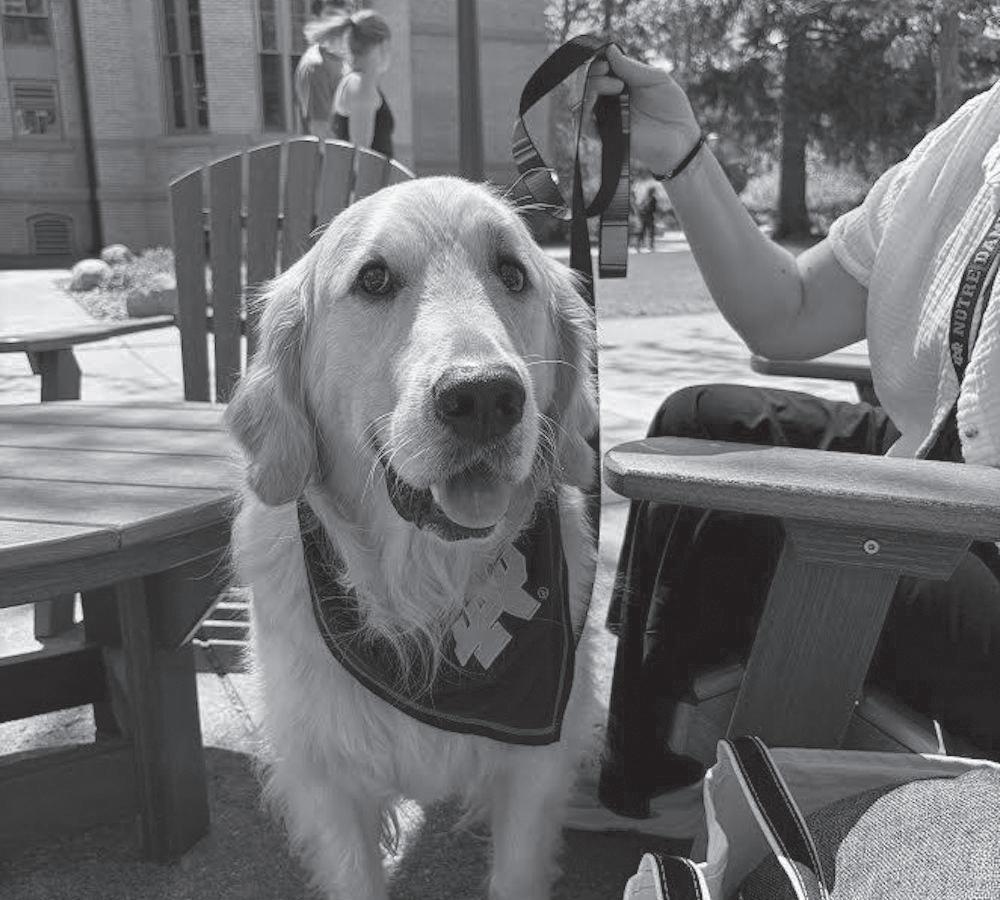
“We have multiple requests for a visit from the Comfort K9s on a daily basis,” Di Carlo wrote. “This shows that the K9s are not only valuable, but are a meaningful part of the Notre Dame community experience.”
In addition to in-person visits, the program has introduced new ways to engage students and spark conversation.
“We just began the trading card program this winter,” Di Carlo wrote. “The trading cards are a great bridge for our officers, and our comfort K9 handlers to bridge a conversation with a student, faculty or staff member. We’re getting a ton of interest from them!”
For now, the department plans to continue focusing on the current team of dogs rather than expanding further.
“Right now, there are no plans to expand the program further,” Di Carlo wrote.
The cards, which feature each of the dogs, have become popular among students. For officers, they also provide a natural opening to connect with students who might not otherwise engage with campus police.
Contact Annelise Demers at ademers@nd.edu

There is a certain irony in the fact that one of the most beloved professors at the University of Notre Dame has chosen to leave. Not because he failed his students, but because he succeeded at something the institution does not know how to value. I know, because I was one of those students.
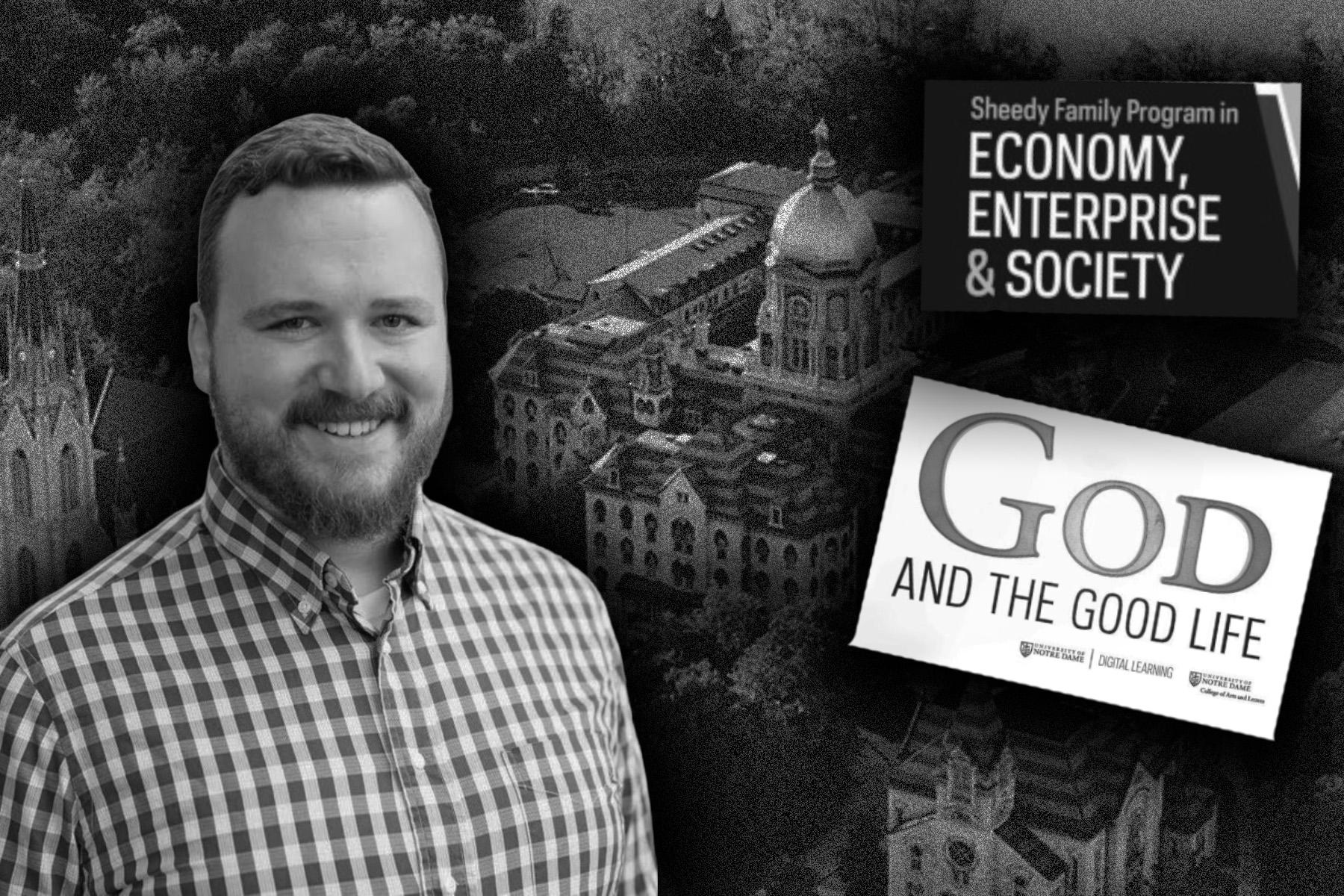
Paul Blaschko taught the most popular philosophy course on campus and, with Chris Hedlin, built the Sheedy Family Program in Economy, Enterprise, and Society from the ground up. In doing this, he did something rare: he took undergraduate students seriously. He forced us to interrogate the assumptions most of us carry around unexamined, about work, success, status and what a good life actually looks like. He assigned Bernard Suits’ “The Grasshopper,” a book in which the protagonist defends a life of play against a world that insists on the supremacy of work. He asked us why a banker is considered more valuable than a teacher, why a surgeon earns more respect than a parent, if faith can be maintained under stress and ambition and whether the metrics society uses to assign worth are the right ones at all. These are not soft questions. They are among the hardest questions philosophy has ever taken up, and he asked them in a room full of 20-year-olds who were about to make consequential decisions about their lives. This is real work, real dialogue that fosters the “formation of an authentic human community graced by the Spirit of Christ” as written in the University’s Mission Statement. Paul brought this formation to roughly 1,000 students a year, spending nearly all of his time teaching and meeting with us.
And for this, the institution gave him less each year. His promotion case was denied. The Sheedy Program, which he built and grew to more than triple its original size, is being handed to a new director. God and the Good Life, the philosophy course he co-designed that enrolled between 900 and 1,100 students per year, will be cut to 450 seats starting in 2027. And so, after 13 years, Paul has declined reappointment and is moving on. He described Notre Dame’s offer as “gracious.” He cited his own discernment, new projects and a commitment to ongoing formation. He is not burning bridges. He is simply walking through a door that the institution left unguarded by failing to deserve him. Why did they let him leave?
According to dean Kenneth Scheve, the answer is simple: This was a standard review. The program was found to be excellent, and the College simply identified room for expansion that required a social scientist as director. The associate director role, the Dean dean noted in a statement to The Observer, was “verbally offered” to Paul, who declined.
That framing deserves scrutiny, because the people who were actually in the room tell a different story.
Associate dean Mary Flannery, speaking to Sheedy students at an
information session this past week, said she “can’t tell you how really not well this all came down.” She described the rollout as “ham-fisted” and acknowledged that the dean “got going fast” and that she “tried to keep up.” She admitted that the dean “maybe didn’t appreciate that this was a little bit of a different kind of program” and “maybe didn’t quite understand the role of the director as much as in other cases.” These are not the words of an institution that conducted a careful, principled review. They are the words of an institution that moved too fast, got caught, and is now managing the fallout.
The “verbal offer” of the associate director role is the administration’s most useful piece of spin, and it needs to be read in context. The offer, as presented, was a reduction in title, a reduction in authority, and by all accounts, no reduction in workload. The person who built the program would have been asked to do more while being given less. Flannery herself put it plainly at the information session: “Once it seemed like he was going to put in someone else, then it just seemed like it wasn’t something that Paul wanted to do.” A verbal offer extended after every other door has closed is not an open negotiation. It is a decision dressed as one.
One of my fellow students at the information session put it plainly: “What it feels like now, getting a little more clarity on it, is that this new dean, up from one year, is commandeering this super successful program that, by all accounts, the students love it, it’s getting funding from the federal government and it’s most of our favorite parts about Notre Dame. And this dean is taking it, swapping it out for something else, and trying to piggyback off that success and change the direction from what it truly is, which is questioning the status quo, which is, quite frankly, what is happening to Paul right now. So the whole thing feels kind of ironic.” Flannery pushed back on the word “commandeer,” insisting the intent was to “supplement, not commandeer.” But she did not dispute the underlying frustration, saying “it’s a transition that could have
gone a lot better.”
The student sentiment in that room was not isolated. Within 36 hours of the news breaking, over 130 students signed a petition in support of Paul. It is worth pausing on that number. Notre Dame enrolls roughly 9,000 undergraduates. One-hundred-and-thirty of us mobilized in a day-and-a-half, without coordination from any administrator, without being asked, because something that mattered to us was being taken away without our input. One is left to wonder how many signatures, if any, Dean dean Scheve’s plan could attract from the people it most directly affects. The question of who a university ultimately exists to serve should not be a difficult one. At Notre Dame, the answer is written into the mission statement. One-hundred-and-thirty of us understood it instinctively.
The charge that led to the promotion denial, as best as one can tell, is that Paul’s work does not conform to Notre Dame’s implicit academic ideal. He was not publishing enough in elite journals. He was not accumulating the right credentials. He was not playing the game. This would be unremarkable bureaucratic pettiness elsewhere, but coming from the philosophy department and Arts and Letters administration of Notre Dame, it is substandard and shocking. It is a betrayal of the discipline of philosophy itself and the liberal arts more broadly.
Before entertaining that charge, consider the record. The Sheedy Program more than tripled in size over three years and serves over 100 students annually. The U.S. Department of Education awarded nearly $4 million to Paul in a grant designed to bring his critical-thinking pedagogy to college classrooms across the country. That project is expected to reach more than 100,000 students within the grant’s lifetime alone. The Wall Street Journal cited the Sheedy Program as a national model for cross-campus collaboration and student career development. At the program’s launch, the then-dean of the College of Arts and Letters called helping students understand “not just what they want to do, but
spend their careers accumulating it through the right publications, the right conferences, the right institutional affiliations. The actual value of the work to anyone outside the field is largely irrelevant. What matters is how it is valued inside it. By that logic, a professor who fills lecture halls with students whose lives are genuinely changed by the material is doing something that simply does not compute. There is no citation for a student who rethinks their career. There is no promotion point for a person who learns to ask better questions about their own life. I know, because I was that student. Paul’s class changed how I think about my own. That does not appear anywhere in his promotion file.
who they want to be” a hallmark of a Notre Dame liberal arts education, and she described the Sheedy Program as central to that purpose. And Paul has not one but two major books to his name, one published by Penguin Press and a second recently finalized with Princeton University Press. By every external measure available, this was not a professor who failed to produce. This was a professor whose work reached more people, in more meaningful ways, than most of his critics’ combined.
So what exactly was the problem?
Philosophy, more than any other field, has always understood that the most important questions are the ones hardest to quantify. Socrates never published a single paper. He walked around Athens asking uncomfortable questions and making powerful people feel stupid, and the city eventually put him on trial for it. The charge was corrupting the youth. The real offense was making the establishment look in the mirror. We have spent two-and-a-half millennia celebrating him for it.
Notre Dame’s philosophy department would have failed to promote him.
The problem Paul ran into has a name, and fittingly, it is one he taught: status anxiety. Alain de Botton defines it as the corrosive need to prove one’s worth through signals others will recognize and validate. De Botton’s argument is that modern societies have replaced aristocratic hierarchies with meritocratic ones, but the anxiety did not go away. It merely found new clothes. In academia, those clothes are publications, citations, journal rankings and grant funding. A professor’s colleagues do not respect them for doing good work. They respect them for how their work is recognized, which is a different thing entirely. Scholarship in the liberal arts, even at Notre Dame, can become not an end in itself but a points system for institutional standing.
The deeper dysfunction is one that sociologist Pierre Bourdieu diagnosed decades ago. In “Homo Academicus,” he argued that universities generate their own internal currency, what he called academic capital, and that scholars
The Observer noted that despite his research falling in line with Sheedy’s values, Clark has explicitly said that his role is to “bring in some social science perspectives.” He has also said, in the same breath, that breath, “Sheedy’s place on campus is less research oriented and more pedagogical.” That detail is worth sitting with. The administration’s own new director acknowledges that his research aligns with what the program already does, and yet the title has still been moved from a teaching-track professor to a tenure-track one. The administration has therefore replaced a teaching professor, whose entire expertise was pedagogical, with a research-track professor to run a program that the research-track professor himself describes as not research-oriented. The institutional logic is not hidden. It is self-contradicting and on the record. Flannery acknowledged as much in The Observer, noting that the shift from the director being on teaching track to tenure track is a secondary effect. Secondary to what, exactly, is left unsaid. But the effect is named and confirmed by the administration itself.
This is what makes the situation at Notre Dame so counterproductive. The University has long prided itself on its commitment to undergraduate education. It is one of the few research universities where that claim has had real institutional weight. And here is one of the few professors on campus doing exactly that, asking exactly the questions the University says it cares about, with a $4 million federal grant, a Wall Street Journal mention, two book contracts and a program that tripled in size to show for it. The institution’s answer was to deny his promotion, replace him as director of what he built and cut his most important course by more than half. There is one more detail that has gone largely unremarked. Dean Scheve has been in his role since July 1, 2025. He has been at Notre Dame for less than a year. In that time, he identified, reviewed and restructured one of the College’s most celebrated programs, replaced its founding director and did so in a process the administration itself has since acknowledged
see “Blaschko” on page 6
Continued from page 5
was not ready to be announced so abruptly. The Sheedy family, whose name and gift the program carries, was not involved in the decision. They found out from students. When one of us asked directly at the information session why there was no place left for Paul in the program he built, the answer revealed two things simultaneously. First, that the decision had already been made before any role for Paul had been considered: once a new director was chosen, there simply was not a place left for the person who built it. Second, and perhaps more troubling, that the rationale behind the decision was strikingly thin. The stated goal was to expand the program toward political science and social science. When pressed
on what that would look like, the administration’s own representative admitted she had presented Paul with “a box with a question mark in it,” telling him only that the new direction involved social science, with no concrete plan for how removing the program’s founder and director would advance that goal. Nothing had been decided. No curriculum had been designed. No vision had been articulated. The Sheedy Program’s founder was displaced in service of an idea that, by the administration’s own admission, existed only as a question mark. That is not a description of a standard review finding room for expansion. That is a description of a decision made first, with justifications still being assembled.
Paul, for his part, has chosen to handle his public departure with grace. He spoke to us at the information session about his love
for the community, his hope that the program would continue to be something genuinely rare in higher education and his confidence that what he and his colleagues built together still exists going forward. Whatever the full complexity of what happened behind closed doors, what he has chosen to say publicly reflects the values he spent 13 years teaching.
He is, in other words, living exactly what he taught us. He is the Grasshopper in a faculty meeting full of Ants, committed to something real in a room full of people optimizing for something measurable. A program dedicated to interrogating status anxiety and the tyranny of conventional notions of success has lost its founder to an institution suffering from exactly that condition. The irony was not lost on those of us in that room. It was not lost on Flannery
either, who said, “You’re not the only one who finds it ironic in this particular program that this is the way it’s going.”
We, his students, know what we got. The Sheedy Program will carry on his curiosity, his accompaniment and his purpose-driven discernment. Whether Notre Dame knows what it is letting walk out the door is a different question.
But perhaps the more important question is this: when a university systematically sidelines the professor most visibly living out its stated mission, what does that tell us about which mission it is actually pursuing?
The Congregation of Holy Cross, from whose tradition Notre Dame draws its identity, was founded on a principle Blessed Basil Moreau considered non-negotiable: “We shall always place education side by side with instruction; the mind
will not be cultivated at the expense of the heart.” It is a principle that Notre Dame regularly asks its applicants to engage with in writing before they are admitted. Paul Blaschko spent 13 years refusing to make that trade. We spent those years learning from him that the trade should never be made. The institution’s response to that refusal is now a matter of public record. The question of what it reveals about Notre Dame’s true hierarchy of values is one the University would do well to sit with, long after Paul has moved on to whatever comes next.
Bruce Alvarez Class of 2028 April 30
This letter to the editor has been co-signed by Marcello SantanaAubert, Isabella Uribe, Brian George and Matt O’Donnell.
On more than one occasion in the past few months, Mendoza has come under fire for being inauthentic to its mission to “Grow the Good in Business.” As current seniors mere days away from graduation, we’ve been fortunate enough to experience firsthand that this is not simply a slogan, but something to which the College is unapologetically committed. Any perception to the contrary is simply an oversight.
Mendoza both houses and actively champions two entities fully committed to advancing its mission: the Business Ethics and Society Program as well as the Business Honors Program. The BESP Department employs nine renowned faculty members, many philosophers or theologians by trade. The department offers over 10 courses, two fellows programs and the “Business
and the Common Good” minor. Students engage with economists like Adam Smith and Karl Marx alongside great Catholic thinkers like Thomas Aquinas and Pope John Paul II. Coursework is designed not only to educate students in business and economics, but to shape them into capable, ethical leaders.
The Business Honors Program is similarly driven, with a unique and succinct mission to engage with “the moral purpose of business and how it can contribute to human flourishing.” Students take upper-level honors courses both in and outside of their majors, receive personal and professional mentoring and participate in Colloquia with model business leaders. They take their developmental core theology and philosophy classes within the program, with an emphasis on integration
of these disciplines with a business education. Students are encouraged to examine not just how business operates, but how they might view it as a vocation in order to serve the common good. These programs illustrate Mendoza’s participation in our University’s institutional commitment to be a force for good in the world. Its guiding motto, “grow the good in business,” can be best understood in light of three key ideas it embodies, the first being that there is inherent good in business itself. Throughout human history, business has allowed us to trade and explore, expand and cultivate relationships, innovate and develop technology and improve our overall quality of life. It is fundamental to our existence as humans. In his 2013 apostolic exhortation, “Evangelii Gaudium,” Pope Francis wrote, “Business is
a vocation, and a noble vocation, provided that those engaged in it see themselves challenged by a greater meaning in life.” There exists a deeper truth that business, when rightly understood and properly practiced, is oriented toward something greater than itself, a vision Mendoza aims to instill in its students.
But the motto does not stop at recognition of the good, the second key idea being that there is room for growth. Business is not perfect, and never claimed to be. We presently face unprecedented costs of living, volatile job markets, a rise in the capabilities of AI technology and much else causing general feelings of uncertainty about our future careers. It is natural to feel disheartened and critical of modern business practices, but the real ethical shortcomings will not be overcome by renouncing
the morality of business and all those who engage in it. Instead, we face a deep need for grounded, principled leaders who will guide business in a better direction and these leaders are exactly the kind Mendoza seeks to form.
Thus, the third implication of the motto is not merely aspirational, but a direct call to action. We are not meant to avoid business because it has, for so long, been deemed immoral. Instead, we are called to embrace our duty to morally engage in it and encourage others to do the same. It won’t change unless we change it, and Notre Dame, specifically Mendoza, is where that change begins.
Class of 2026
April 30
We are proud to announce the official launch of the Notre Dame Political Union (NDPU). Our organization comes at a time when political discourse often feels heated, and people too often choose to stay silent. NDPU aims to create a space of rigorous intellectual inquiry and civil discourse.
While Notre Dame has a few political organizations, we felt that there was no safe space for students to come and have civil, structured conversations with members of our campus community. Our goal is to navigate the complexities of what American politics has become not just through conversation, but through structured, parliamentary-style debate. We believe that by coming together to have discourse rooted in Catholic social teaching and tradition, we can use faith and reason to move beyond the stalemate of resentment that too often surrounds our politics.
NDPU is more than just a debate club; we are an organization that provides mentorship and sharpens research skills. Our biweekly debates are supported by a dedicated team of research analysts who evaluate arguments based on logic, evidence and the common good. We are a nonpartisan club. There are not political parties in our debates, simply sides.
Here is why some of our board members decided to join:
“When I found out that Notre Dame’s free speech ranking was sitting at 238 out of 257 colleges in the country, with a majority of students saying they self-censor in the classroom, I thought that was ridiculous. I came to Jorden with the idea of beginning Notre Dame’s first club that fosters proactive, structured debates on a variety of different political topics that honor the traditions of the University’s Catholic social teaching. The club will be built by two
core bodies: an overseeing board and a supporting group of research analysts. Debates will be structured around teams of two to three people per week, allowing for a variety of different talking points — the audience will be engaged as well.” — co-founder/president Alex Moeller ’28
“When I was approached to start this club, I immediately knew that this was a step to solve the problem of silence on this campus. I feel that more often than not we only hear from the extremes on both sides of the political spectrum and not the average Notre Dame student. I wanted to work with Alex to create a space to do exactly that. We wanted to a place for all students from all different backgrounds and political ideologies to come and not just argue, but to actually learn from one another. We knew that the best way to do this was to use the thread that ties all Notre Dame students together: Catholic
social teaching and tradition. I cannot wait to see this club grow into a hub for civil discourse on campus, and I hope that we can use our common thread to bring people from all walks of life together for the pursuit of a common good.” — co-founder/ president Jorden Poulson ’28
“It is my pleasure to help grow the Notre Dame Political Union as a founding member and create a space where we can uphold an important component of a thriving democracy: organized, thoughtful exchange of ideas. The creation of this club is not a testament to a lack of opportunities to understand, question and educate others on experiences that contribute to policy ideas at Notre Dame. It is an expansion of this, an invitation to students who want to lead new conversations and challenge each other on a breadth of issues they are eager to touch on but that they may not have a dedicated platform to do so. A holistic education must be a
balance of building bridges and sincerely acknowledging and critiquing the why of disagreements. Students deserve to expand this acuity before they take their Notre Dame experience and leave their impact on society.” - co-secretary Chloe Younis ’27
“Once I heard this club’s mission, I knew that I wanted to be part of it. NDPU has the opportunity to create a space for students to come together to realize that we have more in common than we would originally think.” — treasurer Cindy Apolonio Romero ’28
We are looking forward to creating an open space for dialogue and cannot wait to begin our meetings this fall! Go Irish!.
Alex Moller and Jorden Poulsen
Co-founders and co-presidents Notre Dame Political Union Class of

By Matt Norton Scene Writer
I love prediction markets. They’ve challenged the idea of Vegas running sports betting and always taking a hefty commission. They’ve provided statistically significant predictors of political campaign successes and pop culture developments. But I don’t love prediction markets for any of those reasons. To me, they’re one of those things that I’m going to look back on in 50 years and be grateful I was around for just because of how chaotic and unprecedented they are/were. The opportunity to bet on literally anything is something that I don’t think we’ve truly appreciated. Even sports betting was remanded to the backrooms of bars until the past decade or so, and now the NBA shoves ads for it down our throats every game.
But the Wild West days of Polymarket might be coming to an end. This week, Gannon Ken Van Dyke, a U.S. Special Forces soldier, was arraigned in a federal court in New York on charges of fraud related to alleged Polymarket bets on Venezuelan President Nicolas Maduro’s January capture. According to the government, he won over $400,000 by placing $33,943 on Maduro’s ouster days before the operation. The government isn’t charging him with insider trading — rather, it’s charging him with misuse of classified information to turn a profit. Which pretty much sounds like insider trading.
But this raises a larger issue: What qualifies as material non-public information on a site that bets on reality? Take, for instance, the guy that recently (allegedly) used a hair dryer on a Paris weather sensor to make
$35,000 on Polymarket by spiking the high temperature. (Side note: yes, you can bet on the weather there too.) He did affect reality, I guess, by changing the high temperature, at least in the six-inch vicinity of the weather sensor, but is that truly cheating? The bets did settle, but Polymarket changed its French weather source to a more secure sensor — more importantly, French police are going after the guy, so that $35,000 will probably go to legal fees.
The larger issue I’m getting at is probably more relevant with the Special Forces soldier: Imagine Polymarket was around during the Osama bin Laden raid. I’m sure more than one Navy SEAL would have taken a moment in the helicopter to throw at least 20 bucks on bin Laden’s death. Then extend that to drone operators, CIA analysts and even politicians. If this guy
on the Maduro operation can make it work, I’m sure there are people up the chain who might be able to make bets a little more discreetly with multiple wallets and crypto funds more secure than Coinbase accounts. If so, what happens when we give people who have the power to change global dynamics an incentive to make incredibly volatile things happen? The Maduro ouster odds were literally <1% in the hours before the raid. Volatile events make the most money on Polymarket, so it might be enticing for a missile controller to break a treaty or two in the name of 100x-ing his kid’s college fund. I guess the Polymarket party isn’t really over. Yet. Right now the site exists in a weird legal gray area with the FTC, which is why you need a VPN and crypto access to make any bets within U.S. borders. Until proper regulation happens, which is
probably going to happen soon once the government realizes the tax opportunities that regulating sites like Kalshi have provided, as long as you don’t trade on classified information you’re probably in the clear.
I’d like to round this off by making a little prediction market of my own that we can all look back on long after this gets published. Are prediction markets here to stay, and if so, will they be fully adopted by entities like the Intercontinental Exchange (which has already made a huge investment in the prediction market industry), or will they keep their semi-niche user base of crypto bros on X monitoring the situation? I don’t know what the odds of any of this happening are, but there’s probably a contract for it on Polymarket.
Contact Matt Norton at mnorton3@nd.edu
By Rosie Maese Scene Writer
With the new release of the Michael Jackson movie, it’s important to recognize how the proclaimed “King of Pop” iconically transformed the pop music genre forever. His famous spunky moves like the moonwalk and unique movie-esque music videos, such as the one for “Thriller,” make Jackson a true stand-out star of the 80s. He brought a fresh, catchy energy that music was missing.
My personal favorite album of his is the “Thriller” album, which includes revolutionary hits such as “Beat It” and “Billie Jean.” This was Jackson’s sixth studio album, and became one of his most successful albums, along with “Bad” and “Off the Wall.” While some songs are better than others, “Thriller” was a beautiful addition to Jackson’s discography and put him in his own musical league.
One of my favorite tracks is “Human Nature”, which has a very classy, 80s feel to it. Jackson overlaps his vocals well, and lyrics like “I love livin’ this way, I love lovin’ this way” provide a carefree, unapologetic vibe. The verses have a subtle beat that develops in complexity and volume before climaxing at the chorus. I enjoy this musical style because I feel that it makes the chorus extra special, and the beat develops with the listener’s energy. Considering that most of the album is pretty upbeat, this song continues the overall musical precedent established by the earlier tracks.
One of these earlier tracks, titled “Wanna Be Startin’ Something,” actually sets this enthusiastic precedent, as it is the first song on the album. Jackson again incorporates his
famous, familiar background vocals, and this song is arguably the most cheerful of the album because it opens with a loud, sassy chorus. By opening with “I said you wanna be startin’ something,” he is indicating the start of the album, and ironically starting one of the most iconic albums of all time. The song puts you in a mood to dance and moves listeners to a confident, vibrant atmosphere. Personally, not only do I love this song’s tone, but it is somewhat sentimental because my mom also enjoys this song and used to sing it to me when I was growing up.
Another hit that strikes some sentiment for me is “Thriller,” because I heavily associate it with Halloween and going trickor-treating with my friends in my childhood. As children, my friends and I frequently, but poorly, attempted Jackson’s iconic moonwalk. “Thriller” has a truly thrilling vibe because the lyrics, such as “And you feel the cold hand and wonder if you’ll ever see the sun,” set an eerie tone, while the chorus has a lighter atmosphere. The verses match the zombie-esque music video and create a spooky scene for viewers and listeners. Then, the chorus talks about a “thriller” (a monster, to accompany the Halloween vibe) with a very fun beat, contrasting the actual lyrics. Jackson also created an iconic dance in the music video that added to the visual element of the music. Jackson’s ability to gauge multiple senses in his art played a major role in his pop-cultural and musical influence.
The album grapples with general themes such as fun, love and lust through a mix of songs like “P.Y.T.,” “Human Nature,” and “Baby Be Mine,” but also explores a fear factor in hits like “Thriller”
and “Billie Jean.” Jackson took artistic risks through his flashy dance moves and costumes, along with untraditionally blending certain genres. For instance, “The Girl is Mine” smoothly integrates pop and R&B. Jackson transforms his art from great to excellence with this
album by producing such iconic hits, but what truly makes Jackson a great artist is that he was able to replicate this success with his album “Bad.” Overall, this music makes me and other viewers have pure fun, showing that music doesn’t have to be relatable or even
College Professor Department of Political Science
emotional to still be excellent. I would recommend this album to anyone who wants to listen to something truly energetic, wants to dance or just wants to have fun.
Contact Rosie Maese at rmaese@nd.edu
Justin Aguiar
Nicole Aguirre
Adam Akan
Madelyn Alford
Emma Allen
Annabelle Alton
Maximilian Amend
Mason Atwell
Theo Austin
Tess Barrett
Carlos Basurto Martinez
Jalisa Batemon
Charlie Battendieri
Suplicy Mason
Ava Batz
Sofia Benigno
Evan Birks
Elizabeth Borowiak
Tess Brennan
Matthew Broder
Jennifer Cadet
Will Calder
Vincent Calzante
Jaclyn Camp
Gabrielle Canzoniero
PJ Carroll
Sarah-Jane Carten
Annie Chen
Chloe Chun
Nick Cichoski
Martha Cleary
Annie Coffey
Rocío Colón Cotto
Lizbeth Cordova Lopez
Joseph Cresson
Kaden Cunningham
Cade Czarnecki
Rachel DeGaugh
Carolyn Dell
Amanda Dempson
Eric Derr
Elena Ding
Matthew Dirlam
Amy Dorgan
Frazier Dougherty
Max Dow
Clare Duffy
Catie Ellis
Saif Elmaleh
Ashley Estelle
Christian Evans
Janet Federici
Maxwell Feldmann
Andrés Fernández Diep
Faiza Filali
Nolan Fletes
Spencer Foote
Gabrielle Ford
Brandon Foster
Madison Fraizer
Olivia Francis
Avery Gahler
Kennedy Gallaher
Mason Gallo
Libby Garnett
Lupe Garvey
Greg Gehring
Sam Godinez
Kyla Goksoy
Anne Griffin
Molly Griffith
Charlize Guerrero
Marcelo Guzman Aguirre
Kathryn Haertzen
Pierce Hand
Drew Harrell
Ty Harrington
Kathleen Healey
Olivia Heldring
Thomas Helm
Ben Herbst
Stephanie Hernandez
Nayla Hernández Ramírez
Alexis Hill
Liliana Hobday
Dylan Hockx
Carson Hruskoci
Jue Huang
Thomas Huberty
Grace Huguley
Madeline Huie
Ava Hyde
Anna Jang
Andrew Jitendran
Ella Johnson
Emily Joseph
Sandy Kang
Emi Kartsonas
Connor Kaufmann
Mary Elizabeth Kees
Jack Kelleher
Sarah Kerber
Tess Kesler
Kate Kirwan
Jacqueline Klein
Vivie Koo
Ryan Lally
Meghan Lang
Kat Lauinger
Jun Wei Lee
Emma Leedy
Cindy Liu
Maddie Long
John Majsak
Tommy Marino
Maeve Mastri
Bjorn Mauritsen
Thomas Mazzurana
Kelly McGlinn
Madeleine McGovern
Jimmy McHugh
Connor McKenna
Claire McKenna
Coby McKeown
Jonathan Mendez
Alondra Meza Camarillo
Jonathan Mikovits
Jane Miller
Maeve Miller
Kait Milleret
Tia Mittle
Mireya Monterroso
Daniel Mooney
Michael Mora
Aryana Moreau
Charlie Morris
Ryan Murphy
Aidan Murray
Patrick Murray
Edward Nagler
Jackie Nguyen
Avery Njau
Brendan Nolte
Lara Novaes Victor
Abby O’Connor
Grace O’Neill
Yara Obeidi
Kephas Olsson
Angela Olvera
Elizabeth Orchen-Bake
Naz Palines
Charlie Pehl
Matthew Potter
David Rae
Tommy Rafacz
Kate Rafford
Reid Ragsdale
Diego Ramos
Alejandra Ricardo
Miriam Rice
Bridgette Rodgers
Anna Rohrer
Nicholas Rotondi
Olivia Ruffalo
Quinn Sanderson
Carley Sapp
Monica Schleg
Noel Shabu
Kathryn Sherman
Kiki Shim
Peyton Shrader
Gabriela Sierocka
Hannah Alice Simon
Kali Spalding
Allison Srp
Anna Izabella Stachniak
Keira Stenson
Claire Stinson
Richard Sutliff
Richard Taylor
Jack Theobald
Matthew Thorn
Dorothy Tomko
Sophia Torcelino
Nicolas Tsypin
Colly Urdan
Electra Vaitsas
Mark Valenzuela
Izabella Vasquez
Joshua Velasquez
Sam Viner
Aidan Walsh
Arjun Wasan
Colson Wells
Sara Wheeler
Eva Williams
Christopher Winter
Gabi Woodward
George Enshu Xu
Taemin Yoon
Maxine Zamora
Sonia Zhang
Rain Zhang
Zach Zieleniewski
By Chris Dailey Sports Writer
The distance running world was forever changed on April 26, 2026.
31-year-old Kenyan Sabastian Sawe became the first man to ever break the sub-2-hour marathon mark in official competition at the London Marathon, clocking a 1:59:30. Finishing 11 seconds behind and also achieving the once seemingly impossible feat was Ethiopia’s Yomif Kejelcha.
And somehow, even on a day that will go down as one of the wildest the long-distance running world has ever seen, Notre
Dame still managed to make headlines.
At the Glass City Marathon in Toledo, Ohio, former Irish track star Vinny Mauri became the fourth-fastest marathoner in U.S. history in his first ever attempt at the distance.
Mauri ran 2:05:54, an average pace of 4:48 per mile.
Mauri’s effort places him among the top American distance runners of all time and seals his spot for the Olympic trials.
Just last school year, Mauri was in his second graduate season with the Irish running the 5k. Initially at Arizona State for his
undergraduate years, he made the most of his two years in South Bend and became one of the top distance runners in school history. He finished his Notre Dame career top 10 in the mile, 5k and 3000m.
However, despite his success, the idea of Mauri becwoming a world-class marathoner just a year after graduation seemed absurd.
In an interview with the Runner’s World magazine following his miraculous feat, it was revealed Mauri hung up the shoes after graduation, returned home and quickly realized he needed to be back on the trails. So, he took a

MEN’S LACROSSE
part-time job at the running store and got to work. With an affinity for long runs, Mauri hit the trails every day. Soon enough, marathon prep was well underway.
But even then, 2:05? Ludicrous.
That places him with the likes of Conner Mantz – a two-time national champion in the 5k at BYU, turned marathon savant.
A talented runner, there was no doubt Mauri could post an impressive time. In fact, sub 2:16 – the Olympic Qualifying standard – was a near surefire, especially considering his impressive 4:45 per mile pace in the half marathon.
A 2:05 though? Come on now. That’s out of this world. Mauri was a good runner in college, but he was nowhere near the level of Mantz and other guys who make up the top of the list.
It would take a perfect day for Mauri to achieve such a time.
Perhaps a better-than-perfect day.
Vinny Mauri, through the divine luck of the Irish and oldschool method of racing, received just that sort of day.
Mauri’s blazing time is an athletic feat of brilliance.
In a country where approximately 400,000-500,000 people run the marathon each year, Mauri is the fourth fastest of all time. Let that sink in.
Although Sawe and Kejelcha rightfully stole all the international attention this weekend, it was Mauri’s gutsy performance
on the roads of Toledo, Ohio, that won over the hearts of Americans.
As Mauri said in another interview with the CITIUS MAG Podcast on YouTube, the course had no clocks. Mauri explained he was just relying on his average pace and current pace on his watch. When he reached the finish line, it took him a second to realize the clock said 2:05 and not 2:09. It was then that he realized he had just ran the fastest marathon debut in American history.
The most unbelievable part of his story is that he is just getting started.
Mauri ran alone from the very first mile, without the benefit of a pack to push his pace.
During the cold Ohio winter, he trained on Planet Fitness treadmills. Now, with potential sponsors likely lining up at his door, he can devote his full attention to training for the Olympicqualifying race. And if his next marathon places him among elite competitors who can push him even further, his ceiling becomes even higher. Who knows? Maybe one day he will become the first American to break the elusive sub-2-hour barrier.
For now, he’ll relish this moment of making history in his marathon debut.
Contact Chris Dailey at cdailey2@nd.edu
By Jack Muething Sports Writer
The Notre Dame Irish men’s lacrosse team currently holds the No. 1 ranking in the country and is considered the favorite in the upcoming ACC tournament in Charlotte, North Carolina, this weekend. However, the ACC is widely considered to be the best conference in college lacrosse, and Notre Dame will have its hands full if the Irish wants to win its fourth ACC tournament crown since joining the conference in 2014.
After winning the regular season title, the Irish earned the No. 1 seed in the tournament. No matter the ranking in this tourney, though, the semifinal round will be tough, and the Irish’s opponent is no exception to that, as they face the No. 8 Virginia Cavaliers — the only team they lost to this season.
The Cavaliers have a solid offense that scores 12.93 goals per game, tied for 16th in the nation, while the Irish are just above that, scoring 13.00 goals per contest. Virginia struggles on the other end of the field, however, allowing 10.93 goals per game, compared to the Irish’s 8.27 (third nationally). Despite the weaknesses of the Cavalier defense, though, the
Irish had one of their worst offensive showings of the year in the 11-9 loss to Virginia, scoring only 3 goals in the second half and getting shut out in the fourth quarter.
The key thing the Irish need to do differently this time around see more action from sophomore attacker Luke Miller. Against the Cavaliers, Miller didn’t score despite having seven shot attempts, only one of which was on goal. In two of the Irish’s last five games, they did not reach double-digit goals, and Miller went scoreless in both matchups.
Graduate student Josh Yago was the Irish’s primary attacker at the beginning of the season, but his production made him the main focus of the opponent’s defense, leaving much of the scoring load on Miller. The Irish will need him to step up if they want to get their revenge.
Defensively, the Irish have done a solid job limiting star players this season, notably containing the North Carolina Tar Heels’ Owen Duffy and Dominic Pietramala. They also stymied Duke’s standout attacker Benn Johnston to just 2 goals on 15 shots, which helped the Irish to a win despite their offensive struggles. However, like Notre Dame,
the Cavaliers’ offense boasts multiple threats even without a centerpiece; in that first contest, all three of Virginia’s starting attackers contributed equally, each picking up four points. The Irish will need to handle that better this second time.
If the Irish are able to get past the Cavaliers, they’ll face the winner of No. 5 North Carolina and No. 6 Syracuse. Earlier this year, the Irish topped the Tar Heels and the Orange by 10-5 and 16-11, respectively. Notre Dame’s face-off dominance keyed the victory over, as starting FOGO, junior Tyler Spano, vested Tar Heels’ specialist Brady Wambach on 10-of-17 face-offs. Junior goalkeeper Thomas Ricciardelli was also a brick wall between the pipes, recording 15 saves — good for a 75% save percentage. The Tar Heels are currently the 8th-best offense in the country, scoring 14.00 goals per game, and the Irish’s ability to win face-offs and force bad shots was the main reason the Tar Heels were limited to five goals. The Irish would hope for a repeat performance from Spano and Ricciardelli in a rematch.
Despite a similar margin of victory as the UNC game, the Irish’s
battle against the Orange was more of an offensive shootout.
Even though Syracuse’s star attacker Joey Spallina had 3 goals, the Irish contained the other main attacking weapon for the Orange in Michael Leo by limiting him to zero goals on 5 shot attempts. Offensively, the Irish did what they do best and spread the scoring around.
While Miller and senior midfielder Max Busenkell each netted hat tricks, seven other Irish players contributed goals. The best offenses in lacrosse are the ones with many different weapons, and the Irish showed that in their contest against
Syracuse.
In sum, the Irish found success in ACC contests this year by containing star players, winning the face-off battle and spreading the scoring out offensively. The Irish will have a very tough game to start their ACC tournament in Virginia, and if they advance, they will play a team looking for revenge in either Syracuse or North Carolina. Notre Dame takes on the Cavaliers at 5 p.m. on Friday, and the finals are scheduled for noon on Sunday.
Contact Jack Muething at Jmuethin@nd.edu

By Ethan Laslo Sports Writer
We’re getting ready to pick you here, brother.”
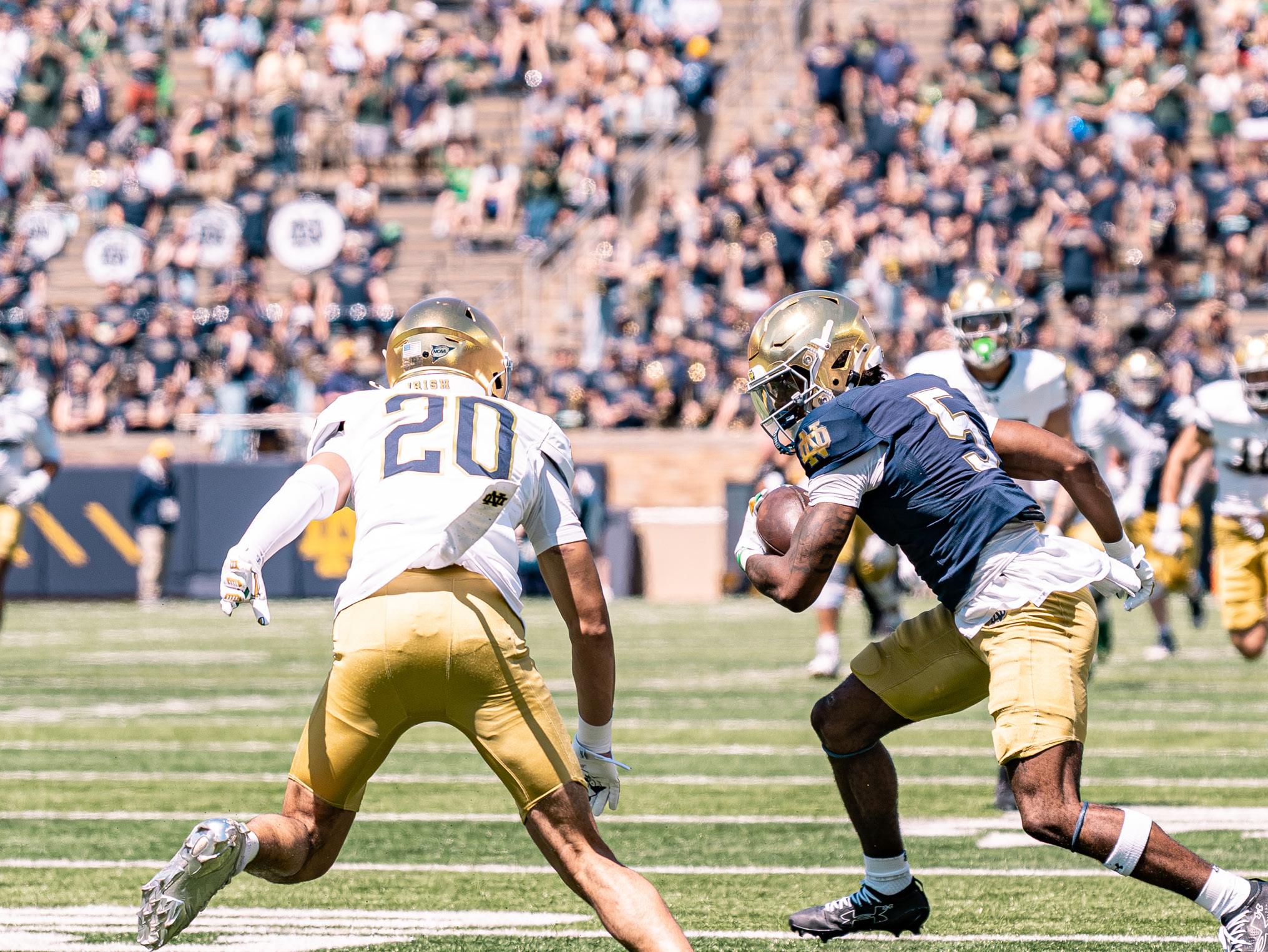
Last Thursday, Notre Dame cemented its place in NFL Draft history as the first school to feature the first two running backs selected. Although Jeremiyah Love made most of the headlines as the highest drafted running back at No. 3 since Saquon Barkley went No. 2 overall in 2018, Jadarian Price had a solid night of his own. With the first round winding down, one team still had to pick: the reigning Super Bowl champion Seattle Seahawks. In the last six months, the Seahawks have lost both sets of legs in their running back room. Kenneth Walker III signed with the Kansas City Chiefs in free agency, while Zach Charbonnet went down with a torn ACL in the divisional round. That left a wide-open running back room, and many wondered if the Seahawks would go running back at pick 32.
Then, Jadarian Price’s phone rang.
“How you doing, bud?” A voice asked over the phone. “It’s John Schneider with the Seahawks.
Schneider has become a household name among NFL general managers — he has been with Seattle since 2010 and was the primary architect in building two Super Bowl champion teams during his time there. He and head coach Mike MacDonald saw something in Price that many predicted they would.
During his time at Notre Dame, Price served as a running mate to Jeremiyah Love, as the eventual 3rd overall pick soared to unimaginable heights. Price put up impressive stats of his own, though. Over three seasons, he totaled 1,854 yards from scrimmage. He earned another 794 return yards and three return touchdowns, two of them being unforgettable ones against USC in 2023 and 2025. In fact, his 37.5 yards per return led all of college football in 2025. That return role may be a bit diminished in Seattle, as they extended superstar return man Rashid Shaheed this offseason. Fortunately for Price, he will instead arrive in a running back room where he can finally step into
the spotlight.
He also gets a prime opportunity to be the feature back with a team that values running the ball as much as any other in the league. Maybe more. In 2025, the Seahawks averaged the fourthmost rushing attempts per game among all NFL teams. Price will also have one of the league’s finest offensive lines blocking for him. After all, it’s especially difficult to win a Super Bowl without good blocking.
“The Seahawks love to run the ball,” Price explained to the media following the draft. “You see what they did in the Super Bowl and what really got them that far, winning it all, you gotta run the ball.”
Price will also be coached by a familiar face in Seattle. Thomas Hammock now serves as the Seahawks’ running backs coach, but Irish fans may instead recognize him as the former head coach of Northern Illinois, which upset Notre Dame in its home opener back in 2024. They may not have known each other well then, but they certainly do now.
“Yeah, me and the running back coach, Coach Hammock, we
had a couple good conversations,” Price said about the development of their relationship leading up to the draft. “One at the combine and then one Zoom where we just talked for about 45 minutes, just straight ball, and then getting to know each other.”
Price also highlighted that Hammock hasn’t let him forget that fateful September afternoon two seasons ago. “Every time we talked previously, so tonight, he’s always mentioned it,” Price said. “One thing he joked about, he’s like, ‘if I was y’all’s coach, I would have handed you the ball more and y’all wouldn’t have lost.’”
For many Hawks fans, the biggest questions surrounding Price aren’t necessarily his abilities running the ball. Everyone who has watched his tape recognizes his big-play abilities. Instead, his lack of experience in the pass game and blocking, along with potential ball-security issues, have been highlighted as areas for development if he wants to be a lead back at the highest level.
Price feels that he was able to successfully show off his

pass-catching skills throughout the spring at both the NFL Combine and at Notre Dame’s Pro Day. The Seahawks appear to share the same sentiment. But, the most important thing for them wasn’t anything Price showcased on the field or with the ball in his hands.
When asked about what makes Price a good fit in Seattle, MacDonald explained that “I think it comes in different forms. But, you learn about the person, about the leadership, the resiliency, the humility, just the commitment to Notre Dame by staying there.”
While Seattle may be getting a great player in Price, it’s important to note that they’re getting an even better person. Price’s loyalty to the Irish was a hallmark of his time in South Bend and was noticed by everyone around him, both inside and outside of the Irish program. It was even noticed in his draft process. Now, he finally gets his chance, and the front office and coaching staff clearly believe he is up to the task.
Contact Ethan Laslo at elaslo@nd.edu