Print Edition for The Observer for Friday, March 21, 2025
Students prepare to receive sacraments
OCIA program guides largest cohort in ND history through process of initation into the Catholic Church
By ISABELLA PONCIROLI News Writer
As Easter approaches, Notre Dame students in the Order of Christian Initiation of Adults (OCIA) program continue to prepare to receive the sacraments of initiation. This year’s program is the largest class ever recorded at Notre Dame, with 55 students taking the next step in their faith journey.
Brett Perkins, assistant director for evangelization and religious education, is the director of Notre Dame’s OCIA program. Fr. Brian
Ching, C.S.C., rector of the Basilica of the Sacred Heart, also works closely with the OCIA students.
The OCIA program was previously known as the Rite of Christian Initiation of Adults (RCIA). The Vatican announced the name change in 2021, and it took effect in 2024. The word “order” replaced the word “rite” to more accurately describe the process as a collection of rites.
“There are three steps that people go through on that journey toward becoming Catholic or getting confirmed, and so each of those
Papal secretary talks diplomacy
By SOPHIA TRAN Associate News Editor
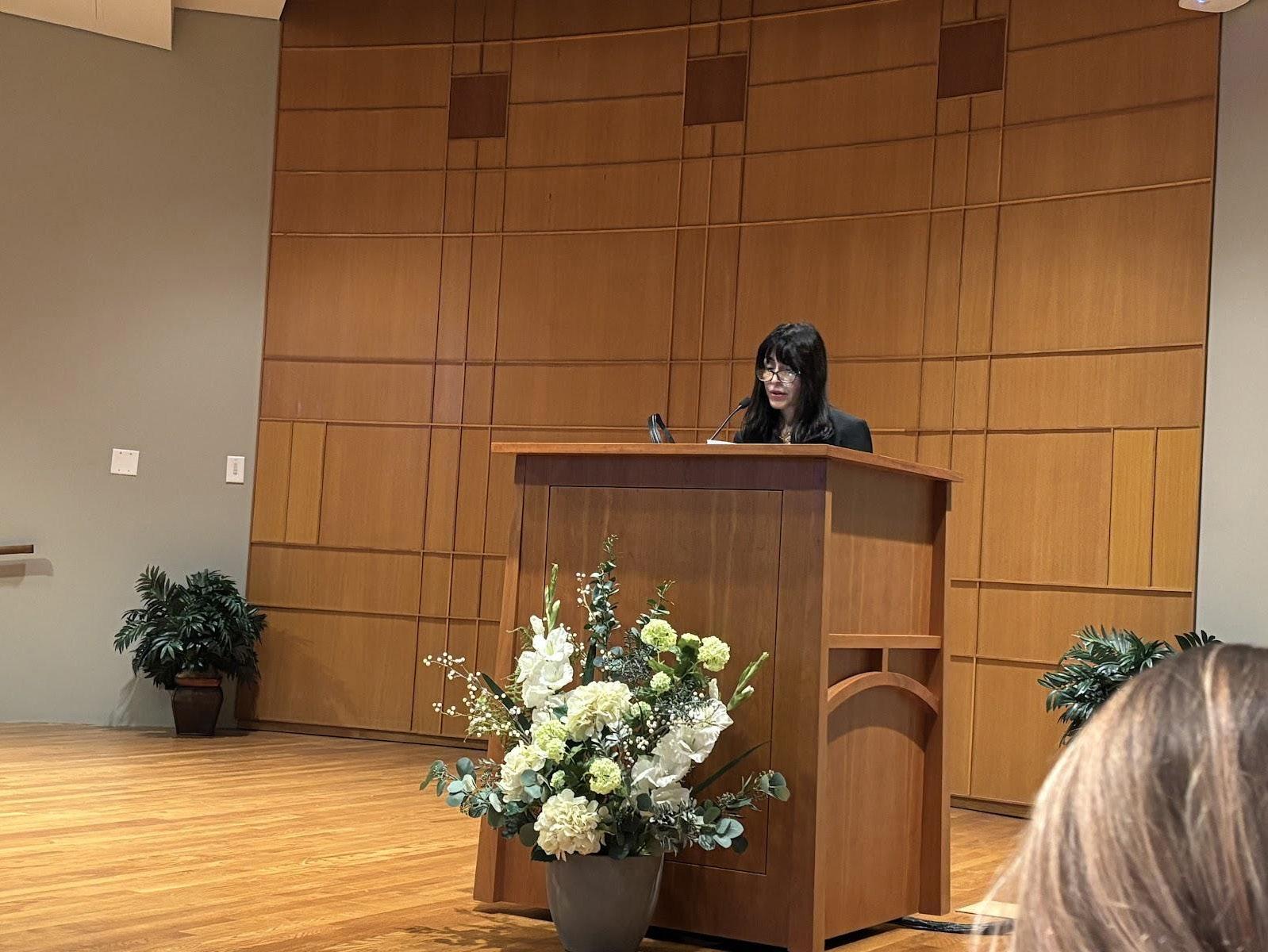
On Thursday, March 20, the Kroc Institute hosted the Honorable Emilce Cuda as a speaker during the institute’s 26th “Annual Dialogues on Nonviolence, Religion, and Peace.” Cuda serves as the secretary of the Pontifical Commission for Latin America at the Holy See and is known for her international lectures on social democracy, Catholicism and
justice concerns. Her hourlong talk was followed by lunch and an open conversation, also hosted by the Kroc Institute.
During her dialogue session, Cuda spoke on diplomacy, interdisciplinary dialogue groups and the recognition of human dignity, with principles rooted in Pope Francis’ teachings on hope. Notably, she referenced Francis when discussing the harsh reality of social justice and politics.
steps is called a rite. The fact that the whole thing is called an order now, as opposed to a rite, is a little bit more accurate,” Perkins said.
The first step is the Rite of Acceptance, an initial public presentation to the local church community by name.
The second step is a twopart rite celebrated at the beginning of Lent, the Rite of Sending and the Rite of Election. The Rite of Sending happens at every parish church, where the godparents and sponsors of the students give testimony to
Journalist speaks on Asian Americans advocacy
By SOPHIE HANAWALT Notre Dame News Editor
As part of Notre Dame’s Asian American Distinguished Speaker Series, LGBTQ+ activist, journalist and author Helen Zia spoke in the Smith Ballroom of the Morris Inn on Wednesday evening. The Liu Institute for Asia and Asian Studies, which is a part of the Keough School of Global Affairs, hosted the event, titled “Helen Zia: A Life at the Intersection of Activism, Writing, and History.” Assistant professor of American Studies Jennifer Huynh served as a moderator.
Zia, who is the daughter of Chinese immigrants and a Princeton alum, gave a detailed account of the events that inspired her to create change through her current career in journalism and life as an activist.
She was a teenager in New Jersey in the 1960s, a time when the United States was home to only about 500,000 Asian Americans and Pacific Islanders. Many of those there were “relegated to live” in ghettos that classified them by their race, Zia said.
Zia added that she “always felt like an alien” in her state, so she rarely spoke up and avoided bringing attention to herself in
school. Zia described how she frequently received the question, “Where are you from?” despite the fact that she was born and raised in the United States.
“And then, finally, if I let [the questioning] go on for a while, that might mutate into ‘your people’ – ‘Where are your people from?’” Zia explained. “And then I would have to relent and say, ‘Oh, my parents are from China.’”
When she asked the same question to white people, she usually received the response, “My people are from America, of course.”
Zia recognized that this was, in part, a failure of the American school system to educate children on the rich history of Asian Americans.
“How could I blame anybody for being ignorant about Asians in America? Back then, there were no history books that included Americans of Asian heritage [and] no classes, even at the college level, let alone kindergarten through 12th grade,” she said.
She added that, as a child, she was unaware of Asian American history too.
“I had no idea how much Asian Americans have always been part of the American people,” Zia said.
She discussed many prominent Asian Americans who invented and contributed to common food practices and industries in the United States (including the frost-resistant orange and the process of sun-drying shrimp), describing these people and their stories as “MIH”, or “missing in history.”
When Zia eventually learned these things, she was both happy to learn something that connected her heritage to the United States and sad that she had been deprived of such important knowledge for so long.
“I used to wonder, how different would life have been for me as a kid growing up if just a little bit of this had been known?” she said.
When Zia got to college, situated within the tumultuous anti-Vietnam War period of the 1970s, she began a long process of learning how to speak up. Zia threw herself into liberation movements organized by other Asian American students, first as a helper, but eventually as a speaker in a peace rally denouncing the war.
“What I [learned] was that I could speak out if I had to, and
SOPHIA TRAN | The Observer
The Honorable Emilce Cuba, an Argentine theologian, professor and Roman Curia official spoke on nonviolence, religion and world peace.
Courtesy of Sabrina Searl.
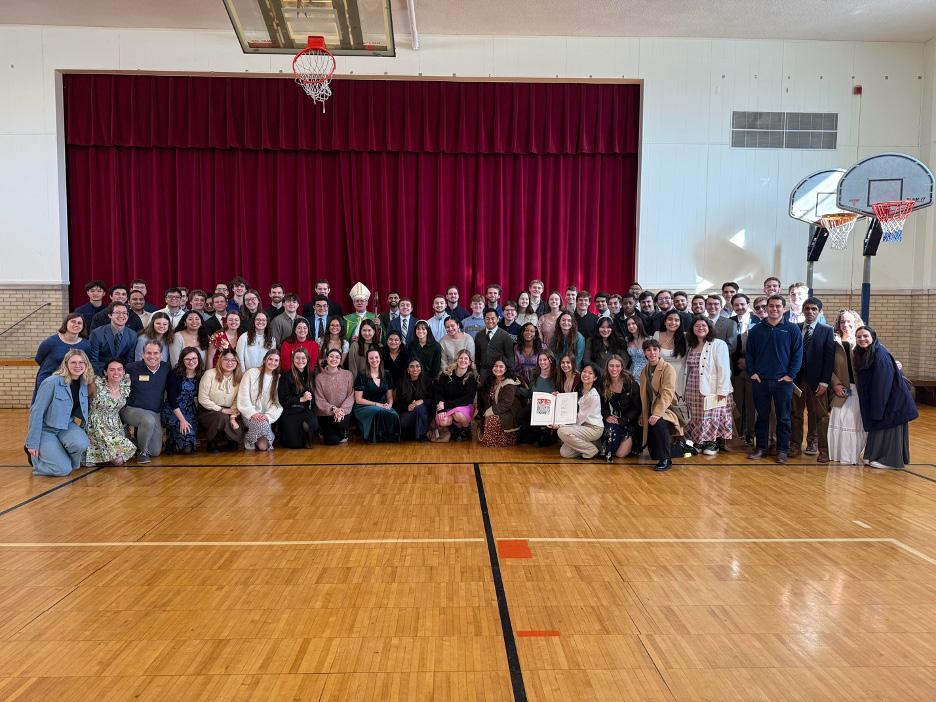
OCIA students and sponsors attend Rite of Election with Bishop Kevin Rhoades at St. Mattthew’s Cathedral in South Bend, Sunday March 2.
Policies The Observer is the independent, daily newspaper published in print and online
The
QUESTION OF THE DAY:
Kerry Jiang freshman Knott Hall “Israel.”
Jack
Lukas
Ashley Avalos junior Lyons Hall “Wedeb.”
Today’s Staff
News
Annelise Demers
Samantha Gebert
Isabel Torres
Graphics
Trey Paine
Photo
Mariella Taddonio
Corrections
Sports Noah Cahill
Scene
Jayden Espinoza Viewpoint Abby Hernan Friday
Notre Dame Glee Club concert
Leighton Concert Hall
8 p.m. - 9:30 p.m.
The Observer regards itself as a professional publication and strives for the highest standards of journalism at all times. We do, however, recognize that we will make mistakes. If we have made a mistake, please contact us at editor@ndsmcobserver.com so we can correct our error.
Notre Dame Glee Club will perform.
Catholic Social Tradition Conference (Day 2 of 3)
McKenna Hall
7:30 a.m. - 9:30 p.m.
Vatican II text analysis.
Saturday
Catholic Social Tradition Conference (Day 3 of 3)
McKenna Hall
7:30 a.m. - 1:30 p.m.
Vatican II Text analysis.
“Hesburgh” Documentary
DeBartolo Performing Arts Center
12:00 pm - 1:00 pm
2018 movie showing. Sunday
Romero Days 2025 Conference
Hesburgh Center
All day
Look at future of Romero studies.
Nathale Joachim performance DeBartolo Performing Arts Center
Tragedies of War: Images of WWII in Print Visual Culture
9:30 a.m. - 5 p.m. World War II Exhibit.
Tuesday
Lecture by Diana Solís: Orgullo de Pilsen
315 Bond Hall
5 p.m. - 6 p.m. Photography on rights.
“American Fiction” Browning Cinema,
JONATHAN KARR
The
Holy Cross Sisters issue anti-Trump statement
Observer Staff Report
On Thursday, March 13, the General Leadership Team of the Congregation of the Sisters of the Holy Cross released a statement responding to executive orders by the Trump administration. The Sisters criticized Trump’s actions dismantling of the U.S. Agency for International Development (USAID) programs, neglecting refugee resettlement programs, firing public service workers, pursuing deportations and backing down from environmental
Advocacy
that moved me one step closer to finding my own voice,” she said.
After college, Zia felt lost. She entered medical school, but left after two years, as she realized that it was not the kind of social change that she wanted to make. She began doing community organizing as her full-time job, worked as a construction worker to try to integrate the construction industry and eventually moved to Detroit, where she worked at a Chrysler plant.
“There was nothing conventional about the path that I took.
Speech
“La vida pende de un hil. Life hangs by a thread,” Cuda said. “This is the name that CELAM, the Latin American Episcopal Conference, chose as its initiative for 2025 … [quoting Francis] The reason is that a lot of people are killing, doing diplomacy for their life. This system kills.”
In her analysis of systems, Cuda explained that diplomacy and socioeconomic principles
commitments.
“These and other edicts represent a crisis of morality and compel us to speak and say that such actions are not of God. They sow fear and threaten the dignity and freedom of our sisters and brothers. They are a betrayal of the fundamental teachings of Christ, who calls us to love our neighbors as ourselves, to care for the ‘least of these,’ and to be stewards of the creation entrusted to us,” the statement read.
Following taking office on Jan. 20, 2025, Trump signed the executive
I just wanted to know how I could make some small difference on this planet with the little time that I’m here on this earth,” Zia said.
When Zia was laid off from her factory job after two years, she eventually realized that she wanted to tell the unknown stories of people she knew. So, she began her journalism career.
It was while Zia was still living in Detroit in 1982 that she learned of the brutal murder of Vincent Chin, a young Chinese American man who had been beaten to death by two auto workers. According to Zia, many people affected by the struggling economy were looking for a scapegoat, and they found
built on exclusivity and inequality can, in essence, “kill” individuals, echoing Francis’ earlier sentiments. She emphasized that elitism is a primary temptation in the modern world.
“[Francis] taught [that] every election presents leaders with two possible paths: the path that leads to global core responsibility and solidarity based on justice,” Cuda said. “The [other] path leads to self-sufficiency, nationalism, protectionism, individualism and isolation, leaving out the poorest. However, if we want to stop the violence, we
order titled “Reevaluating and Realigning United States Foreign Aid” that proposed a 90-day pause on United States foreign assistance funds, apart from those sent to Israel and Egypt, for review, arguing such funds were “antithetical to American values.”
With a recent internal memo from the Trump administration to reorganize foreign aid and federal agencies, it has led to mass layoffs of governmental workers and aid reorganization. A majority of USAID have also been let go and more than 80% of
that in Japanese Americans. Japan had recently begun manufacturing fuel-efficient cars, and factories in Detroit couldn’t keep up.
“Anybody who looked Japanese became the enemy,” Zia explained.
As the environment in Detroit became increasingly hostile and xenophobic, Zia knew that she needed to take action. Her first step was to report on Chin’s murder, so she attended a community meeting, at which multiple lawyers, as well as Chin’s mother, were present. When the lawyers said that there was nothing they could do about the judge deciding not to sentence Chin’s killers to jail
cannot continue ignoring this tragedy.”
Beyond highlighting political and social concerns, Cuda also called on individuals to develop communitarian organizations built on hope. While she addressed a variety of inequalities within society, she pointed to united communities as the solution for achieving the common good. In particular, she encouraged people to develop a new order based on solidarity through a religious lens, inviting those of different faiths to build community. Overall, she stressed
their allocated funds have been discontinued.
On Thursday, March 13, two federal judges, Judge James Bredar of Maryland and Judge William Alsup of California, called for the Trump administration to reinstate nearly 25,000 probationary workers. The majority of these workers are now placed on administrative leave, which the Justice Department described as “the first step towards fully reinstating them.”
On the same day Trump took office he also signed the executive order “Realigning the United States
time, Zia was moved to speak up.
“I raised my hand. That is something everybody can do, to raise your hand and say something,” Zia said.
In that moment, Zia said she learned that to make a difference, you have to step out of your comfort zone.
“Choosing to do nothing is also a decision, and the act of doing nothing still has consequences, too,” she added.
In 2023, Zia established the Vincent Chin Institute, which “creates intergenerational resources for the support, education and empowerment of Asian Pacific American communities
the importance of unity within democracy and warned against equating religion with politics.
“Without a coordinated mode of communitarian diplomacy, this society remains disorganized. That is the chaotic moment of the system when religion occupies the place of politics,”
Cuda said. “Better politics is coordination to act for the common good. The rest is bad politics. The better politics and the better theology are communitarian organizations.”
When discussing the role of Catholics in social work,
Refugee Admissions Program,” which declared the suspension of the program until “such time as the further entry into the United States of refugees aligns with the interests of the United States.”
On Tuesday, January 21, the Trump administration lifted restrictions on where federal immigration agencies can make arrests, now permitting arrests at schools, hospitals and churches. This reversed a 2011 memorandum, which established sensitive locations that
to stand against bigotry and to build the beloved community, especially in areas where there is little advocacy infrastructure,” according to the Institute’s website. She has also written three books: “Asian American Dreams,” “My Country Versus Me” and “Last Boat Out of Shanghai: The Epic Story of the Chinese Who Fled Mao’s Revolution.”
“I hope that by telling the stories of Asian Americans, there might be more compassion, more understanding, more seeing Asian people as humans,” Zia said.
Contact Sophie Hanawalt at shanawal@nd.edu
Cuda emphasized the need for Christians to act as diplomats for life, translating hope into concrete action. This action, she noted, reflects a united effort to protect God’s creation. She also introduced the concept of “deus mortalis,” or “false gods,” referring to leaders and individuals who build systems rooted in exclusion, opposing the ideals of communitarian organizations.
“The question is, ‘Who organizes the hope of the people in the middle of structural economic violence?’” Cuda said. “Because whoever can do it becomes the new deus mortalis.”
To counteract these “false gods,” Cuda urged individuals to seek out hope and prioritize reality over ideology. She introduced the concept of political love, which focuses on social justice and the development of policies that guarantee peace. Throughout her proposals for solutions, the themes of community and connection emerged as central to fostering profound change and hope.
“A real diplomat is a poet. It is necessary to dream if we want to stop violence,” Cuda said. “As Pope Francis tells us, to dream means to hope, like a dynamo that can convert passion into community action.”
She concluded with a call to engagement for the audience.
“Let us not allow ourselves to be robots of hope,“ she said. “Let us recover our sovereign condition as communitarian diplomats of the Kingdom, as the people of God that we are.”
Contact Sophia Tran at stran2@nd.edu
PAID ADVERTISEMENT
their spiritual growth. The student is then accepted to be sent to the bishop for the Rite of Election. All people in OCIA programs across the diocese gather for the Rite of Election.
The final step of the process is receiving the sacraments of initiation, which vary for each student.
Depending on the track a student is on, those who are already baptized will celebrate a special Mass at 2 p.m. on Sunday, April 27 to receive their First Communion and Confirmation, while students being baptized into the Catholic Church will receive all three sacraments of initiation at the Easter Vigil.
“We actually have two tracks of sacramental preparation here in campus ministry, which makes us a little unique among campus ministries and parishes as well,” Perkins said.
The first track is a yearlong process, which is typically referred to as OCIA. The second is a semesterlong process, which campus ministry calls the short course. The second track is meant for students who are already baptized, have a solid foundation in Christianity and actively practice the Christian faith.
There is one yearlong cohort and two short-course cohorts for the fall and spring semesters. The first part of the yearlong course focuses on what it means to be Christian, while the second half of the course and the semester-long courses focus on what it means to be Catholic.
“They are meant to receive people at different points in their faith journey
CONTINUED FROM PAGE 3
limited the powers of Immigration and Customs Enforcement (ICE) and Border Protection.
The Sisters of the Holy Cross issued a similar statement on this issue in 2017 where they denounced Trump’s executive orders on immigrant enforcement and refugee entry.
The Sisters of the Holy Cross urged readers to advocate for “vulnerable” communities affected by Trump’s current policies.
“The Sisters of the Holy Cross call on all people of faith, government leaders, and all those with the power to influence change to reflect on the values of mercy, solidarity and stewardship. Let us work together to build a more just and compassionate world where the vulnerable are not forgotten and where the earth is cared for as a sacred gift,” the statement read.
and accompany them as they seek to become disciples of Jesus within his church,” Perkins said. “But where we hope to get them is the same, moving toward that full commitment, active participation in the life of the church and leaning in on that relationship with Jesus.”
Demetrius Hernandez, a first-year computer science doctoral student, commented on his experience in the OCIA process.
“Something I’ve really appreciated about OCIA is the emphasis on discernment. Growing up, I often felt like questioning things about the church wasn’t encouraged, which contributed to me stepping away for a while. But here, questioning is welcomed, whether it’s in our small group discussions, with my sponsor or from the OCIA leadership. That openness has been so refreshing and has made this process feel natural rather than forced,” Hernandez wrote.
Perkins explains that people who are already baptized outside of the Catholic Church, “would be received into full communion with the Catholic Church and then have their first Communion and confirmation.”
Of the 55 students in the program this year, 27 are unbaptized and 28 are completing their initiation into the church. The OCIA process includes students from firstyears to doctoral candidates.
“Sometimes we’ll get faculty or staff, even, that will join our process, though typically, with faculty or staff members, we would try to get them connected with a local parish in town, which might better provide for the community experience,”
Perkins said.
Campus ministry welcomes people from all different walks of faith and many students come from a variety of religious backgrounds.
Notre Dame junior Ocean Leto grew up Jewish but after exploring different denominations of Christianity was baptized Protestant.
“One week, I saw a slide in my dorm’s hall council presentation saying if you had any Catholic questions to contact Brett from Campus Ministry. I met up with him with the original intent to understand the Catholic position, slay misconceptions and stay Protestant. He invited me to sit in with the OCIA sessions to further discern my faith. Throughout the process, I came to realize that God was calling me to take a leap of faith and join the Catholic Church,” Leto said.
Leto will be confirmed and receive First Communion this Easter.
The OCIA program has even had many international students who may come from places where they have not experienced Christianity. These students might come to Notre Dame for its prestigious education but end up discovering the faith during their time here.
“We had a couple of students who began the process of OCIA here as exchange students in the fall and then went back to their home universities and are hoping to continue the process there now, and so part of it was helping them find local OCIA processes,” Perkins said.
As for their sponsors, students can choose their own or be matched with another student through campus ministry.
“I chose to have a sponsor chosen for me since at the time I was trying to expand the people I knew into the area of campus ministry, and Brett Perkins put me, an athlete, with someone likeminded and similarly driven and curious, which has been increasingly encouraging,” sophomore William Wheeler wrote.
To accommodate students’ busy schedules, the OCIA program mainly meets on Sundays. The students attend Mass at the Basilica and then have a small group session afterward. They also have other events during the week, such as service experiences on Fridays and Saturdays.
“One seemingly simple thing that I have really been inspired by is the fact that they make an effort to know everyone’s name. (Without getting too sappy.) Just knowing your name also makes you feel unique and special (especially in such a large group), and it makes a big impact. It’s all the little things that the OCIA team does that make a huge difference,” Hernandez wrote.
At Sunday Mass, the catechumens — students preparing for baptism — are invited forward with their sponsors after the Liturgy of the Word. They are then sent out to study the word of God as a community for the rest of the Mass.
“The baptized evangelical or Protestant students wouldn’t yet receive holy Communion, but by virtue of their baptism, their place where they should be is at the worship, right there for the rest of the Liturgy of the Eucharist,” Perkins said.
Paige Ellis, a first-year student, views the experience of OCIA as a journey.
“We are all on this journey together, all encountering these same moments of doubt — maybe at different times — but just having that support system is so helpful and definitely makes me feel less alone during this process,” Ellis said.
After Mass, all the students and their sponsors meet at the Coleman-Morse Center for a session on a particular topic of the Catholic faith and time for fellowship with each other. Students are split into small groups to foster faith and community.
“My favorite part of OCIA has been my small group. We have been encouraging one another, having deep, thoughtful conversations and bonding strongly over our faith and different faith journeys,” Wheeler wrote. “The different minds, viewpoints and characteristics of each person in our small group have made it thought-provoking, encouraging and always something I look forward to.”
Leto highlighted how OCIA helps you answer questions you might be wrestling with in your faith.
“Notre Dame does an excellent job at encouraging questions, navigating sensitive topics and properly catechizing all of us candidates in OCIA. I wish I would have heard about this sooner and that there would be more emphasis on evangelization throughout the world’s OCIA programs,” Leto wrote. “For everyone wrestling with their faith or harboring questions, I want to emphasize the benefit of this opportunity. Check it out and see where God is leading you.”
Contact Isabella Ponciroli at iponciro@nd.edu
PAID ADVERTISEMENT
Gracie Eppler
Walking with Kaveh in the rain, I couldn’t help but think about death. The raindrops were fat and wilting, like a plastic bag sagging with pennies. He was running late, and we weren’t expecting the storm. Neither of us had packed umbrellas. I asked Kaveh what time he had gotten up that morning, and he told me he hadn’t gotten up at all. “Today is yesterday,” he said. He’d taken a red-eye from Sacramento and had not slept since reaching Indiana.
It is not every day that you get to share a storm cloud with the author of your favorite book. But at my side, there Kaveh Akbar stood, twice my height, limber as a grasshopper’s legs. Brought to Notre Dame as a part of the Literatures of Annihilation, Exile and Resistance series, Kaveh had just completed a reading of his debut novel, “Martyr!,” and now took to the rain with me. As he waited for the car that would cart him to dinner, we settled beneath the archway of the Morris Inn, both of us thoroughly sodden. I asked him my silly questions, which I would print in a silly little student newspaper, painfully aware of the fact that he’d been asked those same questions a million times before and probably a dozen times since yesterday (today). By the time he got into the car, we were both still sopping wet but smiling. He called me his “new friend,” and I flushed with pride. I confessed I’d read his book twice the week before — once on Tuesday, then again on Wednesday. He replied, “So we’ve spent a lot of time together!” I laughed and agreed that we had, even though the voice memo recording our conversation told me that, in total, our interview was a fleeting eight minutes long.
In those eight minutes, I asked Kaveh about his book, his addiction, his thoughts on heaven and his thoughts on hell too. “I’ve been thinking a lot about the death effect,” I told Kaveh. Because “Martyr!” is a book that’s all about mortality, and yet it encapsulates the intricacies of life in a way I have never read before. Protagonist Cyrus Shams is obsessed with dying, constantly pondering when his time will come and if he should bring it about himself. Cyrus — a poet and an addict — meets Orkideh, a terminally ill artist whose final creative act is to put
The death effect
herself on display in a museum in New York, allowing anyone to come speak to her.
While reading, I wondered why Orkideh’s visitors were so fascinated by her story. What makes a dying, starved artist so much more attractive than a living, well-nourished one? Why do we, as humans, all have a little bit of an obsession with death?
When Kafka kicked the bucket in a hospital outside of Vienna, no one cared that he’d written a story about a dude who woke up as a giant bug. No one knew that he’d coined a genre of surrealism that would eventually be named after him. In life, Franz Kafka was antisocial and severely miserable. In death, he is worshipped like a god.
Vincent Van Gough, Emily Dickinson and Galileo Galilei all suffered from the same cruel fate as Kafka — posthumous fame. “The death effect.” We only care about their brilliance now that they’re pushing up daisies.
“Martyr!” opens with an epigraph by Clarice Lispector: “My God, I just remembered that we die.” Death is impossible and impermeable. Earlier in the evening, in front of a room full of admirers, Kaveh said, “Just when we figure everything out, time’s up.”
If our mistreatment of Kafka proves anything, it is that we humans have a tendency to be unpunctual, to appreciate things when they’re already gone. In the most perfunctory sense of the term, as a second-semester senior, I feel like I’m experiencing something like “the death effect” myself. As my time on campus dwindles, I’ve just begun seeing everything with a newfound clarity.
It is one of life’s greatest tragedies that we are always a little bit too late. We learn to love sleep when we’ve outgrown our nap time schedule. We become grateful for the quality of our academic lectures only when we’re nearing graduation. And after all those years of yearning for more free time, at the end of our lives, we’re given much too much of it when we can least enjoy it.
Thinking about our lack of time (and our misuse of it) can become depressing. But despite the novel’s funereal title, “Martyr!” closes with a hopeful completion of Lispector’s quote: “My God, I just remembered that we die. But — but me too?! Don’t forget that for now, it’s strawberry season.”
Kaveh’s novel is more than just a commentary on life’s ending. Above all else, I think “Martyr!” revolves around the small moments in life’s middle. Fleeting yet beautiful interactions between characters prove why, day in and day out, humans continue to live despite knowing they will die.
The sky was brooding, still pelting us with droplets. We walked faster now, and the bottom of my jeans was caught in huge, black puddles. My notebook was soaked to the spine, the questions I’d carefully and eagerly composed now dripping down the page like melted Crayolas.
In response to my question about “the death effect,” Kaveh told me that he thinks that the big, eclipsing badnesses around us seem like they need big, eclipsing, monolithic goodnesses. “But my experience of life on the planet has been one where the goodnesses that have been made available to me are small and fond and local,” he said. “Here I am, talking with my new friend Gracie, and I’m going to go to dinner with my new friend Azareen and these kinds of interpersonal connections are what make the world habitable.”
Kaveh has found a cure for the death effect: relationships and gratitude. We can’t prolong our appreciation of people and experiences until after they’re gone. By then, our enjoyment is merely retrospective. Consider Vincent Van Gough’s left ear, Emily Dickinson’s rhyme, Galileo’s moons and Kafka’s bloodied kerchief — each a symbol of someone we disregarded too soon. We must recognize brilliance while it’s alive, not wait until it’s buried. There is brilliance all around us, even when our deaths seem so imminent and insignificant. There are still strawberries to eat, new friends to make and conversations to be had under shared storm clouds.
After Kaveh had driven away, the rain still fell in sloping slices like a forward slash mark. I walked back across campus alone until I heard a voice calling after me. “Come quick!” she shouted. A professor, offering me her umbrella to huddle under.
Gracie Eppler is a senior business analytics and English major from St. Louis, MO. Her top three things ever to exist are ‘70’s music, Nutella and Smith Studio 3, where she can be found dancing. You can reach her at geppler@nd.edu.
The views expressed in this column are those of the author and not necessarily those of The Observer.
Backyard barnstorming brilliance
There is an epidemic raging across this country. Hundreds of Americans are missing. In Republican congressional districts throughout the United States, GOP members of Congress have missed public town halls, dodged constituents and neglected their duties at every turn.
Congressional Republicans have been the punching bag for many of President Trump’s increasingly unpopular policies. From trade wars to DOGE, voters are making it harder for these members of Congress to defend the administration and ignore the effects they are feeling. While Republicans avoid their constituents, there could not be a more ripe opportunity for a resurgence of a united Democratic party.
Republicans
Trump and Musk’s unpopular cuts to social security, aggressive foreign policy in Ukraine and record-breaking force of executive orders drew ballooning crowds at the town halls of Republican members of Congress. Many of those who voiced their protest were Republicans who had been personally affected by Musk and Trump’s purge of the federal government for its wasteful social services. After these in-person meetings went viral House Speaker Mike Johnson concluded — no more town halls. Their agenda was so unpopular that it was a threat to their political careers for them to even discuss it with their constituents.
Still, some Republicans pressed on. A handful of members opted for virtual town halls with handpicked questions while voters protested at their offices. Other GOP members of Congress turned away constituents in favor of Republican-only town halls. Those who were brave or foolish enough to host inperson town halls bore the burden of their constituents’ rage against Trump.
The viral clips that come from the events could not paint a more dreary picture for the Republicans. One featured a veteran being dragged out of the town hall. Many showed GOP members of Congress leaving early to deafening boos from their constituents. Worse still were the town halls featuring an empty chair where the Republican representative should have been.
Democrats
It is no secret that the Democratic Party has struggled to find a winning message since their election defeat this past fall. The effect of this confusion resonated as the party that captured 48% of the national vote share this fall hit a record low of 29% favorability in a March poll. The key to the Democrat’s return to power lies in the places where Republicans are too scared to go: their own districts.
A handful of ambitious Democrats may have cracked this code already. With his Fighting Oligarchy tour, Senator Bernie Sanders started a wave of campaign-style rallies in flippable Congressional districts and swing states. Sanders’ tour stops feature sold-out crowds and a litany of young progressive hopefuls such as Rep. Alexandria Ocasio-Cortez.
Following this success, Governor Tim Walz made the promise on social media to host a town hall of his own in any district where a Republican member of Congress refused to. On the tour, he spoke to working-class voters who voted for Trump in the past but felt betrayed by the administration’s policies. Whether it is in high schools in rural Iowa or national arenas in Las Vegas, Sanders and Walz are welcomed to similar results. There is a dire hunger for a government that supports the working class.
This backyard barnstorming brilliance could not only be the path forward for the Democratic Party at large but a rewarding road for those who walk it. Doing town halls in the swingiest cities and states in the country is a surefire way to boost one’s national name recognition for potential future endeavors. Similarly, these meetings are a fantastic tool to find the earliest
donors and super volunteers needed to build a political operation. For those in the audience, the Democratic town halls may strengthen the area party operation and inspire the next generation of local leaders.
The truth is Democrats have a long way to go to return to the majority, and even sold-out town halls are not going to reach every voter. The good news is that these town halls are no longer limited to the liberal Twittersphere but rather the focus of a united Democratic Party. Together with the Democrat’s rebrand back to the donkey, the party launched the People’s Town Halls in an effort to bring voters together in swing district town halls. In some of the same places, Democrats are targeting “coward” Republican members of Congress with ad campaigns bashing them for avoiding their constituents. By all measures, new DNC Ken Martin is all-in on the places where Republicans have come up short.
Republican members of Congress are missing while their constituents bear the burden of Trump’s policy failures. The administration is waging a war on many of the things Americans are proudest of, and GOP members of Congress are the pawns in this game. If gutting social security, cutting ties with our allies and funneling money to the wealthiest Americans is the hill that Republicans want to die on, Democrats need to get out of the way and let them. There could not be a more natural moment for a strong Democratic Party to rise up in opposition to President Trump and Elon Musk. They just need to go where Republicans aren’t: their own districts.
Jack is a proud Michigander, a small-towner, a man of Fisher, a senior, and a licensed boat captain in that order. He enjoys gritty Midwestern football, planespotting, and speechwriting. If you are in urgent need of his consultation or would like to berate him, he can be found frolicking about campus or via email at jsirian2@nd.edu.
The views expressed in this column are those of the author and not necessarily those of The Observer.
The Soapbox
Jack Sirianni Political Paraphernalia
To my many homes and my many moms
Sometimes, I wish home was so close, so familiar, that I could enjoy the privilege of taking it for granted. But for me, an international student on scholarship, going home is a luxury. Going home to the love of my family is more expensive than listening to the ocean in Florida, than walking down the quiet streets of California with my best friend, than singing hymns with the liturgical choir in the great cathedrals of France. Home is a precious gem, a price that gleams far away down the road at the end of each long year.
My first fall break at Notre Dame, I stayed in my dorm. And I almost smothered in the silence, the loneliness, the nothingness of those nine days.
So when Shelin Aunty invited me to celebrate Thanksgiving at her house, I said yes. I said yes, knowing that this was not my home, that she was not my mom.
“But at least, you can get away from campus for a little while,” I told myself as I found myself confronting the curves and edges of this new space. “At least you’ll have someone to talk to in your mother tongue!” I told myself, as I dutifully played the role of the polite guest. At the end of the short break, I came away with polite thank yous on my lips.
The summer after my freshman year, Shelin Aunty came to my rescue once again. I was working in South Bend but had nowhere to live. Aunty generously invited me to stay with her for a month.
Each day I spent with her, my footsteps grew more confident on the carpeted floor of the house, and my hands
began to reach with assurance for my chair at the dining table. Shelin Aunty made me tomato rice, prawns curry and chickpeas “because your mom told me you like them,” and my thank yous became shining eyes, lips that quivered into a smile. I found myself offering funny, crazy, vulnerable stories from life at Notre Dame. I found myself singing to her as she listened quietly. I found myself feeling at home in a house that was not mine.
Shelin Aunty’s was the first home that found me.
Then, another time, when home felt so far away, Ambili Aunty came into my life. As I stepped into the warmth of her house, she took my hand and said, “Welcome home!”
I knew that she was nothing more than my mom’s old friend, an almost-stranger, offering help to a girl who was far away from her family. But then we laughed together over Indian memes. But then I discovered the badass Indian feminist in her. But then she made me the best avocado sandwiches I have ever had. And she became someone dear. And then, she taught me to make rice, and then she took my hands in hers and taught me to tie my hair in a ponytail. And then she became a mom to me. I have been homed and mothered by so many people, and it took such a long time for me to recognize the truth that I am so privileged, so blessed. I did nothing to deserve the love that I continue to receive.
Shelin Aunty is, after all, just an Indian woman living in South Bend, whose only connection to me is that she speaks my language. Cathleen Aunty is just my roommate’s mom. Jibi Kochappan was once merely that uncle who occasionally visited India with American candy for us kids. None of these individuals are restricted by the rules that govern close family ties or the conventions of polite individualistic society to shower me with Christmas gifts,
make audio descriptions for movies on the spot, teach me to braid my hair or guide me by the hand as I strive to find roots in a country and place that is not fully mine. I don’t know why they choose to make themselves into homes for me. But they just do, again and again.
Once, when these people were little more than strangers to me, I thanked them with hesitant politeness. Now, I hold them in my heart, and I know that my gratitude is not enough, it will never be enough. It is hard to accept the truth that in this relationship — I am chiefly a recipient. I have very little to give. Even as I know that love such as theirs demands or expects nothing from me, it still feels hard to know that I can never truly repay them.
But perhaps gifts of love such as these are not meant to be given back; perhaps they are meant to be passed forward. So I will cherish my love, my gratitude for my many homes, in my heart until it is time I meet a girl like me, who stands looking on with wistful eyes as her friends go home to their loved ones. When I meet this girl, I hope I will take her by the hand and call her “mole” (daughter). When I meet this girl, I hope I will be brave enough to make myself into a home for her.
Hannah Alice Simon was born and raised in Kerala, India, and moved to the U.S. for college with the dream of thriving in an intellectual environment that celebrates people with disabilities. On campus, you will mostly see her taking the longest routes to classrooms with her loyal cane, Riptide, by her side. She studies psychology and English with minors in musical theatre and theology. You can contact Hannah at hsimon2@nd.edu.
The views expressed in this column are those of the author and not necessarily those of The Observer.
Do not read this letter, pt. II
left from right, up from down, this way from that way. A slight panic begins to set in; you try to suppress it, but it rises, it rises, oh, how it rises!
To the one brave enough to step out into the night, If you have not yet read pt. I of this letter, please do so here — otherwise, the contents of the following correspondence will appear incoherent.
If you did read pt. I, you’ll recall that we left off just as you were slipping on your winter boots and “stepping out into the night.” As you do, the cold washes over you in an instant, sending bone-chilling shivers up and down the whole of your being. The sidewalks are totally covered in snow — three to four inches at least, and the flakes are beginning to fall harder. As you walk, the storm intensifies. You flip on a flashlight, but it does little good. The wind howls, angrier now than before, as if it sought to deter your endeavor. But try as it may, no force of nature can quench the fire now ablaze inside of your heart— a fire stoked by nothing but the invincible power of love. This kind of love, which at present propels you dauntlessly through this storm is not, however, romantic, nor filial nor platonic. No! — this kind of love is radical, irrational and utterly absurd. This kind of love, no half-decent therapist or life coach would ever prescribe, because it is antithetical to the whole of your biological complexion. This kind of love, it says: to hell with biology! To hell with science! To hell with reason! To hell with that selfish materialism that infects so much of modern life (and no, I don’t speak of consumerism)! This kind of love refuses modernity, refuses wealth and innovation, refuses society and all of its wicked conventions and laughs in the face of that clinician who prescribed unbridled self-satisfaction as the key to happiness! Finally, this kind of love rejects that which is finite, and in embracing all of humankind — most especially that poor woman, stranded somewhere in this godforsaken blizzard — becomes infinite, eternal — this kind of love, it cannot die! Truly, He said to you, whatever you did for one of the least of these brothers and sisters of His, you did for Him!
Then, barely audible above the shrieking wind, you hear her. “H…help…help me…HELP ME! You hurry down a back alleyway, but her voice only grows fainter; soon to be overtaken by the wind entirely. You’ve begun to lose track of time. “How long has it been? Forty-five minutes? An hour? Two?” Not only that, but you’ve become rather disoriented — the snow obscures
The blizzard worsens, but the flame inside your heart, kindled by your most sacred love not for self, but for another, it yet flickers. You cling to this last bit of warmth, beseeching it to light the way, to bring you to her. You search entryways, alleyways, benches, bus stops, but to no avail. Soon, nervously retracing your steps (since filled in by snow) and glancing around in search of familiar scenery (of which there is none—the blizzard obscures all), you resign to the fact that you’ve lost your way. Accordingly, that flame which hitherto raged falters, and perceiving the situation to be hopeless, and your search for the poor woman a futile one, you stumble, reach out a hand to catch yourself, then decide against it, and collapse into the snow. Your heart goes cold. Shivering all over, but caring not for your wretched condition, you slip out of lucidity and into a semi-conscious, dreamlike state.
In this state, you dream that you are God, looking upon a universe devoid of love. Bored, you decide to take the form of a man, and in visiting earth, you encounter an individual who has staked their entire life on the belief that radical love is the only force which has the power to transcend death and, in doing so, bring meaning to life. And you feel sad, because you realize that this person is you, and that this universe devoid of love is your universe. “But how could the universe be devoid of love?” you wonder, perplexed. “I’ve never experienced anything more real than the love I felt towards that poor woman…how could it be an illusion?!” So, still dreaming, still taking the form of God, you call upon your omniscience (so as to produce an answer), and discern that love in this universe is merely a means to an end; a useful tool by which the survival and reproduction of the human species is ensured—well, not really the human species; rather, the DNA inside each individual member of the species, for neither the individuals themselves nor the species matter; the universe itself is ambivalent to them both; it cares not whether they die or live; whether they hate or love.
Then, as God, you reflect on the nature of your own existence, and realize that the only reason you came into existence way back when, at the very dawn of space and time, was because those individual members of the human species, not to be outdone in foolishness, loved one another to such an unadvisable degree that they decided to place their hope in you, the
greatest of all beings — you, who could then validate that love; you who could then make that love come true; you who could then make that love last forever. Upon realizing this, a wave of terror rushes through you, because you gaze upon the state of human affairs, and see that individuals no longer prioritize that foolhardy yet wholesome love of fellow man. What’s more, you (the human version), in loving that poor woman, were the last person to place their faith in that love which had, way back when, at the very dawn of space and time, allowed God to exist. And now that your faith has been vanquished, God, as you have dreamed him for the last indeterminate interval of time, is dead.
Immediately upon the death of God, you slip back into lucidity. The snow continues to fall, now covering most of your limp body, which is, for all intents and purposes, also dead, though your organs cling to life, much like a patient in an irreversible coma — such is the effect of life devoid of love. An unknown interval of time passes. You begin to feel something… something warm… “a blanket, possibly?” Then, a pair of arms wraps around your torso and pulls you towards their own. The stranger presses tightly, clinging to you, and in that moment, a flicker of warmth passes between the two of you, like one candle, still alight, providing the flame for another, since vanquished. You begin turning your head, but in that very moment… You wake up. You’d fallen asleep on the edge of your bed. The shade is propped open just a touch. You peek outside — it’s dark, and still very much snowing. You sit up, covered in sweat. Feeling compelled, but for a reason unknown to yourself, you walk over to your desk, open your journal and jot down the following:
I didn’t save her. She saved me.
With hatred still very much in my heart,
T.W.
Jackson is an aspiring philosopher and nomadic freespirit. He is currently wandering through an alpine meadow somewhere in Kashmir, pondering the meaning of life. If you would like to contact him, please send a carrier pigeon with a hand-written note, addressed to “The Abyss.” He won’t respond. (Editor’s Note: you can contact Jackson at jlang2@nd.edu)
The views expressed in this column are those of the author and not necessarily those of The Observer.
Hannah Alice Simon Views without Vision
Jackson Lang Letters from The Wanderer
By HARRY PENNE Scene Writer
“Doctor Who” is one of my favorite television shows. Growing up, I remember following Doctors Smith and Capaldi during their initial runs, but it’s crazy to think that the “New Doctors” aren’t quite “new” anymore. “Doctor Who” is over 60 years old; it premiered on the BBC on Nov. 23, 1963. “Classic Who” ran until it was canceled in 1989 by the BBC; however, the time-traveling alien could not be stopped! In 2005, “Doctor Who” triumphantly returned, and unlike its often cheesy low-budget predecessor, “New Who” modernized to meet contemporary standards. For many, especially Americans, this was their “Who.” The first season of the reboot starred Christopher Eccleston as the ninth Doctor and Billie Piper as his companion, Rose Tyler. The series was spearheaded by Russel T. Davies, current showrunner of the 2025 season, airing in April.
“Rose,” the reboot’s first episode, is a perfect introduction to the show. Audiences don’t need any knowledge of “Doctor Who” coming into this season; it is a fresh start and a perfect jumping-in point. Audiences follow Rose Tyler going about her daily routine in London, until, by mere circumstance, she encounters living store mannequins and a mysterious man with extraterrestrial technology who merely tells her: “Run.” Rose gradually unravels the mystery of the mysterious man
known only as “the Doctor” in a masterfully paced setup and reveal. One of the most rewarding moments in the episode is when the TARDIS, the Doctor’s spaceship and time machine, which has the exterior form of a blue police box but is bigger on the inside, is finally revealed. Having been teased throughout the episode, it is shown in its entirety when Rose enters. In the climactic finale, the Doctor identifies living mannequins as Autons, a monster from the 1970s era of the show. By the end of the episode, audiences have been introduced to aliens, the TARDIS and the Doctor himself. What makes the episode great, in my opinion, is that it’s told from the companion’s perspective; the audience uncovers the mystery with Rose. The build-up to the Doctor is intense but rewarding, prompting curiosity and excitement for the rest of the season.
Following “Rose,” the Doctor and Rose travel to the far future – the end of the Earth – crashing an alien spaceship party. In the next episode, the duo travel to Earth on Christmas Eve 1869 where they meet ghost-like aliens and author Charles Dickens. The setup of going from the present to the future and then the past is a perfect series statement and hook. Audiences are treated to both aliens and historical figures, which is quintessential “Doctor Who,” setting the tone and expectation of what is to come (20 years of time travel, alien planets and monsters).
For a show with such a deep history, it is daunting to try
and bring back monsters from the past to an audience with no knowledge of them. “New Who” tackled this challenge masterfully, not relying solely on the past, but introducing new characters and villains amidst the retro monsters. It walks the narrow bridge of nostalgia and innovation, finding a healthy balance between the two. Arguably, the most important classic villains introduced in this season are the Daleks, who serve as the main antagonists in the series finale. The Daleks, in the show’s run, have been a staple and fan-favorite since 1963, fighting every single Doctor.
Eccleston only had one season driving the TARDIS, regenerating into David Tennant’s tenth Doctor at the end of the finale. Eccleston has not returned to “Doctor Who,” rejecting appearances in anniversary specials. However, in recent news, Eccleston and Piper will reprise their roles as Doctor and Rose via “Big Finish” audio dramas. While not the main program, it does provide some hope for his return to the TARDIS one day.
The 2005 “Doctor Who” revival is classic television and revitalized the “Who” brand and image. Managing the difficult task of bringing a nerdy low-budget sci-fi show mainstream and to international audiences, it was successful in building a fandom as “Doctor Who” is going strong into its twentieth modern year.
Contact Harry Penne at hpenne@nd.edu
By ANDY OTTONE Scene Writer
Word-of-mouth marketing can do a lot for a film; certain features like “Rocky Horror Picture Show“ and “Napoleon Dynamite“ got their modern notoriety because of friends telling friends to see these movies in decades past. Social media, nowadays, can do a lot of that same legwork. Even if it’s just posts asking, “There’s a Looney Tunes movie in theaters right now?”
“The Day the Earth Blew Up” is a new film featuring Daffy Duck, Porky Pig and the traditionally sidelined Petunia Pig, and it is the first fully animated Looney Tunes movie to be released in theaters that isn’t made up of pre-made shorts and segments. Frankly, it’s a miracle the film even exists at this point. Originally produced for Cartoon Network and streaming services, Warner Brothers’ studios decided to effectively trash the film after it was completed, unless a company was willing to buy it out for distribution. That is exactly what Ketchup Entertainment has done.
“Blew Up” is a fun, silly, family-friendly movie that retains a lot of the heart of older Looney Tunes cartoons, with an updated setting and premise. Instead of the classic cartoon set-ups, Daffy and Porky are presented as adopted brothers and best friends, living in a somewhat logical reality (though Daffy still has his giant wooden hammer).
While the film maintains the tone and energy of a Looney Tunes short, the plot takes its inspiration from 1950’s B films, with a plot featuring alien invasions, zombies and giant monsters.
Another notable sidestep from Looney Tunes tradition is the decision to omit some of their most famous characters. While Porky was arguably the franchise’s first star — his short films predate many famous Looney Tunes characters — and Daffy is a recognizable face of the brand, the movie raises the question “Can you do a Looney Tunes movie without Bugs Bunny?” The answer, shockingly, is yes. If nothing else, this film proves the fact that you can make a feature without having to resort to the quickest references and mainstays. However, there were other characters who might have benefitted the film with their inclusion.
While one may question the decision to exclude the franchise’s most famous extraterrestrial Marvin the Martian in a film featuring an alien antagonist, the film’s plot demonstrates the need for a fresh character with less familiar motivations along with a subtle joke at the character’s exclusion, with the villain proclaiming he’s “not the blowstuff-up type of alien.”
By sidelining more established characters, the film gives rise to an unexpected third pillar; Petunia Pig, in this film presented as an eccentric scientist, has normally not existed much in Looney Tunes beyond being support for Porky.
Here, she is given her own motivations, personality and life before she even meets Porky and Daffy.
“The Day the Earth Blew Up” is a movie that doesn’t seem like it would work on paper, but manages to exceed the expectations it sets for itself with its unconventional cast and marketing (or lack thereof). Ketchup Entertainment was not able to promote the film much beyond social media campaigns, mainly because the budget they’d normally have for the film’s advertising was spent on purchasing the film. However, a respectable opening weekend has opened new doors for Ketchup Entertainment.
While I enjoyed this movie, and I do recommend it, the thing I love most about “Blew Up” is the fact that it brought back to life a film that many saw as dead in the water: “Coyote vs. Acme” was viewed as the epitome of Warner Bros’ misplaced corporate greed stifling artists and the industry. Now, as of the time of this writing, Ketchup Entertainment is officially in negotiations to distribute the completed film, years after its very public cancellation.
“The Day the Earth Blew Up” is not just a good Looney Tunes movie, and it’s more than a fun time at the theater. It’s a light forward for the franchise, for its studio, and if all goes well, maybe on some microscopic level, it can be a shining guide for the future of the animation industry too.
Irish sneak past No. 23 Harvard in South Bend
By BEN HICKS Associate Sports Editor
After a two-win trip to California over spring break, the No. 20 Notre Dame women’s lacrosse team returned to Arlotta Stadium on Wednesday afternoon to welcome No. 23 Harvard for a midweek clash.
The Irish were aiming for their first ranked victory of the season, after previously dropping games at No. 2 Northwestern and No. 21 Duke, as well as at home against No. 19 Clemson and No. 1 Boston College. The team was looking to build on the momentum of two convincing victories on the road against Cal and UC Davis, with
BASEBALL
standout freshman midfielder Madison Rassas recording hat tricks in both.
Out of the Ivy League, the Crimson also entered the top-25 showdown riding a two-game winning streak, after road victories over Holy Cross and conference foe Dartmouth. Harvard has two ranked wins of its own thus far in 2025, using hat tricks by sophomores Grace Mullahy and Callie Batchelder to record wins over No. 15 Navy and No. 23 Connecticut.
The Crimson started out in control in the beautiful 70-degree sunny South Bend weather, holding a commanding 3-0 lead after the opening 15 minutes. Mullahy, a North Carolina native, found the
back of the net twice in the first four minutes, with both goals being assisted by her teammate Batchelder.
The Irish responded with a 5-0 frame of their own in the second to take a two-goal advantage into the locker rooms. Rassas led the team with two goals in the period, while graduate midfielder Kristen Shanahan added a goal of her own to pair with two assists.
The Crimson used another 3-0 run to open the second half, reclaiming the lead at 6-5. Senior attacker Caroline Mullahy, Grace’s older sister, scored the first two Crimson goals of the half.
A free position goal from Irish sophomore midfielder Kathryn Morrissey knotted matters at 6-6
as the game moved into the final quarter.
Strong goalkeeping from both sides kept the score even with under six minutes to go. Notre Dame senior Isabel Pithie recorded a career-high tying 12 saves, while Harvard senior Lizzie Francioli stopped 14 shots, besting her previous career high by nine.
Francioli couldn’t turn away another Irish free position attempt toward the end of the fourth, however, as Rassas picked up her third consecutive hat trick to give Notre Dame the decisive 7-6 lead. Despite a few more opportunities for Harvard, Rassas added the insurance goal with just a second left, and Notre Dame escaped with the
8-6 triumph. The Virginia native now ranks top-50 nationally with 27 goals on the season.
The Crimson will return to Cambridge to host Bryant next Monday, before getting into the heart of the Ivy League slate after that.
Still sitting at just 1-3 in conference play, the Irish will wrap up the regular season with five consecutive ACC contests over the next month. Notre Dame returns to action this Sunday, March 23, for a noon opening draw at Syracuse. Streaming will be available through ACCNX.
Contact Ben Hicks at bhicks2@nd.edu
Irish play first home ACC series with GA Tech
By TYLER REIDY Associate Sports Editor
After a successful home opener on Tuesday, Notre Dame baseball will play out its first Atlantic Coast Conference home series of 2025 this weekend. The Irish (126, 1-5 ACC) will host the Georgia Tech Yellow Jackets (17-4, 4-2 ACC) in windy then cold then perhaps wet conditions.
Notre Dame has played two conference series on the road already against ranked opponents Wake Forest and Clemson. The Irish lost each of their first five games against the two powerhouses but finished well with a 7-3 defeat of the Tigers this past Sunday. They’ll seek more success this weekend as their 14game homestand continues after going 9-6 in home ACC games a season ago and posting the same record in such contests in 2023.
Last time out, Notre Dame dominated Butler to begin its home schedule with an 18-4 win in seven innings on Tuesday. With the result, the Irish have scored 18 or more runs in a game on two separate occasions for the first time in head coach Shawn Stiffler’s tenure, factoring in the 19-6 beatdown of North Florida on Feb. 15.
The Irish did open the game somewhat flat, sitting in a 3-3 tie with Butler at the midway point of the fourth inning. Notre Dame had made three errors, forcing graduate starting pitcher Dylan Heine to grind his way through
SMC LACROSSE
3.1 innings with three total runs (one earned) allowed on six hits.
As it turned out, Notre Dame just needed to get Butler’s bullpen gate open to take complete control of the game. Once Bulldog starter Colin Dailey departed after giving up a go-ahead home run by freshman infielder
Bino Watters in a three-run Irish third inning, the picture changed drastically. Notre Dame tallied eight runs in a 13-hit fourth inning before adding six more runs in the fifth and another for good measure in the sixth. All told, the Irish finished the day with 17 hits in seven innings as a team, with all nine starters recording at least one base knock.
Junior shortstop Estevan Moreno once again stole the show in an Irish home opener, following last year’s three-home run performance with the first cycle of his career. The captain got it done the hard way, singling and doubling first before mashing a long home run in the fifth and hustling out his first collegiate triple in the sixth. Moreno’s 4-for-4 showcase yanked his batting average up nearly 50 points to .192, as he now has four extrabase hits in the last two games after a largely unproductive first month.
The man hitting ahead of Moreno, meanwhile, continued his phenomenal introduction to college baseball. Watters was 3-for-5 with his first career two-home run game, as he lasered an opposite-field shot over
the left-field wall in the third inning before pulling another through the wind to right-center in the fifth. The advanced freshman still has more walks (16) than strikeouts (14) while pacing the Irish in RBIs (20) and tying Moreno for the team lead in home runs with four.
Notre Dame’s new team leader in on-base plus slugging (OPS) had himself a great day as well. Sophomore catcher Davis Johnson was 3-for-5 with a threerun home run that broke the game open in the fourth inning. He’s now slashing .345/.457/.586 for the season and challenging fellow sophomore Carson Tinney, Notre Dame’s Opening Day backstop, for more of a 50-50 playing time split. With Johnson being a left-handed hitter and Tinney a right-handed bat, that may very well be a good problem for Stiffler to have.
Looking ahead to this weekend on the mound, expect Notre Dame to stay with sophomore right-hander Jack Radel on Friday, graduate righty Jackson Dennies on Saturday and junior righty Rory Fox to close out the series on Sunday. Radel (1-2, 5.19 ERA) was great last weekend at Clemson, working five innings with one earned run allowed. Dennies (22, 5.73 ERA) didn’t have his best stuff but should fare well in this Saturday’s forecast high temperature of 40 degrees. Fox (0-1, 3.68 ERA) started in Notre Dame’s only ACC win of the season last Sunday, punching out five in four
innings of one-run baseball.
Georgia Tech’s good allaround game
Coming off their fourth NCAA Tournament appearance in the last five full college baseball seasons, the Yellow Jackets have played well to start 2025. Georgia Tech swept Old Dominion and Western Michigan during the initial wave of non-conference play and has opened its ACC slate with a winning record. The Jackets have taken two out of three games in series at Virginia Tech and home against Pittsburgh, and they come off a 14-6 Tuesday defeat of GardnerWebb in Atlanta.
Projected for a 10th-place finish by the ACC Preseason Poll, Georgia Tech does just about everything well, especially at the plate. The Yellow Jackets rank second in the ACC in batting average (.332), on-base percentage (.439), slugging percentage (.561) and total runs scored (191). They have been the best base-stealing team in the conference, ripping off 48 bags on 53 attempts.
Sophomore outfielder Drew Burress, the reigning ACC Freshman of the Year, yet again ranks among the conference’s best in a handful of categories. He’s slashing .375./.505/.825 with 12 doubles, eight home runs and 30 RBIs. Burress also enters the weekend on a monstrous tear, as he has four doubles, three home runs and 11 RBIs in his last four games. A year ago, he was also
named the D1 Baseball and Perfect Game Freshman of the Year, landing on All-American teams released by both of those publications.
Sophomore infielder Kent Schmidt and junior infielder Kyle Lodise, respective transfers from Georgia Southern and Augusta, complement Burress well in the lineup. Schmidt owns a .415 batting average with 26 RBIs, while Lodise has cranked five home runs as part of a .663 slugging percentage. Freshman two-way player Alex Hernandez has been a major asset as well, pitching six innings while pacing the team in RBIs (31) and hitting seven home runs.
Like Notre Dame, Georgia Tech has a well-defined weekend rotation. Sophomore right-hander Tate McKee (3-0, 2.49 ERA) should get the ball on Friday as he looks to build on his first six-inning effort of the season. Junior righty Brady Jones (2-0, 3.94 ERA), an instate transfer from Georgia State, should go on Saturday. Expect redshirt sophomore right-hander Riley Stanford (0-0, 5.89 ERA) to take the ball on Sunday.
Overall, Georgia Tech ranks seventh in the ACC in team ERA (4.15) and leads the conference in fielding percentage (.980).
This weekend’s games at Frank Eck Stadium will get underway at 4:30 p.m. on Friday, 2 p.m. on Saturday and 1 p.m. on Sunday.
Contact Tyler Reidy at treidy3@nd.edu
Saint Mary’s lacrosse falls to Aurora University
By CLAIRE WATSON Associate Sports Editor
After three losses over spring break, the Saint Mary’s lacrosse team fell to Aurora University 14-5. On a stormy day with multiple weather delays, the two teams started the first quarter with sophomore attacker Rachel Speckhard scoring the first goal, putting the Belles up 1-0. Aurora responded with a goal of their own before senior midfielder Valentina Rubio converted a free position shot to keep the Belles ahead 2-1. Three unanswered goals from Aurora gave them the 4-2 lead before Rubio found the net again to make the score 4-3. The Spartans started strong in the second quarter, as they began
with a 5-0 run. With Saint Mary’s see SMC LAX PAGE 10
Happy Birthday: What you learn through the experiences you encounter this year will push you in a direction that encompasses lifestyle changes. Rethinking how you use your money, talents, and connections will encourage you to save more and to distance yourself from those fostering bad habits. Putting your energy into fitness, diet, and anything stabilizing your life and daily routine is favored. The choice is yours. Your numbers are 7, 15, 23, 29, 31, 37, 48. ARIES (March 21-April 19): Tidy up your finances, investments, and spending habits. Put debt to rest and pay down outstanding balances, bleeding you dry. It’s not about how much you have. It’s about how you make use of what you have. Sell off unnecessary items, and turn your stuff into money in the bank.
TAURUS (April 20-May 20): Take the uncertainty out of the equation by being blunt about what you want to know and adjust your life to fit the results. Positive change begins with facts, a plan, and taking the initiative to make things happen. Let go of what’s not working and replace it with something that will.
GEMINI (May 21-June 20): Partnerships will lead to opportunity. It’s okay to wheel and deal, but if you want it to be an ongoing experience that leads to stardom, you’ll have to include compromise, honesty, and a conscience that protects those unable to defend themselves. Talk is cheap if you don’t honor your word with sufficient action.
CANCER (June 21-July 22): You’ll have to wager today’s pros and cons when doing business, buying and selling, or handling matters that can influence your reputation. Change is inevitable, but doing what’s right will define the outcome. Physical activity will help put a positive spin on what’s possible and what to avoid.
LEO (July 23-Aug. 22): Put your thinking cap on and prepare to learn. Let your heart lead the way, and social and networking events will become your platform for new beginnings. Expose yourself to new concepts and technology that help spin old favorites into something new and exciting. Love and romance are on the rise.
VIRGO (Aug. 23-Sept. 22): Emotions will surface over situations you encounter at home or work. Be ready to look for alternative methods to make ends meet. Having an inkling of the cost of living and a plan to offset and replace something you can’t afford with something doable will help you get ahead.
LIBRA (Sept. 23-Oct. 22): Take a break, do something that will spark your imagination, and give insight into how you can put your attributes to better use. Love, partnerships, and interacting more on the social platform will enhance your life and build the confidence you need to go after your dreams. Embrace change.
SCORPIO (Oct. 23-Nov. 21): Stop laboring over the past and focus on what you can do to build a better future. Put your energy into learning, exercising your rights, and making things happen. Refuse to let anyone bully you into doing for them instead of for yourself. It’s your life to live; engage.
SAGITTARIUS (Nov. 22-Dec. 21): Tidy up loose ends, clear the path, and start anew. Refuse to let the past hold you back when it’s time to put your best foot forward and find your passion. Opportunity is apparent, but if you don’t take advantage of getting out and discovering the possibilities, you’ll keep spinning your wheels.
CAPRICORN (Dec. 22-Jan. 19): Get involved in something that matters to you. The people you meet and the difference you make will change how you feel about your life and what you do for a living. It’s up to you to look for opportunities with a purpose that makes you feel good about yourself and your contributions.
AQUARIUS (Jan. 20-Feb. 18): Consider what you enjoy most and turn it into your occupation or favorite pastime. Whether it concerns work, money, or morals, satisfying your soul will impact you profoundly and shape your move forward. A makeover that suits your lifestyle will summon compliments. Romance is in the stars.
PISCES (Feb. 19-March 20): Discipline and hard work will pave the way to a better lifestyle. Get out, be active, and do your best to choose healthy alternatives. Changing your perspective regarding diet, activities, and who you hang with will make a difference to your health and well-being. A professional change looks promising.
ND WOMEN’S LACROSSE
Irish approach ACC clash with Syracuse Sunday
By CHRIS DAILEY Sports Writer
Prior to the Boston College game, No. 21 Notre Dame’s women’s lacrosse head coach Christine Halfpenny said, “The hungry dog gets the bone, and we are starving right now.” Since then, the team is 3-1 and has seemingly turned the tides on their season. Fresh off a thrilling 8-6 home win over No. 22 Harvard, the Irish will travel to Syracuse University for an ACC clash against the No. 8 Orange on Sunday, March 23 at noon.
Notre Dame is not lacking any confidence heading into their game against Syracuse. The win against Harvard marked the Irish’s third in a row, with the first two coming on an excursion to California. Notre Dame
SMC SOFTBALL
easily handled Cal and UC Davis by scores of 15-8 and 18-6 respectively on their trip out West.
Freshman superstar Madison Rassas also tallied her third consecutive hattrick against the Crimson. Rassas scored three against Cal and four against UC Davis before netting four more against Harvard. The Virginia native now has 28 goals in her debut season, 11 more than Notre Dame’s next leading goalscorer sophomore midfielder Kathryn Morrissey.
The past stretch of games has seen a stark shift in the ability of the Irish’s young squad. After losing 17 seniors from last year, the youthful Notre Dame team had struggles closing out games early in 2025. This was most evident in their late February stretch, where they fell
in ACC play to No. 15 Clemson and No. 13 Duke by scores of 12-11 and 11-9 respectively.
Those losses hurt the Irish’s position in the ACC standings. Although 6-4 on the season, the team is only 1-3 in conference action. Their trip to Syracuse is a great opportunity for Halfpenny’s team to record a vital win within the gauntlet conference.
Similarly to Notre Dame, the Orange are also 6-4 on the season but boast wins over the likes of No. 5 Maryland and No. 6 Stanford. Both Notre Dame and Syracuse have fallen to Clemson as well as perennial powerhouse No. 3 Northwestern in out-of-conference play. Led by head coach and former four-time All-American as a player Kayla Treanor, Syracuse poses a well-balanced attack.
The team currently has a shot-on-goal percentage of .770, compared to their opponents’ percentage of .698. They also have eight players with 10 or more goals on the year, including Tewaaraton Watch List award recipient Emma Ward. Ward has established herself as one of college lacrosse’s premier goalscorers and elite playmakers, tallying 20 goals and 23 assists on the season thus far, highlighted by a hat-trick against Northwestern.
Junior midfielder Emma Muchnick has also proven to be a difference-maker for the Orange. She leads the team with a total of 22 goals and is coming off a five-goal display against Loyola Maryland in which Syracuse prevailed 14-12.
The potent Syracuse attack will
have to get by Notre Dame’s senior goalkeeper Isabel Pithie, who has been an unsung hero for the Irish. After patiently waiting three years to get the nod as a starter, Pithie has excelled. Despite a 15-9 loss against Boston College, Pithie made several impressive saves that helped Notre Dame hang with the best team in the country for much of the game. Her save percentage of .513 ranks 14th in the country.
This game has all of the makings to be a close affair between two ACC foes hungry for a win. A win would mark the Irish’s first victory over the Orange since the 2017-2018 season. The game will be broadcast on the ACC Network.
Contact Chris Dailey at cdailey2@nd.edu
SMC softball ends winning streak vs. Aurora
By CLAIRE WATSON Associate Sports Editor
Following their spring break, the Saint Mary’s softball team continued their season with a double-header against Aurora University, where they took two losses.
Game One
Starting off the first inning, freshman second baseman Talia Jorgensen singled to start the game. Quickly following, sophomore transfer third baseman Laura Heim added a double of her own, advancing Jorgensen to third. Freshman shortstop Hunter St. Peter drove in Jorgensen and Heim with a two-RBI double during the following at-bat, putting the Belles up
SMC LAX
CONTINUED FROM PAGE 8
unable to score, Aurora maintained their 9-3 lead through halftime. In a low-scoring third quarter, Aurora scored the first two goals to extend their lead to 11-3 before sophomore attacker Lana Skibins’ first goal of the day stopped the Spartan run and made it 11-4. In the final quarter, Aurora kept their offensive momentum going with three more goals, bringing the score to 144. Speckhard earned the Belles some consolation with her second goal of the game, making the final score 14-5.
Speckhard and Rubio led the team on offense with a pair of goals apiece. The Belles now fall to 1-4 on the season as they prepare to face off against Anderson University on March 22 at 3:30 p.m.
Contact Claire Watson at cwatson7@nd.edu
2-0. Senior first baseman Alexis Rauch then added another double before junior Sam Mikita grounded out on fielder’s choice, driving St. Peter in to extend the lead to 3-0. A single from freshman left fielder Gia Schiavone, a sacrifice bunt from freshman catcher Lydia Hinga and a single from freshman pitcher Faith Dean allowed Rauch to score to make it 4-0. After the Belles’ strong start, Aurora responded in the bottom of the frame, scoring two runs to cut the deficit to two.
Neither team scored in the second inning, but in the third inning, singles from Mikitka and Schiavone put a runner in scoring position. In the next at-bat, Hinga
reached first on a fielder’s choice, but Mikitka was thrown out at third. Singles from Dean and junior center fielder Leah Zimmerman drove in Schiavone, putting the Belles ahead 5-2. Jorgensen singled after a forced error on the Aurora defense, allowing both Dean and Hinga to score and extend the lead to 7-2. The Belles held Aurora runless in the third, but after failing to score in the top half of the following frame, surrendered a five-run fourth to the Spartans, tying the game at 7-7. Neither team scored in the fifth inning before Aurora continued its offensive momentum in the sixth inning, adding two more runs to take its first
lead of the game. With the Belles unable to respond, the Spartans took the 9-7 win in game one.
Game Two Saint Mary’s started off the first inning hot as Jorgensen doubled before Heim’s double drove her in to take the early 1-0 lead. St. Peter followed with a thirdstraight Belles double, allowing Heim to score and make it 2-0. In the bottom of the first, Aurora responded with two runs of its own to tie up the game. Neither team scored in the second or third innings, but in the fourth, the Spartans added on two runs for themselves to bring the score to 4-2. Aurora kept its offensive run going in the fifth with four
more runs. They held onto the 8-2 lead in the sixth and seventh innings en route to their second victory over the Belles.
St. Peter led the team in the batter’s box on the day with a total of three doubles to power the Belles’ offense. In the circle, the Belles had three pitchers across the two games: Mikitka pitched a full six innings, Dean pitched 3.1 innings and sophomore transfer Sammy Schrader pitched 2.2 innings. Saint Mary’s now prepares for its home opener against North Park on March 29, with first pitch set for 1 p.m.
Contact Claire Watson at cwatson7@nd.edu
PAID ADVERTISEMENT
ND MEN’S TENNIS
Irish men’s tennis face weekend of ACC tests
By NOAH CAHILL Sports Editor
After opening up the season 10-2, the Notre Dame men’s tennis team has suffered a six-game losing skid en route to a 0-6 start to ACC play. They most recently finished a two-match road trip in California, suffering losses to conference newcomers Stanford and Cal. With 10 teams in the top 50 and six in the top 15, the Atlantic Coast Conference is loaded in 2025. The competition doesn’t get any easier this weekend for the Irish, as they return to South Bend for a matchup with No. 1 Wake Forest on Friday and No. 5 NC State in the front end of a doubleheader on Sunday. The evening match that day will be a non-conference clash with St. Bonaventure.
Now ranked No. 33 in the country amongst singles competitors, junior Sebastian Dominko has been in top form of late, going undefeated in his last eight matches, including all six ACC contests. Alongside his team-best 14-2 doubles record, the Slovenian lefty has been Notre Dame’s rock despite the team’s early struggles in conference play. Sophomore Chase
ND WOMEN’S TENNIS
Thompson was a welcome return to the lineup over the weekend after missing three matches with an injury. He improved to 10-2 on the season after splitting his two matches on the California trip, losing a 6-4, 6-4 battle against Stanford before taking down Cal in straight sets.
Wake Forest
Sitting at 24-0 on the season and 6-0 in ACC play, the Demon Deacons are the lone undefeated team in the country and the undisputed best. After an historic 2024 Final Four run, the third in program history, they look primed for another deep run this season. The 2025 ITA National Team Indoor Champions are coming off of a 3-0 weekend with a 4-2 victory over No. 34 Miami and clean sweeps of No. 32 Florida State and NC A&T.
Sitting at 10-4 on the season and 3-1 in ACC play, DK Suresh ranks sixth in the national singles rankings. He has shared the No. 1 spot on the team with No. 12-ranked Stefan Dostanic, who boasts a 6-2 record on the season. Over the weekend, the graduate took court one against Miami, where his match with No. 41-ranked Martin
Katz was stopped early in the third set with the score knotted at 1-1. Suresh took over at No. 1 against Florida State and took a straightset win over No. 14-ranked Corey Craig. The two top singles performers have teamed up to form the No. 5-ranked doubles pairing in the country as well, going 8-1 overall and 4-1 against nationally ranked opponents. The combination of Luciano Tacchi and Luca Pow has been even better, however. The No. 3-ranked partnership sits at 13-2 on the season with a 4-1 conference record.
NC State
Two days after facing No. 1, the Irish run into the No. 5 NC State Wolfpack, who sit at 14-4 on the season. They are off to a 5-0 start to conference play and have won their last seven matches. Their 18-7 record in 2024 earned them an NCAA Tournament berth, where they suffered a heartbreaking 3-4 loss to South Carolina in round two. Over the weekend, they dominated at home with clean sweeps of Florida State and Miami. Ranked No. 26 in singles, Braden Shick takes court one for the Wolfpack, where he sits at 16-11 overall and 9-7 against nationally
ranked opponents. On court two, Martin Borisiouk’s 13-6 record has earned him the No. 23 spot in the national rankings. Schick has also teamed up with Fons Van Sambeek to form the No. 9-ranked doubles pairing. The two are 15-5 on the season, going 4-2 in ACC play and winning eight of their last 10 matches. NC State’s second-court pairing of Luca Staeheli and Jules Leroux also cracks the top 25, boasting a 13-2 record. The two also enter the weekend playing their best tennis, going 4-1 in ACC play and winning eight of their last 10.
St. Bonaventure
The Bonnies have had a rough start to the season with their lone win coming back on Feb. 25 against Ashland. They sit at 1-11 for the year, taking only five points across their 11 losses. In 2024, they similarly struggled early before putting together late-season wins en route to an 11-13 record, and a 2-3 mark in Atlantic 10 conference play. They finished that season ranked ninth in the Division I ITA New England regional rankings and advanced to the second round of the
conference championship for the second time in three years after a 4-1 first-round victory over St. John’s. They are amid a four-game losing skid most recently falling to Birmingham and Temple last weekend by scores of 6-1 and 4-1 respectively. They will take on Mercyhurst at home on Friday before traveling to South Bend for their matchup with the Irish. Their singles lineup has struggled in 2025, posting a combined 18-85 record. Their top three singles courts have gone a combined 6-25 and will have their hands full against the surging Dominko and Thompson. The doubles courts have fared much better for the Bonnies, albeit still with a losing record of 20-33 for the season. Their best pairing, Chase CahillWelsh and Connor Turner, has managed a .500 record, going 5-5, but has lost their last four matches.
The Irish will host No. 1 Wake Forest on Friday at 5 p.m. before their Sunday doubleheader against NC State at 11 a.m. and St. Bonaventure at 6 p.m. in Eck Tennis Pavilion.
Contact Noah Cahill at ncahill2@nd.edu
Irish women’s tennis set for ACC foes Louisville
By NOAH CAHILL Sports Editor
After taking the weekend before spring break off, the Irish women’s tennis team
was back in action with a pair of ACC matchups last weekend. On Friday, they were swept by No. 50 Miami but bounced back two days later with a gritty comeback win
PAID ADVERTISEMENT
PAID ADVERTISEMENT
over Florida State to wrap up their two-game road trip in Florida. Down 3-2 with their backs against the wall, a clutch three-set victory from senior Nibi Ghosh in No.
4 singles kept Notre Dame alive, putting the match on junior Bojana Pozder’s racket one court over at No.
3. Having already clawed back in a 6-4 second set to tie the match at one apiece, Pozder completed her comeback with a 6-3 third set win to secure an Irish victory. Now improved to 13-3 on the season and 3-2 in ACC play, the No. 30-ranked Irish will look to build on their thrilling win as they set their sights on conference opponent Louisville on Sunday in South Bend.
Louisville sits at 8-5 for the season with a 1-4 ACC record. After opening up 2025 with a 5-1 start, conference play proved a taller task. The Cardinals lost their first three ACC matches to SMU, NC State and Wake Forest by a combined score of 3-13. They responded with a weekend of non-conference victories over Xavier and UAB before tallying their first ACC win in a 4-3
battle against Florida State in Tallahassee. The second game of their weekend trip to Florida, however, ended in a 4-0 sweep against No. 50 Miami. The matches provided an identical sample size of common opponents to the Irish, who also took down the Seminoles 4-3 while getting swept by the Hurricanes in reverse order that same weekend.
Alice Otis takes the No. 1 singles court for Louisville, where the junior has posted a 7-5 overall record while going 1-4 in ACC play. She is on a two-match losing skid after dropping both on the Florida trip. She will have her hands full with No. 101-ranked Akari Matsuno, who sits at 8-1 for the season and is undefeated in the No. 1 singles position, including a 2-0 ACC record. The junior has won her last five matches coming into the weekend.
Lika Peresypkina and Elena Noguero have both seen looks on the second singles court for Louisville, combining for a record of 5-8. Pozder and freshman Bianca Molnar have cycled through court two for the
Irish most recently, contributing to a 7-3 overall record at the position.
The bottom half of the lineup has been just as consistent as the top, with a combination of Ghosh, senior Carrie Beckman and junior Rylie Hanford helping courts 4-6 to a combined 30-9 record. The depth and consistency of that group have made up for lessened production on the doubles courts, where Notre Dame holds a 20-12 record compared to their 54-18 singles mark. The Cardinals’ doubles pairings have combined for a 16-14 record in 2025 with the pairing of Otis and Elisabeth Iila emerging as the No. 1 team after going 3-0 in their first three matches at the No. 2 spot. The two have since gone 3-5 on the top court and have lost their last two matches. Before making the trip to South Bend on Sunday, Louisville will host Butler on Friday at noon.
The Sunday ACC clash will begin at 3 p.m. in Eck Tennis Pavilion.
Contact Noah Cahill at ncahill2@nd.edu
ND WOMEN’S BASKETBALL
Irish set for Stephen F. Austin in Round of 64
By TYLER REIDY Associate Sports Editor
On Friday, Purcell Pavilion will host two first round games in the 2025 NCAA Women’s Basketball Tournament. First, at 11:30 a.m., No. 6 seed Michigan (22-10, 11-7 Big Ten) will oppose No. 11 Iowa State (23-11, 12-6 Big 12) after the Cyclones’ defeat of Princeton in Wednesday night’s First Four. Then, at 2 p.m., No. 3 seed Notre Dame (26-5, 16-2 ACC) will face No. 14 Stephen F. Austin (29-5, 16-4 Southland Conference).
Somewhat surprisingly, Notre Dame enters this year’s tournament with a lower seed than the one it had last year, when it made the Sweet 16 as a No. 2 seed. The Irish had a No. 3 seed the season prior when it produced the same pre-tournament results as this year’s (winning the ACC regular season title and losing in the semifinal round of the ACC Tournament). Notre Dame also reached the Sweet 16 in that scenario.
The difference between those recent tournament runs and this one is that Notre Dame is now healthy. In 2023, the Irish lost current graduate guard Olivia Miles to a torn ACL in late February, forcing then-freshman guard KK Bransford to play
all 40 minutes of the team’s final game against Maryland. Last season, head coach Niele Ivey could deploy only six players in the Sweet 16 loss to Oregon State, as Miles was still out with the same injury and senior forward Kylee Watson went down during the ACC Tournament.
A team ranked in the nation’s top three for nearly the entire season, Notre Dame has the talent and depth to reach its first Final Four since 2019 and perhaps win it all for the third time in program history. However, it’ll have a tough path to get there. The two teams seeded higher than Notre Dame in the Birmingham 3 Region played the Irish very well in the regular season, No. 1 Texas taking them to overtime in South Bend and No. 2 TCU beating them outright in the Cayman Islands. Additionally, Notre Dame’s potential round of 32 opponent, Michigan, annihilated No. 4 seed Maryland just two weeks ago during the Big Ten Tournament.
In the days leading up to the big dance, Notre Dame’s entire starting backcourt trio received All-American recognition from either the Associated Press or the U.S. Basketball Writers Association. Sophomore Hannah Hidalgo landed on
the first team for both publications, as she sits fourth in the nation in points per game (24.2) and steals per game (3.7). Olivia Miles earned second-team honors from both, as she remains top-15 nationally in assists per game (5.8) and the only player in the country averaging 15 points, five rebounds and five assists per contest while shooting 40 percent or better from 3-point range.
Senior guard Sonia Citron, a top producer during last year’s tournament run, was named an Honorable Mention AllAmerican by the AP. Doing a little bit of everything for the Irish, Citron is running up 13.8 points, 5.3 rebounds and 2.8 assists per game.
While those three players –along with graduate forward Maddy Westbeld – will be returning to the NCAA Tournament, other key Irish contributors have never been. Graduate forward Liatu King, Notre Dame’s leader in rebounds at 10.4 per game, never saw the big stage during her four years at Pittsburgh. Freshman forward Kate Koval, who plays 18.6 minutes per game and paces the Irish in blocks, hasn’t yet gone dancing either. Graduate forward Liza Karlen went in 2021, 2023 and 2024 with
Marquette but never advanced to the Round of 32, although she double-doubled in South Bend during the first round last year.
Ladyjacks enter on 15game win streak
After spending three seasons in the Western Athletic Conference, Stephen F. Austin thrived in its return to the Southland this year. The Ladyjacks won their final 12 regular-season games before defeating Nicholls, Lamar and No. 1 seed Southeastern Louisiana in the conference tournament. In their only game against a powerconference team, the Ladyjacks lost 78-68 at Texas Tech on Dec. 3.
Stephen F. Austin has historically had some NCAA Tournament success, although it hasn’t reached the Round of 32 since 2000. The Ladyjacks went to the Sweet 16 five times between 1989 and 1996, at one point winning both their conference regular season and tournament titles in seven consecutive years. They didn’t make the NCAA Tournament between 2006 and 2021 but have now been back three times in the past five seasons.
The Ladyjacks pose a considerable offensive threat, ranking
24th in the country with 77.9 points scored per game. They’ve tallied those points efficiently from all areas of the floor, ranking 27th in field goal percentage (46.1) and 3-point percentage (36.0). For comparison, Notre Dame ranks fifth, fifth and first in those three categories respectively.
All five of Stephen F. Austin’s regular starters average at least 11 points per game and a steal per contest. Graduate guard Faith Blackstone, a First Team All-Southland selection, leads the way with 14.9 points, 6.2 rebounds and 1.8 steals per night. Junior guard Ashlyn TraylorWalker ended up on the Second Team, the Indiana native and Radford transfer pacing the Ladyjacks in assists (4.7) and steals (2.3) per game while averaging 13.4 points. Senior forward Trinity Moore made the All-Defensive Team thanks to her averages of 6.6 rebounds, 1.3 steals and 1.5 blocks to go with 11.9 points per contest.
The winners of the MichiganIowa State and Notre DameStephen F. Austin games will square off in the Round of 32 on Sunday at Purcell Pavilion.
Contact Tyler Reidy at treidy3@nd.edu
Sophomore guard Hannah Hidalgo extends for the right-handed